Cambridge A Level French (A Level only) 9716 — 2011 Oct/Nov Paper 4 · Variant 2
9716/42/O/N/11 · 75 marks · ≈84 min
The question paper and its mark scheme, free to read here and free to download. This is Cambridge’s own paper, exactly as it was sat.
Question paper8 pages
Mark scheme3 pages
Answers below. Sit the paper first if you are practising.
Paper as text
Question paper, page 1
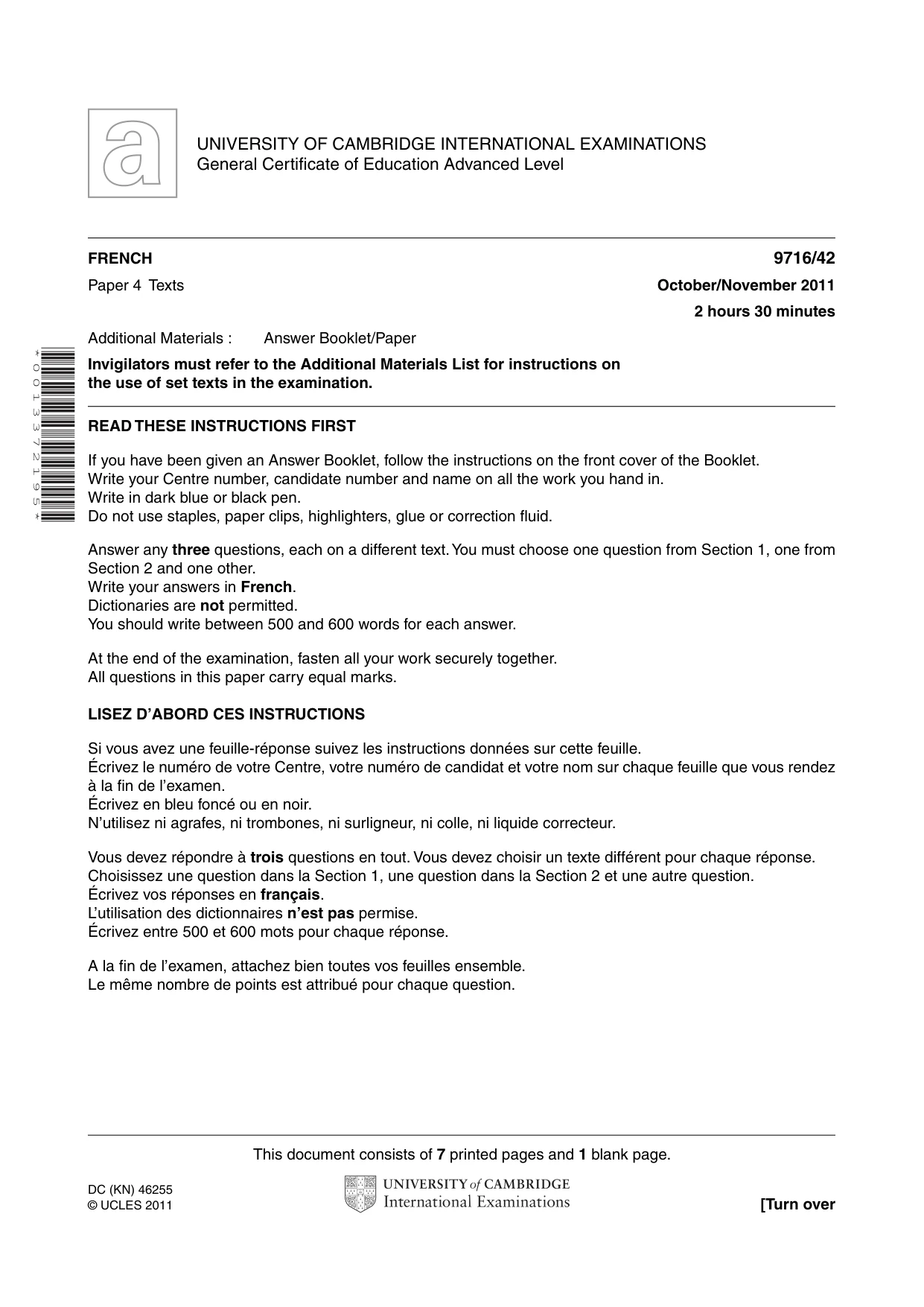
This document consists of 7 printed pages and 1 blank page. DC (KN) 46255 © UCLES 2011 [Turn over UNIVERSITY OF CAMBRIDGE INTERNATIONAL EXAMINATIONS General Certificate of Education Advanced Level * 0 0 1 3 3 7 2 1 9 5 * FRENCH 9716/42 Paper 4 Texts October/November 2011 2 hours 30 minutes Additional Materials : Answer Booklet/Paper Invigilators must refer to the Additional Materials List for instructions on the use of set texts in the examination. READ THESE INSTRUCTIONS FIRST If you have been given an Answer Booklet, follow the instructions on the front cover of the Booklet. Write your Centre number, candidate number and name on all the work you hand in. Write in dark blue or black pen. Do not use staples, paper clips, highlighters, glue or correction fluid. Answer any three questions, each on a different text. You must choose one question from Section 1, one from Section 2 and one other. Write your answers in French. Dictionaries are not permitted. You should write between 500 and 600 words for each answer. At the end of the examination, fasten all your work securely together. All questions in this paper carry equal marks. LISEZ D’ABORD CES INSTRUCTIONS Si vous avez une feuille-réponse suivez les instructions données sur cette feuille. Écrivez le numéro de votre Centre, votre numéro de candidat et votre nom sur chaque feuille que vous rendez à la fin de l’examen. Écrivez en bleu foncé ou en noir. N’utilisez ni agrafes, ni trombones, ni surligneur, ni colle, ni liquide correcteur. Vous devez répondre à trois questions en tout. Vous devez choisir un texte différent pour chaque réponse. Choisissez une question dans la Section 1, une question dans la Section 2 et une autre question. Écrivez vos réponses en français. L’utilisation des dictionnaires n’est pas permise. Écrivez entre 500 et 600 mots pour chaque réponse. A la fin de l’examen, attachez bien toutes vos feuilles ensemble. Le même nombre de points est attribué pour chaque question.
Question paper, page 2
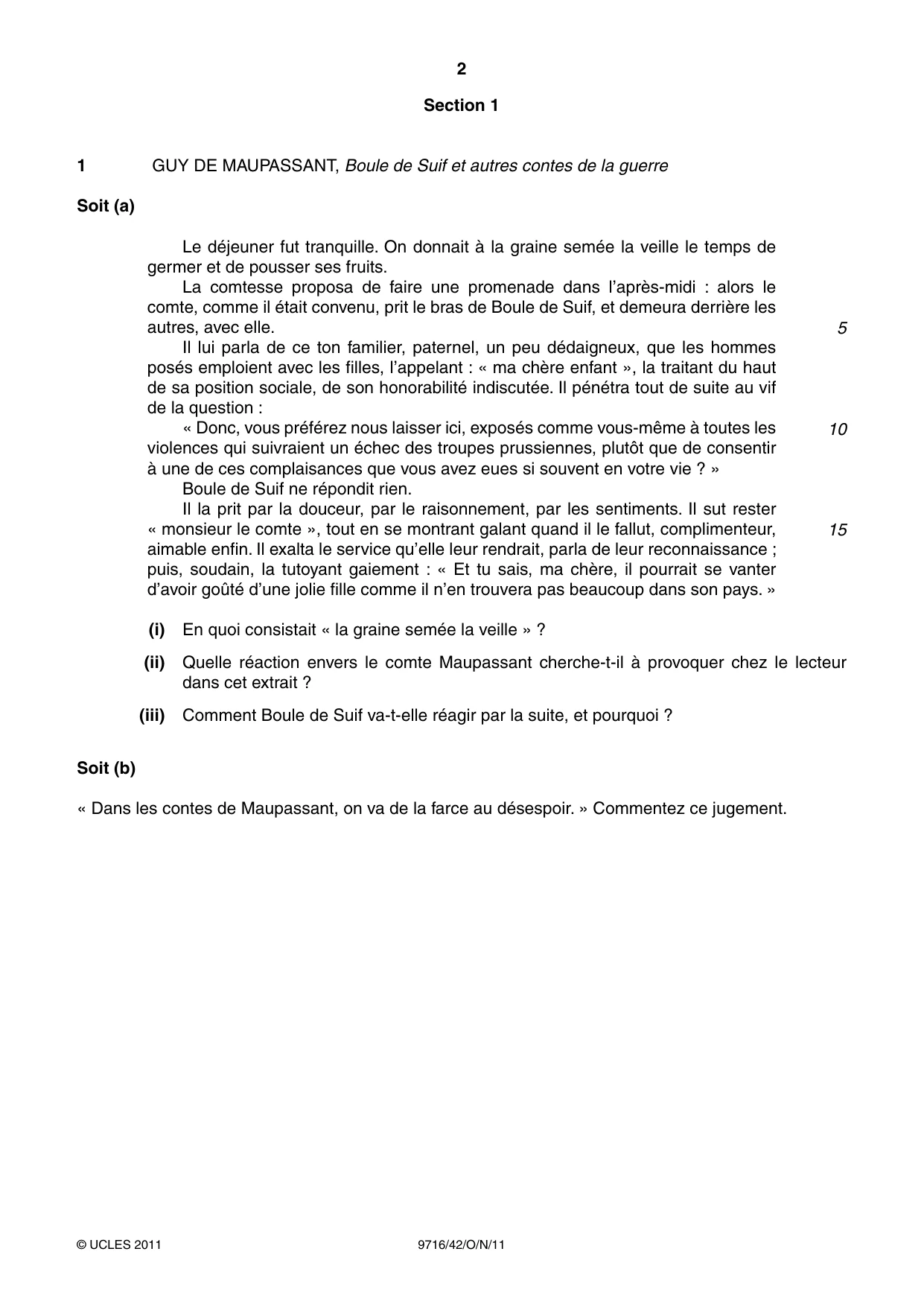
2 9716/42/O/N/11 © UCLES 2011 Section 1 1 GUY DE MAUPASSANT, Boule de Suif et autres contes de la guerre Soit (a) Le déjeuner fut tranquille. On donnait à la graine semée la veille le temps de germer et de pousser ses fruits. La comtesse proposa de faire une promenade dans l’après-midi : alors le comte, comme il était convenu, prit le bras de Boule de Suif, et demeura derrière les autres, avec elle. Il lui parla de ce ton familier, paternel, un peu dédaigneux, que les hommes posés emploient avec les filles, l’appelant : « ma chère enfant », la traitant du haut de sa position sociale, de son honorabilité indiscutée. Il pénétra tout de suite au vif de la question : « Donc, vous préférez nous laisser ici, exposés comme vous-même à toutes les violences qui suivraient un échec des troupes prussiennes, plutôt que de consentir à une de ces complaisances que vous avez eues si souvent en votre vie ? » Boule de Suif ne répondit rien. Il la prit par la douceur, par le raisonnement, par les sentiments. Il sut rester « monsieur le comte », tout en se montrant galant quand il le fallut, complimenteur, aimable enfin. Il exalta le service qu’elle leur rendrait, parla de leur reconnaissance ; puis, soudain, la tutoyant gaiement : « Et tu sais, ma chère, il pourrait se vanter d’avoir goûté d’une jolie fille comme il n’en trouvera pas beaucoup dans son pays. » (i) En quoi consistait « la graine semée la veille » ? (ii) Quelle réaction envers le comte Maupassant cherche-t-il à provoquer chez le lecteur dans cet extrait ? (iii) Comment Boule de Suif va-t-elle réagir par la suite, et pourquoi ? Soit (b) « Dans les contes de Maupassant, on va de la farce au désespoir. » Commentez ce jugement. 5 10 15
Question paper, page 3
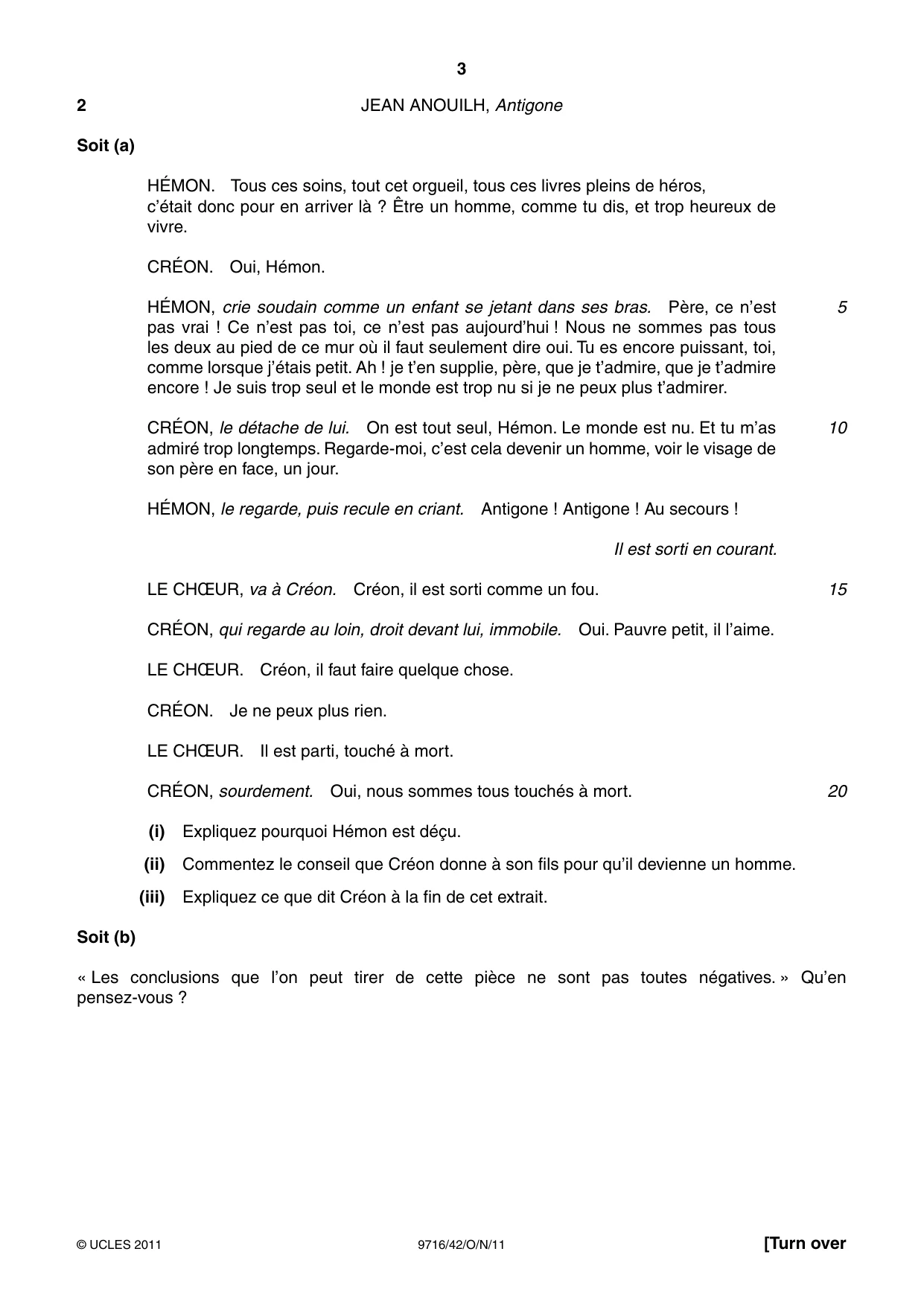
3 9716/42/O/N/11 © UCLES 2011 [Turn over 2 JEAN ANOUILH, Antigone Soit (a) HÉMON. Tous ces soins, tout cet orgueil, tous ces livres pleins de héros, c’était donc pour en arriver là ? Être un homme, comme tu dis, et trop heureux de vivre. CRÉON. Oui, Hémon. HÉMON, crie soudain comme un enfant se jetant dans ses bras. Père, ce n’est pas vrai ! Ce n’est pas toi, ce n’est pas aujourd’hui ! Nous ne sommes pas tous les deux au pied de ce mur où il faut seulement dire oui. Tu es encore puissant, toi, comme lorsque j’étais petit. Ah ! je t’en supplie, père, que je t’admire, que je t’admire encore ! Je suis trop seul et le monde est trop nu si je ne peux plus t’admirer. CRÉON, le détache de lui. On est tout seul, Hémon. Le monde est nu. Et tu m’as admiré trop longtemps. Regarde-moi, c’est cela devenir un homme, voir le visage de son père en face, un jour. HÉMON, le regarde, puis recule en criant. Antigone ! Antigone ! Au secours ! Il est sorti en courant. LE CHŒUR, va à Créon. Créon, il est sorti comme un fou. CRÉON, qui regarde au loin, droit devant lui, immobile. Oui. Pauvre petit, il l’aime. LE CHŒUR. Créon, il faut faire quelque chose. CRÉON. Je ne peux plus rien. LE CHŒUR. Il est parti, touché à mort. CRÉON, sourdement. Oui, nous sommes tous touchés à mort. (i) Expliquez pourquoi Hémon est déçu. (ii) Commentez le conseil que Créon donne à son fils pour qu’il devienne un homme. (iii) Expliquez ce que dit Créon à la fin de cet extrait. Soit (b) « Les conclusions que l’on peut tirer de cette pièce ne sont pas toutes négatives. » Qu’en pensez-vous ? 5 10 15 20
Question paper, page 4
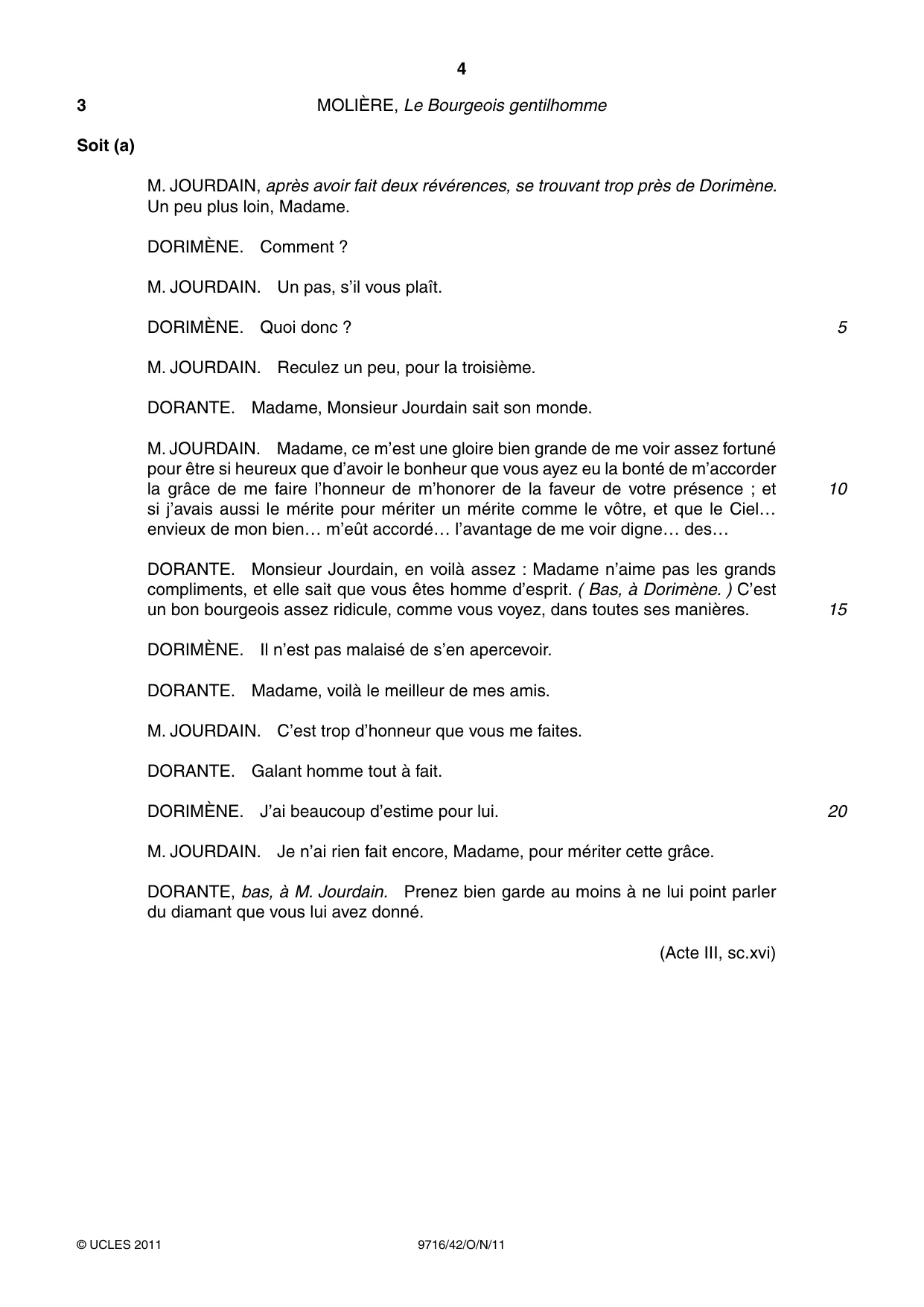
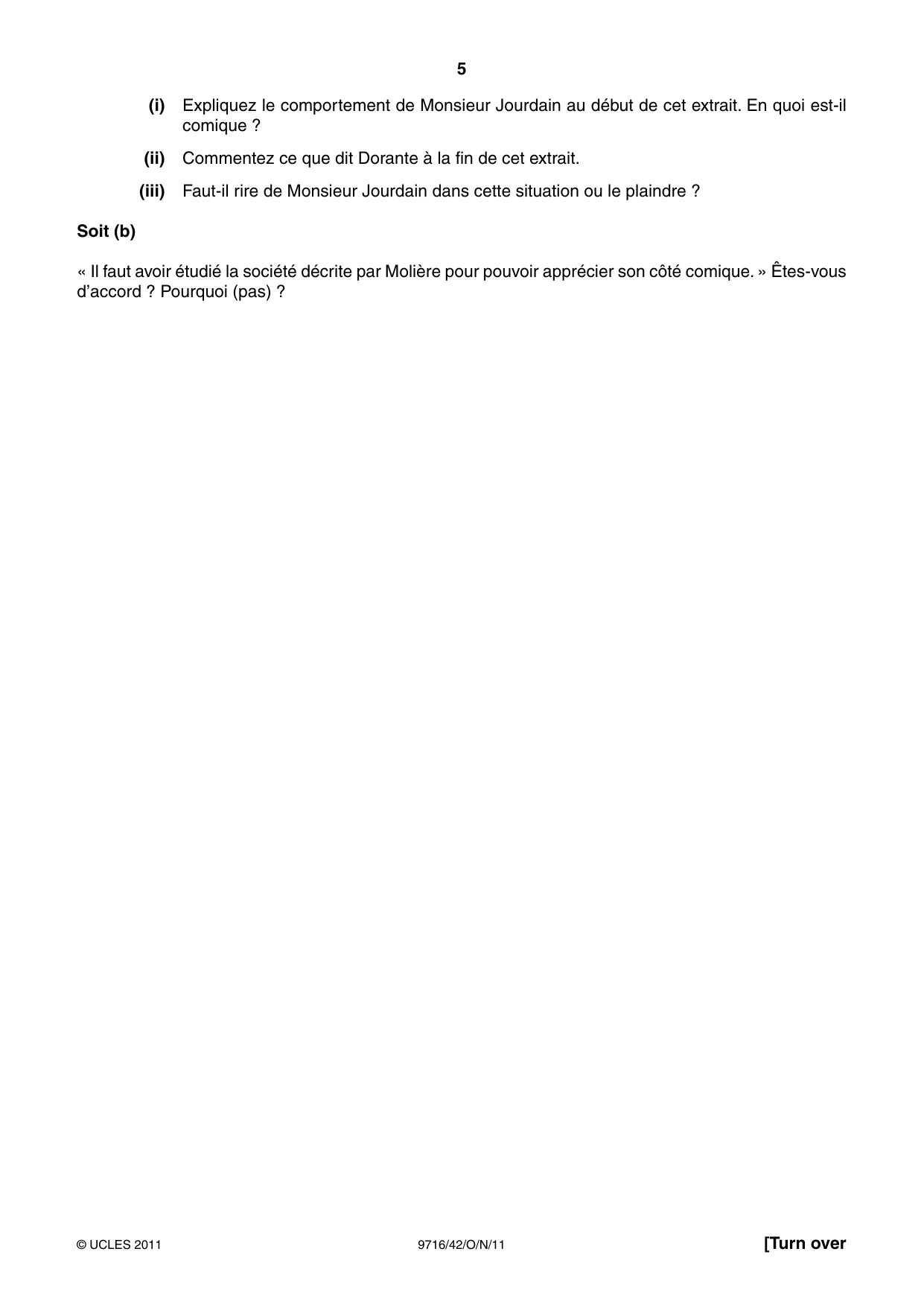
4 9716/42/O/N/11 © UCLES 2011 3 MOLIÈRE, Le Bourgeois gentilhomme Soit (a) M. JOURDAIN, après avoir fait deux révérences, se trouvant trop près de Dorimène. Un peu plus loin, Madame. DORIMÈNE. Comment ? M. JOURDAIN. Un pas, s’il vous plaît. DORIMÈNE. Quoi donc ? M. JOURDAIN. Reculez un peu, pour la troisième. DORANTE. Madame, Monsieur Jourdain sait son monde. M. JOURDAIN. Madame, ce m’est une gloire bien grande de me voir assez fortuné pour être si heureux que d’avoir le bonheur que vous ayez eu la bonté de m’accorder la grâce de me faire l’honneur de m’honorer de la faveur de votre présence ; et si j’avais aussi le mérite pour mériter un mérite comme le vôtre, et que le Ciel… envieux de mon bien… m’eût accordé… l’avantage de me voir digne… des… DORANTE. Monsieur Jourdain, en voilà assez : Madame n’aime pas les grands compliments, et elle sait que vous êtes homme d’esprit. ( Bas, à Dorimène. ) C’est un bon bourgeois assez ridicule, comme vous voyez, dans toutes ses manières. DORIMÈNE. Il n’est pas malaisé de s’en apercevoir. DORANTE. Madame, voilà le meilleur de mes amis. M. JOURDAIN. C’est trop d’honneur que vous me faites. DORANTE. Galant homme tout à fait. DORIMÈNE. J’ai beaucoup d’estime pour lui. M. JOURDAIN. Je n’ai rien fait encore, Madame, pour mériter cette grâce. DORANTE, bas, à M. Jourdain. Prenez bien garde au moins à ne lui point parler du diamant que vous lui avez donné. (Acte III, sc.xvi) 5 10 15 20
Question paper, page 5
5 9716/42/O/N/11 © UCLES 2011 [Turn over (i) Expliquez le comportement de Monsieur Jourdain au début de cet extrait. En quoi est-il comique ? (ii) Commentez ce que dit Dorante à la fin de cet extrait. (iii) Faut-il rire de Monsieur Jourdain dans cette situation ou le plaindre ? Soit (b) « Il faut avoir étudié la société décrite par Molière pour pouvoir apprécier son côté comique. » Êtes-vous d’accord ? Pourquoi (pas) ?
Question paper, page 6
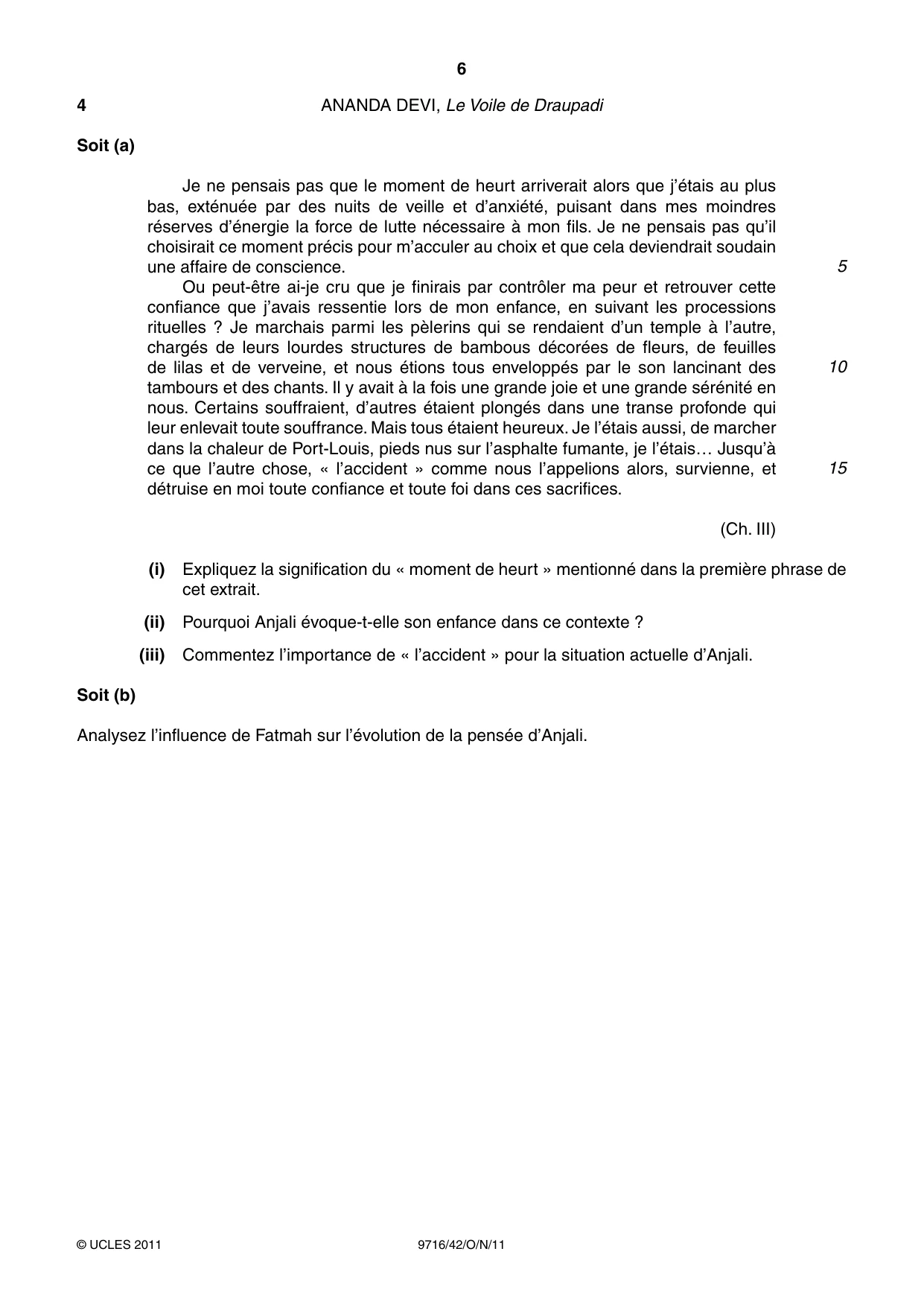
6 9716/42/O/N/11 © UCLES 2011 4 ANANDA DEVI, Le Voile de Draupadi Soit (a) Je ne pensais pas que le moment de heurt arriverait alors que j’étais au plus bas, exténuée par des nuits de veille et d’anxiété, puisant dans mes moindres réserves d’énergie la force de lutte nécessaire à mon fils. Je ne pensais pas qu’il choisirait ce moment précis pour m’acculer au choix et que cela deviendrait soudain une affaire de conscience. Ou peut-être ai-je cru que je finirais par contrôler ma peur et retrouver cette confiance que j’avais ressentie lors de mon enfance, en suivant les processions rituelles ? Je marchais parmi les pèlerins qui se rendaient d’un temple à l’autre, chargés de leurs lourdes structures de bambous décorées de fleurs, de feuilles de lilas et de verveine, et nous étions tous enveloppés par le son lancinant des tambours et des chants. Il y avait à la fois une grande joie et une grande sérénité en nous. Certains souffraient, d’autres étaient plongés dans une transe profonde qui leur enlevait toute souffrance. Mais tous étaient heureux. Je l’étais aussi, de marcher dans la chaleur de Port-Louis, pieds nus sur l’asphalte fumante, je l’étais… Jusqu’à ce que l’autre chose, « l’accident » comme nous l’appelions alors, survienne, et détruise en moi toute confiance et toute foi dans ces sacrifices. (Ch. III) (i) Expliquez la signification du « moment de heurt » mentionné dans la première phrase de cet extrait. (ii) Pourquoi Anjali évoque-t-elle son enfance dans ce contexte ? (iii) Commentez l’importance de « l’accident » pour la situation actuelle d’Anjali. Soit (b) Analysez l’influence de Fatmah sur l’évolution de la pensée d’Anjali. 5 10 15
Question paper, page 7
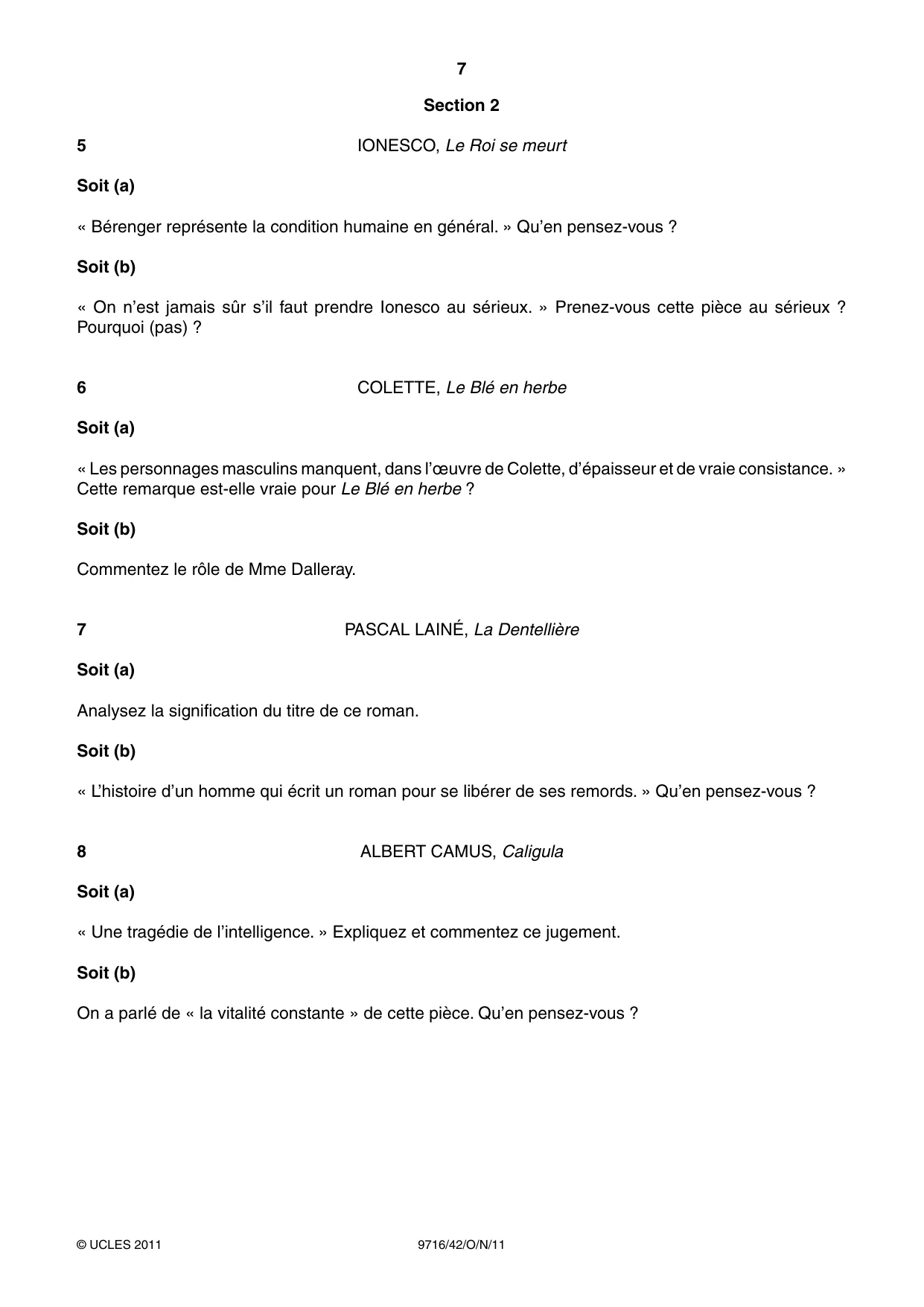
7 9716/42/O/N/11 © UCLES 2011 Section 2 5 IONESCO, Le Roi se meurt Soit (a) « Bérenger représente la condition humaine en général. » Qu’en pensez-vous ? Soit (b) « On n’est jamais sûr s’il faut prendre Ionesco au sérieux. » Prenez-vous cette pièce au sérieux ? Pourquoi (pas) ? 6 COLETTE, Le Blé en herbe Soit (a) « Les personnages masculins manquent, dans l’œuvre de Colette, d’épaisseur et de vraie consistance. » Cette remarque est-elle vraie pour Le Blé en herbe ? Soit (b) Commentez le rôle de Mme Dalleray. 7 PASCAL LAINÉ, La Dentellière Soit (a) Analysez la signification du titre de ce roman. Soit (b) « L’histoire d’un homme qui écrit un roman pour se libérer de ses remords. » Qu’en pensez-vous ? 8 ALBERT CAMUS, Caligula Soit (a) « Une tragédie de l’intelligence. » Expliquez et commentez ce jugement. Soit (b) On a parlé de « la vitalité constante » de cette pièce. Qu’en pensez-vous ?
Question paper, page 8
8 9716/42/O/N/11 © UCLES 2011 BLANK PAGE Copyright Acknowledgements: Question 2 © Jean Anouilh; Antigone; Harrap; 1954. Question 4 © Ananda Devi; Le Voile de Draupadi ; Éditions L’Harmattan; 1993. Permission to reproduce items where third-party owned material protected by copyright is included has been sought and cleared where possible. Every reasonable effort has been made by the publisher (UCLES) to trace copyright holders, but if any items requiring clearance have unwittingly been included, the publisher will be pleased to make amends at the earliest possible opportunity. University of Cambridge International Examinations is part of the Cambridge Assessment Group. Cambridge Assessment is the brand name of University of Cambridge Local Examinations Syndicate (UCLES), which is itself a department of the University of Cambridge.
Mark scheme, page 1
UNIVERSITY OF CAMBRIDGE INTERNATIONAL EXAMINATIONS GCE Advanced Level MARK SCHEME for the October/November 2011 question paper for the guidance of teachers 9716 FRENCH 9716/42 Paper 4 (Texts), maximum raw mark 75 This mark scheme is published as an aid to teachers and candidates, to indicate the requirements of the examination. It shows the basis on which Examiners were instructed to award marks. It does not indicate the details of the discussions that took place at an Examiners’ meeting before marking began, which would have considered the acceptability of alternative answers. Mark schemes must be read in conjunction with the question papers and the report on the examination. • Cambridge will not enter into discussions or correspondence in connection with these mark schemes. Cambridge is publishing the mark schemes for the October/November 2011 question papers for most IGCSE, GCE Advanced Level and Advanced Subsidiary Level syllabuses and some Ordinary Level syllabuses.
Mark scheme, page 2
Page 2 Mark Scheme: Teachers’ version Syllabus Paper GCE A LEVEL – October/November 2011 9716 42 © University of Cambridge International Examinations 2011 Candidates will write their answers in the target language. Examiners will look for a candidate’s ability to communicate effectively and will ignore those linguistic errors which do not impede communication. Passage based questions: Examiners should consider the extent to which candidates have been able to identify the significant issues raised in the passage and, where appropriate, have applied these to the text as a whole. The passage is a stimulus passage, to be used as a springboard to give candidates a starting point for their answer. Examiners should allow candidates to use the passage as they choose, and ask themselves how successfully the candidates have manipulated their material and to what extent they have shown depth of awareness and knowledge of the workings of the text under discussion. This is not an exercise in literary criticism: Examiners should reward candidates whose answers show good understanding of how a text works and how an author has conveyed the key issues. Essay questions: a prime consideration is that candidates show detailed knowledge and understanding of the text. Extracts from Examiners’ Notes This paper is intended to test candidates’ knowledge of a text and their ability to use this knowledge to answer questions in a clear and focused manner. A sophisticated literary approach is not expected (though at the highest levels it is sometimes seen), but great value is placed on evidence of a firsthand response and thoughtful, personal evaluation of what candidates have read. Candidates may have been encouraged to depend closely on prepared notes and quotations: quotation for its own sake is not useful, though it will not be undervalued if used appropriately to illustrate a point in the answer. Candidates do not tend to show all the qualities or faults described in any one mark-band. Examiners attempt to weigh all these up at every borderline, in order to see whether the work can be considered for the category above. At the lower levels, the answer may mention a few ‘facts’ but these may be so poorly understood, badly organised and irrelevant that it falls into category 10–11; or there may be just enough sense of understanding and focus for the Examiner to consider the 12–13 band. Again, at a higher level, an answer may be clear, solid and conscientious (perhaps 18–19), without showing quite the control and attention to perceptively chosen detail which would justify 20 or more. Examiners take a positive and flexible approach and, even when there are obvious flaws in an answer, reward evidence of knowledge and especially any signs of understanding and careful organisation.
Mark scheme, page 3
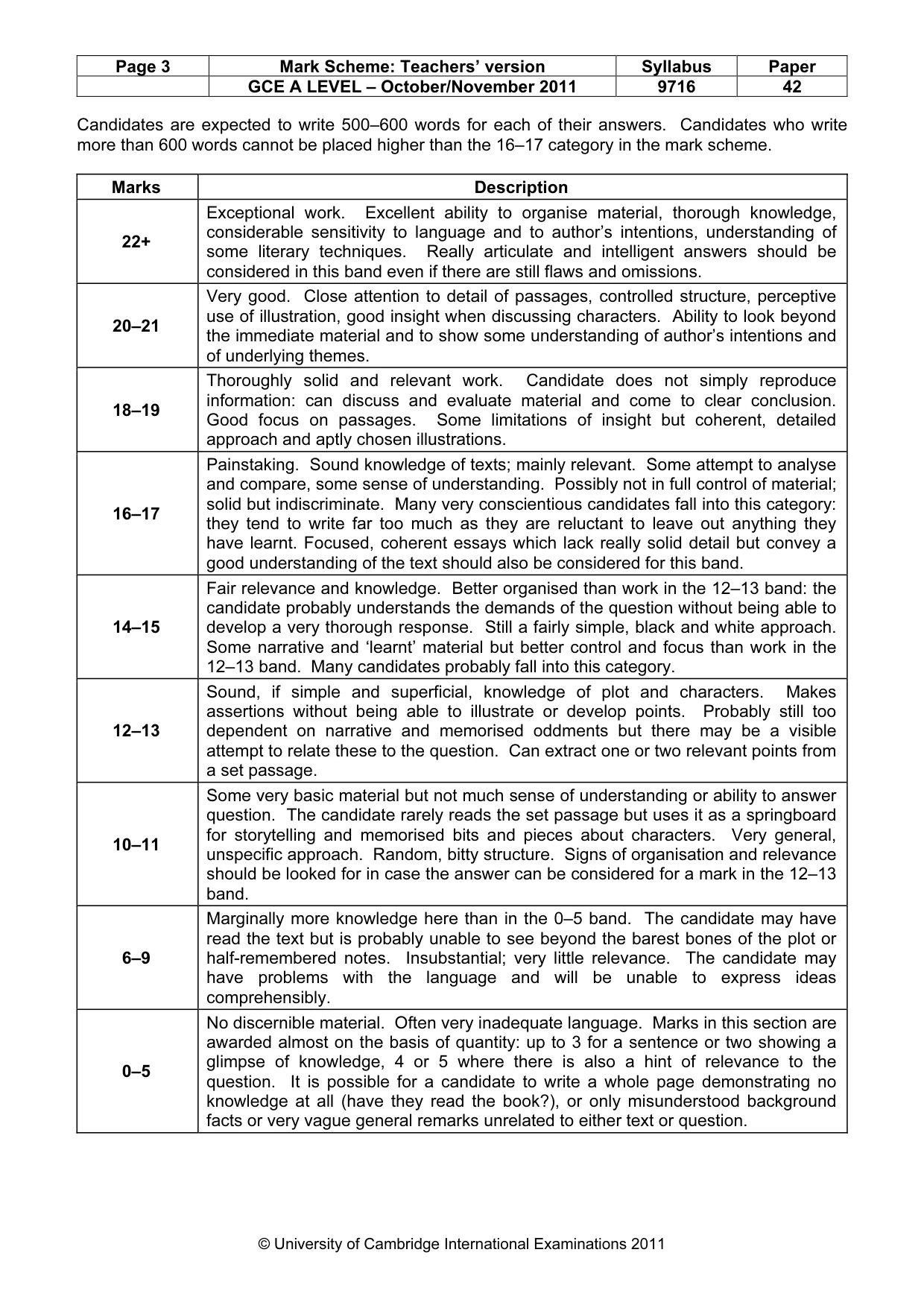
Page 3 Mark Scheme: Teachers’ version Syllabus Paper GCE A LEVEL – October/November 2011 9716 42 © University of Cambridge International Examinations 2011 Candidates are expected to write 500–600 words for each of their answers. Candidates who write more than 600 words cannot be placed higher than the 16–17 category in the mark scheme. Marks Description 22+ Exceptional work. Excellent ability to organise material, thorough knowledge, considerable sensitivity to language and to author’s intentions, understanding of some literary techniques. Really articulate and intelligent answers should be considered in this band even if there are still flaws and omissions. 20–21 Very good. Close attention to detail of passages, controlled structure, perceptive use of illustration, good insight when discussing characters. Ability to look beyond the immediate material and to show some understanding of author’s intentions and of underlying themes. 18–19 Thoroughly solid and relevant work. Candidate does not simply reproduce information: can discuss and evaluate material and come to clear conclusion. Good focus on passages. Some limitations of insight but coherent, detailed approach and aptly chosen illustrations. 16–17 Painstaking. Sound knowledge of texts; mainly relevant. Some attempt to analyse and compare, some sense of understanding. Possibly not in full control of material; solid but indiscriminate. Many very conscientious candidates fall into this category: they tend to write far too much as they are reluctant to leave out anything they have learnt. Focused, coherent essays which lack really solid detail but convey a good understanding of the text should also be considered for this band. 14–15 Fair relevance and knowledge. Better organised than work in the 12–13 band: the candidate probably understands the demands of the question without being able to develop a very thorough response. Still a fairly simple, black and white approach. Some narrative and ‘learnt’ material but better control and focus than work in the 12–13 band. Many candidates probably fall into this category. 12–13 Sound, if simple and superficial, knowledge of plot and characters. Makes assertions without being able to illustrate or develop points. Probably still too dependent on narrative and memorised oddments but there may be a visible attempt to relate these to the question. Can extract one or two relevant points from a set passage. 10–11 Some very basic material but not much sense of understanding or ability to answer question. The candidate rarely reads the set passage but uses it as a springboard for storytelling and memorised bits and pieces about characters. Very general, unspecific approach. Random, bitty structure. Signs of organisation and relevance should be looked for in case the answer can be considered for a mark in the 12–13 band. 6–9 Marginally more knowledge here than in the 0–5 band. The candidate may have read the text but is probably unable to see beyond the barest bones of the plot or half-remembered notes. Insubstantial; very little relevance. The candidate may have problems with the language and will be unable to express ideas comprehensibly. 0–5 No discernible material. Often very inadequate language. Marks in this section are awarded almost on the basis of quantity: up to 3 for a sentence or two showing a glimpse of knowledge, 4 or 5 where there is also a hint of relevance to the question. It is possible for a candidate to write a whole page demonstrating no knowledge at all (have they read the book?), or only misunderstood background facts or very vague general remarks unrelated to either text or question.
What you needed in this session
Cambridge’s own grade thresholds for 2011 Oct/Nov, Paper 4 · Variant 2. A higher threshold means an easier paper — the bar moves with how the cohort did.