Cambridge A Level French (A Level only) 9716 — 2023 May/June Paper 4 · Variant 2
9716/42/M/J/23 · 75 marks · ≈84 min
The question paper and its mark scheme, free to read here and free to download. This is Cambridge’s own paper, exactly as it was sat.
Question paper12 pages
Mark scheme4 pages
Answers below. Sit the paper first if you are practising.
Paper as text
Question paper, page 1
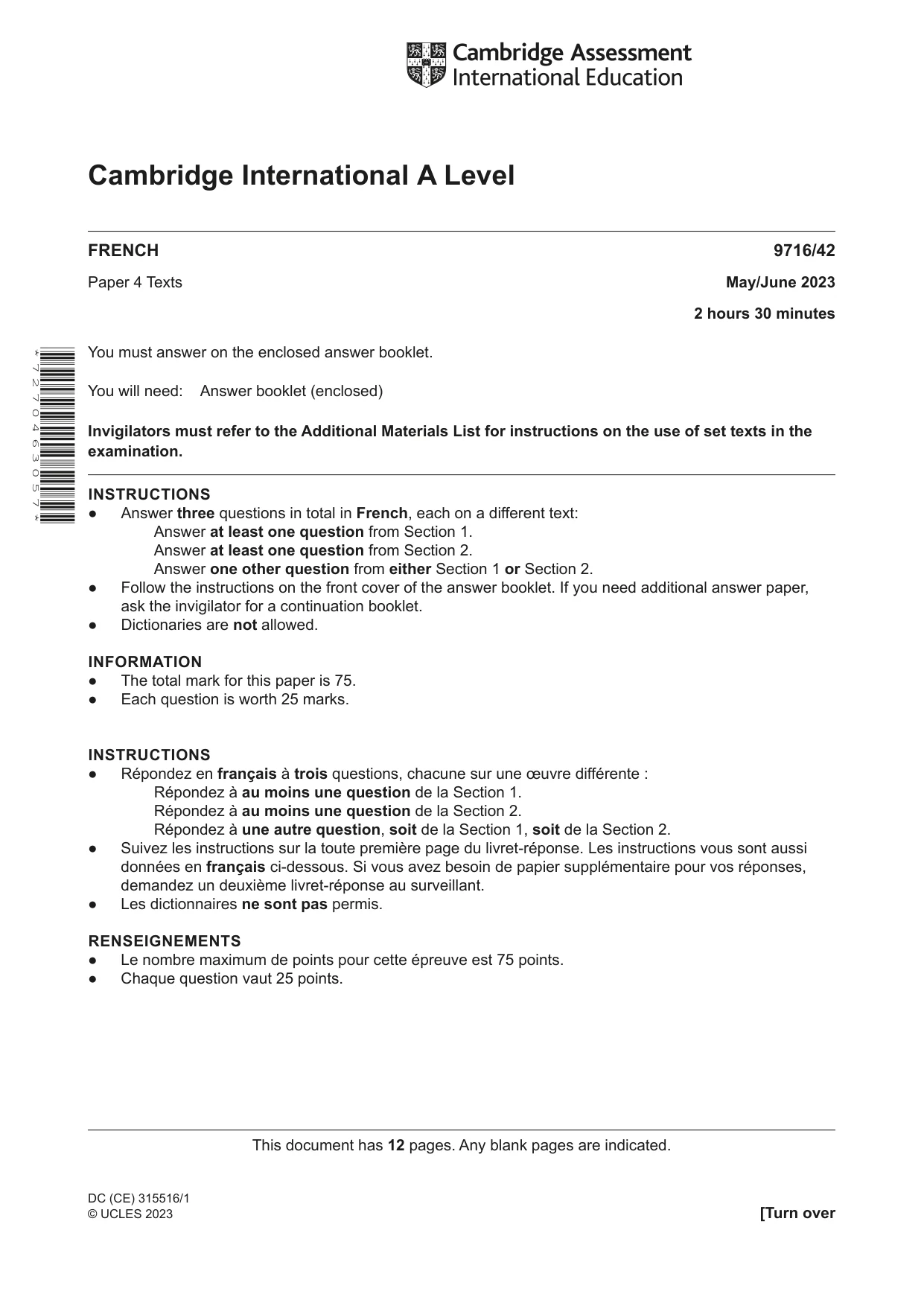
This document has 12 pages. Any blank pages are indicated. [Turn over Cambridge International A Level DC (CE) 315516/1 © UCLES 2023 FRENCH 9716/42 Paper 4 Texts May/June 2023 2 hours 30 minutes You must answer on the enclosed answer booklet. You will need: Answer booklet (enclosed) Invigilators must refer to the Additional Materials List for instructions on the use of set texts in the examination. INSTRUCTIONS ● Answer three questions in total in French, each on a different text: Answer at least one question from Section 1. Answer at least one question from Section 2. Answer one other question from either Section 1 or Section 2. ● Follow the instructions on the front cover of the answer booklet. If you need additional answer paper, ask the invigilator for a continuation booklet. ● Dictionaries are not allowed. INFORMATION ● The total mark for this paper is 75. ● Each question is worth 25 marks. INSTRUCTIONS ● Répondez en français à trois questions, chacune sur une œuvre différente : Répondez à au moins une question de la Section 1. Répondez à au moins une question de la Section 2. Répondez à une autre question, soit de la Section 1, soit de la Section 2. ● Suivez les instructions sur la toute première page du livret-réponse. Les instructions vous sont aussi données en français ci-dessous. Si vous avez besoin de papier supplémentaire pour vos réponses, demandez un deuxième livret-réponse au surveillant. ● Les dictionnaires ne sont pas permis. RENSEIGNEMENTS ● Le nombre maximum de points pour cette épreuve est 75 points. ● Chaque question vaut 25 points. * 7 2 7 0 4 6 3 0 5 7 *
Question paper, page 2
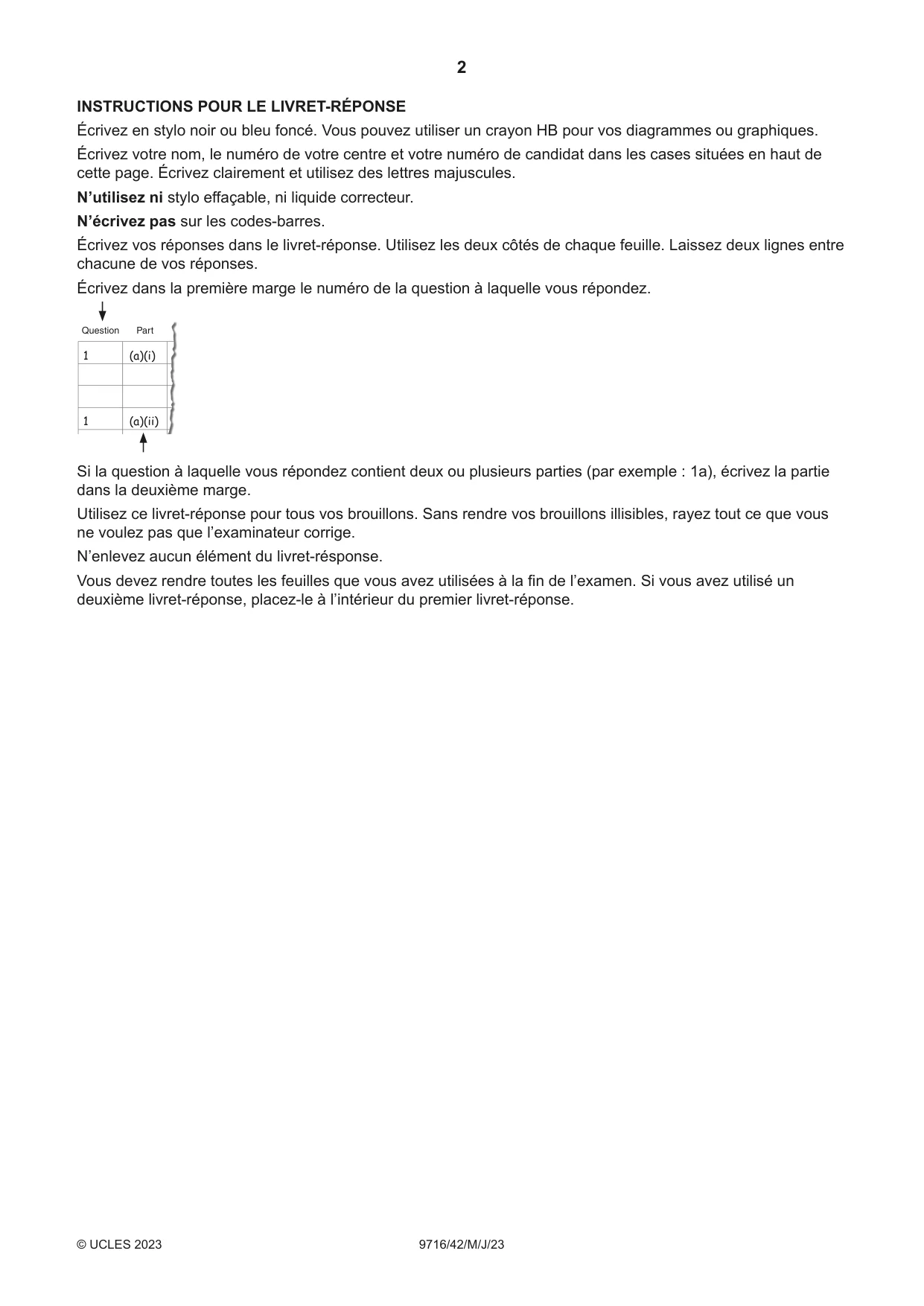
2 9716/42/ M / J /23 © UCLES 2023 INSTRUCTIONS POUR LE LIVRET-RÉPONSE Écrivez en stylo noir ou bleu foncé. Vous pouvez utiliser un crayon HB pour vos diagrammes ou graphiques. Écrivez votre nom, le numéro de votre centre et votre numéro de candidat dans les cases situées en haut de cette page. Écrivez clairement et utilisez des lettres majuscules. N’utilisez ni stylo effaçable, ni liquide correcteur. N’écrivez pas sur les codes-barres. Écrivez vos réponses dans le livret-réponse. Utilisez les deux côtés de chaque feuille. Laissez deux lignes entre chacune de vos réponses. Écrivez dans la première marge le numéro de la question à laquelle vous répondez. Question Part 1 1 (a)(i) (a)(ii) Si la question à laquelle vous répondez contient deux ou plusieurs parties (par exemple : 1a), écrivez la partie dans la deuxième marge. Utilisez ce livret-réponse pour tous vos brouillons. Sans rendre vos brouillons illisibles, rayez tout ce que vous ne voulez pas que l’examinateur corrige. N’enlevez aucun élément du livret-résponse. Vous devez rendre toutes les feuilles que vous avez utilisées à la fin de l’examen. Si vous avez utilisé un deuxième livret-réponse, placez-le à l’intérieur du premier livret-réponse.
Question paper, page 3
3 9716/42/M/J/23 © UCLES 2023 [Turn over BLANK PAGE
Question paper, page 4
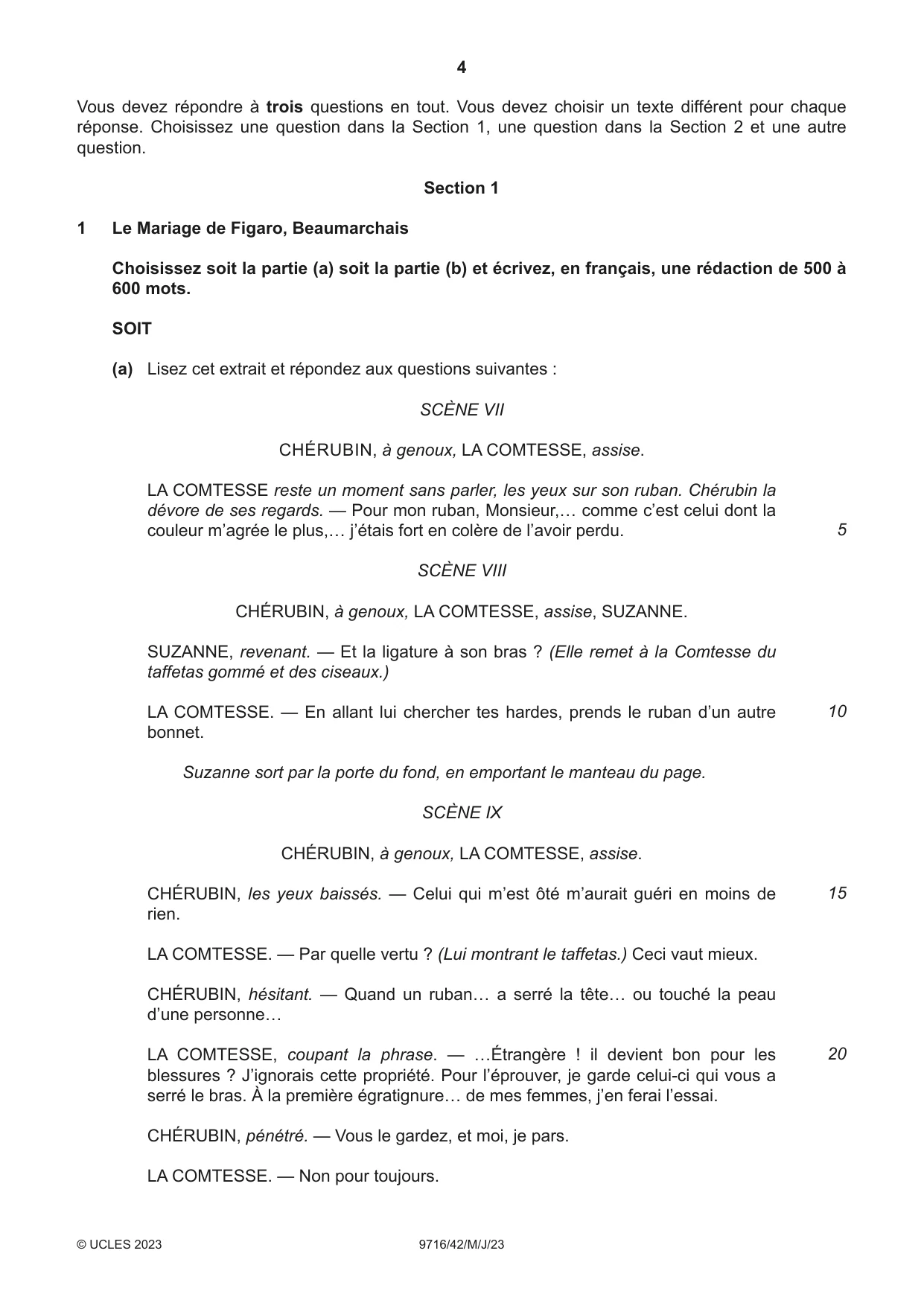
4 9716/42/M/J/23 © UCLES 2023 Vous devez répondre à trois questions en tout. Vous devez choisir un texte différent pour chaque réponse. Choisissez une question dans la Section 1, une question dans la Section 2 et une autre question. Section 1 1 Le Mariage de Figaro, Beaumarchais Choisissez soit la partie (a) soit la partie (b) et écrivez, en français, une rédaction de 500 à 600 mots. SOIT (a) Lisez cet extrait et répondez aux questions suivantes : SCÈNE VII CHÉRUBIN, à genoux, LA COMTESSE, assise. LA COMTESSE reste un moment sans parler, les yeux sur son ruban. Chérubin la dévore de ses regards. — Pour mon ruban, Monsieur,… comme c’est celui dont la couleur m’agrée le plus,… j’étais fort en colère de l’avoir perdu. SCÈNE VIII CHÉRUBIN, à genoux, LA COMTESSE, assise, SUZANNE. SUZANNE, revenant. — Et la ligature à son bras ? (Elle remet à la Comtesse du taffetas gommé et des ciseaux.) LA COMTESSE. — En allant lui chercher tes hardes, prends le ruban d’un autre bonnet. Suzanne sort par la porte du fond, en emportant le manteau du page. SCÈNE IX CHÉRUBIN, à genoux, LA COMTESSE, assise. CHÉRUBIN, les yeux baissés. — Celui qui m’est ôté m’aurait guéri en moins de rien. LA COMTESSE. — Par quelle vertu ? (Lui montrant le taffetas.) Ceci vaut mieux. CHÉRUBIN, hésitant. — Quand un ruban… a serré la tête… ou touché la peau d’une personne… LA COMTESSE, coupant la phrase. — …Étrangère ! il devient bon pour les blessures ? J’ignorais cette propriété. Pour l’éprouver, je garde celui-ci qui vous a serré le bras. À la première égratignure… de mes femmes, j’en ferai l’essai. CHÉRUBIN, pénétré. — Vous le gardez, et moi, je pars. LA COMTESSE. — Non pour toujours. 5 10 15 20
Question paper, page 5
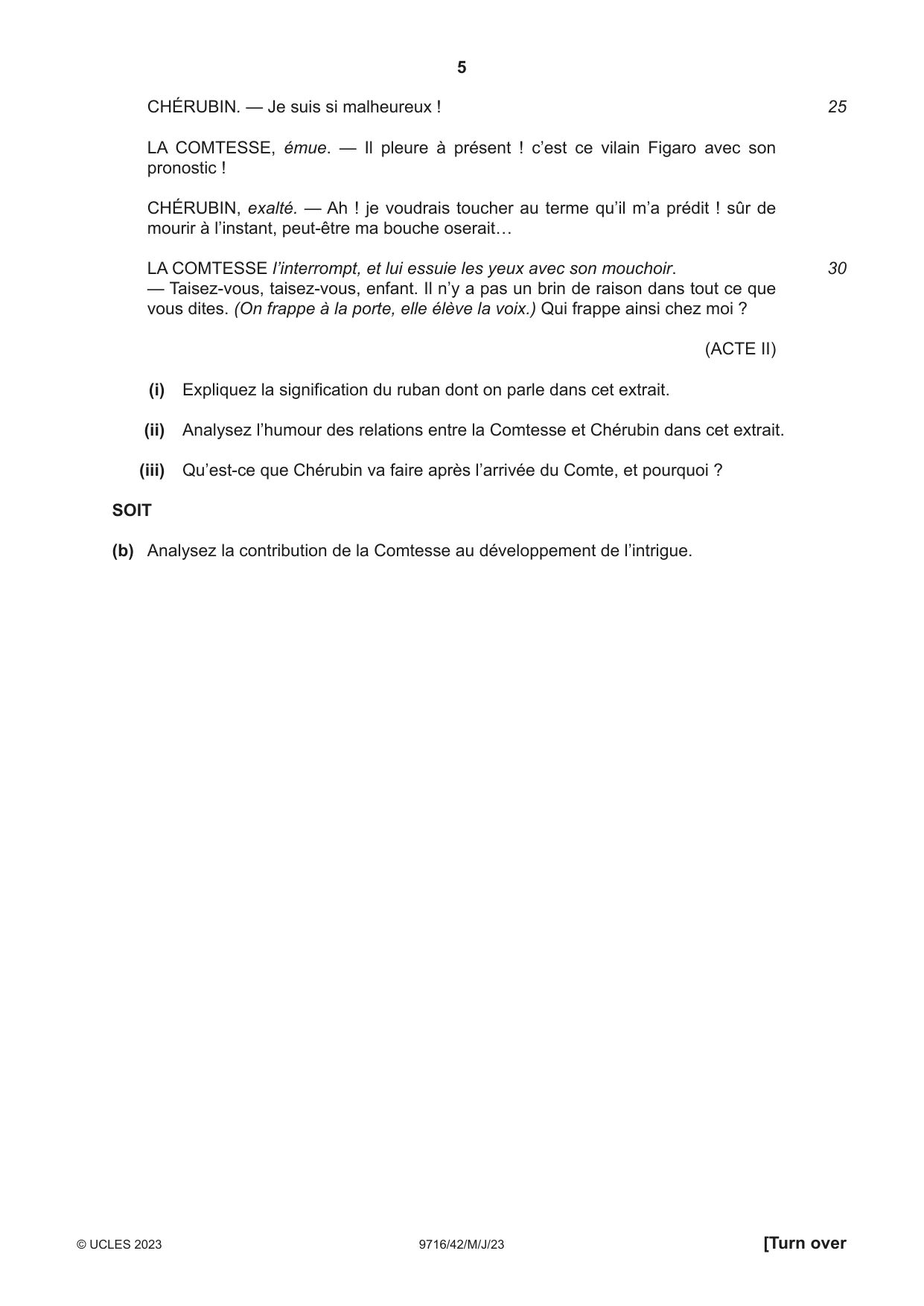
5 9716/42/M/J/23 © UCLES 2023 [Turn over CHÉRUBIN. — Je suis si malheureux ! LA COMTESSE, émue. — Il pleure à présent ! c’est ce vilain Figaro avec son pronostic ! CHÉRUBIN, exalté. — Ah ! je voudrais toucher au terme qu’il m’a prédit ! sûr de mourir à l’instant, peut-être ma bouche oserait… LA COMTESSE l’interrompt, et lui essuie les yeux avec son mouchoir. — Taisez-vous, taisez-vous, enfant. Il n’y a pas un brin de raison dans tout ce que vous dites. (On frappe à la porte, elle élève la voix.) Qui frappe ainsi chez moi ? (ACTE II) (i) Expliquez la signification du ruban dont on parle dans cet extrait. (ii) Analysez l’humour des relations entre la Comtesse et Chérubin dans cet extrait. (iii) Qu’est-ce que Chérubin va faire après l’arrivée du Comte, et pourquoi ? SOIT (b) Analysez la contribution de la Comtesse au développement de l’intrigue. 25 30
Question paper, page 6
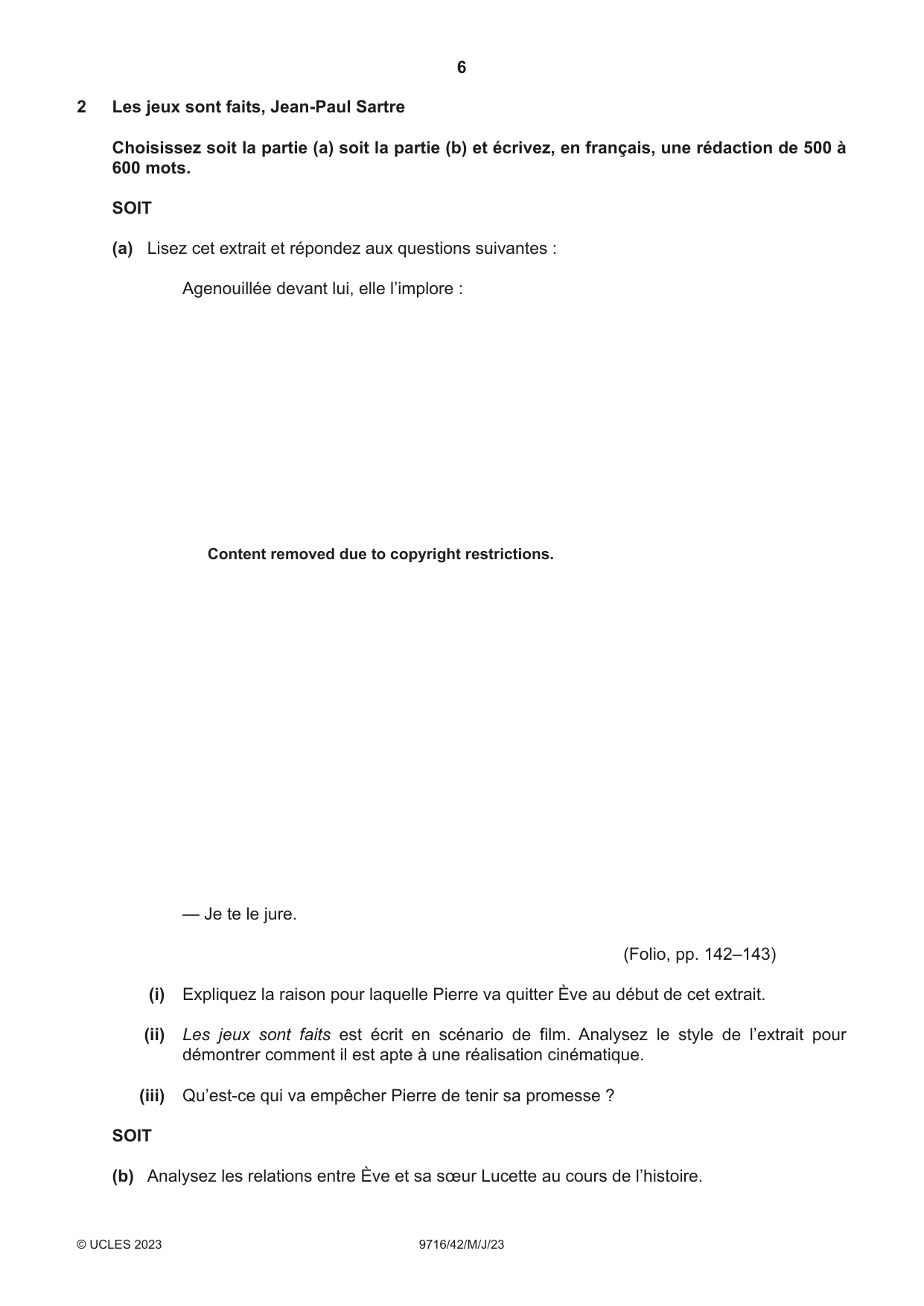
6 9716/42/M/J/23 © UCLES 2023 2 Les jeux sont faits, Jean-Paul Sartre Choisissez soit la partie (a) soit la partie (b) et écrivez, en français, une rédaction de 500 à 600 mots. SOIT (a) Lisez cet extrait et répondez aux questions suivantes : Agenouillée devant lui, elle l’implore : — Je te le jure. (Folio, pp. 142–143) (i) Expliquez la raison pour laquelle Pierre va quitter Ève au début de cet extrait. (ii) Les jeux sont faits est écrit en scénario de film. Analysez le style de l’extrait pour démontrer comment il est apte à une réalisation cinématique. (iii) Qu’est-ce qui va empêcher Pierre de tenir sa promesse ? SOIT (b) Analysez les relations entre Ève et sa sœur Lucette au cours de l’histoire. Content removed due to copyright restrictions.
Question paper, page 7
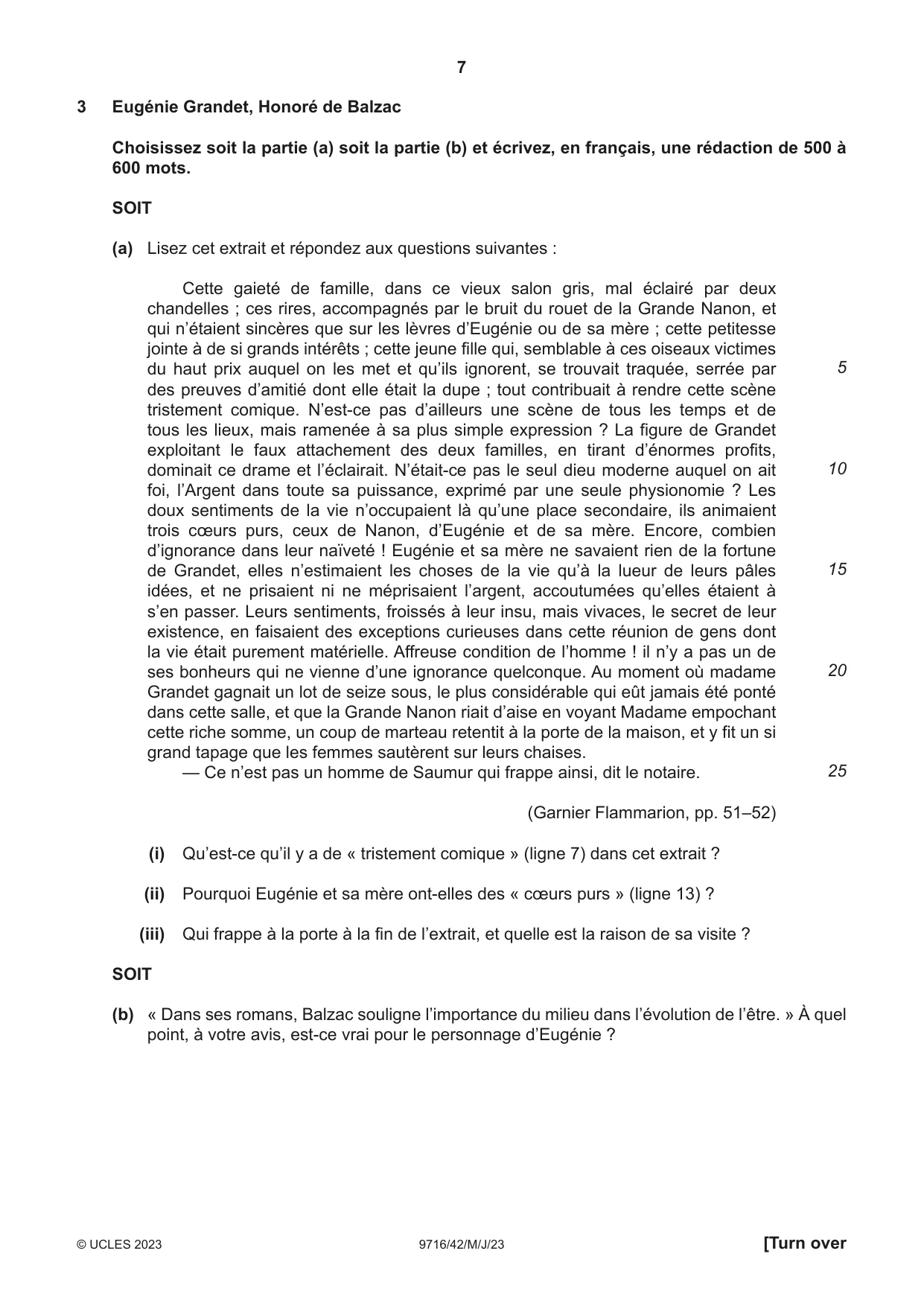
7 9716/42/M/J/23 © UCLES 2023 [Turn over 3 Eugénie Grandet, Honoré de Balzac Choisissez soit la partie (a) soit la partie (b) et écrivez, en français, une rédaction de 500 à 600 mots. SOIT (a) Lisez cet extrait et répondez aux questions suivantes : Cette gaieté de famille, dans ce vieux salon gris, mal éclairé par deux chandelles ; ces rires, accompagnés par le bruit du rouet de la Grande Nanon, et qui n’étaient sincères que sur les lèvres d’Eugénie ou de sa mère ; cette petitesse jointe à de si grands intérêts ; cette jeune fille qui, semblable à ces oiseaux victimes du haut prix auquel on les met et qu’ils ignorent, se trouvait traquée, serrée par des preuves d’amitié dont elle était la dupe ; tout contribuait à rendre cette scène tristement comique. N’est-ce pas d’ailleurs une scène de tous les temps et de tous les lieux, mais ramenée à sa plus simple expression ? La figure de Grandet exploitant le faux attachement des deux familles, en tirant d’énormes profits, dominait ce drame et l’éclairait. N’était-ce pas le seul dieu moderne auquel on ait foi, l’Argent dans toute sa puissance, exprimé par une seule physionomie ? Les doux sentiments de la vie n’occupaient là qu’une place secondaire, ils animaient trois cœurs purs, ceux de Nanon, d’Eugénie et de sa mère. Encore, combien d’ignorance dans leur naïveté ! Eugénie et sa mère ne savaient rien de la fortune de Grandet, elles n’estimaient les choses de la vie qu’à la lueur de leurs pâles idées, et ne prisaient ni ne méprisaient l’argent, accoutumées qu’elles étaient à s’en passer. Leurs sentiments, froissés à leur insu, mais vivaces, le secret de leur existence, en faisaient des exceptions curieuses dans cette réunion de gens dont la vie était purement matérielle. Affreuse condition de l’homme ! il n’y a pas un de ses bonheurs qui ne vienne d’une ignorance quelconque. Au moment où madame Grandet gagnait un lot de seize sous, le plus considérable qui eût jamais été ponté dans cette salle, et que la Grande Nanon riait d’aise en voyant Madame empochant cette riche somme, un coup de marteau retentit à la porte de la maison, et y fit un si grand tapage que les femmes sautèrent sur leurs chaises. — Ce n’est pas un homme de Saumur qui frappe ainsi, dit le notaire. (Garnier Flammarion, pp. 51–52) (i) Qu’est-ce qu’il y a de « tristement comique » (ligne 7) dans cet extrait ? (ii) Pourquoi Eugénie et sa mère ont-elles des « cœurs purs » (ligne 13) ? (iii) Qui frappe à la porte à la fin de l’extrait, et quelle est la raison de sa visite ? SOIT (b) « Dans ses romans, Balzac souligne l’importance du milieu dans l’évolution de l’être. » À quel point, à votre avis, est-ce vrai pour le personnage d’Eugénie ? 5 10 15 20 25
Question paper, page 8
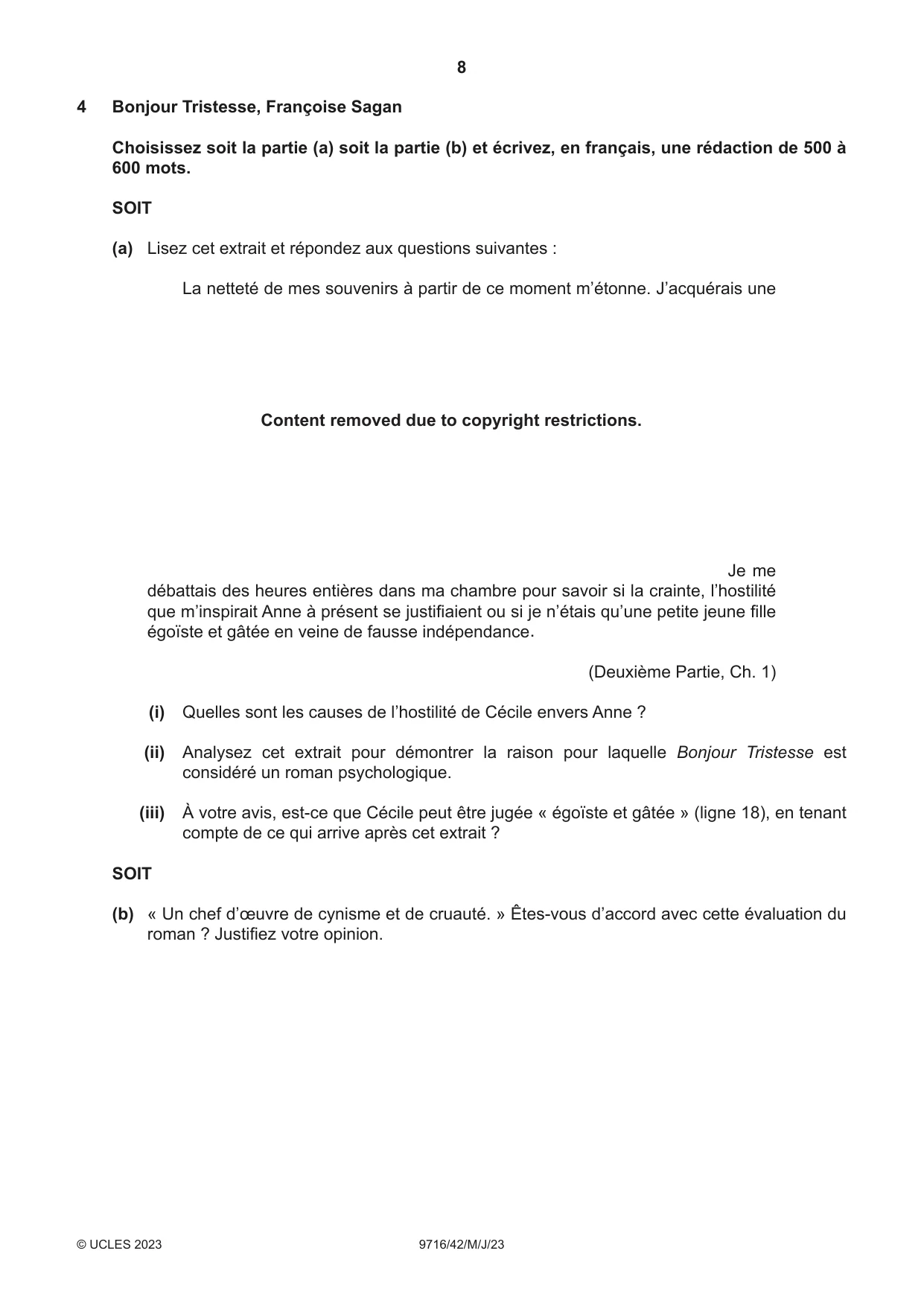
8 9716/42/M/J/23 © UCLES 2023 4 Bonjour Tristesse, Françoise Sagan Choisissez soit la partie (a) soit la partie (b) et écrivez, en français, une rédaction de 500 à 600 mots. SOIT (a) Lisez cet extrait et répondez aux questions suivantes : La netteté de mes souvenirs à partir de ce moment m’étonne. J’acquérais une Je me débattais des heures entières dans ma chambre pour savoir si la crainte, l’hostilité que m’inspirait Anne à présent se justifiaient ou si je n’étais qu’une petite jeune fille égoïste et gâtée en veine de fausse indépendance. (Deuxième Partie, Ch. 1) (i) Quelles sont les causes de l’hostilité de Cécile envers Anne ? (ii) Analysez cet extrait pour démontrer la raison pour laquelle Bonjour Tristesse est considéré un roman psychologique. (iii) À votre avis, est-ce que Cécile peut être jugée « égoïste et gâtée » (ligne 18), en tenant compte de ce qui arrive après cet extrait ? SOIT (b) « Un chef d’œuvre de cynisme et de cruauté. » Êtes-vous d’accord avec cette évaluation du roman ? Justifiez votre opinion. Content removed due to copyright restrictions.
Question paper, page 9
9 9716/42/M/J/23 © UCLES 2023 [Turn over Section 2 5 Un Secret, Philippe Grimbert Choisissez soit la partie (a) soit la partie (b) et écrivez, en français, une rédaction de 500 à 600 mots. SOIT (a) « Le roman constitue un acte de mémoire pour Simon et Hannah. » Êtes-vous d’accord ? Justifiez votre opinion. SOIT (b) À l’origine, Grimbert avait imaginé intituler son roman Le cimetière des chiens. Pourquoi, à votre avis ? 6 Petit Pays, Gaël Faye Choisissez soit la partie (a) soit la partie (b) et écrivez, en français, une rédaction de 500 à 600 mots. SOIT (a) Analysez les raisons et les conséquences de la décision de Gaby adulte de retourner au Burundi. SOIT (b) Analysez les relations entre Gaby et Mme Economopoulos au cours du livre. 7 La Maison de Claudine, Colette Choisissez soit la partie (a) soit la partie (b) et écrivez, en français, une rédaction de 500 à 600 mots. SOIT (a) Analysez le rôle de la mémoire et du passage du temps dans La Maison de Claudine. SOIT (b) Analysez les relations entre Claudine et sa mère au cours de La Maison de Claudine.
Question paper, page 10
10 9716/42/M/J/23 © UCLES 2023 8 No et moi, Delphine de Vigan Choisissez soit la partie (a) soit la partie (b) et écrivez, en français, une rédaction de 500 à 600 mots. SOIT (a) Analysez le thème de la maternité dans le roman. SOIT (b) Analysez l’importance de Lucas pour la structure du roman.
Question paper, page 11
11 9716/42/M/J/23 © UCLES 2023 BLANK PAGE
Question paper, page 12
12 9716/42/M/J/23 © UCLES 2023 Permission to reproduce items where third-party owned material protected by copyright is included has been sought and cleared where possible. Every reasonable effort has been made by the publisher (UCLES) to trace copyright holders, but if any items requiring clearance have unwittingly been included, the publisher will be pleased to make amends at the earliest possible opportunity. To avoid the issue of disclosure of answer-related information to candidates, all copyright acknowledgements are reproduced online in the Cambridge Assessment International Education Copyright Acknowledgements Booklet. This is produced for each series of examinations and is freely available to download at www.cambridgeinternational.org after the live examination series. Cambridge Assessment International Education is part of Cambridge Assessment. Cambridge Assessment is the brand name of the University of Cambridge Local Examinations Syndicate (UCLES), which is a department of the University of Cambridge. BLANK PAGE
Mark scheme, page 1
This document consists of 4 printed pages. © UCLES 2023 [Turn over Cambridge International A Level FRENCH 9716/42 Paper 4 Texts May/June 2023 MARK SCHEME Maximum Mark: 75 Published This mark scheme is published as an aid to teachers and candidates, to indicate the requirements of the examination. It shows the basis on which Examiners were instructed to award marks. It does not indicate the details of the discussions that took place at an Examiners’ meeting before marking began, which would have considered the acceptability of alternative answers. Mark schemes should be read in conjunction with the question paper and the Principal Examiner Report for Teachers. Cambridge International will not enter into discussions about these mark schemes. Cambridge International is publishing the mark schemes for the May/June 2023 series for most Cambridge IGCSE, Cambridge International A and AS Level and Cambridge Pre-U components, and some Cambridge O Level components.
Mark scheme, page 2
9716/42 Cambridge International A Level – Mark Scheme PUBLISHED May/June 2023 © UCLES 2023 Page 2 of 4 Generic Marking Principles These general marking principles must be applied by all examiners when marking candidate answers. They should be applied alongside the specific content of the mark scheme or generic level descriptors for a question. Each question paper and mark scheme will also comply with these marking principles. GENERIC MARKING PRINCIPLE 1: Marks must be awarded in line with: the specific content of the mark scheme or the generic level descriptors for the question the specific skills defined in the mark scheme or in the generic level descriptors for the question the standard of response required by a candidate as exemplified by the standardisation scripts. GENERIC MARKING PRINCIPLE 2: Marks awarded are always whole marks (not half marks, or other fractions). GENERIC MARKING PRINCIPLE 3: Marks must be awarded positively: marks are awarded for correct/valid answers, as defined in the mark scheme. However, credit is given for valid answers which go beyond the scope of the syllabus and mark scheme, referring to your Team Leader as appropriate marks are awarded when candidates clearly demonstrate what they know and can do marks are not deducted for errors marks are not deducted for omissions answers should only be judged on the quality of spelling, punctuation and grammar when these features are specifically assessed by the question as indicated by the mark scheme. The meaning, however, should be unambiguous. GENERIC MARKING PRINCIPLE 4: Rules must be applied consistently, e.g. in situations where candidates have not followed instructions or in the application of generic level descriptors. GENERIC MARKING PRINCIPLE 5: Marks should be awarded using the full range of marks defined in the mark scheme for the question (however; the use of the full mark range may be limited according to the quality of the candidate responses seen). GENERIC MARKING PRINCIPLE 6: Marks awarded are based solely on the requirements as defined in the mark scheme. Marks should not be awarded with grade thresholds or grade descriptors in mind.
Mark scheme, page 3
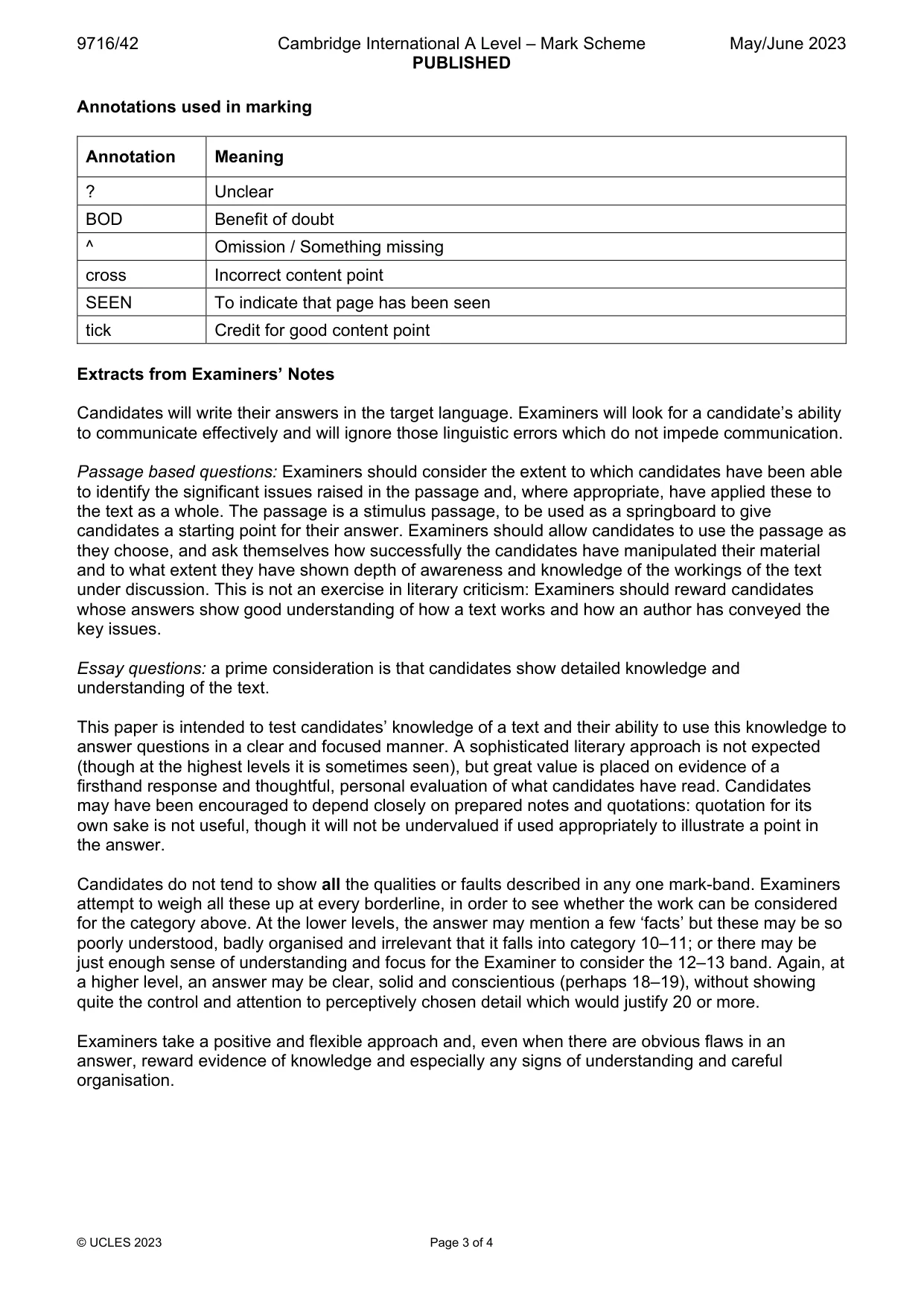
9716/42 Cambridge International A Level – Mark Scheme PUBLISHED May/June 2023 © UCLES 2023 Page 3 of 4 Annotations used in marking Annotation Meaning ? Unclear BOD Benefit of doubt ^ Omission / Something missing cross Incorrect content point SEEN To indicate that page has been seen tick Credit for good content point Extracts from Examiners’ Notes Candidates will write their answers in the target language. Examiners will look for a candidate’s ability to communicate effectively and will ignore those linguistic errors which do not impede communication. Passage based questions: Examiners should consider the extent to which candidates have been able to identify the significant issues raised in the passage and, where appropriate, have applied these to the text as a whole. The passage is a stimulus passage, to be used as a springboard to give candidates a starting point for their answer. Examiners should allow candidates to use the passage as they choose, and ask themselves how successfully the candidates have manipulated their material and to what extent they have shown depth of awareness and knowledge of the workings of the text under discussion. This is not an exercise in literary criticism: Examiners should reward candidates whose answers show good understanding of how a text works and how an author has conveyed the key issues. Essay questions: a prime consideration is that candidates show detailed knowledge and understanding of the text. This paper is intended to test candidates’ knowledge of a text and their ability to use this knowledge to answer questions in a clear and focused manner. A sophisticated literary approach is not expected (though at the highest levels it is sometimes seen), but great value is placed on evidence of a firsthand response and thoughtful, personal evaluation of what candidates have read. Candidates may have been encouraged to depend closely on prepared notes and quotations: quotation for its own sake is not useful, though it will not be undervalued if used appropriately to illustrate a point in the answer. Candidates do not tend to show all the qualities or faults described in any one mark-band. Examiners attempt to weigh all these up at every borderline, in order to see whether the work can be considered for the category above. At the lower levels, the answer may mention a few ‘facts’ but these may be so poorly understood, badly organised and irrelevant that it falls into category 10–11; or there may be just enough sense of understanding and focus for the Examiner to consider the 12–13 band. Again, at a higher level, an answer may be clear, solid and conscientious (perhaps 18–19), without showing quite the control and attention to perceptively chosen detail which would justify 20 or more. Examiners take a positive and flexible approach and, even when there are obvious flaws in an answer, reward evidence of knowledge and especially any signs of understanding and careful organisation.
Mark scheme, page 4
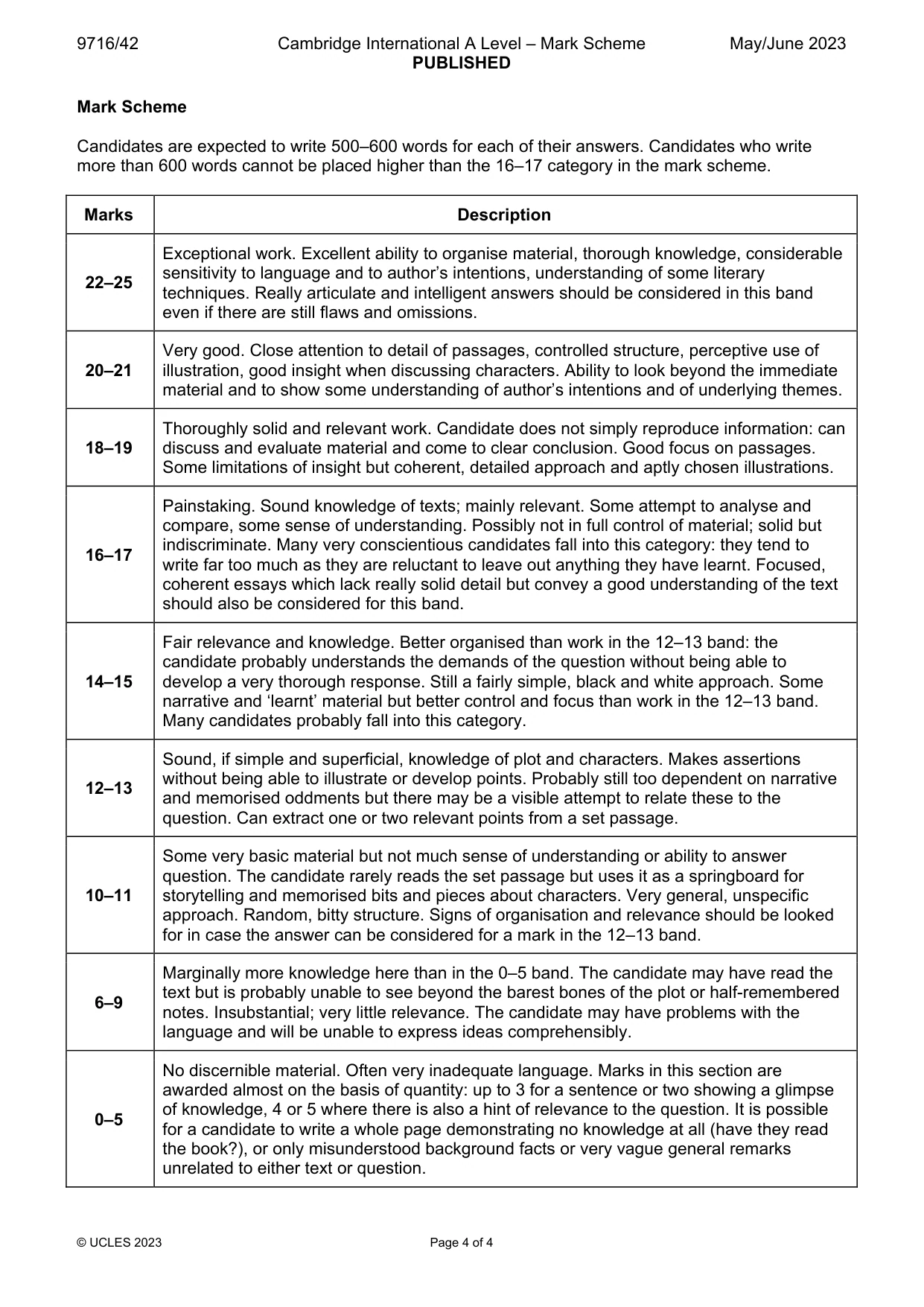
9716/42 Cambridge International A Level – Mark Scheme PUBLISHED May/June 2023 © UCLES 2023 Page 4 of 4 Mark Scheme Candidates are expected to write 500–600 words for each of their answers. Candidates who write more than 600 words cannot be placed higher than the 16–17 category in the mark scheme. Marks Description 22–25 Exceptional work. Excellent ability to organise material, thorough knowledge, considerable sensitivity to language and to author’s intentions, understanding of some literary techniques. Really articulate and intelligent answers should be considered in this band even if there are still flaws and omissions. 20–21 Very good. Close attention to detail of passages, controlled structure, perceptive use of illustration, good insight when discussing characters. Ability to look beyond the immediate material and to show some understanding of author’s intentions and of underlying themes. 18–19 Thoroughly solid and relevant work. Candidate does not simply reproduce information: can discuss and evaluate material and come to clear conclusion. Good focus on passages. Some limitations of insight but coherent, detailed approach and aptly chosen illustrations. 16–17 Painstaking. Sound knowledge of texts; mainly relevant. Some attempt to analyse and compare, some sense of understanding. Possibly not in full control of material; solid but indiscriminate. Many very conscientious candidates fall into this category: they tend to write far too much as they are reluctant to leave out anything they have learnt. Focused, coherent essays which lack really solid detail but convey a good understanding of the text should also be considered for this band. 14–15 Fair relevance and knowledge. Better organised than work in the 12–13 band: the candidate probably understands the demands of the question without being able to develop a very thorough response. Still a fairly simple, black and white approach. Some narrative and ‘learnt’ material but better control and focus than work in the 12–13 band. Many candidates probably fall into this category. 12–13 Sound, if simple and superficial, knowledge of plot and characters. Makes assertions without being able to illustrate or develop points. Probably still too dependent on narrative and memorised oddments but there may be a visible attempt to relate these to the question. Can extract one or two relevant points from a set passage. 10–11 Some very basic material but not much sense of understanding or ability to answer question. The candidate rarely reads the set passage but uses it as a springboard for storytelling and memorised bits and pieces about characters. Very general, unspecific approach. Random, bitty structure. Signs of organisation and relevance should be looked for in case the answer can be considered for a mark in the 12–13 band. 6–9 Marginally more knowledge here than in the 0–5 band. The candidate may have read the text but is probably unable to see beyond the barest bones of the plot or half-remembered notes. Insubstantial; very little relevance. The candidate may have problems with the language and will be unable to express ideas comprehensibly. 0–5 No discernible material. Often very inadequate language. Marks in this section are awarded almost on the basis of quantity: up to 3 for a sentence or two showing a glimpse of knowledge, 4 or 5 where there is also a hint of relevance to the question. It is possible for a candidate to write a whole page demonstrating no knowledge at all (have they read the book?), or only misunderstood background facts or very vague general remarks unrelated to either text or question.
What you needed in this session
Cambridge’s own grade thresholds for 2023 May/June, Paper 4 · Variant 2. A higher threshold means an easier paper — the bar moves with how the cohort did.