Cambridge A Level Environmental Management (AS only) 8291 — 2023 Oct/Nov Paper 1 · Variant 1
8291/11/O/N/23 · 80 marks · ≈90 min
The question paper and its mark scheme, free to read here and free to download. This is Cambridge’s own paper, exactly as it was sat.
Question paper20 pages








Mark scheme17 pages
Answers below. Sit the paper first if you are practising.
Paper as text
Question paper, page 1
This document has 20 pages. Any blank pages are indicated. [Turn over DC (SW/JP) 318197/2 © UCLES 2023 * 4 1 8 0 9 8 2 9 2 7 * ENVIRONMENTAL MANAGEMENT 8291/11 Paper 1 Principles of Environmental Management October/November 2023 1 hour 45 minutes You must answer on the question paper. No additional materials are needed. INSTRUCTIONS ● Section A: answer all questions. ● Section B: answer one question. ● Use a black or dark blue pen. You may use an HB pencil for any diagrams or graphs. ● Write your name, centre number and candidate number in the boxes at the top of the page. ● Write your answer to each question in the space provided. ● Do not use an erasable pen or correction fluid. ● Do not write on any bar codes. ● You may use a calculator. ● You should show all your working and use appropriate units. INFORMATION ● The total mark for this paper is 80. ● The number of marks for each question or part question is shown in brackets [ ]. Cambridge International AS Level
Question paper, page 2
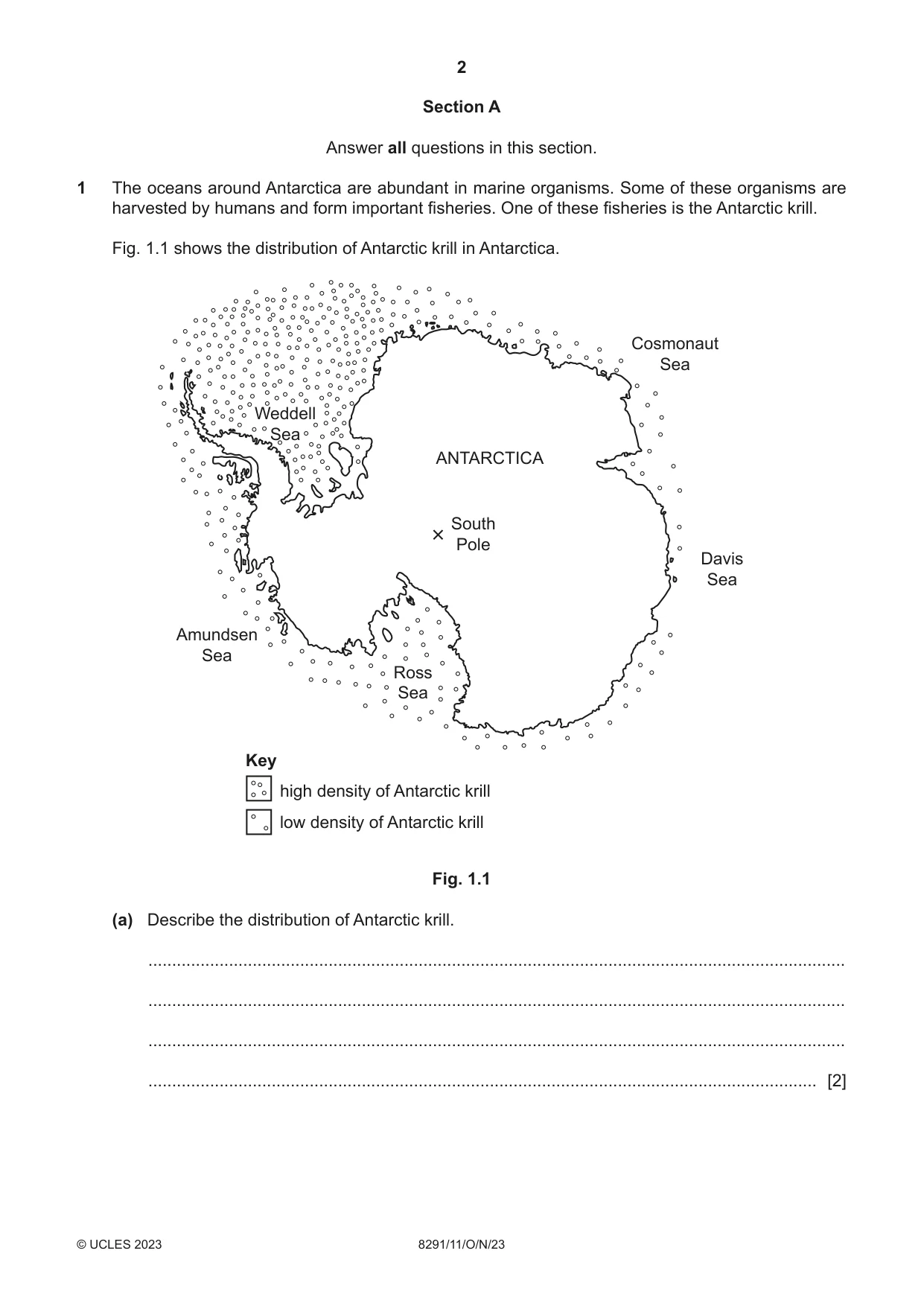
2 8291/11/O/N/23 © UCLES 2023 Section A Answer all questions in this section. 1 The oceans around Antarctica are abundant in marine organisms. Some of these organisms are harvested by humans and form important fisheries. One of these fisheries is the Antarctic krill. Fig. 1.1 shows the distribution of Antarctic krill in Antarctica. Key Weddell Sea Ross Sea Amundsen Sea Davis Sea Cosmonaut Sea ANTARCTICA South Pole high density of Antarctic krill low density of Antarctic krill Fig. 1.1 (a) Describe the distribution of Antarctic krill. … … … … [2]
Question paper, page 3
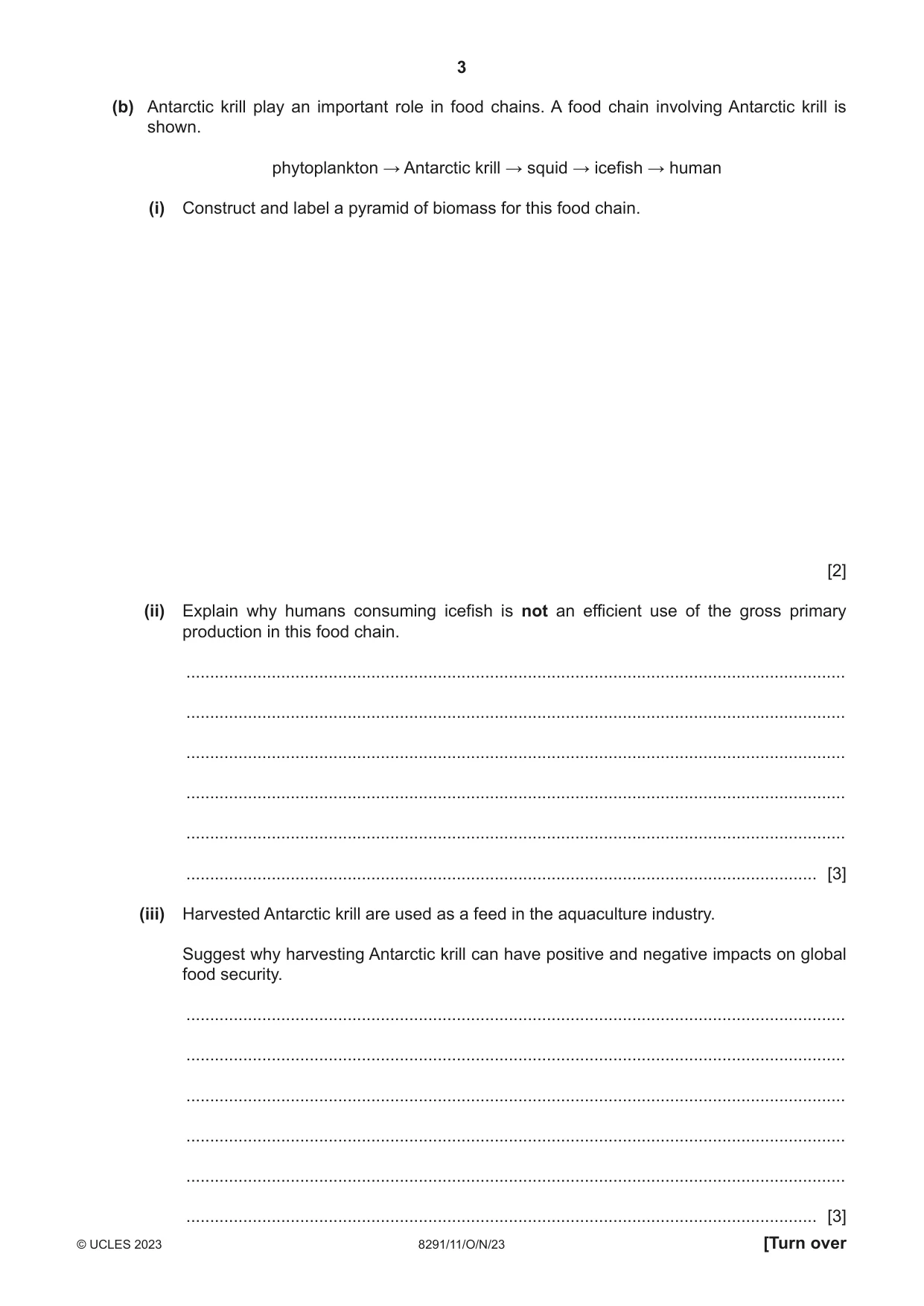
3 8291/11/O/N/23 © UCLES 2023 [Turn over (b) Antarctic krill play an important role in food chains. A food chain involving Antarctic krill is shown. phytoplankton → Antarctic krill → squid → icefish → human (i) Construct and label a pyramid of biomass for this food chain. [2] (ii) Explain why humans consuming icefish is not an efficient use of the gross primary production in this food chain. … … … … … … [3] (iii) Harvested Antarctic krill are used as a feed in the aquaculture industry. Suggest why harvesting Antarctic krill can have positive and negative impacts on global food security. … … … … … … [3]
Question paper, page 4
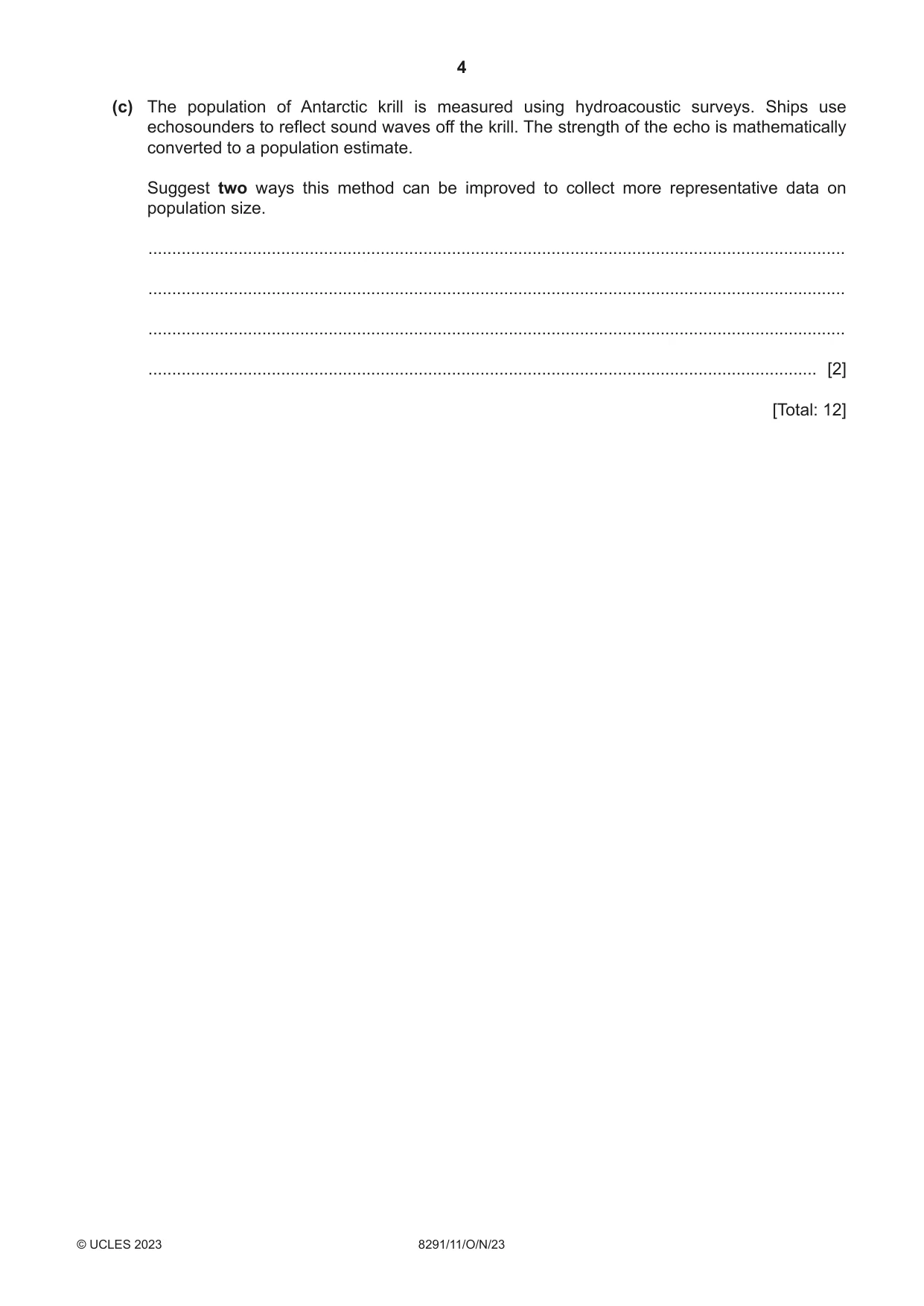
4 8291/11/O/N/23 © UCLES 2023 (c) The population of Antarctic krill is measured using hydroacoustic surveys. Ships use echosounders to reflect sound waves off the krill. The strength of the echo is mathematically converted to a population estimate. Suggest two ways this method can be improved to collect more representative data on population size. … … … … [2] [Total: 12]
Question paper, page 5
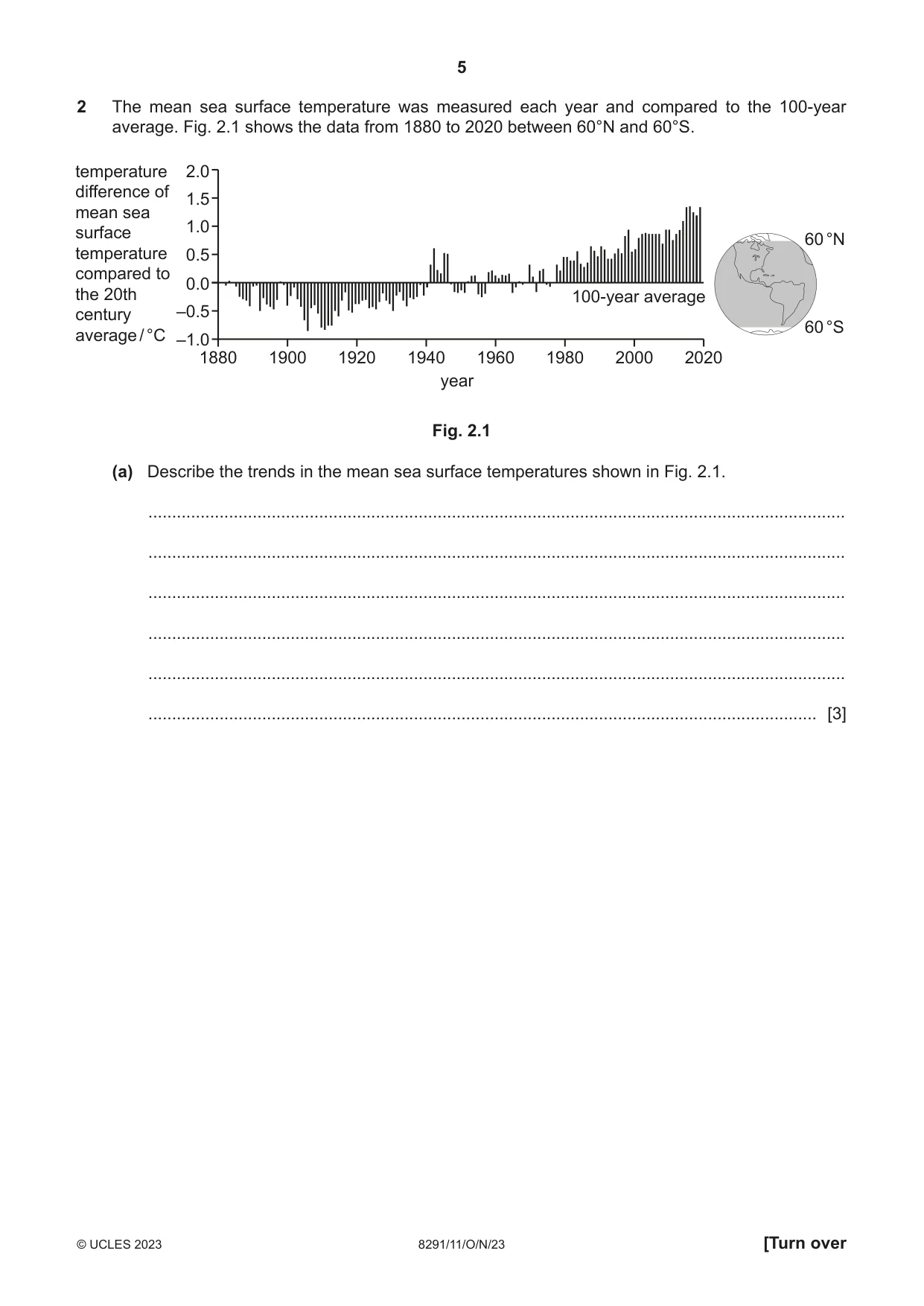
5 8291/11/O/N/23 © UCLES 2023 [Turn over 2 The mean sea surface temperature was measured each year and compared to the 100-year average. Fig. 2.1 shows the data from 1880 to 2020 between 60°N and 60°S. 1880 –1.0 –0.5 0.0 0.5 1.0 1.5 2.0 1900 1920 1940 1960 year 1980 2000 2020 60 °N 60 °S 100-year average temperature difference of mean sea surface temperature compared to the 20th century average / °C Fig. 2.1 (a) Describe the trends in the mean sea surface temperatures shown in Fig. 2.1. … … … … … … [3]
Question paper, page 6
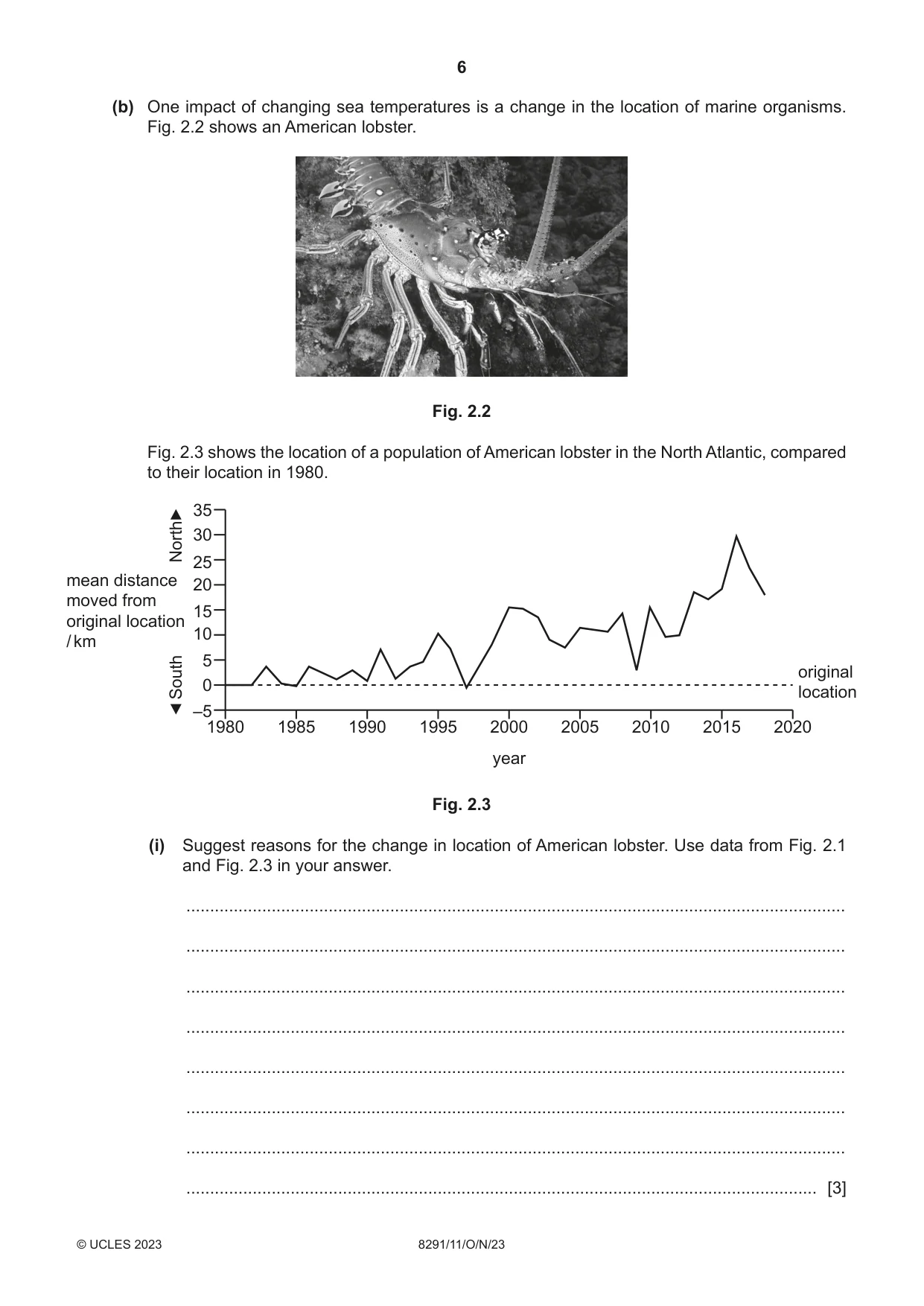
6 8291/11/O/N/23 © UCLES 2023 (b) One impact of changing sea temperatures is a change in the location of marine organisms. Fig. 2.2 shows an American lobster. Fig. 2.2 Fig. 2.3 shows the location of a population of American lobster in the North Atlantic, compared to their location in 1980. –5 0 5 10 15 20 25 30 35 1980 1985 1990 1995 2000 year 2005 2010 2015 2020 original location mean distance moved from original location / km North South Fig. 2.3 (i) Suggest reasons for the change in location of American lobster. Use data from Fig. 2.1 and Fig. 2.3 in your answer. … … … … … … … … [3]
Question paper, page 7
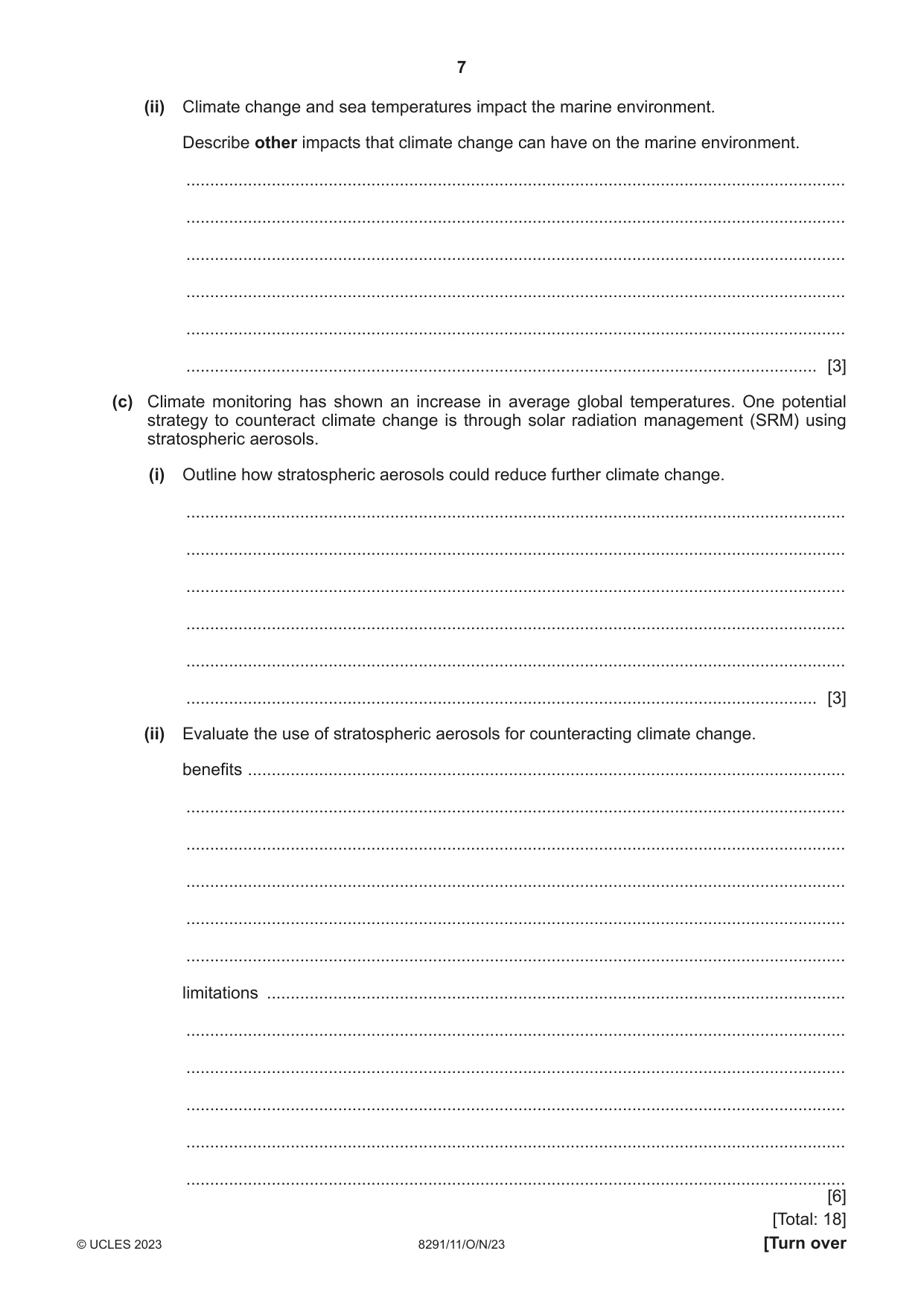
7 8291/11/O/N/23 © UCLES 2023 [Turn over (ii) Climate change and sea temperatures impact the marine environment. Describe other impacts that climate change can have on the marine environment. … … … … … … [3] (c) Climate monitoring has shown an increase in average global temperatures. One potential strategy to counteract climate change is through solar radiation management (SRM) using stratospheric aerosols. (i) Outline how stratospheric aerosols could reduce further climate change. … … … … … … [3] (ii) Evaluate the use of stratospheric aerosols for counteracting climate change. benefits … … … … … … limitations … … … … … … [6] [Total: 18]
Question paper, page 8
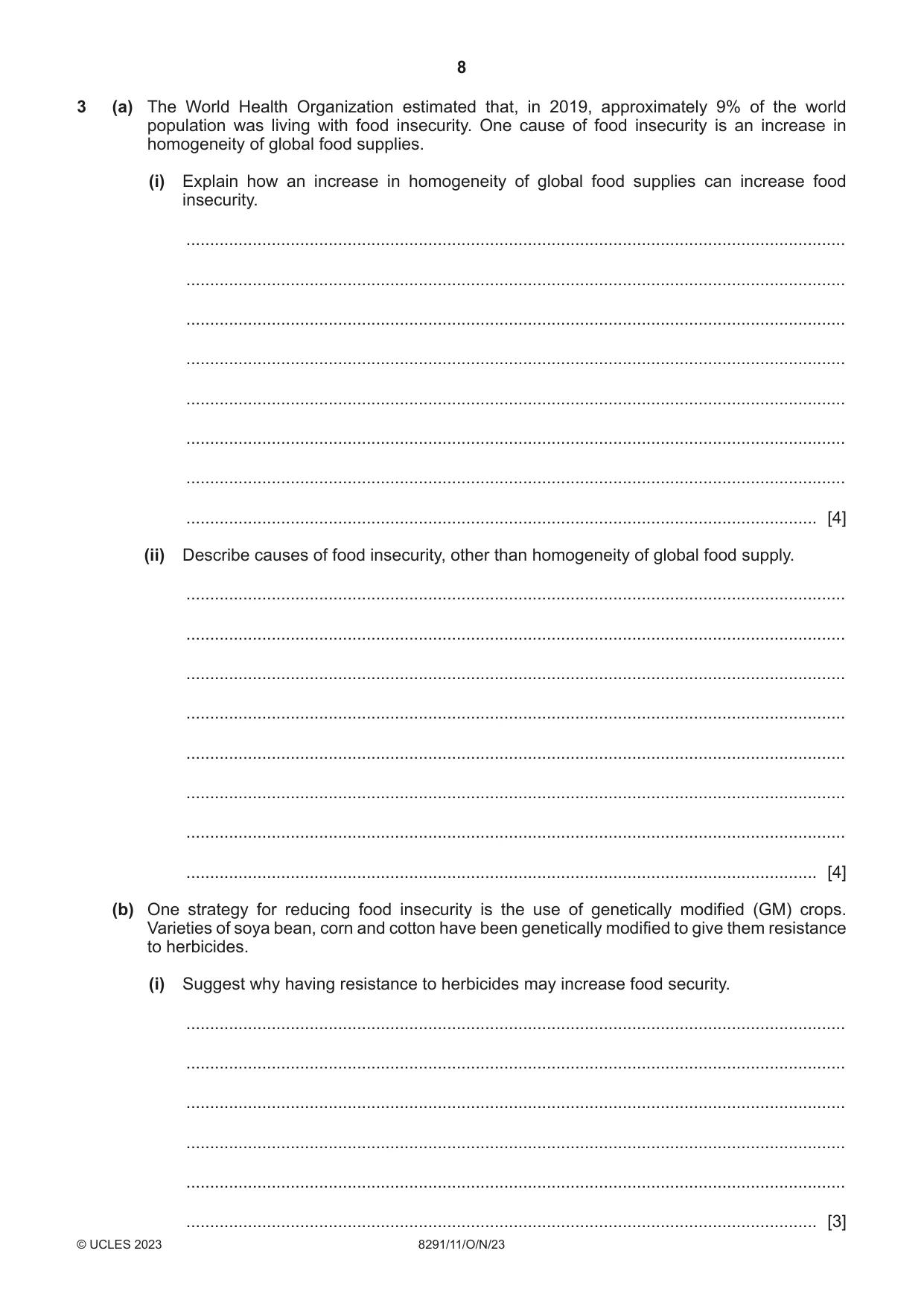
8 8291/11/O/N/23 © UCLES 2023 3 (a) The World Health Organization estimated that, in 2019, approximately 9% of the world population was living with food insecurity. One cause of food insecurity is an increase in homogeneity of global food supplies. (i) Explain how an increase in homogeneity of global food supplies can increase food insecurity. … … … … … … … … [4] (ii) Describe causes of food insecurity, other than homogeneity of global food supply. … … … … … … … … [4] (b) One strategy for reducing food insecurity is the use of genetically modified (GM) crops. Varieties of soya bean, corn and cotton have been genetically modified to give them resistance to herbicides. (i) Suggest why having resistance to herbicides may increase food security. … … … … … … [3]
Question paper, page 9
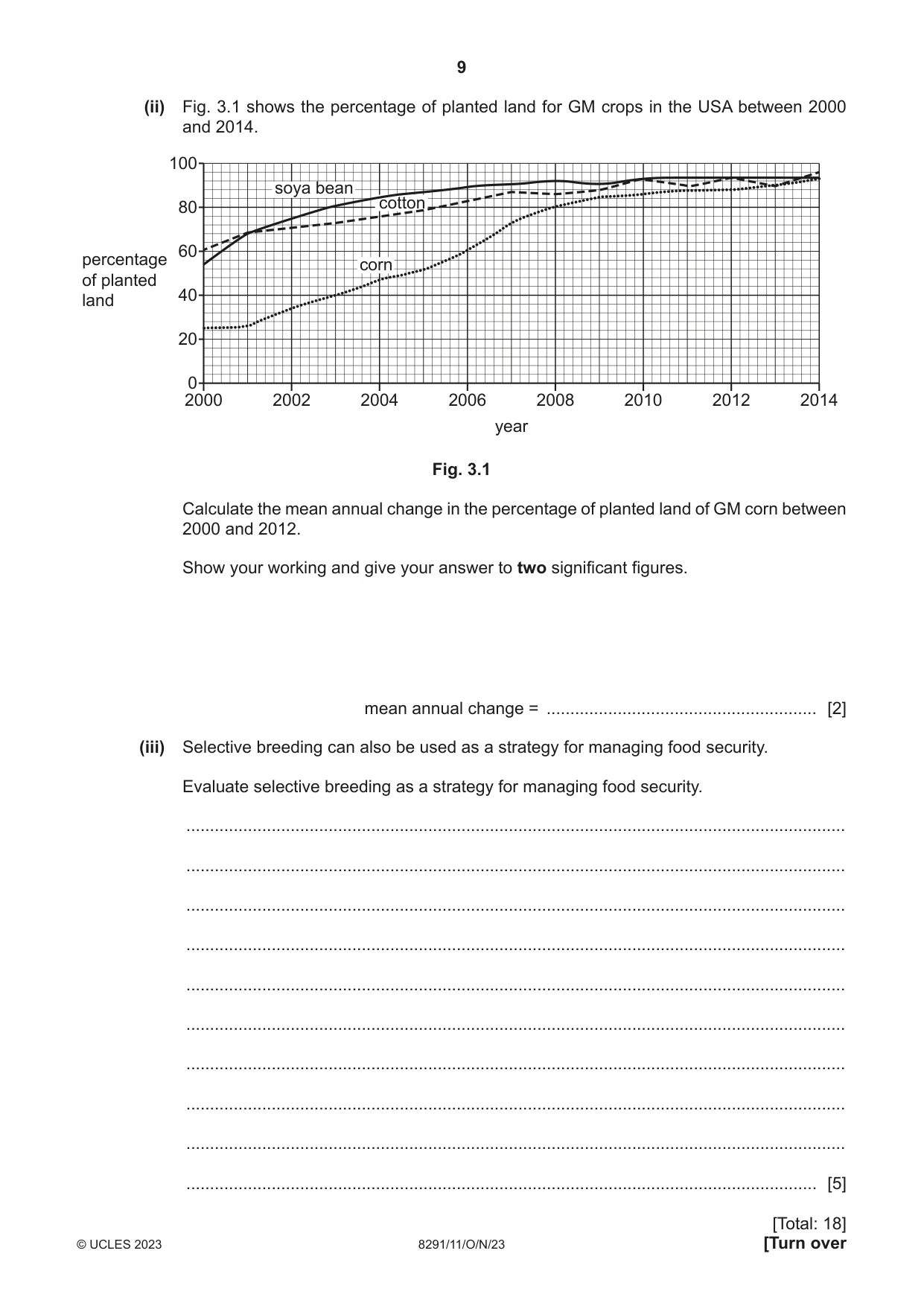
9 8291/11/O/N/23 © UCLES 2023 [Turn over (ii) Fig. 3.1 shows the percentage of planted land for GM crops in the USA between 2000 and 2014. 0 2000 2002 2004 2006 2008 year percentage of planted land 2010 2012 2014 20 40 60 80 100 soya bean cotton corn Fig. 3.1 Calculate the mean annual change in the percentage of planted land of GM corn between 2000 and 2012. Show your working and give your answer to two significant figures. mean annual change = … [2] (iii) Selective breeding can also be used as a strategy for managing food security. Evaluate selective breeding as a strategy for managing food security. … … … … … … … … … … [5] [Total: 18]
Question paper, page 10
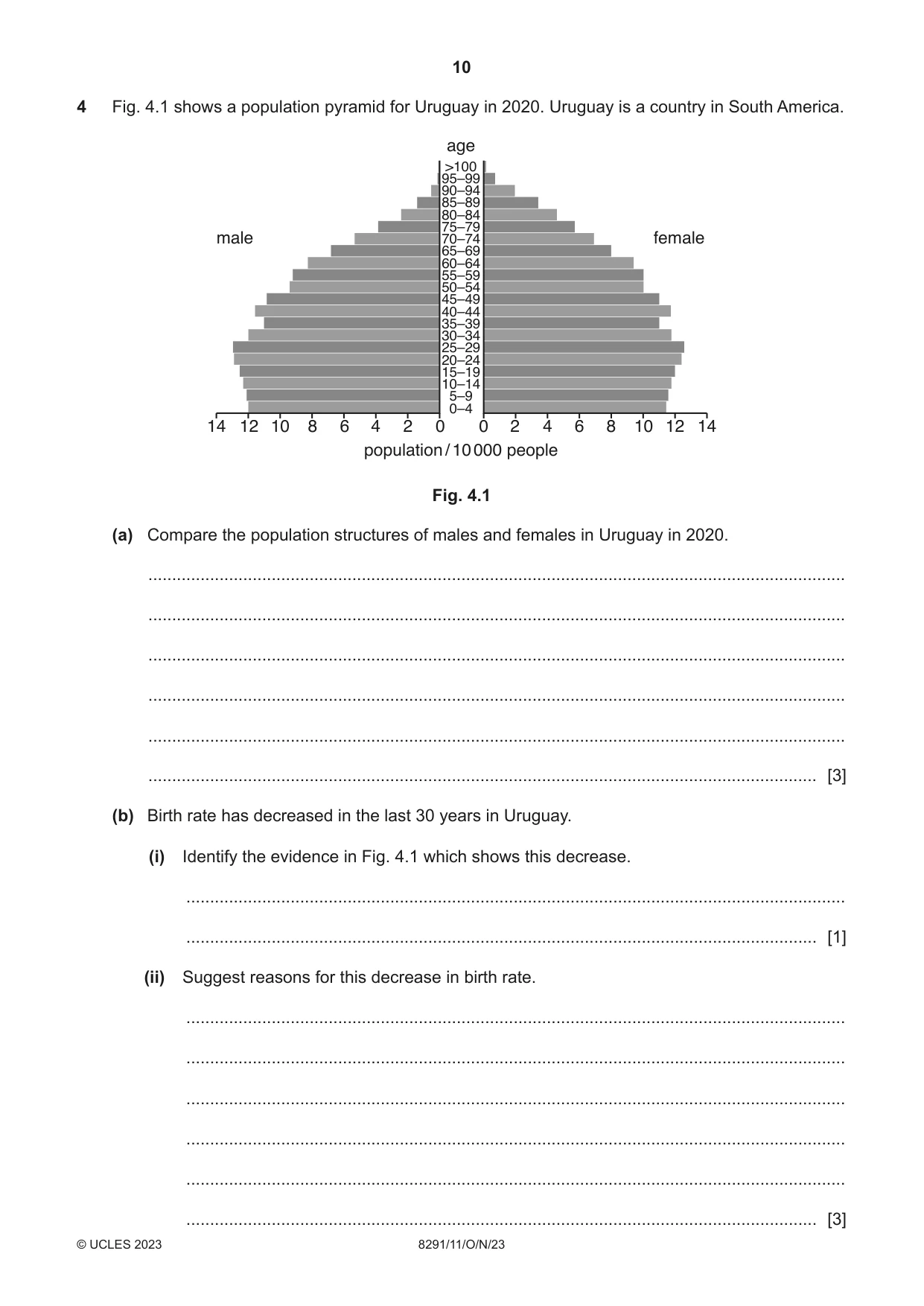
10 8291/11/O/N/23 © UCLES 2023 4 Fig. 4.1 shows a population pyramid for Uruguay in 2020. Uruguay is a country in South America. >100 95–99 90–94 85–89 80–84 75–79 70–74 65–69 60–64 55–59 50–54 45–49 40–44 35–39 30–34 25–29 20–24 15–19 10–14 5–9 0–4 age population / 10 000 people male female 14 14 12 12 10 10 6 6 8 8 4 4 2 2 0 0 Fig. 4.1 (a) Compare the population structures of males and females in Uruguay in 2020. … … … … … … [3] (b) Birth rate has decreased in the last 30 years in Uruguay. (i) Identify the evidence in Fig. 4.1 which shows this decrease. … … [1] (ii) Suggest reasons for this decrease in birth rate. … … … … … … [3]
Question paper, page 11
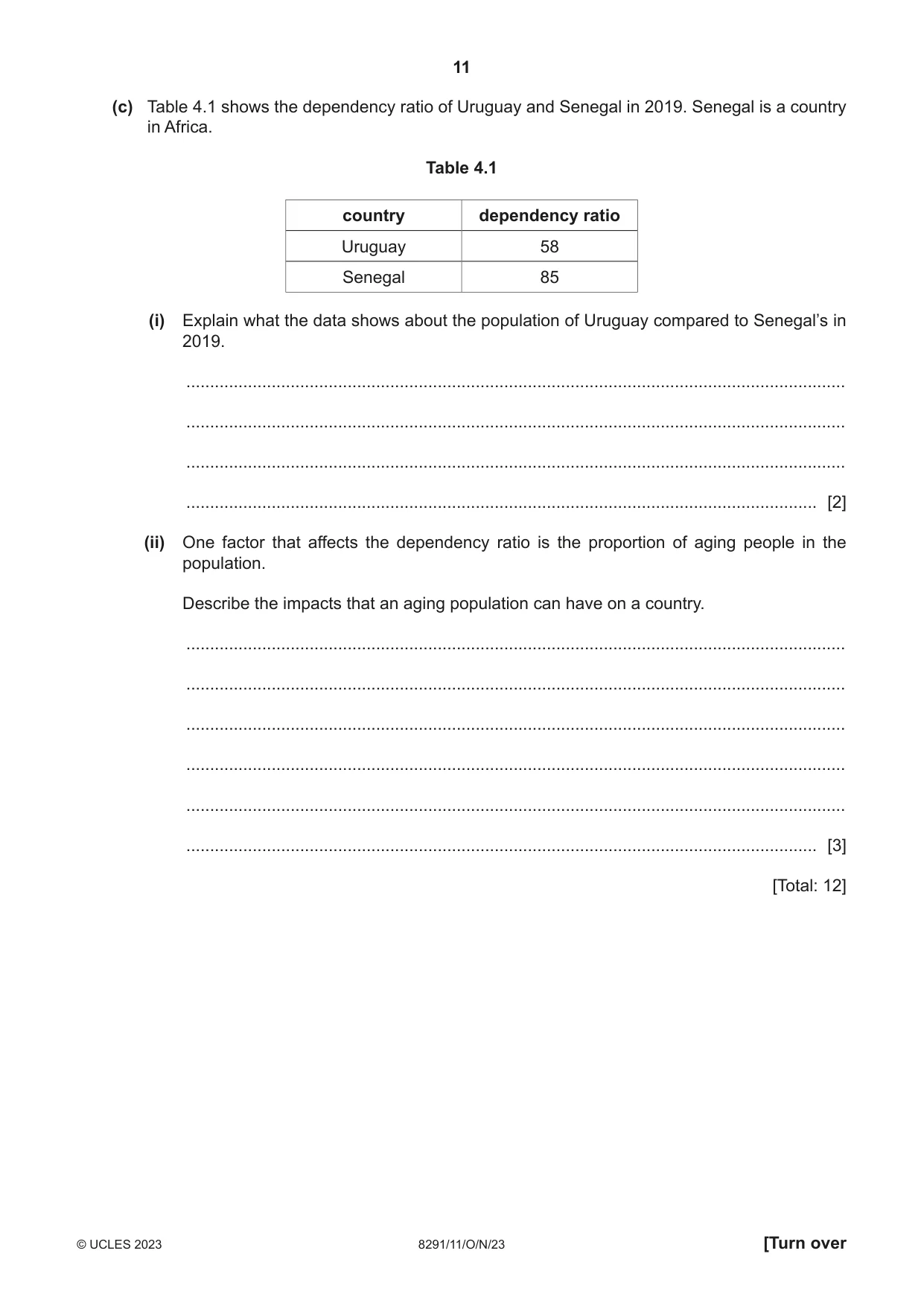
11 8291/11/O/N/23 © UCLES 2023 [Turn over (c) Table 4.1 shows the dependency ratio of Uruguay and Senegal in 2019. Senegal is a country in Africa. Table 4.1 country dependency ratio Uruguay 58 Senegal 85 (i) Explain what the data shows about the population of Uruguay compared to Senegal’s in 2019. … … … … [2] (ii) One factor that affects the dependency ratio is the proportion of aging people in the population. Describe the impacts that an aging population can have on a country. … … … … … … [3] [Total: 12]
Question paper, page 12
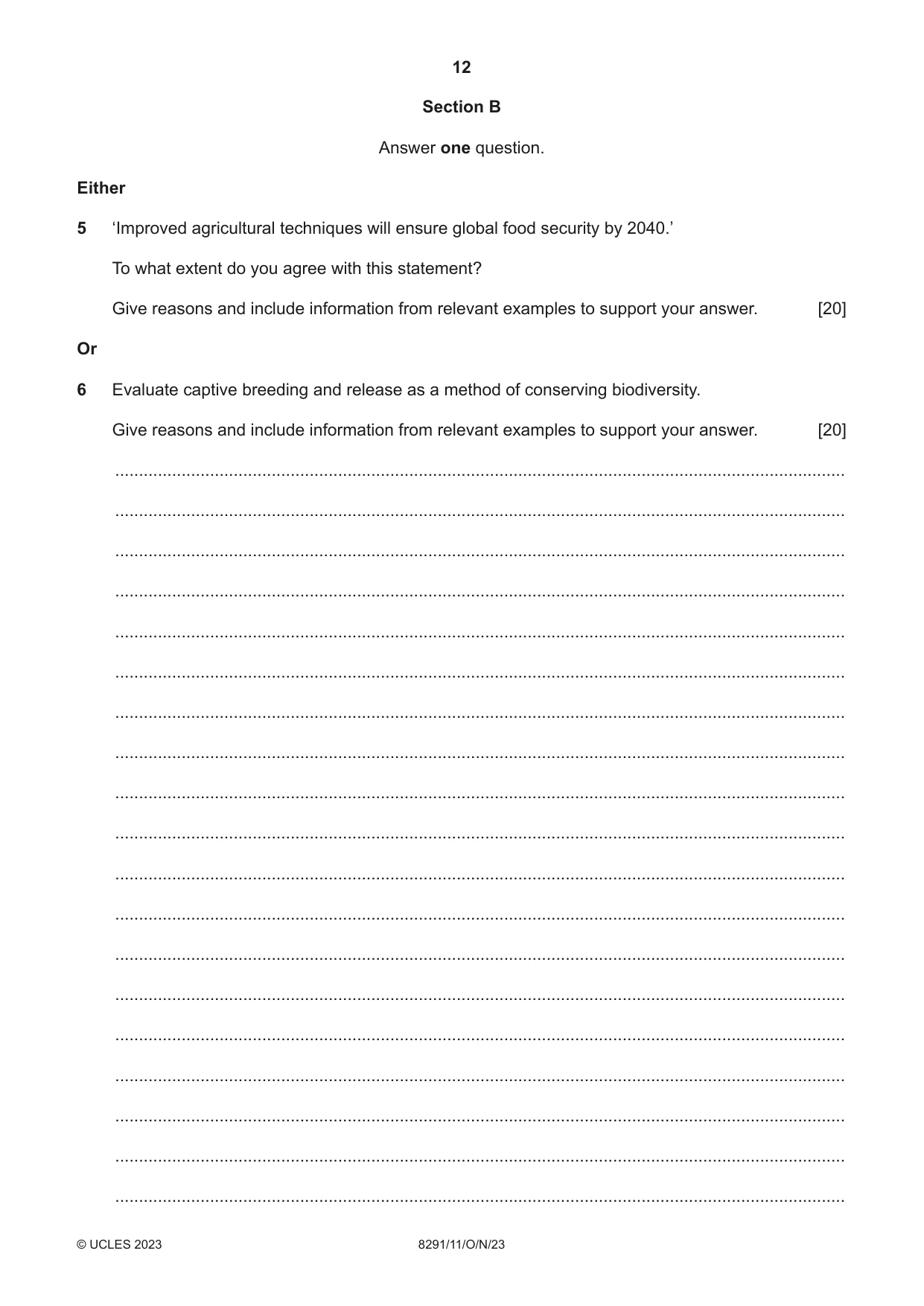
12 8291/11/O/N/23 © UCLES 2023 Section B Answer one question. Either 5 ‘Improved agricultural techniques will ensure global food security by 2040.’ To what extent do you agree with this statement? Give reasons and include information from relevant examples to support your answer. [20] Or 6 Evaluate captive breeding and release as a method of conserving biodiversity. Give reasons and include information from relevant examples to support your answer. [20] … … … … … … … … … … … … … … … … … … …
Question paper, page 13
13 8291/11/O/N/23 © UCLES 2023 [Turn over … … … … … … … … … … … … … … … … … … … … … … … … … … … …
Question paper, page 14
14 8291/11/O/N/23 © UCLES 2023 … … … … … … … … … … … … … … … … … … … … … … … … … … … …
Question paper, page 15
15 8291/11/O/N/23 © UCLES 2023 [Turn over … … … … … … … … … … … … … … … … … … … … … … … … … … … …
Question paper, page 16
16 8291/11/O/N/23 © UCLES 2023 … … … … … … … … … … … … … … … … … … … … … … … … … … … …
Question paper, page 17
17 8291/11/O/N/23 © UCLES 2023 [Turn over … … … … … … … … … … … … … … … … … … … … … … … … … … … …
Question paper, page 18
18 8291/11/O/N/23 © UCLES 2023 … … … … … … … … … … … … … … … … … … … … … … … … … … … …
Question paper, page 19
19 8291/11/O/N/23 © UCLES 2023 BLANK PAGE
Question paper, page 20
20 8291/11/O/N/23 © UCLES 2023 The boundaries and names shown, the designations used and the presentation of material on any maps contained in this question paper/insert do not imply official endorsement or acceptance by Cambridge Assessment International Education concerning the legal status of any country, territory, or area or any of its authorities, or of the delimitation of its frontiers or boundaries. Permission to reproduce items where third-party owned material protected by copyright is included has been sought and cleared where possible. Every reasonable effort has been made by the publisher (UCLES) to trace copyright holders, but if any items requiring clearance have unwittingly been included, the publisher will be pleased to make amends at the earliest possible opportunity. To avoid the issue of disclosure of answer-related information to candidates, all copyright acknowledgements are reproduced online in the Cambridge Assessment International Education Copyright Acknowledgements Booklet. This is produced for each series of examinations and is freely available to download at www.cambridgeinternational.org after the live examination series. Cambridge Assessment International Education is part of Cambridge Assessment. Cambridge Assessment is the brand name of the University of Cambridge Local Examinations Syndicate (UCLES), which is a department of the University of Cambridge. BLANK PAGE
Mark scheme, page 1
This document consists of 17 printed pages. © UCLES 2023 [Turn over Cambridge International AS Level ENVIRONMENTAL MANAGEMENT 8291/11 Paper 1 Principles of Environmental Management October/November 2023 MARK SCHEME Maximum Mark: 80 Published This mark scheme is published as an aid to teachers and candidates, to indicate the requirements of the examination. It shows the basis on which Examiners were instructed to award marks. It does not indicate the details of the discussions that took place at an Examiners’ meeting before marking began, which would have considered the acceptability of alternative answers. Mark schemes should be read in conjunction with the question paper and the Principal Examiner Report for Teachers. Cambridge International will not enter into discussions about these mark schemes. Cambridge International is publishing the mark schemes for the October/November 2023 series for most Cambridge IGCSE, Cambridge International A and AS Level components, and some Cambridge O Level components.
Mark scheme, page 2
8291/11 Cambridge International AS Level – Mark Scheme PUBLISHED October/November 2023 © UCLES 2023 Page 2 of 17 Generic Marking Principles These general marking principles must be applied by all examiners when marking candidate answers. They should be applied alongside the specific content of the mark scheme or generic level descriptors for a question. Each question paper and mark scheme will also comply with these marking principles. GENERIC MARKING PRINCIPLE 1: Marks must be awarded in line with: • the specific content of the mark scheme or the generic level descriptors for the question • the specific skills defined in the mark scheme or in the generic level descriptors for the question • the standard of response required by a candidate as exemplified by the standardisation scripts. GENERIC MARKING PRINCIPLE 2: Marks awarded are always whole marks (not half marks, or other fractions). GENERIC MARKING PRINCIPLE 3: Marks must be awarded positively: • marks are awarded for correct/valid answers, as defined in the mark scheme. However, credit is given for valid answers which go beyond the scope of the syllabus and mark scheme, referring to your Team Leader as appropriate • marks are awarded when candidates clearly demonstrate what they know and can do • marks are not deducted for errors • marks are not deducted for omissions • answers should only be judged on the quality of spelling, punctuation and grammar when these features are specifically assessed by the question as indicated by the mark scheme. The meaning, however, should be unambiguous. GENERIC MARKING PRINCIPLE 4: Rules must be applied consistently, e.g. in situations where candidates have not followed instructions or in the application of generic level descriptors.
Mark scheme, page 3
8291/11 Cambridge International AS Level – Mark Scheme PUBLISHED October/November 2023 © UCLES 2023 Page 3 of 17 GENERIC MARKING PRINCIPLE 5: Marks should be awarded using the full range of marks defined in the mark scheme for the question (however; the use of the full mark range may be limited according to the quality of the candidate responses seen). GENERIC MARKING PRINCIPLE 6: Marks awarded are based solely on the requirements as defined in the mark scheme. Marks should not be awarded with grade thresholds or grade descriptors in mind. Science-Specific Marking Principles 1 Examiners should consider the context and scientific use of any keywords when awarding marks. Although keywords may be present, marks should not be awarded if the keywords are used incorrectly. 2 The examiner should not choose between contradictory statements given in the same question part, and credit should not be awarded for any correct statement that is contradicted within the same question part. Wrong science that is irrelevant to the question should be ignored. 3 Although spellings do not have to be correct, spellings of syllabus terms must allow for clear and unambiguous separation from other syllabus terms with which they may be confused (e.g. ethane / ethene, glucagon / glycogen, refraction / reflection). 4 The error carried forward (ecf) principle should be applied, where appropriate. If an incorrect answer is subsequently used in a scientifically correct way, the candidate should be awarded these subsequent marking points. Further guidance will be included in the mark scheme where necessary and any exceptions to this general principle will be noted. 5 ‘List rule’ guidance For questions that require n responses (e.g. State two reasons …): • The response should be read as continuous prose, even when numbered answer spaces are provided. • Any response marked ignore in the mark scheme should not count towards n. • Incorrect responses should not be awarded credit but will still count towards n. • Read the entire response to check for any responses that contradict those that would otherwise be credited. Credit should not be awarded for any responses that are contradicted within the rest of the response. Where two responses contradict one another, this should be treated as a single incorrect response. • Non-contradictory responses after the first n responses may be ignored even if they include incorrect science.
Mark scheme, page 4
8291/11 Cambridge International AS Level – Mark Scheme PUBLISHED October/November 2023 © UCLES 2023 Page 4 of 17 6 Calculation specific guidance Correct answers to calculations should be given full credit even if there is no working or incorrect working, unless the question states ‘show your working’. For questions in which the number of significant figures required is not stated, credit should be awarded for correct answers when rounded by the examiner to the number of significant figures given in the mark scheme. This may not apply to measured values. For answers given in standard form (e.g. a 10n) in which the convention of restricting the value of the coefficient (a) to a value between 1 and 10 is not followed, credit may still be awarded if the answer can be converted to the answer given in the mark scheme. Unless a separate mark is given for a unit, a missing or incorrect unit will normally mean that the final calculation mark is not awarded. Exceptions to this general principle will be noted in the mark scheme. 7 Guidance for chemical equations Multiples / fractions of coefficients used in chemical equations are acceptable unless stated otherwise in the mark scheme. State symbols given in an equation should be ignored unless asked for in the question or stated otherwise in the mark scheme.
Mark scheme, page 5
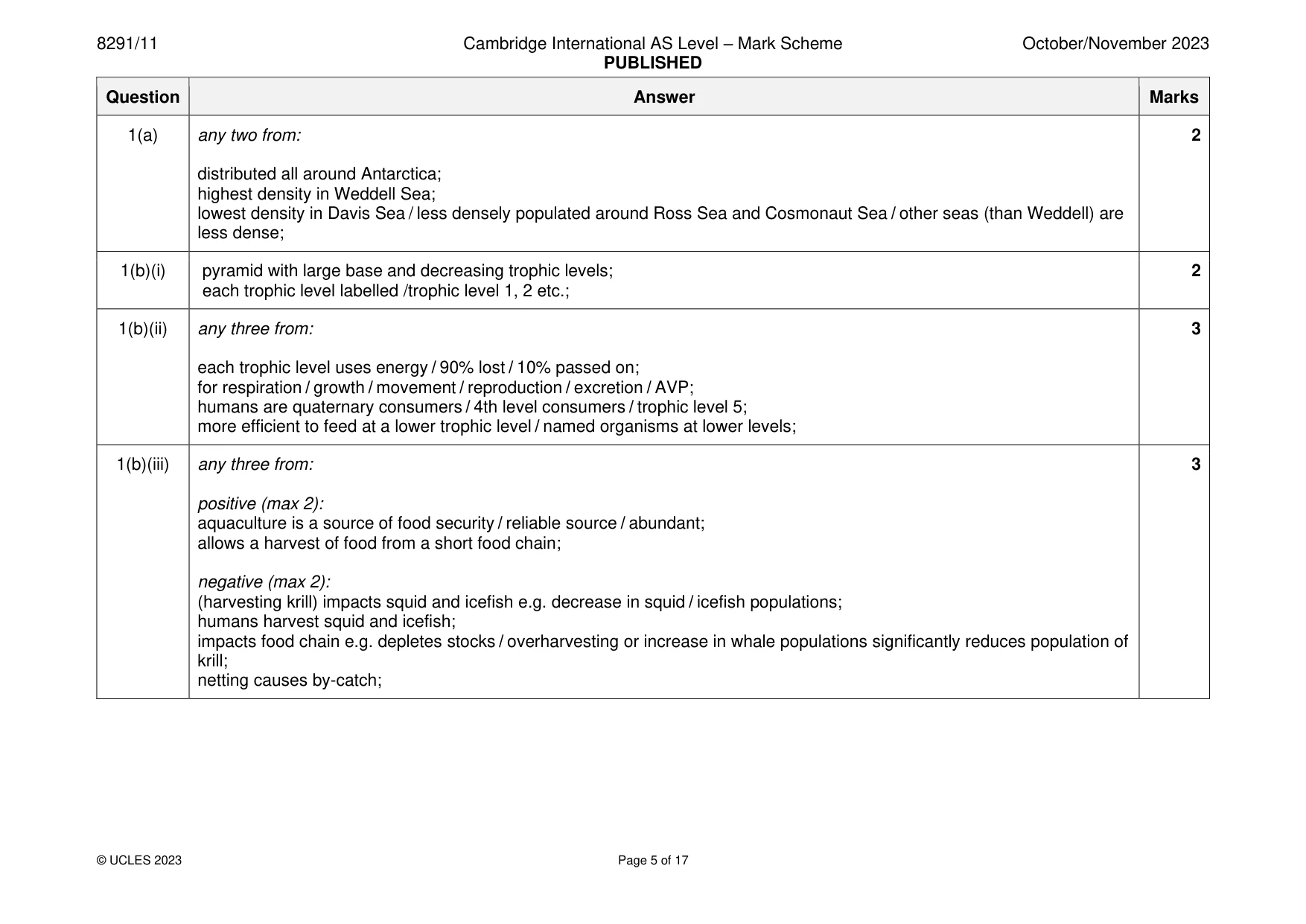
8291/11 Cambridge International AS Level – Mark Scheme PUBLISHED October/November 2023 © UCLES 2023 Page 5 of 17 Question Answer Marks 1(a) any two from: distributed all around Antarctica; highest density in Weddell Sea; lowest density in Davis Sea / less densely populated around Ross Sea and Cosmonaut Sea / other seas (than Weddell) are less dense; 2 1(b)(i) pyramid with large base and decreasing trophic levels; each trophic level labelled /trophic level 1, 2 etc.; 2 1(b)(ii) any three from: each trophic level uses energy / 90% lost / 10% passed on; for respiration / growth / movement / reproduction / excretion / AVP; humans are quaternary consumers / 4th level consumers / trophic level 5; more efficient to feed at a lower trophic level / named organisms at lower levels; 3 1(b)(iii) any three from: positive (max 2): aquaculture is a source of food security / reliable source / abundant; allows a harvest of food from a short food chain; negative (max 2): (harvesting krill) impacts squid and icefish e.g. decrease in squid / icefish populations; humans harvest squid and icefish; impacts food chain e.g. depletes stocks / overharvesting or increase in whale populations significantly reduces population of krill; netting causes by-catch; 3
Mark scheme, page 6
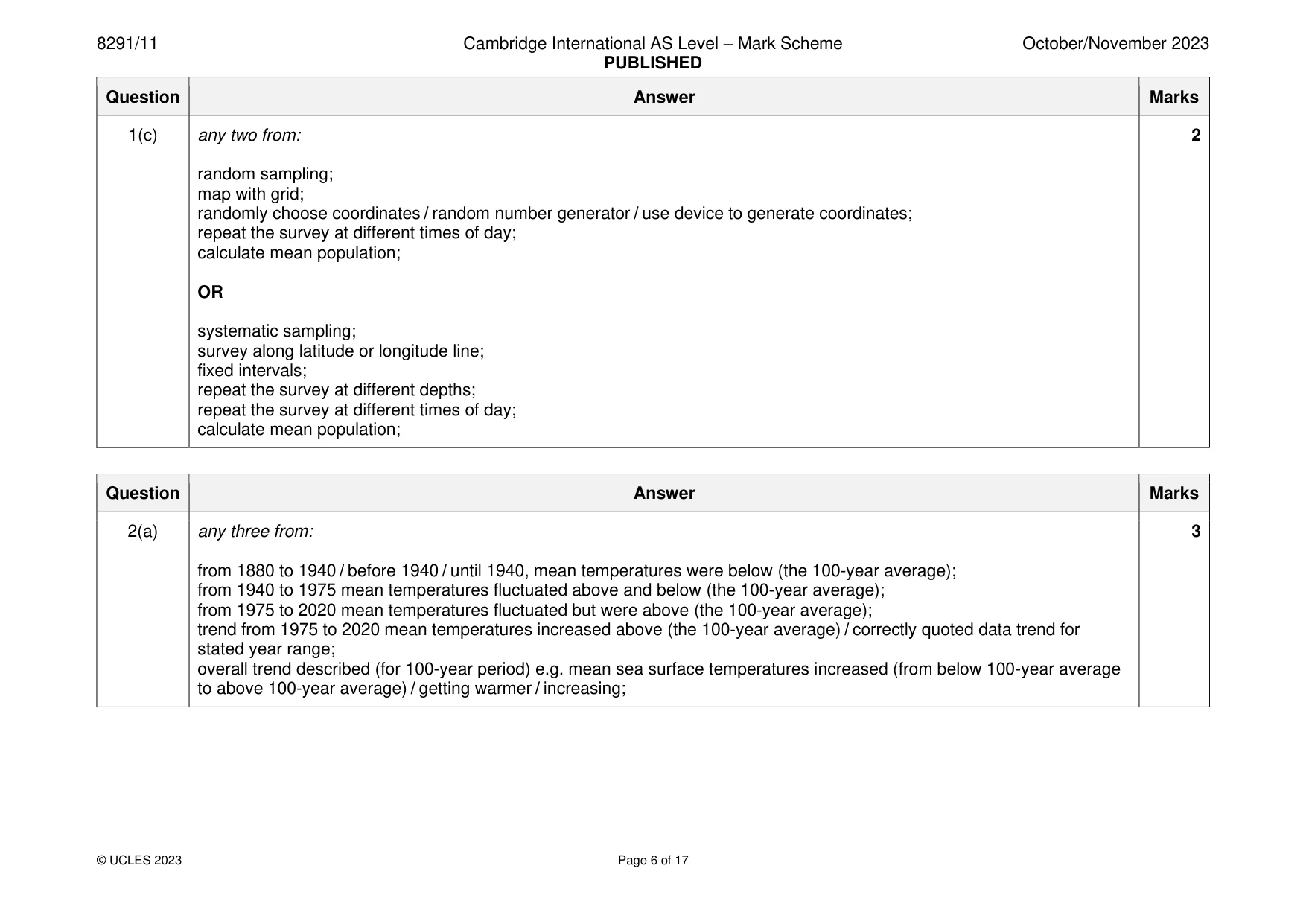
8291/11 Cambridge International AS Level – Mark Scheme PUBLISHED October/November 2023 © UCLES 2023 Page 6 of 17 Question Answer Marks 1(c) any two from: random sampling; map with grid; randomly choose coordinates / random number generator / use device to generate coordinates; repeat the survey at different times of day; calculate mean population; OR systematic sampling; survey along latitude or longitude line; fixed intervals; repeat the survey at different depths; repeat the survey at different times of day; calculate mean population; 2 Question Answer Marks 2(a) any three from: from 1880 to 1940 / before 1940 / until 1940, mean temperatures were below (the 100-year average); from 1940 to 1975 mean temperatures fluctuated above and below (the 100-year average); from 1975 to 2020 mean temperatures fluctuated but were above (the 100-year average); trend from 1975 to 2020 mean temperatures increased above (the 100-year average) / correctly quoted data trend for stated year range; overall trend described (for 100-year period) e.g. mean sea surface temperatures increased (from below 100-year average to above 100-year average) / getting warmer / increasing; 3
Mark scheme, page 7
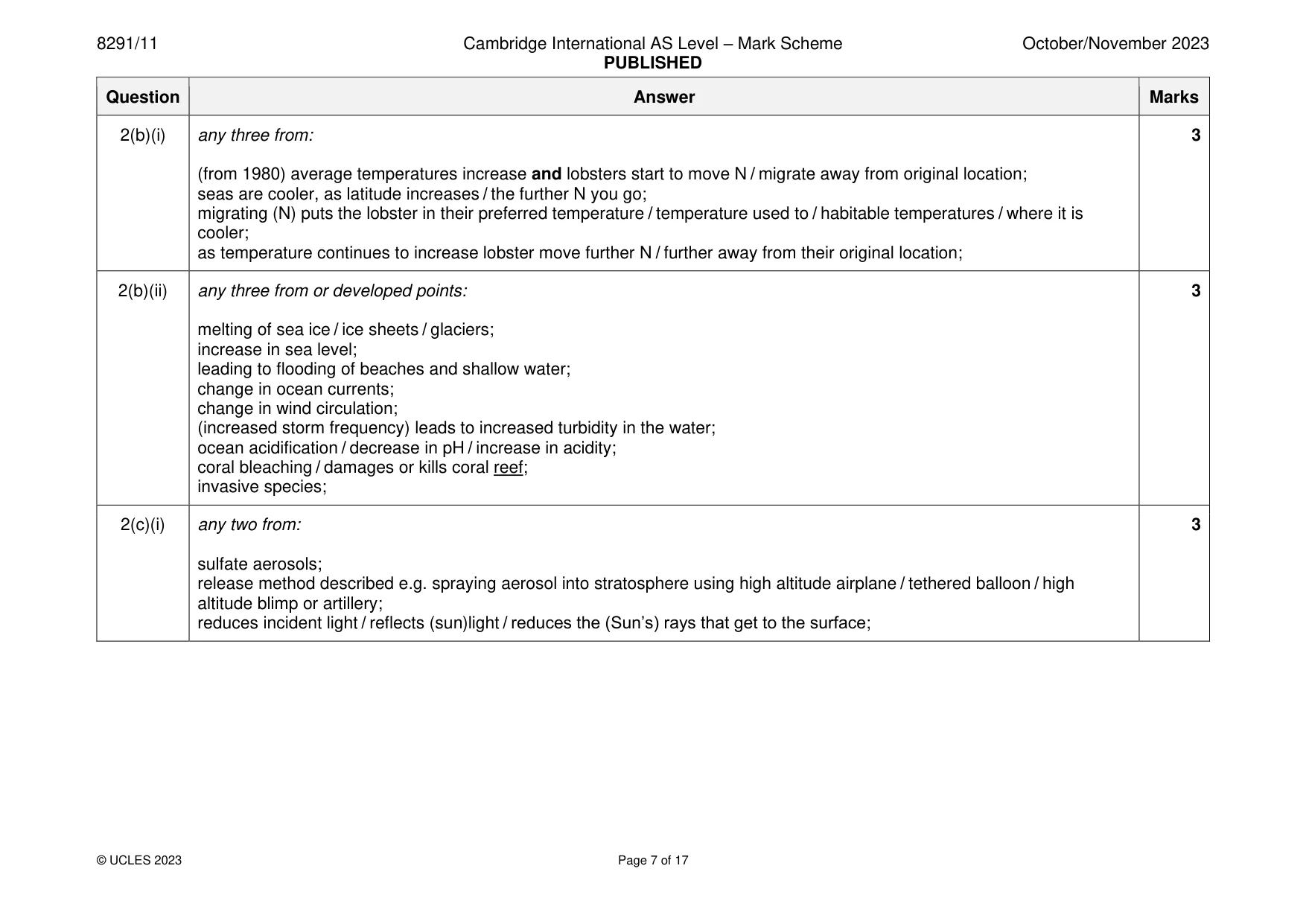
8291/11 Cambridge International AS Level – Mark Scheme PUBLISHED October/November 2023 © UCLES 2023 Page 7 of 17 Question Answer Marks 2(b)(i) any three from: (from 1980) average temperatures increase and lobsters start to move N / migrate away from original location; seas are cooler, as latitude increases / the further N you go; migrating (N) puts the lobster in their preferred temperature / temperature used to / habitable temperatures / where it is cooler; as temperature continues to increase lobster move further N / further away from their original location; 3 2(b)(ii) any three from or developed points: melting of sea ice / ice sheets / glaciers; increase in sea level; leading to flooding of beaches and shallow water; change in ocean currents; change in wind circulation; (increased storm frequency) leads to increased turbidity in the water; ocean acidification / decrease in pH / increase in acidity; coral bleaching / damages or kills coral reef; invasive species; 3 2(c)(i) any two from: sulfate aerosols; release method described e.g. spraying aerosol into stratosphere using high altitude airplane / tethered balloon / high altitude blimp or artillery; reduces incident light / reflects (sun)light / reduces the (Sun’s) rays that get to the surface; 3
Mark scheme, page 8
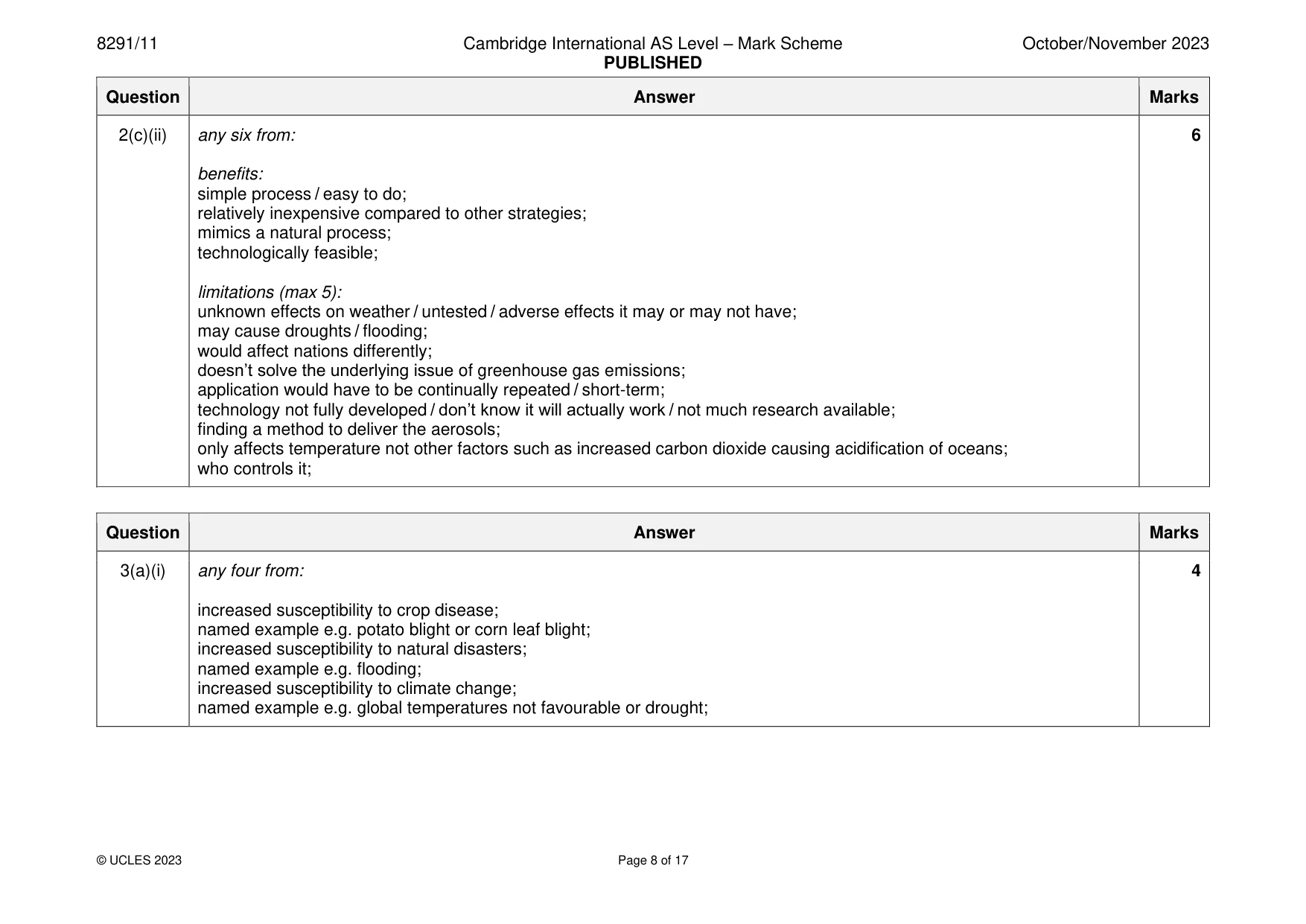
8291/11 Cambridge International AS Level – Mark Scheme PUBLISHED October/November 2023 © UCLES 2023 Page 8 of 17 Question Answer Marks 2(c)(ii) any six from: benefits: simple process / easy to do; relatively inexpensive compared to other strategies; mimics a natural process; technologically feasible; limitations (max 5): unknown effects on weather / untested / adverse effects it may or may not have; may cause droughts / flooding; would affect nations differently; doesn’t solve the underlying issue of greenhouse gas emissions; application would have to be continually repeated / short-term; technology not fully developed / don’t know it will actually work / not much research available; finding a method to deliver the aerosols; only affects temperature not other factors such as increased carbon dioxide causing acidification of oceans; who controls it; 6 Question Answer Marks 3(a)(i) any four from: increased susceptibility to crop disease; named example e.g. potato blight or corn leaf blight; increased susceptibility to natural disasters; named example e.g. flooding; increased susceptibility to climate change; named example e.g. global temperatures not favourable or drought; 4
Mark scheme, page 9
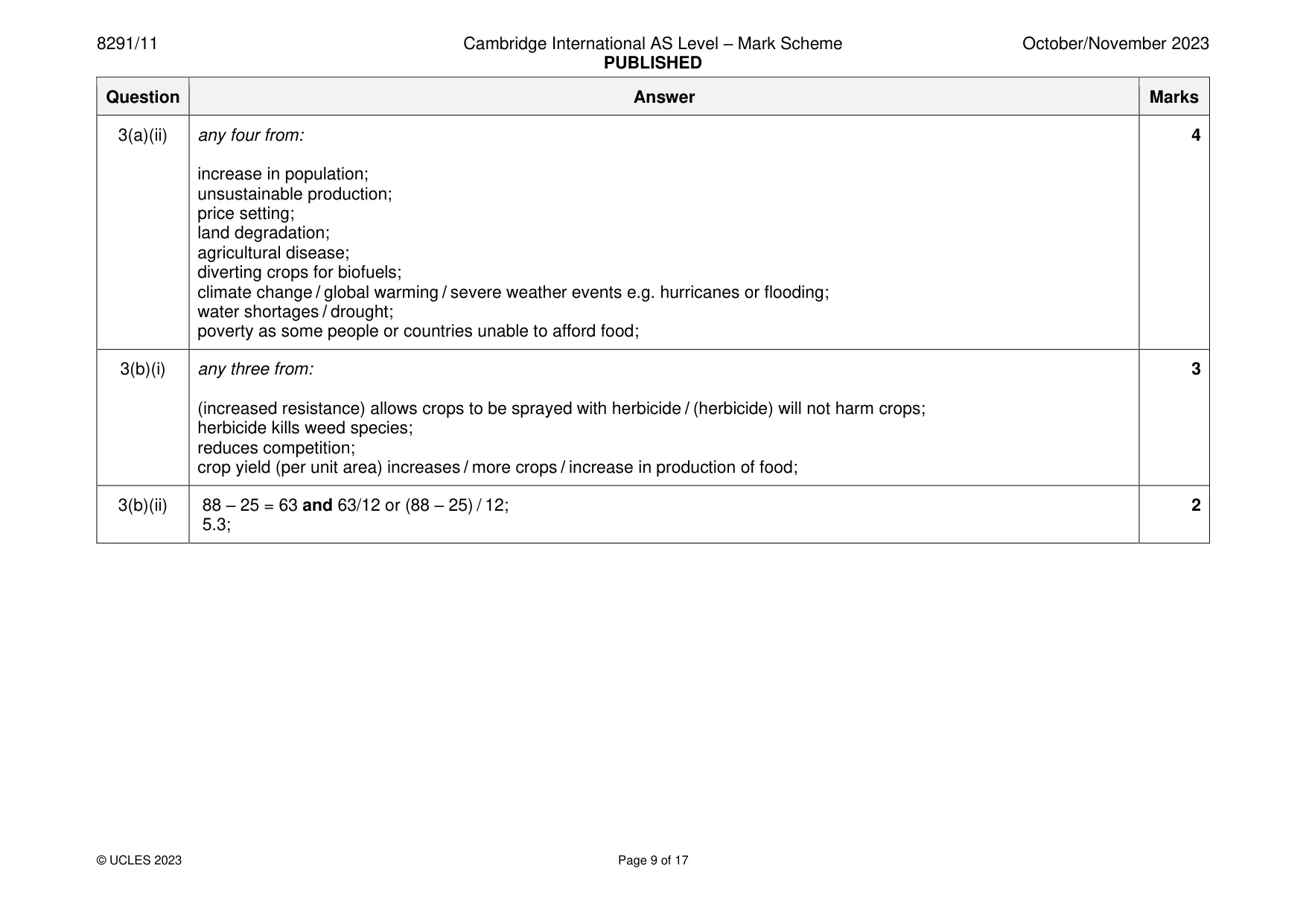
8291/11 Cambridge International AS Level – Mark Scheme PUBLISHED October/November 2023 © UCLES 2023 Page 9 of 17 Question Answer Marks 3(a)(ii) any four from: increase in population; unsustainable production; price setting; land degradation; agricultural disease; diverting crops for biofuels; climate change / global warming / severe weather events e.g. hurricanes or flooding; water shortages / drought; poverty as some people or countries unable to afford food; 4 3(b)(i) any three from: (increased resistance) allows crops to be sprayed with herbicide / (herbicide) will not harm crops; herbicide kills weed species; reduces competition; crop yield (per unit area) increases / more crops / increase in production of food; 3 3(b)(ii) 88 – 25 = 63 and 63/12 or (88 – 25) / 12; 5.3; 2
Mark scheme, page 10
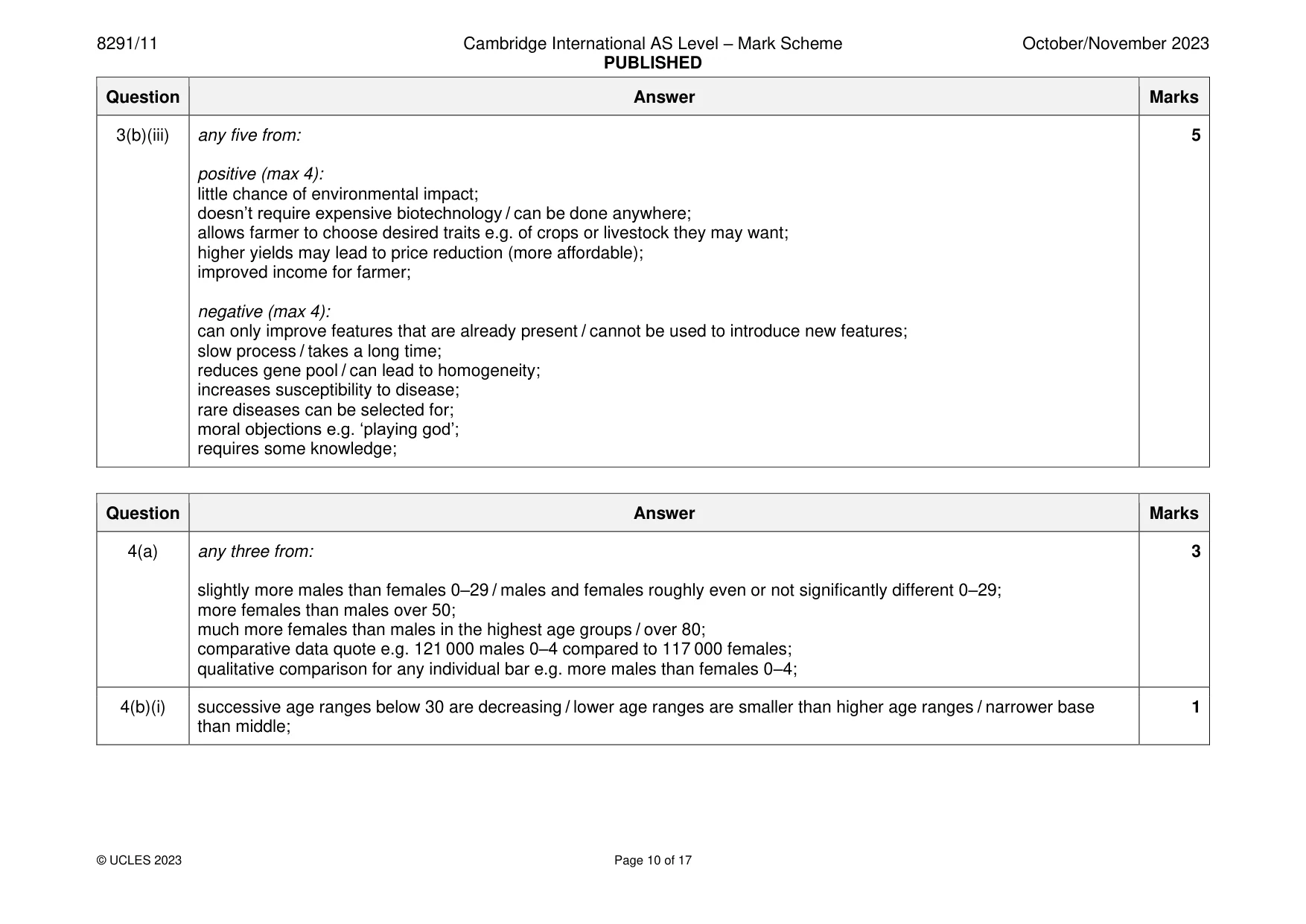
8291/11 Cambridge International AS Level – Mark Scheme PUBLISHED October/November 2023 © UCLES 2023 Page 10 of 17 Question Answer Marks 3(b)(iii) any five from: positive (max 4): little chance of environmental impact; doesn’t require expensive biotechnology / can be done anywhere; allows farmer to choose desired traits e.g. of crops or livestock they may want; higher yields may lead to price reduction (more affordable); improved income for farmer; negative (max 4): can only improve features that are already present / cannot be used to introduce new features; slow process / takes a long time; reduces gene pool / can lead to homogeneity; increases susceptibility to disease; rare diseases can be selected for; moral objections e.g. ‘playing god’; requires some knowledge; 5 Question Answer Marks 4(a) any three from: slightly more males than females 0–29 / males and females roughly even or not significantly different 0–29; more females than males over 50; much more females than males in the highest age groups / over 80; comparative data quote e.g. 121 000 males 0–4 compared to 117 000 females; qualitative comparison for any individual bar e.g. more males than females 0–4; 3 4(b)(i) successive age ranges below 30 are decreasing / lower age ranges are smaller than higher age ranges / narrower base than middle; 1
Mark scheme, page 11
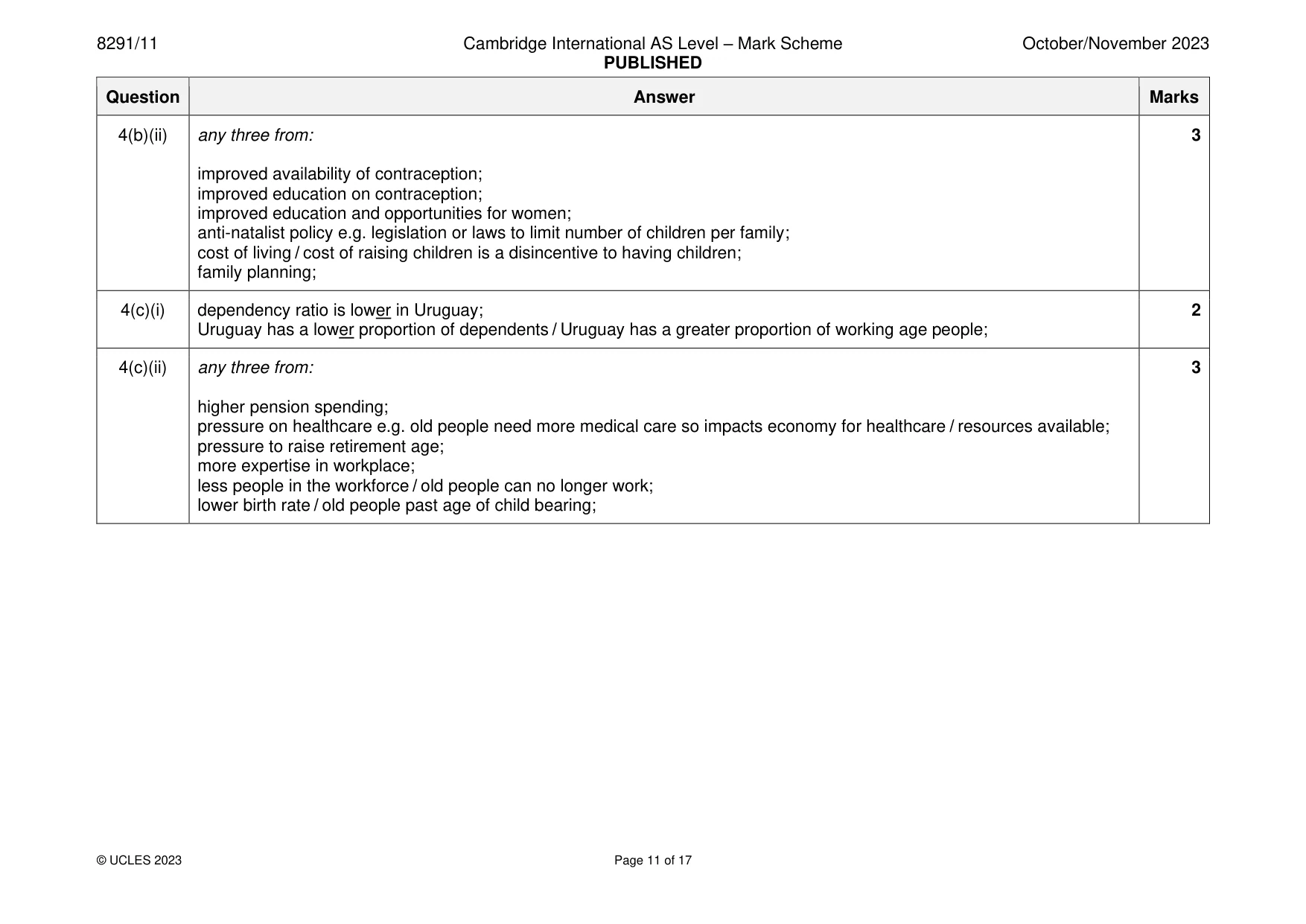
8291/11 Cambridge International AS Level – Mark Scheme PUBLISHED October/November 2023 © UCLES 2023 Page 11 of 17 Question Answer Marks 4(b)(ii) any three from: improved availability of contraception; improved education on contraception; improved education and opportunities for women; anti-natalist policy e.g. legislation or laws to limit number of children per family; cost of living / cost of raising children is a disincentive to having children; family planning; 3 4(c)(i) dependency ratio is lower in Uruguay; Uruguay has a lower proportion of dependents / Uruguay has a greater proportion of working age people; 2 4(c)(ii) any three from: higher pension spending; pressure on healthcare e.g. old people need more medical care so impacts economy for healthcare / resources available; pressure to raise retirement age; more expertise in workplace; less people in the workforce / old people can no longer work; lower birth rate / old people past age of child bearing; 3
Mark scheme, page 12
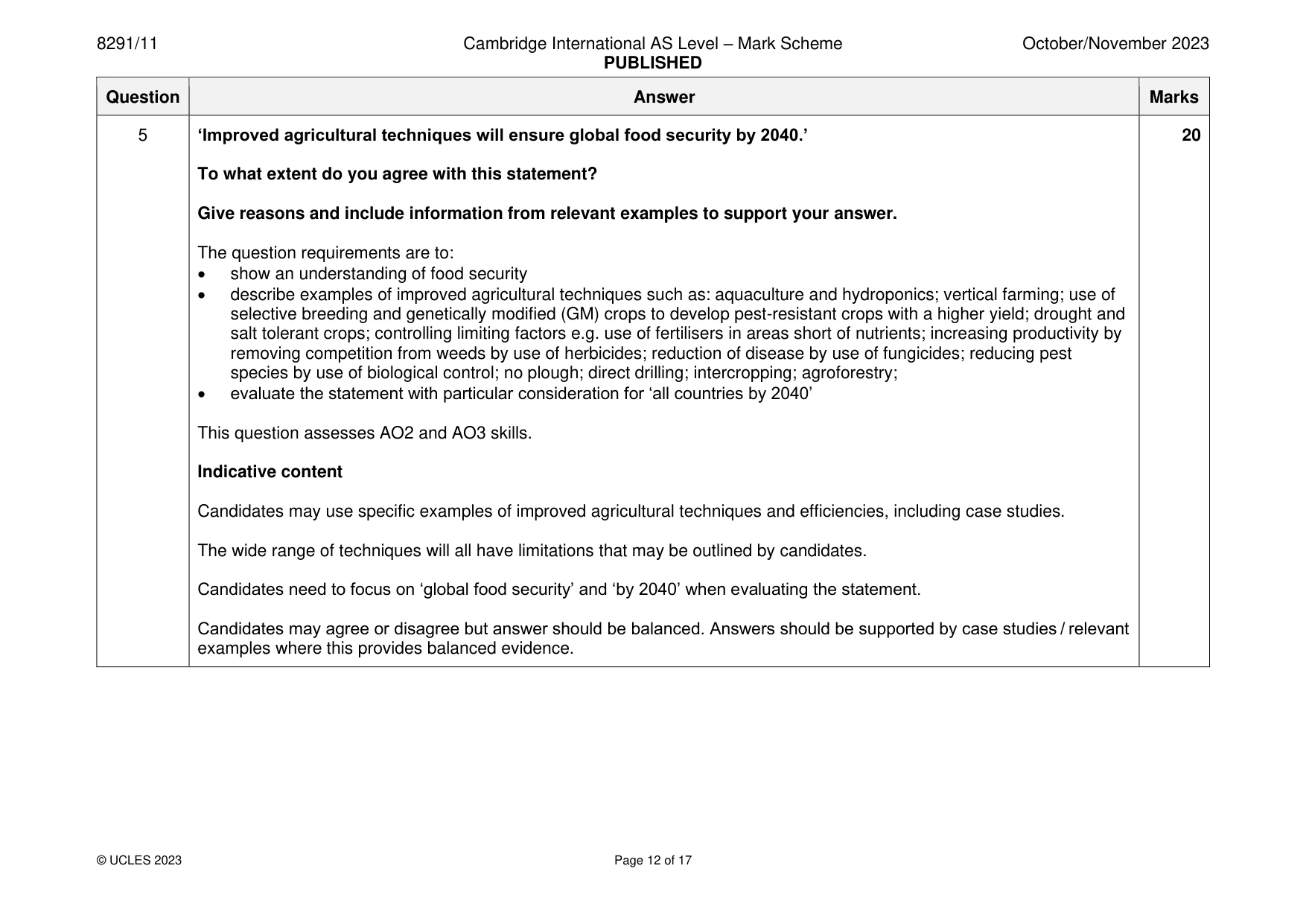
8291/11 Cambridge International AS Level – Mark Scheme PUBLISHED October/November 2023 © UCLES 2023 Page 12 of 17 Question Answer Marks 5 ‘Improved agricultural techniques will ensure global food security by 2040.’ To what extent do you agree with this statement? Give reasons and include information from relevant examples to support your answer. The question requirements are to: • show an understanding of food security • describe examples of improved agricultural techniques such as: aquaculture and hydroponics; vertical farming; use of selective breeding and genetically modified (GM) crops to develop pest-resistant crops with a higher yield; drought and salt tolerant crops; controlling limiting factors e.g. use of fertilisers in areas short of nutrients; increasing productivity by removing competition from weeds by use of herbicides; reduction of disease by use of fungicides; reducing pest species by use of biological control; no plough; direct drilling; intercropping; agroforestry; • evaluate the statement with particular consideration for ‘all countries by 2040’ This question assesses AO2 and AO3 skills. Indicative content Candidates may use specific examples of improved agricultural techniques and efficiencies, including case studies. The wide range of techniques will all have limitations that may be outlined by candidates. Candidates need to focus on ‘global food security’ and ‘by 2040’ when evaluating the statement. Candidates may agree or disagree but answer should be balanced. Answers should be supported by case studies / relevant examples where this provides balanced evidence. 20
Mark scheme, page 13
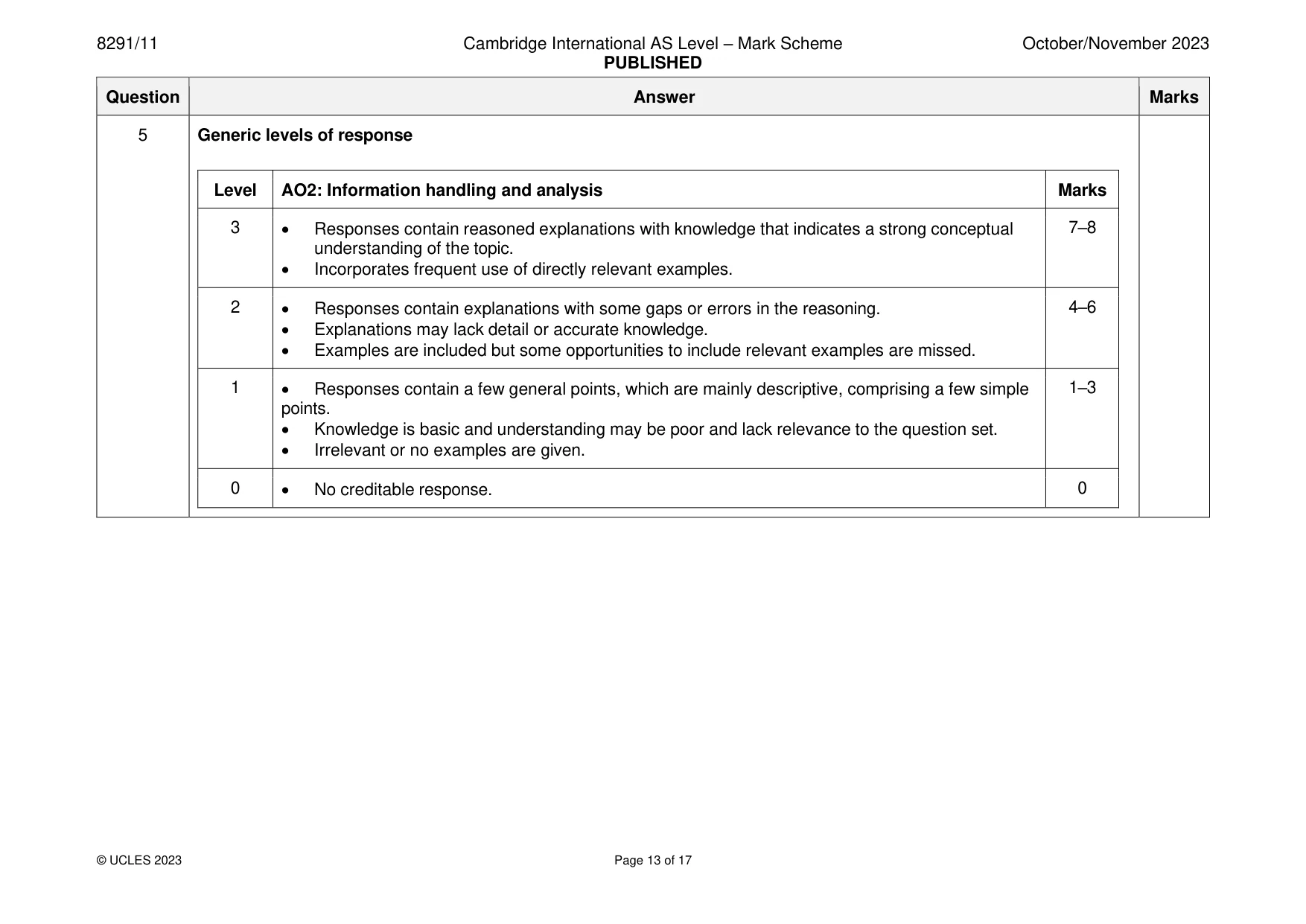
8291/11 Cambridge International AS Level – Mark Scheme PUBLISHED October/November 2023 © UCLES 2023 Page 13 of 17 Question Answer Marks 5 Generic levels of response Level AO2: Information handling and analysis Marks 3 • Responses contain reasoned explanations with knowledge that indicates a strong conceptual understanding of the topic. • Incorporates frequent use of directly relevant examples. 7–8 2 • Responses contain explanations with some gaps or errors in the reasoning. • Explanations may lack detail or accurate knowledge. • Examples are included but some opportunities to include relevant examples are missed. 4–6 1 • Responses contain a few general points, which are mainly descriptive, comprising a few simple points. • Knowledge is basic and understanding may be poor and lack relevance to the question set. • Irrelevant or no examples are given. 1–3 0 • No creditable response. 0
Mark scheme, page 14
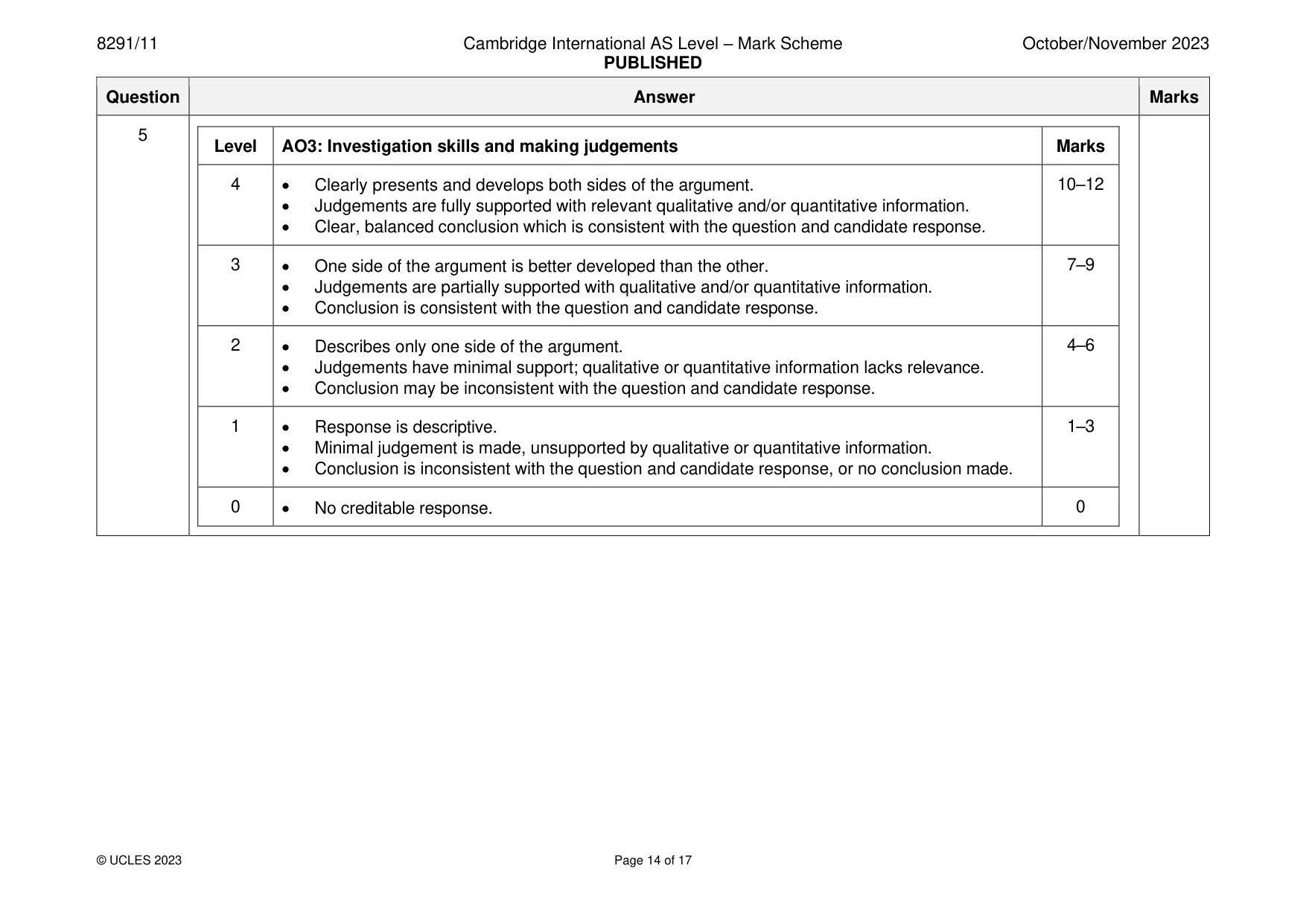
8291/11 Cambridge International AS Level – Mark Scheme PUBLISHED October/November 2023 © UCLES 2023 Page 14 of 17 Question Answer Marks 5 Level AO3: Investigation skills and making judgements Marks 4 • Clearly presents and develops both sides of the argument. • Judgements are fully supported with relevant qualitative and/or quantitative information. • Clear, balanced conclusion which is consistent with the question and candidate response. 10–12 3 • One side of the argument is better developed than the other. • Judgements are partially supported with qualitative and/or quantitative information. • Conclusion is consistent with the question and candidate response. 7–9 2 • Describes only one side of the argument. • Judgements have minimal support; qualitative or quantitative information lacks relevance. • Conclusion may be inconsistent with the question and candidate response. 4–6 1 • Response is descriptive. • Minimal judgement is made, unsupported by qualitative or quantitative information. • Conclusion is inconsistent with the question and candidate response, or no conclusion made. 1–3 0 • No creditable response. 0
Mark scheme, page 15
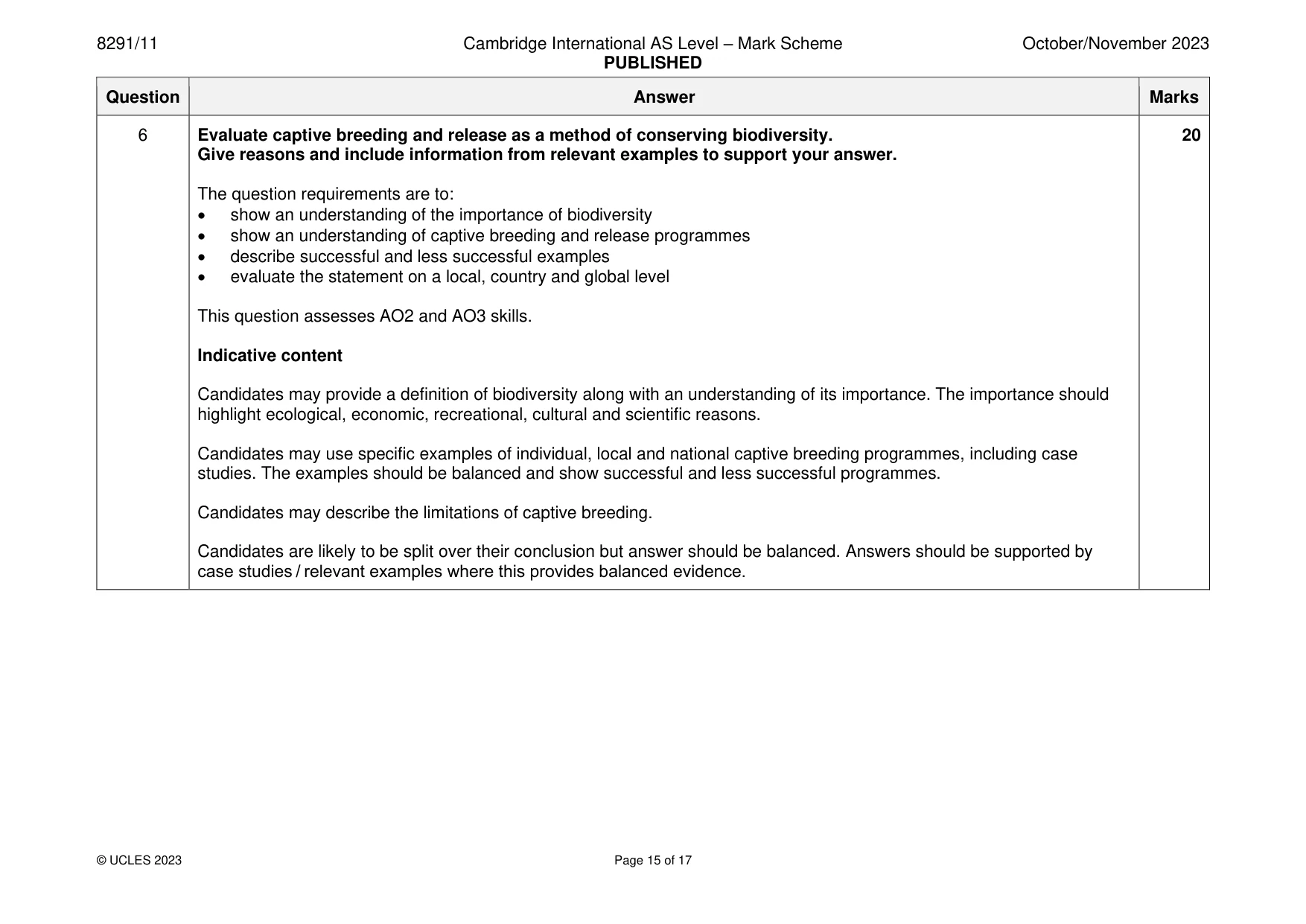
8291/11 Cambridge International AS Level – Mark Scheme PUBLISHED October/November 2023 © UCLES 2023 Page 15 of 17 Question Answer Marks 6 Evaluate captive breeding and release as a method of conserving biodiversity. Give reasons and include information from relevant examples to support your answer. The question requirements are to: • show an understanding of the importance of biodiversity • show an understanding of captive breeding and release programmes • describe successful and less successful examples • evaluate the statement on a local, country and global level This question assesses AO2 and AO3 skills. Indicative content Candidates may provide a definition of biodiversity along with an understanding of its importance. The importance should highlight ecological, economic, recreational, cultural and scientific reasons. Candidates may use specific examples of individual, local and national captive breeding programmes, including case studies. The examples should be balanced and show successful and less successful programmes. Candidates may describe the limitations of captive breeding. Candidates are likely to be split over their conclusion but answer should be balanced. Answers should be supported by case studies / relevant examples where this provides balanced evidence. 20
Mark scheme, page 16
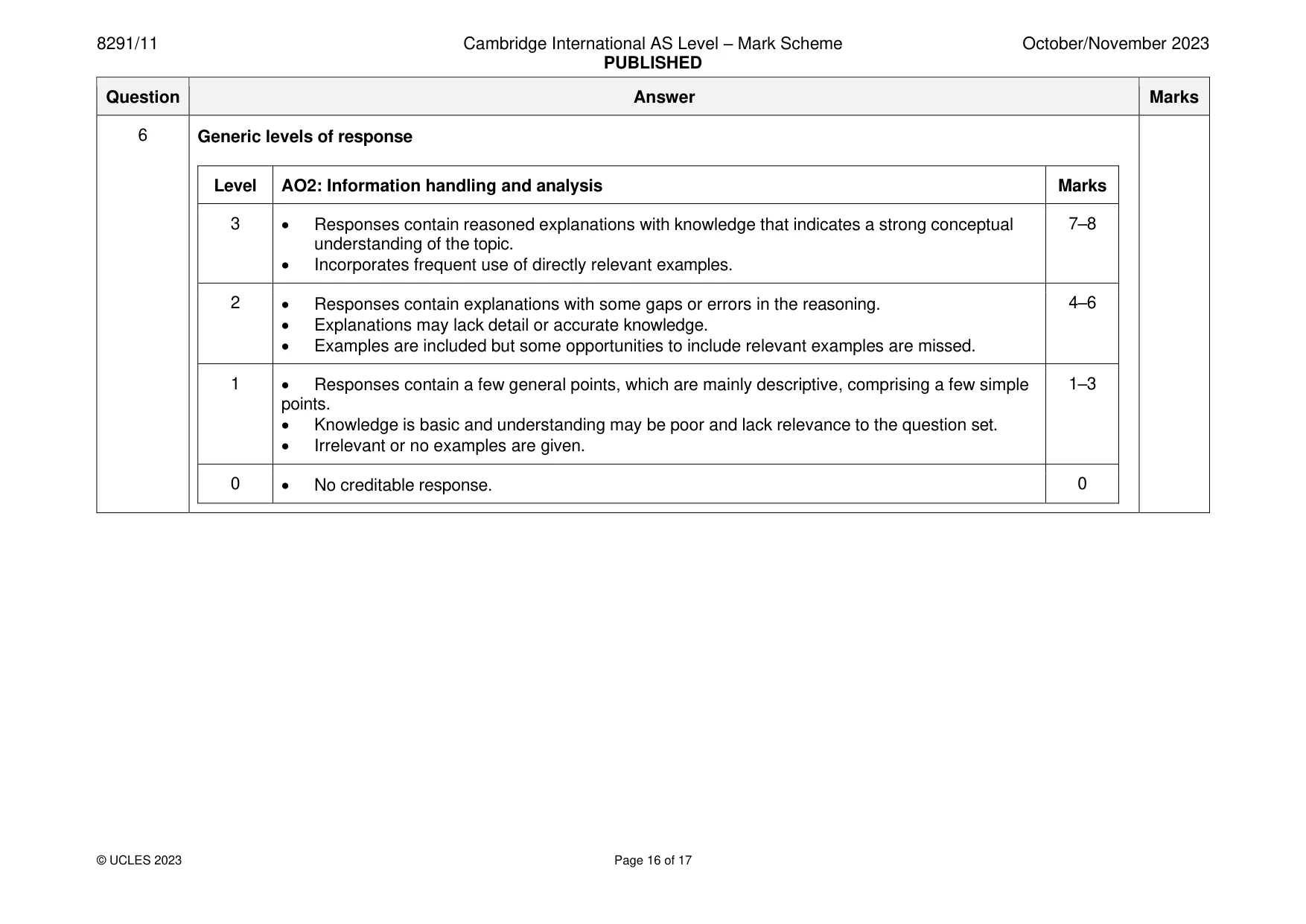
8291/11 Cambridge International AS Level – Mark Scheme PUBLISHED October/November 2023 © UCLES 2023 Page 16 of 17 Question Answer Marks 6 Generic levels of response Level AO2: Information handling and analysis Marks 3 • Responses contain reasoned explanations with knowledge that indicates a strong conceptual understanding of the topic. • Incorporates frequent use of directly relevant examples. 7–8 2 • Responses contain explanations with some gaps or errors in the reasoning. • Explanations may lack detail or accurate knowledge. • Examples are included but some opportunities to include relevant examples are missed. 4–6 1 • Responses contain a few general points, which are mainly descriptive, comprising a few simple points. • Knowledge is basic and understanding may be poor and lack relevance to the question set. • Irrelevant or no examples are given. 1–3 0 • No creditable response. 0
Mark scheme, page 17
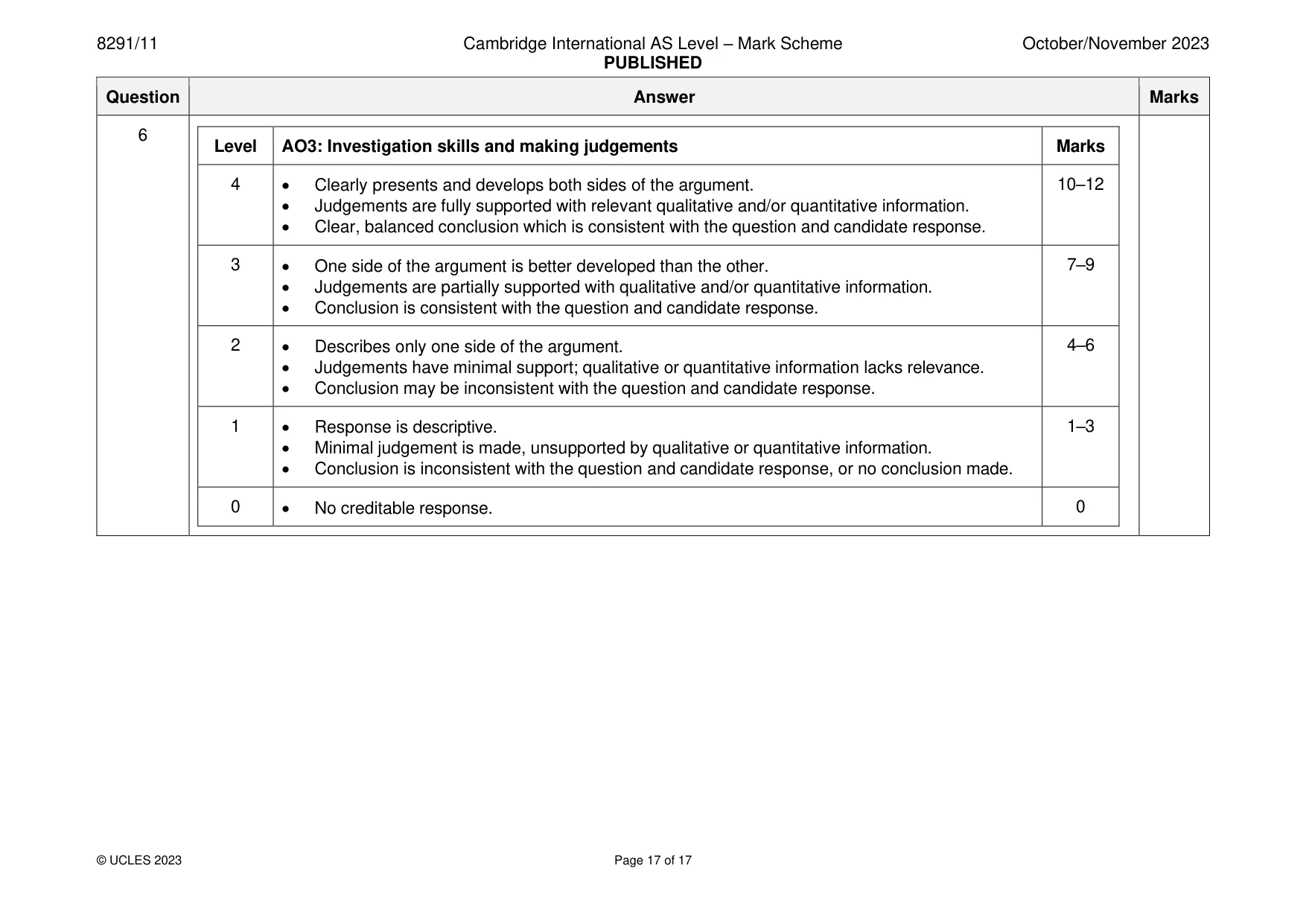
8291/11 Cambridge International AS Level – Mark Scheme PUBLISHED October/November 2023 © UCLES 2023 Page 17 of 17 Question Answer Marks 6 Level AO3: Investigation skills and making judgements Marks 4 • Clearly presents and develops both sides of the argument. • Judgements are fully supported with relevant qualitative and/or quantitative information. • Clear, balanced conclusion which is consistent with the question and candidate response. 10–12 3 • One side of the argument is better developed than the other. • Judgements are partially supported with qualitative and/or quantitative information. • Conclusion is consistent with the question and candidate response. 7–9 2 • Describes only one side of the argument. • Judgements have minimal support; qualitative or quantitative information lacks relevance. • Conclusion may be inconsistent with the question and candidate response. 4–6 1 • Response is descriptive. • Minimal judgement is made, unsupported by qualitative or quantitative information. • Conclusion is inconsistent with the question and candidate response, or no conclusion made. 1–3 0 • No creditable response. 0
What you needed in this session
Cambridge’s own grade thresholds for 2023 Oct/Nov, Paper 1 · Variant 1. A higher threshold means an easier paper — the bar moves with how the cohort did.