Cambridge A Level Environmental Management (AS only) 8291 — 2023 May/June Paper 1 · Variant 1
8291/11/M/J/23 · 80 marks · ≈90 min
The question paper and its mark scheme, free to read here and free to download. This is Cambridge’s own paper, exactly as it was sat.
Question paper20 pages







Mark scheme21 pages
Answers below. Sit the paper first if you are practising.
Paper as text
Question paper, page 1
This document has 20 pages. Any blank pages are indicated. [Turn over Cambridge International AS Level ENVIRONMENTAL MANAGEMENT 8291/11 Paper 1 Principles of Environmental Management May/June 2023 1 hour 45 minutes You must answer on the question paper. No additional materials are needed. INSTRUCTIONS ● Section A: answer all questions. ● Section B: answer one question. ● Use a black or dark blue pen. You may use an HB pencil for any diagrams or graphs. ● Write your name, centre number and candidate number in the boxes at the top of the page. ● Write your answer to each question in the space provided. ● Do not use an erasable pen or correction fluid. ● Do not write on any bar codes. ● You may use a calculator. ● You should show all your working and use appropriate units. INFORMATION ● The total mark for this paper is 80. ● The number of marks for each question or part question is shown in brackets [ ]. * 1 3 8 9 7 6 8 1 0 3 * DC (RW/SG) 317050/2 © UCLES 2023
Question paper, page 2
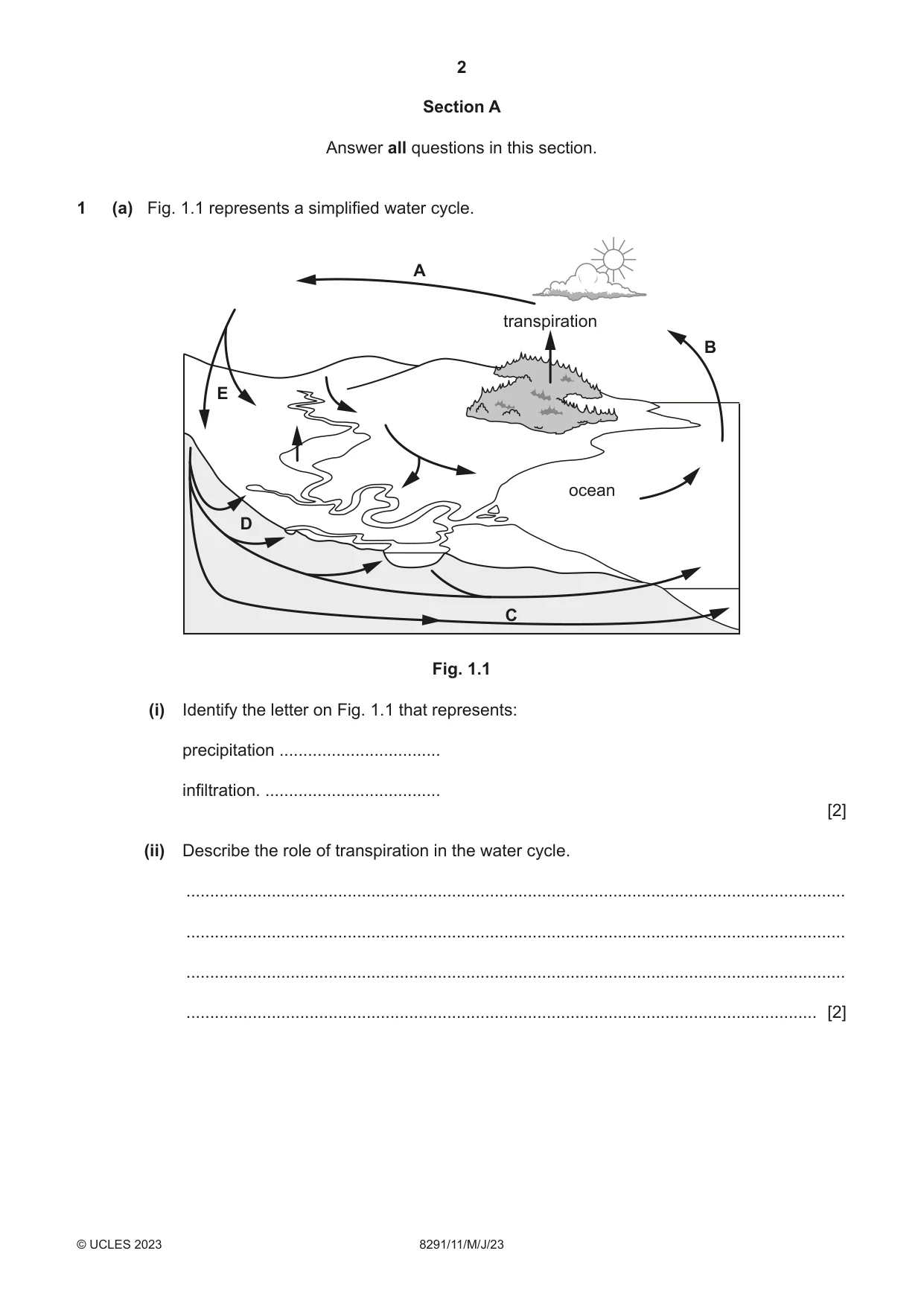
2 8291/11/M/J/23 © UCLES 2023 Section A Answer all questions in this section. 1 (a) Fig. 1.1 represents a simplified water cycle. A E D C B transpiration ocean Fig. 1.1 (i) Identify the letter on Fig. 1.1 that represents: precipitation … infiltration. … [2] (ii) Describe the role of transpiration in the water cycle. … … … … [2]
Question paper, page 3
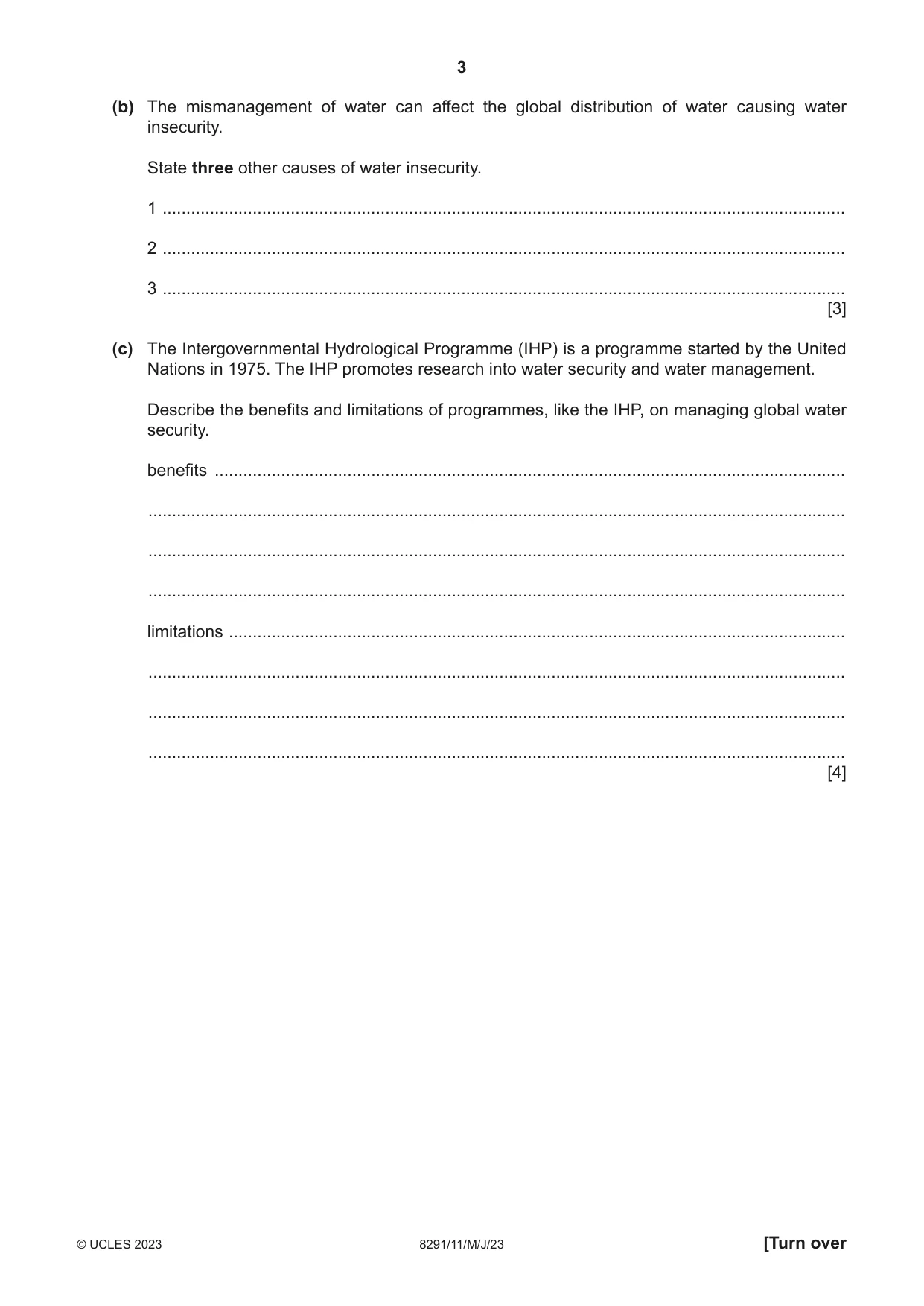
3 8291/11/M/J/23 © UCLES 2023 [Turn over (b) The mismanagement of water can affect the global distribution of water causing water insecurity. State three other causes of water insecurity. 1 … 2 … 3 … [3] (c) The Intergovernmental Hydrological Programme (IHP) is a programme started by the United Nations in 1975. The IHP promotes research into water security and water management. Describe the benefits and limitations of programmes, like the IHP, on managing global water security. benefits … … … … limitations … … … … [4]
Question paper, page 4
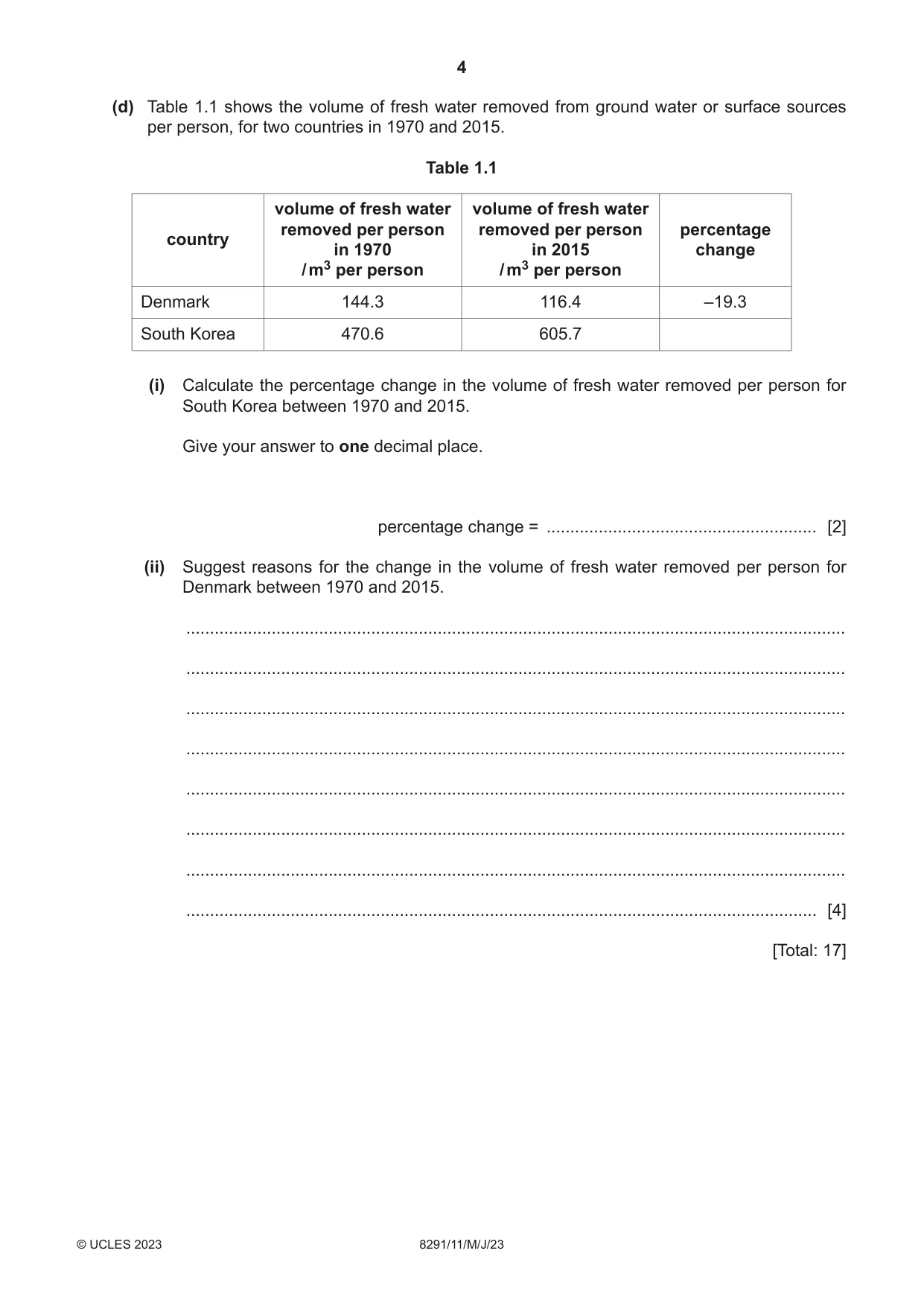
4 8291/11/M/J/23 © UCLES 2023 (d) Table 1.1 shows the volume of fresh water removed from ground water or surface sources per person, for two countries in 1970 and 2015. Table 1.1 country volume of fresh water removed per person in 1970 / m3 per person volume of fresh water removed per person in 2015 / m3 per person percentage change Denmark 144.3 116.4 –19.3 South Korea 470.6 605.7 (i) Calculate the percentage change in the volume of fresh water removed per person for South Korea between 1970 and 2015. Give your answer to one decimal place. percentage change = … [2] (ii) Suggest reasons for the change in the volume of fresh water removed per person for Denmark between 1970 and 2015. … … … … … … … … [4] [Total: 17]
Question paper, page 5
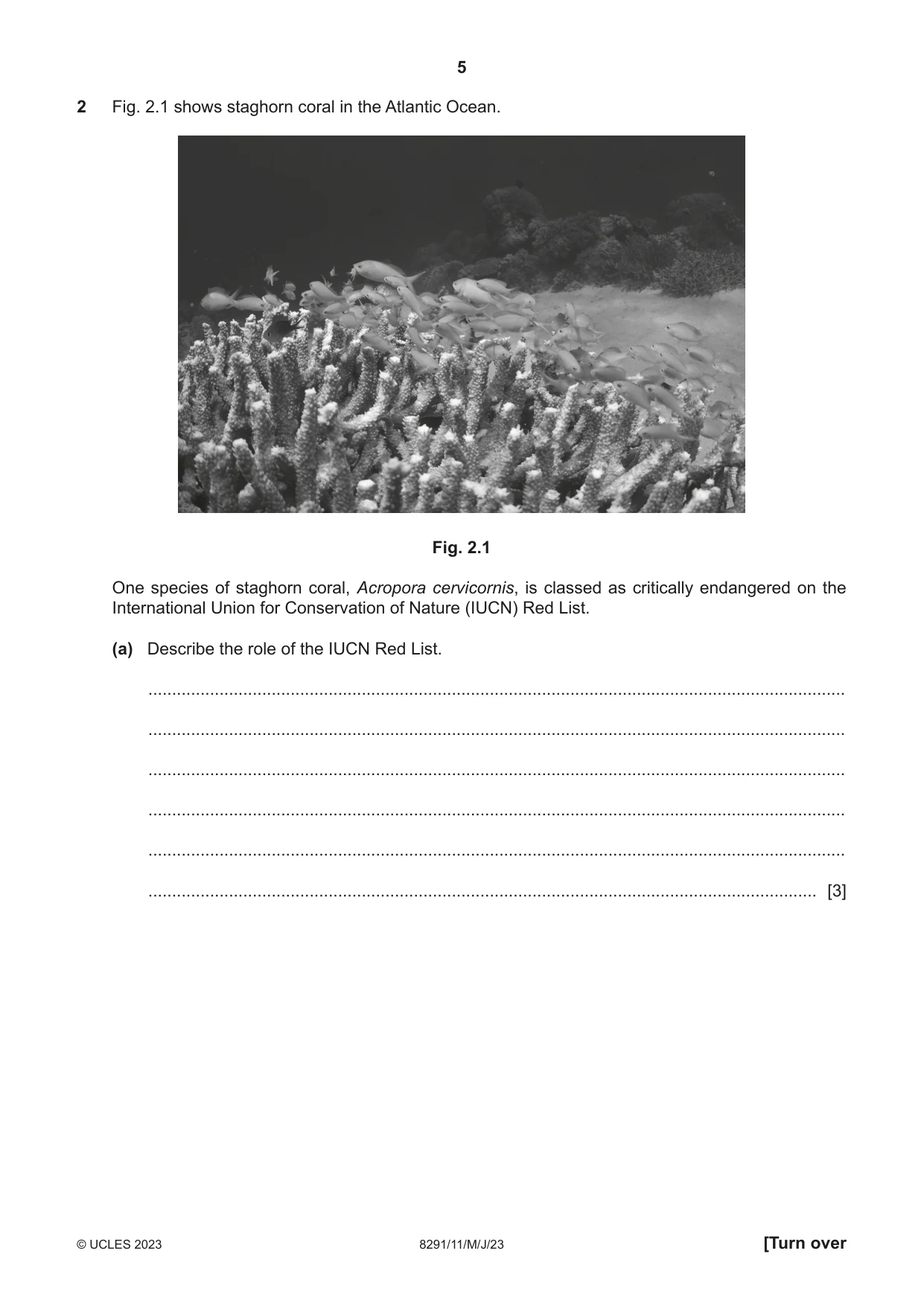
5 8291/11/M/J/23 © UCLES 2023 [Turn over 2 Fig. 2.1 shows staghorn coral in the Atlantic Ocean. Fig. 2.1 One species of staghorn coral, Acropora cervicornis, is classed as critically endangered on the International Union for Conservation of Nature (IUCN) Red List. (a) Describe the role of the IUCN Red List. … … … … … … [3]
Question paper, page 6
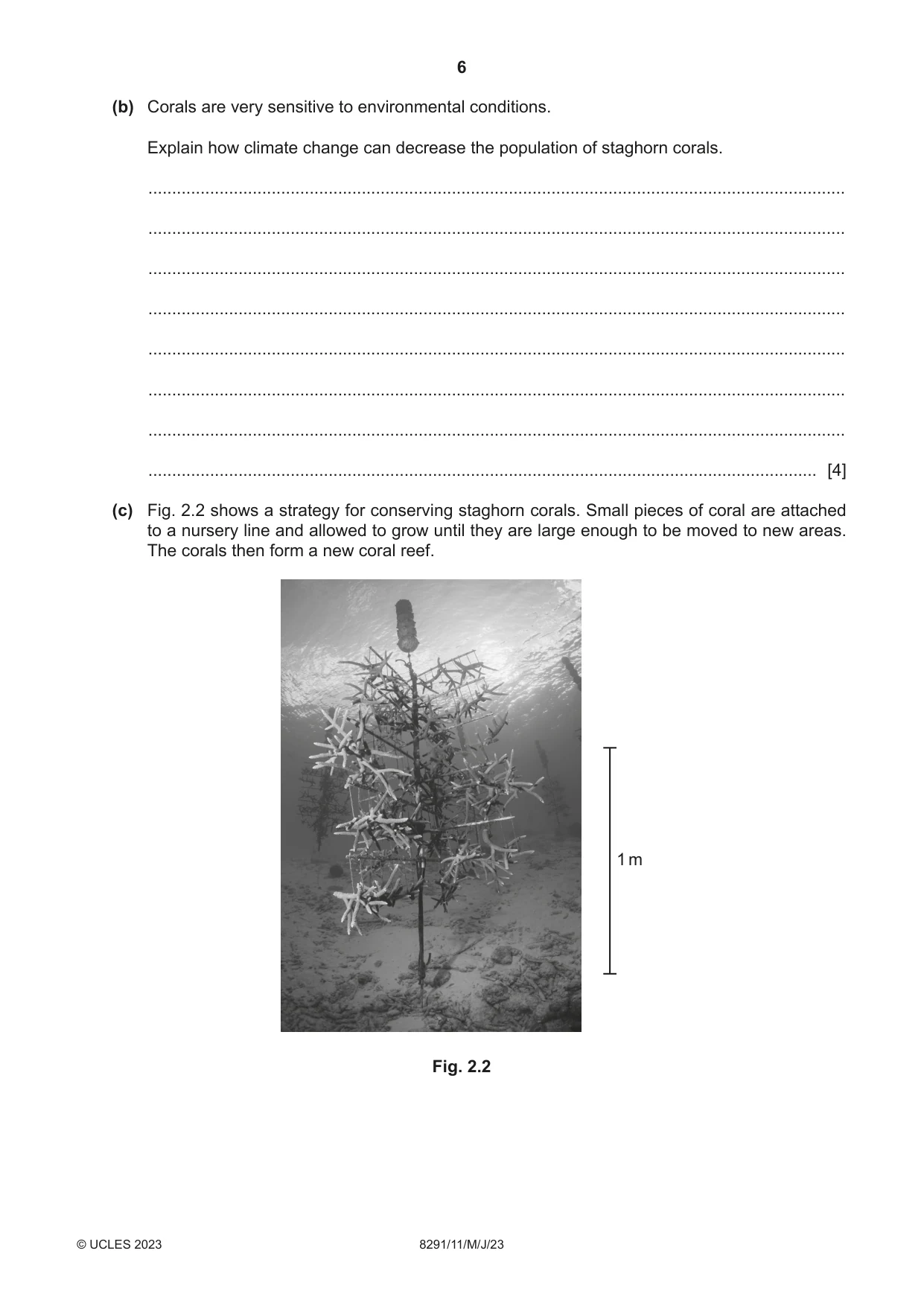
6 8291/11/M/J/23 © UCLES 2023 (b) Corals are very sensitive to environmental conditions. Explain how climate change can decrease the population of staghorn corals. … … … … … … … … [4] (c) Fig. 2.2 shows a strategy for conserving staghorn corals. Small pieces of coral are attached to a nursery line and allowed to grow until they are large enough to be moved to new areas. The corals then form a new coral reef. 1 m Fig. 2.2
Question paper, page 7
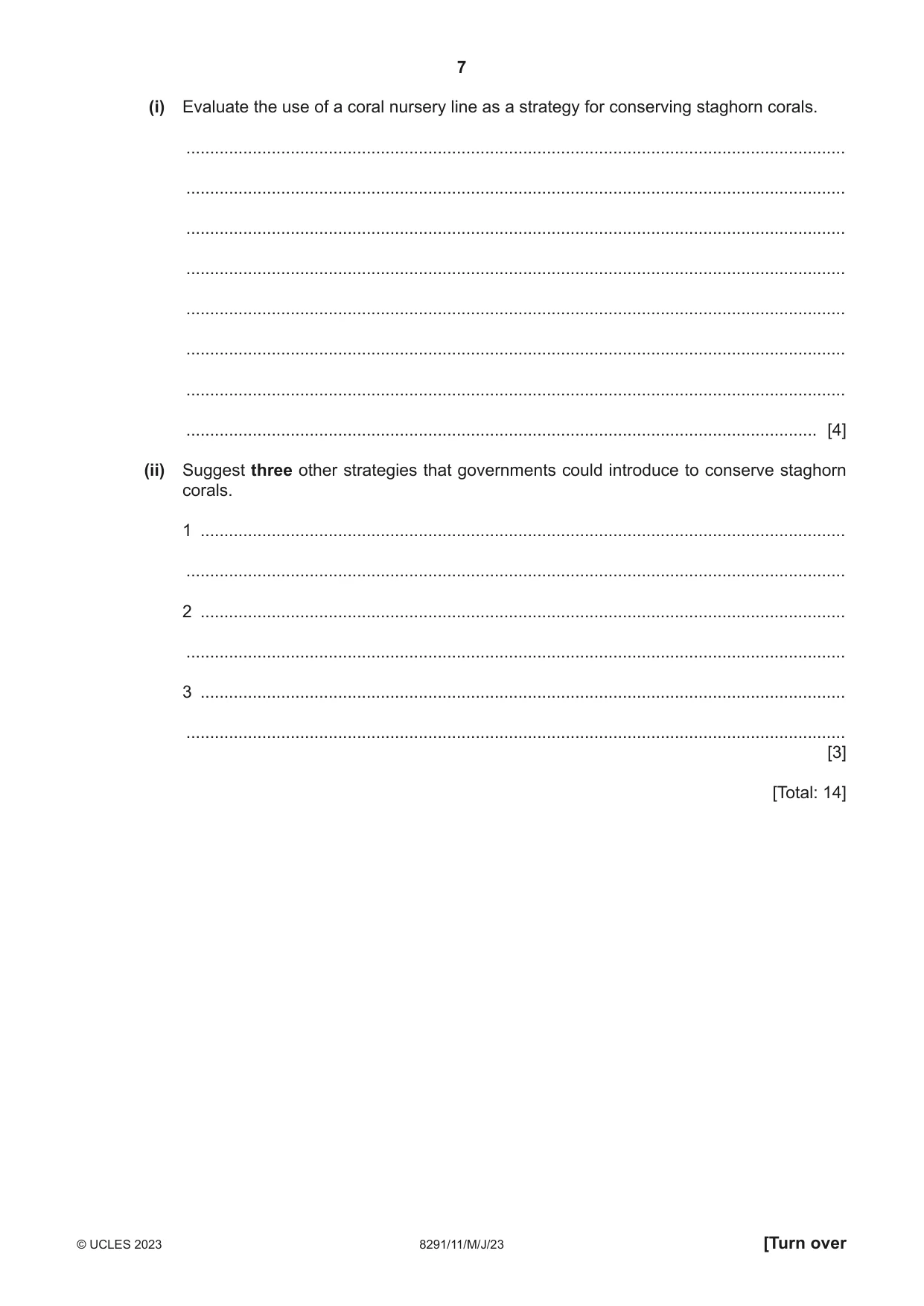
7 8291/11/M/J/23 © UCLES 2023 [Turn over (i) Evaluate the use of a coral nursery line as a strategy for conserving staghorn corals. … … … … … … … … [4] (ii) Suggest three other strategies that governments could introduce to conserve staghorn corals. 1 … … 2 … … 3 … … [3] [Total: 14]
Question paper, page 8
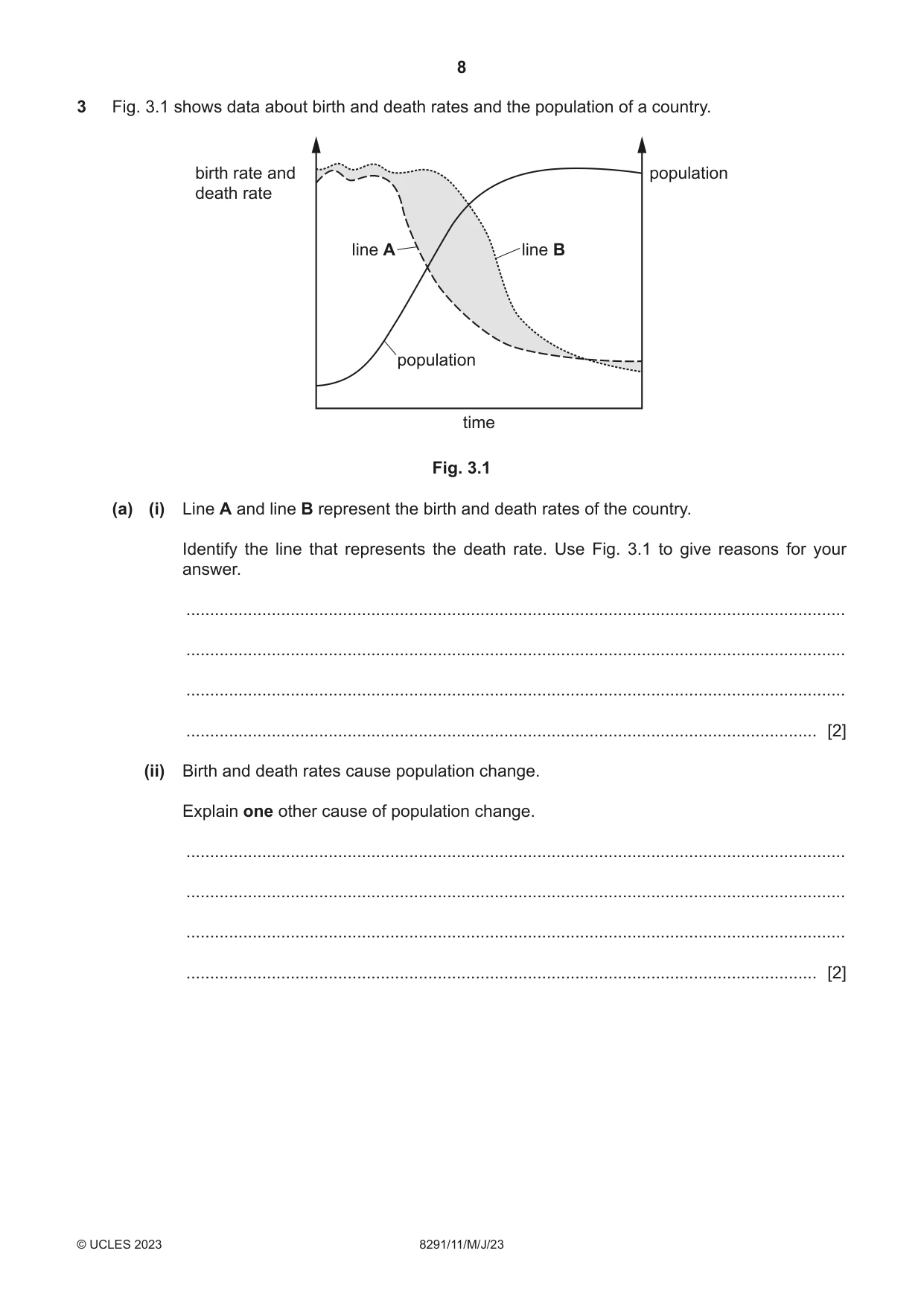
8 8291/11/M/J/23 © UCLES 2023 3 Fig. 3.1 shows data about birth and death rates and the population of a country. birth rate and death rate population population time line A line B Fig. 3.1 (a) (i) Line A and line B represent the birth and death rates of the country. Identify the line that represents the death rate. Use Fig. 3.1 to give reasons for your answer. … … … … [2] (ii) Birth and death rates cause population change. Explain one other cause of population change. … … … … [2]
Question paper, page 9
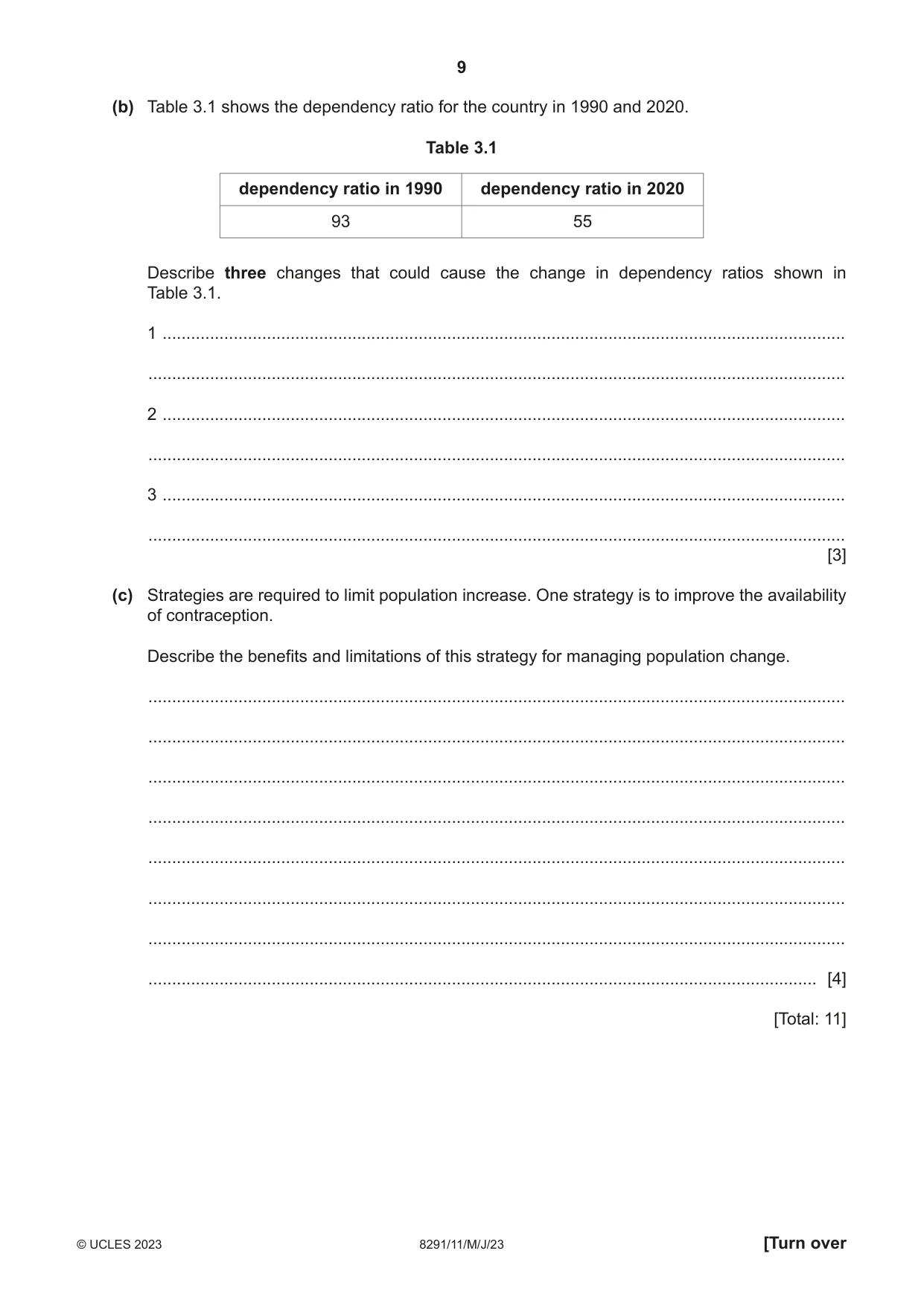
9 8291/11/M/J/23 © UCLES 2023 [Turn over (b) Table 3.1 shows the dependency ratio for the country in 1990 and 2020. Table 3.1 dependency ratio in 1990 dependency ratio in 2020 93 55 Describe three changes that could cause the change in dependency ratios shown in Table 3.1. 1 … … 2 … … 3 … … [3] (c) Strategies are required to limit population increase. One strategy is to improve the availability of contraception. Describe the benefits and limitations of this strategy for managing population change. … … … … … … … … [4] [Total: 11]
Question paper, page 10
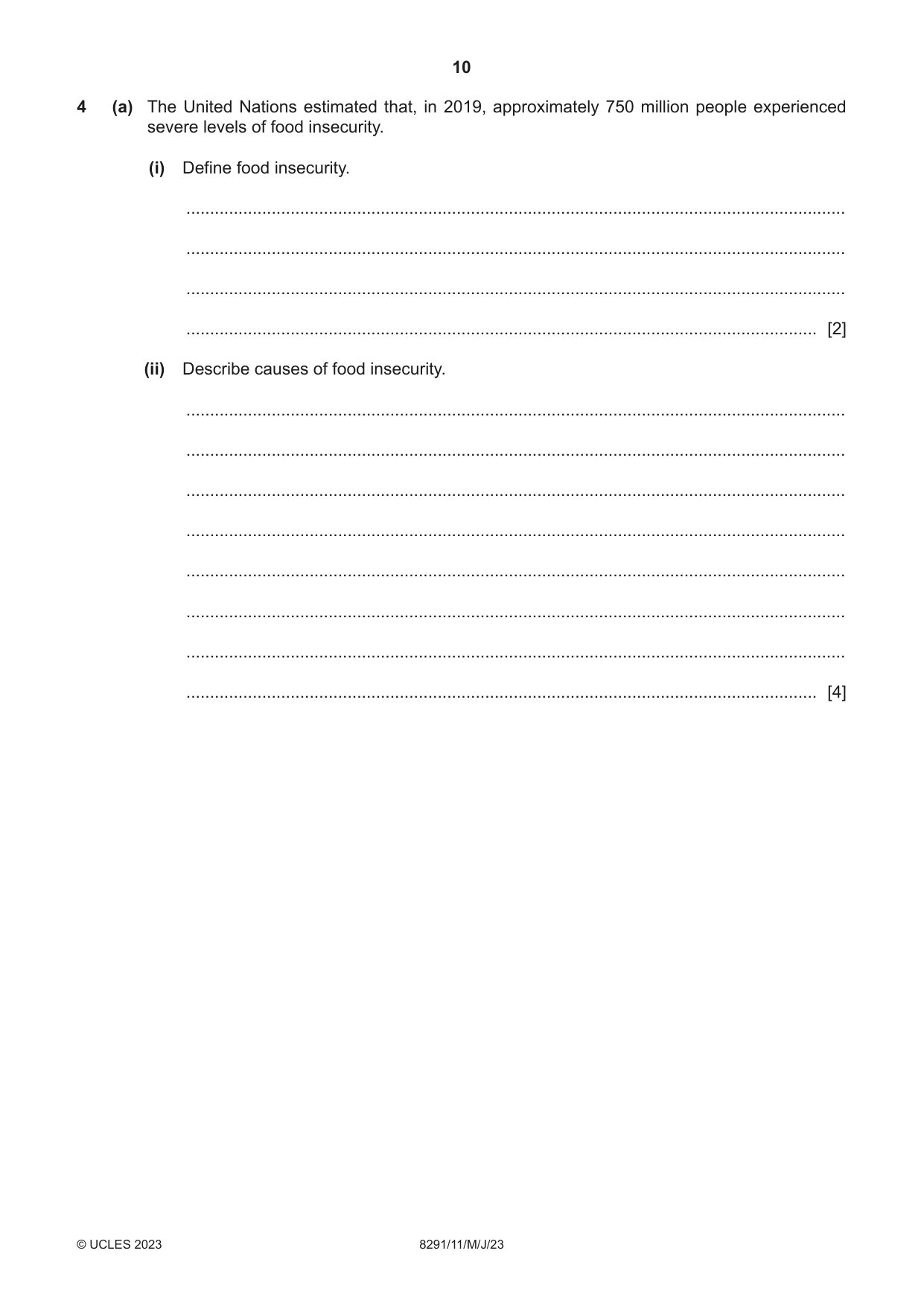
10 8291/11/M/J/23 © UCLES 2023 4 (a) The United Nations estimated that, in 2019, approximately 750 million people experienced severe levels of food insecurity. (i) Define food insecurity. … … … … [2] (ii) Describe causes of food insecurity. … … … … … … … … [4]
Question paper, page 11
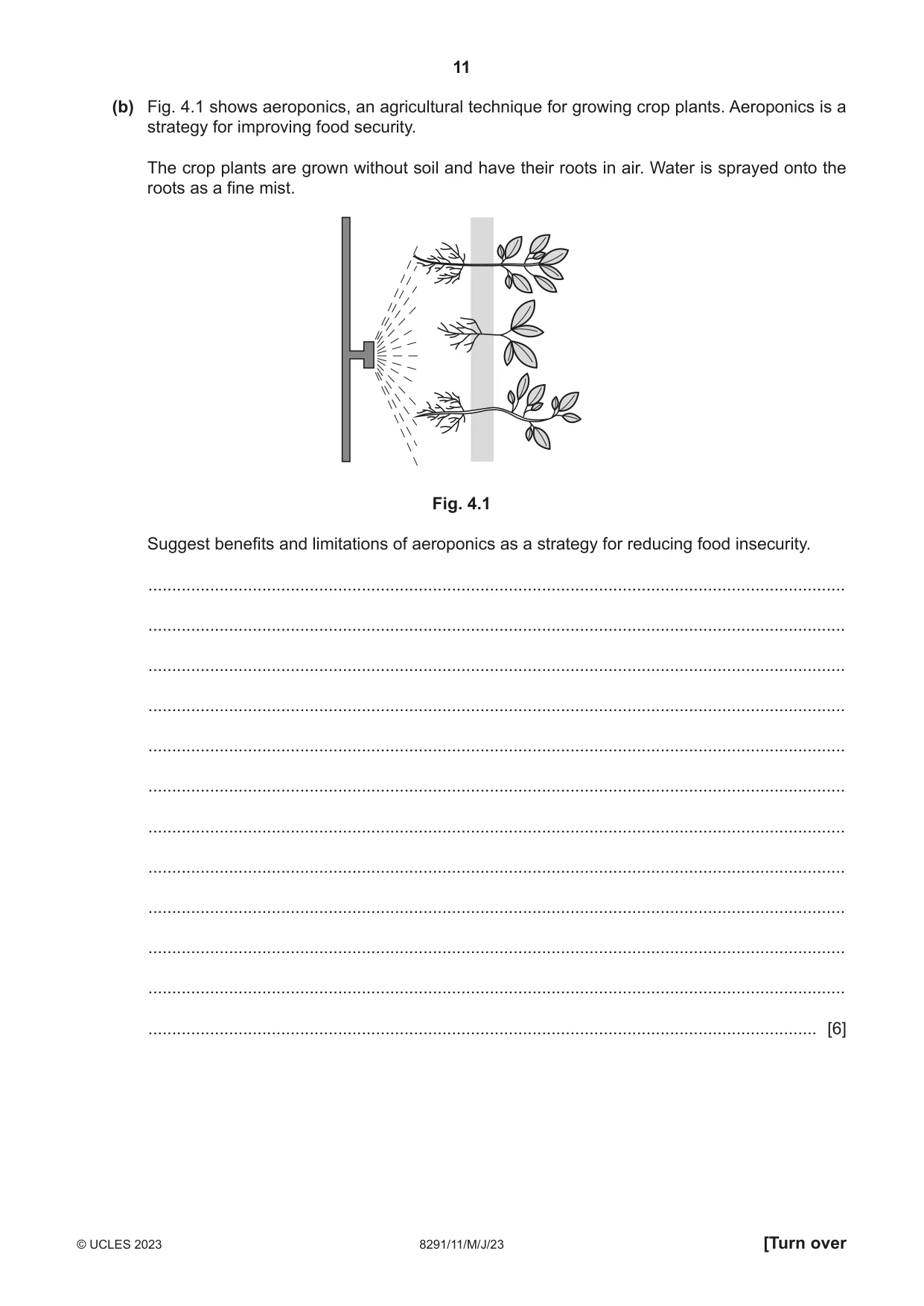
11 8291/11/M/J/23 © UCLES 2023 [Turn over (b) Fig. 4.1 shows aeroponics, an agricultural technique for growing crop plants. Aeroponics is a strategy for improving food security. The crop plants are grown without soil and have their roots in air. Water is sprayed onto the roots as a fine mist. Fig. 4.1 Suggest benefits and limitations of aeroponics as a strategy for reducing food insecurity. … … … … … … … … … … … … [6]
Question paper, page 12
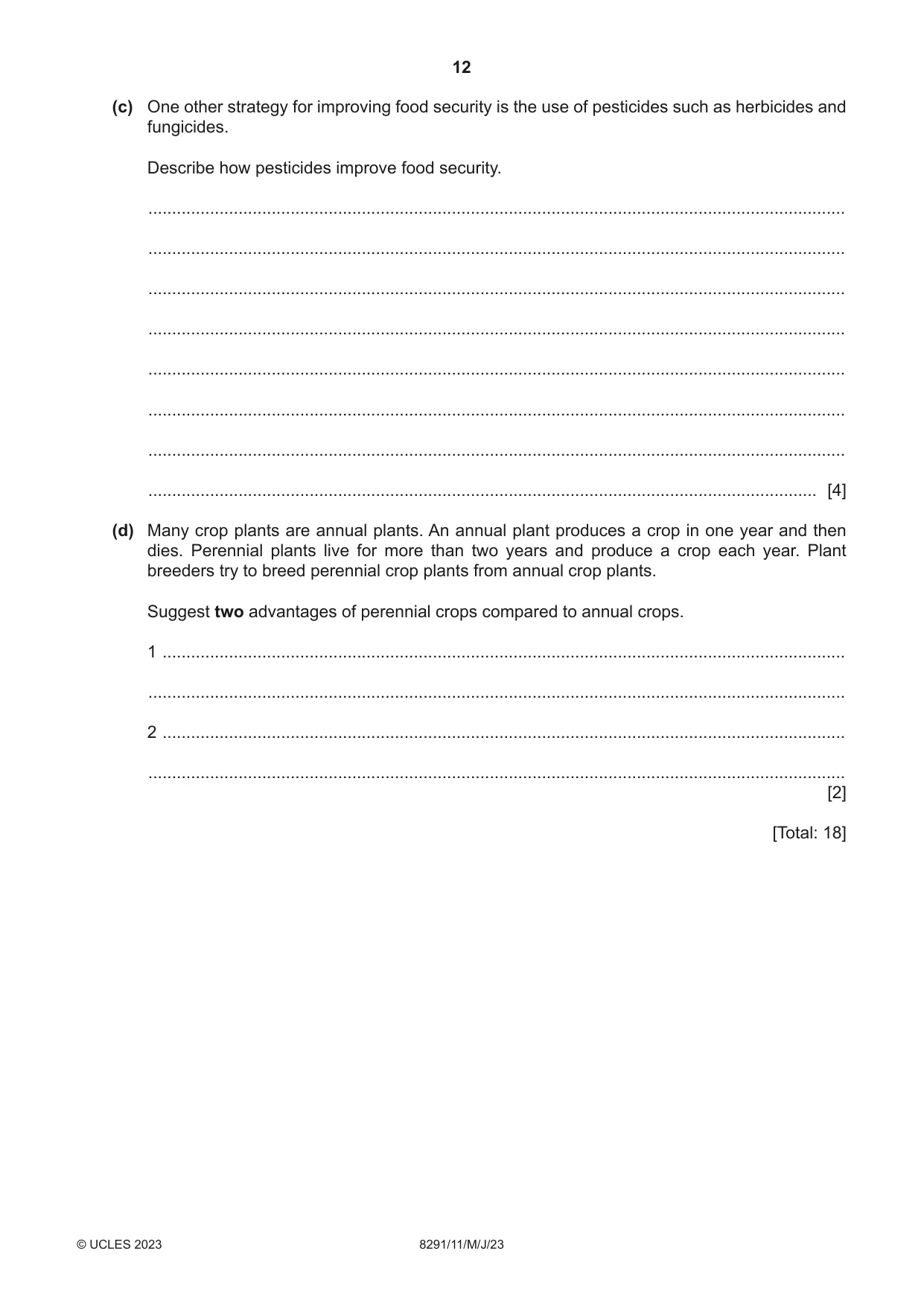
12 8291/11/M/J/23 © UCLES 2023 (c) One other strategy for improving food security is the use of pesticides such as herbicides and fungicides. Describe how pesticides improve food security. … … … … … … … … [4] (d) Many crop plants are annual plants. An annual plant produces a crop in one year and then dies. Perennial plants live for more than two years and produce a crop each year. Plant breeders try to breed perennial crop plants from annual crop plants. Suggest two advantages of perennial crops compared to annual crops. 1 … … 2 … … [2] [Total: 18]
Question paper, page 13
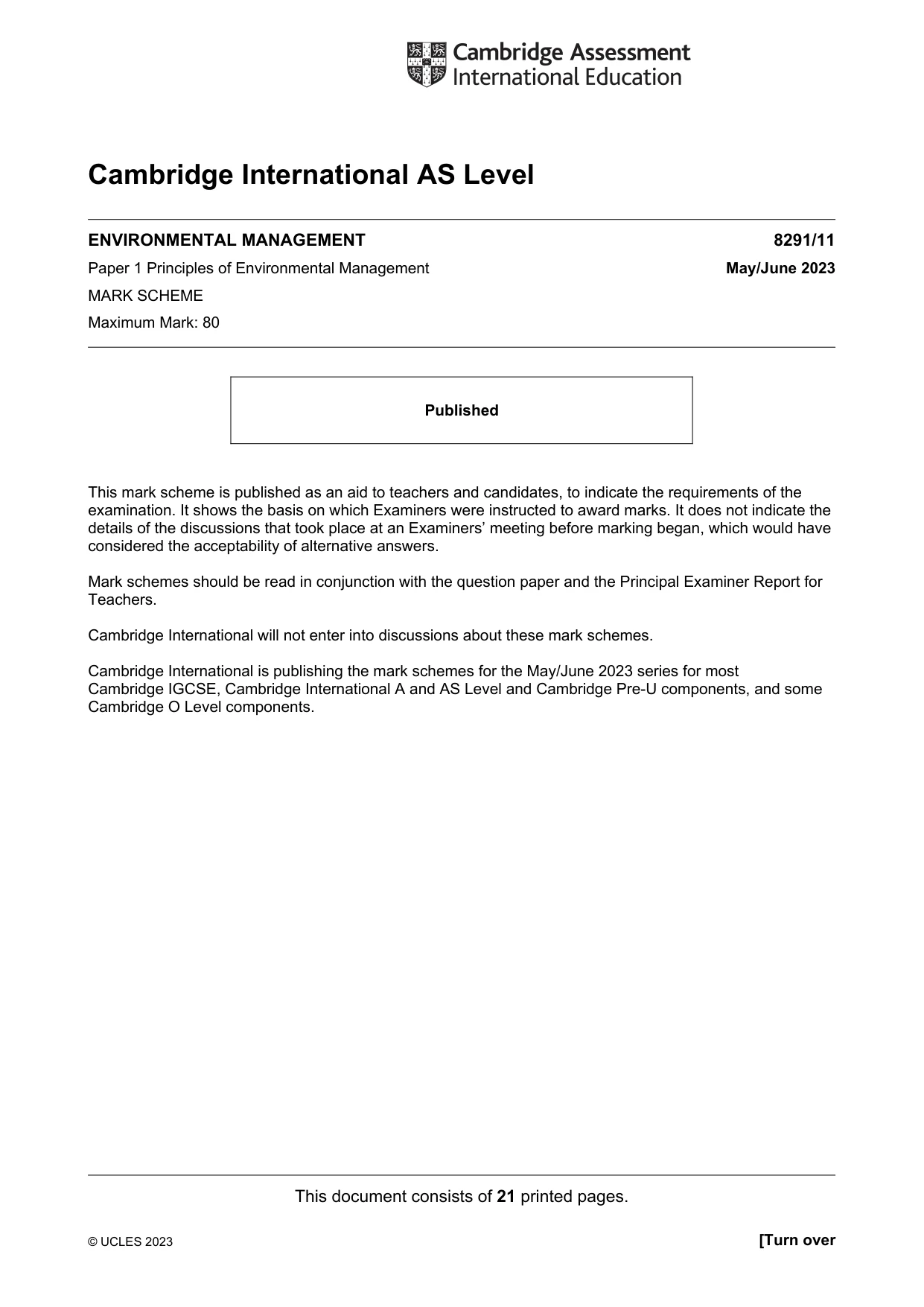
13 8291/11/M/J/23 © UCLES 2023 [Turn over Section B Answer one question. Either 5 ‘Using waste to generate electricity is an effective strategy for reducing the impact of waste disposal.’ To what extent do you agree with this statement? Give reasons and include information from relevant examples to support your answer. [20] Or 6 Evaluate the success of strategies for managing the impacts of human activity on Antarctica. Give reasons and include information from relevant examples to support your answer. [20] … … … … … … … … … … … … … … … … …
Question paper, page 14
14 8291/11/M/J/23 © UCLES 2023 … … … … … … … … … … … … … … … … … … … … … … … … … … … …
Question paper, page 15
15 8291/11/M/J/23 © UCLES 2023 [Turn over … … … … … … … … … … … … … … … … … … … … … … … … … … … …
Question paper, page 16
16 8291/11/M/J/23 © UCLES 2023 … … … … … … … … … … … … … … … … … … … … … … … … … … … …
Question paper, page 17
17 8291/11/M/J/23 © UCLES 2023 [Turn over … … … … … … … … … … … … … … … … … … … … … … … … … … … …
Question paper, page 18
18 8291/11/M/J/23 © UCLES 2023 … … … … … … … … … … … … … … … … … … … … … … … … … … … …
Question paper, page 19
19 8291/11/M/J/23 © UCLES 2023 BLANK PAGE
Question paper, page 20
20 8291/11/M/J/23 © UCLES 2023 BLANK PAGE The boundaries and names shown, the designations used and the presentation of material on any maps contained in this question paper/insert do not imply official endorsement or acceptance by Cambridge Assessment International Education concerning the legal status of any country, territory, or area or any of its authorities, or of the delimitation of its frontiers or boundaries. Permission to reproduce items where third-party owned material protected by copyright is included has been sought and cleared where possible. Every reasonable effort has been made by the publisher (UCLES) to trace copyright holders, but if any items requiring clearance have unwittingly been included, the publisher will be pleased to make amends at the earliest possible opportunity. To avoid the issue of disclosure of answer-related information to candidates, all copyright acknowledgements are reproduced online in the Cambridge Assessment International Education Copyright Acknowledgements Booklet. This is produced for each series of examinations and is freely available to download at www.cambridgeinternational.org after the live examination series. Cambridge Assessment International Education is part of Cambridge Assessment. Cambridge Assessment is the brand name of the University of Cambridge Local Examinations Syndicate (UCLES), which is a department of the University of Cambridge.
Mark scheme, page 1
This document consists of 21 printed pages. © UCLES 2023 [Turn over Cambridge International AS Level ENVIRONMENTAL MANAGEMENT 8291/11 Paper 1 Principles of Environmental Management May/June 2023 MARK SCHEME Maximum Mark: 80 Published This mark scheme is published as an aid to teachers and candidates, to indicate the requirements of the examination. It shows the basis on which Examiners were instructed to award marks. It does not indicate the details of the discussions that took place at an Examiners’ meeting before marking began, which would have considered the acceptability of alternative answers. Mark schemes should be read in conjunction with the question paper and the Principal Examiner Report for Teachers. Cambridge International will not enter into discussions about these mark schemes. Cambridge International is publishing the mark schemes for the May/June 2023 series for most Cambridge IGCSE, Cambridge International A and AS Level and Cambridge Pre-U components, and some Cambridge O Level components.
Mark scheme, page 2
8291/11 Cambridge International AS Level – Mark Scheme PUBLISHED May/June 2023 © UCLES 2023 Page 2 of 21 Generic Marking Principles These general marking principles must be applied by all examiners when marking candidate answers. They should be applied alongside the specific content of the mark scheme or generic level descriptors for a question. Each question paper and mark scheme will also comply with these marking principles. GENERIC MARKING PRINCIPLE 1: Marks must be awarded in line with: the specific content of the mark scheme or the generic level descriptors for the question the specific skills defined in the mark scheme or in the generic level descriptors for the question the standard of response required by a candidate as exemplified by the standardisation scripts. GENERIC MARKING PRINCIPLE 2: Marks awarded are always whole marks (not half marks, or other fractions). GENERIC MARKING PRINCIPLE 3: Marks must be awarded positively: marks are awarded for correct/valid answers, as defined in the mark scheme. However, credit is given for valid answers which go beyond the scope of the syllabus and mark scheme, referring to your Team Leader as appropriate marks are awarded when candidates clearly demonstrate what they know and can do marks are not deducted for errors marks are not deducted for omissions answers should only be judged on the quality of spelling, punctuation and grammar when these features are specifically assessed by the question as indicated by the mark scheme. The meaning, however, should be unambiguous. GENERIC MARKING PRINCIPLE 4: Rules must be applied consistently, e.g. in situations where candidates have not followed instructions or in the application of generic level descriptors.
Mark scheme, page 3
8291/11 Cambridge International AS Level – Mark Scheme PUBLISHED May/June 2023 © UCLES 2023 Page 3 of 21 GENERIC MARKING PRINCIPLE 5: Marks should be awarded using the full range of marks defined in the mark scheme for the question (however; the use of the full mark range may be limited according to the quality of the candidate responses seen). GENERIC MARKING PRINCIPLE 6: Marks awarded are based solely on the requirements as defined in the mark scheme. Marks should not be awarded with grade thresholds or grade descriptors in mind. Science-Specific Marking Principles 1 Examiners should consider the context and scientific use of any keywords when awarding marks. Although keywords may be present, marks should not be awarded if the keywords are used incorrectly. 2 The examiner should not choose between contradictory statements given in the same question part, and credit should not be awarded for any correct statement that is contradicted within the same question part. Wrong science that is irrelevant to the question should be ignored. 3 Although spellings do not have to be correct, spellings of syllabus terms must allow for clear and unambiguous separation from other syllabus terms with which they may be confused (e.g. ethane / ethene, glucagon / glycogen, refraction / reflection). 4 The error carried forward (ecf) principle should be applied, where appropriate. If an incorrect answer is subsequently used in a scientifically correct way, the candidate should be awarded these subsequent marking points. Further guidance will be included in the mark scheme where necessary and any exceptions to this general principle will be noted. 5 ‘List rule’ guidance For questions that require n responses (e.g. State two reasons …): The response should be read as continuous prose, even when numbered answer spaces are provided. Any response marked ignore in the mark scheme should not count towards n. Incorrect responses should not be awarded credit but will still count towards n. Read the entire response to check for any responses that contradict those that would otherwise be credited. Credit should not be awarded for any responses that are contradicted within the rest of the response. Where two responses contradict one another, this should be treated as a single incorrect response. Non-contradictory responses after the first n responses may be ignored even if they include incorrect science.
Mark scheme, page 4
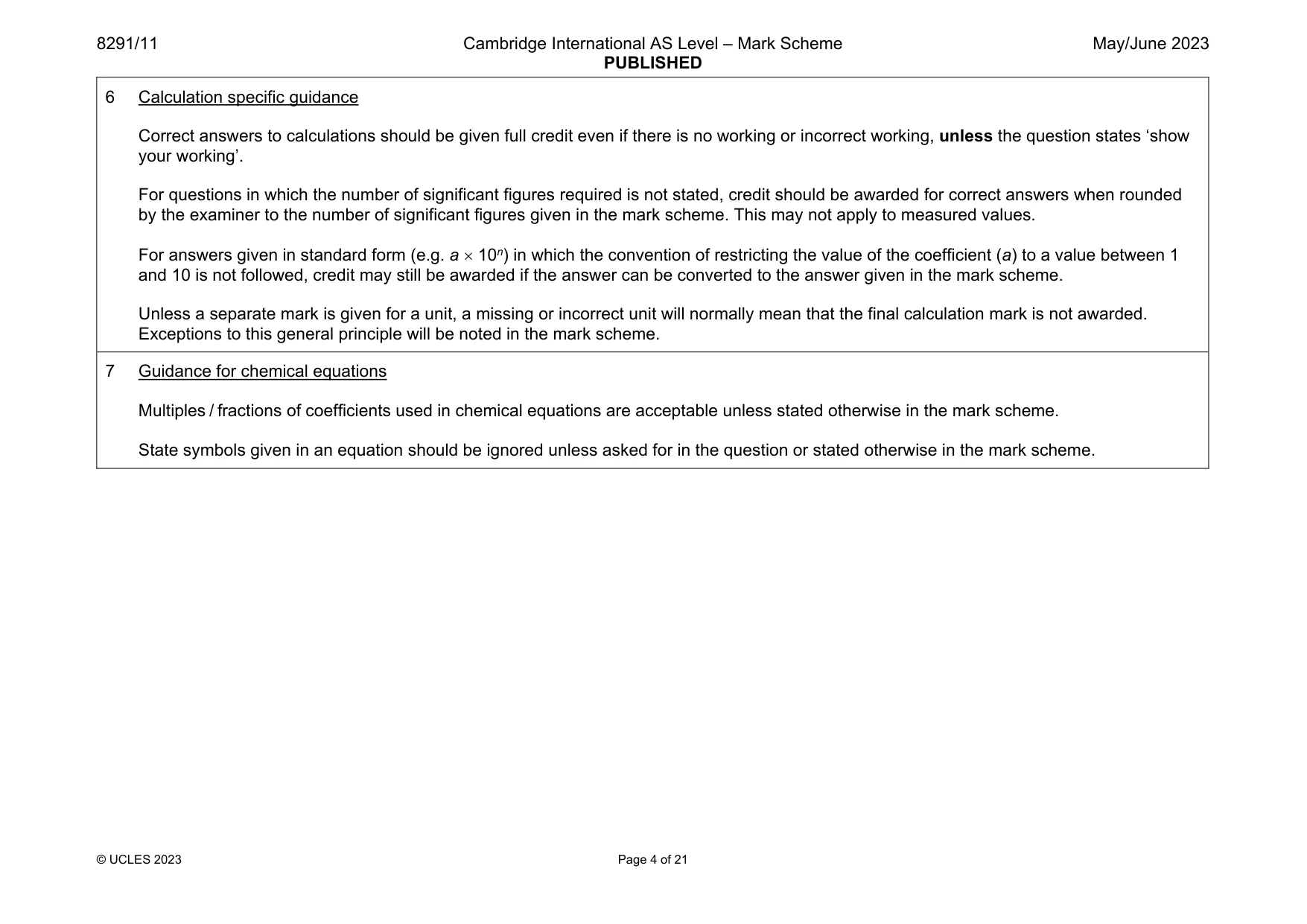
8291/11 Cambridge International AS Level – Mark Scheme PUBLISHED May/June 2023 © UCLES 2023 Page 4 of 21 6 Calculation specific guidance Correct answers to calculations should be given full credit even if there is no working or incorrect working, unless the question states ‘show your working’. For questions in which the number of significant figures required is not stated, credit should be awarded for correct answers when rounded by the examiner to the number of significant figures given in the mark scheme. This may not apply to measured values. For answers given in standard form (e.g. a 10n) in which the convention of restricting the value of the coefficient (a) to a value between 1 and 10 is not followed, credit may still be awarded if the answer can be converted to the answer given in the mark scheme. Unless a separate mark is given for a unit, a missing or incorrect unit will normally mean that the final calculation mark is not awarded. Exceptions to this general principle will be noted in the mark scheme. 7 Guidance for chemical equations Multiples / fractions of coefficients used in chemical equations are acceptable unless stated otherwise in the mark scheme. State symbols given in an equation should be ignored unless asked for in the question or stated otherwise in the mark scheme.
Mark scheme, page 5
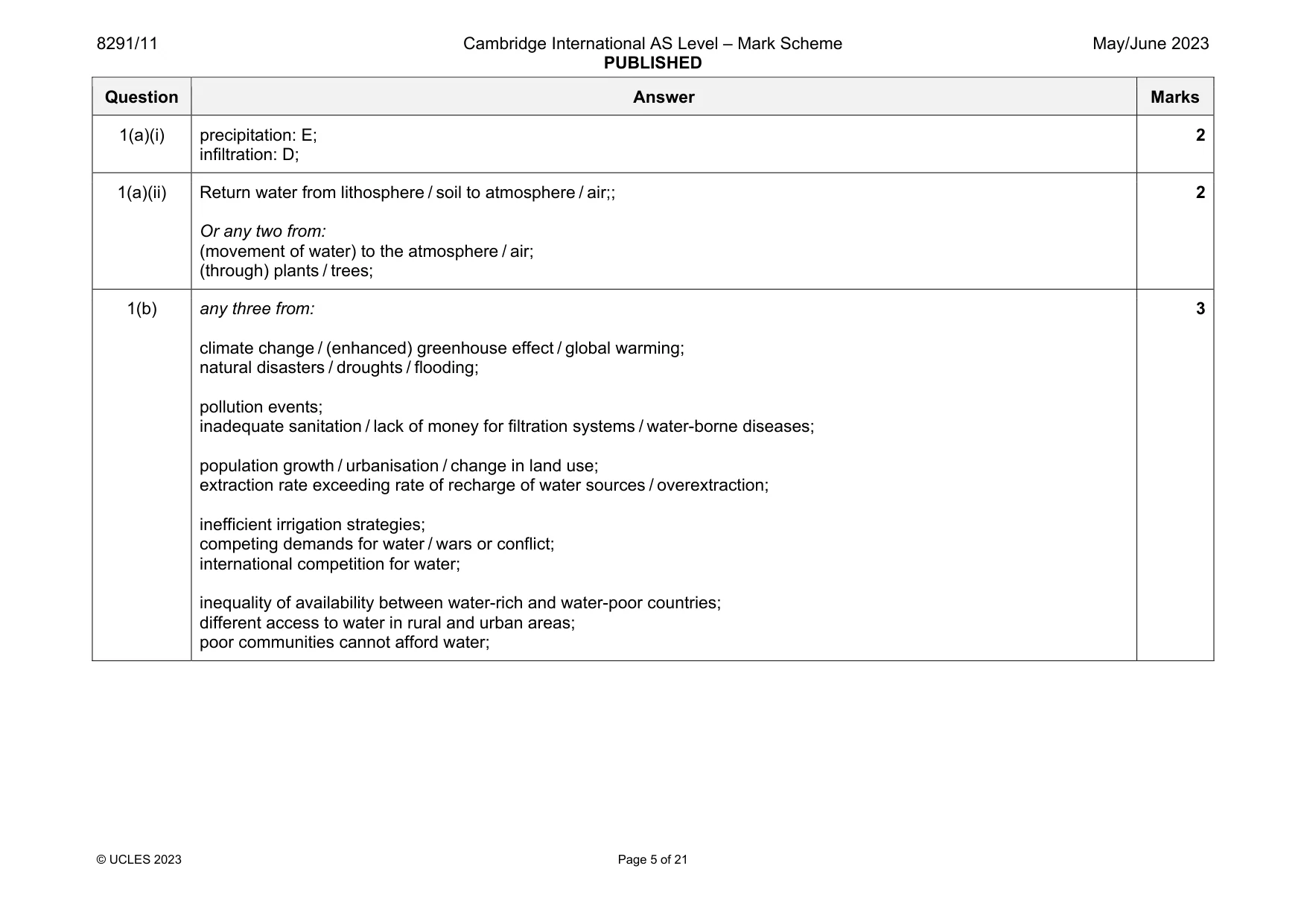
8291/11 Cambridge International AS Level – Mark Scheme PUBLISHED May/June 2023 © UCLES 2023 Page 5 of 21 Question Answer Marks 1(a)(i) precipitation: E; infiltration: D; 2 1(a)(ii) Return water from lithosphere / soil to atmosphere / air;; Or any two from: (movement of water) to the atmosphere / air; (through) plants / trees; 2 1(b) any three from: climate change / (enhanced) greenhouse effect / global warming; natural disasters / droughts / flooding; pollution events; inadequate sanitation / lack of money for filtration systems / water-borne diseases; population growth / urbanisation / change in land use; extraction rate exceeding rate of recharge of water sources / overextraction; inefficient irrigation strategies; competing demands for water / wars or conflict; international competition for water; inequality of availability between water-rich and water-poor countries; different access to water in rural and urban areas; poor communities cannot afford water; 3
Mark scheme, page 6
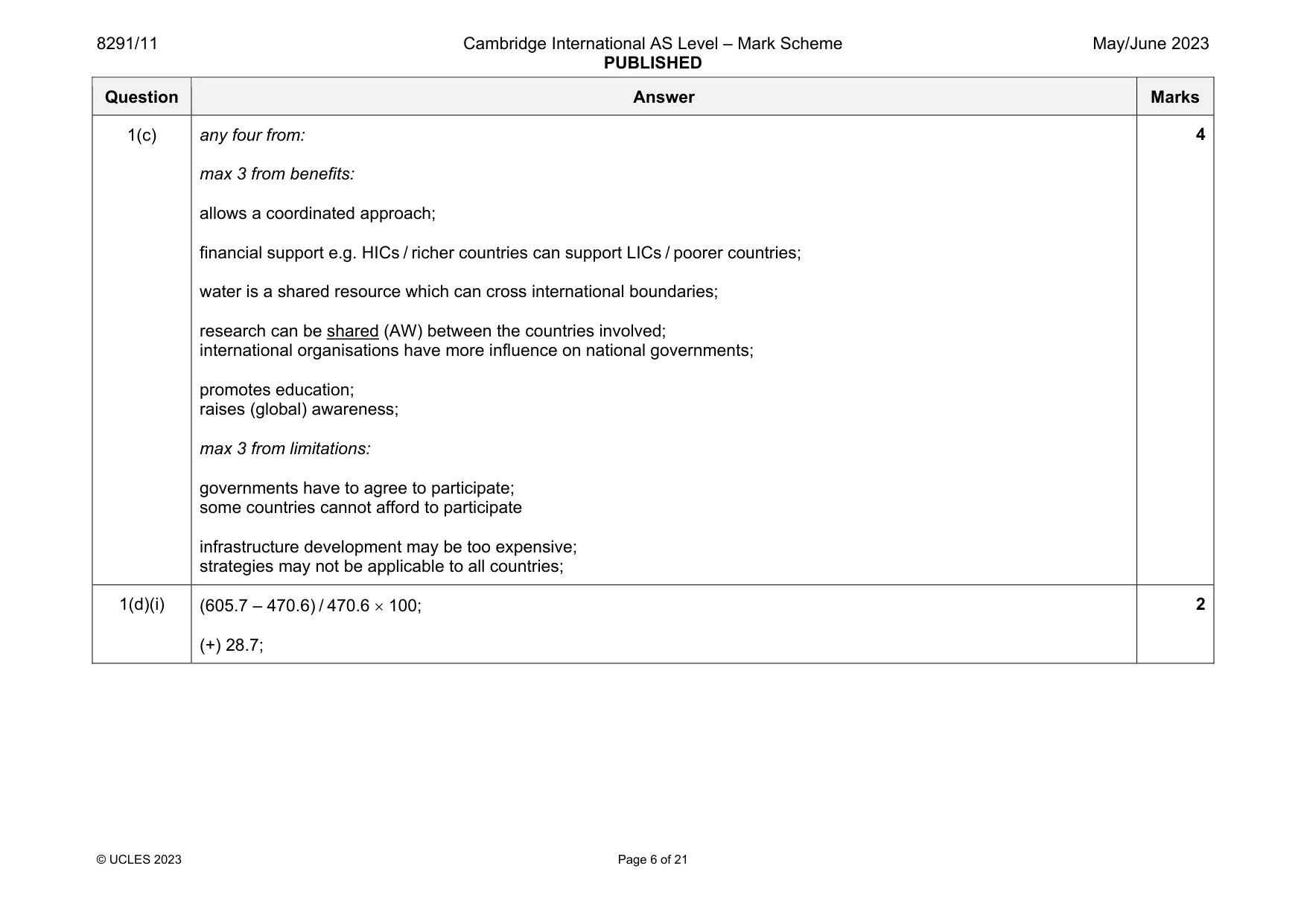
8291/11 Cambridge International AS Level – Mark Scheme PUBLISHED May/June 2023 © UCLES 2023 Page 6 of 21 Question Answer Marks 1(c) any four from: max 3 from benefits: allows a coordinated approach; financial support e.g. HICs / richer countries can support LICs / poorer countries; water is a shared resource which can cross international boundaries; research can be shared (AW) between the countries involved; international organisations have more influence on national governments; promotes education; raises (global) awareness; max 3 from limitations: governments have to agree to participate; some countries cannot afford to participate infrastructure development may be too expensive; strategies may not be applicable to all countries; 4 1(d)(i) (605.7 – 470.6) / 470.6 100; (+) 28.7; 2
Mark scheme, page 7
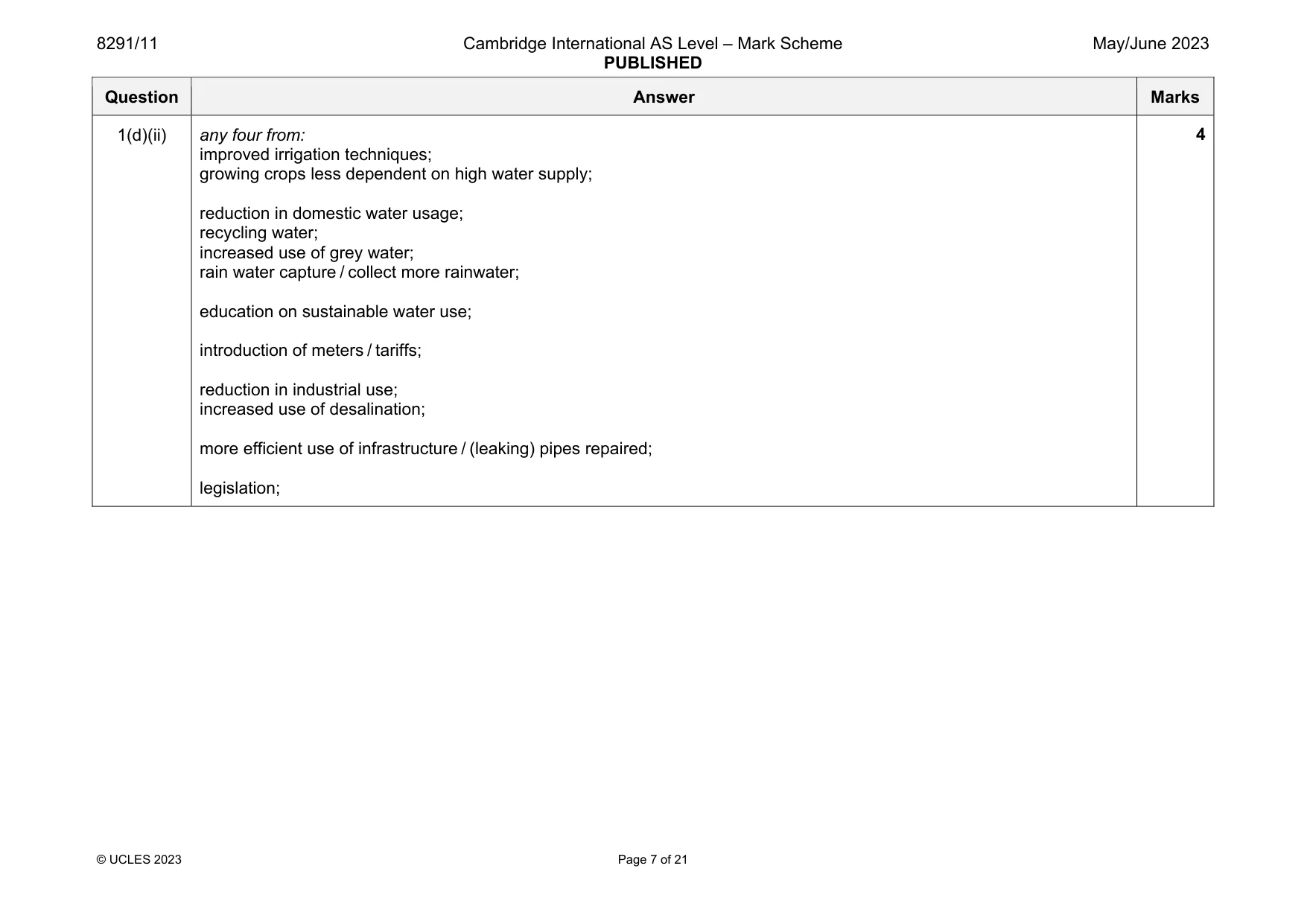
8291/11 Cambridge International AS Level – Mark Scheme PUBLISHED May/June 2023 © UCLES 2023 Page 7 of 21 Question Answer Marks 1(d)(ii) any four from: improved irrigation techniques; growing crops less dependent on high water supply; reduction in domestic water usage; recycling water; increased use of grey water; rain water capture / collect more rainwater; education on sustainable water use; introduction of meters / tariffs; reduction in industrial use; increased use of desalination; more efficient use of infrastructure / (leaking) pipes repaired; legislation; 4
Mark scheme, page 8
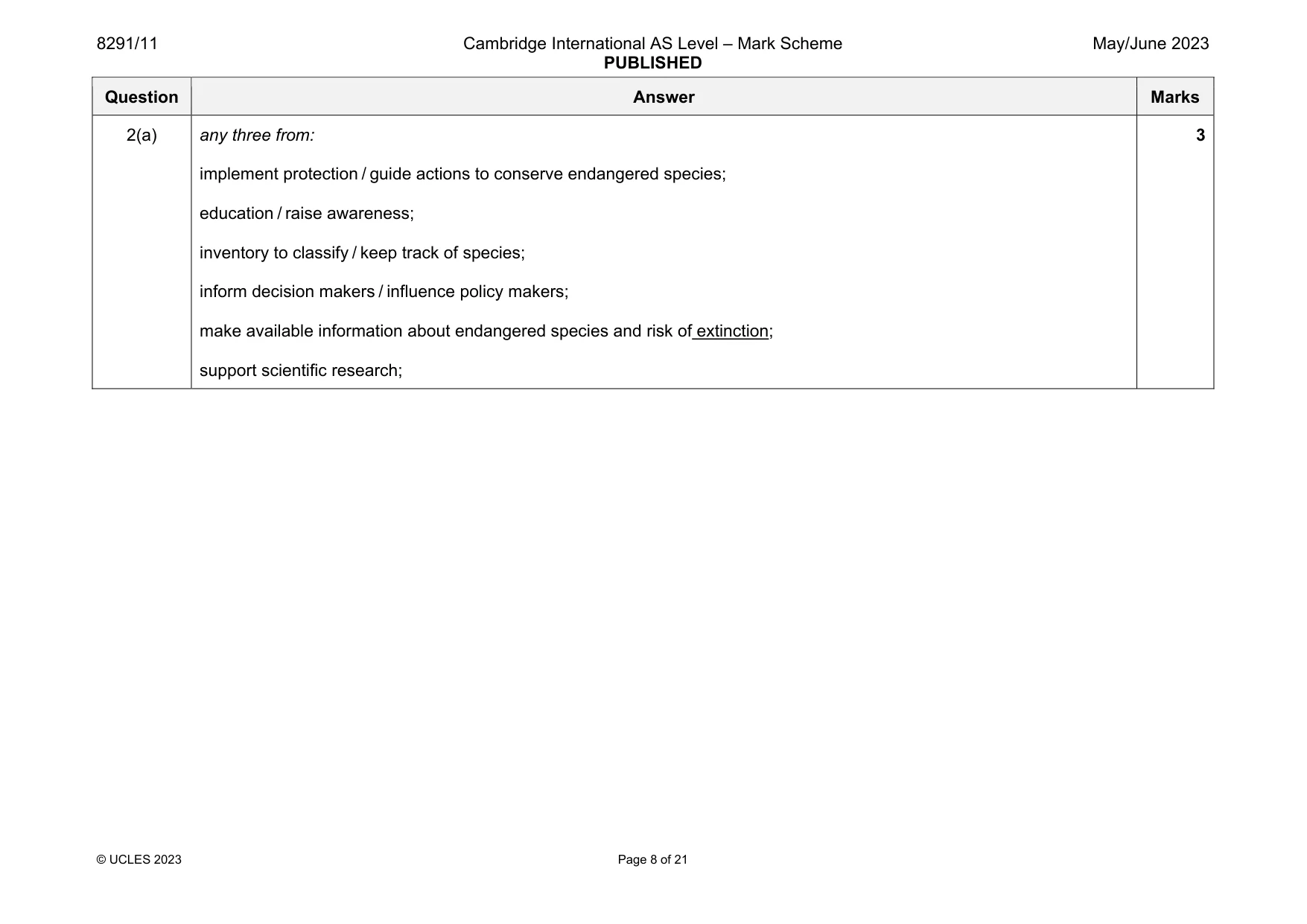
8291/11 Cambridge International AS Level – Mark Scheme PUBLISHED May/June 2023 © UCLES 2023 Page 8 of 21 Question Answer Marks 2(a) any three from: implement protection / guide actions to conserve endangered species; education / raise awareness; inventory to classify / keep track of species; inform decision makers / influence policy makers; make available information about endangered species and risk of extinction; support scientific research; 3
Mark scheme, page 9
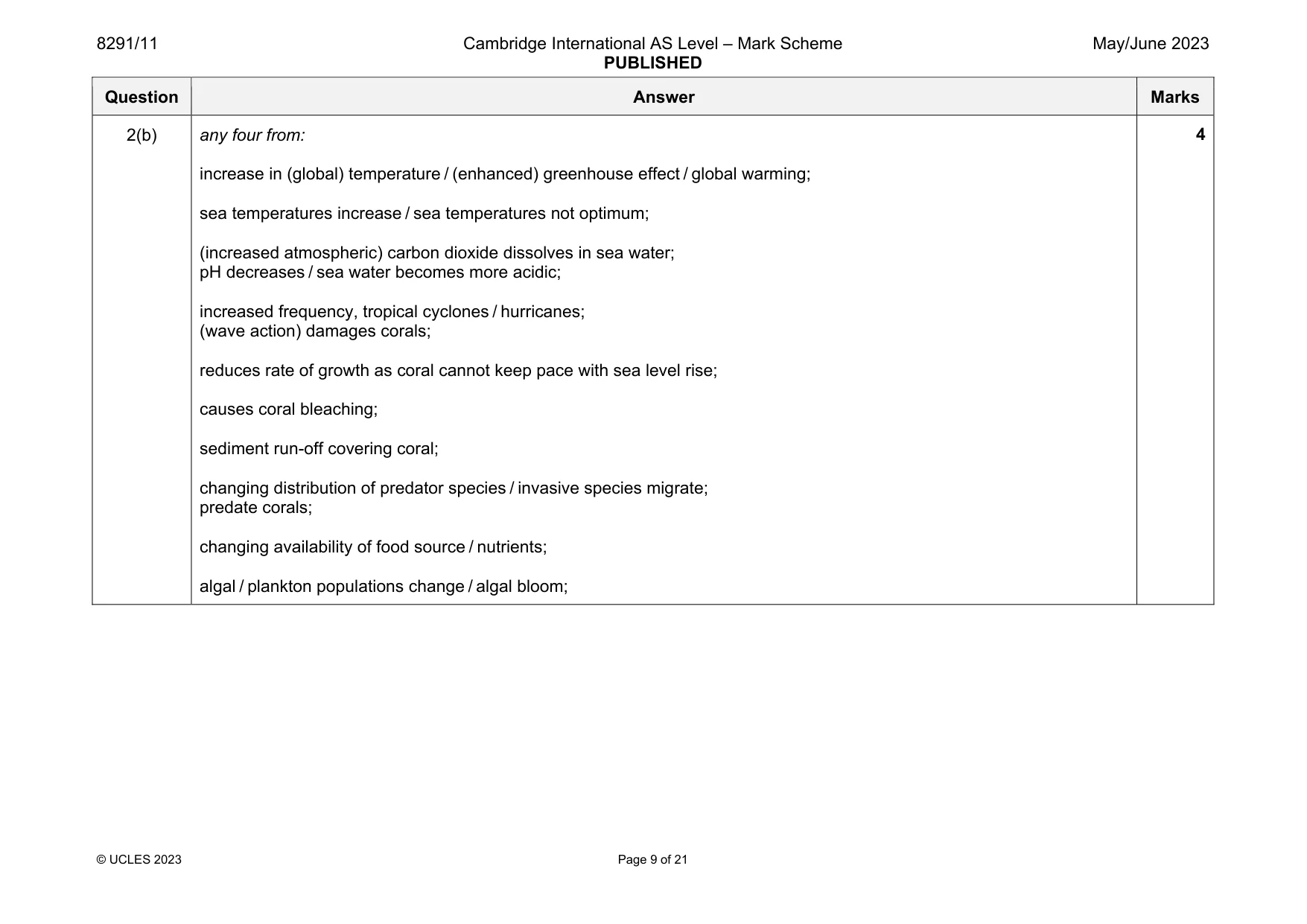
8291/11 Cambridge International AS Level – Mark Scheme PUBLISHED May/June 2023 © UCLES 2023 Page 9 of 21 Question Answer Marks 2(b) any four from: increase in (global) temperature / (enhanced) greenhouse effect / global warming; sea temperatures increase / sea temperatures not optimum; (increased atmospheric) carbon dioxide dissolves in sea water; pH decreases / sea water becomes more acidic; increased frequency, tropical cyclones / hurricanes; (wave action) damages corals; reduces rate of growth as coral cannot keep pace with sea level rise; causes coral bleaching; sediment run-off covering coral; changing distribution of predator species / invasive species migrate; predate corals; changing availability of food source / nutrients; algal / plankton populations change / algal bloom; 4
Mark scheme, page 10
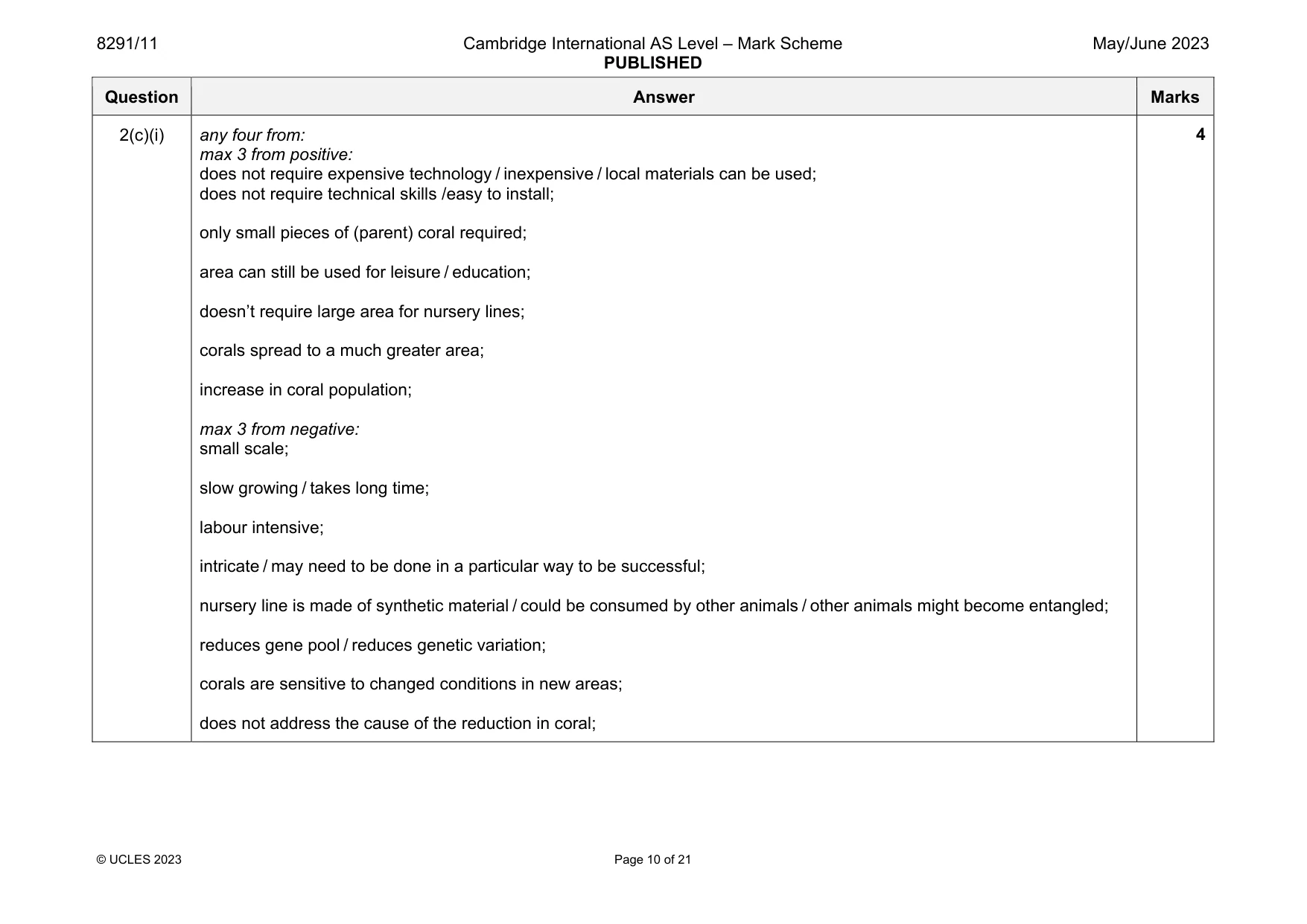
8291/11 Cambridge International AS Level – Mark Scheme PUBLISHED May/June 2023 © UCLES 2023 Page 10 of 21 Question Answer Marks 2(c)(i) any four from: max 3 from positive: does not require expensive technology / inexpensive / local materials can be used; does not require technical skills /easy to install; only small pieces of (parent) coral required; area can still be used for leisure / education; doesn’t require large area for nursery lines; corals spread to a much greater area; increase in coral population; max 3 from negative: small scale; slow growing / takes long time; labour intensive; intricate / may need to be done in a particular way to be successful; nursery line is made of synthetic material / could be consumed by other animals / other animals might become entangled; reduces gene pool / reduces genetic variation; corals are sensitive to changed conditions in new areas; does not address the cause of the reduction in coral; 4
Mark scheme, page 11
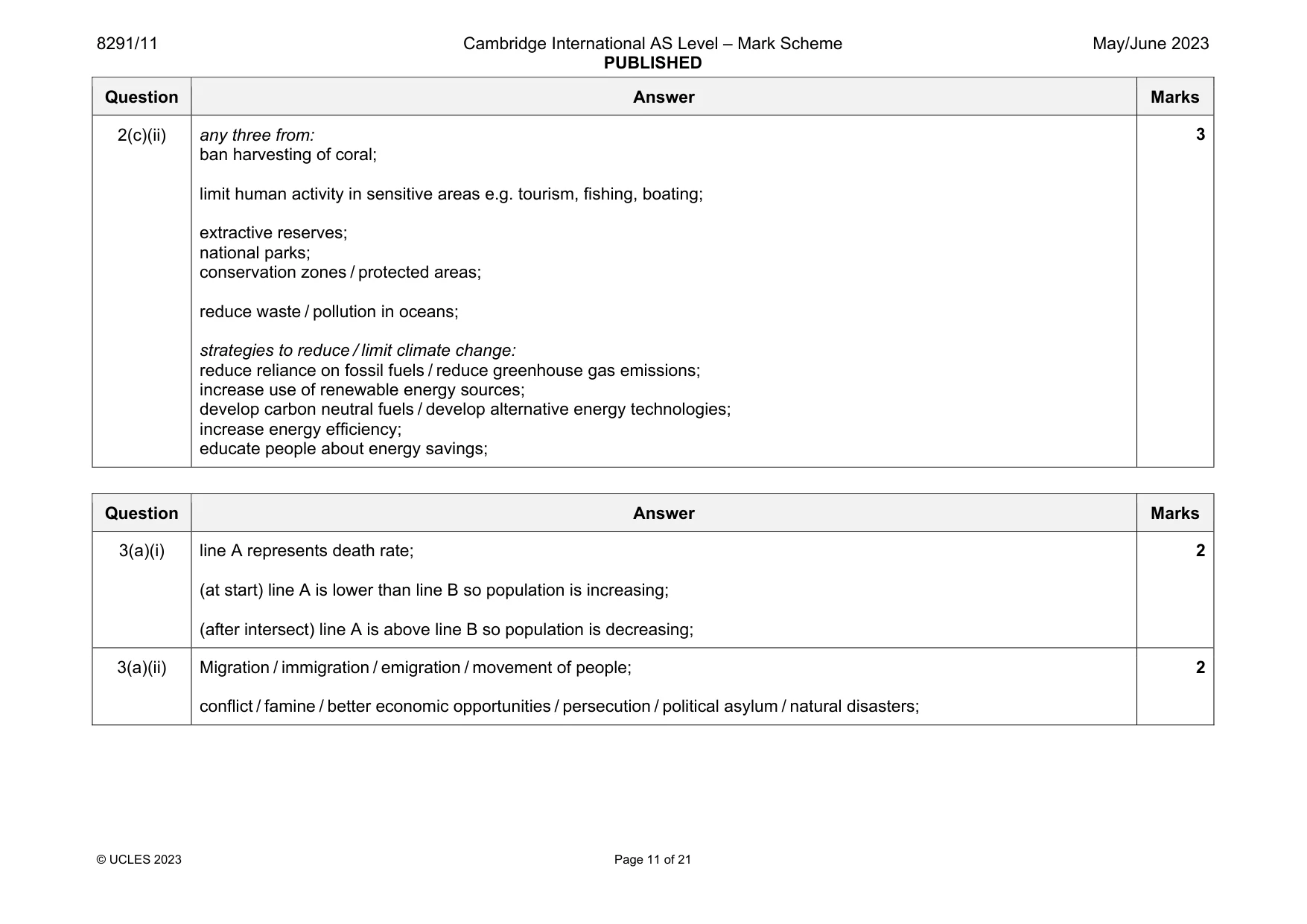
8291/11 Cambridge International AS Level – Mark Scheme PUBLISHED May/June 2023 © UCLES 2023 Page 11 of 21 Question Answer Marks 2(c)(ii) any three from: ban harvesting of coral; limit human activity in sensitive areas e.g. tourism, fishing, boating; extractive reserves; national parks; conservation zones / protected areas; reduce waste / pollution in oceans; strategies to reduce / limit climate change: reduce reliance on fossil fuels / reduce greenhouse gas emissions; increase use of renewable energy sources; develop carbon neutral fuels / develop alternative energy technologies; increase energy efficiency; educate people about energy savings; 3 Question Answer Marks 3(a)(i) line A represents death rate; (at start) line A is lower than line B so population is increasing; (after intersect) line A is above line B so population is decreasing; 2 3(a)(ii) Migration / immigration / emigration / movement of people; conflict / famine / better economic opportunities / persecution / political asylum / natural disasters; 2
Mark scheme, page 12
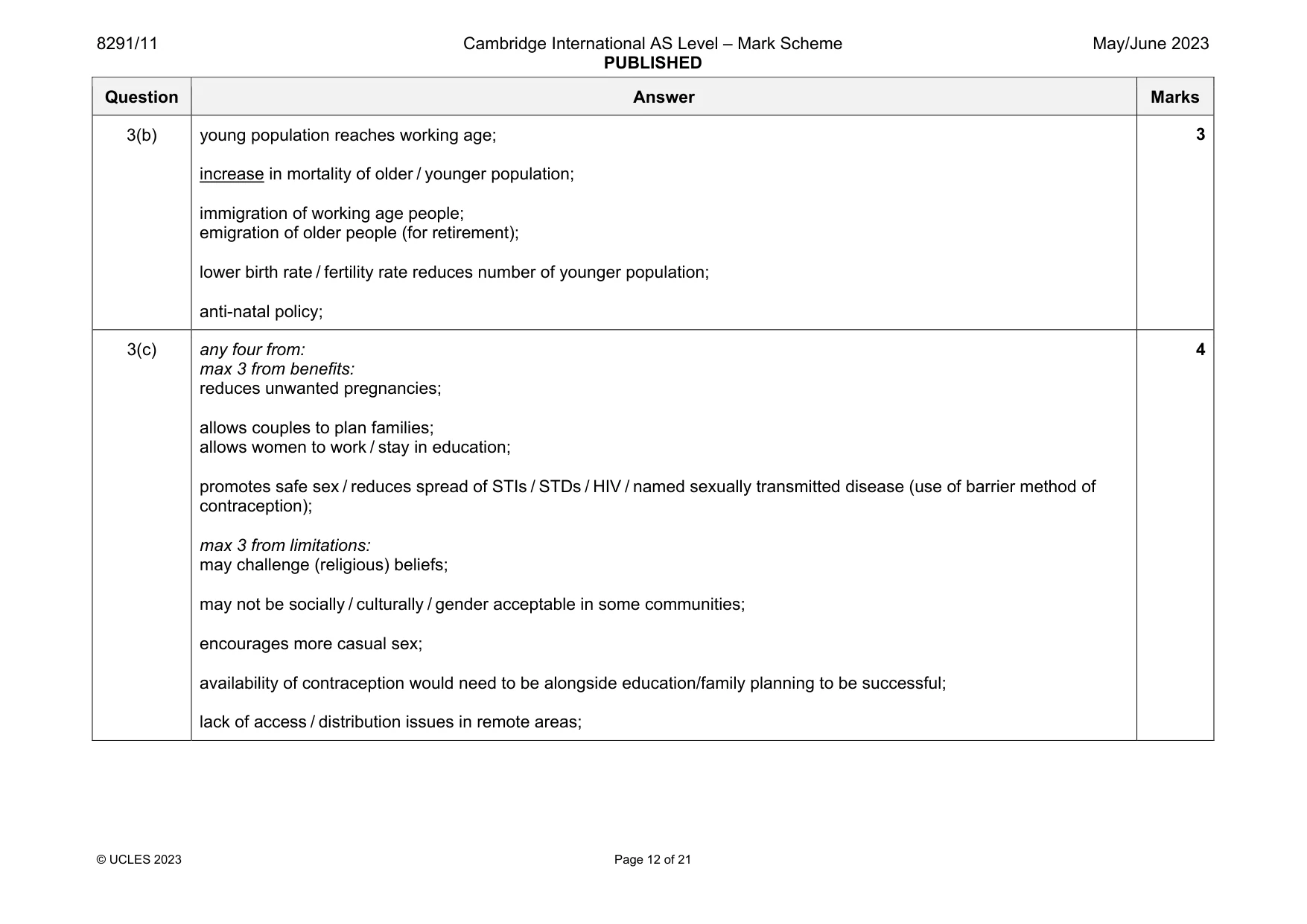
8291/11 Cambridge International AS Level – Mark Scheme PUBLISHED May/June 2023 © UCLES 2023 Page 12 of 21 Question Answer Marks 3(b) young population reaches working age; increase in mortality of older / younger population; immigration of working age people; emigration of older people (for retirement); lower birth rate / fertility rate reduces number of younger population; anti-natal policy; 3 3(c) any four from: max 3 from benefits: reduces unwanted pregnancies; allows couples to plan families; allows women to work / stay in education; promotes safe sex / reduces spread of STIs / STDs / HIV / named sexually transmitted disease (use of barrier method of contraception); max 3 from limitations: may challenge (religious) beliefs; may not be socially / culturally / gender acceptable in some communities; encourages more casual sex; availability of contraception would need to be alongside education/family planning to be successful; lack of access / distribution issues in remote areas; 4
Mark scheme, page 13
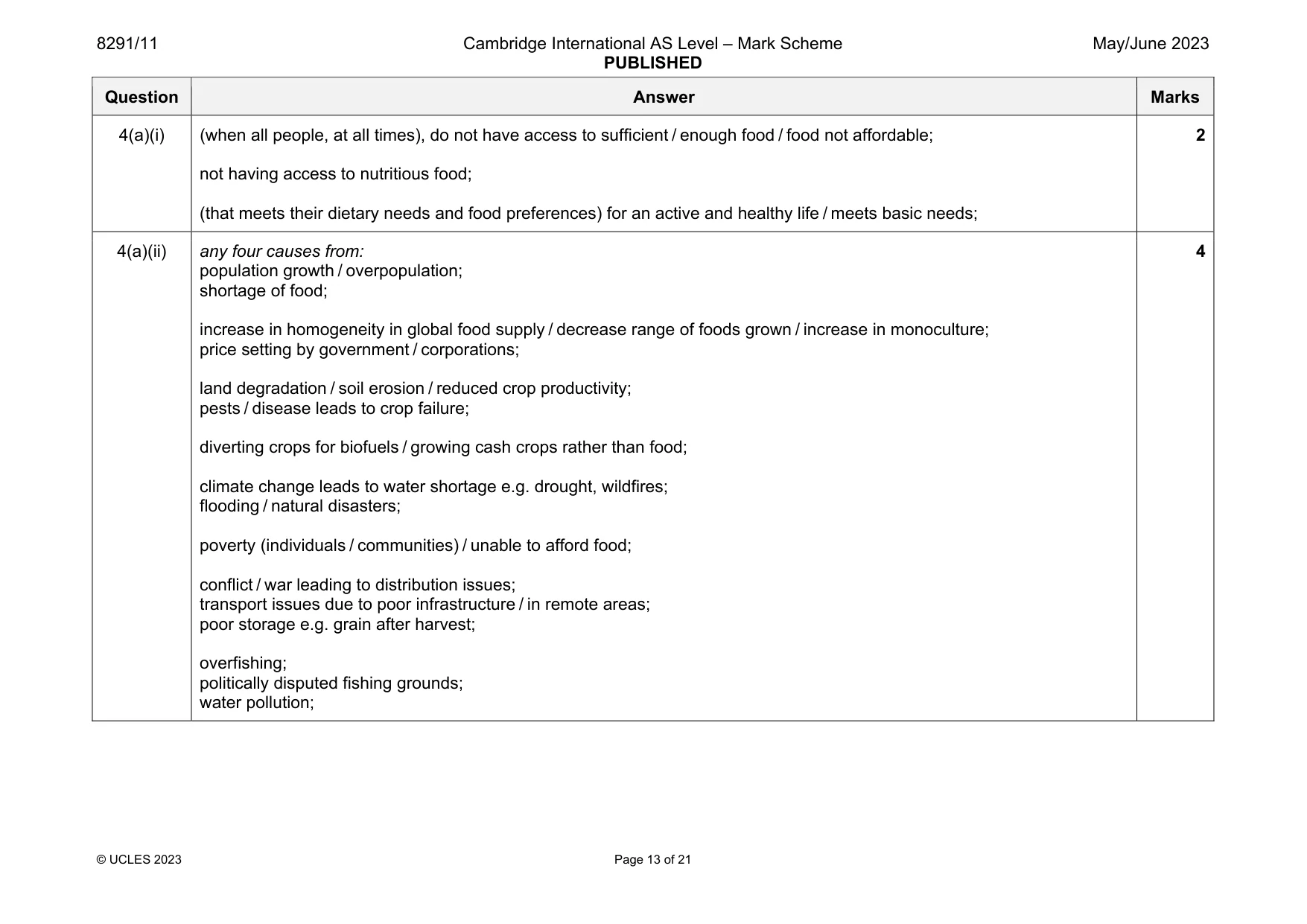
8291/11 Cambridge International AS Level – Mark Scheme PUBLISHED May/June 2023 © UCLES 2023 Page 13 of 21 Question Answer Marks 4(a)(i) (when all people, at all times), do not have access to sufficient / enough food / food not affordable; not having access to nutritious food; (that meets their dietary needs and food preferences) for an active and healthy life / meets basic needs; 2 4(a)(ii) any four causes from: population growth / overpopulation; shortage of food; increase in homogeneity in global food supply / decrease range of foods grown / increase in monoculture; price setting by government / corporations; land degradation / soil erosion / reduced crop productivity; pests / disease leads to crop failure; diverting crops for biofuels / growing cash crops rather than food; climate change leads to water shortage e.g. drought, wildfires; flooding / natural disasters; poverty (individuals / communities) / unable to afford food; conflict / war leading to distribution issues; transport issues due to poor infrastructure / in remote areas; poor storage e.g. grain after harvest; overfishing; politically disputed fishing grounds; water pollution; 4
Mark scheme, page 14
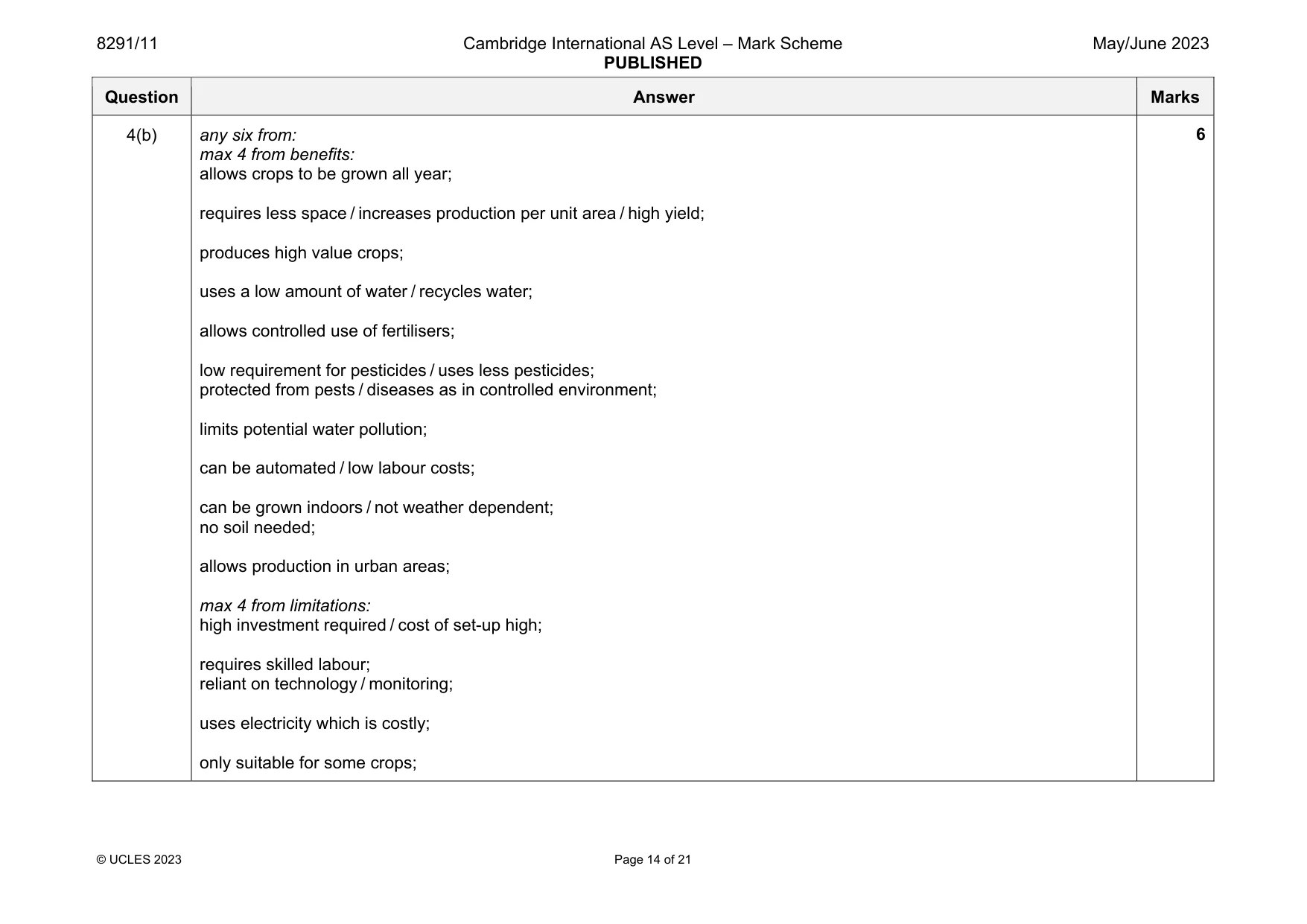
8291/11 Cambridge International AS Level – Mark Scheme PUBLISHED May/June 2023 © UCLES 2023 Page 14 of 21 Question Answer Marks 4(b) any six from: max 4 from benefits: allows crops to be grown all year; requires less space / increases production per unit area / high yield; produces high value crops; uses a low amount of water / recycles water; allows controlled use of fertilisers; low requirement for pesticides / uses less pesticides; protected from pests / diseases as in controlled environment; limits potential water pollution; can be automated / low labour costs; can be grown indoors / not weather dependent; no soil needed; allows production in urban areas; max 4 from limitations: high investment required / cost of set-up high; requires skilled labour; reliant on technology / monitoring; uses electricity which is costly; only suitable for some crops; 6
Mark scheme, page 15
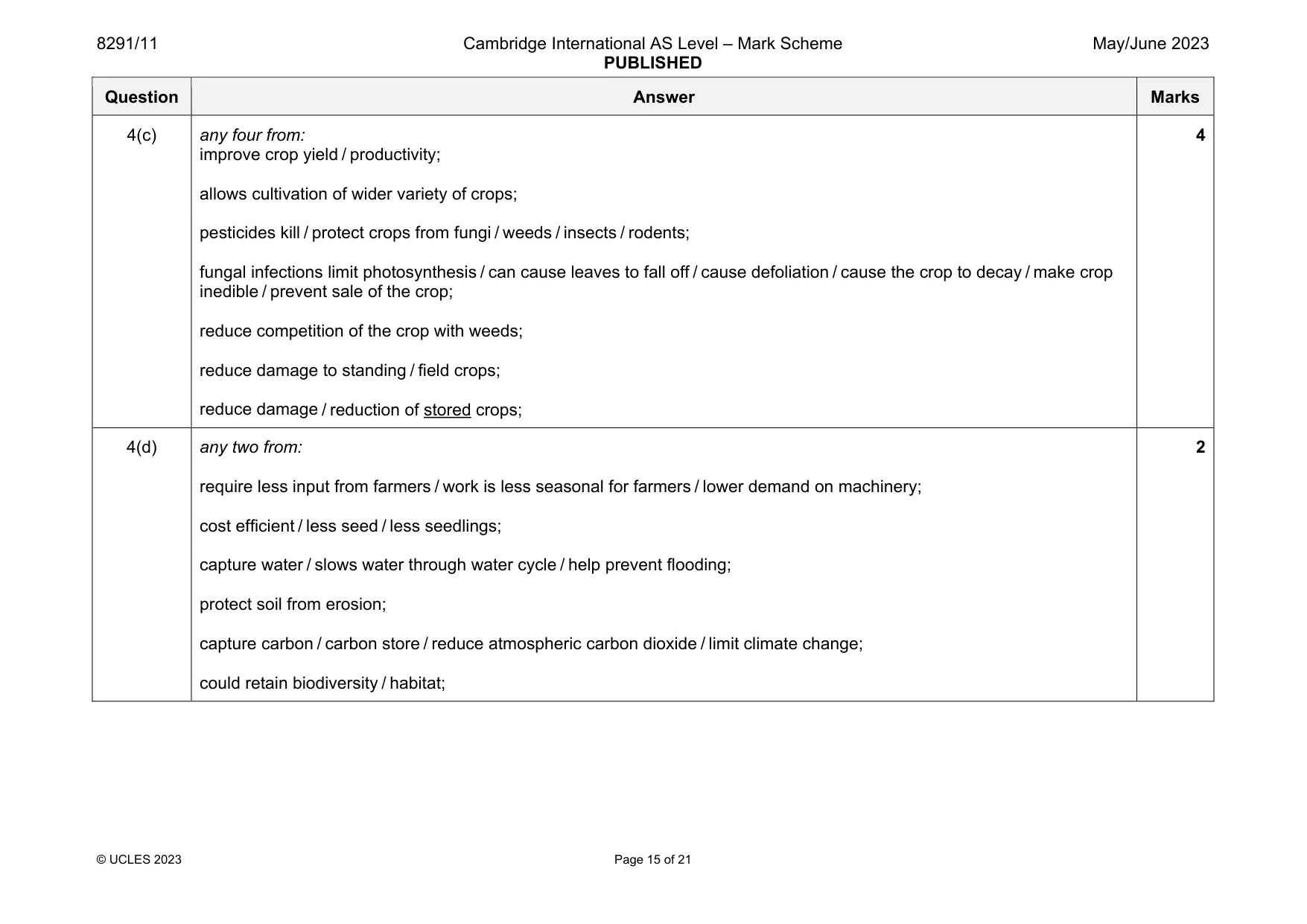
8291/11 Cambridge International AS Level – Mark Scheme PUBLISHED May/June 2023 © UCLES 2023 Page 15 of 21 Question Answer Marks 4(c) any four from: improve crop yield / productivity; allows cultivation of wider variety of crops; pesticides kill / protect crops from fungi / weeds / insects / rodents; fungal infections limit photosynthesis / can cause leaves to fall off / cause defoliation / cause the crop to decay / make crop inedible / prevent sale of the crop; reduce competition of the crop with weeds; reduce damage to standing / field crops; reduce damage / reduction of stored crops; 4 4(d) any two from: require less input from farmers / work is less seasonal for farmers / lower demand on machinery; cost efficient / less seed / less seedlings; capture water / slows water through water cycle / help prevent flooding; protect soil from erosion; capture carbon / carbon store / reduce atmospheric carbon dioxide / limit climate change; could retain biodiversity / habitat; 2
Mark scheme, page 16
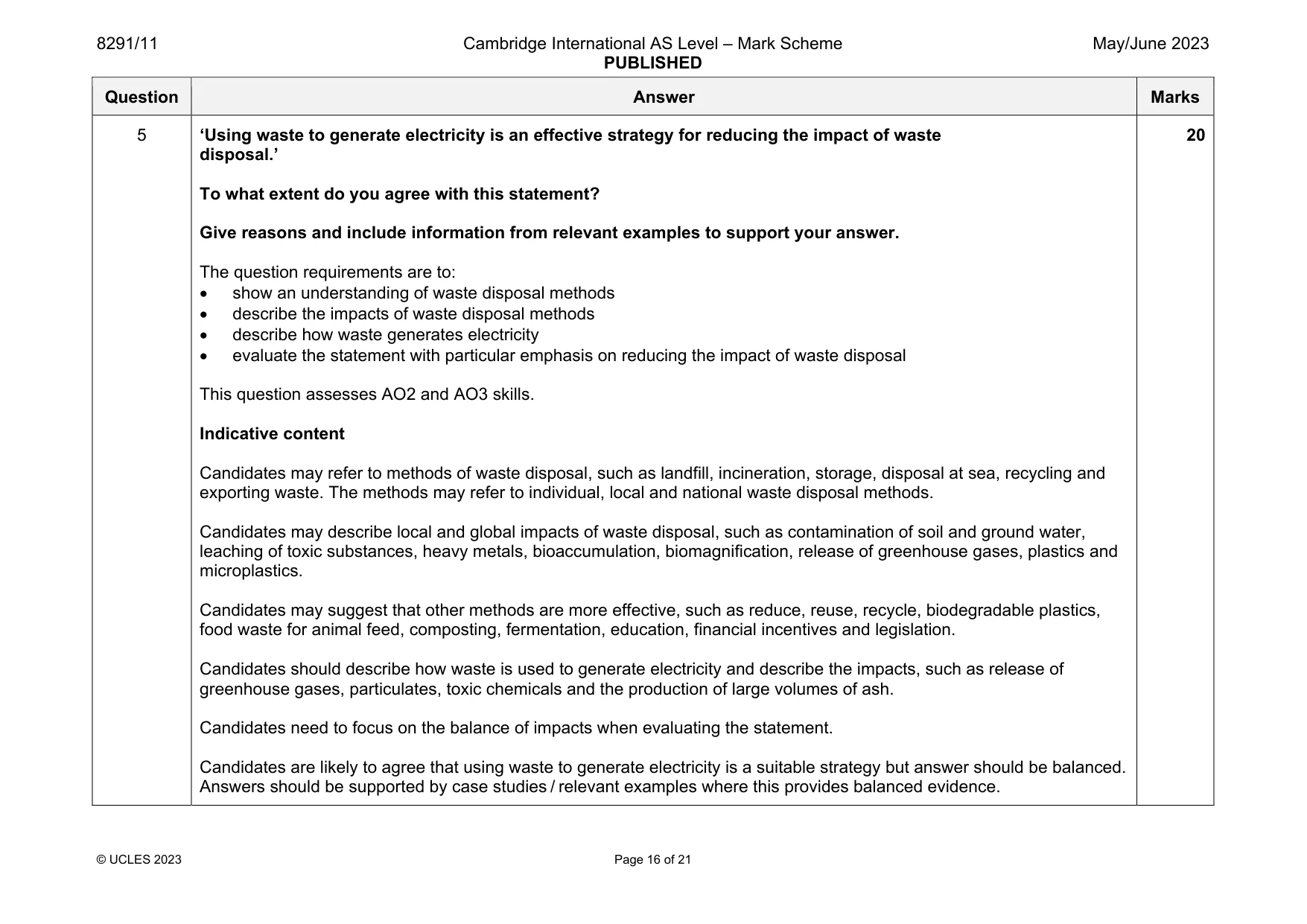
8291/11 Cambridge International AS Level – Mark Scheme PUBLISHED May/June 2023 © UCLES 2023 Page 16 of 21 Question Answer Marks 5 ‘Using waste to generate electricity is an effective strategy for reducing the impact of waste disposal.’ To what extent do you agree with this statement? Give reasons and include information from relevant examples to support your answer. The question requirements are to: show an understanding of waste disposal methods describe the impacts of waste disposal methods describe how waste generates electricity evaluate the statement with particular emphasis on reducing the impact of waste disposal This question assesses AO2 and AO3 skills. Indicative content Candidates may refer to methods of waste disposal, such as landfill, incineration, storage, disposal at sea, recycling and exporting waste. The methods may refer to individual, local and national waste disposal methods. Candidates may describe local and global impacts of waste disposal, such as contamination of soil and ground water, leaching of toxic substances, heavy metals, bioaccumulation, biomagnification, release of greenhouse gases, plastics and microplastics. Candidates may suggest that other methods are more effective, such as reduce, reuse, recycle, biodegradable plastics, food waste for animal feed, composting, fermentation, education, financial incentives and legislation. Candidates should describe how waste is used to generate electricity and describe the impacts, such as release of greenhouse gases, particulates, toxic chemicals and the production of large volumes of ash. Candidates need to focus on the balance of impacts when evaluating the statement. Candidates are likely to agree that using waste to generate electricity is a suitable strategy but answer should be balanced. Answers should be supported by case studies / relevant examples where this provides balanced evidence. 20
Mark scheme, page 17
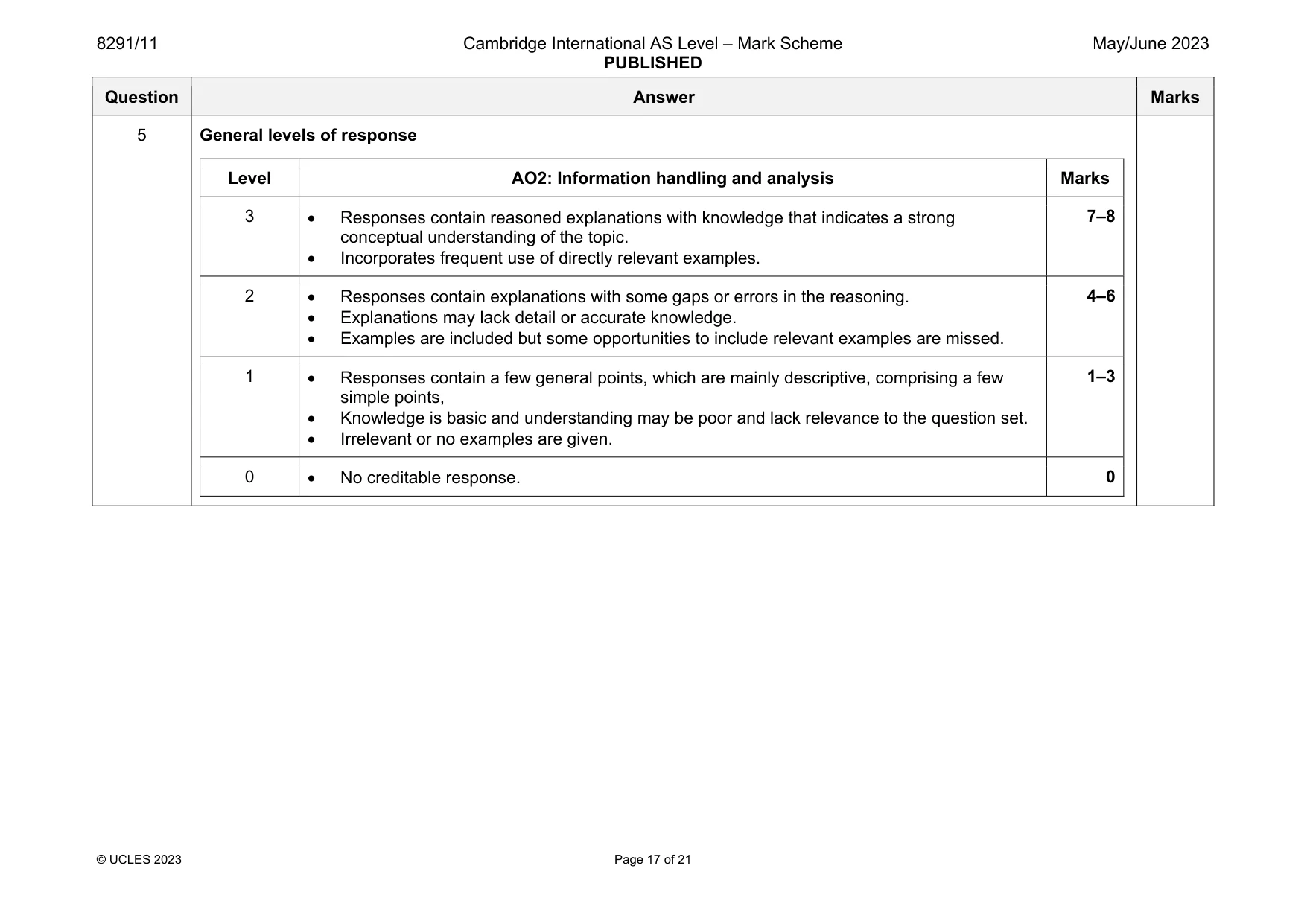
8291/11 Cambridge International AS Level – Mark Scheme PUBLISHED May/June 2023 © UCLES 2023 Page 17 of 21 Question Answer Marks 5 General levels of response Level AO2: Information handling and analysis Marks 3 Responses contain reasoned explanations with knowledge that indicates a strong conceptual understanding of the topic. Incorporates frequent use of directly relevant examples. 7–8 2 Responses contain explanations with some gaps or errors in the reasoning. Explanations may lack detail or accurate knowledge. Examples are included but some opportunities to include relevant examples are missed. 4–6 1 Responses contain a few general points, which are mainly descriptive, comprising a few simple points, Knowledge is basic and understanding may be poor and lack relevance to the question set. Irrelevant or no examples are given. 1–3 0 No creditable response. 0
Mark scheme, page 18
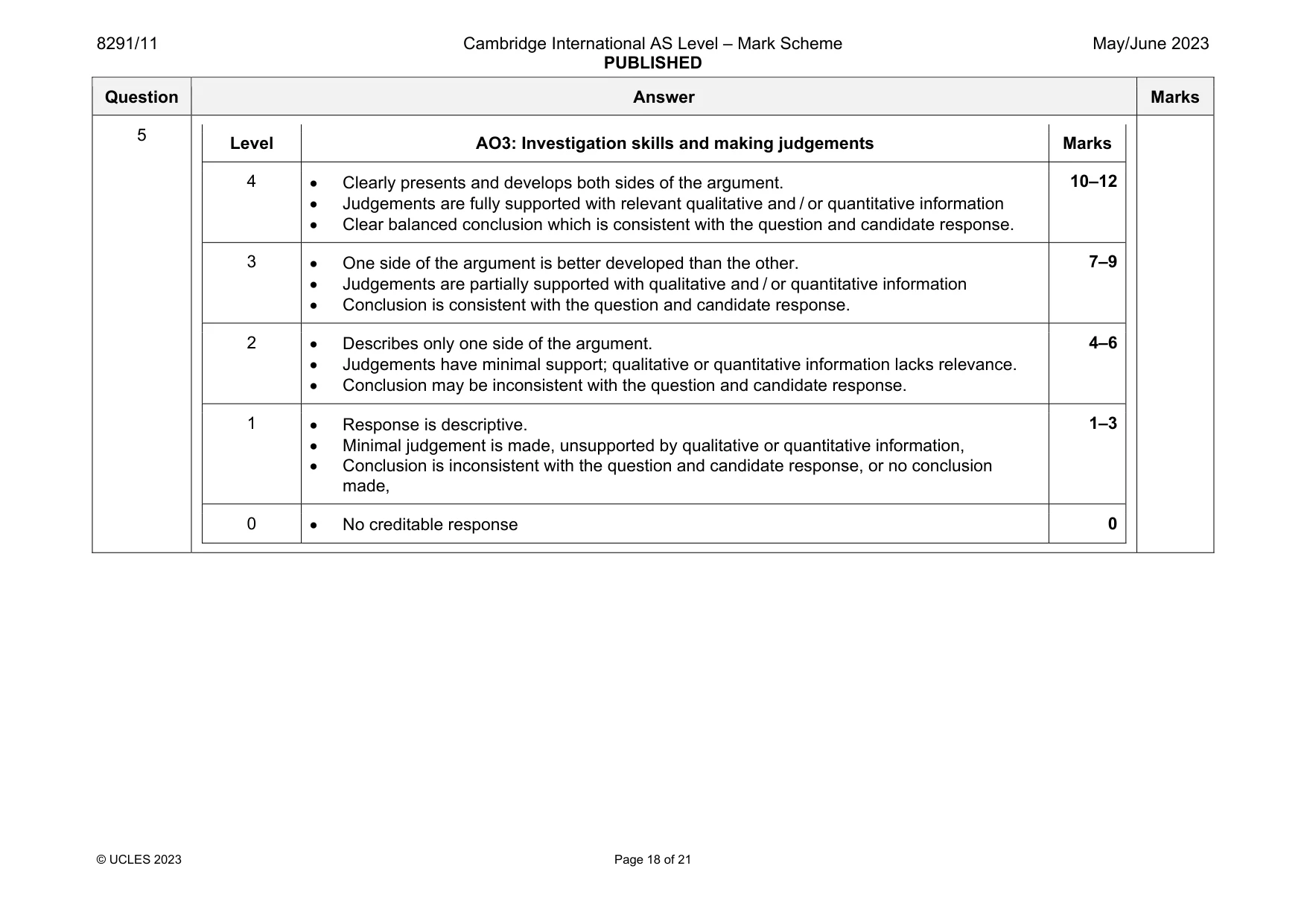
8291/11 Cambridge International AS Level – Mark Scheme PUBLISHED May/June 2023 © UCLES 2023 Page 18 of 21 Question Answer Marks 5 Level AO3: Investigation skills and making judgements Marks 4 Clearly presents and develops both sides of the argument. Judgements are fully supported with relevant qualitative and / or quantitative information Clear balanced conclusion which is consistent with the question and candidate response. 10–12 3 One side of the argument is better developed than the other. Judgements are partially supported with qualitative and / or quantitative information Conclusion is consistent with the question and candidate response. 7–9 2 Describes only one side of the argument. Judgements have minimal support; qualitative or quantitative information lacks relevance. Conclusion may be inconsistent with the question and candidate response. 4–6 1 Response is descriptive. Minimal judgement is made, unsupported by qualitative or quantitative information, Conclusion is inconsistent with the question and candidate response, or no conclusion made, 1–3 0 No creditable response 0
Mark scheme, page 19
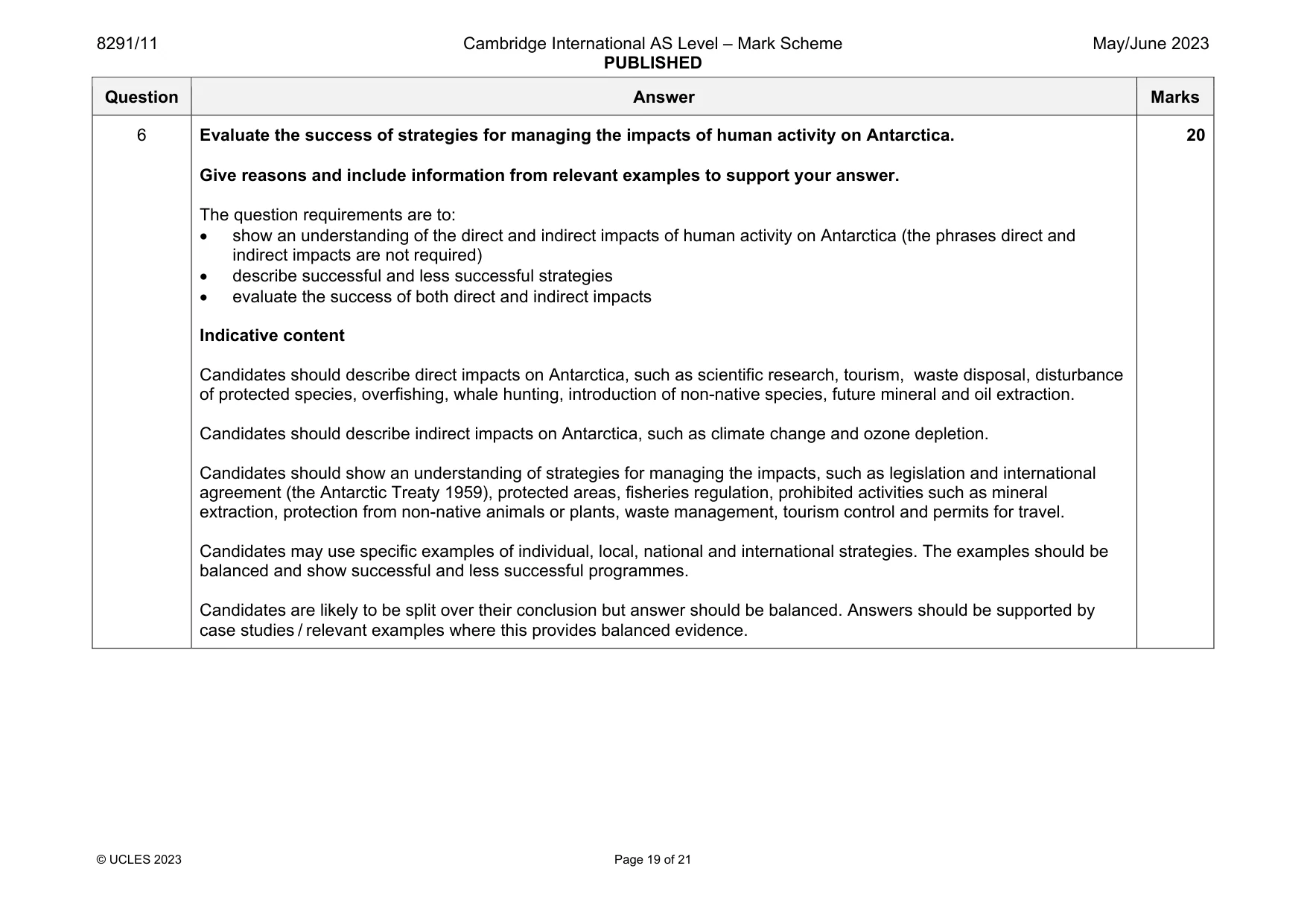
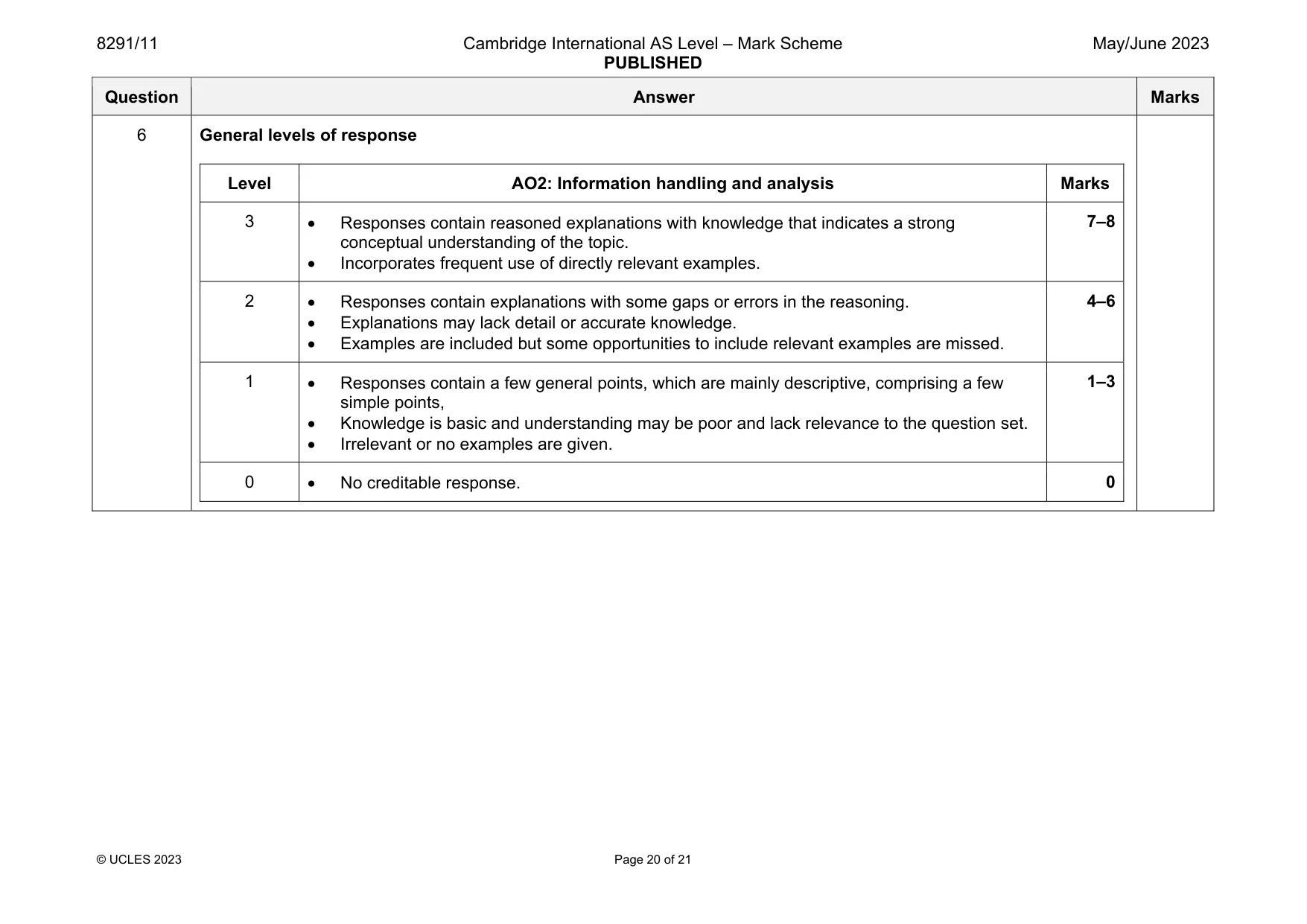
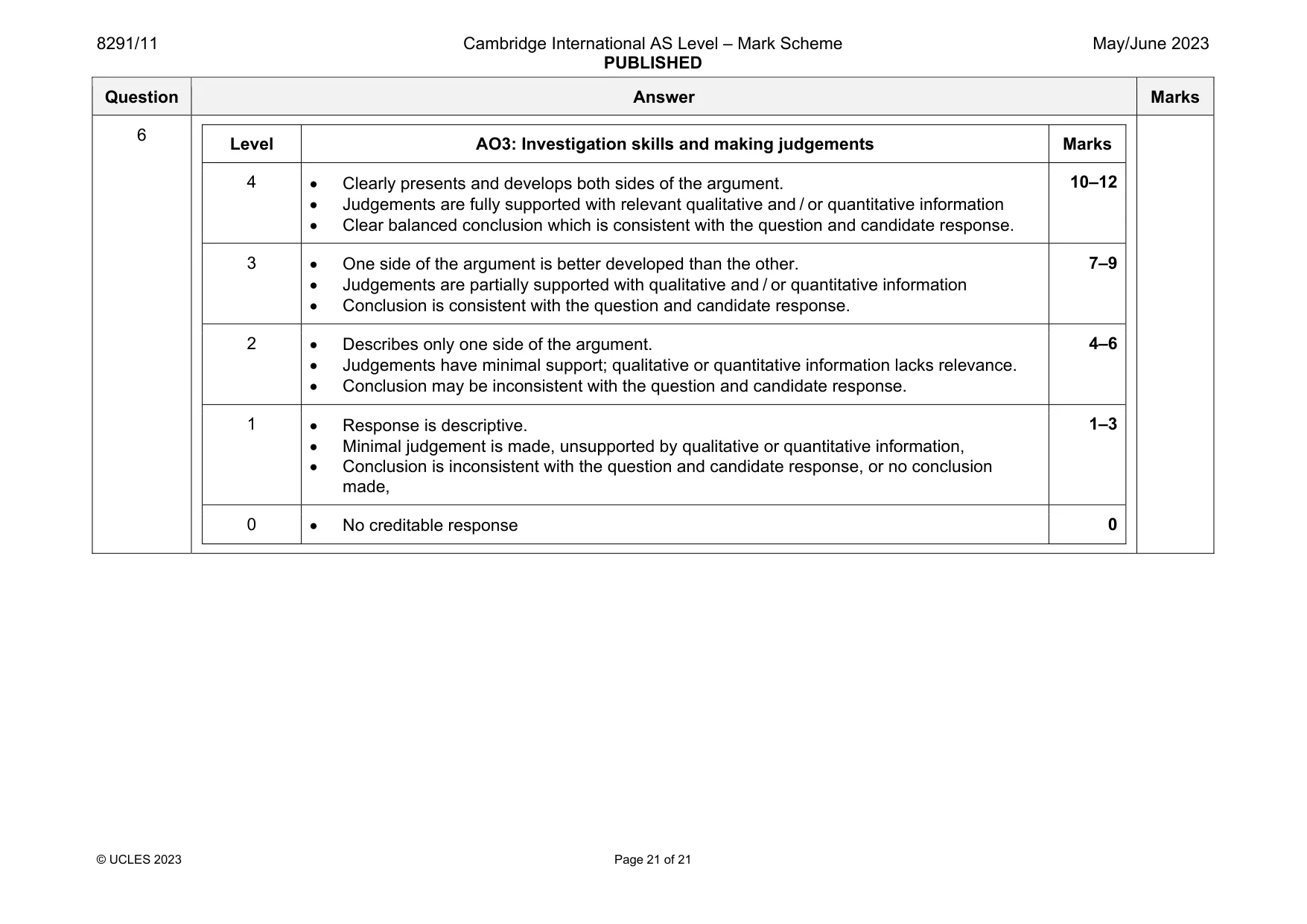
8291/11 Cambridge International AS Level – Mark Scheme PUBLISHED May/June 2023 © UCLES 2023 Page 19 of 21 Question Answer Marks 6 Evaluate the success of strategies for managing the impacts of human activity on Antarctica. Give reasons and include information from relevant examples to support your answer. The question requirements are to: show an understanding of the direct and indirect impacts of human activity on Antarctica (the phrases direct and indirect impacts are not required) describe successful and less successful strategies evaluate the success of both direct and indirect impacts Indicative content Candidates should describe direct impacts on Antarctica, such as scientific research, tourism, waste disposal, disturbance of protected species, overfishing, whale hunting, introduction of non-native species, future mineral and oil extraction. Candidates should describe indirect impacts on Antarctica, such as climate change and ozone depletion. Candidates should show an understanding of strategies for managing the impacts, such as legislation and international agreement (the Antarctic Treaty 1959), protected areas, fisheries regulation, prohibited activities such as mineral extraction, protection from non-native animals or plants, waste management, tourism control and permits for travel. Candidates may use specific examples of individual, local, national and international strategies. The examples should be balanced and show successful and less successful programmes. Candidates are likely to be split over their conclusion but answer should be balanced. Answers should be supported by case studies / relevant examples where this provides balanced evidence. 20
Mark scheme, page 20
8291/11 Cambridge International AS Level – Mark Scheme PUBLISHED May/June 2023 © UCLES 2023 Page 20 of 21 Question Answer Marks 6 General levels of response Level AO2: Information handling and analysis Marks 3 Responses contain reasoned explanations with knowledge that indicates a strong conceptual understanding of the topic. Incorporates frequent use of directly relevant examples. 7–8 2 Responses contain explanations with some gaps or errors in the reasoning. Explanations may lack detail or accurate knowledge. Examples are included but some opportunities to include relevant examples are missed. 4–6 1 Responses contain a few general points, which are mainly descriptive, comprising a few simple points, Knowledge is basic and understanding may be poor and lack relevance to the question set. Irrelevant or no examples are given. 1–3 0 No creditable response. 0
Mark scheme, page 21
8291/11 Cambridge International AS Level – Mark Scheme PUBLISHED May/June 2023 © UCLES 2023 Page 21 of 21 Question Answer Marks 6 Level AO3: Investigation skills and making judgements Marks 4 Clearly presents and develops both sides of the argument. Judgements are fully supported with relevant qualitative and / or quantitative information Clear balanced conclusion which is consistent with the question and candidate response. 10–12 3 One side of the argument is better developed than the other. Judgements are partially supported with qualitative and / or quantitative information Conclusion is consistent with the question and candidate response. 7–9 2 Describes only one side of the argument. Judgements have minimal support; qualitative or quantitative information lacks relevance. Conclusion may be inconsistent with the question and candidate response. 4–6 1 Response is descriptive. Minimal judgement is made, unsupported by qualitative or quantitative information, Conclusion is inconsistent with the question and candidate response, or no conclusion made, 1–3 0 No creditable response 0
What you needed in this session
Cambridge’s own grade thresholds for 2023 May/June, Paper 1 · Variant 1. A higher threshold means an easier paper — the bar moves with how the cohort did.