Cambridge A Level Environmental Management (AS only) 8291 — 2024 May/June Paper 1 · Variant 1
8291/11/M/J/24 · 80 marks · ≈90 min
The question paper and its mark scheme, free to read here and free to download. This is Cambridge’s own paper, exactly as it was sat.
Question paper20 pages









Mark scheme18 pages
Answers below. Sit the paper first if you are practising.
Paper as text
Question paper, page 1
This document has 20 pages. Any blank pages are indicated. [Turn over Cambridge International AS Level * 4 9 6 2 8 4 6 8 9 4 * ENVIRONMENTAL MANAGEMENT 8291/11 Paper 1 Principles of Environmental Management May/June 2024 1 hour 45 minutes You must answer on the question paper. No additional materials are needed. INSTRUCTIONS ● Section A: answer all questions. ● Section B: answer one question. ● Use a black or dark blue pen. You may use an HB pencil for any diagrams or graphs. ● Write your name, centre number and candidate number in the boxes at the top of the page. ● Write your answer to each question in the space provided. ● Do not use an erasable pen or correction fluid. ● Do not write on any bar codes. ● You may use a calculator. ● You should show all your working and use appropriate units. INFORMATION ● The total mark for this paper is 80. ● The number of marks for each question or part question is shown in brackets [ ]. DC (PB/CT) 332755/2 © UCLES 2024
Question paper, page 2
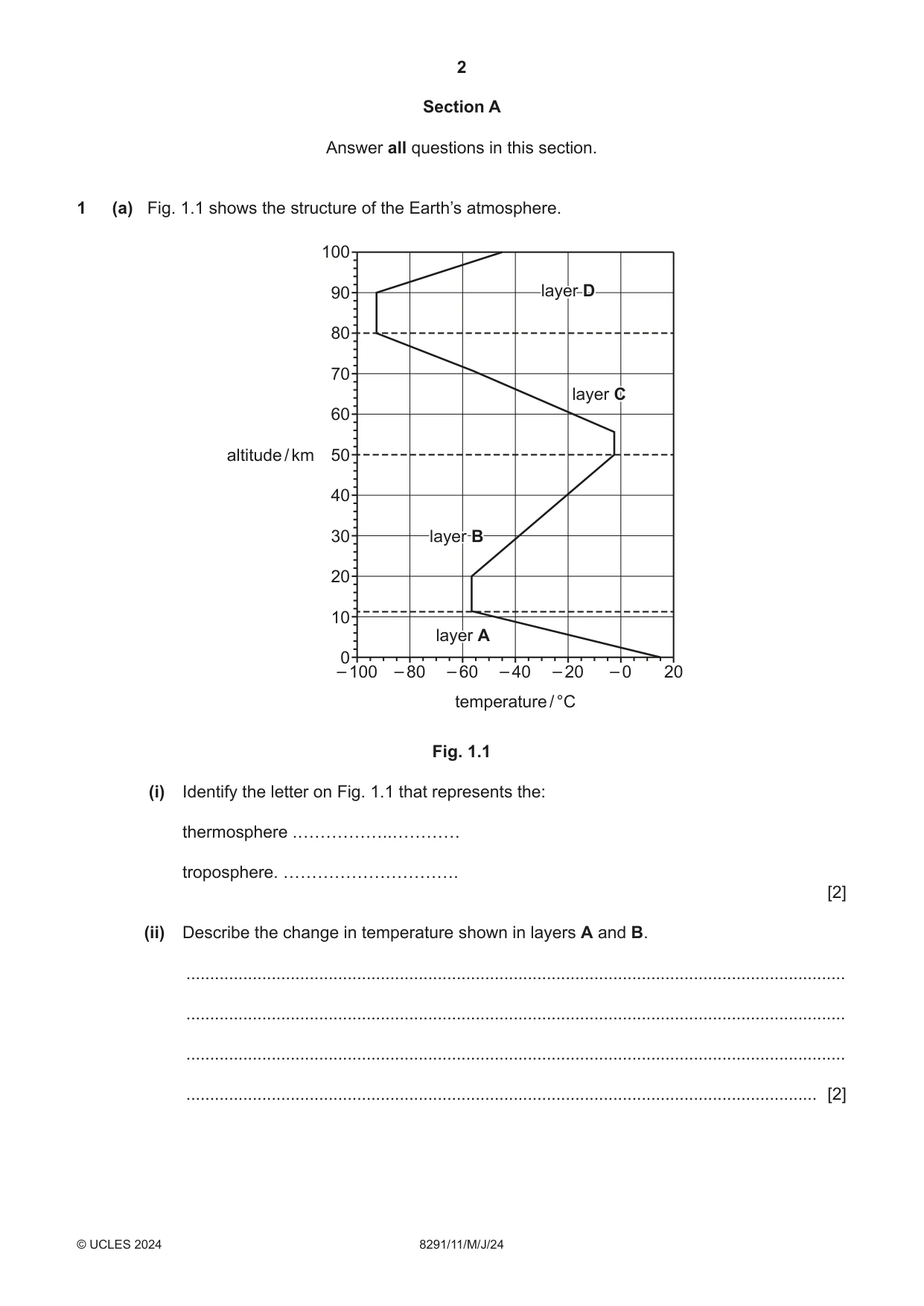
2 8291/11/M/J/24 © UCLES 2024 Section A Answer all questions in this section. 1 (a) Fig. 1.1 shows the structure of the Earth’s atmosphere. 0– 100 – 80 – 60 – 40 – 20 – 0 20 10 20 30 40 50 60 70 80 90 100 altitude / km temperature / °C layer D layer D layer B layer B layer A layer A layer C layer C Fig. 1.1 (i) Identify the letter on Fig. 1.1 that represents the: thermosphere .……………..………… troposphere. …………………………. [2] (ii) Describe the change in temperature shown in layers A and B. … … … … [2]
Question paper, page 3
3 8291/11/M/J/24 © UCLES 2024 [Turn over (iii) Explain how the structure of layer B causes the temperature change between an altitude of 20 km and 50 km. … … … … … … [3] (b) (i) Outline how the natural greenhouse effect maintains the temperature of the Earth’s atmosphere. … … … … … … … … [4] (ii) Suggest how eating a plant-based diet can reduce the enhanced greenhouse effect. … … … … … … … … [4]
Question paper, page 4
4 8291/11/M/J/24 © UCLES 2024 (iii) State two other ways that human activities contribute to the enhanced greenhouse effect. 1 … … 2 … … [2] [Total: 17]
Question paper, page 5
5 8291/11/M/J/24 © UCLES 2024 [Turn over BLANK PAGE
Question paper, page 6
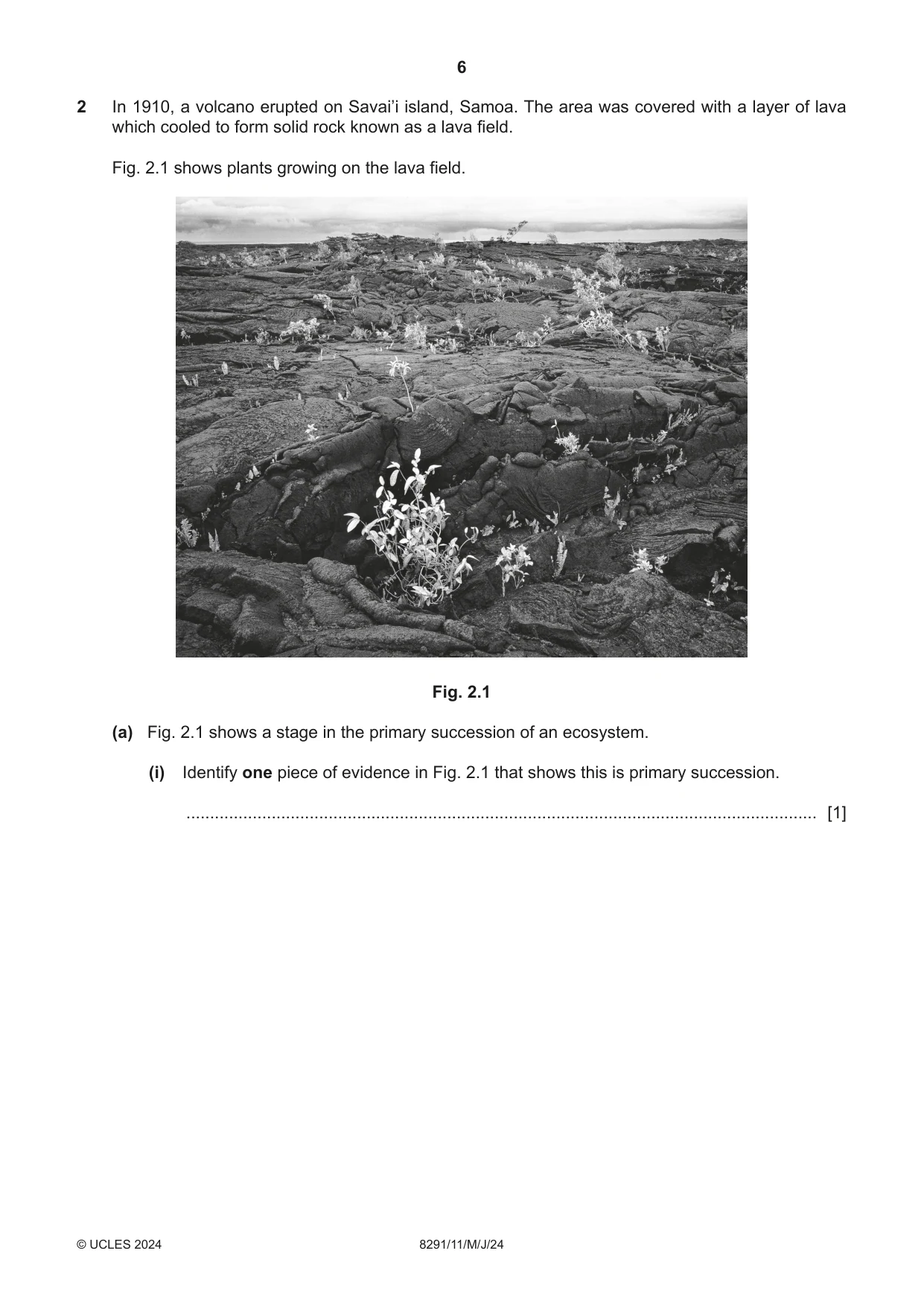
6 8291/11/M/J/24 © UCLES 2024 2 In 1910, a volcano erupted on Savai’i island, Samoa. The area was covered with a layer of lava which cooled to form solid rock known as a lava field. Fig. 2.1 shows plants growing on the lava field. Fig. 2.1 (a) Fig. 2.1 shows a stage in the primary succession of an ecosystem. (i) Identify one piece of evidence in Fig. 2.1 that shows this is primary succession. … [1]
Question paper, page 7
7 8291/11/M/J/24 © UCLES 2024 [Turn over (ii) Explain how this ecosystem will change over time. … … … … … … … … … … … … [6]
Question paper, page 8
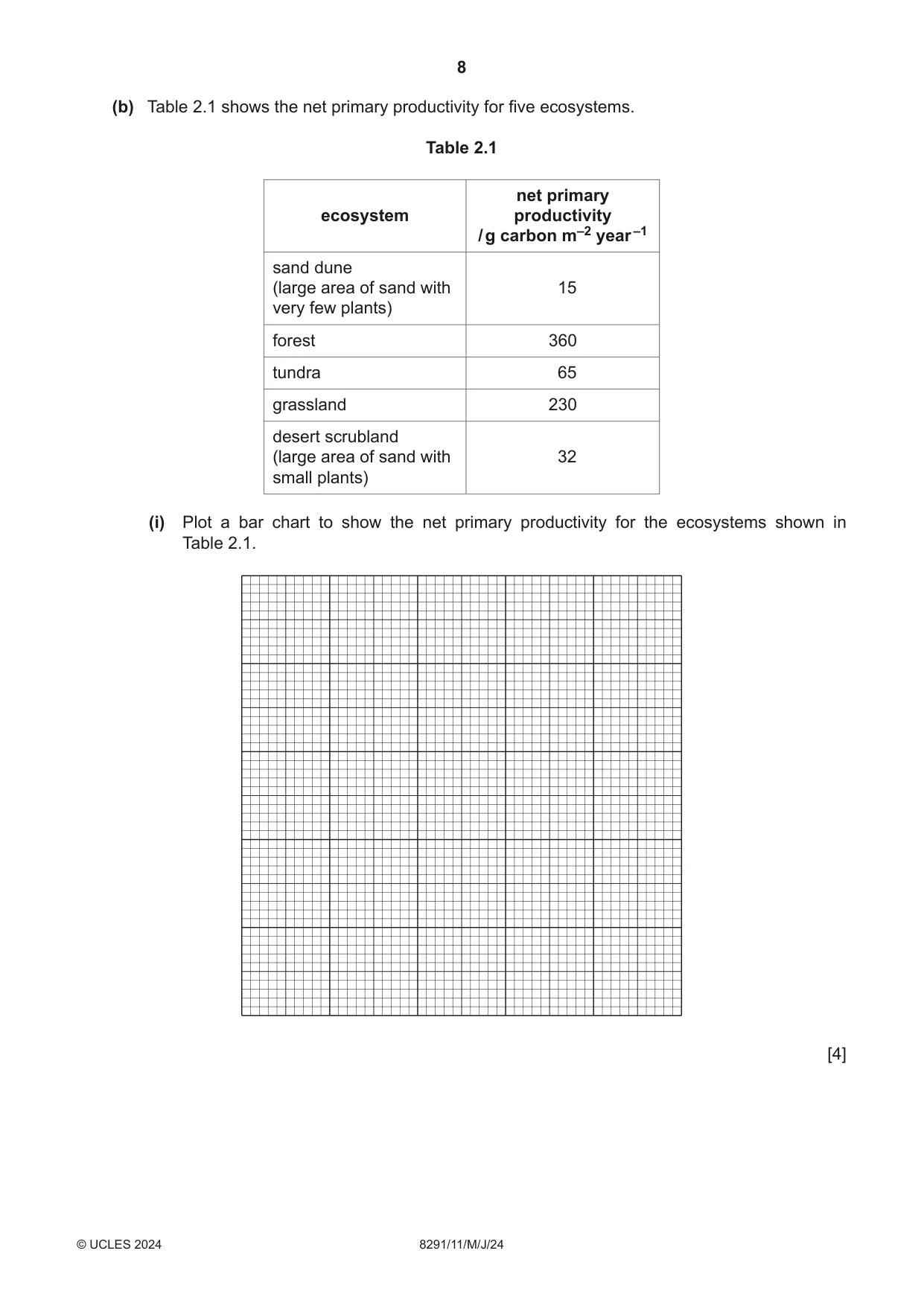
8 8291/11/M/J/24 © UCLES 2024 (b) Table 2.1 shows the net primary productivity for five ecosystems. Table 2.1 ecosystem net primary productivity / g carbon m–2 year –1 sand dune (large area of sand with very few plants) 15 forest 360 tundra 65 grassland 230 desert scrubland (large area of sand with small plants) 32 (i) Plot a bar chart to show the net primary productivity for the ecosystems shown in Table 2.1. [4]
Question paper, page 9
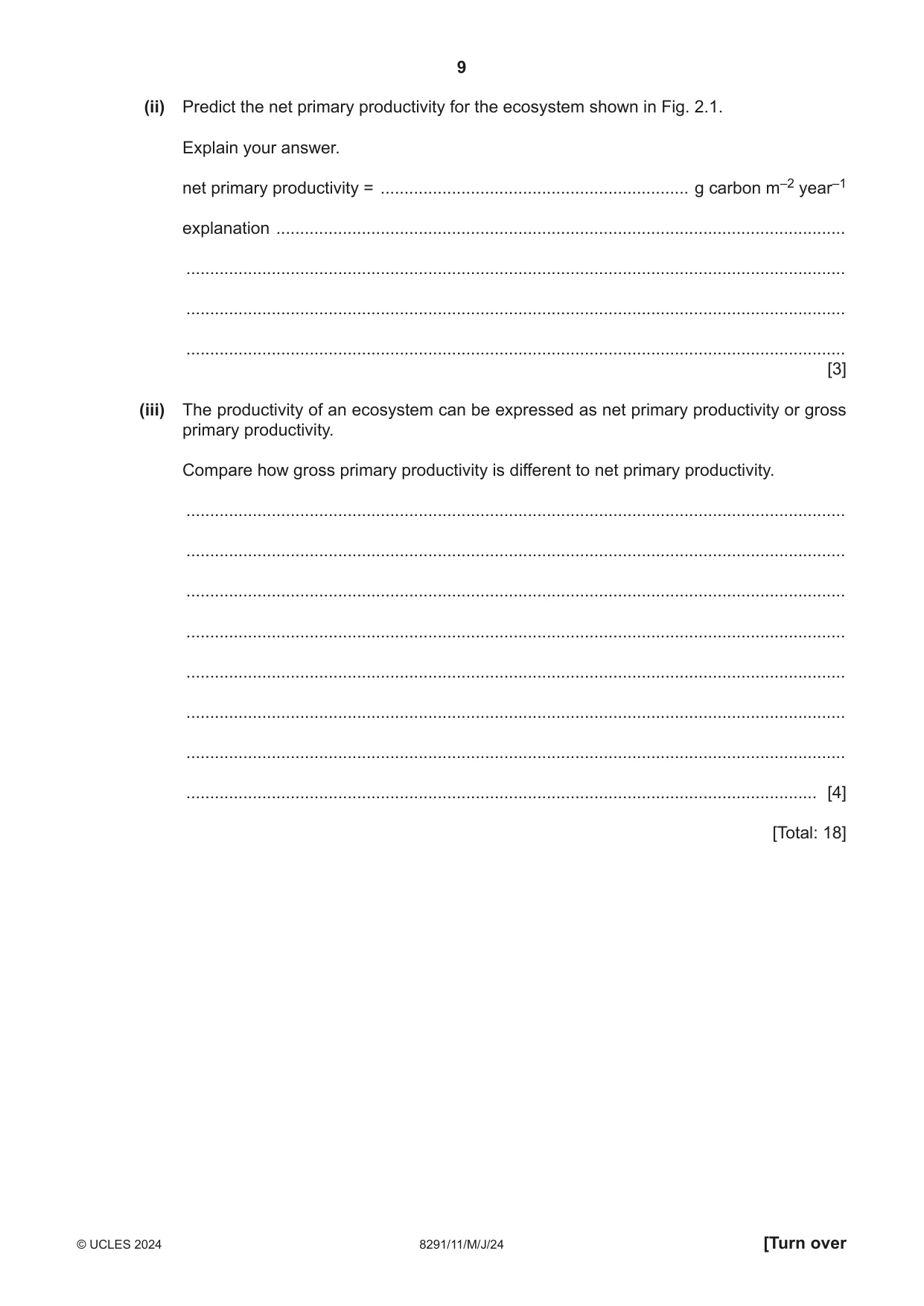
9 8291/11/M/J/24 © UCLES 2024 [Turn over (ii) Predict the net primary productivity for the ecosystem shown in Fig. 2.1. Explain your answer. net primary productivity = … g carbon m–2 year–1 explanation … … … … [3] (iii) The productivity of an ecosystem can be expressed as net primary productivity or gross primary productivity. Compare how gross primary productivity is different to net primary productivity. … … … … … … … … [4] [Total: 18]
Question paper, page 10
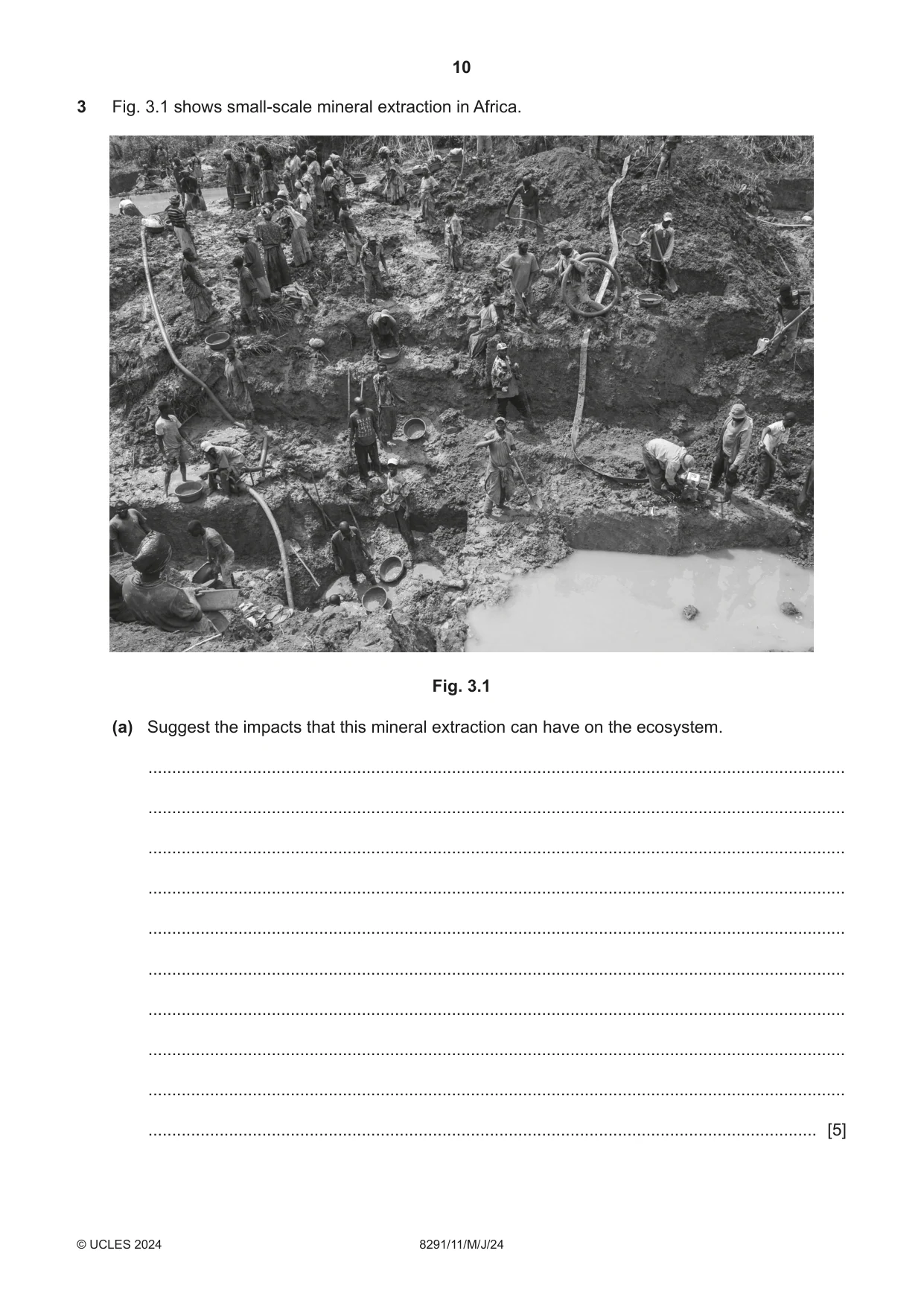
10 8291/11/M/J/24 © UCLES 2024 3 Fig. 3.1 shows small-scale mineral extraction in Africa. Fig. 3.1 (a) Suggest the impacts that this mineral extraction can have on the ecosystem. … … … … … … … … … … [5]
Question paper, page 11
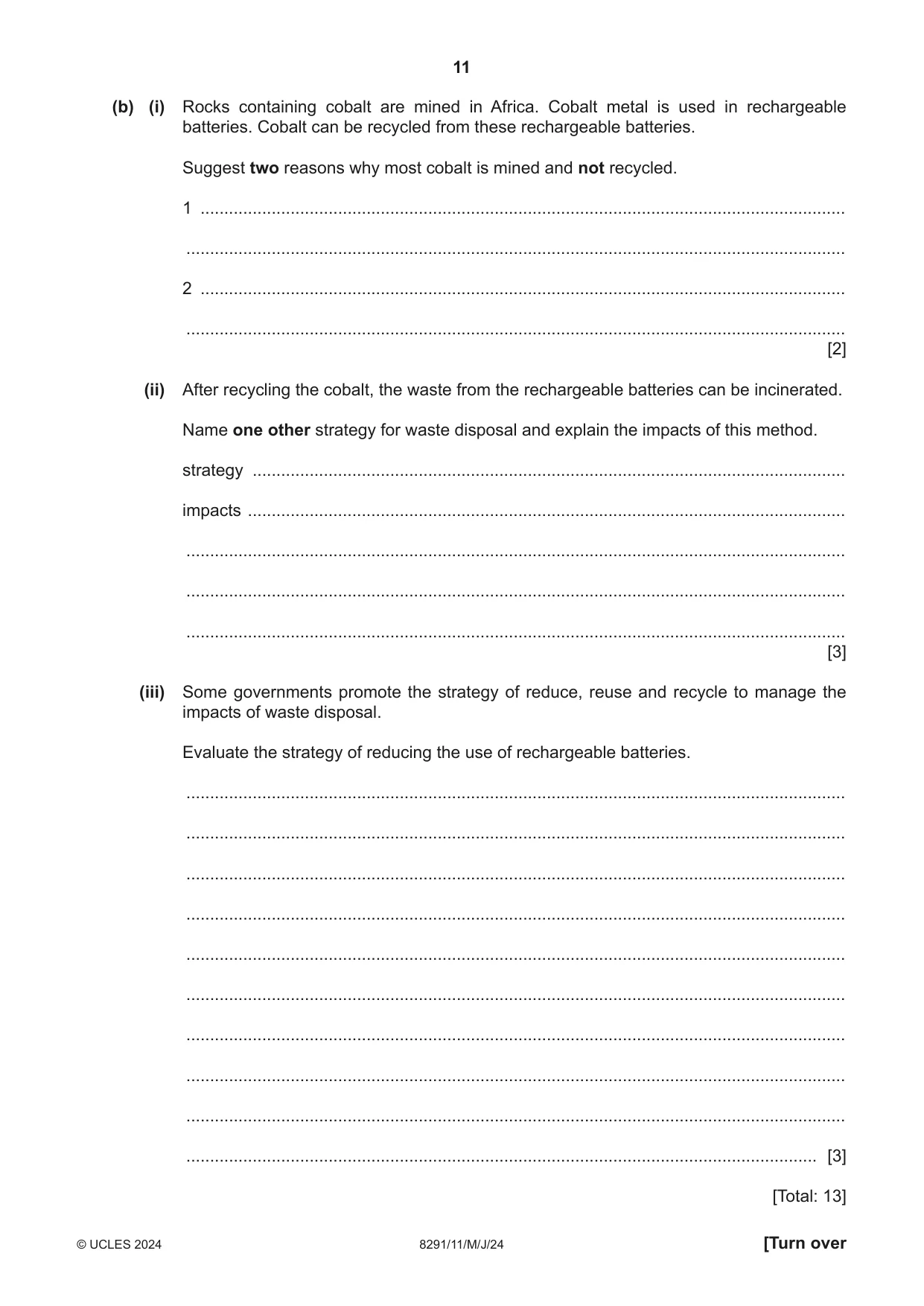
11 8291/11/M/J/24 © UCLES 2024 [Turn over (b) (i) Rocks containing cobalt are mined in Africa. Cobalt metal is used in rechargeable batteries. Cobalt can be recycled from these rechargeable batteries. Suggest two reasons why most cobalt is mined and not recycled. 1 … … 2 … … [2] (ii) After recycling the cobalt, the waste from the rechargeable batteries can be incinerated. Name one other strategy for waste disposal and explain the impacts of this method. strategy … impacts … … … … [3] (iii) Some governments promote the strategy of reduce, reuse and recycle to manage the impacts of waste disposal. Evaluate the strategy of reducing the use of rechargeable batteries. … … … … … … … … … … [3] [Total: 13]
Question paper, page 12
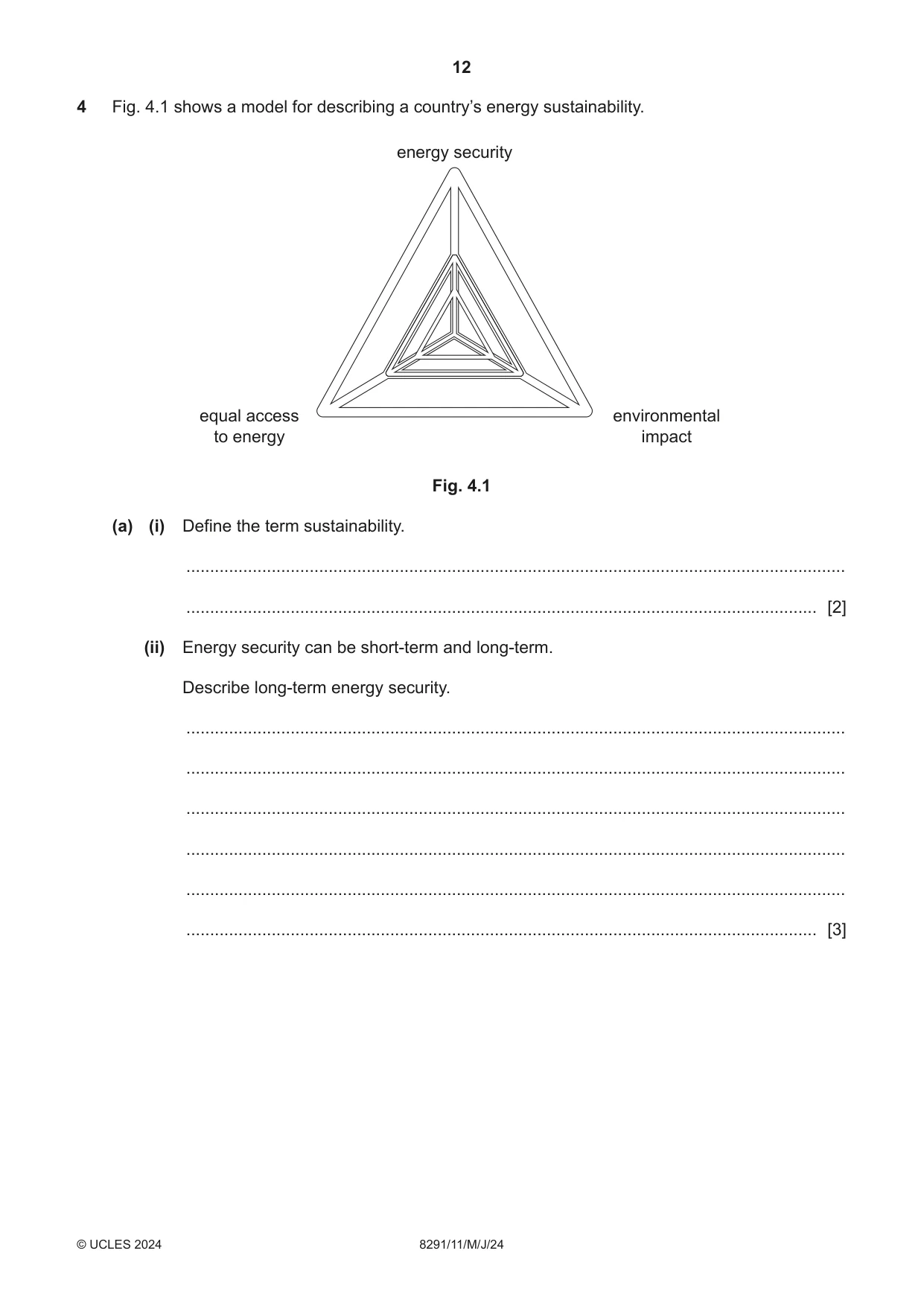
12 8291/11/M/J/24 © UCLES 2024 4 Fig. 4.1 shows a model for describing a country’s energy sustainability. energy security environmental impact equal access to energy Fig. 4.1 (a) (i) Define the term sustainability. … … [2] (ii) Energy security can be short-term and long-term. Describe long-term energy security. … … … … … … [3]
Question paper, page 13
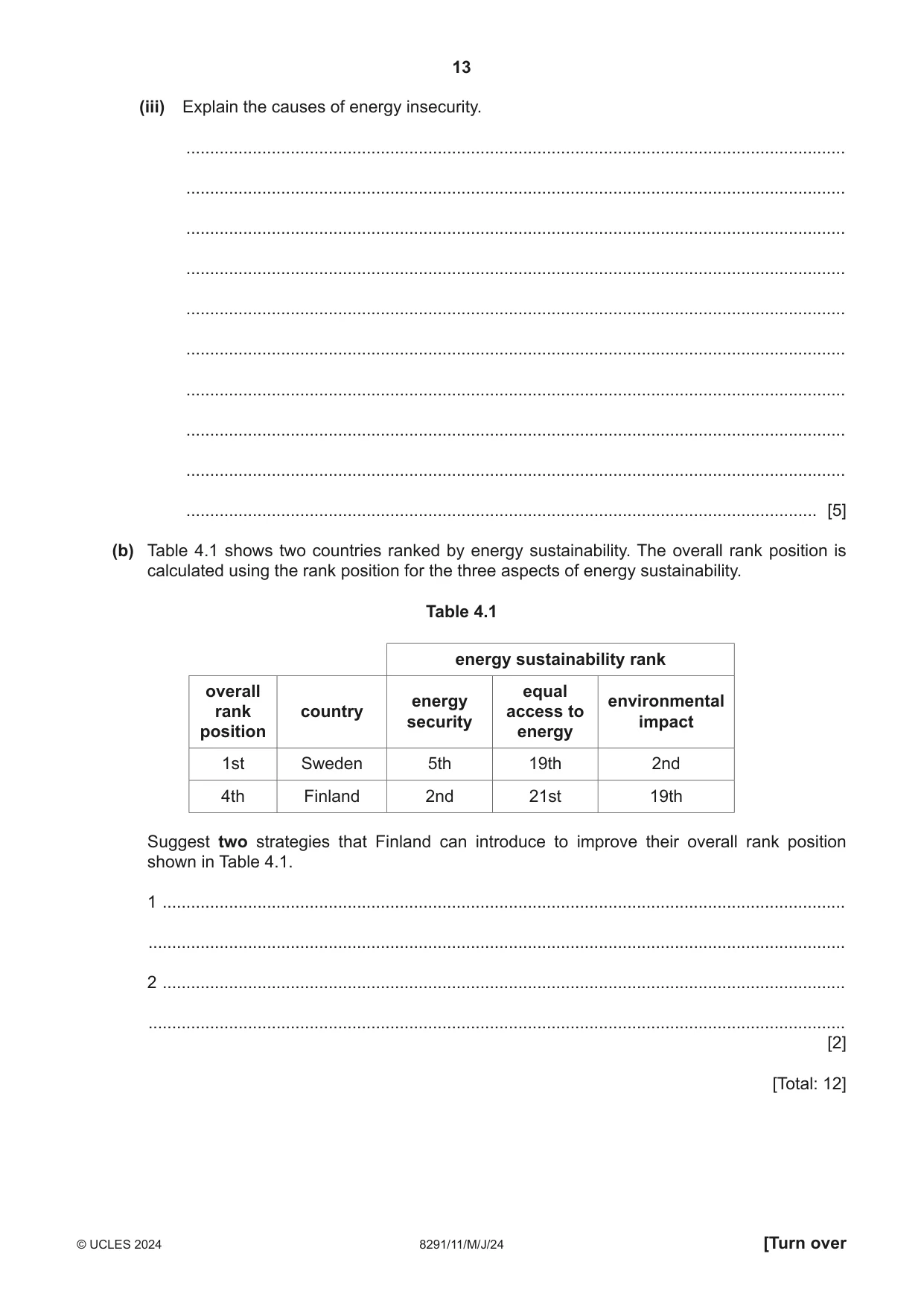
13 8291/11/M/J/24 © UCLES 2024 [Turn over (iii) Explain the causes of energy insecurity. … … … … … … … … … … [5] (b) Table 4.1 shows two countries ranked by energy sustainability. The overall rank position is calculated using the rank position for the three aspects of energy sustainability. Table 4.1 energy sustainability rank overall rank position country energy security equal access to energy environmental impact 1st Sweden 5th 19th 2nd 4th Finland 2nd 21st 19th Suggest two strategies that Finland can introduce to improve their overall rank position shown in Table 4.1. 1 … … 2 … … [2] [Total: 12]
Question paper, page 14
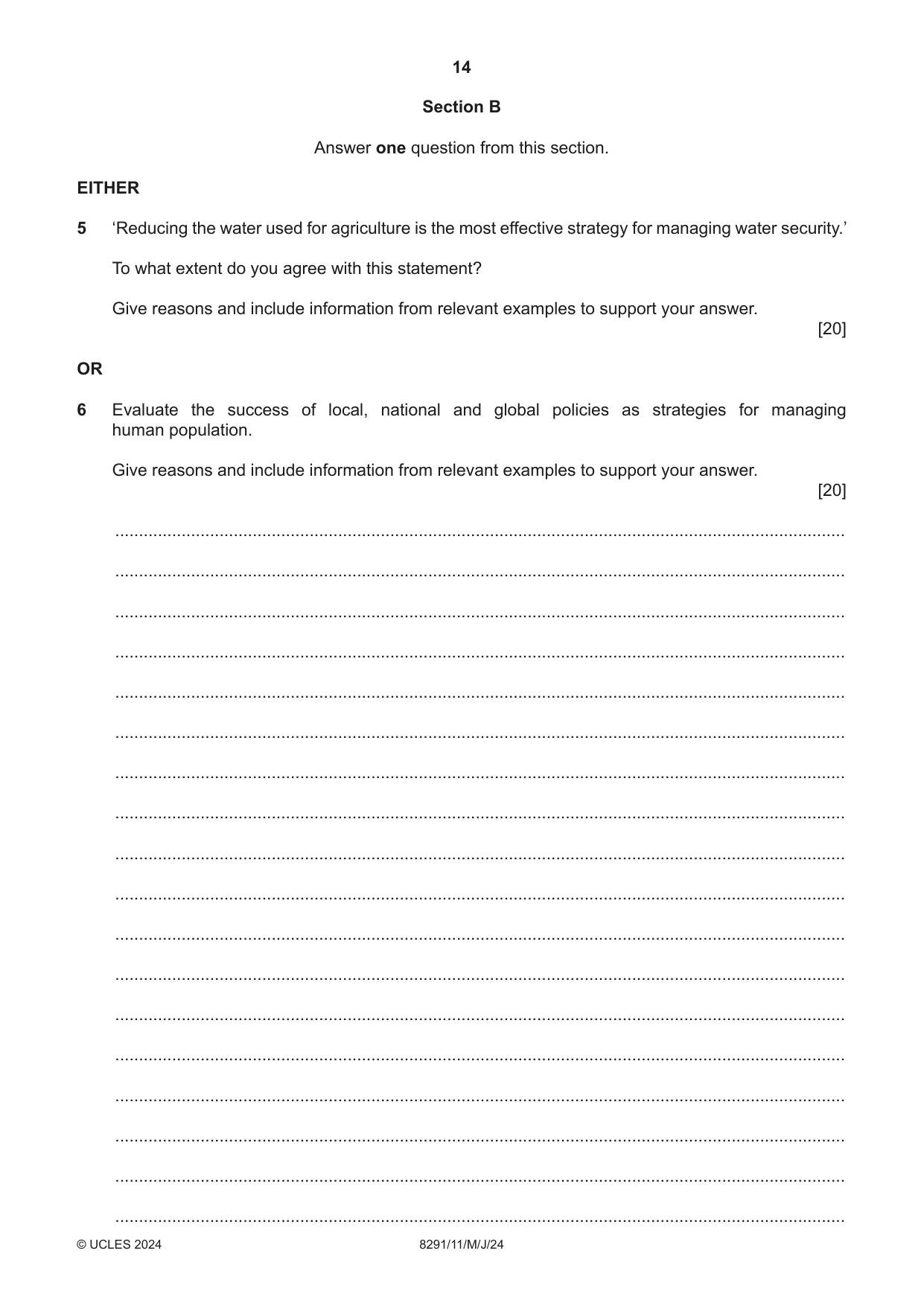
14 8291/11/M/J/24 © UCLES 2024 Section B Answer one question from this section. EITHER 5 ‘Reducing the water used for agriculture is the most effective strategy for managing water security.’ To what extent do you agree with this statement? Give reasons and include information from relevant examples to support your answer. [20] OR 6 Evaluate the success of local, national and global policies as strategies for managing human population. Give reasons and include information from relevant examples to support your answer. [20] … … … … … … … … … … … … … … … … … …
Question paper, page 15
15 8291/11/M/J/24 © UCLES 2024 [Turn over … … … … … … … … … … … … … … … … … … … … … … … … … … … …
Question paper, page 16
16 8291/11/M/J/24 © UCLES 2024 … … … … … … … … … … … … … … … … … … … … … … … … … … … …
Question paper, page 17
17 8291/11/M/J/24 © UCLES 2024 [Turn over … … … … … … … … … … … … … … … … … … … … … … … … … … … …
Question paper, page 18
18 8291/11/M/J/24 © UCLES 2024 … … … … … … … … … … … … … … … … … … … … … … … … … … … …
Question paper, page 19
19 8291/11/M/J/24 © UCLES 2024 [Turn over … … … … … … … … … … … … … … … … … … … … … … … … … … … …
Question paper, page 20
20 8291/11/M/J/24 © UCLES 2024 The boundaries and names shown, the designations used and the presentation of material on any maps contained in this question paper/insert do not imply official endorsement or acceptance by Cambridge Assessment International Education concerning the legal status of any country, territory, or area or any of its authorities, or of the delimitation of its frontiers or boundaries. Permission to reproduce items where third-party owned material protected by copyright is included has been sought and cleared where possible. Every reasonable effort has been made by the publisher (UCLES) to trace copyright holders, but if any items requiring clearance have unwittingly been included, the publisher will be pleased to make amends at the earliest possible opportunity. To avoid the issue of disclosure of answer-related information to candidates, all copyright acknowledgements are reproduced online in the Cambridge Assessment International Education Copyright Acknowledgements Booklet. This is produced for each series of examinations and is freely available to download at www.cambridgeinternational.org after the live examination series. Cambridge Assessment International Education is part of Cambridge Assessment. Cambridge Assessment is the brand name of the University of Cambridge Local Examinations Syndicate (UCLES), which is a department of the University of Cambridge. … … … … … … … … … … … … … … … … … … … … … …
Mark scheme, page 1
This document consists of 18 printed pages. © Cambridge University Press & Assessment 2024 [Turn over Cambridge International AS Level ENVIRONMENTAL MANAGEMENT 8291/11 Paper 1 Principles of Environmental Management May/June 2024 MARK SCHEME Maximum Mark: 80 Published This mark scheme is published as an aid to teachers and candidates, to indicate the requirements of the examination. It shows the basis on which Examiners were instructed to award marks. It does not indicate the details of the discussions that took place at an Examiners’ meeting before marking began, which would have considered the acceptability of alternative answers. Mark schemes should be read in conjunction with the question paper and the Principal Examiner Report for Teachers. Cambridge International will not enter into discussions about these mark schemes. Cambridge International is publishing the mark schemes for the May/June 2024 series for most Cambridge IGCSE, Cambridge International A and AS Level and Cambridge Pre-U components, and some Cambridge O Level components.
Mark scheme, page 2
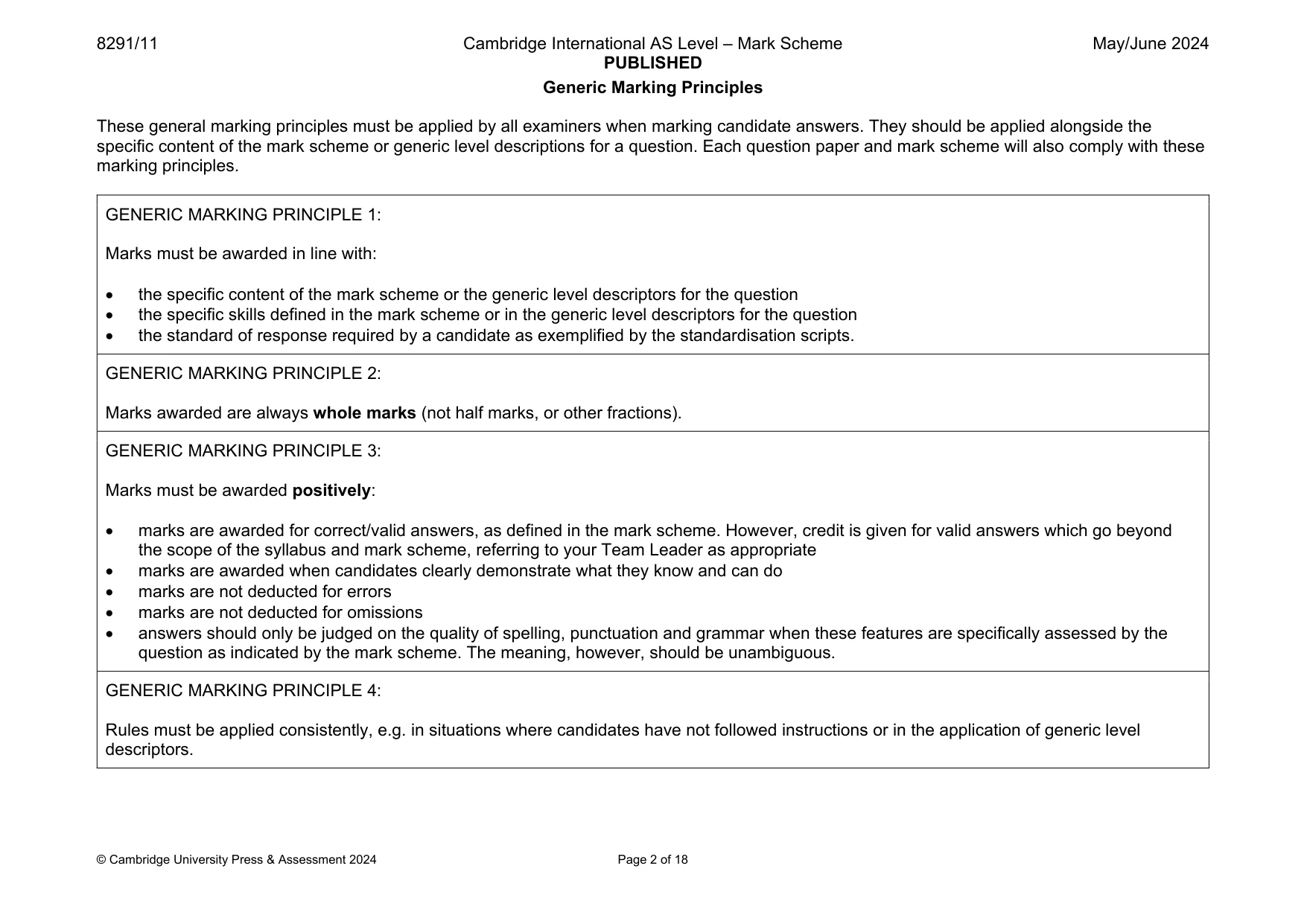
8291/11 Cambridge International AS Level – Mark Scheme PUBLISHED May/June 2024 © Cambridge University Press & Assessment 2024 Page 2 of 18 Generic Marking Principles These general marking principles must be applied by all examiners when marking candidate answers. They should be applied alongside the specific content of the mark scheme or generic level descriptions for a question. Each question paper and mark scheme will also comply with these marking principles. GENERIC MARKING PRINCIPLE 1: Marks must be awarded in line with: the specific content of the mark scheme or the generic level descriptors for the question the specific skills defined in the mark scheme or in the generic level descriptors for the question the standard of response required by a candidate as exemplified by the standardisation scripts. GENERIC MARKING PRINCIPLE 2: Marks awarded are always whole marks (not half marks, or other fractions). GENERIC MARKING PRINCIPLE 3: Marks must be awarded positively: marks are awarded for correct/valid answers, as defined in the mark scheme. However, credit is given for valid answers which go beyond the scope of the syllabus and mark scheme, referring to your Team Leader as appropriate marks are awarded when candidates clearly demonstrate what they know and can do marks are not deducted for errors marks are not deducted for omissions answers should only be judged on the quality of spelling, punctuation and grammar when these features are specifically assessed by the question as indicated by the mark scheme. The meaning, however, should be unambiguous. GENERIC MARKING PRINCIPLE 4: Rules must be applied consistently, e.g. in situations where candidates have not followed instructions or in the application of generic level descriptors.
Mark scheme, page 3
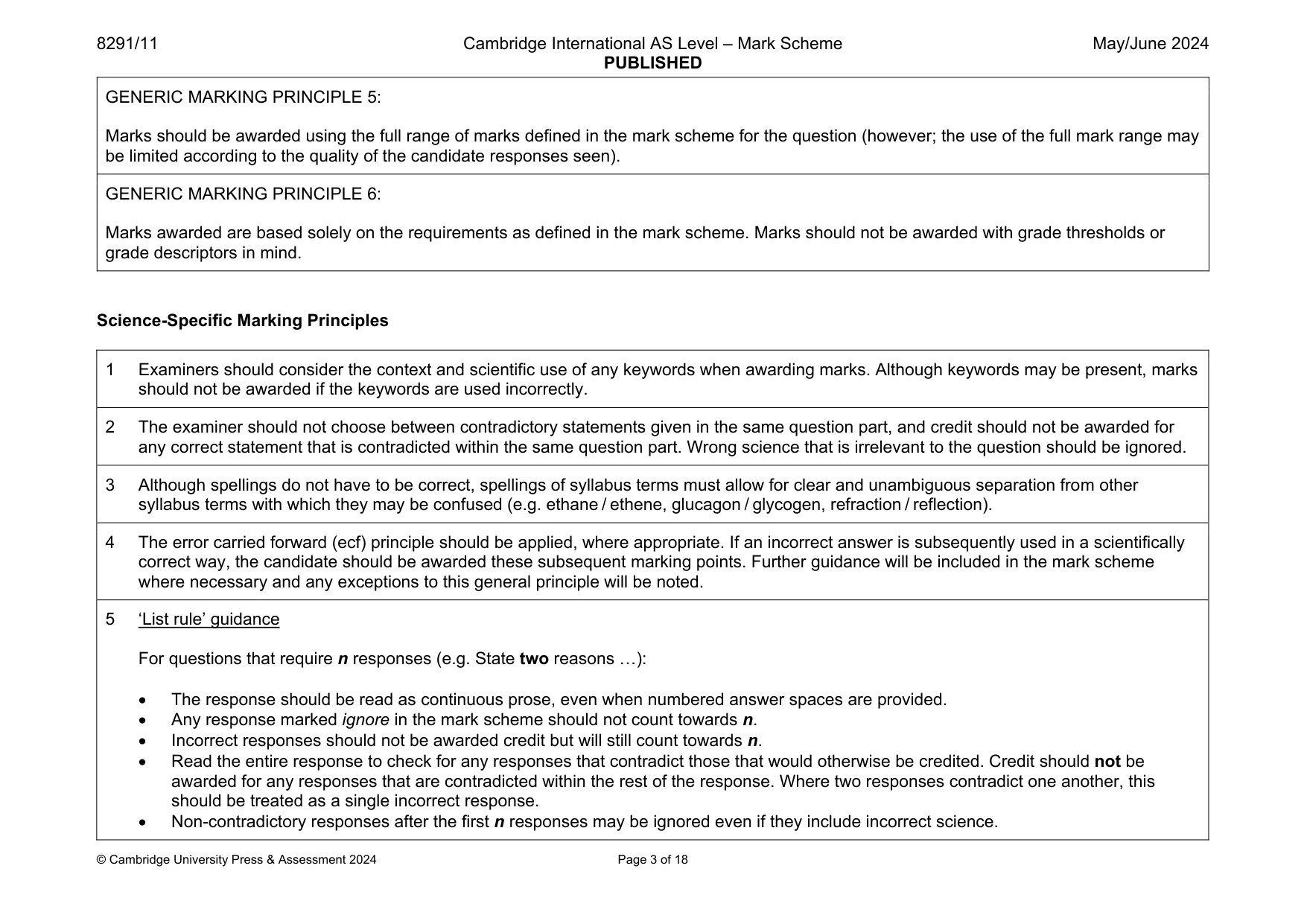
8291/11 Cambridge International AS Level – Mark Scheme PUBLISHED May/June 2024 © Cambridge University Press & Assessment 2024 Page 3 of 18 GENERIC MARKING PRINCIPLE 5: Marks should be awarded using the full range of marks defined in the mark scheme for the question (however; the use of the full mark range may be limited according to the quality of the candidate responses seen). GENERIC MARKING PRINCIPLE 6: Marks awarded are based solely on the requirements as defined in the mark scheme. Marks should not be awarded with grade thresholds or grade descriptors in mind. Science-Specific Marking Principles 1 Examiners should consider the context and scientific use of any keywords when awarding marks. Although keywords may be present, marks should not be awarded if the keywords are used incorrectly. 2 The examiner should not choose between contradictory statements given in the same question part, and credit should not be awarded for any correct statement that is contradicted within the same question part. Wrong science that is irrelevant to the question should be ignored. 3 Although spellings do not have to be correct, spellings of syllabus terms must allow for clear and unambiguous separation from other syllabus terms with which they may be confused (e.g. ethane / ethene, glucagon / glycogen, refraction / reflection). 4 The error carried forward (ecf) principle should be applied, where appropriate. If an incorrect answer is subsequently used in a scientifically correct way, the candidate should be awarded these subsequent marking points. Further guidance will be included in the mark scheme where necessary and any exceptions to this general principle will be noted. 5 ‘List rule’ guidance For questions that require n responses (e.g. State two reasons …): The response should be read as continuous prose, even when numbered answer spaces are provided. Any response marked ignore in the mark scheme should not count towards n. Incorrect responses should not be awarded credit but will still count towards n. Read the entire response to check for any responses that contradict those that would otherwise be credited. Credit should not be awarded for any responses that are contradicted within the rest of the response. Where two responses contradict one another, this should be treated as a single incorrect response. Non-contradictory responses after the first n responses may be ignored even if they include incorrect science.
Mark scheme, page 4
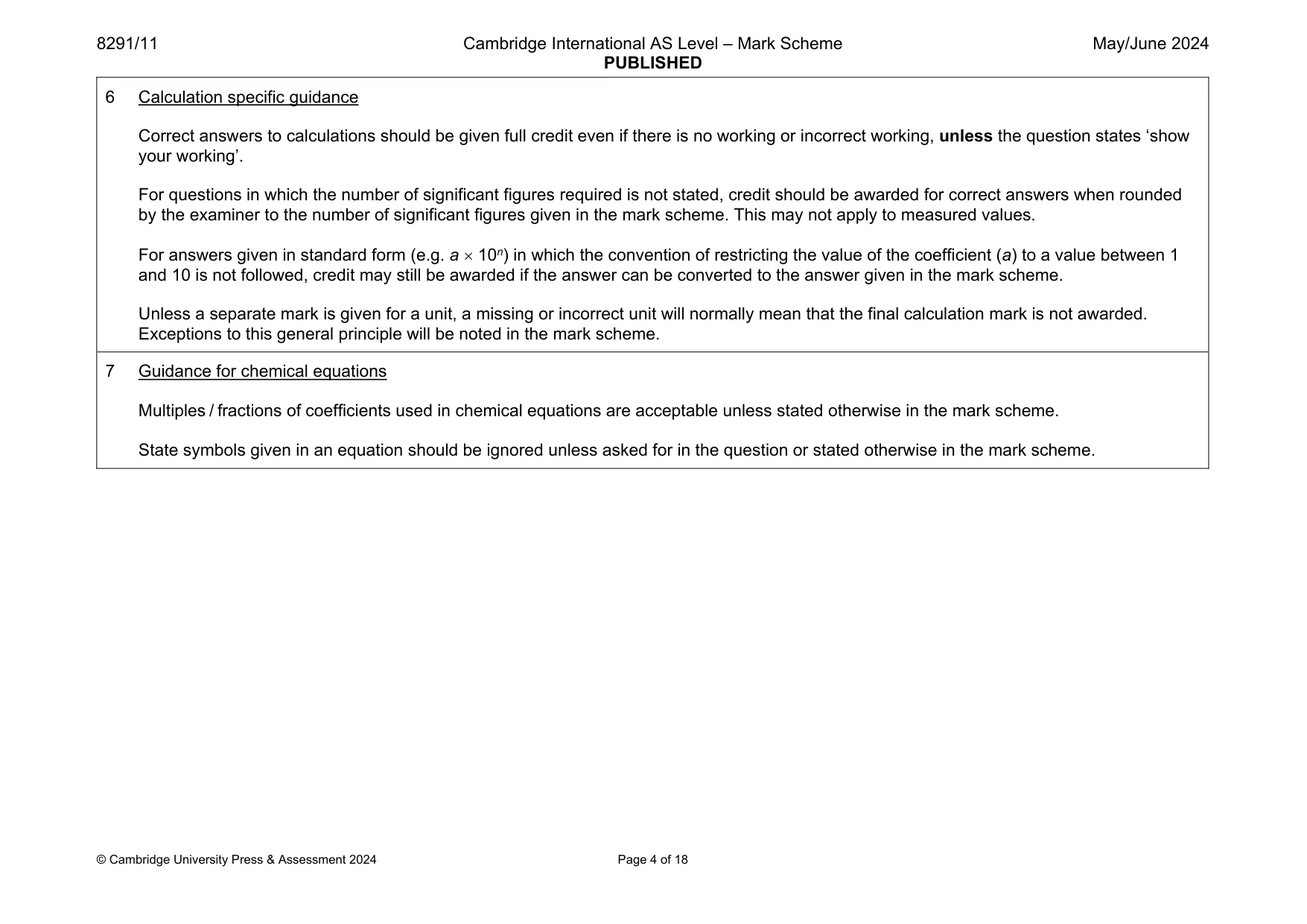
8291/11 Cambridge International AS Level – Mark Scheme PUBLISHED May/June 2024 © Cambridge University Press & Assessment 2024 Page 4 of 18 6 Calculation specific guidance Correct answers to calculations should be given full credit even if there is no working or incorrect working, unless the question states ‘show your working’. For questions in which the number of significant figures required is not stated, credit should be awarded for correct answers when rounded by the examiner to the number of significant figures given in the mark scheme. This may not apply to measured values. For answers given in standard form (e.g. a 10n) in which the convention of restricting the value of the coefficient (a) to a value between 1 and 10 is not followed, credit may still be awarded if the answer can be converted to the answer given in the mark scheme. Unless a separate mark is given for a unit, a missing or incorrect unit will normally mean that the final calculation mark is not awarded. Exceptions to this general principle will be noted in the mark scheme. 7 Guidance for chemical equations Multiples / fractions of coefficients used in chemical equations are acceptable unless stated otherwise in the mark scheme. State symbols given in an equation should be ignored unless asked for in the question or stated otherwise in the mark scheme.
Mark scheme, page 5
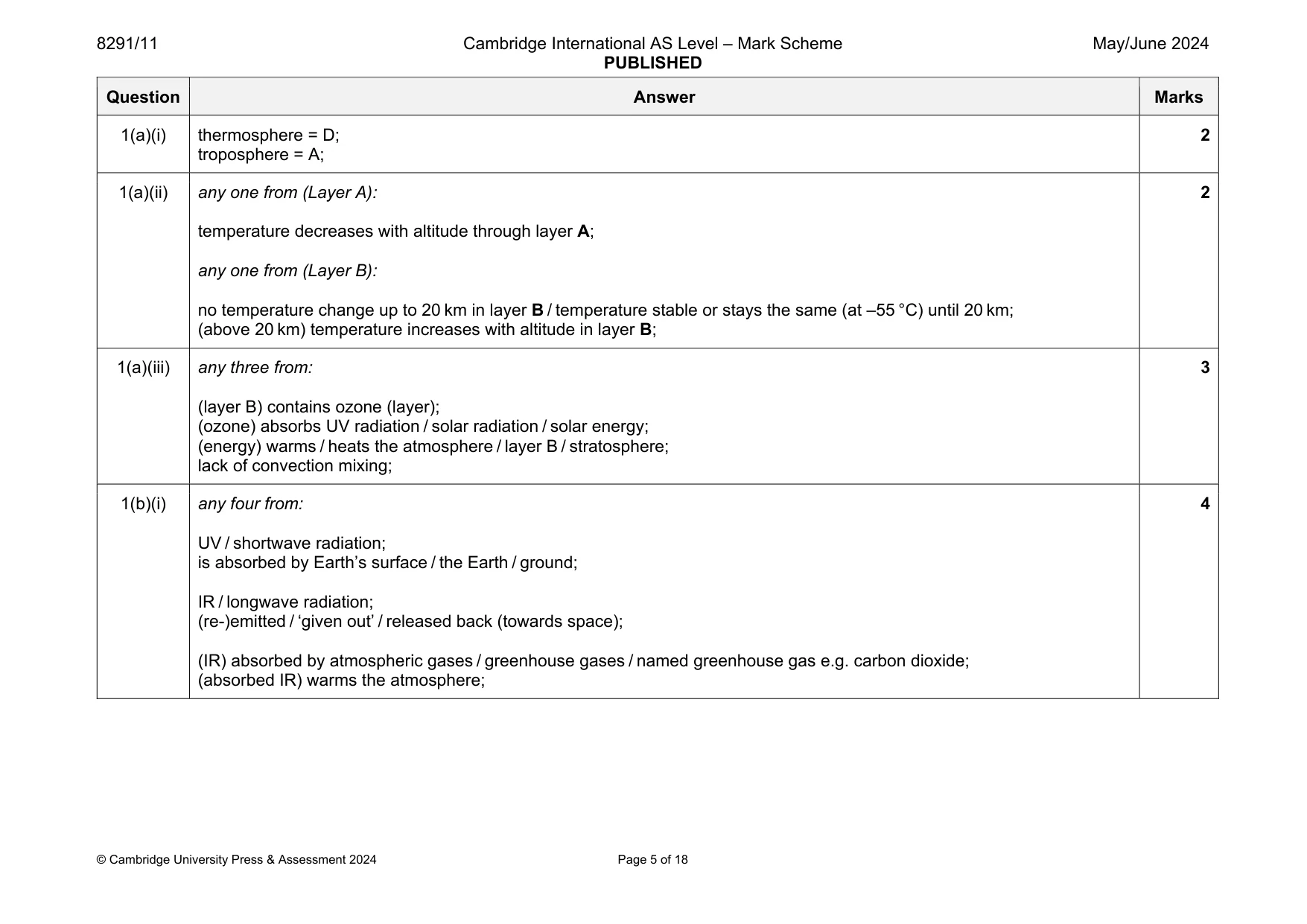
8291/11 Cambridge International AS Level – Mark Scheme PUBLISHED May/June 2024 © Cambridge University Press & Assessment 2024 Page 5 of 18 Question Answer Marks 1(a)(i) thermosphere = D; troposphere = A; 2 1(a)(ii) any one from (Layer A): temperature decreases with altitude through layer A; any one from (Layer B): no temperature change up to 20 km in layer B / temperature stable or stays the same (at –55 °C) until 20 km; (above 20 km) temperature increases with altitude in layer B; 2 1(a)(iii) any three from: (layer B) contains ozone (layer); (ozone) absorbs UV radiation / solar radiation / solar energy; (energy) warms / heats the atmosphere / layer B / stratosphere; lack of convection mixing; 3 1(b)(i) any four from: UV / shortwave radiation; is absorbed by Earth’s surface / the Earth / ground; IR / longwave radiation; (re-)emitted / ‘given out’ / released back (towards space); (IR) absorbed by atmospheric gases / greenhouse gases / named greenhouse gas e.g. carbon dioxide; (absorbed IR) warms the atmosphere; 4
Mark scheme, page 6
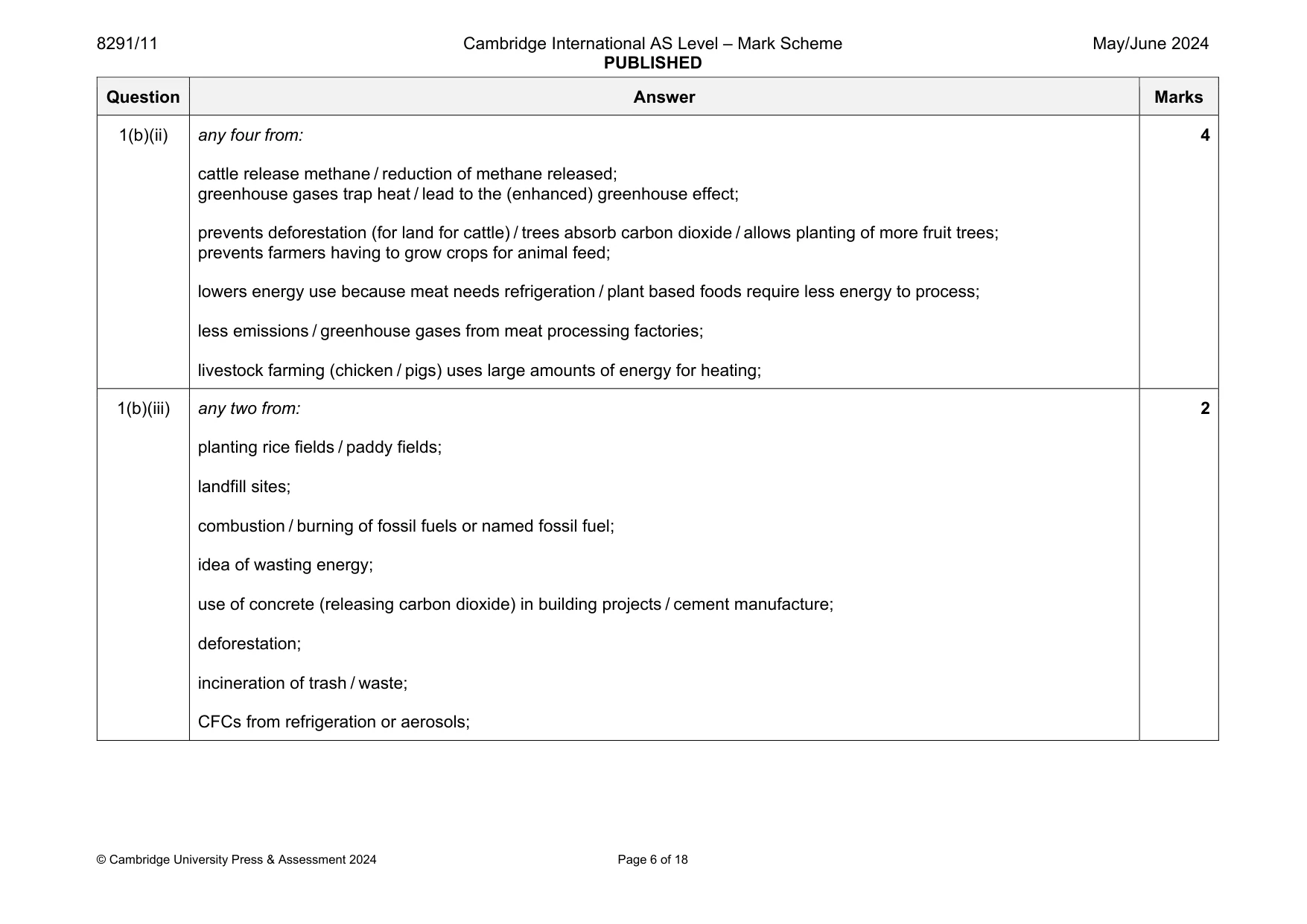
8291/11 Cambridge International AS Level – Mark Scheme PUBLISHED May/June 2024 © Cambridge University Press & Assessment 2024 Page 6 of 18 Question Answer Marks 1(b)(ii) any four from: cattle release methane / reduction of methane released; greenhouse gases trap heat / lead to the (enhanced) greenhouse effect; prevents deforestation (for land for cattle) / trees absorb carbon dioxide / allows planting of more fruit trees; prevents farmers having to grow crops for animal feed; lowers energy use because meat needs refrigeration / plant based foods require less energy to process; less emissions / greenhouse gases from meat processing factories; livestock farming (chicken / pigs) uses large amounts of energy for heating; 4 1(b)(iii) any two from: planting rice fields / paddy fields; landfill sites; combustion / burning of fossil fuels or named fossil fuel; idea of wasting energy; use of concrete (releasing carbon dioxide) in building projects / cement manufacture; deforestation; incineration of trash / waste; CFCs from refrigeration or aerosols; 2
Mark scheme, page 7
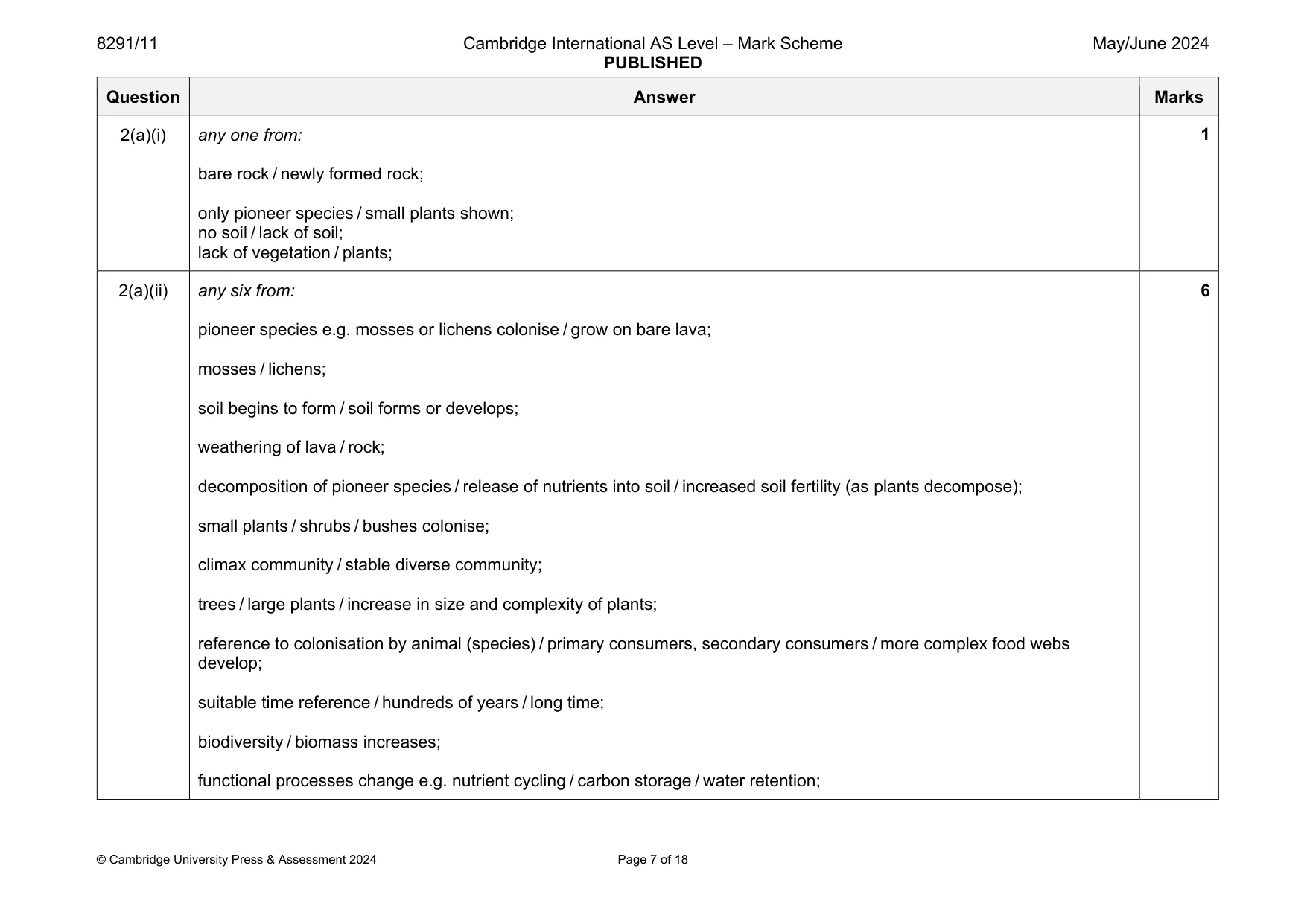
8291/11 Cambridge International AS Level – Mark Scheme PUBLISHED May/June 2024 © Cambridge University Press & Assessment 2024 Page 7 of 18 Question Answer Marks 2(a)(i) any one from: bare rock / newly formed rock; only pioneer species / small plants shown; no soil / lack of soil; lack of vegetation / plants; 1 2(a)(ii) any six from: pioneer species e.g. mosses or lichens colonise / grow on bare lava; mosses / lichens; soil begins to form / soil forms or develops; weathering of lava / rock; decomposition of pioneer species / release of nutrients into soil / increased soil fertility (as plants decompose); small plants / shrubs / bushes colonise; climax community / stable diverse community; trees / large plants / increase in size and complexity of plants; reference to colonisation by animal (species) / primary consumers, secondary consumers / more complex food webs develop; suitable time reference / hundreds of years / long time; biodiversity / biomass increases; functional processes change e.g. nutrient cycling / carbon storage / water retention; 6
Mark scheme, page 8
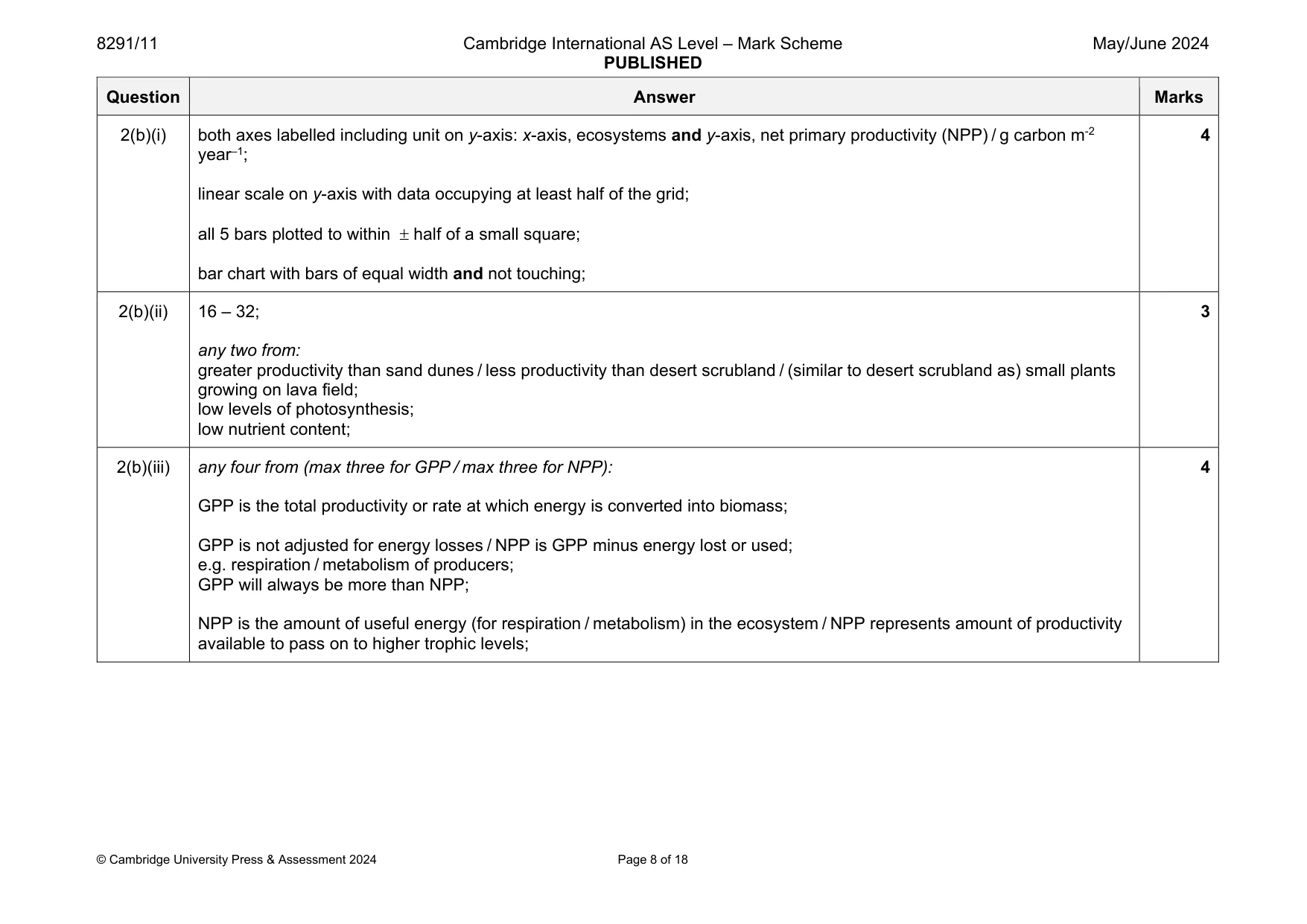
8291/11 Cambridge International AS Level – Mark Scheme PUBLISHED May/June 2024 © Cambridge University Press & Assessment 2024 Page 8 of 18 Question Answer Marks 2(b)(i) both axes labelled including unit on y-axis: x-axis, ecosystems and y-axis, net primary productivity (NPP) / g carbon m-2 year–1; linear scale on y-axis with data occupying at least half of the grid; all 5 bars plotted to within half of a small square; bar chart with bars of equal width and not touching; 4 2(b)(ii) 16 – 32; any two from: greater productivity than sand dunes / less productivity than desert scrubland / (similar to desert scrubland as) small plants growing on lava field; low levels of photosynthesis; low nutrient content; 3 2(b)(iii) any four from (max three for GPP / max three for NPP): GPP is the total productivity or rate at which energy is converted into biomass; GPP is not adjusted for energy losses / NPP is GPP minus energy lost or used; e.g. respiration / metabolism of producers; GPP will always be more than NPP; NPP is the amount of useful energy (for respiration / metabolism) in the ecosystem / NPP represents amount of productivity available to pass on to higher trophic levels; 4
Mark scheme, page 9
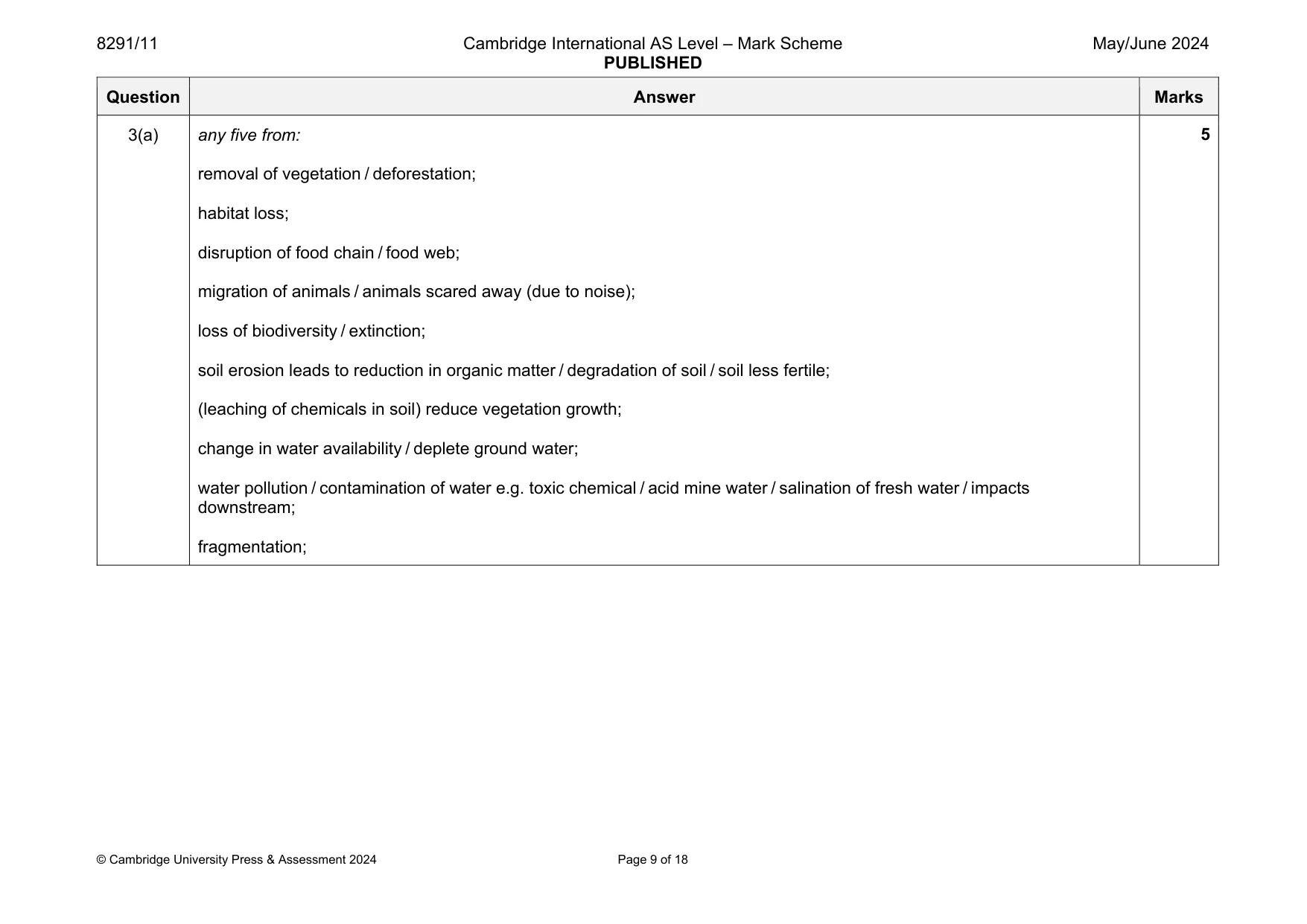
8291/11 Cambridge International AS Level – Mark Scheme PUBLISHED May/June 2024 © Cambridge University Press & Assessment 2024 Page 9 of 18 Question Answer Marks 3(a) any five from: removal of vegetation / deforestation; habitat loss; disruption of food chain / food web; migration of animals / animals scared away (due to noise); loss of biodiversity / extinction; soil erosion leads to reduction in organic matter / degradation of soil / soil less fertile; (leaching of chemicals in soil) reduce vegetation growth; change in water availability / deplete ground water; water pollution / contamination of water e.g. toxic chemical / acid mine water / salination of fresh water / impacts downstream; fragmentation; 5
Mark scheme, page 10
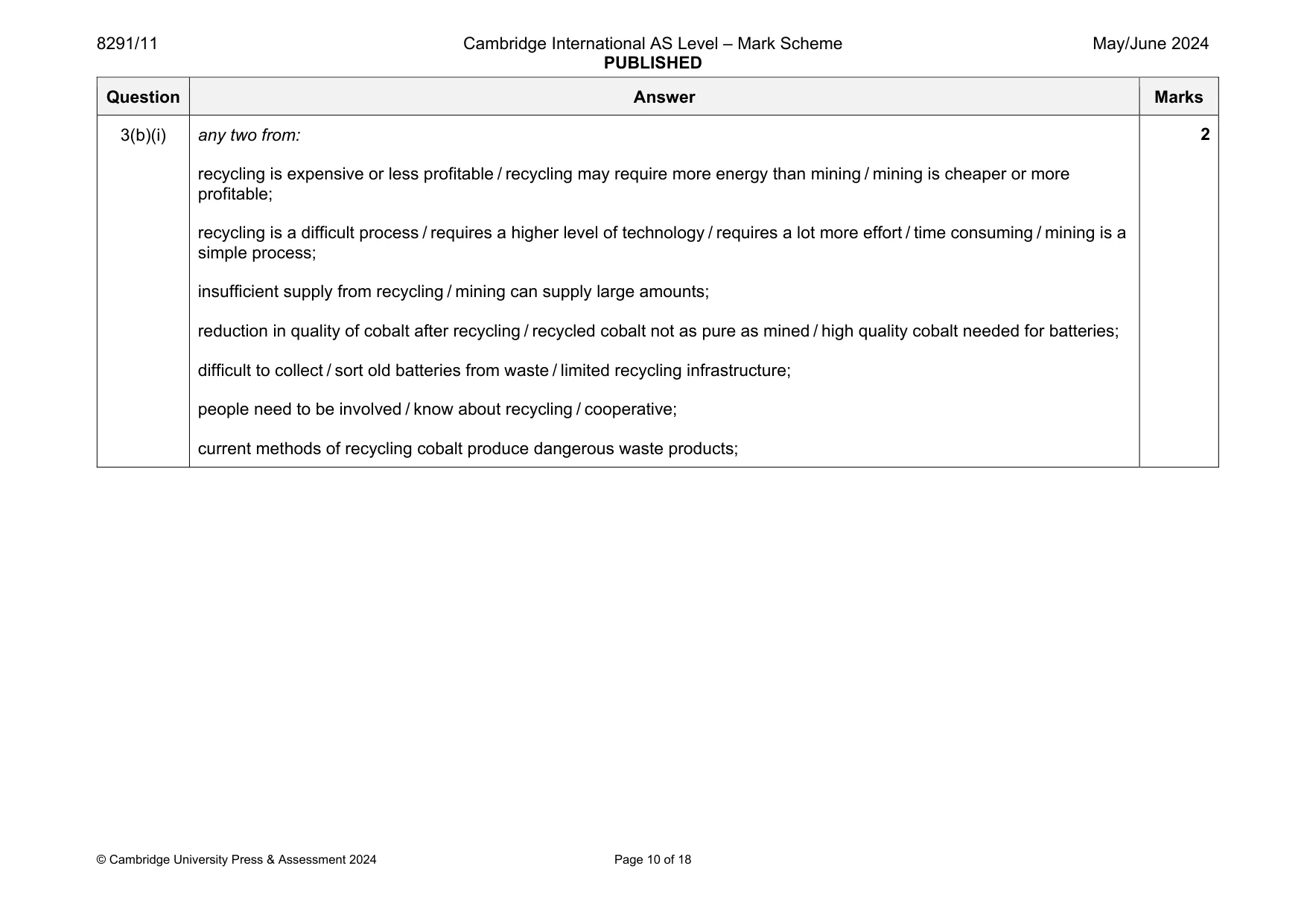
8291/11 Cambridge International AS Level – Mark Scheme PUBLISHED May/June 2024 © Cambridge University Press & Assessment 2024 Page 10 of 18 Question Answer Marks 3(b)(i) any two from: recycling is expensive or less profitable / recycling may require more energy than mining / mining is cheaper or more profitable; recycling is a difficult process / requires a higher level of technology / requires a lot more effort / time consuming / mining is a simple process; insufficient supply from recycling / mining can supply large amounts; reduction in quality of cobalt after recycling / recycled cobalt not as pure as mined / high quality cobalt needed for batteries; difficult to collect / sort old batteries from waste / limited recycling infrastructure; people need to be involved / know about recycling / cooperative; current methods of recycling cobalt produce dangerous waste products; 2
Mark scheme, page 11
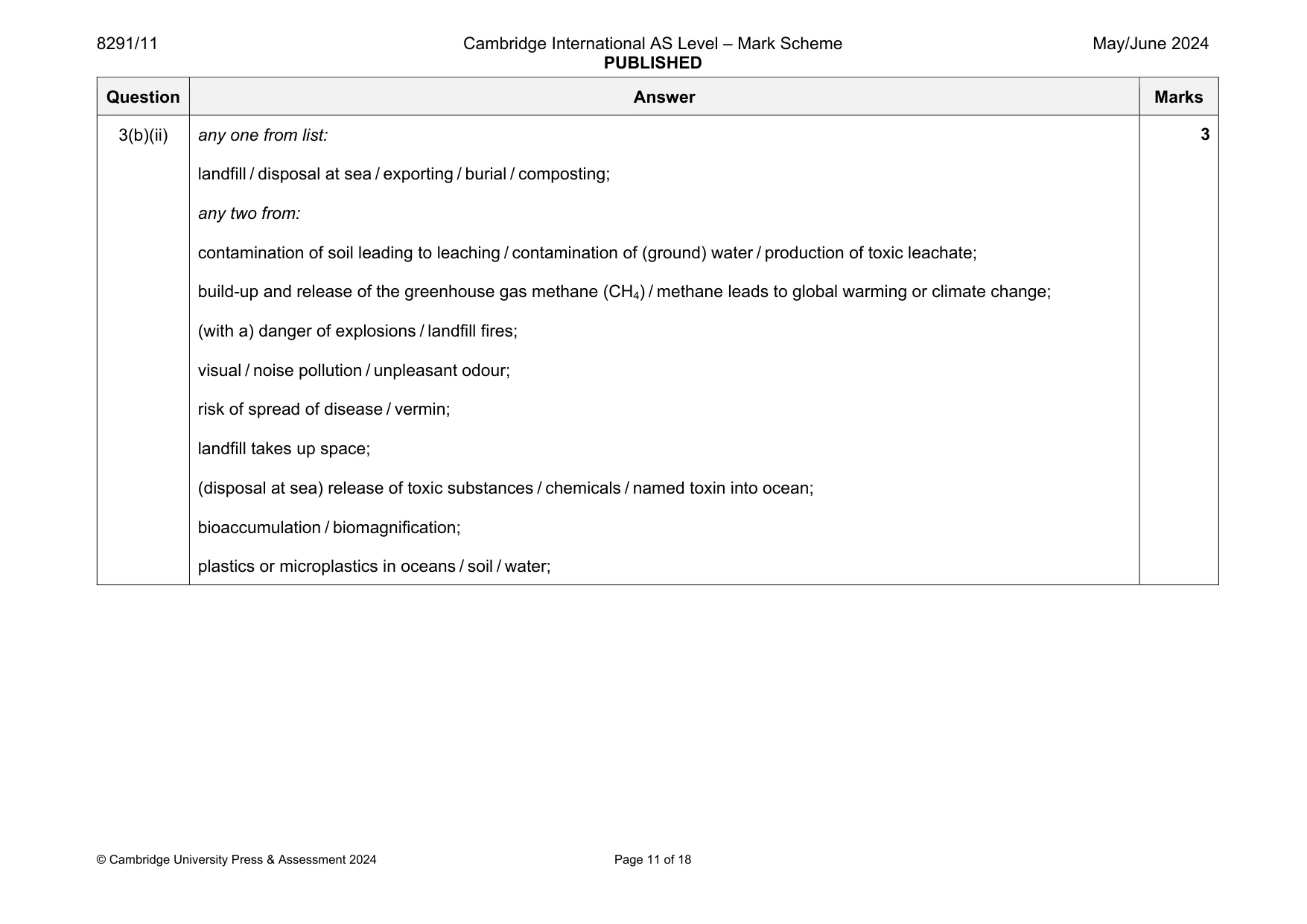
8291/11 Cambridge International AS Level – Mark Scheme PUBLISHED May/June 2024 © Cambridge University Press & Assessment 2024 Page 11 of 18 Question Answer Marks 3(b)(ii) any one from list: landfill / disposal at sea / exporting / burial / composting; any two from: contamination of soil leading to leaching / contamination of (ground) water / production of toxic leachate; build-up and release of the greenhouse gas methane (CH4) / methane leads to global warming or climate change; (with a) danger of explosions / landfill fires; visual / noise pollution / unpleasant odour; risk of spread of disease / vermin; landfill takes up space; (disposal at sea) release of toxic substances / chemicals / named toxin into ocean; bioaccumulation / biomagnification; plastics or microplastics in oceans / soil / water; 3
Mark scheme, page 12
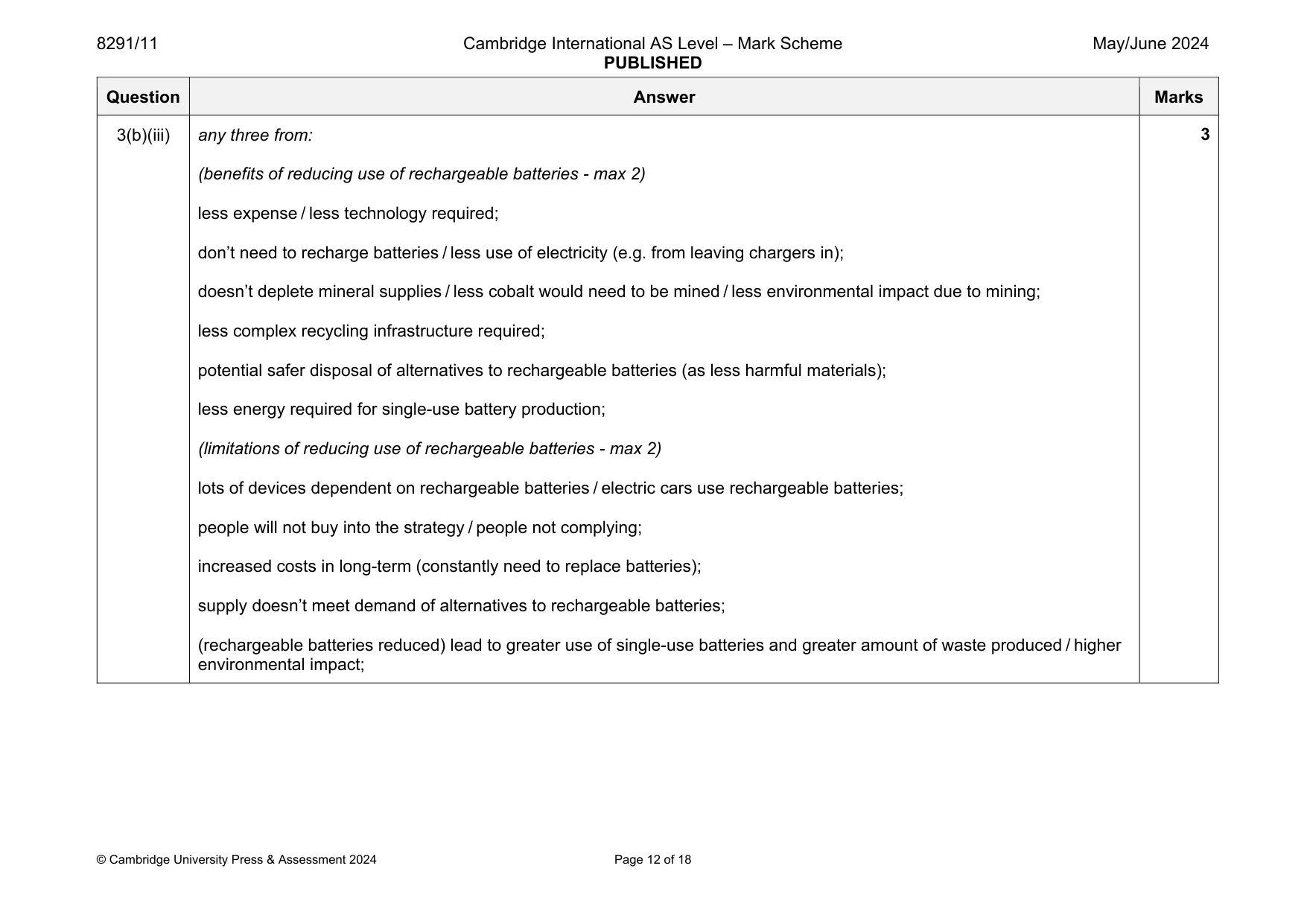
8291/11 Cambridge International AS Level – Mark Scheme PUBLISHED May/June 2024 © Cambridge University Press & Assessment 2024 Page 12 of 18 Question Answer Marks 3(b)(iii) any three from: (benefits of reducing use of rechargeable batteries - max 2) less expense / less technology required; don’t need to recharge batteries / less use of electricity (e.g. from leaving chargers in); doesn’t deplete mineral supplies / less cobalt would need to be mined / less environmental impact due to mining; less complex recycling infrastructure required; potential safer disposal of alternatives to rechargeable batteries (as less harmful materials); less energy required for single-use battery production; (limitations of reducing use of rechargeable batteries - max 2) lots of devices dependent on rechargeable batteries / electric cars use rechargeable batteries; people will not buy into the strategy / people not complying; increased costs in long-term (constantly need to replace batteries); supply doesn’t meet demand of alternatives to rechargeable batteries; (rechargeable batteries reduced) lead to greater use of single-use batteries and greater amount of waste produced / higher environmental impact; 3
Mark scheme, page 13
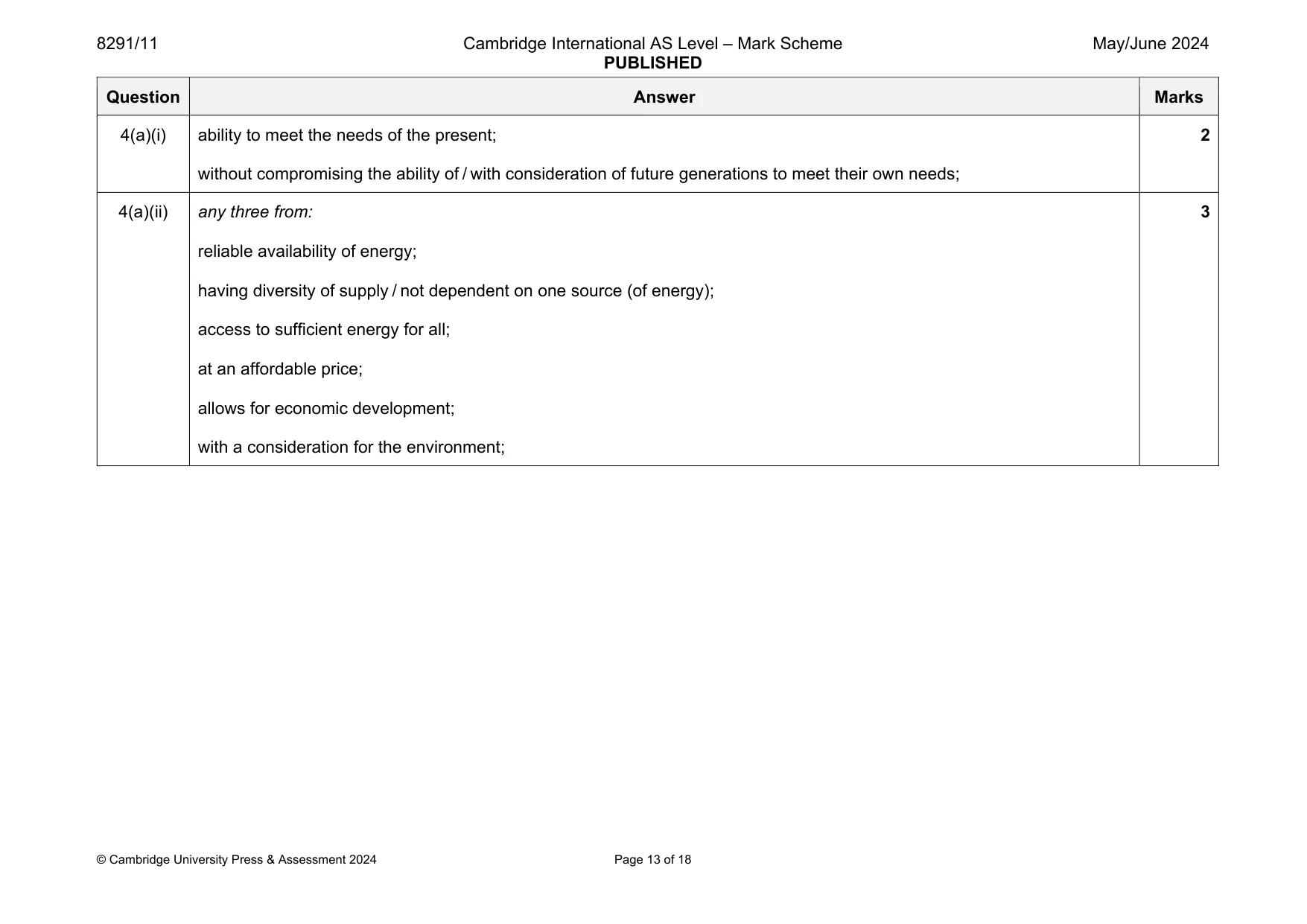
8291/11 Cambridge International AS Level – Mark Scheme PUBLISHED May/June 2024 © Cambridge University Press & Assessment 2024 Page 13 of 18 Question Answer Marks 4(a)(i) ability to meet the needs of the present; without compromising the ability of / with consideration of future generations to meet their own needs; 2 4(a)(ii) any three from: reliable availability of energy; having diversity of supply / not dependent on one source (of energy); access to sufficient energy for all; at an affordable price; allows for economic development; with a consideration for the environment; 3
Mark scheme, page 14
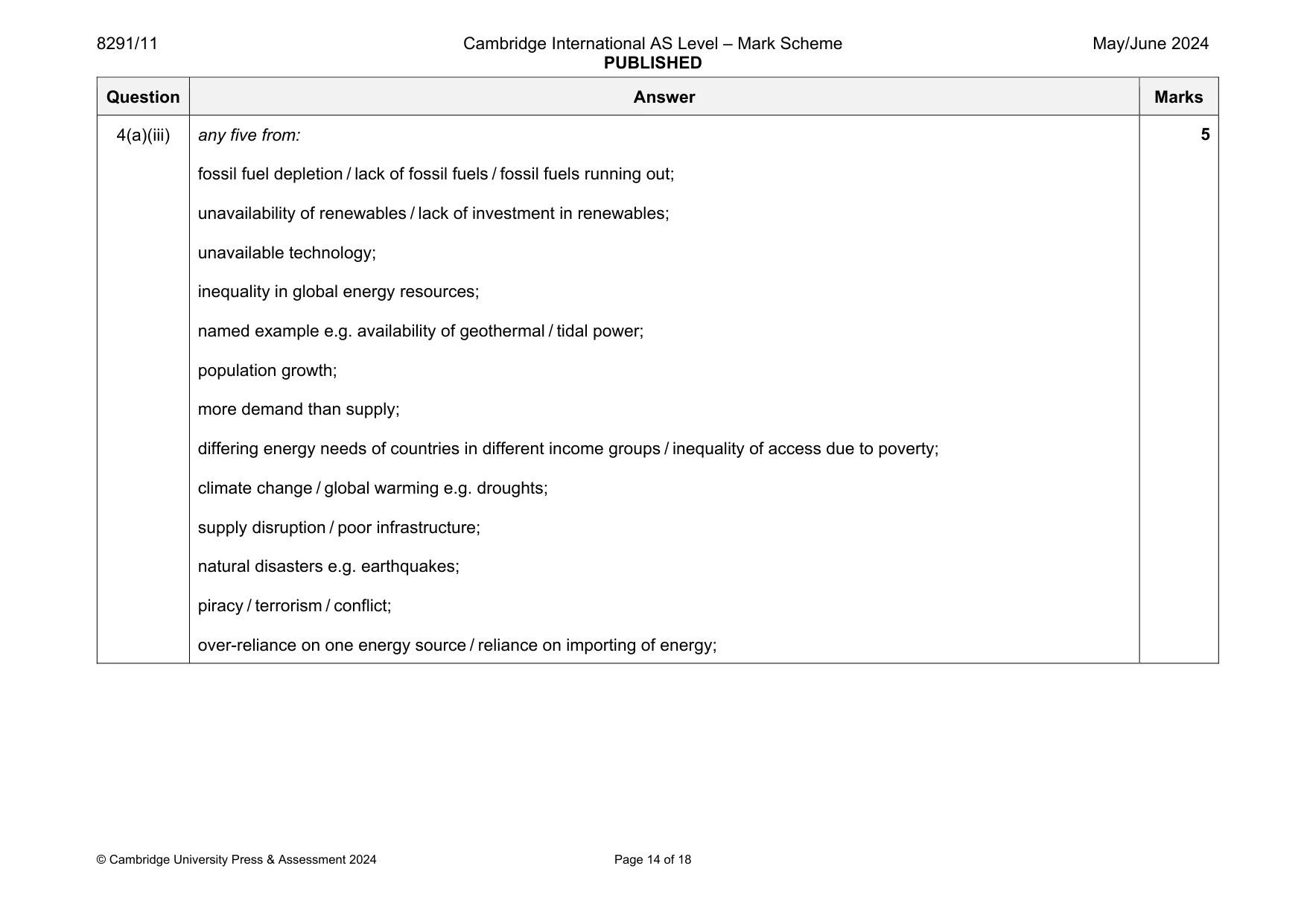
8291/11 Cambridge International AS Level – Mark Scheme PUBLISHED May/June 2024 © Cambridge University Press & Assessment 2024 Page 14 of 18 Question Answer Marks 4(a)(iii) any five from: fossil fuel depletion / lack of fossil fuels / fossil fuels running out; unavailability of renewables / lack of investment in renewables; unavailable technology; inequality in global energy resources; named example e.g. availability of geothermal / tidal power; population growth; more demand than supply; differing energy needs of countries in different income groups / inequality of access due to poverty; climate change / global warming e.g. droughts; supply disruption / poor infrastructure; natural disasters e.g. earthquakes; piracy / terrorism / conflict; over-reliance on one energy source / reliance on importing of energy; 5
Mark scheme, page 15
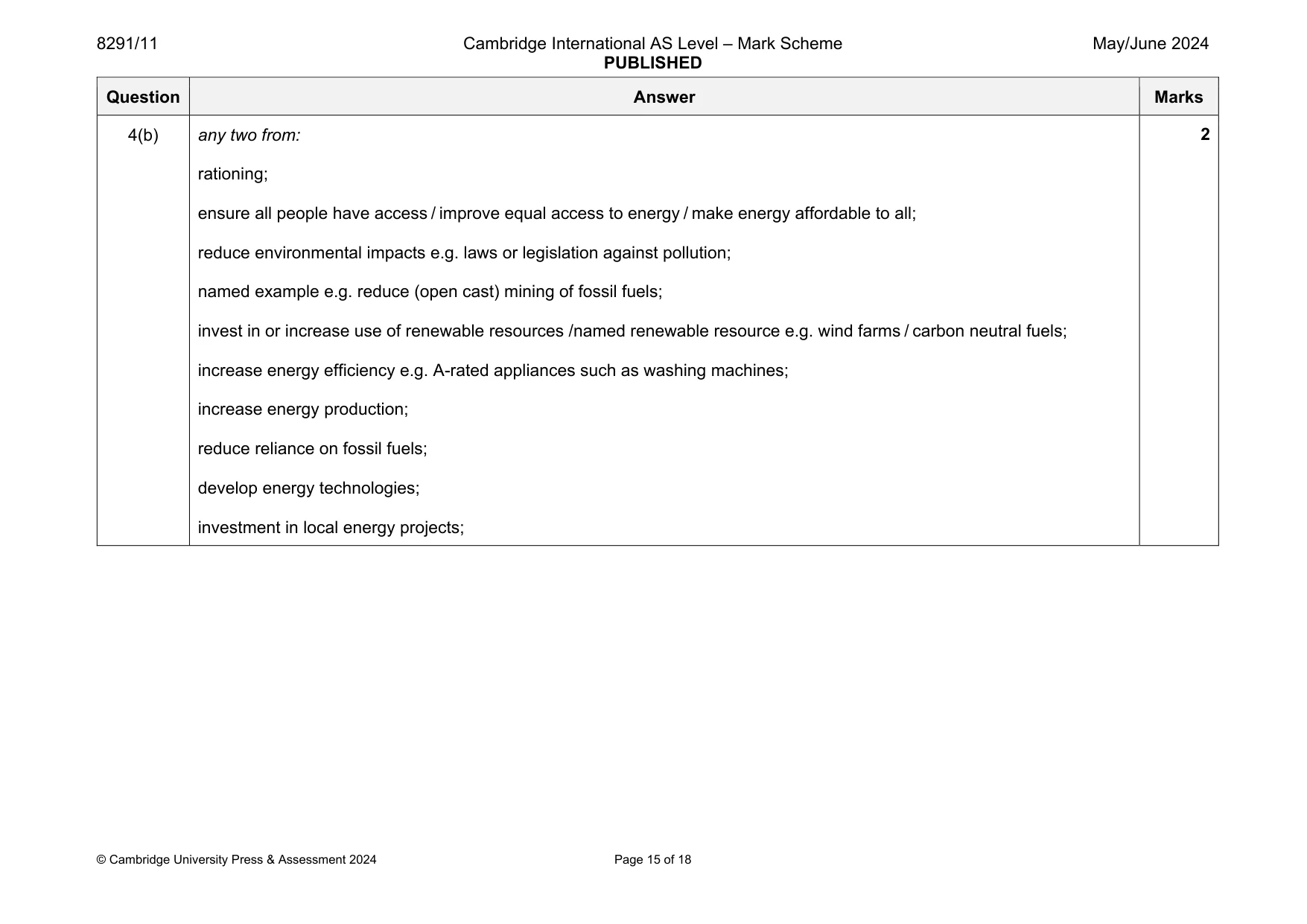
8291/11 Cambridge International AS Level – Mark Scheme PUBLISHED May/June 2024 © Cambridge University Press & Assessment 2024 Page 15 of 18 Question Answer Marks 4(b) any two from: rationing; ensure all people have access / improve equal access to energy / make energy affordable to all; reduce environmental impacts e.g. laws or legislation against pollution; named example e.g. reduce (open cast) mining of fossil fuels; invest in or increase use of renewable resources /named renewable resource e.g. wind farms / carbon neutral fuels; increase energy efficiency e.g. A-rated appliances such as washing machines; increase energy production; reduce reliance on fossil fuels; develop energy technologies; investment in local energy projects; 2
Mark scheme, page 16
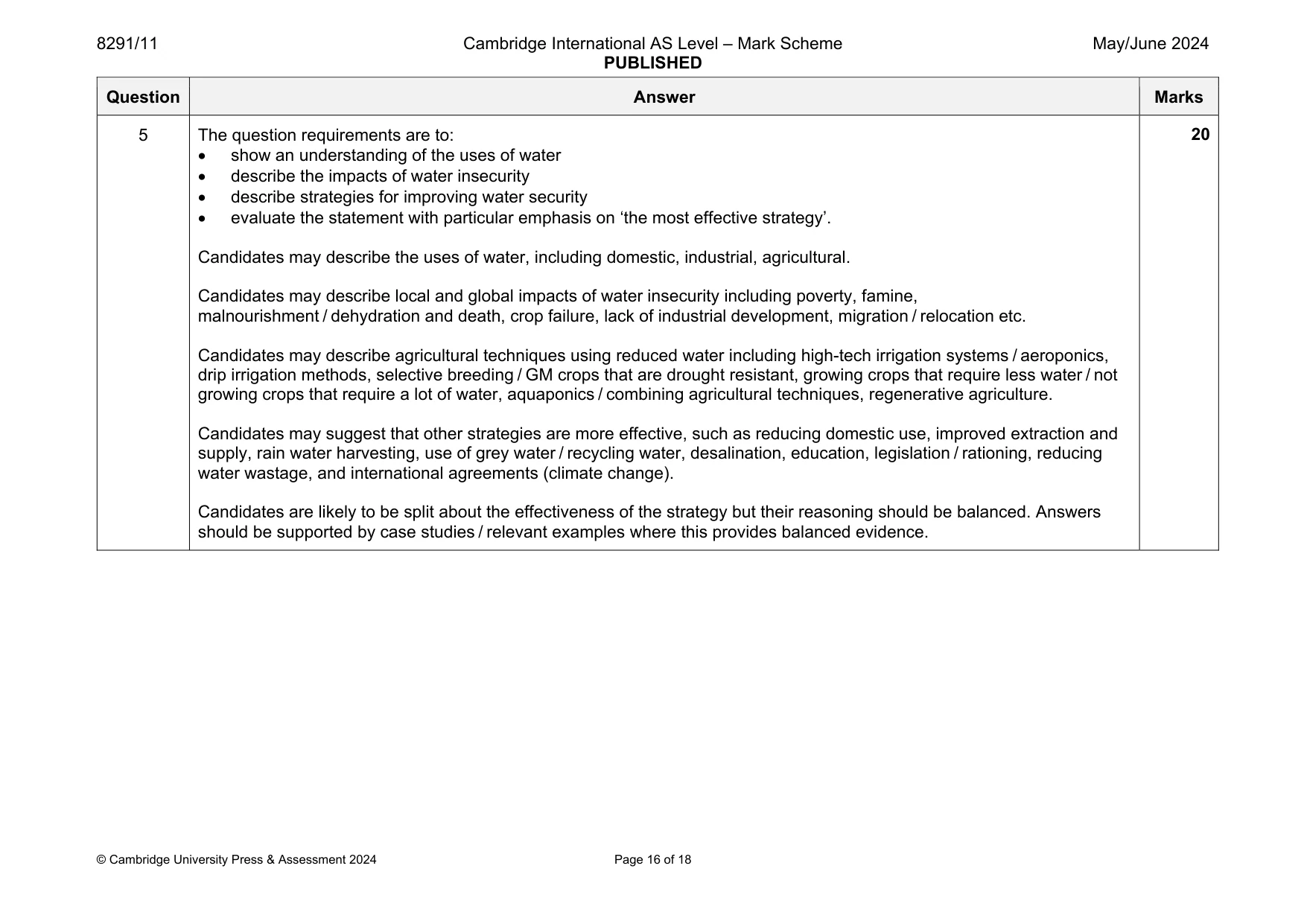
8291/11 Cambridge International AS Level – Mark Scheme PUBLISHED May/June 2024 © Cambridge University Press & Assessment 2024 Page 16 of 18 Question Answer Marks 5 The question requirements are to: show an understanding of the uses of water describe the impacts of water insecurity describe strategies for improving water security evaluate the statement with particular emphasis on ‘the most effective strategy’. Candidates may describe the uses of water, including domestic, industrial, agricultural. Candidates may describe local and global impacts of water insecurity including poverty, famine, malnourishment / dehydration and death, crop failure, lack of industrial development, migration / relocation etc. Candidates may describe agricultural techniques using reduced water including high-tech irrigation systems / aeroponics, drip irrigation methods, selective breeding / GM crops that are drought resistant, growing crops that require less water / not growing crops that require a lot of water, aquaponics / combining agricultural techniques, regenerative agriculture. Candidates may suggest that other strategies are more effective, such as reducing domestic use, improved extraction and supply, rain water harvesting, use of grey water / recycling water, desalination, education, legislation / rationing, reducing water wastage, and international agreements (climate change). Candidates are likely to be split about the effectiveness of the strategy but their reasoning should be balanced. Answers should be supported by case studies / relevant examples where this provides balanced evidence. 20
Mark scheme, page 17
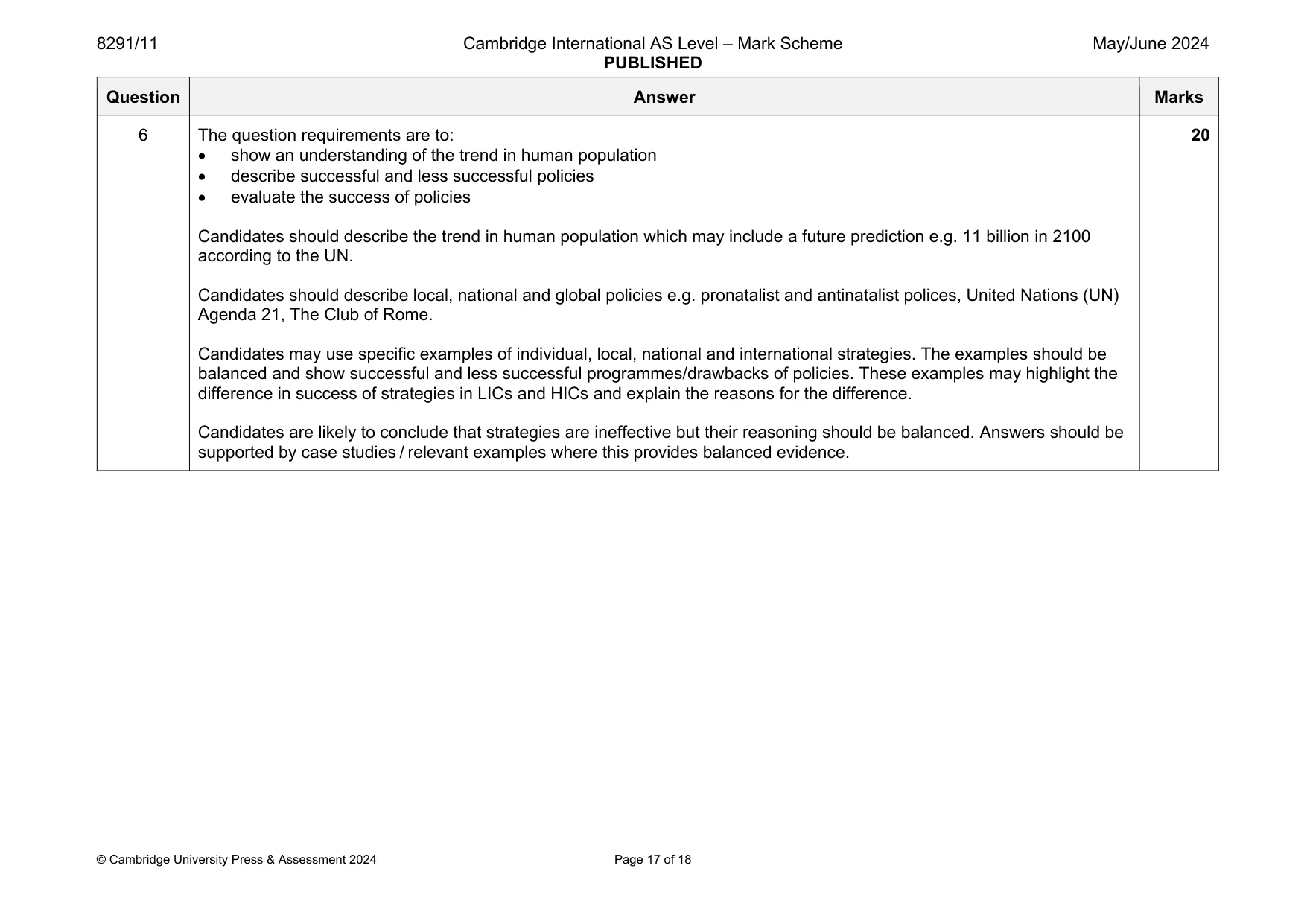
8291/11 Cambridge International AS Level – Mark Scheme PUBLISHED May/June 2024 © Cambridge University Press & Assessment 2024 Page 17 of 18 Question Answer Marks 6 The question requirements are to: show an understanding of the trend in human population describe successful and less successful policies evaluate the success of policies Candidates should describe the trend in human population which may include a future prediction e.g. 11 billion in 2100 according to the UN. Candidates should describe local, national and global policies e.g. pronatalist and antinatalist polices, United Nations (UN) Agenda 21, The Club of Rome. Candidates may use specific examples of individual, local, national and international strategies. The examples should be balanced and show successful and less successful programmes/drawbacks of policies. These examples may highlight the difference in success of strategies in LICs and HICs and explain the reasons for the difference. Candidates are likely to conclude that strategies are ineffective but their reasoning should be balanced. Answers should be supported by case studies / relevant examples where this provides balanced evidence. 20
Mark scheme, page 18
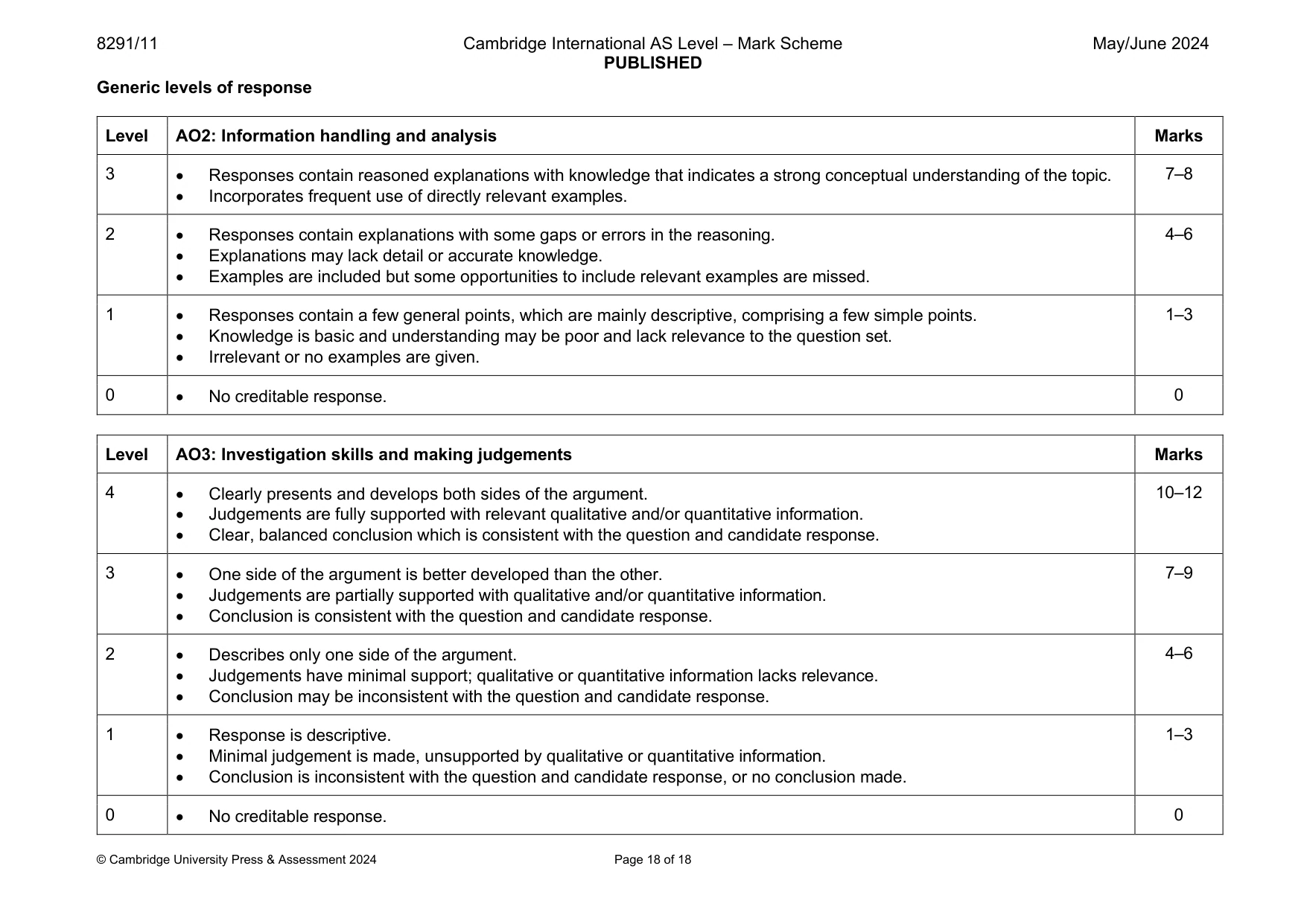
8291/11 Cambridge International AS Level – Mark Scheme PUBLISHED May/June 2024 © Cambridge University Press & Assessment 2024 Page 18 of 18 Generic levels of response Level AO2: Information handling and analysis Marks 3 Responses contain reasoned explanations with knowledge that indicates a strong conceptual understanding of the topic. Incorporates frequent use of directly relevant examples. 7–8 2 Responses contain explanations with some gaps or errors in the reasoning. Explanations may lack detail or accurate knowledge. Examples are included but some opportunities to include relevant examples are missed. 4–6 1 Responses contain a few general points, which are mainly descriptive, comprising a few simple points. Knowledge is basic and understanding may be poor and lack relevance to the question set. Irrelevant or no examples are given. 1–3 0 No creditable response. 0 Level AO3: Investigation skills and making judgements Marks 4 Clearly presents and develops both sides of the argument. Judgements are fully supported with relevant qualitative and/or quantitative information. Clear, balanced conclusion which is consistent with the question and candidate response. 10–12 3 One side of the argument is better developed than the other. Judgements are partially supported with qualitative and/or quantitative information. Conclusion is consistent with the question and candidate response. 7–9 2 Describes only one side of the argument. Judgements have minimal support; qualitative or quantitative information lacks relevance. Conclusion may be inconsistent with the question and candidate response. 4–6 1 Response is descriptive. Minimal judgement is made, unsupported by qualitative or quantitative information. Conclusion is inconsistent with the question and candidate response, or no conclusion made. 1–3 0 No creditable response. 0
What you needed in this session
Cambridge’s own grade thresholds for 2024 May/June, Paper 1 · Variant 1. A higher threshold means an easier paper — the bar moves with how the cohort did.