Cambridge A Level Environmental Management (AS only) 8291 — 2022 May/June Paper 1 · Variant 1
8291/11/M/J/22 · 80 marks · ≈90 min
The question paper and its mark scheme, free to read here and free to download. This is Cambridge’s own paper, exactly as it was sat.
Question paper20 pages






Mark scheme20 pages
Answers below. Sit the paper first if you are practising.
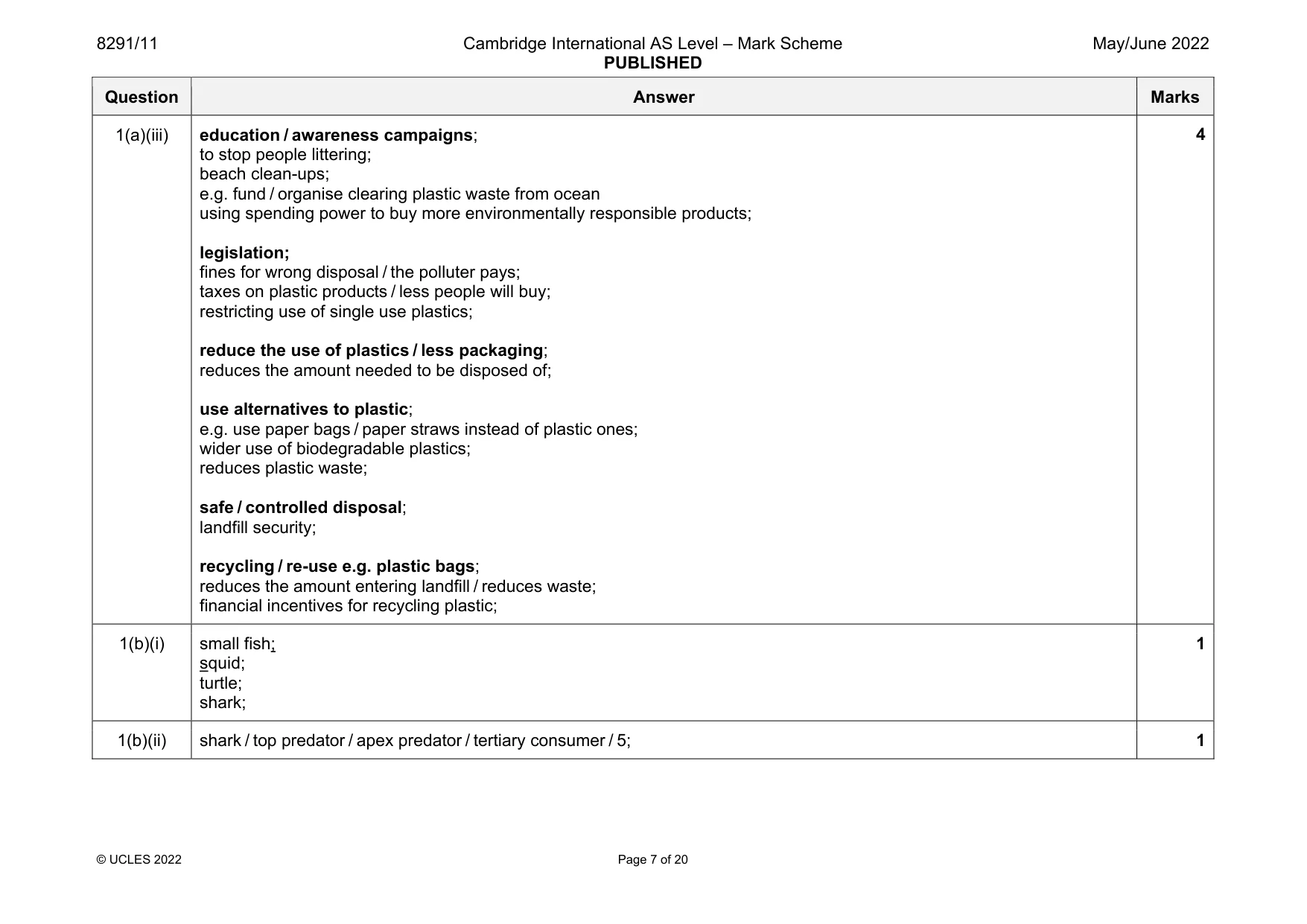
Paper as text
Question paper, page 1
This document has 20 pages. Any blank pages are indicated. [Turn over Cambridge International AS Level DC (LK/CB) 302803/3 © UCLES 2022 ENVIRONMENTAL MANAGEMENT 8291/11 Paper 1 Principles of Environmental Management May/June 2022 1 hour 45 minutes You must answer on the question paper. No additional materials are needed. INSTRUCTIONS ● Section A: answer all questions. ● Section B: answer one question. ● Use a black or dark blue pen. You may use an HB pencil for any diagrams or graphs. ● Write your name, centre number and candidate number in the boxes at the top of the page. ● Write your answer to each question in the space provided. ● Do not use an erasable pen or correction fluid. ● Do not write on any bar codes. ● You may use a calculator. ● You should show all your working and use appropriate units. INFORMATION ● The total mark for this paper is 80. ● The number of marks for each question or part question is shown in brackets [ ]. * 9 4 9 3 9 6 3 2 0 5 *
Question paper, page 2
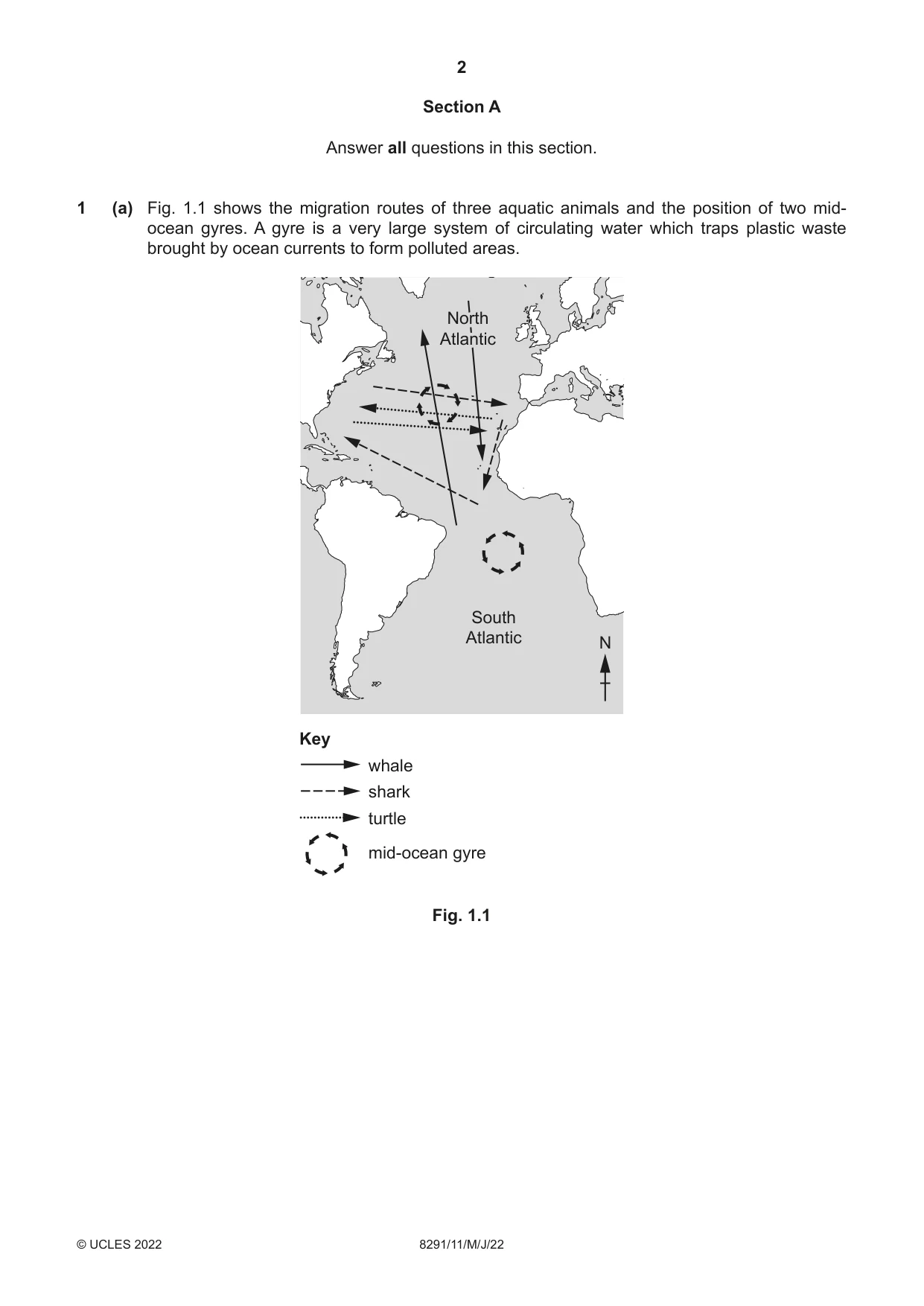
2 8291/11/M/J/22 © UCLES 2022 Section A Answer all questions in this section. 1 (a) Fig. 1.1 shows the migration routes of three aquatic animals and the position of two mid- ocean gyres. A gyre is a very large system of circulating water which traps plastic waste brought by ocean currents to form polluted areas. South Atlantic North Atlantic Key whale shark turtle mid-ocean gyre N Fig. 1.1
Question paper, page 3
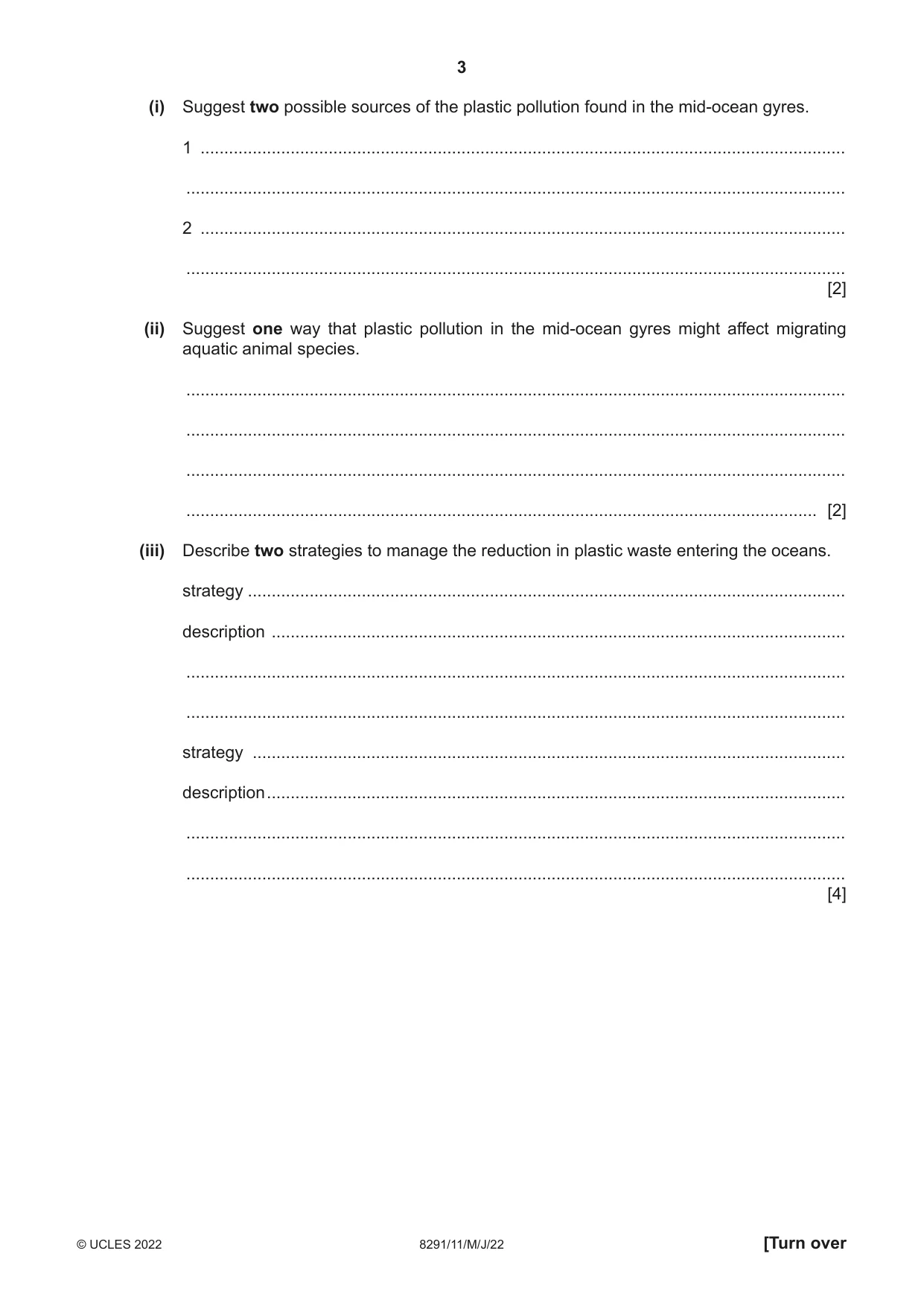
3 8291/11/M/J/22 © UCLES 2022 [Turn over (i) Suggest two possible sources of the plastic pollution found in the mid-ocean gyres. 1 … … 2 … … [2] (ii) Suggest one way that plastic pollution in the mid-ocean gyres might affect migrating aquatic animal species. … … … … [2] (iii) Describe two strategies to manage the reduction in plastic waste entering the oceans. strategy … description … … … strategy … description … … … [4]
Question paper, page 4
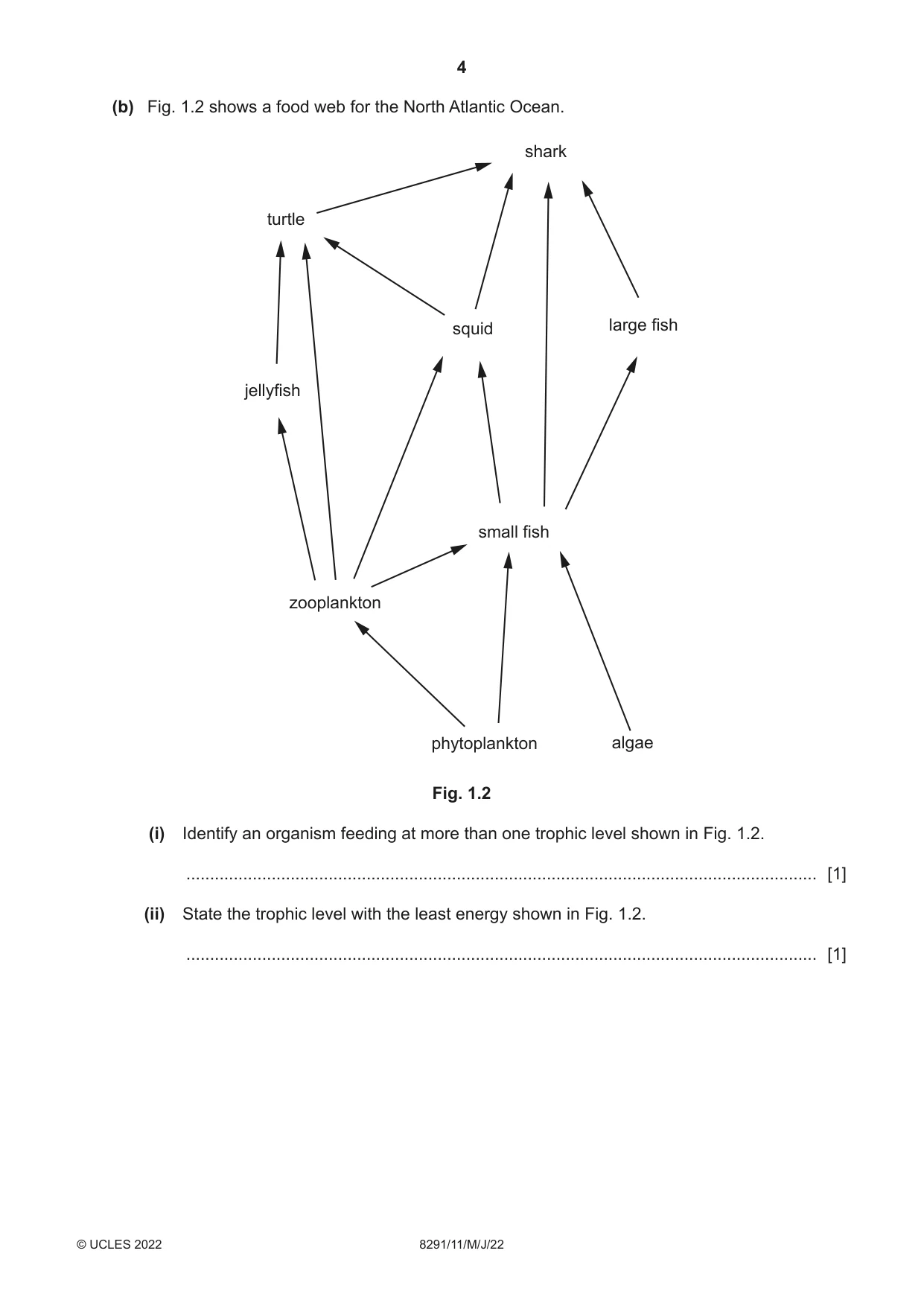
4 8291/11/M/J/22 © UCLES 2022 (b) Fig. 1.2 shows a food web for the North Atlantic Ocean. shark large fish squid turtle jellyfish zooplankton small fish algae phytoplankton Fig. 1.2 (i) Identify an organism feeding at more than one trophic level shown in Fig. 1.2. … [1] (ii) State the trophic level with the least energy shown in Fig. 1.2. … [1]
Question paper, page 5
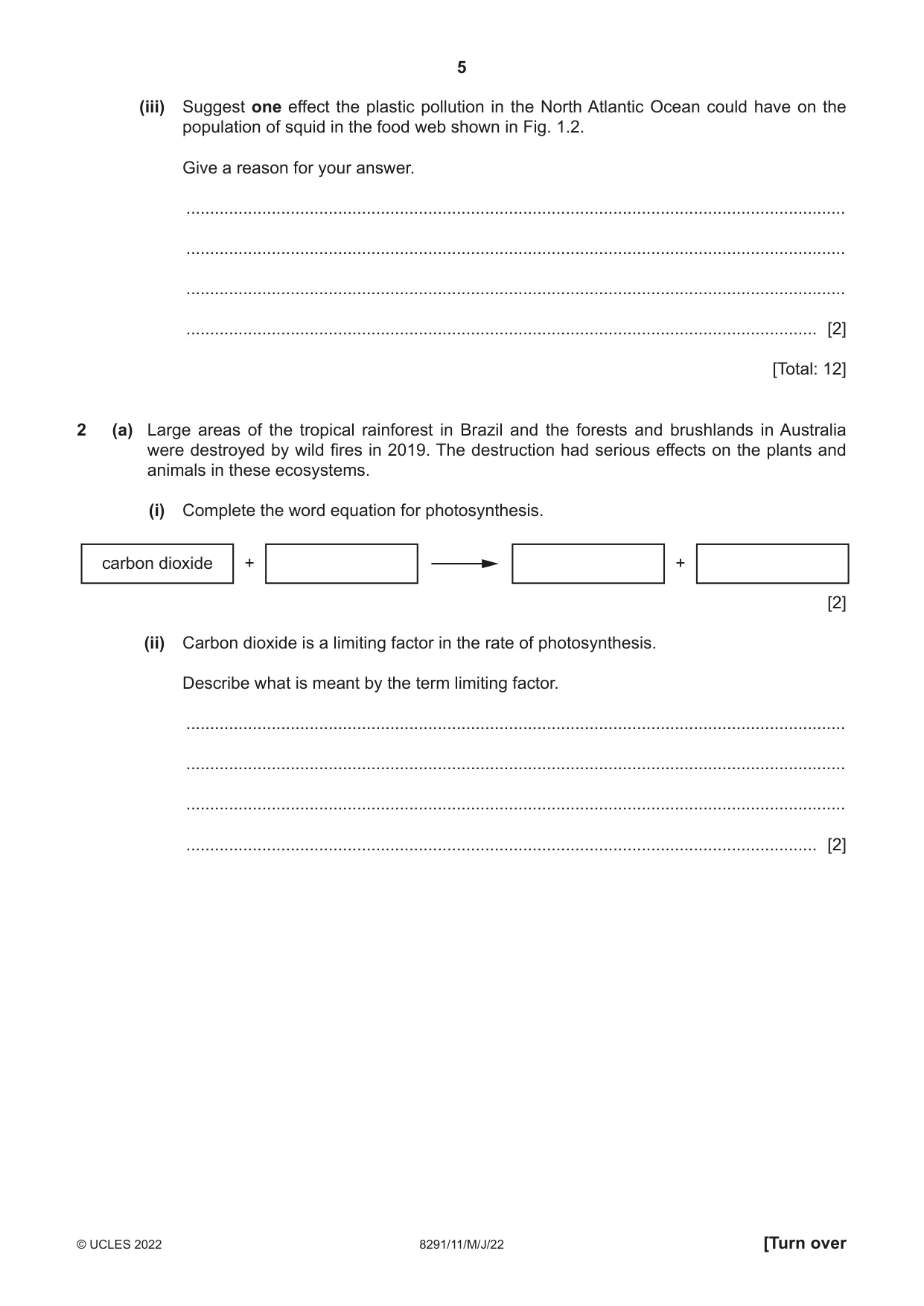
5 8291/11/M/J/22 © UCLES 2022 [Turn over (iii) Suggest one effect the plastic pollution in the North Atlantic Ocean could have on the population of squid in the food web shown in Fig. 1.2. Give a reason for your answer. … … … … [2] [Total: 12] 2 (a) Large areas of the tropical rainforest in Brazil and the forests and brushlands in Australia were destroyed by wild fires in 2019. The destruction had serious effects on the plants and animals in these ecosystems. (i) Complete the word equation for photosynthesis. carbon dioxide + + [2] (ii) Carbon dioxide is a limiting factor in the rate of photosynthesis. Describe what is meant by the term limiting factor. … … … … [2]
Question paper, page 6
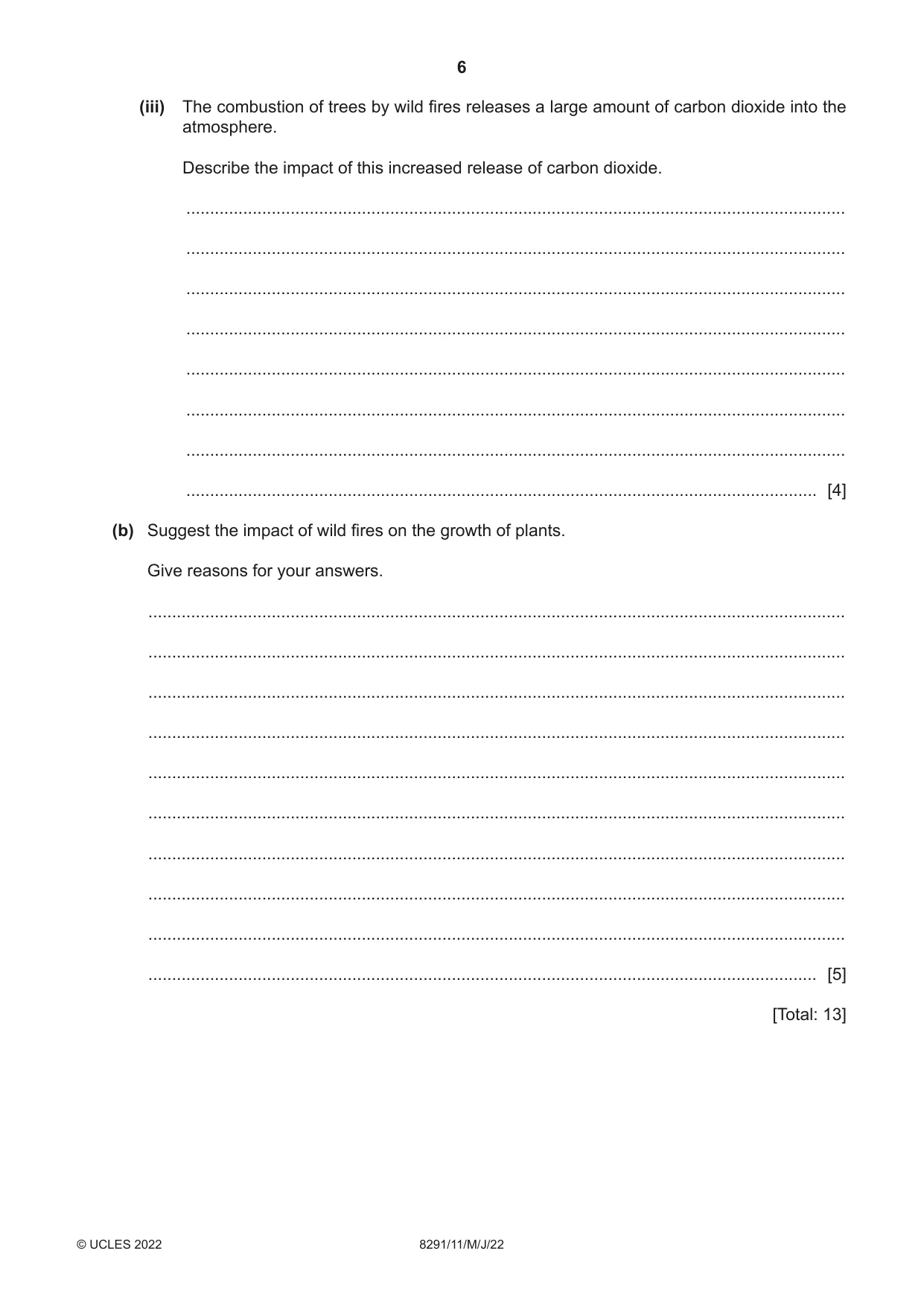
6 8291/11/M/J/22 © UCLES 2022 (iii) The combustion of trees by wild fires releases a large amount of carbon dioxide into the atmosphere. Describe the impact of this increased release of carbon dioxide. … … … … … … … … [4] (b) Suggest the impact of wild fires on the growth of plants. Give reasons for your answers. … … … … … … … … … … [5] [Total: 13]
Question paper, page 7
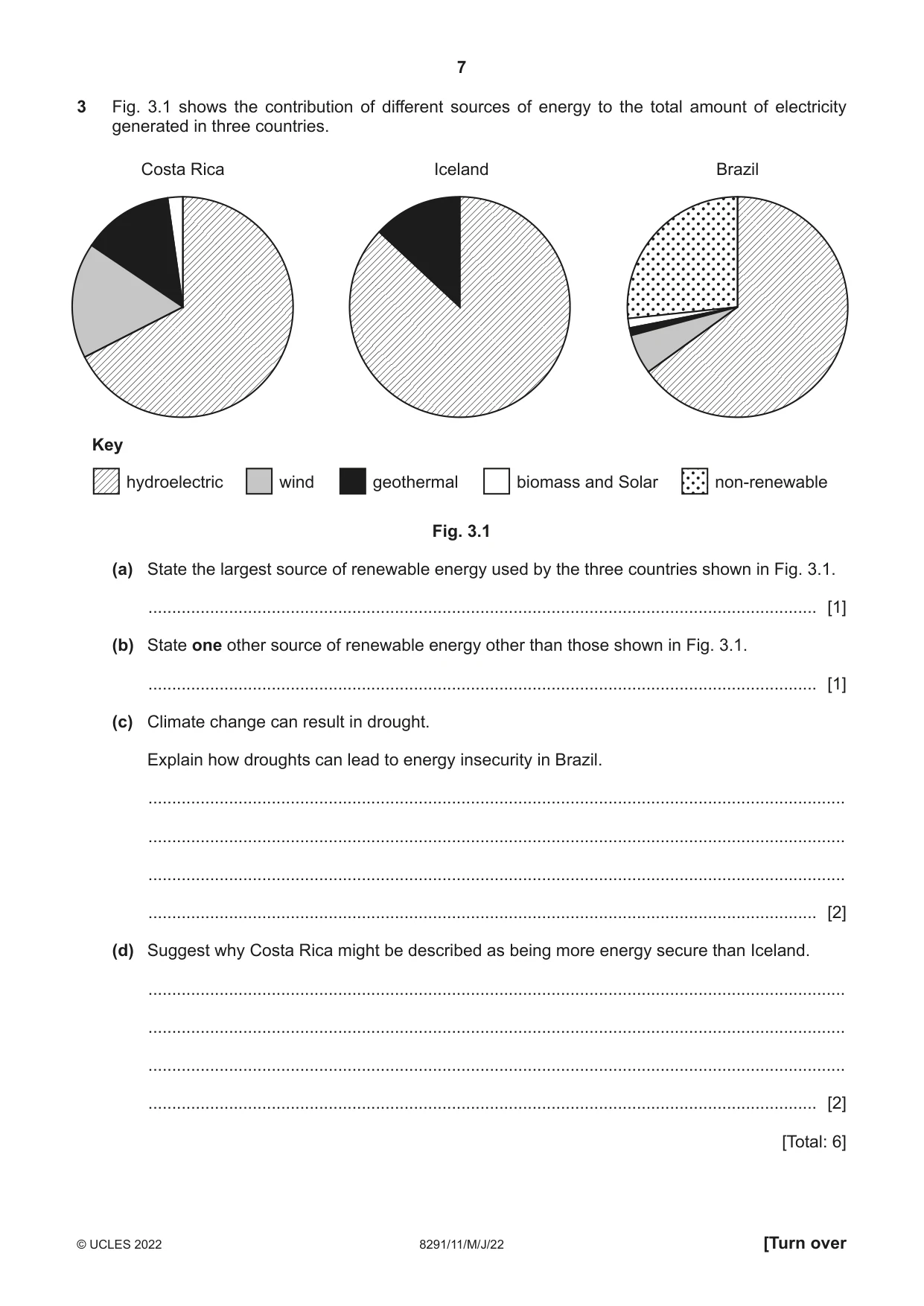
7 8291/11/M/J/22 © UCLES 2022 [Turn over 3 Fig. 3.1 shows the contribution of different sources of energy to the total amount of electricity generated in three countries. Key hydroelectric wind geothermal biomass and Solar non-renewable Costa Rica Iceland Brazil Fig. 3.1 (a) State the largest source of renewable energy used by the three countries shown in Fig. 3.1. … [1] (b) State one other source of renewable energy other than those shown in Fig. 3.1. … [1] (c) Climate change can result in drought. Explain how droughts can lead to energy insecurity in Brazil. … … … … [2] (d) Suggest why Costa Rica might be described as being more energy secure than Iceland. … … … … [2] [Total: 6]
Question paper, page 8
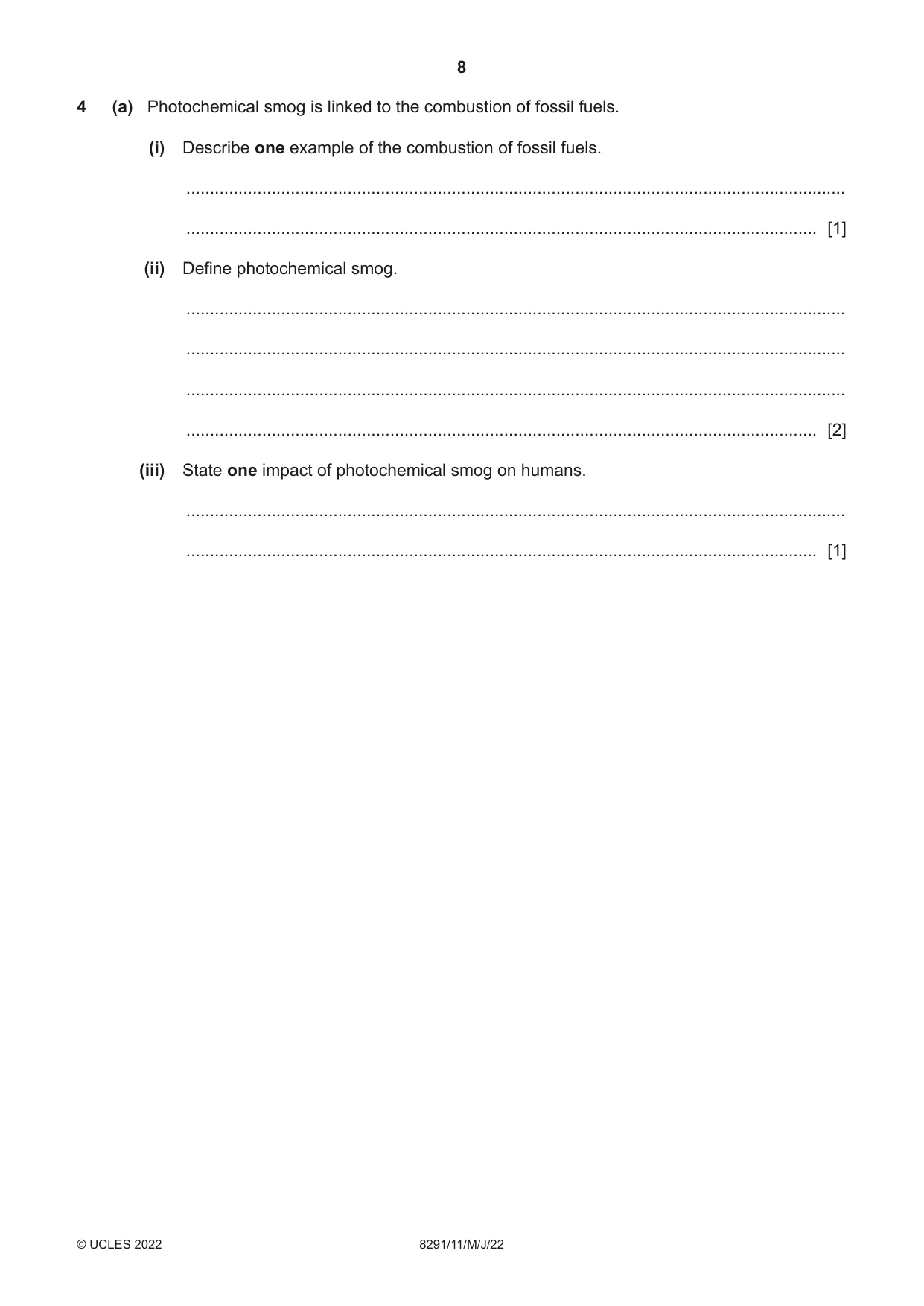
8 8291/11/M/J/22 © UCLES 2022 4 (a) Photochemical smog is linked to the combustion of fossil fuels. (i) Describe one example of the combustion of fossil fuels. … … [1] (ii) Define photochemical smog. … … … … [2] (iii) State one impact of photochemical smog on humans. … … [1]
Question paper, page 9
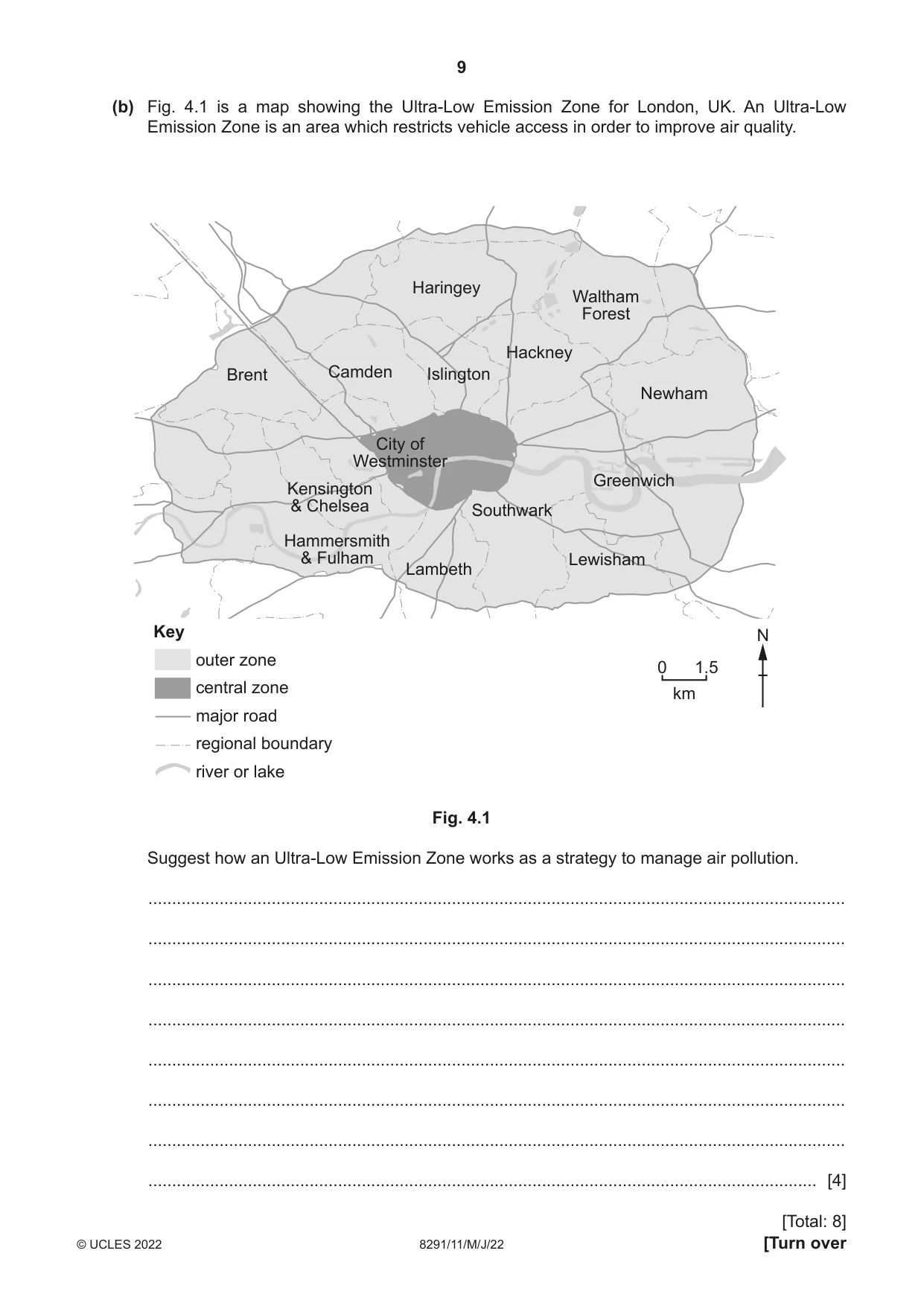
9 8291/11/M/J/22 © UCLES 2022 [Turn over (b) Fig. 4.1 is a map showing the Ultra-Low Emission Zone for London, UK. An Ultra-Low Emission Zone is an area which restricts vehicle access in order to improve air quality. Haringey Waltham Forest Newham Hackney Islington Camden Brent City of Westminster Greenwich Lewisham Southwark Lambeth Hammersmith & Fulham Kensington & Chelsea Key outer zone central zone major road regional boundary river or lake N 0 1.5 km Fig. 4.1 Suggest how an Ultra-Low Emission Zone works as a strategy to manage air pollution. … … … … … … … … [4] [Total: 8]
Question paper, page 10
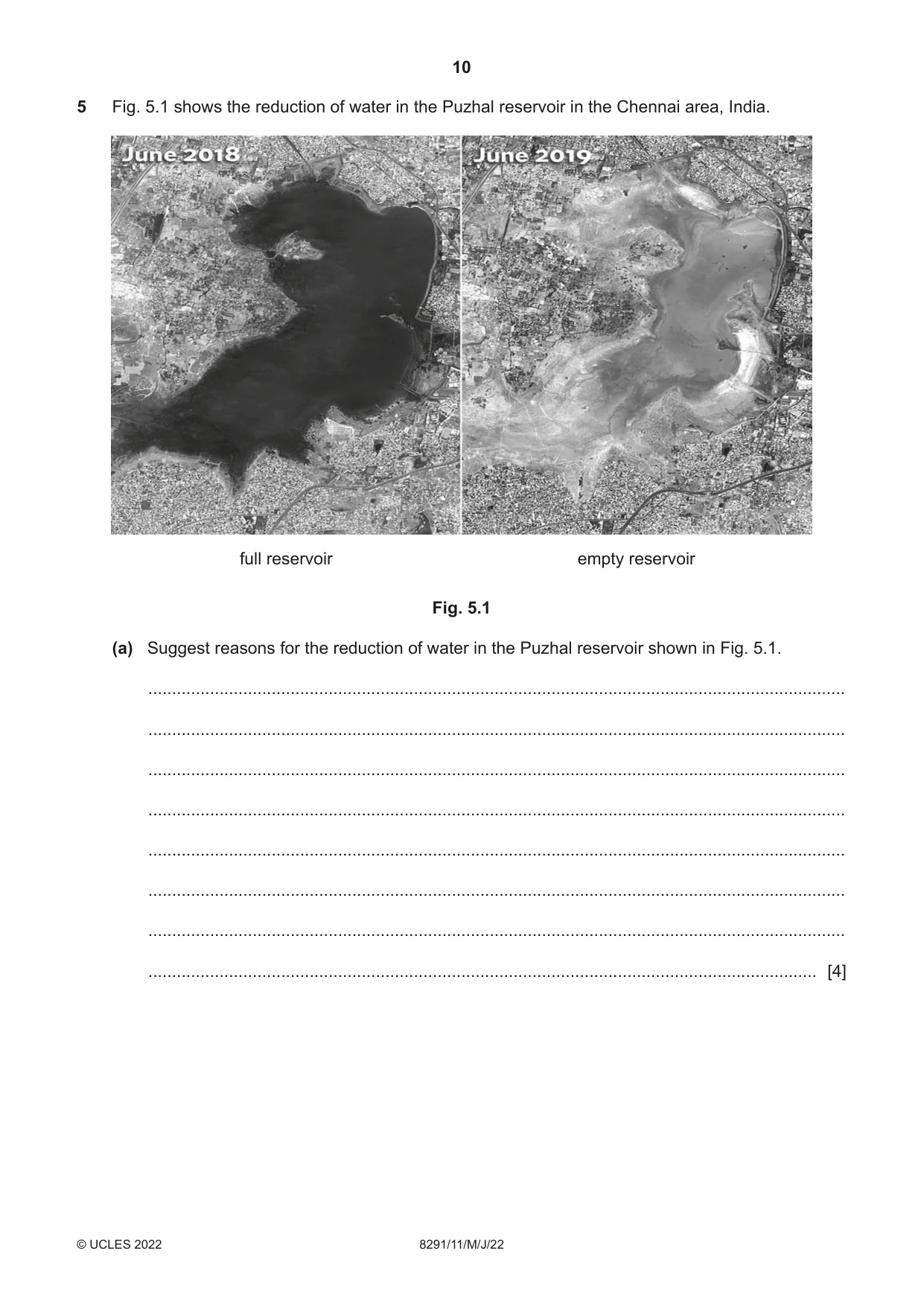
10 8291/11/M/J/22 © UCLES 2022 5 Fig. 5.1 shows the reduction of water in the Puzhal reservoir in the Chennai area, India. full reservoir empty reservoir Fig. 5.1 (a) Suggest reasons for the reduction of water in the Puzhal reservoir shown in Fig. 5.1. … … … … … … … … [4]
Question paper, page 11
11 8291/11/M/J/22 © UCLES 2022 [Turn over (b) Define the term water security. … … … … [2] (c) Describe two impacts of the loss of water security in the Chennai area, India. 1 … … … … 2 … … … … [4] (d) Describe two strategies to manage the water security in the Chennai area, India. 1 … … … … 2 … … … … [4] [Total: 14]
Question paper, page 12
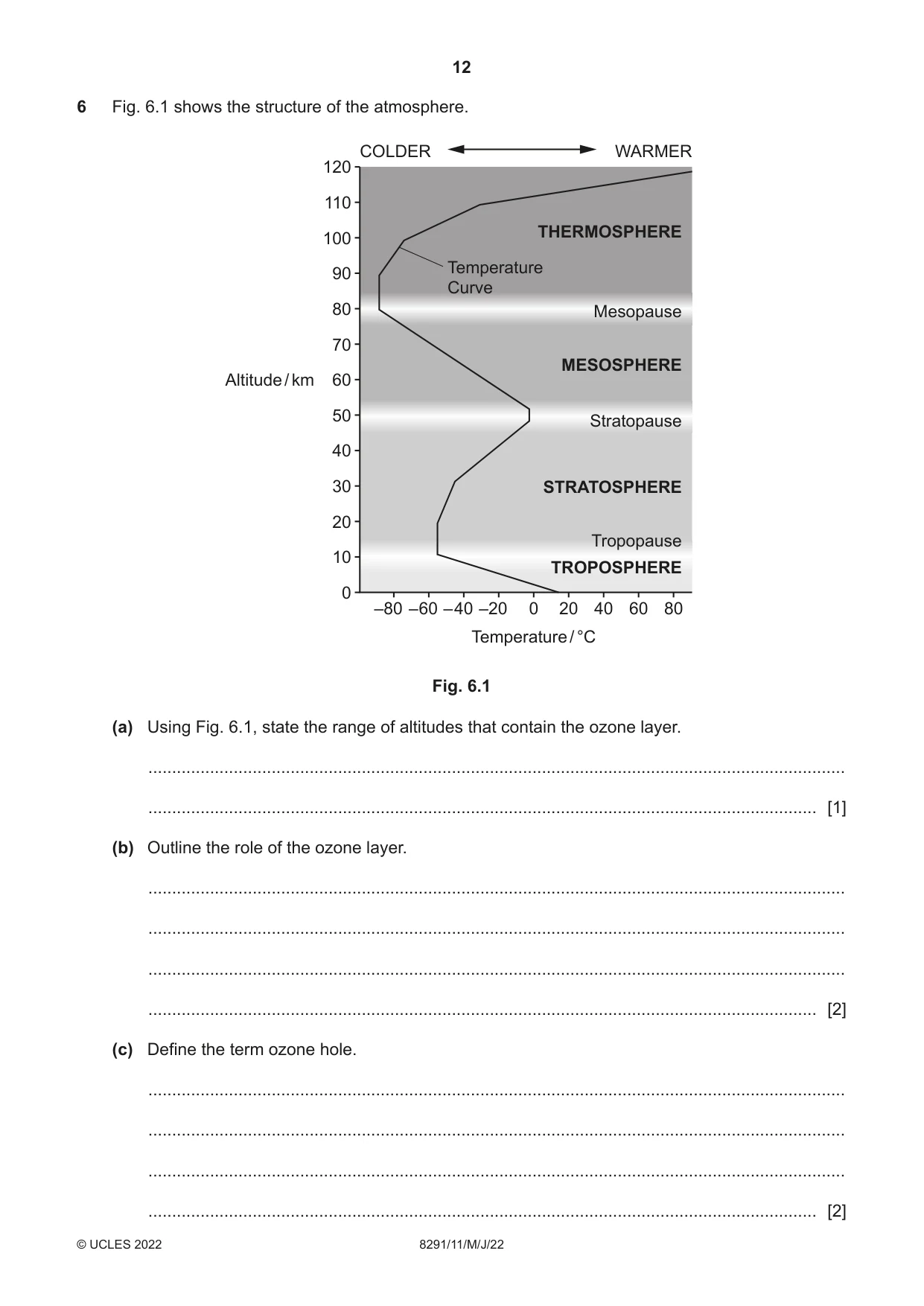
12 8291/11/ M / J /22 © UCLES 2022 6 Fig. 6.1 shows the structure of the atmosphere. –80 0 10 20 30 40 50 60 70 80 90 100 110 120 –60 –40 –20 0 Temperature / °C Temperature Curve THERMOSPHERE MESOSPHERE STRATOSPHERE Tropopause Stratopause Mesopause TROPOSPHERE COLDER WARMER Altitude / km 20 40 60 80 Fig. 6.1 (a) Using Fig. 6.1, state the range of altitudes that contain the ozone layer. … … [1] (b) Outline the role of the ozone layer. … … … … [2] (c) Define the term ozone hole. … … … … [2]
Question paper, page 13
13 8291/11/M/J/22 © UCLES 2022 [Turn over (d) State two effects of ozone depletion on humans. 1 … … 2 … … [2] [Total: 7]
Question paper, page 14
14 8291/11/M/J/22 © UCLES 2022 Section B Answer one question. Either 7 ‘Think globally and act locally is an effective strategy for people to take responsibility for the environment.’ To what extent do you agree with this statement? Give reasons and include information from relevant examples to support your answer. [20] Or 8 Evaluate the success of strategies to manage the human impacts on a tundra location of your choice. Give reasons and include information from relevant examples to support your answer. [20] … … … … … … … … … … … … … … … … …
Question paper, page 15
15 8291/11/M/J/22 © UCLES 2022 [Turn over … … … … … … … … … … … … … … … … … … … … … … … … … … … …
Question paper, page 16
16 8291/11/M/J/22 © UCLES 2022 … … … … … … … … … … … … … … … … … … … … … … … … … … … …
Question paper, page 17
17 8291/11/M/J/22 © UCLES 2022 [Turn over … … … … … … … … … … … … … … … … … … … … … … … … … … … …
Question paper, page 18
18 8291/11/M/J/22 © UCLES 2022 … … … … … … … … … … … … … … … … … … … … … … … … … … … …
Question paper, page 19
19 8291/11/M/J/22 © UCLES 2022 … … … … … … … … … … … … … … … … … … … … … … … … … … … …
Question paper, page 20
20 8291/11/M/J/22 © UCLES 2022 The boundaries and names shown, the designations used and the presentation of material on any maps contained in this question paper/insert do not imply official endorsement or acceptance by Cambridge Assessment International Education concerning the legal status of any country, territory, or area or any of its authorities, or of the delimitation of its frontiers or boundaries. Permission to reproduce items where third-party owned material protected by copyright is included has been sought and cleared where possible. Every reasonable effort has been made by the publisher (UCLES) to trace copyright holders, but if any items requiring clearance have unwittingly been included, the publisher will be pleased to make amends at the earliest possible opportunity. To avoid the issue of disclosure of answer-related information to candidates, all copyright acknowledgements are reproduced online in the Cambridge Assessment International Education Copyright Acknowledgements Booklet. This is produced for each series of examinations and is freely available to download at www.cambridgeinternational.org after the live examination series. Cambridge Assessment International Education is part of Cambridge Assessment. Cambridge Assessment is the brand name of the University of Cambridge Local Examinations Syndicate (UCLES), which is a department of the University of Cambridge. BLANK PAGE
Mark scheme, page 1
This document consists of 20 printed pages. © UCLES 2022 [Turn over Cambridge International AS Level ENVIRONMENTAL MANAGEMENT 8291/11 Paper 1 Principles of Environmental Management May/June 2022 MARK SCHEME Maximum Mark: 80 Published This mark scheme is published as an aid to teachers and candidates, to indicate the requirements of the examination. It shows the basis on which Examiners were instructed to award marks. It does not indicate the details of the discussions that took place at an Examiners’ meeting before marking began, which would have considered the acceptability of alternative answers. Mark schemes should be read in conjunction with the question paper and the Principal Examiner Report for Teachers. Cambridge International will not enter into discussions about these mark schemes. Cambridge International is publishing the mark schemes for the May/June 2022 series for most Cambridge IGCSE, Cambridge International A and AS Level and Cambridge Pre-U components, and some Cambridge O Level components.
Mark scheme, page 2
8291/11 Cambridge International AS Level – Mark Scheme PUBLISHED May/June 2022 © UCLES 2022 Page 2 of 20 Generic Marking Principles These general marking principles must be applied by all examiners when marking candidate answers. They should be applied alongside the specific content of the mark scheme or generic level descriptors for a question. Each question paper and mark scheme will also comply with these marking principles. GENERIC MARKING PRINCIPLE 1: Marks must be awarded in line with: the specific content of the mark scheme or the generic level descriptors for the question the specific skills defined in the mark scheme or in the generic level descriptors for the question the standard of response required by a candidate as exemplified by the standardisation scripts. GENERIC MARKING PRINCIPLE 2: Marks awarded are always whole marks (not half marks, or other fractions). GENERIC MARKING PRINCIPLE 3: Marks must be awarded positively: marks are awarded for correct/valid answers, as defined in the mark scheme. However, credit is given for valid answers which go beyond the scope of the syllabus and mark scheme, referring to your Team Leader as appropriate marks are awarded when candidates clearly demonstrate what they know and can do marks are not deducted for errors marks are not deducted for omissions answers should only be judged on the quality of spelling, punctuation and grammar when these features are specifically assessed by the question as indicated by the mark scheme. The meaning, however, should be unambiguous. GENERIC MARKING PRINCIPLE 4: Rules must be applied consistently, e.g. in situations where candidates have not followed instructions or in the application of generic level descriptors.
Mark scheme, page 3
8291/11 Cambridge International AS Level – Mark Scheme PUBLISHED May/June 2022 © UCLES 2022 Page 3 of 20 GENERIC MARKING PRINCIPLE 5: Marks should be awarded using the full range of marks defined in the mark scheme for the question (however; the use of the full mark range may be limited according to the quality of the candidate responses seen). GENERIC MARKING PRINCIPLE 6: Marks awarded are based solely on the requirements as defined in the mark scheme. Marks should not be awarded with grade thresholds or grade descriptors in mind.
Mark scheme, page 4
8291/11 Cambridge International AS Level – Mark Scheme PUBLISHED May/June 2022 © UCLES 2022 Page 4 of 20 Science-Specific Marking Principles 1 Examiners should consider the context and scientific use of any keywords when awarding marks. Although keywords may be present, marks should not be awarded if the keywords are used incorrectly. 2 The examiner should not choose between contradictory statements given in the same question part, and credit should not be awarded for any correct statement that is contradicted within the same question part. Wrong science that is irrelevant to the question should be ignored. 3 Although spellings do not have to be correct, spellings of syllabus terms must allow for clear and unambiguous separation from other syllabus terms with which they may be confused (e.g. ethane / ethene, glucagon / glycogen, refraction / reflection). 4 The error carried forward (ecf) principle should be applied, where appropriate. If an incorrect answer is subsequently used in a scientifically correct way, the candidate should be awarded these subsequent marking points. Further guidance will be included in the mark scheme where necessary and any exceptions to this general principle will be noted. 5 ‘List rule’ guidance For questions that require n responses (e.g. State two reasons …): The response should be read as continuous prose, even when numbered answer spaces are provided. Any response marked ignore in the mark scheme should not count towards n. Incorrect responses should not be awarded credit but will still count towards n. Read the entire response to check for any responses that contradict those that would otherwise be credited. Credit should not be awarded for any responses that are contradicted within the rest of the response. Where two responses contradict one another, this should be treated as a single incorrect response. Non-contradictory responses after the first n responses may be ignored even if they include incorrect science.
Mark scheme, page 5
8291/11 Cambridge International AS Level – Mark Scheme PUBLISHED May/June 2022 © UCLES 2022 Page 5 of 20 6 Calculation specific guidance Correct answers to calculations should be given full credit even if there is no working or incorrect working, unless the question states ‘show your working’. For questions in which the number of significant figures required is not stated, credit should be awarded for correct answers when rounded by the examiner to the number of significant figures given in the mark scheme. This may not apply to measured values. For answers given in standard form (e.g. a 10n) in which the convention of restricting the value of the coefficient (a) to a value between 1 and 10 is not followed, credit may still be awarded if the answer can be converted to the answer given in the mark scheme. Unless a separate mark is given for a unit, a missing or incorrect unit will normally mean that the final calculation mark is not awarded. Exceptions to this general principle will be noted in the mark scheme. 7 Guidance for chemical equations Multiples / fractions of coefficients used in chemical equations are acceptable unless stated otherwise in the mark scheme. State symbols given in an equation should be ignored unless asked for in the question or stated otherwise in the mark scheme.
Mark scheme, page 6
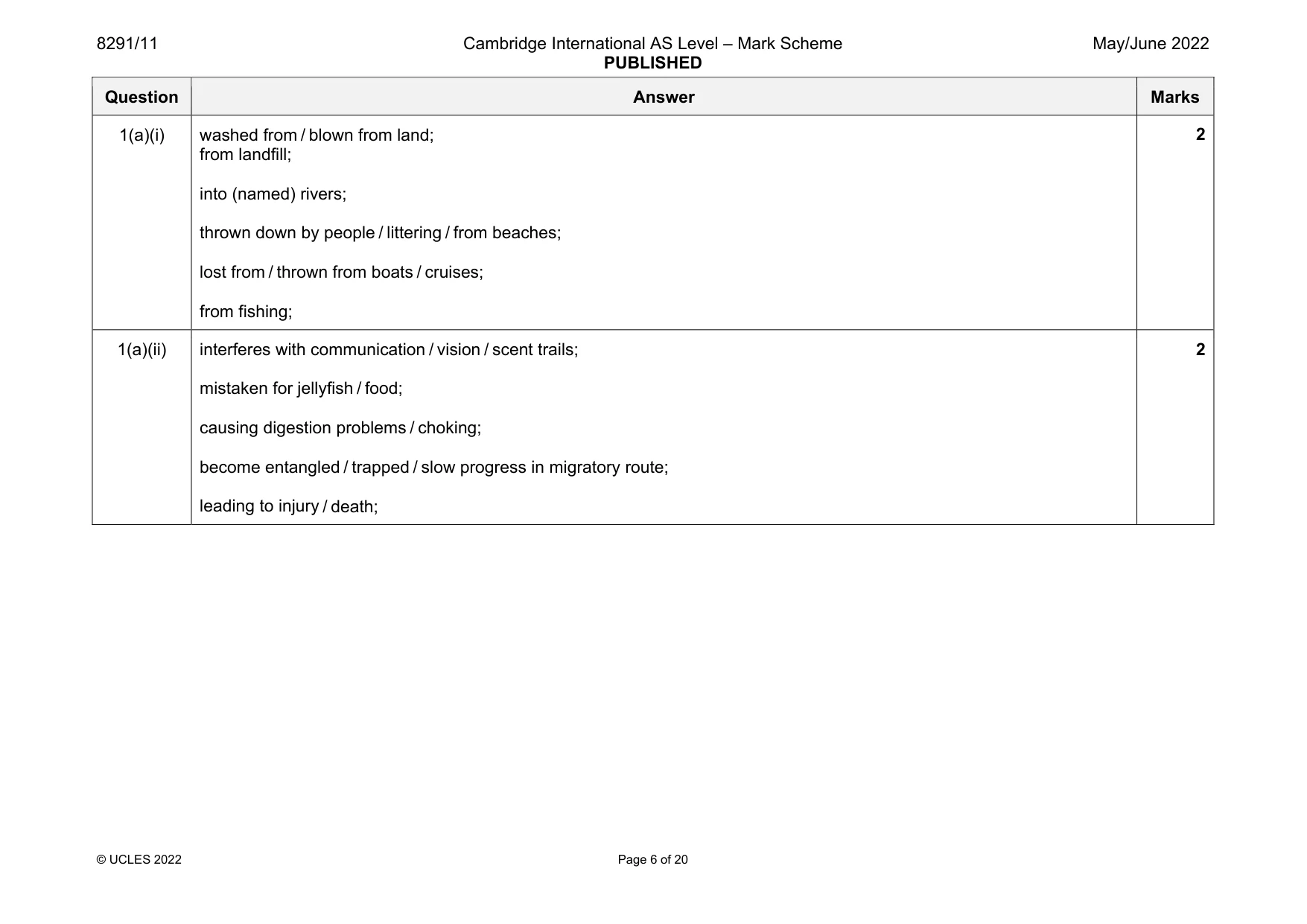
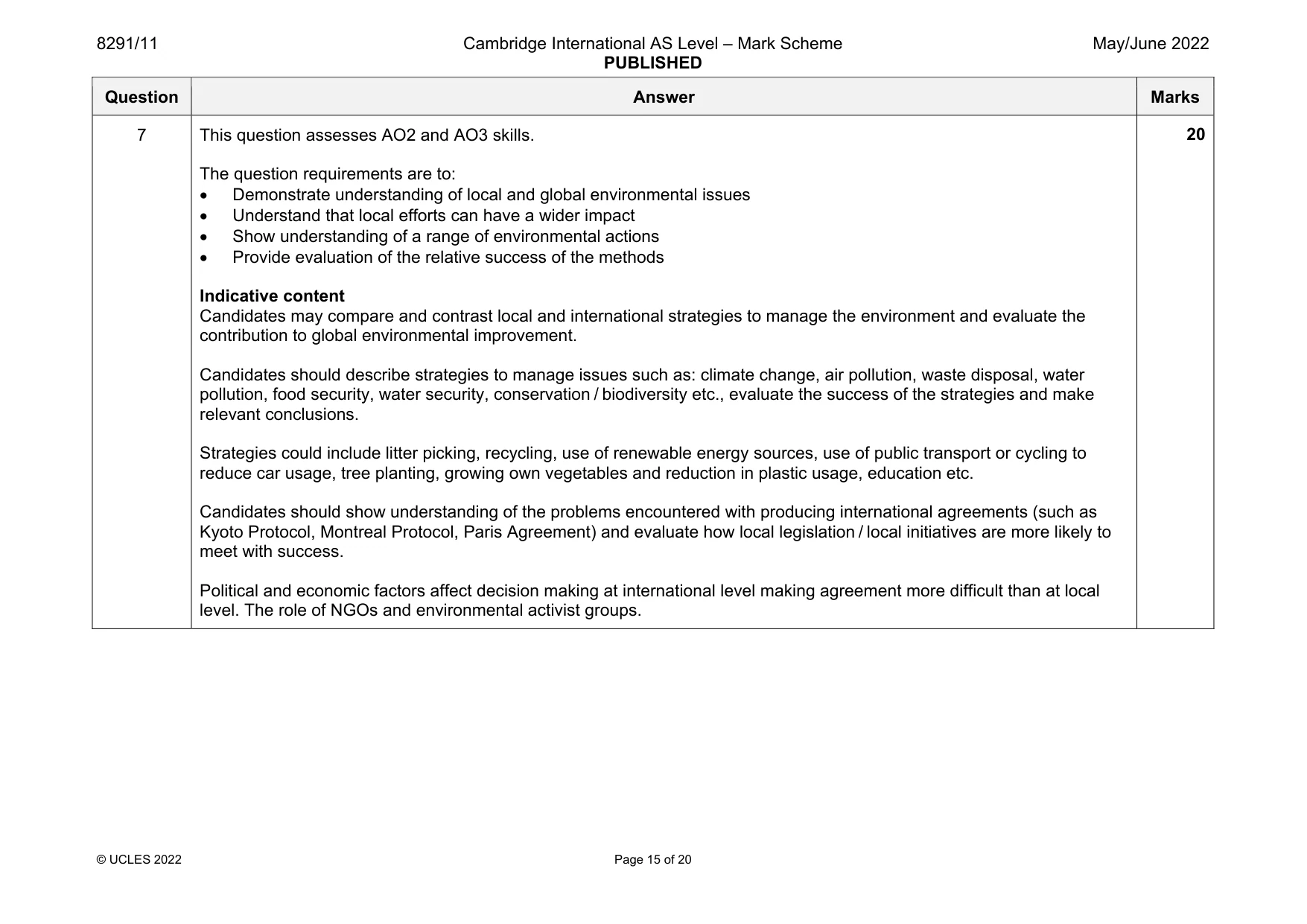
8291/11 Cambridge International AS Level – Mark Scheme PUBLISHED May/June 2022 © UCLES 2022 Page 6 of 20 Question Answer Marks 1(a)(i) washed from / blown from land; from landfill; into (named) rivers; thrown down by people / littering / from beaches; lost from / thrown from boats / cruises; from fishing; 2 1(a)(ii) interferes with communication / vision / scent trails; mistaken for jellyfish / food; causing digestion problems / choking; become entangled / trapped / slow progress in migratory route; leading to injury / death; 2
Mark scheme, page 7
8291/11 Cambridge International AS Level – Mark Scheme PUBLISHED May/June 2022 © UCLES 2022 Page 7 of 20 Question Answer Marks 1(a)(iii) education / awareness campaigns; to stop people littering; beach clean-ups; e.g. fund / organise clearing plastic waste from ocean using spending power to buy more environmentally responsible products; legislation; fines for wrong disposal / the polluter pays; taxes on plastic products / less people will buy; restricting use of single use plastics; reduce the use of plastics / less packaging; reduces the amount needed to be disposed of; use alternatives to plastic; e.g. use paper bags / paper straws instead of plastic ones; wider use of biodegradable plastics; reduces plastic waste; safe / controlled disposal; landfill security; recycling / re-use e.g. plastic bags; reduces the amount entering landfill / reduces waste; financial incentives for recycling plastic; 4 1(b)(i) small fish; squid; turtle; shark; 1 1(b)(ii) shark / top predator / apex predator / tertiary consumer / 5; 1
Mark scheme, page 8
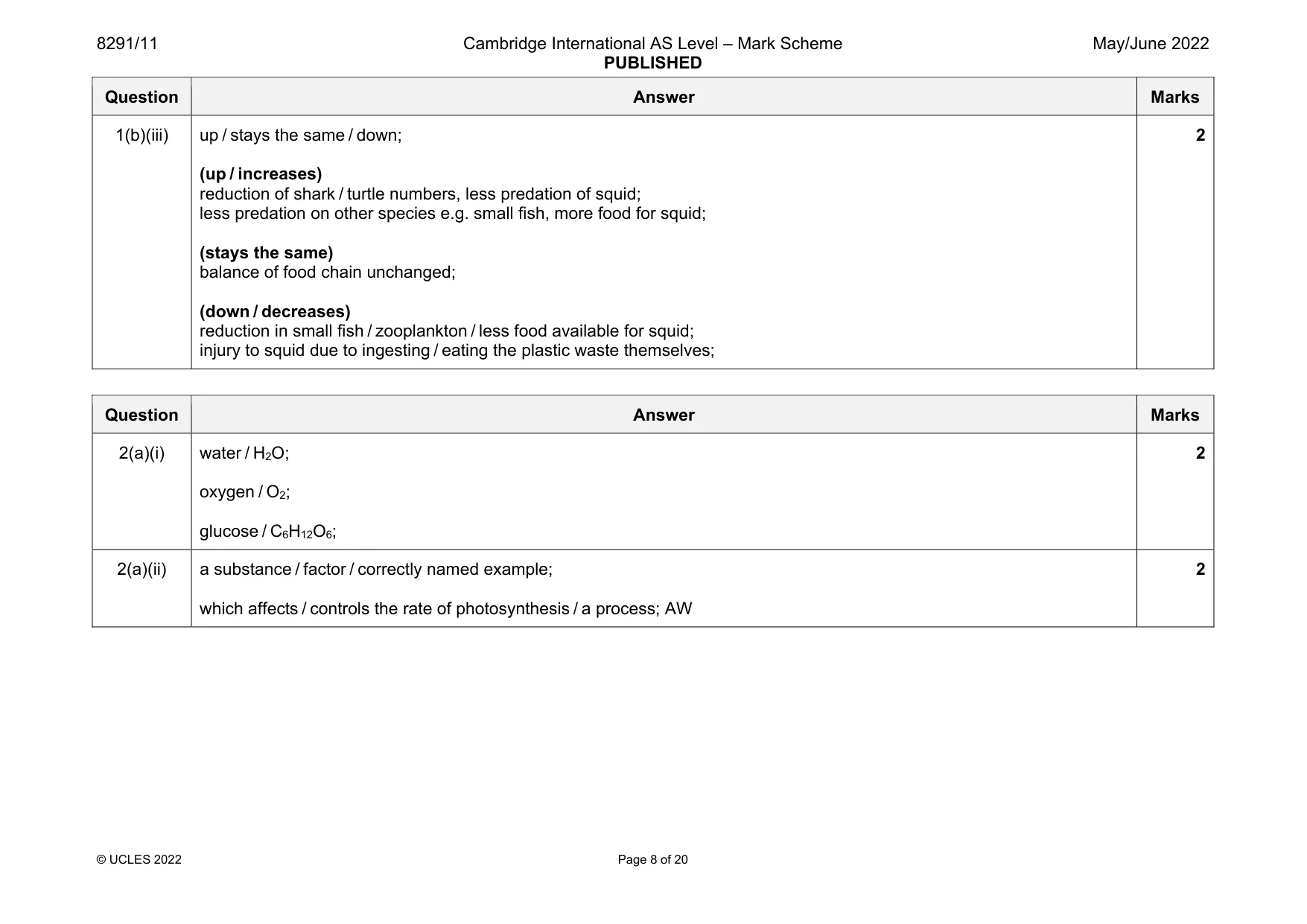
8291/11 Cambridge International AS Level – Mark Scheme PUBLISHED May/June 2022 © UCLES 2022 Page 8 of 20 Question Answer Marks 1(b)(iii) up / stays the same / down; (up / increases) reduction of shark / turtle numbers, less predation of squid; less predation on other species e.g. small fish, more food for squid; (stays the same) balance of food chain unchanged; (down / decreases) reduction in small fish / zooplankton / less food available for squid; injury to squid due to ingesting / eating the plastic waste themselves; 2 Question Answer Marks 2(a)(i) water / H2O; oxygen / O2; glucose / C6H12O6; 2 2(a)(ii) a substance / factor / correctly named example; which affects / controls the rate of photosynthesis / a process; AW 2
Mark scheme, page 9
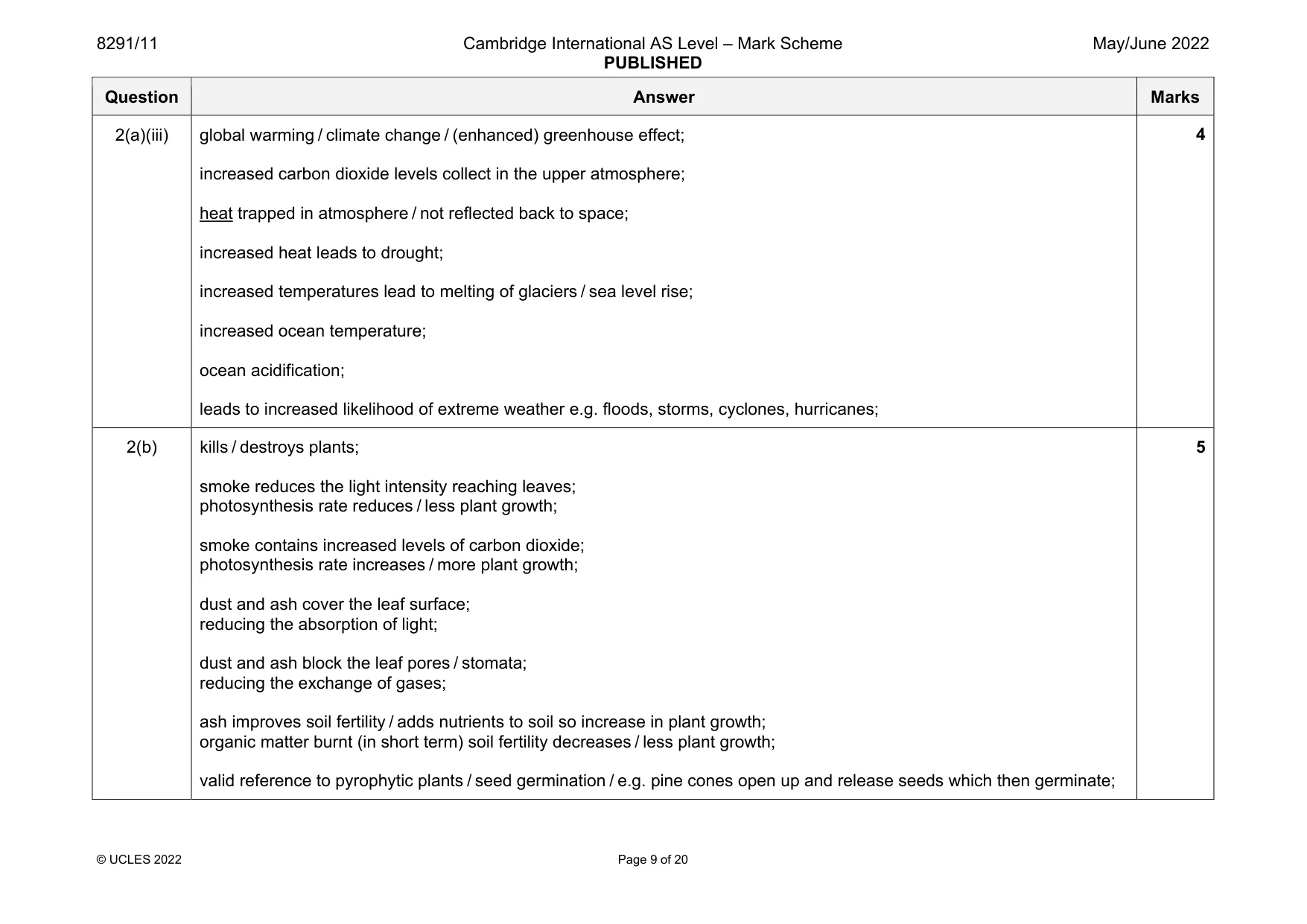
8291/11 Cambridge International AS Level – Mark Scheme PUBLISHED May/June 2022 © UCLES 2022 Page 9 of 20 Question Answer Marks 2(a)(iii) global warming / climate change / (enhanced) greenhouse effect; increased carbon dioxide levels collect in the upper atmosphere; heat trapped in atmosphere / not reflected back to space; increased heat leads to drought; increased temperatures lead to melting of glaciers / sea level rise; increased ocean temperature; ocean acidification; leads to increased likelihood of extreme weather e.g. floods, storms, cyclones, hurricanes; 4 2(b) kills / destroys plants; smoke reduces the light intensity reaching leaves; photosynthesis rate reduces / less plant growth; smoke contains increased levels of carbon dioxide; photosynthesis rate increases / more plant growth; dust and ash cover the leaf surface; reducing the absorption of light; dust and ash block the leaf pores / stomata; reducing the exchange of gases; ash improves soil fertility / adds nutrients to soil so increase in plant growth; organic matter burnt (in short term) soil fertility decreases / less plant growth; valid reference to pyrophytic plants / seed germination / e.g. pine cones open up and release seeds which then germinate; 5
Mark scheme, page 10
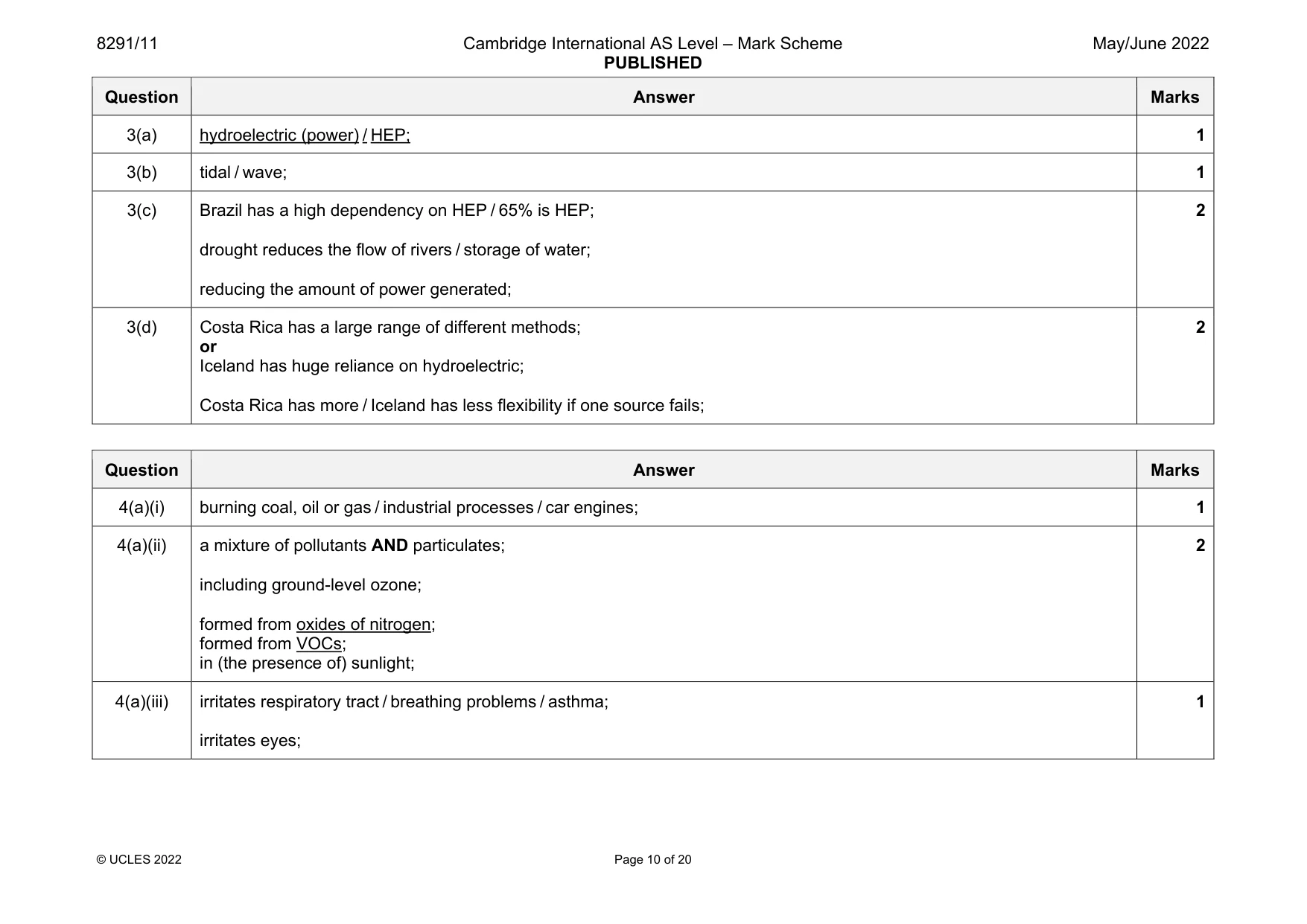
8291/11 Cambridge International AS Level – Mark Scheme PUBLISHED May/June 2022 © UCLES 2022 Page 10 of 20 Question Answer Marks 3(a) hydroelectric (power) / HEP; 1 3(b) tidal / wave; 1 3(c) Brazil has a high dependency on HEP / 65% is HEP; drought reduces the flow of rivers / storage of water; reducing the amount of power generated; 2 3(d) Costa Rica has a large range of different methods; or Iceland has huge reliance on hydroelectric; Costa Rica has more / Iceland has less flexibility if one source fails; 2 Question Answer Marks 4(a)(i) burning coal, oil or gas / industrial processes / car engines; 1 4(a)(ii) a mixture of pollutants AND particulates; including ground-level ozone; formed from oxides of nitrogen; formed from VOCs; in (the presence of) sunlight; 2 4(a)(iii) irritates respiratory tract / breathing problems / asthma; irritates eyes; 1
Mark scheme, page 11
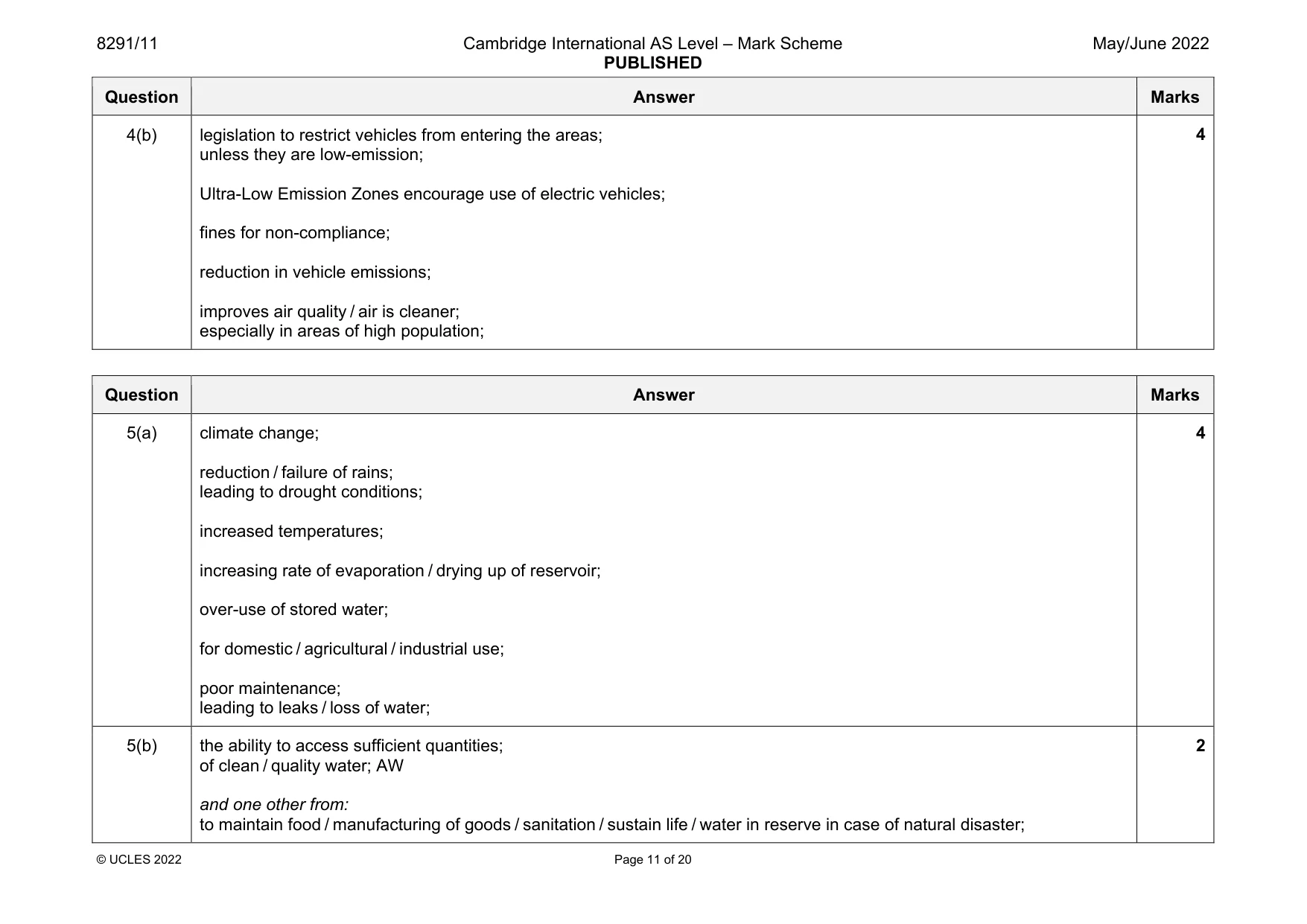
8291/11 Cambridge International AS Level – Mark Scheme PUBLISHED May/June 2022 © UCLES 2022 Page 11 of 20 Question Answer Marks 4(b) legislation to restrict vehicles from entering the areas; unless they are low-emission; Ultra-Low Emission Zones encourage use of electric vehicles; fines for non-compliance; reduction in vehicle emissions; improves air quality / air is cleaner; especially in areas of high population; 4 Question Answer Marks 5(a) climate change; reduction / failure of rains; leading to drought conditions; increased temperatures; increasing rate of evaporation / drying up of reservoir; over-use of stored water; for domestic / agricultural / industrial use; poor maintenance; leading to leaks / loss of water; 4 5(b) the ability to access sufficient quantities; of clean / quality water; AW and one other from: to maintain food / manufacturing of goods / sanitation / sustain life / water in reserve in case of natural disaster; 2
Mark scheme, page 12
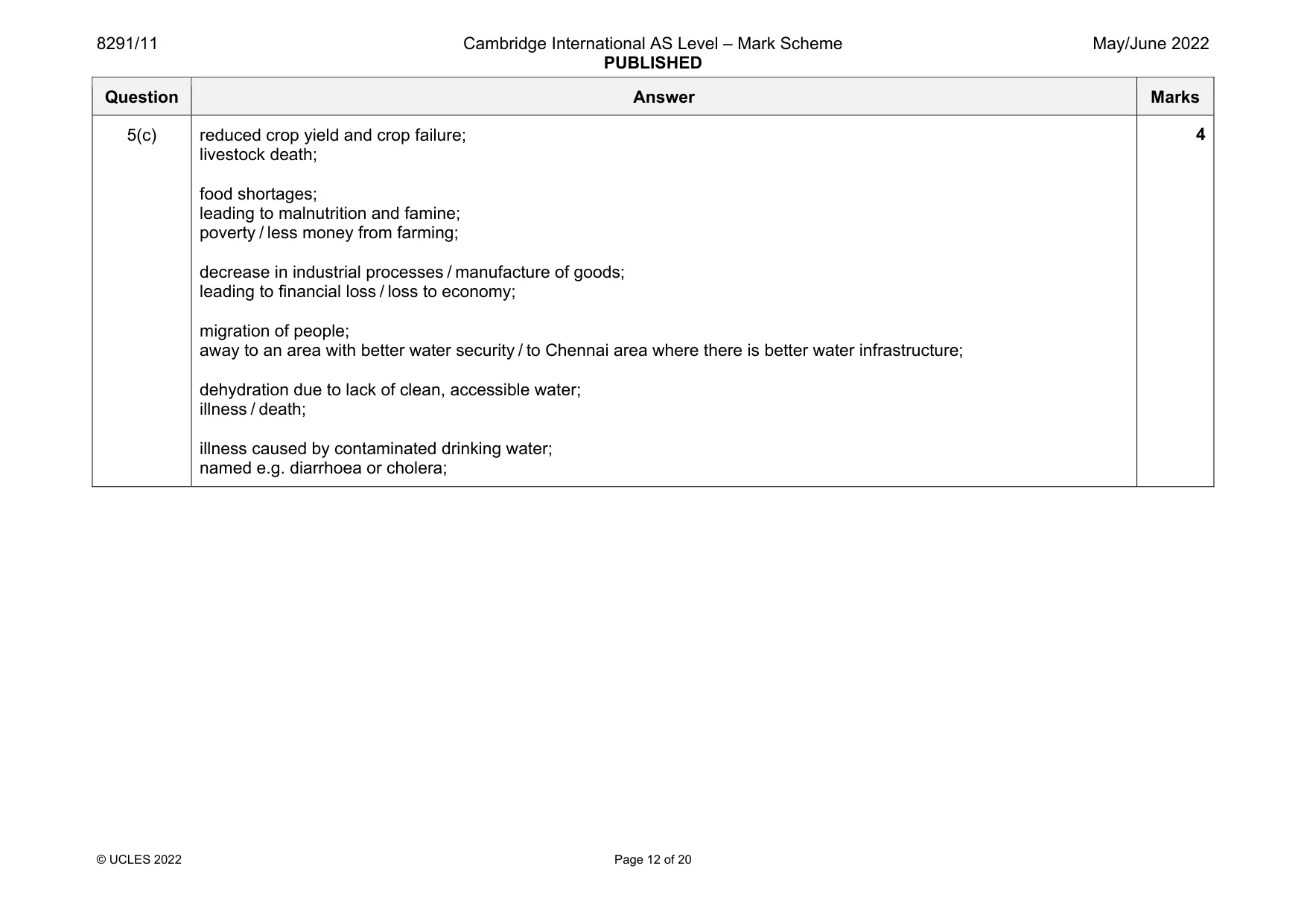
8291/11 Cambridge International AS Level – Mark Scheme PUBLISHED May/June 2022 © UCLES 2022 Page 12 of 20 Question Answer Marks 5(c) reduced crop yield and crop failure; livestock death; food shortages; leading to malnutrition and famine; poverty / less money from farming; decrease in industrial processes / manufacture of goods; leading to financial loss / loss to economy; migration of people; away to an area with better water security / to Chennai area where there is better water infrastructure; dehydration due to lack of clean, accessible water; illness / death; illness caused by contaminated drinking water; named e.g. diarrhoea or cholera; 4
Mark scheme, page 13
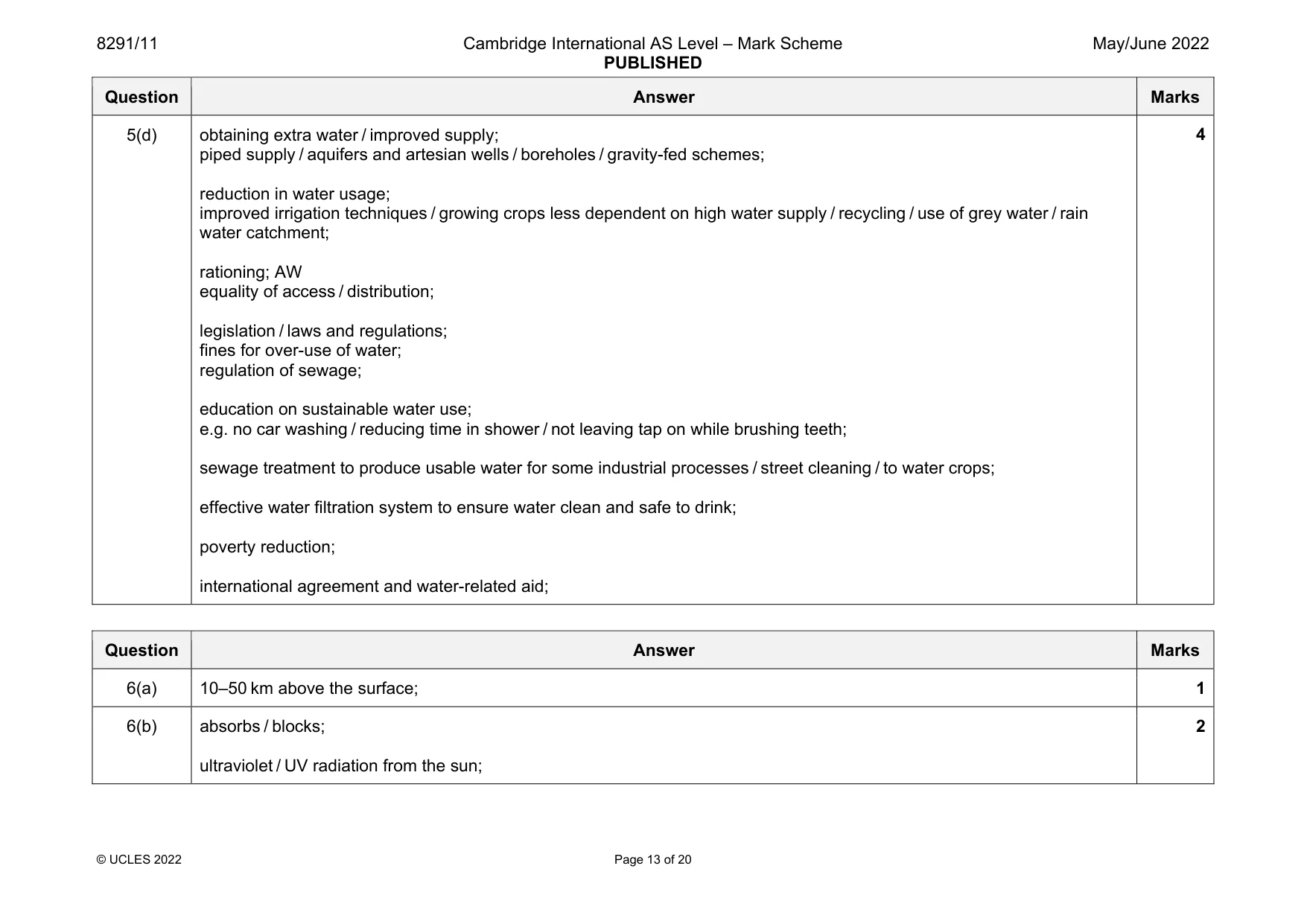
8291/11 Cambridge International AS Level – Mark Scheme PUBLISHED May/June 2022 © UCLES 2022 Page 13 of 20 Question Answer Marks 5(d) obtaining extra water / improved supply; piped supply / aquifers and artesian wells / boreholes / gravity-fed schemes; reduction in water usage; improved irrigation techniques / growing crops less dependent on high water supply / recycling / use of grey water / rain water catchment; rationing; AW equality of access / distribution; legislation / laws and regulations; fines for over-use of water; regulation of sewage; education on sustainable water use; e.g. no car washing / reducing time in shower / not leaving tap on while brushing teeth; sewage treatment to produce usable water for some industrial processes / street cleaning / to water crops; effective water filtration system to ensure water clean and safe to drink; poverty reduction; international agreement and water-related aid; 4 Question Answer Marks 6(a) 10–50 km above the surface; 1 6(b) absorbs / blocks; ultraviolet / UV radiation from the sun; 2
Mark scheme, page 14
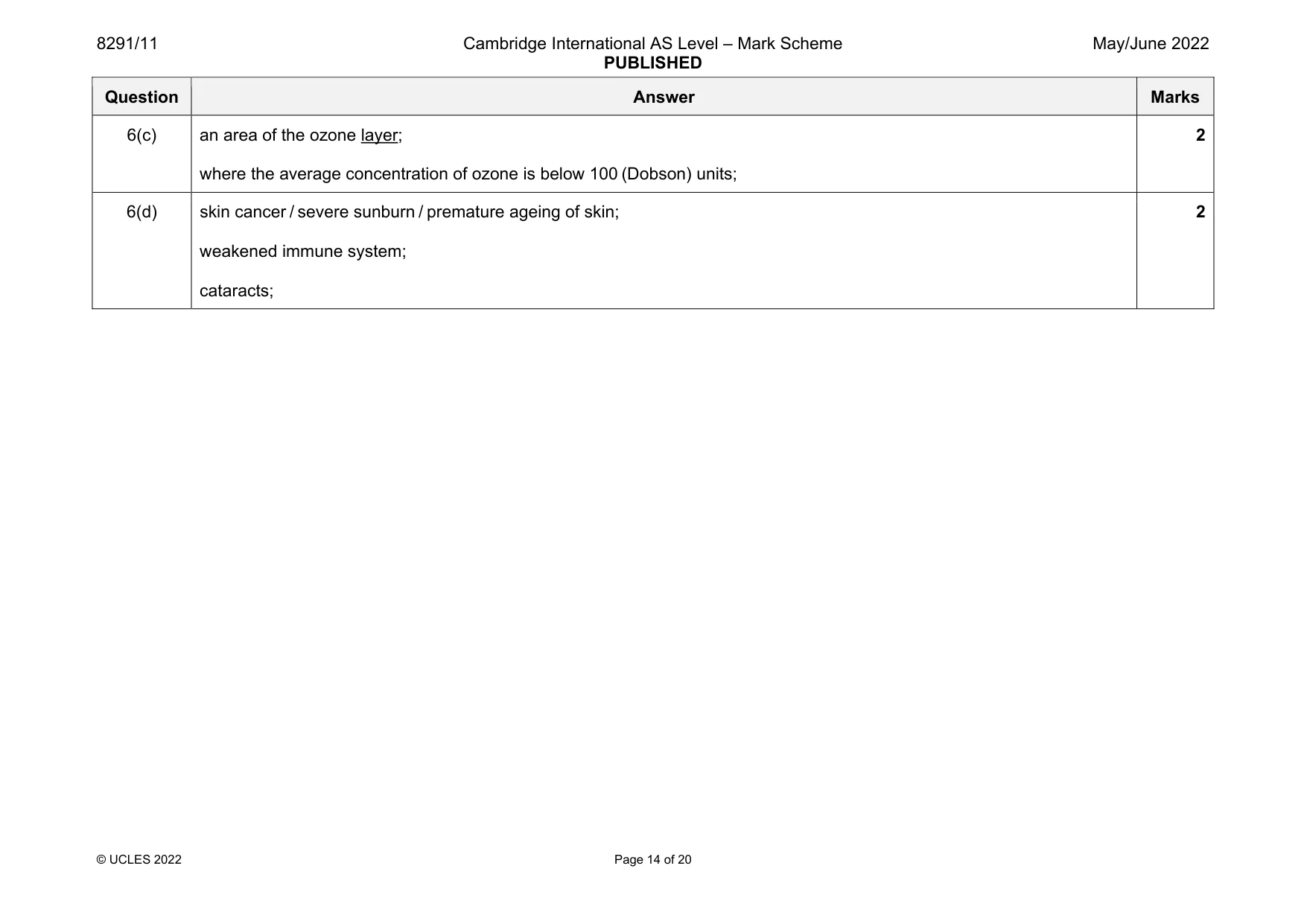
8291/11 Cambridge International AS Level – Mark Scheme PUBLISHED May/June 2022 © UCLES 2022 Page 14 of 20 Question Answer Marks 6(c) an area of the ozone layer; where the average concentration of ozone is below 100 (Dobson) units; 2 6(d) skin cancer / severe sunburn / premature ageing of skin; weakened immune system; cataracts; 2
Mark scheme, page 15
8291/11 Cambridge International AS Level – Mark Scheme PUBLISHED May/June 2022 © UCLES 2022 Page 15 of 20 Question Answer Marks 7 This question assesses AO2 and AO3 skills. The question requirements are to: Demonstrate understanding of local and global environmental issues Understand that local efforts can have a wider impact Show understanding of a range of environmental actions Provide evaluation of the relative success of the methods Indicative content Candidates may compare and contrast local and international strategies to manage the environment and evaluate the contribution to global environmental improvement. Candidates should describe strategies to manage issues such as: climate change, air pollution, waste disposal, water pollution, food security, water security, conservation / biodiversity etc., evaluate the success of the strategies and make relevant conclusions. Strategies could include litter picking, recycling, use of renewable energy sources, use of public transport or cycling to reduce car usage, tree planting, growing own vegetables and reduction in plastic usage, education etc. Candidates should show understanding of the problems encountered with producing international agreements (such as Kyoto Protocol, Montreal Protocol, Paris Agreement) and evaluate how local legislation / local initiatives are more likely to meet with success. Political and economic factors affect decision making at international level making agreement more difficult than at local level. The role of NGOs and environmental activist groups. 20
Mark scheme, page 16
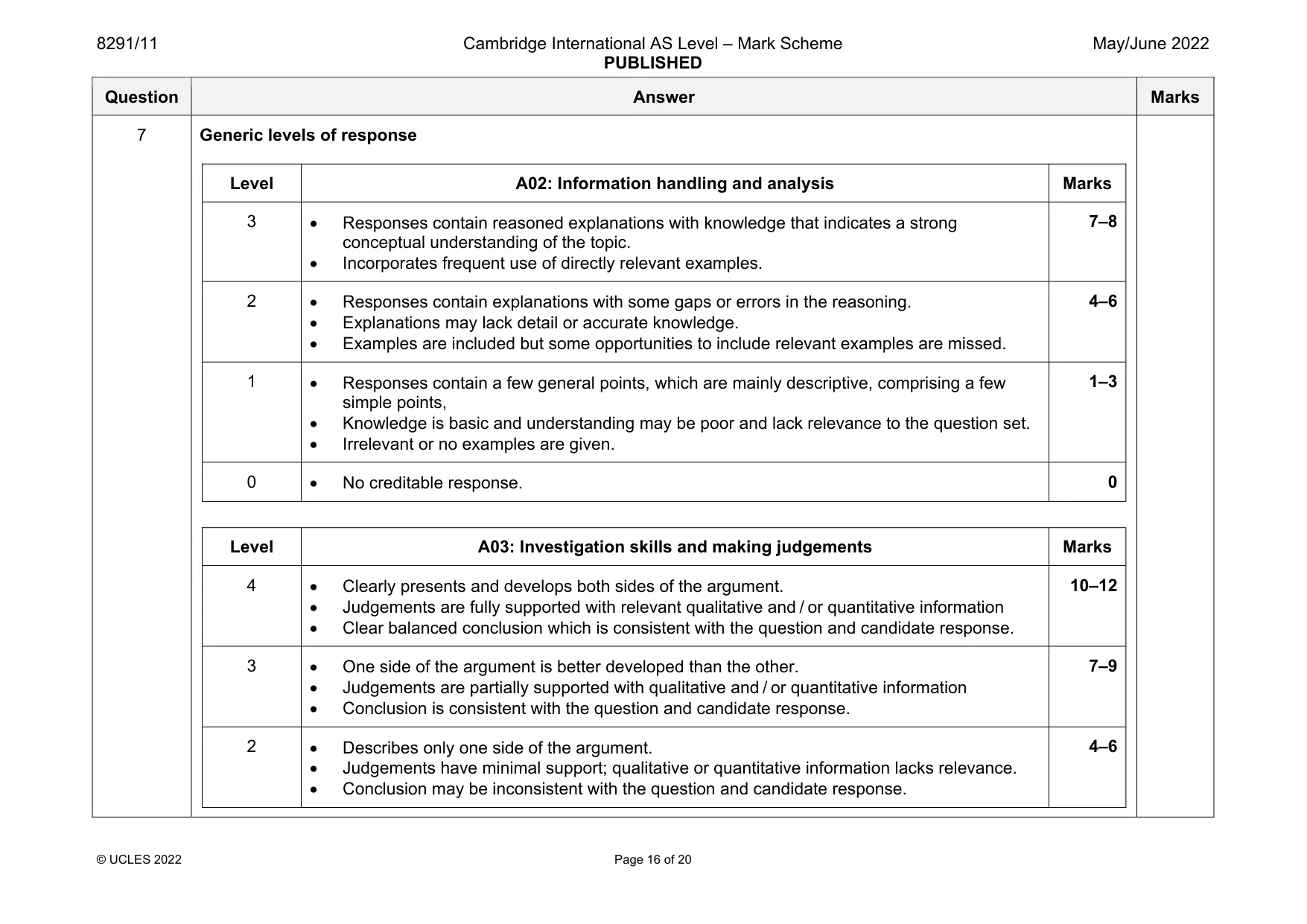
8291/11 Cambridge International AS Level – Mark Scheme PUBLISHED May/June 2022 © UCLES 2022 Page 16 of 20 Question Answer Marks 7 Generic levels of response Level A02: Information handling and analysis Marks 3 Responses contain reasoned explanations with knowledge that indicates a strong conceptual understanding of the topic. Incorporates frequent use of directly relevant examples. 7–8 2 Responses contain explanations with some gaps or errors in the reasoning. Explanations may lack detail or accurate knowledge. Examples are included but some opportunities to include relevant examples are missed. 4–6 1 Responses contain a few general points, which are mainly descriptive, comprising a few simple points, Knowledge is basic and understanding may be poor and lack relevance to the question set. Irrelevant or no examples are given. 1–3 0 No creditable response. 0 Level A03: Investigation skills and making judgements Marks 4 Clearly presents and develops both sides of the argument. Judgements are fully supported with relevant qualitative and / or quantitative information Clear balanced conclusion which is consistent with the question and candidate response. 10–12 3 One side of the argument is better developed than the other. Judgements are partially supported with qualitative and / or quantitative information Conclusion is consistent with the question and candidate response. 7–9 2 Describes only one side of the argument. Judgements have minimal support; qualitative or quantitative information lacks relevance. Conclusion may be inconsistent with the question and candidate response. 4–6
Mark scheme, page 17
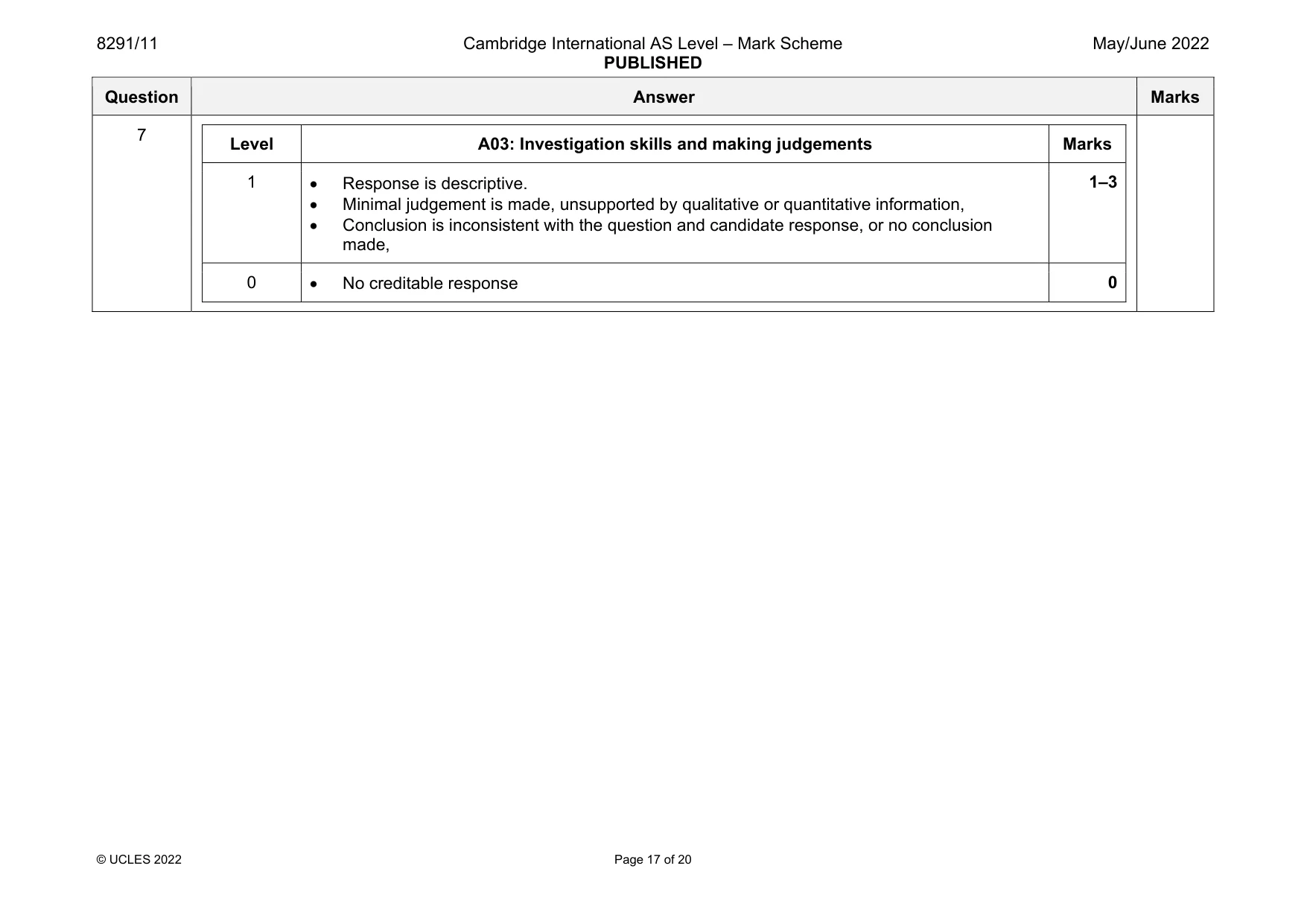
8291/11 Cambridge International AS Level – Mark Scheme PUBLISHED May/June 2022 © UCLES 2022 Page 17 of 20 Question Answer Marks 7 Level A03: Investigation skills and making judgements Marks 1 Response is descriptive. Minimal judgement is made, unsupported by qualitative or quantitative information, Conclusion is inconsistent with the question and candidate response, or no conclusion made, 1–3 0 No creditable response 0
Mark scheme, page 18
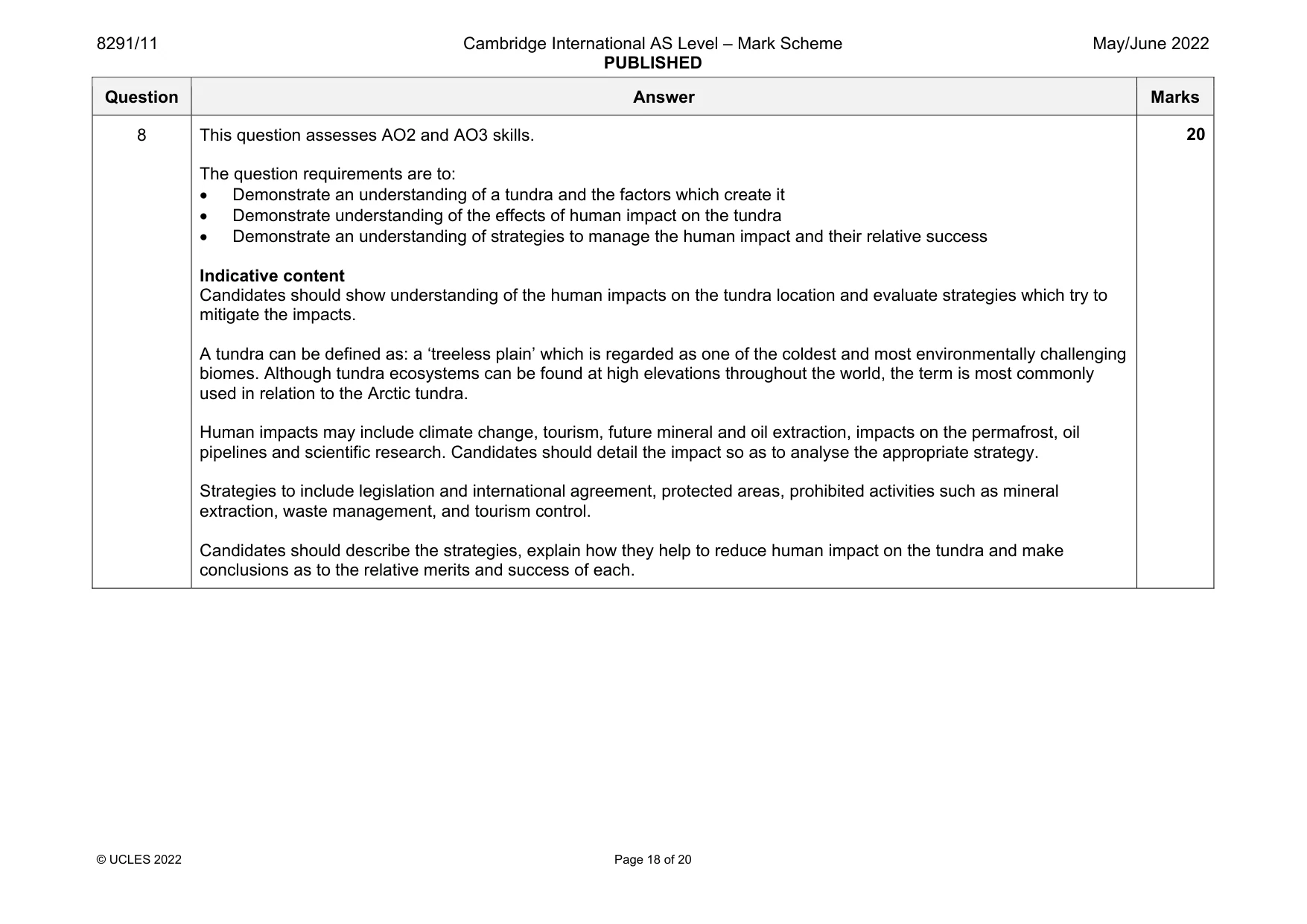
8291/11 Cambridge International AS Level – Mark Scheme PUBLISHED May/June 2022 © UCLES 2022 Page 18 of 20 Question Answer Marks 8 This question assesses AO2 and AO3 skills. The question requirements are to: Demonstrate an understanding of a tundra and the factors which create it Demonstrate understanding of the effects of human impact on the tundra Demonstrate an understanding of strategies to manage the human impact and their relative success Indicative content Candidates should show understanding of the human impacts on the tundra location and evaluate strategies which try to mitigate the impacts. A tundra can be defined as: a ‘treeless plain’ which is regarded as one of the coldest and most environmentally challenging biomes. Although tundra ecosystems can be found at high elevations throughout the world, the term is most commonly used in relation to the Arctic tundra. Human impacts may include climate change, tourism, future mineral and oil extraction, impacts on the permafrost, oil pipelines and scientific research. Candidates should detail the impact so as to analyse the appropriate strategy. Strategies to include legislation and international agreement, protected areas, prohibited activities such as mineral extraction, waste management, and tourism control. Candidates should describe the strategies, explain how they help to reduce human impact on the tundra and make conclusions as to the relative merits and success of each. 20
Mark scheme, page 19
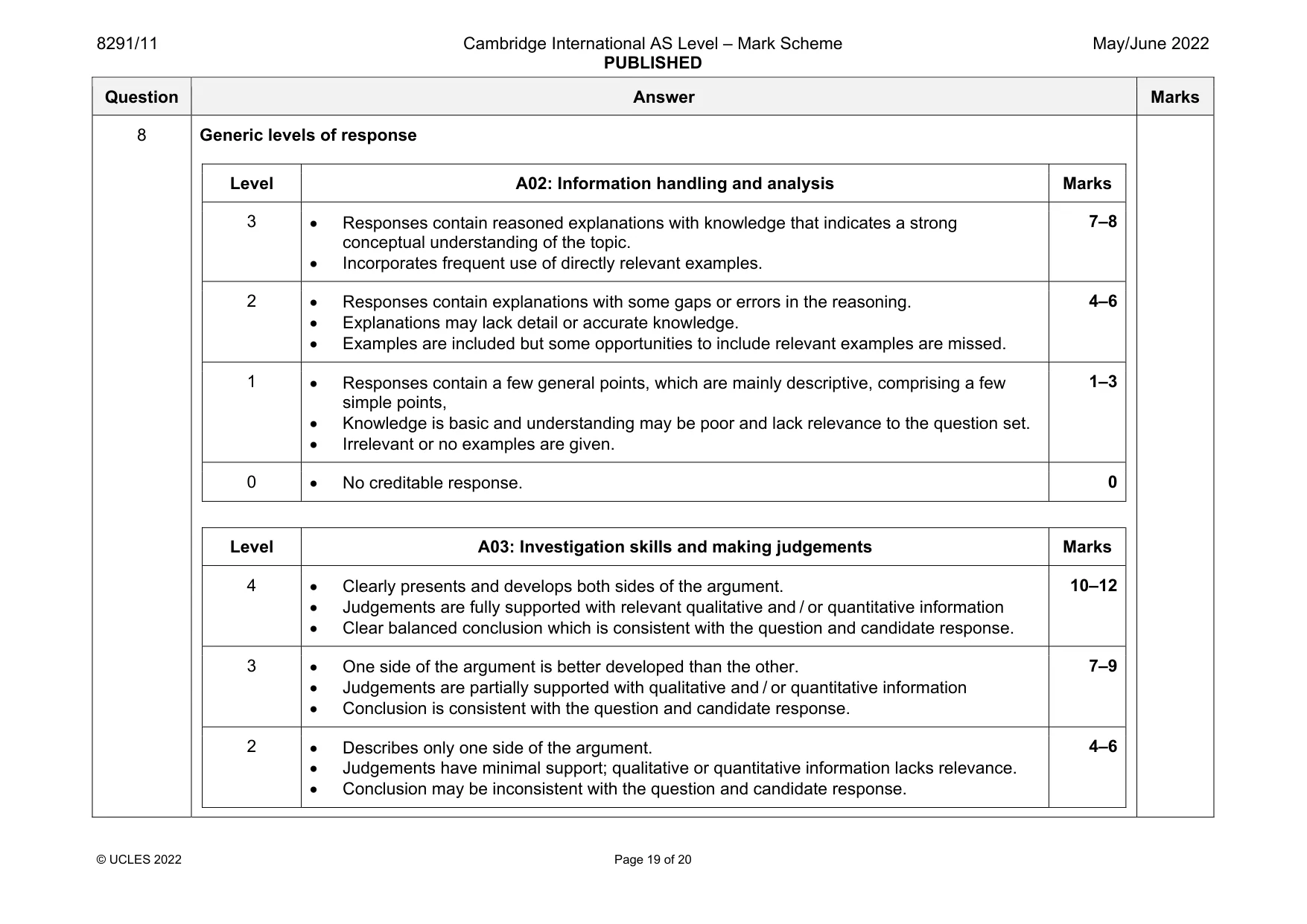
8291/11 Cambridge International AS Level – Mark Scheme PUBLISHED May/June 2022 © UCLES 2022 Page 19 of 20 Question Answer Marks 8 Generic levels of response Level A02: Information handling and analysis Marks 3 Responses contain reasoned explanations with knowledge that indicates a strong conceptual understanding of the topic. Incorporates frequent use of directly relevant examples. 7–8 2 Responses contain explanations with some gaps or errors in the reasoning. Explanations may lack detail or accurate knowledge. Examples are included but some opportunities to include relevant examples are missed. 4–6 1 Responses contain a few general points, which are mainly descriptive, comprising a few simple points, Knowledge is basic and understanding may be poor and lack relevance to the question set. Irrelevant or no examples are given. 1–3 0 No creditable response. 0 Level A03: Investigation skills and making judgements Marks 4 Clearly presents and develops both sides of the argument. Judgements are fully supported with relevant qualitative and / or quantitative information Clear balanced conclusion which is consistent with the question and candidate response. 10–12 3 One side of the argument is better developed than the other. Judgements are partially supported with qualitative and / or quantitative information Conclusion is consistent with the question and candidate response. 7–9 2 Describes only one side of the argument. Judgements have minimal support; qualitative or quantitative information lacks relevance. Conclusion may be inconsistent with the question and candidate response. 4–6
Mark scheme, page 20
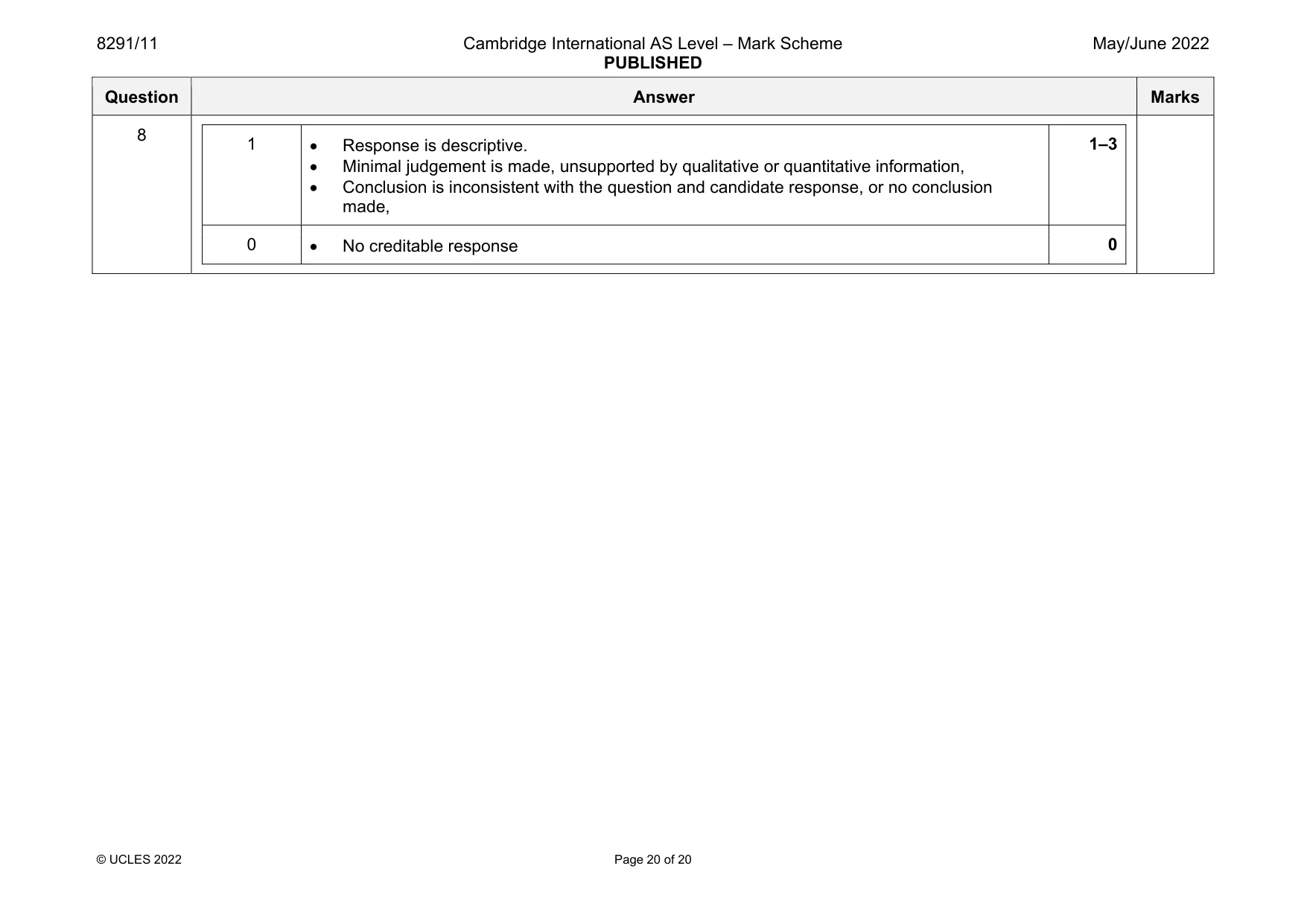
8291/11 Cambridge International AS Level – Mark Scheme PUBLISHED May/June 2022 © UCLES 2022 Page 20 of 20 Question Answer Marks 8 1 Response is descriptive. Minimal judgement is made, unsupported by qualitative or quantitative information, Conclusion is inconsistent with the question and candidate response, or no conclusion made, 1–3 0 No creditable response 0
What you needed in this session
Cambridge’s own grade thresholds for 2022 May/June, Paper 1 · Variant 1. A higher threshold means an easier paper — the bar moves with how the cohort did.