Cambridge A Level Environmental Management (AS only) 8291 — 2023 Oct/Nov Paper 1 · Variant 2
8291/12/O/N/23 · 80 marks · ≈90 min
The question paper and its mark scheme, free to read here and free to download. This is Cambridge’s own paper, exactly as it was sat.
Question paper20 pages






Mark scheme15 pages
Answers below. Sit the paper first if you are practising.
Paper as text
Question paper, page 1
This document has 20 pages. [Turn over Cambridge International AS Level DC (LK/JG) 318198/3 © UCLES 2023 * 0 2 8 9 7 4 1 4 2 3 * ENVIRONMENTAL MANAGEMENT 8291/12 Paper 1 Principles of Environmental Management October/November 2023 1 hour 45 minutes You must answer on the question paper. No additional materials are needed. INSTRUCTIONS ● Section A: answer all questions. ● Section B: answer one question. ● Use a black or dark blue pen. You may use an HB pencil for any diagrams or graphs. ● Write your name, centre number and candidate number in the boxes at the top of the page. ● Write your answer to each question in the space provided. ● Do not use an erasable pen or correction fluid. ● Do not write on any bar codes. ● You may use a calculator. ● You should show all your working and use appropriate units. INFORMATION ● The total mark for this paper is 80. ● The number of marks for each question or part question is shown in brackets [ ].
Question paper, page 2
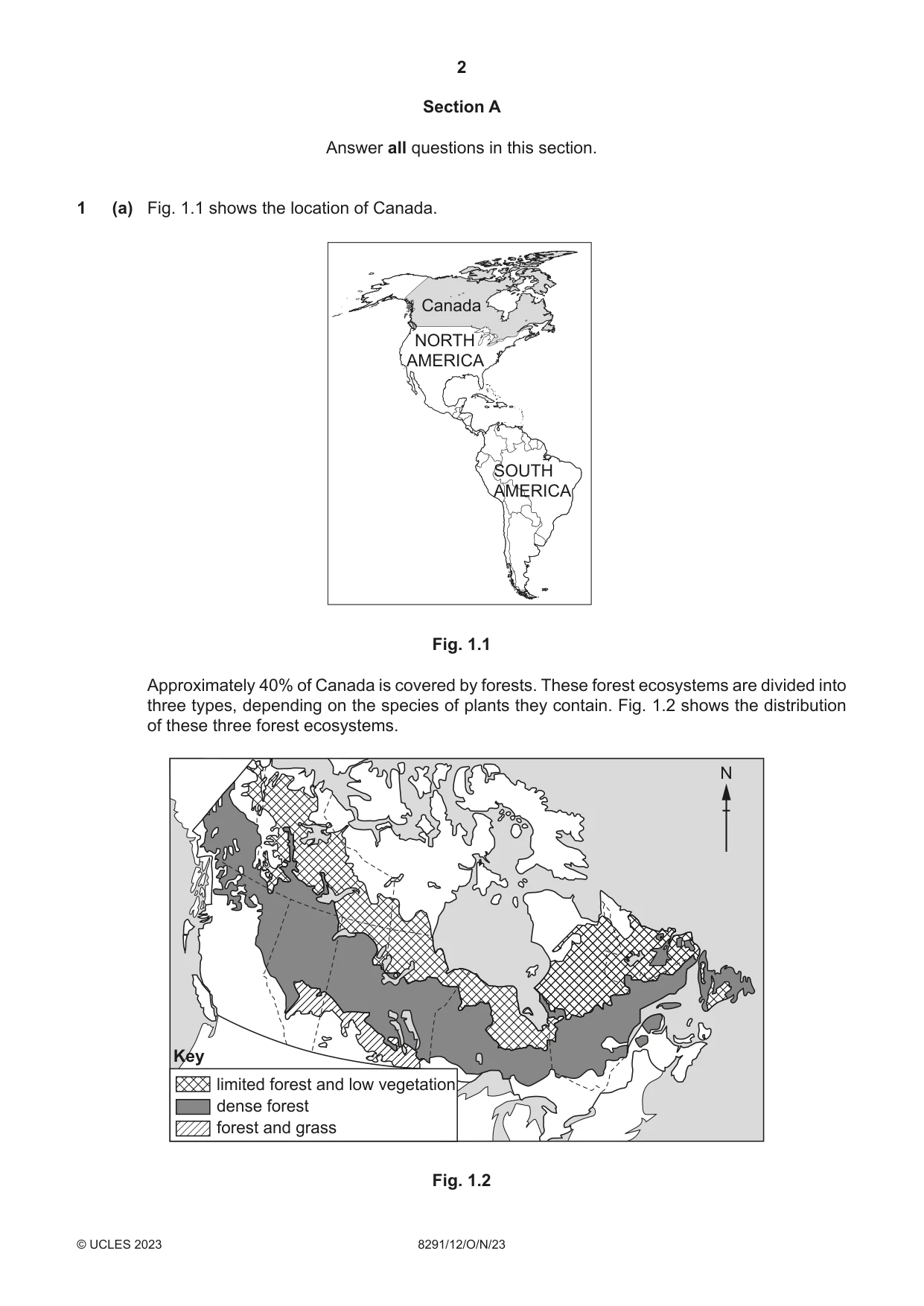
2 8291/12/O/N/23 © UCLES 2023 Section A Answer all questions in this section. 1 (a) Fig. 1.1 shows the location of Canada. Canada NORTH AMERICA SOUTH AMERICA Fig. 1.1 Approximately 40% of Canada is covered by forests. These forest ecosystems are divided into three types, depending on the species of plants they contain. Fig. 1.2 shows the distribution of these three forest ecosystems. N limited forest and low vegetation dense forest forest and grass Key Fig. 1.2
Question paper, page 3
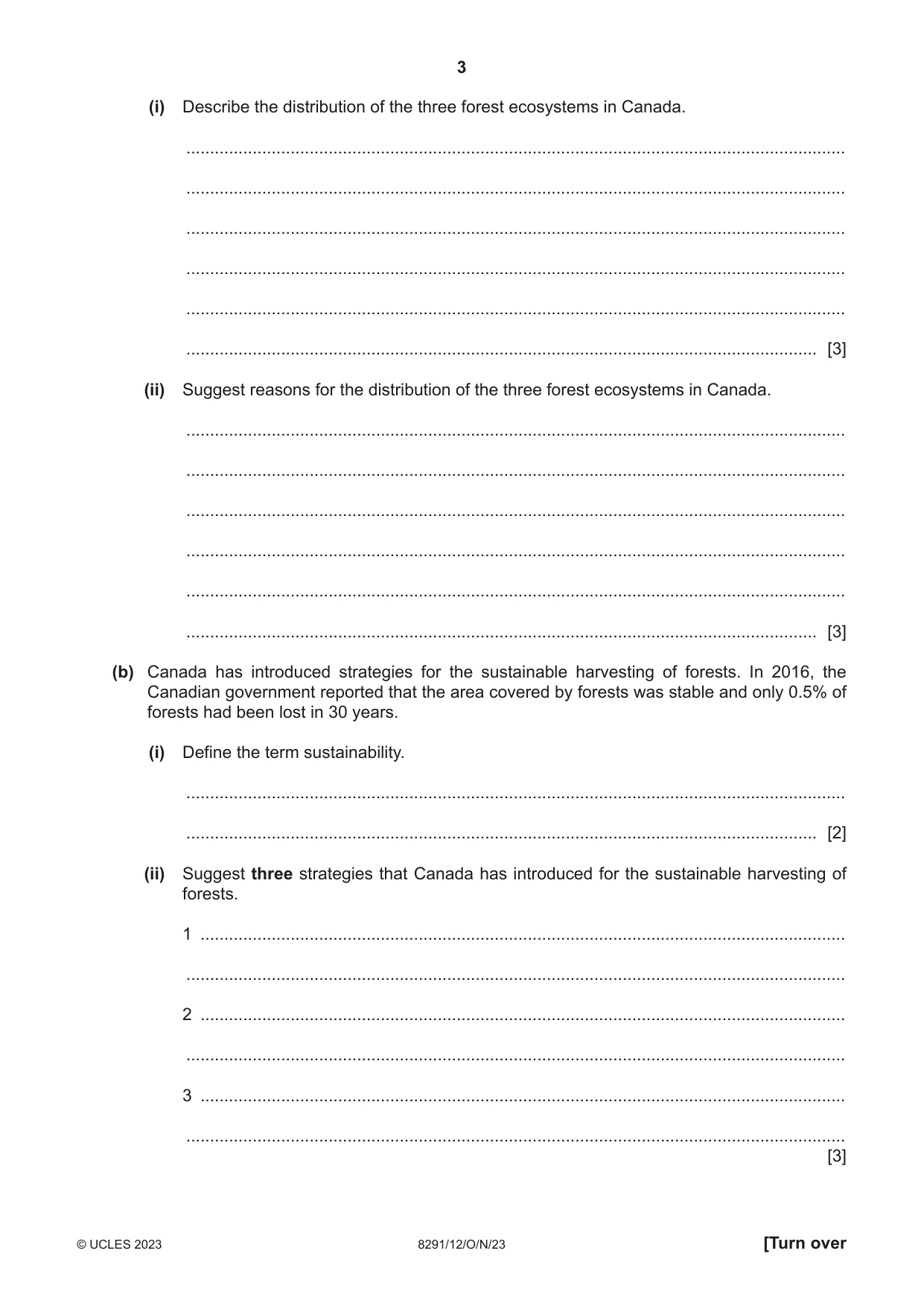
3 8291/12/O/N/23 © UCLES 2023 [Turn over (i) Describe the distribution of the three forest ecosystems in Canada. … … … … … … [3] (ii) Suggest reasons for the distribution of the three forest ecosystems in Canada. … … … … … … [3] (b) Canada has introduced strategies for the sustainable harvesting of forests. In 2016, the Canadian government reported that the area covered by forests was stable and only 0.5% of forests had been lost in 30 years. (i) Define the term sustainability. … … [2] (ii) Suggest three strategies that Canada has introduced for the sustainable harvesting of forests. 1 … … 2 … … 3 … … [3]
Question paper, page 4
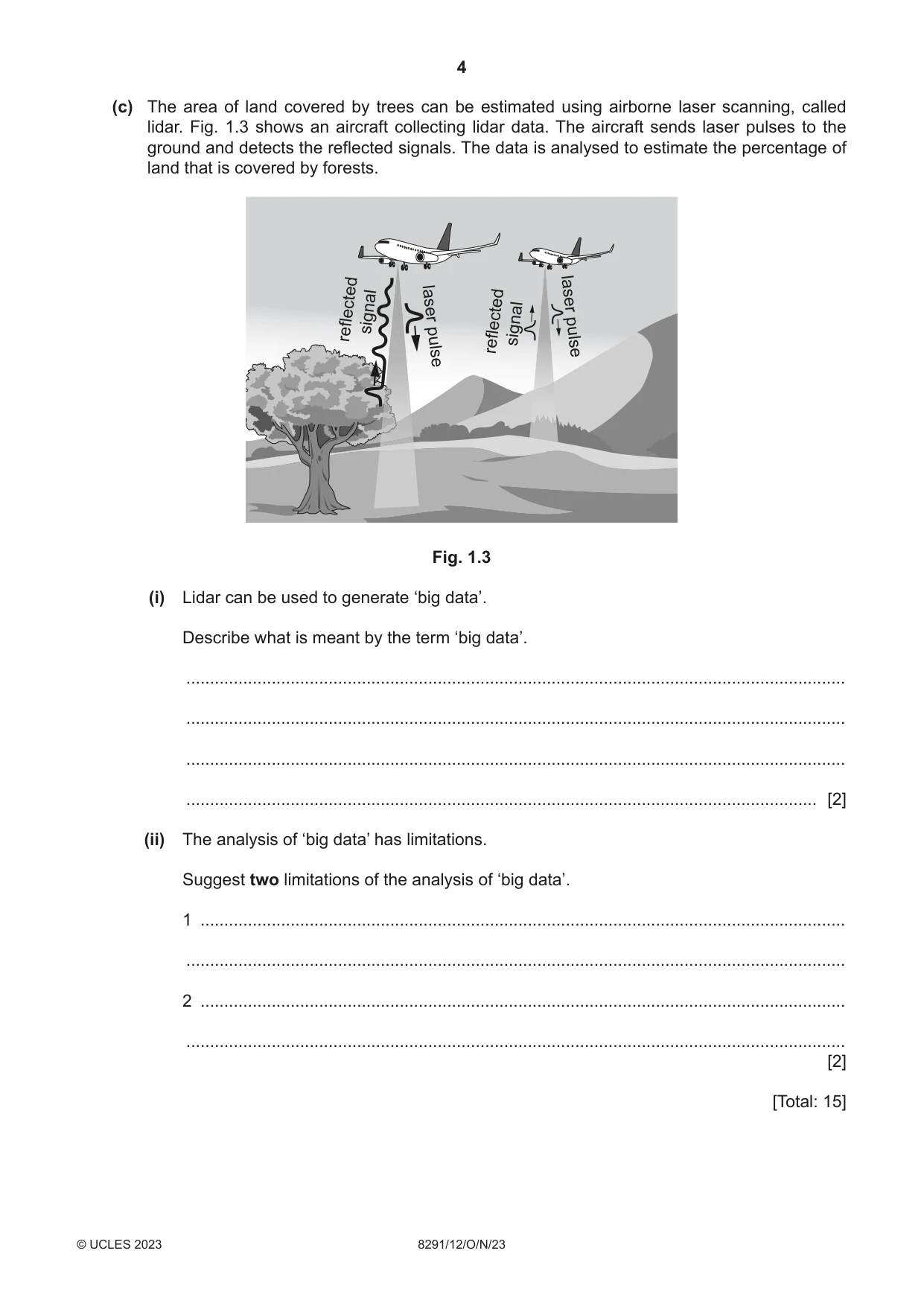
4 8291/12/ O/ N/23 © UCLES 2023 (c) The area of land covered by trees can be estimated using airborne laser scanning, called lidar. Fig. 1.3 shows an aircraft collecting lidar data. The aircraft sends laser pulses to the ground and detects the reflected signals. The data is analysed to estimate the percentage of land that is covered by forests. laser pulse reflected signal laser pulse reflected signal Fig. 1.3 (i) Lidar can be used to generate ‘big data’. Describe what is meant by the term ‘big data’. … … … … [2] (ii) The analysis of ‘big data’ has limitations. Suggest two limitations of the analysis of ‘big data’. 1 … … 2 … … [2] [Total: 15]
Question paper, page 5
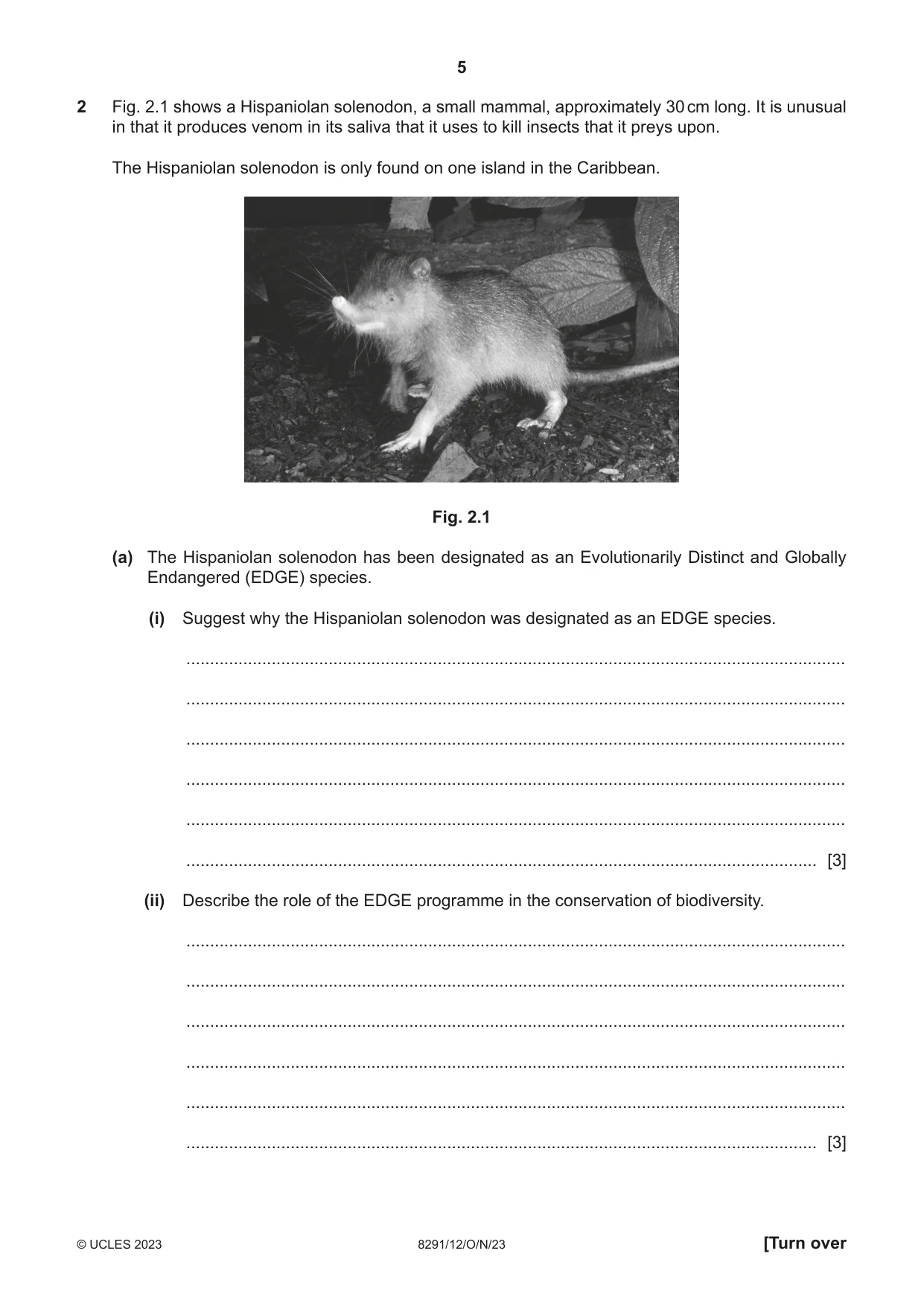
5 8291/12/O/N/23 © UCLES 2023 [Turn over 2 Fig. 2.1 shows a Hispaniolan solenodon, a small mammal, approximately 30 cm long. It is unusual in that it produces venom in its saliva that it uses to kill insects that it preys upon. The Hispaniolan solenodon is only found on one island in the Caribbean. Fig. 2.1 (a) The Hispaniolan solenodon has been designated as an Evolutionarily Distinct and Globally Endangered (EDGE) species. (i) Suggest why the Hispaniolan solenodon was designated as an EDGE species. … … … … … … [3] (ii) Describe the role of the EDGE programme in the conservation of biodiversity. … … … … … … [3]
Question paper, page 6
6 8291/12/O/N/23 © UCLES 2023 (b) The population of Hispaniolan solenodons is decreasing. Suggest three factors that may have caused the population to decrease. 1 … … 2 … … 3 … … [3] (c) List five strategies to conserve the Hispaniolan solenodon. 1 … … 2 … … 3 … … 4 … … 5 … … [5] [Total: 14]
Question paper, page 7
7 8291/12/O/N/23 © UCLES 2023 [Turn over 3 (a) The World Health Organization estimated that, in 2019, approximately 9% of the world population was living with food insecurity. One cause of food insecurity is agricultural disease. (i) Define food insecurity. … … … … [2] (ii) Explain how agricultural diseases in crops can increase food insecurity. … … … … … … … … [4]
Question paper, page 8
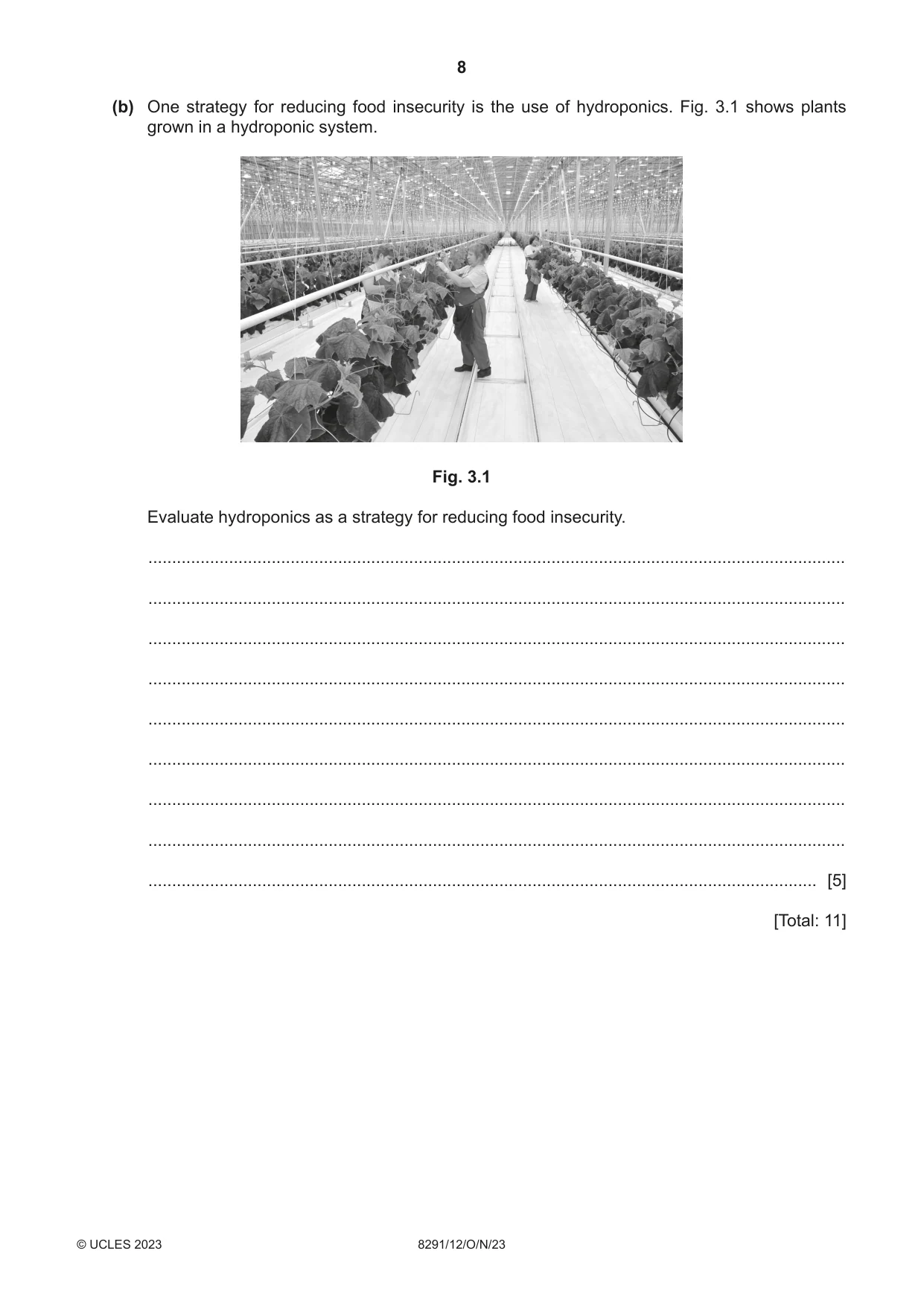
8 8291/12/O/N/23 © UCLES 2023 (b) One strategy for reducing food insecurity is the use of hydroponics. Fig. 3.1 shows plants grown in a hydroponic system. Fig. 3.1 Evaluate hydroponics as a strategy for reducing food insecurity. … … … … … … … … … [5] [Total: 11]
Question paper, page 9
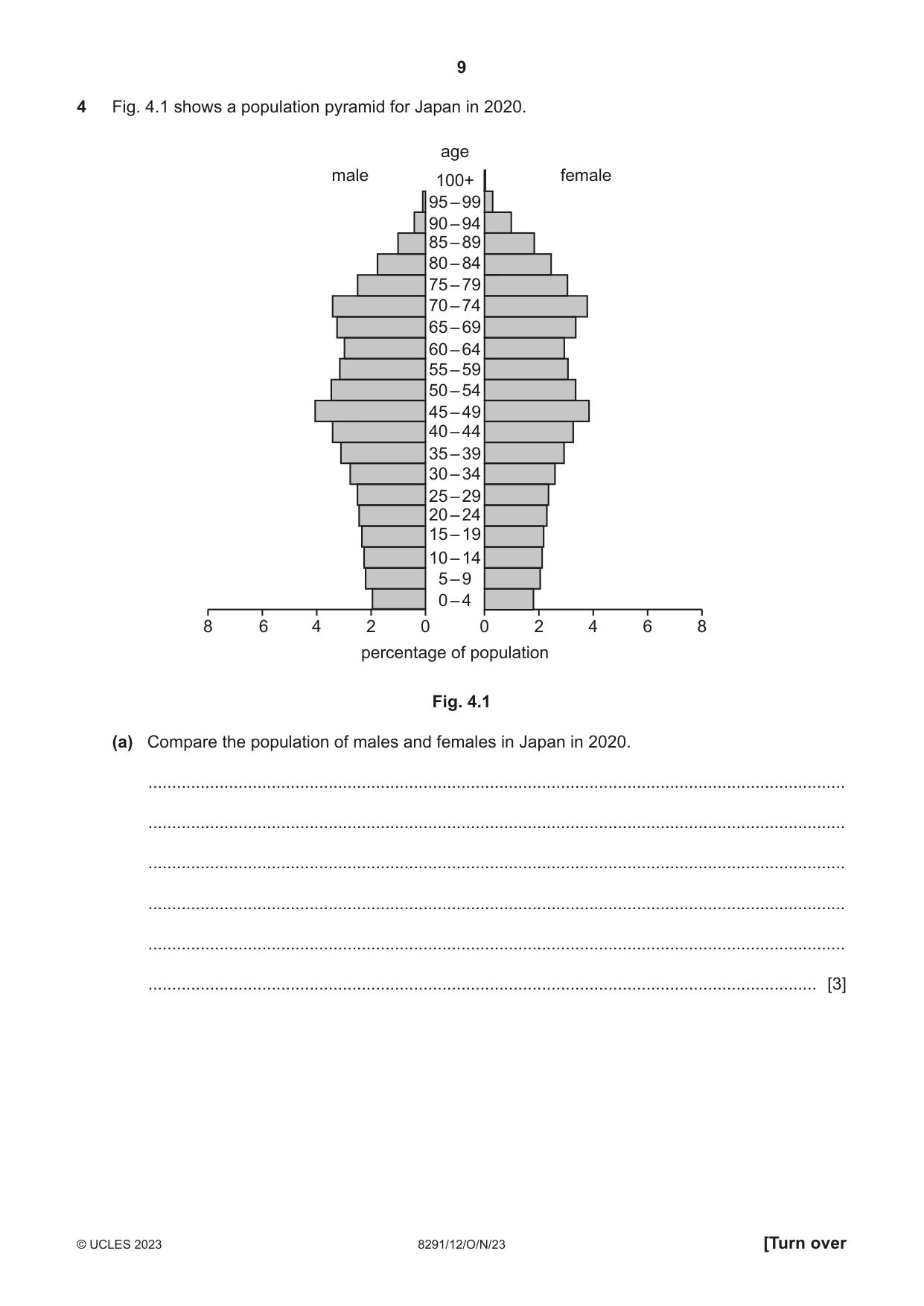
9 8291/12/O/N/23 © UCLES 2023 [Turn over 4 Fig. 4.1 shows a population pyramid for Japan in 2020. 0 – 4 5 – 9 10 – 14 15 – 19 20 – 24 25 – 29 30 – 34 35 – 39 40 – 44 45 – 49 50 – 54 55 – 59 60 – 64 65 – 69 70 – 74 75 – 79 80 – 84 85 – 89 90 – 94 95 – 99 100+ male female 0 0 2 2 4 4 6 6 8 8 age percentage of population Fig. 4.1 (a) Compare the population of males and females in Japan in 2020. … … … … … … [3]
Question paper, page 10
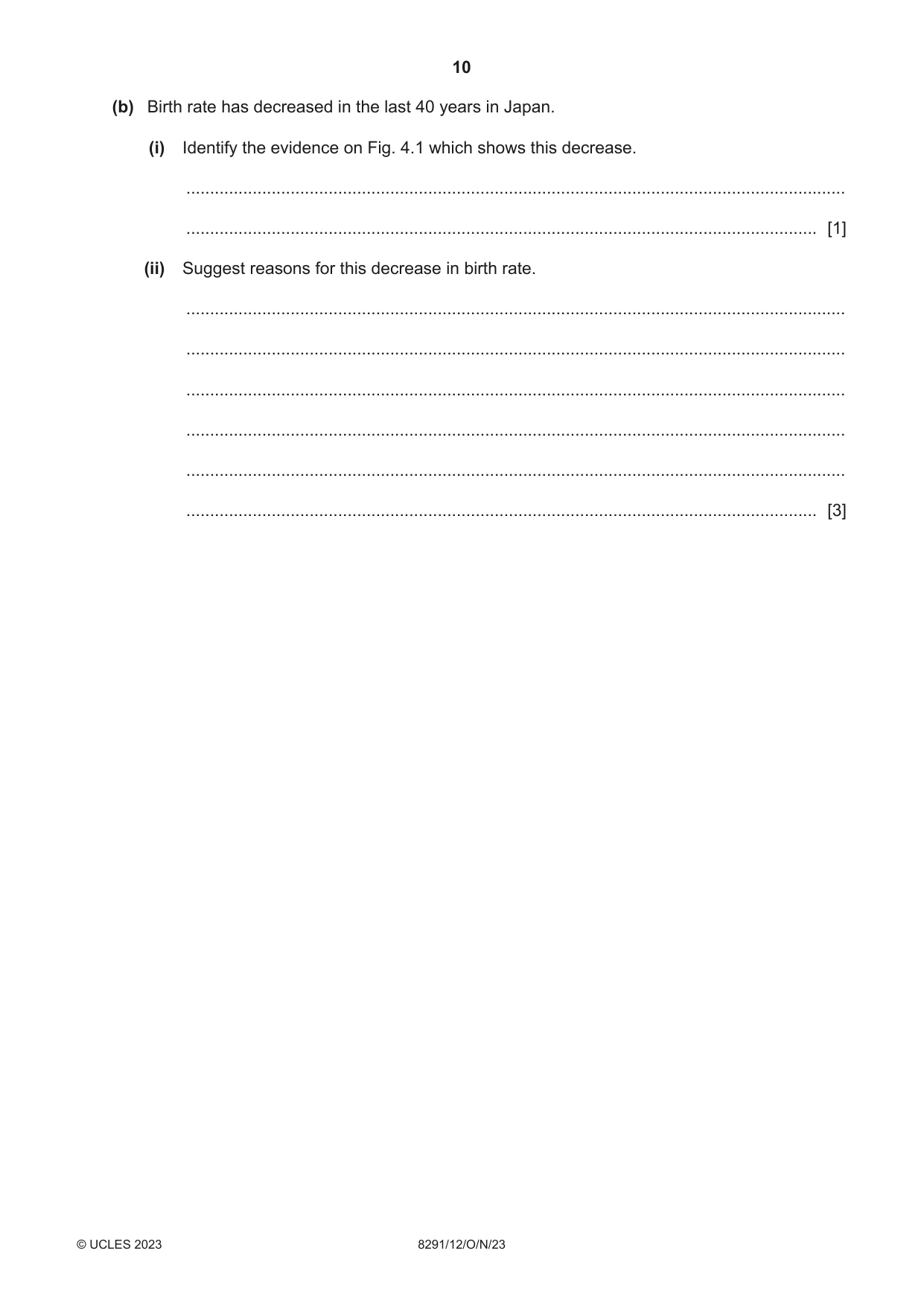
10 8291/12/O/N/23 © UCLES 2023 (b) Birth rate has decreased in the last 40 years in Japan. (i) Identify the evidence on Fig. 4.1 which shows this decrease. … … [1] (ii) Suggest reasons for this decrease in birth rate. … … … … … … [3]
Question paper, page 11
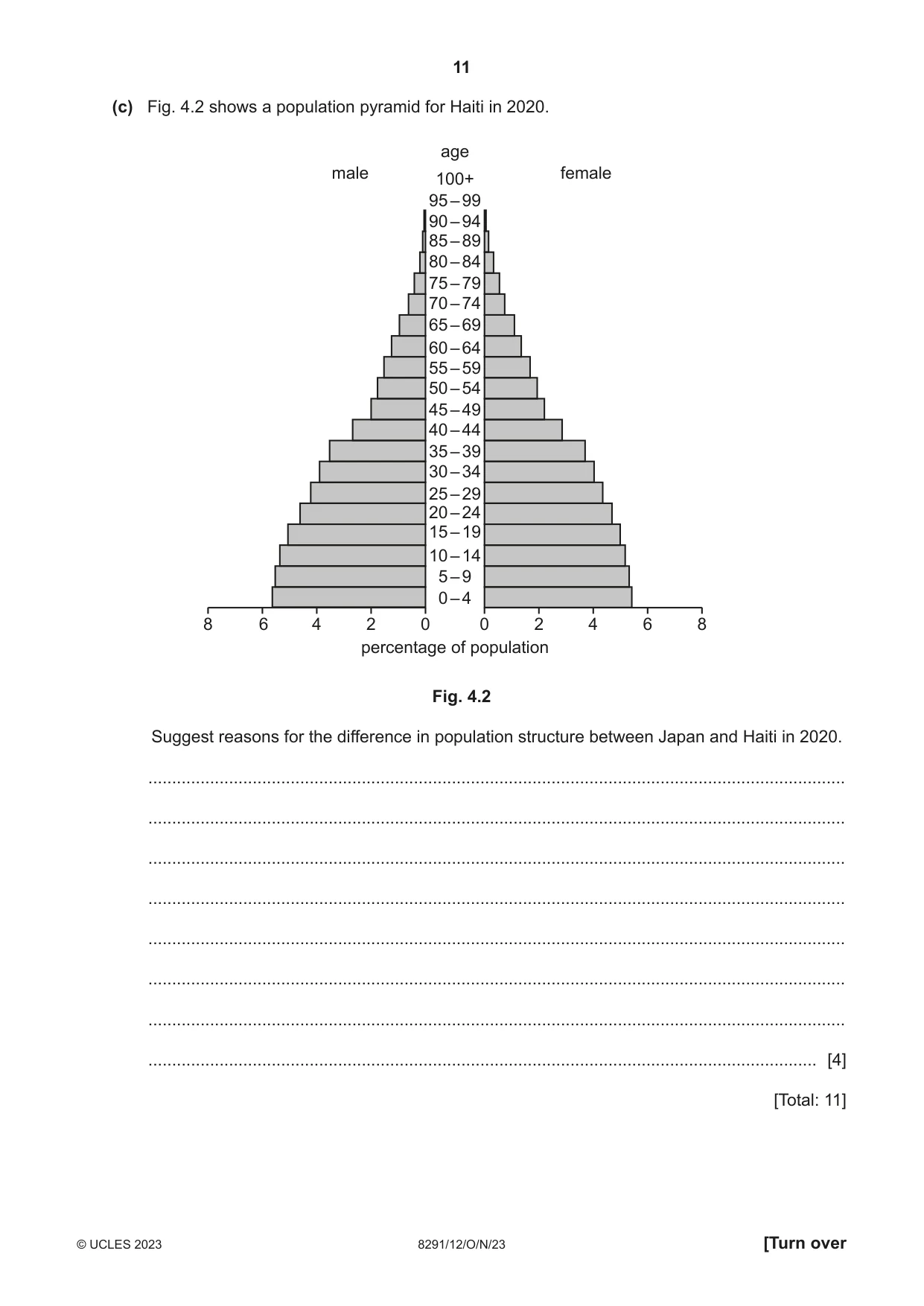
11 8291/12/O/N/23 © UCLES 2023 [Turn over (c) Fig. 4.2 shows a population pyramid for Haiti in 2020. 0 – 4 5 – 9 10 – 14 15 – 19 20 – 24 25 – 29 30 – 34 35 – 39 40 – 44 45 – 49 50 – 54 55 – 59 60 – 64 65 – 69 70 – 74 75 – 79 80 – 84 85 – 89 90 – 94 95 – 99 100+ age male female 0 0 2 2 4 4 6 6 8 8 percentage of population Fig. 4.2 Suggest reasons for the difference in population structure between Japan and Haiti in 2020. … … … … … … … … [4] [Total: 11]
Question paper, page 12
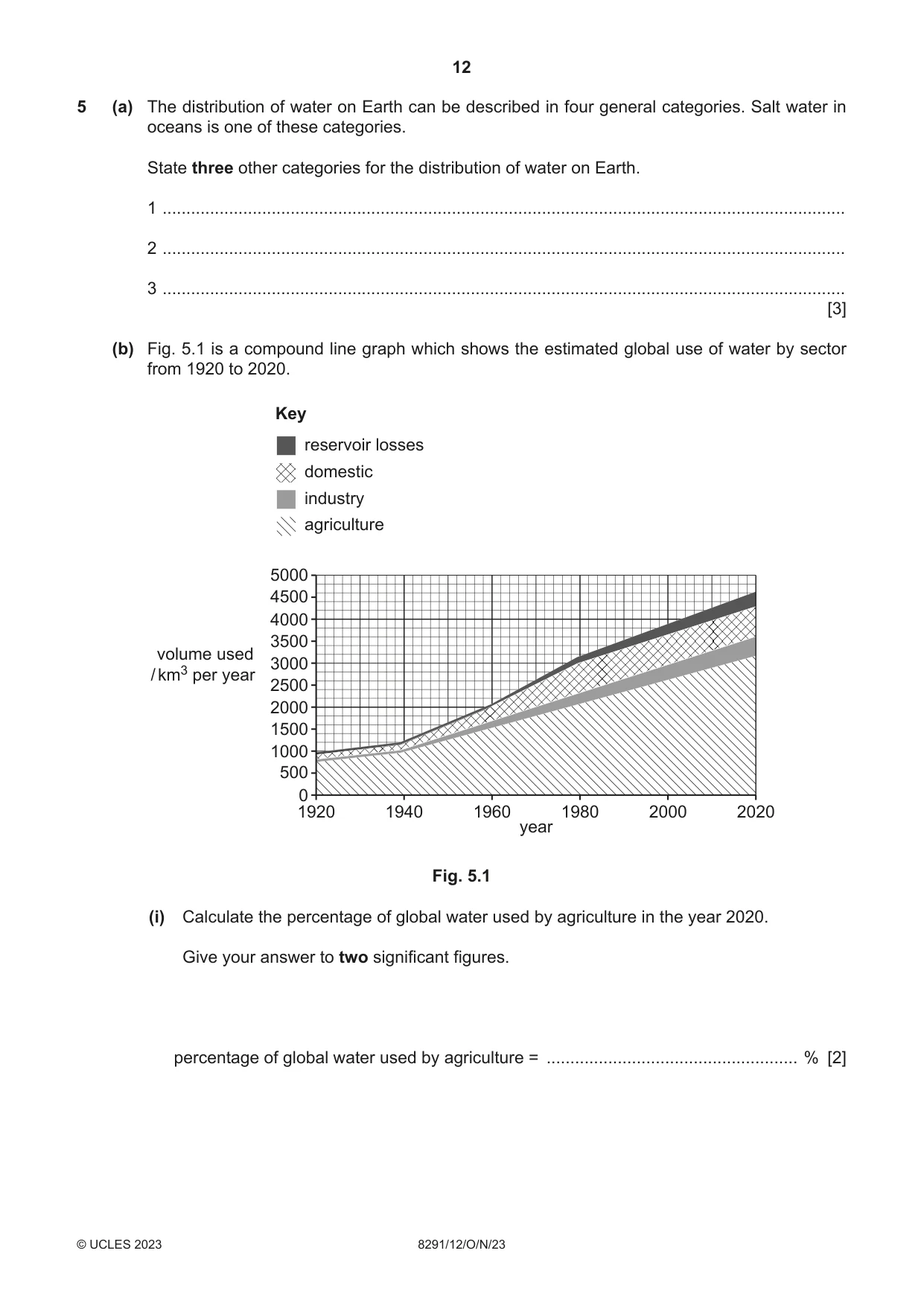
12 8291/12/O/N/23 © UCLES 2023 5 (a) The distribution of water on Earth can be described in four general categories. Salt water in oceans is one of these categories. State three other categories for the distribution of water on Earth. 1 … 2 … 3 … [3] (b) Fig. 5.1 is a compound line graph which shows the estimated global use of water by sector from 1920 to 2020. 1920 Key 1940 1960 1980 2000 2020 1000 2000 3000 2500 1500 500 0 3500 4000 4500 5000 year volume used / km3 per year reservoir losses domestic industry agriculture Fig. 5.1 (i) Calculate the percentage of global water used by agriculture in the year 2020. Give your answer to two significant figures. percentage of global water used by agriculture = … % [2]
Question paper, page 13
13 8291/12/O/N/23 © UCLES 2023 [Turn over (ii) Describe two strategies that farmers use to reduce water usage. 1 … … … … 2 … … … … [4] [Total: 9]
Question paper, page 14
14 8291/12/O/N/23 © UCLES 2023 Section B Answer one question. Either 6 ‘Reducing water usage will provide water security for all countries by the year 2040.’ To what extent do you agree with this statement? Give reasons and include information from relevant examples to support your answer. [20] Or 7 Evaluate habitat conservation and habitat creation as methods of conserving biodiversity. Give reasons and include information from relevant examples to support your answer. [20] … … … … … … … … … … … … … … … … … … …
Question paper, page 15
15 8291/12/O/N/23 © UCLES 2023 [Turn over … … … … … … … … … … … … … … … … … … … … … … … … … … … …
Question paper, page 16
16 8291/12/O/N/23 © UCLES 2023 … … … … … … … … … … … … … … … … … … … … … … … … … … … …
Question paper, page 17
17 8291/12/O/N/23 © UCLES 2023 [Turn over … … … … … … … … … … … … … … … … … … … … … … … … … … … …
Question paper, page 18
18 8291/12/O/N/23 © UCLES 2023 … … … … … … … … … … … … … … … … … … … … … … … … … … … …
Question paper, page 19
19 8291/12/O/N/23 © UCLES 2023 [Turn over … … … … … … … … … … … … … … … … … … … … … … … … … … … …
Question paper, page 20
20 8291/12/O/N/23 © UCLES 2023 … … … … … … … … … … … … … … … … … … … … … … The boundaries and names shown, the designations used and the presentation of material on any maps contained in this question paper/insert do not imply official endorsement or acceptance by Cambridge Assessment International Education concerning the legal status of any country, territory, or area or any of its authorities, or of the delimitation of its frontiers or boundaries. Permission to reproduce items where third-party owned material protected by copyright is included has been sought and cleared where possible. Every reasonable effort has been made by the publisher (UCLES) to trace copyright holders, but if any items requiring clearance have unwittingly been included, the publisher will be pleased to make amends at the earliest possible opportunity. To avoid the issue of disclosure of answer-related information to candidates, all copyright acknowledgements are reproduced online in the Cambridge Assessment International Education Copyright Acknowledgements Booklet. This is produced for each series of examinations and is freely available to download at www.cambridgeinternational.org after the live examination series. Cambridge Assessment International Education is part of Cambridge Assessment. Cambridge Assessment is the brand name of the University of Cambridge Local Examinations Syndicate (UCLES), which is a department of the University of Cambridge.
Mark scheme, page 1
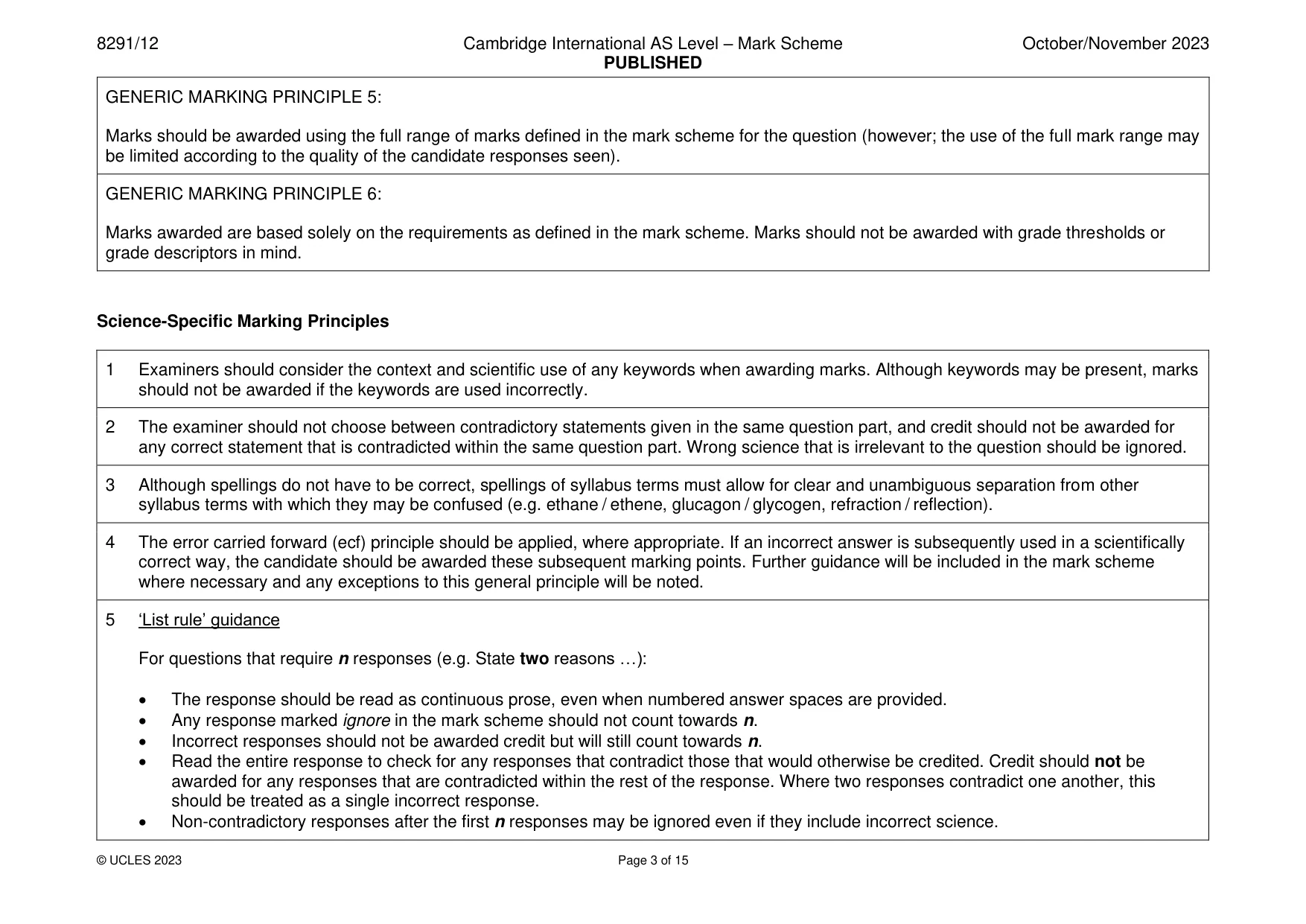
This document consists of 15 printed pages. © UCLES 2023 [Turn over Cambridge International AS Level ENVIRONMENTAL MANAGEMENT 8291/12 Paper 1 Principles of Environmental Management October/November 2023 MARK SCHEME Maximum Mark: 80 Published This mark scheme is published as an aid to teachers and candidates, to indicate the requirements of the examination. It shows the basis on which Examiners were instructed to award marks. It does not indicate the details of the discussions that took place at an Examiners’ meeting before marking began, which would have considered the acceptability of alternative answers. Mark schemes should be read in conjunction with the question paper and the Principal Examiner Report for Teachers. Cambridge International will not enter into discussions about these mark schemes. Cambridge International is publishing the mark schemes for the October/November 2023 series for most Cambridge IGCSE, Cambridge International A and AS Level components, and some Cambridge O Level components.
Mark scheme, page 2
8291/12 Cambridge International AS Level – Mark Scheme PUBLISHED October/November 2023 © UCLES 2023 Page 2 of 15 Generic Marking Principles These general marking principles must be applied by all examiners when marking candidate answers. They should be applied alongside the specific content of the mark scheme or generic level descriptors for a question. Each question paper and mark scheme will also comply with these marking principles. GENERIC MARKING PRINCIPLE 1: Marks must be awarded in line with: • the specific content of the mark scheme or the generic level descriptors for the question • the specific skills defined in the mark scheme or in the generic level descriptors for the question • the standard of response required by a candidate as exemplified by the standardisation scripts. GENERIC MARKING PRINCIPLE 2: Marks awarded are always whole marks (not half marks, or other fractions). GENERIC MARKING PRINCIPLE 3: Marks must be awarded positively: • marks are awarded for correct/valid answers, as defined in the mark scheme. However, credit is given for valid answers which go beyond the scope of the syllabus and mark scheme, referring to your Team Leader as appropriate • marks are awarded when candidates clearly demonstrate what they know and can do • marks are not deducted for errors • marks are not deducted for omissions • answers should only be judged on the quality of spelling, punctuation and grammar when these features are specifically assessed by the question as indicated by the mark scheme. The meaning, however, should be unambiguous. GENERIC MARKING PRINCIPLE 4: Rules must be applied consistently, e.g. in situations where candidates have not followed instructions or in the application of generic level descriptors.
Mark scheme, page 3
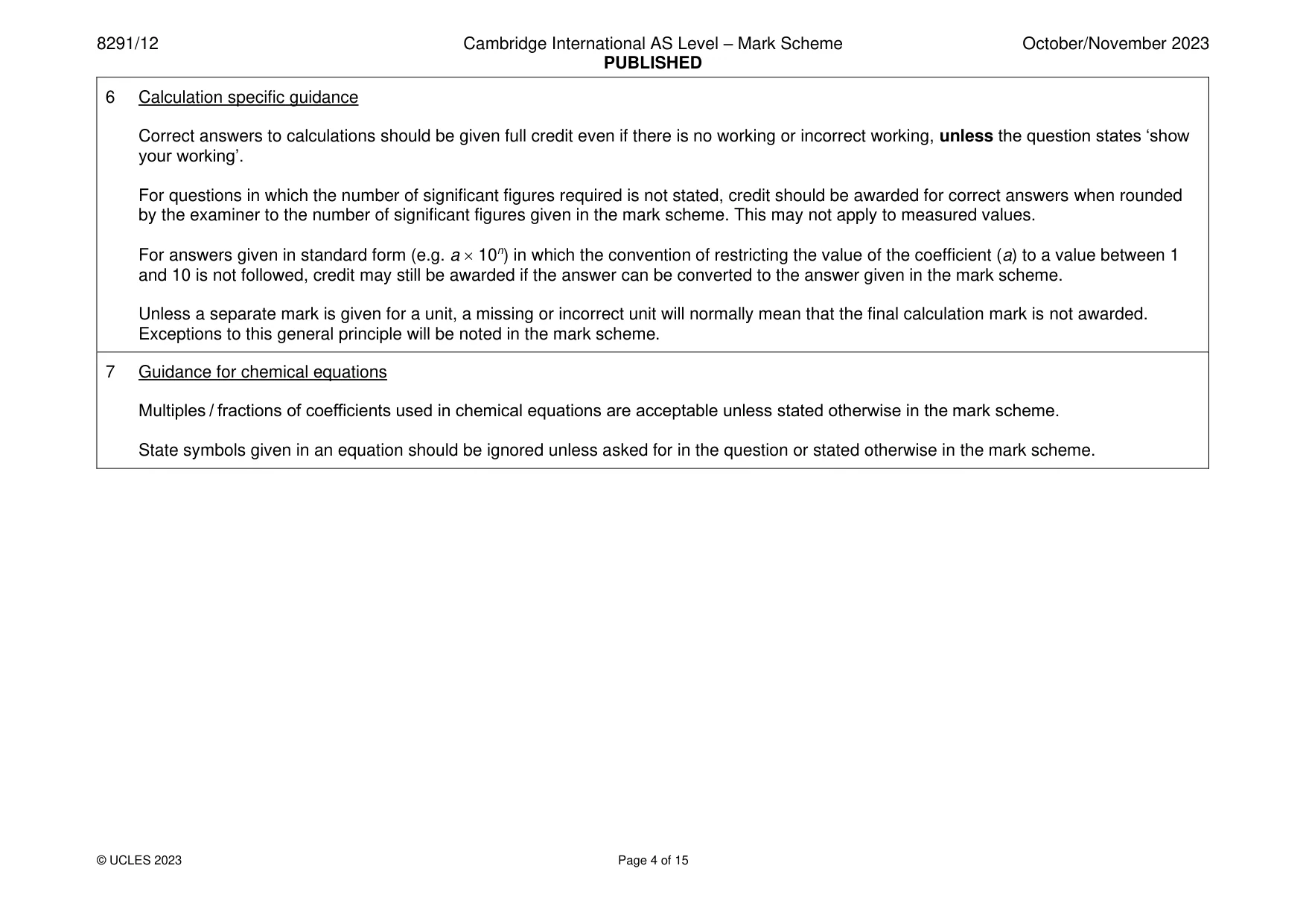
8291/12 Cambridge International AS Level – Mark Scheme PUBLISHED October/November 2023 © UCLES 2023 Page 3 of 15 GENERIC MARKING PRINCIPLE 5: Marks should be awarded using the full range of marks defined in the mark scheme for the question (however; the use of the full mark range may be limited according to the quality of the candidate responses seen). GENERIC MARKING PRINCIPLE 6: Marks awarded are based solely on the requirements as defined in the mark scheme. Marks should not be awarded with grade thresholds or grade descriptors in mind. Science-Specific Marking Principles 1 Examiners should consider the context and scientific use of any keywords when awarding marks. Although keywords may be present, marks should not be awarded if the keywords are used incorrectly. 2 The examiner should not choose between contradictory statements given in the same question part, and credit should not be awarded for any correct statement that is contradicted within the same question part. Wrong science that is irrelevant to the question should be ignored. 3 Although spellings do not have to be correct, spellings of syllabus terms must allow for clear and unambiguous separation from other syllabus terms with which they may be confused (e.g. ethane / ethene, glucagon / glycogen, refraction / reflection). 4 The error carried forward (ecf) principle should be applied, where appropriate. If an incorrect answer is subsequently used in a scientifically correct way, the candidate should be awarded these subsequent marking points. Further guidance will be included in the mark scheme where necessary and any exceptions to this general principle will be noted. 5 ‘List rule’ guidance For questions that require n responses (e.g. State two reasons …): • The response should be read as continuous prose, even when numbered answer spaces are provided. • Any response marked ignore in the mark scheme should not count towards n. • Incorrect responses should not be awarded credit but will still count towards n. • Read the entire response to check for any responses that contradict those that would otherwise be credited. Credit should not be awarded for any responses that are contradicted within the rest of the response. Where two responses contradict one another, this should be treated as a single incorrect response. • Non-contradictory responses after the first n responses may be ignored even if they include incorrect science.
Mark scheme, page 4
8291/12 Cambridge International AS Level – Mark Scheme PUBLISHED October/November 2023 © UCLES 2023 Page 4 of 15 6 Calculation specific guidance Correct answers to calculations should be given full credit even if there is no working or incorrect working, unless the question states ‘show your working’. For questions in which the number of significant figures required is not stated, credit should be awarded for correct answers when rounded by the examiner to the number of significant figures given in the mark scheme. This may not apply to measured values. For answers given in standard form (e.g. a 10n) in which the convention of restricting the value of the coefficient (a) to a value between 1 and 10 is not followed, credit may still be awarded if the answer can be converted to the answer given in the mark scheme. Unless a separate mark is given for a unit, a missing or incorrect unit will normally mean that the final calculation mark is not awarded. Exceptions to this general principle will be noted in the mark scheme. 7 Guidance for chemical equations Multiples / fractions of coefficients used in chemical equations are acceptable unless stated otherwise in the mark scheme. State symbols given in an equation should be ignored unless asked for in the question or stated otherwise in the mark scheme.
Mark scheme, page 5
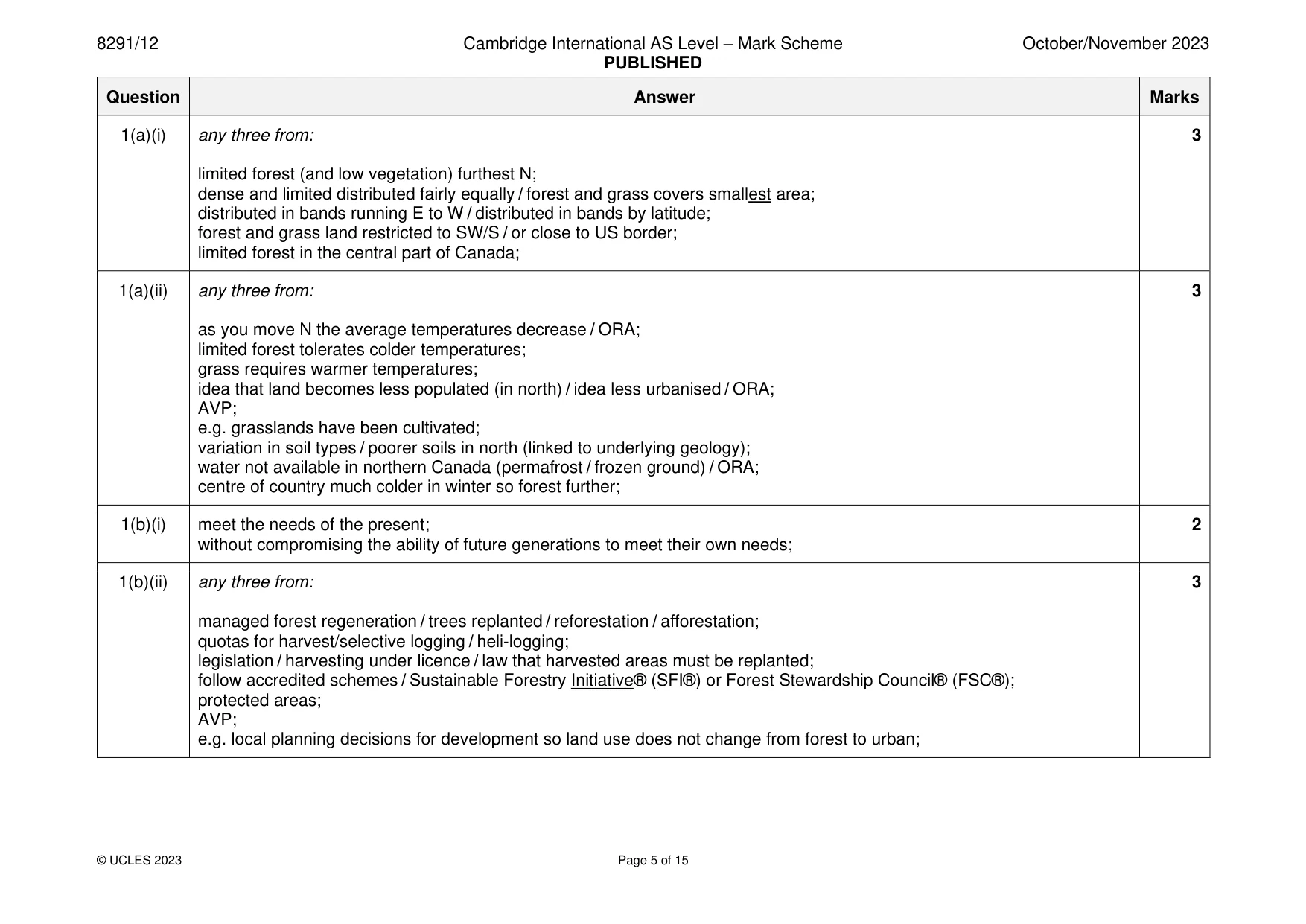
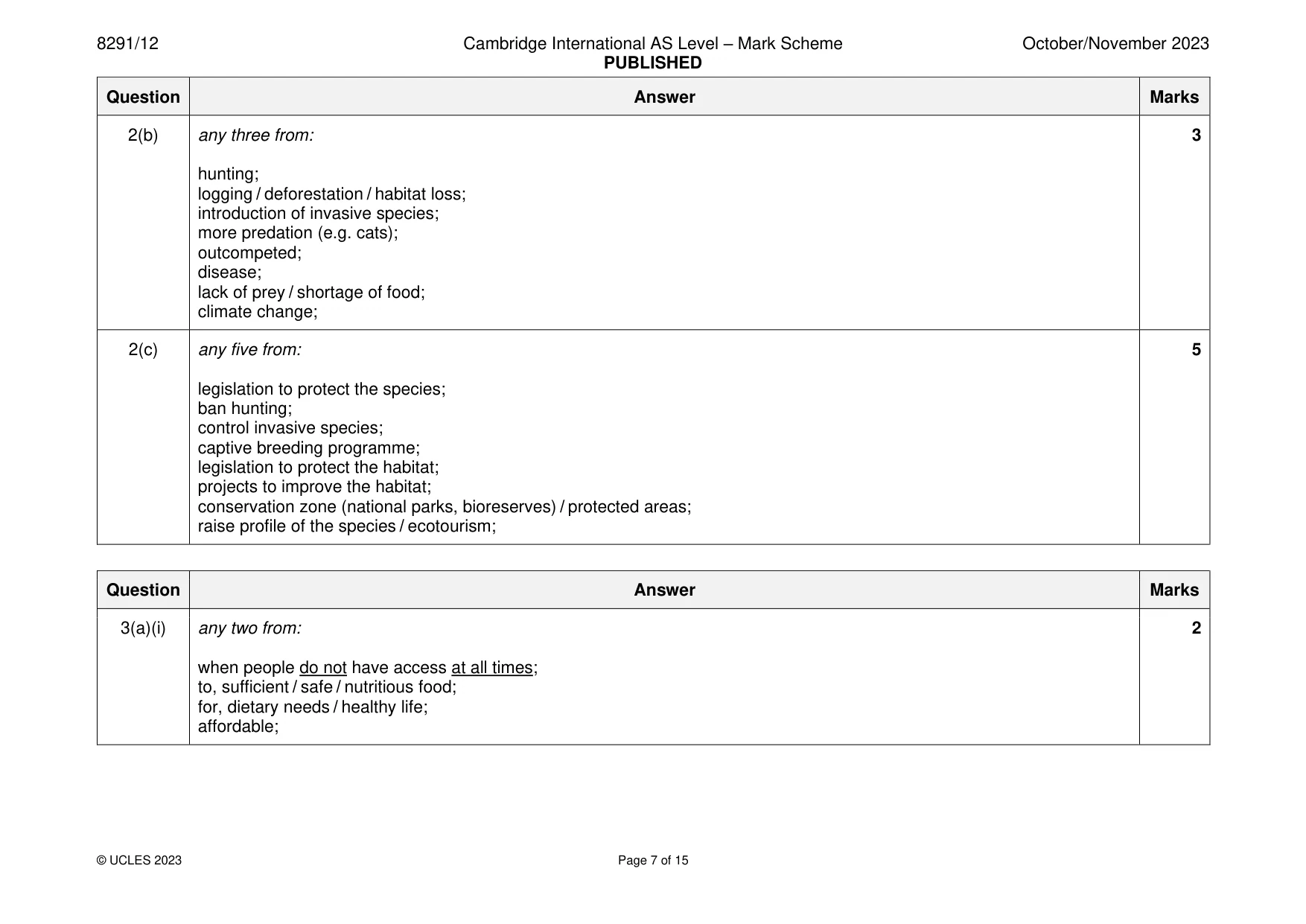
8291/12 Cambridge International AS Level – Mark Scheme PUBLISHED October/November 2023 © UCLES 2023 Page 5 of 15 Question Answer Marks 1(a)(i) any three from: limited forest (and low vegetation) furthest N; dense and limited distributed fairly equally / forest and grass covers smallest area; distributed in bands running E to W / distributed in bands by latitude; forest and grass land restricted to SW/S / or close to US border; limited forest in the central part of Canada; 3 1(a)(ii) any three from: as you move N the average temperatures decrease / ORA; limited forest tolerates colder temperatures; grass requires warmer temperatures; idea that land becomes less populated (in north) / idea less urbanised / ORA; AVP; e.g. grasslands have been cultivated; variation in soil types / poorer soils in north (linked to underlying geology); water not available in northern Canada (permafrost / frozen ground) / ORA; centre of country much colder in winter so forest further; 3 1(b)(i) meet the needs of the present; without compromising the ability of future generations to meet their own needs; 2 1(b)(ii) any three from: managed forest regeneration / trees replanted / reforestation / afforestation; quotas for harvest/selective logging / heli-logging; legislation / harvesting under licence / law that harvested areas must be replanted; follow accredited schemes / Sustainable Forestry Initiative® (SFI®) or Forest Stewardship Council® (FSC®); protected areas; AVP; e.g. local planning decisions for development so land use does not change from forest to urban; 3
Mark scheme, page 6
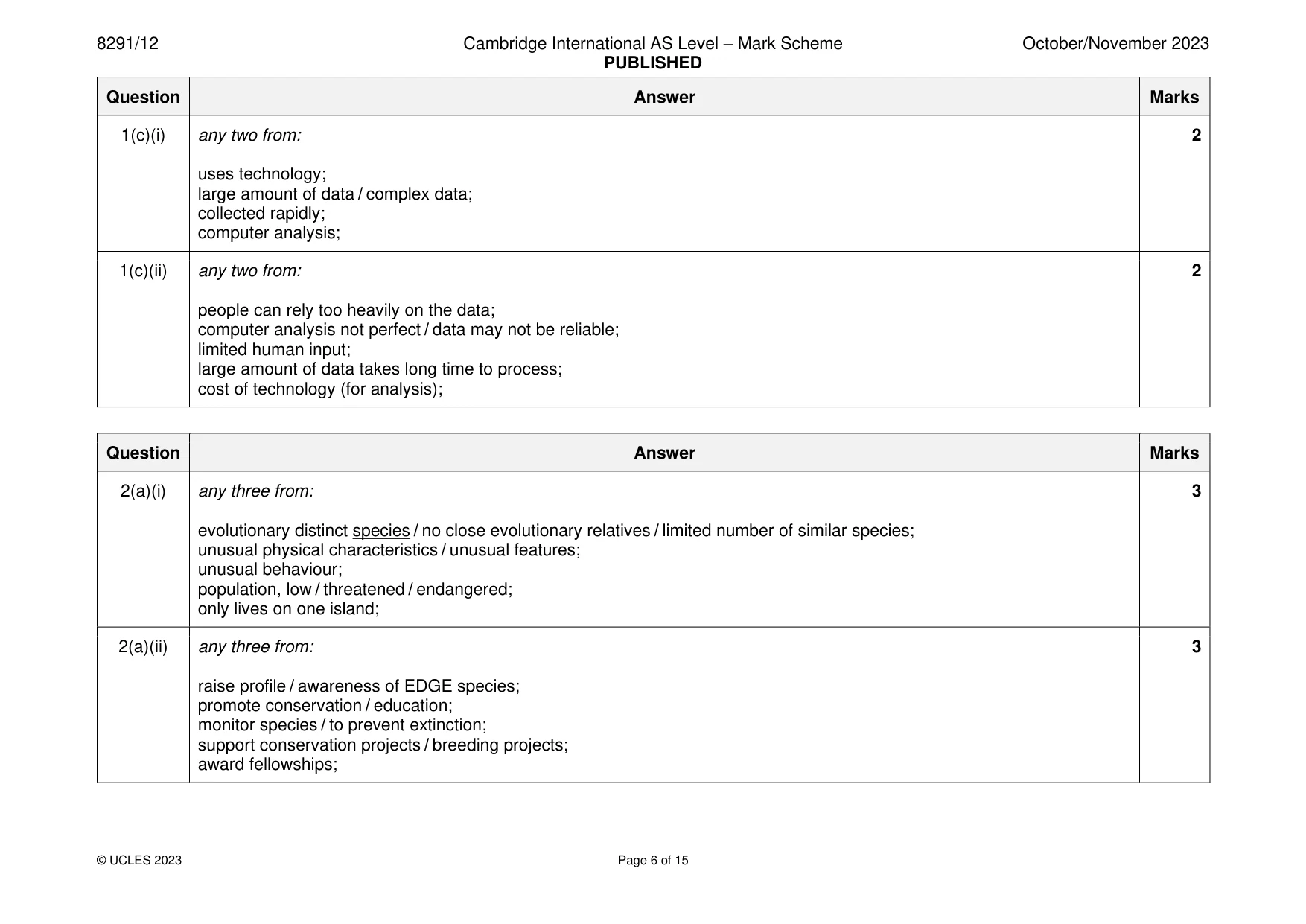
8291/12 Cambridge International AS Level – Mark Scheme PUBLISHED October/November 2023 © UCLES 2023 Page 6 of 15 Question Answer Marks 1(c)(i) any two from: uses technology; large amount of data / complex data; collected rapidly; computer analysis; 2 1(c)(ii) any two from: people can rely too heavily on the data; computer analysis not perfect / data may not be reliable; limited human input; large amount of data takes long time to process; cost of technology (for analysis); 2 Question Answer Marks 2(a)(i) any three from: evolutionary distinct species / no close evolutionary relatives / limited number of similar species; unusual physical characteristics / unusual features; unusual behaviour; population, low / threatened / endangered; only lives on one island; 3 2(a)(ii) any three from: raise profile / awareness of EDGE species; promote conservation / education; monitor species / to prevent extinction; support conservation projects / breeding projects; award fellowships; 3
Mark scheme, page 7
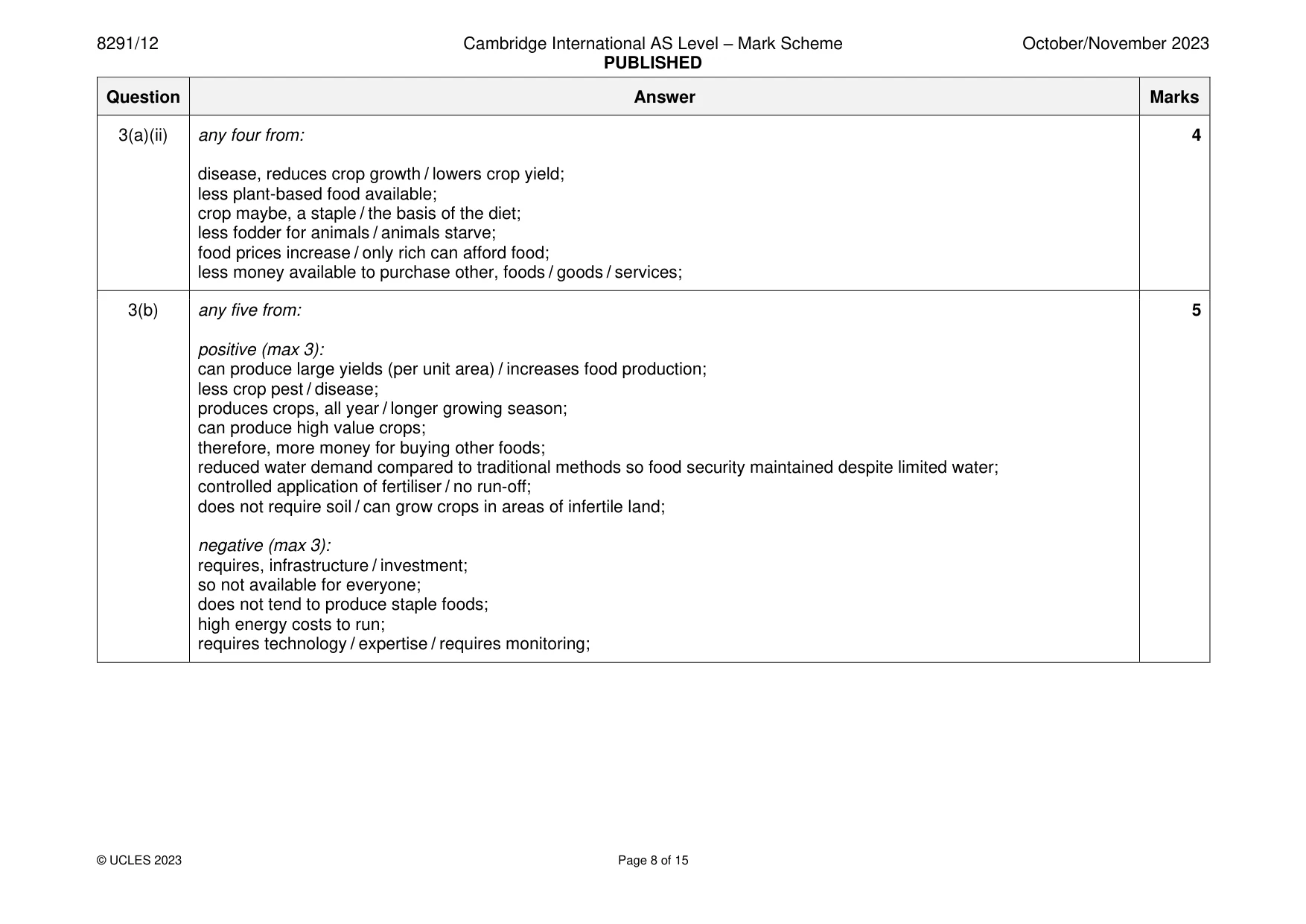
8291/12 Cambridge International AS Level – Mark Scheme PUBLISHED October/November 2023 © UCLES 2023 Page 7 of 15 Question Answer Marks 2(b) any three from: hunting; logging / deforestation / habitat loss; introduction of invasive species; more predation (e.g. cats); outcompeted; disease; lack of prey / shortage of food; climate change; 3 2(c) any five from: legislation to protect the species; ban hunting; control invasive species; captive breeding programme; legislation to protect the habitat; projects to improve the habitat; conservation zone (national parks, bioreserves) / protected areas; raise profile of the species / ecotourism; 5 Question Answer Marks 3(a)(i) any two from: when people do not have access at all times; to, sufficient / safe / nutritious food; for, dietary needs / healthy life; affordable; 2
Mark scheme, page 8
8291/12 Cambridge International AS Level – Mark Scheme PUBLISHED October/November 2023 © UCLES 2023 Page 8 of 15 Question Answer Marks 3(a)(ii) any four from: disease, reduces crop growth / lowers crop yield; less plant-based food available; crop maybe, a staple / the basis of the diet; less fodder for animals / animals starve; food prices increase / only rich can afford food; less money available to purchase other, foods / goods / services; 4 3(b) any five from: positive (max 3): can produce large yields (per unit area) / increases food production; less crop pest / disease; produces crops, all year / longer growing season; can produce high value crops; therefore, more money for buying other foods; reduced water demand compared to traditional methods so food security maintained despite limited water; controlled application of fertiliser / no run-off; does not require soil / can grow crops in areas of infertile land; negative (max 3): requires, infrastructure / investment; so not available for everyone; does not tend to produce staple foods; high energy costs to run; requires technology / expertise / requires monitoring; 5
Mark scheme, page 9
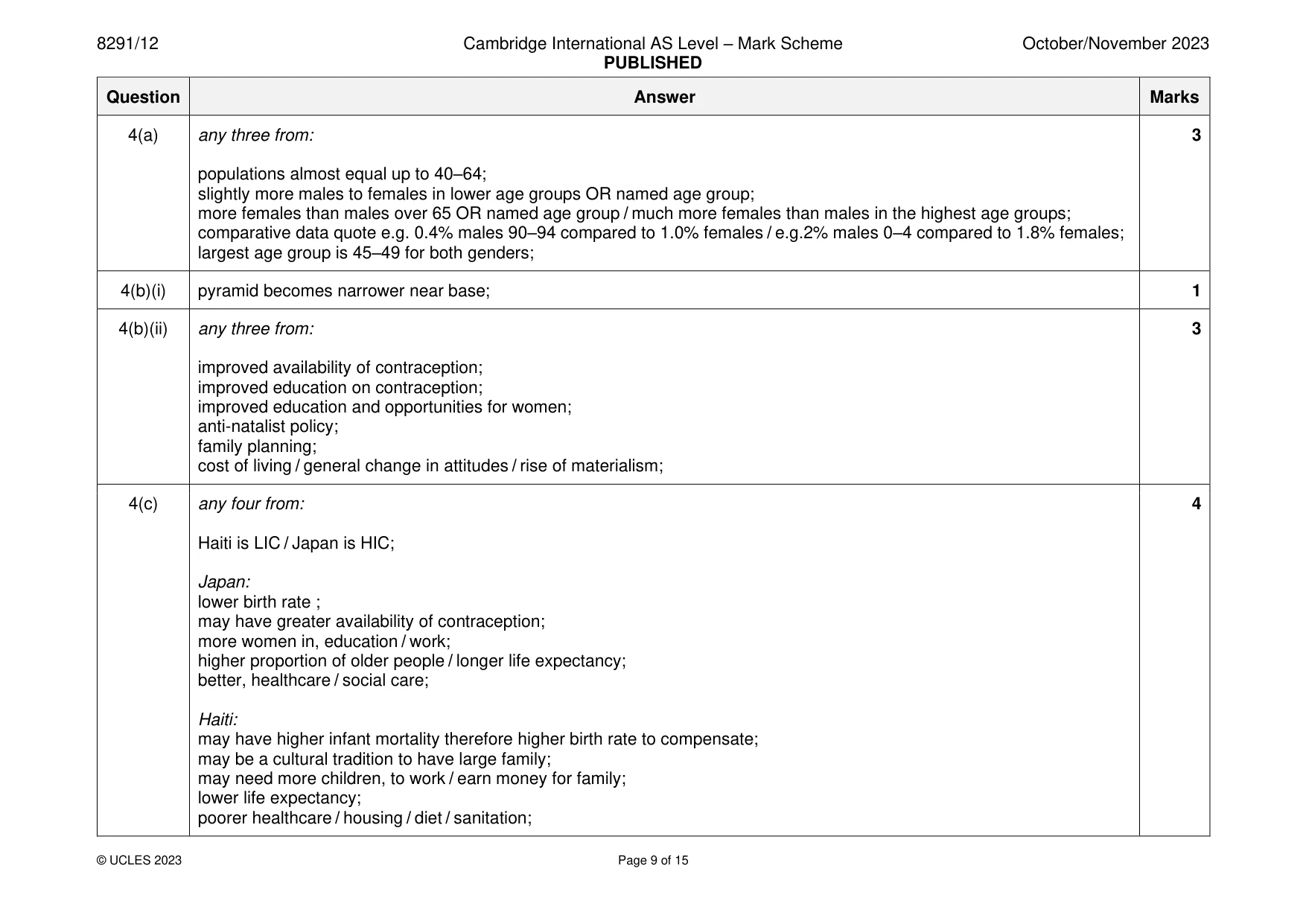
8291/12 Cambridge International AS Level – Mark Scheme PUBLISHED October/November 2023 © UCLES 2023 Page 9 of 15 Question Answer Marks 4(a) any three from: populations almost equal up to 40–64; slightly more males to females in lower age groups OR named age group; more females than males over 65 OR named age group / much more females than males in the highest age groups; comparative data quote e.g. 0.4% males 90–94 compared to 1.0% females / e.g.2% males 0–4 compared to 1.8% females; largest age group is 45–49 for both genders; 3 4(b)(i) pyramid becomes narrower near base; 1 4(b)(ii) any three from: improved availability of contraception; improved education on contraception; improved education and opportunities for women; anti-natalist policy; family planning; cost of living / general change in attitudes / rise of materialism; 3 4(c) any four from: Haiti is LIC / Japan is HIC; Japan: lower birth rate ; may have greater availability of contraception; more women in, education / work; higher proportion of older people / longer life expectancy; better, healthcare / social care; Haiti: may have higher infant mortality therefore higher birth rate to compensate; may be a cultural tradition to have large family; may need more children, to work / earn money for family; lower life expectancy; poorer healthcare / housing / diet / sanitation; 4
Mark scheme, page 10
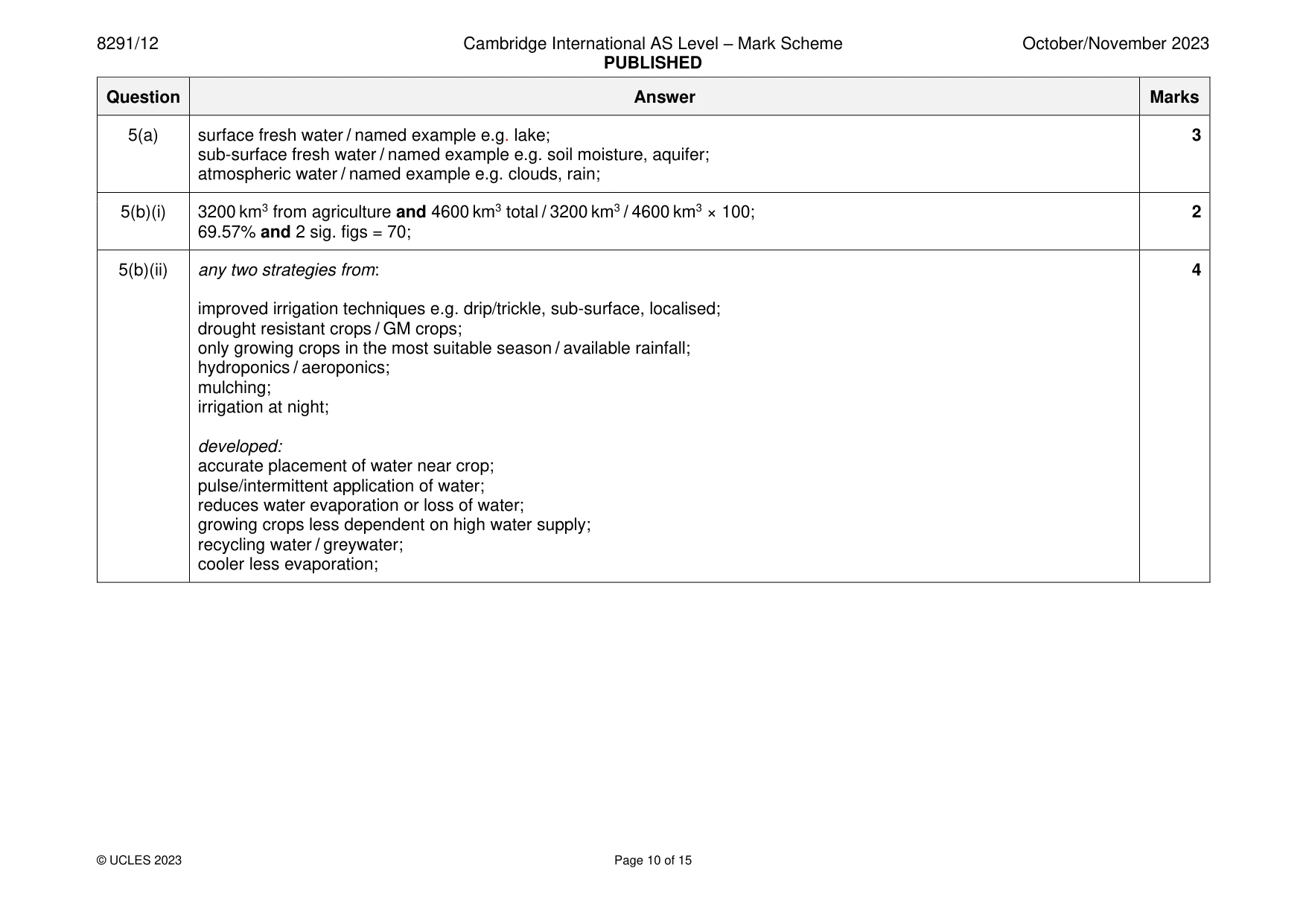
8291/12 Cambridge International AS Level – Mark Scheme PUBLISHED October/November 2023 © UCLES 2023 Page 10 of 15 Question Answer Marks 5(a) surface fresh water / named example e.g. lake; sub-surface fresh water / named example e.g. soil moisture, aquifer; atmospheric water / named example e.g. clouds, rain; 3 5(b)(i) 3200 km3 from agriculture and 4600 km3 total / 3200 km3 / 4600 km3 × 100; 69.57% and 2 sig. figs = 70; 2 5(b)(ii) any two strategies from: improved irrigation techniques e.g. drip/trickle, sub-surface, localised; drought resistant crops / GM crops; only growing crops in the most suitable season / available rainfall; hydroponics / aeroponics; mulching; irrigation at night; developed: accurate placement of water near crop; pulse/intermittent application of water; reduces water evaporation or loss of water; growing crops less dependent on high water supply; recycling water / greywater; cooler less evaporation; 4
Mark scheme, page 11
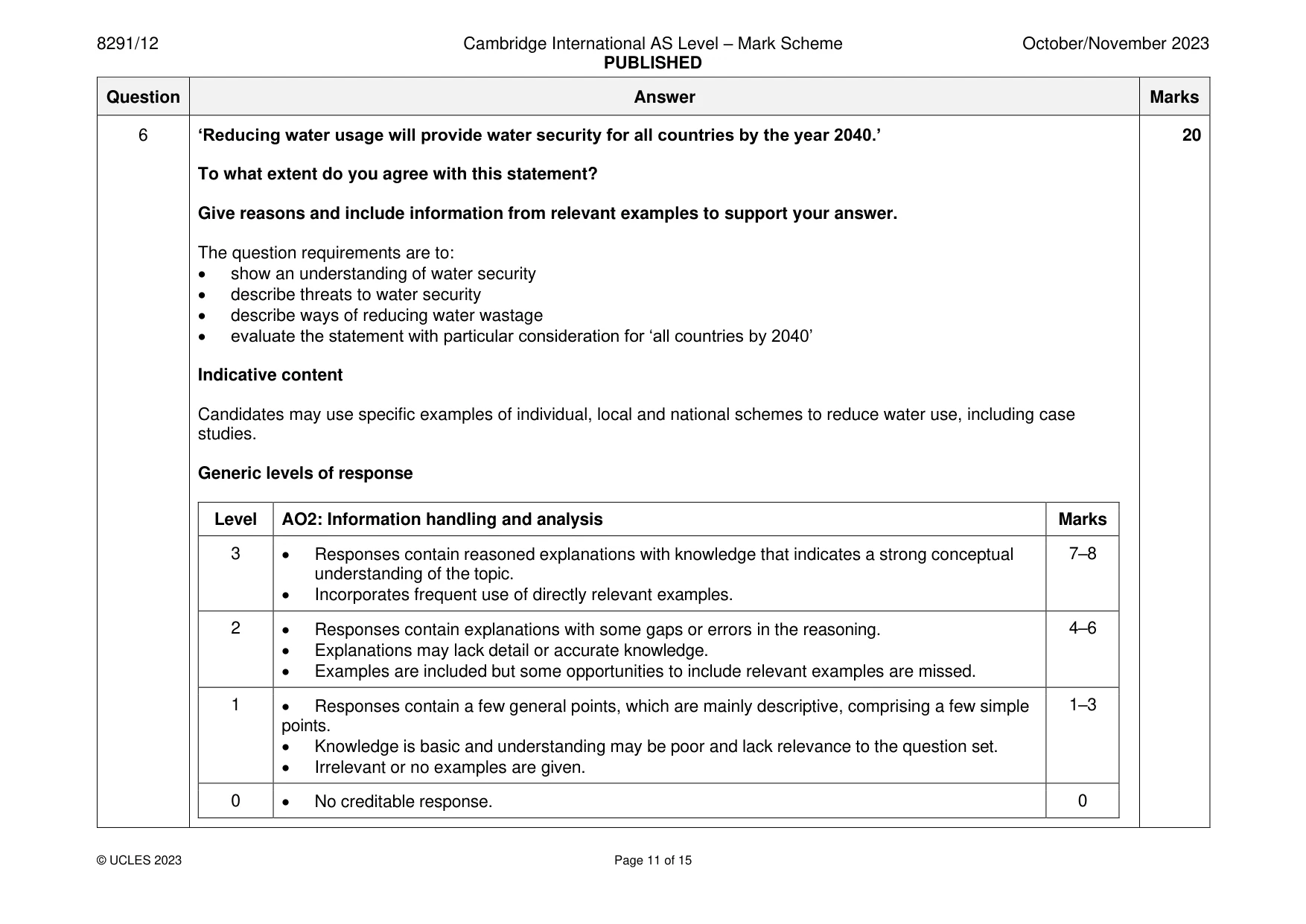
8291/12 Cambridge International AS Level – Mark Scheme PUBLISHED October/November 2023 © UCLES 2023 Page 11 of 15 Question Answer Marks 6 ‘Reducing water usage will provide water security for all countries by the year 2040.’ To what extent do you agree with this statement? Give reasons and include information from relevant examples to support your answer. The question requirements are to: • show an understanding of water security • describe threats to water security • describe ways of reducing water wastage • evaluate the statement with particular consideration for ‘all countries by 2040’ Indicative content Candidates may use specific examples of individual, local and national schemes to reduce water use, including case studies. Generic levels of response Level AO2: Information handling and analysis Marks 3 • Responses contain reasoned explanations with knowledge that indicates a strong conceptual understanding of the topic. • Incorporates frequent use of directly relevant examples. 7–8 2 • Responses contain explanations with some gaps or errors in the reasoning. • Explanations may lack detail or accurate knowledge. • Examples are included but some opportunities to include relevant examples are missed. 4–6 1 • Responses contain a few general points, which are mainly descriptive, comprising a few simple points. • Knowledge is basic and understanding may be poor and lack relevance to the question set. • Irrelevant or no examples are given. 1–3 0 • No creditable response. 0 20
Mark scheme, page 12
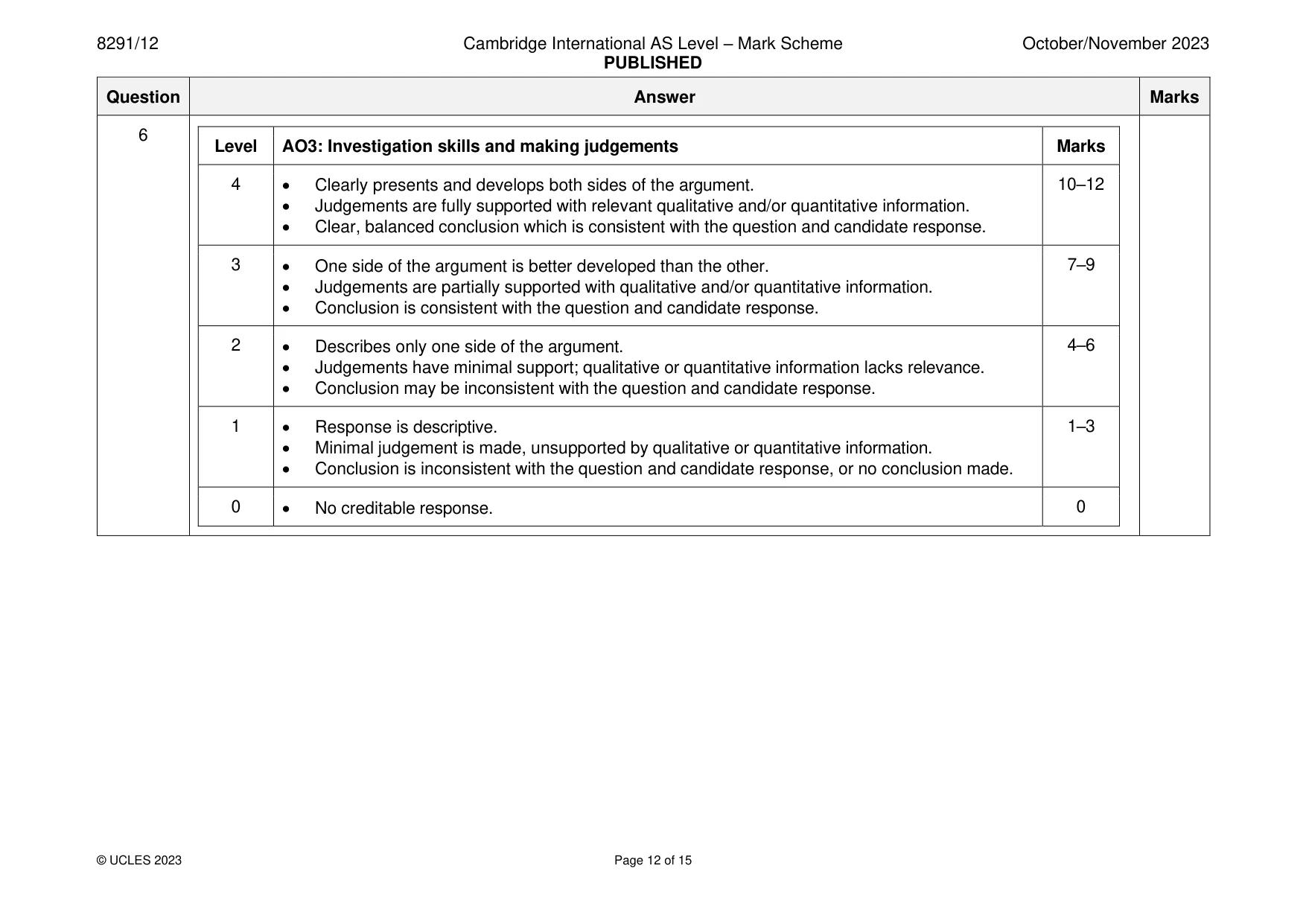
8291/12 Cambridge International AS Level – Mark Scheme PUBLISHED October/November 2023 © UCLES 2023 Page 12 of 15 Question Answer Marks 6 Level AO3: Investigation skills and making judgements Marks 4 • Clearly presents and develops both sides of the argument. • Judgements are fully supported with relevant qualitative and/or quantitative information. • Clear, balanced conclusion which is consistent with the question and candidate response. 10–12 3 • One side of the argument is better developed than the other. • Judgements are partially supported with qualitative and/or quantitative information. • Conclusion is consistent with the question and candidate response. 7–9 2 • Describes only one side of the argument. • Judgements have minimal support; qualitative or quantitative information lacks relevance. • Conclusion may be inconsistent with the question and candidate response. 4–6 1 • Response is descriptive. • Minimal judgement is made, unsupported by qualitative or quantitative information. • Conclusion is inconsistent with the question and candidate response, or no conclusion made. 1–3 0 • No creditable response. 0
Mark scheme, page 13
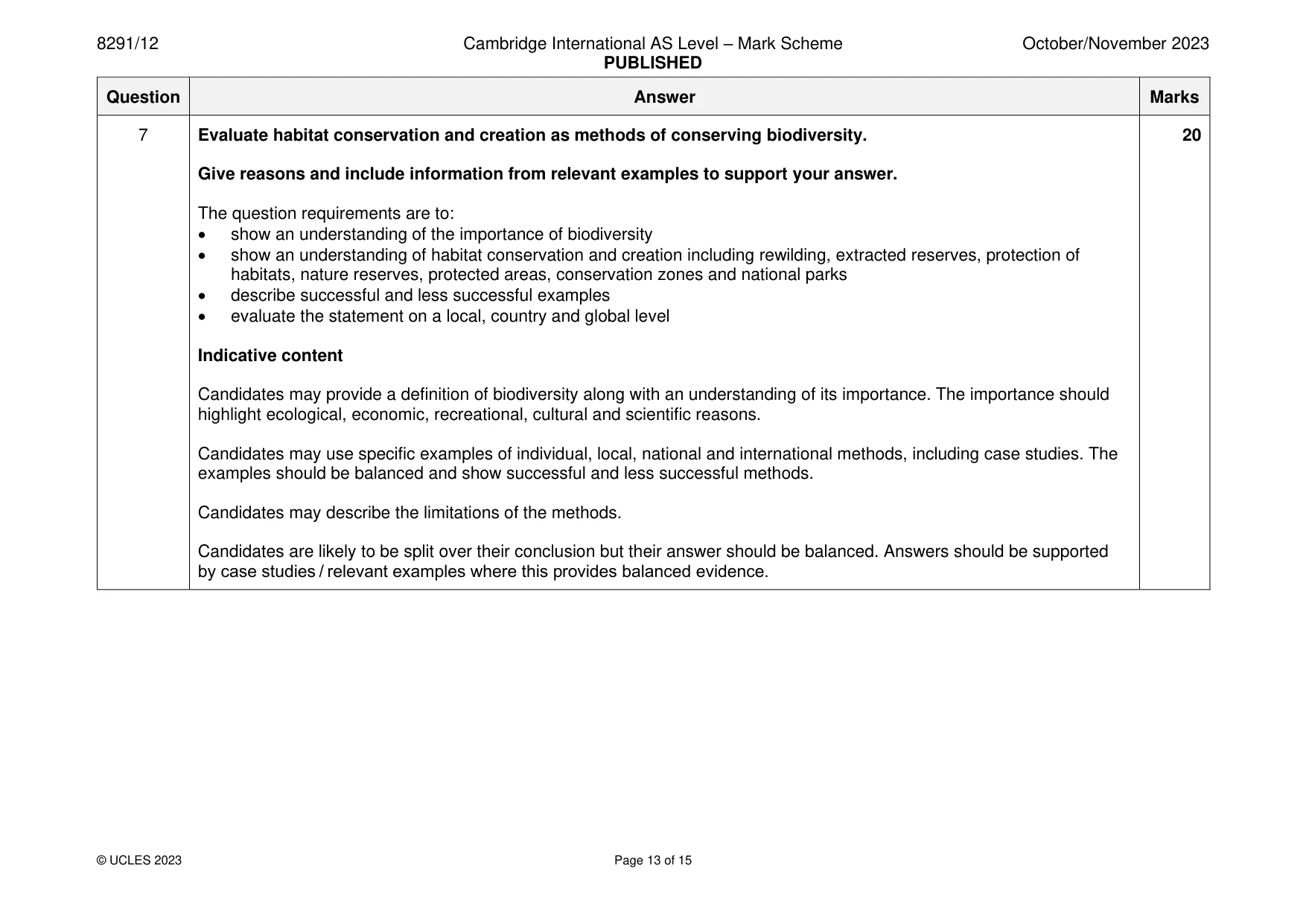
8291/12 Cambridge International AS Level – Mark Scheme PUBLISHED October/November 2023 © UCLES 2023 Page 13 of 15 Question Answer Marks 7 Evaluate habitat conservation and creation as methods of conserving biodiversity. Give reasons and include information from relevant examples to support your answer. The question requirements are to: • show an understanding of the importance of biodiversity • show an understanding of habitat conservation and creation including rewilding, extracted reserves, protection of habitats, nature reserves, protected areas, conservation zones and national parks • describe successful and less successful examples • evaluate the statement on a local, country and global level Indicative content Candidates may provide a definition of biodiversity along with an understanding of its importance. The importance should highlight ecological, economic, recreational, cultural and scientific reasons. Candidates may use specific examples of individual, local, national and international methods, including case studies. The examples should be balanced and show successful and less successful methods. Candidates may describe the limitations of the methods. Candidates are likely to be split over their conclusion but their answer should be balanced. Answers should be supported by case studies / relevant examples where this provides balanced evidence. 20
Mark scheme, page 14
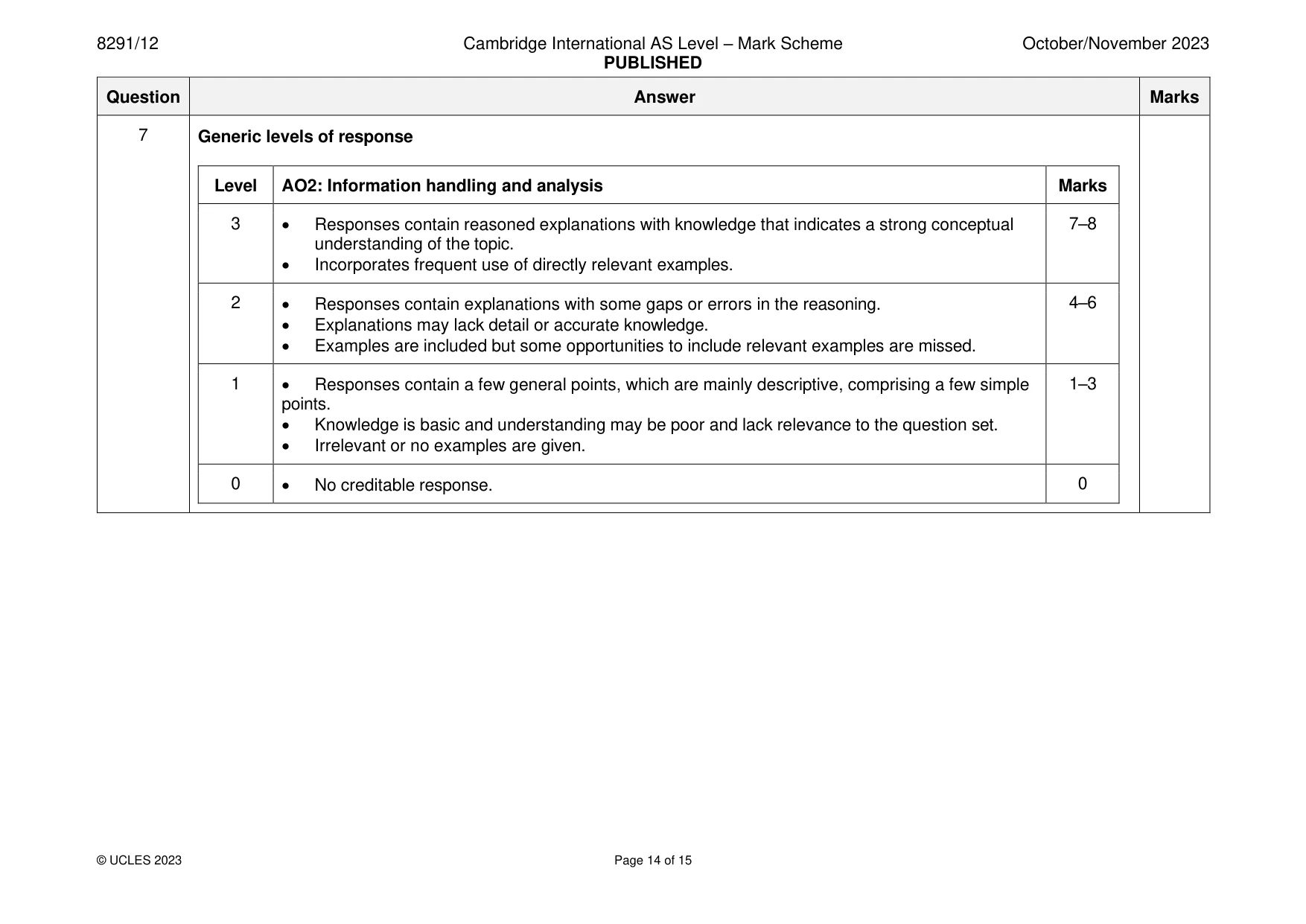
8291/12 Cambridge International AS Level – Mark Scheme PUBLISHED October/November 2023 © UCLES 2023 Page 14 of 15 Question Answer Marks 7 Generic levels of response Level AO2: Information handling and analysis Marks 3 • Responses contain reasoned explanations with knowledge that indicates a strong conceptual understanding of the topic. • Incorporates frequent use of directly relevant examples. 7–8 2 • Responses contain explanations with some gaps or errors in the reasoning. • Explanations may lack detail or accurate knowledge. • Examples are included but some opportunities to include relevant examples are missed. 4–6 1 • Responses contain a few general points, which are mainly descriptive, comprising a few simple points. • Knowledge is basic and understanding may be poor and lack relevance to the question set. • Irrelevant or no examples are given. 1–3 0 • No creditable response. 0
Mark scheme, page 15
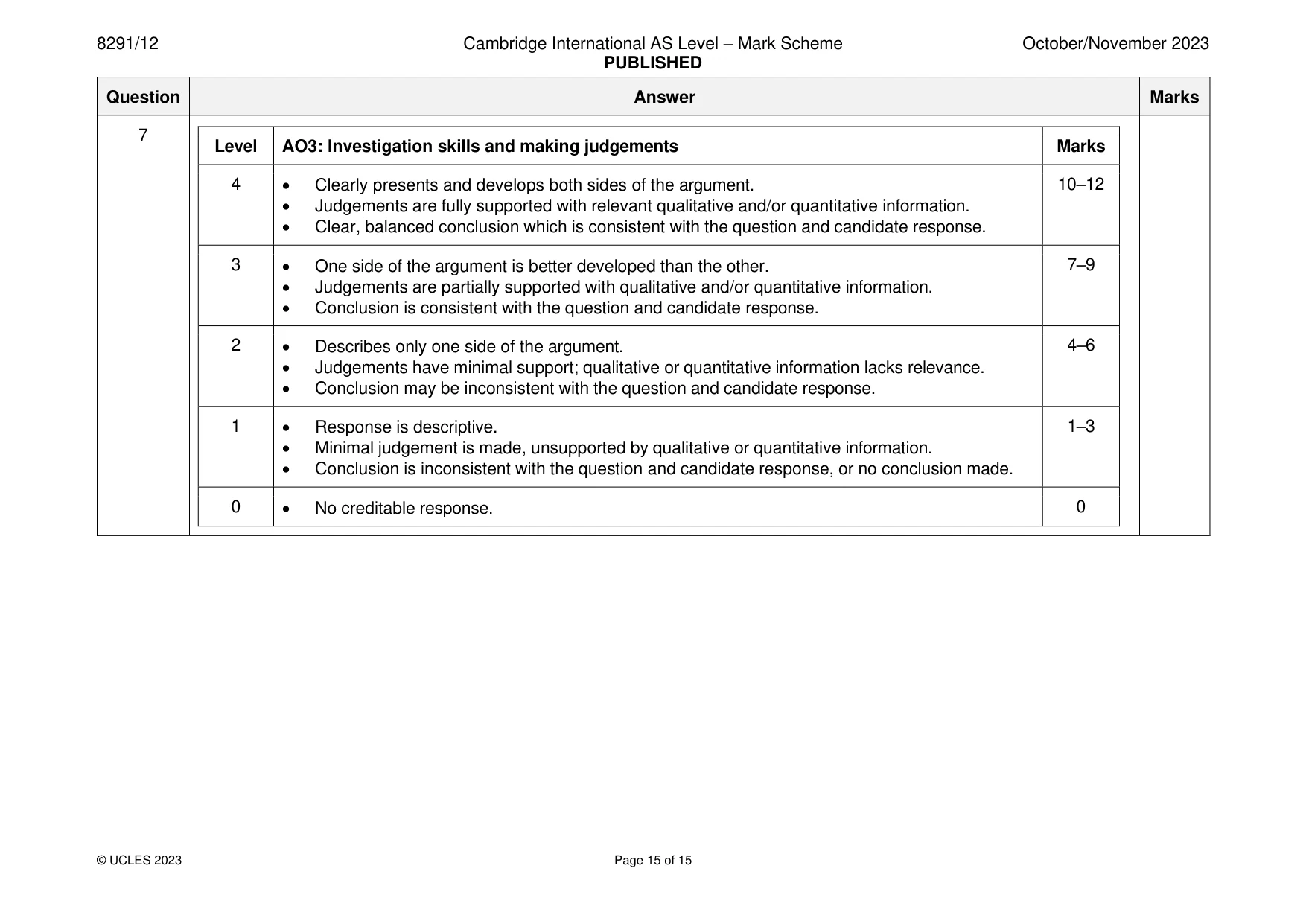
8291/12 Cambridge International AS Level – Mark Scheme PUBLISHED October/November 2023 © UCLES 2023 Page 15 of 15 Question Answer Marks 7 Level AO3: Investigation skills and making judgements Marks 4 • Clearly presents and develops both sides of the argument. • Judgements are fully supported with relevant qualitative and/or quantitative information. • Clear, balanced conclusion which is consistent with the question and candidate response. 10–12 3 • One side of the argument is better developed than the other. • Judgements are partially supported with qualitative and/or quantitative information. • Conclusion is consistent with the question and candidate response. 7–9 2 • Describes only one side of the argument. • Judgements have minimal support; qualitative or quantitative information lacks relevance. • Conclusion may be inconsistent with the question and candidate response. 4–6 1 • Response is descriptive. • Minimal judgement is made, unsupported by qualitative or quantitative information. • Conclusion is inconsistent with the question and candidate response, or no conclusion made. 1–3 0 • No creditable response. 0
What you needed in this session
Cambridge’s own grade thresholds for 2023 Oct/Nov, Paper 1 · Variant 2. A higher threshold means an easier paper — the bar moves with how the cohort did.