Cambridge A Level Environmental Management (AS only) 8291 — 2023 May/June Paper 1 · Variant 2
8291/12/M/J/23 · 80 marks · ≈90 min
The question paper and its mark scheme, free to read here and free to download. This is Cambridge’s own paper, exactly as it was sat.
Question paper20 pages





Mark scheme18 pages
Answers below. Sit the paper first if you are practising.
Paper as text
Question paper, page 1
This document has 20 pages. [Turn over Cambridge International AS Level DC (CE/CGW) 317055/1 © UCLES 2023 * 4 2 0 0 6 4 5 6 5 5 * ENVIRONMENTAL MANAGEMENT 8291/12 Paper 1 Principles of Environmental Management May/June 2023 1 hour 45 minutes You must answer on the question paper. No additional materials are needed. INSTRUCTIONS ● Section A: answer all questions. ● Section B: answer one question. ● Use a black or dark blue pen. You may use an HB pencil for any diagrams or graphs. ● Write your name, centre number and candidate number in the boxes at the top of the page. ● Write your answer to each question in the space provided. ● Do not use an erasable pen or correction fluid. ● Do not write on any bar codes. ● You may use a calculator. ● You should show all your working and use appropriate units. INFORMATION ● The total mark for this paper is 80. ● The number of marks for each question or part question is shown in brackets [ ].
Question paper, page 2
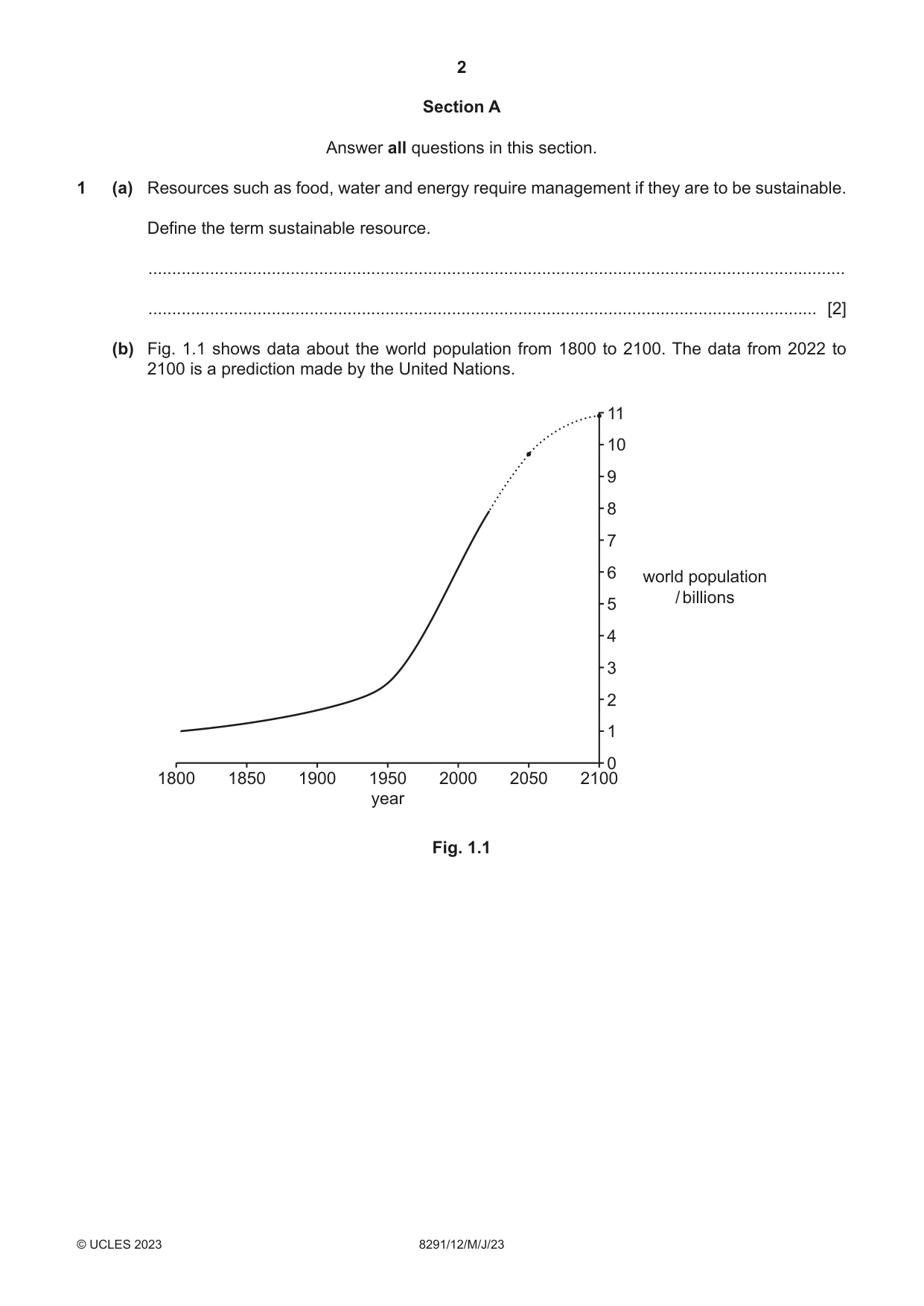
2 8291/12/M/J/23 © UCLES 2023 Section A Answer all questions in this section. 1 (a) Resources such as food, water and energy require management if they are to be sustainable. Define the term sustainable resource. … … [2] (b) Fig. 1.1 shows data about the world population from 1800 to 2100. The data from 2022 to 2100 is a prediction made by the United Nations. 1800 1850 1900 1950 year world population / billions 2000 2100 0 1 2 3 4 5 6 7 8 9 10 11 2050 Fig. 1.1
Question paper, page 3
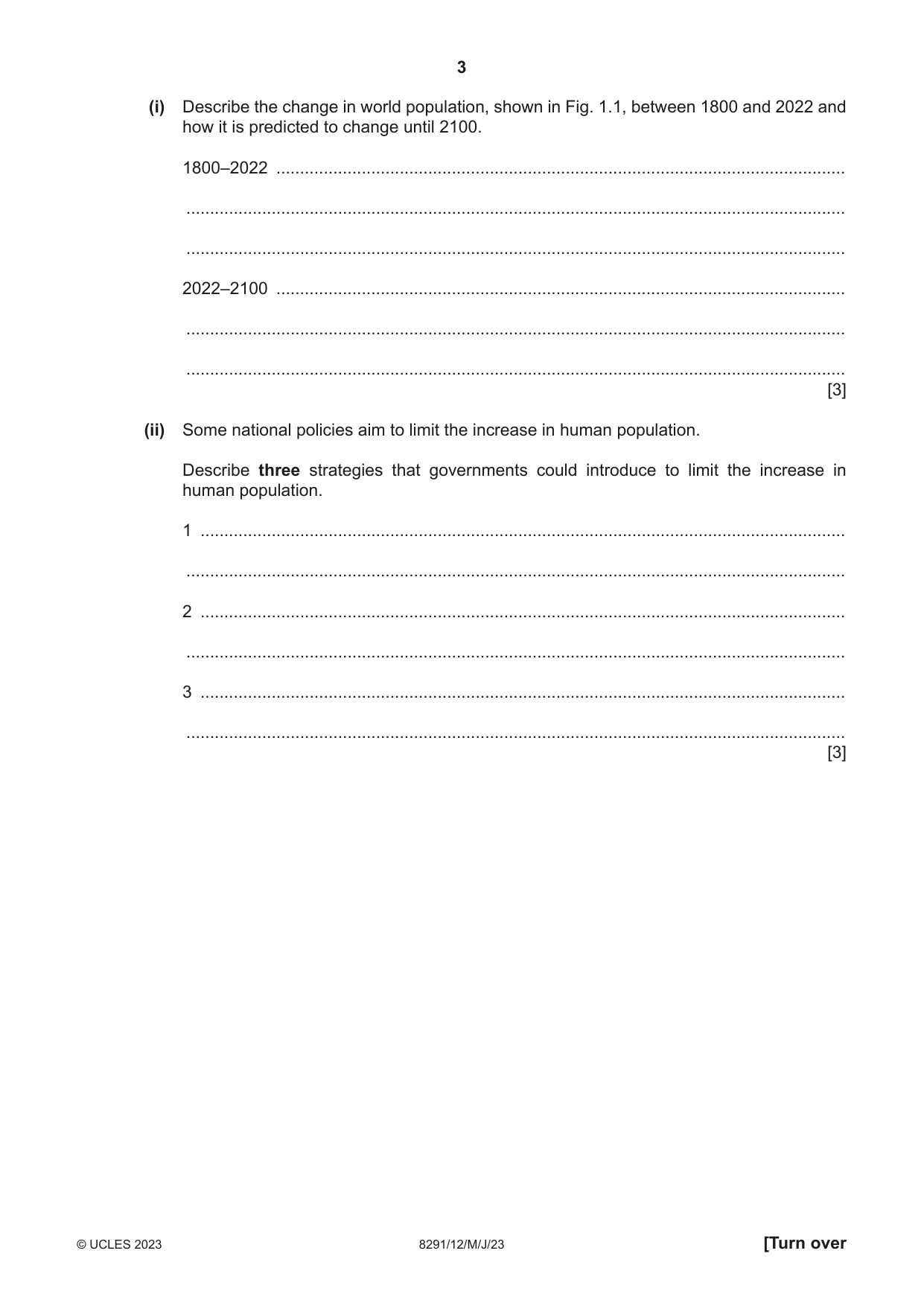
3 8291/12/M/J/23 © UCLES 2023 [Turn over (i) Describe the change in world population, shown in Fig. 1.1, between 1800 and 2022 and how it is predicted to change until 2100. 1800–2022 … … … 2022–2100 … … … [3] (ii) Some national policies aim to limit the increase in human population. Describe three strategies that governments could introduce to limit the increase in human population. 1 … … 2 … … 3 … … [3]
Question paper, page 4
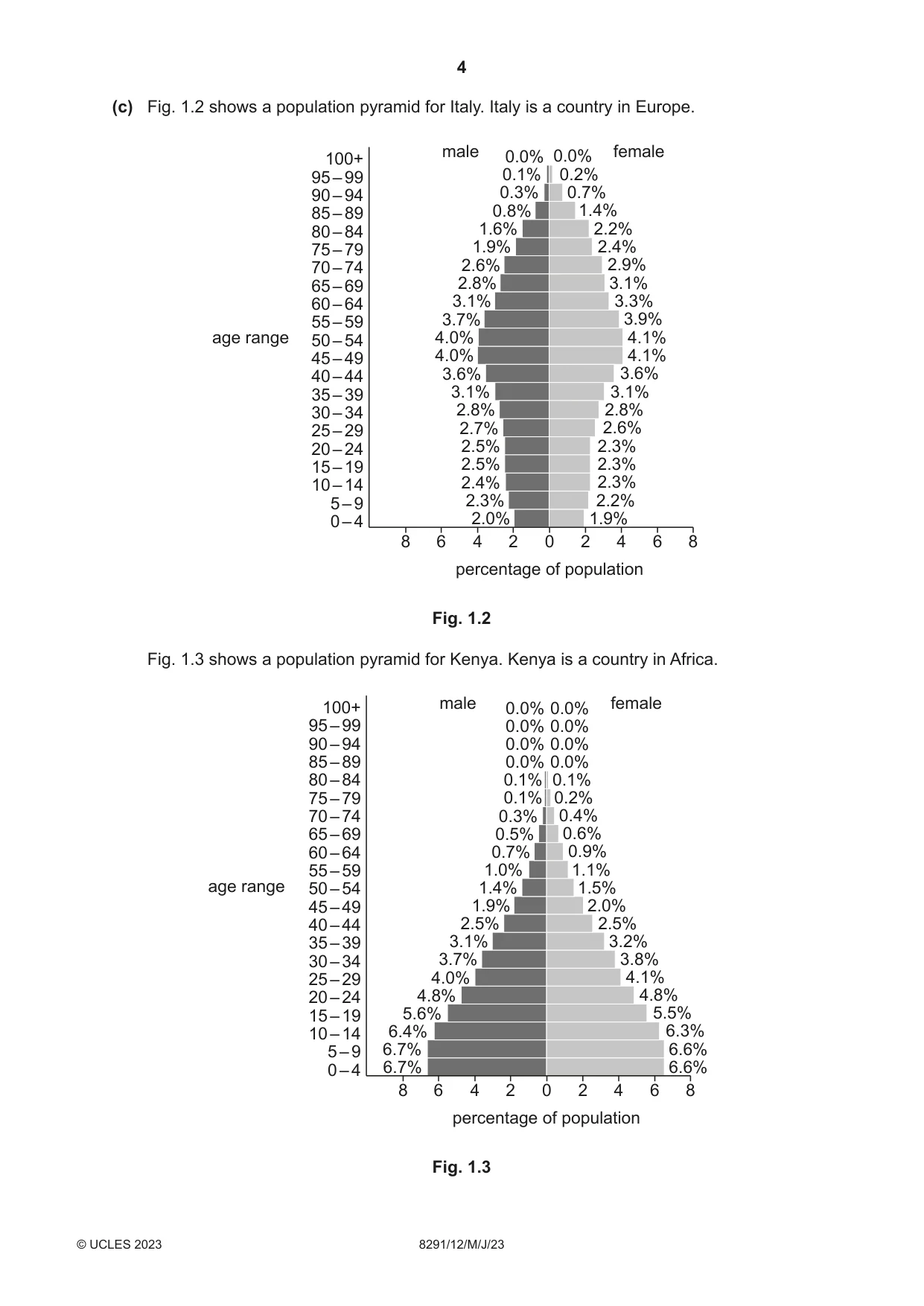
4 8291/12/M/J/23 © UCLES 2023 (c) Fig. 1.2 shows a population pyramid for Italy. Italy is a country in Europe. 2 4 male female 6 8 100+ 95 – 99 90 – 94 85 – 89 80 – 84 75 – 79 70 – 74 65 – 69 60 – 64 55 – 59 50 – 54 45 – 49 40 – 44 35 – 39 30 – 34 25 – 29 20 – 24 15 – 19 10 – 14 5 – 9 0 – 4 0.0% 0.2% 0.7% 1.4% 2.2% 2.4% 2.9% 3.1% 3.3% 3.9% 4.1% 4.1% 3.6% 3.1% 2.8% 2.6% 2.3% 2.3% 2.3% 2.2% 1.9% 0.0% 0.1% 0.3% 0.8% 1.6% 1.9% 2.6% 2.8% 3.1% 3.7% 4.0% 4.0% 3.6% 3.1% 2.8% 2.7% 2.5% 2.5% 2.4% 2.3% 2.0% 0 percentage of population age range 2 4 6 8 Fig. 1.2 Fig. 1.3 shows a population pyramid for Kenya. Kenya is a country in Africa. 2 4 male female 6 8 0.0% 0.0% 0.0% 0.0% 0.1% 0.2% 0.4% 0.6% 0.9% 1.1% 1.5% 2.0% 2.5% 3.2% 3.8% 4.1% 4.8% 5.5% 6.3% 6.6% 6.6% 0.0% 0.0% 0.0% 0.0% 0.1% 0.1% 0.3% 0.5% 0.7% 1.0% 1.4% 1.9% 2.5% 3.1% 3.7% 4.0% 4.8% 5.6% 6.4% 6.7% 6.7% 0 2 4 6 8 percentage of population age range 100+ 95 – 99 90 – 94 85 – 89 80 – 84 75 – 79 70 – 74 65 – 69 60 – 64 55 – 59 50 – 54 45 – 49 40 – 44 35 – 39 30 – 34 25 – 29 20 – 24 15 – 19 10 – 14 5 – 9 0 – 4 Fig. 1.3
Question paper, page 5
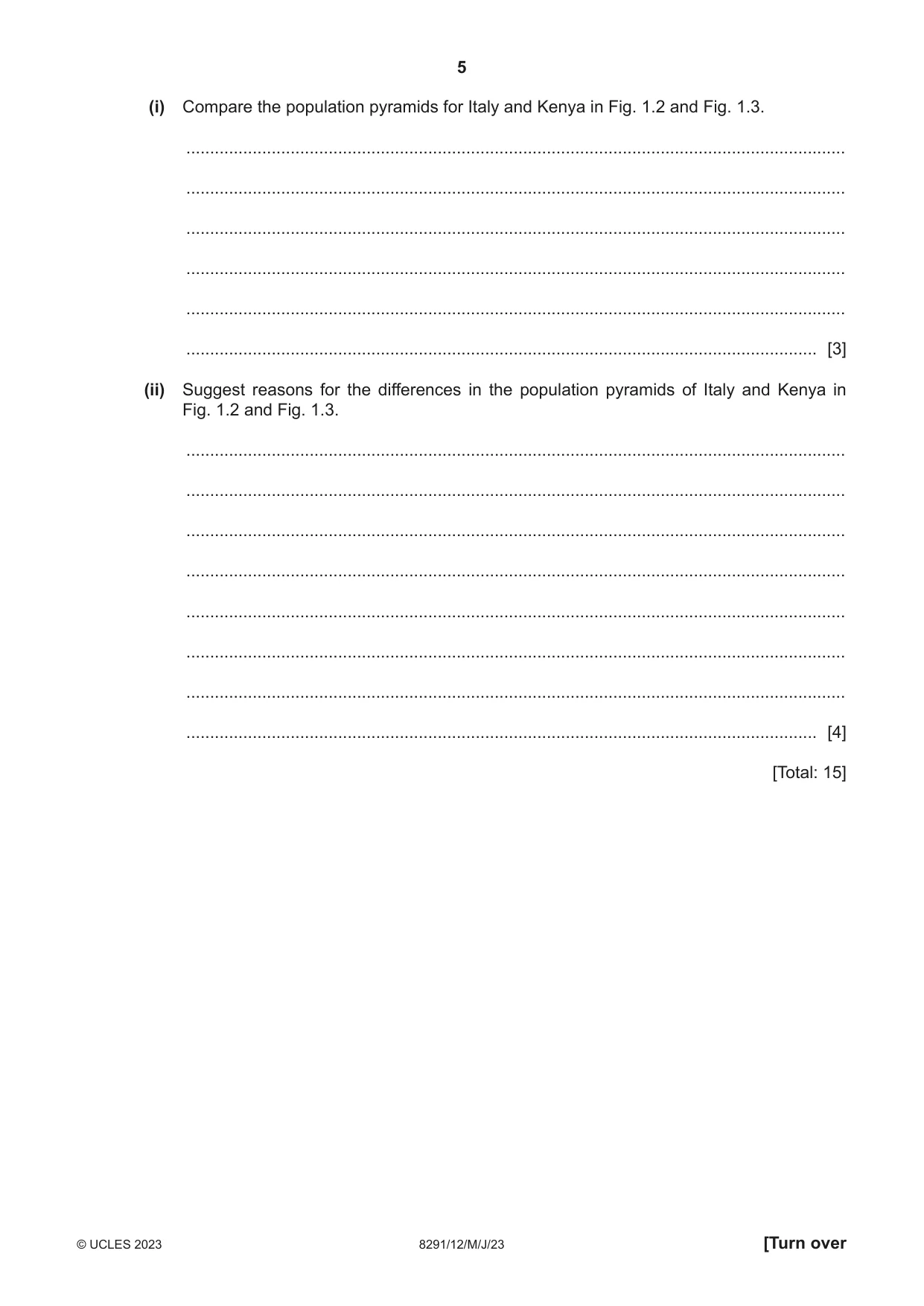
5 8291/12/M/J/23 © UCLES 2023 [Turn over (i) Compare the population pyramids for Italy and Kenya in Fig. 1.2 and Fig. 1.3. … … … … … … [3] (ii) Suggest reasons for the differences in the population pyramids of Italy and Kenya in Fig. 1.2 and Fig. 1.3. … … … … … … … … [4] [Total: 15]
Question paper, page 6
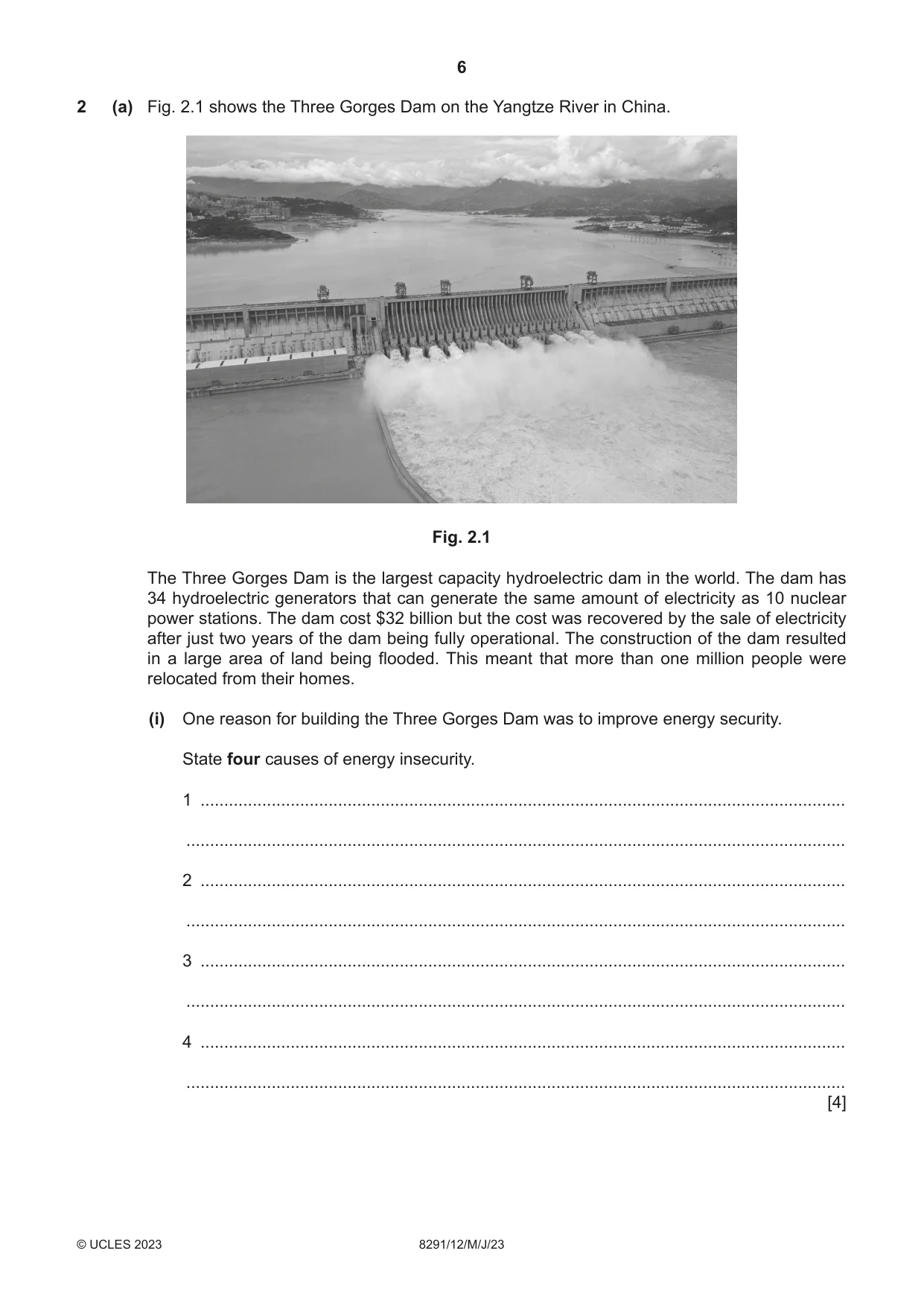
6 8291/12/M/J/23 © UCLES 2023 2 (a) Fig. 2.1 shows the Three Gorges Dam on the Yangtze River in China. Fig. 2.1 The Three Gorges Dam is the largest capacity hydroelectric dam in the world. The dam has 34 hydroelectric generators that can generate the same amount of electricity as 10 nuclear power stations. The dam cost $32 billion but the cost was recovered by the sale of electricity after just two years of the dam being fully operational. The construction of the dam resulted in a large area of land being flooded. This meant that more than one million people were relocated from their homes. (i) One reason for building the Three Gorges Dam was to improve energy security. State four causes of energy insecurity. 1 … … 2 … … 3 … … 4 … … [4]
Question paper, page 7
7 8291/12/M/J/23 © UCLES 2023 [Turn over (ii) The Three Gorges Dam generates electricity. This helps reduce energy insecurity. Suggest three other reasons why it was important for the government to build the Three Gorges Dam. 1 … … 2 … … 3 … … [3] (iii) Hydroelectric power generated from the dam is a renewable resource. State one other renewable energy resource. … [1]
Question paper, page 8
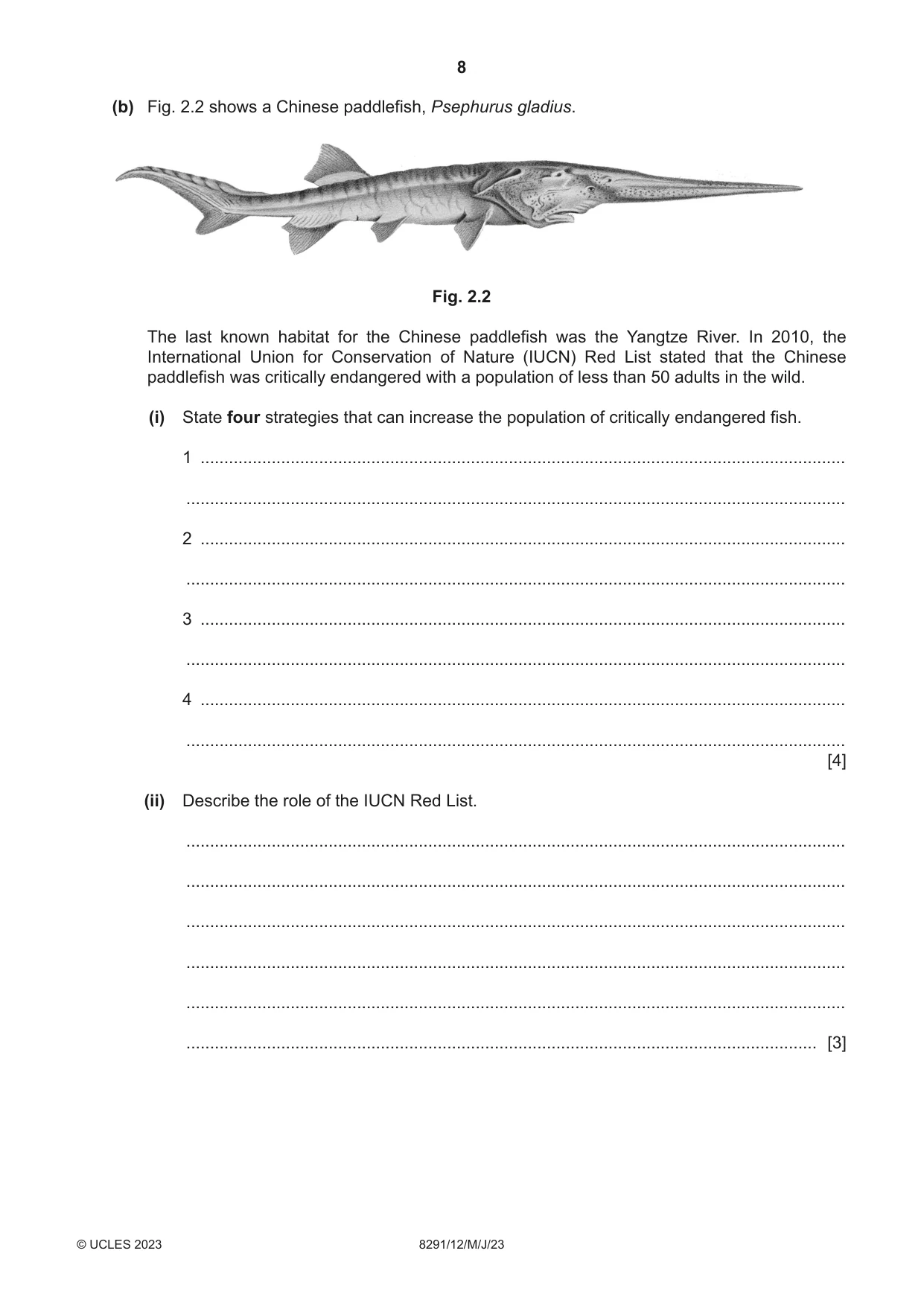
8 8291/12/M/J/23 © UCLES 2023 (b) Fig. 2.2 shows a Chinese paddlefish, Psephurus gladius. Fig. 2.2 The last known habitat for the Chinese paddlefish was the Yangtze River. In 2010, the International Union for Conservation of Nature (IUCN) Red List stated that the Chinese paddlefish was critically endangered with a population of less than 50 adults in the wild. (i) State four strategies that can increase the population of critically endangered fish. 1 … … 2 … … 3 … … 4 … … [4] (ii) Describe the role of the IUCN Red List. … … … … … … [3]
Question paper, page 9
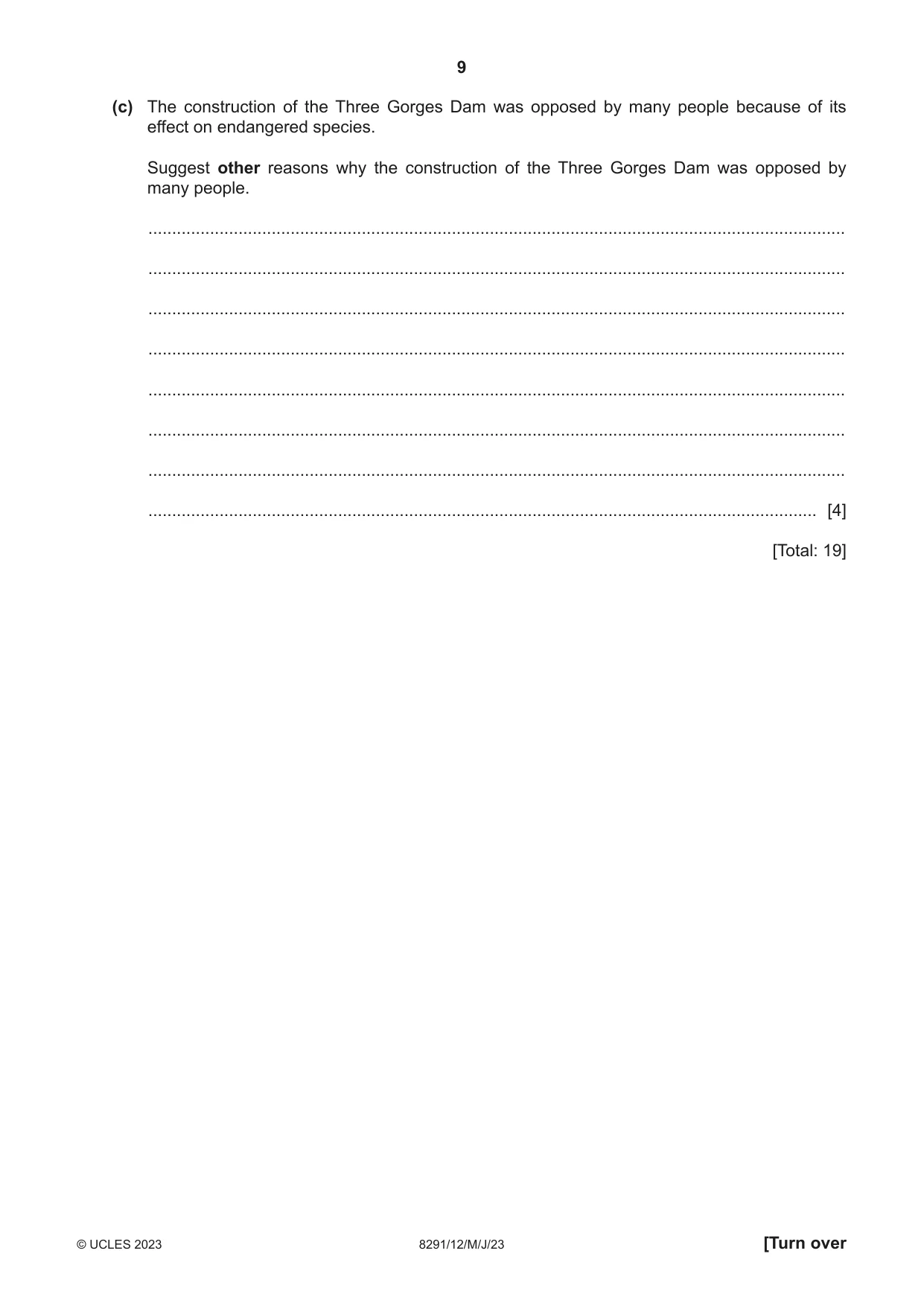
9 8291/12/M/J/23 © UCLES 2023 [Turn over (c) The construction of the Three Gorges Dam was opposed by many people because of its effect on endangered species. Suggest other reasons why the construction of the Three Gorges Dam was opposed by many people. … … … … … … … … [4] [Total: 19]
Question paper, page 10
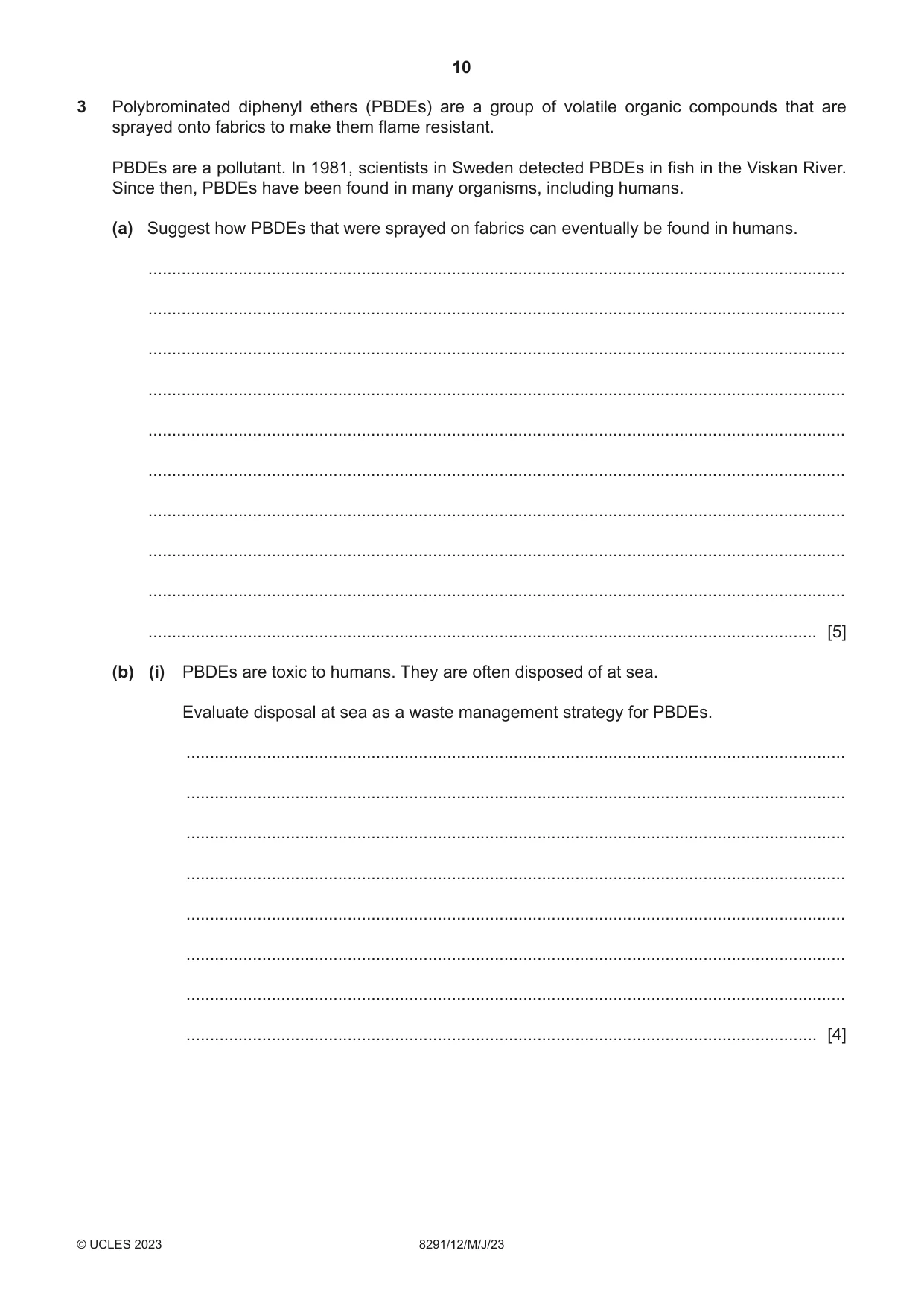
10 8291/12/M/J/23 © UCLES 2023 3 Polybrominated diphenyl ethers (PBDEs) are a group of volatile organic compounds that are sprayed onto fabrics to make them flame resistant. PBDEs are a pollutant. In 1981, scientists in Sweden detected PBDEs in fish in the Viskan River. Since then, PBDEs have been found in many organisms, including humans. (a) Suggest how PBDEs that were sprayed on fabrics can eventually be found in humans. … … … … … … … … … … [5] (b) (i) PBDEs are toxic to humans. They are often disposed of at sea. Evaluate disposal at sea as a waste management strategy for PBDEs. … … … … … … … … [4]
Question paper, page 11
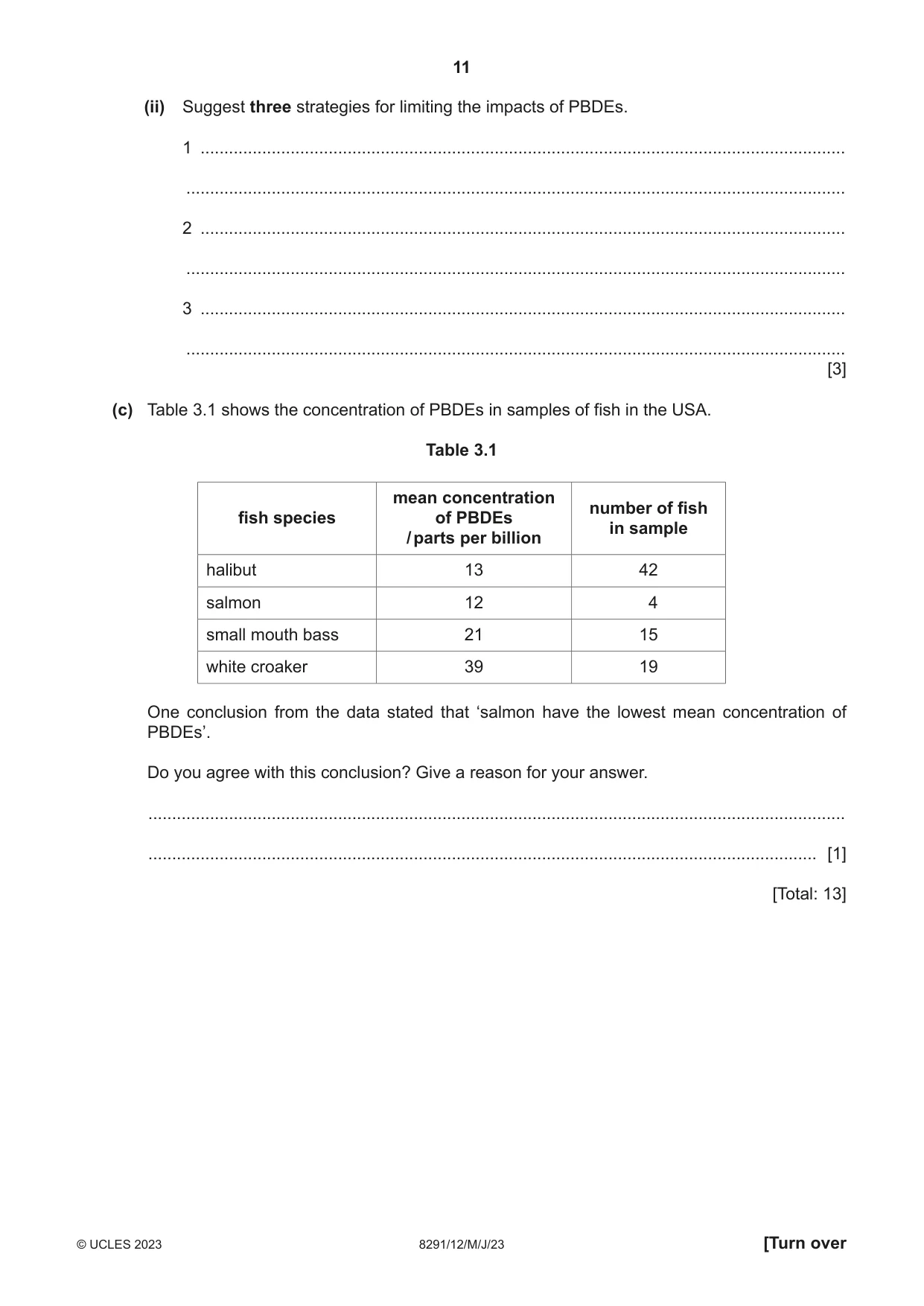
11 8291/12/M/J/23 © UCLES 2023 [Turn over (ii) Suggest three strategies for limiting the impacts of PBDEs. 1 … … 2 … … 3 … … [3] (c) Table 3.1 shows the concentration of PBDEs in samples of fish in the USA. Table 3.1 fish species mean concentration of PBDEs / parts per billion number of fish in sample halibut 13 42 salmon 12 4 small mouth bass 21 15 white croaker 39 19 One conclusion from the data stated that ‘salmon have the lowest mean concentration of PBDEs’. Do you agree with this conclusion? Give a reason for your answer. … … [1] [Total: 13]
Question paper, page 12
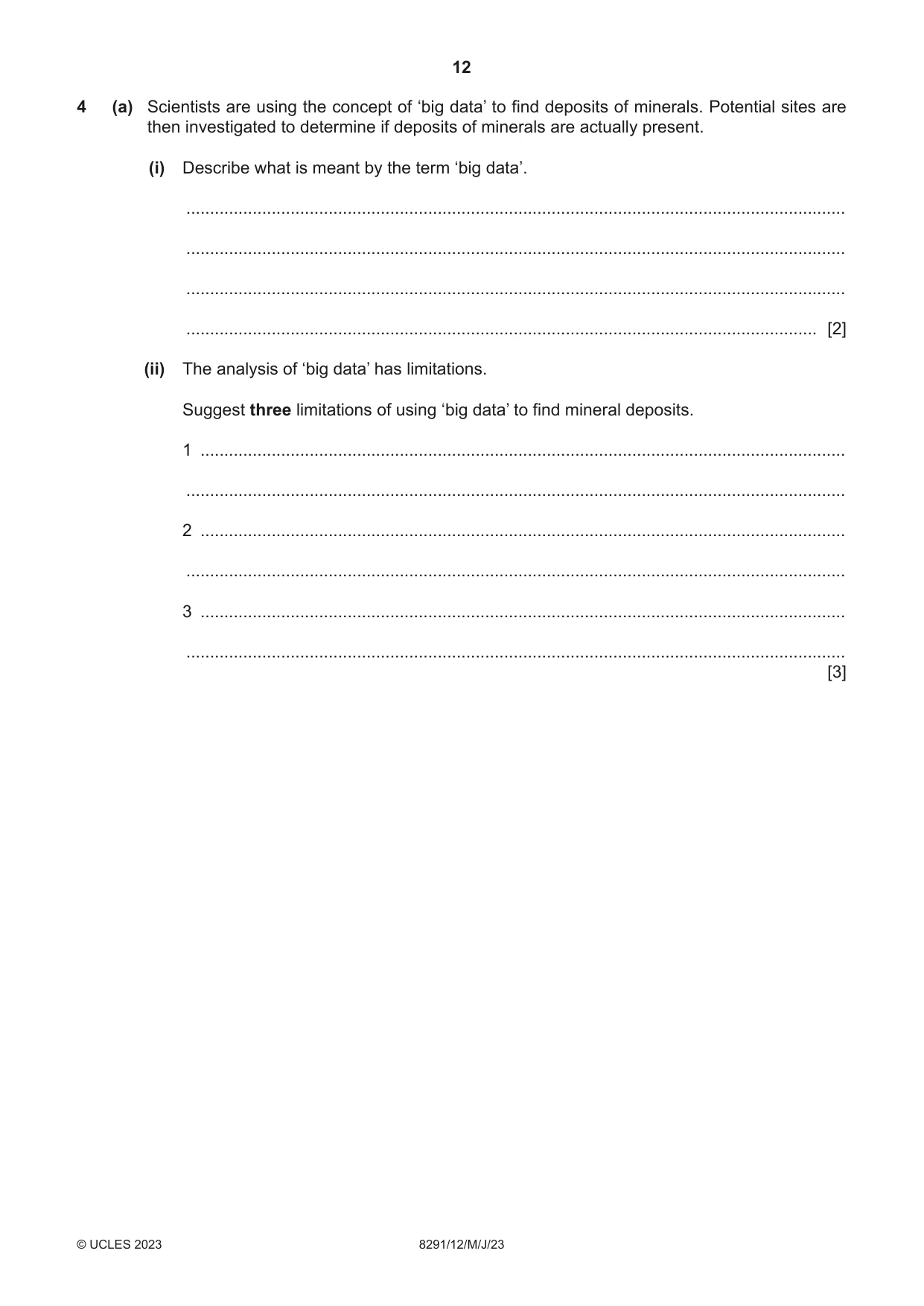
12 8291/12/M/J/23 © UCLES 2023 4 (a) Scientists are using the concept of ‘big data’ to find deposits of minerals. Potential sites are then investigated to determine if deposits of minerals are actually present. (i) Describe what is meant by the term ‘big data’. … … … … [2] (ii) The analysis of ‘big data’ has limitations. Suggest three limitations of using ‘big data’ to find mineral deposits. 1 … … 2 … … 3 … … [3]
Question paper, page 13
13 8291/12/M/J/23 © UCLES 2023 [Turn over (b) Zircon is a mineral used in the steel and electronics industries. Zircon can be extracted by dredge mining. Dredge mining removes material from the bottom of lakes and rivers. Fig. 4.1 shows dredge mining in a freshwater lake in Mozambique, Africa. Fig. 4.1 (i) Suggest the impacts of dredge mining zircon. Include positive and negative impacts in your answer. positive impacts … … … … negative impacts … … … … [5]
Question paper, page 14
14 8291/12/M/J/23 © UCLES 2023 (ii) Suggest how the extraction of zircon from freshwater lakes can be managed sustainably. … … … … … … [3] [Total: 13]
Question paper, page 15
15 8291/12/M/J/23 © UCLES 2023 [Turn over Section B Answer one question. Either 5 ‘Reducing deforestation, increasing reforestation and afforestation are effective strategies for reducing the impact of climate change.’ To what extent do you agree with this statement? Give reasons and include information from relevant examples to support your answer. [20] Or 6 Evaluate the success of strategies for managing water security. Give reasons and include information from relevant examples to support your answer. [20] … … … … … … … … … … … … … … … … … … …
Question paper, page 16
16 8291/12/M/J/23 © UCLES 2023 … … … … … … … … … … … … … … … … … … … … … … … … … … … …
Question paper, page 17
17 8291/12/M/J/23 © UCLES 2023 [Turn over … … … … … … … … … … … … … … … … … … … … … … … … … … … …
Question paper, page 18
18 8291/12/M/J/23 © UCLES 2023 … … … … … … … … … … … … … … … … … … … … … … … … … … … …
Question paper, page 19
19 8291/12/M/J/23 © UCLES 2023 [Turn over … … … … … … … … … … … … … … … … … … … … … … … … … … … …
Question paper, page 20
20 8291/12/M/J/23 © UCLES 2023 The boundaries and names shown, the designations used and the presentation of material on any maps contained in this question paper/insert do not imply official endorsement or acceptance by Cambridge Assessment International Education concerning the legal status of any country, territory, or area or any of its authorities, or of the delimitation of its frontiers or boundaries. Permission to reproduce items where third-party owned material protected by copyright is included has been sought and cleared where possible. Every reasonable effort has been made by the publisher (UCLES) to trace copyright holders, but if any items requiring clearance have unwittingly been included, the publisher will be pleased to make amends at the earliest possible opportunity. To avoid the issue of disclosure of answer-related information to candidates, all copyright acknowledgements are reproduced online in the Cambridge Assessment International Education Copyright Acknowledgements Booklet. This is produced for each series of examinations and is freely available to download at www.cambridgeinternational.org after the live examination series. Cambridge Assessment International Education is part of Cambridge Assessment. Cambridge Assessment is the brand name of the University of Cambridge Local Examinations Syndicate (UCLES), which is a department of the University of Cambridge. … … … … … … … … … … … … … … … … … … … … … …
Mark scheme, page 1
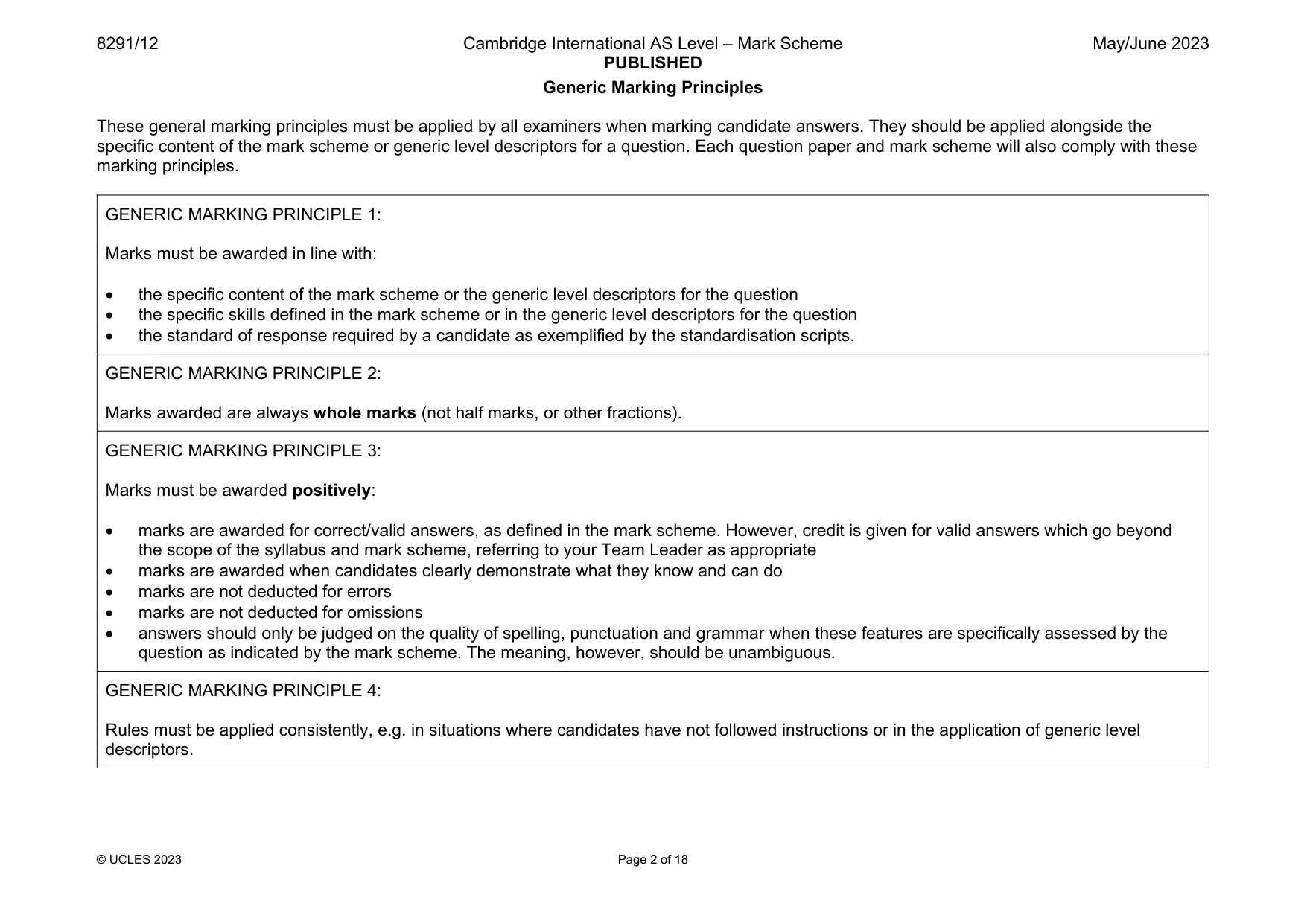
This document consists of 18 printed pages. © UCLES 2023 [Turn over Cambridge International AS Level ENVIRONMENTAL MANAGEMENT 8291/12 Paper 1 Principles of Environmental Management May/June 2023 MARK SCHEME Maximum Mark: 80 Published This mark scheme is published as an aid to teachers and candidates, to indicate the requirements of the examination. It shows the basis on which Examiners were instructed to award marks. It does not indicate the details of the discussions that took place at an Examiners’ meeting before marking began, which would have considered the acceptability of alternative answers. Mark schemes should be read in conjunction with the question paper and the Principal Examiner Report for Teachers. Cambridge International will not enter into discussions about these mark schemes. Cambridge International is publishing the mark schemes for the May/June 2023 series for most Cambridge IGCSE, Cambridge International A and AS Level and Cambridge Pre-U components, and some Cambridge O Level components.
Mark scheme, page 2
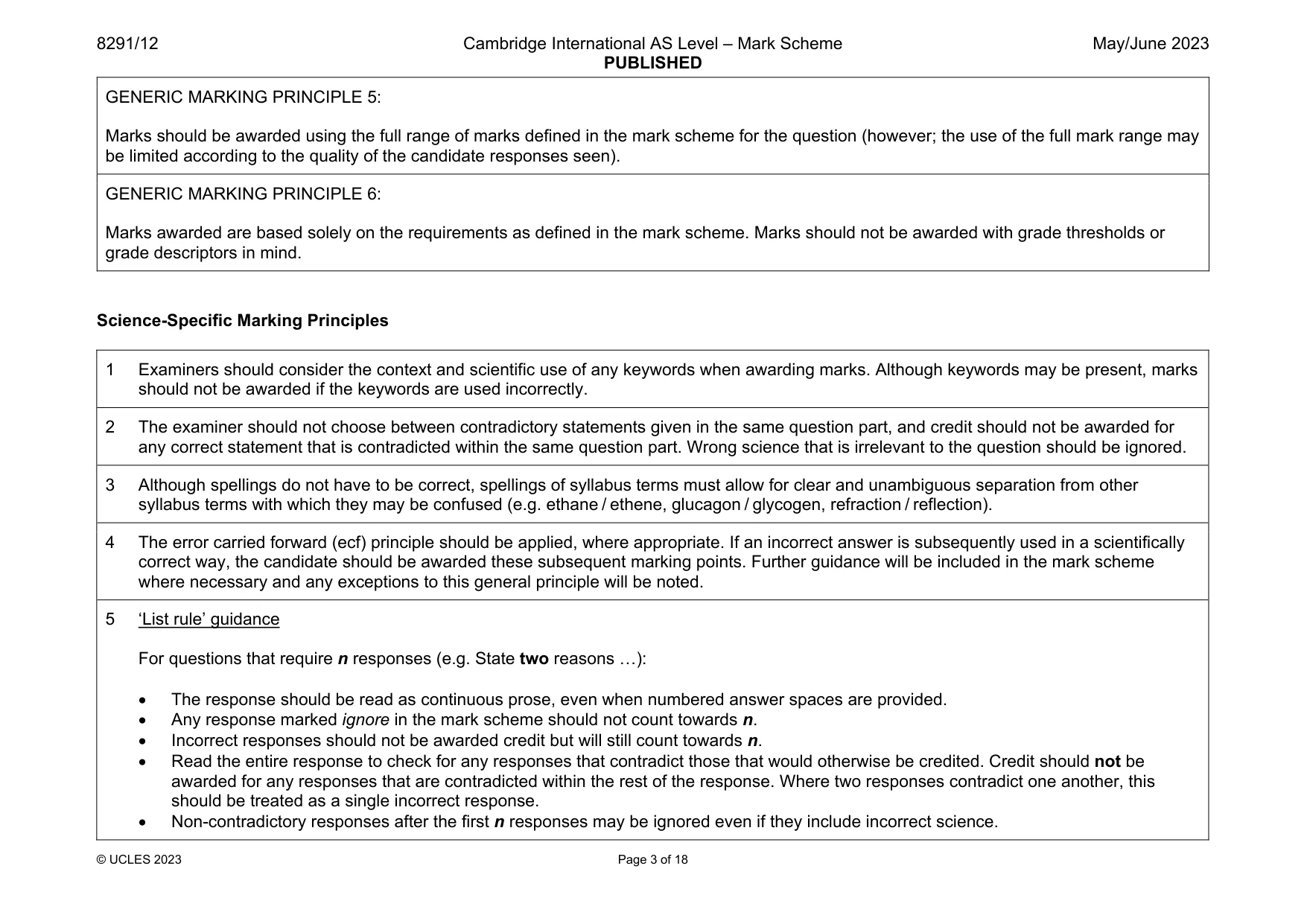
8291/12 Cambridge International AS Level – Mark Scheme PUBLISHED May/June 2023 © UCLES 2023 Page 2 of 18 Generic Marking Principles These general marking principles must be applied by all examiners when marking candidate answers. They should be applied alongside the specific content of the mark scheme or generic level descriptors for a question. Each question paper and mark scheme will also comply with these marking principles. GENERIC MARKING PRINCIPLE 1: Marks must be awarded in line with: the specific content of the mark scheme or the generic level descriptors for the question the specific skills defined in the mark scheme or in the generic level descriptors for the question the standard of response required by a candidate as exemplified by the standardisation scripts. GENERIC MARKING PRINCIPLE 2: Marks awarded are always whole marks (not half marks, or other fractions). GENERIC MARKING PRINCIPLE 3: Marks must be awarded positively: marks are awarded for correct/valid answers, as defined in the mark scheme. However, credit is given for valid answers which go beyond the scope of the syllabus and mark scheme, referring to your Team Leader as appropriate marks are awarded when candidates clearly demonstrate what they know and can do marks are not deducted for errors marks are not deducted for omissions answers should only be judged on the quality of spelling, punctuation and grammar when these features are specifically assessed by the question as indicated by the mark scheme. The meaning, however, should be unambiguous. GENERIC MARKING PRINCIPLE 4: Rules must be applied consistently, e.g. in situations where candidates have not followed instructions or in the application of generic level descriptors.
Mark scheme, page 3
8291/12 Cambridge International AS Level – Mark Scheme PUBLISHED May/June 2023 © UCLES 2023 Page 3 of 18 GENERIC MARKING PRINCIPLE 5: Marks should be awarded using the full range of marks defined in the mark scheme for the question (however; the use of the full mark range may be limited according to the quality of the candidate responses seen). GENERIC MARKING PRINCIPLE 6: Marks awarded are based solely on the requirements as defined in the mark scheme. Marks should not be awarded with grade thresholds or grade descriptors in mind. Science-Specific Marking Principles 1 Examiners should consider the context and scientific use of any keywords when awarding marks. Although keywords may be present, marks should not be awarded if the keywords are used incorrectly. 2 The examiner should not choose between contradictory statements given in the same question part, and credit should not be awarded for any correct statement that is contradicted within the same question part. Wrong science that is irrelevant to the question should be ignored. 3 Although spellings do not have to be correct, spellings of syllabus terms must allow for clear and unambiguous separation from other syllabus terms with which they may be confused (e.g. ethane / ethene, glucagon / glycogen, refraction / reflection). 4 The error carried forward (ecf) principle should be applied, where appropriate. If an incorrect answer is subsequently used in a scientifically correct way, the candidate should be awarded these subsequent marking points. Further guidance will be included in the mark scheme where necessary and any exceptions to this general principle will be noted. 5 ‘List rule’ guidance For questions that require n responses (e.g. State two reasons …): The response should be read as continuous prose, even when numbered answer spaces are provided. Any response marked ignore in the mark scheme should not count towards n. Incorrect responses should not be awarded credit but will still count towards n. Read the entire response to check for any responses that contradict those that would otherwise be credited. Credit should not be awarded for any responses that are contradicted within the rest of the response. Where two responses contradict one another, this should be treated as a single incorrect response. Non-contradictory responses after the first n responses may be ignored even if they include incorrect science.
Mark scheme, page 4
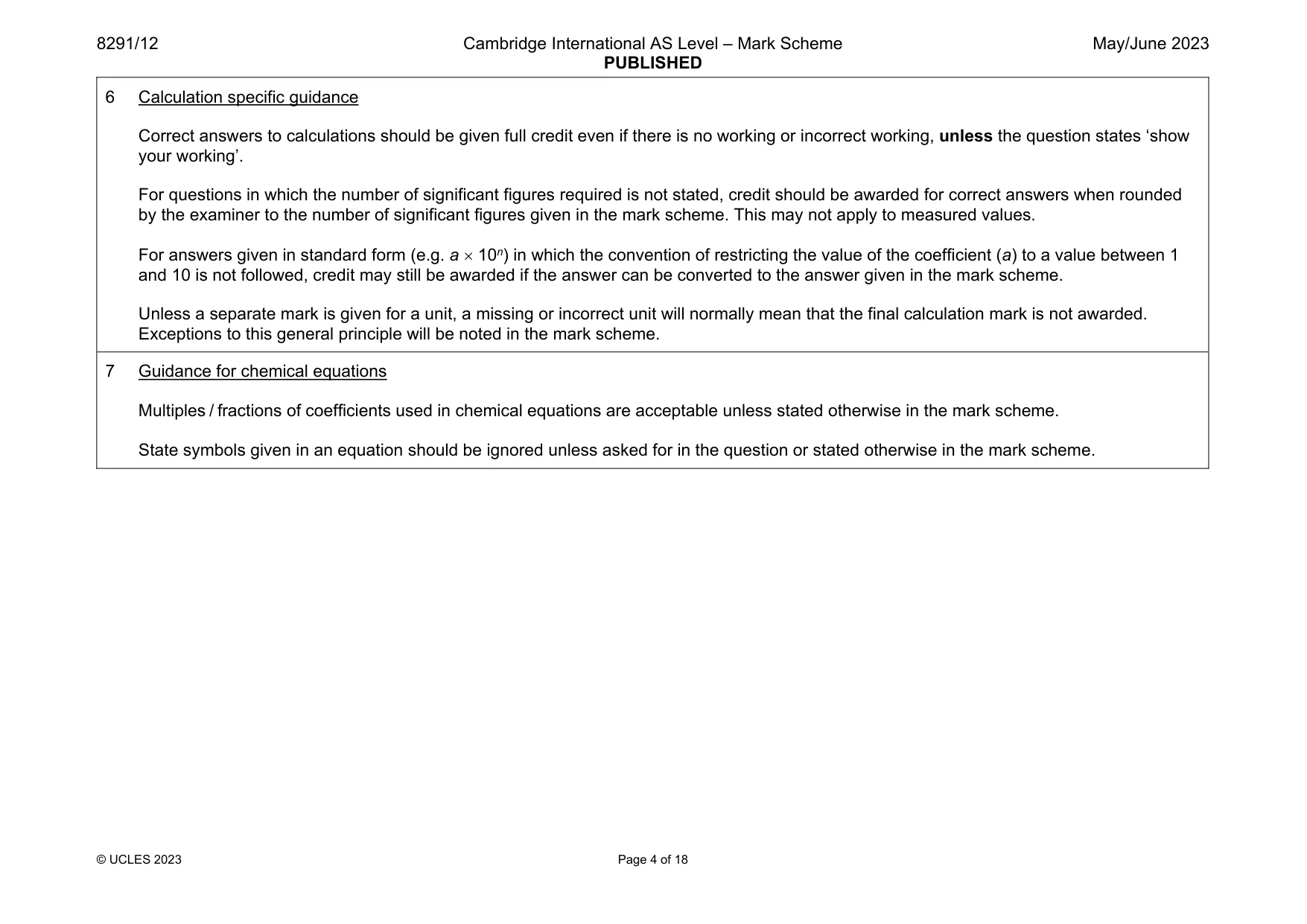
8291/12 Cambridge International AS Level – Mark Scheme PUBLISHED May/June 2023 © UCLES 2023 Page 4 of 18 6 Calculation specific guidance Correct answers to calculations should be given full credit even if there is no working or incorrect working, unless the question states ‘show your working’. For questions in which the number of significant figures required is not stated, credit should be awarded for correct answers when rounded by the examiner to the number of significant figures given in the mark scheme. This may not apply to measured values. For answers given in standard form (e.g. a 10n) in which the convention of restricting the value of the coefficient (a) to a value between 1 and 10 is not followed, credit may still be awarded if the answer can be converted to the answer given in the mark scheme. Unless a separate mark is given for a unit, a missing or incorrect unit will normally mean that the final calculation mark is not awarded. Exceptions to this general principle will be noted in the mark scheme. 7 Guidance for chemical equations Multiples / fractions of coefficients used in chemical equations are acceptable unless stated otherwise in the mark scheme. State symbols given in an equation should be ignored unless asked for in the question or stated otherwise in the mark scheme.
Mark scheme, page 5
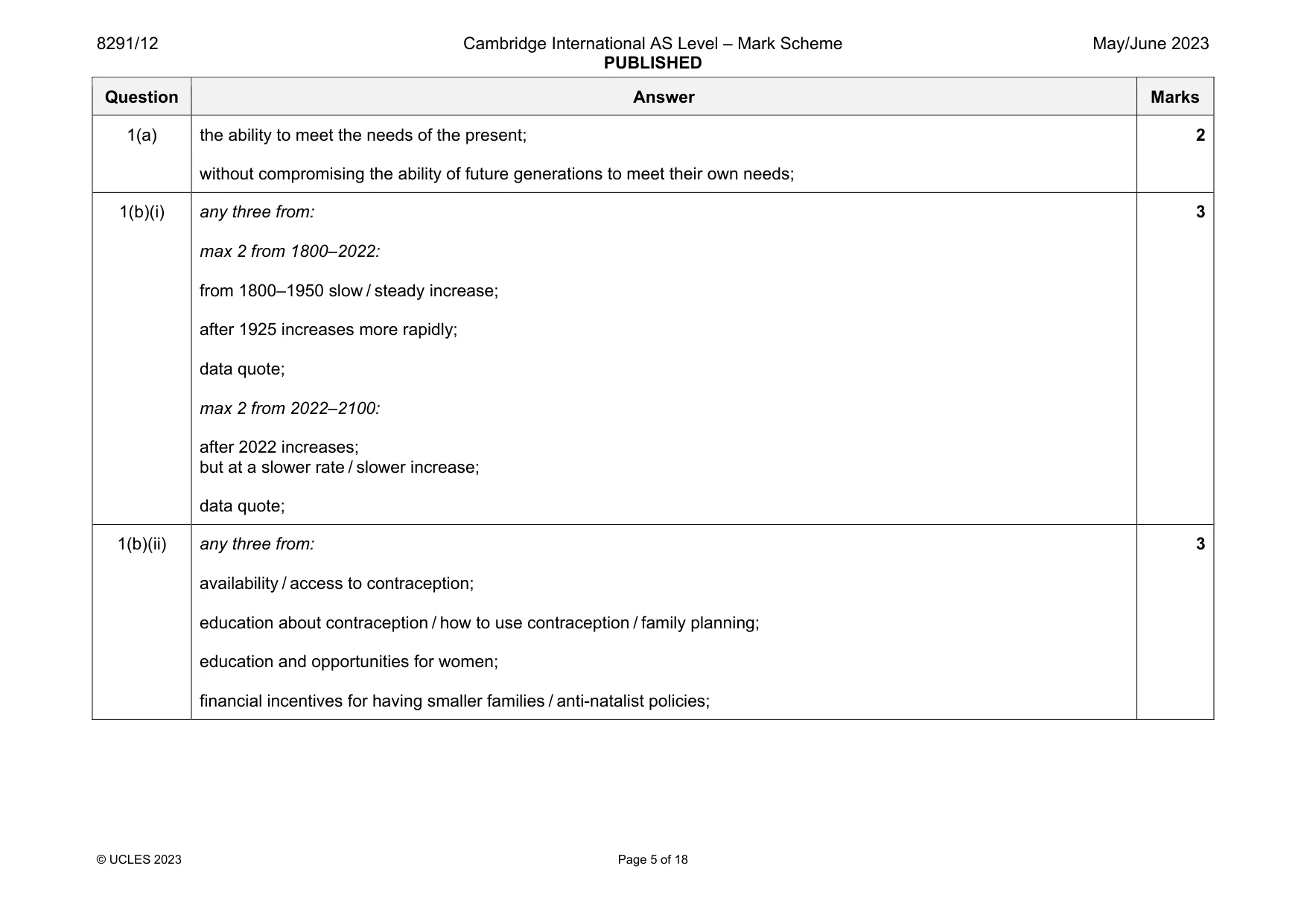
8291/12 Cambridge International AS Level – Mark Scheme PUBLISHED May/June 2023 © UCLES 2023 Page 5 of 18 Question Answer Marks 1(a) the ability to meet the needs of the present; without compromising the ability of future generations to meet their own needs; 2 1(b)(i) any three from: max 2 from 1800–2022: from 1800–1950 slow / steady increase; after 1925 increases more rapidly; data quote; max 2 from 2022–2100: after 2022 increases; but at a slower rate / slower increase; data quote; 3 1(b)(ii) any three from: availability / access to contraception; education about contraception / how to use contraception / family planning; education and opportunities for women; financial incentives for having smaller families / anti-natalist policies; 3
Mark scheme, page 6
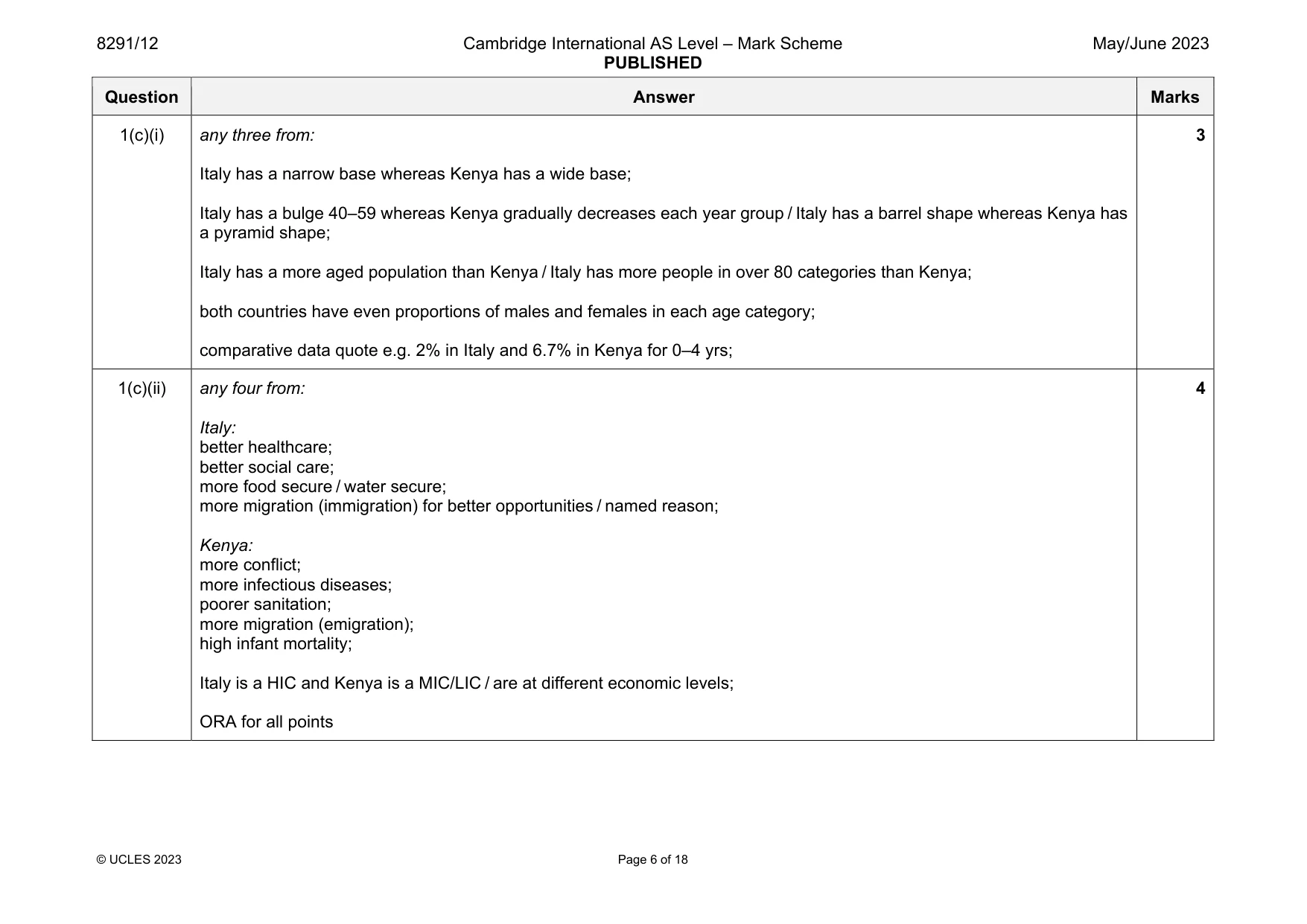
8291/12 Cambridge International AS Level – Mark Scheme PUBLISHED May/June 2023 © UCLES 2023 Page 6 of 18 Question Answer Marks 1(c)(i) any three from: Italy has a narrow base whereas Kenya has a wide base; Italy has a bulge 40–59 whereas Kenya gradually decreases each year group / Italy has a barrel shape whereas Kenya has a pyramid shape; Italy has a more aged population than Kenya / Italy has more people in over 80 categories than Kenya; both countries have even proportions of males and females in each age category; comparative data quote e.g. 2% in Italy and 6.7% in Kenya for 0–4 yrs; 3 1(c)(ii) any four from: Italy: better healthcare; better social care; more food secure / water secure; more migration (immigration) for better opportunities / named reason; Kenya: more conflict; more infectious diseases; poorer sanitation; more migration (emigration); high infant mortality; Italy is a HIC and Kenya is a MIC/LIC / are at different economic levels; ORA for all points 4
Mark scheme, page 7
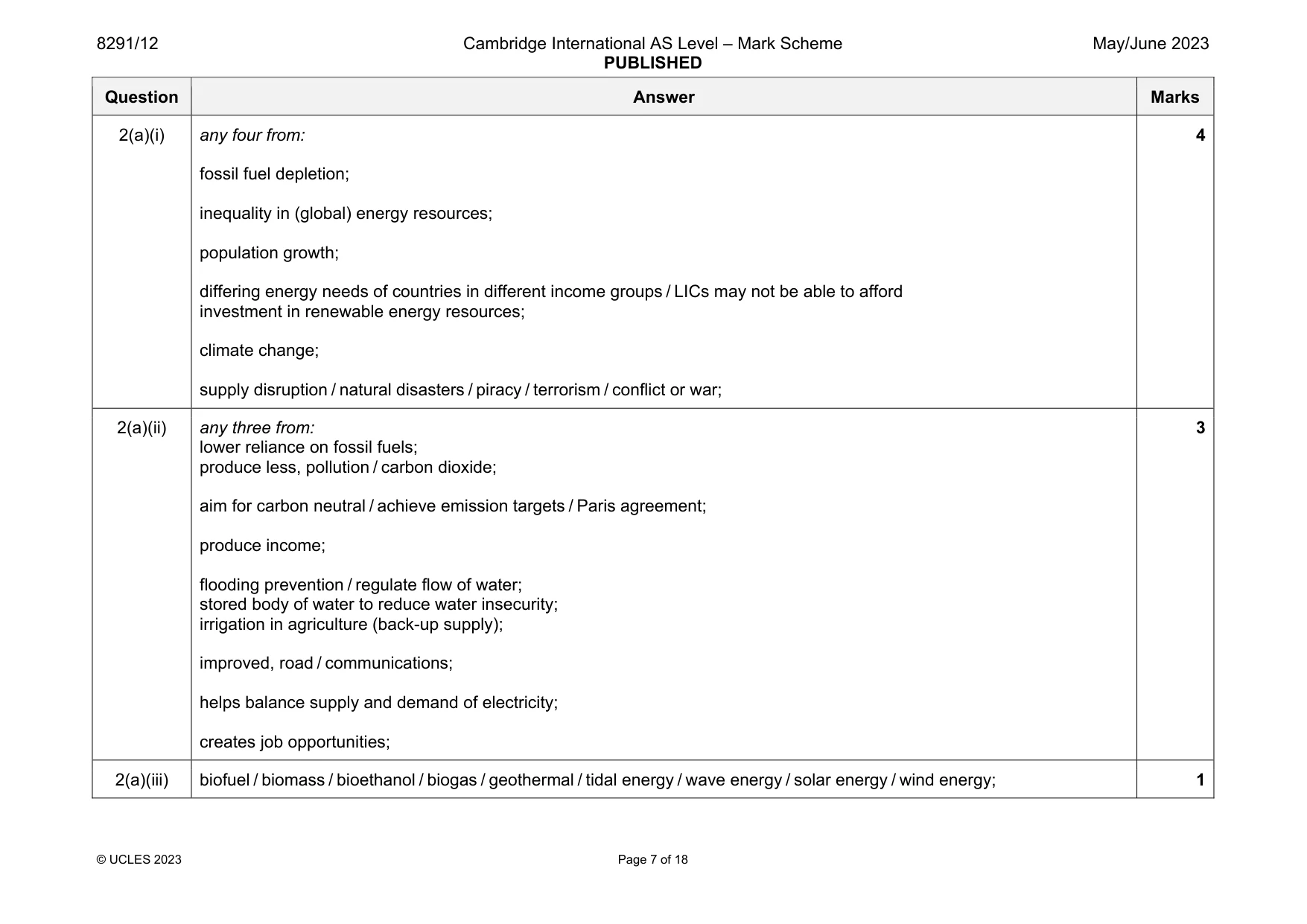
8291/12 Cambridge International AS Level – Mark Scheme PUBLISHED May/June 2023 © UCLES 2023 Page 7 of 18 Question Answer Marks 2(a)(i) any four from: fossil fuel depletion; inequality in (global) energy resources; population growth; differing energy needs of countries in different income groups / LICs may not be able to afford investment in renewable energy resources; climate change; supply disruption / natural disasters / piracy / terrorism / conflict or war; 4 2(a)(ii) any three from: lower reliance on fossil fuels; produce less, pollution / carbon dioxide; aim for carbon neutral / achieve emission targets / Paris agreement; produce income; flooding prevention / regulate flow of water; stored body of water to reduce water insecurity; irrigation in agriculture (back-up supply); improved, road / communications; helps balance supply and demand of electricity; creates job opportunities; 3 2(a)(iii) biofuel / biomass / bioethanol / biogas / geothermal / tidal energy / wave energy / solar energy / wind energy; 1
Mark scheme, page 8
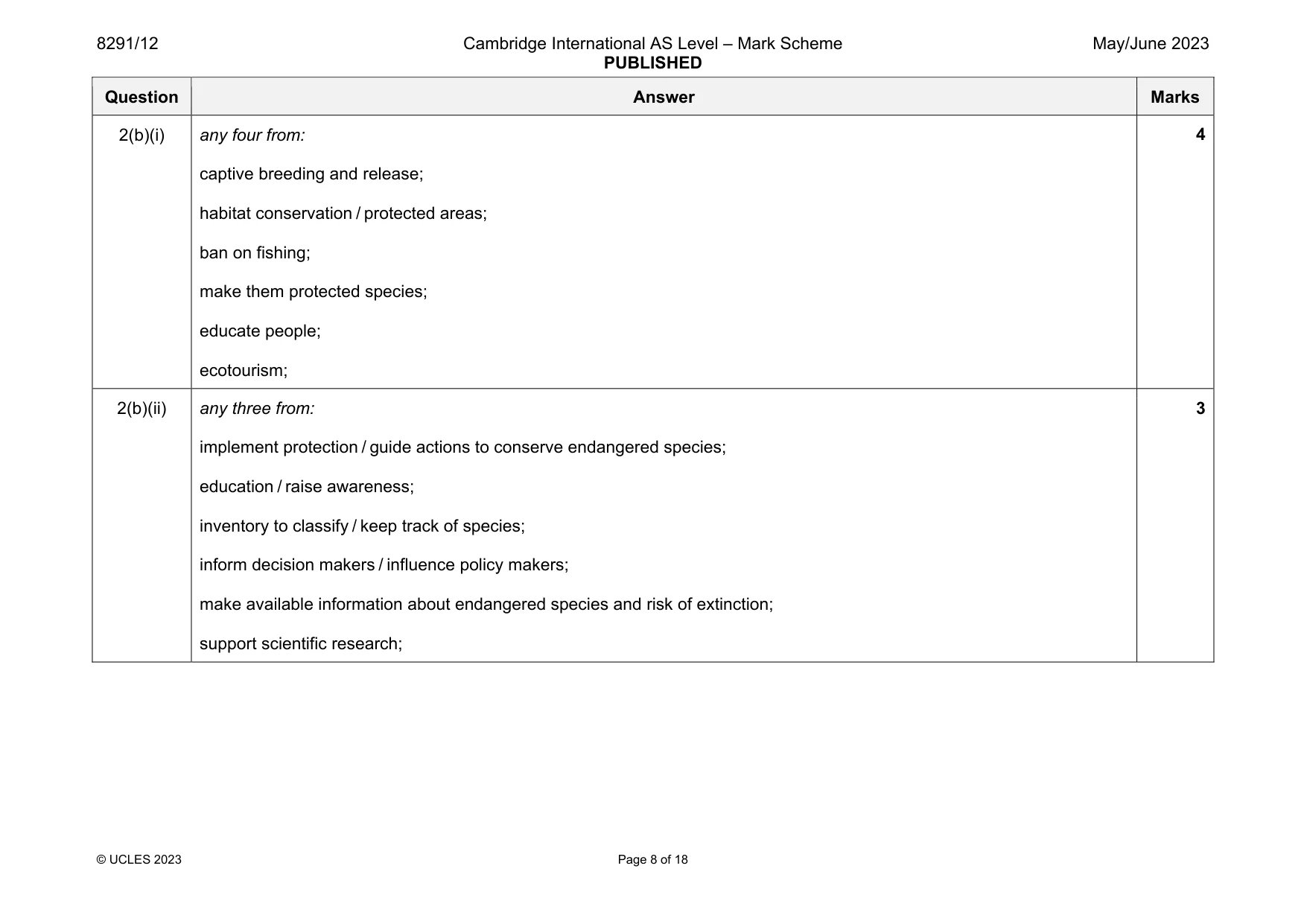
8291/12 Cambridge International AS Level – Mark Scheme PUBLISHED May/June 2023 © UCLES 2023 Page 8 of 18 Question Answer Marks 2(b)(i) any four from: captive breeding and release; habitat conservation / protected areas; ban on fishing; make them protected species; educate people; ecotourism; 4 2(b)(ii) any three from: implement protection / guide actions to conserve endangered species; education / raise awareness; inventory to classify / keep track of species; inform decision makers / influence policy makers; make available information about endangered species and risk of extinction; support scientific research; 3
Mark scheme, page 9
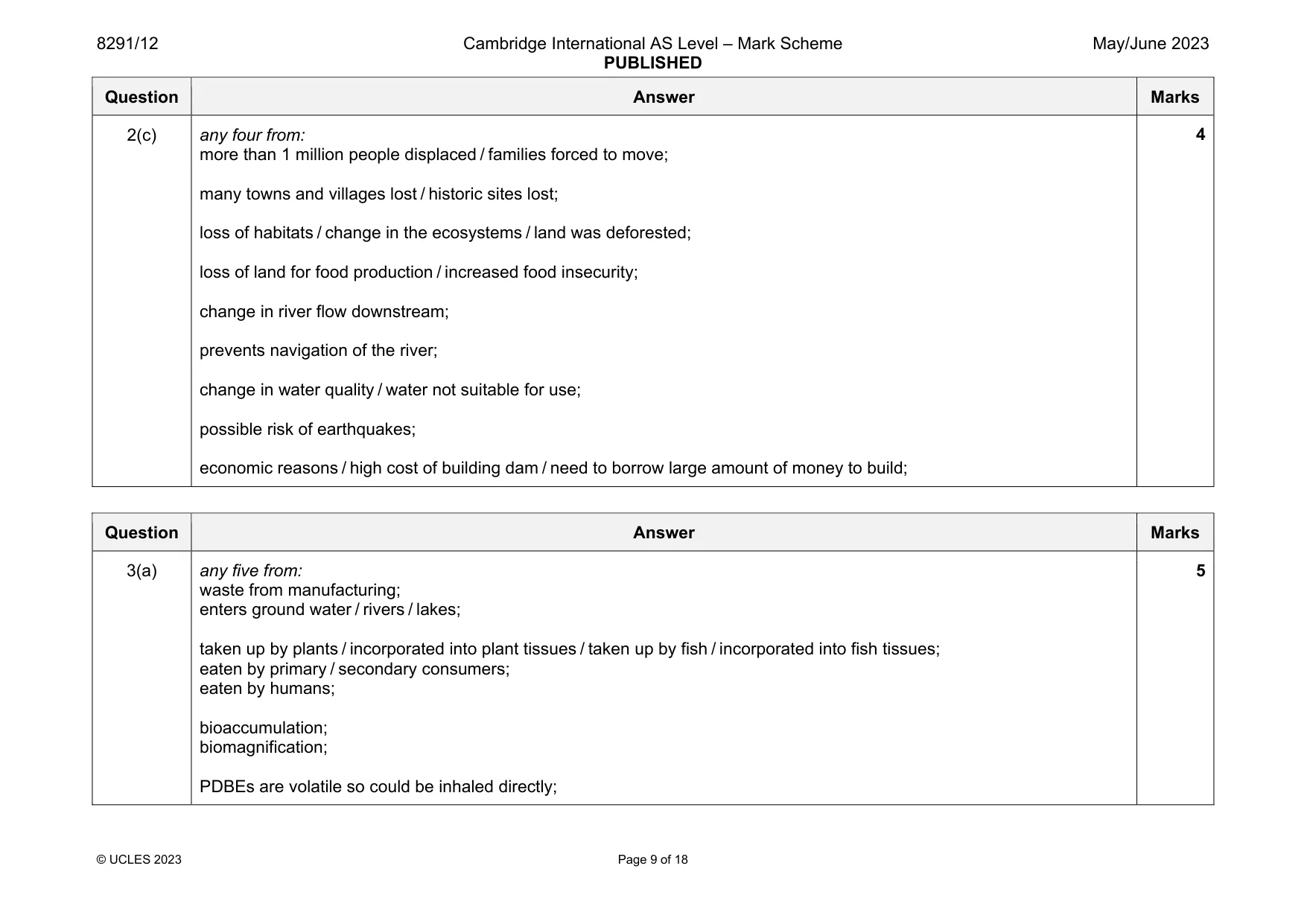
8291/12 Cambridge International AS Level – Mark Scheme PUBLISHED May/June 2023 © UCLES 2023 Page 9 of 18 Question Answer Marks 2(c) any four from: more than 1 million people displaced / families forced to move; many towns and villages lost / historic sites lost; loss of habitats / change in the ecosystems / land was deforested; loss of land for food production / increased food insecurity; change in river flow downstream; prevents navigation of the river; change in water quality / water not suitable for use; possible risk of earthquakes; economic reasons / high cost of building dam / need to borrow large amount of money to build; 4 Question Answer Marks 3(a) any five from: waste from manufacturing; enters ground water / rivers / lakes; taken up by plants / incorporated into plant tissues / taken up by fish / incorporated into fish tissues; eaten by primary / secondary consumers; eaten by humans; bioaccumulation; biomagnification; PDBEs are volatile so could be inhaled directly; 5
Mark scheme, page 10
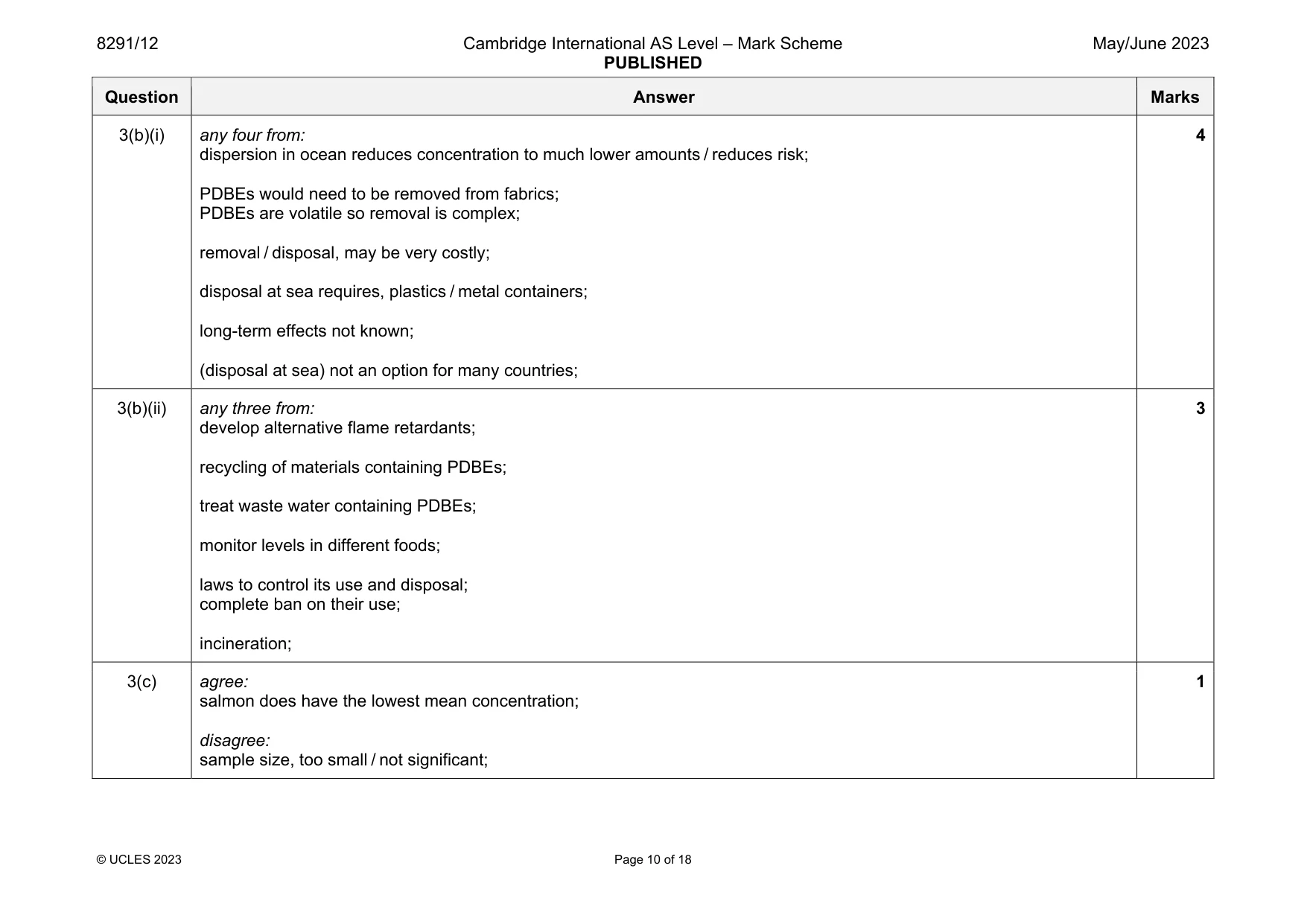
8291/12 Cambridge International AS Level – Mark Scheme PUBLISHED May/June 2023 © UCLES 2023 Page 10 of 18 Question Answer Marks 3(b)(i) any four from: dispersion in ocean reduces concentration to much lower amounts / reduces risk; PDBEs would need to be removed from fabrics; PDBEs are volatile so removal is complex; removal / disposal, may be very costly; disposal at sea requires, plastics / metal containers; long-term effects not known; (disposal at sea) not an option for many countries; 4 3(b)(ii) any three from: develop alternative flame retardants; recycling of materials containing PDBEs; treat waste water containing PDBEs; monitor levels in different foods; laws to control its use and disposal; complete ban on their use; incineration; 3 3(c) agree: salmon does have the lowest mean concentration; disagree: sample size, too small / not significant; 1
Mark scheme, page 11
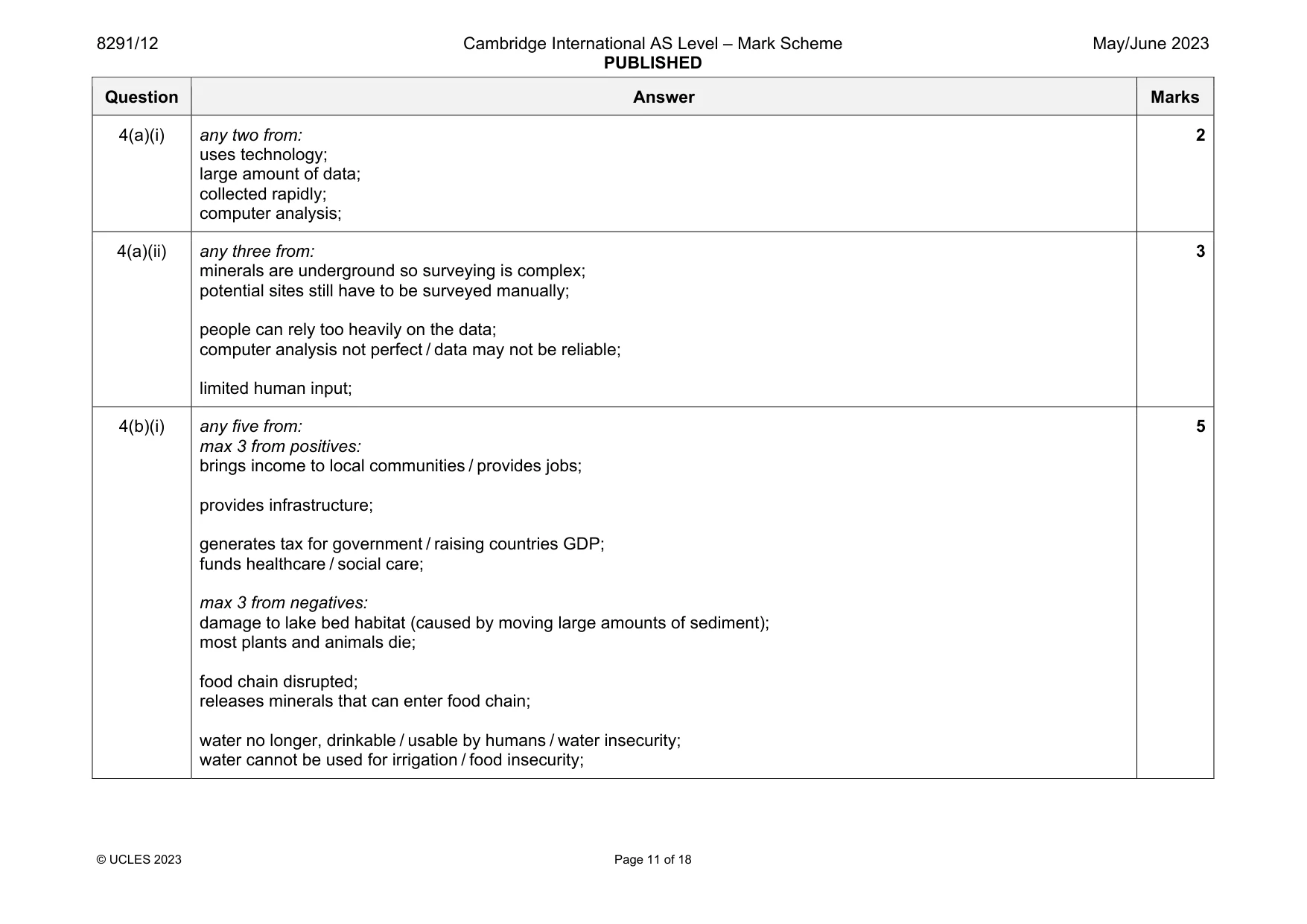
8291/12 Cambridge International AS Level – Mark Scheme PUBLISHED May/June 2023 © UCLES 2023 Page 11 of 18 Question Answer Marks 4(a)(i) any two from: uses technology; large amount of data; collected rapidly; computer analysis; 2 4(a)(ii) any three from: minerals are underground so surveying is complex; potential sites still have to be surveyed manually; people can rely too heavily on the data; computer analysis not perfect / data may not be reliable; limited human input; 3 4(b)(i) any five from: max 3 from positives: brings income to local communities / provides jobs; provides infrastructure; generates tax for government / raising countries GDP; funds healthcare / social care; max 3 from negatives: damage to lake bed habitat (caused by moving large amounts of sediment); most plants and animals die; food chain disrupted; releases minerals that can enter food chain; water no longer, drinkable / usable by humans / water insecurity; water cannot be used for irrigation / food insecurity; 5
Mark scheme, page 12
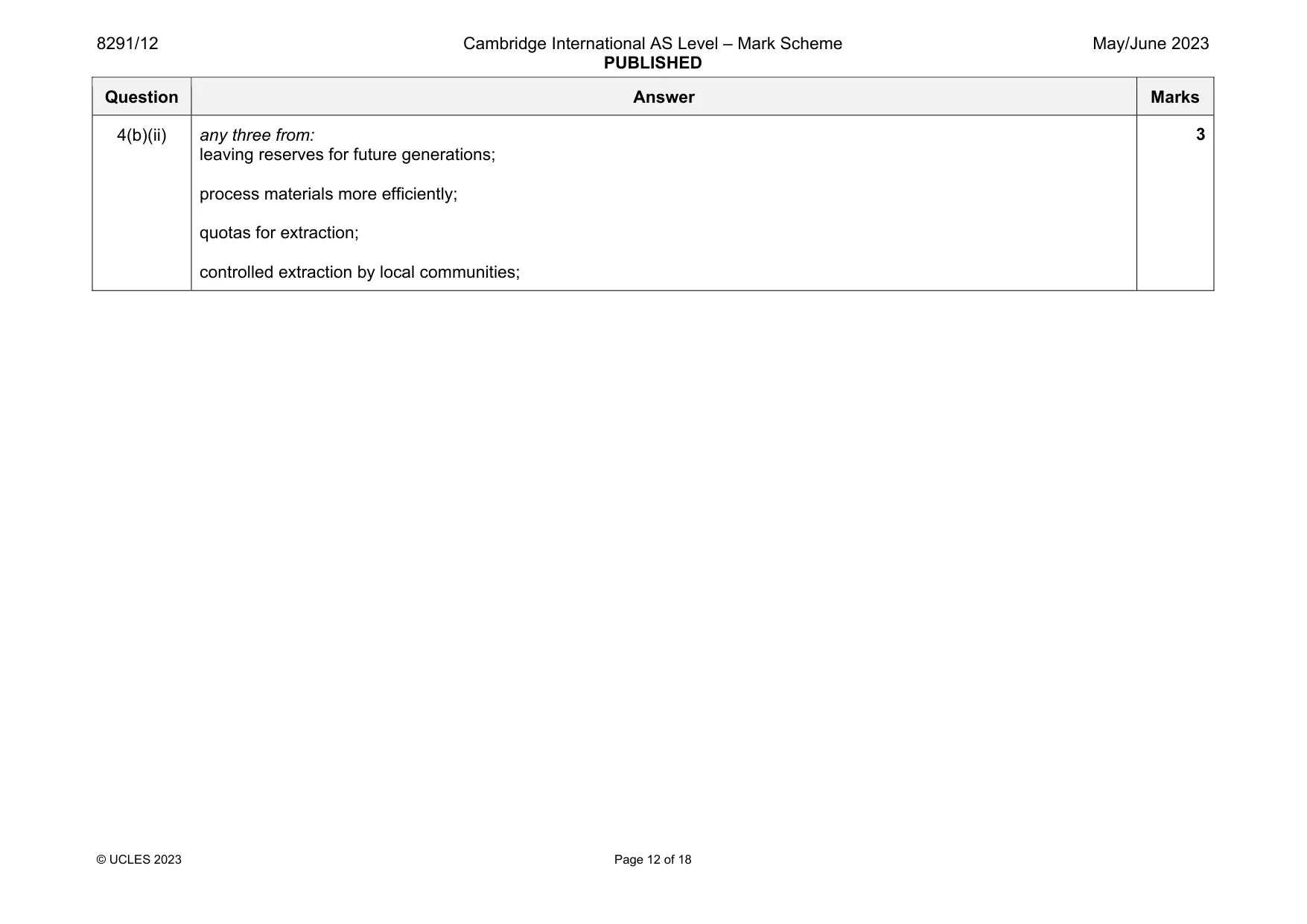
8291/12 Cambridge International AS Level – Mark Scheme PUBLISHED May/June 2023 © UCLES 2023 Page 12 of 18 Question Answer Marks 4(b)(ii) any three from: leaving reserves for future generations; process materials more efficiently; quotas for extraction; controlled extraction by local communities; 3
Mark scheme, page 13
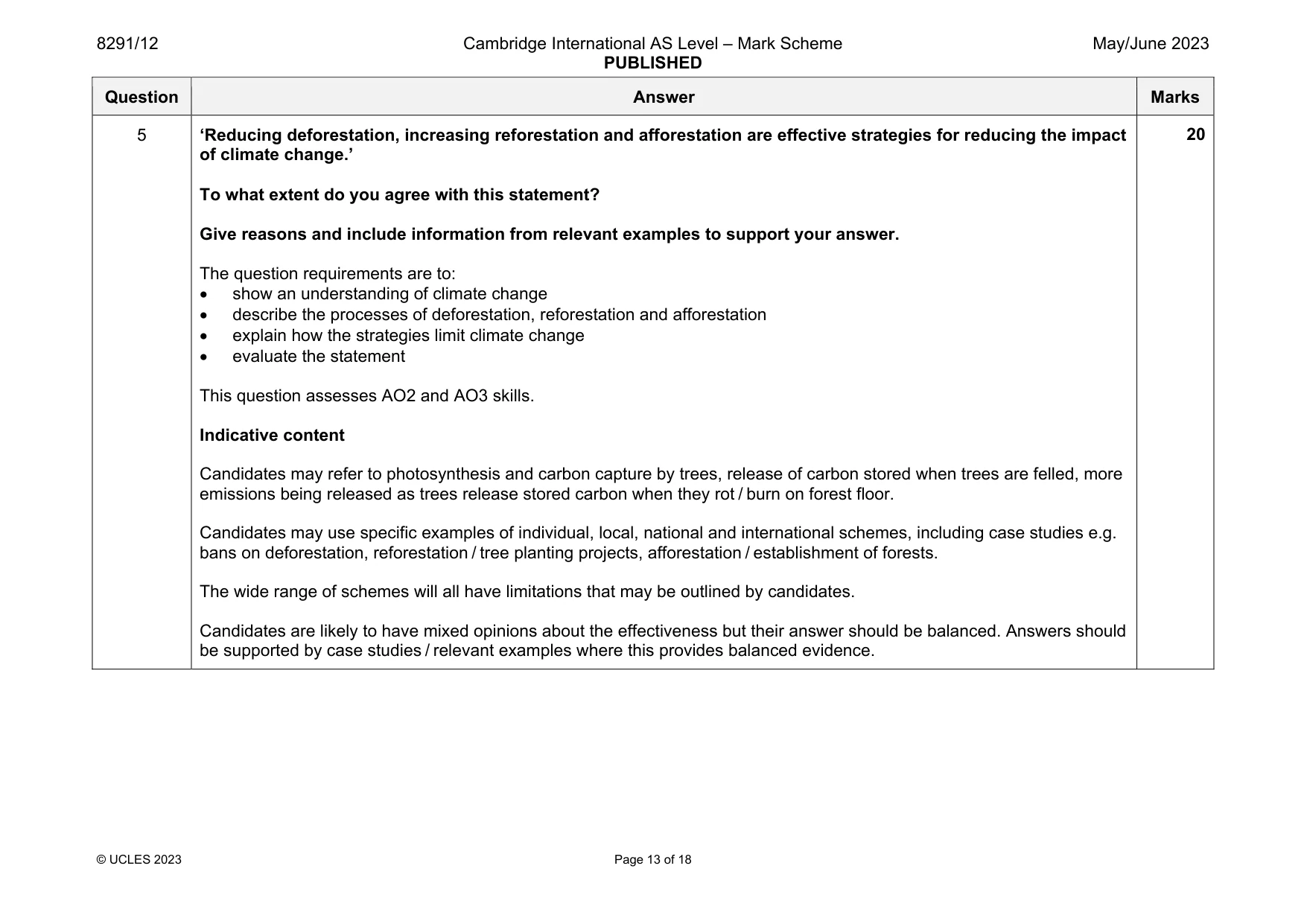
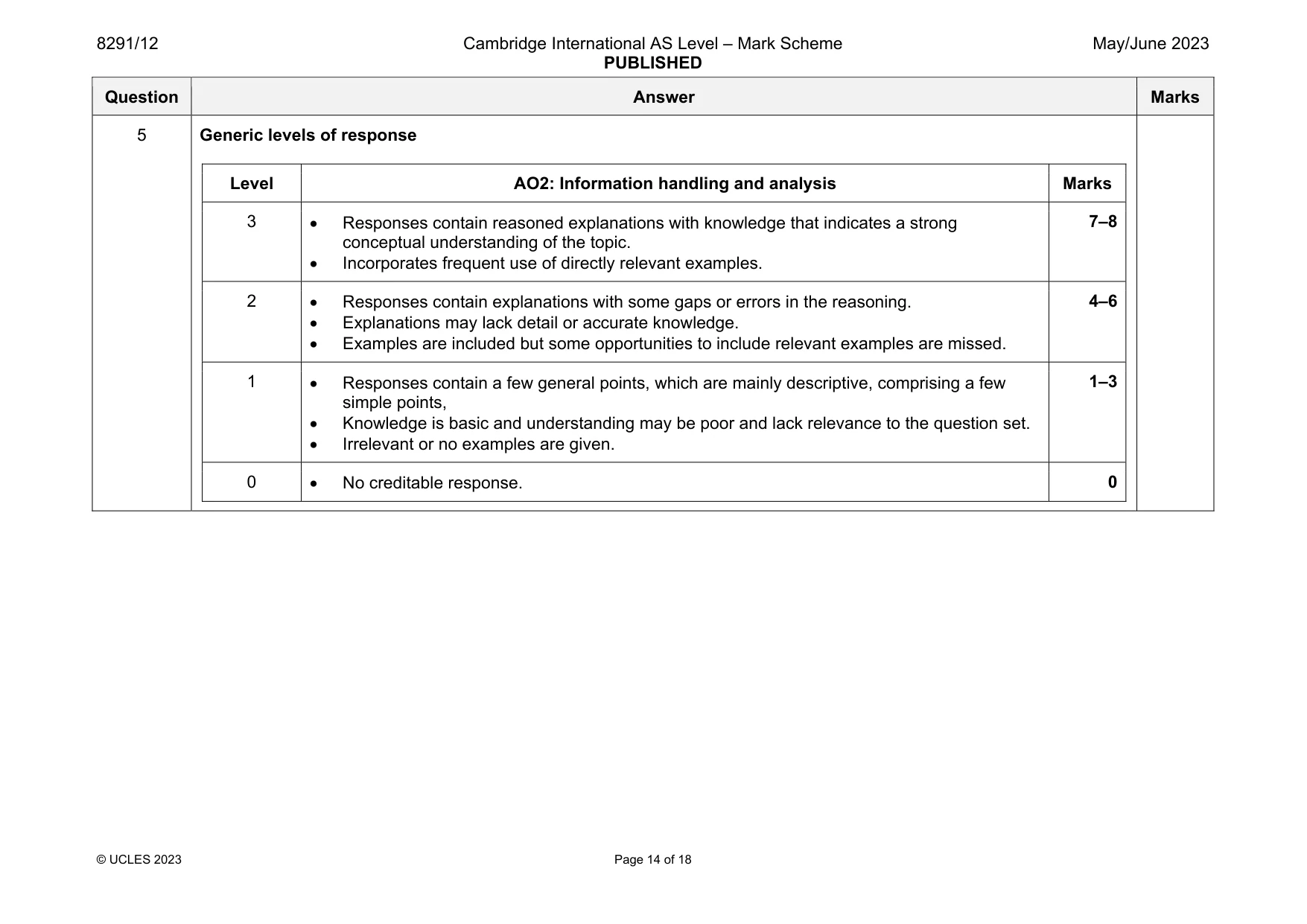
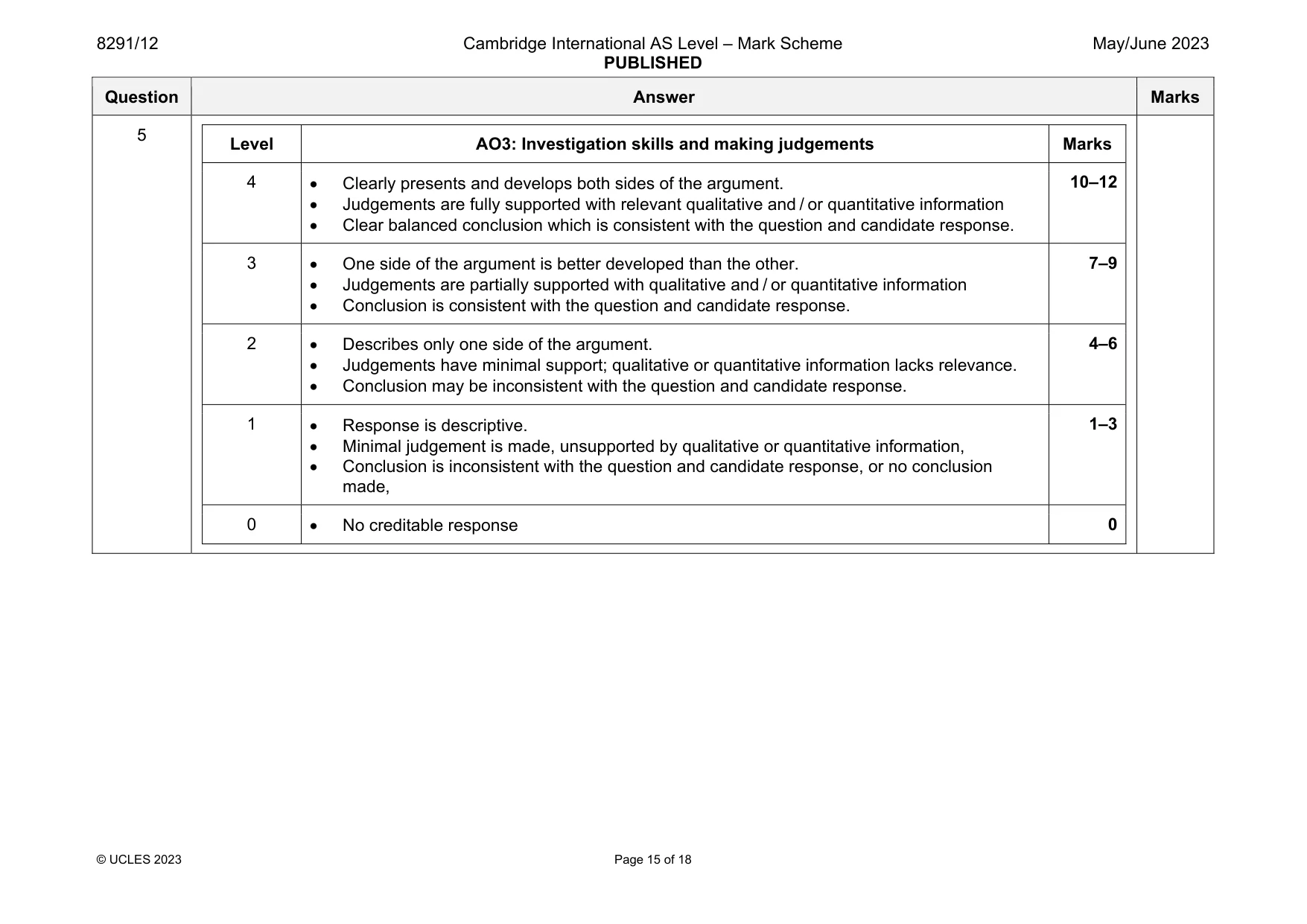
8291/12 Cambridge International AS Level – Mark Scheme PUBLISHED May/June 2023 © UCLES 2023 Page 13 of 18 Question Answer Marks 5 ‘Reducing deforestation, increasing reforestation and afforestation are effective strategies for reducing the impact of climate change.’ To what extent do you agree with this statement? Give reasons and include information from relevant examples to support your answer. The question requirements are to: show an understanding of climate change describe the processes of deforestation, reforestation and afforestation explain how the strategies limit climate change evaluate the statement This question assesses AO2 and AO3 skills. Indicative content Candidates may refer to photosynthesis and carbon capture by trees, release of carbon stored when trees are felled, more emissions being released as trees release stored carbon when they rot / burn on forest floor. Candidates may use specific examples of individual, local, national and international schemes, including case studies e.g. bans on deforestation, reforestation / tree planting projects, afforestation / establishment of forests. The wide range of schemes will all have limitations that may be outlined by candidates. Candidates are likely to have mixed opinions about the effectiveness but their answer should be balanced. Answers should be supported by case studies / relevant examples where this provides balanced evidence. 20
Mark scheme, page 14
8291/12 Cambridge International AS Level – Mark Scheme PUBLISHED May/June 2023 © UCLES 2023 Page 14 of 18 Question Answer Marks 5 Generic levels of response Level AO2: Information handling and analysis Marks 3 Responses contain reasoned explanations with knowledge that indicates a strong conceptual understanding of the topic. Incorporates frequent use of directly relevant examples. 7–8 2 Responses contain explanations with some gaps or errors in the reasoning. Explanations may lack detail or accurate knowledge. Examples are included but some opportunities to include relevant examples are missed. 4–6 1 Responses contain a few general points, which are mainly descriptive, comprising a few simple points, Knowledge is basic and understanding may be poor and lack relevance to the question set. Irrelevant or no examples are given. 1–3 0 No creditable response. 0
Mark scheme, page 15
8291/12 Cambridge International AS Level – Mark Scheme PUBLISHED May/June 2023 © UCLES 2023 Page 15 of 18 Question Answer Marks 5 Level AO3: Investigation skills and making judgements Marks 4 Clearly presents and develops both sides of the argument. Judgements are fully supported with relevant qualitative and / or quantitative information Clear balanced conclusion which is consistent with the question and candidate response. 10–12 3 One side of the argument is better developed than the other. Judgements are partially supported with qualitative and / or quantitative information Conclusion is consistent with the question and candidate response. 7–9 2 Describes only one side of the argument. Judgements have minimal support; qualitative or quantitative information lacks relevance. Conclusion may be inconsistent with the question and candidate response. 4–6 1 Response is descriptive. Minimal judgement is made, unsupported by qualitative or quantitative information, Conclusion is inconsistent with the question and candidate response, or no conclusion made, 1–3 0 No creditable response 0
Mark scheme, page 16
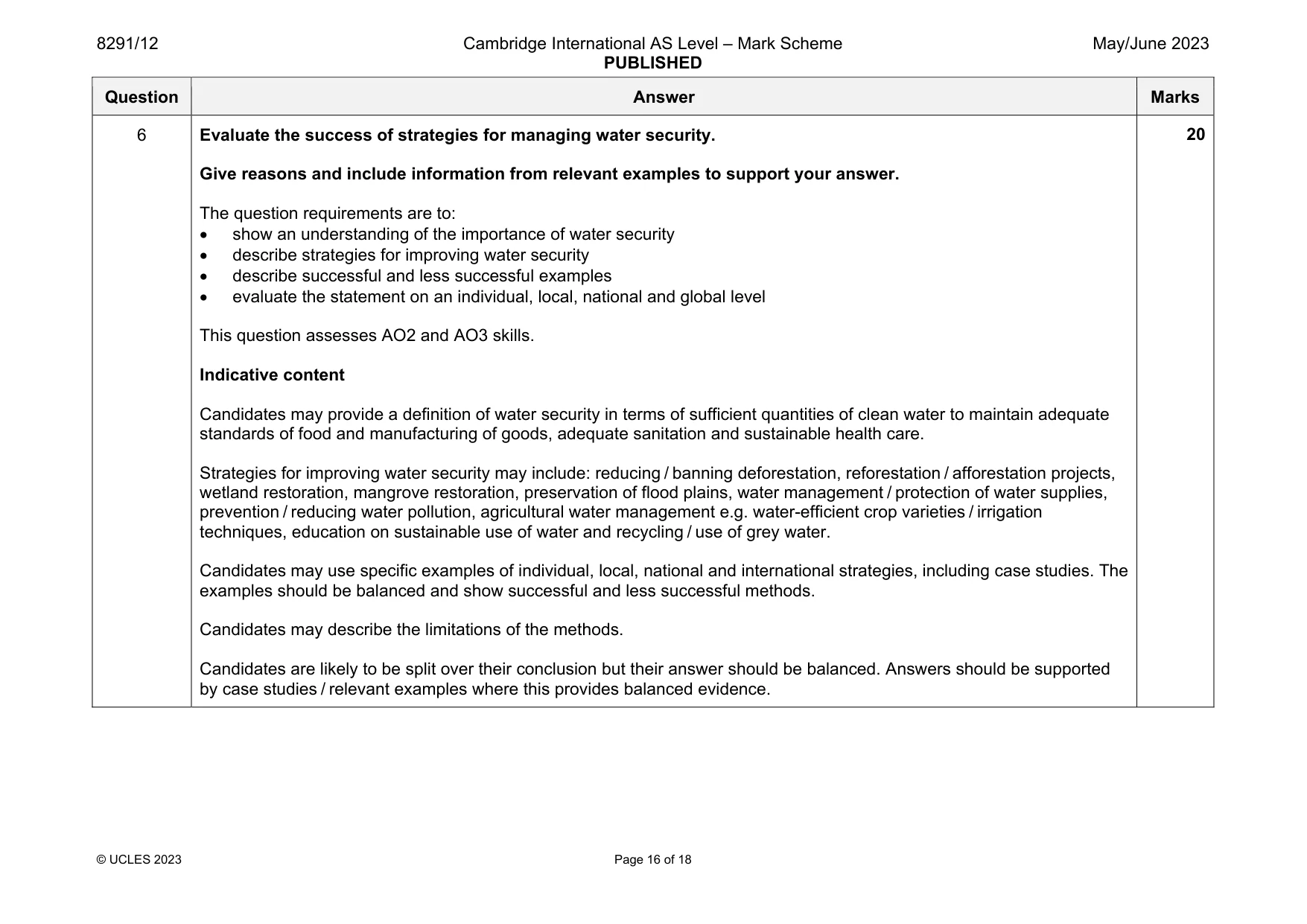
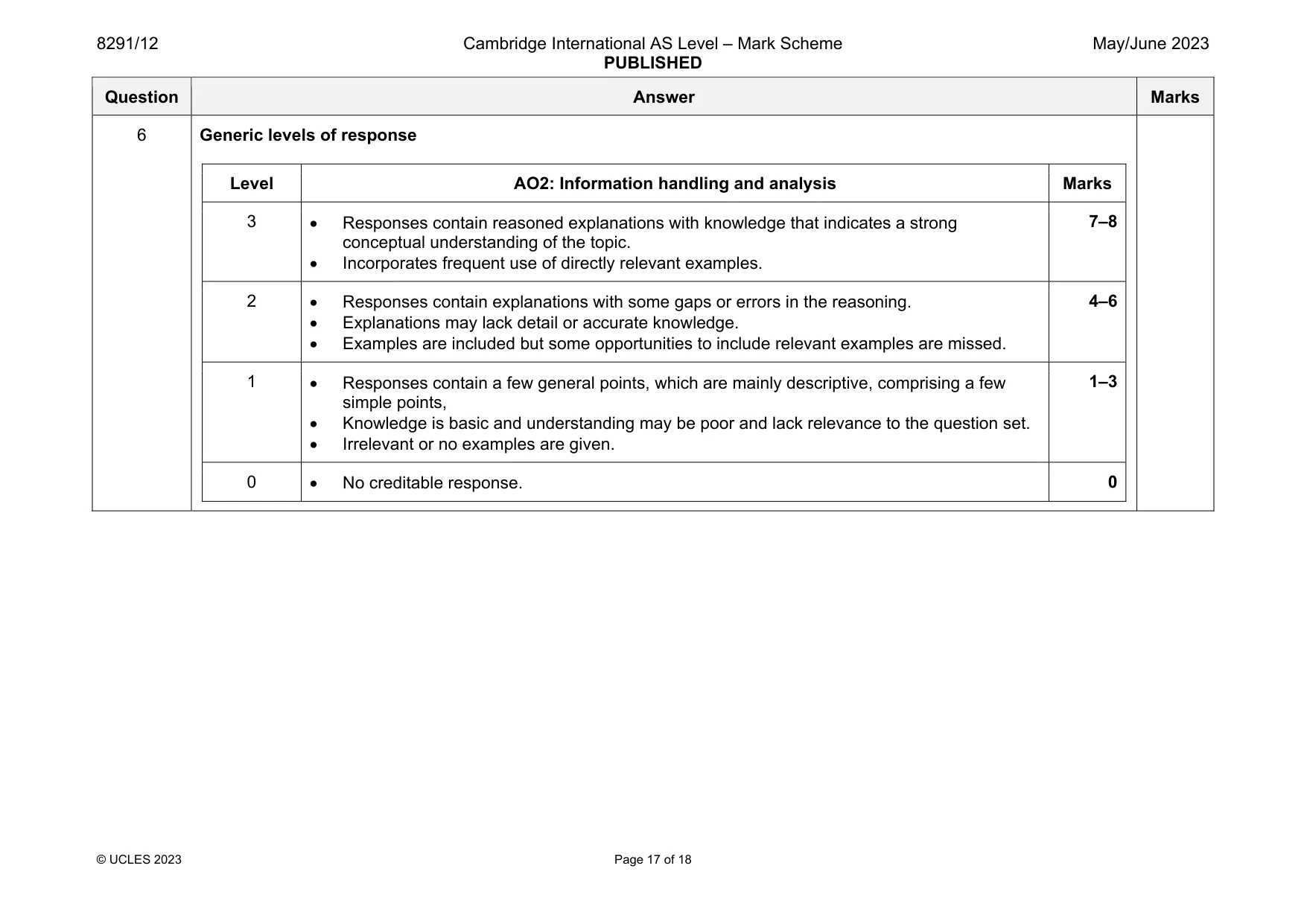
8291/12 Cambridge International AS Level – Mark Scheme PUBLISHED May/June 2023 © UCLES 2023 Page 16 of 18 Question Answer Marks 6 Evaluate the success of strategies for managing water security. Give reasons and include information from relevant examples to support your answer. The question requirements are to: show an understanding of the importance of water security describe strategies for improving water security describe successful and less successful examples evaluate the statement on an individual, local, national and global level This question assesses AO2 and AO3 skills. Indicative content Candidates may provide a definition of water security in terms of sufficient quantities of clean water to maintain adequate standards of food and manufacturing of goods, adequate sanitation and sustainable health care. Strategies for improving water security may include: reducing / banning deforestation, reforestation / afforestation projects, wetland restoration, mangrove restoration, preservation of flood plains, water management / protection of water supplies, prevention / reducing water pollution, agricultural water management e.g. water-efficient crop varieties / irrigation techniques, education on sustainable use of water and recycling / use of grey water. Candidates may use specific examples of individual, local, national and international strategies, including case studies. The examples should be balanced and show successful and less successful methods. Candidates may describe the limitations of the methods. Candidates are likely to be split over their conclusion but their answer should be balanced. Answers should be supported by case studies / relevant examples where this provides balanced evidence. 20
Mark scheme, page 17
8291/12 Cambridge International AS Level – Mark Scheme PUBLISHED May/June 2023 © UCLES 2023 Page 17 of 18 Question Answer Marks 6 Generic levels of response Level AO2: Information handling and analysis Marks 3 Responses contain reasoned explanations with knowledge that indicates a strong conceptual understanding of the topic. Incorporates frequent use of directly relevant examples. 7–8 2 Responses contain explanations with some gaps or errors in the reasoning. Explanations may lack detail or accurate knowledge. Examples are included but some opportunities to include relevant examples are missed. 4–6 1 Responses contain a few general points, which are mainly descriptive, comprising a few simple points, Knowledge is basic and understanding may be poor and lack relevance to the question set. Irrelevant or no examples are given. 1–3 0 No creditable response. 0
Mark scheme, page 18
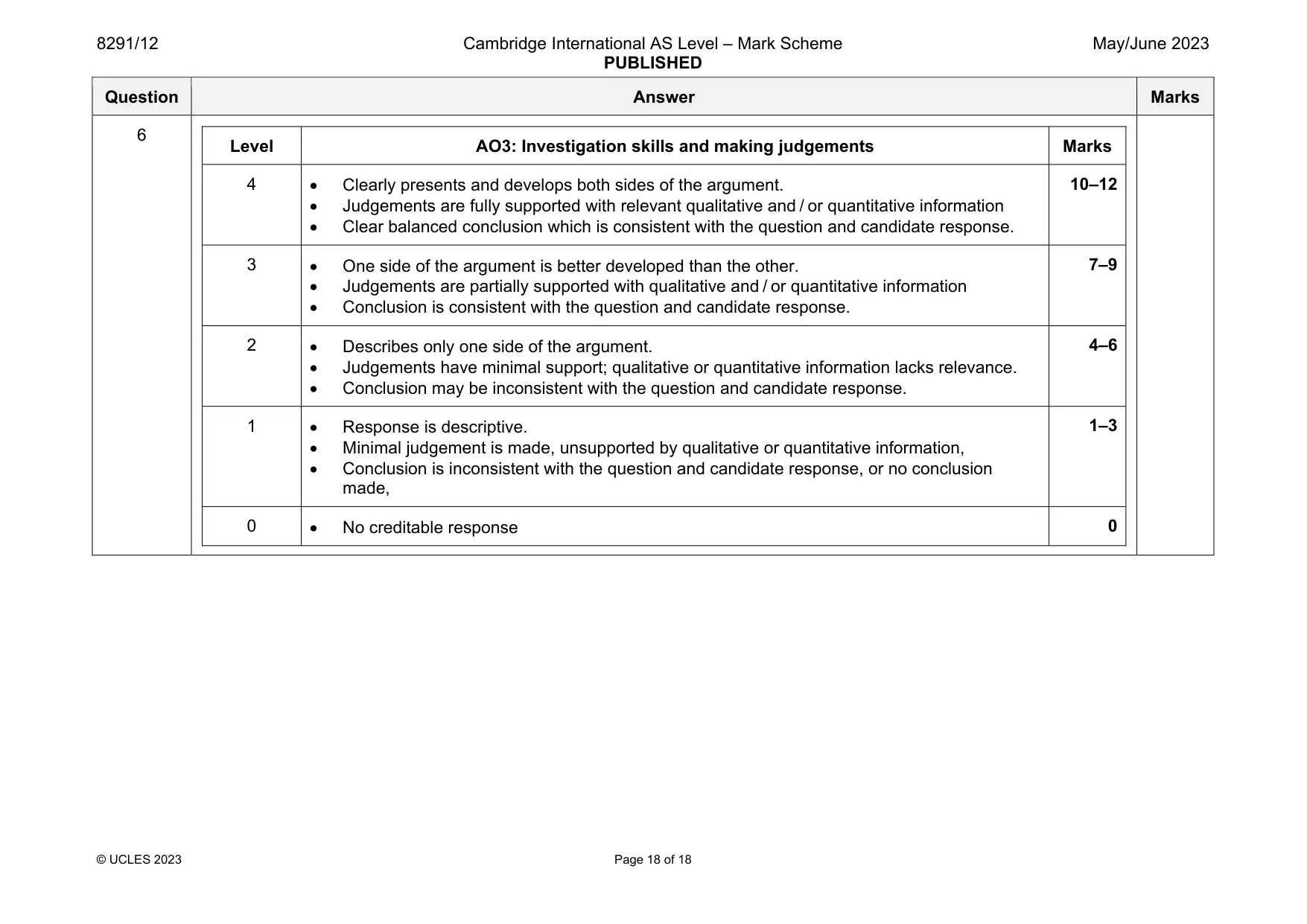
8291/12 Cambridge International AS Level – Mark Scheme PUBLISHED May/June 2023 © UCLES 2023 Page 18 of 18 Question Answer Marks 6 Level AO3: Investigation skills and making judgements Marks 4 Clearly presents and develops both sides of the argument. Judgements are fully supported with relevant qualitative and / or quantitative information Clear balanced conclusion which is consistent with the question and candidate response. 10–12 3 One side of the argument is better developed than the other. Judgements are partially supported with qualitative and / or quantitative information Conclusion is consistent with the question and candidate response. 7–9 2 Describes only one side of the argument. Judgements have minimal support; qualitative or quantitative information lacks relevance. Conclusion may be inconsistent with the question and candidate response. 4–6 1 Response is descriptive. Minimal judgement is made, unsupported by qualitative or quantitative information, Conclusion is inconsistent with the question and candidate response, or no conclusion made, 1–3 0 No creditable response 0
What you needed in this session
Cambridge’s own grade thresholds for 2023 May/June, Paper 1 · Variant 2. A higher threshold means an easier paper — the bar moves with how the cohort did.