Cambridge A Level Environmental Management (AS only) 8291 — 2022 May/June Paper 1 · Variant 3
8291/13/M/J/22 · 80 marks · ≈90 min
The question paper and its mark scheme, free to read here and free to download. This is Cambridge’s own paper, exactly as it was sat.
Question paper20 pages








Mark scheme19 pages
Answers below. Sit the paper first if you are practising.
Paper as text
Question paper, page 1
This document has 20 pages. Any blank pages are indicated. [Turn over Cambridge International AS Level * 7 6 5 8 8 6 4 4 2 2 * DC (CE/FC) 310854 © UCLES 2022 ENVIRONMENTAL MANAGEMENT 8291/13 Paper 1 Principles of Environmental Management May/June 2022 1 hour 45 minutes You must answer on the question paper. No additional materials are needed. INSTRUCTIONS ● Section A: answer all questions. ● Section B: answer one question. ● Use a black or dark blue pen. You may use an HB pencil for any diagrams or graphs. ● Write your name, centre number and candidate number in the boxes at the top of the page. ● Write your answer to each question in the space provided. ● Do not use an erasable pen or correction fluid. ● Do not write on any bar codes. ● You may use a calculator. ● You should show all your working and use appropriate units. INFORMATION ● The total mark for this paper is 80. ● The number of marks for each question or part question is shown in brackets [ ].
Question paper, page 2
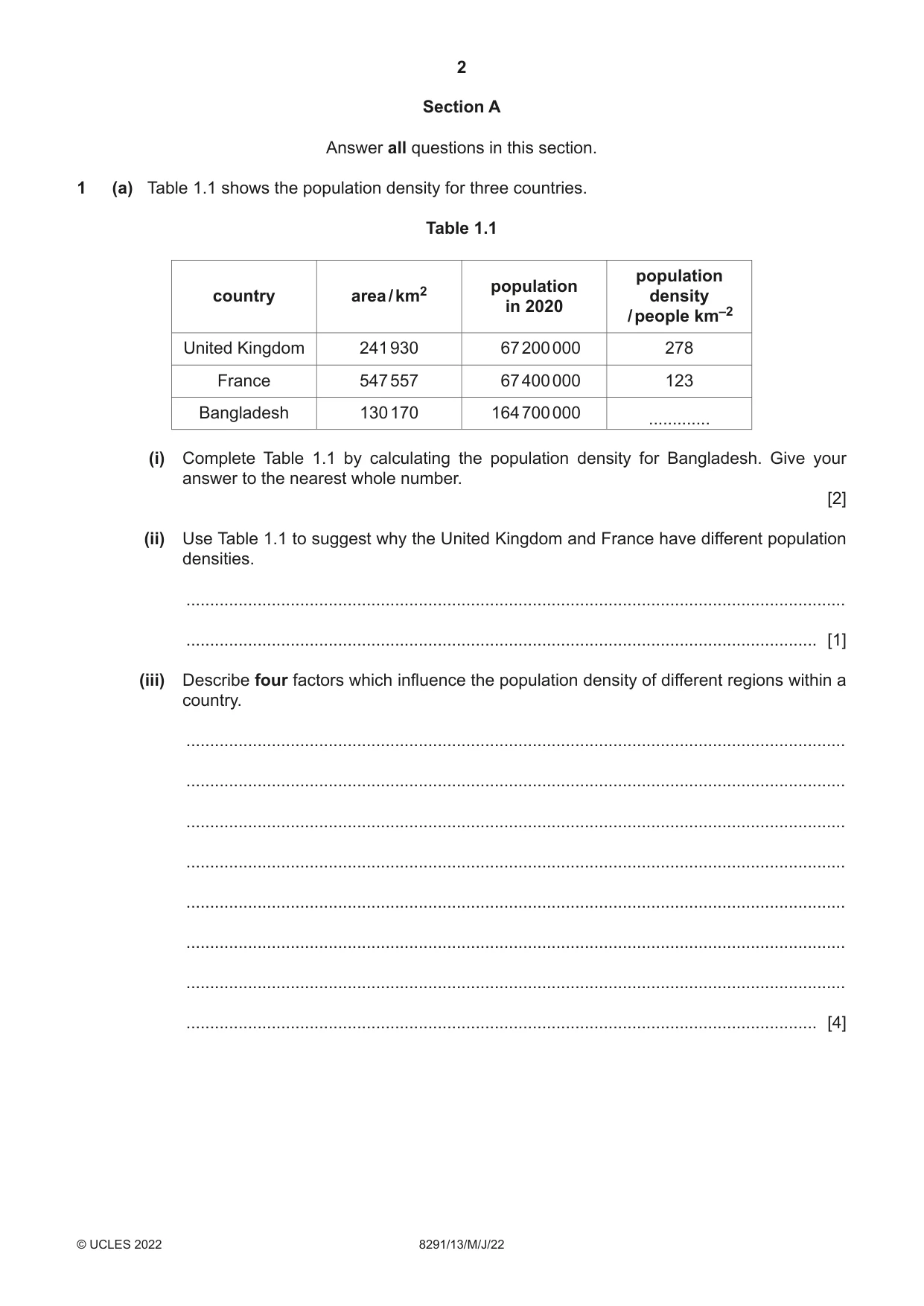
2 8291/13/M/J/22 © UCLES 2022 Section A Answer all questions in this section. 1 (a) Table 1.1 shows the population density for three countries. Table 1.1 country area / km2 population in 2020 population density / people km–2 United Kingdom 241 930 67 200 000 278 France 547 557 67 400 000 123 Bangladesh 130 170 164 700 000 … (i) Complete Table 1.1 by calculating the population density for Bangladesh. Give your answer to the nearest whole number. [2] (ii) Use Table 1.1 to suggest why the United Kingdom and France have different population densities. … … [1] (iii) Describe four factors which influence the population density of different regions within a country. … … … … … … … … [4]
Question paper, page 3
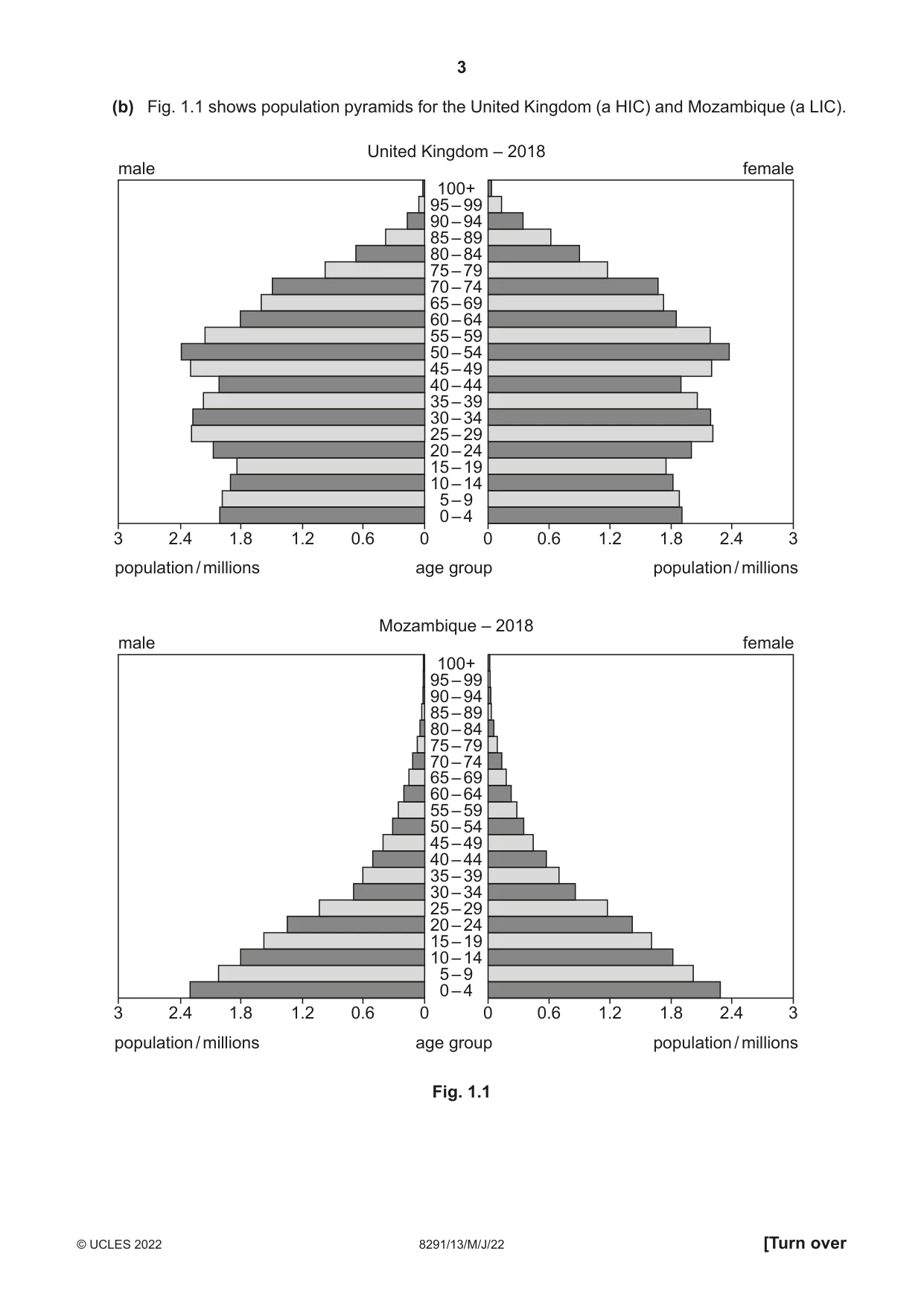
3 8291/13/M/J/22 © UCLES 2022 [Turn over (b) Fig. 1.1 shows population pyramids for the United Kingdom (a HIC) and Mozambique (a LIC). age group 0 – 4 5 – 9 10 – 14 15 – 19 20 – 24 25 – 29 30 – 34 35 – 39 40 – 44 45 – 49 50 – 54 55 – 59 60 – 64 65 – 69 70 – 74 75 – 79 80 – 84 85 – 89 90 – 94 95 – 99 100+ United Kingdom – 2018 male population / millions population / millions female 0.6 1.2 1.8 2.4 3 0 0.6 1.2 1.8 2.4 3 0 age group 0 – 4 5 – 9 10 – 14 15 – 19 20 – 24 25 – 29 30 – 34 35 – 39 40 – 44 45 – 49 50 – 54 55 – 59 60 – 64 65 – 69 70 – 74 75 – 79 80 – 84 85 – 89 90 – 94 95 – 99 100+ Mozambique – 2018 male population / millions population / millions female 0.6 1.2 1.8 2.4 3 0 0.6 1.2 1.8 2.4 3 0 Fig. 1.1
Question paper, page 4
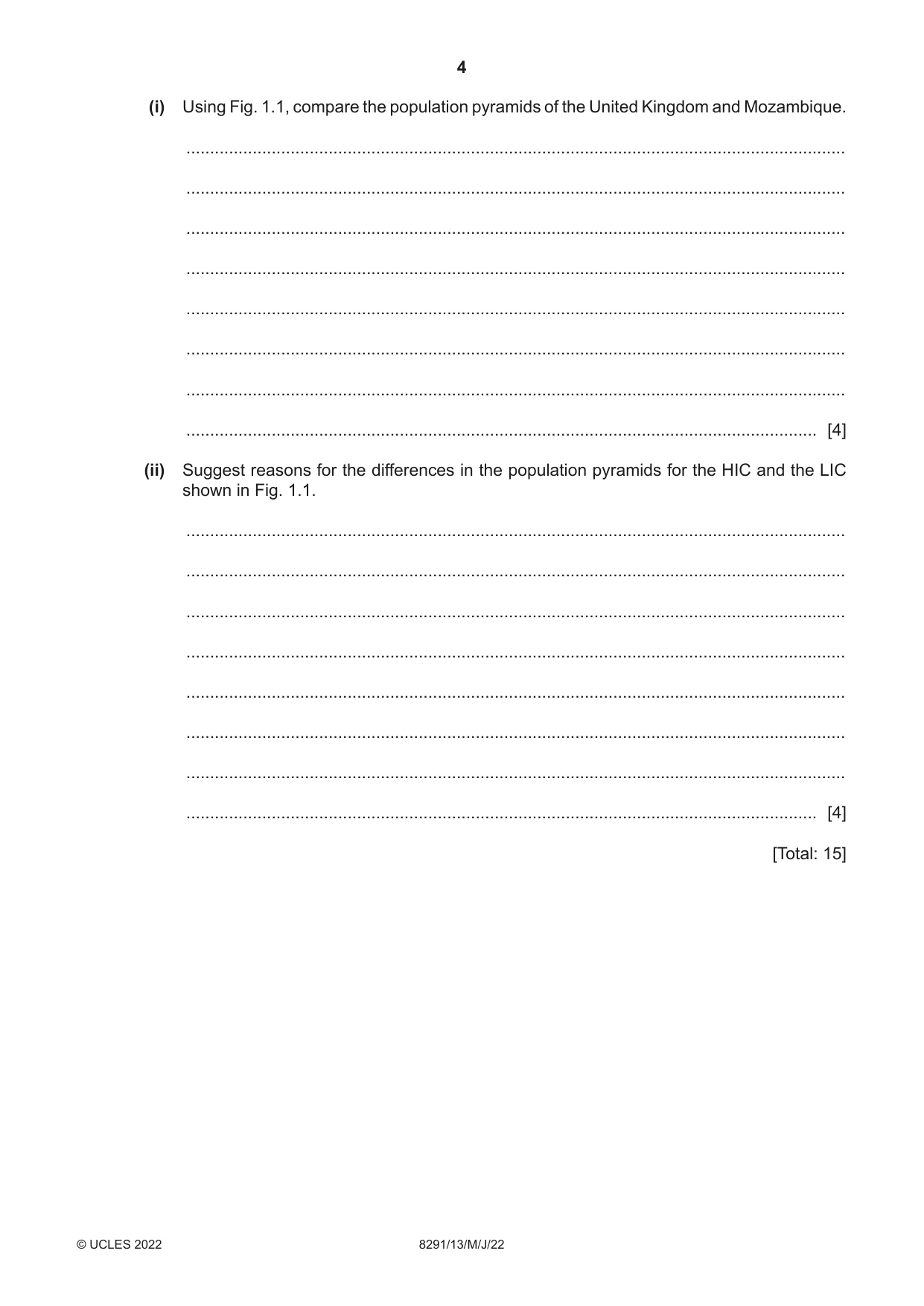
4 8291/13/M/J/22 © UCLES 2022 (i) Using Fig. 1.1, compare the population pyramids of the United Kingdom and Mozambique. … … … … … … … … [4] (ii) Suggest reasons for the differences in the population pyramids for the HIC and the LIC shown in Fig. 1.1. … … … … … … … … [4] [Total: 15]
Question paper, page 5
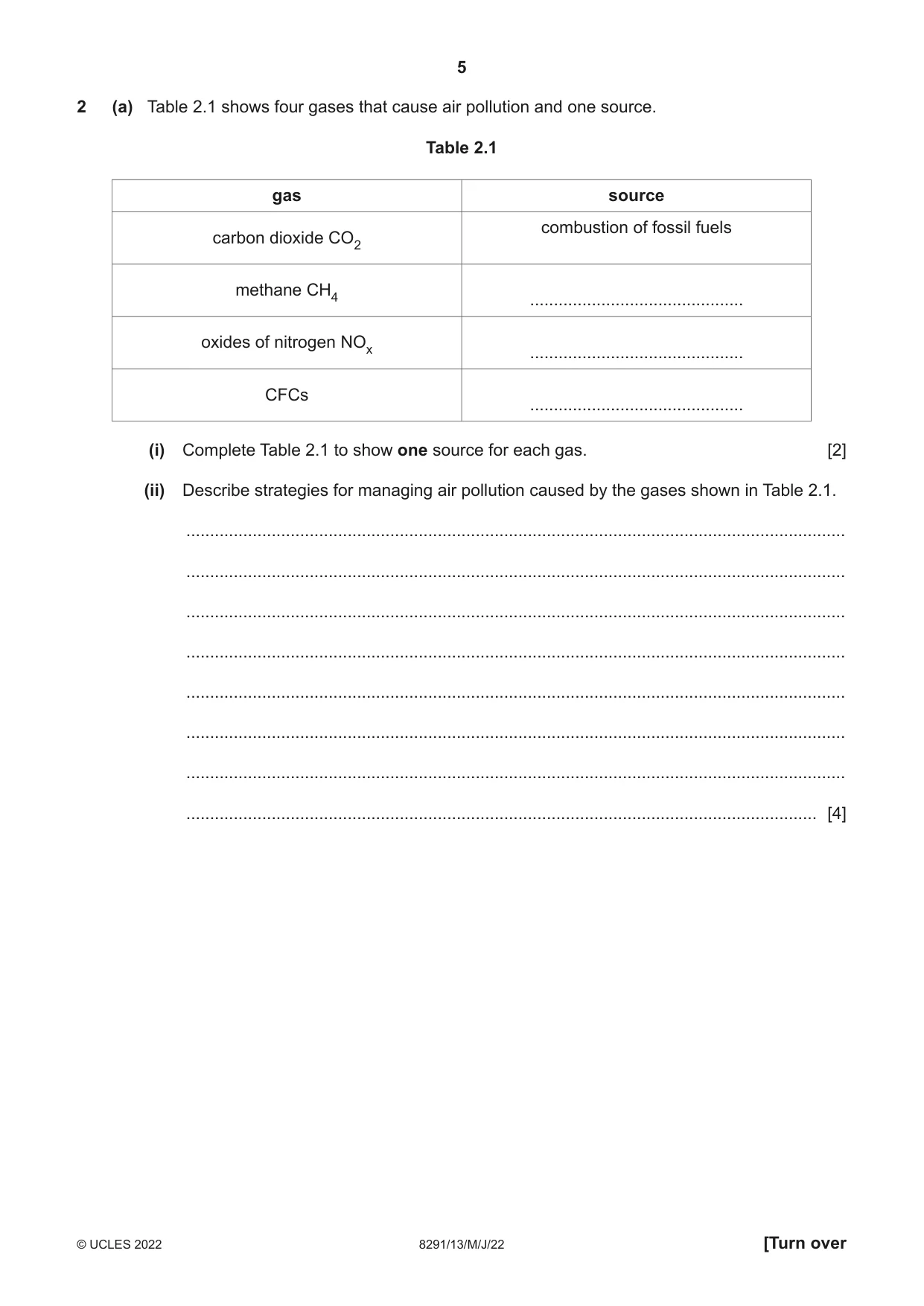
5 8291/13/M/J/22 © UCLES 2022 [Turn over 2 (a) Table 2.1 shows four gases that cause air pollution and one source. Table 2.1 gas source carbon dioxide CO2 combustion of fossil fuels methane CH4 … oxides of nitrogen NOx … CFCs … (i) Complete Table 2.1 to show one source for each gas. [2] (ii) Describe strategies for managing air pollution caused by the gases shown in Table 2.1. … … … … … … … … [4]
Question paper, page 6
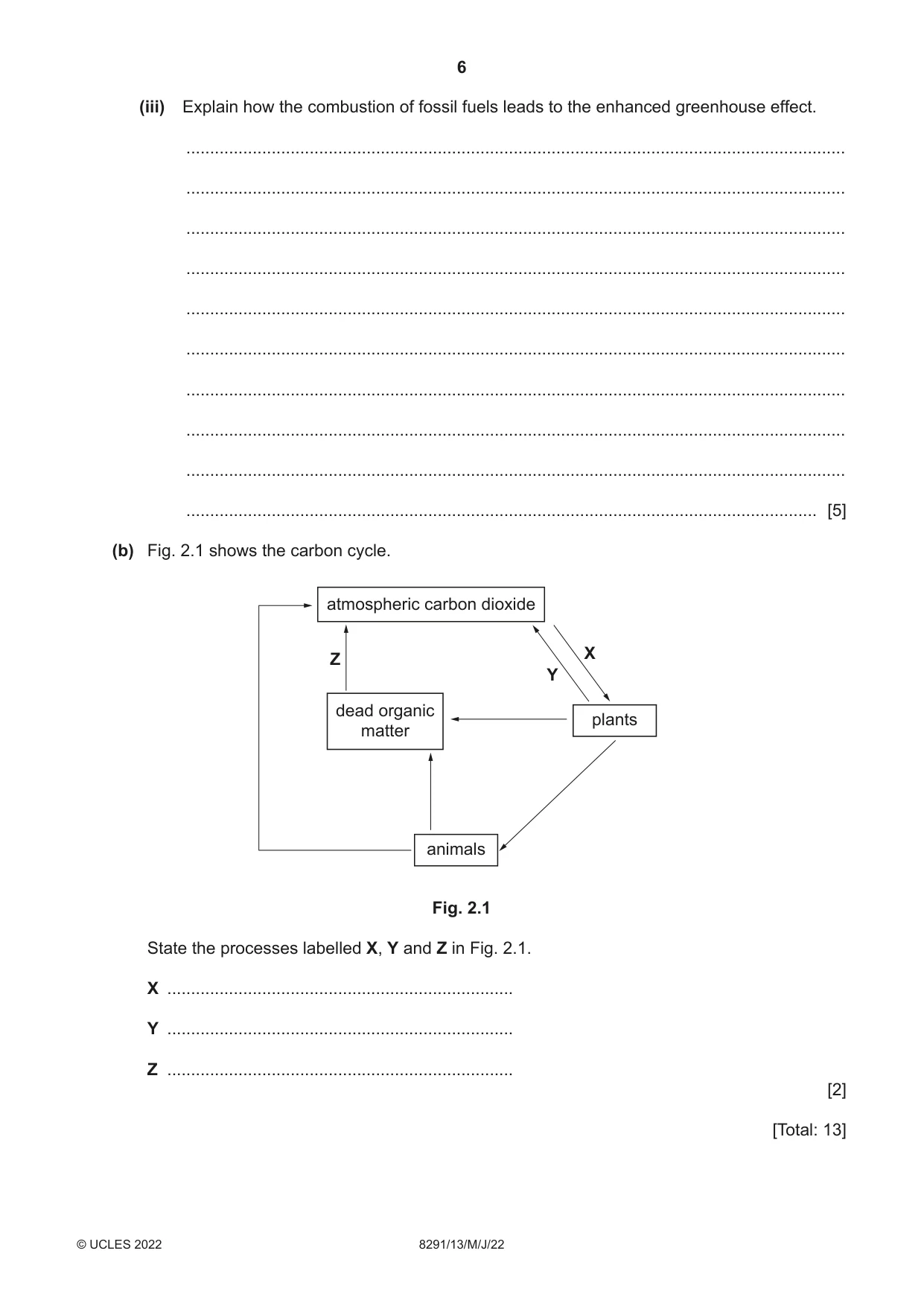
6 8291/13/M/J/22 © UCLES 2022 (iii) Explain how the combustion of fossil fuels leads to the enhanced greenhouse effect. … … … … … … … … … … [5] (b) Fig. 2.1 shows the carbon cycle. atmospheric carbon dioxide dead organic matter Z Y X animals plants Fig. 2.1 State the processes labelled X, Y and Z in Fig. 2.1. X … Y … Z … [2] [Total: 13]
Question paper, page 7
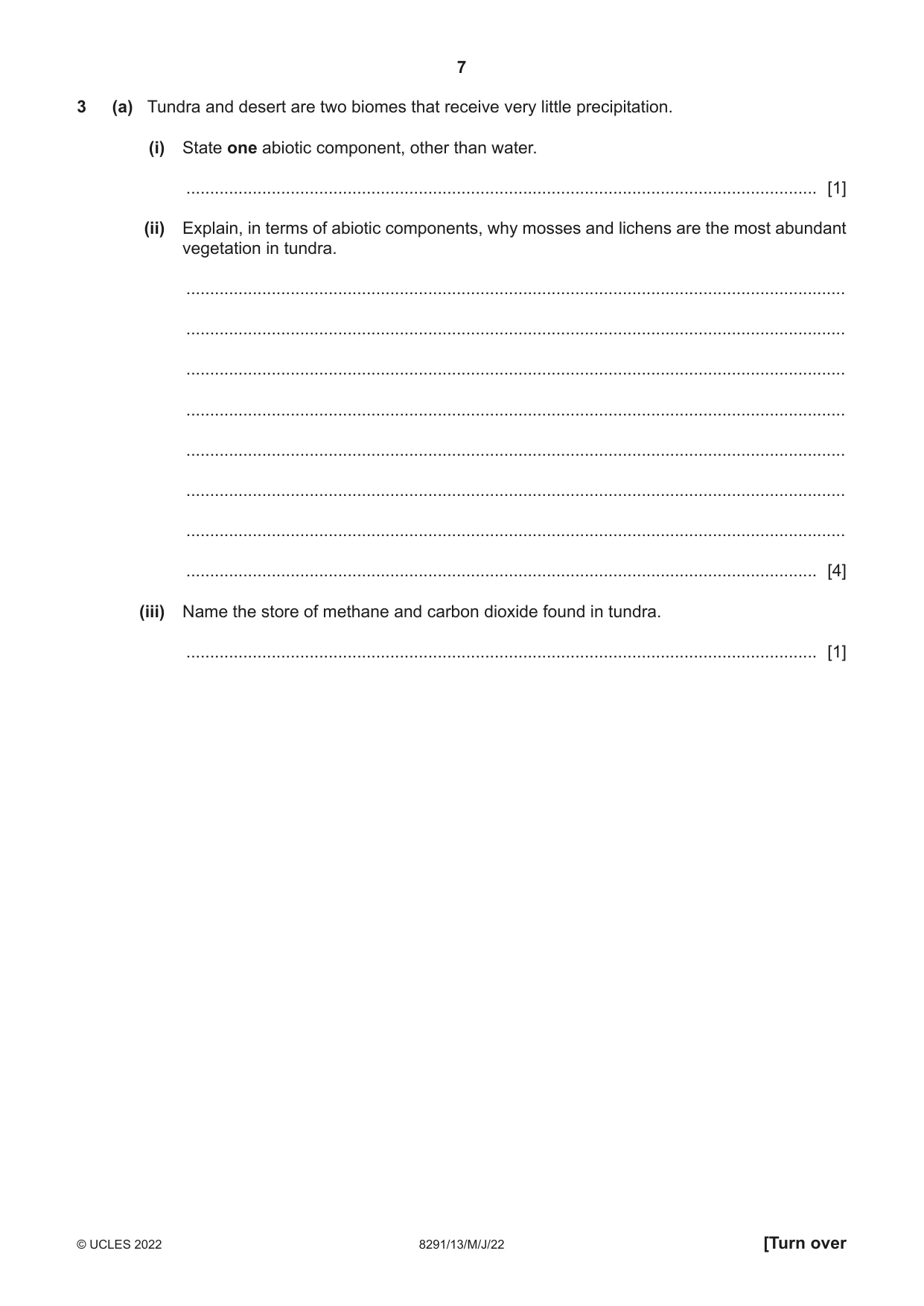
7 8291/13/M/J/22 © UCLES 2022 [Turn over 3 (a) Tundra and desert are two biomes that receive very little precipitation. (i) State one abiotic component, other than water. … [1] (ii) Explain, in terms of abiotic components, why mosses and lichens are the most abundant vegetation in tundra. … … … … … … … … [4] (iii) Name the store of methane and carbon dioxide found in tundra. … [1]
Question paper, page 8
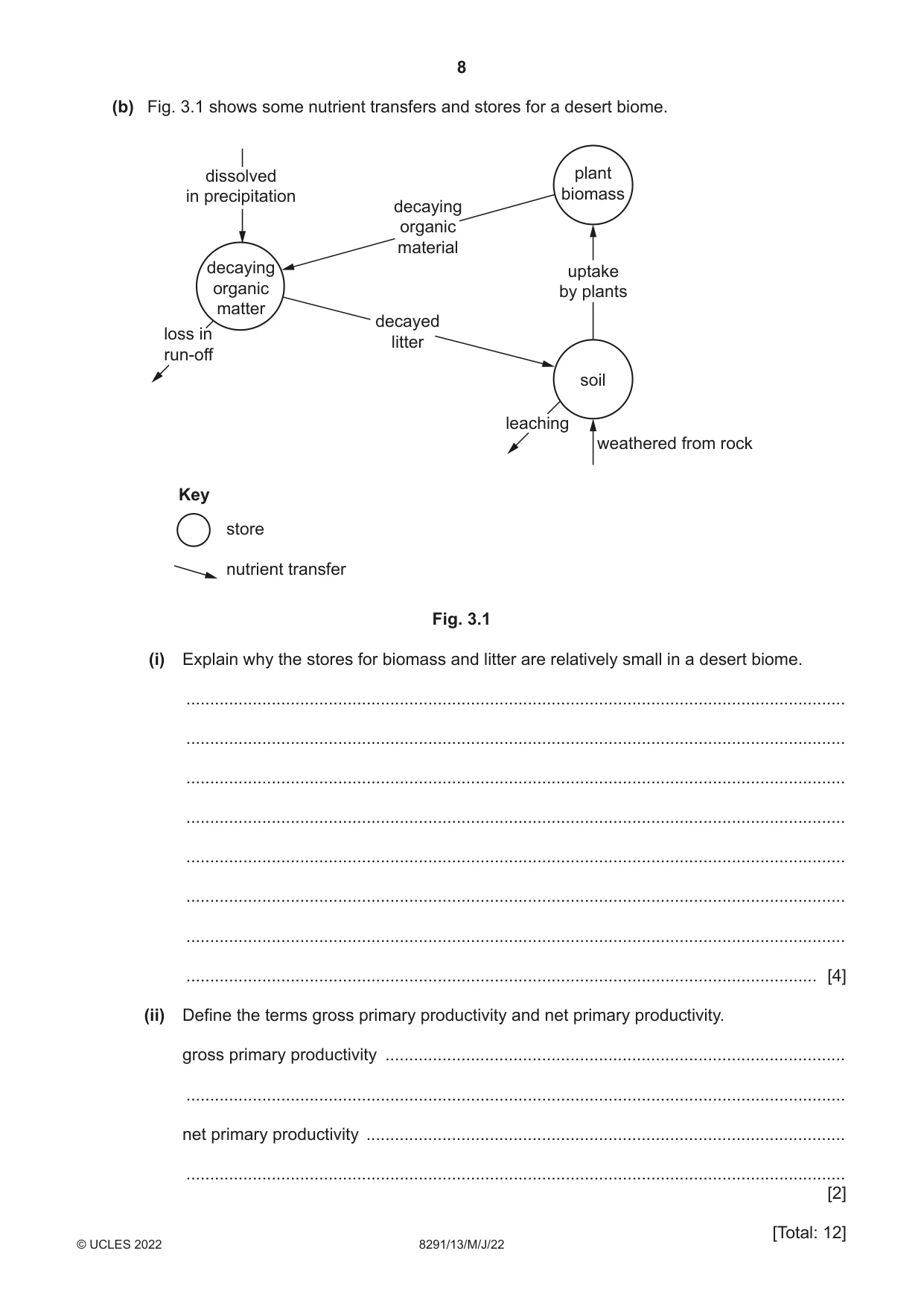
8 8291/13/M/J/22 © UCLES 2022 (b) Fig. 3.1 shows some nutrient transfers and stores for a desert biome. decaying organic matter plant biomass soil store nutrient transfer weathered from rock Key dissolved in precipitation decaying organic material decayed litter loss in run-off uptake by plants leaching Fig. 3.1 (i) Explain why the stores for biomass and litter are relatively small in a desert biome. … … … … … … … … [4] (ii) Define the terms gross primary productivity and net primary productivity. gross primary productivity … … net primary productivity … … [2] [Total: 12]
Question paper, page 9
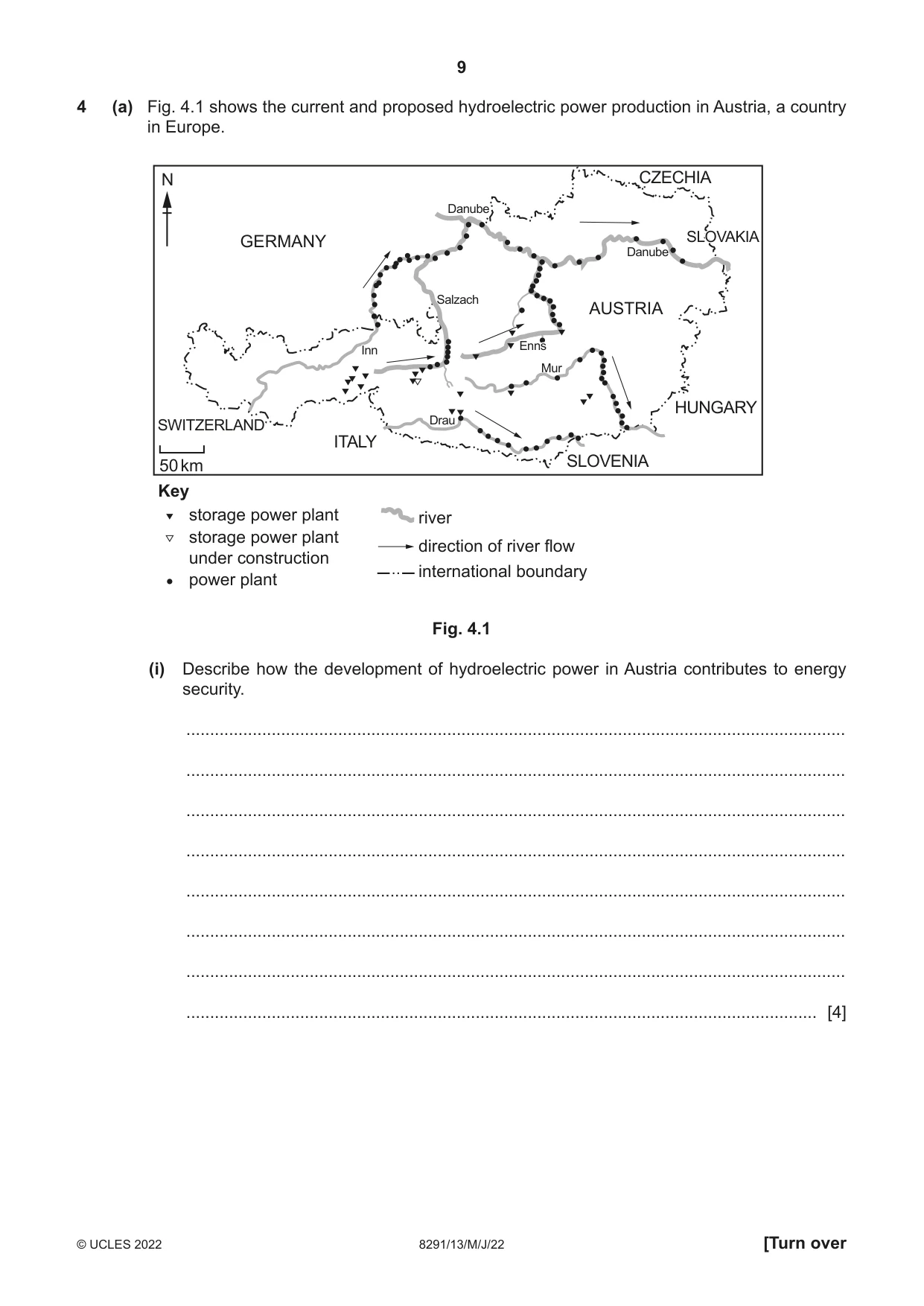
9 8291/13/M/J/22 © UCLES 2022 [Turn over 4 (a) Fig. 4.1 shows the current and proposed hydroelectric power production in Austria, a country in Europe. power plant river direction of river flow international boundary storage power plant storage power plant under construction Key N 50 km GERMANY SLOVAKIA ITALY SLOVENIA HUNGARY Inn Salzach Enns Mur Danube Danube Drau GERMANY CZECHIA SLOVAKIA AUSTRIA ITALY SLOVENIA HUNGARY SWITZERLAND Inn Salzach Enns Mur Danube Danube Drau Fig. 4.1 (i) Describe how the development of hydroelectric power in Austria contributes to energy security. … … … … … … … … [4]
Question paper, page 10
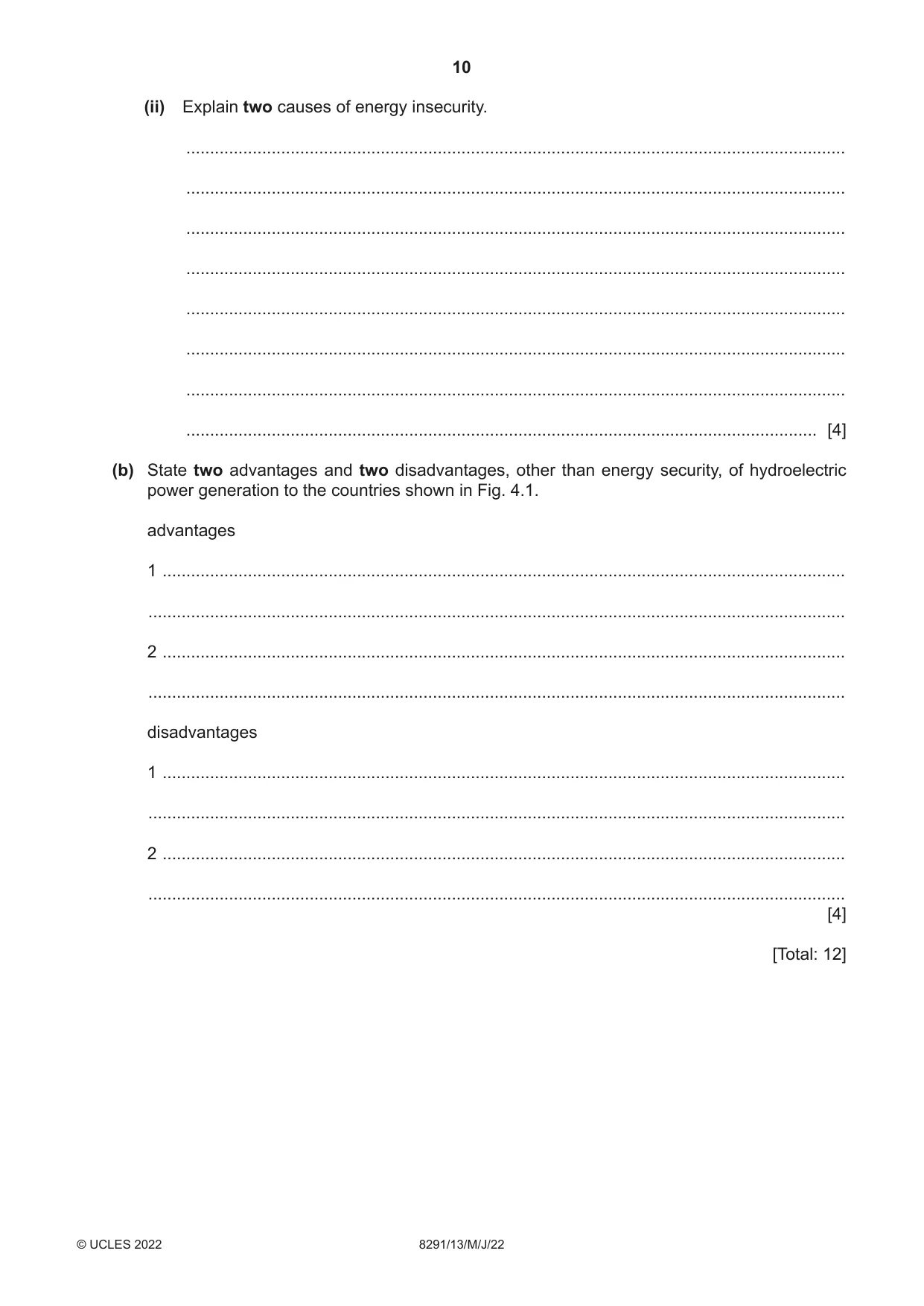
10 8291/13/M/J/22 © UCLES 2022 (ii) Explain two causes of energy insecurity. … … … … … … … … [4] (b) State two advantages and two disadvantages, other than energy security, of hydroelectric power generation to the countries shown in Fig. 4.1. advantages 1 … … 2 … … disadvantages 1 … … 2 … … [4] [Total: 12]
Question paper, page 11
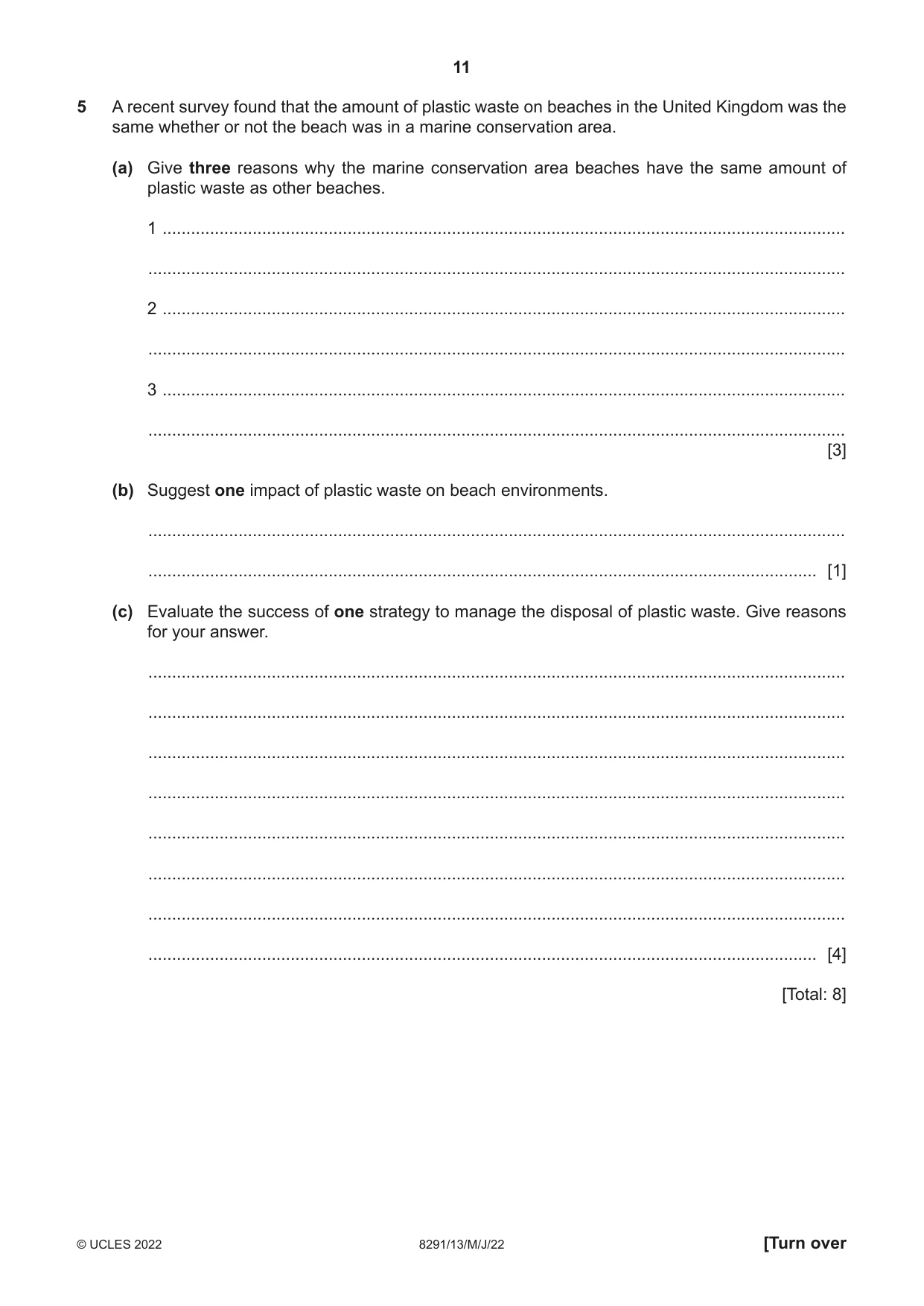
11 8291/13/M/J/22 © UCLES 2022 [Turn over 5 A recent survey found that the amount of plastic waste on beaches in the United Kingdom was the same whether or not the beach was in a marine conservation area. (a) Give three reasons why the marine conservation area beaches have the same amount of plastic waste as other beaches. 1 … … 2 … … 3 … … [3] (b) Suggest one impact of plastic waste on beach environments. … … [1] (c) Evaluate the success of one strategy to manage the disposal of plastic waste. Give reasons for your answer. … … … … … … … … [4] [Total: 8]
Question paper, page 12
12 8291/13/M/J/22 © UCLES 2022 Section B Answer one question. Either 6 ‘The devastating Australian wild fires of 2020 are strong evidence for global climate change.’ To what extent do you agree with this statement? Give reasons and include information from relevant examples to support your answer. [20] Or 7 Evaluate the success of strategies to manage the conservation of habitats in a location of your choice. Give reasons and include information from relevant examples to support your answer. [20] … … … … … … … … … … … … … … … … … …
Question paper, page 13
13 8291/13/M/J/22 © UCLES 2022 [Turn over … … … … … … … … … … … … … … … … … … … … … … … … … … … …
Question paper, page 14
14 8291/13/M/J/22 © UCLES 2022 … … … … … … … … … … … … … … … … … … … … … … … … … … … …
Question paper, page 15
15 8291/13/M/J/22 © UCLES 2022 [Turn over … … … … … … … … … … … … … … … … … … … … … … … … … … … …
Question paper, page 16
16 8291/13/M/J/22 © UCLES 2022 … … … … … … … … … … … … … … … … … … … … … … … … … … … …
Question paper, page 17
17 8291/13/M/J/22 © UCLES 2022 … … … … … … … … … … … … … … … … … … … … … … … … … … … …
Question paper, page 18
18 8291/13/M/J/22 © UCLES 2022 BLANK PAGE
Question paper, page 19
19 8291/13/M/J/22 © UCLES 2022 BLANK PAGE
Question paper, page 20
20 8291/13/M/J/22 © UCLES 2022 The boundaries and names shown, the designations used and the presentation of material on any maps contained in this question paper/insert do not imply official endorsement or acceptance by Cambridge Assessment International Education concerning the legal status of any country, territory, or area or any of its authorities, or of the delimitation of its frontiers or boundaries. Permission to reproduce items where third-party owned material protected by copyright is included has been sought and cleared where possible. Every reasonable effort has been made by the publisher (UCLES) to trace copyright holders, but if any items requiring clearance have unwittingly been included, the publisher will be pleased to make amends at the earliest possible opportunity. To avoid the issue of disclosure of answer-related information to candidates, all copyright acknowledgements are reproduced online in the Cambridge Assessment International Education Copyright Acknowledgements Booklet. This is produced for each series of examinations and is freely available to download at www.cambridgeinternational.org after the live examination series. Cambridge Assessment International Education is part of Cambridge Assessment. Cambridge Assessment is the brand name of the University of Cambridge Local Examinations Syndicate (UCLES), which is a department of the University of Cambridge. BLANK PAGE
Mark scheme, page 1
This document consists of 19 printed pages. © UCLES 2022 [Turn over Cambridge International AS Level ENVIRONMENTAL MANAGEMENT 8291/13 Paper 1 Principles of Environmental Management May/June 2022 MARK SCHEME Maximum Mark: 80 Published This mark scheme is published as an aid to teachers and candidates, to indicate the requirements of the examination. It shows the basis on which Examiners were instructed to award marks. It does not indicate the details of the discussions that took place at an Examiners’ meeting before marking began, which would have considered the acceptability of alternative answers. Mark schemes should be read in conjunction with the question paper and the Principal Examiner Report for Teachers. Cambridge International will not enter into discussions about these mark schemes. Cambridge International is publishing the mark schemes for the May/June 2022 series for most Cambridge IGCSE, Cambridge International A and AS Level and Cambridge Pre-U components, and some Cambridge O Level components.
Mark scheme, page 2
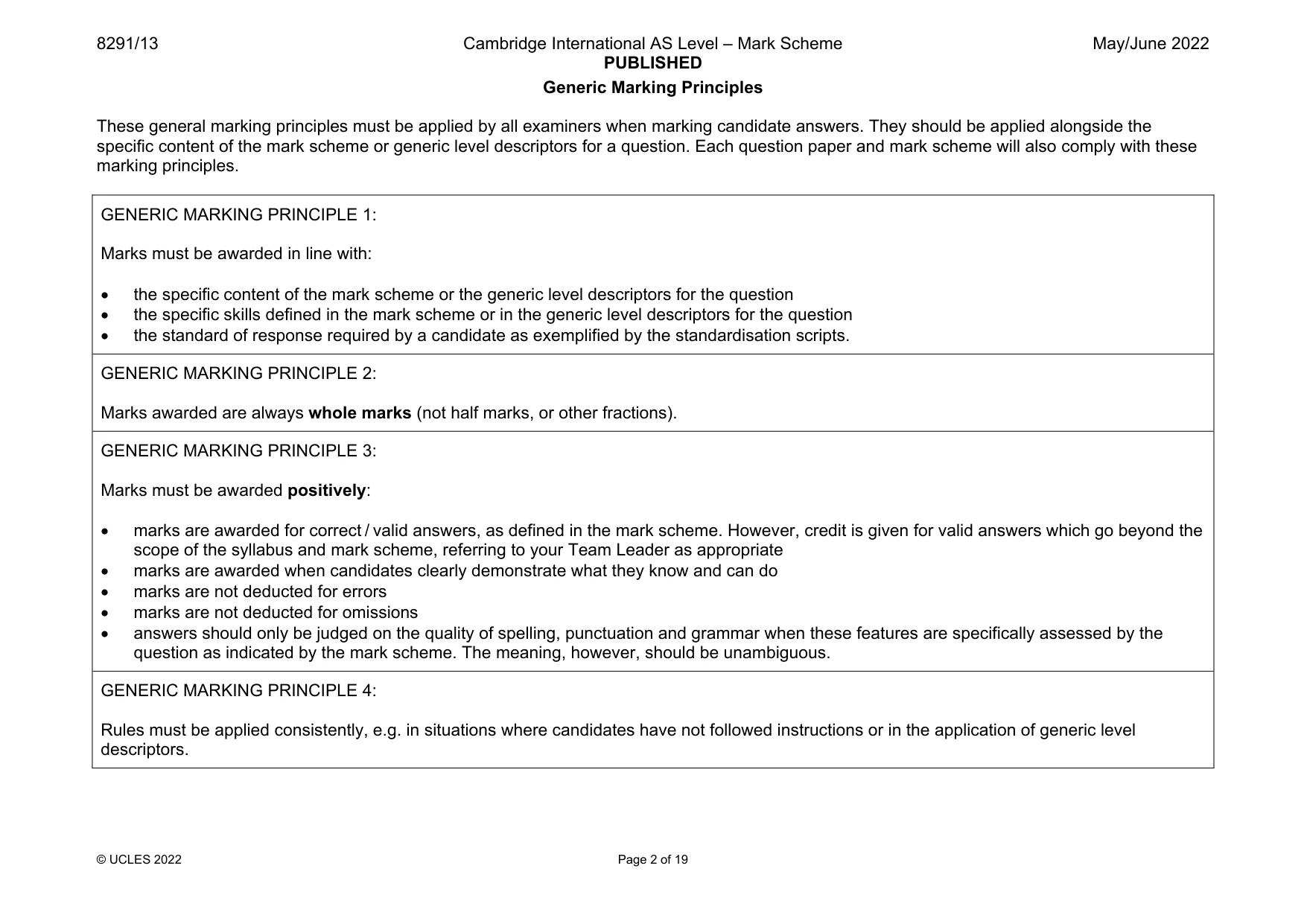
8291/13 Cambridge International AS Level – Mark Scheme PUBLISHED May/June 2022 © UCLES 2022 Page 2 of 19 Generic Marking Principles These general marking principles must be applied by all examiners when marking candidate answers. They should be applied alongside the specific content of the mark scheme or generic level descriptors for a question. Each question paper and mark scheme will also comply with these marking principles. GENERIC MARKING PRINCIPLE 1: Marks must be awarded in line with: the specific content of the mark scheme or the generic level descriptors for the question the specific skills defined in the mark scheme or in the generic level descriptors for the question the standard of response required by a candidate as exemplified by the standardisation scripts. GENERIC MARKING PRINCIPLE 2: Marks awarded are always whole marks (not half marks, or other fractions). GENERIC MARKING PRINCIPLE 3: Marks must be awarded positively: marks are awarded for correct / valid answers, as defined in the mark scheme. However, credit is given for valid answers which go beyond the scope of the syllabus and mark scheme, referring to your Team Leader as appropriate marks are awarded when candidates clearly demonstrate what they know and can do marks are not deducted for errors marks are not deducted for omissions answers should only be judged on the quality of spelling, punctuation and grammar when these features are specifically assessed by the question as indicated by the mark scheme. The meaning, however, should be unambiguous. GENERIC MARKING PRINCIPLE 4: Rules must be applied consistently, e.g. in situations where candidates have not followed instructions or in the application of generic level descriptors.
Mark scheme, page 3
8291/13 Cambridge International AS Level – Mark Scheme PUBLISHED May/June 2022 © UCLES 2022 Page 3 of 19 GENERIC MARKING PRINCIPLE 5: Marks should be awarded using the full range of marks defined in the mark scheme for the question (however; the use of the full mark range may be limited according to the quality of the candidate responses seen). GENERIC MARKING PRINCIPLE 6: Marks awarded are based solely on the requirements as defined in the mark scheme. Marks should not be awarded with grade thresholds or grade descriptors in mind.
Mark scheme, page 4
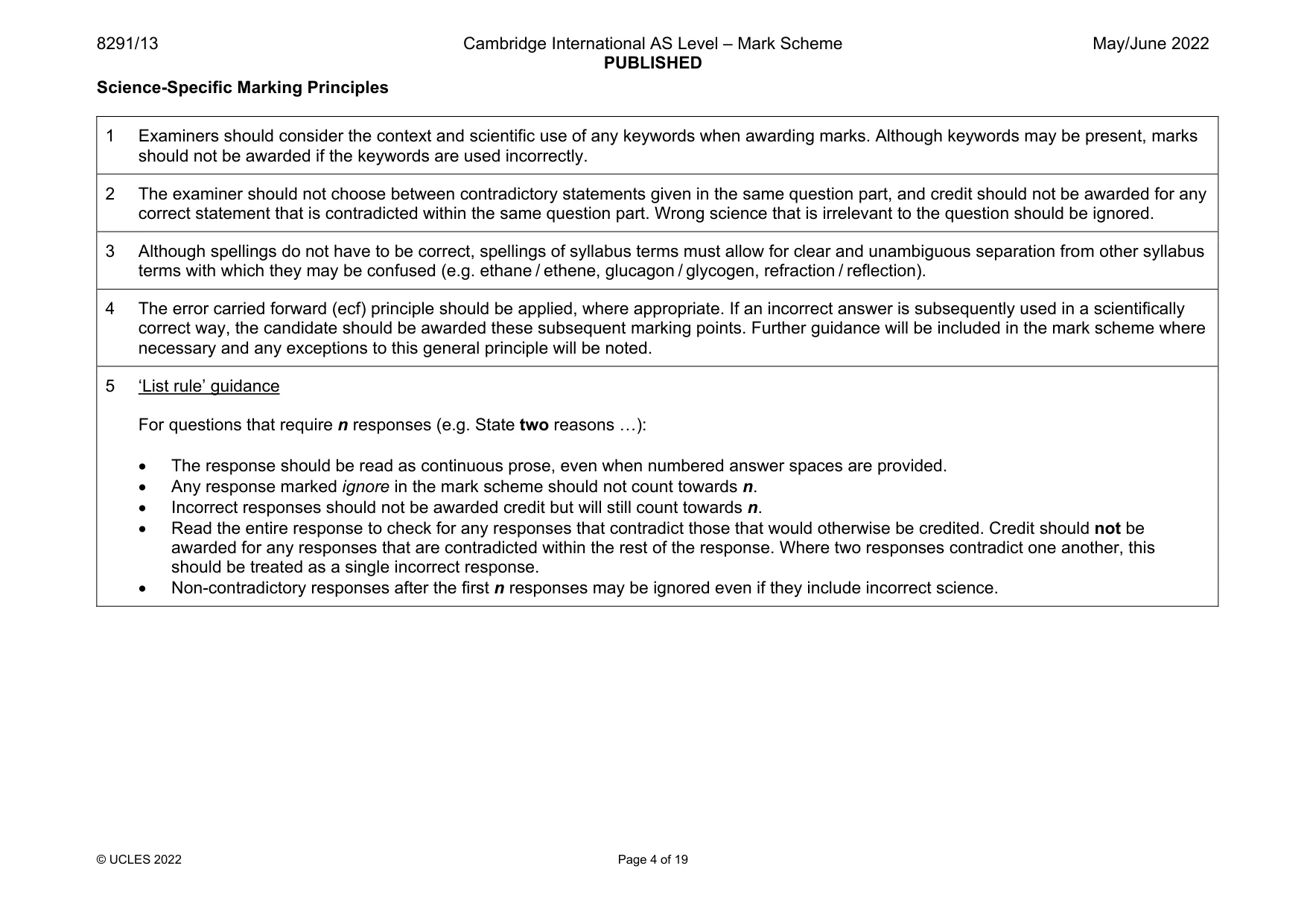
8291/13 Cambridge International AS Level – Mark Scheme PUBLISHED May/June 2022 © UCLES 2022 Page 4 of 19 Science-Specific Marking Principles 1 Examiners should consider the context and scientific use of any keywords when awarding marks. Although keywords may be present, marks should not be awarded if the keywords are used incorrectly. 2 The examiner should not choose between contradictory statements given in the same question part, and credit should not be awarded for any correct statement that is contradicted within the same question part. Wrong science that is irrelevant to the question should be ignored. 3 Although spellings do not have to be correct, spellings of syllabus terms must allow for clear and unambiguous separation from other syllabus terms with which they may be confused (e.g. ethane / ethene, glucagon / glycogen, refraction / reflection). 4 The error carried forward (ecf) principle should be applied, where appropriate. If an incorrect answer is subsequently used in a scientifically correct way, the candidate should be awarded these subsequent marking points. Further guidance will be included in the mark scheme where necessary and any exceptions to this general principle will be noted. 5 ‘List rule’ guidance For questions that require n responses (e.g. State two reasons …): The response should be read as continuous prose, even when numbered answer spaces are provided. Any response marked ignore in the mark scheme should not count towards n. Incorrect responses should not be awarded credit but will still count towards n. Read the entire response to check for any responses that contradict those that would otherwise be credited. Credit should not be awarded for any responses that are contradicted within the rest of the response. Where two responses contradict one another, this should be treated as a single incorrect response. Non-contradictory responses after the first n responses may be ignored even if they include incorrect science.
Mark scheme, page 5
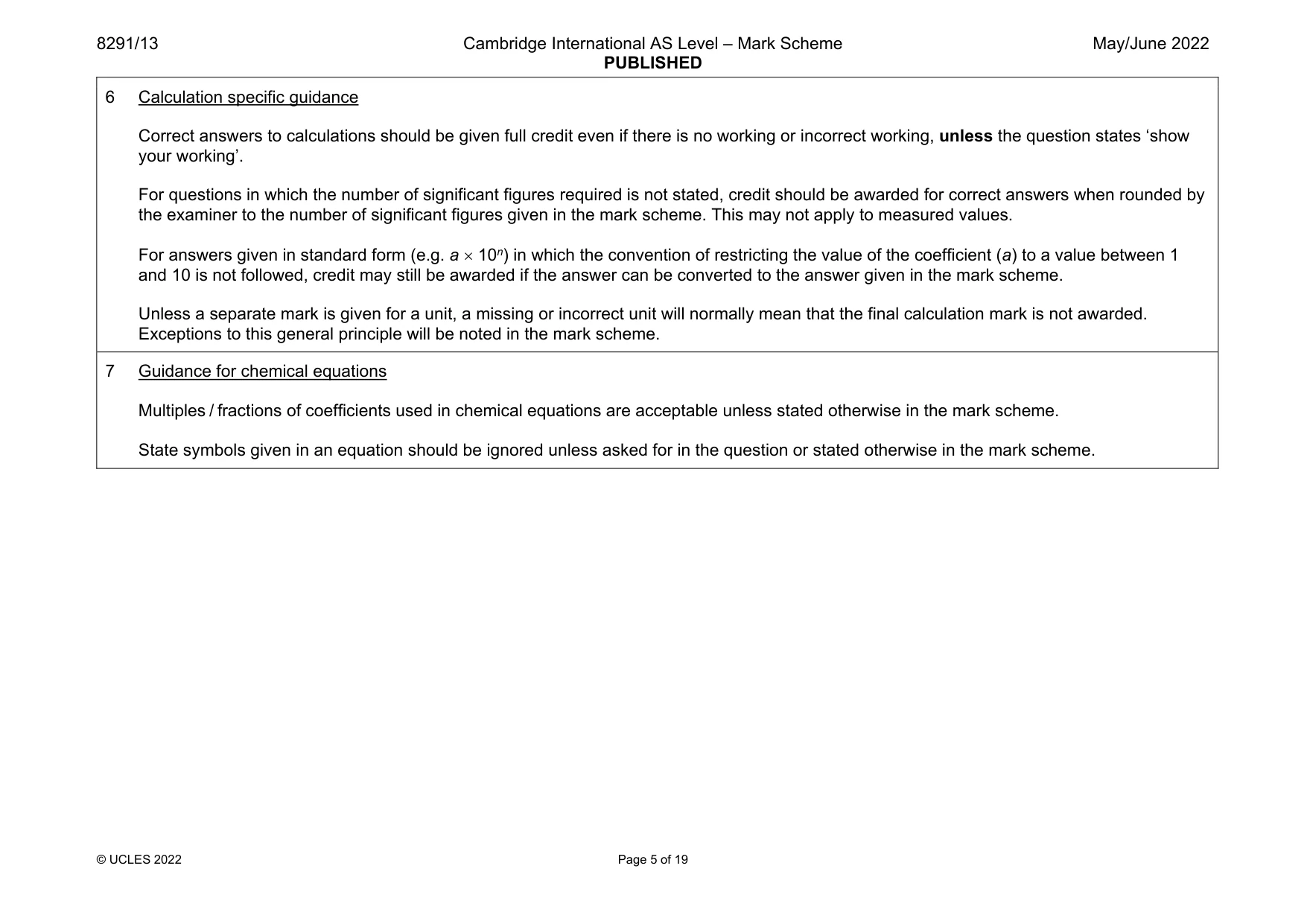
8291/13 Cambridge International AS Level – Mark Scheme PUBLISHED May/June 2022 © UCLES 2022 Page 5 of 19 6 Calculation specific guidance Correct answers to calculations should be given full credit even if there is no working or incorrect working, unless the question states ‘show your working’. For questions in which the number of significant figures required is not stated, credit should be awarded for correct answers when rounded by the examiner to the number of significant figures given in the mark scheme. This may not apply to measured values. For answers given in standard form (e.g. a 10n) in which the convention of restricting the value of the coefficient (a) to a value between 1 and 10 is not followed, credit may still be awarded if the answer can be converted to the answer given in the mark scheme. Unless a separate mark is given for a unit, a missing or incorrect unit will normally mean that the final calculation mark is not awarded. Exceptions to this general principle will be noted in the mark scheme. 7 Guidance for chemical equations Multiples / fractions of coefficients used in chemical equations are acceptable unless stated otherwise in the mark scheme. State symbols given in an equation should be ignored unless asked for in the question or stated otherwise in the mark scheme.
Mark scheme, page 6
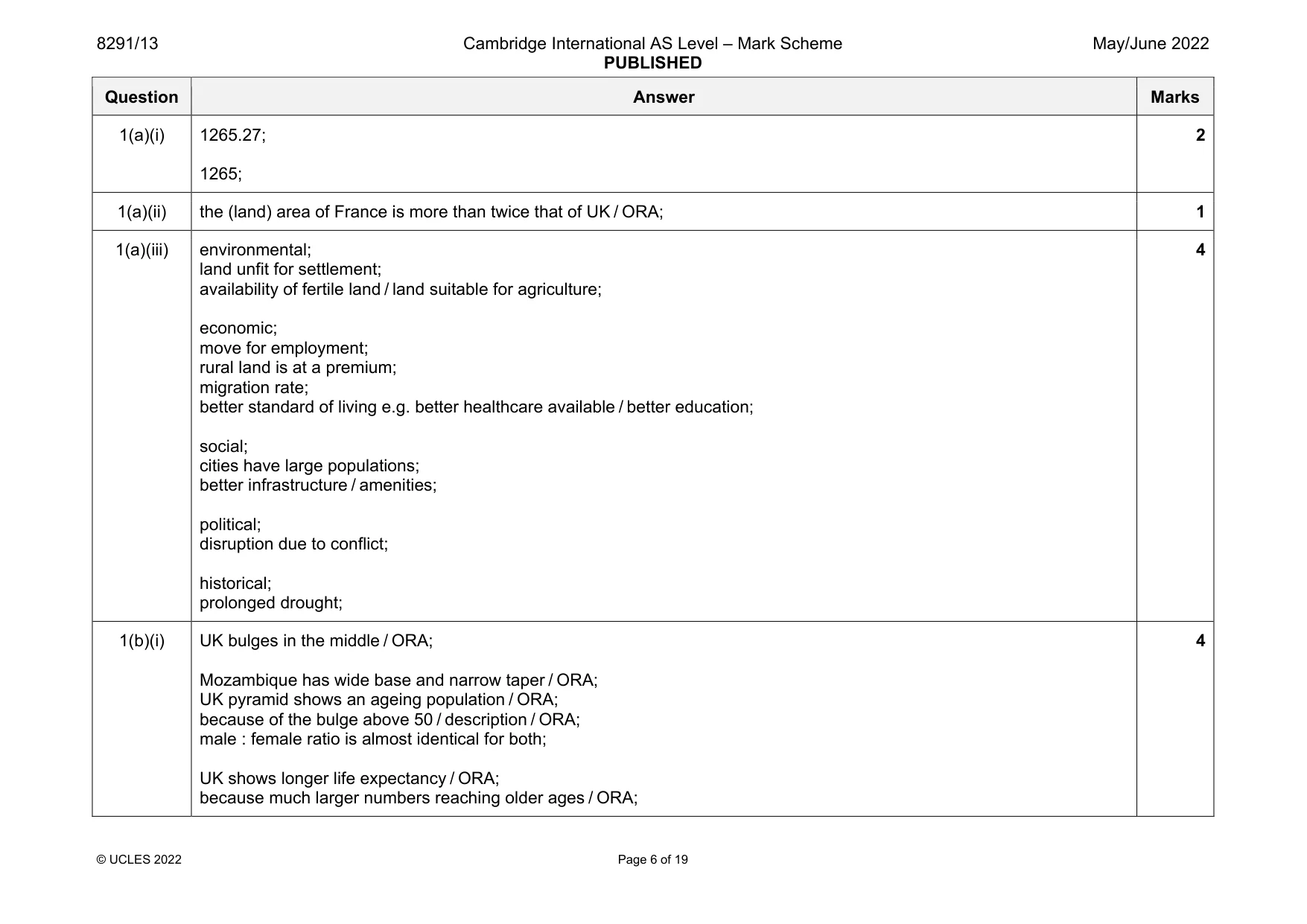
8291/13 Cambridge International AS Level – Mark Scheme PUBLISHED May/June 2022 © UCLES 2022 Page 6 of 19 Question Answer Marks 1(a)(i) 1265.27; 1265; 2 1(a)(ii) the (land) area of France is more than twice that of UK / ORA; 1 1(a)(iii) environmental; land unfit for settlement; availability of fertile land / land suitable for agriculture; economic; move for employment; rural land is at a premium; migration rate; better standard of living e.g. better healthcare available / better education; social; cities have large populations; better infrastructure / amenities; political; disruption due to conflict; historical; prolonged drought; 4 1(b)(i) UK bulges in the middle / ORA; Mozambique has wide base and narrow taper / ORA; UK pyramid shows an ageing population / ORA; because of the bulge above 50 / description / ORA; male : female ratio is almost identical for both; UK shows longer life expectancy / ORA; because much larger numbers reaching older ages / ORA; 4
Mark scheme, page 7
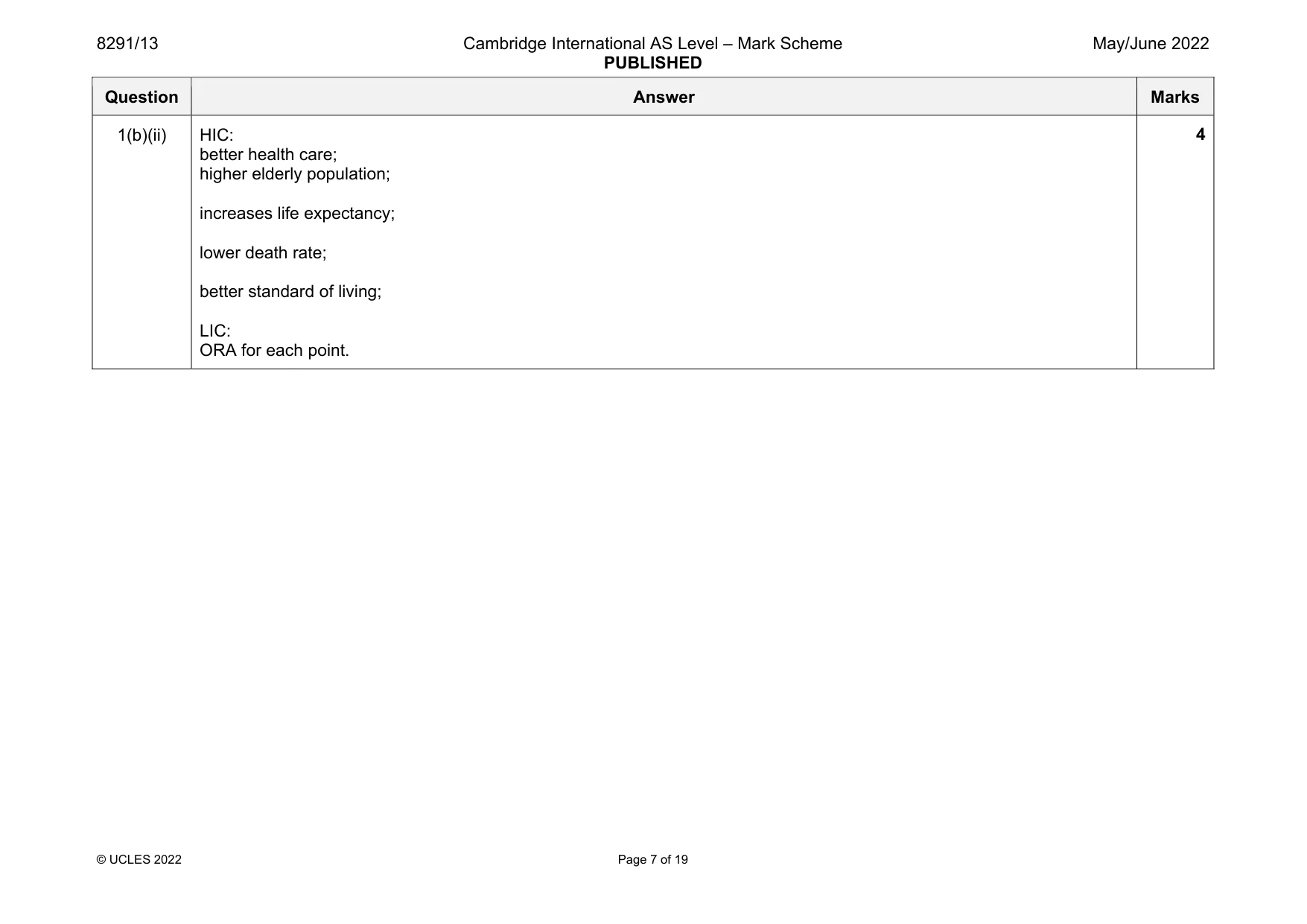
8291/13 Cambridge International AS Level – Mark Scheme PUBLISHED May/June 2022 © UCLES 2022 Page 7 of 19 Question Answer Marks 1(b)(ii) HIC: better health care; higher elderly population; increases life expectancy; lower death rate; better standard of living; LIC: ORA for each point. 4
Mark scheme, page 8
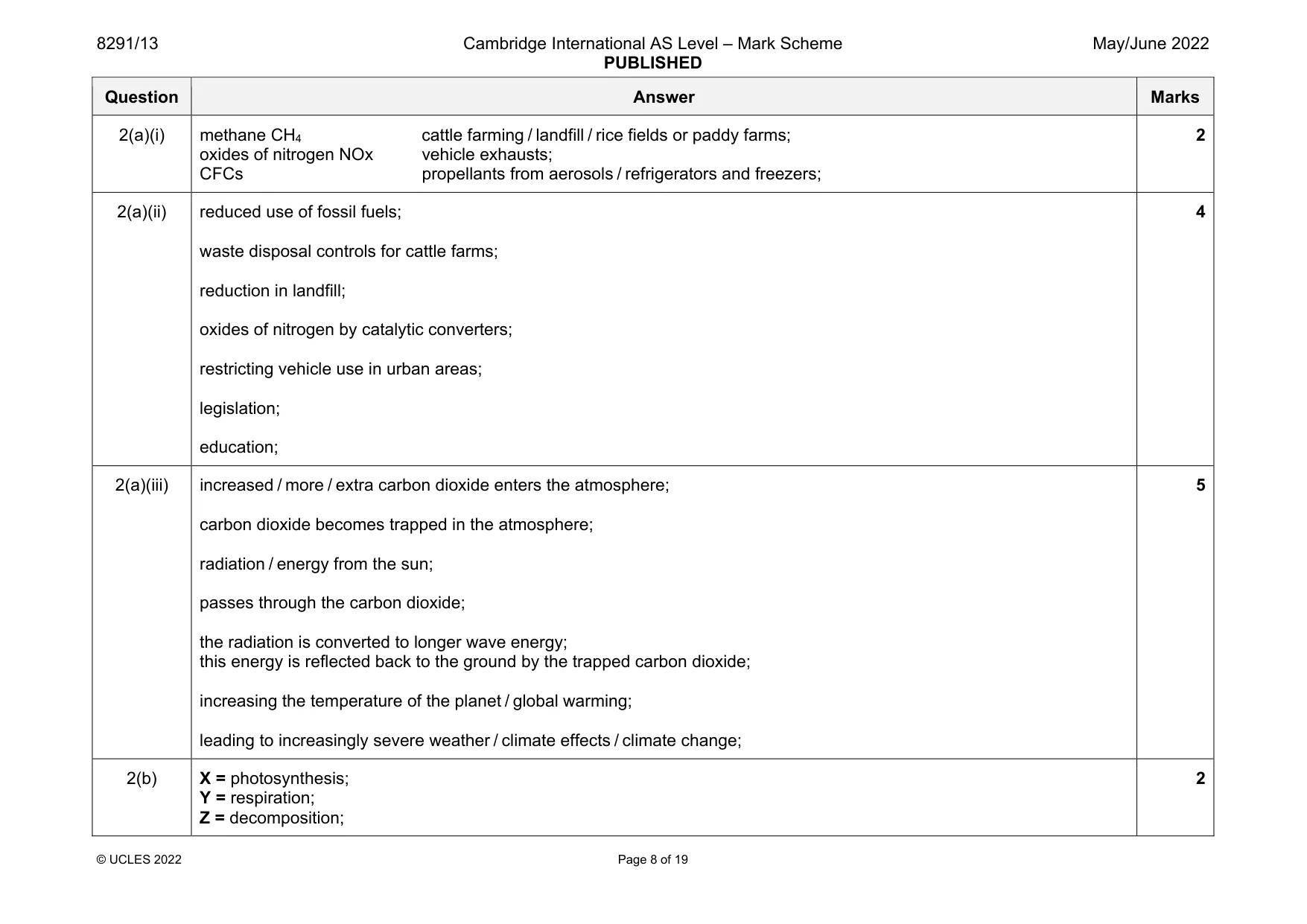
8291/13 Cambridge International AS Level – Mark Scheme PUBLISHED May/June 2022 © UCLES 2022 Page 8 of 19 Question Answer Marks 2(a)(i) methane CH4 cattle farming / landfill / rice fields or paddy farms; oxides of nitrogen NOx vehicle exhausts; CFCs propellants from aerosols / refrigerators and freezers; 2 2(a)(ii) reduced use of fossil fuels; waste disposal controls for cattle farms; reduction in landfill; oxides of nitrogen by catalytic converters; restricting vehicle use in urban areas; legislation; education; 4 2(a)(iii) increased / more / extra carbon dioxide enters the atmosphere; carbon dioxide becomes trapped in the atmosphere; radiation / energy from the sun; passes through the carbon dioxide; the radiation is converted to longer wave energy; this energy is reflected back to the ground by the trapped carbon dioxide; increasing the temperature of the planet / global warming; leading to increasingly severe weather / climate effects / climate change; 5 2(b) X = photosynthesis; Y = respiration; Z = decomposition; 2
Mark scheme, page 9
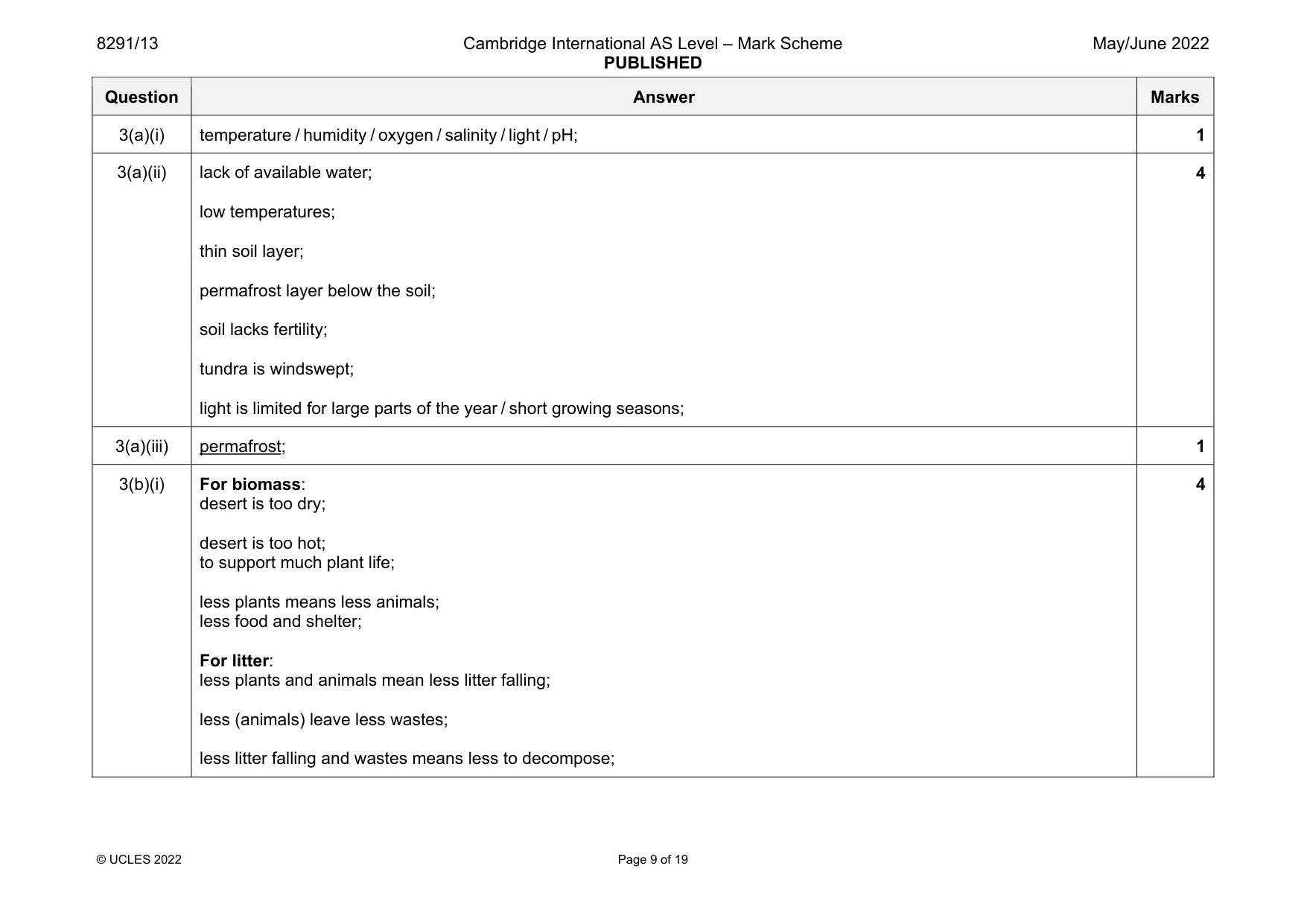
8291/13 Cambridge International AS Level – Mark Scheme PUBLISHED May/June 2022 © UCLES 2022 Page 9 of 19 Question Answer Marks 3(a)(i) temperature / humidity / oxygen / salinity / light / pH; 1 3(a)(ii) lack of available water; low temperatures; thin soil layer; permafrost layer below the soil; soil lacks fertility; tundra is windswept; light is limited for large parts of the year / short growing seasons; 4 3(a)(iii) permafrost; 1 3(b)(i) For biomass: desert is too dry; desert is too hot; to support much plant life; less plants means less animals; less food and shelter; For litter: less plants and animals mean less litter falling; less (animals) leave less wastes; less litter falling and wastes means less to decompose; 4
Mark scheme, page 10
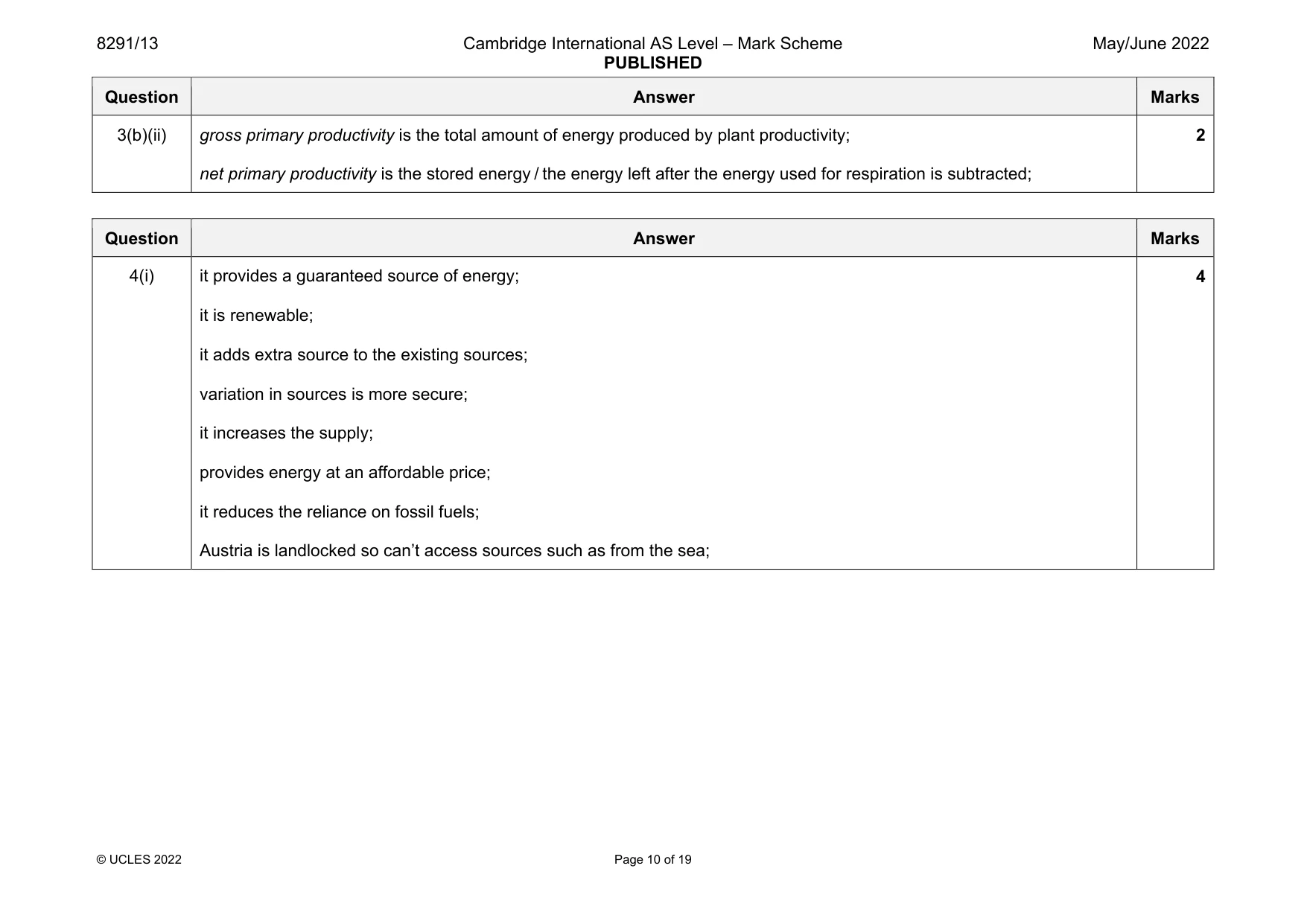
8291/13 Cambridge International AS Level – Mark Scheme PUBLISHED May/June 2022 © UCLES 2022 Page 10 of 19 Question Answer Marks 3(b)(ii) gross primary productivity is the total amount of energy produced by plant productivity; net primary productivity is the stored energy / the energy left after the energy used for respiration is subtracted; 2 Question Answer Marks 4(i) it provides a guaranteed source of energy; it is renewable; it adds extra source to the existing sources; variation in sources is more secure; it increases the supply; provides energy at an affordable price; it reduces the reliance on fossil fuels; Austria is landlocked so can’t access sources such as from the sea; 4
Mark scheme, page 11
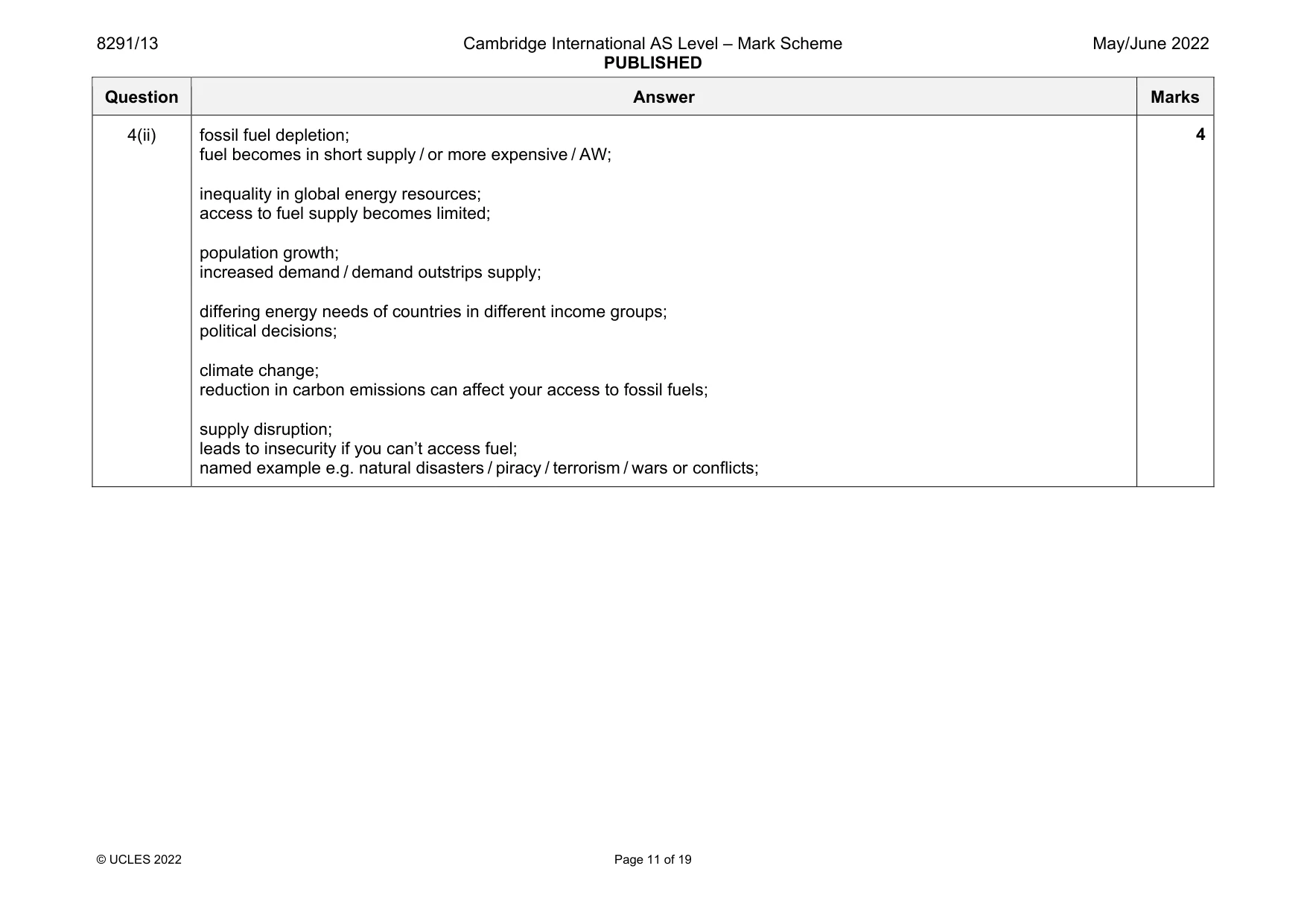
8291/13 Cambridge International AS Level – Mark Scheme PUBLISHED May/June 2022 © UCLES 2022 Page 11 of 19 Question Answer Marks 4(ii) fossil fuel depletion; fuel becomes in short supply / or more expensive / AW; inequality in global energy resources; access to fuel supply becomes limited; population growth; increased demand / demand outstrips supply; differing energy needs of countries in different income groups; political decisions; climate change; reduction in carbon emissions can affect your access to fossil fuels; supply disruption; leads to insecurity if you can’t access fuel; named example e.g. natural disasters / piracy / terrorism / wars or conflicts; 4
Mark scheme, page 12
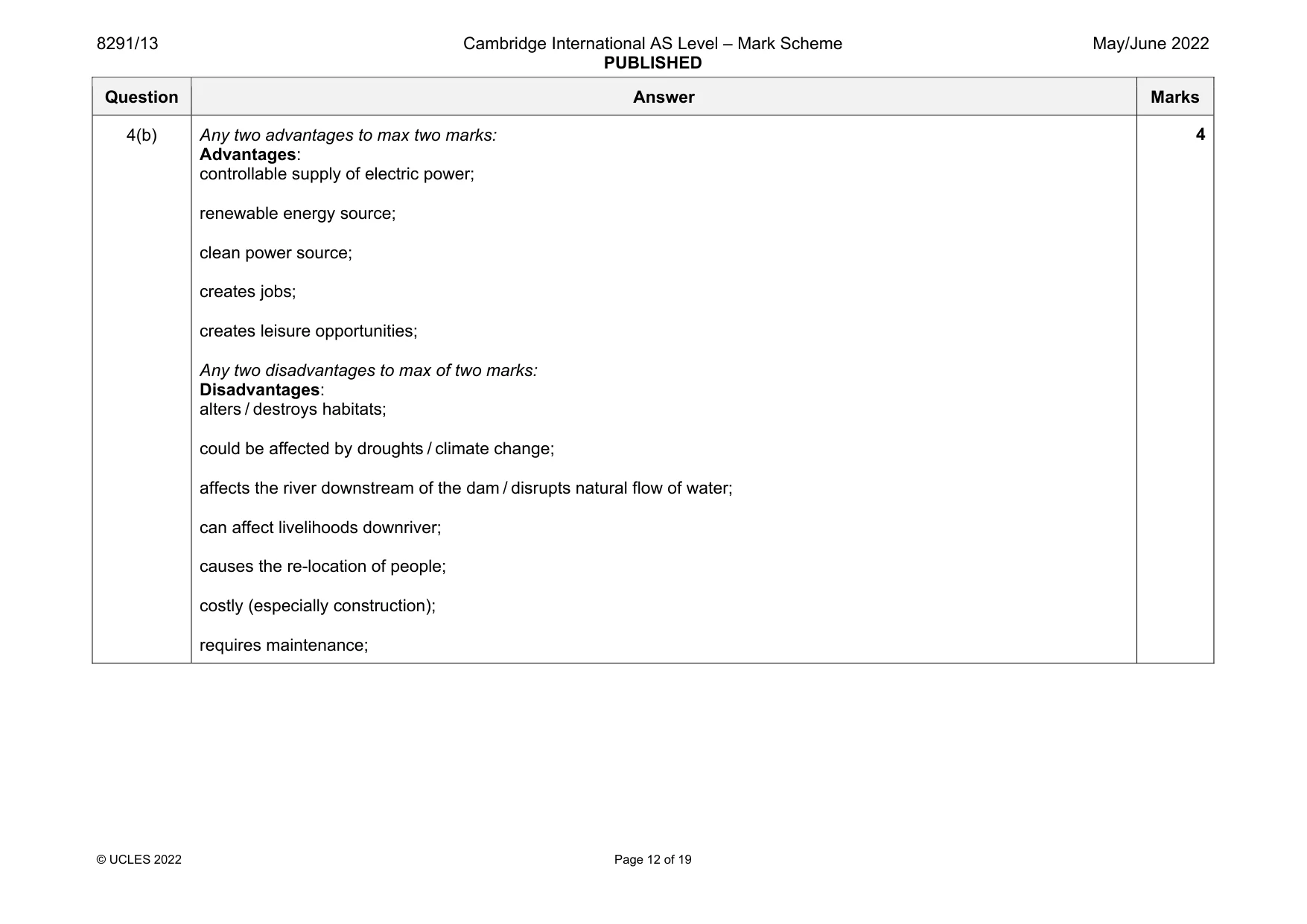
8291/13 Cambridge International AS Level – Mark Scheme PUBLISHED May/June 2022 © UCLES 2022 Page 12 of 19 Question Answer Marks 4(b) Any two advantages to max two marks: Advantages: controllable supply of electric power; renewable energy source; clean power source; creates jobs; creates leisure opportunities; Any two disadvantages to max of two marks: Disadvantages: alters / destroys habitats; could be affected by droughts / climate change; affects the river downstream of the dam / disrupts natural flow of water; can affect livelihoods downriver; causes the re-location of people; costly (especially construction); requires maintenance; 4
Mark scheme, page 13
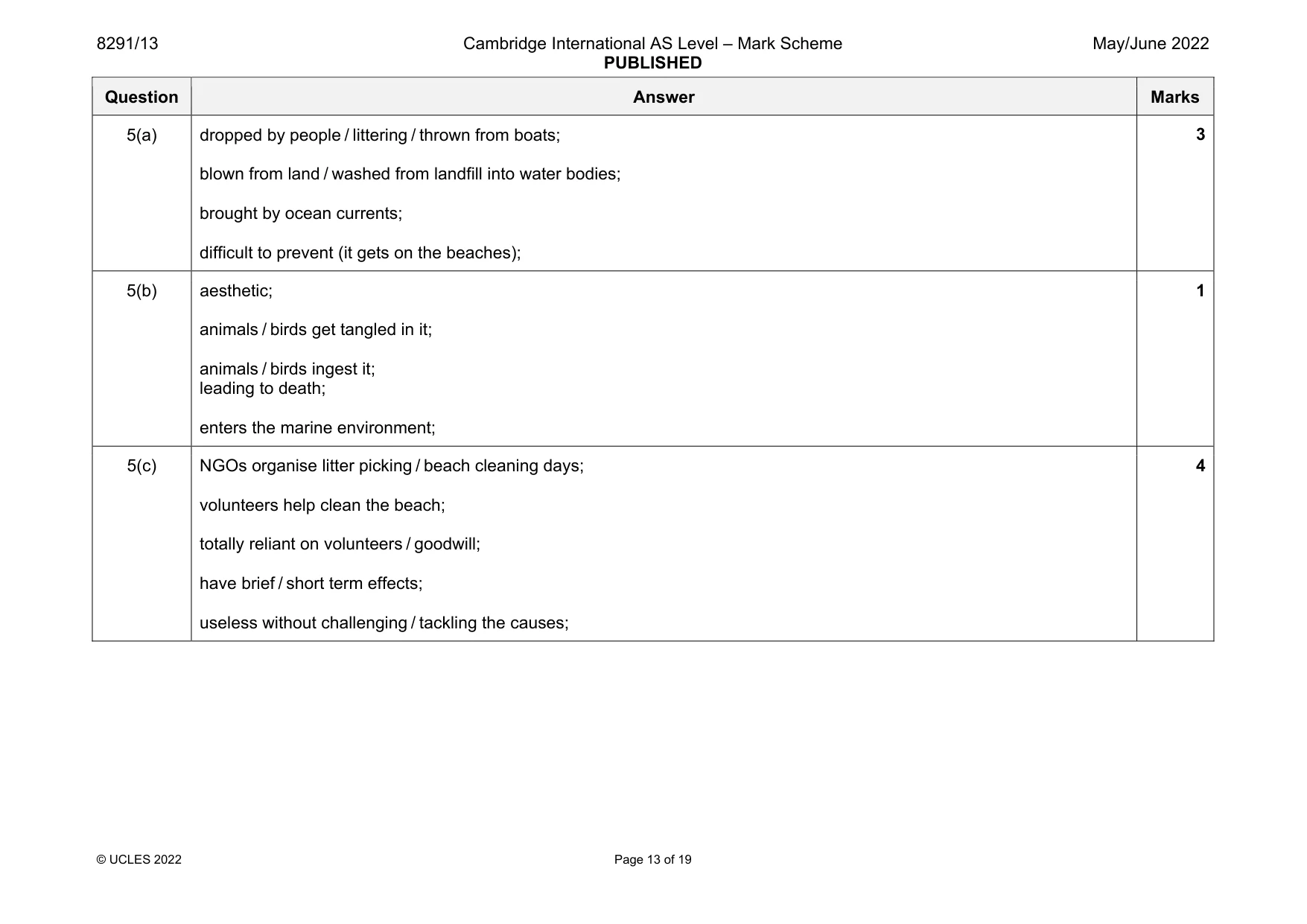
8291/13 Cambridge International AS Level – Mark Scheme PUBLISHED May/June 2022 © UCLES 2022 Page 13 of 19 Question Answer Marks 5(a) dropped by people / littering / thrown from boats; blown from land / washed from landfill into water bodies; brought by ocean currents; difficult to prevent (it gets on the beaches); 3 5(b) aesthetic; animals / birds get tangled in it; animals / birds ingest it; leading to death; enters the marine environment; 1 5(c) NGOs organise litter picking / beach cleaning days; volunteers help clean the beach; totally reliant on volunteers / goodwill; have brief / short term effects; useless without challenging / tackling the causes; 4
Mark scheme, page 14
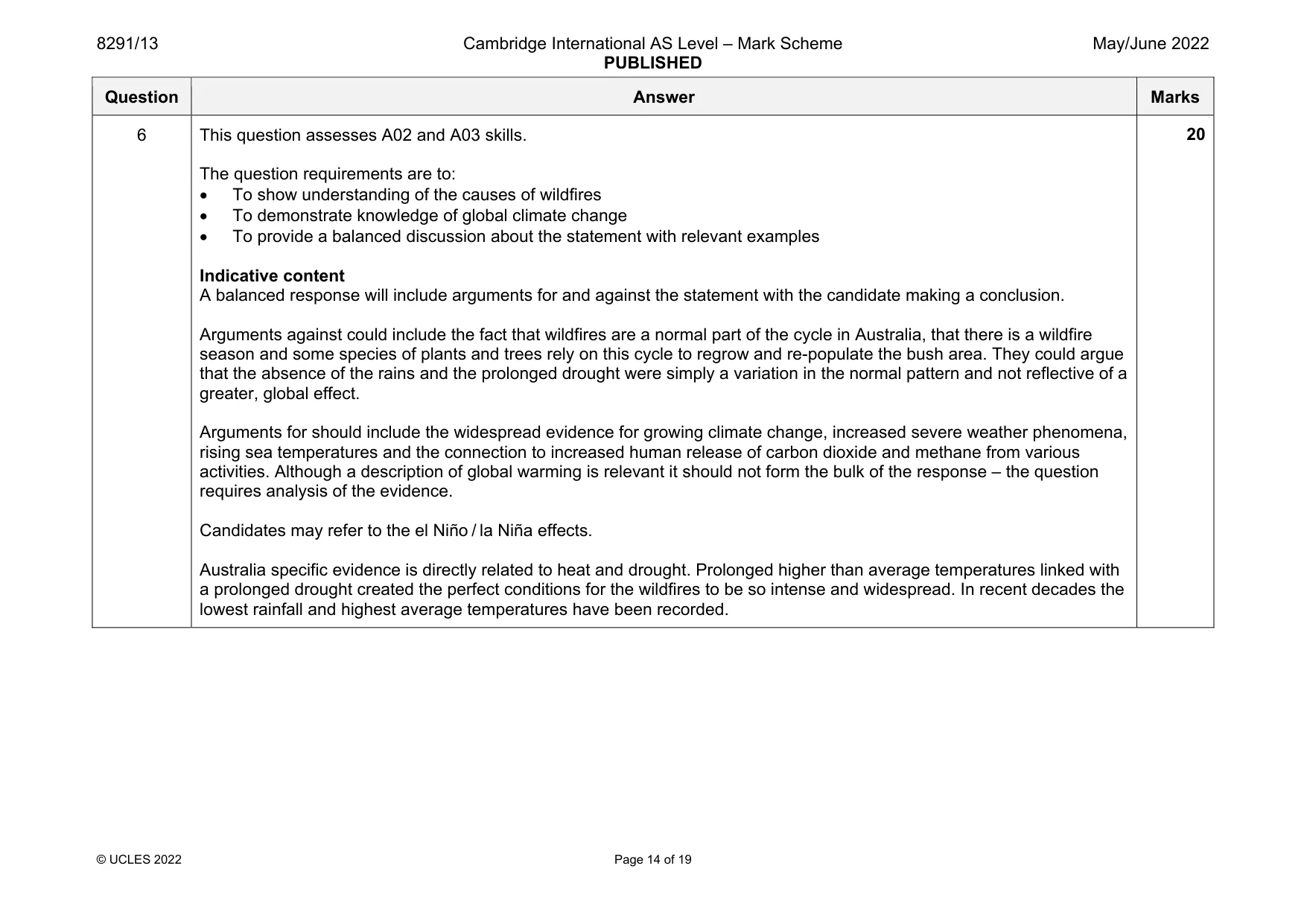
8291/13 Cambridge International AS Level – Mark Scheme PUBLISHED May/June 2022 © UCLES 2022 Page 14 of 19 Question Answer Marks 6 This question assesses A02 and A03 skills. The question requirements are to: To show understanding of the causes of wildfires To demonstrate knowledge of global climate change To provide a balanced discussion about the statement with relevant examples Indicative content A balanced response will include arguments for and against the statement with the candidate making a conclusion. Arguments against could include the fact that wildfires are a normal part of the cycle in Australia, that there is a wildfire season and some species of plants and trees rely on this cycle to regrow and re-populate the bush area. They could argue that the absence of the rains and the prolonged drought were simply a variation in the normal pattern and not reflective of a greater, global effect. Arguments for should include the widespread evidence for growing climate change, increased severe weather phenomena, rising sea temperatures and the connection to increased human release of carbon dioxide and methane from various activities. Although a description of global warming is relevant it should not form the bulk of the response – the question requires analysis of the evidence. Candidates may refer to the el Niño / la Niña effects. Australia specific evidence is directly related to heat and drought. Prolonged higher than average temperatures linked with a prolonged drought created the perfect conditions for the wildfires to be so intense and widespread. In recent decades the lowest rainfall and highest average temperatures have been recorded. 20
Mark scheme, page 15
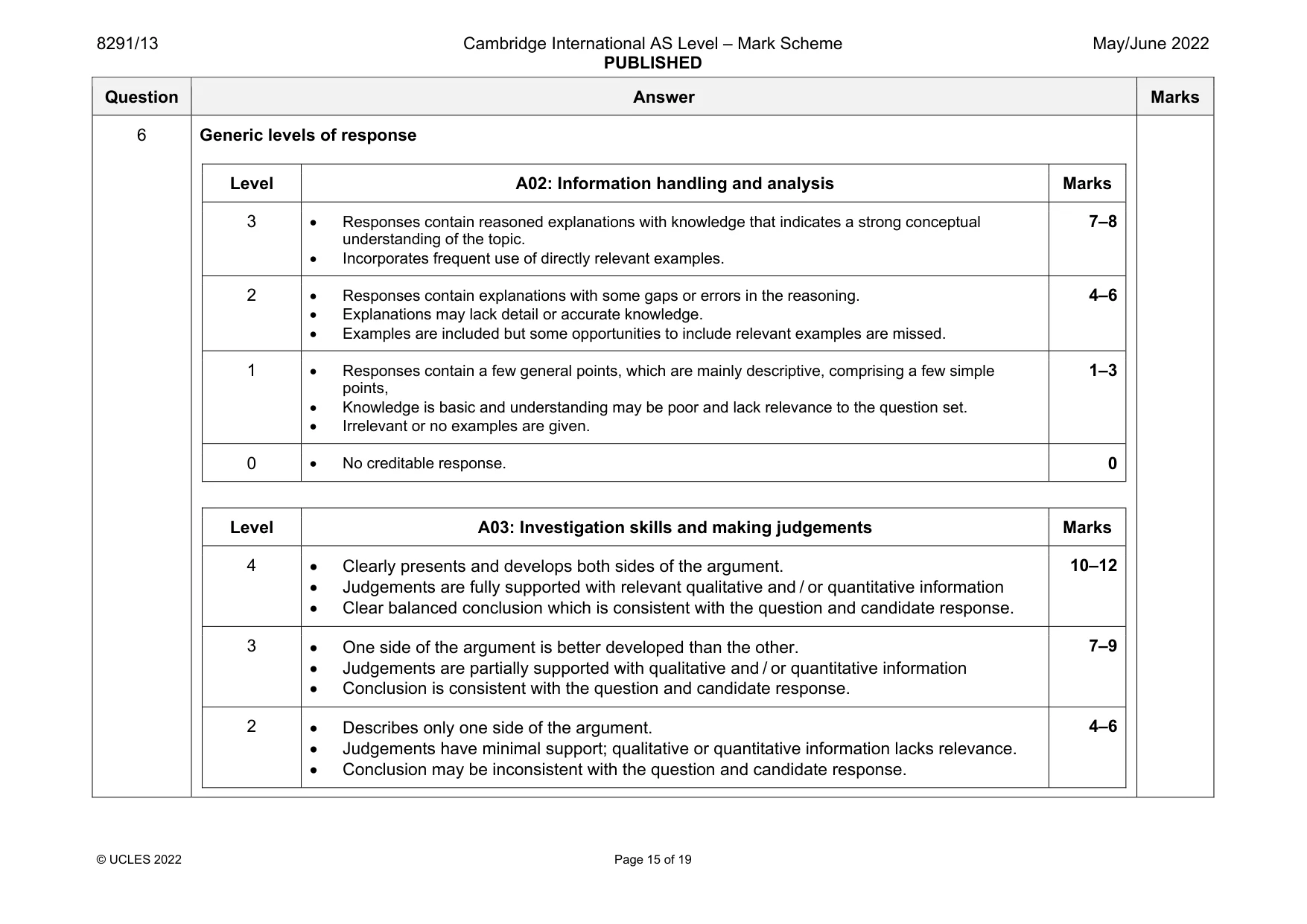
8291/13 Cambridge International AS Level – Mark Scheme PUBLISHED May/June 2022 © UCLES 2022 Page 15 of 19 Question Answer Marks 6 Generic levels of response Level A02: Information handling and analysis Marks 3 Responses contain reasoned explanations with knowledge that indicates a strong conceptual understanding of the topic. Incorporates frequent use of directly relevant examples. 7–8 2 Responses contain explanations with some gaps or errors in the reasoning. Explanations may lack detail or accurate knowledge. Examples are included but some opportunities to include relevant examples are missed. 4–6 1 Responses contain a few general points, which are mainly descriptive, comprising a few simple points, Knowledge is basic and understanding may be poor and lack relevance to the question set. Irrelevant or no examples are given. 1–3 0 No creditable response. 0 Level A03: Investigation skills and making judgements Marks 4 Clearly presents and develops both sides of the argument. Judgements are fully supported with relevant qualitative and / or quantitative information Clear balanced conclusion which is consistent with the question and candidate response. 10–12 3 One side of the argument is better developed than the other. Judgements are partially supported with qualitative and / or quantitative information Conclusion is consistent with the question and candidate response. 7–9 2 Describes only one side of the argument. Judgements have minimal support; qualitative or quantitative information lacks relevance. Conclusion may be inconsistent with the question and candidate response. 4–6
Mark scheme, page 16
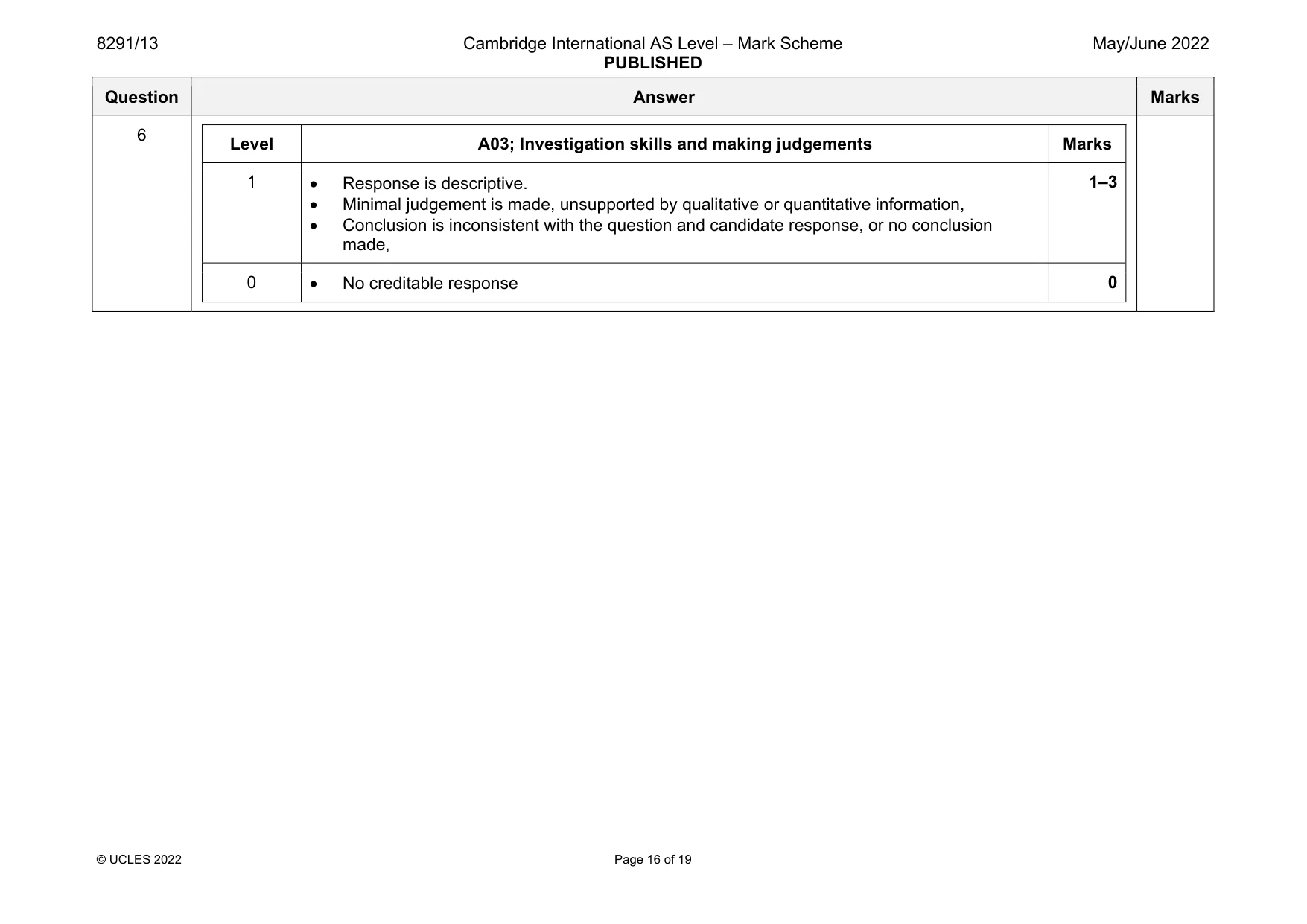
8291/13 Cambridge International AS Level – Mark Scheme PUBLISHED May/June 2022 © UCLES 2022 Page 16 of 19 Question Answer Marks 6 Level A03; Investigation skills and making judgements Marks 1 Response is descriptive. Minimal judgement is made, unsupported by qualitative or quantitative information, Conclusion is inconsistent with the question and candidate response, or no conclusion made, 1–3 0 No creditable response 0
Mark scheme, page 17
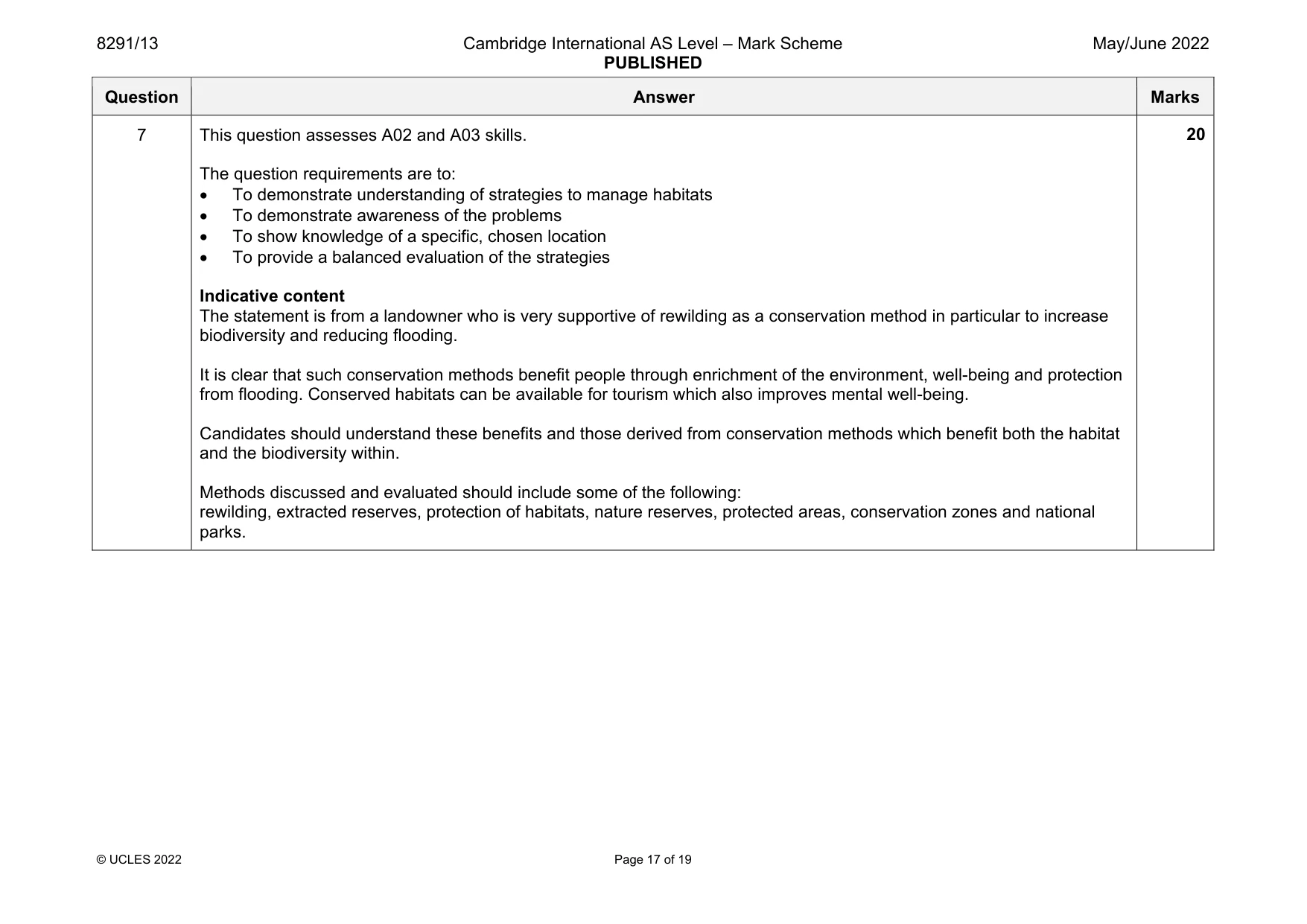
8291/13 Cambridge International AS Level – Mark Scheme PUBLISHED May/June 2022 © UCLES 2022 Page 17 of 19 Question Answer Marks 7 This question assesses A02 and A03 skills. The question requirements are to: To demonstrate understanding of strategies to manage habitats To demonstrate awareness of the problems To show knowledge of a specific, chosen location To provide a balanced evaluation of the strategies Indicative content The statement is from a landowner who is very supportive of rewilding as a conservation method in particular to increase biodiversity and reducing flooding. It is clear that such conservation methods benefit people through enrichment of the environment, well-being and protection from flooding. Conserved habitats can be available for tourism which also improves mental well-being. Candidates should understand these benefits and those derived from conservation methods which benefit both the habitat and the biodiversity within. Methods discussed and evaluated should include some of the following: rewilding, extracted reserves, protection of habitats, nature reserves, protected areas, conservation zones and national parks. 20
Mark scheme, page 18
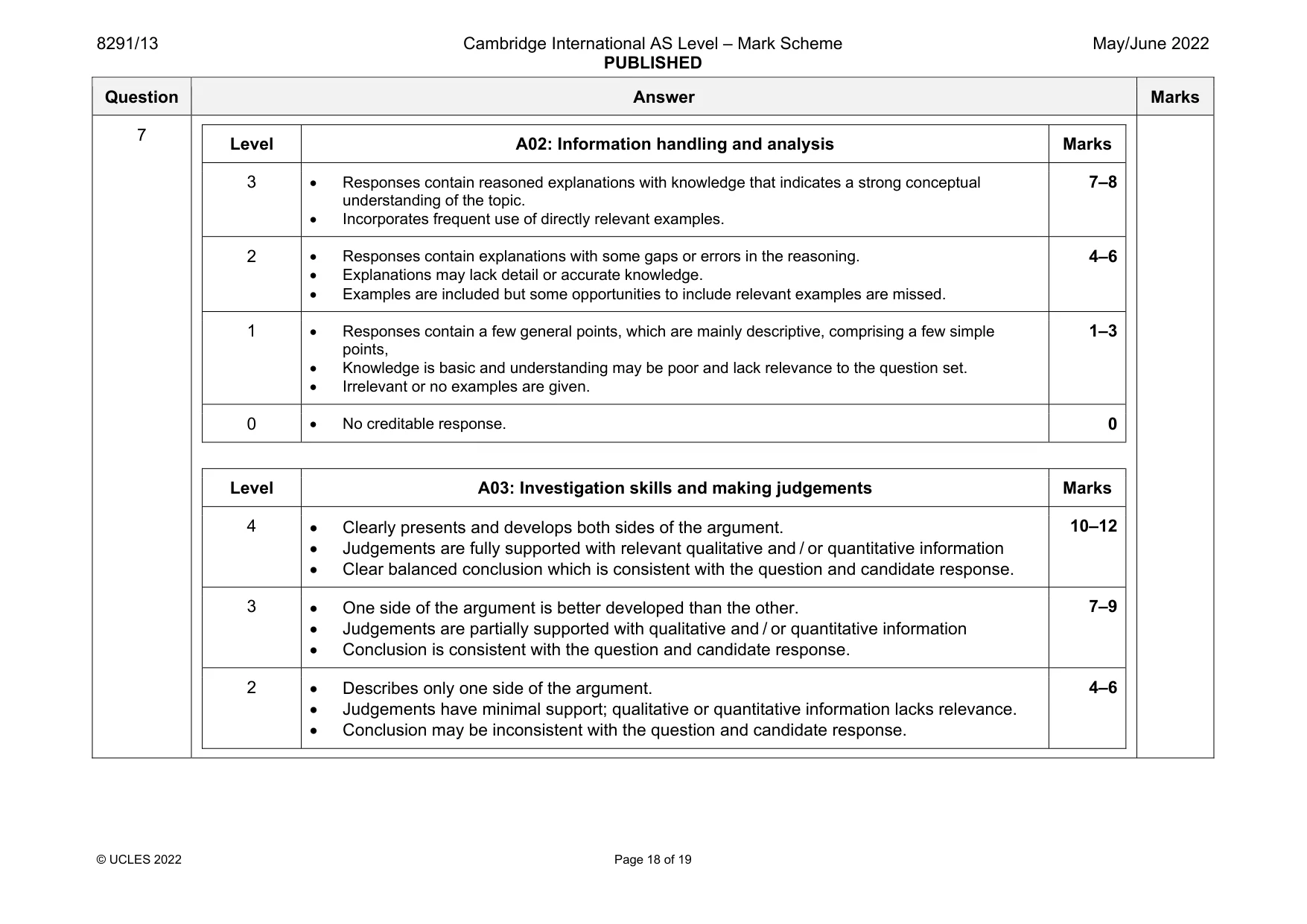
8291/13 Cambridge International AS Level – Mark Scheme PUBLISHED May/June 2022 © UCLES 2022 Page 18 of 19 Question Answer Marks 7 Level A02: Information handling and analysis Marks 3 Responses contain reasoned explanations with knowledge that indicates a strong conceptual understanding of the topic. Incorporates frequent use of directly relevant examples. 7–8 2 Responses contain explanations with some gaps or errors in the reasoning. Explanations may lack detail or accurate knowledge. Examples are included but some opportunities to include relevant examples are missed. 4–6 1 Responses contain a few general points, which are mainly descriptive, comprising a few simple points, Knowledge is basic and understanding may be poor and lack relevance to the question set. Irrelevant or no examples are given. 1–3 0 No creditable response. 0 Level A03: Investigation skills and making judgements Marks 4 Clearly presents and develops both sides of the argument. Judgements are fully supported with relevant qualitative and / or quantitative information Clear balanced conclusion which is consistent with the question and candidate response. 10–12 3 One side of the argument is better developed than the other. Judgements are partially supported with qualitative and / or quantitative information Conclusion is consistent with the question and candidate response. 7–9 2 Describes only one side of the argument. Judgements have minimal support; qualitative or quantitative information lacks relevance. Conclusion may be inconsistent with the question and candidate response. 4–6
Mark scheme, page 19
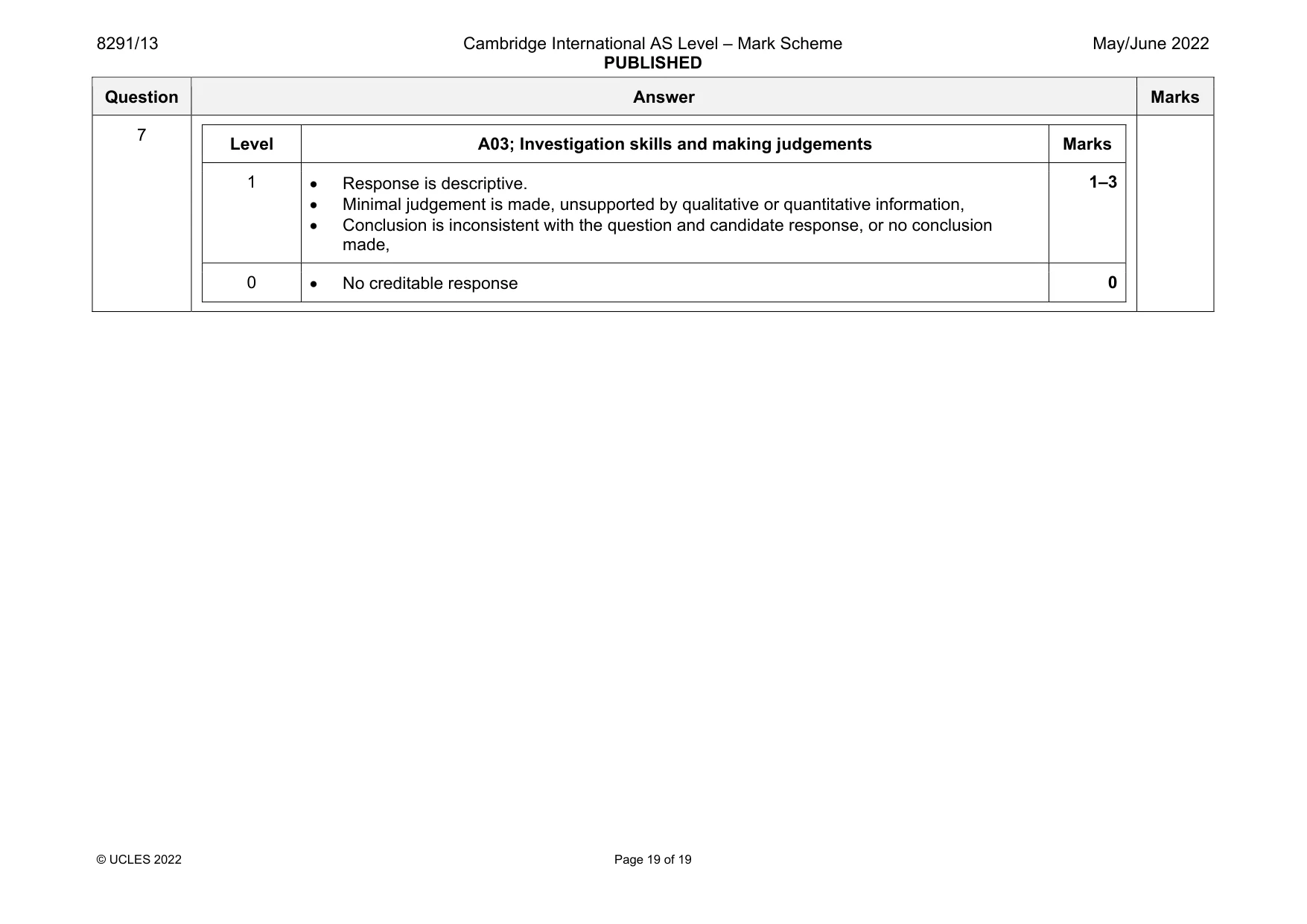
8291/13 Cambridge International AS Level – Mark Scheme PUBLISHED May/June 2022 © UCLES 2022 Page 19 of 19 Question Answer Marks 7 Level A03; Investigation skills and making judgements Marks 1 Response is descriptive. Minimal judgement is made, unsupported by qualitative or quantitative information, Conclusion is inconsistent with the question and candidate response, or no conclusion made, 1–3 0 No creditable response 0
What you needed in this session
Cambridge’s own grade thresholds for 2022 May/June, Paper 1 · Variant 3. A higher threshold means an easier paper — the bar moves with how the cohort did.