Cambridge A Level Environmental Management (AS only) 8291 — 2018 Oct/Nov Paper 1 · Variant 1
8291/11/O/N/18
The question paper and its mark scheme, free to read here and free to download. This is Cambridge’s own paper, exactly as it was sat.
Question paper12 pages
Mark scheme15 pages
Answers below. Sit the paper first if you are practising.
Paper as text
Question paper, page 1
* 3 7 8 6 4 1 0 4 0 7 * This document consists of 12 printed pages. DC (KN/SG) 153682/3 © UCLES 2018 [Turn over Cambridge International Examinations Cambridge International Advanced Subsidiary Level ENVIRONMENTAL MANAGEMENT 8291/11 Paper 1 Lithosphere and Atmosphere October/November 2018 1 hour 30 minutes Additional Materials: Answer Booklet/Paper READ THESE INSTRUCTIONS FIRST Write your Centre number, candidate number and name on all the work you hand in. Write in dark blue or black pen. You may use an HB pencil for any diagrams or graphs. Do not use staples, paper clips, glue or correction fluid. DO NOT WRITE IN ANY BARCODES. Electronic calculators may be used. You may lose marks if you do not show your working or if you do not use appropriate units. Section A Answer all questions in this section. Write your answers in the spaces provided on the question paper. Section B Answer one question from this section. Write your answers on the separate answer paper provided. At the end of the examination, 1. fasten all separate answer paper securely to the question paper; 2. enter the question number from Section B in the grid. For Examiner’s Use Section A 1 2 Section B Total
Question paper, page 2
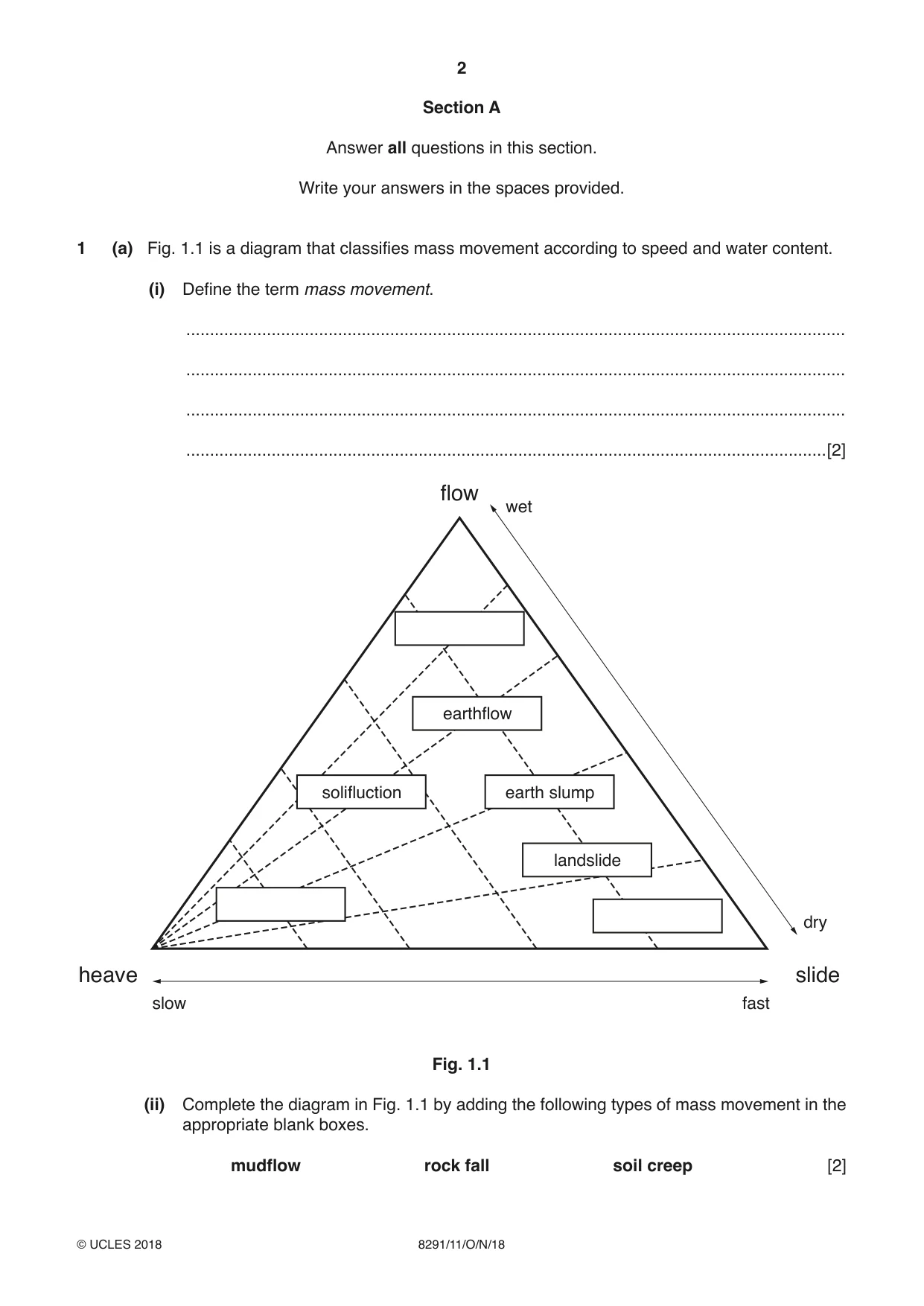
2 8291/11/O/N/18 © UCLES 2018 Section A Answer all questions in this section. Write your answers in the spaces provided. 1 (a) Fig. 1.1 is a diagram that classifies mass movement according to speed and water content. (i) Define the term mass movement. … … … …[2] solifluction earthflow earth slump landslide wet dry fast slow flow slide heave Fig. 1.1 (ii) Complete the diagram in Fig. 1.1 by adding the following types of mass movement in the appropriate blank boxes. mudflow rock fall soil creep [2]
Question paper, page 3
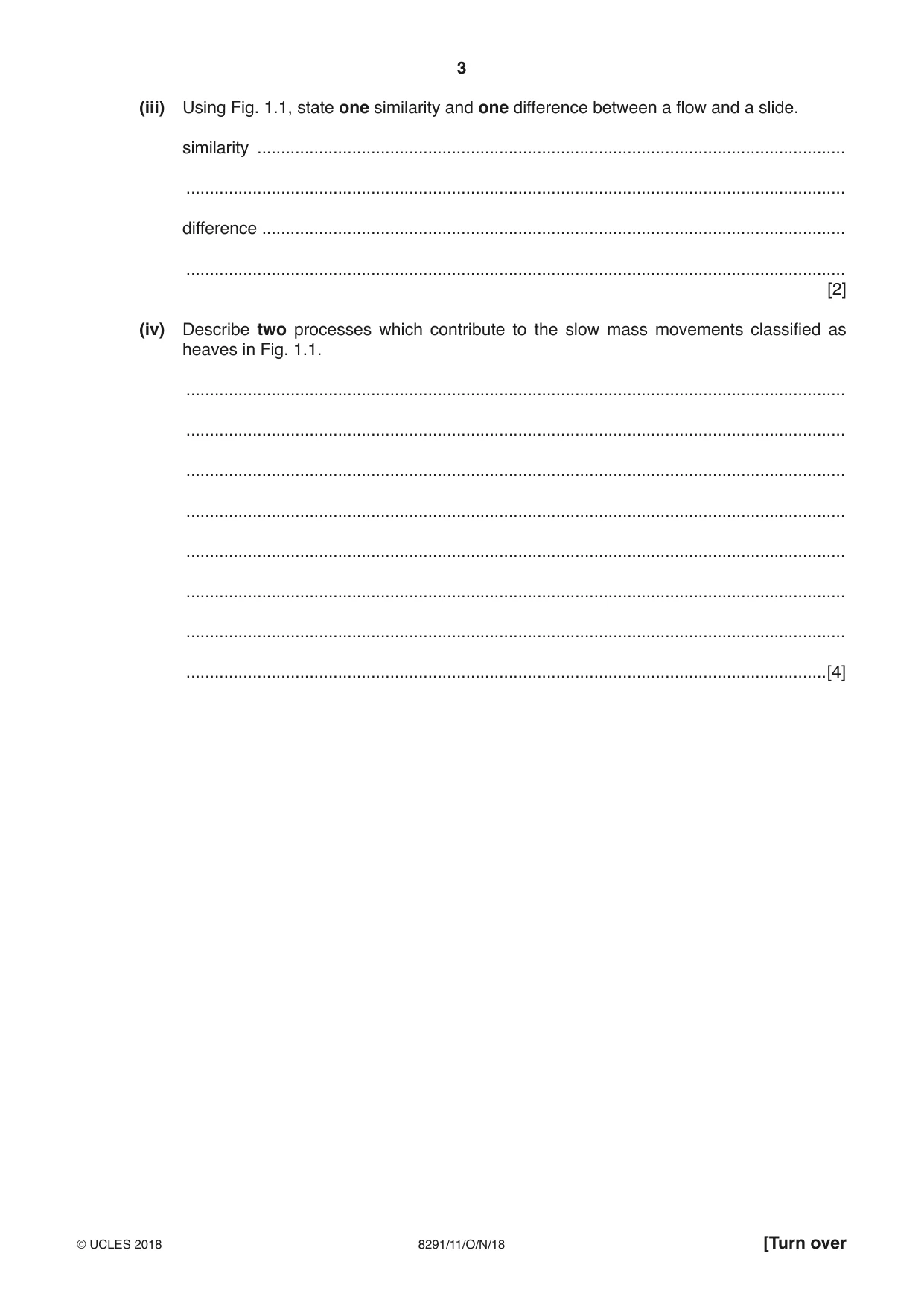
3 8291/11/O/N/18 © UCLES 2018 [Turn over (iii) Using Fig. 1.1, state one similarity and one difference between a flow and a slide. similarity … … difference … … [2] (iv) Describe two processes which contribute to the slow mass movements classified as heaves in Fig. 1.1. … … … … … … … …[4]
Question paper, page 4
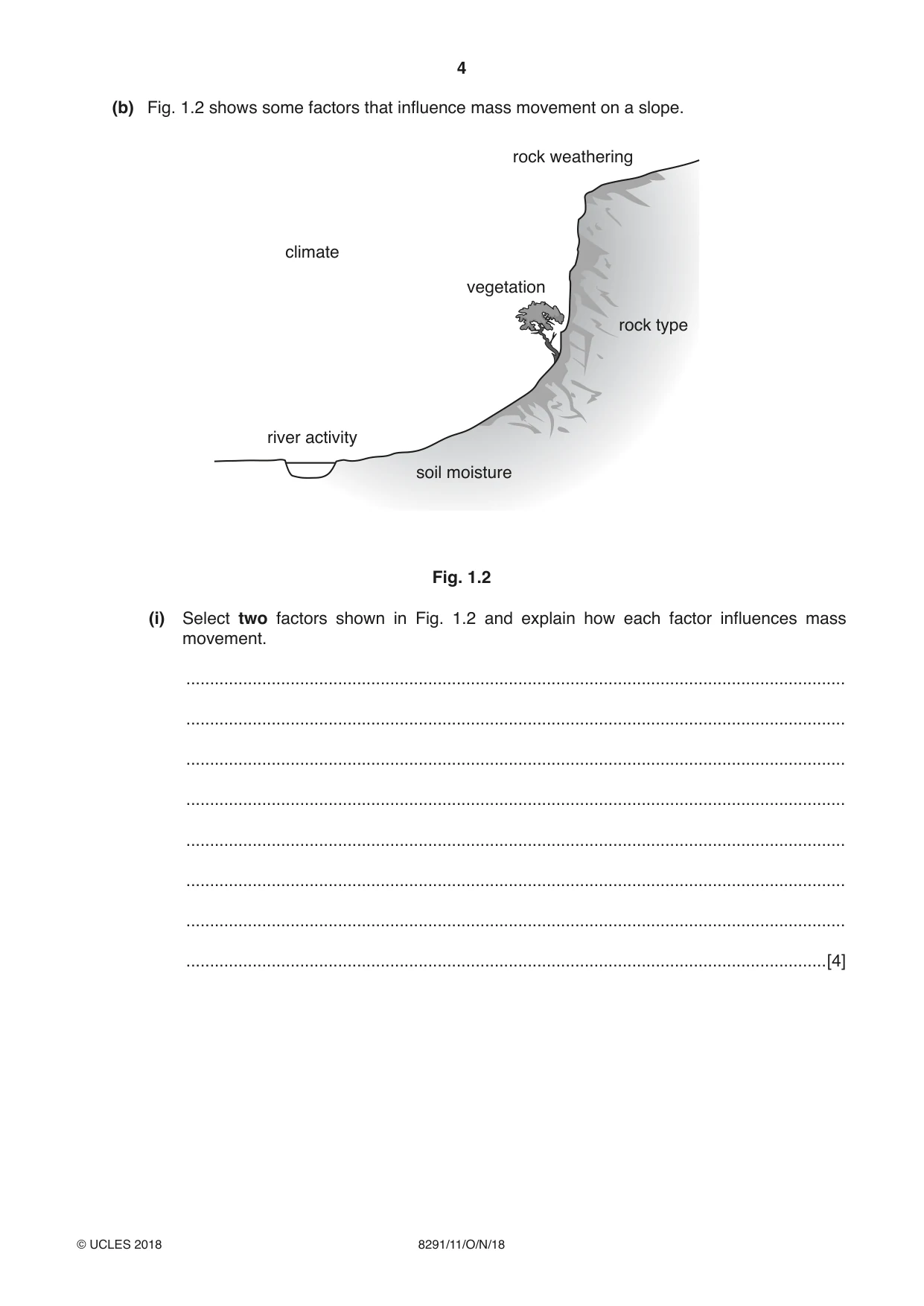
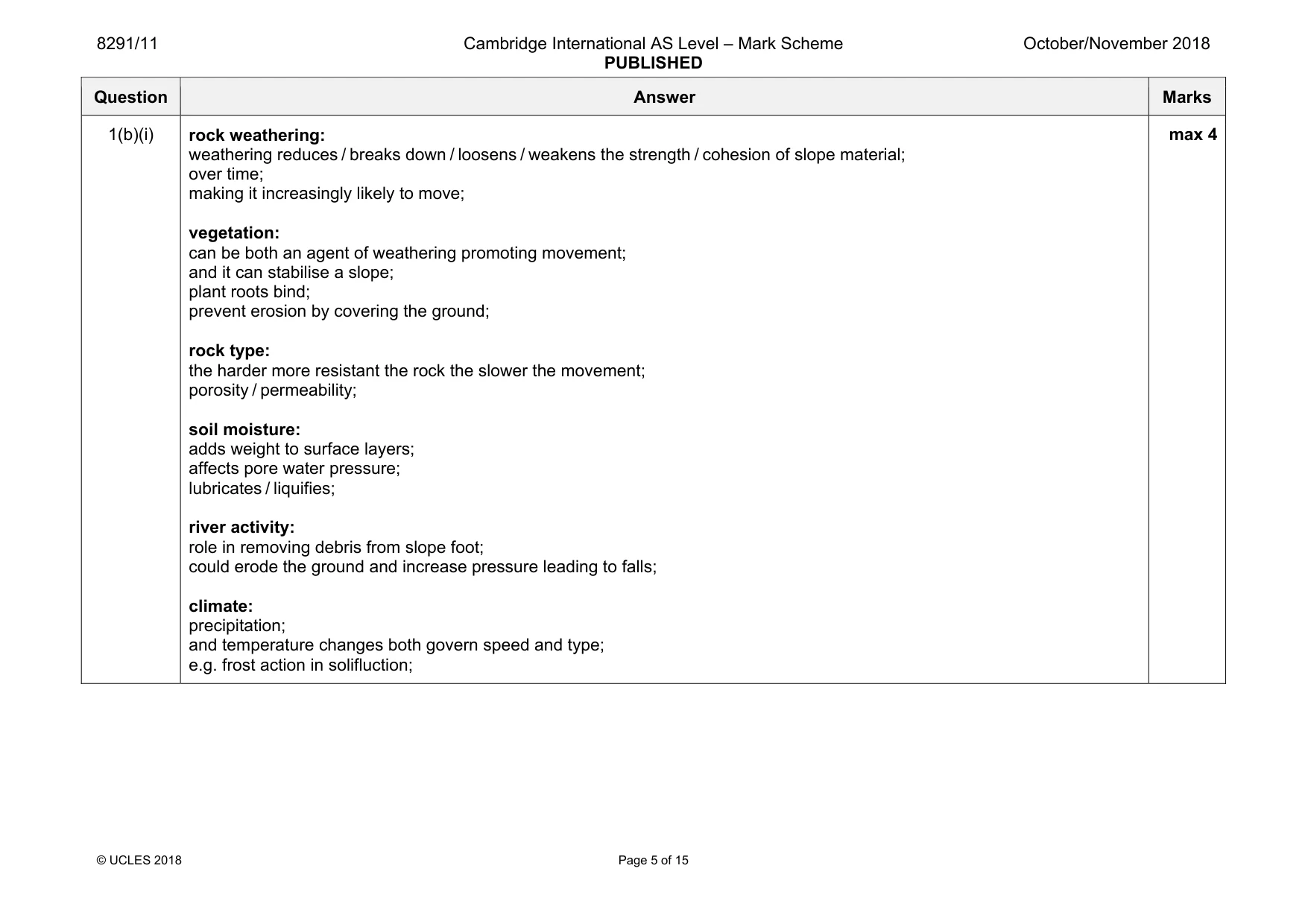
4 8291/11/O/N/18 © UCLES 2018 (b) Fig. 1.2 shows some factors that influence mass movement on a slope. rock weathering rock type soil moisture river activity climate vegetation Fig. 1.2 (i) Select two factors shown in Fig. 1.2 and explain how each factor influences mass movement. … … … … … … … …[4]
Question paper, page 5
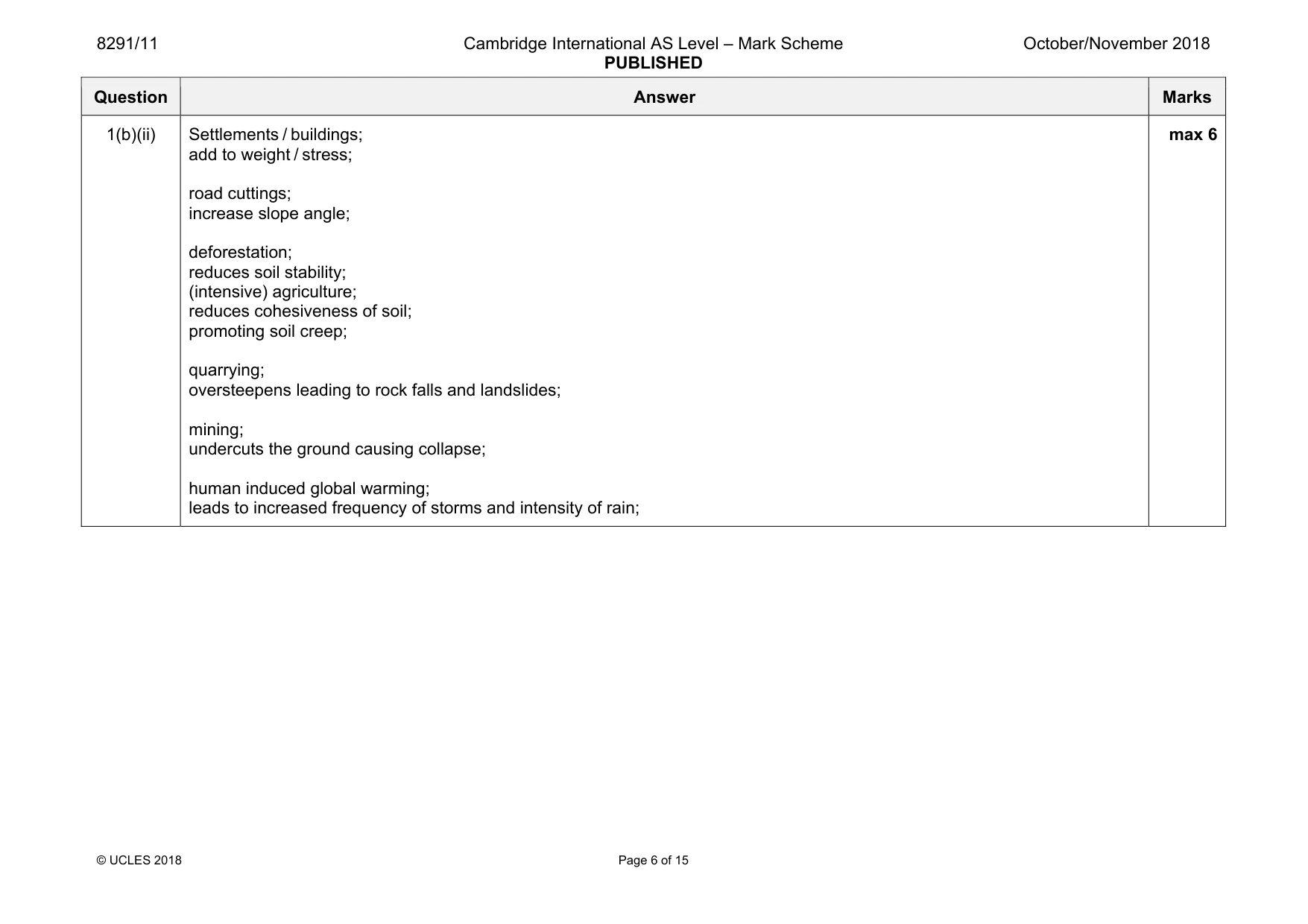
5 8291/11/O/N/18 © UCLES 2018 [Turn over (ii) Explain how human activity might be responsible for triggering mass movement on slopes. … … … … … … … … … … … …[6] [Total: 20]
Question paper, page 6
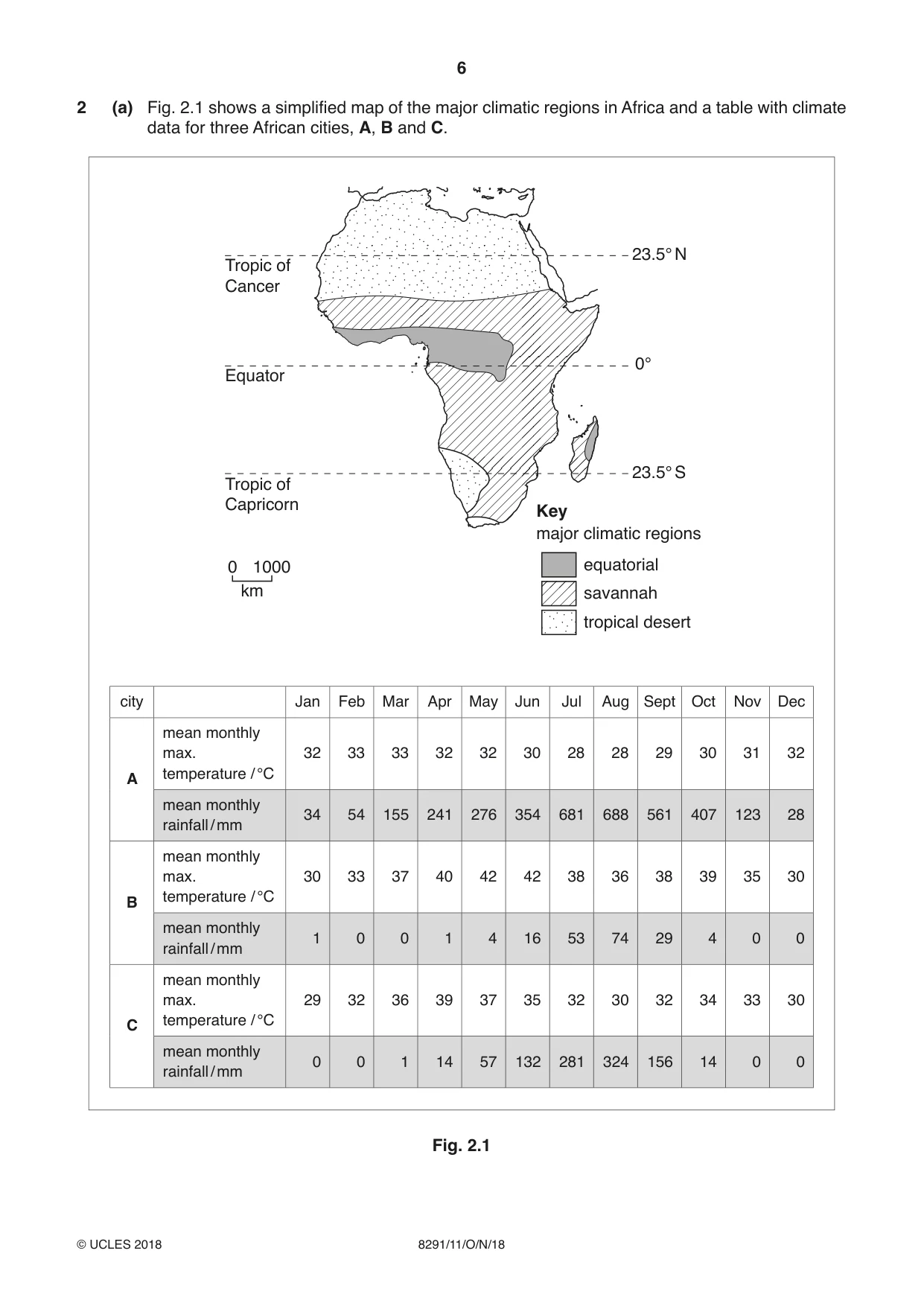
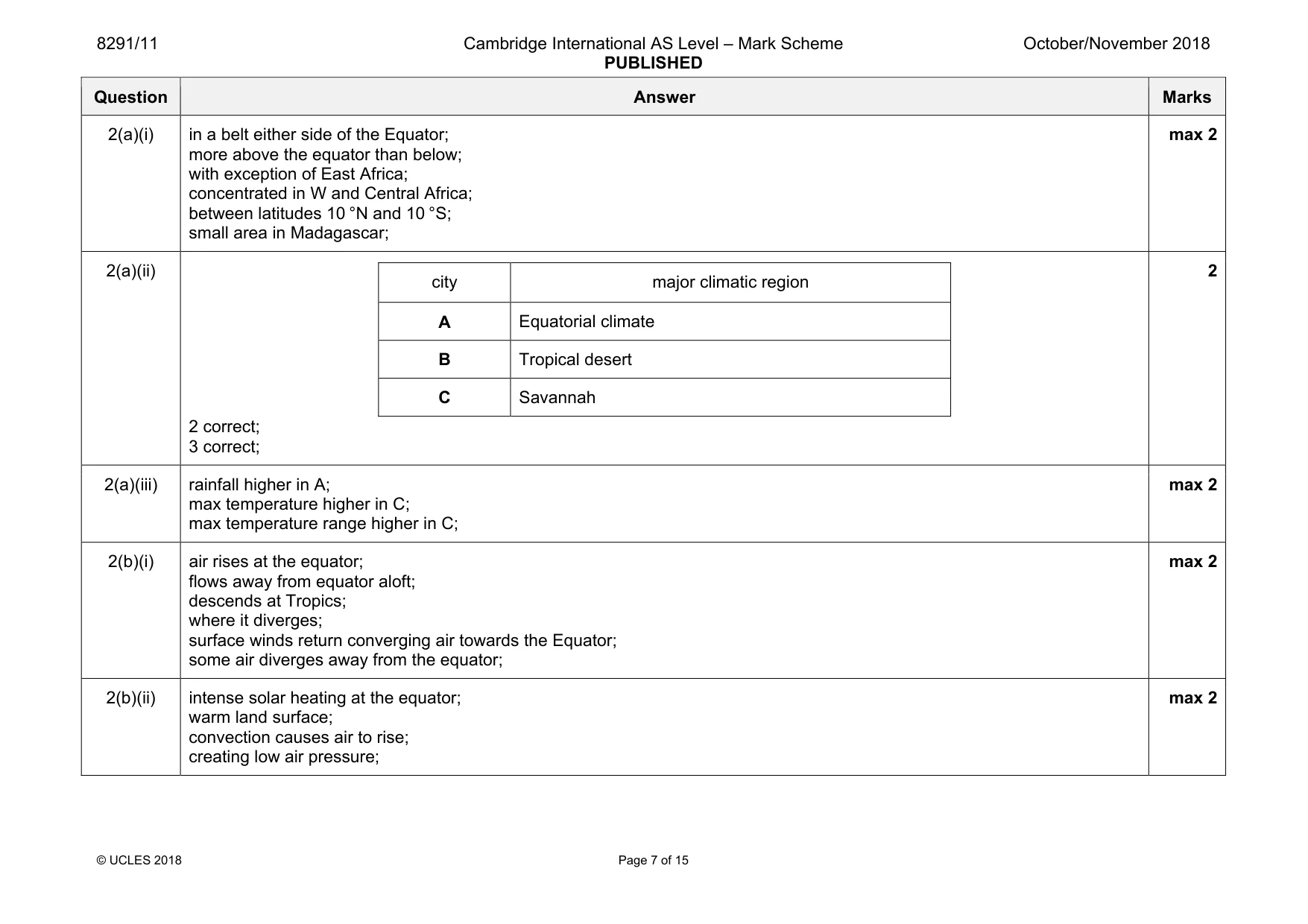
6 8291/11/O/N/18 © UCLES 2018 2 (a) Fig. 2.1 shows a simplified map of the major climatic regions in Africa and a table with climate data for three African cities, A, B and C. 0 1000 km Tropic of Cancer Tropic of Capricorn 23.5° N 0° 23.5° S Equator Key major climatic regions equatorial savannah tropical desert city Jan Feb Mar Apr May Jun Jul Aug Sept Oct Nov Dec A mean monthly max. temperature / °C 32 33 33 32 32 30 28 28 29 30 31 32 mean monthly rainfall / mm 34 54 155 241 276 354 681 688 561 407 123 28 B mean monthly max. temperature / °C 30 33 37 40 42 42 38 36 38 39 35 30 mean monthly rainfall / mm 1 0 0 1 4 16 53 74 29 4 0 0 C mean monthly max. temperature / °C 29 32 36 39 37 35 32 30 32 34 33 30 mean monthly rainfall / mm 0 0 1 14 57 132 281 324 156 14 0 0 Fig. 2.1
Question paper, page 7
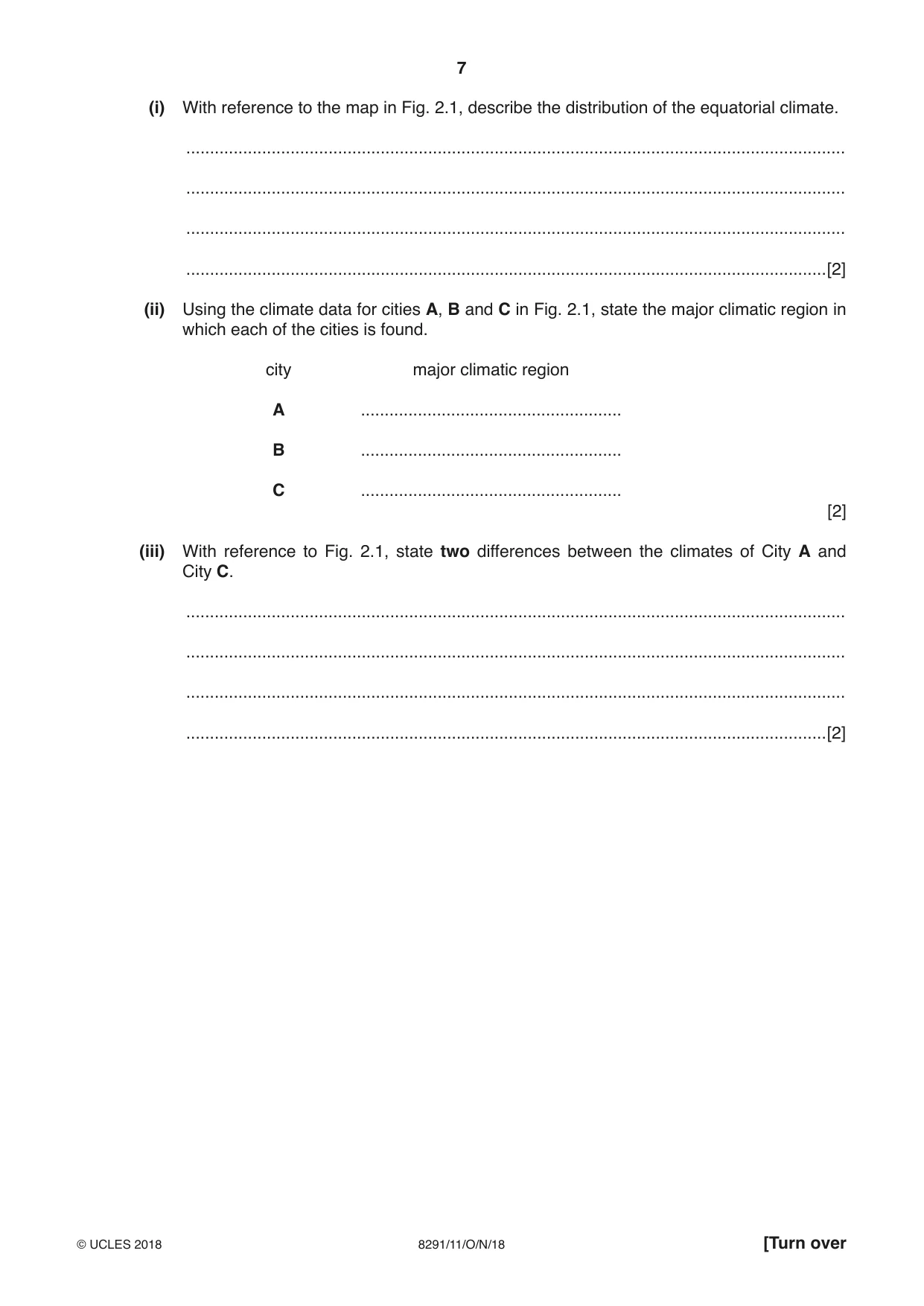
7 8291/11/O/N/18 © UCLES 2018 [Turn over (i) With reference to the map in Fig. 2.1, describe the distribution of the equatorial climate. … … … …[2] (ii) Using the climate data for cities A, B and C in Fig. 2.1, state the major climatic region in which each of the cities is found. city major climatic region A … B … C … [2] (iii) With reference to Fig. 2.1, state two differences between the climates of City A and City C. … … … …[2]
Question paper, page 8
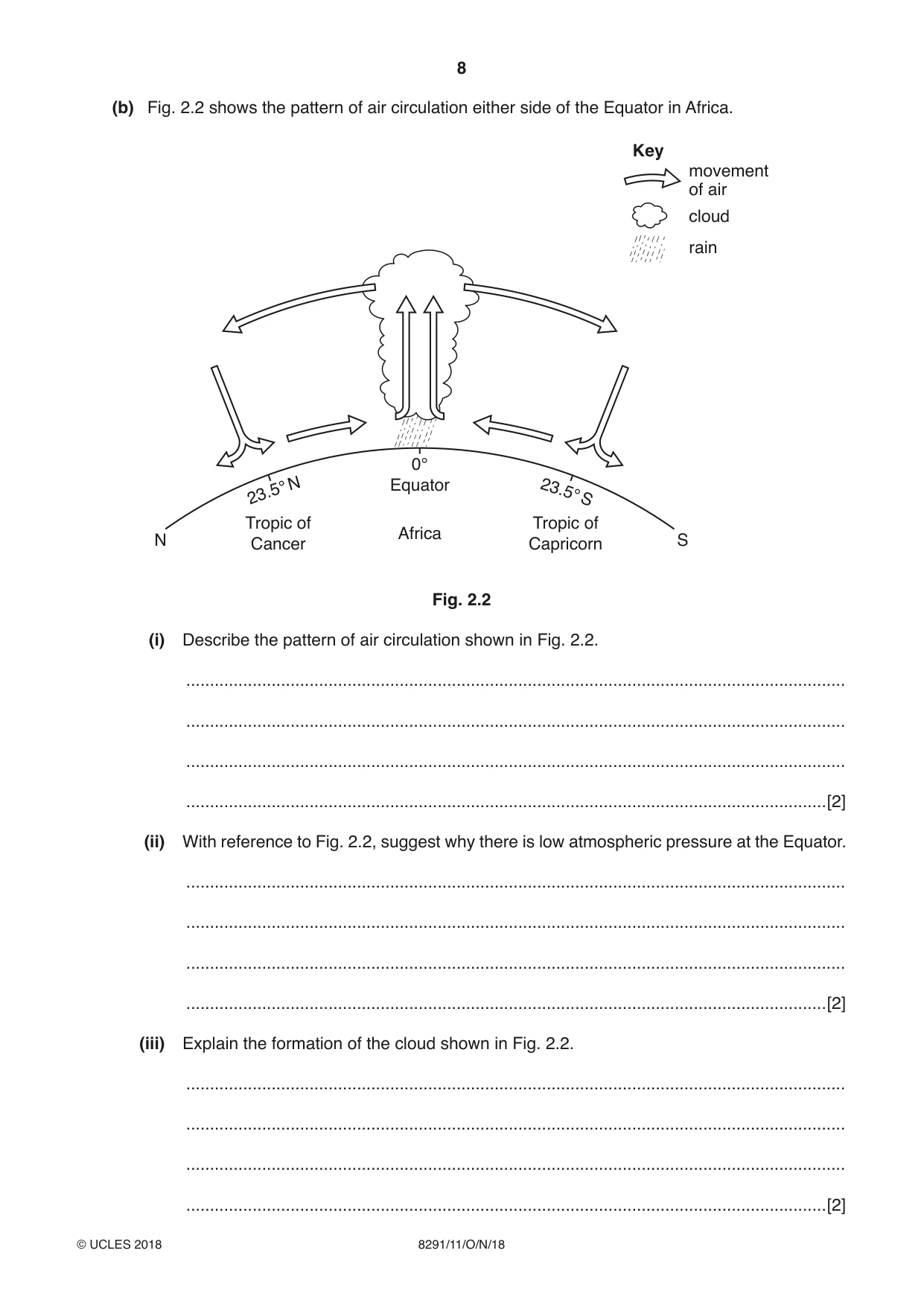
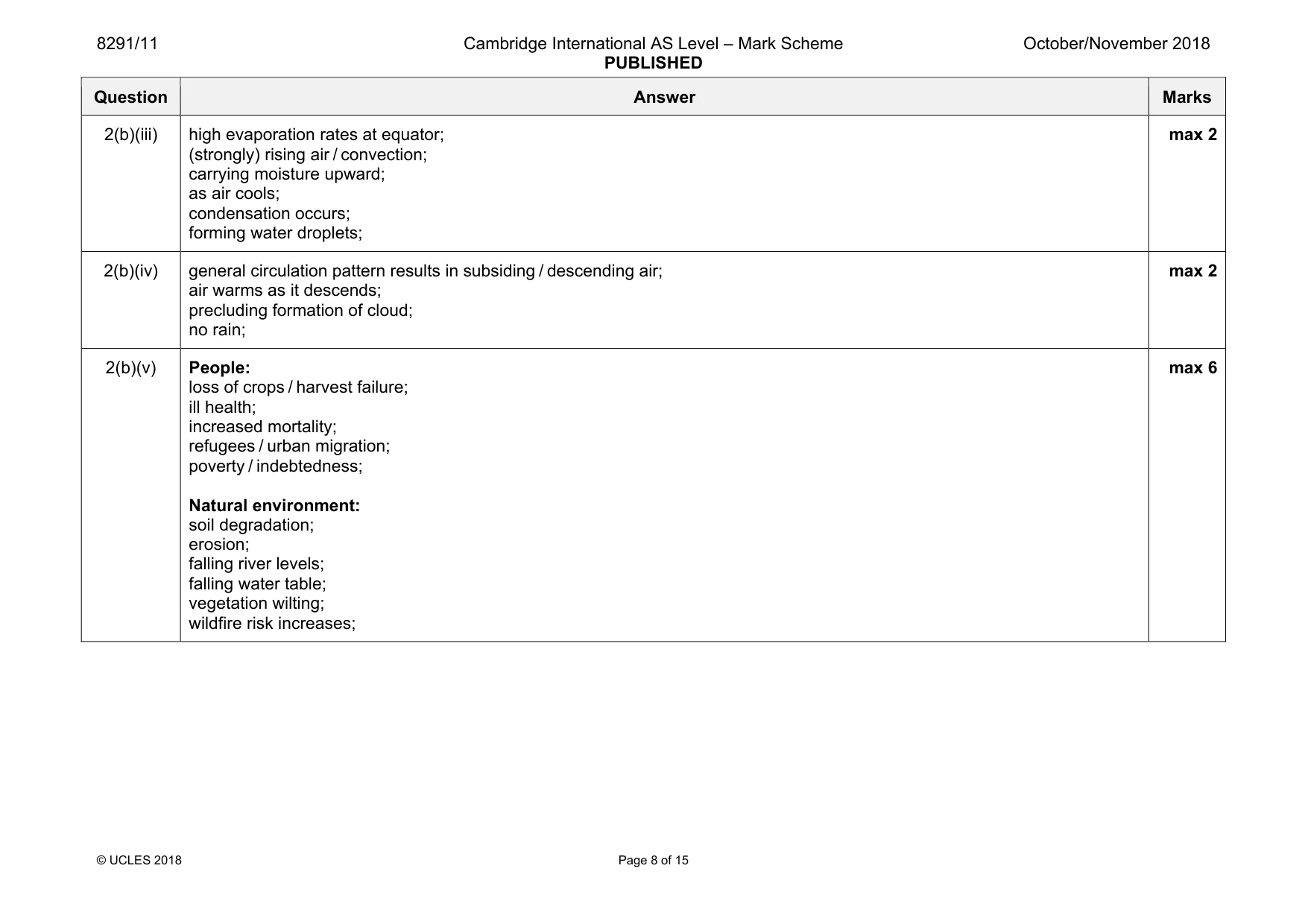
8 8291/11/O/N/18 © UCLES 2018 (b) Fig. 2.2 shows the pattern of air circulation either side of the Equator in Africa. 23. 5° N 23. 5° S 0° Equator Africa Tropic of Cancer Tropic of Capricorn N S Key movement of air cloud rain Fig. 2.2 (i) Describe the pattern of air circulation shown in Fig. 2.2. … … … …[2] (ii) With reference to Fig. 2.2, suggest why there is low atmospheric pressure at the Equator. … … … …[2] (iii) Explain the formation of the cloud shown in Fig. 2.2. … … … …[2]
Question paper, page 9
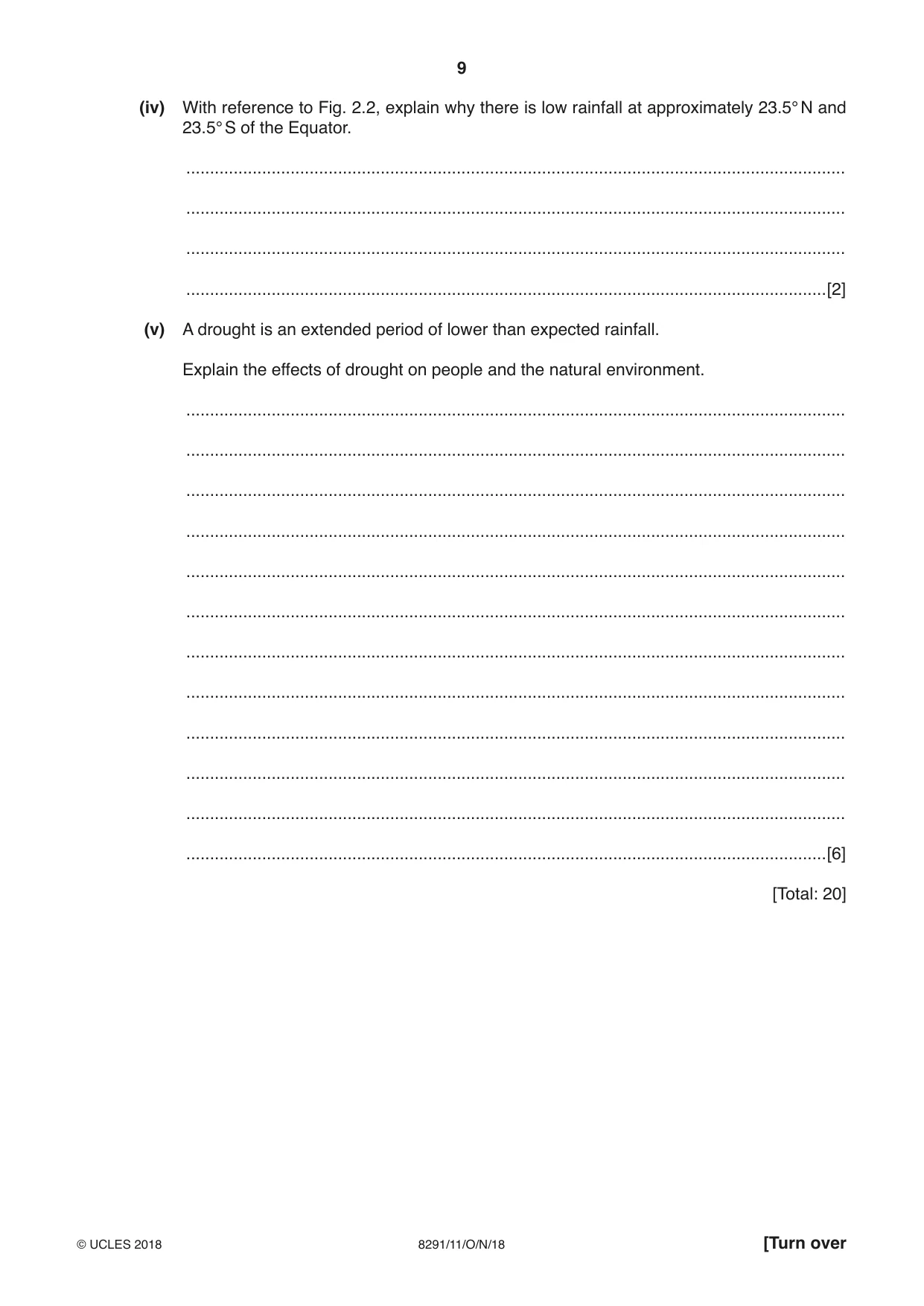
9 8291/11/O/N/18 © UCLES 2018 [Turn over (iv) With reference to Fig. 2.2, explain why there is low rainfall at approximately 23.5° N and 23.5° S of the Equator. … … … …[2] (v) A drought is an extended period of lower than expected rainfall. Explain the effects of drought on people and the natural environment. … … … … … … … … … … … …[6] [Total: 20]
Question paper, page 10
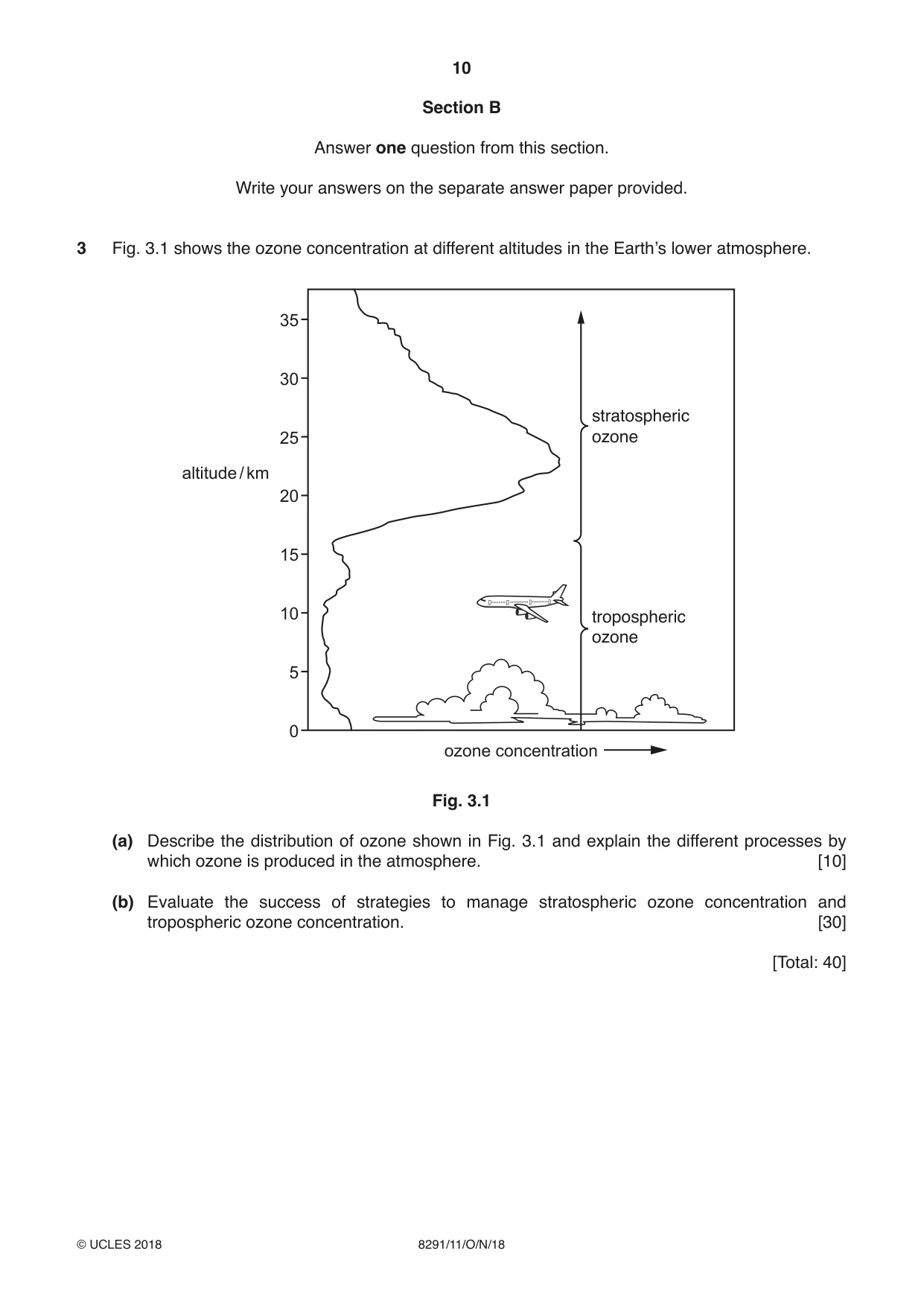
10 8291/11/O/N/18 © UCLES 2018 Section B Answer one question from this section. Write your answers on the separate answer paper provided. 3 Fig. 3.1 shows the ozone concentration at different altitudes in the Earth’s lower atmosphere. 35 30 25 20 15 10 5 0 altitude / km ozone concentration stratospheric ozone tropospheric ozone Fig. 3.1 (a) Describe the distribution of ozone shown in Fig. 3.1 and explain the different processes by which ozone is produced in the atmosphere. [10] (b) Evaluate the success of strategies to manage stratospheric ozone concentration and tropospheric ozone concentration. [30] [Total: 40]
Question paper, page 11
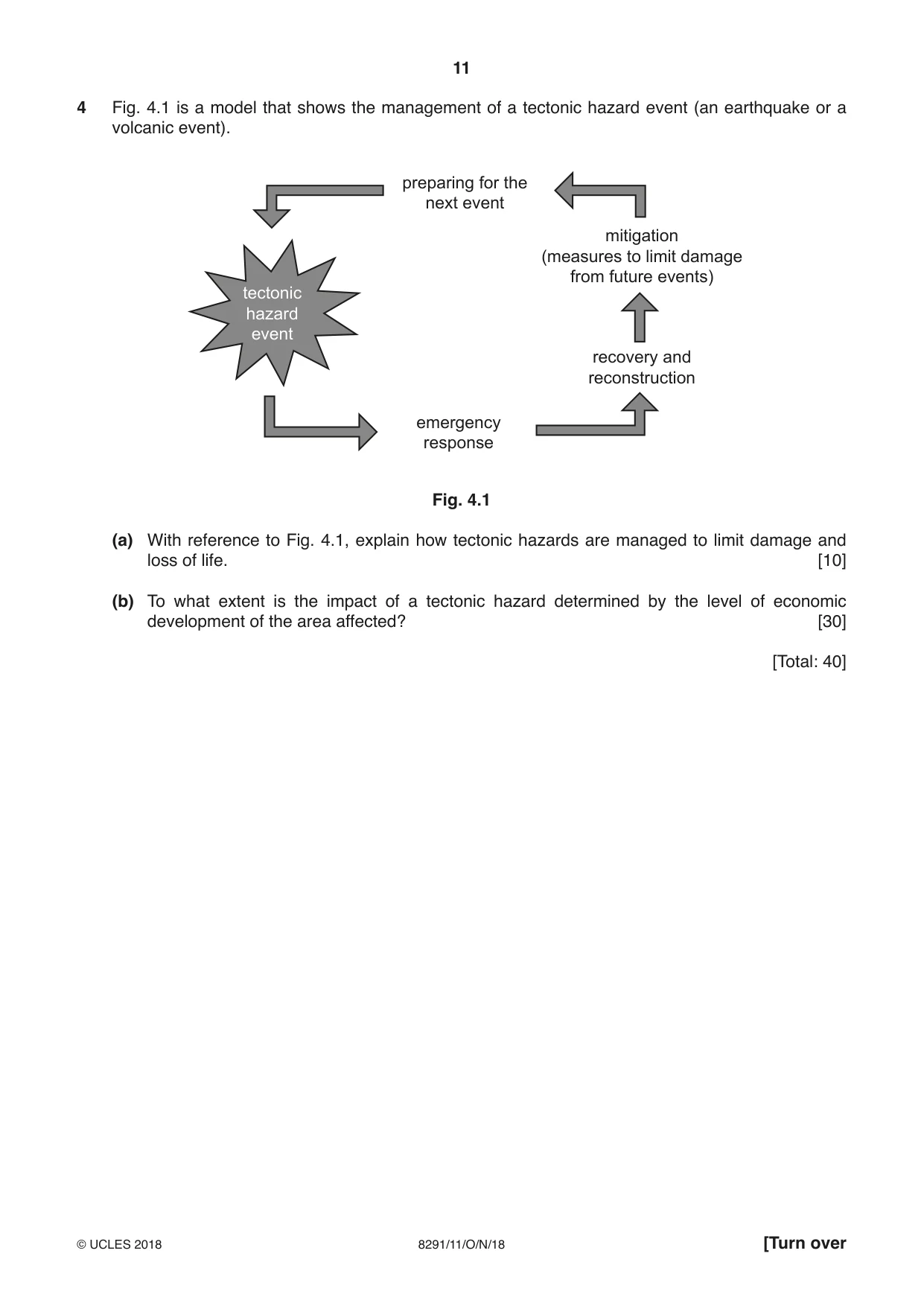
11 8291/11/O/N/18 © UCLES 2018 [Turn over 4 Fig. 4.1 is a model that shows the management of a tectonic hazard event (an earthquake or a volcanic event). tectonic hazard event preparing for the next event mitigation (measures to limit damage from future events) recovery and reconstruction emergency response Fig. 4.1 (a) With reference to Fig. 4.1, explain how tectonic hazards are managed to limit damage and loss of life. [10] (b) To what extent is the impact of a tectonic hazard determined by the level of economic development of the area affected? [30] [Total: 40]
Question paper, page 12
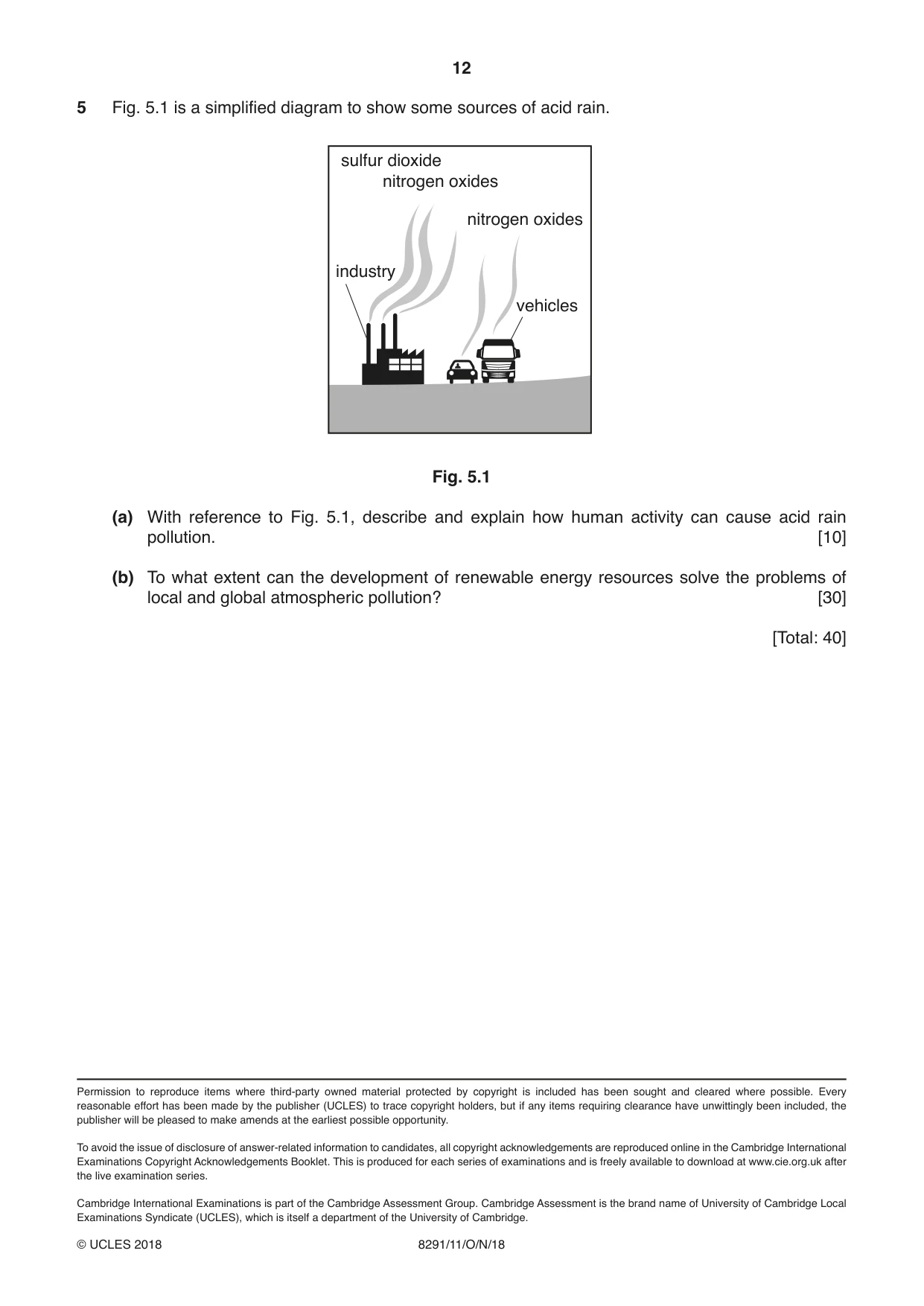
12 8291/11/O/N/18 © UCLES 2018 Permission to reproduce items where third-party owned material protected by copyright is included has been sought and cleared where possible. Every reasonable effort has been made by the publisher (UCLES) to trace copyright holders, but if any items requiring clearance have unwittingly been included, the publisher will be pleased to make amends at the earliest possible opportunity. To avoid the issue of disclosure of answer-related information to candidates, all copyright acknowledgements are reproduced online in the Cambridge International Examinations Copyright Acknowledgements Booklet. This is produced for each series of examinations and is freely available to download at www.cie.org.uk after the live examination series. Cambridge International Examinations is part of the Cambridge Assessment Group. Cambridge Assessment is the brand name of University of Cambridge Local Examinations Syndicate (UCLES), which is itself a department of the University of Cambridge. 5 Fig. 5.1 is a simplified diagram to show some sources of acid rain. vehicles industry sulfur dioxide nitrogen oxides nitrogen oxides Fig. 5.1 (a) With reference to Fig. 5.1, describe and explain how human activity can cause acid rain pollution. [10] (b) To what extent can the development of renewable energy resources solve the problems of local and global atmospheric pollution? [30] [Total: 40]
Mark scheme, page 1
This document consists of 15 printed pages. © UCLES 2018 [Turn over Cambridge Assessment International Education Cambridge International Advanced Subsidiary Level ENVIRONMENTAL MANAGEMENT 8291/11 Paper 1 October/November 2018 MARK SCHEME Maximum Mark: 80 Published This mark scheme is published as an aid to teachers and candidates, to indicate the requirements of the examination. It shows the basis on which Examiners were instructed to award marks. It does not indicate the details of the discussions that took place at an Examiners’ meeting before marking began, which would have considered the acceptability of alternative answers. Mark schemes should be read in conjunction with the question paper and the Principal Examiner Report for Teachers. Cambridge International will not enter into discussions about these mark schemes. Cambridge International is publishing the mark schemes for the October/November 2018 series for most Cambridge IGCSE™, Cambridge International A and AS Level components and some Cambridge O Level components.
Mark scheme, page 2
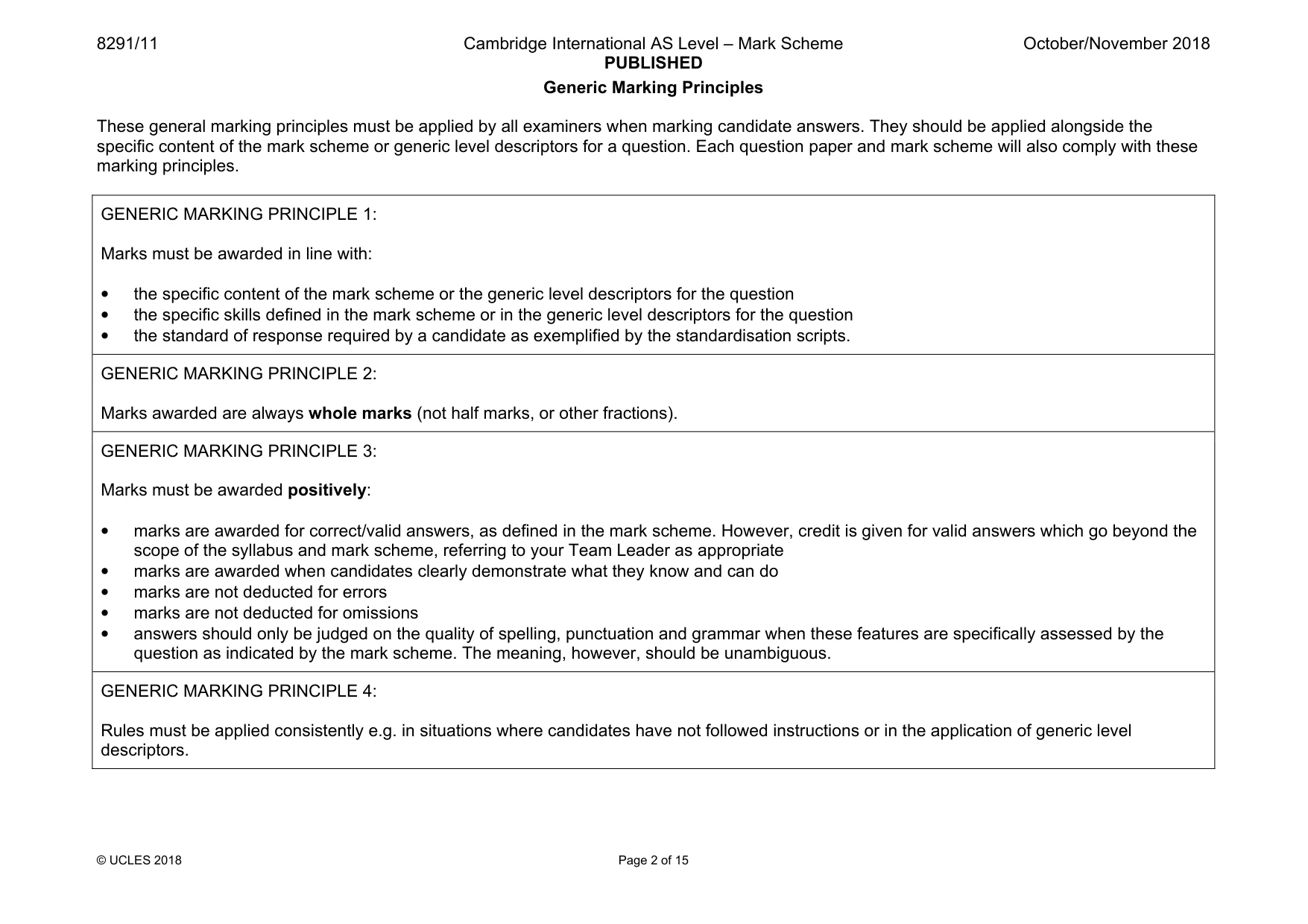
8291/11 Cambridge International AS Level – Mark Scheme PUBLISHED October/November 2018 © UCLES 2018 Page 2 of 15 Generic Marking Principles These general marking principles must be applied by all examiners when marking candidate answers. They should be applied alongside the specific content of the mark scheme or generic level descriptors for a question. Each question paper and mark scheme will also comply with these marking principles. GENERIC MARKING PRINCIPLE 1: Marks must be awarded in line with: • the specific content of the mark scheme or the generic level descriptors for the question • the specific skills defined in the mark scheme or in the generic level descriptors for the question • the standard of response required by a candidate as exemplified by the standardisation scripts. GENERIC MARKING PRINCIPLE 2: Marks awarded are always whole marks (not half marks, or other fractions). GENERIC MARKING PRINCIPLE 3: Marks must be awarded positively: • marks are awarded for correct/valid answers, as defined in the mark scheme. However, credit is given for valid answers which go beyond the scope of the syllabus and mark scheme, referring to your Team Leader as appropriate • marks are awarded when candidates clearly demonstrate what they know and can do • marks are not deducted for errors • marks are not deducted for omissions • answers should only be judged on the quality of spelling, punctuation and grammar when these features are specifically assessed by the question as indicated by the mark scheme. The meaning, however, should be unambiguous. GENERIC MARKING PRINCIPLE 4: Rules must be applied consistently e.g. in situations where candidates have not followed instructions or in the application of generic level descriptors.
Mark scheme, page 3
8291/11 Cambridge International AS Level – Mark Scheme PUBLISHED October/November 2018 © UCLES 2018 Page 3 of 15 GENERIC MARKING PRINCIPLE 5: Marks should be awarded using the full range of marks defined in the mark scheme for the question (however; the use of the full mark range may be limited according to the quality of the candidate responses seen). GENERIC MARKING PRINCIPLE 6: Marks awarded are based solely on the requirements as defined in the mark scheme. Marks should not be awarded with grade thresholds or grade descriptors in mind.
Mark scheme, page 4
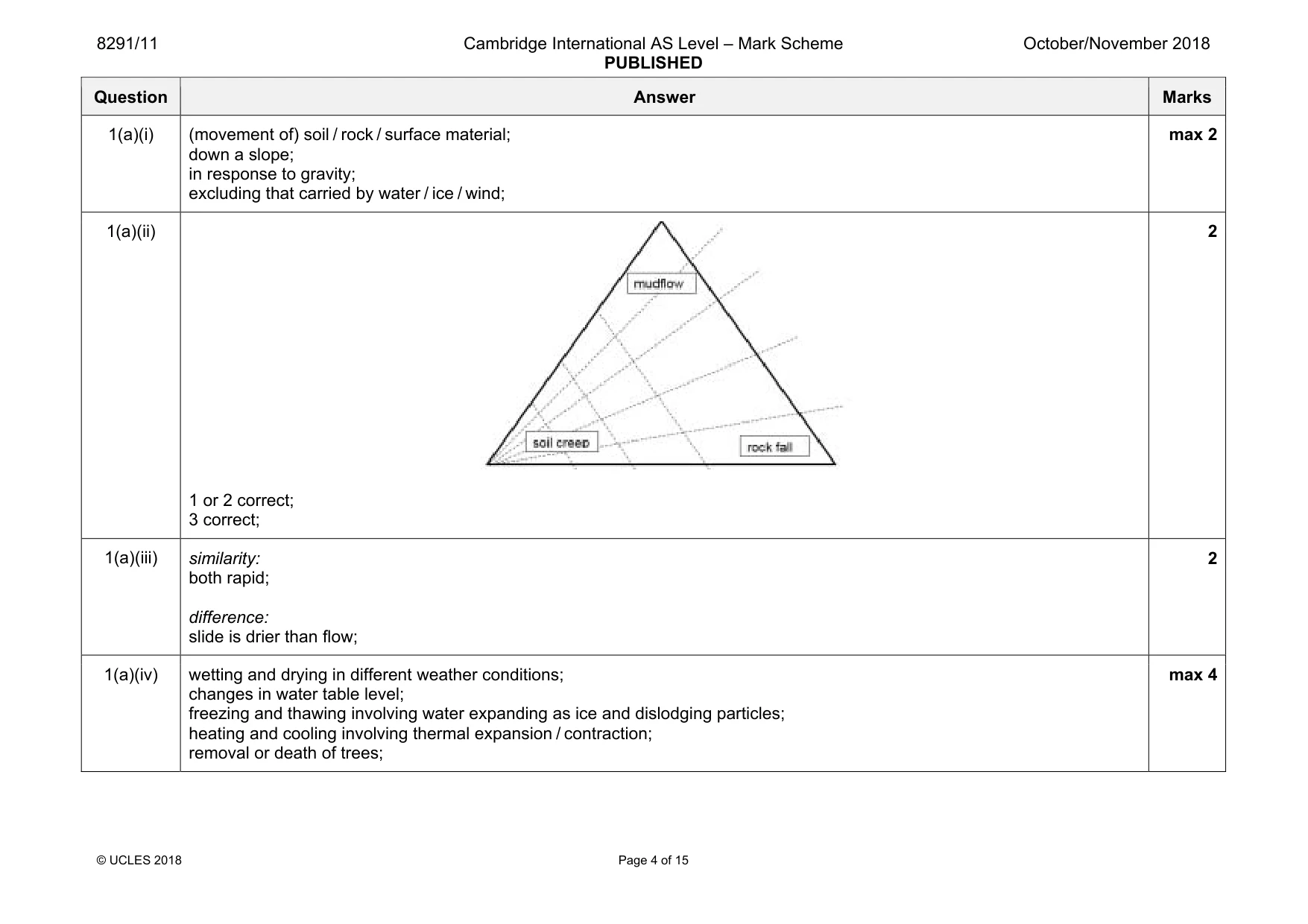
8291/11 Cambridge International AS Level – Mark Scheme PUBLISHED October/November 2018 © UCLES 2018 Page 4 of 15 Question Answer Marks 1(a)(i) (movement of) soil / rock / surface material; down a slope; in response to gravity; excluding that carried by water / ice / wind; max 2 1(a)(ii) 1 or 2 correct; 3 correct; 2 1(a)(iii) similarity: both rapid; difference: slide is drier than flow; 2 1(a)(iv) wetting and drying in different weather conditions; changes in water table level; freezing and thawing involving water expanding as ice and dislodging particles; heating and cooling involving thermal expansion / contraction; removal or death of trees; max 4
Mark scheme, page 5
8291/11 Cambridge International AS Level – Mark Scheme PUBLISHED October/November 2018 © UCLES 2018 Page 5 of 15 Question Answer Marks 1(b)(i) rock weathering: weathering reduces / breaks down / loosens / weakens the strength / cohesion of slope material; over time; making it increasingly likely to move; vegetation: can be both an agent of weathering promoting movement; and it can stabilise a slope; plant roots bind; prevent erosion by covering the ground; rock type: the harder more resistant the rock the slower the movement; porosity / permeability; soil moisture: adds weight to surface layers; affects pore water pressure; lubricates / liquifies; river activity: role in removing debris from slope foot; could erode the ground and increase pressure leading to falls; climate: precipitation; and temperature changes both govern speed and type; e.g. frost action in solifluction; max 4
Mark scheme, page 6
8291/11 Cambridge International AS Level – Mark Scheme PUBLISHED October/November 2018 © UCLES 2018 Page 6 of 15 Question Answer Marks 1(b)(ii) Settlements / buildings; add to weight / stress; road cuttings; increase slope angle; deforestation; reduces soil stability; (intensive) agriculture; reduces cohesiveness of soil; promoting soil creep; quarrying; oversteepens leading to rock falls and landslides; mining; undercuts the ground causing collapse; human induced global warming; leads to increased frequency of storms and intensity of rain; max 6
Mark scheme, page 7
8291/11 Cambridge International AS Level – Mark Scheme PUBLISHED October/November 2018 © UCLES 2018 Page 7 of 15 Question Answer Marks 2(a)(i) in a belt either side of the Equator; more above the equator than below; with exception of East Africa; concentrated in W and Central Africa; between latitudes 10 °N and 10 °S; small area in Madagascar; max 2 2(a)(ii) city major climatic region A Equatorial climate B Tropical desert C Savannah 2 correct; 3 correct; 2 2(a)(iii) rainfall higher in A; max temperature higher in C; max temperature range higher in C; max 2 2(b)(i) air rises at the equator; flows away from equator aloft; descends at Tropics; where it diverges; surface winds return converging air towards the Equator; some air diverges away from the equator; max 2 2(b)(ii) intense solar heating at the equator; warm land surface; convection causes air to rise; creating low air pressure; max 2
Mark scheme, page 8
8291/11 Cambridge International AS Level – Mark Scheme PUBLISHED October/November 2018 © UCLES 2018 Page 8 of 15 Question Answer Marks 2(b)(iii) high evaporation rates at equator; (strongly) rising air / convection; carrying moisture upward; as air cools; condensation occurs; forming water droplets; max 2 2(b)(iv) general circulation pattern results in subsiding / descending air; air warms as it descends; precluding formation of cloud; no rain; max 2 2(b)(v) People: loss of crops / harvest failure; ill health; increased mortality; refugees / urban migration; poverty / indebtedness; Natural environment: soil degradation; erosion; falling river levels; falling water table; vegetation wilting; wildfire risk increases; max 6
Mark scheme, page 9
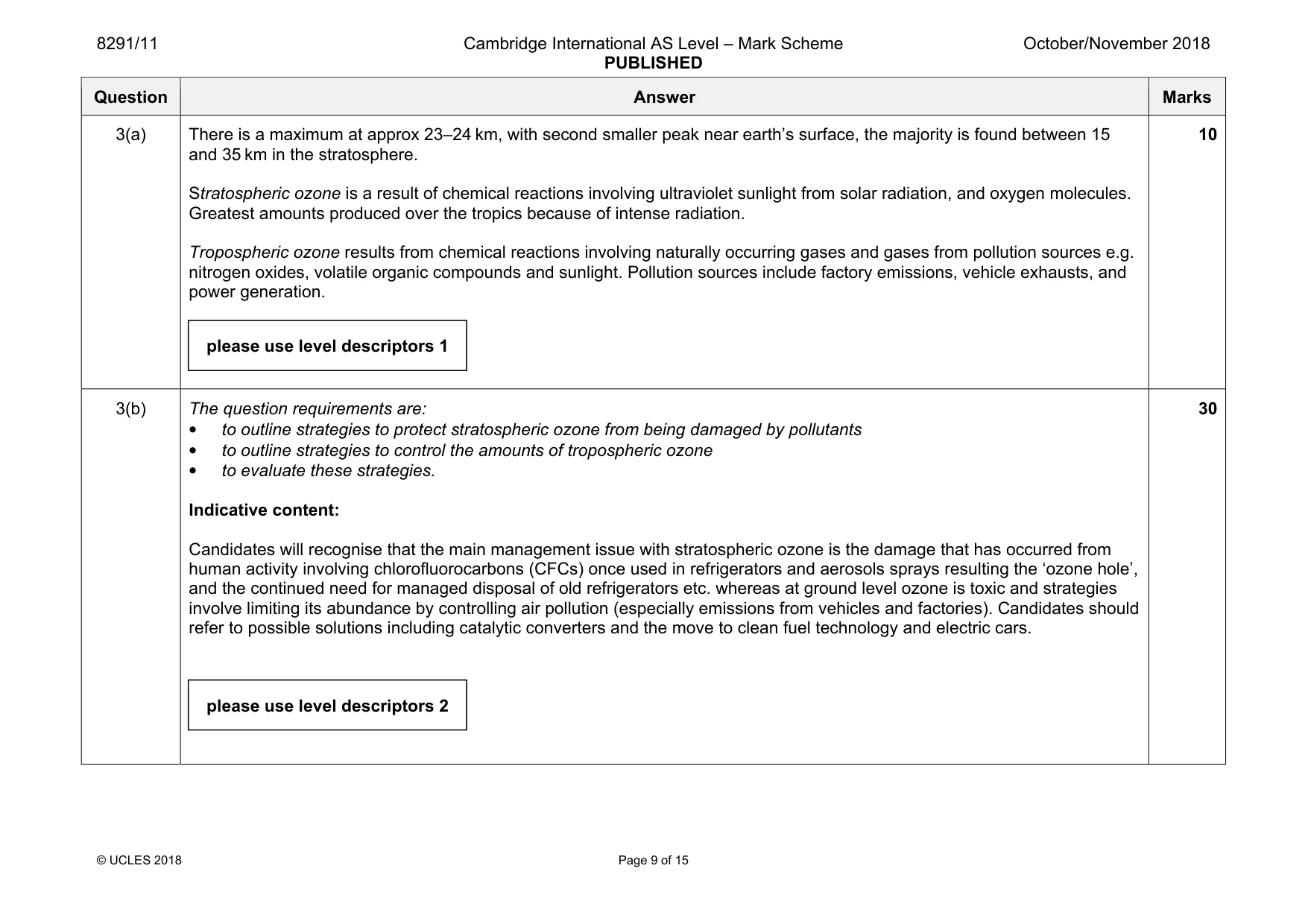
8291/11 Cambridge International AS Level – Mark Scheme PUBLISHED October/November 2018 © UCLES 2018 Page 9 of 15 Question Answer Marks 3(a) There is a maximum at approx 23–24 km, with second smaller peak near earth’s surface, the majority is found between 15 and 35 km in the stratosphere. Stratospheric ozone is a result of chemical reactions involving ultraviolet sunlight from solar radiation, and oxygen molecules. Greatest amounts produced over the tropics because of intense radiation. Tropospheric ozone results from chemical reactions involving naturally occurring gases and gases from pollution sources e.g. nitrogen oxides, volatile organic compounds and sunlight. Pollution sources include factory emissions, vehicle exhausts, and power generation. 10 3(b) The question requirements are: • to outline strategies to protect stratospheric ozone from being damaged by pollutants • to outline strategies to control the amounts of tropospheric ozone • to evaluate these strategies. Indicative content: Candidates will recognise that the main management issue with stratospheric ozone is the damage that has occurred from human activity involving chlorofluorocarbons (CFCs) once used in refrigerators and aerosols sprays resulting the ‘ozone hole’, and the continued need for managed disposal of old refrigerators etc. whereas at ground level ozone is toxic and strategies involve limiting its abundance by controlling air pollution (especially emissions from vehicles and factories). Candidates should refer to possible solutions including catalytic converters and the move to clean fuel technology and electric cars. 30 please use level descriptors 1 please use level descriptors 2
Mark scheme, page 10
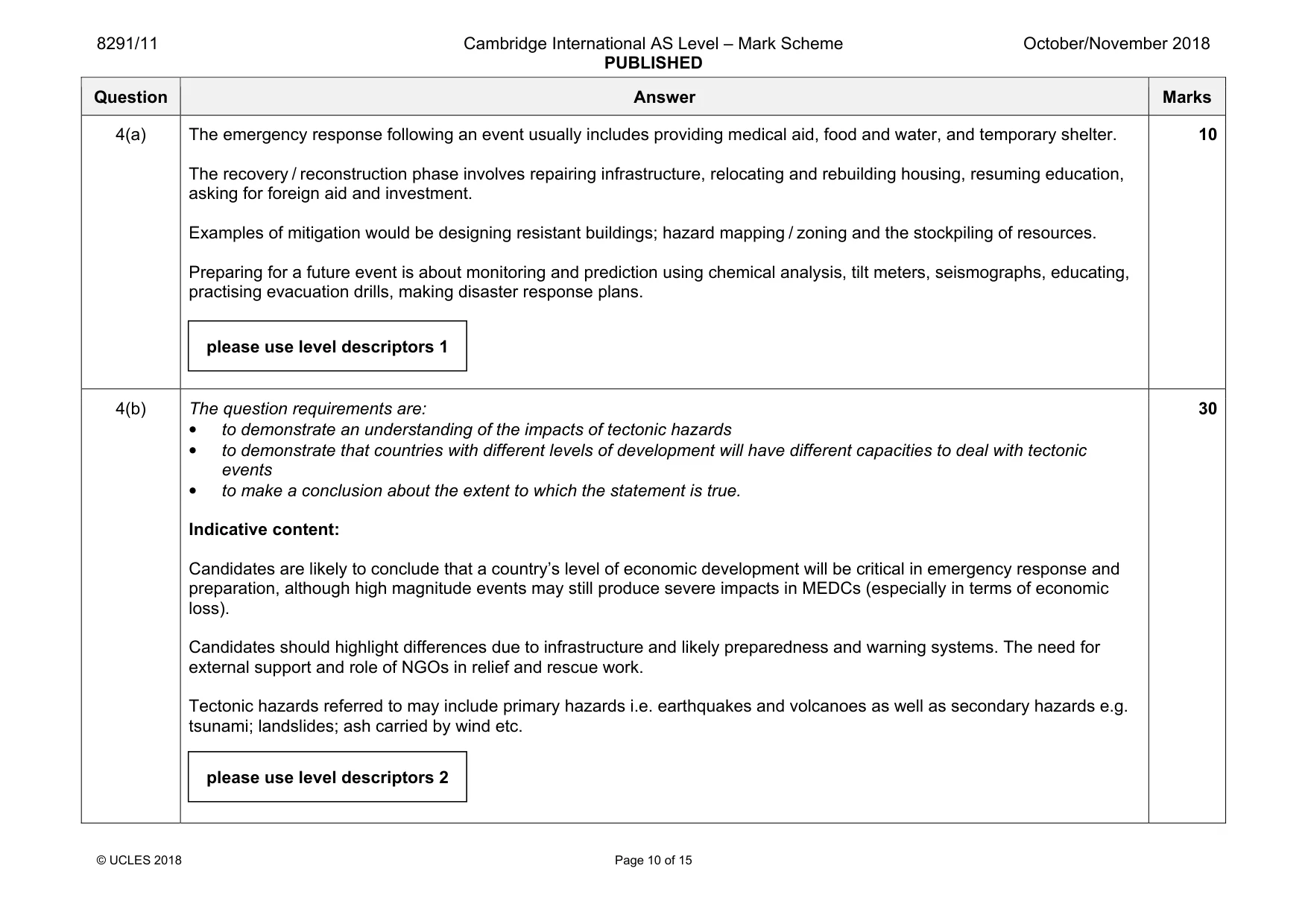
8291/11 Cambridge International AS Level – Mark Scheme PUBLISHED October/November 2018 © UCLES 2018 Page 10 of 15 Question Answer Marks 4(a) The emergency response following an event usually includes providing medical aid, food and water, and temporary shelter. The recovery / reconstruction phase involves repairing infrastructure, relocating and rebuilding housing, resuming education, asking for foreign aid and investment. Examples of mitigation would be designing resistant buildings; hazard mapping / zoning and the stockpiling of resources. Preparing for a future event is about monitoring and prediction using chemical analysis, tilt meters, seismographs, educating, practising evacuation drills, making disaster response plans. 10 4(b) The question requirements are: • to demonstrate an understanding of the impacts of tectonic hazards • to demonstrate that countries with different levels of development will have different capacities to deal with tectonic events • to make a conclusion about the extent to which the statement is true. Indicative content: Candidates are likely to conclude that a country’s level of economic development will be critical in emergency response and preparation, although high magnitude events may still produce severe impacts in MEDCs (especially in terms of economic loss). Candidates should highlight differences due to infrastructure and likely preparedness and warning systems. The need for external support and role of NGOs in relief and rescue work. Tectonic hazards referred to may include primary hazards i.e. earthquakes and volcanoes as well as secondary hazards e.g. tsunami; landslides; ash carried by wind etc. 30 please use level descriptors 2 please use level descriptors 1
Mark scheme, page 11
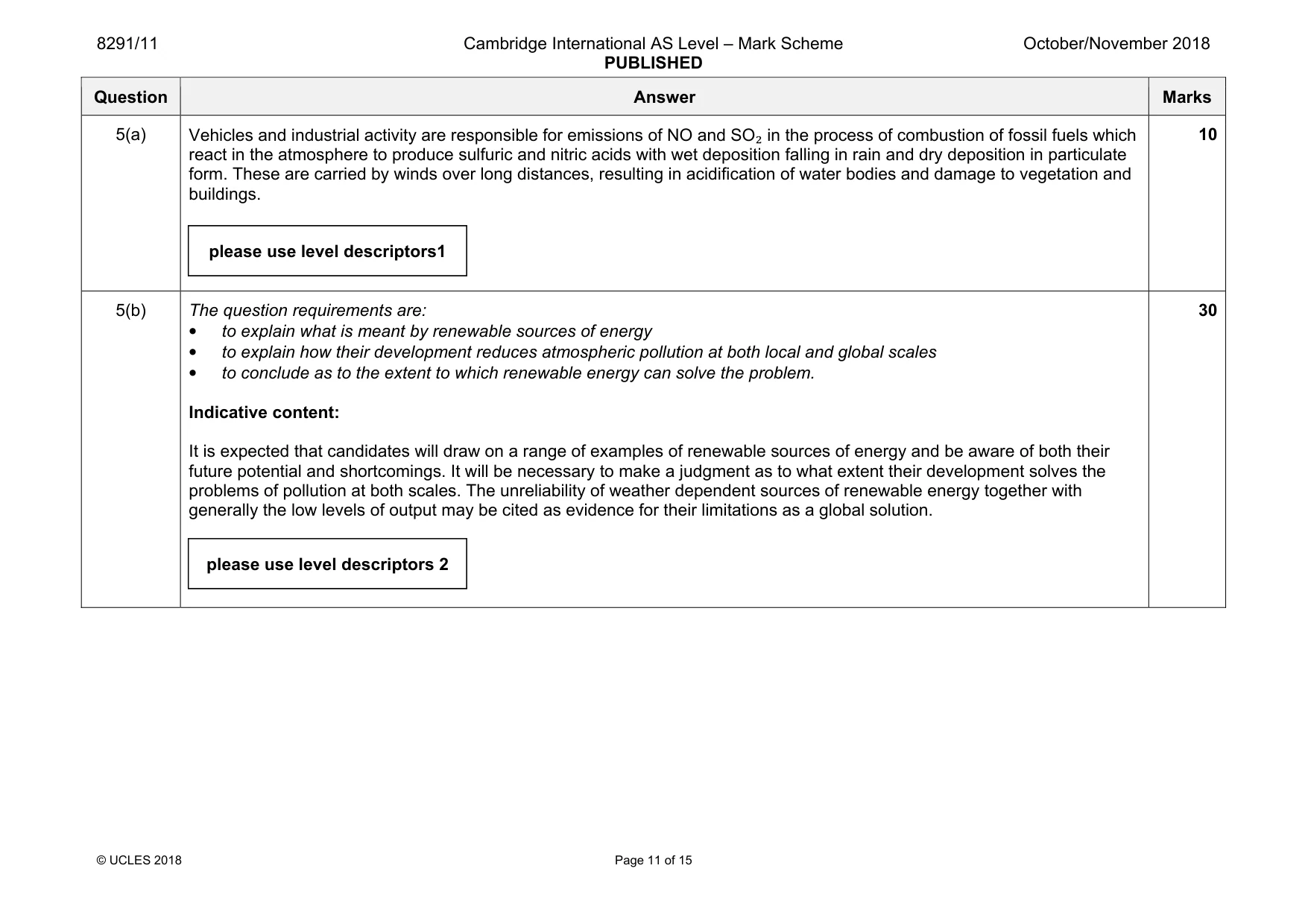
8291/11 Cambridge International AS Level – Mark Scheme PUBLISHED October/November 2018 © UCLES 2018 Page 11 of 15 Question Answer Marks 5(a) Vehicles and industrial activity are responsible for emissions of NO and SO₂ in the process of combustion of fossil fuels which react in the atmosphere to produce sulfuric and nitric acids with wet deposition falling in rain and dry deposition in particulate form. These are carried by winds over long distances, resulting in acidification of water bodies and damage to vegetation and buildings. 10 5(b) The question requirements are: • to explain what is meant by renewable sources of energy • to explain how their development reduces atmospheric pollution at both local and global scales • to conclude as to the extent to which renewable energy can solve the problem. Indicative content: It is expected that candidates will draw on a range of examples of renewable sources of energy and be aware of both their future potential and shortcomings. It will be necessary to make a judgment as to what extent their development solves the problems of pollution at both scales. The unreliability of weather dependent sources of renewable energy together with generally the low levels of output may be cited as evidence for their limitations as a global solution. 30 please use level descriptors1 please use level descriptors 2
Mark scheme, page 12
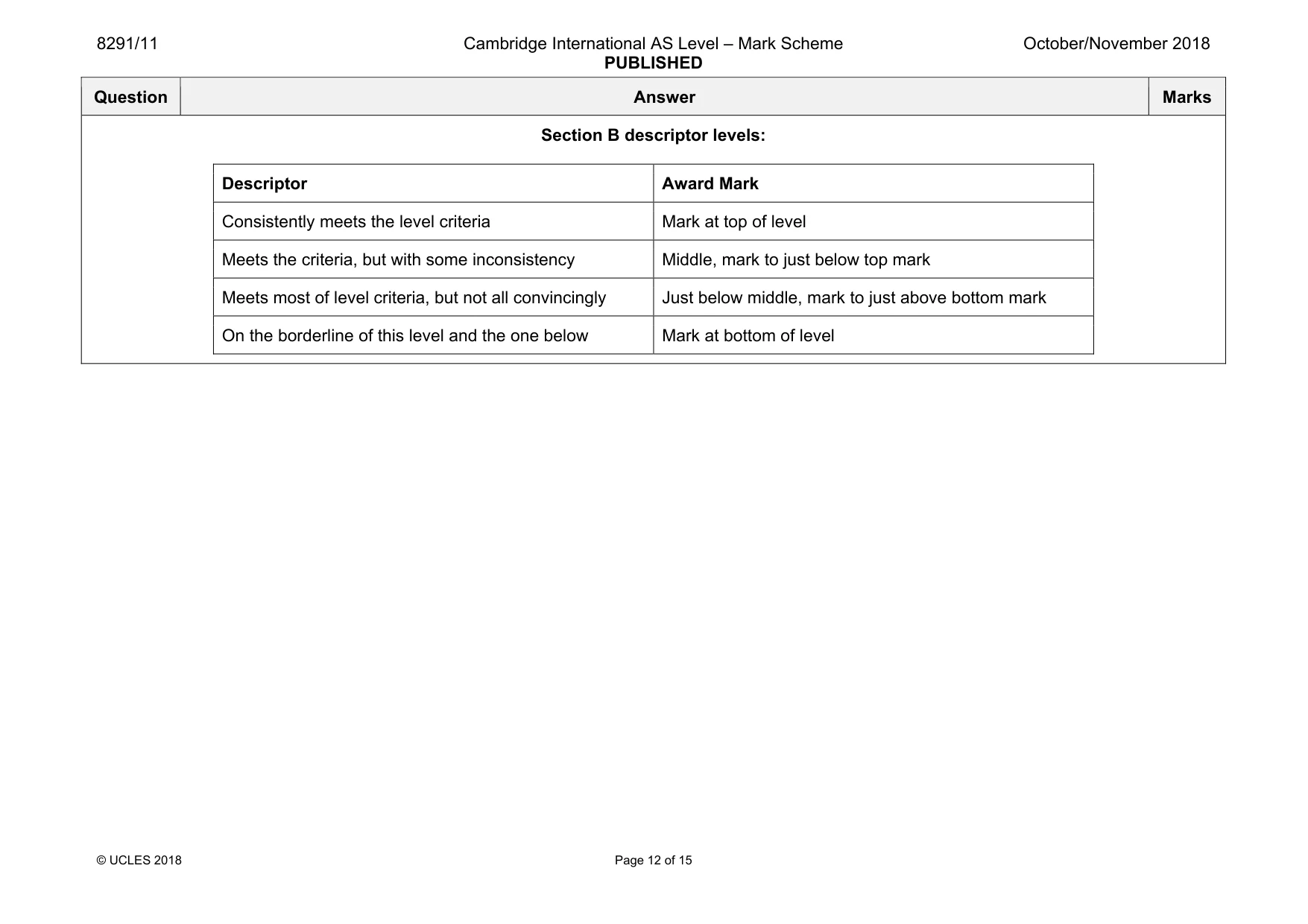
8291/11 Cambridge International AS Level – Mark Scheme PUBLISHED October/November 2018 © UCLES 2018 Page 12 of 15 Question Answer Marks Section B descriptor levels: Descriptor Award Mark Consistently meets the level criteria Mark at top of level Meets the criteria, but with some inconsistency Middle, mark to just below top mark Meets most of level criteria, but not all convincingly Just below middle, mark to just above bottom mark On the borderline of this level and the one below Mark at bottom of level
Mark scheme, page 13
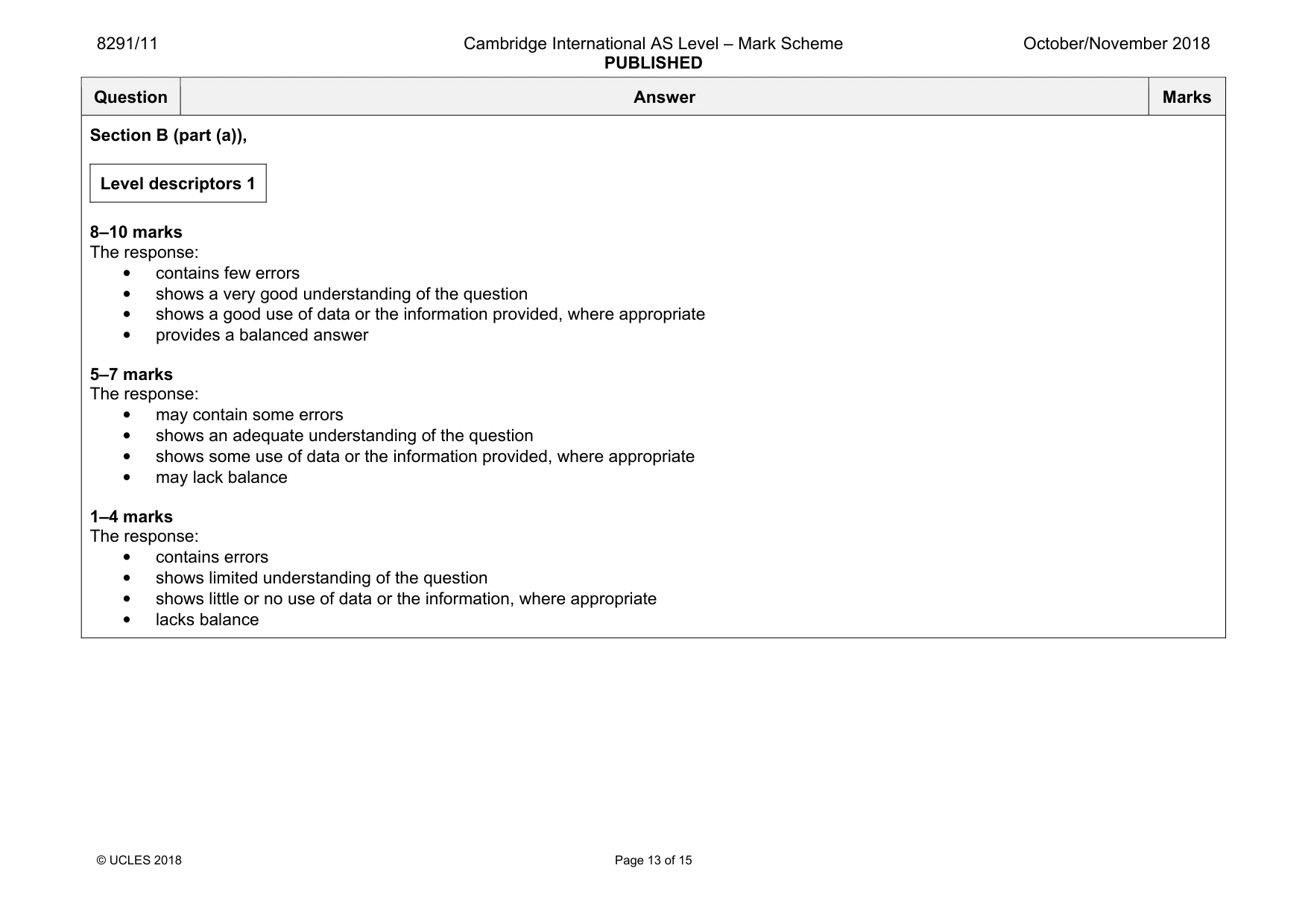
8291/11 Cambridge International AS Level – Mark Scheme PUBLISHED October/November 2018 © UCLES 2018 Page 13 of 15 Question Answer Marks Section B (part (a)), Level descriptors 1 8–10 marks The response: • contains few errors • shows a very good understanding of the question • shows a good use of data or the information provided, where appropriate • provides a balanced answer 5–7 marks The response: • may contain some errors • shows an adequate understanding of the question • shows some use of data or the information provided, where appropriate • may lack balance 1–4 marks The response: • contains errors • shows limited understanding of the question • shows little or no use of data or the information, where appropriate • lacks balance
Mark scheme, page 14
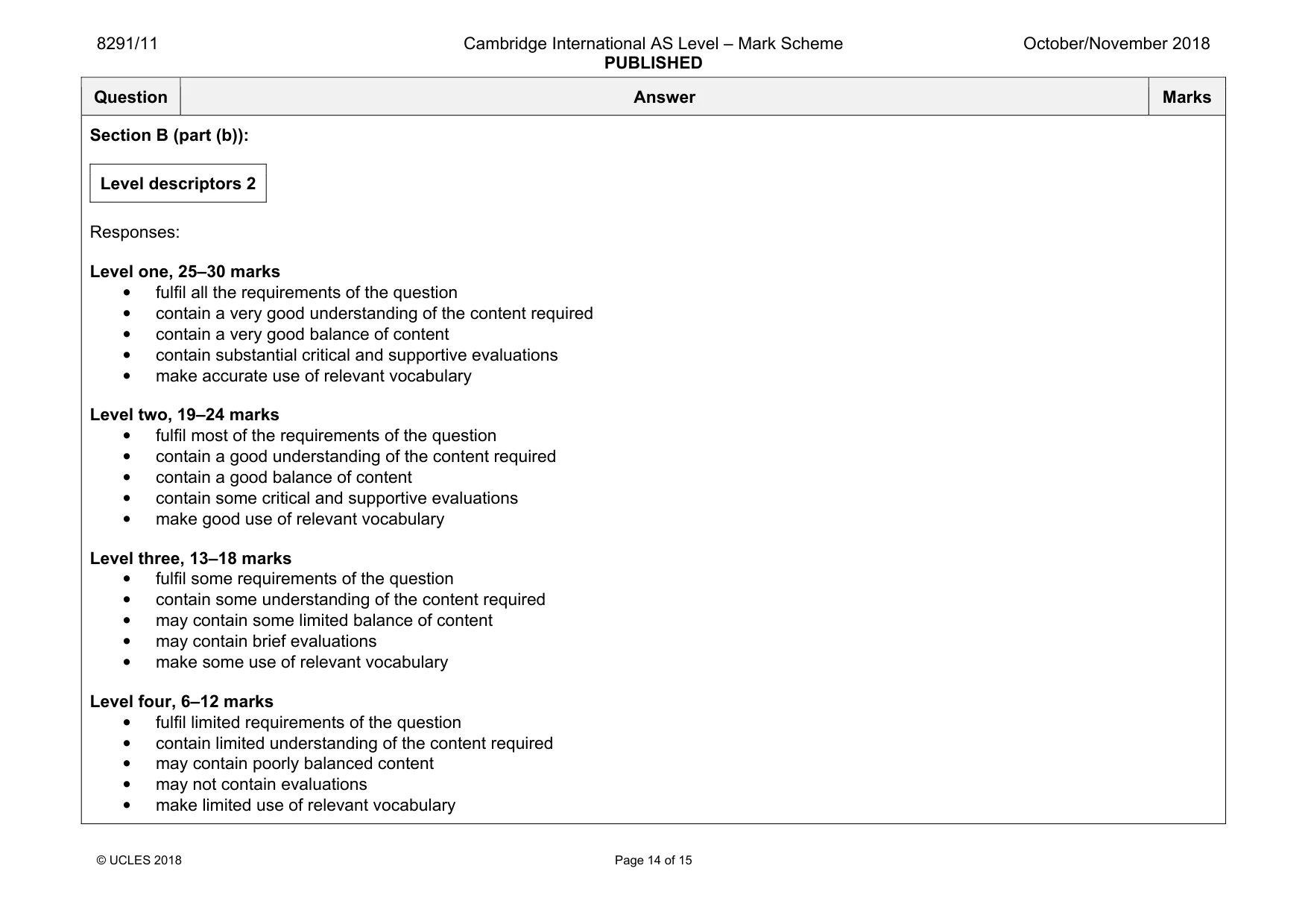
8291/11 Cambridge International AS Level – Mark Scheme PUBLISHED October/November 2018 © UCLES 2018 Page 14 of 15 Question Answer Marks Section B (part (b)): Level descriptors 2 Responses: Level one, 25–30 marks • fulfil all the requirements of the question • contain a very good understanding of the content required • contain a very good balance of content • contain substantial critical and supportive evaluations • make accurate use of relevant vocabulary Level two, 19–24 marks • fulfil most of the requirements of the question • contain a good understanding of the content required • contain a good balance of content • contain some critical and supportive evaluations • make good use of relevant vocabulary Level three, 13–18 marks • fulfil some requirements of the question • contain some understanding of the content required • may contain some limited balance of content • may contain brief evaluations • make some use of relevant vocabulary Level four, 6–12 marks • fulfil limited requirements of the question • contain limited understanding of the content required • may contain poorly balanced content • may not contain evaluations • make limited use of relevant vocabulary
Mark scheme, page 15
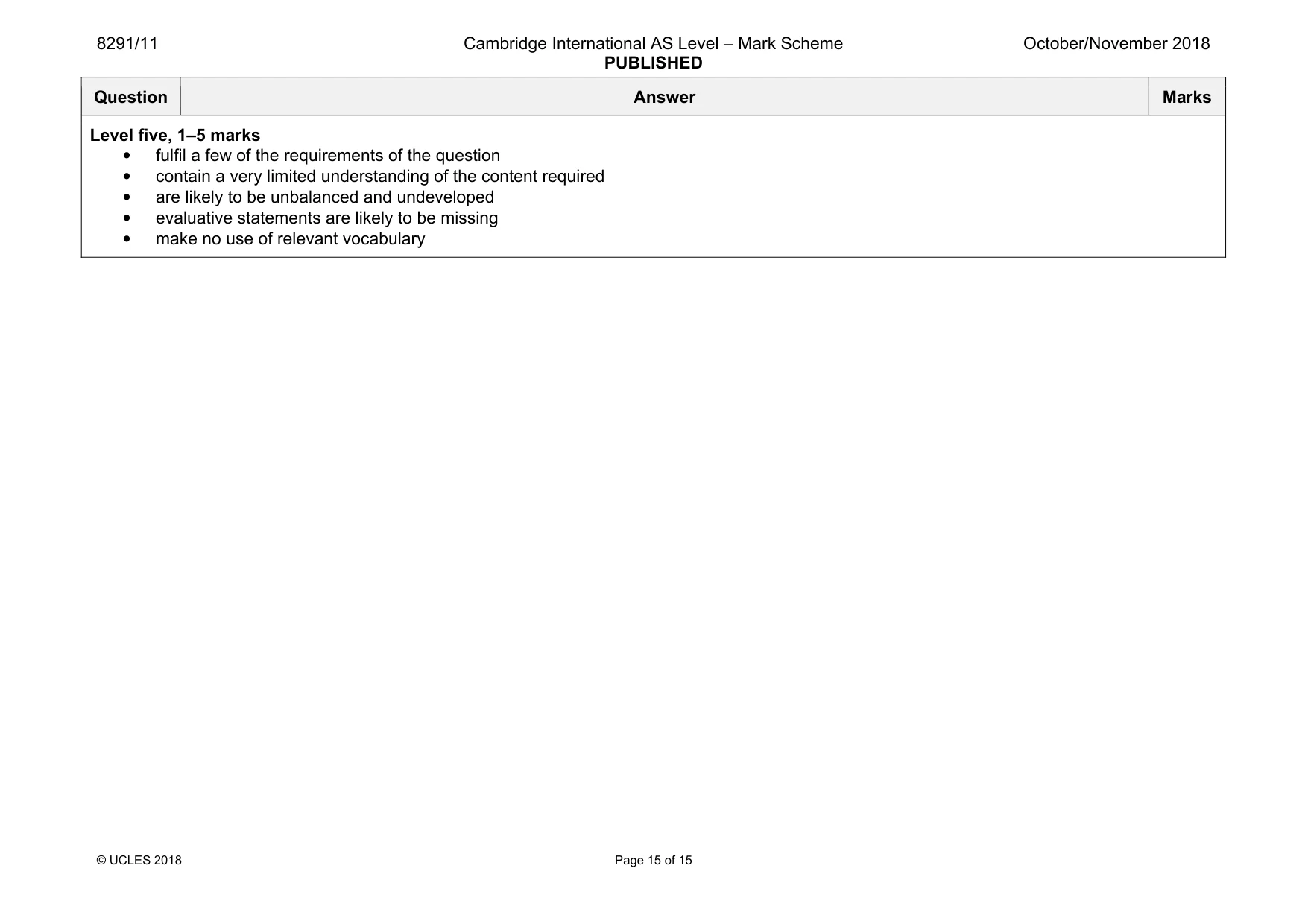
8291/11 Cambridge International AS Level – Mark Scheme PUBLISHED October/November 2018 © UCLES 2018 Page 15 of 15 Question Answer Marks Level five, 1–5 marks • fulfil a few of the requirements of the question • contain a very limited understanding of the content required • are likely to be unbalanced and undeveloped • evaluative statements are likely to be missing • make no use of relevant vocabulary