Cambridge A Level Environmental Management (AS only) 8291 — 2012 May/June Paper 1 · Variant 1
8291/11/M/J/12 · 80 marks · ≈90 min
The question paper and its mark scheme, free to read here and free to download. This is Cambridge’s own paper, exactly as it was sat.
Question paper12 pages

Mark scheme9 pages
Answers below. Sit the paper first if you are practising.
Paper as text
Question paper, page 1
This document consists of 10 printed pages and 2 blank pages. DC (SJF/CGW) 51057/7 © UCLES 2012 [Turn over UNIVERSITY OF CAMBRIDGE INTERNATIONAL EXAMINATIONS General Certificate of Education Advanced Subsidiary Level READ THESE INSTRUCTIONS FIRST Write your Centre number, candidate number and name on all the work you hand in. Write in dark blue or black pen. You may use a soft pencil for any diagrams, graphs, tables or rough working. Do not use staples, paper clips, highlighters, glue or correction fluid. DO NOT WRITE IN ANY BARCODES. Section A Answer all questions. Write your answers in the spaces provided on the question paper. Section B Answer one question from this section. Answer the question on the separate answer paper provided. At the end of the examination, 1. fasten all separate answer paper securely to the question paper; 2. enter the question number from Section B in the grid opposite. CANDIDATE NAME CENTRE NUMBER CANDIDATE NUMBER ENVIRONMENTAL MANAGEMENT 8291/11 Paper 1 Lithosphere and Atmosphere May/June 2012 1 hour 30 minutes Additional Materials: Answer Booklet/Paper * 3 5 6 1 1 3 0 3 2 6 * For Examiner’s Use Section A 1 2 Section B Total
Question paper, page 2
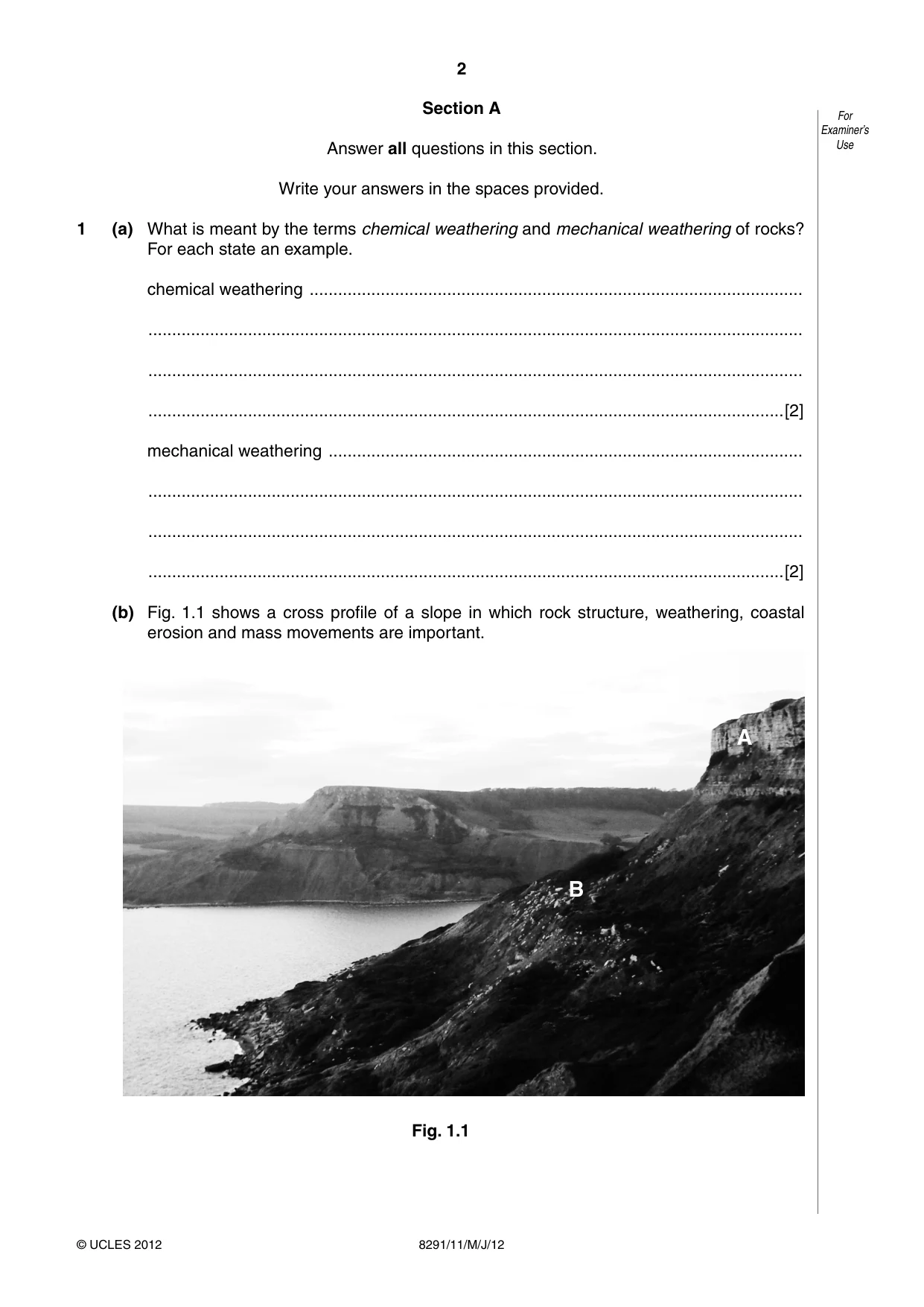
2 8291/11/M/J/12 For Examiner’s Use © UCLES 2012 Section A Answer all questions in this section. Write your answers in the spaces provided. 1 (a) What is meant by the terms chemical weathering and mechanical weathering of rocks? For each state an example. chemical weathering … … … …[2] mechanical weathering … … … …[2] (b) Fig. 1.1 shows a cross profile of a slope in which rock structure, weathering, coastal erosion and mass movements are important. A B Fig. 1.1
Question paper, page 3
3 8291/11/M/J/12 [Turn over For Examiner’s Use © UCLES 2012 (i) Explain how the rock structure shown at point A in Fig. 1.1 would assist the process of weathering to produce the large angular fragments seen at point B. … … … … … … …[3] (ii) Describe and explain the distribution of larger debris on the slope in Fig. 1.1. … … … …[2] (iii) Explain how erosion by the sea would help to maintain the instability of the whole of the slope in Fig. 1.1. … … … …[2]
Question paper, page 4
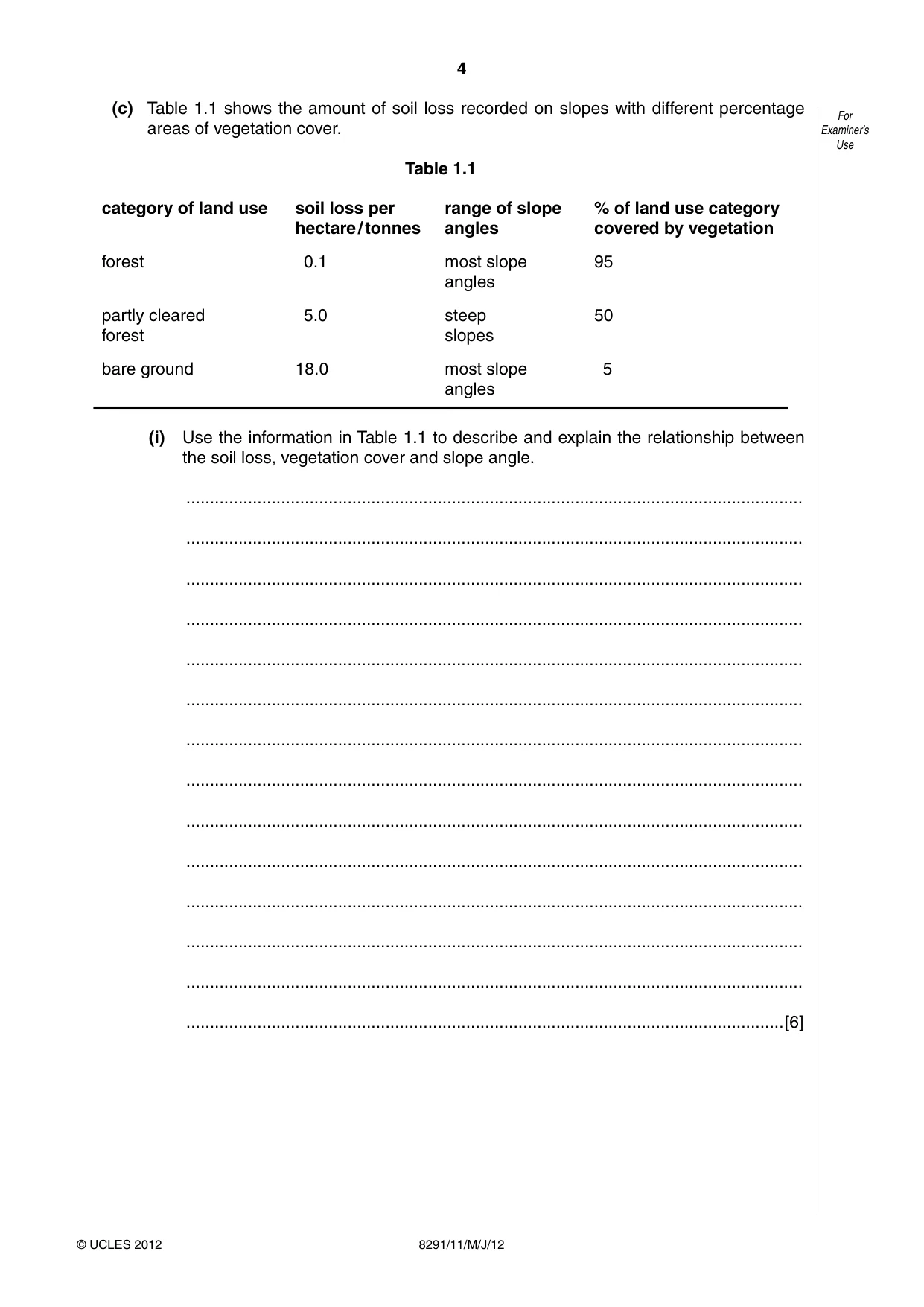
4 8291/11/M/J/12 For Examiner’s Use © UCLES 2012 (c) Table 1.1 shows the amount of soil loss recorded on slopes with different percentage areas of vegetation cover. Table 1.1 category of land use soil loss per hectare / tonnes range of slope angles % of land use category covered by vegetation forest 0.1 most slope angles 95 partly cleared forest 5.0 steep slopes 50 bare ground 18.0 most slope angles 5 (i) Use the information in Table 1.1 to describe and explain the relationship between the soil loss, vegetation cover and slope angle. … … … … … … … … … … … … … …[6]
Question paper, page 5
5 8291/11/M/J/12 [Turn over For Examiner’s Use © UCLES 2012 (ii) Explain why minimising soil loss on sloping land is better achieved by measures that retain much of the original vegetation cover rather than extensive clearance followed by replanting. … … … … … … …[3] [Total: 20]
Question paper, page 6
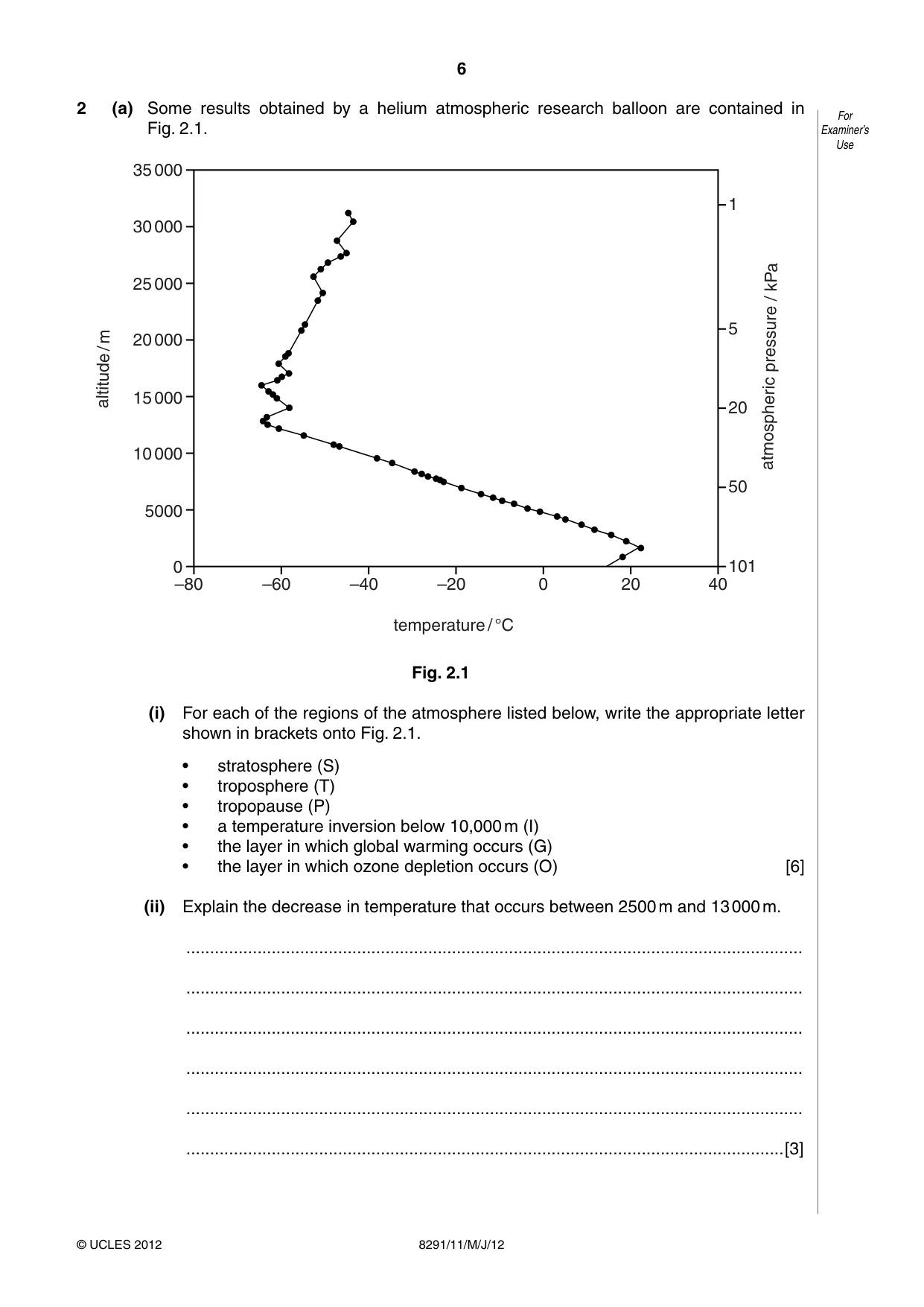
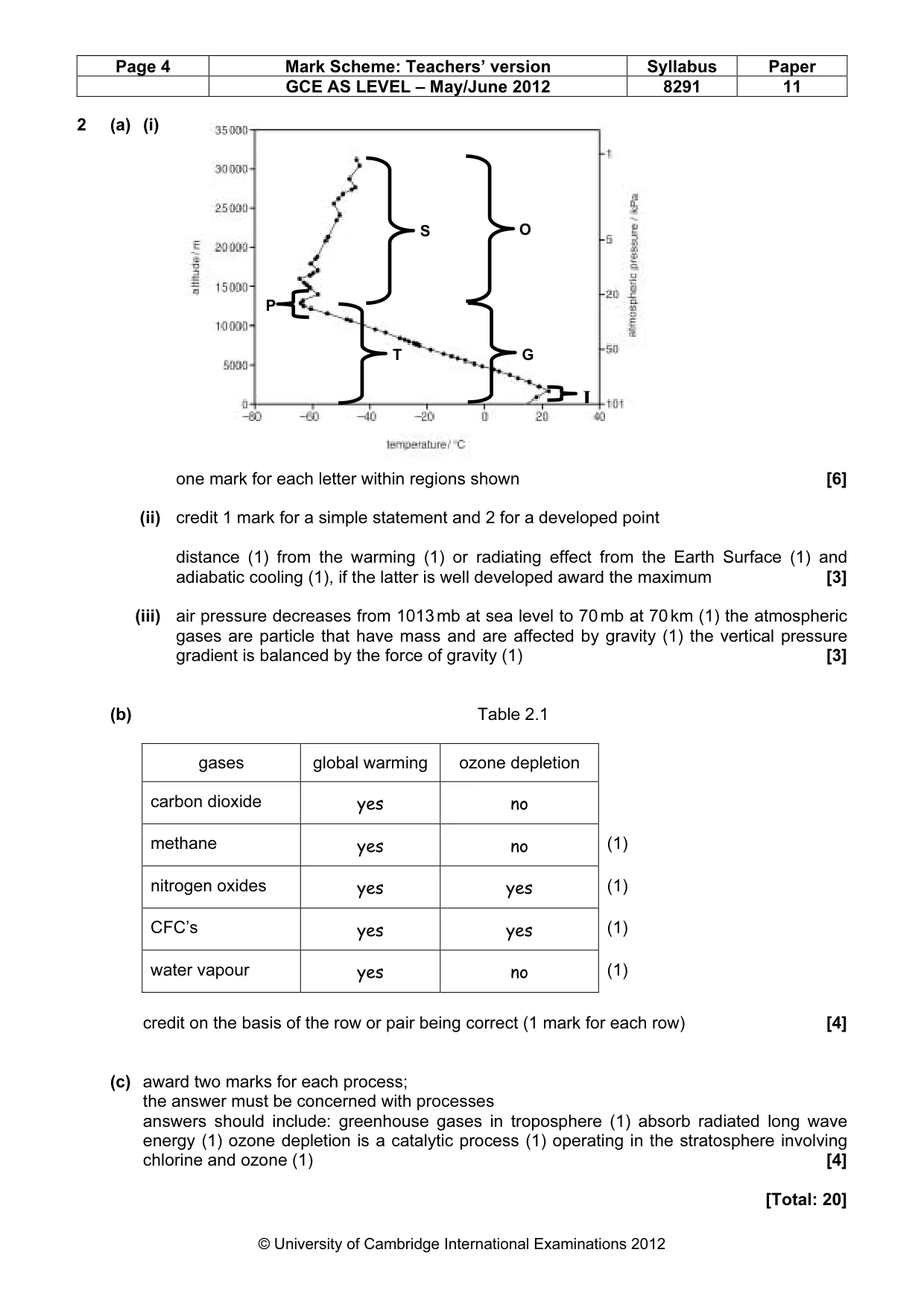
6 8291/11/M/J/12 For Examiner’s Use © UCLES 2012 2 (a) Some results obtained by a helium atmospheric research balloon are contained in Fig. 2.1. 0 5000 10 000 –80 –60 –40 –20 temperature / °C 20 40 101 50 20 5 1 0 15 000 20 000 altitude / m atmospheric pressure / kPa 25 000 30 000 35 000 Fig. 2.1 (i) For each of the regions of the atmosphere listed below, write the appropriate letter shown in brackets onto Fig. 2.1. • stratosphere (S) • troposphere (T) • tropopause (P) • a temperature inversion below 10,000 m (I) • the layer in which global warming occurs (G) • the layer in which ozone depletion occurs (O) [6] (ii) Explain the decrease in temperature that occurs between 2500 m and 13 000 m. … … … … … …[3]
Question paper, page 7
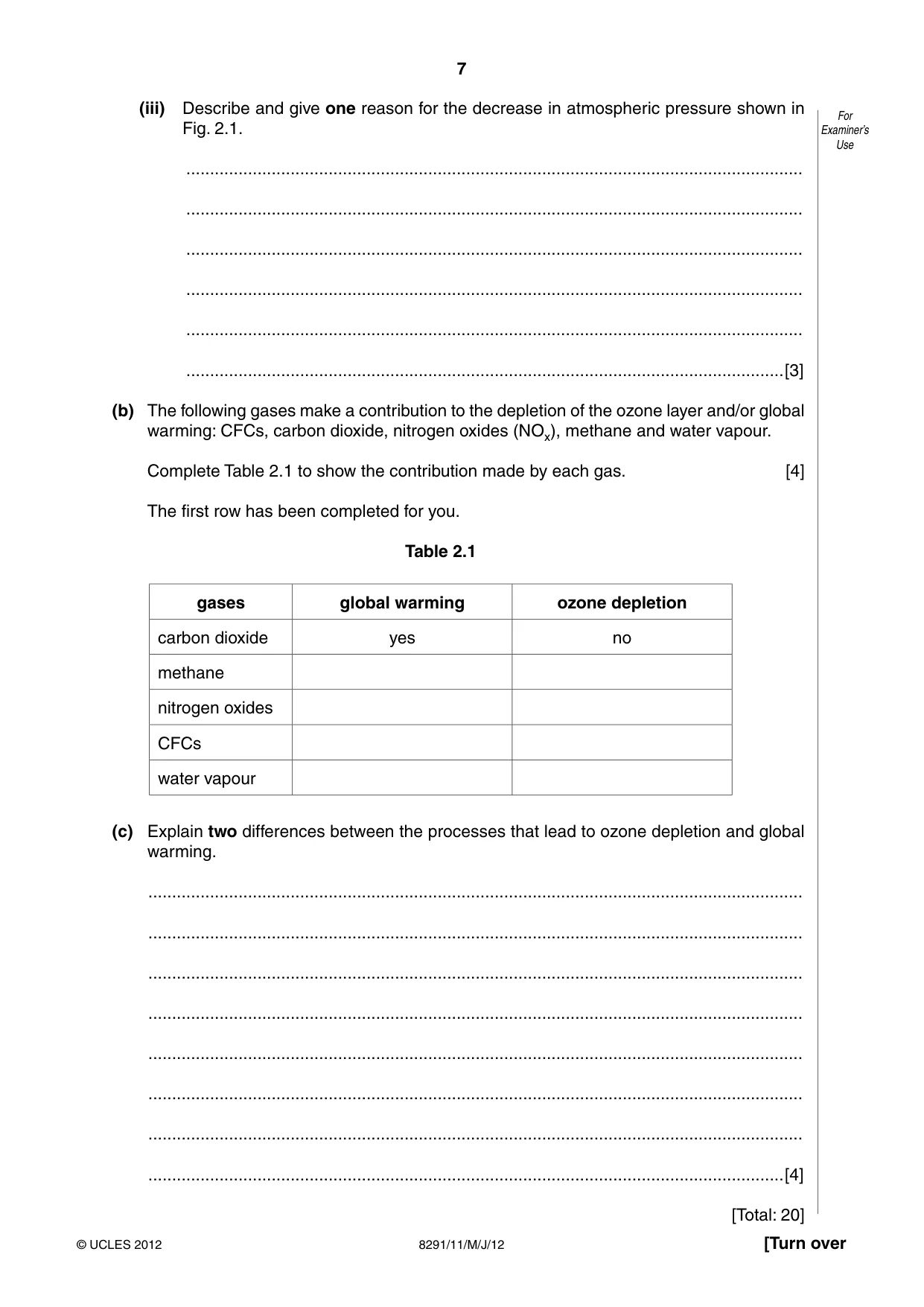
7 8291/11/M/J/12 [Turn over For Examiner’s Use © UCLES 2012 (iii) Describe and give one reason for the decrease in atmospheric pressure shown in Fig. 2.1. … … … … … …[3] (b) The following gases make a contribution to the depletion of the ozone layer and/or global warming: CFCs, carbon dioxide, nitrogen oxides (NOx), methane and water vapour. Complete Table 2.1 to show the contribution made by each gas. [4] The first row has been completed for you. Table 2.1 gases global warming ozone depletion carbon dioxide yes no methane nitrogen oxides CFCs water vapour (c) Explain two differences between the processes that lead to ozone depletion and global warming. … … … … … … … …[4] [Total: 20]
Question paper, page 8
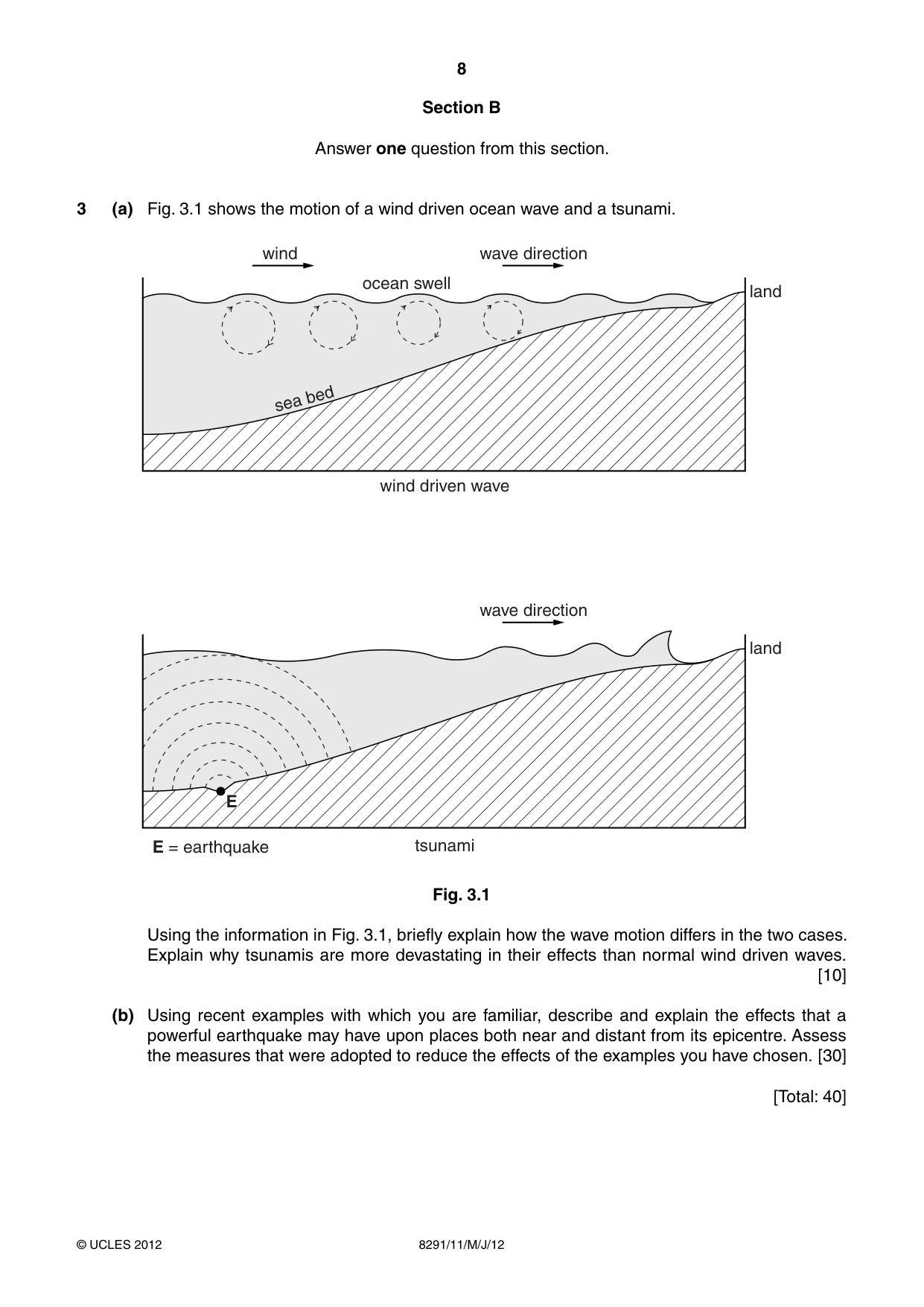
8 8291/11/M/J/12 © UCLES 2012 Section B Answer one question from this section. 3 (a) Fig. 3.1 shows the motion of a wind driven ocean wave and a tsunami. sea bed wind wave direction wave direction ocean swell wind driven wave tsunami land land E E = earthquake Fig. 3.1 Using the information in Fig. 3.1, briefly explain how the wave motion differs in the two cases. Explain why tsunamis are more devastating in their effects than normal wind driven waves. [10] (b) Using recent examples with which you are familiar, describe and explain the effects that a powerful earthquake may have upon places both near and distant from its epicentre. Assess the measures that were adopted to reduce the effects of the examples you have chosen. [30] [Total: 40]
Question paper, page 9
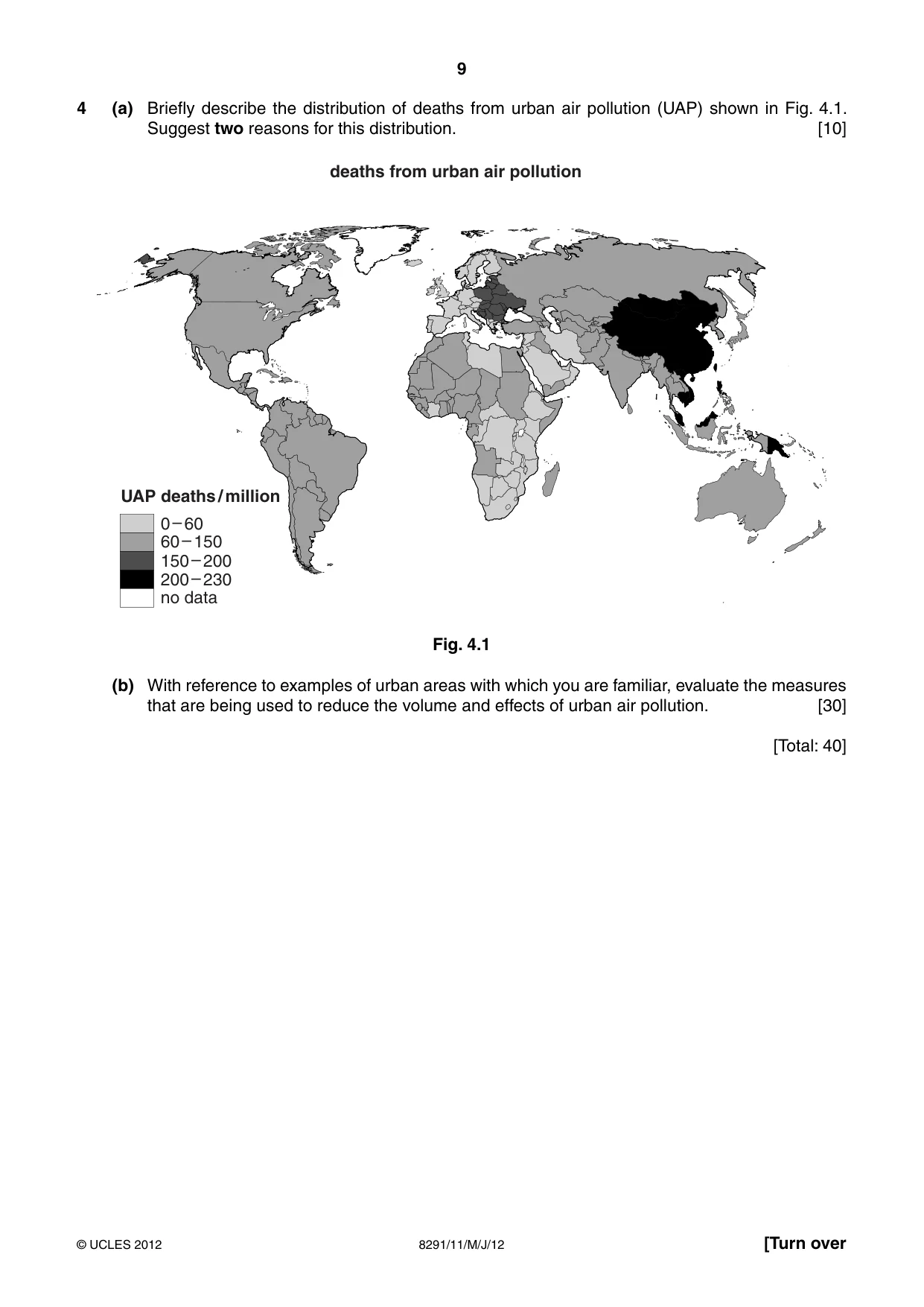
9 8291/11/M/J/12 © UCLES 2012 [Turn over 4 (a) Briefly describe the distribution of deaths from urban air pollution (UAP) shown in Fig. 4.1. Suggest two reasons for this distribution. [10] deaths from urban air pollution UAP deaths / million 0 – 60 60 – 150 150 – 200 200 – 230 no data Fig. 4.1 (b) With reference to examples of urban areas with which you are familiar, evaluate the measures that are being used to reduce the volume and effects of urban air pollution. [30] [Total: 40]
Question paper, page 10
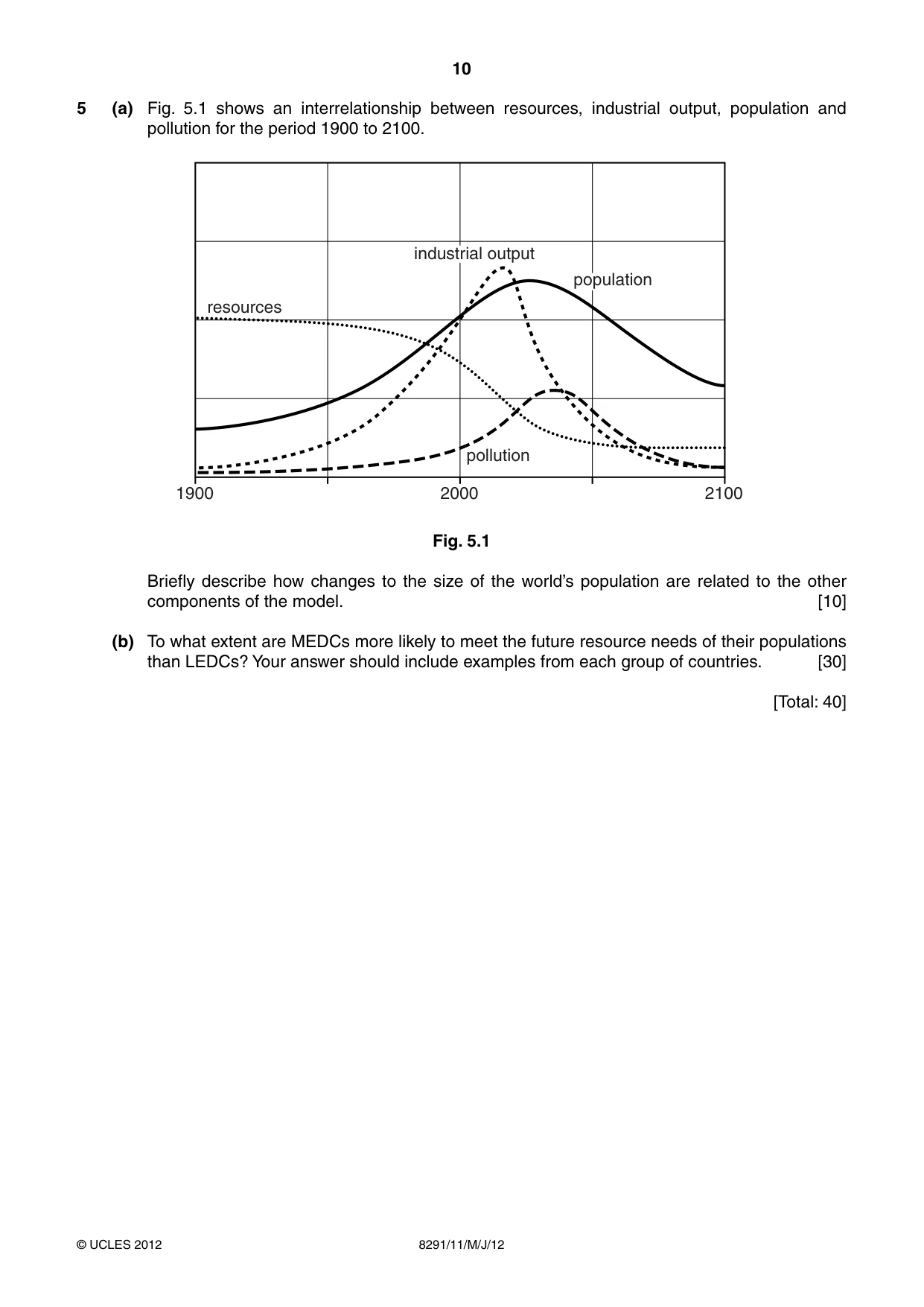
10 8291/11/M/J/12 © UCLES 2012 5 (a) Fig. 5.1 shows an interrelationship between resources, industrial output, population and pollution for the period 1900 to 2100. 1900 2000 2100 resources population pollution industrial output Fig. 5.1 Briefly describe how changes to the size of the world’s population are related to the other components of the model. [10] (b) To what extent are MEDCs more likely to meet the future resource needs of their populations than LEDCs? Your answer should include examples from each group of countries. [30] [Total: 40]
Question paper, page 11
11 8291/11/M/J/12 © UCLES 2012 BLANK PAGE
Question paper, page 12
12 8291/11/M/J/12 © UCLES 2012 BLANK PAGE Copyright Acknowledgements: Question 4 Figure 4.1 © ADAPTED; http://www.wunderground.com/health/airpollution.asp. Permission to reproduce items where third-party owned material protected by copyright is included has been sought and cleared where possible. Every reasonable effort has been made by the publisher (UCLES) to trace copyright holders, but if any items requiring clearance have unwittingly been included, the publisher will be pleased to make amends at the earliest possible opportunity. University of Cambridge International Examinations is part of the Cambridge Assessment Group. Cambridge Assessment is the brand name of University of Cambridge Local Examinations Syndicate (UCLES), which is itself a department of the University of Cambridge.
Mark scheme, page 1
UNIVERSITY OF CAMBRIDGE INTERNATIONAL EXAMINATIONS GCE Advanced Subsidiary Level MARK SCHEME for the May/June 2012 question paper for the guidance of teachers 8291 ENVIRONMENTAL MANAGEMENT 8291/11 Paper 1, maximum raw mark 80 This mark scheme is published as an aid to teachers and candidates, to indicate the requirements of the examination. It shows the basis on which Examiners were instructed to award marks. It does not indicate the details of the discussions that took place at an Examiners’ meeting before marking began, which would have considered the acceptability of alternative answers. Mark schemes must be read in conjunction with the question papers and the report on the examination. • Cambridge will not enter into discussions or correspondence in connection with these mark schemes. Cambridge is publishing the mark schemes for the May/June 2012 question papers for most IGCSE, GCE Advanced Level and Advanced Subsidiary Level syllabuses and some Ordinary Level syllabuses.
Mark scheme, page 2
Page 2 Mark Scheme: Teachers’ version Syllabus Paper GCE AS LEVEL – May/June 2012 8291 11 © University of Cambridge International Examinations 2012 General notes Symbols used in Environmental Management mark schemes. / separates alternatives for a marking point – other valid ways of expressing the same idea are also credited ; separates points for the award of a mark [3] indicates the number of marks available [max 3] the number shows the maximum number of marks available for the question where there are more marking points than total marks available [max 3] when part of the marks of a question must come from part of the mark scheme, this is indicated by non-bold marks showing the internal maxima for different parts of the question these non-bold marks are also used to show marks for bands where banded mark schemes are used italic indicates that this is information about the marking points and is not required to gain credit italic text is also used for comments about alternatives that should be accepted, ignored or rejected ora or reverse argument – shows that an argument from an alternative viewpoint will be credited AW alternative wording, sometimes called ‘or words to that effect’ – AW is used when there are many different ways of expressing the same idea ( ) the word / phrase in brackets is not required to gain marks but sets the context of the response for credit e.g. (nuclear) waste – nuclear is not needed but if it was described as a domestic waste then no mark is awarded volcanic underlined words – the answer must contain exactly this word ecf error carried forward – if an incorrect answer is given to part of a question, and this answer is subsequently used by a candidate in later parts of the question, this indicates that the candidate’s incorrect answer will be used as a starting point for marking the later parts of the question
Mark scheme, page 3
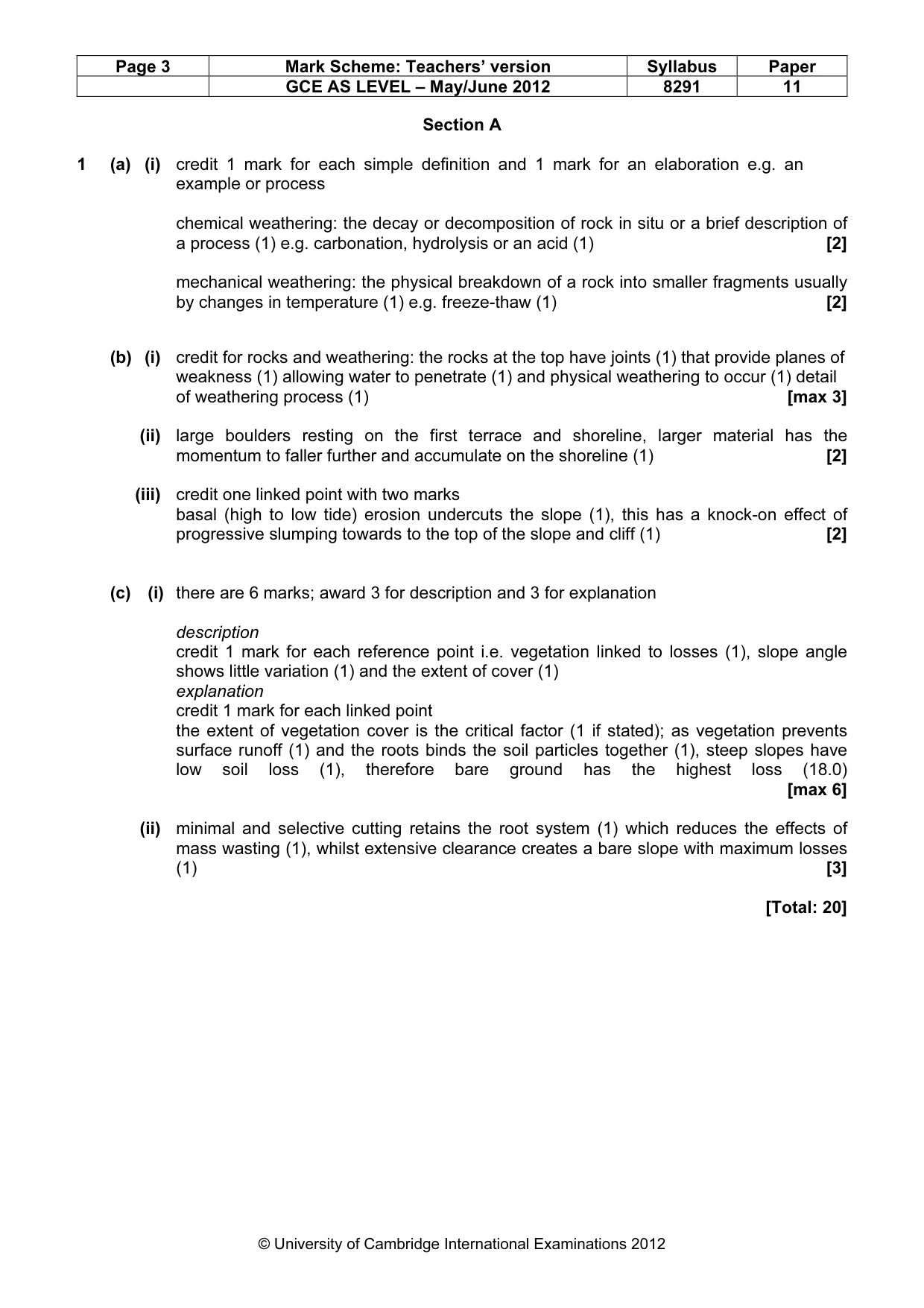
Page 3 Mark Scheme: Teachers’ version Syllabus Paper GCE AS LEVEL – May/June 2012 8291 11 © University of Cambridge International Examinations 2012 Section A 1 (a) (i) credit 1 mark for each simple definition and 1 mark for an elaboration e.g. an example or process chemical weathering: the decay or decomposition of rock in situ or a brief description of a process (1) e.g. carbonation, hydrolysis or an acid (1) [2] mechanical weathering: the physical breakdown of a rock into smaller fragments usually by changes in temperature (1) e.g. freeze-thaw (1) [2] (b) (i) credit for rocks and weathering: the rocks at the top have joints (1) that provide planes of weakness (1) allowing water to penetrate (1) and physical weathering to occur (1) detail of weathering process (1) [max 3] (ii) large boulders resting on the first terrace and shoreline, larger material has the momentum to faller further and accumulate on the shoreline (1) [2] (iii) credit one linked point with two marks basal (high to low tide) erosion undercuts the slope (1), this has a knock-on effect of progressive slumping towards to the top of the slope and cliff (1) [2] (c) (i) there are 6 marks; award 3 for description and 3 for explanation description credit 1 mark for each reference point i.e. vegetation linked to losses (1), slope angle shows little variation (1) and the extent of cover (1) explanation credit 1 mark for each linked point the extent of vegetation cover is the critical factor (1 if stated); as vegetation prevents surface runoff (1) and the roots binds the soil particles together (1), steep slopes have low soil loss (1), therefore bare ground has the highest loss (18.0) [max 6] (ii) minimal and selective cutting retains the root system (1) which reduces the effects of mass wasting (1), whilst extensive clearance creates a bare slope with maximum losses (1) [3] [Total: 20]
Mark scheme, page 4
Page 4 Mark Scheme: Teachers’ version Syllabus Paper GCE AS LEVEL – May/June 2012 8291 11 © University of Cambridge International Examinations 2012 2 (a) (i) one mark for each letter within regions shown [6] (ii) credit 1 mark for a simple statement and 2 for a developed point distance (1) from the warming (1) or radiating effect from the Earth Surface (1) and adiabatic cooling (1), if the latter is well developed award the maximum [3] (iii) air pressure decreases from 1013 mb at sea level to 70 mb at 70 km (1) the atmospheric gases are particle that have mass and are affected by gravity (1) the vertical pressure gradient is balanced by the force of gravity (1) [3] (b) Table 2.1 gases global warming ozone depletion carbon dioxide yes no methane yes no (1) nitrogen oxides yes yes (1) CFC’s yes yes (1) water vapour yes no (1) credit on the basis of the row or pair being correct (1 mark for each row) [4] (c) award two marks for each process; the answer must be concerned with processes answers should include: greenhouse gases in troposphere (1) absorb radiated long wave energy (1) ozone depletion is a catalytic process (1) operating in the stratosphere involving chlorine and ozone (1) [4] [Total: 20] P I O G S T
Mark scheme, page 5
Page 5 Mark Scheme: Teachers’ version Syllabus Paper GCE AS LEVEL – May/June 2012 8291 11 © University of Cambridge International Examinations 2012 Section B Answer one question from this section 3 (a) a normal sea wave is produced by wind pushing on the windward side and low pressure on the leeward side; water particles circulate beneath the wave; produces a swell; on reaching a shore/beach the circular wave motion is disrupted through friction; ultimately resulting in a breaking wave; speed and height depend on wind speed tsunamis are fast moving standing wave within which there is no water particle circulation; at sea they may be no more than 1/2 metre high but can travel at speeds > 50 kph.; on reaching a gentle shore friction with the sea bed causes the water to pile up to heights in excess of 20 m; thereby invading the coastline; some better candidates may mention the withdrawal of the sea prior to the reaching the shore 8 to 10 mark answers should be clear about the nature of the waves at sea and the different manner of breaking in terms of height and speed. Answers must cover the devastating effects of tsunamis 4 to 7 mark answers may focus on tsunamis, or simply relate how they break onto a shore; expect simplistic answers 1 to 3 mark answers will be very simplistic a give a few details on impact but nothing on process [10] (b) the question has three requirements: describing/explaining the effects of an earthquake close to the epicentre describing/explaining the effects of an earthquake distant from the epicentre an assessment of measures suggested annotations: e.g. eff = effects; n = near; d = distant; m = measures the question needs the use of recent examples, including Loma Prieta, Aceh, Chile; perhaps with references to historically distant earthquakes near effects include shock wave (L waves) devastation. local tsunamis, aftershocks, urban destruction and loss of life distant effects: on land lesser shocks with limited effects; at sea, tsunamis can be devastating measures depend on the examples but should include: warnings; evacuation, rescue, and aid annotations: e.g; n = near: d = distant; m = measure Band 1 answers must select a recent example and give balance to the requirements of the question. These requirements will be. The selected measures should be clearly assessed (25–30) Band 3 answers will develop at least two of the question requirements. Expect some lack of detail and dislocation of effects and measures from the examples (13–18) Band 4 answers although relevant should expand local effects but be unclear about the tapering of terrestrial effect and compounding of marine effects. Measures may have superficial coverage (6–12) [Total: 40]
Mark scheme, page 6
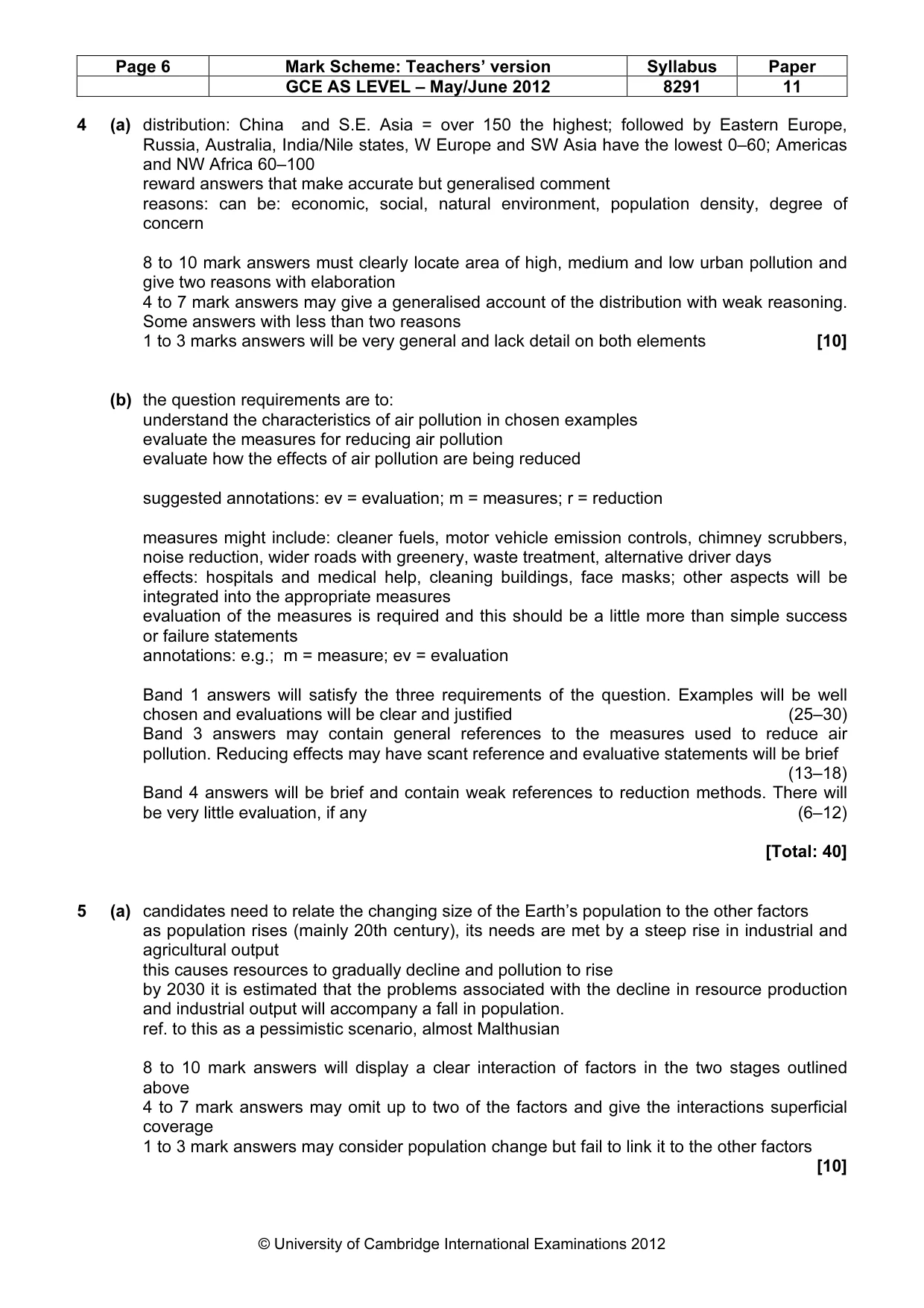
Page 6 Mark Scheme: Teachers’ version Syllabus Paper GCE AS LEVEL – May/June 2012 8291 11 © University of Cambridge International Examinations 2012 4 (a) distribution: China and S.E. Asia = over 150 the highest; followed by Eastern Europe, Russia, Australia, India/Nile states, W Europe and SW Asia have the lowest 0–60; Americas and NW Africa 60–100 reward answers that make accurate but generalised comment reasons: can be: economic, social, natural environment, population density, degree of concern 8 to 10 mark answers must clearly locate area of high, medium and low urban pollution and give two reasons with elaboration 4 to 7 mark answers may give a generalised account of the distribution with weak reasoning. Some answers with less than two reasons 1 to 3 marks answers will be very general and lack detail on both elements [10] (b) the question requirements are to: understand the characteristics of air pollution in chosen examples evaluate the measures for reducing air pollution evaluate how the effects of air pollution are being reduced suggested annotations: ev = evaluation; m = measures; r = reduction measures might include: cleaner fuels, motor vehicle emission controls, chimney scrubbers, noise reduction, wider roads with greenery, waste treatment, alternative driver days effects: hospitals and medical help, cleaning buildings, face masks; other aspects will be integrated into the appropriate measures evaluation of the measures is required and this should be a little more than simple success or failure statements annotations: e.g.; m = measure; ev = evaluation Band 1 answers will satisfy the three requirements of the question. Examples will be well chosen and evaluations will be clear and justified (25–30) Band 3 answers may contain general references to the measures used to reduce air pollution. Reducing effects may have scant reference and evaluative statements will be brief (13–18) Band 4 answers will be brief and contain weak references to reduction methods. There will be very little evaluation, if any (6–12) [Total: 40] 5 (a) candidates need to relate the changing size of the Earth’s population to the other factors as population rises (mainly 20th century), its needs are met by a steep rise in industrial and agricultural output this causes resources to gradually decline and pollution to rise by 2030 it is estimated that the problems associated with the decline in resource production and industrial output will accompany a fall in population. ref. to this as a pessimistic scenario, almost Malthusian 8 to 10 mark answers will display a clear interaction of factors in the two stages outlined above 4 to 7 mark answers may omit up to two of the factors and give the interactions superficial coverage 1 to 3 mark answers may consider population change but fail to link it to the other factors [10]
Mark scheme, page 7
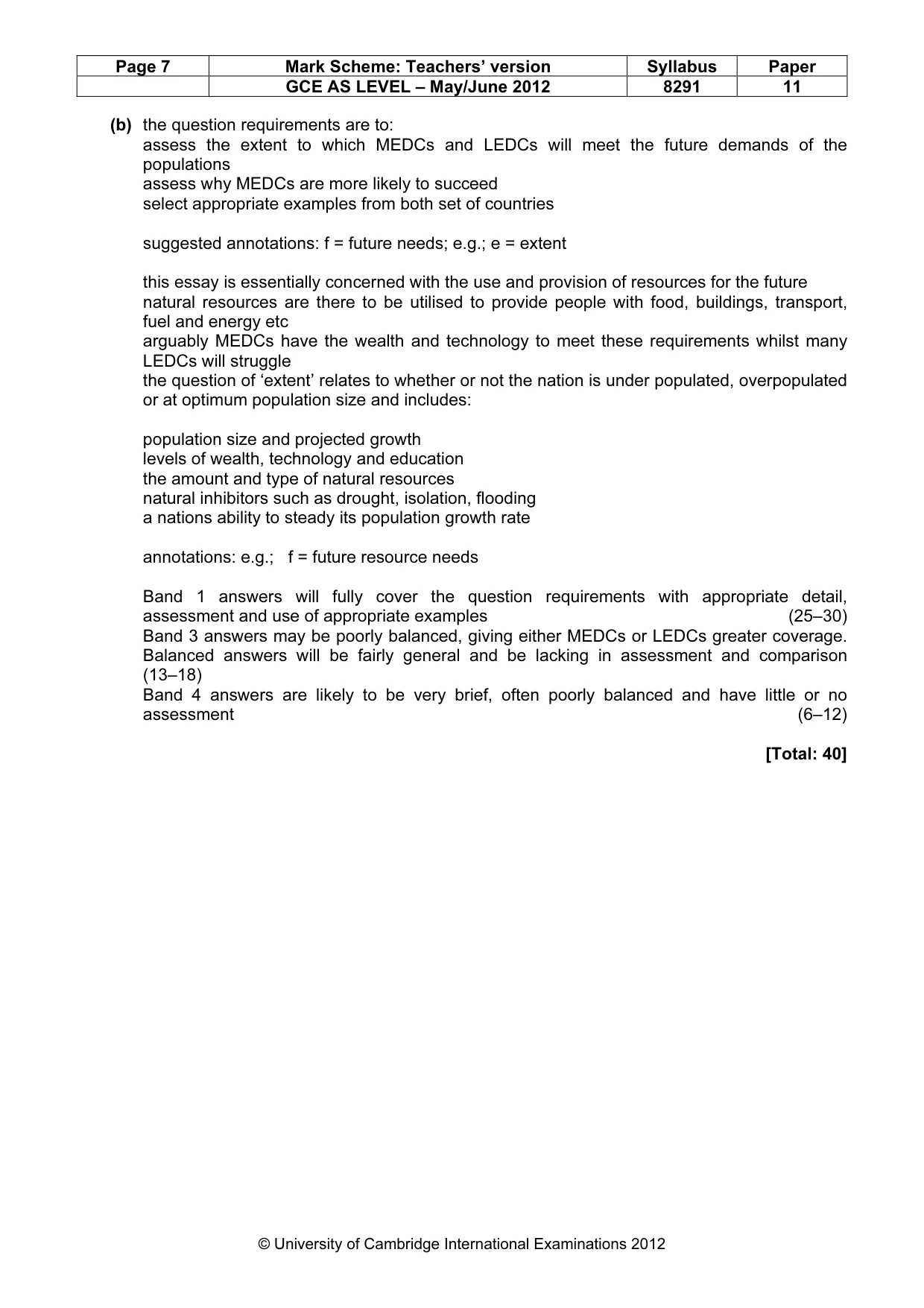
Page 7 Mark Scheme: Teachers’ version Syllabus Paper GCE AS LEVEL – May/June 2012 8291 11 © University of Cambridge International Examinations 2012 (b) the question requirements are to: assess the extent to which MEDCs and LEDCs will meet the future demands of the populations assess why MEDCs are more likely to succeed select appropriate examples from both set of countries suggested annotations: f = future needs; e.g.; e = extent this essay is essentially concerned with the use and provision of resources for the future natural resources are there to be utilised to provide people with food, buildings, transport, fuel and energy etc arguably MEDCs have the wealth and technology to meet these requirements whilst many LEDCs will struggle the question of ‘extent’ relates to whether or not the nation is under populated, overpopulated or at optimum population size and includes: population size and projected growth levels of wealth, technology and education the amount and type of natural resources natural inhibitors such as drought, isolation, flooding a nations ability to steady its population growth rate annotations: e.g.; f = future resource needs Band 1 answers will fully cover the question requirements with appropriate detail, assessment and use of appropriate examples (25–30) Band 3 answers may be poorly balanced, giving either MEDCs or LEDCs greater coverage. Balanced answers will be fairly general and be lacking in assessment and comparison (13–18) Band 4 answers are likely to be very brief, often poorly balanced and have little or no assessment (6–12) [Total: 40]
Mark scheme, page 8
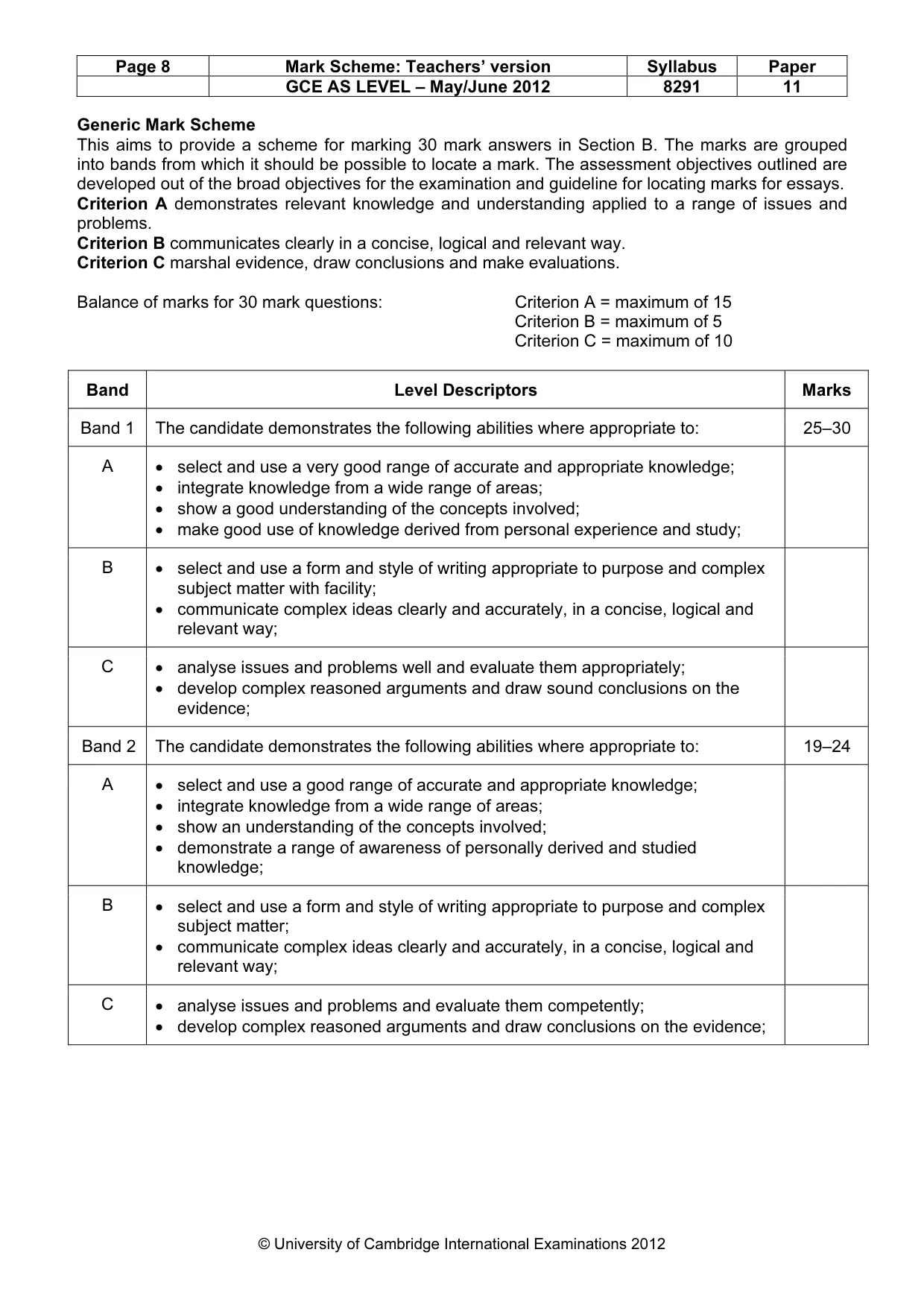
Page 8 Mark Scheme: Teachers’ version Syllabus Paper GCE AS LEVEL – May/June 2012 8291 11 © University of Cambridge International Examinations 2012 Generic Mark Scheme This aims to provide a scheme for marking 30 mark answers in Section B. The marks are grouped into bands from which it should be possible to locate a mark. The assessment objectives outlined are developed out of the broad objectives for the examination and guideline for locating marks for essays. Criterion A demonstrates relevant knowledge and understanding applied to a range of issues and problems. Criterion B communicates clearly in a concise, logical and relevant way. Criterion C marshal evidence, draw conclusions and make evaluations. Balance of marks for 30 mark questions: Criterion A = maximum of 15 Criterion B = maximum of 5 Criterion C = maximum of 10 Band Level Descriptors Marks Band 1 The candidate demonstrates the following abilities where appropriate to: 25–30 A • select and use a very good range of accurate and appropriate knowledge; • integrate knowledge from a wide range of areas; • show a good understanding of the concepts involved; • make good use of knowledge derived from personal experience and study; B • select and use a form and style of writing appropriate to purpose and complex subject matter with facility; • communicate complex ideas clearly and accurately, in a concise, logical and relevant way; C • analyse issues and problems well and evaluate them appropriately; • develop complex reasoned arguments and draw sound conclusions on the evidence; Band 2 The candidate demonstrates the following abilities where appropriate to: 19–24 A • select and use a good range of accurate and appropriate knowledge; • integrate knowledge from a wide range of areas; • show an understanding of the concepts involved; • demonstrate a range of awareness of personally derived and studied knowledge; B • select and use a form and style of writing appropriate to purpose and complex subject matter; • communicate complex ideas clearly and accurately, in a concise, logical and relevant way; C • analyse issues and problems and evaluate them competently; • develop complex reasoned arguments and draw conclusions on the evidence;
Mark scheme, page 9
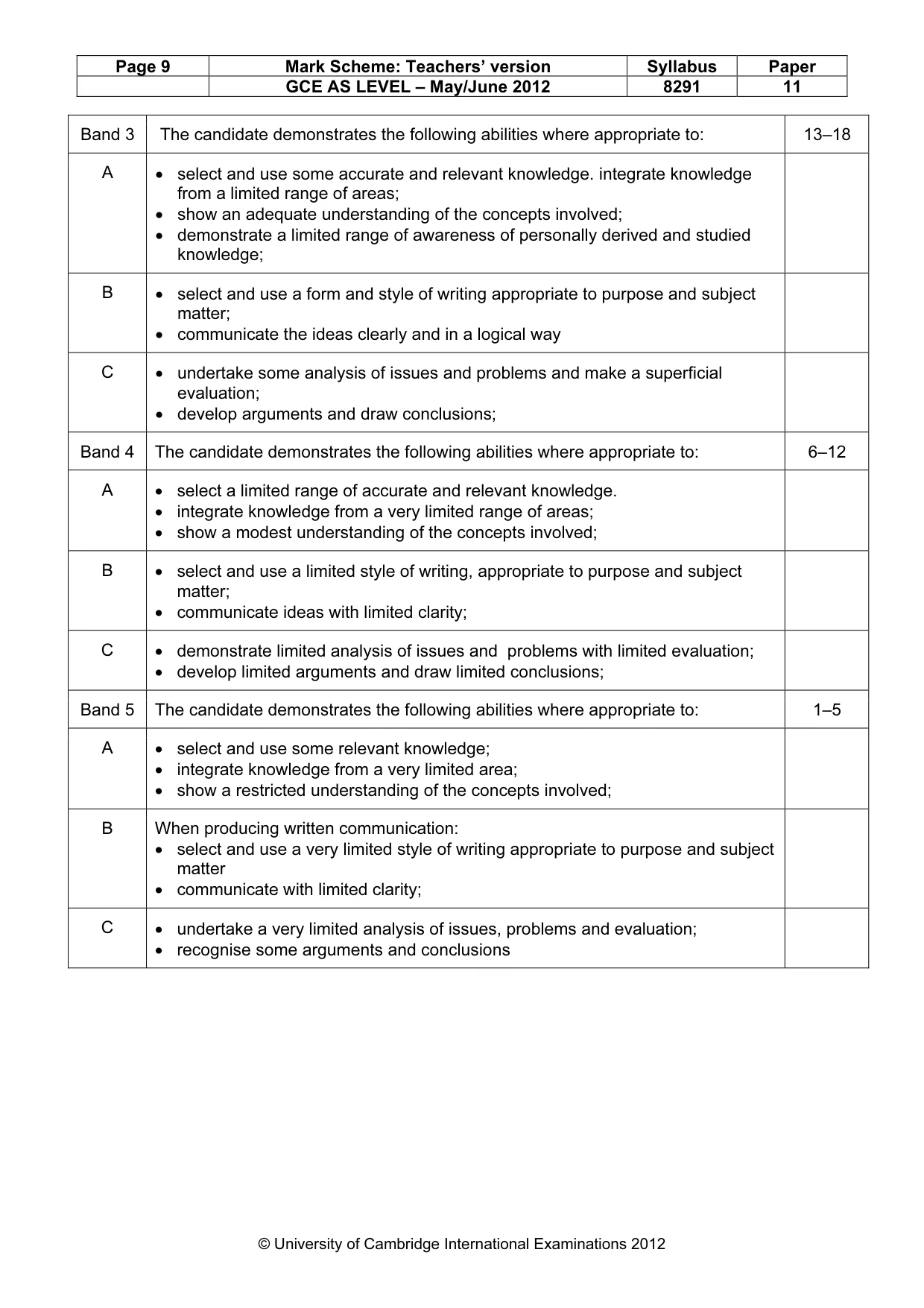
Page 9 Mark Scheme: Teachers’ version Syllabus Paper GCE AS LEVEL – May/June 2012 8291 11 © University of Cambridge International Examinations 2012 Band 3 The candidate demonstrates the following abilities where appropriate to: 13–18 A • select and use some accurate and relevant knowledge. integrate knowledge from a limited range of areas; • show an adequate understanding of the concepts involved; • demonstrate a limited range of awareness of personally derived and studied knowledge; B • select and use a form and style of writing appropriate to purpose and subject matter; • communicate the ideas clearly and in a logical way C • undertake some analysis of issues and problems and make a superficial evaluation; • develop arguments and draw conclusions; Band 4 The candidate demonstrates the following abilities where appropriate to: 6–12 A • select a limited range of accurate and relevant knowledge. • integrate knowledge from a very limited range of areas; • show a modest understanding of the concepts involved; B • select and use a limited style of writing, appropriate to purpose and subject matter; • communicate ideas with limited clarity; C • demonstrate limited analysis of issues and problems with limited evaluation; • develop limited arguments and draw limited conclusions; Band 5 The candidate demonstrates the following abilities where appropriate to: 1–5 A • select and use some relevant knowledge; • integrate knowledge from a very limited area; • show a restricted understanding of the concepts involved; B When producing written communication: • select and use a very limited style of writing appropriate to purpose and subject matter • communicate with limited clarity; C • undertake a very limited analysis of issues, problems and evaluation; • recognise some arguments and conclusions
What you needed in this session
Cambridge’s own grade thresholds for 2012 May/June, Paper 1 · Variant 1. A higher threshold means an easier paper — the bar moves with how the cohort did.