Cambridge A Level Environmental Management (AS only) 8291 — 2012 May/June Paper 1 · Variant 3
8291/13/M/J/12 · 80 marks · ≈90 min
The question paper and its mark scheme, free to read here and free to download. This is Cambridge’s own paper, exactly as it was sat.
Question paper12 pages



Mark scheme9 pages
Answers below. Sit the paper first if you are practising.
Paper as text
Question paper, page 1
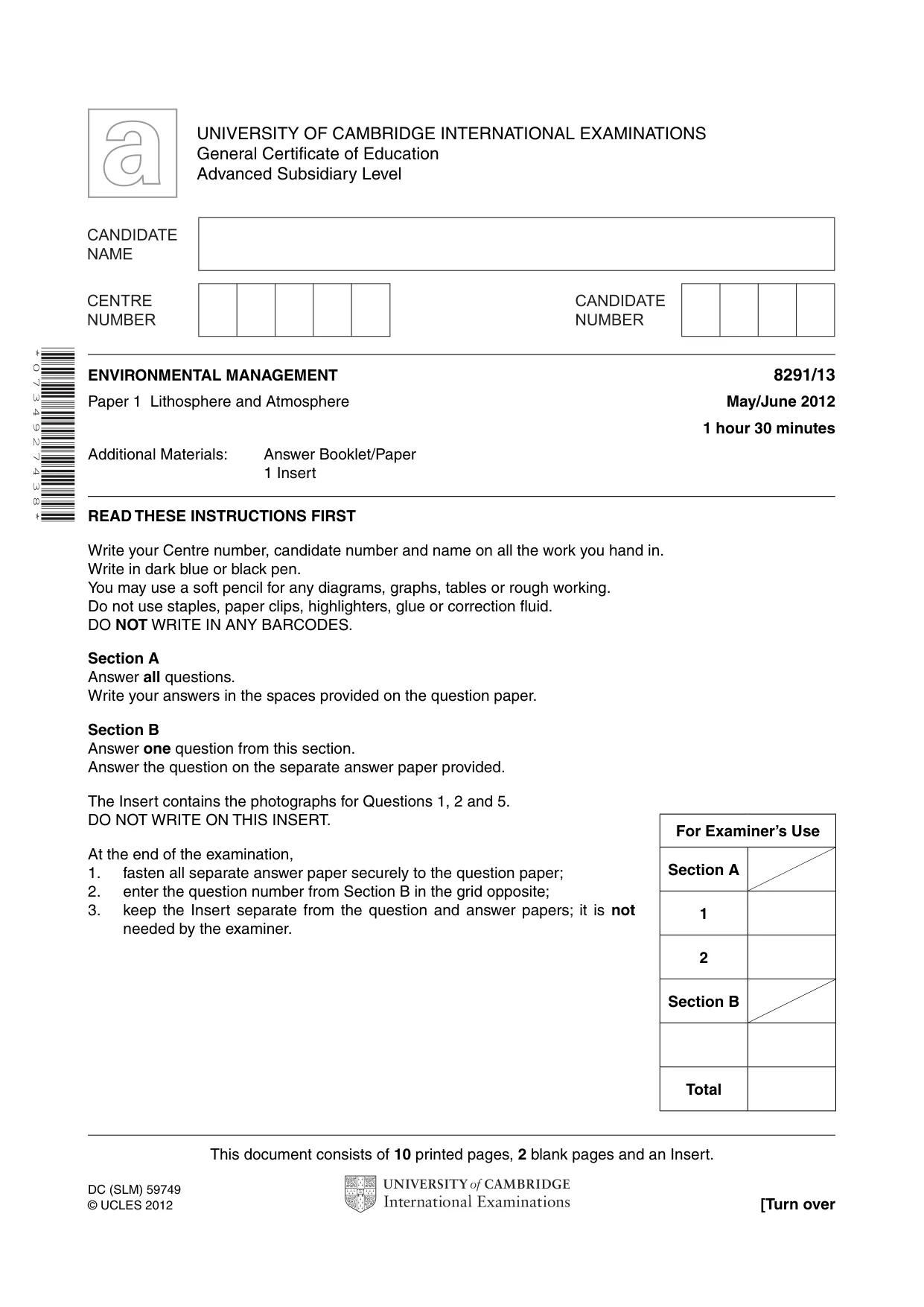
This document consists of 10 printed pages, 2 blank pages and an Insert. DC (SLM) 59749 © UCLES 2012 [Turn over UNIVERSITY OF CAMBRIDGE INTERNATIONAL EXAMINATIONS General Certificate of Education Advanced Subsidiary Level * 0 7 3 4 9 2 7 4 3 8 * ENVIRONMENTAL MANAGEMENT 8291/13 Paper 1 Lithosphere and Atmosphere May/June 2012 1 hour 30 minutes Additional Materials: Answer Booklet/Paper 1 Insert READ THESE INSTRUCTIONS FIRST Write your Centre number, candidate number and name on all the work you hand in. Write in dark blue or black pen. You may use a soft pencil for any diagrams, graphs, tables or rough working. Do not use staples, paper clips, highlighters, glue or correction fluid. DO NOT WRITE IN ANY BARCODES. Section A Answer all questions. Write your answers in the spaces provided on the question paper. Section B Answer one question from this section. Answer the question on the separate answer paper provided. The Insert contains the photographs for Questions 1, 2 and 5. DO NOT WRITE ON THIS INSERT. At the end of the examination, 1. fasten all separate answer paper securely to the question paper; 2. enter the question number from Section B in the grid opposite; 3. keep the Insert separate from the question and answer papers; it is not needed by the examiner. For Examiner’s Use Section A 1 2 Section B Total
Question paper, page 2
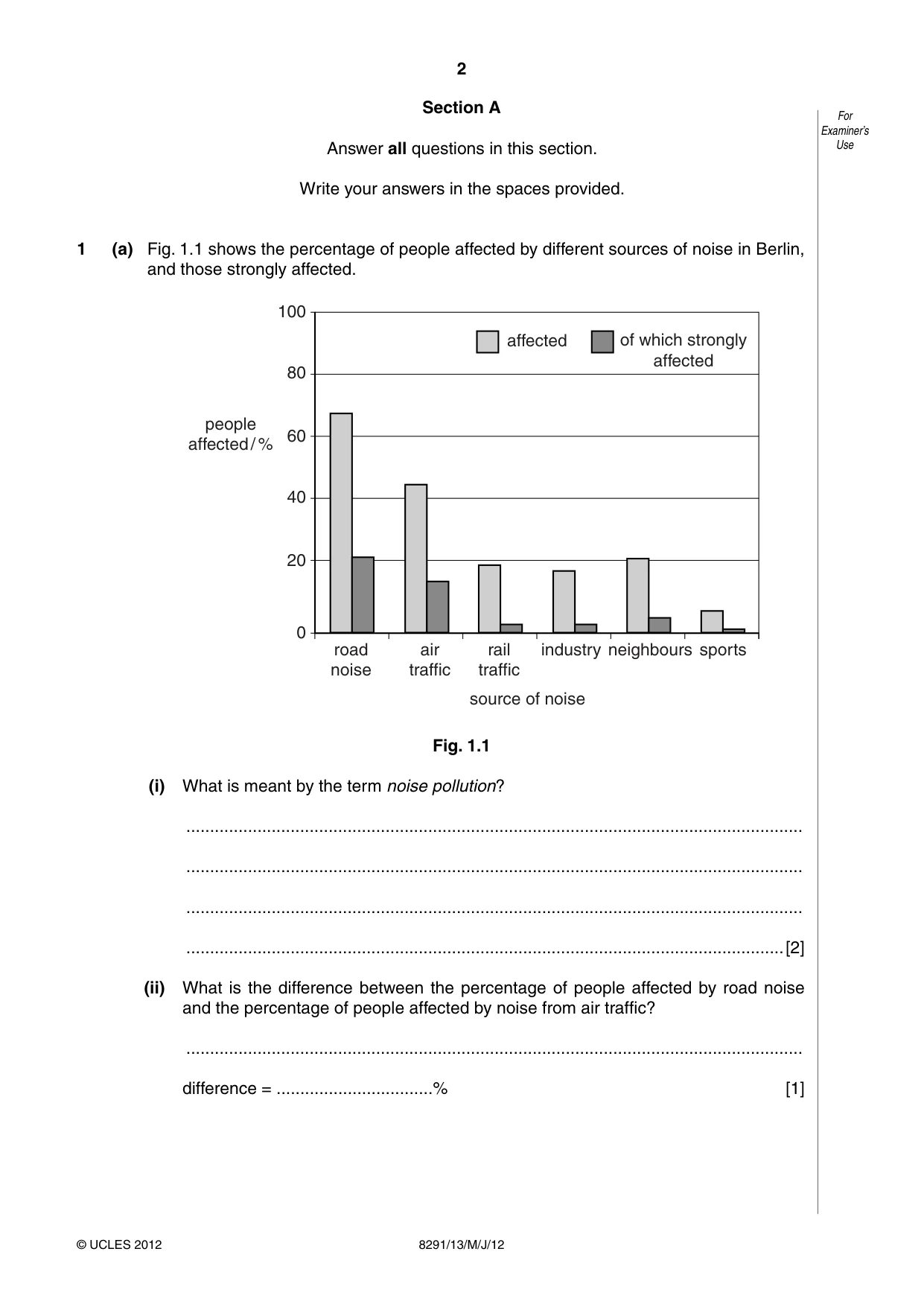
2 8291/13/M/J/12 © UCLES 2012 For Examiner’s Use Section A Answer all questions in this section. Write your answers in the spaces provided. 1 (a) Fig. 1.1 shows the percentage of people affected by different sources of noise in Berlin, and those strongly affected. 100 80 60 40 20 0 road noise air traffic rail traffic industry neighbours sports affected of which strongly affected source of noise people affected / % Fig. 1.1 (i) What is meant by the term noise pollution? … … … …[2] (ii) What is the difference between the percentage of people affected by road noise and the percentage of people affected by noise from air traffic? … difference = …% [1]
Question paper, page 3
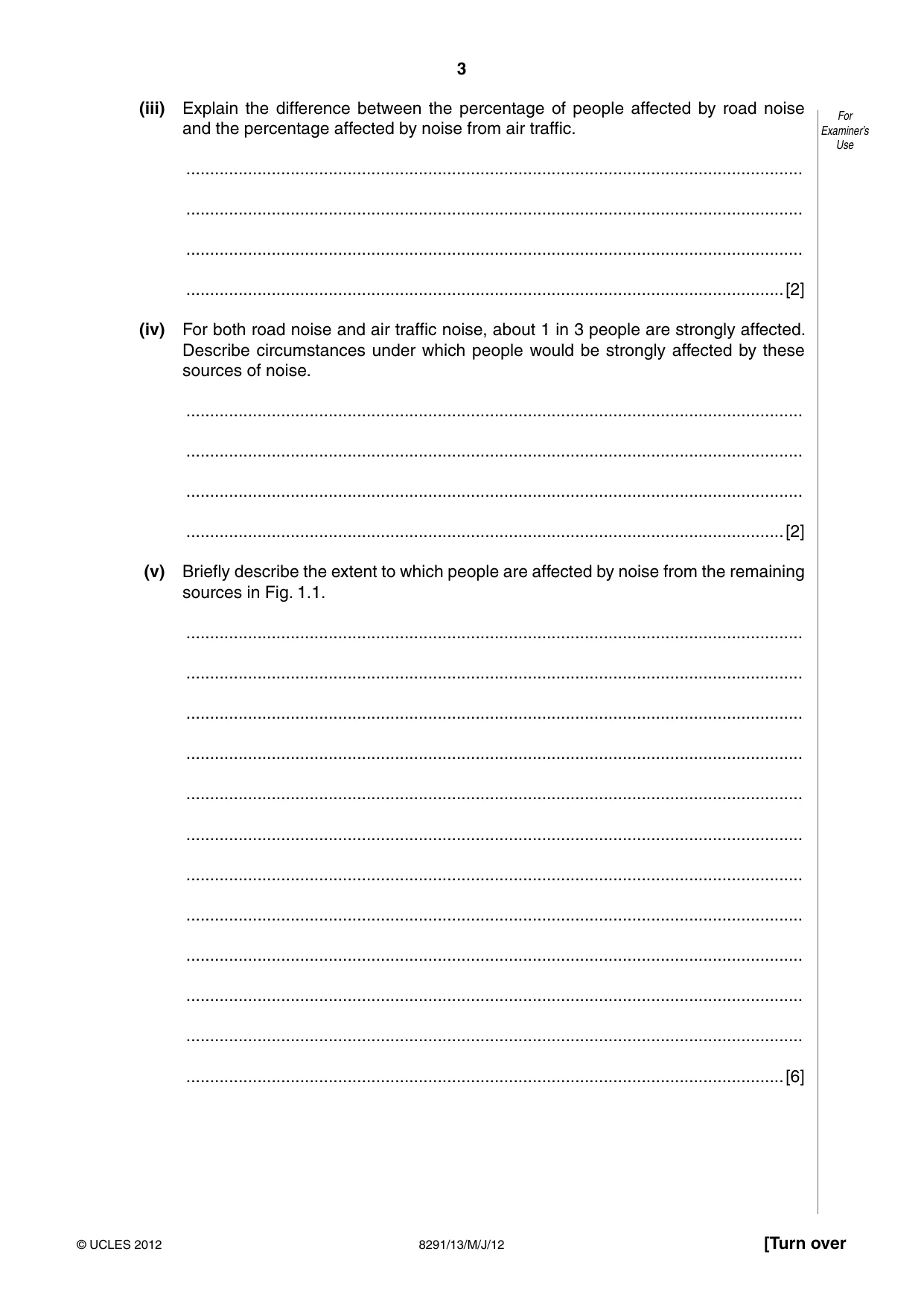
3 8291/13/M/J/12 © UCLES 2012 [Turn over For Examiner’s Use (iii) Explain the difference between the percentage of people affected by road noise and the percentage affected by noise from air traffic. … … … …[2] (iv) For both road noise and air traffic noise, about 1 in 3 people are strongly affected. Describe circumstances under which people would be strongly affected by these sources of noise. … … … …[2] (v) Briefly describe the extent to which people are affected by noise from the remaining sources in Fig. 1.1. … … … … … … … … … … … …[6]
Question paper, page 4
4 8291/13/M/J/12 © UCLES 2012 For Examiner’s Use (b) Look at the photograph for Question 1(b) on the insert. It shows a panoramic view across part of the city of Berlin. Describe and explain the variations in the level and type of noise pollution likely to be experienced in the region of Berlin shown in the photograph. … … … … … … … … … … … … … … … …[7] [Total: 20]
Question paper, page 5
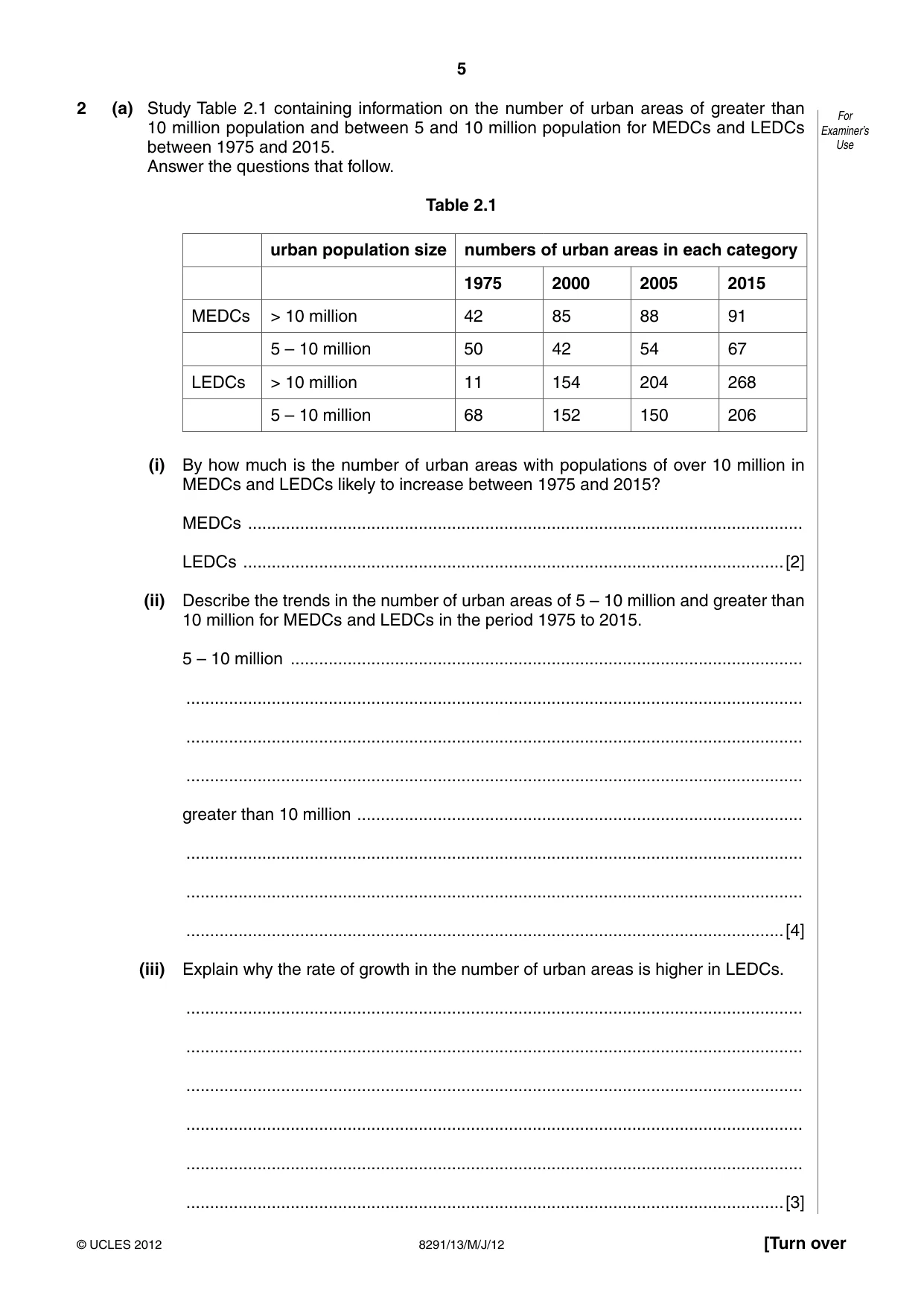
5 8291/13/M/J/12 © UCLES 2012 [Turn over For Examiner’s Use 2 (a) Study Table 2.1 containing information on the number of urban areas of greater than 10 million population and between 5 and 10 million population for MEDCs and LEDCs between 1975 and 2015. Answer the questions that follow. Table 2.1 urban population size numbers of urban areas in each category 1975 2000 2005 2015 MEDCs > 10 million 42 85 88 91 5 – 10 million 50 42 54 67 LEDCs > 10 million 11 154 204 268 5 – 10 million 68 152 150 206 (i) By how much is the number of urban areas with populations of over 10 million in MEDCs and LEDCs likely to increase between 1975 and 2015? MEDCs … LEDCs …[2] (ii) Describe the trends in the number of urban areas of 5 – 10 million and greater than 10 million for MEDCs and LEDCs in the period 1975 to 2015. 5 – 10 million … … … … greater than 10 million … … … …[4] (iii) Explain why the rate of growth in the number of urban areas is higher in LEDCs. … … … … … …[3]
Question paper, page 6
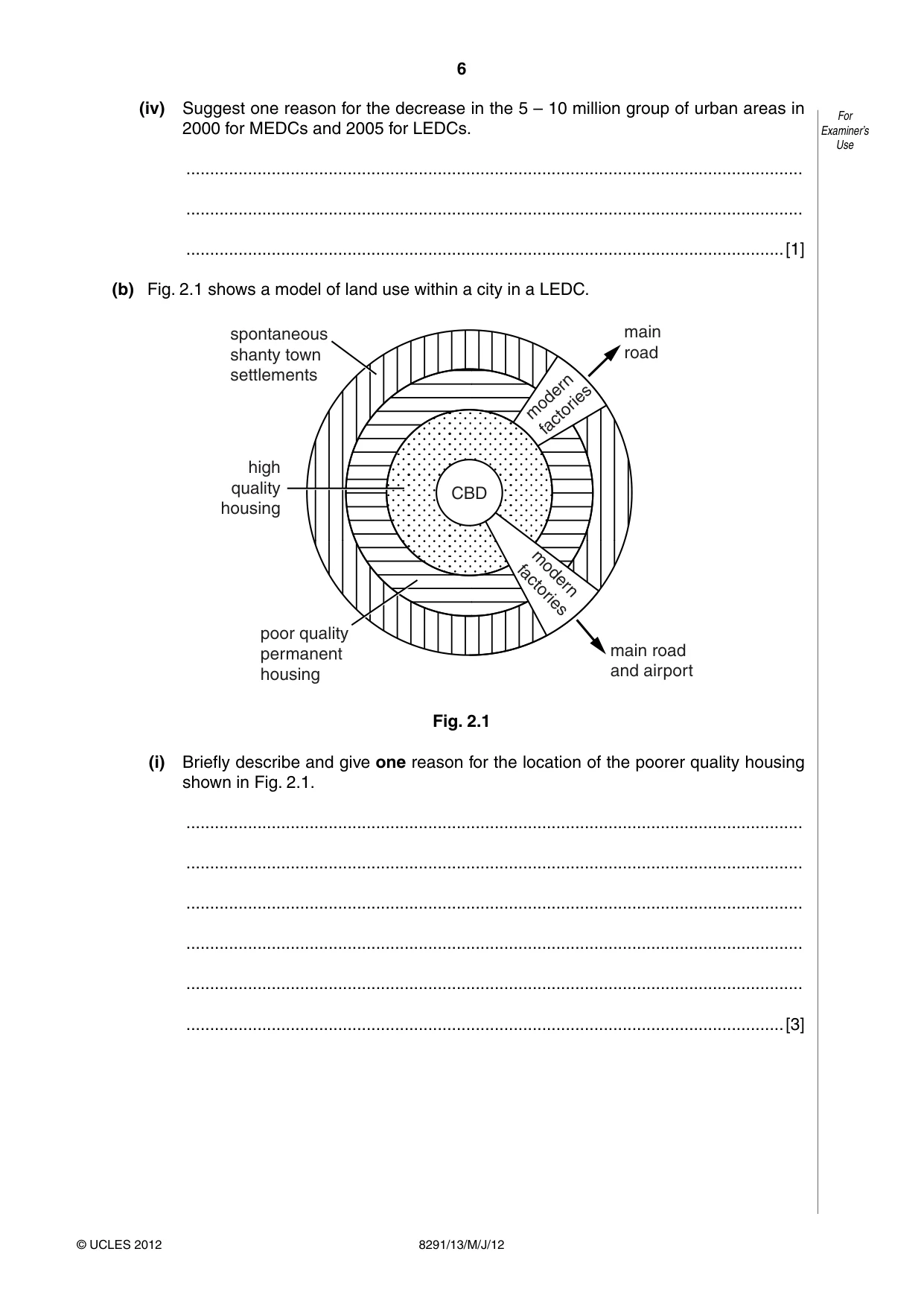
6 8291/13/M/J/12 © UCLES 2012 For Examiner’s Use (iv) Suggest one reason for the decrease in the 5 – 10 million group of urban areas in 2000 for MEDCs and 2005 for LEDCs. … … …[1] (b) Fig. 2.1 shows a model of land use within a city in a LEDC. modern factories modern factories main road main road and airport spontaneous shanty town settlements high quality housing CBD poor quality permanent housing Fig. 2.1 (i) Briefly describe and give one reason for the location of the poorer quality housing shown in Fig. 2.1. … … … … … …[3]
Question paper, page 7
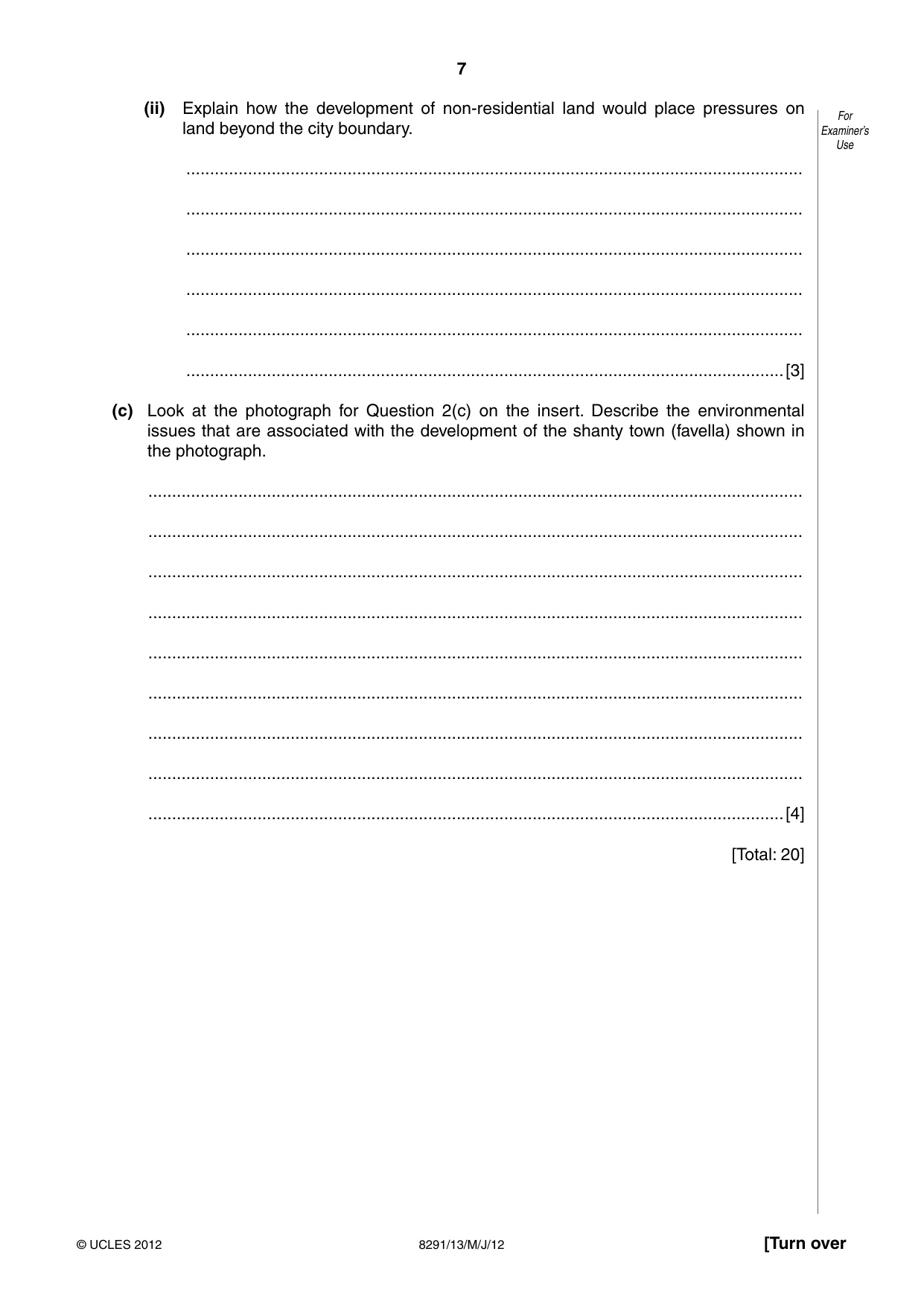
7 8291/13/M/J/12 © UCLES 2012 [Turn over For Examiner’s Use (ii) Explain how the development of non-residential land would place pressures on land beyond the city boundary. … … … … … …[3] (c) Look at the photograph for Question 2(c) on the insert. Describe the environmental issues that are associated with the development of the shanty town (favella) shown in the photograph. … … … … … … … … …[4] [Total: 20]
Question paper, page 8
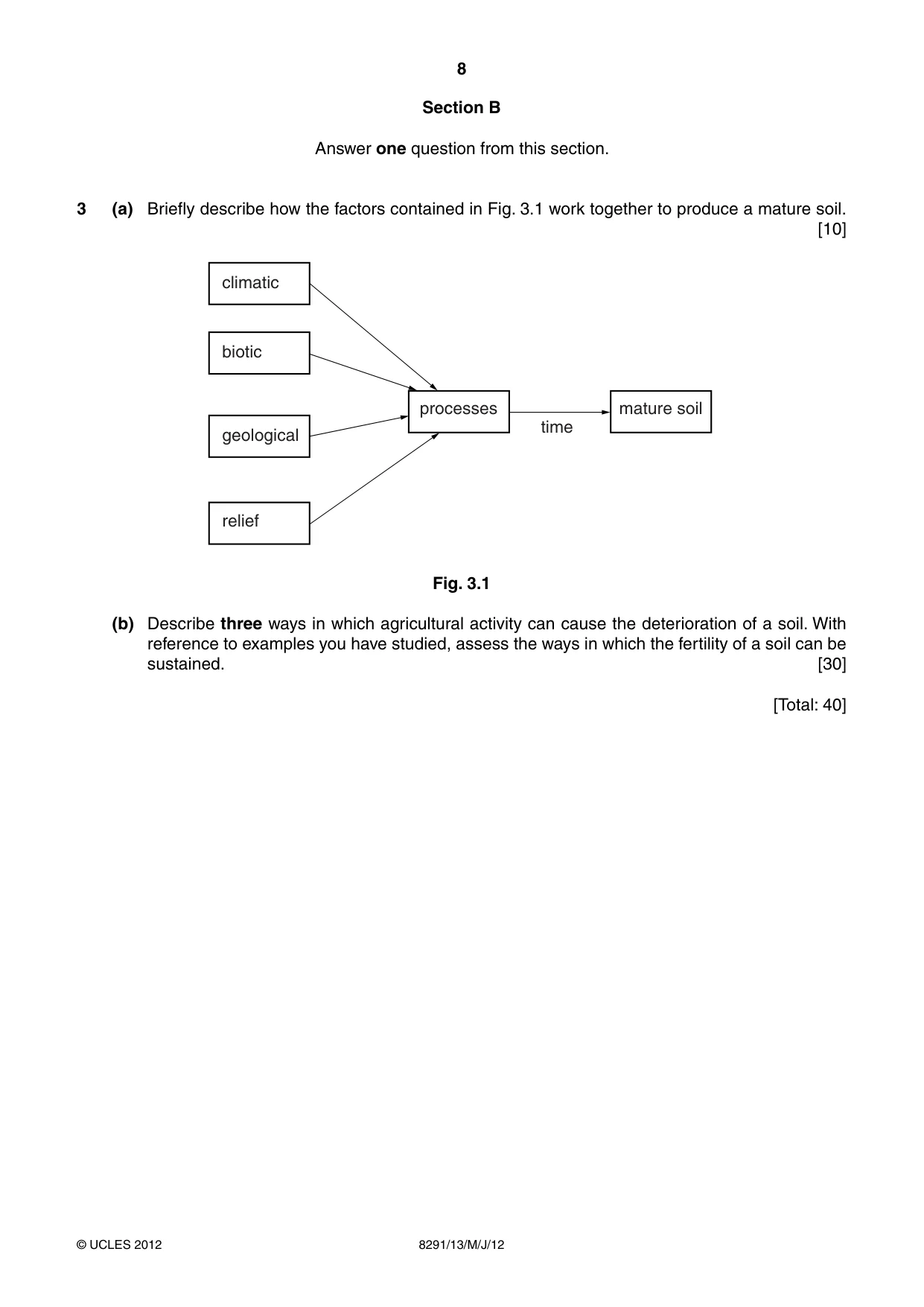
8 8291/13/M/J/12 © UCLES 2012 Section B Answer one question from this section. 3 (a) Briefly describe how the factors contained in Fig. 3.1 work together to produce a mature soil. [10] climatic biotic processes mature soil geological relief time Fig. 3.1 (b) Describe three ways in which agricultural activity can cause the deterioration of a soil. With reference to examples you have studied, assess the ways in which the fertility of a soil can be sustained. [30] [Total: 40]
Question paper, page 9
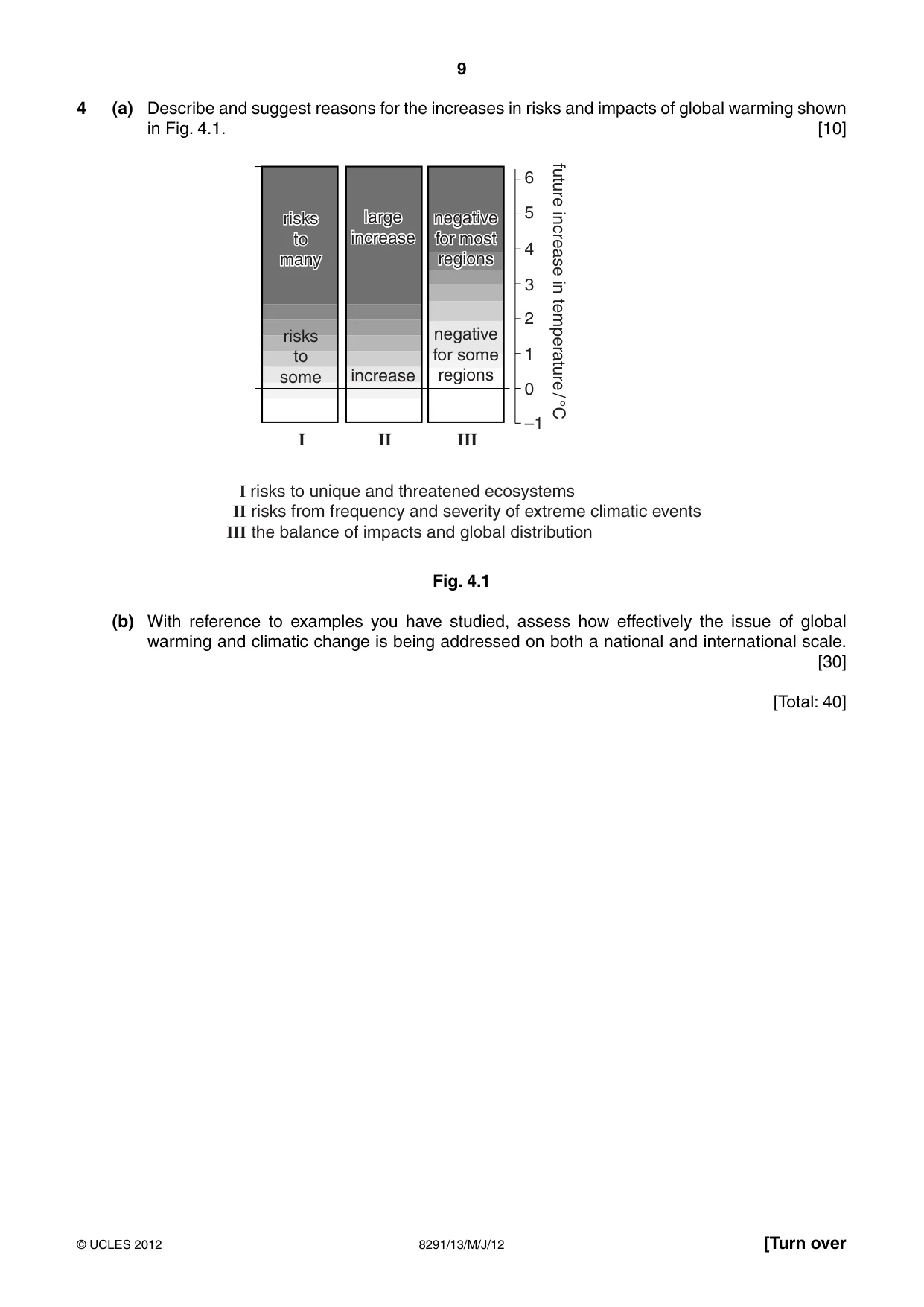
9 8291/13/M/J/12 © UCLES 2012 [Turn over 4 (a) Describe and suggest reasons for the increases in risks and impacts of global warming shown in Fig. 4.1. [10] 6 future increase in temperature / °C 5 4 3 2 1 0 –1 I I risks to unique and threatened ecosystems II risks from frequency and severity of extreme climatic events III the balance of impacts and global distribution II III risks to some risks to many increase large increase negative for most regions risks to many large increase negative for most regions negative for some regions Fig. 4.1 (b) With reference to examples you have studied, assess how effectively the issue of global warming and climatic change is being addressed on both a national and international scale. [30] [Total: 40]
Question paper, page 10
10 8291/13/M/J/12 © UCLES 2012 5 (a) Look at the photographs for Question 5(a) on the insert. They show two effects of acid rain. Briefly describe the processes that contributed to these two aspects of environmental damage. [10] (b) With reference to urban areas with which you are familiar, describe the main contributors to chemical pollution of the atmosphere. Assess some of the measures that are being adopted to reduce this pollution. [30] [Total: 40]
Question paper, page 11
11 8291/13/M/J/12 © UCLES 2012 BLANK PAGE
Question paper, page 12
12 8291/13/M/J/12 © UCLES 2012 Copyright Acknowledgements: Question 1a Figure 1.1 © www.stadtentwicklung.berlin.de. Question 4a Figure 4.1 © www.globalwarming-awareness2007.html. Question 1 Figure 1.2 Photograph © David Crossland; Germany Images; Alamy. Question 2c Figure 2.3 Photograph © Ref: 2960080; Poverty; iStockphoto. Question 5 Figure 5.1 Photograph © Ref: 10744319; Environmental catastrophe on the Czech German border; iStockphoto. Question 5 Figure 5.1 Photograph © Ref: 5001266; Acid erosion; iStockphoto. Permission to reproduce items where third-party owned material protected by copyright is included has been sought and cleared where possible. Every reasonable effort has been made by the publisher (UCLES) to trace copyright holders, but if any items requiring clearance have unwittingly been included, the publisher will be pleased to make amends at the earliest possible opportunity. University of Cambridge International Examinations is part of the Cambridge Assessment Group. Cambridge Assessment is the brand name of University of Cambridge Local Examinations Syndicate (UCLES), which is itself a department of the University of Cambridge. BLANK PAGE
Mark scheme, page 1
UNIVERSITY OF CAMBRIDGE INTERNATIONAL EXAMINATIONS GCE Advanced Subsidiary Level MARK SCHEME for the May/June 2012 question paper for the guidance of teachers 8291 ENVIRONMENTAL MANAGEMENT 8291/13 Paper 1, maximum raw mark 80 This mark scheme is published as an aid to teachers and candidates, to indicate the requirements of the examination. It shows the basis on which Examiners were instructed to award marks. It does not indicate the details of the discussions that took place at an Examiners’ meeting before marking began, which would have considered the acceptability of alternative answers. Mark schemes must be read in conjunction with the question papers and the report on the examination. • Cambridge will not enter into discussions or correspondence in connection with these mark schemes. Cambridge is publishing the mark schemes for the May/June 2012 question papers for most IGCSE, GCE Advanced Level and Advanced Subsidiary Level syllabuses and some Ordinary Level syllabuses.
Mark scheme, page 2
Page 2 Mark Scheme: Teachers’ version Syllabus Paper GCE AS LEVEL – May/June 2012 8291 13 © University of Cambridge International Examinations 2012 General notes Symbols used in Environmental Management mark schemes. / separates alternatives for a marking point – other valid ways of expressing the same idea are also credited ; separates points for the award of a mark [3] indicates the number of marks available [max 3] the number shows the maximum number of marks available for the question where there are more marking points than total marks available [max 3] when part of the marks of a question must come from part of the mark scheme, this is indicated by non-bold marks showing the internal maxima for different parts of the question these non-bold marks are also used to show marks for bands where banded mark schemes are used italic indicates that this is information about the marking points and is not required to gain credit italic text is also used for comments about alternatives that should be accepted, ignored or rejected ora or reverse argument – shows that an argument from an alternative viewpoint will be credited AW alternative wording, sometimes called ‘or words to that effect’ – AW is used when there are many different ways of expressing the same idea ( ) the word / phrase in brackets is not required to gain marks but sets the context of the response for credit e.g. (nuclear) waste – nuclear is not needed but if it was described as a domestic waste then no mark is awarded volcanic underlined words – the answer must contain exactly this word ecf error carried forward – if an incorrect answer is given to part of a question, and this answer is subsequently used by a candidate in later parts of the question, this indicates that the candidate’s incorrect answer will be used as a starting point for marking the later parts of the question
Mark scheme, page 3
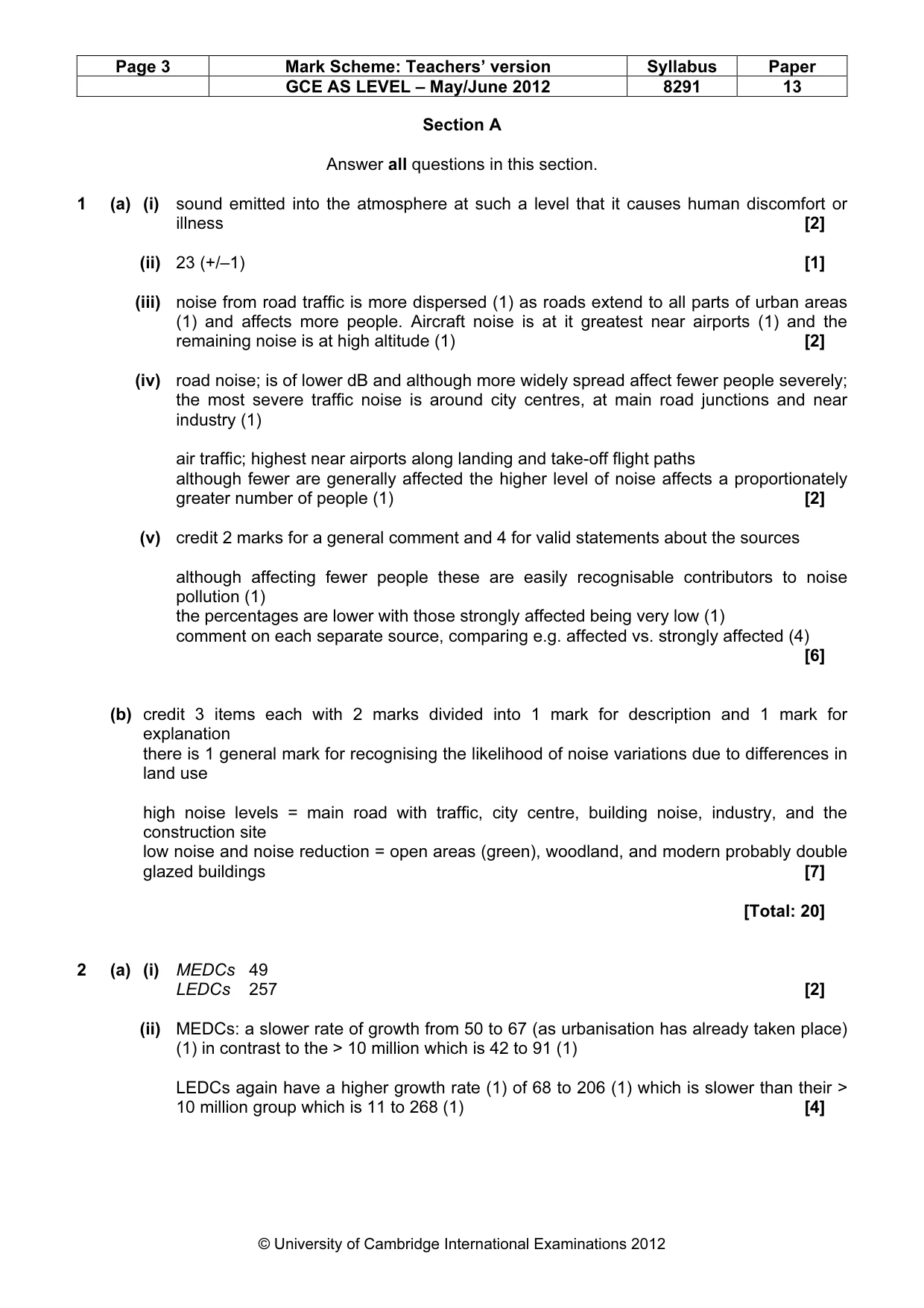
Page 3 Mark Scheme: Teachers’ version Syllabus Paper GCE AS LEVEL – May/June 2012 8291 13 © University of Cambridge International Examinations 2012 Section A Answer all questions in this section. 1 (a) (i) sound emitted into the atmosphere at such a level that it causes human discomfort or illness [2] (ii) 23 (+/–1) [1] (iii) noise from road traffic is more dispersed (1) as roads extend to all parts of urban areas (1) and affects more people. Aircraft noise is at it greatest near airports (1) and the remaining noise is at high altitude (1) [2] (iv) road noise; is of lower dB and although more widely spread affect fewer people severely; the most severe traffic noise is around city centres, at main road junctions and near industry (1) air traffic; highest near airports along landing and take-off flight paths although fewer are generally affected the higher level of noise affects a proportionately greater number of people (1) [2] (v) credit 2 marks for a general comment and 4 for valid statements about the sources although affecting fewer people these are easily recognisable contributors to noise pollution (1) the percentages are lower with those strongly affected being very low (1) comment on each separate source, comparing e.g. affected vs. strongly affected (4) [6] (b) credit 3 items each with 2 marks divided into 1 mark for description and 1 mark for explanation there is 1 general mark for recognising the likelihood of noise variations due to differences in land use high noise levels = main road with traffic, city centre, building noise, industry, and the construction site low noise and noise reduction = open areas (green), woodland, and modern probably double glazed buildings [7] [Total: 20] 2 (a) (i) MEDCs 49 LEDCs 257 [2] (ii) MEDCs: a slower rate of growth from 50 to 67 (as urbanisation has already taken place) (1) in contrast to the > 10 million which is 42 to 91 (1) LEDCs again have a higher growth rate (1) of 68 to 206 (1) which is slower than their > 10 million group which is 11 to 268 (1) [4]
Mark scheme, page 4
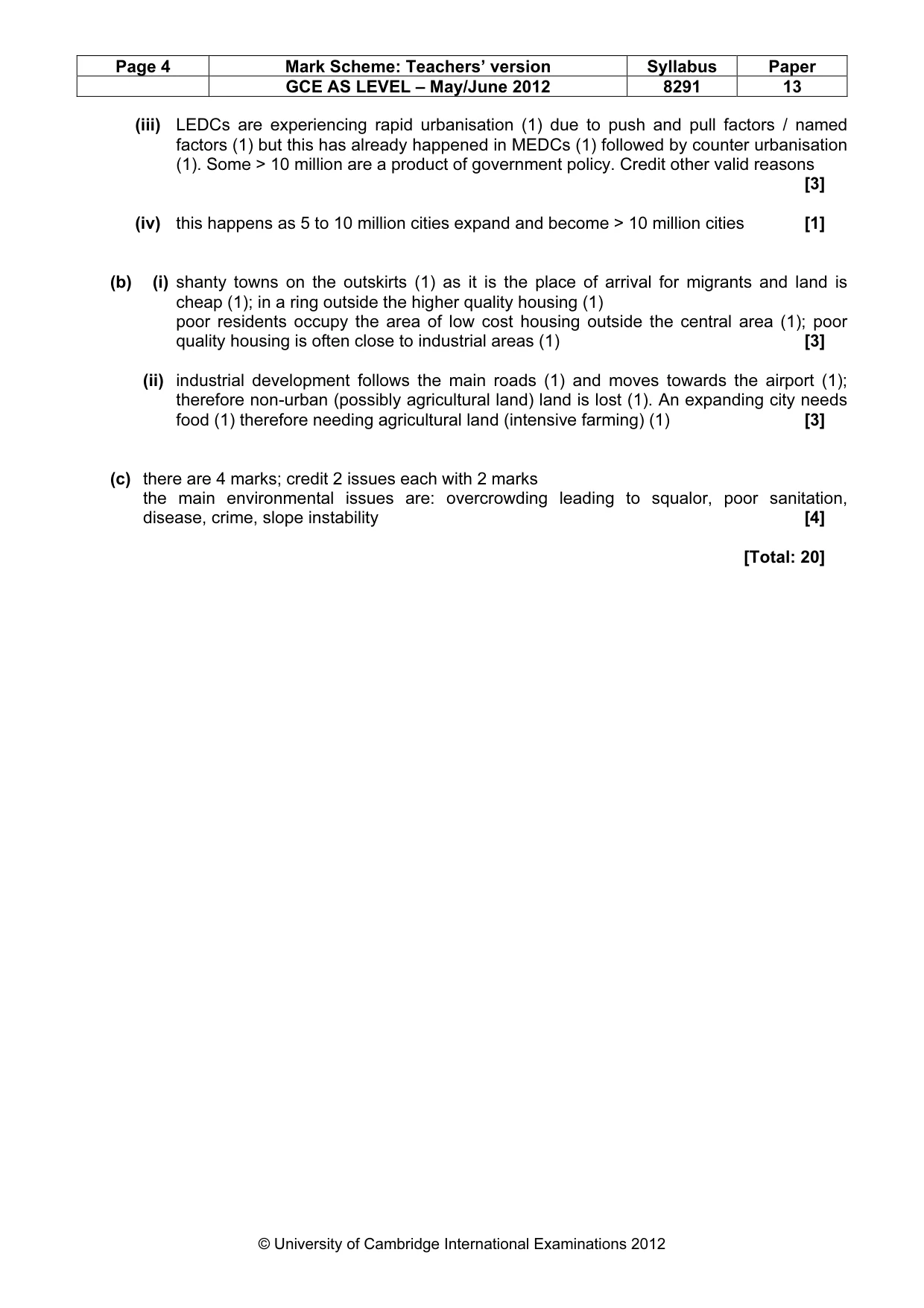
Page 4 Mark Scheme: Teachers’ version Syllabus Paper GCE AS LEVEL – May/June 2012 8291 13 © University of Cambridge International Examinations 2012 (iii) LEDCs are experiencing rapid urbanisation (1) due to push and pull factors / named factors (1) but this has already happened in MEDCs (1) followed by counter urbanisation (1). Some > 10 million are a product of government policy. Credit other valid reasons [3] (iv) this happens as 5 to 10 million cities expand and become > 10 million cities [1] (b) (i) shanty towns on the outskirts (1) as it is the place of arrival for migrants and land is cheap (1); in a ring outside the higher quality housing (1) poor residents occupy the area of low cost housing outside the central area (1); poor quality housing is often close to industrial areas (1) [3] (ii) industrial development follows the main roads (1) and moves towards the airport (1); therefore non-urban (possibly agricultural land) land is lost (1). An expanding city needs food (1) therefore needing agricultural land (intensive farming) (1) [3] (c) there are 4 marks; credit 2 issues each with 2 marks the main environmental issues are: overcrowding leading to squalor, poor sanitation, disease, crime, slope instability [4] [Total: 20]
Mark scheme, page 5
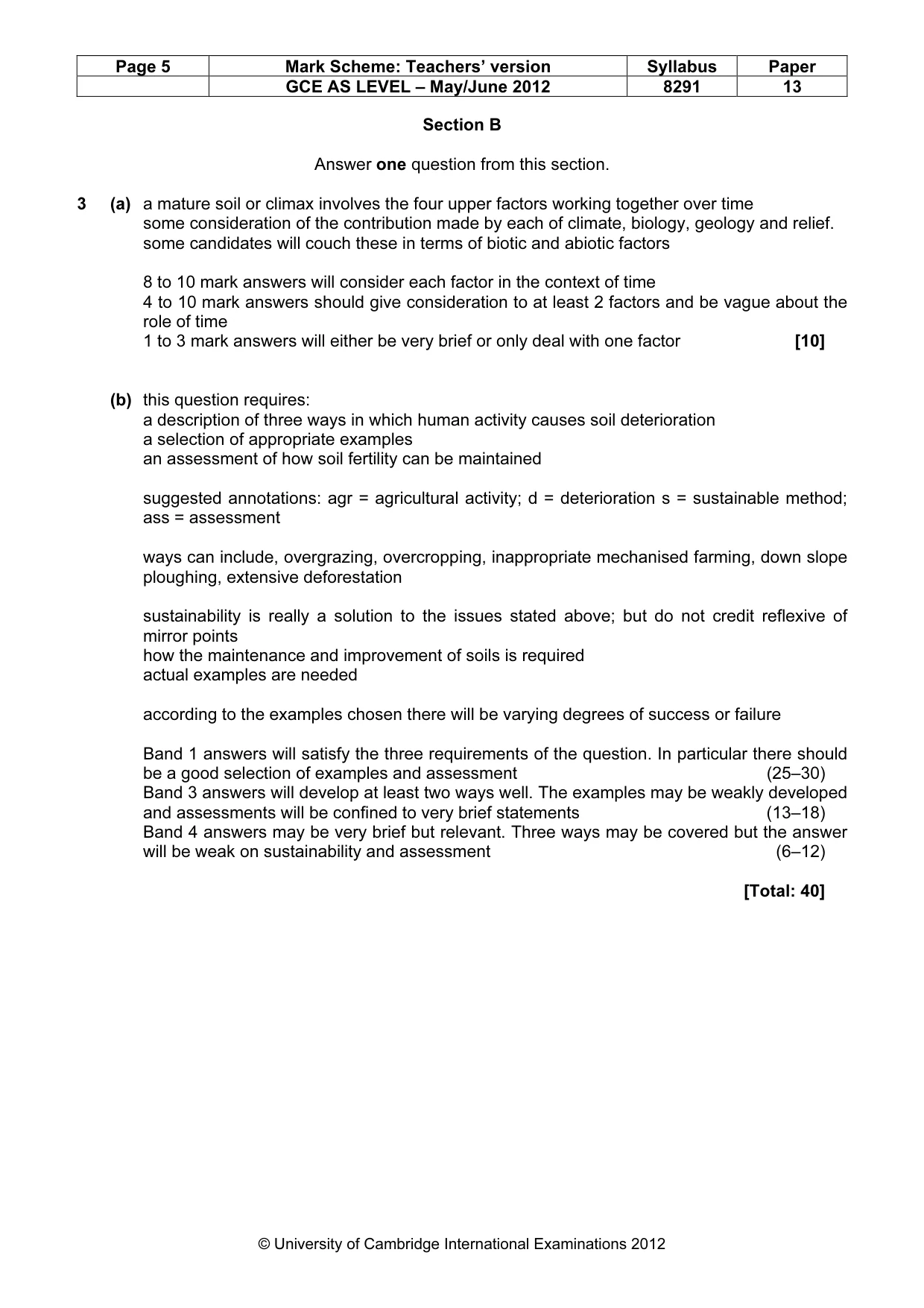
Page 5 Mark Scheme: Teachers’ version Syllabus Paper GCE AS LEVEL – May/June 2012 8291 13 © University of Cambridge International Examinations 2012 Section B Answer one question from this section. 3 (a) a mature soil or climax involves the four upper factors working together over time some consideration of the contribution made by each of climate, biology, geology and relief. some candidates will couch these in terms of biotic and abiotic factors 8 to 10 mark answers will consider each factor in the context of time 4 to 10 mark answers should give consideration to at least 2 factors and be vague about the role of time 1 to 3 mark answers will either be very brief or only deal with one factor [10] (b) this question requires: a description of three ways in which human activity causes soil deterioration a selection of appropriate examples an assessment of how soil fertility can be maintained suggested annotations: agr = agricultural activity; d = deterioration s = sustainable method; ass = assessment ways can include, overgrazing, overcropping, inappropriate mechanised farming, down slope ploughing, extensive deforestation sustainability is really a solution to the issues stated above; but do not credit reflexive of mirror points how the maintenance and improvement of soils is required actual examples are needed according to the examples chosen there will be varying degrees of success or failure Band 1 answers will satisfy the three requirements of the question. In particular there should be a good selection of examples and assessment (25–30) Band 3 answers will develop at least two ways well. The examples may be weakly developed and assessments will be confined to very brief statements (13–18) Band 4 answers may be very brief but relevant. Three ways may be covered but the answer will be weak on sustainability and assessment (6–12) [Total: 40]
Mark scheme, page 6
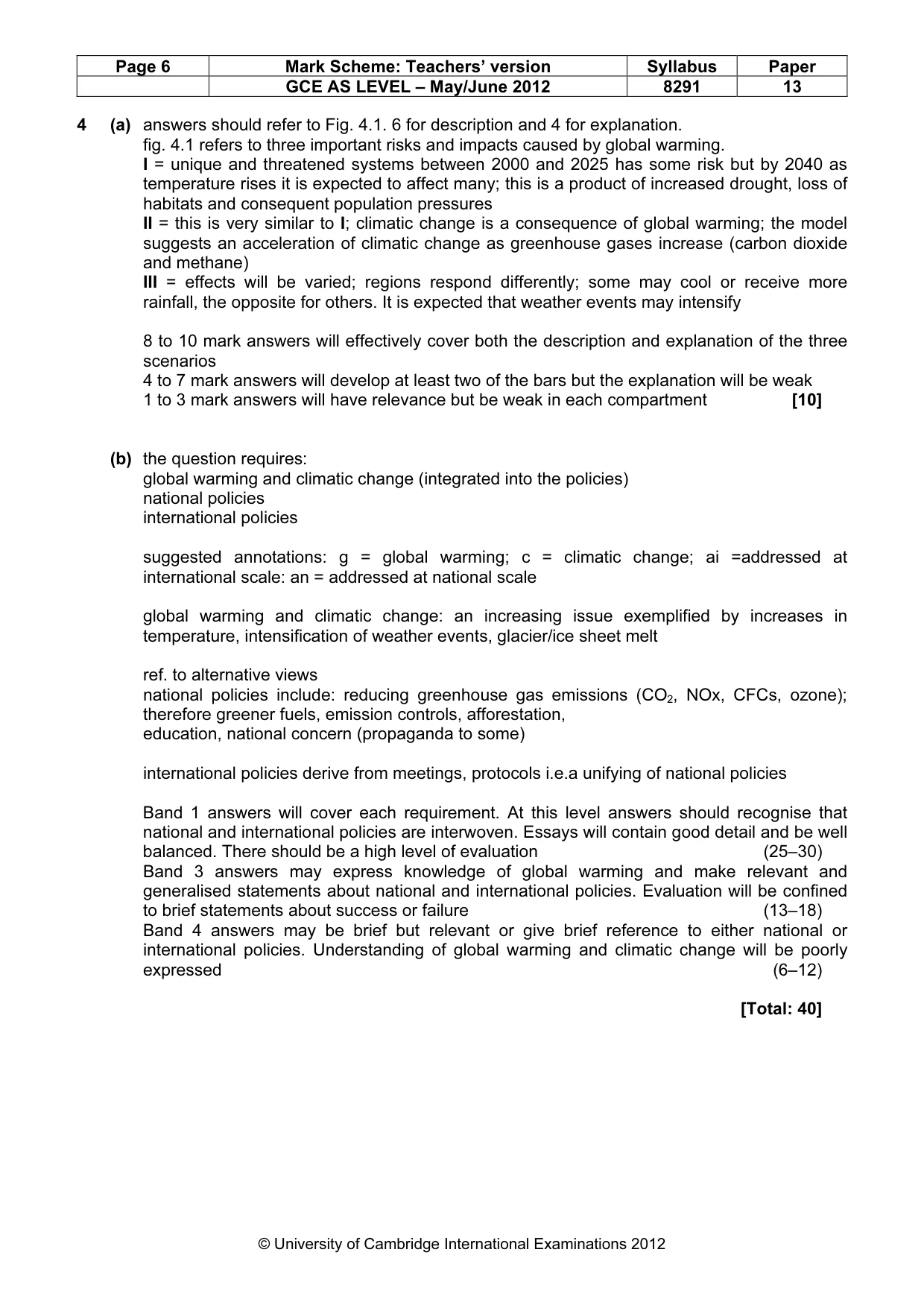
Page 6 Mark Scheme: Teachers’ version Syllabus Paper GCE AS LEVEL – May/June 2012 8291 13 © University of Cambridge International Examinations 2012 4 (a) answers should refer to Fig. 4.1. 6 for description and 4 for explanation. fig. 4.1 refers to three important risks and impacts caused by global warming. I = unique and threatened systems between 2000 and 2025 has some risk but by 2040 as temperature rises it is expected to affect many; this is a product of increased drought, loss of habitats and consequent population pressures II = this is very similar to I; climatic change is a consequence of global warming; the model suggests an acceleration of climatic change as greenhouse gases increase (carbon dioxide and methane) III = effects will be varied; regions respond differently; some may cool or receive more rainfall, the opposite for others. It is expected that weather events may intensify 8 to 10 mark answers will effectively cover both the description and explanation of the three scenarios 4 to 7 mark answers will develop at least two of the bars but the explanation will be weak 1 to 3 mark answers will have relevance but be weak in each compartment [10] (b) the question requires: global warming and climatic change (integrated into the policies) national policies international policies suggested annotations: g = global warming; c = climatic change; ai =addressed at international scale: an = addressed at national scale global warming and climatic change: an increasing issue exemplified by increases in temperature, intensification of weather events, glacier/ice sheet melt ref. to alternative views national policies include: reducing greenhouse gas emissions (CO2, NOx, CFCs, ozone); therefore greener fuels, emission controls, afforestation, education, national concern (propaganda to some) international policies derive from meetings, protocols i.e.a unifying of national policies Band 1 answers will cover each requirement. At this level answers should recognise that national and international policies are interwoven. Essays will contain good detail and be well balanced. There should be a high level of evaluation (25–30) Band 3 answers may express knowledge of global warming and make relevant and generalised statements about national and international policies. Evaluation will be confined to brief statements about success or failure (13–18) Band 4 answers may be brief but relevant or give brief reference to either national or international policies. Understanding of global warming and climatic change will be poorly expressed (6–12) [Total: 40]
Mark scheme, page 7
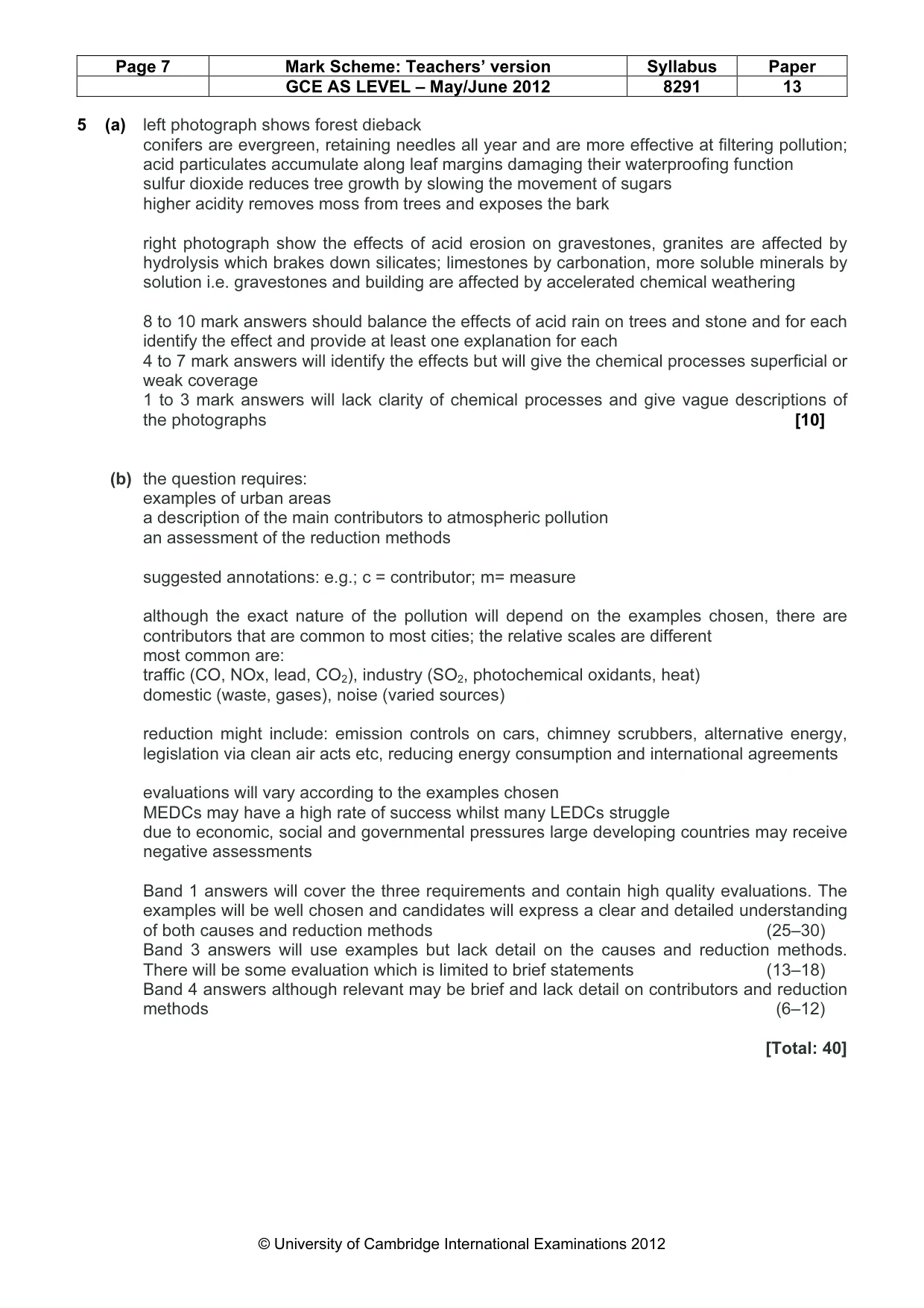
Page 7 Mark Scheme: Teachers’ version Syllabus Paper GCE AS LEVEL – May/June 2012 8291 13 © University of Cambridge International Examinations 2012 5 (a) left photograph shows forest dieback conifers are evergreen, retaining needles all year and are more effective at filtering pollution; acid particulates accumulate along leaf margins damaging their waterproofing function sulfur dioxide reduces tree growth by slowing the movement of sugars higher acidity removes moss from trees and exposes the bark right photograph show the effects of acid erosion on gravestones, granites are affected by hydrolysis which brakes down silicates; limestones by carbonation, more soluble minerals by solution i.e. gravestones and building are affected by accelerated chemical weathering 8 to 10 mark answers should balance the effects of acid rain on trees and stone and for each identify the effect and provide at least one explanation for each 4 to 7 mark answers will identify the effects but will give the chemical processes superficial or weak coverage 1 to 3 mark answers will lack clarity of chemical processes and give vague descriptions of the photographs [10] (b) the question requires: examples of urban areas a description of the main contributors to atmospheric pollution an assessment of the reduction methods suggested annotations: e.g.; c = contributor; m= measure although the exact nature of the pollution will depend on the examples chosen, there are contributors that are common to most cities; the relative scales are different most common are: traffic (CO, NOx, lead, CO2), industry (SO2, photochemical oxidants, heat) domestic (waste, gases), noise (varied sources) reduction might include: emission controls on cars, chimney scrubbers, alternative energy, legislation via clean air acts etc, reducing energy consumption and international agreements evaluations will vary according to the examples chosen MEDCs may have a high rate of success whilst many LEDCs struggle due to economic, social and governmental pressures large developing countries may receive negative assessments Band 1 answers will cover the three requirements and contain high quality evaluations. The examples will be well chosen and candidates will express a clear and detailed understanding of both causes and reduction methods (25–30) Band 3 answers will use examples but lack detail on the causes and reduction methods. There will be some evaluation which is limited to brief statements (13–18) Band 4 answers although relevant may be brief and lack detail on contributors and reduction methods (6–12) [Total: 40]
Mark scheme, page 8
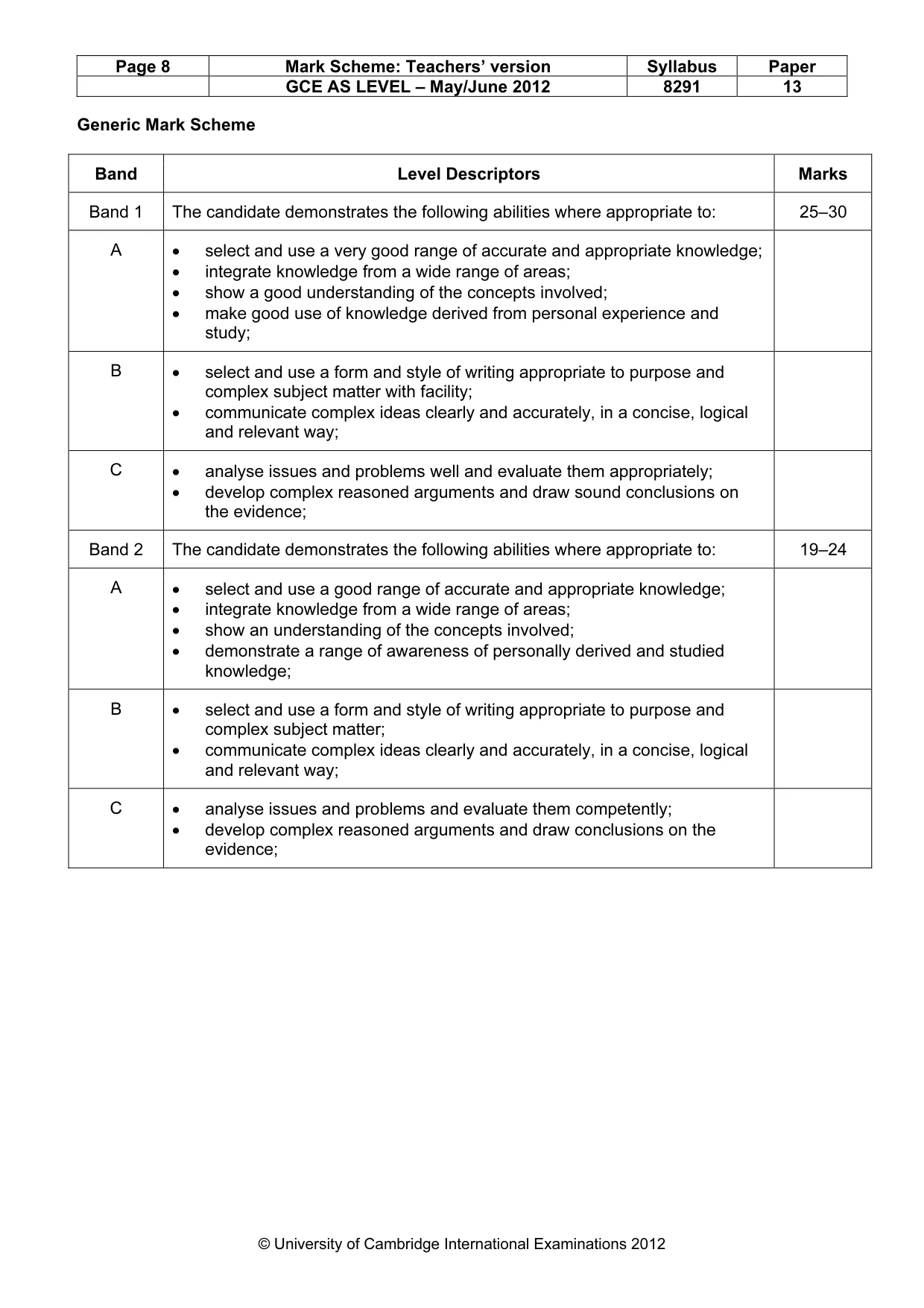
Page 8 Mark Scheme: Teachers’ version Syllabus Paper GCE AS LEVEL – May/June 2012 8291 13 © University of Cambridge International Examinations 2012 Generic Mark Scheme Band Level Descriptors Marks Band 1 The candidate demonstrates the following abilities where appropriate to: 25–30 A • select and use a very good range of accurate and appropriate knowledge; • integrate knowledge from a wide range of areas; • show a good understanding of the concepts involved; • make good use of knowledge derived from personal experience and study; B • select and use a form and style of writing appropriate to purpose and complex subject matter with facility; • communicate complex ideas clearly and accurately, in a concise, logical and relevant way; C • analyse issues and problems well and evaluate them appropriately; • develop complex reasoned arguments and draw sound conclusions on the evidence; Band 2 The candidate demonstrates the following abilities where appropriate to: 19–24 A • select and use a good range of accurate and appropriate knowledge; • integrate knowledge from a wide range of areas; • show an understanding of the concepts involved; • demonstrate a range of awareness of personally derived and studied knowledge; B • select and use a form and style of writing appropriate to purpose and complex subject matter; • communicate complex ideas clearly and accurately, in a concise, logical and relevant way; C • analyse issues and problems and evaluate them competently; • develop complex reasoned arguments and draw conclusions on the evidence;
Mark scheme, page 9
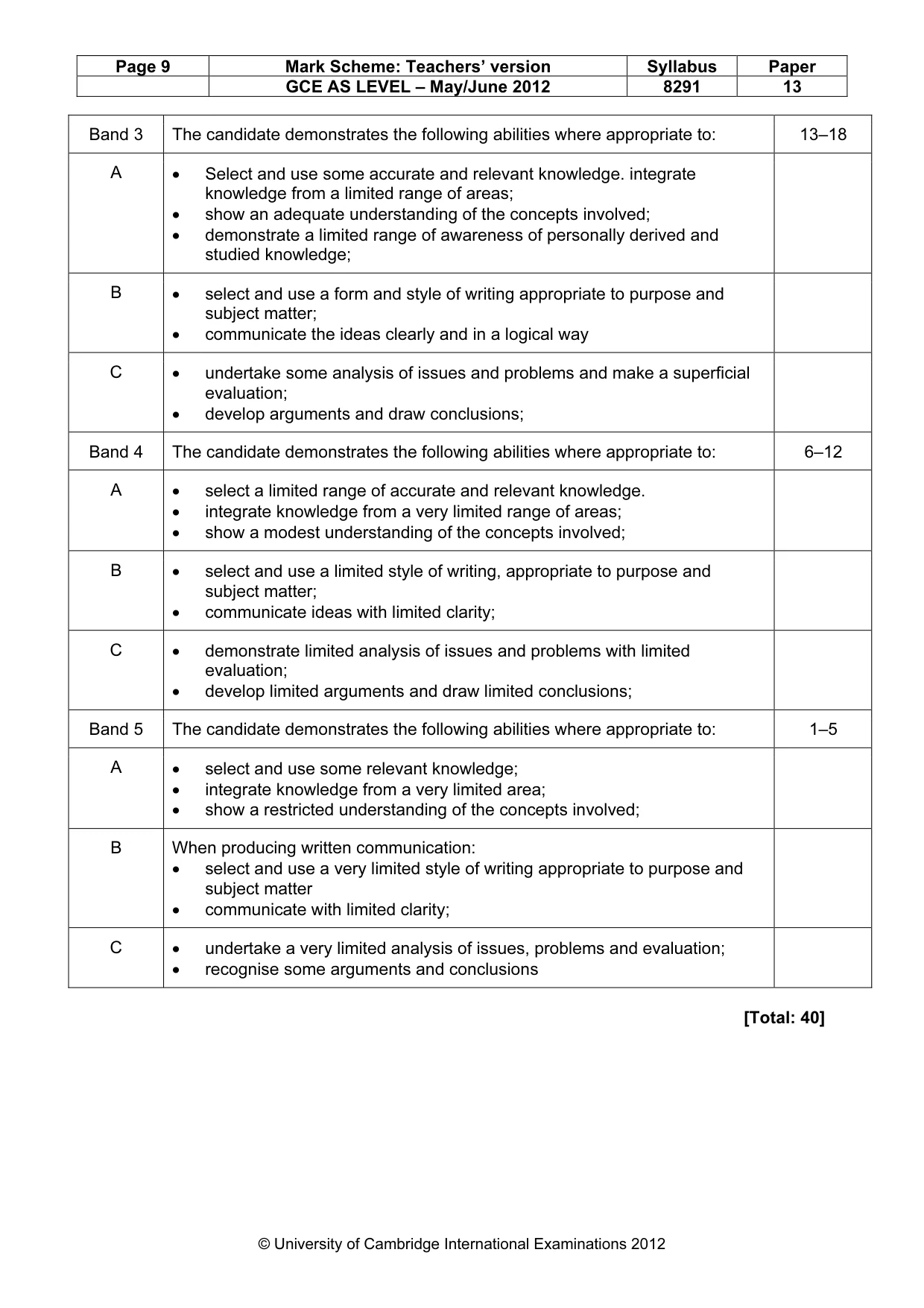
Page 9 Mark Scheme: Teachers’ version Syllabus Paper GCE AS LEVEL – May/June 2012 8291 13 © University of Cambridge International Examinations 2012 Band 3 The candidate demonstrates the following abilities where appropriate to: 13–18 A • Select and use some accurate and relevant knowledge. integrate knowledge from a limited range of areas; • show an adequate understanding of the concepts involved; • demonstrate a limited range of awareness of personally derived and studied knowledge; B • select and use a form and style of writing appropriate to purpose and subject matter; • communicate the ideas clearly and in a logical way C • undertake some analysis of issues and problems and make a superficial evaluation; • develop arguments and draw conclusions; Band 4 The candidate demonstrates the following abilities where appropriate to: 6–12 A • select a limited range of accurate and relevant knowledge. • integrate knowledge from a very limited range of areas; • show a modest understanding of the concepts involved; B • select and use a limited style of writing, appropriate to purpose and subject matter; • communicate ideas with limited clarity; C • demonstrate limited analysis of issues and problems with limited evaluation; • develop limited arguments and draw limited conclusions; Band 5 The candidate demonstrates the following abilities where appropriate to: 1–5 A • select and use some relevant knowledge; • integrate knowledge from a very limited area; • show a restricted understanding of the concepts involved; B When producing written communication: • select and use a very limited style of writing appropriate to purpose and subject matter • communicate with limited clarity; C • undertake a very limited analysis of issues, problems and evaluation; • recognise some arguments and conclusions [Total: 40]
What you needed in this session
Cambridge’s own grade thresholds for 2012 May/June, Paper 1 · Variant 3. A higher threshold means an easier paper — the bar moves with how the cohort did.