Cambridge A Level English - Language AS and A Level (from 2014) 9093 — 2023 Oct/Nov Paper 1 · Variant 2
9093/12/O/N/23 · 50 marks · ≈56 min
The question paper and its mark scheme, free to read here and free to download. This is Cambridge’s own paper, exactly as it was sat.
Question paper8 pages
Mark scheme14 pages
Answers below. Sit the paper first if you are practising.
Paper as text
Question paper, page 1
Cambridge International AS & A Level 9093/12 October/November 2023 2 hours 15 minutes ENGLISH LANGUAGE Paper 1 Reading You must answer on the enclosed answer booklet. You will need: Answer booklet (enclosed) INSTRUCTIONS • Answer all questions. • Follow the instructions on the front cover of the answer booklet. If you need additional answer paper, ask the invigilator for a continuation booklet. • Dictionaries are not allowed. INFORMATION • The total mark for this paper is 50. • The number of marks for each question or part question is shown in brackets [ ]. This document has 8 pages. Any blank pages are indicated. [Turn over 11_9093_12_2023_1.14 © UCLES 2023 *6302496846*
Question paper, page 2
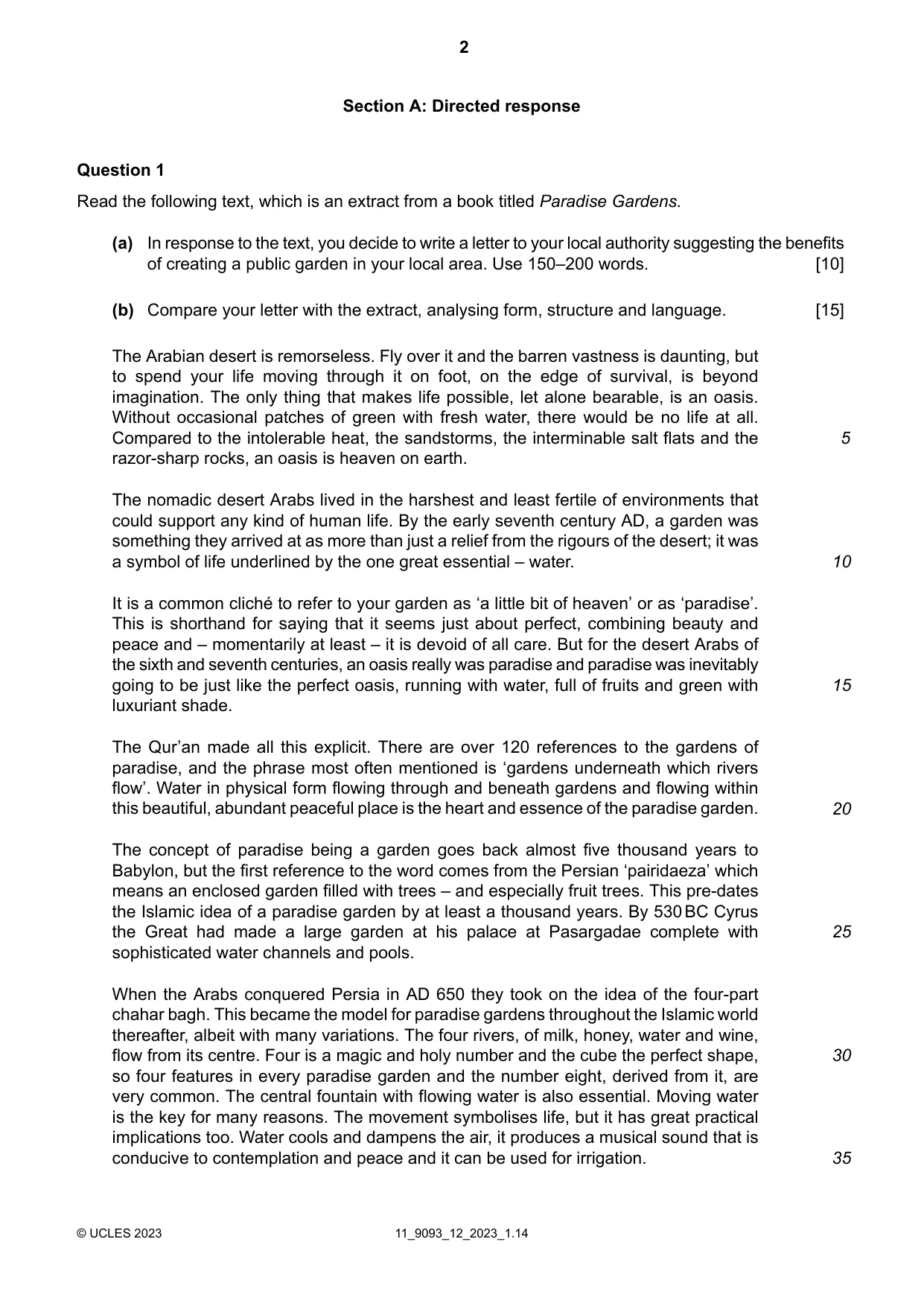
35 30 25 20 15 10 5 Section A: Directed response Question 1 Read the following text, which is an extract from a book titled Paradise Gardens. In response to the text, you decide to write a letter to your local authority suggesting the benefits of creating a public garden in your local area. Use 150–200 words. [10] (a) Compare your letter with the extract, analysing form, structure and language. [15] (b) The Arabian desert is remorseless. Fly over it and the barren vastness is daunting, but to spend your life moving through it on foot, on the edge of survival, is beyond imagination. The only thing that makes life possible, let alone bearable, is an oasis. Without occasional patches of green with fresh water, there would be no life at all. Compared to the intolerable heat, the sandstorms, the interminable salt flats and the razor-sharp rocks, an oasis is heaven on earth. The nomadic desert Arabs lived in the harshest and least fertile of environments that could support any kind of human life. By the early seventh century AD, a garden was something they arrived at as more than just a relief from the rigours of the desert; it was a symbol of life underlined by the one great essential – water. It is a common cliché to refer to your garden as ‘a little bit of heaven’ or as ‘paradise’. This is shorthand for saying that it seems just about perfect, combining beauty and peace and – momentarily at least – it is devoid of all care. But for the desert Arabs of the sixth and seventh centuries, an oasis really was paradise and paradise was inevitably going to be just like the perfect oasis, running with water, full of fruits and green with luxuriant shade. The Qur’an made all this explicit. There are over 120 references to the gardens of paradise, and the phrase most often mentioned is ‘gardens underneath which rivers flow’. Water in physical form flowing through and beneath gardens and flowing within this beautiful, abundant peaceful place is the heart and essence of the paradise garden. The concept of paradise being a garden goes back almost five thousand years to Babylon, but the first reference to the word comes from the Persian ‘pairidaeza’ which means an enclosed garden filled with trees – and especially fruit trees. This pre-dates the Islamic idea of a paradise garden by at least a thousand years. By 530BC Cyrus the Great had made a large garden at his palace at Pasargadae complete with sophisticated water channels and pools. When the Arabs conquered Persia in AD 650 they took on the idea of the four-part chahar bagh. This became the model for paradise gardens throughout the Islamic world thereafter, albeit with many variations. The four rivers, of milk, honey, water and wine, flow from its centre. Four is a magic and holy number and the cube the perfect shape, so four features in every paradise garden and the number eight, derived from it, are very common. The central fountain with flowing water is also essential. Moving water is the key for many reasons. The movement symbolises life, but it has great practical implications too. Water cools and dampens the air, it produces a musical sound that is conducive to contemplation and peace and it can be used for irrigation. 11_9093_12_2023_1.14 © UCLES 2023 2
Question paper, page 3
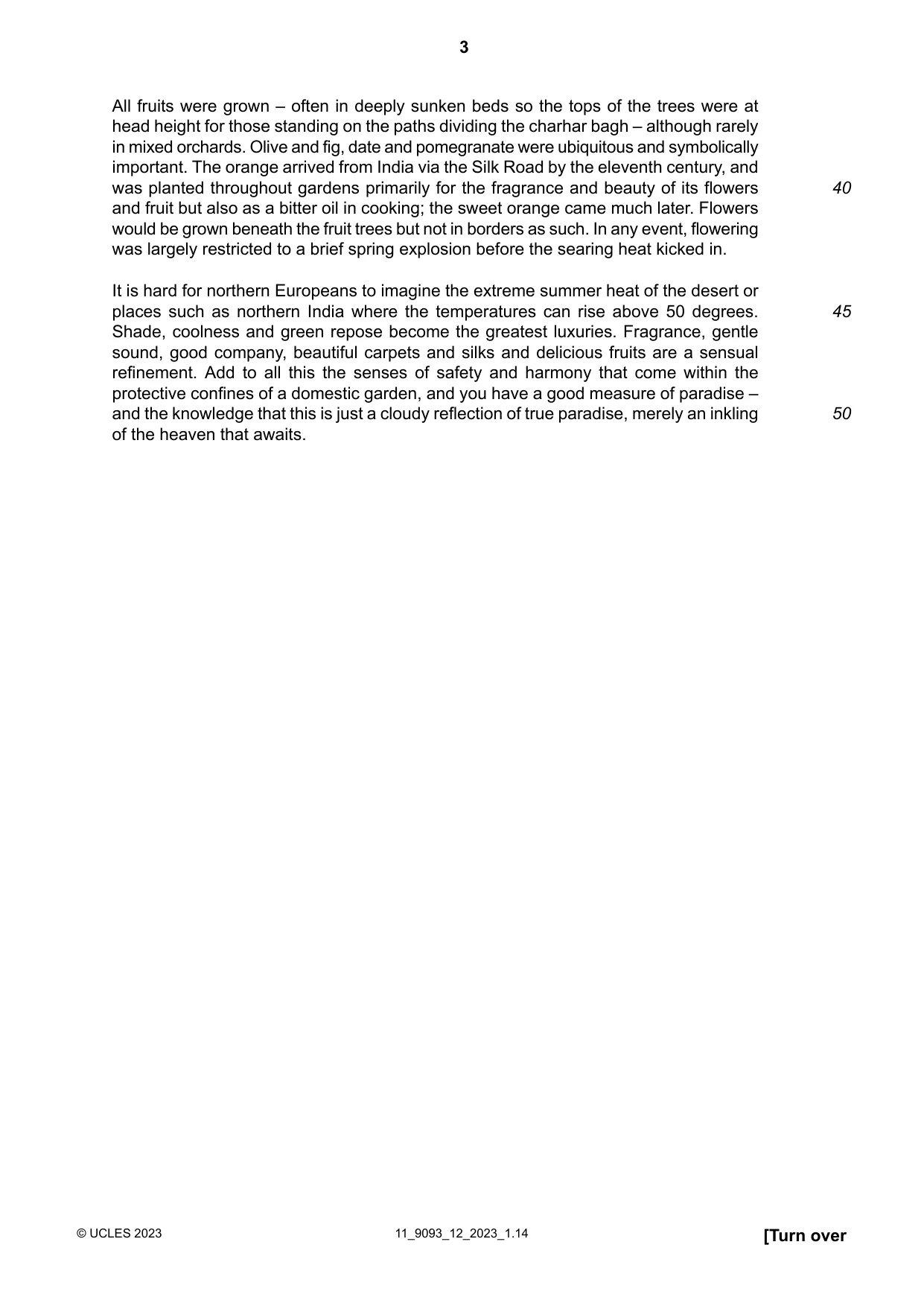
50 45 40 All fruits were grown – often in deeply sunken beds so the tops of the trees were at head height for those standing on the paths dividing the charhar bagh – although rarely in mixed orchards. Olive and fig, date and pomegranate were ubiquitous and symbolically important. The orange arrived from India via the Silk Road by the eleventh century, and was planted throughout gardens primarily for the fragrance and beauty of its flowers and fruit but also as a bitter oil in cooking; the sweet orange came much later. Flowers would be grown beneath the fruit trees but not in borders as such. In any event, flowering was largely restricted to a brief spring explosion before the searing heat kicked in. It is hard for northern Europeans to imagine the extreme summer heat of the desert or places such as northern India where the temperatures can rise above 50 degrees. Shade, coolness and green repose become the greatest luxuries. Fragrance, gentle sound, good company, beautiful carpets and silks and delicious fruits are a sensual refinement. Add to all this the senses of safety and harmony that come within the protective confines of a domestic garden, and you have a good measure of paradise – and the knowledge that this is just a cloudy reflection of true paradise, merely an inkling of the heaven that awaits. [Turn over 11_9093_12_2023_1.14 © UCLES 2023 3
Question paper, page 4
Section B: Text analysis Question 2 Read the following text, which is an editorial piece from a lifestyle magazine. Analyse the text, focusing on form, structure and language. [25] View from here As her annual spring clean morphs into the mother of all clear-outs, Suzy Smith unearths lifelong treasures that cue some exhausting emotional tussles. 11_9093_12_2023_1.14 © UCLES 2023 4 Content removed due to copyright restrictions.
Question paper, page 5
Perhaps that’s a project for the future. In the meantime, a lot of it has to go. I know I shall feel much better when it does. 11_9093_12_2023_1.14 © UCLES 2023 5 Content removed due to copyright restrictions.
Question paper, page 6
BLANK PAGE 11_9093_12_2023_1.14 © UCLES 2023 6
Question paper, page 7
BLANK PAGE 11_9093_12_2023_1.14 © UCLES 2023 7
Question paper, page 8
BLANK PAGE Permission to reproduce items where third-party owned material protected by copyright is included has been sought and cleared where possible. Every reasonable effort has been made by the publisher (UCLES) to trace copyright holders, but if any items requiring clearance have unwittingly been included, the publisher will be pleased to make amends at the earliest possible opportunity. To avoid the issue of disclosure of answer-related information to candidates, all copyright acknowledgements are reproduced online in the Cambridge Assessment International Education Copyright Acknowledgements Booklet. This is produced for each series of examinations and is freely available to download at www.cambridgeinternational.org after the live examination series. Cambridge Assessment International Education is part of Cambridge Assessment. Cambridge Assessment is the brand name of the University of Cambridge Local Examinations Syndicate (UCLES), which is a department of the University of Cambridge. 11_9093_12_2023_1.14 © UCLES 2023 8
Mark scheme, page 1
This document consists of 14 printed pages. © UCLES 2023 [Turn over Cambridge International AS & A Level ENGLISH LANGUAGE 9093/12 Paper 1 Reading October/November 2023 MARK SCHEME Maximum Mark: 50 Published This mark scheme is published as an aid to teachers and candidates, to indicate the requirements of the examination. It shows the basis on which Examiners were instructed to award marks. It does not indicate the details of the discussions that took place at an Examiners’ meeting before marking began, which would have considered the acceptability of alternative answers. Mark schemes should be read in conjunction with the question paper and the Principal Examiner Report for Teachers. Cambridge International will not enter into discussions about these mark schemes. Cambridge International is publishing the mark schemes for the October/November 2023 series for most Cambridge IGCSE, Cambridge International A and AS Level components, and some Cambridge O Level components.
Mark scheme, page 2
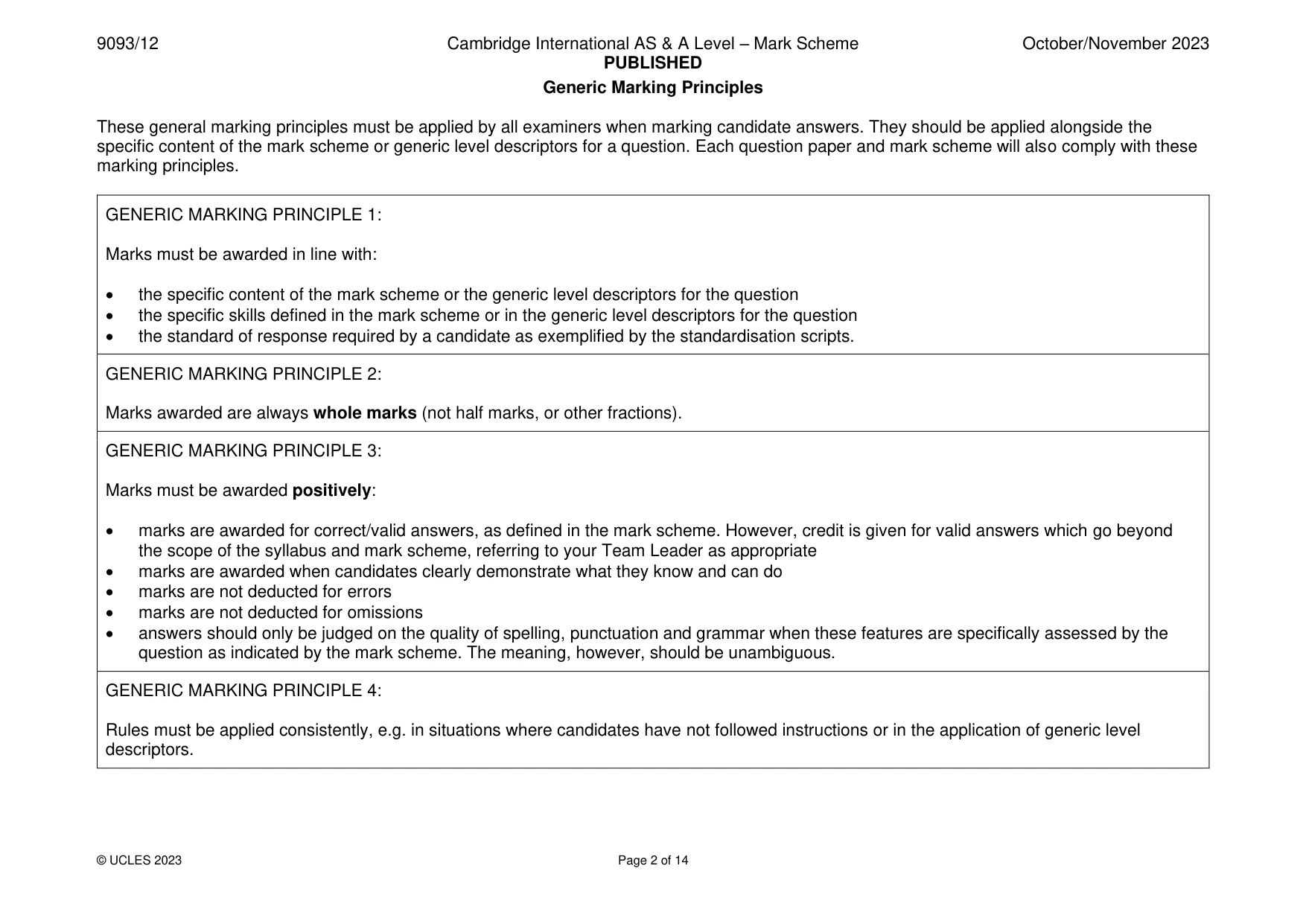
9093/12 Cambridge International AS & A Level – Mark Scheme PUBLISHED October/November 2023 © UCLES 2023 Page 2 of 14 Generic Marking Principles These general marking principles must be applied by all examiners when marking candidate answers. They should be applied alongside the specific content of the mark scheme or generic level descriptors for a question. Each question paper and mark scheme will also comply with these marking principles. GENERIC MARKING PRINCIPLE 1: Marks must be awarded in line with: • the specific content of the mark scheme or the generic level descriptors for the question • the specific skills defined in the mark scheme or in the generic level descriptors for the question • the standard of response required by a candidate as exemplified by the standardisation scripts. GENERIC MARKING PRINCIPLE 2: Marks awarded are always whole marks (not half marks, or other fractions). GENERIC MARKING PRINCIPLE 3: Marks must be awarded positively: • marks are awarded for correct/valid answers, as defined in the mark scheme. However, credit is given for valid answers which go beyond the scope of the syllabus and mark scheme, referring to your Team Leader as appropriate • marks are awarded when candidates clearly demonstrate what they know and can do • marks are not deducted for errors • marks are not deducted for omissions • answers should only be judged on the quality of spelling, punctuation and grammar when these features are specifically assessed by the question as indicated by the mark scheme. The meaning, however, should be unambiguous. GENERIC MARKING PRINCIPLE 4: Rules must be applied consistently, e.g. in situations where candidates have not followed instructions or in the application of generic level descriptors.
Mark scheme, page 3
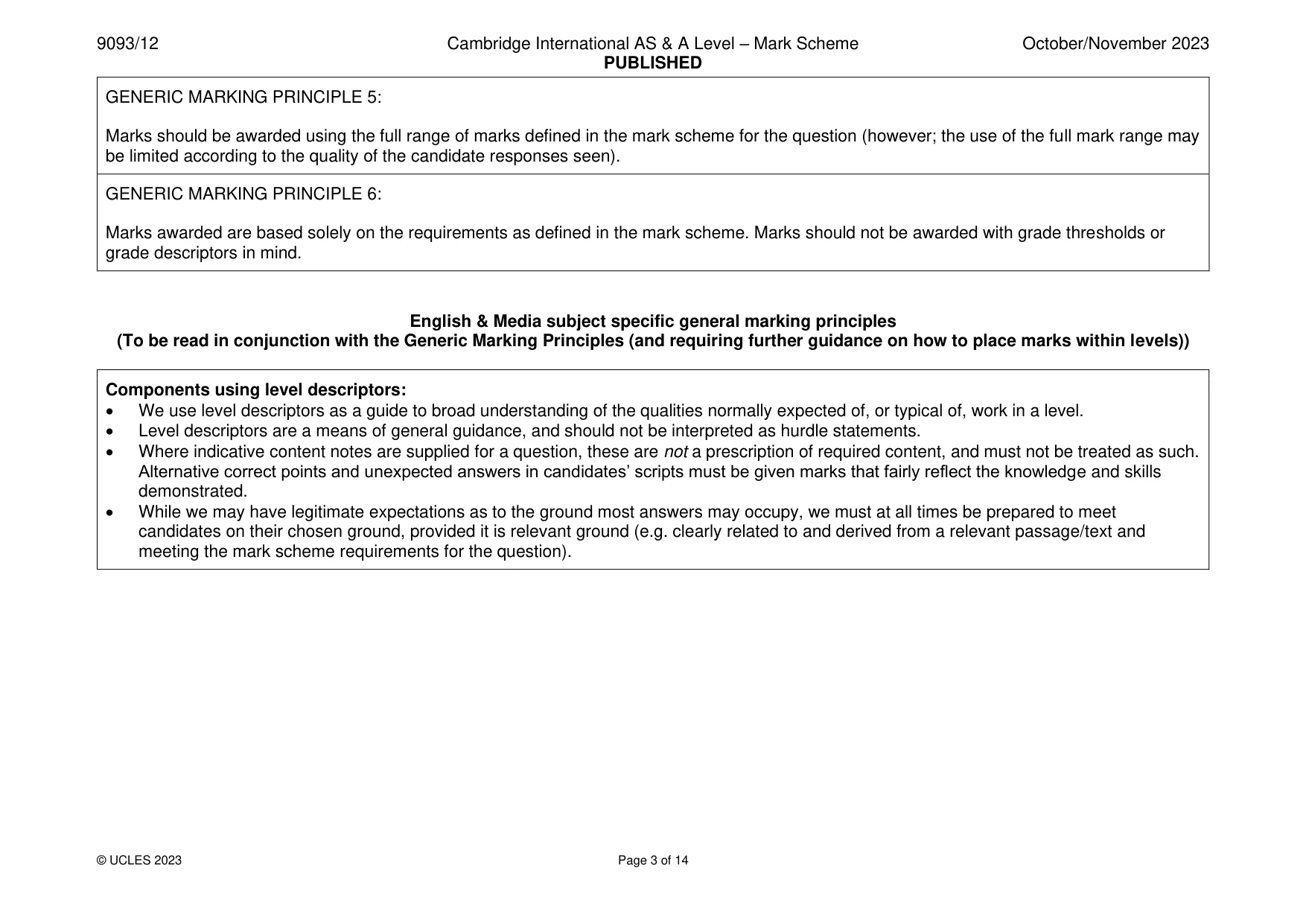
9093/12 Cambridge International AS & A Level – Mark Scheme PUBLISHED October/November 2023 © UCLES 2023 Page 3 of 14 GENERIC MARKING PRINCIPLE 5: Marks should be awarded using the full range of marks defined in the mark scheme for the question (however; the use of the full mark range may be limited according to the quality of the candidate responses seen). GENERIC MARKING PRINCIPLE 6: Marks awarded are based solely on the requirements as defined in the mark scheme. Marks should not be awarded with grade thresholds or grade descriptors in mind. English & Media subject specific general marking principles (To be read in conjunction with the Generic Marking Principles (and requiring further guidance on how to place marks within levels)) Components using level descriptors: • We use level descriptors as a guide to broad understanding of the qualities normally expected of, or typical of, work in a level. • Level descriptors are a means of general guidance, and should not be interpreted as hurdle statements. • Where indicative content notes are supplied for a question, these are not a prescription of required content, and must not be treated as such. Alternative correct points and unexpected answers in candidates’ scripts must be given marks that fairly reflect the knowledge and skills demonstrated. • While we may have legitimate expectations as to the ground most answers may occupy, we must at all times be prepared to meet candidates on their chosen ground, provided it is relevant ground (e.g. clearly related to and derived from a relevant passage/text and meeting the mark scheme requirements for the question).
Mark scheme, page 4
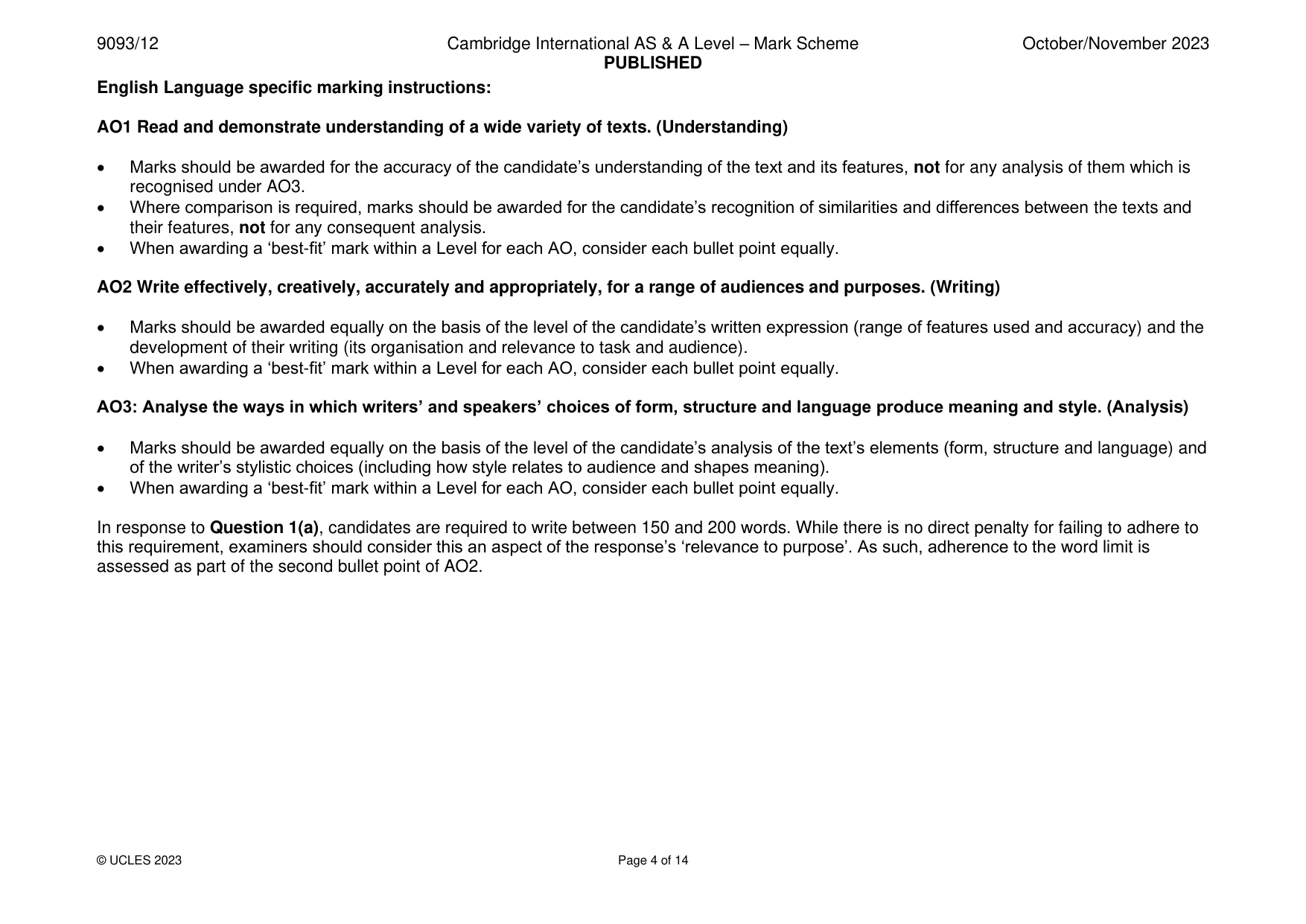
9093/12 Cambridge International AS & A Level – Mark Scheme PUBLISHED October/November 2023 © UCLES 2023 Page 4 of 14 English Language specific marking instructions: AO1 Read and demonstrate understanding of a wide variety of texts. (Understanding) • Marks should be awarded for the accuracy of the candidate’s understanding of the text and its features, not for any analysis of them which is recognised under AO3. • Where comparison is required, marks should be awarded for the candidate’s recognition of similarities and differences between the texts and their features, not for any consequent analysis. • When awarding a ‘best-fit’ mark within a Level for each AO, consider each bullet point equally. AO2 Write effectively, creatively, accurately and appropriately, for a range of audiences and purposes. (Writing) • Marks should be awarded equally on the basis of the level of the candidate’s written expression (range of features used and accuracy) and the development of their writing (its organisation and relevance to task and audience). • When awarding a ‘best-fit’ mark within a Level for each AO, consider each bullet point equally. AO3: Analyse the ways in which writers’ and speakers’ choices of form, structure and language produce meaning and style. (Analysis) • Marks should be awarded equally on the basis of the level of the candidate’s analysis of the text’s elements (form, structure and language) and of the writer’s stylistic choices (including how style relates to audience and shapes meaning). • When awarding a ‘best-fit’ mark within a Level for each AO, consider each bullet point equally. In response to Question 1(a), candidates are required to write between 150 and 200 words. While there is no direct penalty for failing to adhere to this requirement, examiners should consider this an aspect of the response’s ‘relevance to purpose’. As such, adherence to the word limit is assessed as part of the second bullet point of AO2.
Mark scheme, page 5
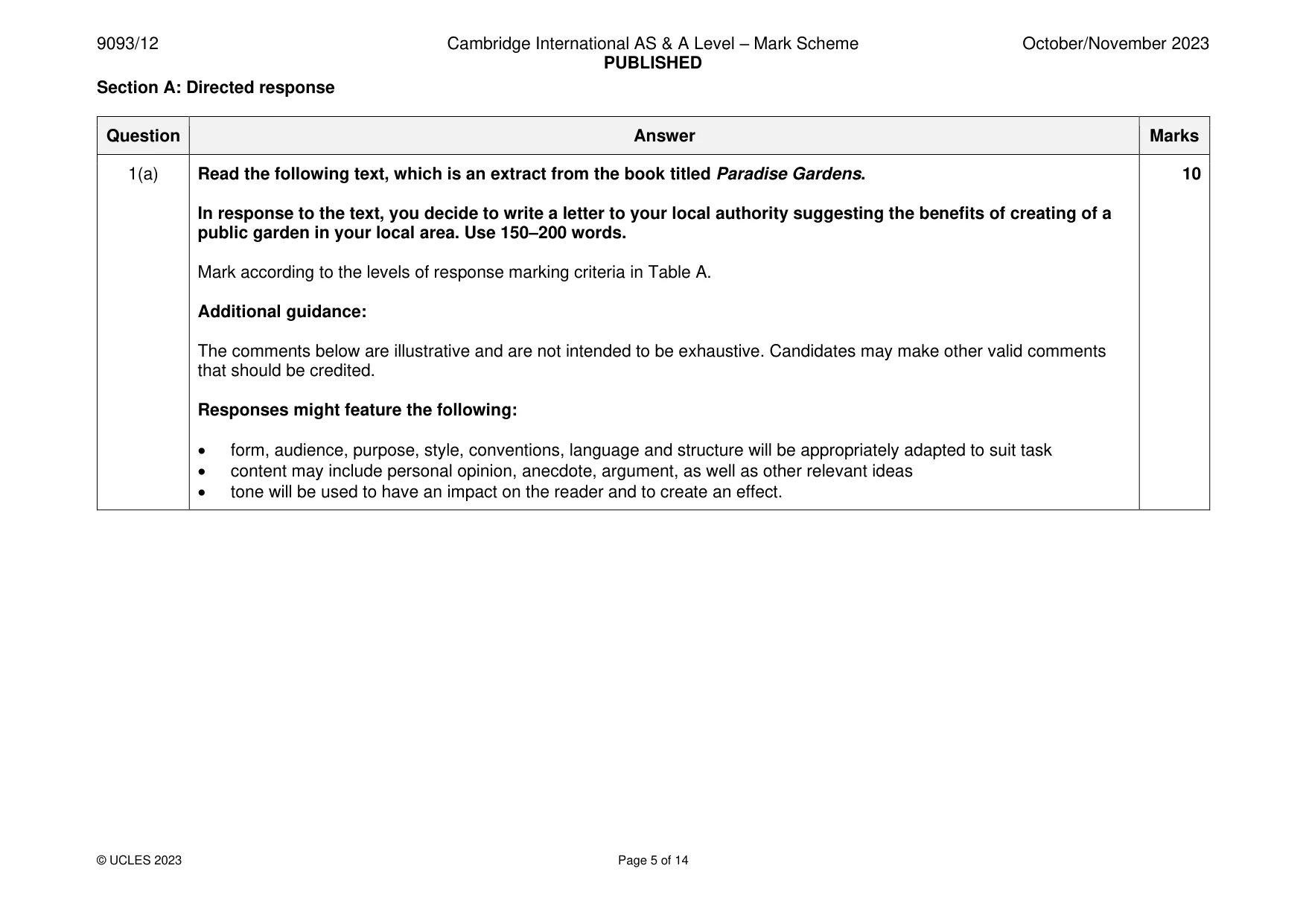
9093/12 Cambridge International AS & A Level – Mark Scheme PUBLISHED October/November 2023 © UCLES 2023 Page 5 of 14 Section A: Directed response Question Answer Marks 1(a) Read the following text, which is an extract from the book titled Paradise Gardens. In response to the text, you decide to write a letter to your local authority suggesting the benefits of creating of a public garden in your local area. Use 150–200 words. Mark according to the levels of response marking criteria in Table A. Additional guidance: The comments below are illustrative and are not intended to be exhaustive. Candidates may make other valid comments that should be credited. Responses might feature the following: • form, audience, purpose, style, conventions, language and structure will be appropriately adapted to suit task • content may include personal opinion, anecdote, argument, as well as other relevant ideas • tone will be used to have an impact on the reader and to create an effect. 10
Mark scheme, page 6
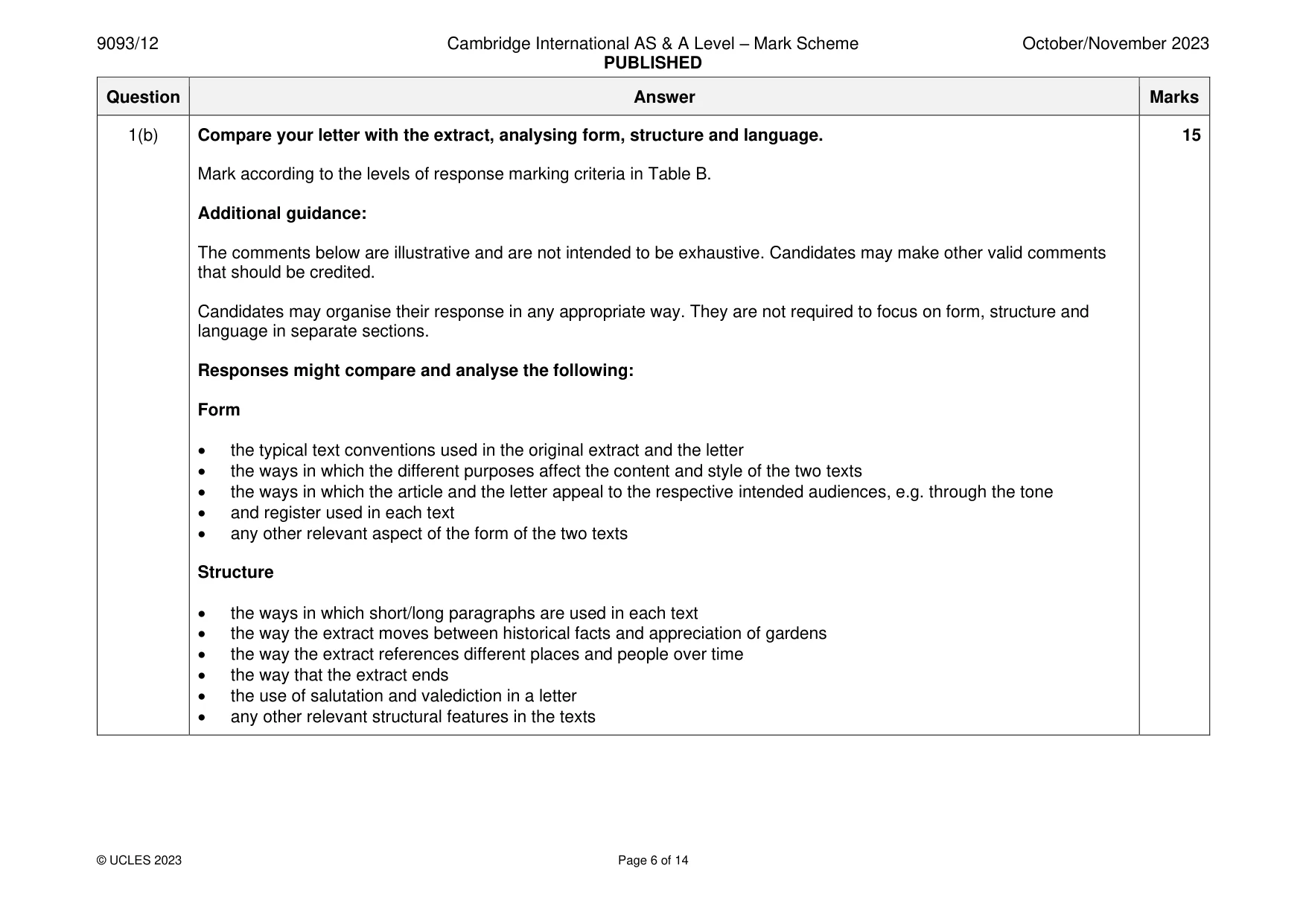
9093/12 Cambridge International AS & A Level – Mark Scheme PUBLISHED October/November 2023 © UCLES 2023 Page 6 of 14 Question Answer Marks 1(b) Compare your letter with the extract, analysing form, structure and language. Mark according to the levels of response marking criteria in Table B. Additional guidance: The comments below are illustrative and are not intended to be exhaustive. Candidates may make other valid comments that should be credited. Candidates may organise their response in any appropriate way. They are not required to focus on form, structure and language in separate sections. Responses might compare and analyse the following: Form • the typical text conventions used in the original extract and the letter • the ways in which the different purposes affect the content and style of the two texts • the ways in which the article and the letter appeal to the respective intended audiences, e.g. through the tone • and register used in each text • any other relevant aspect of the form of the two texts Structure • the ways in which short/long paragraphs are used in each text • the way the extract moves between historical facts and appreciation of gardens • the way the extract references different places and people over time • the way that the extract ends • the use of salutation and valediction in a letter • any other relevant structural features in the texts 15
Mark scheme, page 7
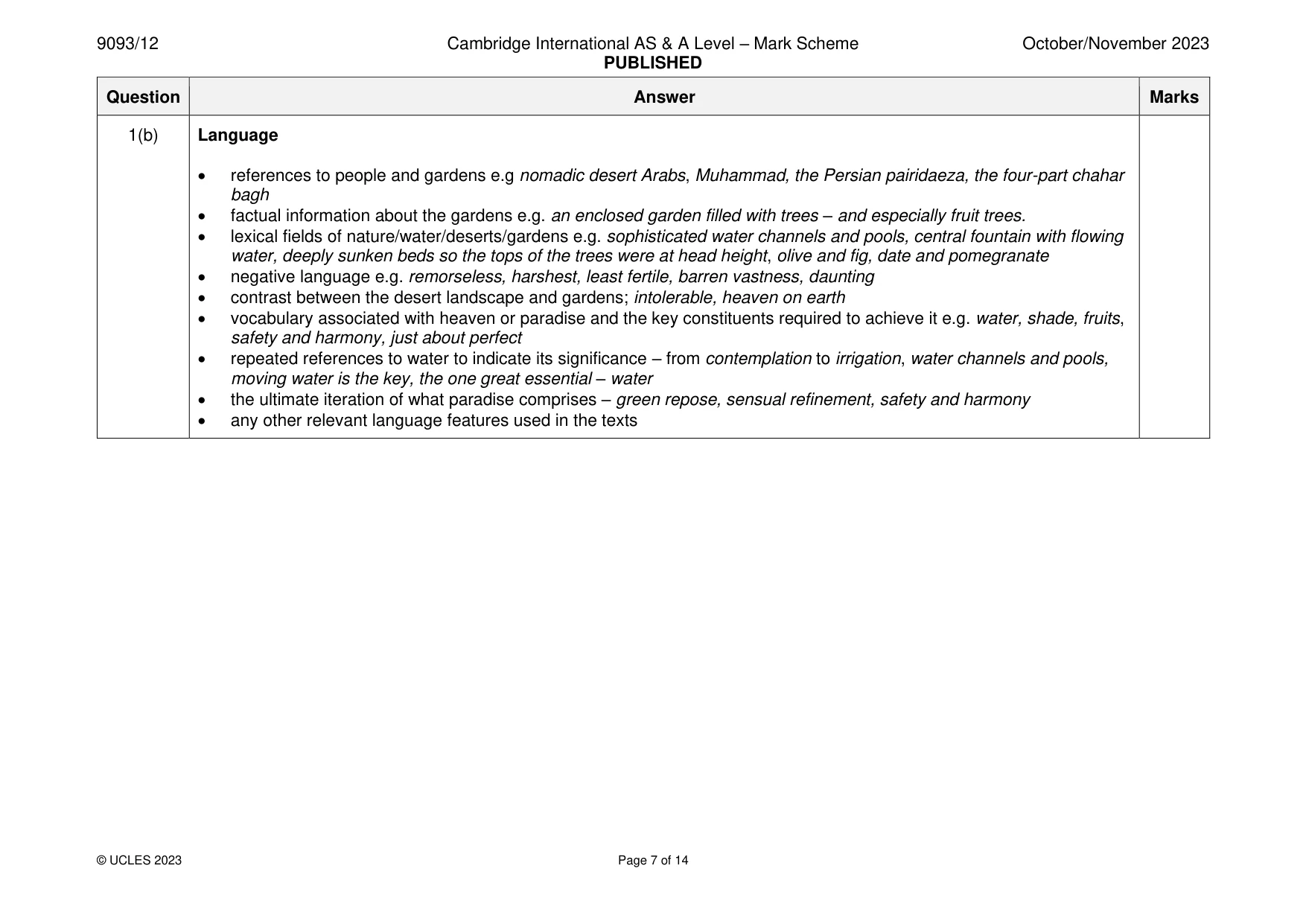
9093/12 Cambridge International AS & A Level – Mark Scheme PUBLISHED October/November 2023 © UCLES 2023 Page 7 of 14 Question Answer Marks 1(b) Language • references to people and gardens e.g nomadic desert Arabs, Muhammad, the Persian pairidaeza, the four-part chahar bagh • factual information about the gardens e.g. an enclosed garden filled with trees – and especially fruit trees. • lexical fields of nature/water/deserts/gardens e.g. sophisticated water channels and pools, central fountain with flowing water, deeply sunken beds so the tops of the trees were at head height, olive and fig, date and pomegranate • negative language e.g. remorseless, harshest, least fertile, barren vastness, daunting • contrast between the desert landscape and gardens; intolerable, heaven on earth • vocabulary associated with heaven or paradise and the key constituents required to achieve it e.g. water, shade, fruits, safety and harmony, just about perfect • repeated references to water to indicate its significance – from contemplation to irrigation, water channels and pools, moving water is the key, the one great essential – water • the ultimate iteration of what paradise comprises – green repose, sensual refinement, safety and harmony • any other relevant language features used in the texts
Mark scheme, page 8
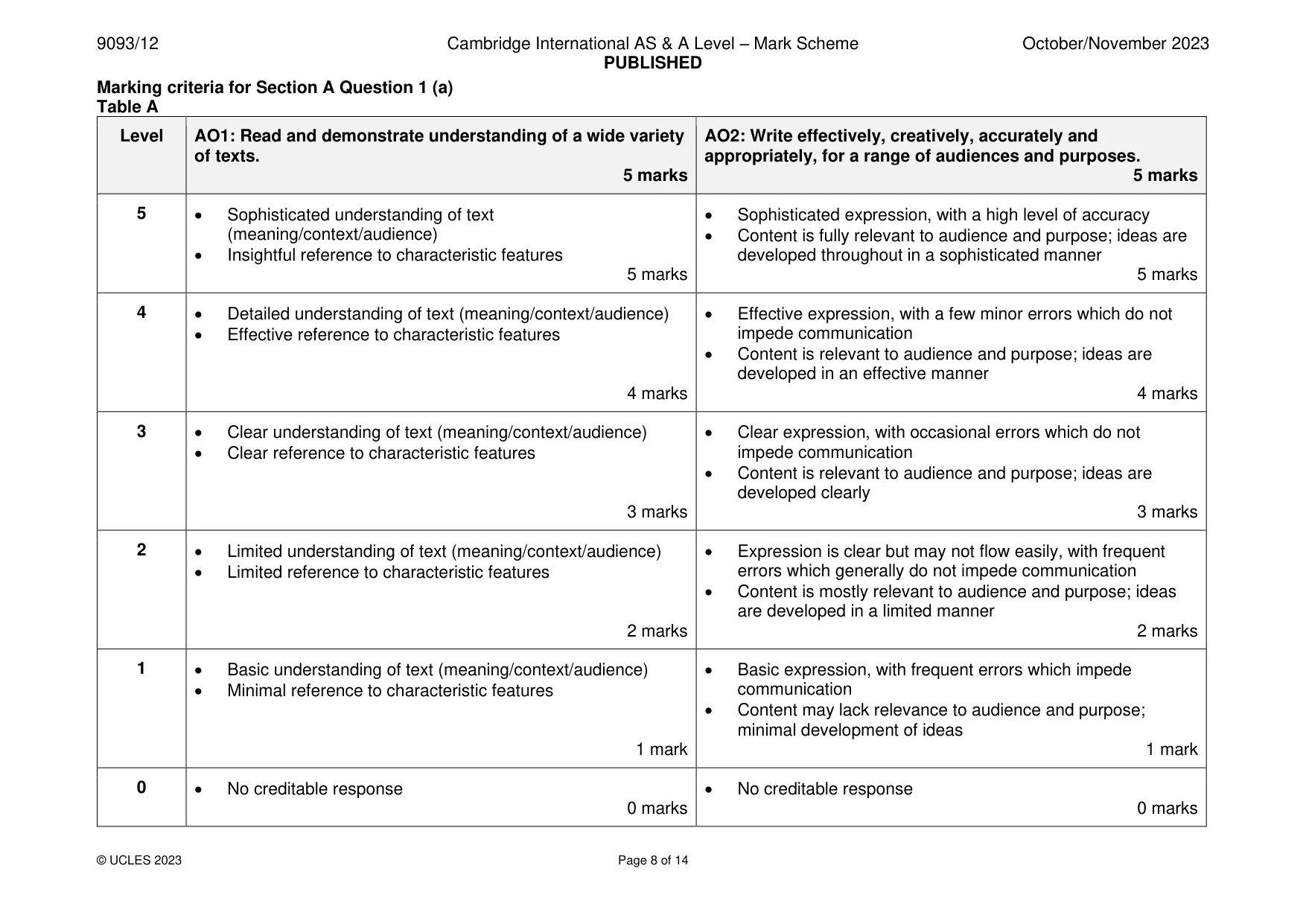
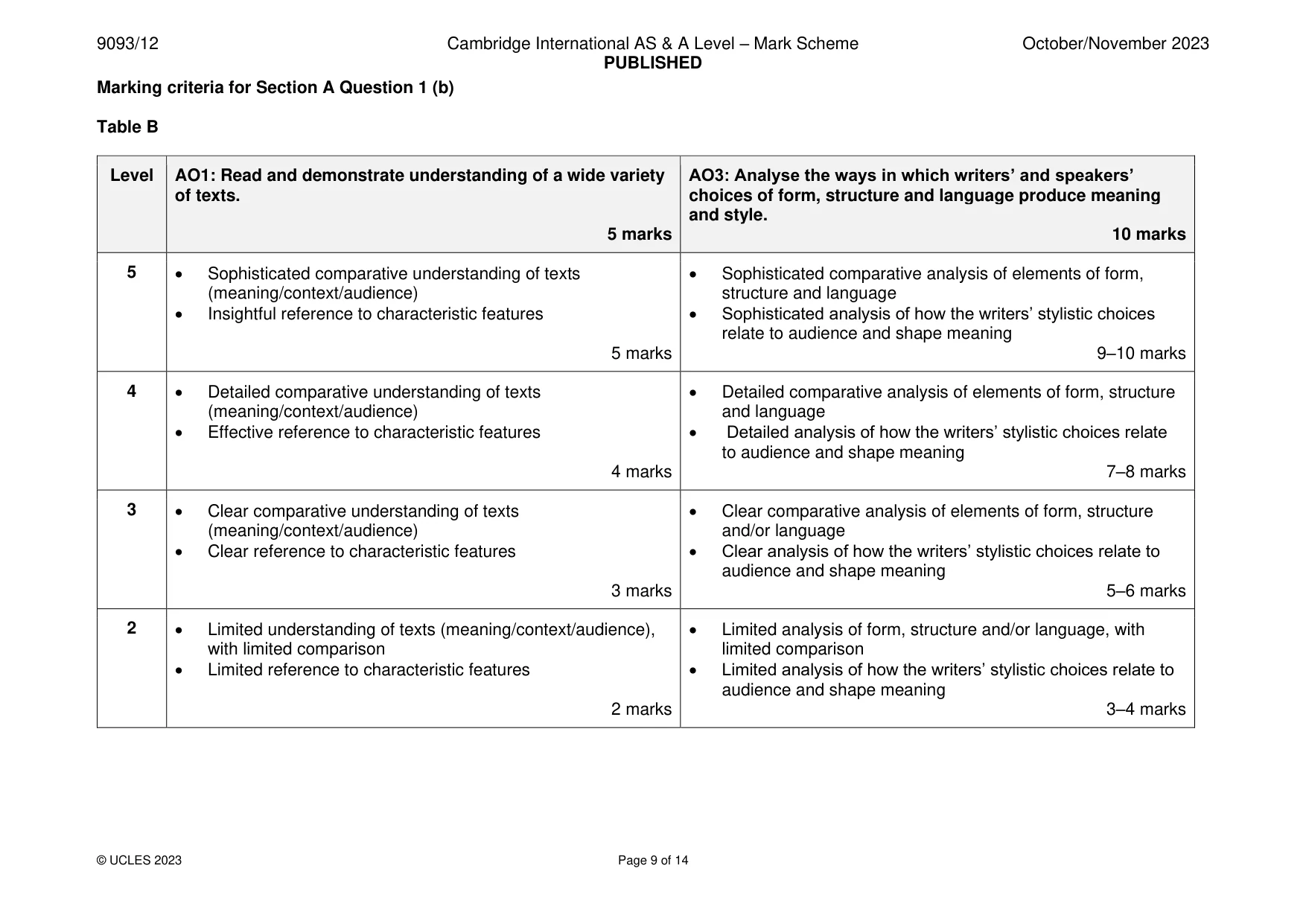
9093/12 Cambridge International AS & A Level – Mark Scheme PUBLISHED October/November 2023 © UCLES 2023 Page 8 of 14 Marking criteria for Section A Question 1 (a) Table A Level AO1: Read and demonstrate understanding of a wide variety of texts. 5 marks AO2: Write effectively, creatively, accurately and appropriately, for a range of audiences and purposes. 5 marks 5 • Sophisticated understanding of text (meaning/context/audience) • Insightful reference to characteristic features 5 marks • Sophisticated expression, with a high level of accuracy • Content is fully relevant to audience and purpose; ideas are developed throughout in a sophisticated manner 5 marks 4 • Detailed understanding of text (meaning/context/audience) • Effective reference to characteristic features 4 marks • Effective expression, with a few minor errors which do not impede communication • Content is relevant to audience and purpose; ideas are developed in an effective manner 4 marks 3 • Clear understanding of text (meaning/context/audience) • Clear reference to characteristic features 3 marks • Clear expression, with occasional errors which do not impede communication • Content is relevant to audience and purpose; ideas are developed clearly 3 marks 2 • Limited understanding of text (meaning/context/audience) • Limited reference to characteristic features 2 marks • Expression is clear but may not flow easily, with frequent errors which generally do not impede communication • Content is mostly relevant to audience and purpose; ideas are developed in a limited manner 2 marks 1 • Basic understanding of text (meaning/context/audience) • Minimal reference to characteristic features 1 mark • Basic expression, with frequent errors which impede communication • Content may lack relevance to audience and purpose; minimal development of ideas 1 mark 0 • No creditable response 0 marks • No creditable response 0 marks
Mark scheme, page 9
9093/12 Cambridge International AS & A Level – Mark Scheme PUBLISHED October/November 2023 © UCLES 2023 Page 9 of 14 Marking criteria for Section A Question 1 (b) Table B Level AO1: Read and demonstrate understanding of a wide variety of texts. 5 marks AO3: Analyse the ways in which writers’ and speakers’ choices of form, structure and language produce meaning and style. 10 marks 5 • Sophisticated comparative understanding of texts (meaning/context/audience) • Insightful reference to characteristic features 5 marks • Sophisticated comparative analysis of elements of form, structure and language • Sophisticated analysis of how the writers’ stylistic choices relate to audience and shape meaning 9–10 marks 4 • Detailed comparative understanding of texts (meaning/context/audience) • Effective reference to characteristic features 4 marks • Detailed comparative analysis of elements of form, structure and language • Detailed analysis of how the writers’ stylistic choices relate to audience and shape meaning 7–8 marks 3 • Clear comparative understanding of texts (meaning/context/audience) • Clear reference to characteristic features 3 marks • Clear comparative analysis of elements of form, structure and/or language • Clear analysis of how the writers’ stylistic choices relate to audience and shape meaning 5–6 marks 2 • Limited understanding of texts (meaning/context/audience), with limited comparison • Limited reference to characteristic features 2 marks • Limited analysis of form, structure and/or language, with limited comparison • Limited analysis of how the writers’ stylistic choices relate to audience and shape meaning 3–4 marks
Mark scheme, page 10
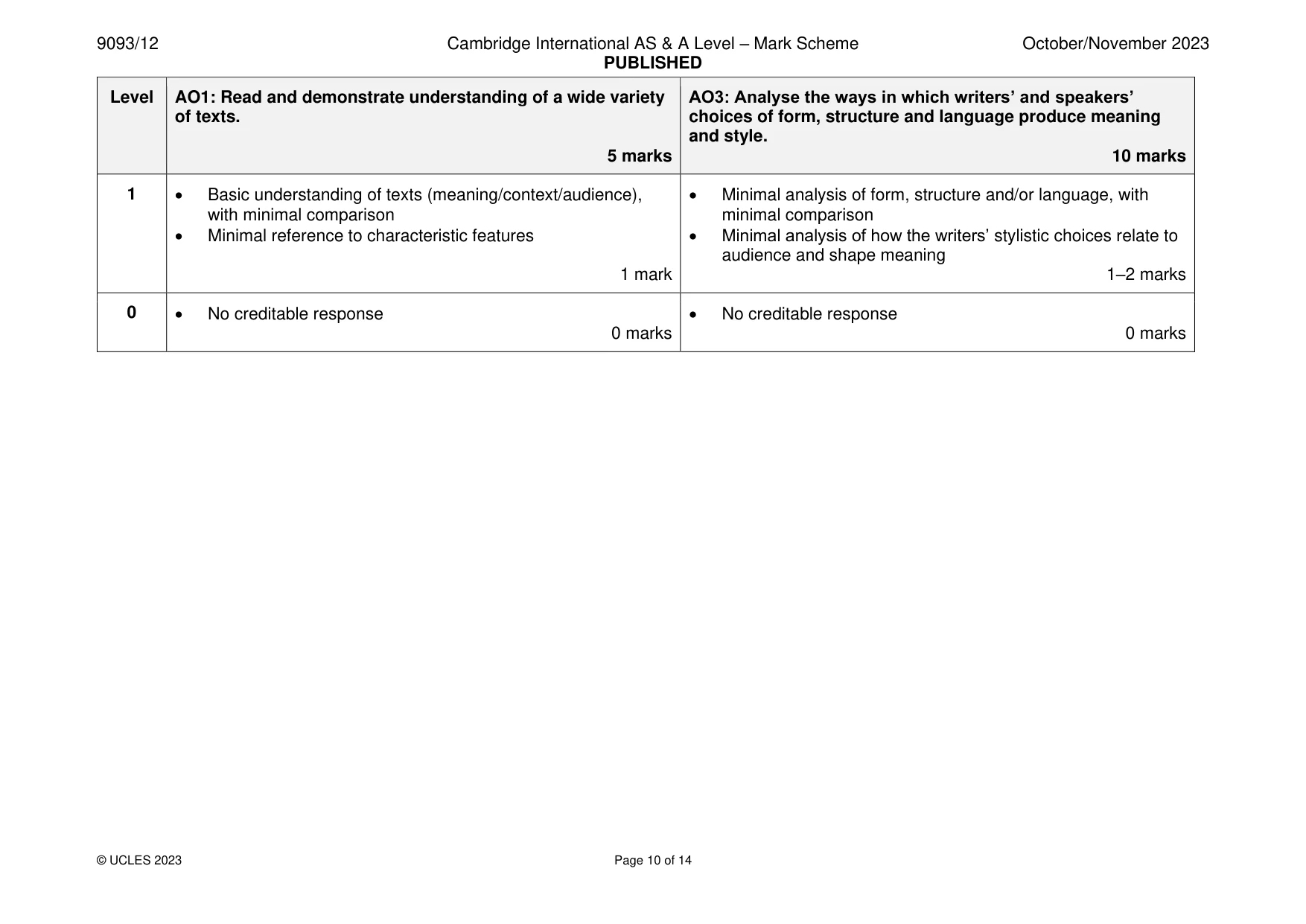
9093/12 Cambridge International AS & A Level – Mark Scheme PUBLISHED October/November 2023 © UCLES 2023 Page 10 of 14 Level AO1: Read and demonstrate understanding of a wide variety of texts. 5 marks AO3: Analyse the ways in which writers’ and speakers’ choices of form, structure and language produce meaning and style. 10 marks 1 • Basic understanding of texts (meaning/context/audience), with minimal comparison • Minimal reference to characteristic features 1 mark • Minimal analysis of form, structure and/or language, with minimal comparison • Minimal analysis of how the writers’ stylistic choices relate to audience and shape meaning 1–2 marks 0 • No creditable response 0 marks • No creditable response 0 marks
Mark scheme, page 11
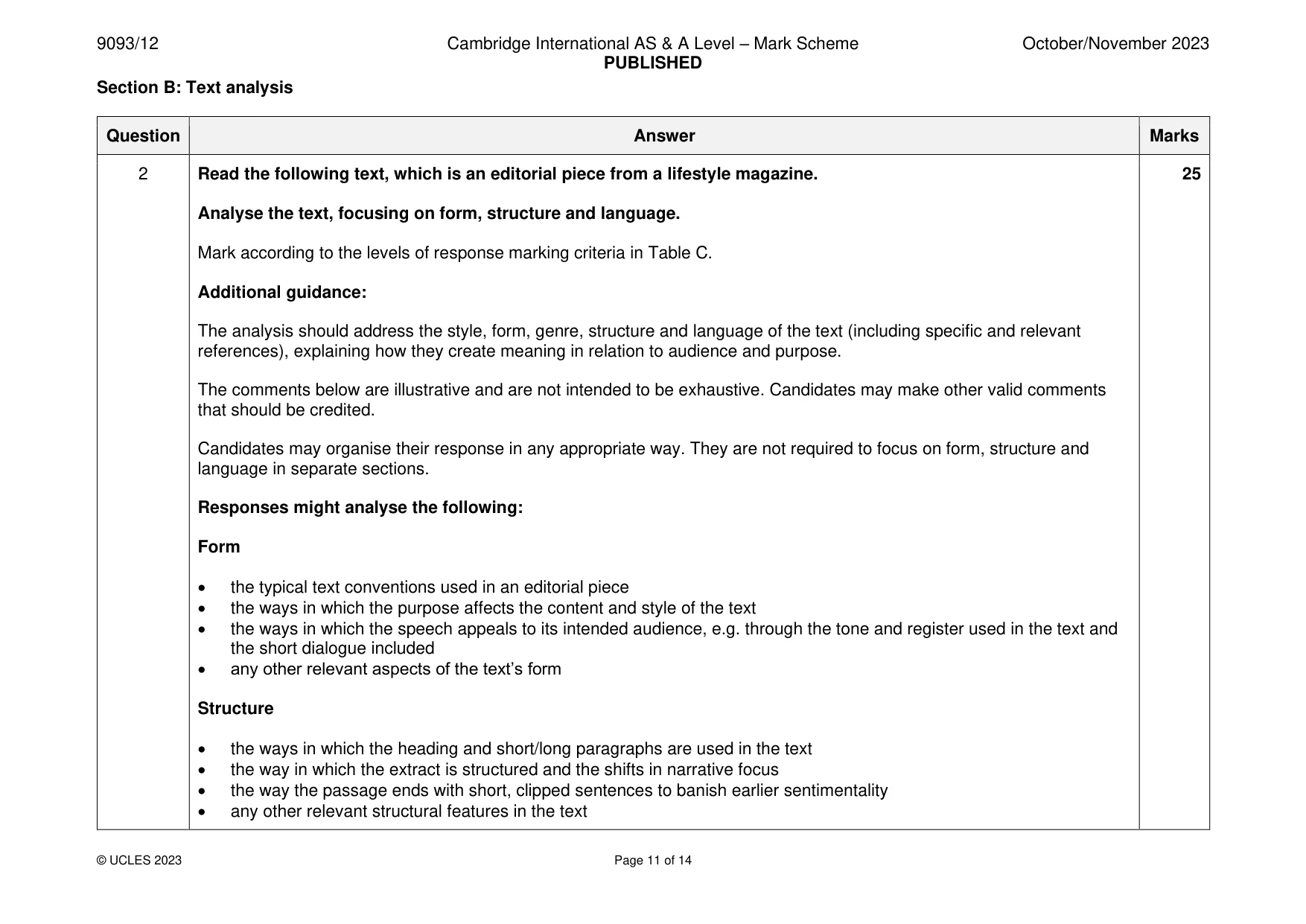
9093/12 Cambridge International AS & A Level – Mark Scheme PUBLISHED October/November 2023 © UCLES 2023 Page 11 of 14 Section B: Text analysis Question Answer Marks 2 Read the following text, which is an editorial piece from a lifestyle magazine. Analyse the text, focusing on form, structure and language. Mark according to the levels of response marking criteria in Table C. Additional guidance: The analysis should address the style, form, genre, structure and language of the text (including specific and relevant references), explaining how they create meaning in relation to audience and purpose. The comments below are illustrative and are not intended to be exhaustive. Candidates may make other valid comments that should be credited. Candidates may organise their response in any appropriate way. They are not required to focus on form, structure and language in separate sections. Responses might analyse the following: Form • the typical text conventions used in an editorial piece • the ways in which the purpose affects the content and style of the text • the ways in which the speech appeals to its intended audience, e.g. through the tone and register used in the text and the short dialogue included • any other relevant aspects of the text’s form Structure • the ways in which the heading and short/long paragraphs are used in the text • the way in which the extract is structured and the shifts in narrative focus • the way the passage ends with short, clipped sentences to banish earlier sentimentality • any other relevant structural features in the text 25
Mark scheme, page 12
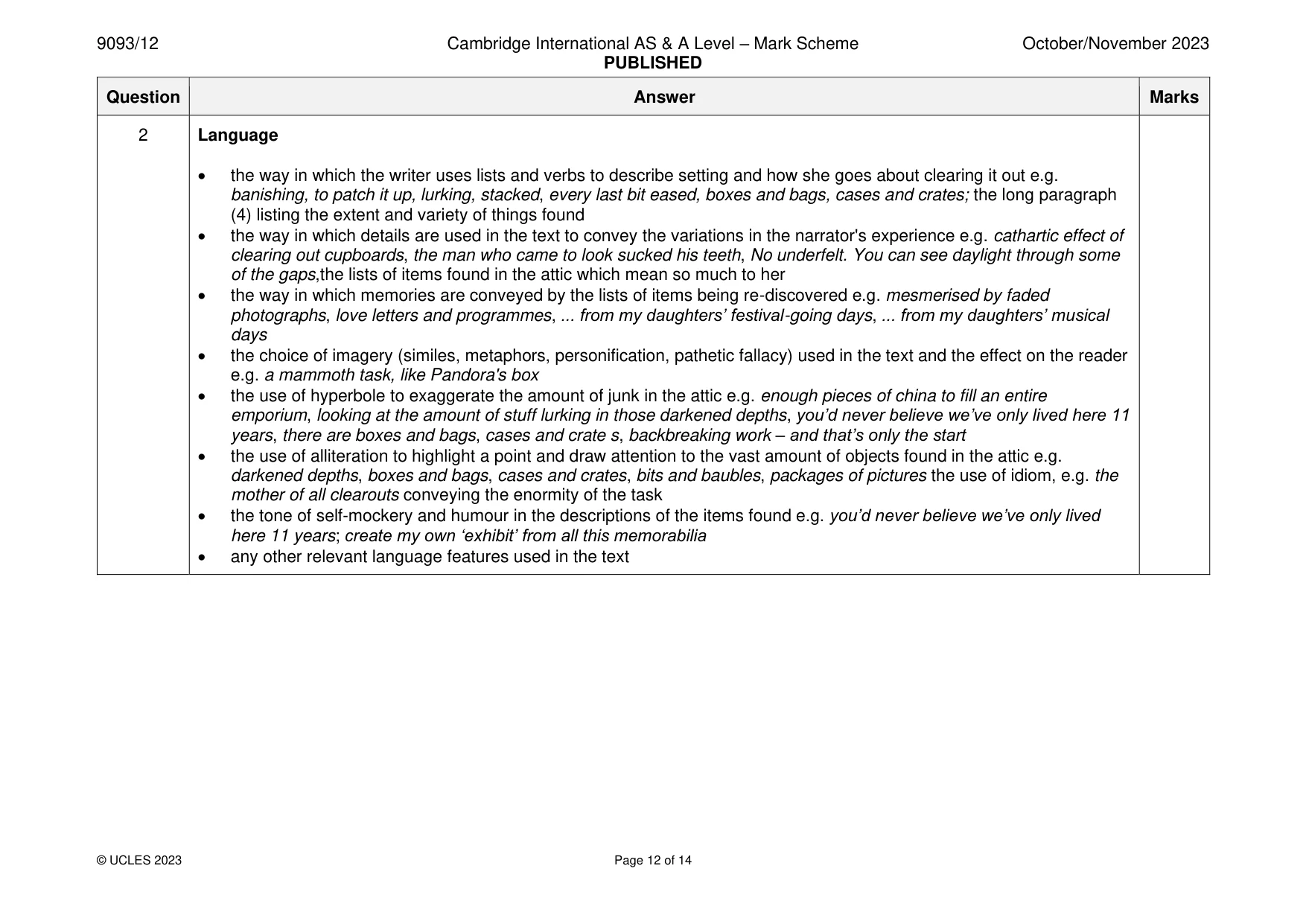
9093/12 Cambridge International AS & A Level – Mark Scheme PUBLISHED October/November 2023 © UCLES 2023 Page 12 of 14 Question Answer Marks 2 Language • the way in which the writer uses lists and verbs to describe setting and how she goes about clearing it out e.g. banishing, to patch it up, lurking, stacked, every last bit eased, boxes and bags, cases and crates; the long paragraph (4) listing the extent and variety of things found • the way in which details are used in the text to convey the variations in the narrator's experience e.g. cathartic effect of clearing out cupboards, the man who came to look sucked his teeth, No underfelt. You can see daylight through some of the gaps,the lists of items found in the attic which mean so much to her • the way in which memories are conveyed by the lists of items being re-discovered e.g. mesmerised by faded photographs, love letters and programmes, ... from my daughters’ festival-going days, ... from my daughters’ musical days • the choice of imagery (similes, metaphors, personification, pathetic fallacy) used in the text and the effect on the reader e.g. a mammoth task, like Pandora's box • the use of hyperbole to exaggerate the amount of junk in the attic e.g. enough pieces of china to fill an entire emporium, looking at the amount of stuff lurking in those darkened depths, you’d never believe we’ve only lived here 11 years, there are boxes and bags, cases and crate s, backbreaking work – and that’s only the start • the use of alliteration to highlight a point and draw attention to the vast amount of objects found in the attic e.g. darkened depths, boxes and bags, cases and crates, bits and baubles, packages of pictures the use of idiom, e.g. the mother of all clearouts conveying the enormity of the task • the tone of self-mockery and humour in the descriptions of the items found e.g. you’d never believe we’ve only lived here 11 years; create my own ‘exhibit’ from all this memorabilia • any other relevant language features used in the text
Mark scheme, page 13
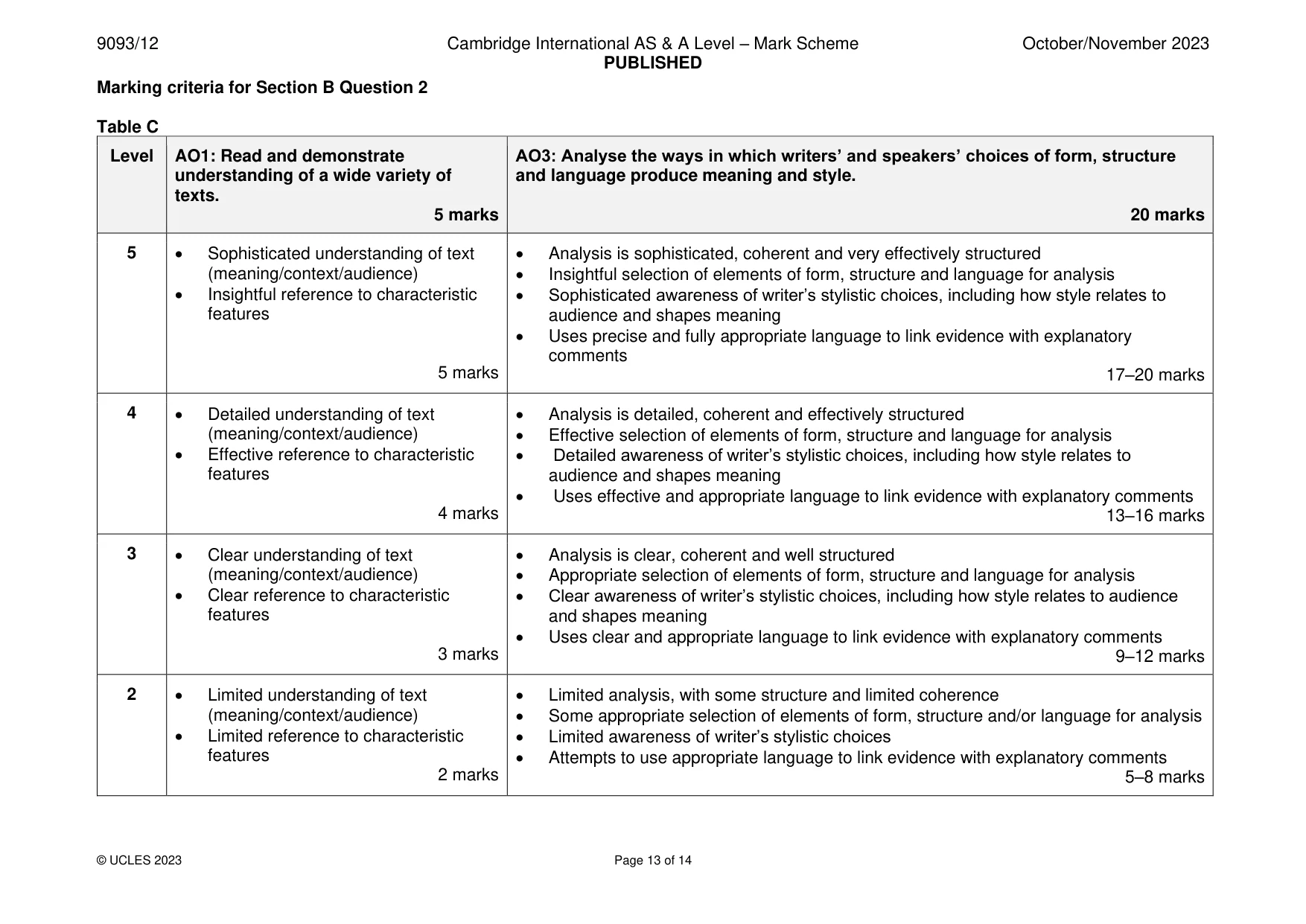
9093/12 Cambridge International AS & A Level – Mark Scheme PUBLISHED October/November 2023 © UCLES 2023 Page 13 of 14 Marking criteria for Section B Question 2 Table C Level AO1: Read and demonstrate understanding of a wide variety of texts. 5 marks AO3: Analyse the ways in which writers’ and speakers’ choices of form, structure and language produce meaning and style. 20 marks 5 • Sophisticated understanding of text (meaning/context/audience) • Insightful reference to characteristic features 5 marks • Analysis is sophisticated, coherent and very effectively structured • Insightful selection of elements of form, structure and language for analysis • Sophisticated awareness of writer’s stylistic choices, including how style relates to audience and shapes meaning • Uses precise and fully appropriate language to link evidence with explanatory comments 17–20 marks 4 • Detailed understanding of text (meaning/context/audience) • Effective reference to characteristic features 4 marks • Analysis is detailed, coherent and effectively structured • Effective selection of elements of form, structure and language for analysis • Detailed awareness of writer’s stylistic choices, including how style relates to audience and shapes meaning • Uses effective and appropriate language to link evidence with explanatory comments 13–16 marks 3 • Clear understanding of text (meaning/context/audience) • Clear reference to characteristic features 3 marks • Analysis is clear, coherent and well structured • Appropriate selection of elements of form, structure and language for analysis • Clear awareness of writer’s stylistic choices, including how style relates to audience and shapes meaning • Uses clear and appropriate language to link evidence with explanatory comments 9–12 marks 2 • Limited understanding of text (meaning/context/audience) • Limited reference to characteristic features 2 marks • Limited analysis, with some structure and limited coherence • Some appropriate selection of elements of form, structure and/or language for analysis • Limited awareness of writer’s stylistic choices • Attempts to use appropriate language to link evidence with explanatory comments 5–8 marks
Mark scheme, page 14
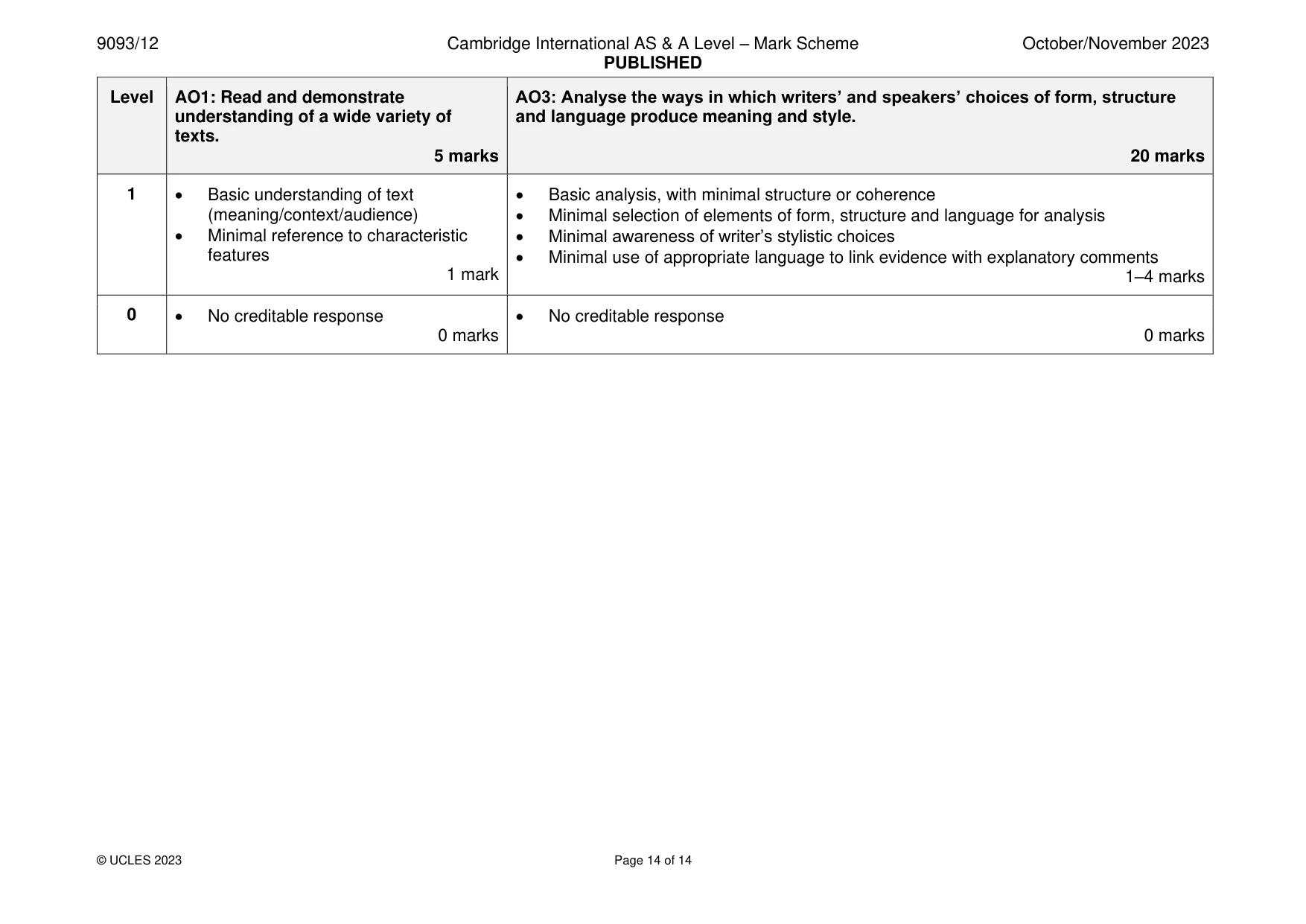
9093/12 Cambridge International AS & A Level – Mark Scheme PUBLISHED October/November 2023 © UCLES 2023 Page 14 of 14 Level AO1: Read and demonstrate understanding of a wide variety of texts. 5 marks AO3: Analyse the ways in which writers’ and speakers’ choices of form, structure and language produce meaning and style. 20 marks 1 • Basic understanding of text (meaning/context/audience) • Minimal reference to characteristic features 1 mark • Basic analysis, with minimal structure or coherence • Minimal selection of elements of form, structure and language for analysis • Minimal awareness of writer’s stylistic choices • Minimal use of appropriate language to link evidence with explanatory comments 1–4 marks 0 • No creditable response 0 marks • No creditable response 0 marks
What you needed in this session
Cambridge’s own grade thresholds for 2023 Oct/Nov, Paper 1 · Variant 2. A higher threshold means an easier paper — the bar moves with how the cohort did.