Cambridge A Level English - Language AS and A Level (from 2014) 9093 — 2022 Feb/March Paper 1 · Variant 2
9093/12/F/M/22 · 50 marks · ≈56 min
The question paper and its mark scheme, free to read here and free to download. This is Cambridge’s own paper, exactly as it was sat.
Question paper8 pages
Mark scheme13 pages
Answers below. Sit the paper first if you are practising.
Paper as text
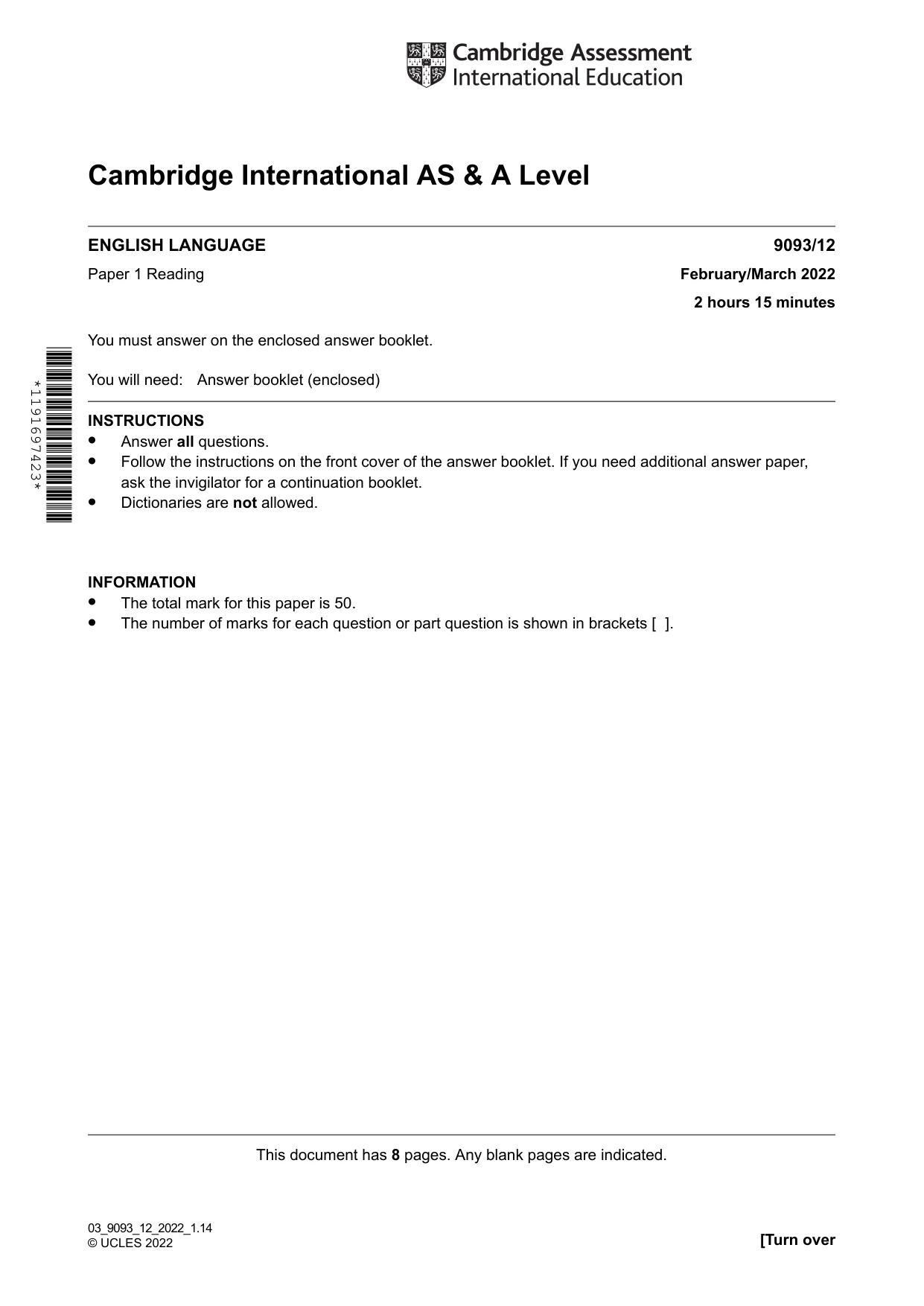
Question paper, page 1
Cambridge International AS & A Level 9093/12 February/March 2022 2 hours 15 minutes ENGLISH LANGUAGE Paper 1 Reading You must answer on the enclosed answer booklet. You will need: Answer booklet (enclosed) INSTRUCTIONS • Answer all questions. • Follow the instructions on the front cover of the answer booklet. If you need additional answer paper, ask the invigilator for a continuation booklet. • Dictionaries are not allowed. INFORMATION • The total mark for this paper is 50. • The number of marks for each question or part question is shown in brackets [ ]. This document has 8 pages. Any blank pages are indicated. [Turn over 03_9093_12_2022_1.14 © UCLES 2022 *1191697423*
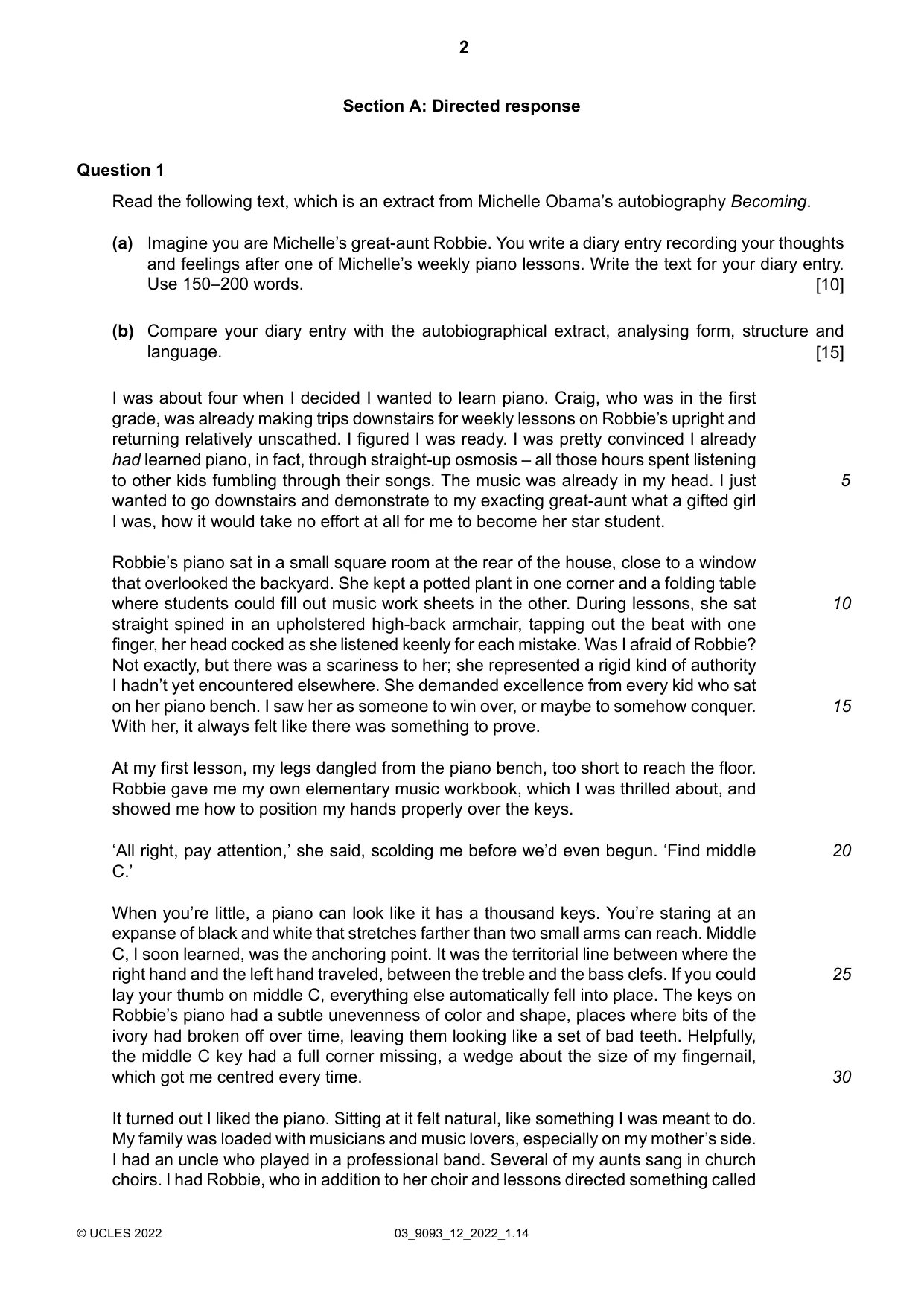
Question paper, page 2
30 25 20 15 10 5 Section A: Directed response Question 1 Read the following text, which is an extract from Michelle Obama’s autobiography Becoming. Imagine you are Michelle’s great-aunt Robbie. You write a diary entry recording your thoughts and feelings after one of Michelle’s weekly piano lessons. Write the text for your diary entry. Use 150–200 words. [10] (a) Compare your diary entry with the autobiographical extract, analysing form, structure and language. [15] (b) I was about four when I decided I wanted to learn piano. Craig, who was in the first grade, was already making trips downstairs for weekly lessons on Robbie’s upright and returning relatively unscathed. I figured I was ready. I was pretty convinced I already had learned piano, in fact, through straight-up osmosis – all those hours spent listening to other kids fumbling through their songs. The music was already in my head. I just wanted to go downstairs and demonstrate to my exacting great-aunt what a gifted girl I was, how it would take no effort at all for me to become her star student. Robbie’s piano sat in a small square room at the rear of the house, close to a window that overlooked the backyard. She kept a potted plant in one corner and a folding table where students could fill out music work sheets in the other. During lessons, she sat straight spined in an upholstered high-back armchair, tapping out the beat with one finger, her head cocked as she listened keenly for each mistake. Was I afraid of Robbie? Not exactly, but there was a scariness to her; she represented a rigid kind of authority I hadn’t yet encountered elsewhere. She demanded excellence from every kid who sat on her piano bench. I saw her as someone to win over, or maybe to somehow conquer. With her, it always felt like there was something to prove. At my first lesson, my legs dangled from the piano bench, too short to reach the floor. Robbie gave me my own elementary music workbook, which I was thrilled about, and showed me how to position my hands properly over the keys. ‘All right, pay attention,’ she said, scolding me before we’d even begun. ‘Find middle C.’ When you’re little, a piano can look like it has a thousand keys. You’re staring at an expanse of black and white that stretches farther than two small arms can reach. Middle C, I soon learned, was the anchoring point. It was the territorial line between where the right hand and the left hand traveled, between the treble and the bass clefs. If you could lay your thumb on middle C, everything else automatically fell into place. The keys on Robbie’s piano had a subtle unevenness of color and shape, places where bits of the ivory had broken off over time, leaving them looking like a set of bad teeth. Helpfully, the middle C key had a full corner missing, a wedge about the size of my fingernail, which got me centred every time. It turned out I liked the piano. Sitting at it felt natural, like something I was meant to do. My family was loaded with musicians and music lovers, especially on my mother’s side. I had an uncle who played in a professional band. Several of my aunts sang in church choirs. I had Robbie, who in addition to her choir and lessons directed something called 03_9093_12_2022_1.14 © UCLES 2022 2
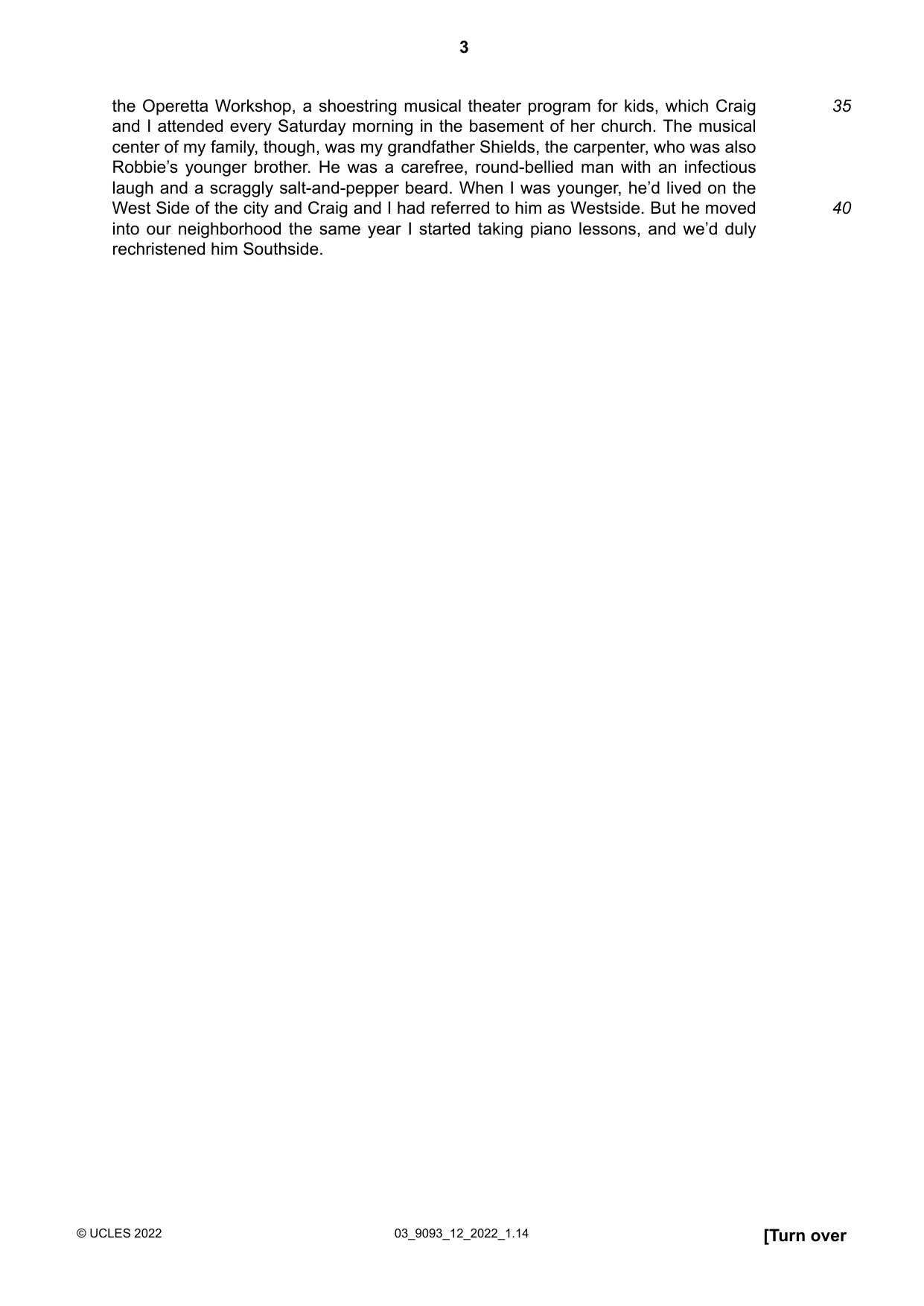
Question paper, page 3
40 35 the Operetta Workshop, a shoestring musical theater program for kids, which Craig and I attended every Saturday morning in the basement of her church. The musical center of my family, though, was my grandfather Shields, the carpenter, who was also Robbie’s younger brother. He was a carefree, round-bellied man with an infectious laugh and a scraggly salt-and-pepper beard. When I was younger, he’d lived on the West Side of the city and Craig and I had referred to him as Westside. But he moved into our neighborhood the same year I started taking piano lessons, and we’d duly rechristened him Southside. [Turn over 03_9093_12_2022_1.14 © UCLES 2022 3
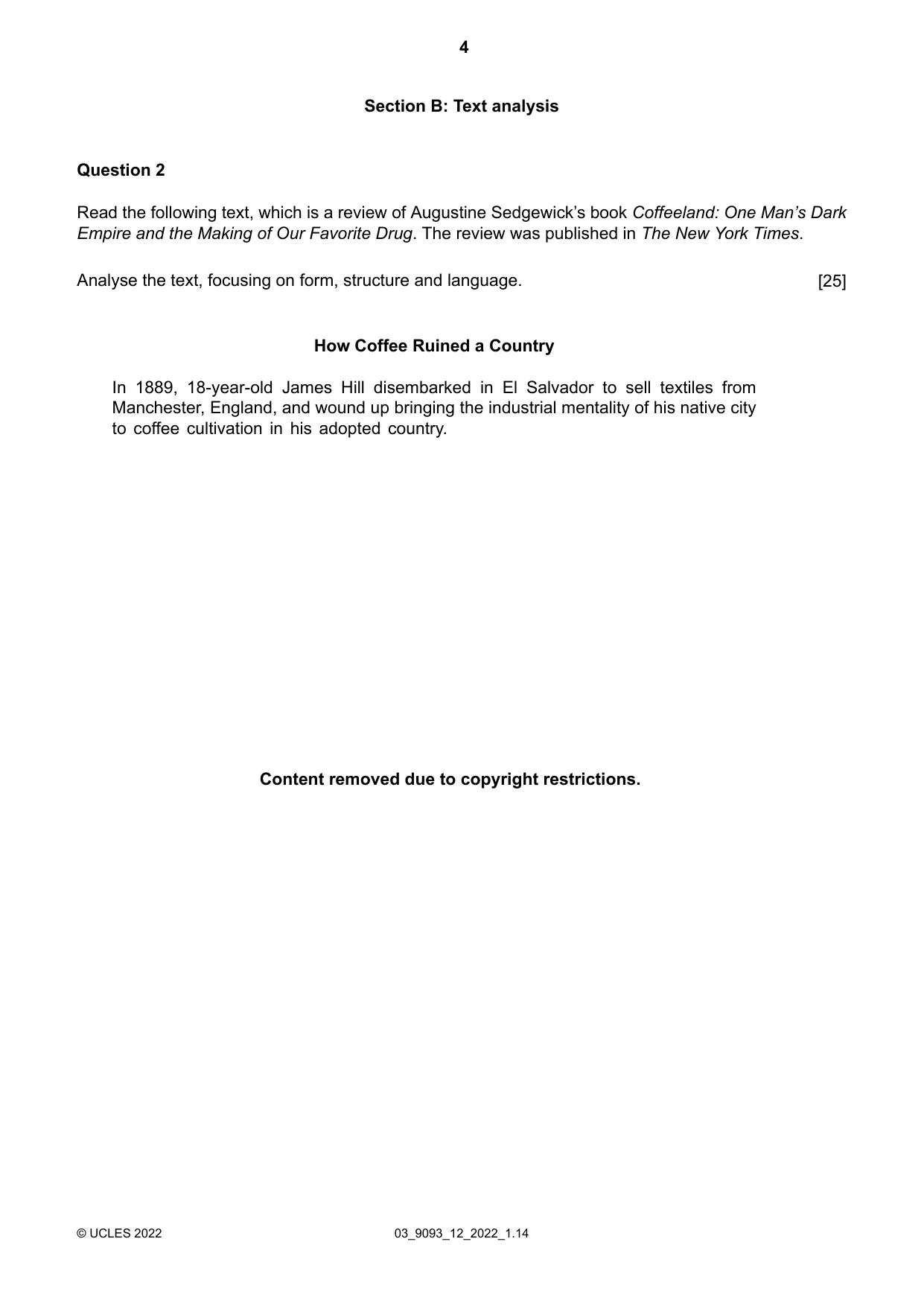
Question paper, page 4
Section B: Text analysis Question 2 Read the following text, which is a review of Augustine Sedgewick’s book Coffeeland: One Man’s Dark Empire and the Making of Our Favorite Drug. The review was published in The New York Times. Analyse the text, focusing on form, structure and language. [25] How Coffee Ruined a Country In 1889, 18-year-old James Hill disembarked in El Salvador to sell textiles from Manchester, England, and wound up bringing the industrial mentality of his native city to coffee cultivation in his adopted country. 03_9093_12_2022_1.14 © UCLES 2022 4 Content removed due to copyright restrictions.
Question paper, page 5
Sedgewick’s satisfying brew made me thirstier for an even bolder blend. 03_9093_12_2022_1.14 © UCLES 2022 5 Content removed due to copyright restrictions.
Question paper, page 6
BLANK PAGE 03_9093_12_2022_1.14 © UCLES 2022 6
Question paper, page 7
BLANK PAGE 03_9093_12_2022_1.14 © UCLES 2022 7
Question paper, page 8
BLANK PAGE Permission to reproduce items where third-party owned material protected by copyright is included has been sought and cleared where possible. Every reasonable effort has been made by the publisher (UCLES) to trace copyright holders, but if any items requiring clearance have unwittingly been included, the publisher will be pleased to make amends at the earliest possible opportunity. To avoid the issue of disclosure of answer-related information to candidates, all copyright acknowledgements are reproduced online in the Cambridge Assessment International Education Copyright Acknowledgements Booklet. This is produced for each series of examinations and is freely available to download at www.cambridgeinternational.org after the live examination series. Cambridge Assessment International Education is part of Cambridge Assessment. Cambridge Assessment is the brand name of the University of Cambridge Local Examinations Syndicate (UCLES), which is a department of the University of Cambridge. 03_9093_12_2022_1.14 © UCLES 2022 8
Mark scheme, page 1
This document consists of 13 printed pages. © UCLES 2022 [Turn over Cambridge International AS & A Level ENGLISH LANGUAGE 9093/12 Paper 1 Reading February/March 2022 MARK SCHEME Maximum Mark: 50 Published This mark scheme is published as an aid to teachers and candidates, to indicate the requirements of the examination. It shows the basis on which Examiners were instructed to award marks. It does not indicate the details of the discussions that took place at an Examiners’ meeting before marking began, which would have considered the acceptability of alternative answers. Mark schemes should be read in conjunction with the question paper and the Principal Examiner Report for Teachers. Cambridge International will not enter into discussions about these mark schemes. Cambridge International is publishing the mark schemes for the February/March 2022 series for most Cambridge IGCSE™, Cambridge International A and AS Level components and some Cambridge O Level components.
Mark scheme, page 2
9093/12 Cambridge International AS & A Level – Mark Scheme PUBLISHED February/March 2022 © UCLES 2022 Page 2 of 13 Generic Marking Principles These general marking principles must be applied by all examiners when marking candidate answers. They should be applied alongside the specific content of the mark scheme or generic level descriptors for a question. Each question paper and mark scheme will also comply with these marking principles. GENERIC MARKING PRINCIPLE 1: Marks must be awarded in line with: • the specific content of the mark scheme or the generic level descriptors for the question • the specific skills defined in the mark scheme or in the generic level descriptors for the question • the standard of response required by a candidate as exemplified by the standardisation scripts. GENERIC MARKING PRINCIPLE 2: Marks awarded are always whole marks (not half marks, or other fractions). GENERIC MARKING PRINCIPLE 3: Marks must be awarded positively: • marks are awarded for correct/valid answers, as defined in the mark scheme. However, credit is given for valid answers which go beyond the scope of the syllabus and mark scheme, referring to your Team Leader as appropriate • marks are awarded when candidates clearly demonstrate what they know and can do • marks are not deducted for errors • marks are not deducted for omissions • answers should only be judged on the quality of spelling, punctuation and grammar when these features are specifically assessed by the question as indicated by the mark scheme. The meaning, however, should be unambiguous. GENERIC MARKING PRINCIPLE 4: Rules must be applied consistently, e.g. in situations where candidates have not followed instructions or in the application of generic level descriptors.
Mark scheme, page 3
9093/12 Cambridge International AS & A Level – Mark Scheme PUBLISHED February/March 2022 © UCLES 2022 Page 3 of 13 GENERIC MARKING PRINCIPLE 5: Marks should be awarded using the full range of marks defined in the mark scheme for the question (however; the use of the full mark range may be limited according to the quality of the candidate responses seen). GENERIC MARKING PRINCIPLE 6: Marks awarded are based solely on the requirements as defined in the mark scheme. Marks should not be awarded with grade thresholds or grade descriptors in mind. English & Media subject specific general marking principles (To be read in conjunction with the Generic Marking Principles (and requiring further guidance on how to place marks within levels)) Components using level descriptors: • We use level descriptors as a guide to broad understanding of the qualities normally expected of, or typical of, work in a level. • Level descriptors are a means of general guidance, and should not be interpreted as hurdle statements. • Where indicative content notes are supplied for a question, these are not a prescription of required content, and must not be treated as such. Alternative correct points and unexpected answers in candidates’ scripts must be given marks that fairly reflect the knowledge and skills demonstrated. • While we may have legitimate expectations as to the ground most answers may occupy, we must at all times be prepared to meet candidates on their chosen ground, provided it is relevant ground (e.g. clearly related to and derived from a relevant passage/text and meeting the mark scheme requirements for the question).
Mark scheme, page 4
9093/12 Cambridge International AS & A Level – Mark Scheme PUBLISHED February/March 2022 © UCLES 2022 Page 4 of 13 English Language specific marking instructions: AO1 Read and demonstrate understanding of a wide variety of texts. (Understanding) • Marks should be awarded for the accuracy of the candidate’s understanding of the text and its features, not for any analysis of them which is recognised under AO3. • Where comparison is required, marks should be awarded for the candidate’s recognition of similarities and differences between the texts and their features, not for any consequent analysis. • When awarding a ‘best-fit’ mark within a Level for each AO, consider each bullet point equally. AO2 Write effectively, creatively, accurately and appropriately, for a range of audiences and purposes. (Writing) • Marks should be awarded equally on the basis of the level of the candidate’s written expression (range of features used and accuracy) and the development of their writing (its organisation and relevance to task and audience). • When awarding a ‘best-fit’ mark within a Level for each AO, consider each bullet point equally. AO3: Analyse the ways in which writers’ and speakers’ choices of form, structure and language produce meaning and style. (Analysis) • Marks should be awarded equally on the basis of the level of the candidate’s analysis of the text’s elements (form, structure and language) and of the writer’s stylistic choices (including how style relates to audience and shapes meaning). • When awarding a ‘best-fit’ mark within a Level for each AO, consider each bullet point equally. In response to Question 1(a), candidates are required to write between 150 and 200 words. While there is no direct penalty for failing to adhere to this requirement, examiners should consider this an aspect of the response’s ‘relevance to purpose’. As such, adherence to the word limit is assessed as part of the second bullet point of AO2.
Mark scheme, page 5
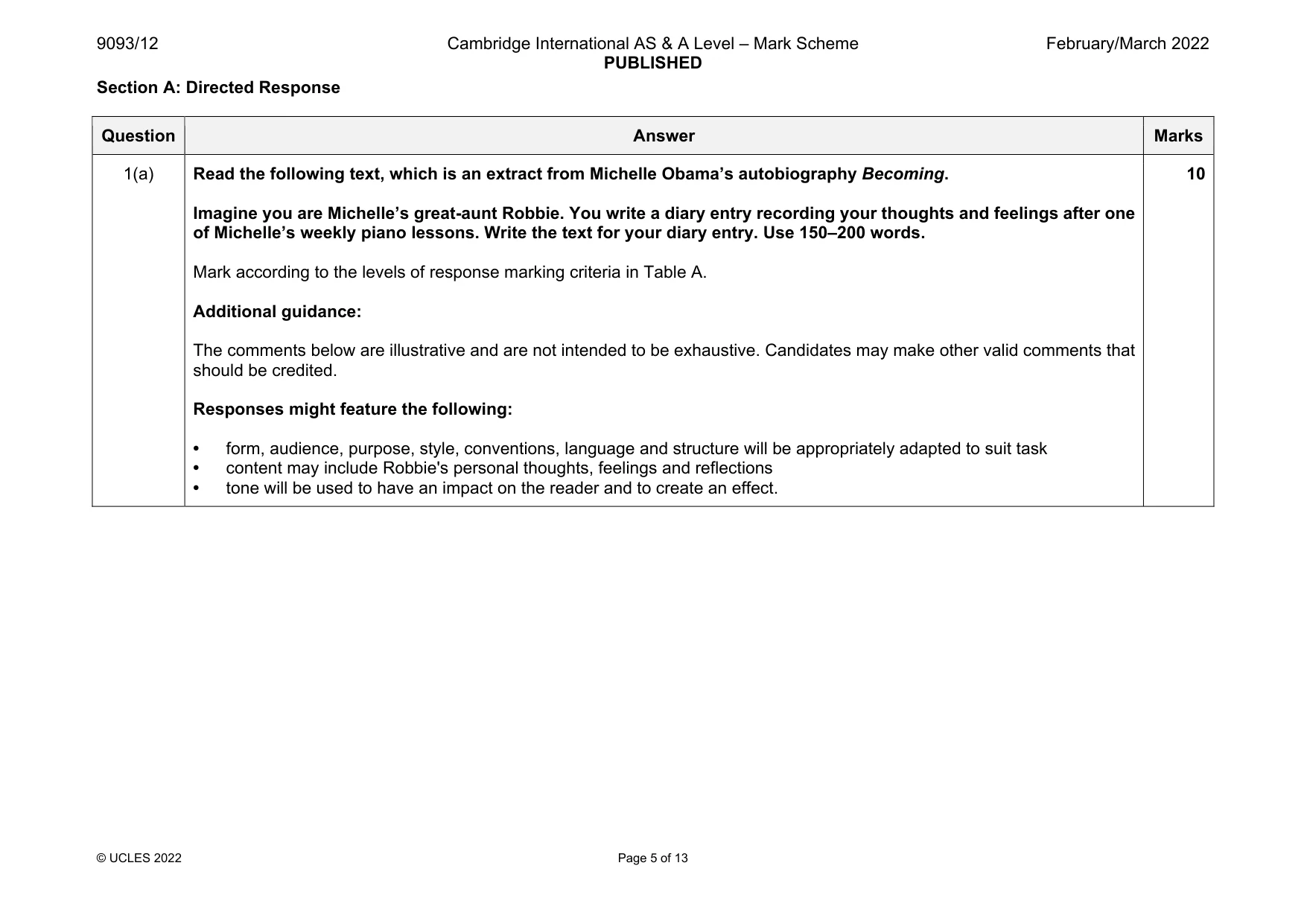
9093/12 Cambridge International AS & A Level – Mark Scheme PUBLISHED February/March 2022 © UCLES 2022 Page 5 of 13 Section A: Directed Response Question Answer Marks 1(a) Read the following text, which is an extract from Michelle Obama’s autobiography Becoming. Imagine you are Michelle’s great-aunt Robbie. You write a diary entry recording your thoughts and feelings after one of Michelle’s weekly piano lessons. Write the text for your diary entry. Use 150–200 words. Mark according to the levels of response marking criteria in Table A. Additional guidance: The comments below are illustrative and are not intended to be exhaustive. Candidates may make other valid comments that should be credited. Responses might feature the following: • form, audience, purpose, style, conventions, language and structure will be appropriately adapted to suit task • content may include Robbie's personal thoughts, feelings and reflections • tone will be used to have an impact on the reader and to create an effect. 10
Mark scheme, page 6
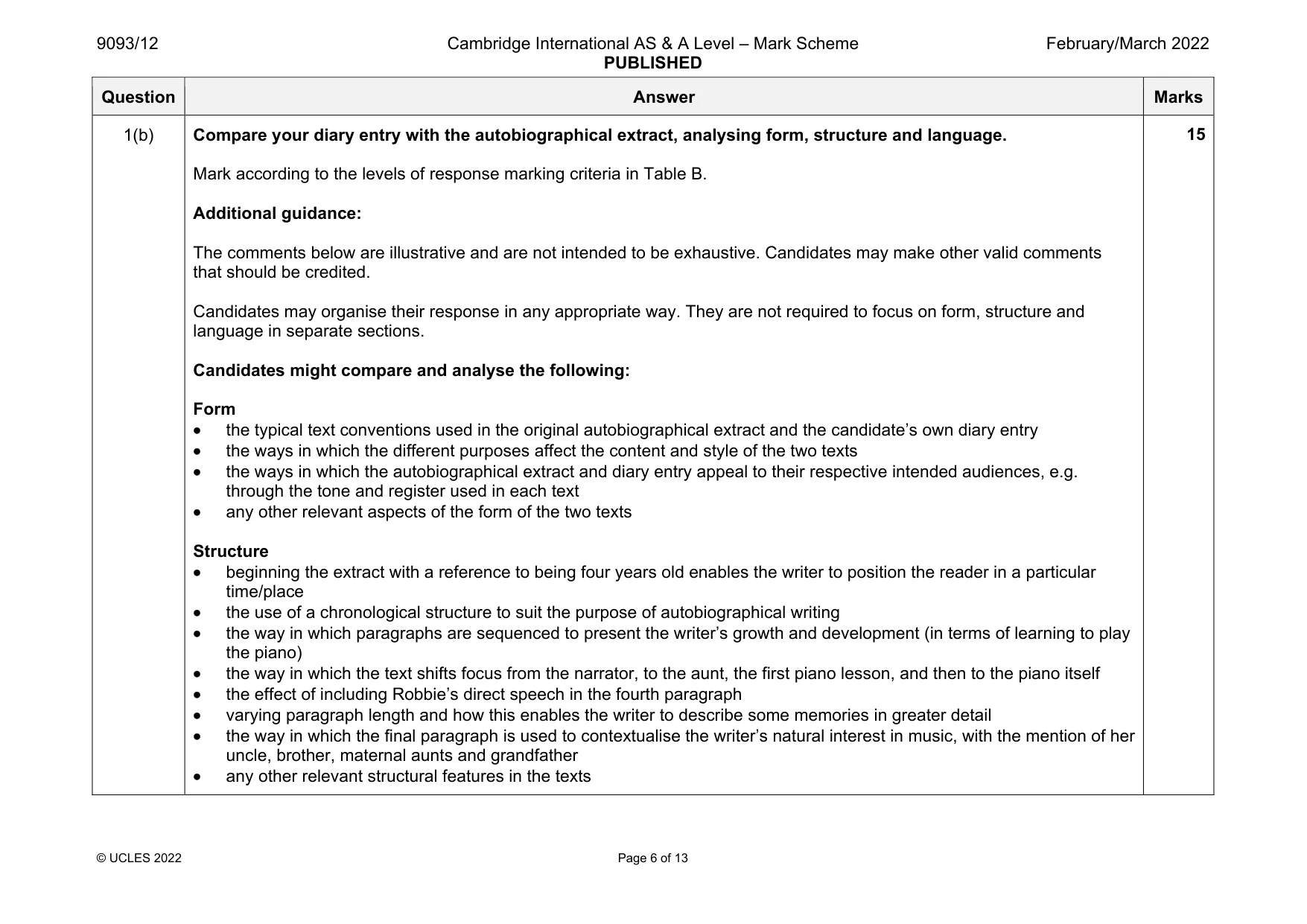
9093/12 Cambridge International AS & A Level – Mark Scheme PUBLISHED February/March 2022 © UCLES 2022 Page 6 of 13 Question Answer Marks 1(b) Compare your diary entry with the autobiographical extract, analysing form, structure and language. Mark according to the levels of response marking criteria in Table B. Additional guidance: The comments below are illustrative and are not intended to be exhaustive. Candidates may make other valid comments that should be credited. Candidates may organise their response in any appropriate way. They are not required to focus on form, structure and language in separate sections. Candidates might compare and analyse the following: Form • the typical text conventions used in the original autobiographical extract and the candidate’s own diary entry • the ways in which the different purposes affect the content and style of the two texts • the ways in which the autobiographical extract and diary entry appeal to their respective intended audiences, e.g. through the tone and register used in each text • any other relevant aspects of the form of the two texts Structure • beginning the extract with a reference to being four years old enables the writer to position the reader in a particular time/place • the use of a chronological structure to suit the purpose of autobiographical writing • the way in which paragraphs are sequenced to present the writer’s growth and development (in terms of learning to play the piano) • the way in which the text shifts focus from the narrator, to the aunt, the first piano lesson, and then to the piano itself • the effect of including Robbie’s direct speech in the fourth paragraph • varying paragraph length and how this enables the writer to describe some memories in greater detail • the way in which the final paragraph is used to contextualise the writer’s natural interest in music, with the mention of her uncle, brother, maternal aunts and grandfather • any other relevant structural features in the texts 15
Mark scheme, page 7
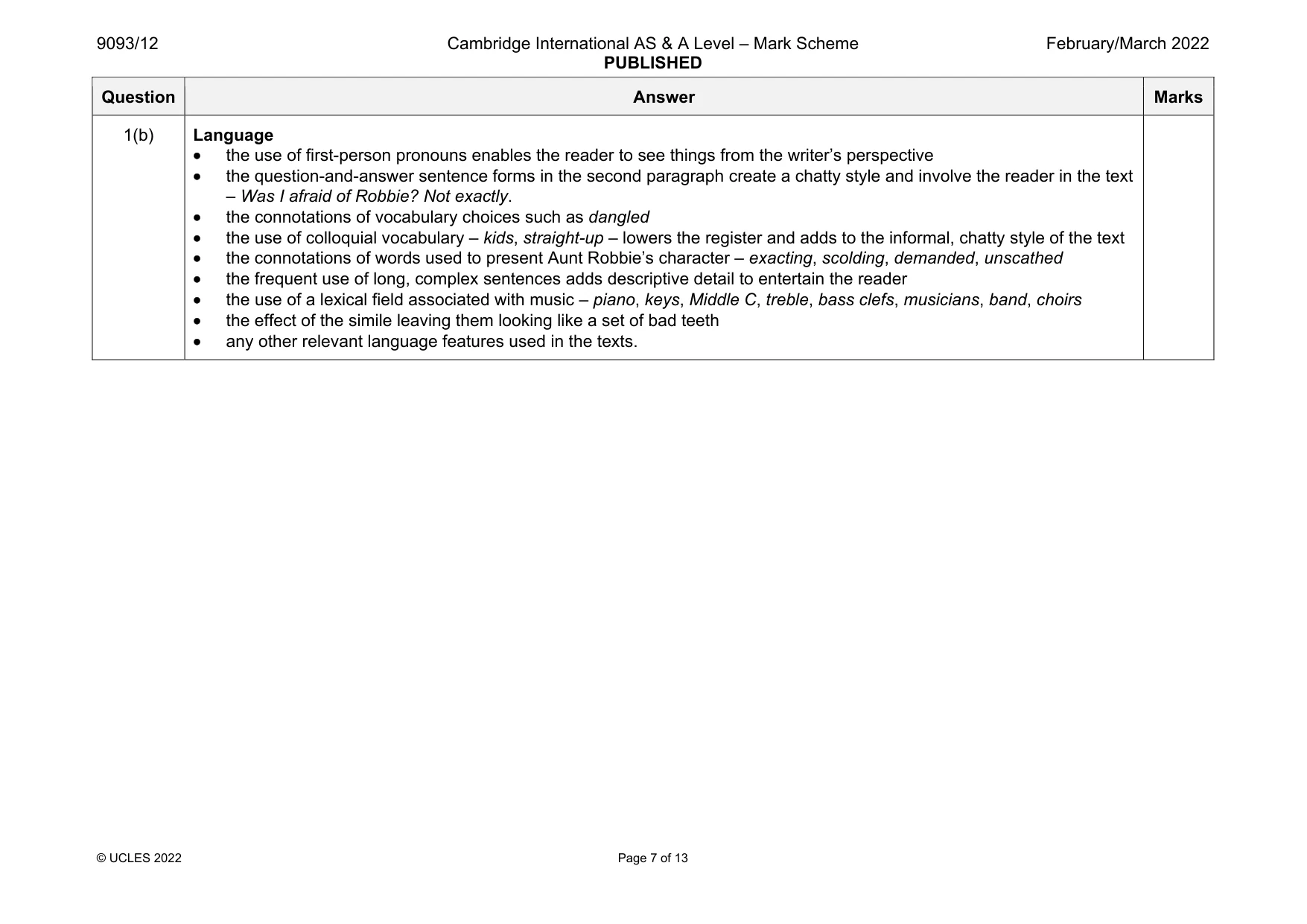
9093/12 Cambridge International AS & A Level – Mark Scheme PUBLISHED February/March 2022 © UCLES 2022 Page 7 of 13 Question Answer Marks 1(b) Language • the use of first-person pronouns enables the reader to see things from the writer’s perspective • the question-and-answer sentence forms in the second paragraph create a chatty style and involve the reader in the text – Was I afraid of Robbie? Not exactly. • the connotations of vocabulary choices such as dangled • the use of colloquial vocabulary – kids, straight-up – lowers the register and adds to the informal, chatty style of the text • the connotations of words used to present Aunt Robbie’s character – exacting, scolding, demanded, unscathed • the frequent use of long, complex sentences adds descriptive detail to entertain the reader • the use of a lexical field associated with music – piano, keys, Middle C, treble, bass clefs, musicians, band, choirs • the effect of the simile leaving them looking like a set of bad teeth • any other relevant language features used in the texts.
Mark scheme, page 8
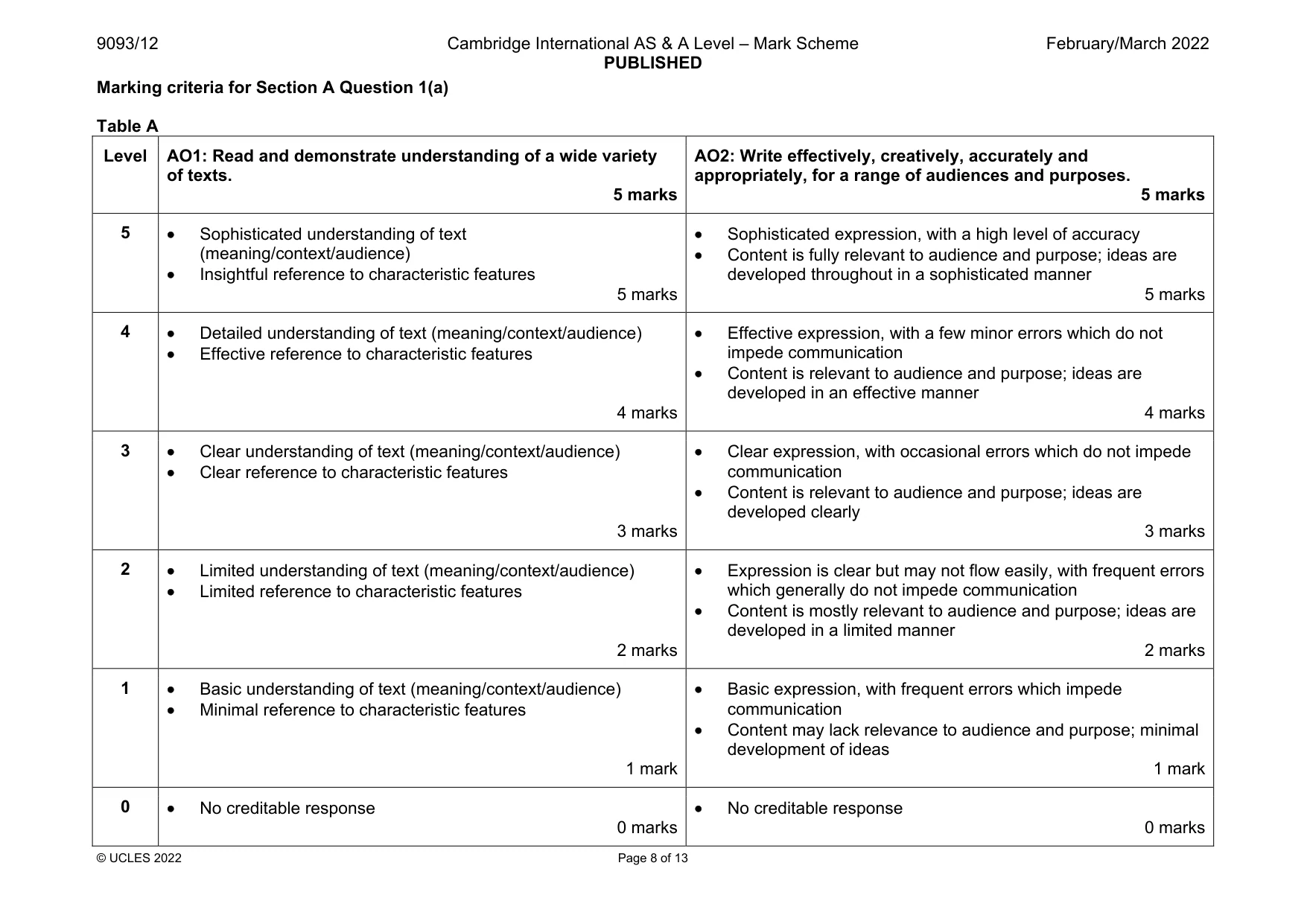
9093/12 Cambridge International AS & A Level – Mark Scheme PUBLISHED February/March 2022 © UCLES 2022 Page 8 of 13 Marking criteria for Section A Question 1(a) Table A Level AO1: Read and demonstrate understanding of a wide variety of texts. 5 marks AO2: Write effectively, creatively, accurately and appropriately, for a range of audiences and purposes. 5 marks 5 • Sophisticated understanding of text (meaning/context/audience) • Insightful reference to characteristic features 5 marks • Sophisticated expression, with a high level of accuracy • Content is fully relevant to audience and purpose; ideas are developed throughout in a sophisticated manner 5 marks 4 • Detailed understanding of text (meaning/context/audience) • Effective reference to characteristic features 4 marks • Effective expression, with a few minor errors which do not impede communication • Content is relevant to audience and purpose; ideas are developed in an effective manner 4 marks 3 • Clear understanding of text (meaning/context/audience) • Clear reference to characteristic features 3 marks • Clear expression, with occasional errors which do not impede communication • Content is relevant to audience and purpose; ideas are developed clearly 3 marks 2 • Limited understanding of text (meaning/context/audience) • Limited reference to characteristic features 2 marks • Expression is clear but may not flow easily, with frequent errors which generally do not impede communication • Content is mostly relevant to audience and purpose; ideas are developed in a limited manner 2 marks 1 • Basic understanding of text (meaning/context/audience) • Minimal reference to characteristic features 1 mark • Basic expression, with frequent errors which impede communication • Content may lack relevance to audience and purpose; minimal development of ideas 1 mark 0 • No creditable response 0 marks • No creditable response 0 marks
Mark scheme, page 9
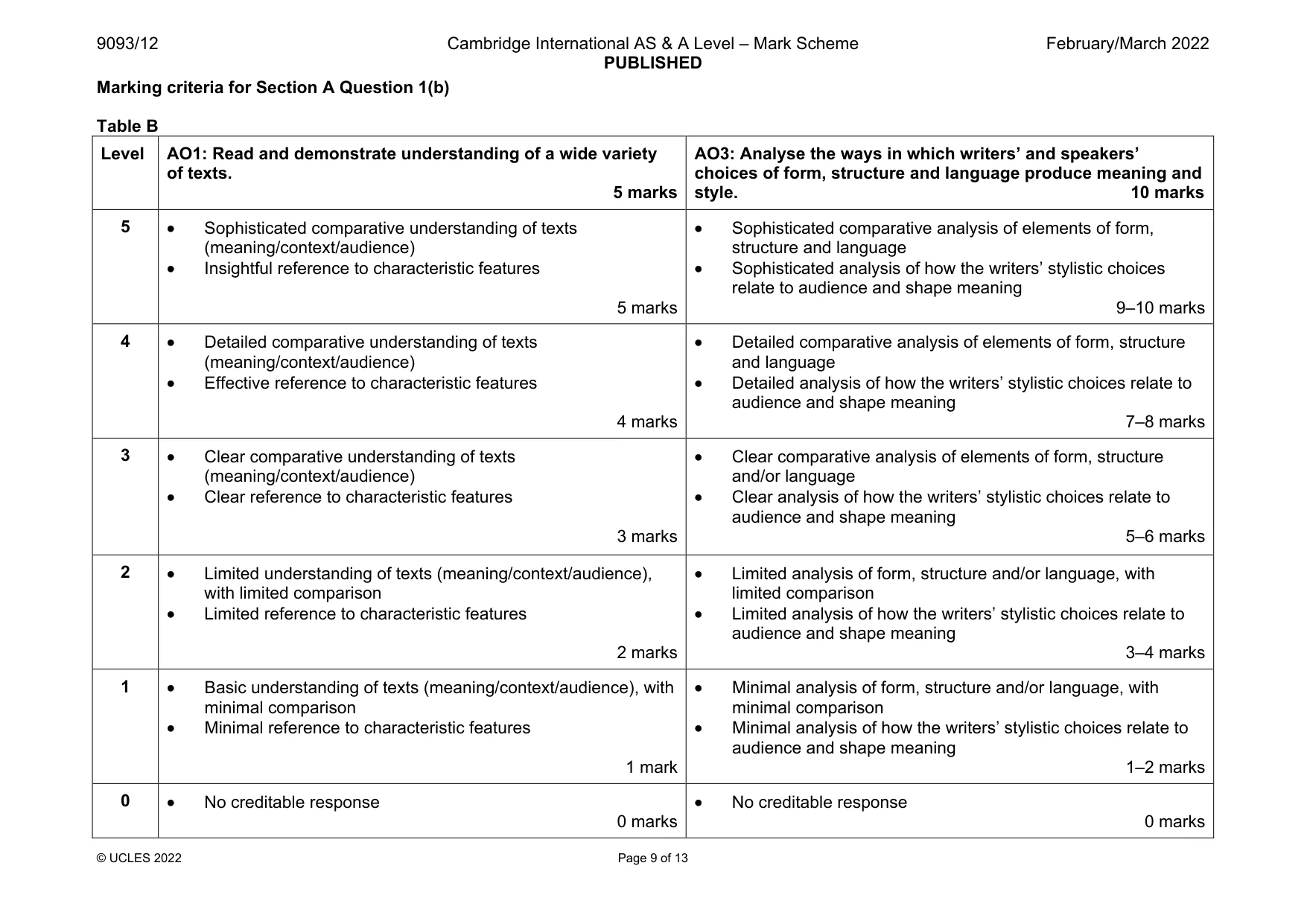
9093/12 Cambridge International AS & A Level – Mark Scheme PUBLISHED February/March 2022 © UCLES 2022 Page 9 of 13 Marking criteria for Section A Question 1(b) Table B Level AO1: Read and demonstrate understanding of a wide variety of texts. 5 marks AO3: Analyse the ways in which writers’ and speakers’ choices of form, structure and language produce meaning and style. 10 marks 5 • Sophisticated comparative understanding of texts (meaning/context/audience) • Insightful reference to characteristic features 5 marks • Sophisticated comparative analysis of elements of form, structure and language • Sophisticated analysis of how the writers’ stylistic choices relate to audience and shape meaning 9–10 marks 4 • Detailed comparative understanding of texts (meaning/context/audience) • Effective reference to characteristic features 4 marks • Detailed comparative analysis of elements of form, structure and language • Detailed analysis of how the writers’ stylistic choices relate to audience and shape meaning 7–8 marks 3 • Clear comparative understanding of texts (meaning/context/audience) • Clear reference to characteristic features 3 marks • Clear comparative analysis of elements of form, structure and/or language • Clear analysis of how the writers’ stylistic choices relate to audience and shape meaning 5–6 marks 2 • Limited understanding of texts (meaning/context/audience), with limited comparison • Limited reference to characteristic features 2 marks • Limited analysis of form, structure and/or language, with limited comparison • Limited analysis of how the writers’ stylistic choices relate to audience and shape meaning 3–4 marks 1 • Basic understanding of texts (meaning/context/audience), with minimal comparison • Minimal reference to characteristic features 1 mark • Minimal analysis of form, structure and/or language, with minimal comparison • Minimal analysis of how the writers’ stylistic choices relate to audience and shape meaning 1–2 marks 0 • No creditable response 0 marks • No creditable response 0 marks
Mark scheme, page 10
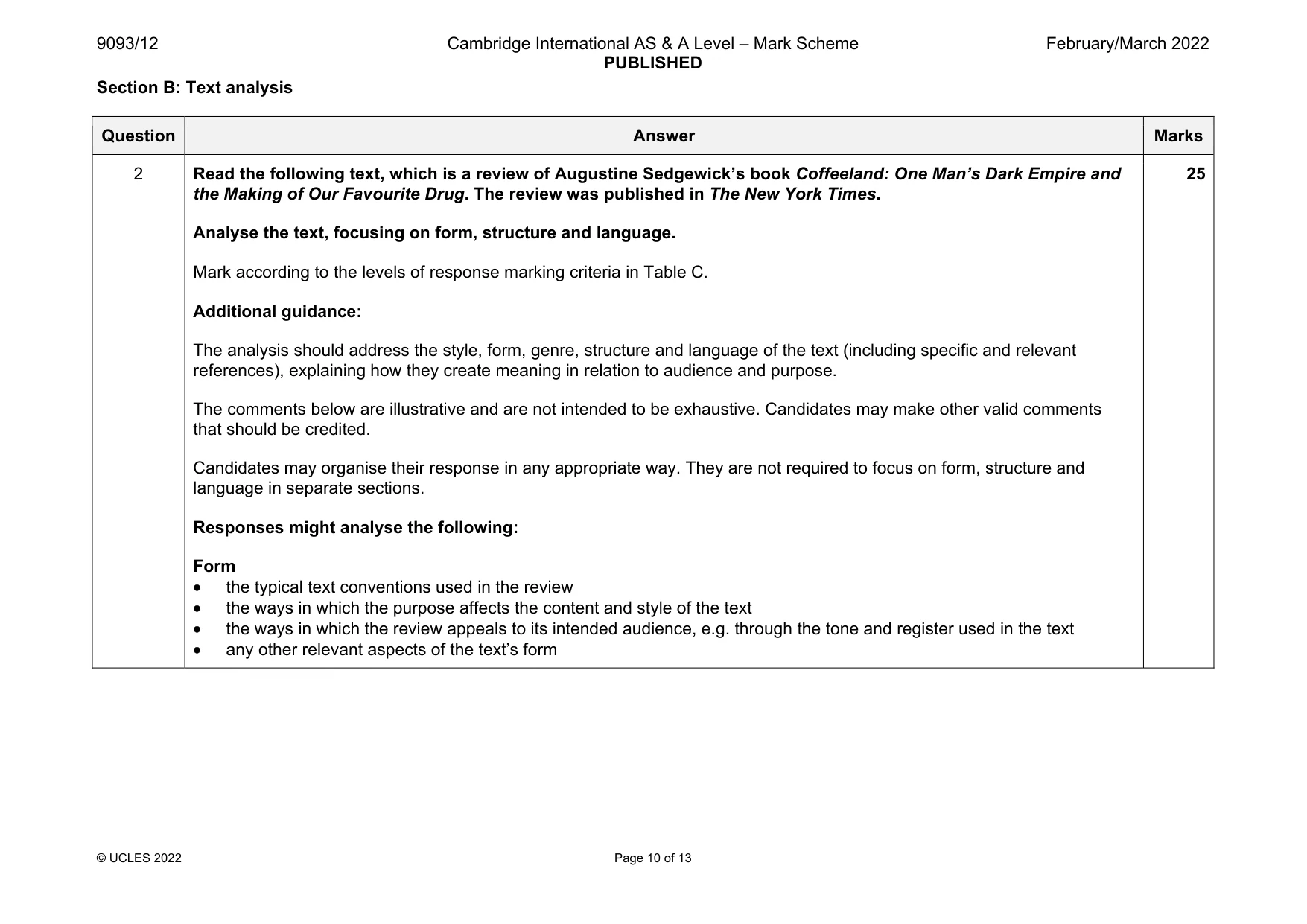
9093/12 Cambridge International AS & A Level – Mark Scheme PUBLISHED February/March 2022 © UCLES 2022 Page 10 of 13 Section B: Text analysis Question Answer Marks 2 Read the following text, which is a review of Augustine Sedgewick’s book Coffeeland: One Man’s Dark Empire and the Making of Our Favourite Drug. The review was published in The New York Times. Analyse the text, focusing on form, structure and language. Mark according to the levels of response marking criteria in Table C. Additional guidance: The analysis should address the style, form, genre, structure and language of the text (including specific and relevant references), explaining how they create meaning in relation to audience and purpose. The comments below are illustrative and are not intended to be exhaustive. Candidates may make other valid comments that should be credited. Candidates may organise their response in any appropriate way. They are not required to focus on form, structure and language in separate sections. Responses might analyse the following: Form • the typical text conventions used in the review • the ways in which the purpose affects the content and style of the text • the ways in which the review appeals to its intended audience, e.g. through the tone and register used in the text • any other relevant aspects of the text’s form 25
Mark scheme, page 11
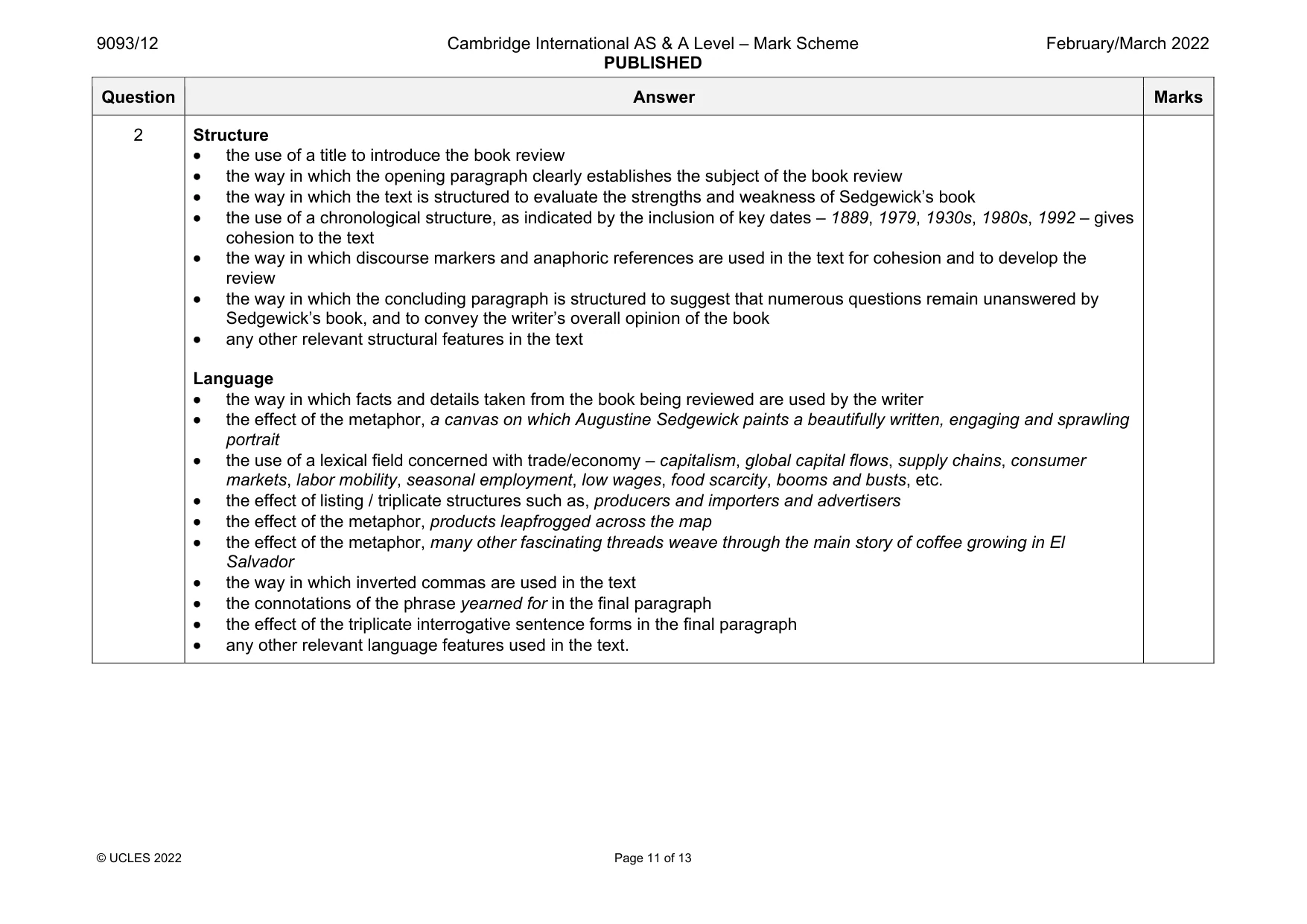
9093/12 Cambridge International AS & A Level – Mark Scheme PUBLISHED February/March 2022 © UCLES 2022 Page 11 of 13 Question Answer Marks 2 Structure • the use of a title to introduce the book review • the way in which the opening paragraph clearly establishes the subject of the book review • the way in which the text is structured to evaluate the strengths and weakness of Sedgewick’s book • the use of a chronological structure, as indicated by the inclusion of key dates – 1889, 1979, 1930s, 1980s, 1992 – gives cohesion to the text • the way in which discourse markers and anaphoric references are used in the text for cohesion and to develop the review • the way in which the concluding paragraph is structured to suggest that numerous questions remain unanswered by Sedgewick’s book, and to convey the writer’s overall opinion of the book • any other relevant structural features in the text Language • the way in which facts and details taken from the book being reviewed are used by the writer • the effect of the metaphor, a canvas on which Augustine Sedgewick paints a beautifully written, engaging and sprawling portrait • the use of a lexical field concerned with trade/economy – capitalism, global capital flows, supply chains, consumer markets, labor mobility, seasonal employment, low wages, food scarcity, booms and busts, etc. • the effect of listing / triplicate structures such as, producers and importers and advertisers • the effect of the metaphor, products leapfrogged across the map • the effect of the metaphor, many other fascinating threads weave through the main story of coffee growing in El Salvador • the way in which inverted commas are used in the text • the connotations of the phrase yearned for in the final paragraph • the effect of the triplicate interrogative sentence forms in the final paragraph • any other relevant language features used in the text.
Mark scheme, page 12
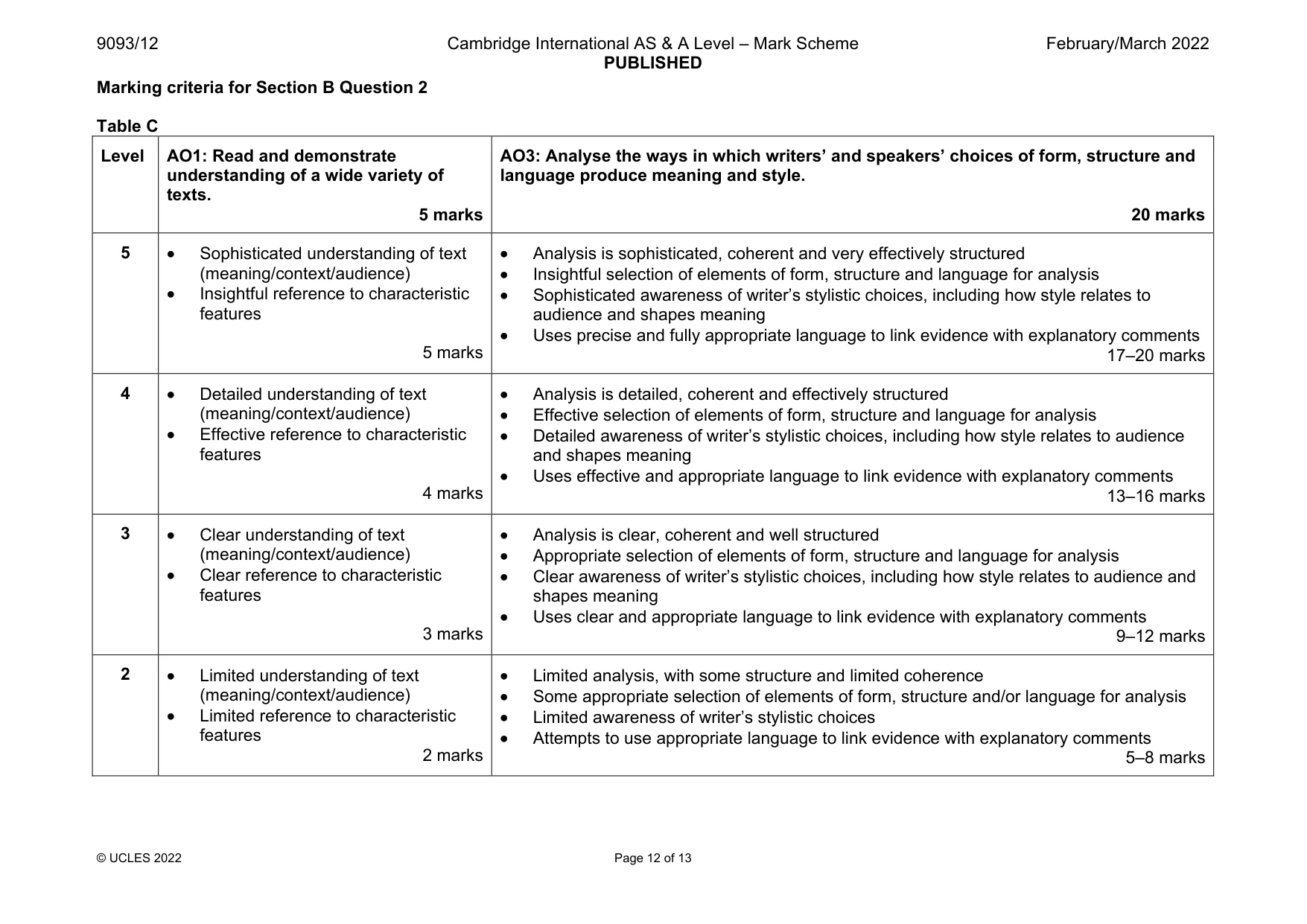
9093/12 Cambridge International AS & A Level – Mark Scheme PUBLISHED February/March 2022 © UCLES 2022 Page 12 of 13 Marking criteria for Section B Question 2 Table C Level AO1: Read and demonstrate understanding of a wide variety of texts. 5 marks AO3: Analyse the ways in which writers’ and speakers’ choices of form, structure and language produce meaning and style. 20 marks 5 • Sophisticated understanding of text (meaning/context/audience) • Insightful reference to characteristic features 5 marks • Analysis is sophisticated, coherent and very effectively structured • Insightful selection of elements of form, structure and language for analysis • Sophisticated awareness of writer’s stylistic choices, including how style relates to audience and shapes meaning • Uses precise and fully appropriate language to link evidence with explanatory comments 17–20 marks 4 • Detailed understanding of text (meaning/context/audience) • Effective reference to characteristic features 4 marks • Analysis is detailed, coherent and effectively structured • Effective selection of elements of form, structure and language for analysis • Detailed awareness of writer’s stylistic choices, including how style relates to audience and shapes meaning • Uses effective and appropriate language to link evidence with explanatory comments 13–16 marks 3 • Clear understanding of text (meaning/context/audience) • Clear reference to characteristic features 3 marks • Analysis is clear, coherent and well structured • Appropriate selection of elements of form, structure and language for analysis • Clear awareness of writer’s stylistic choices, including how style relates to audience and shapes meaning • Uses clear and appropriate language to link evidence with explanatory comments 9–12 marks 2 • Limited understanding of text (meaning/context/audience) • Limited reference to characteristic features 2 marks • Limited analysis, with some structure and limited coherence • Some appropriate selection of elements of form, structure and/or language for analysis • Limited awareness of writer’s stylistic choices • Attempts to use appropriate language to link evidence with explanatory comments 5–8 marks
Mark scheme, page 13
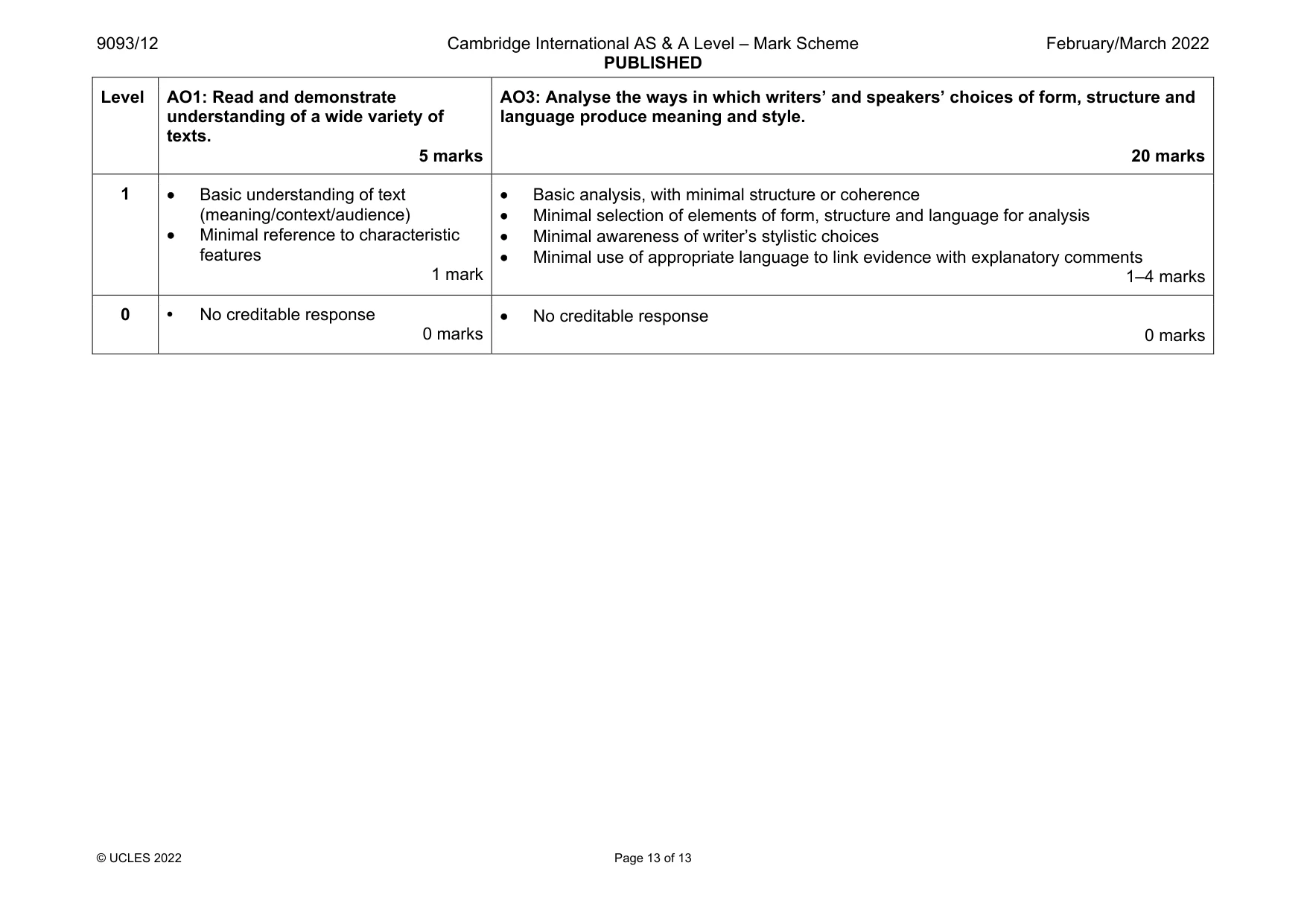
9093/12 Cambridge International AS & A Level – Mark Scheme PUBLISHED February/March 2022 © UCLES 2022 Page 13 of 13 Level AO1: Read and demonstrate understanding of a wide variety of texts. 5 marks AO3: Analyse the ways in which writers’ and speakers’ choices of form, structure and language produce meaning and style. 20 marks 1 • Basic understanding of text (meaning/context/audience) • Minimal reference to characteristic features 1 mark • Basic analysis, with minimal structure or coherence • Minimal selection of elements of form, structure and language for analysis • Minimal awareness of writer’s stylistic choices • Minimal use of appropriate language to link evidence with explanatory comments 1–4 marks 0 • No creditable response 0 marks • No creditable response 0 marks
What you needed in this session
Cambridge’s own grade thresholds for 2022 Feb/March, Paper 1 · Variant 2. A higher threshold means an easier paper — the bar moves with how the cohort did.