Cambridge A Level English - Language AS and A Level (from 2014) 9093 — 2021 May/June Paper 1 · Variant 3
9093/13/M/J/21 · 50 marks · ≈56 min
The question paper and its mark scheme, free to read here and free to download. This is Cambridge’s own paper, exactly as it was sat.
Question paper8 pages

Mark scheme15 pages
Answers below. Sit the paper first if you are practising.
Paper as text
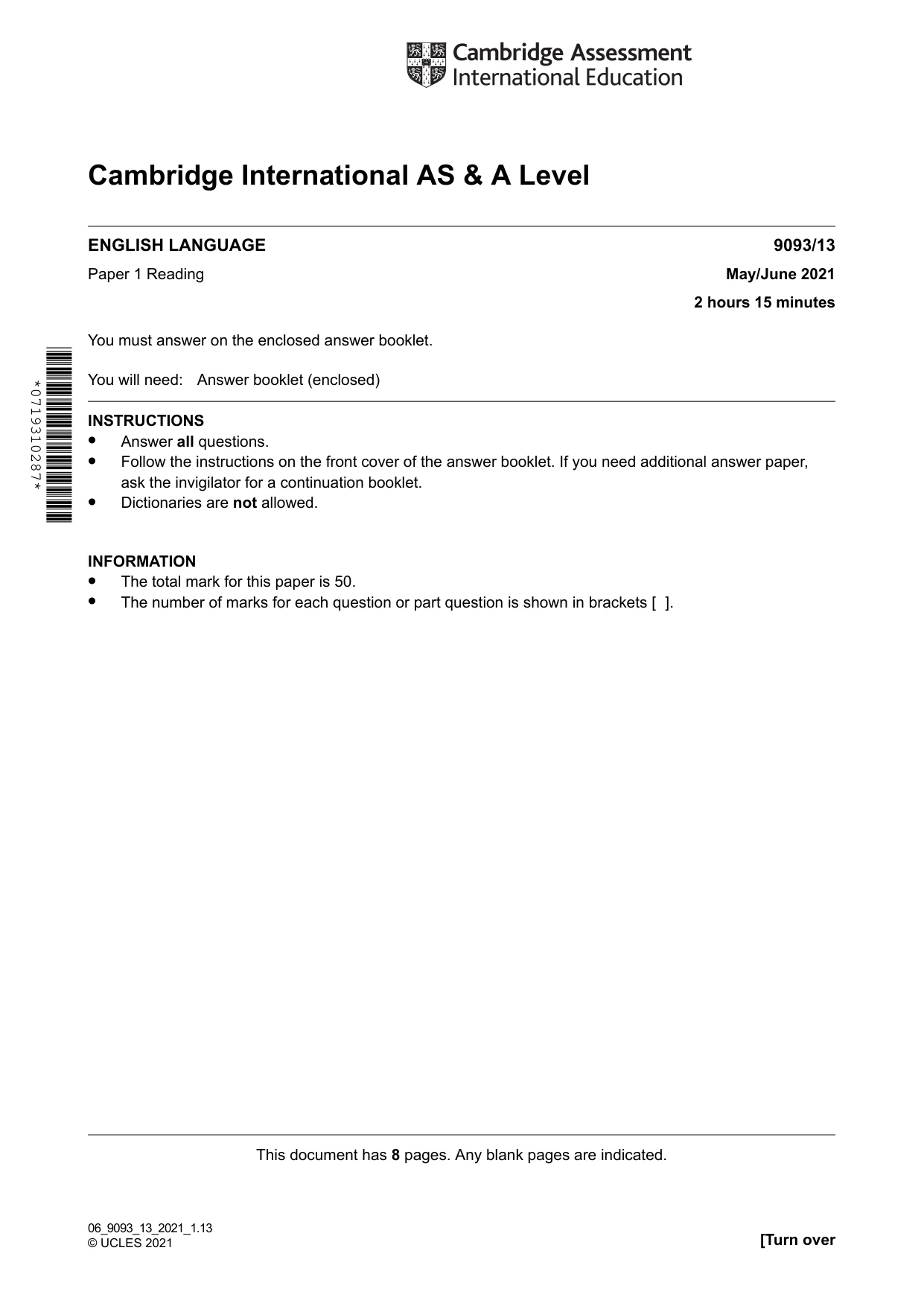
Question paper, page 1
Cambridge International AS & A Level 9093/13 ENGLISH LANGUAGE May/June 2021 Paper 1 Reading 2 hours 15 minutes You must answer on the enclosed answer booklet. You will need: Answer booklet (enclosed) INSTRUCTIONS • Answer all questions. • Follow the instructions on the front cover of the answer booklet. If you need additional answer paper, ask the invigilator for a continuation booklet. • Dictionaries are not allowed. INFORMATION • The total mark for this paper is 50. • The number of marks for each question or part question is shown in brackets [ ]. This document has 8 pages. Any blank pages are indicated. [Turn over 06_9093_13_2021_1.13 © UCLES 2021 *0719310287*
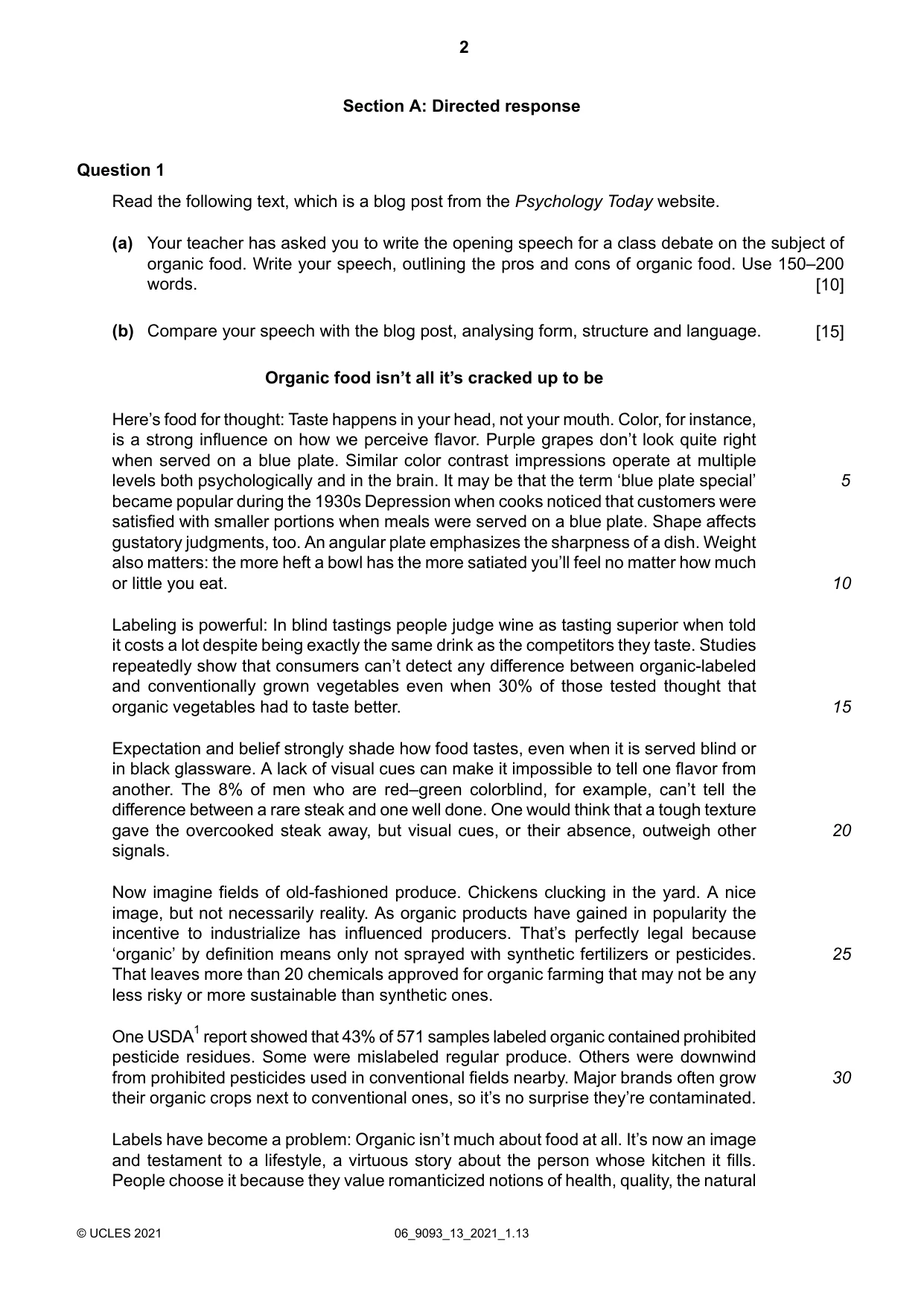
Question paper, page 2
30 25 20 15 10 5 Section A: Directed response Question 1 Read the following text, which is a blog post from the Psychology Today website. Your teacher has asked you to write the opening speech for a class debate on the subject of organic food. Write your speech, outlining the pros and cons of organic food. Use 150–200 words. (a) [10] Compare your speech with the blog post, analysing form, structure and language. (b) [15] Organic food isn’t all it’s cracked up to be Here’s food for thought: Taste happens in your head, not your mouth. Color, for instance, is a strong influence on how we perceive flavor. Purple grapes don’t look quite right when served on a blue plate. Similar color contrast impressions operate at multiple levels both psychologically and in the brain. It may be that the term ‘blue plate special’ became popular during the 1930s Depression when cooks noticed that customers were satisfied with smaller portions when meals were served on a blue plate. Shape affects gustatory judgments, too. An angular plate emphasizes the sharpness of a dish. Weight also matters: the more heft a bowl has the more satiated you’ll feel no matter how much or little you eat. Labeling is powerful: In blind tastings people judge wine as tasting superior when told it costs a lot despite being exactly the same drink as the competitors they taste. Studies repeatedly show that consumers can’t detect any difference between organic-labeled and conventionally grown vegetables even when 30% of those tested thought that organic vegetables had to taste better. Expectation and belief strongly shade how food tastes, even when it is served blind or in black glassware. A lack of visual cues can make it impossible to tell one flavor from another. The 8% of men who are red–green colorblind, for example, can’t tell the difference between a rare steak and one well done. One would think that a tough texture gave the overcooked steak away, but visual cues, or their absence, outweigh other signals. Now imagine fields of old-fashioned produce. Chickens clucking in the yard. A nice image, but not necessarily reality. As organic products have gained in popularity the incentive to industrialize has influenced producers. That’s perfectly legal because ‘organic’ by definition means only not sprayed with synthetic fertilizers or pesticides. That leaves more than 20 chemicals approved for organic farming that may not be any less risky or more sustainable than synthetic ones. One USDA1 report showed that 43% of 571 samples labeled organic contained prohibited pesticide residues. Some were mislabeled regular produce. Others were downwind from prohibited pesticides used in conventional fields nearby. Major brands often grow their organic crops next to conventional ones, so it’s no surprise they’re contaminated. Labels have become a problem: Organic isn’t much about food at all. It’s now an image and testament to a lifestyle, a virtuous story about the person whose kitchen it fills. People choose it because they value romanticized notions of health, quality, the natural 06_9093_13_2021_1.13 © UCLES 2021 2
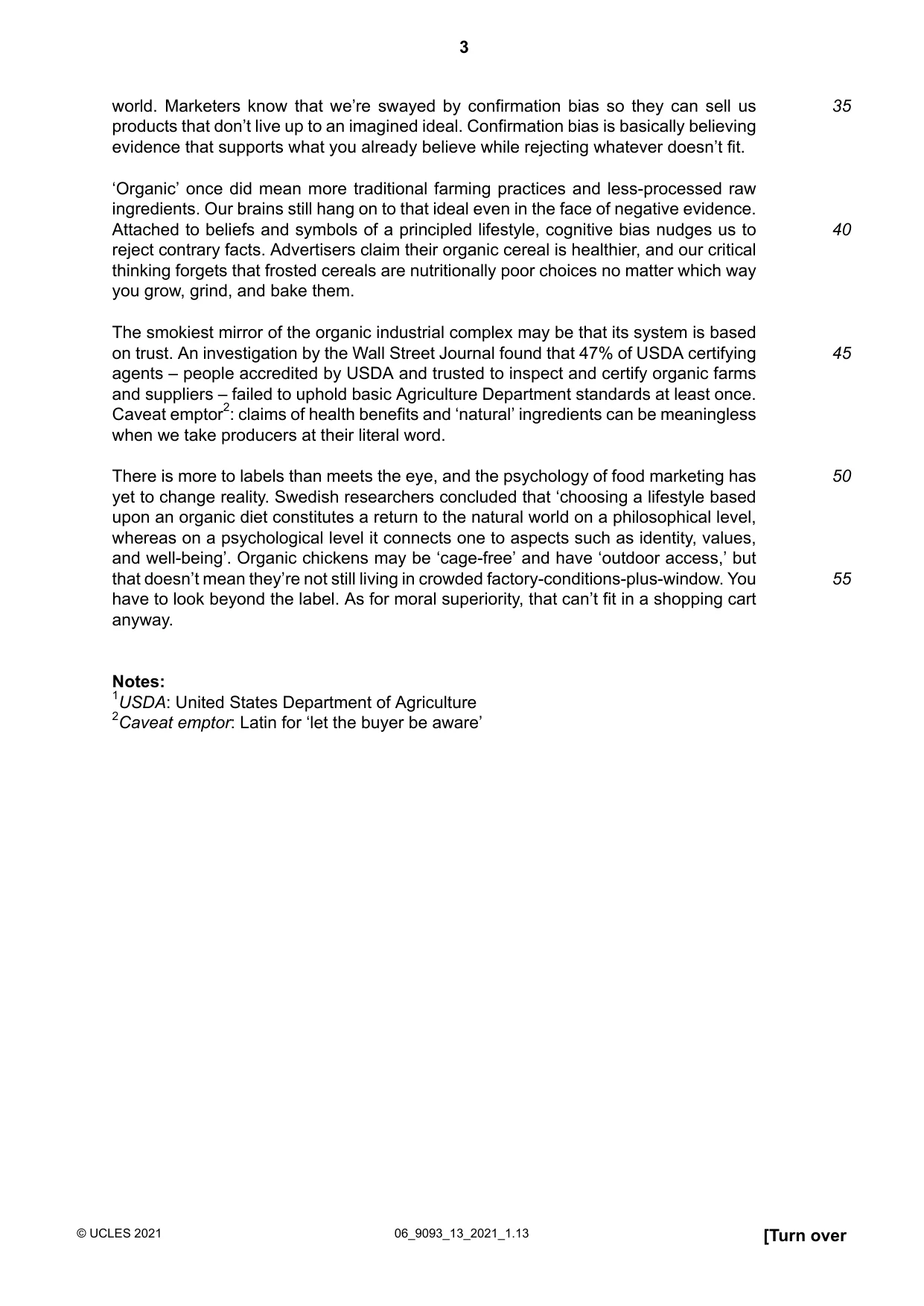
Question paper, page 3
55 50 45 40 35 world. Marketers know that we’re swayed by confirmation bias so they can sell us products that don’t live up to an imagined ideal. Confirmation bias is basically believing evidence that supports what you already believe while rejecting whatever doesn’t fit. ‘Organic’ once did mean more traditional farming practices and less-processed raw ingredients. Our brains still hang on to that ideal even in the face of negative evidence. Attached to beliefs and symbols of a principled lifestyle, cognitive bias nudges us to reject contrary facts. Advertisers claim their organic cereal is healthier, and our critical thinking forgets that frosted cereals are nutritionally poor choices no matter which way you grow, grind, and bake them. The smokiest mirror of the organic industrial complex may be that its system is based on trust. An investigation by the Wall Street Journal found that 47% of USDA certifying agents – people accredited by USDA and trusted to inspect and certify organic farms and suppliers – failed to uphold basic Agriculture Department standards at least once. Caveat emptor2: claims of health benefits and ‘natural’ ingredients can be meaningless when we take producers at their literal word. There is more to labels than meets the eye, and the psychology of food marketing has yet to change reality. Swedish researchers concluded that ‘choosing a lifestyle based upon an organic diet constitutes a return to the natural world on a philosophical level, whereas on a psychological level it connects one to aspects such as identity, values, and well-being’. Organic chickens may be ‘cage-free’ and have ‘outdoor access,’ but that doesn’t mean they’re not still living in crowded factory-conditions-plus-window. You have to look beyond the label. As for moral superiority, that can’t fit in a shopping cart anyway. Notes: 1USDA: United States Department of Agriculture 2Caveat emptor: Latin for ‘let the buyer be aware’ [Turn over 06_9093_13_2021_1.13 © UCLES 2021 3
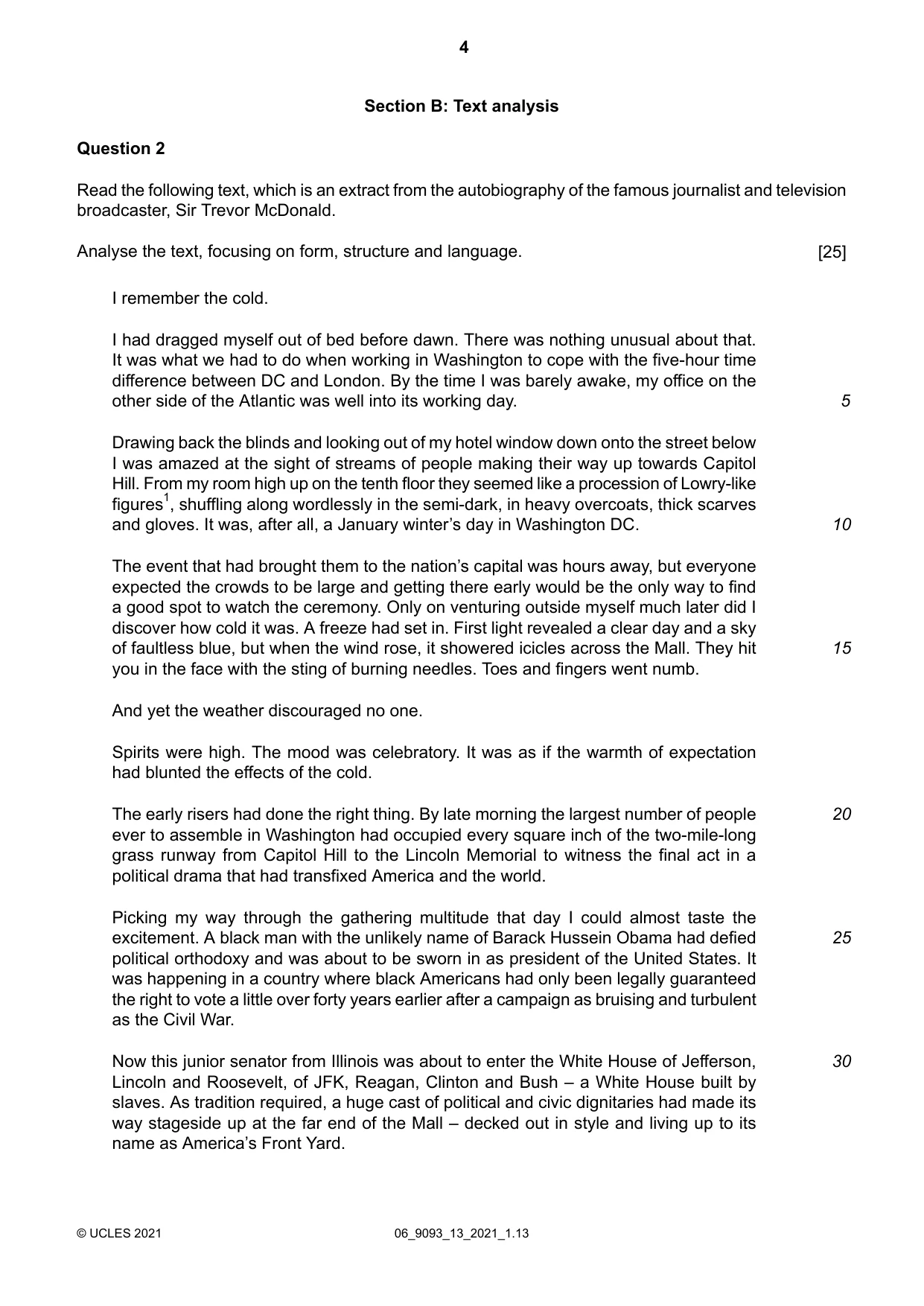
Question paper, page 4
30 25 20 15 10 5 Section B: Text analysis Question 2 Read the following text, which is an extract from the autobiography of the famous journalist and television broadcaster, Sir Trevor McDonald. Analyse the text, focusing on form, structure and language. [25] I remember the cold. I had dragged myself out of bed before dawn. There was nothing unusual about that. It was what we had to do when working in Washington to cope with the five-hour time difference between DC and London. By the time I was barely awake, my office on the other side of the Atlantic was well into its working day. Drawing back the blinds and looking out of my hotel window down onto the street below I was amazed at the sight of streams of people making their way up towards Capitol Hill. From my room high up on the tenth floor they seemed like a procession of Lowry-like figures1, shuffling along wordlessly in the semi-dark, in heavy overcoats, thick scarves and gloves. It was, after all, a January winter’s day in Washington DC. The event that had brought them to the nation’s capital was hours away, but everyone expected the crowds to be large and getting there early would be the only way to find a good spot to watch the ceremony. Only on venturing outside myself much later did I discover how cold it was. A freeze had set in. First light revealed a clear day and a sky of faultless blue, but when the wind rose, it showered icicles across the Mall. They hit you in the face with the sting of burning needles. Toes and fingers went numb. And yet the weather discouraged no one. Spirits were high. The mood was celebratory. It was as if the warmth of expectation had blunted the effects of the cold. The early risers had done the right thing. By late morning the largest number of people ever to assemble in Washington had occupied every square inch of the two-mile-long grass runway from Capitol Hill to the Lincoln Memorial to witness the final act in a political drama that had transfixed America and the world. Picking my way through the gathering multitude that day I could almost taste the excitement. A black man with the unlikely name of Barack Hussein Obama had defied political orthodoxy and was about to be sworn in as president of the United States. It was happening in a country where black Americans had only been legally guaranteed the right to vote a little over forty years earlier after a campaign as bruising and turbulent as the Civil War. Now this junior senator from Illinois was about to enter the White House of Jefferson, Lincoln and Roosevelt, of JFK, Reagan, Clinton and Bush – a White House built by slaves. As tradition required, a huge cast of political and civic dignitaries had made its way stageside up at the far end of the Mall – decked out in style and living up to its name as America’s Front Yard. 06_9093_13_2021_1.13 © UCLES 2021 4
Question paper, page 5
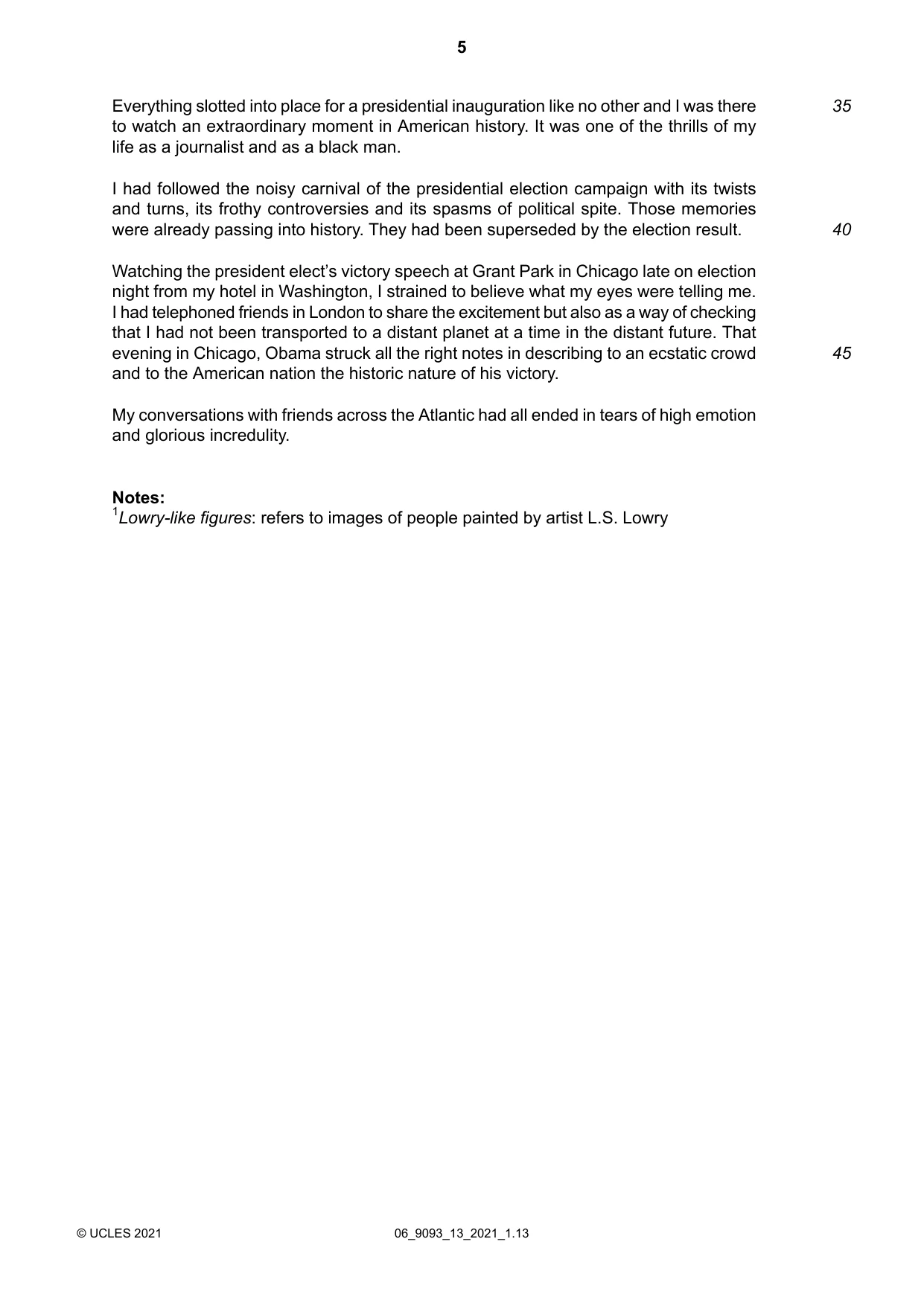
45 40 35 Everything slotted into place for a presidential inauguration like no other and I was there to watch an extraordinary moment in American history. It was one of the thrills of my life as a journalist and as a black man. I had followed the noisy carnival of the presidential election campaign with its twists and turns, its frothy controversies and its spasms of political spite. Those memories were already passing into history. They had been superseded by the election result. Watching the president elect’s victory speech at Grant Park in Chicago late on election night from my hotel in Washington, I strained to believe what my eyes were telling me. I had telephoned friends in London to share the excitement but also as a way of checking that I had not been transported to a distant planet at a time in the distant future. That evening in Chicago, Obama struck all the right notes in describing to an ecstatic crowd and to the American nation the historic nature of his victory. My conversations with friends across the Atlantic had all ended in tears of high emotion and glorious incredulity. Notes: 1Lowry-like figures: refers to images of people painted by artist L.S. Lowry 06_9093_13_2021_1.13 © UCLES 2021 5
Question paper, page 6
BLANK PAGE 06_9093_13_2021_1.13 © UCLES 2021 6
Question paper, page 7
BLANK PAGE 06_9093_13_2021_1.13 © UCLES 2021 7
Question paper, page 8
BLANK PAGE Permission to reproduce items where third-party owned material protected by copyright is included has been sought and cleared where possible. Every reasonable effort has been made by the publisher (UCLES) to trace copyright holders, but if any items requiring clearance have unwittingly been included, the publisher will be pleased to make amends at the earliest possible opportunity. To avoid the issue of disclosure of answer-related information to candidates, all copyright acknowledgements are reproduced online in the Cambridge Assessment International Education Copyright Acknowledgements Booklet. This is produced for each series of examinations and is freely available to download at www.cambridgeinternational.org after the live examination series. Cambridge Assessment International Education is part of the Cambridge Assessment Group. Cambridge Assessment is the brand name of the University of Cambridge Local Examinations Syndicate (UCLES), which itself is a department of the University of Cambridge. 06_9093_13_2021_1.13 © UCLES 2021 8
Mark scheme, page 1
This document consists of 15 printed pages. © UCLES 2021 [Turn over Cambridge International AS & A Level ENGLISH LANGUAGE 9093/13 Paper 1 Reading May/June 2021 MARK SCHEME Maximum Mark: 50 Published This mark scheme is published as an aid to teachers and candidates, to indicate the requirements of the examination. It shows the basis on which Examiners were instructed to award marks. It does not indicate the details of the discussions that took place at an Examiners’ meeting before marking began, which would have considered the acceptability of alternative answers. Mark schemes should be read in conjunction with the question paper and the Principal Examiner Report for Teachers. Cambridge International will not enter into discussions about these mark schemes. Cambridge International is publishing the mark schemes for the May/June 2021 series for most Cambridge IGCSE™, Cambridge International A and AS Level components and some Cambridge O Level components.
Mark scheme, page 2
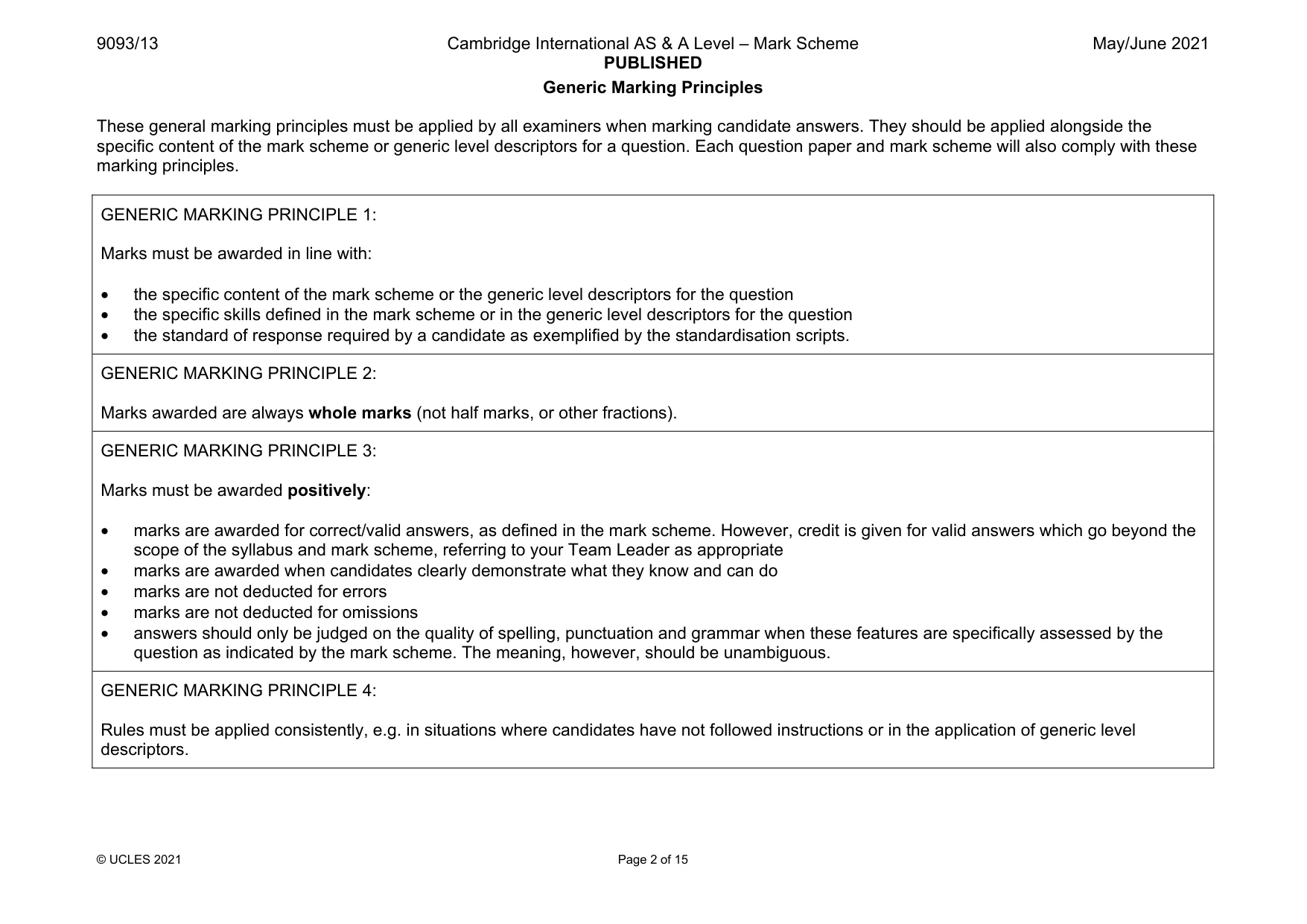
9093/13 Cambridge International AS & A Level – Mark Scheme PUBLISHED May/June 2021 © UCLES 2021 Page 2 of 15 Generic Marking Principles These general marking principles must be applied by all examiners when marking candidate answers. They should be applied alongside the specific content of the mark scheme or generic level descriptors for a question. Each question paper and mark scheme will also comply with these marking principles. GENERIC MARKING PRINCIPLE 1: Marks must be awarded in line with: • the specific content of the mark scheme or the generic level descriptors for the question • the specific skills defined in the mark scheme or in the generic level descriptors for the question • the standard of response required by a candidate as exemplified by the standardisation scripts. GENERIC MARKING PRINCIPLE 2: Marks awarded are always whole marks (not half marks, or other fractions). GENERIC MARKING PRINCIPLE 3: Marks must be awarded positively: • marks are awarded for correct/valid answers, as defined in the mark scheme. However, credit is given for valid answers which go beyond the scope of the syllabus and mark scheme, referring to your Team Leader as appropriate • marks are awarded when candidates clearly demonstrate what they know and can do • marks are not deducted for errors • marks are not deducted for omissions • answers should only be judged on the quality of spelling, punctuation and grammar when these features are specifically assessed by the question as indicated by the mark scheme. The meaning, however, should be unambiguous. GENERIC MARKING PRINCIPLE 4: Rules must be applied consistently, e.g. in situations where candidates have not followed instructions or in the application of generic level descriptors.
Mark scheme, page 3
9093/13 Cambridge International AS & A Level – Mark Scheme PUBLISHED May/June 2021 © UCLES 2021 Page 3 of 15 GENERIC MARKING PRINCIPLE 5: Marks should be awarded using the full range of marks defined in the mark scheme for the question (however; the use of the full mark range may be limited according to the quality of the candidate responses seen). GENERIC MARKING PRINCIPLE 6: Marks awarded are based solely on the requirements as defined in the mark scheme. Marks should not be awarded with grade thresholds or grade descriptors in mind.
Mark scheme, page 4
9093/13 Cambridge International AS & A Level – Mark Scheme PUBLISHED May/June 2021 © UCLES 2021 Page 4 of 15 English & Media subject specific general marking principles (To be read in conjunction with the Generic Marking Principles (and requiring further guidance on how to place marks within levels)) Components using level descriptors: • We use level descriptors as a guide to broad understanding of the qualities normally expected of, or typical of, work in a level. • Level descriptors are a means of general guidance, and should not be interpreted as hurdle statements. • Where indicative content notes are supplied for a question, these are not a prescription of required content, and must not be treated as such. Alternative correct points and unexpected answers in candidates’ scripts must be given marks that fairly reflect the knowledge and skills demonstrated. • While we may have legitimate expectations as to the ground most answers may occupy, we must at all times be prepared to meet candidates on their chosen ground, provided it is relevant ground (e.g. clearly related to and derived from a relevant passage/text and meeting the mark scheme requirements for the question).
Mark scheme, page 5
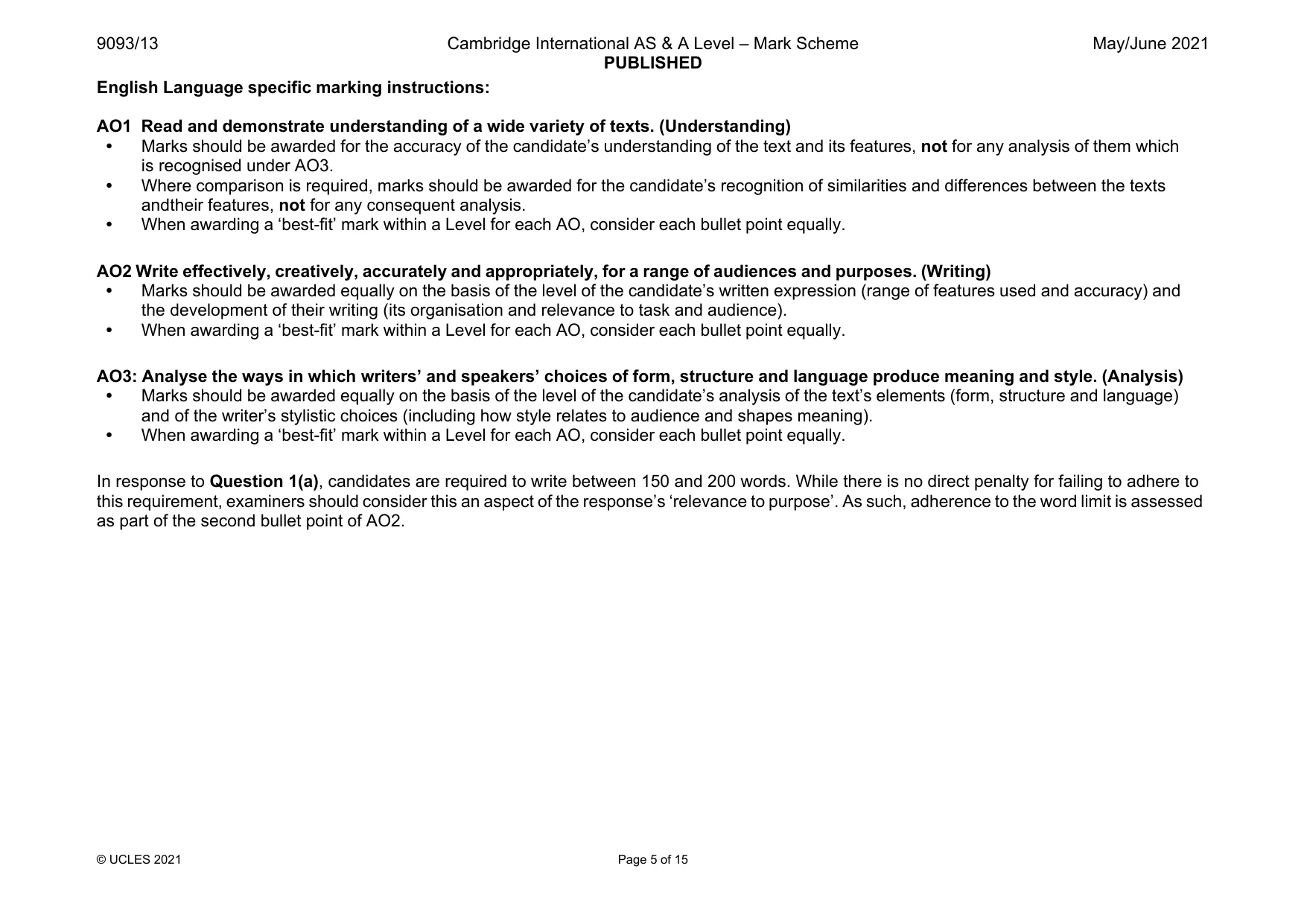
9093/13 Cambridge International AS & A Level – Mark Scheme PUBLISHED May/June 2021 © UCLES 2021 Page 5 of 15 English Language specific marking instructions: AO1 Read and demonstrate understanding of a wide variety of texts. (Understanding) • Marks should be awarded for the accuracy of the candidate’s understanding of the text and its features, not for any analysis of them which is recognised under AO3. • Where comparison is required, marks should be awarded for the candidate’s recognition of similarities and differences between the texts and their features, not for any consequent analysis. • When awarding a ‘best-fit’ mark within a Level for each AO, consider each bullet point equally. AO2 Write effectively, creatively, accurately and appropriately, for a range of audiences and purposes. (Writing) • Marks should be awarded equally on the basis of the level of the candidate’s written expression (range of features used and accuracy) and the development of their writing (its organisation and relevance to task and audience). • When awarding a ‘best-fit’ mark within a Level for each AO, consider each bullet point equally. AO3: Analyse the ways in which writers’ and speakers’ choices of form, structure and language produce meaning and style. (Analysis) • Marks should be awarded equally on the basis of the level of the candidate’s analysis of the text’s elements (form, structure and language) and of the writer’s stylistic choices (including how style relates to audience and shapes meaning). • When awarding a ‘best-fit’ mark within a Level for each AO, consider each bullet point equally. In response to Question 1(a), candidates are required to write between 150 and 200 words. While there is no direct penalty for failing to adhere to this requirement, examiners should consider this an aspect of the response’s ‘relevance to purpose’. As such, adherence to the word limit is assessed as part of the second bullet point of AO2.
Mark scheme, page 6
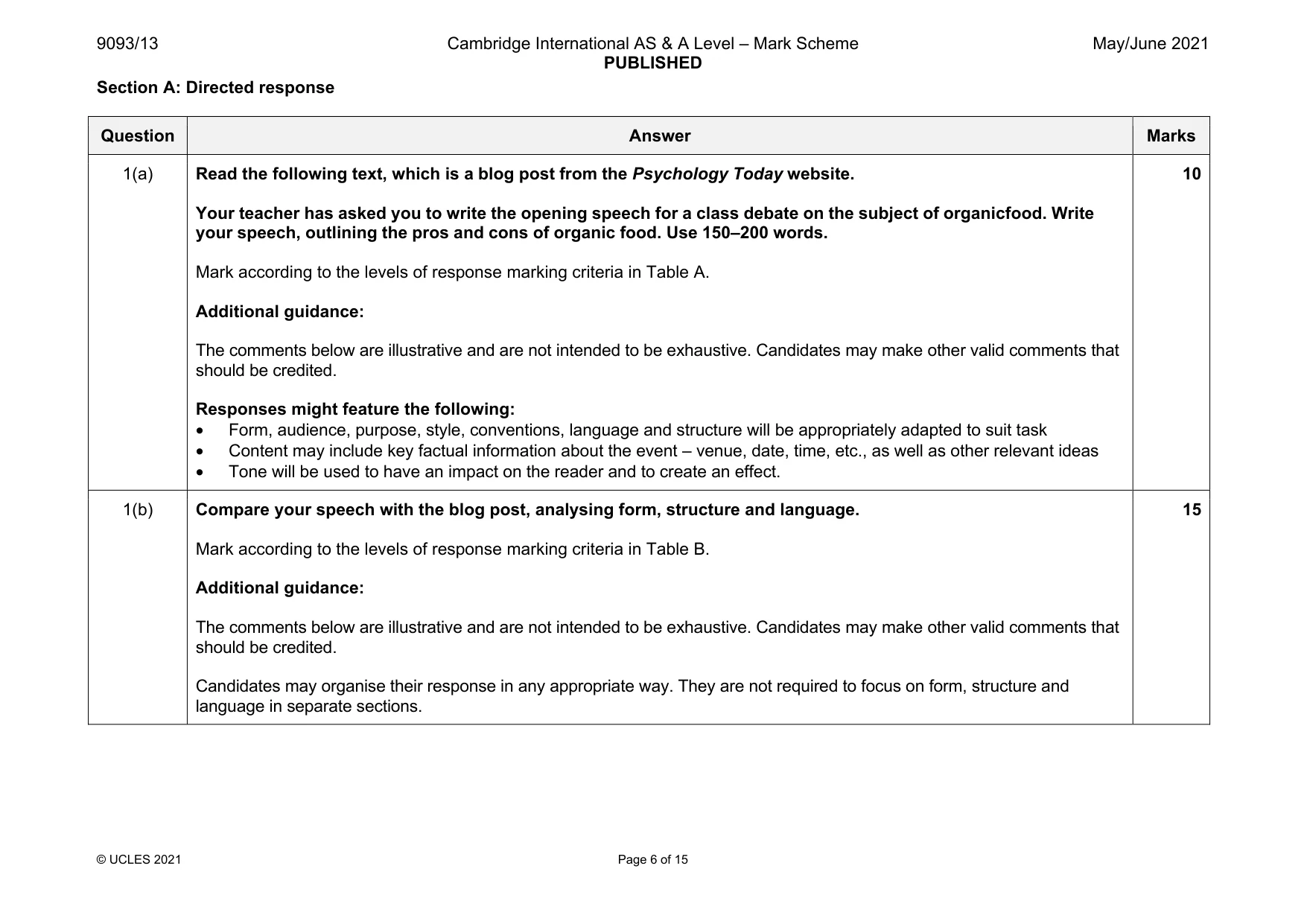
9093/13 Cambridge International AS & A Level – Mark Scheme PUBLISHED May/June 2021 © UCLES 2021 Page 6 of 15 Section A: Directed response Question Answer Marks 1(a) Read the following text, which is a blog post from the Psychology Today website. Your teacher has asked you to write the opening speech for a class debate on the subject of organic food. Write your speech, outlining the pros and cons of organic food. Use 150–200 words. Mark according to the levels of response marking criteria in Table A. Additional guidance: The comments below are illustrative and are not intended to be exhaustive. Candidates may make other valid comments that should be credited. Responses might feature the following: • Form, audience, purpose, style, conventions, language and structure will be appropriately adapted to suit task • Content may include key factual information about the event – venue, date, time, etc., as well as other relevant ideas • Tone will be used to have an impact on the reader and to create an effect. 10 1(b) Compare your speech with the blog post, analysing form, structure and language. Mark according to the levels of response marking criteria in Table B. Additional guidance: The comments below are illustrative and are not intended to be exhaustive. Candidates may make other valid comments that should be credited. Candidates may organise their response in any appropriate way. They are not required to focus on form, structure and language in separate sections. 15
Mark scheme, page 7
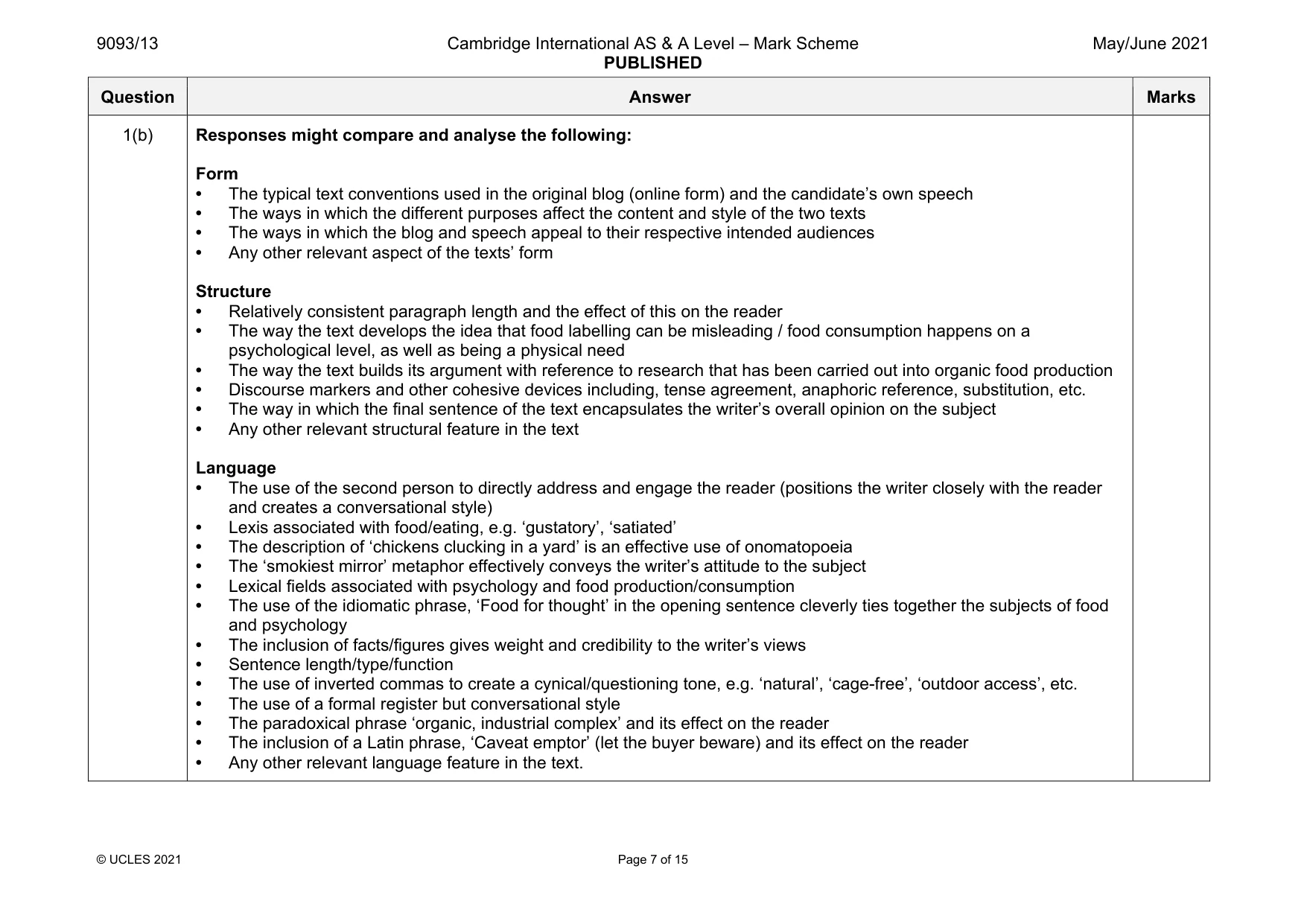
9093/13 Cambridge International AS & A Level – Mark Scheme PUBLISHED May/June 2021 © UCLES 2021 Page 7 of 15 Question Answer Marks 1(b) Responses might compare and analyse the following: Form • The typical text conventions used in the original blog (online form) and the candidate’s own speech • The ways in which the different purposes affect the content and style of the two texts • The ways in which the blog and speech appeal to their respective intended audiences • Any other relevant aspect of the texts’ form Structure • Relatively consistent paragraph length and the effect of this on the reader • The way the text develops the idea that food labelling can be misleading / food consumption happens on a psychological level, as well as being a physical need • The way the text builds its argument with reference to research that has been carried out into organic food production • Discourse markers and other cohesive devices including, tense agreement, anaphoric reference, substitution, etc. • The way in which the final sentence of the text encapsulates the writer’s overall opinion on the subject • Any other relevant structural feature in the text Language • The use of the second person to directly address and engage the reader (positions the writer closely with the reader and creates a conversational style) • Lexis associated with food/eating, e.g. ‘gustatory’, ‘satiated’ • The description of ‘chickens clucking in a yard’ is an effective use of onomatopoeia • The ‘smokiest mirror’ metaphor effectively conveys the writer’s attitude to the subject • Lexical fields associated with psychology and food production/consumption • The use of the idiomatic phrase, ‘Food for thought’ in the opening sentence cleverly ties together the subjects of food and psychology • The inclusion of facts/figures gives weight and credibility to the writer’s views • Sentence length/type/function • The use of inverted commas to create a cynical/questioning tone, e.g. ‘natural’, ‘cage-free’, ‘outdoor access’, etc. • The use of a formal register but conversational style • The paradoxical phrase ‘organic, industrial complex’ and its effect on the reader • The inclusion of a Latin phrase, ‘Caveat emptor’ (let the buyer beware) and its effect on the reader • Any other relevant language feature in the text.
Mark scheme, page 8
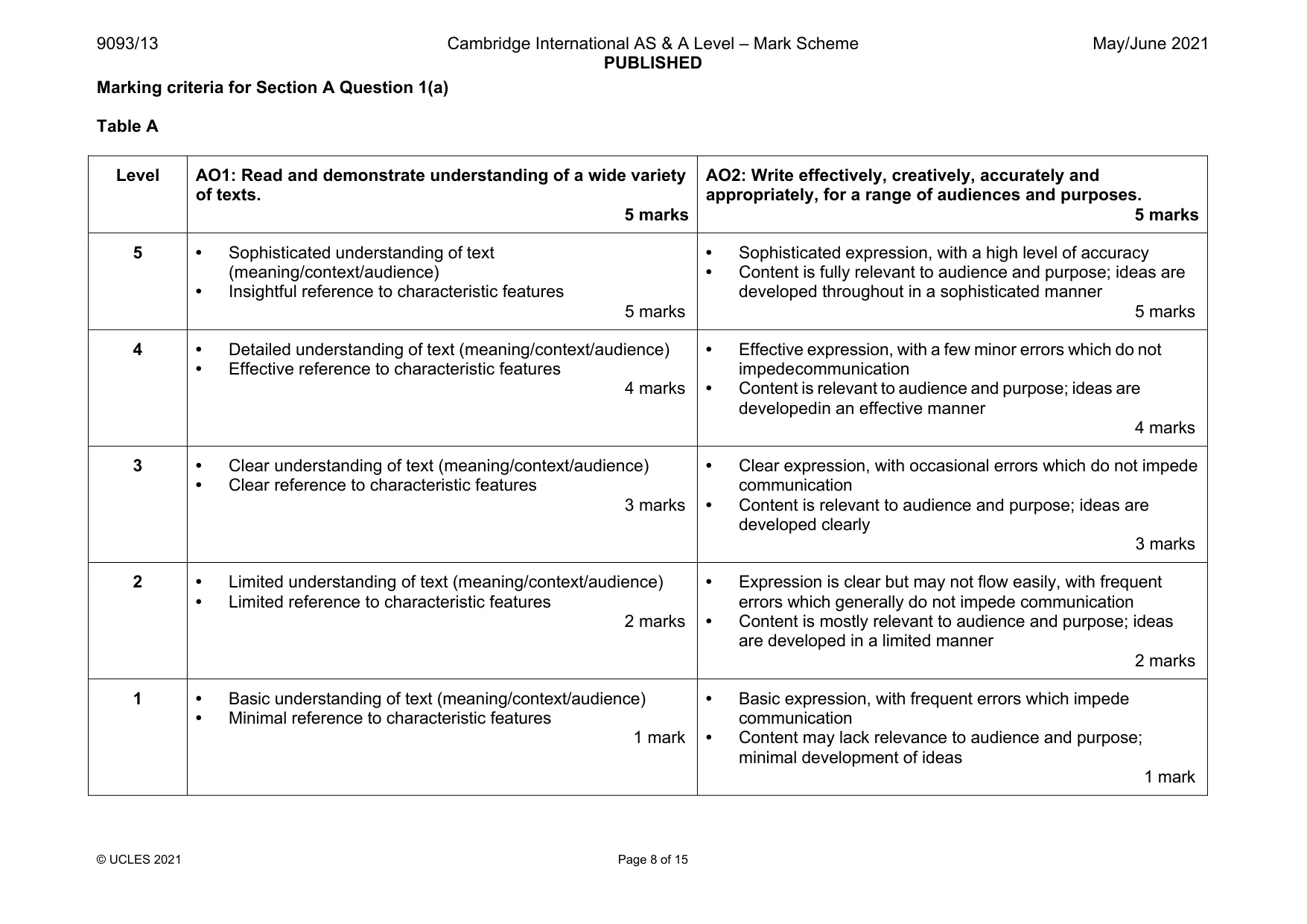
9093/13 Cambridge International AS & A Level – Mark Scheme PUBLISHED May/June 2021 © UCLES 2021 Page 8 of 15 Marking criteria for Section A Question 1(a) Table A Level AO1: Read and demonstrate understanding of a wide variety of texts. 5 marks AO2: Write effectively, creatively, accurately and appropriately, for a range of audiences and purposes. 5 marks 5 • Sophisticated understanding of text (meaning/context/audience) • Insightful reference to characteristic features 5 marks • Sophisticated expression, with a high level of accuracy • Content is fully relevant to audience and purpose; ideas are developed throughout in a sophisticated manner 5 marks 4 • Detailed understanding of text (meaning/context/audience) • Effective reference to characteristic features 4 marks • Effective expression, with a few minor errors which do not impede communication • Content is relevant to audience and purpose; ideas are developed in an effective manner 4 marks 3 • Clear understanding of text (meaning/context/audience) • Clear reference to characteristic features 3 marks • Clear expression, with occasional errors which do not impede communication • Content is relevant to audience and purpose; ideas are developed clearly 3 marks 2 • Limited understanding of text (meaning/context/audience) • Limited reference to characteristic features 2 marks • Expression is clear but may not flow easily, with frequent errors which generally do not impede communication • Content is mostly relevant to audience and purpose; ideas are developed in a limited manner 2 marks 1 • Basic understanding of text (meaning/context/audience) • Minimal reference to characteristic features 1 mark • Basic expression, with frequent errors which impede communication • Content may lack relevance to audience and purpose; minimal development of ideas 1 mark
Mark scheme, page 9
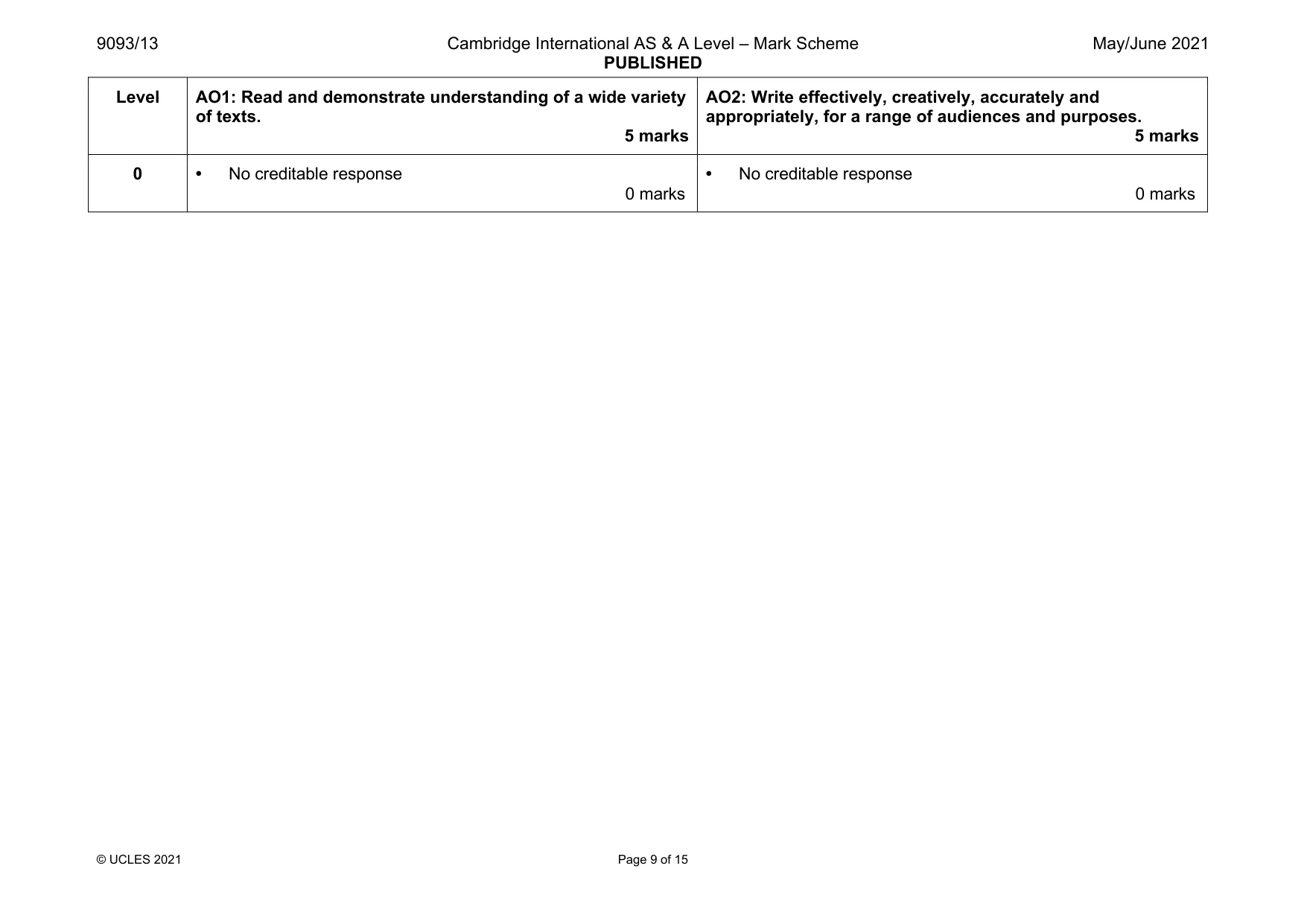
9093/13 Cambridge International AS & A Level – Mark Scheme PUBLISHED May/June 2021 © UCLES 2021 Page 9 of 15 Level AO1: Read and demonstrate understanding of a wide variety of texts. 5 marks AO2: Write effectively, creatively, accurately and appropriately, for a range of audiences and purposes. 5 marks 0 • No creditable response 0 marks • No creditable response 0 marks
Mark scheme, page 10
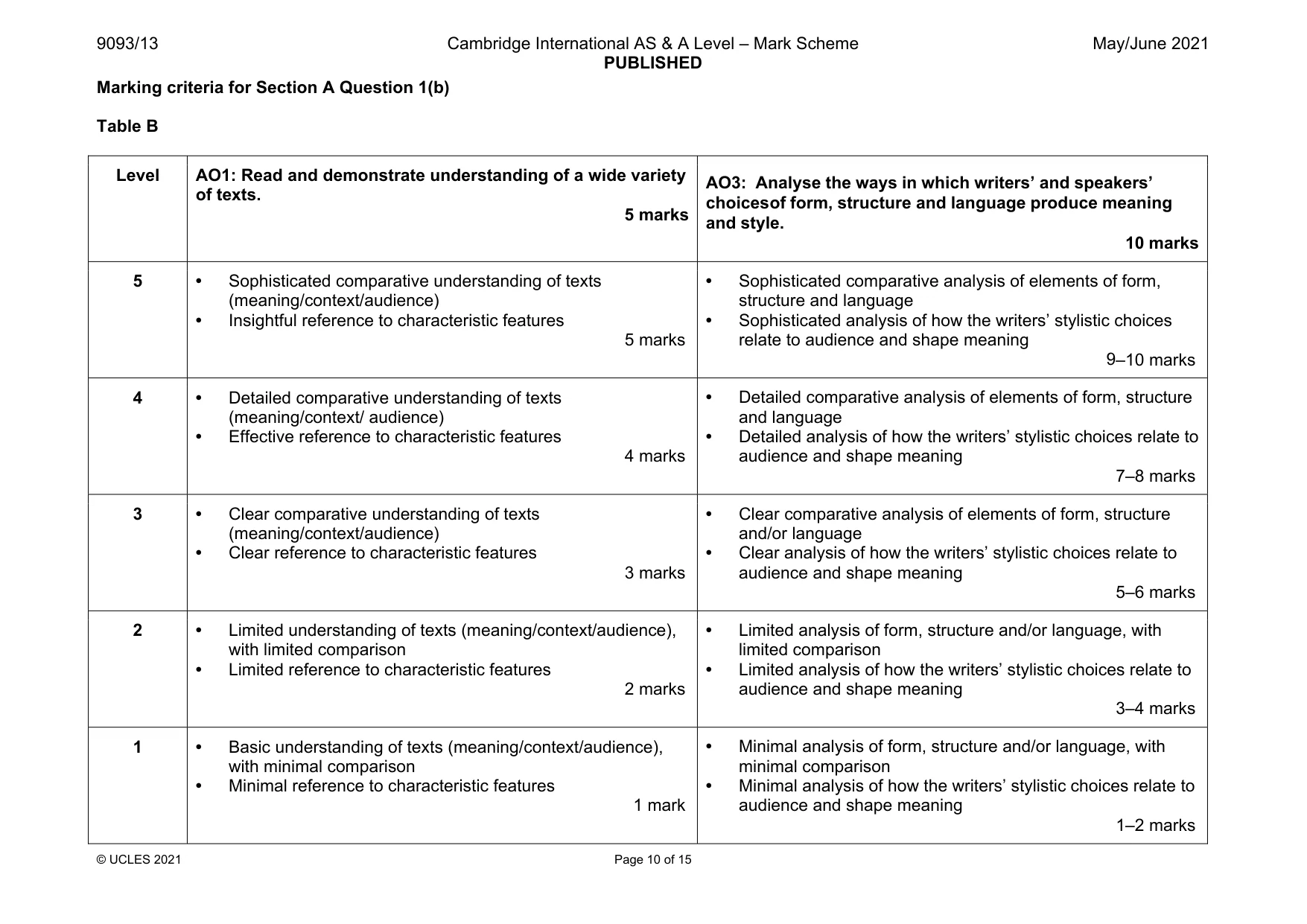
9093/13 Cambridge International AS & A Level – Mark Scheme PUBLISHED May/June 2021 © UCLES 2021 Page 10 of 15 Marking criteria for Section A Question 1(b) Table B Level AO1: Read and demonstrate understanding of a wide variety of texts. 5 marks AO3: Analyse the ways in which writers’ and speakers’ choices of form, structure and language produce meaning and style. 10 marks 5 • Sophisticated comparative understanding of texts (meaning/context/audience) • Insightful reference to characteristic features 5 marks • Sophisticated comparative analysis of elements of form, structure and language • Sophisticated analysis of how the writers’ stylistic choices relate to audience and shape meaning 9–10 marks 4 • Detailed comparative understanding of texts (meaning/context/ audience) • Effective reference to characteristic features 4 marks • Detailed comparative analysis of elements of form, structure and language • Detailed analysis of how the writers’ stylistic choices relate to audience and shape meaning 7–8 marks 3 • Clear comparative understanding of texts (meaning/context/audience) • Clear reference to characteristic features 3 marks • Clear comparative analysis of elements of form, structure and/or language • Clear analysis of how the writers’ stylistic choices relate to audience and shape meaning 5–6 marks 2 • Limited understanding of texts (meaning/context/audience), with limited comparison • Limited reference to characteristic features 2 marks • Limited analysis of form, structure and/or language, with limited comparison • Limited analysis of how the writers’ stylistic choices relate to audience and shape meaning 3–4 marks 1 • Basic understanding of texts (meaning/context/audience), with minimal comparison • Minimal reference to characteristic features 1 mark • Minimal analysis of form, structure and/or language, with minimal comparison • Minimal analysis of how the writers’ stylistic choices relate to audience and shape meaning 1–2 marks
Mark scheme, page 11
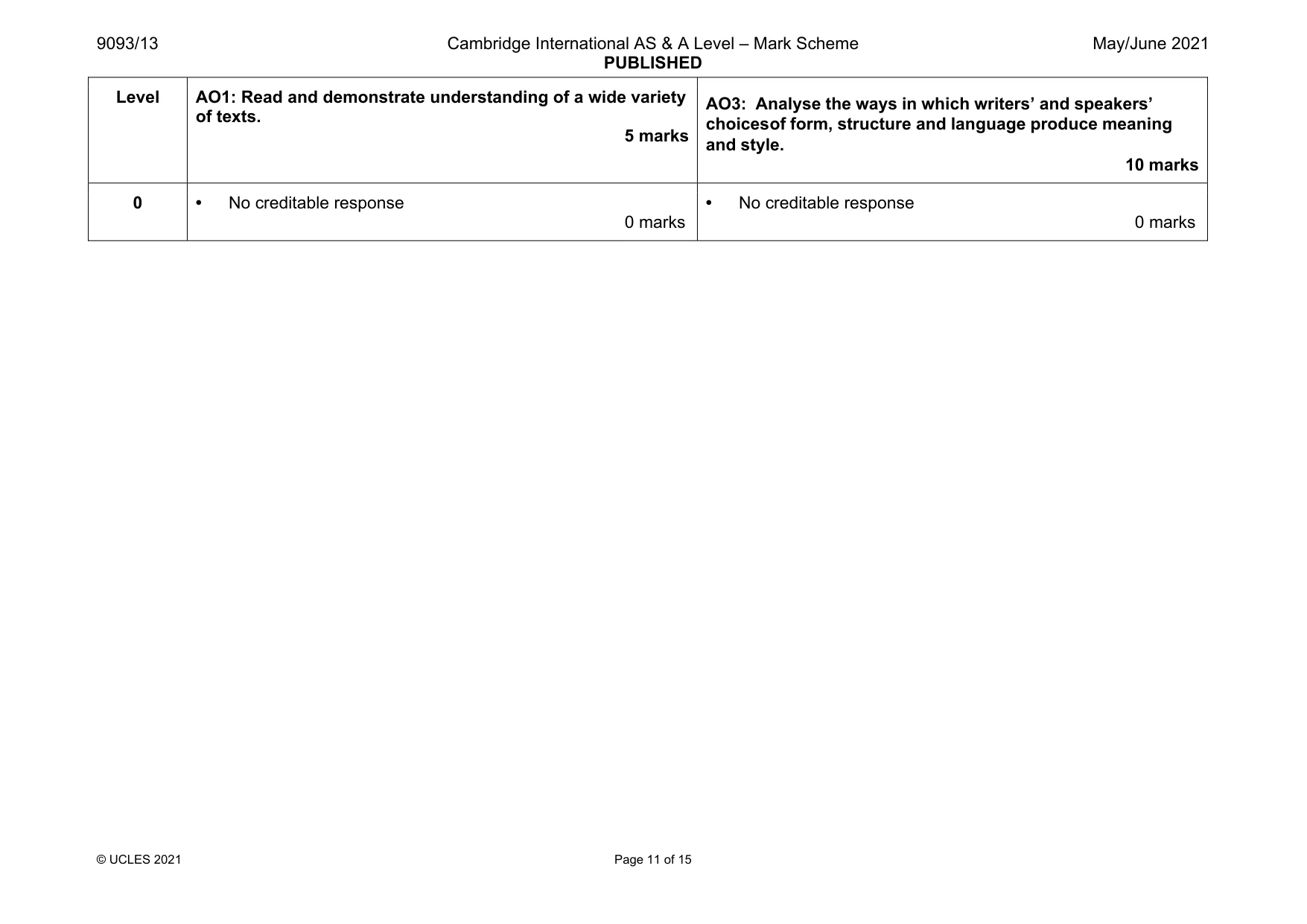
9093/13 Cambridge International AS & A Level – Mark Scheme PUBLISHED May/June 2021 © UCLES 2021 Page 11 of 15 Level AO1: Read and demonstrate understanding of a wide variety of texts. 5 marks AO3: Analyse the ways in which writers’ and speakers’ choices of form, structure and language produce meaning and style. 10 marks 0 • No creditable response 0 marks • No creditable response 0 marks
Mark scheme, page 12
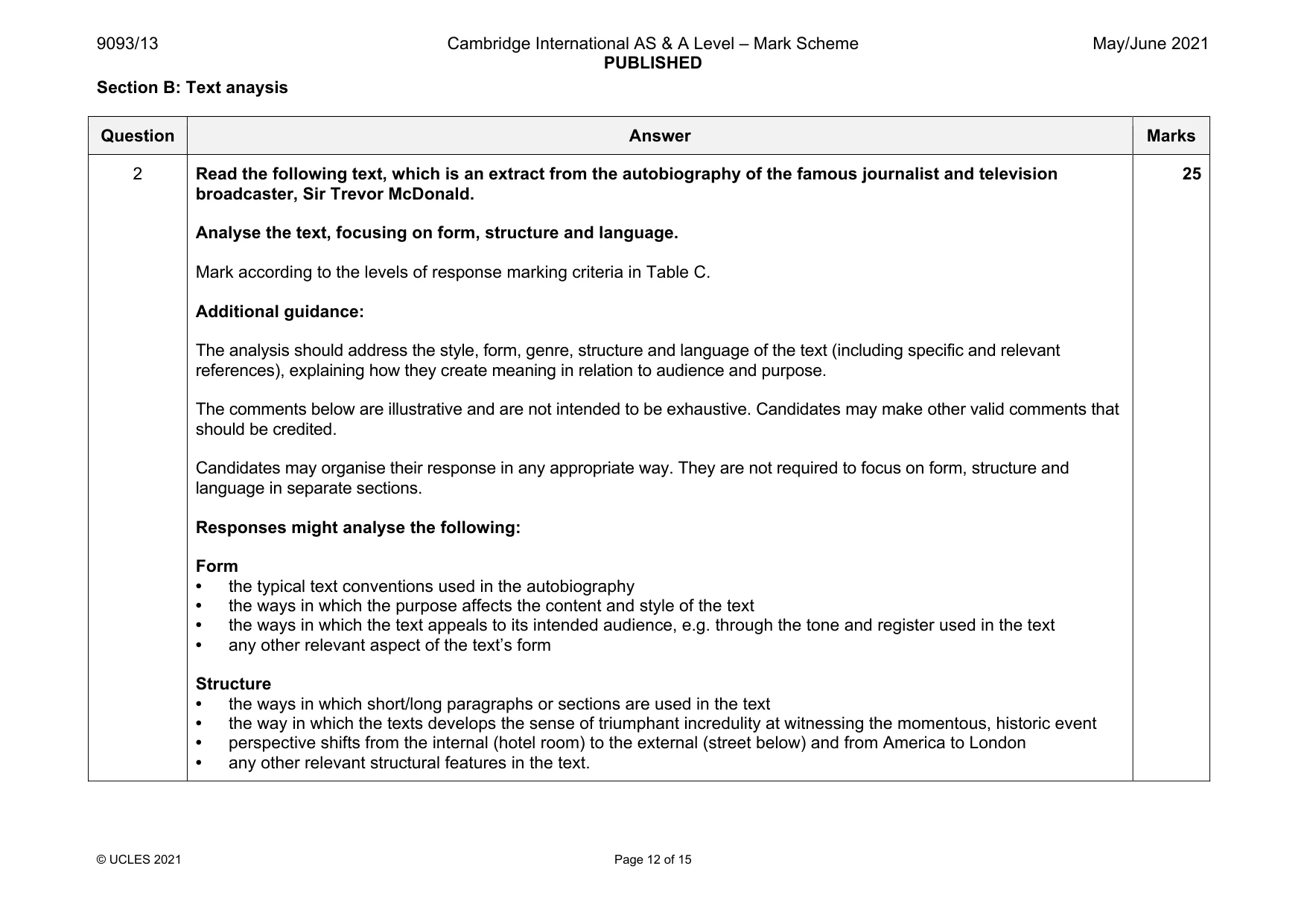
9093/13 Cambridge International AS & A Level – Mark Scheme PUBLISHED May/June 2021 © UCLES 2021 Page 12 of 15 Section B: Text anaysis Question Answer Marks 2 Read the following text, which is an extract from the autobiography of the famous journalist and television broadcaster, Sir Trevor McDonald. Analyse the text, focusing on form, structure and language. Mark according to the levels of response marking criteria in Table C. Additional guidance: The analysis should address the style, form, genre, structure and language of the text (including specific and relevant references), explaining how they create meaning in relation to audience and purpose. The comments below are illustrative and are not intended to be exhaustive. Candidates may make other valid comments that should be credited. Candidates may organise their response in any appropriate way. They are not required to focus on form, structure and language in separate sections. Responses might analyse the following: Form • the typical text conventions used in the autobiography • the ways in which the purpose affects the content and style of the text • the ways in which the text appeals to its intended audience, e.g. through the tone and register used in the text • any other relevant aspect of the text’s form Structure • the ways in which short/long paragraphs or sections are used in the text • the way in which the texts develops the sense of triumphant incredulity at witnessing the momentous, historic event • perspective shifts from the internal (hotel room) to the external (street below) and from America to London • any other relevant structural features in the text. 25
Mark scheme, page 13
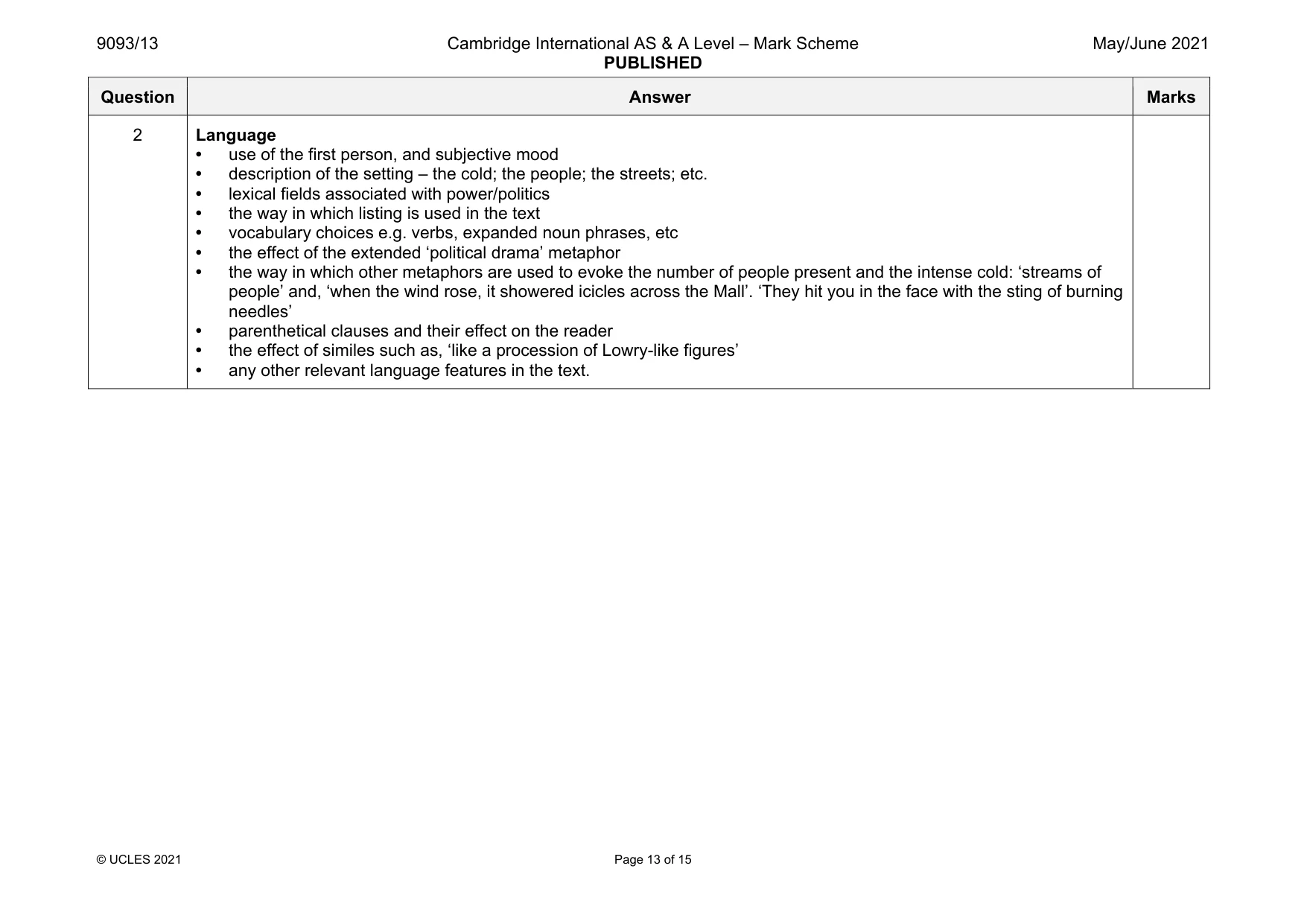
9093/13 Cambridge International AS & A Level – Mark Scheme PUBLISHED May/June 2021 © UCLES 2021 Page 13 of 15 Question Answer Marks 2 Language • use of the first person, and subjective mood • description of the setting – the cold; the people; the streets; etc. • lexical fields associated with power/politics • the way in which listing is used in the text • vocabulary choices e.g. verbs, expanded noun phrases, etc • the effect of the extended ‘political drama’ metaphor • the way in which other metaphors are used to evoke the number of people present and the intense cold: ‘streams of people’ and, ‘when the wind rose, it showered icicles across the Mall’. ‘They hit you in the face with the sting of burning needles’ • parenthetical clauses and their effect on the reader • the effect of similes such as, ‘like a procession of Lowry-like figures’ • any other relevant language features in the text.
Mark scheme, page 14
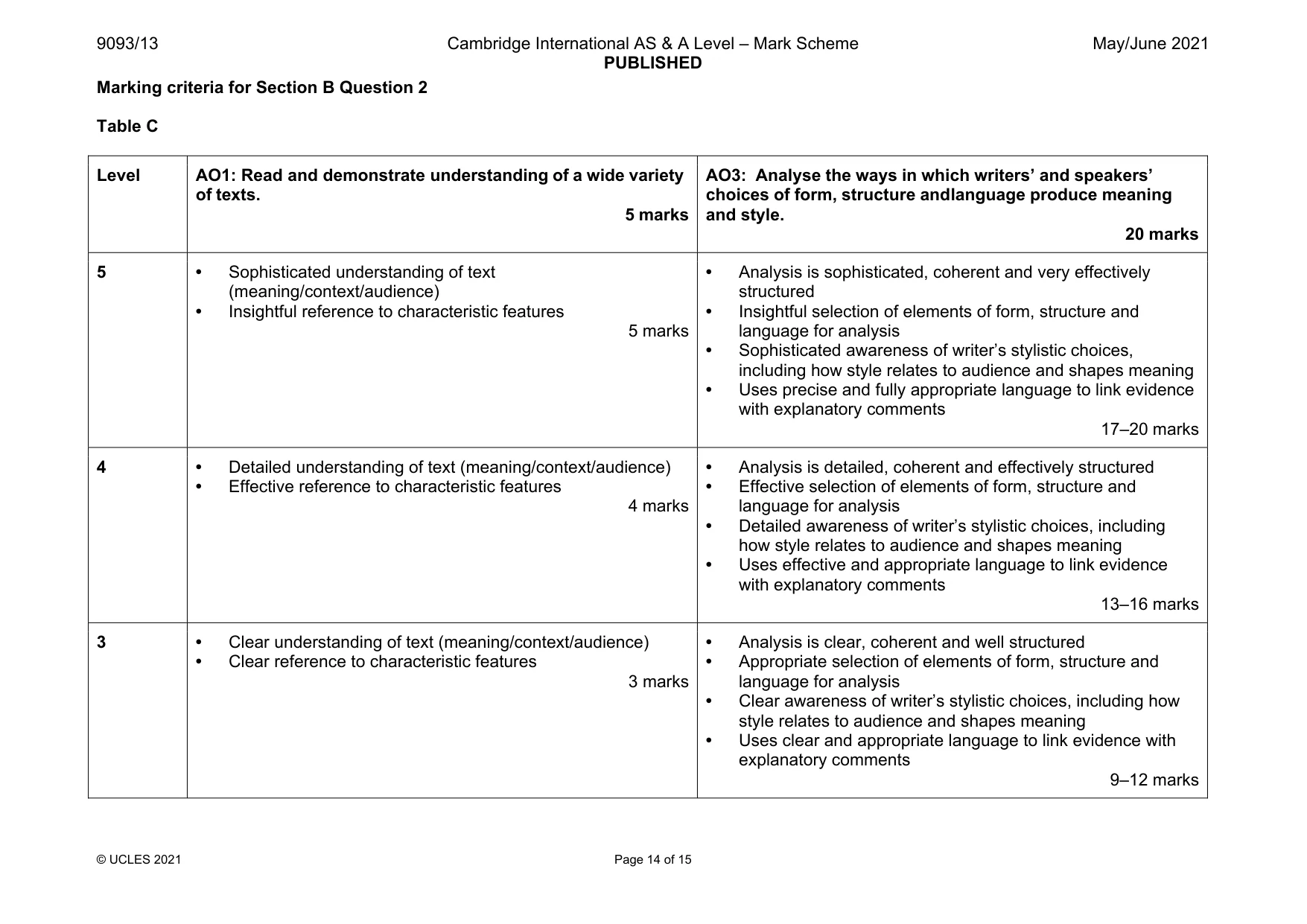
9093/13 Cambridge International AS & A Level – Mark Scheme PUBLISHED May/June 2021 © UCLES 2021 Page 14 of 15 Marking criteria for Section B Question 2 Table C Level AO1: Read and demonstrate understanding of a wide variety of texts. 5 marks AO3: Analyse the ways in which writers’ and speakers’ choices of form, structure and language produce meaning and style. 20 marks 5 • Sophisticated understanding of text (meaning/context/audience) • Insightful reference to characteristic features 5 marks • Analysis is sophisticated, coherent and very effectively structured • Insightful selection of elements of form, structure and language for analysis • Sophisticated awareness of writer’s stylistic choices, including how style relates to audience and shapes meaning • Uses precise and fully appropriate language to link evidence with explanatory comments 17–20 marks 4 • Detailed understanding of text (meaning/context/audience) • Effective reference to characteristic features 4 marks • Analysis is detailed, coherent and effectively structured • Effective selection of elements of form, structure and language for analysis • Detailed awareness of writer’s stylistic choices, including how style relates to audience and shapes meaning • Uses effective and appropriate language to link evidence with explanatory comments 13–16 marks 3 • Clear understanding of text (meaning/context/audience) • Clear reference to characteristic features 3 marks • Analysis is clear, coherent and well structured • Appropriate selection of elements of form, structure and language for analysis • Clear awareness of writer’s stylistic choices, including how style relates to audience and shapes meaning • Uses clear and appropriate language to link evidence with explanatory comments 9–12 marks
Mark scheme, page 15
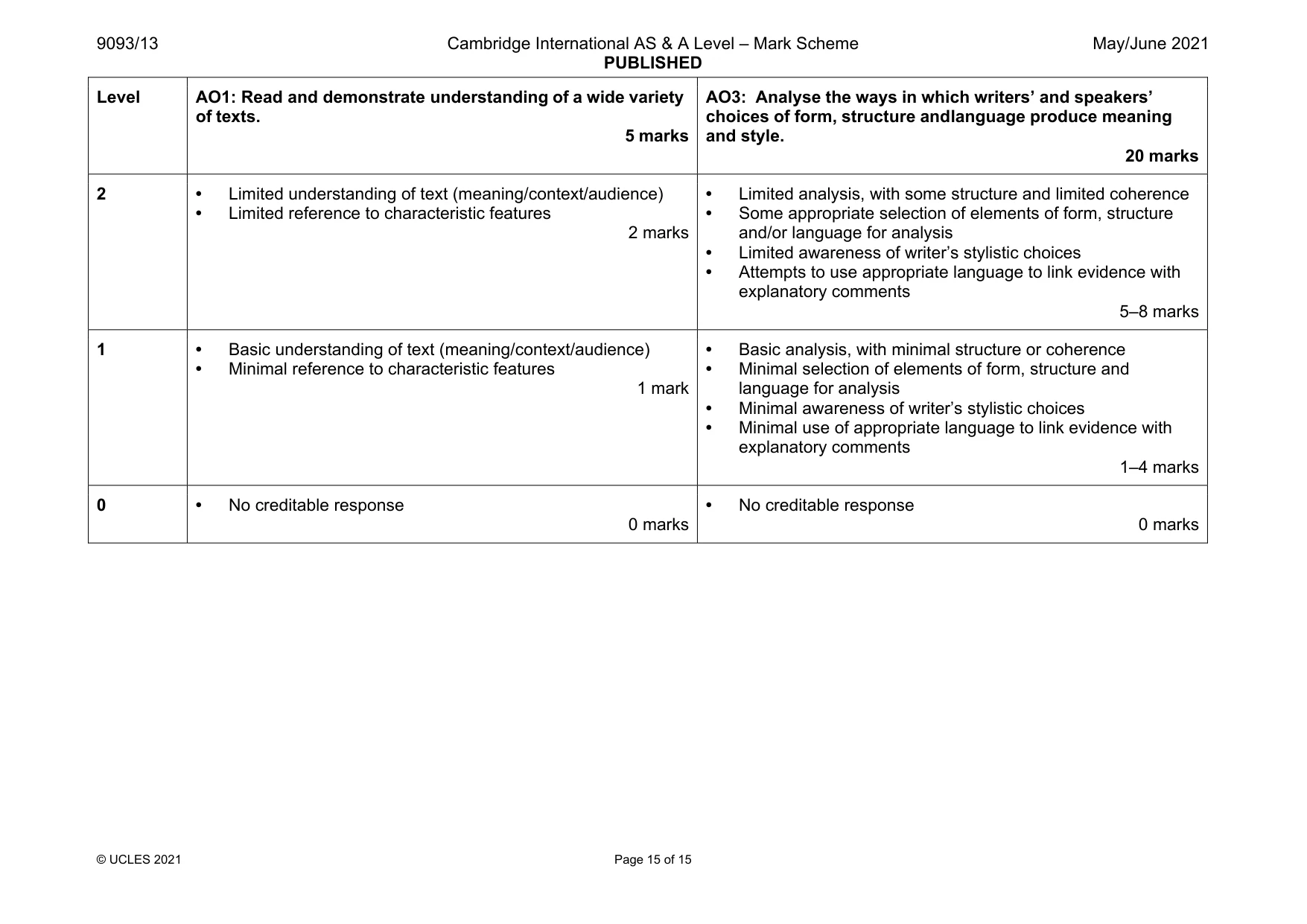
9093/13 Cambridge International AS & A Level – Mark Scheme PUBLISHED May/June 2021 © UCLES 2021 Page 15 of 15 Level AO1: Read and demonstrate understanding of a wide variety of texts. 5 marks AO3: Analyse the ways in which writers’ and speakers’ choices of form, structure and language produce meaning and style. 20 marks 2 • Limited understanding of text (meaning/context/audience) • Limited reference to characteristic features 2 marks • Limited analysis, with some structure and limited coherence • Some appropriate selection of elements of form, structure and/or language for analysis • Limited awareness of writer’s stylistic choices • Attempts to use appropriate language to link evidence with explanatory comments 5–8 marks 1 • Basic understanding of text (meaning/context/audience) • Minimal reference to characteristic features 1 mark • Basic analysis, with minimal structure or coherence • Minimal selection of elements of form, structure and language for analysis • Minimal awareness of writer’s stylistic choices • Minimal use of appropriate language to link evidence with explanatory comments 1–4 marks 0 • No creditable response 0 marks • No creditable response 0 marks
What you needed in this session
Cambridge’s own grade thresholds for 2021 May/June, Paper 1 · Variant 3. A higher threshold means an easier paper — the bar moves with how the cohort did.