Cambridge A Level English - Language AS and A Level (from 2014) 9093 — 2020 Feb/March Paper 1 · Variant 2
9093/12/F/M/20 · 50 marks · ≈56 min
The question paper and its mark scheme, free to read here and free to download. This is Cambridge’s own paper, exactly as it was sat.
Question paper8 pages

Mark scheme4 pages
Answers below. Sit the paper first if you are practising.
Paper as text
Question paper, page 1
Cambridge International AS & A Level This document has 8 pages. Blank pages are indicated. DC (LK) 186779/2 © UCLES 2020 [Turn over ENGLISH LANGUAGE 9093/12 Paper 1 Passages February/March 2020 2 hours 15 minutes You must answer on the enclosed answer booklet. You will need: Answer booklet (enclosed) INSTRUCTIONS ● Answer two questions in total: Answer Question 1. Answer either Question 2 or Question 3. ● Follow the instructions on the front cover of the answer booklet. If you need additional answer paper, ask the invigilator for a continuation booklet. ● You are reminded of the need for good English and clear presentation in your answers. INFORMATION ● The total mark for this paper is 50. ● The number of marks for each question or part question is shown in brackets [ ]. * 5 4 8 3 8 1 2 1 7 7 *
Question paper, page 2
2 9093/12/F/M/20 © UCLES 2020 Answer Question 1 and either Question 2 or Question 3. 1 In the following extract from a short story, the narrator describes going to an appointment at a lawyer’s office in South Africa. (a) Comment on the language and style of the extract. [15] (b) Imagine you are one of the lawyer’s other clients and have witnessed the events in the extract. You decide to write a diary entry reflecting on those events. Basing your writing closely on the material of the original extract, and using 120 to 150 of your own words, write a section of your diary entry. [10] Take it to a lawyer. That’s what my friend told me to do. Now, I had never had occasion to have anything to do with lawyers. Mention of lawyers always brought to my mind pictures of courts, police: terrifying pictures. Although I was in trouble, I wondered why it should be a lawyer who would help me. However, my friend gave me the address. And from that moment my problem loomed larger. It turned in my mind. On the night before my visit to the solicitor, my heart was full of feelings of hurt. My soul fed on fire and scalding water. I’d tell the lawyer; I’d tell him everything that had gnawed inside me for several days. I went up the stairs of the high building. Whenever I met a man I imagined that he was the lawyer and all but started to pour out my trouble. On the landing I met a boy with a man’s head and face and rather large ears and lips. I told him I had come to see Mr. B, the lawyer. Very gently, he told me to go into the waiting room and wait my turn with the others. I was disappointed. I had wanted to see Mr. B, tell him everything and get the lawyer’s cure for it. To be told to wait … They were sitting in the waiting room, the clients, ranged round the walls – about twenty of them, like those dolls waiting to be bowled over at a merry go round fair. It didn’t seem that I’d get enough time to recite the whole thing – how it all started, grew into something big and was threatening to crush me – with so many people waiting. The boy with the man’s head and face and large ears came in at intervals to call the next person. I knew what I’d do: I’d go over the whole problem in my mind, so that I could even say it backwards. The lawyer must miss nothing, nothing whatever. But in the course of it all my eyes wandered about the room: the people, the walls, the ceiling, the furniture. A bare, unattractive room: the arms of the chairs had scratches on them that might have been made with a pin by someone who was tired of waiting. Against the only stretch of wall that was free of chairs for clients, a man of about fifty sat at a table, sealing envelopes. ‘The big man is very busy today, eh?’ observed the man at the table. ‘Yes,’ I said mechanically. My attention was drawn to the whole setting once more: a plain unpretentious room with oldish chairs; the pile of letters and envelopes; the man; and the picture of the cat. 5 10 15 20 25 30
Question paper, page 3
3 9093/12/F/M/20 © UCLES 2020 [Turn over An envelope fell to the floor. He bent down to take it up. I watched his large hands feel about for it, fumbling. Then the hand came upon the object, but with much more weight than a piece of paper warranted. Even before he came up straight on his chair I saw it clearly. The man at the table was blind, stone blind. As my eyes were getting used to the details, after my mind had thus been jolted into confused activity, I understood. Here was a man sealing envelopes, looking like a drawing on a flat surface. Perhaps he was flat and without depth, like a gramophone disc; too flat even to be hindered by the heat, the boredom of sitting for hours doing the same work; by too many or too few people coming. An invincible pair, he and the cat glowering at him, scorning our shames and hurts and the heat, seeming to hold the key to the immediate imperceptible and the most remote unforeseeable. I went in to see Mr B. A small man (as I had imagined) with tired eyes but an undaunted face. I told him everything from beginning to end. 35 40 45
Question paper, page 4
4 9093/12/F/M/20 © UCLES 2020 2 The following text is taken from a book, written by Philip Hoare, that blends memoir and travel writing. In the text, the writer contemplates some of the sights and sounds of the natural world. (a) Comment on the language and style of the text. [15] (b) You have been asked to produce a guide for novice birdwatchers. Basing your writing closely on the material of the original text, write a section for the guide about the behaviour of blackbirds. Use 120 to 150 of your own words. [10] There could hardly be a more common bird, yet you could travel around half the world and never hear anything so beautiful as a blackbird in a suburban garden. Their big eyes sense the small slip from darkness to the semblance of light before all other garden birds; only robins can rival them in this keen awareness. I listen to the first notes of the first song, a lone voice in the dark, joined by another, then another, until they form a circle of sound. From dawn to dusk they rise and fall, fit and start, from roofs to trees, announcing their allure. Their songs are asymmetrical, apparently random; phrases are thrown out to be echoed by rivals, in the way humpback whales take up that year’s song and repeat it through the oceans. As the philosopher and musician David Rothenberg showed me, when you speed up the song of a humpback, it sounds very much like birdsong, with the same ‘sustained whistles, rhythmic chirps, and noisy brawphs’. Each sequence is its own narrative, precisely measured out. Blackbirds have the ability to sound both ridiculous and sublime at the same time, with their querying intonation ending in an upnote, like a teen’s mallspeak – duh-duh-duh?; or duh-duh-lu, duh-duh-lu! But theirs is a serious intent, bent on preventing any incursion into their fiefdom1, as well as sounding sexy to a potential mate. They’ll fly just a few feet off the ground, to avoid predators from above – although a habit which made sense when their only enemies were raptors is less useful now that their low flight-paths take them directly into potentially lethal traffic; it amazes me, as yet another black streak almost zooms through my bike wheels, that they don’t sustain more casualties. They must retain a trace memory of when all this was only heathland. A blackbird defends its territory all its life; some may live for up to twenty years. The same bird bobs and bows and runs across my garage roof year after year, looking up at me in turn. How can such a grey, wet day be so beautiful? After days of rain I ride out at dawn, taking my chance during a brief interlude of dryness. There’s nothing to focus on, just cloud. Under such skies anything is a gain. It’s May Day. The rain intensifies the smell of the morning. The woods through which the road runs lean over and meet tree-to-tree, negating the tarmac below. At the beach, the water is flat calm. The world has opened up again. A new shape appears high over the shore; the slender wings of a swallow, zigzagging its way from the sea to the trees, thousands of miles from sub-Saharan Africa. Later, I’ll watch them from water level as they swoop within inches of my head, so close that I can see every detail: blue-black backs as iridescent as a mineral, pure white bellies and rosy chins. 5 10 15 20 25 30 35
Question paper, page 5
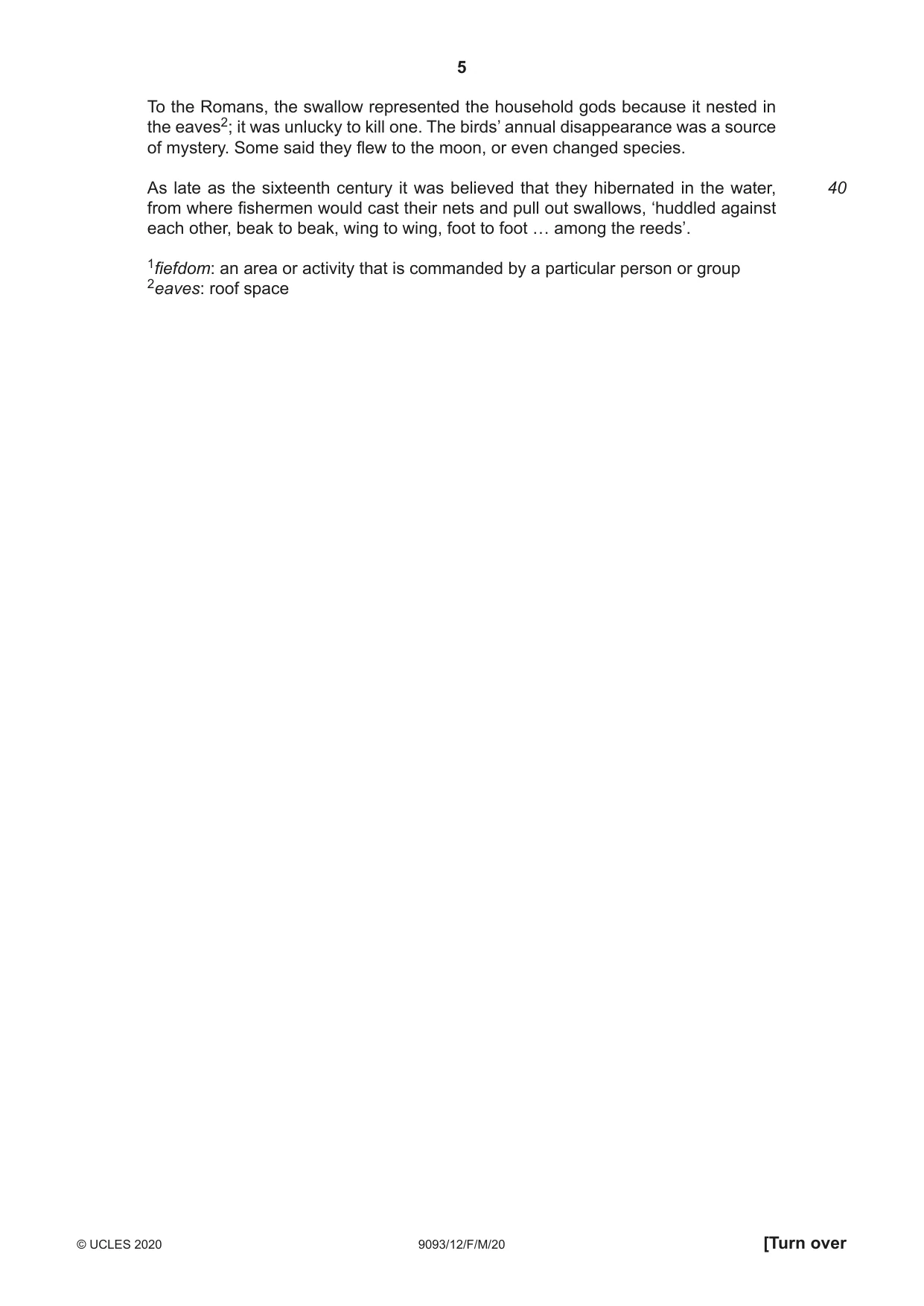
5 9093/12/F/M/20 © UCLES 2020 [Turn over To the Romans, the swallow represented the household gods because it nested in the eaves2; it was unlucky to kill one. The birds’ annual disappearance was a source of mystery. Some said they flew to the moon, or even changed species. As late as the sixteenth century it was believed that they hibernated in the water, from where fishermen would cast their nets and pull out swallows, ‘huddled against each other, beak to beak, wing to wing, foot to foot … among the reeds’. 1fiefdom: an area or activity that is commanded by a particular person or group 2eaves: roof space 40
Question paper, page 6
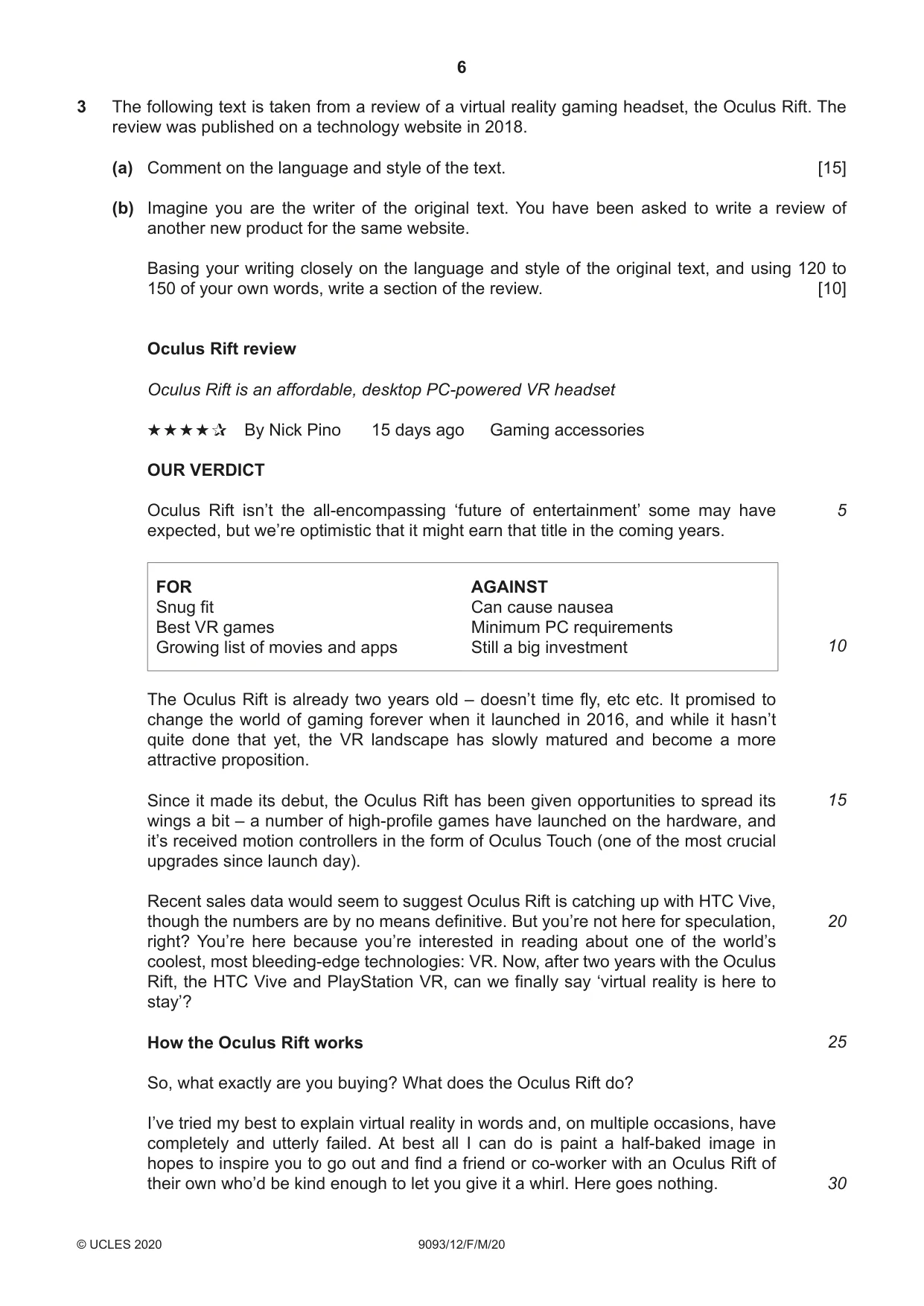
6 9093/12/F/M/20 © UCLES 2020 3 The following text is taken from a review of a virtual reality gaming headset, the Oculus Rift. The review was published on a technology website in 2018. (a) Comment on the language and style of the text. [15] (b) Imagine you are the writer of the original text. You have been asked to write a review of another new product for the same website. Basing your writing closely on the language and style of the original text, and using 120 to 150 of your own words, write a section of the review. [10] Oculus Rift review Oculus Rift is an affordable, desktop PC-powered VR headset ★ ★ ★ ★ ✰ By Nick Pino 15 days ago Gaming accessories OUR VERDICT Oculus Rift isn’t the all-encompassing ‘future of entertainment’ some may have expected, but we’re optimistic that it might earn that title in the coming years. FOR Snug fit Best VR games Growing list of movies and apps AGAINST Can cause nausea Minimum PC requirements Still a big investment The Oculus Rift is already two years old – doesn’t time fly, etc etc. It promised to change the world of gaming forever when it launched in 2016, and while it hasn’t quite done that yet, the VR landscape has slowly matured and become a more attractive proposition. Since it made its debut, the Oculus Rift has been given opportunities to spread its wings a bit – a number of high-profile games have launched on the hardware, and it’s received motion controllers in the form of Oculus Touch (one of the most crucial upgrades since launch day). Recent sales data would seem to suggest Oculus Rift is catching up with HTC Vive, though the numbers are by no means definitive. But you’re not here for speculation, right? You’re here because you’re interested in reading about one of the world’s coolest, most bleeding-edge technologies: VR. Now, after two years with the Oculus Rift, the HTC Vive and PlayStation VR, can we finally say ‘virtual reality is here to stay’? How the Oculus Rift works So, what exactly are you buying? What does the Oculus Rift do? I’ve tried my best to explain virtual reality in words and, on multiple occasions, have completely and utterly failed. At best all I can do is paint a half-baked image in hopes to inspire you to go out and find a friend or co-worker with an Oculus Rift of their own who’d be kind enough to let you give it a whirl. Here goes nothing. 5 10 15 20 25 30
Question paper, page 7
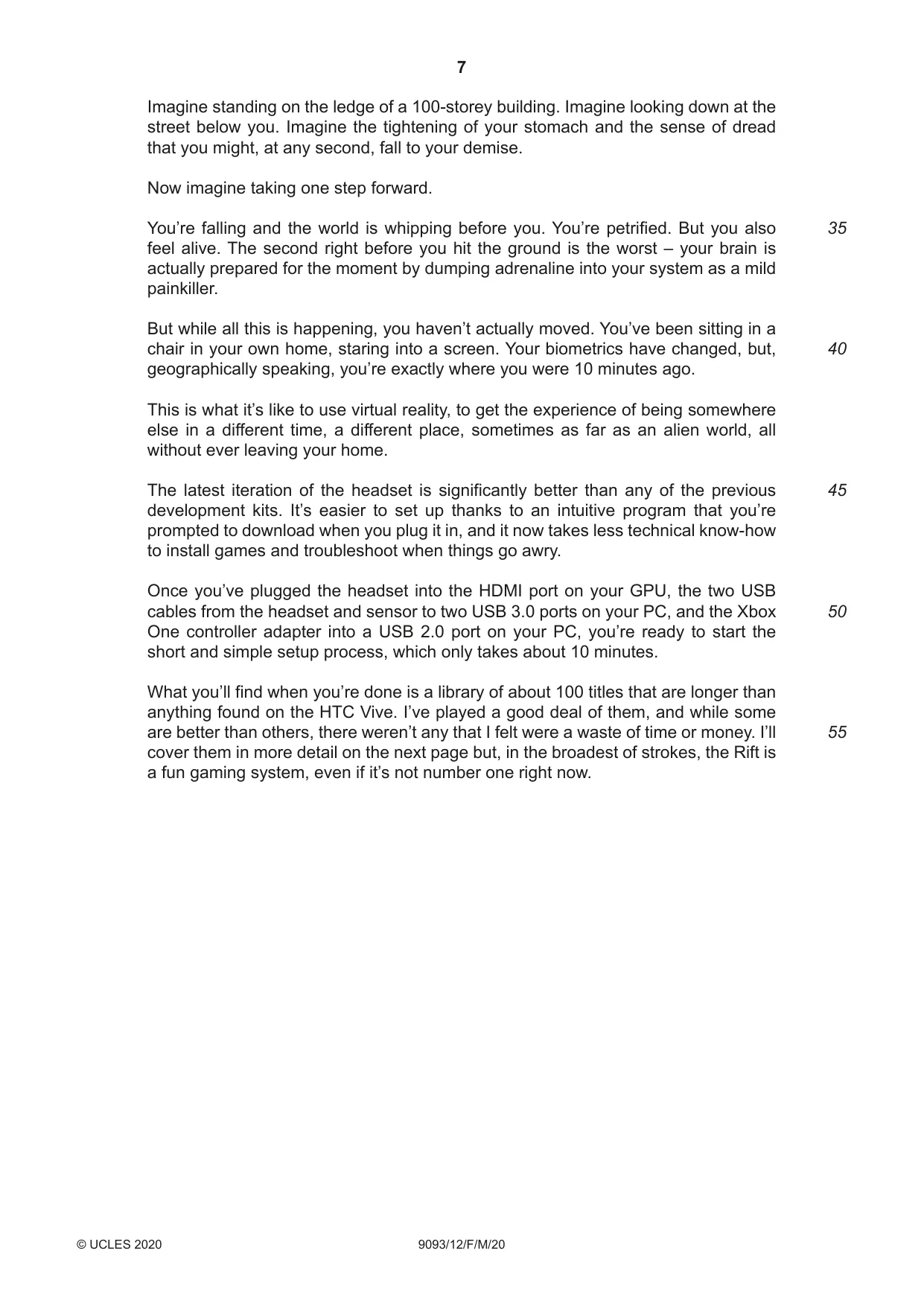
7 9093/12/F/M/20 © UCLES 2020 Imagine standing on the ledge of a 100-storey building. Imagine looking down at the street below you. Imagine the tightening of your stomach and the sense of dread that you might, at any second, fall to your demise. Now imagine taking one step forward. You’re falling and the world is whipping before you. You’re petrified. But you also feel alive. The second right before you hit the ground is the worst – your brain is actually prepared for the moment by dumping adrenaline into your system as a mild painkiller. But while all this is happening, you haven’t actually moved. You’ve been sitting in a chair in your own home, staring into a screen. Your biometrics have changed, but, geographically speaking, you’re exactly where you were 10 minutes ago. This is what it’s like to use virtual reality, to get the experience of being somewhere else in a different time, a different place, sometimes as far as an alien world, all without ever leaving your home. The latest iteration of the headset is significantly better than any of the previous development kits. It’s easier to set up thanks to an intuitive program that you’re prompted to download when you plug it in, and it now takes less technical know-how to install games and troubleshoot when things go awry. Once you’ve plugged the headset into the HDMI port on your GPU, the two USB cables from the headset and sensor to two USB 3.0 ports on your PC, and the Xbox One controller adapter into a USB 2.0 port on your PC, you’re ready to start the short and simple setup process, which only takes about 10 minutes. What you’ll find when you’re done is a library of about 100 titles that are longer than anything found on the HTC Vive. I’ve played a good deal of them, and while some are better than others, there weren’t any that I felt were a waste of time or money. I’ll cover them in more detail on the next page but, in the broadest of strokes, the Rift is a fun gaming system, even if it’s not number one right now. 35 40 45 50 55
Question paper, page 8
8 9093/12/F/M/20 © UCLES 2020 Permission to reproduce items where third-party owned material protected by copyright is included has been sought and cleared where possible. Every reasonable effort has been made by the publisher (UCLES) to trace copyright holders, but if any items requiring clearance have unwittingly been included, the publisher will be pleased to make amends at the earliest possible opportunity. To avoid the issue of disclosure of answer-related information to candidates, all copyright acknowledgements are reproduced online in the Cambridge Assessment International Education Copyright Acknowledgements Booklet. This is produced for each series of examinations and is freely available to download at www.cambridgeinternational.org after the live examination series. Cambridge Assessment International Education is part of the Cambridge Assessment Group. Cambridge Assessment is the brand name of the University of Cambridge Local Examinations Syndicate (UCLES), which itself is a department of the University of Cambridge. BLANK PAGE
Mark scheme, page 1
This document consists of 4 printed pages. © UCLES 2020 [Turn over Cambridge International AS & A Level ENGLISH LANGUAGE 9093/12 Paper 1 Passages March 2020 MARK SCHEME Maximum Mark: 50 Published This mark scheme is published as an aid to teachers and candidates, to indicate the requirements of the examination. It shows the basis on which Examiners were instructed to award marks. It does not indicate the details of the discussions that took place at an Examiners’ meeting before marking began, which would have considered the acceptability of alternative answers. Mark schemes should be read in conjunction with the question paper and the Principal Examiner Report for Teachers. Cambridge International will not enter into discussions about these mark schemes. Cambridge International is publishing the mark schemes for the March 2020 series for most Cambridge IGCSE™, Cambridge International A and AS Level components and some Cambridge O Level components.
Mark scheme, page 2
9093/12 Cambridge International AS & A Level – Mark Scheme PUBLISHED March 2020 © UCLES 2020 Page 2 of 4 Generic Marking Principles These general marking principles must be applied by all examiners when marking candidate answers. They should be applied alongside the specific content of the mark scheme or generic level descriptors for a question. Each question paper and mark scheme will also comply with these marking principles. GENERIC MARKING PRINCIPLE 1: Marks must be awarded in line with: • the specific content of the mark scheme or the generic level descriptors for the question • the specific skills defined in the mark scheme or in the generic level descriptors for the question • the standard of response required by a candidate as exemplified by the standardisation scripts. GENERIC MARKING PRINCIPLE 2: Marks awarded are always whole marks (not half marks, or other fractions). GENERIC MARKING PRINCIPLE 3: Marks must be awarded positively: • marks are awarded for correct/valid answers, as defined in the mark scheme. However, credit is given for valid answers which go beyond the scope of the syllabus and mark scheme, referring to your Team Leader as appropriate • marks are awarded when candidates clearly demonstrate what they know and can do • marks are not deducted for errors • marks are not deducted for omissions • answers should only be judged on the quality of spelling, punctuation and grammar when these features are specifically assessed by the question as indicated by the mark scheme. The meaning, however, should be unambiguous. GENERIC MARKING PRINCIPLE 4: Rules must be applied consistently e.g. in situations where candidates have not followed instructions or in the application of generic level descriptors. GENERIC MARKING PRINCIPLE 5: Marks should be awarded using the full range of marks defined in the mark scheme for the question (however; the use of the full mark range may be limited according to the quality of the candidate responses seen). GENERIC MARKING PRINCIPLE 6: Marks awarded are based solely on the requirements as defined in the mark scheme. Marks should not be awarded with grade thresholds or grade descriptors in mind.
Mark scheme, page 3
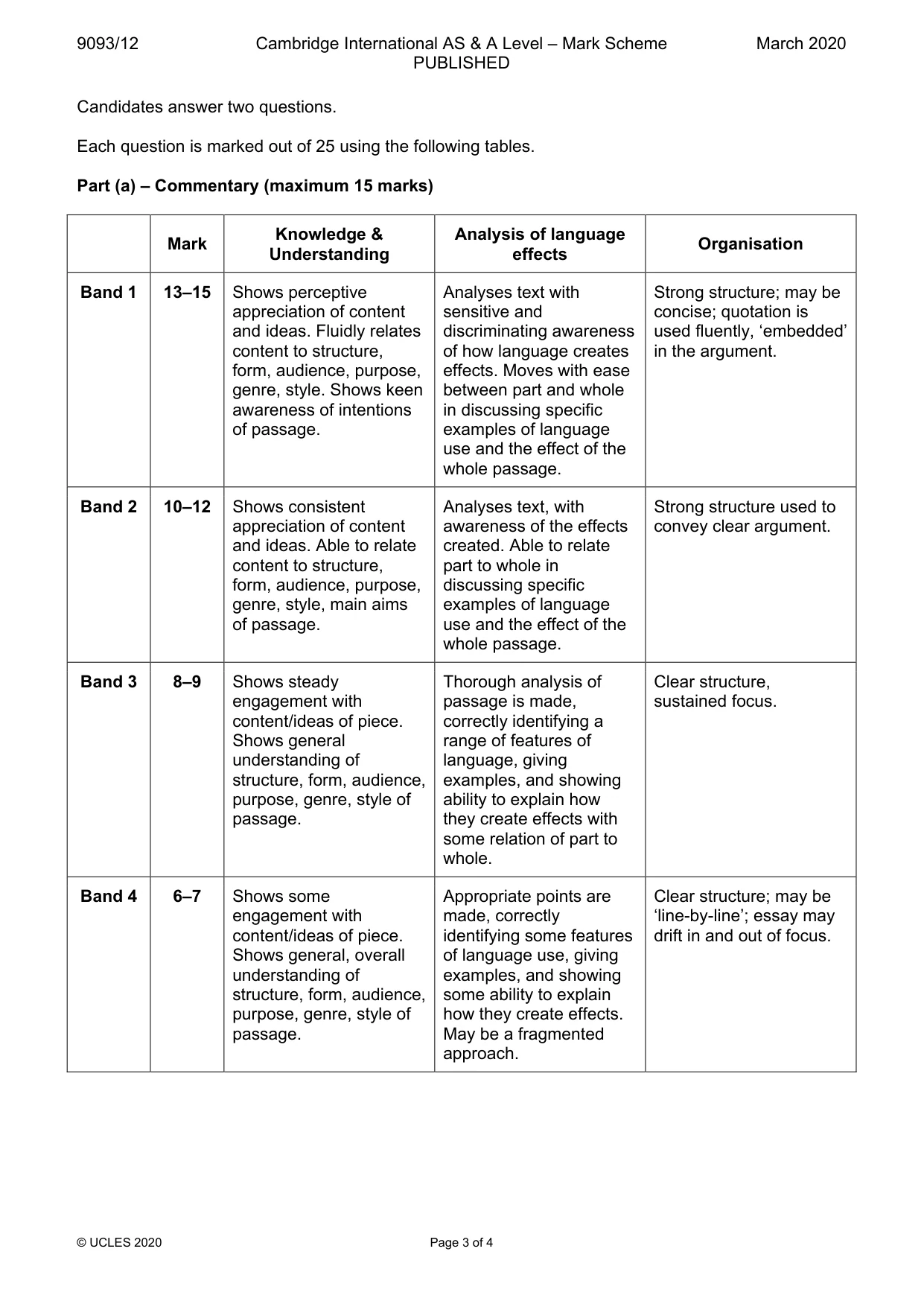
9093/12 Cambridge International AS & A Level – Mark Scheme PUBLISHED March 2020 © UCLES 2020 Page 3 of 4 Candidates answer two questions. Each question is marked out of 25 using the following tables. Part (a) – Commentary (maximum 15 marks) Mark Knowledge & Understanding Analysis of language effects Organisation Band 1 13–15 Shows perceptive appreciation of content and ideas. Fluidly relates content to structure, form, audience, purpose, genre, style. Shows keen awareness of intentions of passage. Analyses text with sensitive and discriminating awareness of how language creates effects. Moves with ease between part and whole in discussing specific examples of language use and the effect of the whole passage. Strong structure; may be concise; quotation is used fluently, ‘embedded’ in the argument. Band 2 10–12 Shows consistent appreciation of content and ideas. Able to relate content to structure, form, audience, purpose, genre, style, main aims of passage. Analyses text, with awareness of the effects created. Able to relate part to whole in discussing specific examples of language use and the effect of the whole passage. Strong structure used to convey clear argument. Band 3 8–9 Shows steady engagement with content/ideas of piece. Shows general understanding of structure, form, audience, purpose, genre, style of passage. Thorough analysis of passage is made, correctly identifying a range of features of language, giving examples, and showing ability to explain how they create effects with some relation of part to whole. Clear structure, sustained focus. Band 4 6–7 Shows some engagement with content/ideas of piece. Shows general, overall understanding of structure, form, audience, purpose, genre, style of passage. Appropriate points are made, correctly identifying some features of language use, giving examples, and showing some ability to explain how they create effects. May be a fragmented approach. Clear structure; may be ‘line-by-line’; essay may drift in and out of focus.
Mark scheme, page 4
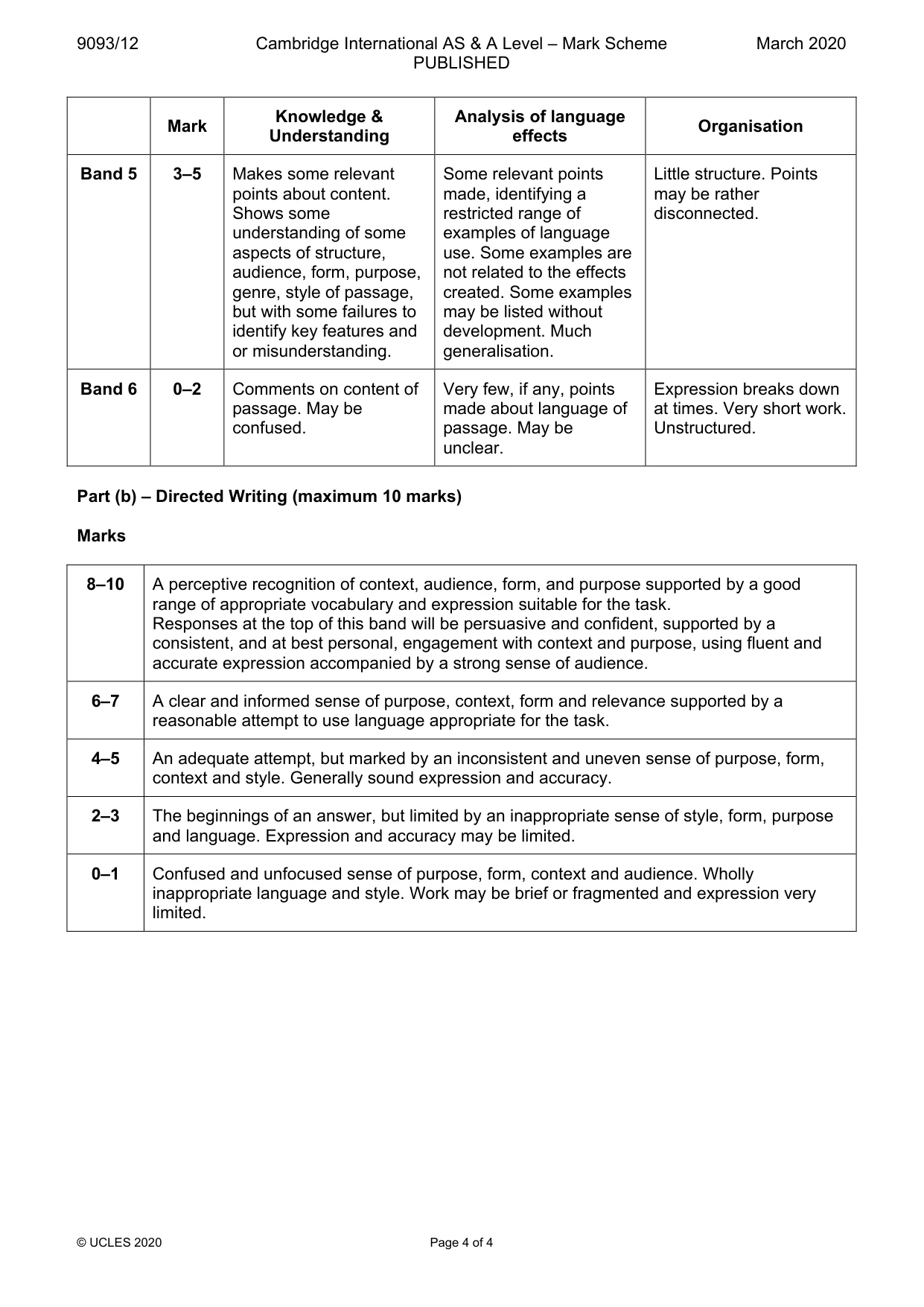
9093/12 Cambridge International AS & A Level – Mark Scheme PUBLISHED March 2020 © UCLES 2020 Page 4 of 4 Mark Knowledge & Understanding Analysis of language effects Organisation Band 5 3–5 Makes some relevant points about content. Shows some understanding of some aspects of structure, audience, form, purpose, genre, style of passage, but with some failures to identify key features and or misunderstanding. Some relevant points made, identifying a restricted range of examples of language use. Some examples are not related to the effects created. Some examples may be listed without development. Much generalisation. Little structure. Points may be rather disconnected. Band 6 0–2 Comments on content of passage. May be confused. Very few, if any, points made about language of passage. May be unclear. Expression breaks down at times. Very short work. Unstructured. Part (b) – Directed Writing (maximum 10 marks) Marks 8–10 A perceptive recognition of context, audience, form, and purpose supported by a good range of appropriate vocabulary and expression suitable for the task. Responses at the top of this band will be persuasive and confident, supported by a consistent, and at best personal, engagement with context and purpose, using fluent and accurate expression accompanied by a strong sense of audience. 6–7 A clear and informed sense of purpose, context, form and relevance supported by a reasonable attempt to use language appropriate for the task. 4–5 An adequate attempt, but marked by an inconsistent and uneven sense of purpose, form, context and style. Generally sound expression and accuracy. 2–3 The beginnings of an answer, but limited by an inappropriate sense of style, form, purpose and language. Expression and accuracy may be limited. 0–1 Confused and unfocused sense of purpose, form, context and audience. Wholly inappropriate language and style. Work may be brief or fragmented and expression very limited.
What you needed in this session
Cambridge’s own grade thresholds for 2020 Feb/March, Paper 1 · Variant 2. A higher threshold means an easier paper — the bar moves with how the cohort did.