Cambridge A Level English - Language AS and A Level (from 2014) 9093 — 2019 Feb/March Paper 1 · Variant 2
9093/12/F/M/19 · 50 marks · ≈56 min
The question paper and its mark scheme, free to read here and free to download. This is Cambridge’s own paper, exactly as it was sat.
Question paper8 pages
Mark scheme4 pages
Answers below. Sit the paper first if you are practising.
Paper as text
Question paper, page 1
This document consists of 7 printed pages, 1 blank page and 1 Insert. DC (ST) 167699/1 © UCLES 2019 [Turn over Cambridge Assessment International Education Cambridge International Advanced Subsidiary and Advanced Level * 6 8 7 9 6 6 0 8 0 2 * ENGLISH LANGUAGE 9093/12 Paper 1 Passages February/March 2019 2 hours 15 minutes No Additional Materials are required. READ THESE INSTRUCTIONS FIRST An answer booklet is provided inside this question paper. You should follow the instructions on the front cover of the answer booklet. If you need additional answer paper, ask the invigilator for a continuation booklet. Answer two questions: Question 1 and either Question 2 or Question 3. You should spend about 15 minutes reading the passages and questions before you start writing your answers. You are reminded of the need for good English and clear presentation in your answers. The number of marks is given in brackets [ ] at the end of each question or part question.
Question paper, page 2
2 9093/12/F/M/19 © UCLES 2019 Answer Question 1 and either Question 2 or Question 3. 1 The following text is an extract from a magazine article written by Kofi Annan, former Secretary- General of the United Nations. In the article, Annan warns of the global consequences of overpopulation on planet Earth. (a) Comment on the language and style of the text. [15] (b) After reading the text, you give a speech to your classmates to persuade them to tackle the issue at a local level through individual and community action. Basing your writing closely on the material of the original text, write a section of the speech. You should use between 120 and 150 of your own words. [10] Red Alert We are running out of space. Fly over Africa at night and you will see mile after mile of fires burning red in the dark as scrub is removed to make way for human beings. Satellite images of nocturnal Europe or America show vast areas lit up like an enormous fairground. From Shanghai to Sydney, from Moscow to Mexico City, the skylines of our major cities are no longer fixed and familiar. Where we cannot build into the sky, we construct vast chequerboards of smogbound, low-rise dwellings that stretch from one horizon to the other. Our cities expand in every direction as we fight to house a population that is growing at the rate of 200,000 each day. That adds up to a headcount the size of Germany every year. To feed this growing number requires ever more land to farm: each year, more than 150,000 square kilometres of natural forest are lost to agricultural or urban development. Forests cover a third of our planet’s surface. They produce life-giving oxygen and, by absorbing carbon dioxide, also mitigate the otherwise catastrophic effects of climate change. Not only do they provide a habitat for many of the world’s most endangered animals, around 1.6 billion people rely on them for food, fresh water, clothing, traditional medicine and shelter. Yet they are under threat from rampant deforestation in its many forms: fires, clearing for agriculture, unsustainable logging, ranching and development. We speak reverentially of the savage beauty and teeming biodiversity of the world’s great wildernesses, from the tropical rainforests of Amazonia and central Africa, to our wetlands and deserts, and on to Patagonia and the frozen wastes of Antarctica. We are increasingly aware of the threats to such spaces and have encouraged sustainable conservation and ecotourism. But still the threats remain. The greatest unexplored space on our planet lies beneath the oceans. Yet rising CO2 levels in the atmosphere are causing acidification, which disrupts food chains and marine habitats. Huge floating masses of plastic dumped in the oceans turn into hazardous waste that endangers not only marine life but also, indirectly, human populations – and the planet itself. Overfishing, illegal and damaging trawling practices and past whaling have emptied the oceans before we have even properly understood what riches they contain. And the great spaces of the oceans are the lungs of the planet. The very air we breathe is filling up with toxins. For years, gases have burned through the ozone layer, exposing us to ultraviolet rays and affecting climate 5 10 15 20 25 30 35
Question paper, page 3
3 9093/12/F/M/19 © UCLES 2019 [Turn over change. Airborne diseases – such as Zika, swine flu and bird flu – have multiplied and threatened to become global pandemics. Great clouds of smog hover above our cities and airborne diseases multiply. Inhalation of toxic gases is said to reduce average lifespans by one to two years. Various estimates suggest that air pollution accounts for between half and two- thirds of all premature deaths in Asia, while anywhere between 10 and 20% of all worldwide deaths are attributable to the same cause. Typhoons, hurricanes and cyclones are harbingers of disaster, yet the winds are also, for some, an important source of energy. The debate about the effectiveness of wind farms rages on. Protesters claim they are ineffective and even dangerous eyesores, while pro-campaigners trumpet the positive impact of these wind farms. Space itself – famously the final frontier – has not been colonised but has, instead, become a dumping ground to such an extent that scientists are now calling on nations to reduce the quantity of orbital junk they produce or risk inhibiting future space activity. And yet, as overpopulation and decreasing landmass become a conundrum for future generations, will outer space provide an inhabitable environment? 40 45 50
Question paper, page 4
4 9093/12/F/M/19 © UCLES 2019 2 The following extract is from food writer Sophie Egan’s book, Devoured. In the extract, Egan explores the connection between the working and eating habits of the ‘millennial’ generation – people reaching adulthood in the early twenty-first century. (a) Comment on the language and style of the passage. [15] (b) After reading the extract, you decide that Josh and his fellow ‘millennials’ need to make some changes regarding what, where and how they eat. You explain your views on the subject in your personal blog. Basing your writing on the material of the original passage, and using between 120 and 150 of your own words, write a section of text for your blog. [10] The Millennial Food Psyche Wednesday, 7:00 A.M. An alarm clock blares, and a guy we’ll call Josh bolts out of bed. The noise is definitely alarming because he has the alarm set to the one that sounds like bad things are happening on a submarine. Ambling into the kitchen, Josh finds his neatly lined rows of coffee pods and goes for the southern pecan flavour. Autumn has just begun, and at that particular moment, he’s in the mood for something comforting. Josh is a thirty-one-year-old hardware operations quality engineer at Google. At six feet tall with pale, freckled skin, brown hair, and blue eyes, he’s got somewhere between a cross-country runner’s build and a ‘dad-bod’1 – the latter thanks to a slight paunch that’s developed since taking the Google position three years earlier (surely a small price to pay for finally having landed his dream job at the best company to work for in the country). 7:08 A.M. Josh opens his laptop and plunges deep into the Internet. With seven different windows open, his screen flashes with a whirl of activity. The number of e-mails waiting for him this morning is massive. It’s not so much that the deluge has already begun, but that it never really ends. Every minute he sleeps, the more behind he gets at work. So now he takes a sip of coffee and starts firing e-mails back. Josh is a member of the millennial generation. A graduate of the University of Michigan, he’s among the 61 percent of his cohort with a college degree, 15 percent higher than his parents’. He’s among the 62 percent who prefer to live in mixed- use urban areas, according to a successful consumer insights firm. Work, nightlife, shopping – all at their doorsteps. Also like other millennials, he was raised on cereal, computers, and a congratulations every time he put his socks on straight. Josh scrolls through his Facebook feed and sees that his friend from a summer internship in Austin a few years back is on a two-week liquid diet. She has posted a photo of herself sipping a kale smoothie at Starbucks. Josh also sees that his sister in Portland made homemade pizza last night with gluten-free dough, topped with poached eggs from the chickens in her backyard. And Josh’s former college roommate has posted from a CrossFit2 box in New York, bragging about his WOD, which means ‘workout of the day’. He’s eating a strawberry coconut breakfast bar he got from the gym. 5 10 15 20 25 30
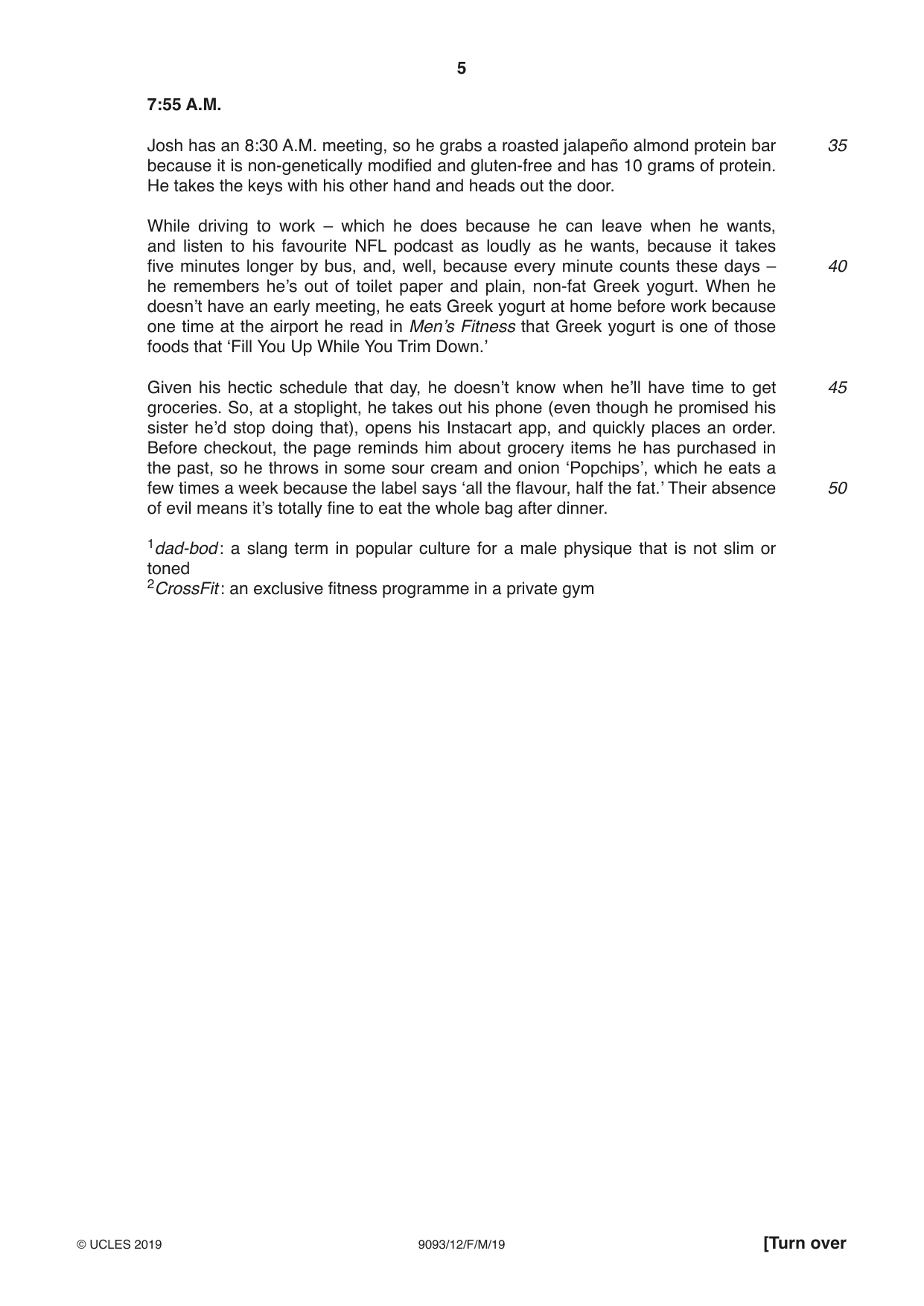
Question paper, page 5
5 9093/12/F/M/19 © UCLES 2019 [Turn over 7:55 A.M. Josh has an 8:30 A.M. meeting, so he grabs a roasted jalapeño almond protein bar because it is non-genetically modified and gluten-free and has 10 grams of protein. He takes the keys with his other hand and heads out the door. While driving to work – which he does because he can leave when he wants, and listen to his favourite NFL podcast as loudly as he wants, because it takes five minutes longer by bus, and, well, because every minute counts these days – he remembers he’s out of toilet paper and plain, non-fat Greek yogurt. When he doesn’t have an early meeting, he eats Greek yogurt at home before work because one time at the airport he read in Men’s Fitness that Greek yogurt is one of those foods that ‘Fill You Up While You Trim Down.’ Given his hectic schedule that day, he doesn’t know when he’ll have time to get groceries. So, at a stoplight, he takes out his phone (even though he promised his sister he’d stop doing that), opens his Instacart app, and quickly places an order. Before checkout, the page reminds him about grocery items he has purchased in the past, so he throws in some sour cream and onion ‘Popchips’, which he eats a few times a week because the label says ‘all the flavour, half the fat.’ Their absence of evil means it’s totally fine to eat the whole bag after dinner. 1dad-bod : a slang term in popular culture for a male physique that is not slim or toned 2CrossFit : an exclusive fitness programme in a private gym 35 40 45 50
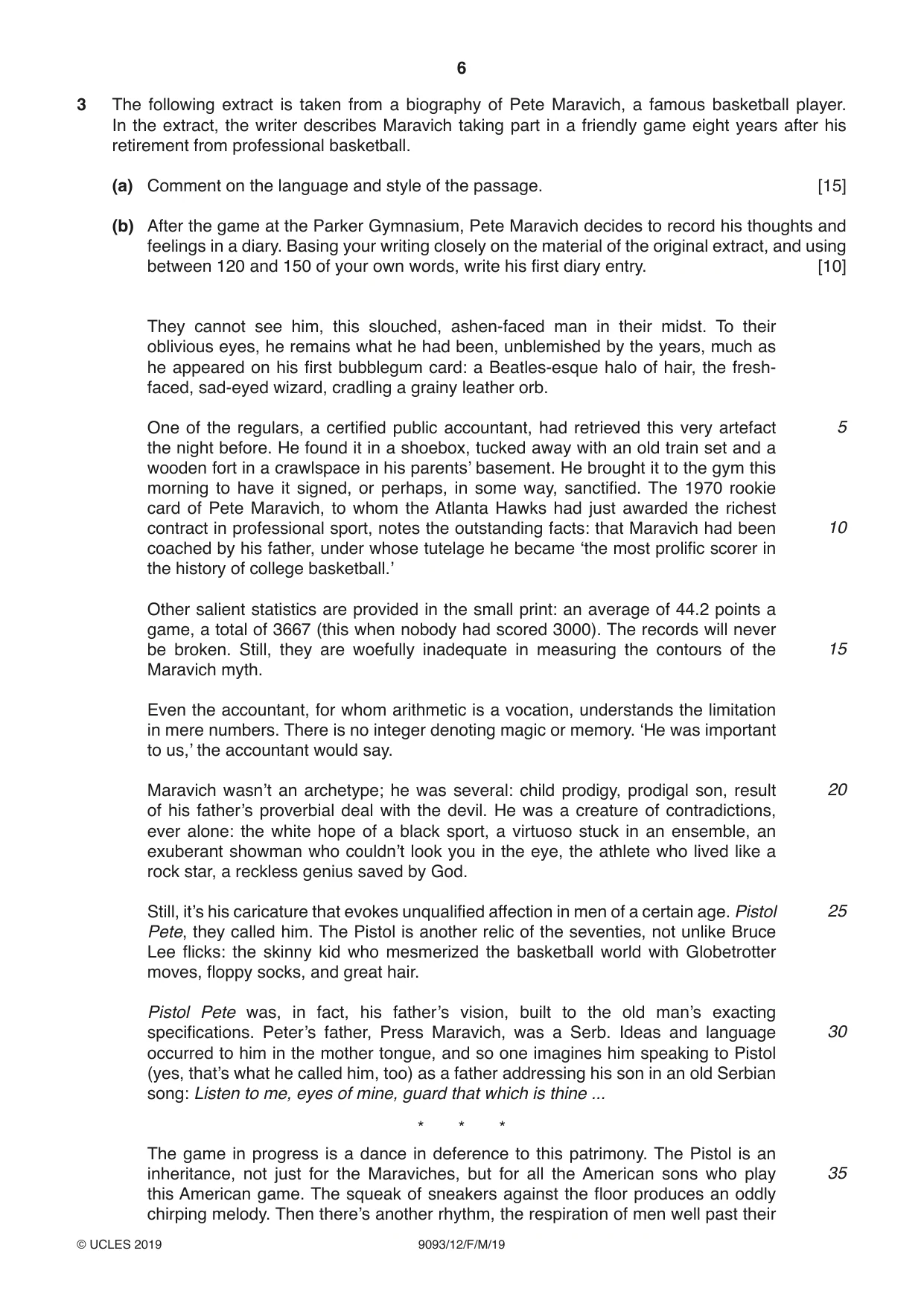
Question paper, page 6
6 9093/12/F/M/19 © UCLES 2019 3 The following extract is taken from a biography of Pete Maravich, a famous basketball player. In the extract, the writer describes Maravich taking part in a friendly game eight years after his retirement from professional basketball. (a) Comment on the language and style of the passage. [15] (b) After the game at the Parker Gymnasium, Pete Maravich decides to record his thoughts and feelings in a diary. Basing your writing closely on the material of the original extract, and using between 120 and 150 of your own words, write his first diary entry. [10] They cannot see him, this slouched, ashen-faced man in their midst. To their oblivious eyes, he remains what he had been, unblemished by the years, much as he appeared on his first bubblegum card: a Beatles-esque halo of hair, the fresh- faced, sad-eyed wizard, cradling a grainy leather orb. One of the regulars, a certified public accountant, had retrieved this very artefact the night before. He found it in a shoebox, tucked away with an old train set and a wooden fort in a crawlspace in his parents’ basement. He brought it to the gym this morning to have it signed, or perhaps, in some way, sanctified. The 1970 rookie card of Pete Maravich, to whom the Atlanta Hawks had just awarded the richest contract in professional sport, notes the outstanding facts: that Maravich had been coached by his father, under whose tutelage he became ‘the most prolific scorer in the history of college basketball.’ Other salient statistics are provided in the small print: an average of 44.2 points a game, a total of 3667 (this when nobody had scored 3000). The records will never be broken. Still, they are woefully inadequate in measuring the contours of the Maravich myth. Even the accountant, for whom arithmetic is a vocation, understands the limitation in mere numbers. There is no integer denoting magic or memory. ‘He was important to us,’ the accountant would say. Maravich wasn’t an archetype; he was several: child prodigy, prodigal son, result of his father’s proverbial deal with the devil. He was a creature of contradictions, ever alone: the white hope of a black sport, a virtuoso stuck in an ensemble, an exuberant showman who couldn’t look you in the eye, the athlete who lived like a rock star, a reckless genius saved by God. Still, it’s his caricature that evokes unqualified affection in men of a certain age. Pistol Pete, they called him. The Pistol is another relic of the seventies, not unlike Bruce Lee flicks: the skinny kid who mesmerized the basketball world with Globetrotter moves, floppy socks, and great hair. Pistol Pete was, in fact, his father’s vision, built to the old man’s exacting specifications. Peter’s father, Press Maravich, was a Serb. Ideas and language occurred to him in the mother tongue, and so one imagines him speaking to Pistol (yes, that’s what he called him, too) as a father addressing his son in an old Serbian song: Listen to me, eyes of mine, guard that which is thine ... * * * The game in progress is a dance in deference to this patrimony. The Pistol is an inheritance, not just for the Maraviches, but for all the American sons who play this American game. The squeak of sneakers against the floor produces an oddly chirping melody. Then there’s another rhythm, the respiration of men well past their 5 10 15 20 25 30 35
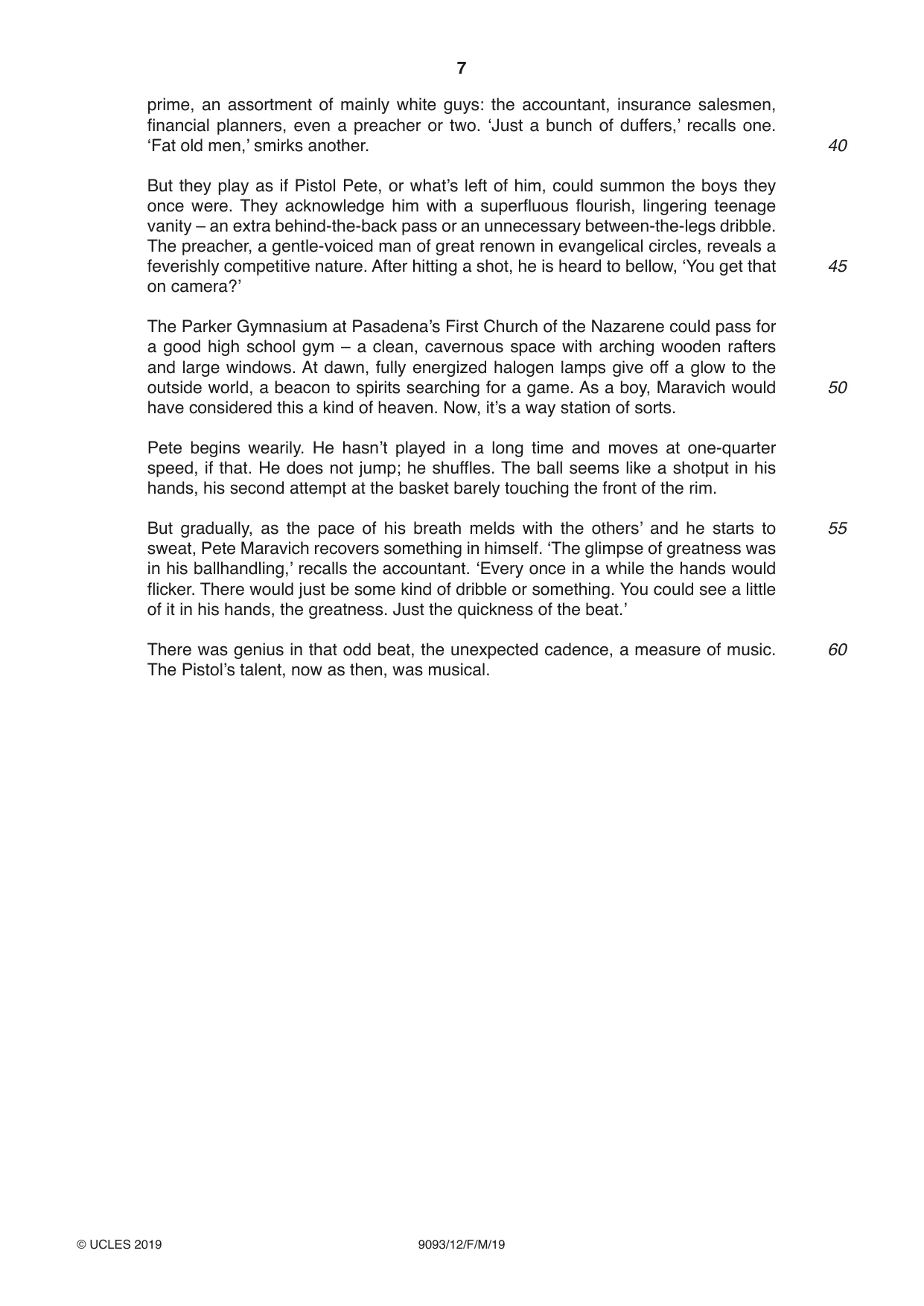
Question paper, page 7
7 9093/12/F/M/19 © UCLES 2019 prime, an assortment of mainly white guys: the accountant, insurance salesmen, financial planners, even a preacher or two. ‘Just a bunch of duffers,’ recalls one. ‘Fat old men,’ smirks another. But they play as if Pistol Pete, or what’s left of him, could summon the boys they once were. They acknowledge him with a superfluous flourish, lingering teenage vanity – an extra behind-the-back pass or an unnecessary between-the-legs dribble. The preacher, a gentle-voiced man of great renown in evangelical circles, reveals a feverishly competitive nature. After hitting a shot, he is heard to bellow, ‘You get that on camera?’ The Parker Gymnasium at Pasadena’s First Church of the Nazarene could pass for a good high school gym – a clean, cavernous space with arching wooden rafters and large windows. At dawn, fully energized halogen lamps give off a glow to the outside world, a beacon to spirits searching for a game. As a boy, Maravich would have considered this a kind of heaven. Now, it’s a way station of sorts. Pete begins wearily. He hasn’t played in a long time and moves at one-quarter speed, if that. He does not jump; he shuffles. The ball seems like a shotput in his hands, his second attempt at the basket barely touching the front of the rim. But gradually, as the pace of his breath melds with the others’ and he starts to sweat, Pete Maravich recovers something in himself. ‘The glimpse of greatness was in his ballhandling,’ recalls the accountant. ‘Every once in a while the hands would flicker. There would just be some kind of dribble or something. You could see a little of it in his hands, the greatness. Just the quickness of the beat.’ There was genius in that odd beat, the unexpected cadence, a measure of music. The Pistol’s talent, now as then, was musical. 40 45 50 55 60
Question paper, page 8
8 9093/12/F/M/19 © UCLES 2019 BLANK PAGE Permission to reproduce items where third-party owned material protected by copyright is included has been sought and cleared where possible. Every reasonable effort has been made by the publisher (UCLES) to trace copyright holders, but if any items requiring clearance have unwittingly been included, the publisher will be pleased to make amends at the earliest possible opportunity. To avoid the issue of disclosure of answer-related information to candidates, all copyright acknowledgements are reproduced online in the Cambridge Assessment International Education Copyright Acknowledgements Booklet. This is produced for each series of examinations and is freely available to download at www.cambridgeinternational.org after the live examination series. Cambridge Assessment International Education is part of the Cambridge Assessment Group. Cambridge Assessment is the brand name of the University of Cambridge Local Examinations Syndicate (UCLES), which itself is a department of the University of Cambridge.
Mark scheme, page 1
This document consists of 4 printed pages. © UCLES 2019 [Turn over Cambridge Assessment International Education Cambridge International Advanced Subsidiary and Advanced Level ENGLISH LANGUAGE 9093/12 Paper 1 Passages March 2019 MARK SCHEME Maximum Mark: 50 Published This mark scheme is published as an aid to teachers and candidates, to indicate the requirements of the examination. It shows the basis on which Examiners were instructed to award marks. It does not indicate the details of the discussions that took place at an Examiners’ meeting before marking began, which would have considered the acceptability of alternative answers. Mark schemes should be read in conjunction with the question paper and the Principal Examiner Report for Teachers. Cambridge International will not enter into discussions about these mark schemes. Cambridge International is publishing the mark schemes for the March 2019 series for most Cambridge IGCSE™, Cambridge International A and AS Level components and some Cambridge O Level components.
Mark scheme, page 2
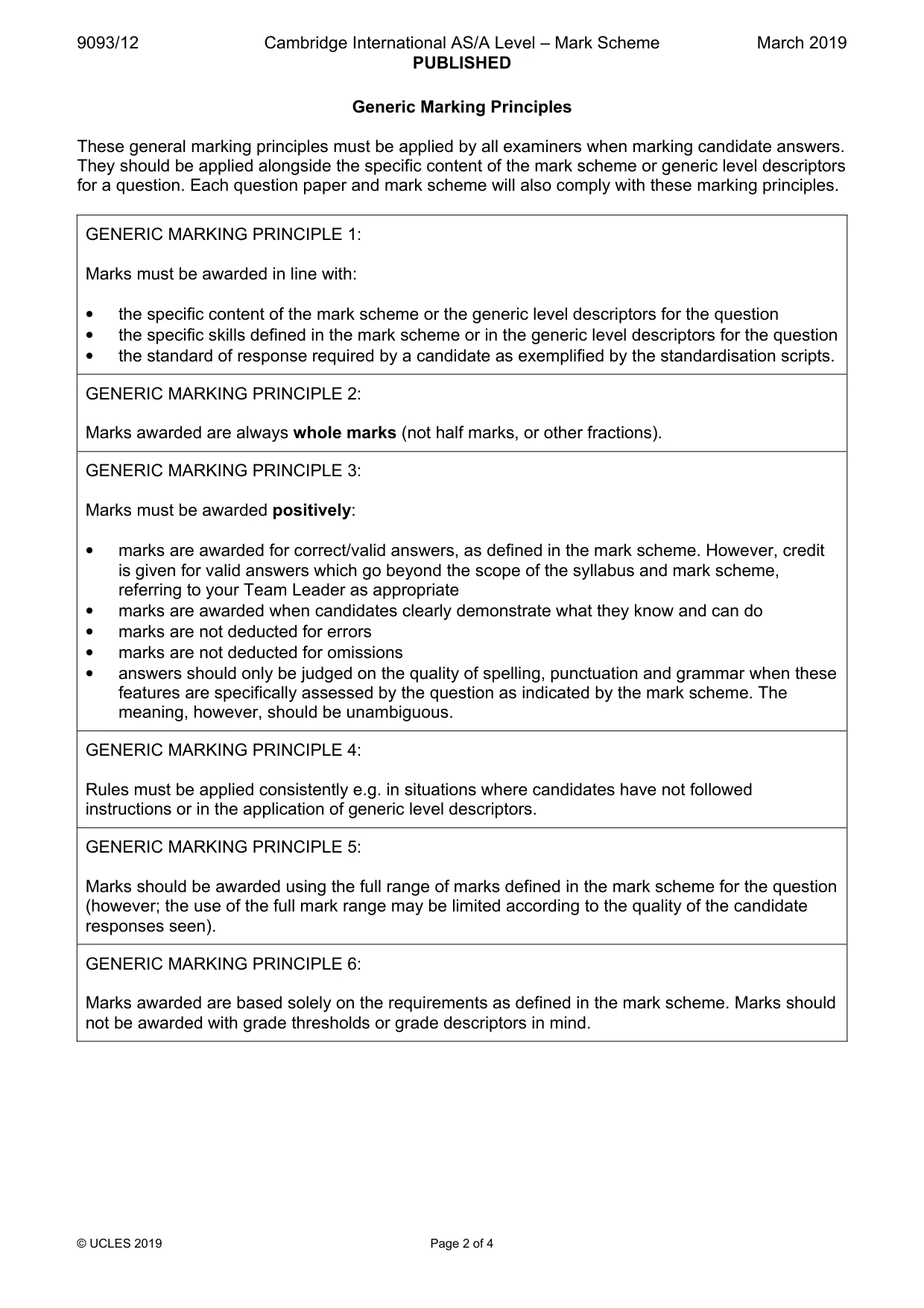
9093/12 Cambridge International AS/A Level – Mark Scheme PUBLISHED March 2019 © UCLES 2019 Page 2 of 4 Generic Marking Principles These general marking principles must be applied by all examiners when marking candidate answers. They should be applied alongside the specific content of the mark scheme or generic level descriptors for a question. Each question paper and mark scheme will also comply with these marking principles. GENERIC MARKING PRINCIPLE 1: Marks must be awarded in line with: • the specific content of the mark scheme or the generic level descriptors for the question • the specific skills defined in the mark scheme or in the generic level descriptors for the question • the standard of response required by a candidate as exemplified by the standardisation scripts. GENERIC MARKING PRINCIPLE 2: Marks awarded are always whole marks (not half marks, or other fractions). GENERIC MARKING PRINCIPLE 3: Marks must be awarded positively: • marks are awarded for correct/valid answers, as defined in the mark scheme. However, credit is given for valid answers which go beyond the scope of the syllabus and mark scheme, referring to your Team Leader as appropriate • marks are awarded when candidates clearly demonstrate what they know and can do • marks are not deducted for errors • marks are not deducted for omissions • answers should only be judged on the quality of spelling, punctuation and grammar when these features are specifically assessed by the question as indicated by the mark scheme. The meaning, however, should be unambiguous. GENERIC MARKING PRINCIPLE 4: Rules must be applied consistently e.g. in situations where candidates have not followed instructions or in the application of generic level descriptors. GENERIC MARKING PRINCIPLE 5: Marks should be awarded using the full range of marks defined in the mark scheme for the question (however; the use of the full mark range may be limited according to the quality of the candidate responses seen). GENERIC MARKING PRINCIPLE 6: Marks awarded are based solely on the requirements as defined in the mark scheme. Marks should not be awarded with grade thresholds or grade descriptors in mind.
Mark scheme, page 3
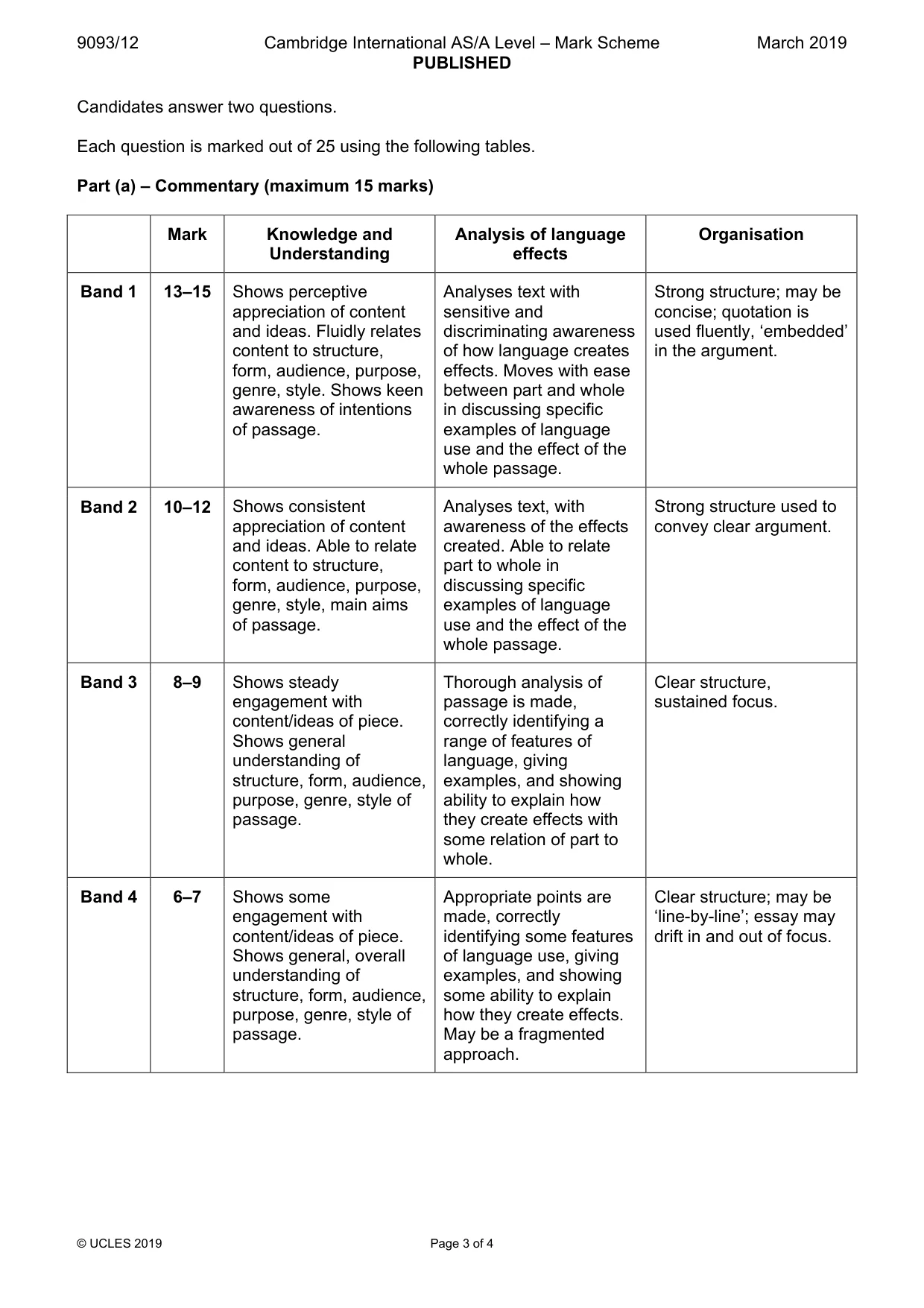
9093/12 Cambridge International AS/A Level – Mark Scheme PUBLISHED March 2019 © UCLES 2019 Page 3 of 4 Candidates answer two questions. Each question is marked out of 25 using the following tables. Part (a) – Commentary (maximum 15 marks) Mark Knowledge and Understanding Analysis of language effects Organisation Band 1 13–15 Shows perceptive appreciation of content and ideas. Fluidly relates content to structure, form, audience, purpose, genre, style. Shows keen awareness of intentions of passage. Analyses text with sensitive and discriminating awareness of how language creates effects. Moves with ease between part and whole in discussing specific examples of language use and the effect of the whole passage. Strong structure; may be concise; quotation is used fluently, ‘embedded’ in the argument. Band 2 10–12 Shows consistent appreciation of content and ideas. Able to relate content to structure, form, audience, purpose, genre, style, main aims of passage. Analyses text, with awareness of the effects created. Able to relate part to whole in discussing specific examples of language use and the effect of the whole passage. Strong structure used to convey clear argument. Band 3 8–9 Shows steady engagement with content/ideas of piece. Shows general understanding of structure, form, audience, purpose, genre, style of passage. Thorough analysis of passage is made, correctly identifying a range of features of language, giving examples, and showing ability to explain how they create effects with some relation of part to whole. Clear structure, sustained focus. Band 4 6–7 Shows some engagement with content/ideas of piece. Shows general, overall understanding of structure, form, audience, purpose, genre, style of passage. Appropriate points are made, correctly identifying some features of language use, giving examples, and showing some ability to explain how they create effects. May be a fragmented approach. Clear structure; may be ‘line-by-line’; essay may drift in and out of focus.
Mark scheme, page 4
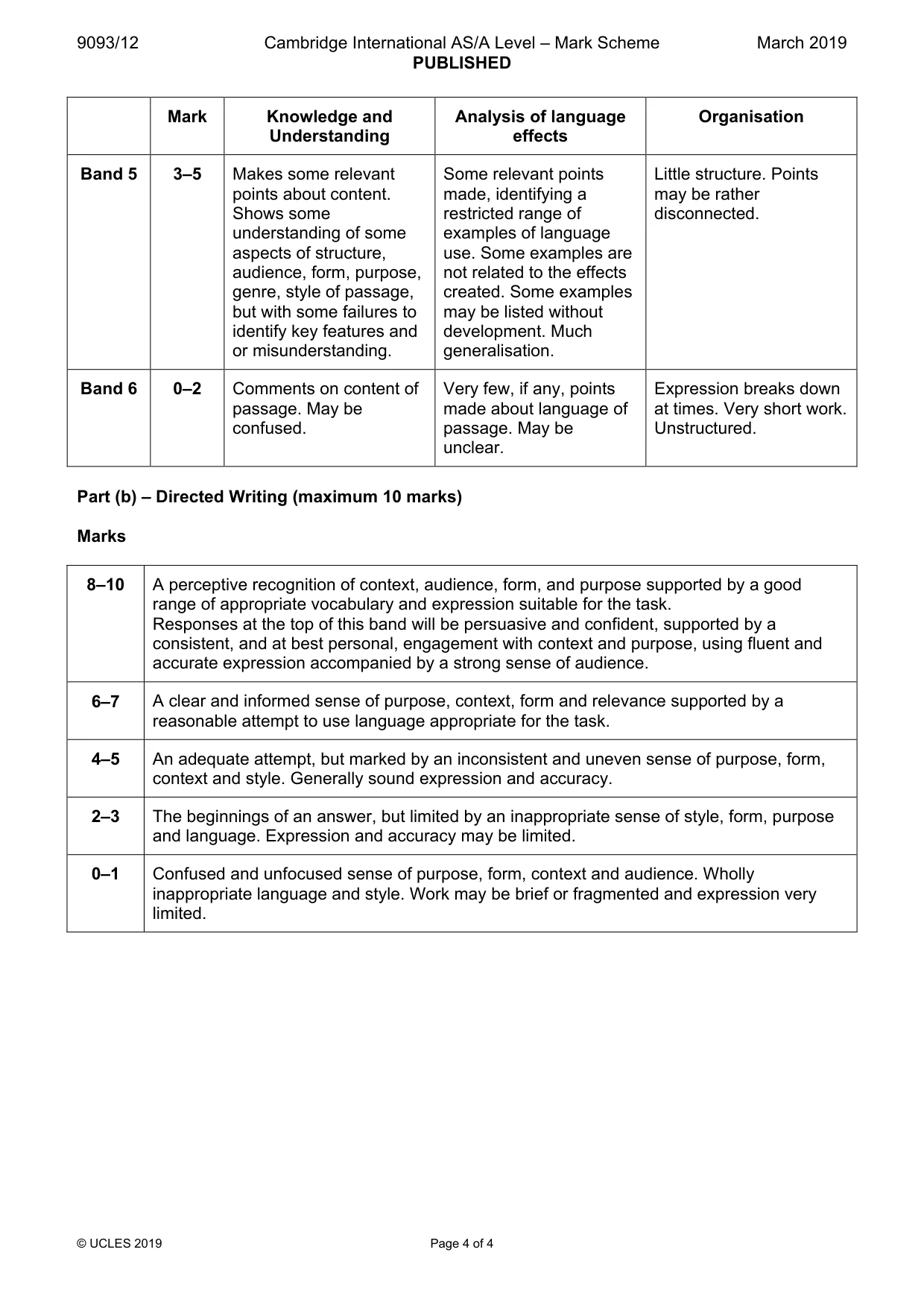
9093/12 Cambridge International AS/A Level – Mark Scheme PUBLISHED March 2019 © UCLES 2019 Page 4 of 4 Mark Knowledge and Understanding Analysis of language effects Organisation Band 5 3–5 Makes some relevant points about content. Shows some understanding of some aspects of structure, audience, form, purpose, genre, style of passage, but with some failures to identify key features and or misunderstanding. Some relevant points made, identifying a restricted range of examples of language use. Some examples are not related to the effects created. Some examples may be listed without development. Much generalisation. Little structure. Points may be rather disconnected. Band 6 0–2 Comments on content of passage. May be confused. Very few, if any, points made about language of passage. May be unclear. Expression breaks down at times. Very short work. Unstructured. Part (b) – Directed Writing (maximum 10 marks) Marks 8–10 A perceptive recognition of context, audience, form, and purpose supported by a good range of appropriate vocabulary and expression suitable for the task. Responses at the top of this band will be persuasive and confident, supported by a consistent, and at best personal, engagement with context and purpose, using fluent and accurate expression accompanied by a strong sense of audience. 6–7 A clear and informed sense of purpose, context, form and relevance supported by a reasonable attempt to use language appropriate for the task. 4–5 An adequate attempt, but marked by an inconsistent and uneven sense of purpose, form, context and style. Generally sound expression and accuracy. 2–3 The beginnings of an answer, but limited by an inappropriate sense of style, form, purpose and language. Expression and accuracy may be limited. 0–1 Confused and unfocused sense of purpose, form, context and audience. Wholly inappropriate language and style. Work may be brief or fragmented and expression very limited.
What you needed in this session
Cambridge’s own grade thresholds for 2019 Feb/March, Paper 1 · Variant 2. A higher threshold means an easier paper — the bar moves with how the cohort did.