Cambridge A Level English - Language AS and A Level (from 2014) 9093 — 2018 Feb/March Paper 1 · Variant 2
9093/12/F/M/18 · 50 marks · ≈56 min
The question paper and its mark scheme, free to read here and free to download. This is Cambridge’s own paper, exactly as it was sat.
Question paper8 pages

Mark scheme4 pages
Answers below. Sit the paper first if you are practising.
Paper as text
Question paper, page 1
This document consists of 7 printed pages, 1 blank page and 1 Insert. DC (RCL (GO)) 148152/2 © UCLES 2018 [Turn over Cambridge International Examinations Cambridge International Advanced Subsidiary and Advanced Level * 1 1 0 2 0 5 2 5 4 4 * ENGLISH LANGUAGE 9093/12 Paper 1 Passages February/March 2018 2 hours 15 minutes No Additional Materials are required. READ THESE INSTRUCTIONS FIRST An answer booklet is provided inside this question paper. You should follow the instructions on the front cover of the answer booklet. If you need additional answer paper, ask the invigilator for a continuation booklet. Answer two questions: Question 1 and either Question 2 or Question 3. You should spend about 15 minutes reading the passages and questions before you start writing your answers. You are reminded of the need for good English and clear presentation in your answers. The number of marks is given in brackets [ ] at the end of each question or part question.
Question paper, page 2
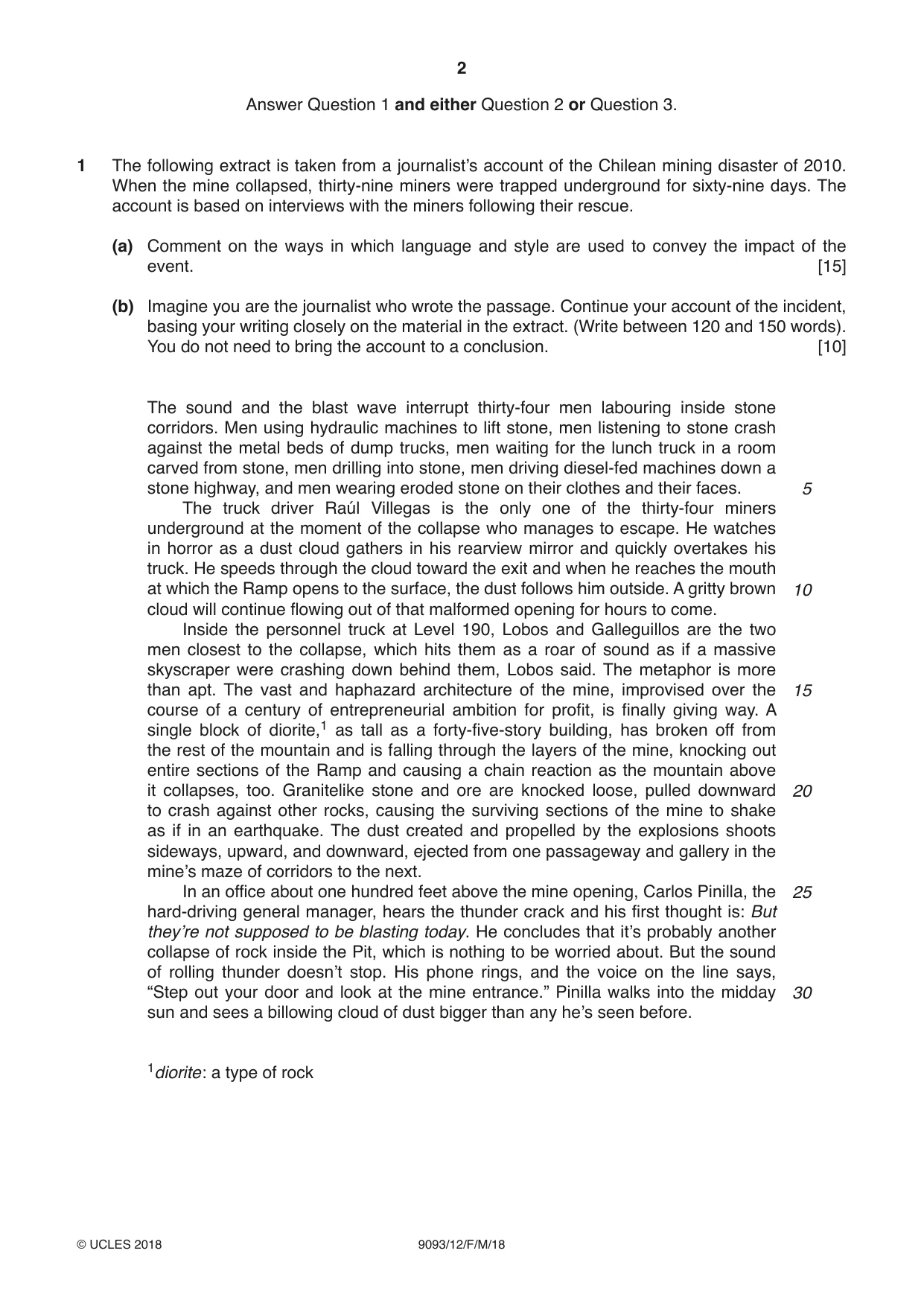
2 9093/12/F/M/18 © UCLES 2018 Answer Question 1 and either Question 2 or Question 3. 1 The following extract is taken from a journalist’s account of the Chilean mining disaster of 2010. When the mine collapsed, thirty-nine miners were trapped underground for sixty-nine days. The account is based on interviews with the miners following their rescue. (a) Comment on the ways in which language and style are used to convey the impact of the event. [15] (b) Imagine you are the journalist who wrote the passage. Continue your account of the incident, basing your writing closely on the material in the extract. (Write between 120 and 150 words). You do not need to bring the account to a conclusion. [10] The sound and the blast wave interrupt thirty-four men labouring inside stone corridors. Men using hydraulic machines to lift stone, men listening to stone crash against the metal beds of dump trucks, men waiting for the lunch truck in a room carved from stone, men drilling into stone, men driving diesel-fed machines down a stone highway, and men wearing eroded stone on their clothes and their faces. The truck driver Raúl Villegas is the only one of the thirty-four miners underground at the moment of the collapse who manages to escape. He watches in horror as a dust cloud gathers in his rearview mirror and quickly overtakes his truck. He speeds through the cloud toward the exit and when he reaches the mouth at which the Ramp opens to the surface, the dust follows him outside. A gritty brown cloud will continue flowing out of that malformed opening for hours to come. Inside the personnel truck at Level 190, Lobos and Galleguillos are the two men closest to the collapse, which hits them as a roar of sound as if a massive skyscraper were crashing down behind them, Lobos said. The metaphor is more than apt. The vast and haphazard architecture of the mine, improvised over the course of a century of entrepreneurial ambition for profit, is finally giving way. A single block of diorite,1 as tall as a forty-five-story building, has broken off from the rest of the mountain and is falling through the layers of the mine, knocking out entire sections of the Ramp and causing a chain reaction as the mountain above it collapses, too. Granitelike stone and ore are knocked loose, pulled downward to crash against other rocks, causing the surviving sections of the mine to shake as if in an earthquake. The dust created and propelled by the explosions shoots sideways, upward, and downward, ejected from one passageway and gallery in the mine’s maze of corridors to the next. In an office about one hundred feet above the mine opening, Carlos Pinilla, the hard-driving general manager, hears the thunder crack and his first thought is: But they’re not supposed to be blasting today. He concludes that it’s probably another collapse of rock inside the Pit, which is nothing to be worried about. But the sound of rolling thunder doesn’t stop. His phone rings, and the voice on the line says, “Step out your door and look at the mine entrance.” Pinilla walks into the midday sun and sees a billowing cloud of dust bigger than any he’s seen before. 1diorite: a type of rock 5 10 15 20 25 30
Question paper, page 3
3 9093/12/F/M/18 © UCLES 2018 [Turn over TURN OVER FOR QUESTION 2.
Question paper, page 4
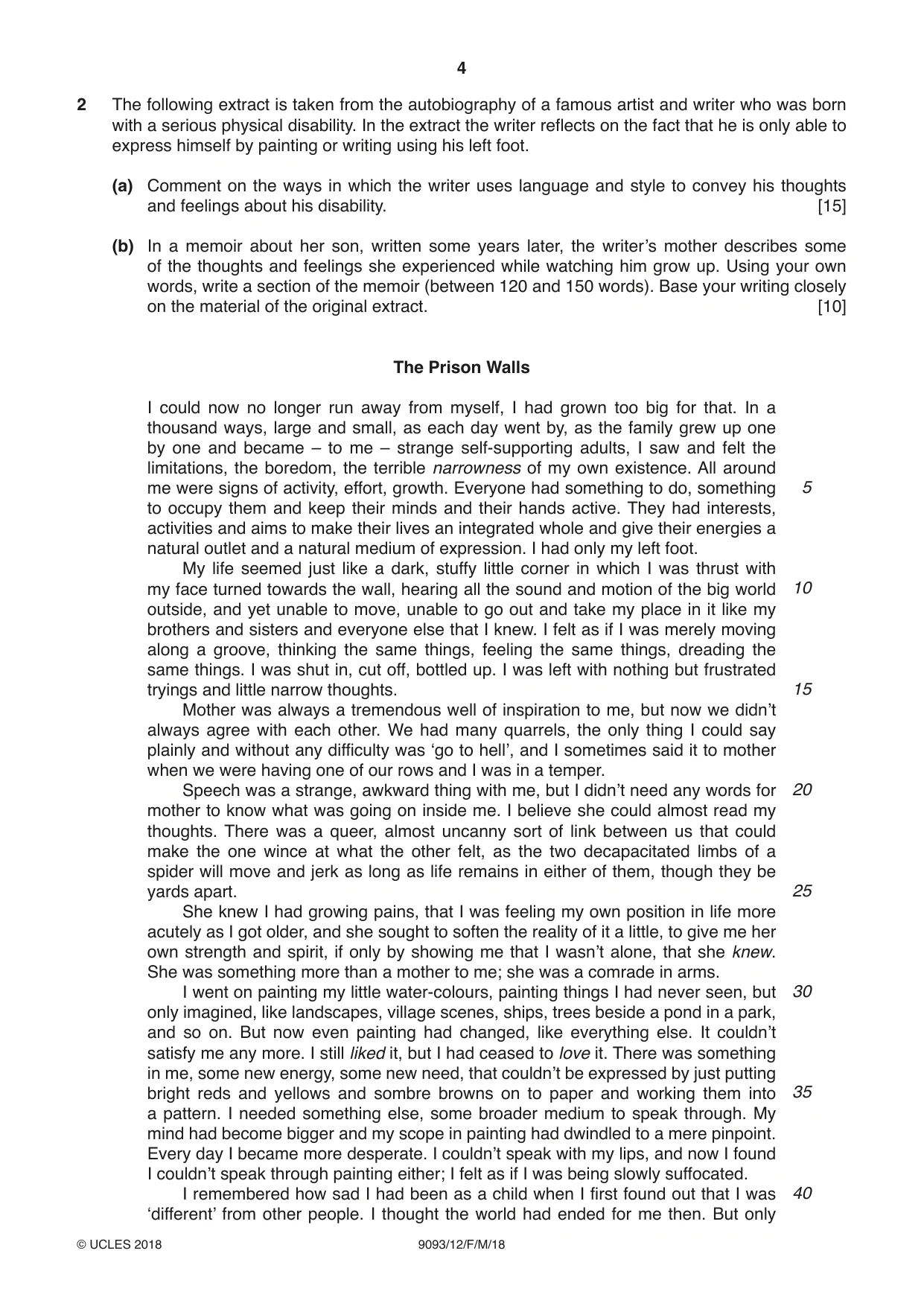
4 9093/12/F/M/18 © UCLES 2018 2 The following extract is taken from the autobiography of a famous artist and writer who was born with a serious physical disability. In the extract the writer reflects on the fact that he is only able to express himself by painting or writing using his left foot. (a) Comment on the ways in which the writer uses language and style to convey his thoughts and feelings about his disability. [15] (b) In a memoir about her son, written some years later, the writer’s mother describes some of the thoughts and feelings she experienced while watching him grow up. Using your own words, write a section of the memoir (between 120 and 150 words). Base your writing closely on the material of the original extract. [10] The Prison Walls I could now no longer run away from myself, I had grown too big for that. In a thousand ways, large and small, as each day went by, as the family grew up one by one and became – to me – strange self-supporting adults, I saw and felt the limitations, the boredom, the terrible narrowness of my own existence. All around me were signs of activity, effort, growth. Everyone had something to do, something to occupy them and keep their minds and their hands active. They had interests, activities and aims to make their lives an integrated whole and give their energies a natural outlet and a natural medium of expression. I had only my left foot. My life seemed just like a dark, stuffy little corner in which I was thrust with my face turned towards the wall, hearing all the sound and motion of the big world outside, and yet unable to move, unable to go out and take my place in it like my brothers and sisters and everyone else that I knew. I felt as if I was merely moving along a groove, thinking the same things, feeling the same things, dreading the same things. I was shut in, cut off, bottled up. I was left with nothing but frustrated tryings and little narrow thoughts. Mother was always a tremendous well of inspiration to me, but now we didn’t always agree with each other. We had many quarrels, the only thing I could say plainly and without any difficulty was ‘go to hell’, and I sometimes said it to mother when we were having one of our rows and I was in a temper. Speech was a strange, awkward thing with me, but I didn’t need any words for mother to know what was going on inside me. I believe she could almost read my thoughts. There was a queer, almost uncanny sort of link between us that could make the one wince at what the other felt, as the two decapacitated limbs of a spider will move and jerk as long as life remains in either of them, though they be yards apart. She knew I had growing pains, that I was feeling my own position in life more acutely as I got older, and she sought to soften the reality of it a little, to give me her own strength and spirit, if only by showing me that I wasn’t alone, that she knew. She was something more than a mother to me; she was a comrade in arms. I went on painting my little water-colours, painting things I had never seen, but only imagined, like landscapes, village scenes, ships, trees beside a pond in a park, and so on. But now even painting had changed, like everything else. It couldn’t satisfy me any more. I still liked it, but I had ceased to love it. There was something in me, some new energy, some new need, that couldn’t be expressed by just putting bright reds and yellows and sombre browns on to paper and working them into a pattern. I needed something else, some broader medium to speak through. My mind had become bigger and my scope in painting had dwindled to a mere pinpoint. Every day I became more desperate. I couldn’t speak with my lips, and now I found I couldn’t speak through painting either; I felt as if I was being slowly suffocated. I remembered how sad I had been as a child when I first found out that I was ‘different’ from other people. I thought the world had ended for me then. But only 5 10 15 20 25 30 35 40
Question paper, page 5
5 9093/12/F/M/18 © UCLES 2018 [Turn over now was I beginning to feel the full significance of that ‘difference’, the true meaning of it. As a child I had cried bitterly when I became conscious of my own crippledom. I didn’t cry now – I hadn’t the comfort of tears. All my agony was inside.
Question paper, page 6
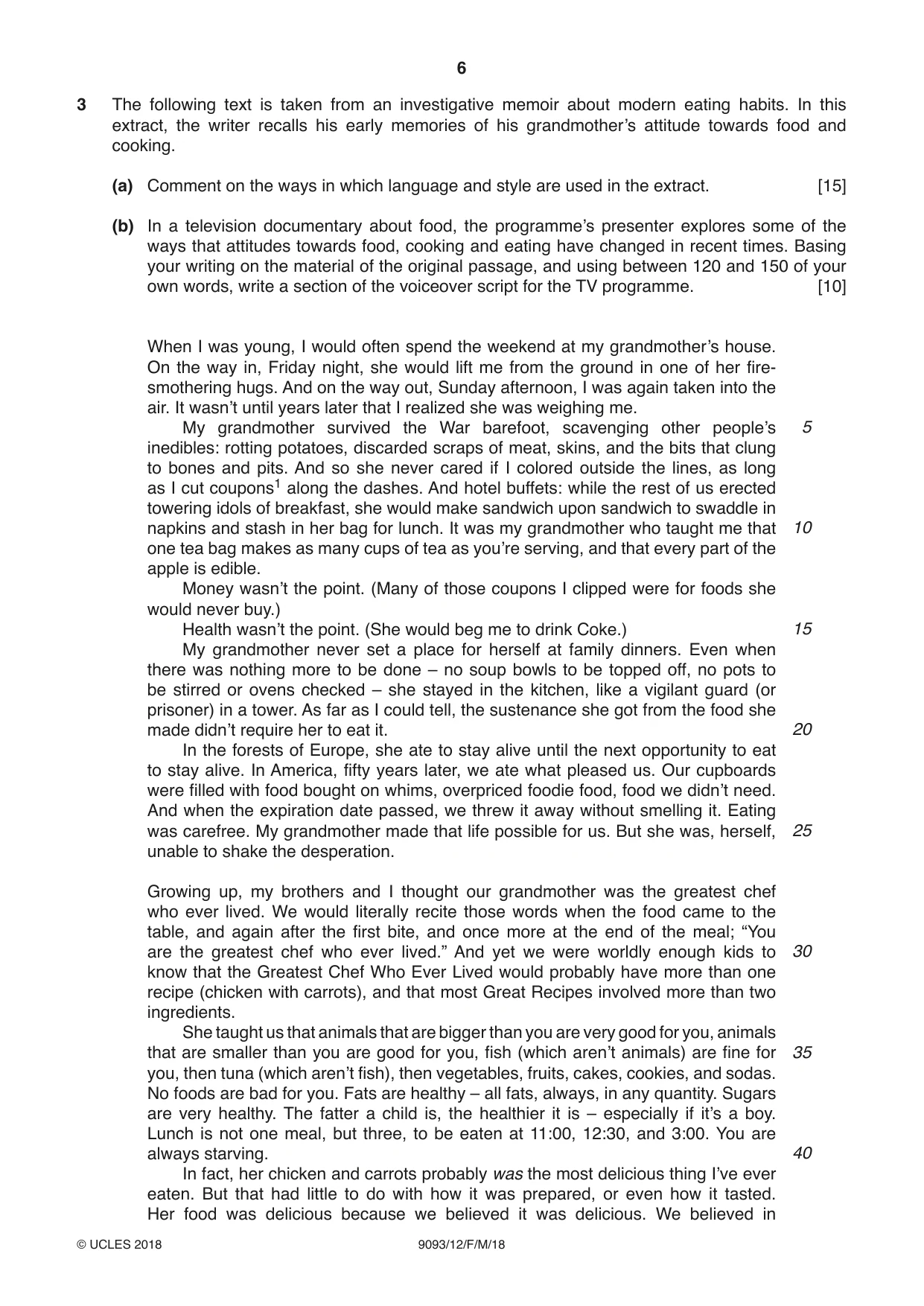
6 9093/12/F/M/18 © UCLES 2018 3 The following text is taken from an investigative memoir about modern eating habits. In this extract, the writer recalls his early memories of his grandmother’s attitude towards food and cooking. (a) Comment on the ways in which language and style are used in the extract. [15] (b) In a television documentary about food, the programme’s presenter explores some of the ways that attitudes towards food, cooking and eating have changed in recent times. Basing your writing on the material of the original passage, and using between 120 and 150 of your own words, write a section of the voiceover script for the TV programme. [10] When I was young, I would often spend the weekend at my grandmother’s house. On the way in, Friday night, she would lift me from the ground in one of her fire- smothering hugs. And on the way out, Sunday afternoon, I was again taken into the air. It wasn’t until years later that I realized she was weighing me. My grandmother survived the War barefoot, scavenging other people’s inedibles: rotting potatoes, discarded scraps of meat, skins, and the bits that clung to bones and pits. And so she never cared if I colored outside the lines, as long as I cut coupons1 along the dashes. And hotel buffets: while the rest of us erected towering idols of breakfast, she would make sandwich upon sandwich to swaddle in napkins and stash in her bag for lunch. It was my grandmother who taught me that one tea bag makes as many cups of tea as you’re serving, and that every part of the apple is edible. Money wasn’t the point. (Many of those coupons I clipped were for foods she would never buy.) Health wasn’t the point. (She would beg me to drink Coke.) My grandmother never set a place for herself at family dinners. Even when there was nothing more to be done – no soup bowls to be topped off, no pots to be stirred or ovens checked – she stayed in the kitchen, like a vigilant guard (or prisoner) in a tower. As far as I could tell, the sustenance she got from the food she made didn’t require her to eat it. In the forests of Europe, she ate to stay alive until the next opportunity to eat to stay alive. In America, fifty years later, we ate what pleased us. Our cupboards were filled with food bought on whims, overpriced foodie food, food we didn’t need. And when the expiration date passed, we threw it away without smelling it. Eating was carefree. My grandmother made that life possible for us. But she was, herself, unable to shake the desperation. Growing up, my brothers and I thought our grandmother was the greatest chef who ever lived. We would literally recite those words when the food came to the table, and again after the first bite, and once more at the end of the meal; “You are the greatest chef who ever lived.” And yet we were worldly enough kids to know that the Greatest Chef Who Ever Lived would probably have more than one recipe (chicken with carrots), and that most Great Recipes involved more than two ingredients. She taught us that animals that are bigger than you are very good for you, animals that are smaller than you are good for you, fish (which aren’t animals) are fine for you, then tuna (which aren’t fish), then vegetables, fruits, cakes, cookies, and sodas. No foods are bad for you. Fats are healthy – all fats, always, in any quantity. Sugars are very healthy. The fatter a child is, the healthier it is – especially if it’s a boy. Lunch is not one meal, but three, to be eaten at 11:00, 12:30, and 3:00. You are always starving. In fact, her chicken and carrots probably was the most delicious thing I’ve ever eaten. But that had little to do with how it was prepared, or even how it tasted. Her food was delicious because we believed it was delicious. We believed in 5 10 15 20 25 30 35 40
Question paper, page 7
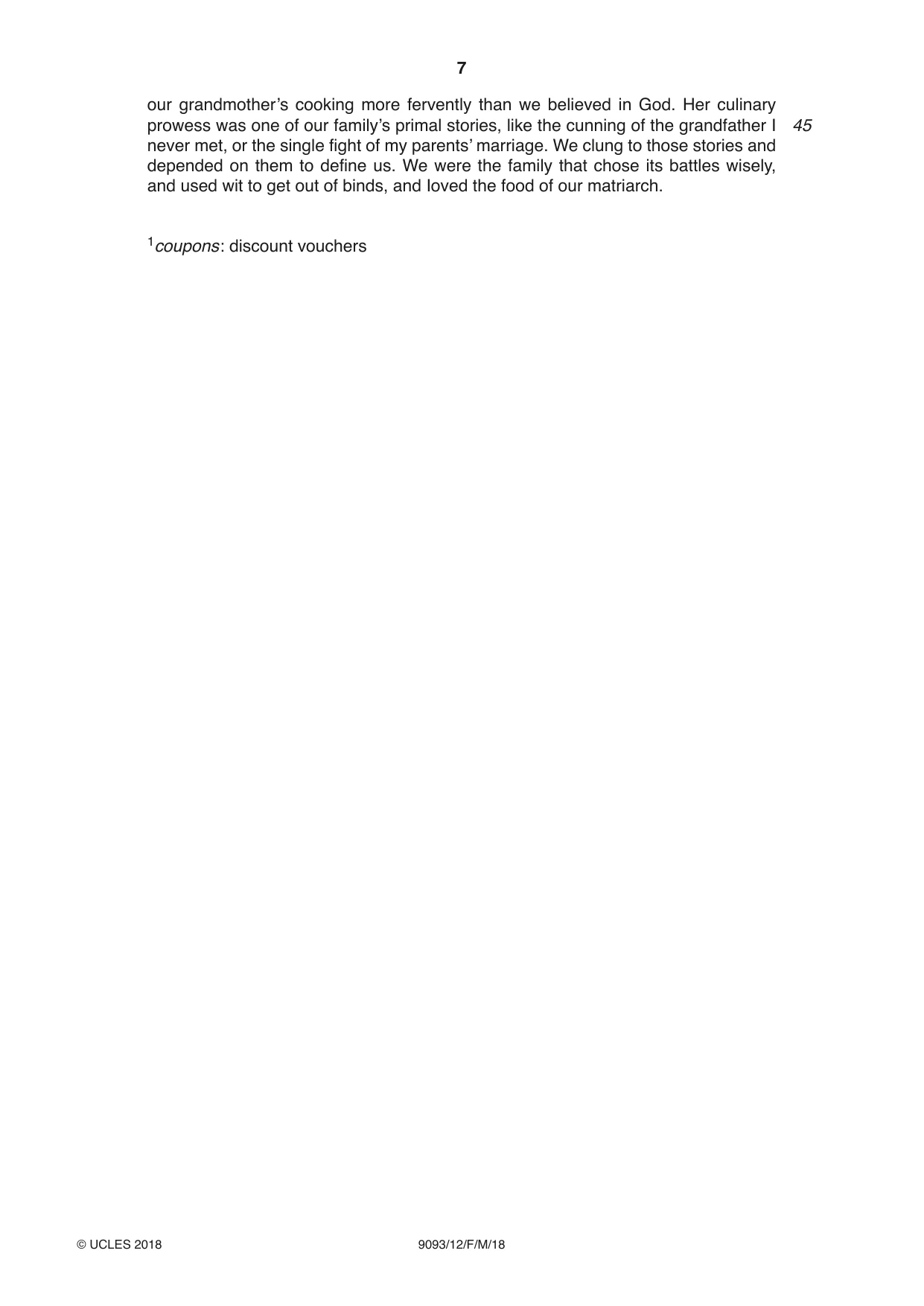
7 9093/12/F/M/18 © UCLES 2018 our grandmother’s cooking more fervently than we believed in God. Her culinary prowess was one of our family’s primal stories, like the cunning of the grandfather I never met, or the single fight of my parents’ marriage. We clung to those stories and depended on them to define us. We were the family that chose its battles wisely, and used wit to get out of binds, and Ioved the food of our matriarch. 1coupons: discount vouchers 45
Question paper, page 8
8 9093/12/F/M/18 © UCLES 2018 Permission to reproduce items where third-party owned material protected by copyright is included has been sought and cleared where possible. Every reasonable effort has been made by the publisher (UCLES) to trace copyright holders, but if any items requiring clearance have unwittingly been included, the publisher will be pleased to make amends at the earliest possible opportunity. To avoid the issue of disclosure of answer-related information to candidates, all copyright acknowledgements are reproduced online in the Cambridge International Examinations Copyright Acknowledgements Booklet. This is produced for each series of examinations and is freely available to download at www.cie.org.uk after the live examination series. Cambridge International Examinations is part of the Cambridge Assessment Group. Cambridge Assessment is the brand name of University of Cambridge Local Examinations Syndicate (UCLES), which is itself a department of the University of Cambridge. BLANK PAGE
Mark scheme, page 1
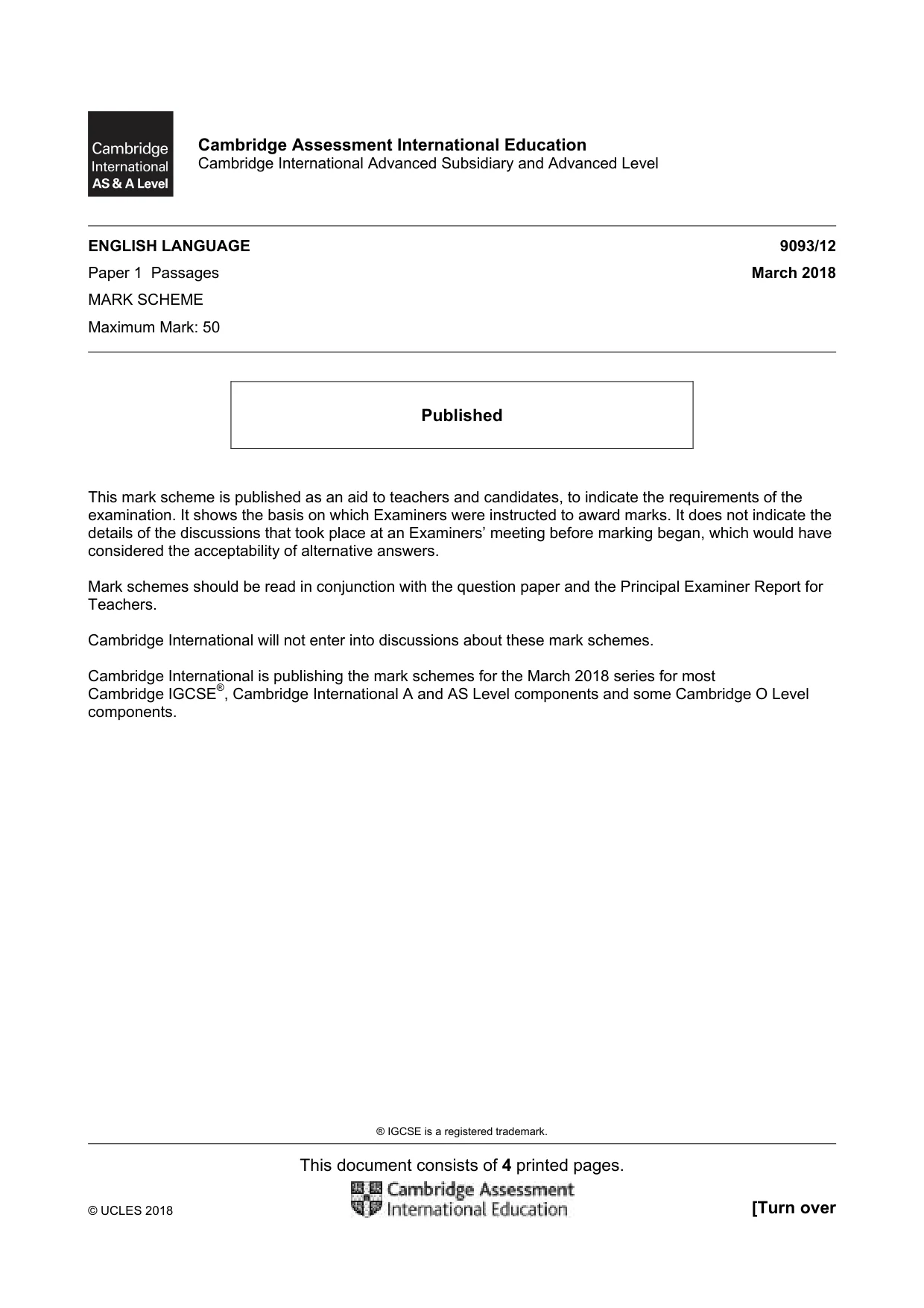
® IGCSE is a registered trademark. This document consists of 4 printed pages. © UCLES 2018 [Turn over Cambridge Assessment International Education Cambridge International Advanced Subsidiary and Advanced Level ENGLISH LANGUAGE 9093/12 Paper 1 Passages March 2018 MARK SCHEME Maximum Mark: 50 Published This mark scheme is published as an aid to teachers and candidates, to indicate the requirements of the examination. It shows the basis on which Examiners were instructed to award marks. It does not indicate the details of the discussions that took place at an Examiners’ meeting before marking began, which would have considered the acceptability of alternative answers. Mark schemes should be read in conjunction with the question paper and the Principal Examiner Report for Teachers. Cambridge International will not enter into discussions about these mark schemes. Cambridge International is publishing the mark schemes for the March 2018 series for most Cambridge IGCSE®, Cambridge International A and AS Level components and some Cambridge O Level components.
Mark scheme, page 2
9093/12 Cambridge International AS/A Level – Mark Scheme PUBLISHED March 2018 © UCLES 2018 Page 2 of 4 Generic Marking Principles These general marking principles must be applied by all examiners when marking candidate answers. They should be applied alongside the specific content of the mark scheme or generic level descriptors for a question. Each question paper and mark scheme will also comply with these marking principles. GENERIC MARKING PRINCIPLE 1: Marks must be awarded in line with: • the specific content of the mark scheme or the generic level descriptors for the question • the specific skills defined in the mark scheme or in the generic level descriptors for the question • the standard of response required by a candidate as exemplified by the standardisation scripts. GENERIC MARKING PRINCIPLE 2: Marks awarded are always whole marks (not half marks, or other fractions). GENERIC MARKING PRINCIPLE 3: Marks must be awarded positively: • marks are awarded for correct/valid answers, as defined in the mark scheme. However, credit is given for valid answers which go beyond the scope of the syllabus and mark scheme, referring to your Team Leader as appropriate • marks are awarded when candidates clearly demonstrate what they know and can do • marks are not deducted for errors • marks are not deducted for omissions • answers should only be judged on the quality of spelling, punctuation and grammar when these features are specifically assessed by the question as indicated by the mark scheme. The meaning, however, should be unambiguous. GENERIC MARKING PRINCIPLE 4: Rules must be applied consistently e.g. in situations where candidates have not followed instructions or in the application of generic level descriptors. GENERIC MARKING PRINCIPLE 5: Marks should be awarded using the full range of marks defined in the mark scheme for the question (however; the use of the full mark range may be limited according to the quality of the candidate responses seen). GENERIC MARKING PRINCIPLE 6: Marks awarded are based solely on the requirements as defined in the mark scheme. Marks should not be awarded with grade thresholds or grade descriptors in mind.
Mark scheme, page 3
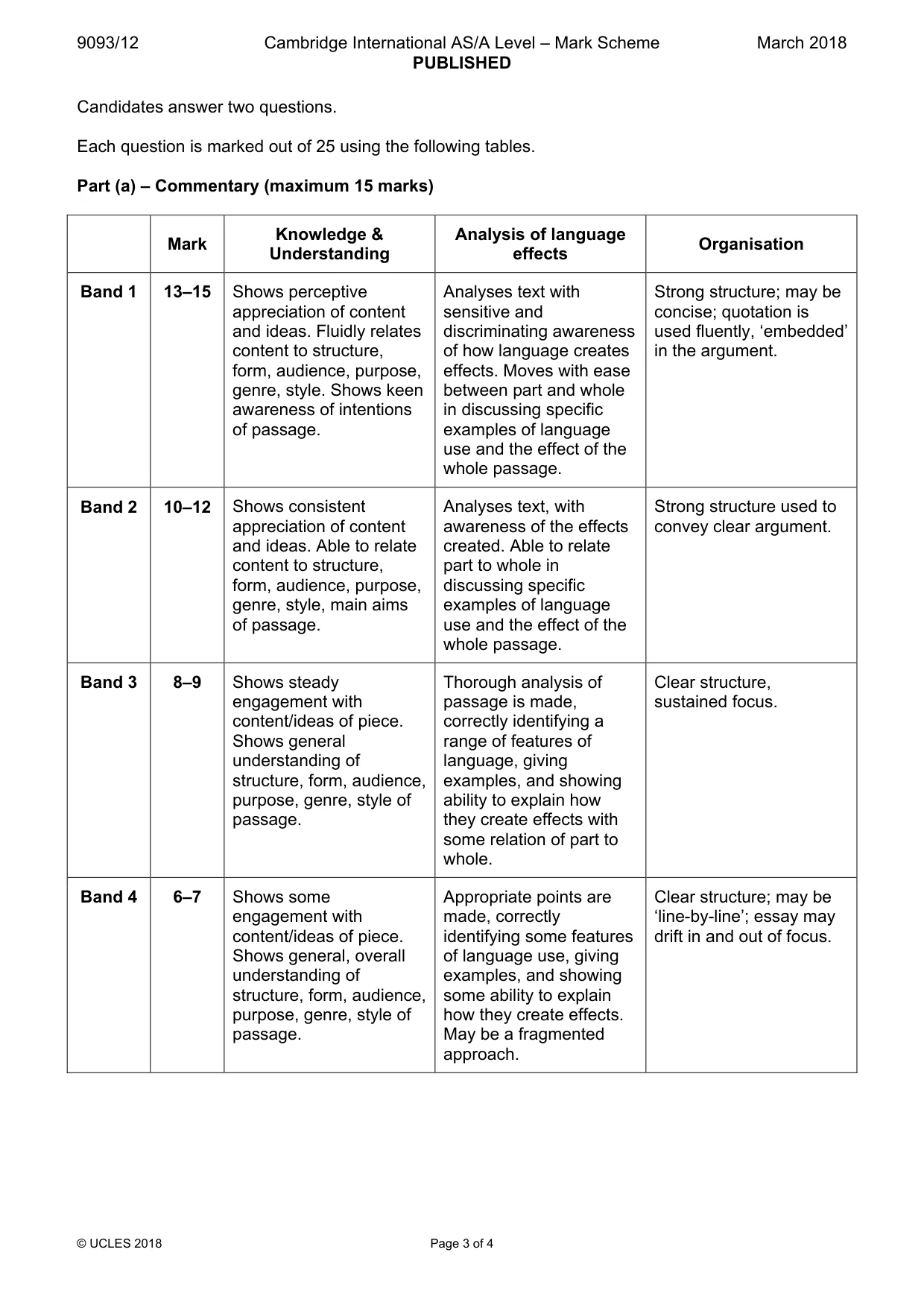
9093/12 Cambridge International AS/A Level – Mark Scheme PUBLISHED March 2018 © UCLES 2018 Page 3 of 4 Candidates answer two questions. Each question is marked out of 25 using the following tables. Part (a) – Commentary (maximum 15 marks) Mark Knowledge & Understanding Analysis of language effects Organisation Band 1 13–15 Shows perceptive appreciation of content and ideas. Fluidly relates content to structure, form, audience, purpose, genre, style. Shows keen awareness of intentions of passage. Analyses text with sensitive and discriminating awareness of how language creates effects. Moves with ease between part and whole in discussing specific examples of language use and the effect of the whole passage. Strong structure; may be concise; quotation is used fluently, ‘embedded’ in the argument. Band 2 10–12 Shows consistent appreciation of content and ideas. Able to relate content to structure, form, audience, purpose, genre, style, main aims of passage. Analyses text, with awareness of the effects created. Able to relate part to whole in discussing specific examples of language use and the effect of the whole passage. Strong structure used to convey clear argument. Band 3 8–9 Shows steady engagement with content/ideas of piece. Shows general understanding of structure, form, audience, purpose, genre, style of passage. Thorough analysis of passage is made, correctly identifying a range of features of language, giving examples, and showing ability to explain how they create effects with some relation of part to whole. Clear structure, sustained focus. Band 4 6–7 Shows some engagement with content/ideas of piece. Shows general, overall understanding of structure, form, audience, purpose, genre, style of passage. Appropriate points are made, correctly identifying some features of language use, giving examples, and showing some ability to explain how they create effects. May be a fragmented approach. Clear structure; may be ‘line-by-line’; essay may drift in and out of focus.
Mark scheme, page 4
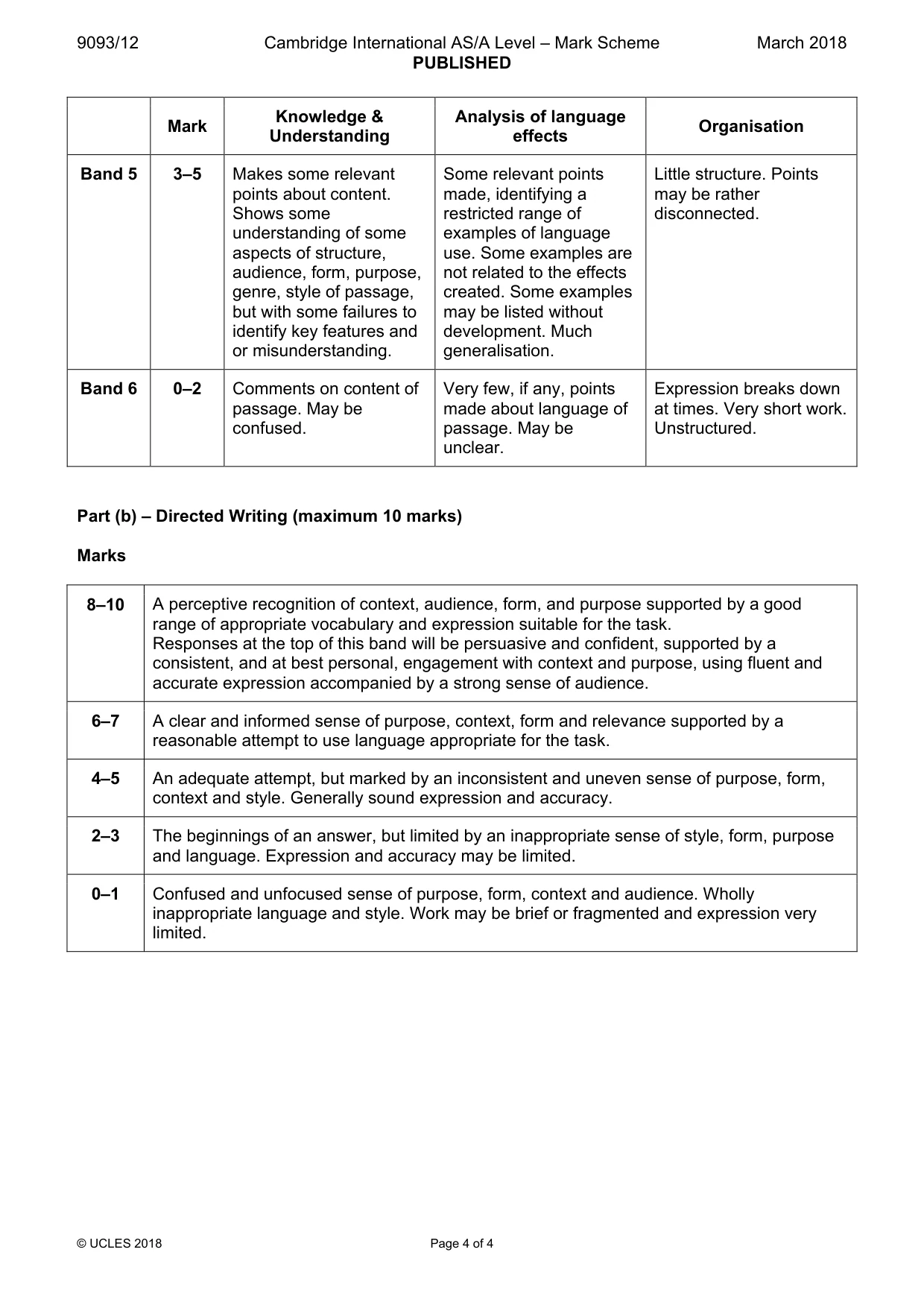
9093/12 Cambridge International AS/A Level – Mark Scheme PUBLISHED March 2018 © UCLES 2018 Page 4 of 4 Mark Knowledge & Understanding Analysis of language effects Organisation Band 5 3–5 Makes some relevant points about content. Shows some understanding of some aspects of structure, audience, form, purpose, genre, style of passage, but with some failures to identify key features and or misunderstanding. Some relevant points made, identifying a restricted range of examples of language use. Some examples are not related to the effects created. Some examples may be listed without development. Much generalisation. Little structure. Points may be rather disconnected. Band 6 0–2 Comments on content of passage. May be confused. Very few, if any, points made about language of passage. May be unclear. Expression breaks down at times. Very short work. Unstructured. Part (b) – Directed Writing (maximum 10 marks) Marks 8–10 A perceptive recognition of context, audience, form, and purpose supported by a good range of appropriate vocabulary and expression suitable for the task. Responses at the top of this band will be persuasive and confident, supported by a consistent, and at best personal, engagement with context and purpose, using fluent and accurate expression accompanied by a strong sense of audience. 6–7 A clear and informed sense of purpose, context, form and relevance supported by a reasonable attempt to use language appropriate for the task. 4–5 An adequate attempt, but marked by an inconsistent and uneven sense of purpose, form, context and style. Generally sound expression and accuracy. 2–3 The beginnings of an answer, but limited by an inappropriate sense of style, form, purpose and language. Expression and accuracy may be limited. 0–1 Confused and unfocused sense of purpose, form, context and audience. Wholly inappropriate language and style. Work may be brief or fragmented and expression very limited.
What you needed in this session
Cambridge’s own grade thresholds for 2018 Feb/March, Paper 1 · Variant 2. A higher threshold means an easier paper — the bar moves with how the cohort did.