Cambridge A Level English - Language AS and A Level (from 2014) 9093 — 2017 Feb/March Paper 1 · Variant 2
9093/12/F/M/17 · 50 marks · ≈56 min
The question paper and its mark scheme, free to read here and free to download. This is Cambridge’s own paper, exactly as it was sat.
Question paper8 pages


Mark scheme3 pages
Answers below. Sit the paper first if you are practising.
Paper as text
Question paper, page 1
This document consists of 7 printed pages, 1 blank page and 1 Insert. DC (RCL (DF)) 130749/2 © UCLES 2017 [Turn over Cambridge International Examinations Cambridge International Advanced Subsidiary and Advanced Level * 3 6 9 3 3 5 4 4 9 9 * ENGLISH LANGUAGE 9093/12 Paper 1 Passages February/March 2017 2 hours 15 minutes No Additional Materials are required. READ THESE INSTRUCTIONS FIRST An answer booklet is provided inside this question paper. You should follow the instructions on the front cover of the answer booklet. If you need additional answer paper, ask the invigilator for a continuation booklet. Answer two questions: Question 1 and either Question 2 or Question 3. You should spend about 15 minutes reading the passages and questions before you start writing your answers. You are reminded of the need for good English and clear presentation in your answers. The number of marks is given in brackets [ ] at the end of each question or part question.
Question paper, page 2
2 9093/12/F/M/17 © UCLES 2017 Answer Question 1 and either Question 2 or Question 3. 1 The following extract is taken from the novel The Namesake by Jhumpa Lahiri. Gogol and Sonia have been brought up in America and are now visiting India with their parents (Ashoke and Ashima) for the first time. (a) Comment on the style and language of the extract and the ways in which it conveys the children’s reactions to the situation. [15] (b) The children’s mother keeps a diary of the visit, noting in particular her own feelings about seeing her children in a new place. Write a section (120–150 words) of her diary. Base your answer closely on the material of the original extract. [10] The wheels touch the ground, the aircraft is sprayed with disinfectant, Content removed due to copyright restrictions.
Question paper, page 3
3 9093/12/F/M/17 © UCLES 2017 [Turn over the armoire in which they would have stored their clothes. Content removed due to copyright restrictions.
Question paper, page 4
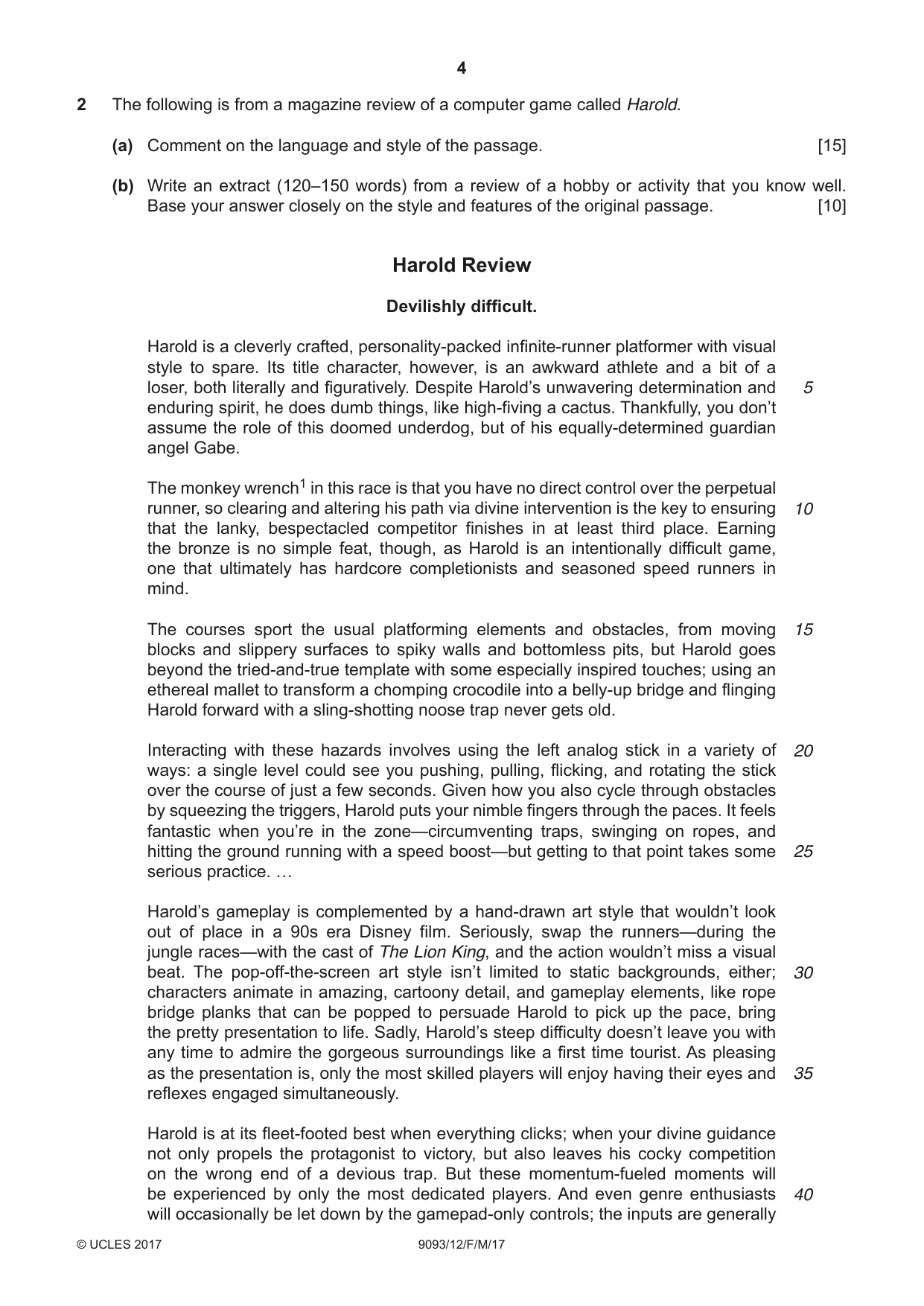
4 9093/12/F/M/17 © UCLES 2017 2 The following is from a magazine review of a computer game called Harold. (a) Comment on the language and style of the passage. [15] (b) Write an extract (120–150 words) from a review of a hobby or activity that you know well. Base your answer closely on the style and features of the original passage. [10] Harold Review Devilishly difficult. Harold is a cleverly crafted, personality-packed infinite-runner platformer with visual style to spare. Its title character, however, is an awkward athlete and a bit of a loser, both literally and figuratively. Despite Harold’s unwavering determination and enduring spirit, he does dumb things, like high-fiving a cactus. Thankfully, you don’t assume the role of this doomed underdog, but of his equally-determined guardian angel Gabe. The monkey wrench1 in this race is that you have no direct control over the perpetual runner, so clearing and altering his path via divine intervention is the key to ensuring that the lanky, bespectacled competitor finishes in at least third place. Earning the bronze is no simple feat, though, as Harold is an intentionally difficult game, one that ultimately has hardcore completionists and seasoned speed runners in mind. The courses sport the usual platforming elements and obstacles, from moving blocks and slippery surfaces to spiky walls and bottomless pits, but Harold goes beyond the tried-and-true template with some especially inspired touches; using an ethereal mallet to transform a chomping crocodile into a belly-up bridge and flinging Harold forward with a sling-shotting noose trap never gets old. Interacting with these hazards involves using the left analog stick in a variety of ways: a single level could see you pushing, pulling, flicking, and rotating the stick over the course of just a few seconds. Given how you also cycle through obstacles by squeezing the triggers, Harold puts your nimble fingers through the paces. It feels fantastic when you’re in the zone—circumventing traps, swinging on ropes, and hitting the ground running with a speed boost—but getting to that point takes some serious practice. … Harold’s gameplay is complemented by a hand-drawn art style that wouldn’t look out of place in a 90s era Disney film. Seriously, swap the runners—during the jungle races—with the cast of The Lion King, and the action wouldn’t miss a visual beat. The pop-off-the-screen art style isn’t limited to static backgrounds, either; characters animate in amazing, cartoony detail, and gameplay elements, like rope bridge planks that can be popped to persuade Harold to pick up the pace, bring the pretty presentation to life. Sadly, Harold’s steep difficulty doesn’t leave you with any time to admire the gorgeous surroundings like a first time tourist. As pleasing as the presentation is, only the most skilled players will enjoy having their eyes and reflexes engaged simultaneously. Harold is at its fleet-footed best when everything clicks; when your divine guidance not only propels the protagonist to victory, but also leaves his cocky competition on the wrong end of a devious trap. But these momentum-fueled moments will be experienced by only the most dedicated players. And even genre enthusiasts will occasionally be let down by the gamepad-only controls; the inputs are generally 5 10 15 20 25 30 35 40
Question paper, page 5
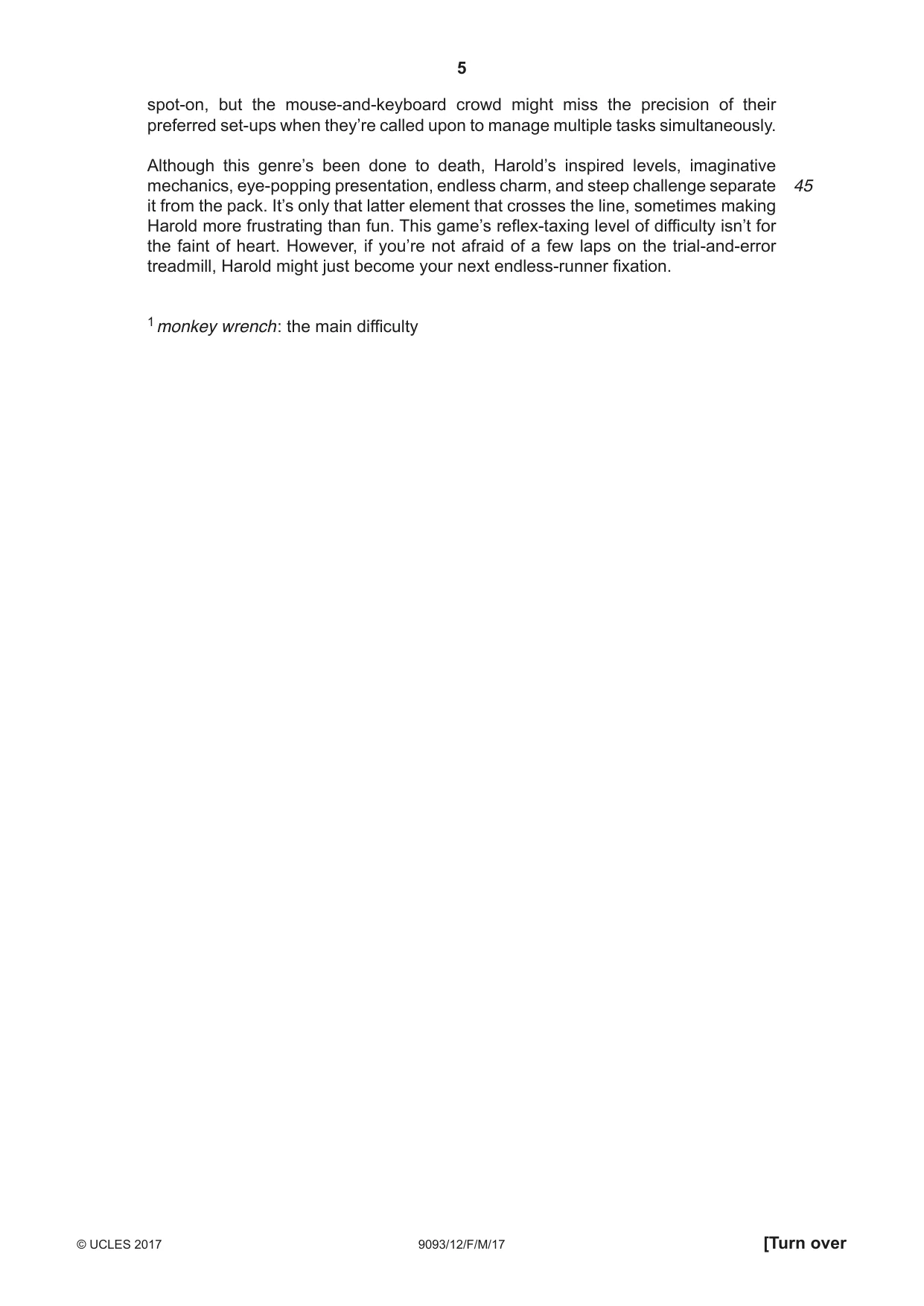
5 9093/12/F/M/17 © UCLES 2017 [Turn over spot-on, but the mouse-and-keyboard crowd might miss the precision of their preferred set-ups when they’re called upon to manage multiple tasks simultaneously. Although this genre’s been done to death, Harold’s inspired levels, imaginative mechanics, eye-popping presentation, endless charm, and steep challenge separate it from the pack. It’s only that latter element that crosses the line, sometimes making Harold more frustrating than fun. This game’s reflex-taxing level of difficulty isn’t for the faint of heart. However, if you’re not afraid of a few laps on the trial-and-error treadmill, Harold might just become your next endless-runner fixation. 1 monkey wrench : the main difficulty 45
Question paper, page 6
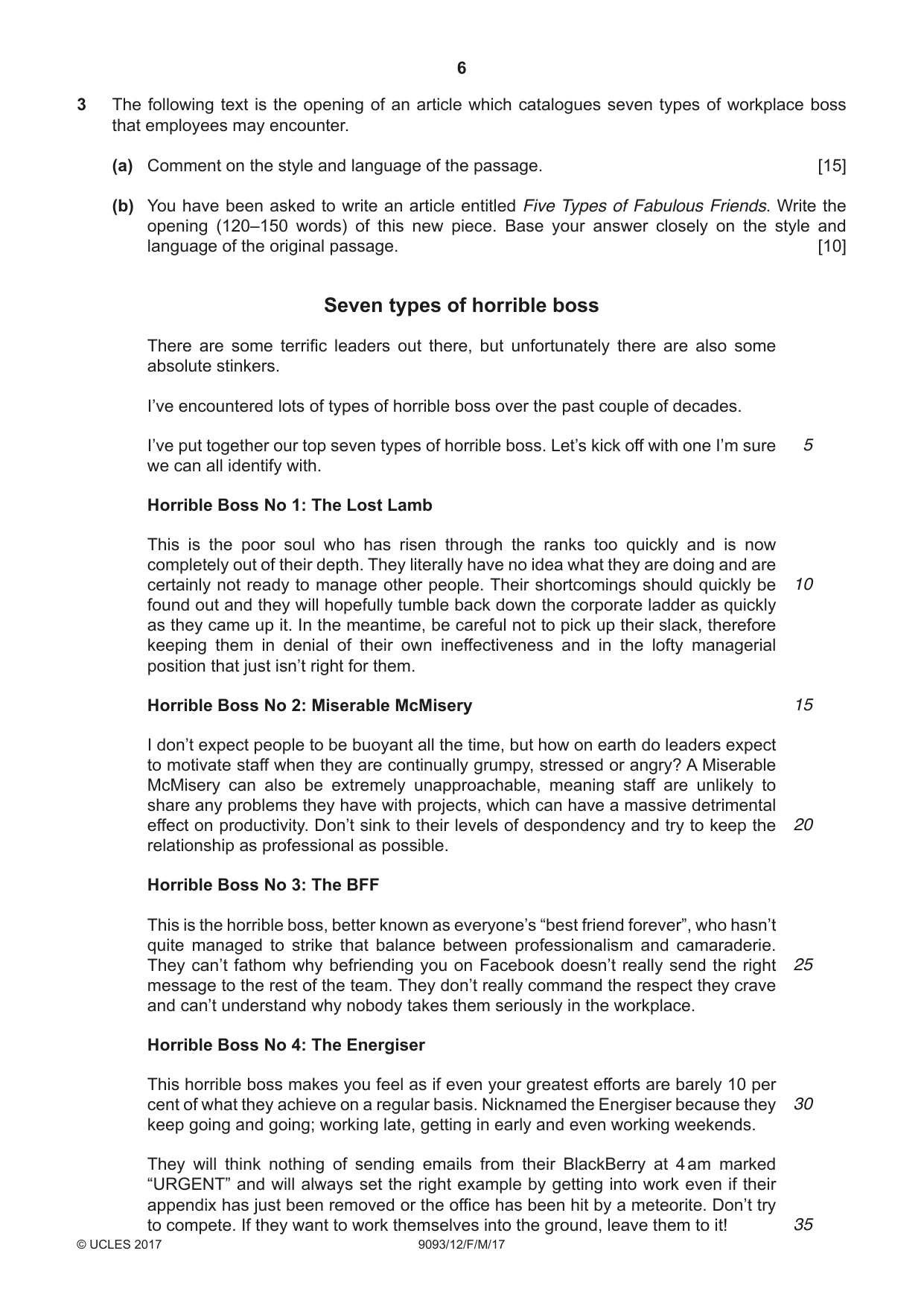
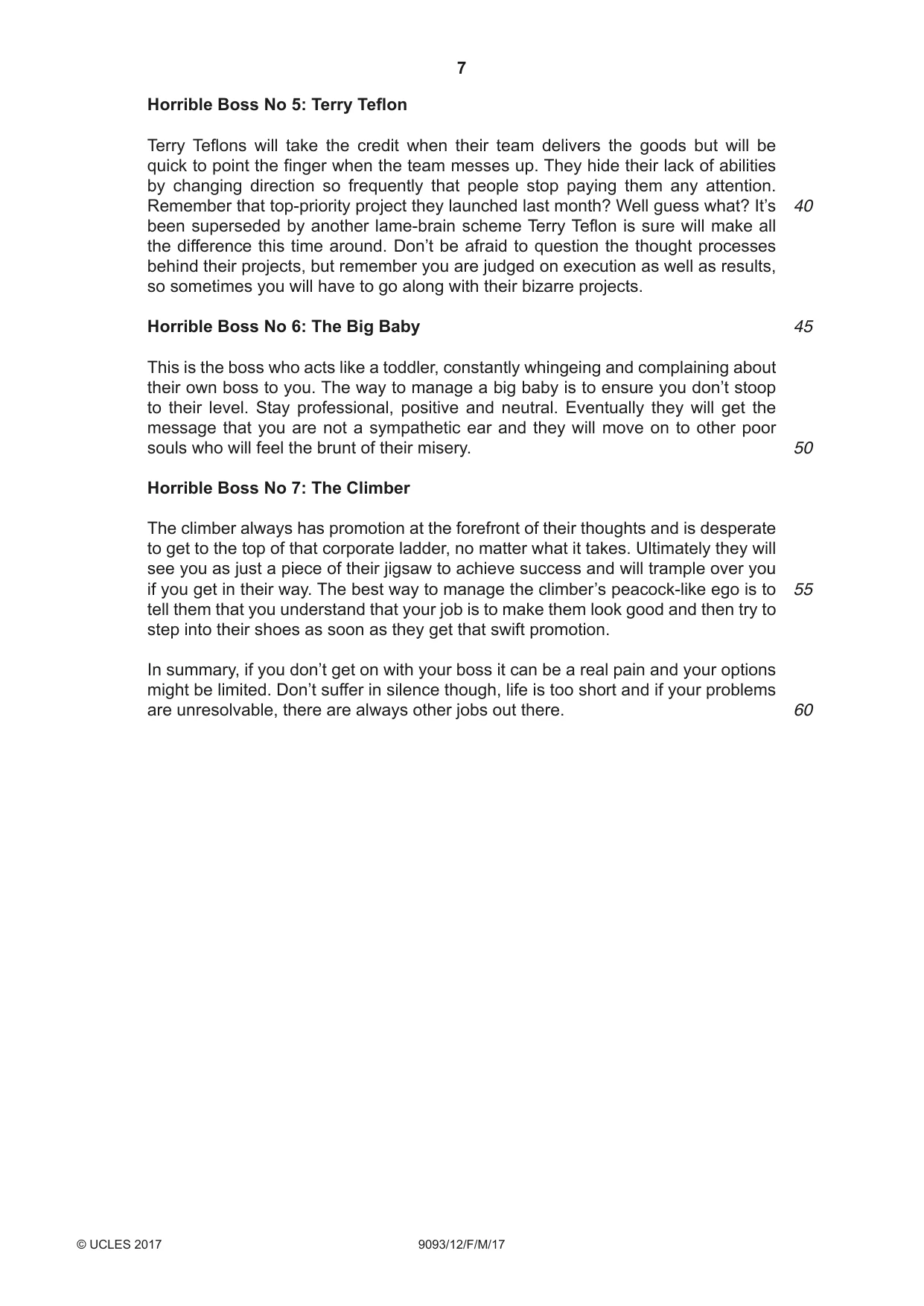
6 9093/12/F/M/17 © UCLES 2017 3 The following text is the opening of an article which catalogues seven types of workplace boss that employees may encounter. (a) Comment on the style and language of the passage. [15] (b) You have been asked to write an article entitled Five Types of Fabulous Friends. Write the opening (120–150 words) of this new piece. Base your answer closely on the style and language of the original passage. [10] Seven types of horrible boss There are some terrific leaders out there, but unfortunately there are also some absolute stinkers. I’ve encountered lots of types of horrible boss over the past couple of decades. I’ve put together our top seven types of horrible boss. Let’s kick off with one I’m sure we can all identify with. Horrible Boss No 1: The Lost Lamb This is the poor soul who has risen through the ranks too quickly and is now completely out of their depth. They literally have no idea what they are doing and are certainly not ready to manage other people. Their shortcomings should quickly be found out and they will hopefully tumble back down the corporate ladder as quickly as they came up it. In the meantime, be careful not to pick up their slack, therefore keeping them in denial of their own ineffectiveness and in the lofty managerial position that just isn’t right for them. Horrible Boss No 2: Miserable McMisery I don’t expect people to be buoyant all the time, but how on earth do leaders expect to motivate staff when they are continually grumpy, stressed or angry? A Miserable McMisery can also be extremely unapproachable, meaning staff are unlikely to share any problems they have with projects, which can have a massive detrimental effect on productivity. Don’t sink to their levels of despondency and try to keep the relationship as professional as possible. Horrible Boss No 3: The BFF This is the horrible boss, better known as everyone’s “best friend forever”, who hasn’t quite managed to strike that balance between professionalism and camaraderie. They can’t fathom why befriending you on Facebook doesn’t really send the right message to the rest of the team. They don’t really command the respect they crave and can’t understand why nobody takes them seriously in the workplace. Horrible Boss No 4: The Energiser This horrible boss makes you feel as if even your greatest efforts are barely 10 per cent of what they achieve on a regular basis. Nicknamed the Energiser because they keep going and going; working late, getting in early and even working weekends. They will think nothing of sending emails from their BlackBerry at 4 am marked “URGENT” and will always set the right example by getting into work even if their appendix has just been removed or the office has been hit by a meteorite. Don’t try to compete. If they want to work themselves into the ground, leave them to it! 5 10 15 20 25 30 35
Question paper, page 7
7 9093/12/F/M/17 © UCLES 2017 Horrible Boss No 5: Terry Teflon Terry Teflons will take the credit when their team delivers the goods but will be quick to point the finger when the team messes up. They hide their lack of abilities by changing direction so frequently that people stop paying them any attention. Remember that top-priority project they launched last month? Well guess what? It’s been superseded by another lame-brain scheme Terry Teflon is sure will make all the difference this time around. Don’t be afraid to question the thought processes behind their projects, but remember you are judged on execution as well as results, so sometimes you will have to go along with their bizarre projects. Horrible Boss No 6: The Big Baby This is the boss who acts like a toddler, constantly whingeing and complaining about their own boss to you. The way to manage a big baby is to ensure you don’t stoop to their level. Stay professional, positive and neutral. Eventually they will get the message that you are not a sympathetic ear and they will move on to other poor souls who will feel the brunt of their misery. Horrible Boss No 7: The Climber The climber always has promotion at the forefront of their thoughts and is desperate to get to the top of that corporate ladder, no matter what it takes. Ultimately they will see you as just a piece of their jigsaw to achieve success and will trample over you if you get in their way. The best way to manage the climber’s peacock-like ego is to tell them that you understand that your job is to make them look good and then try to step into their shoes as soon as they get that swift promotion. In summary, if you don’t get on with your boss it can be a real pain and your options might be limited. Don’t suffer in silence though, life is too short and if your problems are unresolvable, there are always other jobs out there. 40 45 50 55 60
Question paper, page 8
8 9093/12/F/M/17 © UCLES 2017 BLANK PAGE Permission to reproduce items where third-party owned material protected by copyright is included has been sought and cleared where possible. Every reasonable effort has been made by the publisher (UCLES) to trace copyright holders, but if any items requiring clearance have unwittingly been included, the publisher will be pleased to make amends at the earliest possible opportunity. To avoid the issue of disclosure of answer-related information to candidates, all copyright acknowledgements are reproduced online in the Cambridge International Examinations Copyright Acknowledgements Booklet. This is produced for each series of examinations and is freely available to download at www.cie.org.uk after the live examination series. Cambridge International Examinations is part of the Cambridge Assessment Group. Cambridge Assessment is the brand name of University of Cambridge Local Examinations Syndicate (UCLES), which is itself a department of the University of Cambridge.
Mark scheme, page 1
® IGCSE is a registered trademark. This document consists of 3 printed pages. © UCLES 2017 [Turn over Cambridge International Examinations Cambridge International Advanced Subsidiary and Advanced Level ENGLISH LANGUAGE 9093/12 Paper 1 Passages March 2017 MARK SCHEME Maximum Mark: 50 Published This mark scheme is published as an aid to teachers and candidates, to indicate the requirements of the examination. It shows the basis on which Examiners were instructed to award marks. It does not indicate the details of the discussions that took place at an Examiners’ meeting before marking began, which would have considered the acceptability of alternative answers. Mark schemes should be read in conjunction with the question paper and the Principal Examiner Report for Teachers. Cambridge will not enter into discussions about these mark schemes. Cambridge is publishing the mark schemes for the March 2017 series for most Cambridge IGCSE®, Cambridge International A and AS Level components and some Cambridge O Level components.
Mark scheme, page 2
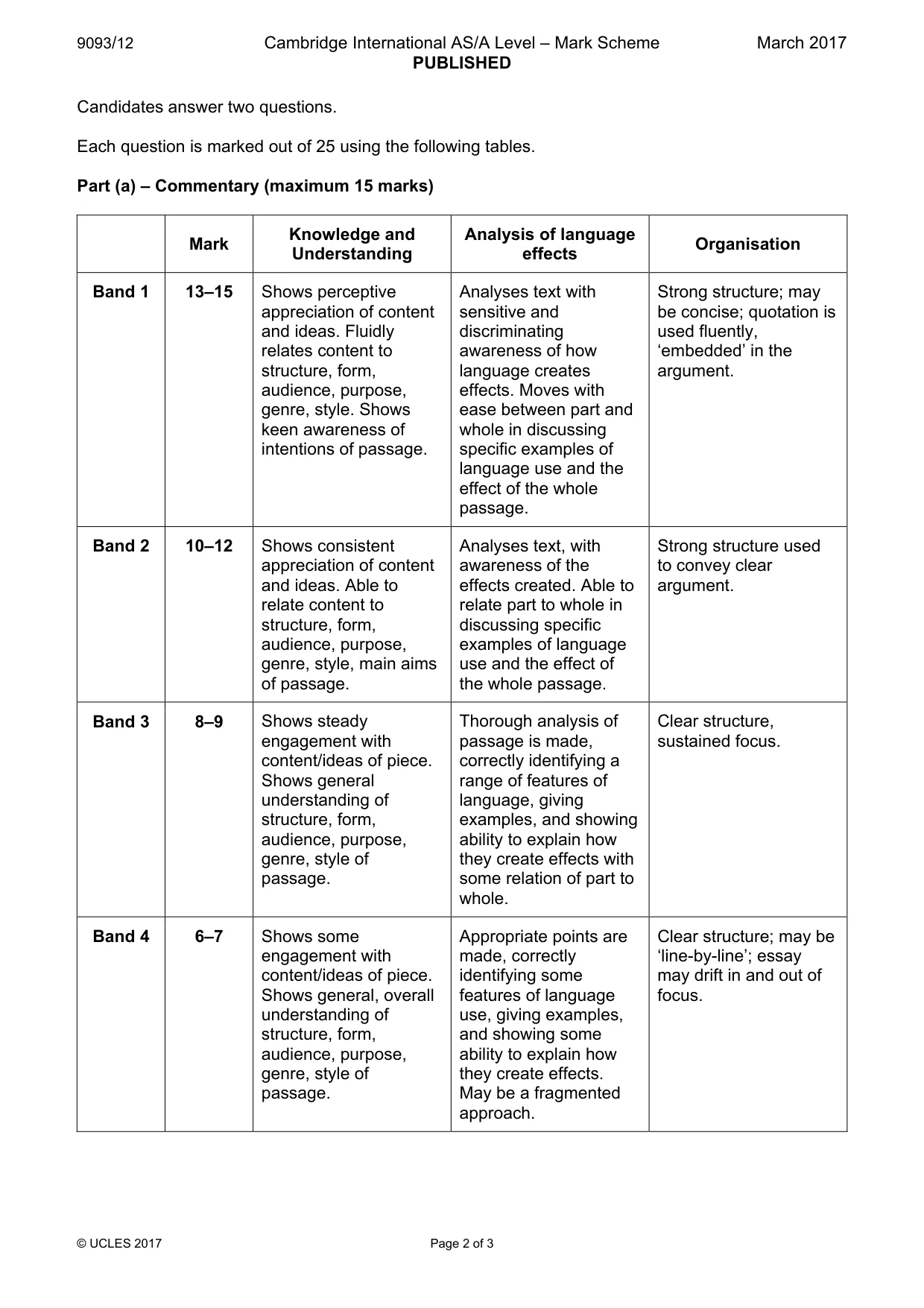
9093/12 Cambridge International AS/A Level – Mark Scheme PUBLISHED March 2017 © UCLES 2017 Page 2 of 3 Candidates answer two questions. Each question is marked out of 25 using the following tables. Part (a) – Commentary (maximum 15 marks) Mark Knowledge and Understanding Analysis of language effects Organisation Band 1 13–15 Shows perceptive appreciation of content and ideas. Fluidly relates content to structure, form, audience, purpose, genre, style. Shows keen awareness of intentions of passage. Analyses text with sensitive and discriminating awareness of how language creates effects. Moves with ease between part and whole in discussing specific examples of language use and the effect of the whole passage. Strong structure; may be concise; quotation is used fluently, ‘embedded’ in the argument. Band 2 10–12 Shows consistent appreciation of content and ideas. Able to relate content to structure, form, audience, purpose, genre, style, main aims of passage. Analyses text, with awareness of the effects created. Able to relate part to whole in discussing specific examples of language use and the effect of the whole passage. Strong structure used to convey clear argument. Band 3 8–9 Shows steady engagement with content/ideas of piece. Shows general understanding of structure, form, audience, purpose, genre, style of passage. Thorough analysis of passage is made, correctly identifying a range of features of language, giving examples, and showing ability to explain how they create effects with some relation of part to whole. Clear structure, sustained focus. Band 4 6–7 Shows some engagement with content/ideas of piece. Shows general, overall understanding of structure, form, audience, purpose, genre, style of passage. Appropriate points are made, correctly identifying some features of language use, giving examples, and showing some ability to explain how they create effects. May be a fragmented approach. Clear structure; may be ‘line-by-line’; essay may drift in and out of focus.
Mark scheme, page 3
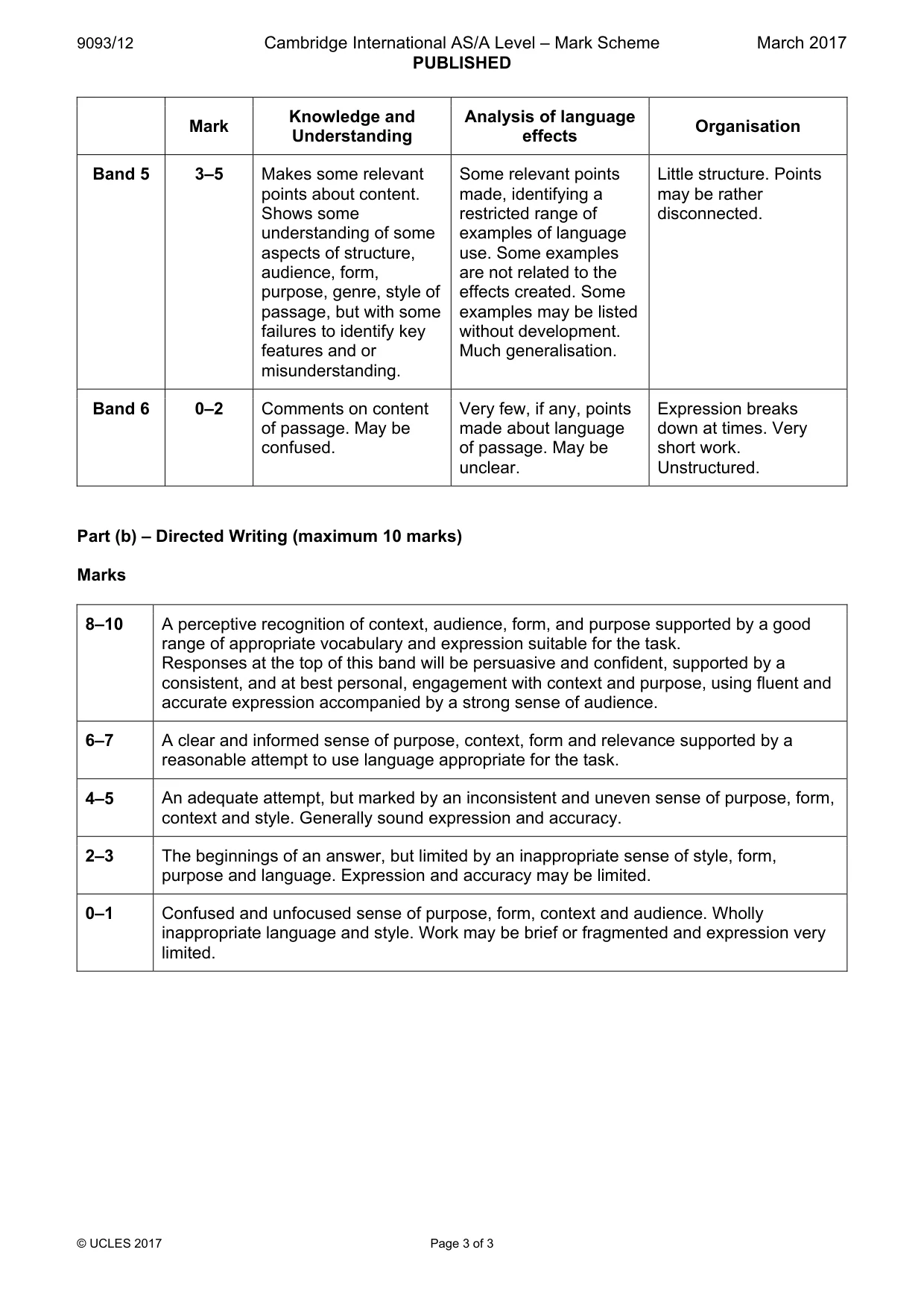
9093/12 Cambridge International AS/A Level – Mark Scheme PUBLISHED March 2017 © UCLES 2017 Page 3 of 3 Mark Knowledge and Understanding Analysis of language effects Organisation Band 5 3–5 Makes some relevant points about content. Shows some understanding of some aspects of structure, audience, form, purpose, genre, style of passage, but with some failures to identify key features and or misunderstanding. Some relevant points made, identifying a restricted range of examples of language use. Some examples are not related to the effects created. Some examples may be listed without development. Much generalisation. Little structure. Points may be rather disconnected. Band 6 0–2 Comments on content of passage. May be confused. Very few, if any, points made about language of passage. May be unclear. Expression breaks down at times. Very short work. Unstructured. Part (b) – Directed Writing (maximum 10 marks) Marks 8–10 A perceptive recognition of context, audience, form, and purpose supported by a good range of appropriate vocabulary and expression suitable for the task. Responses at the top of this band will be persuasive and confident, supported by a consistent, and at best personal, engagement with context and purpose, using fluent and accurate expression accompanied by a strong sense of audience. 6–7 A clear and informed sense of purpose, context, form and relevance supported by a reasonable attempt to use language appropriate for the task. 4–5 An adequate attempt, but marked by an inconsistent and uneven sense of purpose, form, context and style. Generally sound expression and accuracy. 2–3 The beginnings of an answer, but limited by an inappropriate sense of style, form, purpose and language. Expression and accuracy may be limited. 0–1 Confused and unfocused sense of purpose, form, context and audience. Wholly inappropriate language and style. Work may be brief or fragmented and expression very limited.
What you needed in this session
Cambridge’s own grade thresholds for 2017 Feb/March, Paper 1 · Variant 2. A higher threshold means an easier paper — the bar moves with how the cohort did.