Cambridge A Level English - Language AS and A Level (from 2014) 9093 — 2016 Feb/March Paper 1 · Variant 2
9093/12/F/M/16 · 50 marks · ≈56 min
The question paper and its mark scheme, free to read here and free to download. This is Cambridge’s own paper, exactly as it was sat.
Question paper8 pages
Mark scheme3 pages
Answers below. Sit the paper first if you are practising.
Paper as text
Question paper, page 1
This document consists of 5 printed pages, 3 blank pages and 1 insert. DC (ST) 135355 © UCLES 2016 [Turn over * 8 7 7 8 5 7 6 1 2 1 * ENGLISH LANGUAGE 9093/12 Paper 1 Passages February/March 2016 2 hours 15 minutes No Additional Materials are required. READ THESE INSTRUCTIONS FIRST An answer booklet is provided inside this question paper. You should follow the instructions on the front cover of the answer booklet. If you need additional answer paper, ask the invigilator for a continuation booklet. Answer two questions: Question 1 and either Question 2 or Question 3. You should spend about 15 minutes reading the passages and questions before you start writing your answers. You are reminded of the need for good English and clear presentation in your answers. The number of marks is given in brackets [ ] at the end of each question or part question. Cambridge International Examinations Cambridge International Advanced Subsidiary and Advanced Level
Question paper, page 2
2 9093/12/F/M/16 © UCLES 2016 Answer Question 1 and either Question 2 or Question 3. 1 The following text is taken from a New Zealand newspaper. (a) Comment on the ways in which the language and style are used to present an argument. [15] (b) The same newspaper publishes an article on children and exercise. Write the opening (between 120 and 150 words) for this new article. Base your answer closely on the style and language of the original. [10] An evolving health crisis of childhood obesity is upon us. Is this the generation where children are condemned to live shorter lives than their parents? Dave Shaw investigates. Countless factors have led us here, with nutrition playing a major role. Many foods now advertised to kids are higher in sugar, salt and fat than those targeted at young generations before. Children are hardwired to fall for these flavours. The food industry is arguably exploiting the biology – and psychology – of children. They aren’t just providing a source of calories and nutrients for a child, they’re impacting their health in a way that could warrant future legal action. Many children are growing up believing food should be served deep-fried and sugar coated. Is this ethical? If other countries were causing havoc on our children’s health like this, then we’d put a stop to it. A film shedding light on this topic is Fed Up which may be the most important documentary in recent times. The film essentially says we have a problem, a problem that many vested interests have no intention of solving, and a problem that must be dealt with if we’re interested in our survival. In the food industry’s defence, they are giving us what we want and if we ask for healthier foods, they will provide. But in the end, profits come first. Here’s a heads up about some food industry insights that may be affecting you and your family. The bliss point: This is the perfect amount of sugar – or salt and fat – that allows a food to become highly salient1. When these tastes combine, they provide a dopamine-fuelled rush driving us to eat more. It’s no surprise children want to eat more of the food that tastes good. Unfortunately, the high consumption of sugary, salty and fatty foods can lead to obesity, metabolic syndrome, diabetes or much worse. Hyperprocessed food: There are many heavy hitting facts about the harms of eating too much sugary and other hyperprocessed foods, yet many of us continue to buy, serve and eat them every day. There is no difference between some processed food and sugar itself. Saying you can eat a bowl of cornflakes with no added sugar or a bowl of sugar with no added cornflakes can be essentially the same thing. 5 10 15 20 25 30
Question paper, page 3
3 9093/12/F/M/16 © UCLES 2016 [Turn over ‘Eater’-tainment: The food industry has learned what humans want and is only too happy to oblige. At every eating opportunity or on every street corner awaits a sugary or salty snack made to satisfy our craving. It’s what people of all ages gorge on to feel good for a few moments or to relax. Who doesn’t want to get on this ride, right? And when we do, we are only more than tempted to ride it again and again. Marketing: The marketing of children’s food is a controversial topic, with many companies under siege for how they promote their food to youngsters. Children often don’t know the difference between good and bad food and have to rely on others to tell them – usually their parents. But when they see the Golden Arches2 or colourful packages covered in cartoons they immediately connect with a product. After tasting the addictive combination of sugar, salt and fat, the marketing image is permanently engraved on their mind. Suddenly, they want more. Maternal disempowerment: What does a mother do when she has the difficult choice of giving her child what they want or giving them what’s best for their health? This is a common struggle against an overwhelming tide of marketing and, possibly, addiction. Sometimes even the parents don’t know what’s best, so who’s left to pick up the reins? Parents, and their children, need to be educated on what are the healthier options, and the healthier choice must become the easier choice. Public misperception: A fast food diet should not be socially accepted, but it is. So, the real goal is to change how we view food. The government has a role to play, but if we look at the great public health successes, they come from changes in how we perceive a product. Smoking for example is now seen as deadly and disgusting, when it was once sexy. If you look at something and say, “that’s horrible, I’d rather have something else,” you’re not going to feel drawn to eat it. We can apply this learning to how we eat. We need to take the power out of certain foods: from there saying “no” to eating junk is easy. 1 salient : flavoursome and appealing. 2 Golden Arches: the trademark of an international hamburger chain. 35 40 45 50 55
Question paper, page 4
4 9093/12/F/M/16 © UCLES 2016 2 The following text is the opening of the novel A Fine Balance, by Rohinton Mistry. The novel is set in India in the 1970s. (a) Comment on the language and style of the extract. [15] (b) Continue the passage (between 120 and 150 words). Base your answer closely on the language and style of the original. You do not need to bring the passage to a conclusion. [10] Dina Dalal seldom indulged in looking back at her life Enlisting him would have ruined any chance of changing her husband’s mind. Content removed due to copyright restrictions.
Question paper, page 5
5 9093/12/F/M/16 © UCLES 2016 3 The following extract presents the American writer Eleanor Clark’s first impressions on visiting Rome in the 1940s. (a) Comment on the language and style of the extract. [15] (b) Imagine that the same writer visits a place that you know well and records her first impressions. Write a section of her essay (between 120 and 150 words). Base your answer closely on the language and style of the original extract. You do not have to bring the essay to a conclusion. [10] Fountains You walk close to your dreams. Sometimes it seems that these pulsing crowds, with their daily and yearly rhythms established so long ago none of it has to be decided any more, with their elbows and knees and souls touching and rubbing and everybody most pleased and agreeable when it is like that, in a bus for instance, will in another minute all be naked, or will have fish tails or horses’ behinds like the characters of the fountains. For the Anglo-Saxon mind, ruled by conscience and the romantic, rigid in its privacies, everything here is shocking—an endless revelation and immersion; this is the vocabulary of our sleep; and the key image is always water. That is the great assault of Rome, and it is total and terrible. It is really strange that foreigners of the polite centuries always used to wax so romantic about the fountains of Rome, and the music supposed to represent them was such as any young girl could listen to. The truth is, they are extremely indecent, in various ways. Their number is indecent, much as the lives of the Caesars were; common reason expires here; it is of their nature too to make those lives quite ordinary, nothing surprises you beside them. Their settings are apt to be extravagant; they can have sprung up anywhere, be tacked anywhere on the sides of buildings or are themselves a whole house wall; and their details have the candid, smiling sadism of dreams. But the worst is the life around them, and their part in it. They are not only memory, or the living singleness of time, though they are that too and the city would have fallen apart under the weight of its past a long time ago without them; this is easy to see; you notice at once when there is a drought and the fountains become quiet and stale, or empty, how old everything begins to look. But there is another unity or community within every single moment to which they are essential, and that is where the real outrage comes. The romantic, the idealist, the tender-minded of any vein dies a thousand deaths in these fountains; their every dolphin is his nemesis1. The very genius spent on them makes them shocking. They are not objets d’art 2 held off from life and treated with respect as they would be anywhere else; there is a closeness, an imminence of touch around them that nothing in our life has except dreams and sex, whence the awful burden on those. They are always being drunk from and splashed in and sat on, everybody dips into them as into his own private memory and quite often they have all kinds of rubbish in their lovely basins, because although the street cleaners of Rome are many and hard-working they cannot be everywhere at once. 1 nemesis: the agent of someone’s downfall. 2 objets d’art : artistic objects. 5 10 15 20 25 30 35
Question paper, page 6
6 9093/12/F/M/16 © UCLES 2016 BLANK PAGE
Question paper, page 7
7 9093/12/F/M/16 © UCLES 2016 BLANK PAGE
Question paper, page 8
8 9093/12/F/M/16 © UCLES 2016 BLANK PAGE Permission to reproduce items where third-party owned material protected by copyright is included has been sought and cleared where possible. Every reasonable effort has been made by the publisher (UCLES) to trace copyright holders, but if any items requiring clearance have unwittingly been included, the publisher will be pleased to make amends at the earliest possible opportunity. To avoid the issue of disclosure of answer-related information to candidates, all copyright acknowledgements are reproduced online in the Cambridge International Examinations Copyright Acknowledgements Booklet. This is produced for each series of examinations and is freely available to download at www.cie.org.uk after the live examination series. Cambridge International Examinations is part of the Cambridge Assessment Group. Cambridge Assessment is the brand name of University of Cambridge Local Examinations Syndicate (UCLES), which is itself a department of the University of Cambridge.
Mark scheme, page 1
® IGCSE is the registered trademark of Cambridge International Examinations. CAMBRIDGE INTERNATIONAL EXAMINATIONS Cambridge International Advanced Subsidiary and Advanced Level MARK SCHEME for the March 2016 series 9093 ENGLISH LANGUAGE 9093/12 Paper 1 (Passages), maximum raw mark 50 This mark scheme is published as an aid to teachers and candidates, to indicate the requirements of the examination. It shows the basis on which Examiners were instructed to award marks. It does not indicate the details of the discussions that took place at an Examiners’ meeting before marking began, which would have considered the acceptability of alternative answers. Mark schemes should be read in conjunction with the question paper and the Principal Examiner Report for Teachers. Cambridge will not enter into discussions about these mark schemes. Cambridge is publishing the mark schemes for the March 2016 series for most Cambridge IGCSE® and Cambridge International A and AS Level components.
Mark scheme, page 2
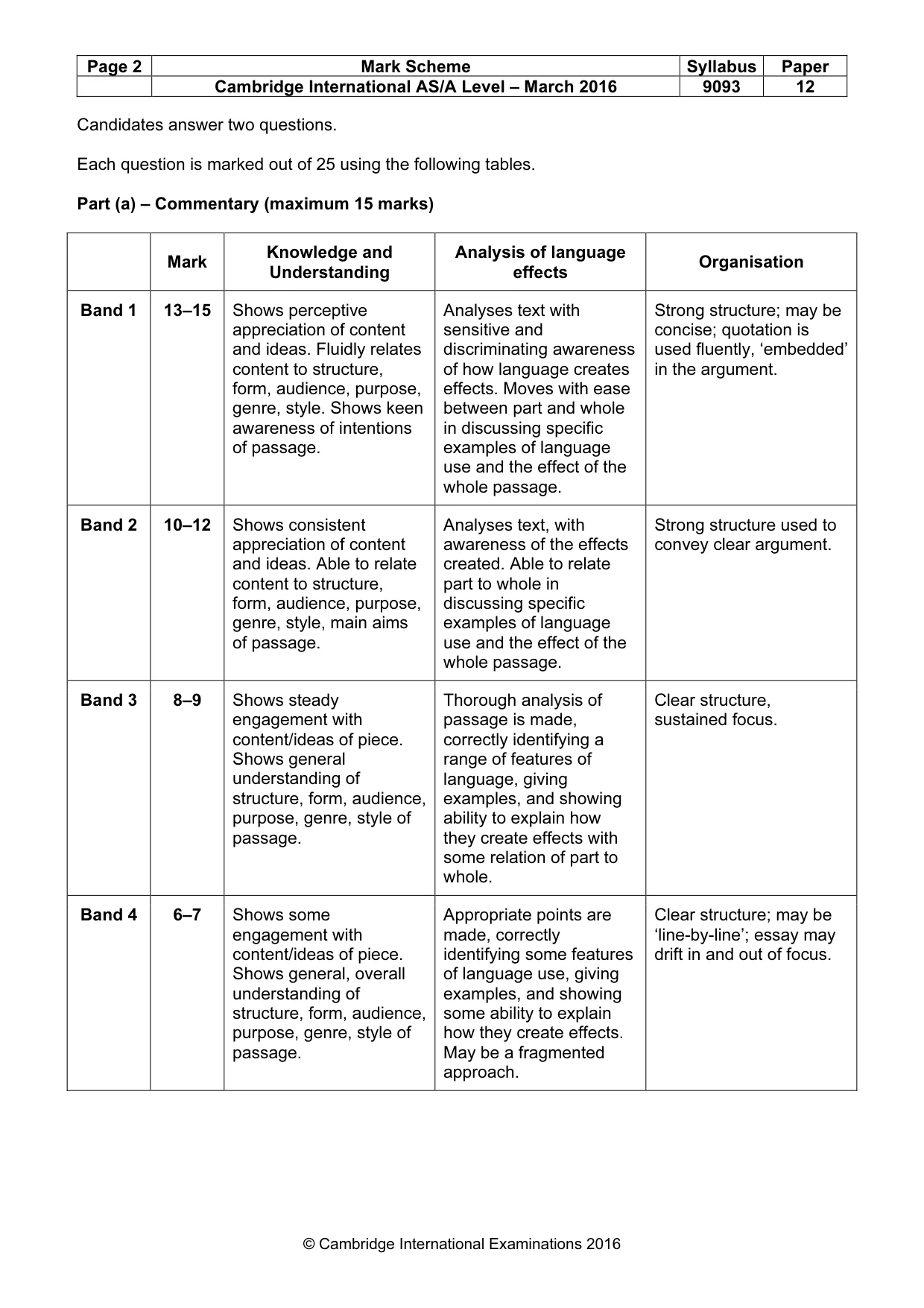
Page 2 Mark Scheme Syllabus Paper Cambridge International AS/A Level – March 2016 9093 12 © Cambridge International Examinations 2016 Candidates answer two questions. Each question is marked out of 25 using the following tables. Part (a) – Commentary (maximum 15 marks) Mark Knowledge and Understanding Analysis of language effects Organisation Band 1 13–15 Shows perceptive appreciation of content and ideas. Fluidly relates content to structure, form, audience, purpose, genre, style. Shows keen awareness of intentions of passage. Analyses text with sensitive and discriminating awareness of how language creates effects. Moves with ease between part and whole in discussing specific examples of language use and the effect of the whole passage. Strong structure; may be concise; quotation is used fluently, ‘embedded’ in the argument. Band 2 10–12 Shows consistent appreciation of content and ideas. Able to relate content to structure, form, audience, purpose, genre, style, main aims of passage. Analyses text, with awareness of the effects created. Able to relate part to whole in discussing specific examples of language use and the effect of the whole passage. Strong structure used to convey clear argument. Band 3 8–9 Shows steady engagement with content/ideas of piece. Shows general understanding of structure, form, audience, purpose, genre, style of passage. Thorough analysis of passage is made, correctly identifying a range of features of language, giving examples, and showing ability to explain how they create effects with some relation of part to whole. Clear structure, sustained focus. Band 4 6–7 Shows some engagement with content/ideas of piece. Shows general, overall understanding of structure, form, audience, purpose, genre, style of passage. Appropriate points are made, correctly identifying some features of language use, giving examples, and showing some ability to explain how they create effects. May be a fragmented approach. Clear structure; may be ‘line-by-line’; essay may drift in and out of focus.
Mark scheme, page 3
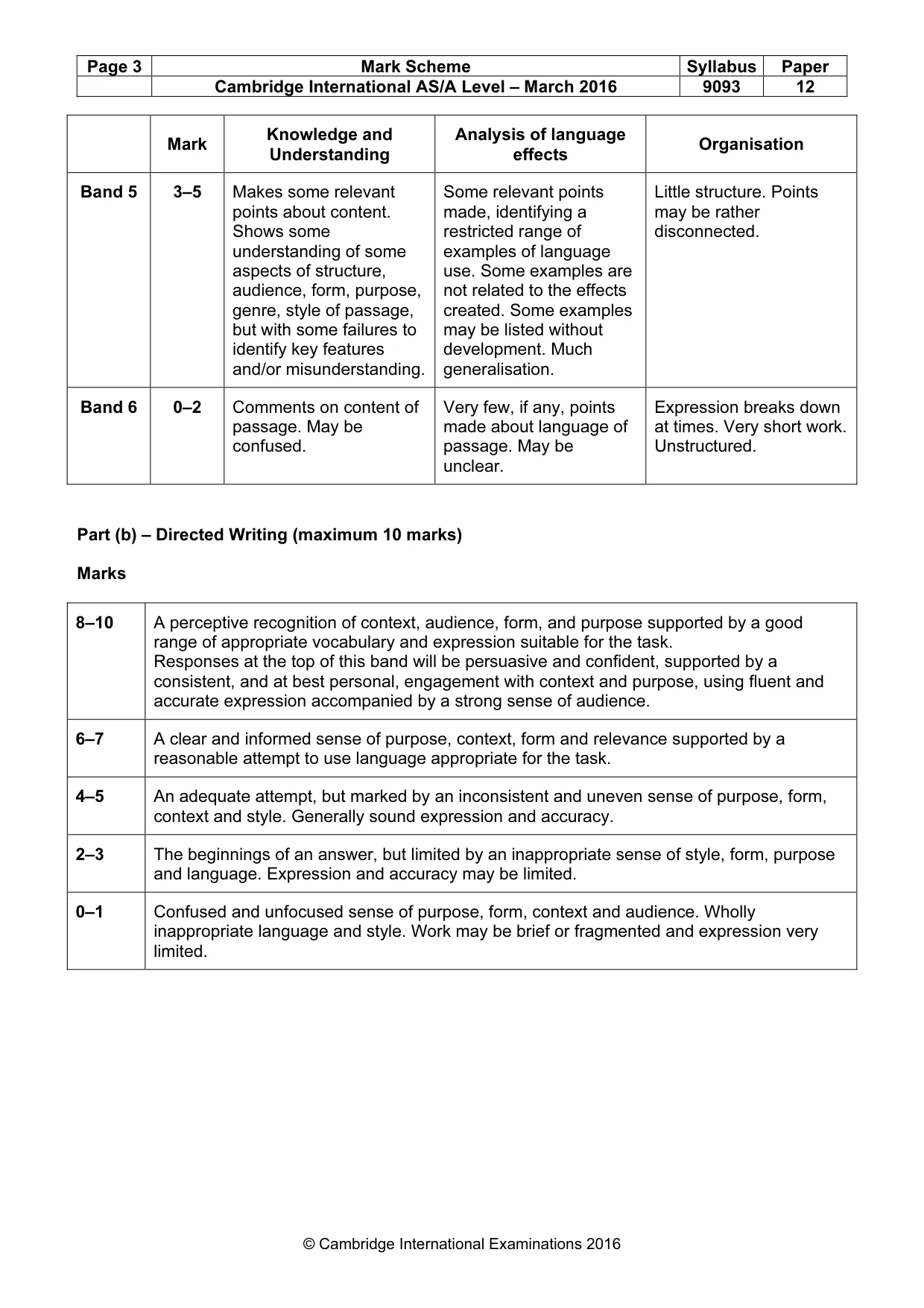
Page 3 Mark Scheme Syllabus Paper Cambridge International AS/A Level – March 2016 9093 12 © Cambridge International Examinations 2016 Mark Knowledge and Understanding Analysis of language effects Organisation Band 5 3–5 Makes some relevant points about content. Shows some understanding of some aspects of structure, audience, form, purpose, genre, style of passage, but with some failures to identify key features and/or misunderstanding. Some relevant points made, identifying a restricted range of examples of language use. Some examples are not related to the effects created. Some examples may be listed without development. Much generalisation. Little structure. Points may be rather disconnected. Band 6 0–2 Comments on content of passage. May be confused. Very few, if any, points made about language of passage. May be unclear. Expression breaks down at times. Very short work. Unstructured. Part (b) – Directed Writing (maximum 10 marks) Marks 8–10 A perceptive recognition of context, audience, form, and purpose supported by a good range of appropriate vocabulary and expression suitable for the task. Responses at the top of this band will be persuasive and confident, supported by a consistent, and at best personal, engagement with context and purpose, using fluent and accurate expression accompanied by a strong sense of audience. 6–7 A clear and informed sense of purpose, context, form and relevance supported by a reasonable attempt to use language appropriate for the task. 4–5 An adequate attempt, but marked by an inconsistent and uneven sense of purpose, form, context and style. Generally sound expression and accuracy. 2–3 The beginnings of an answer, but limited by an inappropriate sense of style, form, purpose and language. Expression and accuracy may be limited. 0–1 Confused and unfocused sense of purpose, form, context and audience. Wholly inappropriate language and style. Work may be brief or fragmented and expression very limited.
What you needed in this session
Cambridge’s own grade thresholds for 2016 Feb/March, Paper 1 · Variant 2. A higher threshold means an easier paper — the bar moves with how the cohort did.