Cambridge A Level English - Language AS and A Level (from 2014) 9093 — 2014 Oct/Nov Paper 3 · Variant 1
9093/31/O/N/14 · 50 marks · ≈56 min
The question paper and its mark scheme, free to read here and free to download. This is Cambridge’s own paper, exactly as it was sat.
Question paper8 pages


Mark scheme3 pages
Answers below. Sit the paper first if you are practising.
Paper as text
Question paper, page 1
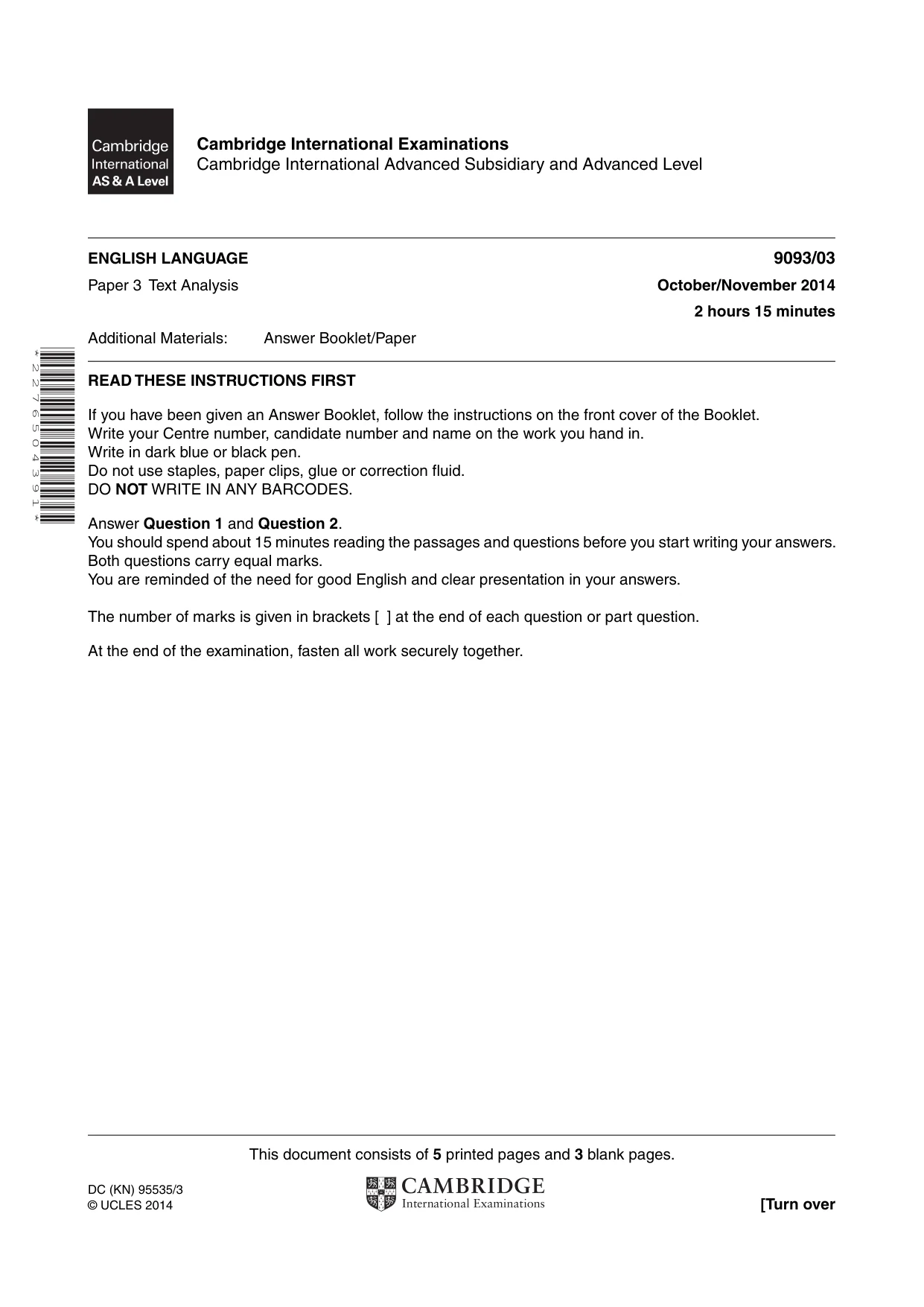
This document consists of 5 printed pages and 3 blank pages. DC (KN) 95535/3 © UCLES 2014 [Turn over Cambridge International Examinations Cambridge International Advanced Subsidiary and Advanced Level * 2 2 7 6 5 0 4 3 9 1 * ENGLISH LANGUAGE 9093/03 Paper 3 Text Analysis October/November 2014 2 hours 15 minutes Additional Materials: Answer Booklet/Paper READ THESE INSTRUCTIONS FIRST If you have been given an Answer Booklet, follow the instructions on the front cover of the Booklet. Write your Centre number, candidate number and name on the work you hand in. Write in dark blue or black pen. Do not use staples, paper clips, glue or correction fluid. DO NOT WRITE IN ANY BARCODES. Answer Question 1 and Question 2. You should spend about 15 minutes reading the passages and questions before you start writing your answers. Both questions carry equal marks. You are reminded of the need for good English and clear presentation in your answers. The number of marks is given in brackets [ ] at the end of each question or part question. At the end of the examination, fasten all work securely together.
Question paper, page 2
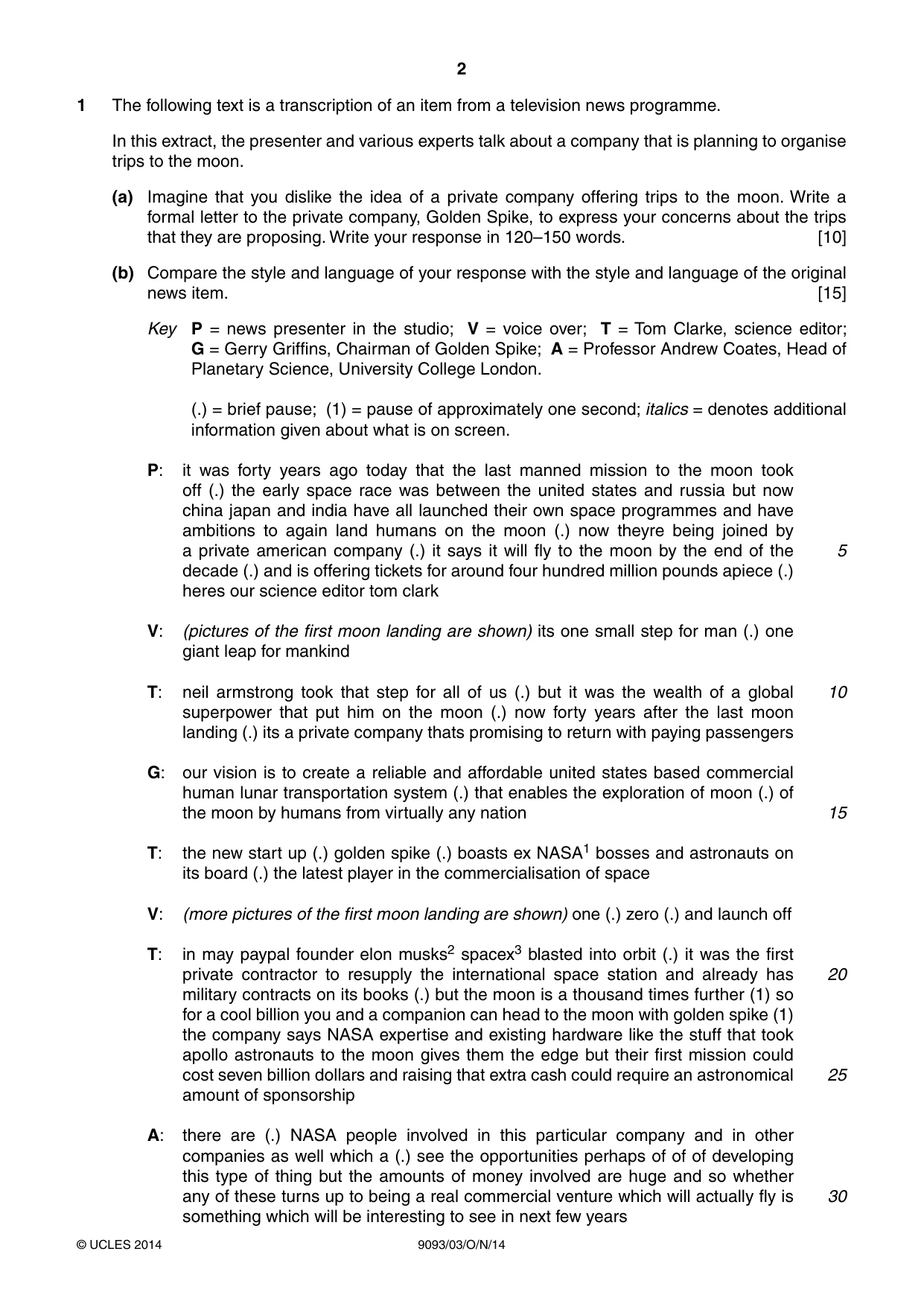
2 9093/03/O/N/14 © UCLES 2014 1 The following text is a transcription of an item from a television news programme. In this extract, the presenter and various experts talk about a company that is planning to organise trips to the moon. (a) Imagine that you dislike the idea of a private company offering trips to the moon. Write a formal letter to the private company, Golden Spike, to express your concerns about the trips that they are proposing. Write your response in 120–150 words. [10] (b) Compare the style and language of your response with the style and language of the original news item. [15] Key P = news presenter in the studio; V = voice over; T = Tom Clarke, science editor; G = Gerry Griffins, Chairman of Golden Spike; A = Professor Andrew Coates, Head of Planetary Science, University College London. (.) = brief pause; (1) = pause of approximately one second; italics = denotes additional information given about what is on screen. P: it was forty years ago today that the last manned mission to the moon took off (.) the early space race was between the united states and russia but now china japan and india have all launched their own space programmes and have ambitions to again land humans on the moon (.) now theyre being joined by a private american company (.) it says it will fly to the moon by the end of the decade (.) and is offering tickets for around four hundred million pounds apiece (.) heres our science editor tom clark V: (pictures of the first moon landing are shown) its one small step for man (.) one giant leap for mankind T: neil armstrong took that step for all of us (.) but it was the wealth of a global superpower that put him on the moon (.) now forty years after the last moon landing (.) its a private company thats promising to return with paying passengers G: our vision is to create a reliable and affordable united states based commercial human lunar transportation system (.) that enables the exploration of moon (.) of the moon by humans from virtually any nation T: the new start up (.) golden spike (.) boasts ex NASA1 bosses and astronauts on its board (.) the latest player in the commercialisation of space V: (more pictures of the first moon landing are shown) one (.) zero (.) and launch off T: in may paypal founder elon musks2 spacex3 blasted into orbit (.) it was the first private contractor to resupply the international space station and already has military contracts on its books (.) but the moon is a thousand times further (1) so for a cool billion you and a companion can head to the moon with golden spike (1) the company says NASA expertise and existing hardware like the stuff that took apollo astronauts to the moon gives them the edge but their first mission could cost seven billion dollars and raising that extra cash could require an astronomical amount of sponsorship A: there are (.) NASA people involved in this particular company and in other companies as well which a (.) see the opportunities perhaps of of of developing this type of thing but the amounts of money involved are huge and so whether any of these turns up to being a real commercial venture which will actually fly is something which will be interesting to see in next few years 5 10 15 20 25 30
Question paper, page 3
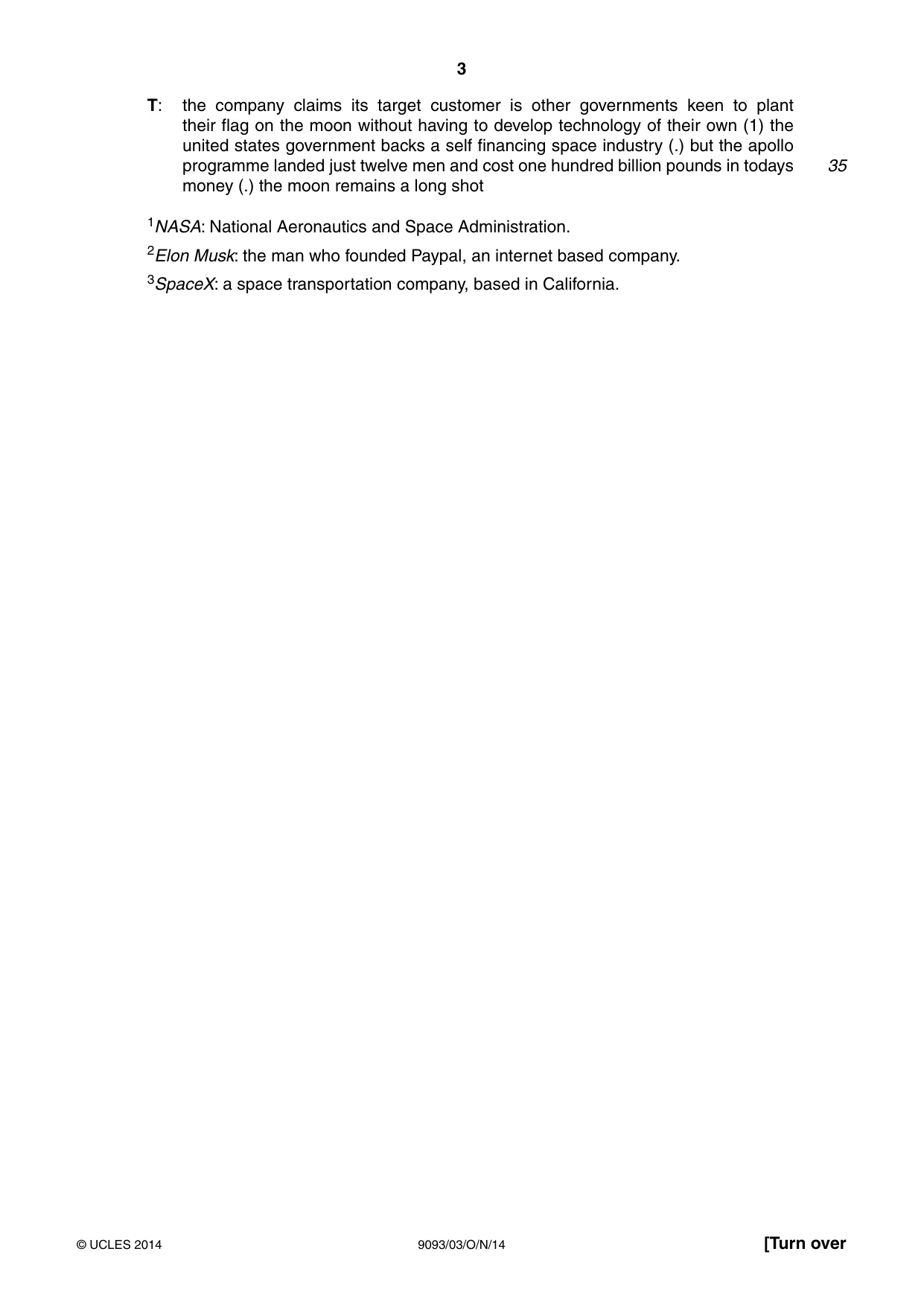
3 9093/03/O/N/14 © UCLES 2014 [Turn over T: the company claims its target customer is other governments keen to plant their flag on the moon without having to develop technology of their own (1) the united states government backs a self financing space industry (.) but the apollo programme landed just twelve men and cost one hundred billion pounds in todays money (.) the moon remains a long shot 1NASA: National Aeronautics and Space Administration. 2Elon Musk: the man who founded Paypal, an internet based company. 3SpaceX: a space transportation company, based in California. 35
Question paper, page 4
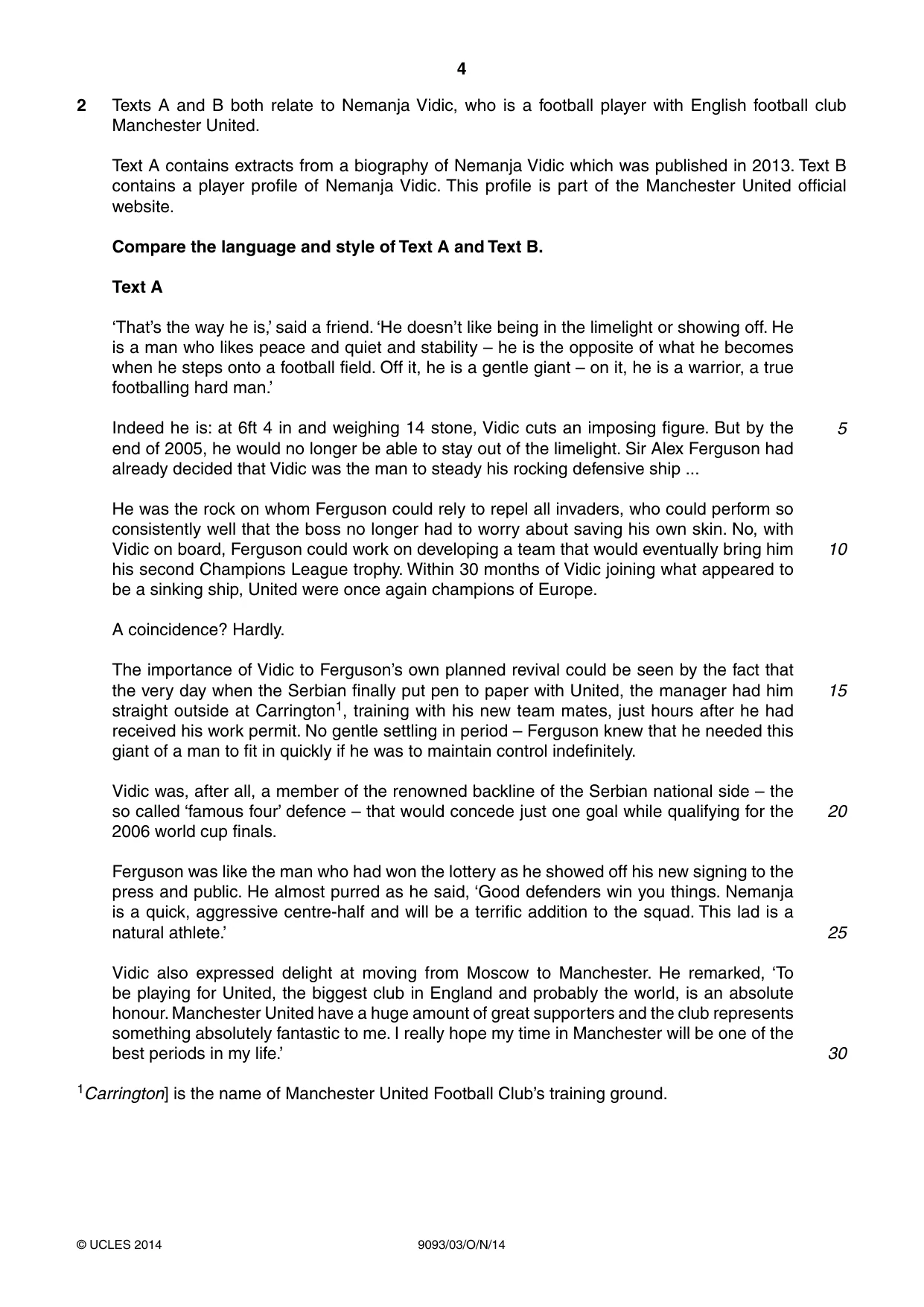
4 9093/03/O/N/14 © UCLES 2014 2 Texts A and B both relate to Nemanja Vidic, who is a football player with English football club Manchester United. Text A contains extracts from a biography of Nemanja Vidic which was published in 2013. Text B contains a player profile of Nemanja Vidic. This profile is part of the Manchester United official website. Compare the language and style of Text A and Text B. Text A ‘That’s the way he is,’ said a friend. ‘He doesn’t like being in the limelight or showing off. He is a man who likes peace and quiet and stability – he is the opposite of what he becomes when he steps onto a football field. Off it, he is a gentle giant – on it, he is a warrior, a true footballing hard man.’ Indeed he is: at 6ft 4 in and weighing 14 stone, Vidic cuts an imposing figure. But by the end of 2005, he would no longer be able to stay out of the limelight. Sir Alex Ferguson had already decided that Vidic was the man to steady his rocking defensive ship ... He was the rock on whom Ferguson could rely to repel all invaders, who could perform so consistently well that the boss no longer had to worry about saving his own skin. No, with Vidic on board, Ferguson could work on developing a team that would eventually bring him his second Champions League trophy. Within 30 months of Vidic joining what appeared to be a sinking ship, United were once again champions of Europe. A coincidence? Hardly. The importance of Vidic to Ferguson’s own planned revival could be seen by the fact that the very day when the Serbian finally put pen to paper with United, the manager had him straight outside at Carrington1, training with his new team mates, just hours after he had received his work permit. No gentle settling in period – Ferguson knew that he needed this giant of a man to fit in quickly if he was to maintain control indefinitely. Vidic was, after all, a member of the renowned backline of the Serbian national side – the so called ‘famous four’ defence – that would concede just one goal while qualifying for the 2006 world cup finals. Ferguson was like the man who had won the lottery as he showed off his new signing to the press and public. He almost purred as he said, ‘Good defenders win you things. Nemanja is a quick, aggressive centre-half and will be a terrific addition to the squad. This lad is a natural athlete.’ Vidic also expressed delight at moving from Moscow to Manchester. He remarked, ‘To be playing for United, the biggest club in England and probably the world, is an absolute honour. Manchester United have a huge amount of great supporters and the club represents something absolutely fantastic to me. I really hope my time in Manchester will be one of the best periods in my life.’ 1Carrington] is the name of Manchester United Football Club’s training ground. 5 10 15 20 25 30
Question paper, page 5
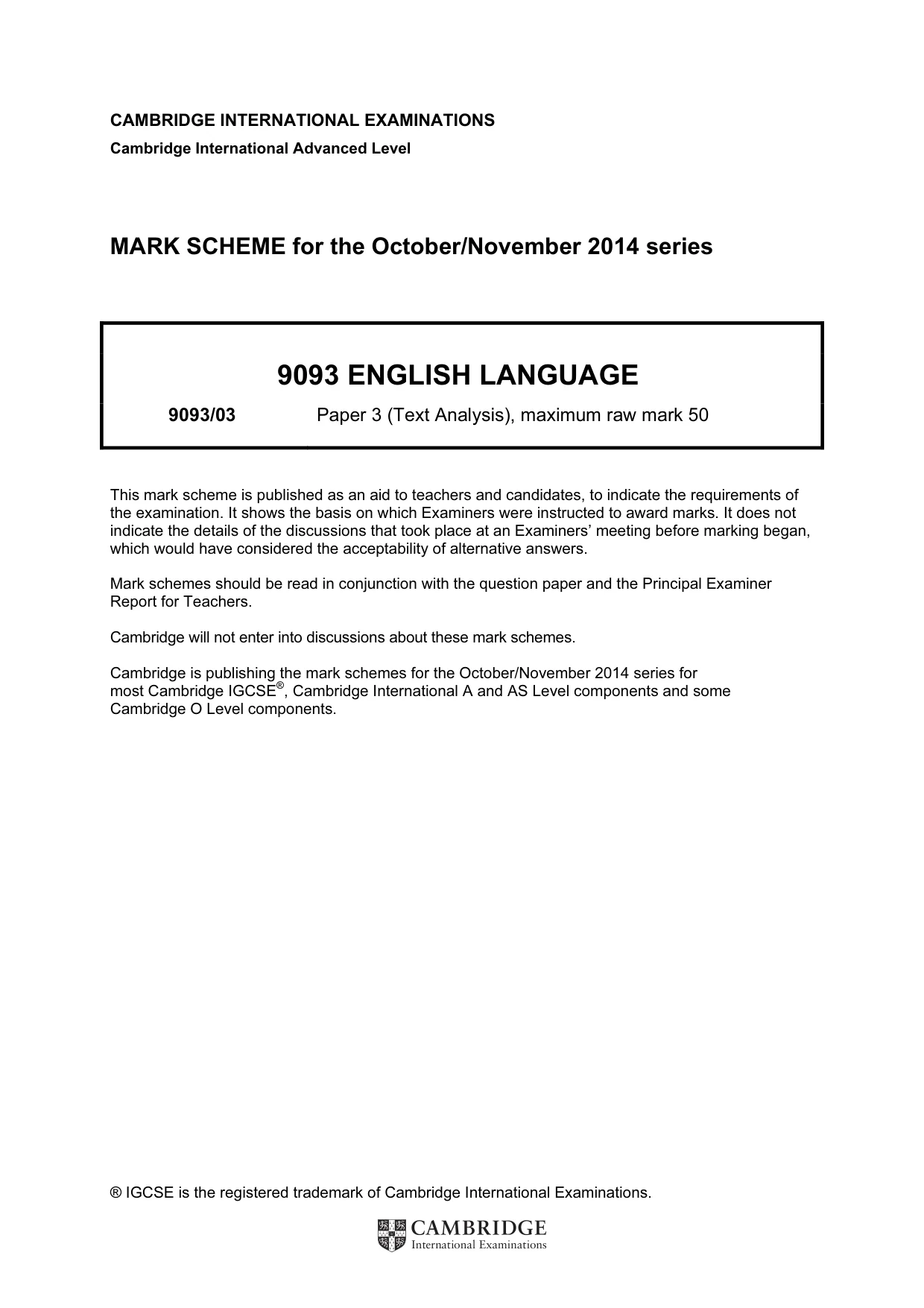
5 9093/03/O/N/14 © UCLES 2014 Text B Tall, uncompromising and solid as a rock: Nemanja Vidic is the epitome of what a Manchester United captain should aspire to. Relentless in the tackle and formidable in the air, the Serbian powerhouse has become one of the Premier League’s most-feared defenders and a key factor in United’s recent silverware haul. Vida, as he’s affectionately known, began his career with boyhood club Red Star Belgrade, joining their youth programme at 14. His first-team debut didn’t arrive until 2001 but he went on to make 22 appearances in his first season. His stay with Red Star ended with a domestic league and cup double before switching to Russian outfit Spartak Moscow in August 2004. Just 39 games and four goals later, United came calling and the Reds announced his signing on Christmas Day, 2005. Without a game in two months, due to the Russian season’s early climax, Nemanja took some time to shine but after finding his feet, began to show his unquestionable class. Unfortunately, a collarbone injury sustained at the end of March 2007 kept him out of the title run-in, but his performances had already inspired a rousing song from the fans. Thankfully, the Serbian soon returned to full fitness and his impressive performances earned him a contract extension in 2007. He said of the improved deal: “Playing in this team is a great privilege. I hope I can do my bit to bring the club even more trophies in the years ahead.” True to his word, Vidic helped United claim the Premier League title and UEFA Champions League crown during the 2007/08 season, before helping retain that top-flight crown the following season while lifting the League Cup and FIFA Club World Cup. Notably, he also took home both the player and fan-voted Player of the Year awards that term. The 2011/12 season was one to forget as a cruciate knee injury suffered in December ruled the Serbian out for around eight months. By 2014 he announced that he would leave Old Trafford for pastures new. He said: “It’s the last year of my contract and I have had eight wonderful years here.” 5 10 15 20 25
Question paper, page 6
6 9093/03/O/N/14 © UCLES 2014 BLANK PAGE
Question paper, page 7
7 9093/03/O/N/14 © UCLES 2014 BLANK PAGE
Question paper, page 8
8 9093/03/O/N/14 © UCLES 2014 Copyright Acknowledgements: Question 1 © http://www.channel4.com/news/fly-me-to-the-moon-thatll-be-1-6bn. Question 2 © Frank Worrall; Nemanja Vidic; The Biography; John Blake Publishing; September 2013. Question 2 © http://www.manutd.com/en/Players-And-Staff/First-Team/Nemanja-Vidic.aspx?pageNo=1. Permission to reproduce items where third-party owned material protected by copyright is included has been sought and cleared where possible. Every reasonable effort has been made by the publisher (UCLES) to trace copyright holders, but if any items requiring clearance have unwittingly been included, the publisher will be pleased to make amends at the earliest possible opportunity. Cambridge International Examinations is part of the Cambridge Assessment Group. Cambridge Assessment is the brand name of University of Cambridge Local Examinations Syndicate (UCLES), which is itself a department of the University of Cambridge. BLANK PAGE
Mark scheme, page 1
® IGCSE is the registered trademark of Cambridge International Examinations. CAMBRIDGE INTERNATIONAL EXAMINATIONS Cambridge International Advanced Level MARK SCHEME for the October/November 2014 series 9093 ENGLISH LANGUAGE 9093/03 Paper 3 (Text Analysis), maximum raw mark 50 This mark scheme is published as an aid to teachers and candidates, to indicate the requirements of the examination. It shows the basis on which Examiners were instructed to award marks. It does not indicate the details of the discussions that took place at an Examiners’ meeting before marking began, which would have considered the acceptability of alternative answers. Mark schemes should be read in conjunction with the question paper and the Principal Examiner Report for Teachers. Cambridge will not enter into discussions about these mark schemes. Cambridge is publishing the mark schemes for the October/November 2014 series for most Cambridge IGCSE®, Cambridge International A and AS Level components and some Cambridge O Level components.
Mark scheme, page 2
Page 2 Mark Scheme Syllabus Paper Cambridge International A Level – October/November 2014 9093 03 © Cambridge International Examinations 2014 1 (a) Directed Writing Band 1 9–10 Discriminating sense and understanding of audience, form, purpose conventions and effects, underpinned by a fluent, highly accurate reworking of the material in a highly appropriate style. Band 2 7–8 Proficient grasp and appreciation of audience, form, purpose and conventions and effects supported by an informed and engaged reworking of the material in a consistent, appropriate and generally fluent style. Band 3 5–6 Competent understanding of audience, form, purpose conventions and effects, supported by an adequate reworking of the material in a measured style, perhaps containing a few lapses in accuracy and expression. Band 4 3–4 Essentially sound but uneven sense and understanding of audience, form, purpose conventions and effects, supported by some engagement in reworking the material but marked by several lapses in accuracy and expression. Band 5 1–2 Basic and limited sense and understanding of audience, form, purpose conventions and effects; limited engagement with reworking the material and marked by frequent lapses in accuracy and expression and/or an inappropriate grasp of intent and style. Band 6 0–1 Wholly inappropriate sense of audience, form, purpose conventions and effects; brief or confused work and/or marked by highly limited accuracy and expression. (b) Commentary on language and style Band 1 13–15 Discriminating, detailed, very comparative and highly informed appreciation and awareness spoken and/or written language; highly focused on effects created by conventions, form and style, purpose; very selective and close references to texts. Band 2 10–12 Proficient, consistent appreciation awareness of spoken and/or written language; analyses texts with good degree of awareness of conventions, form and style, purpose; selective and relevant use of and reference to texts. Band 3 8–9 Steady and mainly focused appreciation and awareness of spoken and/or written language; comments on texts are measured if not fully developed at times and show understanding of conventions, form and style, purpose; some relevant use of and reference to texts. Band 4 6–7 Some engagement and partial appreciation and awareness of spoken and/or written language; occasional but undeveloped comments on some aspects of conventions, form and style, purpose; partial use of and reference to texts. Band 5 3–5 Basic appreciation and awareness of spoken and/or written language; generalised and limited analysis of conventions, form and style, purpose; listing of features without further comment; limited textual reference. Band 6 0–2 Very limited appreciation and awareness of spoken and/or written language; tendency to focus on content or engage in unfocused, fragmented ideas; brief or confused work.
Mark scheme, page 3
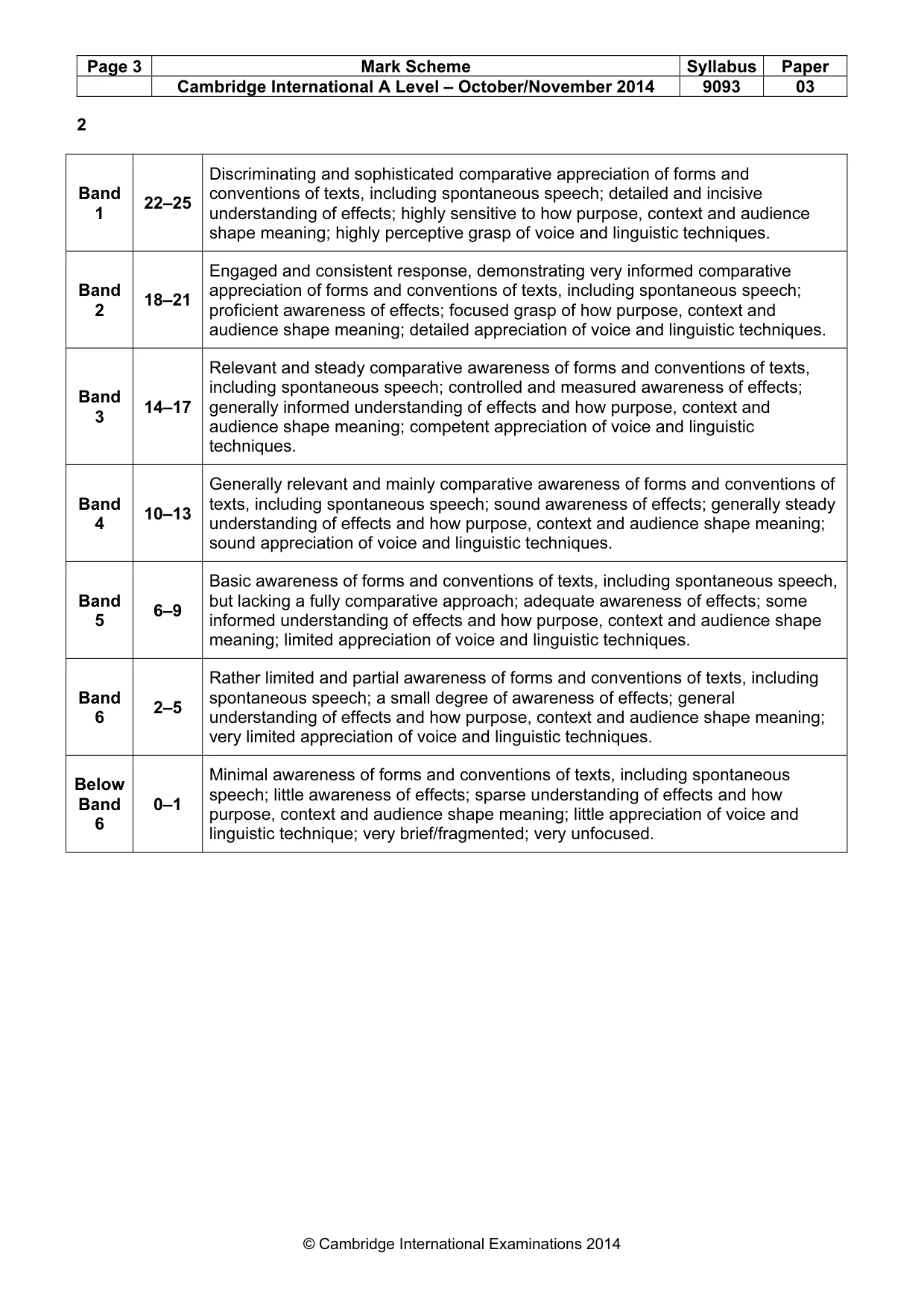
Page 3 Mark Scheme Syllabus Paper Cambridge International A Level – October/November 2014 9093 03 © Cambridge International Examinations 2014 2 Band 1 22–25 Discriminating and sophisticated comparative appreciation of forms and conventions of texts, including spontaneous speech; detailed and incisive understanding of effects; highly sensitive to how purpose, context and audience shape meaning; highly perceptive grasp of voice and linguistic techniques. Band 2 18–21 Engaged and consistent response, demonstrating very informed comparative appreciation of forms and conventions of texts, including spontaneous speech; proficient awareness of effects; focused grasp of how purpose, context and audience shape meaning; detailed appreciation of voice and linguistic techniques. Band 3 14–17 Relevant and steady comparative awareness of forms and conventions of texts, including spontaneous speech; controlled and measured awareness of effects; generally informed understanding of effects and how purpose, context and audience shape meaning; competent appreciation of voice and linguistic techniques. Band 4 10–13 Generally relevant and mainly comparative awareness of forms and conventions of texts, including spontaneous speech; sound awareness of effects; generally steady understanding of effects and how purpose, context and audience shape meaning; sound appreciation of voice and linguistic techniques. Band 5 6–9 Basic awareness of forms and conventions of texts, including spontaneous speech, but lacking a fully comparative approach; adequate awareness of effects; some informed understanding of effects and how purpose, context and audience shape meaning; limited appreciation of voice and linguistic techniques. Band 6 2–5 Rather limited and partial awareness of forms and conventions of texts, including spontaneous speech; a small degree of awareness of effects; general understanding of effects and how purpose, context and audience shape meaning; very limited appreciation of voice and linguistic techniques. Below Band 6 0–1 Minimal awareness of forms and conventions of texts, including spontaneous speech; little awareness of effects; sparse understanding of effects and how purpose, context and audience shape meaning; little appreciation of voice and linguistic technique; very brief/fragmented; very unfocused.
What you needed in this session
Cambridge’s own grade thresholds for 2014 Oct/Nov, Paper 3 · Variant 1. A higher threshold means an easier paper — the bar moves with how the cohort did.