Cambridge A Level English - Language AS and A Level (from 2014) 9093 — 2014 Oct/Nov Paper 1 · Variant 3
9093/13/O/N/14 · 50 marks · ≈56 min
The question paper and its mark scheme, free to read here and free to download. This is Cambridge’s own paper, exactly as it was sat.
Question paper8 pages
Mark scheme4 pages
Answers below. Sit the paper first if you are practising.
Paper as text
Question paper, page 1
This document consists of 7 printed pages, 1 blank page and 1 insert. DC (RCL (KM)) 103949/7 R © UCLES 2014 [Turn over Cambridge International Examinations Cambridge International Advanced Subsidiary and Advanced Level * 4 2 1 3 3 0 9 1 5 7 * ENGLISH LANGUAGE 9093/13 Paper 1 Passages October/November 2014 2 hours 15 minutes No Additional Materials are required. READ THESE INSTRUCTIONS FIRST An answer booklet is provided inside this question paper. You should follow the instructions on the front cover of the answer booklet. If you need additional answer paper ask the invigilator for a continuation booklet. Answer two questions: Question 1 and either Question 2 or Question 3. You should spend about 15 minutes reading the passages and questions before you start writing your answers. You are reminded of the need for good English and clear presentation in your answers. The number of marks is given in brackets [ ] at the end of each question or part question.
Question paper, page 2
2 9093/13/O/N/14 © UCLES 2014 Answer Question 1 and either Question 2 or Question 3. 1 The following piece of travel writing describes a journey during the rainy season in India. (a) Comment on the ways in which language and style are used to convey the writer’s experience of the weather and his journey. [15] (b) The writer produces another piece of travel writing about another journey he experiences in severe weather in a different part of the world. Write a section of this piece of travel writing (between 120–150 words). Base your answer closely on the style and features of the original extract. [10] The captain of the Airbus, speaking at 31,000 feet in a cloudless morning sky, announced arrival in fourteen minutes. A flanking turn to join the inbound traffic revealed that the city was enclosed in a massive slate-coloured marquee of rain. From up here its roof had a smooth, well-worked appearance – though, sinking closer, I saw that it was actually a sea of rolling waves, billows and breakers. They threw up spouts of black foam which kept getting vaporized by hurricane-force winds. When the Airbus dropped in it bounced out again. Our ride to the ground was a wild, plunging one, Bombay finally glimpsed through steaming windows as a dim, misty abstraction offering hints of a city but little hard evidence. Silver roads wound through dark hills enveloped in even darker clouds, their bases lapped by huge interlocking puddles. The distant downtown skyscrapers were vague and like pillars of smoke. We landed, taxied up to the stand and parked beside another Airbus preparing for push-back. Rain sheeted off its wings as men in dripping waterproof capes closed the cargo doors. The domestic arrivals hall stood seventy yards away with a car- wash arrangement of gushing waterspouts ranged across its entrance. Passing through meant immersion and, inside, blood-curdling curses and blasphemies were being uttered by the soaking, gasping passengers. The taxi I hailed outside had come through so many monsoons there was a tide mark of corrosion running around the bottom of the doors. Like a Plimsoll line1, it seemed to indicate the depth of the water over which the driver was not licensed to operate. Braving the rain he sprang out, seized my bag, ushered me in, threw the bag in after me, then rushed round to board himself. These courtesies were not so surprising as the cab’s interior. It had been transformed into a tiny world of order and tranquillity. A gaudy statuette stood on the dashboard with postcards of snowy Himalayan landscapes glued beneath, each illuminated by a coloured Christmas-tree light. Garlands of jasmines filled the car with fragrance. Behind my seat more lights flanked a miniature gilded cage containing a toy nightingale. There was thick crimson carpeting on the floor and, pasted to the rear of the driver’s seat, pictures of girls, temples, tigers, cumulus clouds in a dark monsoon sky. A sign fixed to the dashboard said ‘Bless Us!’, another, ‘This vehicle was purchased with funds from the Union Bank.’ The driver, young, intense, took a small bottle from his glove box and beckoned me forward. He placed a dab of sandalwood perfume on my wrists and then plunged his hands into the jumble of wires that hung from the dashboard. These, touched together in sequence, got the engine going. The noise it made was unusual, like 5 10 15 20 25 30 35
Question paper, page 3
3 9093/13/O/N/14 © UCLES 2014 [Turn over steam whistles accompanied by deep percussive bangs. He activated the single wiper, which fitfully stirred the torrent coursing down the windscreen, then turned and smiled at me. ‘Are you comfortable?’ ‘Yes, thank you.’ Cautiously he joined the traffic hurtling into town, the vehicles all semi-obscured by spray and travelling like speed boats. Racing to beat the lights we hit our first billabong of standing water. It thundered into the wheel wells and gushed up past the windows, causing the car to slew wildly; a lorry overtaking on the wrong side missed us by the width of a raindrop. Horns blared. The driver, his thin shoulders hunched, jaw muscles working, gripped the wheel like the reins of a runaway horse. Plumed wakes warned there was more ahead. ‘Puddle,’ muttered the driver, slowing. Puddle? It was a small inland sea, its further coast barely visible to the naked eye, but our crossing was accomplished without difficulty since this one had a benign puddle god. The driver’s confidence grew. We entered the next at a fair speed but, midway over, there was a sudden lurch and a muffled, shocking thud; we spun slowly, sheeting water, to face the way we had come. The car lay at an odd angle and all the Christmas-tree lights had gone out. For a few seconds we sat in stunned silence and then the driver threw open the door. What he saw caused him to clutch his head in anguish. The front offside wheel had come off. It still occupied the wheel well, but was no longer attached to the axle. We stared at it while the water enclosed us. We stood in it up to our ankles; it fell on us out of the sky and came at us laterally as surf from passing vehicles. I had never felt so wet or exposed. And we were marooned amid speeding traffic in conditions of minimum visibility. It was the driver who acted. Moaning softly, half-blinded by rain, he heaved my bag out and ran with it to the side of the road before dodging back and locking his doors. Then he went sprinting off and, within seconds, was lost in the downpour. 1Plimsoll line: a special marking on a ship indicating the legal limit to which it may be loaded so that it floats safely 40 45 50 55 60 65
Question paper, page 4
4 9093/13/O/N/14 © UCLES 2014 2 The following text is taken from an online review of The X Factor, a show in which contestants compete in a talent competition to become stars in the music world. (a) Comment on the ways in which language and style are used to portray the show. [15] (b) The writer produces an online review of another popular television programme or film. Write a section of this review (between 120–150 words). Base your answer closely on the style and features of the original extract. [10] There’s a lot about The X Factor that feels familiar. It’s not just that the same channel tried and failed with The X Factor five years ago, or that this is now hosted by the same chump who fronted the massive flop that was Popstars Live, no, it’s mainly the fact that Got Talent only wrapped up its season two months ago and you’d be forgiven for mistaking these two entertainment behemoths1 for being the exact same programme. As with Got Talent there’s a judge sitting on the end being snarky, there’s a little mousy brunette next to him, this time, and you’ve even got a pop star who used to be in a boy band. X Factor is on the same network as Talent, it’s made by the same people as Talent, it’s got a set that looks plucked straight out of Talent, the auditions are happening in front of a live audience just like on Talent, you’ve got old people embarrassing themselves like on Talent and the judging panel even has a big X on the front of it like Talent does. The only real difference seems to be a lack of jugglers. The X Factor kicked off Monday night with the first of a week’s worth of audition episodes. It would be nice if we as a nation of television viewers could write a joint letter to reality shows in an effort to finally rid the world of ‘the audition round’: Dear Reality Shows, we understand that you have auditions. We realise there will be heart warming tales and embarrassing shockers, we accept that, we know how it works, and we’ve been watching them for the last decade. We know that when you stop to hear a person’s sob story that they’ll undoubtedly turn out to be really talented, just as we know that when you linger a little long with somebody who seems a little too full of themselves that you’ll soon cut them down to size with their lousy audition. We’ve been here before. Can we all agree that there were shocking moments and touching moments and just move on? Please. Of course, that’s not going to happen this year as The X Factor trotted out all the old tricks. There were the awkward singers who were met with plenty of carefully selected reaction shots of audience members gaping in confusion. There were people with possible psychological issues who were predictably terrible. They even trotted out the old Idol trick of choosing an artist, this time Lady GaGa, and pointing out how she was being butchered by so many contestants. Then they show three or four singers doing a bad rendition of Lady GaGa before the host narrates something like “will such-and-such be able to break the trend!” and surprise surprise such-and- such does! The X Factor is over-produced to within an inch of its life. The producers can’t let any moment sit still without pounding a poorly chosen pop-song to blare over the soundtrack to remind us how we should be feeling. Oh look, there’s some cute boys on stage, let’s play Justin Bieber. Oh look, that girl’s had a tough life, let’s play Miley Cyrus – The Climb. Oh this guy just sang Queen, let’s play We Are The Champions. The X Factor producers just can’t help themselves; it’s as if they’re afraid of silence or organic moments. 5 10 15 20 25 30 35 40
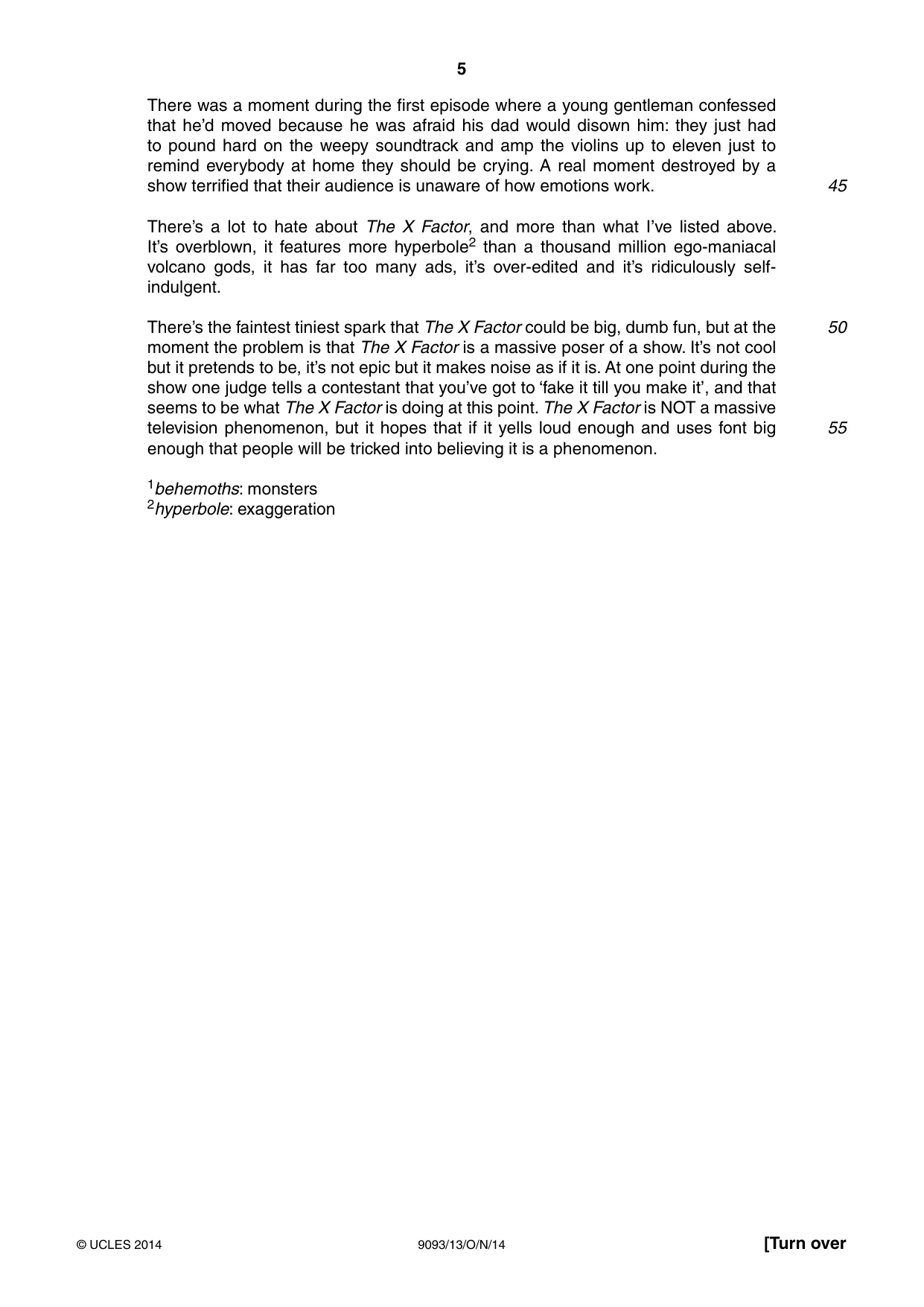
Question paper, page 5
5 9093/13/O/N/14 © UCLES 2014 [Turn over There was a moment during the first episode where a young gentleman confessed that he’d moved because he was afraid his dad would disown him: they just had to pound hard on the weepy soundtrack and amp the violins up to eleven just to remind everybody at home they should be crying. A real moment destroyed by a show terrified that their audience is unaware of how emotions work. There’s a lot to hate about The X Factor, and more than what I’ve listed above. It’s overblown, it features more hyperbole2 than a thousand million ego-maniacal volcano gods, it has far too many ads, it’s over-edited and it’s ridiculously self- indulgent. There’s the faintest tiniest spark that The X Factor could be big, dumb fun, but at the moment the problem is that The X Factor is a massive poser of a show. It’s not cool but it pretends to be, it’s not epic but it makes noise as if it is. At one point during the show one judge tells a contestant that you’ve got to ‘fake it till you make it’, and that seems to be what The X Factor is doing at this point. The X Factor is NOT a massive television phenomenon, but it hopes that if it yells loud enough and uses font big enough that people will be tricked into believing it is a phenomenon. 1behemoths: monsters 2hyperbole: exaggeration 45 50 55
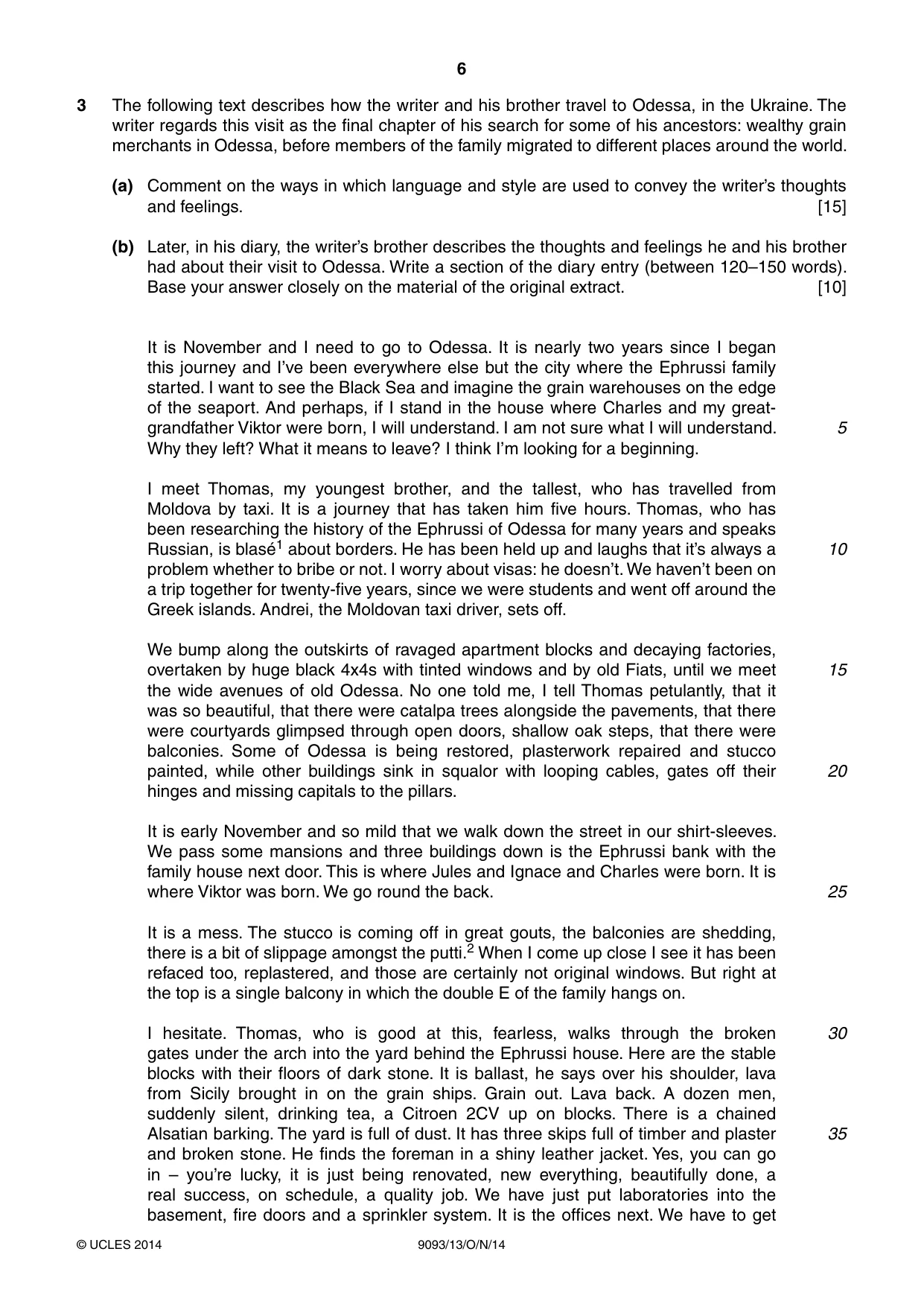
Question paper, page 6
6 9093/13/O/N/14 © UCLES 2014 3 The following text describes how the writer and his brother travel to Odessa, in the Ukraine. The writer regards this visit as the final chapter of his search for some of his ancestors: wealthy grain merchants in Odessa, before members of the family migrated to different places around the world. (a) Comment on the ways in which language and style are used to convey the writer’s thoughts and feelings. [15] (b) Later, in his diary, the writer’s brother describes the thoughts and feelings he and his brother had about their visit to Odessa. Write a section of the diary entry (between 120–150 words). Base your answer closely on the material of the original extract. [10] It is November and I need to go to Odessa. It is nearly two years since I began this journey and I’ve been everywhere else but the city where the Ephrussi family started. I want to see the Black Sea and imagine the grain warehouses on the edge of the seaport. And perhaps, if I stand in the house where Charles and my great- grandfather Viktor were born, I will understand. I am not sure what I will understand. Why they left? What it means to leave? I think I’m looking for a beginning. I meet Thomas, my youngest brother, and the tallest, who has travelled from Moldova by taxi. It is a journey that has taken him five hours. Thomas, who has been researching the history of the Ephrussi of Odessa for many years and speaks Russian, is blasé1 about borders. He has been held up and laughs that it’s always a problem whether to bribe or not. I worry about visas: he doesn’t. We haven’t been on a trip together for twenty-five years, since we were students and went off around the Greek islands. Andrei, the Moldovan taxi driver, sets off. We bump along the outskirts of ravaged apartment blocks and decaying factories, overtaken by huge black 4x4s with tinted windows and by old Fiats, until we meet the wide avenues of old Odessa. No one told me, I tell Thomas petulantly, that it was so beautiful, that there were catalpa trees alongside the pavements, that there were courtyards glimpsed through open doors, shallow oak steps, that there were balconies. Some of Odessa is being restored, plasterwork repaired and stucco painted, while other buildings sink in squalor with looping cables, gates off their hinges and missing capitals to the pillars. It is early November and so mild that we walk down the street in our shirt-sleeves. We pass some mansions and three buildings down is the Ephrussi bank with the family house next door. This is where Jules and Ignace and Charles were born. It is where Viktor was born. We go round the back. It is a mess. The stucco is coming off in great gouts, the balconies are shedding, there is a bit of slippage amongst the putti.2 When I come up close I see it has been refaced too, replastered, and those are certainly not original windows. But right at the top is a single balcony in which the double E of the family hangs on. I hesitate. Thomas, who is good at this, fearless, walks through the broken gates under the arch into the yard behind the Ephrussi house. Here are the stable blocks with their floors of dark stone. It is ballast, he says over his shoulder, lava from Sicily brought in on the grain ships. Grain out. Lava back. A dozen men, suddenly silent, drinking tea, a Citroen 2CV up on blocks. There is a chained Alsatian barking. The yard is full of dust. It has three skips full of timber and plaster and broken stone. He finds the foreman in a shiny leather jacket. Yes, you can go in – you’re lucky, it is just being renovated, new everything, beautifully done, a real success, on schedule, a quality job. We have just put laboratories into the basement, fire doors and a sprinkler system. It is the offices next. We have to get 5 10 15 20 25 30 35
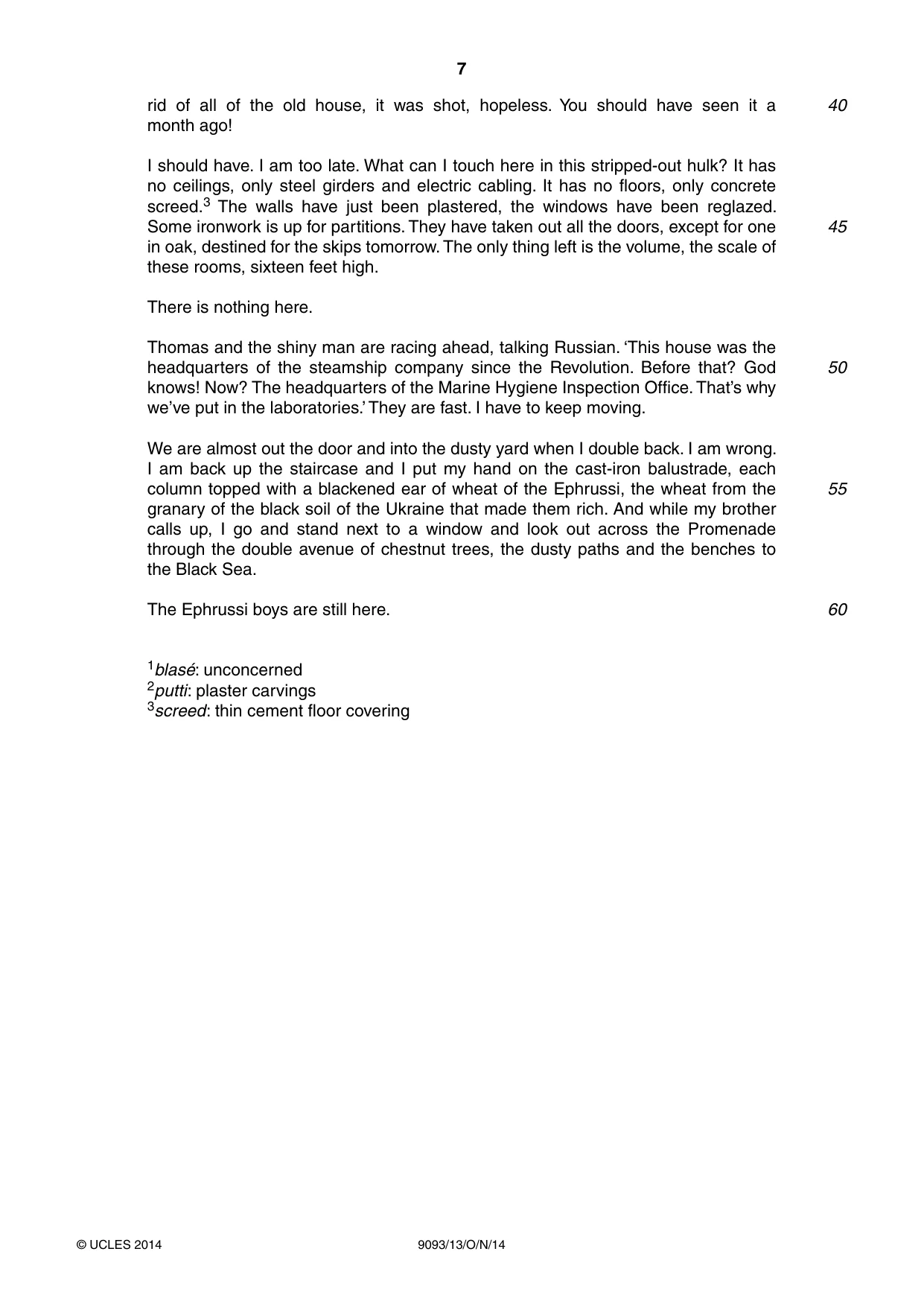
Question paper, page 7
7 9093/13/O/N/14 © UCLES 2014 rid of all of the old house, it was shot, hopeless. You should have seen it a month ago! I should have. I am too late. What can I touch here in this stripped-out hulk? It has no ceilings, only steel girders and electric cabling. It has no floors, only concrete screed.3 The walls have just been plastered, the windows have been reglazed. Some ironwork is up for partitions. They have taken out all the doors, except for one in oak, destined for the skips tomorrow. The only thing left is the volume, the scale of these rooms, sixteen feet high. There is nothing here. Thomas and the shiny man are racing ahead, talking Russian. ‘This house was the headquarters of the steamship company since the Revolution. Before that? God knows! Now? The headquarters of the Marine Hygiene Inspection Office. That’s why we’ve put in the laboratories.’ They are fast. I have to keep moving. We are almost out the door and into the dusty yard when I double back. I am wrong. I am back up the staircase and I put my hand on the cast-iron balustrade, each column topped with a blackened ear of wheat of the Ephrussi, the wheat from the granary of the black soil of the Ukraine that made them rich. And while my brother calls up, I go and stand next to a window and look out across the Promenade through the double avenue of chestnut trees, the dusty paths and the benches to the Black Sea. The Ephrussi boys are still here. 1blasé: unconcerned 2putti : plaster carvings 3screed : thin cement floor covering 40 45 50 55 60
Question paper, page 8
8 9093/13/O/N/14 © UCLES 2014 Copyright Acknowledgements: Question 1 Alexander Frater; Chasing the Monsoon; © Alexander Frater 1990; Published by Picador. Reprinted by permission of Pan Macmillan; 2005. Question 2 © Review – The X Factor Australia; Change The Channel; http://ctchannel.wordpress.com/2010/08/30/review-the-x-factor-australia/; 30 August 2010. Question 3 © Edmund de Waal; The Hare with Amber Eyes; © Edmund de Waal 2010; Published by Vintage. Reprinted by permission of the Random House Group Ltd; 2011. Permission to reproduce items where third-party owned material protected by copyright is included has been sought and cleared where possible. Every reasonable effort has been made by the publisher (UCLES) to trace copyright holders, but if any items requiring clearance have unwittingly been included, the publisher will be pleased to make amends at the earliest possible opportunity. Cambridge International Examinations is part of the Cambridge Assessment Group. Cambridge Assessment is the brand name of University of Cambridge Local Examinations Syndicate (UCLES), which is itself a department of the University of Cambridge. BLANK PAGE
Mark scheme, page 1
® IGCSE is the registered trademark of Cambridge International Examinations. CAMBRIDGE INTERNATIONAL EXAMINATIONS Cambridge International Advanced Subsidiary and Advanced Level MARK SCHEME for the October/November 2014 series 9093 ENGLISH LANGUAGE 9093/13 Paper 1 (Passages), maximum raw mark 50 This mark scheme is published as an aid to teachers and candidates, to indicate the requirements of the examination. It shows the basis on which Examiners were instructed to award marks. It does not indicate the details of the discussions that took place at an Examiners’ meeting before marking began, which would have considered the acceptability of alternative answers. Mark schemes should be read in conjunction with the question paper and the Principal Examiner Report for Teachers. Cambridge will not enter into discussions about these mark schemes. Cambridge is publishing the mark schemes for the October/November 2014 series for most Cambridge IGCSE®, Cambridge International A and AS Level components and some Cambridge O Level components.
Mark scheme, page 2
Page 2 Mark Scheme Syllabus Paper Cambridge International AS/A Level – October/November 2014 9093 13 © Cambridge International Examinations 2014 Assessment Objectives: • Ability to read with understanding written material in a variety of forms, and to comment on its effectiveness. • Knowledge and understanding of features of English language. • Ability to write clearly, accurately and effectively for a particular purpose or audience. Each answer is marked out of a total of 25. • 15 marks are available for part (a) – commentary on use of language in the passage. • 10 marks are available for part (b) – directed writing task based on the passage. Each part is marked in accordance with the following general marking criteria.
Mark scheme, page 3
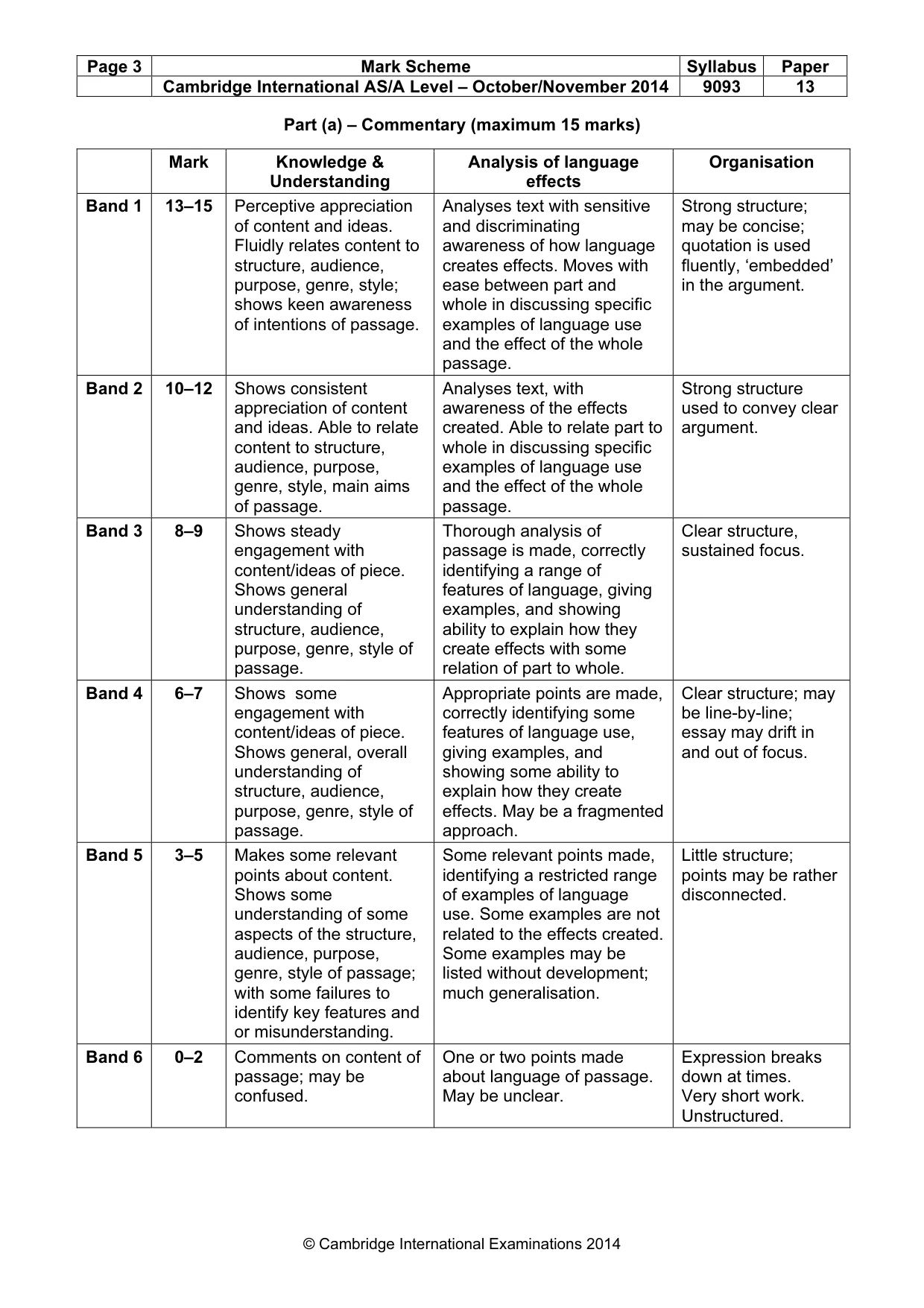
Page 3 Mark Scheme Syllabus Paper Cambridge International AS/A Level – October/November 2014 9093 13 © Cambridge International Examinations 2014 Part (a) – Commentary (maximum 15 marks) Mark Knowledge & Understanding Analysis of language effects Organisation Band 1 13–15 Perceptive appreciation of content and ideas. Fluidly relates content to structure, audience, purpose, genre, style; shows keen awareness of intentions of passage. Analyses text with sensitive and discriminating awareness of how language creates effects. Moves with ease between part and whole in discussing specific examples of language use and the effect of the whole passage. Strong structure; may be concise; quotation is used fluently, ‘embedded’ in the argument. Band 2 10–12 Shows consistent appreciation of content and ideas. Able to relate content to structure, audience, purpose, genre, style, main aims of passage. Analyses text, with awareness of the effects created. Able to relate part to whole in discussing specific examples of language use and the effect of the whole passage. Strong structure used to convey clear argument. Band 3 8–9 Shows steady engagement with content/ideas of piece. Shows general understanding of structure, audience, purpose, genre, style of passage. Thorough analysis of passage is made, correctly identifying a range of features of language, giving examples, and showing ability to explain how they create effects with some relation of part to whole. Clear structure, sustained focus. Band 4 6–7 Shows some engagement with content/ideas of piece. Shows general, overall understanding of structure, audience, purpose, genre, style of passage. Appropriate points are made, correctly identifying some features of language use, giving examples, and showing some ability to explain how they create effects. May be a fragmented approach. Clear structure; may be line-by-line; essay may drift in and out of focus. Band 5 3–5 Makes some relevant points about content. Shows some understanding of some aspects of the structure, audience, purpose, genre, style of passage; with some failures to identify key features and or misunderstanding. Some relevant points made, identifying a restricted range of examples of language use. Some examples are not related to the effects created. Some examples may be listed without development; much generalisation. Little structure; points may be rather disconnected. Band 6 0–2 Comments on content of passage; may be confused. One or two points made about language of passage. May be unclear. Expression breaks down at times. Very short work. Unstructured.
Mark scheme, page 4
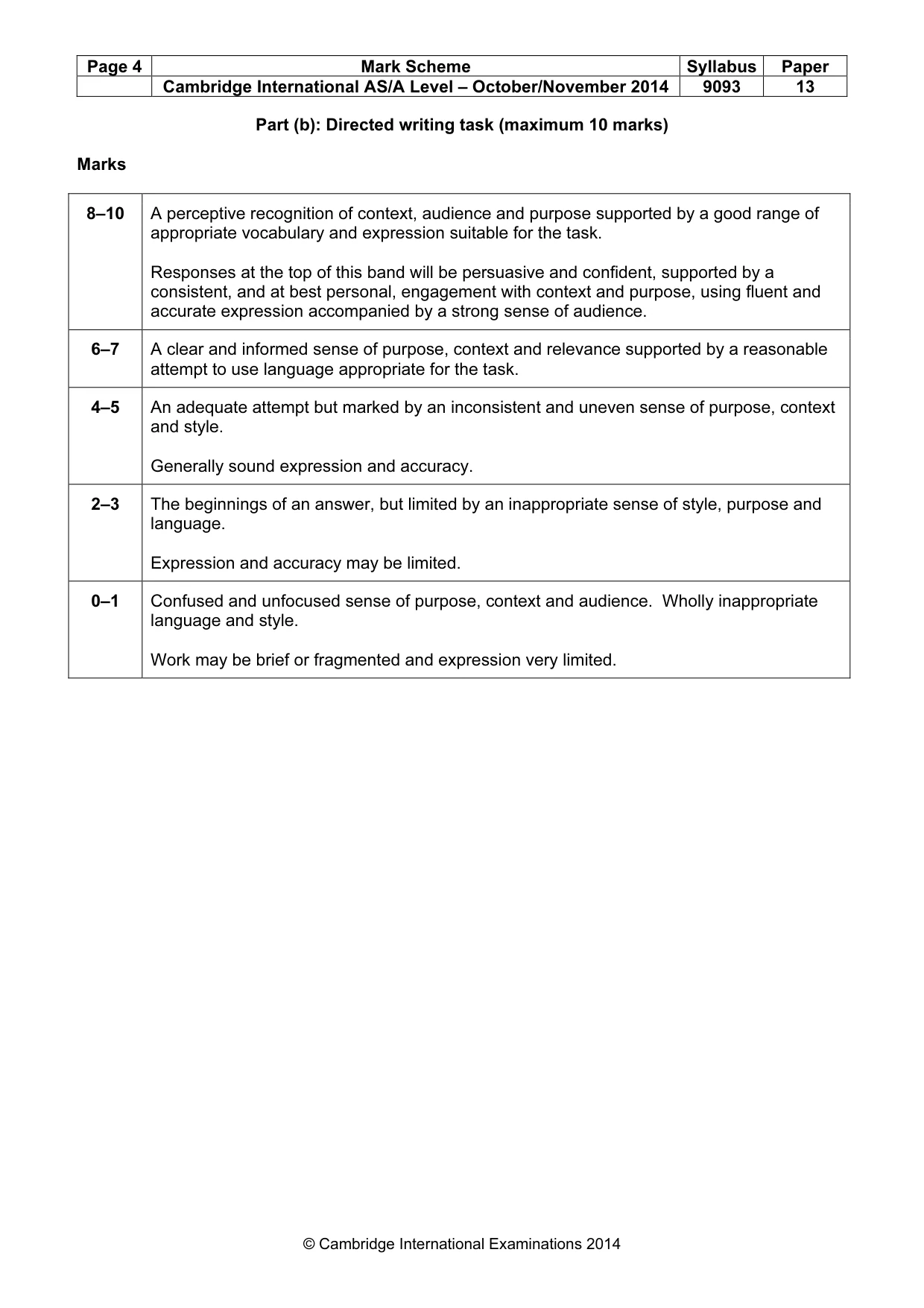
Page 4 Mark Scheme Syllabus Paper Cambridge International AS/A Level – October/November 2014 9093 13 © Cambridge International Examinations 2014 Part (b): Directed writing task (maximum 10 marks) Marks 8–10 A perceptive recognition of context, audience and purpose supported by a good range of appropriate vocabulary and expression suitable for the task. Responses at the top of this band will be persuasive and confident, supported by a consistent, and at best personal, engagement with context and purpose, using fluent and accurate expression accompanied by a strong sense of audience. 6–7 A clear and informed sense of purpose, context and relevance supported by a reasonable attempt to use language appropriate for the task. 4–5 An adequate attempt but marked by an inconsistent and uneven sense of purpose, context and style. Generally sound expression and accuracy. 2–3 The beginnings of an answer, but limited by an inappropriate sense of style, purpose and language. Expression and accuracy may be limited. 0–1 Confused and unfocused sense of purpose, context and audience. Wholly inappropriate language and style. Work may be brief or fragmented and expression very limited.
What you needed in this session
Cambridge’s own grade thresholds for 2014 Oct/Nov, Paper 1 · Variant 3. A higher threshold means an easier paper — the bar moves with how the cohort did.