Cambridge A Level English - Language AS and A Level (from 2014) 9093 — 2014 May/June Paper 1 · Variant 1
9093/11/M/J/14 · 50 marks · ≈56 min
The question paper and its mark scheme, free to read here and free to download. This is Cambridge’s own paper, exactly as it was sat.
Question paper8 pages
Mark scheme3 pages
Answers below. Sit the paper first if you are practising.
Paper as text
Question paper, page 1
This document consists of 7 printed pages, 1 blank page and 1 insert. DC (RCL/KM) 79942/5 © UCLES 2014 [Turn over Cambridge International Examinations Cambridge International Advanced Subsidiary and Advanced Level * 3 7 8 2 0 5 1 2 4 5 * ENGLISH LANGUAGE 9093/11 Paper 1 Passages May/June 2014 2 hours 15 minutes No Additional Materials are required. READ THESE INSTRUCTIONS FIRST An answer booklet is provided inside this question paper. You should follow the instructions on the front cover of the answer booklet. If you need additional answer paper ask the invigilator for a continuation booklet. Answer two questions: Question 1 and either Question 2 or Question 3. You should spend about 15 minutes reading the passages and questions before you start writing your answers. You are reminded of the need for good English and clear presentation in your answers. The number of marks is given in brackets [ ] at the end of each question or part question.
Question paper, page 2
2 9093/11/M/J/14 © UCLES 2014 Answer Question 1 and either Question 2 or Question 3. 1 The following text is taken from a newspaper article offering a guide for new visitors to the city of Rio de Janeiro in Brazil. (a) Comment on the ways in which language and style are used to portray the city. [15] (b) The same newspaper publishes another article which offers a similar guide for new visitors to a popular tourist location in your country. Write a section (between 120–150 words) of this article. Base your answer closely on the features of the writing in the original extract. [10] RIO DE JANEIRO – “Brazil is not for beginners,” the late, great Brazilian composer Tom Jobim once quipped. Nowhere does the remark hold more true than for the country’s pulsing, chaotic oceanfront metropolis, Rio de Janeiro. This is a city of contrasts, where vastly different worlds rub shoulders, and the unexpected lies lurking around every corner. Hang a right during an aimless stroll through the chic beach-side neighborhoods of Ipanema or Copacabana and you might just bump into a lush tropical forest. Hang a left, and the luxury condominiums1 could give way to a warren of brick and corrugated iron houses perched precariously on a rocky outcropping – a “favela,” or hillside slum. It’s this proximity between rich and poor, city and nature, that gives Rio its intensity. But it also makes navigation a challenge for first-time visitors. Luckily, Rio is dotted with landmarks that allow you to easily find your bearings. Sugarloaf Hill, the awesome rocky outcropping that can be visited by aerial cable car, presides over Guanabara Bay in the east. The monumental statue, Christ the Redeemer, reaches toward the sea from his perch inside the dense Tijuca Forest in the heart of the city. A five-mile stretch of white sand marks Rio’s southern edge, home to the legendary Copacabana, Ipanema and Leblon beaches. Here, the beach is a way of life, and these iconic stretches of sand are the stage upon which Rio natives play out their lives. Weekends draw huge crowds from across the class spectrum to swim, surf, sun, jog, picnic, gossip, frolic, flirt, stretch and strut. During the Southern Hemisphere summer, January to March, the throngs are often so thick that towel-size beach space can be hard to come by. But persevere. Between the tall, tanned, young and lovely girls from Ipanema, their muscle-bound, tattoo-covered male counterparts, the flocks of screaming children and steady stream of vendors selling everything from sunscreen to frozen slush made from Amazon berries, the action is not to be missed. No trip to the beach is complete without a stroll down Avenida Visconde de Piraja, Ipanema’s main drag2, where the dress code consists of bikinis, sarongs and flip- flops. Homegrown clothing lines abound, churning out pretty but pricey sundresses, short-shorts, pantsuits for the daring and, naturally, bikinis. Top Brazilian beachwear houses include Lenny, Salinas and Osklen. 5 10 15 20 25 30
Question paper, page 3
3 9093/11/M/J/14 © UCLES 2014 [Turn over If you haven’t gotten your fill of snacks on the beach, head to Bibi Sucos, which serves up a dizzying array of freshly squeezed exotic juices – jabuticaba,3 anyone? – and, with Brazil’s dizzily spiraling prices, is among Rio’s few remaining inexpensive pleasures. A more sophisticated meal can be had at Market, also on Visconde de Piraja, which serves up tasty, healthy alternatives to the “comida por quilo” self- service buffets that offer up meat in all its imaginable incarnations, paid for by the weight. If you’re a Brazilian at heart, with a well-developed carnivorous instinct, no trip to Rio is complete without a visit to a “rodizio,” a fixed-price restaurant where an endless variety of meats, from filet mignon to chicken hearts, are served off the spit by a parade of waiters. Porcao, which has three Rio locations including one in Ipanema, is a “rodizio” of epic proportions. To work off the meat overdose, a hike doubtless will be in order, and Rio offers several excellent options. The world’s largest urban forest, Tijuca is home to a host of monkeys, parrots and cute raccoon-like creatures called coatis (“cuatis” in Portuguese) as well as the Christ statue, perched atop a verdant, 2,300-foot peak. You could take the “bondinho,” or little streetcar, that winds its way to the top. But if you really want to burn off those extra calories, a better option is a hike to the top of the Tijuca Peak, which is a full 1,000 feet higher and offers unparalleled panoramic views over the city. Get an early start, because the park closes at sundown, and the hike can take up to six hours for a round trip. For a stiff dose of Rio night life, hit Lapa. Bars serving up Brazilian cane alcohol, “cachaca,” tiny clubs with live music and massive, multilevel mega-discos are all concentrated in this historic neighborhood near the city center. Friday nights this is where the action is, and the crowds are so thick you can barely walk – let alone dance. 1 condominiums : apartments 2 drag : street 3 jabuticaba : a purple grape used for producing fruit drinks 35 40 45 50 55 60
Question paper, page 4
4 9093/11/M/J/14 © UCLES 2014 2 The following text is taken from an autobiographical account written by a passenger who was on board the ship Titanic when it hit an iceberg in 1912. (a) Comment on the ways in which language and style are used to portray the writer’s thoughts and feelings. [15] (b) Continue the account (between 120–150 words). You do not have to bring the account to a close. Base your answer closely on the style and features of the original extract. [10] Suddenly a queer quivering ran under me, apparently the whole length of the ship. Startled by the very strangeness of the shivering motion, I sprang to the floor. With too perfect a trust in that mighty vessel I again lay down. No confusion, no noise of any kind, one could believe no danger imminent. Our stewardess came and said she could learn nothing. Looking out into the companionway I saw heads appearing asking questions from half-closed doors. All still, no excitement. I sat down again. My friend was by this time dressed; still her daughter and I talked on, Margaret pretending to eat a sandwich. Her hand shook so that the bread kept parting company from the chicken. Then I saw she was frightened, and for the first time I was too, but why get dressed, as no one had given the slightest hint of any possible danger? An officer’s cap passed the door. I asked: ‘Is there an accident or danger of any kind?’ ‘None, so far as I know’, was his courteous answer, spoken quietly and most kindly. This same officer then entered a cabin a little distance down the companionway and, by this time distrustful of everything, I listened intently, and distinctly heard, ‘We can keep the water out for a while.’ Then, and not until then, did I realize the horror of an accident at sea. Now it was too late to dress; slippers were quicker than shoes; the stewardess put on our life-preservers, and we were just ready when Mr Roebling came to tell us he would take us to our friend’s mother, who was waiting above. No laughing throng, but on either side [of the staircases] stand quietly, bravely, the stewards, all equipped with the white, ghostly life-preservers. Always the thing one tries not to see even crossing a ferry. Now only pale faces, each form strapped about with those white bars. So gruesome a scene. We passed on. The awful good-byes. The quiet look of hope in the brave men’s eyes as the wives were put into the lifeboats. Nothing escaped one at this fearful moment. We left from the sun deck, seventy-five feet above the water. Mr Case and Mr Roebling, brave men, saw us to the lifeboat, made no effort to save themselves, but stepped back on deck. Our lifeboat, with thirty-six in it, began lowering to the sea. This was done amid the greatest confusion. Rough seamen all giving different orders. No officer aboard. As only one side of the ropes worked, the lifeboat at one time was in such a position that it seemed we must capsize in mid-air. At last the ropes worked together, and we drew nearer and nearer the black, oily water. The first touch of our lifeboat on that black sea came to me as a last good-bye to life, and so we put off – a tiny boat on a great sea – rowed away from what had been a safe home for five days. The first wish on the part of all was to stay near the Titanic. We all felt so much safer near the ship. Surely such a vessel could not sink. I thought the danger must be exaggerated, and we could all be taken aboard again. But surely the outline of that great, good ship was growing less. The bow of the boat was getting black. Light after light was disappearing, and now those rough seamen put to their oars and we were told to hunt under seats, any place, anywhere, for a lantern, a light of any kind. Every place was empty. There was no water – no stimulant of any kind. Not a biscuit 5 10 15 20 25 30 35 40
Question paper, page 5
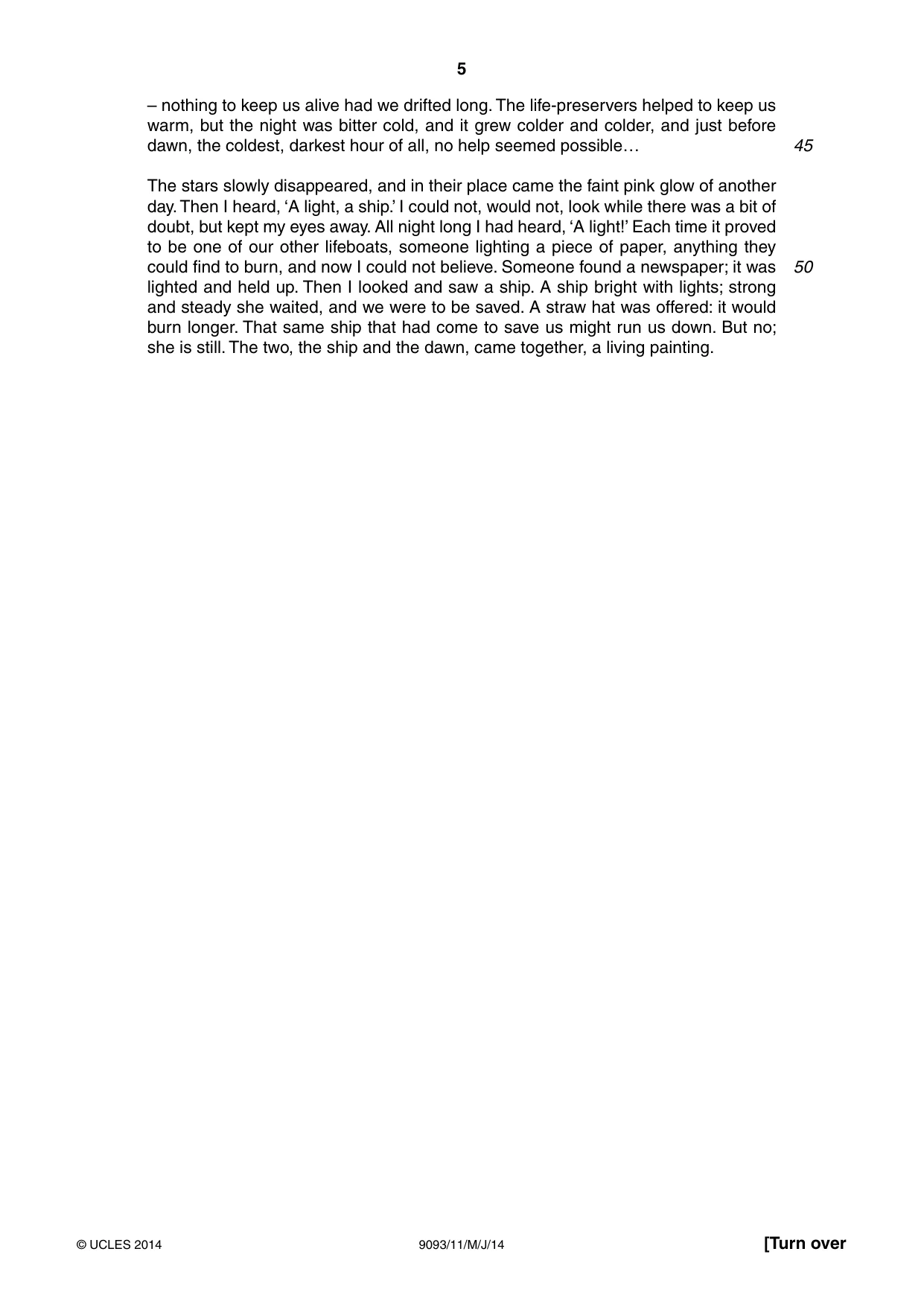
5 9093/11/M/J/14 © UCLES 2014 [Turn over – nothing to keep us alive had we drifted long. The life-preservers helped to keep us warm, but the night was bitter cold, and it grew colder and colder, and just before dawn, the coldest, darkest hour of all, no help seemed possible… The stars slowly disappeared, and in their place came the faint pink glow of another day. Then I heard, ‘A light, a ship.’ I could not, would not, look while there was a bit of doubt, but kept my eyes away. All night long I had heard, ‘A light!’ Each time it proved to be one of our other lifeboats, someone lighting a piece of paper, anything they could find to burn, and now I could not believe. Someone found a newspaper; it was lighted and held up. Then I looked and saw a ship. A ship bright with lights; strong and steady she waited, and we were to be saved. A straw hat was offered: it would burn longer. That same ship that had come to save us might run us down. But no; she is still. The two, the ship and the dawn, came together, a living painting. 45 50
Question paper, page 6
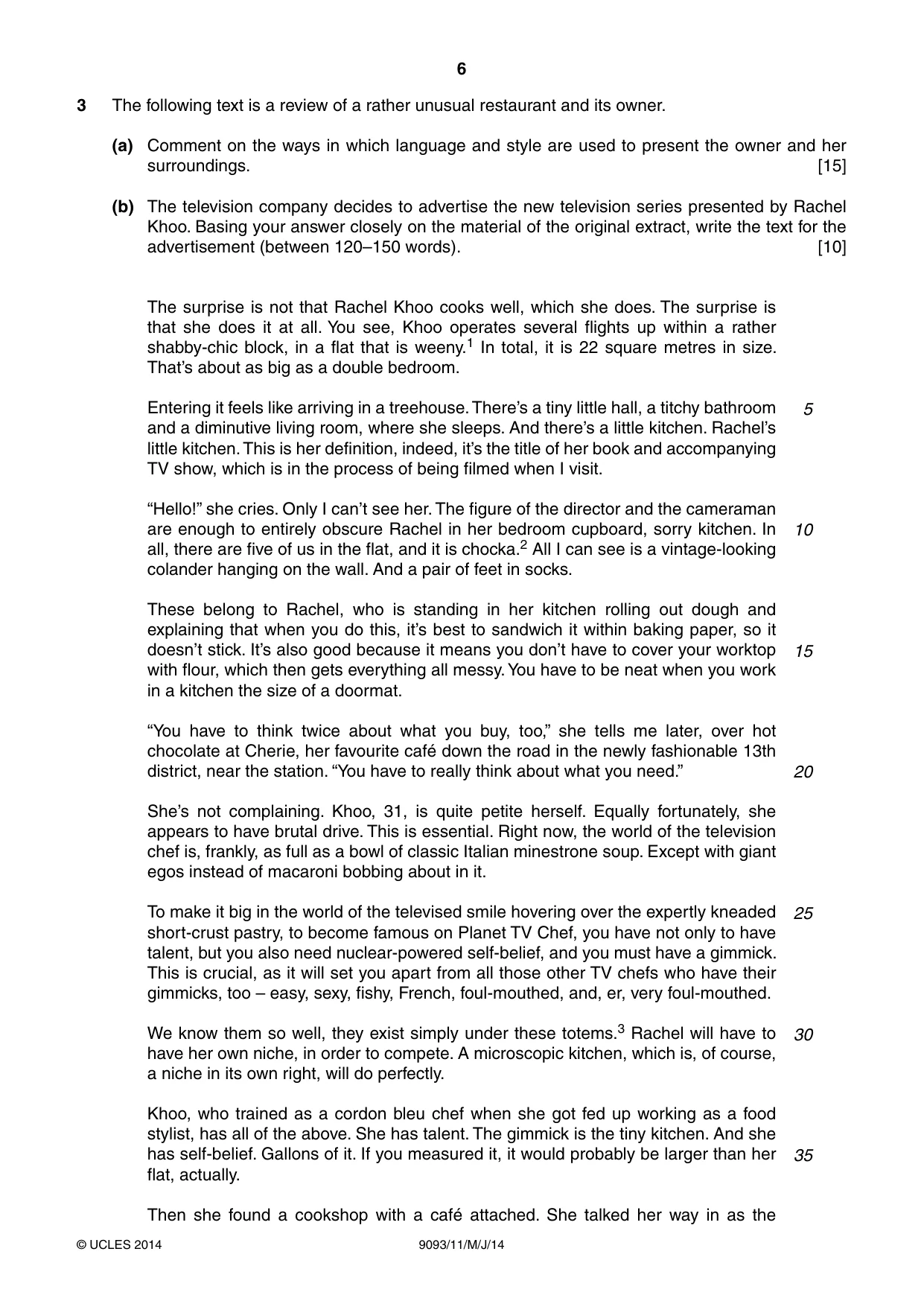
6 9093/11/M/J/14 © UCLES 2014 3 The following text is a review of a rather unusual restaurant and its owner. (a) Comment on the ways in which language and style are used to present the owner and her surroundings. [15] (b) The television company decides to advertise the new television series presented by Rachel Khoo. Basing your answer closely on the material of the original extract, write the text for the advertisement (between 120–150 words). [10] The surprise is not that Rachel Khoo cooks well, which she does. The surprise is that she does it at all. You see, Khoo operates several flights up within a rather shabby-chic block, in a flat that is weeny.1 In total, it is 22 square metres in size. That’s about as big as a double bedroom. Entering it feels like arriving in a treehouse. There’s a tiny little hall, a titchy bathroom and a diminutive living room, where she sleeps. And there’s a little kitchen. Rachel’s little kitchen. This is her definition, indeed, it’s the title of her book and accompanying TV show, which is in the process of being filmed when I visit. “Hello!” she cries. Only I can’t see her. The figure of the director and the cameraman are enough to entirely obscure Rachel in her bedroom cupboard, sorry kitchen. In all, there are five of us in the flat, and it is chocka.2 All I can see is a vintage-looking colander hanging on the wall. And a pair of feet in socks. These belong to Rachel, who is standing in her kitchen rolling out dough and explaining that when you do this, it’s best to sandwich it within baking paper, so it doesn’t stick. It’s also good because it means you don’t have to cover your worktop with flour, which then gets everything all messy. You have to be neat when you work in a kitchen the size of a doormat. “You have to think twice about what you buy, too,” she tells me later, over hot chocolate at Cherie, her favourite café down the road in the newly fashionable 13th district, near the station. “You have to really think about what you need.” She’s not complaining. Khoo, 31, is quite petite herself. Equally fortunately, she appears to have brutal drive. This is essential. Right now, the world of the television chef is, frankly, as full as a bowl of classic Italian minestrone soup. Except with giant egos instead of macaroni bobbing about in it. To make it big in the world of the televised smile hovering over the expertly kneaded short-crust pastry, to become famous on Planet TV Chef, you have not only to have talent, but you also need nuclear-powered self-belief, and you must have a gimmick. This is crucial, as it will set you apart from all those other TV chefs who have their gimmicks, too – easy, sexy, fishy, French, foul-mouthed, and, er, very foul-mouthed. We know them so well, they exist simply under these totems.3 Rachel will have to have her own niche, in order to compete. A microscopic kitchen, which is, of course, a niche in its own right, will do perfectly. Khoo, who trained as a cordon bleu chef when she got fed up working as a food stylist, has all of the above. She has talent. The gimmick is the tiny kitchen. And she has self-belief. Gallons of it. If you measured it, it would probably be larger than her flat, actually. Then she found a cookshop with a café attached. She talked her way in as the 5 10 15 20 25 30 35
Question paper, page 7
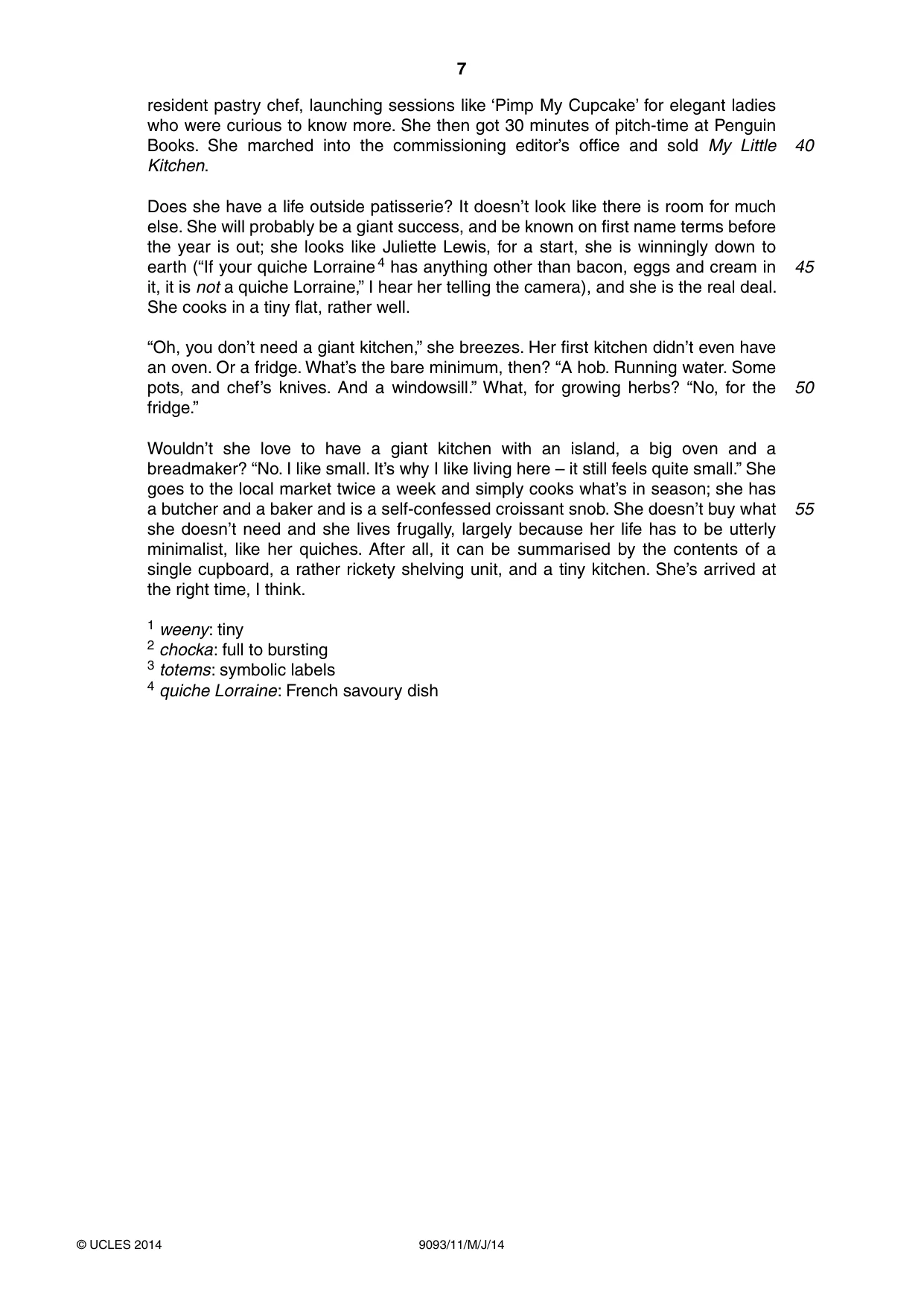
7 9093/11/M/J/14 © UCLES 2014 resident pastry chef, launching sessions like ‘Pimp My Cupcake’ for elegant ladies who were curious to know more. She then got 30 minutes of pitch-time at Penguin Books. She marched into the commissioning editor’s office and sold My Little Kitchen. Does she have a life outside patisserie? It doesn’t look like there is room for much else. She will probably be a giant success, and be known on first name terms before the year is out; she looks like Juliette Lewis, for a start, she is winningly down to earth (“If your quiche Lorraine 4 has anything other than bacon, eggs and cream in it, it is not a quiche Lorraine,” I hear her telling the camera), and she is the real deal. She cooks in a tiny flat, rather well. “Oh, you don’t need a giant kitchen,” she breezes. Her first kitchen didn’t even have an oven. Or a fridge. What’s the bare minimum, then? “A hob. Running water. Some pots, and chef’s knives. And a windowsill.” What, for growing herbs? “No, for the fridge.” Wouldn’t she love to have a giant kitchen with an island, a big oven and a breadmaker? “No. I like small. It’s why I like living here – it still feels quite small.” She goes to the local market twice a week and simply cooks what’s in season; she has a butcher and a baker and is a self-confessed croissant snob. She doesn’t buy what she doesn’t need and she lives frugally, largely because her life has to be utterly minimalist, like her quiches. After all, it can be summarised by the contents of a single cupboard, a rather rickety shelving unit, and a tiny kitchen. She’s arrived at the right time, I think. 1 weeny : tiny 2 chocka : full to bursting 3 totems : symbolic labels 4 quiche Lorraine : French savoury dish 40 45 50 55
Question paper, page 8
8 9093/11/M/J/14 © UCLES 2014 Copyright Acknowledgements: Question 1 © Jenny Barchfield; A Beginner’s Guide to Rio de Janeiro; Paddock Publications Inc; 2012. Question 2 © Elizabeth Shutes; The Sinking of the Titanic; www.eyewitnesstohistory.com; 2000. Question 3 © Rosie Millard; Meet Rachel Khoo, Star of the Little Paris Kitchen; Radio Times; 19 March 2011. Permission to reproduce items where third-party owned material protected by copyright is included has been sought and cleared where possible. Every reasonable effort has been made by the publisher (UCLES) to trace copyright holders, but if any items requiring clearance have unwittingly been included, the publisher will be pleased to make amends at the earliest possible opportunity. Cambridge International Examinations is part of the Cambridge Assessment Group. Cambridge Assessment is the brand name of University of Cambridge Local Examinations Syndicate (UCLES), which is itself a department of the University of Cambridge. BLANK PAGE
Mark scheme, page 1
CAMBRIDGE INTERNATIONAL EXAMINATIONS GCE Advanced Level MARK SCHEME for the May/June 2014 series 9093 ENGLISH LANGUAGE 9093/11 Paper 1 (Passages), maximum raw mark 50 This mark scheme is published as an aid to teachers and candidates, to indicate the requirements of the examination. It shows the basis on which Examiners were instructed to award marks. It does not indicate the details of the discussions that took place at an Examiners’ meeting before marking began, which would have considered the acceptability of alternative answers. Mark schemes should be read in conjunction with the question paper and the Principal Examiner Report for Teachers. Cambridge will not enter into discussions about these mark schemes. Cambridge is publishing the mark schemes for the May/June 2014 series for most IGCSE, GCE Advanced Level and Advanced Subsidiary Level components and some Ordinary Level components.
Mark scheme, page 2
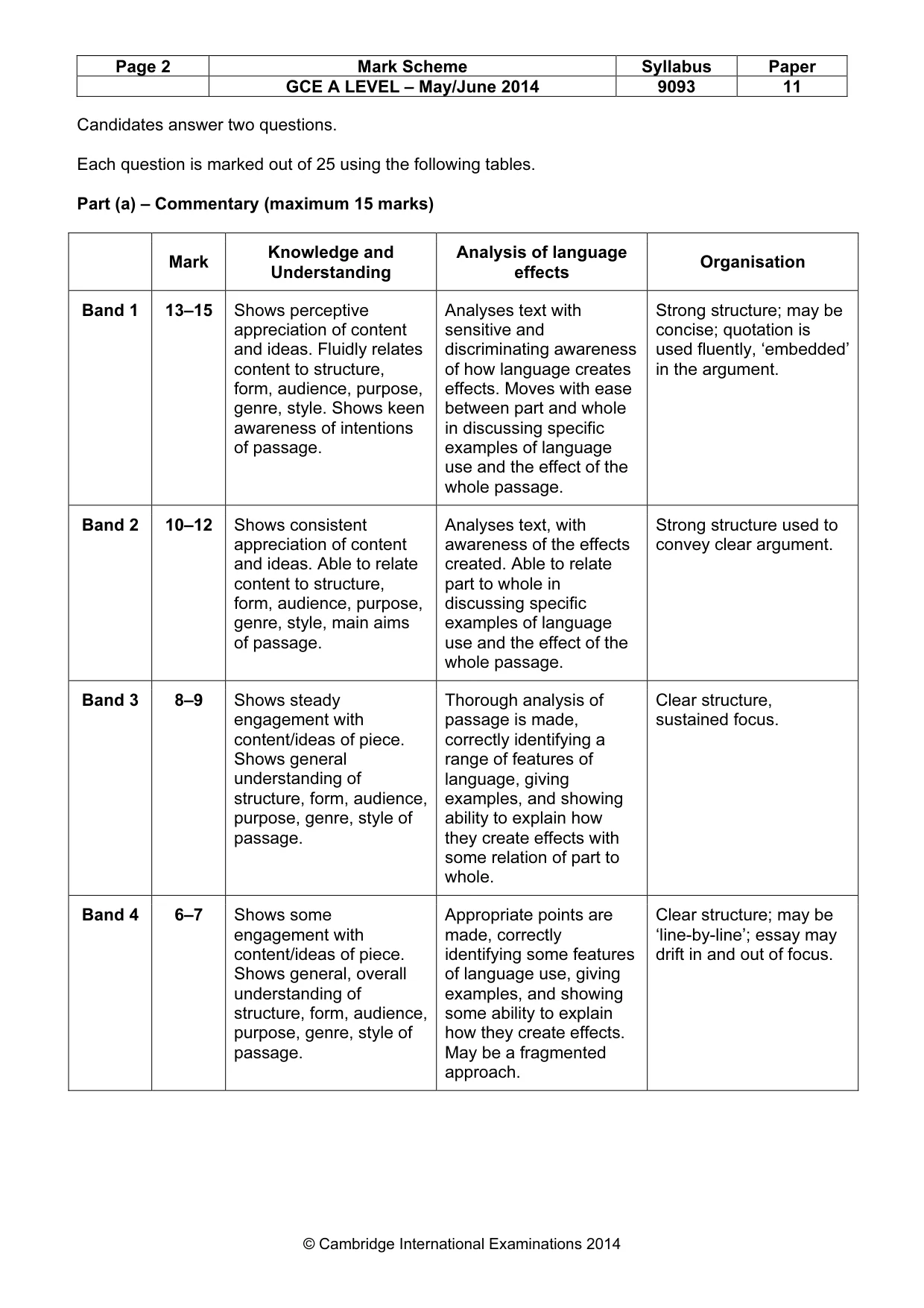
Page 2 Mark Scheme Syllabus Paper GCE A LEVEL – May/June 2014 9093 11 © Cambridge International Examinations 2014 Candidates answer two questions. Each question is marked out of 25 using the following tables. Part (a) – Commentary (maximum 15 marks) Mark Knowledge and Understanding Analysis of language effects Organisation Band 1 13–15 Shows perceptive appreciation of content and ideas. Fluidly relates content to structure, form, audience, purpose, genre, style. Shows keen awareness of intentions of passage. Analyses text with sensitive and discriminating awareness of how language creates effects. Moves with ease between part and whole in discussing specific examples of language use and the effect of the whole passage. Strong structure; may be concise; quotation is used fluently, ‘embedded’ in the argument. Band 2 10–12 Shows consistent appreciation of content and ideas. Able to relate content to structure, form, audience, purpose, genre, style, main aims of passage. Analyses text, with awareness of the effects created. Able to relate part to whole in discussing specific examples of language use and the effect of the whole passage. Strong structure used to convey clear argument. Band 3 8–9 Shows steady engagement with content/ideas of piece. Shows general understanding of structure, form, audience, purpose, genre, style of passage. Thorough analysis of passage is made, correctly identifying a range of features of language, giving examples, and showing ability to explain how they create effects with some relation of part to whole. Clear structure, sustained focus. Band 4 6–7 Shows some engagement with content/ideas of piece. Shows general, overall understanding of structure, form, audience, purpose, genre, style of passage. Appropriate points are made, correctly identifying some features of language use, giving examples, and showing some ability to explain how they create effects. May be a fragmented approach. Clear structure; may be ‘line-by-line’; essay may drift in and out of focus.
Mark scheme, page 3
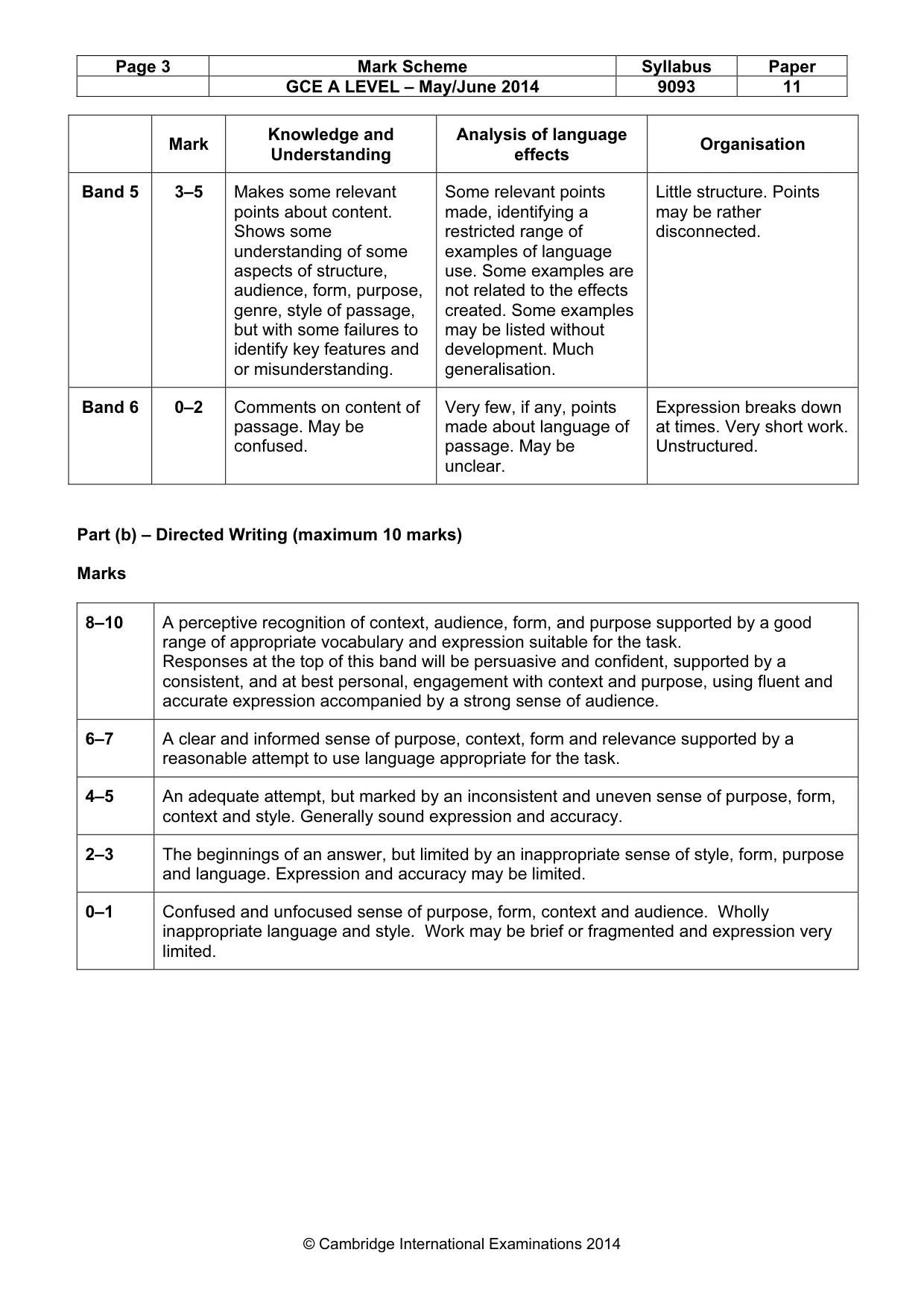
Page 3 Mark Scheme Syllabus Paper GCE A LEVEL – May/June 2014 9093 11 © Cambridge International Examinations 2014 Mark Knowledge and Understanding Analysis of language effects Organisation Band 5 3–5 Makes some relevant points about content. Shows some understanding of some aspects of structure, audience, form, purpose, genre, style of passage, but with some failures to identify key features and or misunderstanding. Some relevant points made, identifying a restricted range of examples of language use. Some examples are not related to the effects created. Some examples may be listed without development. Much generalisation. Little structure. Points may be rather disconnected. Band 6 0–2 Comments on content of passage. May be confused. Very few, if any, points made about language of passage. May be unclear. Expression breaks down at times. Very short work. Unstructured. Part (b) – Directed Writing (maximum 10 marks) Marks 8–10 A perceptive recognition of context, audience, form, and purpose supported by a good range of appropriate vocabulary and expression suitable for the task. Responses at the top of this band will be persuasive and confident, supported by a consistent, and at best personal, engagement with context and purpose, using fluent and accurate expression accompanied by a strong sense of audience. 6–7 A clear and informed sense of purpose, context, form and relevance supported by a reasonable attempt to use language appropriate for the task. 4–5 An adequate attempt, but marked by an inconsistent and uneven sense of purpose, form, context and style. Generally sound expression and accuracy. 2–3 The beginnings of an answer, but limited by an inappropriate sense of style, form, purpose and language. Expression and accuracy may be limited. 0–1 Confused and unfocused sense of purpose, form, context and audience. Wholly inappropriate language and style. Work may be brief or fragmented and expression very limited.
What you needed in this session
Cambridge’s own grade thresholds for 2014 May/June, Paper 1 · Variant 1. A higher threshold means an easier paper — the bar moves with how the cohort did.