Questions as text
Q1 · What is most likely to be the impact on economic growth and on the rate of inflation in… 9708/32 Oct/Nov 2009
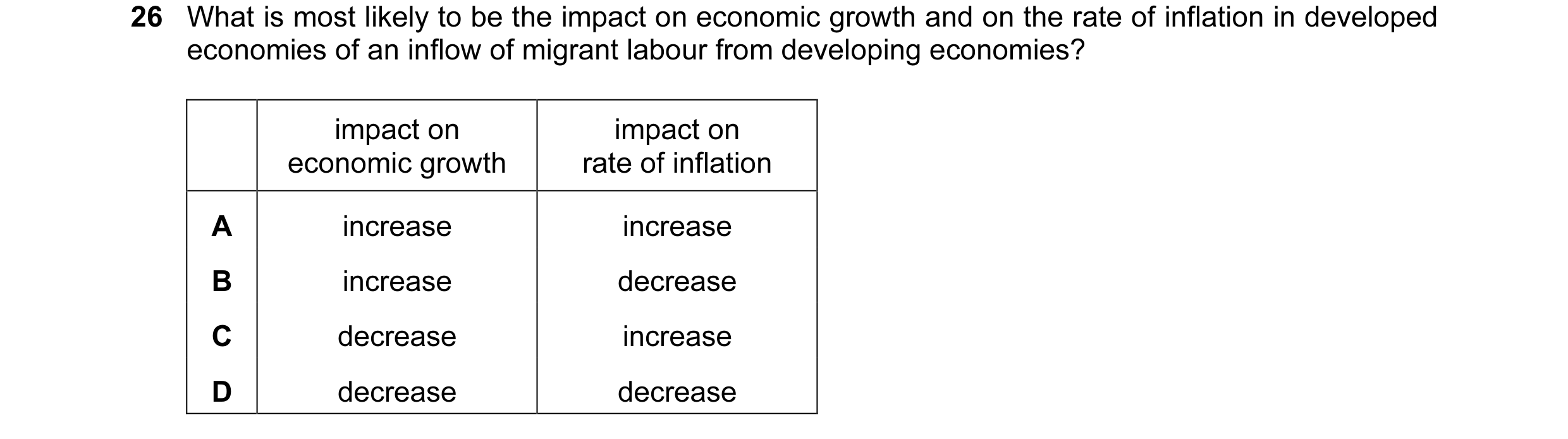
26 What is most likely to be the impact on economic growth and on the rate of inflation in developed economies of an inflow of migrant labour from developing economies? impact on impact on economic growth rate of inflation A increase increase B increase decrease C decrease increase D decrease decrease
1 marks
Answer: B
This question in 9708/32 Oct/Nov 2009
Q2 · What is likely to result from foreign direct investment in developing economies? 9708/31 Oct/Nov 2011
26 What is likely to result from foreign direct investment in developing economies? A a reduction in local wage levels B a reduction in tax revenues in developing economies C a reduction in the range of consumer goods available to the local population D a worsening of net income flows from investments
1 marks
Answer: D
This question in 9708/31 Oct/Nov 2011
Q3 · The European Union imposes a quota on the volume of garments imported from China 9708/31 May/June 2012
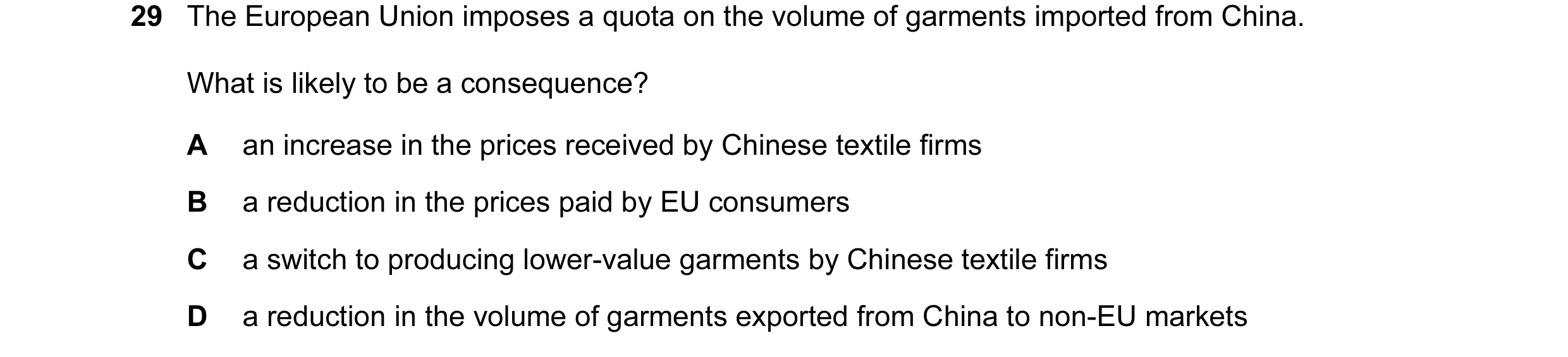
29 The European Union imposes a quota on the volume of garments imported from China. What is likely to be a consequence? A an increase in the prices received by Chinese textile firms B a reduction in the prices paid by EU consumers C a switch to producing lower-value garments by Chinese textile firms D a reduction in the volume of garments exported from China to non-EU markets
1 marks
Answer: A
This question in 9708/31 May/June 2012
Q4 · What is likely to be the effect on developing economies of an increase in inward foreign… 9708/33 Oct/Nov 2012
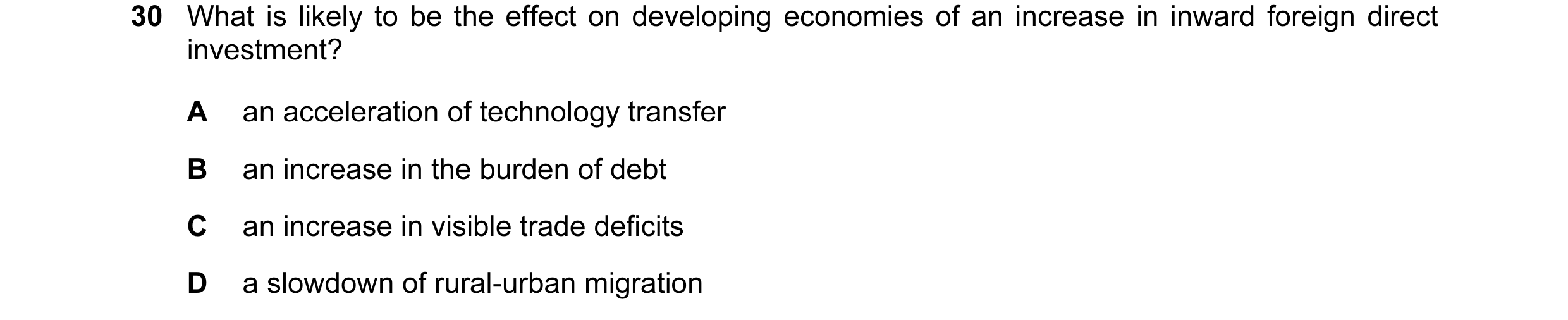
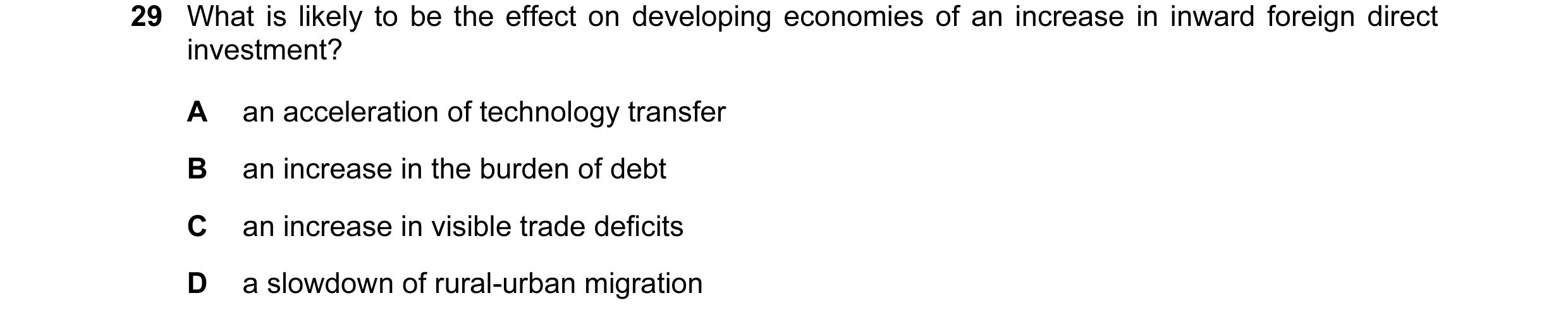
30 What is likely to be the effect on developing economies of an increase in inward foreign direct investment? A an acceleration of technology transfer B an increase in the burden of debt C an increase in visible trade deficits D a slowdown of rural-urban migration
1 marks
This question in 9708/33 Oct/Nov 2012
Q5 · What is most likely to result from foreign direct investment in developing economies? 9708/33 Oct/Nov 2013
28 What is most likely to result from foreign direct investment in developing economies? A a deterioration in the trade balances of developing economies B a reduction in migration to urban areas C a reduction in the transfer of technology to developing economies D a rise in per capita levels of consumption in developing economies
1 marks
Answer: D
This question in 9708/33 Oct/Nov 2013
Q6 · Which policy by developed economies would be most beneficial for developing economies? 9708/31 Oct/Nov 2015
28 Which policy by developed economies would be most beneficial for developing economies? A a ban on resource exploration by mining companies in developing economies B restrictions on investment by global firms in developing economies C the abolition of restrictions on immigration of skilled labour from developing economies D the withdrawal of agricultural subsidies in developed economies
1 marks
This question in 9708/31 Oct/Nov 2015
Q7 · What are likely to be the impacts on an economy of increased competition from abroad? 9708/32 Oct/Nov 2015
26 What are likely to be the impacts on an economy of increased competition from abroad? impact on impact on trade impact on rate unemployment balance of inflation rate A improve raise decrease B improve reduce decrease C worsen raise increase D worsen reduce increase
1 marks
Answer: D
This question in 9708/32 Oct/Nov 2015
Q8 · What is likely to be the effect on developing economies of an increase in inward foreign… 9708/32 Oct/Nov 2015
29 What is likely to be the effect on developing economies of an increase in inward foreign direct investment? A an acceleration of technology transfer B an increase in the burden of debt C an increase in visible trade deficits D a slowdown of rural-urban migration
1 marks
Answer: A
This question in 9708/32 Oct/Nov 2015
Q9 · What is most likely to result from foreign direct investment in developing economies? 9708/32 May/June 2016
29 What is most likely to result from foreign direct investment in developing economies? A a deterioration in the trade balances of developing economies B a reduction in migration to urban areas in developing economies C a reduction in the transfer of technology to developing economies D a rise in per capita levels of consumption in developing economies
1 marks
Answer: D
This question in 9708/32 May/June 2016
Q10 · What has not accompanied global economic growth over the last twenty five years? 9708/32 Oct/Nov 2016
28 What has not accompanied global economic growth over the last twenty five years? A a depletion of non-renewable resources B decreased international trade C growing urbanisation D increased atmospheric pollution
1 marks
Answer: B
This question in 9708/32 Oct/Nov 2016
Q11 · What has been a common economic factor in countries that have developed rapidly in recent… 9708/33 Oct/Nov 2016
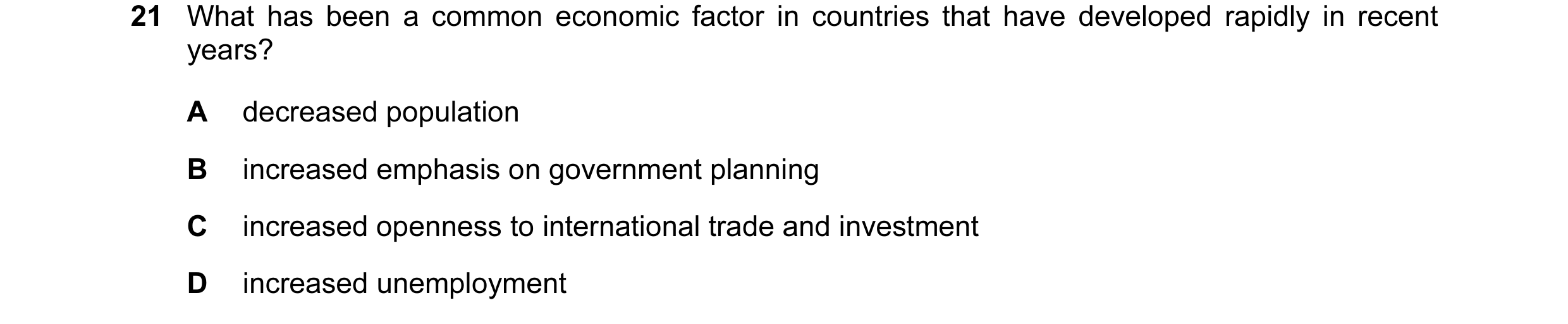
21 What has been a common economic factor in countries that have developed rapidly in recent years? A decreased population B increased emphasis on government planning C increased openness to international trade and investment D increased unemployment
1 marks
Answer: C
This question in 9708/33 Oct/Nov 2016
Q12 · A benefit of foreign direct investment (FDI) is better training for local workers leading… 9708/33 Oct/Nov 2020
21 A benefit of foreign direct investment (FDI) is better training for local workers leading to improved human capital and large productivity increases. A disadvantage is that additional income gained is sent back to the country from which the FDI came. How would these changes affect the aggregate demand and aggregate supply curves? aggregate aggregate demand curve supply curve A shift left shift left B shift right shift left C shift left shift right D shift right shift right
1 marks
Answer: C
This question in 9708/33 Oct/Nov 2020
Q13 · Country X has a low rate of inflation and a stable currency and unemployed resources 9708/32 Oct/Nov 2022
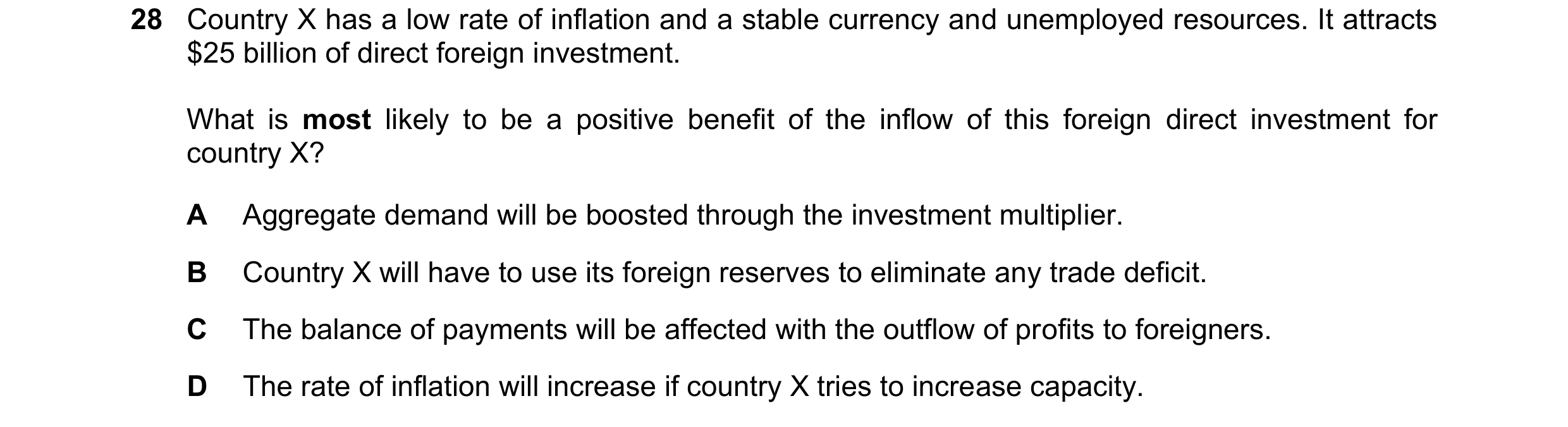
28 Country X has a low rate of inflation and a stable currency and unemployed resources. It attracts $25 billion of direct foreign investment. What is most likely to be a positive benefit of the inflow of this foreign direct investment for country X? A Aggregate demand will be boosted through the investment multiplier. B Country X will have to use its foreign reserves to eliminate any trade deficit. C The balance of payments will be affected with the outflow of profits to foreigners. D The rate of inflation will increase if country X tries to increase capacity.
1 marks
Answer: A
This question in 9708/32 Oct/Nov 2022
Q14 · What is not a threat to globalisation? 9708/31 May/June 2024
23 What is not a threat to globalisation? A rising fear of losing jobs to immigrant workers B rising political tensions among major economies of the world C stronger trade unions in industries producing substitutes of imports D withdrawal of government support for inefficient industries
1 marks
Answer: D
This question in 9708/31 May/June 2024
Q15 · What is the most likely consequence of an increase in the number of multinational… 9708/31 May/June 2024
27 What is the most likely consequence of an increase in the number of multinational companies? A a decrease in advancements in technology B a decrease in foreign direct investment C an increase in exports D an increase in unemployment
1 marks
Answer: C
This question in 9708/31 May/June 2024
Q16 · What is not a threat to globalisation? 9708/33 May/June 2024
23 What is not a threat to globalisation? A rising fear of losing jobs to immigrant workers B rising political tensions among major economies of the world C stronger trade unions in industries producing substitutes of imports D withdrawal of government support for inefficient industries
1 marks
Answer: D
This question in 9708/33 May/June 2024
Q17 · What is the most likely consequence of an increase in the number of multinational… 9708/33 May/June 2024
27 What is the most likely consequence of an increase in the number of multinational companies? A a decrease in advancements in technology B a decrease in foreign direct investment C an increase in exports D an increase in unemployment
1 marks
Answer: C
This question in 9708/33 May/June 2024


 1 / 4
1 / 4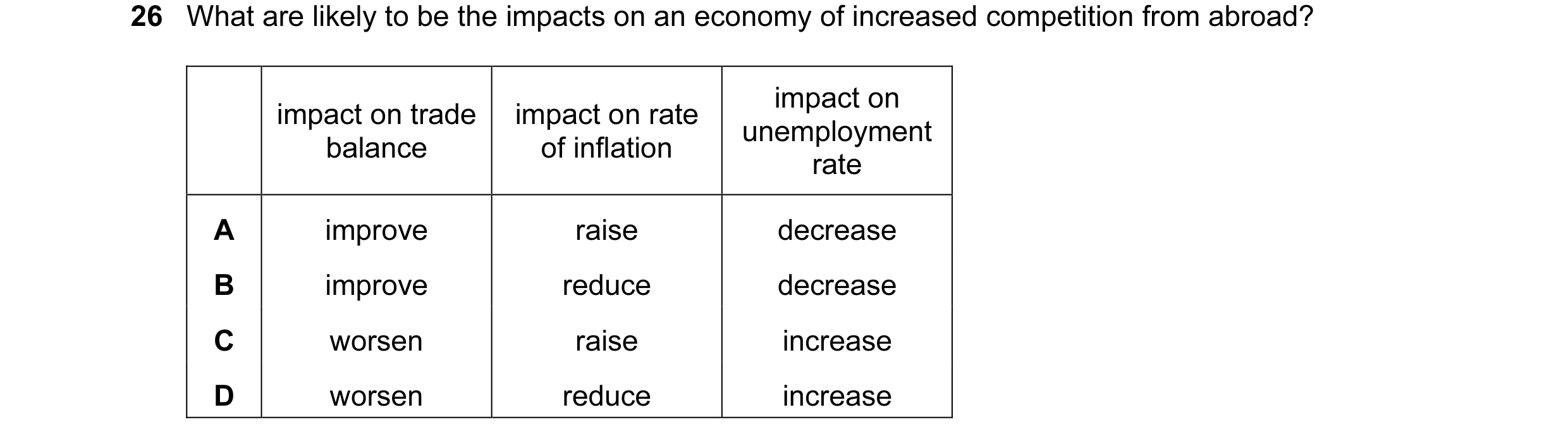


 2 / 4
2 / 4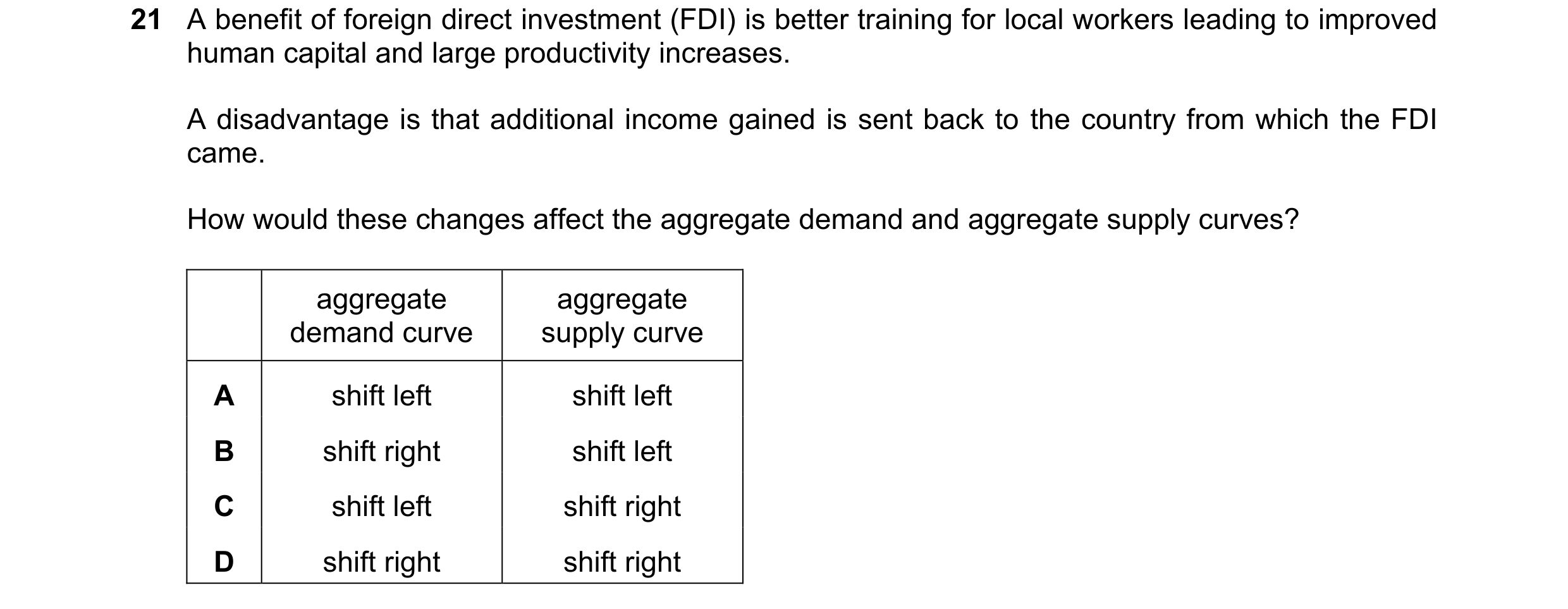


 3 / 4
3 / 4 4 / 4
4 / 4