Cambridge A Level Economics 9708 — 2021 Oct/Nov Paper 4 · Variant 3
9708/43/O/N/21 · 7 questions · 70 marks · ≈79 min
The question paper and its mark scheme, free to read here and free to download. This is Cambridge’s own paper, exactly as it was sat.
Question paper4 pages


Mark scheme12 pages
Answers below. Sit the paper first if you are practising.



Questions as text
Q1 · The effects of European Union (EU) labour migration In 2016 in the EU labour market there…
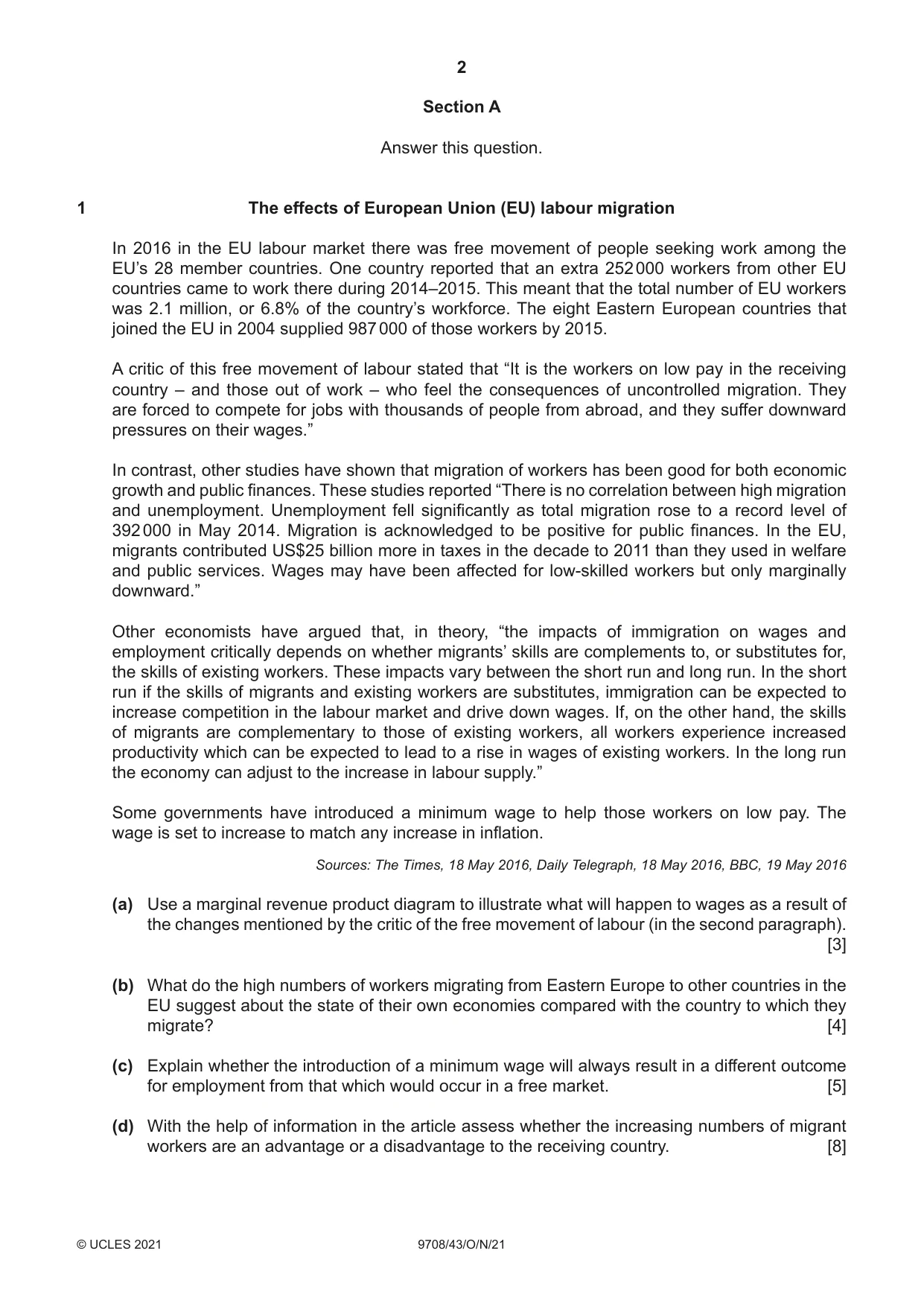
1 The effects of European Union (EU) labour migration In 2016 in the EU labour market there was free movement of people seeking work among the EU’s 28 member countries. One country reported that an extra 252 000 workers from other EU countries came to work there during 2014–2015. This meant that the total number of EU workers was 2.1 million, or 6.8% of the country’s workforce. The eight Eastern European countries that joined the EU in 2004 supplied 987 000 of those workers by 2015. A critic of this free movement of labour stated that “It is the workers on low pay in the receiving country – and those out of work – who feel the consequences of uncontrolled migration. They are forced to compete for jobs with thousands of people from abroad, and they suffer downward pressures on their wages.” In contrast, other studies have shown that migration of workers has been good for both economic growth and public finances. These studies reported “There is no correlation between high migration and unemployment. Unemployment fell significantly as total migration rose to a record level of 392 000 in May 2014. Migration is acknowledged to be positive for public finances. In the EU, migrants contributed US$25 billion more in taxes in the decade to 2011 than they used in welfare and public services. Wages may have been affected for low-skilled workers but only marginally downward.” Other economists have argued that, in theory, “the impacts of immigration on wages and employment critically depends on whether migrants’ skills are complements to, or substitutes for, the skills of existing workers. These impacts vary between the short run and long run. In the short run if the skills of migrants and existing workers are substitutes, immigration can be expected to increase competition in the labour market and drive down wages. If, on the other hand, the skills of migrants are complementary to those of existing workers, all workers experience increased productivity which can be expected to lead to a rise in wages of existing workers. In the long run the economy can adjust to the increase in labour supply.” Some governments have introduced a minimum wage to help those workers on low pay. The wage is set to increase to match any increase in inflation. Sources: The Times, 18 May 2016, Daily Telegraph, 18 May 2016, BBC, 19 May 2016 (a) Use a marginal revenue product diagram to illustrate what will happen to wages as a result of the changes mentioned by the critic of the free movement of labour (in the second paragraph). [3] (b) What do the high numbers of workers migrating from Eastern Europe to other countries in the EU suggest about the state of their own economies compared with the country to which they migrate? [4] (c) Explain whether the introduction of a minimum wage will always result in a different outcome for employment from that which would occur in a free market. [5] (d) With the help of information in the article assess whether the increasing numbers of migrant workers are an advantage or a disadvantage to the receiving country. [8]
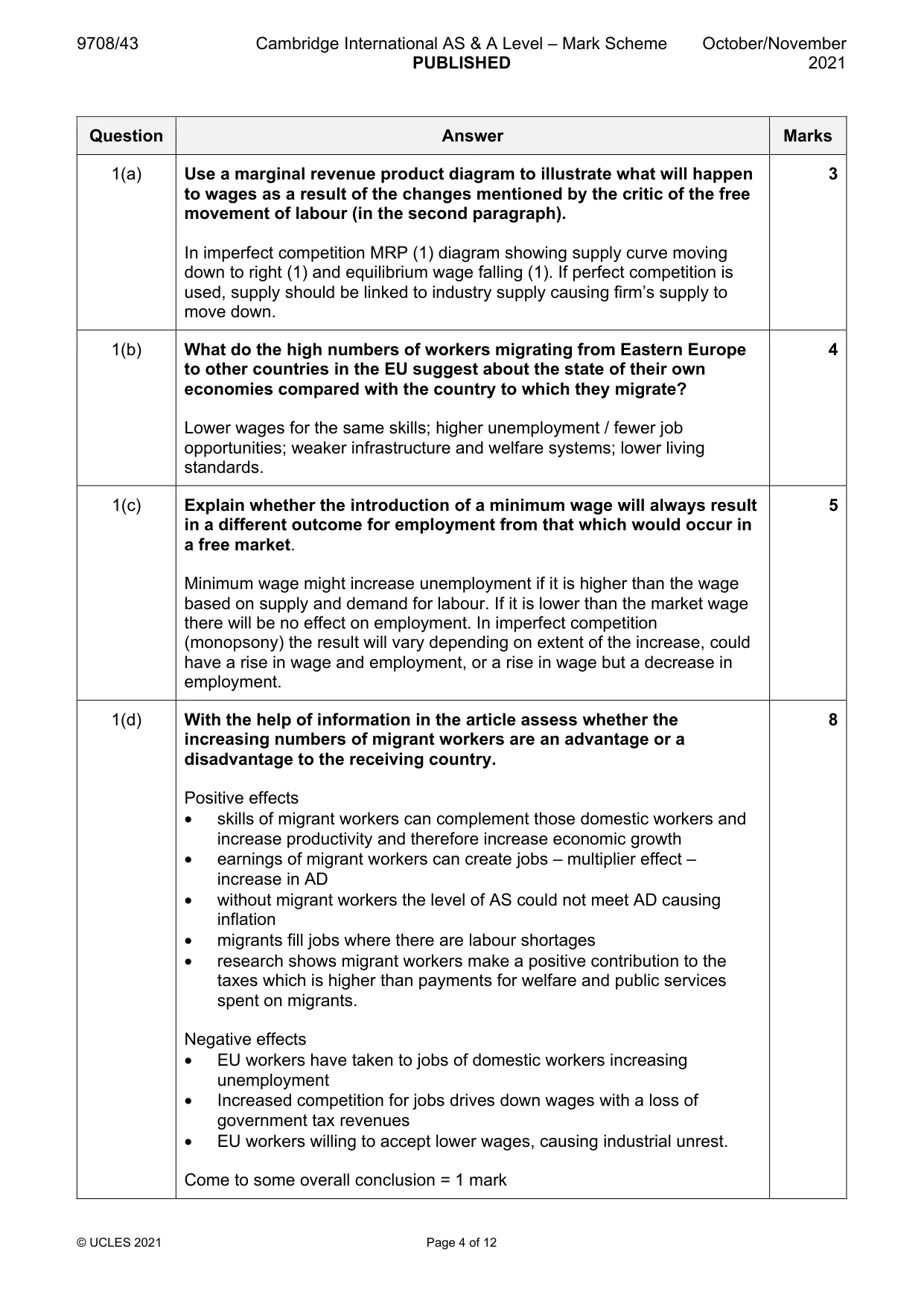
Mark scheme: Question Answer Marks 1(a) Use a marginal revenue product diagram to illustrate what will happen 3 to wages as a result of the changes mentioned by the critic of the free movement of labour (in the second paragraph). In imperfect competition MRP (1) diagram showing supply curve moving down to right (1) and equilibrium wage falling (1). If perfect competition is used, supply should be linked to industry supply causing firm’s supply to move down. 1(b) What do the high numbers of workers migrating from Eastern Europe 4 to other countries in the EU suggest about the state of their own economies compared with the country to which they migrate? Lower wages for the same skills; higher unemployment / fewer job opportunities; weaker infrastructure and welfare systems; lower living standards. 1(c) Explain whether the introduction of a minimum wage will always result 5 in a different outcome for employment from that which would occur in a free market. Minimum wage might increase unemployment if it is higher than the wage based on supply and demand for labour. If it is lower than the market wage there will be no effect on employment. In imperfect competition (monopsony) the result will vary depending on extent of the increase, could have a rise in wage and employment, or a rise in wage but a decrease in employment. 1(d) With the help of information in the article assess whether the 8 increasing numbers of migrant workers are an advantage or a disadvantage to the receiving country. Positive effects • skills of migrant workers can complement those domestic workers and increase productivity and therefore increase economic growth • earnings of migrant workers can create jobs – multiplier effect – increase in AD • without migrant workers the level of AS could not meet AD causing inflation • migrants fill jobs where there are labour shortages • research shows migrant workers make a positive contribution to the taxes which is higher than payments for welfare and public services spent on migrants. Negative effects • EU workers have taken to jobs of domestic workers increasing unemployment • Increased competition for jobs drives down wages with a loss of government tax revenues • EU workers willing to accept lower wages, causing industrial unrest. Come to some overall conclusion = 1 mark
More questions on Labour market forces and government intervention
Q2 · Analyse the reasons why it might be thought necessary for a government to control…
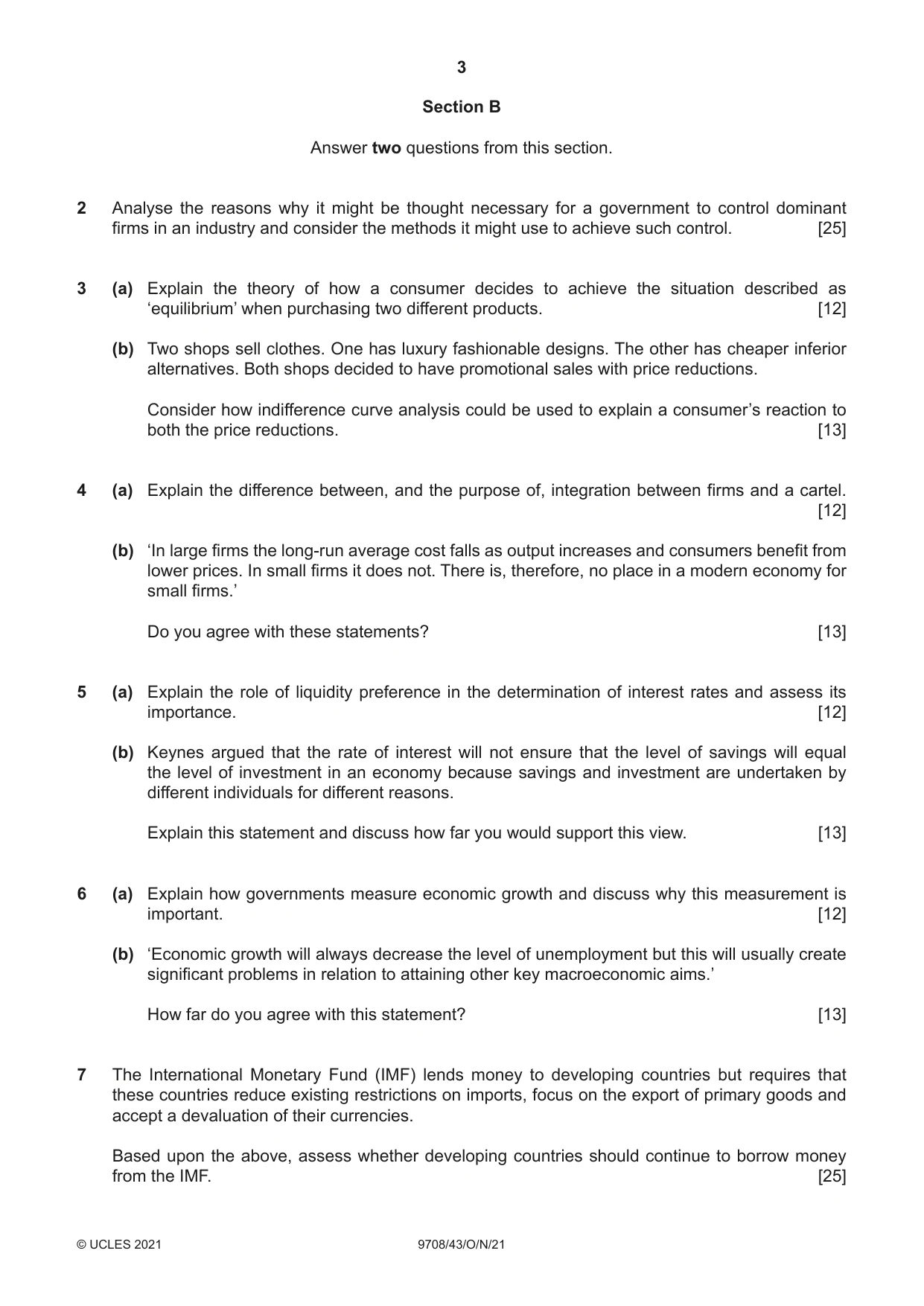
2 Analyse the reasons why it might be thought necessary for a government to control dominant firms in an industry and consider the methods it might use to achieve such control. [25]
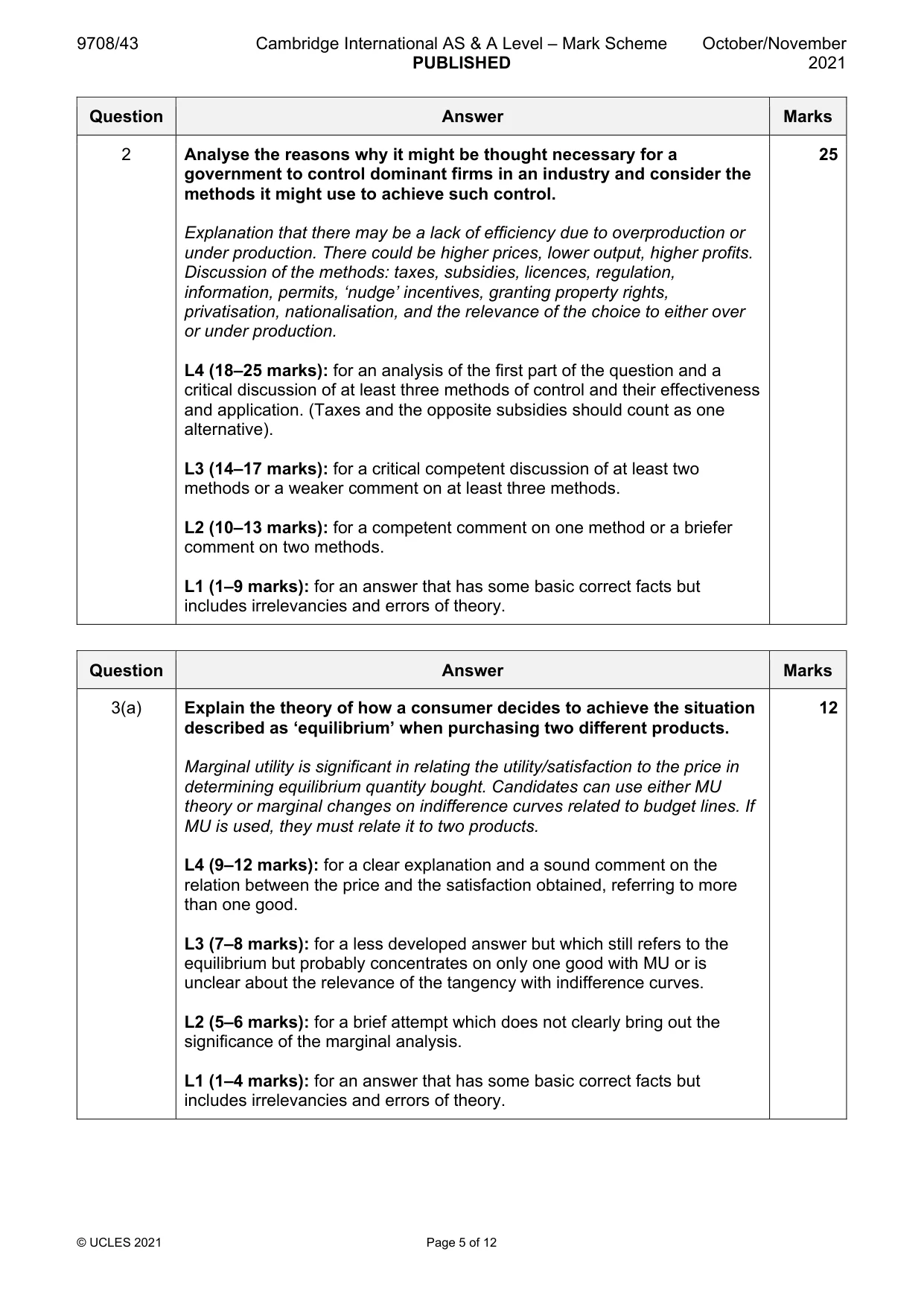
Mark scheme: 2 Analyse the reasons why it might be thought necessary for a 25 government to control dominant firms in an industry and consider the methods it might use to achieve such control. Explanation that there may be a lack of efficiency due to overproduction or under production. There could be higher prices, lower output, higher profits. Discussion of the methods: taxes, subsidies, licences, regulation, information, permits, ‘nudge’ incentives, granting property rights, privatisation, nationalisation, and the relevance of the choice to either over or under production. L4 (18–25 marks): for an analysis of the first part of the question and a critical discussion of at least three methods of control and their effectiveness and application. (Taxes and the opposite subsidies should count as one alternative). L3 (14–17 marks): for a critical competent discussion of at least two methods or a weaker comment on at least three methods. L2 (10–13 marks): for a competent comment on one method or a briefer comment on two methods. L1 (1–9 marks): for an answer that has some basic correct facts but includes irrelevancies and errors of theory.
Q3 · Explain the theory of how a consumer decides to achieve the situation described as…
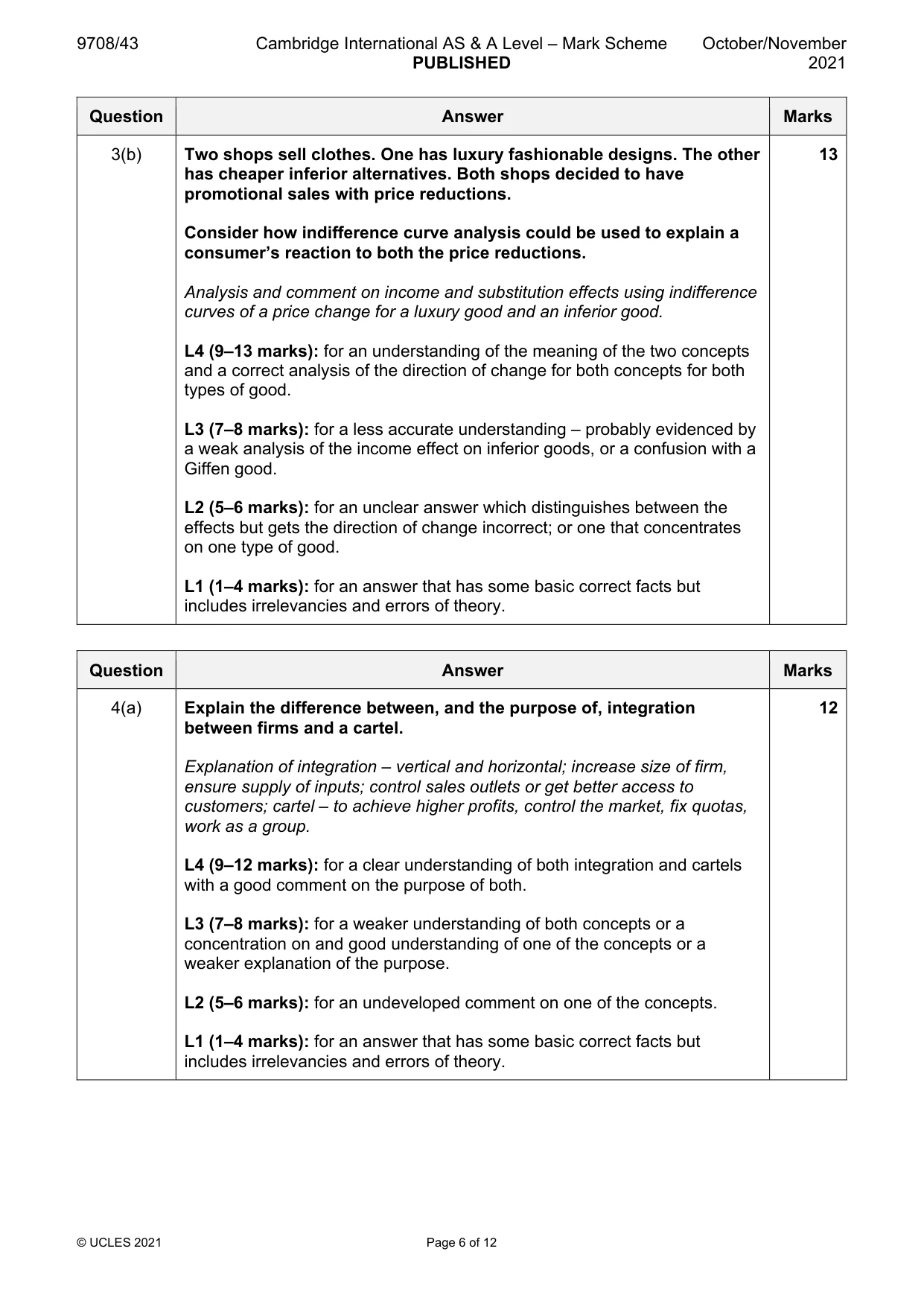
3 (a) Explain the theory of how a consumer decides to achieve the situation described as ‘equilibrium’ when purchasing two different products. [12] (b) Two shops sell clothes. One has luxury fashionable designs. The other has cheaper inferior alternatives. Both shops decided to have promotional sales with price reductions. Consider how indifference curve analysis could be used to explain a consumer’s reaction to both the price reductions. [13]
Mark scheme: 3(a) Explain the theory of how a consumer decides to achieve the situation 12 described as ‘equilibrium’ when purchasing two different products. Marginal utility is significant in relating the utility/satisfaction to the price in determining equilibrium quantity bought. Candidates can use either MU theory or marginal changes on indifference curves related to budget lines. If MU is used, they must relate it to two products. L4 (9–12 marks): for a clear explanation and a sound comment on the relation between the price and the satisfaction obtained, referring to more than one good. L3 (7–8 marks): for a less developed answer but which still refers to the equilibrium but probably concentrates on only one good with MU or is unclear about the relevance of the tangency with indifference curves. L2 (5–6 marks): for a brief attempt which does not clearly bring out the significance of the marginal analysis. L1 (1–4 marks): for an answer that has some basic correct facts but includes irrelevancies and errors of theory. 3(b) Two shops sell clothes. One has luxury fashionable designs. The other 13 has cheaper inferior alternatives. Both shops decided to have promotional sales with price reductions. Consider how indifference curve analysis could be used to explain a consumer’s reaction to both the price reductions. Analysis and comment on income and substitution effects using indifference curves of a price change for a luxury good and an inferior good. L4 (9–13 marks): for an understanding of the meaning of the two concepts and a correct analysis of the direction of change for both concepts for both types of good. L3 (7–8 marks): for a less accurate understanding – probably evidenced by a weak analysis of the income effect on inferior goods, or a confusion with a Giffen good. L2 (5–6 marks): for an unclear answer which distinguishes between the effects but gets the direction of change incorrect; or one that concentrates on one type of good. L1 (1–4 marks): for an answer that has some basic correct facts but includes irrelevancies and errors of theory.
Q4 · Explain the difference between, and the purpose of, integration between firms and a cartel
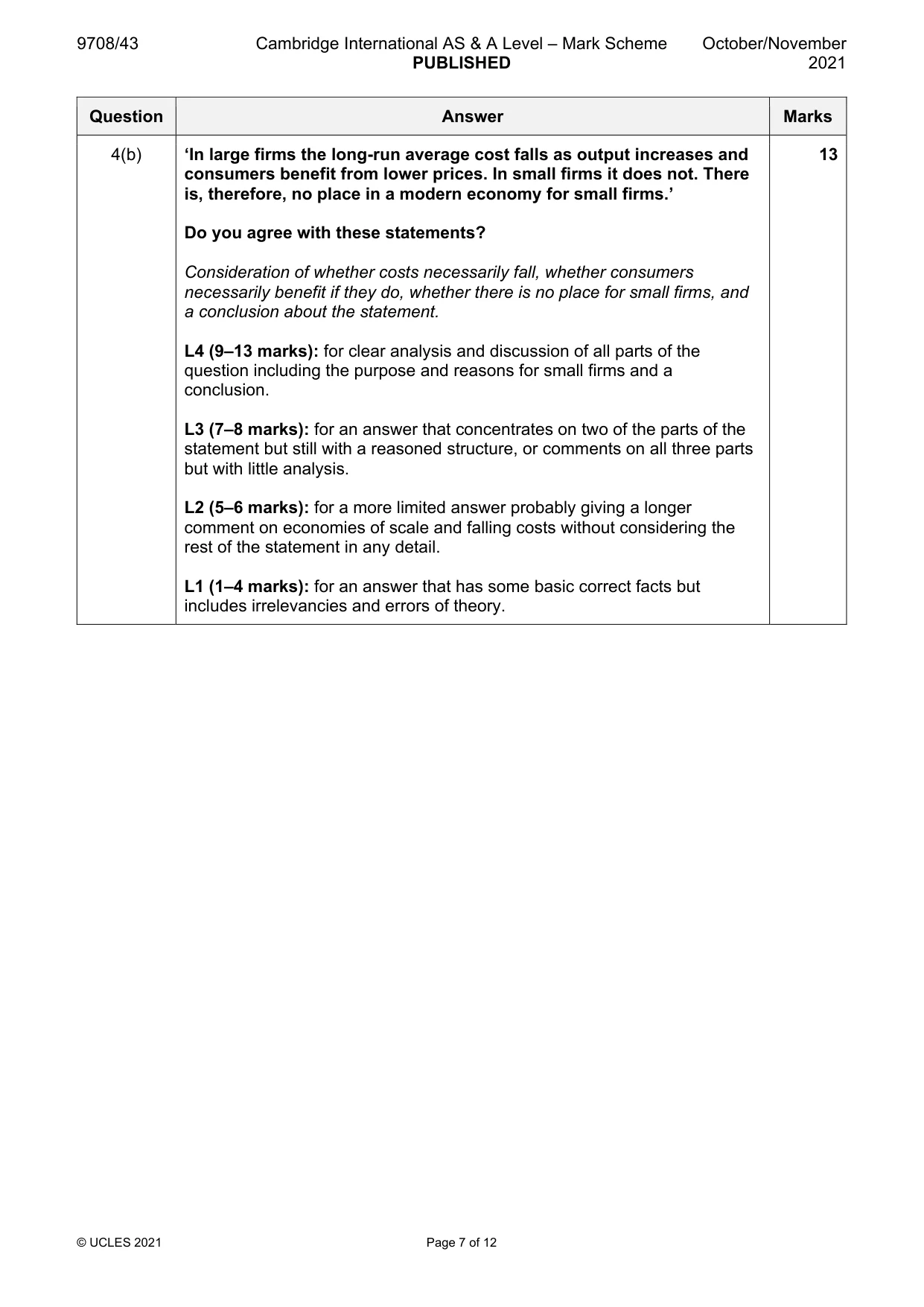
4 (a) Explain the difference between, and the purpose of, integration between firms and a cartel. [12] (b) ‘In large firms the long-run average cost falls as output increases and consumers benefit from lower prices. In small firms it does not. There is, therefore, no place in a modern economy for small firms.’ Do you agree with these statements? [13]
Mark scheme: 4(a) Explain the difference between, and the purpose of, integration 12 between firms and a cartel. Explanation of integration – vertical and horizontal; increase size of firm, ensure supply of inputs; control sales outlets or get better access to customers; cartel – to achieve higher profits, control the market, fix quotas, work as a group. L4 (9–12 marks): for a clear understanding of both integration and cartels with a good comment on the purpose of both. L3 (7–8 marks): for a weaker understanding of both concepts or a concentration on and good understanding of one of the concepts or a weaker explanation of the purpose. L2 (5–6 marks): for an undeveloped comment on one of the concepts. L1 (1–4 marks): for an answer that has some basic correct facts but includes irrelevancies and errors of theory. 4(b) ‘In large firms the long-run average cost falls as output increases and 13 consumers benefit from lower prices. In small firms it does not. There is, therefore, no place in a modern economy for small firms.’ Do you agree with these statements? Consideration of whether costs necessarily fall, whether consumers necessarily benefit if they do, whether there is no place for small firms, and a conclusion about the statement. L4 (9–13 marks): for clear analysis and discussion of all parts of the question including the purpose and reasons for small firms and a conclusion. L3 (7–8 marks): for an answer that concentrates on two of the parts of the statement but still with a reasoned structure, or comments on all three parts but with little analysis. L2 (5–6 marks): for a more limited answer probably giving a longer comment on economies of scale and falling costs without considering the rest of the statement in any detail. L1 (1–4 marks): for an answer that has some basic correct facts but includes irrelevancies and errors of theory.
Q5 · Explain the role of liquidity preference in the determination of interest rates and…
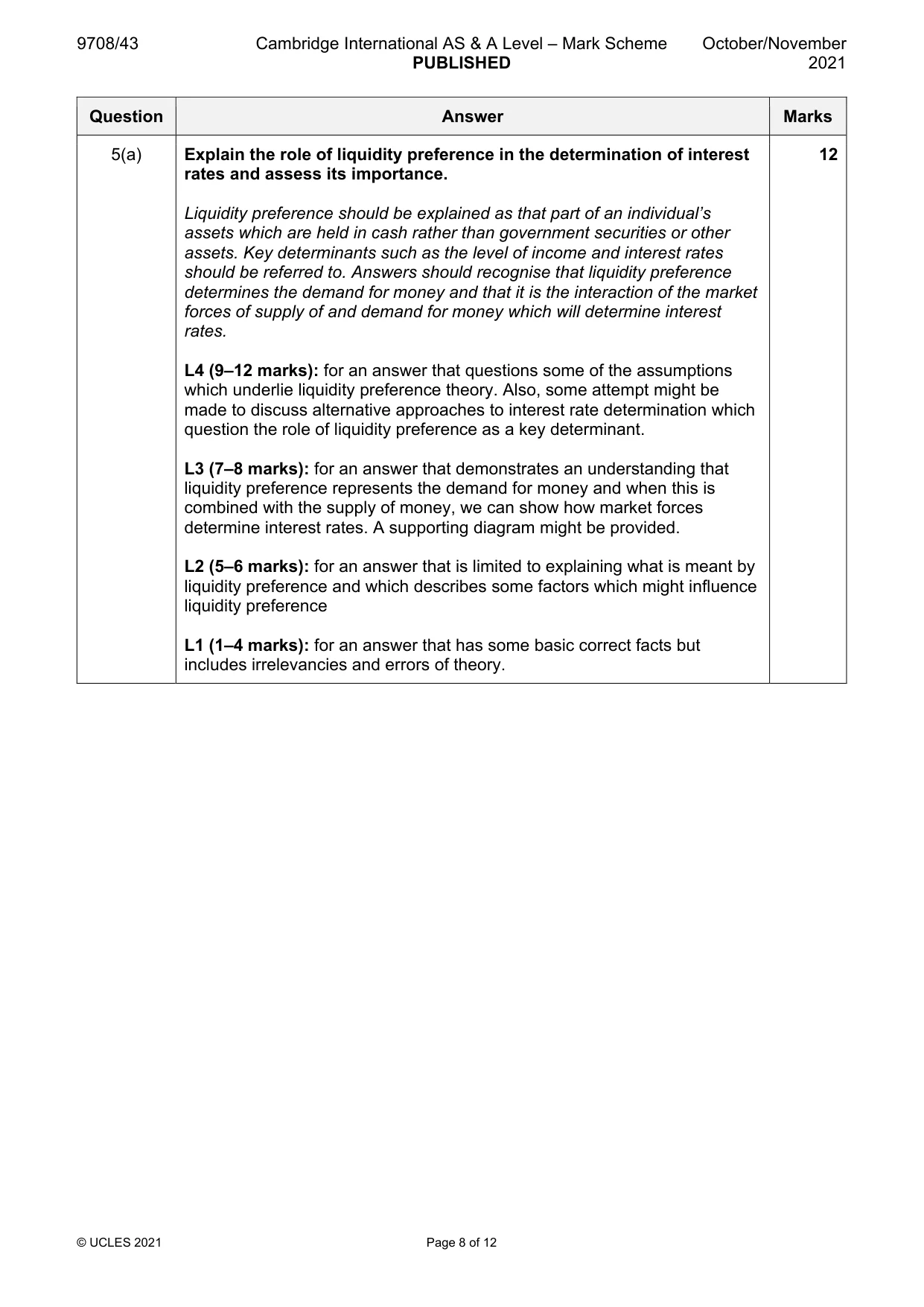
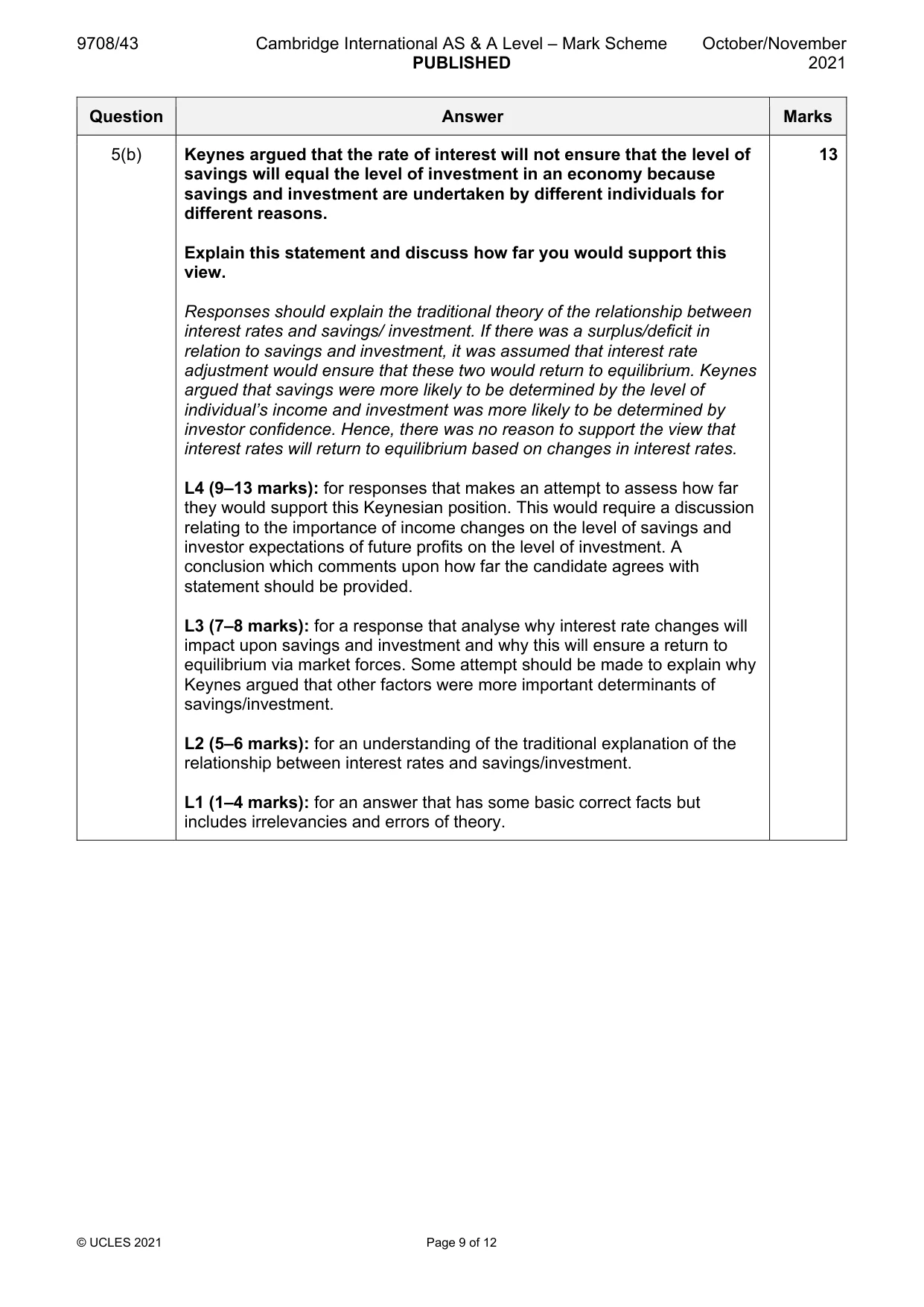
5 (a) Explain the role of liquidity preference in the determination of interest rates and assess its importance. [12] (b) Keynes argued that the rate of interest will not ensure that the level of savings will equal the level of investment in an economy because savings and investment are undertaken by different individuals for different reasons. Explain this statement and discuss how far you would support this view. [13]
Mark scheme: 5(a) Explain the role of liquidity preference in the determination of interest 12 rates and assess its importance. Liquidity preference should be explained as that part of an individual’s assets which are held in cash rather than government securities or other assets. Key determinants such as the level of income and interest rates should be referred to. Answers should recognise that liquidity preference determines the demand for money and that it is the interaction of the market forces of supply of and demand for money which will determine interest rates. L4 (9–12 marks): for an answer that questions some of the assumptions which underlie liquidity preference theory. Also, some attempt might be made to discuss alternative approaches to interest rate determination which question the role of liquidity preference as a key determinant. L3 (7–8 marks): for an answer that demonstrates an understanding that liquidity preference represents the demand for money and when this is combined with the supply of money, we can show how market forces determine interest rates. A supporting diagram might be provided. L2 (5–6 marks): for an answer that is limited to explaining what is meant by liquidity preference and which describes some factors which might influence liquidity preference L1 (1–4 marks): for an answer that has some basic correct facts but includes irrelevancies and errors of theory. 5(b) Keynes argued that the rate of interest will not ensure that the level of 13 savings will equal the level of investment in an economy because savings and investment are undertaken by different individuals for different reasons. Explain this statement and discuss how far you would support this view. Responses should explain the traditional theory of the relationship between interest rates and savings/ investment. If there was a surplus/deficit in relation to savings and investment, it was assumed that interest rate adjustment would ensure that these two would return to equilibrium. Keynes argued that savings were more likely to be determined by the level of individual’s income and investment was more likely to be determined by investor confidence. Hence, there was no reason to support the view that interest rates will return to equilibrium based on changes in interest rates. L4 (9–13 marks): for responses that makes an attempt to assess how far they would support this Keynesian position. This would require a discussion relating to the importance of income changes on the level of savings and investor expectations of future profits on the level of investment. A conclusion which comments upon how far the candidate agrees with statement should be provided. L3 (7–8 marks): for a response that analyse why interest rate changes will impact upon savings and investment and why this will ensure a return to equilibrium via market forces. Some attempt should be made to explain why Keynes argued that other factors were more important determinants of savings/investment. L2 (5–6 marks): for an understanding of the traditional explanation of the relationship between interest rates and savings/investment. L1 (1–4 marks): for an answer that has some basic correct facts but includes irrelevancies and errors of theory.
Q6 · Explain how governments measure economic growth and discuss why this measurement is…
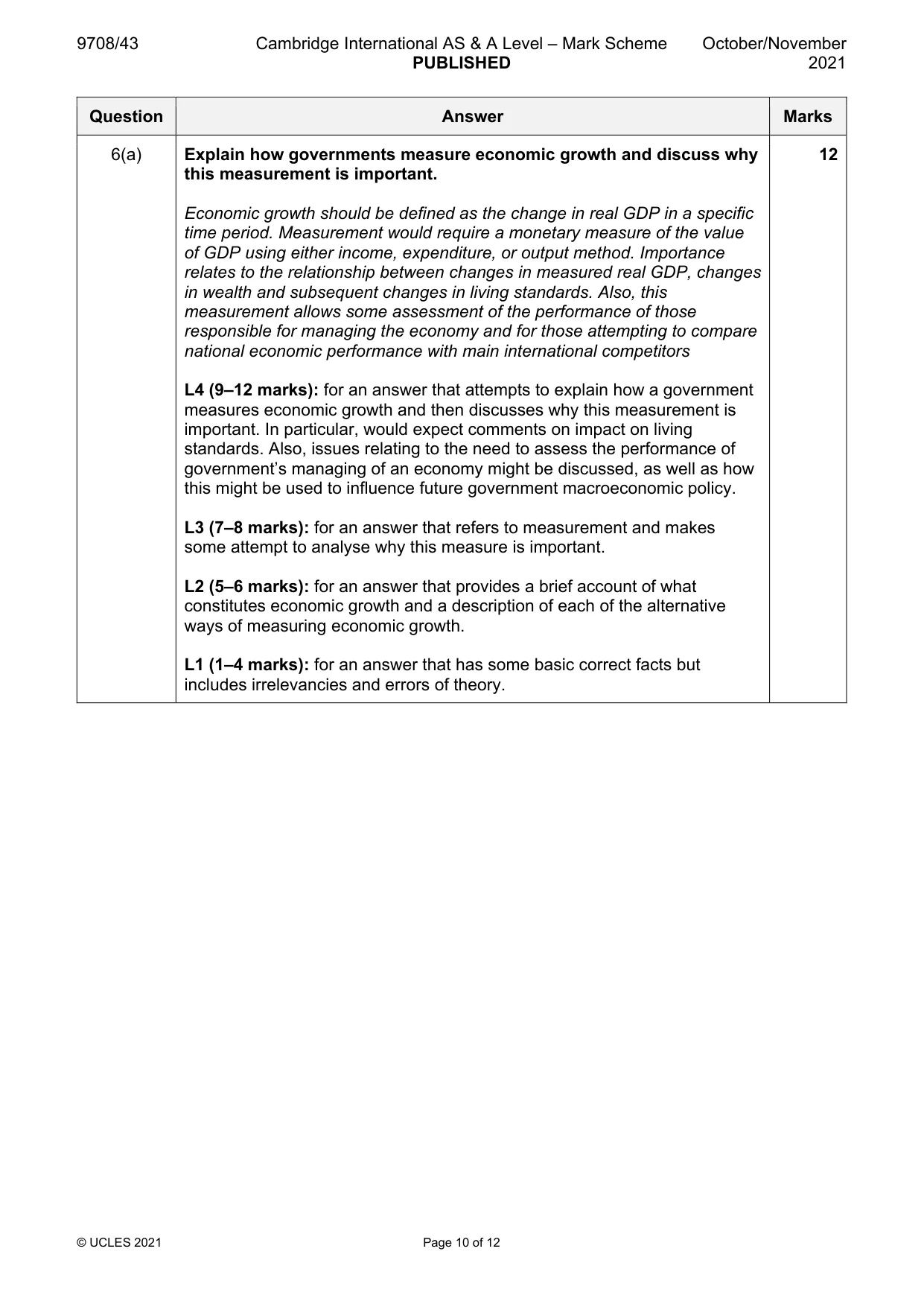
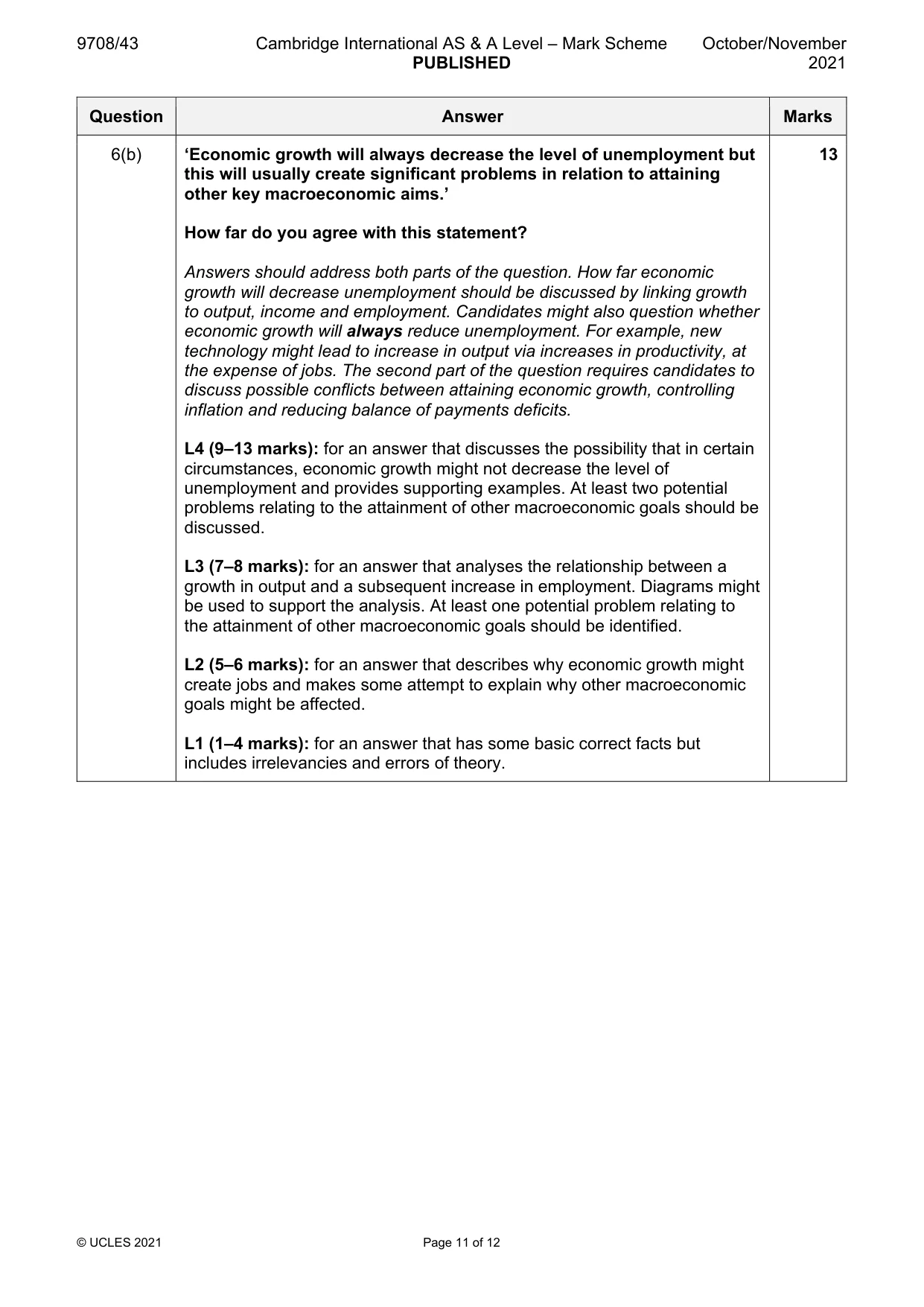
6 (a) Explain how governments measure economic growth and discuss why this measurement is important. [12] (b) ‘Economic growth will always decrease the level of unemployment but this will usually create significant problems in relation to attaining other key macroeconomic aims.’ How far do you agree with this statement? [13]
Mark scheme: 6(a) Explain how governments measure economic growth and discuss why 12 this measurement is important. Economic growth should be defined as the change in real GDP in a specific time period. Measurement would require a monetary measure of the value of GDP using either income, expenditure, or output method. Importance relates to the relationship between changes in measured real GDP, changes in wealth and subsequent changes in living standards. Also, this measurement allows some assessment of the performance of those responsible for managing the economy and for those attempting to compare national economic performance with main international competitors L4 (9–12 marks): for an answer that attempts to explain how a government measures economic growth and then discusses why this measurement is important. In particular, would expect comments on impact on living standards. Also, issues relating to the need to assess the performance of government’s managing of an economy might be discussed, as well as how this might be used to influence future government macroeconomic policy. L3 (7–8 marks): for an answer that refers to measurement and makes some attempt to analyse why this measure is important. L2 (5–6 marks): for an answer that provides a brief account of what constitutes economic growth and a description of each of the alternative ways of measuring economic growth. L1 (1–4 marks): for an answer that has some basic correct facts but includes irrelevancies and errors of theory. 6(b) ‘Economic growth will always decrease the level of unemployment but 13 this will usually create significant problems in relation to attaining other key macroeconomic aims.’ How far do you agree with this statement? Answers should address both parts of the question. How far economic growth will decrease unemployment should be discussed by linking growth to output, income and employment. Candidates might also question whether economic growth will always reduce unemployment. For example, new technology might lead to increase in output via increases in productivity, at the expense of jobs. The second part of the question requires candidates to discuss possible conflicts between attaining economic growth, controlling inflation and reducing balance of payments deficits. L4 (9–13 marks): for an answer that discusses the possibility that in certain circumstances, economic growth might not decrease the level of unemployment and provides supporting examples. At least two potential problems relating to the attainment of other macroeconomic goals should be discussed. L3 (7–8 marks): for an answer that analyses the relationship between a growth in output and a subsequent increase in employment. Diagrams might be used to support the analysis. At least one potential problem relating to the attainment of other macroeconomic goals should be identified. L2 (5–6 marks): for an answer that describes why economic growth might create jobs and makes some attempt to explain why other macroeconomic goals might be affected. L1 (1–4 marks): for an answer that has some basic correct facts but includes irrelevancies and errors of theory.
More questions on Links between macroeconomic problems and their interrelatedness
Q7 · The International Monetary Fund (IMF) lends money to developing countries but requires…
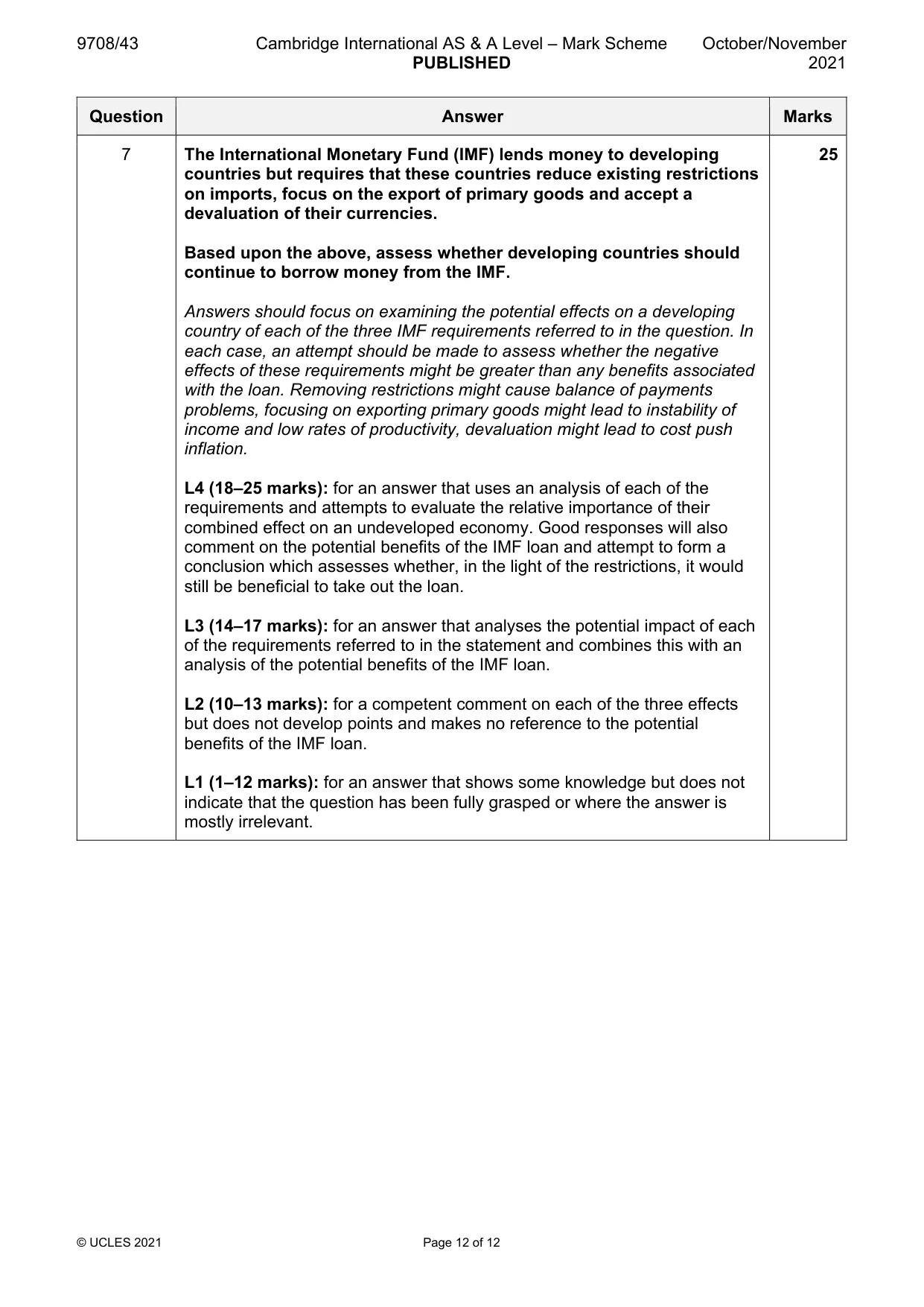
7 The International Monetary Fund (IMF) lends money to developing countries but requires that these countries reduce existing restrictions on imports, focus on the export of primary goods and accept a devaluation of their currencies. Based upon the above, assess whether developing countries should continue to borrow money from the IMF. [25]
Mark scheme: 7 The International Monetary Fund (IMF) lends money to developing 25 countries but requires that these countries reduce existing restrictions on imports, focus on the export of primary goods and accept a devaluation of their currencies. Based upon the above, assess whether developing countries should continue to borrow money from the IMF. Answers should focus on examining the potential effects on a developing country of each of the three IMF requirements referred to in the question. In each case, an attempt should be made to assess whether the negative effects of these requirements might be greater than any benefits associated with the loan. Removing restrictions might cause balance of payments problems, focusing on exporting primary goods might lead to instability of income and low rates of productivity, devaluation might lead to cost push inflation. L4 (18–25 marks): for an answer that uses an analysis of each of the requirements and attempts to evaluate the relative importance of their combined effect on an undeveloped economy. Good responses will also comment on the potential benefits of the IMF loan and attempt to form a conclusion which assesses whether, in the light of the restrictions, it would still be beneficial to take out the loan. L3 (14–17 marks): for an answer that analyses the potential impact of each of the requirements referred to in the statement and combines this with an analysis of the potential benefits of the IMF loan. L2 (10–13 marks): for a competent comment on each of the three effects but does not develop points and makes no reference to the potential benefits of the IMF loan. L1 (1–12 marks): for an answer that shows some knowledge but does not indicate that the question has been fully grasped or where the answer is mostly irrelevant.
More questions on Relationship between countries at different levels of development
What was in this paper
The subtopics covered by these 7 questions, and how many questions each got. Open one in a new tab to see every Cambridge question on it.
1Government policies to achieve efficient resource allocation and correct market failure1Indifference curves and budget lines1Labour market forces and government intervention1Links between macroeconomic problems and their interrelatedness1Relationship between countries at different levels of development1The circular flow of income1What you needed in this session
Cambridge’s own grade thresholds for 2021 Oct/Nov, Paper 4 · Variant 3. A higher threshold means an easier paper — the bar moves with how the cohort did.