Cambridge A Level Economics 9708 — 2024 Oct/Nov Paper 4 · Variant 3
9708/43/O/N/24 · 5 questions · 60 marks · ≈68 min
The question paper and its mark scheme, free to read here and free to download. This is Cambridge’s own paper, exactly as it was sat.
Question paper4 pages

Mark scheme17 pages
Answers below. Sit the paper first if you are practising.




Questions as text
Q1 · The threat from large firms In 2021, one of the largest United States (US) technology…
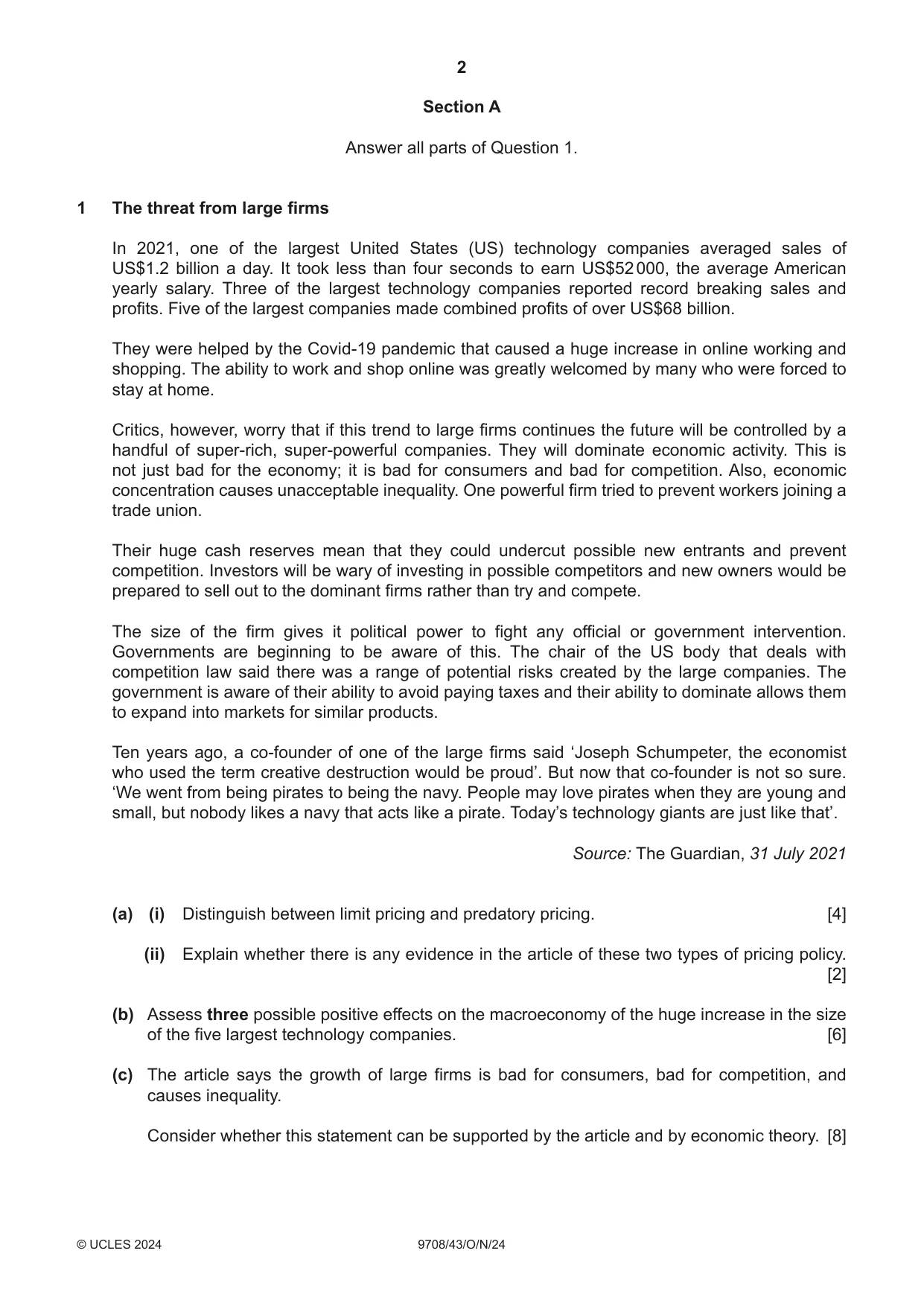
1 The threat from large firms In 2021, one of the largest United States (US) technology companies averaged sales of US$1.2 billion a day. It took less than four seconds to earn US$52 000, the average American yearly salary. Three of the largest technology companies reported record breaking sales and profits. Five of the largest companies made combined profits of over US$68 billion. They were helped by the Covid-19 pandemic that caused a huge increase in online working and shopping. The ability to work and shop online was greatly welcomed by many who were forced to stay at home. Critics, however, worry that if this trend to large firms continues the future will be controlled by a handful of super-rich, super-powerful companies. They will dominate economic activity. This is not just bad for the economy; it is bad for consumers and bad for competition. Also, economic concentration causes unacceptable inequality. One powerful firm tried to prevent workers joining a trade union. Their huge cash reserves mean that they could undercut possible new entrants and prevent competition. Investors will be wary of investing in possible competitors and new owners would be prepared to sell out to the dominant firms rather than try and compete. The size of the firm gives it political power to fight any official or government intervention. Governments are beginning to be aware of this. The chair of the US body that deals with competition law said there was a range of potential risks created by the large companies. The government is aware of their ability to avoid paying taxes and their ability to dominate allows them to expand into markets for similar products. Ten years ago, a co-founder of one of the large firms said ‘Joseph Schumpeter, the economist who used the term creative destruction would be proud’. But now that co-founder is not so sure. ‘We went from being pirates to being the navy. People may love pirates when they are young and small, but nobody likes a navy that acts like a pirate. Today’s technology giants are just like that’. Source: The Guardian, 31 July 2021 (a) (i) Distinguish between limit pricing and predatory pricing. [4] (ii) Explain whether there is any evidence in the article of these two types of pricing policy. [2] (b) Assess three possible positive effects on the macroeconomy of the huge increase in the size of the five largest technology companies. [6] (c) The article says the growth of large firms is bad for consumers, bad for competition, and causes inequality. Consider whether this statement can be supported by the article and by economic theory. [8]
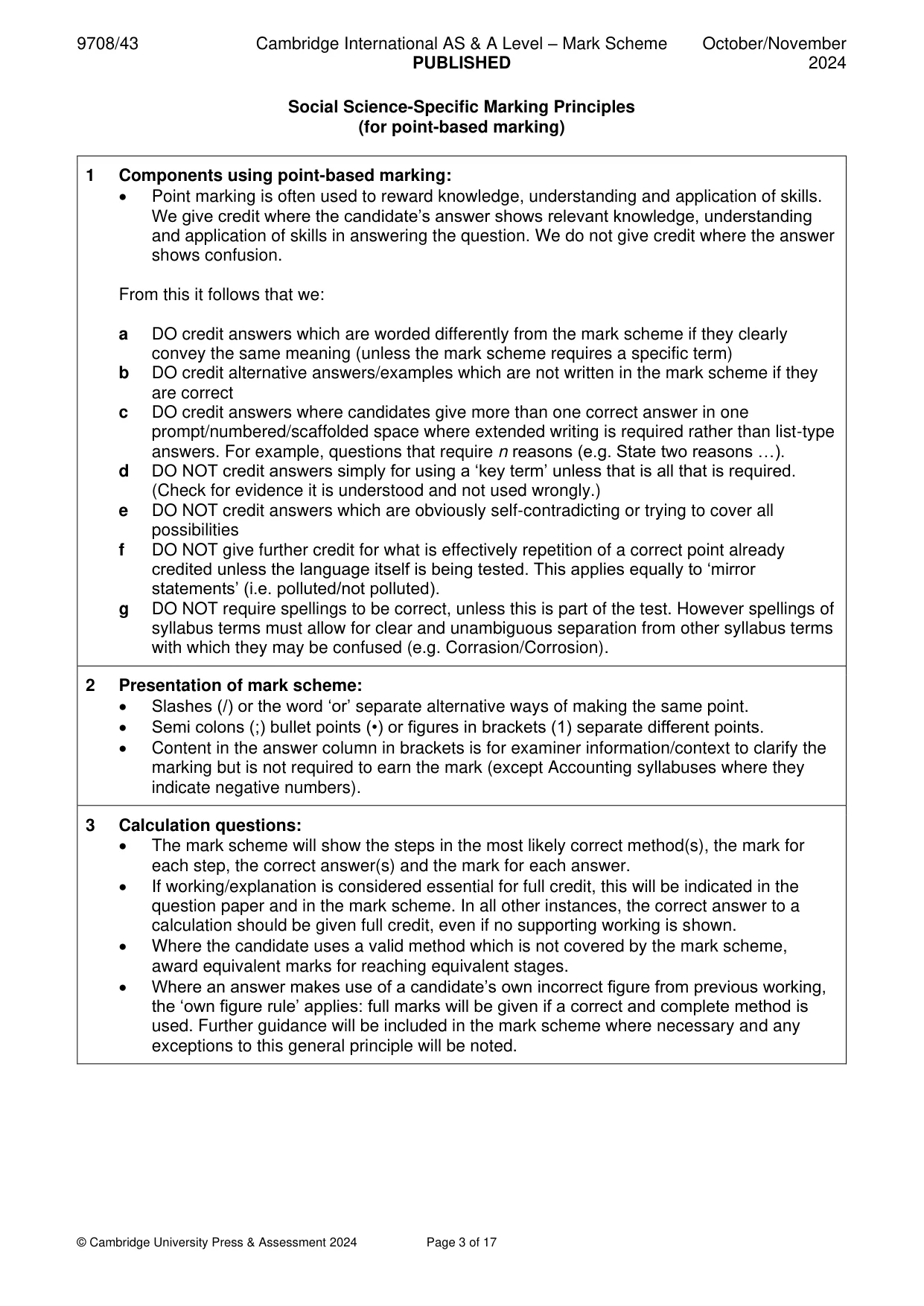
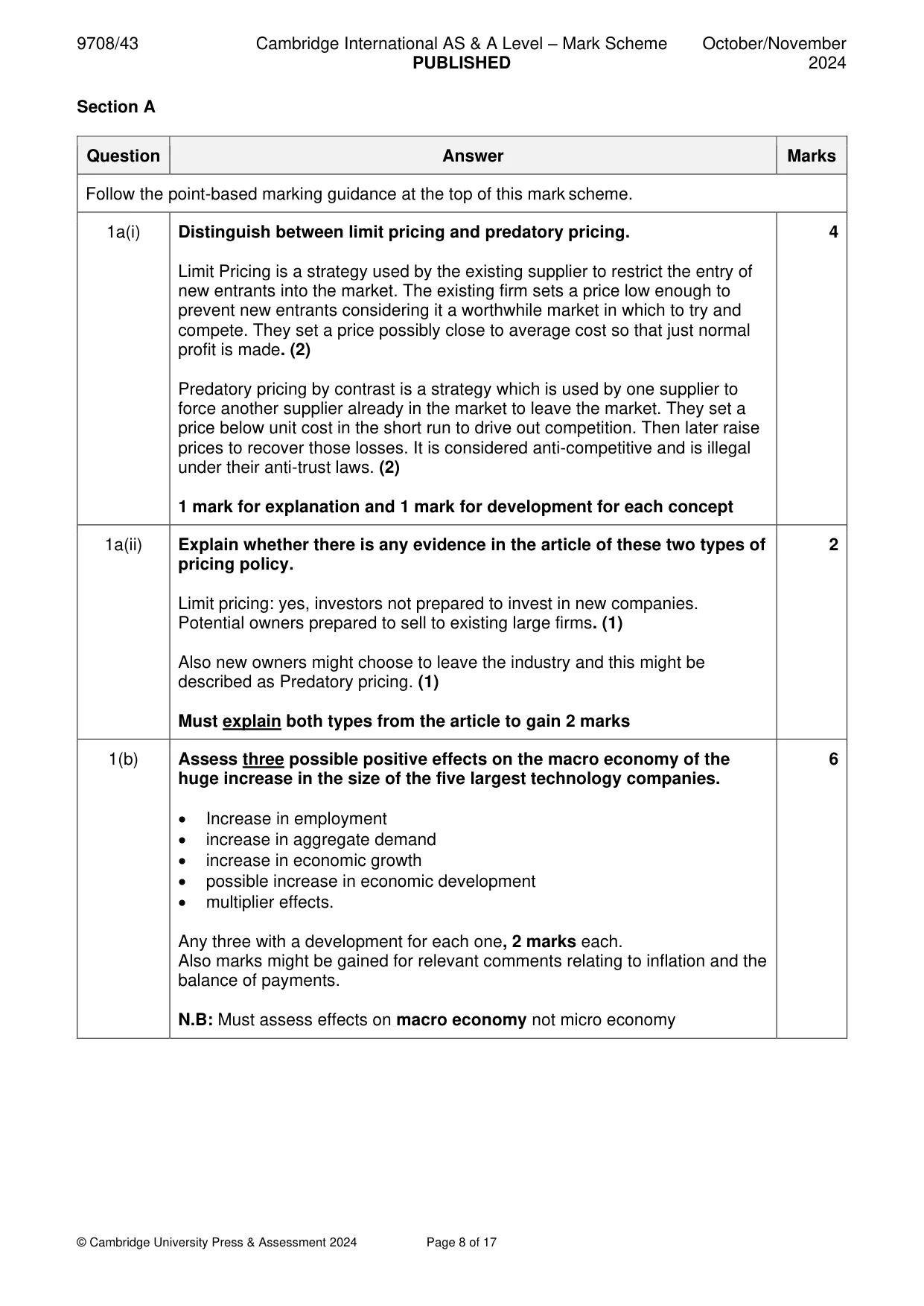
Mark scheme: Question Answer Marks Follow the point-based marking guidance at the top of this mark scheme. 1a(i) Distinguish between limit pricing and predatory pricing. 4 Limit Pricing is a strategy used by the existing supplier to restrict the entry of new entrants into the market. The existing firm sets a price low enough to prevent new entrants considering it a worthwhile market in which to try and compete. They set a price possibly close to average cost so that just normal profit is made. (2) Predatory pricing by contrast is a strategy which is used by one supplier to force another supplier already in the market to leave the market. They set a price below unit cost in the short run to drive out competition. Then later raise prices to recover those losses. It is considered anti-competitive and is illegal under their anti-trust laws. (2) 1 mark for explanation and 1 mark for development for each concept 1a(ii) Explain whether there is any evidence in the article of these two types of 2 pricing policy. Limit pricing: yes, investors not prepared to invest in new companies. Potential owners prepared to sell to existing large firms. (1) Also new owners might choose to leave the industry and this might be described as Predatory pricing. (1) Must explain both types from the article to gain 2 marks 1(b) Assess three possible positive effects on the macro economy of the 6 huge increase in the size of the five largest technology companies. • Increase in employment • increase in aggregate demand • increase in economic growth • possible increase in economic development • multiplier effects. Any three with a development for each one, 2 marks each. Also marks might be gained for relevant comments relating to inflation and the balance of payments. N.B: Must assess effects on macro economy not micro economy 1(c) The article says the growth of large firms is bad for consumers, bad for 8 competition, and causes inequality. Consider whether this statement can be supported by the article or by economic theory. In support: Article mentions profit compared with salaries, restriction on union membership, avoidance of tax, expansion into adjacent markets. Theory: Growth of firms can lead to less choice, higher prices, restricted output, higher profits. This is supported by the article and by theory. It can be detrimental for consumers and detrimental for competition. Monopolies can be formed, small firms forced out of the market. (4 marks for support) Against the statement: Article mentions consumers working/staying at home and welcoming the service the firms provide. Theory: Large firms can also have economies of scale, can reduce prices, can encourage innovation and research. This is not mentioned in the article but is supported by economic theory. (4 marks for against the statement) Conclusion: statement is not therefore always true. (1 mark) 8 marks maximum Section B
Q2 · Negative externalities of production cause market failure
2 Negative externalities of production cause market failure. With the help of a diagram, assess the extent to which the introduction of indirect taxation is likely to address this cause of market failure. [20] OR
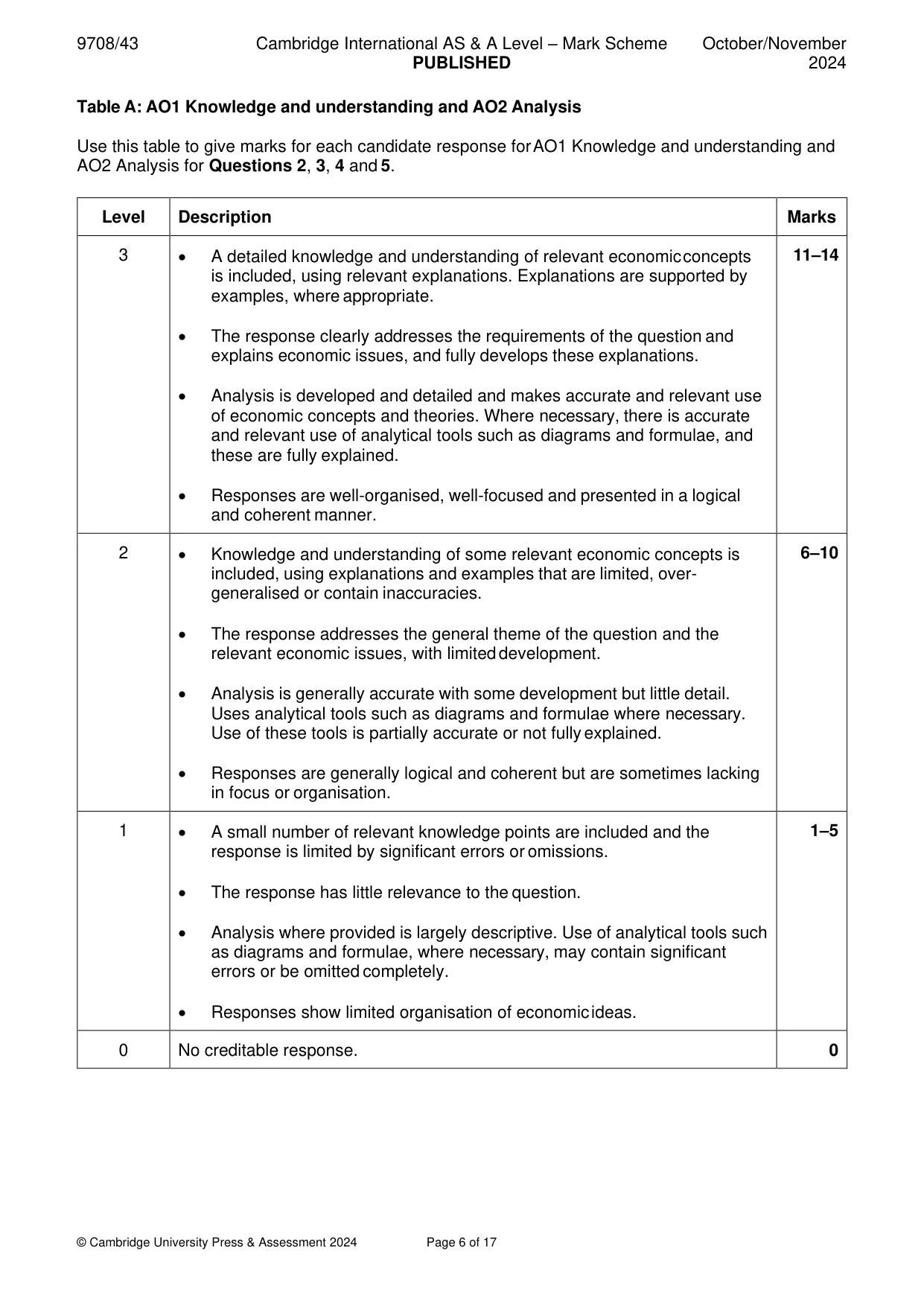
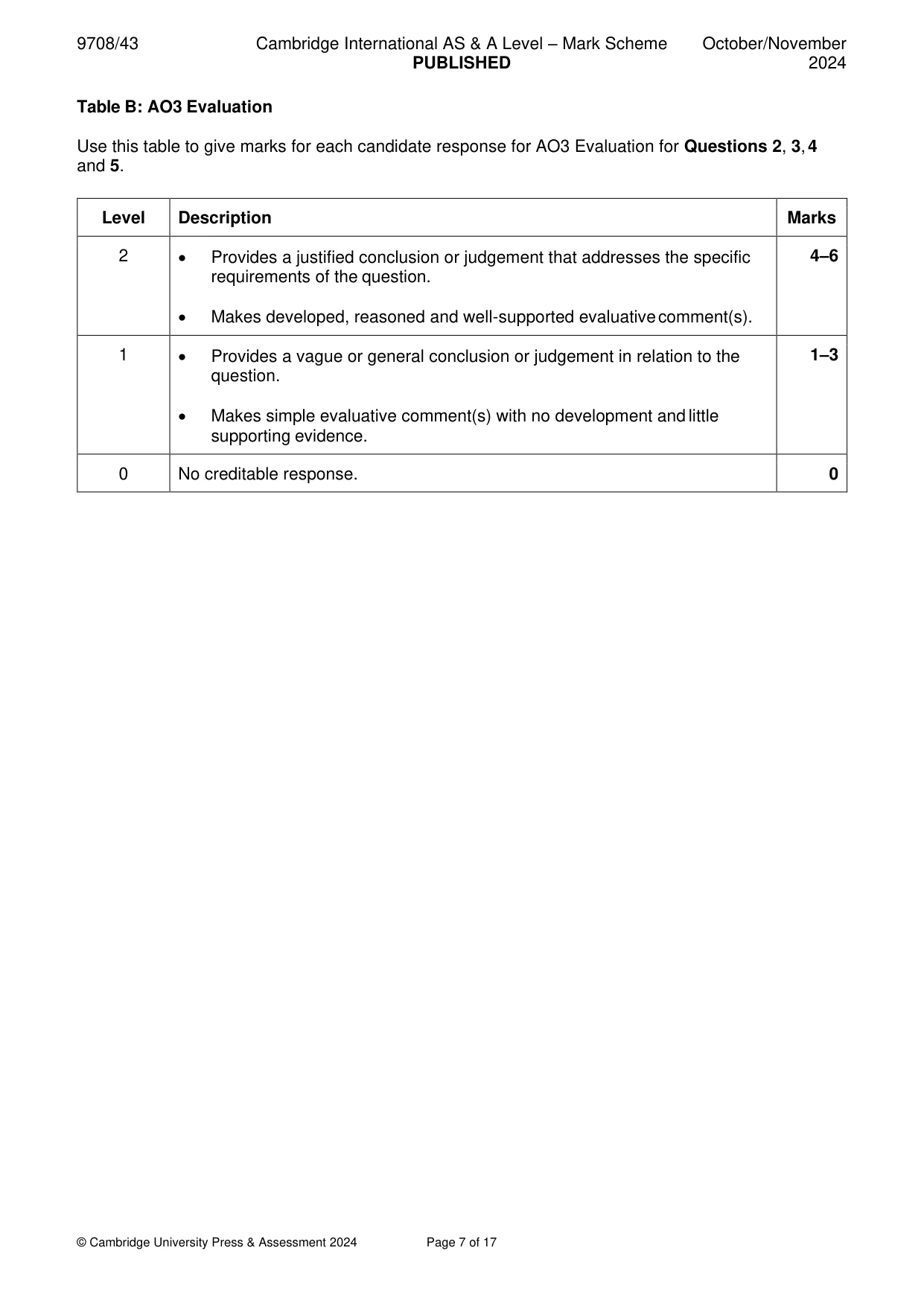
Mark scheme: 2 Negative externalities of production cause market failure. 20 With the help of a diagram, assess the extent to which the introduction of indirect taxation is likely to address this cause of market failure. Use Table A: AO1 Knowledge and understanding and AO2 Analysis and Table B: AO3 Evaluation to mark candidate responses to this question. AO1 and AO2 out of 14 marks. AO3 out of 6 marks. Indicative content Responses may include: AO1 Knowledge and understanding and AO2 Analysis • Market failure regarding this question would relate to allocative inefficiency. Market failure can be explained by defining allocative efficiency and linking this to the requirement to allocate resources to maximise consumer satisfaction. • This can be supported by a diagram illustrating a level of output where AR = MC which is consistent with an outcome that achieves allocative efficiency. • Negative externalities occur when the consumption/production of a good produces a cost to society which is greater than that incurred by an individual consumer/producer. This is sometimes described as a negative ‘spill-over’ effect. • One form of government intervention might be the introduction of indirect taxation. A clearly labelled, accurate diagram can be used to show the impact of an indirect taxation on the level of output and efficiency. • Analysis would use this to show the impact of an indirect tax on the PC curve. • Further analysis should then identify the links between the indirect tax and the behaviour of firms. This would link the creation of negative externalities to the benefits of removing them and then linking this to addressing this cause of market failure N.B: L2 max if no or incorrect diagram provided. 2 AO3 Evaluation • A government might introduce indirect taxation however it is difficult to determine the extent of the taxation necessary which will address the issue of market failure without causing other problems, for example, an increase in unemployment. • Also, the impact of indirect taxation in some circumstances takes a long time to become effective. • Some large firms might produce and sell products which have an inelastic demand therefore this would be unlikely to have a significant impact on output and efficiency. • The introduction of indirect taxation might be costly and unnecessarily bureaucratic, as well as being difficult to monitor and enforce. • It might be that government intervention based on the use of alternative more direct approaches such as the use of pollution permit might be more effective. • Indirect taxation is regressive and might unfairly penalise lower income groups. • A conclusion should consider alternatives, compare these with the use of indirect taxation and attempt to form some judgement regarding the effectiveness of this type of policy. Accept all valid responses AO1 Knowledge and understanding and AO2 Analysis 14 AO3 Evaluation 6
Q3 · Wages in a perfectly competitive labour market will always be higher than wages in a…
3 Wages in a perfectly competitive labour market will always be higher than wages in a monopsony labour market. With the help of a diagram, evaluate this statement. [20] Section C Answer one question. EITHER
Mark scheme: 3 Wages in a perfectly competitive labour market will always be higher 20 than wages in a monopsony labour market. With the help of a diagram evaluate this statement. Use Table A: AO1 Knowledge and understanding and AO2 Analysis and Table B: AO3 Evaluation to mark candidate responses to this question. AO1 and AO2 out of 14 marks. AO3 out of 6 marks. Indicative content Responses may include: AO1 Knowledge and understanding and AO2 Analysis • Characteristics of a perfectly competitive labour market should be described. This should be supported by a relevant diagram. • An explanation of how monopsony markets work should be provided, emphasising the importance of how wages are determined in this type of market. • A diagram should be provided which shows a monopsony labour market and used to show how wages and level of employment are determined. • Analysis should refer to the factors which affect both the supply of and demand for labour in both these types of labour market. Note: L2 max if no or incorrect diagram provided. 3 AO3 Evaluation • Evaluation should then be used to link external factors which might affect final wage levels in both markets. For example, Trades Union or government intervention. In some cases, the intervention of Trades Union might lead to an increase in the productivity of the workforce through the provision of better training. This would support that wages would be higher in a perfectly competitive labour market. • Although a monopsony labour market model would predict lower wages due to buyer power on the part of monopsony firms, other factors will still determine the extent to which monopsony market wages will remain low. For example, the ease with which capital can be substituted for labour. • Also, the existing proportion of capital to labour in the particular industry will influence the extent to which wages might rise in either market. • Accusations of labour exploitation might lead to government intervention in a monopsony labour market. A minimum wage might be fixed that it is higher than wages gained in a perfectly competitive labour market. • Trades Unions might also intervene in monopsony markets and enable workers to gain higher wages through collective bargaining. • Higher wages might not be sustainable in the long run in perfectly competitive markets, due to increases in the supply of labour responding to the opportunity to gain higher wages. • A conclusion should attempt to address each element of the statement. The key word ‘always’ should be considered in the light of the question preceding argument. Accept all valid responses AO1 Knowledge and understanding and AO2 Analysis 14 AO3 Evaluation 6
More questions on Labour market forces and government intervention
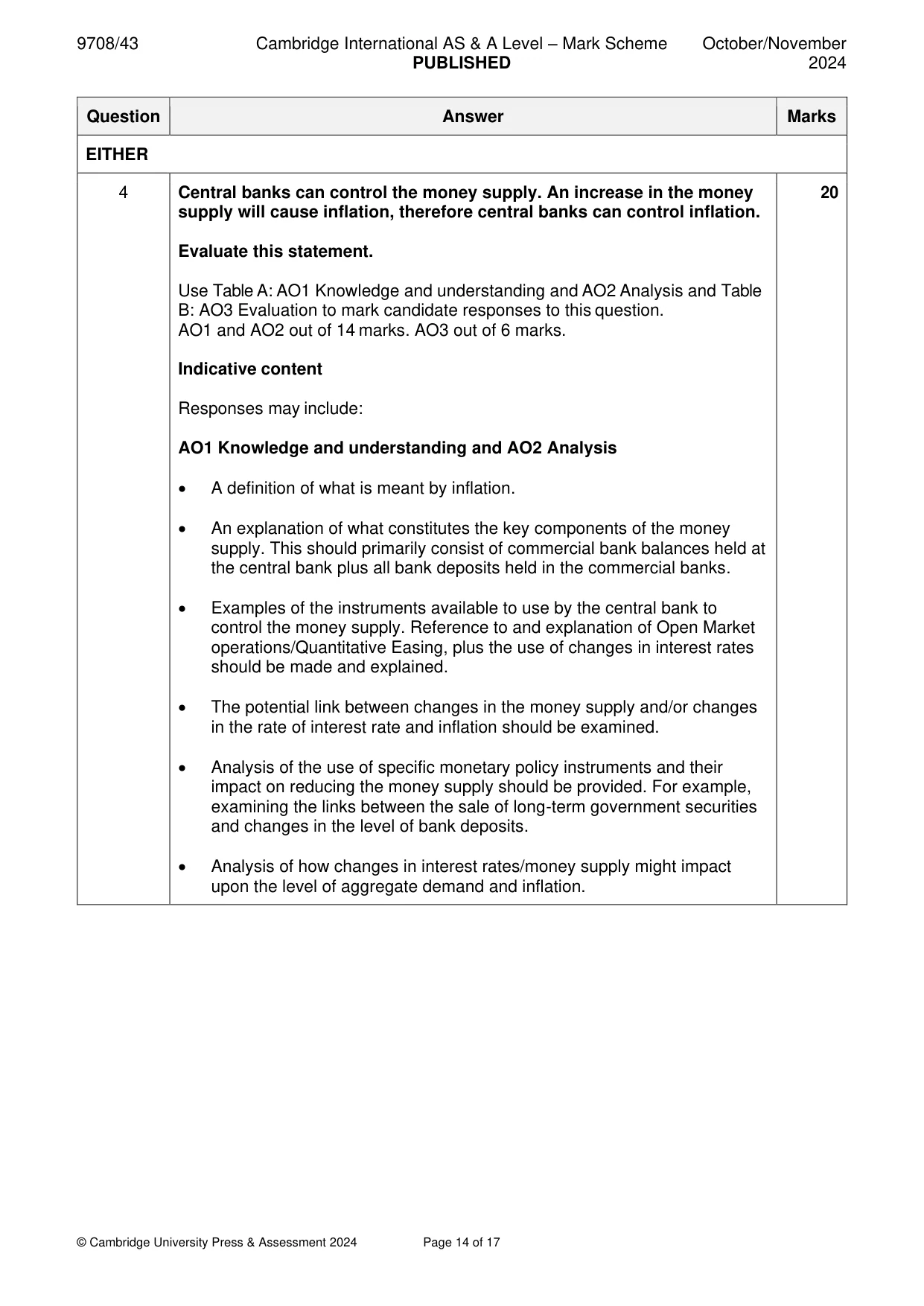
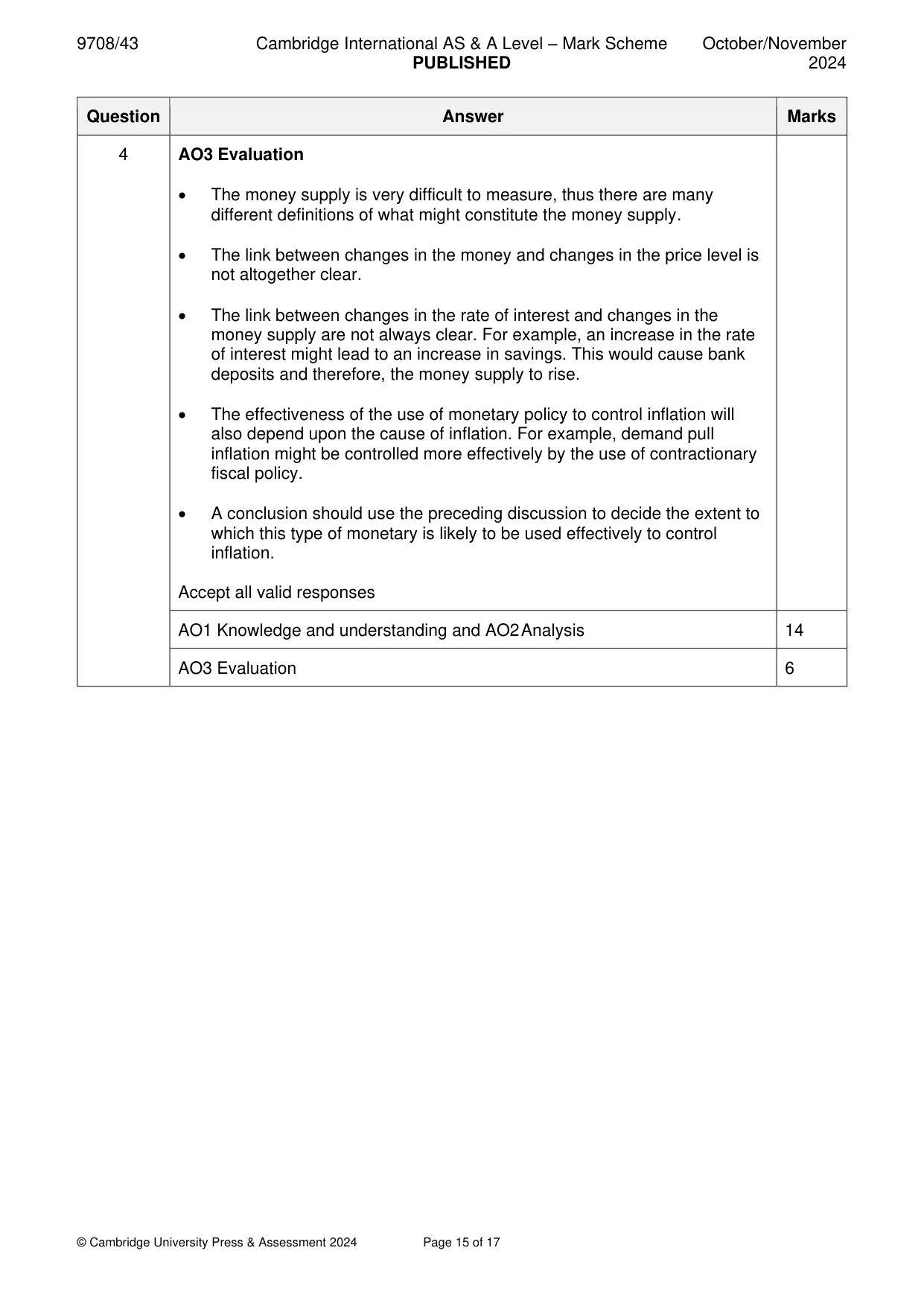
Q4 · Central banks can control the money supply
4 Central banks can control the money supply. An increase in the money supply will cause inflation, therefore central banks can control inflation. Evaluate this statement. [20] OR
Mark scheme: 4 Central banks can control the money supply. An increase in the money 20 supply will cause inflation, therefore central banks can control inflation. Evaluate this statement. Use Table A: AO1 Knowledge and understanding and AO2 Analysis and Table B: AO3 Evaluation to mark candidate responses to this question. AO1 and AO2 out of 14 marks. AO3 out of 6 marks. Indicative content Responses may include: AO1 Knowledge and understanding and AO2 Analysis • A definition of what is meant by inflation. • An explanation of what constitutes the key components of the money supply. This should primarily consist of commercial bank balances held at the central bank plus all bank deposits held in the commercial banks. • Examples of the instruments available to use by the central bank to control the money supply. Reference to and explanation of Open Market operations/Quantitative Easing, plus the use of changes in interest rates should be made and explained. • The potential link between changes in the money supply and/or changes in the rate of interest rate and inflation should be examined. • Analysis of the use of specific monetary policy instruments and their impact on reducing the money supply should be provided. For example, examining the links between the sale of long-term government securities and changes in the level of bank deposits. • Analysis of how changes in interest rates/money supply might impact upon the level of aggregate demand and inflation. 4 AO3 Evaluation • The money supply is very difficult to measure, thus there are many different definitions of what might constitute the money supply. • The link between changes in the money and changes in the price level is not altogether clear. • The link between changes in the rate of interest and changes in the money supply are not always clear. For example, an increase in the rate of interest might lead to an increase in savings. This would cause bank deposits and therefore, the money supply to rise. • The effectiveness of the use of monetary policy to control inflation will also depend upon the cause of inflation. For example, demand pull inflation might be controlled more effectively by the use of contractionary fiscal policy. • A conclusion should use the preceding discussion to decide the extent to which this type of monetary is likely to be used effectively to control inflation. Accept all valid responses AO1 Knowledge and understanding and AO2 Analysis 14 AO3 Evaluation 6
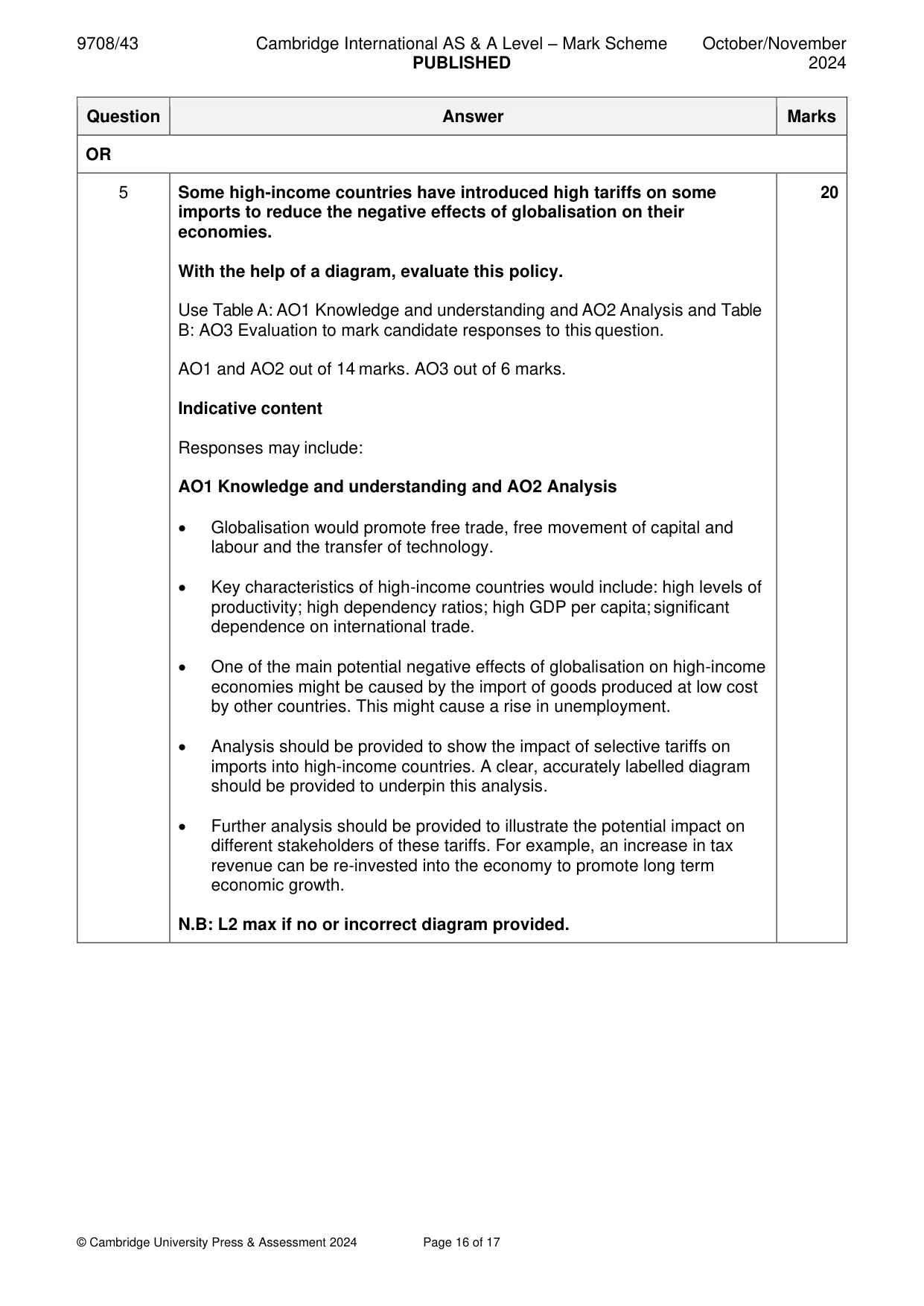
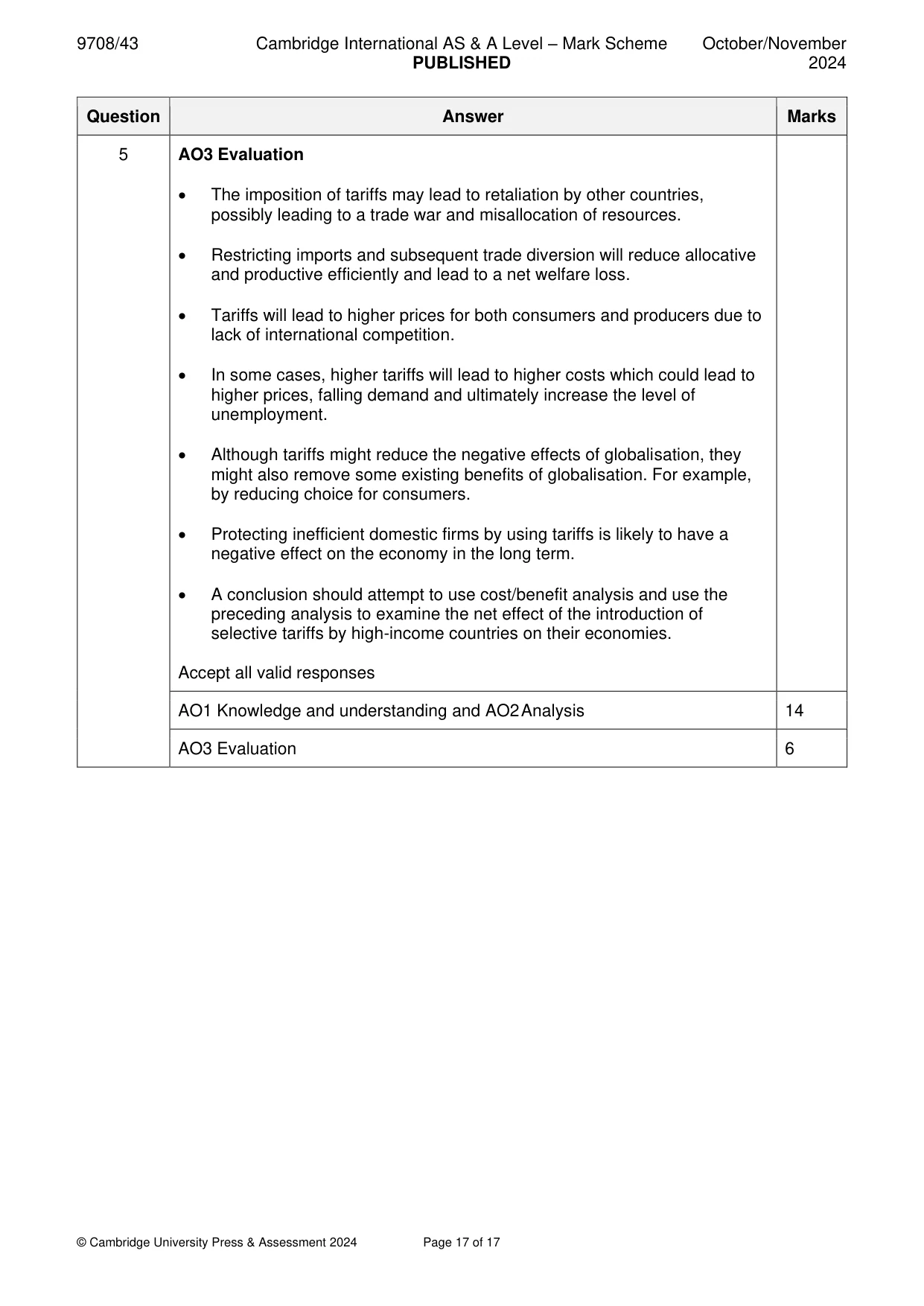
Q5 · Some high-income countries have introduced a policy of high tariffs on some imports to…
5 Some high-income countries have introduced a policy of high tariffs on some imports to reduce the negative effects of globalisation on their economies. With the help of a diagram, evaluate this policy. [20]
Mark scheme: 5 Some high-income countries have introduced high tariffs on some 20 imports to reduce the negative effects of globalisation on their economies. With the help of a diagram, evaluate this policy. Use Table A: AO1 Knowledge and understanding and AO2 Analysis and Table B: AO3 Evaluation to mark candidate responses to this question. AO1 and AO2 out of 14 marks. AO3 out of 6 marks. Indicative content Responses may include: AO1 Knowledge and understanding and AO2 Analysis • Globalisation would promote free trade, free movement of capital and labour and the transfer of technology. • Key characteristics of high-income countries would include: high levels of productivity; high dependency ratios; high GDP per capita; significant dependence on international trade. • One of the main potential negative effects of globalisation on high-income economies might be caused by the import of goods produced at low cost by other countries. This might cause a rise in unemployment. • Analysis should be provided to show the impact of selective tariffs on imports into high-income countries. A clear, accurately labelled diagram should be provided to underpin this analysis. • Further analysis should be provided to illustrate the potential impact on different stakeholders of these tariffs. For example, an increase in tax revenue can be re-invested into the economy to promote long term economic growth. N.B: L2 max if no or incorrect diagram provided. 5 AO3 Evaluation • The imposition of tariffs may lead to retaliation by other countries, possibly leading to a trade war and misallocation of resources. • Restricting imports and subsequent trade diversion will reduce allocative and productive efficiently and lead to a net welfare loss. • Tariffs will lead to higher prices for both consumers and producers due to lack of international competition. • In some cases, higher tariffs will lead to higher costs which could lead to higher prices, falling demand and ultimately increase the level of unemployment. • Although tariffs might reduce the negative effects of globalisation, they might also remove some existing benefits of globalisation. For example, by reducing choice for consumers. • Protecting inefficient domestic firms by using tariffs is likely to have a negative effect on the economy in the long term. • A conclusion should attempt to use cost/benefit analysis and use the preceding analysis to examine the net effect of the introduction of selective tariffs by high-income countries on their economies. Accept all valid responses AO1 Knowledge and understanding and AO2 Analysis 14 AO3 Evaluation 6
What was in this paper
The subtopics covered by these 5 questions, and how many questions each got. Open one in a new tab to see every Cambridge question on it.
What you needed in this session
Cambridge’s own grade thresholds for 2024 Oct/Nov, Paper 4 · Variant 3. A higher threshold means an easier paper — the bar moves with how the cohort did.