Cambridge A Level Economics 9708 — 2017 May/June Paper 4 · Variant 3
9708/43/M/J/17 · 7 questions · 70 marks · ≈79 min
The question paper and its mark scheme, free to read here and free to download. This is Cambridge’s own paper, exactly as it was sat.
Question paper4 pages


Mark scheme9 pages
Answers below. Sit the paper first if you are practising.




Questions as text
Q1 · Pay and the rate of inflation In the United Kingdom (UK) in the last three months of 2014…
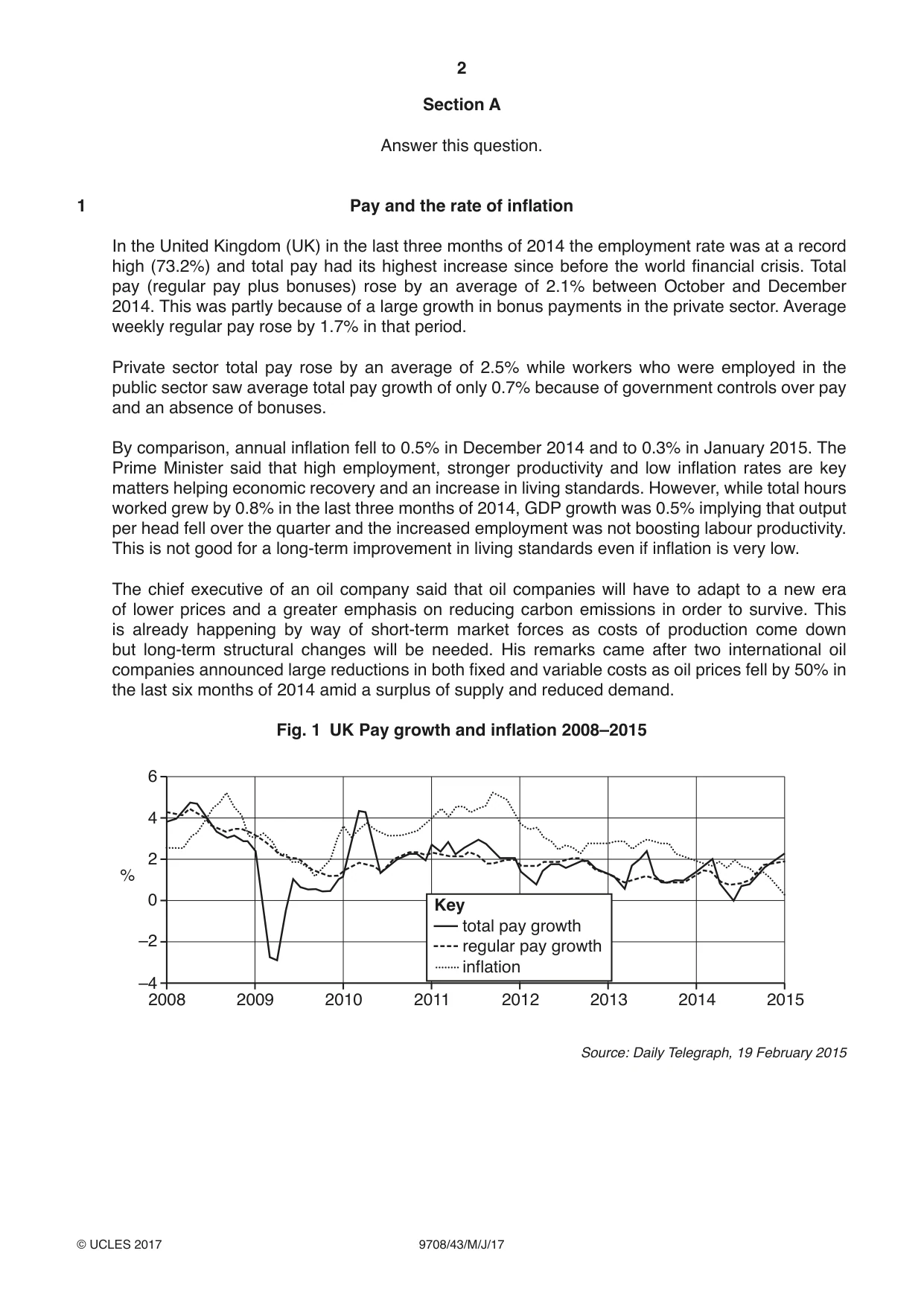
1 Pay and the rate of inflation In the United Kingdom (UK) in the last three months of 2014 the employment rate was at a record high (73.2%) and total pay had its highest increase since before the world financial crisis. Total pay (regular pay plus bonuses) rose by an average of 2.1% between October and December 2014. This was partly because of a large growth in bonus payments in the private sector. Average weekly regular pay rose by 1.7% in that period. Private sector total pay rose by an average of 2.5% while workers who were employed in the public sector saw average total pay growth of only 0.7% because of government controls over pay and an absence of bonuses. By comparison, annual inflation fell to 0.5% in December 2014 and to 0.3% in January 2015. The Prime Minister said that high employment, stronger productivity and low inflation rates are key matters helping economic recovery and an increase in living standards. However, while total hours worked grew by 0.8% in the last three months of 2014, GDP growth was 0.5% implying that output per head fell over the quarter and the increased employment was not boosting labour productivity. This is not good for a long-term improvement in living standards even if inflation is very low. The chief executive of an oil company said that oil companies will have to adapt to a new era of lower prices and a greater emphasis on reducing carbon emissions in order to survive. This is already happening by way of short-term market forces as costs of production come down but long-term structural changes will be needed. His remarks came after two international oil companies announced large reductions in both fixed and variable costs as oil prices fell by 50% in the last six months of 2014 amid a surplus of supply and reduced demand. Fig. 1 UK Pay growth and inflation 2008–2015 6 4 2 % 0 Key total pay growth –2 regular pay growth inflation –4 2008 2009 2010 2011 2012 2013 2014 2015 Source: Daily Telegraph, 19 February 2015 (a) The article says that public sector workers had an average increase in pay of 0.7% compared with a 2.5% increase for private sector workers. State two reasons given in the information for this. [2] (b) “In 2014, despite the rise in earnings, both regular pay and real total pay have gradually fallen since 2008.” Use Fig. 1 to determine whether or not this is true. [5] (c) In January 2015 the workforce of an oil company demanded a pay increase. How could the company use the evidence from the information to oppose the demand? [5] (d) Discuss why inflation and the rate of growth of total pay are significant economic indicators. [8]
Mark scheme: Question Answer Marks Section A: Data Response 1(a) Any two: 2 • no bonuses in public sector • private sector had bonuses so this increased differential • government policy to control economy/inflation 1(b) • no truth 5 • regular pay always rising, chart shows rate not absolute amount • rose at different rates • Up to 2 marks for: real pay fell except in 2008, small part of 2010, and end of 2014 1(c) • wages always rising 5 • in 2015 wages growth was higher than inflation • inflation down, productivity down • employment up • oil sales down 1(d) Up to 2 marks for each relevant comment. 8 Comments on effect on • demand • expenditure • GDP • international competitiveness • employment rates (Maximum 8 marks)
More questions on Government macroeconomic policy objectives
Q2 · Firms should be allowed to produce in the manner they wish and consumers allowed to buy…
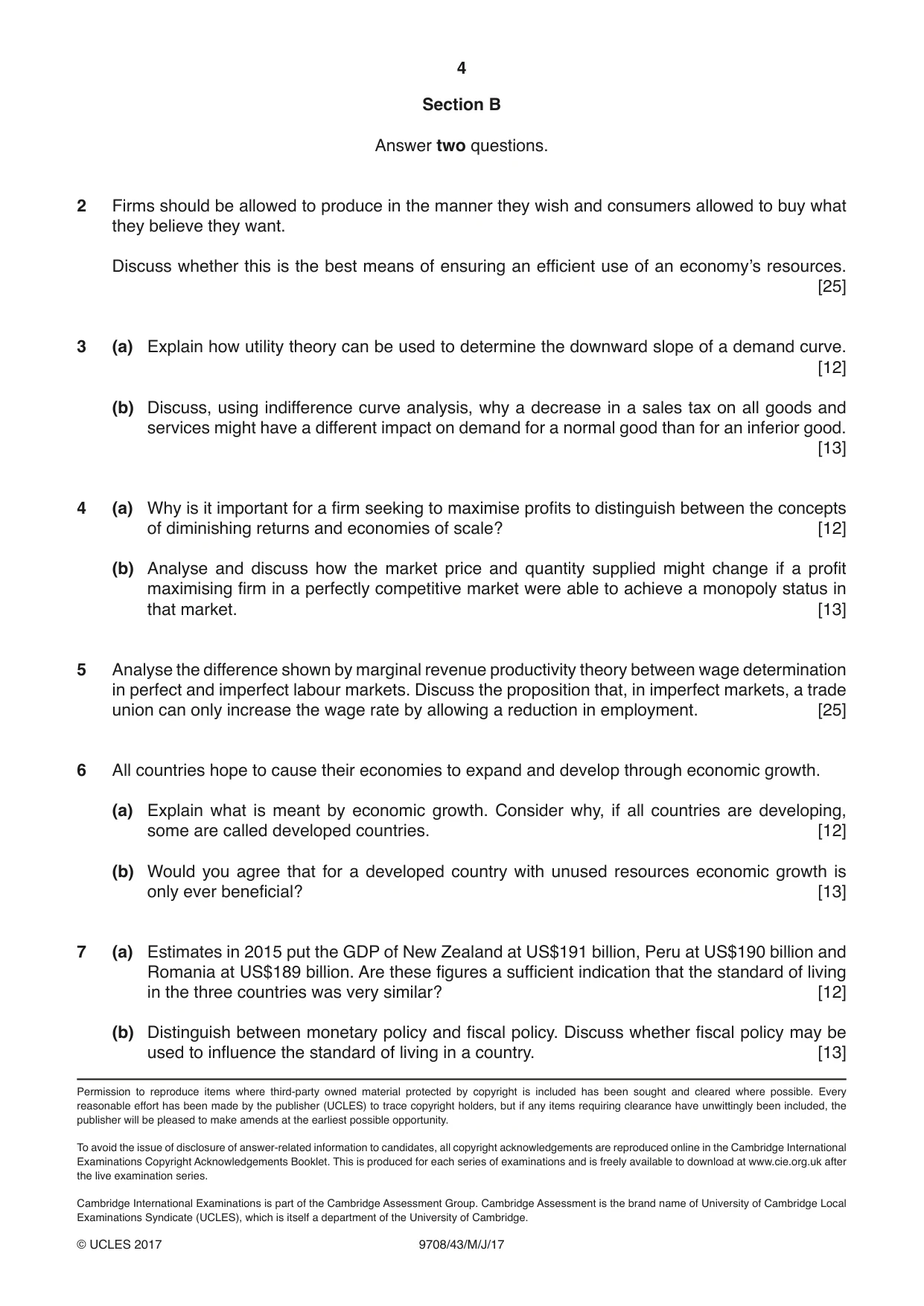
2 Firms should be allowed to produce in the manner they wish and consumers allowed to buy what they believe they want. Discuss whether this is the best means of ensuring an efficient use of an economy’s resources. [25]
Mark scheme: 2 Explanation of meaning of efficient allocation and explanation of the analysis 25 which ensures an efficient optimum may be reached. Distinction between productive and allocative efficiency. Individual actions are not always best for society as a whole. Discussion of reasons for market failure and necessity/desirability of government intervention to achieve efficiency. This could be by persuasion (nudge theory) rather than by enforcement. Nudge theory, originally an ethical idea not a government manipulative tool, involves designing choices to encourage decision making in wider positive interests of society. But it can be used in government context. Level 4 (18-25 marks): for a thorough explanation and a reasoned discussion dealing with both aspects of efficiency and possible reasons for market failure/government intervention. A conclusion should be drawn. Level 3 (14-17 marks): for a competent explanation of the terms with accurate but limited discussion. Level 2 (10-13 marks): for a correct but undeveloped explanation with some attempt at analysis but only brief discussion with no conclusion. Level 1 (1-9 marks): For an answer that shows some knowledge but does not indicate that the question has been fully grasped or where the answer is mostly irrelevant.
Q3 · Explain how utility theory can be used to determine the downward slope of a demand curve
3 (a) Explain how utility theory can be used to determine the downward slope of a demand curve. [12] (b) Discuss, using indifference curve analysis, why a decrease in a sales tax on all goods and services might have a different impact on demand for a normal good than for an inferior good. [13]
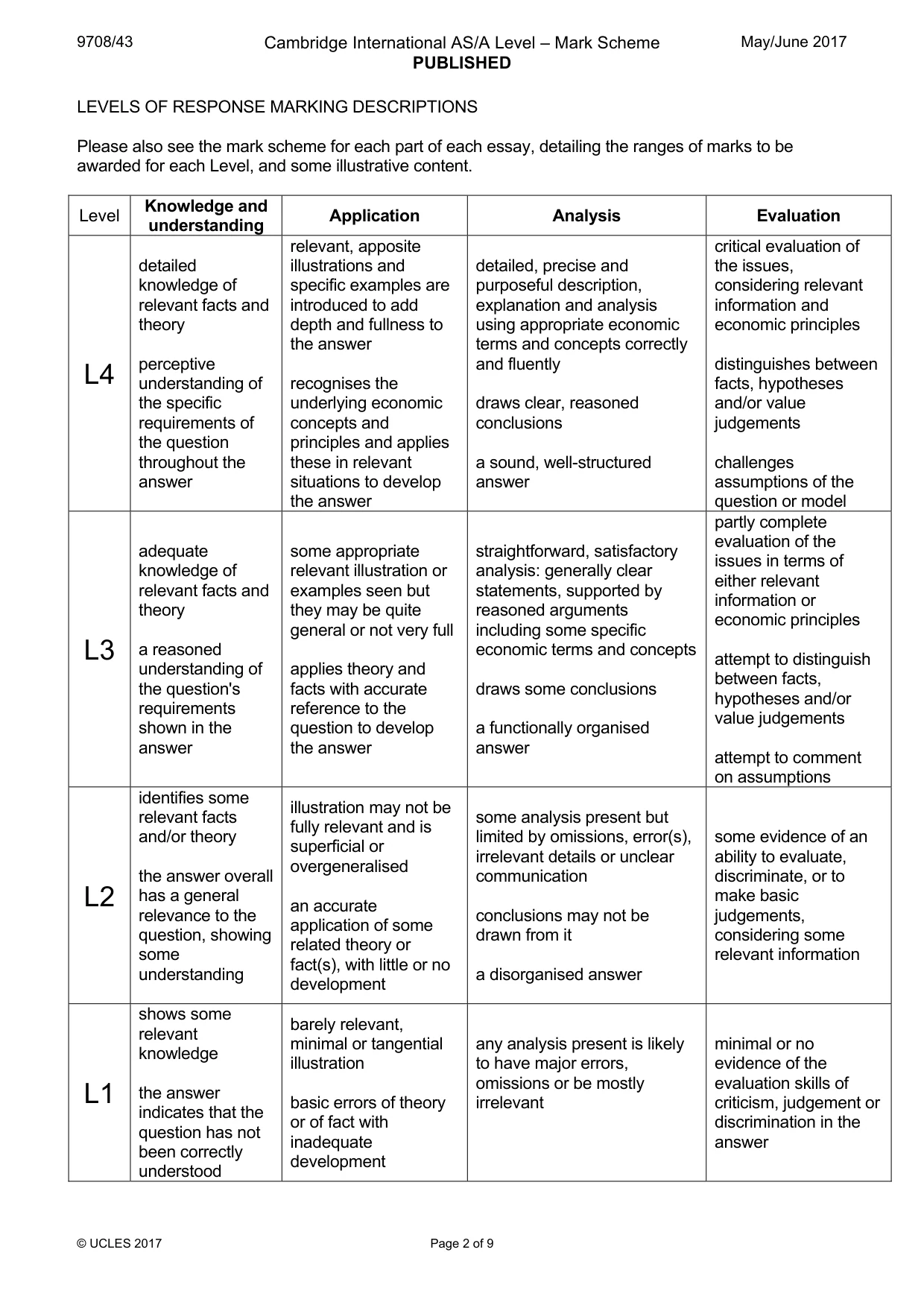
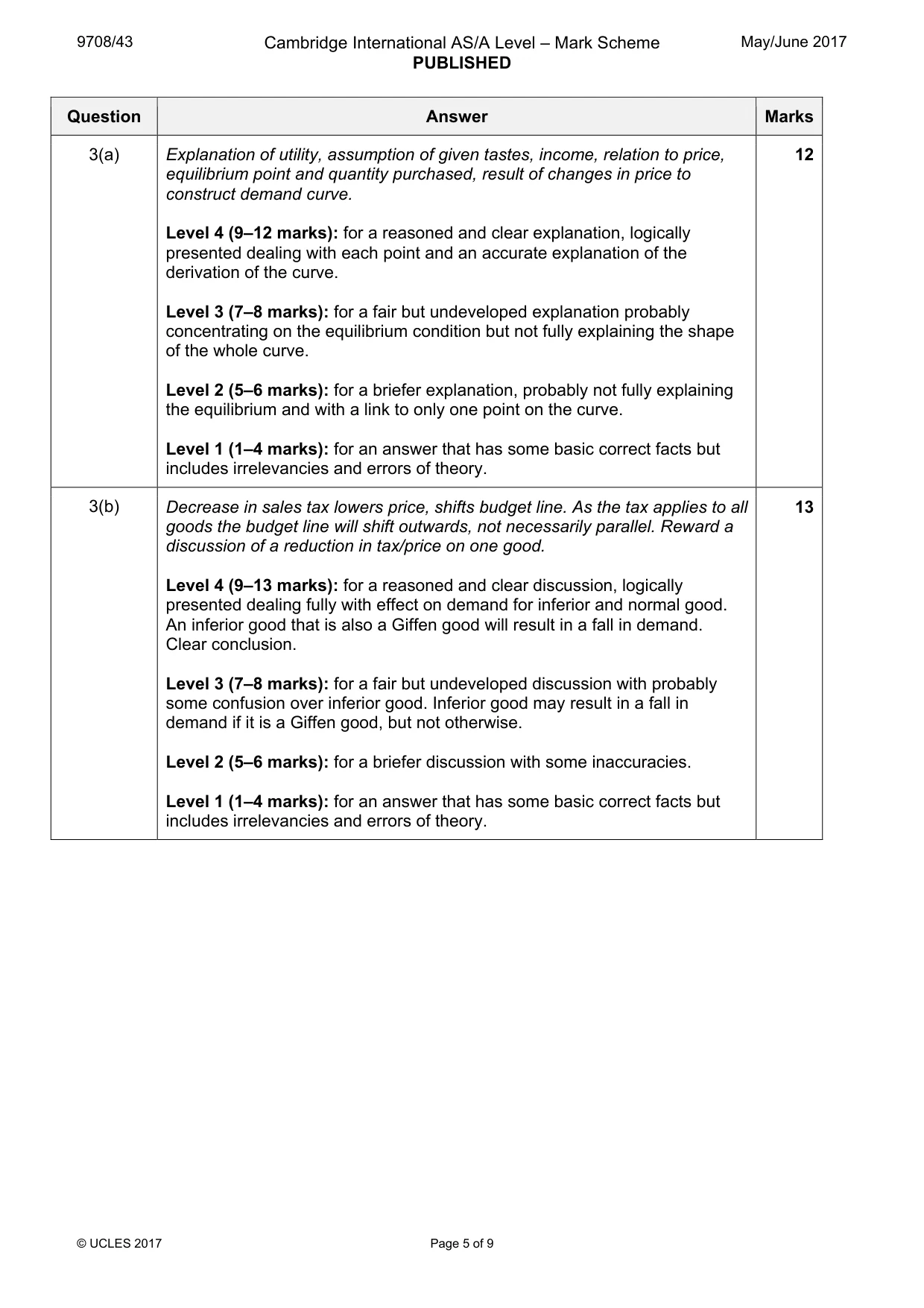
Mark scheme: 3(a) Explanation of utility, assumption of given tastes, income, relation to price, 12 equilibrium point and quantity purchased, result of changes in price to construct demand curve. Level 4 (9–12 marks): for a reasoned and clear explanation, logically presented dealing with each point and an accurate explanation of the derivation of the curve. Level 3 (7–8 marks): for a fair but undeveloped explanation probably concentrating on the equilibrium condition but not fully explaining the shape of the whole curve. Level 2 (5–6 marks): for a briefer explanation, probably not fully explaining the equilibrium and with a link to only one point on the curve. Level 1 (1–4 marks): for an answer that has some basic correct facts but includes irrelevancies and errors of theory. 3(b) Decrease in sales tax lowers price, shifts budget line. As the tax applies to all 13 goods the budget line will shift outwards, not necessarily parallel. Reward a discussion of a reduction in tax/price on one good. Level 4 (9–13 marks): for a reasoned and clear discussion, logically presented dealing fully with effect on demand for inferior and normal good. An inferior good that is also a Giffen good will result in a fall in demand. Clear conclusion. Level 3 (7–8 marks): for a fair but undeveloped discussion with probably some confusion over inferior good. Inferior good may result in a fall in demand if it is a Giffen good, but not otherwise. Level 2 (5–6 marks): for a briefer discussion with some inaccuracies. Level 1 (1–4 marks): for an answer that has some basic correct facts but includes irrelevancies and errors of theory.
Q4 · Why is it important for a firm seeking to maximise profits to distinguish between the…
4 (a) Why is it important for a firm seeking to maximise profits to distinguish between the concepts of diminishing returns and economies of scale? [12] (b) Analyse and discuss how the market price and quantity supplied might change if a profit maximising firm in a perfectly competitive market were able to achieve a monopoly status in that market. [13]
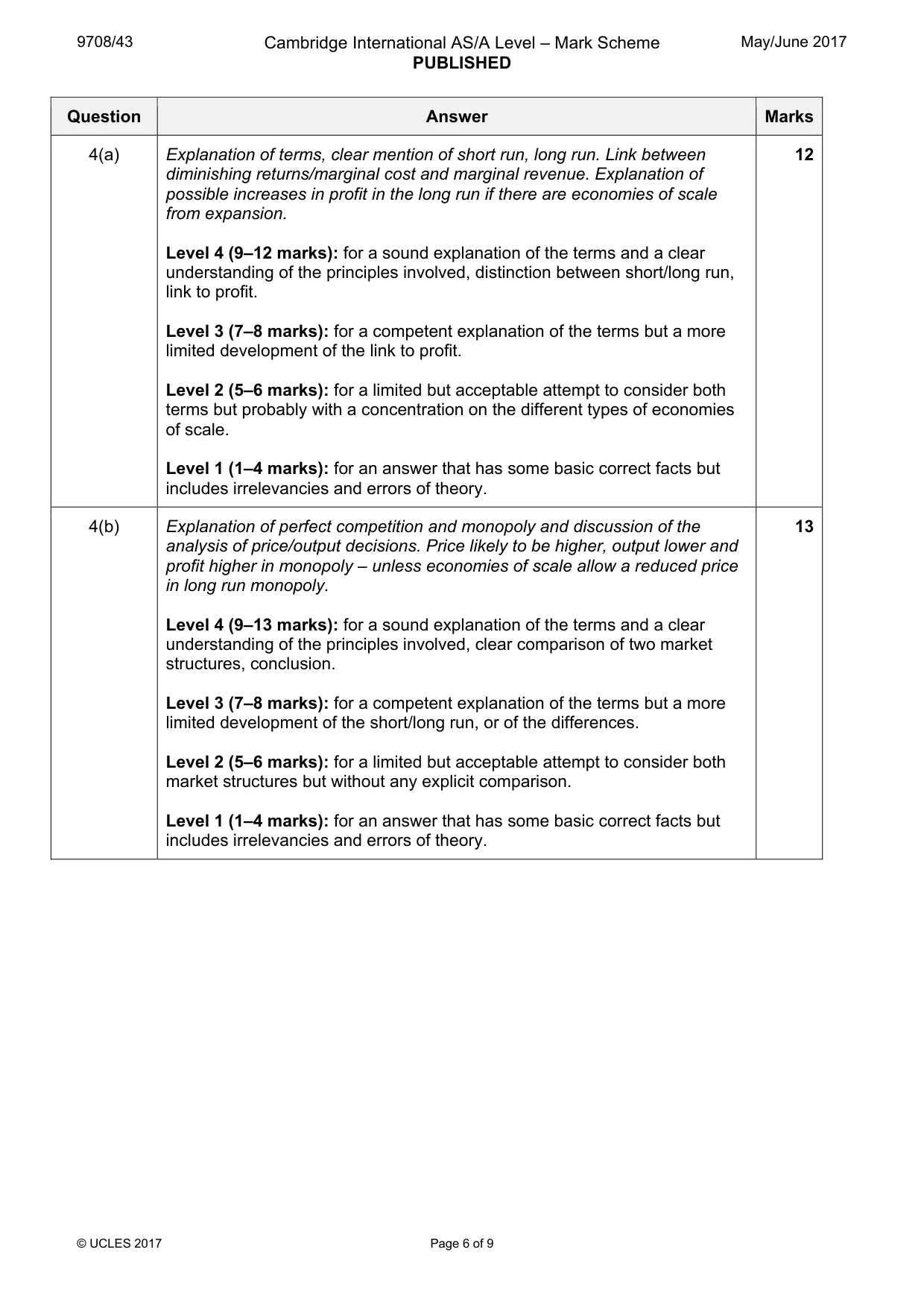
Mark scheme: 4(a) Explanation of terms, clear mention of short run, long run. Link between 12 diminishing returns/marginal cost and marginal revenue. Explanation of possible increases in profit in the long run if there are economies of scale from expansion. Level 4 (9–12 marks): for a sound explanation of the terms and a clear understanding of the principles involved, distinction between short/long run, link to profit. Level 3 (7–8 marks): for a competent explanation of the terms but a more limited development of the link to profit. Level 2 (5–6 marks): for a limited but acceptable attempt to consider both terms but probably with a concentration on the different types of economies of scale. Level 1 (1–4 marks): for an answer that has some basic correct facts but includes irrelevancies and errors of theory. 4(b) Explanation of perfect competition and monopoly and discussion of the 13 analysis of price/output decisions. Price likely to be higher, output lower and profit higher in monopoly – unless economies of scale allow a reduced price in long run monopoly. Level 4 (9–13 marks): for a sound explanation of the terms and a clear understanding of the principles involved, clear comparison of two market structures, conclusion. Level 3 (7–8 marks): for a competent explanation of the terms but a more limited development of the short/long run, or of the differences. Level 2 (5–6 marks): for a limited but acceptable attempt to consider both market structures but without any explicit comparison. Level 1 (1–4 marks): for an answer that has some basic correct facts but includes irrelevancies and errors of theory.
Q5 · Analyse the difference shown by marginal revenue productivity theory between wage…
5 Analyse the difference shown by marginal revenue productivity theory between wage determination in perfect and imperfect labour markets. Discuss the proposition that, in imperfect markets, a trade union can only increase the wage rate by allowing a reduction in employment. [25]
Mark scheme: 5 Analysis of difference between perfect competitive factor markets and 25 imperfectly competitive markets. Wages may be increased by unions in imperfect markets without decreasing unemployment as long as it doesn’t rise above point where mc=mr. This still leaves the firm with abnormal profit. Beyond this point, higher wages will result in a decrease in employment. Level 4 (18–25 marks): for a critique of the statement and a thorough explanation of the analysis of wage determination with a clear comparison of perfect and imperfect markets. The conclusion about employment should be clearly stated. Level 3 (14–17 marks): for a weaker critique of the statement but a competent explanation of imperfect market wage determination together with a conclusion. Level 2 (10–13 marks): for a correct but undeveloped analysis with only a brief consideration of the employment position and no real conclusion. Level 1 (1–9 marks): for an answer that shows some knowledge but does not indicate that the question has been fully grasped or where the answer is mostly irrelevant.
More questions on Labour market forces and government intervention
Q6 · All countries hope to cause their economies to expand and develop through economic growth
6 All countries hope to cause their economies to expand and develop through economic growth. (a) Explain what is meant by economic growth. Consider why, if all countries are developing, some are called developed countries. [12] (b) Would you agree that for a developed country with unused resources economic growth is only ever beneficial? [13]
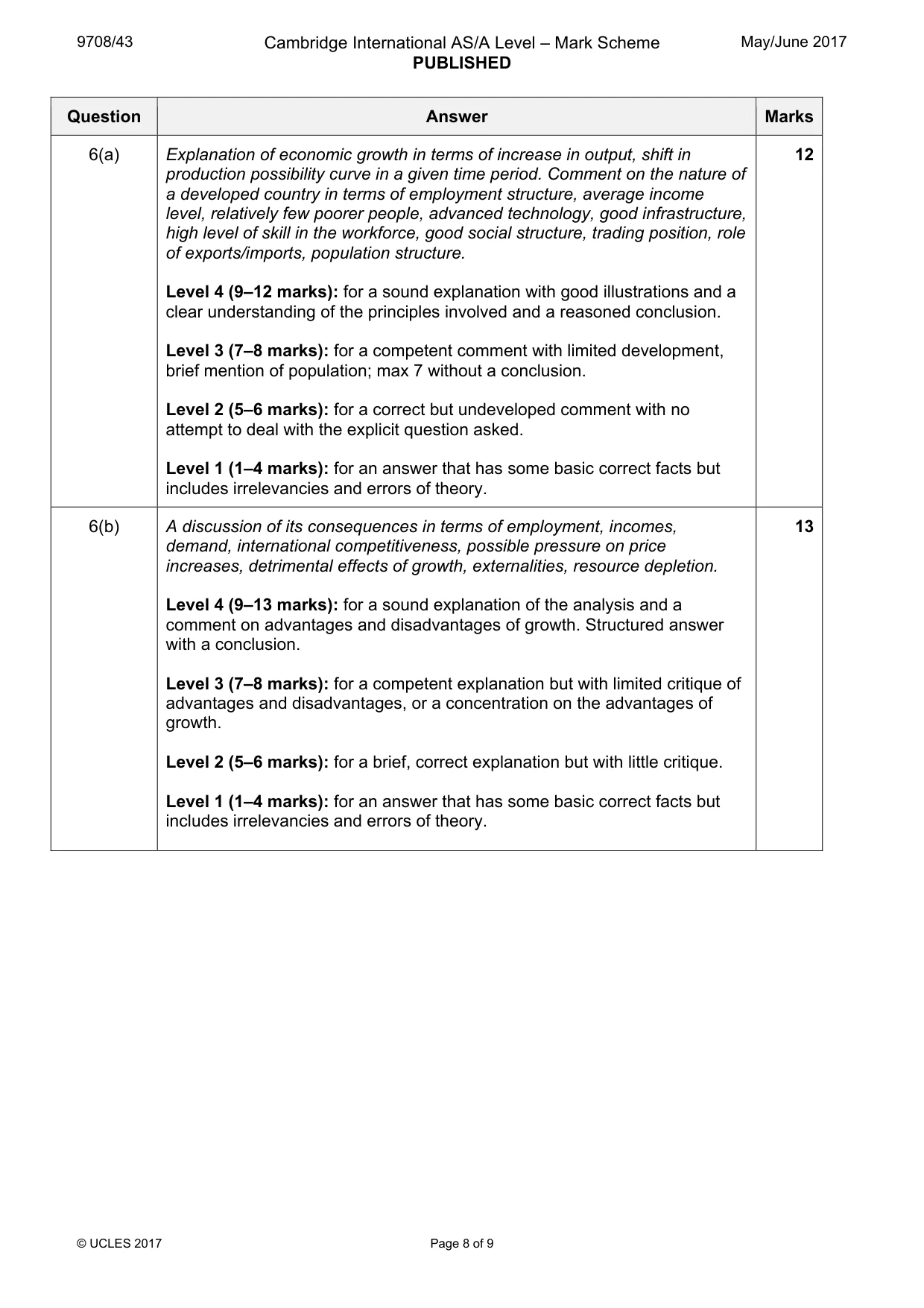
Mark scheme: 6(a) Explanation of economic growth in terms of increase in output, shift in 12 production possibility curve in a given time period. Comment on the nature of a developed country in terms of employment structure, average income level, relatively few poorer people, advanced technology, good infrastructure, high level of skill in the workforce, good social structure, trading position, role of exports/imports, population structure. Level 4 (9–12 marks): for a sound explanation with good illustrations and a clear understanding of the principles involved and a reasoned conclusion. Level 3 (7–8 marks): for a competent comment with limited development, brief mention of population; max 7 without a conclusion. Level 2 (5–6 marks): for a correct but undeveloped comment with no attempt to deal with the explicit question asked. Level 1 (1–4 marks): for an answer that has some basic correct facts but includes irrelevancies and errors of theory. 6(b) A discussion of its consequences in terms of employment, incomes, 13 demand, international competitiveness, possible pressure on price increases, detrimental effects of growth, externalities, resource depletion. Level 4 (9–13 marks): for a sound explanation of the analysis and a comment on advantages and disadvantages of growth. Structured answer with a conclusion. Level 3 (7–8 marks): for a competent explanation but with limited critique of advantages and disadvantages, or a concentration on the advantages of growth. Level 2 (5–6 marks): for a brief, correct explanation but with little critique. Level 1 (1–4 marks): for an answer that has some basic correct facts but includes irrelevancies and errors of theory.
Q7 · Estimates in 2015 put the GDP of New Zealand at US$191 billion, Peru at US$190 billion…
7 (a) Estimates in 2015 put the GDP of New Zealand at US$191 billion, Peru at US$190 billion and Romania at US$189 billion. Are these figures a sufficient indication that the standard of living in the three countries was very similar? [12] (b) Distinguish between monetary policy and fiscal policy. Discuss whether fiscal policy may be used to influence the standard of living in a country. [13]
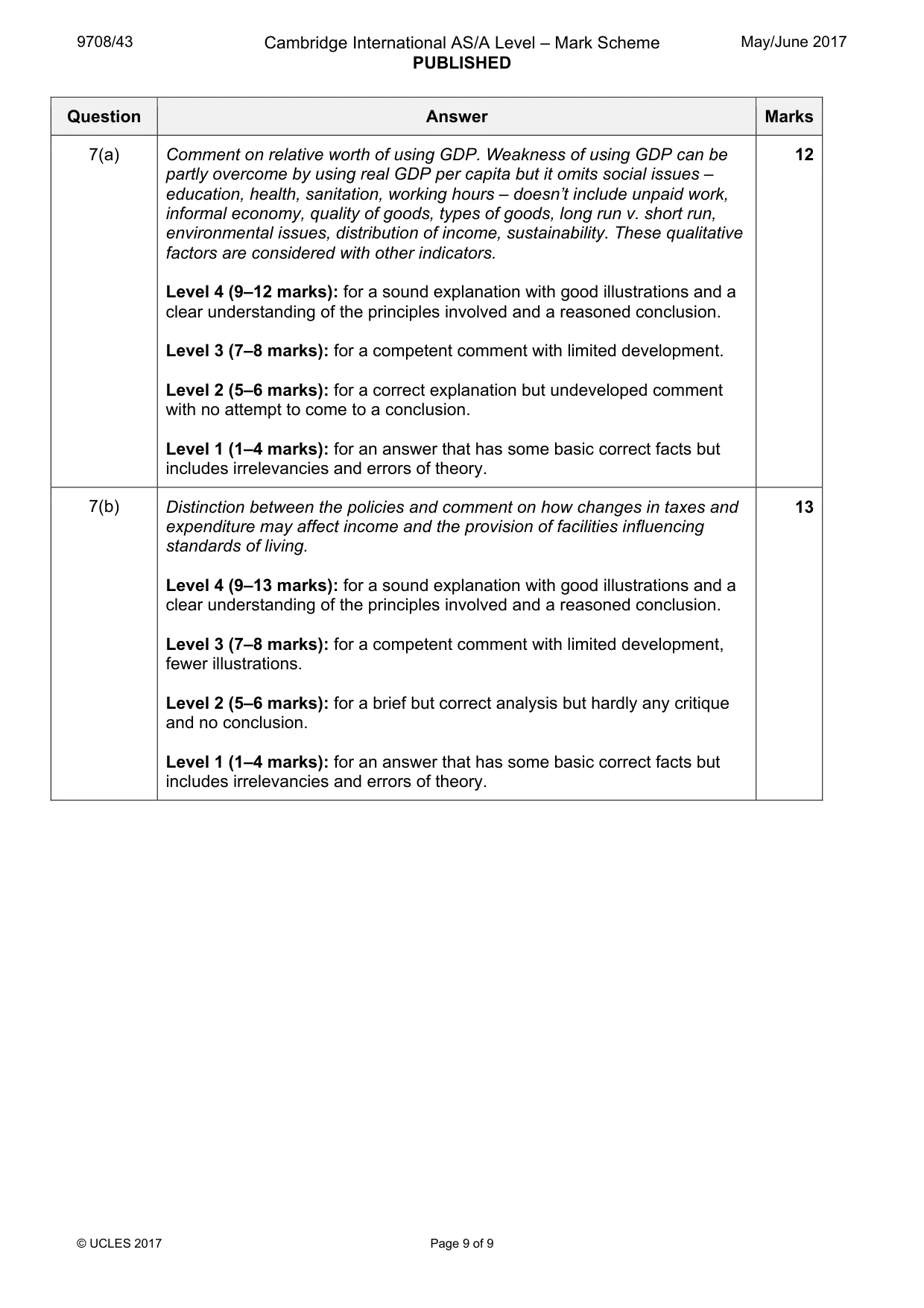
Mark scheme: 7(a) Comment on relative worth of using GDP. Weakness of using GDP can be 12 partly overcome by using real GDP per capita but it omits social issues – education, health, sanitation, working hours – doesn’t include unpaid work, informal economy, quality of goods, types of goods, long run v. short run, environmental issues, distribution of income, sustainability. These qualitative factors are considered with other indicators. Level 4 (9–12 marks): for a sound explanation with good illustrations and a clear understanding of the principles involved and a reasoned conclusion. Level 3 (7–8 marks): for a competent comment with limited development. Level 2 (5–6 marks): for a correct explanation but undeveloped comment with no attempt to come to a conclusion. Level 1 (1–4 marks): for an answer that has some basic correct facts but includes irrelevancies and errors of theory. 7(b) Distinction between the policies and comment on how changes in taxes and 13 expenditure may affect income and the provision of facilities influencing standards of living. Level 4 (9–13 marks): for a sound explanation with good illustrations and a clear understanding of the principles involved and a reasoned conclusion. Level 3 (7–8 marks): for a competent comment with limited development, fewer illustrations. Level 2 (5–6 marks): for a brief but correct analysis but hardly any critique and no conclusion. Level 1 (1–4 marks): for an answer that has some basic correct facts but includes irrelevancies and errors of theory.
What was in this paper
The subtopics covered by these 7 questions, and how many questions each got. Open one in a new tab to see every Cambridge question on it.
What you needed in this session
Cambridge’s own grade thresholds for 2017 May/June, Paper 4 · Variant 3. A higher threshold means an easier paper — the bar moves with how the cohort did.