Cambridge A Level Divinity 9011 — 2022 Oct/Nov Paper 2 · Variant 2
9011/22/O/N/22 · 100 marks · ≈113 min
The question paper and its mark scheme, free to read here and free to download. This is Cambridge’s own paper, exactly as it was sat.
Question paper4 pages
Mark scheme21 pages
Answers below. Sit the paper first if you are practising.



Paper as text
Question paper, page 1
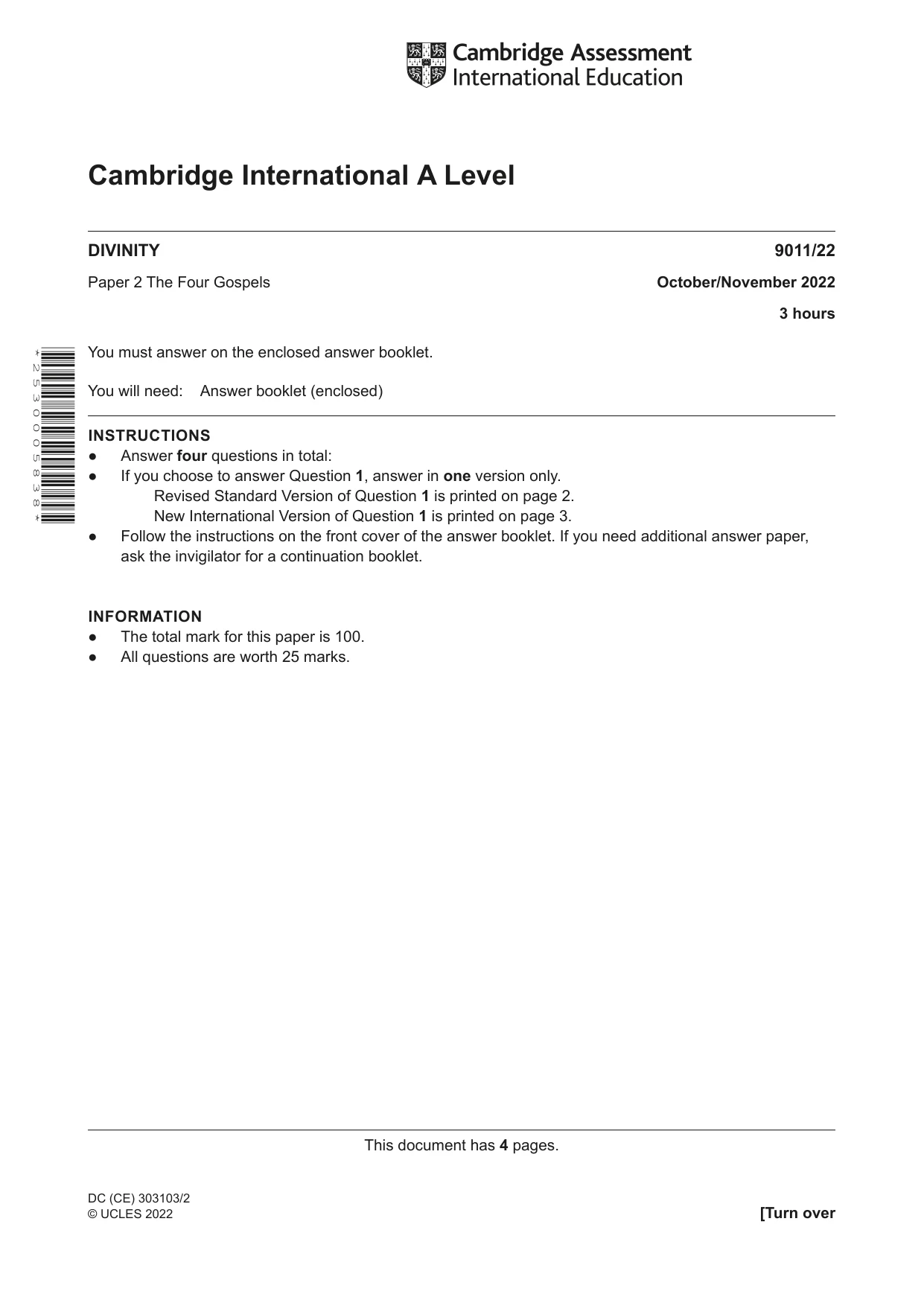
This document has 4 pages. [Turn over Cambridge International A Level * 2 5 3 0 0 0 5 8 3 8 * DC (CE) 303103/2 © UCLES 2022 DIVINITY 9011/22 Paper 2 The Four Gospels October/November 2022 3 hours You must answer on the enclosed answer booklet. You will need: Answer booklet (enclosed) INSTRUCTIONS ● Answer four questions in total: ● If you choose to answer Question 1, answer in one version only. Revised Standard Version of Question 1 is printed on page 2. New International Version of Question 1 is printed on page 3. ● Follow the instructions on the front cover of the answer booklet. If you need additional answer paper, ask the invigilator for a continuation booklet. INFORMATION ● The total mark for this paper is 100. ● All questions are worth 25 marks.
Question paper, page 2
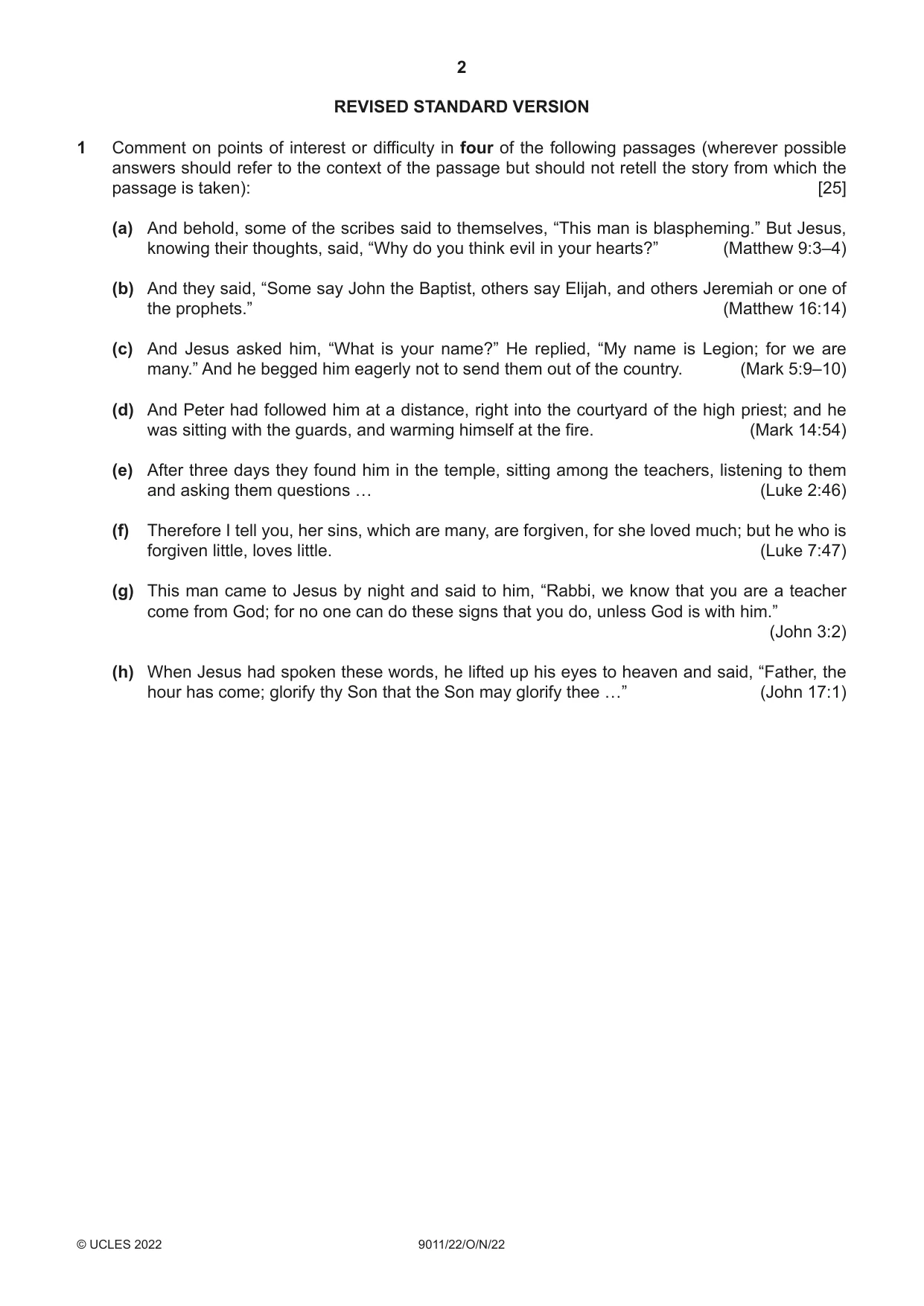
2 9011/22/O/N/22 © UCLES 2022 REVISED STANDARD VERSION 1 Comment on points of interest or difficulty in four of the following passages (wherever possible answers should refer to the context of the passage but should not retell the story from which the passage is taken): [25] (a) And behold, some of the scribes said to themselves, “This man is blaspheming.” But Jesus, knowing their thoughts, said, “Why do you think evil in your hearts?” (Matthew 9:3–4) (b) And they said, “Some say John the Baptist, others say Elijah, and others Jeremiah or one of the prophets.” (Matthew 16:14) (c) And Jesus asked him, “What is your name?” He replied, “My name is Legion; for we are many.” And he begged him eagerly not to send them out of the country. (Mark 5:9–10) (d) And Peter had followed him at a distance, right into the courtyard of the high priest; and he was sitting with the guards, and warming himself at the fire. (Mark 14:54) (e) After three days they found him in the temple, sitting among the teachers, listening to them and asking them questions … (Luke 2:46) (f) Therefore I tell you, her sins, which are many, are forgiven, for she loved much; but he who is forgiven little, loves little. (Luke 7:47) (g) This man came to Jesus by night and said to him, “Rabbi, we know that you are a teacher come from God; for no one can do these signs that you do, unless God is with him.” (John 3:2) (h) When Jesus had spoken these words, he lifted up his eyes to heaven and said, “Father, the hour has come; glorify thy Son that the Son may glorify thee …” (John 17:1)
Question paper, page 3
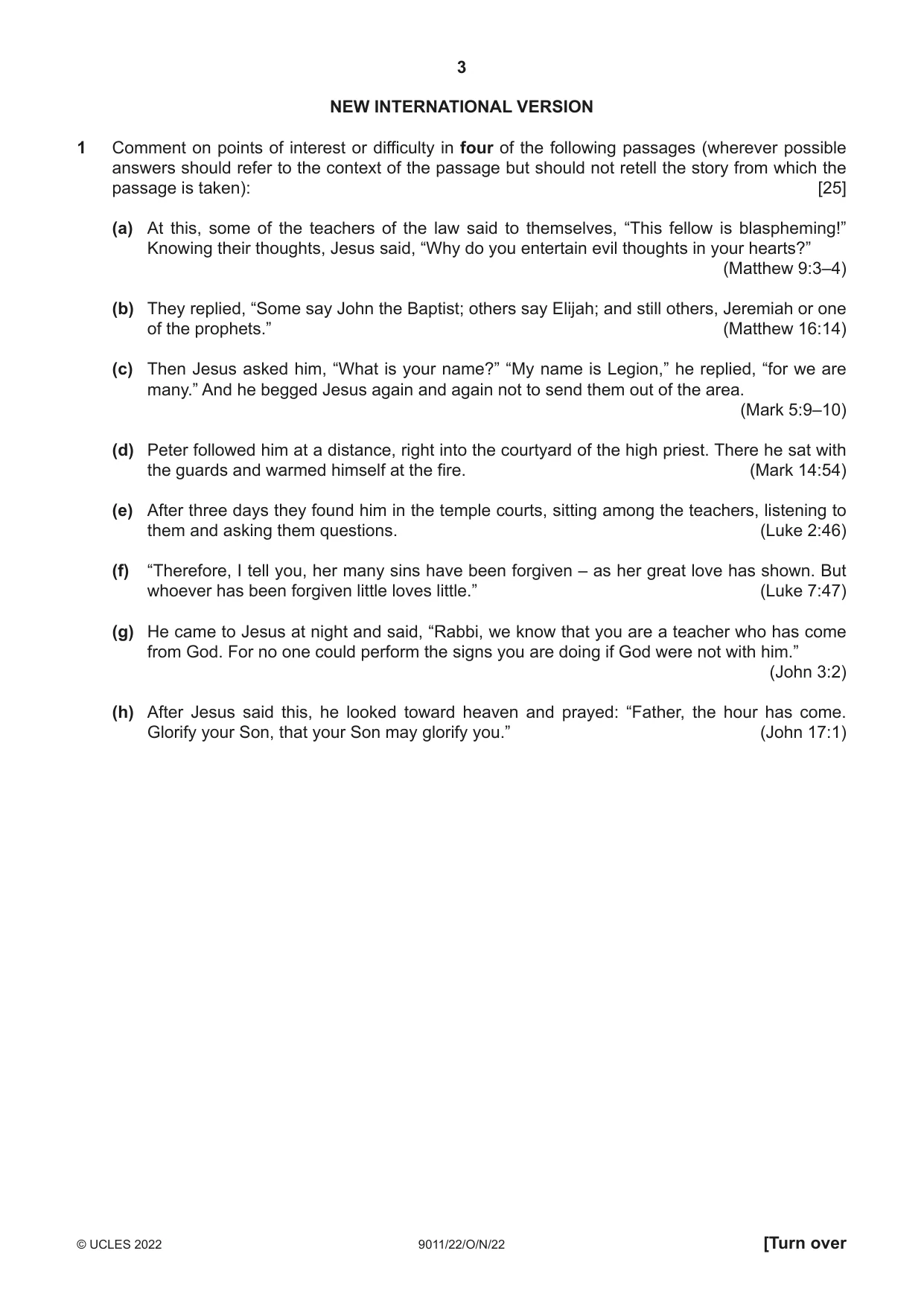
3 9011/22/O/N/22 © UCLES 2022 [Turn over NEW INTERNATIONAL VERSION 1 Comment on points of interest or difficulty in four of the following passages (wherever possible answers should refer to the context of the passage but should not retell the story from which the passage is taken): [25] (a) At this, some of the teachers of the law said to themselves, “This fellow is blaspheming!” Knowing their thoughts, Jesus said, “Why do you entertain evil thoughts in your hearts?” (Matthew 9:3–4) (b) They replied, “Some say John the Baptist; others say Elijah; and still others, Jeremiah or one of the prophets.” (Matthew 16:14) (c) Then Jesus asked him, “What is your name?” “My name is Legion,” he replied, “for we are many.” And he begged Jesus again and again not to send them out of the area. (Mark 5:9–10) (d) Peter followed him at a distance, right into the courtyard of the high priest. There he sat with the guards and warmed himself at the fire. (Mark 14:54) (e) After three days they found him in the temple courts, sitting among the teachers, listening to them and asking them questions. (Luke 2:46) (f) “Therefore, I tell you, her many sins have been forgiven – as her great love has shown. But whoever has been forgiven little loves little.” (Luke 7:47) (g) He came to Jesus at night and said, “Rabbi, we know that you are a teacher who has come from God. For no one could perform the signs you are doing if God were not with him.” (John 3:2) (h) After Jesus said this, he looked toward heaven and prayed: “Father, the hour has come. Glorify your Son, that your Son may glorify you.” (John 17:1)
Question paper, page 4
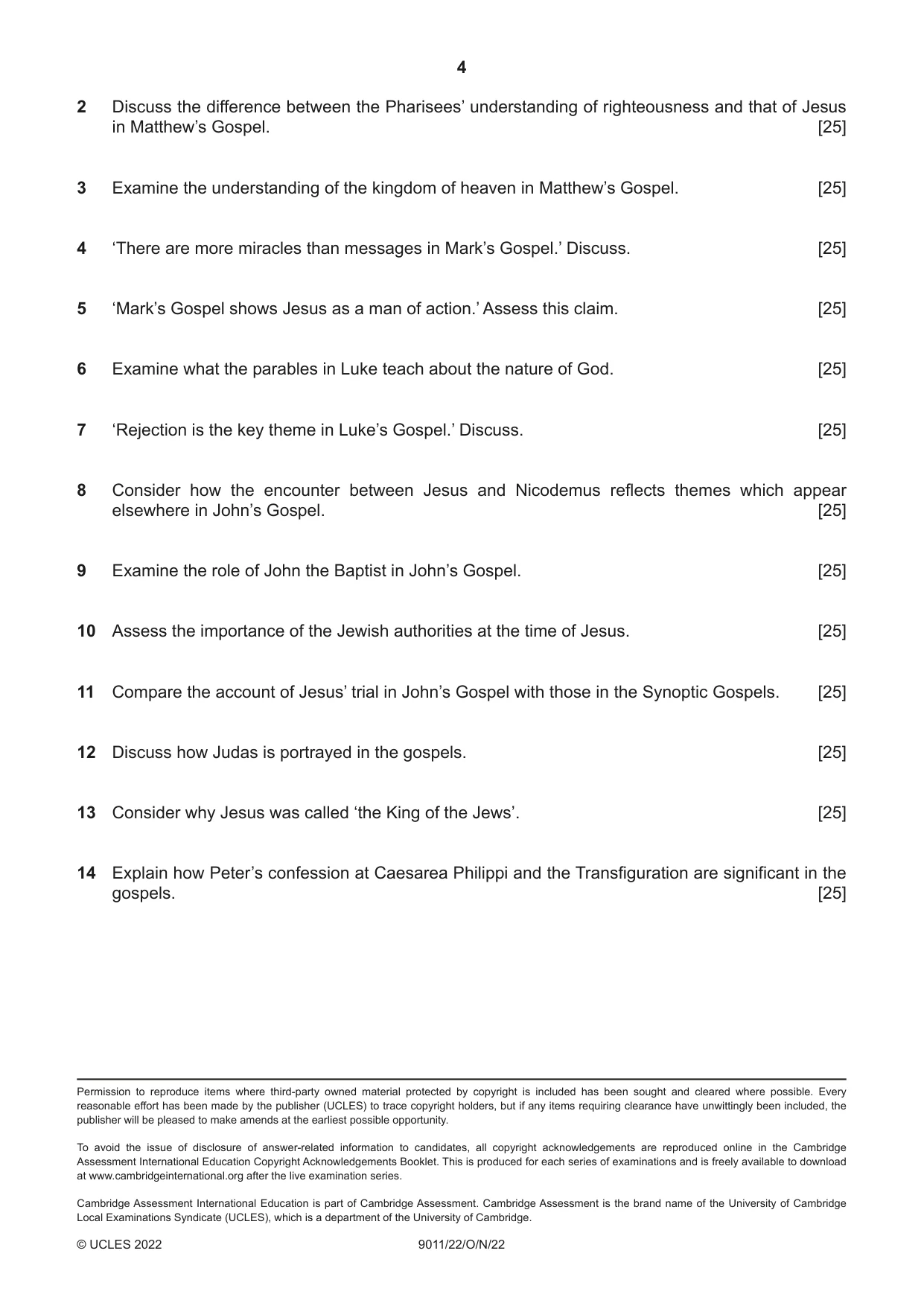
4 9011/22/O/N/22 © UCLES 2022 Permission to reproduce items where third-party owned material protected by copyright is included has been sought and cleared where possible. Every reasonable effort has been made by the publisher (UCLES) to trace copyright holders, but if any items requiring clearance have unwittingly been included, the publisher will be pleased to make amends at the earliest possible opportunity. To avoid the issue of disclosure of answer-related information to candidates, all copyright acknowledgements are reproduced online in the Cambridge Assessment International Education Copyright Acknowledgements Booklet. This is produced for each series of examinations and is freely available to download at www.cambridgeinternational.org after the live examination series. Cambridge Assessment International Education is part of Cambridge Assessment. Cambridge Assessment is the brand name of the University of Cambridge Local Examinations Syndicate (UCLES), which is a department of the University of Cambridge. 2 Discuss the difference between the Pharisees’ understanding of righteousness and that of Jesus in Matthew’s Gospel. [25] 3 Examine the understanding of the kingdom of heaven in Matthew’s Gospel. [25] 4 ‘There are more miracles than messages in Mark’s Gospel.’ Discuss. [25] 5 ‘Mark’s Gospel shows Jesus as a man of action.’ Assess this claim. [25] 6 Examine what the parables in Luke teach about the nature of God. [25] 7 ‘Rejection is the key theme in Luke’s Gospel.’ Discuss. [25] 8 Consider how the encounter between Jesus and Nicodemus reflects themes which appear elsewhere in John’s Gospel. [25] 9 Examine the role of John the Baptist in John’s Gospel. [25] 10 Assess the importance of the Jewish authorities at the time of Jesus. [25] 11 Compare the account of Jesus’ trial in John’s Gospel with those in the Synoptic Gospels. [25] 12 Discuss how Judas is portrayed in the gospels. [25] 13 Consider why Jesus was called ‘the King of the Jews’. [25] 14 Explain how Peter’s confession at Caesarea Philippi and the Transfiguration are significant in the gospels. [25]
Mark scheme, page 1
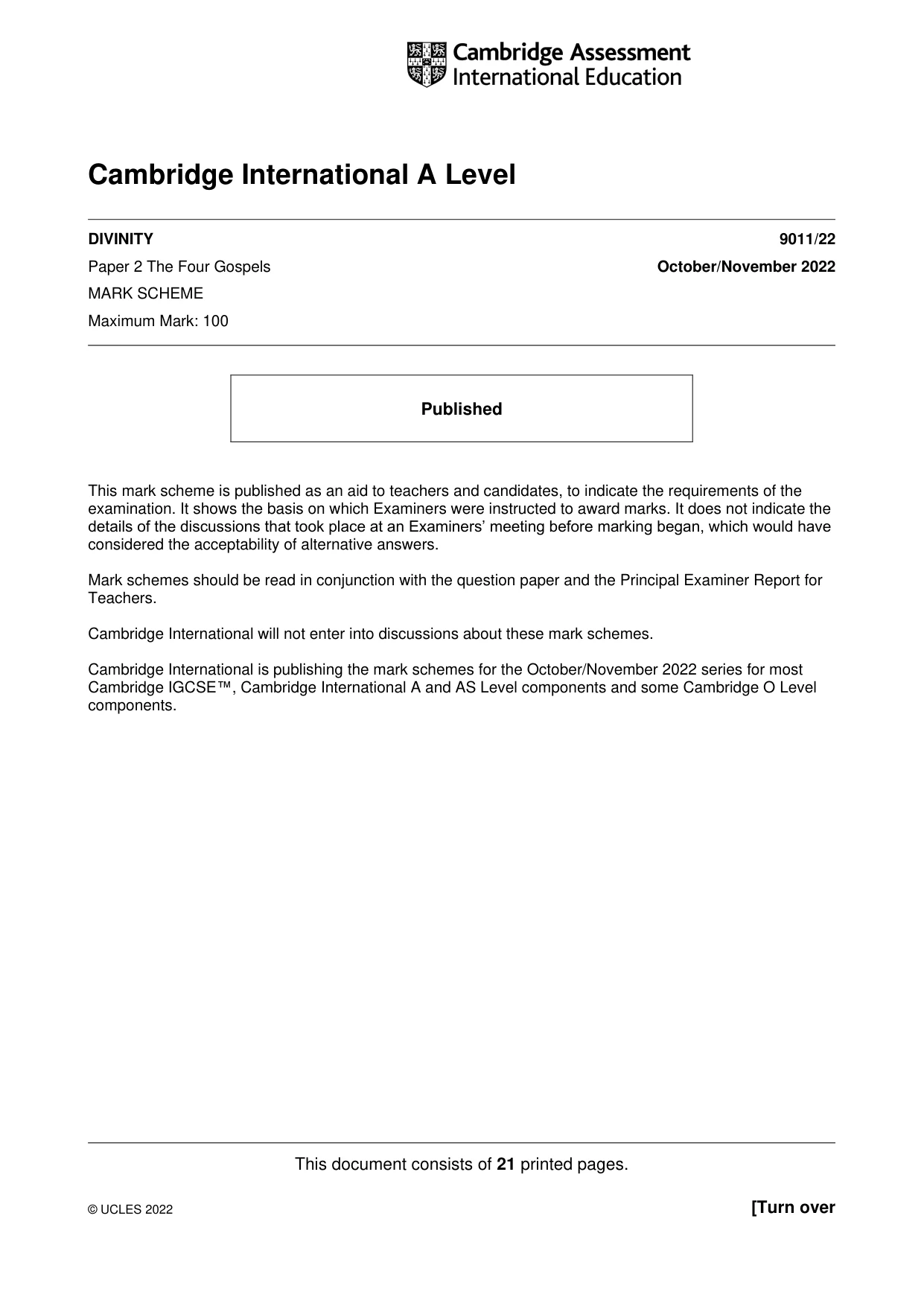
This document consists of 21 printed pages. © UCLES 2022 [Turn over Cambridge International A Level DIVINITY 9011/22 Paper 2 The Four Gospels October/November 2022 MARK SCHEME Maximum Mark: 100 Published This mark scheme is published as an aid to teachers and candidates, to indicate the requirements of the examination. It shows the basis on which Examiners were instructed to award marks. It does not indicate the details of the discussions that took place at an Examiners’ meeting before marking began, which would have considered the acceptability of alternative answers. Mark schemes should be read in conjunction with the question paper and the Principal Examiner Report for Teachers. Cambridge International will not enter into discussions about these mark schemes. Cambridge International is publishing the mark schemes for the October/November 2022 series for most Cambridge IGCSE™, Cambridge International A and AS Level components and some Cambridge O Level components.
Mark scheme, page 2
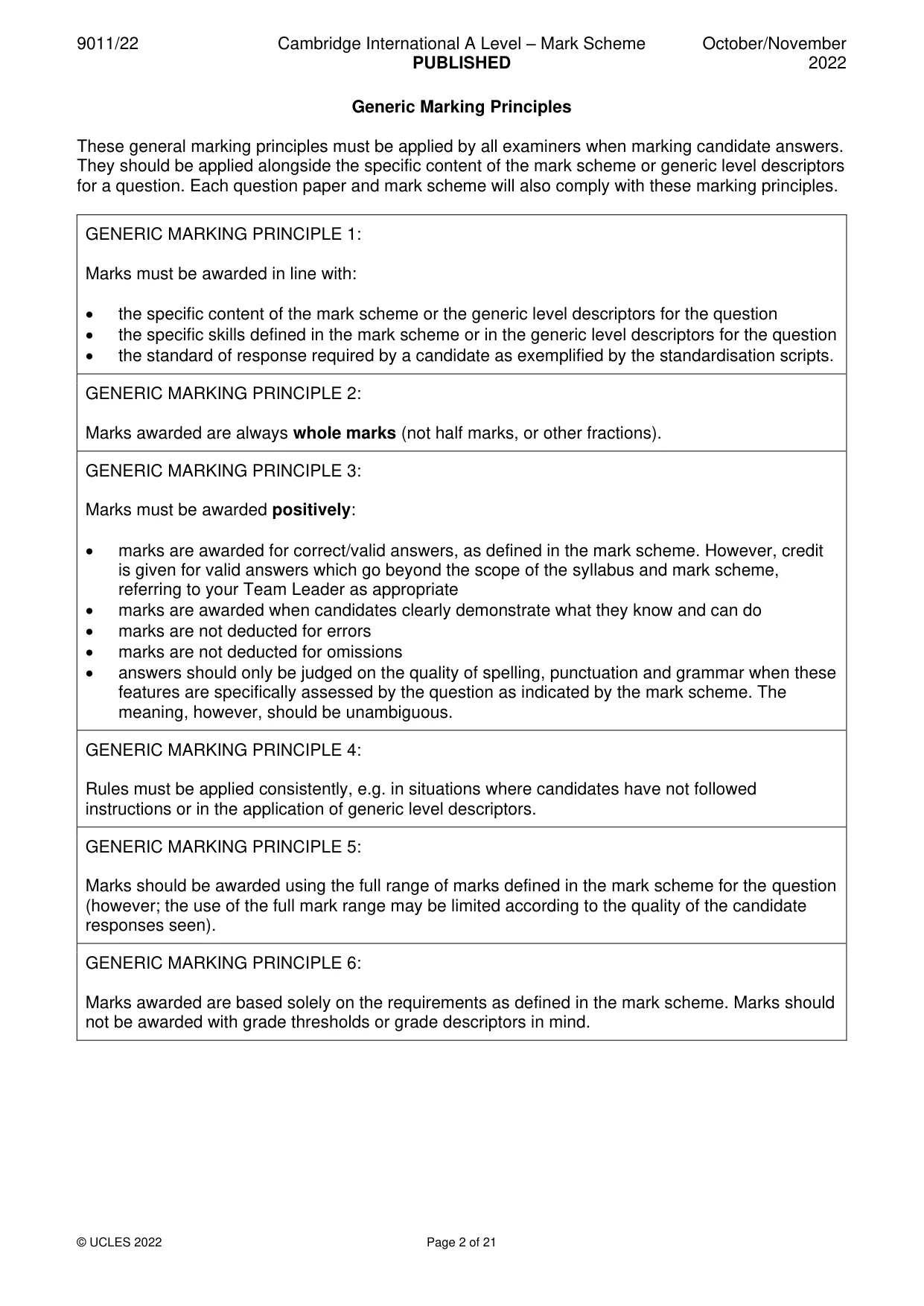
9011/22 Cambridge International A Level – Mark Scheme PUBLISHED October/November 2022 © UCLES 2022 Page 2 of 21 Generic Marking Principles These general marking principles must be applied by all examiners when marking candidate answers. They should be applied alongside the specific content of the mark scheme or generic level descriptors for a question. Each question paper and mark scheme will also comply with these marking principles. GENERIC MARKING PRINCIPLE 1: Marks must be awarded in line with: • the specific content of the mark scheme or the generic level descriptors for the question • the specific skills defined in the mark scheme or in the generic level descriptors for the question • the standard of response required by a candidate as exemplified by the standardisation scripts. GENERIC MARKING PRINCIPLE 2: Marks awarded are always whole marks (not half marks, or other fractions). GENERIC MARKING PRINCIPLE 3: Marks must be awarded positively: • marks are awarded for correct/valid answers, as defined in the mark scheme. However, credit is given for valid answers which go beyond the scope of the syllabus and mark scheme, referring to your Team Leader as appropriate • marks are awarded when candidates clearly demonstrate what they know and can do • marks are not deducted for errors • marks are not deducted for omissions • answers should only be judged on the quality of spelling, punctuation and grammar when these features are specifically assessed by the question as indicated by the mark scheme. The meaning, however, should be unambiguous. GENERIC MARKING PRINCIPLE 4: Rules must be applied consistently, e.g. in situations where candidates have not followed instructions or in the application of generic level descriptors. GENERIC MARKING PRINCIPLE 5: Marks should be awarded using the full range of marks defined in the mark scheme for the question (however; the use of the full mark range may be limited according to the quality of the candidate responses seen). GENERIC MARKING PRINCIPLE 6: Marks awarded are based solely on the requirements as defined in the mark scheme. Marks should not be awarded with grade thresholds or grade descriptors in mind.
Mark scheme, page 3
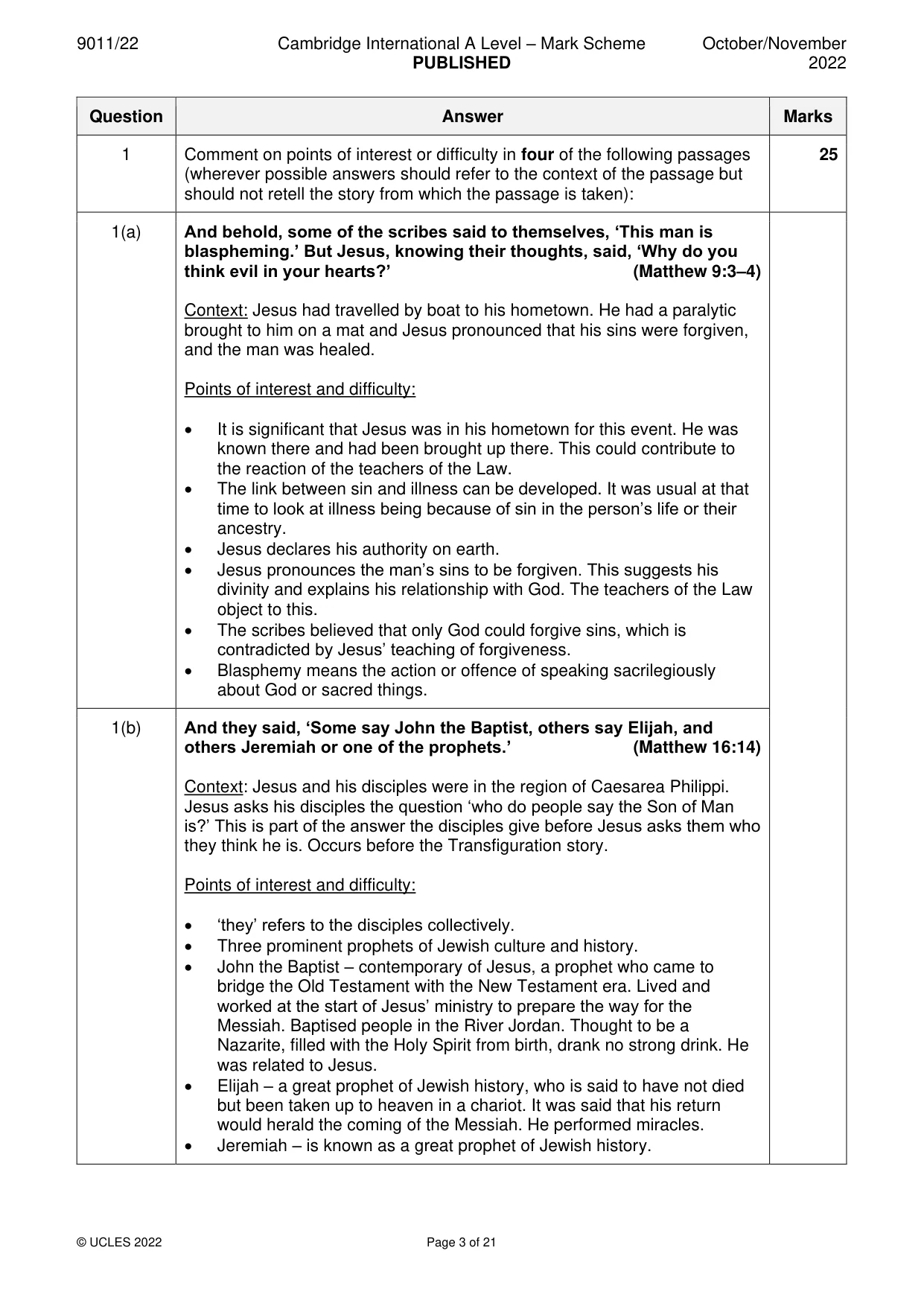
9011/22 Cambridge International A Level – Mark Scheme PUBLISHED October/November 2022 © UCLES 2022 Page 3 of 21 Question Answer Marks 1 Comment on points of interest or difficulty in four of the following passages (wherever possible answers should refer to the context of the passage but should not retell the story from which the passage is taken): 25 1(a) And behold, some of the scribes said to themselves, ‘This man is blaspheming.’ But Jesus, knowing their thoughts, said, ‘Why do you think evil in your hearts?’ (Matthew 9:3–4) Context: Jesus had travelled by boat to his hometown. He had a paralytic brought to him on a mat and Jesus pronounced that his sins were forgiven, and the man was healed. Points of interest and difficulty: • It is significant that Jesus was in his hometown for this event. He was known there and had been brought up there. This could contribute to the reaction of the teachers of the Law. • The link between sin and illness can be developed. It was usual at that time to look at illness being because of sin in the person’s life or their ancestry. • Jesus declares his authority on earth. • Jesus pronounces the man’s sins to be forgiven. This suggests his divinity and explains his relationship with God. The teachers of the Law object to this. • The scribes believed that only God could forgive sins, which is contradicted by Jesus’ teaching of forgiveness. • Blasphemy means the action or offence of speaking sacrilegiously about God or sacred things. 1(b) And they said, ‘Some say John the Baptist, others say Elijah, and others Jeremiah or one of the prophets.’ (Matthew 16:14) Context: Jesus and his disciples were in the region of Caesarea Philippi. Jesus asks his disciples the question ‘who do people say the Son of Man is?’ This is part of the answer the disciples give before Jesus asks them who they think he is. Occurs before the Transfiguration story. Points of interest and difficulty: • ‘they’ refers to the disciples collectively. • Three prominent prophets of Jewish culture and history. • John the Baptist – contemporary of Jesus, a prophet who came to bridge the Old Testament with the New Testament era. Lived and worked at the start of Jesus’ ministry to prepare the way for the Messiah. Baptised people in the River Jordan. Thought to be a Nazarite, filled with the Holy Spirit from birth, drank no strong drink. He was related to Jesus. • Elijah – a great prophet of Jewish history, who is said to have not died but been taken up to heaven in a chariot. It was said that his return would herald the coming of the Messiah. He performed miracles. • Jeremiah – is known as a great prophet of Jewish history.
Mark scheme, page 4
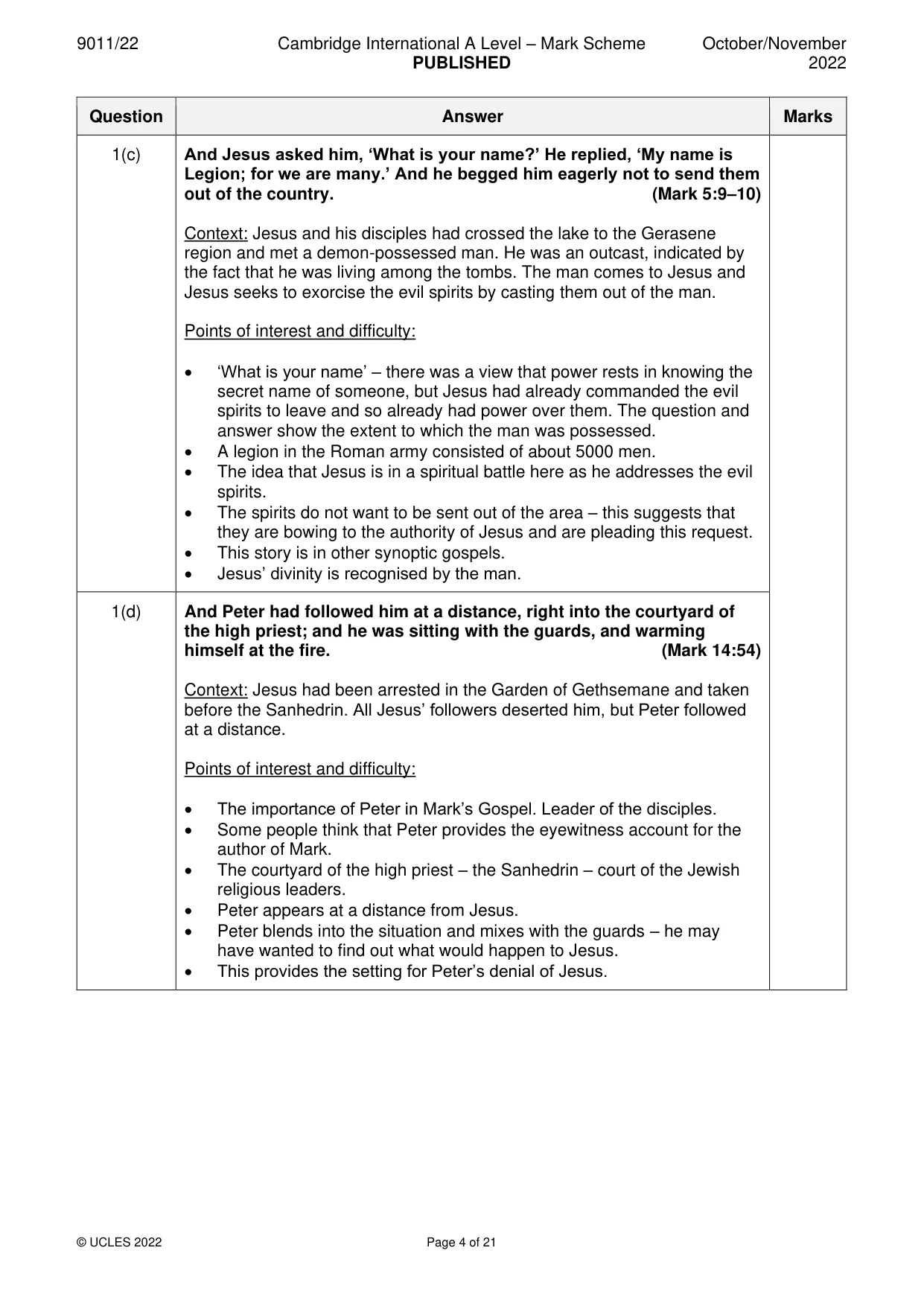
9011/22 Cambridge International A Level – Mark Scheme PUBLISHED October/November 2022 © UCLES 2022 Page 4 of 21 Question Answer Marks 1(c) And Jesus asked him, ‘What is your name?’ He replied, ‘My name is Legion; for we are many.’ And he begged him eagerly not to send them out of the country. (Mark 5:9–10) Context: Jesus and his disciples had crossed the lake to the Gerasene region and met a demon-possessed man. He was an outcast, indicated by the fact that he was living among the tombs. The man comes to Jesus and Jesus seeks to exorcise the evil spirits by casting them out of the man. Points of interest and difficulty: • ‘What is your name’ – there was a view that power rests in knowing the secret name of someone, but Jesus had already commanded the evil spirits to leave and so already had power over them. The question and answer show the extent to which the man was possessed. • A legion in the Roman army consisted of about 5000 men. • The idea that Jesus is in a spiritual battle here as he addresses the evil spirits. • The spirits do not want to be sent out of the area – this suggests that they are bowing to the authority of Jesus and are pleading this request. • This story is in other synoptic gospels. • Jesus’ divinity is recognised by the man. 1(d) And Peter had followed him at a distance, right into the courtyard of the high priest; and he was sitting with the guards, and warming himself at the fire. (Mark 14:54) Context: Jesus had been arrested in the Garden of Gethsemane and taken before the Sanhedrin. All Jesus’ followers deserted him, but Peter followed at a distance. Points of interest and difficulty: • The importance of Peter in Mark’s Gospel. Leader of the disciples. • Some people think that Peter provides the eyewitness account for the author of Mark. • The courtyard of the high priest – the Sanhedrin – court of the Jewish religious leaders. • Peter appears at a distance from Jesus. • Peter blends into the situation and mixes with the guards – he may have wanted to find out what would happen to Jesus. • This provides the setting for Peter’s denial of Jesus.
Mark scheme, page 5
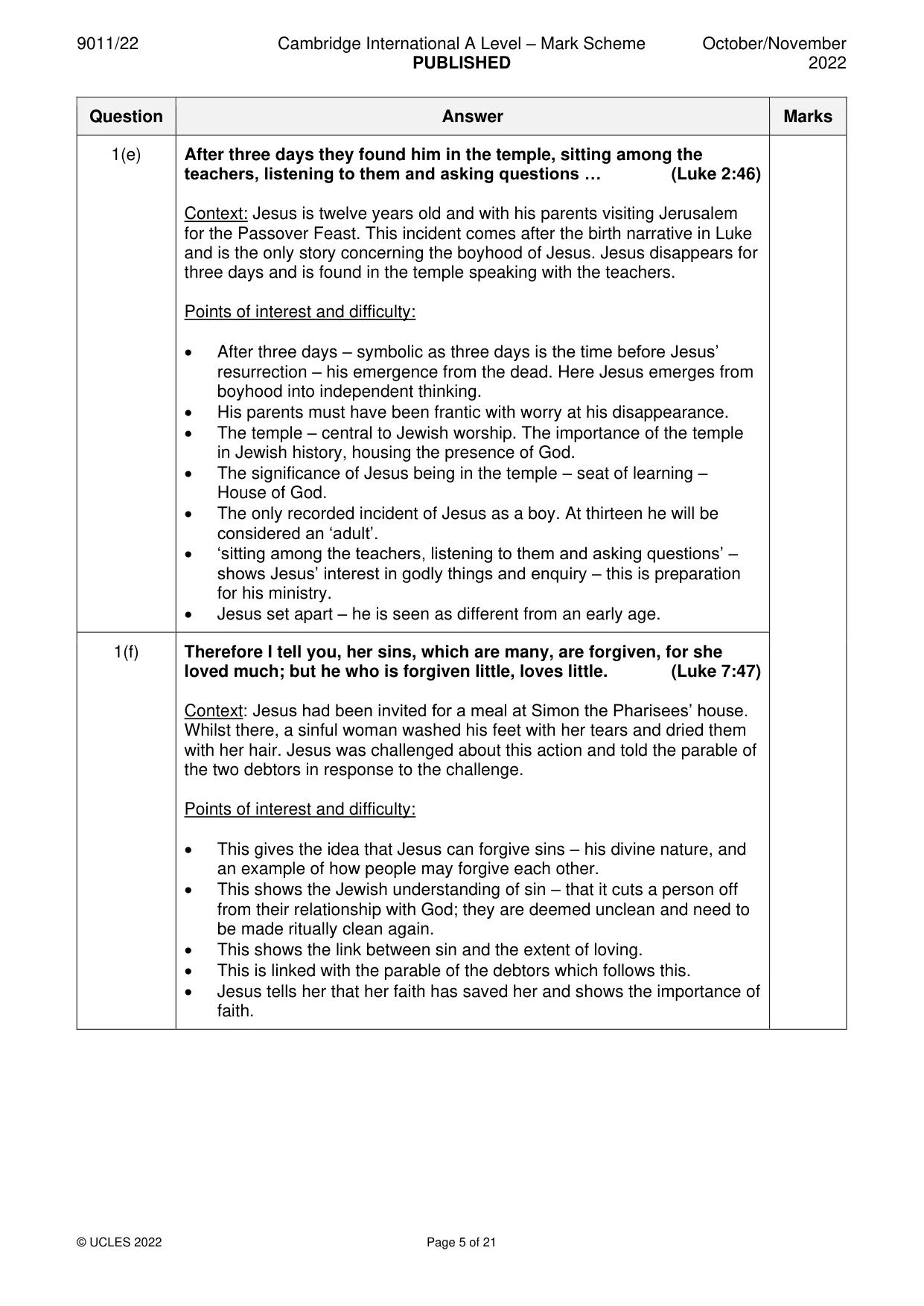
9011/22 Cambridge International A Level – Mark Scheme PUBLISHED October/November 2022 © UCLES 2022 Page 5 of 21 Question Answer Marks 1(e) After three days they found him in the temple, sitting among the teachers, listening to them and asking questions … (Luke 2:46) Context: Jesus is twelve years old and with his parents visiting Jerusalem for the Passover Feast. This incident comes after the birth narrative in Luke and is the only story concerning the boyhood of Jesus. Jesus disappears for three days and is found in the temple speaking with the teachers. Points of interest and difficulty: • After three days – symbolic as three days is the time before Jesus’ resurrection – his emergence from the dead. Here Jesus emerges from boyhood into independent thinking. • His parents must have been frantic with worry at his disappearance. • The temple – central to Jewish worship. The importance of the temple in Jewish history, housing the presence of God. • The significance of Jesus being in the temple – seat of learning – House of God. • The only recorded incident of Jesus as a boy. At thirteen he will be considered an ‘adult’. • ‘sitting among the teachers, listening to them and asking questions’ – shows Jesus’ interest in godly things and enquiry – this is preparation for his ministry. • Jesus set apart – he is seen as different from an early age. 1(f) Therefore I tell you, her sins, which are many, are forgiven, for she loved much; but he who is forgiven little, loves little. (Luke 7:47) Context: Jesus had been invited for a meal at Simon the Pharisees’ house. Whilst there, a sinful woman washed his feet with her tears and dried them with her hair. Jesus was challenged about this action and told the parable of the two debtors in response to the challenge. Points of interest and difficulty: • This gives the idea that Jesus can forgive sins – his divine nature, and an example of how people may forgive each other. • This shows the Jewish understanding of sin – that it cuts a person off from their relationship with God; they are deemed unclean and need to be made ritually clean again. • This shows the link between sin and the extent of loving. • This is linked with the parable of the debtors which follows this. • Jesus tells her that her faith has saved her and shows the importance of faith.
Mark scheme, page 6
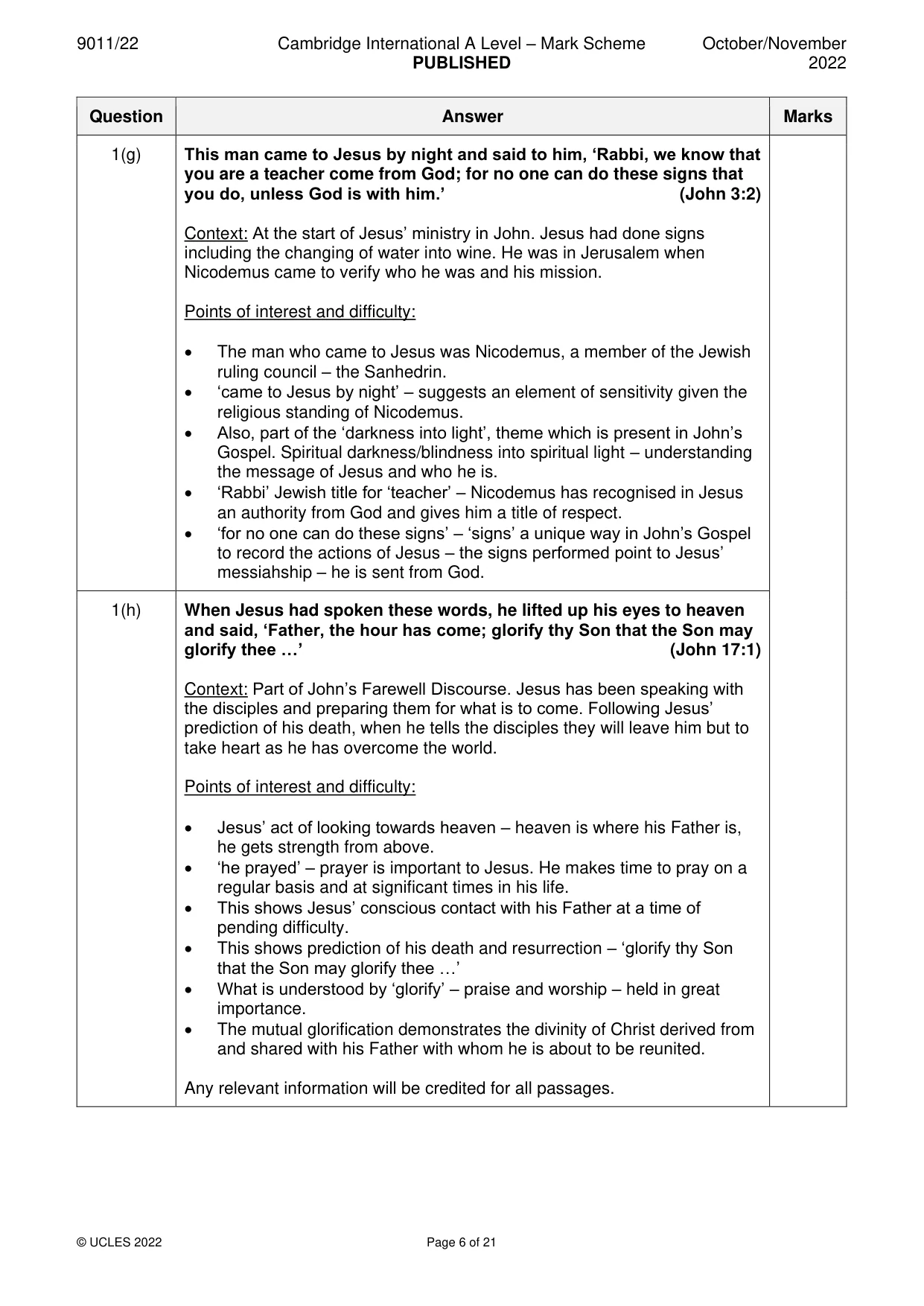
9011/22 Cambridge International A Level – Mark Scheme PUBLISHED October/November 2022 © UCLES 2022 Page 6 of 21 Question Answer Marks 1(g) This man came to Jesus by night and said to him, ‘Rabbi, we know that you are a teacher come from God; for no one can do these signs that you do, unless God is with him.’ (John 3:2) Context: At the start of Jesus’ ministry in John. Jesus had done signs including the changing of water into wine. He was in Jerusalem when Nicodemus came to verify who he was and his mission. Points of interest and difficulty: • The man who came to Jesus was Nicodemus, a member of the Jewish ruling council – the Sanhedrin. • ‘came to Jesus by night’ – suggests an element of sensitivity given the religious standing of Nicodemus. • Also, part of the ‘darkness into light’, theme which is present in John’s Gospel. Spiritual darkness/blindness into spiritual light – understanding the message of Jesus and who he is. • ‘Rabbi’ Jewish title for ‘teacher’ – Nicodemus has recognised in Jesus an authority from God and gives him a title of respect. • ‘for no one can do these signs’ – ‘signs’ a unique way in John’s Gospel to record the actions of Jesus – the signs performed point to Jesus’ messiahship – he is sent from God. 1(h) When Jesus had spoken these words, he lifted up his eyes to heaven and said, ‘Father, the hour has come; glorify thy Son that the Son may glorify thee …’ (John 17:1) Context: Part of John’s Farewell Discourse. Jesus has been speaking with the disciples and preparing them for what is to come. Following Jesus’ prediction of his death, when he tells the disciples they will leave him but to take heart as he has overcome the world. Points of interest and difficulty: • Jesus’ act of looking towards heaven – heaven is where his Father is, he gets strength from above. • ‘he prayed’ – prayer is important to Jesus. He makes time to pray on a regular basis and at significant times in his life. • This shows Jesus’ conscious contact with his Father at a time of pending difficulty. • This shows prediction of his death and resurrection – ‘glorify thy Son that the Son may glorify thee …’ • What is understood by ‘glorify’ – praise and worship – held in great importance. • The mutual glorification demonstrates the divinity of Christ derived from and shared with his Father with whom he is about to be reunited. Any relevant information will be credited for all passages.
Mark scheme, page 7
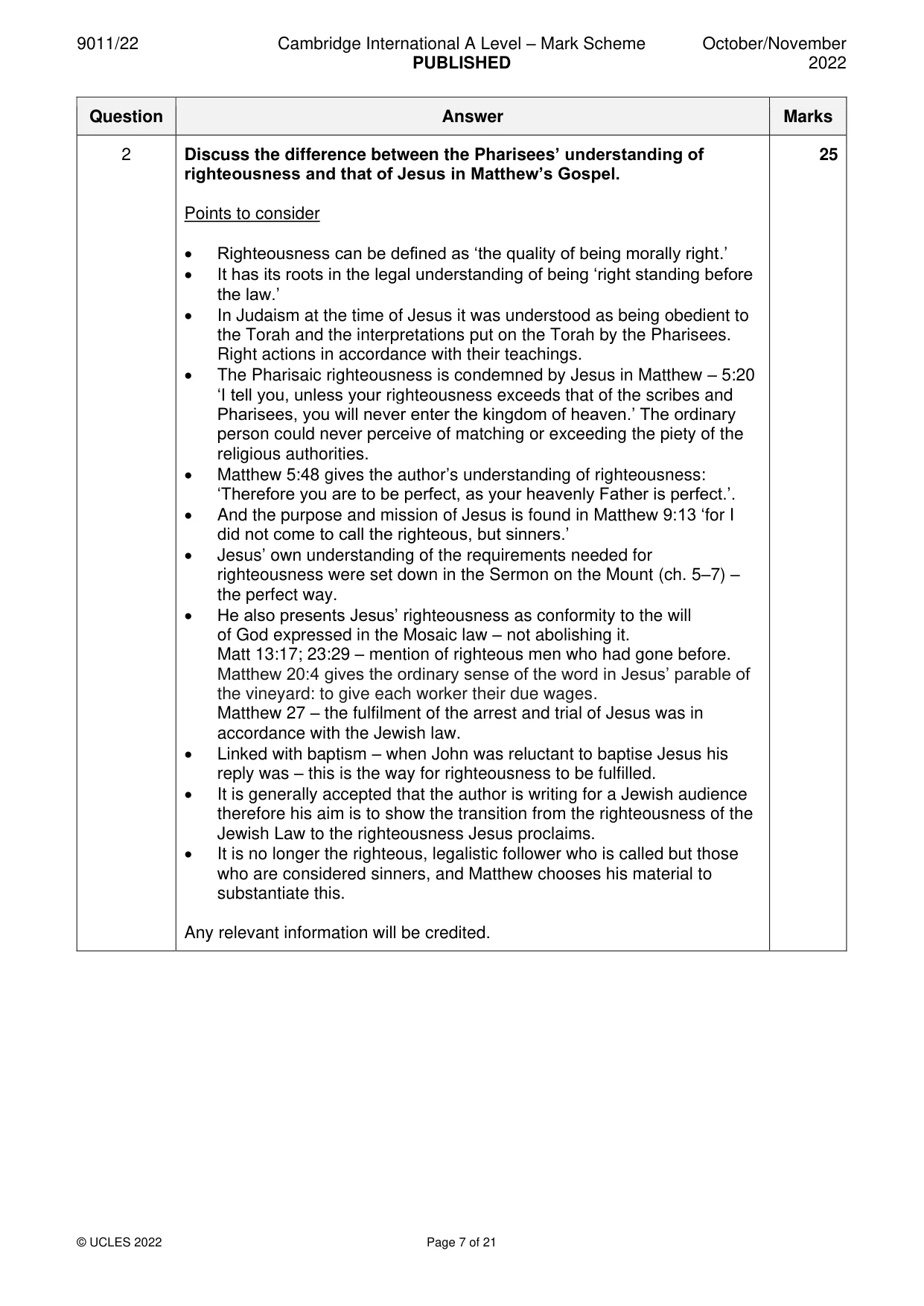
9011/22 Cambridge International A Level – Mark Scheme PUBLISHED October/November 2022 © UCLES 2022 Page 7 of 21 Question Answer Marks 2 Discuss the difference between the Pharisees’ understanding of righteousness and that of Jesus in Matthew’s Gospel. Points to consider • Righteousness can be defined as ‘the quality of being morally right.’ • It has its roots in the legal understanding of being ‘right standing before the law.’ • In Judaism at the time of Jesus it was understood as being obedient to the Torah and the interpretations put on the Torah by the Pharisees. Right actions in accordance with their teachings. • The Pharisaic righteousness is condemned by Jesus in Matthew – 5:20 ‘I tell you, unless your righteousness exceeds that of the scribes and Pharisees, you will never enter the kingdom of heaven.’ The ordinary person could never perceive of matching or exceeding the piety of the religious authorities. • Matthew 5:48 gives the author’s understanding of righteousness: ‘Therefore you are to be perfect, as your heavenly Father is perfect.’. • And the purpose and mission of Jesus is found in Matthew 9:13 ‘for I did not come to call the righteous, but sinners.’ • Jesus’ own understanding of the requirements needed for righteousness were set down in the Sermon on the Mount (ch. 5–7) – the perfect way. • He also presents Jesus’ righteousness as conformity to the will of God expressed in the Mosaic law – not abolishing it. Matt 13:17; 23:29 – mention of righteous men who had gone before. Matthew 20:4 gives the ordinary sense of the word in Jesus’ parable of the vineyard: to give each worker their due wages. Matthew 27 – the fulfilment of the arrest and trial of Jesus was in accordance with the Jewish law. • Linked with baptism – when John was reluctant to baptise Jesus his reply was – this is the way for righteousness to be fulfilled. • It is generally accepted that the author is writing for a Jewish audience therefore his aim is to show the transition from the righteousness of the Jewish Law to the righteousness Jesus proclaims. • It is no longer the righteous, legalistic follower who is called but those who are considered sinners, and Matthew chooses his material to substantiate this. Any relevant information will be credited. 25
Mark scheme, page 8
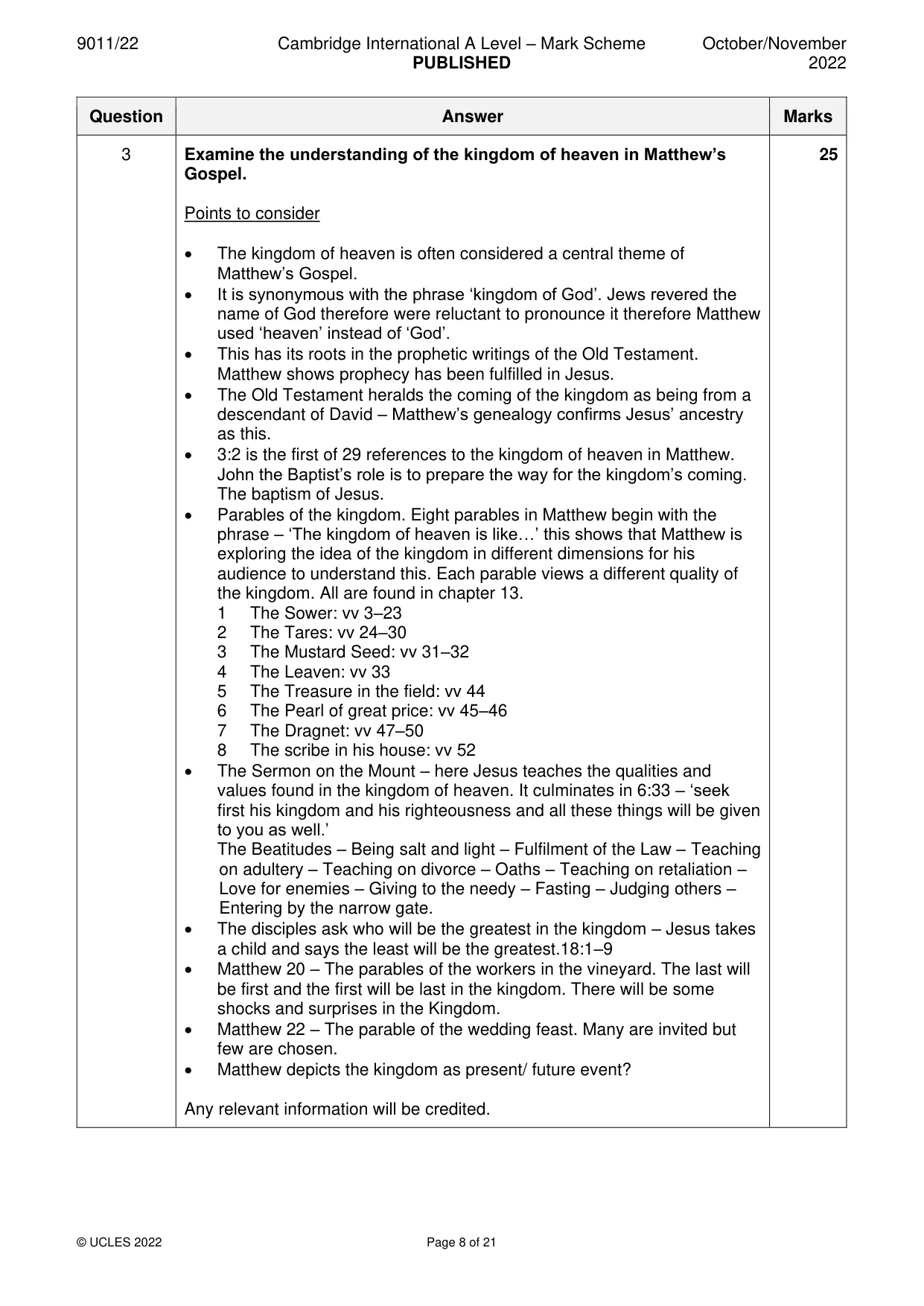
9011/22 Cambridge International A Level – Mark Scheme PUBLISHED October/November 2022 © UCLES 2022 Page 8 of 21 Question Answer Marks 3 Examine the understanding of the kingdom of heaven in Matthew’s Gospel. Points to consider • The kingdom of heaven is often considered a central theme of Matthew’s Gospel. • It is synonymous with the phrase ‘kingdom of God’. Jews revered the name of God therefore were reluctant to pronounce it therefore Matthew used ‘heaven’ instead of ‘God’. • This has its roots in the prophetic writings of the Old Testament. Matthew shows prophecy has been fulfilled in Jesus. • The Old Testament heralds the coming of the kingdom as being from a descendant of David – Matthew’s genealogy confirms Jesus’ ancestry as this. • 3:2 is the first of 29 references to the kingdom of heaven in Matthew. John the Baptist’s role is to prepare the way for the kingdom’s coming. The baptism of Jesus. • Parables of the kingdom. Eight parables in Matthew begin with the phrase – ‘The kingdom of heaven is like…’ this shows that Matthew is exploring the idea of the kingdom in different dimensions for his audience to understand this. Each parable views a different quality of the kingdom. All are found in chapter 13. 1 The Sower: vv 3–23 2 The Tares: vv 24–30 3 The Mustard Seed: vv 31–32 4 The Leaven: vv 33 5 The Treasure in the field: vv 44 6 The Pearl of great price: vv 45–46 7 The Dragnet: vv 47–50 8 The scribe in his house: vv 52 • The Sermon on the Mount – here Jesus teaches the qualities and values found in the kingdom of heaven. It culminates in 6:33 – ‘seek first his kingdom and his righteousness and all these things will be given to you as well.’ The Beatitudes – Being salt and light – Fulfilment of the Law – Teaching on adultery – Teaching on divorce – Oaths – Teaching on retaliation – Love for enemies – Giving to the needy – Fasting – Judging others – Entering by the narrow gate. • The disciples ask who will be the greatest in the kingdom – Jesus takes a child and says the least will be the greatest.18:1–9 • Matthew 20 – The parables of the workers in the vineyard. The last will be first and the first will be last in the kingdom. There will be some shocks and surprises in the Kingdom. • Matthew 22 – The parable of the wedding feast. Many are invited but few are chosen. • Matthew depicts the kingdom as present/ future event? Any relevant information will be credited. 25
Mark scheme, page 9
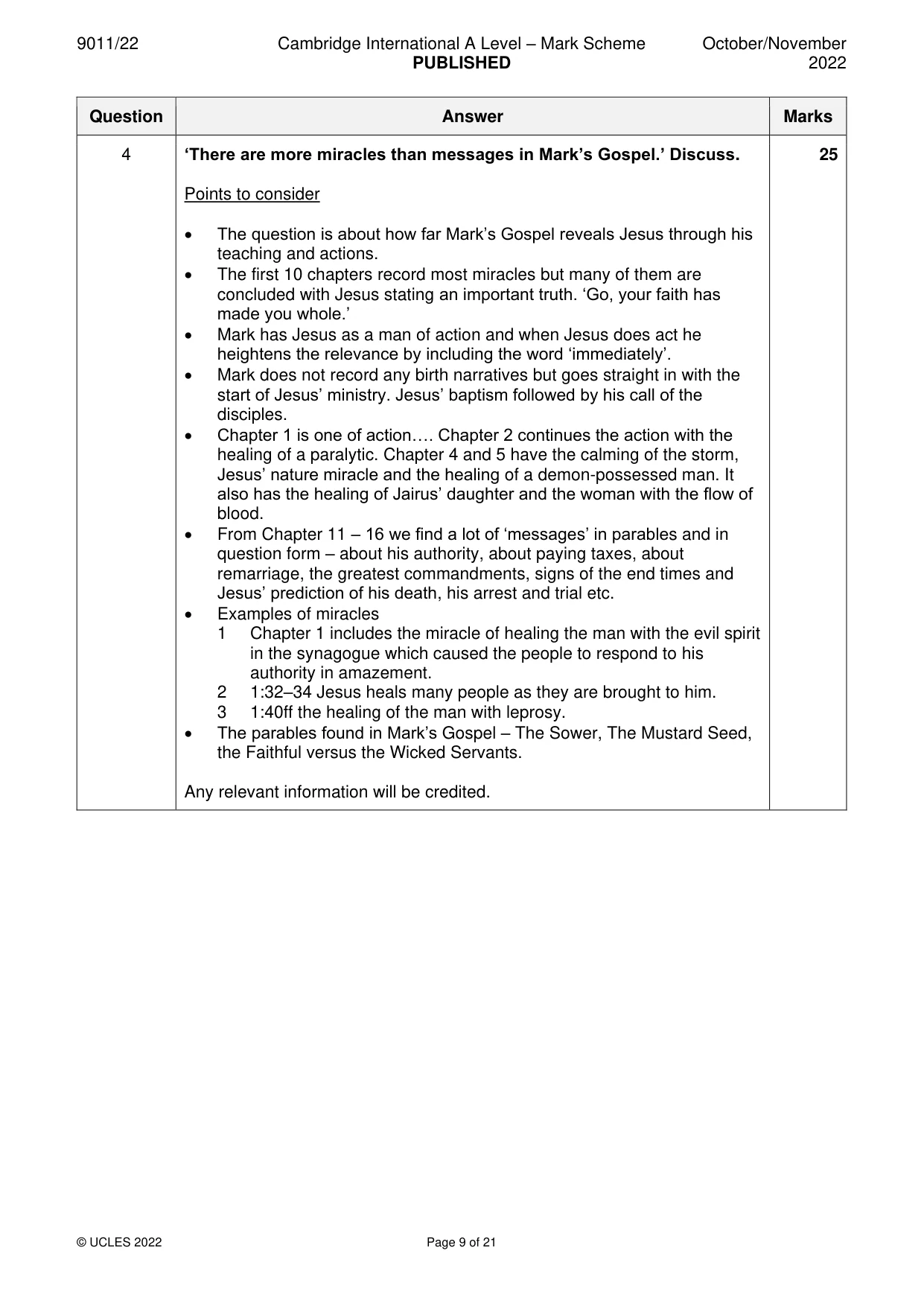
9011/22 Cambridge International A Level – Mark Scheme PUBLISHED October/November 2022 © UCLES 2022 Page 9 of 21 Question Answer Marks 4 ‘There are more miracles than messages in Mark’s Gospel.’ Discuss. Points to consider • The question is about how far Mark’s Gospel reveals Jesus through his teaching and actions. • The first 10 chapters record most miracles but many of them are concluded with Jesus stating an important truth. ‘Go, your faith has made you whole.’ • Mark has Jesus as a man of action and when Jesus does act he heightens the relevance by including the word ‘immediately’. • Mark does not record any birth narratives but goes straight in with the start of Jesus’ ministry. Jesus’ baptism followed by his call of the disciples. • Chapter 1 is one of action…. Chapter 2 continues the action with the healing of a paralytic. Chapter 4 and 5 have the calming of the storm, Jesus’ nature miracle and the healing of a demon-possessed man. It also has the healing of Jairus’ daughter and the woman with the flow of blood. • From Chapter 11 – 16 we find a lot of ‘messages’ in parables and in question form – about his authority, about paying taxes, about remarriage, the greatest commandments, signs of the end times and Jesus’ prediction of his death, his arrest and trial etc. • Examples of miracles 1 Chapter 1 includes the miracle of healing the man with the evil spirit in the synagogue which caused the people to respond to his authority in amazement. 2 1:32–34 Jesus heals many people as they are brought to him. 3 1:40ff the healing of the man with leprosy. • The parables found in Mark’s Gospel – The Sower, The Mustard Seed, the Faithful versus the Wicked Servants. Any relevant information will be credited. 25
Mark scheme, page 10
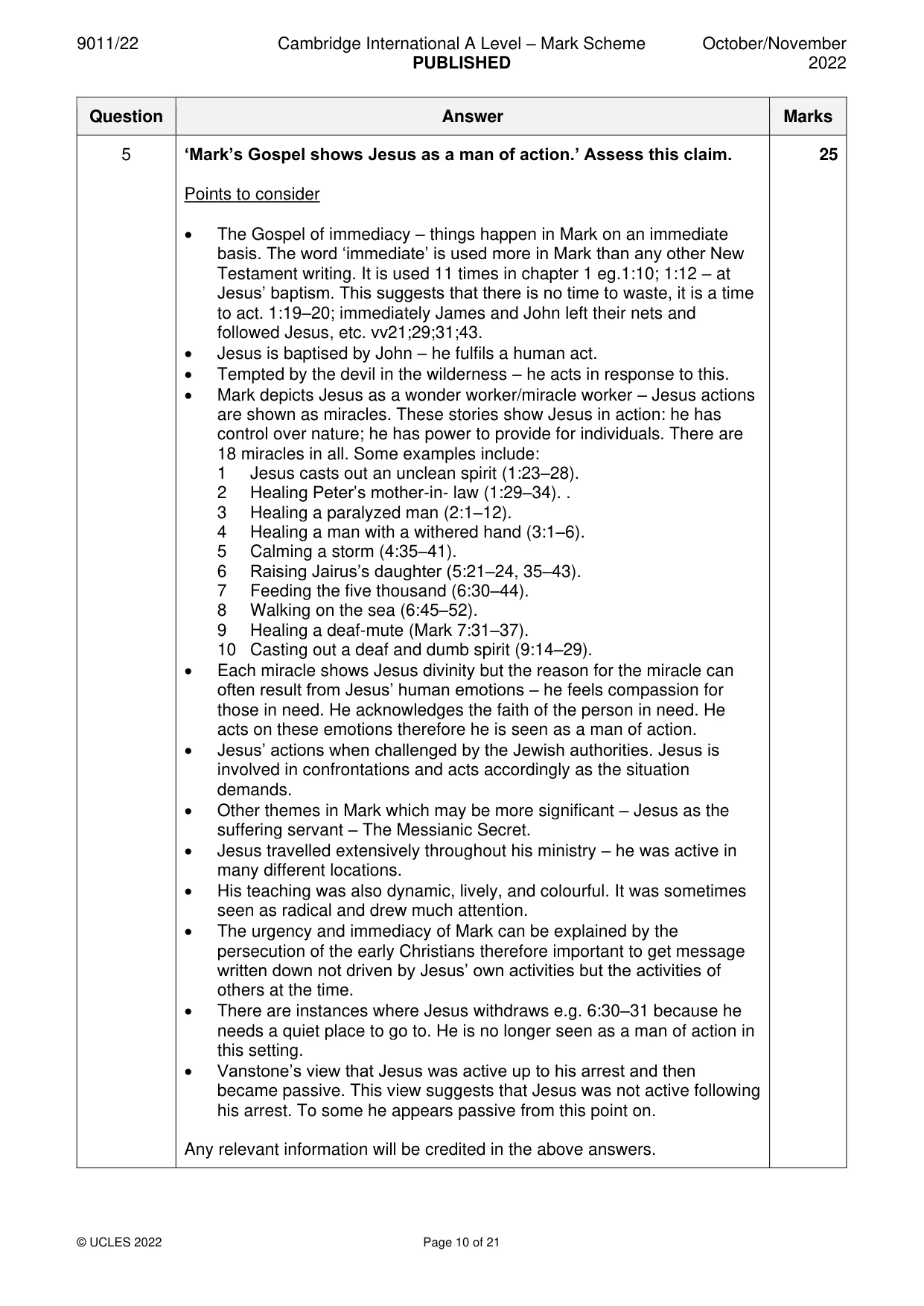
9011/22 Cambridge International A Level – Mark Scheme PUBLISHED October/November 2022 © UCLES 2022 Page 10 of 21 Question Answer Marks 5 ‘Mark’s Gospel shows Jesus as a man of action.’ Assess this claim. Points to consider • The Gospel of immediacy – things happen in Mark on an immediate basis. The word ‘immediate’ is used more in Mark than any other New Testament writing. It is used 11 times in chapter 1 eg.1:10; 1:12 – at Jesus’ baptism. This suggests that there is no time to waste, it is a time to act. 1:19–20; immediately James and John left their nets and followed Jesus, etc. vv21;29;31;43. • Jesus is baptised by John – he fulfils a human act. • Tempted by the devil in the wilderness – he acts in response to this. • Mark depicts Jesus as a wonder worker/miracle worker – Jesus actions are shown as miracles. These stories show Jesus in action: he has control over nature; he has power to provide for individuals. There are 18 miracles in all. Some examples include: 1 Jesus casts out an unclean spirit (1:23–28). 2 Healing Peter’s mother-in- law (1:29–34). . 3 Healing a paralyzed man (2:1–12). 4 Healing a man with a withered hand (3:1–6). 5 Calming a storm (4:35–41). 6 Raising Jairus’s daughter (5:21–24, 35–43). 7 Feeding the five thousand (6:30–44). 8 Walking on the sea (6:45–52). 9 Healing a deaf-mute (Mark 7:31–37). 10 Casting out a deaf and dumb spirit (9:14–29). • Each miracle shows Jesus divinity but the reason for the miracle can often result from Jesus’ human emotions – he feels compassion for those in need. He acknowledges the faith of the person in need. He acts on these emotions therefore he is seen as a man of action. • Jesus’ actions when challenged by the Jewish authorities. Jesus is involved in confrontations and acts accordingly as the situation demands. • Other themes in Mark which may be more significant – Jesus as the suffering servant – The Messianic Secret. • Jesus travelled extensively throughout his ministry – he was active in many different locations. • His teaching was also dynamic, lively, and colourful. It was sometimes seen as radical and drew much attention. • The urgency and immediacy of Mark can be explained by the persecution of the early Christians therefore important to get message written down not driven by Jesus’ own activities but the activities of others at the time. • There are instances where Jesus withdraws e.g. 6:30–31 because he needs a quiet place to go to. He is no longer seen as a man of action in this setting. • Vanstone’s view that Jesus was active up to his arrest and then became passive. This view suggests that Jesus was not active following his arrest. To some he appears passive from this point on. Any relevant information will be credited in the above answers. 25
Mark scheme, page 11
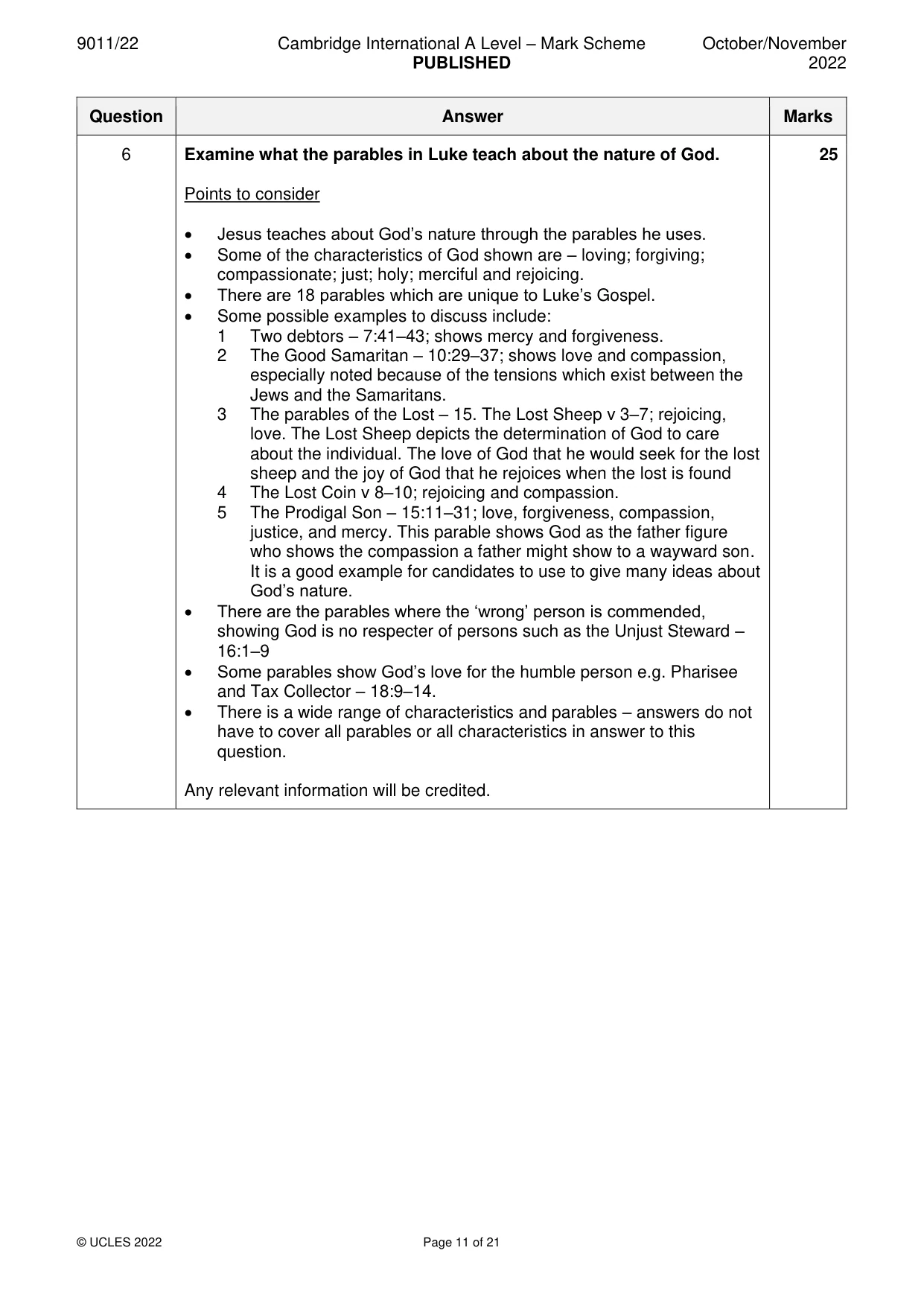
9011/22 Cambridge International A Level – Mark Scheme PUBLISHED October/November 2022 © UCLES 2022 Page 11 of 21 Question Answer Marks 6 Examine what the parables in Luke teach about the nature of God. Points to consider • Jesus teaches about God’s nature through the parables he uses. • Some of the characteristics of God shown are – loving; forgiving; compassionate; just; holy; merciful and rejoicing. • There are 18 parables which are unique to Luke’s Gospel. • Some possible examples to discuss include: 1 Two debtors – 7:41–43; shows mercy and forgiveness. 2 The Good Samaritan – 10:29–37; shows love and compassion, especially noted because of the tensions which exist between the Jews and the Samaritans. 3 The parables of the Lost – 15. The Lost Sheep v 3–7; rejoicing, love. The Lost Sheep depicts the determination of God to care about the individual. The love of God that he would seek for the lost sheep and the joy of God that he rejoices when the lost is found 4 The Lost Coin v 8–10; rejoicing and compassion. 5 The Prodigal Son – 15:11–31; love, forgiveness, compassion, justice, and mercy. This parable shows God as the father figure who shows the compassion a father might show to a wayward son. It is a good example for candidates to use to give many ideas about God’s nature. • There are the parables where the ‘wrong’ person is commended, showing God is no respecter of persons such as the Unjust Steward – 16:1–9 • Some parables show God’s love for the humble person e.g. Pharisee and Tax Collector – 18:9–14. • There is a wide range of characteristics and parables – answers do not have to cover all parables or all characteristics in answer to this question. Any relevant information will be credited. 25
Mark scheme, page 12
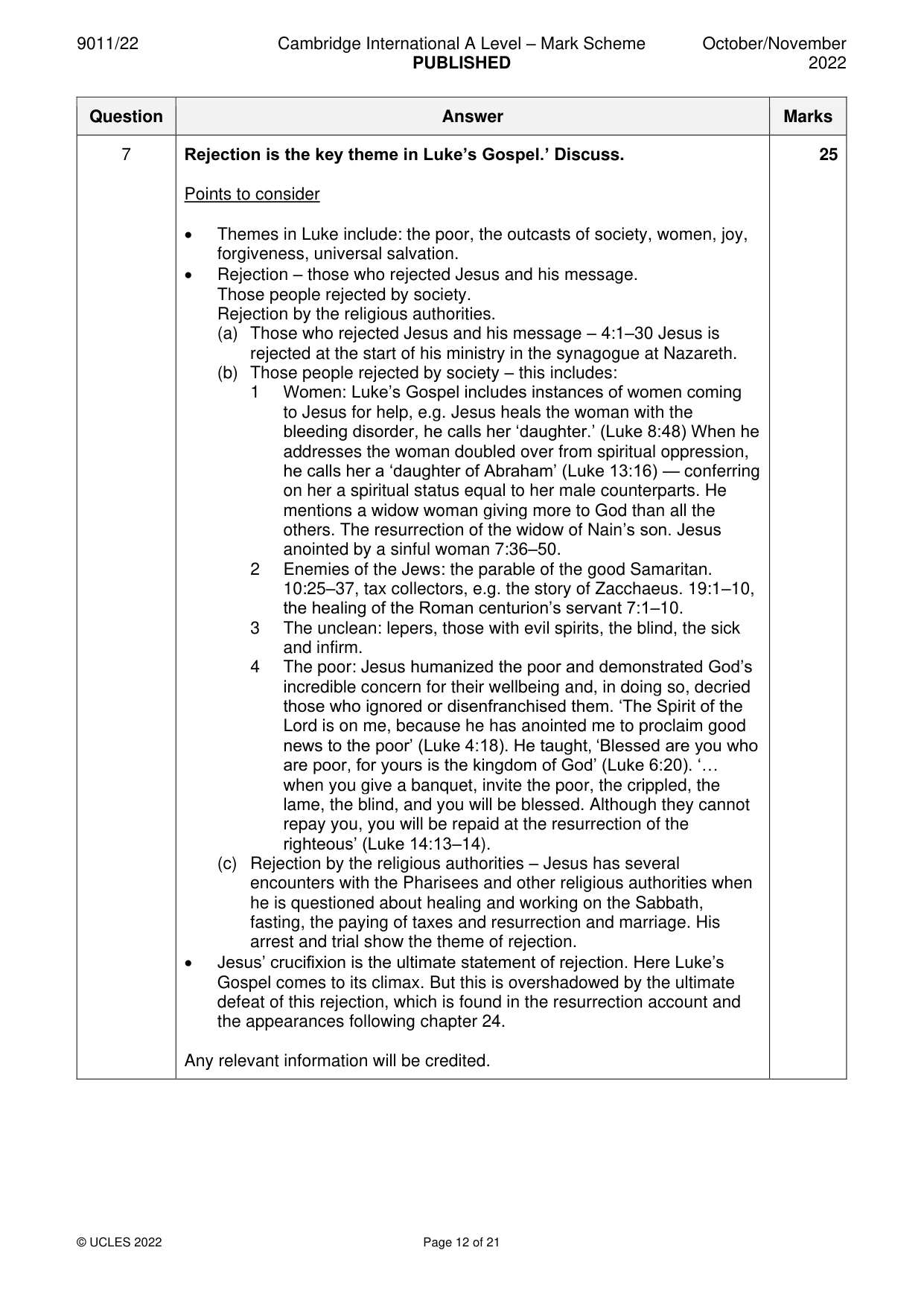
9011/22 Cambridge International A Level – Mark Scheme PUBLISHED October/November 2022 © UCLES 2022 Page 12 of 21 Question Answer Marks 7 Rejection is the key theme in Luke’s Gospel.’ Discuss. Points to consider • Themes in Luke include: the poor, the outcasts of society, women, joy, forgiveness, universal salvation. • Rejection – those who rejected Jesus and his message. Those people rejected by society. Rejection by the religious authorities. (a) Those who rejected Jesus and his message – 4:1–30 Jesus is rejected at the start of his ministry in the synagogue at Nazareth. (b) Those people rejected by society – this includes: 1 Women: Luke’s Gospel includes instances of women coming to Jesus for help, e.g. Jesus heals the woman with the bleeding disorder, he calls her ‘daughter.’ (Luke 8:48) When he addresses the woman doubled over from spiritual oppression, he calls her a ‘daughter of Abraham’ (Luke 13:16) — conferring on her a spiritual status equal to her male counterparts. He mentions a widow woman giving more to God than all the others. The resurrection of the widow of Nain’s son. Jesus anointed by a sinful woman 7:36–50. 2 Enemies of the Jews: the parable of the good Samaritan. 10:25–37, tax collectors, e.g. the story of Zacchaeus. 19:1–10, the healing of the Roman centurion’s servant 7:1–10. 3 The unclean: lepers, those with evil spirits, the blind, the sick and infirm. 4 The poor: Jesus humanized the poor and demonstrated God’s incredible concern for their wellbeing and, in doing so, decried those who ignored or disenfranchised them. ‘The Spirit of the Lord is on me, because he has anointed me to proclaim good news to the poor’ (Luke 4:18). He taught, ‘Blessed are you who are poor, for yours is the kingdom of God’ (Luke 6:20). ‘… when you give a banquet, invite the poor, the crippled, the lame, the blind, and you will be blessed. Although they cannot repay you, you will be repaid at the resurrection of the righteous’ (Luke 14:13–14). (c) Rejection by the religious authorities – Jesus has several encounters with the Pharisees and other religious authorities when he is questioned about healing and working on the Sabbath, fasting, the paying of taxes and resurrection and marriage. His arrest and trial show the theme of rejection. • Jesus’ crucifixion is the ultimate statement of rejection. Here Luke’s Gospel comes to its climax. But this is overshadowed by the ultimate defeat of this rejection, which is found in the resurrection account and the appearances following chapter 24. Any relevant information will be credited. 25
Mark scheme, page 13
9011/22 Cambridge International A Level – Mark Scheme PUBLISHED October/November 2022 © UCLES 2022 Page 13 of 21 Question Answer Marks 8 Consider how the encounter between Jesus and Nicodemus reflects themes which appear elsewhere in John’s Gospel. Points to consider Chapter 3:1–21 – the story of Nicodemus coming to Jesus by night. • Nicodemus was a Pharisee – Jesus’ relationship with the Pharisees in this gospel – the Pharisees in John are fearful of the interest Jesus had from the start – 4:1; feel that Jesus has deceived the people – chapter 7 and plan to arrest him. Nicodemus provides the opposite, open-minded view to Jesus, to that of the Pharisees as a whole. • Rebirth – 3:4 Nicodemus asks, ‘how a man can be reborn?’ Jesus responds that man needs to be born of water and the spirit = baptism. The work of John the Baptist. New start through baptism. Born of the Spirit. • Water – ‘be born of water and of the Spirit’ – 1:26–27 John the Baptist recognises that one will come after him who will baptise by the spirit. 1:29–34; the baptism of Jesus. The healing by the pool. The woman at the well. I am the living water. • The kingdom of God – here Jesus states that unless someone is reborn, he cannot see the kingdom of God. • The Spirit – Jesus’ baptism and Transfiguration. Chapter 16 – the work of the Holy Spirit, the Comforter/Counsellor will come after Jesus has gone to be with his Father. • Love – 3:16 shows God’s love for the world. The disciple ‘whom God loved’. John 15:9–17 ‘As the Father has loved me, so have I loved you. Now remain in my love.’ ‘Greater love has no man than this ...’ The two new commandments that Jesus gives. Love God. Love your neighbour as you love yourself. • Light and darkness – The Prologue. Jesus’ healing of the blind man 9:1–12; 24–34. Spiritual blindness 9:36–41. I am the light of the world. • Truth – The Prologue. 14:6 Jesus says, ‘I am the way and the truth and the life. No one comes to the Father except through me.’ 14:12 ‘I tell you the truth, anyone who has faith in me will do what I have been doing.’ 18:38; ‘What is truth?’ the question of Pilate to Jesus. • Nicodemus does appear again in John’s Gospel therefore candidates may make reference to this and will be credited for the relevance of the material used. Any relevant information will be credited. 25
Mark scheme, page 14
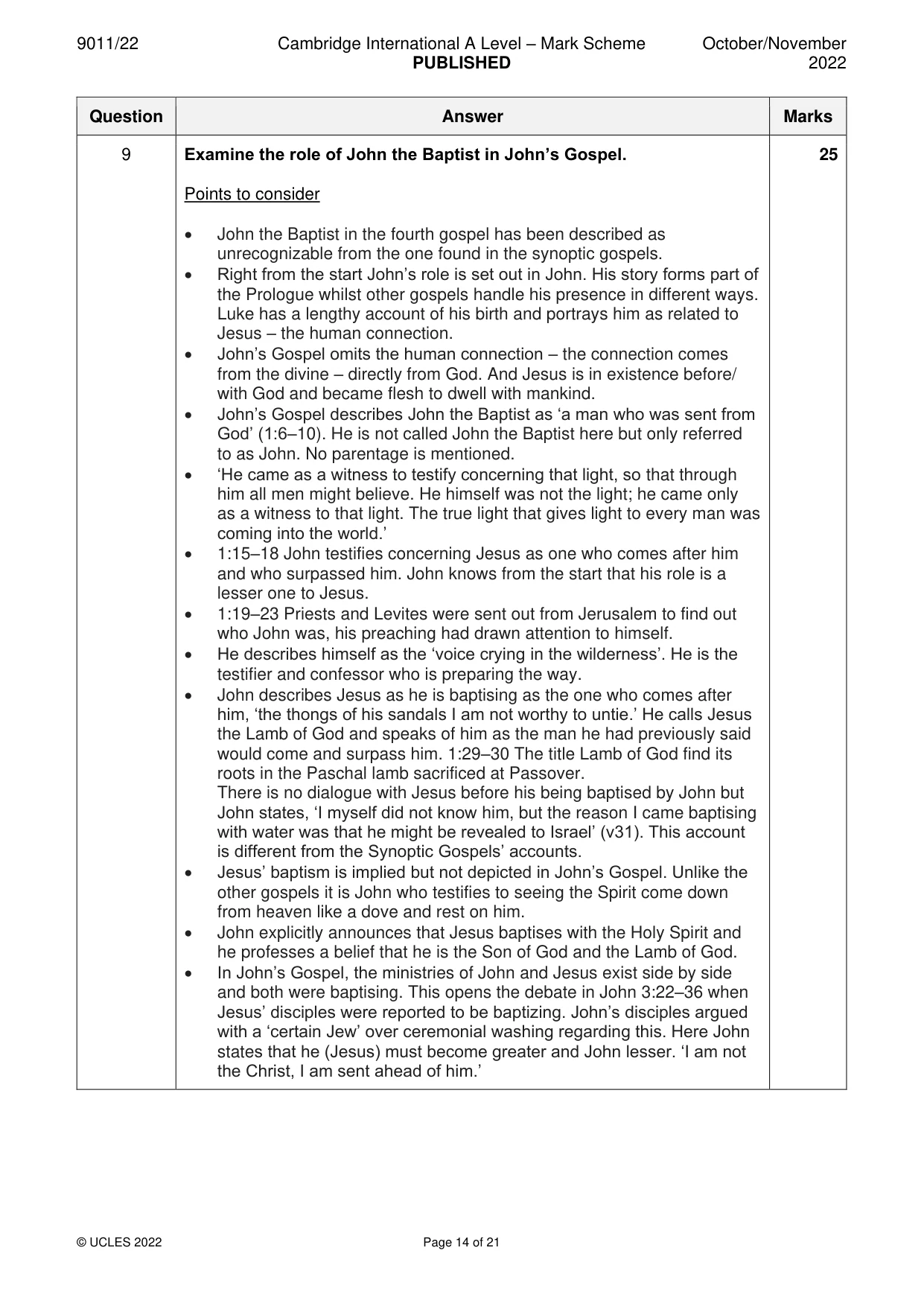
9011/22 Cambridge International A Level – Mark Scheme PUBLISHED October/November 2022 © UCLES 2022 Page 14 of 21 Question Answer Marks 9 Examine the role of John the Baptist in John’s Gospel. Points to consider • John the Baptist in the fourth gospel has been described as unrecognizable from the one found in the synoptic gospels. • Right from the start John’s role is set out in John. His story forms part of the Prologue whilst other gospels handle his presence in different ways. Luke has a lengthy account of his birth and portrays him as related to Jesus – the human connection. • John’s Gospel omits the human connection – the connection comes from the divine – directly from God. And Jesus is in existence before/ with God and became flesh to dwell with mankind. • John’s Gospel describes John the Baptist as ‘a man who was sent from God’ (1:6–10). He is not called John the Baptist here but only referred to as John. No parentage is mentioned. • ‘He came as a witness to testify concerning that light, so that through him all men might believe. He himself was not the light; he came only as a witness to that light. The true light that gives light to every man was coming into the world.’ • 1:15–18 John testifies concerning Jesus as one who comes after him and who surpassed him. John knows from the start that his role is a lesser one to Jesus. • 1:19–23 Priests and Levites were sent out from Jerusalem to find out who John was, his preaching had drawn attention to himself. • He describes himself as the ‘voice crying in the wilderness’. He is the testifier and confessor who is preparing the way. • John describes Jesus as he is baptising as the one who comes after him, ‘the thongs of his sandals I am not worthy to untie.’ He calls Jesus the Lamb of God and speaks of him as the man he had previously said would come and surpass him. 1:29–30 The title Lamb of God find its roots in the Paschal lamb sacrificed at Passover. There is no dialogue with Jesus before his being baptised by John but John states, ‘I myself did not know him, but the reason I came baptising with water was that he might be revealed to Israel’ (v31). This account is different from the Synoptic Gospels’ accounts. • Jesus’ baptism is implied but not depicted in John’s Gospel. Unlike the other gospels it is John who testifies to seeing the Spirit come down from heaven like a dove and rest on him. • John explicitly announces that Jesus baptises with the Holy Spirit and he professes a belief that he is the Son of God and the Lamb of God. • In John’s Gospel, the ministries of John and Jesus exist side by side and both were baptising. This opens the debate in John 3:22–36 when Jesus’ disciples were reported to be baptizing. John’s disciples argued with a ‘certain Jew’ over ceremonial washing regarding this. Here John states that he (Jesus) must become greater and John lesser. ‘I am not the Christ, I am sent ahead of him.’ 25
Mark scheme, page 15
9011/22 Cambridge International A Level – Mark Scheme PUBLISHED October/November 2022 © UCLES 2022 Page 15 of 21 Question Answer Marks 9 • John’s Gospel begins with The Prologue which tells the story of Jesus’ origin, mission, and purpose. This is different from the synoptics and the way he presents John the Baptist is in the same fashion, full of spiritual and theological insight. His language is chosen, not as narrative but for a specific purpose. • The story of John the Baptist’s imprisonment, beheading and death is not recorded as it is in the other gospels. It is lightly passed over in 3:24 when it mentions ‘this happened before he was put in prison.’ • Candidates might compare the role of John the Baptist in John with the other gospels but do not have to as the question is about John’s Gospel. Any relevant information will be credited.
Mark scheme, page 16
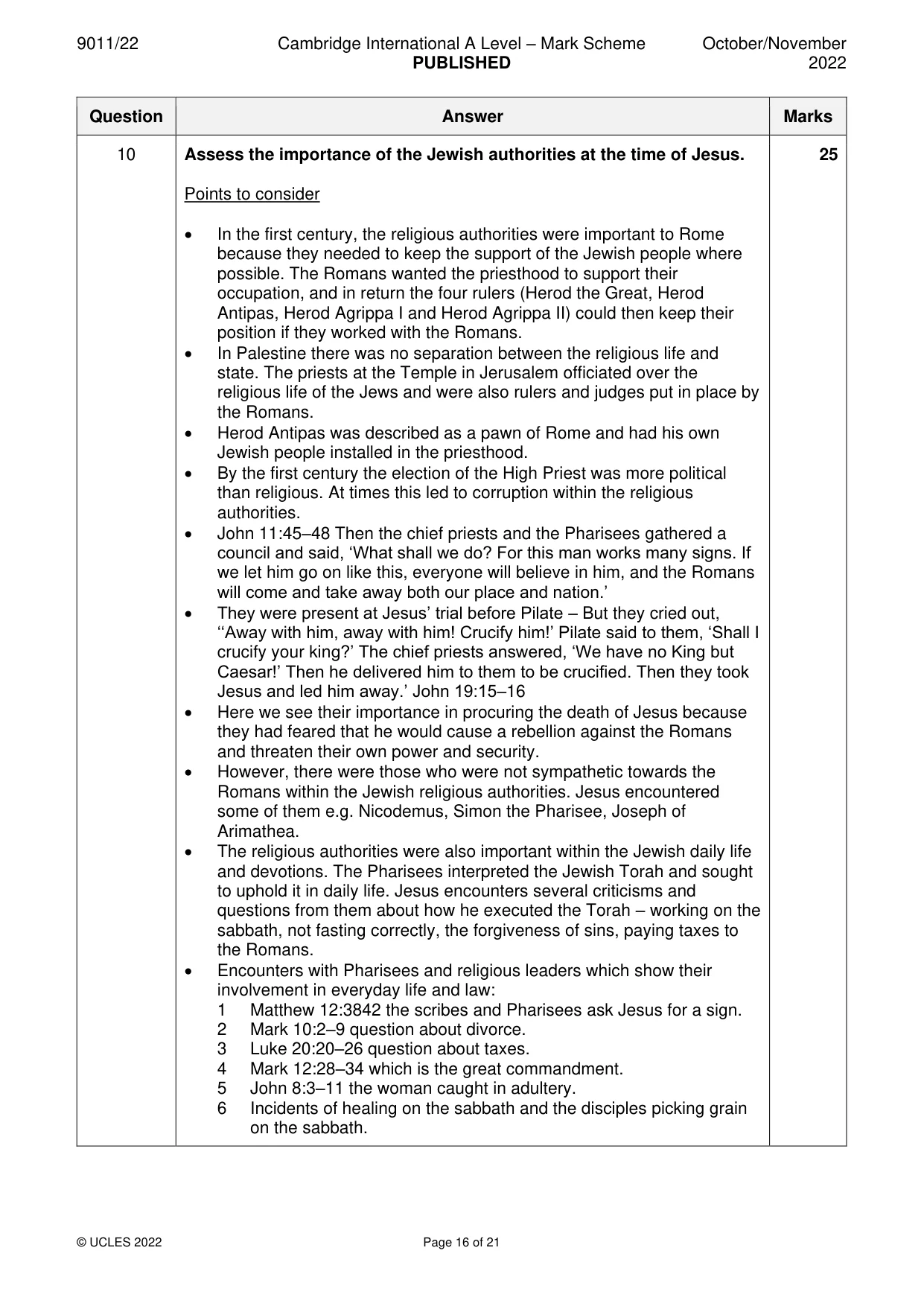
9011/22 Cambridge International A Level – Mark Scheme PUBLISHED October/November 2022 © UCLES 2022 Page 16 of 21 Question Answer Marks 10 Assess the importance of the Jewish authorities at the time of Jesus. Points to consider • In the first century, the religious authorities were important to Rome because they needed to keep the support of the Jewish people where possible. The Romans wanted the priesthood to support their occupation, and in return the four rulers (Herod the Great, Herod Antipas, Herod Agrippa I and Herod Agrippa II) could then keep their position if they worked with the Romans. • In Palestine there was no separation between the religious life and state. The priests at the Temple in Jerusalem officiated over the religious life of the Jews and were also rulers and judges put in place by the Romans. • Herod Antipas was described as a pawn of Rome and had his own Jewish people installed in the priesthood. • By the first century the election of the High Priest was more political than religious. At times this led to corruption within the religious authorities. • John 11:45–48 Then the chief priests and the Pharisees gathered a council and said, ‘What shall we do? For this man works many signs. If we let him go on like this, everyone will believe in him, and the Romans will come and take away both our place and nation.’ • They were present at Jesus’ trial before Pilate – But they cried out, ‘‘Away with him, away with him! Crucify him!’ Pilate said to them, ‘Shall I crucify your king?’ The chief priests answered, ‘We have no King but Caesar!’ Then he delivered him to them to be crucified. Then they took Jesus and led him away.’ John 19:15–16 • Here we see their importance in procuring the death of Jesus because they had feared that he would cause a rebellion against the Romans and threaten their own power and security. • However, there were those who were not sympathetic towards the Romans within the Jewish religious authorities. Jesus encountered some of them e.g. Nicodemus, Simon the Pharisee, Joseph of Arimathea. • The religious authorities were also important within the Jewish daily life and devotions. The Pharisees interpreted the Jewish Torah and sought to uphold it in daily life. Jesus encounters several criticisms and questions from them about how he executed the Torah – working on the sabbath, not fasting correctly, the forgiveness of sins, paying taxes to the Romans. • Encounters with Pharisees and religious leaders which show their involvement in everyday life and law: 1 Matthew 12:3842 the scribes and Pharisees ask Jesus for a sign. 2 Mark 10:2–9 question about divorce. 3 Luke 20:20–26 question about taxes. 4 Mark 12:28–34 which is the great commandment. 5 John 8:3–11 the woman caught in adultery. 6 Incidents of healing on the sabbath and the disciples picking grain on the sabbath. 25
Mark scheme, page 17
9011/22 Cambridge International A Level – Mark Scheme PUBLISHED October/November 2022 © UCLES 2022 Page 17 of 21 Question Answer Marks 10 • The Sadducees were the wealthy ruling class of Jesus’ day. They had wealth, power and influence and wanted to protect their status. Many of them were priests and could keep their wealth in return for political allegiance to the Romans. They opposed Jesus because they feared the people may rise and overthrow Roman occupation therefore their position of wealth would go. • Many Jews did not hold the views of the Sadducees and looked to a day when the Jewish Messiah would come and raise them up as a nation again. Any relevant information will be credited.
Mark scheme, page 18
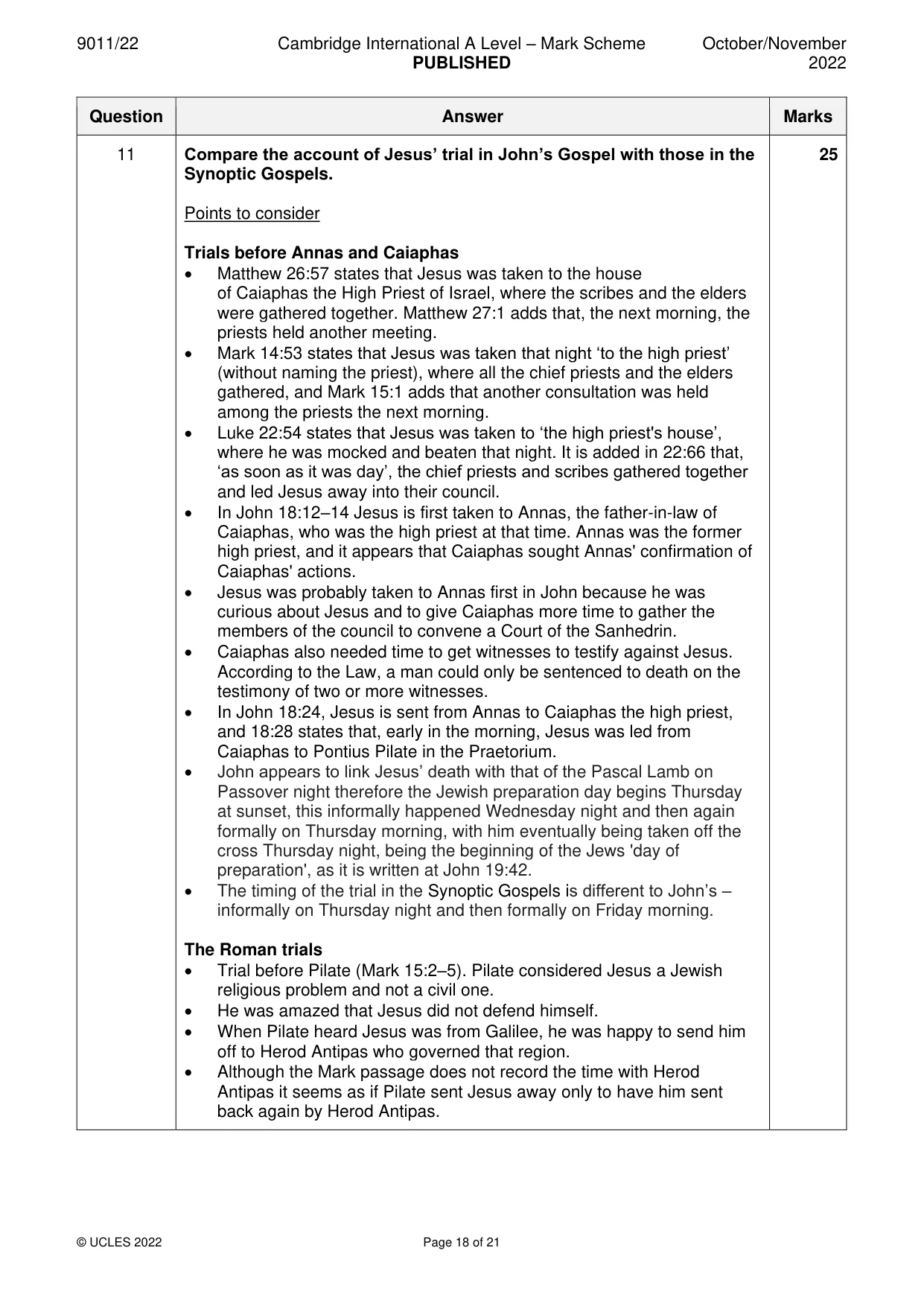
9011/22 Cambridge International A Level – Mark Scheme PUBLISHED October/November 2022 © UCLES 2022 Page 18 of 21 Question Answer Marks 11 Compare the account of Jesus’ trial in John’s Gospel with those in the Synoptic Gospels. Points to consider Trials before Annas and Caiaphas • Matthew 26:57 states that Jesus was taken to the house of Caiaphas the High Priest of Israel, where the scribes and the elders were gathered together. Matthew 27:1 adds that, the next morning, the priests held another meeting. • Mark 14:53 states that Jesus was taken that night ‘to the high priest’ (without naming the priest), where all the chief priests and the elders gathered, and Mark 15:1 adds that another consultation was held among the priests the next morning. • Luke 22:54 states that Jesus was taken to ‘the high priest's house’, where he was mocked and beaten that night. It is added in 22:66 that, ‘as soon as it was day’, the chief priests and scribes gathered together and led Jesus away into their council. • In John 18:12–14 Jesus is first taken to Annas, the father-in-law of Caiaphas, who was the high priest at that time. Annas was the former high priest, and it appears that Caiaphas sought Annas' confirmation of Caiaphas' actions. • Jesus was probably taken to Annas first in John because he was curious about Jesus and to give Caiaphas more time to gather the members of the council to convene a Court of the Sanhedrin. • Caiaphas also needed time to get witnesses to testify against Jesus. According to the Law, a man could only be sentenced to death on the testimony of two or more witnesses. • In John 18:24, Jesus is sent from Annas to Caiaphas the high priest, and 18:28 states that, early in the morning, Jesus was led from Caiaphas to Pontius Pilate in the Praetorium. • John appears to link Jesus’ death with that of the Pascal Lamb on Passover night therefore the Jewish preparation day begins Thursday at sunset, this informally happened Wednesday night and then again formally on Thursday morning, with him eventually being taken off the cross Thursday night, being the beginning of the Jews 'day of preparation', as it is written at John 19:42. • The timing of the trial in the Synoptic Gospels is different to John’s – informally on Thursday night and then formally on Friday morning. The Roman trials • Trial before Pilate (Mark 15:2–5). Pilate considered Jesus a Jewish religious problem and not a civil one. • He was amazed that Jesus did not defend himself. • When Pilate heard Jesus was from Galilee, he was happy to send him off to Herod Antipas who governed that region. • Although the Mark passage does not record the time with Herod Antipas it seems as if Pilate sent Jesus away only to have him sent back again by Herod Antipas. 25
Mark scheme, page 19
9011/22 Cambridge International A Level – Mark Scheme PUBLISHED October/November 2022 © UCLES 2022 Page 19 of 21 Question Answer Marks 11 • Trial before Herod Antipas (this is only recorded in Luke 23:6–12): Herod had heard about Jesus and wanted to see a miracle. He and his soldiers mocked Jesus and put a robe on him. Sent him back to Pilate. • Trial before Pilate continued and concluded (Mark 15:6–15; Luke 23:13–25): Pilate had no reason to give death sentence that Jews wanted but the crowd demanded crucifixion. Pilate gave the frenzied crowd the choice and they chose a murderer to be released instead of Jesus. • Pilate in Matthew is reluctant to execute Jesus and puts the blame for this act firmly at the feet of the Jews and Judas. Pilate’s wife relays a dream she has had regarding Jesus, and Pilate responds by publicly washing his hands of the decision to crucify Jesus. He does not see anything wrong with Jesus. • ‘The governor was greatly amazed’ (Matthew 27:14). • ‘[Pilate] realized that it was out of jealousy that they had handed him over’ (Matthew 27:18). • ‘He asked, 'Why, what evil has he done?'‘ (Matthew 27:23) • John has Pilate telling the Jewish authorities to judge Jesus themselves by their law. Pilate asks Jesus directly ‘Are you the King of the Jews?’ Jesus and Pilate have an altercation around this which allows Jesus the opportunity to disclose information about his kingdom. • Pilate provides the opportunity for Jesus to disclose who he is: King of the Jews. • In John, Pilate had to come out to meet the Jewish authorities so they could remain ritually clean for the Passover Festival. • The denial of Peter appears in different places within the trial accounts in the different gospels. • The Passion Narrative in John is the longest piece of scripture in which John parallels the Synoptic Gospels. Mark is thought to provide the framework for the gospels – the same personalities are involved, and the same sequence of events occur. • The Jewish people cry ‘crucify’ – they have gathered to celebrate the festival of Passover. Any relevant information will be credited.
Mark scheme, page 20
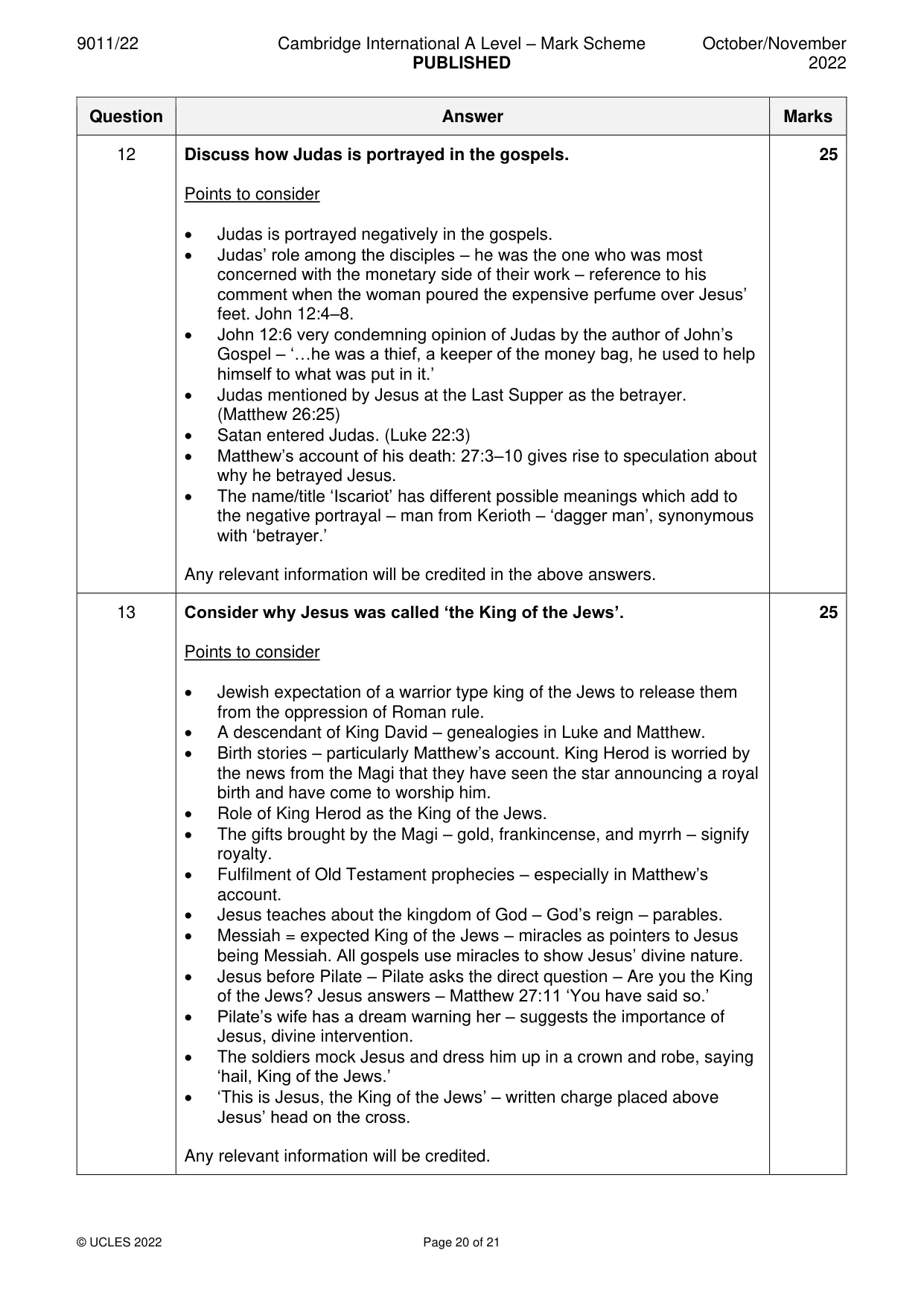
9011/22 Cambridge International A Level – Mark Scheme PUBLISHED October/November 2022 © UCLES 2022 Page 20 of 21 Question Answer Marks 12 Discuss how Judas is portrayed in the gospels. Points to consider • Judas is portrayed negatively in the gospels. • Judas’ role among the disciples – he was the one who was most concerned with the monetary side of their work – reference to his comment when the woman poured the expensive perfume over Jesus’ feet. John 12:4–8. • John 12:6 very condemning opinion of Judas by the author of John’s Gospel – ‘…he was a thief, a keeper of the money bag, he used to help himself to what was put in it.’ • Judas mentioned by Jesus at the Last Supper as the betrayer. (Matthew 26:25) • Satan entered Judas. (Luke 22:3) • Matthew’s account of his death: 27:3–10 gives rise to speculation about why he betrayed Jesus. • The name/title ‘Iscariot’ has different possible meanings which add to the negative portrayal – man from Kerioth – ‘dagger man’, synonymous with ‘betrayer.’ Any relevant information will be credited in the above answers. 25 13 Consider why Jesus was called ‘the King of the Jews’. Points to consider • Jewish expectation of a warrior type king of the Jews to release them from the oppression of Roman rule. • A descendant of King David – genealogies in Luke and Matthew. • Birth stories – particularly Matthew’s account. King Herod is worried by the news from the Magi that they have seen the star announcing a royal birth and have come to worship him. • Role of King Herod as the King of the Jews. • The gifts brought by the Magi – gold, frankincense, and myrrh – signify royalty. • Fulfilment of Old Testament prophecies – especially in Matthew’s account. • Jesus teaches about the kingdom of God – God’s reign – parables. • Messiah = expected King of the Jews – miracles as pointers to Jesus being Messiah. All gospels use miracles to show Jesus’ divine nature. • Jesus before Pilate – Pilate asks the direct question – Are you the King of the Jews? Jesus answers – Matthew 27:11 ‘You have said so.’ • Pilate’s wife has a dream warning her – suggests the importance of Jesus, divine intervention. • The soldiers mock Jesus and dress him up in a crown and robe, saying ‘hail, King of the Jews.’ • ‘This is Jesus, the King of the Jews’ – written charge placed above Jesus’ head on the cross. Any relevant information will be credited. 25
Mark scheme, page 21
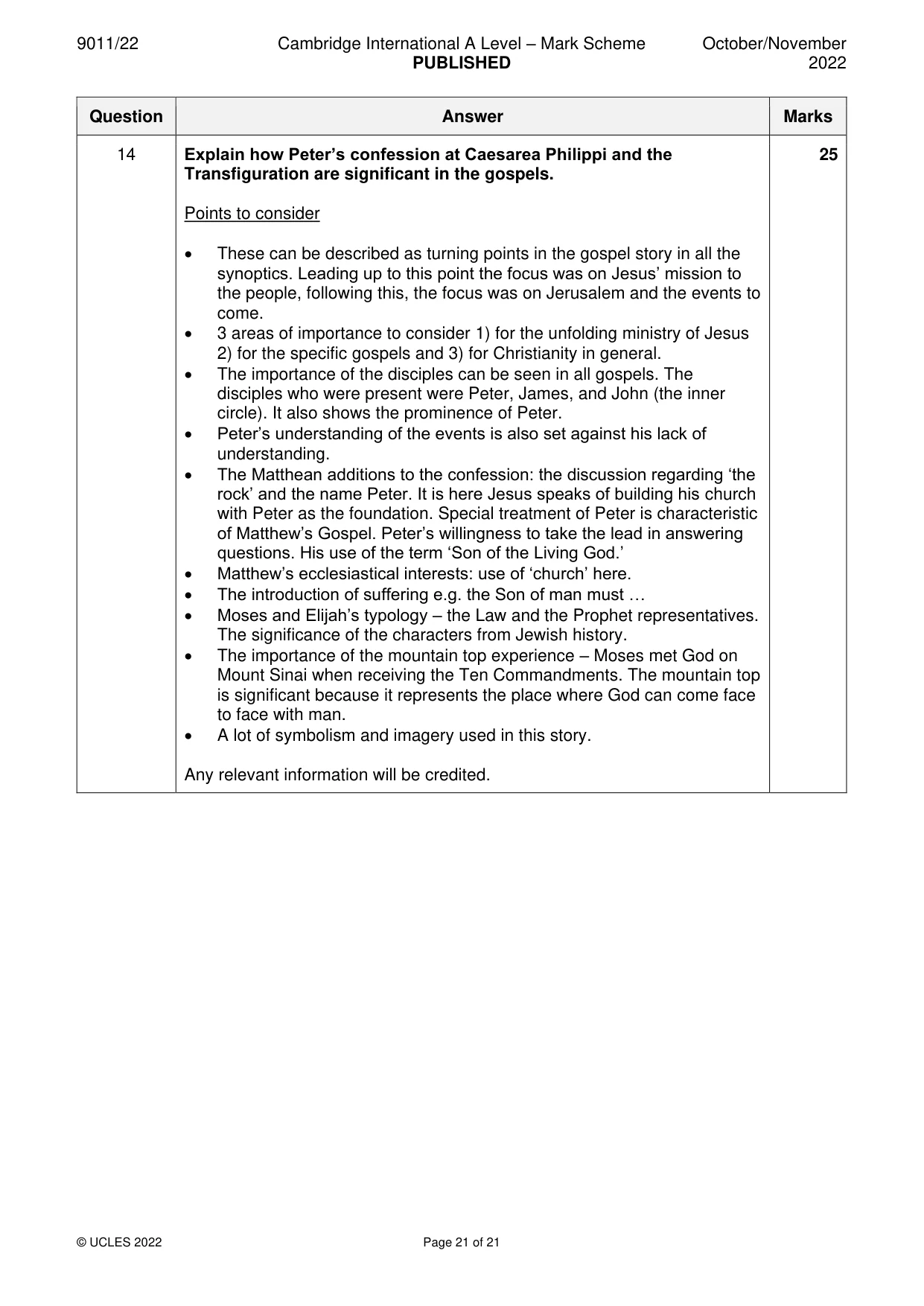
9011/22 Cambridge International A Level – Mark Scheme PUBLISHED October/November 2022 © UCLES 2022 Page 21 of 21 Question Answer Marks 14 Explain how Peter’s confession at Caesarea Philippi and the Transfiguration are significant in the gospels. Points to consider • These can be described as turning points in the gospel story in all the synoptics. Leading up to this point the focus was on Jesus’ mission to the people, following this, the focus was on Jerusalem and the events to come. • 3 areas of importance to consider 1) for the unfolding ministry of Jesus 2) for the specific gospels and 3) for Christianity in general. • The importance of the disciples can be seen in all gospels. The disciples who were present were Peter, James, and John (the inner circle). It also shows the prominence of Peter. • Peter’s understanding of the events is also set against his lack of understanding. • The Matthean additions to the confession: the discussion regarding ‘the rock’ and the name Peter. It is here Jesus speaks of building his church with Peter as the foundation. Special treatment of Peter is characteristic of Matthew’s Gospel. Peter’s willingness to take the lead in answering questions. His use of the term ‘Son of the Living God.’ • Matthew’s ecclesiastical interests: use of ‘church’ here. • The introduction of suffering e.g. the Son of man must … • Moses and Elijah’s typology – the Law and the Prophet representatives. The significance of the characters from Jewish history. • The importance of the mountain top experience – Moses met God on Mount Sinai when receiving the Ten Commandments. The mountain top is significant because it represents the place where God can come face to face with man. • A lot of symbolism and imagery used in this story. Any relevant information will be credited. 25
What you needed in this session
Cambridge’s own grade thresholds for 2022 Oct/Nov, Paper 2 · Variant 2. A higher threshold means an easier paper — the bar moves with how the cohort did.