Cambridge A Level Divinity 9011 — 2022 May/June Paper 2 · Variant 2
9011/22/M/J/22 · 100 marks · ≈113 min
The question paper and its mark scheme, free to read here and free to download. This is Cambridge’s own paper, exactly as it was sat.
Question paper4 pages
Mark scheme25 pages
Answers below. Sit the paper first if you are practising.


Paper as text
Question paper, page 1
This document has 4 pages. [Turn over Cambridge International A Level * 1 1 0 1 4 2 0 5 7 7 * DC (CJ) 301742 © UCLES 2022 DIVINITY 9011/22 Paper 2 The Four Gospels May/June 2022 3 hours You must answer on the enclosed answer booklet. You will need: Answer booklet (enclosed) INSTRUCTIONS ● Answer four questions in total: ● If you choose to answer Question 1, answer in one version only. Revised Standard Version of Question 1 is printed on page 2. New International Version of Question 1 is printed on page 3. ● Follow the instructions on the front cover of the answer booklet. If you need additional answer paper, ask the invigilator for a continuation booklet. INFORMATION ● The total mark for this paper is 100. ● All questions are worth 25 marks.
Question paper, page 2
2 9011/22/M/J/22 © UCLES 2022 REVISED STANDARD VERSION 1 Comment on points of interest or difficulty in four of the following passages (wherever possible answers should refer to the context of the passage but should not retell the story from which the passage is taken): [25] (a) And all the people were amazed, and said, “Can this be the Son of David?” But when the Pharisees heard it they said, “It is only by Be-el’zebul, the prince of demons, that this man casts out demons.” (Matthew 12:23–24) (b) At that time Herod the tetrarch heard about the fame of Jesus; and he said to his servants, “This is John the Baptist, he has been raised from the dead; that is why these powers are at work in him.” (Matthew 14:1–2) (c) And Jesus said to them, “A prophet is not without honour, except in his own country, and among his own kin, and in his own house.” (Mark 6:4) (d) And they tried to arrest him, but feared the multitude, for they perceived that he had told the parable against them; so they left him and went away. (Mark 12:12) (e) And the child grew and became strong in spirit, and he was in the wilderness till the day of his manifestation to Israel. (Luke 1:80) (f) I tell you, this man went down to his house justified rather than the other; for every one who exalts himself will be humbled, but he who humbles himself will be exalted. (Luke 18:14) (g) When the people saw the sign which he had done, they said, “This is indeed the prophet who is to come into the world!” (John 6:14) (h) So she ran, and went to Simon Peter and the other disciple, the one whom Jesus loved, and said to them, “They have taken the Lord out of the tomb, and we do not know where they have laid him.” (John 20:2)
Question paper, page 3
3 9011/22/M/J/22 © UCLES 2022 [Turn over NEW INTERNATIONAL VERSION 1 Comment on points of interest or difficulty in four of the following passages (wherever possible answers should refer to the context of the passage but should not retell the story from which the passage is taken): [25] (a) All the people were astonished and said, “Could this be the Son of David?” But when the Pharisees heard this, they said, “It is only by Beelzebul, the prince of demons, that this fellow drives out demons.” (Matthew 12:23–24) (b) At that time Herod the tetrarch heard the reports about Jesus, and he said to his attendants, “This is John the Baptist; he has risen from the dead! That is why miraculous powers are at work in him.” (Matthew 14:1–2) (c) Jesus said to them, “A prophet is not without honour except in his own town, among his relatives and in his own home.” (Mark 6:4) (d) Then the chief priests, the teachers of the law and the elders looked for a way to arrest him because they knew he had spoken the parable against them. But they were afraid of the crowd; so they left him and went away. (Mark 12:12) (e) And the child grew and became strong in spirit; and he lived in the wilderness until he appeared publicly to Israel. (Luke 1:80) (f) “I tell you that this man, rather than the other, went home justified before God. For all those who exalt themselves will be humbled, and those who humble themselves will be exalted.” (Luke 18:14) (g) After the people saw the sign Jesus performed, they began to say, “Surely this is the Prophet who is to come into the world.” (John 6:14) (h) So she came running to Simon Peter and the other disciple, the one Jesus loved, and said, “They have taken the Lord out of the tomb, and we don’t know where they have put him!” (John 20:2)
Question paper, page 4
4 9011/22/M/J/22 © UCLES 2022 Permission to reproduce items where third-party owned material protected by copyright is included has been sought and cleared where possible. Every reasonable effort has been made by the publisher (UCLES) to trace copyright holders, but if any items requiring clearance have unwittingly been included, the publisher will be pleased to make amends at the earliest possible opportunity. To avoid the issue of disclosure of answer-related information to candidates, all copyright acknowledgements are reproduced online in the Cambridge Assessment International Education Copyright Acknowledgements Booklet. This is produced for each series of examinations and is freely available to download at www.cambridgeinternational.org after the live examination series. Cambridge Assessment International Education is part of Cambridge Assessment. Cambridge Assessment is the brand name of the University of Cambridge Local Examinations Syndicate (UCLES), which is a department of the University of Cambridge. 2 ‘Matthew presents Jesus as condemning violence at all times.’ Discuss. [25] 3 Assess the significance of Old Testament prophecy in Matthew’s Gospel. [25] 4 ‘The Gospel of Mark was not the first gospel to be written.’ Discuss. [25] 5 Explain why, in Mark’s Gospel, Jesus’ messiahship is portrayed as a secret. [25] 6 ‘In Luke’s Gospel, Jesus’ message relies on the miracles he performs.’ Discuss. [25] 7 ‘Luke believed the Kingdom of God had arrived in the ministry of Jesus.’ Discuss the evidence for this claim. [25] 8 Assess Jesus’ relationship to God the Father in John’s Gospel. [25] 9 Consider the significance of ‘bread’ and ‘water’ as symbols in John’s Gospel. [25] 10 Examine the role of Mary the mother of Jesus in the gospel accounts. [25] 11 Analyse the way Jesus teaches in John’s Gospel in comparison with the synoptic gospels. [25] 12 Examine the use of the title Son of Man in the gospels. [25] 13 ‘Jesus urged his followers to give up all their possessions.’ Assess this statement. [25] 14 Analyse Jesus’ conflicts with the Pharisees. [25]
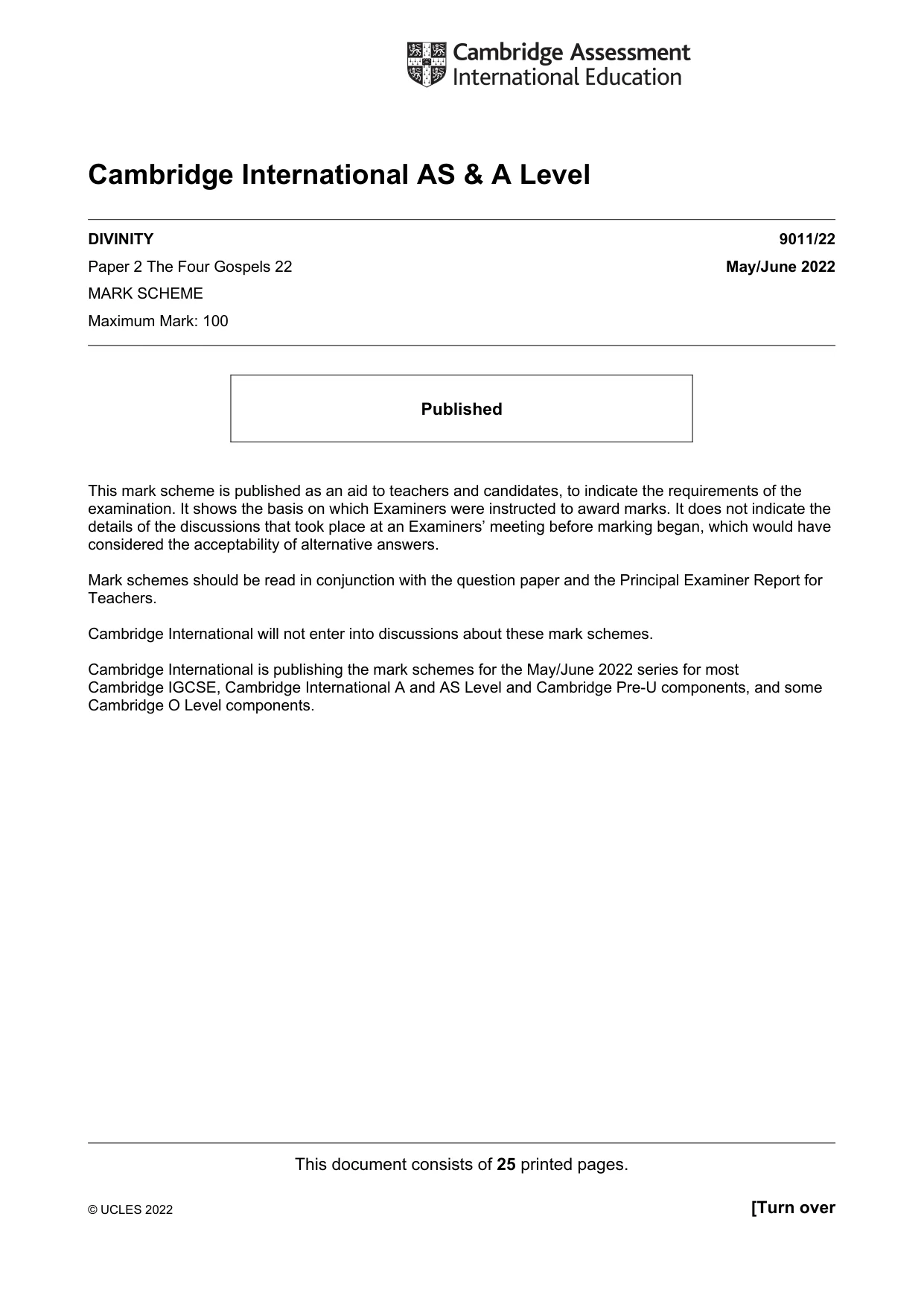
Mark scheme, page 1
This document consists of 25 printed pages. © UCLES 2022 [Turn over Cambridge International AS & A Level DIVINITY 9011/22 Paper 2 The Four Gospels 22 May/June 2022 MARK SCHEME Maximum Mark: 100 Published This mark scheme is published as an aid to teachers and candidates, to indicate the requirements of the examination. It shows the basis on which Examiners were instructed to award marks. It does not indicate the details of the discussions that took place at an Examiners’ meeting before marking began, which would have considered the acceptability of alternative answers. Mark schemes should be read in conjunction with the question paper and the Principal Examiner Report for Teachers. Cambridge International will not enter into discussions about these mark schemes. Cambridge International is publishing the mark schemes for the May/June 2022 series for most Cambridge IGCSE, Cambridge International A and AS Level and Cambridge Pre-U components, and some Cambridge O Level components.
Mark scheme, page 2
9011/22 Cambridge International AS & A Level – Mark Scheme PUBLISHED May/June 2022 © UCLES 2022 Page 2 of 25 Generic Marking Principles These general marking principles must be applied by all examiners when marking candidate answers. They should be applied alongside the specific content of the mark scheme or generic level descriptors for a question. Each question paper and mark scheme will also comply with these marking principles. GENERIC MARKING PRINCIPLE 1: Marks must be awarded in line with: the specific content of the mark scheme or the generic level descriptors for the question the specific skills defined in the mark scheme or in the generic level descriptors for the question the standard of response required by a candidate as exemplified by the standardisation scripts. GENERIC MARKING PRINCIPLE 2: Marks awarded are always whole marks (not half marks, or other fractions). GENERIC MARKING PRINCIPLE 3: Marks must be awarded positively: marks are awarded for correct/valid answers, as defined in the mark scheme. However, credit is given for valid answers which go beyond the scope of the syllabus and mark scheme, referring to your Team Leader as appropriate marks are awarded when candidates clearly demonstrate what they know and can do marks are not deducted for errors marks are not deducted for omissions answers should only be judged on the quality of spelling, punctuation and grammar when these features are specifically assessed by the question as indicated by the mark scheme. The meaning, however, should be unambiguous. GENERIC MARKING PRINCIPLE 4: Rules must be applied consistently, e.g. in situations where candidates have not followed instructions or in the application of generic level descriptors. GENERIC MARKING PRINCIPLE 5: Marks should be awarded using the full range of marks defined in the mark scheme for the question (however; the use of the full mark range may be limited according to the quality of the candidate responses seen). GENERIC MARKING PRINCIPLE 6: Marks awarded are based solely on the requirements as defined in the mark scheme. Marks should not be awarded with grade thresholds or grade descriptors in mind.
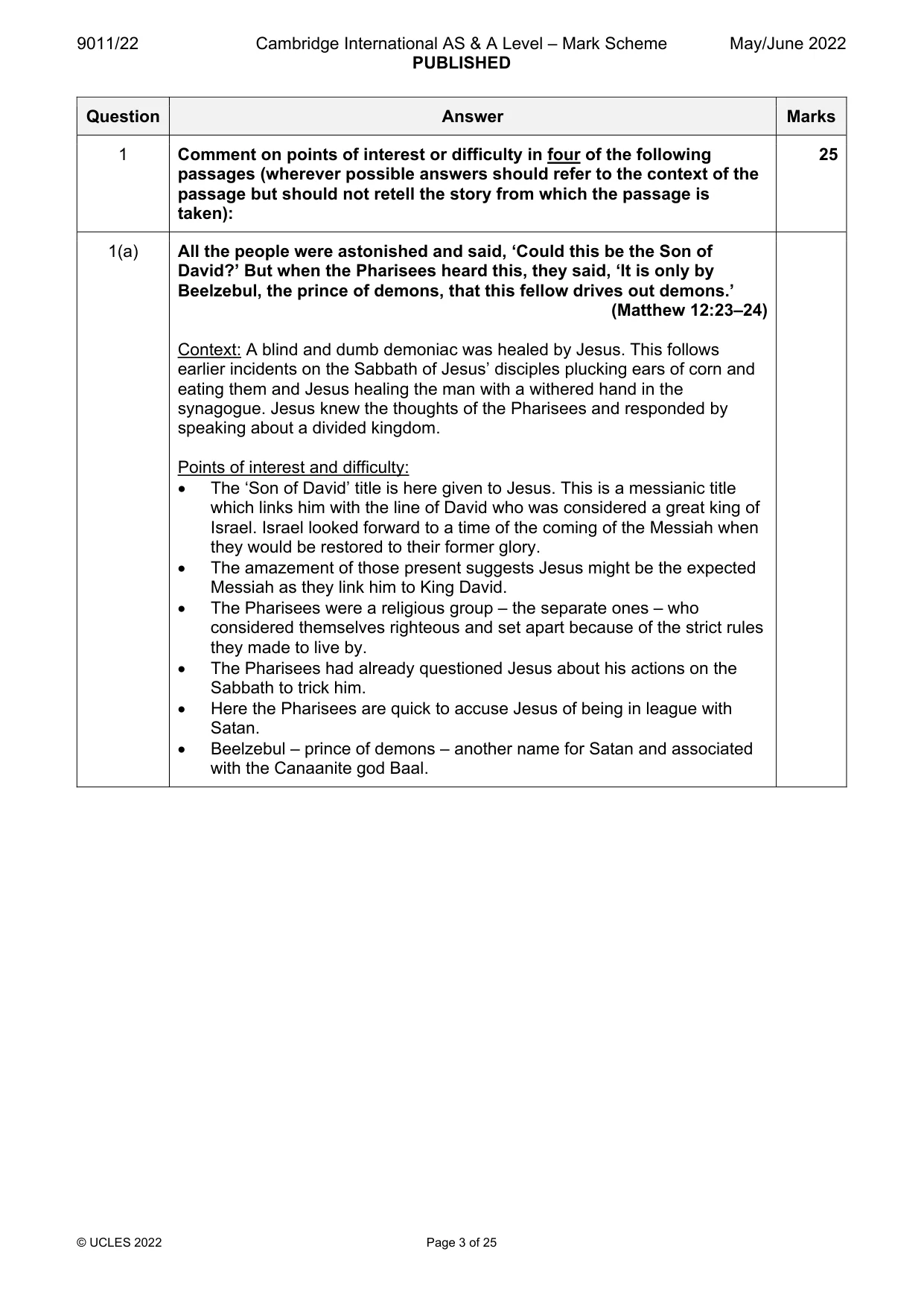
Mark scheme, page 3
9011/22 Cambridge International AS & A Level – Mark Scheme PUBLISHED May/June 2022 © UCLES 2022 Page 3 of 25 Question Answer Marks 1 Comment on points of interest or difficulty in four of the following passages (wherever possible answers should refer to the context of the passage but should not retell the story from which the passage is taken): 25 1(a) All the people were astonished and said, ‘Could this be the Son of David?’ But when the Pharisees heard this, they said, ‘It is only by Beelzebul, the prince of demons, that this fellow drives out demons.’ (Matthew 12:23–24) Context: A blind and dumb demoniac was healed by Jesus. This follows earlier incidents on the Sabbath of Jesus’ disciples plucking ears of corn and eating them and Jesus healing the man with a withered hand in the synagogue. Jesus knew the thoughts of the Pharisees and responded by speaking about a divided kingdom. Points of interest and difficulty: The ‘Son of David’ title is here given to Jesus. This is a messianic title which links him with the line of David who was considered a great king of Israel. Israel looked forward to a time of the coming of the Messiah when they would be restored to their former glory. The amazement of those present suggests Jesus might be the expected Messiah as they link him to King David. The Pharisees were a religious group – the separate ones – who considered themselves righteous and set apart because of the strict rules they made to live by. The Pharisees had already questioned Jesus about his actions on the Sabbath to trick him. Here the Pharisees are quick to accuse Jesus of being in league with Satan. Beelzebul – prince of demons – another name for Satan and associated with the Canaanite god Baal.
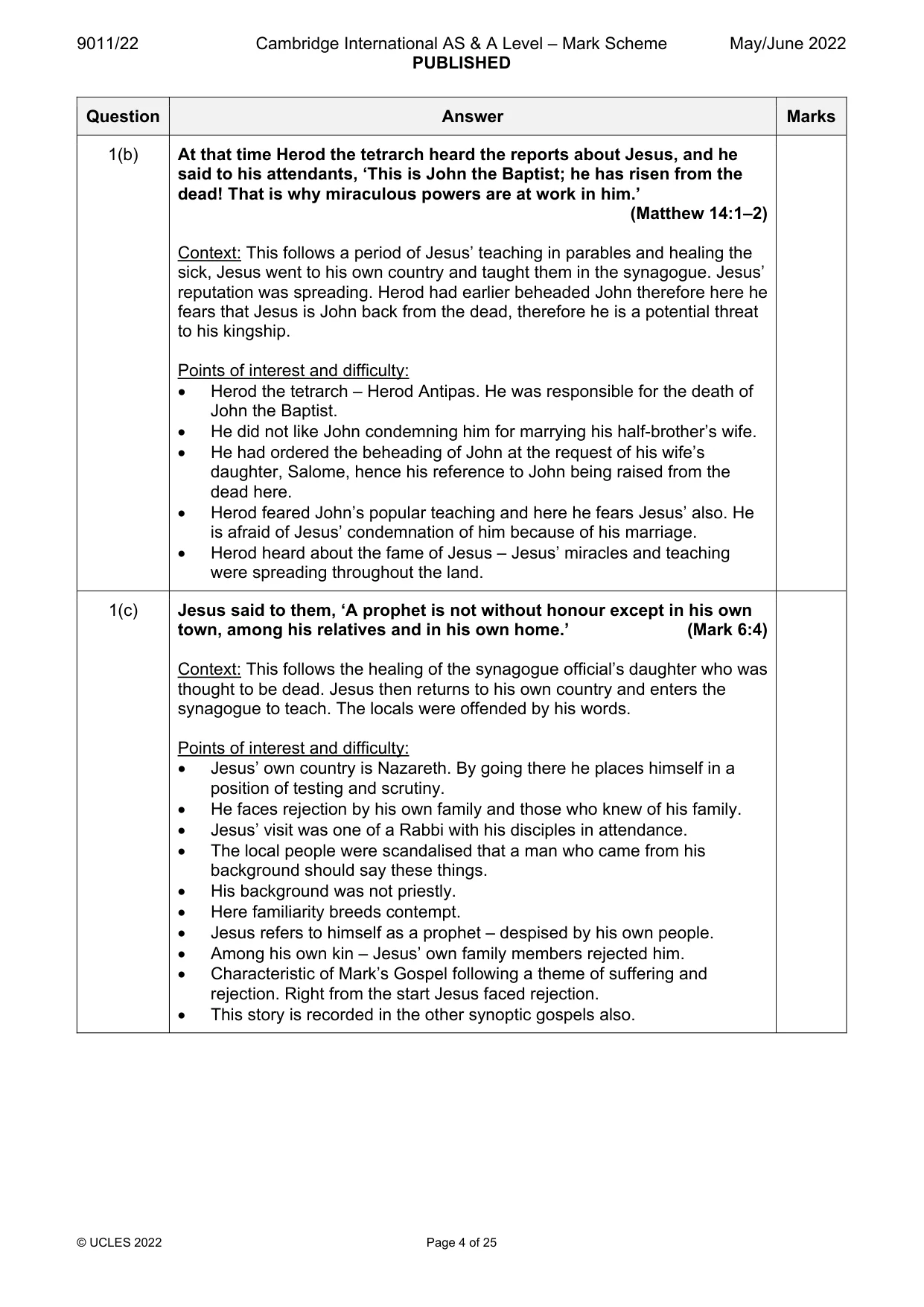
Mark scheme, page 4
9011/22 Cambridge International AS & A Level – Mark Scheme PUBLISHED May/June 2022 © UCLES 2022 Page 4 of 25 Question Answer Marks 1(b) At that time Herod the tetrarch heard the reports about Jesus, and he said to his attendants, ‘This is John the Baptist; he has risen from the dead! That is why miraculous powers are at work in him.’ (Matthew 14:1–2) Context: This follows a period of Jesus’ teaching in parables and healing the sick, Jesus went to his own country and taught them in the synagogue. Jesus’ reputation was spreading. Herod had earlier beheaded John therefore here he fears that Jesus is John back from the dead, therefore he is a potential threat to his kingship. Points of interest and difficulty: Herod the tetrarch – Herod Antipas. He was responsible for the death of John the Baptist. He did not like John condemning him for marrying his half-brother’s wife. He had ordered the beheading of John at the request of his wife’s daughter, Salome, hence his reference to John being raised from the dead here. Herod feared John’s popular teaching and here he fears Jesus’ also. He is afraid of Jesus’ condemnation of him because of his marriage. Herod heard about the fame of Jesus – Jesus’ miracles and teaching were spreading throughout the land. 1(c) Jesus said to them, ‘A prophet is not without honour except in his own town, among his relatives and in his own home.’ (Mark 6:4) Context: This follows the healing of the synagogue official’s daughter who was thought to be dead. Jesus then returns to his own country and enters the synagogue to teach. The locals were offended by his words. Points of interest and difficulty: Jesus’ own country is Nazareth. By going there he places himself in a position of testing and scrutiny. He faces rejection by his own family and those who knew of his family. Jesus’ visit was one of a Rabbi with his disciples in attendance. The local people were scandalised that a man who came from his background should say these things. His background was not priestly. Here familiarity breeds contempt. Jesus refers to himself as a prophet – despised by his own people. Among his own kin – Jesus’ own family members rejected him. Characteristic of Mark’s Gospel following a theme of suffering and rejection. Right from the start Jesus faced rejection. This story is recorded in the other synoptic gospels also.
Mark scheme, page 5
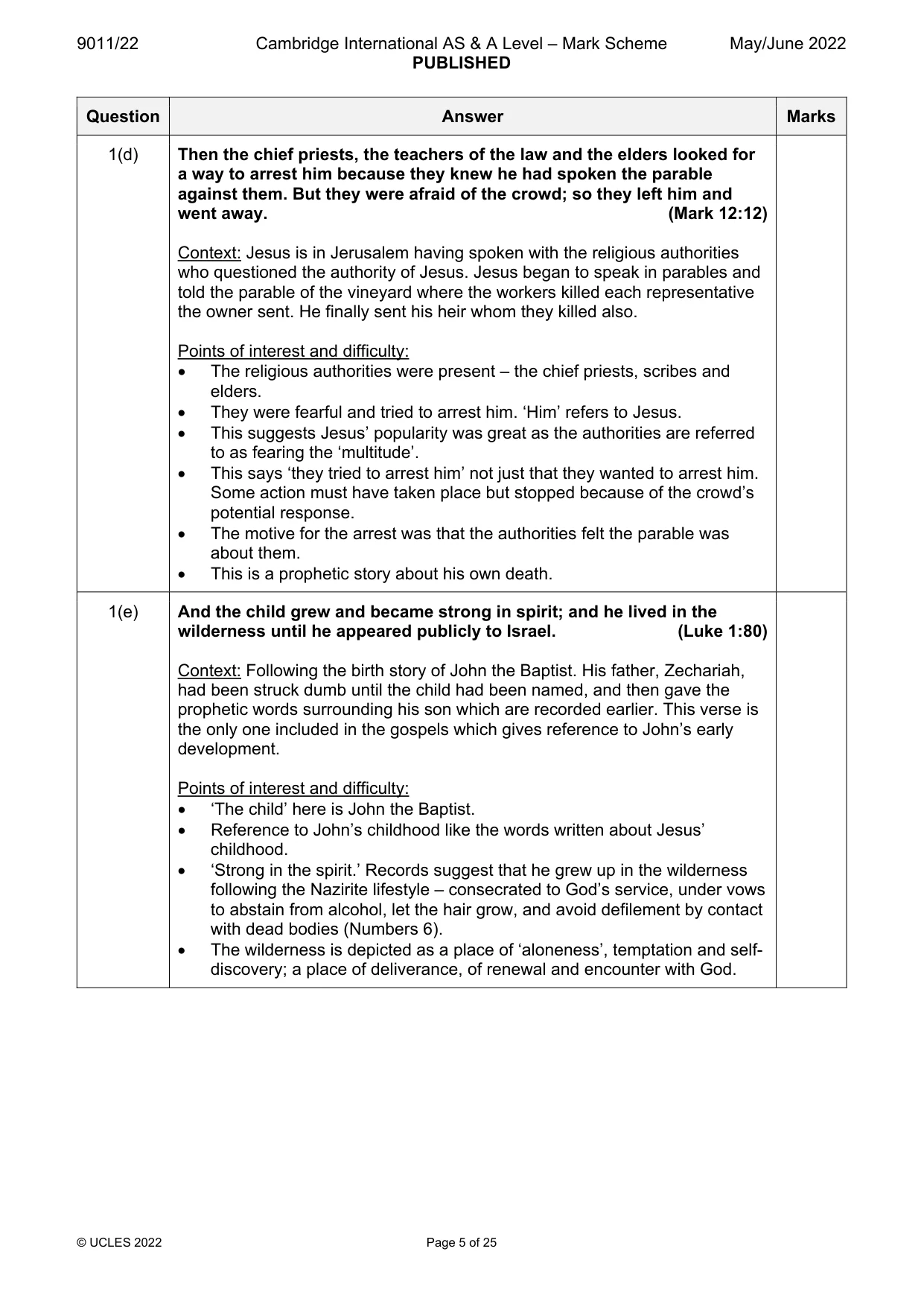
9011/22 Cambridge International AS & A Level – Mark Scheme PUBLISHED May/June 2022 © UCLES 2022 Page 5 of 25 Question Answer Marks 1(d) Then the chief priests, the teachers of the law and the elders looked for a way to arrest him because they knew he had spoken the parable against them. But they were afraid of the crowd; so they left him and went away. (Mark 12:12) Context: Jesus is in Jerusalem having spoken with the religious authorities who questioned the authority of Jesus. Jesus began to speak in parables and told the parable of the vineyard where the workers killed each representative the owner sent. He finally sent his heir whom they killed also. Points of interest and difficulty: The religious authorities were present – the chief priests, scribes and elders. They were fearful and tried to arrest him. ‘Him’ refers to Jesus. This suggests Jesus’ popularity was great as the authorities are referred to as fearing the ‘multitude’. This says ‘they tried to arrest him’ not just that they wanted to arrest him. Some action must have taken place but stopped because of the crowd’s potential response. The motive for the arrest was that the authorities felt the parable was about them. This is a prophetic story about his own death. 1(e) And the child grew and became strong in spirit; and he lived in the wilderness until he appeared publicly to Israel. (Luke 1:80) Context: Following the birth story of John the Baptist. His father, Zechariah, had been struck dumb until the child had been named, and then gave the prophetic words surrounding his son which are recorded earlier. This verse is the only one included in the gospels which gives reference to John’s early development. Points of interest and difficulty: ‘The child’ here is John the Baptist. Reference to John’s childhood like the words written about Jesus’ childhood. ‘Strong in the spirit.’ Records suggest that he grew up in the wilderness following the Nazirite lifestyle – consecrated to God’s service, under vows to abstain from alcohol, let the hair grow, and avoid defilement by contact with dead bodies (Numbers 6). The wilderness is depicted as a place of ‘aloneness’, temptation and self- discovery; a place of deliverance, of renewal and encounter with God.
Mark scheme, page 6
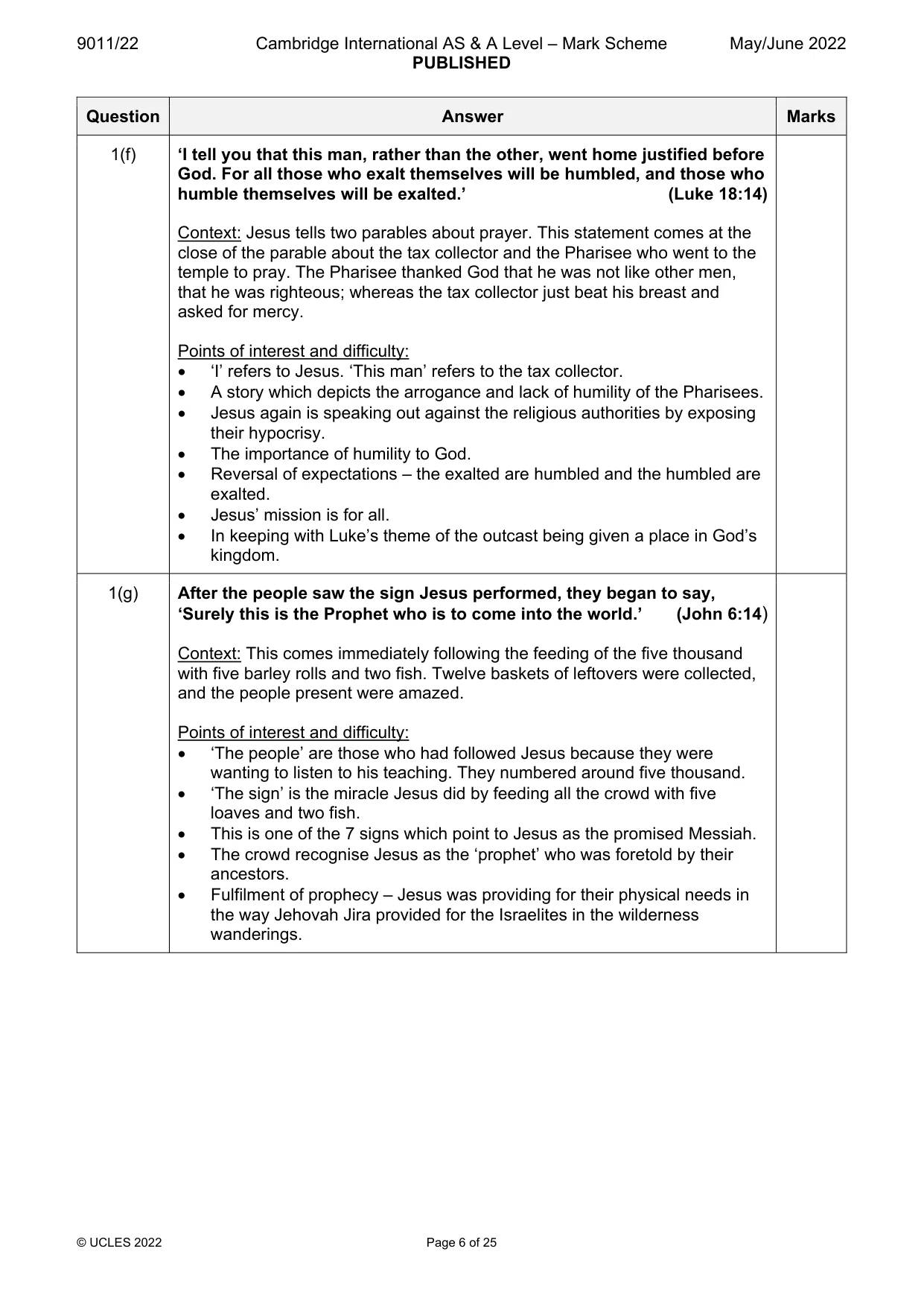
9011/22 Cambridge International AS & A Level – Mark Scheme PUBLISHED May/June 2022 © UCLES 2022 Page 6 of 25 Question Answer Marks 1(f) ‘I tell you that this man, rather than the other, went home justified before God. For all those who exalt themselves will be humbled, and those who humble themselves will be exalted.’ (Luke 18:14) Context: Jesus tells two parables about prayer. This statement comes at the close of the parable about the tax collector and the Pharisee who went to the temple to pray. The Pharisee thanked God that he was not like other men, that he was righteous; whereas the tax collector just beat his breast and asked for mercy. Points of interest and difficulty: ‘I’ refers to Jesus. ‘This man’ refers to the tax collector. A story which depicts the arrogance and lack of humility of the Pharisees. Jesus again is speaking out against the religious authorities by exposing their hypocrisy. The importance of humility to God. Reversal of expectations – the exalted are humbled and the humbled are exalted. Jesus’ mission is for all. In keeping with Luke’s theme of the outcast being given a place in God’s kingdom. 1(g) After the people saw the sign Jesus performed, they began to say, ‘Surely this is the Prophet who is to come into the world.’ (John 6:14) Context: This comes immediately following the feeding of the five thousand with five barley rolls and two fish. Twelve baskets of leftovers were collected, and the people present were amazed. Points of interest and difficulty: ‘The people’ are those who had followed Jesus because they were wanting to listen to his teaching. They numbered around five thousand. ‘The sign’ is the miracle Jesus did by feeding all the crowd with five loaves and two fish. This is one of the 7 signs which point to Jesus as the promised Messiah. The crowd recognise Jesus as the ‘prophet’ who was foretold by their ancestors. Fulfilment of prophecy – Jesus was providing for their physical needs in the way Jehovah Jira provided for the Israelites in the wilderness wanderings.
Mark scheme, page 7
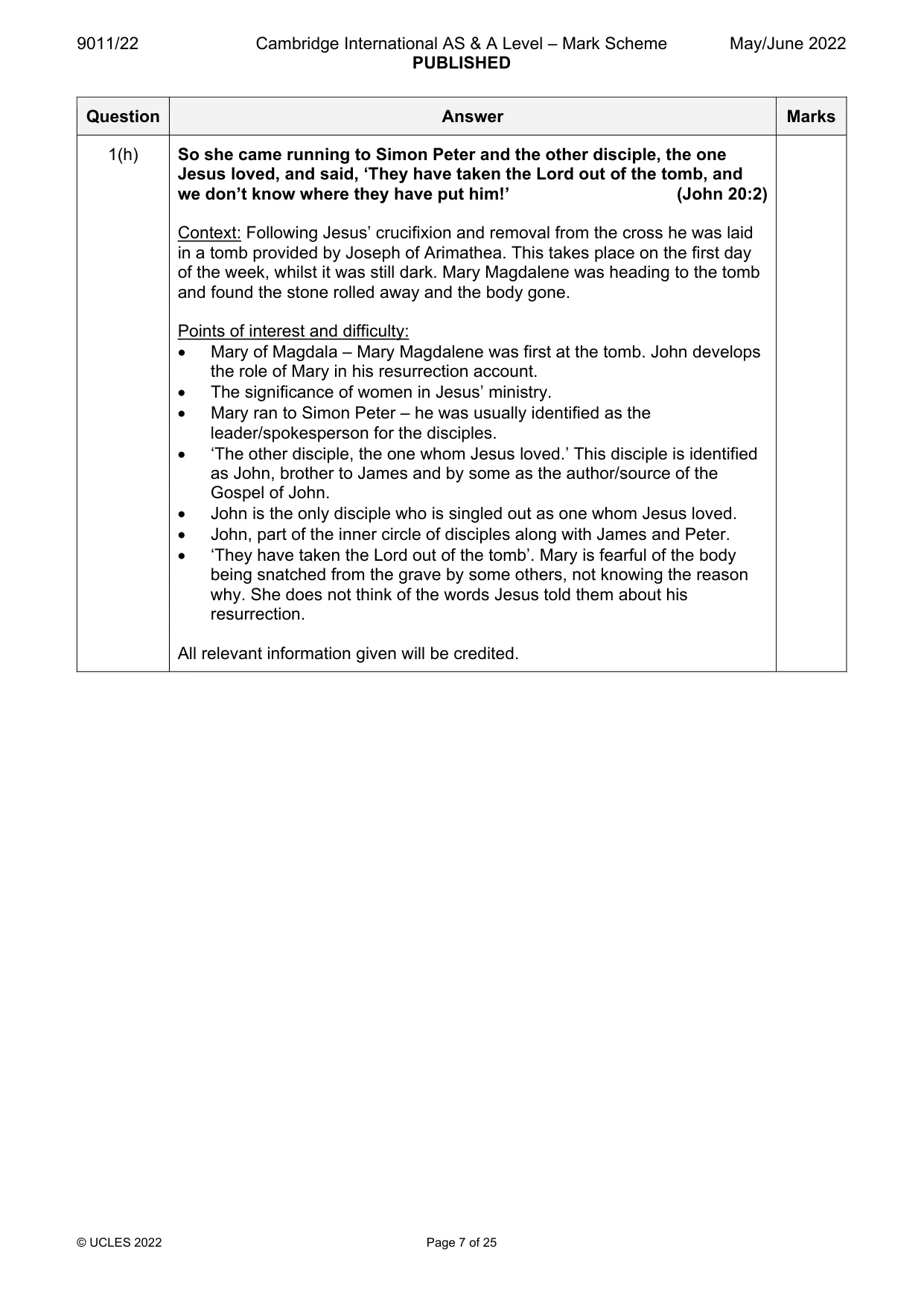
9011/22 Cambridge International AS & A Level – Mark Scheme PUBLISHED May/June 2022 © UCLES 2022 Page 7 of 25 Question Answer Marks 1(h) So she came running to Simon Peter and the other disciple, the one Jesus loved, and said, ‘They have taken the Lord out of the tomb, and we don’t know where they have put him!’ (John 20:2) Context: Following Jesus’ crucifixion and removal from the cross he was laid in a tomb provided by Joseph of Arimathea. This takes place on the first day of the week, whilst it was still dark. Mary Magdalene was heading to the tomb and found the stone rolled away and the body gone. Points of interest and difficulty: Mary of Magdala – Mary Magdalene was first at the tomb. John develops the role of Mary in his resurrection account. The significance of women in Jesus’ ministry. Mary ran to Simon Peter – he was usually identified as the leader/spokesperson for the disciples. ‘The other disciple, the one whom Jesus loved.’ This disciple is identified as John, brother to James and by some as the author/source of the Gospel of John. John is the only disciple who is singled out as one whom Jesus loved. John, part of the inner circle of disciples along with James and Peter. ‘They have taken the Lord out of the tomb’. Mary is fearful of the body being snatched from the grave by some others, not knowing the reason why. She does not think of the words Jesus told them about his resurrection. All relevant information given will be credited.
Mark scheme, page 8
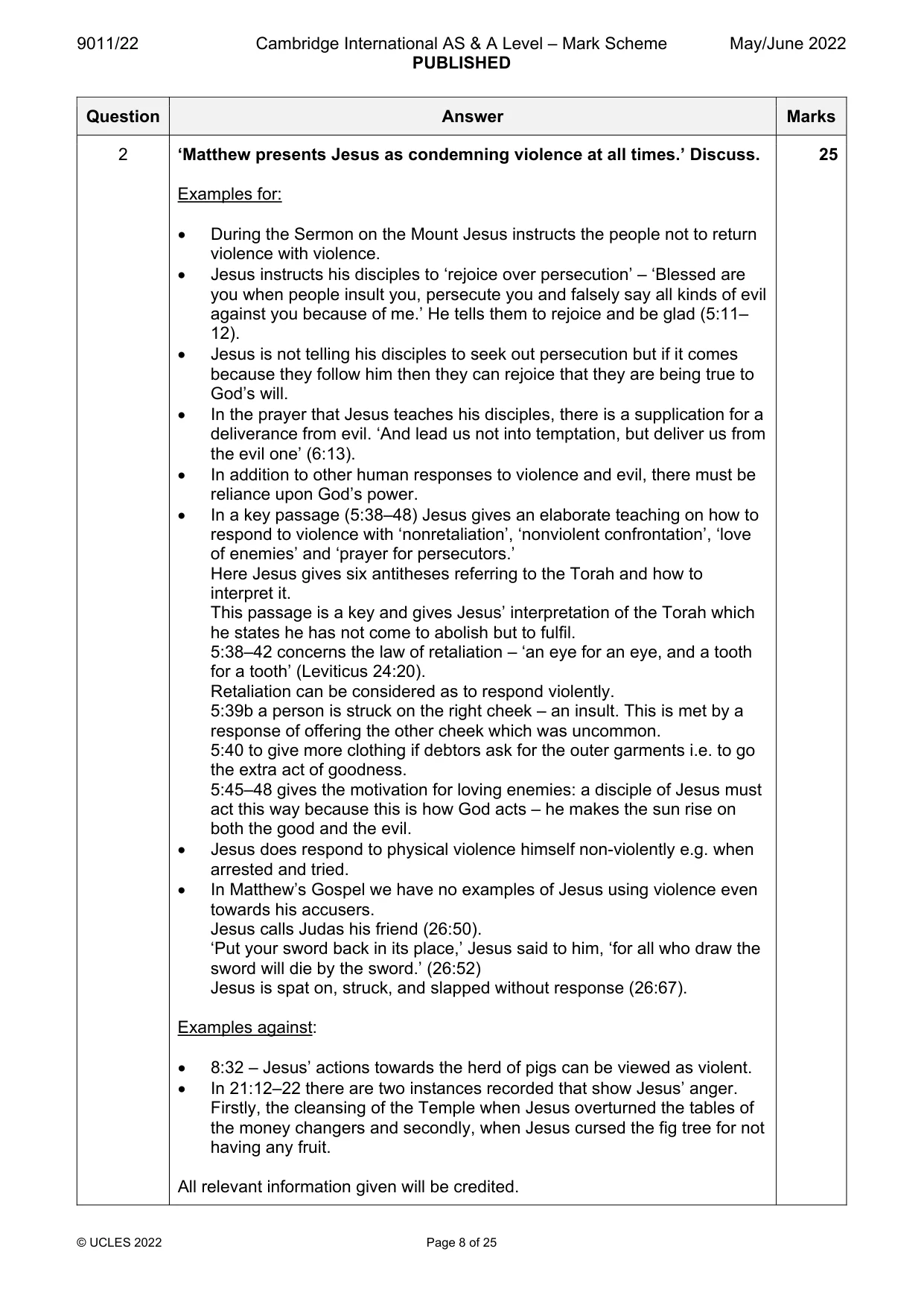
9011/22 Cambridge International AS & A Level – Mark Scheme PUBLISHED May/June 2022 © UCLES 2022 Page 8 of 25 Question Answer Marks 2 ‘Matthew presents Jesus as condemning violence at all times.’ Discuss. Examples for: During the Sermon on the Mount Jesus instructs the people not to return violence with violence. Jesus instructs his disciples to ‘rejoice over persecution’ – ‘Blessed are you when people insult you, persecute you and falsely say all kinds of evil against you because of me.’ He tells them to rejoice and be glad (5:11– 12). Jesus is not telling his disciples to seek out persecution but if it comes because they follow him then they can rejoice that they are being true to God’s will. In the prayer that Jesus teaches his disciples, there is a supplication for a deliverance from evil. ‘And lead us not into temptation, but deliver us from the evil one’ (6:13). In addition to other human responses to violence and evil, there must be reliance upon God’s power. In a key passage (5:38–48) Jesus gives an elaborate teaching on how to respond to violence with ‘nonretaliation’, ‘nonviolent confrontation’, ‘love of enemies’ and ‘prayer for persecutors.’ Here Jesus gives six antitheses referring to the Torah and how to interpret it. This passage is a key and gives Jesus’ interpretation of the Torah which he states he has not come to abolish but to fulfil. 5:38–42 concerns the law of retaliation – ‘an eye for an eye, and a tooth for a tooth’ (Leviticus 24:20). Retaliation can be considered as to respond violently. 5:39b a person is struck on the right cheek – an insult. This is met by a response of offering the other cheek which was uncommon. 5:40 to give more clothing if debtors ask for the outer garments i.e. to go the extra act of goodness. 5:45–48 gives the motivation for loving enemies: a disciple of Jesus must act this way because this is how God acts – he makes the sun rise on both the good and the evil. Jesus does respond to physical violence himself non-violently e.g. when arrested and tried. In Matthew’s Gospel we have no examples of Jesus using violence even towards his accusers. Jesus calls Judas his friend (26:50). ‘Put your sword back in its place,’ Jesus said to him, ‘for all who draw the sword will die by the sword.’ (26:52) Jesus is spat on, struck, and slapped without response (26:67). Examples against: 8:32 – Jesus’ actions towards the herd of pigs can be viewed as violent. In 21:12–22 there are two instances recorded that show Jesus’ anger. Firstly, the cleansing of the Temple when Jesus overturned the tables of the money changers and secondly, when Jesus cursed the fig tree for not having any fruit. All relevant information given will be credited. 25
Mark scheme, page 9
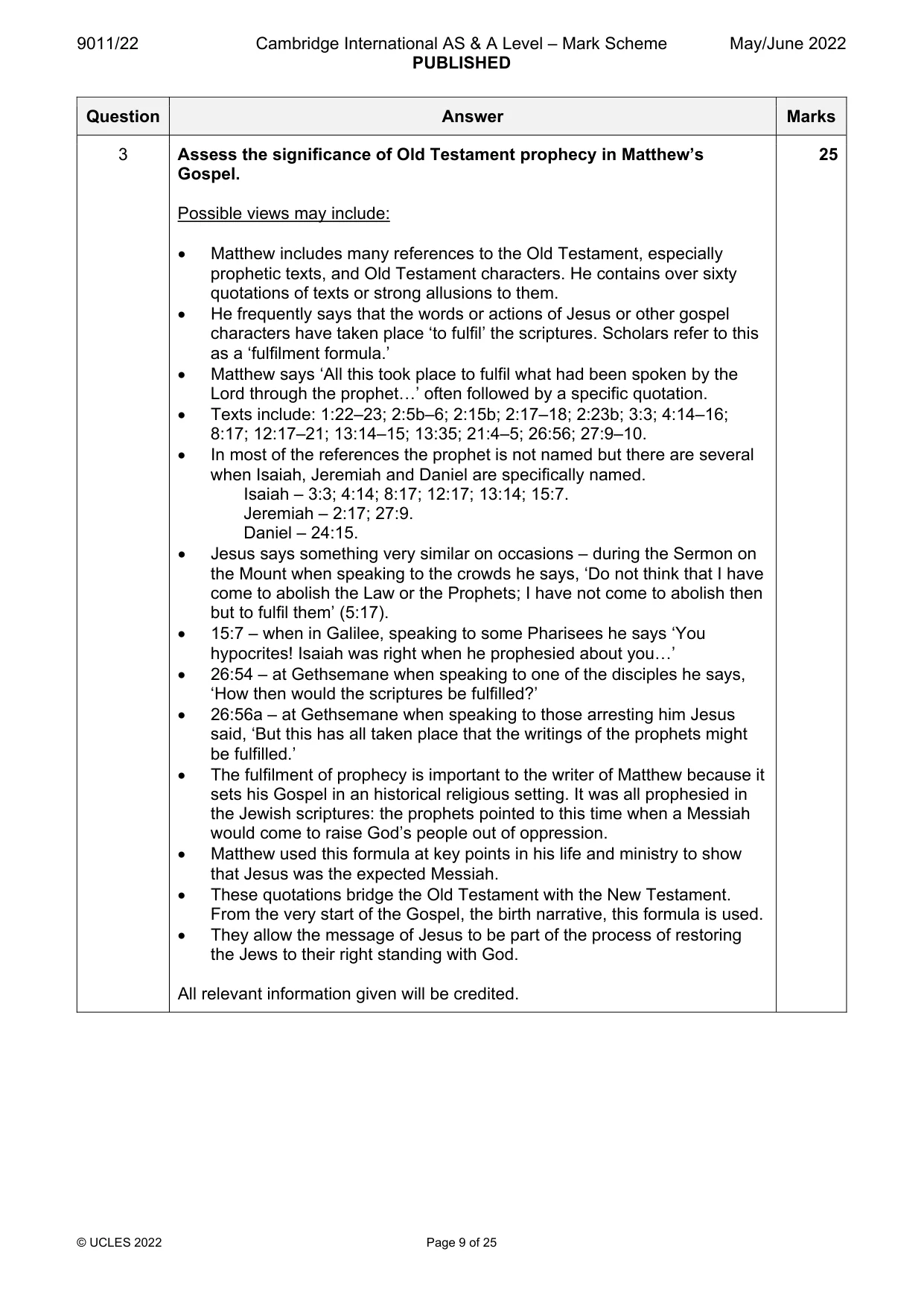
9011/22 Cambridge International AS & A Level – Mark Scheme PUBLISHED May/June 2022 © UCLES 2022 Page 9 of 25 Question Answer Marks 3 Assess the significance of Old Testament prophecy in Matthew’s Gospel. Possible views may include: Matthew includes many references to the Old Testament, especially prophetic texts, and Old Testament characters. He contains over sixty quotations of texts or strong allusions to them. He frequently says that the words or actions of Jesus or other gospel characters have taken place ‘to fulfil’ the scriptures. Scholars refer to this as a ‘fulfilment formula.’ Matthew says ‘All this took place to fulfil what had been spoken by the Lord through the prophet…’ often followed by a specific quotation. Texts include: 1:22–23; 2:5b–6; 2:15b; 2:17–18; 2:23b; 3:3; 4:14–16; 8:17; 12:17–21; 13:14–15; 13:35; 21:4–5; 26:56; 27:9–10. In most of the references the prophet is not named but there are several when Isaiah, Jeremiah and Daniel are specifically named. Isaiah – 3:3; 4:14; 8:17; 12:17; 13:14; 15:7. Jeremiah – 2:17; 27:9. Daniel – 24:15. Jesus says something very similar on occasions – during the Sermon on the Mount when speaking to the crowds he says, ‘Do not think that I have come to abolish the Law or the Prophets; I have not come to abolish then but to fulfil them’ (5:17). 15:7 – when in Galilee, speaking to some Pharisees he says ‘You hypocrites! Isaiah was right when he prophesied about you…’ 26:54 – at Gethsemane when speaking to one of the disciples he says, ‘How then would the scriptures be fulfilled?’ 26:56a – at Gethsemane when speaking to those arresting him Jesus said, ‘But this has all taken place that the writings of the prophets might be fulfilled.’ The fulfilment of prophecy is important to the writer of Matthew because it sets his Gospel in an historical religious setting. It was all prophesied in the Jewish scriptures: the prophets pointed to this time when a Messiah would come to raise God’s people out of oppression. Matthew used this formula at key points in his life and ministry to show that Jesus was the expected Messiah. These quotations bridge the Old Testament with the New Testament. From the very start of the Gospel, the birth narrative, this formula is used. They allow the message of Jesus to be part of the process of restoring the Jews to their right standing with God. All relevant information given will be credited. 25
Mark scheme, page 10
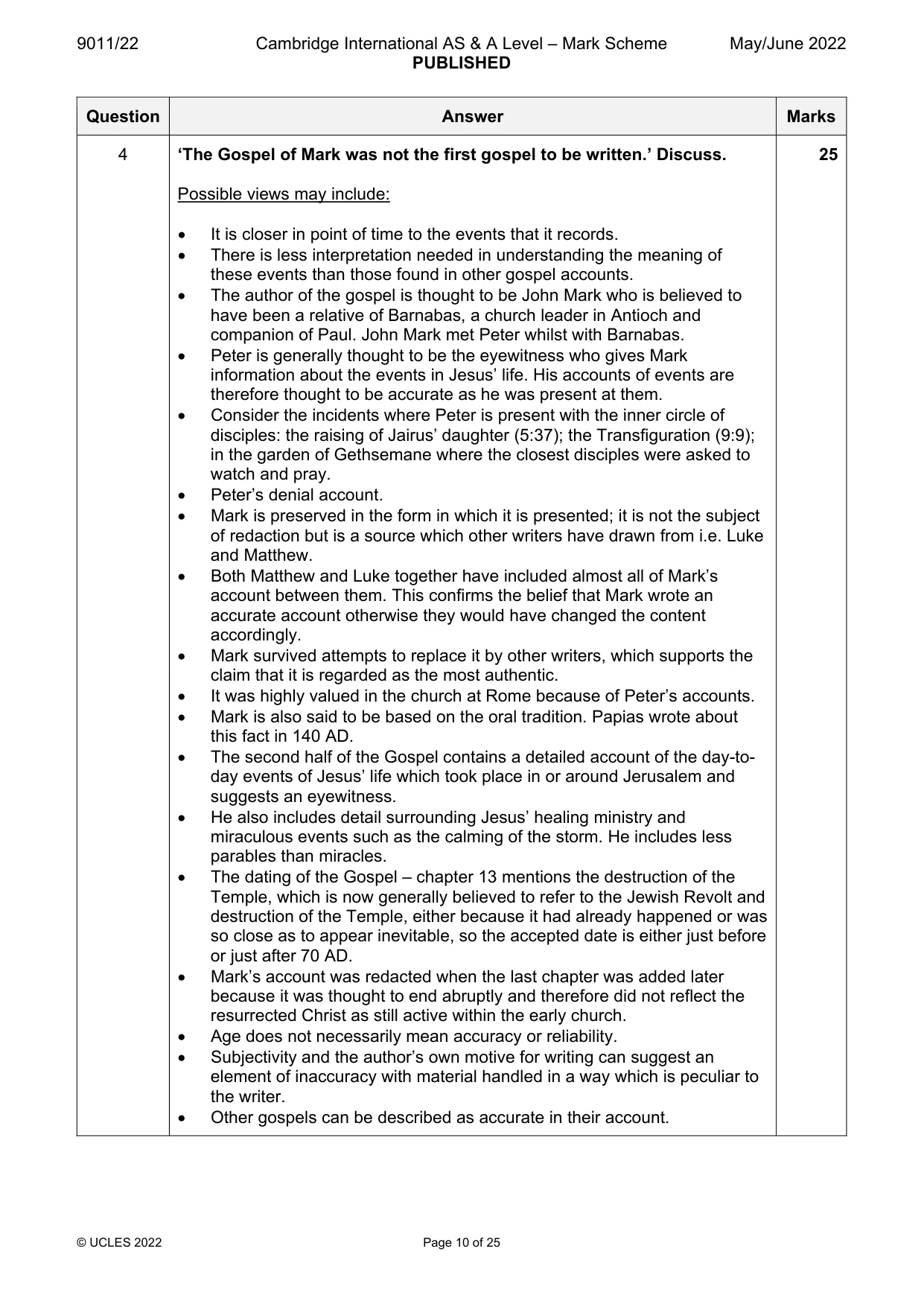
9011/22 Cambridge International AS & A Level – Mark Scheme PUBLISHED May/June 2022 © UCLES 2022 Page 10 of 25 Question Answer Marks 4 ‘The Gospel of Mark was not the first gospel to be written.’ Discuss. Possible views may include: It is closer in point of time to the events that it records. There is less interpretation needed in understanding the meaning of these events than those found in other gospel accounts. The author of the gospel is thought to be John Mark who is believed to have been a relative of Barnabas, a church leader in Antioch and companion of Paul. John Mark met Peter whilst with Barnabas. Peter is generally thought to be the eyewitness who gives Mark information about the events in Jesus’ life. His accounts of events are therefore thought to be accurate as he was present at them. Consider the incidents where Peter is present with the inner circle of disciples: the raising of Jairus’ daughter (5:37); the Transfiguration (9:9); in the garden of Gethsemane where the closest disciples were asked to watch and pray. Peter’s denial account. Mark is preserved in the form in which it is presented; it is not the subject of redaction but is a source which other writers have drawn from i.e. Luke and Matthew. Both Matthew and Luke together have included almost all of Mark’s account between them. This confirms the belief that Mark wrote an accurate account otherwise they would have changed the content accordingly. Mark survived attempts to replace it by other writers, which supports the claim that it is regarded as the most authentic. It was highly valued in the church at Rome because of Peter’s accounts. Mark is also said to be based on the oral tradition. Papias wrote about this fact in 140 AD. The second half of the Gospel contains a detailed account of the day-to- day events of Jesus’ life which took place in or around Jerusalem and suggests an eyewitness. He also includes detail surrounding Jesus’ healing ministry and miraculous events such as the calming of the storm. He includes less parables than miracles. The dating of the Gospel – chapter 13 mentions the destruction of the Temple, which is now generally believed to refer to the Jewish Revolt and destruction of the Temple, either because it had already happened or was so close as to appear inevitable, so the accepted date is either just before or just after 70 AD. Mark’s account was redacted when the last chapter was added later because it was thought to end abruptly and therefore did not reflect the resurrected Christ as still active within the early church. Age does not necessarily mean accuracy or reliability. Subjectivity and the author’s own motive for writing can suggest an element of inaccuracy with material handled in a way which is peculiar to the writer. Other gospels can be described as accurate in their account. 25
Mark scheme, page 11
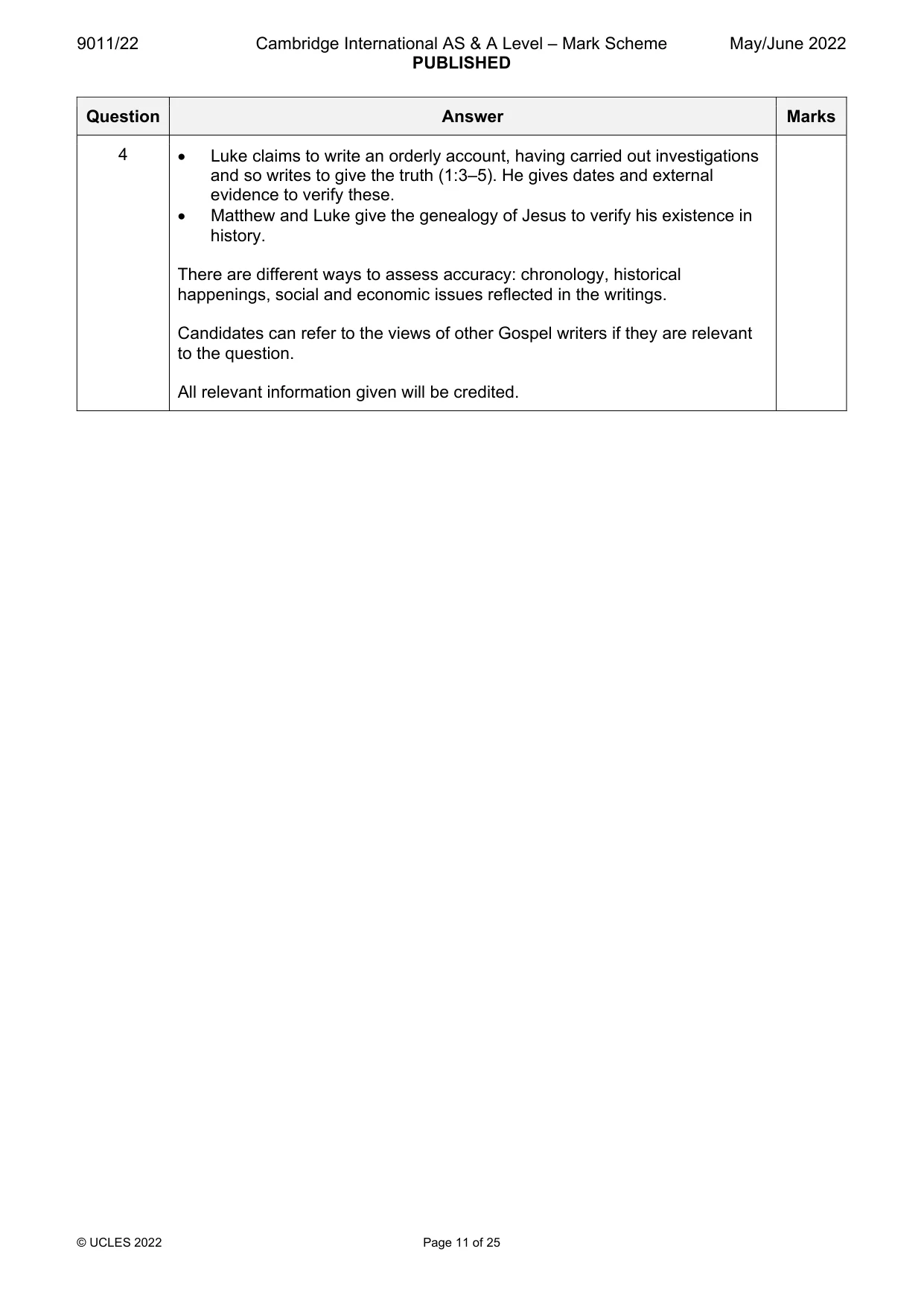
9011/22 Cambridge International AS & A Level – Mark Scheme PUBLISHED May/June 2022 © UCLES 2022 Page 11 of 25 Question Answer Marks 4 Luke claims to write an orderly account, having carried out investigations and so writes to give the truth (1:3–5). He gives dates and external evidence to verify these. Matthew and Luke give the genealogy of Jesus to verify his existence in history. There are different ways to assess accuracy: chronology, historical happenings, social and economic issues reflected in the writings. Candidates can refer to the views of other Gospel writers if they are relevant to the question. All relevant information given will be credited.
Mark scheme, page 12
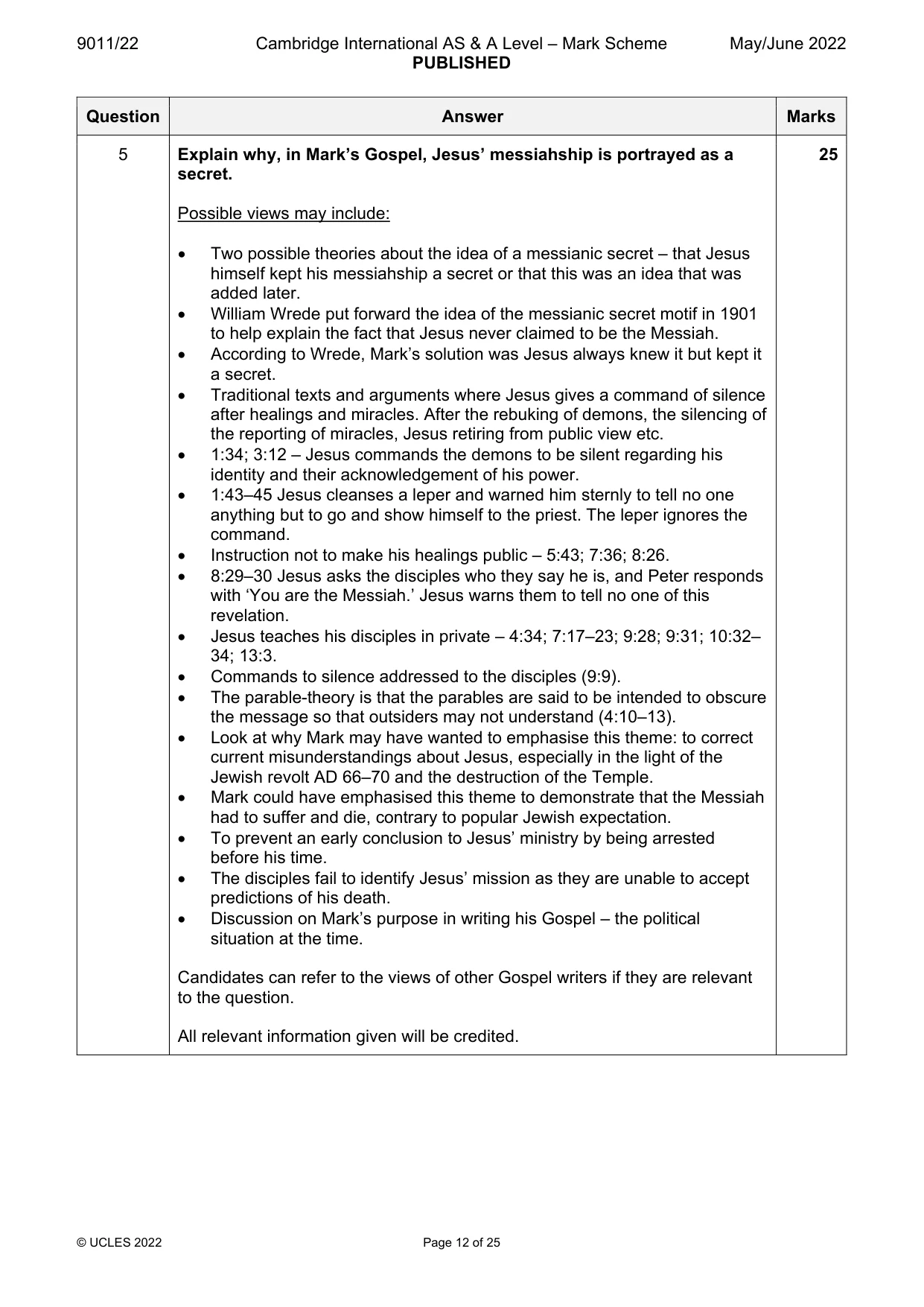
9011/22 Cambridge International AS & A Level – Mark Scheme PUBLISHED May/June 2022 © UCLES 2022 Page 12 of 25 Question Answer Marks 5 Explain why, in Mark’s Gospel, Jesus’ messiahship is portrayed as a secret. Possible views may include: Two possible theories about the idea of a messianic secret – that Jesus himself kept his messiahship a secret or that this was an idea that was added later. William Wrede put forward the idea of the messianic secret motif in 1901 to help explain the fact that Jesus never claimed to be the Messiah. According to Wrede, Mark’s solution was Jesus always knew it but kept it a secret. Traditional texts and arguments where Jesus gives a command of silence after healings and miracles. After the rebuking of demons, the silencing of the reporting of miracles, Jesus retiring from public view etc. 1:34; 3:12 – Jesus commands the demons to be silent regarding his identity and their acknowledgement of his power. 1:43–45 Jesus cleanses a leper and warned him sternly to tell no one anything but to go and show himself to the priest. The leper ignores the command. Instruction not to make his healings public – 5:43; 7:36; 8:26. 8:29–30 Jesus asks the disciples who they say he is, and Peter responds with ‘You are the Messiah.’ Jesus warns them to tell no one of this revelation. Jesus teaches his disciples in private – 4:34; 7:17–23; 9:28; 9:31; 10:32– 34; 13:3. Commands to silence addressed to the disciples (9:9). The parable-theory is that the parables are said to be intended to obscure the message so that outsiders may not understand (4:10–13). Look at why Mark may have wanted to emphasise this theme: to correct current misunderstandings about Jesus, especially in the light of the Jewish revolt AD 66–70 and the destruction of the Temple. Mark could have emphasised this theme to demonstrate that the Messiah had to suffer and die, contrary to popular Jewish expectation. To prevent an early conclusion to Jesus’ ministry by being arrested before his time. The disciples fail to identify Jesus’ mission as they are unable to accept predictions of his death. Discussion on Mark’s purpose in writing his Gospel – the political situation at the time. Candidates can refer to the views of other Gospel writers if they are relevant to the question. All relevant information given will be credited. 25
Mark scheme, page 13
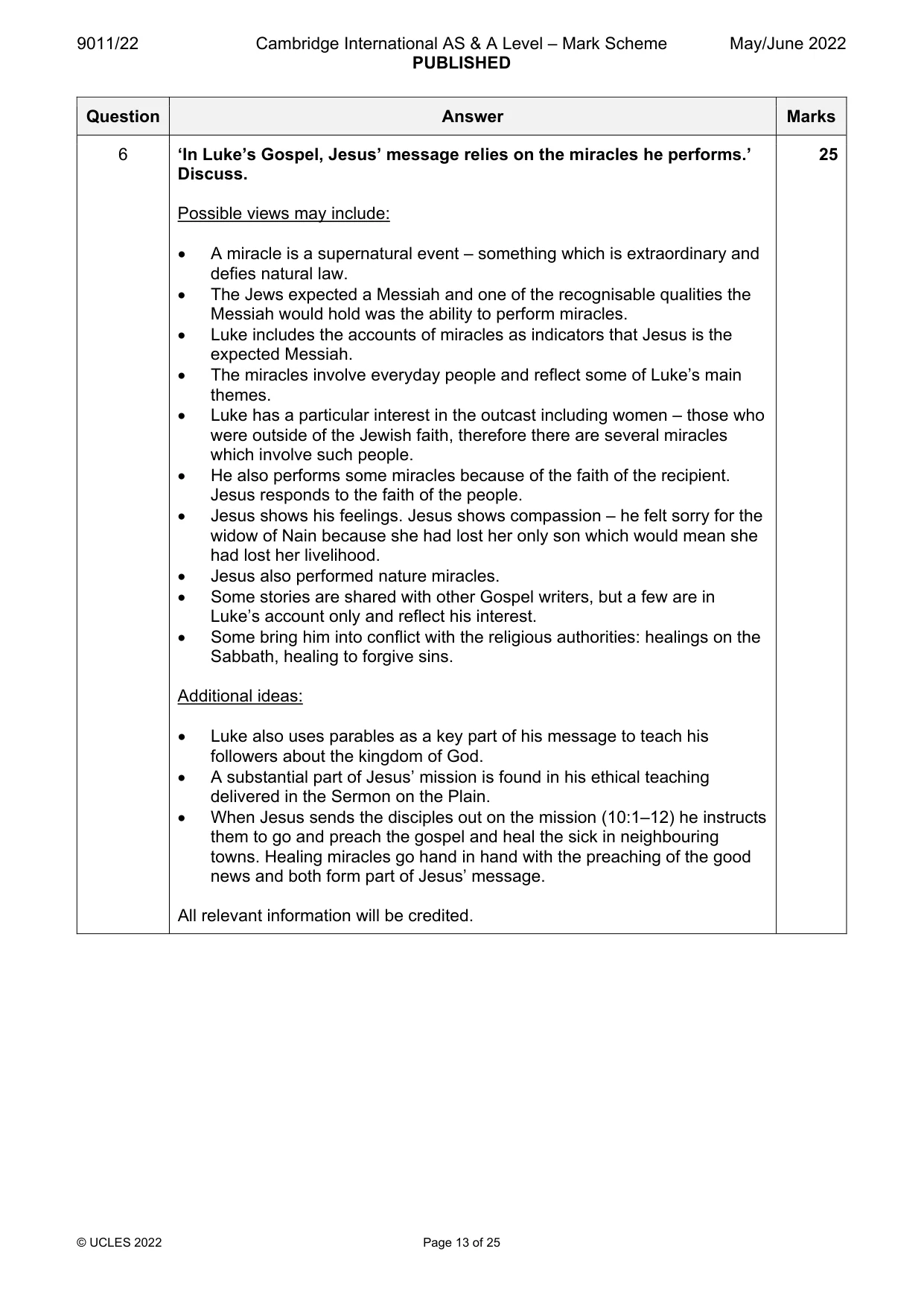
9011/22 Cambridge International AS & A Level – Mark Scheme PUBLISHED May/June 2022 © UCLES 2022 Page 13 of 25 Question Answer Marks 6 ‘In Luke’s Gospel, Jesus’ message relies on the miracles he performs.’ Discuss. Possible views may include: A miracle is a supernatural event – something which is extraordinary and defies natural law. The Jews expected a Messiah and one of the recognisable qualities the Messiah would hold was the ability to perform miracles. Luke includes the accounts of miracles as indicators that Jesus is the expected Messiah. The miracles involve everyday people and reflect some of Luke’s main themes. Luke has a particular interest in the outcast including women – those who were outside of the Jewish faith, therefore there are several miracles which involve such people. He also performs some miracles because of the faith of the recipient. Jesus responds to the faith of the people. Jesus shows his feelings. Jesus shows compassion – he felt sorry for the widow of Nain because she had lost her only son which would mean she had lost her livelihood. Jesus also performed nature miracles. Some stories are shared with other Gospel writers, but a few are in Luke’s account only and reflect his interest. Some bring him into conflict with the religious authorities: healings on the Sabbath, healing to forgive sins. Additional ideas: Luke also uses parables as a key part of his message to teach his followers about the kingdom of God. A substantial part of Jesus’ mission is found in his ethical teaching delivered in the Sermon on the Plain. When Jesus sends the disciples out on the mission (10:1–12) he instructs them to go and preach the gospel and heal the sick in neighbouring towns. Healing miracles go hand in hand with the preaching of the good news and both form part of Jesus’ message. All relevant information will be credited. 25
Mark scheme, page 14
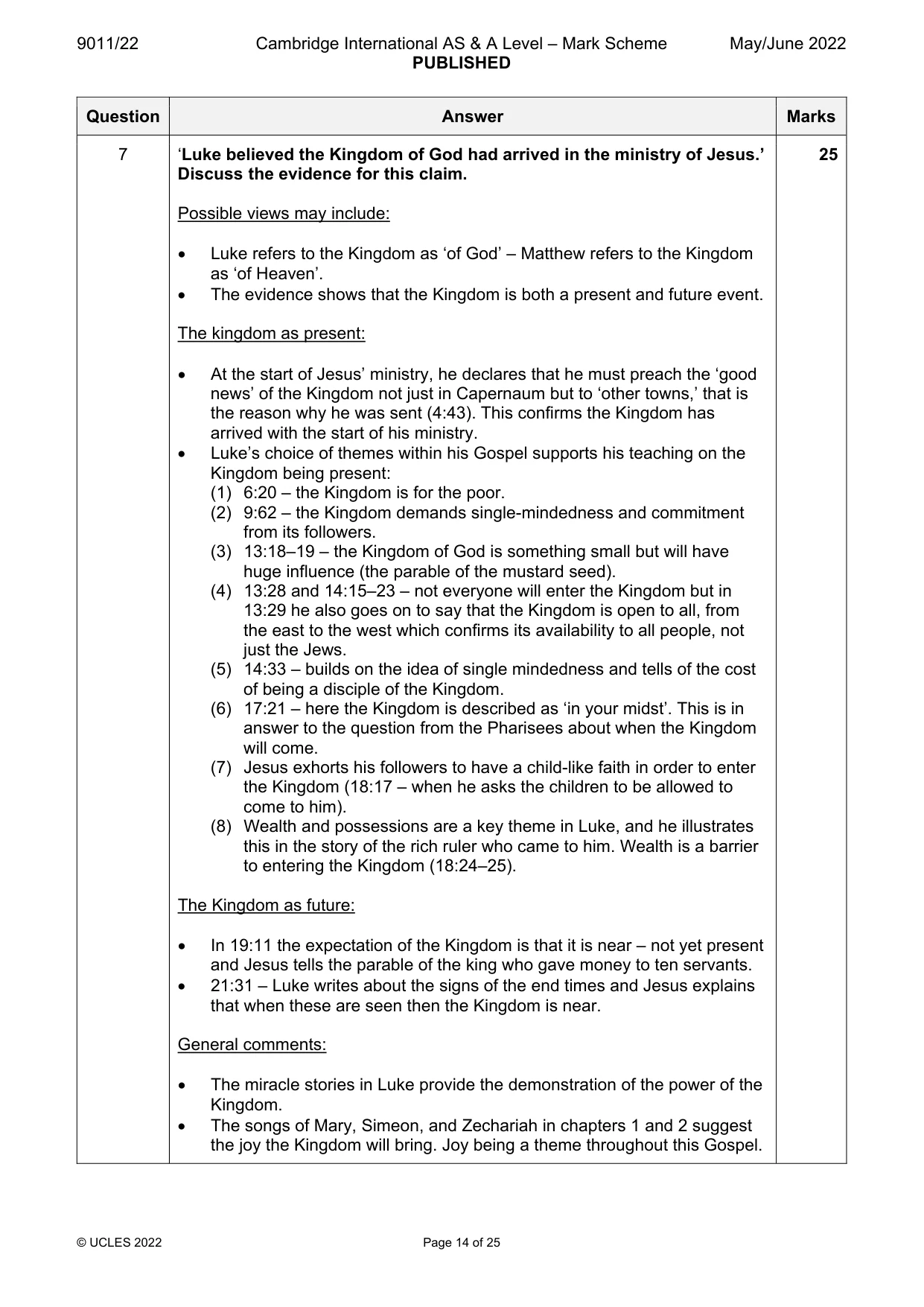
9011/22 Cambridge International AS & A Level – Mark Scheme PUBLISHED May/June 2022 © UCLES 2022 Page 14 of 25 Question Answer Marks 7 ‘Luke believed the Kingdom of God had arrived in the ministry of Jesus.’ Discuss the evidence for this claim. Possible views may include: Luke refers to the Kingdom as ‘of God’ – Matthew refers to the Kingdom as ‘of Heaven’. The evidence shows that the Kingdom is both a present and future event. The kingdom as present: At the start of Jesus’ ministry, he declares that he must preach the ‘good news’ of the Kingdom not just in Capernaum but to ‘other towns,’ that is the reason why he was sent (4:43). This confirms the Kingdom has arrived with the start of his ministry. Luke’s choice of themes within his Gospel supports his teaching on the Kingdom being present: (1) 6:20 – the Kingdom is for the poor. (2) 9:62 – the Kingdom demands single-mindedness and commitment from its followers. (3) 13:18–19 – the Kingdom of God is something small but will have huge influence (the parable of the mustard seed). (4) 13:28 and 14:15–23 – not everyone will enter the Kingdom but in 13:29 he also goes on to say that the Kingdom is open to all, from the east to the west which confirms its availability to all people, not just the Jews. (5) 14:33 – builds on the idea of single mindedness and tells of the cost of being a disciple of the Kingdom. (6) 17:21 – here the Kingdom is described as ‘in your midst’. This is in answer to the question from the Pharisees about when the Kingdom will come. (7) Jesus exhorts his followers to have a child-like faith in order to enter the Kingdom (18:17 – when he asks the children to be allowed to come to him). (8) Wealth and possessions are a key theme in Luke, and he illustrates this in the story of the rich ruler who came to him. Wealth is a barrier to entering the Kingdom (18:24–25). The Kingdom as future: In 19:11 the expectation of the Kingdom is that it is near – not yet present and Jesus tells the parable of the king who gave money to ten servants. 21:31 – Luke writes about the signs of the end times and Jesus explains that when these are seen then the Kingdom is near. General comments: The miracle stories in Luke provide the demonstration of the power of the Kingdom. The songs of Mary, Simeon, and Zechariah in chapters 1 and 2 suggest the joy the Kingdom will bring. Joy being a theme throughout this Gospel. 25
Mark scheme, page 15
9011/22 Cambridge International AS & A Level – Mark Scheme PUBLISHED May/June 2022 © UCLES 2022 Page 15 of 25 Question Answer Marks 7 Luke also presents the Kingdom as both a present event with the coming of Jesus as the Messiah and of having an element of it being a future event which is evident in chapters 12 and 21. In chapter 17 Jesus follows up his declaration about the Kingdom within, with an address to his disciples about the end times. All relevant information will be credited.
Mark scheme, page 16
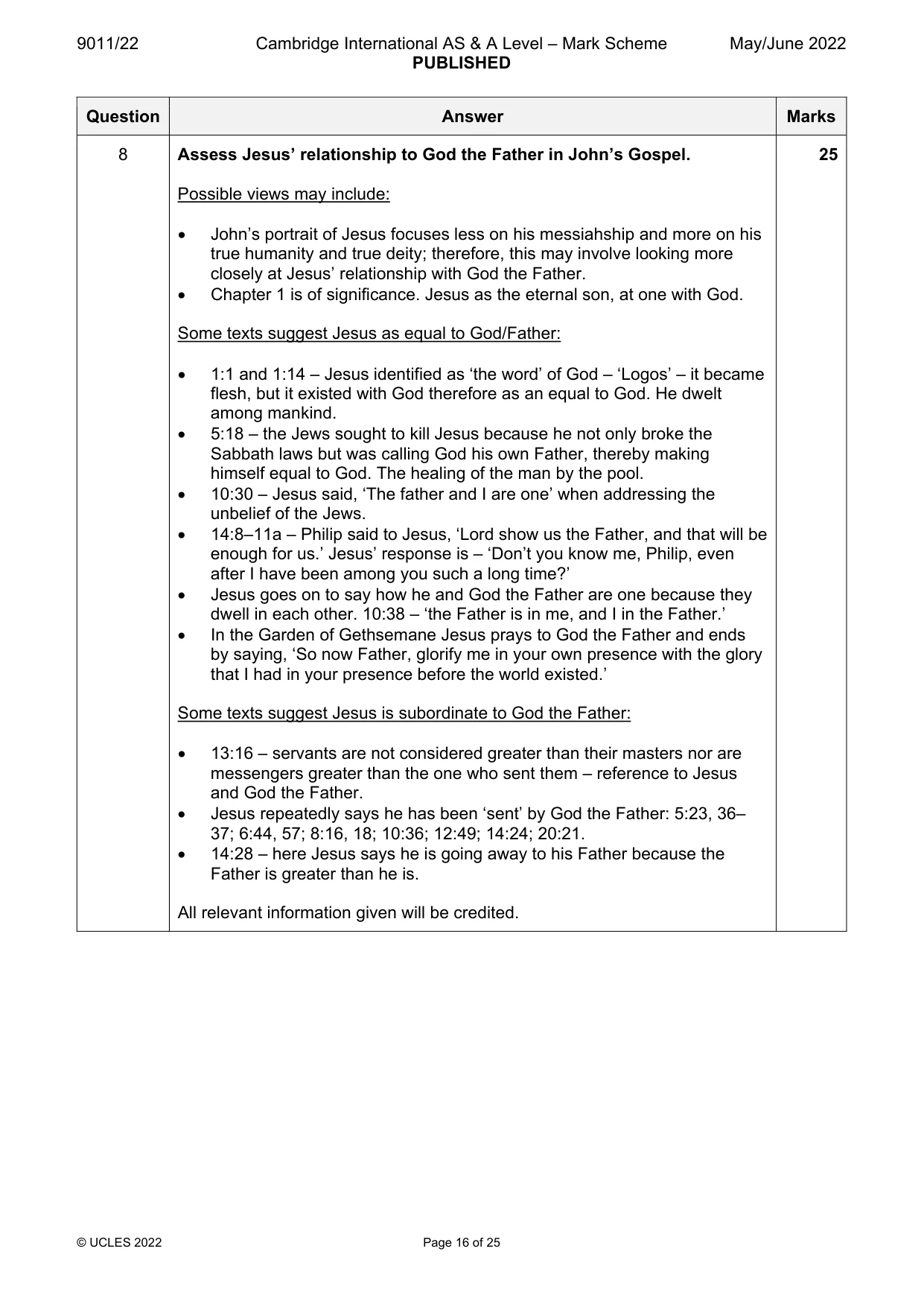
9011/22 Cambridge International AS & A Level – Mark Scheme PUBLISHED May/June 2022 © UCLES 2022 Page 16 of 25 Question Answer Marks 8 Assess Jesus’ relationship to God the Father in John’s Gospel. Possible views may include: John’s portrait of Jesus focuses less on his messiahship and more on his true humanity and true deity; therefore, this may involve looking more closely at Jesus’ relationship with God the Father. Chapter 1 is of significance. Jesus as the eternal son, at one with God. Some texts suggest Jesus as equal to God/Father: 1:1 and 1:14 – Jesus identified as ‘the word’ of God – ‘Logos’ – it became flesh, but it existed with God therefore as an equal to God. He dwelt among mankind. 5:18 – the Jews sought to kill Jesus because he not only broke the Sabbath laws but was calling God his own Father, thereby making himself equal to God. The healing of the man by the pool. 10:30 – Jesus said, ‘The father and I are one’ when addressing the unbelief of the Jews. 14:8–11a – Philip said to Jesus, ‘Lord show us the Father, and that will be enough for us.’ Jesus’ response is – ‘Don’t you know me, Philip, even after I have been among you such a long time?’ Jesus goes on to say how he and God the Father are one because they dwell in each other. 10:38 – ‘the Father is in me, and I in the Father.’ In the Garden of Gethsemane Jesus prays to God the Father and ends by saying, ‘So now Father, glorify me in your own presence with the glory that I had in your presence before the world existed.’ Some texts suggest Jesus is subordinate to God the Father: 13:16 – servants are not considered greater than their masters nor are messengers greater than the one who sent them – reference to Jesus and God the Father. Jesus repeatedly says he has been ‘sent’ by God the Father: 5:23, 36– 37; 6:44, 57; 8:16, 18; 10:36; 12:49; 14:24; 20:21. 14:28 – here Jesus says he is going away to his Father because the Father is greater than he is. All relevant information given will be credited. 25
Mark scheme, page 17
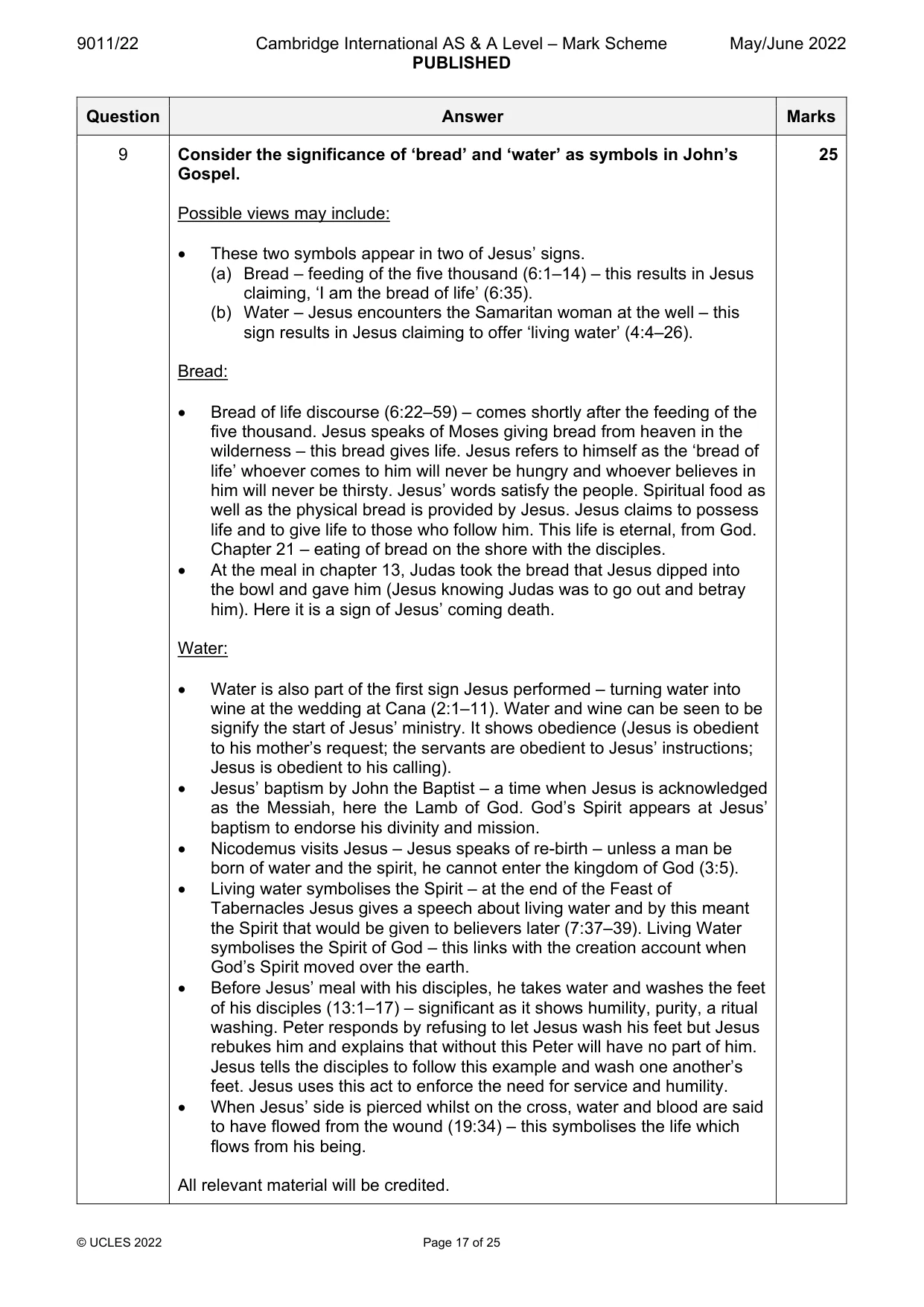
9011/22 Cambridge International AS & A Level – Mark Scheme PUBLISHED May/June 2022 © UCLES 2022 Page 17 of 25 Question Answer Marks 9 Consider the significance of ‘bread’ and ‘water’ as symbols in John’s Gospel. Possible views may include: These two symbols appear in two of Jesus’ signs. (a) Bread – feeding of the five thousand (6:1–14) – this results in Jesus claiming, ‘I am the bread of life’ (6:35). (b) Water – Jesus encounters the Samaritan woman at the well – this sign results in Jesus claiming to offer ‘living water’ (4:4–26). Bread: Bread of life discourse (6:22–59) – comes shortly after the feeding of the five thousand. Jesus speaks of Moses giving bread from heaven in the wilderness – this bread gives life. Jesus refers to himself as the ‘bread of life’ whoever comes to him will never be hungry and whoever believes in him will never be thirsty. Jesus’ words satisfy the people. Spiritual food as well as the physical bread is provided by Jesus. Jesus claims to possess life and to give life to those who follow him. This life is eternal, from God. Chapter 21 – eating of bread on the shore with the disciples. At the meal in chapter 13, Judas took the bread that Jesus dipped into the bowl and gave him (Jesus knowing Judas was to go out and betray him). Here it is a sign of Jesus’ coming death. Water: Water is also part of the first sign Jesus performed – turning water into wine at the wedding at Cana (2:1–11). Water and wine can be seen to be signify the start of Jesus’ ministry. It shows obedience (Jesus is obedient to his mother’s request; the servants are obedient to Jesus’ instructions; Jesus is obedient to his calling). Jesus’ baptism by John the Baptist – a time when Jesus is acknowledged as the Messiah, here the Lamb of God. God’s Spirit appears at Jesus’ baptism to endorse his divinity and mission. Nicodemus visits Jesus – Jesus speaks of re-birth – unless a man be born of water and the spirit, he cannot enter the kingdom of God (3:5). Living water symbolises the Spirit – at the end of the Feast of Tabernacles Jesus gives a speech about living water and by this meant the Spirit that would be given to believers later (7:37–39). Living Water symbolises the Spirit of God – this links with the creation account when God’s Spirit moved over the earth. Before Jesus’ meal with his disciples, he takes water and washes the feet of his disciples (13:1–17) – significant as it shows humility, purity, a ritual washing. Peter responds by refusing to let Jesus wash his feet but Jesus rebukes him and explains that without this Peter will have no part of him. Jesus tells the disciples to follow this example and wash one another’s feet. Jesus uses this act to enforce the need for service and humility. When Jesus’ side is pierced whilst on the cross, water and blood are said to have flowed from the wound (19:34) – this symbolises the life which flows from his being. All relevant material will be credited. 25
Mark scheme, page 18
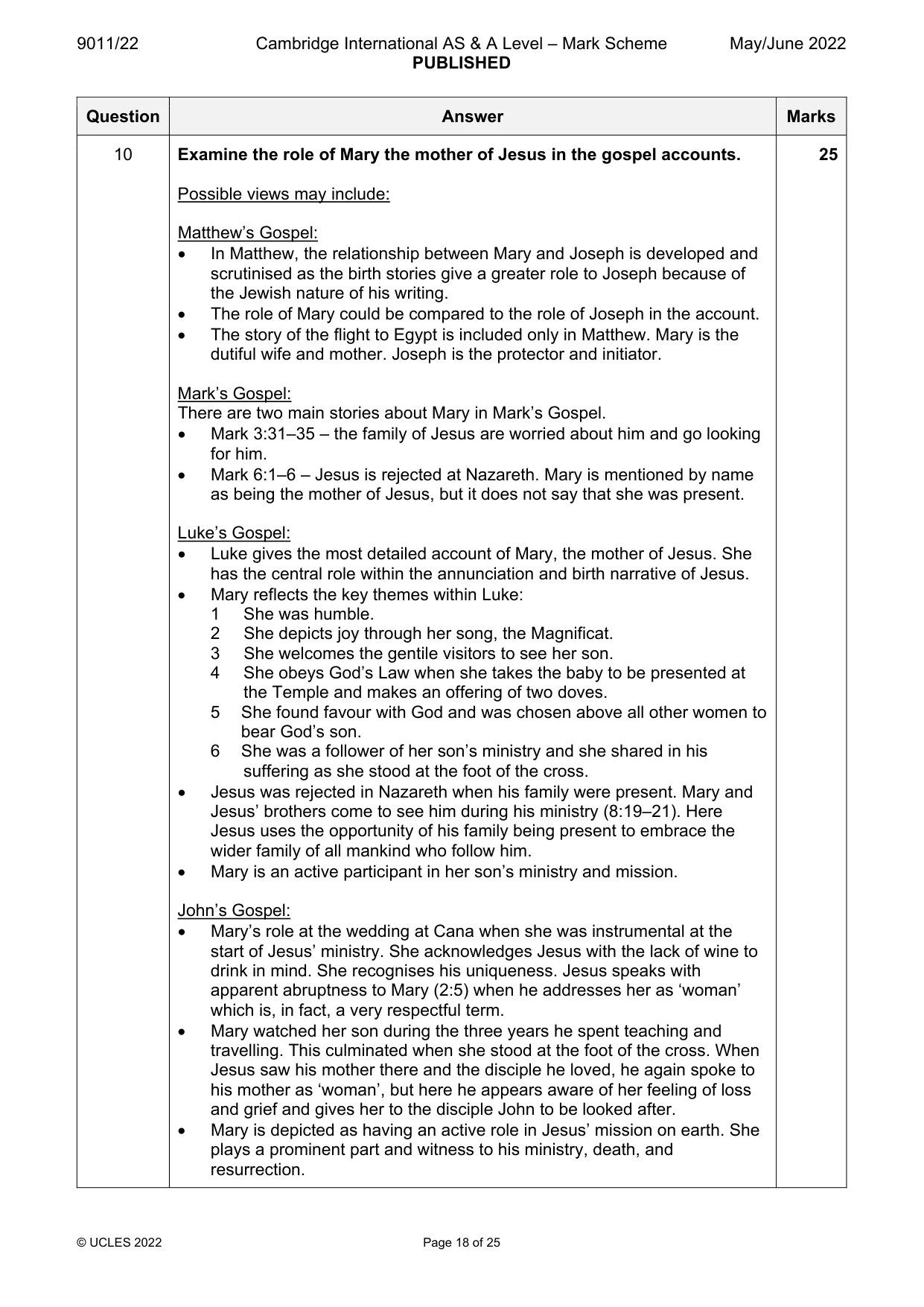
9011/22 Cambridge International AS & A Level – Mark Scheme PUBLISHED May/June 2022 © UCLES 2022 Page 18 of 25 Question Answer Marks 10 Examine the role of Mary the mother of Jesus in the gospel accounts. Possible views may include: Matthew’s Gospel: In Matthew, the relationship between Mary and Joseph is developed and scrutinised as the birth stories give a greater role to Joseph because of the Jewish nature of his writing. The role of Mary could be compared to the role of Joseph in the account. The story of the flight to Egypt is included only in Matthew. Mary is the dutiful wife and mother. Joseph is the protector and initiator. Mark’s Gospel: There are two main stories about Mary in Mark’s Gospel. Mark 3:31–35 – the family of Jesus are worried about him and go looking for him. Mark 6:1–6 – Jesus is rejected at Nazareth. Mary is mentioned by name as being the mother of Jesus, but it does not say that she was present. Luke’s Gospel: Luke gives the most detailed account of Mary, the mother of Jesus. She has the central role within the annunciation and birth narrative of Jesus. Mary reflects the key themes within Luke: 1 She was humble. 2 She depicts joy through her song, the Magnificat. 3 She welcomes the gentile visitors to see her son. 4 She obeys God’s Law when she takes the baby to be presented at the Temple and makes an offering of two doves. 5 She found favour with God and was chosen above all other women to bear God’s son. 6 She was a follower of her son’s ministry and she shared in his suffering as she stood at the foot of the cross. Jesus was rejected in Nazareth when his family were present. Mary and Jesus’ brothers come to see him during his ministry (8:19–21). Here Jesus uses the opportunity of his family being present to embrace the wider family of all mankind who follow him. Mary is an active participant in her son’s ministry and mission. John’s Gospel: Mary’s role at the wedding at Cana when she was instrumental at the start of Jesus’ ministry. She acknowledges Jesus with the lack of wine to drink in mind. She recognises his uniqueness. Jesus speaks with apparent abruptness to Mary (2:5) when he addresses her as ‘woman’ which is, in fact, a very respectful term. Mary watched her son during the three years he spent teaching and travelling. This culminated when she stood at the foot of the cross. When Jesus saw his mother there and the disciple he loved, he again spoke to his mother as ‘woman’, but here he appears aware of her feeling of loss and grief and gives her to the disciple John to be looked after. Mary is depicted as having an active role in Jesus’ mission on earth. She plays a prominent part and witness to his ministry, death, and resurrection. 25
Mark scheme, page 19
9011/22 Cambridge International AS & A Level – Mark Scheme PUBLISHED May/June 2022 © UCLES 2022 Page 19 of 25 Question Answer Marks 10 Candidates may give relevant background information about the role of women in the Jewish society during that time to show how the gospels depicted Mary in a different way. All relevant information given will be credited.
Mark scheme, page 20
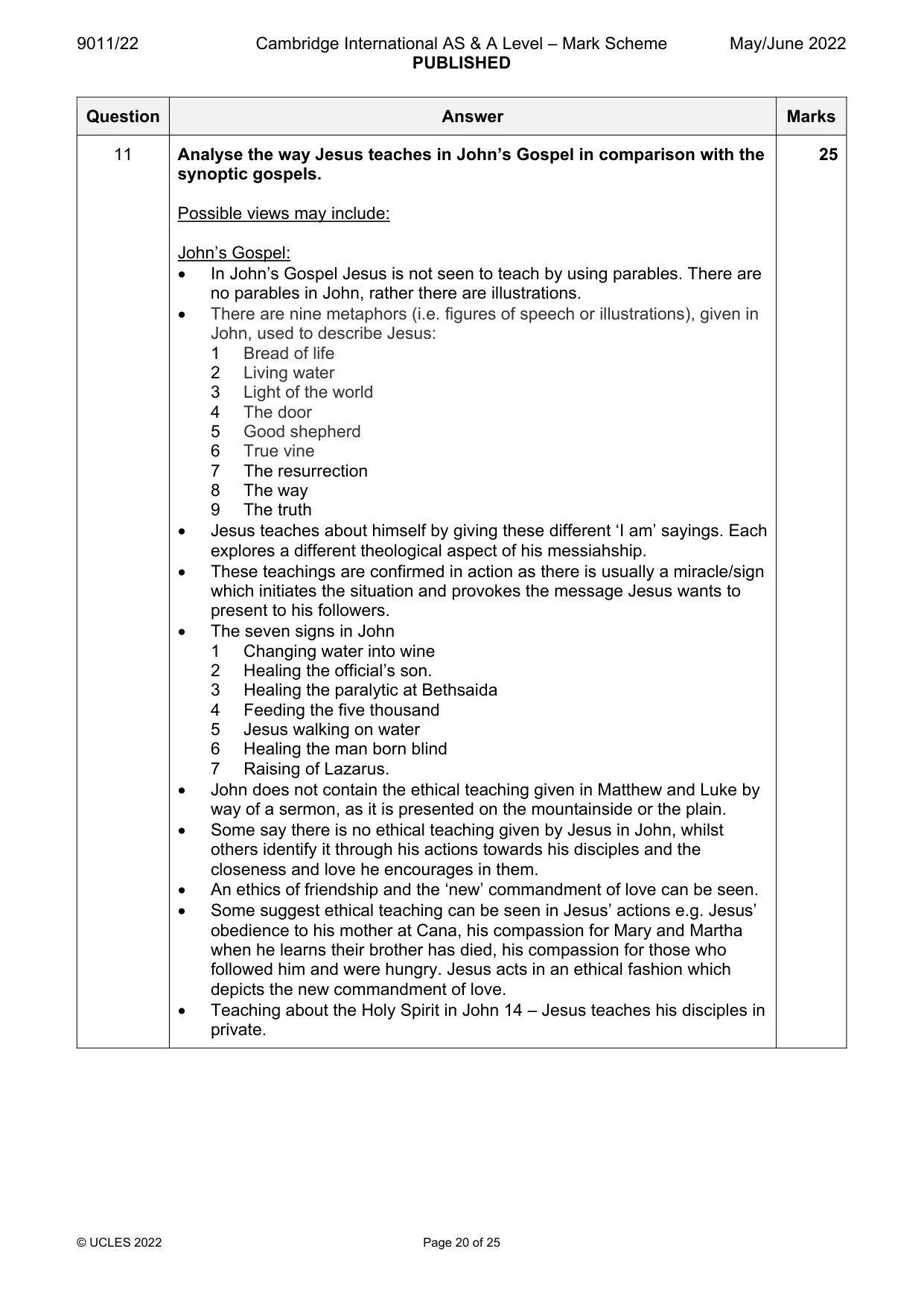
9011/22 Cambridge International AS & A Level – Mark Scheme PUBLISHED May/June 2022 © UCLES 2022 Page 20 of 25 Question Answer Marks 11 Analyse the way Jesus teaches in John’s Gospel in comparison with the synoptic gospels. Possible views may include: John’s Gospel: In John’s Gospel Jesus is not seen to teach by using parables. There are no parables in John, rather there are illustrations. There are nine metaphors (i.e. figures of speech or illustrations), given in John, used to describe Jesus: 1 Bread of life 2 Living water 3 Light of the world 4 The door 5 Good shepherd 6 True vine 7 The resurrection 8 The way 9 The truth Jesus teaches about himself by giving these different ‘I am’ sayings. Each explores a different theological aspect of his messiahship. These teachings are confirmed in action as there is usually a miracle/sign which initiates the situation and provokes the message Jesus wants to present to his followers. The seven signs in John 1 Changing water into wine 2 Healing the official’s son. 3 Healing the paralytic at Bethsaida 4 Feeding the five thousand 5 Jesus walking on water 6 Healing the man born blind 7 Raising of Lazarus. John does not contain the ethical teaching given in Matthew and Luke by way of a sermon, as it is presented on the mountainside or the plain. Some say there is no ethical teaching given by Jesus in John, whilst others identify it through his actions towards his disciples and the closeness and love he encourages in them. An ethics of friendship and the ‘new’ commandment of love can be seen. Some suggest ethical teaching can be seen in Jesus’ actions e.g. Jesus’ obedience to his mother at Cana, his compassion for Mary and Martha when he learns their brother has died, his compassion for those who followed him and were hungry. Jesus acts in an ethical fashion which depicts the new commandment of love. Teaching about the Holy Spirit in John 14 – Jesus teaches his disciples in private. 25
Mark scheme, page 21
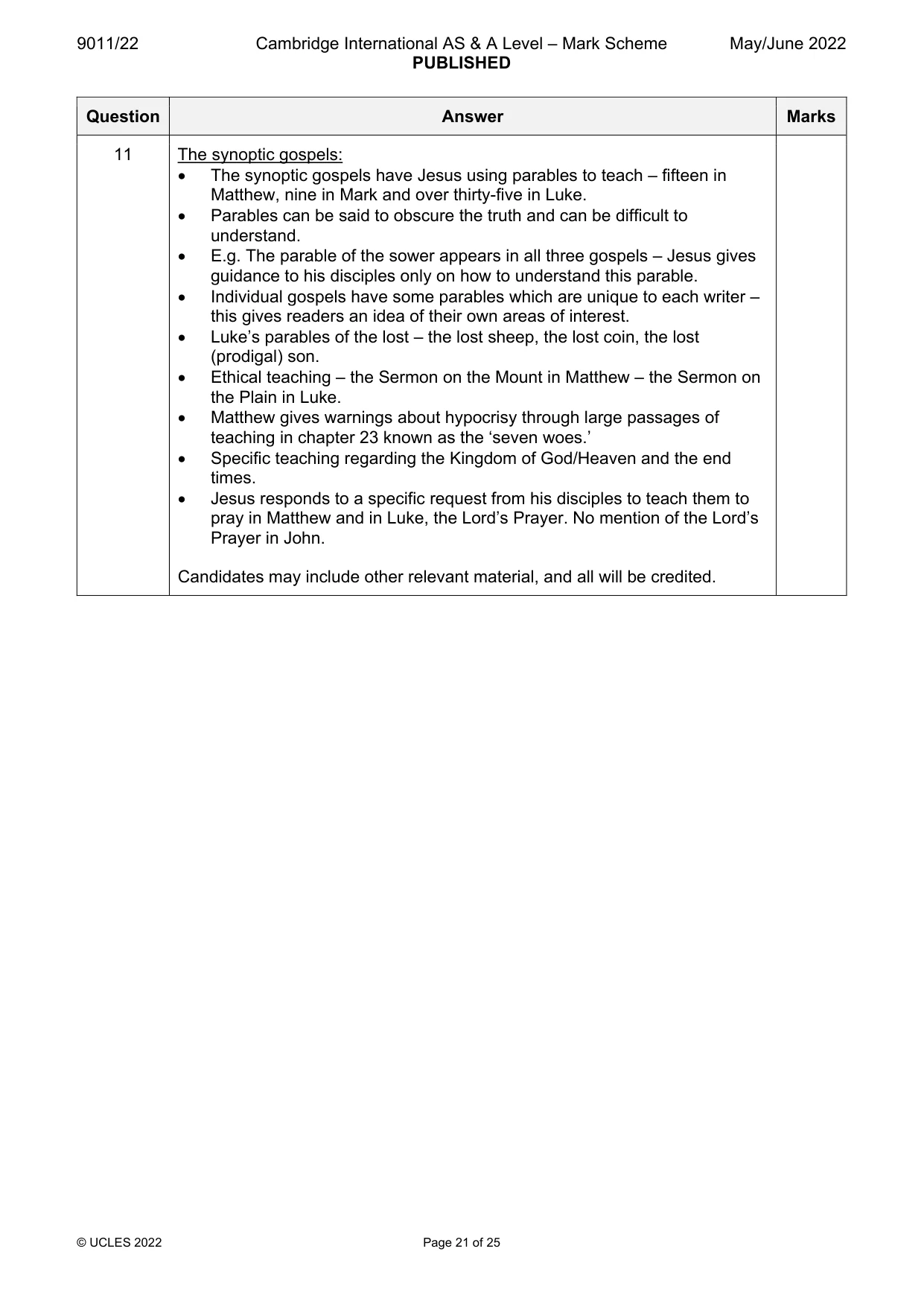
9011/22 Cambridge International AS & A Level – Mark Scheme PUBLISHED May/June 2022 © UCLES 2022 Page 21 of 25 Question Answer Marks 11 The synoptic gospels: The synoptic gospels have Jesus using parables to teach – fifteen in Matthew, nine in Mark and over thirty-five in Luke. Parables can be said to obscure the truth and can be difficult to understand. E.g. The parable of the sower appears in all three gospels – Jesus gives guidance to his disciples only on how to understand this parable. Individual gospels have some parables which are unique to each writer – this gives readers an idea of their own areas of interest. Luke’s parables of the lost – the lost sheep, the lost coin, the lost (prodigal) son. Ethical teaching – the Sermon on the Mount in Matthew – the Sermon on the Plain in Luke. Matthew gives warnings about hypocrisy through large passages of teaching in chapter 23 known as the ‘seven woes.’ Specific teaching regarding the Kingdom of God/Heaven and the end times. Jesus responds to a specific request from his disciples to teach them to pray in Matthew and in Luke, the Lord’s Prayer. No mention of the Lord’s Prayer in John. Candidates may include other relevant material, and all will be credited.
Mark scheme, page 22
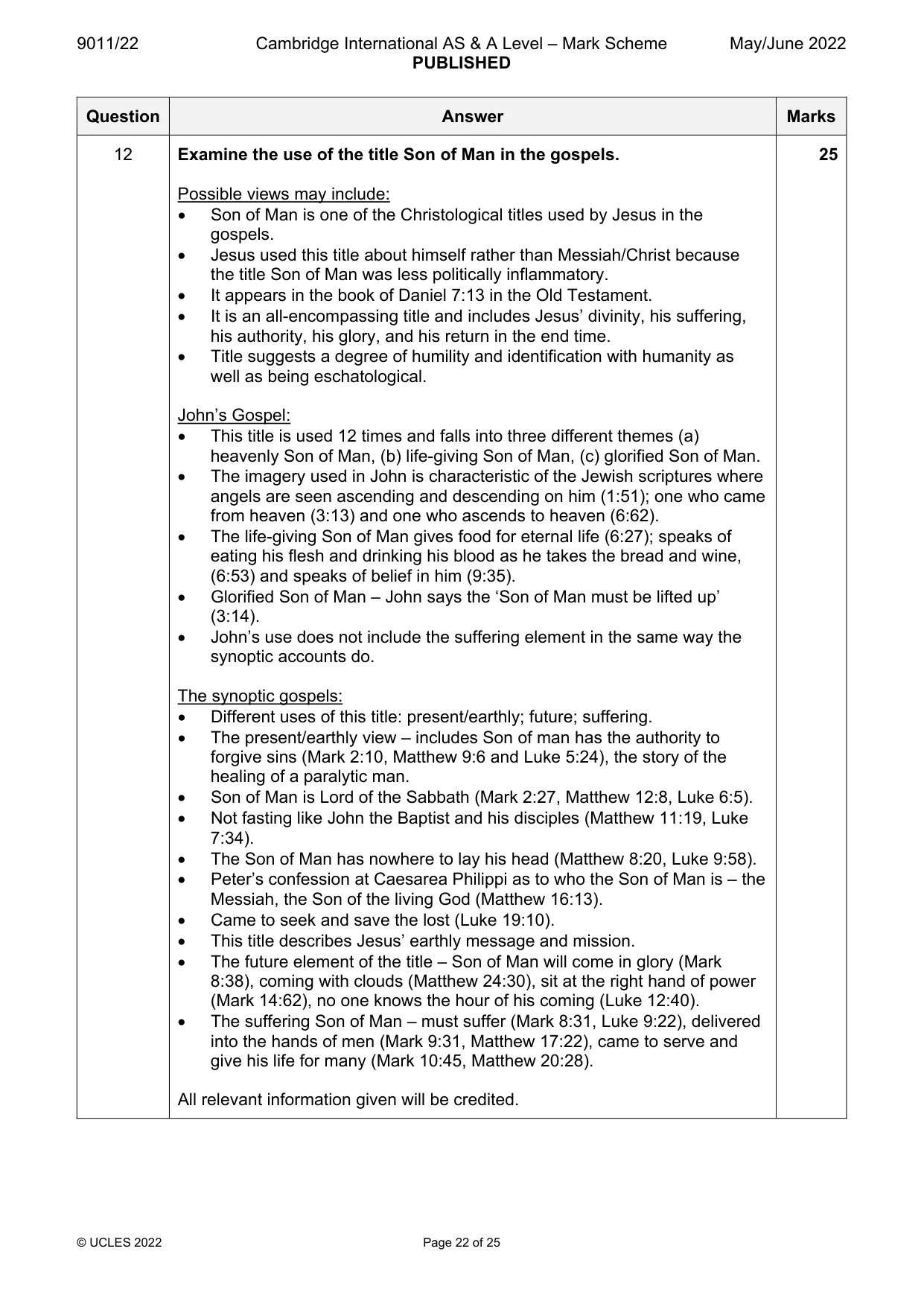
9011/22 Cambridge International AS & A Level – Mark Scheme PUBLISHED May/June 2022 © UCLES 2022 Page 22 of 25 Question Answer Marks 12 Examine the use of the title Son of Man in the gospels. Possible views may include: Son of Man is one of the Christological titles used by Jesus in the gospels. Jesus used this title about himself rather than Messiah/Christ because the title Son of Man was less politically inflammatory. It appears in the book of Daniel 7:13 in the Old Testament. It is an all-encompassing title and includes Jesus’ divinity, his suffering, his authority, his glory, and his return in the end time. Title suggests a degree of humility and identification with humanity as well as being eschatological. John’s Gospel: This title is used 12 times and falls into three different themes (a) heavenly Son of Man, (b) life-giving Son of Man, (c) glorified Son of Man. The imagery used in John is characteristic of the Jewish scriptures where angels are seen ascending and descending on him (1:51); one who came from heaven (3:13) and one who ascends to heaven (6:62). The life-giving Son of Man gives food for eternal life (6:27); speaks of eating his flesh and drinking his blood as he takes the bread and wine, (6:53) and speaks of belief in him (9:35). Glorified Son of Man – John says the ‘Son of Man must be lifted up’ (3:14). John’s use does not include the suffering element in the same way the synoptic accounts do. The synoptic gospels: Different uses of this title: present/earthly; future; suffering. The present/earthly view – includes Son of man has the authority to forgive sins (Mark 2:10, Matthew 9:6 and Luke 5:24), the story of the healing of a paralytic man. Son of Man is Lord of the Sabbath (Mark 2:27, Matthew 12:8, Luke 6:5). Not fasting like John the Baptist and his disciples (Matthew 11:19, Luke 7:34). The Son of Man has nowhere to lay his head (Matthew 8:20, Luke 9:58). Peter’s confession at Caesarea Philippi as to who the Son of Man is – the Messiah, the Son of the living God (Matthew 16:13). Came to seek and save the lost (Luke 19:10). This title describes Jesus’ earthly message and mission. The future element of the title – Son of Man will come in glory (Mark 8:38), coming with clouds (Matthew 24:30), sit at the right hand of power (Mark 14:62), no one knows the hour of his coming (Luke 12:40). The suffering Son of Man – must suffer (Mark 8:31, Luke 9:22), delivered into the hands of men (Mark 9:31, Matthew 17:22), came to serve and give his life for many (Mark 10:45, Matthew 20:28). All relevant information given will be credited. 25
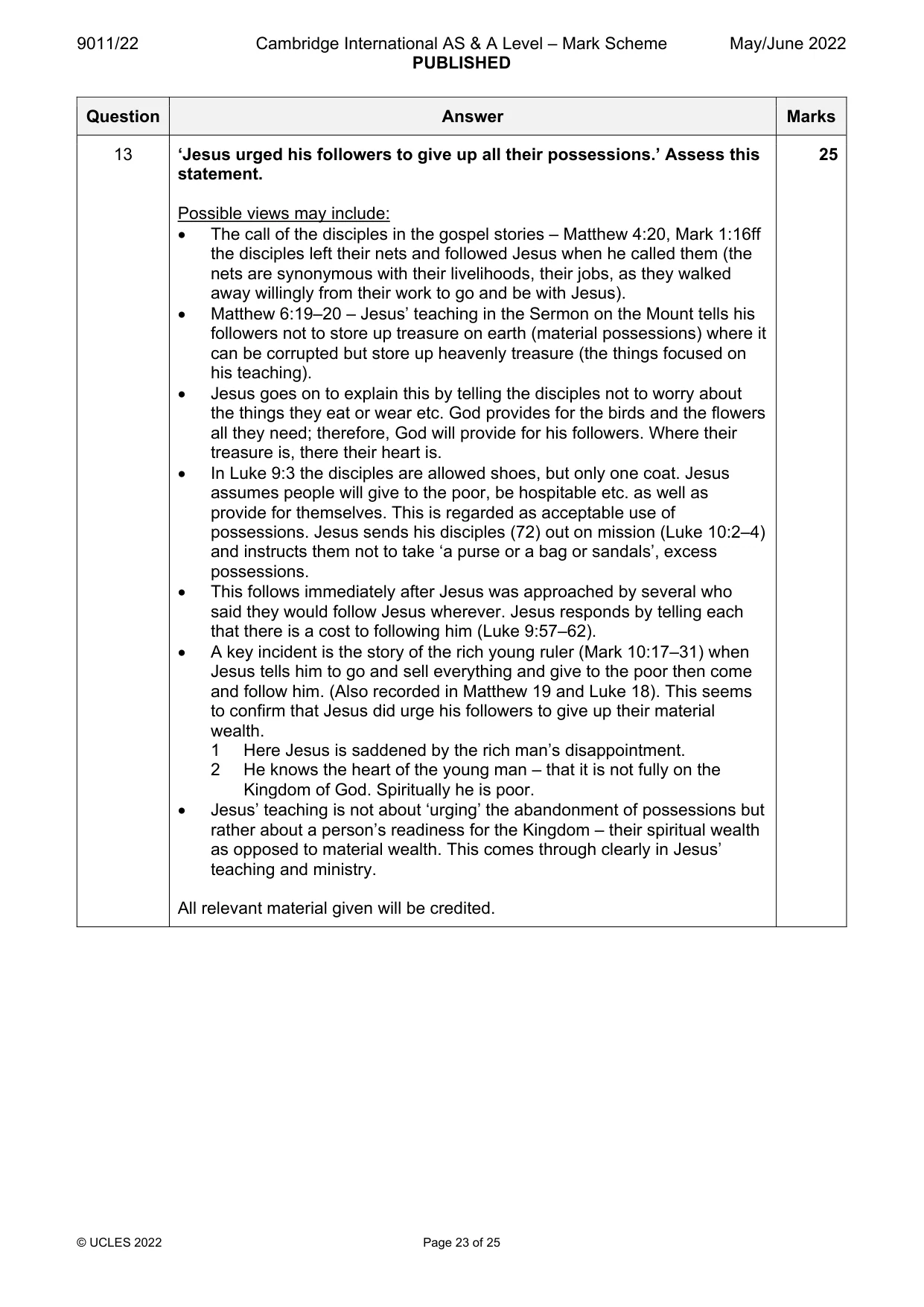
Mark scheme, page 23
9011/22 Cambridge International AS & A Level – Mark Scheme PUBLISHED May/June 2022 © UCLES 2022 Page 23 of 25 Question Answer Marks 13 ‘Jesus urged his followers to give up all their possessions.’ Assess this statement. Possible views may include: The call of the disciples in the gospel stories – Matthew 4:20, Mark 1:16ff the disciples left their nets and followed Jesus when he called them (the nets are synonymous with their livelihoods, their jobs, as they walked away willingly from their work to go and be with Jesus). Matthew 6:19–20 – Jesus’ teaching in the Sermon on the Mount tells his followers not to store up treasure on earth (material possessions) where it can be corrupted but store up heavenly treasure (the things focused on his teaching). Jesus goes on to explain this by telling the disciples not to worry about the things they eat or wear etc. God provides for the birds and the flowers all they need; therefore, God will provide for his followers. Where their treasure is, there their heart is. In Luke 9:3 the disciples are allowed shoes, but only one coat. Jesus assumes people will give to the poor, be hospitable etc. as well as provide for themselves. This is regarded as acceptable use of possessions. Jesus sends his disciples (72) out on mission (Luke 10:2–4) and instructs them not to take ‘a purse or a bag or sandals’, excess possessions. This follows immediately after Jesus was approached by several who said they would follow Jesus wherever. Jesus responds by telling each that there is a cost to following him (Luke 9:57–62). A key incident is the story of the rich young ruler (Mark 10:17–31) when Jesus tells him to go and sell everything and give to the poor then come and follow him. (Also recorded in Matthew 19 and Luke 18). This seems to confirm that Jesus did urge his followers to give up their material wealth. 1 Here Jesus is saddened by the rich man’s disappointment. 2 He knows the heart of the young man – that it is not fully on the Kingdom of God. Spiritually he is poor. Jesus’ teaching is not about ‘urging’ the abandonment of possessions but rather about a person’s readiness for the Kingdom – their spiritual wealth as opposed to material wealth. This comes through clearly in Jesus’ teaching and ministry. All relevant material given will be credited. 25
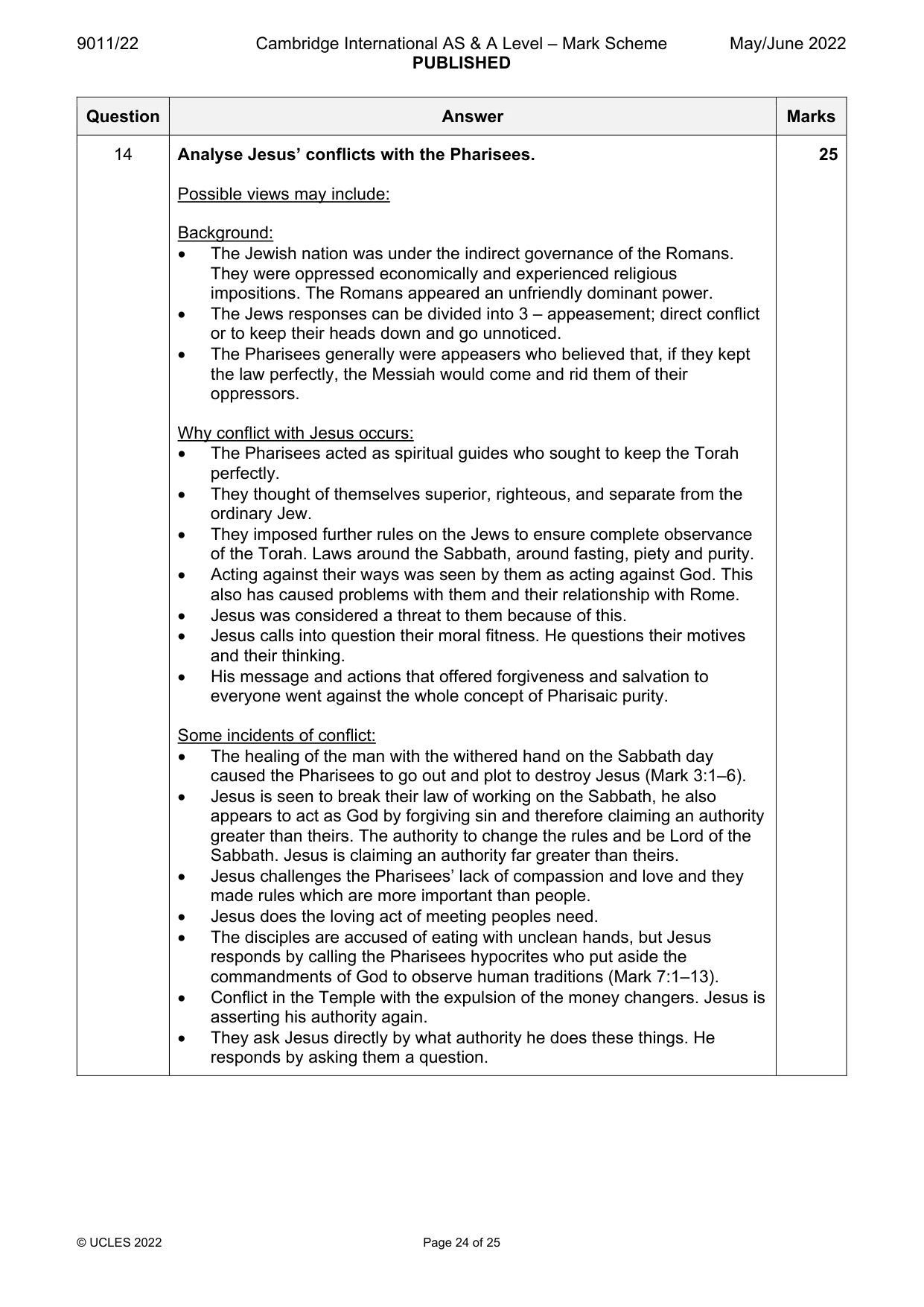
Mark scheme, page 24
9011/22 Cambridge International AS & A Level – Mark Scheme PUBLISHED May/June 2022 © UCLES 2022 Page 24 of 25 Question Answer Marks 14 Analyse Jesus’ conflicts with the Pharisees. Possible views may include: Background: The Jewish nation was under the indirect governance of the Romans. They were oppressed economically and experienced religious impositions. The Romans appeared an unfriendly dominant power. The Jews responses can be divided into 3 – appeasement; direct conflict or to keep their heads down and go unnoticed. The Pharisees generally were appeasers who believed that, if they kept the law perfectly, the Messiah would come and rid them of their oppressors. Why conflict with Jesus occurs: The Pharisees acted as spiritual guides who sought to keep the Torah perfectly. They thought of themselves superior, righteous, and separate from the ordinary Jew. They imposed further rules on the Jews to ensure complete observance of the Torah. Laws around the Sabbath, around fasting, piety and purity. Acting against their ways was seen by them as acting against God. This also has caused problems with them and their relationship with Rome. Jesus was considered a threat to them because of this. Jesus calls into question their moral fitness. He questions their motives and their thinking. His message and actions that offered forgiveness and salvation to everyone went against the whole concept of Pharisaic purity. Some incidents of conflict: The healing of the man with the withered hand on the Sabbath day caused the Pharisees to go out and plot to destroy Jesus (Mark 3:1–6). Jesus is seen to break their law of working on the Sabbath, he also appears to act as God by forgiving sin and therefore claiming an authority greater than theirs. The authority to change the rules and be Lord of the Sabbath. Jesus is claiming an authority far greater than theirs. Jesus challenges the Pharisees’ lack of compassion and love and they made rules which are more important than people. Jesus does the loving act of meeting peoples need. The disciples are accused of eating with unclean hands, but Jesus responds by calling the Pharisees hypocrites who put aside the commandments of God to observe human traditions (Mark 7:1–13). Conflict in the Temple with the expulsion of the money changers. Jesus is asserting his authority again. They ask Jesus directly by what authority he does these things. He responds by asking them a question. 25
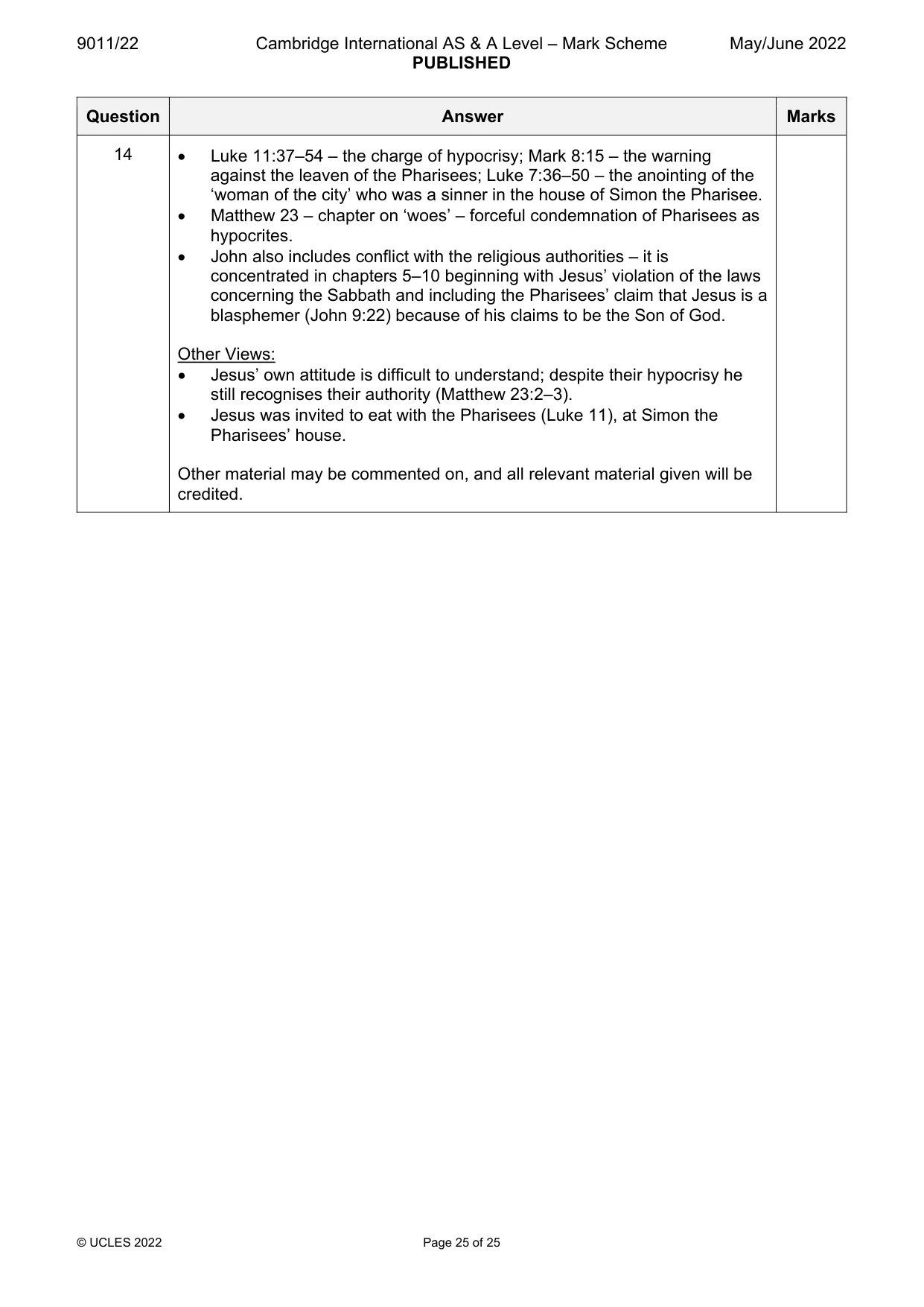
Mark scheme, page 25
9011/22 Cambridge International AS & A Level – Mark Scheme PUBLISHED May/June 2022 © UCLES 2022 Page 25 of 25 Question Answer Marks 14 Luke 11:37–54 – the charge of hypocrisy; Mark 8:15 – the warning against the leaven of the Pharisees; Luke 7:36–50 – the anointing of the ‘woman of the city’ who was a sinner in the house of Simon the Pharisee. Matthew 23 – chapter on ‘woes’ – forceful condemnation of Pharisees as hypocrites. John also includes conflict with the religious authorities – it is concentrated in chapters 5–10 beginning with Jesus’ violation of the laws concerning the Sabbath and including the Pharisees’ claim that Jesus is a blasphemer (John 9:22) because of his claims to be the Son of God. Other Views: Jesus’ own attitude is difficult to understand; despite their hypocrisy he still recognises their authority (Matthew 23:2–3). Jesus was invited to eat with the Pharisees (Luke 11), at Simon the Pharisees’ house. Other material may be commented on, and all relevant material given will be credited.
What you needed in this session
Cambridge’s own grade thresholds for 2022 May/June, Paper 2 · Variant 2. A higher threshold means an easier paper — the bar moves with how the cohort did.