Cambridge A Level Divinity 9011 — 2019 Oct/Nov Paper 2 · Variant 2
9011/22/O/N/19 · 100 marks · ≈113 min
The question paper and its mark scheme, free to read here and free to download. This is Cambridge’s own paper, exactly as it was sat.
Question paper4 pages
Mark scheme19 pages
Answers below. Sit the paper first if you are practising.
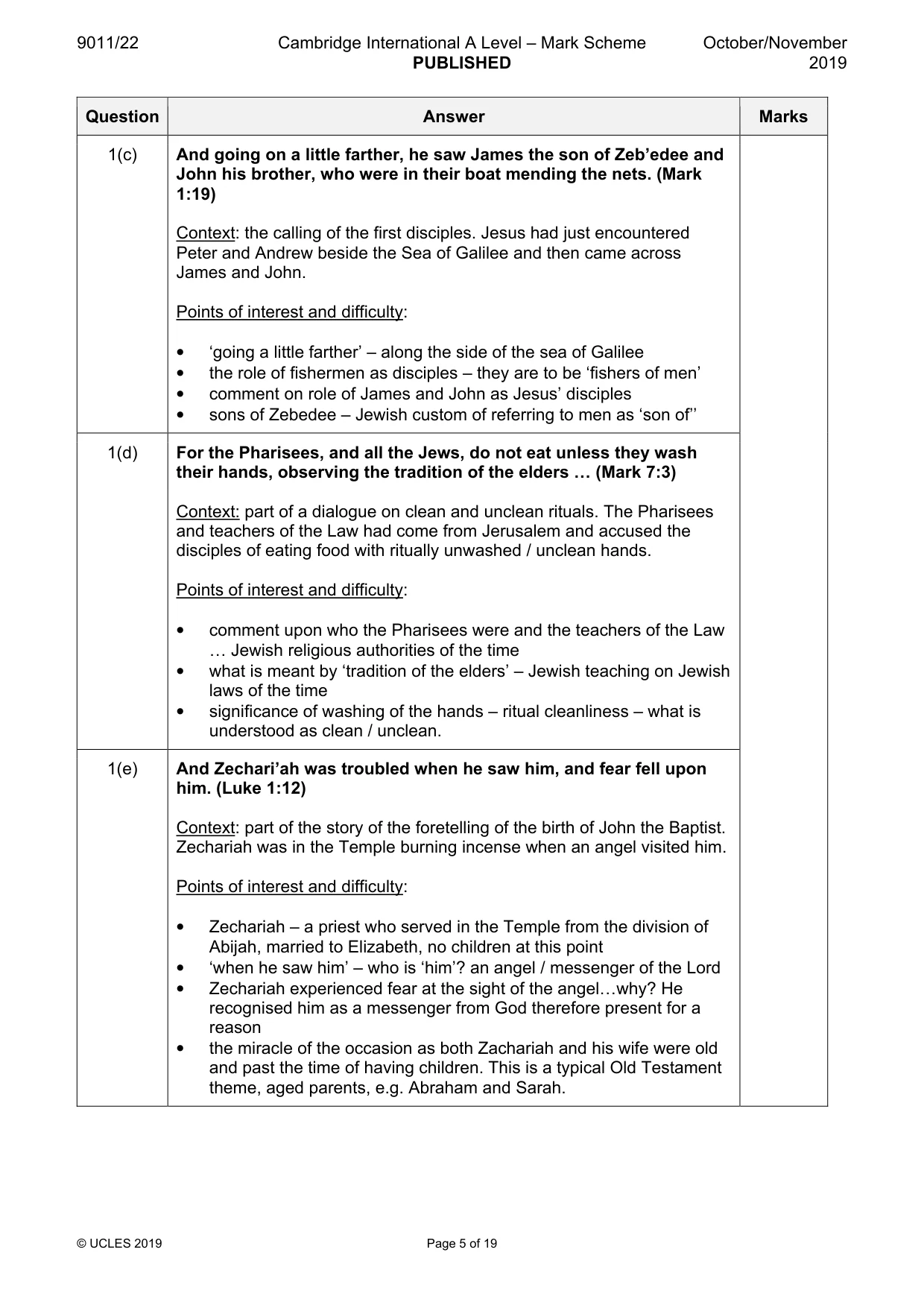
Paper as text
Question paper, page 1
This document consists of 4 printed pages and 1 Insert. DC (KS) 166014/4 © UCLES 2019 [Turn over * 1 8 4 8 8 3 4 8 3 3 * Cambridge Assessment International Education Cambridge International Advanced Level DIVINITY 9011/22 Paper 2 The Four Gospels October/November 2019 3 hours No Additional Materials are required. READ THESE INSTRUCTIONS FIRST An answer booklet is provided inside this question paper. You should follow the instructions on the front cover of the answer booklet. If you need additional answer paper ask the invigilator for a continuation booklet. Answer four questions. If you choose to answer Question 1, answer in one version only. Revised Standard Version of Question 1 is printed on page 2. New International Version of Question 1 is printed on page 3. You are reminded of the need for good English and clear presentation in your answers. All questions in this paper carry 25 marks.
Question paper, page 2
2 9011/22/O/N/19 © UCLES 2019 REVISED STANDARD VERSION 1 Comment on points of interest or difficulty in four of the following passages (wherever possible answers should refer to the context of the passage but should not retell the story from which the passage is taken): [25] (a) This was to fulfil what the Lord had spoken by the prophet, “Out of Egypt have I called my son.” (Matthew 2:15b) (b) But he turned and said to Peter, “Get behind me, Satan! You are a hindrance to me; for you are not on the side of God, but of men.” (Matthew 16:23) (c) And going on a little farther, he saw James the son of Zeb’edee and John his brother, who were in their boat mending the nets. (Mark 1:19) (d) For the Pharisees, and all the Jews, do not eat unless they wash their hands, observing the tradition of the elders … (Mark 7:3) (e) And Zechari’ah was troubled when he saw him, and fear fell upon him. (Luke 1:12) (f) So he ran on ahead and climbed up into a sycamore tree to see him, for he was to pass that way. (Luke 19:4) (g) In him was life, and the life was the light of men. The light shines in the darkness, and the darkness has not overcome it. (John 1:4–5) (h) It was Mary who anointed the Lord with ointment and wiped his feet with her hair, whose brother Laz’arus was ill. (John 11:2)
Question paper, page 3
3 9011/22/O/N/19 © UCLES 2019 [Turn over NEW INTERNATIONAL VERSION 1 Comment on points of interest or difficulty in four of the following passages (wherever possible answers should refer to the context of the passage but should not retell the story from which the passage is taken): [25] (a) And so was fulfilled what the Lord had said through the prophet: “Out of Egypt I called my son.” (Matthew 2:15b) (b) Jesus turned and said to Peter, “Get behind me, Satan! You are a stumbling-block to me; you do not have in mind the things of God, but the things of men.” (Matthew 16:23) (c) When he had gone a little farther, he saw James son of Zebedee and his brother John in a boat, preparing their nets. (Mark 1:19) (d) The Pharisees and all the Jews do not eat unless they give their hands a ceremonial washing, holding to the tradition of the elders. (Mark 7:3) (e) When Zechariah saw him, he was startled and was gripped with fear. (Luke 1:12) (f) So he ran ahead and climbed a sycamore-fig tree to see him, since Jesus was coming that way. (Luke 19:4) (g) In him was life, and that life was the light of men. The light shines in the darkness, but the darkness has not understood it. (John 1:4–5) (h) This Mary, whose brother Lazarus now lay sick, was the same one who poured perfume on the Lord and wiped his feet with her hair. (John 11:2)
Question paper, page 4
4 9011/22/O/N/19 © UCLES 2019 2 Examine the role of Joseph in Matthew’s birth narrative. [25] 3 How positive is Matthew’s portrait of the disciples in his gospel? [25] 4 Assess Jesus’ relationship with the Jewish authorities in Mark’s Gospel. [25] 5 ‘The Messianic Secret is a central theme in Mark.’ Discuss. [25] 6 Examine Luke’s portrayal of the importance of the Holy Spirit in his gospel. [25] 7 Assess how ‘humility’, as a Lucan theme, first appears in Christ’s birth narrative and then continues throughout his gospel. [25] 8 ‘John’s Prologue prepares the reader for the rest of the gospel.’ Discuss. [25] 9 Examine John’s use of ‘water’ and ‘living water’ in his gospel. [25] 10 Assess whether the Sermon on the Mount in Matthew 5–7 and the Sermon on the Plain in Luke 6:17–49 reflect the purpose of the authors. [25] 11 ‘Jesus was more than just a miracle worker.’ Discuss. [25] 12 Examine the different titles for Christ used by two gospel authors. [25] 13 Examine whether the main differences between the gospels came from the authors’ different audiences. [25] 14 Examine the impact of Roman rule in Palestine on the life and ministry of Jesus. [25] Permission to reproduce items where third-party owned material protected by copyright is included has been sought and cleared where possible. Every reasonable effort has been made by the publisher (UCLES) to trace copyright holders, but if any items requiring clearance have unwittingly been included, the publisher will be pleased to make amends at the earliest possible opportunity. To avoid the issue of disclosure of answer-related information to candidates, all copyright acknowledgements are reproduced online in the Cambridge Assessment International Education Copyright Acknowledgements Booklet. This is produced for each series of examinations and is freely available to download at www.cambridgeinternational.org after the live examination series. Cambridge Assessment International Education is part of the Cambridge Assessment Group. Cambridge Assessment is the brand name of the University of Cambridge Local Examinations Syndicate (UCLES), which itself is a department of the University of Cambridge.
Mark scheme, page 1
This document consists of 19 printed pages. © UCLES 2019 [Turn over Cambridge Assessment International Education Cambridge International Advanced Level DIVINITY 9011/22 Paper 2 The Four Gospels October/November 2019 MARK SCHEME Maximum Mark: 100 Published This mark scheme is published as an aid to teachers and candidates, to indicate the requirements of the examination. It shows the basis on which Examiners were instructed to award marks. It does not indicate the details of the discussions that took place at an Examiners’ meeting before marking began, which would have considered the acceptability of alternative answers. Mark schemes should be read in conjunction with the question paper and the Principal Examiner Report for Teachers. Cambridge International will not enter into discussions about these mark schemes. Cambridge International is publishing the mark schemes for the October/November 2019 series for most Cambridge IGCSE™, Cambridge International A and AS Level components and some Cambridge O Level components.
Mark scheme, page 2
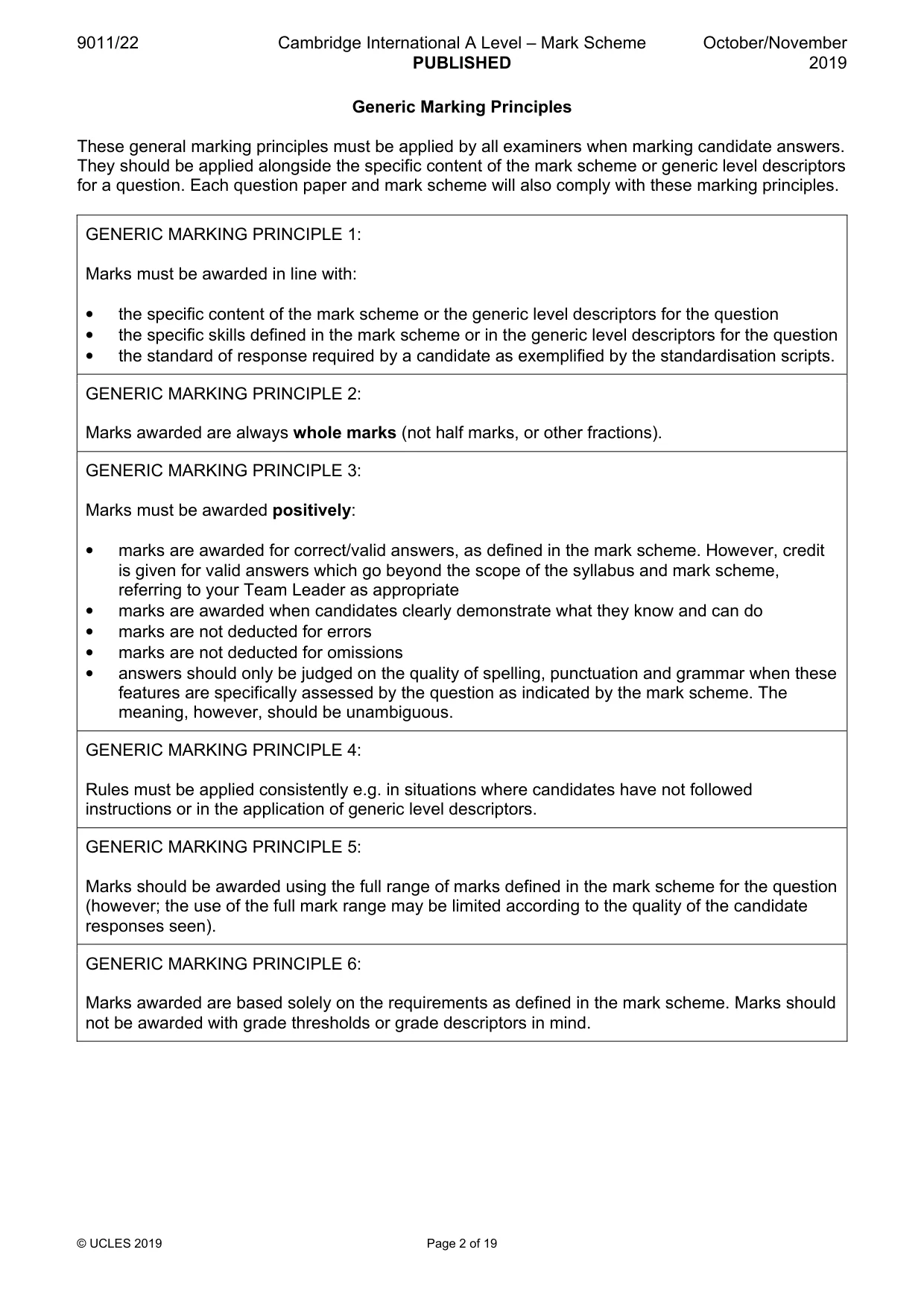
9011/22 Cambridge International A Level – Mark Scheme PUBLISHED October/November 2019 © UCLES 2019 Page 2 of 19 Generic Marking Principles These general marking principles must be applied by all examiners when marking candidate answers. They should be applied alongside the specific content of the mark scheme or generic level descriptors for a question. Each question paper and mark scheme will also comply with these marking principles. GENERIC MARKING PRINCIPLE 1: Marks must be awarded in line with: • the specific content of the mark scheme or the generic level descriptors for the question • the specific skills defined in the mark scheme or in the generic level descriptors for the question • the standard of response required by a candidate as exemplified by the standardisation scripts. GENERIC MARKING PRINCIPLE 2: Marks awarded are always whole marks (not half marks, or other fractions). GENERIC MARKING PRINCIPLE 3: Marks must be awarded positively: • marks are awarded for correct/valid answers, as defined in the mark scheme. However, credit is given for valid answers which go beyond the scope of the syllabus and mark scheme, referring to your Team Leader as appropriate • marks are awarded when candidates clearly demonstrate what they know and can do • marks are not deducted for errors • marks are not deducted for omissions • answers should only be judged on the quality of spelling, punctuation and grammar when these features are specifically assessed by the question as indicated by the mark scheme. The meaning, however, should be unambiguous. GENERIC MARKING PRINCIPLE 4: Rules must be applied consistently e.g. in situations where candidates have not followed instructions or in the application of generic level descriptors. GENERIC MARKING PRINCIPLE 5: Marks should be awarded using the full range of marks defined in the mark scheme for the question (however; the use of the full mark range may be limited according to the quality of the candidate responses seen). GENERIC MARKING PRINCIPLE 6: Marks awarded are based solely on the requirements as defined in the mark scheme. Marks should not be awarded with grade thresholds or grade descriptors in mind.
Mark scheme, page 3
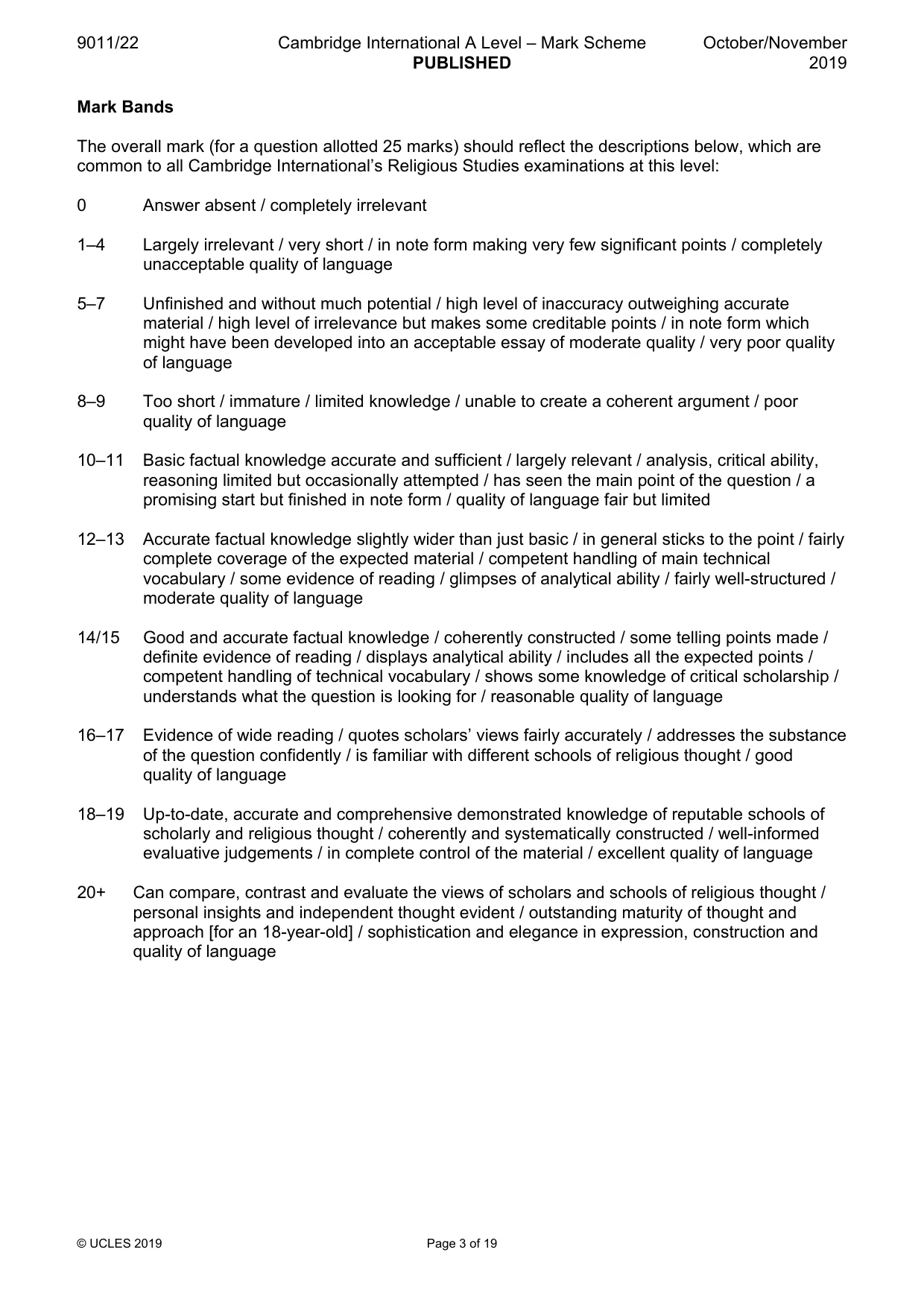
9011/22 Cambridge International A Level – Mark Scheme PUBLISHED October/November 2019 © UCLES 2019 Page 3 of 19 Mark Bands The overall mark (for a question allotted 25 marks) should reflect the descriptions below, which are common to all Cambridge International’s Religious Studies examinations at this level: 0 Answer absent / completely irrelevant 1–4 Largely irrelevant / very short / in note form making very few significant points / completely unacceptable quality of language 5–7 Unfinished and without much potential / high level of inaccuracy outweighing accurate material / high level of irrelevance but makes some creditable points / in note form which might have been developed into an acceptable essay of moderate quality / very poor quality of language 8–9 Too short / immature / limited knowledge / unable to create a coherent argument / poor quality of language 10–11 Basic factual knowledge accurate and sufficient / largely relevant / analysis, critical ability, reasoning limited but occasionally attempted / has seen the main point of the question / a promising start but finished in note form / quality of language fair but limited 12–13 Accurate factual knowledge slightly wider than just basic / in general sticks to the point / fairly complete coverage of the expected material / competent handling of main technical vocabulary / some evidence of reading / glimpses of analytical ability / fairly well-structured / moderate quality of language 14/15 Good and accurate factual knowledge / coherently constructed / some telling points made / definite evidence of reading / displays analytical ability / includes all the expected points / competent handling of technical vocabulary / shows some knowledge of critical scholarship / understands what the question is looking for / reasonable quality of language 16–17 Evidence of wide reading / quotes scholars’ views fairly accurately / addresses the substance of the question confidently / is familiar with different schools of religious thought / good quality of language 18–19 Up-to-date, accurate and comprehensive demonstrated knowledge of reputable schools of scholarly and religious thought / coherently and systematically constructed / well-informed evaluative judgements / in complete control of the material / excellent quality of language 20+ Can compare, contrast and evaluate the views of scholars and schools of religious thought / personal insights and independent thought evident / outstanding maturity of thought and approach [for an 18-year-old] / sophistication and elegance in expression, construction and quality of language
Mark scheme, page 4
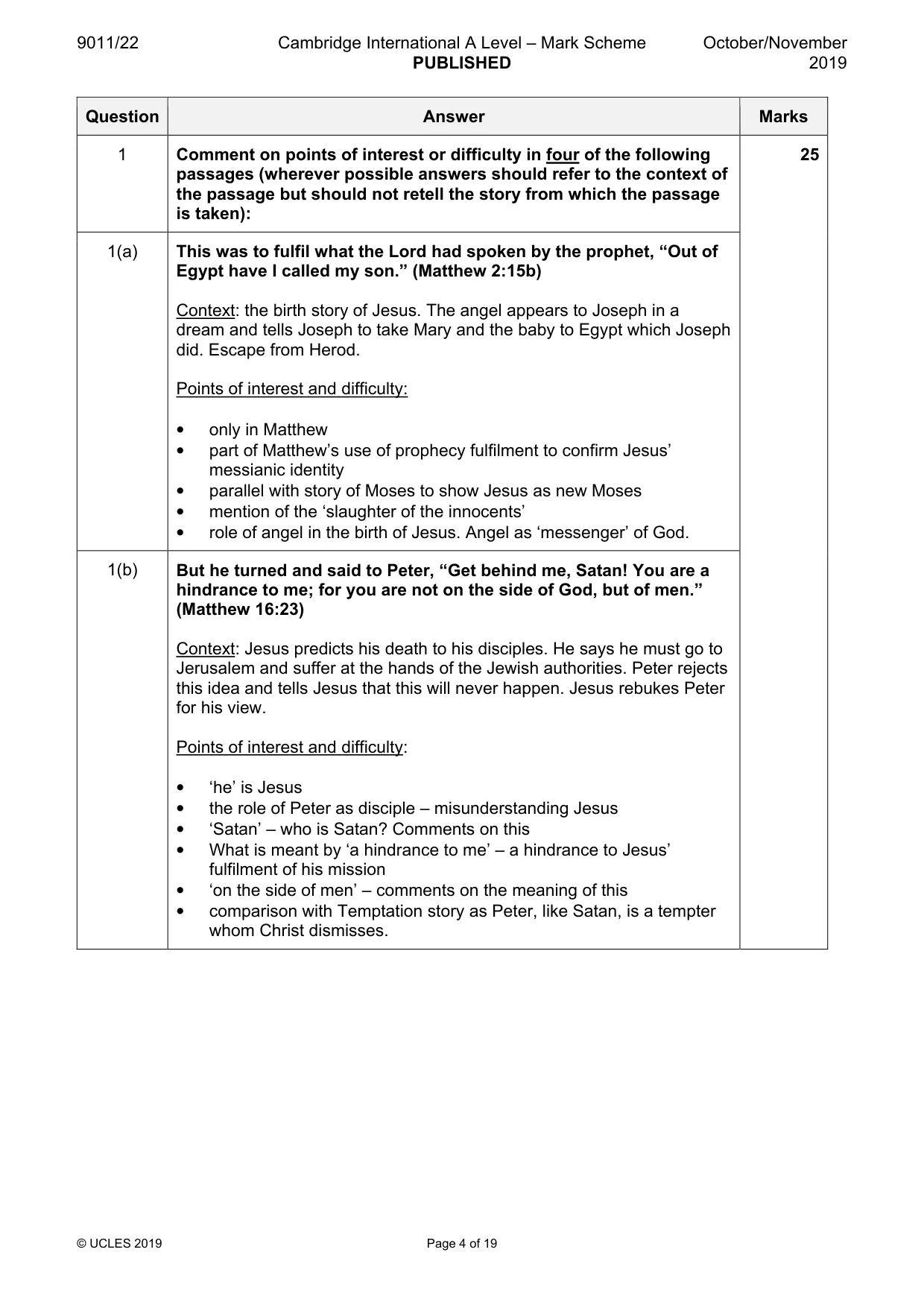
9011/22 Cambridge International A Level – Mark Scheme PUBLISHED October/November 2019 © UCLES 2019 Page 4 of 19 Question Answer Marks 1 Comment on points of interest or difficulty in four of the following passages (wherever possible answers should refer to the context of the passage but should not retell the story from which the passage is taken): 25 1(a) This was to fulfil what the Lord had spoken by the prophet, “Out of Egypt have I called my son.” (Matthew 2:15b) Context: the birth story of Jesus. The angel appears to Joseph in a dream and tells Joseph to take Mary and the baby to Egypt which Joseph did. Escape from Herod. Points of interest and difficulty: • only in Matthew • part of Matthew’s use of prophecy fulfilment to confirm Jesus’ messianic identity • parallel with story of Moses to show Jesus as new Moses • mention of the ‘slaughter of the innocents’ • role of angel in the birth of Jesus. Angel as ‘messenger’ of God. 1(b) But he turned and said to Peter, “Get behind me, Satan! You are a hindrance to me; for you are not on the side of God, but of men.” (Matthew 16:23) Context: Jesus predicts his death to his disciples. He says he must go to Jerusalem and suffer at the hands of the Jewish authorities. Peter rejects this idea and tells Jesus that this will never happen. Jesus rebukes Peter for his view. Points of interest and difficulty: • ‘he’ is Jesus • the role of Peter as disciple – misunderstanding Jesus • ‘Satan’ – who is Satan? Comments on this • What is meant by ‘a hindrance to me’ – a hindrance to Jesus’ fulfilment of his mission • ‘on the side of men’ – comments on the meaning of this • comparison with Temptation story as Peter, like Satan, is a tempter whom Christ dismisses.
Mark scheme, page 5
9011/22 Cambridge International A Level – Mark Scheme PUBLISHED October/November 2019 © UCLES 2019 Page 5 of 19 Question Answer Marks 1(c) And going on a little farther, he saw James the son of Zeb’edee and John his brother, who were in their boat mending the nets. (Mark 1:19) Context: the calling of the first disciples. Jesus had just encountered Peter and Andrew beside the Sea of Galilee and then came across James and John. Points of interest and difficulty: • ‘going a little farther’ – along the side of the sea of Galilee • the role of fishermen as disciples – they are to be ‘fishers of men’ • comment on role of James and John as Jesus’ disciples • sons of Zebedee – Jewish custom of referring to men as ‘son of’’ 1(d) For the Pharisees, and all the Jews, do not eat unless they wash their hands, observing the tradition of the elders « (Mark 7:3) Context: part of a dialogue on clean and unclean rituals. The Pharisees and teachers of the Law had come from Jerusalem and accused the disciples of eating food with ritually unwashed / unclean hands. Points of interest and difficulty: • comment upon who the Pharisees were and the teachers of the Law « Jewish religious authorities of the time • what is meant by ‘tradition of the elders’ – Jewish teaching on Jewish laws of the time • significance of washing of the hands – ritual cleanliness – what is understood as clean / unclean. 1(e) And Zechari’ah was troubled when he saw him, and fear fell upon him. (Luke 1:12) Context: part of the story of the foretelling of the birth of John the Baptist. Zechariah was in the Temple burning incense when an angel visited him. Points of interest and difficulty: • Zechariah – a priest who served in the Temple from the division of Abijah, married to Elizabeth, no children at this point • ‘when he saw him’ – who is ‘him’? an angel / messenger of the Lord • Zechariah experienced fear at the sight of the angel«why? He recognised him as a messenger from God therefore present for a reason • the miracle of the occasion as both Zachariah and his wife were old and past the time of having children. This is a typical Old Testament theme, aged parents, e.g. Abraham and Sarah.
Mark scheme, page 6
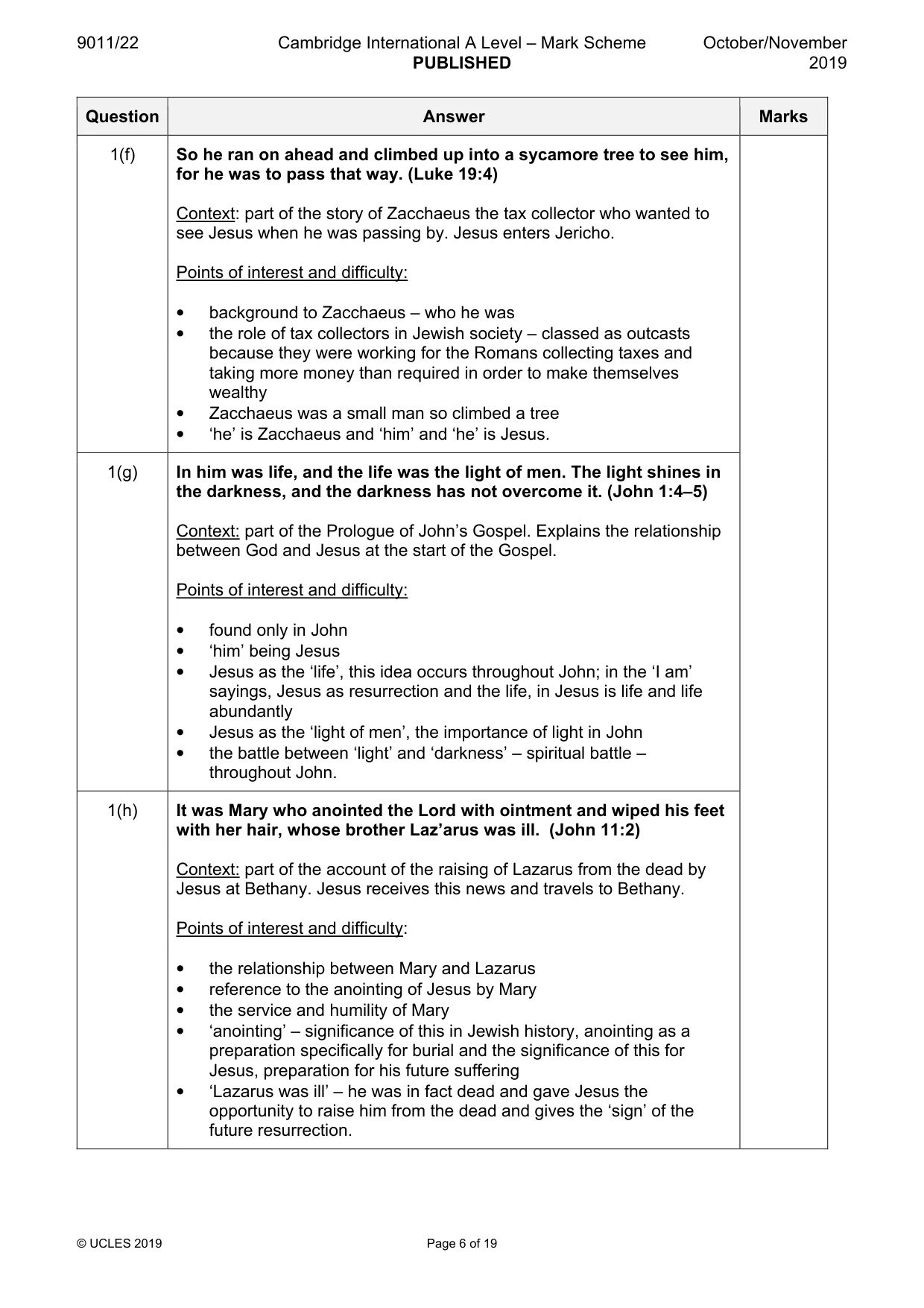
9011/22 Cambridge International A Level – Mark Scheme PUBLISHED October/November 2019 © UCLES 2019 Page 6 of 19 Question Answer Marks 1(f) So he ran on ahead and climbed up into a sycamore tree to see him, for he was to pass that way. (Luke 19:4) Context: part of the story of Zacchaeus the tax collector who wanted to see Jesus when he was passing by. Jesus enters Jericho. Points of interest and difficulty: • background to Zacchaeus – who he was • the role of tax collectors in Jewish society – classed as outcasts because they were working for the Romans collecting taxes and taking more money than required in order to make themselves wealthy • Zacchaeus was a small man so climbed a tree • ‘he’ is Zacchaeus and ‘him’ and ‘he’ is Jesus. 1(g) In him was life, and the life was the light of men. The light shines in the darkness, and the darkness has not overcome it. (John 1:4–5) Context: part of the Prologue of John’s Gospel. Explains the relationship between God and Jesus at the start of the Gospel. Points of interest and difficulty: • found only in John • ‘him’ being Jesus • Jesus as the ‘life’, this idea occurs throughout John; in the ‘I am’ sayings, Jesus as resurrection and the life, in Jesus is life and life abundantly • Jesus as the ‘light of men’, the importance of light in John • the battle between ‘light’ and ‘darkness’ – spiritual battle – throughout John. 1(h) It was Mary who anointed the Lord with ointment and wiped his feet with her hair, whose brother Laz’arus was ill. (John 11:2) Context: part of the account of the raising of Lazarus from the dead by Jesus at Bethany. Jesus receives this news and travels to Bethany. Points of interest and difficulty: • the relationship between Mary and Lazarus • reference to the anointing of Jesus by Mary • the service and humility of Mary • ‘anointing’ – significance of this in Jewish history, anointing as a preparation specifically for burial and the significance of this for Jesus, preparation for his future suffering • ‘Lazarus was ill’ – he was in fact dead and gave Jesus the opportunity to raise him from the dead and gives the ‘sign’ of the future resurrection.
Mark scheme, page 7
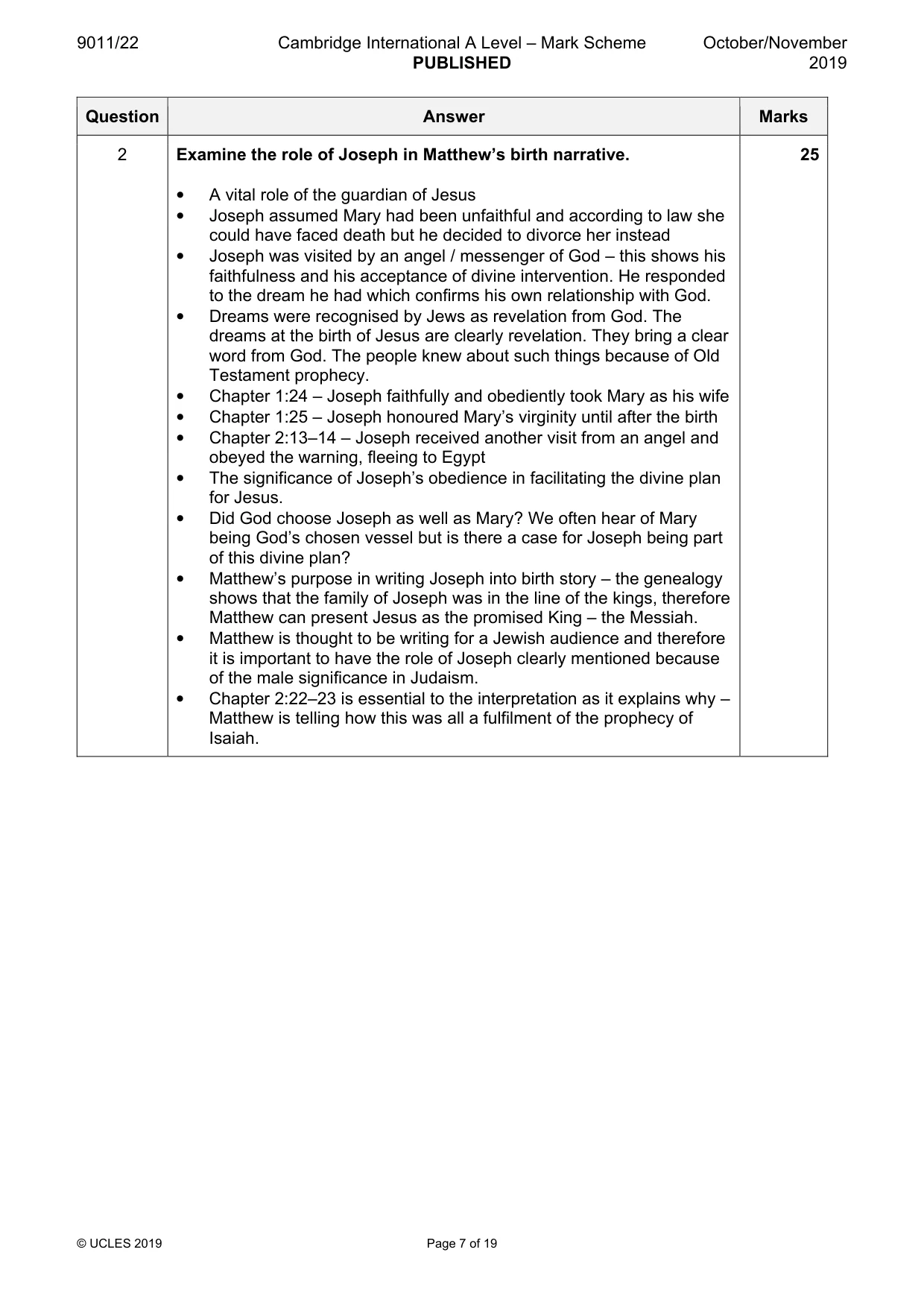
9011/22 Cambridge International A Level – Mark Scheme PUBLISHED October/November 2019 © UCLES 2019 Page 7 of 19 Question Answer Marks 2 Examine the role of Joseph in Matthew’s birth narrative. • A vital role of the guardian of Jesus • Joseph assumed Mary had been unfaithful and according to law she could have faced death but he decided to divorce her instead • Joseph was visited by an angel / messenger of God – this shows his faithfulness and his acceptance of divine intervention. He responded to the dream he had which confirms his own relationship with God. • Dreams were recognised by Jews as revelation from God. The dreams at the birth of Jesus are clearly revelation. They bring a clear word from God. The people knew about such things because of Old Testament prophecy. • Chapter 1:24 – Joseph faithfully and obediently took Mary as his wife • Chapter 1:25 – Joseph honoured Mary’s virginity until after the birth • Chapter 2:13–14 – Joseph received another visit from an angel and obeyed the warning, fleeing to Egypt • The significance of Joseph’s obedience in facilitating the divine plan for Jesus. • Did God choose Joseph as well as Mary? We often hear of Mary being God’s chosen vessel but is there a case for Joseph being part of this divine plan? • Matthew’s purpose in writing Joseph into birth story – the genealogy shows that the family of Joseph was in the line of the kings, therefore Matthew can present Jesus as the promised King – the Messiah. • Matthew is thought to be writing for a Jewish audience and therefore it is important to have the role of Joseph clearly mentioned because of the male significance in Judaism. • Chapter 2:22–23 is essential to the interpretation as it explains why – Matthew is telling how this was all a fulfilment of the prophecy of Isaiah. 25
Mark scheme, page 8
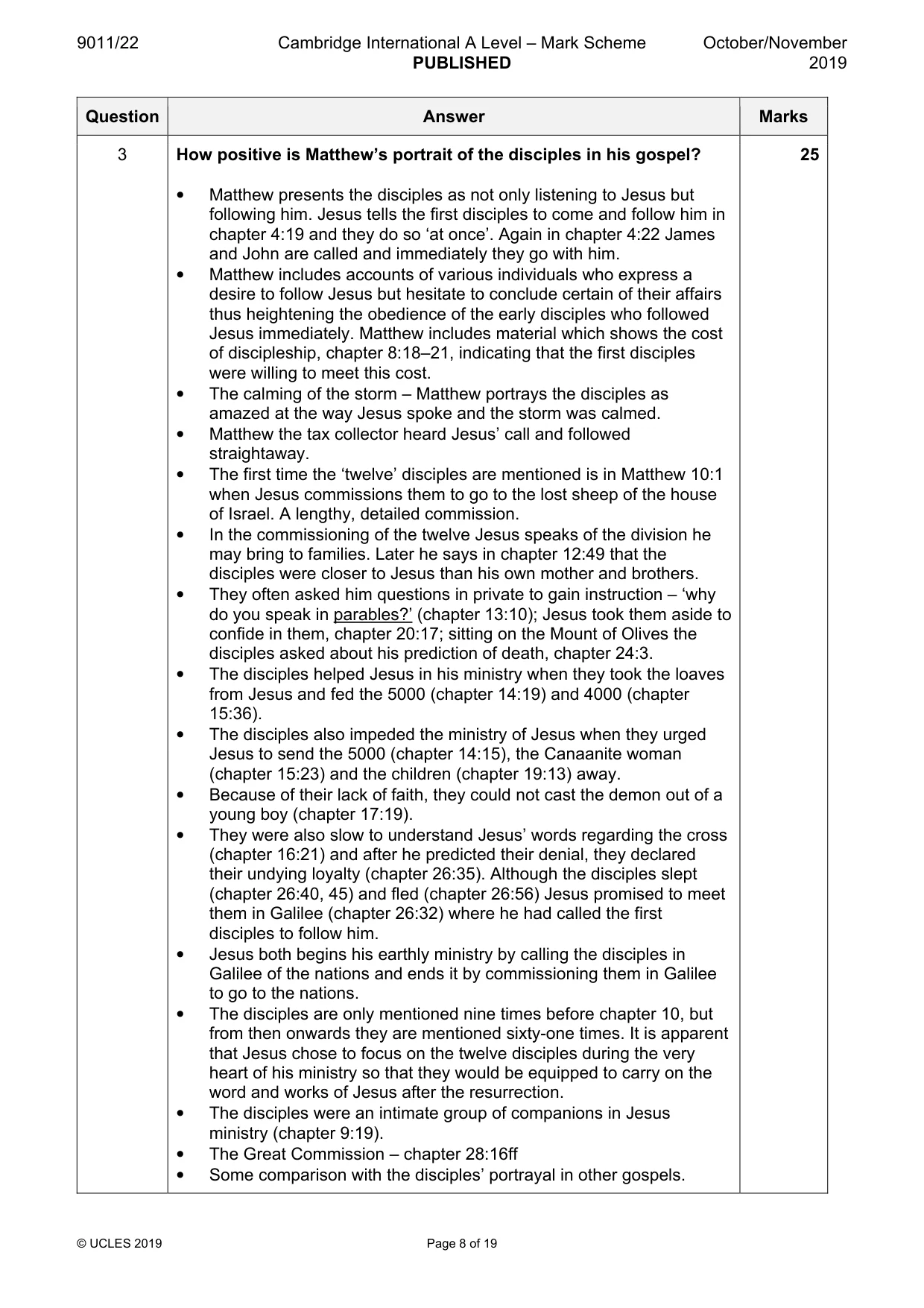
9011/22 Cambridge International A Level – Mark Scheme PUBLISHED October/November 2019 © UCLES 2019 Page 8 of 19 Question Answer Marks 3 How positive is Matthew’s portrait of the disciples in his gospel? • Matthew presents the disciples as not only listening to Jesus but following him. Jesus tells the first disciples to come and follow him in chapter 4:19 and they do so ‘at once’. Again in chapter 4:22 James and John are called and immediately they go with him. • Matthew includes accounts of various individuals who express a desire to follow Jesus but hesitate to conclude certain of their affairs thus heightening the obedience of the early disciples who followed Jesus immediately. Matthew includes material which shows the cost of discipleship, chapter 8:18–21, indicating that the first disciples were willing to meet this cost. • The calming of the storm – Matthew portrays the disciples as amazed at the way Jesus spoke and the storm was calmed. • Matthew the tax collector heard Jesus’ call and followed straightaway. • The first time the ‘twelve’ disciples are mentioned is in Matthew 10:1 when Jesus commissions them to go to the lost sheep of the house of Israel. A lengthy, detailed commission. • In the commissioning of the twelve Jesus speaks of the division he may bring to families. Later he says in chapter 12:49 that the disciples were closer to Jesus than his own mother and brothers. • They often asked him questions in private to gain instruction – ‘why do you speak in parables?’ (chapter 13:10); Jesus took them aside to confide in them, chapter 20:17; sitting on the Mount of Olives the disciples asked about his prediction of death, chapter 24:3. • The disciples helped Jesus in his ministry when they took the loaves from Jesus and fed the 5000 (chapter 14:19) and 4000 (chapter 15:36). • The disciples also impeded the ministry of Jesus when they urged Jesus to send the 5000 (chapter 14:15), the Canaanite woman (chapter 15:23) and the children (chapter 19:13) away. • Because of their lack of faith, they could not cast the demon out of a young boy (chapter 17:19). • They were also slow to understand Jesus’ words regarding the cross (chapter 16:21) and after he predicted their denial, they declared their undying loyalty (chapter 26:35). Although the disciples slept (chapter 26:40, 45) and fled (chapter 26:56) Jesus promised to meet them in Galilee (chapter 26:32) where he had called the first disciples to follow him. • Jesus both begins his earthly ministry by calling the disciples in Galilee of the nations and ends it by commissioning them in Galilee to go to the nations. • The disciples are only mentioned nine times before chapter 10, but from then onwards they are mentioned sixty-one times. It is apparent that Jesus chose to focus on the twelve disciples during the very heart of his ministry so that they would be equipped to carry on the word and works of Jesus after the resurrection. • The disciples were an intimate group of companions in Jesus ministry (chapter 9:19). • The Great Commission – chapter 28:16ff • Some comparison with the disciples’ portrayal in other gospels. 25
Mark scheme, page 9
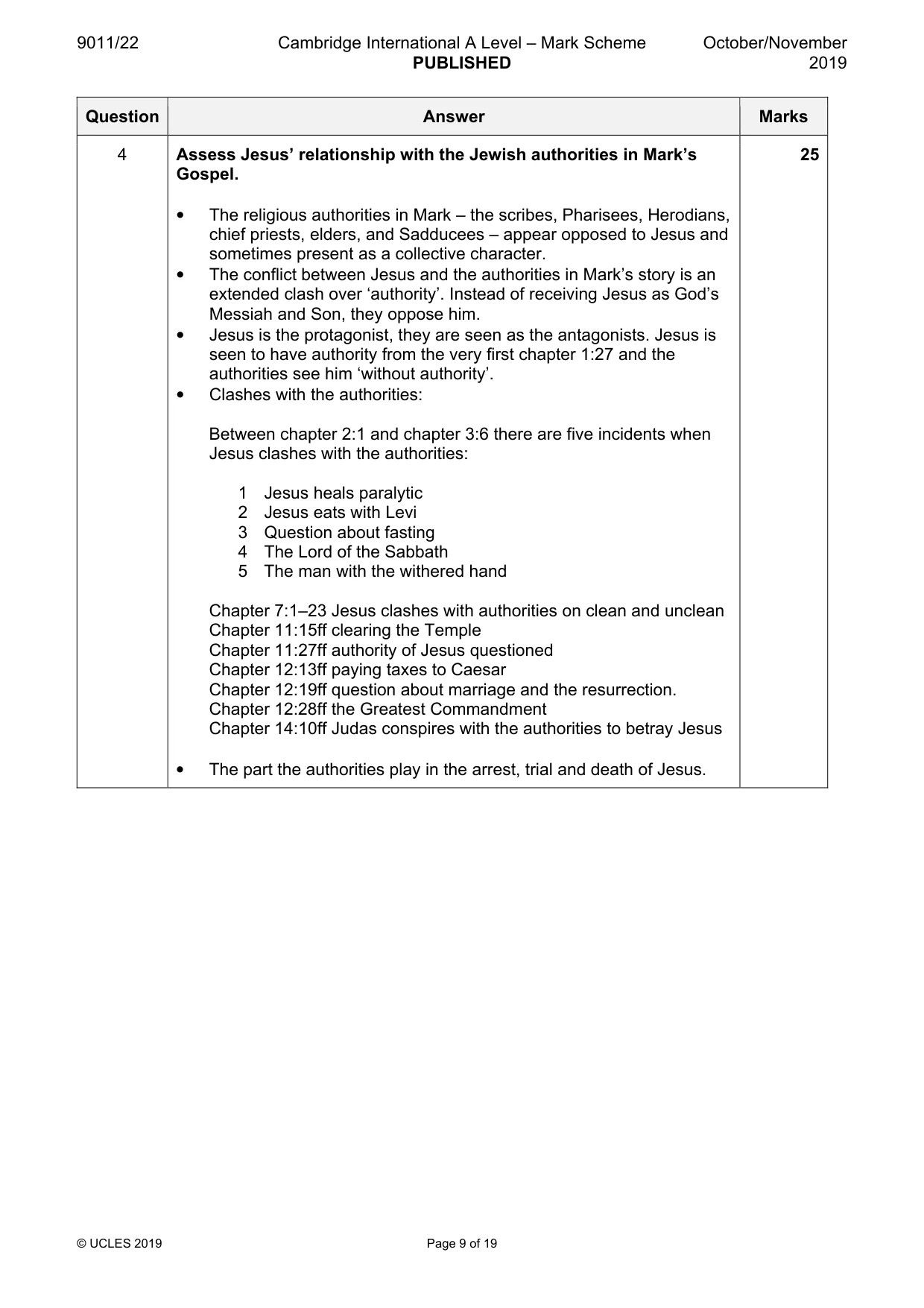
9011/22 Cambridge International A Level – Mark Scheme PUBLISHED October/November 2019 © UCLES 2019 Page 9 of 19 Question Answer Marks 4 Assess Jesus’ relationship with the Jewish authorities in Mark’s Gospel. • The religious authorities in Mark – the scribes, Pharisees, Herodians, chief priests, elders, and Sadducees – appear opposed to Jesus and sometimes present as a collective character. • The conflict between Jesus and the authorities in Mark’s story is an extended clash over ‘authority’. Instead of receiving Jesus as God’s Messiah and Son, they oppose him. • Jesus is the protagonist, they are seen as the antagonists. Jesus is seen to have authority from the very first chapter 1:27 and the authorities see him ‘without authority’. • Clashes with the authorities: Between chapter 2:1 and chapter 3:6 there are five incidents when Jesus clashes with the authorities: 1 Jesus heals paralytic 2 Jesus eats with Levi 3 Question about fasting 4 The Lord of the Sabbath 5 The man with the withered hand Chapter 7:1–23 Jesus clashes with authorities on clean and unclean Chapter 11:15ff clearing the Temple Chapter 11:27ff authority of Jesus questioned Chapter 12:13ff paying taxes to Caesar Chapter 12:19ff question about marriage and the resurrection. Chapter 12:28ff the Greatest Commandment Chapter 14:10ff Judas conspires with the authorities to betray Jesus • The part the authorities play in the arrest, trial and death of Jesus. 25
Mark scheme, page 10
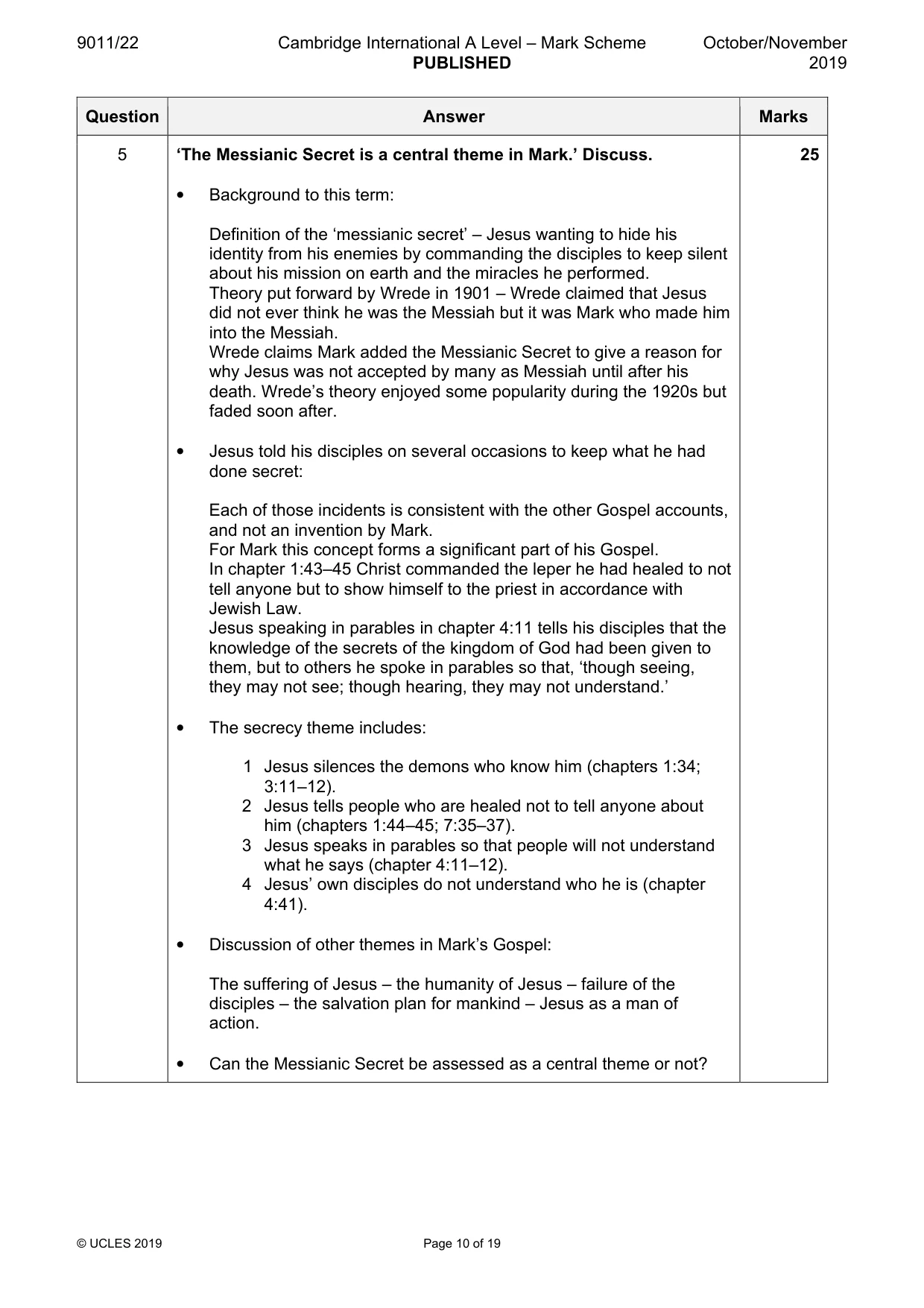
9011/22 Cambridge International A Level – Mark Scheme PUBLISHED October/November 2019 © UCLES 2019 Page 10 of 19 Question Answer Marks 5 ‘The Messianic Secret is a central theme in Mark.’ Discuss. • Background to this term: Definition of the ‘messianic secret’ – Jesus wanting to hide his identity from his enemies by commanding the disciples to keep silent about his mission on earth and the miracles he performed. Theory put forward by Wrede in 1901 – Wrede claimed that Jesus did not ever think he was the Messiah but it was Mark who made him into the Messiah. Wrede claims Mark added the Messianic Secret to give a reason for why Jesus was not accepted by many as Messiah until after his death. Wrede’s theory enjoyed some popularity during the 1920s but faded soon after. • Jesus told his disciples on several occasions to keep what he had done secret: Each of those incidents is consistent with the other Gospel accounts, and not an invention by Mark. For Mark this concept forms a significant part of his Gospel. In chapter 1:43–45 Christ commanded the leper he had healed to not tell anyone but to show himself to the priest in accordance with Jewish Law. Jesus speaking in parables in chapter 4:11 tells his disciples that the knowledge of the secrets of the kingdom of God had been given to them, but to others he spoke in parables so that, ‘though seeing, they may not see; though hearing, they may not understand.’ • The secrecy theme includes: 1 Jesus silences the demons who know him (chapters 1:34; 3:11–12). 2 Jesus tells people who are healed not to tell anyone about him (chapters 1:44–45; 7:35–37). 3 Jesus speaks in parables so that people will not understand what he says (chapter 4:11–12). 4 Jesus’ own disciples do not understand who he is (chapter 4:41). • Discussion of other themes in Mark’s Gospel: The suffering of Jesus – the humanity of Jesus – failure of the disciples – the salvation plan for mankind – Jesus as a man of action. • Can the Messianic Secret be assessed as a central theme or not? 25
Mark scheme, page 11
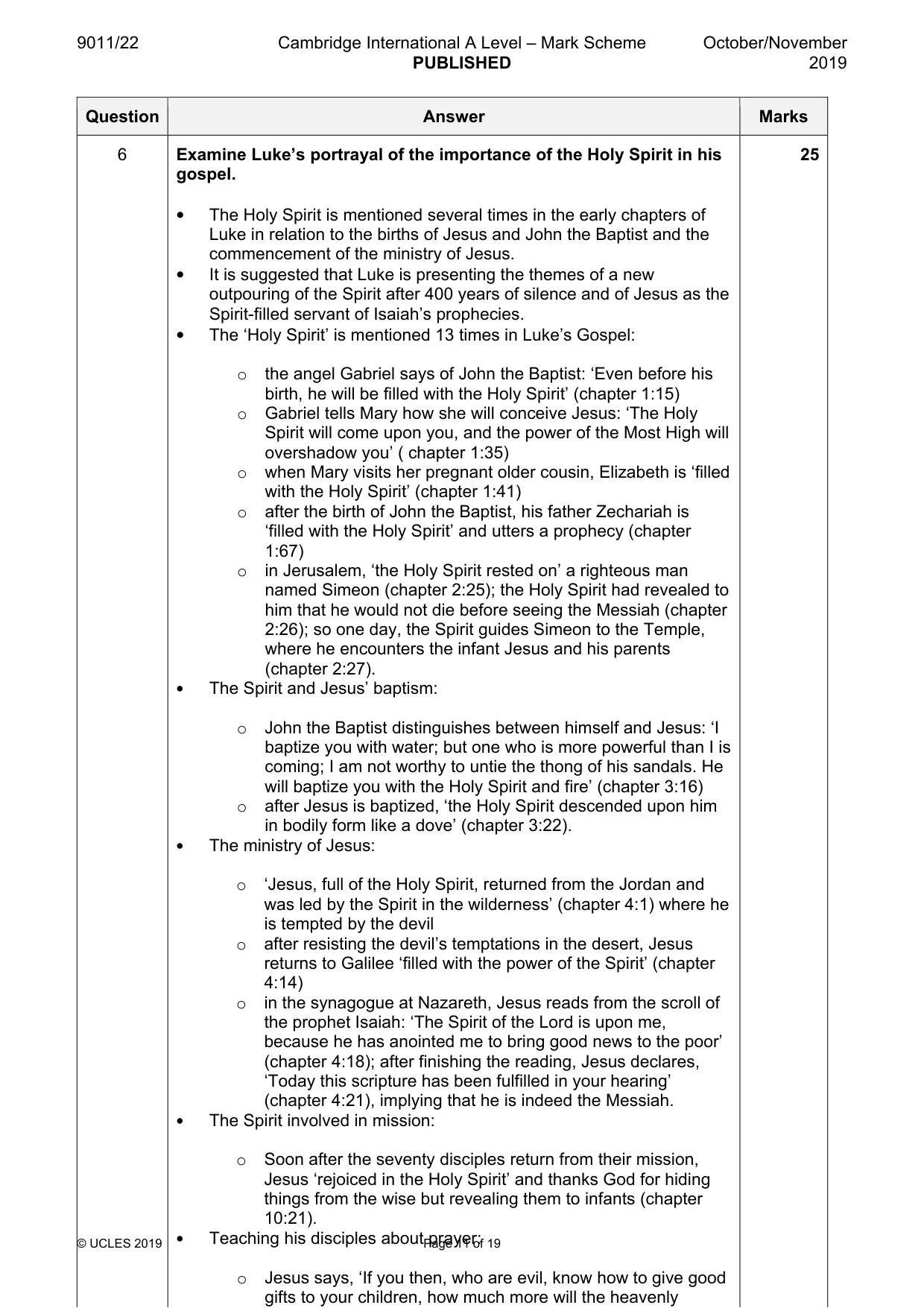
9011/22 Cambridge International A Level – Mark Scheme PUBLISHED October/November 2019 © UCLES 2019 Page 11 of 19 Question Answer Marks 6 Examine Luke’s portrayal of the importance of the Holy Spirit in his gospel. • The Holy Spirit is mentioned several times in the early chapters of Luke in relation to the births of Jesus and John the Baptist and the commencement of the ministry of Jesus. • It is suggested that Luke is presenting the themes of a new outpouring of the Spirit after 400 years of silence and of Jesus as the Spirit-filled servant of Isaiah’s prophecies. • The ‘Holy Spirit’ is mentioned 13 times in Luke’s Gospel: o the angel Gabriel says of John the Baptist: ‘Even before his birth, he will be filled with the Holy Spirit’ (chapter 1:15) o Gabriel tells Mary how she will conceive Jesus: ‘The Holy Spirit will come upon you, and the power of the Most High will overshadow you’ ( chapter 1:35) o when Mary visits her pregnant older cousin, Elizabeth is ‘filled with the Holy Spirit’ (chapter 1:41) o after the birth of John the Baptist, his father Zechariah is ‘filled with the Holy Spirit’ and utters a prophecy (chapter 1:67) o in Jerusalem, ‘the Holy Spirit rested on’ a righteous man named Simeon (chapter 2:25); the Holy Spirit had revealed to him that he would not die before seeing the Messiah (chapter 2:26); so one day, the Spirit guides Simeon to the Temple, where he encounters the infant Jesus and his parents (chapter 2:27). • The Spirit and Jesus’ baptism: o John the Baptist distinguishes between himself and Jesus: ‘I baptize you with water; but one who is more powerful than I is coming; I am not worthy to untie the thong of his sandals. He will baptize you with the Holy Spirit and fire’ (chapter 3:16) o after Jesus is baptized, ‘the Holy Spirit descended upon him in bodily form like a dove’ (chapter 3:22). • The ministry of Jesus: o ‘Jesus, full of the Holy Spirit, returned from the Jordan and was led by the Spirit in the wilderness’ (chapter 4:1) where he is tempted by the devil o after resisting the devil’s temptations in the desert, Jesus returns to Galilee ‘filled with the power of the Spirit’ (chapter 4:14) o in the synagogue at Nazareth, Jesus reads from the scroll of the prophet Isaiah: ‘The Spirit of the Lord is upon me, because he has anointed me to bring good news to the poor’ (chapter 4:18); after finishing the reading, Jesus declares, ‘Today this scripture has been fulfilled in your hearing’ (chapter 4:21), implying that he is indeed the Messiah. • The Spirit involved in mission: o Soon after the seventy disciples return from their mission, Jesus ‘rejoiced in the Holy Spirit’ and thanks God for hiding things from the wise but revealing them to infants (chapter 10:21). • Teaching his disciples about prayer: o Jesus says, ‘If you then, who are evil, know how to give good gifts to your children, how much more will the heavenly 25
Mark scheme, page 12
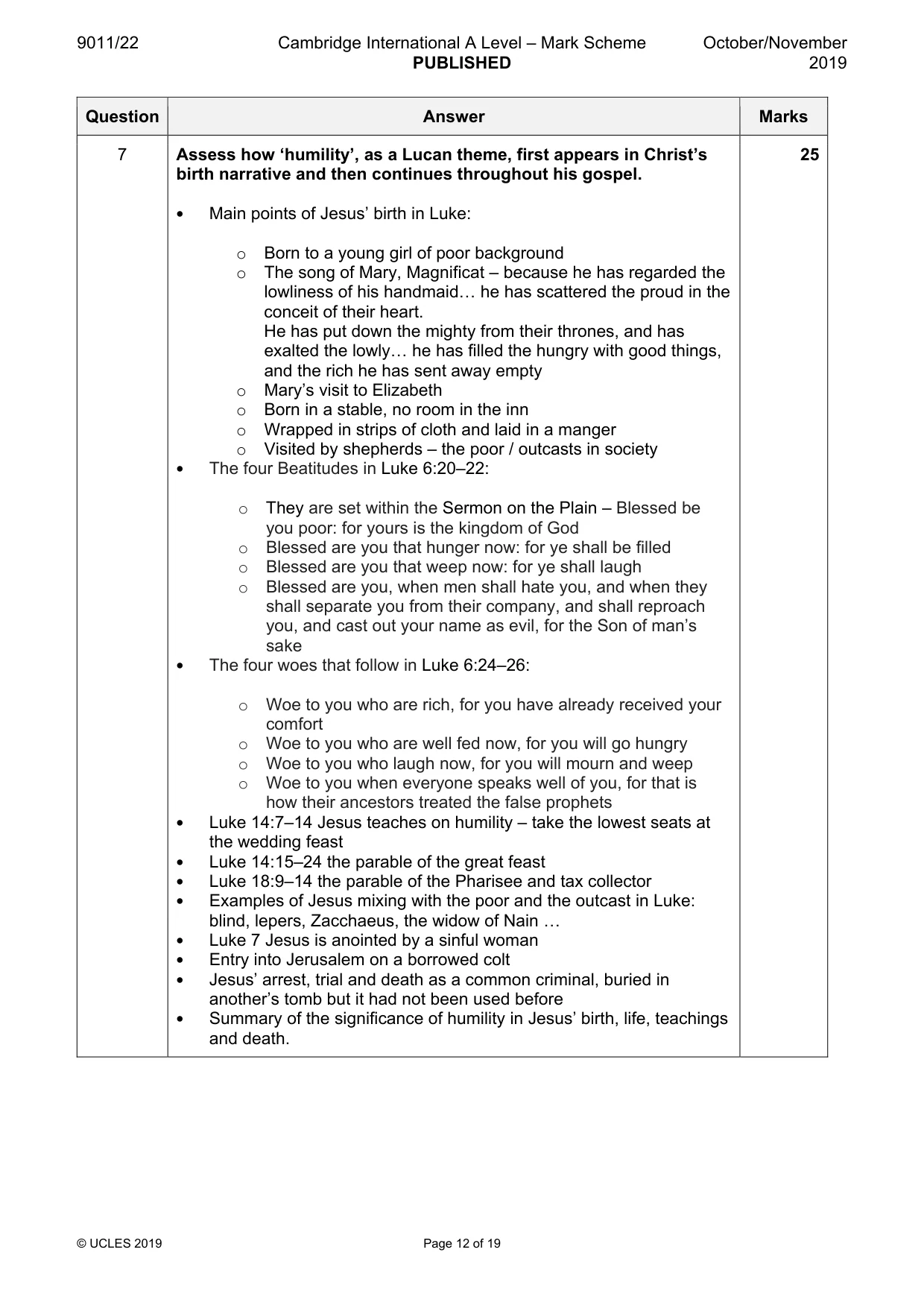
9011/22 Cambridge International A Level – Mark Scheme PUBLISHED October/November 2019 © UCLES 2019 Page 12 of 19 Question Answer Marks 7 Assess how ‘humility’, as a Lucan theme, first appears in Christ’s birth narrative and then continues throughout his gospel. • Main points of Jesus’ birth in Luke: o Born to a young girl of poor background o The song of Mary, Magnificat – because he has regarded the lowliness of his handmaid« he has scattered the proud in the conceit of their heart. He has put down the mighty from their thrones, and has exalted the lowly« he has filled the hungry with good things, and the rich he has sent away empty o Mary’s visit to Elizabeth o Born in a stable, no room in the inn o Wrapped in strips of cloth and laid in a manger o Visited by shepherds – the poor / outcasts in society • The four Beatitudes in Luke 6:20–22: o They are set within the Sermon on the Plain – Blessed be you poor: for yours is the kingdom of God o Blessed are you that hunger now: for ye shall be filled o Blessed are you that weep now: for ye shall laugh o Blessed are you, when men shall hate you, and when they shall separate you from their company, and shall reproach you, and cast out your name as evil, for the Son of man’s sake • The four woes that follow in Luke 6:24–26: o Woe to you who are rich, for you have already received your comfort o Woe to you who are well fed now, for you will go hungry o Woe to you who laugh now, for you will mourn and weep o Woe to you when everyone speaks well of you, for that is how their ancestors treated the false prophets • Luke 14:7–14 Jesus teaches on humility – take the lowest seats at the wedding feast • Luke 14:15–24 the parable of the great feast • Luke 18:9–14 the parable of the Pharisee and tax collector • Examples of Jesus mixing with the poor and the outcast in Luke: blind, lepers, Zacchaeus, the widow of Nain « • Luke 7 Jesus is anointed by a sinful woman • Entry into Jerusalem on a borrowed colt • Jesus’ arrest, trial and death as a common criminal, buried in another’s tomb but it had not been used before • Summary of the significance of humility in Jesus’ birth, life, teachings and death. 25
Mark scheme, page 13
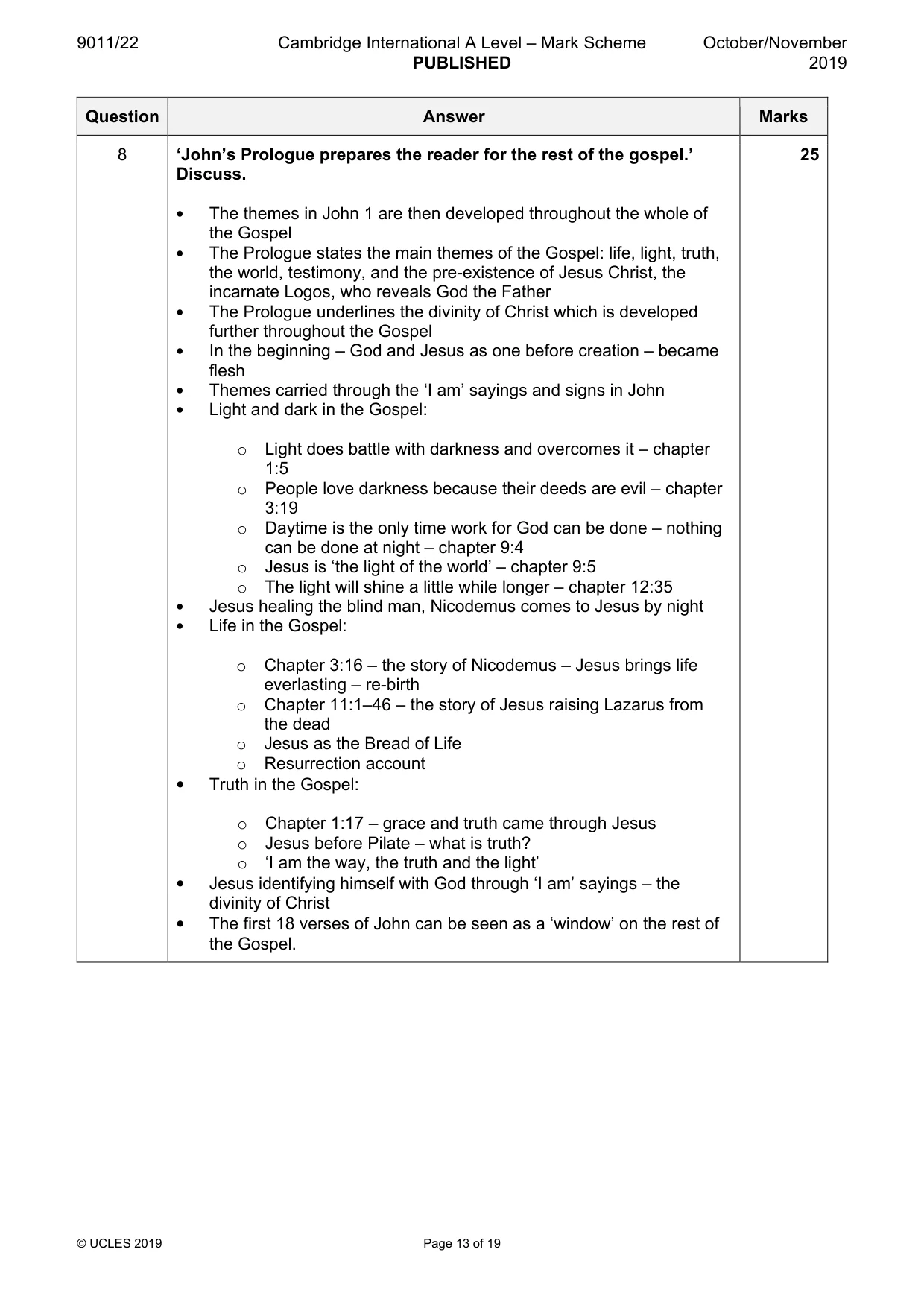
9011/22 Cambridge International A Level – Mark Scheme PUBLISHED October/November 2019 © UCLES 2019 Page 13 of 19 Question Answer Marks 8 ‘John’s Prologue prepares the reader for the rest of the gospel.’ Discuss. • The themes in John 1 are then developed throughout the whole of the Gospel • The Prologue states the main themes of the Gospel: life, light, truth, the world, testimony, and the pre-existence of Jesus Christ, the incarnate Logos, who reveals God the Father • The Prologue underlines the divinity of Christ which is developed further throughout the Gospel • In the beginning – God and Jesus as one before creation – became flesh • Themes carried through the ‘I am’ sayings and signs in John • Light and dark in the Gospel: o Light does battle with darkness and overcomes it – chapter 1:5 o People love darkness because their deeds are evil – chapter 3:19 o Daytime is the only time work for God can be done – nothing can be done at night – chapter 9:4 o Jesus is ‘the light of the world’ – chapter 9:5 o The light will shine a little while longer – chapter 12:35 • Jesus healing the blind man, Nicodemus comes to Jesus by night • Life in the Gospel: o Chapter 3:16 – the story of Nicodemus – Jesus brings life everlasting – re-birth o Chapter 11:1–46 – the story of Jesus raising Lazarus from the dead o Jesus as the Bread of Life o Resurrection account • Truth in the Gospel: o Chapter 1:17 – grace and truth came through Jesus o Jesus before Pilate – what is truth? o ‘I am the way, the truth and the light’ • Jesus identifying himself with God through ‘I am’ sayings – the divinity of Christ • The first 18 verses of John can be seen as a ‘window’ on the rest of the Gospel. 25
Mark scheme, page 14
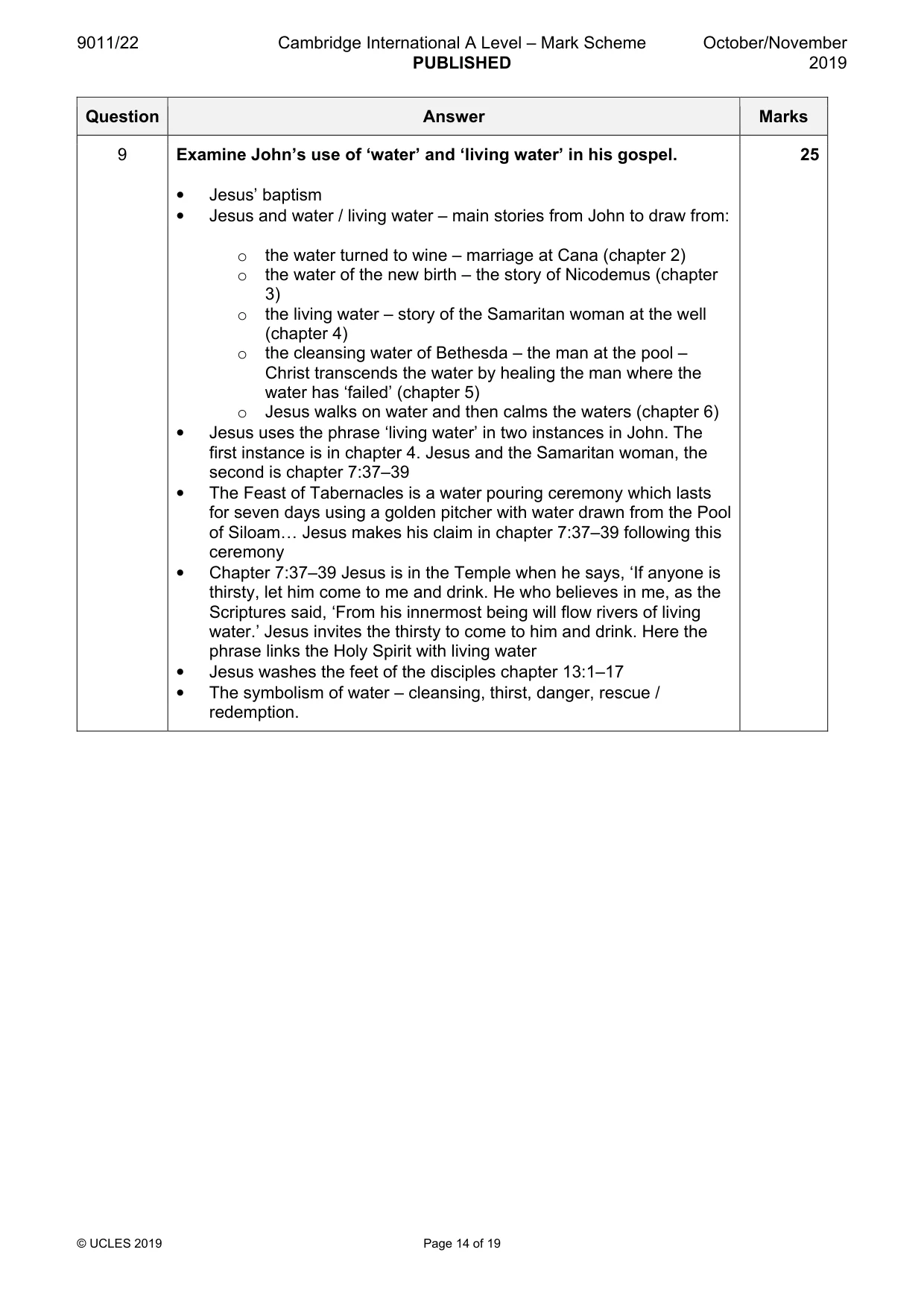
9011/22 Cambridge International A Level – Mark Scheme PUBLISHED October/November 2019 © UCLES 2019 Page 14 of 19 Question Answer Marks 9 Examine John’s use of ‘water’ and ‘living water’ in his gospel. • Jesus’ baptism • Jesus and water / living water – main stories from John to draw from: o the water turned to wine – marriage at Cana (chapter 2) o the water of the new birth – the story of Nicodemus (chapter 3) o the living water – story of the Samaritan woman at the well (chapter 4) o the cleansing water of Bethesda – the man at the pool – Christ transcends the water by healing the man where the water has ‘failed’ (chapter 5) o Jesus walks on water and then calms the waters (chapter 6) • Jesus uses the phrase ‘living water’ in two instances in John. The first instance is in chapter 4. Jesus and the Samaritan woman, the second is chapter 7:37–39 • The Feast of Tabernacles is a water pouring ceremony which lasts for seven days using a golden pitcher with water drawn from the Pool of Siloam« Jesus makes his claim in chapter 7:37–39 following this ceremony • Chapter 7:37–39 Jesus is in the Temple when he says, ‘If anyone is thirsty, let him come to me and drink. He who believes in me, as the Scriptures said, ‘From his innermost being will flow rivers of living water.’ Jesus invites the thirsty to come to him and drink. Here the phrase links the Holy Spirit with living water • Jesus washes the feet of the disciples chapter 13:1–17 • The symbolism of water – cleansing, thirst, danger, rescue / redemption. 25
Mark scheme, page 15
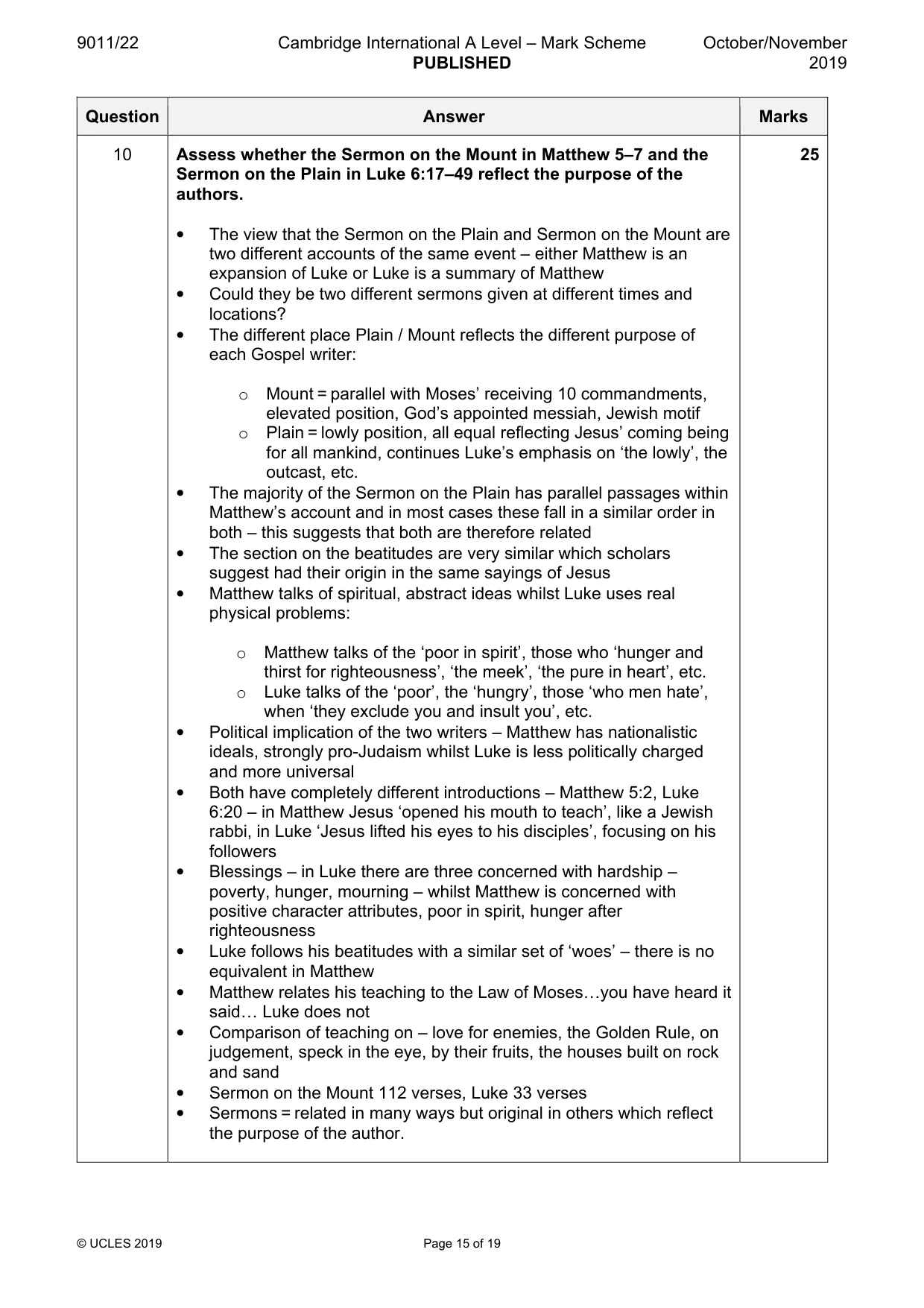
9011/22 Cambridge International A Level – Mark Scheme PUBLISHED October/November 2019 © UCLES 2019 Page 15 of 19 Question Answer Marks 10 Assess whether the Sermon on the Mount in Matthew 5–7 and the Sermon on the Plain in Luke 6:17–49 reflect the purpose of the authors. • The view that the Sermon on the Plain and Sermon on the Mount are two different accounts of the same event – either Matthew is an expansion of Luke or Luke is a summary of Matthew • Could they be two different sermons given at different times and locations? • The different place Plain / Mount reflects the different purpose of each Gospel writer: o Mount = parallel with Moses’ receiving 10 commandments, elevated position, God’s appointed messiah, Jewish motif o Plain = lowly position, all equal reflecting Jesus’ coming being for all mankind, continues Luke’s emphasis on ‘the lowly’, the outcast, etc. • The majority of the Sermon on the Plain has parallel passages within Matthew’s account and in most cases these fall in a similar order in both – this suggests that both are therefore related • The section on the beatitudes are very similar which scholars suggest had their origin in the same sayings of Jesus • Matthew talks of spiritual, abstract ideas whilst Luke uses real physical problems: o Matthew talks of the ‘poor in spirit’, those who ‘hunger and thirst for righteousness’, ‘the meek’, ‘the pure in heart’, etc. o Luke talks of the ‘poor’, the ‘hungry’, those ‘who men hate’, when ‘they exclude you and insult you’, etc. • Political implication of the two writers – Matthew has nationalistic ideals, strongly pro-Judaism whilst Luke is less politically charged and more universal • Both have completely different introductions – Matthew 5:2, Luke 6:20 – in Matthew Jesus ‘opened his mouth to teach’, like a Jewish rabbi, in Luke ‘Jesus lifted his eyes to his disciples’, focusing on his followers • Blessings – in Luke there are three concerned with hardship – poverty, hunger, mourning – whilst Matthew is concerned with positive character attributes, poor in spirit, hunger after righteousness • Luke follows his beatitudes with a similar set of ‘woes’ – there is no equivalent in Matthew • Matthew relates his teaching to the Law of Moses«you have heard it said« Luke does not • Comparison of teaching on – love for enemies, the Golden Rule, on judgement, speck in the eye, by their fruits, the houses built on rock and sand • Sermon on the Mount 112 verses, Luke 33 verses • Sermons = related in many ways but original in others which reflect the purpose of the author. 25
Mark scheme, page 16
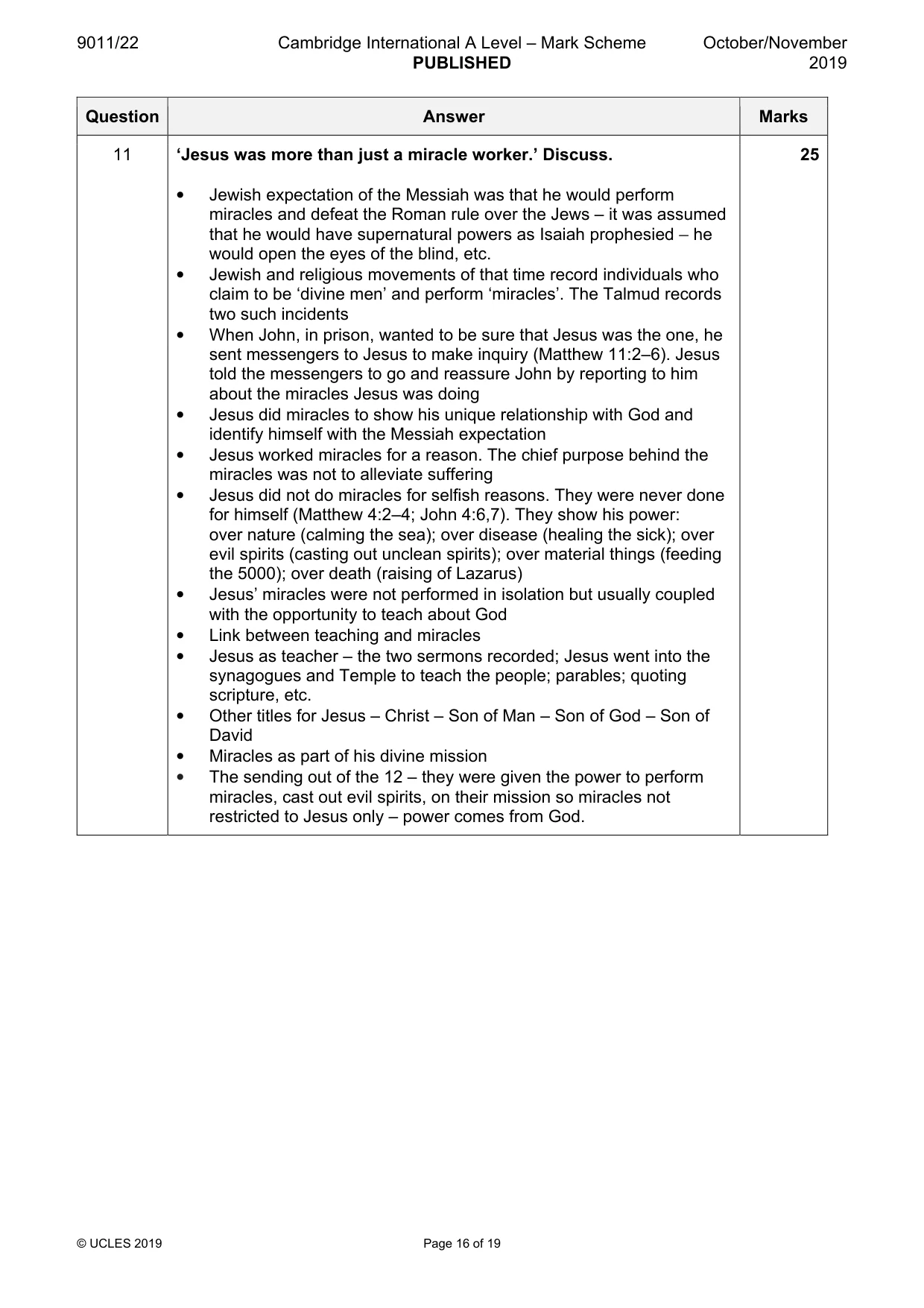
9011/22 Cambridge International A Level – Mark Scheme PUBLISHED October/November 2019 © UCLES 2019 Page 16 of 19 Question Answer Marks 11 ‘Jesus was more than just a miracle worker.’ Discuss. • Jewish expectation of the Messiah was that he would perform miracles and defeat the Roman rule over the Jews – it was assumed that he would have supernatural powers as Isaiah prophesied – he would open the eyes of the blind, etc. • Jewish and religious movements of that time record individuals who claim to be ‘divine men’ and perform ‘miracles’. The Talmud records two such incidents • When John, in prison, wanted to be sure that Jesus was the one, he sent messengers to Jesus to make inquiry (Matthew 11:2–6). Jesus told the messengers to go and reassure John by reporting to him about the miracles Jesus was doing • Jesus did miracles to show his unique relationship with God and identify himself with the Messiah expectation • Jesus worked miracles for a reason. The chief purpose behind the miracles was not to alleviate suffering • Jesus did not do miracles for selfish reasons. They were never done for himself (Matthew 4:2–4; John 4:6,7). They show his power: over nature (calming the sea); over disease (healing the sick); over evil spirits (casting out unclean spirits); over material things (feeding the 5000); over death (raising of Lazarus) • Jesus’ miracles were not performed in isolation but usually coupled with the opportunity to teach about God • Link between teaching and miracles • Jesus as teacher – the two sermons recorded; Jesus went into the synagogues and Temple to teach the people; parables; quoting scripture, etc. • Other titles for Jesus – Christ – Son of Man – Son of God – Son of David • Miracles as part of his divine mission • The sending out of the 12 – they were given the power to perform miracles, cast out evil spirits, on their mission so miracles not restricted to Jesus only – power comes from God. 25
Mark scheme, page 17
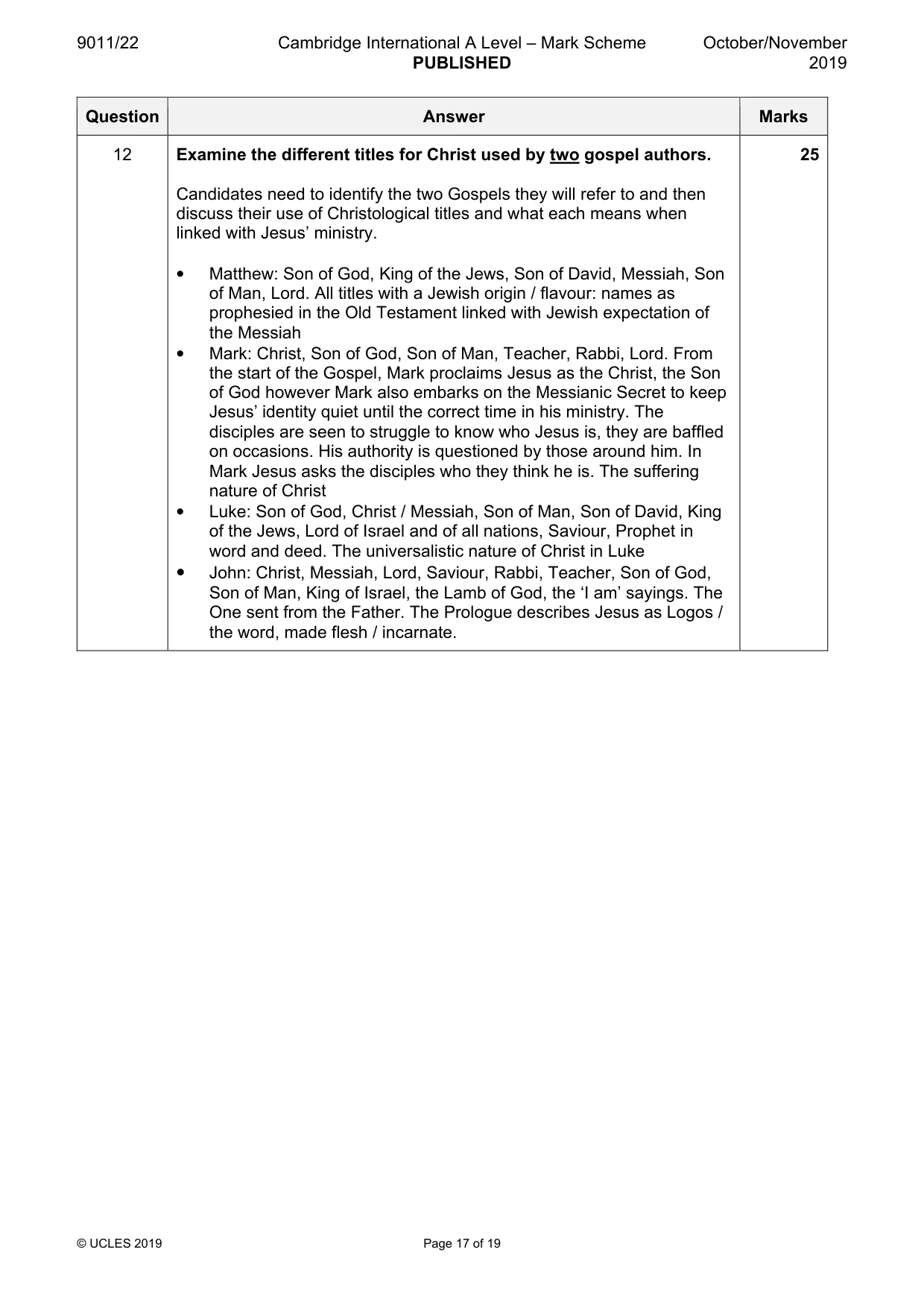
9011/22 Cambridge International A Level – Mark Scheme PUBLISHED October/November 2019 © UCLES 2019 Page 17 of 19 Question Answer Marks 12 Examine the different titles for Christ used by two gospel authors. Candidates need to identify the two Gospels they will refer to and then discuss their use of Christological titles and what each means when linked with Jesus’ ministry. • Matthew: Son of God, King of the Jews, Son of David, Messiah, Son of Man, Lord. All titles with a Jewish origin / flavour: names as prophesied in the Old Testament linked with Jewish expectation of the Messiah • Mark: Christ, Son of God, Son of Man, Teacher, Rabbi, Lord. From the start of the Gospel, Mark proclaims Jesus as the Christ, the Son of God however Mark also embarks on the Messianic Secret to keep Jesus’ identity quiet until the correct time in his ministry. The disciples are seen to struggle to know who Jesus is, they are baffled on occasions. His authority is questioned by those around him. In Mark Jesus asks the disciples who they think he is. The suffering nature of Christ • Luke: Son of God, Christ / Messiah, Son of Man, Son of David, King of the Jews, Lord of Israel and of all nations, Saviour, Prophet in word and deed. The universalistic nature of Christ in Luke • John: Christ, Messiah, Lord, Saviour, Rabbi, Teacher, Son of God, Son of Man, King of Israel, the Lamb of God, the ‘I am’ sayings. The One sent from the Father. The Prologue describes Jesus as Logos / the word, made flesh / incarnate. 25
Mark scheme, page 18
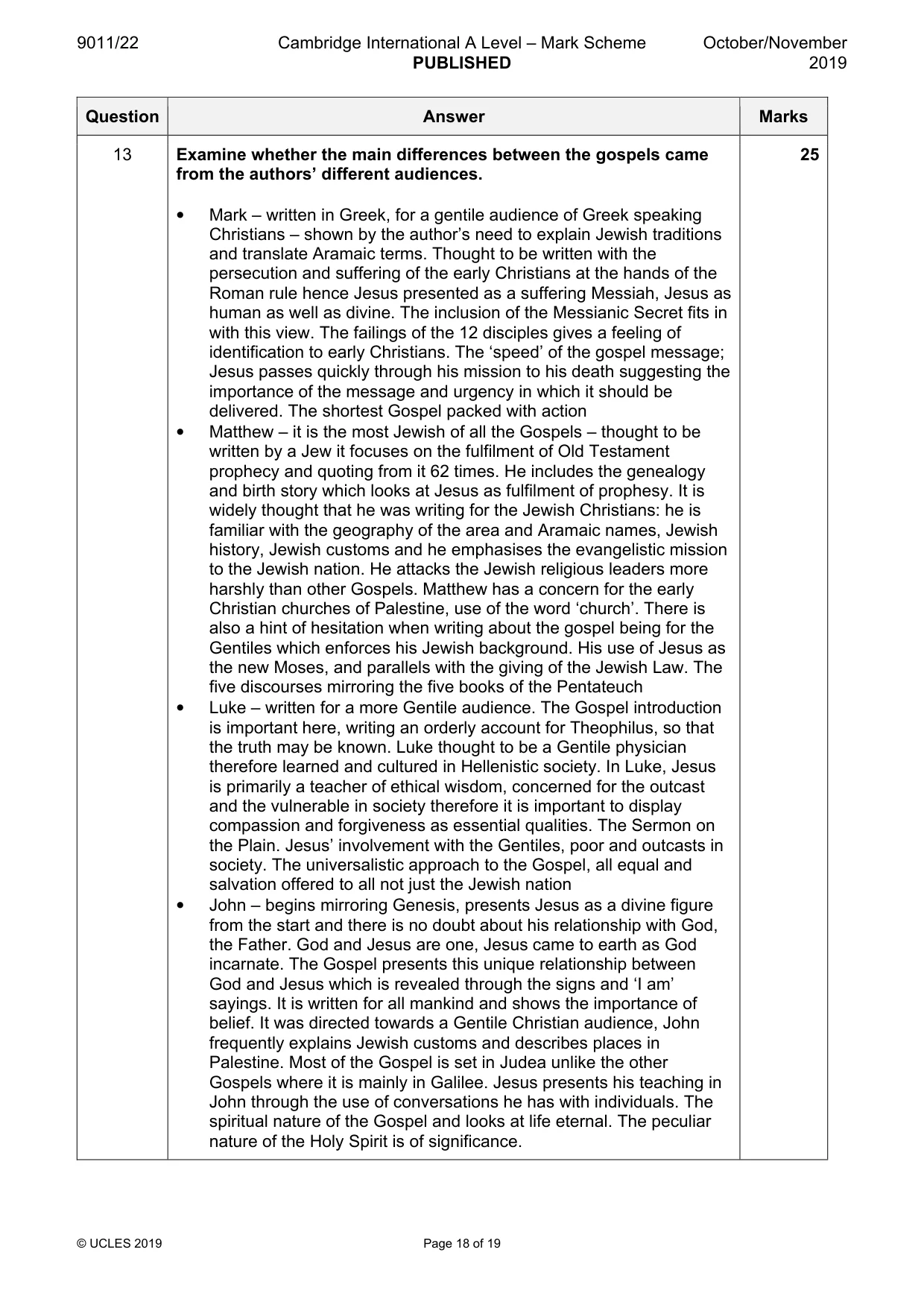
9011/22 Cambridge International A Level – Mark Scheme PUBLISHED October/November 2019 © UCLES 2019 Page 18 of 19 Question Answer Marks 13 Examine whether the main differences between the gospels came from the authors’ different audiences. • Mark – written in Greek, for a gentile audience of Greek speaking Christians – shown by the author’s need to explain Jewish traditions and translate Aramaic terms. Thought to be written with the persecution and suffering of the early Christians at the hands of the Roman rule hence Jesus presented as a suffering Messiah, Jesus as human as well as divine. The inclusion of the Messianic Secret fits in with this view. The failings of the 12 disciples gives a feeling of identification to early Christians. The ‘speed’ of the gospel message; Jesus passes quickly through his mission to his death suggesting the importance of the message and urgency in which it should be delivered. The shortest Gospel packed with action • Matthew – it is the most Jewish of all the Gospels – thought to be written by a Jew it focuses on the fulfilment of Old Testament prophecy and quoting from it 62 times. He includes the genealogy and birth story which looks at Jesus as fulfilment of prophesy. It is widely thought that he was writing for the Jewish Christians: he is familiar with the geography of the area and Aramaic names, Jewish history, Jewish customs and he emphasises the evangelistic mission to the Jewish nation. He attacks the Jewish religious leaders more harshly than other Gospels. Matthew has a concern for the early Christian churches of Palestine, use of the word ‘church’. There is also a hint of hesitation when writing about the gospel being for the Gentiles which enforces his Jewish background. His use of Jesus as the new Moses, and parallels with the giving of the Jewish Law. The five discourses mirroring the five books of the Pentateuch • Luke – written for a more Gentile audience. The Gospel introduction is important here, writing an orderly account for Theophilus, so that the truth may be known. Luke thought to be a Gentile physician therefore learned and cultured in Hellenistic society. In Luke, Jesus is primarily a teacher of ethical wisdom, concerned for the outcast and the vulnerable in society therefore it is important to display compassion and forgiveness as essential qualities. The Sermon on the Plain. Jesus’ involvement with the Gentiles, poor and outcasts in society. The universalistic approach to the Gospel, all equal and salvation offered to all not just the Jewish nation • John – begins mirroring Genesis, presents Jesus as a divine figure from the start and there is no doubt about his relationship with God, the Father. God and Jesus are one, Jesus came to earth as God incarnate. The Gospel presents this unique relationship between God and Jesus which is revealed through the signs and ‘I am’ sayings. It is written for all mankind and shows the importance of belief. It was directed towards a Gentile Christian audience, John frequently explains Jewish customs and describes places in Palestine. Most of the Gospel is set in Judea unlike the other Gospels where it is mainly in Galilee. Jesus presents his teaching in John through the use of conversations he has with individuals. The spiritual nature of the Gospel and looks at life eternal. The peculiar nature of the Holy Spirit is of significance. 25
Mark scheme, page 19
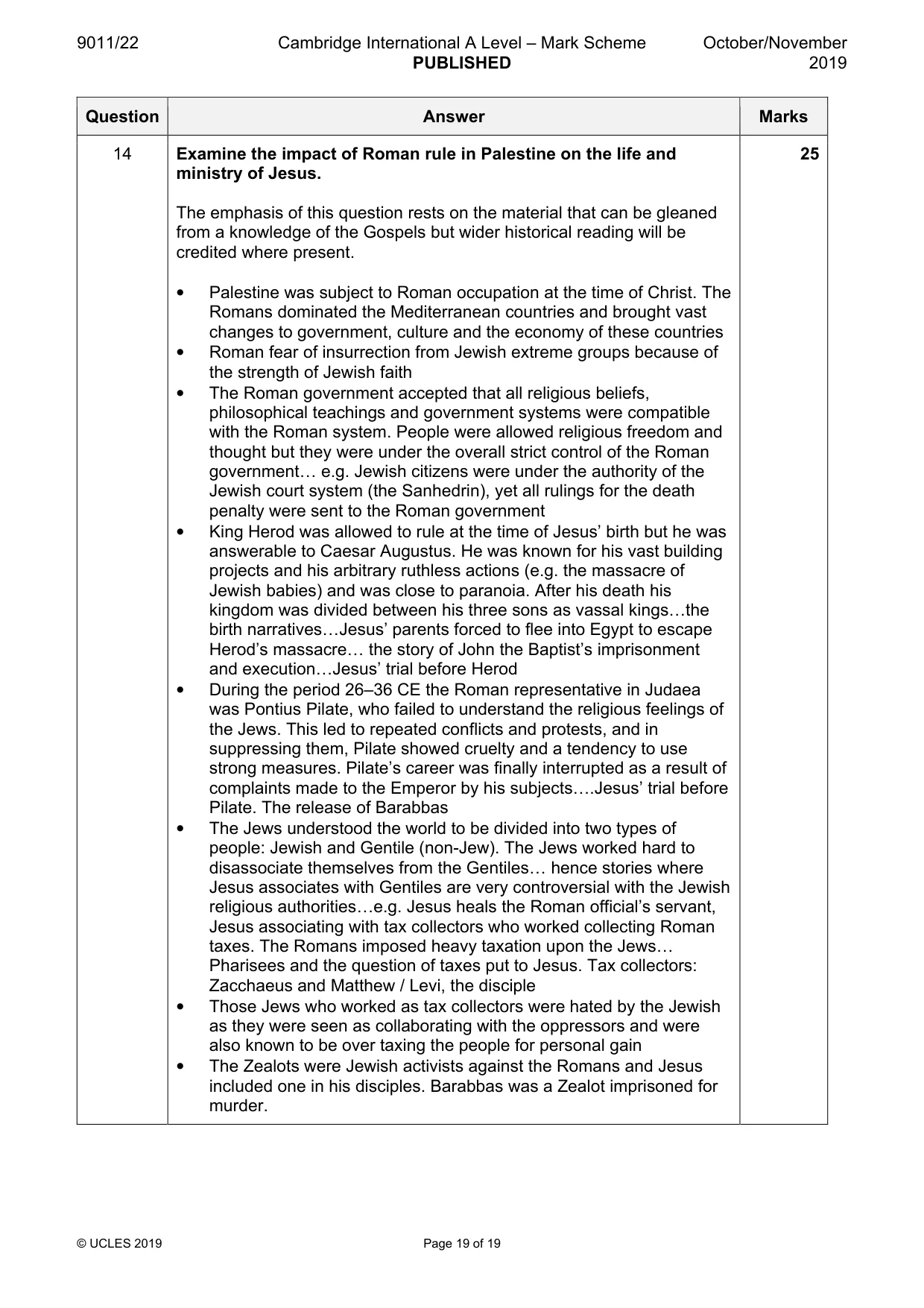
9011/22 Cambridge International A Level – Mark Scheme PUBLISHED October/November 2019 © UCLES 2019 Page 19 of 19 Question Answer Marks 14 Examine the impact of Roman rule in Palestine on the life and ministry of Jesus. The emphasis of this question rests on the material that can be gleaned from a knowledge of the Gospels but wider historical reading will be credited where present. • Palestine was subject to Roman occupation at the time of Christ. The Romans dominated the Mediterranean countries and brought vast changes to government, culture and the economy of these countries • Roman fear of insurrection from Jewish extreme groups because of the strength of Jewish faith • The Roman government accepted that all religious beliefs, philosophical teachings and government systems were compatible with the Roman system. People were allowed religious freedom and thought but they were under the overall strict control of the Roman government« e.g. Jewish citizens were under the authority of the Jewish court system (the Sanhedrin), yet all rulings for the death penalty were sent to the Roman government • King Herod was allowed to rule at the time of Jesus’ birth but he was answerable to Caesar Augustus. He was known for his vast building projects and his arbitrary ruthless actions (e.g. the massacre of Jewish babies) and was close to paranoia. After his death his kingdom was divided between his three sons as vassal kings«the birth narratives«Jesus’ parents forced to flee into Egypt to escape Herod’s massacre« the story of John the Baptist’s imprisonment and execution«Jesus’ trial before Herod • During the period 26–36 CE the Roman representative in Judaea was Pontius Pilate, who failed to understand the religious feelings of the Jews. This led to repeated conflicts and protests, and in suppressing them, Pilate showed cruelty and a tendency to use strong measures. Pilate’s career was finally interrupted as a result of complaints made to the Emperor by his subjects«.Jesus’ trial before Pilate. The release of Barabbas • The Jews understood the world to be divided into two types of people: Jewish and Gentile (non-Jew). The Jews worked hard to disassociate themselves from the Gentiles« hence stories where Jesus associates with Gentiles are very controversial with the Jewish religious authorities«e.g. Jesus heals the Roman official’s servant, Jesus associating with tax collectors who worked collecting Roman taxes. The Romans imposed heavy taxation upon the Jews« Pharisees and the question of taxes put to Jesus. Tax collectors: Zacchaeus and Matthew / Levi, the disciple • Those Jews who worked as tax collectors were hated by the Jewish as they were seen as collaborating with the oppressors and were also known to be over taxing the people for personal gain • The Zealots were Jewish activists against the Romans and Jesus included one in his disciples. Barabbas was a Zealot imprisoned for murder. 25
What you needed in this session
Cambridge’s own grade thresholds for 2019 Oct/Nov, Paper 2 · Variant 2. A higher threshold means an easier paper — the bar moves with how the cohort did.