Cambridge A Level Divinity 9011 — 2020 Oct/Nov Paper 2 · Variant 2
9011/22/O/N/20 · 100 marks · ≈113 min
The question paper and its mark scheme, free to read here and free to download. This is Cambridge’s own paper, exactly as it was sat.
Question paper4 pages
Mark scheme17 pages
Answers below. Sit the paper first if you are practising.
Paper as text
Question paper, page 1
Cambridge International A Level This document has 4 pages. Blank pages are indicated. DC (MM) 181820/2 © UCLES 2020 [Turn over DIVINITY 9011/22 Paper 2 The Four Gospels October/November 2020 3 hours You must answer on the enclosed answer booklet. You will need: Answer booklet (enclosed) INSTRUCTIONS ● Answer four questions in total: ● If you choose to answer Question 1, answer in one version only. Revised Standard Version of Question 1 is printed on page 2. New International Version of Question 1 is printed on page 3. ● Follow the instructions on the front cover of the answer booklet. If you need additional answer paper, ask the invigilator for a continuation booklet. INFORMATION ● The total mark for this paper is 100. ● All questions are worth 25 marks. * 5 9 2 2 7 3 3 8 2 0 *
Question paper, page 2
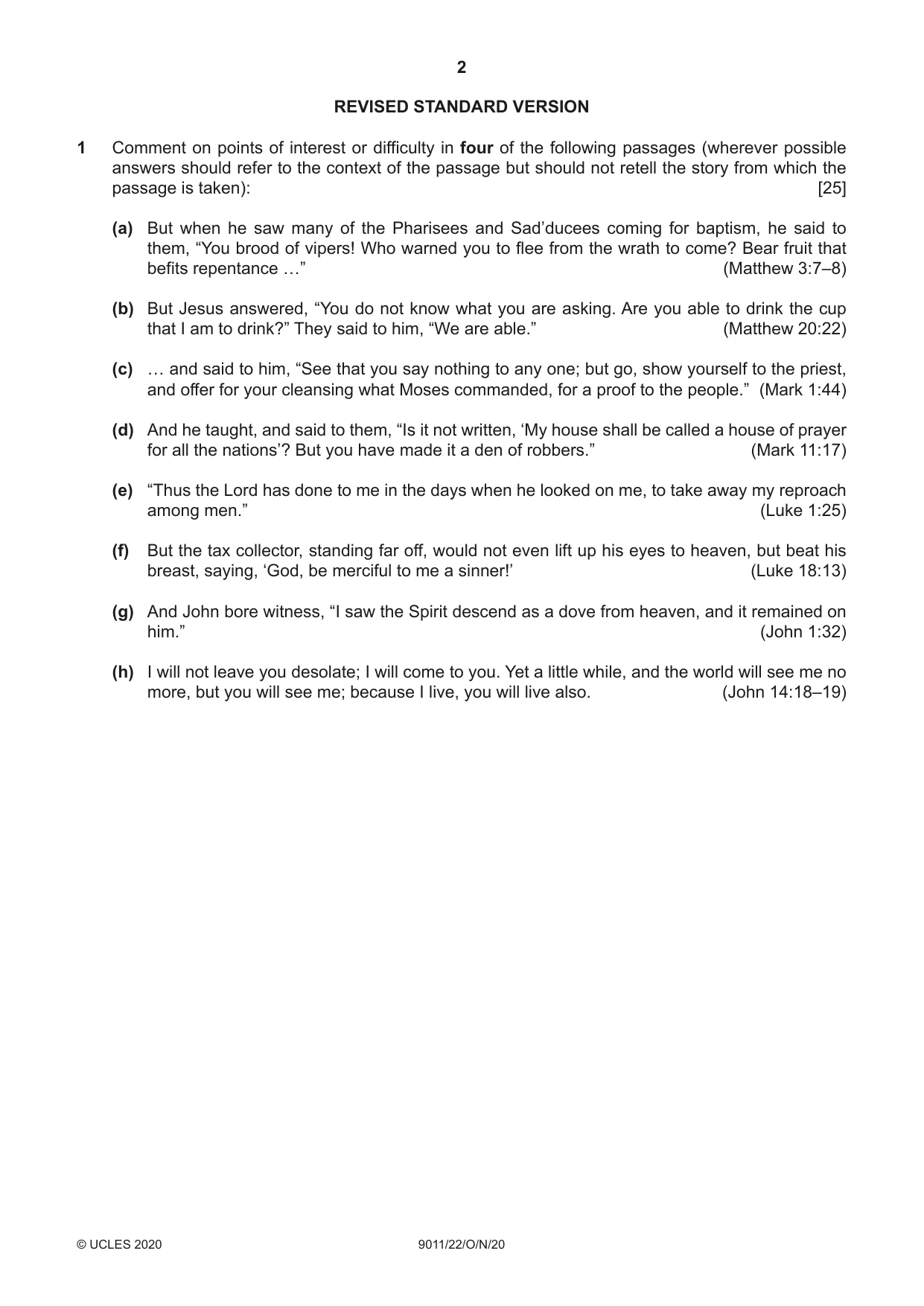
2 9011/22/O/N/20 © UCLES 2020 REVISED STANDARD VERSION 1 Comment on points of interest or difficulty in four of the following passages (wherever possible answers should refer to the context of the passage but should not retell the story from which the passage is taken): [25] (a) But when he saw many of the Pharisees and Sad’ducees coming for baptism, he said to them, “You brood of vipers! Who warned you to flee from the wrath to come? Bear fruit that befits repentance …” (Matthew 3:7–8) (b) But Jesus answered, “You do not know what you are asking. Are you able to drink the cup that I am to drink?” They said to him, “We are able.” (Matthew 20:22) (c) … and said to him, “See that you say nothing to any one; but go, show yourself to the priest, and offer for your cleansing what Moses commanded, for a proof to the people.” (Mark 1:44) (d) And he taught, and said to them, “Is it not written, ‘My house shall be called a house of prayer for all the nations’? But you have made it a den of robbers.” (Mark 11:17) (e) “Thus the Lord has done to me in the days when he looked on me, to take away my reproach among men.” (Luke 1:25) (f) But the tax collector, standing far off, would not even lift up his eyes to heaven, but beat his breast, saying, ‘God, be merciful to me a sinner!’ (Luke 18:13) (g) And John bore witness, “I saw the Spirit descend as a dove from heaven, and it remained on him.” (John 1:32) (h) I will not leave you desolate; I will come to you. Yet a little while, and the world will see me no more, but you will see me; because I live, you will live also. (John 14:18–19)
Question paper, page 3
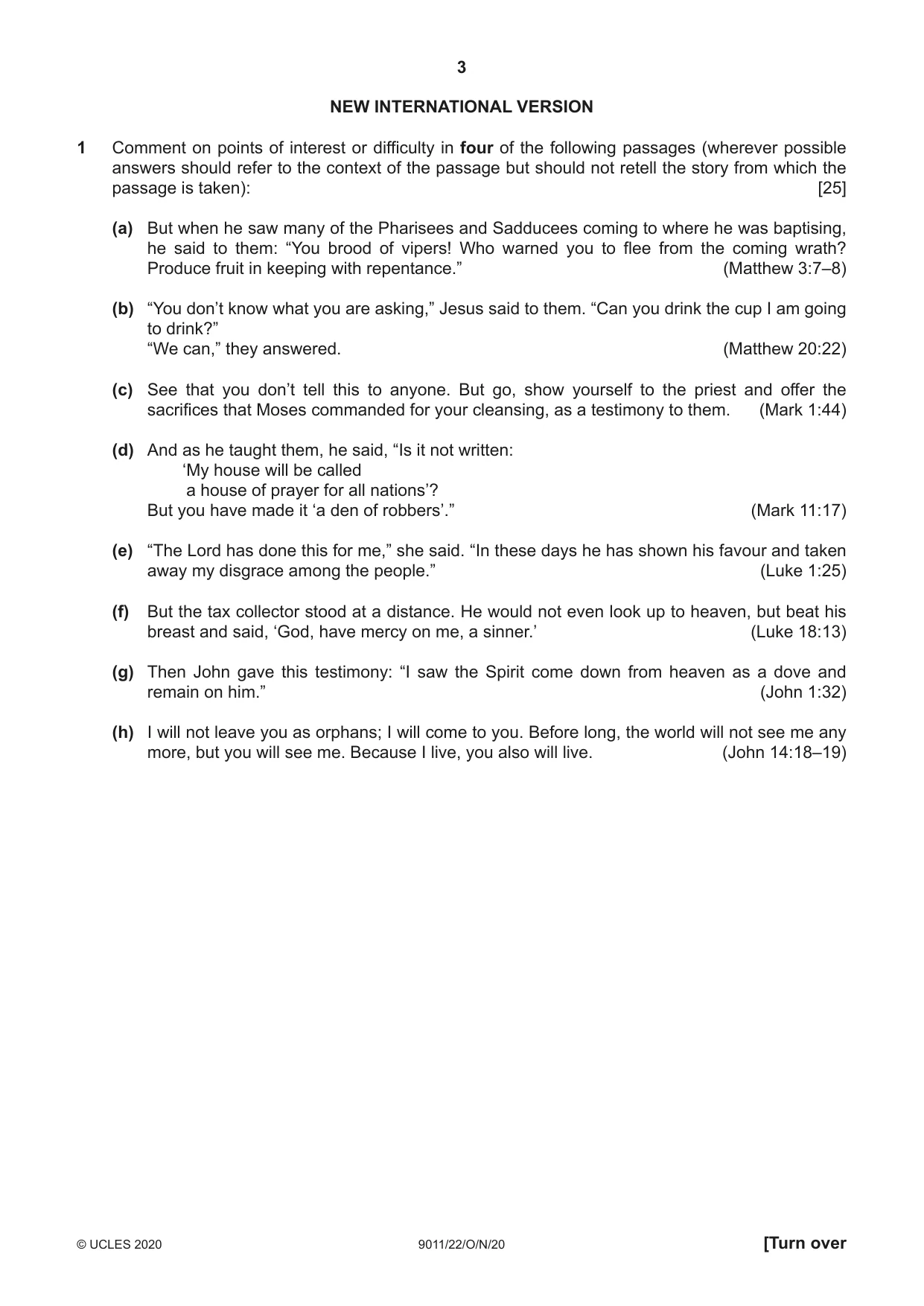
3 9011/22/O/N/20 © UCLES 2020 [Turn over NEW INTERNATIONAL VERSION 1 Comment on points of interest or difficulty in four of the following passages (wherever possible answers should refer to the context of the passage but should not retell the story from which the passage is taken): [25] (a) But when he saw many of the Pharisees and Sadducees coming to where he was baptising, he said to them: “You brood of vipers! Who warned you to flee from the coming wrath? Produce fruit in keeping with repentance.” (Matthew 3:7–8) (b) “You don’t know what you are asking,” Jesus said to them. “Can you drink the cup I am going to drink?” “We can,” they answered. (Matthew 20:22) (c) See that you don’t tell this to anyone. But go, show yourself to the priest and offer the sacrifices that Moses commanded for your cleansing, as a testimony to them. (Mark 1:44) (d) And as he taught them, he said, “Is it not written: ‘ My house will be called a house of prayer for all nations’? But you have made it ‘a den of robbers’.” (Mark 11:17) (e) “The Lord has done this for me,” she said. “In these days he has shown his favour and taken away my disgrace among the people.” (Luke 1:25) (f) But the tax collector stood at a distance. He would not even look up to heaven, but beat his breast and said, ‘God, have mercy on me, a sinner.’ (Luke 18:13) (g) Then John gave this testimony: “I saw the Spirit come down from heaven as a dove and remain on him.” (John 1:32) (h) I will not leave you as orphans; I will come to you. Before long, the world will not see me any more, but you will see me. Because I live, you also will live. (John 14:18–19)
Question paper, page 4
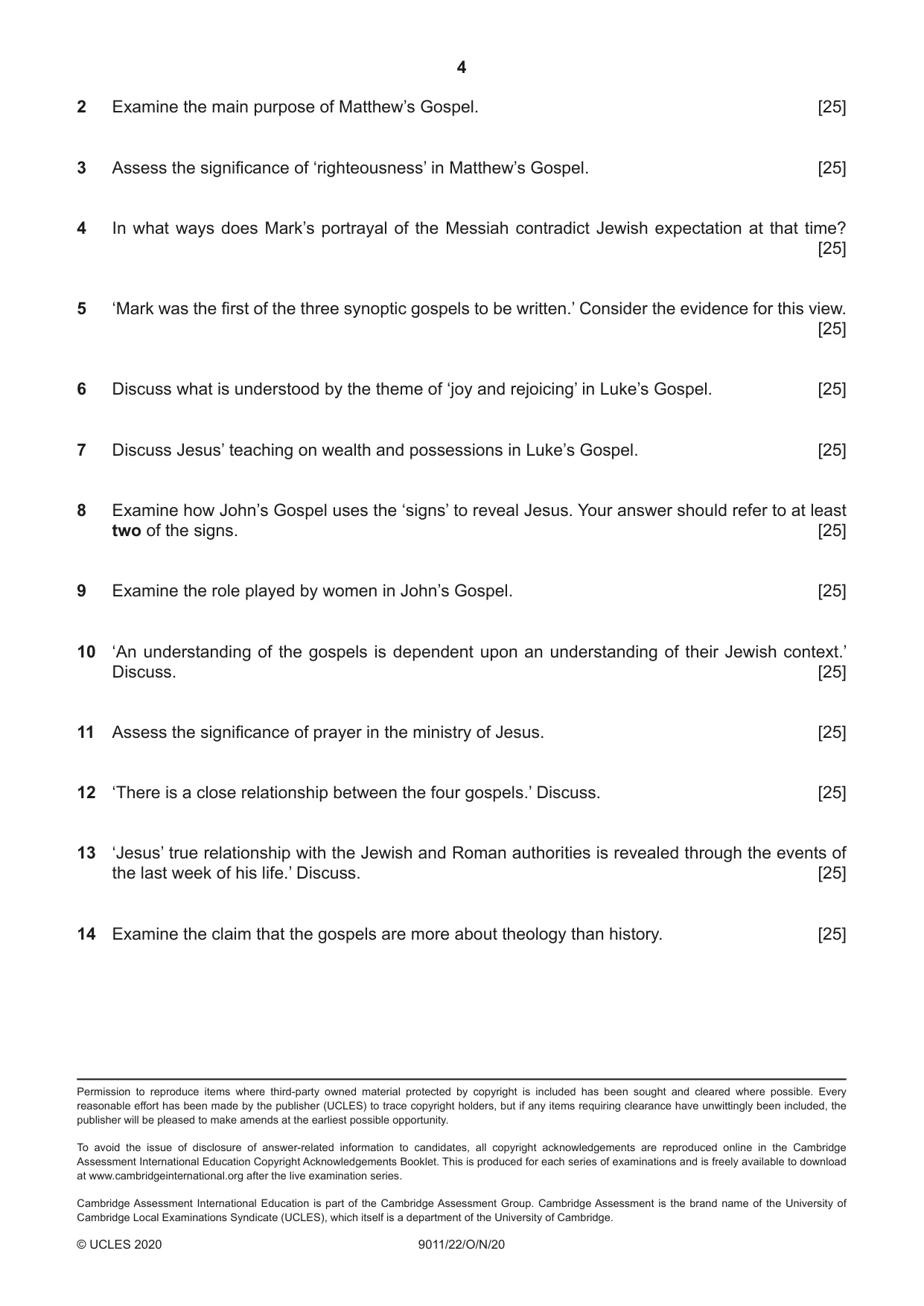
4 9011/22/O/N/20 © UCLES 2020 Permission to reproduce items where third-party owned material protected by copyright is included has been sought and cleared where possible. Every reasonable effort has been made by the publisher (UCLES) to trace copyright holders, but if any items requiring clearance have unwittingly been included, the publisher will be pleased to make amends at the earliest possible opportunity. To avoid the issue of disclosure of answer-related information to candidates, all copyright acknowledgements are reproduced online in the Cambridge Assessment International Education Copyright Acknowledgements Booklet. This is produced for each series of examinations and is freely available to download at www.cambridgeinternational.org after the live examination series. Cambridge Assessment International Education is part of the Cambridge Assessment Group. Cambridge Assessment is the brand name of the University of Cambridge Local Examinations Syndicate (UCLES), which itself is a department of the University of Cambridge. 2 Examine the main purpose of Matthew’s Gospel. [25] 3 Assess the significance of ‘righteousness’ in Matthew’s Gospel. [25] 4 In what ways does Mark’s portrayal of the Messiah contradict Jewish expectation at that time? [25] 5 ‘Mark was the first of the three synoptic gospels to be written.’ Consider the evidence for this view. [25] 6 Discuss what is understood by the theme of ‘joy and rejoicing’ in Luke’s Gospel. [25] 7 Discuss Jesus’ teaching on wealth and possessions in Luke’s Gospel. [25] 8 Examine how John’s Gospel uses the ‘signs’ to reveal Jesus. Your answer should refer to at least two of the signs. [25] 9 Examine the role played by women in John’s Gospel. [25] 10 ‘An understanding of the gospels is dependent upon an understanding of their Jewish context.’ Discuss. [25] 11 Assess the significance of prayer in the ministry of Jesus. [25] 12 ‘There is a close relationship between the four gospels.’ Discuss. [25] 13 ‘Jesus’ true relationship with the Jewish and Roman authorities is revealed through the events of the last week of his life.’ Discuss. [25] 14 Examine the claim that the gospels are more about theology than history. [25]
Mark scheme, page 1
This document consists of 17 printed pages. © UCLES 2020 [Turn over Cambridge International A Level DIVINITY 9011/22 Paper 2 The Four Gospels October/November 2020 MARK SCHEME Maximum Mark: 100 Published This mark scheme is published as an aid to teachers and candidates, to indicate the requirements of the examination. It shows the basis on which Examiners were instructed to award marks. It does not indicate the details of the discussions that took place at an Examiners’ meeting before marking began, which would have considered the acceptability of alternative answers. Mark schemes should be read in conjunction with the question paper and the Principal Examiner Report for Teachers. Cambridge International will not enter into discussions about these mark schemes. Cambridge International is publishing the mark schemes for the October/November 2020 series for most Cambridge IGCSE™, Cambridge International A and AS Level and Cambridge Pre-U components, and some Cambridge O Level components.
Mark scheme, page 2
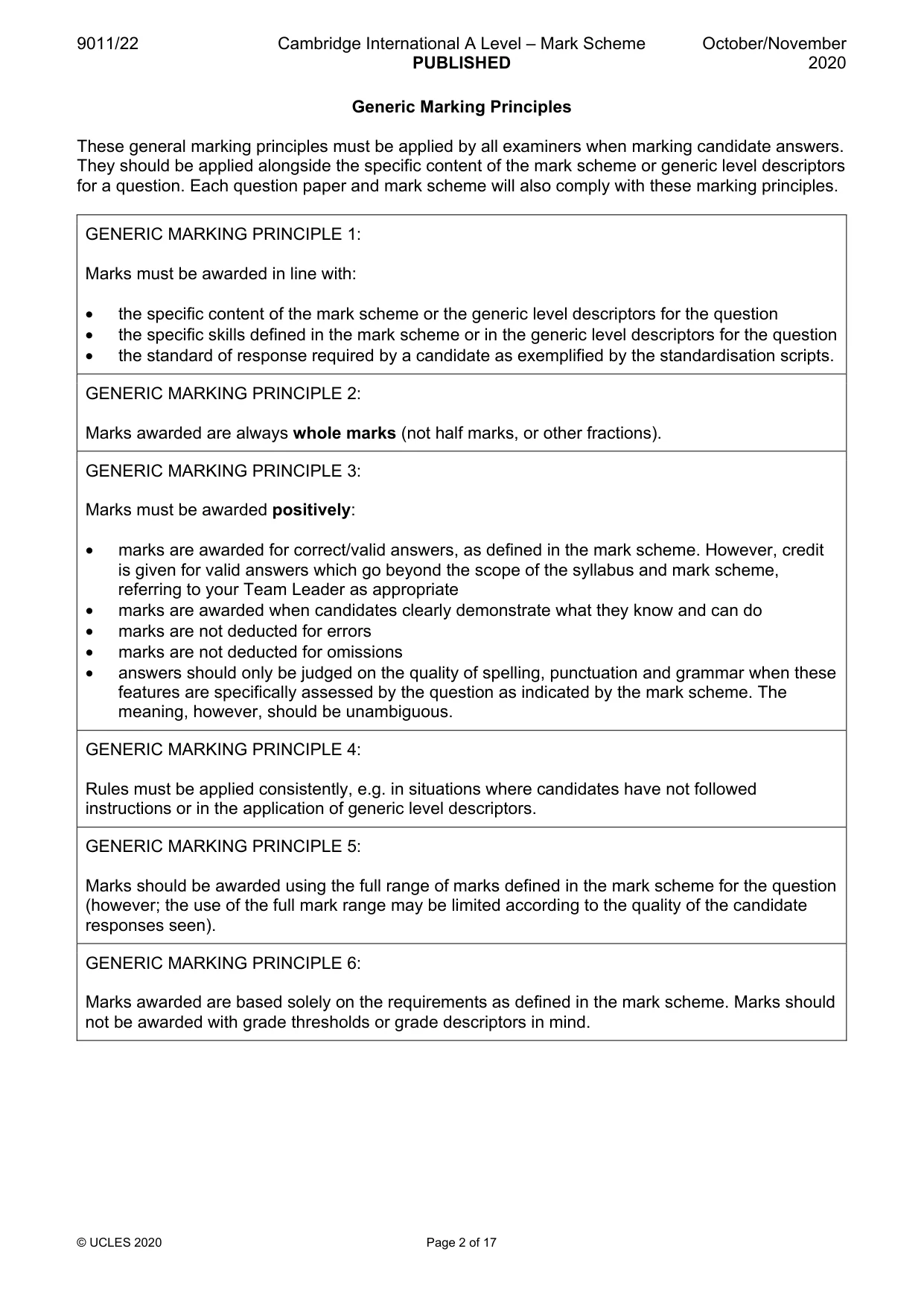
9011/22 Cambridge International A Level – Mark Scheme PUBLISHED October/November 2020 © UCLES 2020 Page 2 of 17 Generic Marking Principles These general marking principles must be applied by all examiners when marking candidate answers. They should be applied alongside the specific content of the mark scheme or generic level descriptors for a question. Each question paper and mark scheme will also comply with these marking principles. GENERIC MARKING PRINCIPLE 1: Marks must be awarded in line with: • the specific content of the mark scheme or the generic level descriptors for the question • the specific skills defined in the mark scheme or in the generic level descriptors for the question • the standard of response required by a candidate as exemplified by the standardisation scripts. GENERIC MARKING PRINCIPLE 2: Marks awarded are always whole marks (not half marks, or other fractions). GENERIC MARKING PRINCIPLE 3: Marks must be awarded positively: • marks are awarded for correct/valid answers, as defined in the mark scheme. However, credit is given for valid answers which go beyond the scope of the syllabus and mark scheme, referring to your Team Leader as appropriate • marks are awarded when candidates clearly demonstrate what they know and can do • marks are not deducted for errors • marks are not deducted for omissions • answers should only be judged on the quality of spelling, punctuation and grammar when these features are specifically assessed by the question as indicated by the mark scheme. The meaning, however, should be unambiguous. GENERIC MARKING PRINCIPLE 4: Rules must be applied consistently, e.g. in situations where candidates have not followed instructions or in the application of generic level descriptors. GENERIC MARKING PRINCIPLE 5: Marks should be awarded using the full range of marks defined in the mark scheme for the question (however; the use of the full mark range may be limited according to the quality of the candidate responses seen). GENERIC MARKING PRINCIPLE 6: Marks awarded are based solely on the requirements as defined in the mark scheme. Marks should not be awarded with grade thresholds or grade descriptors in mind.
Mark scheme, page 3
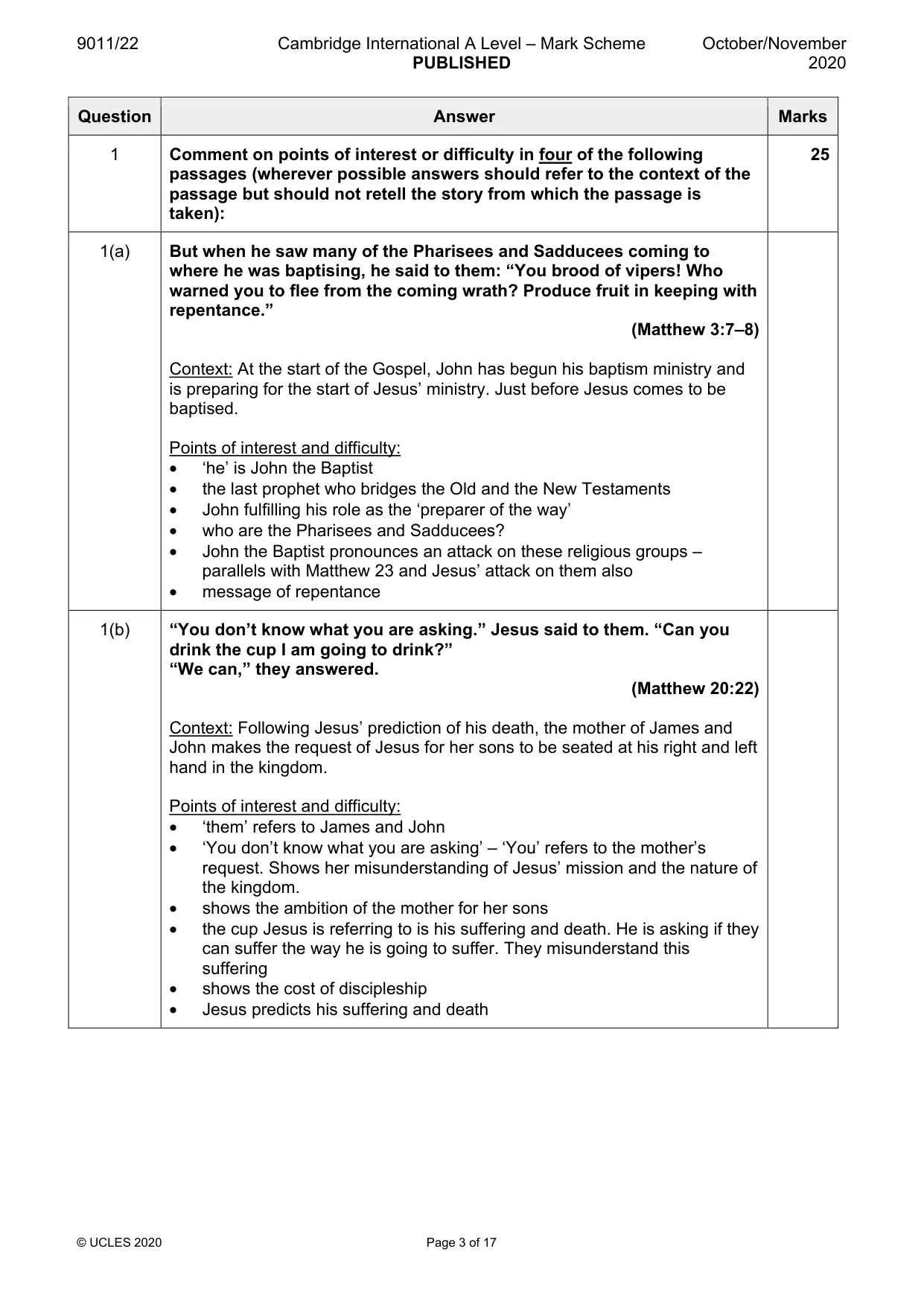
9011/22 Cambridge International A Level – Mark Scheme PUBLISHED October/November 2020 © UCLES 2020 Page 3 of 17 Question Answer Marks 1 Comment on points of interest or difficulty in four of the following passages (wherever possible answers should refer to the context of the passage but should not retell the story from which the passage is taken): 25 1(a) But when he saw many of the Pharisees and Sadducees coming to where he was baptising, he said to them: “You brood of vipers! Who warned you to flee from the coming wrath? Produce fruit in keeping with repentance.” (Matthew 3:7–8) Context: At the start of the Gospel, John has begun his baptism ministry and is preparing for the start of Jesus’ ministry. Just before Jesus comes to be baptised. Points of interest and difficulty: • ‘he’ is John the Baptist • the last prophet who bridges the Old and the New Testaments • John fulfilling his role as the ‘preparer of the way’ • who are the Pharisees and Sadducees? • John the Baptist pronounces an attack on these religious groups – parallels with Matthew 23 and Jesus’ attack on them also • message of repentance 1(b) “You don’t know what you are asking.” Jesus said to them. “Can you drink the cup I am going to drink?” “We can,” they answered. (Matthew 20:22) Context: Following Jesus’ prediction of his death, the mother of James and John makes the request of Jesus for her sons to be seated at his right and left hand in the kingdom. Points of interest and difficulty: • ‘them’ refers to James and John • ‘You don’t know what you are asking’ – ‘You’ refers to the mother’s request. Shows her misunderstanding of Jesus’ mission and the nature of the kingdom. • shows the ambition of the mother for her sons • the cup Jesus is referring to is his suffering and death. He is asking if they can suffer the way he is going to suffer. They misunderstand this suffering • shows the cost of discipleship • Jesus predicts his suffering and death
Mark scheme, page 4
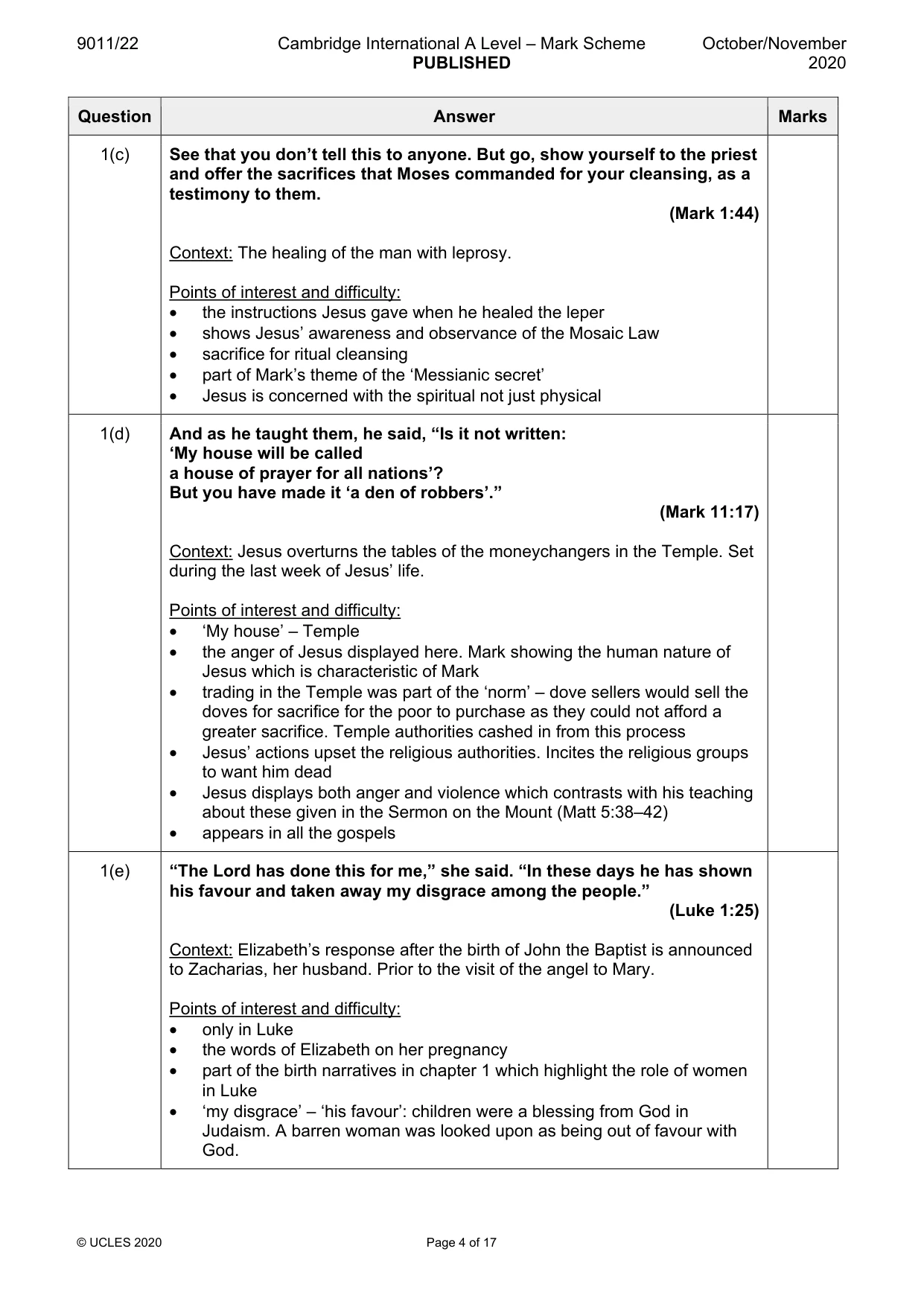
9011/22 Cambridge International A Level – Mark Scheme PUBLISHED October/November 2020 © UCLES 2020 Page 4 of 17 Question Answer Marks 1(c) See that you don’t tell this to anyone. But go, show yourself to the priest and offer the sacrifices that Moses commanded for your cleansing, as a testimony to them. (Mark 1:44) Context: The healing of the man with leprosy. Points of interest and difficulty: • the instructions Jesus gave when he healed the leper • shows Jesus’ awareness and observance of the Mosaic Law • sacrifice for ritual cleansing • part of Mark’s theme of the ‘Messianic secret’ • Jesus is concerned with the spiritual not just physical 1(d) And as he taught them, he said, “Is it not written: ‘My house will be called a house of prayer for all nations’? But you have made it ‘a den of robbers’.” (Mark 11:17) Context: Jesus overturns the tables of the moneychangers in the Temple. Set during the last week of Jesus’ life. Points of interest and difficulty: • ‘My house’ – Temple • the anger of Jesus displayed here. Mark showing the human nature of Jesus which is characteristic of Mark • trading in the Temple was part of the ‘norm’ – dove sellers would sell the doves for sacrifice for the poor to purchase as they could not afford a greater sacrifice. Temple authorities cashed in from this process • Jesus’ actions upset the religious authorities. Incites the religious groups to want him dead • Jesus displays both anger and violence which contrasts with his teaching about these given in the Sermon on the Mount (Matt 5:38–42) • appears in all the gospels 1(e) “The Lord has done this for me,” she said. “In these days he has shown his favour and taken away my disgrace among the people.” (Luke 1:25) Context: Elizabeth’s response after the birth of John the Baptist is announced to Zacharias, her husband. Prior to the visit of the angel to Mary. Points of interest and difficulty: • only in Luke • the words of Elizabeth on her pregnancy • part of the birth narratives in chapter 1 which highlight the role of women in Luke • ‘my disgrace’ – ‘his favour’: children were a blessing from God in Judaism. A barren woman was looked upon as being out of favour with God.
Mark scheme, page 5
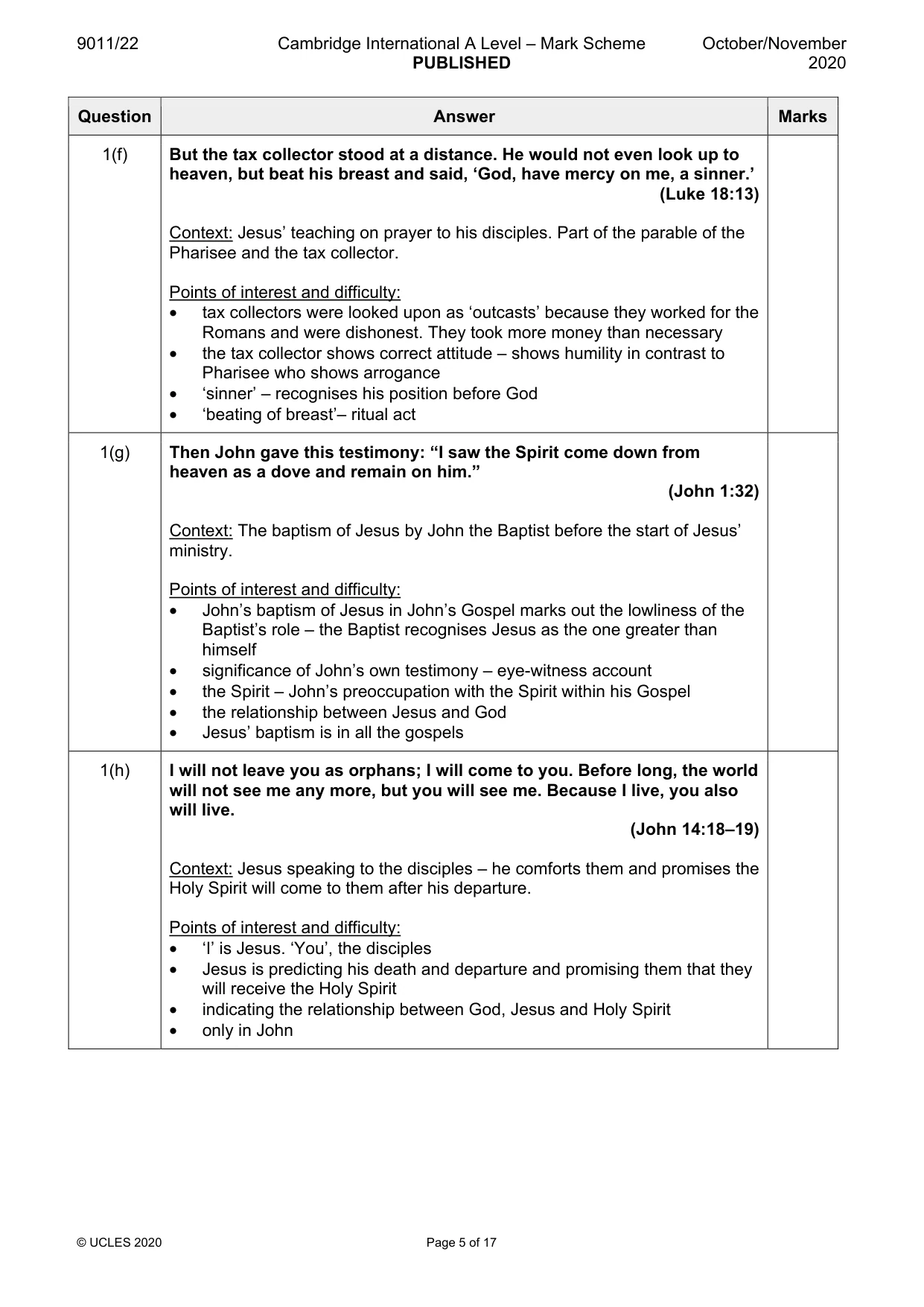
9011/22 Cambridge International A Level – Mark Scheme PUBLISHED October/November 2020 © UCLES 2020 Page 5 of 17 Question Answer Marks 1(f) But the tax collector stood at a distance. He would not even look up to heaven, but beat his breast and said, ‘God, have mercy on me, a sinner.’ (Luke 18:13) Context: Jesus’ teaching on prayer to his disciples. Part of the parable of the Pharisee and the tax collector. Points of interest and difficulty: • tax collectors were looked upon as ‘outcasts’ because they worked for the Romans and were dishonest. They took more money than necessary • the tax collector shows correct attitude – shows humility in contrast to Pharisee who shows arrogance • ‘sinner’ – recognises his position before God • ‘beating of breast’– ritual act 1(g) Then John gave this testimony: “I saw the Spirit come down from heaven as a dove and remain on him.” (John 1:32) Context: The baptism of Jesus by John the Baptist before the start of Jesus’ ministry. Points of interest and difficulty: • John’s baptism of Jesus in John’s Gospel marks out the lowliness of the Baptist’s role – the Baptist recognises Jesus as the one greater than himself • significance of John’s own testimony – eye-witness account • the Spirit – John’s preoccupation with the Spirit within his Gospel • the relationship between Jesus and God • Jesus’ baptism is in all the gospels 1(h) I will not leave you as orphans; I will come to you. Before long, the world will not see me any more, but you will see me. Because I live, you also will live. (John 14:18–19) Context: Jesus speaking to the disciples – he comforts them and promises the Holy Spirit will come to them after his departure. Points of interest and difficulty: • ‘I’ is Jesus. ‘You’, the disciples • Jesus is predicting his death and departure and promising them that they will receive the Holy Spirit • indicating the relationship between God, Jesus and Holy Spirit • only in John
Mark scheme, page 6
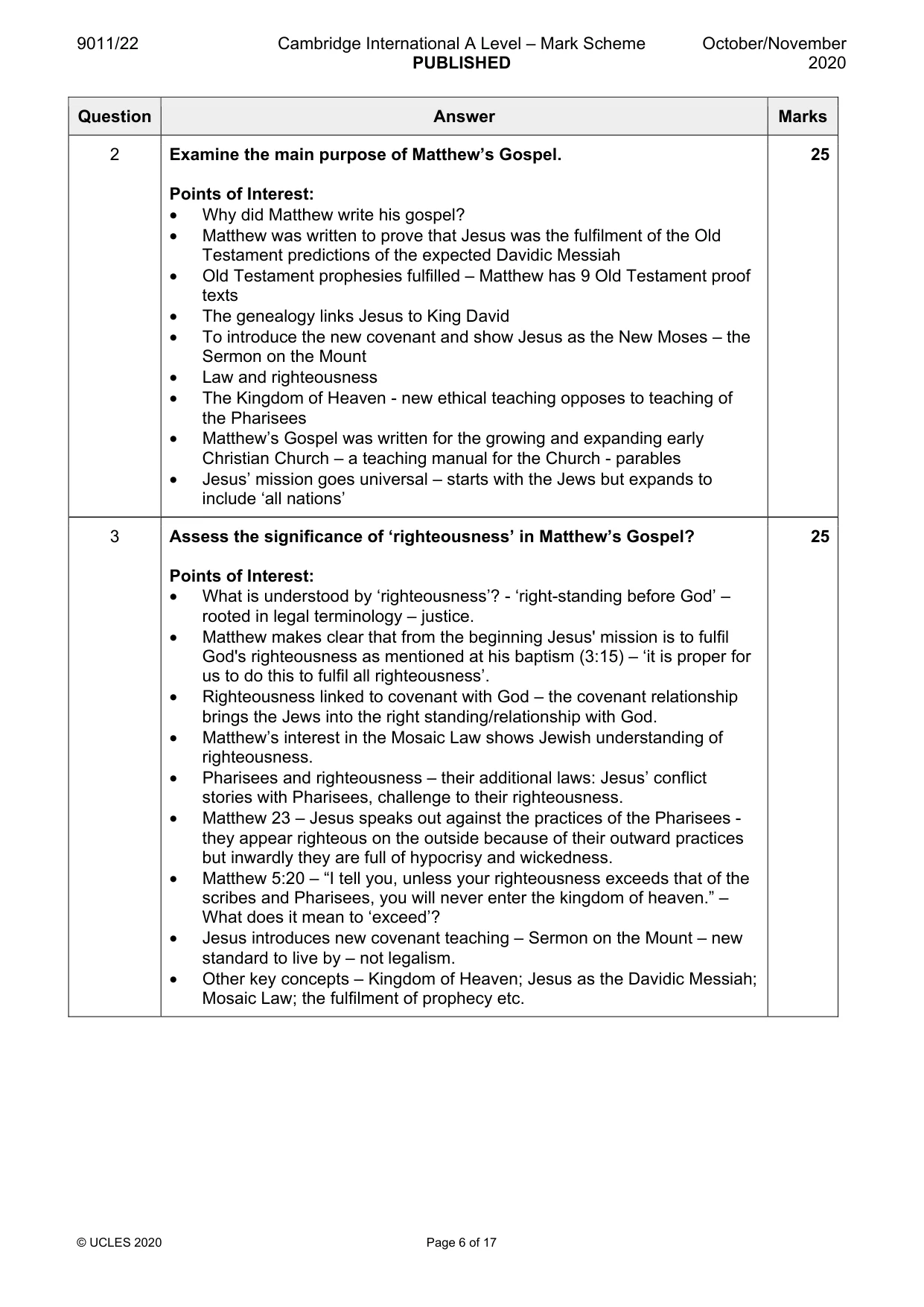
9011/22 Cambridge International A Level – Mark Scheme PUBLISHED October/November 2020 © UCLES 2020 Page 6 of 17 Question Answer Marks 2 Examine the main purpose of Matthew’s Gospel. Points of Interest: • Why did Matthew write his gospel? • Matthew was written to prove that Jesus was the fulfilment of the Old Testament predictions of the expected Davidic Messiah • Old Testament prophesies fulfilled – Matthew has 9 Old Testament proof texts • The genealogy links Jesus to King David • To introduce the new covenant and show Jesus as the New Moses – the Sermon on the Mount • Law and righteousness • The Kingdom of Heaven - new ethical teaching opposes to teaching of the Pharisees • Matthew’s Gospel was written for the growing and expanding early Christian Church – a teaching manual for the Church - parables • Jesus’ mission goes universal – starts with the Jews but expands to include ‘all nations’ 25 3 Assess the significance of ‘righteousness’ in Matthew’s Gospel? Points of Interest: • What is understood by ‘righteousness’? - ‘right-standing before God’ – rooted in legal terminology – justice. • Matthew makes clear that from the beginning Jesus' mission is to fulfil God's righteousness as mentioned at his baptism (3:15) – ‘it is proper for us to do this to fulfil all righteousness’. • Righteousness linked to covenant with God – the covenant relationship brings the Jews into the right standing/relationship with God. • Matthew’s interest in the Mosaic Law shows Jewish understanding of righteousness. • Pharisees and righteousness – their additional laws: Jesus’ conflict stories with Pharisees, challenge to their righteousness. • Matthew 23 – Jesus speaks out against the practices of the Pharisees - they appear righteous on the outside because of their outward practices but inwardly they are full of hypocrisy and wickedness. • Matthew 5:20 – “I tell you, unless your righteousness exceeds that of the scribes and Pharisees, you will never enter the kingdom of heaven.” – What does it mean to ‘exceed’? • Jesus introduces new covenant teaching – Sermon on the Mount – new standard to live by – not legalism. • Other key concepts – Kingdom of Heaven; Jesus as the Davidic Messiah; Mosaic Law; the fulfilment of prophecy etc. 25
Mark scheme, page 7
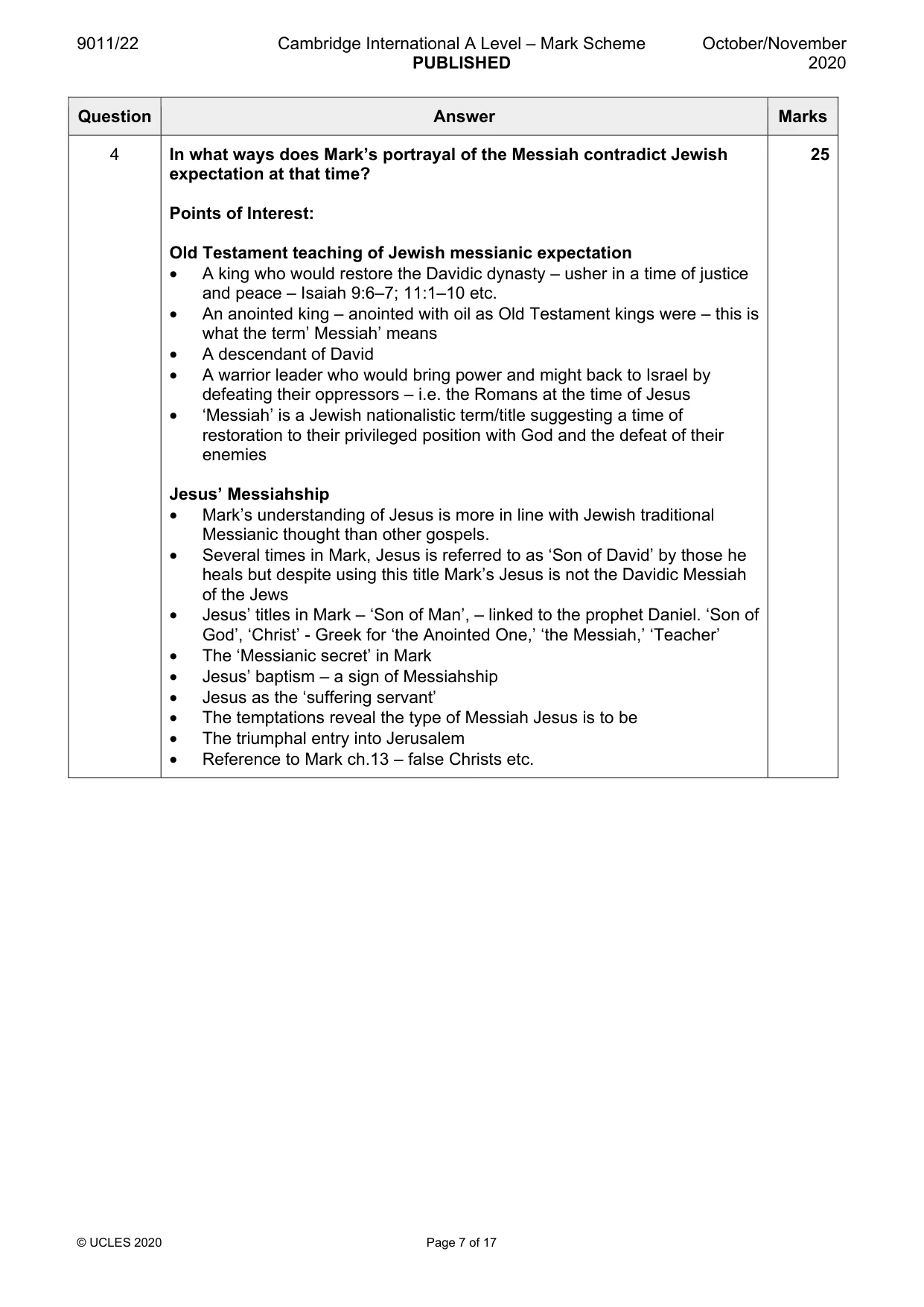
9011/22 Cambridge International A Level – Mark Scheme PUBLISHED October/November 2020 © UCLES 2020 Page 7 of 17 Question Answer Marks 4 In what ways does Mark’s portrayal of the Messiah contradict Jewish expectation at that time? Points of Interest: Old Testament teaching of Jewish messianic expectation • A king who would restore the Davidic dynasty – usher in a time of justice and peace – Isaiah 9:6–7; 11:1–10 etc. • An anointed king – anointed with oil as Old Testament kings were – this is what the term’ Messiah’ means • A descendant of David • A warrior leader who would bring power and might back to Israel by defeating their oppressors – i.e. the Romans at the time of Jesus • ‘Messiah’ is a Jewish nationalistic term/title suggesting a time of restoration to their privileged position with God and the defeat of their enemies Jesus’ Messiahship • Mark’s understanding of Jesus is more in line with Jewish traditional Messianic thought than other gospels. • Several times in Mark, Jesus is referred to as ‘Son of David’ by those he heals but despite using this title Mark’s Jesus is not the Davidic Messiah of the Jews • Jesus’ titles in Mark – ‘Son of Man’, – linked to the prophet Daniel. ‘Son of God’, ‘Christ’ - Greek for ‘the Anointed One,’ ‘the Messiah,’ ‘Teacher’ • The ‘Messianic secret’ in Mark • Jesus’ baptism – a sign of Messiahship • Jesus as the ‘suffering servant’ • The temptations reveal the type of Messiah Jesus is to be • The triumphal entry into Jerusalem • Reference to Mark ch.13 – false Christs etc. 25
Mark scheme, page 8
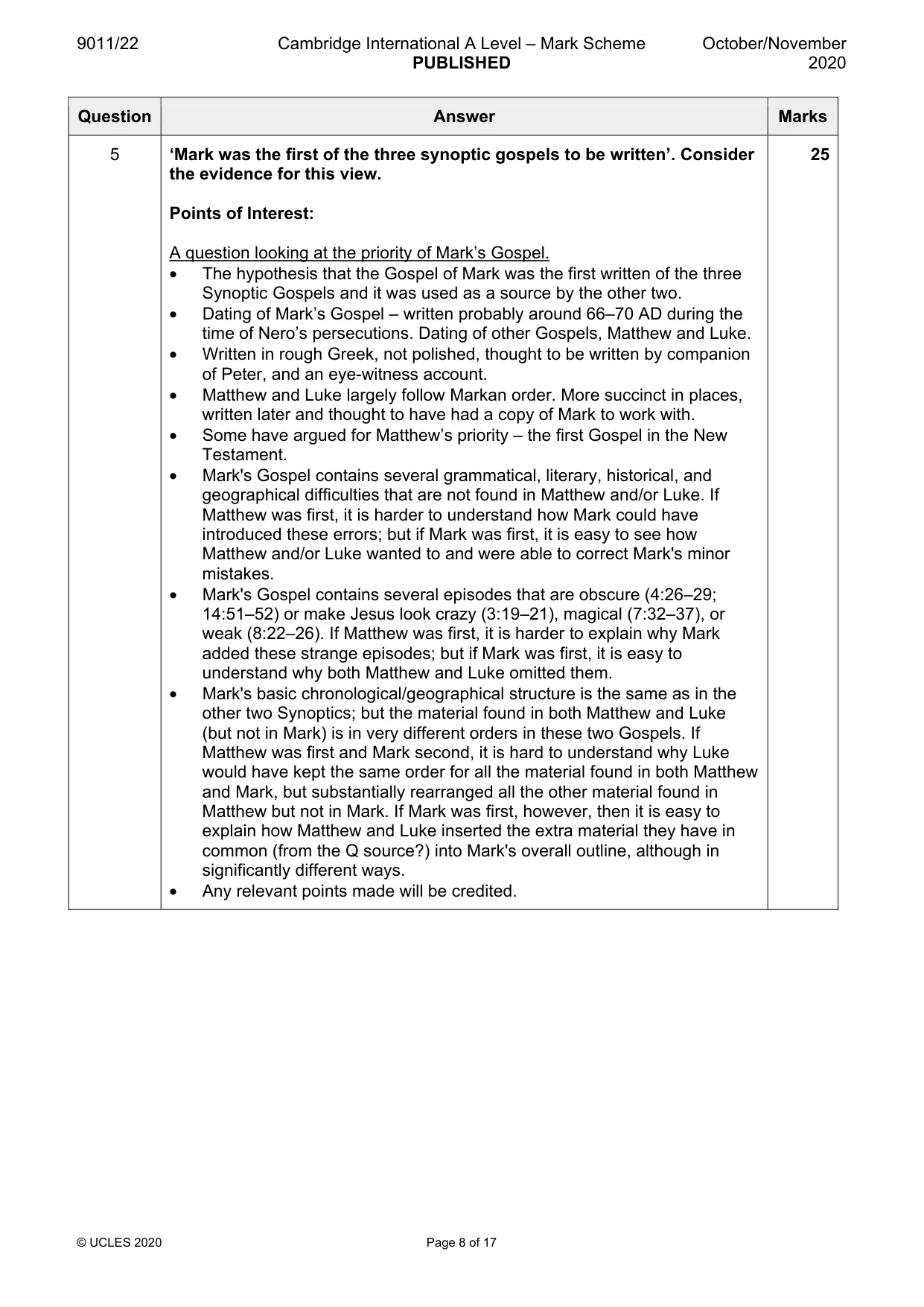
9011/22 Cambridge International A Level – Mark Scheme PUBLISHED October/November 2020 © UCLES 2020 Page 8 of 17 Question Answer Marks 5 ‘Mark was the first of the three synoptic gospels to be written’. Consider the evidence for this view. Points of Interest: A question looking at the priority of Mark’s Gospel. • The hypothesis that the Gospel of Mark was the first written of the three Synoptic Gospels and it was used as a source by the other two. • Dating of Mark’s Gospel – written probably around 66–70 AD during the time of Nero’s persecutions. Dating of other Gospels, Matthew and Luke. • Written in rough Greek, not polished, thought to be written by companion of Peter, and an eye-witness account. • Matthew and Luke largely follow Markan order. More succinct in places, written later and thought to have had a copy of Mark to work with. • Some have argued for Matthew’s priority – the first Gospel in the New Testament. • Mark's Gospel contains several grammatical, literary, historical, and geographical difficulties that are not found in Matthew and/or Luke. If Matthew was first, it is harder to understand how Mark could have introduced these errors; but if Mark was first, it is easy to see how Matthew and/or Luke wanted to and were able to correct Mark's minor mistakes. • Mark's Gospel contains several episodes that are obscure (4:26–29; 14:51–52) or make Jesus look crazy (3:19–21), magical (7:32–37), or weak (8:22–26). If Matthew was first, it is harder to explain why Mark added these strange episodes; but if Mark was first, it is easy to understand why both Matthew and Luke omitted them. • Mark's basic chronological/geographical structure is the same as in the other two Synoptics; but the material found in both Matthew and Luke (but not in Mark) is in very different orders in these two Gospels. If Matthew was first and Mark second, it is hard to understand why Luke would have kept the same order for all the material found in both Matthew and Mark, but substantially rearranged all the other material found in Matthew but not in Mark. If Mark was first, however, then it is easy to explain how Matthew and Luke inserted the extra material they have in common (from the Q source?) into Mark's overall outline, although in significantly different ways. • Any relevant points made will be credited. 25
Mark scheme, page 9
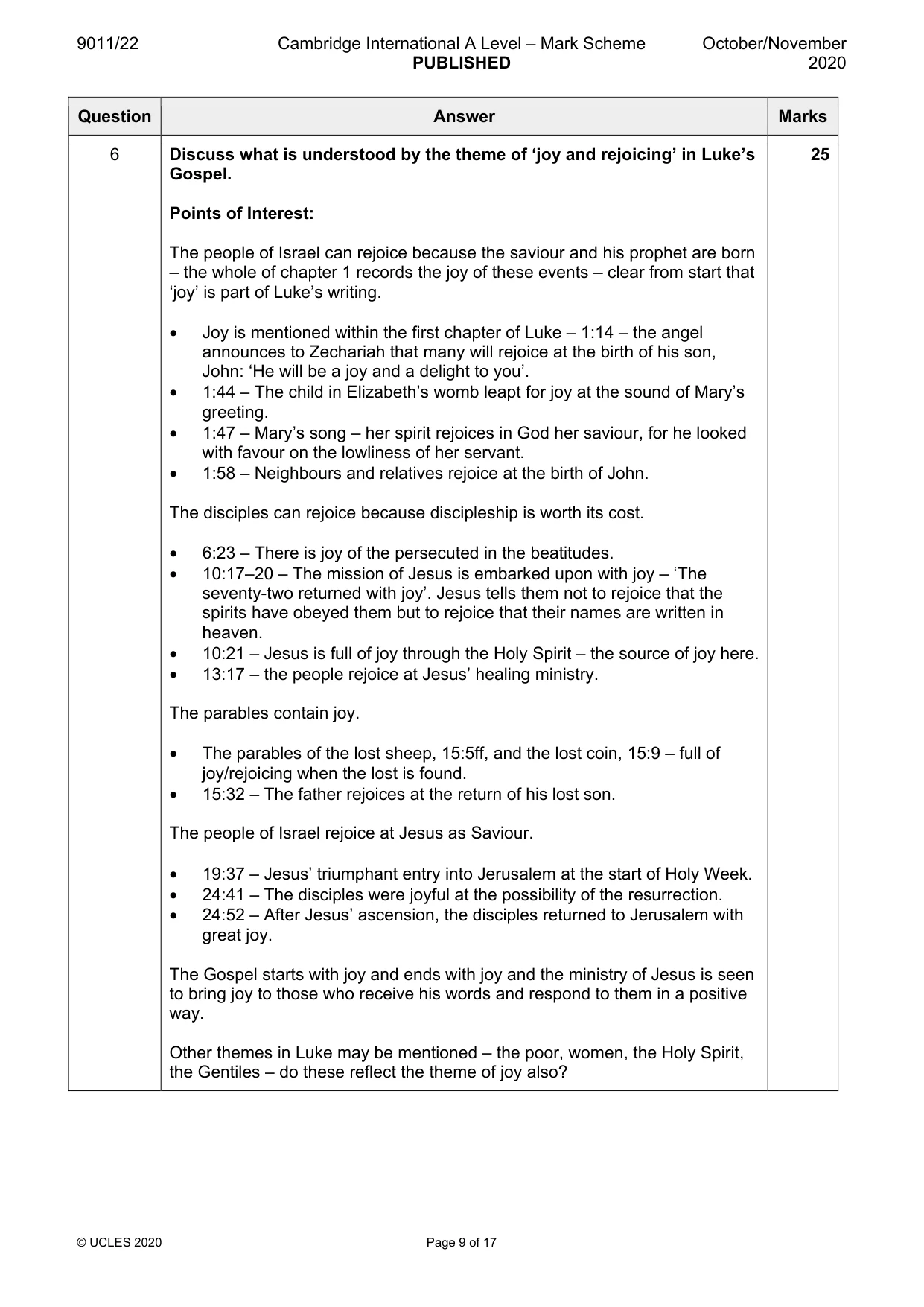
9011/22 Cambridge International A Level – Mark Scheme PUBLISHED October/November 2020 © UCLES 2020 Page 9 of 17 Question Answer Marks 6 Discuss what is understood by the theme of ‘joy and rejoicing’ in Luke’s Gospel. Points of Interest: The people of Israel can rejoice because the saviour and his prophet are born – the whole of chapter 1 records the joy of these events – clear from start that ‘joy’ is part of Luke’s writing. • Joy is mentioned within the first chapter of Luke – 1:14 – the angel announces to Zechariah that many will rejoice at the birth of his son, John: ‘He will be a joy and a delight to you’. • 1:44 – The child in Elizabeth’s womb leapt for joy at the sound of Mary’s greeting. • 1:47 – Mary’s song – her spirit rejoices in God her saviour, for he looked with favour on the lowliness of her servant. • 1:58 – Neighbours and relatives rejoice at the birth of John. The disciples can rejoice because discipleship is worth its cost. • 6:23 – There is joy of the persecuted in the beatitudes. • 10:17–20 – The mission of Jesus is embarked upon with joy – ‘The seventy-two returned with joy’. Jesus tells them not to rejoice that the spirits have obeyed them but to rejoice that their names are written in heaven. • 10:21 – Jesus is full of joy through the Holy Spirit – the source of joy here. • 13:17 – the people rejoice at Jesus’ healing ministry. The parables contain joy. • The parables of the lost sheep, 15:5ff, and the lost coin, 15:9 – full of joy/rejoicing when the lost is found. • 15:32 – The father rejoices at the return of his lost son. The people of Israel rejoice at Jesus as Saviour. • 19:37 – Jesus’ triumphant entry into Jerusalem at the start of Holy Week. • 24:41 – The disciples were joyful at the possibility of the resurrection. • 24:52 – After Jesus’ ascension, the disciples returned to Jerusalem with great joy. The Gospel starts with joy and ends with joy and the ministry of Jesus is seen to bring joy to those who receive his words and respond to them in a positive way. Other themes in Luke may be mentioned – the poor, women, the Holy Spirit, the Gentiles – do these reflect the theme of joy also? 25
Mark scheme, page 10
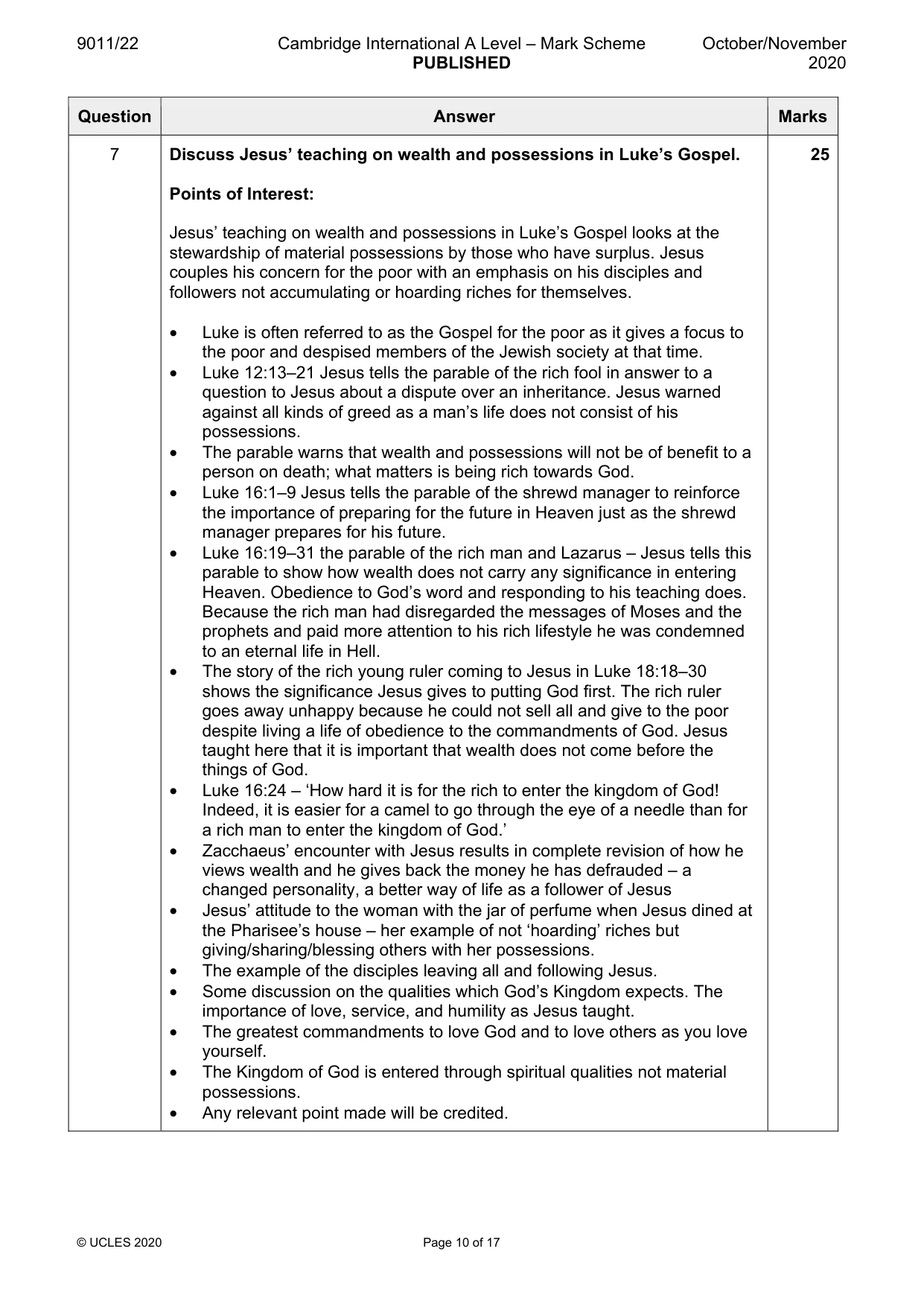
9011/22 Cambridge International A Level – Mark Scheme PUBLISHED October/November 2020 © UCLES 2020 Page 10 of 17 Question Answer Marks 7 Discuss Jesus’ teaching on wealth and possessions in Luke’s Gospel. Points of Interest: Jesus’ teaching on wealth and possessions in Luke’s Gospel looks at the stewardship of material possessions by those who have surplus. Jesus couples his concern for the poor with an emphasis on his disciples and followers not accumulating or hoarding riches for themselves. • Luke is often referred to as the Gospel for the poor as it gives a focus to the poor and despised members of the Jewish society at that time. • Luke 12:13–21 Jesus tells the parable of the rich fool in answer to a question to Jesus about a dispute over an inheritance. Jesus warned against all kinds of greed as a man’s life does not consist of his possessions. • The parable warns that wealth and possessions will not be of benefit to a person on death; what matters is being rich towards God. • Luke 16:1–9 Jesus tells the parable of the shrewd manager to reinforce the importance of preparing for the future in Heaven just as the shrewd manager prepares for his future. • Luke 16:19–31 the parable of the rich man and Lazarus – Jesus tells this parable to show how wealth does not carry any significance in entering Heaven. Obedience to God’s word and responding to his teaching does. Because the rich man had disregarded the messages of Moses and the prophets and paid more attention to his rich lifestyle he was condemned to an eternal life in Hell. • The story of the rich young ruler coming to Jesus in Luke 18:18–30 shows the significance Jesus gives to putting God first. The rich ruler goes away unhappy because he could not sell all and give to the poor despite living a life of obedience to the commandments of God. Jesus taught here that it is important that wealth does not come before the things of God. • Luke 16:24 – ‘How hard it is for the rich to enter the kingdom of God! Indeed, it is easier for a camel to go through the eye of a needle than for a rich man to enter the kingdom of God.’ • Zacchaeus’ encounter with Jesus results in complete revision of how he views wealth and he gives back the money he has defrauded – a changed personality, a better way of life as a follower of Jesus • Jesus’ attitude to the woman with the jar of perfume when Jesus dined at the Pharisee’s house – her example of not ‘hoarding’ riches but giving/sharing/blessing others with her possessions. • The example of the disciples leaving all and following Jesus. • Some discussion on the qualities which God’s Kingdom expects. The importance of love, service, and humility as Jesus taught. • The greatest commandments to love God and to love others as you love yourself. • The Kingdom of God is entered through spiritual qualities not material possessions. • Any relevant point made will be credited. 25
Mark scheme, page 11
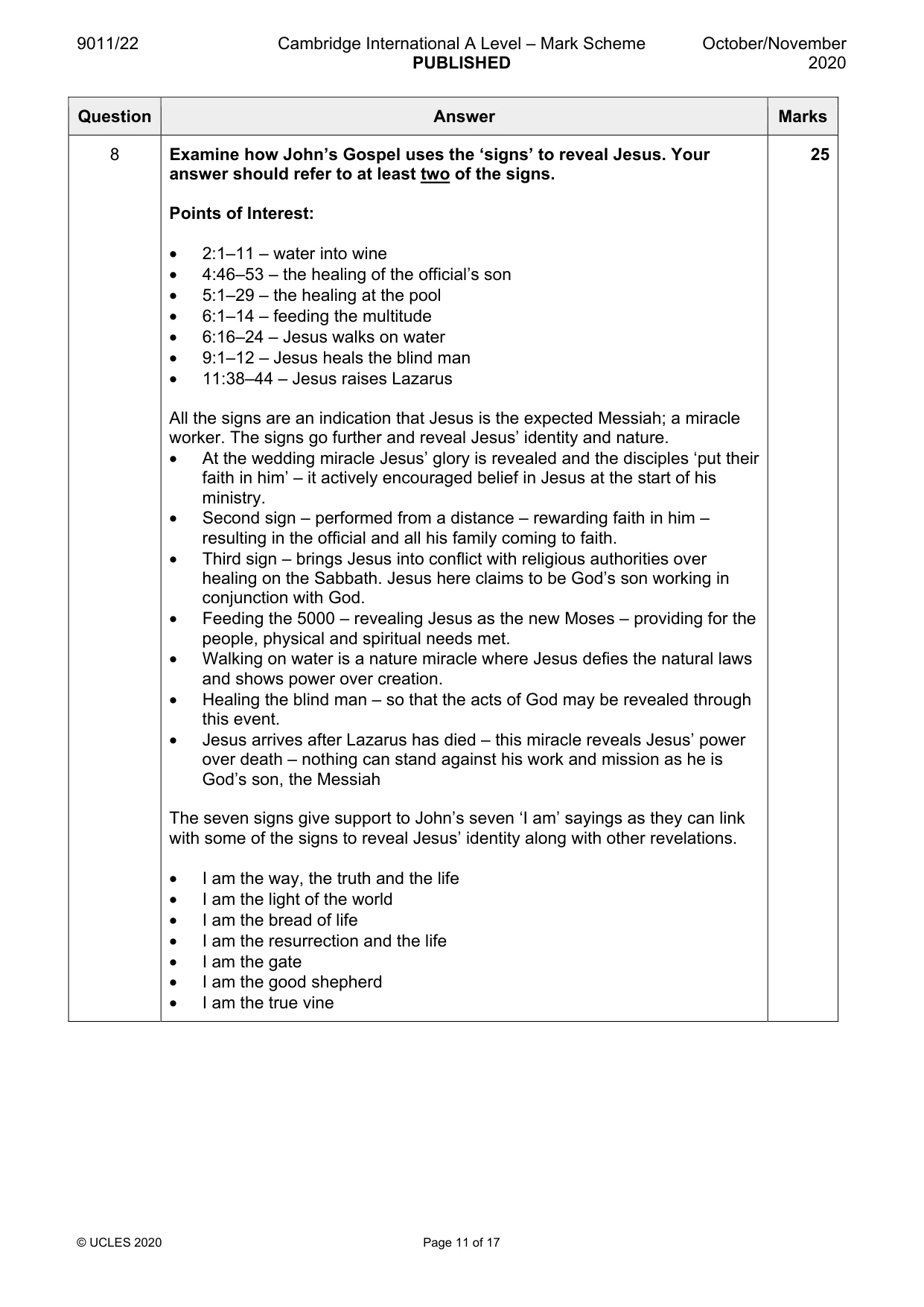
9011/22 Cambridge International A Level – Mark Scheme PUBLISHED October/November 2020 © UCLES 2020 Page 11 of 17 Question Answer Marks 8 Examine how John’s Gospel uses the ‘signs’ to reveal Jesus. Your answer should refer to at least two of the signs. Points of Interest: • 2:1–11 – water into wine • 4:46–53 – the healing of the official’s son • 5:1–29 – the healing at the pool • 6:1–14 – feeding the multitude • 6:16–24 – Jesus walks on water • 9:1–12 – Jesus heals the blind man • 11:38–44 – Jesus raises Lazarus All the signs are an indication that Jesus is the expected Messiah; a miracle worker. The signs go further and reveal Jesus’ identity and nature. • At the wedding miracle Jesus’ glory is revealed and the disciples ‘put their faith in him’ – it actively encouraged belief in Jesus at the start of his ministry. • Second sign – performed from a distance – rewarding faith in him – resulting in the official and all his family coming to faith. • Third sign – brings Jesus into conflict with religious authorities over healing on the Sabbath. Jesus here claims to be God’s son working in conjunction with God. • Feeding the 5000 – revealing Jesus as the new Moses – providing for the people, physical and spiritual needs met. • Walking on water is a nature miracle where Jesus defies the natural laws and shows power over creation. • Healing the blind man – so that the acts of God may be revealed through this event. • Jesus arrives after Lazarus has died – this miracle reveals Jesus’ power over death – nothing can stand against his work and mission as he is God’s son, the Messiah The seven signs give support to John’s seven ‘I am’ sayings as they can link with some of the signs to reveal Jesus’ identity along with other revelations. • I am the way, the truth and the life • I am the light of the world • I am the bread of life • I am the resurrection and the life • I am the gate • I am the good shepherd • I am the true vine 25
Mark scheme, page 12
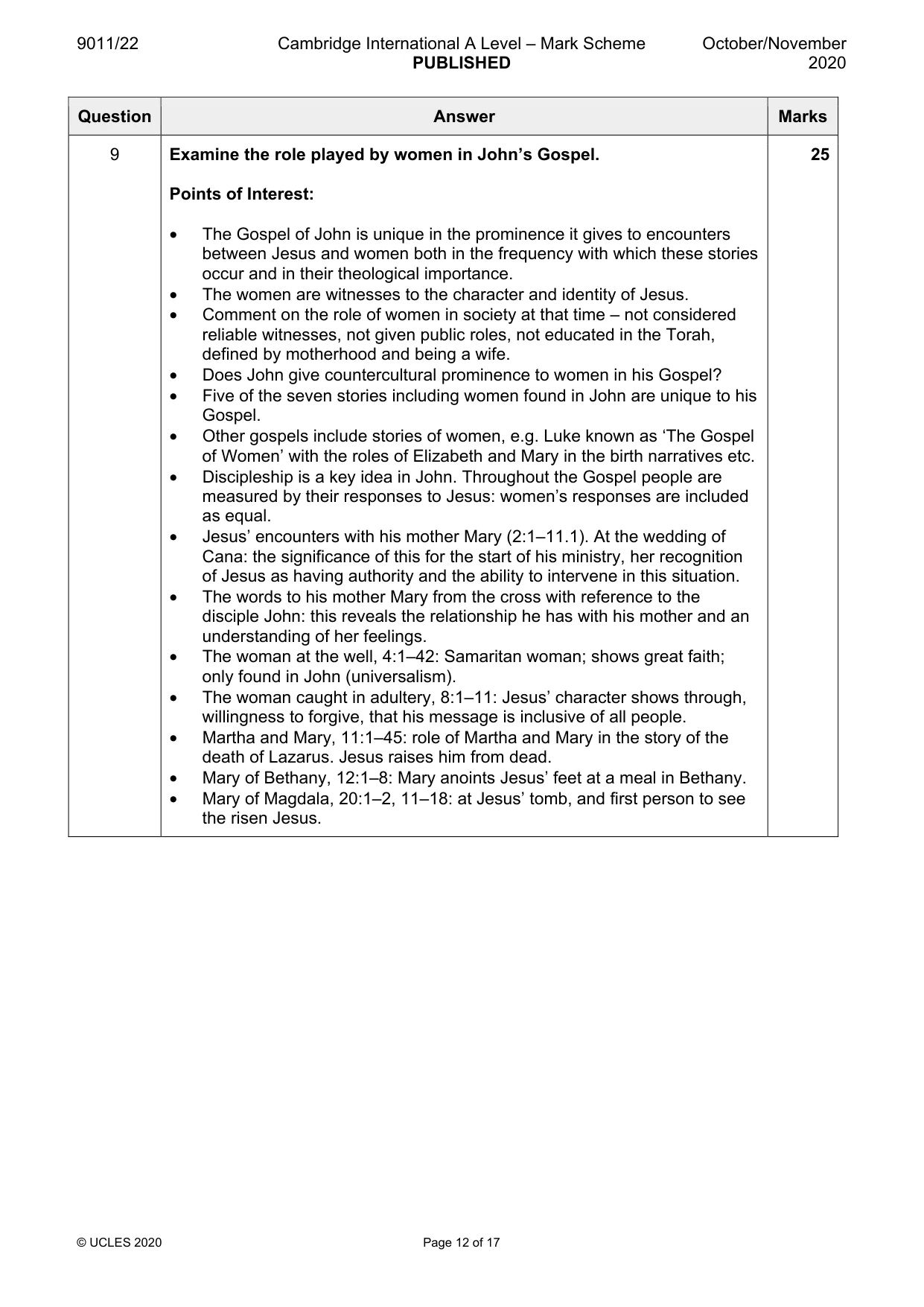
9011/22 Cambridge International A Level – Mark Scheme PUBLISHED October/November 2020 © UCLES 2020 Page 12 of 17 Question Answer Marks 9 Examine the role played by women in John’s Gospel. Points of Interest: • The Gospel of John is unique in the prominence it gives to encounters between Jesus and women both in the frequency with which these stories occur and in their theological importance. • The women are witnesses to the character and identity of Jesus. • Comment on the role of women in society at that time – not considered reliable witnesses, not given public roles, not educated in the Torah, defined by motherhood and being a wife. • Does John give countercultural prominence to women in his Gospel? • Five of the seven stories including women found in John are unique to his Gospel. • Other gospels include stories of women, e.g. Luke known as ‘The Gospel of Women’ with the roles of Elizabeth and Mary in the birth narratives etc. • Discipleship is a key idea in John. Throughout the Gospel people are measured by their responses to Jesus: women’s responses are included as equal. • Jesus’ encounters with his mother Mary (2:1–11.1). At the wedding of Cana: the significance of this for the start of his ministry, her recognition of Jesus as having authority and the ability to intervene in this situation. • The words to his mother Mary from the cross with reference to the disciple John: this reveals the relationship he has with his mother and an understanding of her feelings. • The woman at the well, 4:1–42: Samaritan woman; shows great faith; only found in John (universalism). • The woman caught in adultery, 8:1–11: Jesus’ character shows through, willingness to forgive, that his message is inclusive of all people. • Martha and Mary, 11:1–45: role of Martha and Mary in the story of the death of Lazarus. Jesus raises him from dead. • Mary of Bethany, 12:1–8: Mary anoints Jesus’ feet at a meal in Bethany. • Mary of Magdala, 20:1–2, 11–18: at Jesus’ tomb, and first person to see the risen Jesus. 25
Mark scheme, page 13
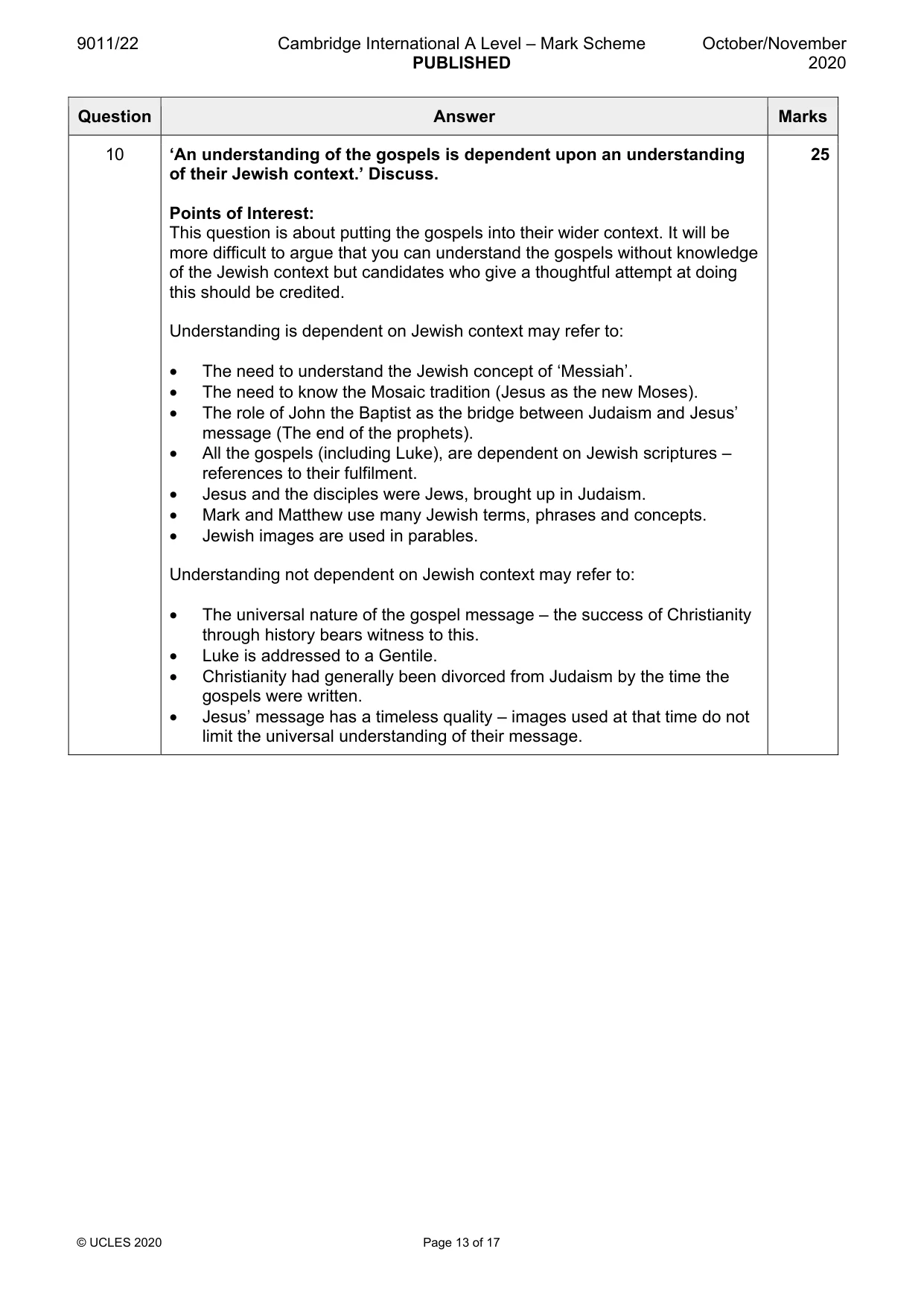
9011/22 Cambridge International A Level – Mark Scheme PUBLISHED October/November 2020 © UCLES 2020 Page 13 of 17 Question Answer Marks 10 ‘An understanding of the gospels is dependent upon an understanding of their Jewish context.’ Discuss. Points of Interest: This question is about putting the gospels into their wider context. It will be more difficult to argue that you can understand the gospels without knowledge of the Jewish context but candidates who give a thoughtful attempt at doing this should be credited. Understanding is dependent on Jewish context may refer to: • The need to understand the Jewish concept of ‘Messiah’. • The need to know the Mosaic tradition (Jesus as the new Moses). • The role of John the Baptist as the bridge between Judaism and Jesus’ message (The end of the prophets). • All the gospels (including Luke), are dependent on Jewish scriptures – references to their fulfilment. • Jesus and the disciples were Jews, brought up in Judaism. • Mark and Matthew use many Jewish terms, phrases and concepts. • Jewish images are used in parables. Understanding not dependent on Jewish context may refer to: • The universal nature of the gospel message – the success of Christianity through history bears witness to this. • Luke is addressed to a Gentile. • Christianity had generally been divorced from Judaism by the time the gospels were written. • Jesus’ message has a timeless quality – images used at that time do not limit the universal understanding of their message. 25
Mark scheme, page 14
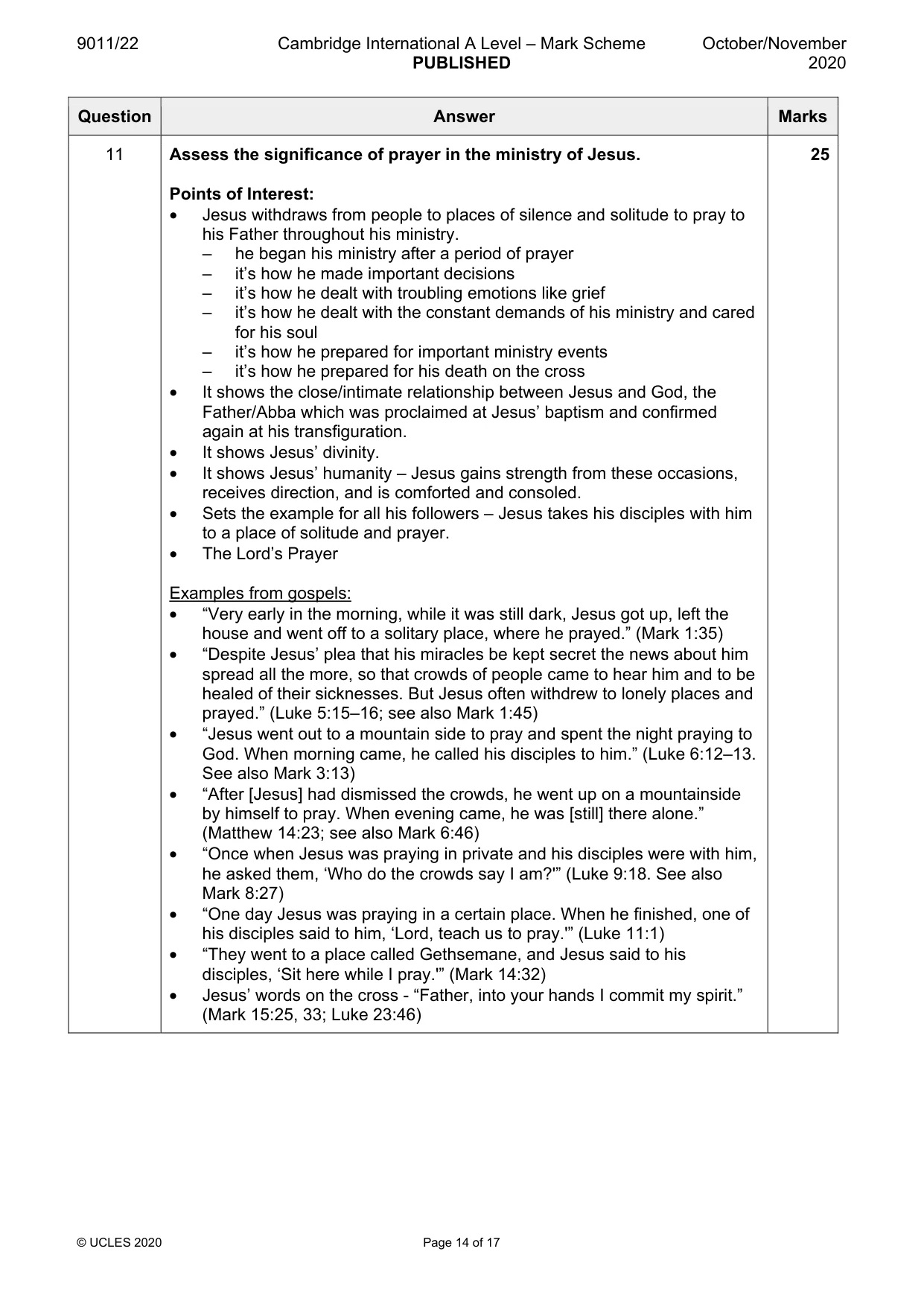
9011/22 Cambridge International A Level – Mark Scheme PUBLISHED October/November 2020 © UCLES 2020 Page 14 of 17 Question Answer Marks 11 Assess the significance of prayer in the ministry of Jesus. Points of Interest: • Jesus withdraws from people to places of silence and solitude to pray to his Father throughout his ministry. – he began his ministry after a period of prayer – it’s how he made important decisions – it’s how he dealt with troubling emotions like grief – it’s how he dealt with the constant demands of his ministry and cared for his soul – it’s how he prepared for important ministry events – it’s how he prepared for his death on the cross • It shows the close/intimate relationship between Jesus and God, the Father/Abba which was proclaimed at Jesus’ baptism and confirmed again at his transfiguration. • It shows Jesus’ divinity. • It shows Jesus’ humanity – Jesus gains strength from these occasions, receives direction, and is comforted and consoled. • Sets the example for all his followers – Jesus takes his disciples with him to a place of solitude and prayer. • The Lord’s Prayer Examples from gospels: • “Very early in the morning, while it was still dark, Jesus got up, left the house and went off to a solitary place, where he prayed.” (Mark 1:35) • “Despite Jesus’ plea that his miracles be kept secret the news about him spread all the more, so that crowds of people came to hear him and to be healed of their sicknesses. But Jesus often withdrew to lonely places and prayed.” (Luke 5:15–16; see also Mark 1:45) • “Jesus went out to a mountain side to pray and spent the night praying to God. When morning came, he called his disciples to him.” (Luke 6:12–13. See also Mark 3:13) • “After [Jesus] had dismissed the crowds, he went up on a mountainside by himself to pray. When evening came, he was [still] there alone.” (Matthew 14:23; see also Mark 6:46) • “Once when Jesus was praying in private and his disciples were with him, he asked them, ‘Who do the crowds say I am?'” (Luke 9:18. See also Mark 8:27) • “One day Jesus was praying in a certain place. When he finished, one of his disciples said to him, ‘Lord, teach us to pray.'” (Luke 11:1) • “They went to a place called Gethsemane, and Jesus said to his disciples, ‘Sit here while I pray.'” (Mark 14:32) • Jesus’ words on the cross - “Father, into your hands I commit my spirit.” (Mark 15:25, 33; Luke 23:46) 25
Mark scheme, page 15
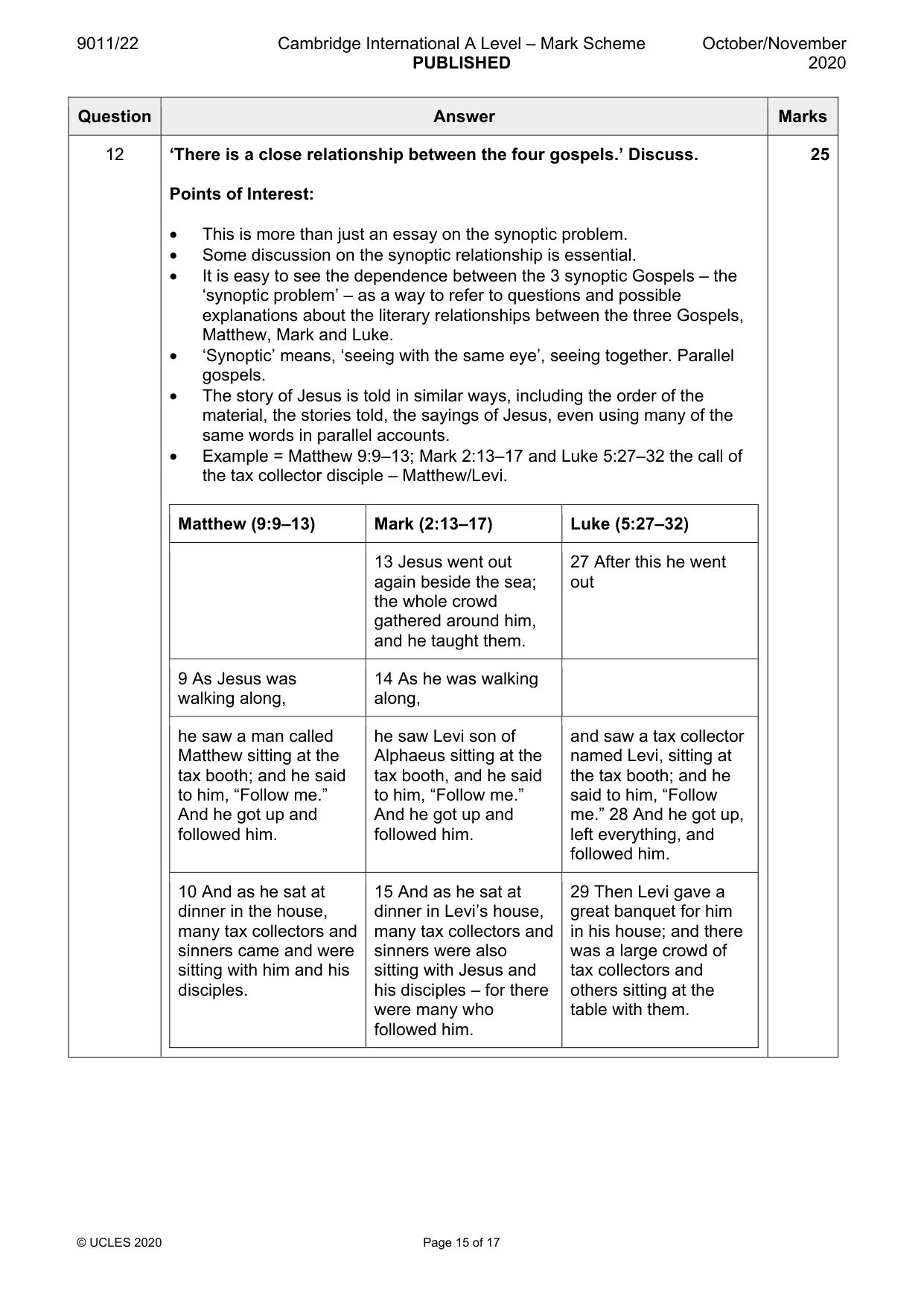
9011/22 Cambridge International A Level – Mark Scheme PUBLISHED October/November 2020 © UCLES 2020 Page 15 of 17 Question Answer Marks 12 ‘There is a close relationship between the four gospels.’ Discuss. Points of Interest: • This is more than just an essay on the synoptic problem. • Some discussion on the synoptic relationship is essential. • It is easy to see the dependence between the 3 synoptic Gospels – the ‘synoptic problem’ – as a way to refer to questions and possible explanations about the literary relationships between the three Gospels, Matthew, Mark and Luke. • ‘Synoptic’ means, ‘seeing with the same eye’, seeing together. Parallel gospels. • The story of Jesus is told in similar ways, including the order of the material, the stories told, the sayings of Jesus, even using many of the same words in parallel accounts. • Example = Matthew 9:9–13; Mark 2:13–17 and Luke 5:27–32 the call of the tax collector disciple – Matthew/Levi. Matthew (9:9–13) Mark (2:13–17) Luke (5:27–32) 13 Jesus went out again beside the sea; the whole crowd gathered around him, and he taught them. 27 After this he went out 9 As Jesus was walking along, 14 As he was walking along, he saw a man called Matthew sitting at the tax booth; and he said to him, “Follow me.” And he got up and followed him. he saw Levi son of Alphaeus sitting at the tax booth, and he said to him, “Follow me.” And he got up and followed him. and saw a tax collector named Levi, sitting at the tax booth; and he said to him, “Follow me.” 28 And he got up, left everything, and followed him. 10 And as he sat at dinner in the house, many tax collectors and sinners came and were sitting with him and his disciples. 15 And as he sat at dinner in Levi’s house, many tax collectors and sinners were also sitting with Jesus and his disciples – for there were many who followed him. 29 Then Levi gave a great banquet for him in his house; and there was a large crowd of tax collectors and others sitting at the table with them. 25
Mark scheme, page 16
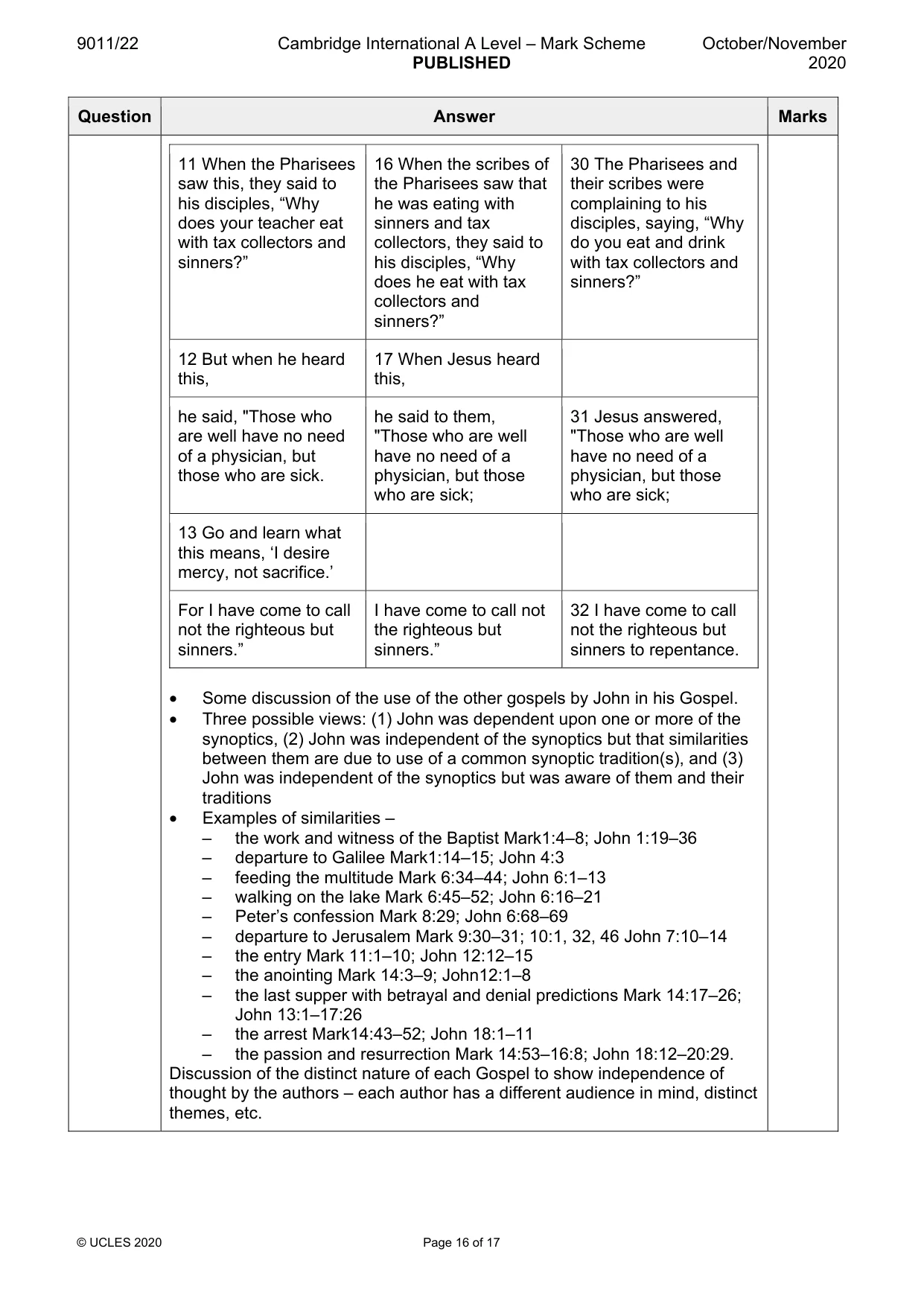
9011/22 Cambridge International A Level – Mark Scheme PUBLISHED October/November 2020 © UCLES 2020 Page 16 of 17 Question Answer Marks 11 When the Pharisees saw this, they said to his disciples, “Why does your teacher eat with tax collectors and sinners?” 16 When the scribes of the Pharisees saw that he was eating with sinners and tax collectors, they said to his disciples, “Why does he eat with tax collectors and sinners?” 30 The Pharisees and their scribes were complaining to his disciples, saying, “Why do you eat and drink with tax collectors and sinners?” 12 But when he heard this, 17 When Jesus heard this, he said, "Those who are well have no need of a physician, but those who are sick. he said to them, "Those who are well have no need of a physician, but those who are sick; 31 Jesus answered, "Those who are well have no need of a physician, but those who are sick; 13 Go and learn what this means, ‘I desire mercy, not sacrifice.’ For I have come to call not the righteous but sinners.” I have come to call not the righteous but sinners.” 32 I have come to call not the righteous but sinners to repentance. • Some discussion of the use of the other gospels by John in his Gospel. • Three possible views: (1) John was dependent upon one or more of the synoptics, (2) John was independent of the synoptics but that similarities between them are due to use of a common synoptic tradition(s), and (3) John was independent of the synoptics but was aware of them and their traditions • Examples of similarities – – the work and witness of the Baptist Mark1:4–8; John 1:19–36 – departure to Galilee Mark1:14–15; John 4:3 – feeding the multitude Mark 6:34–44; John 6:1–13 – walking on the lake Mark 6:45–52; John 6:16–21 – Peter’s confession Mark 8:29; John 6:68–69 – departure to Jerusalem Mark 9:30–31; 10:1, 32, 46 John 7:10–14 – the entry Mark 11:1–10; John 12:12–15 – the anointing Mark 14:3–9; John12:1–8 – the last supper with betrayal and denial predictions Mark 14:17–26; John 13:1–17:26 – the arrest Mark14:43–52; John 18:1–11 – the passion and resurrection Mark 14:53–16:8; John 18:12–20:29. Discussion of the distinct nature of each Gospel to show independence of thought by the authors – each author has a different audience in mind, distinct themes, etc.
Mark scheme, page 17
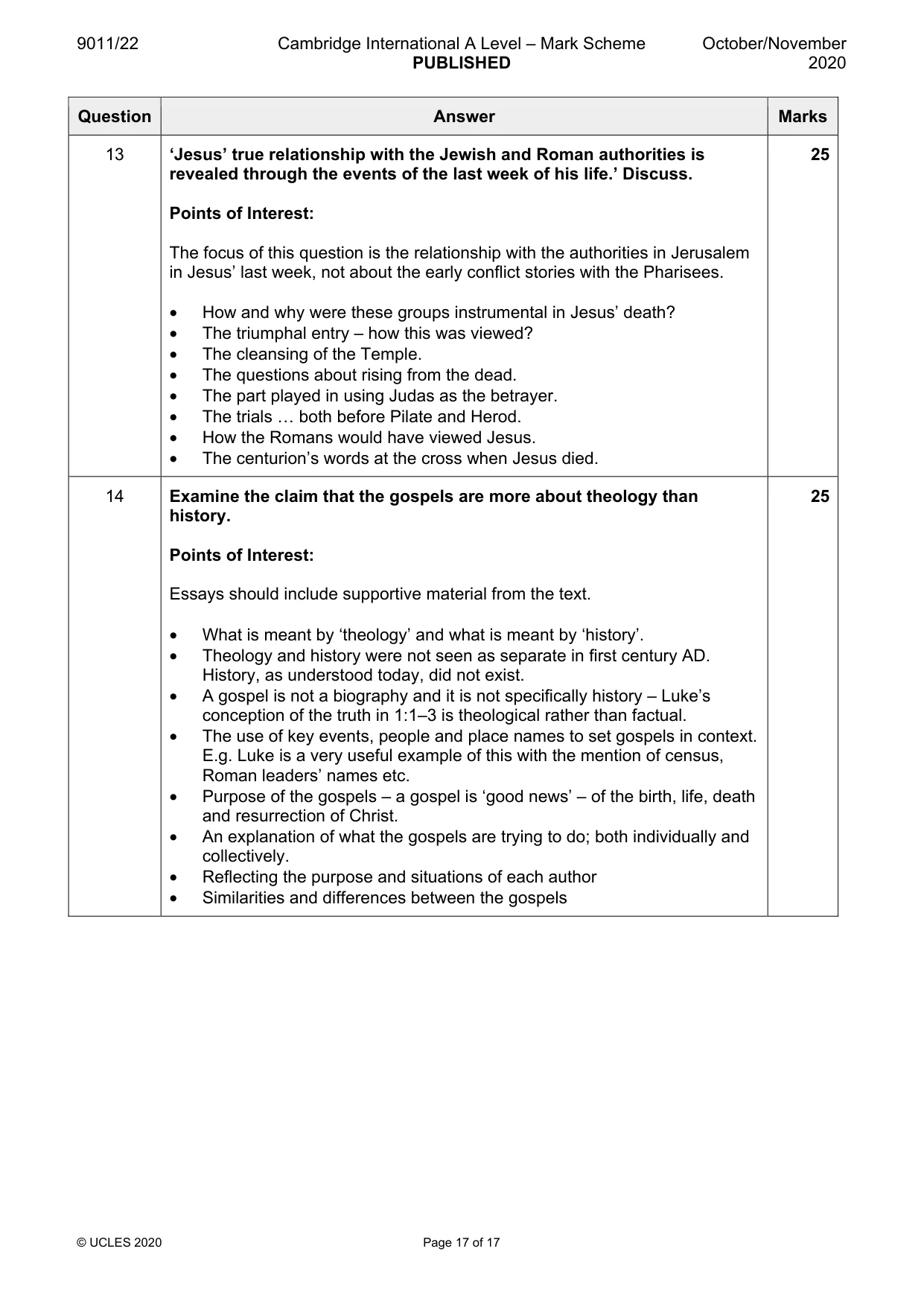
9011/22 Cambridge International A Level – Mark Scheme PUBLISHED October/November 2020 © UCLES 2020 Page 17 of 17 Question Answer Marks 13 ‘Jesus’ true relationship with the Jewish and Roman authorities is revealed through the events of the last week of his life.’ Discuss. Points of Interest: The focus of this question is the relationship with the authorities in Jerusalem in Jesus’ last week, not about the early conflict stories with the Pharisees. • How and why were these groups instrumental in Jesus’ death? • The triumphal entry – how this was viewed? • The cleansing of the Temple. • The questions about rising from the dead. • The part played in using Judas as the betrayer. • The trials … both before Pilate and Herod. • How the Romans would have viewed Jesus. • The centurion’s words at the cross when Jesus died. 25 14 Examine the claim that the gospels are more about theology than history. Points of Interest: Essays should include supportive material from the text. • What is meant by ‘theology’ and what is meant by ‘history’. • Theology and history were not seen as separate in first century AD. History, as understood today, did not exist. • A gospel is not a biography and it is not specifically history – Luke’s conception of the truth in 1:1–3 is theological rather than factual. • The use of key events, people and place names to set gospels in context. E.g. Luke is a very useful example of this with the mention of census, Roman leaders’ names etc. • Purpose of the gospels – a gospel is ‘good news’ – of the birth, life, death and resurrection of Christ. • An explanation of what the gospels are trying to do; both individually and collectively. • Reflecting the purpose and situations of each author • Similarities and differences between the gospels 25
What you needed in this session
Cambridge’s own grade thresholds for 2020 Oct/Nov, Paper 2 · Variant 2. A higher threshold means an easier paper — the bar moves with how the cohort did.