Cambridge A Level Divinity 9011 — 2021 Oct/Nov Paper 2 · Variant 2
9011/22/O/N/21 · 100 marks · ≈113 min
The question paper and its mark scheme, free to read here and free to download. This is Cambridge’s own paper, exactly as it was sat.
Question paper4 pages
Mark scheme23 pages
Answers below. Sit the paper first if you are practising.

Paper as text
Question paper, page 1
DC (NF) 217083/2 © UCLES 2021 [Turn over This document has 4 pages. * 2 5 0 6 9 9 5 6 9 8 * DIVINITY 9011/22 Paper 2 The Four Gospels October/November 2021 3 hours You must answer on the enclosed answer booklet. You will need: Answer booklet (enclosed) INSTRUCTIONS ● Answer four questions in total: ● If you choose to answer Question 1, answer in one version only. Revised Standard Version of Question 1 is printed on page 2. New International Version of Question 1 is printed on page 3. ● Follow the instructions on the front cover of the answer booklet. If you need additional answer paper, ask the invigilator for a continuation booklet. INFORMATION ● The total mark for this paper is 100. ● All questions are worth 25 marks. Cambridge International A Level
Question paper, page 2
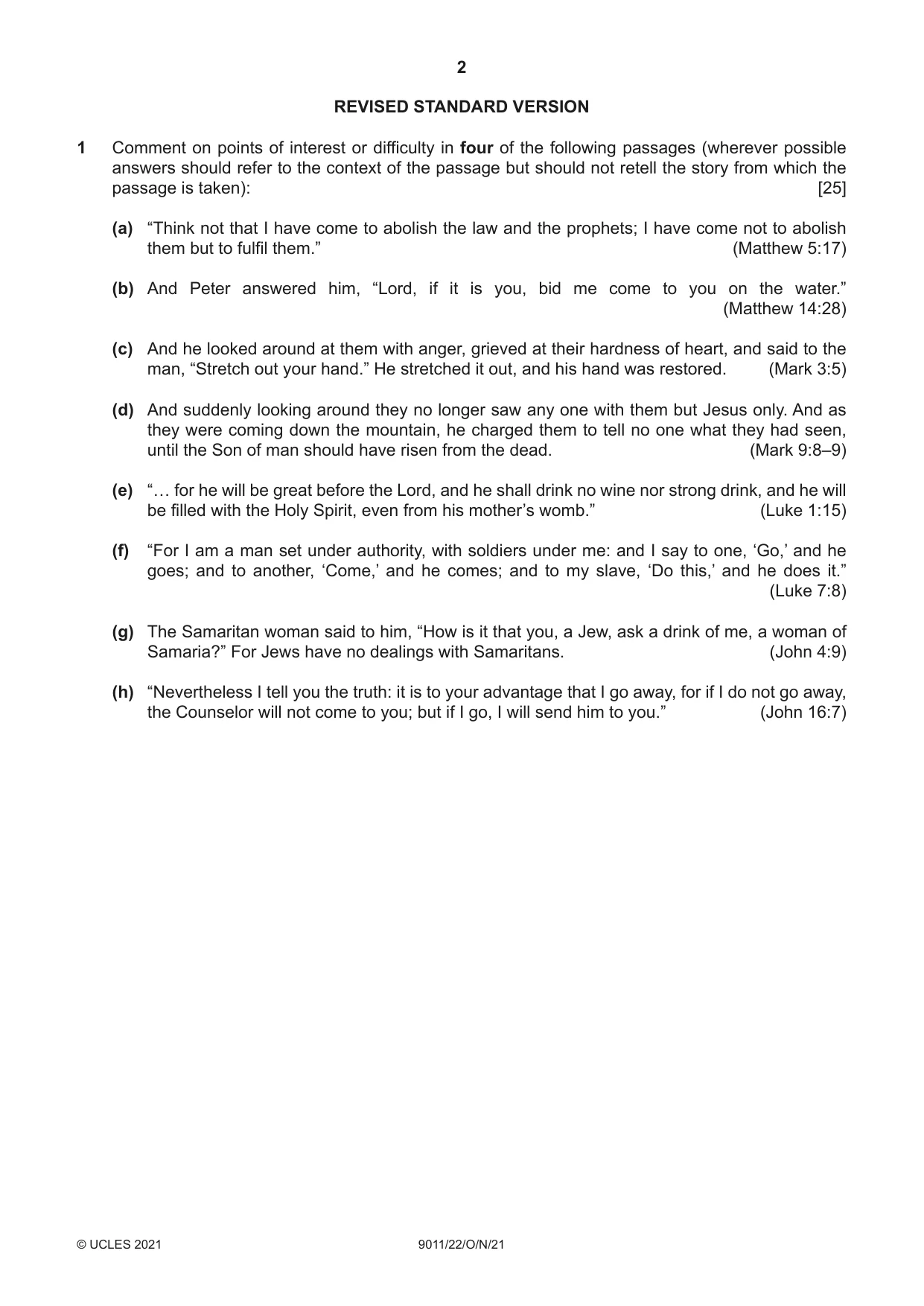
2 9011/22/O/N/21 © UCLES 2021 REVISED STANDARD VERSION 1 Comment on points of interest or difficulty in four of the following passages (wherever possible answers should refer to the context of the passage but should not retell the story from which the passage is taken): [25] (a) “Think not that I have come to abolish the law and the prophets; I have come not to abolish them but to fulfil them.” (Matthew 5:17) (b) And Peter answered him, “Lord, if it is you, bid me come to you on the water.” (Matthew 14:28) (c) And he looked around at them with anger, grieved at their hardness of heart, and said to the man, “Stretch out your hand.” He stretched it out, and his hand was restored. (Mark 3:5) (d) And suddenly looking around they no longer saw any one with them but Jesus only. And as they were coming down the mountain, he charged them to tell no one what they had seen, until the Son of man should have risen from the dead. (Mark 9:8–9) (e) “… for he will be great before the Lord, and he shall drink no wine nor strong drink, and he will be filled with the Holy Spirit, even from his mother’s womb.” (Luke 1:15) (f) “For I am a man set under authority, with soldiers under me: and I say to one, ‘Go,’ and he goes; and to another, ‘Come,’ and he comes; and to my slave, ‘Do this,’ and he does it.” (Luke 7:8) (g) The Samaritan woman said to him, “How is it that you, a Jew, ask a drink of me, a woman of Samaria?” For Jews have no dealings with Samaritans. (John 4:9) (h) “Nevertheless I tell you the truth: it is to your advantage that I go away, for if I do not go away, the Counselor will not come to you; but if I go, I will send him to you.” (John 16:7)
Question paper, page 3
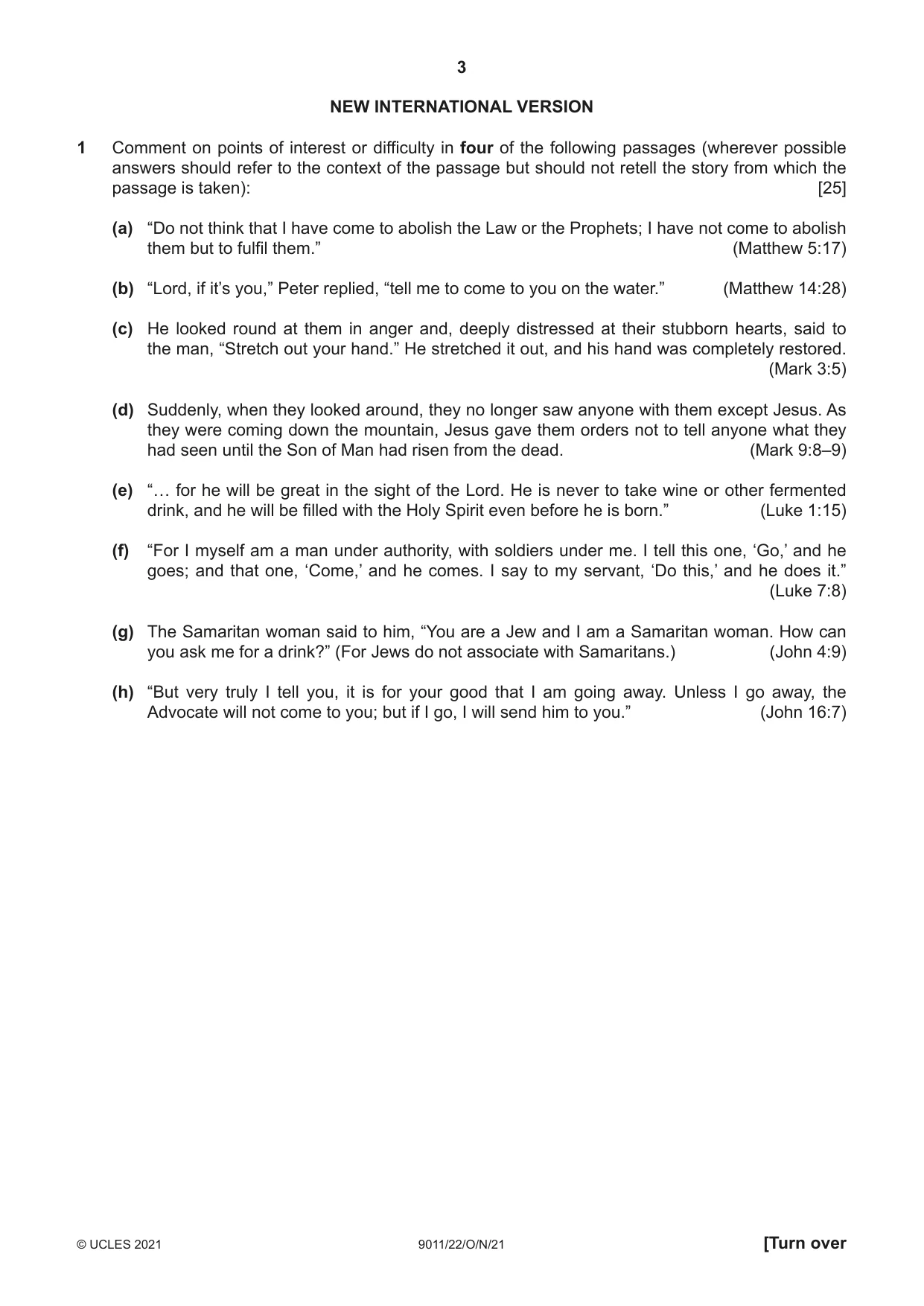
3 9011/22/O/N/21 © UCLES 2021 [Turn over NEW INTERNATIONAL VERSION 1 Comment on points of interest or difficulty in four of the following passages (wherever possible answers should refer to the context of the passage but should not retell the story from which the passage is taken): [25] (a) “Do not think that I have come to abolish the Law or the Prophets; I have not come to abolish them but to fulfil them.” (Matthew 5:17) (b) “Lord, if it’s you,” Peter replied, “tell me to come to you on the water.” (Matthew 14:28) (c) He looked round at them in anger and, deeply distressed at their stubborn hearts, said to the man, “Stretch out your hand.” He stretched it out, and his hand was completely restored. (Mark 3:5) (d) Suddenly, when they looked around, they no longer saw anyone with them except Jesus. As they were coming down the mountain, Jesus gave them orders not to tell anyone what they had seen until the Son of Man had risen from the dead. (Mark 9:8–9) (e) “… for he will be great in the sight of the Lord. He is never to take wine or other fermented drink, and he will be filled with the Holy Spirit even before he is born.” (Luke 1:15) (f) “For I myself am a man under authority, with soldiers under me. I tell this one, ‘Go,’ and he goes; and that one, ‘Come,’ and he comes. I say to my servant, ‘Do this,’ and he does it.” (Luke 7:8) (g) The Samaritan woman said to him, “You are a Jew and I am a Samaritan woman. How can you ask me for a drink?” (For Jews do not associate with Samaritans.) (John 4:9) (h) “But very truly I tell you, it is for your good that I am going away. Unless I go away, the Advocate will not come to you; but if I go, I will send him to you.” (John 16:7)
Question paper, page 4
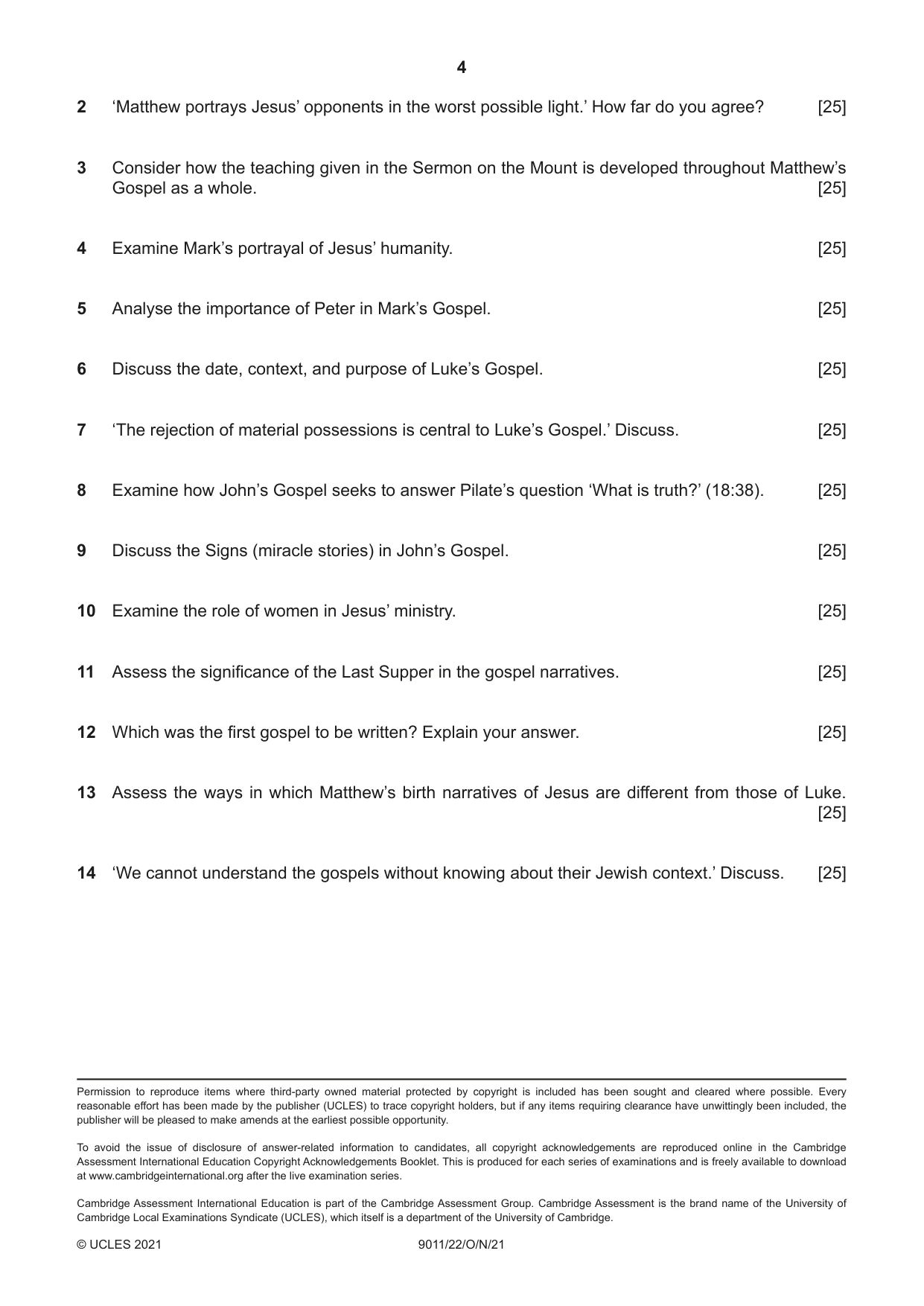
4 9011/22/O/N/21 © UCLES 2021 Permission to reproduce items where third-party owned material protected by copyright is included has been sought and cleared where possible. Every reasonable effort has been made by the publisher (UCLES) to trace copyright holders, but if any items requiring clearance have unwittingly been included, the publisher will be pleased to make amends at the earliest possible opportunity. To avoid the issue of disclosure of answer-related information to candidates, all copyright acknowledgements are reproduced online in the Cambridge Assessment International Education Copyright Acknowledgements Booklet. This is produced for each series of examinations and is freely available to download at www.cambridgeinternational.org after the live examination series. Cambridge Assessment International Education is part of the Cambridge Assessment Group. Cambridge Assessment is the brand name of the University of Cambridge Local Examinations Syndicate (UCLES), which itself is a department of the University of Cambridge. 2 ‘Matthew portrays Jesus’ opponents in the worst possible light.’ How far do you agree? [25] 3 Consider how the teaching given in the Sermon on the Mount is developed throughout Matthew’s Gospel as a whole. [25] 4 Examine Mark’s portrayal of Jesus’ humanity. [25] 5 Analyse the importance of Peter in Mark’s Gospel. [25] 6 Discuss the date, context, and purpose of Luke’s Gospel. [25] 7 ‘The rejection of material possessions is central to Luke’s Gospel.’ Discuss. [25] 8 Examine how John’s Gospel seeks to answer Pilate’s question ‘What is truth?’ (18:38). [25] 9 Discuss the Signs (miracle stories) in John’s Gospel. [25] 10 Examine the role of women in Jesus’ ministry. [25] 11 Assess the significance of the Last Supper in the gospel narratives. [25] 12 Which was the first gospel to be written? Explain your answer. [25] 13 Assess the ways in which Matthew’s birth narratives of Jesus are different from those of Luke. [25] 14 ‘We cannot understand the gospels without knowing about their Jewish context.’ Discuss. [25]
Mark scheme, page 1
This document consists of 23 printed pages. © UCLES 2021 [Turn over Cambridge International A Level DIVINITY 9011/22 Paper 2 The Four Gospels October/November 2021 MARK SCHEME Maximum Mark100 Published This mark scheme is published as an aid to teachers and candidates, to indicate the requirements of the examination. It shows the basis on which Examiners were instructed to award marks. It does not indicate the details of the discussions that took place at an Examiners’ meeting before marking began, which would have considered the acceptability of alternative answers. Mark schemes should be read in conjunction with the question paper and the Principal Examiner Report for Teachers. Cambridge International will not enter into discussions about these mark schemes. Cambridge International is publishing the mark schemes for the October/November 2021 series for most Cambridge IGCSE™, Cambridge International A and AS Level components and some Cambridge O Level components.
Mark scheme, page 2
9011/22 Cambridge International A Level – Mark Scheme PUBLISHED October/November 2021 © UCLES 2021 Page 2 of 23 Generic Marking Principles These general marking principles must be applied by all examiners when marking candidate answers. They should be applied alongside the specific content of the mark scheme or generic level descriptors for a question. Each question paper and mark scheme will also comply with these marking principles. GENERIC MARKING PRINCIPLE 1: Marks must be awarded in line with: • the specific content of the mark scheme or the generic level descriptors for the question • the specific skills defined in the mark scheme or in the generic level descriptors for the question • the standard of response required by a candidate as exemplified by the standardisation scripts. GENERIC MARKING PRINCIPLE 2: Marks awarded are always whole marks (not half marks, or other fractions). GENERIC MARKING PRINCIPLE 3: Marks must be awarded positively: • marks are awarded for correct/valid answers, as defined in the mark scheme. However, credit is given for valid answers which go beyond the scope of the syllabus and mark scheme, referring to your Team Leader as appropriate • marks are awarded when candidates clearly demonstrate what they know and can do • marks are not deducted for errors • marks are not deducted for omissions • answers should only be judged on the quality of spelling, punctuation and grammar when these features are specifically assessed by the question as indicated by the mark scheme. The meaning, however, should be unambiguous. GENERIC MARKING PRINCIPLE 4: Rules must be applied consistently, e.g. in situations where candidates have not followed instructions or in the application of generic level descriptors. GENERIC MARKING PRINCIPLE 5: Marks should be awarded using the full range of marks defined in the mark scheme for the question (however; the use of the full mark range may be limited according to the quality of the candidate responses seen). GENERIC MARKING PRINCIPLE 6: Marks awarded are based solely on the requirements as defined in the mark scheme. Marks should not be awarded with grade thresholds or grade descriptors in mind.
Mark scheme, page 3
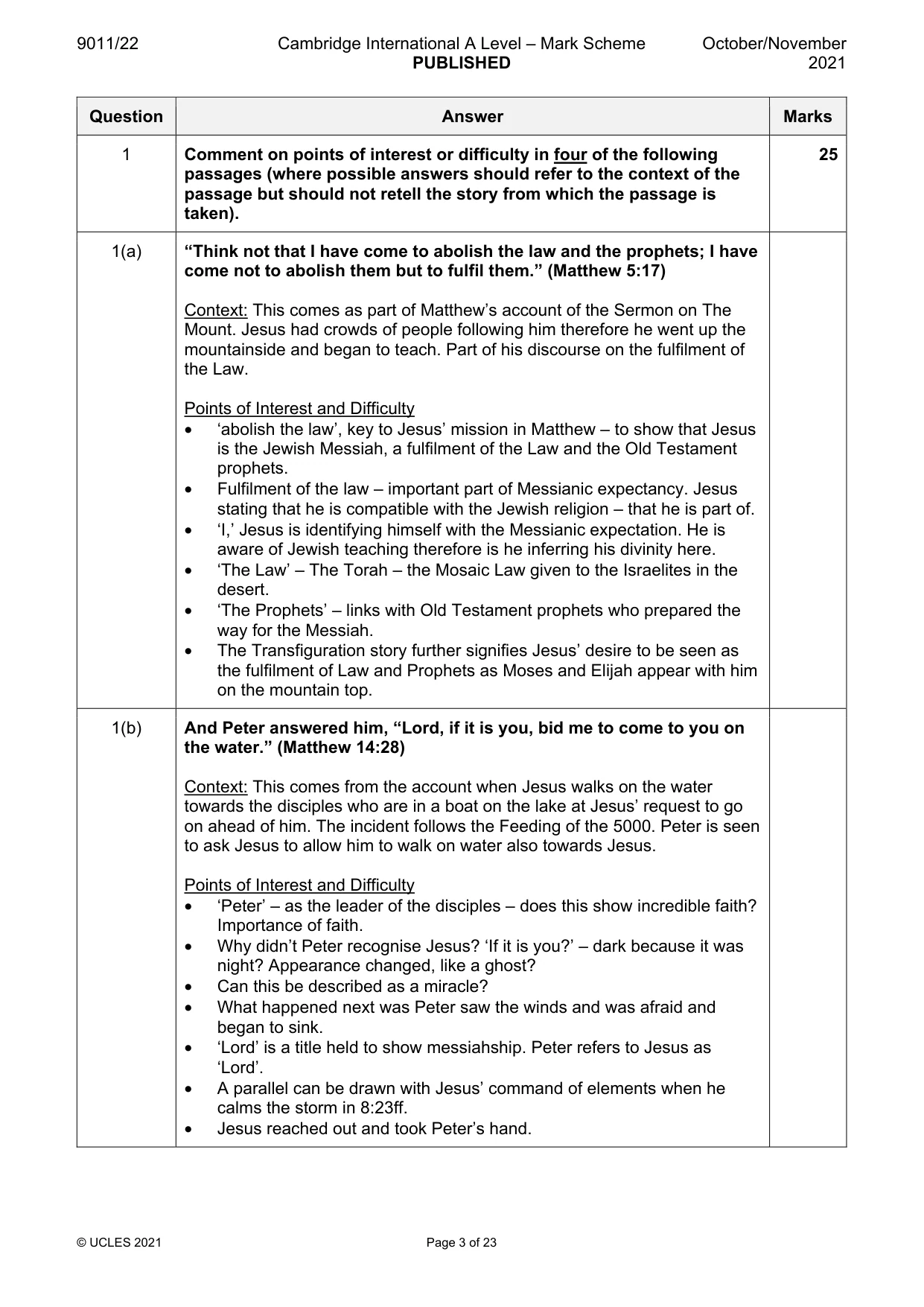
9011/22 Cambridge International A Level – Mark Scheme PUBLISHED October/November 2021 © UCLES 2021 Page 3 of 23 Question Answer Marks 1 Comment on points of interest or difficulty in four of the following passages (where possible answers should refer to the context of the passage but should not retell the story from which the passage is taken). 25 1(a) “Think not that I have come to abolish the law and the prophets; I have come not to abolish them but to fulfil them.” (Matthew 5:17) Context: This comes as part of Matthew’s account of the Sermon on The Mount. Jesus had crowds of people following him therefore he went up the mountainside and began to teach. Part of his discourse on the fulfilment of the Law. Points of Interest and Difficulty • ‘abolish the law’, key to Jesus’ mission in Matthew – to show that Jesus is the Jewish Messiah, a fulfilment of the Law and the Old Testament prophets. • Fulfilment of the law – important part of Messianic expectancy. Jesus stating that he is compatible with the Jewish religion – that he is part of. • ‘I,’ Jesus is identifying himself with the Messianic expectation. He is aware of Jewish teaching therefore is he inferring his divinity here. • ‘The Law’ – The Torah – the Mosaic Law given to the Israelites in the desert. • ‘The Prophets’ – links with Old Testament prophets who prepared the way for the Messiah. • The Transfiguration story further signifies Jesus’ desire to be seen as the fulfilment of Law and Prophets as Moses and Elijah appear with him on the mountain top. 1(b) And Peter answered him, “Lord, if it is you, bid me to come to you on the water.” (Matthew 14:28) Context: This comes from the account when Jesus walks on the water towards the disciples who are in a boat on the lake at Jesus’ request to go on ahead of him. The incident follows the Feeding of the 5000. Peter is seen to ask Jesus to allow him to walk on water also towards Jesus. Points of Interest and Difficulty • ‘Peter’ – as the leader of the disciples – does this show incredible faith? Importance of faith. • Why didn’t Peter recognise Jesus? ‘If it is you?’ – dark because it was night? Appearance changed, like a ghost? • Can this be described as a miracle? • What happened next was Peter saw the winds and was afraid and began to sink. • ‘Lord’ is a title held to show messiahship. Peter refers to Jesus as ‘Lord’. • A parallel can be drawn with Jesus’ command of elements when he calms the storm in 8:23ff. • Jesus reached out and took Peter’s hand.
Mark scheme, page 4
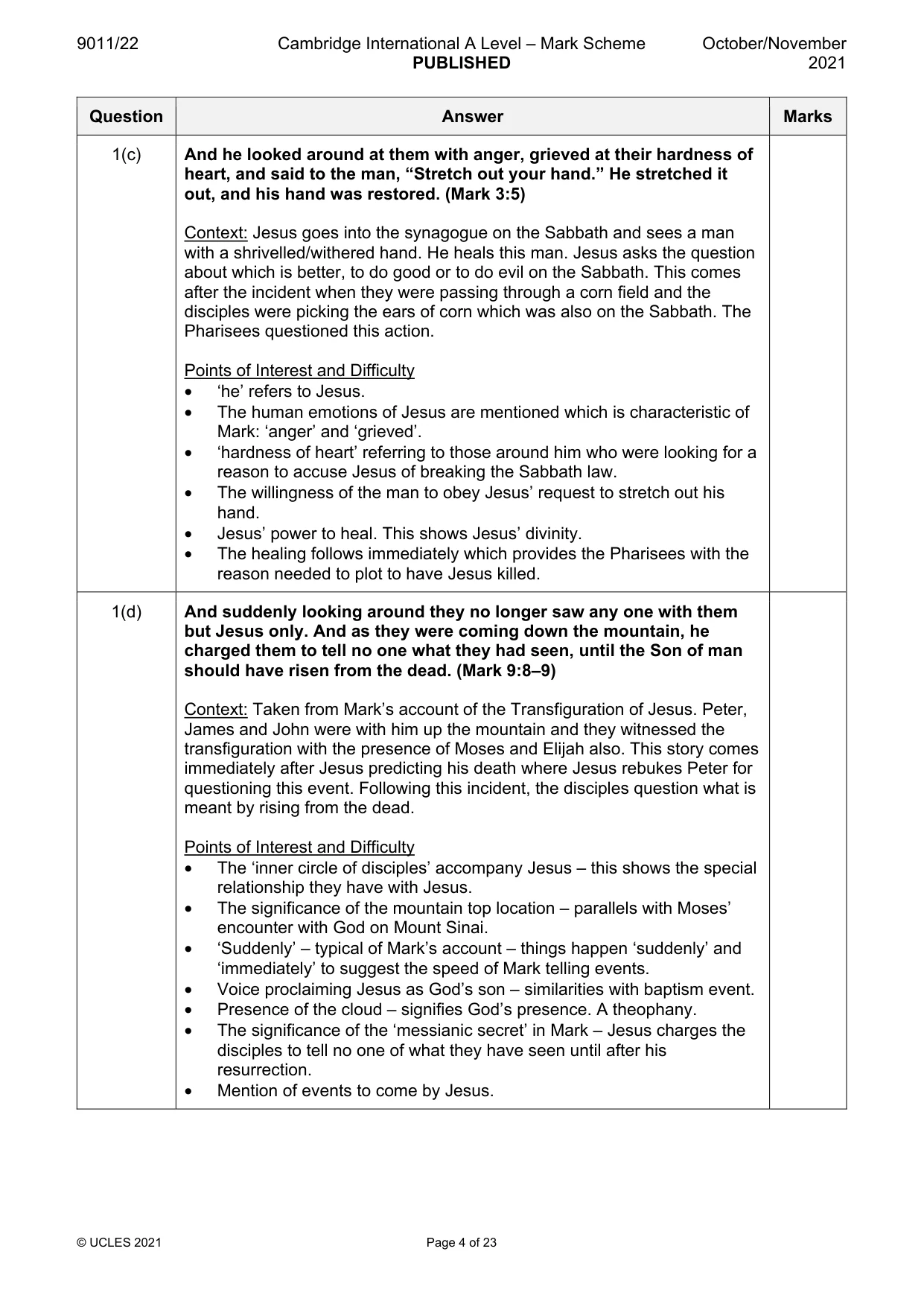
9011/22 Cambridge International A Level – Mark Scheme PUBLISHED October/November 2021 © UCLES 2021 Page 4 of 23 Question Answer Marks 1(c) And he looked around at them with anger, grieved at their hardness of heart, and said to the man, “Stretch out your hand.” He stretched it out, and his hand was restored. (Mark 3:5) Context: Jesus goes into the synagogue on the Sabbath and sees a man with a shrivelled/withered hand. He heals this man. Jesus asks the question about which is better, to do good or to do evil on the Sabbath. This comes after the incident when they were passing through a corn field and the disciples were picking the ears of corn which was also on the Sabbath. The Pharisees questioned this action. Points of Interest and Difficulty • ‘he’ refers to Jesus. • The human emotions of Jesus are mentioned which is characteristic of Mark: ‘anger’ and ‘grieved’. • ‘hardness of heart’ referring to those around him who were looking for a reason to accuse Jesus of breaking the Sabbath law. • The willingness of the man to obey Jesus’ request to stretch out his hand. • Jesus’ power to heal. This shows Jesus’ divinity. • The healing follows immediately which provides the Pharisees with the reason needed to plot to have Jesus killed. 1(d) And suddenly looking around they no longer saw any one with them but Jesus only. And as they were coming down the mountain, he charged them to tell no one what they had seen, until the Son of man should have risen from the dead. (Mark 9:8–9) Context: Taken from Mark’s account of the Transfiguration of Jesus. Peter, James and John were with him up the mountain and they witnessed the transfiguration with the presence of Moses and Elijah also. This story comes immediately after Jesus predicting his death where Jesus rebukes Peter for questioning this event. Following this incident, the disciples question what is meant by rising from the dead. Points of Interest and Difficulty • The ‘inner circle of disciples’ accompany Jesus – this shows the special relationship they have with Jesus. • The significance of the mountain top location – parallels with Moses’ encounter with God on Mount Sinai. • ‘Suddenly’ – typical of Mark’s account – things happen ‘suddenly’ and ‘immediately’ to suggest the speed of Mark telling events. • Voice proclaiming Jesus as God’s son – similarities with baptism event. • Presence of the cloud – signifies God’s presence. A theophany. • The significance of the ‘messianic secret’ in Mark – Jesus charges the disciples to tell no one of what they have seen until after his resurrection. • Mention of events to come by Jesus.
Mark scheme, page 5
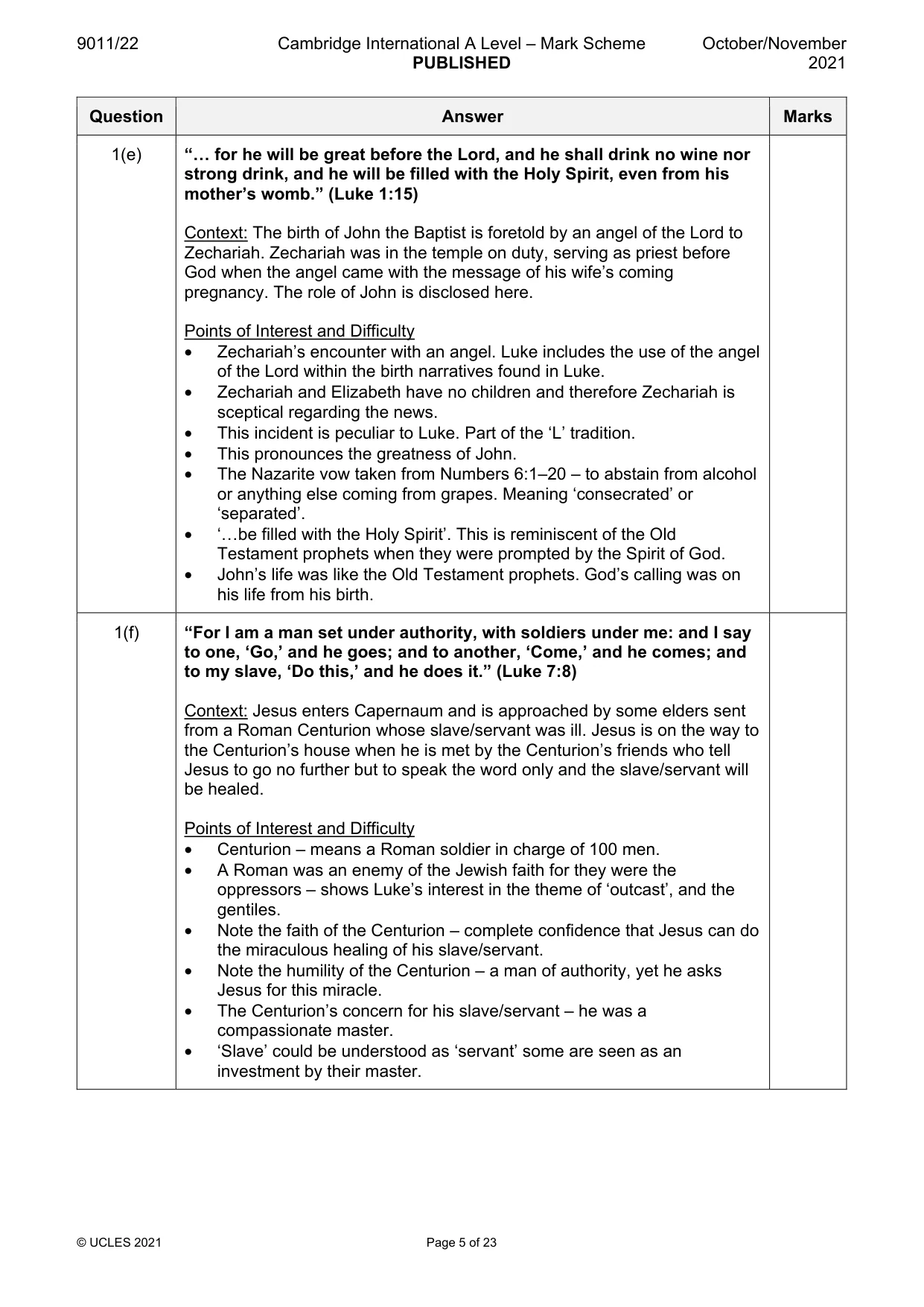
9011/22 Cambridge International A Level – Mark Scheme PUBLISHED October/November 2021 © UCLES 2021 Page 5 of 23 Question Answer Marks 1(e) “… for he will be great before the Lord, and he shall drink no wine nor strong drink, and he will be filled with the Holy Spirit, even from his mother’s womb.” (Luke 1:15) Context: The birth of John the Baptist is foretold by an angel of the Lord to Zechariah. Zechariah was in the temple on duty, serving as priest before God when the angel came with the message of his wife’s coming pregnancy. The role of John is disclosed here. Points of Interest and Difficulty • Zechariah’s encounter with an angel. Luke includes the use of the angel of the Lord within the birth narratives found in Luke. • Zechariah and Elizabeth have no children and therefore Zechariah is sceptical regarding the news. • This incident is peculiar to Luke. Part of the ‘L’ tradition. • This pronounces the greatness of John. • The Nazarite vow taken from Numbers 6:1–20 – to abstain from alcohol or anything else coming from grapes. Meaning ‘consecrated’ or ‘separated’. • ‘…be filled with the Holy Spirit’. This is reminiscent of the Old Testament prophets when they were prompted by the Spirit of God. • John’s life was like the Old Testament prophets. God’s calling was on his life from his birth. 1(f) “For I am a man set under authority, with soldiers under me: and I say to one, ‘Go,’ and he goes; and to another, ‘Come,’ and he comes; and to my slave, ‘Do this,’ and he does it.” (Luke 7:8) Context: Jesus enters Capernaum and is approached by some elders sent from a Roman Centurion whose slave/servant was ill. Jesus is on the way to the Centurion’s house when he is met by the Centurion’s friends who tell Jesus to go no further but to speak the word only and the slave/servant will be healed. Points of Interest and Difficulty • Centurion – means a Roman soldier in charge of 100 men. • A Roman was an enemy of the Jewish faith for they were the oppressors – shows Luke’s interest in the theme of ‘outcast’, and the gentiles. • Note the faith of the Centurion – complete confidence that Jesus can do the miraculous healing of his slave/servant. • Note the humility of the Centurion – a man of authority, yet he asks Jesus for this miracle. • The Centurion’s concern for his slave/servant – he was a compassionate master. • ‘Slave’ could be understood as ‘servant’ some are seen as an investment by their master.
Mark scheme, page 6
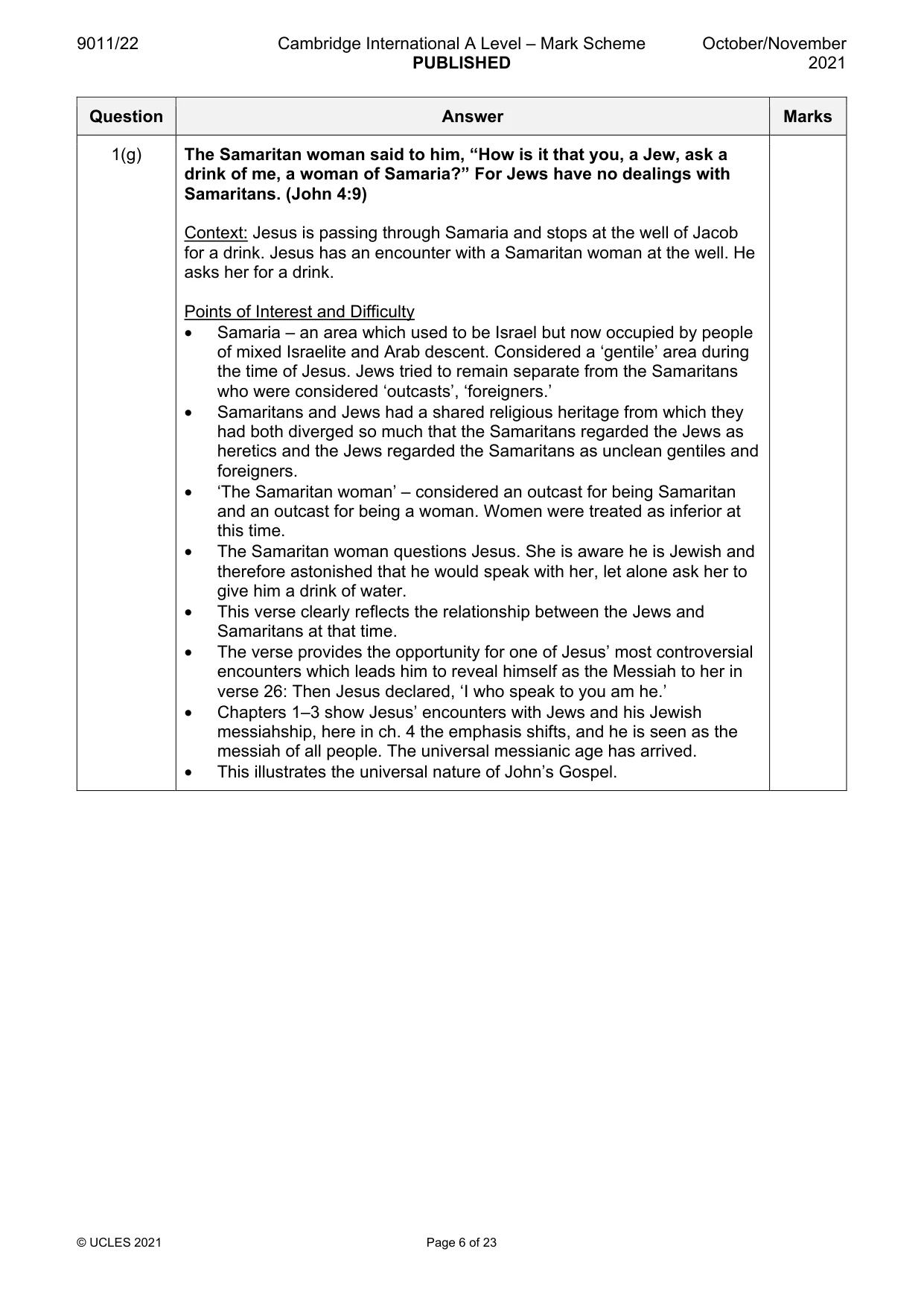
9011/22 Cambridge International A Level – Mark Scheme PUBLISHED October/November 2021 © UCLES 2021 Page 6 of 23 Question Answer Marks 1(g) The Samaritan woman said to him, “How is it that you, a Jew, ask a drink of me, a woman of Samaria?” For Jews have no dealings with Samaritans. (John 4:9) Context: Jesus is passing through Samaria and stops at the well of Jacob for a drink. Jesus has an encounter with a Samaritan woman at the well. He asks her for a drink. Points of Interest and Difficulty • Samaria – an area which used to be Israel but now occupied by people of mixed Israelite and Arab descent. Considered a ‘gentile’ area during the time of Jesus. Jews tried to remain separate from the Samaritans who were considered ‘outcasts’, ‘foreigners.’ • Samaritans and Jews had a shared religious heritage from which they had both diverged so much that the Samaritans regarded the Jews as heretics and the Jews regarded the Samaritans as unclean gentiles and foreigners. • ‘The Samaritan woman’ – considered an outcast for being Samaritan and an outcast for being a woman. Women were treated as inferior at this time. • The Samaritan woman questions Jesus. She is aware he is Jewish and therefore astonished that he would speak with her, let alone ask her to give him a drink of water. • This verse clearly reflects the relationship between the Jews and Samaritans at that time. • The verse provides the opportunity for one of Jesus’ most controversial encounters which leads him to reveal himself as the Messiah to her in verse 26: Then Jesus declared, ‘I who speak to you am he.’ • Chapters 1–3 show Jesus’ encounters with Jews and his Jewish messiahship, here in ch. 4 the emphasis shifts, and he is seen as the messiah of all people. The universal messianic age has arrived. • This illustrates the universal nature of John’s Gospel.
Mark scheme, page 7
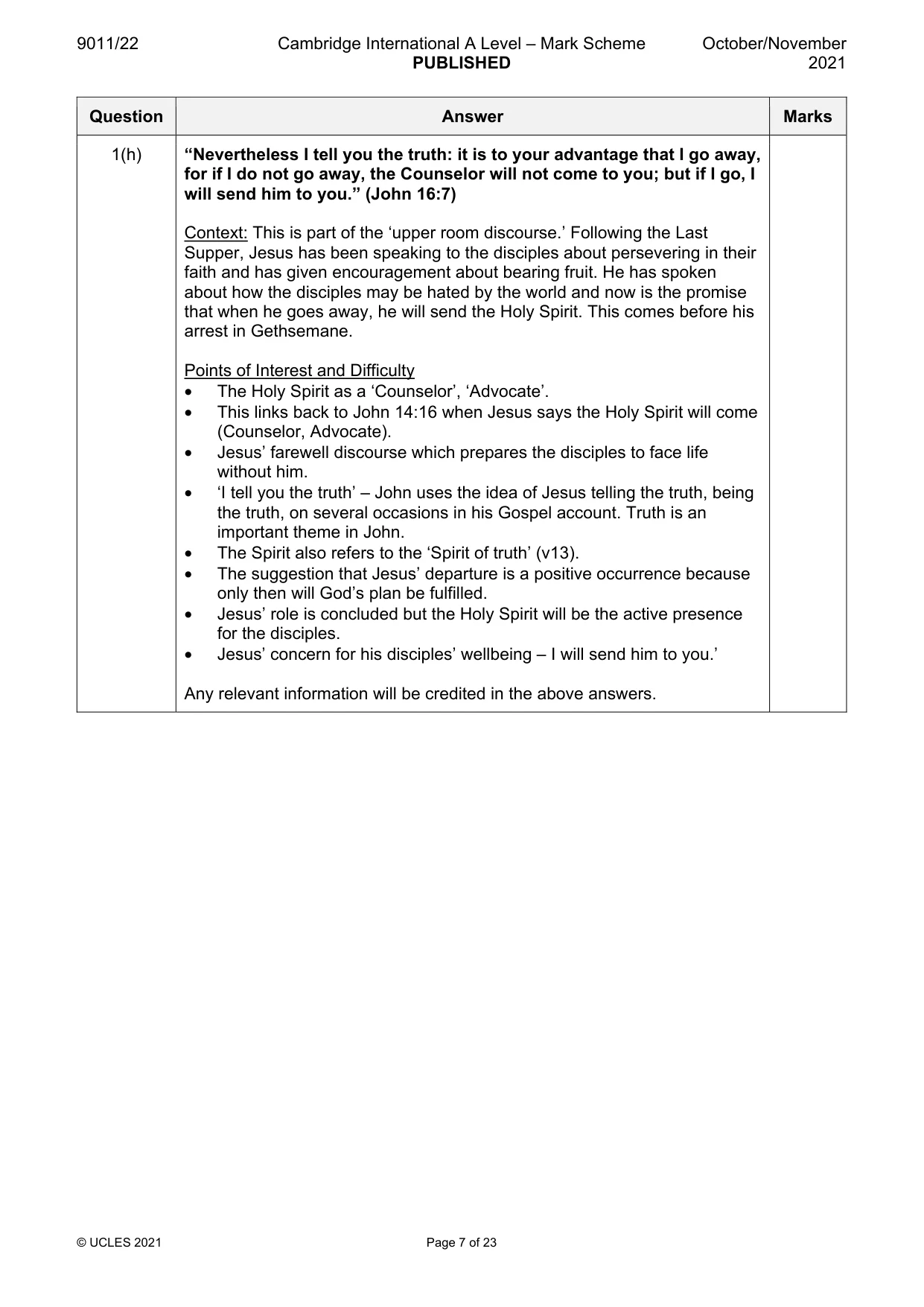
9011/22 Cambridge International A Level – Mark Scheme PUBLISHED October/November 2021 © UCLES 2021 Page 7 of 23 Question Answer Marks 1(h) “Nevertheless I tell you the truth: it is to your advantage that I go away, for if I do not go away, the Counselor will not come to you; but if I go, I will send him to you.” (John 16:7) Context: This is part of the ‘upper room discourse.’ Following the Last Supper, Jesus has been speaking to the disciples about persevering in their faith and has given encouragement about bearing fruit. He has spoken about how the disciples may be hated by the world and now is the promise that when he goes away, he will send the Holy Spirit. This comes before his arrest in Gethsemane. Points of Interest and Difficulty • The Holy Spirit as a ‘Counselor’, ‘Advocate’. • This links back to John 14:16 when Jesus says the Holy Spirit will come (Counselor, Advocate). • Jesus’ farewell discourse which prepares the disciples to face life without him. • ‘I tell you the truth’ – John uses the idea of Jesus telling the truth, being the truth, on several occasions in his Gospel account. Truth is an important theme in John. • The Spirit also refers to the ‘Spirit of truth’ (v13). • The suggestion that Jesus’ departure is a positive occurrence because only then will God’s plan be fulfilled. • Jesus’ role is concluded but the Holy Spirit will be the active presence for the disciples. • Jesus’ concern for his disciples’ wellbeing – I will send him to you.’ Any relevant information will be credited in the above answers.
Mark scheme, page 8
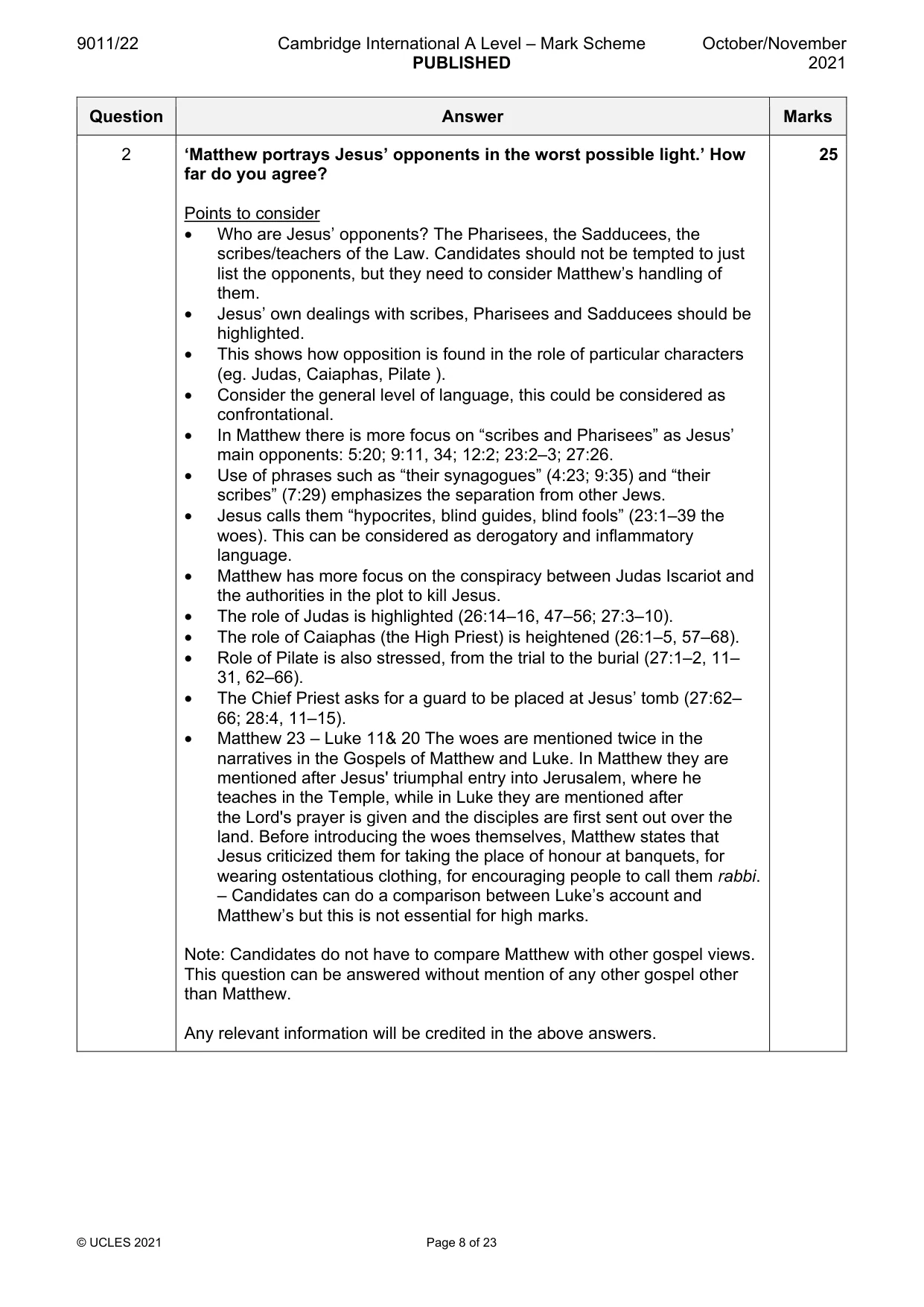
9011/22 Cambridge International A Level – Mark Scheme PUBLISHED October/November 2021 © UCLES 2021 Page 8 of 23 Question Answer Marks 2 ‘Matthew portrays Jesus’ opponents in the worst possible light.’ How far do you agree? Points to consider • Who are Jesus’ opponents? The Pharisees, the Sadducees, the scribes/teachers of the Law. Candidates should not be tempted to just list the opponents, but they need to consider Matthew’s handling of them. • Jesus’ own dealings with scribes, Pharisees and Sadducees should be highlighted. • This shows how opposition is found in the role of particular characters (eg. Judas, Caiaphas, Pilate ). • Consider the general level of language, this could be considered as confrontational. • In Matthew there is more focus on “scribes and Pharisees” as Jesus’ main opponents: 5:20; 9:11, 34; 12:2; 23:2–3; 27:26. • Use of phrases such as “their synagogues” (4:23; 9:35) and “their scribes” (7:29) emphasizes the separation from other Jews. • Jesus calls them “hypocrites, blind guides, blind fools” (23:1–39 the woes). This can be considered as derogatory and inflammatory language. • Matthew has more focus on the conspiracy between Judas Iscariot and the authorities in the plot to kill Jesus. • The role of Judas is highlighted (26:14–16, 47–56; 27:3–10). • The role of Caiaphas (the High Priest) is heightened (26:1–5, 57–68). • Role of Pilate is also stressed, from the trial to the burial (27:1–2, 11– 31, 62–66). • The Chief Priest asks for a guard to be placed at Jesus’ tomb (27:62– 66; 28:4, 11–15). • Matthew 23 – Luke 11& 20 The woes are mentioned twice in the narratives in the Gospels of Matthew and Luke. In Matthew they are mentioned after Jesus' triumphal entry into Jerusalem, where he teaches in the Temple, while in Luke they are mentioned after the Lord's prayer is given and the disciples are first sent out over the land. Before introducing the woes themselves, Matthew states that Jesus criticized them for taking the place of honour at banquets, for wearing ostentatious clothing, for encouraging people to call them rabbi. – Candidates can do a comparison between Luke’s account and Matthew’s but this is not essential for high marks. Note: Candidates do not have to compare Matthew with other gospel views. This question can be answered without mention of any other gospel other than Matthew. Any relevant information will be credited in the above answers. 25
Mark scheme, page 9
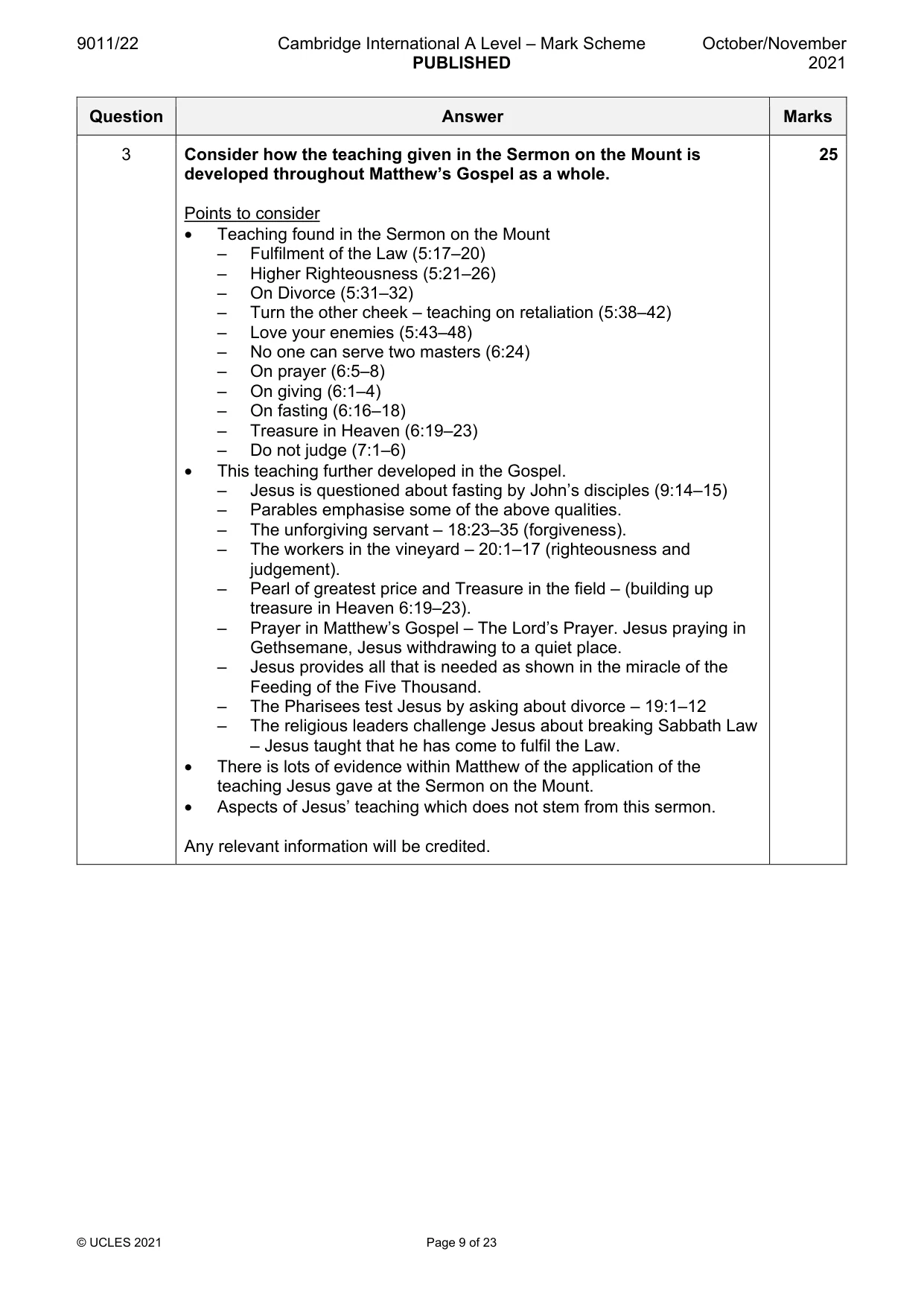
9011/22 Cambridge International A Level – Mark Scheme PUBLISHED October/November 2021 © UCLES 2021 Page 9 of 23 Question Answer Marks 3 Consider how the teaching given in the Sermon on the Mount is developed throughout Matthew’s Gospel as a whole. Points to consider • Teaching found in the Sermon on the Mount – Fulfilment of the Law (5:17–20) – Higher Righteousness (5:21–26) – On Divorce (5:31–32) – Turn the other cheek – teaching on retaliation (5:38–42) – Love your enemies (5:43–48) – No one can serve two masters (6:24) – On prayer (6:5–8) – On giving (6:1–4) – On fasting (6:16–18) – Treasure in Heaven (6:19–23) – Do not judge (7:1–6) • This teaching further developed in the Gospel. – Jesus is questioned about fasting by John’s disciples (9:14–15) – Parables emphasise some of the above qualities. – The unforgiving servant – 18:23–35 (forgiveness). – The workers in the vineyard – 20:1–17 (righteousness and judgement). – Pearl of greatest price and Treasure in the field – (building up treasure in Heaven 6:19–23). – Prayer in Matthew’s Gospel – The Lord’s Prayer. Jesus praying in Gethsemane, Jesus withdrawing to a quiet place. – Jesus provides all that is needed as shown in the miracle of the Feeding of the Five Thousand. – The Pharisees test Jesus by asking about divorce – 19:1–12 – The religious leaders challenge Jesus about breaking Sabbath Law – Jesus taught that he has come to fulfil the Law. • There is lots of evidence within Matthew of the application of the teaching Jesus gave at the Sermon on the Mount. • Aspects of Jesus’ teaching which does not stem from this sermon. Any relevant information will be credited. 25
Mark scheme, page 10
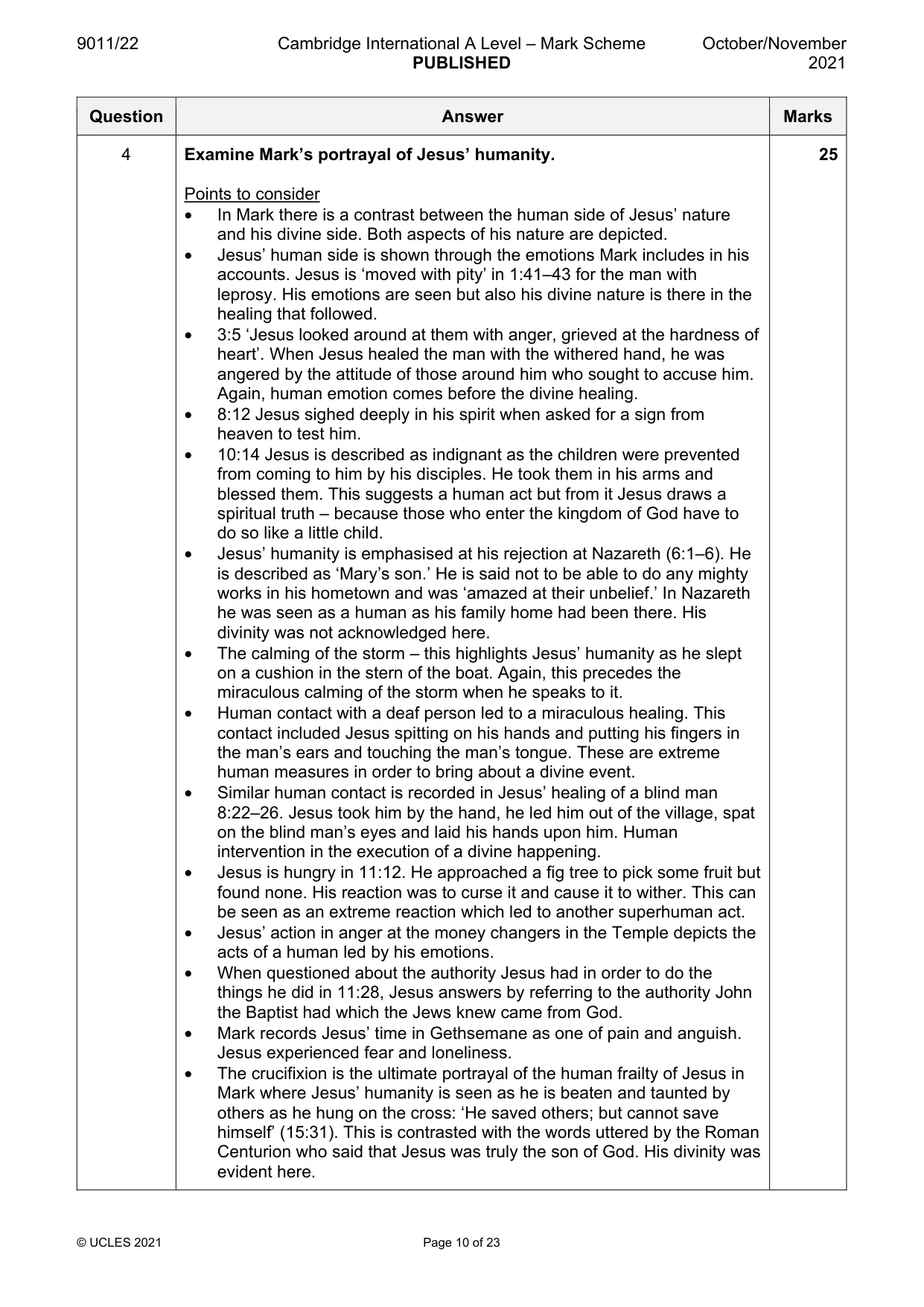
9011/22 Cambridge International A Level – Mark Scheme PUBLISHED October/November 2021 © UCLES 2021 Page 10 of 23 Question Answer Marks 4 Examine Mark’s portrayal of Jesus’ humanity. Points to consider • In Mark there is a contrast between the human side of Jesus’ nature and his divine side. Both aspects of his nature are depicted. • Jesus’ human side is shown through the emotions Mark includes in his accounts. Jesus is ‘moved with pity’ in 1:41–43 for the man with leprosy. His emotions are seen but also his divine nature is there in the healing that followed. • 3:5 ‘Jesus looked around at them with anger, grieved at the hardness of heart’. When Jesus healed the man with the withered hand, he was angered by the attitude of those around him who sought to accuse him. Again, human emotion comes before the divine healing. • 8:12 Jesus sighed deeply in his spirit when asked for a sign from heaven to test him. • 10:14 Jesus is described as indignant as the children were prevented from coming to him by his disciples. He took them in his arms and blessed them. This suggests a human act but from it Jesus draws a spiritual truth – because those who enter the kingdom of God have to do so like a little child. • Jesus’ humanity is emphasised at his rejection at Nazareth (6:1–6). He is described as ‘Mary’s son.’ He is said not to be able to do any mighty works in his hometown and was ‘amazed at their unbelief.’ In Nazareth he was seen as a human as his family home had been there. His divinity was not acknowledged here. • The calming of the storm – this highlights Jesus’ humanity as he slept on a cushion in the stern of the boat. Again, this precedes the miraculous calming of the storm when he speaks to it. • Human contact with a deaf person led to a miraculous healing. This contact included Jesus spitting on his hands and putting his fingers in the man’s ears and touching the man’s tongue. These are extreme human measures in order to bring about a divine event. • Similar human contact is recorded in Jesus’ healing of a blind man 8:22–26. Jesus took him by the hand, he led him out of the village, spat on the blind man’s eyes and laid his hands upon him. Human intervention in the execution of a divine happening. • Jesus is hungry in 11:12. He approached a fig tree to pick some fruit but found none. His reaction was to curse it and cause it to wither. This can be seen as an extreme reaction which led to another superhuman act. • Jesus’ action in anger at the money changers in the Temple depicts the acts of a human led by his emotions. • When questioned about the authority Jesus had in order to do the things he did in 11:28, Jesus answers by referring to the authority John the Baptist had which the Jews knew came from God. • Mark records Jesus’ time in Gethsemane as one of pain and anguish. Jesus experienced fear and loneliness. • The crucifixion is the ultimate portrayal of the human frailty of Jesus in Mark where Jesus’ humanity is seen as he is beaten and taunted by others as he hung on the cross: ‘He saved others; but cannot save himself’ (15:31). This is contrasted with the words uttered by the Roman Centurion who said that Jesus was truly the son of God. His divinity was evident here. 25
Mark scheme, page 11
9011/22 Cambridge International A Level – Mark Scheme PUBLISHED October/November 2021 © UCLES 2021 Page 11 of 23 Question Answer Marks 4 • Throughout Mark there are many examples of Jesus being depicted as truly human through his actions and his emotions. These stand in direct contrast to the divinity of Jesus which is also seen in Mark through his encounter with God and the miracles he did. • Both aspects of Jesus’ character are of significance in this Gospel. There is not a hard and fast division between humanity and divinity, but that they are united in Christ. Any relevant information will be credited.
Mark scheme, page 12
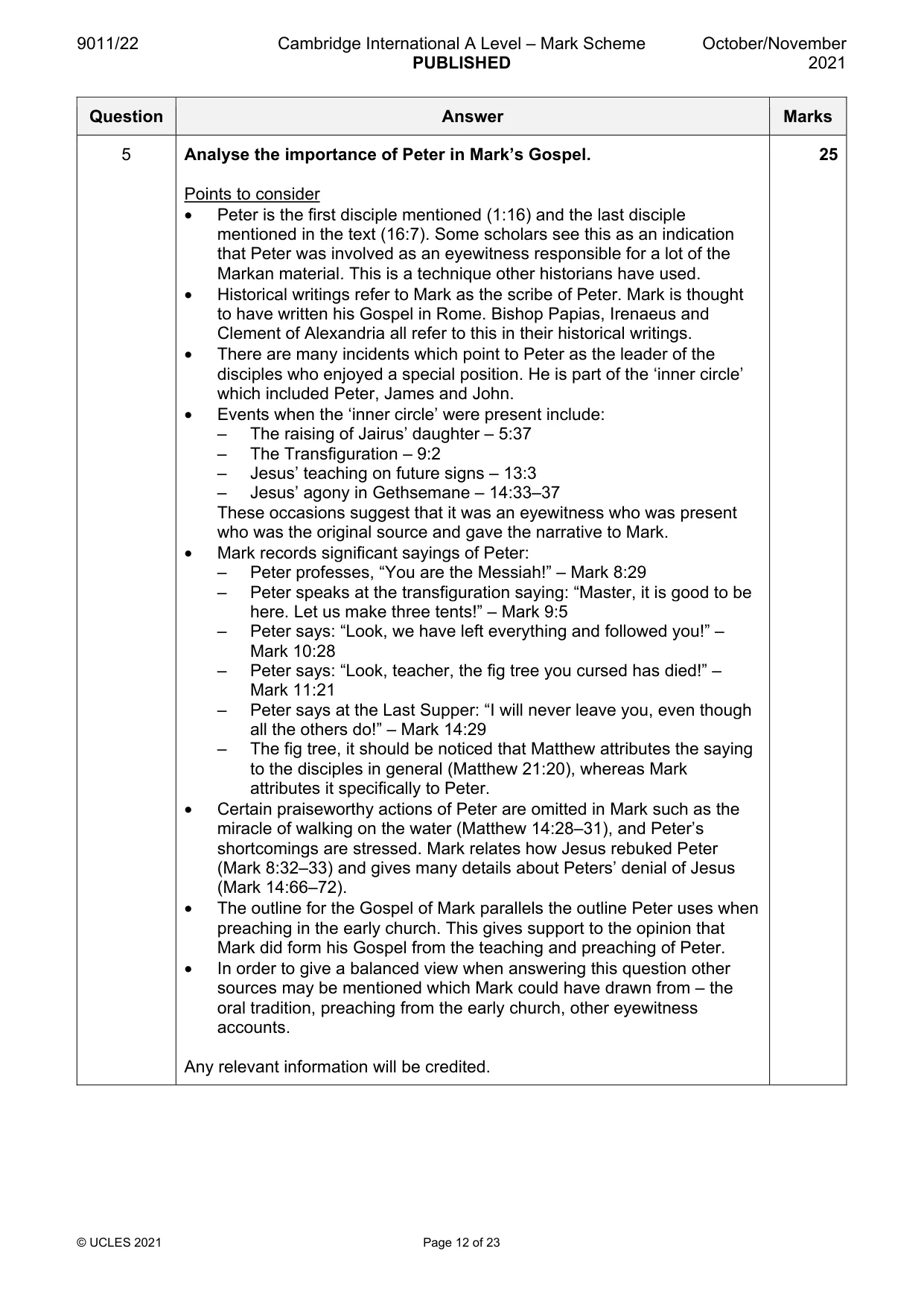
9011/22 Cambridge International A Level – Mark Scheme PUBLISHED October/November 2021 © UCLES 2021 Page 12 of 23 Question Answer Marks 5 Analyse the importance of Peter in Mark’s Gospel. Points to consider • Peter is the first disciple mentioned (1:16) and the last disciple mentioned in the text (16:7). Some scholars see this as an indication that Peter was involved as an eyewitness responsible for a lot of the Markan material. This is a technique other historians have used. • Historical writings refer to Mark as the scribe of Peter. Mark is thought to have written his Gospel in Rome. Bishop Papias, Irenaeus and Clement of Alexandria all refer to this in their historical writings. • There are many incidents which point to Peter as the leader of the disciples who enjoyed a special position. He is part of the ‘inner circle’ which included Peter, James and John. • Events when the ‘inner circle’ were present include: – The raising of Jairus’ daughter – 5:37 – The Transfiguration – 9:2 – Jesus’ teaching on future signs – 13:3 – Jesus’ agony in Gethsemane – 14:33–37 These occasions suggest that it was an eyewitness who was present who was the original source and gave the narrative to Mark. • Mark records significant sayings of Peter: – Peter professes, “You are the Messiah!” – Mark 8:29 – Peter speaks at the transfiguration saying: “Master, it is good to be here. Let us make three tents!” – Mark 9:5 – Peter says: “Look, we have left everything and followed you!” – Mark 10:28 – Peter says: “Look, teacher, the fig tree you cursed has died!” – Mark 11:21 – Peter says at the Last Supper: “I will never leave you, even though all the others do!” – Mark 14:29 – The fig tree, it should be noticed that Matthew attributes the saying to the disciples in general (Matthew 21:20), whereas Mark attributes it specifically to Peter. • Certain praiseworthy actions of Peter are omitted in Mark such as the miracle of walking on the water (Matthew 14:28–31), and Peter’s shortcomings are stressed. Mark relates how Jesus rebuked Peter (Mark 8:32–33) and gives many details about Peters’ denial of Jesus (Mark 14:66–72). • The outline for the Gospel of Mark parallels the outline Peter uses when preaching in the early church. This gives support to the opinion that Mark did form his Gospel from the teaching and preaching of Peter. • In order to give a balanced view when answering this question other sources may be mentioned which Mark could have drawn from – the oral tradition, preaching from the early church, other eyewitness accounts. Any relevant information will be credited. 25
Mark scheme, page 13
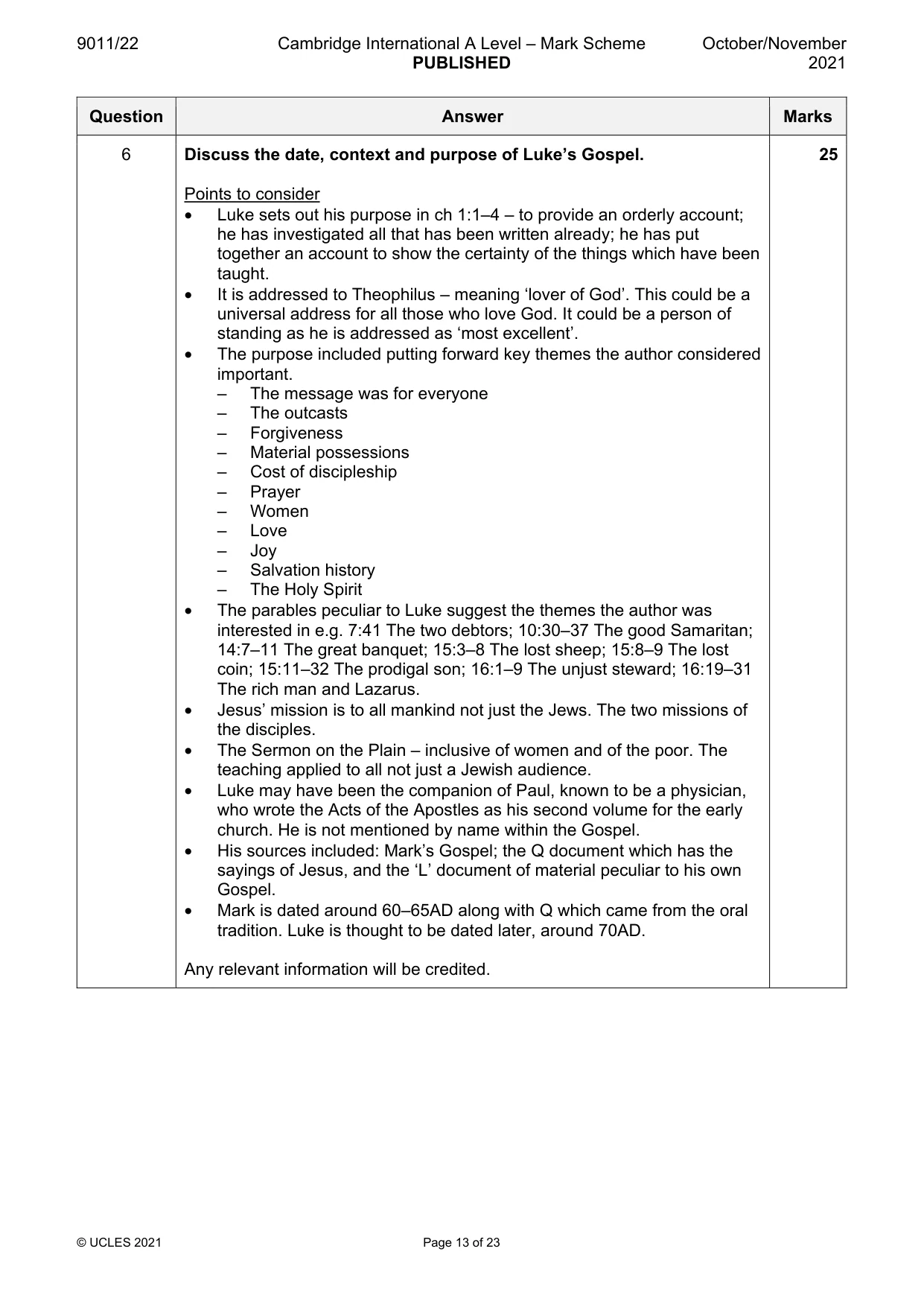
9011/22 Cambridge International A Level – Mark Scheme PUBLISHED October/November 2021 © UCLES 2021 Page 13 of 23 Question Answer Marks 6 Discuss the date, context and purpose of Luke’s Gospel. Points to consider • Luke sets out his purpose in ch 1:1–4 – to provide an orderly account; he has investigated all that has been written already; he has put together an account to show the certainty of the things which have been taught. • It is addressed to Theophilus – meaning ‘lover of God’. This could be a universal address for all those who love God. It could be a person of standing as he is addressed as ‘most excellent’. • The purpose included putting forward key themes the author considered important. – The message was for everyone – The outcasts – Forgiveness – Material possessions – Cost of discipleship – Prayer – Women – Love – Joy – Salvation history – The Holy Spirit • The parables peculiar to Luke suggest the themes the author was interested in e.g. 7:41 The two debtors; 10:30–37 The good Samaritan; 14:7–11 The great banquet; 15:3–8 The lost sheep; 15:8–9 The lost coin; 15:11–32 The prodigal son; 16:1–9 The unjust steward; 16:19–31 The rich man and Lazarus. • Jesus’ mission is to all mankind not just the Jews. The two missions of the disciples. • The Sermon on the Plain – inclusive of women and of the poor. The teaching applied to all not just a Jewish audience. • Luke may have been the companion of Paul, known to be a physician, who wrote the Acts of the Apostles as his second volume for the early church. He is not mentioned by name within the Gospel. • His sources included: Mark’s Gospel; the Q document which has the sayings of Jesus, and the ‘L’ document of material peculiar to his own Gospel. • Mark is dated around 60–65AD along with Q which came from the oral tradition. Luke is thought to be dated later, around 70AD. Any relevant information will be credited. 25
Mark scheme, page 14
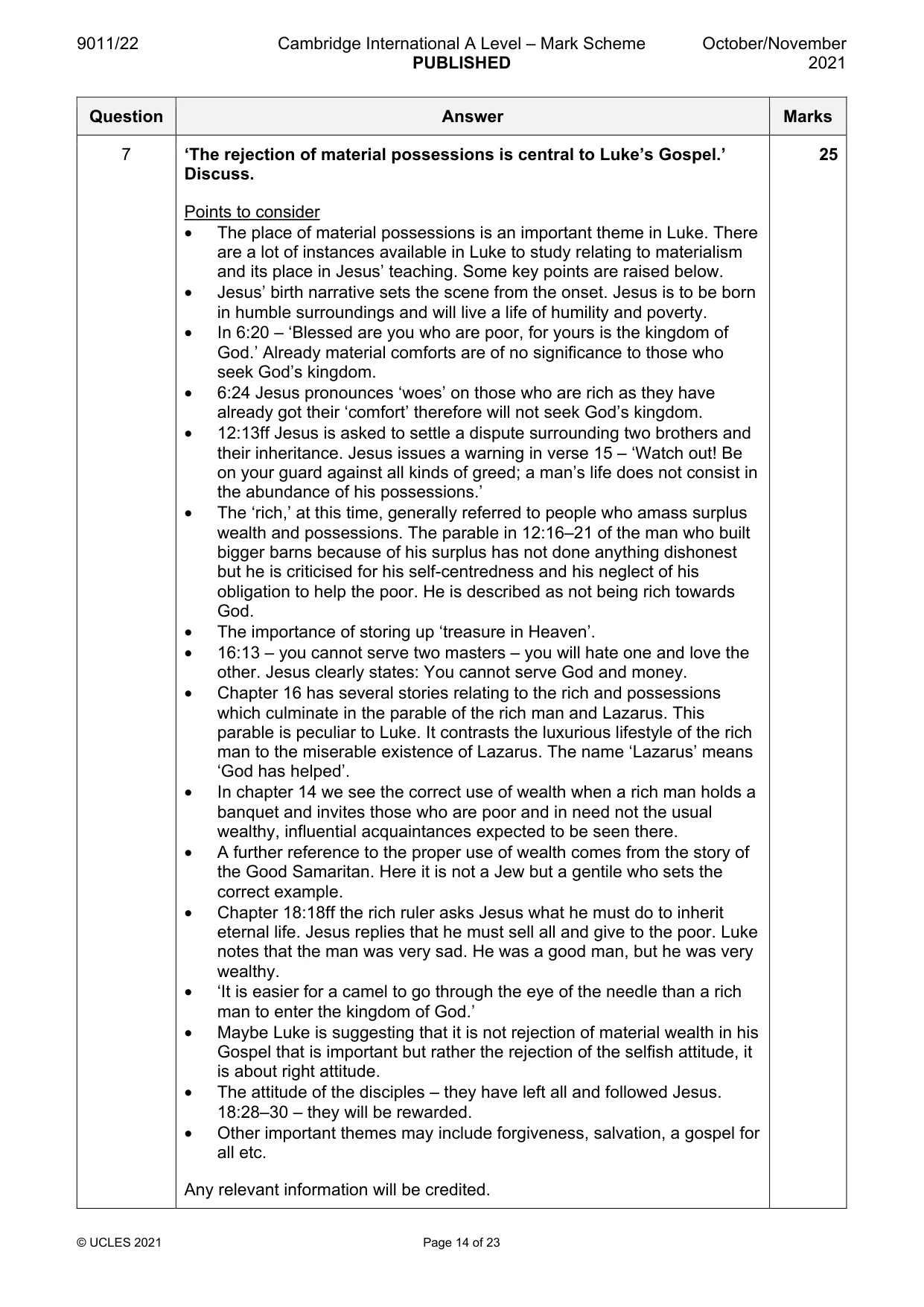
9011/22 Cambridge International A Level – Mark Scheme PUBLISHED October/November 2021 © UCLES 2021 Page 14 of 23 Question Answer Marks 7 ‘The rejection of material possessions is central to Luke’s Gospel.’ Discuss. Points to consider • The place of material possessions is an important theme in Luke. There are a lot of instances available in Luke to study relating to materialism and its place in Jesus’ teaching. Some key points are raised below. • Jesus’ birth narrative sets the scene from the onset. Jesus is to be born in humble surroundings and will live a life of humility and poverty. • In 6:20 – ‘Blessed are you who are poor, for yours is the kingdom of God.’ Already material comforts are of no significance to those who seek God’s kingdom. • 6:24 Jesus pronounces ‘woes’ on those who are rich as they have already got their ‘comfort’ therefore will not seek God’s kingdom. • 12:13ff Jesus is asked to settle a dispute surrounding two brothers and their inheritance. Jesus issues a warning in verse 15 – ‘Watch out! Be on your guard against all kinds of greed; a man’s life does not consist in the abundance of his possessions.’ • The ‘rich,’ at this time, generally referred to people who amass surplus wealth and possessions. The parable in 12:16–21 of the man who built bigger barns because of his surplus has not done anything dishonest but he is criticised for his self-centredness and his neglect of his obligation to help the poor. He is described as not being rich towards God. • The importance of storing up ‘treasure in Heaven’. • 16:13 – you cannot serve two masters – you will hate one and love the other. Jesus clearly states: You cannot serve God and money. • Chapter 16 has several stories relating to the rich and possessions which culminate in the parable of the rich man and Lazarus. This parable is peculiar to Luke. It contrasts the luxurious lifestyle of the rich man to the miserable existence of Lazarus. The name ‘Lazarus’ means ‘God has helped’. • In chapter 14 we see the correct use of wealth when a rich man holds a banquet and invites those who are poor and in need not the usual wealthy, influential acquaintances expected to be seen there. • A further reference to the proper use of wealth comes from the story of the Good Samaritan. Here it is not a Jew but a gentile who sets the correct example. • Chapter 18:18ff the rich ruler asks Jesus what he must do to inherit eternal life. Jesus replies that he must sell all and give to the poor. Luke notes that the man was very sad. He was a good man, but he was very wealthy. • ‘It is easier for a camel to go through the eye of the needle than a rich man to enter the kingdom of God.’ • Maybe Luke is suggesting that it is not rejection of material wealth in his Gospel that is important but rather the rejection of the selfish attitude, it is about right attitude. • The attitude of the disciples – they have left all and followed Jesus. 18:28–30 – they will be rewarded. • Other important themes may include forgiveness, salvation, a gospel for all etc. Any relevant information will be credited. 25
Mark scheme, page 15
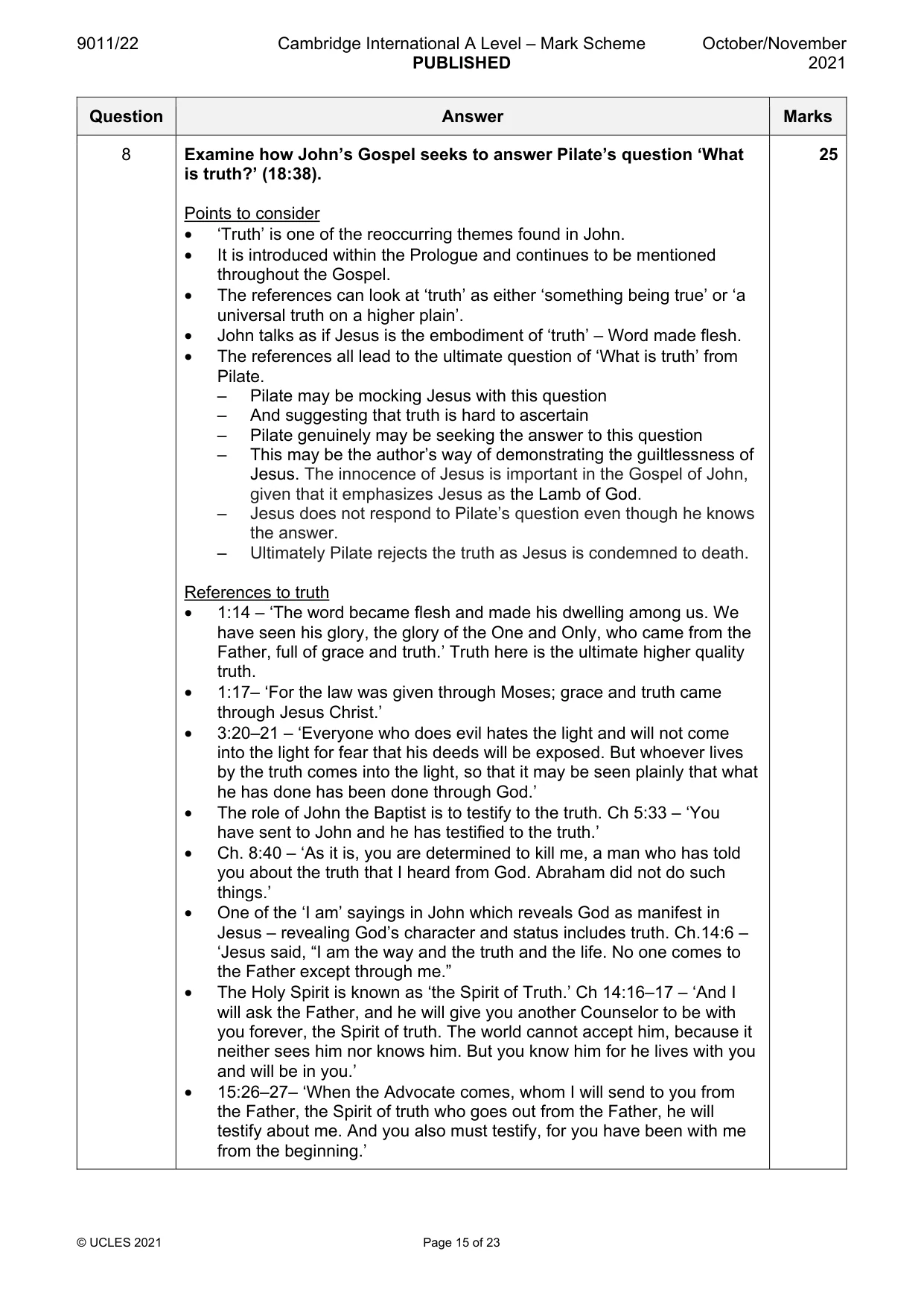
9011/22 Cambridge International A Level – Mark Scheme PUBLISHED October/November 2021 © UCLES 2021 Page 15 of 23 Question Answer Marks 8 Examine how John’s Gospel seeks to answer Pilate’s question ‘What is truth?’ (18:38). Points to consider • ‘Truth’ is one of the reoccurring themes found in John. • It is introduced within the Prologue and continues to be mentioned throughout the Gospel. • The references can look at ‘truth’ as either ‘something being true’ or ‘a universal truth on a higher plain’. • John talks as if Jesus is the embodiment of ‘truth’ – Word made flesh. • The references all lead to the ultimate question of ‘What is truth’ from Pilate. – Pilate may be mocking Jesus with this question – And suggesting that truth is hard to ascertain – Pilate genuinely may be seeking the answer to this question – This may be the author’s way of demonstrating the guiltlessness of Jesus. The innocence of Jesus is important in the Gospel of John, given that it emphasizes Jesus as the Lamb of God. – Jesus does not respond to Pilate’s question even though he knows the answer. – Ultimately Pilate rejects the truth as Jesus is condemned to death. References to truth • 1:14 – ‘The word became flesh and made his dwelling among us. We have seen his glory, the glory of the One and Only, who came from the Father, full of grace and truth.’ Truth here is the ultimate higher quality truth. • 1:17– ‘For the law was given through Moses; grace and truth came through Jesus Christ.’ • 3:20–21 – ‘Everyone who does evil hates the light and will not come into the light for fear that his deeds will be exposed. But whoever lives by the truth comes into the light, so that it may be seen plainly that what he has done has been done through God.’ • The role of John the Baptist is to testify to the truth. Ch 5:33 – ‘You have sent to John and he has testified to the truth.’ • Ch. 8:40 – ‘As it is, you are determined to kill me, a man who has told you about the truth that I heard from God. Abraham did not do such things.’ • One of the ‘I am’ sayings in John which reveals God as manifest in Jesus – revealing God’s character and status includes truth. Ch.14:6 – ‘Jesus said, “I am the way and the truth and the life. No one comes to the Father except through me.” • The Holy Spirit is known as ‘the Spirit of Truth.’ Ch 14:16–17 – ‘And I will ask the Father, and he will give you another Counselor to be with you forever, the Spirit of truth. The world cannot accept him, because it neither sees him nor knows him. But you know him for he lives with you and will be in you.’ • 15:26–27– ‘When the Advocate comes, whom I will send to you from the Father, the Spirit of truth who goes out from the Father, he will testify about me. And you also must testify, for you have been with me from the beginning.’ 25
Mark scheme, page 16
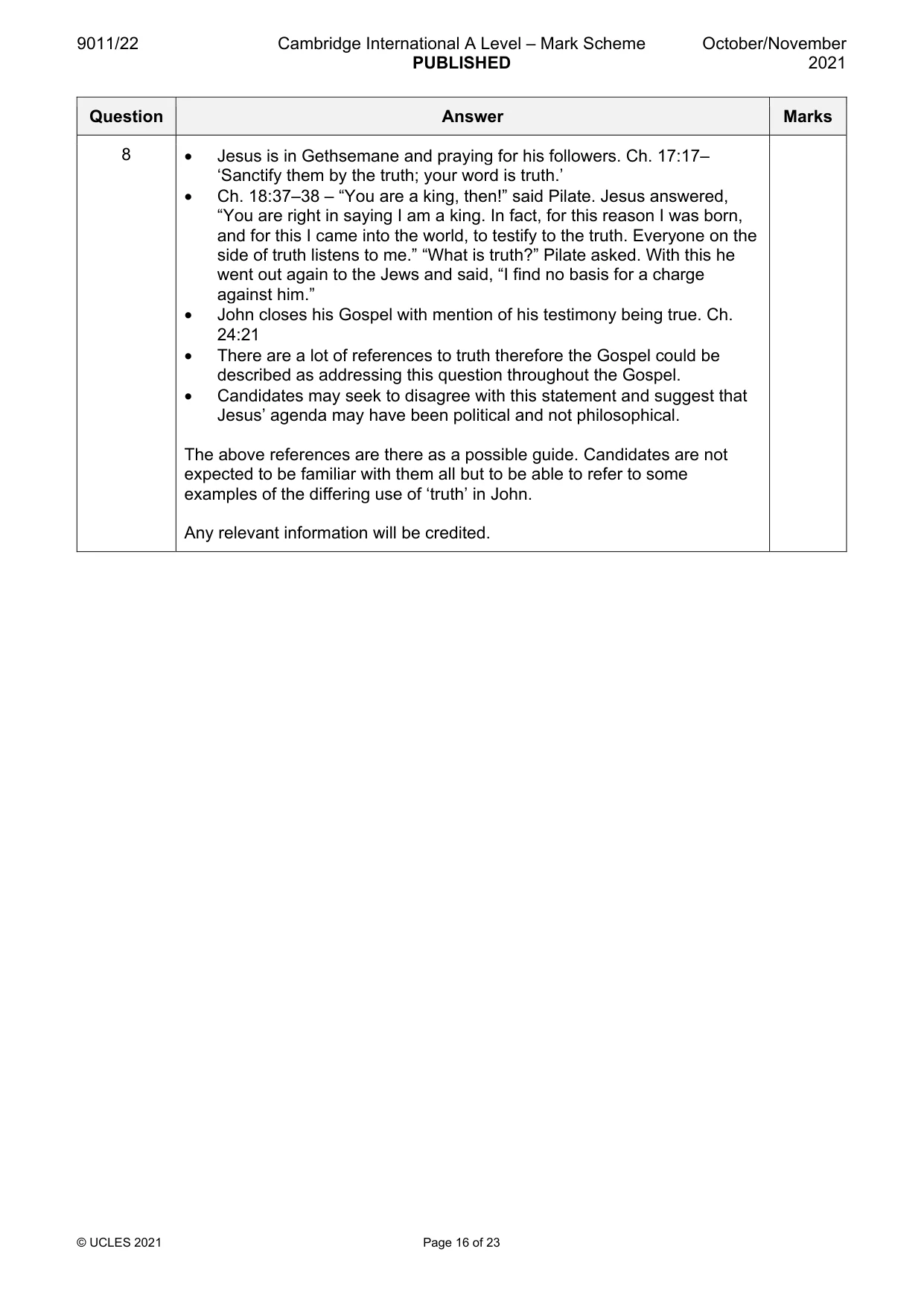
9011/22 Cambridge International A Level – Mark Scheme PUBLISHED October/November 2021 © UCLES 2021 Page 16 of 23 Question Answer Marks 8 • Jesus is in Gethsemane and praying for his followers. Ch. 17:17– ‘Sanctify them by the truth; your word is truth.’ • Ch. 18:37–38 – “You are a king, then!” said Pilate. Jesus answered, “You are right in saying I am a king. In fact, for this reason I was born, and for this I came into the world, to testify to the truth. Everyone on the side of truth listens to me.” “What is truth?” Pilate asked. With this he went out again to the Jews and said, “I find no basis for a charge against him.” • John closes his Gospel with mention of his testimony being true. Ch. 24:21 • There are a lot of references to truth therefore the Gospel could be described as addressing this question throughout the Gospel. • Candidates may seek to disagree with this statement and suggest that Jesus’ agenda may have been political and not philosophical. The above references are there as a possible guide. Candidates are not expected to be familiar with them all but to be able to refer to some examples of the differing use of ‘truth’ in John. Any relevant information will be credited.
Mark scheme, page 17
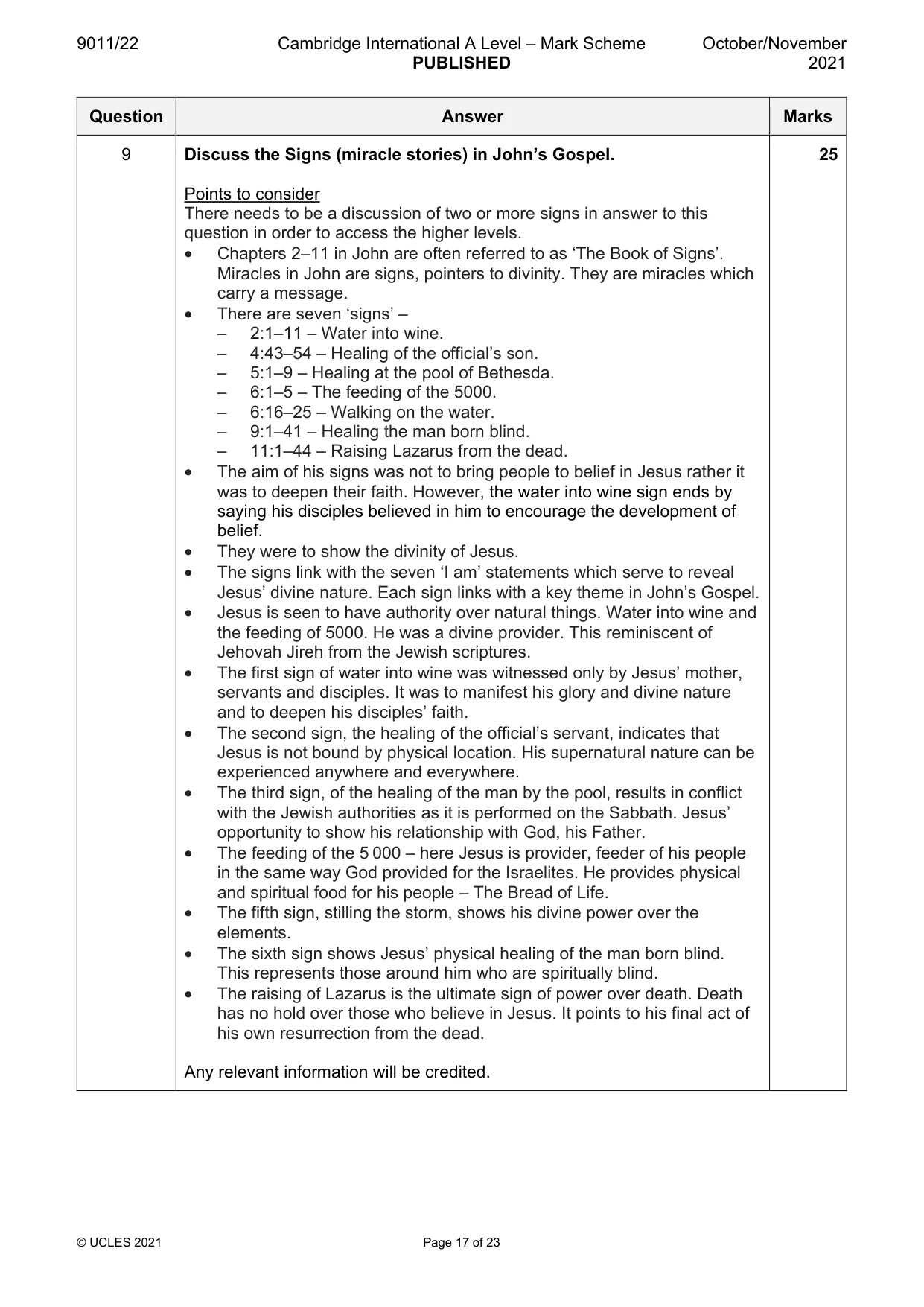
9011/22 Cambridge International A Level – Mark Scheme PUBLISHED October/November 2021 © UCLES 2021 Page 17 of 23 Question Answer Marks 9 Discuss the Signs (miracle stories) in John’s Gospel. Points to consider There needs to be a discussion of two or more signs in answer to this question in order to access the higher levels. • Chapters 2–11 in John are often referred to as ‘The Book of Signs’. Miracles in John are signs, pointers to divinity. They are miracles which carry a message. • There are seven ‘signs’ – – 2:1–11 – Water into wine. – 4:43–54 – Healing of the official’s son. – 5:1–9 – Healing at the pool of Bethesda. – 6:1–5 – The feeding of the 5000. – 6:16–25 – Walking on the water. – 9:1–41 – Healing the man born blind. – 11:1–44 – Raising Lazarus from the dead. • The aim of his signs was not to bring people to belief in Jesus rather it was to deepen their faith. However, the water into wine sign ends by saying his disciples believed in him to encourage the development of belief. • They were to show the divinity of Jesus. • The signs link with the seven ‘I am’ statements which serve to reveal Jesus’ divine nature. Each sign links with a key theme in John’s Gospel. • Jesus is seen to have authority over natural things. Water into wine and the feeding of 5000. He was a divine provider. This reminiscent of Jehovah Jireh from the Jewish scriptures. • The first sign of water into wine was witnessed only by Jesus’ mother, servants and disciples. It was to manifest his glory and divine nature and to deepen his disciples’ faith. • The second sign, the healing of the official’s servant, indicates that Jesus is not bound by physical location. His supernatural nature can be experienced anywhere and everywhere. • The third sign, of the healing of the man by the pool, results in conflict with the Jewish authorities as it is performed on the Sabbath. Jesus’ opportunity to show his relationship with God, his Father. • The feeding of the 5 000 – here Jesus is provider, feeder of his people in the same way God provided for the Israelites. He provides physical and spiritual food for his people – The Bread of Life. • The fifth sign, stilling the storm, shows his divine power over the elements. • The sixth sign shows Jesus’ physical healing of the man born blind. This represents those around him who are spiritually blind. • The raising of Lazarus is the ultimate sign of power over death. Death has no hold over those who believe in Jesus. It points to his final act of his own resurrection from the dead. Any relevant information will be credited. 25
Mark scheme, page 18
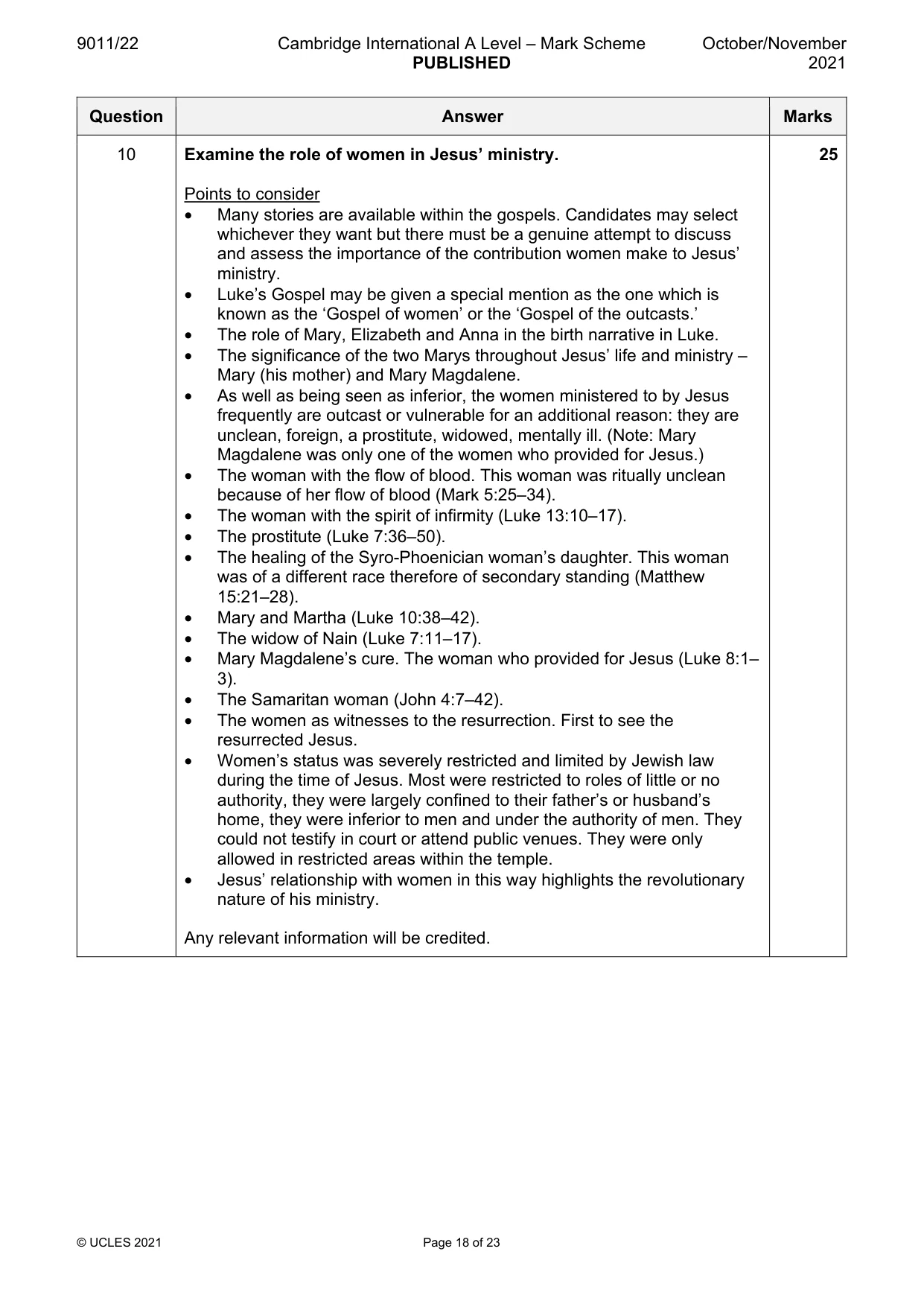
9011/22 Cambridge International A Level – Mark Scheme PUBLISHED October/November 2021 © UCLES 2021 Page 18 of 23 Question Answer Marks 10 Examine the role of women in Jesus’ ministry. Points to consider • Many stories are available within the gospels. Candidates may select whichever they want but there must be a genuine attempt to discuss and assess the importance of the contribution women make to Jesus’ ministry. • Luke’s Gospel may be given a special mention as the one which is known as the ‘Gospel of women’ or the ‘Gospel of the outcasts.’ • The role of Mary, Elizabeth and Anna in the birth narrative in Luke. • The significance of the two Marys throughout Jesus’ life and ministry – Mary (his mother) and Mary Magdalene. • As well as being seen as inferior, the women ministered to by Jesus frequently are outcast or vulnerable for an additional reason: they are unclean, foreign, a prostitute, widowed, mentally ill. (Note: Mary Magdalene was only one of the women who provided for Jesus.) • The woman with the flow of blood. This woman was ritually unclean because of her flow of blood (Mark 5:25–34). • The woman with the spirit of infirmity (Luke 13:10–17). • The prostitute (Luke 7:36–50). • The healing of the Syro-Phoenician woman’s daughter. This woman was of a different race therefore of secondary standing (Matthew 15:21–28). • Mary and Martha (Luke 10:38–42). • The widow of Nain (Luke 7:11–17). • Mary Magdalene’s cure. The woman who provided for Jesus (Luke 8:1– 3). • The Samaritan woman (John 4:7–42). • The women as witnesses to the resurrection. First to see the resurrected Jesus. • Women’s status was severely restricted and limited by Jewish law during the time of Jesus. Most were restricted to roles of little or no authority, they were largely confined to their father’s or husband’s home, they were inferior to men and under the authority of men. They could not testify in court or attend public venues. They were only allowed in restricted areas within the temple. • Jesus’ relationship with women in this way highlights the revolutionary nature of his ministry. Any relevant information will be credited. 25
Mark scheme, page 19
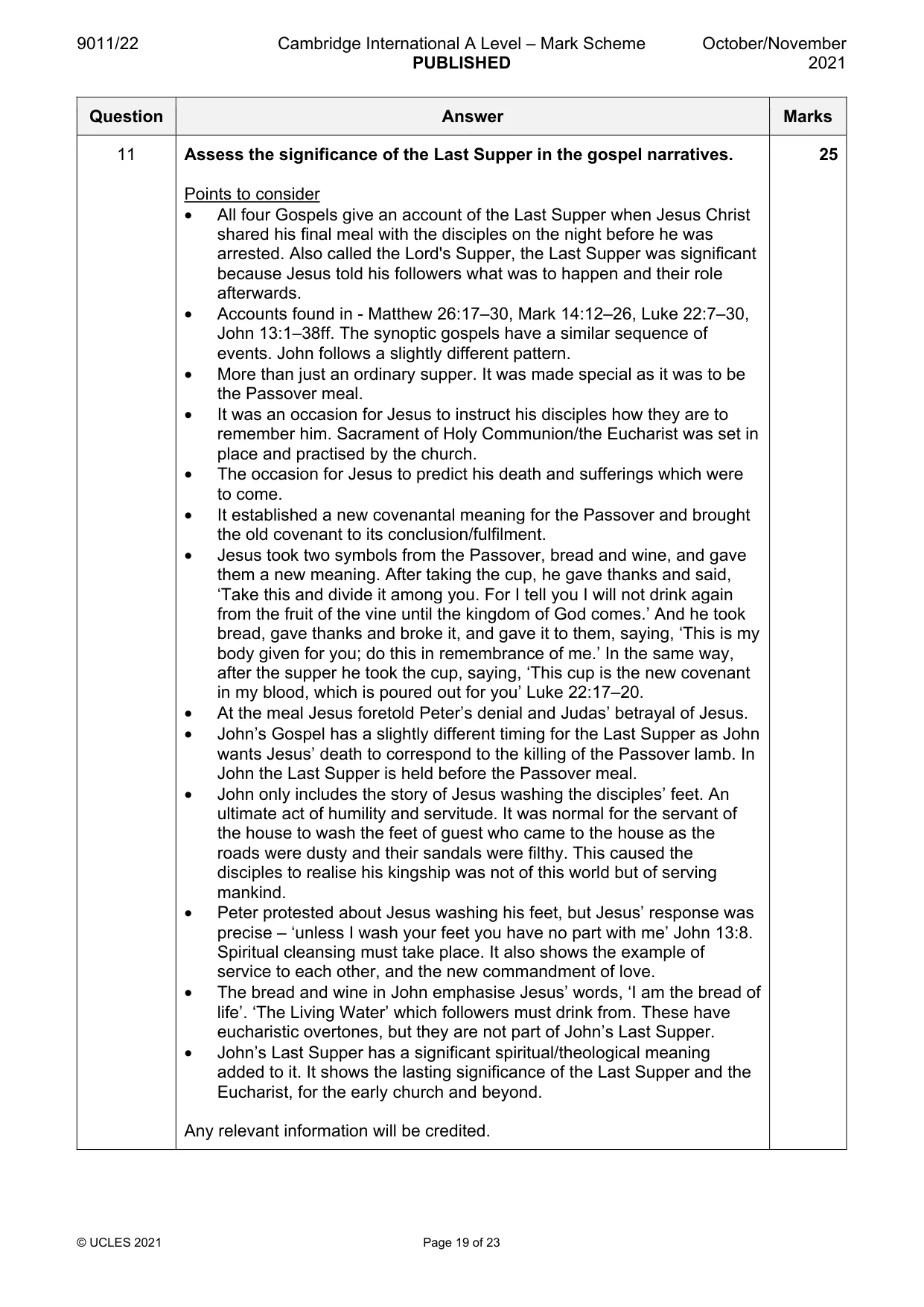
9011/22 Cambridge International A Level – Mark Scheme PUBLISHED October/November 2021 © UCLES 2021 Page 19 of 23 Question Answer Marks 11 Assess the significance of the Last Supper in the gospel narratives. Points to consider • All four Gospels give an account of the Last Supper when Jesus Christ shared his final meal with the disciples on the night before he was arrested. Also called the Lord's Supper, the Last Supper was significant because Jesus told his followers what was to happen and their role afterwards. • Accounts found in - Matthew 26:17–30, Mark 14:12–26, Luke 22:7–30, John 13:1–38ff. The synoptic gospels have a similar sequence of events. John follows a slightly different pattern. • More than just an ordinary supper. It was made special as it was to be the Passover meal. • It was an occasion for Jesus to instruct his disciples how they are to remember him. Sacrament of Holy Communion/the Eucharist was set in place and practised by the church. • The occasion for Jesus to predict his death and sufferings which were to come. • It established a new covenantal meaning for the Passover and brought the old covenant to its conclusion/fulfilment. • Jesus took two symbols from the Passover, bread and wine, and gave them a new meaning. After taking the cup, he gave thanks and said, ‘Take this and divide it among you. For I tell you I will not drink again from the fruit of the vine until the kingdom of God comes.’ And he took bread, gave thanks and broke it, and gave it to them, saying, ‘This is my body given for you; do this in remembrance of me.’ In the same way, after the supper he took the cup, saying, ‘This cup is the new covenant in my blood, which is poured out for you’ Luke 22:17–20. • At the meal Jesus foretold Peter’s denial and Judas’ betrayal of Jesus. • John’s Gospel has a slightly different timing for the Last Supper as John wants Jesus’ death to correspond to the killing of the Passover lamb. In John the Last Supper is held before the Passover meal. • John only includes the story of Jesus washing the disciples’ feet. An ultimate act of humility and servitude. It was normal for the servant of the house to wash the feet of guest who came to the house as the roads were dusty and their sandals were filthy. This caused the disciples to realise his kingship was not of this world but of serving mankind. • Peter protested about Jesus washing his feet, but Jesus’ response was precise – ‘unless I wash your feet you have no part with me’ John 13:8. Spiritual cleansing must take place. It also shows the example of service to each other, and the new commandment of love. • The bread and wine in John emphasise Jesus’ words, ‘I am the bread of life’. ‘The Living Water’ which followers must drink from. These have eucharistic overtones, but they are not part of John’s Last Supper. • John’s Last Supper has a significant spiritual/theological meaning added to it. It shows the lasting significance of the Last Supper and the Eucharist, for the early church and beyond. Any relevant information will be credited. 25
Mark scheme, page 20
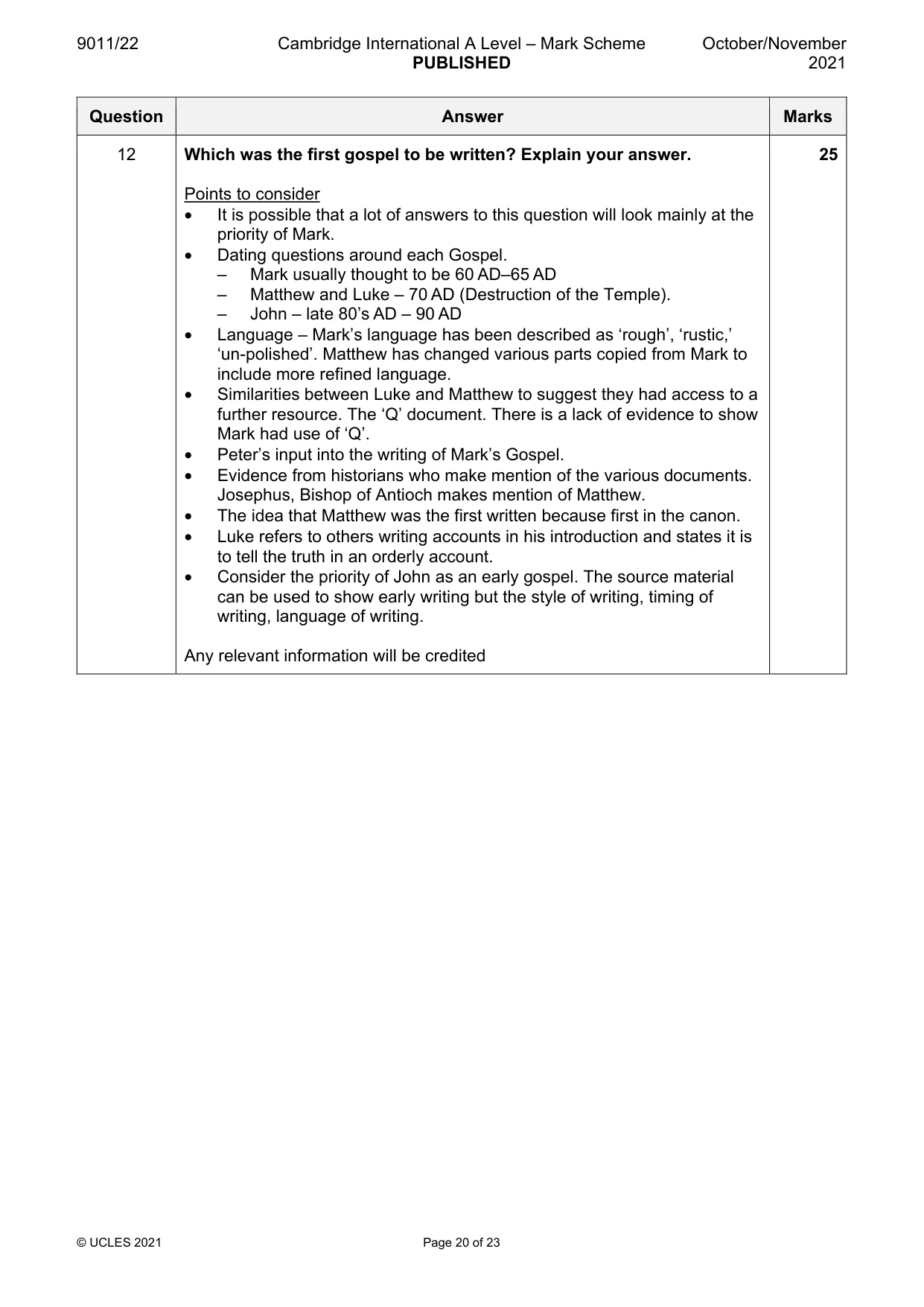
9011/22 Cambridge International A Level – Mark Scheme PUBLISHED October/November 2021 © UCLES 2021 Page 20 of 23 Question Answer Marks 12 Which was the first gospel to be written? Explain your answer. Points to consider • It is possible that a lot of answers to this question will look mainly at the priority of Mark. • Dating questions around each Gospel. – Mark usually thought to be 60 AD–65 AD – Matthew and Luke – 70 AD (Destruction of the Temple). – John – late 80’s AD – 90 AD • Language – Mark’s language has been described as ‘rough’, ‘rustic,’ ‘un-polished’. Matthew has changed various parts copied from Mark to include more refined language. • Similarities between Luke and Matthew to suggest they had access to a further resource. The ‘Q’ document. There is a lack of evidence to show Mark had use of ‘Q’. • Peter’s input into the writing of Mark’s Gospel. • Evidence from historians who make mention of the various documents. Josephus, Bishop of Antioch makes mention of Matthew. • The idea that Matthew was the first written because first in the canon. • Luke refers to others writing accounts in his introduction and states it is to tell the truth in an orderly account. • Consider the priority of John as an early gospel. The source material can be used to show early writing but the style of writing, timing of writing, language of writing. Any relevant information will be credited 25
Mark scheme, page 21
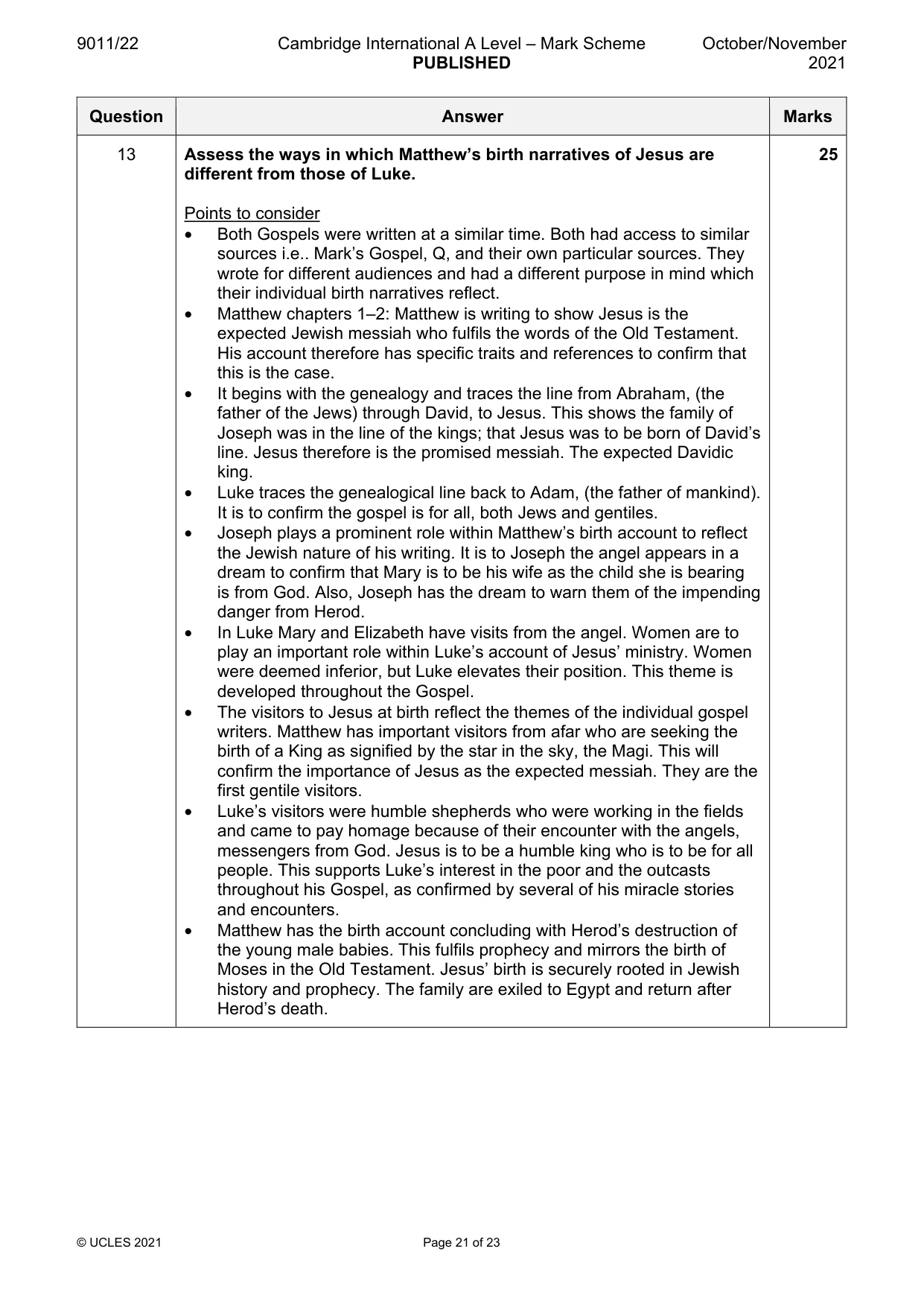
9011/22 Cambridge International A Level – Mark Scheme PUBLISHED October/November 2021 © UCLES 2021 Page 21 of 23 Question Answer Marks 13 Assess the ways in which Matthew’s birth narratives of Jesus are different from those of Luke. Points to consider • Both Gospels were written at a similar time. Both had access to similar sources i.e.. Mark’s Gospel, Q, and their own particular sources. They wrote for different audiences and had a different purpose in mind which their individual birth narratives reflect. • Matthew chapters 1–2: Matthew is writing to show Jesus is the expected Jewish messiah who fulfils the words of the Old Testament. His account therefore has specific traits and references to confirm that this is the case. • It begins with the genealogy and traces the line from Abraham, (the father of the Jews) through David, to Jesus. This shows the family of Joseph was in the line of the kings; that Jesus was to be born of David’s line. Jesus therefore is the promised messiah. The expected Davidic king. • Luke traces the genealogical line back to Adam, (the father of mankind). It is to confirm the gospel is for all, both Jews and gentiles. • Joseph plays a prominent role within Matthew’s birth account to reflect the Jewish nature of his writing. It is to Joseph the angel appears in a dream to confirm that Mary is to be his wife as the child she is bearing is from God. Also, Joseph has the dream to warn them of the impending danger from Herod. • In Luke Mary and Elizabeth have visits from the angel. Women are to play an important role within Luke’s account of Jesus’ ministry. Women were deemed inferior, but Luke elevates their position. This theme is developed throughout the Gospel. • The visitors to Jesus at birth reflect the themes of the individual gospel writers. Matthew has important visitors from afar who are seeking the birth of a King as signified by the star in the sky, the Magi. This will confirm the importance of Jesus as the expected messiah. They are the first gentile visitors. • Luke’s visitors were humble shepherds who were working in the fields and came to pay homage because of their encounter with the angels, messengers from God. Jesus is to be a humble king who is to be for all people. This supports Luke’s interest in the poor and the outcasts throughout his Gospel, as confirmed by several of his miracle stories and encounters. • Matthew has the birth account concluding with Herod’s destruction of the young male babies. This fulfils prophecy and mirrors the birth of Moses in the Old Testament. Jesus’ birth is securely rooted in Jewish history and prophecy. The family are exiled to Egypt and return after Herod’s death. 25
Mark scheme, page 22
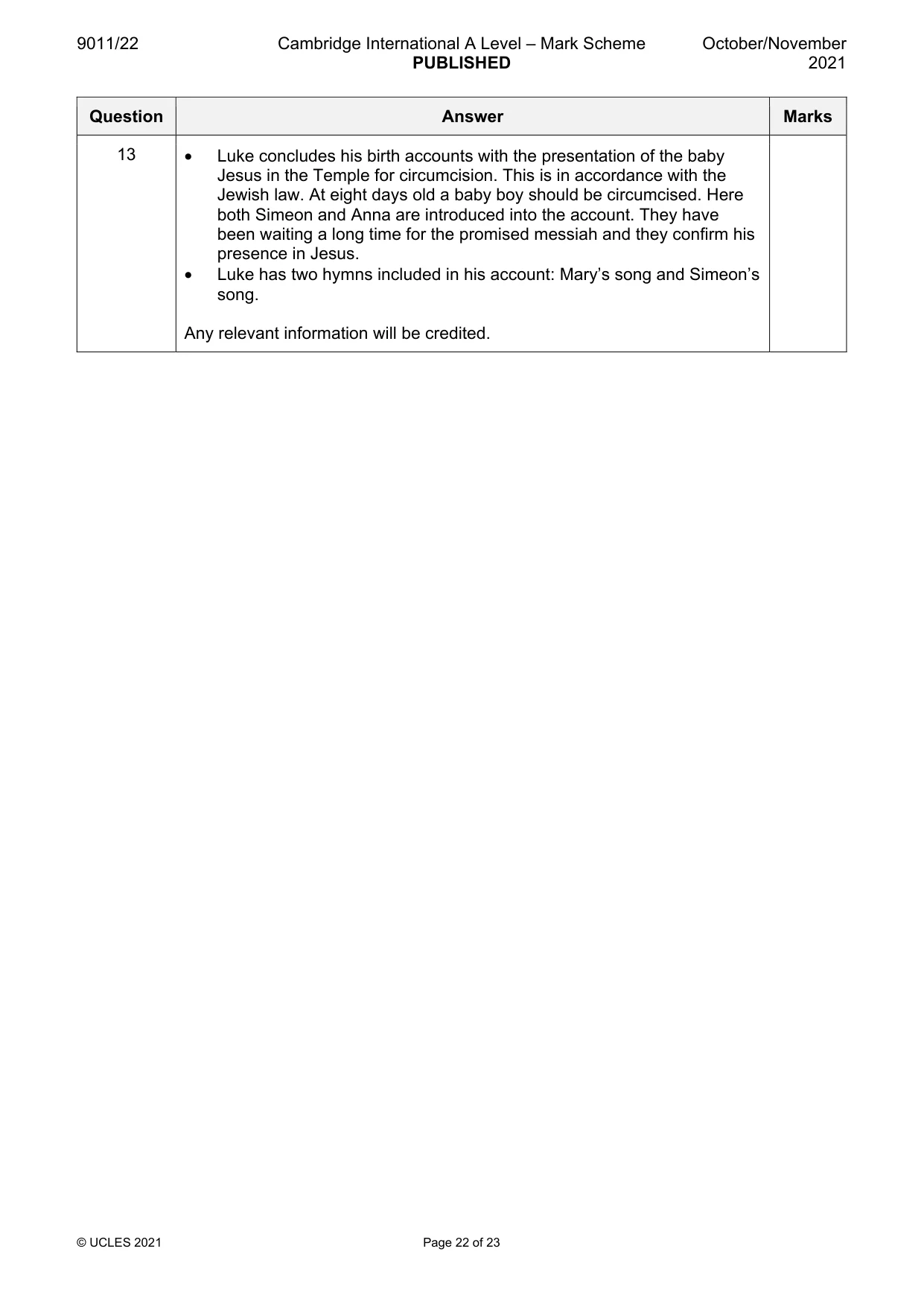
9011/22 Cambridge International A Level – Mark Scheme PUBLISHED October/November 2021 © UCLES 2021 Page 22 of 23 Question Answer Marks 13 • Luke concludes his birth accounts with the presentation of the baby Jesus in the Temple for circumcision. This is in accordance with the Jewish law. At eight days old a baby boy should be circumcised. Here both Simeon and Anna are introduced into the account. They have been waiting a long time for the promised messiah and they confirm his presence in Jesus. • Luke has two hymns included in his account: Mary’s song and Simeon’s song. Any relevant information will be credited.
Mark scheme, page 23
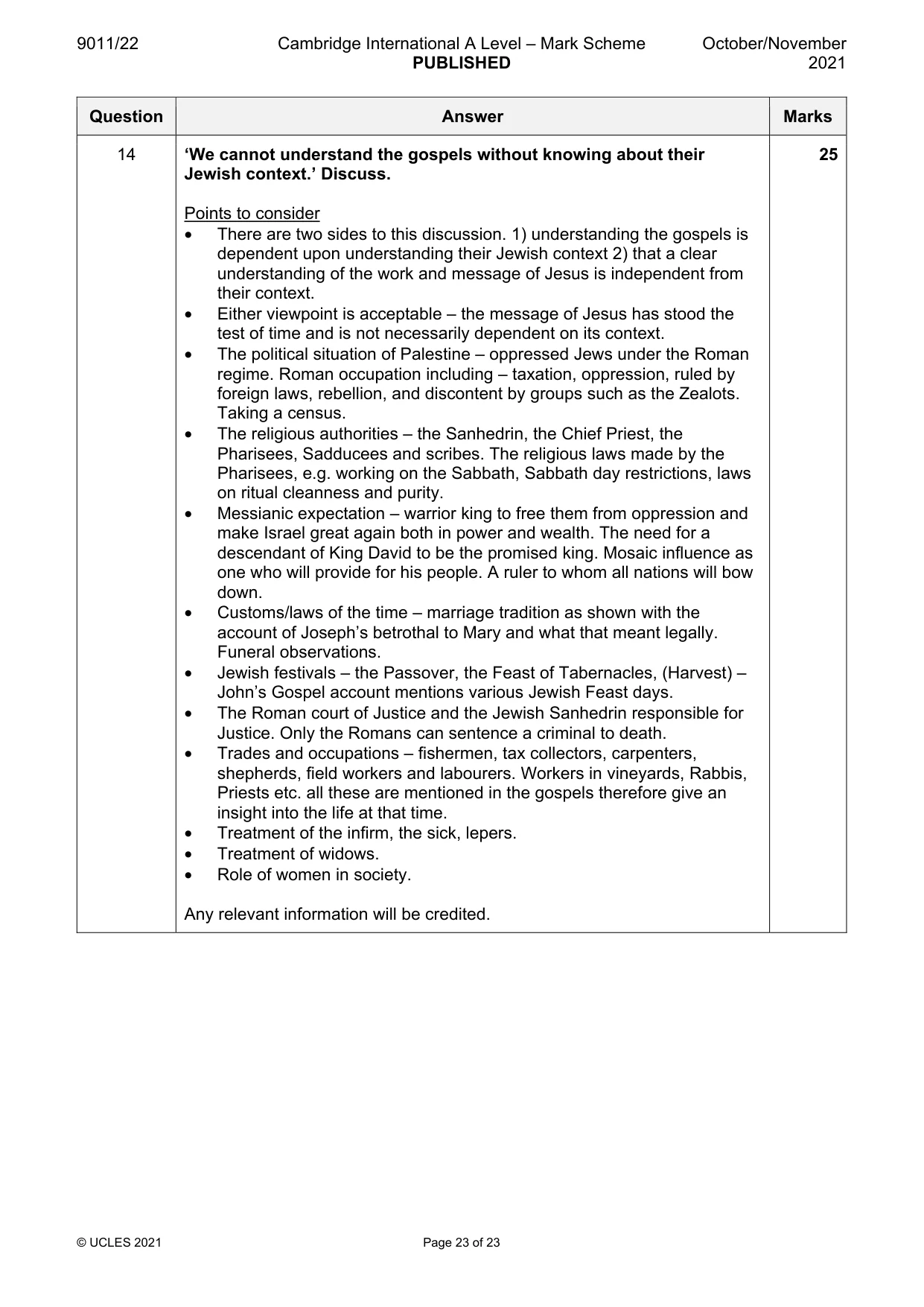
9011/22 Cambridge International A Level – Mark Scheme PUBLISHED October/November 2021 © UCLES 2021 Page 23 of 23 Question Answer Marks 14 ‘We cannot understand the gospels without knowing about their Jewish context.’ Discuss. Points to consider • There are two sides to this discussion. 1) understanding the gospels is dependent upon understanding their Jewish context 2) that a clear understanding of the work and message of Jesus is independent from their context. • Either viewpoint is acceptable – the message of Jesus has stood the test of time and is not necessarily dependent on its context. • The political situation of Palestine – oppressed Jews under the Roman regime. Roman occupation including – taxation, oppression, ruled by foreign laws, rebellion, and discontent by groups such as the Zealots. Taking a census. • The religious authorities – the Sanhedrin, the Chief Priest, the Pharisees, Sadducees and scribes. The religious laws made by the Pharisees, e.g. working on the Sabbath, Sabbath day restrictions, laws on ritual cleanness and purity. • Messianic expectation – warrior king to free them from oppression and make Israel great again both in power and wealth. The need for a descendant of King David to be the promised king. Mosaic influence as one who will provide for his people. A ruler to whom all nations will bow down. • Customs/laws of the time – marriage tradition as shown with the account of Joseph’s betrothal to Mary and what that meant legally. Funeral observations. • Jewish festivals – the Passover, the Feast of Tabernacles, (Harvest) – John’s Gospel account mentions various Jewish Feast days. • The Roman court of Justice and the Jewish Sanhedrin responsible for Justice. Only the Romans can sentence a criminal to death. • Trades and occupations – fishermen, tax collectors, carpenters, shepherds, field workers and labourers. Workers in vineyards, Rabbis, Priests etc. all these are mentioned in the gospels therefore give an insight into the life at that time. • Treatment of the infirm, the sick, lepers. • Treatment of widows. • Role of women in society. Any relevant information will be credited. 25
What you needed in this session
Cambridge’s own grade thresholds for 2021 Oct/Nov, Paper 2 · Variant 2. A higher threshold means an easier paper — the bar moves with how the cohort did.