Cambridge A Level Design and Textiles 9631 — 2019 Oct/Nov Paper 1 · Variant 1
9631/11/O/N/19 · 75 marks · ≈84 min
The question paper and its mark scheme, free to read here and free to download. This is Cambridge’s own paper, exactly as it was sat.
Question paper4 pages
Mark scheme14 pages
Answers below. Sit the paper first if you are practising.
Paper as text
Question paper, page 1
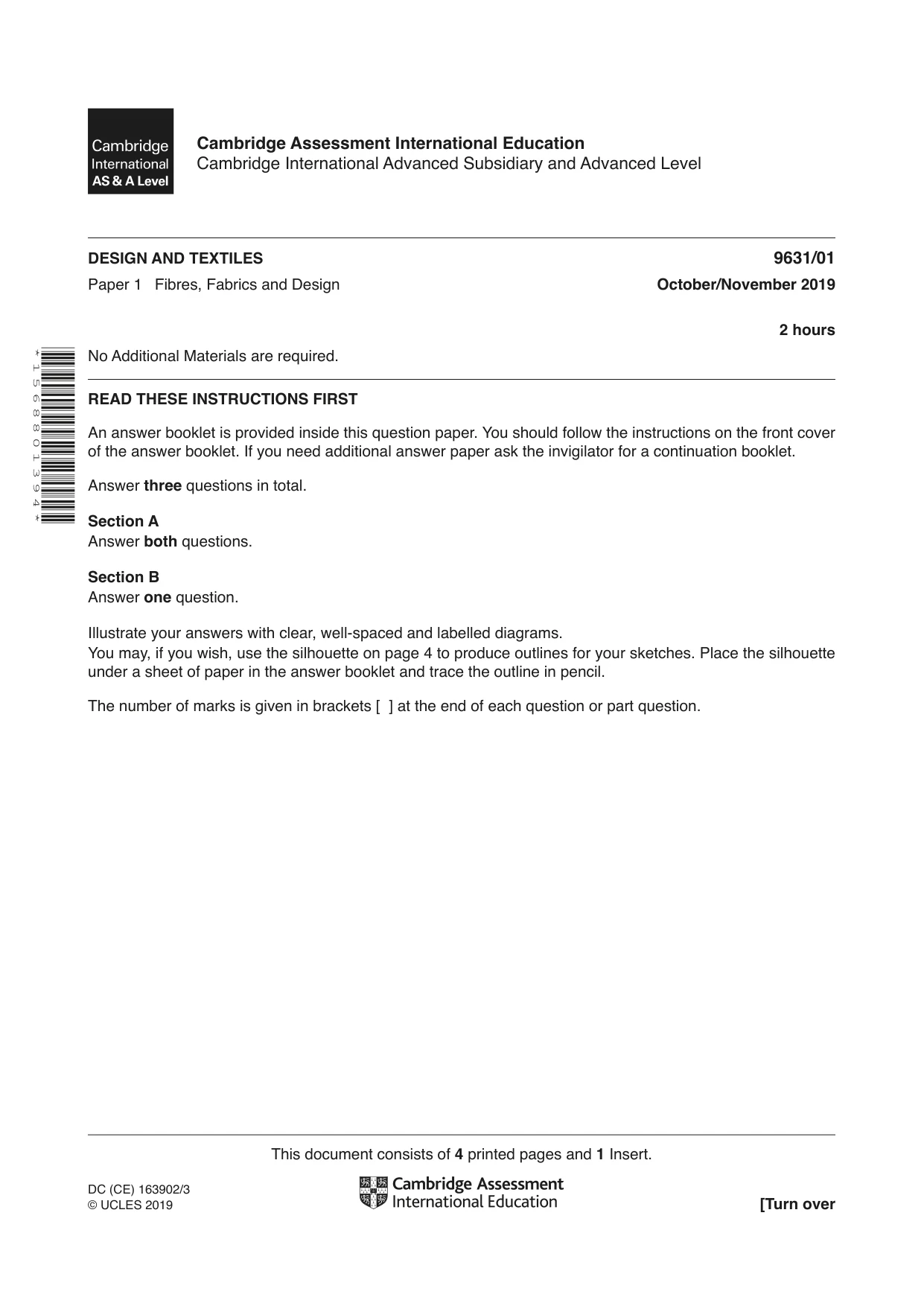
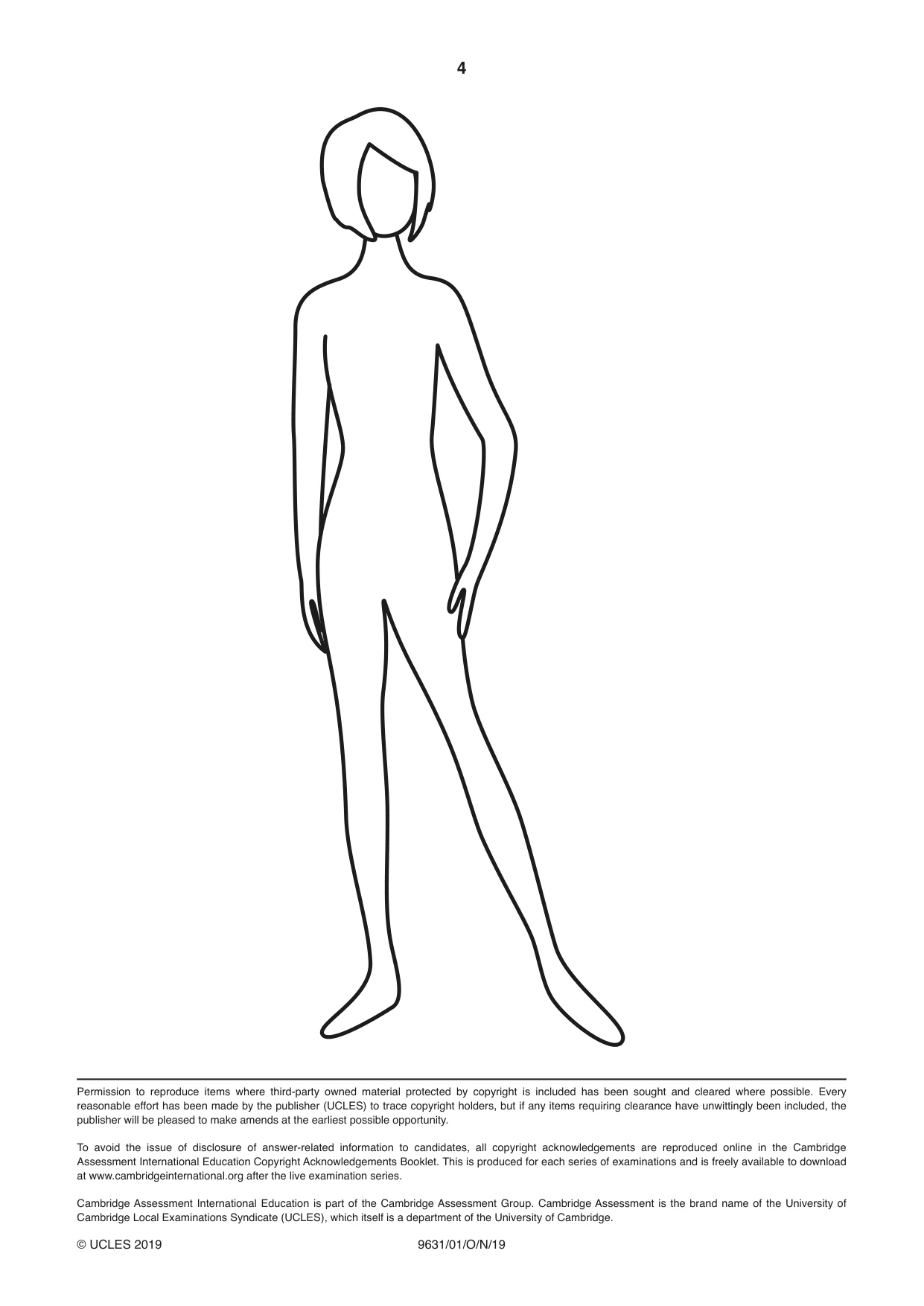
This document consists of 4 printed pages and 1 Insert. DC (CE) 163902/3 © UCLES 2019 [Turn over * 1 5 6 8 8 0 1 3 9 4 * Cambridge Assessment International Education Cambridge International Advanced Subsidiary and Advanced Level DESIGN AND TEXTILES 9631/01 Paper 1 Fibres, Fabrics and Design October/November 2019 2 hours No Additional Materials are required. READ THESE INSTRUCTIONS FIRST An answer booklet is provided inside this question paper. You should follow the instructions on the front cover of the answer booklet. If you need additional answer paper ask the invigilator for a continuation booklet. Answer three questions in total. Section A Answer both questions. Section B Answer one question. Illustrate your answers with clear, well-spaced and labelled diagrams. You may, if you wish, use the silhouette on page 4 to produce outlines for your sketches. Place the silhouette under a sheet of paper in the answer booklet and trace the outline in pencil. The number of marks is given in brackets [ ] at the end of each question or part question.
Question paper, page 2
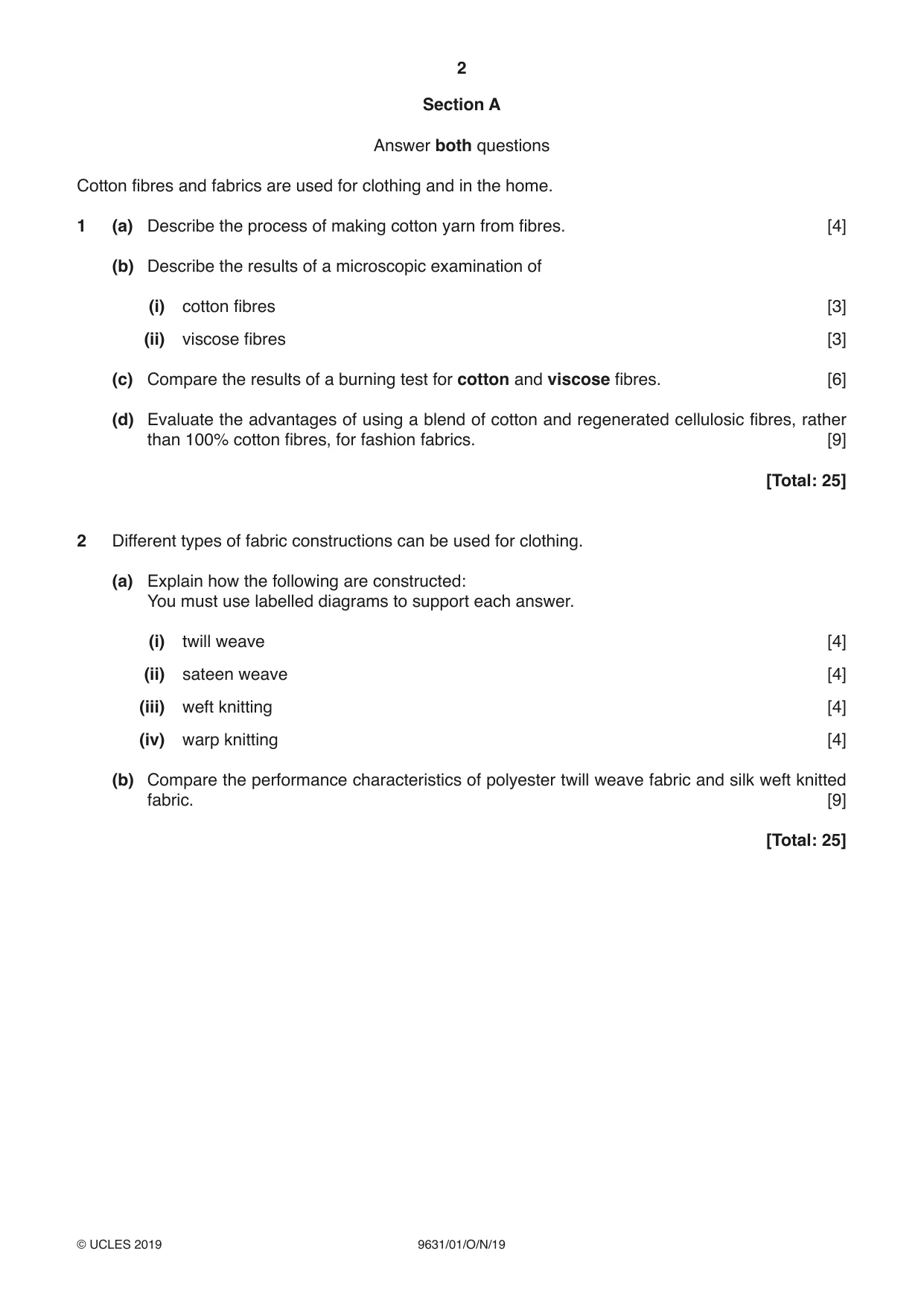
2 9631/01/O/N/19 © UCLES 2019 Section A Answer both questions Cotton fibres and fabrics are used for clothing and in the home. 1 (a) Describe the process of making cotton yarn from fibres. [4] (b) Describe the results of a microscopic examination of (i) cotton fibres [3] (ii) viscose fibres [3] (c) Compare the results of a burning test for cotton and viscose fibres. [6] (d) Evaluate the advantages of using a blend of cotton and regenerated cellulosic fibres, rather than 100% cotton fibres, for fashion fabrics. [9] [Total: 25] 2 Different types of fabric constructions can be used for clothing. (a) Explain how the following are constructed: You must use labelled diagrams to support each answer. (i) twill weave [4] (ii) sateen weave [4] (iii) weft knitting [4] (iv) warp knitting [4] (b) Compare the performance characteristics of polyester twill weave fabric and silk weft knitted fabric. [9] [Total: 25]
Question paper, page 3
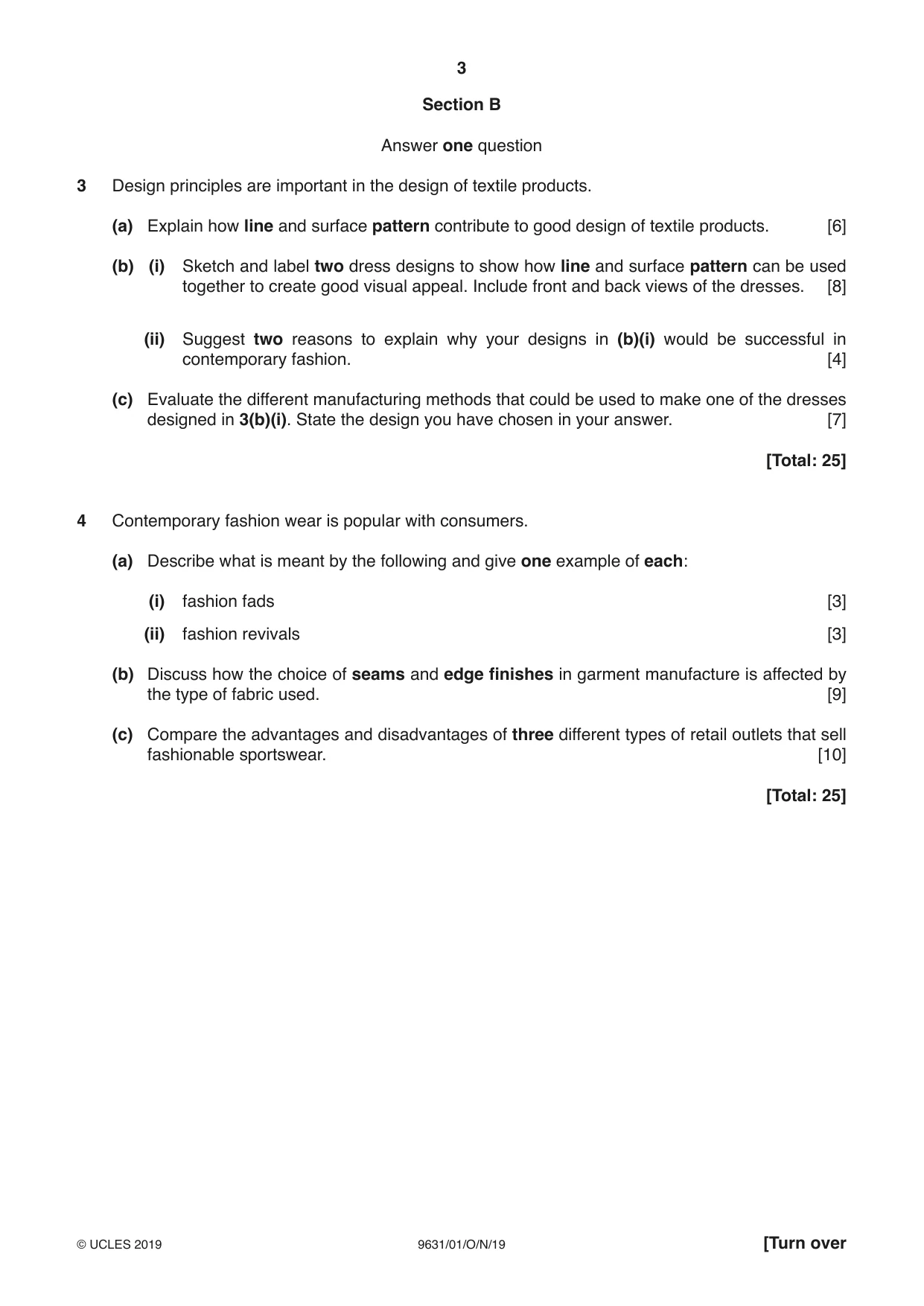
3 9631/01/O/N/19 © UCLES 2019 [Turn over Section B Answer one question 3 Design principles are important in the design of textile products. (a) Explain how line and surface pattern contribute to good design of textile products. [6] (b) (i) Sketch and label two dress designs to show how line and surface pattern can be used together to create good visual appeal. Include front and back views of the dresses. [8] (ii) Suggest two reasons to explain why your designs in (b)(i) would be successful in contemporary fashion. [4] (c) Evaluate the different manufacturing methods that could be used to make one of the dresses designed in 3(b)(i). State the design you have chosen in your answer. [7] [Total: 25] 4 Contemporary fashion wear is popular with consumers. (a) Describe what is meant by the following and give one example of each: (i) fashion fads [3] (ii) fashion revivals [3] (b) Discuss how the choice of seams and edge finishes in garment manufacture is affected by the type of fabric used. [9] (c) Compare the advantages and disadvantages of three different types of retail outlets that sell fashionable sportswear. [10] [Total: 25]
Question paper, page 4
4 9631/01/O/N/19 © UCLES 2019 Permission to reproduce items where third-party owned material protected by copyright is included has been sought and cleared where possible. Every reasonable effort has been made by the publisher (UCLES) to trace copyright holders, but if any items requiring clearance have unwittingly been included, the publisher will be pleased to make amends at the earliest possible opportunity. To avoid the issue of disclosure of answer-related information to candidates, all copyright acknowledgements are reproduced online in the Cambridge Assessment International Education Copyright Acknowledgements Booklet. This is produced for each series of examinations and is freely available to download at www.cambridgeinternational.org after the live examination series. Cambridge Assessment International Education is part of the Cambridge Assessment Group. Cambridge Assessment is the brand name of the University of Cambridge Local Examinations Syndicate (UCLES), which itself is a department of the University of Cambridge.
Mark scheme, page 1
This document consists of 14 printed pages. © UCLES 2019 [Turn over Cambridge Assessment International Education Cambridge International Advanced Subsidiary and Advanced Level DESIGN AND TEXTILES 9631/01 Paper 1 Fibres, Fabrics and Design October/November 2019 MARK SCHEME Maximum Mark: 75 Published This mark scheme is published as an aid to teachers and candidates, to indicate the requirements of the examination. It shows the basis on which Examiners were instructed to award marks. It does not indicate the details of the discussions that took place at an Examiners’ meeting before marking began, which would have considered the acceptability of alternative answers. Mark schemes should be read in conjunction with the question paper and the Principal Examiner Report for Teachers. Cambridge International will not enter into discussions about these mark schemes. Cambridge International is publishing the mark schemes for the October/November 2019 series for most Cambridge IGCSE™, Cambridge International A and AS Level components and some Cambridge O Level components.
Mark scheme, page 2
9631/01 Cambridge International AS/A Level – Mark Scheme PUBLISHED October/November 2019 © UCLES 2019 Page 2 of 14 Generic Marking Principles These general marking principles must be applied by all examiners when marking candidate answers. They should be applied alongside the specific content of the mark scheme or generic level descriptors for a question. Each question paper and mark scheme will also comply with these marking principles. GENERIC MARKING PRINCIPLE 1: Marks must be awarded in line with: • the specific content of the mark scheme or the generic level descriptors for the question • the specific skills defined in the mark scheme or in the generic level descriptors for the question • the standard of response required by a candidate as exemplified by the standardisation scripts. GENERIC MARKING PRINCIPLE 2: Marks awarded are always whole marks (not half marks, or other fractions). GENERIC MARKING PRINCIPLE 3: Marks must be awarded positively: • marks are awarded for correct/valid answers, as defined in the mark scheme. However, credit is given for valid answers which go beyond the scope of the syllabus and mark scheme, referring to your Team Leader as appropriate • marks are awarded when candidates clearly demonstrate what they know and can do • marks are not deducted for errors • marks are not deducted for omissions • answers should only be judged on the quality of spelling, punctuation and grammar when these features are specifically assessed by the question as indicated by the mark scheme. The meaning, however, should be unambiguous. GENERIC MARKING PRINCIPLE 4: Rules must be applied consistently e.g. in situations where candidates have not followed instructions or in the application of generic level descriptors. GENERIC MARKING PRINCIPLE 5: Marks should be awarded using the full range of marks defined in the mark scheme for the question (however; the use of the full mark range may be limited according to the quality of the candidate responses seen). GENERIC MARKING PRINCIPLE 6: Marks awarded are based solely on the requirements as defined in the mark scheme. Marks should not be awarded with grade thresholds or grade descriptors in mind.
Mark scheme, page 3
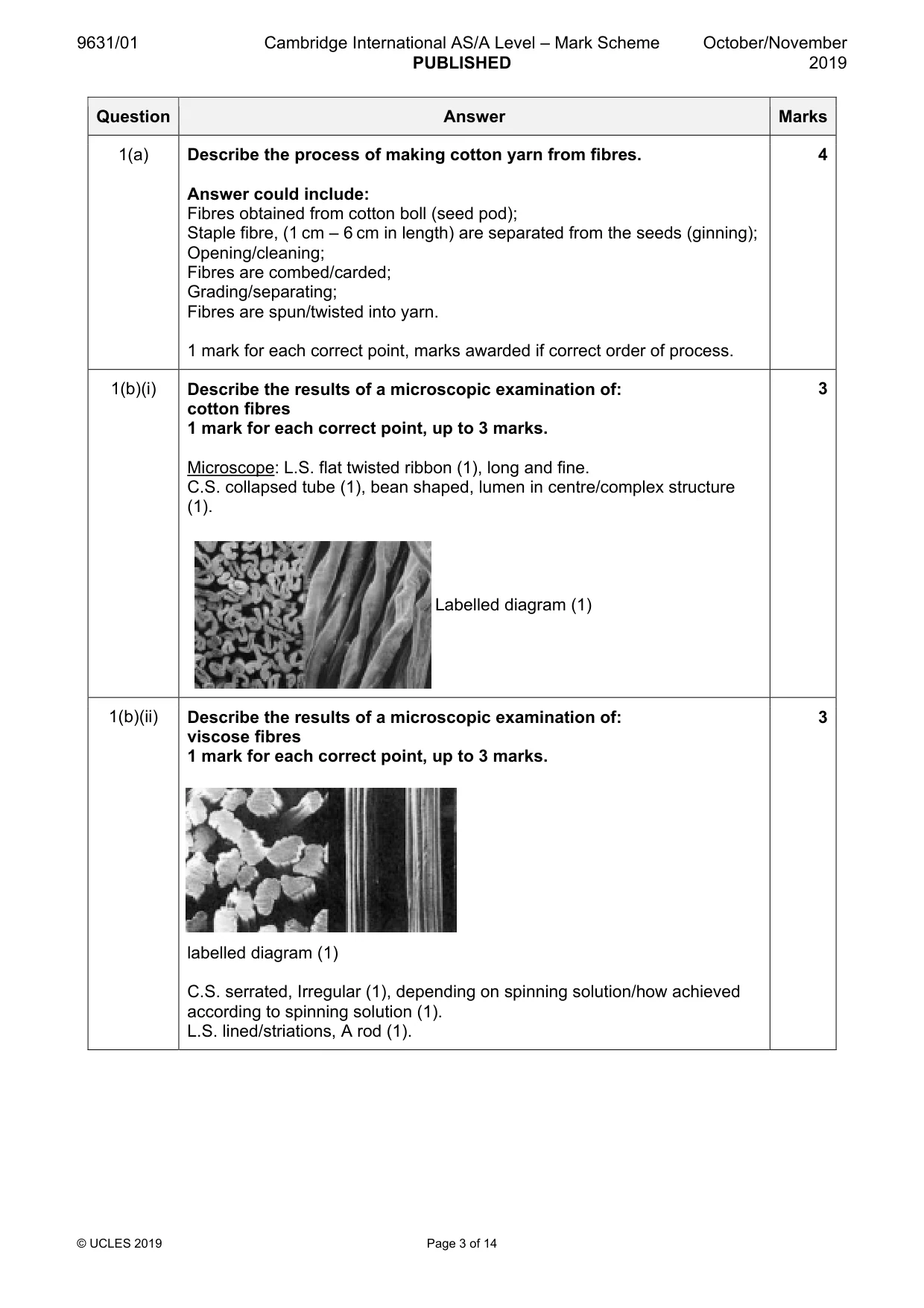
9631/01 Cambridge International AS/A Level – Mark Scheme PUBLISHED October/November 2019 © UCLES 2019 Page 3 of 14 Question Answer Marks 1(a) Describe the process of making cotton yarn from fibres. Answer could include: Fibres obtained from cotton boll (seed pod); Staple fibre, (1 cm – 6 cm in length) are separated from the seeds (ginning); Opening/cleaning; Fibres are combed/carded; Grading/separating; Fibres are spun/twisted into yarn. 1 mark for each correct point, marks awarded if correct order of process. 4 1(b)(i) Describe the results of a microscopic examination of: cotton fibres 1 mark for each correct point, up to 3 marks. Microscope: L.S. flat twisted ribbon (1), long and fine. C.S. collapsed tube (1), bean shaped, lumen in centre/complex structure (1). Labelled diagram (1) 3 1(b)(ii) Describe the results of a microscopic examination of: viscose fibres 1 mark for each correct point, up to 3 marks. labelled diagram (1) C.S. serrated, Irregular (1), depending on spinning solution/how achieved according to spinning solution (1). L.S. lined/striations, A rod (1). 3
Mark scheme, page 4
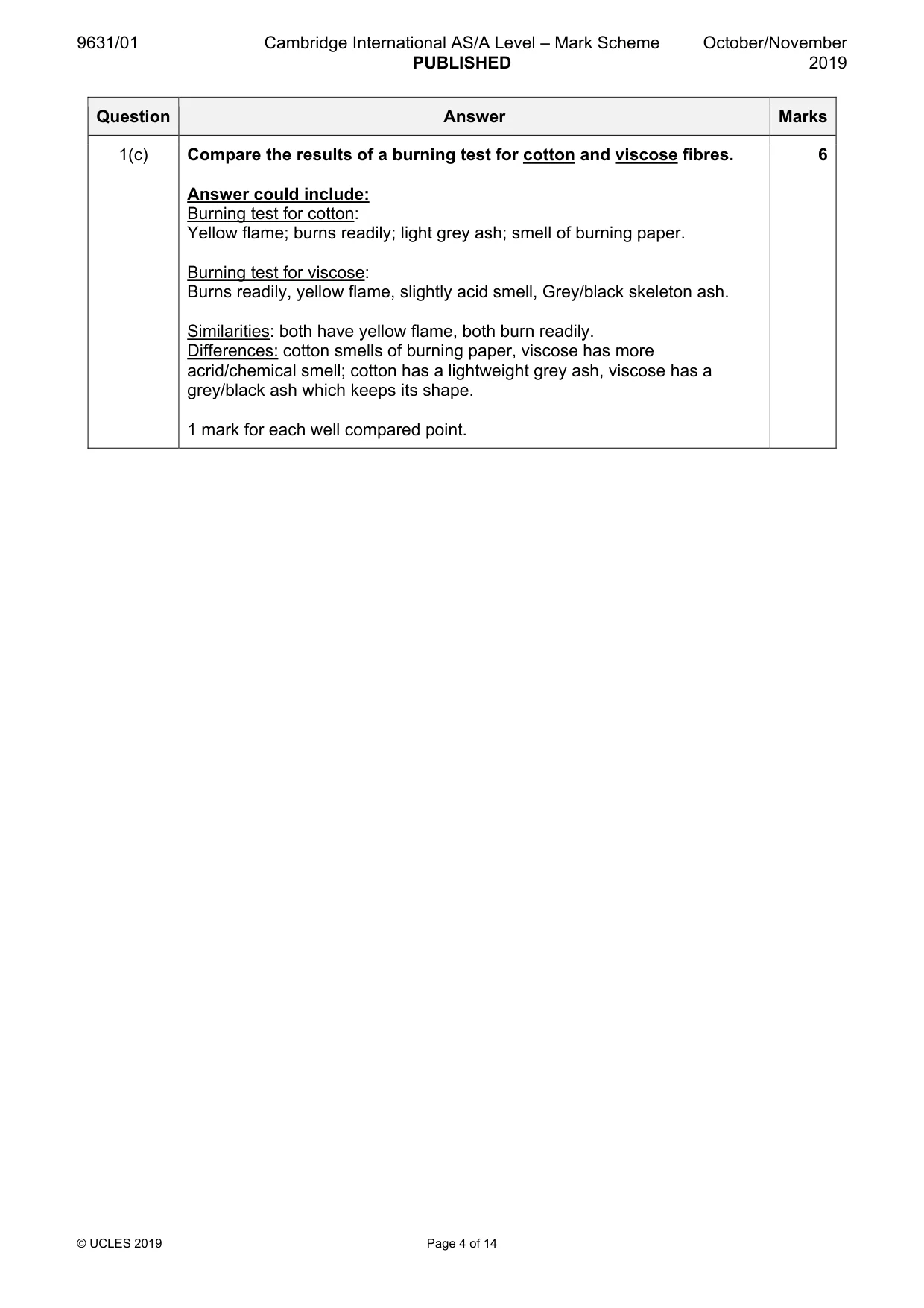
9631/01 Cambridge International AS/A Level – Mark Scheme PUBLISHED October/November 2019 © UCLES 2019 Page 4 of 14 Question Answer Marks 1(c) Compare the results of a burning test for cotton and viscose fibres. Answer could include: Burning test for cotton: Yellow flame; burns readily; light grey ash; smell of burning paper. Burning test for viscose: Burns readily, yellow flame, slightly acid smell, Grey/black skeleton ash. Similarities: both have yellow flame, both burn readily. Differences: cotton smells of burning paper, viscose has more acrid/chemical smell; cotton has a lightweight grey ash, viscose has a grey/black ash which keeps its shape. 1 mark for each well compared point. 6
Mark scheme, page 5
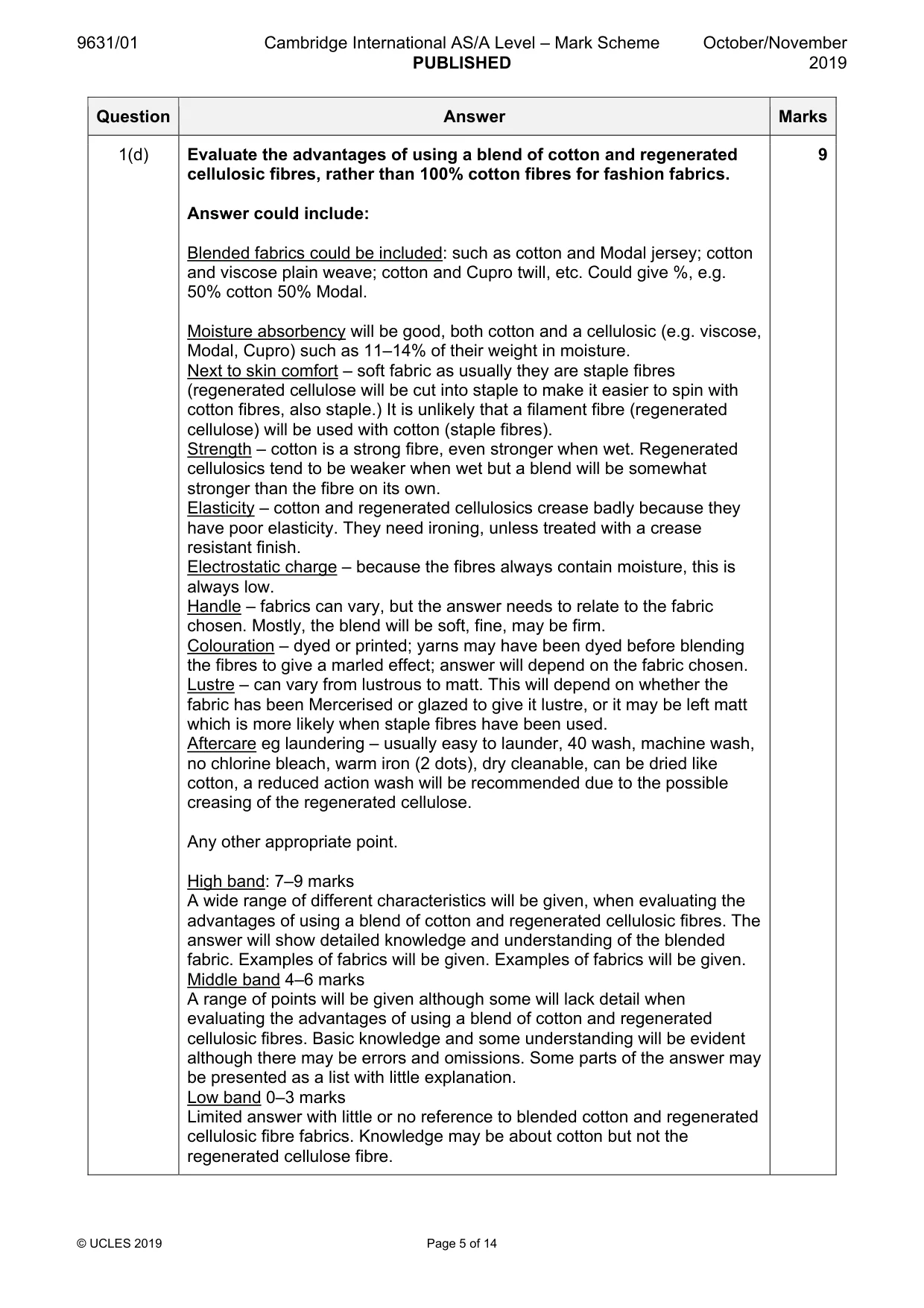
9631/01 Cambridge International AS/A Level – Mark Scheme PUBLISHED October/November 2019 © UCLES 2019 Page 5 of 14 Question Answer Marks 1(d) Evaluate the advantages of using a blend of cotton and regenerated cellulosic fibres, rather than 100% cotton fibres for fashion fabrics. Answer could include: Blended fabrics could be included: such as cotton and Modal jersey; cotton and viscose plain weave; cotton and Cupro twill, etc. Could give %, e.g. 50% cotton 50% Modal. Moisture absorbency will be good, both cotton and a cellulosic (e.g. viscose, Modal, Cupro) such as 11–14% of their weight in moisture. Next to skin comfort – soft fabric as usually they are staple fibres (regenerated cellulose will be cut into staple to make it easier to spin with cotton fibres, also staple.) It is unlikely that a filament fibre (regenerated cellulose) will be used with cotton (staple fibres). Strength – cotton is a strong fibre, even stronger when wet. Regenerated cellulosics tend to be weaker when wet but a blend will be somewhat stronger than the fibre on its own. Elasticity – cotton and regenerated cellulosics crease badly because they have poor elasticity. They need ironing, unless treated with a crease resistant finish. Electrostatic charge – because the fibres always contain moisture, this is always low. Handle – fabrics can vary, but the answer needs to relate to the fabric chosen. Mostly, the blend will be soft, fine, may be firm. Colouration – dyed or printed; yarns may have been dyed before blending the fibres to give a marled effect; answer will depend on the fabric chosen. Lustre – can vary from lustrous to matt. This will depend on whether the fabric has been Mercerised or glazed to give it lustre, or it may be left matt which is more likely when staple fibres have been used. Aftercare eg laundering – usually easy to launder, 40 wash, machine wash, no chlorine bleach, warm iron (2 dots), dry cleanable, can be dried like cotton, a reduced action wash will be recommended due to the possible creasing of the regenerated cellulose. Any other appropriate point. High band: 7–9 marks A wide range of different characteristics will be given, when evaluating the advantages of using a blend of cotton and regenerated cellulosic fibres. The answer will show detailed knowledge and understanding of the blended fabric. Examples of fabrics will be given. Examples of fabrics will be given. Middle band 4–6 marks A range of points will be given although some will lack detail when evaluating the advantages of using a blend of cotton and regenerated cellulosic fibres. Basic knowledge and some understanding will be evident although there may be errors and omissions. Some parts of the answer may be presented as a list with little explanation. Low band 0–3 marks Limited answer with little or no reference to blended cotton and regenerated cellulosic fibre fabrics. Knowledge may be about cotton but not the regenerated cellulose fibre. 9
Mark scheme, page 6
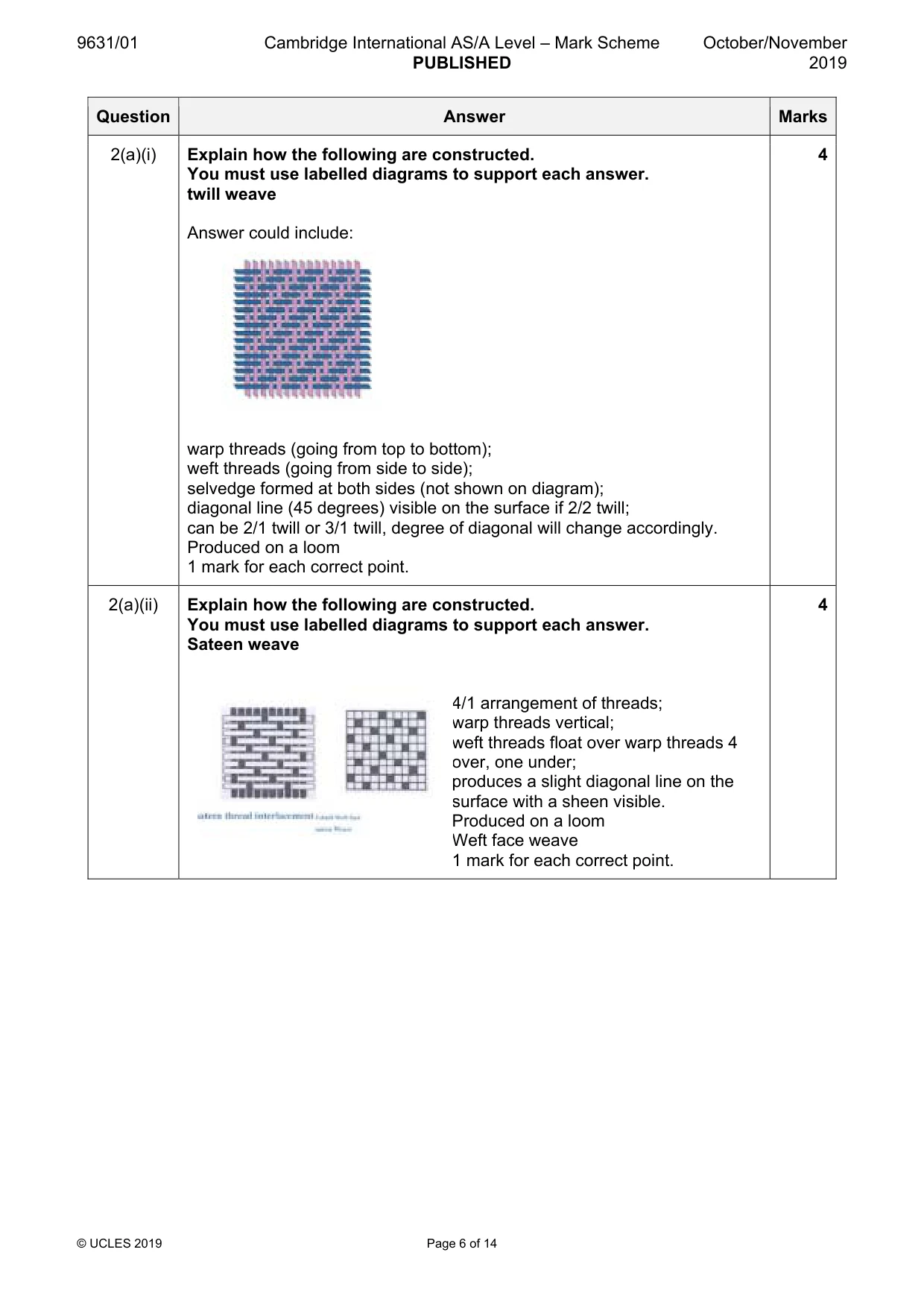
9631/01 Cambridge International AS/A Level – Mark Scheme PUBLISHED October/November 2019 © UCLES 2019 Page 6 of 14 Question Answer Marks 2(a)(i) Explain how the following are constructed. You must use labelled diagrams to support each answer. twill weave Answer could include: warp threads (going from top to bottom); weft threads (going from side to side); selvedge formed at both sides (not shown on diagram); diagonal line (45 degrees) visible on the surface if 2/2 twill; can be 2/1 twill or 3/1 twill, degree of diagonal will change accordingly. Produced on a loom 1 mark for each correct point. 4 2(a)(ii) Explain how the following are constructed. You must use labelled diagrams to support each answer. Sateen weave 4/1 arrangement of threads; warp threads vertical; weft threads float over warp threads 4 over, one under; produces a slight diagonal line on the surface with a sheen visible. Produced on a loom Weft face weave 1 mark for each correct point. 4
Mark scheme, page 7
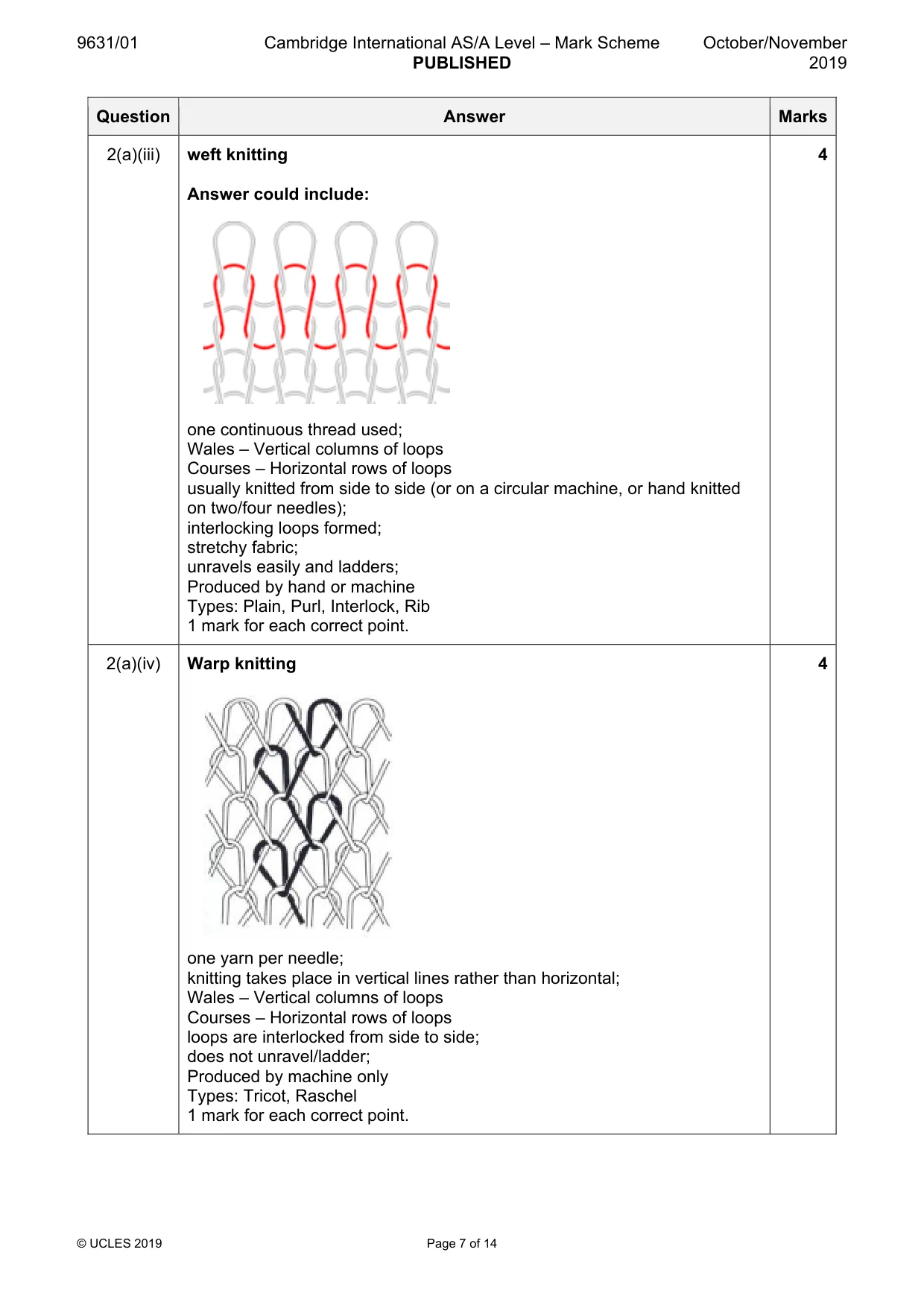
9631/01 Cambridge International AS/A Level – Mark Scheme PUBLISHED October/November 2019 © UCLES 2019 Page 7 of 14 Question Answer Marks 2(a)(iii) weft knitting Answer could include: one continuous thread used; Wales – Vertical columns of loops Courses – Horizontal rows of loops usually knitted from side to side (or on a circular machine, or hand knitted on two/four needles); interlocking loops formed; stretchy fabric; unravels easily and ladders; Produced by hand or machine Types: Plain, Purl, Interlock, Rib 1 mark for each correct point. 4 2(a)(iv) Warp knitting one yarn per needle; knitting takes place in vertical lines rather than horizontal; Wales – Vertical columns of loops Courses – Horizontal rows of loops loops are interlocked from side to side; does not unravel/ladder; Produced by machine only Types: Tricot, Raschel 1 mark for each correct point. 4
Mark scheme, page 8
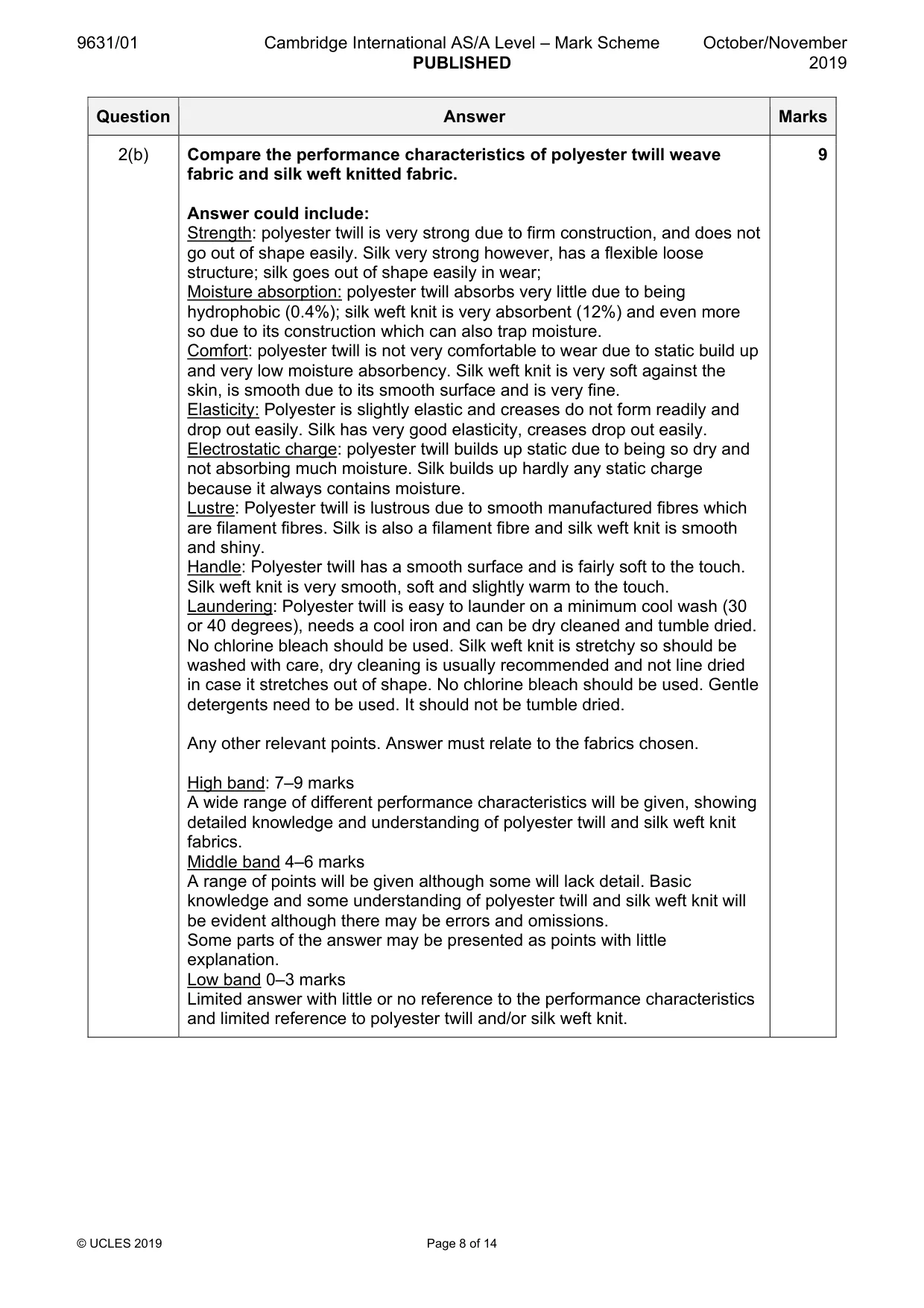
9631/01 Cambridge International AS/A Level – Mark Scheme PUBLISHED October/November 2019 © UCLES 2019 Page 8 of 14 Question Answer Marks 2(b) Compare the performance characteristics of polyester twill weave fabric and silk weft knitted fabric. Answer could include: Strength: polyester twill is very strong due to firm construction, and does not go out of shape easily. Silk very strong however, has a flexible loose structure; silk goes out of shape easily in wear; Moisture absorption: polyester twill absorbs very little due to being hydrophobic (0.4%); silk weft knit is very absorbent (12%) and even more so due to its construction which can also trap moisture. Comfort: polyester twill is not very comfortable to wear due to static build up and very low moisture absorbency. Silk weft knit is very soft against the skin, is smooth due to its smooth surface and is very fine. Elasticity: Polyester is slightly elastic and creases do not form readily and drop out easily. Silk has very good elasticity, creases drop out easily. Electrostatic charge: polyester twill builds up static due to being so dry and not absorbing much moisture. Silk builds up hardly any static charge because it always contains moisture. Lustre: Polyester twill is lustrous due to smooth manufactured fibres which are filament fibres. Silk is also a filament fibre and silk weft knit is smooth and shiny. Handle: Polyester twill has a smooth surface and is fairly soft to the touch. Silk weft knit is very smooth, soft and slightly warm to the touch. Laundering: Polyester twill is easy to launder on a minimum cool wash (30 or 40 degrees), needs a cool iron and can be dry cleaned and tumble dried. No chlorine bleach should be used. Silk weft knit is stretchy so should be washed with care, dry cleaning is usually recommended and not line dried in case it stretches out of shape. No chlorine bleach should be used. Gentle detergents need to be used. It should not be tumble dried. Any other relevant points. Answer must relate to the fabrics chosen. High band: 7–9 marks A wide range of different performance characteristics will be given, showing detailed knowledge and understanding of polyester twill and silk weft knit fabrics. Middle band 4–6 marks A range of points will be given although some will lack detail. Basic knowledge and some understanding of polyester twill and silk weft knit will be evident although there may be errors and omissions. Some parts of the answer may be presented as points with little explanation. Low band 0–3 marks Limited answer with little or no reference to the performance characteristics and limited reference to polyester twill and/or silk weft knit. 9
Mark scheme, page 9
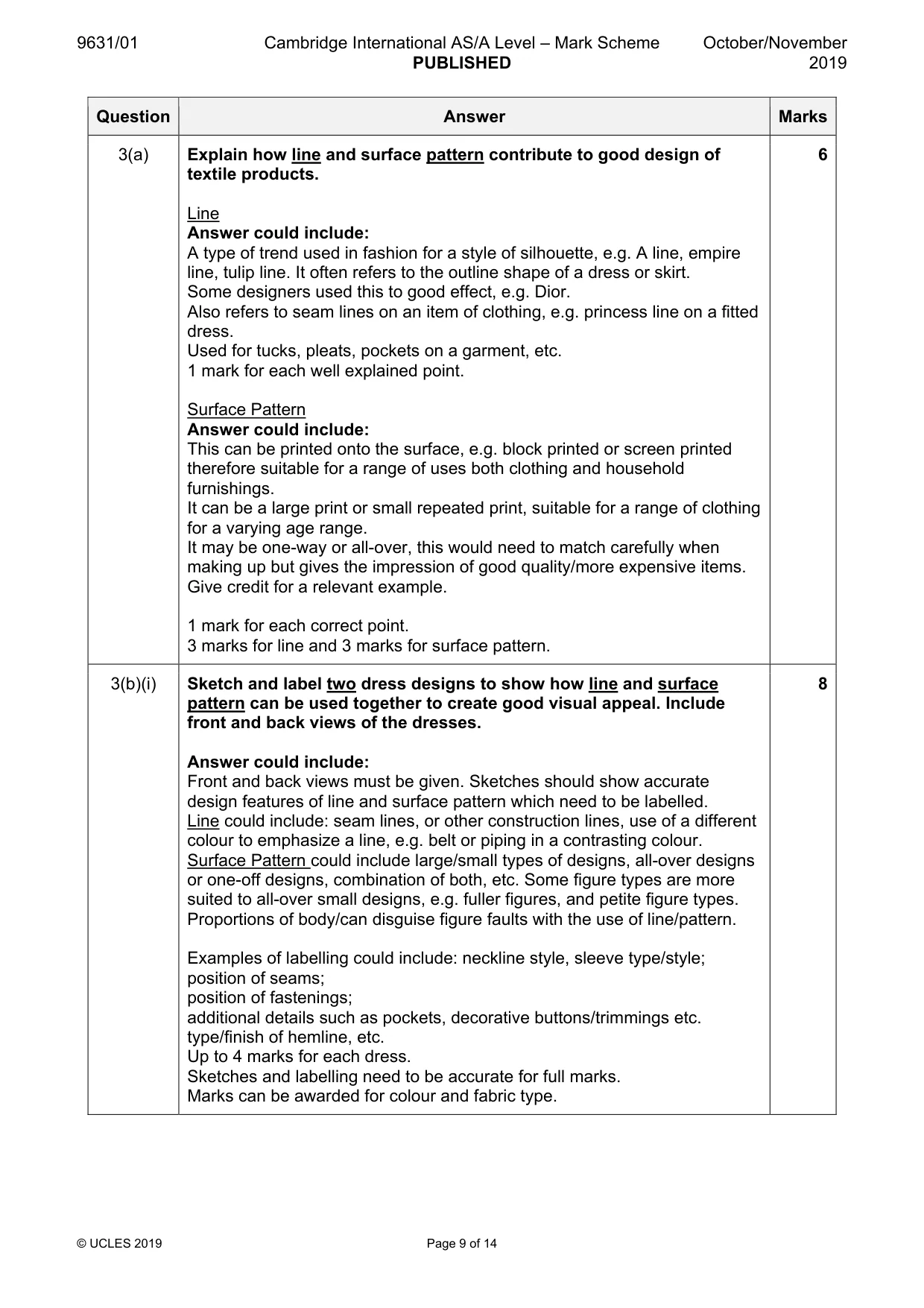
9631/01 Cambridge International AS/A Level – Mark Scheme PUBLISHED October/November 2019 © UCLES 2019 Page 9 of 14 Question Answer Marks 3(a) Explain how line and surface pattern contribute to good design of textile products. Line Answer could include: A type of trend used in fashion for a style of silhouette, e.g. A line, empire line, tulip line. It often refers to the outline shape of a dress or skirt. Some designers used this to good effect, e.g. Dior. Also refers to seam lines on an item of clothing, e.g. princess line on a fitted dress. Used for tucks, pleats, pockets on a garment, etc. 1 mark for each well explained point. Surface Pattern Answer could include: This can be printed onto the surface, e.g. block printed or screen printed therefore suitable for a range of uses both clothing and household furnishings. It can be a large print or small repeated print, suitable for a range of clothing for a varying age range. It may be one-way or all-over, this would need to match carefully when making up but gives the impression of good quality/more expensive items. Give credit for a relevant example. 1 mark for each correct point. 3 marks for line and 3 marks for surface pattern. 6 3(b)(i) Sketch and label two dress designs to show how line and surface pattern can be used together to create good visual appeal. Include front and back views of the dresses. Answer could include: Front and back views must be given. Sketches should show accurate design features of line and surface pattern which need to be labelled. Line could include: seam lines, or other construction lines, use of a different colour to emphasize a line, e.g. belt or piping in a contrasting colour. Surface Pattern could include large/small types of designs, all-over designs or one-off designs, combination of both, etc. Some figure types are more suited to all-over small designs, e.g. fuller figures, and petite figure types. Proportions of body/can disguise figure faults with the use of line/pattern. Examples of labelling could include: neckline style, sleeve type/style; position of seams; position of fastenings; additional details such as pockets, decorative buttons/trimmings etc. type/finish of hemline, etc. Up to 4 marks for each dress. Sketches and labelling need to be accurate for full marks. Marks can be awarded for colour and fabric type. 8
Mark scheme, page 10
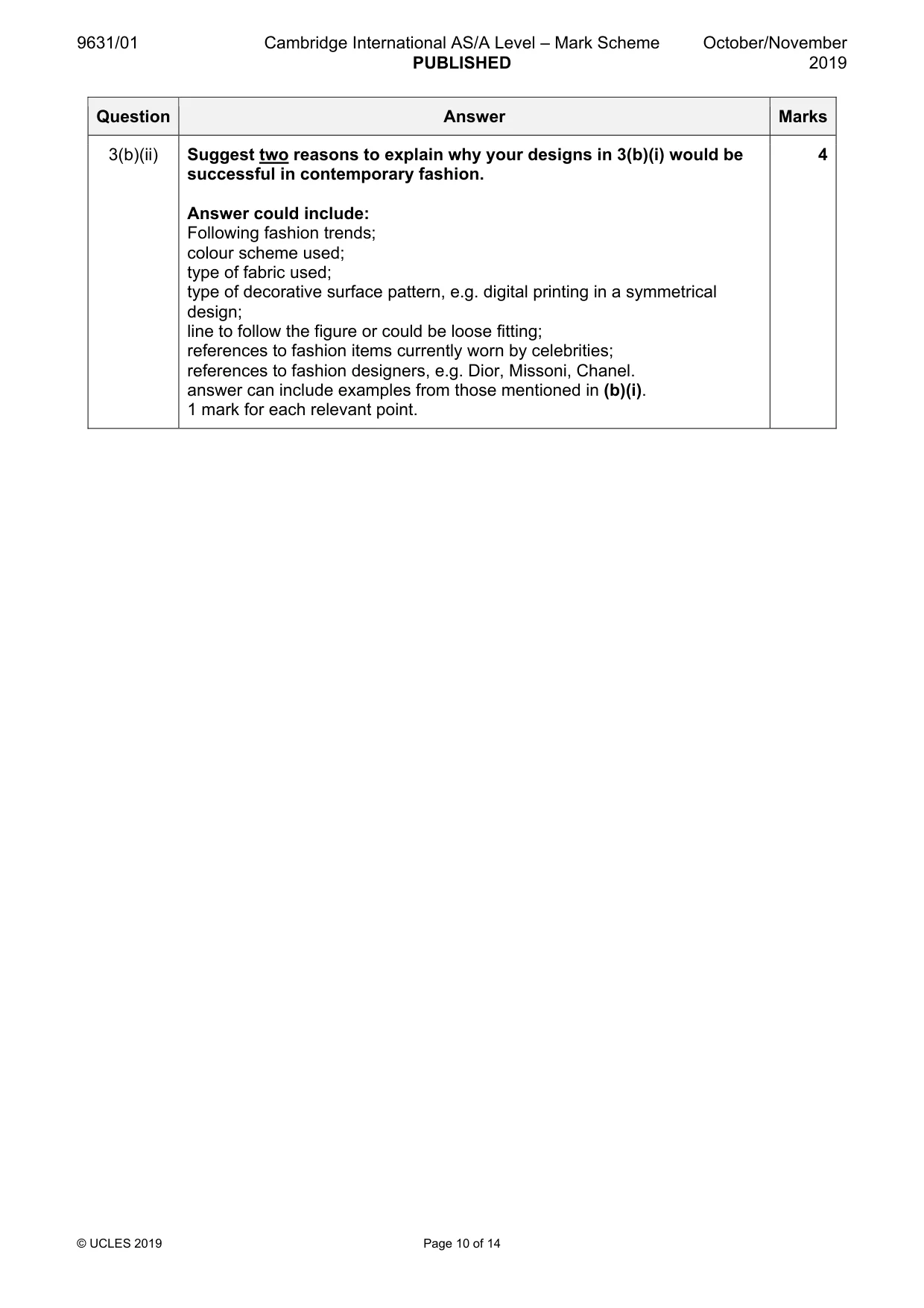
9631/01 Cambridge International AS/A Level – Mark Scheme PUBLISHED October/November 2019 © UCLES 2019 Page 10 of 14 Question Answer Marks 3(b)(ii) Suggest two reasons to explain why your designs in 3(b)(i) would be successful in contemporary fashion. Answer could include: Following fashion trends; colour scheme used; type of fabric used; type of decorative surface pattern, e.g. digital printing in a symmetrical design; line to follow the figure or could be loose fitting; references to fashion items currently worn by celebrities; references to fashion designers, e.g. Dior, Missoni, Chanel. answer can include examples from those mentioned in (b)(i). 1 mark for each relevant point. 4
Mark scheme, page 11
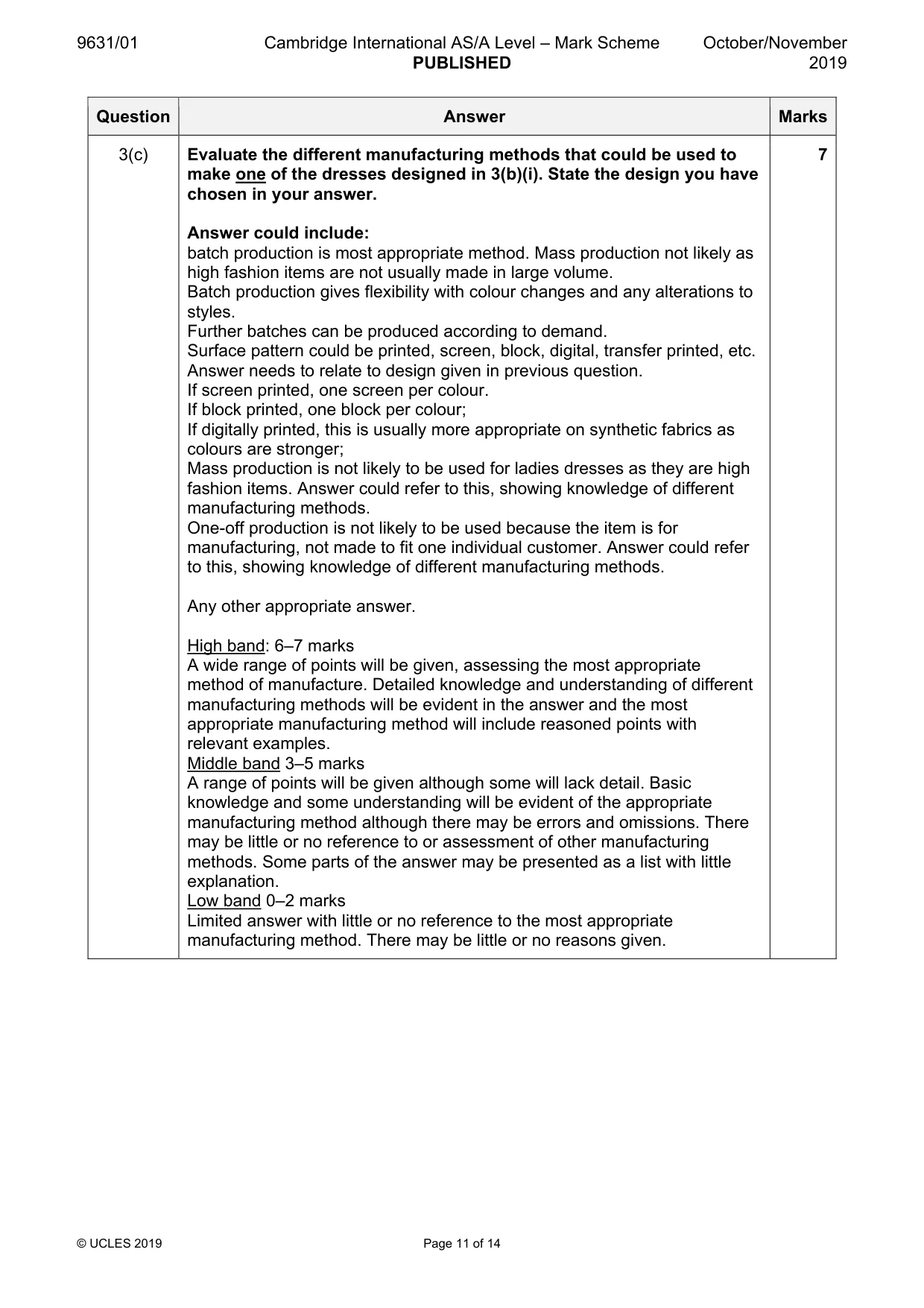
9631/01 Cambridge International AS/A Level – Mark Scheme PUBLISHED October/November 2019 © UCLES 2019 Page 11 of 14 Question Answer Marks 3(c) Evaluate the different manufacturing methods that could be used to make one of the dresses designed in 3(b)(i). State the design you have chosen in your answer. Answer could include: batch production is most appropriate method. Mass production not likely as high fashion items are not usually made in large volume. Batch production gives flexibility with colour changes and any alterations to styles. Further batches can be produced according to demand. Surface pattern could be printed, screen, block, digital, transfer printed, etc. Answer needs to relate to design given in previous question. If screen printed, one screen per colour. If block printed, one block per colour; If digitally printed, this is usually more appropriate on synthetic fabrics as colours are stronger; Mass production is not likely to be used for ladies dresses as they are high fashion items. Answer could refer to this, showing knowledge of different manufacturing methods. One-off production is not likely to be used because the item is for manufacturing, not made to fit one individual customer. Answer could refer to this, showing knowledge of different manufacturing methods. Any other appropriate answer. High band: 6–7 marks A wide range of points will be given, assessing the most appropriate method of manufacture. Detailed knowledge and understanding of different manufacturing methods will be evident in the answer and the most appropriate manufacturing method will include reasoned points with relevant examples. Middle band 3–5 marks A range of points will be given although some will lack detail. Basic knowledge and some understanding will be evident of the appropriate manufacturing method although there may be errors and omissions. There may be little or no reference to or assessment of other manufacturing methods. Some parts of the answer may be presented as a list with little explanation. Low band 0–2 marks Limited answer with little or no reference to the most appropriate manufacturing method. There may be little or no reasons given. 7
Mark scheme, page 12
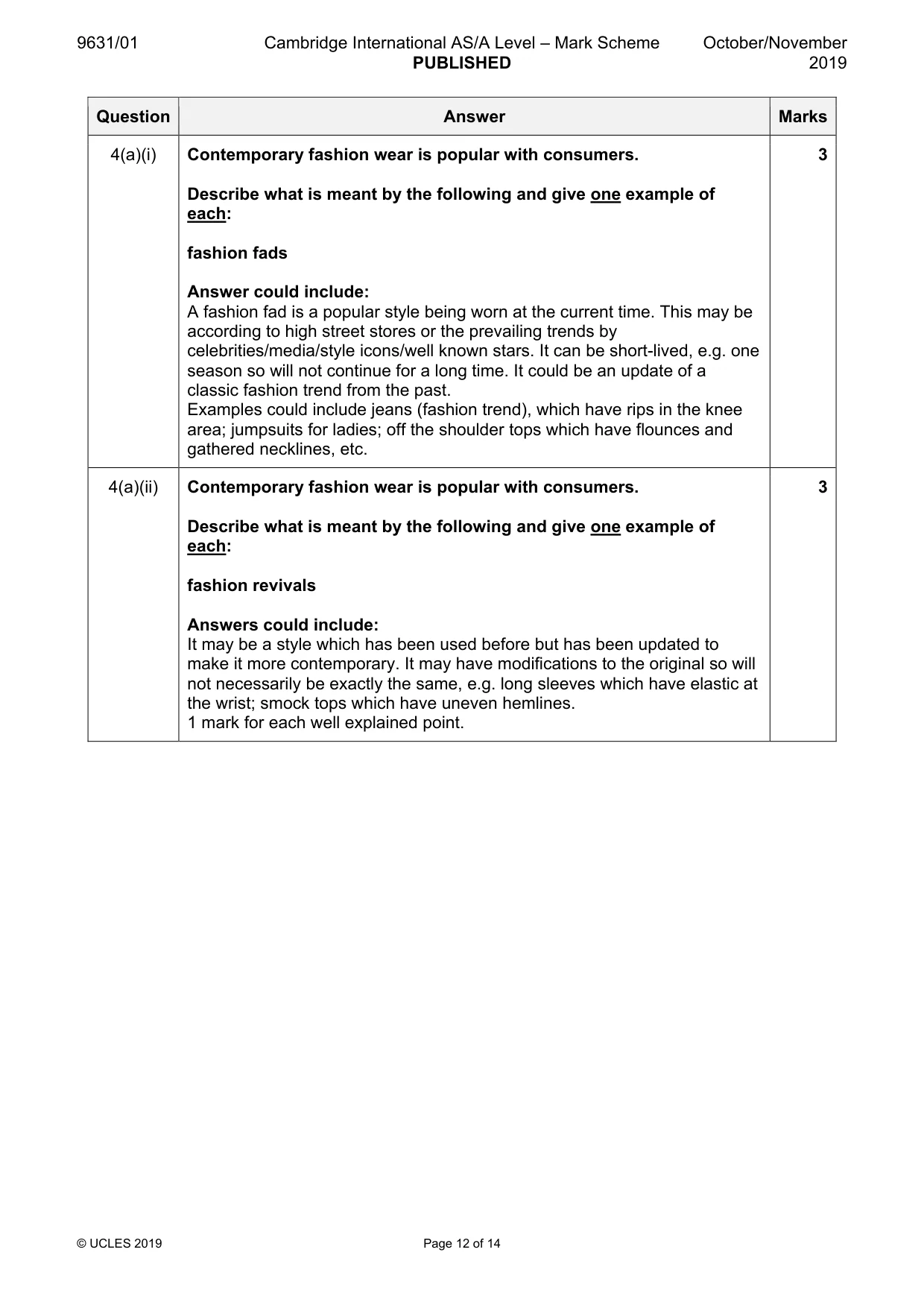
9631/01 Cambridge International AS/A Level – Mark Scheme PUBLISHED October/November 2019 © UCLES 2019 Page 12 of 14 Question Answer Marks 4(a)(i) Contemporary fashion wear is popular with consumers. Describe what is meant by the following and give one example of each: fashion fads Answer could include: A fashion fad is a popular style being worn at the current time. This may be according to high street stores or the prevailing trends by celebrities/media/style icons/well known stars. It can be short-lived, e.g. one season so will not continue for a long time. It could be an update of a classic fashion trend from the past. Examples could include jeans (fashion trend), which have rips in the knee area; jumpsuits for ladies; off the shoulder tops which have flounces and gathered necklines, etc. 3 4(a)(ii) Contemporary fashion wear is popular with consumers. Describe what is meant by the following and give one example of each: fashion revivals Answers could include: It may be a style which has been used before but has been updated to make it more contemporary. It may have modifications to the original so will not necessarily be exactly the same, e.g. long sleeves which have elastic at the wrist; smock tops which have uneven hemlines. 1 mark for each well explained point. 3
Mark scheme, page 13
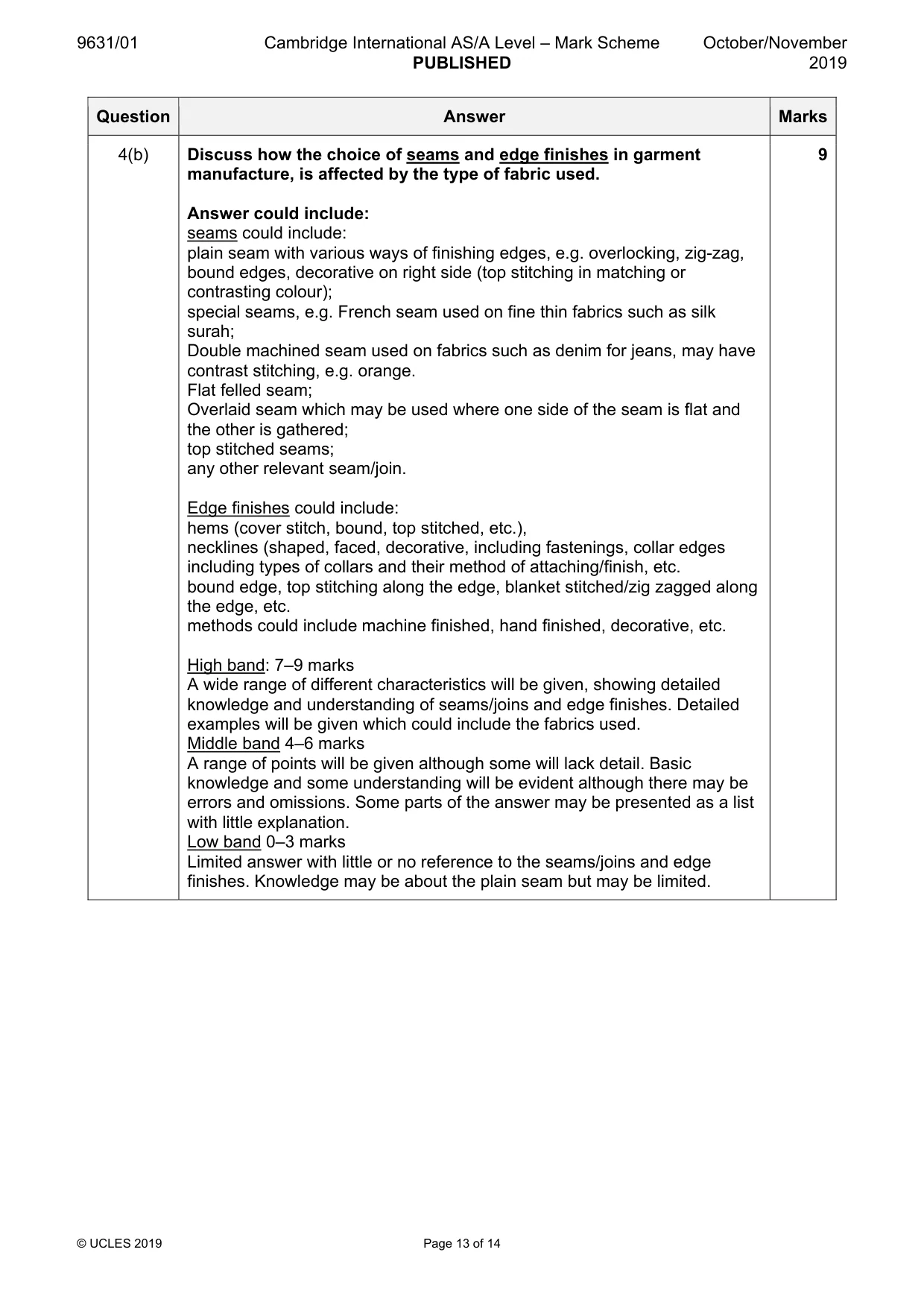
9631/01 Cambridge International AS/A Level – Mark Scheme PUBLISHED October/November 2019 © UCLES 2019 Page 13 of 14 Question Answer Marks 4(b) Discuss how the choice of seams and edge finishes in garment manufacture, is affected by the type of fabric used. Answer could include: seams could include: plain seam with various ways of finishing edges, e.g. overlocking, zig-zag, bound edges, decorative on right side (top stitching in matching or contrasting colour); special seams, e.g. French seam used on fine thin fabrics such as silk surah; Double machined seam used on fabrics such as denim for jeans, may have contrast stitching, e.g. orange. Flat felled seam; Overlaid seam which may be used where one side of the seam is flat and the other is gathered; top stitched seams; any other relevant seam/join. Edge finishes could include: hems (cover stitch, bound, top stitched, etc.), necklines (shaped, faced, decorative, including fastenings, collar edges including types of collars and their method of attaching/finish, etc. bound edge, top stitching along the edge, blanket stitched/zig zagged along the edge, etc. methods could include machine finished, hand finished, decorative, etc. High band: 7–9 marks A wide range of different characteristics will be given, showing detailed knowledge and understanding of seams/joins and edge finishes. Detailed examples will be given which could include the fabrics used. Middle band 4–6 marks A range of points will be given although some will lack detail. Basic knowledge and some understanding will be evident although there may be errors and omissions. Some parts of the answer may be presented as a list with little explanation. Low band 0–3 marks Limited answer with little or no reference to the seams/joins and edge finishes. Knowledge may be about the plain seam but may be limited. 9
Mark scheme, page 14
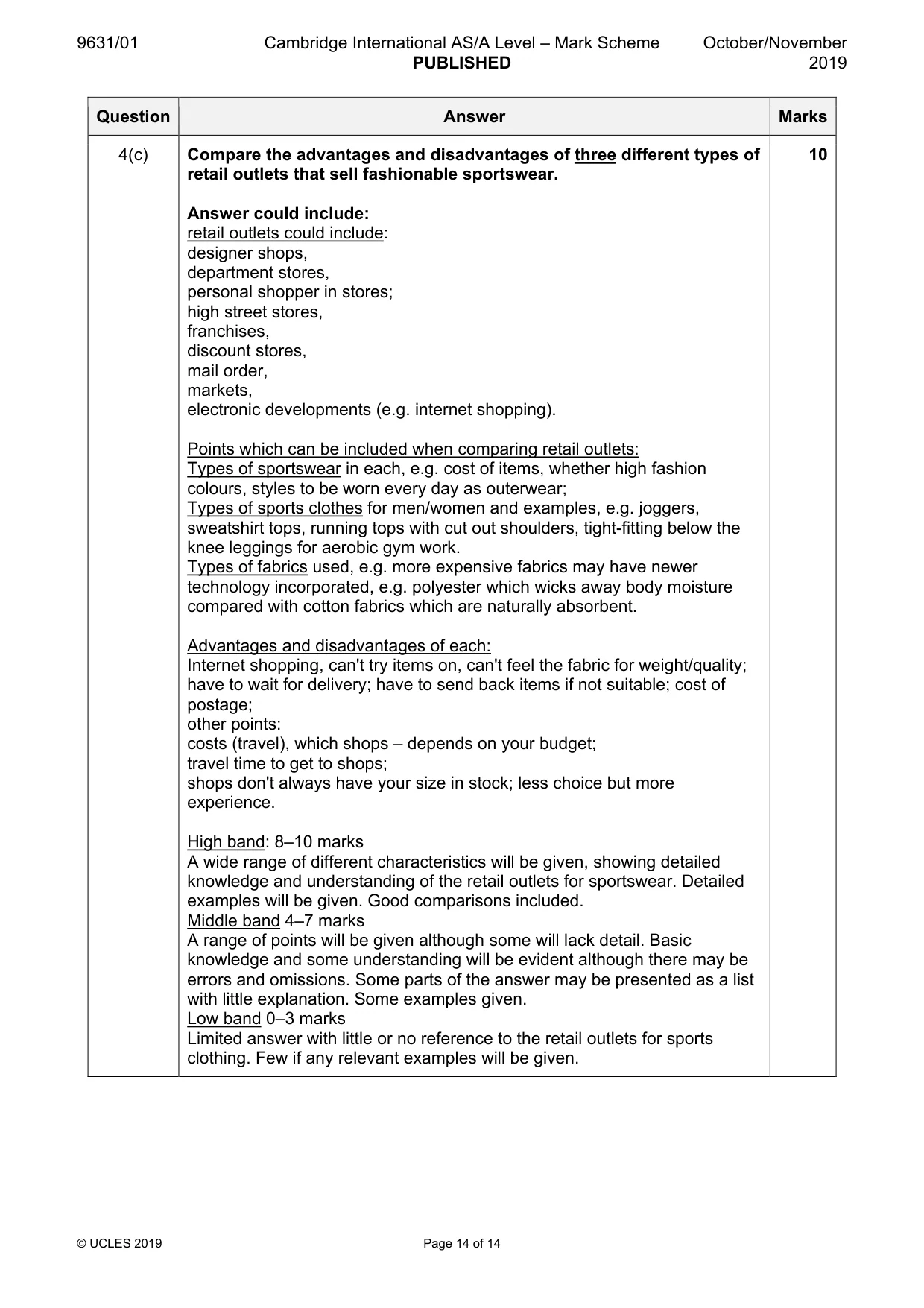
9631/01 Cambridge International AS/A Level – Mark Scheme PUBLISHED October/November 2019 © UCLES 2019 Page 14 of 14 Question Answer Marks 4(c) Compare the advantages and disadvantages of three different types of retail outlets that sell fashionable sportswear. Answer could include: retail outlets could include: designer shops, department stores, personal shopper in stores; high street stores, franchises, discount stores, mail order, markets, electronic developments (e.g. internet shopping). Points which can be included when comparing retail outlets: Types of sportswear in each, e.g. cost of items, whether high fashion colours, styles to be worn every day as outerwear; Types of sports clothes for men/women and examples, e.g. joggers, sweatshirt tops, running tops with cut out shoulders, tight-fitting below the knee leggings for aerobic gym work. Types of fabrics used, e.g. more expensive fabrics may have newer technology incorporated, e.g. polyester which wicks away body moisture compared with cotton fabrics which are naturally absorbent. Advantages and disadvantages of each: Internet shopping, can't try items on, can't feel the fabric for weight/quality; have to wait for delivery; have to send back items if not suitable; cost of postage; other points: costs (travel), which shops – depends on your budget; travel time to get to shops; shops don't always have your size in stock; less choice but more experience. High band: 8–10 marks A wide range of different characteristics will be given, showing detailed knowledge and understanding of the retail outlets for sportswear. Detailed examples will be given. Good comparisons included. Middle band 4–7 marks A range of points will be given although some will lack detail. Basic knowledge and some understanding will be evident although there may be errors and omissions. Some parts of the answer may be presented as a list with little explanation. Some examples given. Low band 0–3 marks Limited answer with little or no reference to the retail outlets for sports clothing. Few if any relevant examples will be given. 10
What you needed in this session
Cambridge’s own grade thresholds for 2019 Oct/Nov, Paper 1 · Variant 1. A higher threshold means an easier paper — the bar moves with how the cohort did.