Cambridge A Level Design and Textiles 9631 — 2016 Oct/Nov Paper 1 · Variant 1
9631/11/O/N/16 · 75 marks · ≈84 min
The question paper and its mark scheme, free to read here and free to download. This is Cambridge’s own paper, exactly as it was sat.
Question paper4 pages
Mark scheme13 pages
Answers below. Sit the paper first if you are practising.
Paper as text
Question paper, page 1
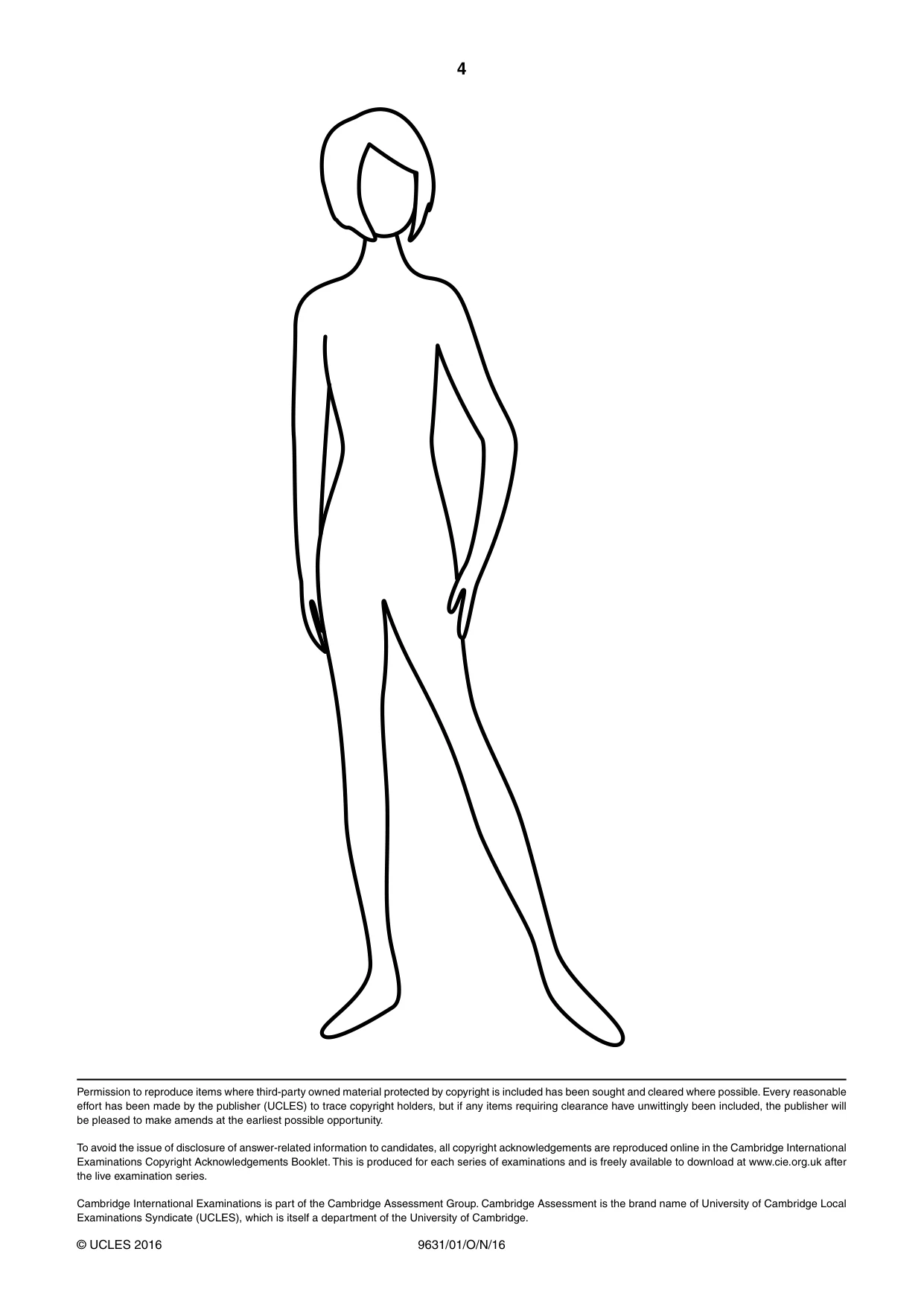
This document consists of 4 printed pages and 1 Insert. DC (RW) 116919/3 © UCLES 2016 [Turn over Cambridge International Examinations Cambridge International Advanced Subsidiary and Advanced Level * 1 9 4 9 2 2 8 6 7 7 * DESIGN AND TEXTILES 9631/01 Paper 1 Fibres, Fabrics and Design October/November 2016 2 hours No Additional Materials are required. READ THESE INSTRUCTIONS FIRST An answer booklet is provided inside this question paper. You should follow the instructions on the front cover of the answer booklet. If you need additional answer paper ask the invigilator for a continuation booklet. Answer three questions in total. Section A Answer both questions. Section B Answer one question. Illustrate your answers with clear, well-spaced diagrams. You may, if you wish, use the silhouette on page 4 to produce outlines for your sketches. Place the silhouette under a sheet of paper in the answer booklet and trace the outline in pencil. The number of marks is given in brackets [ ] at the end of each question or part question.
Question paper, page 2
2 9631/01/O/N/16 © UCLES 2016 Section A Answer both questions. 1 Wool and acrylic fibres are often used in fabrics for clothing. (a) (i) Explain with the use of a diagram the microscopic view of wool fibres. [3] (ii) Explain three reasons why wool can be successfully blended with acrylic. [6] (b) Explain how colour variations can be achieved on woven wool fabrics. You may use diagrams to support your answer. [6] (c) Discuss the differences between five performance characteristics of fabrics made from wool fibres with those made from acrylic fibres. [10] [Total: 25] 2 There is a wide range of fabrics used in clothing. Fabrics may be constructed in different ways. (a) (i) Describe the construction of the following: • cotton twill; • viscose jersey; • nylon raschel. [6] (ii) For each fabric named in 2(a)(i) suggest one item of clothing that the fabric could be used for and explain why the fabric is suitable for that use. [9] (b) Explain how CAD can be used to develop woven or printed patterns when designing fabrics. [10] [Total: 25]
Question paper, page 3
3 9631/01/O/N/16 © UCLES 2016 [Turn over Section B Answer any one question. 3 Design trends are important in the manufacture of ladies’ fashion. (a) State what is meant by a ‘classic trend’ in fashion and give two examples to support your answer. [3] (b) Draw the front and back views of two different skirts which use current design trends. Name the trends you have used. [6] (c) (i) Explain why it is necessary to make a prototype of a skirt before it goes into production. [4] (ii) Describe the stages involved in making a prototype for a skirt. [6] (d) Discuss the importance of fashion cycles in designing fashion garments. [6] [Total: 25] 4 There are many stages involved in clothing manufacturing. (a) (i) Outline four factors that will influence a fashion designer when producing new garment designs. [4] (ii) Explain how a fashion designer and manufacturer will decide which fabrics to use when planning to make garments. [4] (b) Explain what is meant by the following terms used in garment manufacturing, giving detailed examples for each: (i) grading; [3] (ii) quality control; [3] (iii) pressing and steaming. [3] (c) Explain why fashion designers use knitted fabrics to produce ladies’ fashion items. Include examples to support your answer. [8] [Total: 25]
Question paper, page 4
4 9631/01/O/N/16 © UCLES 2016 Permission to reproduce items where third-party owned material protected by copyright is included has been sought and cleared where possible. Every reasonable effort has been made by the publisher (UCLES) to trace copyright holders, but if any items requiring clearance have unwittingly been included, the publisher will be pleased to make amends at the earliest possible opportunity. To avoid the issue of disclosure of answer-related information to candidates, all copyright acknowledgements are reproduced online in the Cambridge International Examinations Copyright Acknowledgements Booklet. This is produced for each series of examinations and is freely available to download at www.cie.org.uk after the live examination series. Cambridge International Examinations is part of the Cambridge Assessment Group. Cambridge Assessment is the brand name of University of Cambridge Local Examinations Syndicate (UCLES), which is itself a department of the University of Cambridge.
Mark scheme, page 1
® IGCSE is the registered trademark of Cambridge International Examinations. This document consists of 13 printed pages. © UCLES 2016 [Turn over Cambridge International Examinations Cambridge International Advanced Subsidiary and Advanced Level DESIGN AND TEXTILES 9631/01 Paper 1 Fibres, Fabrics and Design October/November 2016 MARK SCHEME Maximum Mark: 75 Published This mark scheme is published as an aid to teachers and candidates, to indicate the requirements of the examination. It shows the basis on which Examiners were instructed to award marks. It does not indicate the details of the discussions that took place at an Examiners’ meeting before marking began, which would have considered the acceptability of alternative answers. Mark schemes should be read in conjunction with the question paper and the Principal Examiner Report for Teachers. Cambridge will not enter into discussions about these mark schemes. Cambridge is publishing the mark schemes for the October/November 2016 series for most Cambridge IGCSE®, Cambridge International A and AS Level components and some Cambridge O Level components.
Mark scheme, page 2
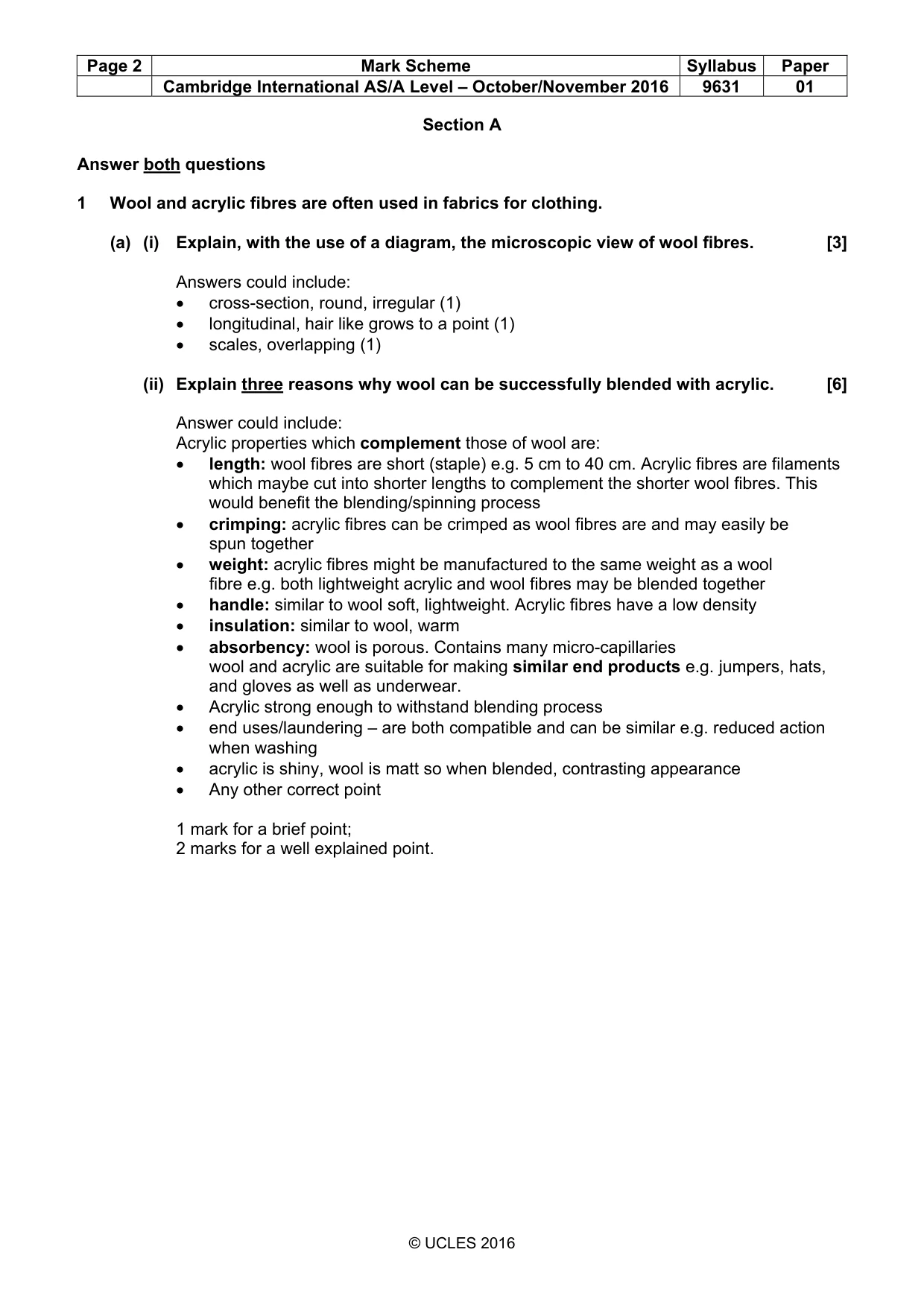
Page 2 Mark Scheme Syllabus Paper Cambridge International AS/A Level – October/November 2016 9631 01 © UCLES 2016 Section A Answer both questions 1 Wool and acrylic fibres are often used in fabrics for clothing. (a) (i) Explain, with the use of a diagram, the microscopic view of wool fibres. [3] Answers could include: • cross-section, round, irregular (1) • longitudinal, hair like grows to a point (1) • scales, overlapping (1) (ii) Explain three reasons why wool can be successfully blended with acrylic. [6] Answer could include: Acrylic properties which complement those of wool are: • length: wool fibres are short (staple) e.g. 5 cm to 40 cm. Acrylic fibres are filaments which maybe cut into shorter lengths to complement the shorter wool fibres. This would benefit the blending/spinning process • crimping: acrylic fibres can be crimped as wool fibres are and may easily be spun together • weight: acrylic fibres might be manufactured to the same weight as a wool fibre e.g. both lightweight acrylic and wool fibres may be blended together • handle: similar to wool soft, lightweight. Acrylic fibres have a low density • insulation: similar to wool, warm • absorbency: wool is porous. Contains many micro-capillaries wool and acrylic are suitable for making similar end products e.g. jumpers, hats, and gloves as well as underwear. • Acrylic strong enough to withstand blending process • end uses/laundering – are both compatible and can be similar e.g. reduced action when washing • acrylic is shiny, wool is matt so when blended, contrasting appearance • Any other correct point 1 mark for a brief point; 2 marks for a well explained point.
Mark scheme, page 3
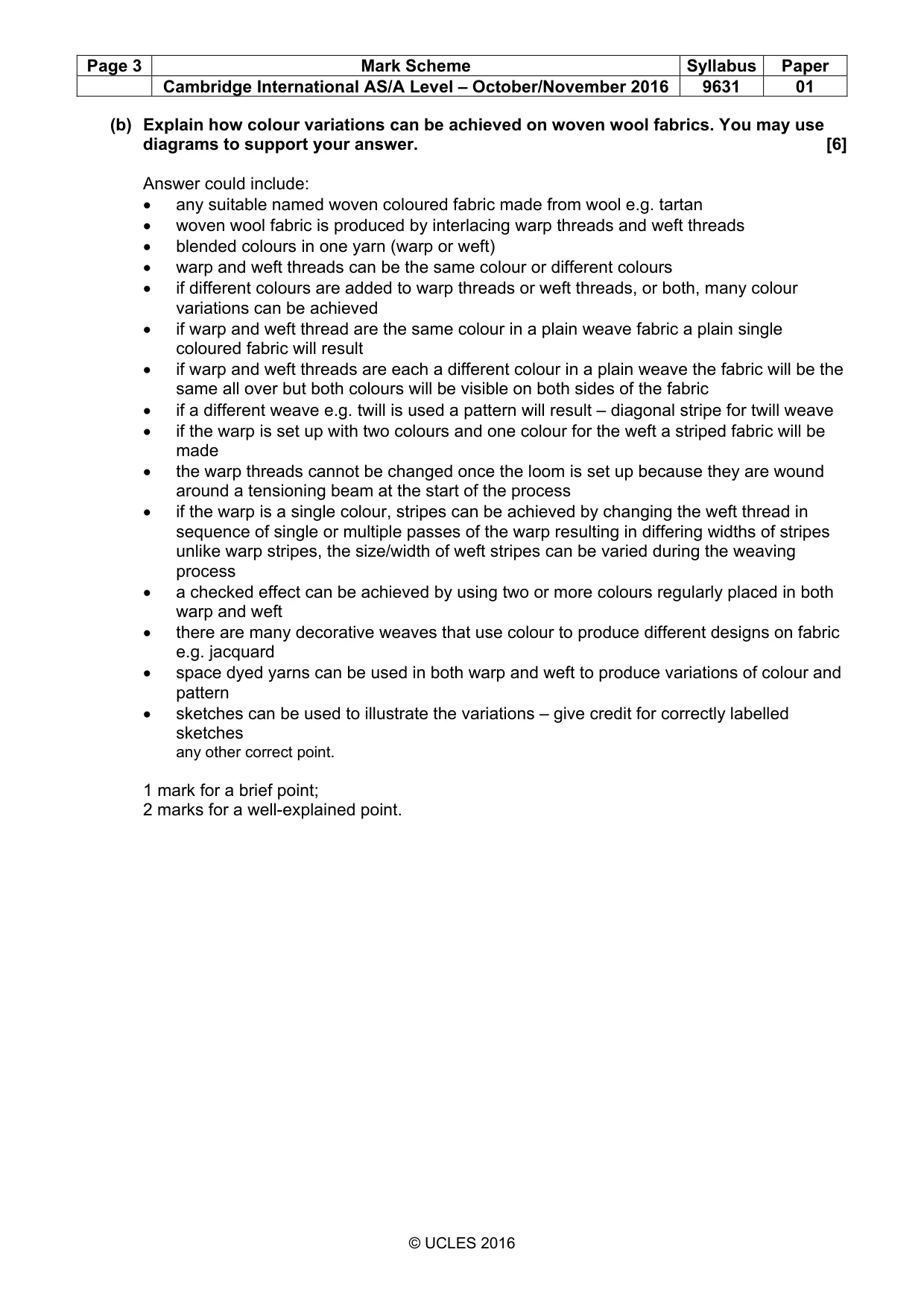
Page 3 Mark Scheme Syllabus Paper Cambridge International AS/A Level – October/November 2016 9631 01 © UCLES 2016 (b) Explain how colour variations can be achieved on woven wool fabrics. You may use diagrams to support your answer. [6] Answer could include: • any suitable named woven coloured fabric made from wool e.g. tartan • woven wool fabric is produced by interlacing warp threads and weft threads • blended colours in one yarn (warp or weft) • warp and weft threads can be the same colour or different colours • if different colours are added to warp threads or weft threads, or both, many colour variations can be achieved • if warp and weft thread are the same colour in a plain weave fabric a plain single coloured fabric will result • if warp and weft threads are each a different colour in a plain weave the fabric will be the same all over but both colours will be visible on both sides of the fabric • if a different weave e.g. twill is used a pattern will result – diagonal stripe for twill weave • if the warp is set up with two colours and one colour for the weft a striped fabric will be made • the warp threads cannot be changed once the loom is set up because they are wound around a tensioning beam at the start of the process • if the warp is a single colour, stripes can be achieved by changing the weft thread in sequence of single or multiple passes of the warp resulting in differing widths of stripes unlike warp stripes, the size/width of weft stripes can be varied during the weaving process • a checked effect can be achieved by using two or more colours regularly placed in both warp and weft • there are many decorative weaves that use colour to produce different designs on fabric e.g. jacquard • space dyed yarns can be used in both warp and weft to produce variations of colour and pattern • sketches can be used to illustrate the variations – give credit for correctly labelled sketches any other correct point. 1 mark for a brief point; 2 marks for a well-explained point.
Mark scheme, page 4
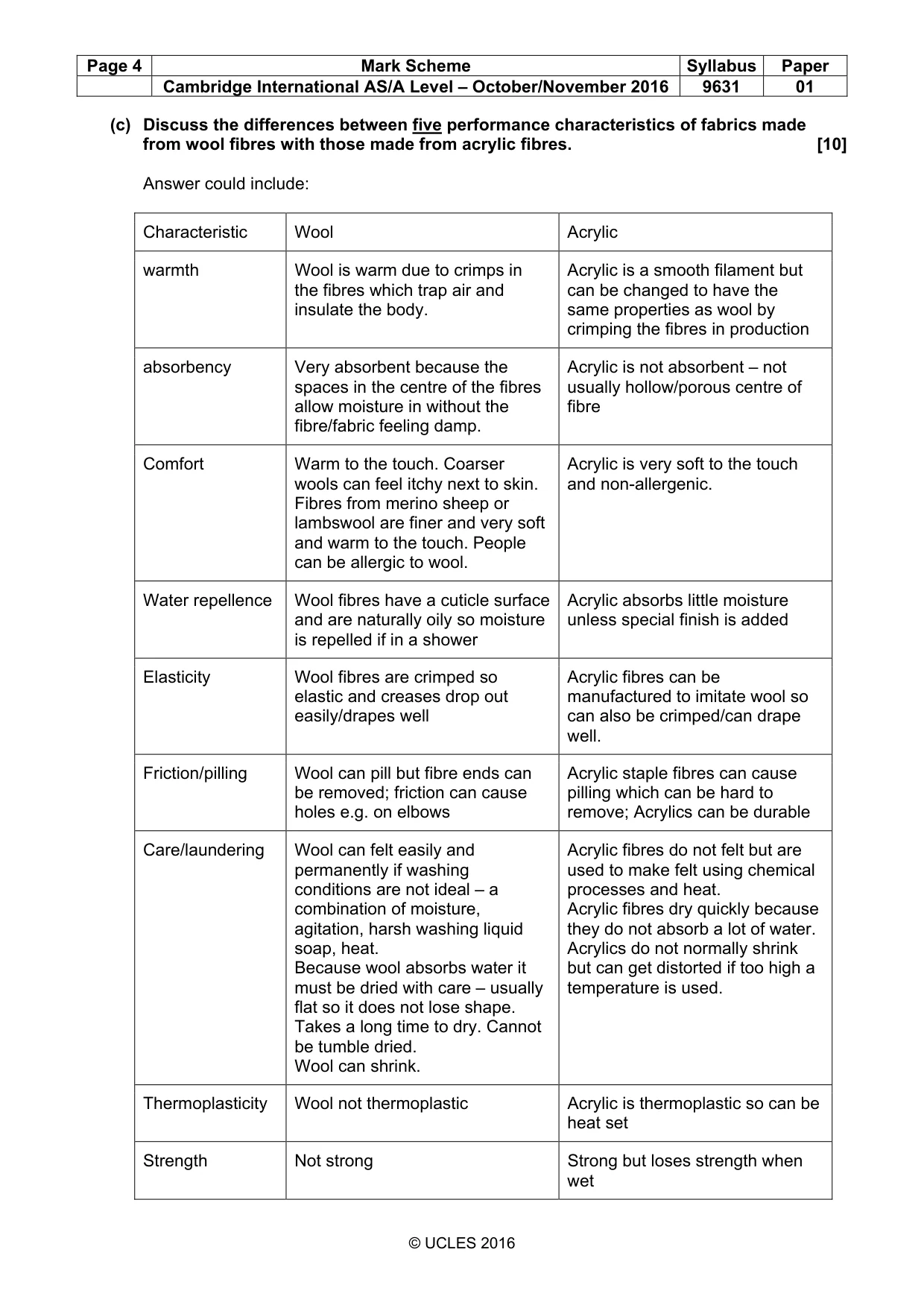
Page 4 Mark Scheme Syllabus Paper Cambridge International AS/A Level – October/November 2016 9631 01 © UCLES 2016 (c) Discuss the differences between five performance characteristics of fabrics made from wool fibres with those made from acrylic fibres. [10] Answer could include: Characteristic Wool Acrylic warmth Wool is warm due to crimps in the fibres which trap air and insulate the body. Acrylic is a smooth filament but can be changed to have the same properties as wool by crimping the fibres in production absorbency Very absorbent because the spaces in the centre of the fibres allow moisture in without the fibre/fabric feeling damp. Acrylic is not absorbent – not usually hollow/porous centre of fibre Comfort Warm to the touch. Coarser wools can feel itchy next to skin. Fibres from merino sheep or lambswool are finer and very soft and warm to the touch. People can be allergic to wool. Acrylic is very soft to the touch and non-allergenic. Water repellence Wool fibres have a cuticle surface and are naturally oily so moisture is repelled if in a shower Acrylic absorbs little moisture unless special finish is added Elasticity Wool fibres are crimped so elastic and creases drop out easily/drapes well Acrylic fibres can be manufactured to imitate wool so can also be crimped/can drape well. Friction/pilling Wool can pill but fibre ends can be removed; friction can cause holes e.g. on elbows Acrylic staple fibres can cause pilling which can be hard to remove; Acrylics can be durable Care/laundering Wool can felt easily and permanently if washing conditions are not ideal – a combination of moisture, agitation, harsh washing liquid soap, heat. Because wool absorbs water it must be dried with care – usually flat so it does not lose shape. Takes a long time to dry. Cannot be tumble dried. Wool can shrink. Acrylic fibres do not felt but are used to make felt using chemical processes and heat. Acrylic fibres dry quickly because they do not absorb a lot of water. Acrylics do not normally shrink but can get distorted if too high a temperature is used. Thermoplasticity Wool not thermoplastic Acrylic is thermoplastic so can be heat set Strength Not strong Strong but loses strength when wet
Mark scheme, page 5
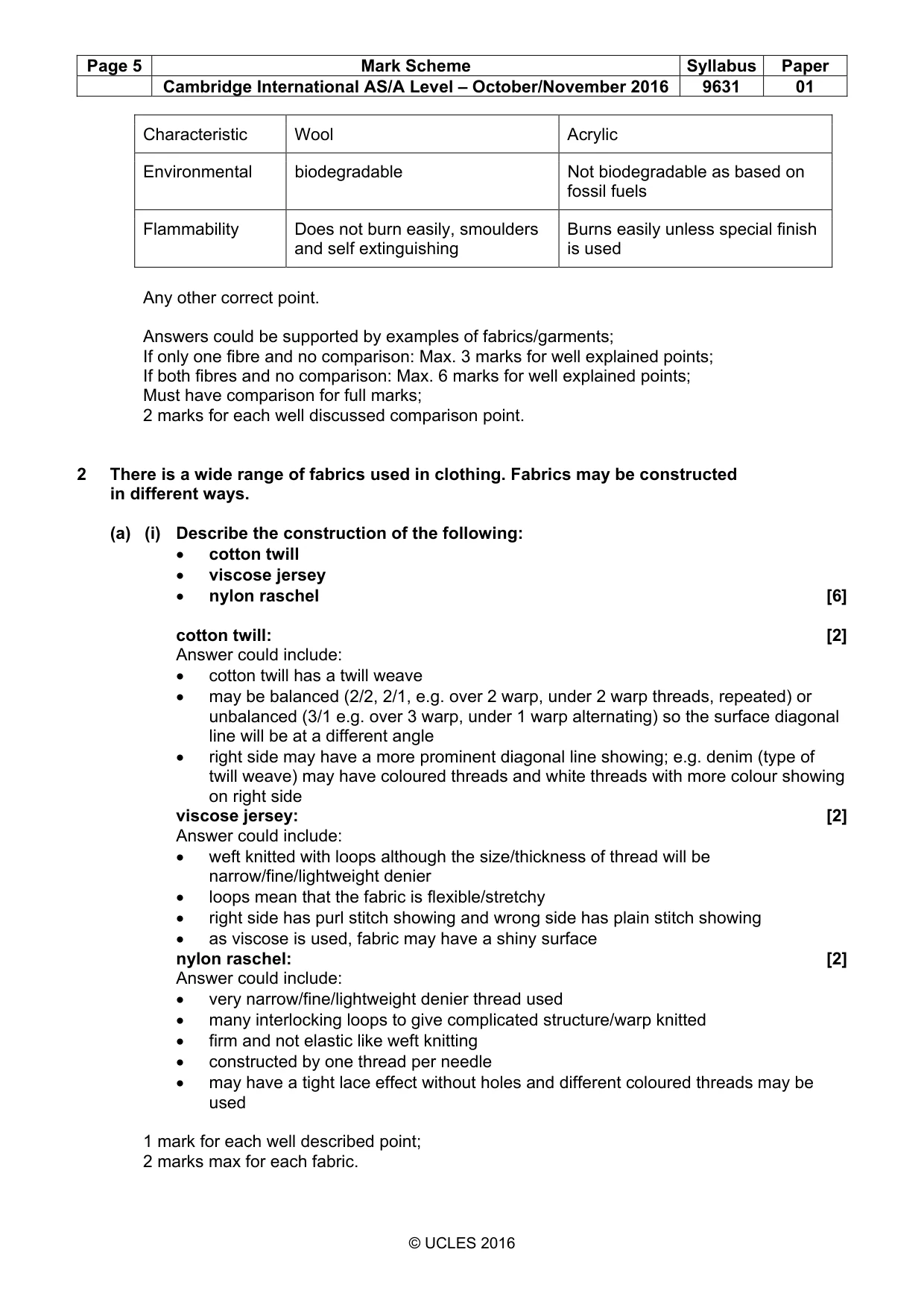
Page 5 Mark Scheme Syllabus Paper Cambridge International AS/A Level – October/November 2016 9631 01 © UCLES 2016 Characteristic Wool Acrylic Environmental biodegradable Not biodegradable as based on fossil fuels Flammability Does not burn easily, smoulders and self extinguishing Burns easily unless special finish is used Any other correct point. Answers could be supported by examples of fabrics/garments; If only one fibre and no comparison: Max. 3 marks for well explained points; If both fibres and no comparison: Max. 6 marks for well explained points; Must have comparison for full marks; 2 marks for each well discussed comparison point. 2 There is a wide range of fabrics used in clothing. Fabrics may be constructed in different ways. (a) (i) Describe the construction of the following: • cotton twill • viscose jersey • nylon raschel [6] cotton twill: [2] Answer could include: • cotton twill has a twill weave • may be balanced (2/2, 2/1, e.g. over 2 warp, under 2 warp threads, repeated) or unbalanced (3/1 e.g. over 3 warp, under 1 warp alternating) so the surface diagonal line will be at a different angle • right side may have a more prominent diagonal line showing; e.g. denim (type of twill weave) may have coloured threads and white threads with more colour showing on right side viscose jersey: [2] Answer could include: • weft knitted with loops although the size/thickness of thread will be narrow/fine/lightweight denier • loops mean that the fabric is flexible/stretchy • right side has purl stitch showing and wrong side has plain stitch showing • as viscose is used, fabric may have a shiny surface nylon raschel: [2] Answer could include: • very narrow/fine/lightweight denier thread used • many interlocking loops to give complicated structure/warp knitted • firm and not elastic like weft knitting • constructed by one thread per needle • may have a tight lace effect without holes and different coloured threads may be used 1 mark for each well described point; 2 marks max for each fabric.
Mark scheme, page 6
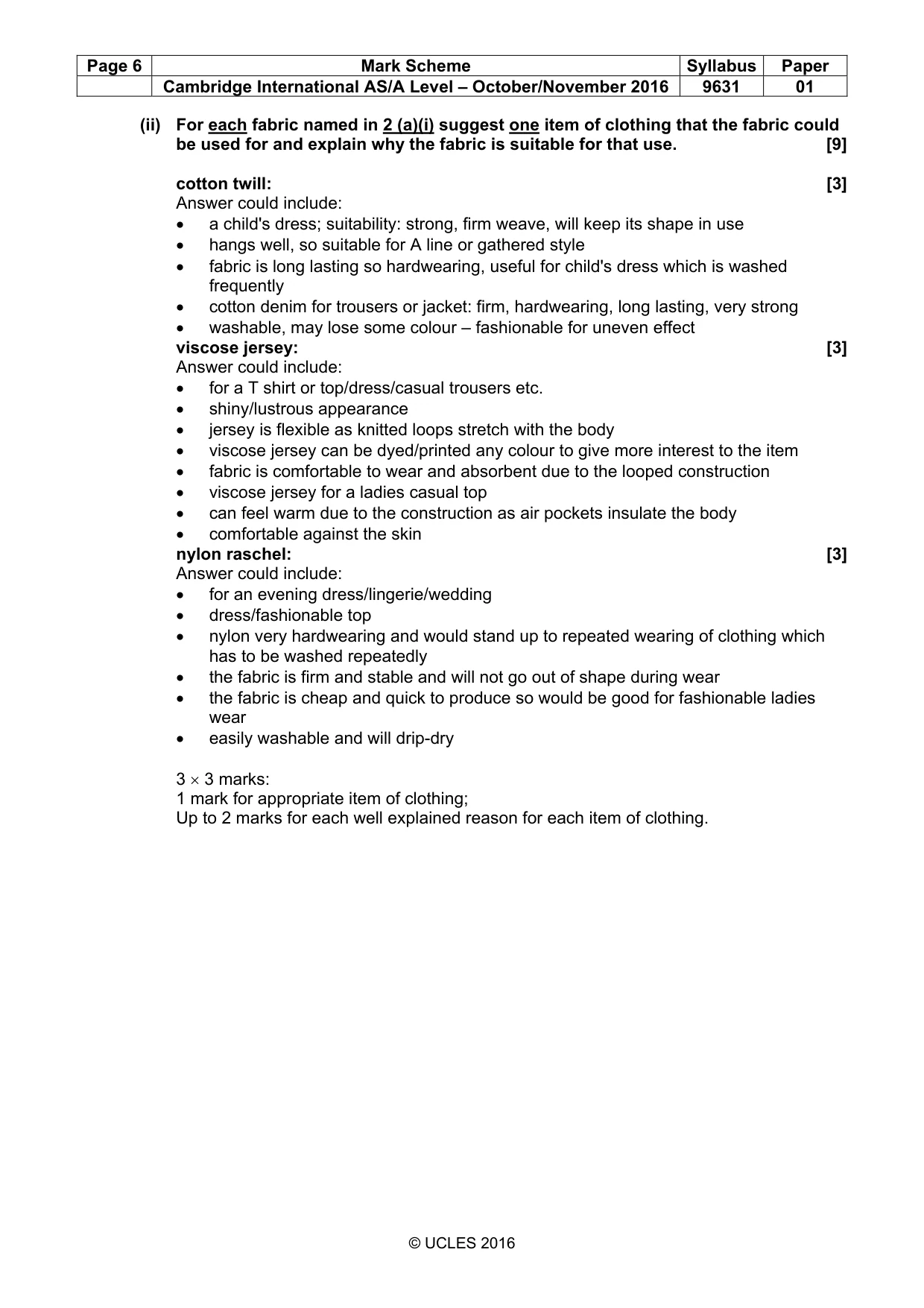
Page 6 Mark Scheme Syllabus Paper Cambridge International AS/A Level – October/November 2016 9631 01 © UCLES 2016 (ii) For each fabric named in 2 (a)(i) suggest one item of clothing that the fabric could be used for and explain why the fabric is suitable for that use. [9] cotton twill: [3] Answer could include: • a child's dress; suitability: strong, firm weave, will keep its shape in use • hangs well, so suitable for A line or gathered style • fabric is long lasting so hardwearing, useful for child's dress which is washed frequently • cotton denim for trousers or jacket: firm, hardwearing, long lasting, very strong • washable, may lose some colour – fashionable for uneven effect viscose jersey: [3] Answer could include: • for a T shirt or top/dress/casual trousers etc. • shiny/lustrous appearance • jersey is flexible as knitted loops stretch with the body • viscose jersey can be dyed/printed any colour to give more interest to the item • fabric is comfortable to wear and absorbent due to the looped construction • viscose jersey for a ladies casual top • can feel warm due to the construction as air pockets insulate the body • comfortable against the skin nylon raschel: [3] Answer could include: • for an evening dress/lingerie/wedding • dress/fashionable top • nylon very hardwearing and would stand up to repeated wearing of clothing which has to be washed repeatedly • the fabric is firm and stable and will not go out of shape during wear • the fabric is cheap and quick to produce so would be good for fashionable ladies wear • easily washable and will drip-dry 3 × 3 marks: 1 mark for appropriate item of clothing; Up to 2 marks for each well explained reason for each item of clothing.
Mark scheme, page 7
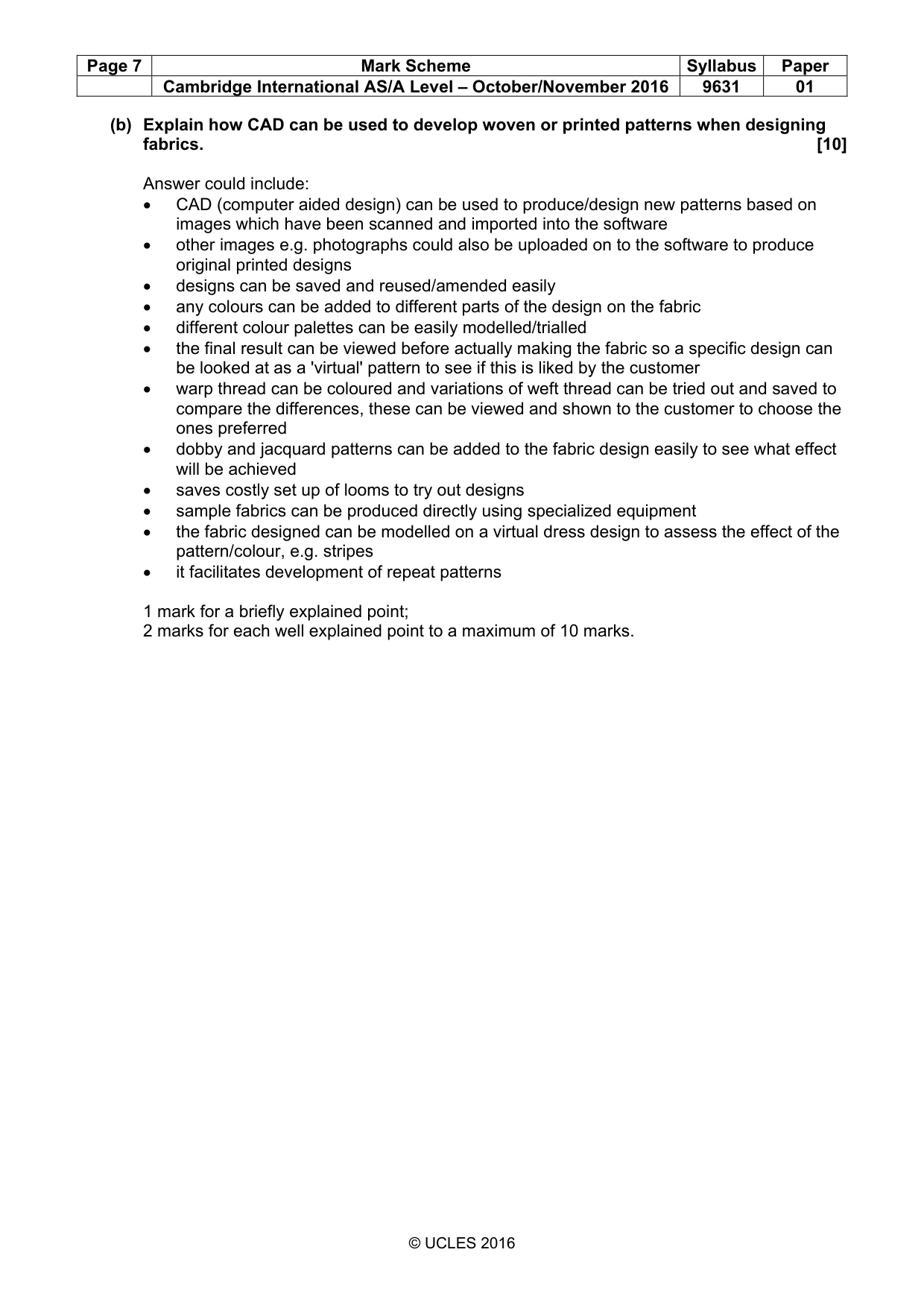
Page 7 Mark Scheme Syllabus Paper Cambridge International AS/A Level – October/November 2016 9631 01 © UCLES 2016 (b) Explain how CAD can be used to develop woven or printed patterns when designing fabrics. [10] Answer could include: • CAD (computer aided design) can be used to produce/design new patterns based on images which have been scanned and imported into the software • other images e.g. photographs could also be uploaded on to the software to produce original printed designs • designs can be saved and reused/amended easily • any colours can be added to different parts of the design on the fabric • different colour palettes can be easily modelled/trialled • the final result can be viewed before actually making the fabric so a specific design can be looked at as a 'virtual' pattern to see if this is liked by the customer • warp thread can be coloured and variations of weft thread can be tried out and saved to compare the differences, these can be viewed and shown to the customer to choose the ones preferred • dobby and jacquard patterns can be added to the fabric design easily to see what effect will be achieved • saves costly set up of looms to try out designs • sample fabrics can be produced directly using specialized equipment • the fabric designed can be modelled on a virtual dress design to assess the effect of the pattern/colour, e.g. stripes • it facilitates development of repeat patterns 1 mark for a briefly explained point; 2 marks for each well explained point to a maximum of 10 marks.
Mark scheme, page 8
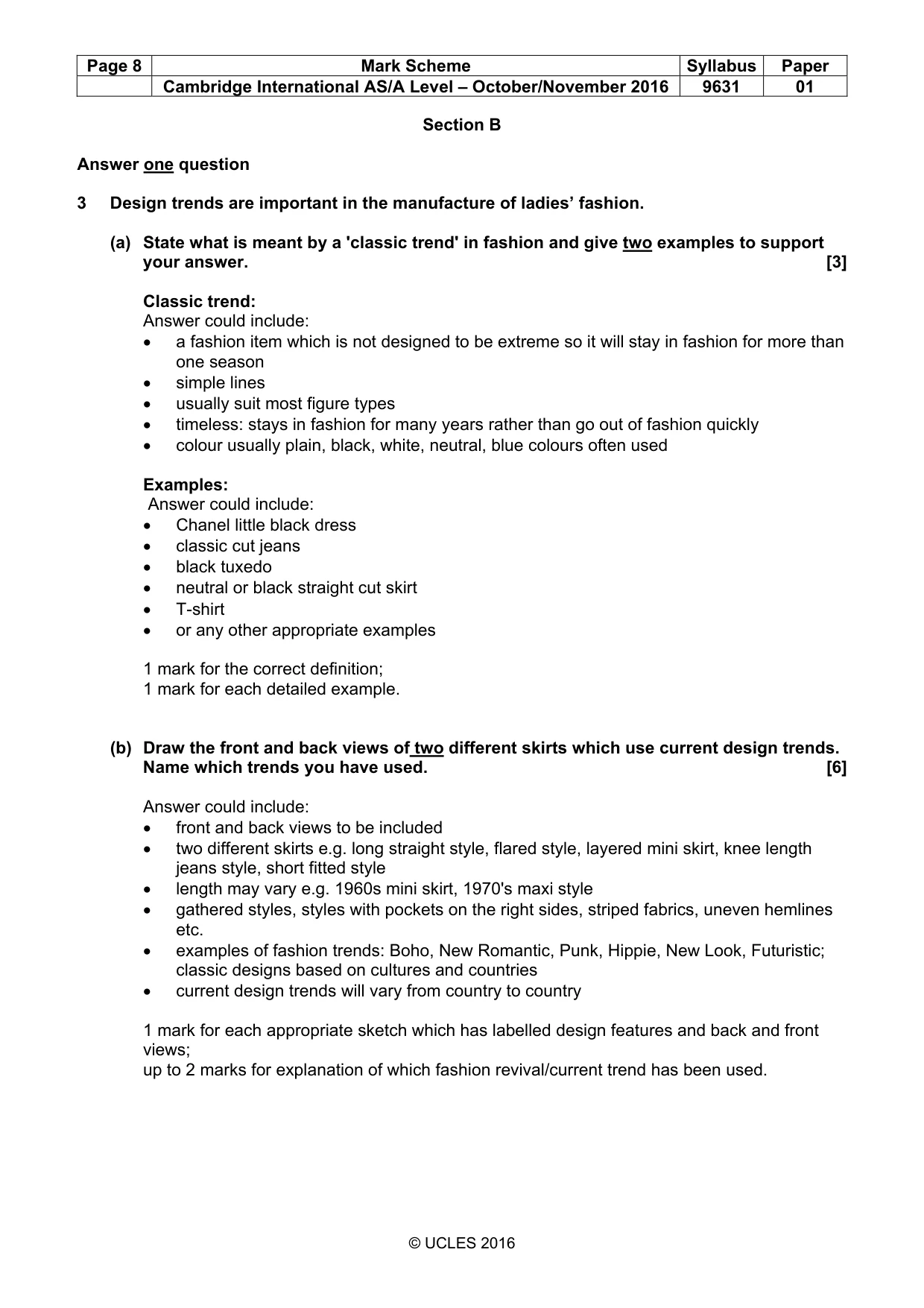
Page 8 Mark Scheme Syllabus Paper Cambridge International AS/A Level – October/November 2016 9631 01 © UCLES 2016 Section B Answer one question 3 Design trends are important in the manufacture of ladies’ fashion. (a) State what is meant by a 'classic trend' in fashion and give two examples to support your answer. [3] Classic trend: Answer could include: • a fashion item which is not designed to be extreme so it will stay in fashion for more than one season • simple lines • usually suit most figure types • timeless: stays in fashion for many years rather than go out of fashion quickly • colour usually plain, black, white, neutral, blue colours often used Examples: Answer could include: • Chanel little black dress • classic cut jeans • black tuxedo • neutral or black straight cut skirt • T-shirt • or any other appropriate examples 1 mark for the correct definition; 1 mark for each detailed example. (b) Draw the front and back views of two different skirts which use current design trends. Name which trends you have used. [6] Answer could include: • front and back views to be included • two different skirts e.g. long straight style, flared style, layered mini skirt, knee length jeans style, short fitted style • length may vary e.g. 1960s mini skirt, 1970's maxi style • gathered styles, styles with pockets on the right sides, striped fabrics, uneven hemlines etc. • examples of fashion trends: Boho, New Romantic, Punk, Hippie, New Look, Futuristic; classic designs based on cultures and countries • current design trends will vary from country to country 1 mark for each appropriate sketch which has labelled design features and back and front views; up to 2 marks for explanation of which fashion revival/current trend has been used.
Mark scheme, page 9
Page 9 Mark Scheme Syllabus Paper Cambridge International AS/A Level – October/November 2016 9631 01 © UCLES 2016 (c) (i) Explain why it is necessary to make a prototype of the skirt before it goes into production. [4] Answer could include: • to check size(s) • check position of main style features e.g. pockets/princess seams/darts/waistline detail • see if any adjustments need to be made by comparing the prototype with the design • show the design to the customer to see if they are happy with the item • useful to see the design made up as it may look better (or not so successful) compared to the sketch • prototype made to see how easy/difficult it is to make the item/time • a way to check the cost of making up the item especially if specialist processes are used • to plan production • to make sure the chosen fabric and components and colours work for the design any other relevant points 1 mark for each brief point 2 marks for well described points up to 4 marks. (ii) Describe the stages involved in making a prototype for a skirt. [6] Answer could include: • prototype pattern needs to be made first, relevant to the design • pattern developed from basic block patterns • as the prototype will be a one-off product a paper pattern will be used • pin pattern onto fabric and cut out the pieces • a skilled worker (sample machinist) will produce the prototype skirt by stitching the pieces together • following the product specification which will include a drawing of the design • choose suitable fabric similar in weight and performance to final fabric e.g. cotton calico or other cheap fabric • may use final fabric • stages of assembly (depends on design chosen): make darts/pleats; stitch pocket(s) in position • assembly main skirt pieces by stitching side seams • finish top of skirt e.g. waistband/facing/elastic casing etc. • make lower edge/hem etc. • press skirt • fit the skirt to check sizes and make adjustments if needed
Mark scheme, page 10
Page 10 Mark Scheme Syllabus Paper Cambridge International AS/A Level – October/November 2016 9631 01 © UCLES 2016 (d) Discuss the importance of fashion cycles in designing fashion garments. [6] A range of relevant points should be included which shows knowledge and understanding of fashion cycles and their importance to designers of fashion garments. Some of the following should be included: Answers could include: • The fashion cycle begins when a particular look emerges and is popular often after a popular celebrity is photographed wearing it • Emulation (copy), the second phase, begins as the style is adopted by magazine covers and the mass media • Market saturation, the proliferation of low-cost fashion copies in the market, marks the end of the fashion cycle FASHION CYCLE Answers could include: • Cycle: Period of time or life span during which fashion exists • Style: Particular look, shape or type of apparel • Fashion: a style that is popular during a period of time • The fashion cycle is usually depicted as a bell-shaped curve encompassing five stages • Consumers are exposed, every season to multitudes of new styles • Some styles are rejected immediately by the buyers at retail level, where as some styles are accepted for a time, as demonstrated by consumers purchasing and wearing them • With trend reports in new papers and fashion channels many women who consider themselves up to date with what’s new, go out each season to assess what's needed in order to keep their wardrobe relevant 1 Introduction of a style: New collections are produced each season. Every style has some different elements like line, shape, colour, fabric. The first stage may not be accepted by the consumers. New styles are usually introduced in high price level and new styles created by a designer are worn by the selected people who can afford it, celebrities and rich people who love to experiment and try out new styles to grab the attention of media. Such styles, as they are expensive, are produced in small quantities. 2 Increase in popularity: New styles worn by celebrities and seen by many people may draw attention of buyers, the press, and public. Most designers have prêt a porter line that sells at comparatively low prices in quantity. Manufacturers adopt design and styles to produce with less expensive fabric or less details for mass production. 3 Peak in popularity: When production of any style is in volume, it requires mass acceptance. The manufacturers carefully study trends because the consumer will always prefer clothes that are in the main stream of fashion. When a fashion is at height of its popularity, it may be in such demand that many manufacturers copy it or produce adaptations of it at many price levels. Length of this stage determines if the fashion becomes Classic or Fad 4 Decline in popularity: Eventually people begin looking for new styles. They still wear the particular style but are not willing to buy them at the same price. With the launch of new collections every season the popularity of the style of the previous seasons declines (unless it becomes or is a classic). The market becomes saturated as the market is flooded with the same styles. Styles that are in decline go in sales and are sold at reduced prices to clear. 5 Rejection period: It is the last phase of the cycle. Some consumers have already turned to new looks, thus beginning a new cycle. The rejection or discarding of a style just because it is out of fashion is called consumer obsolescence. Since consumers have lost interest manufactures stop producing the styles and retailers will not restock them. 1 mark for each well discussed point, up to 6 points.
Mark scheme, page 11
Page 11 Mark Scheme Syllabus Paper Cambridge International AS/A Level – October/November 2016 9631 01 © UCLES 2016 4 There are many stages involved in clothing manufacturing. (a) (i) Outline four factors that will influence a fashion designer when producing new garment designs. [4] Answer could include: • research will be carried out which can include design sources/inspiration e.g. the designer may choose a country/culture or holiday images etc. to produce designs for new fashion items • colour trend forecasts which are available for fashion designers to refer to when choosing a colour palette for their designs • target group – type of item • fabric trends/sales which are for fashion designers and may have particular fabrics which are set to be popular and which other fashion designers are using e.g. lace fabrics were popular in the summer season 2014 and were used on many different fashion items e.g. t-shirts, dresses, tops • which season they are designing for e.g. winter season may need designs for coats/to cover the body/thicker fabrics etc. • market – who is the designer designing for? Which age group, climate, brand etc.; • Cost – what are the making and retail costs? 1 mark for each well explained point. (ii) Explain how a fashion designer and manufacturer will decide which fabrics to use when planning to make garments. Answer could include: • the prototype will be made in a cheap fabric such as cotton calico so it will not give a good idea of how the finished product will look, only whether the garment design and pattern work • style of garment/design • weight of fabric e.g. lightweight, medium or heavyweight • which weave/knit/other construction to use e.g. plain woven fabric will be firm and may hang stiffly if the fabric is heavy. A knitted fabric will drape more softly and will cling more to the body • colour/design on the fabrics will depend on colour/fabric trends for a particular season so a designer may wish to be influenced by these and use them or choose something which is more original and innovative • chemical/physical tests if relevant to garment • ease of stitching/working the fabric when making the design – this will be of particular interest for the manufacturer as the labour force employed will need to stitch the items together in the most efficient way • cost depends on market for garments. High end expensive fabrics, low end cheap and poorer quality • availability e.g. locally sourced • environmental and ethical issues e.g. Fair trade cotton/sustainable/organic; linked to marketing, local sourcing • function/use of garment – does it need to be washable, hard wearing etc. • for men/ladies • ethical issues e.g. not using leather/animal fur 1 mark for a brief point; 2 marks for a well explained point; Answer may have two of the above or any other relevant points.
Mark scheme, page 12
Page 12 Mark Scheme Syllabus Paper Cambridge International AS/A Level – October/November 2016 9631 01 © UCLES 2016 (b) Explain what is meant by the following terms used in garment manufacturing, giving detailed examples for each: (i) grading [3] (ii) quality control [3] (iii) pressing and steaming [3] (i) Grading Answer could include: • a pattern used in manufacturing will be graded to different sizes e.g. size 6, 8 10 etc. • different sides of the pattern piece will have the extra amount included • the sides of a pattern which normally have the extra amounts are side seams, hems, shoulder seams etc. using CAD • also darts, necklines, armholes will be adjusted • tables are used to grade manually (ii) Quality control Answer could include: • quality checks take place at different stages and at the end of production so that the quality of making up can be checked • the seam allowances need to be 1 cm and there may be a tolerance of 2 mm for this • when the seam is checked for quality control, the width of the seam will be checked to make sure it is within the tolerance and measures 0.9 – 1.1 cm • areas which may be checked for quality include length of darts, zip insertion finish, number of buttons, finish of seams, etc. • if the product is not manufactured to the required standard, it may be rejected and returned to the original machinist to correct • if mistakes cannot be corrected the product will be discarded • the quality points will be included in the manufacturing specification e.g. tolerances. (iii) Pressing and steaming: Answer could include: • pressing may take place throughout the making stages to ensure all the processes are flat, neat and well finished • the final pressing to remove creases will be steam pressing either with a steam iron or using a steam press where the garment is placed on a stand, inflated and steamed with a jet of steam • the item will be put on a hanger and possibly packaged e.g. covered in plastic or boxed, depending on the product For each item: 1 mark for a brief point; 2 marks for a well explained point. 1 mark for a specific relevant example
Mark scheme, page 13
Page 13 Mark Scheme Syllabus Paper Cambridge International AS/A Level – October/November 2016 9631 01 © UCLES 2016 (c) Explain why fashion designers use knitted fabrics to produce ladies’ fashion items. Include examples to support your answer. [8] Answer could include: • knitted fabrics are flexible and mould well to the body, e.g. sportswear • less construction details are needed because the fabric can stretch around body curves e.g. darts or shaped seams may not be needed because the fabric can stretch, therefore cheaper to manufacture, e.g. nightwear • designs can be printed onto knitted fabric easily, e.g. t-shirts • drapes well • soft handle/comfort • fabric can be dyed easily • fabric is quick to produce as it can be produced very quickly on knitting machines either flat bed/circular or warp knitting machines, e.g. socks and tights • many of the synthetic fibres can be produced to many different requirements so thickness/texture of yarns can be altered easily to produce a wide variety of fabric, e.g. woollen pullovers and fleeces • the quality of the fabric does not rely just on natural fibres. Many of the newer fibres e.g. lyocell/tencel can be knitted successfully • cost of knitted fabrics often lower than woven 1 mark for brief discussion; 2 marks for well discussed point; Give credit for specific and relevant examples.
What you needed in this session
Cambridge’s own grade thresholds for 2016 Oct/Nov, Paper 1 · Variant 1. A higher threshold means an easier paper — the bar moves with how the cohort did.