Cambridge A Level Design and Textiles 9631 — 2015 Oct/Nov Paper 1 · Variant 1
9631/11/O/N/15 · 75 marks · ≈84 min
The question paper and its mark scheme, free to read here and free to download. This is Cambridge’s own paper, exactly as it was sat.
Question paper4 pages
Mark scheme12 pages
Answers below. Sit the paper first if you are practising.


Paper as text
Question paper, page 1
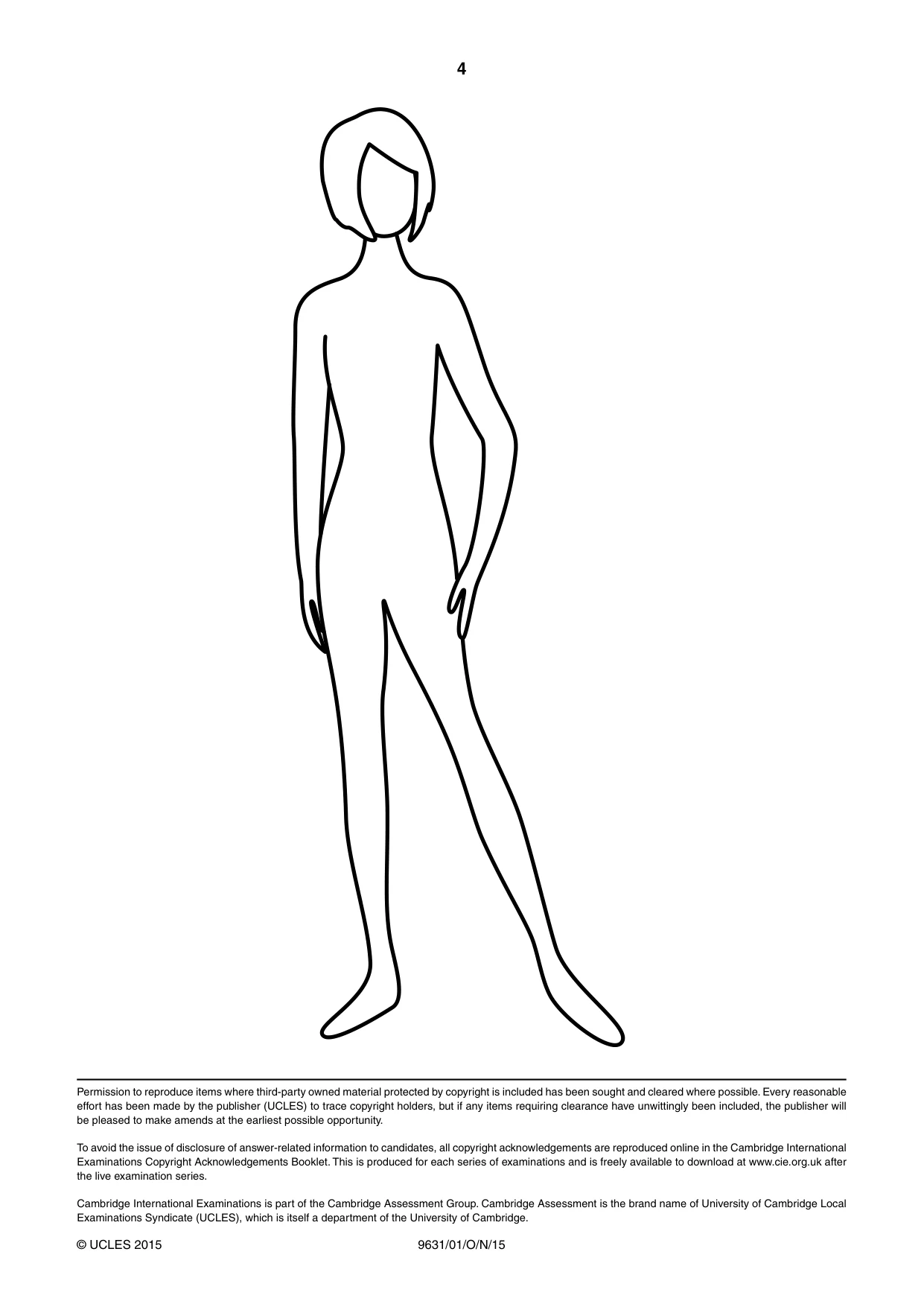
This document consists of 4 printed pages and 1 Insert. DC (KN/JG) 97827/2 © UCLES 2015 [Turn over Cambridge International Examinations Cambridge International Advanced Subsidiary and Advanced Level * 4 0 0 3 8 7 9 2 1 2 * DESIGN AND TEXTILES 9631/01 Paper 1 Fibres, Fabrics and Design October/November 2015 2 hours No Additional Materials are required. READ THESE INSTRUCTIONS FIRST An answer booklet is provided inside this question paper. You should follow the instructions on the front cover of the answer booklet. If you need additional answer paper ask the invigilator for a continuation booklet. Answer three questions in total. Section A Answer both questions. Section B Answer one question. Illustrate your answers with clear, well-spaced diagrams. You may, if you wish, use the silhouette on page 4 to produce outlines for your sketches. Place the silhouette under a single sheet of script paper and trace the outline in pencil. The number of marks is given in brackets [ ] at the end of each question or part question.
Question paper, page 2
2 9631/01/O/N/15 © UCLES 2015 Section A Answer both questions. 1 Natural fibres and fabrics are widely used in the production of textile items. (a) State how fibres are obtained from: (i) cotton plants [1] (ii) flax plants. [1] (b) Compare the following characteristics of cotton fibres and flax fibres: (i) variation of fibre length [2] (ii) the cross-section as seen under a microscope. [2] (c) (i) Discuss four performance characteristics of cotton fabrics that make them suitable for clothing. [8] (ii) Explain why linen fabrics are not as popular as cotton fabrics for clothing. [3] (d) Evaluate the range of cotton fabrics that can be used for children’s clothing. Name specific examples of cotton fabrics in your answer. [8] [Total: 25] 2 There is a wide choice of synthetic fibres and fabrics. (a) Describe the following fibres and, for each, give one example of its use: (i) aramid fibre [2] (ii) elastane fibre. [2] (b) Compare the performance characteristics of aramid fibre and elastane fibre with reference to: (i) flammability [2] (ii) strength [2] (iii) extensibility. [2] (c) Using labelled diagrams and notes, name and compare the structure of one woven synthetic fabric and one weft knitted synthetic fabric. [8] (d) Discuss the factors which should be considered when choosing whether to use woven fabrics or knitted fabrics for clothing. [7] [Total: 25]
Question paper, page 3
3 9631/01/O/N/15 © UCLES 2015 [Turn over Section B Answer one question. 3 Bags are a popular fashion accessory. (a) (i) Draw a design of a fashionable bag suitable for a teenager. Include front and back views and show how line and colour can be used in an interesting way. Label your design clearly. [6] (ii) Describe two different secure closures (fastenings) which would be appropriate for your bag design. [4] (iii) Explain how your choice of line and colour have shown good design principles and follow current trends. [6] (b) Discuss the advantages for the consumer of there being a wide choice of retail outlets that sell bags. Give examples of types of retail outlets in your answer. [9] [Total: 25] 4 The manufacture of clothing items depends upon many factors. (a) (i) Explain three ways of adapting existing patterns/templates. [3] (ii) Outline the main stages of producing garment patterns/templates for use in manufacturing. [5] (b) Discuss four factors which a manufacturer would need to consider when choosing fused interfacings for different fabrics. [8] (c) Evaluate the range of neckline openings which are available to a manufacturer of ladies’ clothing. Give specific examples in your answer. [9] [Total: 25]
Question paper, page 4
4 9631/01/O/N/15 © UCLES 2015 Permission to reproduce items where third-party owned material protected by copyright is included has been sought and cleared where possible. Every reasonable effort has been made by the publisher (UCLES) to trace copyright holders, but if any items requiring clearance have unwittingly been included, the publisher will be pleased to make amends at the earliest possible opportunity. To avoid the issue of disclosure of answer-related information to candidates, all copyright acknowledgements are reproduced online in the Cambridge International Examinations Copyright Acknowledgements Booklet. This is produced for each series of examinations and is freely available to download at www.cie.org.uk after the live examination series. Cambridge International Examinations is part of the Cambridge Assessment Group. Cambridge Assessment is the brand name of University of Cambridge Local Examinations Syndicate (UCLES), which is itself a department of the University of Cambridge.
Mark scheme, page 1
® IGCSE is the registered trademark of Cambridge International Examinations. CAMBRIDGE INTERNATIONAL EXAMINATIONS Cambridge International Advanced Subsidiary and Advanced Level MARK SCHEME for the October/November 2015 series 9631 DESIGN AND TEXTILES 9631/01 Paper 1 (Fibres, Fabrics and Design), maximum raw mark 75 This mark scheme is published as an aid to teachers and candidates, to indicate the requirements of the examination. It shows the basis on which Examiners were instructed to award marks. It does not indicate the details of the discussions that took place at an Examiners’ meeting before marking began, which would have considered the acceptability of alternative answers. Mark schemes should be read in conjunction with the question paper and the Principal Examiner Report for Teachers. Cambridge will not enter into discussions about these mark schemes. Cambridge is publishing the mark schemes for the October/November 2015 series for most Cambridge IGCSE®, Cambridge International A and AS Level components and some Cambridge O Level components.
Mark scheme, page 2
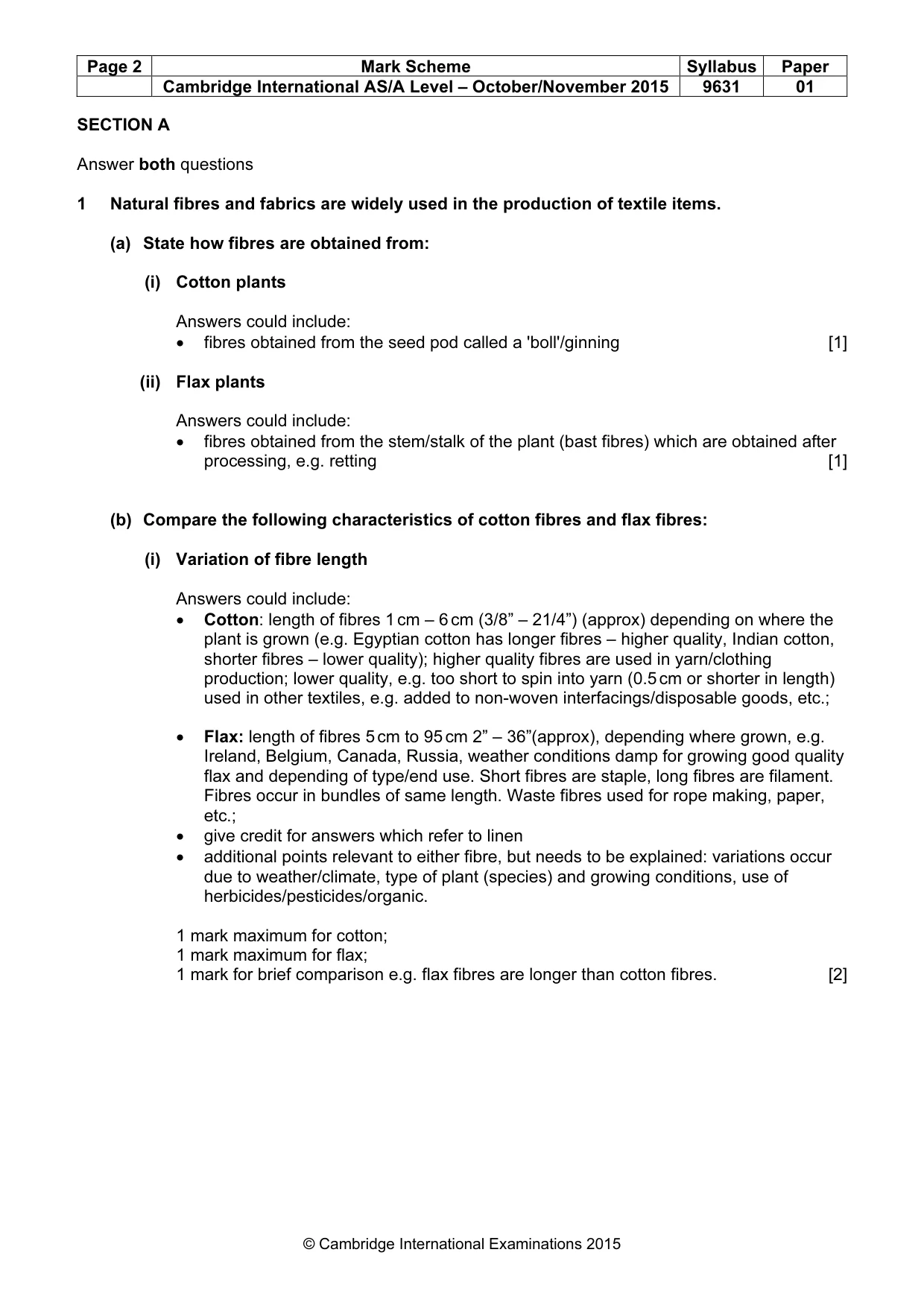
Page 2 Mark Scheme Syllabus Paper Cambridge International AS/A Level – October/November 2015 9631 01 © Cambridge International Examinations 2015 SECTION A Answer both questions 1 Natural fibres and fabrics are widely used in the production of textile items. (a) State how fibres are obtained from: (i) Cotton plants Answers could include: • fibres obtained from the seed pod called a 'boll'/ginning [1] (ii) Flax plants Answers could include: • fibres obtained from the stem/stalk of the plant (bast fibres) which are obtained after processing, e.g. retting [1] (b) Compare the following characteristics of cotton fibres and flax fibres: (i) Variation of fibre length Answers could include: • Cotton: length of fibres 1 cm – 6 cm (3/8” – 21/4”) (approx) depending on where the plant is grown (e.g. Egyptian cotton has longer fibres – higher quality, Indian cotton, shorter fibres – lower quality); higher quality fibres are used in yarn/clothing production; lower quality, e.g. too short to spin into yarn (0.5 cm or shorter in length) used in other textiles, e.g. added to non-woven interfacings/disposable goods, etc.; • Flax: length of fibres 5 cm to 95 cm 2” – 36”(approx), depending where grown, e.g. Ireland, Belgium, Canada, Russia, weather conditions damp for growing good quality flax and depending of type/end use. Short fibres are staple, long fibres are filament. Fibres occur in bundles of same length. Waste fibres used for rope making, paper, etc.; • give credit for answers which refer to linen • additional points relevant to either fibre, but needs to be explained: variations occur due to weather/climate, type of plant (species) and growing conditions, use of herbicides/pesticides/organic. 1 mark maximum for cotton; 1 mark maximum for flax; 1 mark for brief comparison e.g. flax fibres are longer than cotton fibres. [2]
Mark scheme, page 3
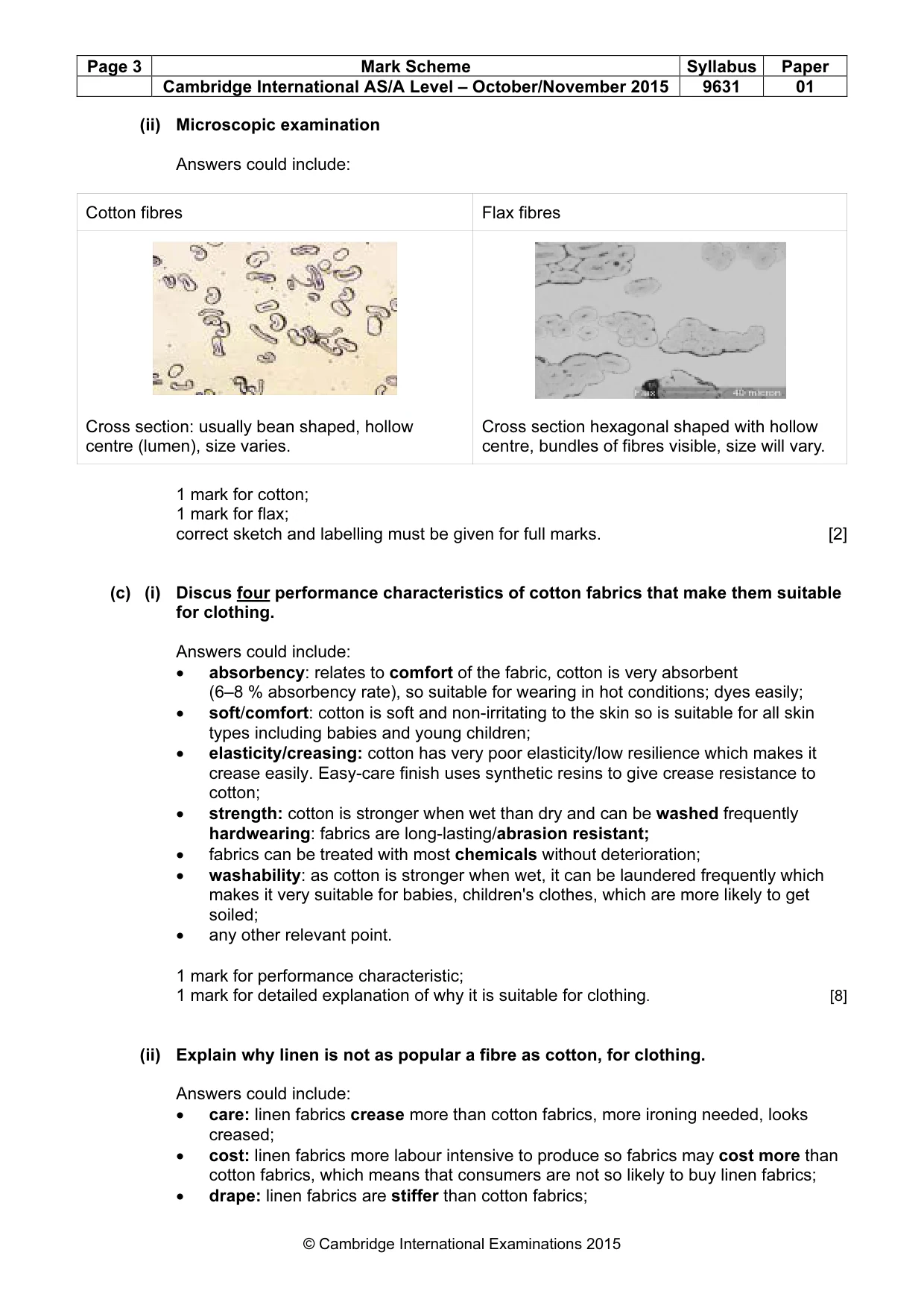
Page 3 Mark Scheme Syllabus Paper Cambridge International AS/A Level – October/November 2015 9631 01 © Cambridge International Examinations 2015 (ii) Microscopic examination Answers could include: Cotton fibres Flax fibres Cross section: usually bean shaped, hollow centre (lumen), size varies. Cross section hexagonal shaped with hollow centre, bundles of fibres visible, size will vary. 1 mark for cotton; 1 mark for flax; correct sketch and labelling must be given for full marks. [2] (c) (i) Discus four performance characteristics of cotton fabrics that make them suitable for clothing. Answers could include: • absorbency: relates to comfort of the fabric, cotton is very absorbent (6–8 % absorbency rate), so suitable for wearing in hot conditions; dyes easily; • soft/comfort: cotton is soft and non-irritating to the skin so is suitable for all skin types including babies and young children; • elasticity/creasing: cotton has very poor elasticity/low resilience which makes it crease easily. Easy-care finish uses synthetic resins to give crease resistance to cotton; • strength: cotton is stronger when wet than dry and can be washed frequently hardwearing: fabrics are long-lasting/abrasion resistant; • fabrics can be treated with most chemicals without deterioration; • washability: as cotton is stronger when wet, it can be laundered frequently which makes it very suitable for babies, children's clothes, which are more likely to get soiled; • any other relevant point. 1 mark for performance characteristic; 1 mark for detailed explanation of why it is suitable for clothing. [8] (ii) Explain why linen is not as popular a fibre as cotton, for clothing. Answers could include: • care: linen fabrics crease more than cotton fabrics, more ironing needed, looks creased; • cost: linen fabrics more labour intensive to produce so fabrics may cost more than cotton fabrics, which means that consumers are not so likely to buy linen fabrics; • drape: linen fabrics are stiffer than cotton fabrics;
Mark scheme, page 4
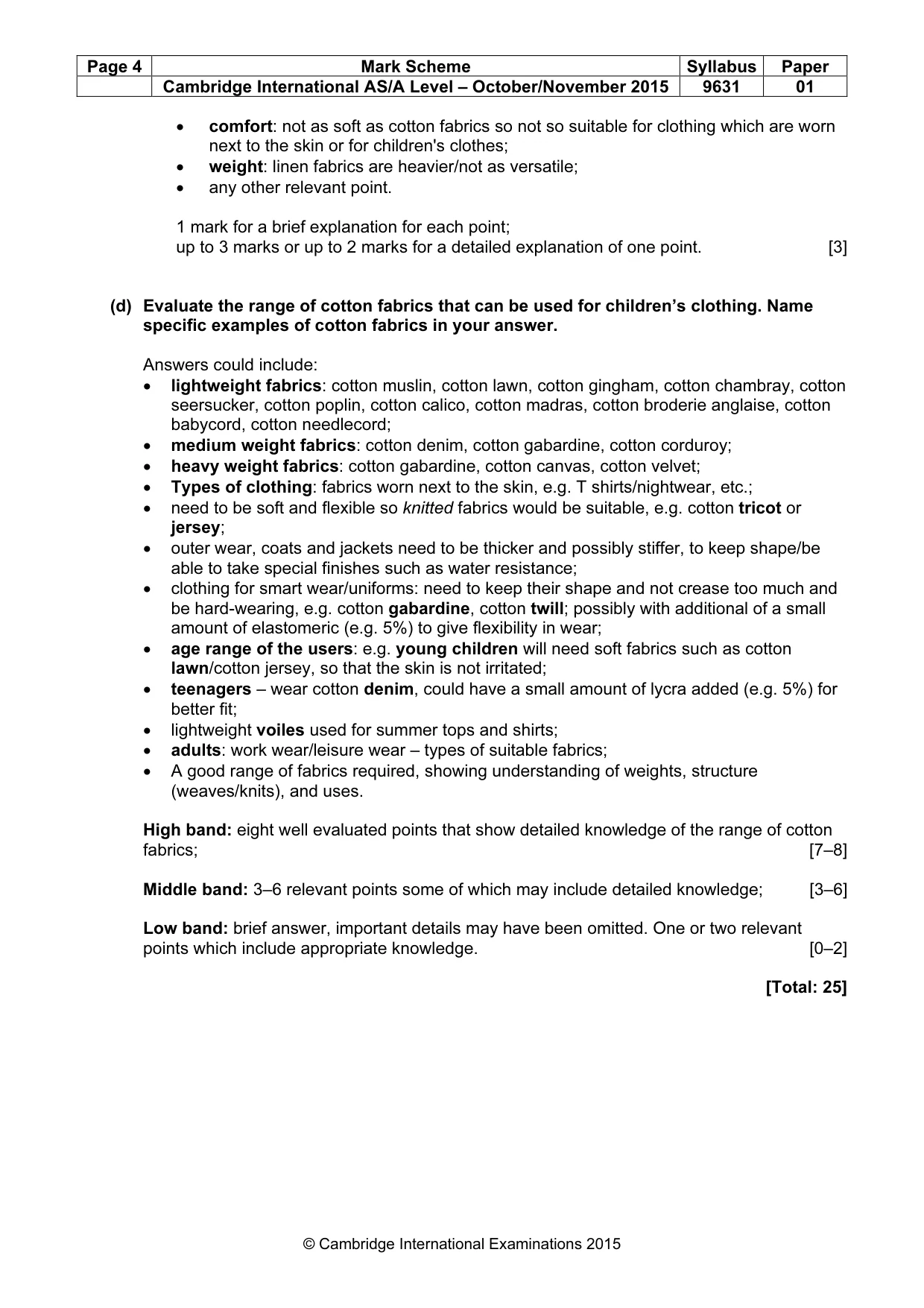
Page 4 Mark Scheme Syllabus Paper Cambridge International AS/A Level – October/November 2015 9631 01 © Cambridge International Examinations 2015 • comfort: not as soft as cotton fabrics so not so suitable for clothing which are worn next to the skin or for children's clothes; • weight: linen fabrics are heavier/not as versatile; • any other relevant point. 1 mark for a brief explanation for each point; up to 3 marks or up to 2 marks for a detailed explanation of one point. [3] (d) Evaluate the range of cotton fabrics that can be used for children’s clothing. Name specific examples of cotton fabrics in your answer. Answers could include: • lightweight fabrics: cotton muslin, cotton lawn, cotton gingham, cotton chambray, cotton seersucker, cotton poplin, cotton calico, cotton madras, cotton broderie anglaise, cotton babycord, cotton needlecord; • medium weight fabrics: cotton denim, cotton gabardine, cotton corduroy; • heavy weight fabrics: cotton gabardine, cotton canvas, cotton velvet; • Types of clothing: fabrics worn next to the skin, e.g. T shirts/nightwear, etc.; • need to be soft and flexible so knitted fabrics would be suitable, e.g. cotton tricot or jersey; • outer wear, coats and jackets need to be thicker and possibly stiffer, to keep shape/be able to take special finishes such as water resistance; • clothing for smart wear/uniforms: need to keep their shape and not crease too much and be hard-wearing, e.g. cotton gabardine, cotton twill; possibly with additional of a small amount of elastomeric (e.g. 5%) to give flexibility in wear; • age range of the users: e.g. young children will need soft fabrics such as cotton lawn/cotton jersey, so that the skin is not irritated; • teenagers – wear cotton denim, could have a small amount of lycra added (e.g. 5%) for better fit; • lightweight voiles used for summer tops and shirts; • adults: work wear/leisure wear – types of suitable fabrics; • A good range of fabrics required, showing understanding of weights, structure (weaves/knits), and uses. High band: eight well evaluated points that show detailed knowledge of the range of cotton fabrics; [7–8] Middle band: 3–6 relevant points some of which may include detailed knowledge; [3–6] Low band: brief answer, important details may have been omitted. One or two relevant points which include appropriate knowledge. [0–2] [Total: 25]
Mark scheme, page 5
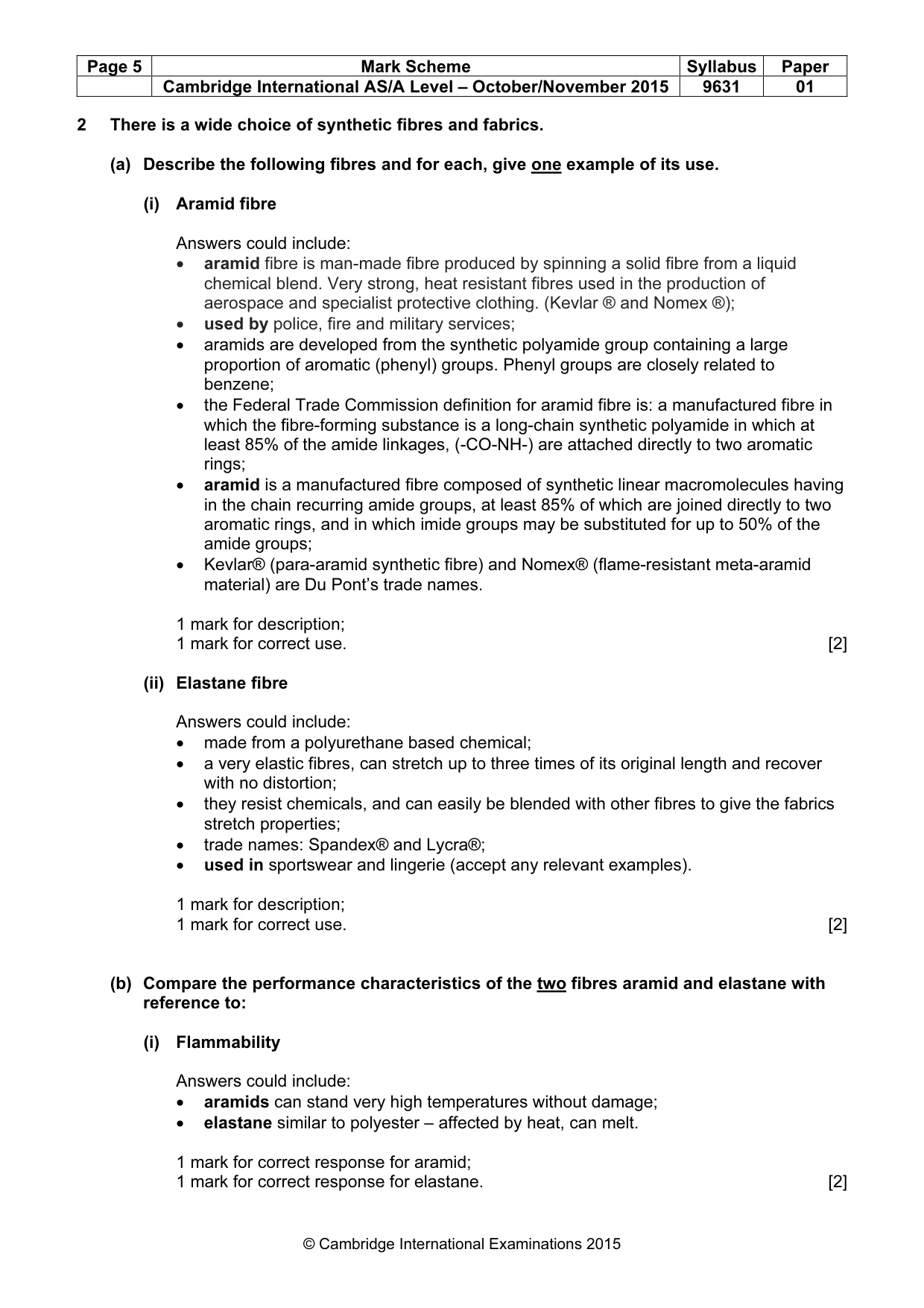
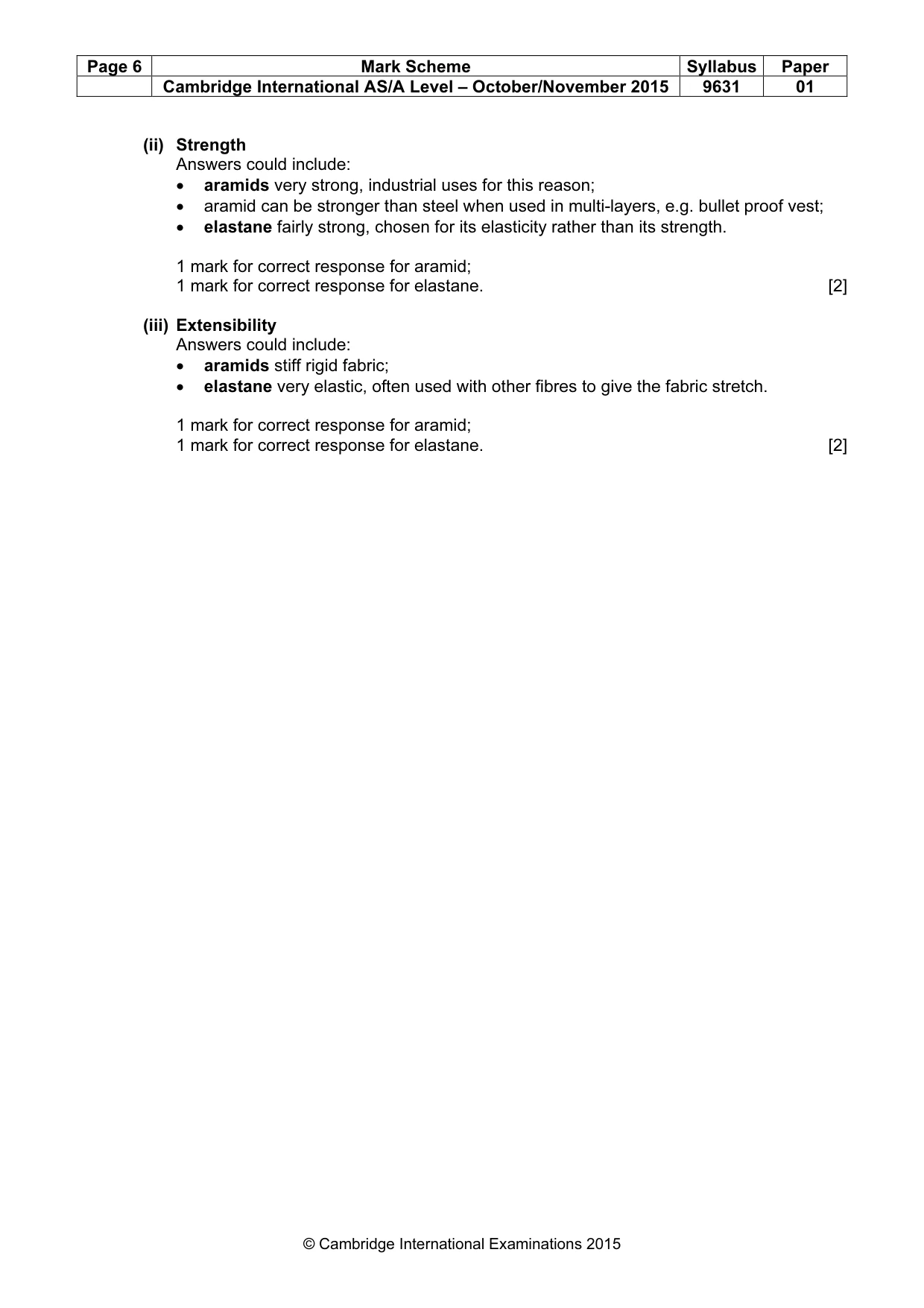
Page 5 Mark Scheme Syllabus Paper Cambridge International AS/A Level – October/November 2015 9631 01 © Cambridge International Examinations 2015 2 There is a wide choice of synthetic fibres and fabrics. (a) Describe the following fibres and for each, give one example of its use. (i) Aramid fibre Answers could include: • aramid fibre is man-made fibre produced by spinning a solid fibre from a liquid chemical blend. Very strong, heat resistant fibres used in the production of aerospace and specialist protective clothing. (Kevlar ® and Nomex ®); • used by police, fire and military services; • aramids are developed from the synthetic polyamide group containing a large proportion of aromatic (phenyl) groups. Phenyl groups are closely related to benzene; • the Federal Trade Commission definition for aramid fibre is: a manufactured fibre in which the fibre-forming substance is a long-chain synthetic polyamide in which at least 85% of the amide linkages, (-CO-NH-) are attached directly to two aromatic rings; • aramid is a manufactured fibre composed of synthetic linear macromolecules having in the chain recurring amide groups, at least 85% of which are joined directly to two aromatic rings, and in which imide groups may be substituted for up to 50% of the amide groups; • Kevlar® (para-aramid synthetic fibre) and Nomex® (flame-resistant meta-aramid material) are Du Pont’s trade names. 1 mark for description; 1 mark for correct use. [2] (ii) Elastane fibre Answers could include: • made from a polyurethane based chemical; • a very elastic fibres, can stretch up to three times of its original length and recover with no distortion; • they resist chemicals, and can easily be blended with other fibres to give the fabrics stretch properties; • trade names: Spandex® and Lycra®; • used in sportswear and lingerie (accept any relevant examples). 1 mark for description; 1 mark for correct use. [2] (b) Compare the performance characteristics of the two fibres aramid and elastane with reference to: (i) Flammability Answers could include: • aramids can stand very high temperatures without damage; • elastane similar to polyester – affected by heat, can melt. 1 mark for correct response for aramid; 1 mark for correct response for elastane. [2]
Mark scheme, page 6
Page 6 Mark Scheme Syllabus Paper Cambridge International AS/A Level – October/November 2015 9631 01 © Cambridge International Examinations 2015 (ii) Strength Answers could include: • aramids very strong, industrial uses for this reason; • aramid can be stronger than steel when used in multi-layers, e.g. bullet proof vest; • elastane fairly strong, chosen for its elasticity rather than its strength. 1 mark for correct response for aramid; 1 mark for correct response for elastane. [2] (iii) Extensibility Answers could include: • aramids stiff rigid fabric; • elastane very elastic, often used with other fibres to give the fabric stretch. 1 mark for correct response for aramid; 1 mark for correct response for elastane. [2]
Mark scheme, page 7
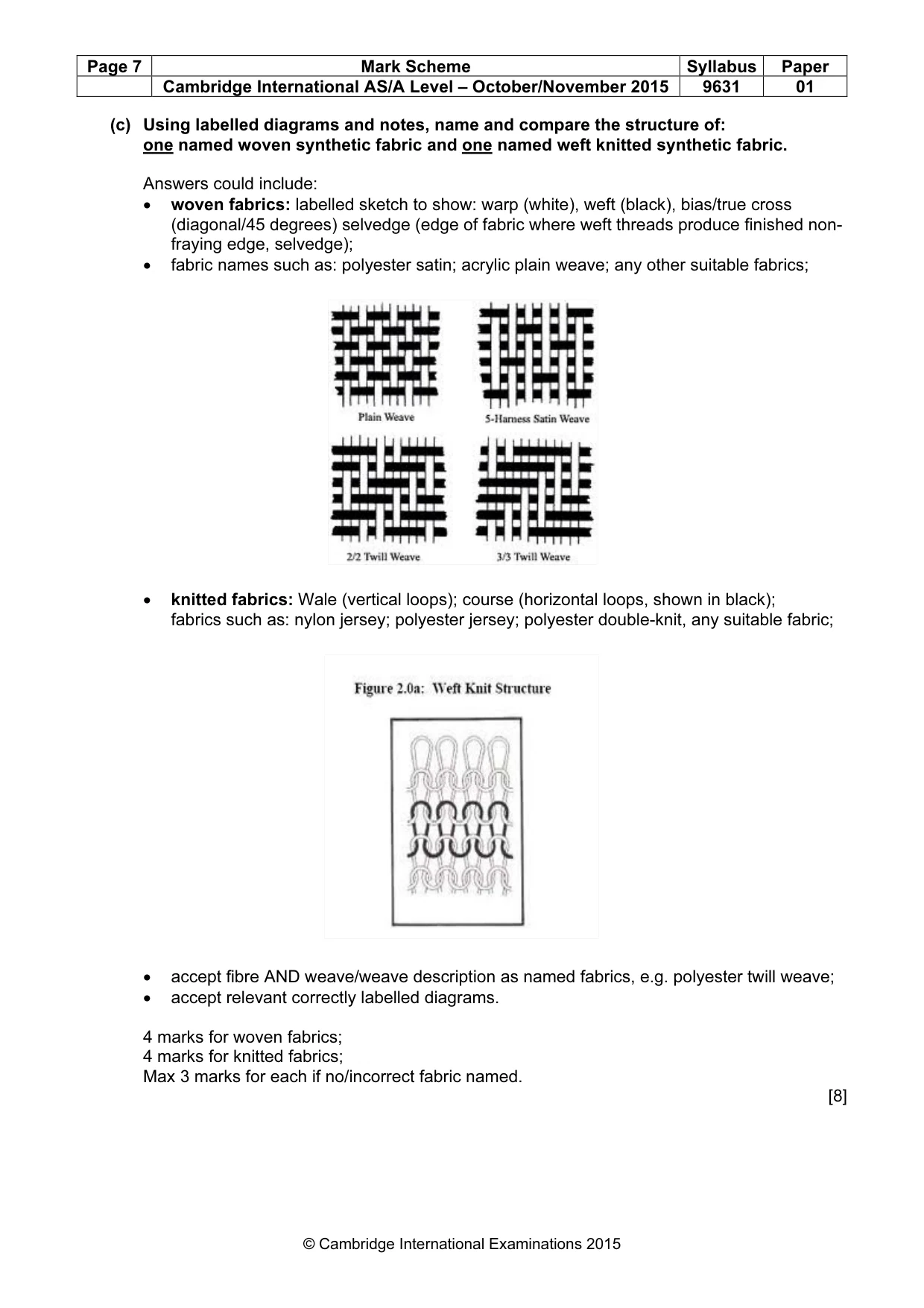
Page 7 Mark Scheme Syllabus Paper Cambridge International AS/A Level – October/November 2015 9631 01 © Cambridge International Examinations 2015 (c) Using labelled diagrams and notes, name and compare the structure of: one named woven synthetic fabric and one named weft knitted synthetic fabric. Answers could include: • woven fabrics: labelled sketch to show: warp (white), weft (black), bias/true cross (diagonal/45 degrees) selvedge (edge of fabric where weft threads produce finished non- fraying edge, selvedge); • fabric names such as: polyester satin; acrylic plain weave; any other suitable fabrics; • knitted fabrics: Wale (vertical loops); course (horizontal loops, shown in black); fabrics such as: nylon jersey; polyester jersey; polyester double-knit, any suitable fabric; • accept fibre AND weave/weave description as named fabrics, e.g. polyester twill weave; • accept relevant correctly labelled diagrams. 4 marks for woven fabrics; 4 marks for knitted fabrics; Max 3 marks for each if no/incorrect fabric named. [8]
Mark scheme, page 8
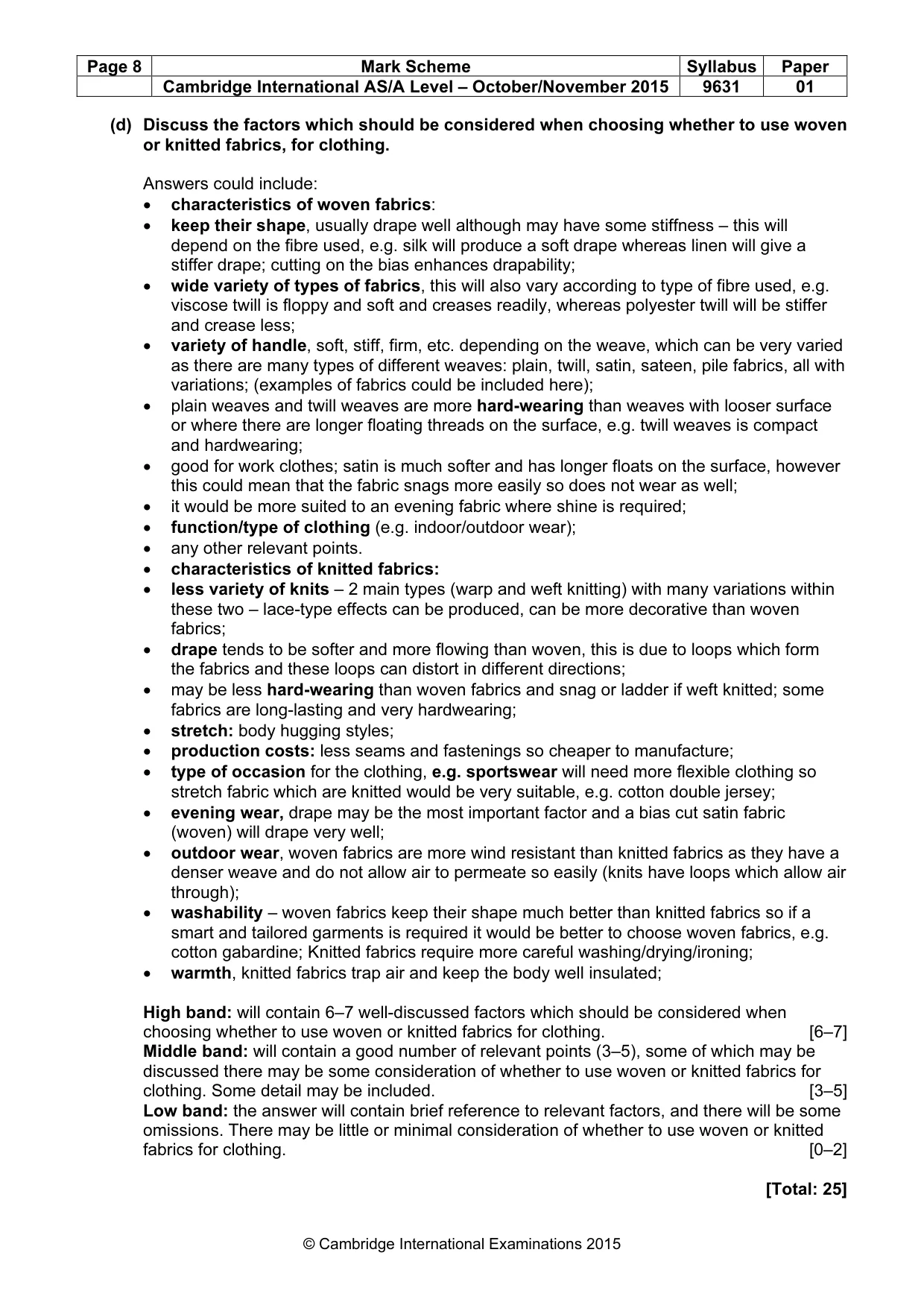
Page 8 Mark Scheme Syllabus Paper Cambridge International AS/A Level – October/November 2015 9631 01 © Cambridge International Examinations 2015 (d) Discuss the factors which should be considered when choosing whether to use woven or knitted fabrics, for clothing. Answers could include: • characteristics of woven fabrics: • keep their shape, usually drape well although may have some stiffness – this will depend on the fibre used, e.g. silk will produce a soft drape whereas linen will give a stiffer drape; cutting on the bias enhances drapability; • wide variety of types of fabrics, this will also vary according to type of fibre used, e.g. viscose twill is floppy and soft and creases readily, whereas polyester twill will be stiffer and crease less; • variety of handle, soft, stiff, firm, etc. depending on the weave, which can be very varied as there are many types of different weaves: plain, twill, satin, sateen, pile fabrics, all with variations; (examples of fabrics could be included here); • plain weaves and twill weaves are more hard-wearing than weaves with looser surface or where there are longer floating threads on the surface, e.g. twill weaves is compact and hardwearing; • good for work clothes; satin is much softer and has longer floats on the surface, however this could mean that the fabric snags more easily so does not wear as well; • it would be more suited to an evening fabric where shine is required; • function/type of clothing (e.g. indoor/outdoor wear); • any other relevant points. • characteristics of knitted fabrics: • less variety of knits – 2 main types (warp and weft knitting) with many variations within these two – lace-type effects can be produced, can be more decorative than woven fabrics; • drape tends to be softer and more flowing than woven, this is due to loops which form the fabrics and these loops can distort in different directions; • may be less hard-wearing than woven fabrics and snag or ladder if weft knitted; some fabrics are long-lasting and very hardwearing; • stretch: body hugging styles; • production costs: less seams and fastenings so cheaper to manufacture; • type of occasion for the clothing, e.g. sportswear will need more flexible clothing so stretch fabric which are knitted would be very suitable, e.g. cotton double jersey; • evening wear, drape may be the most important factor and a bias cut satin fabric (woven) will drape very well; • outdoor wear, woven fabrics are more wind resistant than knitted fabrics as they have a denser weave and do not allow air to permeate so easily (knits have loops which allow air through); • washability – woven fabrics keep their shape much better than knitted fabrics so if a smart and tailored garments is required it would be better to choose woven fabrics, e.g. cotton gabardine; Knitted fabrics require more careful washing/drying/ironing; • warmth, knitted fabrics trap air and keep the body well insulated; High band: will contain 6–7 well-discussed factors which should be considered when choosing whether to use woven or knitted fabrics for clothing. [6–7] Middle band: will contain a good number of relevant points (3–5), some of which may be discussed there may be some consideration of whether to use woven or knitted fabrics for clothing. Some detail may be included. [3–5] Low band: the answer will contain brief reference to relevant factors, and there will be some omissions. There may be little or minimal consideration of whether to use woven or knitted fabrics for clothing. [0–2] [Total: 25]
Mark scheme, page 9
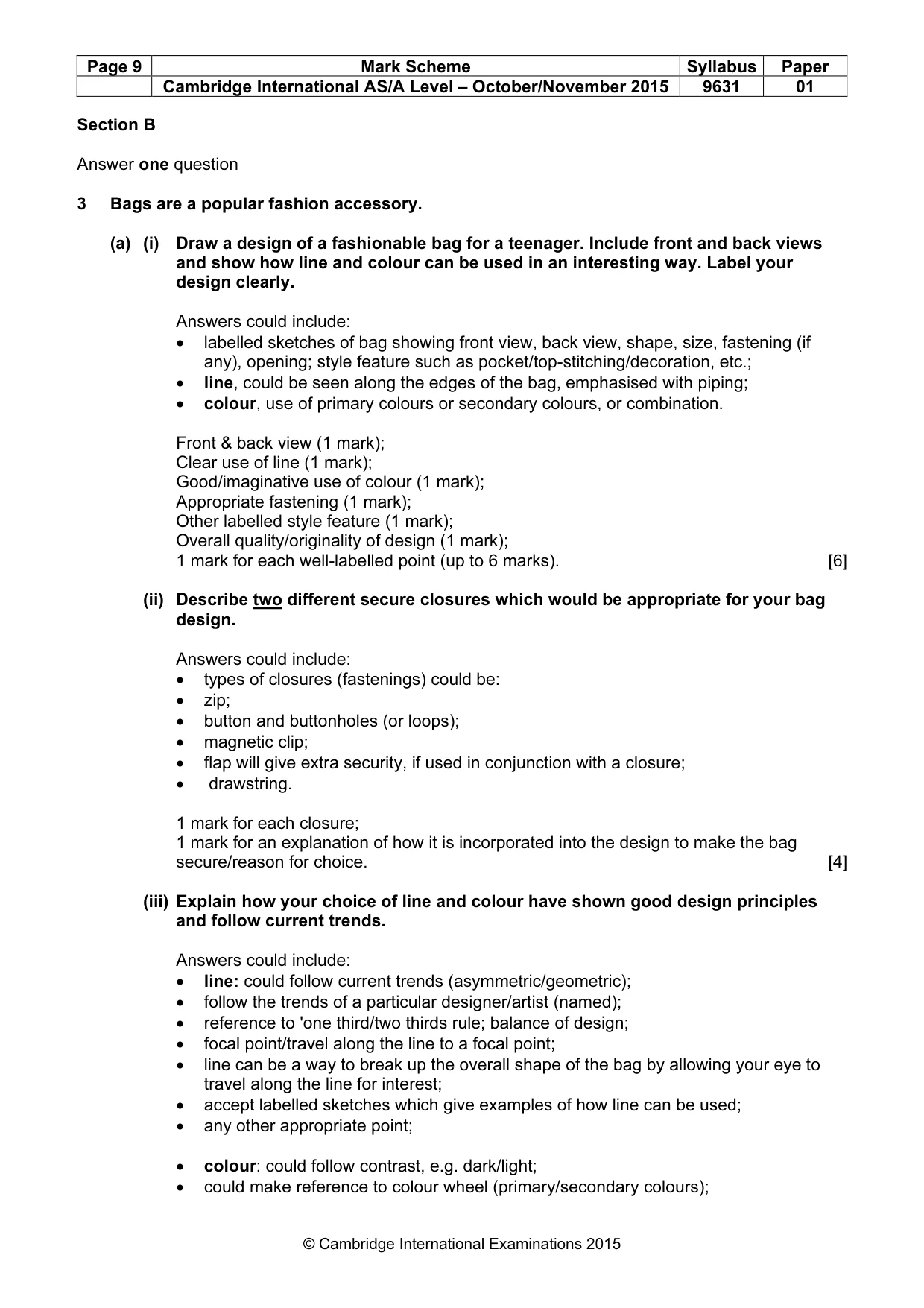
Page 9 Mark Scheme Syllabus Paper Cambridge International AS/A Level – October/November 2015 9631 01 © Cambridge International Examinations 2015 Section B Answer one question 3 Bags are a popular fashion accessory. (a) (i) Draw a design of a fashionable bag for a teenager. Include front and back views and show how line and colour can be used in an interesting way. Label your design clearly. Answers could include: • labelled sketches of bag showing front view, back view, shape, size, fastening (if any), opening; style feature such as pocket/top-stitching/decoration, etc.; • line, could be seen along the edges of the bag, emphasised with piping; • colour, use of primary colours or secondary colours, or combination. Front & back view (1 mark); Clear use of line (1 mark); Good/imaginative use of colour (1 mark); Appropriate fastening (1 mark); Other labelled style feature (1 mark); Overall quality/originality of design (1 mark); 1 mark for each well-labelled point (up to 6 marks). [6] (ii) Describe two different secure closures which would be appropriate for your bag design. Answers could include: • types of closures (fastenings) could be: • zip; • button and buttonholes (or loops); • magnetic clip; • flap will give extra security, if used in conjunction with a closure; • drawstring. 1 mark for each closure; 1 mark for an explanation of how it is incorporated into the design to make the bag secure/reason for choice. [4] (iii) Explain how your choice of line and colour have shown good design principles and follow current trends. Answers could include: • line: could follow current trends (asymmetric/geometric); • follow the trends of a particular designer/artist (named); • reference to 'one third/two thirds rule; balance of design; • focal point/travel along the line to a focal point; • line can be a way to break up the overall shape of the bag by allowing your eye to travel along the line for interest; • accept labelled sketches which give examples of how line can be used; • any other appropriate point; • colour: could follow contrast, e.g. dark/light; • could make reference to colour wheel (primary/secondary colours);
Mark scheme, page 10
Page 10 Mark Scheme Syllabus Paper Cambridge International AS/A Level – October/November 2015 9631 01 © Cambridge International Examinations 2015 • could discuss points about occasion and colours appropriate for these, e.g. dark; • colours for evening wear; meaning of colours, e.g. blue cool; • reference to the colours used and whether they relate to a particular season; • designer who has used these colours; • some other reason for using them; • follow trends of particular colour groups as suggested by trend forecasting of colours; • any other appropriate point; • It is likely that reference to current trends will be included in the explanation of both line and colour and separate marks should be awarded, but not if the information is repeated. Up to 2 marks for each well explained choice of line; Up to 2 marks for each well explained choice of colour; Up to 2 marks for each well explained point about current trends; Answers should show detailed knowledge and understanding for full marks. [6] (b) Discuss the advantages for the consumer of there being a wide choice of retail outlets that sell bags. Give examples of types of retail outlets in your answer. Answers could include: • types of retail outlets which could be included department stores, mail order, internet shopping, markets, supermarkets, independent stores; small/large stores; etc.; • types of customers – some prefer to look/feel fabrics so would prefer to go to a retail outlet rather than buy online/mail order; • cost of items to be bought – markets tend to be cheaper than department stores; with internet shopping being popular currently, customers can compare prices easily before buying goods; • style of bags – some people prefer buying goods which are not too commonly available so may prefer to pay more for a bag where a smaller number has been produced, (batch produced) rather than buy a bag which is cheaper and has been mass produced; • quality of item: (e.g. thickness of fabric or quality of leather) this is often best determined when looking at the actual item rather than mail order/internet shopping; • market stalls/independent stores: may have individual hand-made original items which are not available elsewhere; • advantages: choice, range of price and quality, can try on, convenience, distance, health issues, individual designs versus mass produced, personal service any other appropriate/relevant points. High band: the answer will contain 7–9 well-discussed advantages for the consumer that shows detailed knowledge and understanding of the choice of retail outlets that sell bags. Relevant examples should be included. [7–9] Middle band: the answer will contain a good number of advantages (e.g. 3–6), some of which may be discussed and show relevant knowledge about the choice of retail outlets that sell bags. There may be some omissions. Some examples may be included. [3–6] Low band: the answer will be brief and important details may have been omitted. There may be one or two relevant points include appropriate knowledge about the choice of retail outlets that sell bags. There may be few if any examples. [0–2] [Total: 25]
Mark scheme, page 11
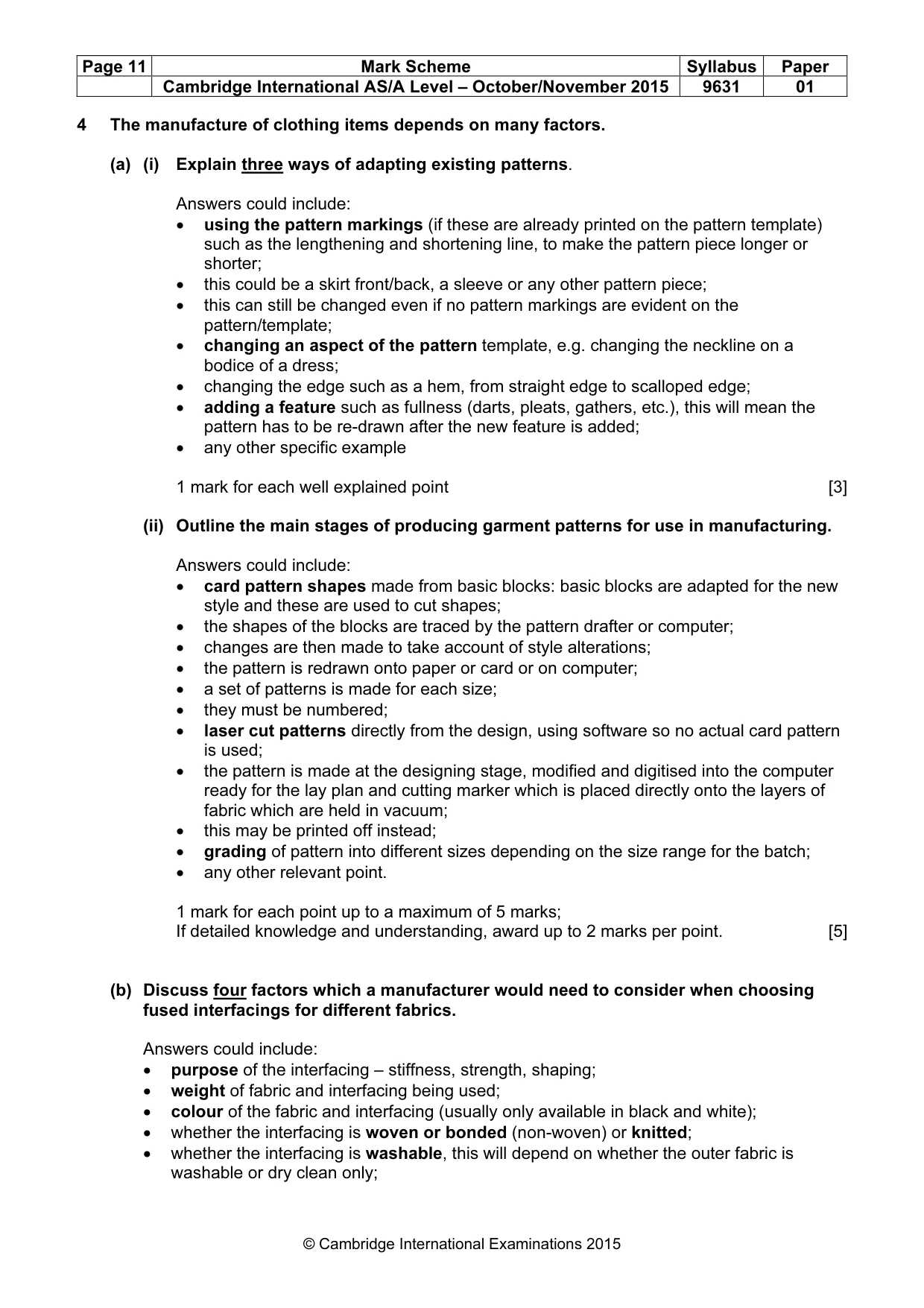
Page 11 Mark Scheme Syllabus Paper Cambridge International AS/A Level – October/November 2015 9631 01 © Cambridge International Examinations 2015 4 The manufacture of clothing items depends on many factors. (a) (i) Explain three ways of adapting existing patterns. Answers could include: • using the pattern markings (if these are already printed on the pattern template) such as the lengthening and shortening line, to make the pattern piece longer or shorter; • this could be a skirt front/back, a sleeve or any other pattern piece; • this can still be changed even if no pattern markings are evident on the pattern/template; • changing an aspect of the pattern template, e.g. changing the neckline on a bodice of a dress; • changing the edge such as a hem, from straight edge to scalloped edge; • adding a feature such as fullness (darts, pleats, gathers, etc.), this will mean the pattern has to be re-drawn after the new feature is added; • any other specific example 1 mark for each well explained point [3] (ii) Outline the main stages of producing garment patterns for use in manufacturing. Answers could include: • card pattern shapes made from basic blocks: basic blocks are adapted for the new style and these are used to cut shapes; • the shapes of the blocks are traced by the pattern drafter or computer; • changes are then made to take account of style alterations; • the pattern is redrawn onto paper or card or on computer; • a set of patterns is made for each size; • they must be numbered; • laser cut patterns directly from the design, using software so no actual card pattern is used; • the pattern is made at the designing stage, modified and digitised into the computer ready for the lay plan and cutting marker which is placed directly onto the layers of fabric which are held in vacuum; • this may be printed off instead; • grading of pattern into different sizes depending on the size range for the batch; • any other relevant point. 1 mark for each point up to a maximum of 5 marks; If detailed knowledge and understanding, award up to 2 marks per point. [5] (b) Discuss four factors which a manufacturer would need to consider when choosing fused interfacings for different fabrics. Answers could include: • purpose of the interfacing – stiffness, strength, shaping; • weight of fabric and interfacing being used; • colour of the fabric and interfacing (usually only available in black and white); • whether the interfacing is woven or bonded (non-woven) or knitted; • whether the interfacing is washable, this will depend on whether the outer fabric is washable or dry clean only;
Mark scheme, page 12
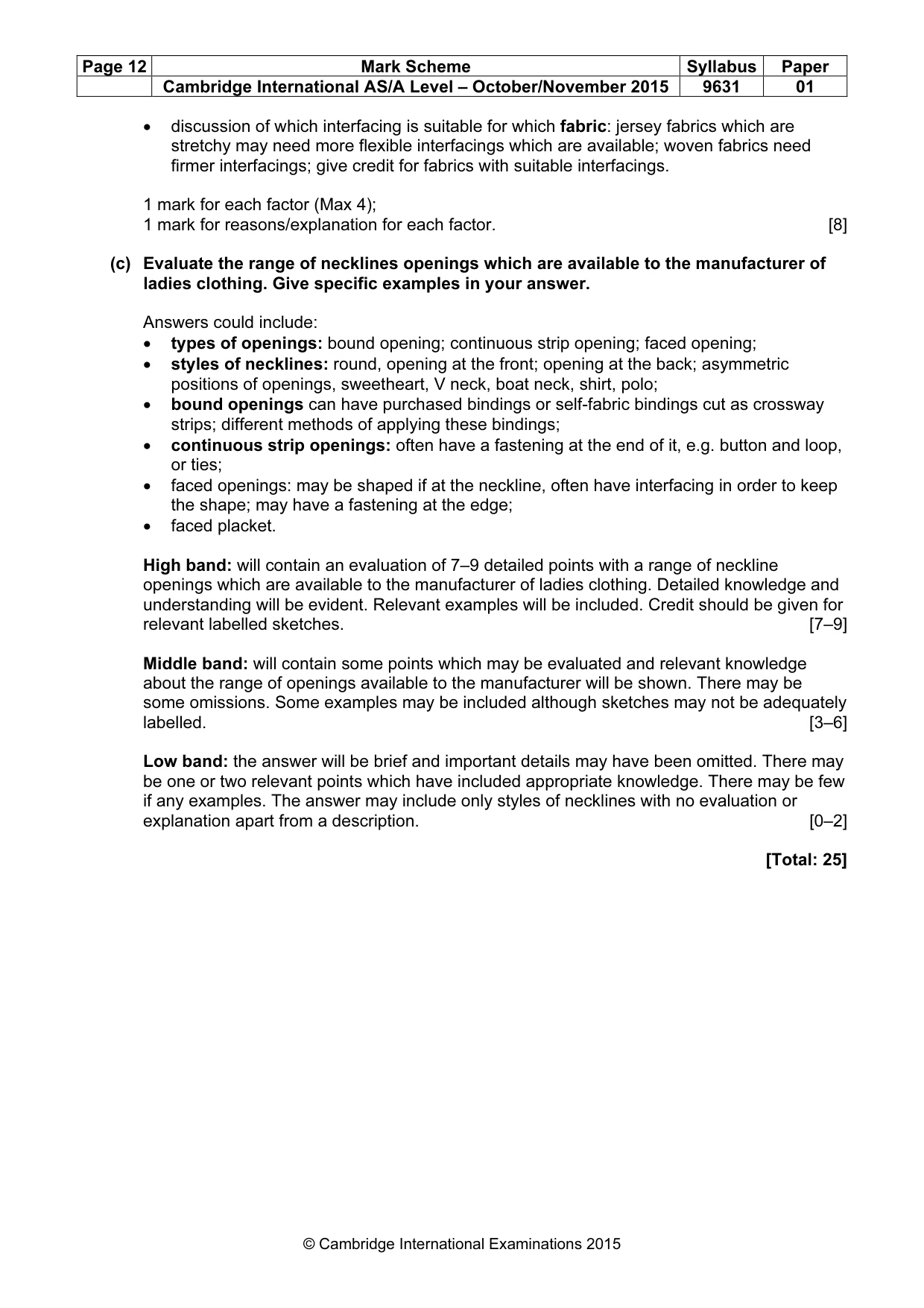
Page 12 Mark Scheme Syllabus Paper Cambridge International AS/A Level – October/November 2015 9631 01 © Cambridge International Examinations 2015 • discussion of which interfacing is suitable for which fabric: jersey fabrics which are stretchy may need more flexible interfacings which are available; woven fabrics need firmer interfacings; give credit for fabrics with suitable interfacings. 1 mark for each factor (Max 4); 1 mark for reasons/explanation for each factor. [8] (c) Evaluate the range of necklines openings which are available to the manufacturer of ladies clothing. Give specific examples in your answer. Answers could include: • types of openings: bound opening; continuous strip opening; faced opening; • styles of necklines: round, opening at the front; opening at the back; asymmetric positions of openings, sweetheart, V neck, boat neck, shirt, polo; • bound openings can have purchased bindings or self-fabric bindings cut as crossway strips; different methods of applying these bindings; • continuous strip openings: often have a fastening at the end of it, e.g. button and loop, or ties; • faced openings: may be shaped if at the neckline, often have interfacing in order to keep the shape; may have a fastening at the edge; • faced placket. High band: will contain an evaluation of 7–9 detailed points with a range of neckline openings which are available to the manufacturer of ladies clothing. Detailed knowledge and understanding will be evident. Relevant examples will be included. Credit should be given for relevant labelled sketches. [7–9] Middle band: will contain some points which may be evaluated and relevant knowledge about the range of openings available to the manufacturer will be shown. There may be some omissions. Some examples may be included although sketches may not be adequately labelled. [3–6] Low band: the answer will be brief and important details may have been omitted. There may be one or two relevant points which have included appropriate knowledge. There may be few if any examples. The answer may include only styles of necklines with no evaluation or explanation apart from a description. [0–2] [Total: 25]
What you needed in this session
Cambridge’s own grade thresholds for 2015 Oct/Nov, Paper 1 · Variant 1. A higher threshold means an easier paper — the bar moves with how the cohort did.