Cambridge A Level Design and Textiles 9631 — 2017 Oct/Nov Paper 1 · Variant 1
9631/11/O/N/17 · 75 marks · ≈84 min
The question paper and its mark scheme, free to read here and free to download. This is Cambridge’s own paper, exactly as it was sat.
Question paper4 pages
Mark scheme16 pages
Answers below. Sit the paper first if you are practising.
Paper as text
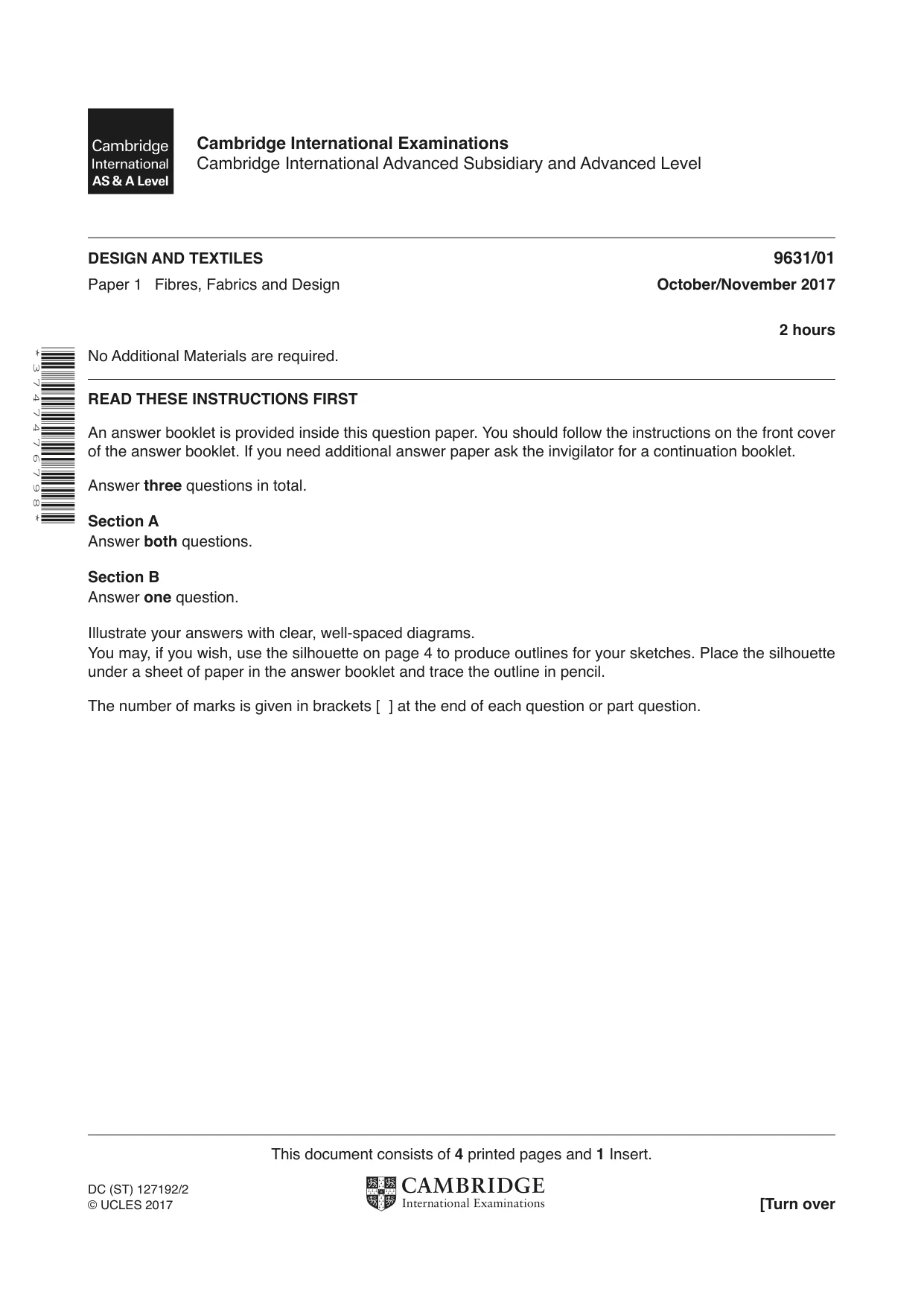
Question paper, page 1
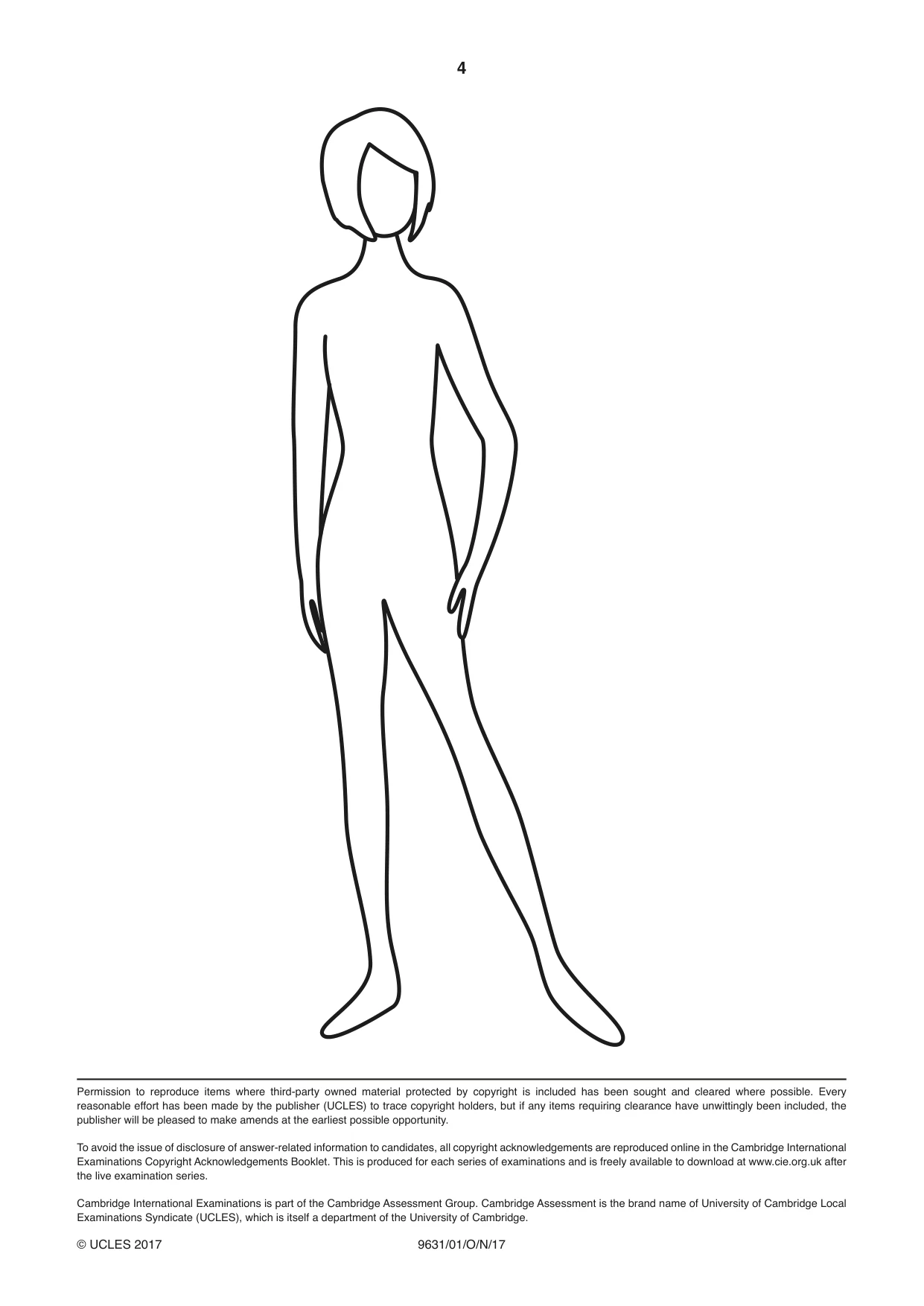
This document consists of 4 printed pages and 1 Insert. DC (ST) 127192/2 © UCLES 2017 [Turn over Cambridge International Examinations Cambridge International Advanced Subsidiary and Advanced Level * 3 7 4 7 4 7 6 7 9 8 * DESIGN AND TEXTILES 9631/01 Paper 1 Fibres, Fabrics and Design October/November 2017 2 hours No Additional Materials are required. READ THESE INSTRUCTIONS FIRST An answer booklet is provided inside this question paper. You should follow the instructions on the front cover of the answer booklet. If you need additional answer paper ask the invigilator for a continuation booklet. Answer three questions in total. Section A Answer both questions. Section B Answer one question. Illustrate your answers with clear, well-spaced diagrams. You may, if you wish, use the silhouette on page 4 to produce outlines for your sketches. Place the silhouette under a sheet of paper in the answer booklet and trace the outline in pencil. The number of marks is given in brackets [ ] at the end of each question or part question.
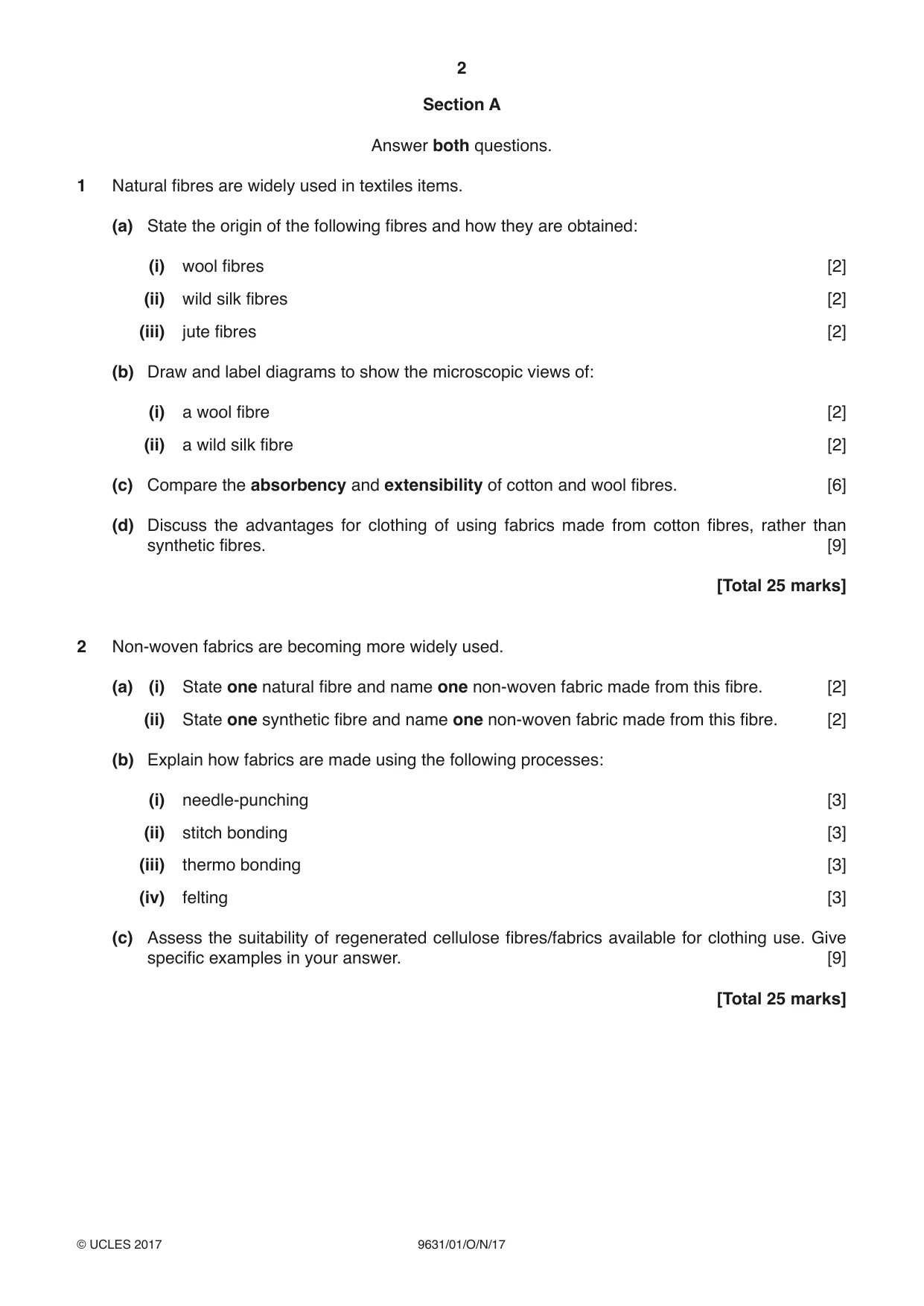
Question paper, page 2
2 9631/01/O/N/17 © UCLES 2017 Section A Answer both questions. 1 Natural fibres are widely used in textiles items. (a) State the origin of the following fibres and how they are obtained: (i) wool fibres [2] (ii) wild silk fibres [2] (iii) jute fibres [2] (b) Draw and label diagrams to show the microscopic views of: (i) a wool fibre [2] (ii) a wild silk fibre [2] (c) Compare the absorbency and extensibility of cotton and wool fibres. [6] (d) Discuss the advantages for clothing of using fabrics made from cotton fibres, rather than synthetic fibres. [9] [Total 25 marks] 2 Non-woven fabrics are becoming more widely used. (a) (i) State one natural fibre and name one non-woven fabric made from this fibre. [2] (ii) State one synthetic fibre and name one non-woven fabric made from this fibre. [2] (b) Explain how fabrics are made using the following processes: (i) needle-punching [3] (ii) stitch bonding [3] (iii) thermo bonding [3] (iv) felting [3] (c) Assess the suitability of regenerated cellulose fibres/fabrics available for clothing use. Give specific examples in your answer. [9] [Total 25 marks]
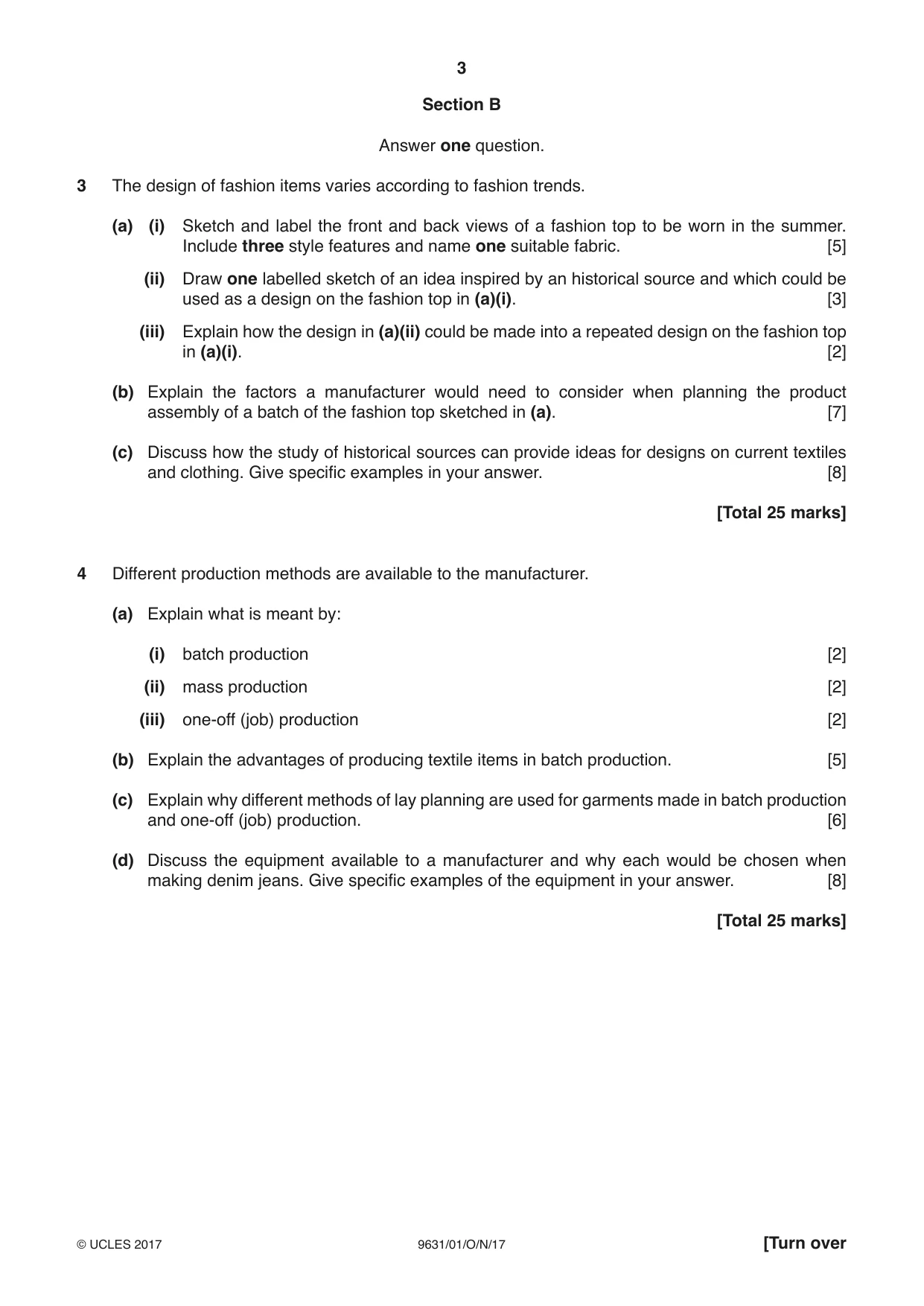
Question paper, page 3
3 9631/01/O/N/17 © UCLES 2017 [Turn over Section B Answer one question. 3 The design of fashion items varies according to fashion trends. (a) (i) Sketch and label the front and back views of a fashion top to be worn in the summer. Include three style features and name one suitable fabric. [5] (ii) Draw one labelled sketch of an idea inspired by an historical source and which could be used as a design on the fashion top in (a)(i). [3] (iii) Explain how the design in (a)(ii) could be made into a repeated design on the fashion top in (a)(i). [2] (b) Explain the factors a manufacturer would need to consider when planning the product assembly of a batch of the fashion top sketched in (a). [7] (c) Discuss how the study of historical sources can provide ideas for designs on current textiles and clothing. Give specific examples in your answer. [8] [Total 25 marks] 4 Different production methods are available to the manufacturer. (a) Explain what is meant by: (i) batch production [2] (ii) mass production [2] (iii) one-off (job) production [2] (b) Explain the advantages of producing textile items in batch production. [5] (c) Explain why different methods of lay planning are used for garments made in batch production and one-off (job) production. [6] (d) Discuss the equipment available to a manufacturer and why each would be chosen when making denim jeans. Give specific examples of the equipment in your answer. [8] [Total 25 marks]
Question paper, page 4
4 9631/01/O/N/17 © UCLES 2017 Permission to reproduce items where third-party owned material protected by copyright is included has been sought and cleared where possible. Every reasonable effort has been made by the publisher (UCLES) to trace copyright holders, but if any items requiring clearance have unwittingly been included, the publisher will be pleased to make amends at the earliest possible opportunity. To avoid the issue of disclosure of answer-related information to candidates, all copyright acknowledgements are reproduced online in the Cambridge International Examinations Copyright Acknowledgements Booklet. This is produced for each series of examinations and is freely available to download at www.cie.org.uk after the live examination series. Cambridge International Examinations is part of the Cambridge Assessment Group. Cambridge Assessment is the brand name of University of Cambridge Local Examinations Syndicate (UCLES), which is itself a department of the University of Cambridge.
Mark scheme, page 1
® IGCSE is a registered trademark. This document consists of 16 printed pages. © UCLES 2017 [Turn over Cambridge Assessment International Education Cambridge International Advanced Subsidiary and Advanced Level DESIGN AND TEXTILES 9631/01 Paper 1 Fibres, Fabrics and Design October/November 2017 MARK SCHEME Maximum Mark: 75 Published This mark scheme is published as an aid to teachers and candidates, to indicate the requirements of the examination. It shows the basis on which Examiners were instructed to award marks. It does not indicate the details of the discussions that took place at an Examiners’ meeting before marking began, which would have considered the acceptability of alternative answers. Mark schemes should be read in conjunction with the question paper and the Principal Examiner Report for Teachers. Cambridge International will not enter into discussions about these mark schemes. Cambridge International is publishing the mark schemes for the October/November 2017 series for most Cambridge IGCSE®, Cambridge International A and AS Level components and some Cambridge O Level components.
Mark scheme, page 2
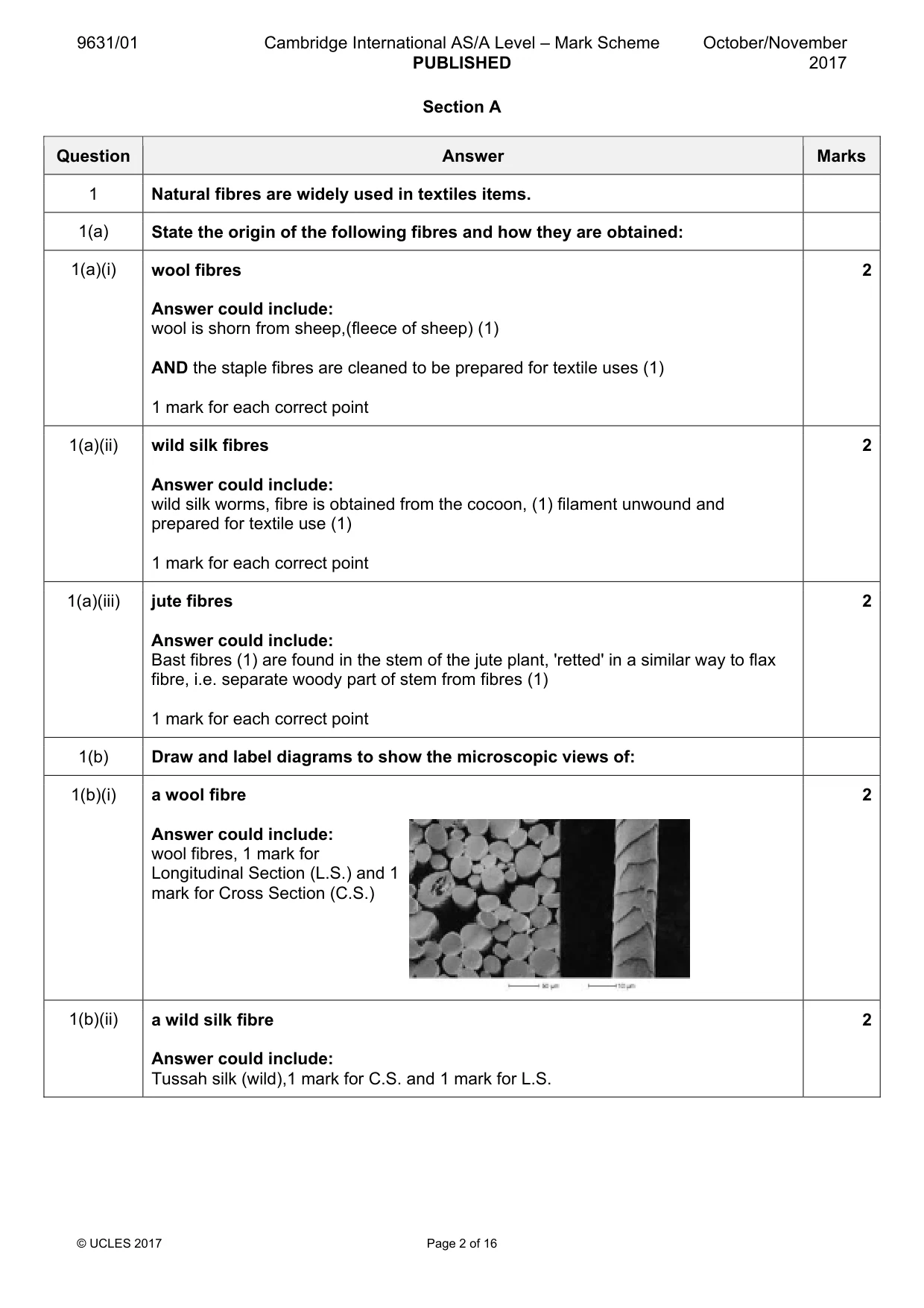
9631/01 Cambridge International AS/A Level – Mark Scheme PUBLISHED October/November 2017 © UCLES 2017 Page 2 of 16 Section A Question Answer Marks 1 Natural fibres are widely used in textiles items. 1(a) State the origin of the following fibres and how they are obtained: 1(a)(i) wool fibres Answer could include: wool is shorn from sheep,(fleece of sheep) (1) AND the staple fibres are cleaned to be prepared for textile uses (1) 1 mark for each correct point 2 1(a)(ii) wild silk fibres Answer could include: wild silk worms, fibre is obtained from the cocoon, (1) filament unwound and prepared for textile use (1) 1 mark for each correct point 2 1(a)(iii) jute fibres Answer could include: Bast fibres (1) are found in the stem of the jute plant, 'retted' in a similar way to flax fibre, i.e. separate woody part of stem from fibres (1) 1 mark for each correct point 2 1(b) Draw and label diagrams to show the microscopic views of: 1(b)(i) a wool fibre Answer could include: wool fibres, 1 mark for Longitudinal Section (L.S.) and 1 mark for Cross Section (C.S.) 2 1(b)(ii) a wild silk fibre Answer could include: Tussah silk (wild),1 mark for C.S. and 1 mark for L.S. 2
Mark scheme, page 3
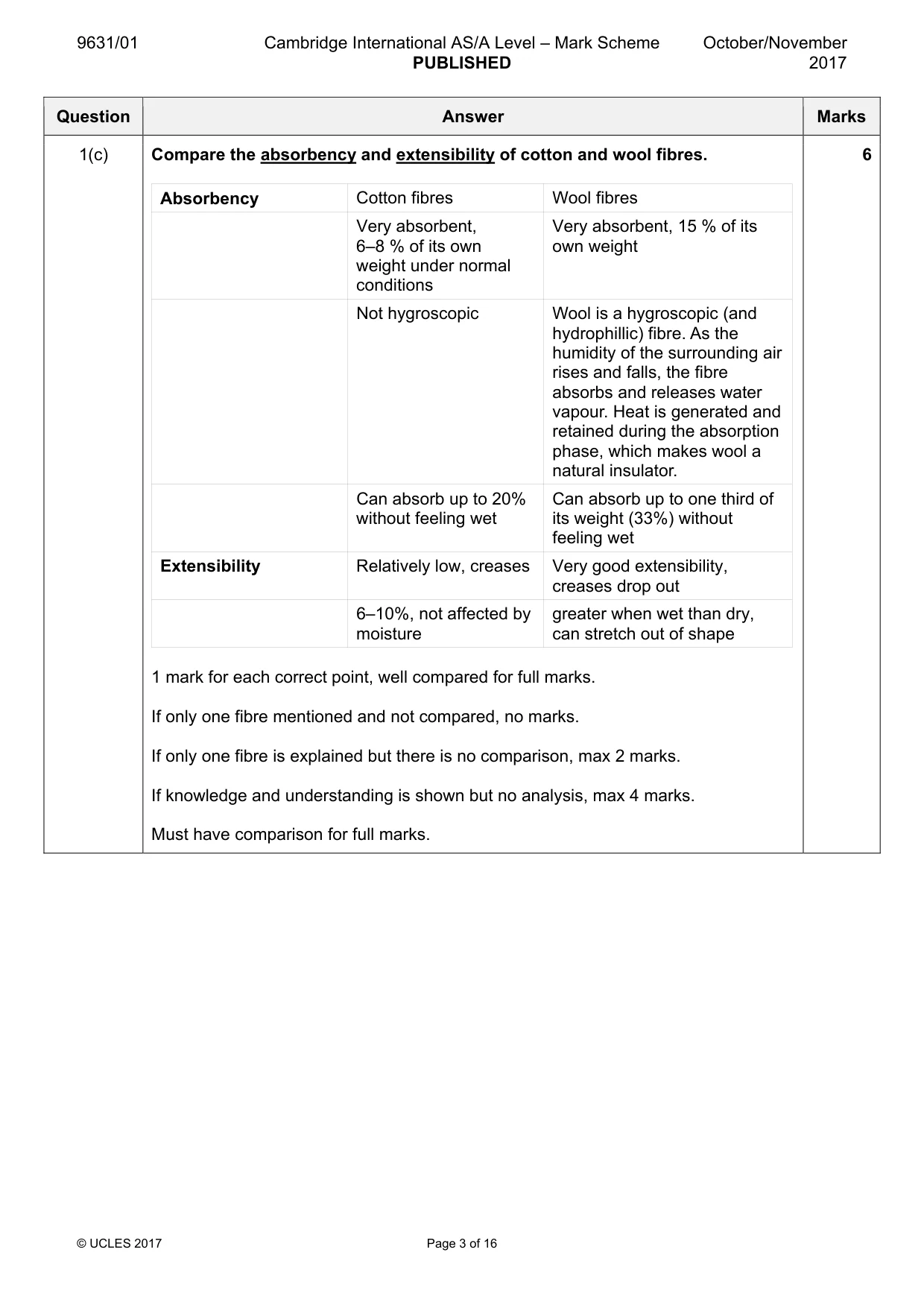
9631/01 Cambridge International AS/A Level – Mark Scheme PUBLISHED October/November 2017 © UCLES 2017 Page 3 of 16 Question Answer Marks 1(c) Compare the absorbency and extensibility of cotton and wool fibres. Absorbency Cotton fibres Wool fibres Very absorbent, 6–8 % of its own weight under normal conditions Very absorbent, 15 % of its own weight Not hygroscopic Wool is a hygroscopic (and hydrophillic) fibre. As the humidity of the surrounding air rises and falls, the fibre absorbs and releases water vapour. Heat is generated and retained during the absorption phase, which makes wool a natural insulator. Can absorb up to 20% without feeling wet Can absorb up to one third of its weight (33%) without feeling wet Extensibility Relatively low, creases Very good extensibility, creases drop out 6–10%, not affected by moisture greater when wet than dry, can stretch out of shape 1 mark for each correct point, well compared for full marks. If only one fibre mentioned and not compared, no marks. If only one fibre is explained but there is no comparison, max 2 marks. If knowledge and understanding is shown but no analysis, max 4 marks. Must have comparison for full marks. 6
Mark scheme, page 4
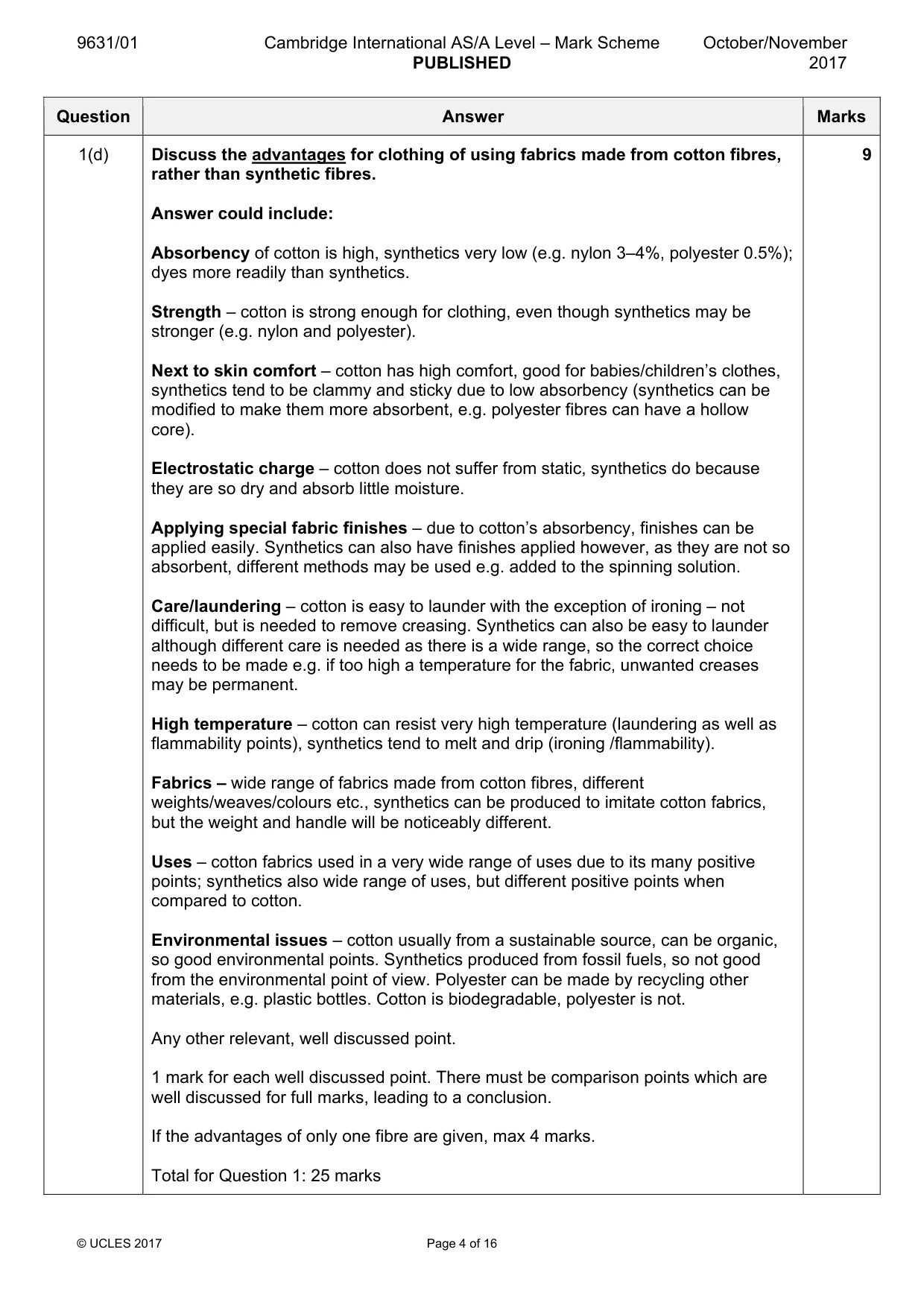
9631/01 Cambridge International AS/A Level – Mark Scheme PUBLISHED October/November 2017 © UCLES 2017 Page 4 of 16 Question Answer Marks 1(d) Discuss the advantages for clothing of using fabrics made from cotton fibres, rather than synthetic fibres. Answer could include: Absorbency of cotton is high, synthetics very low (e.g. nylon 3–4%, polyester 0.5%); dyes more readily than synthetics. Strength – cotton is strong enough for clothing, even though synthetics may be stronger (e.g. nylon and polyester). Next to skin comfort – cotton has high comfort, good for babies/children’s clothes, synthetics tend to be clammy and sticky due to low absorbency (synthetics can be modified to make them more absorbent, e.g. polyester fibres can have a hollow core). Electrostatic charge – cotton does not suffer from static, synthetics do because they are so dry and absorb little moisture. Applying special fabric finishes – due to cotton’s absorbency, finishes can be applied easily. Synthetics can also have finishes applied however, as they are not so absorbent, different methods may be used e.g. added to the spinning solution. Care/laundering – cotton is easy to launder with the exception of ironing – not difficult, but is needed to remove creasing. Synthetics can also be easy to launder although different care is needed as there is a wide range, so the correct choice needs to be made e.g. if too high a temperature for the fabric, unwanted creases may be permanent. High temperature – cotton can resist very high temperature (laundering as well as flammability points), synthetics tend to melt and drip (ironing /flammability). Fabrics – wide range of fabrics made from cotton fibres, different weights/weaves/colours etc., synthetics can be produced to imitate cotton fabrics, but the weight and handle will be noticeably different. Uses – cotton fabrics used in a very wide range of uses due to its many positive points; synthetics also wide range of uses, but different positive points when compared to cotton. Environmental issues – cotton usually from a sustainable source, can be organic, so good environmental points. Synthetics produced from fossil fuels, so not good from the environmental point of view. Polyester can be made by recycling other materials, e.g. plastic bottles. Cotton is biodegradable, polyester is not. Any other relevant, well discussed point. 1 mark for each well discussed point. There must be comparison points which are well discussed for full marks, leading to a conclusion. If the advantages of only one fibre are given, max 4 marks. Total for Question 1: 25 marks 9
Mark scheme, page 5
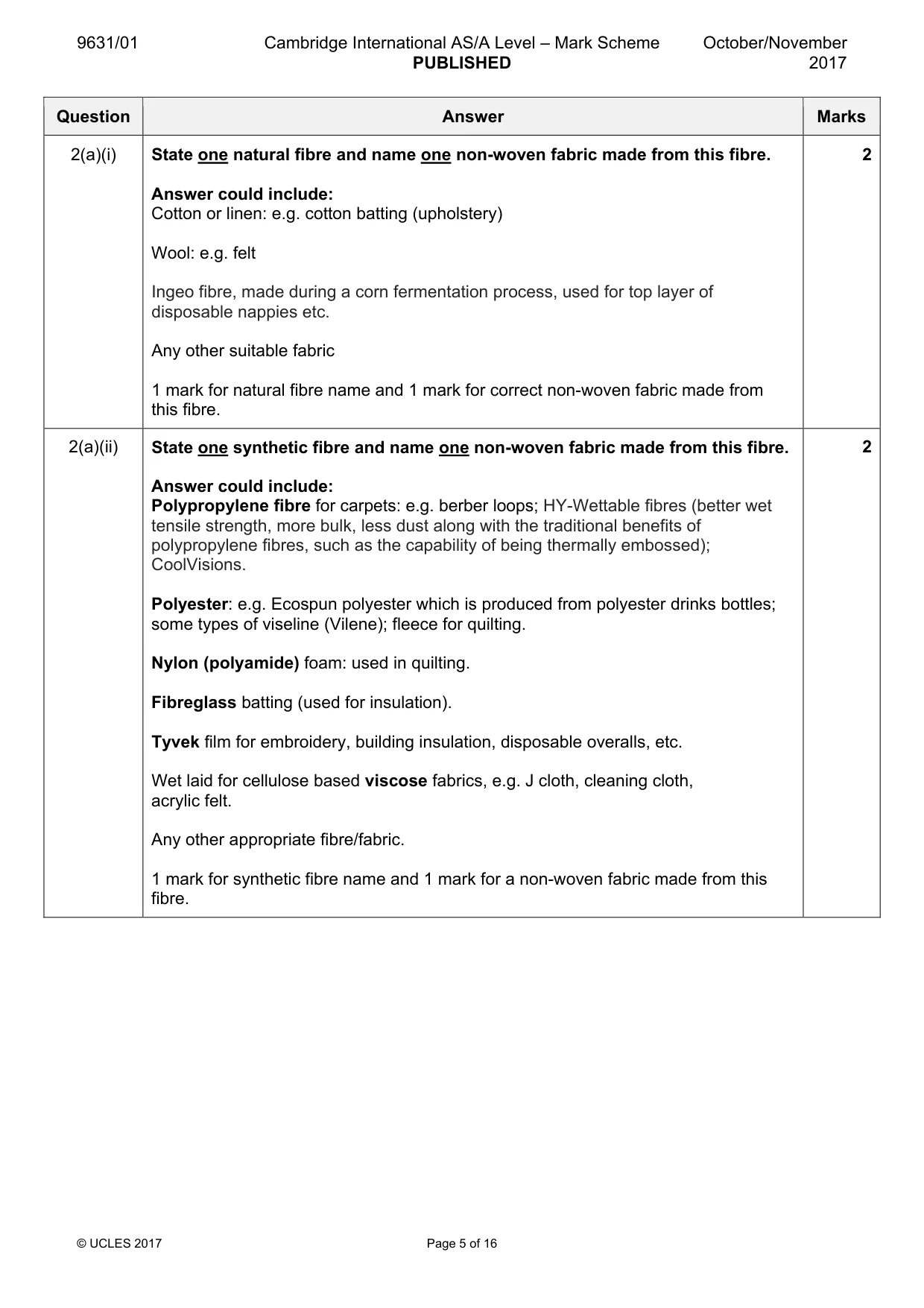
9631/01 Cambridge International AS/A Level – Mark Scheme PUBLISHED October/November 2017 © UCLES 2017 Page 5 of 16 Question Answer Marks 2(a)(i) State one natural fibre and name one non-woven fabric made from this fibre. Answer could include: Cotton or linen: e.g. cotton batting (upholstery) Wool: e.g. felt Ingeo fibre, made during a corn fermentation process, used for top layer of disposable nappies etc. Any other suitable fabric 1 mark for natural fibre name and 1 mark for correct non-woven fabric made from this fibre. 2 2(a)(ii) State one synthetic fibre and name one non-woven fabric made from this fibre. Answer could include: Polypropylene fibre for carpets: e.g. berber loops; HY-Wettable fibres (better wet tensile strength, more bulk, less dust along with the traditional benefits of polypropylene fibres, such as the capability of being thermally embossed); CoolVisions. Polyester: e.g. Ecospun polyester which is produced from polyester drinks bottles; some types of viseline (Vilene); fleece for quilting. Nylon (polyamide) foam: used in quilting. Fibreglass batting (used for insulation). Tyvek film for embroidery, building insulation, disposable overalls, etc. Wet laid for cellulose based viscose fabrics, e.g. J cloth, cleaning cloth, acrylic felt. Any other appropriate fibre/fabric. 1 mark for synthetic fibre name and 1 mark for a non-woven fabric made from this fibre. 2
Mark scheme, page 6
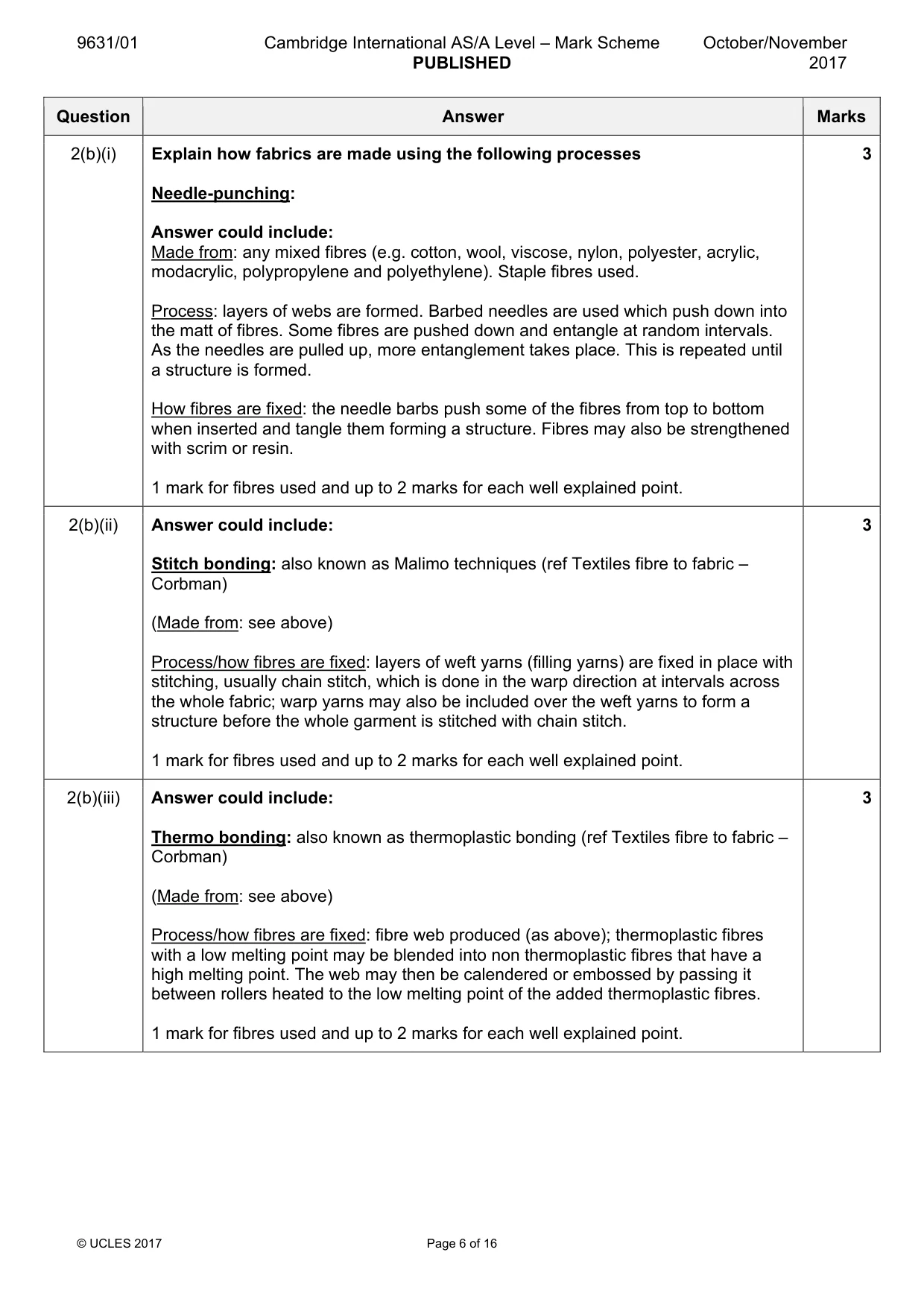
9631/01 Cambridge International AS/A Level – Mark Scheme PUBLISHED October/November 2017 © UCLES 2017 Page 6 of 16 Question Answer Marks 2(b)(i) Explain how fabrics are made using the following processes Needle-punching: Answer could include: Made from: any mixed fibres (e.g. cotton, wool, viscose, nylon, polyester, acrylic, modacrylic, polypropylene and polyethylene). Staple fibres used. Process: layers of webs are formed. Barbed needles are used which push down into the matt of fibres. Some fibres are pushed down and entangle at random intervals. As the needles are pulled up, more entanglement takes place. This is repeated until a structure is formed. How fibres are fixed: the needle barbs push some of the fibres from top to bottom when inserted and tangle them forming a structure. Fibres may also be strengthened with scrim or resin. 1 mark for fibres used and up to 2 marks for each well explained point. 3 2(b)(ii) Answer could include: Stitch bonding: also known as Malimo techniques (ref Textiles fibre to fabric – Corbman) (Made from: see above) Process/how fibres are fixed: layers of weft yarns (filling yarns) are fixed in place with stitching, usually chain stitch, which is done in the warp direction at intervals across the whole fabric; warp yarns may also be included over the weft yarns to form a structure before the whole garment is stitched with chain stitch. 1 mark for fibres used and up to 2 marks for each well explained point. 3 2(b)(iii) Answer could include: Thermo bonding: also known as thermoplastic bonding (ref Textiles fibre to fabric – Corbman) (Made from: see above) Process/how fibres are fixed: fibre web produced (as above); thermoplastic fibres with a low melting point may be blended into non thermoplastic fibres that have a high melting point. The web may then be calendered or embossed by passing it between rollers heated to the low melting point of the added thermoplastic fibres. 1 mark for fibres used and up to 2 marks for each well explained point. 3
Mark scheme, page 7
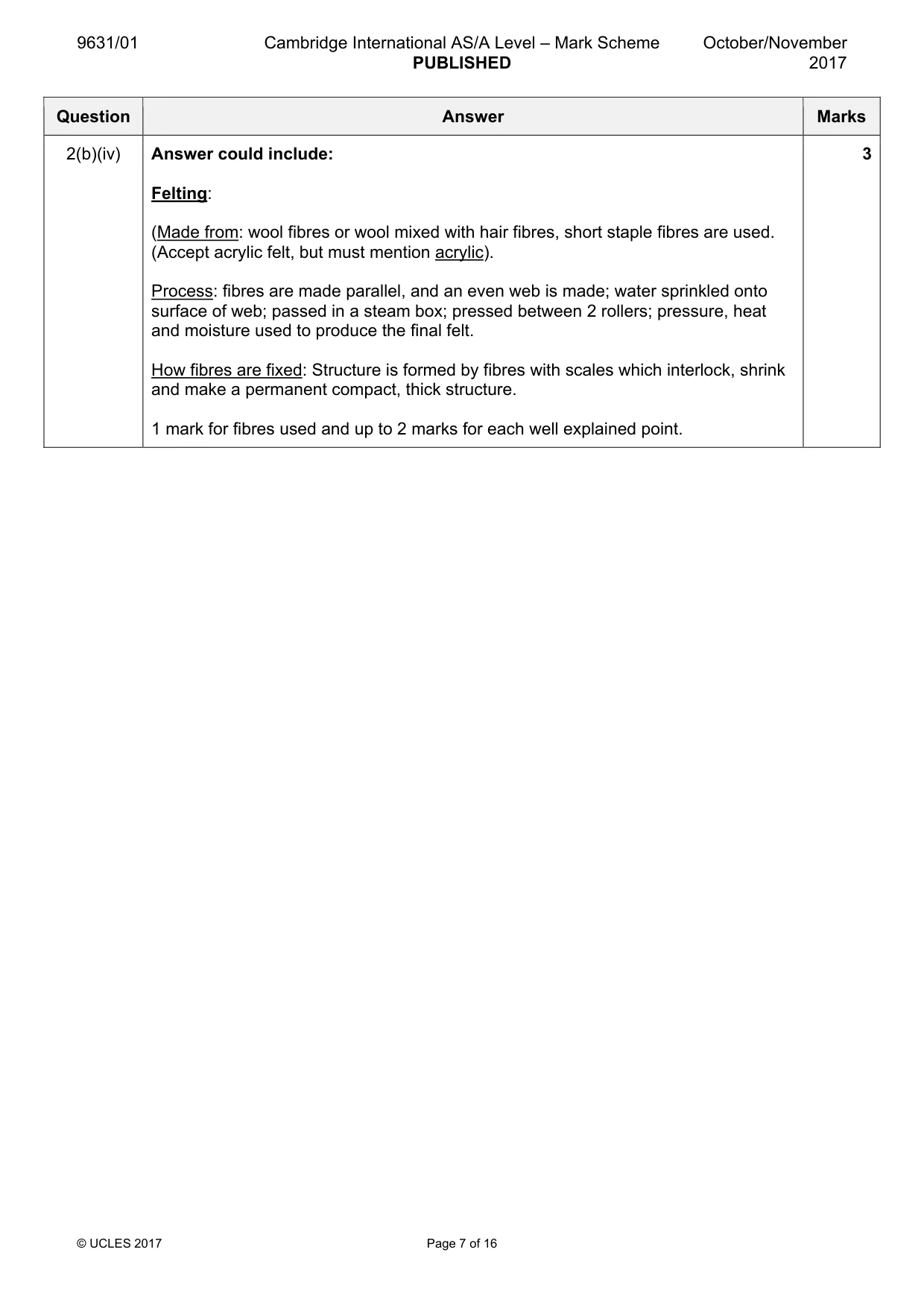
9631/01 Cambridge International AS/A Level – Mark Scheme PUBLISHED October/November 2017 © UCLES 2017 Page 7 of 16 Question Answer Marks 2(b)(iv) Answer could include: Felting: (Made from: wool fibres or wool mixed with hair fibres, short staple fibres are used. (Accept acrylic felt, but must mention acrylic). Process: fibres are made parallel, and an even web is made; water sprinkled onto surface of web; passed in a steam box; pressed between 2 rollers; pressure, heat and moisture used to produce the final felt. How fibres are fixed: Structure is formed by fibres with scales which interlock, shrink and make a permanent compact, thick structure. 1 mark for fibres used and up to 2 marks for each well explained point. 3
Mark scheme, page 8
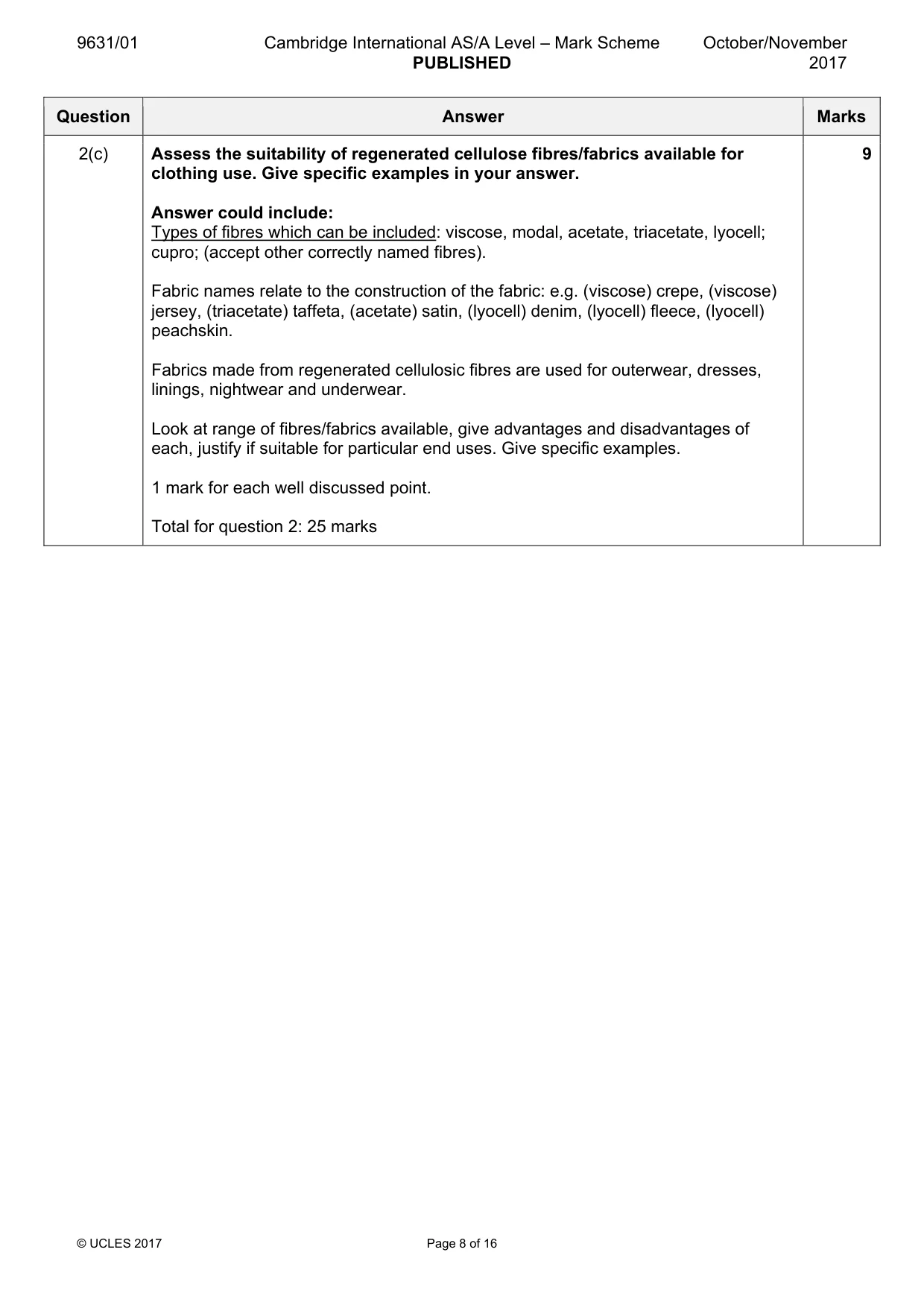
9631/01 Cambridge International AS/A Level – Mark Scheme PUBLISHED October/November 2017 © UCLES 2017 Page 8 of 16 Question Answer Marks 2(c) Assess the suitability of regenerated cellulose fibres/fabrics available for clothing use. Give specific examples in your answer. Answer could include: Types of fibres which can be included: viscose, modal, acetate, triacetate, lyocell; cupro; (accept other correctly named fibres). Fabric names relate to the construction of the fabric: e.g. (viscose) crepe, (viscose) jersey, (triacetate) taffeta, (acetate) satin, (lyocell) denim, (lyocell) fleece, (lyocell) peachskin. Fabrics made from regenerated cellulosic fibres are used for outerwear, dresses, linings, nightwear and underwear. Look at range of fibres/fabrics available, give advantages and disadvantages of each, justify if suitable for particular end uses. Give specific examples. 1 mark for each well discussed point. Total for question 2: 25 marks 9
Mark scheme, page 9
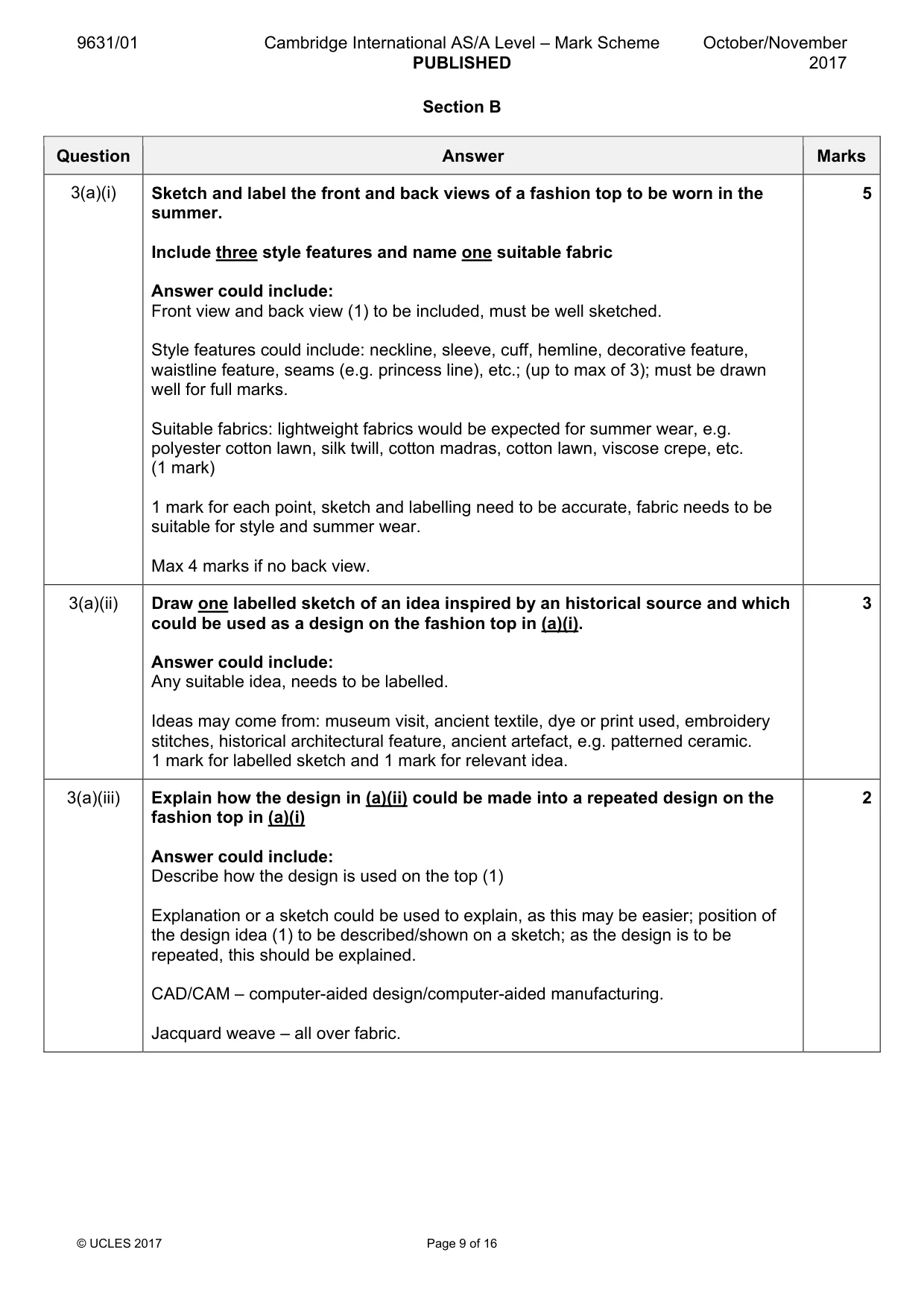
9631/01 Cambridge International AS/A Level – Mark Scheme PUBLISHED October/November 2017 © UCLES 2017 Page 9 of 16 Section B Question Answer Marks 3(a)(i) Sketch and label the front and back views of a fashion top to be worn in the summer. Include three style features and name one suitable fabric Answer could include: Front view and back view (1) to be included, must be well sketched. Style features could include: neckline, sleeve, cuff, hemline, decorative feature, waistline feature, seams (e.g. princess line), etc.; (up to max of 3); must be drawn well for full marks. Suitable fabrics: lightweight fabrics would be expected for summer wear, e.g. polyester cotton lawn, silk twill, cotton madras, cotton lawn, viscose crepe, etc. (1 mark) 1 mark for each point, sketch and labelling need to be accurate, fabric needs to be suitable for style and summer wear. Max 4 marks if no back view. 5 3(a)(ii) Draw one labelled sketch of an idea inspired by an historical source and which could be used as a design on the fashion top in (a)(i). Answer could include: Any suitable idea, needs to be labelled. Ideas may come from: museum visit, ancient textile, dye or print used, embroidery stitches, historical architectural feature, ancient artefact, e.g. patterned ceramic. 1 mark for labelled sketch and 1 mark for relevant idea. 3 3(a)(iii) Explain how the design in (a)(ii) could be made into a repeated design on the fashion top in (a)(i) Answer could include: Describe how the design is used on the top (1) Explanation or a sketch could be used to explain, as this may be easier; position of the design idea (1) to be described/shown on a sketch; as the design is to be repeated, this should be explained. CAD/CAM – computer-aided design/computer-aided manufacturing. Jacquard weave – all over fabric. 2
Mark scheme, page 10
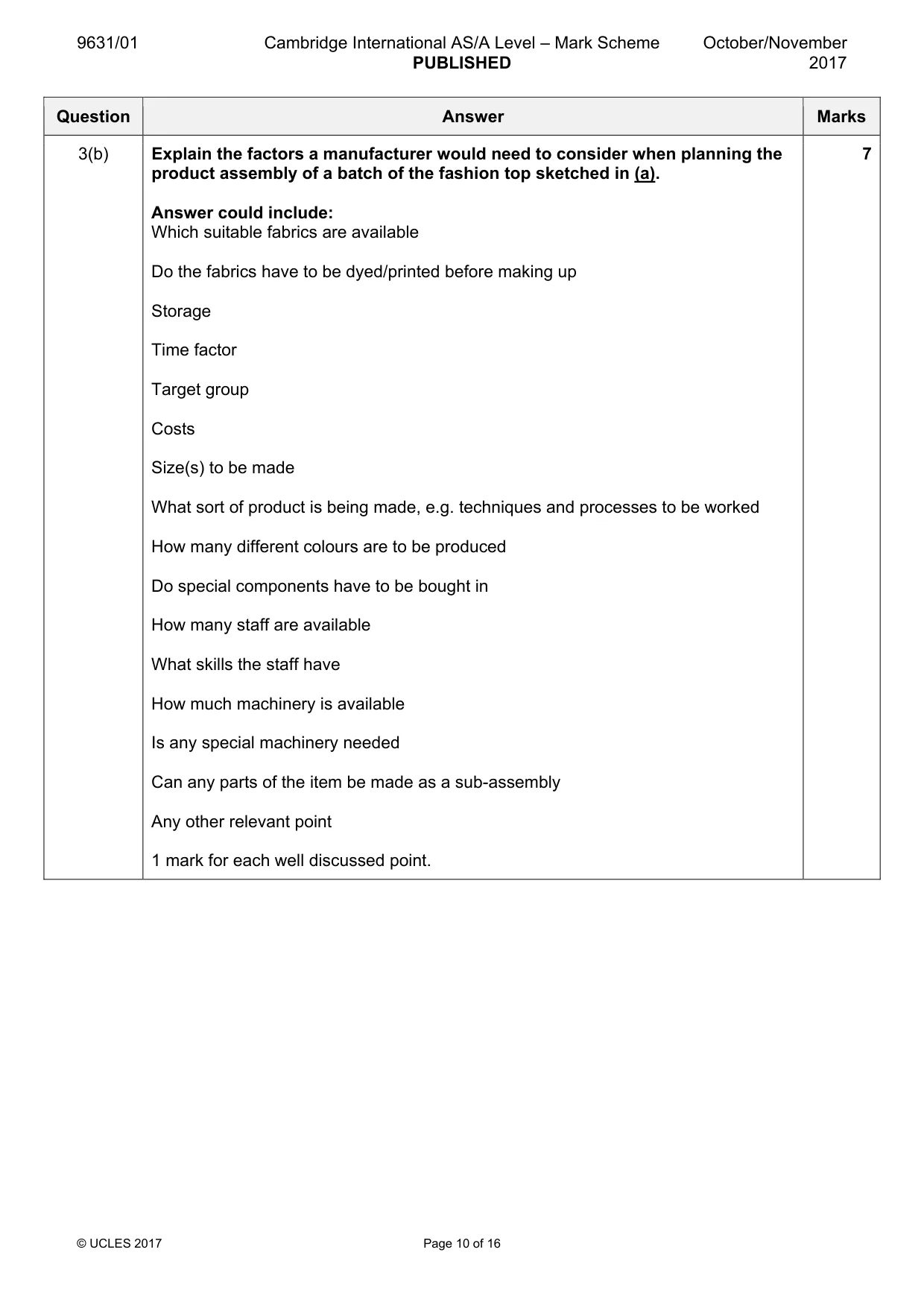
9631/01 Cambridge International AS/A Level – Mark Scheme PUBLISHED October/November 2017 © UCLES 2017 Page 10 of 16 Question Answer Marks 3(b) Explain the factors a manufacturer would need to consider when planning the product assembly of a batch of the fashion top sketched in (a). Answer could include: Which suitable fabrics are available Do the fabrics have to be dyed/printed before making up Storage Time factor Target group Costs Size(s) to be made What sort of product is being made, e.g. techniques and processes to be worked How many different colours are to be produced Do special components have to be bought in How many staff are available What skills the staff have How much machinery is available Is any special machinery needed Can any parts of the item be made as a sub-assembly Any other relevant point 1 mark for each well discussed point. 7
Mark scheme, page 11
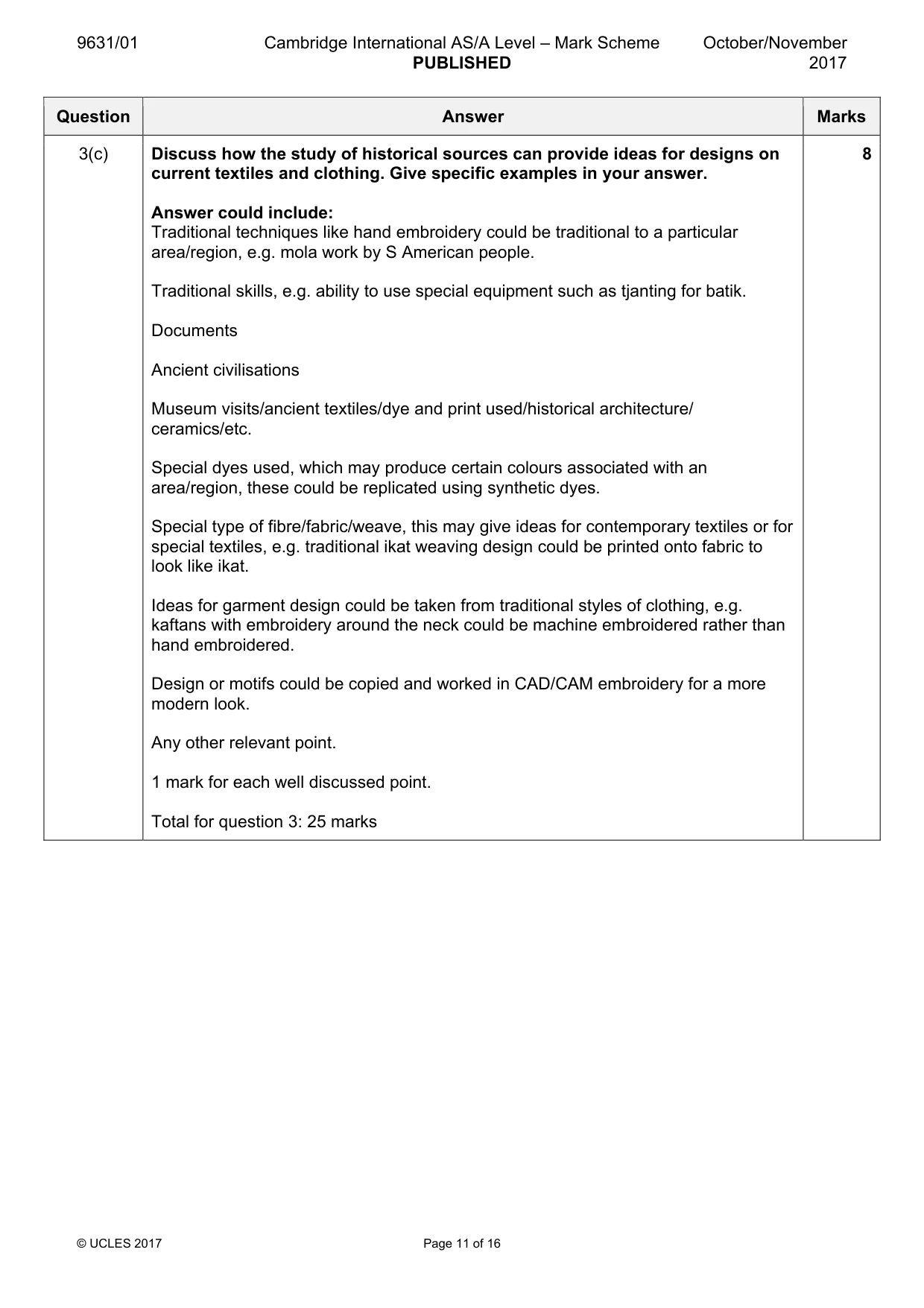
9631/01 Cambridge International AS/A Level – Mark Scheme PUBLISHED October/November 2017 © UCLES 2017 Page 11 of 16 Question Answer Marks 3(c) Discuss how the study of historical sources can provide ideas for designs on current textiles and clothing. Give specific examples in your answer. Answer could include: Traditional techniques like hand embroidery could be traditional to a particular area/region, e.g. mola work by S American people. Traditional skills, e.g. ability to use special equipment such as tjanting for batik. Documents Ancient civilisations Museum visits/ancient textiles/dye and print used/historical architecture/ ceramics/etc. Special dyes used, which may produce certain colours associated with an area/region, these could be replicated using synthetic dyes. Special type of fibre/fabric/weave, this may give ideas for contemporary textiles or for special textiles, e.g. traditional ikat weaving design could be printed onto fabric to look like ikat. Ideas for garment design could be taken from traditional styles of clothing, e.g. kaftans with embroidery around the neck could be machine embroidered rather than hand embroidered. Design or motifs could be copied and worked in CAD/CAM embroidery for a more modern look. Any other relevant point. 1 mark for each well discussed point. Total for question 3: 25 marks 8
Mark scheme, page 12
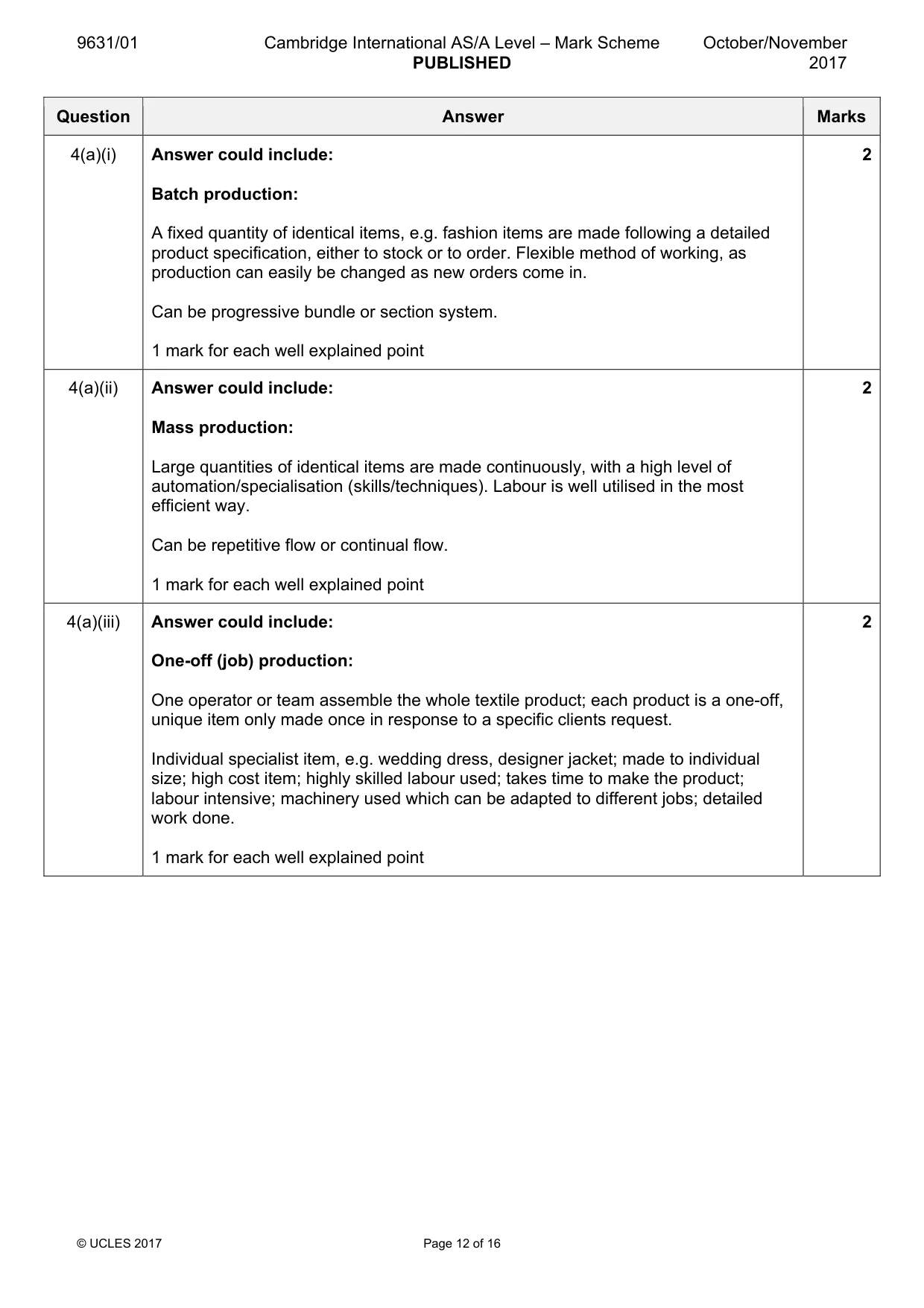
9631/01 Cambridge International AS/A Level – Mark Scheme PUBLISHED October/November 2017 © UCLES 2017 Page 12 of 16 Question Answer Marks 4(a)(i) Answer could include: Batch production: A fixed quantity of identical items, e.g. fashion items are made following a detailed product specification, either to stock or to order. Flexible method of working, as production can easily be changed as new orders come in. Can be progressive bundle or section system. 1 mark for each well explained point 2 4(a)(ii) Answer could include: Mass production: Large quantities of identical items are made continuously, with a high level of automation/specialisation (skills/techniques). Labour is well utilised in the most efficient way. Can be repetitive flow or continual flow. 1 mark for each well explained point 2 4(a)(iii) Answer could include: One-off (job) production: One operator or team assemble the whole textile product; each product is a one-off, unique item only made once in response to a specific clients request. Individual specialist item, e.g. wedding dress, designer jacket; made to individual size; high cost item; highly skilled labour used; takes time to make the product; labour intensive; machinery used which can be adapted to different jobs; detailed work done. 1 mark for each well explained point 2
Mark scheme, page 13
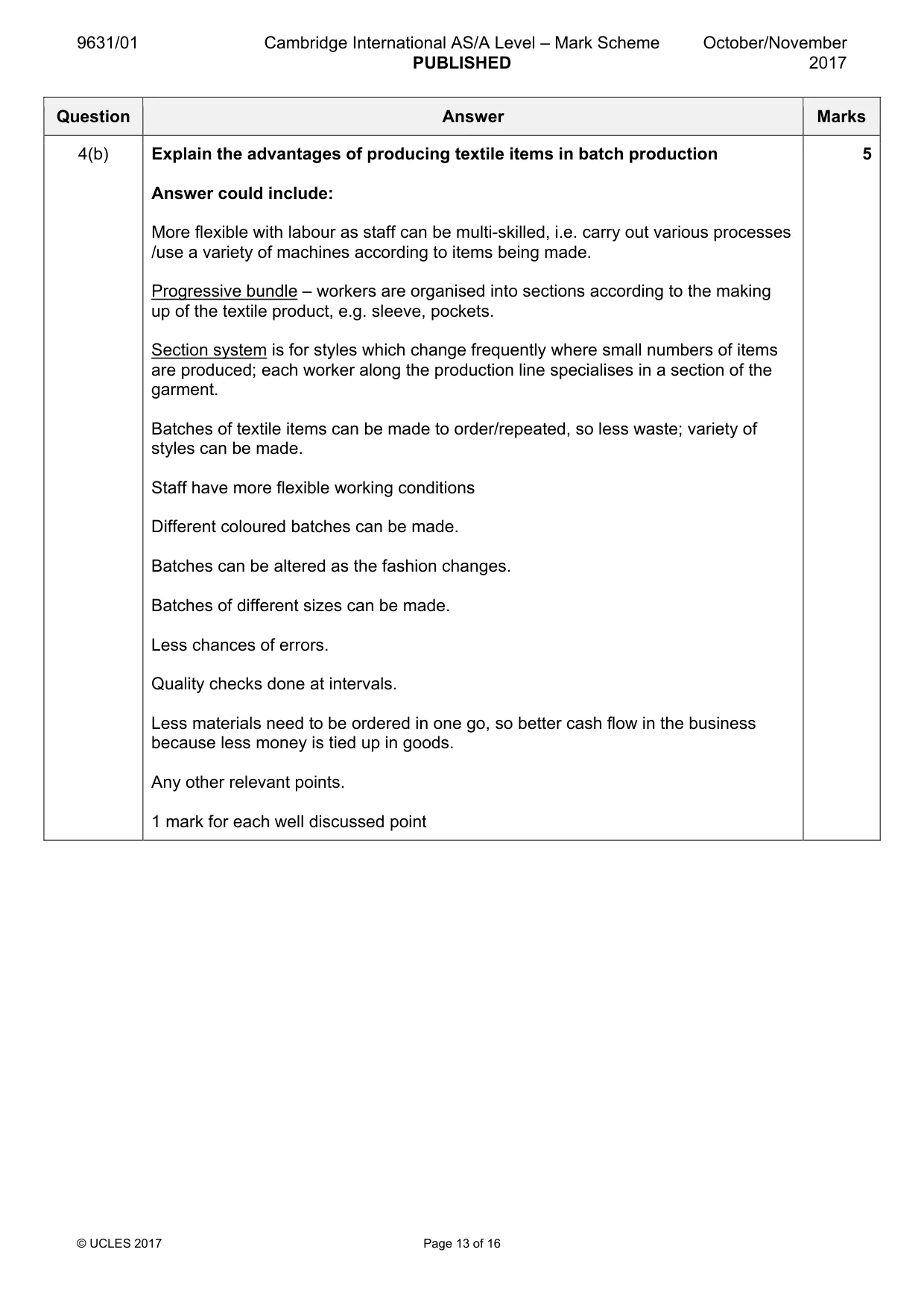
9631/01 Cambridge International AS/A Level – Mark Scheme PUBLISHED October/November 2017 © UCLES 2017 Page 13 of 16 Question Answer Marks 4(b) Explain the advantages of producing textile items in batch production Answer could include: More flexible with labour as staff can be multi-skilled, i.e. carry out various processes /use a variety of machines according to items being made. Progressive bundle – workers are organised into sections according to the making up of the textile product, e.g. sleeve, pockets. Section system is for styles which change frequently where small numbers of items are produced; each worker along the production line specialises in a section of the garment. Batches of textile items can be made to order/repeated, so less waste; variety of styles can be made. Staff have more flexible working conditions Different coloured batches can be made. Batches can be altered as the fashion changes. Batches of different sizes can be made. Less chances of errors. Quality checks done at intervals. Less materials need to be ordered in one go, so better cash flow in the business because less money is tied up in goods. Any other relevant points. 1 mark for each well discussed point 5
Mark scheme, page 14
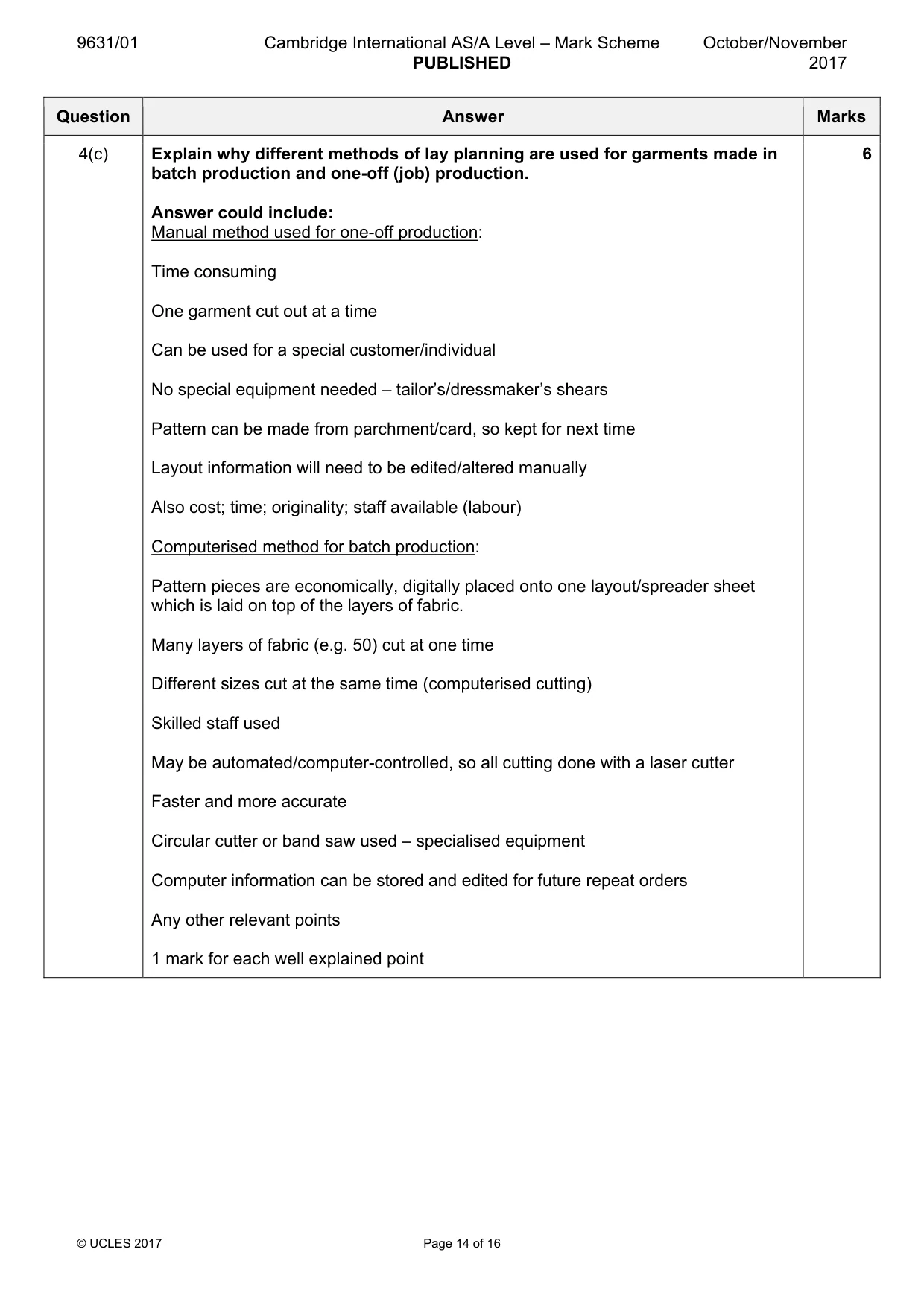
9631/01 Cambridge International AS/A Level – Mark Scheme PUBLISHED October/November 2017 © UCLES 2017 Page 14 of 16 Question Answer Marks 4(c) Explain why different methods of lay planning are used for garments made in batch production and one-off (job) production. Answer could include: Manual method used for one-off production: Time consuming One garment cut out at a time Can be used for a special customer/individual No special equipment needed – tailor’s/dressmaker’s shears Pattern can be made from parchment/card, so kept for next time Layout information will need to be edited/altered manually Also cost; time; originality; staff available (labour) Computerised method for batch production: Pattern pieces are economically, digitally placed onto one layout/spreader sheet which is laid on top of the layers of fabric. Many layers of fabric (e.g. 50) cut at one time Different sizes cut at the same time (computerised cutting) Skilled staff used May be automated/computer-controlled, so all cutting done with a laser cutter Faster and more accurate Circular cutter or band saw used – specialised equipment Computer information can be stored and edited for future repeat orders Any other relevant points 1 mark for each well explained point 6
Mark scheme, page 15
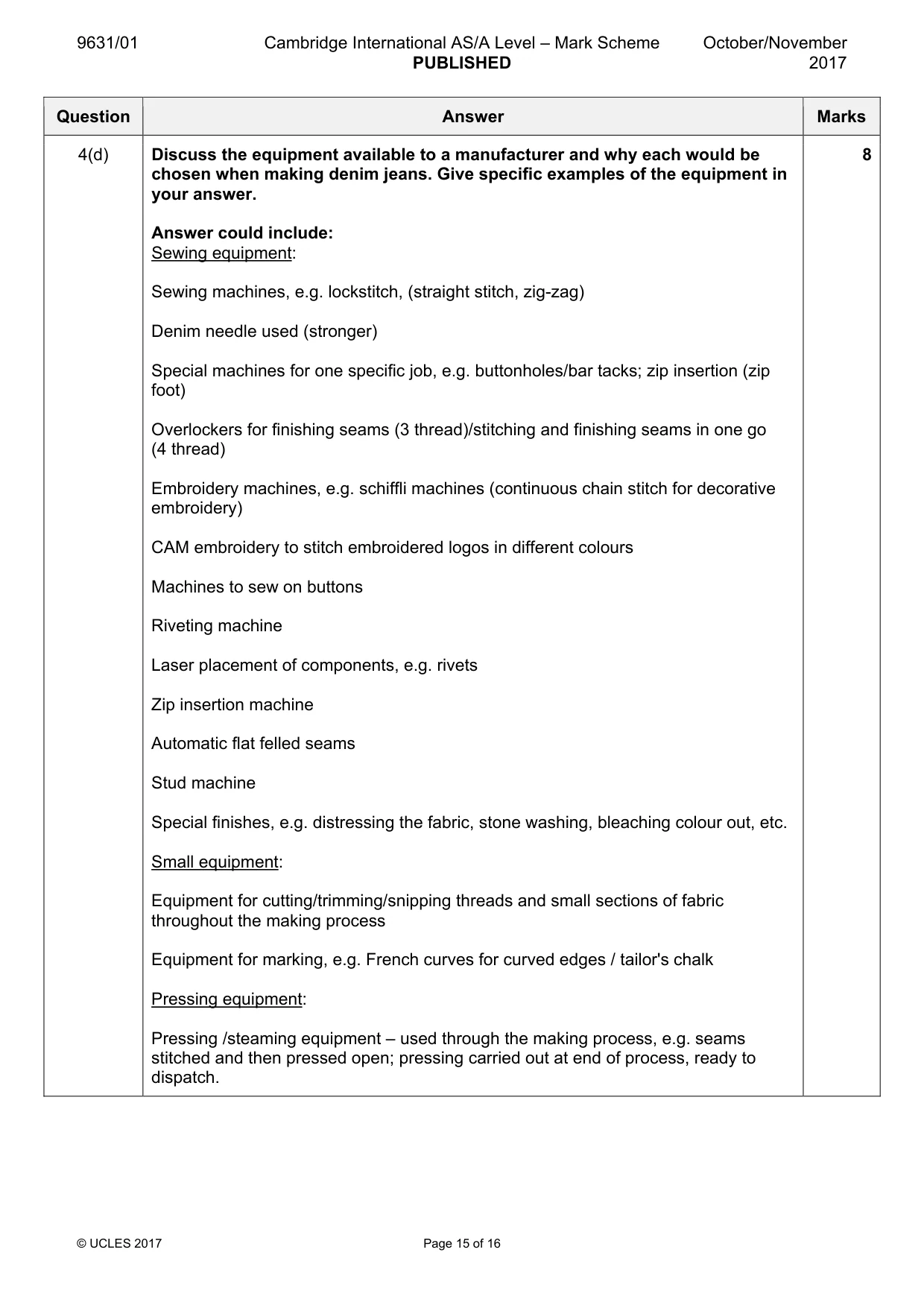
9631/01 Cambridge International AS/A Level – Mark Scheme PUBLISHED October/November 2017 © UCLES 2017 Page 15 of 16 Question Answer Marks 4(d) Discuss the equipment available to a manufacturer and why each would be chosen when making denim jeans. Give specific examples of the equipment in your answer. Answer could include: Sewing equipment: Sewing machines, e.g. lockstitch, (straight stitch, zig-zag) Denim needle used (stronger) Special machines for one specific job, e.g. buttonholes/bar tacks; zip insertion (zip foot) Overlockers for finishing seams (3 thread)/stitching and finishing seams in one go (4 thread) Embroidery machines, e.g. schiffli machines (continuous chain stitch for decorative embroidery) CAM embroidery to stitch embroidered logos in different colours Machines to sew on buttons Riveting machine Laser placement of components, e.g. rivets Zip insertion machine Automatic flat felled seams Stud machine Special finishes, e.g. distressing the fabric, stone washing, bleaching colour out, etc. Small equipment: Equipment for cutting/trimming/snipping threads and small sections of fabric throughout the making process Equipment for marking, e.g. French curves for curved edges / tailor's chalk Pressing equipment: Pressing /steaming equipment – used through the making process, e.g. seams stitched and then pressed open; pressing carried out at end of process, ready to dispatch. 8
Mark scheme, page 16
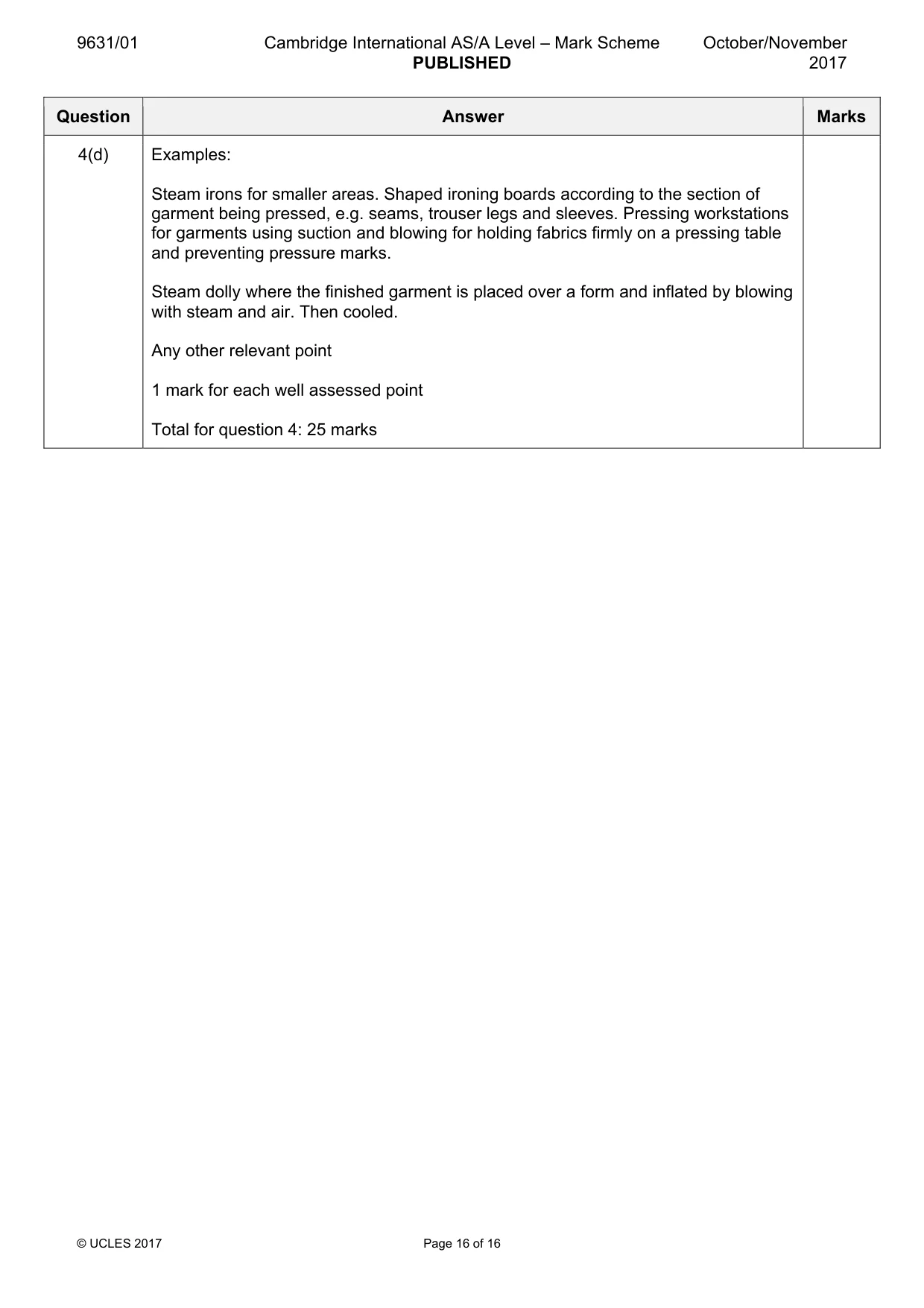
9631/01 Cambridge International AS/A Level – Mark Scheme PUBLISHED October/November 2017 © UCLES 2017 Page 16 of 16 Question Answer Marks 4(d) Examples: Steam irons for smaller areas. Shaped ironing boards according to the section of garment being pressed, e.g. seams, trouser legs and sleeves. Pressing workstations for garments using suction and blowing for holding fabrics firmly on a pressing table and preventing pressure marks. Steam dolly where the finished garment is placed over a form and inflated by blowing with steam and air. Then cooled. Any other relevant point 1 mark for each well assessed point Total for question 4: 25 marks
What you needed in this session
Cambridge’s own grade thresholds for 2017 Oct/Nov, Paper 1 · Variant 1. A higher threshold means an easier paper — the bar moves with how the cohort did.