Cambridge A Level Design and Textiles 9631 — 2012 Oct/Nov Paper 1 · Variant 1
9631/11/O/N/12 · 75 marks · ≈84 min
The question paper and its mark scheme, free to read here and free to download. This is Cambridge’s own paper, exactly as it was sat.
Question paper4 pages
Mark scheme9 pages
Answers below. Sit the paper first if you are practising.
Paper as text
Question paper, page 1
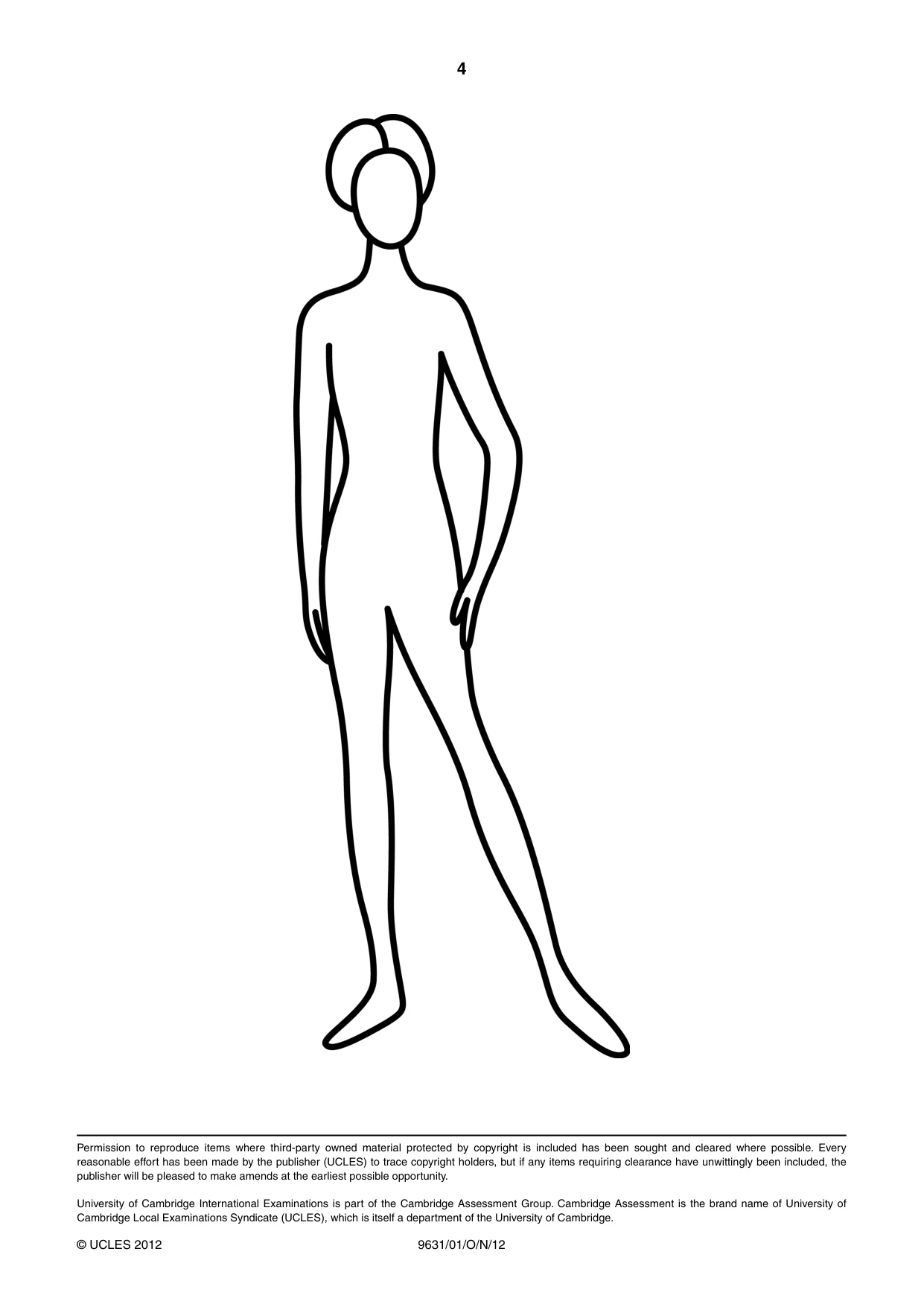
This document consists of 4 printed pages. DC (CW/SW) 51525/2 © UCLES 2012 [Turn over UNIVERSITY OF CAMBRIDGE INTERNATIONAL EXAMINATIONS General Certificate of Education Advanced Subsidiary Level and Advanced Level * 1 9 3 6 0 8 7 7 0 2 * DESIGN AND TEXTILES 9631/01 Paper 1 Fibres, Fabrics and Design October/November 2012 2 hours Additional Materials: Answer Booklet/Paper READ THESE INSTRUCTIONS FIRST If you have been given an Answer Booklet, follow the instructions on the front cover of the Booklet. Write your Centre number, candidate number and name on all the work you hand in. Write in dark blue or black pen. You may use a pencil for any diagrams or rough working. Do not use staples, paper clips, highlighters, glue or correction fluid. Answer three questions in total. Section A Answer both questions. Section B Answer one question. Illustrate your answers with clear, well-spaced diagrams. You may, if you wish, use the silhouette on page 4 to produce outlines for your sketches. Place the silhouette under a single sheet of script paper and trace the outline in pencil. At the end of the examination, fasten all your work securely together. The number of marks is given in brackets [ ] at the end of each question or part question.
Question paper, page 2
2 9631/01/O/N/12 © UCLES 2012 Section A Answer both questions. 1 The performance characteristics of fabrics for clothing is an important consideration. (a) State the source of: (i) viscose and (ii) acetate fibres [2] (b) Name one fabric made from viscose and one fabric made from acetate, which would be suitable for use in clothing. [2] (c) Compare the performance characteristics of both fabrics in (a) explaining why each is suitable for clothing. [8] (d) Discuss the methods available for testing fabrics, commenting on the results expected, to establish whether they are made from viscose or acetate. [6] (e) Comment on which additional performance characteristics would be important when choosing viscose fabrics for use in the home. [7] [Total: 25] 2 There is a wide range of fabric construction methods used for household (non-clothing) textiles. (a) Explain how the system used for plain weaving, differs from the system used for pile weaving. [4] (b) Using labelled sketches, describe the construction methods used for: (i) velvet; (ii) terry towelling; (iii) knitted fleece. [9] (c) Compare the following characteristics for one knitted fabric from (b) with one named non- woven fabric: (i) appearance; (ii) fibre composition; (iii) end uses. [12] [Total: 25]
Question paper, page 3
3 9631/01/O/N/12 © UCLES 2012 [Turn over Section B Answer one question. 3 Colour and pattern are important features of textiles for fashion items. (a) Suggest three reasons why fashions are constantly changing. [3] (b) (i) Using labelled sketches, show how colour and pattern can be incorporated into the designs of three fashion tops for teenagers. [9] (ii) Give reasons for your choice of colour and pattern. [4] (c) Assess whether retrospective fashion ideas have been used in current trends for women’s wear. Give specific examples from the fashion designers you have studied. [9] [Total: 25] OR 4 Clothing manufacture can be home based or industry based. (a) Describe two ways of making patterns (templates) for garments, in industry. [4] (b) Using labelled diagrams explain how: (i) to lengthen and shorten a named sleeve on a commercial pattern (template). [3] (ii) to alter a basic sleeve pattern (template) to produce one different sleeve style. Choose a different sleeve to the one used in (b)(i). [5] (c) Compare four features of a pattern (template) used at home, with one used in industry. [4] (d) Assess the range of closures (fastenings) available for garment making. Comment on whether the method of fastening is functional or decorative. [9] [Total: 25]
Question paper, page 4
4 9631/01/O/N/12 © UCLES 2012 Permission to reproduce items where third-party owned material protected by copyright is included has been sought and cleared where possible. Every reasonable effort has been made by the publisher (UCLES) to trace copyright holders, but if any items requiring clearance have unwittingly been included, the publisher will be pleased to make amends at the earliest possible opportunity. University of Cambridge International Examinations is part of the Cambridge Assessment Group. Cambridge Assessment is the brand name of University of Cambridge Local Examinations Syndicate (UCLES), which is itself a department of the University of Cambridge.
Mark scheme, page 1
CAMBRIDGE INTERNATIONAL EXAMINATIONS GCE Advanced Subsidiary Level and GCE Advanced Level MARK SCHEME for the October/November 2012 series 9631 DESIGN AND TEXTILES 9631/01 Paper 1 (Fibres, Fabrics and Design), maximum raw mark 75 This mark scheme is published as an aid to teachers and candidates, to indicate the requirements of the examination. It shows the basis on which Examiners were instructed to award marks. It does not indicate the details of the discussions that took place at an Examiners’ meeting before marking began, which would have considered the acceptability of alternative answers. Mark schemes should be read in conjunction with the question paper and the Principal Examiner Report for Teachers. Cambridge will not enter into discussions about these mark schemes. Cambridge is publishing the mark schemes for the October/November 2012 series for most IGCSE, GCE Advanced Level and Advanced Subsidiary Level components and some Ordinary Level components.
Mark scheme, page 2
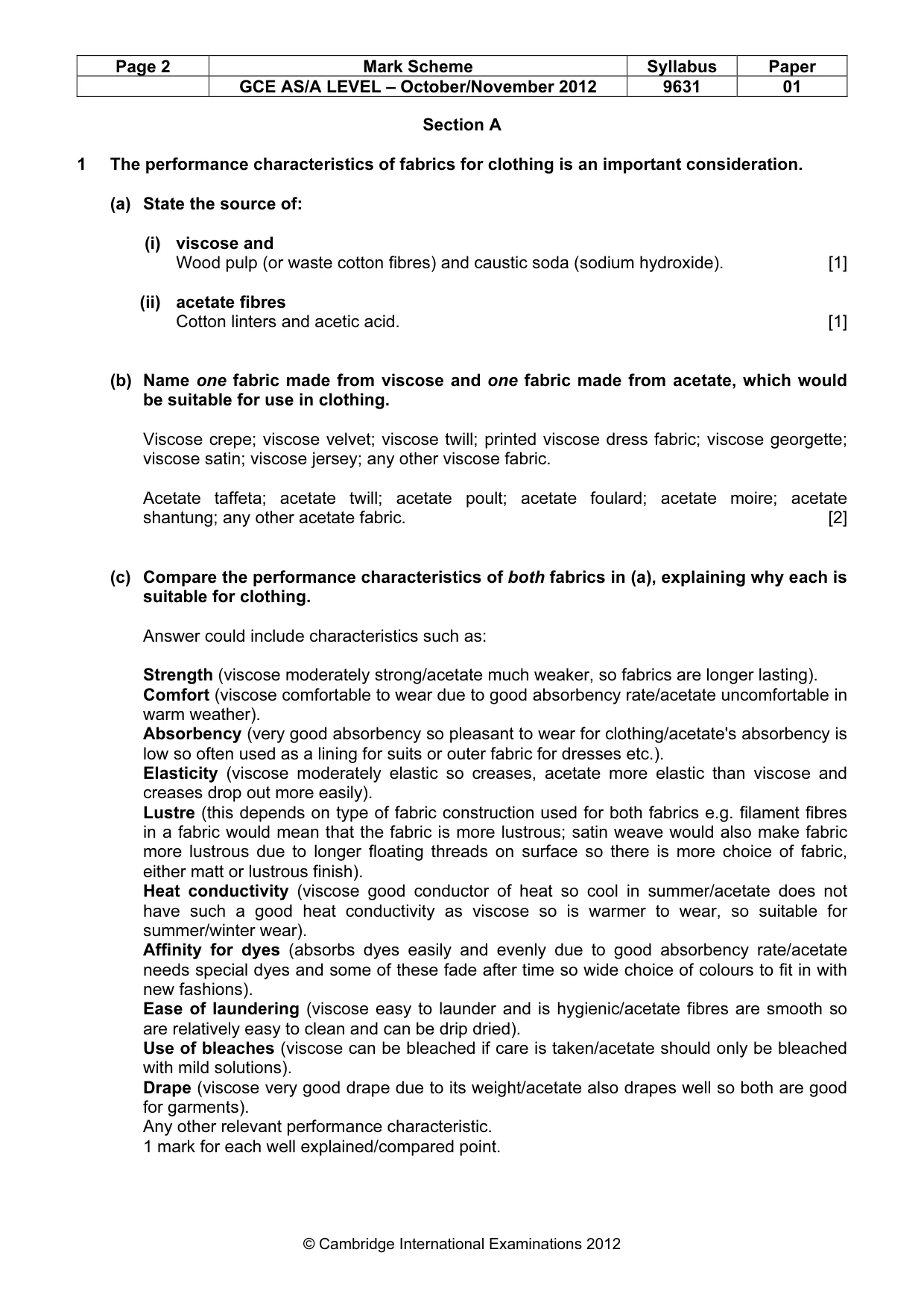
Page 2 Mark Scheme Syllabus Paper GCE AS/A LEVEL – October/November 2012 9631 01 © Cambridge International Examinations 2012 Section A 1 The performance characteristics of fabrics for clothing is an important consideration. (a) State the source of: (i) viscose and Wood pulp (or waste cotton fibres) and caustic soda (sodium hydroxide). [1] (ii) acetate fibres Cotton linters and acetic acid. [1] (b) Name one fabric made from viscose and one fabric made from acetate, which would be suitable for use in clothing. Viscose crepe; viscose velvet; viscose twill; printed viscose dress fabric; viscose georgette; viscose satin; viscose jersey; any other viscose fabric. Acetate taffeta; acetate twill; acetate poult; acetate foulard; acetate moire; acetate shantung; any other acetate fabric. [2] (c) Compare the performance characteristics of both fabrics in (a), explaining why each is suitable for clothing. Answer could include characteristics such as: Strength (viscose moderately strong/acetate much weaker, so fabrics are longer lasting). Comfort (viscose comfortable to wear due to good absorbency rate/acetate uncomfortable in warm weather). Absorbency (very good absorbency so pleasant to wear for clothing/acetate's absorbency is low so often used as a lining for suits or outer fabric for dresses etc.). Elasticity (viscose moderately elastic so creases, acetate more elastic than viscose and creases drop out more easily). Lustre (this depends on type of fabric construction used for both fabrics e.g. filament fibres in a fabric would mean that the fabric is more lustrous; satin weave would also make fabric more lustrous due to longer floating threads on surface so there is more choice of fabric, either matt or lustrous finish). Heat conductivity (viscose good conductor of heat so cool in summer/acetate does not have such a good heat conductivity as viscose so is warmer to wear, so suitable for summer/winter wear). Affinity for dyes (absorbs dyes easily and evenly due to good absorbency rate/acetate needs special dyes and some of these fade after time so wide choice of colours to fit in with new fashions). Ease of laundering (viscose easy to launder and is hygienic/acetate fibres are smooth so are relatively easy to clean and can be drip dried). Use of bleaches (viscose can be bleached if care is taken/acetate should only be bleached with mild solutions). Drape (viscose very good drape due to its weight/acetate also drapes well so both are good for garments). Any other relevant performance characteristic. 1 mark for each well explained/compared point.
Mark scheme, page 3
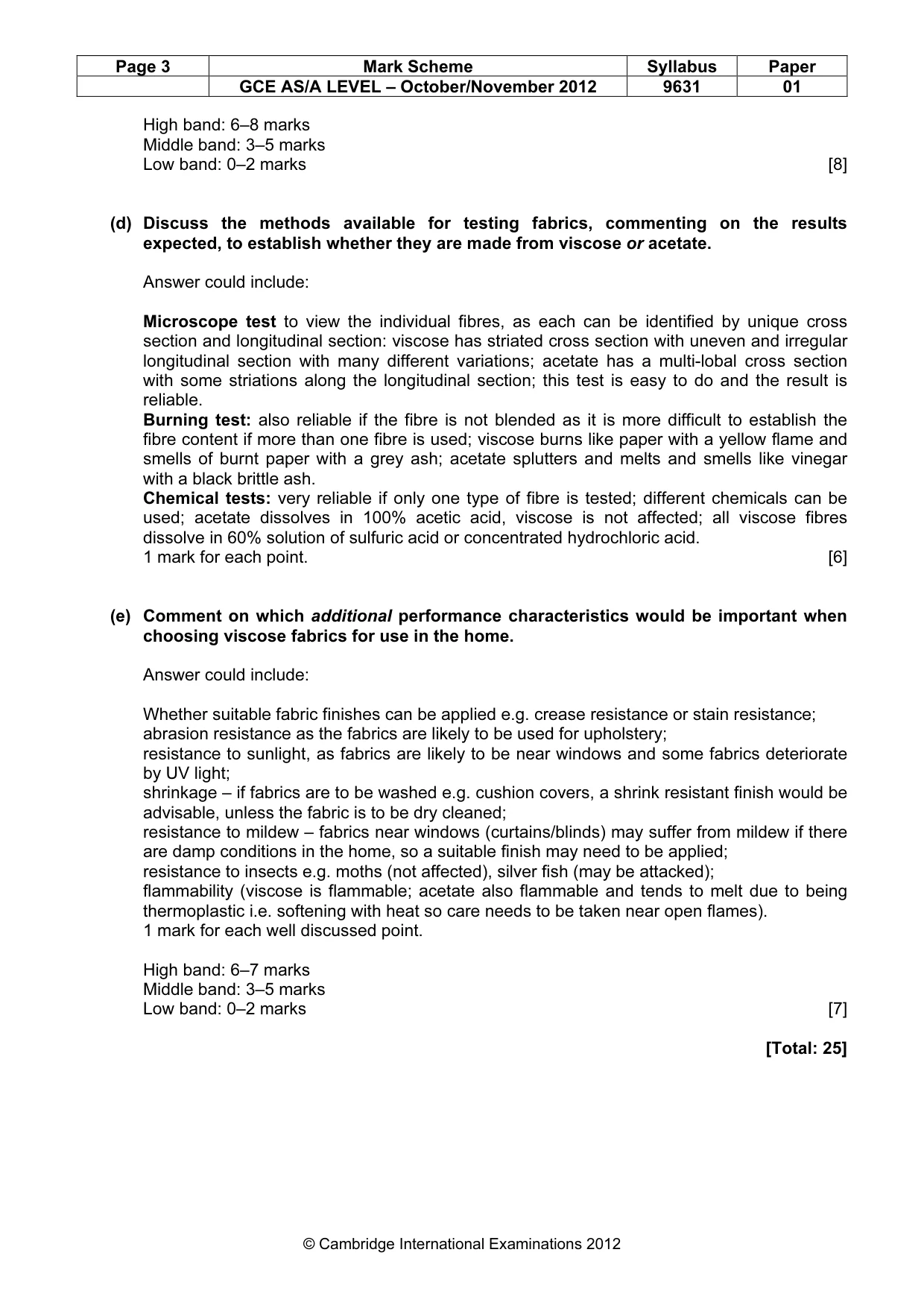
Page 3 Mark Scheme Syllabus Paper GCE AS/A LEVEL – October/November 2012 9631 01 © Cambridge International Examinations 2012 High band: 6–8 marks Middle band: 3–5 marks Low band: 0–2 marks [8] (d) Discuss the methods available for testing fabrics, commenting on the results expected, to establish whether they are made from viscose or acetate. Answer could include: Microscope test to view the individual fibres, as each can be identified by unique cross section and longitudinal section: viscose has striated cross section with uneven and irregular longitudinal section with many different variations; acetate has a multi-lobal cross section with some striations along the longitudinal section; this test is easy to do and the result is reliable. Burning test: also reliable if the fibre is not blended as it is more difficult to establish the fibre content if more than one fibre is used; viscose burns like paper with a yellow flame and smells of burnt paper with a grey ash; acetate splutters and melts and smells like vinegar with a black brittle ash. Chemical tests: very reliable if only one type of fibre is tested; different chemicals can be used; acetate dissolves in 100% acetic acid, viscose is not affected; all viscose fibres dissolve in 60% solution of sulfuric acid or concentrated hydrochloric acid. 1 mark for each point. [6] (e) Comment on which additional performance characteristics would be important when choosing viscose fabrics for use in the home. Answer could include: Whether suitable fabric finishes can be applied e.g. crease resistance or stain resistance; abrasion resistance as the fabrics are likely to be used for upholstery; resistance to sunlight, as fabrics are likely to be near windows and some fabrics deteriorate by UV light; shrinkage – if fabrics are to be washed e.g. cushion covers, a shrink resistant finish would be advisable, unless the fabric is to be dry cleaned; resistance to mildew – fabrics near windows (curtains/blinds) may suffer from mildew if there are damp conditions in the home, so a suitable finish may need to be applied; resistance to insects e.g. moths (not affected), silver fish (may be attacked); flammability (viscose is flammable; acetate also flammable and tends to melt due to being thermoplastic i.e. softening with heat so care needs to be taken near open flames). 1 mark for each well discussed point. High band: 6–7 marks Middle band: 3–5 marks Low band: 0–2 marks [7] [Total: 25]
Mark scheme, page 4
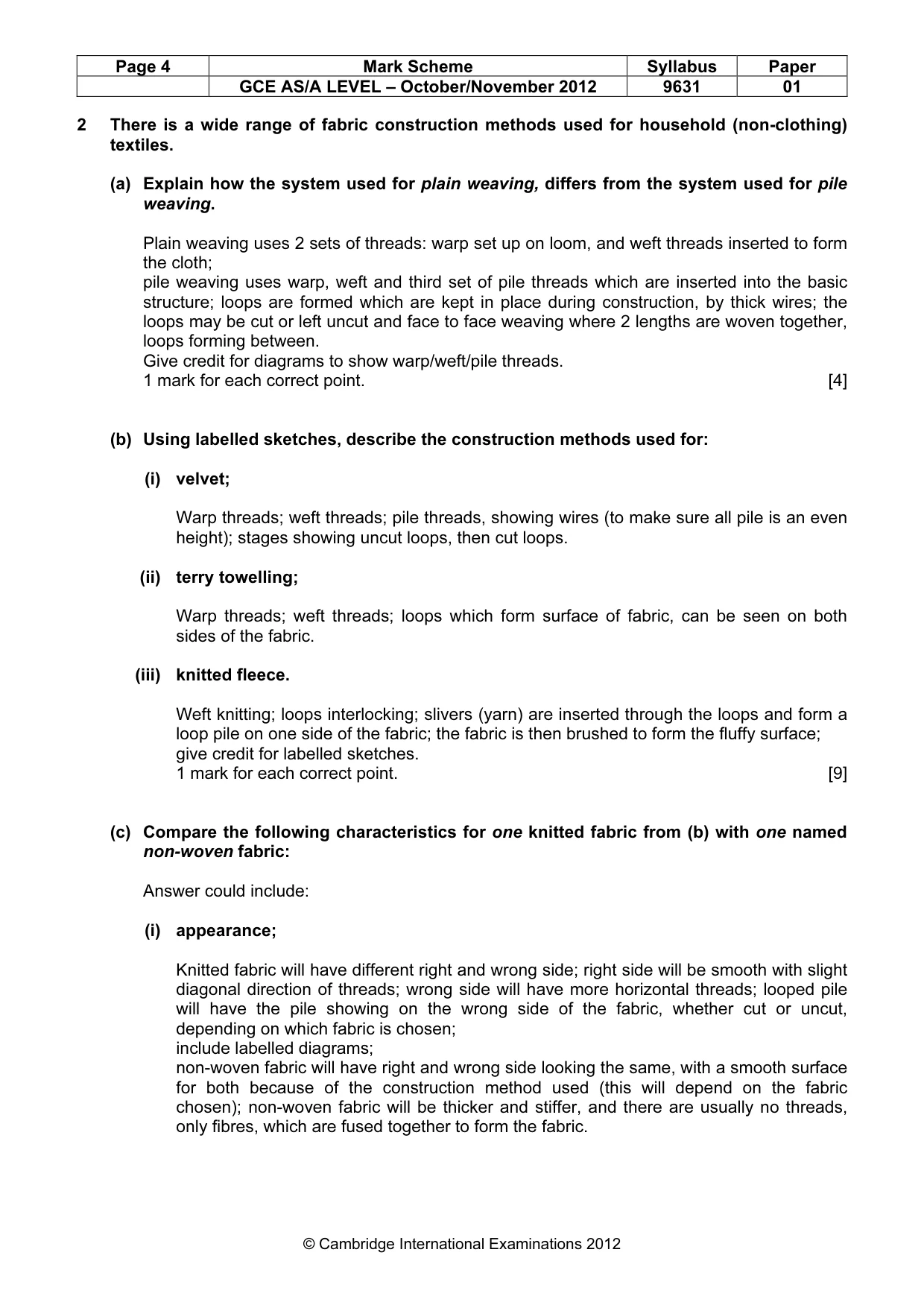
Page 4 Mark Scheme Syllabus Paper GCE AS/A LEVEL – October/November 2012 9631 01 © Cambridge International Examinations 2012 2 There is a wide range of fabric construction methods used for household (non-clothing) textiles. (a) Explain how the system used for plain weaving, differs from the system used for pile weaving. Plain weaving uses 2 sets of threads: warp set up on loom, and weft threads inserted to form the cloth; pile weaving uses warp, weft and third set of pile threads which are inserted into the basic structure; loops are formed which are kept in place during construction, by thick wires; the loops may be cut or left uncut and face to face weaving where 2 lengths are woven together, loops forming between. Give credit for diagrams to show warp/weft/pile threads. 1 mark for each correct point. [4] (b) Using labelled sketches, describe the construction methods used for: (i) velvet; Warp threads; weft threads; pile threads, showing wires (to make sure all pile is an even height); stages showing uncut loops, then cut loops. (ii) terry towelling; Warp threads; weft threads; loops which form surface of fabric, can be seen on both sides of the fabric. (iii) knitted fleece. Weft knitting; loops interlocking; slivers (yarn) are inserted through the loops and form a loop pile on one side of the fabric; the fabric is then brushed to form the fluffy surface; give credit for labelled sketches. 1 mark for each correct point. [9] (c) Compare the following characteristics for one knitted fabric from (b) with one named non-woven fabric: Answer could include: (i) appearance; Knitted fabric will have different right and wrong side; right side will be smooth with slight diagonal direction of threads; wrong side will have more horizontal threads; looped pile will have the pile showing on the wrong side of the fabric, whether cut or uncut, depending on which fabric is chosen; include labelled diagrams; non-woven fabric will have right and wrong side looking the same, with a smooth surface for both because of the construction method used (this will depend on the fabric chosen); non-woven fabric will be thicker and stiffer, and there are usually no threads, only fibres, which are fused together to form the fabric.
Mark scheme, page 5
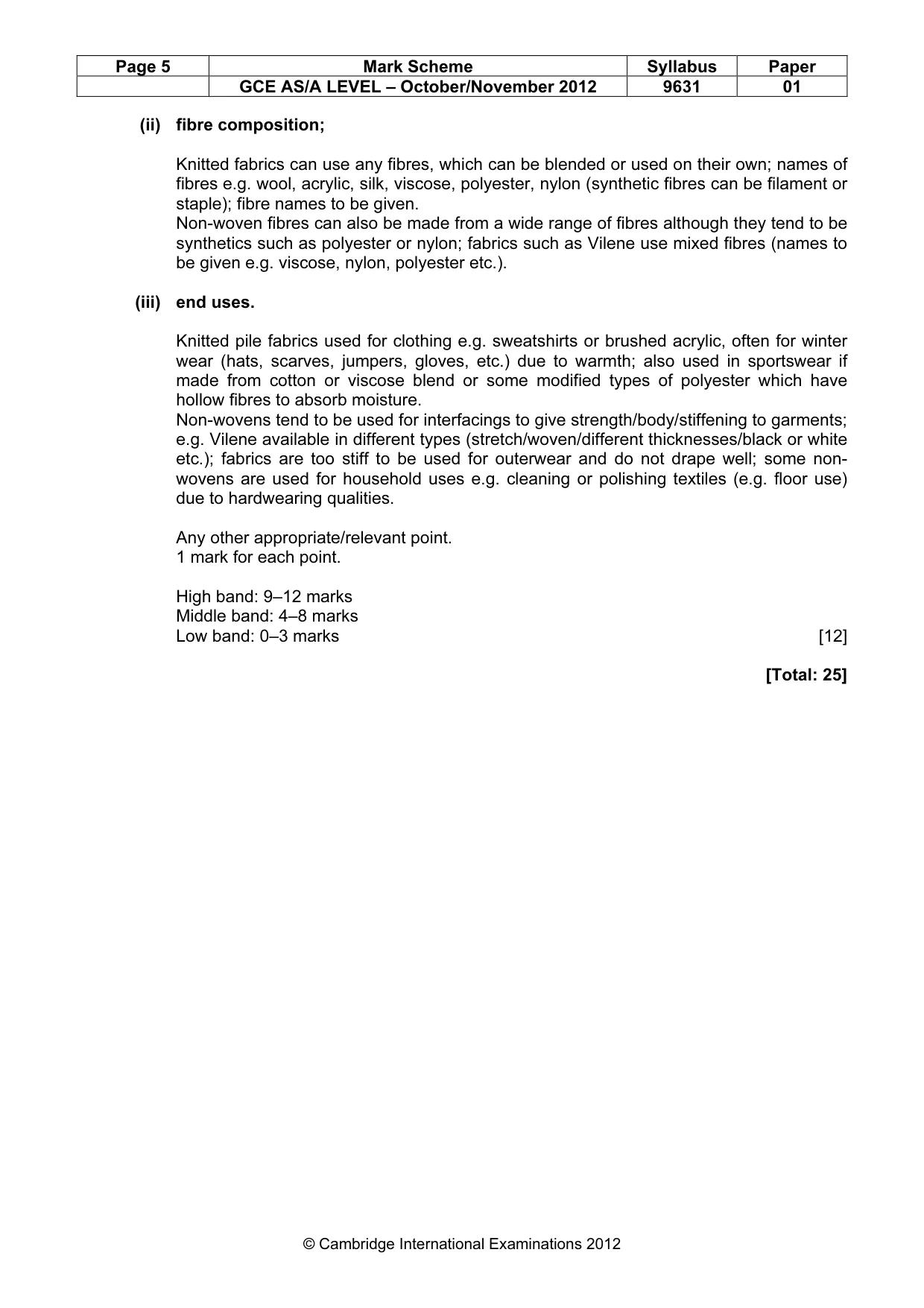
Page 5 Mark Scheme Syllabus Paper GCE AS/A LEVEL – October/November 2012 9631 01 © Cambridge International Examinations 2012 (ii) fibre composition; Knitted fabrics can use any fibres, which can be blended or used on their own; names of fibres e.g. wool, acrylic, silk, viscose, polyester, nylon (synthetic fibres can be filament or staple); fibre names to be given. Non-woven fibres can also be made from a wide range of fibres although they tend to be synthetics such as polyester or nylon; fabrics such as Vilene use mixed fibres (names to be given e.g. viscose, nylon, polyester etc.). (iii) end uses. Knitted pile fabrics used for clothing e.g. sweatshirts or brushed acrylic, often for winter wear (hats, scarves, jumpers, gloves, etc.) due to warmth; also used in sportswear if made from cotton or viscose blend or some modified types of polyester which have hollow fibres to absorb moisture. Non-wovens tend to be used for interfacings to give strength/body/stiffening to garments; e.g. Vilene available in different types (stretch/woven/different thicknesses/black or white etc.); fabrics are too stiff to be used for outerwear and do not drape well; some non- wovens are used for household uses e.g. cleaning or polishing textiles (e.g. floor use) due to hardwearing qualities. Any other appropriate/relevant point. 1 mark for each point. High band: 9–12 marks Middle band: 4–8 marks Low band: 0–3 marks [12] [Total: 25]
Mark scheme, page 6
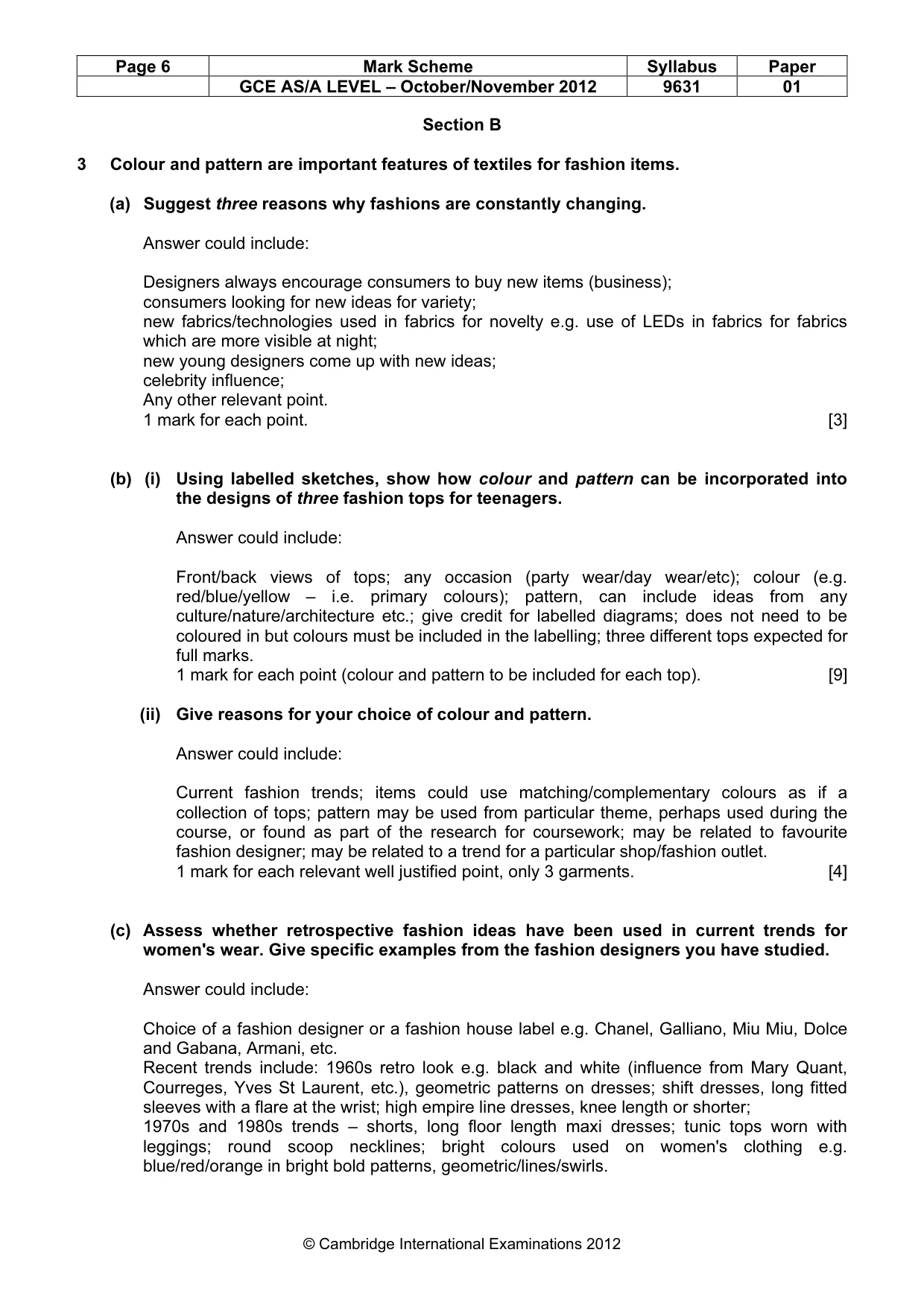
Page 6 Mark Scheme Syllabus Paper GCE AS/A LEVEL – October/November 2012 9631 01 © Cambridge International Examinations 2012 Section B 3 Colour and pattern are important features of textiles for fashion items. (a) Suggest three reasons why fashions are constantly changing. Answer could include: Designers always encourage consumers to buy new items (business); consumers looking for new ideas for variety; new fabrics/technologies used in fabrics for novelty e.g. use of LEDs in fabrics for fabrics which are more visible at night; new young designers come up with new ideas; celebrity influence; Any other relevant point. 1 mark for each point. [3] (b) (i) Using labelled sketches, show how colour and pattern can be incorporated into the designs of three fashion tops for teenagers. Answer could include: Front/back views of tops; any occasion (party wear/day wear/etc); colour (e.g. red/blue/yellow – i.e. primary colours); pattern, can include ideas from any culture/nature/architecture etc.; give credit for labelled diagrams; does not need to be coloured in but colours must be included in the labelling; three different tops expected for full marks. 1 mark for each point (colour and pattern to be included for each top). [9] (ii) Give reasons for your choice of colour and pattern. Answer could include: Current fashion trends; items could use matching/complementary colours as if a collection of tops; pattern may be used from particular theme, perhaps used during the course, or found as part of the research for coursework; may be related to favourite fashion designer; may be related to a trend for a particular shop/fashion outlet. 1 mark for each relevant well justified point, only 3 garments. [4] (c) Assess whether retrospective fashion ideas have been used in current trends for women's wear. Give specific examples from the fashion designers you have studied. Answer could include: Choice of a fashion designer or a fashion house label e.g. Chanel, Galliano, Miu Miu, Dolce and Gabana, Armani, etc. Recent trends include: 1960s retro look e.g. black and white (influence from Mary Quant, Courreges, Yves St Laurent, etc.), geometric patterns on dresses; shift dresses, long fitted sleeves with a flare at the wrist; high empire line dresses, knee length or shorter; 1970s and 1980s trends – shorts, long floor length maxi dresses; tunic tops worn with leggings; round scoop necklines; bright colours used on women's clothing e.g. blue/red/orange in bright bold patterns, geometric/lines/swirls.
Mark scheme, page 7
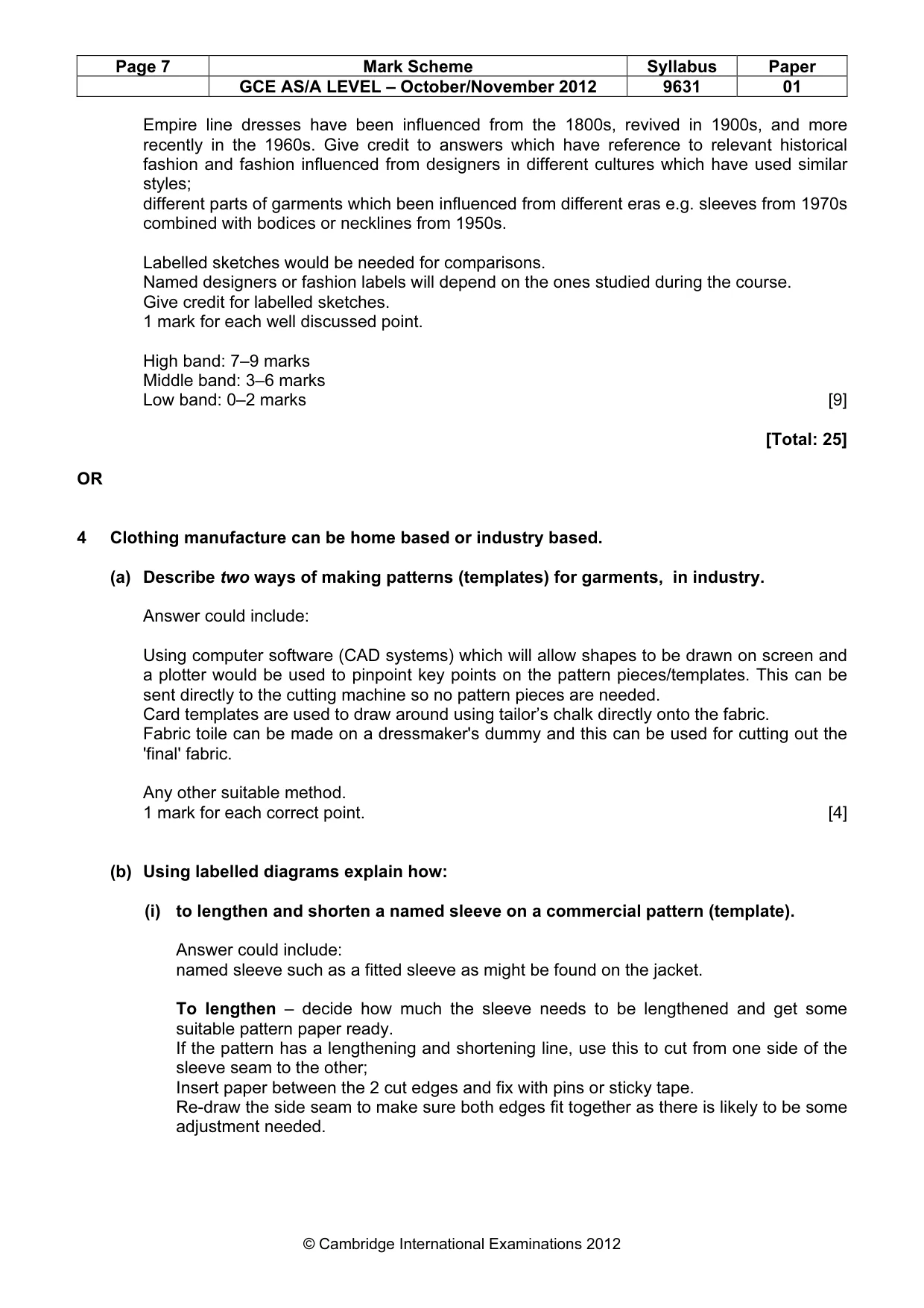
Page 7 Mark Scheme Syllabus Paper GCE AS/A LEVEL – October/November 2012 9631 01 © Cambridge International Examinations 2012 Empire line dresses have been influenced from the 1800s, revived in 1900s, and more recently in the 1960s. Give credit to answers which have reference to relevant historical fashion and fashion influenced from designers in different cultures which have used similar styles; different parts of garments which been influenced from different eras e.g. sleeves from 1970s combined with bodices or necklines from 1950s. Labelled sketches would be needed for comparisons. Named designers or fashion labels will depend on the ones studied during the course. Give credit for labelled sketches. 1 mark for each well discussed point. High band: 7–9 marks Middle band: 3–6 marks Low band: 0–2 marks [9] [Total: 25] OR 4 Clothing manufacture can be home based or industry based. (a) Describe two ways of making patterns (templates) for garments, in industry. Answer could include: Using computer software (CAD systems) which will allow shapes to be drawn on screen and a plotter would be used to pinpoint key points on the pattern pieces/templates. This can be sent directly to the cutting machine so no pattern pieces are needed. Card templates are used to draw around using tailor’s chalk directly onto the fabric. Fabric toile can be made on a dressmaker's dummy and this can be used for cutting out the 'final' fabric. Any other suitable method. 1 mark for each correct point. [4] (b) Using labelled diagrams explain how: (i) to lengthen and shorten a named sleeve on a commercial pattern (template). Answer could include: named sleeve such as a fitted sleeve as might be found on the jacket. To lengthen – decide how much the sleeve needs to be lengthened and get some suitable pattern paper ready. If the pattern has a lengthening and shortening line, use this to cut from one side of the sleeve seam to the other; Insert paper between the 2 cut edges and fix with pins or sticky tape. Re-draw the side seam to make sure both edges fit together as there is likely to be some adjustment needed.
Mark scheme, page 8
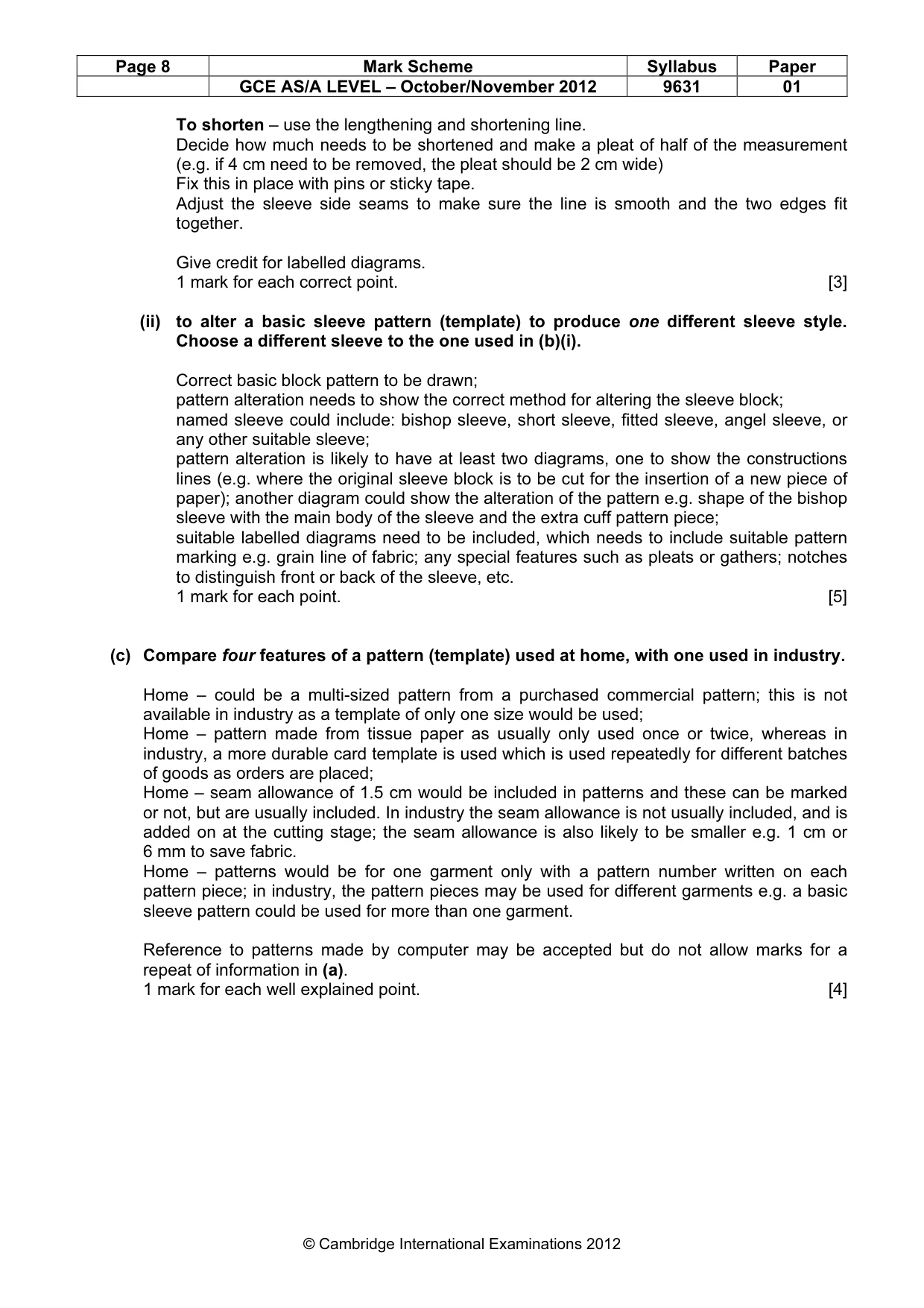
Page 8 Mark Scheme Syllabus Paper GCE AS/A LEVEL – October/November 2012 9631 01 © Cambridge International Examinations 2012 To shorten – use the lengthening and shortening line. Decide how much needs to be shortened and make a pleat of half of the measurement (e.g. if 4 cm need to be removed, the pleat should be 2 cm wide) Fix this in place with pins or sticky tape. Adjust the sleeve side seams to make sure the line is smooth and the two edges fit together. Give credit for labelled diagrams. 1 mark for each correct point. [3] (ii) to alter a basic sleeve pattern (template) to produce one different sleeve style. Choose a different sleeve to the one used in (b)(i). Correct basic block pattern to be drawn; pattern alteration needs to show the correct method for altering the sleeve block; named sleeve could include: bishop sleeve, short sleeve, fitted sleeve, angel sleeve, or any other suitable sleeve; pattern alteration is likely to have at least two diagrams, one to show the constructions lines (e.g. where the original sleeve block is to be cut for the insertion of a new piece of paper); another diagram could show the alteration of the pattern e.g. shape of the bishop sleeve with the main body of the sleeve and the extra cuff pattern piece; suitable labelled diagrams need to be included, which needs to include suitable pattern marking e.g. grain line of fabric; any special features such as pleats or gathers; notches to distinguish front or back of the sleeve, etc. 1 mark for each point. [5] (c) Compare four features of a pattern (template) used at home, with one used in industry. Home – could be a multi-sized pattern from a purchased commercial pattern; this is not available in industry as a template of only one size would be used; Home – pattern made from tissue paper as usually only used once or twice, whereas in industry, a more durable card template is used which is used repeatedly for different batches of goods as orders are placed; Home – seam allowance of 1.5 cm would be included in patterns and these can be marked or not, but are usually included. In industry the seam allowance is not usually included, and is added on at the cutting stage; the seam allowance is also likely to be smaller e.g. 1 cm or 6 mm to save fabric. Home – patterns would be for one garment only with a pattern number written on each pattern piece; in industry, the pattern pieces may be used for different garments e.g. a basic sleeve pattern could be used for more than one garment. Reference to patterns made by computer may be accepted but do not allow marks for a repeat of information in (a). 1 mark for each well explained point. [4]
Mark scheme, page 9
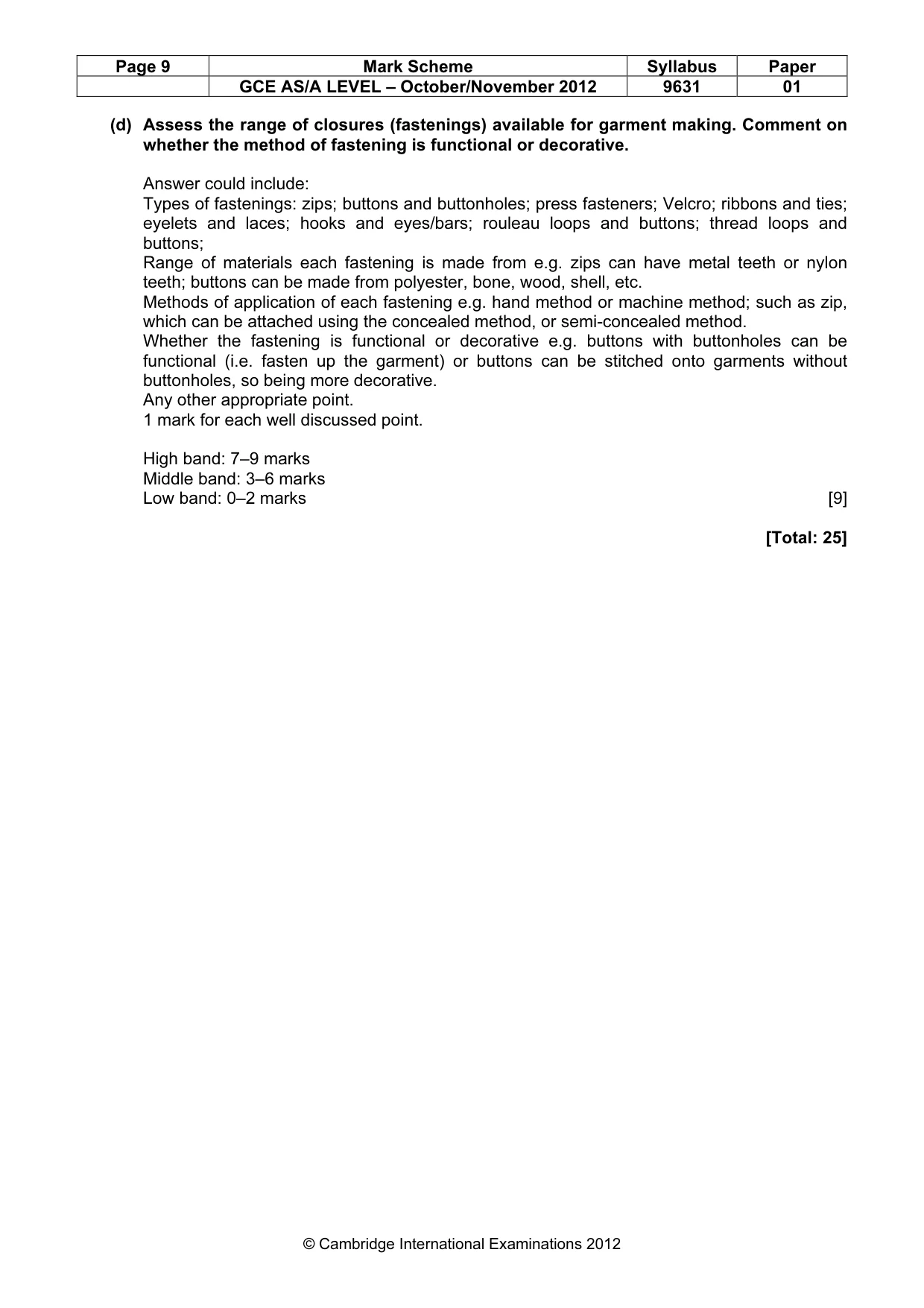
Page 9 Mark Scheme Syllabus Paper GCE AS/A LEVEL – October/November 2012 9631 01 © Cambridge International Examinations 2012 (d) Assess the range of closures (fastenings) available for garment making. Comment on whether the method of fastening is functional or decorative. Answer could include: Types of fastenings: zips; buttons and buttonholes; press fasteners; Velcro; ribbons and ties; eyelets and laces; hooks and eyes/bars; rouleau loops and buttons; thread loops and buttons; Range of materials each fastening is made from e.g. zips can have metal teeth or nylon teeth; buttons can be made from polyester, bone, wood, shell, etc. Methods of application of each fastening e.g. hand method or machine method; such as zip, which can be attached using the concealed method, or semi-concealed method. Whether the fastening is functional or decorative e.g. buttons with buttonholes can be functional (i.e. fasten up the garment) or buttons can be stitched onto garments without buttonholes, so being more decorative. Any other appropriate point. 1 mark for each well discussed point. High band: 7–9 marks Middle band: 3–6 marks Low band: 0–2 marks [9] [Total: 25]
What you needed in this session
Cambridge’s own grade thresholds for 2012 Oct/Nov, Paper 1 · Variant 1. A higher threshold means an easier paper — the bar moves with how the cohort did.