Cambridge A Level Design and Technology 9705 — 2022 May/June Paper 3 · Variant 2
9705/32/M/J/22 · 120 marks · ≈135 min
The question paper and its mark scheme, free to read here and free to download. This is Cambridge’s own paper, exactly as it was sat.
Question paper8 pages

Mark scheme16 pages
Answers below. Sit the paper first if you are practising.
Paper as text
Question paper, page 1
This document has 8 pages. Any blank pages are indicated. [Turn over Cambridge International AS & A Level DC (PQ/CT) 302245/2 © UCLES 2022 DESIGN & TECHNOLOGY 9705/32 Paper 3 May/June 2022 3 hours You must answer on the answer booklet/paper. You will need: Answer booklet/paper Coloured pencils A3 drawing paper (5 sheets) A range of design drawing equipment INSTRUCTIONS ● Answer three questions in total: Section A: answer two questions from one of the Parts A, B or C. Section B: answer one question. ● If you have been given an answer booklet, follow the instructions on the front cover of the answer booklet. ● Use a black or dark blue pen. ● Write your name, centre number and candidate number on all the work you hand in. ● Do not use an erasable pen or correction fluid. ● You may use an HB pencil, or coloured pencils as appropriate, for any diagrams, graphs or rough working. ● At the end of the examination, fasten all your work together. Do not use staples, paper clips or glue. INFORMATION ● The total mark for this paper is 120. ● The number of marks for each question or part question is shown in brackets [ ]. ● All dimensions are in millimetres. * 5 9 3 9 5 4 2 5 7 0 *
Question paper, page 2
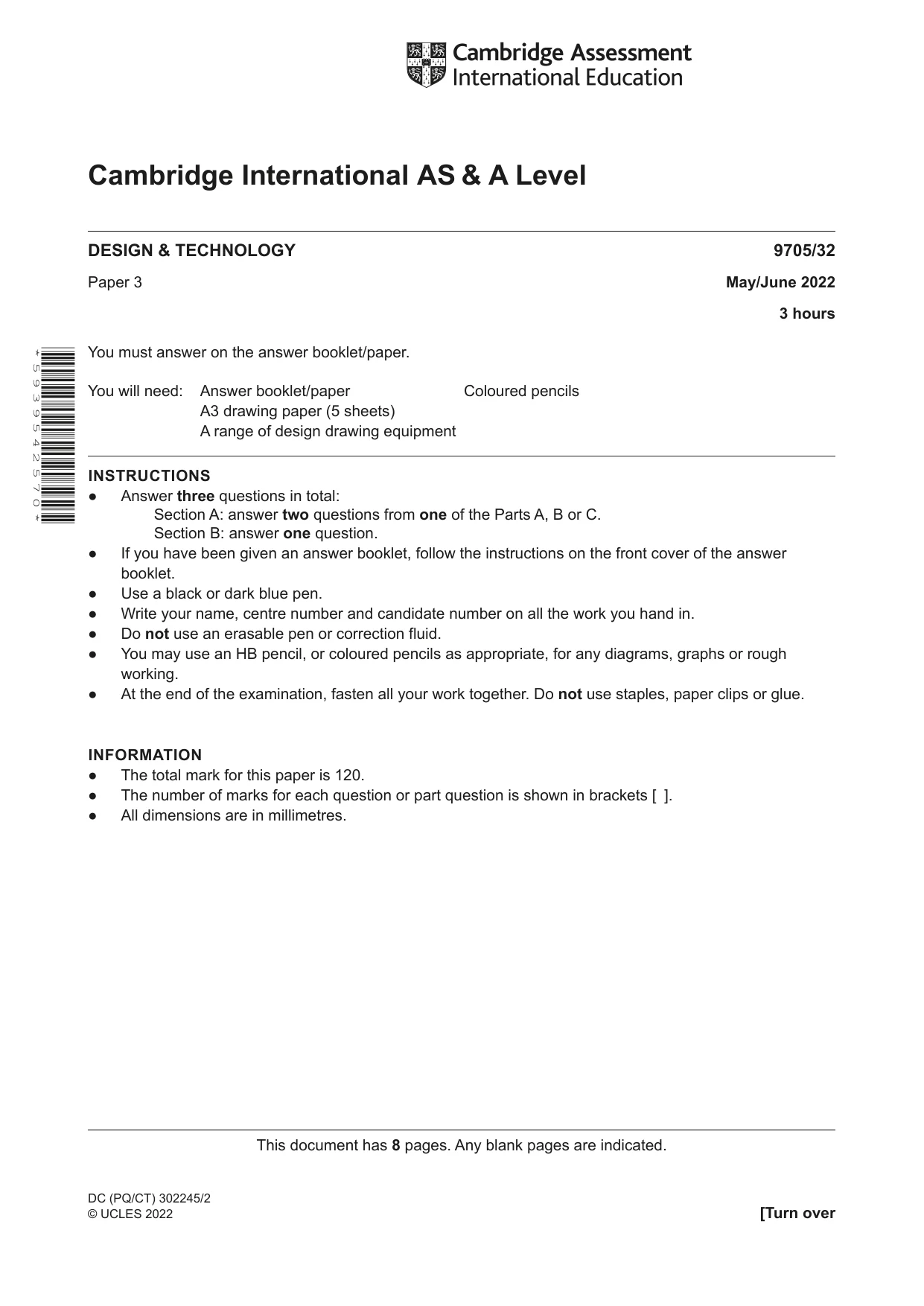
2 9705/32/M/J/22 © UCLES 2022 Section A Answer two questions from one of the Parts A, B or C. Part A – Product Design The instruction ‘discuss’ denotes that you should: • examine critically the issues raised by the question • explain and interpret these issues as appropriate • introduce evidence wherever possible to support conclusions of arguments. 1 Fig. 1.1 shows details of an earphone holder. Ø15 Ø8 Ø40 4 10 20 Fig. 1.1 (a) State a suitable material for an earphone holder of the type shown in Fig. 1.1 and give two reasons for your choice. [3] (b) Use sketches and notes to describe how you would make an earphone holder in a school workshop. [9] (c) Explain the changes which may be necessary to the design, the manufacturing method used and the material selected, if 50 identical earphone holders were required. Use sketches and notes to support your answer. [8] 2 Discuss how unit costs and available manufacturing processes influence a designer when selecting materials for two of the following: • a mass-produced paper clip • a one-off item of jewellery • a batch of 20 stools for a café. [20]
Question paper, page 3
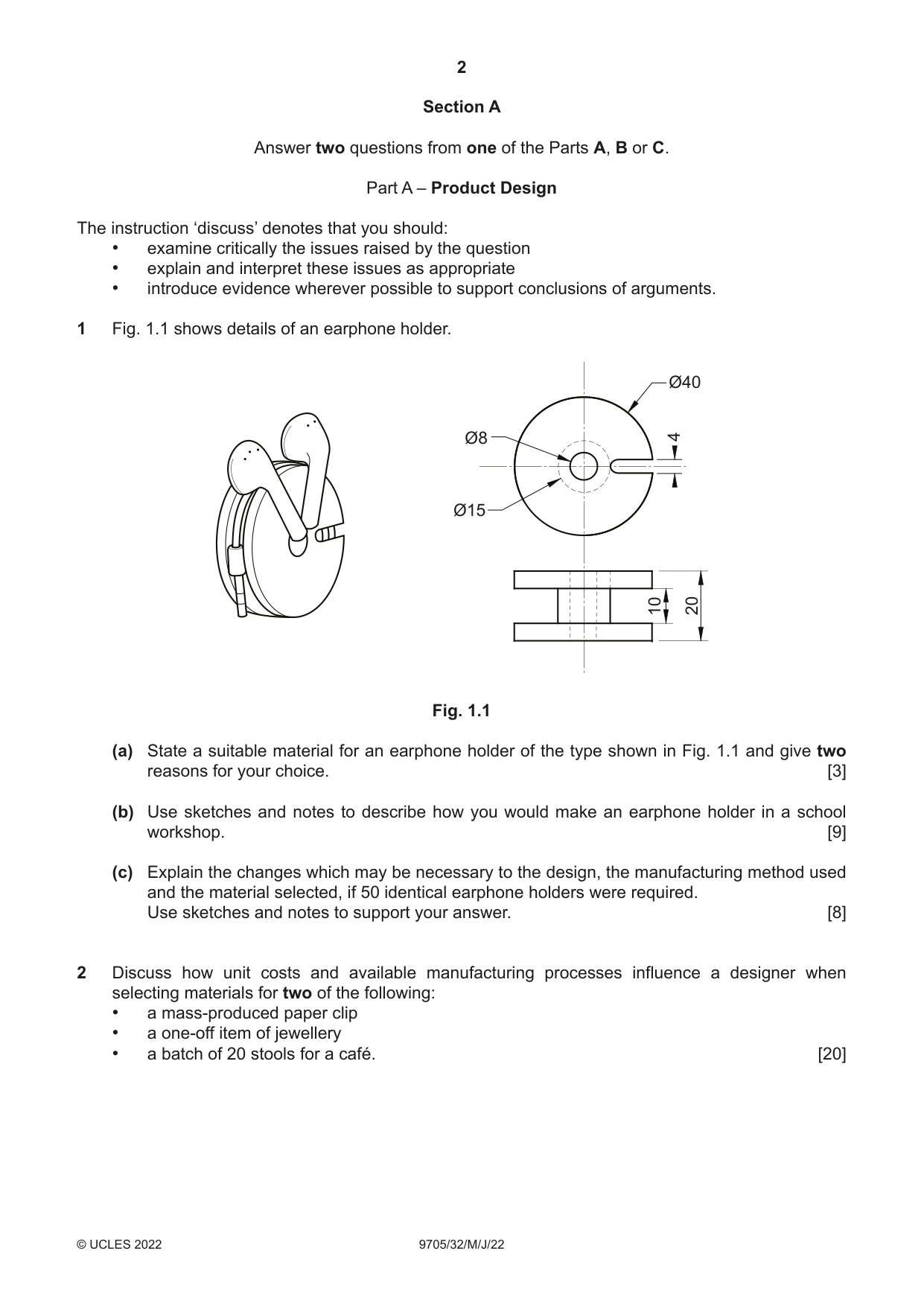
3 9705/32/M/J/22 © UCLES 2022 [Turn over 3 item: HIPS tray process: vacuum forming item: aluminium picture frame process: extrusion item: hardwood lamp base process: turning and boring Ø80 Ø10 120 deep Ø40 20 120 Fig. 3.1 Choose two of the items shown in Fig. 3.1. For each: (a) use sketches and notes to describe how the process has been used in the manufacture of the item [14] (b) explain why the process is particularly suitable for the production of the item. [6]
Question paper, page 4
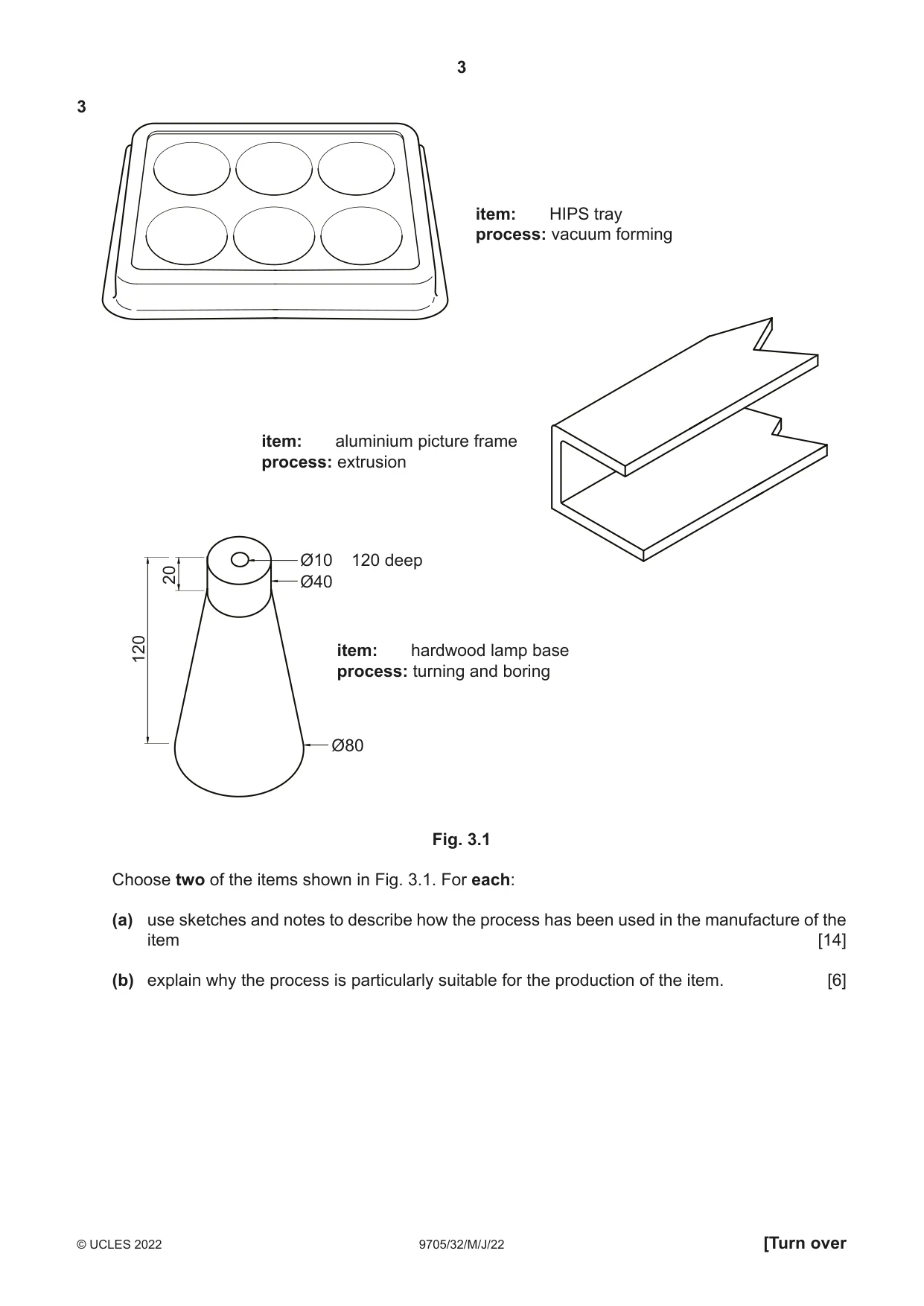
4 9705/32/M/J/22 © UCLES 2022 Part B – Practical Technology The instruction ‘discuss’ denotes that you should: • examine critically the issues raised by the question • explain and interpret these issues as appropriate • introduce evidence wherever possible to support conclusions of arguments. 4 Explain the benefits and drawbacks of each of the following ways of achieving motion in a system or product: • electrical • mechanical. Give an appropriate example of an application where each may be used. [20] 5 Fig. 5.1 shows a circuit to control a motor. M D C B A + V 0 V 2 kΩ Fig. 5.1 (a) (i) Identify and describe the function of components A, B, C and D. [8] (ii) Describe the function of the 2 kΩ resistor. [2] (b) Discuss the importance of innovation and evolution in the development of new products. [10] 6 (a) Use sketches and notes to describe in detail the following joining processes: (i) Hard soldering (brazing) a Ø10 mild steel bar into a drilled hole in 10 mm thick mild steel. [6] (ii) Soft soldering a resistor onto a printed circuit board (PCB). [6] (b) Use two examples to explain the advantages of using adhesives, rather than mechanical fixings or heat, to join materials together. [8]
Question paper, page 5
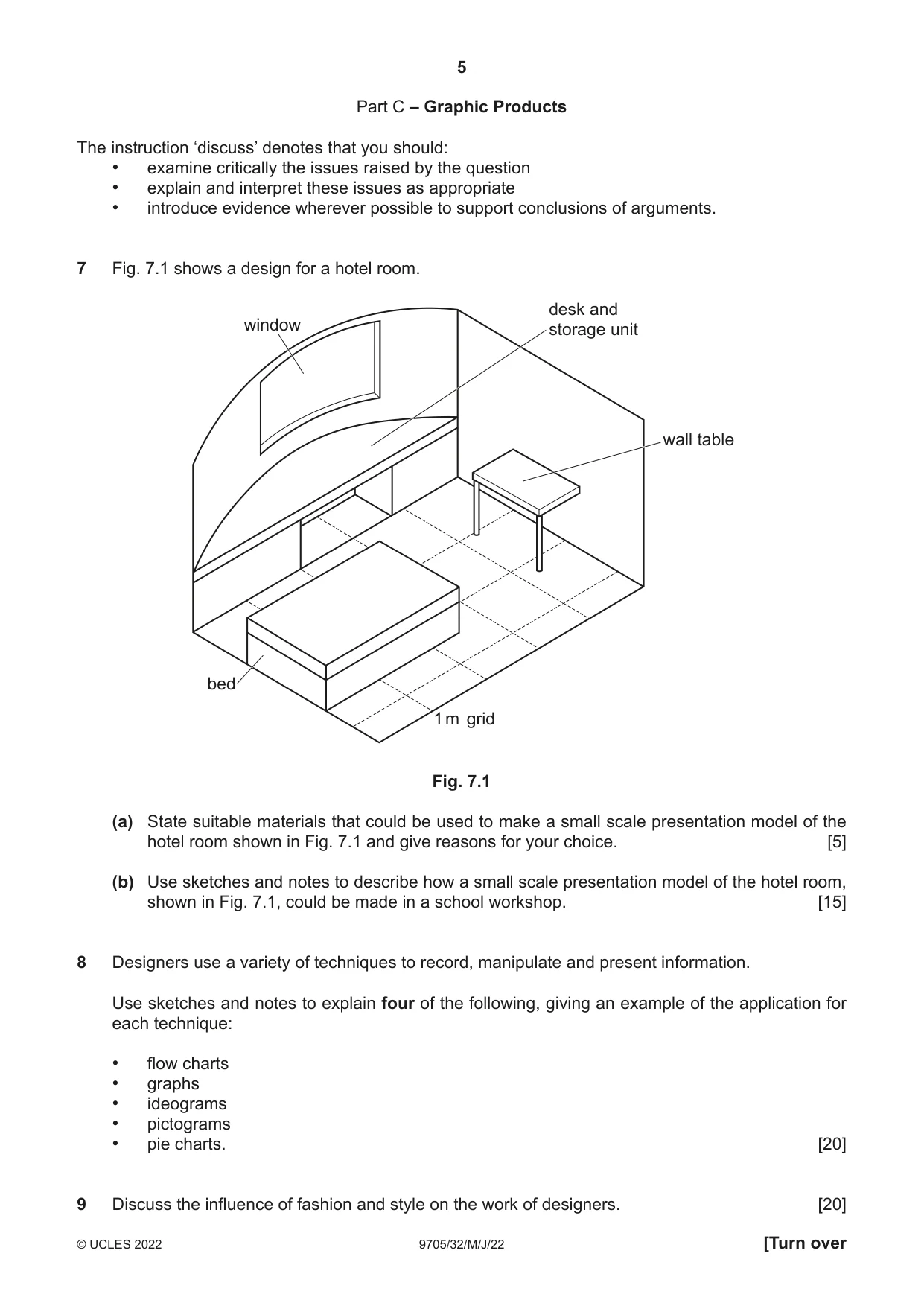
5 9705/32/M/J/22 © UCLES 2022 [Turn over Part C – Graphic Products The instruction ‘discuss’ denotes that you should: • examine critically the issues raised by the question • explain and interpret these issues as appropriate • introduce evidence wherever possible to support conclusions of arguments. 7 Fig. 7.1 shows a design for a hotel room. window desk and storage unit bed wall table 1 m grid Fig. 7.1 (a) State suitable materials that could be used to make a small scale presentation model of the hotel room shown in Fig. 7.1 and give reasons for your choice. [5] (b) Use sketches and notes to describe how a small scale presentation model of the hotel room, shown in Fig. 7.1, could be made in a school workshop. [15] 8 Designers use a variety of techniques to record, manipulate and present information. Use sketches and notes to explain four of the following, giving an example of the application for each technique: • flow charts • graphs • ideograms • pictograms • pie charts. [20] 9 Discuss the influence of fashion and style on the work of designers. [20]
Question paper, page 6
6 9705/32/M/J/22 © UCLES 2022 Section B Answer one question on the A3 paper provided. Each question is worth 80 marks. You should approach the design question of your choice in the following manner: Analysis Produce an analysis of the given situation/problem, which may be in written or graphical form. [5] Specification From the analysis produce a detailed written specification of the design requirements. Include at least five specification points other than those given in the question. [5] Exploration Use bold sketches and brief notes to show your exploration of ideas for a design solution, with reasons for selection. [25] Development Show using bold sketches and notes, the development, reasoning and composition of ideas into a single design proposal. Give details of materials, constructional and other relevant technical details. [25] Proposed solution Produce drawings of an appropriate kind to show the complete solution. [15] Evaluation Give a written evaluation of the final design solution. [5]
Question paper, page 7
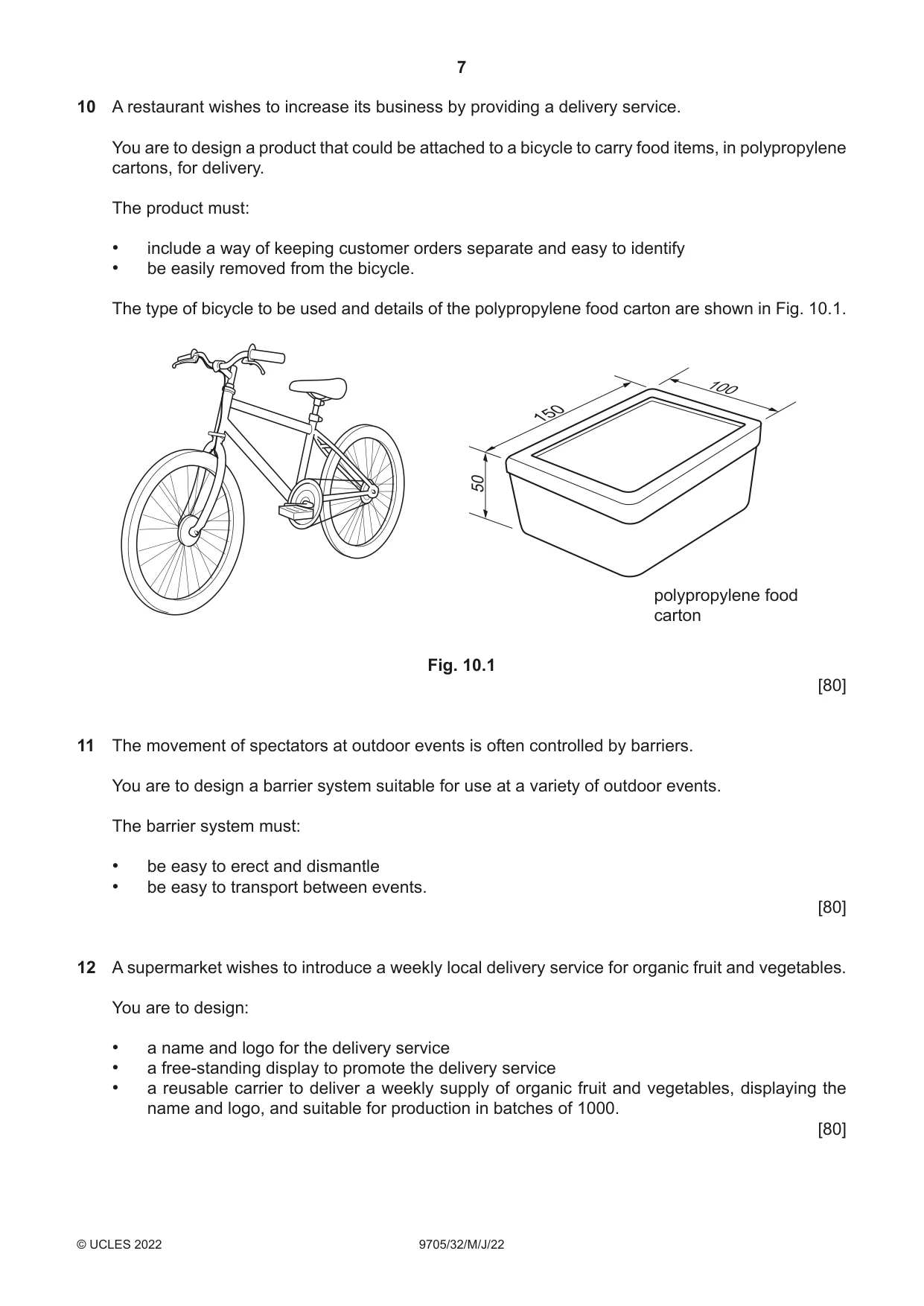
7 9705/32/M/J/22 © UCLES 2022 10 A restaurant wishes to increase its business by providing a delivery service. You are to design a product that could be attached to a bicycle to carry food items, in polypropylene cartons, for delivery. The product must: • include a way of keeping customer orders separate and easy to identify • be easily removed from the bicycle. The type of bicycle to be used and details of the polypropylene food carton are shown in Fig. 10.1. 50 100 150 polypropylene food carton Fig. 10.1 [80] 11 The movement of spectators at outdoor events is often controlled by barriers. You are to design a barrier system suitable for use at a variety of outdoor events. The barrier system must: • be easy to erect and dismantle • be easy to transport between events. [80] 12 A supermarket wishes to introduce a weekly local delivery service for organic fruit and vegetables. You are to design: • a name and logo for the delivery service • a free-standing display to promote the delivery service • a reusable carrier to deliver a weekly supply of organic fruit and vegetables, displaying the name and logo, and suitable for production in batches of 1000. [80]
Question paper, page 8
8 9705/32/M/J/22 © UCLES 2022 Permission to reproduce items where third-party owned material protected by copyright is included has been sought and cleared where possible. Every reasonable effort has been made by the publisher (UCLES) to trace copyright holders, but if any items requiring clearance have unwittingly been included, the publisher will be pleased to make amends at the earliest possible opportunity. To avoid the issue of disclosure of answer-related information to candidates, all copyright acknowledgements are reproduced online in the Cambridge Assessment International Education Copyright Acknowledgements Booklet. This is produced for each series of examinations and is freely available to download at www.cambridgeinternational.org after the live examination series. Cambridge Assessment International Education is part of Cambridge Assessment. Cambridge Assessment is the brand name of the University of Cambridge Local Examinations Syndicate (UCLES), which is a department of the University of Cambridge. BLANK PAGE
Mark scheme, page 1
This document consists of 16 printed pages. © UCLES 2022 [Turn over Cambridge International AS & A Level DESIGN AND TECHNOLOGY 9705/32 Paper 3 Written 32 May/June 2022 MARK SCHEME Maximum Mark: 120 Published This mark scheme is published as an aid to teachers and candidates, to indicate the requirements of the examination. It shows the basis on which Examiners were instructed to award marks. It does not indicate the details of the discussions that took place at an Examiners’ meeting before marking began, which would have considered the acceptability of alternative answers. Mark schemes should be read in conjunction with the question paper and the Principal Examiner Report for Teachers. Cambridge International will not enter into discussions about these mark schemes. Cambridge International is publishing the mark schemes for the May/June 2022 series for most Cambridge IGCSE, Cambridge International A and AS Level and Cambridge Pre-U components, and some Cambridge O Level components.
Mark scheme, page 2
9705/32 Cambridge International AS & A Level – Mark Scheme PUBLISHED May/June 2022 © UCLES 2022 Page 2 of 16 Generic Marking Principles These general marking principles must be applied by all examiners when marking candidate answers. They should be applied alongside the specific content of the mark scheme or generic level descriptors for a question. Each question paper and mark scheme will also comply with these marking principles. GENERIC MARKING PRINCIPLE 1: Marks must be awarded in line with: the specific content of the mark scheme or the generic level descriptors for the question the specific skills defined in the mark scheme or in the generic level descriptors for the question the standard of response required by a candidate as exemplified by the standardisation scripts. GENERIC MARKING PRINCIPLE 2: Marks awarded are always whole marks (not half marks, or other fractions). GENERIC MARKING PRINCIPLE 3: Marks must be awarded positively: marks are awarded for correct/valid answers, as defined in the mark scheme. However, credit is given for valid answers which go beyond the scope of the syllabus and mark scheme, referring to your Team Leader as appropriate marks are awarded when candidates clearly demonstrate what they know and can do marks are not deducted for errors marks are not deducted for omissions answers should only be judged on the quality of spelling, punctuation and grammar when these features are specifically assessed by the question as indicated by the mark scheme. The meaning, however, should be unambiguous. GENERIC MARKING PRINCIPLE 4: Rules must be applied consistently, e.g. in situations where candidates have not followed instructions or in the application of generic level descriptors.
Mark scheme, page 3
9705/32 Cambridge International AS & A Level – Mark Scheme PUBLISHED May/June 2022 © UCLES 2022 Page 3 of 16 GENERIC MARKING PRINCIPLE 5: Marks should be awarded using the full range of marks defined in the mark scheme for the question (however; the use of the full mark range may be limited according to the quality of the candidate responses seen). GENERIC MARKING PRINCIPLE 6: Marks awarded are based solely on the requirements as defined in the mark scheme. Marks should not be awarded with grade thresholds or grade descriptors in mind.
Mark scheme, page 4
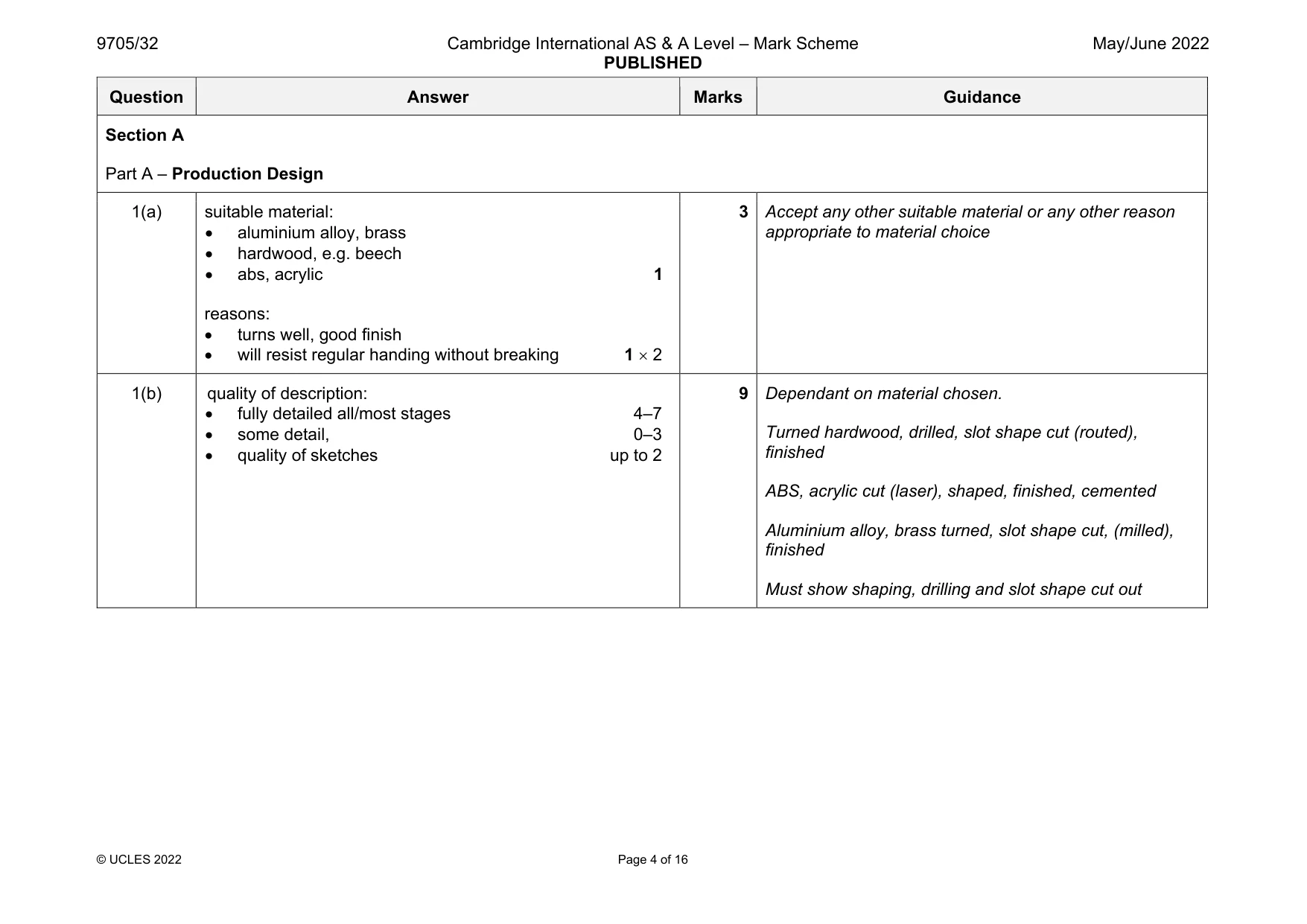
9705/32 Cambridge International AS & A Level – Mark Scheme PUBLISHED May/June 2022 © UCLES 2022 Page 4 of 16 Question Answer Marks Guidance Section A Part A – Production Design 1(a) suitable material: aluminium alloy, brass hardwood, e.g. beech abs, acrylic 1 reasons: turns well, good finish will resist regular handing without breaking 1 2 3 Accept any other suitable material or any other reason appropriate to material choice 1(b) quality of description: fully detailed all/most stages 4–7 some detail, 0–3 quality of sketches up to 2 9 Dependant on material chosen. Turned hardwood, drilled, slot shape cut (routed), finished ABS, acrylic cut (laser), shaped, finished, cemented Aluminium alloy, brass turned, slot shape cut, (milled), finished Must show shaping, drilling and slot shape cut out
Mark scheme, page 5
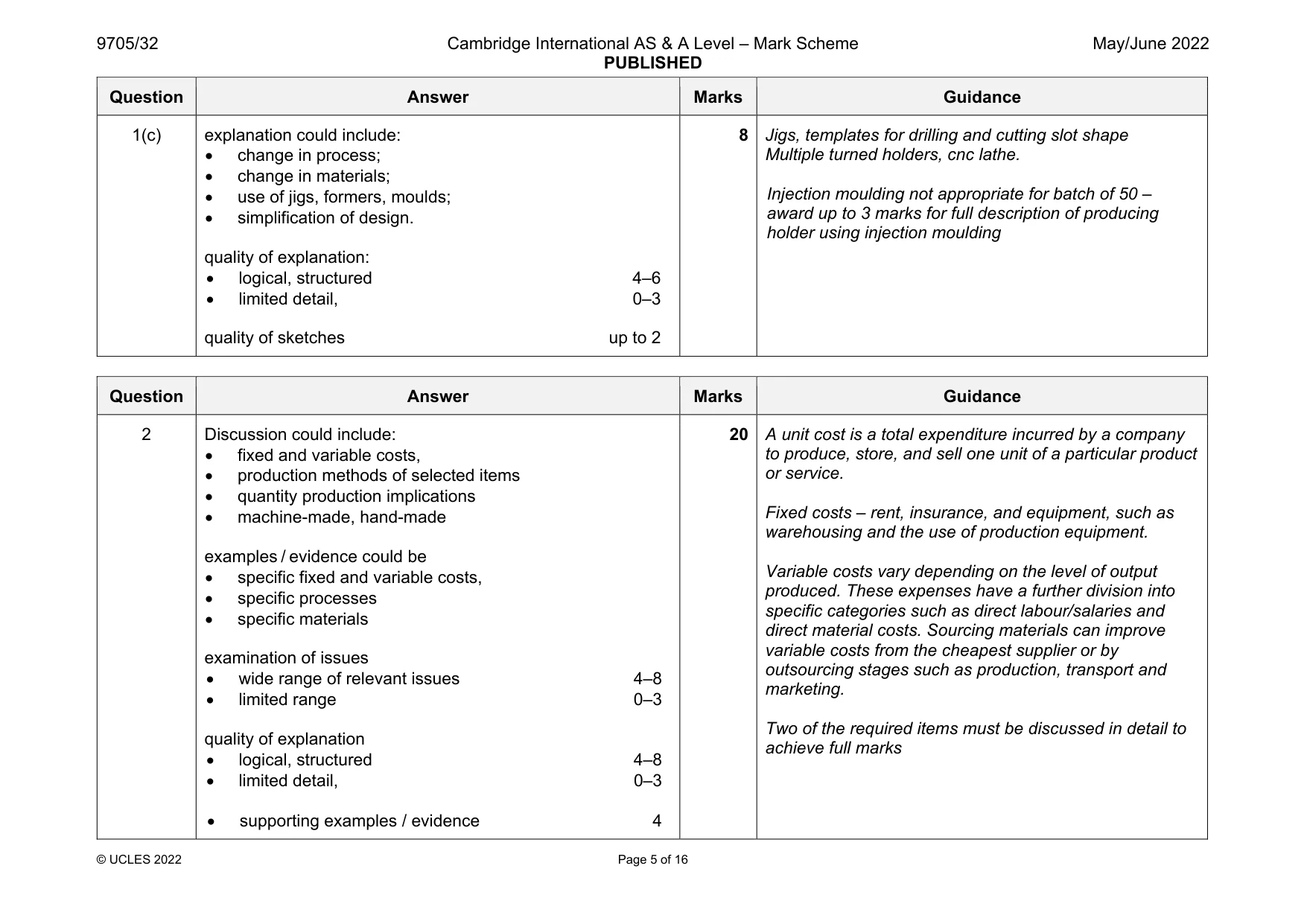
9705/32 Cambridge International AS & A Level – Mark Scheme PUBLISHED May/June 2022 © UCLES 2022 Page 5 of 16 Question Answer Marks Guidance 1(c) explanation could include: change in process; change in materials; use of jigs, formers, moulds; simplification of design. quality of explanation: logical, structured 4–6 limited detail, 0–3 quality of sketches up to 2 8 Jigs, templates for drilling and cutting slot shape Multiple turned holders, cnc lathe. Injection moulding not appropriate for batch of 50 – award up to 3 marks for full description of producing holder using injection moulding Question Answer Marks Guidance 2 Discussion could include: fixed and variable costs, production methods of selected items quantity production implications machine-made, hand-made examples / evidence could be specific fixed and variable costs, specific processes specific materials examination of issues wide range of relevant issues 4–8 limited range 0–3 quality of explanation logical, structured 4–8 limited detail, 0–3 supporting examples / evidence 4 20 A unit cost is a total expenditure incurred by a company to produce, store, and sell one unit of a particular product or service. Fixed costs – rent, insurance, and equipment, such as warehousing and the use of production equipment. Variable costs vary depending on the level of output produced. These expenses have a further division into specific categories such as direct labour/salaries and direct material costs. Sourcing materials can improve variable costs from the cheapest supplier or by outsourcing stages such as production, transport and marketing. Two of the required items must be discussed in detail to achieve full marks
Mark scheme, page 6
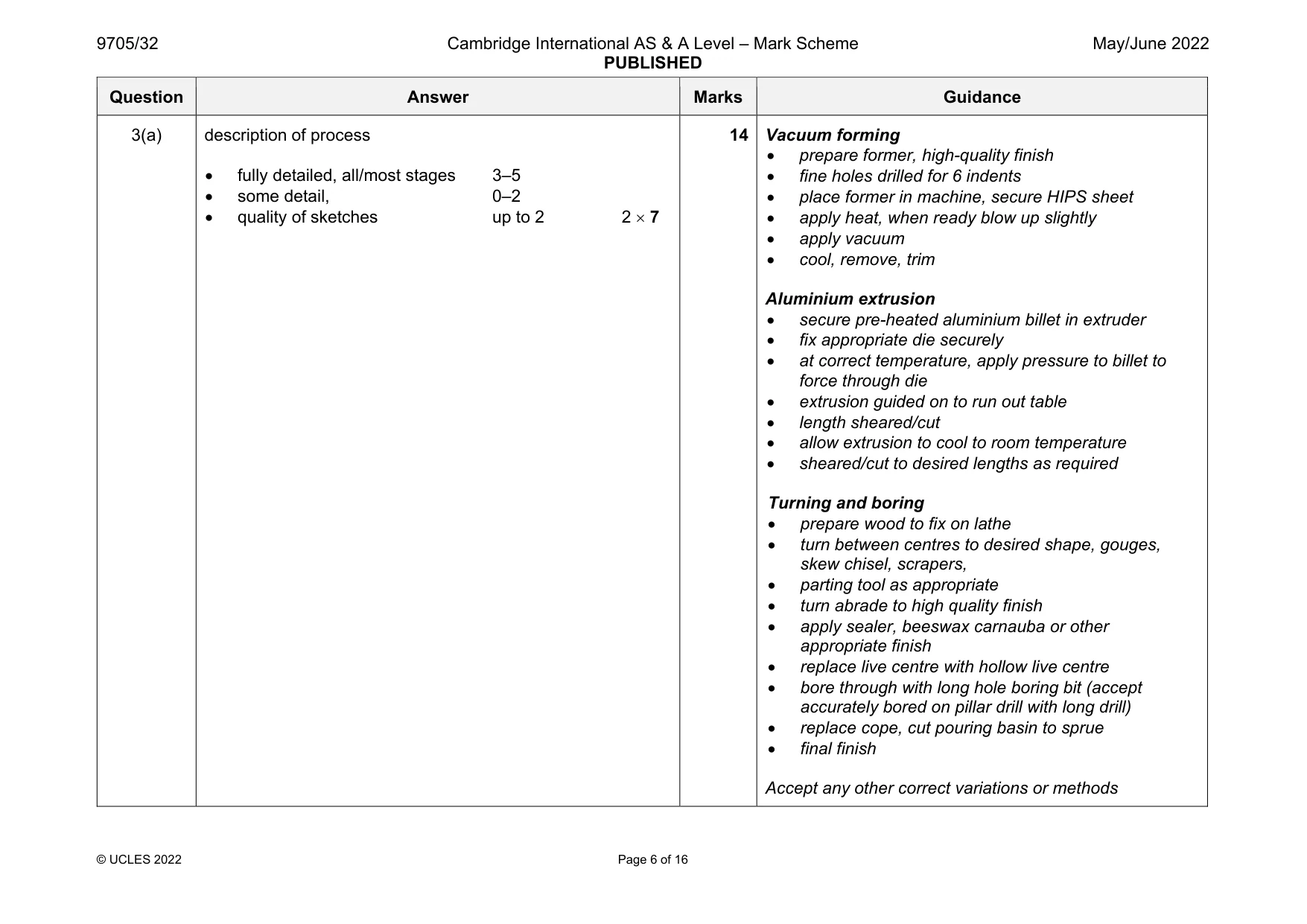
9705/32 Cambridge International AS & A Level – Mark Scheme PUBLISHED May/June 2022 © UCLES 2022 Page 6 of 16 Question Answer Marks Guidance 3(a) description of process fully detailed, all/most stages 3–5 some detail, 0–2 quality of sketches up to 2 2 7 14 Vacuum forming prepare former, high-quality finish fine holes drilled for 6 indents place former in machine, secure HIPS sheet apply heat, when ready blow up slightly apply vacuum cool, remove, trim Aluminium extrusion secure pre-heated aluminium billet in extruder fix appropriate die securely at correct temperature, apply pressure to billet to force through die extrusion guided on to run out table length sheared/cut allow extrusion to cool to room temperature sheared/cut to desired lengths as required Turning and boring prepare wood to fix on lathe turn between centres to desired shape, gouges, skew chisel, scrapers, parting tool as appropriate turn abrade to high quality finish apply sealer, beeswax carnauba or other appropriate finish replace live centre with hollow live centre bore through with long hole boring bit (accept accurately bored on pillar drill with long drill) replace cope, cut pouring basin to sprue final finish Accept any other correct variations or methods
Mark scheme, page 7
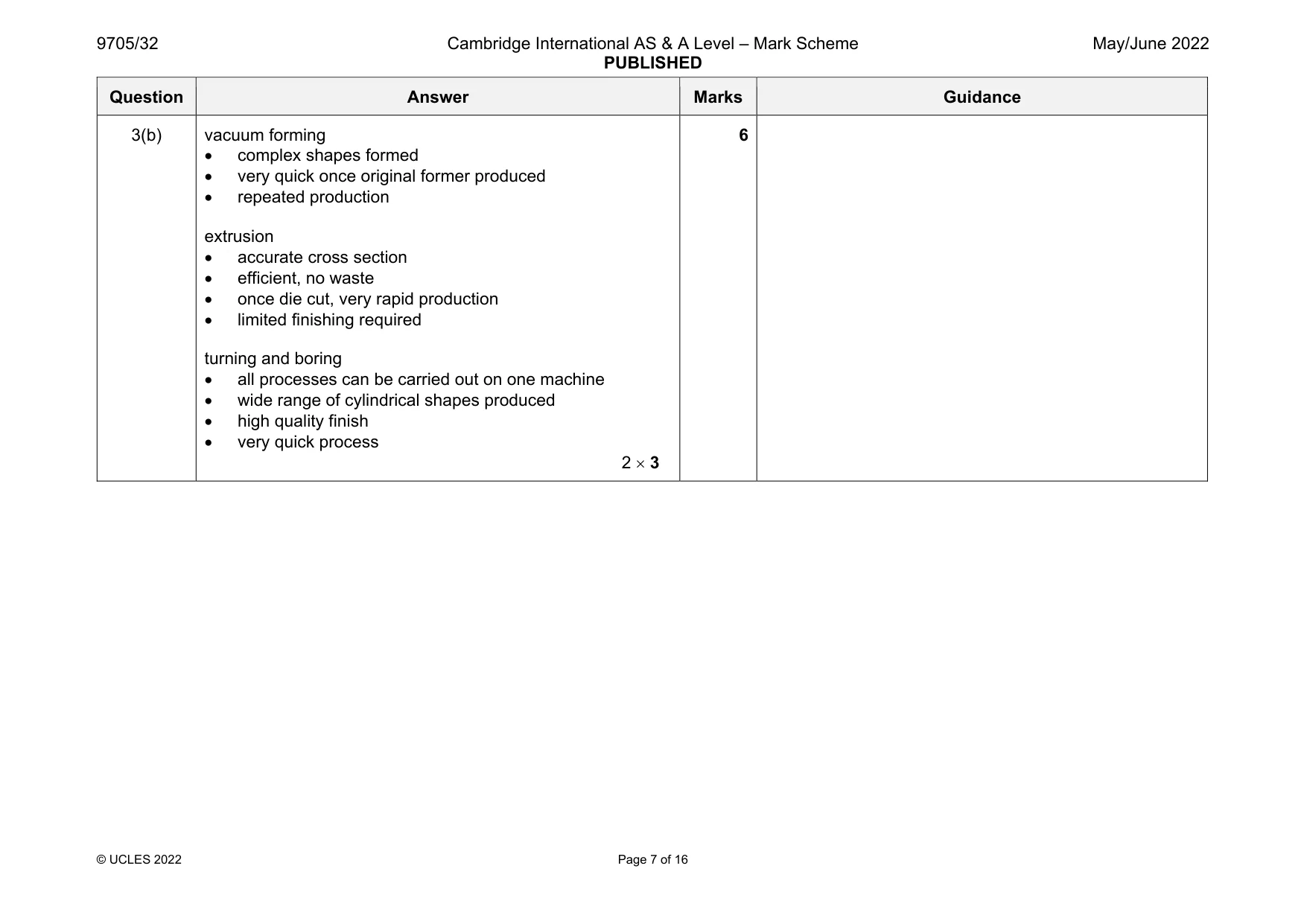
9705/32 Cambridge International AS & A Level – Mark Scheme PUBLISHED May/June 2022 © UCLES 2022 Page 7 of 16 Question Answer Marks Guidance 3(b) vacuum forming complex shapes formed very quick once original former produced repeated production extrusion accurate cross section efficient, no waste once die cut, very rapid production limited finishing required turning and boring all processes can be carried out on one machine wide range of cylindrical shapes produced high quality finish very quick process 2 3 6
Mark scheme, page 8
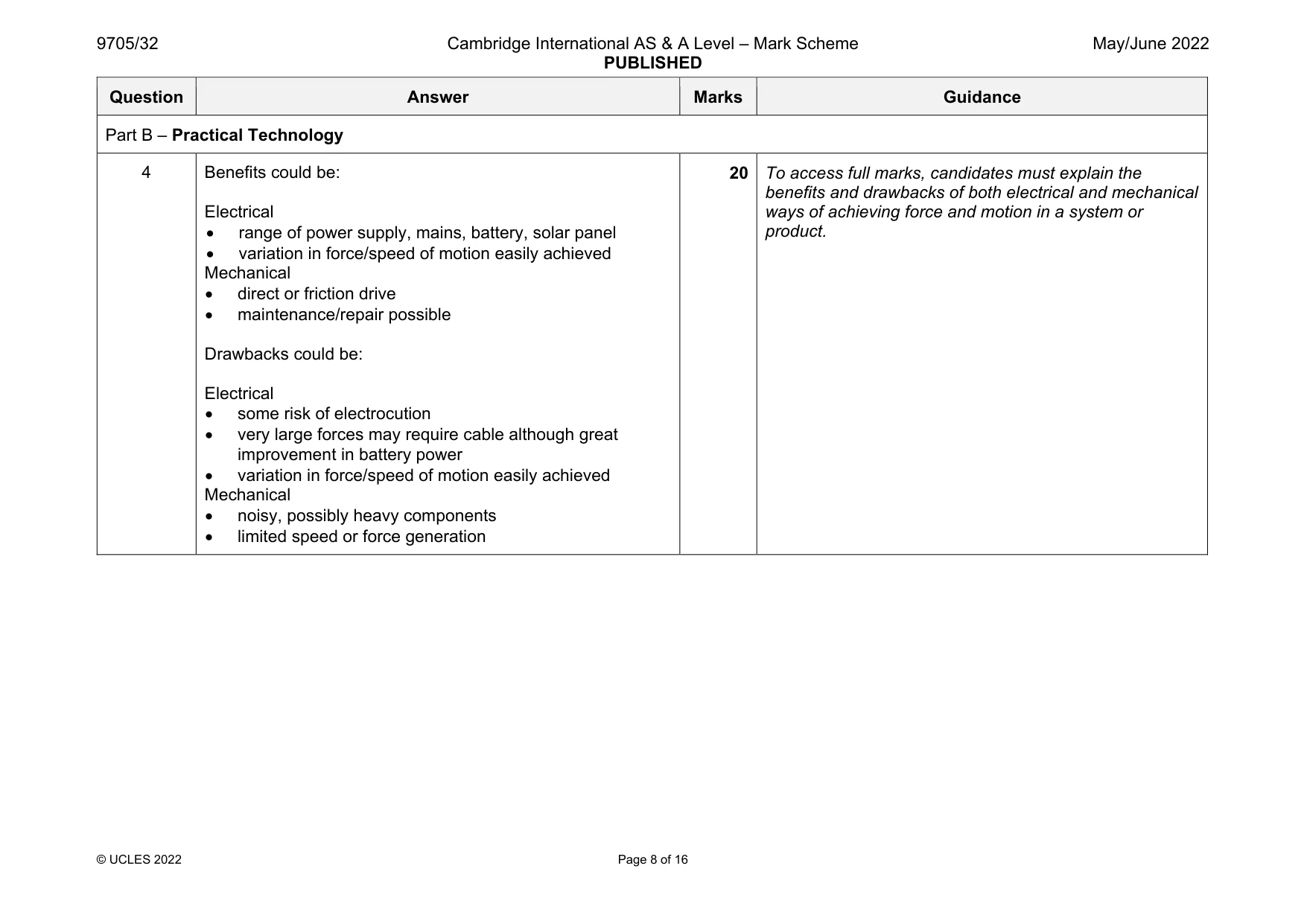
9705/32 Cambridge International AS & A Level – Mark Scheme PUBLISHED May/June 2022 © UCLES 2022 Page 8 of 16 Question Answer Marks Guidance Part B – Practical Technology 4 Benefits could be: Electrical range of power supply, mains, battery, solar panel variation in force/speed of motion easily achieved Mechanical direct or friction drive maintenance/repair possible Drawbacks could be: Electrical some risk of electrocution very large forces may require cable although great improvement in battery power variation in force/speed of motion easily achieved Mechanical noisy, possibly heavy components limited speed or force generation 20 To access full marks, candidates must explain the benefits and drawbacks of both electrical and mechanical ways of achieving force and motion in a system or product.
Mark scheme, page 9
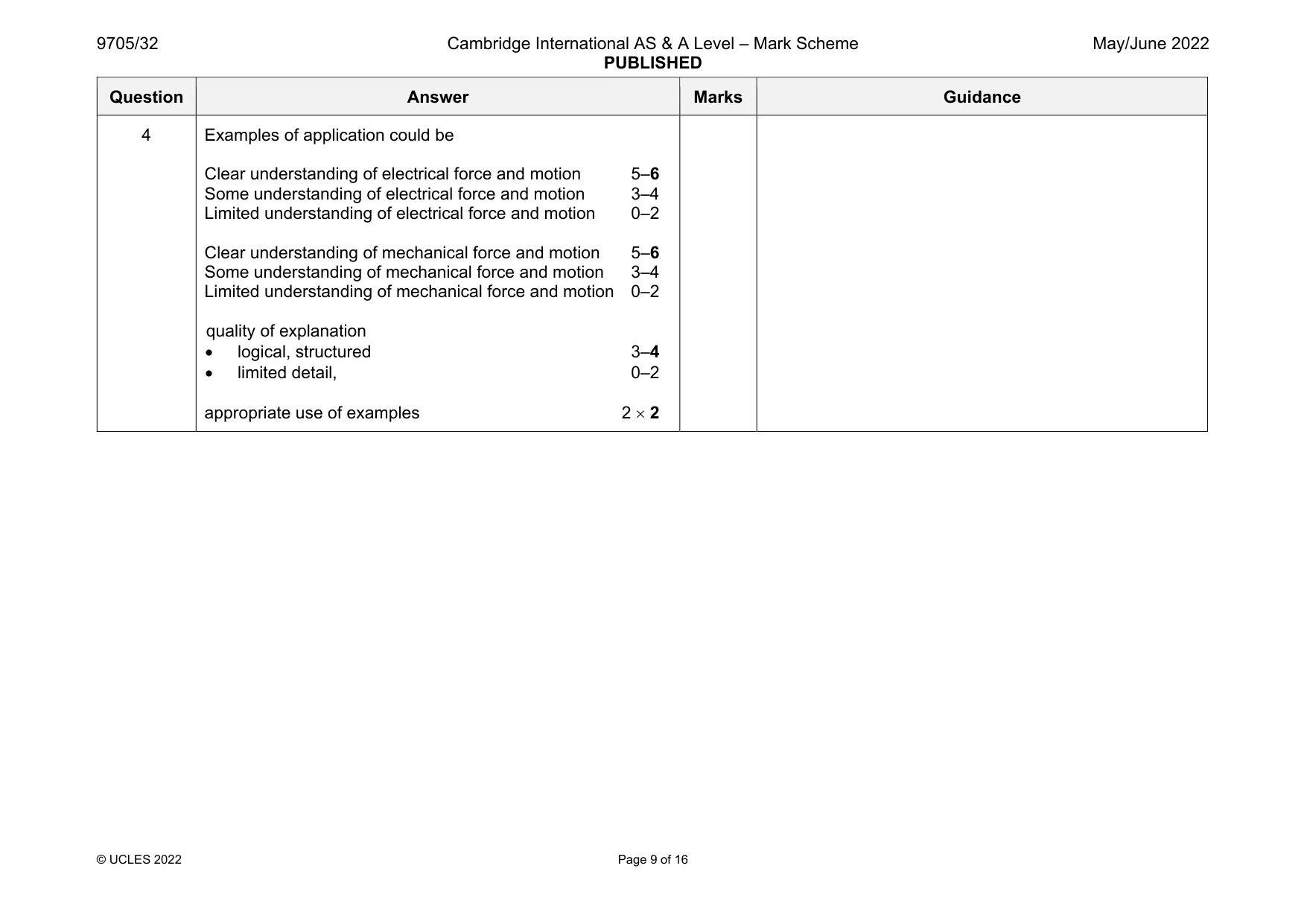
9705/32 Cambridge International AS & A Level – Mark Scheme PUBLISHED May/June 2022 © UCLES 2022 Page 9 of 16 Question Answer Marks Guidance 4 Examples of application could be Clear understanding of electrical force and motion 5–6 Some understanding of electrical force and motion 3–4 Limited understanding of electrical force and motion 0–2 Clear understanding of mechanical force and motion 5–6 Some understanding of mechanical force and motion 3–4 Limited understanding of mechanical force and motion 0–2 quality of explanation logical, structured 3–4 limited detail, 0–2 appropriate use of examples 2 2
Mark scheme, page 10
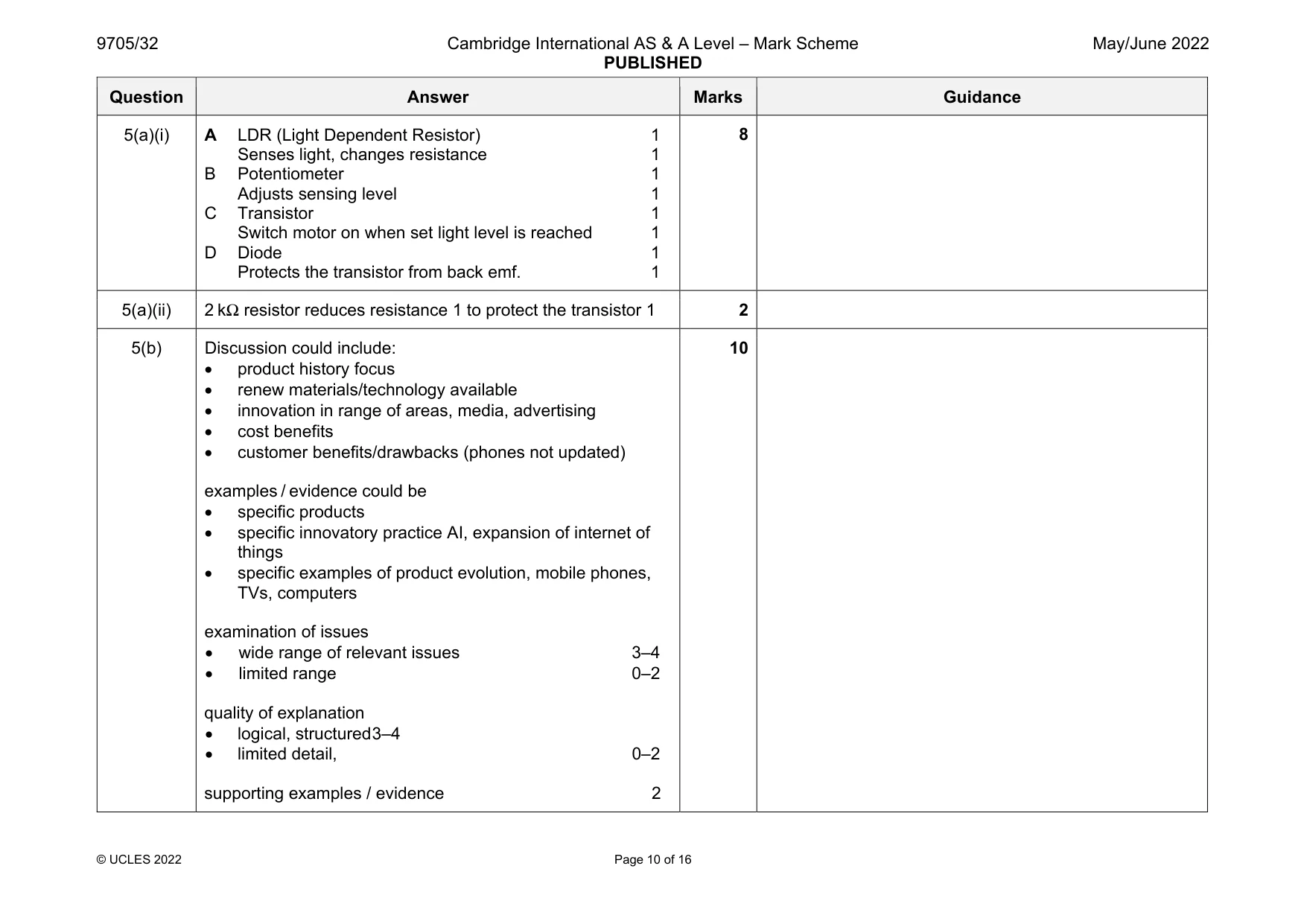
9705/32 Cambridge International AS & A Level – Mark Scheme PUBLISHED May/June 2022 © UCLES 2022 Page 10 of 16 Question Answer Marks Guidance 5(a)(i) A LDR (Light Dependent Resistor) 1 Senses light, changes resistance 1 B Potentiometer 1 Adjusts sensing level 1 C Transistor 1 Switch motor on when set light level is reached 1 D Diode 1 Protects the transistor from back emf. 1 8 5(a)(ii) 2 kΩ resistor reduces resistance 1 to protect the transistor 1 2 5(b) Discussion could include: product history focus renew materials/technology available innovation in range of areas, media, advertising cost benefits customer benefits/drawbacks (phones not updated) examples / evidence could be specific products specific innovatory practice AI, expansion of internet of things specific examples of product evolution, mobile phones, TVs, computers examination of issues wide range of relevant issues 3–4 limited range 0–2 quality of explanation logical, structured 3–4 limited detail, 0–2 supporting examples / evidence 2 10
Mark scheme, page 11
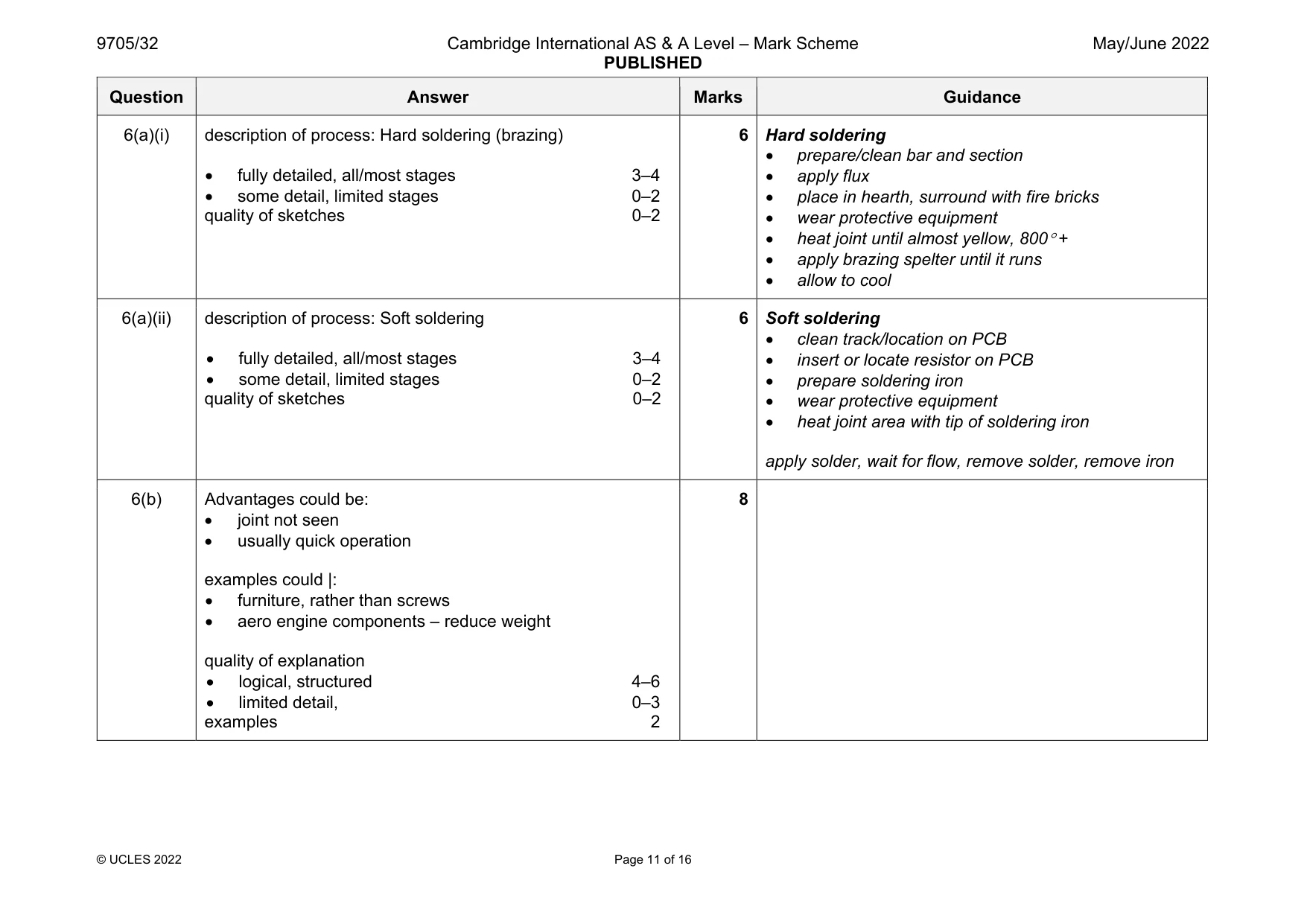
9705/32 Cambridge International AS & A Level – Mark Scheme PUBLISHED May/June 2022 © UCLES 2022 Page 11 of 16 Question Answer Marks Guidance 6(a)(i) description of process: Hard soldering (brazing) fully detailed, all/most stages 3–4 some detail, limited stages 0–2 quality of sketches 0–2 6 Hard soldering prepare/clean bar and section apply flux place in hearth, surround with fire bricks wear protective equipment heat joint until almost yellow, 800 + apply brazing spelter until it runs allow to cool 6(a)(ii) description of process: Soft soldering fully detailed, all/most stages 3–4 some detail, limited stages 0–2 quality of sketches 0–2 6 Soft soldering clean track/location on PCB insert or locate resistor on PCB prepare soldering iron wear protective equipment heat joint area with tip of soldering iron apply solder, wait for flow, remove solder, remove iron 6(b) Advantages could be: joint not seen usually quick operation examples could |: furniture, rather than screws aero engine components – reduce weight quality of explanation logical, structured 4–6 limited detail, 0–3 examples 2 8
Mark scheme, page 12
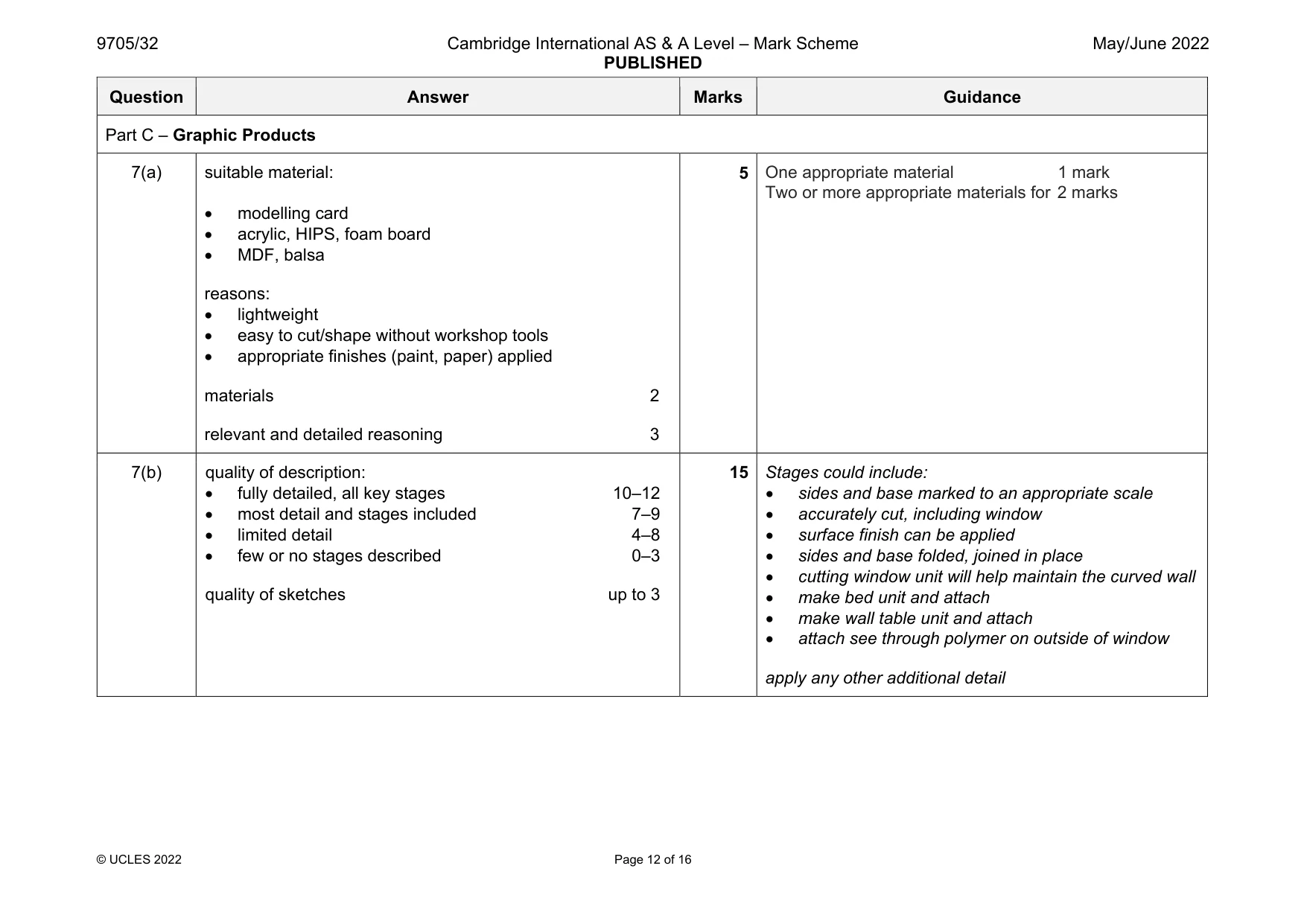
9705/32 Cambridge International AS & A Level – Mark Scheme PUBLISHED May/June 2022 © UCLES 2022 Page 12 of 16 Question Answer Marks Guidance Part C – Graphic Products 7(a) suitable material: modelling card acrylic, HIPS, foam board MDF, balsa reasons: lightweight easy to cut/shape without workshop tools appropriate finishes (paint, paper) applied materials 2 relevant and detailed reasoning 3 5 One appropriate material 1 mark Two or more appropriate materials for 2 marks 7(b) quality of description: fully detailed, all key stages 10–12 most detail and stages included 7–9 limited detail 4–8 few or no stages described 0–3 quality of sketches up to 3 15 Stages could include: sides and base marked to an appropriate scale accurately cut, including window surface finish can be applied sides and base folded, joined in place cutting window unit will help maintain the curved wall make bed unit and attach make wall table unit and attach attach see through polymer on outside of window apply any other additional detail
Mark scheme, page 13
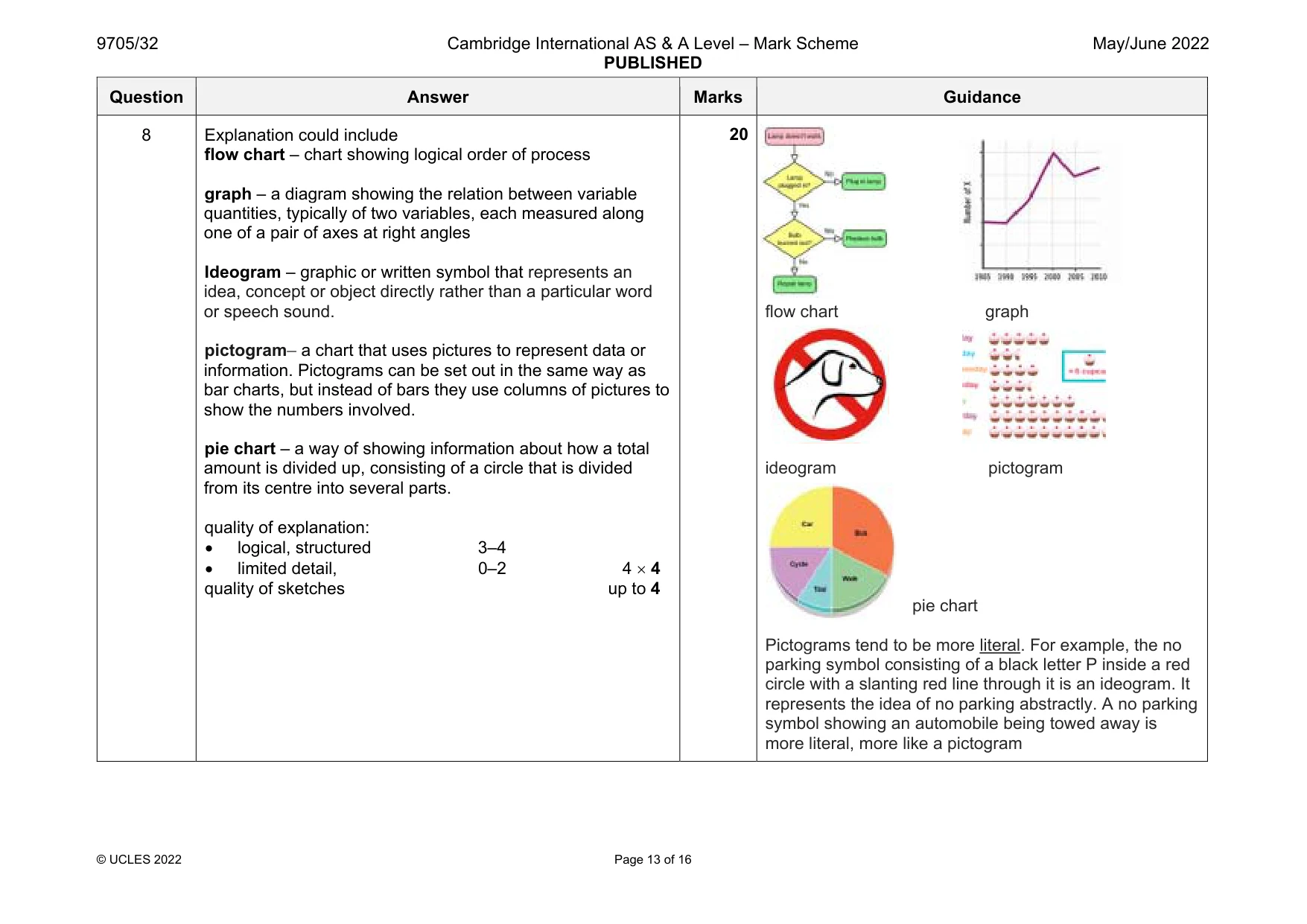
9705/32 Cambridge International AS & A Level – Mark Scheme PUBLISHED May/June 2022 © UCLES 2022 Page 13 of 16 Question Answer Marks Guidance 8 Explanation could include flow chart – chart showing logical order of process graph – a diagram showing the relation between variable quantities, typically of two variables, each measured along one of a pair of axes at right angles Ideogram – graphic or written symbol that represents an idea, concept or object directly rather than a particular word or speech sound. pictogram– a chart that uses pictures to represent data or information. Pictograms can be set out in the same way as bar charts, but instead of bars they use columns of pictures to show the numbers involved. pie chart – a way of showing information about how a total amount is divided up, consisting of a circle that is divided from its centre into several parts. quality of explanation: logical, structured 3–4 limited detail, 0–2 4 4 quality of sketches up to 4 20 flow chart graph ideogram pictogram pie chart Pictograms tend to be more literal. For example, the no parking symbol consisting of a black letter P inside a red circle with a slanting red line through it is an ideogram. It represents the idea of no parking abstractly. A no parking symbol showing an automobile being towed away is more literal, more like a pictogram
Mark scheme, page 14
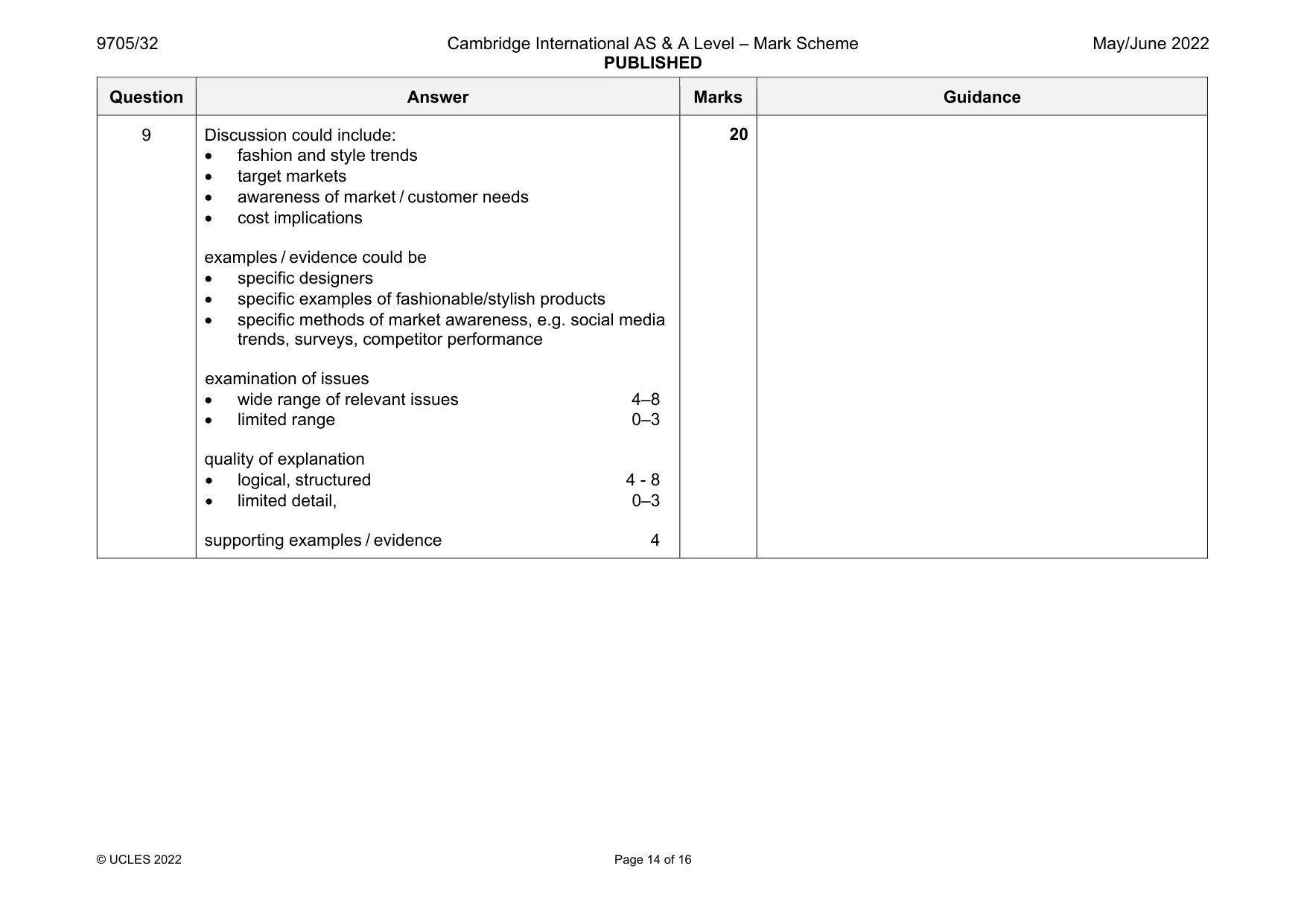
9705/32 Cambridge International AS & A Level – Mark Scheme PUBLISHED May/June 2022 © UCLES 2022 Page 14 of 16 Question Answer Marks Guidance 9 Discussion could include: fashion and style trends target markets awareness of market / customer needs cost implications examples / evidence could be specific designers specific examples of fashionable/stylish products specific methods of market awareness, e.g. social media trends, surveys, competitor performance examination of issues wide range of relevant issues 4–8 limited range 0–3 quality of explanation logical, structured 4 - 8 limited detail, 0–3 supporting examples / evidence 4 20
Mark scheme, page 15
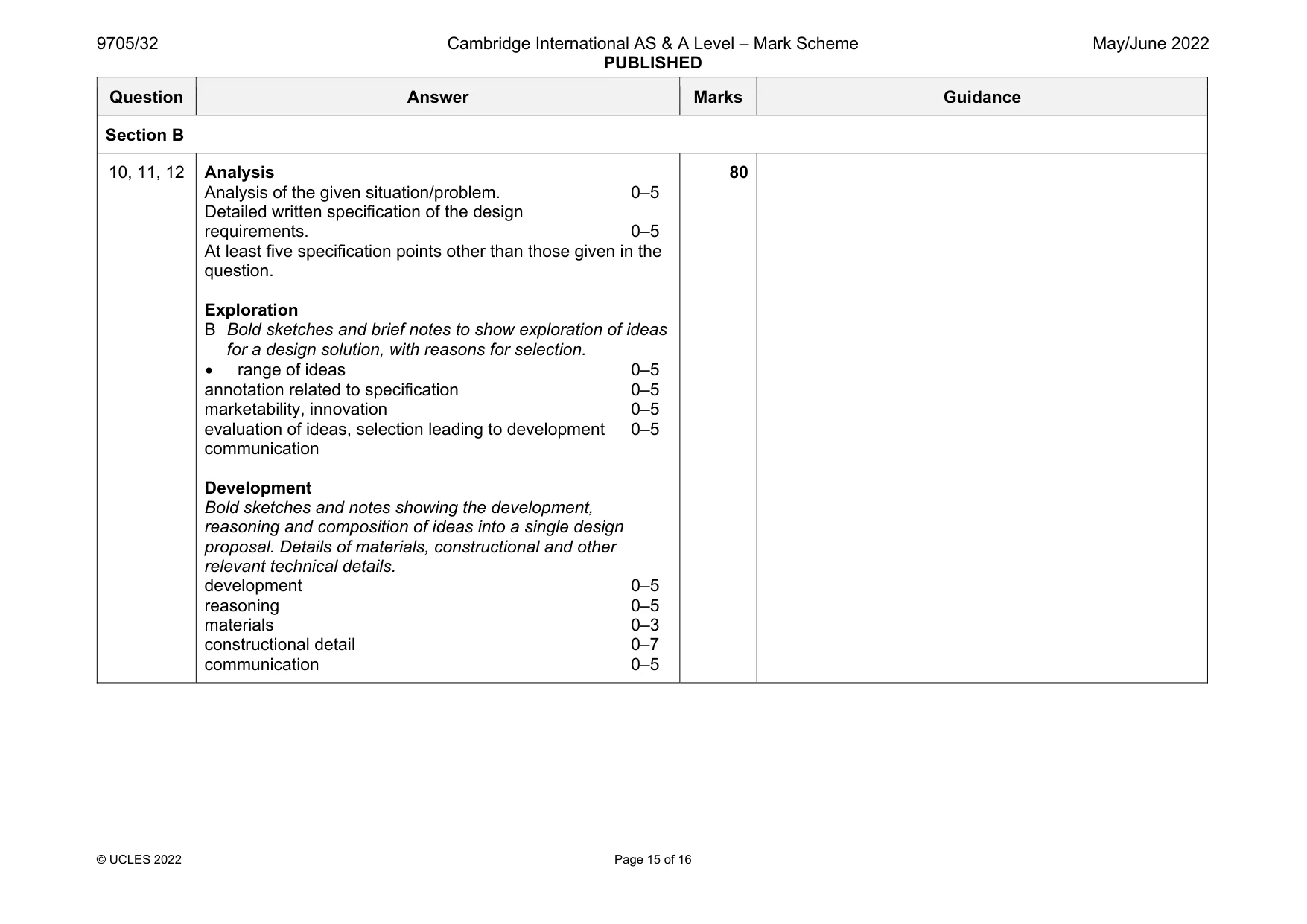
9705/32 Cambridge International AS & A Level – Mark Scheme PUBLISHED May/June 2022 © UCLES 2022 Page 15 of 16 Question Answer Marks Guidance Section B 10, 11, 12 Analysis Analysis of the given situation/problem. 0–5 Detailed written specification of the design requirements. 0–5 At least five specification points other than those given in the question. Exploration B Bold sketches and brief notes to show exploration of ideas for a design solution, with reasons for selection. range of ideas 0–5 annotation related to specification 0–5 marketability, innovation 0–5 evaluation of ideas, selection leading to development 0–5 communication Development Bold sketches and notes showing the development, reasoning and composition of ideas into a single design proposal. Details of materials, constructional and other relevant technical details. development 0–5 reasoning 0–5 materials 0–3 constructional detail 0–7 communication 0–5 80
Mark scheme, page 16
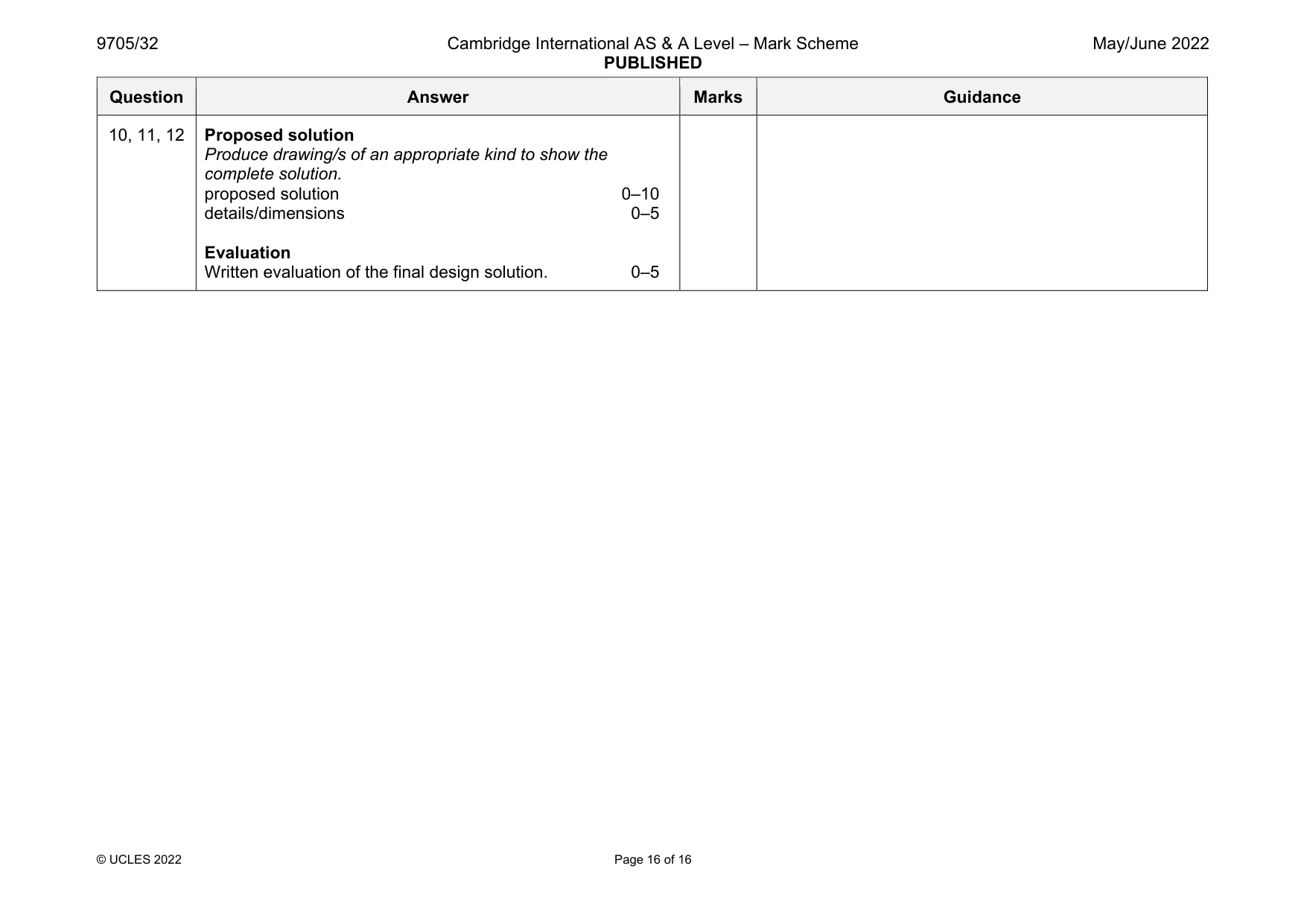
9705/32 Cambridge International AS & A Level – Mark Scheme PUBLISHED May/June 2022 © UCLES 2022 Page 16 of 16 Question Answer Marks Guidance 10, 11, 12 Proposed solution Produce drawing/s of an appropriate kind to show the complete solution. proposed solution 0–10 details/dimensions 0–5 Evaluation Written evaluation of the final design solution. 0–5
What you needed in this session
Cambridge’s own grade thresholds for 2022 May/June, Paper 3 · Variant 2. A higher threshold means an easier paper — the bar moves with how the cohort did.