Cambridge A Level Design and Technology 9705 — 2023 May/June Paper 3 · Variant 2
9705/32/M/J/23 · 120 marks · ≈135 min
The question paper and its mark scheme, free to read here and free to download. This is Cambridge’s own paper, exactly as it was sat.
Question paper12 pages

Mark scheme16 pages
Answers below. Sit the paper first if you are practising.
Paper as text
Question paper, page 1
This document has 12 pages. Any blank pages are indicated. [Turn over * 4 2 9 9 0 7 7 7 0 1 * Cambridge International AS & A Level DC (DE/CB) 317627/2 © UCLES 2023 DESIGN & TECHNOLOGY 9705/32 Paper 3 May/June 2023 3 hours You must answer on the answer booklet/paper. You will need: Answer booklet/paper Coloured pencils A3 drawing paper (5 sheets) A range of design drawing equipment INSTRUCTIONS ● Answer three questions in total: Section A: answer two questions from one of the Parts A, B or C. Section B: answer one question. ● If you have been given an answer booklet, follow the instructions on the front cover of the answer booklet. ● Use a black or dark blue pen. ● Write your name, centre number and candidate number on all the work you hand in. ● Do not use an erasable pen or correction fluid. ● You may use an HB pencil, or coloured pencils as appropriate, for any diagrams, graphs or rough working. ● At the end of the examination, fasten all your work together. Do not use staples, paper clips or glue. INFORMATION ● The total mark for this paper is 120. ● The number of marks for each question or part question is shown in brackets [ ]. ● All dimensions are in millimetres.
Question paper, page 2
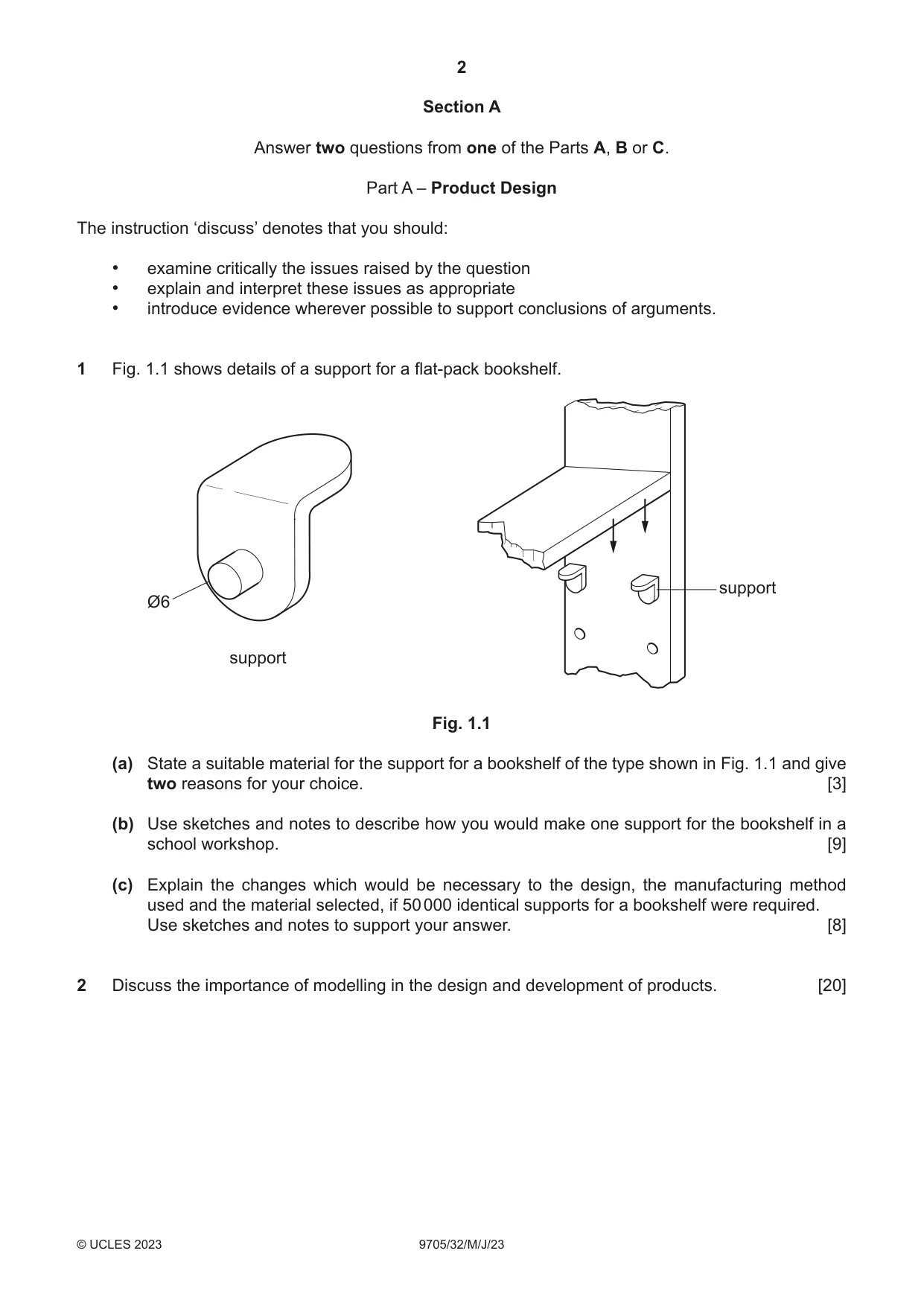
2 9705/32/M/J/23 © UCLES 2023 Section A Answer two questions from one of the Parts A, B or C. Part A – Product Design The instruction ‘discuss’ denotes that you should: • examine critically the issues raised by the question • explain and interpret these issues as appropriate • introduce evidence wherever possible to support conclusions of arguments. 1 Fig. 1.1 shows details of a support for a flat-pack bookshelf. support support Ø6 Fig. 1.1 (a) State a suitable material for the support for a bookshelf of the type shown in Fig. 1.1 and give two reasons for your choice. [3] (b) Use sketches and notes to describe how you would make one support for the bookshelf in a school workshop. [9] (c) Explain the changes which would be necessary to the design, the manufacturing method used and the material selected, if 50 000 identical supports for a bookshelf were required. Use sketches and notes to support your answer. [8] 2 Discuss the importance of modelling in the design and development of products. [20]
Question paper, page 3
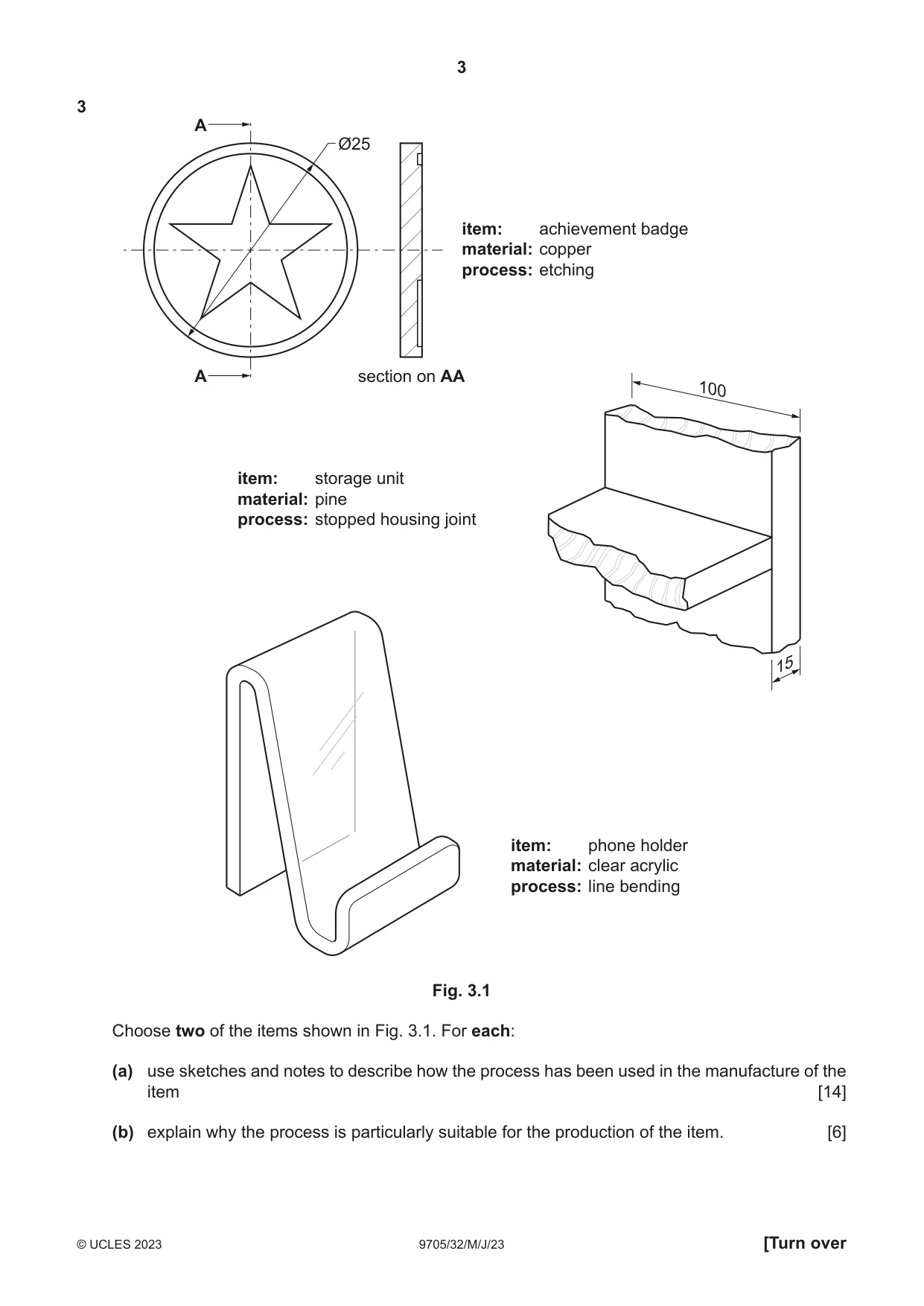
3 9705/32/M/J/23 © UCLES 2023 [Turn over 3 Ø25 section on AA item: achievement badge material: copper process: etching item: storage unit material: pine process: stopped housing joint item: phone holder material: clear acrylic process: line bending A A 100 15 Fig. 3.1 Choose two of the items shown in Fig. 3.1. For each: (a) use sketches and notes to describe how the process has been used in the manufacture of the item [14] (b) explain why the process is particularly suitable for the production of the item. [6]
Question paper, page 4
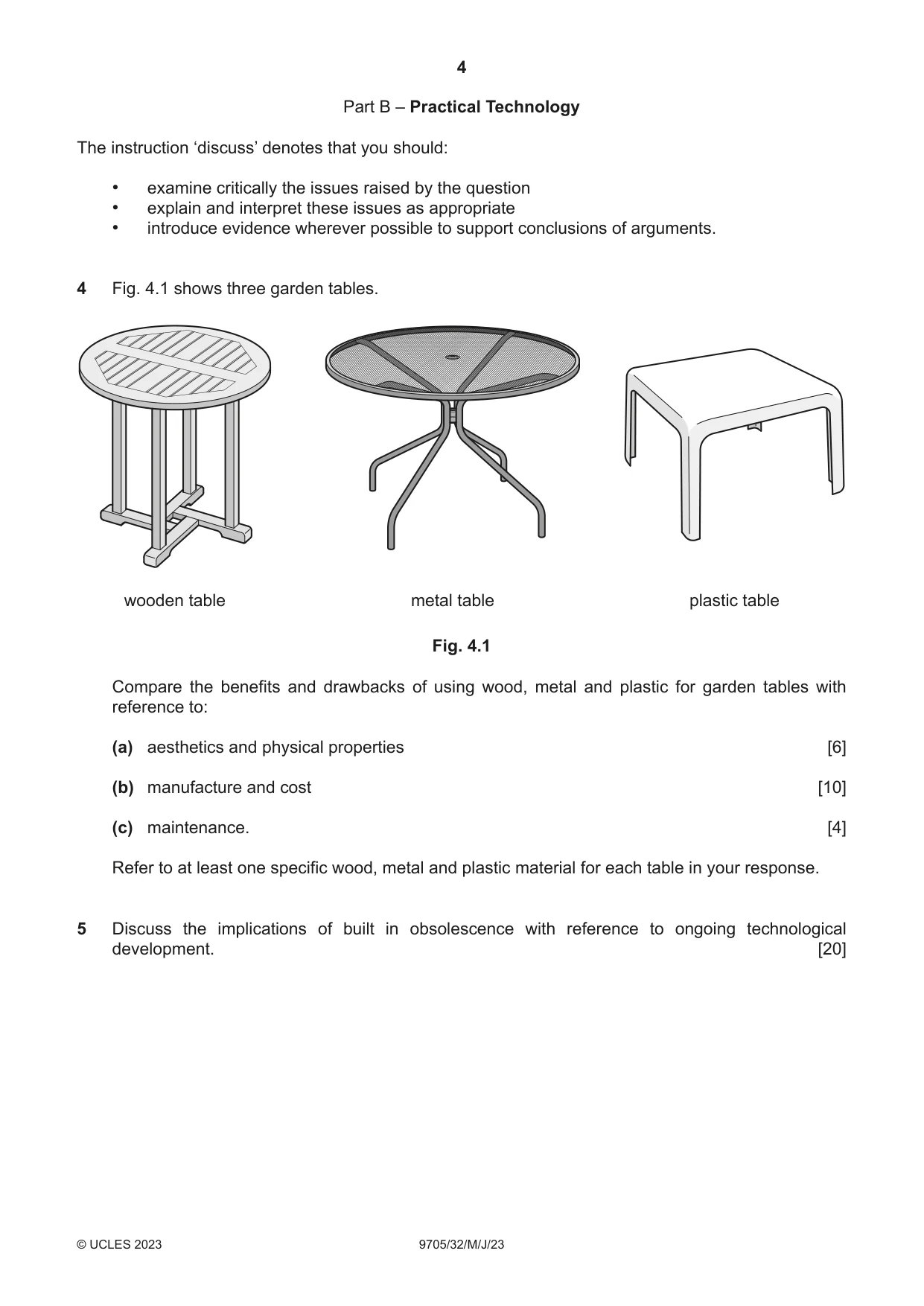
4 9705/32/M/J/23 © UCLES 2023 Part B – Practical Technology The instruction ‘discuss’ denotes that you should: • examine critically the issues raised by the question • explain and interpret these issues as appropriate • introduce evidence wherever possible to support conclusions of arguments. 4 Fig. 4.1 shows three garden tables. wooden table metal table plastic table Fig. 4.1 Compare the benefits and drawbacks of using wood, metal and plastic for garden tables with reference to: (a) aesthetics and physical properties [6] (b) manufacture and cost [10] (c) maintenance. [4] Refer to at least one specific wood, metal and plastic material for each table in your response. 5 Discuss the implications of built in obsolescence with reference to ongoing technological development. [20]
Question paper, page 5
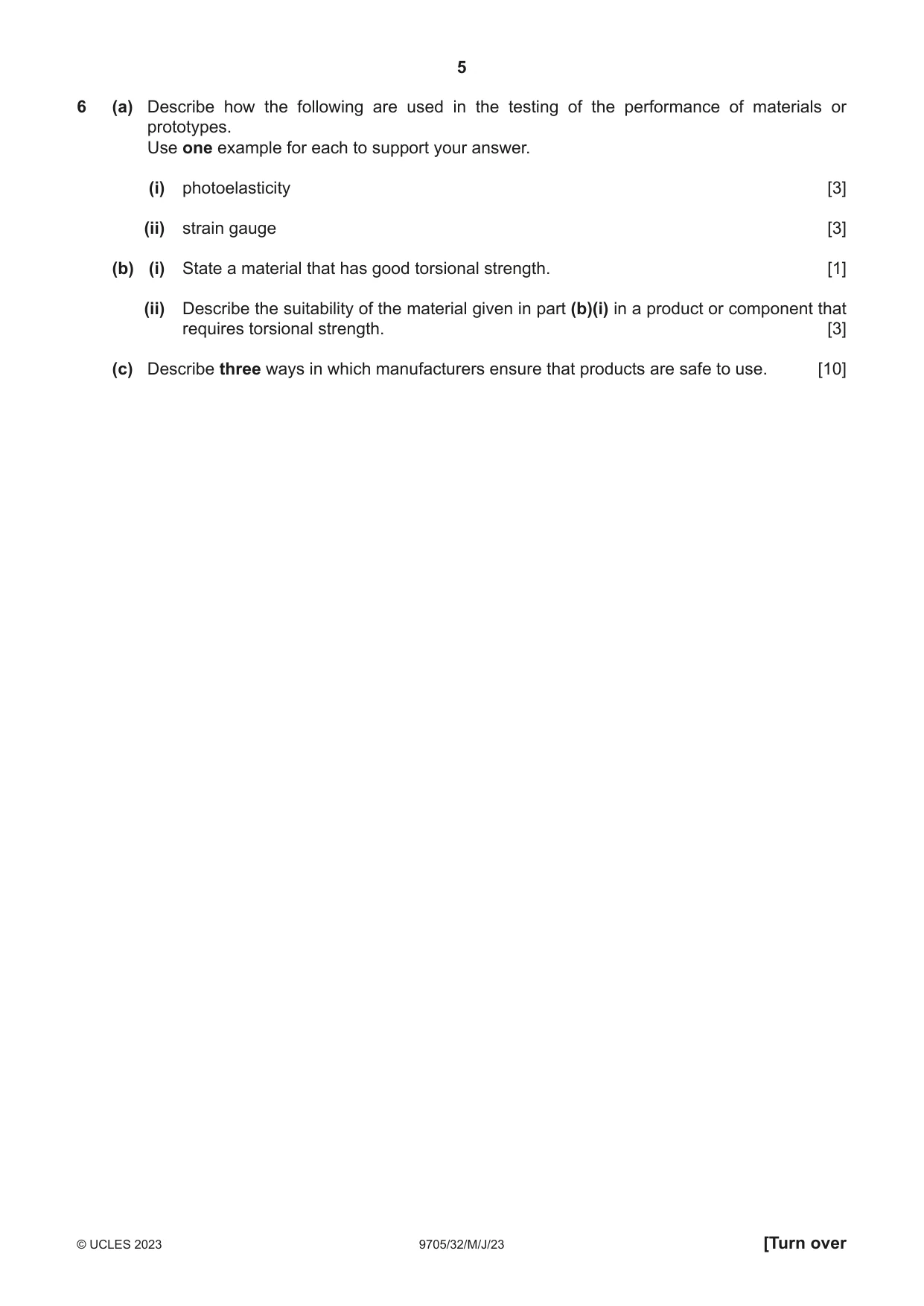
5 9705/32/M/J/23 © UCLES 2023 [Turn over 6 (a) Describe how the following are used in the testing of the performance of materials or prototypes. Use one example for each to support your answer. (i) photoelasticity [3] (ii) strain gauge [3] (b) (i) State a material that has good torsional strength. [1] (ii) Describe the suitability of the material given in part (b)(i) in a product or component that requires torsional strength. [3] (c) Describe three ways in which manufacturers ensure that products are safe to use. [10]
Question paper, page 6
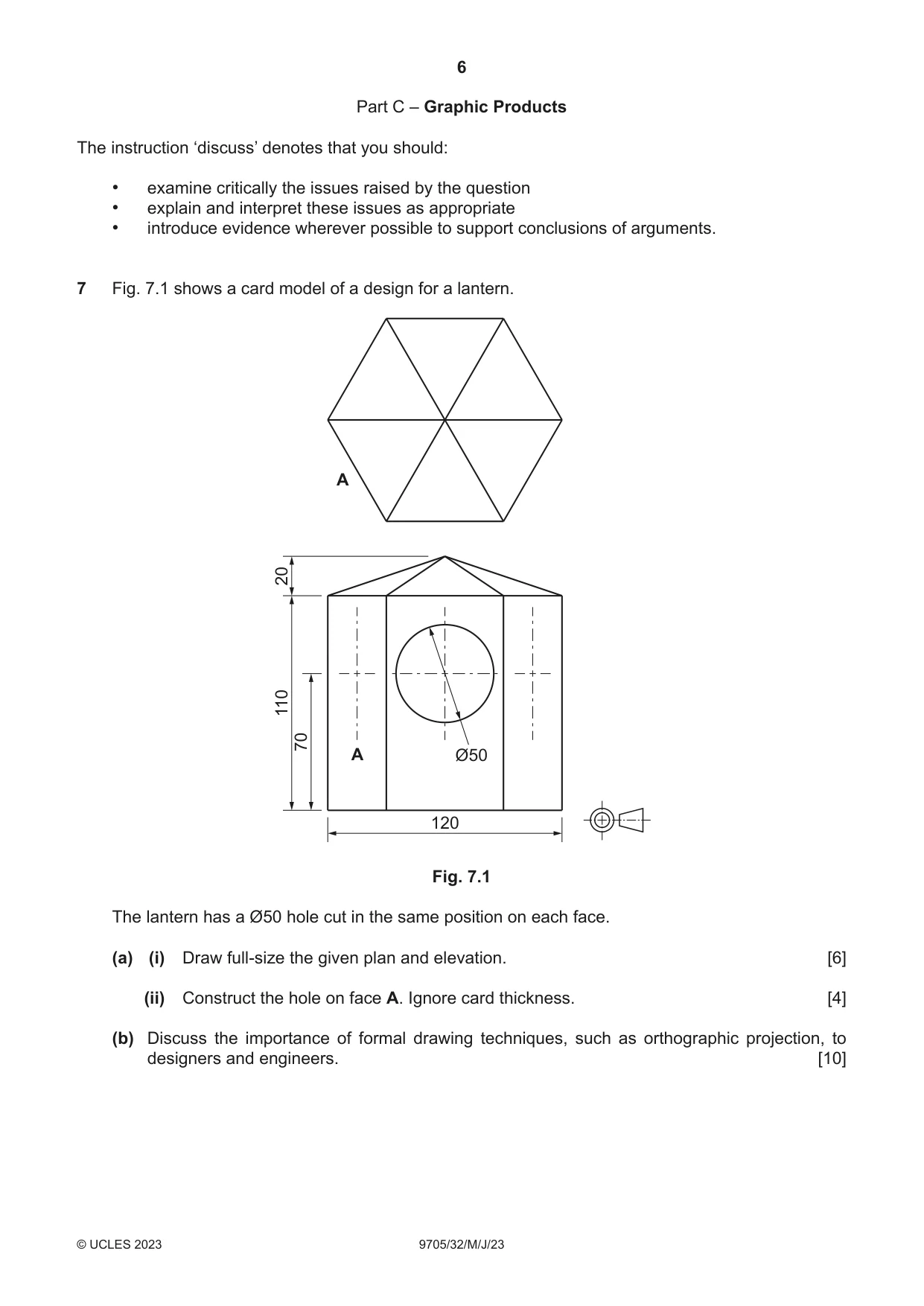
6 9705/32/M/J/23 © UCLES 2023 Part C – Graphic Products The instruction ‘discuss’ denotes that you should: • examine critically the issues raised by the question • explain and interpret these issues as appropriate • introduce evidence wherever possible to support conclusions of arguments. 7 Fig. 7.1 shows a card model of a design for a lantern. A A Ø50 120 70 110 20 Fig. 7.1 The lantern has a Ø50 hole cut in the same position on each face. (a) (i) Draw full-size the given plan and elevation. [6] (ii) Construct the hole on face A. Ignore card thickness. [4] (b) Discuss the importance of formal drawing techniques, such as orthographic projection, to designers and engineers. [10]
Question paper, page 7
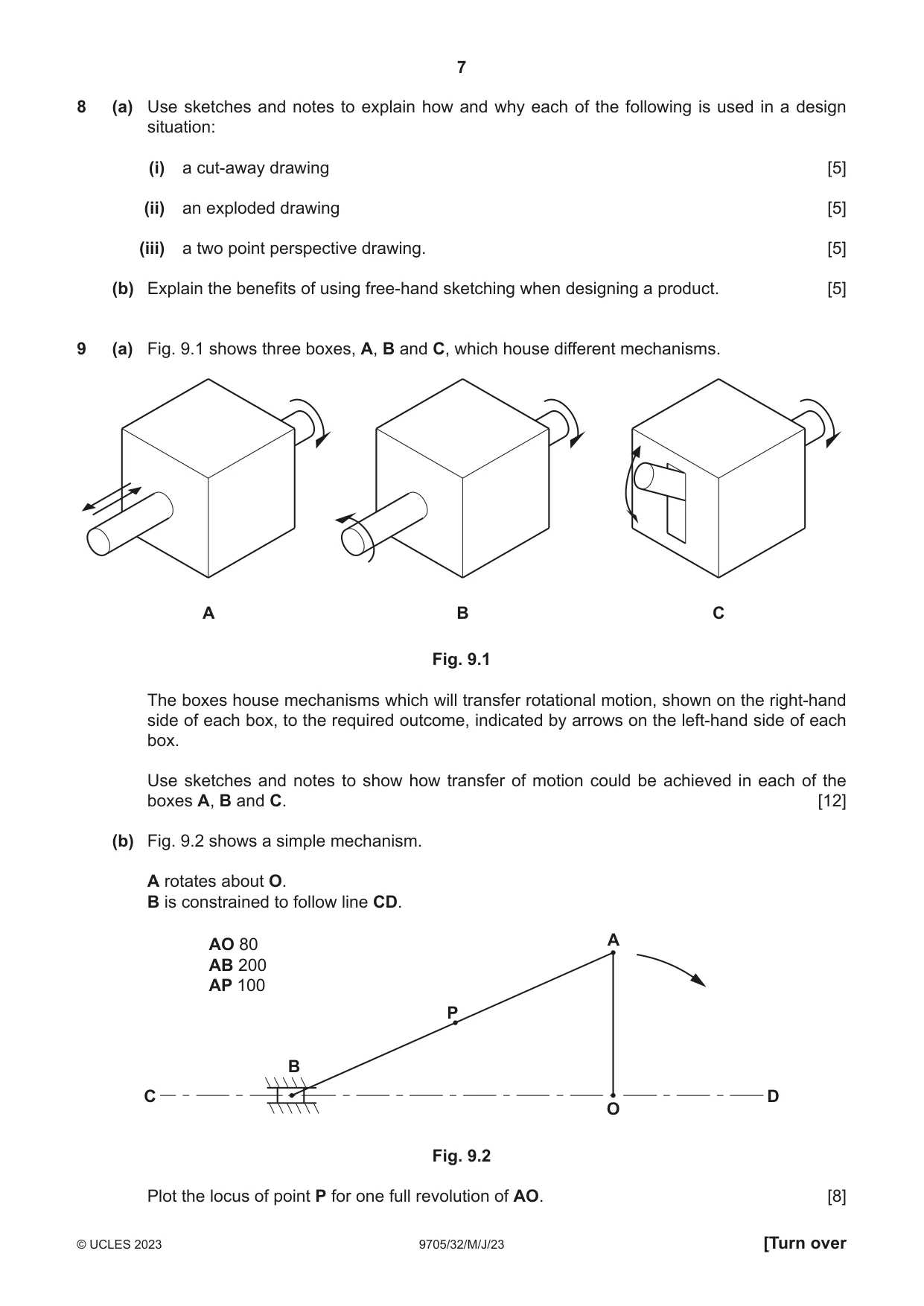
7 9705/32/M/J/23 © UCLES 2023 [Turn over 8 (a) Use sketches and notes to explain how and why each of the following is used in a design situation: (i) a cut-away drawing [5] (ii) an exploded drawing [5] (iii) a two point perspective drawing. [5] (b) Explain the benefits of using free-hand sketching when designing a product. [5] 9 (a) Fig. 9.1 shows three boxes, A, B and C, which house different mechanisms. A B C Fig. 9.1 The boxes house mechanisms which will transfer rotational motion, shown on the right-hand side of each box, to the required outcome, indicated by arrows on the left-hand side of each box. Use sketches and notes to show how transfer of motion could be achieved in each of the boxes A, B and C. [12] (b) Fig. 9.2 shows a simple mechanism. A rotates about O. B is constrained to follow line CD. C B O D A P AO 80 AB 200 AP 100 Fig. 9.2 Plot the locus of point P for one full revolution of AO. [8]
Question paper, page 8
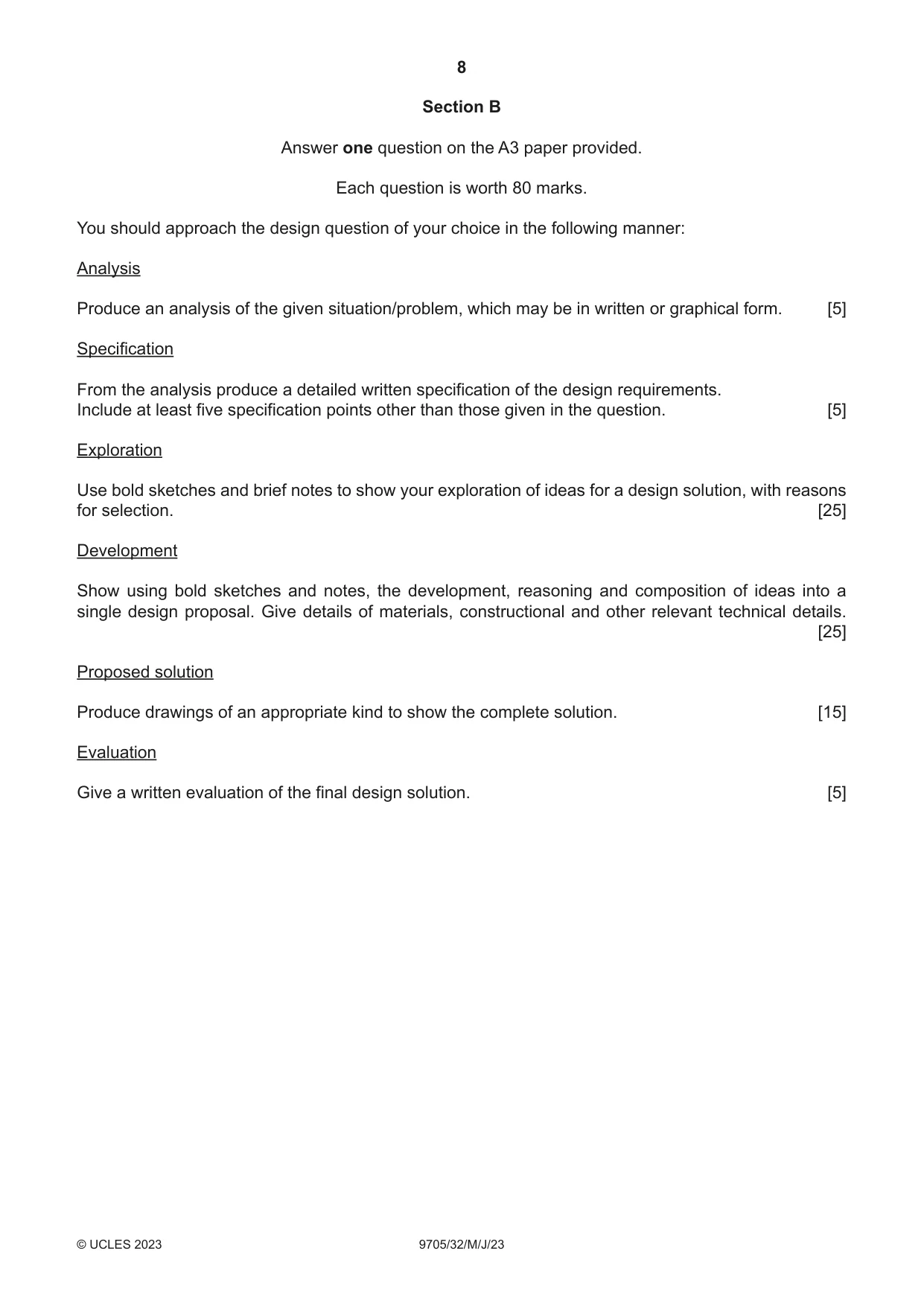
8 9705/32/M/J/23 © UCLES 2023 Section B Answer one question on the A3 paper provided. Each question is worth 80 marks. You should approach the design question of your choice in the following manner: Analysis Produce an analysis of the given situation/problem, which may be in written or graphical form. [5] Specification From the analysis produce a detailed written specification of the design requirements. Include at least five specification points other than those given in the question. [5] Exploration Use bold sketches and brief notes to show your exploration of ideas for a design solution, with reasons for selection. [25] Development Show using bold sketches and notes, the development, reasoning and composition of ideas into a single design proposal. Give details of materials, constructional and other relevant technical details. [25] Proposed solution Produce drawings of an appropriate kind to show the complete solution. [15] Evaluation Give a written evaluation of the final design solution. [5]
Question paper, page 9
9 9705/32/M/J/23 © UCLES 2023 [Turn over 10 A restaurant wishes to provide diners with a range of sauces or dips when they eat. The restaurant tables are circular and can seat up to 8 diners. You are to design a product to hold six different sauces or dips, to be placed on a restaurant table. The product must allow: • ease of access to all sauces or dips by all diners at the table • each sauce or dip to be refilled during the meal. [80] 11 A school for children aged 5 to 11 years wants to encourage them to use recyclable waste collection facilities around the school. A container that will encourage children to place different types of recyclable waste in separate sections would be helpful. You are to design a container that can be manufactured as a batch of 10. The container must: • clearly show what type of recyclable waste is to be collected in each section • produce a noise or light effect when a child places recyclable waste in the section. [80]
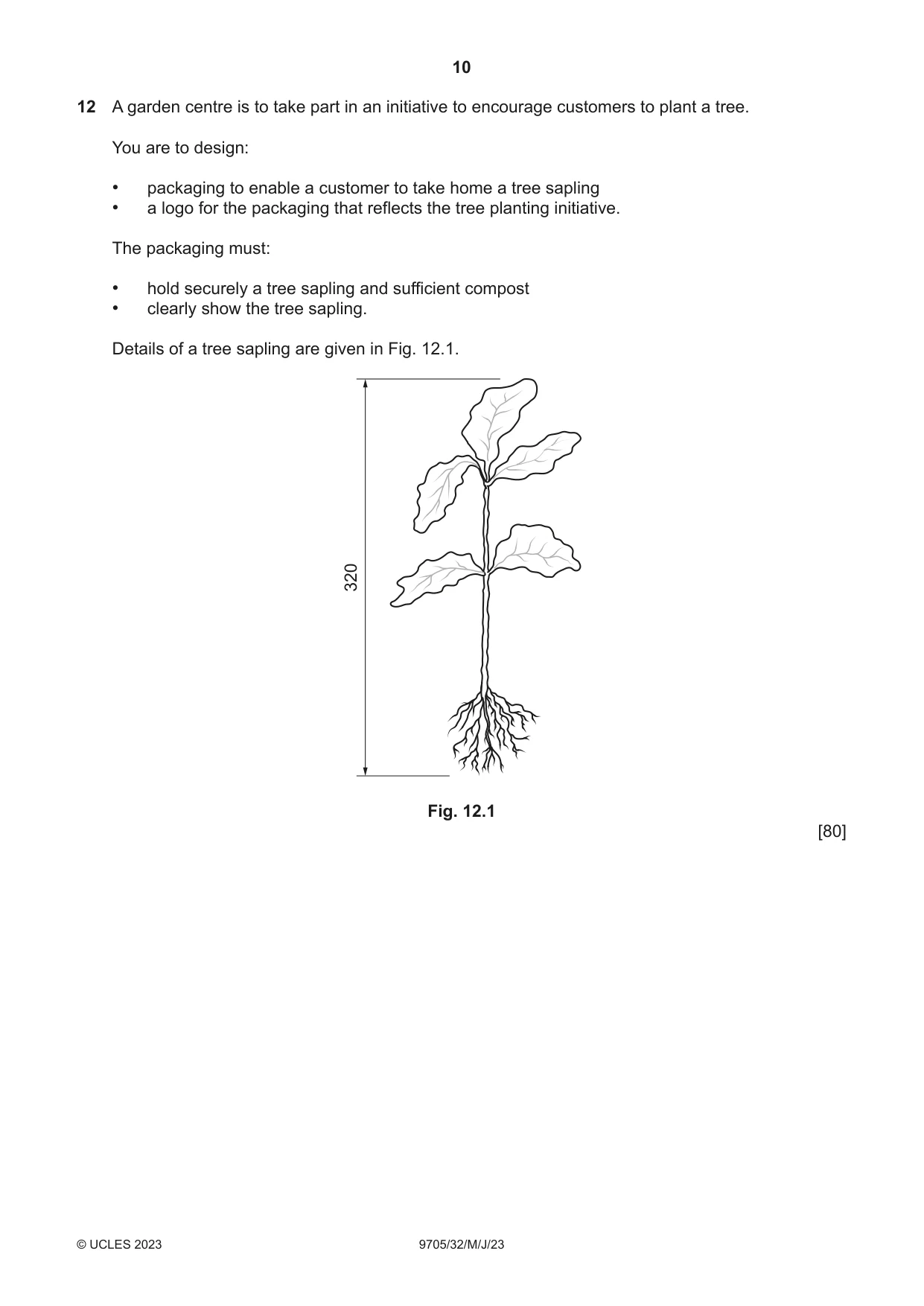
Question paper, page 10
10 9705/32/M/J/23 © UCLES 2023 12 A garden centre is to take part in an initiative to encourage customers to plant a tree. You are to design: • packaging to enable a customer to take home a tree sapling • a logo for the packaging that reflects the tree planting initiative. The packaging must: • hold securely a tree sapling and sufficient compost • clearly show the tree sapling. Details of a tree sapling are given in Fig. 12.1. 320 Fig. 12.1 [80]
Question paper, page 11
11 9705/32/M/J/23 © UCLES 2023 BLANK PAGE
Question paper, page 12
12 9705/32/M/J/23 © UCLES 2023 Permission to reproduce items where third-party owned material protected by copyright is included has been sought and cleared where possible. Every reasonable effort has been made by the publisher (UCLES) to trace copyright holders, but if any items requiring clearance have unwittingly been included, the publisher will be pleased to make amends at the earliest possible opportunity. To avoid the issue of disclosure of answer-related information to candidates, all copyright acknowledgements are reproduced online in the Cambridge Assessment International Education Copyright Acknowledgements Booklet. This is produced for each series of examinations and is freely available to download at www.cambridgeinternational.org after the live examination series. Cambridge Assessment International Education is part of Cambridge Assessment. Cambridge Assessment is the brand name of the University of Cambridge Local Examinations Syndicate (UCLES), which is a department of the University of Cambridge. BLANK PAGE
Mark scheme, page 1
This document consists of 16 printed pages. © UCLES 2023 [Turn over Cambridge International AS & A Level DESIGN AND TECHNOLOGY 9705/32 Paper 3 Written May/June 2023 MARK SCHEME Maximum Mark: 120 Published This mark scheme is published as an aid to teachers and candidates, to indicate the requirements of the examination. It shows the basis on which Examiners were instructed to award marks. It does not indicate the details of the discussions that took place at an Examiners’ meeting before marking began, which would have considered the acceptability of alternative answers. Mark schemes should be read in conjunction with the question paper and the Principal Examiner Report for Teachers. Cambridge International will not enter into discussions about these mark schemes. Cambridge International is publishing the mark schemes for the May/June 2023 series for most Cambridge IGCSE, Cambridge International A and AS Level and Cambridge Pre-U components, and some Cambridge O Level components.
Mark scheme, page 2
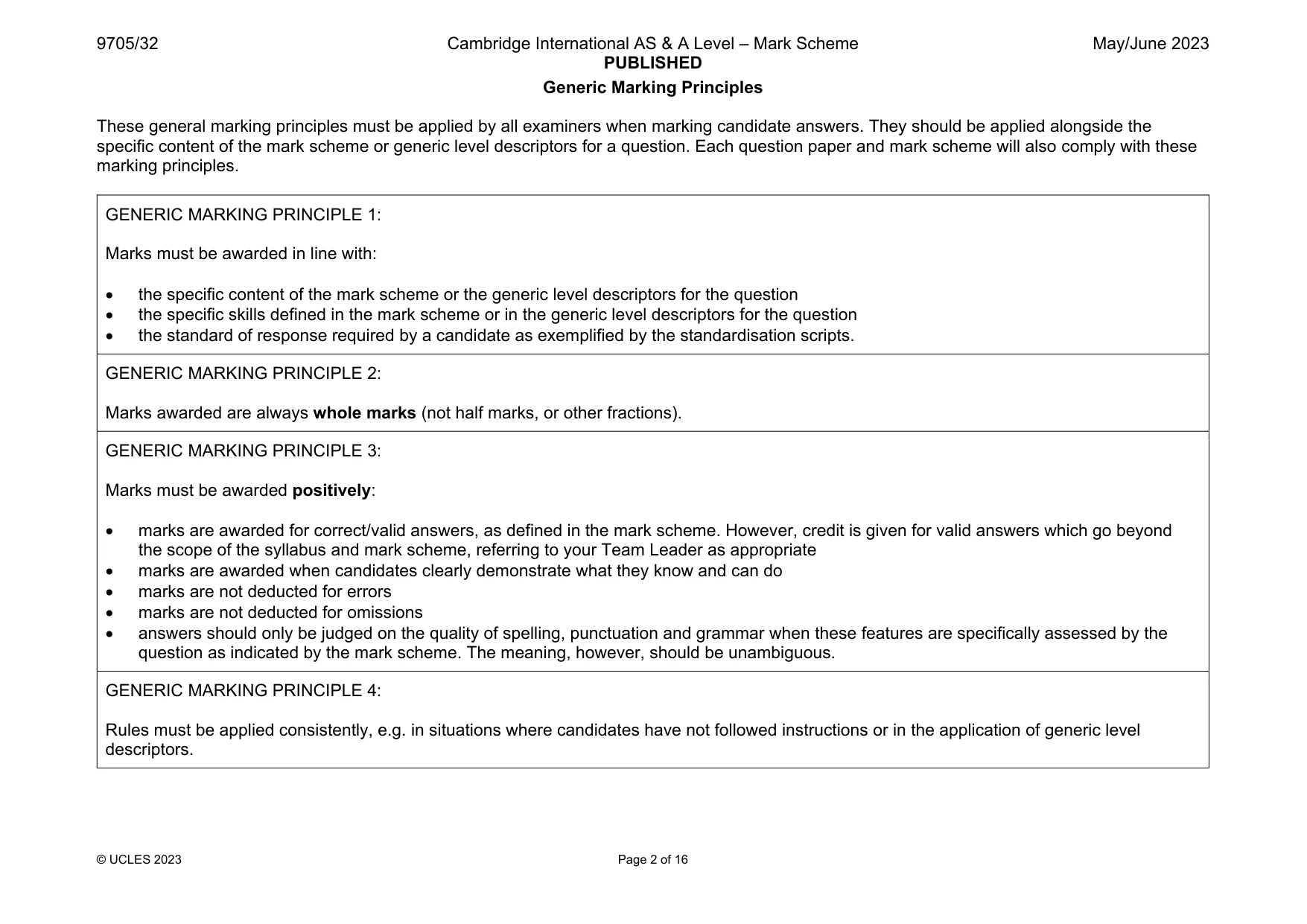
9705/32 Cambridge International AS & A Level – Mark Scheme PUBLISHED May/June 2023 © UCLES 2023 Page 2 of 16 Generic Marking Principles These general marking principles must be applied by all examiners when marking candidate answers. They should be applied alongside the specific content of the mark scheme or generic level descriptors for a question. Each question paper and mark scheme will also comply with these marking principles. GENERIC MARKING PRINCIPLE 1: Marks must be awarded in line with: the specific content of the mark scheme or the generic level descriptors for the question the specific skills defined in the mark scheme or in the generic level descriptors for the question the standard of response required by a candidate as exemplified by the standardisation scripts. GENERIC MARKING PRINCIPLE 2: Marks awarded are always whole marks (not half marks, or other fractions). GENERIC MARKING PRINCIPLE 3: Marks must be awarded positively: marks are awarded for correct/valid answers, as defined in the mark scheme. However, credit is given for valid answers which go beyond the scope of the syllabus and mark scheme, referring to your Team Leader as appropriate marks are awarded when candidates clearly demonstrate what they know and can do marks are not deducted for errors marks are not deducted for omissions answers should only be judged on the quality of spelling, punctuation and grammar when these features are specifically assessed by the question as indicated by the mark scheme. The meaning, however, should be unambiguous. GENERIC MARKING PRINCIPLE 4: Rules must be applied consistently, e.g. in situations where candidates have not followed instructions or in the application of generic level descriptors.
Mark scheme, page 3
9705/32 Cambridge International AS & A Level – Mark Scheme PUBLISHED May/June 2023 © UCLES 2023 Page 3 of 16 GENERIC MARKING PRINCIPLE 5: Marks should be awarded using the full range of marks defined in the mark scheme for the question (however; the use of the full mark range may be limited according to the quality of the candidate responses seen). GENERIC MARKING PRINCIPLE 6: Marks awarded are based solely on the requirements as defined in the mark scheme. Marks should not be awarded with grade thresholds or grade descriptors in mind.
Mark scheme, page 4
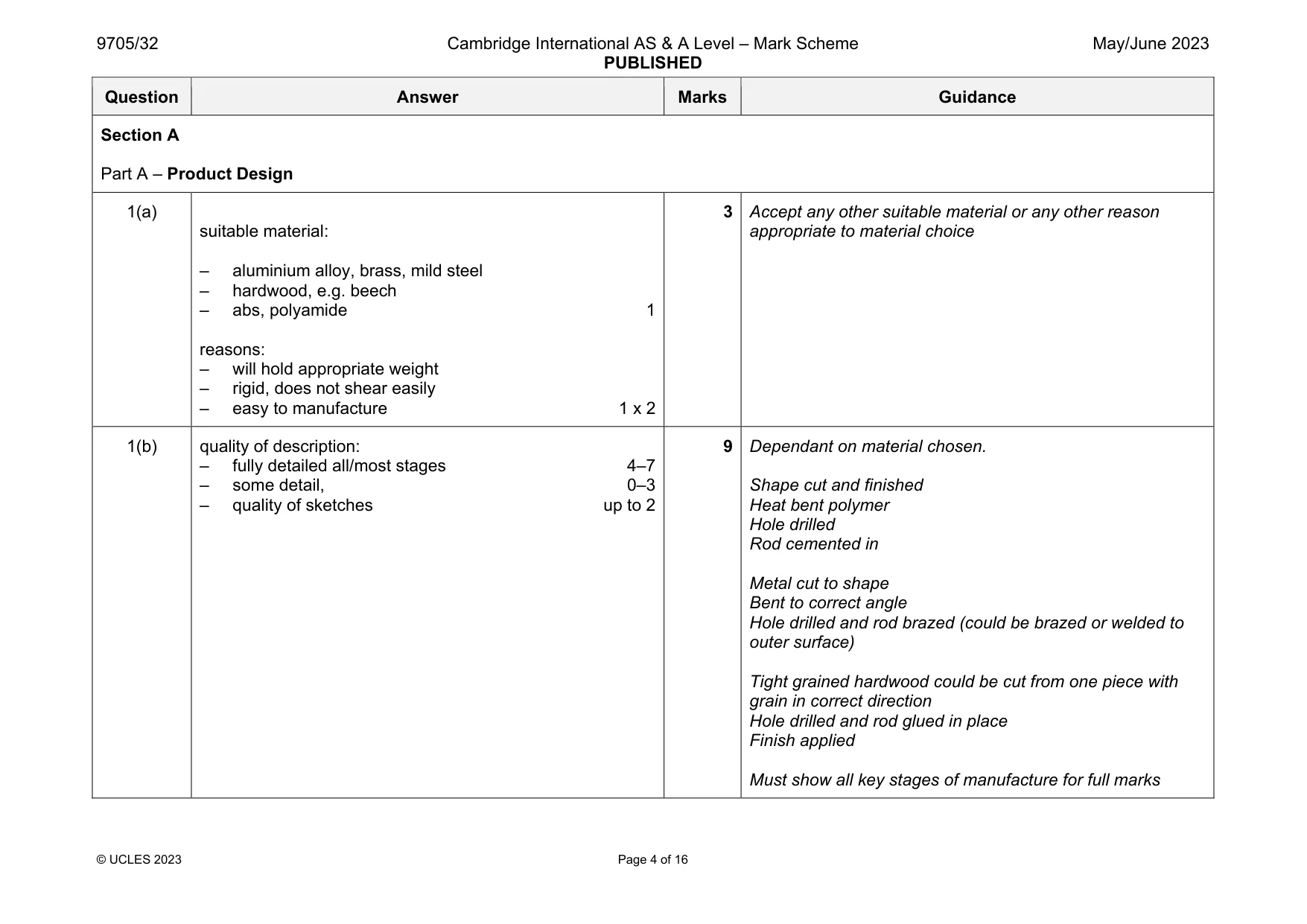
9705/32 Cambridge International AS & A Level – Mark Scheme PUBLISHED May/June 2023 © UCLES 2023 Page 4 of 16 Question Answer Marks Guidance Section A Part A – Product Design 1(a) suitable material: – aluminium alloy, brass, mild steel – hardwood, e.g. beech – abs, polyamide 1 reasons: – will hold appropriate weight – rigid, does not shear easily – easy to manufacture 1 x 2 3 Accept any other suitable material or any other reason appropriate to material choice 1(b) quality of description: – fully detailed all/most stages 4–7 – some detail, 0–3 – quality of sketches up to 2 9 Dependant on material chosen. Shape cut and finished Heat bent polymer Hole drilled Rod cemented in Metal cut to shape Bent to correct angle Hole drilled and rod brazed (could be brazed or welded to outer surface) Tight grained hardwood could be cut from one piece with grain in correct direction Hole drilled and rod glued in place Finish applied Must show all key stages of manufacture for full marks
Mark scheme, page 5
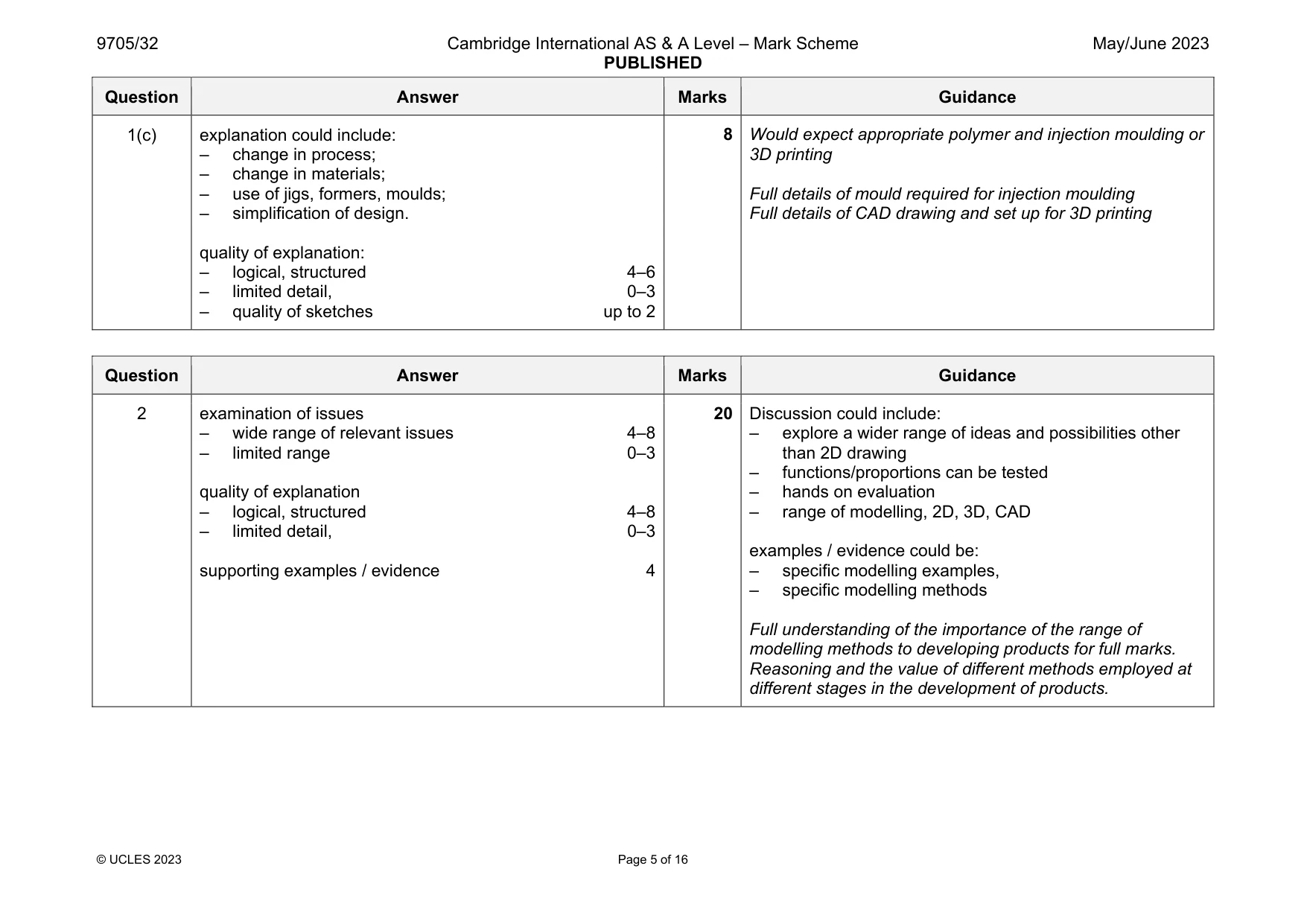
9705/32 Cambridge International AS & A Level – Mark Scheme PUBLISHED May/June 2023 © UCLES 2023 Page 5 of 16 Question Answer Marks Guidance 1(c) explanation could include: – change in process; – change in materials; – use of jigs, formers, moulds; – simplification of design. quality of explanation: – logical, structured 4–6 – limited detail, 0–3 – quality of sketches up to 2 8 Would expect appropriate polymer and injection moulding or 3D printing Full details of mould required for injection moulding Full details of CAD drawing and set up for 3D printing Question Answer Marks Guidance 2 examination of issues – wide range of relevant issues 4–8 – limited range 0–3 quality of explanation – logical, structured 4–8 – limited detail, 0–3 supporting examples / evidence 4 20 Discussion could include: – explore a wider range of ideas and possibilities other than 2D drawing – functions/proportions can be tested – hands on evaluation – range of modelling, 2D, 3D, CAD examples / evidence could be: – specific modelling examples, – specific modelling methods Full understanding of the importance of the range of modelling methods to developing products for full marks. Reasoning and the value of different methods employed at different stages in the development of products.
Mark scheme, page 6
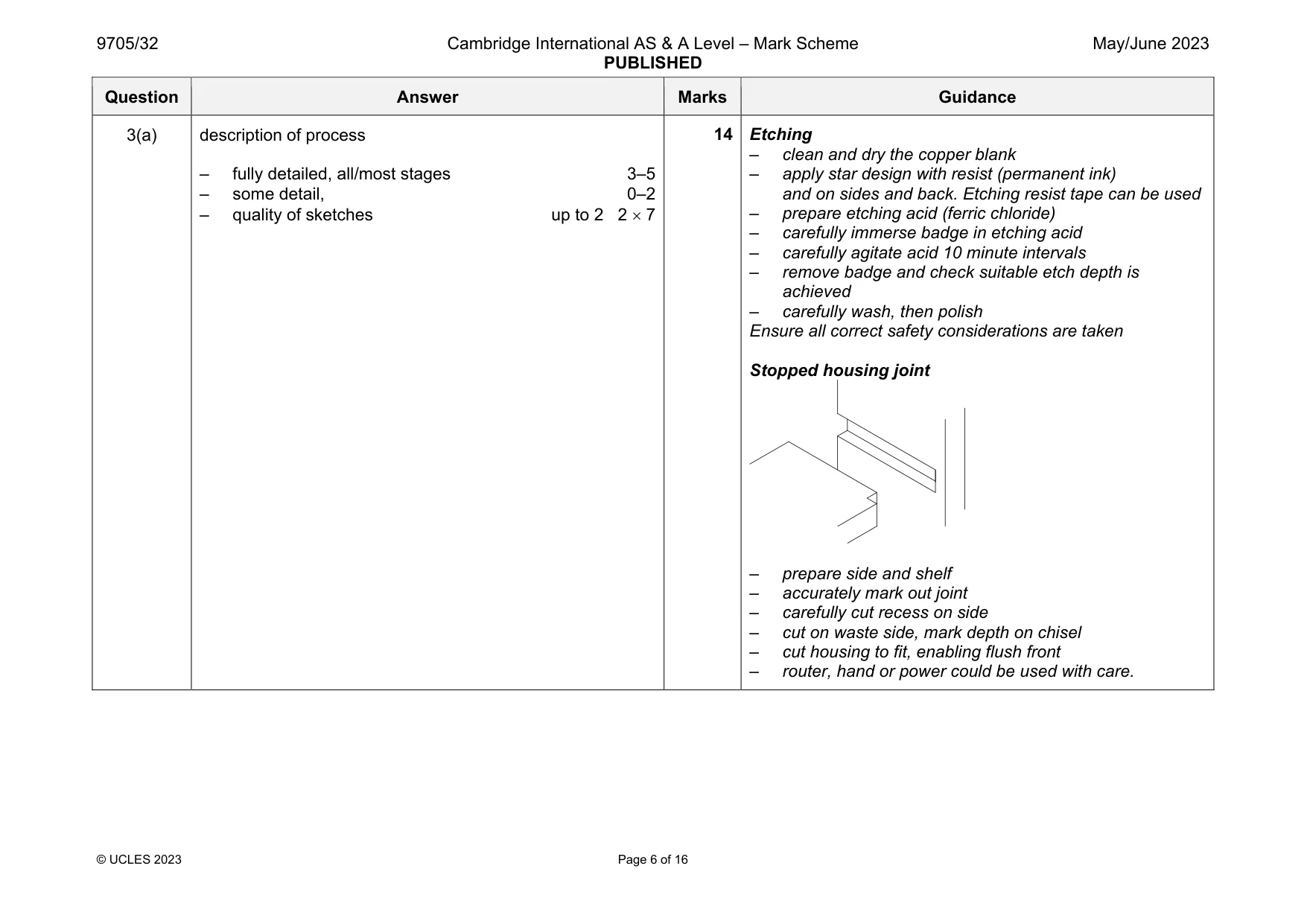
9705/32 Cambridge International AS & A Level – Mark Scheme PUBLISHED May/June 2023 © UCLES 2023 Page 6 of 16 Question Answer Marks Guidance 3(a) description of process – fully detailed, all/most stages 3–5 – some detail, 0–2 – quality of sketches up to 2 2 7 14 Etching – clean and dry the copper blank – apply star design with resist (permanent ink) and on sides and back. Etching resist tape can be used – prepare etching acid (ferric chloride) – carefully immerse badge in etching acid – carefully agitate acid 10 minute intervals – remove badge and check suitable etch depth is achieved – carefully wash, then polish Ensure all correct safety considerations are taken Stopped housing joint – prepare side and shelf – accurately mark out joint – carefully cut recess on side – cut on waste side, mark depth on chisel – cut housing to fit, enabling flush front – router, hand or power could be used with care.
Mark scheme, page 7
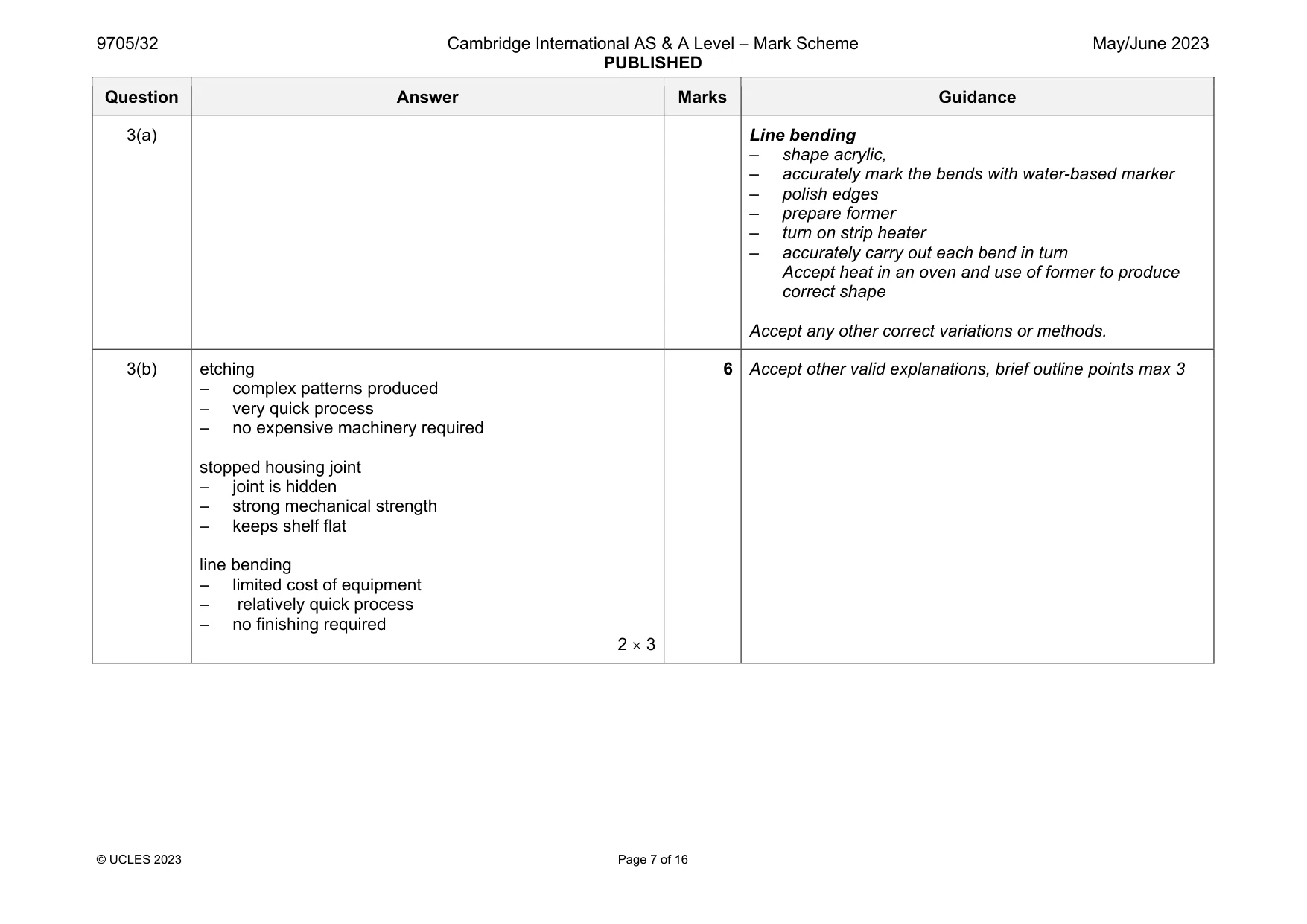
9705/32 Cambridge International AS & A Level – Mark Scheme PUBLISHED May/June 2023 © UCLES 2023 Page 7 of 16 Question Answer Marks Guidance 3(a) Line bending – shape acrylic, – accurately mark the bends with water-based marker – polish edges – prepare former – turn on strip heater – accurately carry out each bend in turn Accept heat in an oven and use of former to produce correct shape Accept any other correct variations or methods. 3(b) etching – complex patterns produced – very quick process – no expensive machinery required stopped housing joint – joint is hidden – strong mechanical strength – keeps shelf flat line bending – limited cost of equipment – relatively quick process – no finishing required 2 3 6 Accept other valid explanations, brief outline points max 3
Mark scheme, page 8
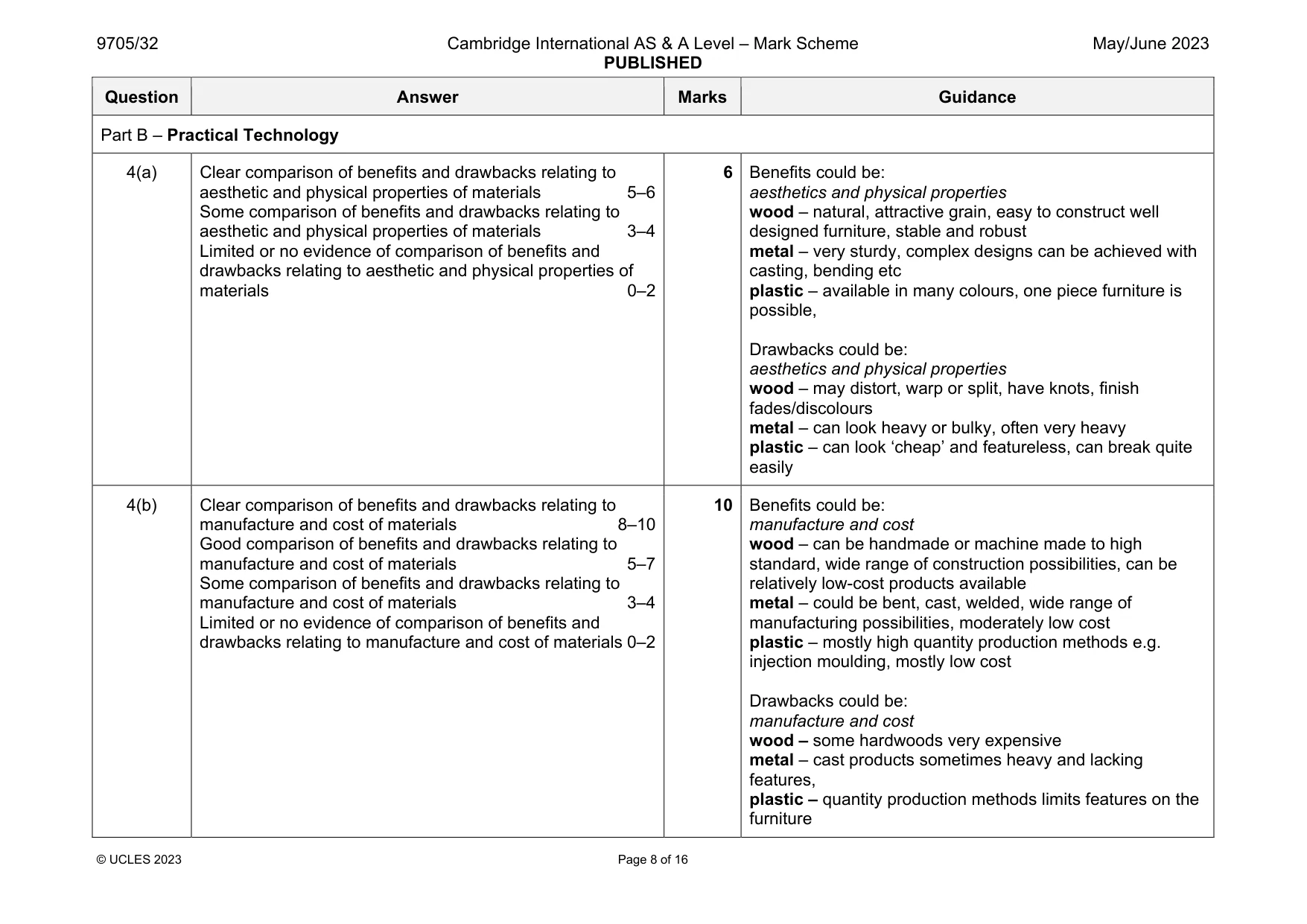
9705/32 Cambridge International AS & A Level – Mark Scheme PUBLISHED May/June 2023 © UCLES 2023 Page 8 of 16 Question Answer Marks Guidance Part B – Practical Technology 4(a) Clear comparison of benefits and drawbacks relating to aesthetic and physical properties of materials 5–6 Some comparison of benefits and drawbacks relating to aesthetic and physical properties of materials 3–4 Limited or no evidence of comparison of benefits and drawbacks relating to aesthetic and physical properties of materials 0–2 6 Benefits could be: aesthetics and physical properties wood – natural, attractive grain, easy to construct well designed furniture, stable and robust metal – very sturdy, complex designs can be achieved with casting, bending etc plastic – available in many colours, one piece furniture is possible, Drawbacks could be: aesthetics and physical properties wood – may distort, warp or split, have knots, finish fades/discolours metal – can look heavy or bulky, often very heavy plastic – can look ‘cheap’ and featureless, can break quite easily 4(b) Clear comparison of benefits and drawbacks relating to manufacture and cost of materials 8–10 Good comparison of benefits and drawbacks relating to manufacture and cost of materials 5–7 Some comparison of benefits and drawbacks relating to manufacture and cost of materials 3–4 Limited or no evidence of comparison of benefits and drawbacks relating to manufacture and cost of materials 0–2 10 Benefits could be: manufacture and cost wood – can be handmade or machine made to high standard, wide range of construction possibilities, can be relatively low-cost products available metal – could be bent, cast, welded, wide range of manufacturing possibilities, moderately low cost plastic – mostly high quantity production methods e.g. injection moulding, mostly low cost Drawbacks could be: manufacture and cost wood – some hardwoods very expensive metal – cast products sometimes heavy and lacking features, plastic – quantity production methods limits features on the furniture
Mark scheme, page 9
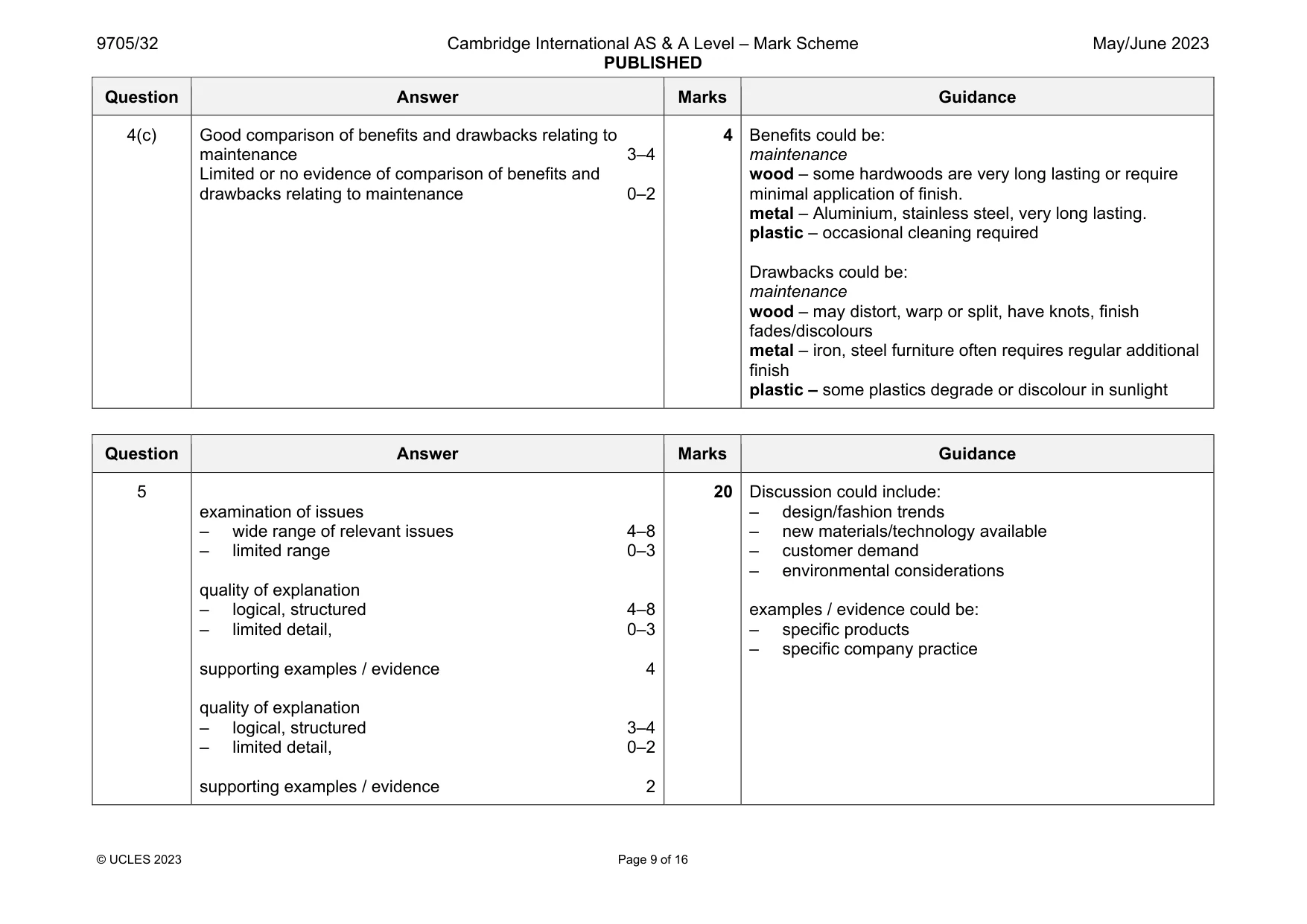
9705/32 Cambridge International AS & A Level – Mark Scheme PUBLISHED May/June 2023 © UCLES 2023 Page 9 of 16 Question Answer Marks Guidance 4(c) Good comparison of benefits and drawbacks relating to maintenance 3–4 Limited or no evidence of comparison of benefits and drawbacks relating to maintenance 0–2 4 Benefits could be: maintenance wood – some hardwoods are very long lasting or require minimal application of finish. metal – Aluminium, stainless steel, very long lasting. plastic – occasional cleaning required Drawbacks could be: maintenance wood – may distort, warp or split, have knots, finish fades/discolours metal – iron, steel furniture often requires regular additional finish plastic – some plastics degrade or discolour in sunlight Question Answer Marks Guidance 5 examination of issues – wide range of relevant issues 4–8 – limited range 0–3 quality of explanation – logical, structured 4–8 – limited detail, 0–3 supporting examples / evidence 4 quality of explanation – logical, structured 3–4 – limited detail, 0–2 supporting examples / evidence 2 20 Discussion could include: – design/fashion trends – new materials/technology available – customer demand – environmental considerations examples / evidence could be: – specific products – specific company practice
Mark scheme, page 10
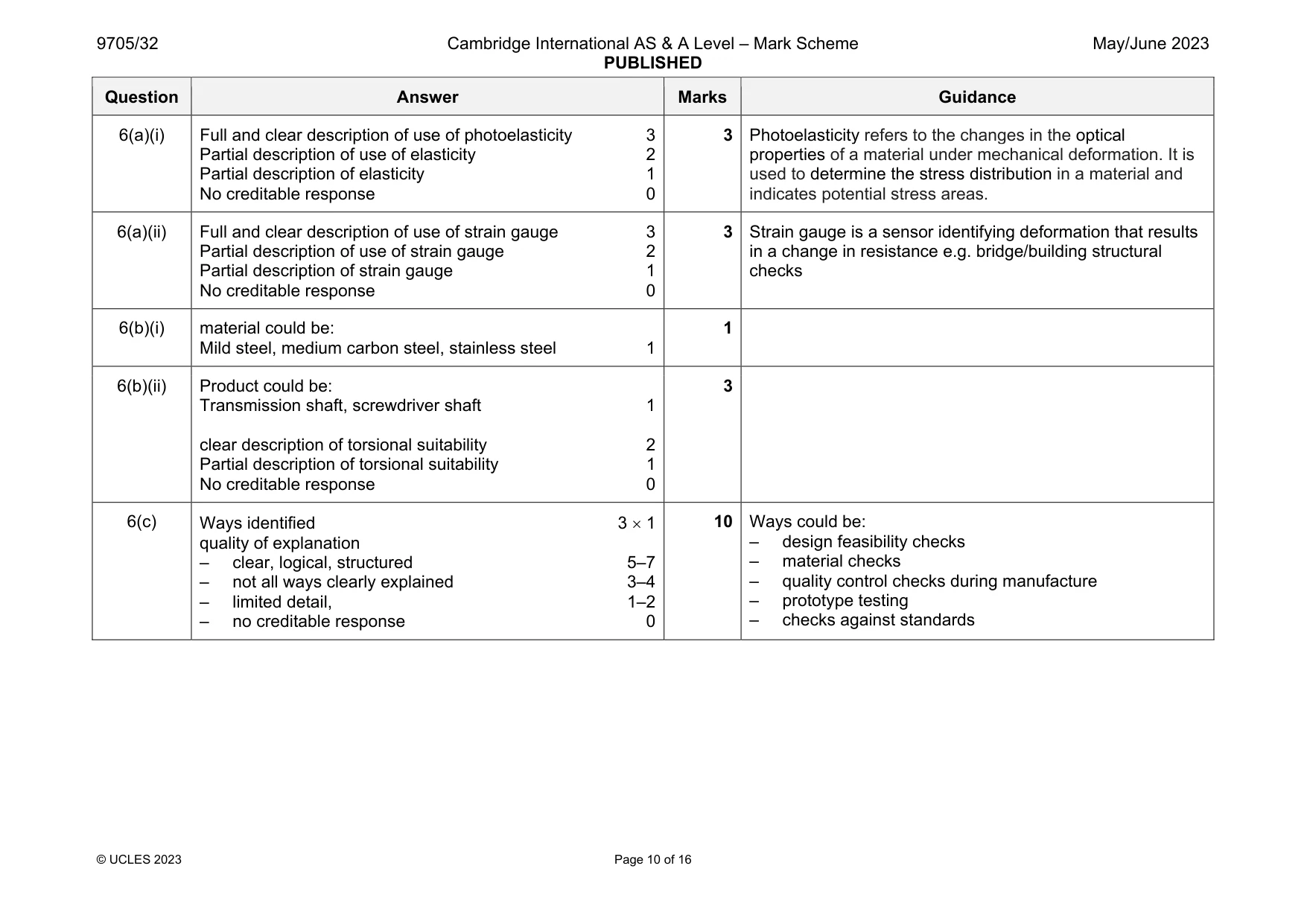
9705/32 Cambridge International AS & A Level – Mark Scheme PUBLISHED May/June 2023 © UCLES 2023 Page 10 of 16 Question Answer Marks Guidance 6(a)(i) Full and clear description of use of photoelasticity 3 Partial description of use of elasticity 2 Partial description of elasticity 1 No creditable response 0 3 Photoelasticity refers to the changes in the optical properties of a material under mechanical deformation. It is used to determine the stress distribution in a material and indicates potential stress areas. 6(a)(ii) Full and clear description of use of strain gauge 3 Partial description of use of strain gauge 2 Partial description of strain gauge 1 No creditable response 0 3 Strain gauge is a sensor identifying deformation that results in a change in resistance e.g. bridge/building structural checks 6(b)(i) material could be: Mild steel, medium carbon steel, stainless steel 1 1 6(b)(ii) Product could be: Transmission shaft, screwdriver shaft 1 clear description of torsional suitability 2 Partial description of torsional suitability 1 No creditable response 0 3 6(c) Ways identified 3 1 quality of explanation – clear, logical, structured 5–7 – not all ways clearly explained 3–4 – limited detail, 1–2 – no creditable response 0 10 Ways could be: – design feasibility checks – material checks – quality control checks during manufacture – prototype testing – checks against standards
Mark scheme, page 11
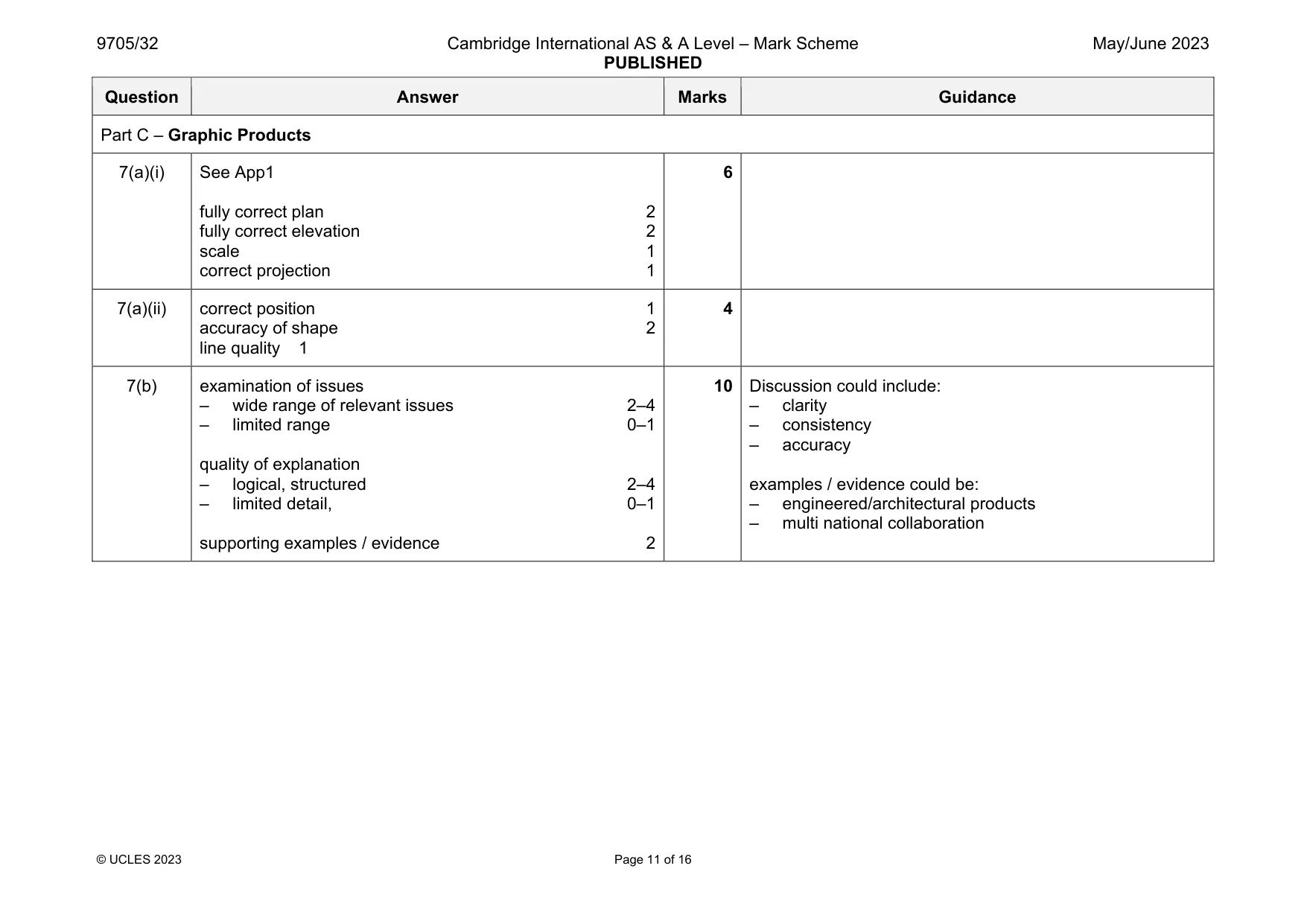
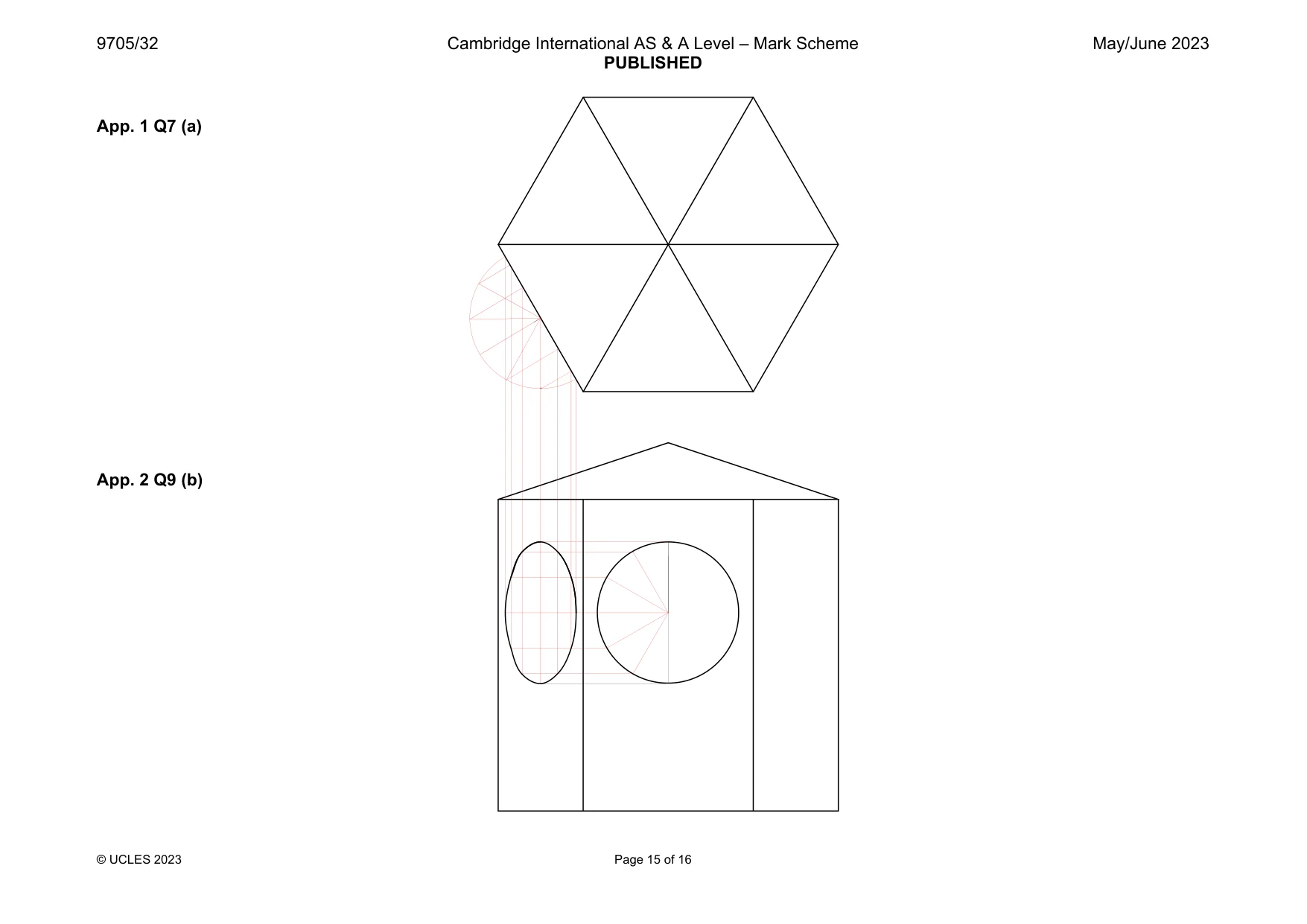
9705/32 Cambridge International AS & A Level – Mark Scheme PUBLISHED May/June 2023 © UCLES 2023 Page 11 of 16 Question Answer Marks Guidance Part C – Graphic Products 7(a)(i) See App1 fully correct plan 2 fully correct elevation 2 scale 1 correct projection 1 6 7(a)(ii) correct position 1 accuracy of shape 2 line quality 1 4 7(b) examination of issues – wide range of relevant issues 2–4 – limited range 0–1 quality of explanation – logical, structured 2–4 – limited detail, 0–1 supporting examples / evidence 2 10 Discussion could include: – clarity – consistency – accuracy examples / evidence could be: – engineered/architectural products – multi national collaboration
Mark scheme, page 12
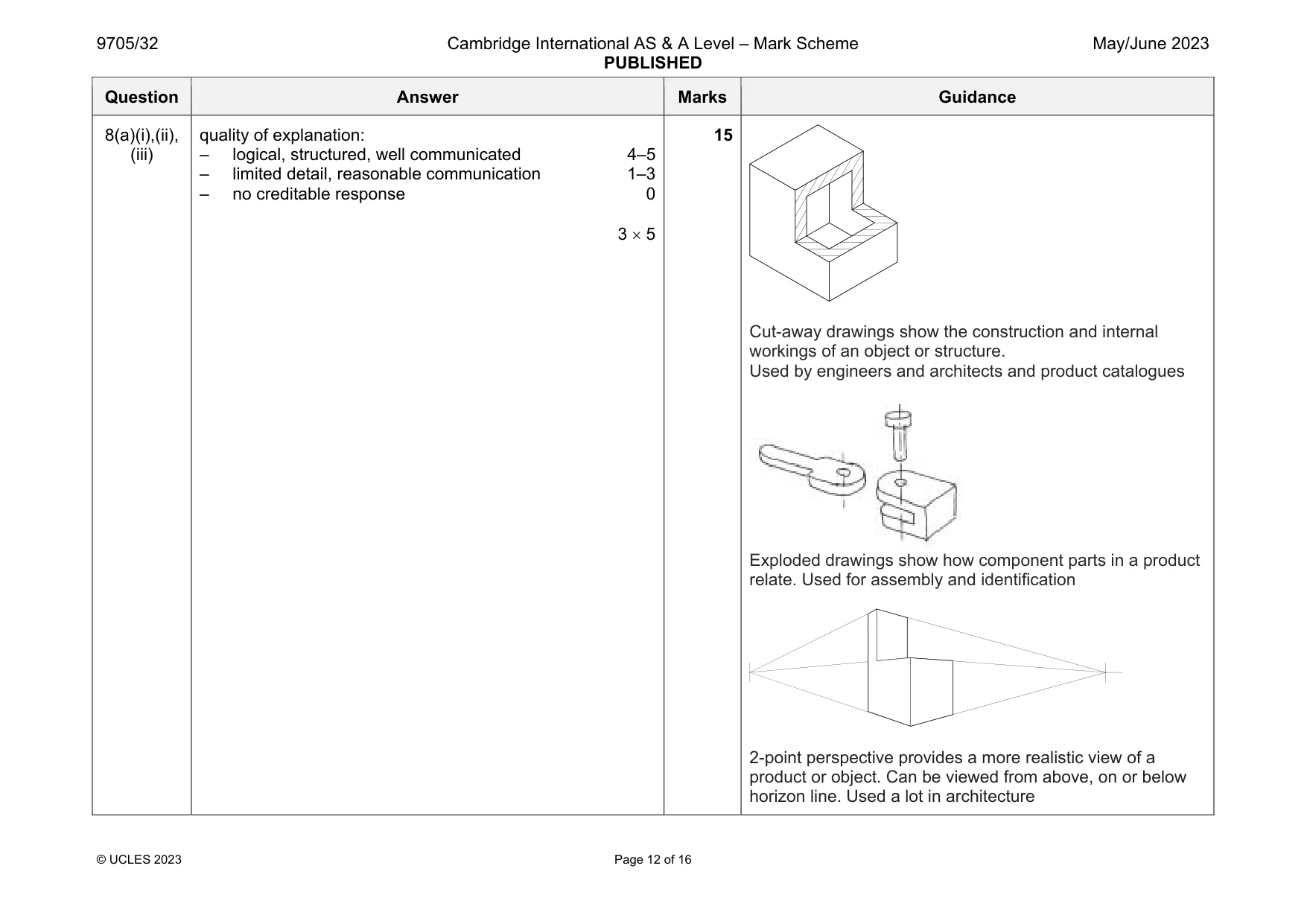
9705/32 Cambridge International AS & A Level – Mark Scheme PUBLISHED May/June 2023 © UCLES 2023 Page 12 of 16 Question Answer Marks Guidance 8(a)(i),(ii), (iii) quality of explanation: – logical, structured, well communicated 4–5 – limited detail, reasonable communication 1–3 – no creditable response 0 3 5 15 Cut-away drawings show the construction and internal workings of an object or structure. Used by engineers and architects and product catalogues Exploded drawings show how component parts in a product relate. Used for assembly and identification 2-point perspective provides a more realistic view of a product or object. Can be viewed from above, on or below horizon line. Used a lot in architecture
Mark scheme, page 13
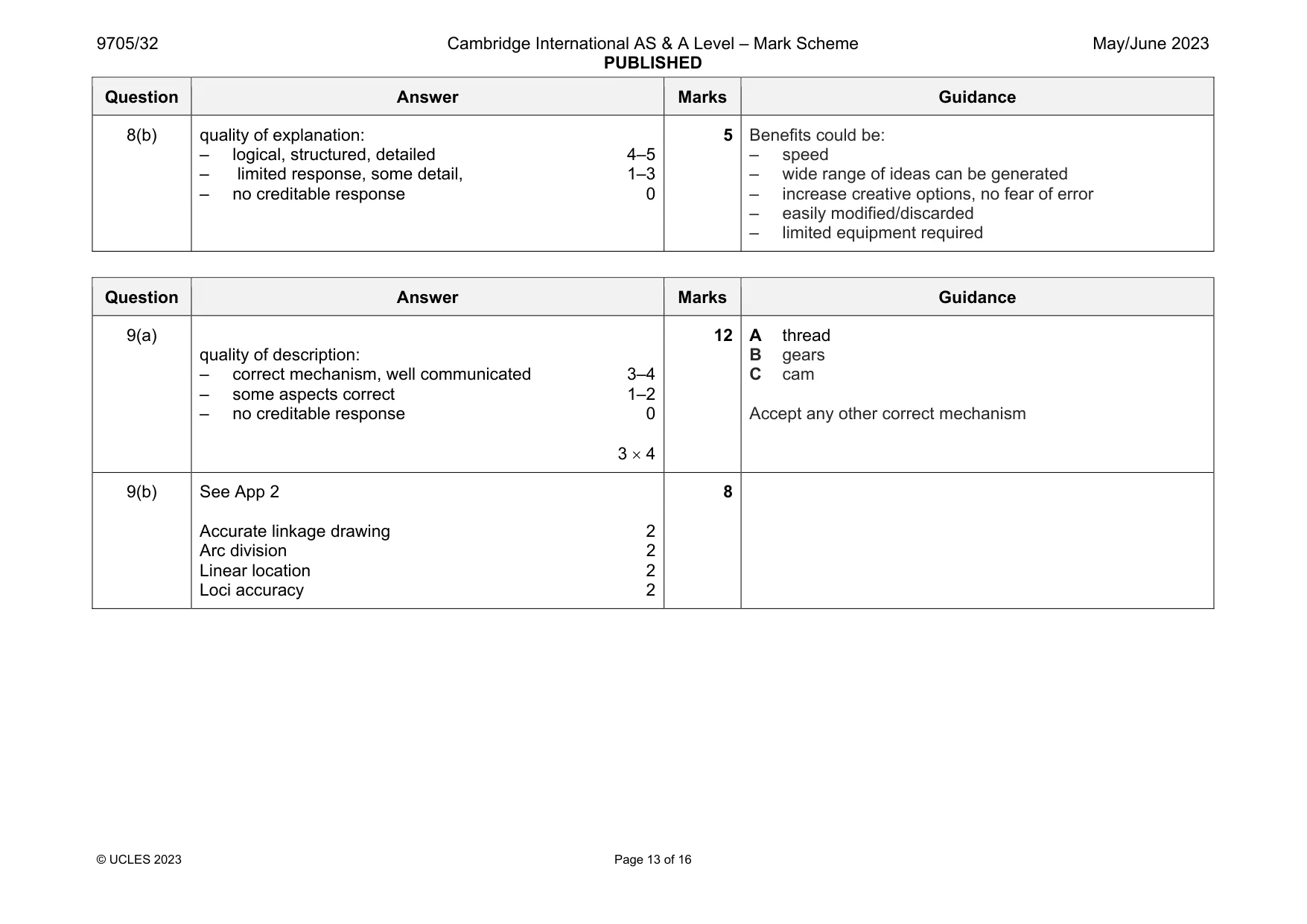
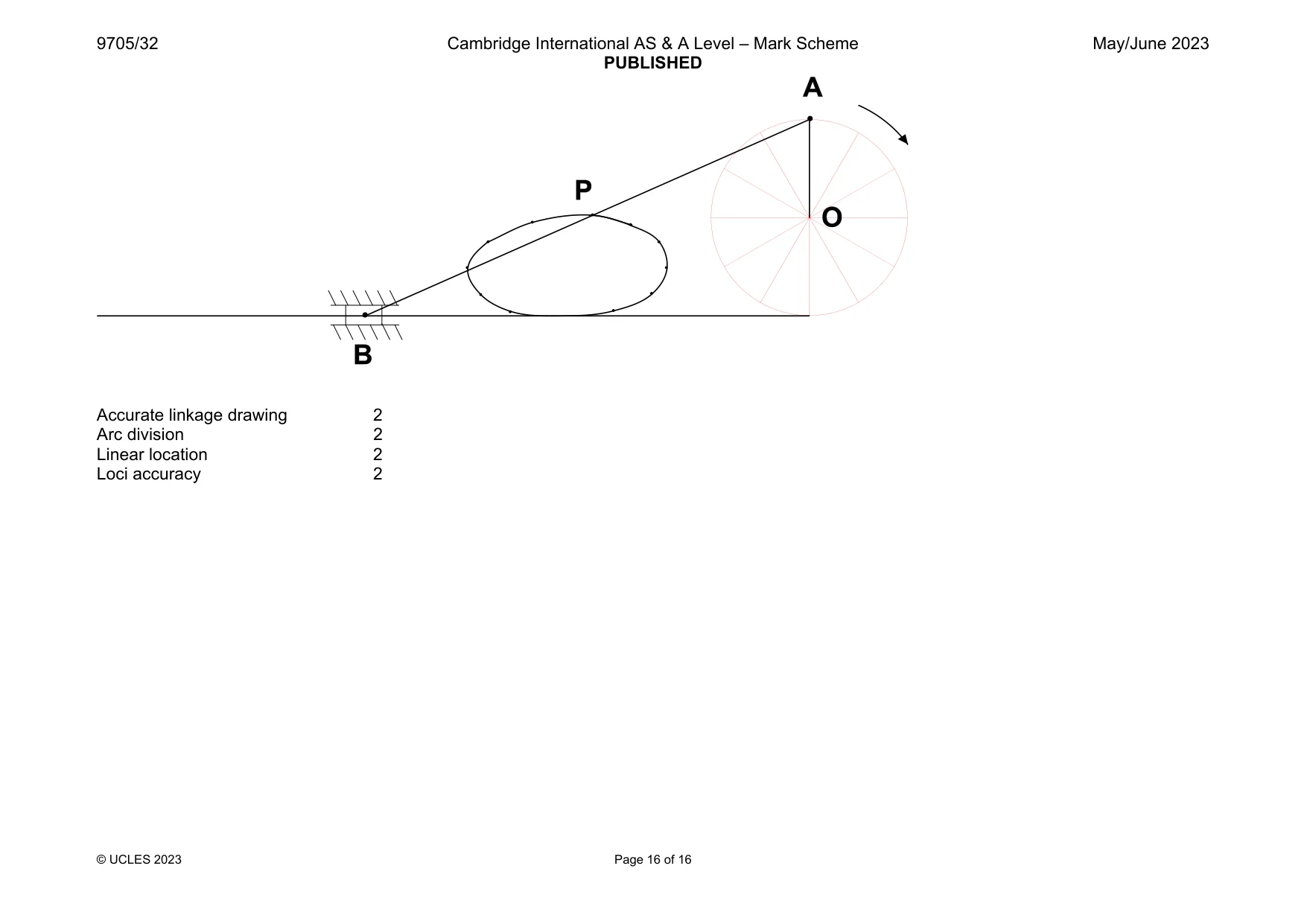
9705/32 Cambridge International AS & A Level – Mark Scheme PUBLISHED May/June 2023 © UCLES 2023 Page 13 of 16 Question Answer Marks Guidance 8(b) quality of explanation: – logical, structured, detailed 4–5 – limited response, some detail, 1–3 – no creditable response 0 5 Benefits could be: – speed – wide range of ideas can be generated – increase creative options, no fear of error – easily modified/discarded – limited equipment required Question Answer Marks Guidance 9(a) quality of description: – correct mechanism, well communicated 3–4 – some aspects correct 1–2 – no creditable response 0 3 4 12 A thread B gears C cam Accept any other correct mechanism 9(b) See App 2 Accurate linkage drawing 2 Arc division 2 Linear location 2 Loci accuracy 2 8
Mark scheme, page 14
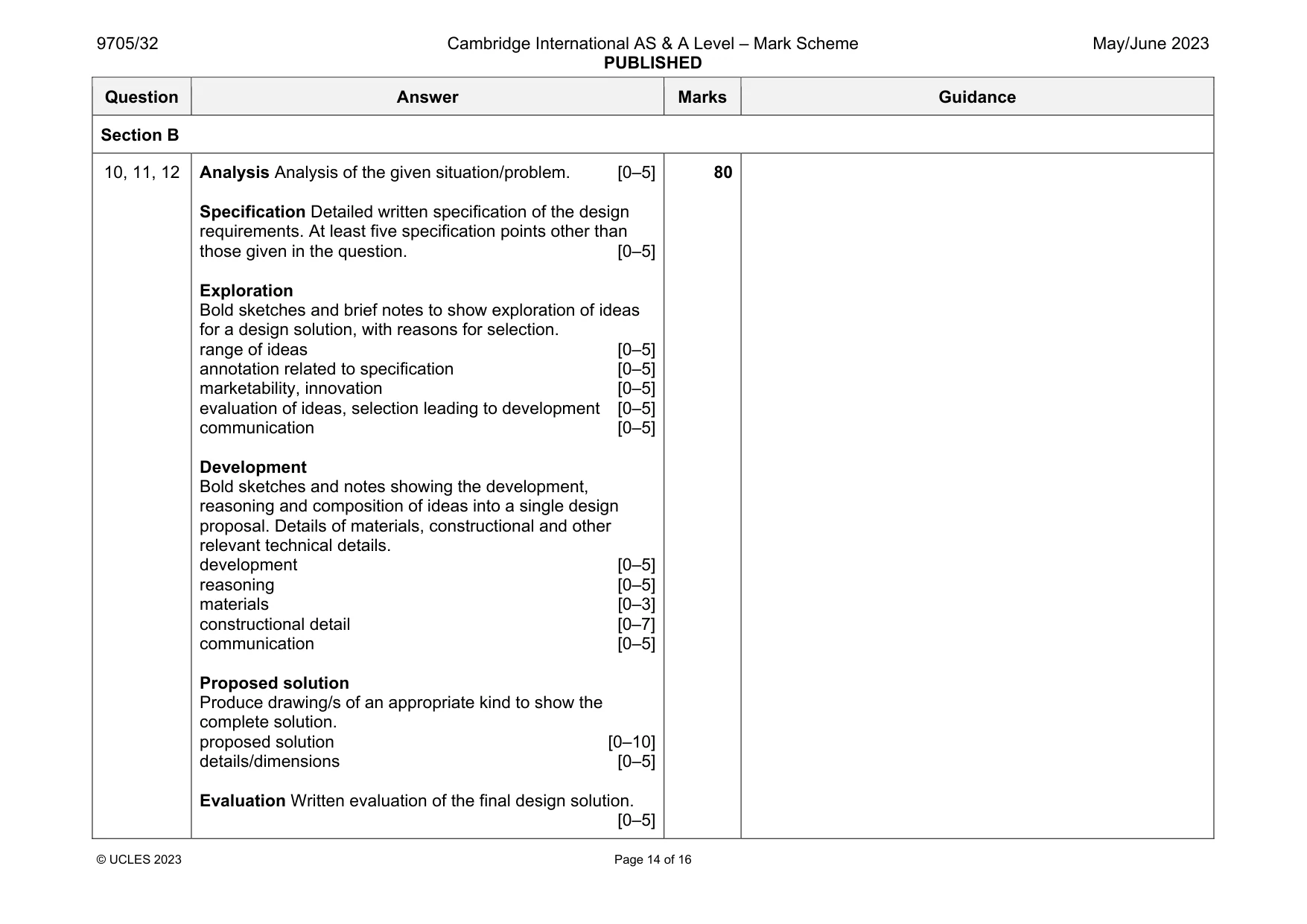
9705/32 Cambridge International AS & A Level – Mark Scheme PUBLISHED May/June 2023 © UCLES 2023 Page 14 of 16 Question Answer Marks Guidance Section B 10, 11, 12 Analysis Analysis of the given situation/problem. [0–5] Specification Detailed written specification of the design requirements. At least five specification points other than those given in the question. [0–5] Exploration Bold sketches and brief notes to show exploration of ideas for a design solution, with reasons for selection. range of ideas [0–5] annotation related to specification [0–5] marketability, innovation [0–5] evaluation of ideas, selection leading to development [0–5] communication [0–5] Development Bold sketches and notes showing the development, reasoning and composition of ideas into a single design proposal. Details of materials, constructional and other relevant technical details. development [0–5] reasoning [0–5] materials [0–3] constructional detail [0–7] communication [0–5] Proposed solution Produce drawing/s of an appropriate kind to show the complete solution. proposed solution [0–10] details/dimensions [0–5] Evaluation Written evaluation of the final design solution. [0–5] 80
Mark scheme, page 15
9705/32 Cambridge International AS & A Level – Mark Scheme PUBLISHED May/June 2023 © UCLES 2023 Page 15 of 16 App. 1 Q7 (a) App. 2 Q9 (b)
Mark scheme, page 16
9705/32 Cambridge International AS & A Level – Mark Scheme PUBLISHED May/June 2023 © UCLES 2023 Page 16 of 16 Accurate linkage drawing 2 Arc division 2 Linear location 2 Loci accuracy 2
What you needed in this session
Cambridge’s own grade thresholds for 2023 May/June, Paper 3 · Variant 2. A higher threshold means an easier paper — the bar moves with how the cohort did.