Cambridge A Level Design and Technology 9705 — 2024 Oct/Nov Paper 1 · Variant 2
9705/12/O/N/24 · 120 marks · ≈135 min
The question paper and its mark scheme, free to read here and free to download. This is Cambridge’s own paper, exactly as it was sat.
Question paper12 pages
Mark scheme16 pages
Answers below. Sit the paper first if you are practising.
Paper as text
Question paper, page 1
This document has 12 pages. Any blank pages are indicated. [Turn over * 9 9 1 4 0 0 7 2 1 7 * Cambridge International AS & A Level DESIGN & TECHNOLOGY 9705/12 Paper 1 October/November 2024 3 hours You must answer on the answer booklet/paper. You will need: Answer booklet/A4 paper Coloured pencils A3 drawing paper (2 sheets) Extra sheets of A3 drawing paper if needed A range of design drawing equipment INSTRUCTIONS ● Answer three questions in total: Section A: answer one question on the answer booklet/A4 paper provided. Section B: answer one question on the answer booklet/A4 paper provided. Section C: answer one question on A3 drawing paper. Use both sides of the paper. ● You may request additional sheets of A3 drawing paper, but only if you have used up both sides of each of the 2 sheets provided. ● If you have been given an answer booklet, follow the instructions on the front cover of the answer booklet. ● Use a black or dark blue pen. ● Write your name, centre number and candidate number on all the work you hand in. ● Do not use an erasable pen or correction fluid. ● You may use an HB pencil, or coloured pencils as appropriate, for any diagrams, graphs or rough working. ● At the end of the examination, fasten all your work together. Do not use staples, paper clips or glue. INFORMATION ● The total mark for this paper is 120. ● The number of marks for each question or part question is shown in brackets [ ]. ● All dimensions are in millimetres. DC (DE/FC) 337400/1 © UCLES 2024
Question paper, page 2
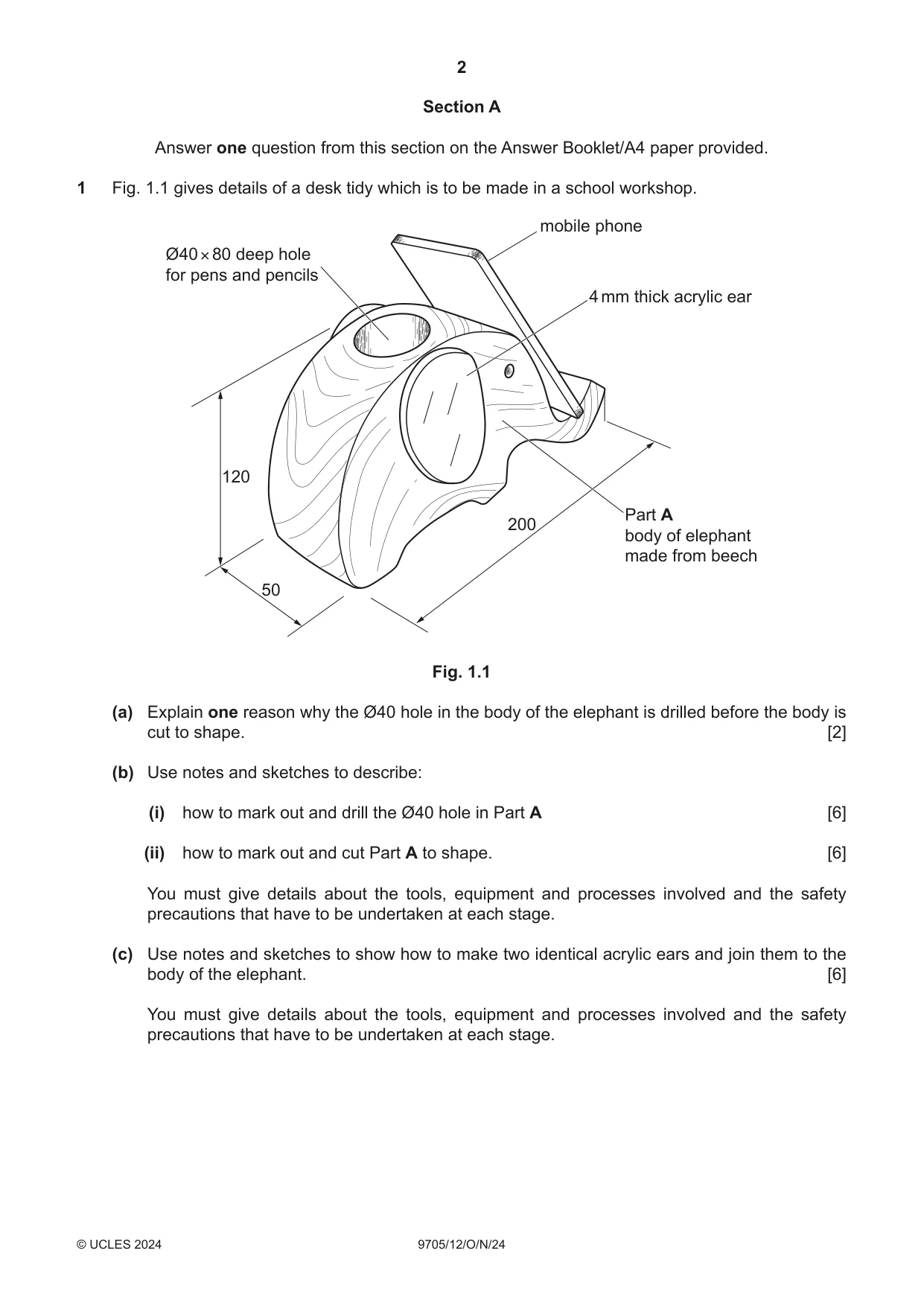
2 9705/12/O/N/24 © UCLES 2024 Section A Answer one question from this section on the Answer Booklet/A4 paper provided. 1 Fig. 1.1 gives details of a desk tidy which is to be made in a school workshop. Ø40 × 80 deep hole for pens and pencils mobile phone 120 200 50 4 mm thick acrylic ear Part A body of elephant made from beech Fig. 1.1 (a) Explain one reason why the Ø40 hole in the body of the elephant is drilled before the body is cut to shape. [2] (b) Use notes and sketches to describe: (i) how to mark out and drill the Ø40 hole in Part A [6] (ii) how to mark out and cut Part A to shape. [6] You must give details about the tools, equipment and processes involved and the safety precautions that have to be undertaken at each stage. (c) Use notes and sketches to show how to make two identical acrylic ears and join them to the body of the elephant. [6] You must give details about the tools, equipment and processes involved and the safety precautions that have to be undertaken at each stage.
Question paper, page 3
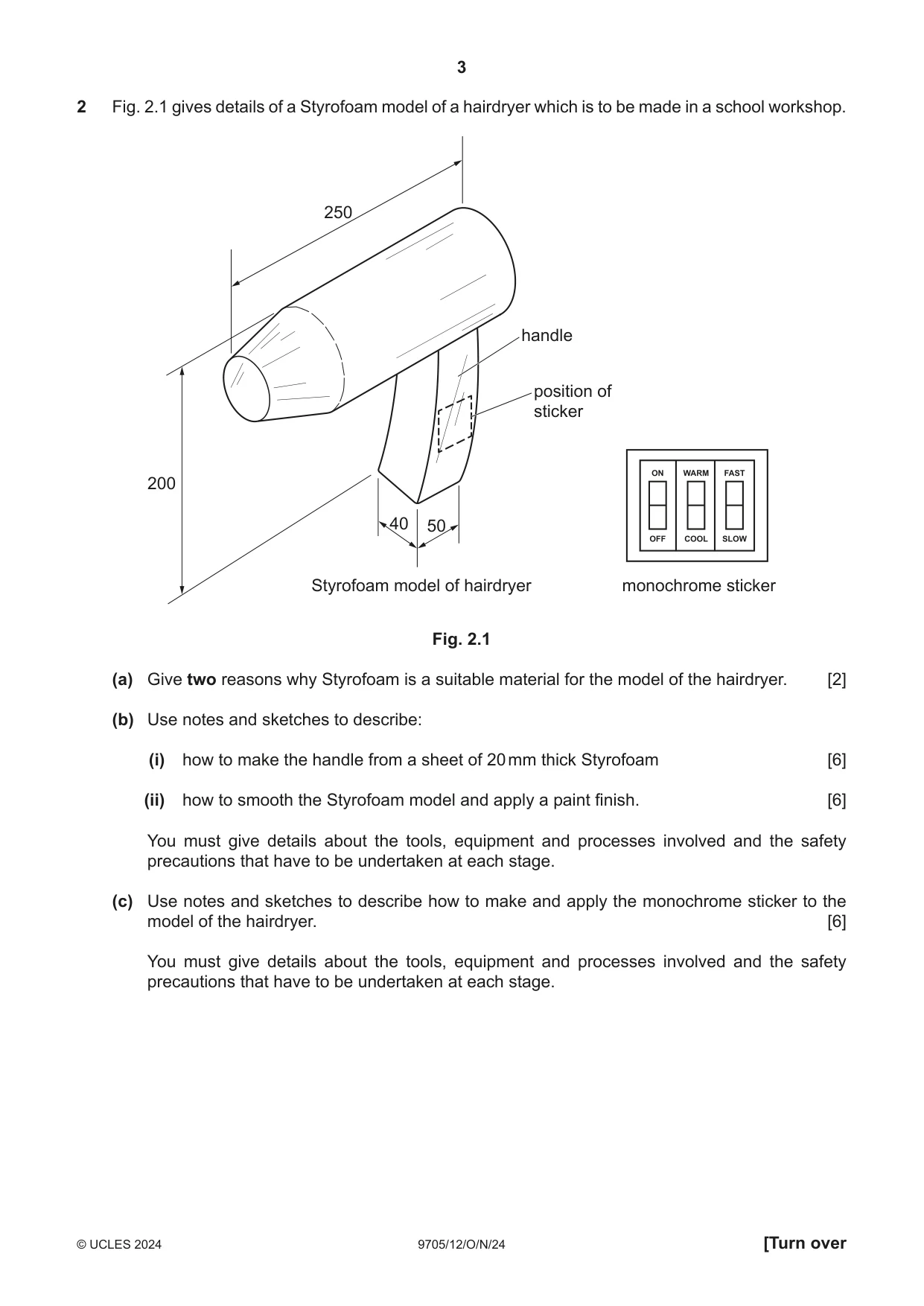
3 9705/12/O/N/24 © UCLES 2024 [Turn over 2 Fig. 2.1 gives details of a Styrofoam model of a hairdryer which is to be made in a school workshop. handle position of sticker Styrofoam model of hairdryer monochrome sticker 50 200 250 40 Fig. 2.1 (a) Give two reasons why Styrofoam is a suitable material for the model of the hairdryer. [2] (b) Use notes and sketches to describe: (i) how to make the handle from a sheet of 20 mm thick Styrofoam [6] (ii) how to smooth the Styrofoam model and apply a paint finish. [6] You must give details about the tools, equipment and processes involved and the safety precautions that have to be undertaken at each stage. (c) Use notes and sketches to describe how to make and apply the monochrome sticker to the model of the hairdryer. [6] You must give details about the tools, equipment and processes involved and the safety precautions that have to be undertaken at each stage.
Question paper, page 4
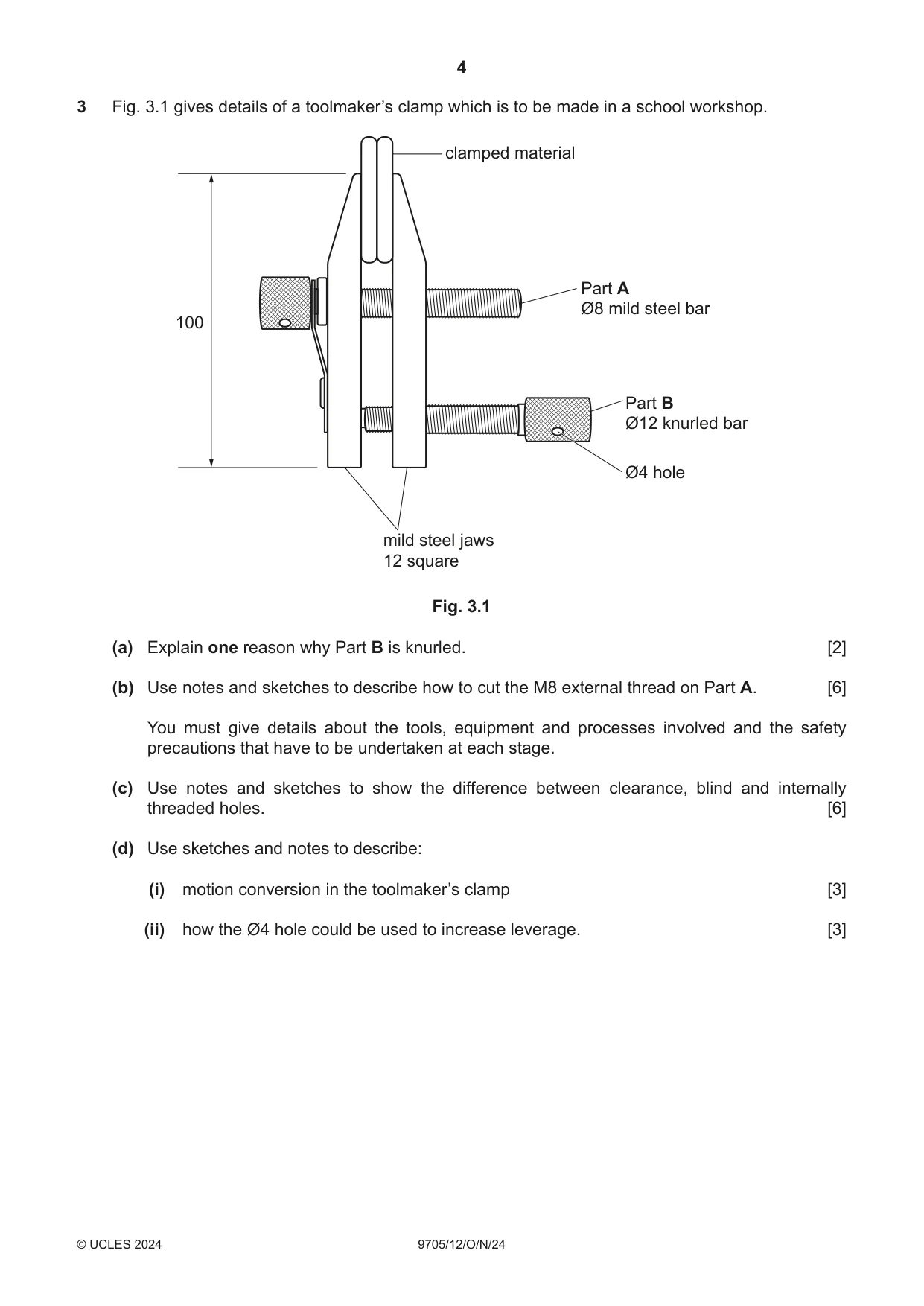
4 9705/12/O/N/24 © UCLES 2024 3 Fig. 3.1 gives details of a toolmaker’s clamp which is to be made in a school workshop. 100 clamped material mild steel jaws 12 square Part A Ø8 mild steel bar Part B Ø12 knurled bar Ø4 hole Fig. 3.1 (a) Explain one reason why Part B is knurled. [2] (b) Use notes and sketches to describe how to cut the M8 external thread on Part A. [6] You must give details about the tools, equipment and processes involved and the safety precautions that have to be undertaken at each stage. (c) Use notes and sketches to show the difference between clearance, blind and internally threaded holes. [6] (d) Use sketches and notes to describe: (i) motion conversion in the toolmaker’s clamp [3] (ii) how the Ø4 hole could be used to increase leverage. [3]
Question paper, page 5
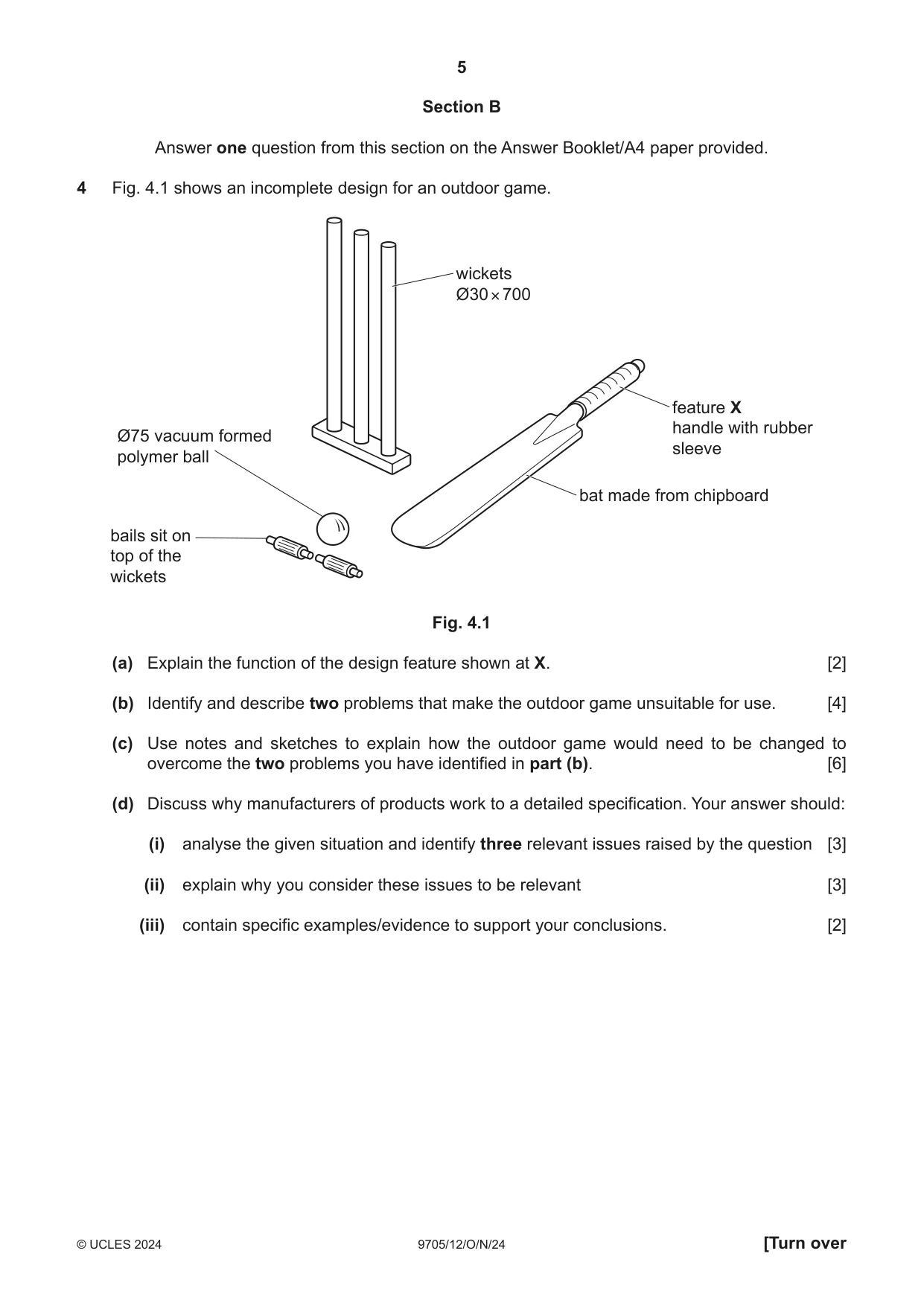
5 9705/12/O/N/24 © UCLES 2024 [Turn over Section B Answer one question from this section on the Answer Booklet/A4 paper provided. 4 Fig. 4.1 shows an incomplete design for an outdoor game. bails sit on top of the wickets Ø75 vacuum formed polymer ball feature X handle with rubber sleeve bat made from chipboard wickets Ø30 × 700 Fig. 4.1 (a) Explain the function of the design feature shown at X. [2] (b) Identify and describe two problems that make the outdoor game unsuitable for use. [4] (c) Use notes and sketches to explain how the outdoor game would need to be changed to overcome the two problems you have identified in part (b). [6] (d) Discuss why manufacturers of products work to a detailed specification. Your answer should: (i) analyse the given situation and identify three relevant issues raised by the question [3] (ii) explain why you consider these issues to be relevant [3] (iii) contain specific examples/evidence to support your conclusions. [2]
Question paper, page 6
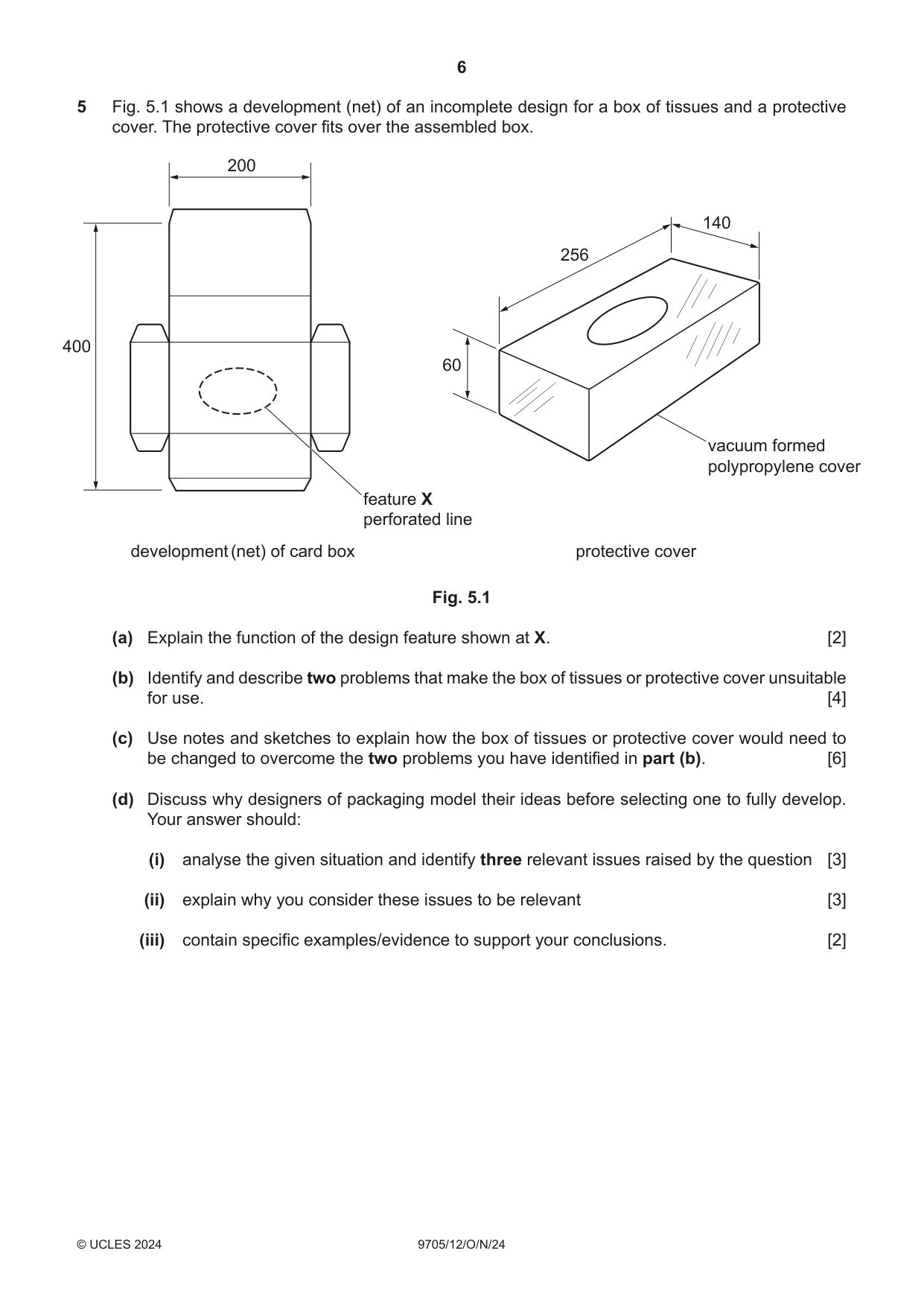
6 9705/12/O/N/24 © UCLES 2024 5 Fig. 5.1 shows a development (net) of an incomplete design for a box of tissues and a protective cover. The protective cover fits over the assembled box. 200 256 140 60 400 feature X perforated line vacuum formed polypropylene cover development (net) of card box protective cover Fig. 5.1 (a) Explain the function of the design feature shown at X. [2] (b) Identify and describe two problems that make the box of tissues or protective cover unsuitable for use. [4] (c) Use notes and sketches to explain how the box of tissues or protective cover would need to be changed to overcome the two problems you have identified in part (b). [6] (d) Discuss why designers of packaging model their ideas before selecting one to fully develop. Your answer should: (i) analyse the given situation and identify three relevant issues raised by the question [3] (ii) explain why you consider these issues to be relevant [3] (iii) contain specific examples/evidence to support your conclusions. [2]
Question paper, page 7
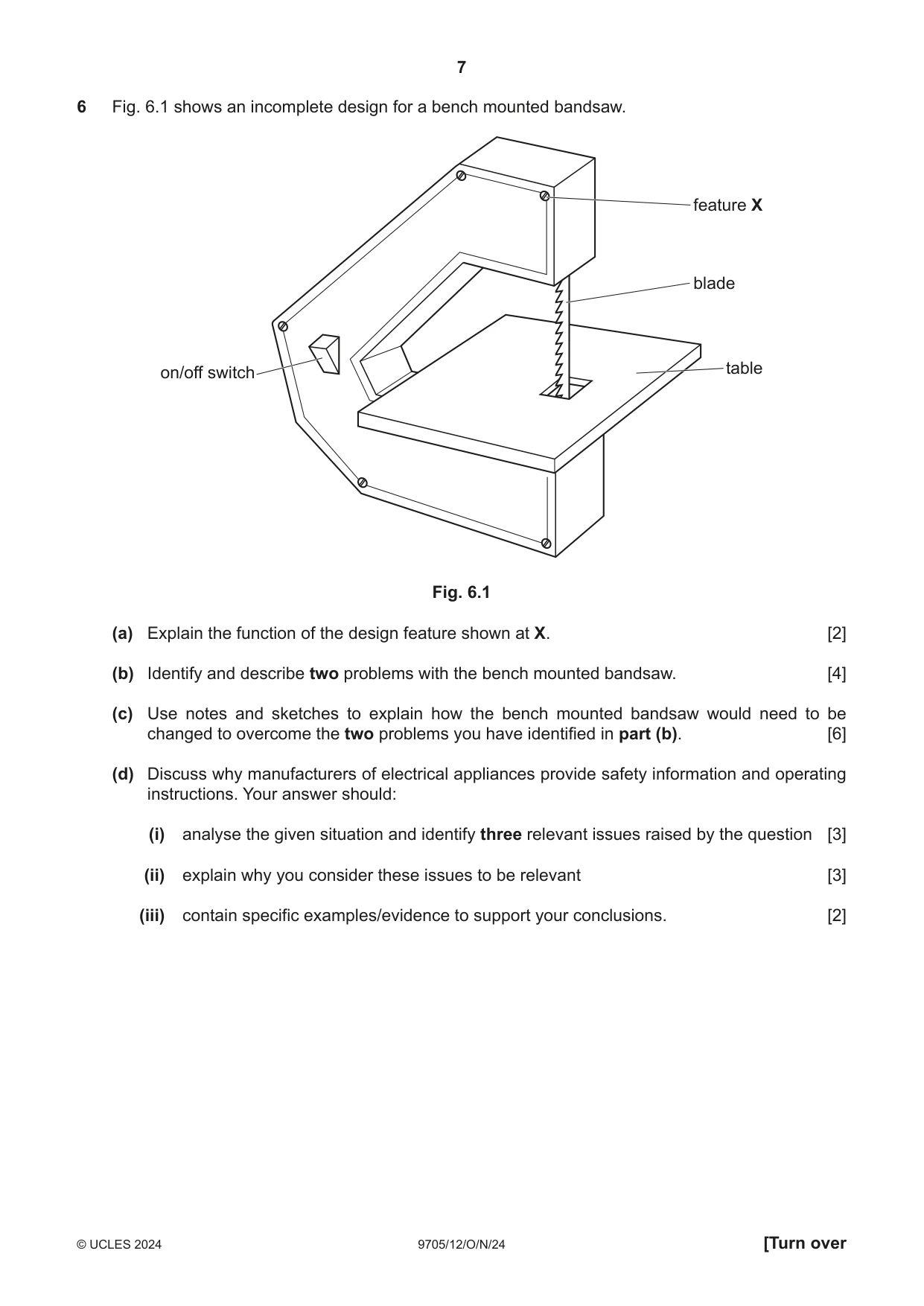
7 9705/12/O/N/24 © UCLES 2024 [Turn over 6 Fig. 6.1 shows an incomplete design for a bench mounted bandsaw. on/off switch feature X blade table Fig. 6.1 (a) Explain the function of the design feature shown at X. [2] (b) Identify and describe two problems with the bench mounted bandsaw. [4] (c) Use notes and sketches to explain how the bench mounted bandsaw would need to be changed to overcome the two problems you have identified in part (b). [6] (d) Discuss why manufacturers of electrical appliances provide safety information and operating instructions. Your answer should: (i) analyse the given situation and identify three relevant issues raised by the question [3] (ii) explain why you consider these issues to be relevant [3] (iii) contain specific examples/evidence to support your conclusions. [2]
Question paper, page 8
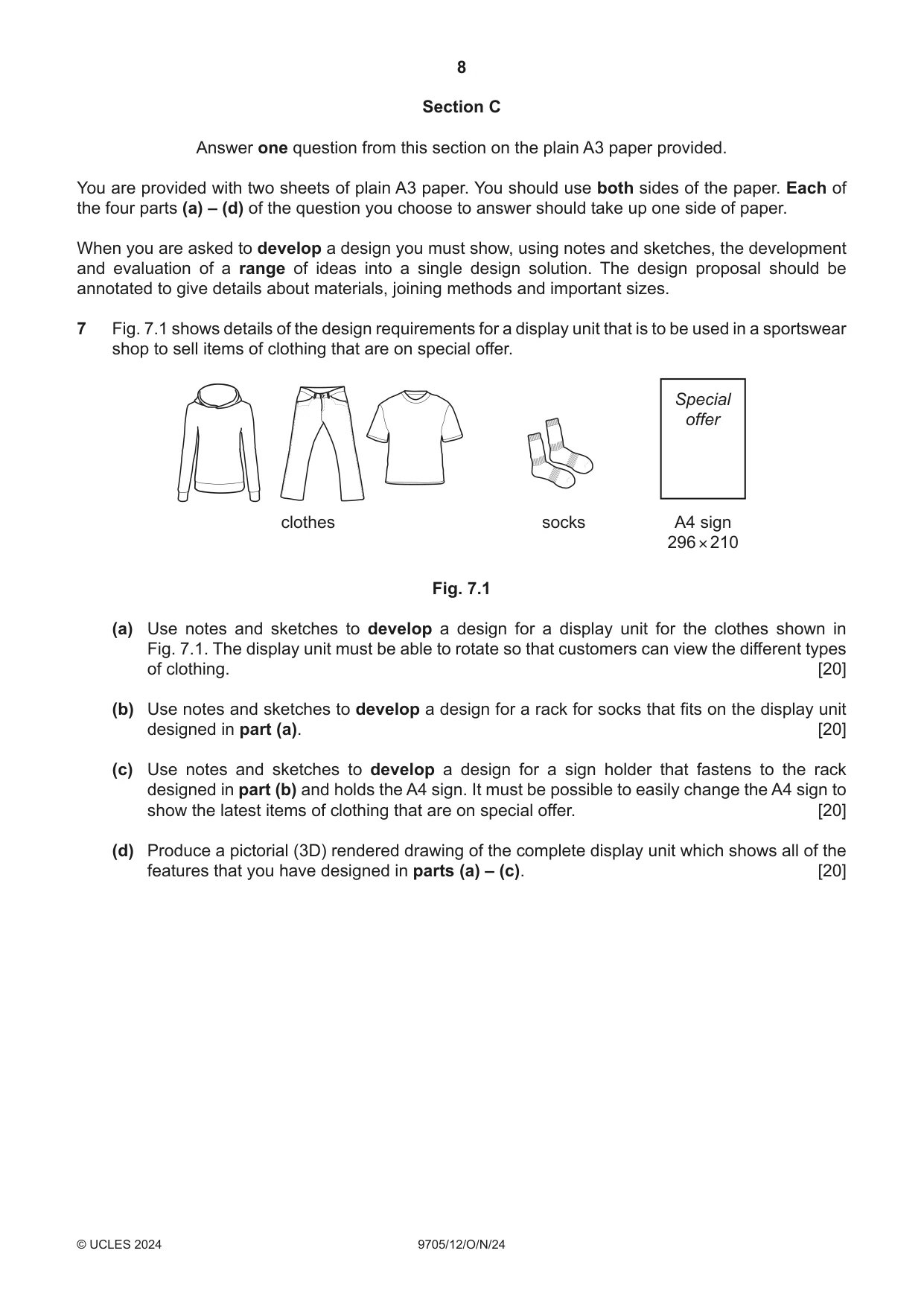
8 9705/12/O/N/24 © UCLES 2024 Section C Answer one question from this section on the plain A3 paper provided. You are provided with two sheets of plain A3 paper. You should use both sides of the paper. Each of the four parts (a) – (d) of the question you choose to answer should take up one side of paper. When you are asked to develop a design you must show, using notes and sketches, the development and evaluation of a range of ideas into a single design solution. The design proposal should be annotated to give details about materials, joining methods and important sizes. 7 Fig. 7.1 shows details of the design requirements for a display unit that is to be used in a sportswear shop to sell items of clothing that are on special offer. clothes socks A4 sign 296 × 210 Special offer Fig. 7.1 (a) Use notes and sketches to develop a design for a display unit for the clothes shown in Fig. 7.1. The display unit must be able to rotate so that customers can view the different types of clothing. [20] (b) Use notes and sketches to develop a design for a rack for socks that fits on the display unit designed in part (a). [20] (c) Use notes and sketches to develop a design for a sign holder that fastens to the rack designed in part (b) and holds the A4 sign. It must be possible to easily change the A4 sign to show the latest items of clothing that are on special offer. [20] (d) Produce a pictorial (3D) rendered drawing of the complete display unit which shows all of the features that you have designed in parts (a) – (c). [20]
Question paper, page 9
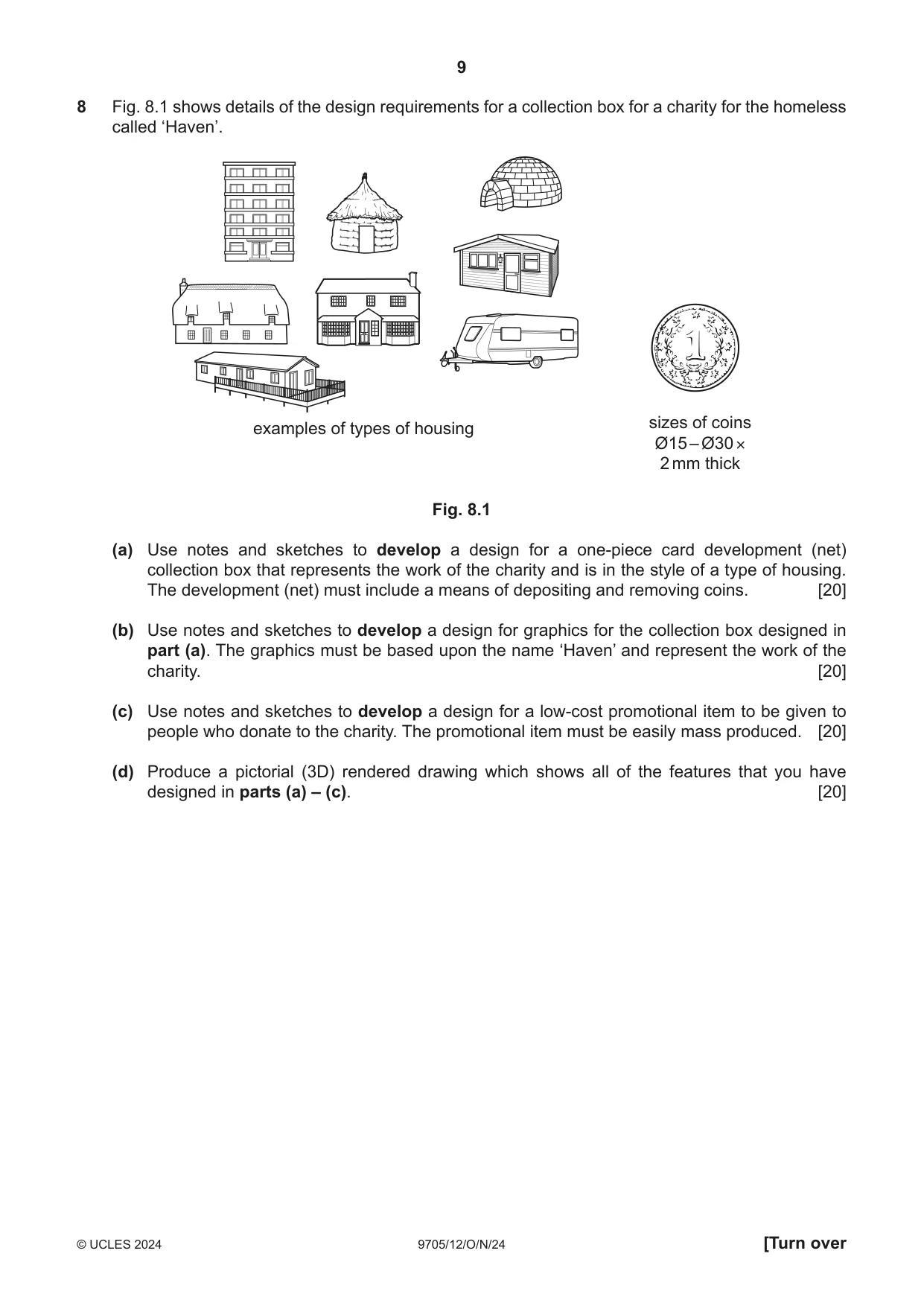
9 9705/12/ O/N/24 © UCLES 2024 [Turn over 8 Fig. 8.1 shows details of the design requirements for a collection box for a charity for the homeless called ‘Haven’. examples of types of housing sizes of coins Ø15–Ø30× 2mm thick Fig. 8.1 (a) Use notes and sketches to develop a design for a one-piece card development (net) collection box that represents the work of the charity and is in the style of a type of housing. The development (net) must include a means of depositing and removing coins. [20] (b) Use notes and sketches to develop a design for graphics for the collection box designed in part (a). The graphics must be based upon the name ‘Haven’ and represent the work of the charity. [20] (c) Use notes and sketches to develop a design for a low-cost promotional item to be given to people who donate to the charity. The promotional item must be easily mass produced. [20] (d) Produce a pictorial (3D) rendered drawing which shows all of the features that you have designed in parts (a) – (c). [20]
Question paper, page 10
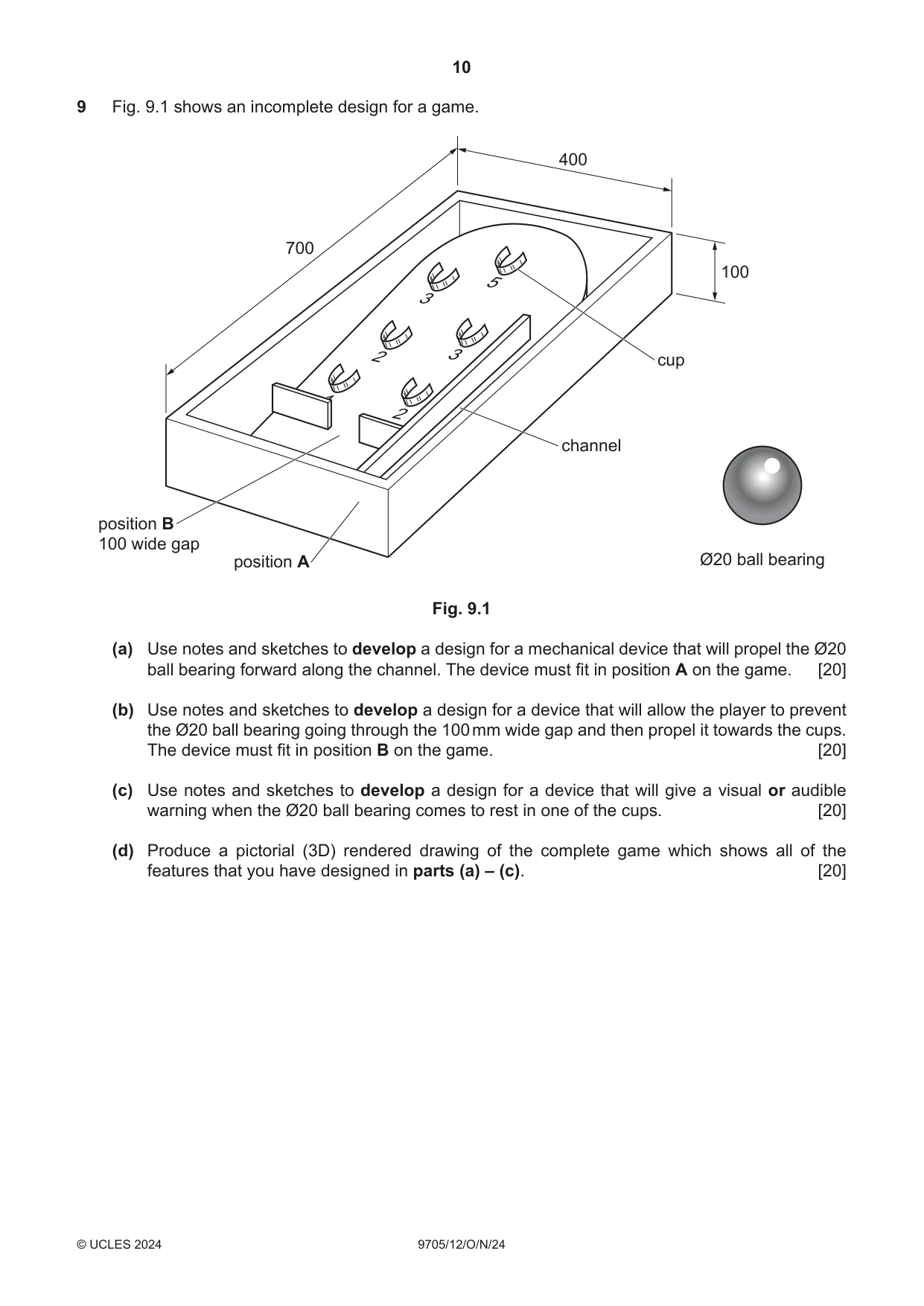
10 9705/12/O/N/24 © UCLES 2024 9 Fig. 9.1 shows an incomplete design for a game. 2 3 5 3 2 1 700 400 100 cup channel Ø20 ball bearing position A position B 100 wide gap Fig. 9.1 (a) Use notes and sketches to develop a design for a mechanical device that will propel the Ø20 ball bearing forward along the channel. The device must fit in position A on the game. [20] (b) Use notes and sketches to develop a design for a device that will allow the player to prevent the Ø20 ball bearing going through the 100 mm wide gap and then propel it towards the cups. The device must fit in position B on the game. [20] (c) Use notes and sketches to develop a design for a device that will give a visual or audible warning when the Ø20 ball bearing comes to rest in one of the cups. [20] (d) Produce a pictorial (3D) rendered drawing of the complete game which shows all of the features that you have designed in parts (a) – (c). [20]
Question paper, page 11
11 9705/12/O/N/24 © UCLES 2024 BLANK PAGE
Question paper, page 12
12 9705/12/O/N/24 © UCLES 2024 Permission to reproduce items where third-party owned material protected by copyright is included has been sought and cleared where possible. Every reasonable effort has been made by the publisher (UCLES) to trace copyright holders, but if any items requiring clearance have unwittingly been included, the publisher will be pleased to make amends at the earliest possible opportunity. To avoid the issue of disclosure of answer-related information to candidates, all copyright acknowledgements are reproduced online in the Cambridge Assessment International Education Copyright Acknowledgements Booklet. This is produced for each series of examinations and is freely available to download at www.cambridgeinternational.org after the live examination series. Cambridge Assessment International Education is part of Cambridge Assessment. Cambridge Assessment is the brand name of the University of Cambridge Local Examinations Syndicate (UCLES), which is a department of the University of Cambridge. BLANK PAGE
Mark scheme, page 1
This document consists of 16 printed pages. © Cambridge University Press & Assessment 2024 [Turn over Cambridge International AS & A Level DESIGN & TECHNOLOGY 9705/12 Paper 1 October/November 2024 MARK SCHEME Maximum Mark: 120 Published This mark scheme is published as an aid to teachers and candidates, to indicate the requirements of the examination. It shows the basis on which Examiners were instructed to award marks. It does not indicate the details of the discussions that took place at an Examiners’ meeting before marking began, which would have considered the acceptability of alternative answers. Mark schemes should be read in conjunction with the question paper and the Principal Examiner Report for Teachers. Cambridge International will not enter into discussions about these mark schemes. Cambridge International is publishing the mark schemes for the October/November 2024 series for most Cambridge IGCSE, Cambridge International A and AS Level components, and some Cambridge O Level components.
Mark scheme, page 2
9705/12 Cambridge International AS & A Level – Mark Scheme PUBLISHED October/November 2024 © Cambridge University Press & Assessment 2024 Page 2 of 16 Generic Marking Principles These general marking principles must be applied by all examiners when marking candidate answers. They should be applied alongside the specific content of the mark scheme or generic level descriptions for a question. Each question paper and mark scheme will also comply with these marking principles. GENERIC MARKING PRINCIPLE 1: Marks must be awarded in line with: • the specific content of the mark scheme or the generic level descriptors for the question • the specific skills defined in the mark scheme or in the generic level descriptors for the question • the standard of response required by a candidate as exemplified by the standardisation scripts. GENERIC MARKING PRINCIPLE 2: Marks awarded are always whole marks (not half marks, or other fractions). GENERIC MARKING PRINCIPLE 3: Marks must be awarded positively: • marks are awarded for correct/valid answers, as defined in the mark scheme. However, credit is given for valid answers which go beyond the scope of the syllabus and mark scheme, referring to your Team Leader as appropriate • marks are awarded when candidates clearly demonstrate what they know and can do • marks are not deducted for errors • marks are not deducted for omissions • answers should only be judged on the quality of spelling, punctuation and grammar when these features are specifically assessed by the question as indicated by the mark scheme. The meaning, however, should be unambiguous. GENERIC MARKING PRINCIPLE 4: Rules must be applied consistently, e.g. in situations where candidates have not followed instructions or in the application of generic level descriptors.
Mark scheme, page 3
9705/12 Cambridge International AS & A Level – Mark Scheme PUBLISHED October/November 2024 © Cambridge University Press & Assessment 2024 Page 3 of 16 GENERIC MARKING PRINCIPLE 5: Marks should be awarded using the full range of marks defined in the mark scheme for the question (however; the use of the full mark range may be limited according to the quality of the candidate responses seen). GENERIC MARKING PRINCIPLE 6: Marks awarded are based solely on the requirements as defined in the mark scheme. Marks should not be awarded with grade thresholds or grade descriptors in mind.
Mark scheme, page 4
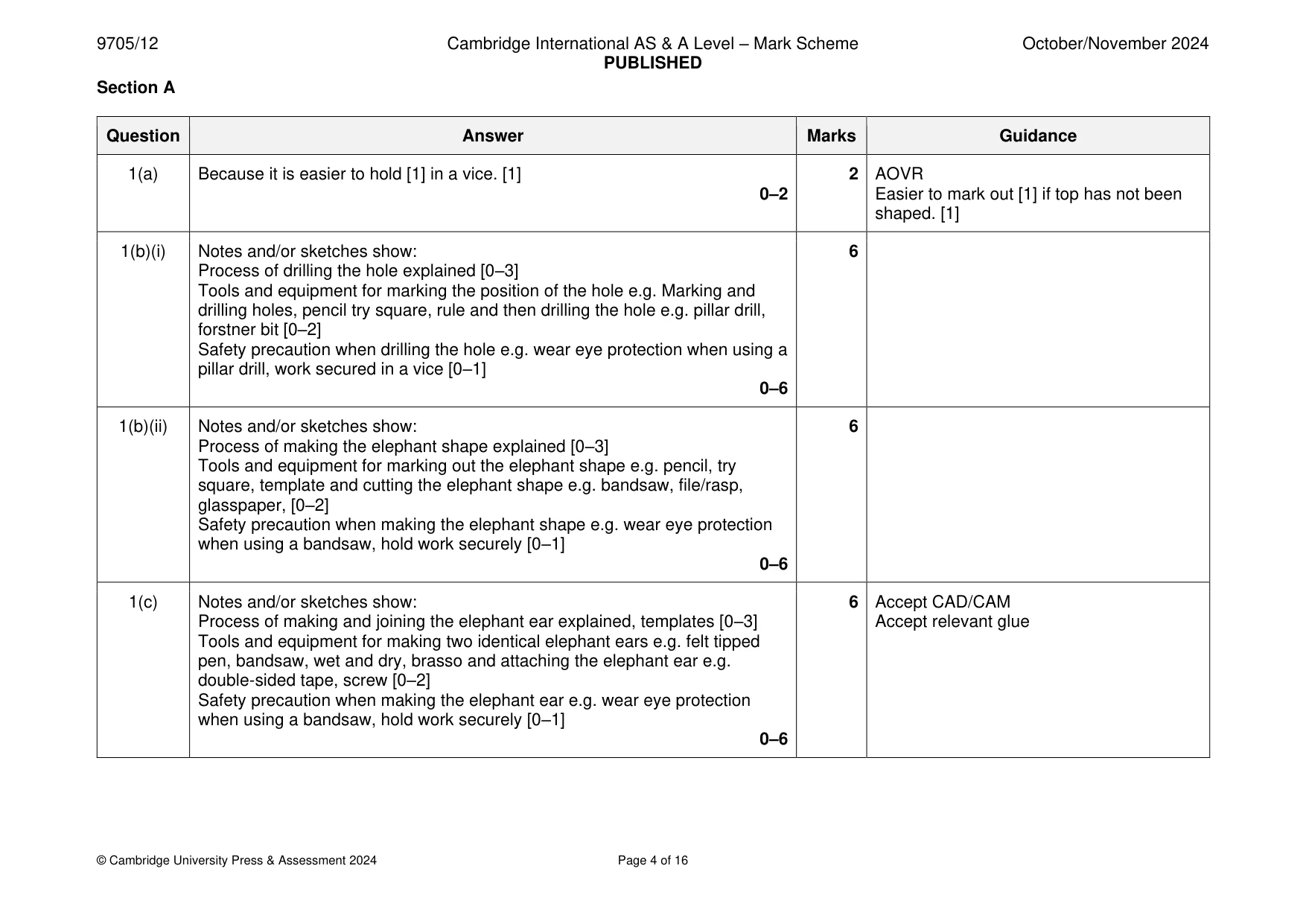
9705/12 Cambridge International AS & A Level – Mark Scheme PUBLISHED October/November 2024 © Cambridge University Press & Assessment 2024 Page 4 of 16 Section A Question Answer Marks Guidance 1(a) Because it is easier to hold [1] in a vice. [1] 0–2 2 AOVR Easier to mark out [1] if top has not been shaped. [1] 1(b)(i) Notes and/or sketches show: Process of drilling the hole explained [0–3] Tools and equipment for marking the position of the hole e.g. Marking and drilling holes, pencil try square, rule and then drilling the hole e.g. pillar drill, forstner bit [0–2] Safety precaution when drilling the hole e.g. wear eye protection when using a pillar drill, work secured in a vice [0–1] 0–6 6 1(b)(ii) Notes and/or sketches show: Process of making the elephant shape explained [0–3] Tools and equipment for marking out the elephant shape e.g. pencil, try square, template and cutting the elephant shape e.g. bandsaw, file/rasp, glasspaper, [0–2] Safety precaution when making the elephant shape e.g. wear eye protection when using a bandsaw, hold work securely [0–1] 0–6 6 1(c) Notes and/or sketches show: Process of making and joining the elephant ear explained, templates [0–3] Tools and equipment for making two identical elephant ears e.g. felt tipped pen, bandsaw, wet and dry, brasso and attaching the elephant ear e.g. double-sided tape, screw [0–2] Safety precaution when making the elephant ear e.g. wear eye protection when using a bandsaw, hold work securely [0–1] 0–6 6 Accept CAD/CAM Accept relevant glue
Mark scheme, page 5
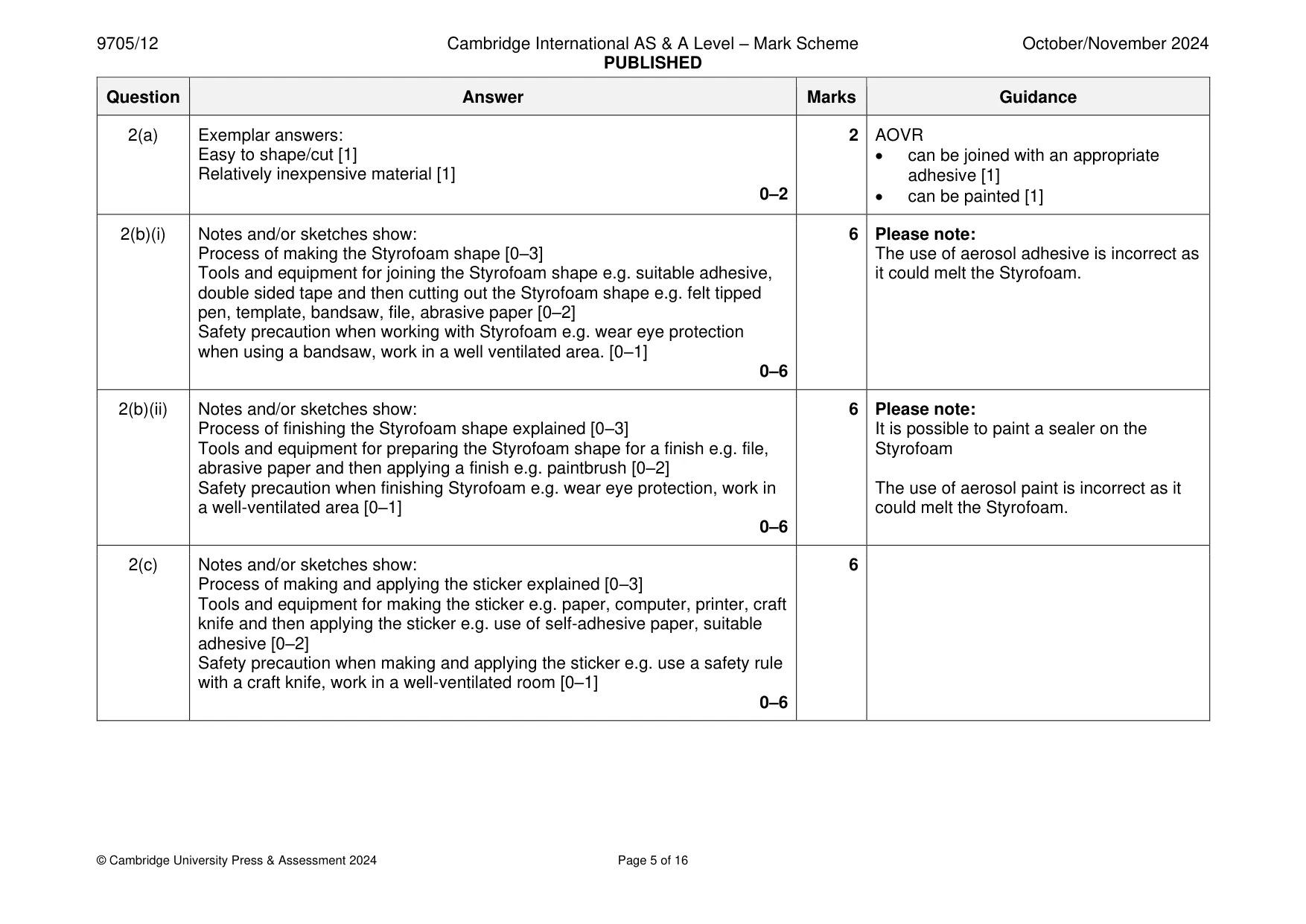
9705/12 Cambridge International AS & A Level – Mark Scheme PUBLISHED October/November 2024 © Cambridge University Press & Assessment 2024 Page 5 of 16 Question Answer Marks Guidance 2(a) Exemplar answers: Easy to shape/cut [1] Relatively inexpensive material [1] 0–2 2 AOVR • can be joined with an appropriate adhesive [1] • can be painted [1] 2(b)(i) Notes and/or sketches show: Process of making the Styrofoam shape [0–3] Tools and equipment for joining the Styrofoam shape e.g. suitable adhesive, double sided tape and then cutting out the Styrofoam shape e.g. felt tipped pen, template, bandsaw, file, abrasive paper [0–2] Safety precaution when working with Styrofoam e.g. wear eye protection when using a bandsaw, work in a well ventilated area. [0–1] 0–6 6 Please note: The use of aerosol adhesive is incorrect as it could melt the Styrofoam. 2(b)(ii) Notes and/or sketches show: Process of finishing the Styrofoam shape explained [0–3] Tools and equipment for preparing the Styrofoam shape for a finish e.g. file, abrasive paper and then applying a finish e.g. paintbrush [0–2] Safety precaution when finishing Styrofoam e.g. wear eye protection, work in a well-ventilated area [0–1] 0–6 6 Please note: It is possible to paint a sealer on the Styrofoam The use of aerosol paint is incorrect as it could melt the Styrofoam. 2(c) Notes and/or sketches show: Process of making and applying the sticker explained [0–3] Tools and equipment for making the sticker e.g. paper, computer, printer, craft knife and then applying the sticker e.g. use of self-adhesive paper, suitable adhesive [0–2] Safety precaution when making and applying the sticker e.g. use a safety rule with a craft knife, work in a well-ventilated room [0–1] 0–6 6
Mark scheme, page 6
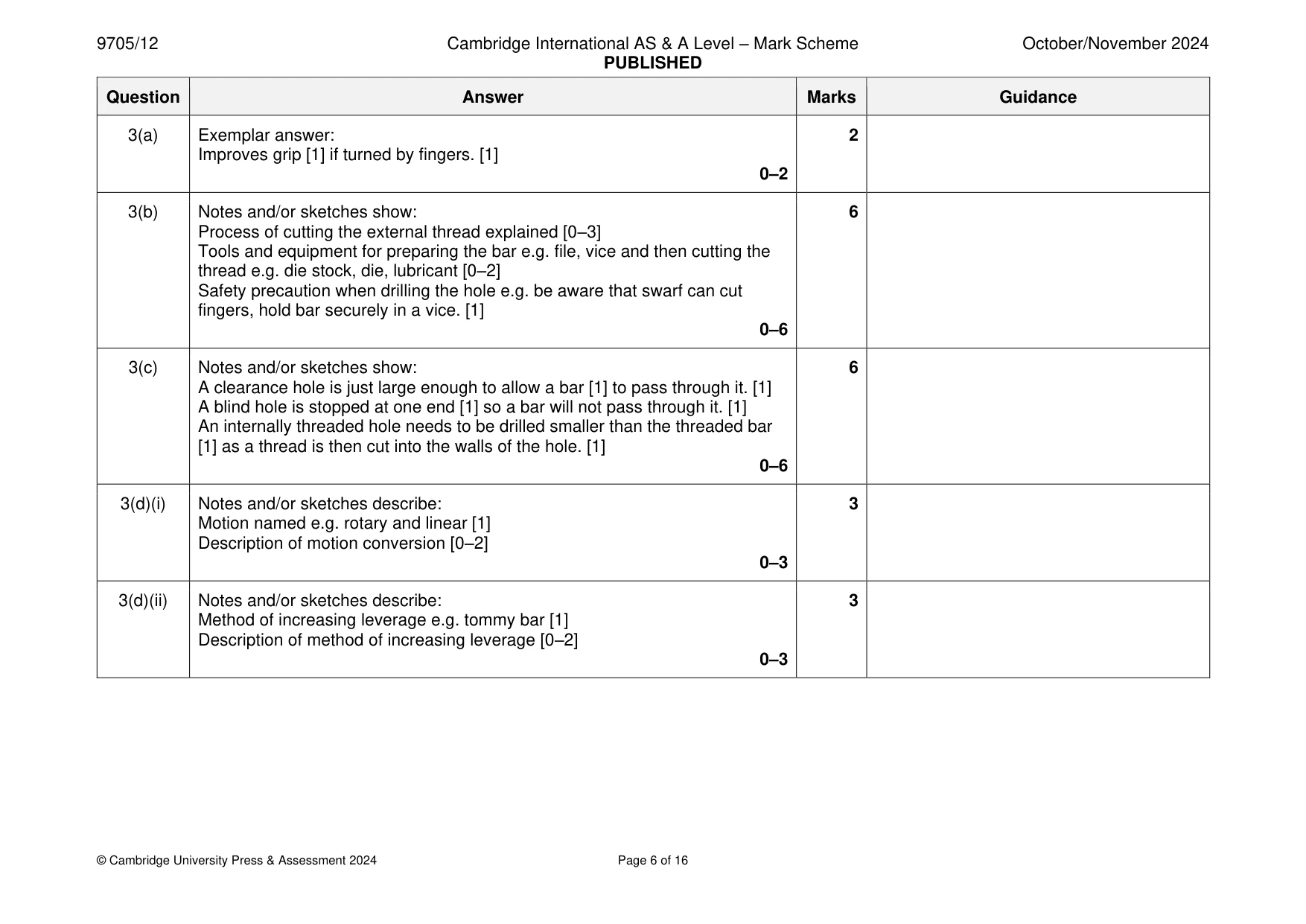
9705/12 Cambridge International AS & A Level – Mark Scheme PUBLISHED October/November 2024 © Cambridge University Press & Assessment 2024 Page 6 of 16 Question Answer Marks Guidance 3(a) Exemplar answer: Improves grip [1] if turned by fingers. [1] 0–2 2 3(b) Notes and/or sketches show: Process of cutting the external thread explained [0–3] Tools and equipment for preparing the bar e.g. file, vice and then cutting the thread e.g. die stock, die, lubricant [0–2] Safety precaution when drilling the hole e.g. be aware that swarf can cut fingers, hold bar securely in a vice. [1] 0–6 6 3(c) Notes and/or sketches show: A clearance hole is just large enough to allow a bar [1] to pass through it. [1] A blind hole is stopped at one end [1] so a bar will not pass through it. [1] An internally threaded hole needs to be drilled smaller than the threaded bar [1] as a thread is then cut into the walls of the hole. [1] 0–6 6 3(d)(i) Notes and/or sketches describe: Motion named e.g. rotary and linear [1] Description of motion conversion [0–2] 0–3 3 3(d)(ii) Notes and/or sketches describe: Method of increasing leverage e.g. tommy bar [1] Description of method of increasing leverage [0–2] 0–3 3
Mark scheme, page 7
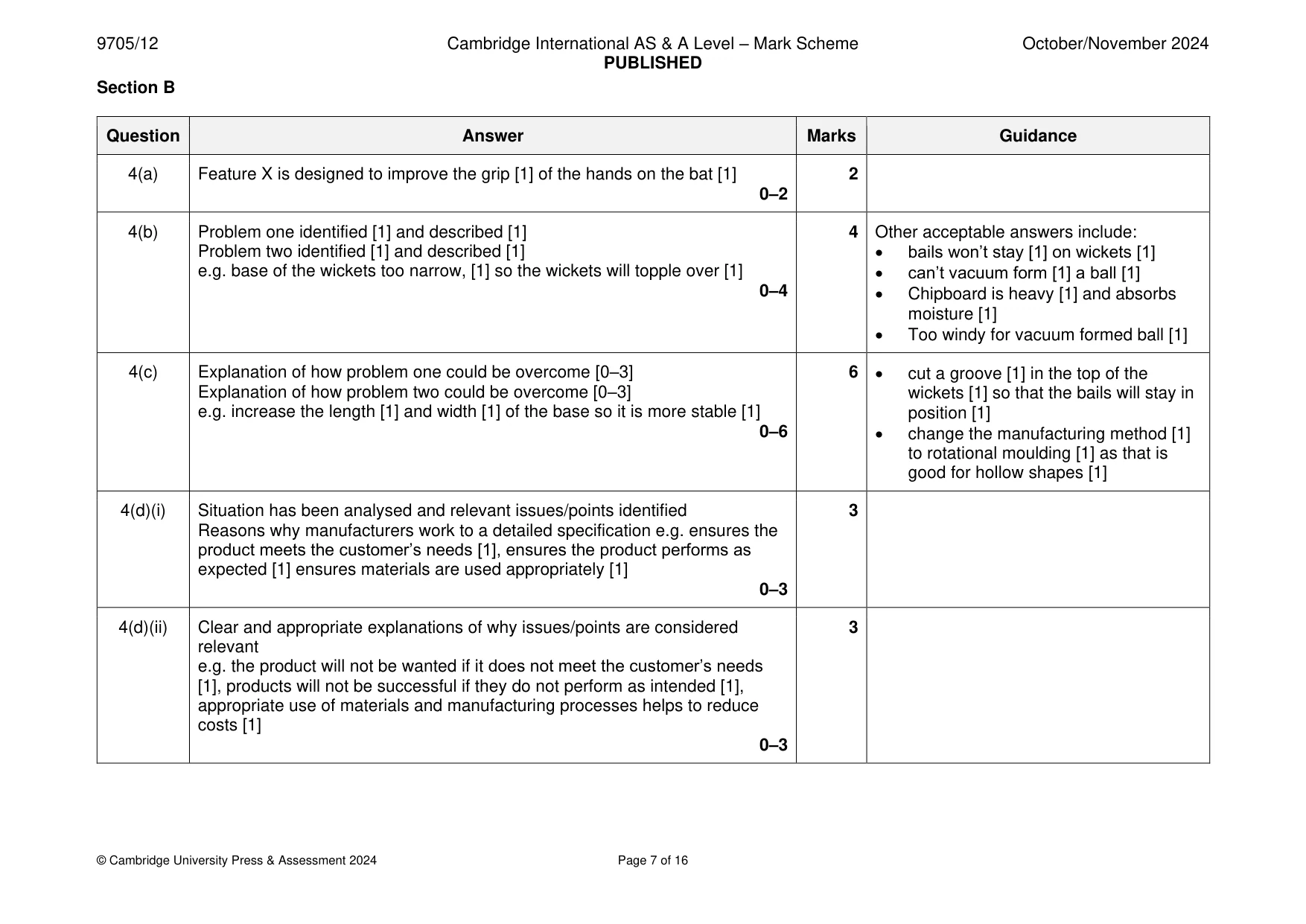
9705/12 Cambridge International AS & A Level – Mark Scheme PUBLISHED October/November 2024 © Cambridge University Press & Assessment 2024 Page 7 of 16 Section B Question Answer Marks Guidance 4(a) Feature X is designed to improve the grip [1] of the hands on the bat [1] 0–2 2 4(b) Problem one identified [1] and described [1] Problem two identified [1] and described [1] e.g. base of the wickets too narrow, [1] so the wickets will topple over [1] 0–4 4 Other acceptable answers include: • bails won’t stay [1] on wickets [1] • can’t vacuum form [1] a ball [1] • Chipboard is heavy [1] and absorbs moisture [1] • Too windy for vacuum formed ball [1] 4(c) Explanation of how problem one could be overcome [0–3] Explanation of how problem two could be overcome [0–3] e.g. increase the length [1] and width [1] of the base so it is more stable [1] 0–6 6 • cut a groove [1] in the top of the wickets [1] so that the bails will stay in position [1] • change the manufacturing method [1] to rotational moulding [1] as that is good for hollow shapes [1] 4(d)(i) Situation has been analysed and relevant issues/points identified Reasons why manufacturers work to a detailed specification e.g. ensures the product meets the customer’s needs [1], ensures the product performs as expected [1] ensures materials are used appropriately [1] 0–3 3 4(d)(ii) Clear and appropriate explanations of why issues/points are considered relevant e.g. the product will not be wanted if it does not meet the customer’s needs [1], products will not be successful if they do not perform as intended [1], appropriate use of materials and manufacturing processes helps to reduce costs [1] 0–3 3
Mark scheme, page 8
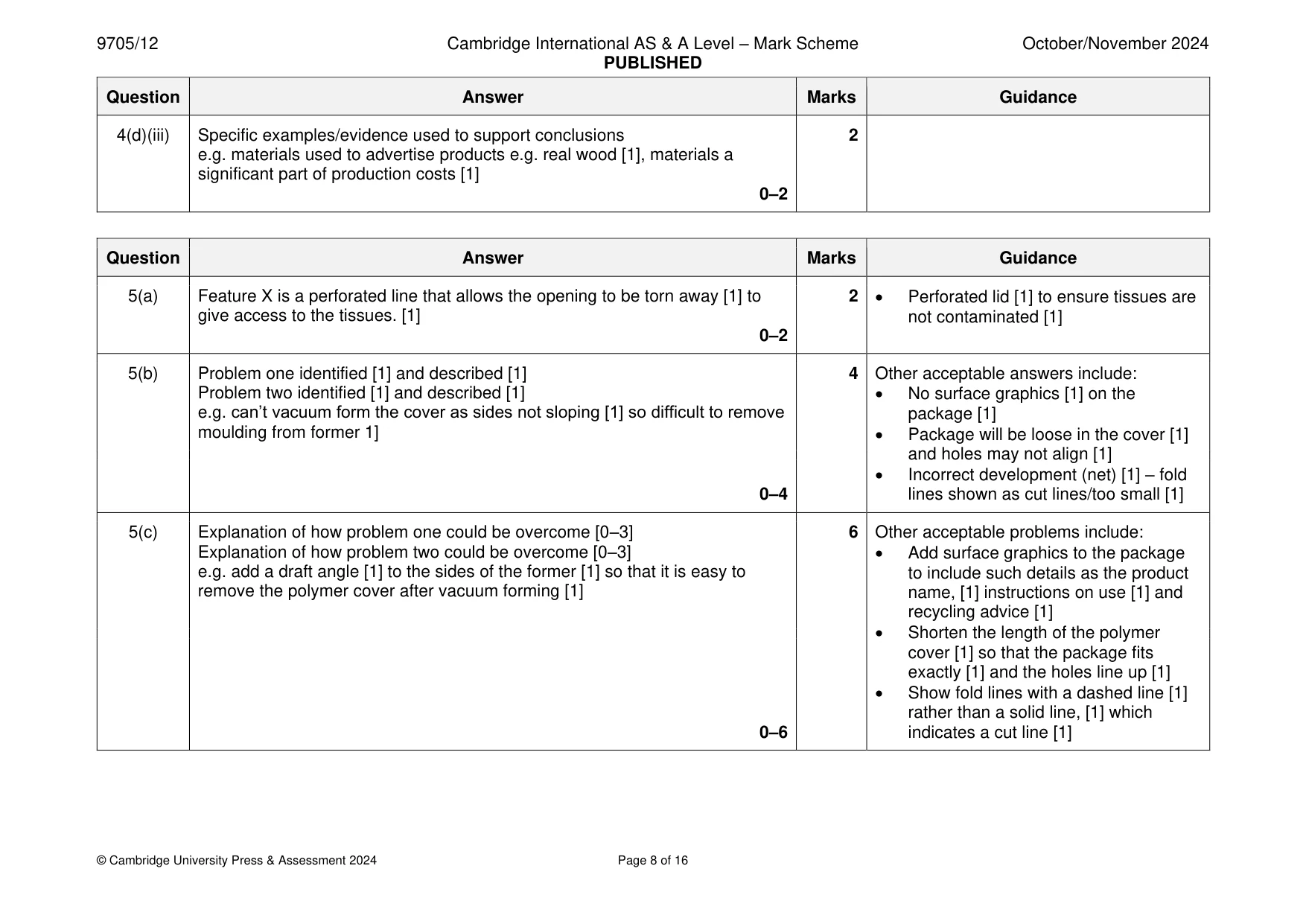
9705/12 Cambridge International AS & A Level – Mark Scheme PUBLISHED October/November 2024 © Cambridge University Press & Assessment 2024 Page 8 of 16 Question Answer Marks Guidance 4(d)(iii) Specific examples/evidence used to support conclusions e.g. materials used to advertise products e.g. real wood [1], materials a significant part of production costs [1] 0–2 2 Question Answer Marks Guidance 5(a) Feature X is a perforated line that allows the opening to be torn away [1] to give access to the tissues. [1] 0–2 2 • Perforated lid [1] to ensure tissues are not contaminated [1] 5(b) Problem one identified [1] and described [1] Problem two identified [1] and described [1] e.g. can’t vacuum form the cover as sides not sloping [1] so difficult to remove moulding from former 1] 4 Other acceptable answers include: • No surface graphics [1] on the package [1] • Package will be loose in the cover [1] and holes may not align [1] • Incorrect development (net) [1] – fold lines shown as cut lines/too small [1] 0–4 5(c) Explanation of how problem one could be overcome [0–3] Explanation of how problem two could be overcome [0–3] e.g. add a draft angle [1] to the sides of the former [1] so that it is easy to remove the polymer cover after vacuum forming [1] 6 Other acceptable problems include: • Add surface graphics to the package to include such details as the product name, [1] instructions on use [1] and recycling advice [1] • Shorten the length of the polymer cover [1] so that the package fits exactly [1] and the holes line up [1] • Show fold lines with a dashed line [1] rather than a solid line, [1] which indicates a cut line [1] 0–6
Mark scheme, page 9
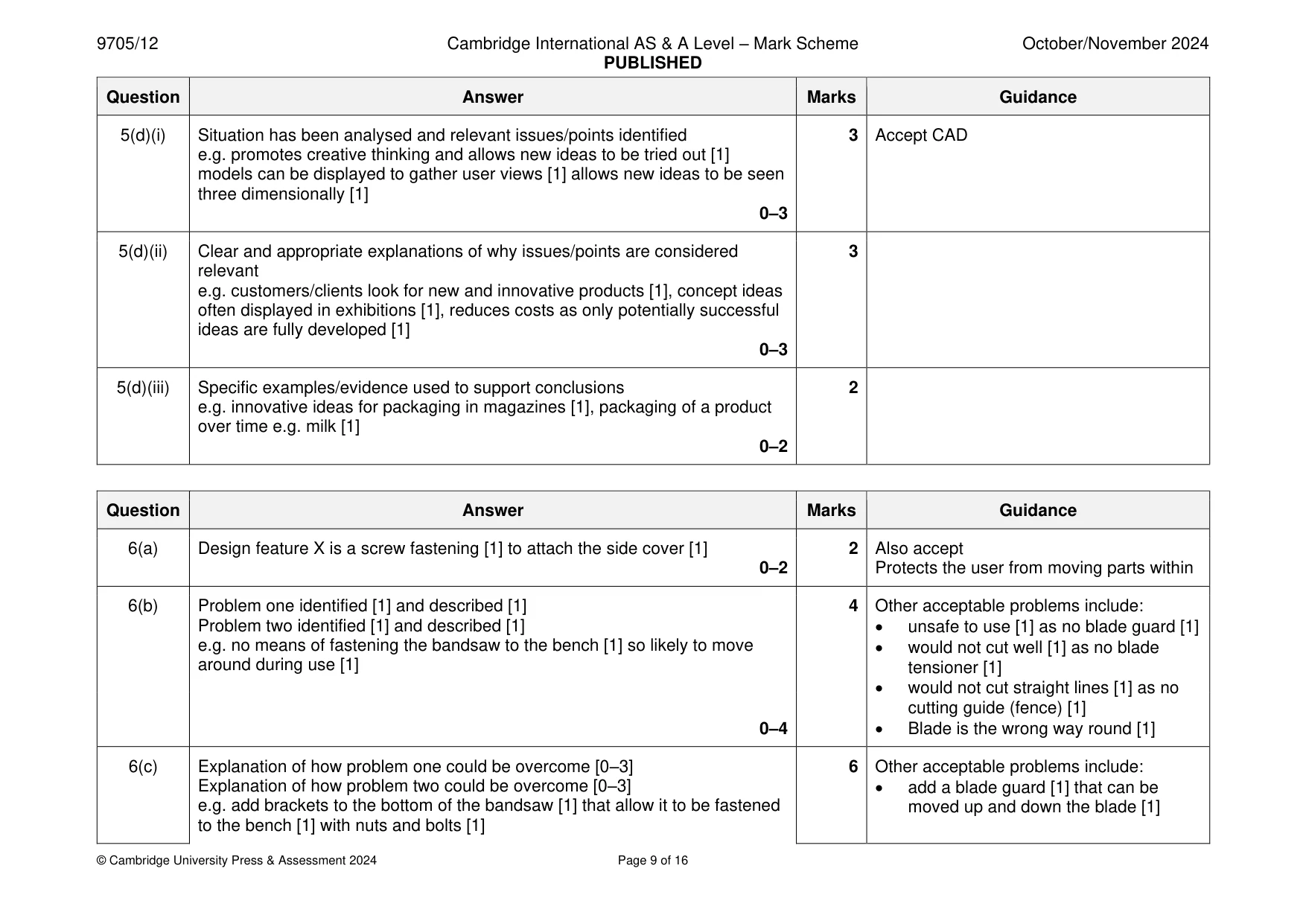
9705/12 Cambridge International AS & A Level – Mark Scheme PUBLISHED October/November 2024 © Cambridge University Press & Assessment 2024 Page 9 of 16 Question Answer Marks Guidance 5(d)(i) Situation has been analysed and relevant issues/points identified e.g. promotes creative thinking and allows new ideas to be tried out [1] models can be displayed to gather user views [1] allows new ideas to be seen three dimensionally [1] 0–3 3 Accept CAD 5(d)(ii) Clear and appropriate explanations of why issues/points are considered relevant e.g. customers/clients look for new and innovative products [1], concept ideas often displayed in exhibitions [1], reduces costs as only potentially successful ideas are fully developed [1] 0–3 3 5(d)(iii) Specific examples/evidence used to support conclusions e.g. innovative ideas for packaging in magazines [1], packaging of a product over time e.g. milk [1] 0–2 2 Question Answer Marks Guidance 6(a) Design feature X is a screw fastening [1] to attach the side cover [1] 0–2 2 Also accept Protects the user from moving parts within 6(b) Problem one identified [1] and described [1] Problem two identified [1] and described [1] e.g. no means of fastening the bandsaw to the bench [1] so likely to move around during use [1] 4 Other acceptable problems include: • unsafe to use [1] as no blade guard [1] • would not cut well [1] as no blade tensioner [1] • would not cut straight lines [1] as no cutting guide (fence) [1] • Blade is the wrong way round [1] 0–4 6(c) Explanation of how problem one could be overcome [0–3] Explanation of how problem two could be overcome [0–3] e.g. add brackets to the bottom of the bandsaw [1] that allow it to be fastened to the bench [1] with nuts and bolts [1] 6 Other acceptable problems include: • add a blade guard [1] that can be moved up and down the blade [1]
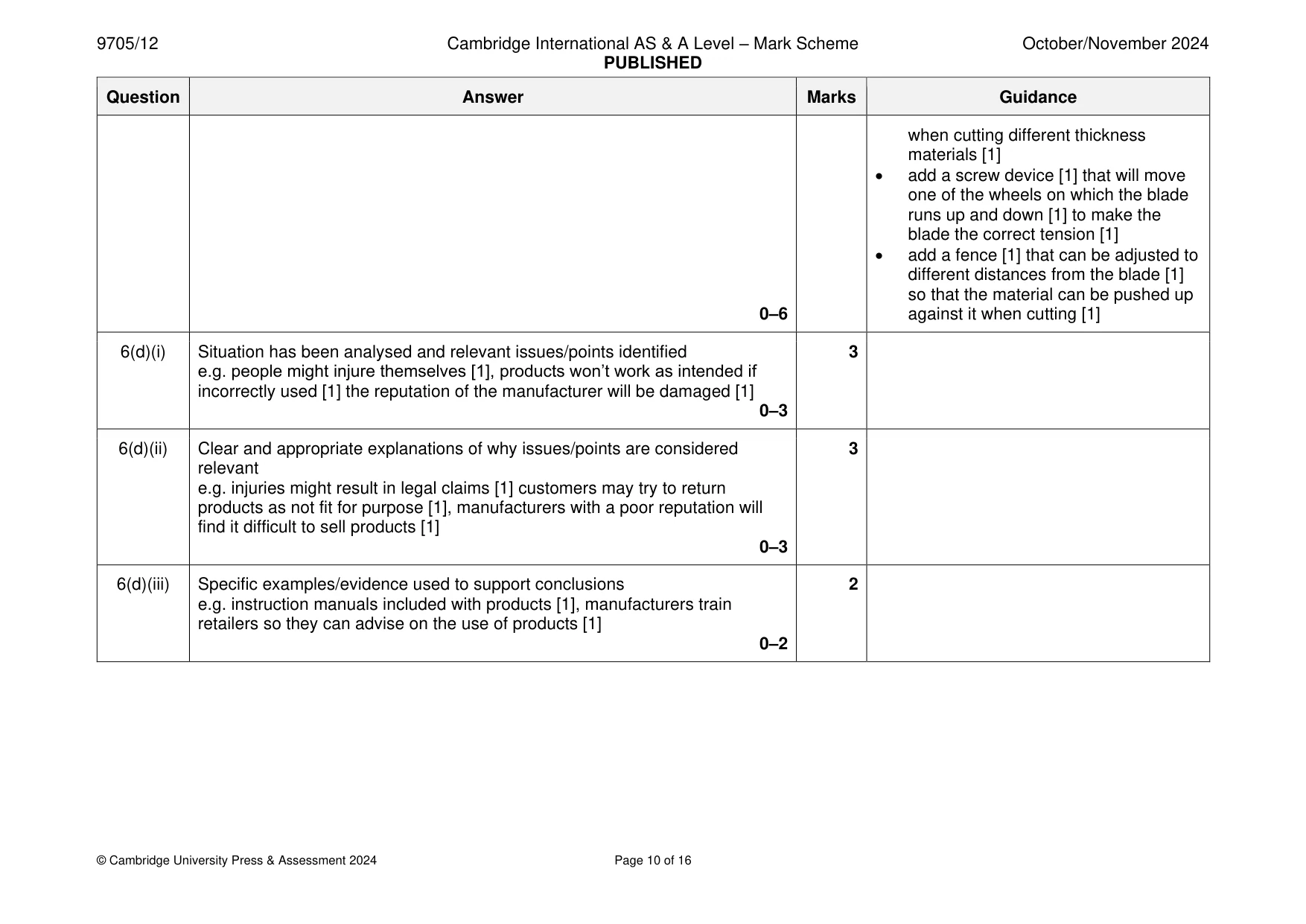
Mark scheme, page 10
9705/12 Cambridge International AS & A Level – Mark Scheme PUBLISHED October/November 2024 © Cambridge University Press & Assessment 2024 Page 10 of 16 Question Answer Marks Guidance 0–6 when cutting different thickness materials [1] • add a screw device [1] that will move one of the wheels on which the blade runs up and down [1] to make the blade the correct tension [1] • add a fence [1] that can be adjusted to different distances from the blade [1] so that the material can be pushed up against it when cutting [1] 6(d)(i) Situation has been analysed and relevant issues/points identified e.g. people might injure themselves [1], products won’t work as intended if incorrectly used [1] the reputation of the manufacturer will be damaged [1] 0–3 3 6(d)(ii) Clear and appropriate explanations of why issues/points are considered relevant e.g. injuries might result in legal claims [1] customers may try to return products as not fit for purpose [1], manufacturers with a poor reputation will find it difficult to sell products [1] 0–3 3 6(d)(iii) Specific examples/evidence used to support conclusions e.g. instruction manuals included with products [1], manufacturers train retailers so they can advise on the use of products [1] 0–2 2
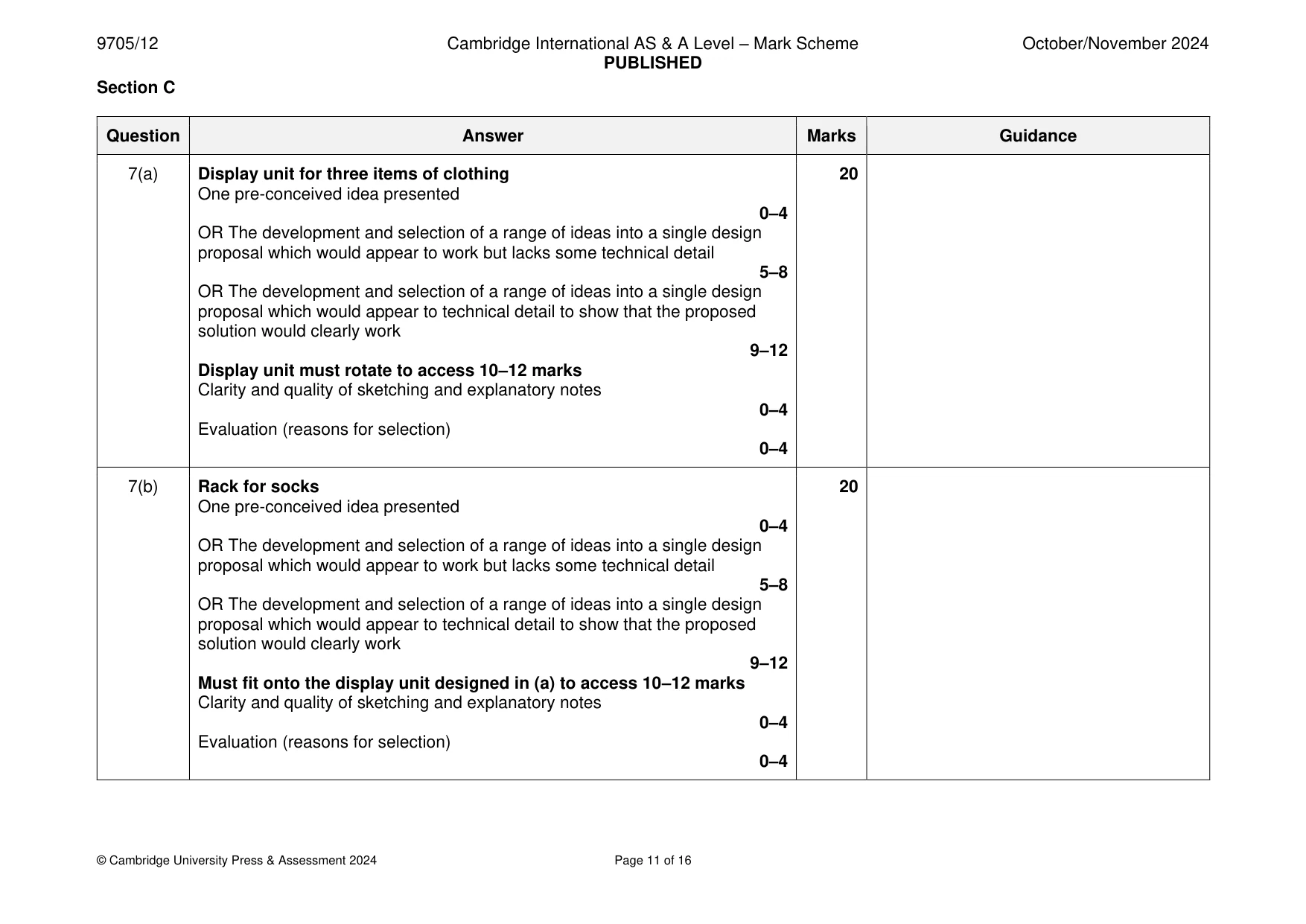
Mark scheme, page 11
9705/12 Cambridge International AS & A Level – Mark Scheme PUBLISHED October/November 2024 © Cambridge University Press & Assessment 2024 Page 11 of 16 Section C Question Answer Marks Guidance 7(a) Display unit for three items of clothing One pre-conceived idea presented 0–4 OR The development and selection of a range of ideas into a single design proposal which would appear to work but lacks some technical detail 5–8 OR The development and selection of a range of ideas into a single design proposal which would appear to technical detail to show that the proposed solution would clearly work 9–12 Display unit must rotate to access 10–12 marks Clarity and quality of sketching and explanatory notes 0–4 Evaluation (reasons for selection) 0–4 20 7(b) Rack for socks One pre-conceived idea presented 0–4 OR The development and selection of a range of ideas into a single design proposal which would appear to work but lacks some technical detail 5–8 OR The development and selection of a range of ideas into a single design proposal which would appear to technical detail to show that the proposed solution would clearly work 9–12 Must fit onto the display unit designed in (a) to access 10–12 marks Clarity and quality of sketching and explanatory notes 0–4 Evaluation (reasons for selection) 0–4 20
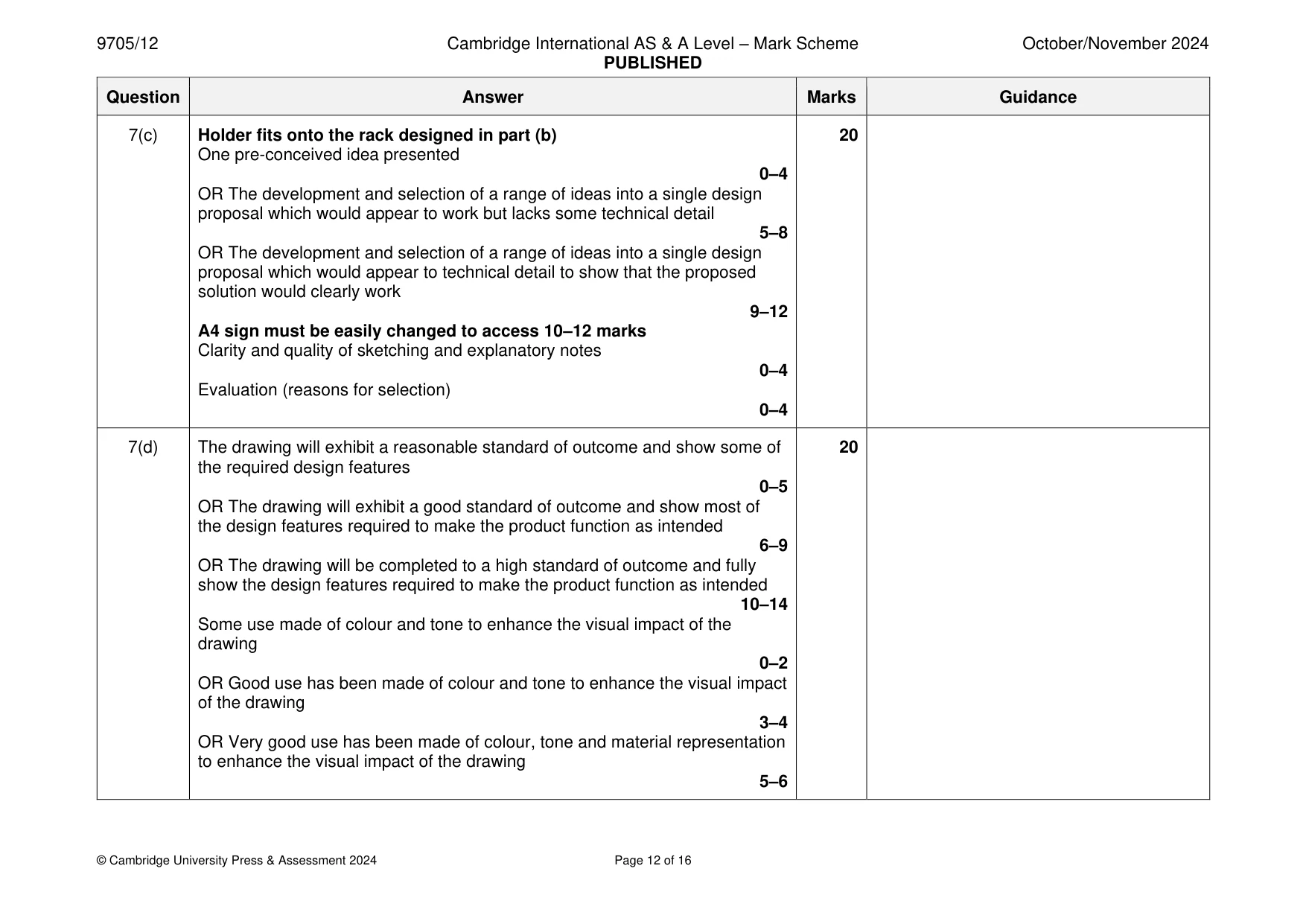
Mark scheme, page 12
9705/12 Cambridge International AS & A Level – Mark Scheme PUBLISHED October/November 2024 © Cambridge University Press & Assessment 2024 Page 12 of 16 Question Answer Marks Guidance 7(c) Holder fits onto the rack designed in part (b) One pre-conceived idea presented 0–4 OR The development and selection of a range of ideas into a single design proposal which would appear to work but lacks some technical detail 5–8 OR The development and selection of a range of ideas into a single design proposal which would appear to technical detail to show that the proposed solution would clearly work 9–12 A4 sign must be easily changed to access 10–12 marks Clarity and quality of sketching and explanatory notes 0–4 Evaluation (reasons for selection) 0–4 20 7(d) The drawing will exhibit a reasonable standard of outcome and show some of the required design features 0–5 OR The drawing will exhibit a good standard of outcome and show most of the design features required to make the product function as intended 6–9 OR The drawing will be completed to a high standard of outcome and fully show the design features required to make the product function as intended 10–14 Some use made of colour and tone to enhance the visual impact of the drawing 0–2 OR Good use has been made of colour and tone to enhance the visual impact of the drawing 3–4 OR Very good use has been made of colour, tone and material representation to enhance the visual impact of the drawing 5–6 20
Mark scheme, page 13
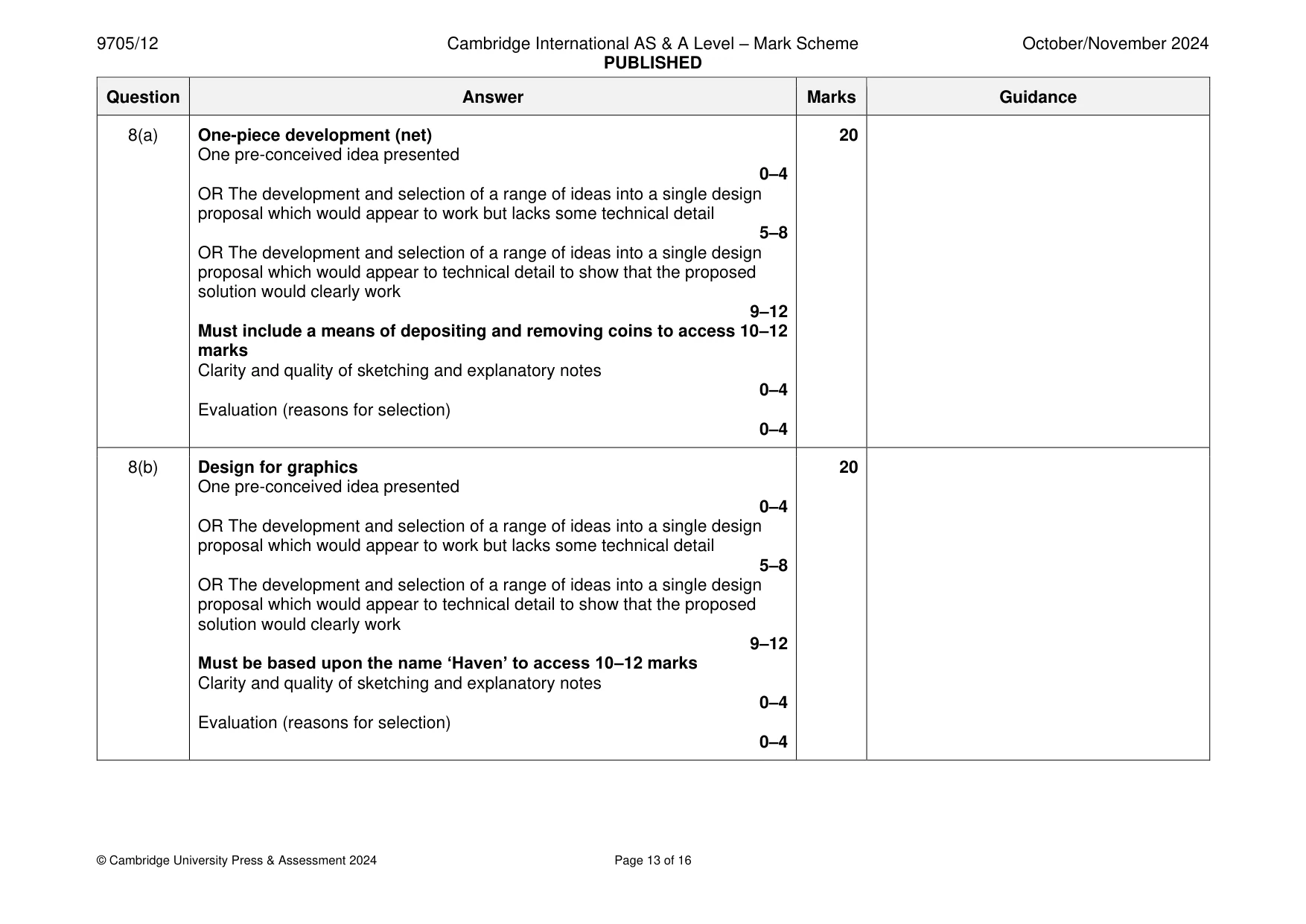
9705/12 Cambridge International AS & A Level – Mark Scheme PUBLISHED October/November 2024 © Cambridge University Press & Assessment 2024 Page 13 of 16 Question Answer Marks Guidance 8(a) One-piece development (net) One pre-conceived idea presented 0–4 OR The development and selection of a range of ideas into a single design proposal which would appear to work but lacks some technical detail 5–8 OR The development and selection of a range of ideas into a single design proposal which would appear to technical detail to show that the proposed solution would clearly work 9–12 Must include a means of depositing and removing coins to access 10–12 marks Clarity and quality of sketching and explanatory notes 0–4 Evaluation (reasons for selection) 0–4 20 8(b) Design for graphics One pre-conceived idea presented 0–4 OR The development and selection of a range of ideas into a single design proposal which would appear to work but lacks some technical detail 5–8 OR The development and selection of a range of ideas into a single design proposal which would appear to technical detail to show that the proposed solution would clearly work 9–12 Must be based upon the name ‘Haven’ to access 10–12 marks Clarity and quality of sketching and explanatory notes 0–4 Evaluation (reasons for selection) 0–4 20
Mark scheme, page 14
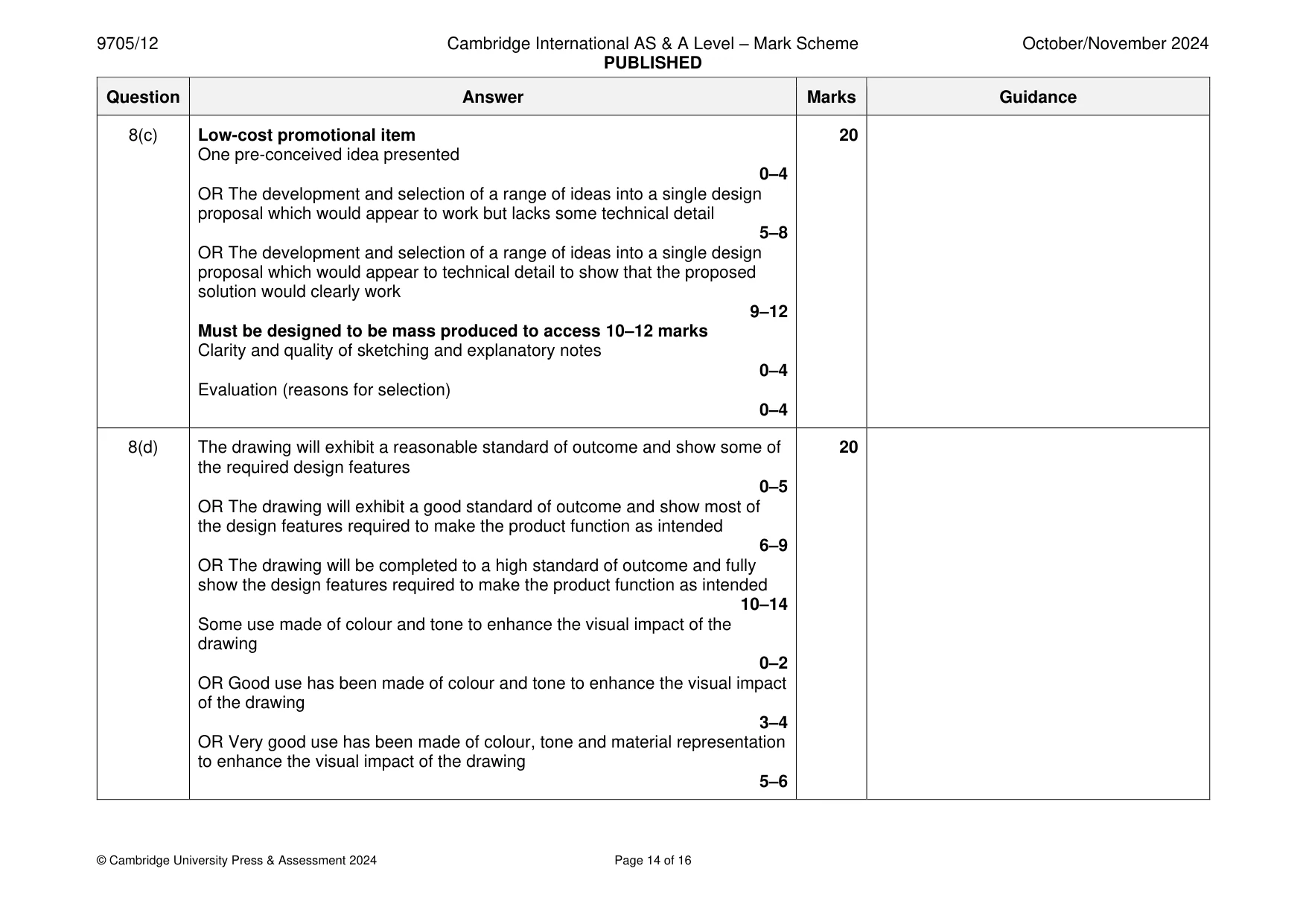
9705/12 Cambridge International AS & A Level – Mark Scheme PUBLISHED October/November 2024 © Cambridge University Press & Assessment 2024 Page 14 of 16 Question Answer Marks Guidance 8(c) Low-cost promotional item One pre-conceived idea presented 0–4 OR The development and selection of a range of ideas into a single design proposal which would appear to work but lacks some technical detail 5–8 OR The development and selection of a range of ideas into a single design proposal which would appear to technical detail to show that the proposed solution would clearly work 9–12 Must be designed to be mass produced to access 10–12 marks Clarity and quality of sketching and explanatory notes 0–4 Evaluation (reasons for selection) 0–4 20 8(d) The drawing will exhibit a reasonable standard of outcome and show some of the required design features 0–5 OR The drawing will exhibit a good standard of outcome and show most of the design features required to make the product function as intended 6–9 OR The drawing will be completed to a high standard of outcome and fully show the design features required to make the product function as intended 10–14 Some use made of colour and tone to enhance the visual impact of the drawing 0–2 OR Good use has been made of colour and tone to enhance the visual impact of the drawing 3–4 OR Very good use has been made of colour, tone and material representation to enhance the visual impact of the drawing 5–6 20
Mark scheme, page 15
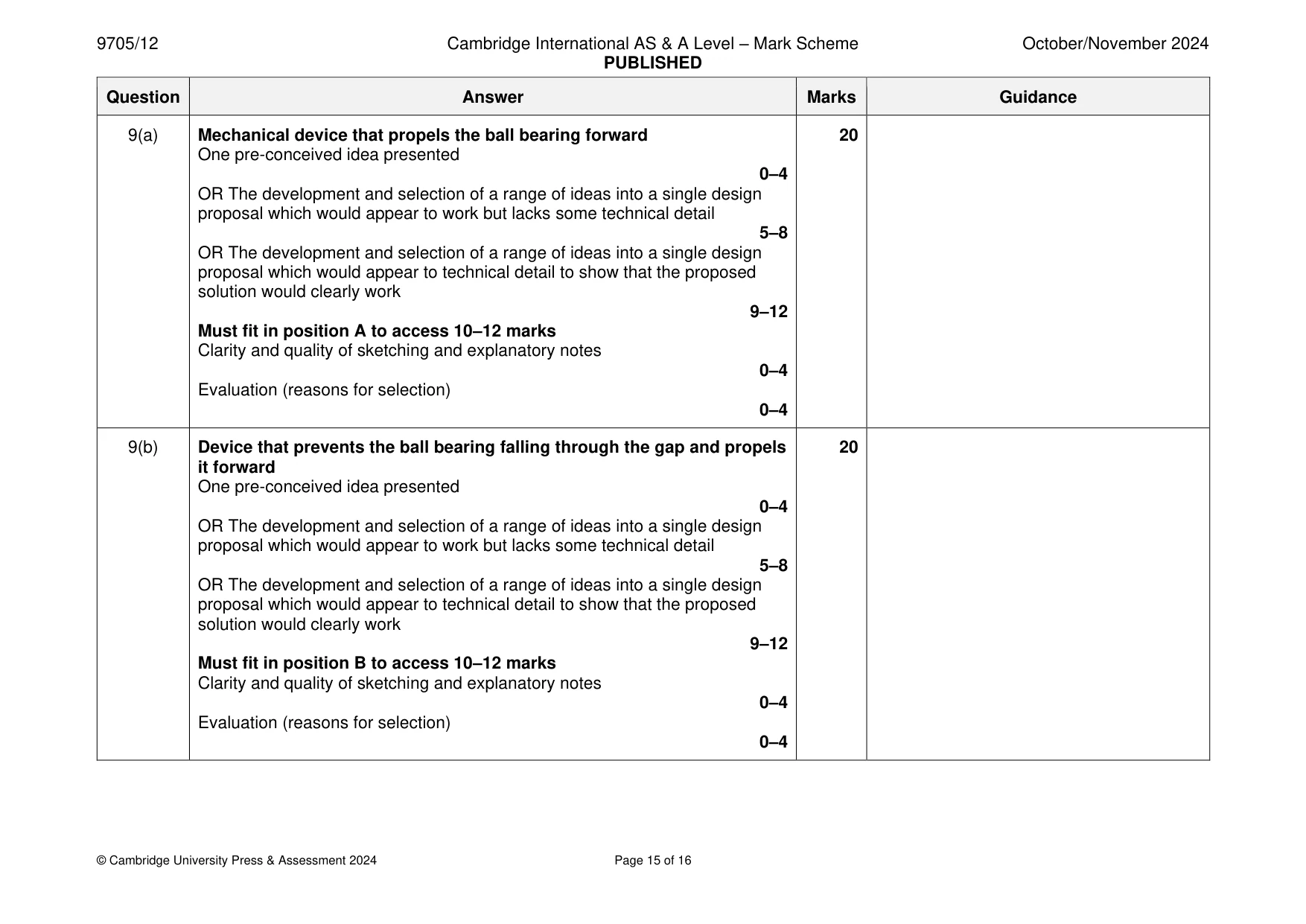
9705/12 Cambridge International AS & A Level – Mark Scheme PUBLISHED October/November 2024 © Cambridge University Press & Assessment 2024 Page 15 of 16 Question Answer Marks Guidance 9(a) Mechanical device that propels the ball bearing forward One pre-conceived idea presented 0–4 OR The development and selection of a range of ideas into a single design proposal which would appear to work but lacks some technical detail 5–8 OR The development and selection of a range of ideas into a single design proposal which would appear to technical detail to show that the proposed solution would clearly work 9–12 Must fit in position A to access 10–12 marks Clarity and quality of sketching and explanatory notes 0–4 Evaluation (reasons for selection) 0–4 20 9(b) Device that prevents the ball bearing falling through the gap and propels it forward One pre-conceived idea presented 0–4 OR The development and selection of a range of ideas into a single design proposal which would appear to work but lacks some technical detail 5–8 OR The development and selection of a range of ideas into a single design proposal which would appear to technical detail to show that the proposed solution would clearly work 9–12 Must fit in position B to access 10–12 marks Clarity and quality of sketching and explanatory notes 0–4 Evaluation (reasons for selection) 0–4 20
Mark scheme, page 16
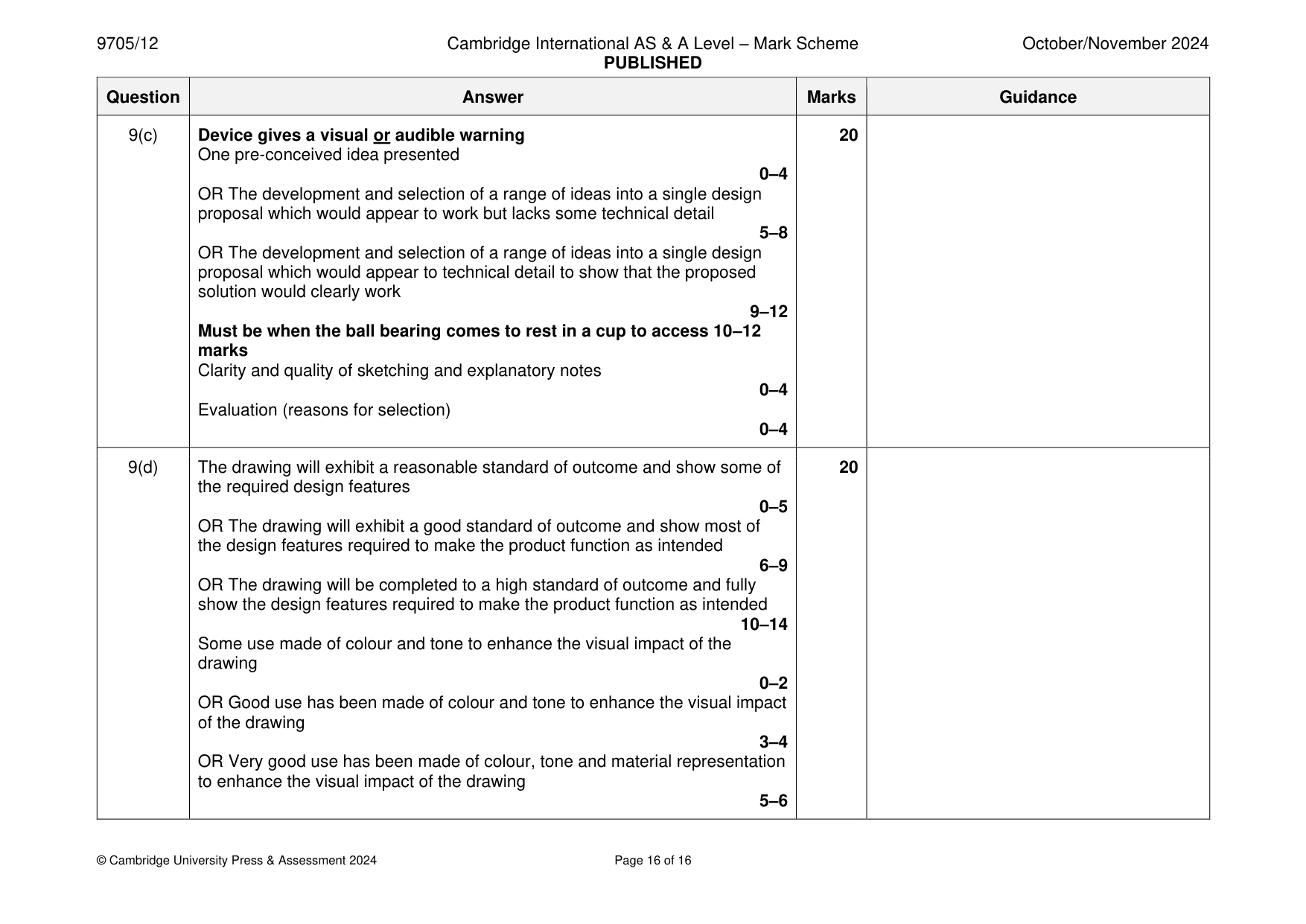
9705/12 Cambridge International AS & A Level – Mark Scheme PUBLISHED October/November 2024 © Cambridge University Press & Assessment 2024 Page 16 of 16 Question Answer Marks Guidance 9(c) Device gives a visual or audible warning One pre-conceived idea presented 0–4 OR The development and selection of a range of ideas into a single design proposal which would appear to work but lacks some technical detail 5–8 OR The development and selection of a range of ideas into a single design proposal which would appear to technical detail to show that the proposed solution would clearly work 9–12 Must be when the ball bearing comes to rest in a cup to access 10–12 marks Clarity and quality of sketching and explanatory notes 0–4 Evaluation (reasons for selection) 0–4 20 9(d) The drawing will exhibit a reasonable standard of outcome and show some of the required design features 0–5 OR The drawing will exhibit a good standard of outcome and show most of the design features required to make the product function as intended 6–9 OR The drawing will be completed to a high standard of outcome and fully show the design features required to make the product function as intended 10–14 Some use made of colour and tone to enhance the visual impact of the drawing 0–2 OR Good use has been made of colour and tone to enhance the visual impact of the drawing 3–4 OR Very good use has been made of colour, tone and material representation to enhance the visual impact of the drawing 5–6 20
What you needed in this session
Cambridge’s own grade thresholds for 2024 Oct/Nov, Paper 1 · Variant 2. A higher threshold means an easier paper — the bar moves with how the cohort did.