Cambridge A Level Design and Technology 9705 — 2022 May/June Paper 1 · Variant 2
9705/12/M/J/22 · 120 marks · ≈135 min
The question paper and its mark scheme, free to read here and free to download. This is Cambridge’s own paper, exactly as it was sat.
Question paper12 pages

Mark scheme21 pages
Answers below. Sit the paper first if you are practising.
Paper as text
Question paper, page 1
This document has 12 pages. Any blank pages are indicated. [Turn over Cambridge International AS & A Level DC (LK/FC) 303206/2 © UCLES 2022 DESIGN & TECHNOLOGY 9705/12 Paper 1 May/June 2022 3 hours You must answer on the answer booklet/paper. You will need: Answer booklet/A4 paper Coloured pencils A3 drawing paper (2 sheets) Extra sheets of A3 drawing paper if needed A range of design drawing equipment INSTRUCTIONS ● Answer three questions in total: Section A: answer one question on the answer booklet/A4 paper provided. Section B: answer one question on the answer booklet/A4 paper provided. Section C: answer one question on A3 drawing paper. Use both sides of the paper. ● You may request additional sheets of A3 drawing paper, but only if you have used up both sides of each of the 2 sheets provided. ● If you have been given an answer booklet, follow the instructions on the front cover of the answer booklet. ● Use a black or dark blue pen. ● Write your name, centre number and candidate number on all the work you hand in. ● Do not use an erasable pen or correction fluid. ● You may use an HB pencil, or coloured pencils as appropriate, for any diagrams, graphs or rough working. ● At the end of the examination, fasten all your work together. Do not use staples, paper clips or glue. INFORMATION ● The total mark for this paper is 120. ● The number of marks for each question or part question is shown in brackets [ ]. ● All dimensions are in millimetres. * 6 6 7 2 4 0 8 5 8 0 *
Question paper, page 2
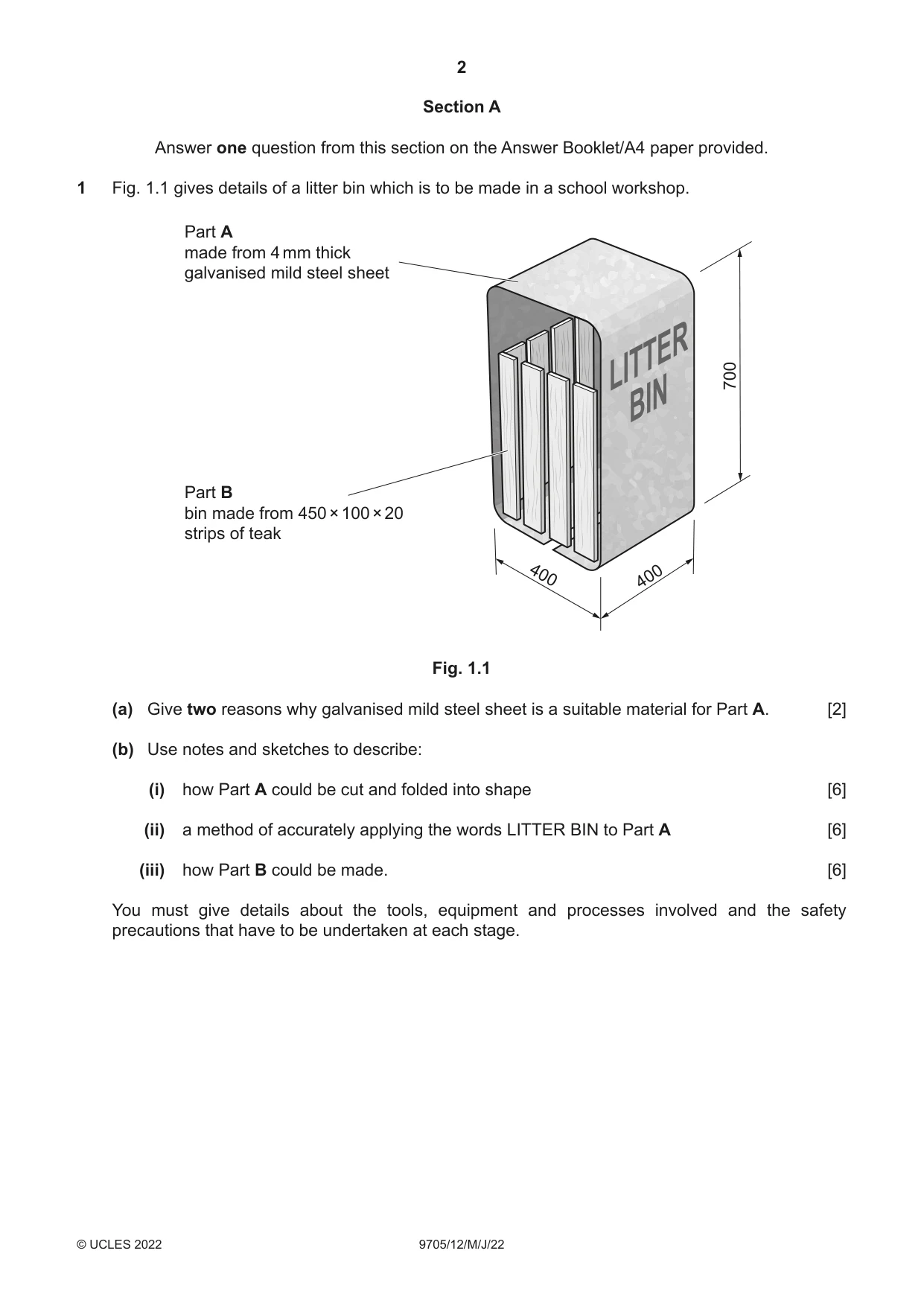
2 9705/12/ M / J /22 © UCLES 2022 Section A Answer one question from this section on the Answer Booklet/A4 paper provided. 1 Fig. 1.1 gives details of a litter bin which is to be made in a school workshop. LITTER BIN 700 400 400 Part B bin made from 450 × 100 × 20 strips of teak Part A made from 4 mm thick galvanised mild steel sheet Fig. 1.1 (a) Give two reasons why galvanised mild steel sheet is a suitable material for Part A. [2] (b) Use notes and sketches to describe: (i) how Part A could be cut and folded into shape [6] (ii) a method of accurately applying the words LITTER BIN to Part A [6] (iii) how Part B could be made. [6] You must give details about the tools, equipment and processes involved and the safety precautions that have to be undertaken at each stage.
Question paper, page 3
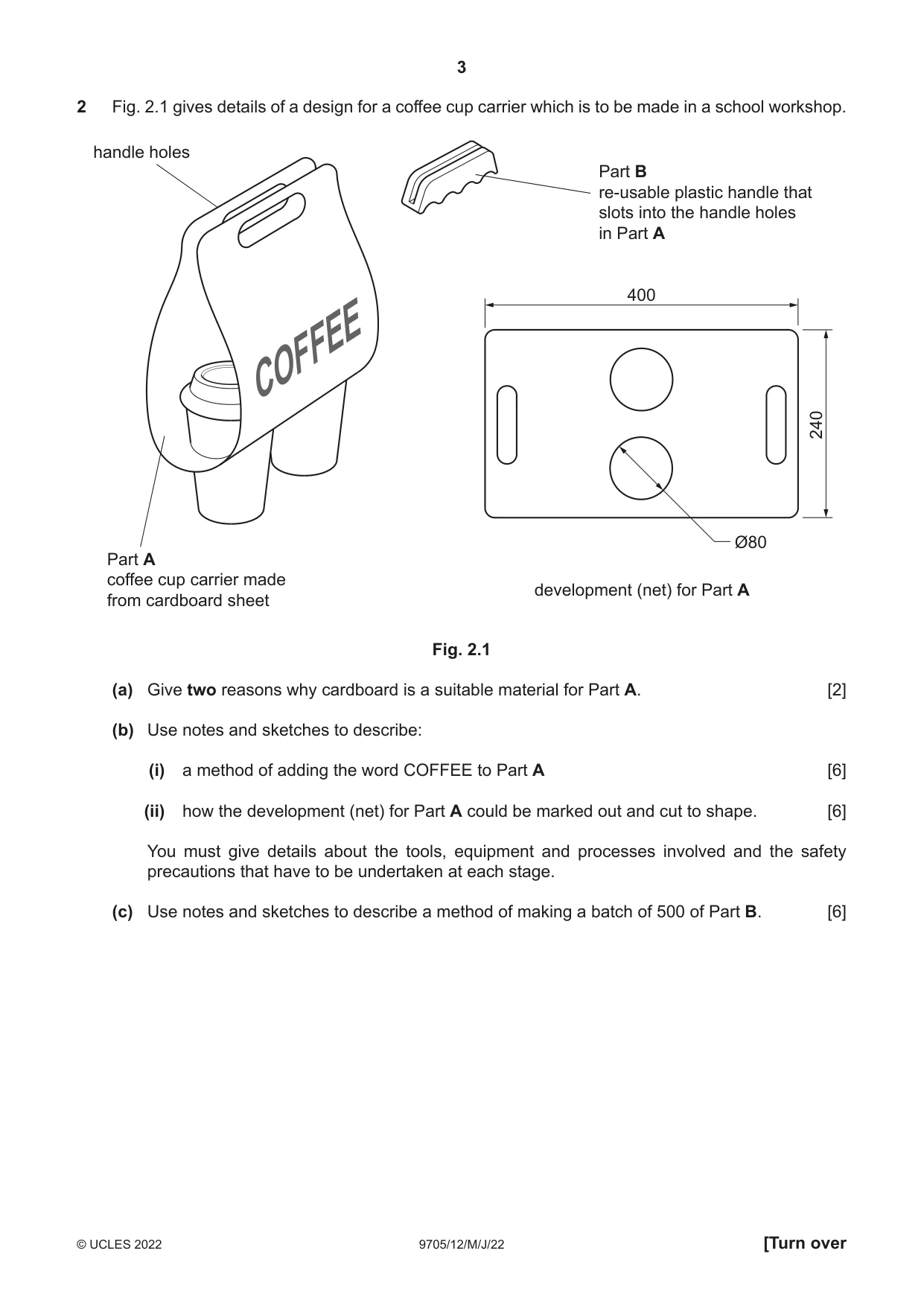
3 9705/12/M/J/22 © UCLES 2022 [Turn over 2 Fig. 2.1 gives details of a design for a coffee cup carrier which is to be made in a school workshop. COFFEE 400 Ø80 development (net) for Part A handle holes 240 Part B re-usable plastic handle that slots into the handle holes in Part A Part A coffee cup carrier made from cardboard sheet Fig. 2.1 (a) Give two reasons why cardboard is a suitable material for Part A. [2] (b) Use notes and sketches to describe: (i) a method of adding the word COFFEE to Part A [6] (ii) how the development (net) for Part A could be marked out and cut to shape. [6] You must give details about the tools, equipment and processes involved and the safety precautions that have to be undertaken at each stage. (c) Use notes and sketches to describe a method of making a batch of 500 of Part B. [6]
Question paper, page 4
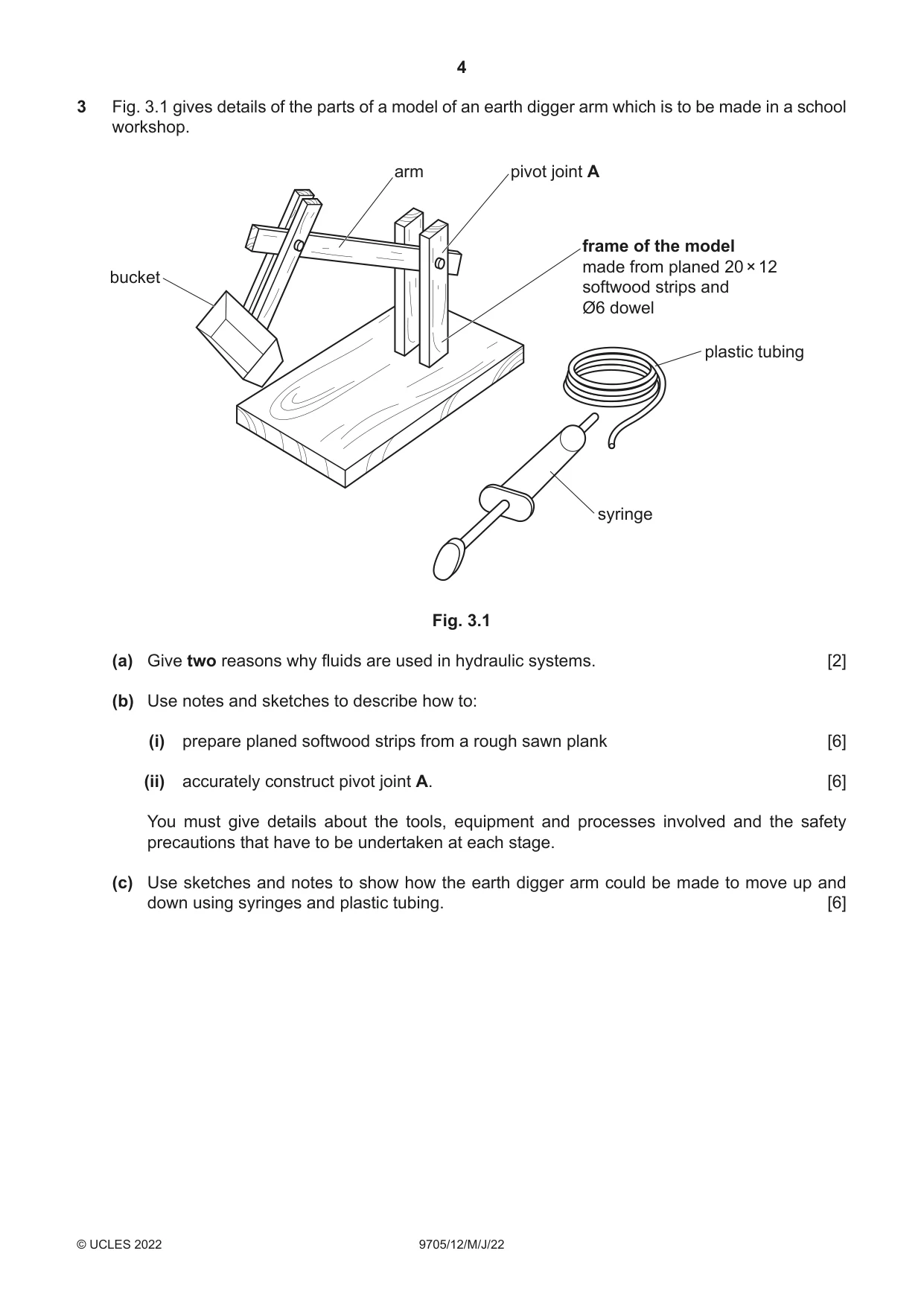
4 9705/12/M/J/22 © UCLES 2022 3 Fig. 3.1 gives details of the parts of a model of an earth digger arm which is to be made in a school workshop. syringe plastic tubing arm pivot joint A frame of the model made from planed 20 × 12 softwood strips and Ø6 dowel bucket Fig. 3.1 (a) Give two reasons why fluids are used in hydraulic systems. [2] (b) Use notes and sketches to describe how to: (i) prepare planed softwood strips from a rough sawn plank [6] (ii) accurately construct pivot joint A. [6] You must give details about the tools, equipment and processes involved and the safety precautions that have to be undertaken at each stage. (c) Use sketches and notes to show how the earth digger arm could be made to move up and down using syringes and plastic tubing. [6]
Question paper, page 5
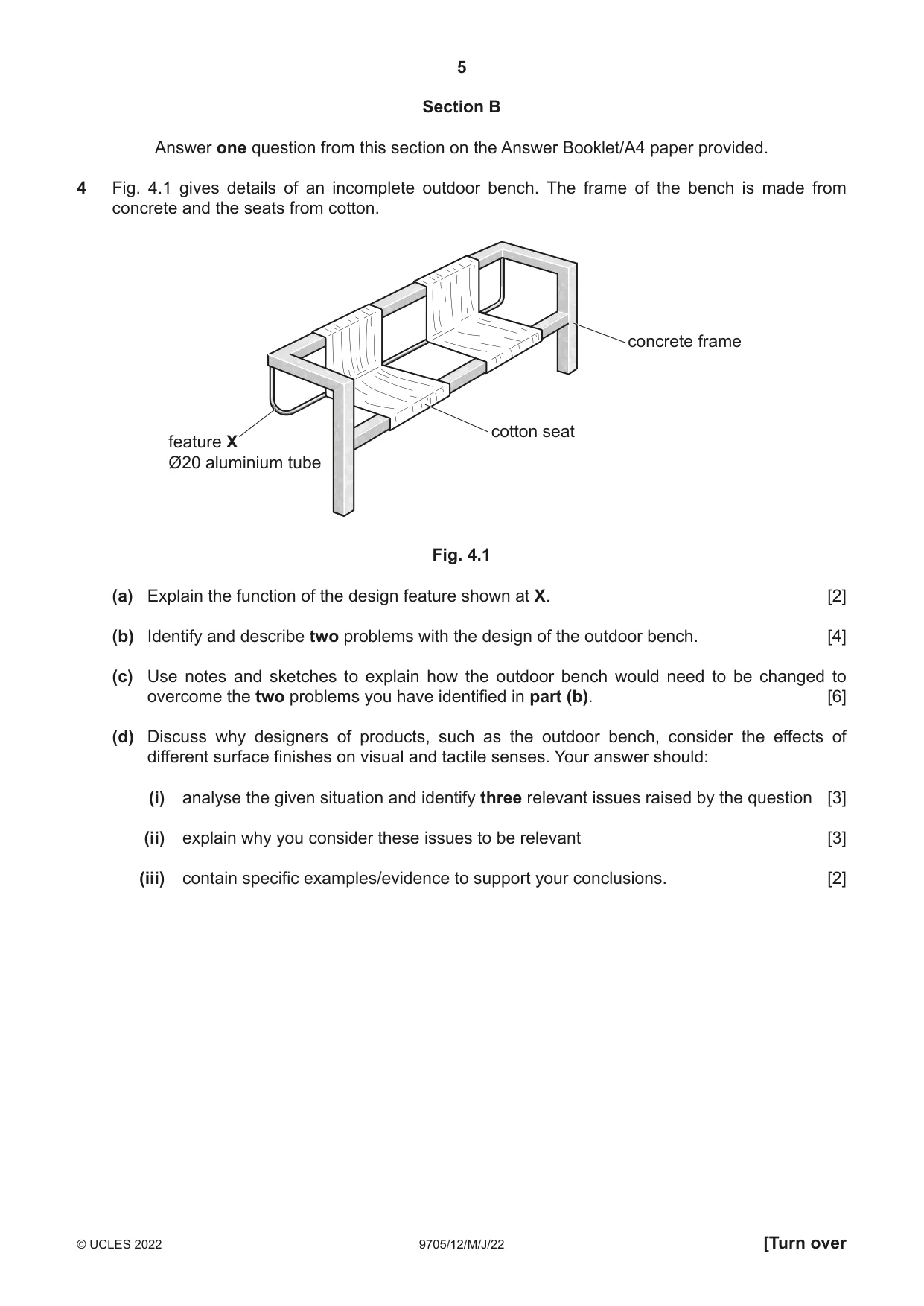
5 9705/12/ M / J /22 © UCLES 2022 [Turn over Section B Answer one question from this section on the Answer Booklet/A4 paper provided. 4 Fig. 4.1 gives details of an incomplete outdoor bench. The frame of the bench is made from concrete and the seats from cotton. concrete frame cotton seat feature X Ø20 aluminium tube Fig. 4.1 (a) Explain the function of the design feature shown at X. [2] (b) Identify and describe two problems with the design of the outdoor bench. [4] (c) Use notes and sketches to explain how the outdoor bench would need to be changed to overcome the two problems you have identified in part (b). [6] (d) Discuss why designers of products, such as the outdoor bench, consider the effects of different surface finishes on visual and tactile senses. Your answer should: (i) analyse the given situation and identify three relevant issues raised by the question [3] (ii) explain why you consider these issues to be relevant [3] (iii) contain specific examples/evidence to support your conclusions. [2]
Question paper, page 6
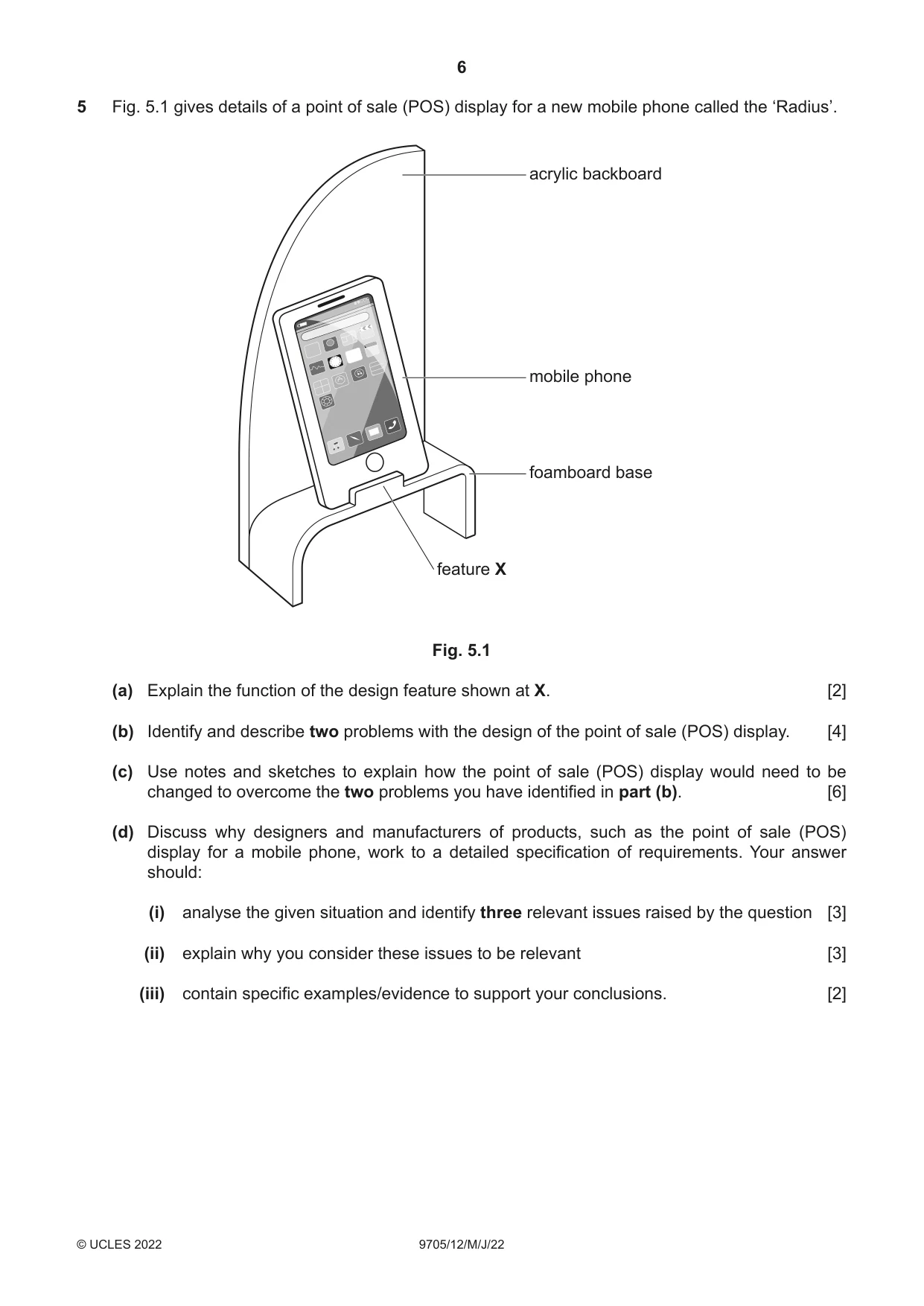
6 9705/12/ M / J /22 © UCLES 2022 5 Fig. 5.1 gives details of a point of sale (POS) display for a new mobile phone called the ‘Radius’. feature X acrylic backboard mobile phone foamboard base Fig. 5.1 (a) Explain the function of the design feature shown at X. [2] (b) Identify and describe two problems with the design of the point of sale (POS) display. [4] (c) Use notes and sketches to explain how the point of sale (POS) display would need to be changed to overcome the two problems you have identified in part (b). [6] (d) Discuss why designers and manufacturers of products, such as the point of sale (POS) display for a mobile phone, work to a detailed specification of requirements. Your answer should: (i) analyse the given situation and identify three relevant issues raised by the question [3] (ii) explain why you consider these issues to be relevant [3] (iii) contain specific examples/evidence to support your conclusions. [2]
Question paper, page 7
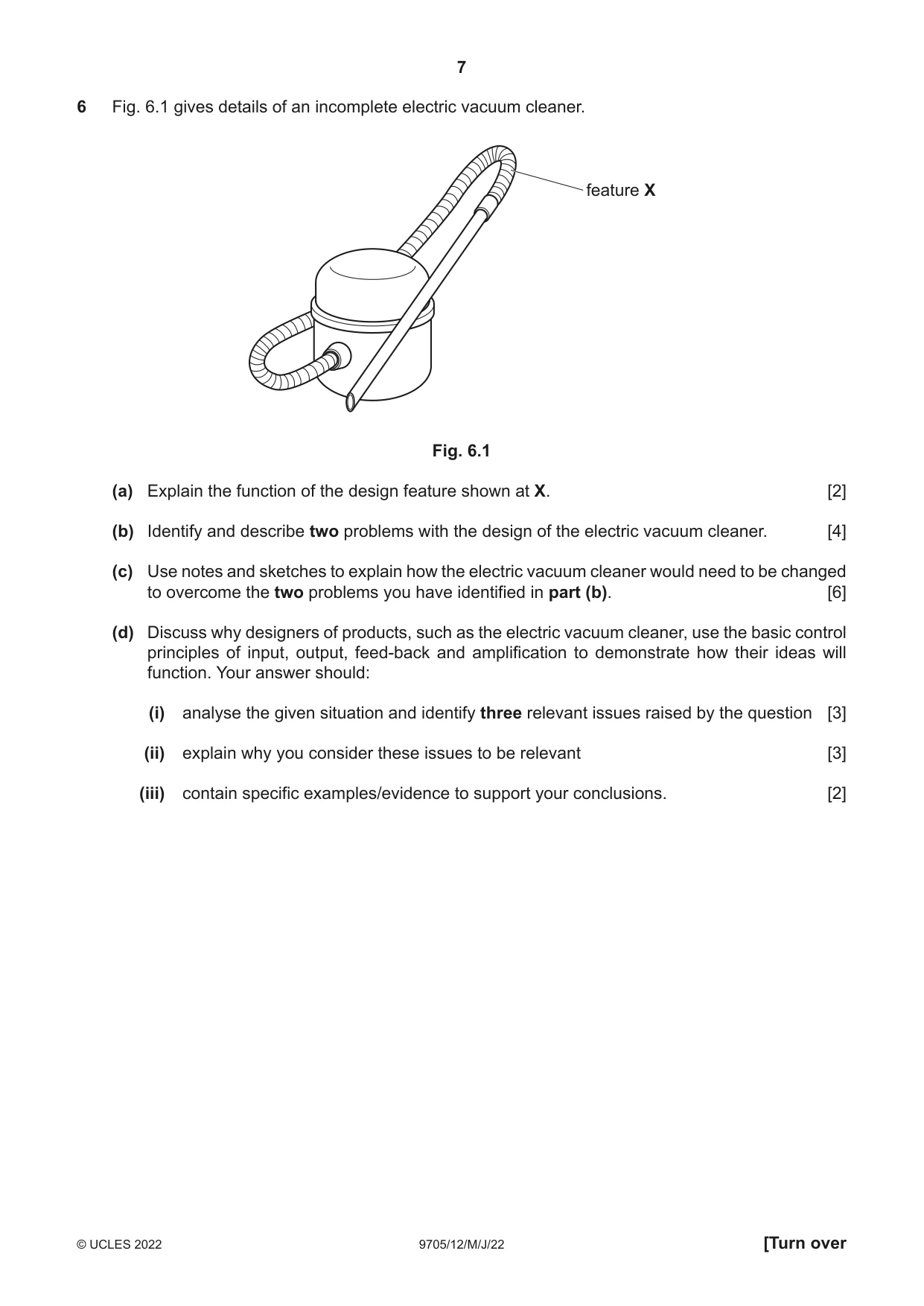
7 9705/12/M/J/22 © UCLES 2022 [Turn over 6 Fig. 6.1 gives details of an incomplete electric vacuum cleaner. feature X Fig. 6.1 (a) Explain the function of the design feature shown at X. [2] (b) Identify and describe two problems with the design of the electric vacuum cleaner. [4] (c) Use notes and sketches to explain how the electric vacuum cleaner would need to be changed to overcome the two problems you have identified in part (b). [6] (d) Discuss why designers of products, such as the electric vacuum cleaner, use the basic control principles of input, output, feed-back and amplification to demonstrate how their ideas will function. Your answer should: (i) analyse the given situation and identify three relevant issues raised by the question [3] (ii) explain why you consider these issues to be relevant [3] (iii) contain specific examples/evidence to support your conclusions. [2]
Question paper, page 8
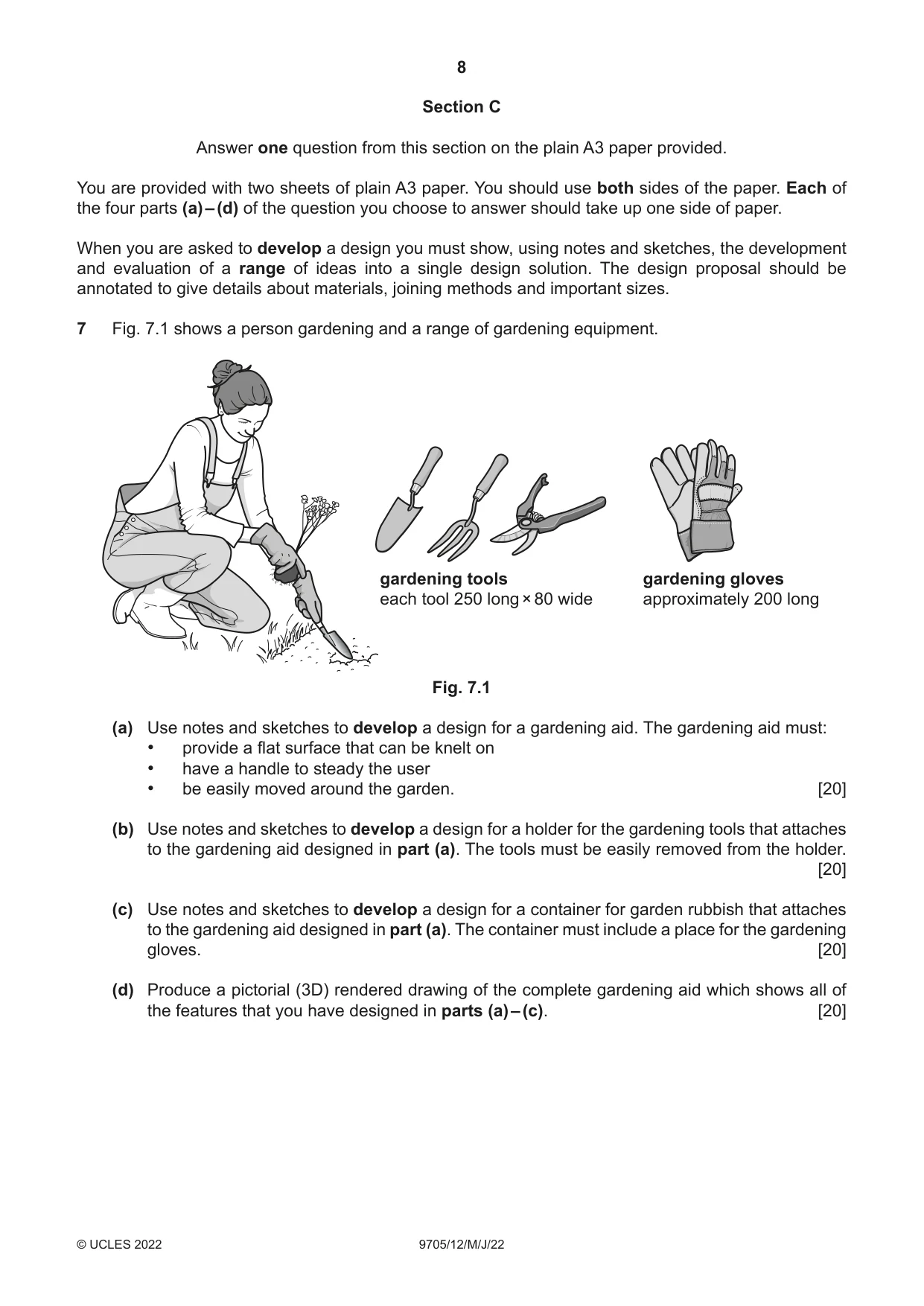
8 9705/12/ M / J /22 © UCLES 2022 Section C Answer one question from this section on the plain A3 paper provided. You are provided with two sheets of plain A3 paper. You should use both sides of the paper. Each of the four parts (a) – (d) of the question you choose to answer should take up one side of paper. When you are asked to develop a design you must show, using notes and sketches, the development and evaluation of a range of ideas into a single design solution. The design proposal should be annotated to give details about materials, joining methods and important sizes. 7 Fig. 7.1 shows a person gardening and a range of gardening equipment. gardening tools each tool 250 long × 80 wide gardening gloves approximately 200 long Fig. 7.1 (a) Use notes and sketches to develop a design for a gardening aid. The gardening aid must: • provide a flat surface that can be knelt on • have a handle to steady the user • be easily moved around the garden. [20] (b) Use notes and sketches to develop a design for a holder for the gardening tools that attaches to the gardening aid designed in part (a). The tools must be easily removed from the holder. [20] (c) Use notes and sketches to develop a design for a container for garden rubbish that attaches to the gardening aid designed in part (a). The container must include a place for the gardening gloves. [20] (d) Produce a pictorial (3D) rendered drawing of the complete gardening aid which shows all of the features that you have designed in parts (a) – (c). [20]
Question paper, page 9
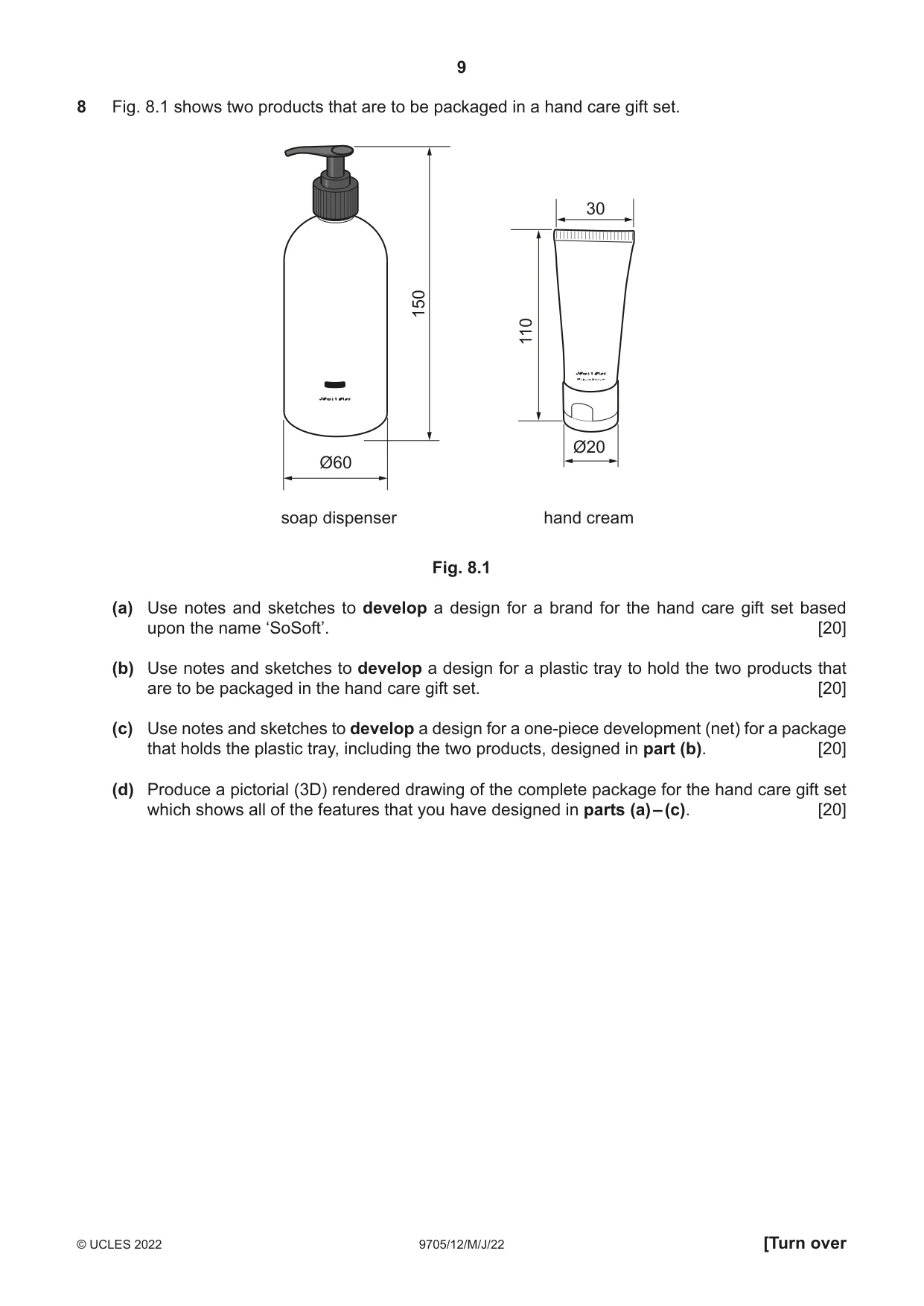
9 9705/12/M/J/22 © UCLES 2022 [Turn over 8 Fig. 8.1 shows two products that are to be packaged in a hand care gift set. hand cream 110 30 150 soap dispenser Ø20 Ø60 Fig. 8.1 (a) Use notes and sketches to develop a design for a brand for the hand care gift set based upon the name ‘SoSoft’. [20] (b) Use notes and sketches to develop a design for a plastic tray to hold the two products that are to be packaged in the hand care gift set. [20] (c) Use notes and sketches to develop a design for a one-piece development (net) for a package that holds the plastic tray, including the two products, designed in part (b). [20] (d) Produce a pictorial (3D) rendered drawing of the complete package for the hand care gift set which shows all of the features that you have designed in parts (a) – (c). [20]
Question paper, page 10
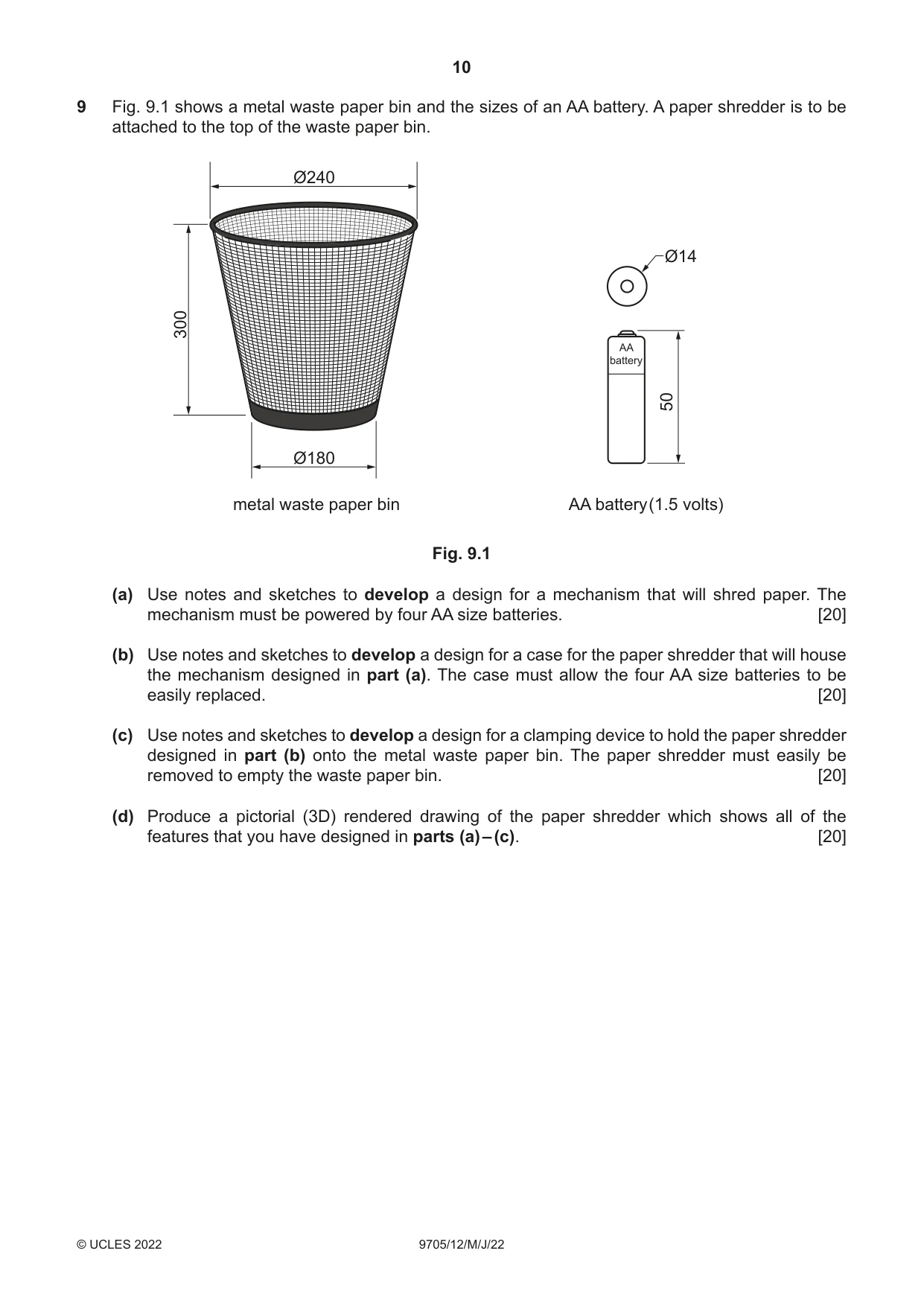
10 9705/12/M/J/22 © UCLES 2022 9 Fig. 9.1 shows a metal waste paper bin and the sizes of an AA battery. A paper shredder is to be attached to the top of the waste paper bin. 50 metal waste paper bin AA battery (1.5 volts) Ø180 Ø14 Ø240 300 Fig. 9.1 (a) Use notes and sketches to develop a design for a mechanism that will shred paper. The mechanism must be powered by four AA size batteries. [20] (b) Use notes and sketches to develop a design for a case for the paper shredder that will house the mechanism designed in part (a). The case must allow the four AA size batteries to be easily replaced. [20] (c) Use notes and sketches to develop a design for a clamping device to hold the paper shredder designed in part (b) onto the metal waste paper bin. The paper shredder must easily be removed to empty the waste paper bin. [20] (d) Produce a pictorial (3D) rendered drawing of the paper shredder which shows all of the features that you have designed in parts (a) – (c). [20]
Question paper, page 11
11 9705/12/M/J/22 © UCLES 2022 BLANK PAGE
Question paper, page 12
12 9705/12/M/J/22 © UCLES 2022 Permission to reproduce items where third-party owned material protected by copyright is included has been sought and cleared where possible. Every reasonable effort has been made by the publisher (UCLES) to trace copyright holders, but if any items requiring clearance have unwittingly been included, the publisher will be pleased to make amends at the earliest possible opportunity. To avoid the issue of disclosure of answer-related information to candidates, all copyright acknowledgements are reproduced online in the Cambridge Assessment International Education Copyright Acknowledgements Booklet. This is produced for each series of examinations and is freely available to download at www.cambridgeinternational.org after the live examination series. Cambridge Assessment International Education is part of Cambridge Assessment. Cambridge Assessment is the brand name of the University of Cambridge Local Examinations Syndicate (UCLES), which is a department of the University of Cambridge. BLANK PAGE
Mark scheme, page 1
This document consists of 21 printed pages. © UCLES 2022 [Turn over Cambridge International AS & A Level DESIGN AND TECHNOLOGY 9705/12 Paper 1 Written 12 May/June 2022 MARK SCHEME Maximum Mark: 120 Published This mark scheme is published as an aid to teachers and candidates, to indicate the requirements of the examination. It shows the basis on which Examiners were instructed to award marks. It does not indicate the details of the discussions that took place at an Examiners’ meeting before marking began, which would have considered the acceptability of alternative answers. Mark schemes should be read in conjunction with the question paper and the Principal Examiner Report for Teachers. Cambridge International will not enter into discussions about these mark schemes. Cambridge International is publishing the mark schemes for the May/June 2022 series for most Cambridge IGCSE, Cambridge International A and AS Level and Cambridge Pre-U components, and some Cambridge O Level components.
Mark scheme, page 2
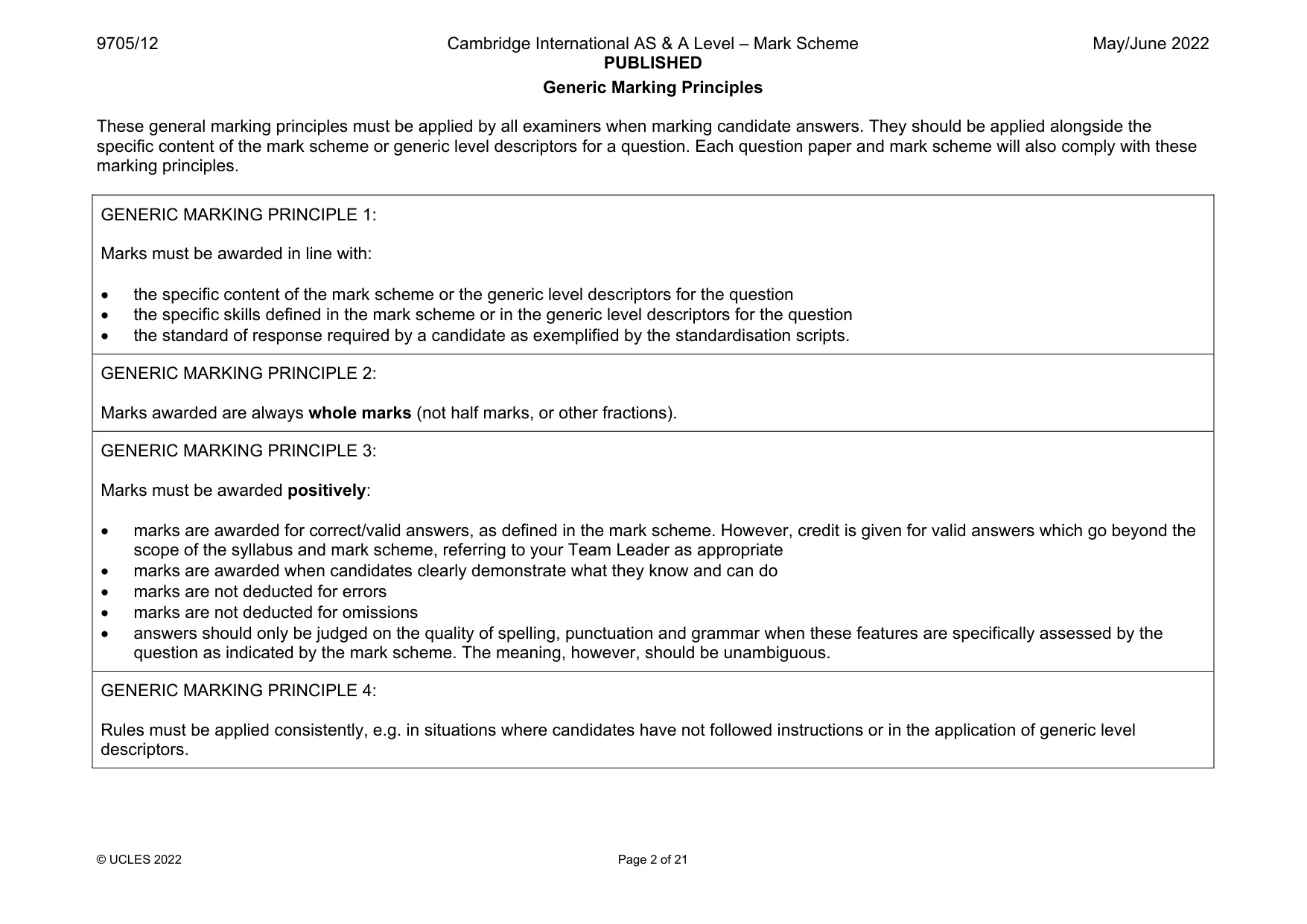
9705/12 Cambridge International AS & A Level – Mark Scheme PUBLISHED May/June 2022 © UCLES 2022 Page 2 of 21 Generic Marking Principles These general marking principles must be applied by all examiners when marking candidate answers. They should be applied alongside the specific content of the mark scheme or generic level descriptors for a question. Each question paper and mark scheme will also comply with these marking principles. GENERIC MARKING PRINCIPLE 1: Marks must be awarded in line with: the specific content of the mark scheme or the generic level descriptors for the question the specific skills defined in the mark scheme or in the generic level descriptors for the question the standard of response required by a candidate as exemplified by the standardisation scripts. GENERIC MARKING PRINCIPLE 2: Marks awarded are always whole marks (not half marks, or other fractions). GENERIC MARKING PRINCIPLE 3: Marks must be awarded positively: marks are awarded for correct/valid answers, as defined in the mark scheme. However, credit is given for valid answers which go beyond the scope of the syllabus and mark scheme, referring to your Team Leader as appropriate marks are awarded when candidates clearly demonstrate what they know and can do marks are not deducted for errors marks are not deducted for omissions answers should only be judged on the quality of spelling, punctuation and grammar when these features are specifically assessed by the question as indicated by the mark scheme. The meaning, however, should be unambiguous. GENERIC MARKING PRINCIPLE 4: Rules must be applied consistently, e.g. in situations where candidates have not followed instructions or in the application of generic level descriptors.
Mark scheme, page 3
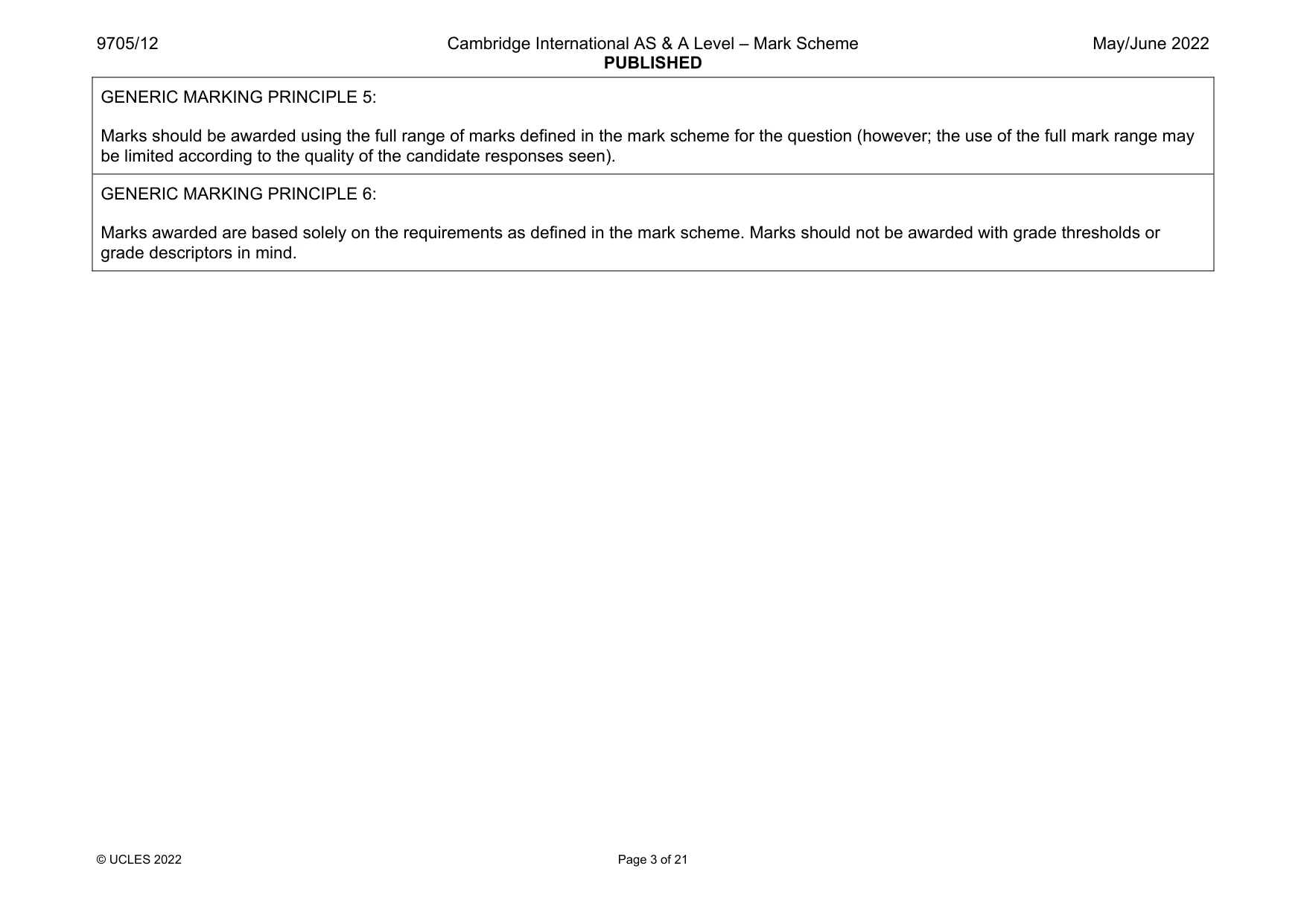
9705/12 Cambridge International AS & A Level – Mark Scheme PUBLISHED May/June 2022 © UCLES 2022 Page 3 of 21 GENERIC MARKING PRINCIPLE 5: Marks should be awarded using the full range of marks defined in the mark scheme for the question (however; the use of the full mark range may be limited according to the quality of the candidate responses seen). GENERIC MARKING PRINCIPLE 6: Marks awarded are based solely on the requirements as defined in the mark scheme. Marks should not be awarded with grade thresholds or grade descriptors in mind.
Mark scheme, page 4
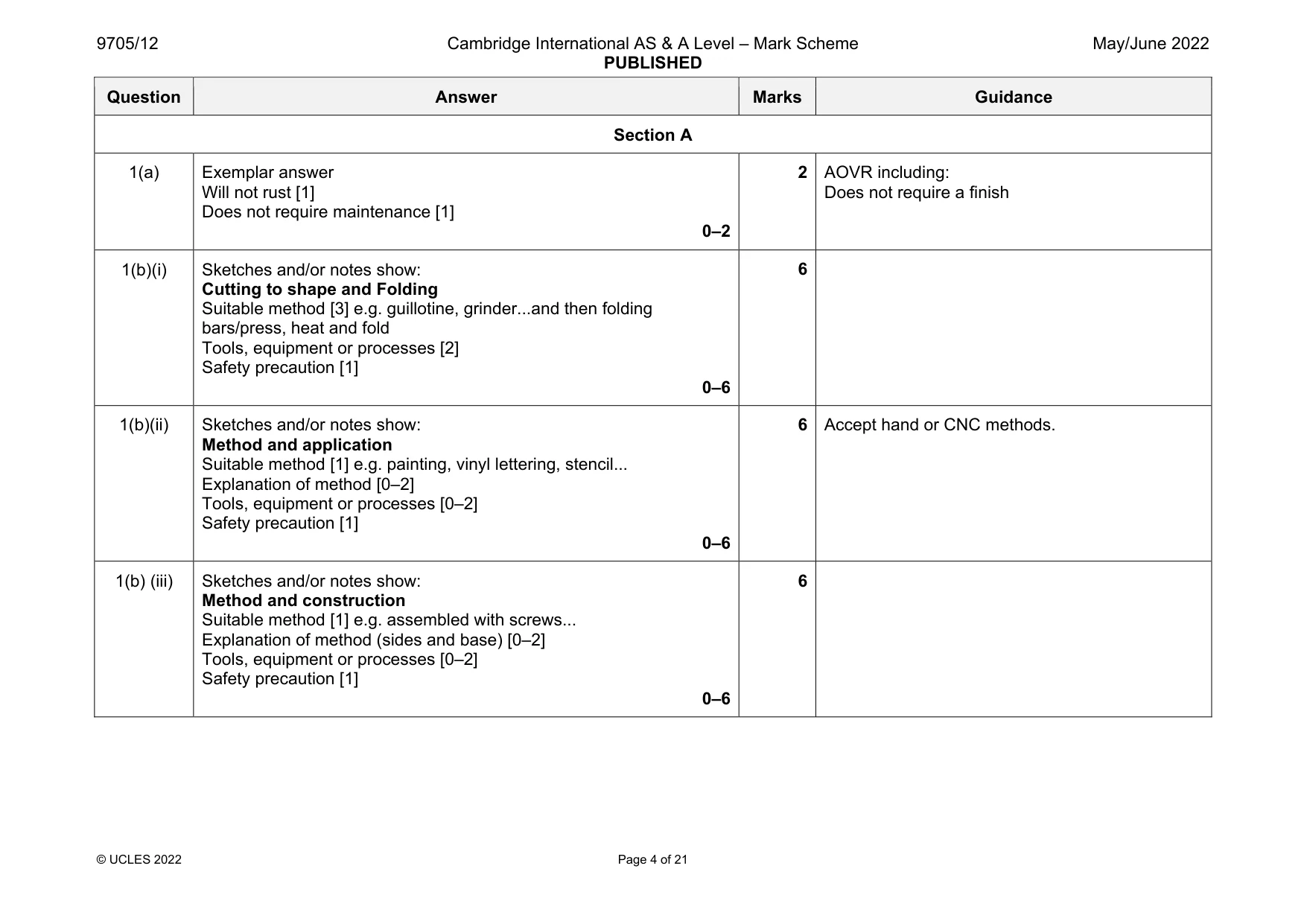
9705/12 Cambridge International AS & A Level – Mark Scheme PUBLISHED May/June 2022 © UCLES 2022 Page 4 of 21 Question Answer Marks Guidance Section A 1(a) Exemplar answer Will not rust [1] Does not require maintenance [1] 0–2 2 AOVR including: Does not require a finish 1(b)(i) Sketches and/or notes show: Cutting to shape and Folding Suitable method [3] e.g. guillotine, grinder...and then folding bars/press, heat and fold Tools, equipment or processes [2] Safety precaution [1] 0–6 6 1(b)(ii) Sketches and/or notes show: Method and application Suitable method [1] e.g. painting, vinyl lettering, stencil... Explanation of method [0–2] Tools, equipment or processes [0–2] Safety precaution [1] 0–6 6 Accept hand or CNC methods. 1(b) (iii) Sketches and/or notes show: Method and construction Suitable method [1] e.g. assembled with screws... Explanation of method (sides and base) [0–2] Tools, equipment or processes [0–2] Safety precaution [1] 0–6 6
Mark scheme, page 5
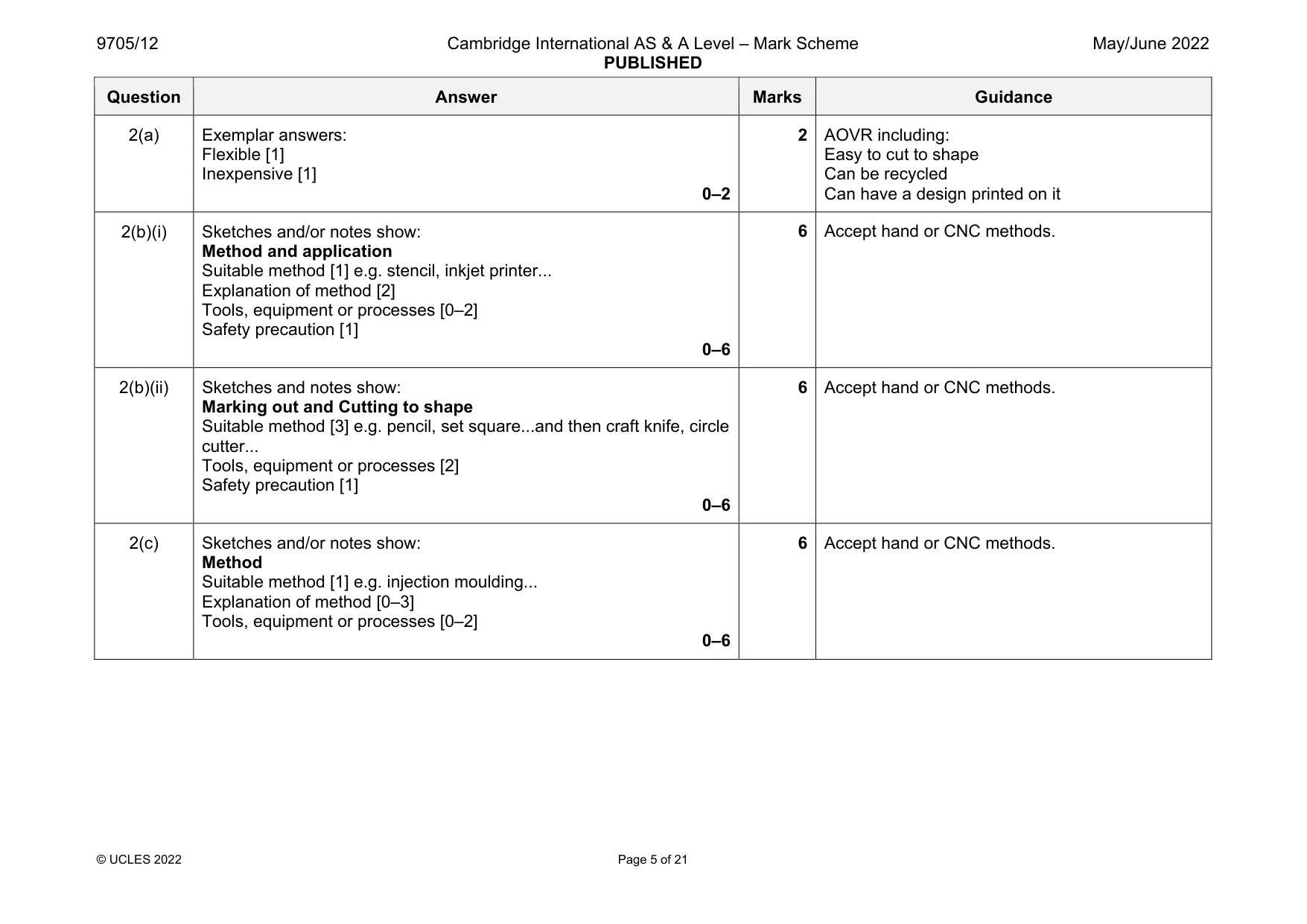
9705/12 Cambridge International AS & A Level – Mark Scheme PUBLISHED May/June 2022 © UCLES 2022 Page 5 of 21 Question Answer Marks Guidance 2(a) Exemplar answers: Flexible [1] Inexpensive [1] 0–2 2 AOVR including: Easy to cut to shape Can be recycled Can have a design printed on it 2(b)(i) Sketches and/or notes show: Method and application Suitable method [1] e.g. stencil, inkjet printer... Explanation of method [2] Tools, equipment or processes [0–2] Safety precaution [1] 0–6 6 Accept hand or CNC methods. 2(b)(ii) Sketches and notes show: Marking out and Cutting to shape Suitable method [3] e.g. pencil, set square...and then craft knife, circle cutter... Tools, equipment or processes [2] Safety precaution [1] 0–6 6 Accept hand or CNC methods. 2(c) Sketches and/or notes show: Method Suitable method [1] e.g. injection moulding... Explanation of method [0–3] Tools, equipment or processes [0–2] 0–6 6 Accept hand or CNC methods.
Mark scheme, page 6
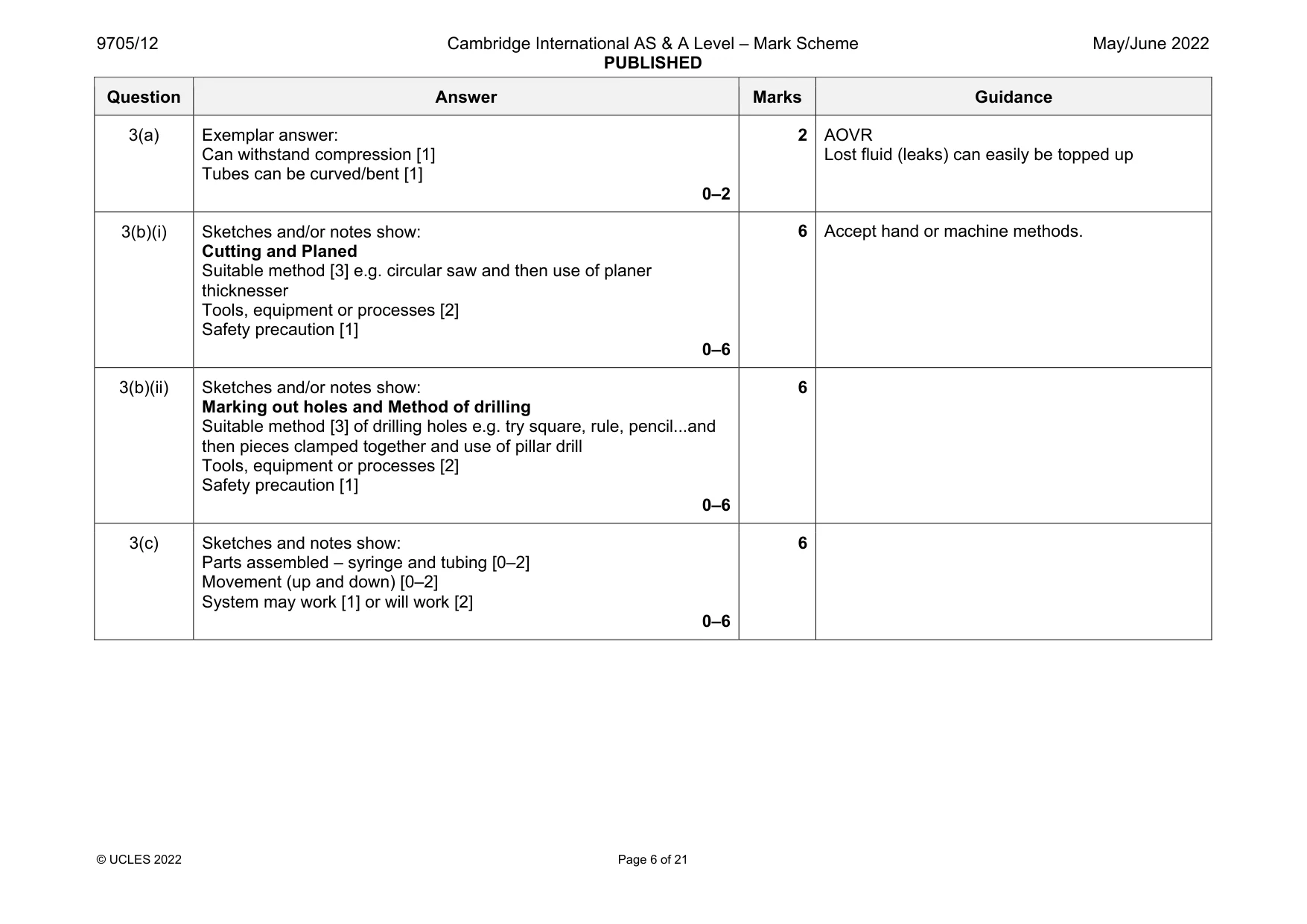
9705/12 Cambridge International AS & A Level – Mark Scheme PUBLISHED May/June 2022 © UCLES 2022 Page 6 of 21 Question Answer Marks Guidance 3(a) Exemplar answer: Can withstand compression [1] Tubes can be curved/bent [1] 0–2 2 AOVR Lost fluid (leaks) can easily be topped up 3(b)(i) Sketches and/or notes show: Cutting and Planed Suitable method [3] e.g. circular saw and then use of planer thicknesser Tools, equipment or processes [2] Safety precaution [1] 0–6 6 Accept hand or machine methods. 3(b)(ii) Sketches and/or notes show: Marking out holes and Method of drilling Suitable method [3] of drilling holes e.g. try square, rule, pencil...and then pieces clamped together and use of pillar drill Tools, equipment or processes [2] Safety precaution [1] 0–6 6 3(c) Sketches and notes show: Parts assembled – syringe and tubing [0–2] Movement (up and down) [0–2] System may work [1] or will work [2] 0–6 6
Mark scheme, page 7
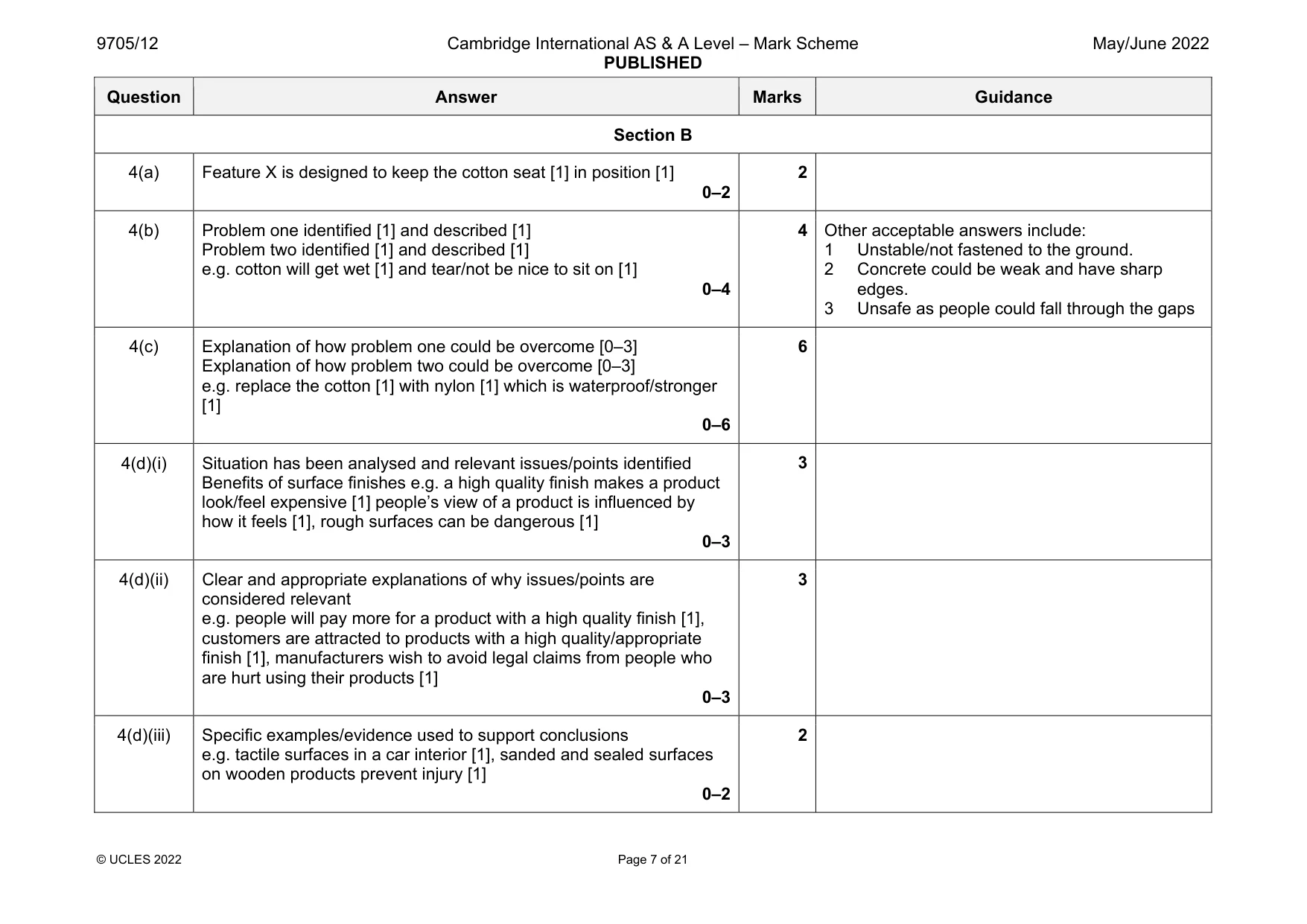
9705/12 Cambridge International AS & A Level – Mark Scheme PUBLISHED May/June 2022 © UCLES 2022 Page 7 of 21 Question Answer Marks Guidance Section B 4(a) Feature X is designed to keep the cotton seat [1] in position [1] 0–2 2 4(b) Problem one identified [1] and described [1] Problem two identified [1] and described [1] e.g. cotton will get wet [1] and tear/not be nice to sit on [1] 0–4 4 Other acceptable answers include: 1 Unstable/not fastened to the ground. 2 Concrete could be weak and have sharp edges. 3 Unsafe as people could fall through the gaps 4(c) Explanation of how problem one could be overcome [0–3] Explanation of how problem two could be overcome [0–3] e.g. replace the cotton [1] with nylon [1] which is waterproof/stronger [1] 0–6 6 4(d)(i) Situation has been analysed and relevant issues/points identified Benefits of surface finishes e.g. a high quality finish makes a product look/feel expensive [1] people’s view of a product is influenced by how it feels [1], rough surfaces can be dangerous [1] 0–3 3 4(d)(ii) Clear and appropriate explanations of why issues/points are considered relevant e.g. people will pay more for a product with a high quality finish [1], customers are attracted to products with a high quality/appropriate finish [1], manufacturers wish to avoid legal claims from people who are hurt using their products [1] 0–3 3 4(d)(iii) Specific examples/evidence used to support conclusions e.g. tactile surfaces in a car interior [1], sanded and sealed surfaces on wooden products prevent injury [1] 0–2 2
Mark scheme, page 8
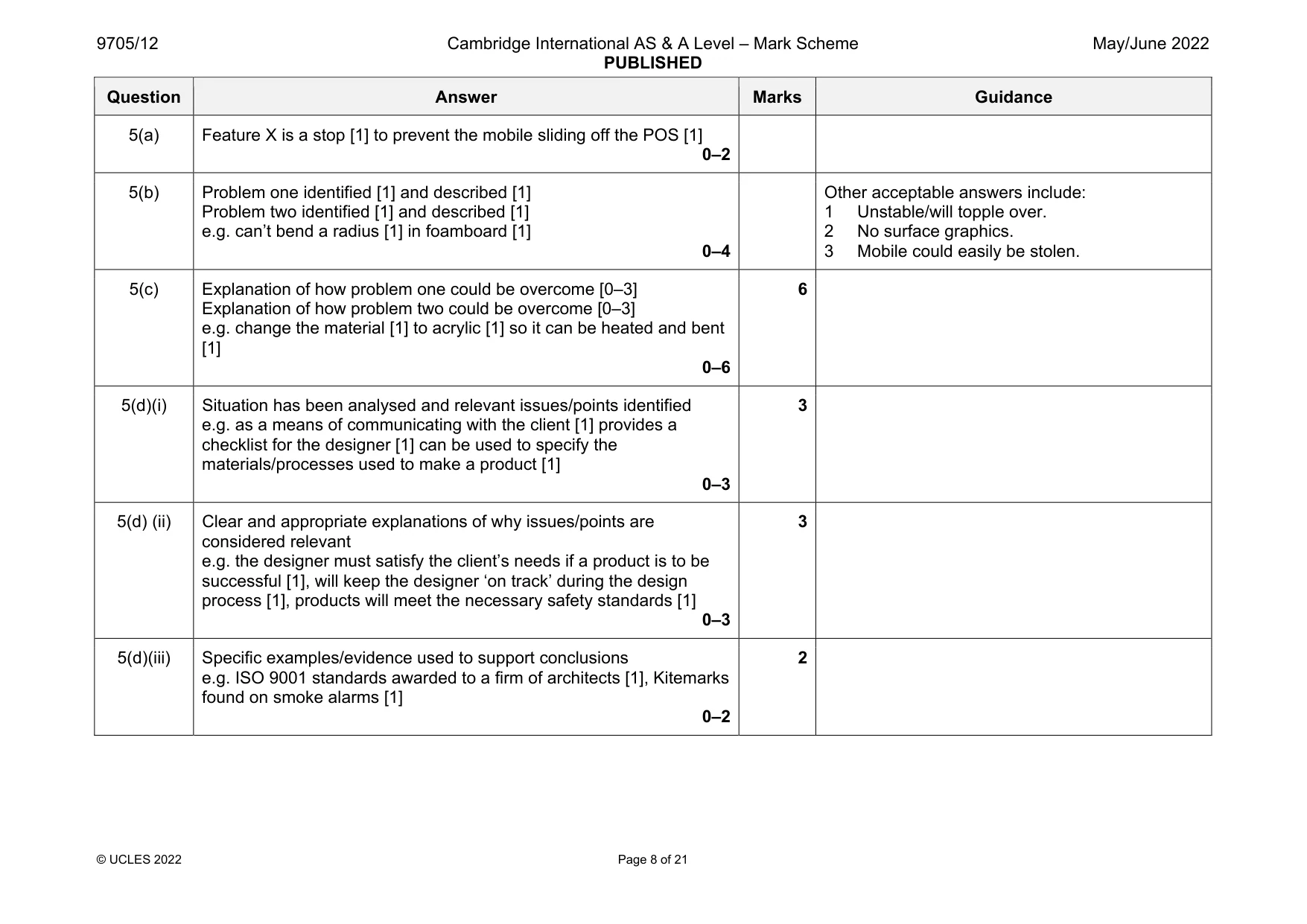
9705/12 Cambridge International AS & A Level – Mark Scheme PUBLISHED May/June 2022 © UCLES 2022 Page 8 of 21 Question Answer Marks Guidance 5(a) Feature X is a stop [1] to prevent the mobile sliding off the POS [1] 0–2 5(b) Problem one identified [1] and described [1] Problem two identified [1] and described [1] e.g. can’t bend a radius [1] in foamboard [1] 0–4 Other acceptable answers include: 1 Unstable/will topple over. 2 No surface graphics. 3 Mobile could easily be stolen. 5(c) Explanation of how problem one could be overcome [0–3] Explanation of how problem two could be overcome [0–3] e.g. change the material [1] to acrylic [1] so it can be heated and bent [1] 0–6 6 5(d)(i) Situation has been analysed and relevant issues/points identified e.g. as a means of communicating with the client [1] provides a checklist for the designer [1] can be used to specify the materials/processes used to make a product [1] 0–3 3 5(d) (ii) Clear and appropriate explanations of why issues/points are considered relevant e.g. the designer must satisfy the client’s needs if a product is to be successful [1], will keep the designer ‘on track’ during the design process [1], products will meet the necessary safety standards [1] 0–3 3 5(d)(iii) Specific examples/evidence used to support conclusions e.g. ISO 9001 standards awarded to a firm of architects [1], Kitemarks found on smoke alarms [1] 0–2 2
Mark scheme, page 9
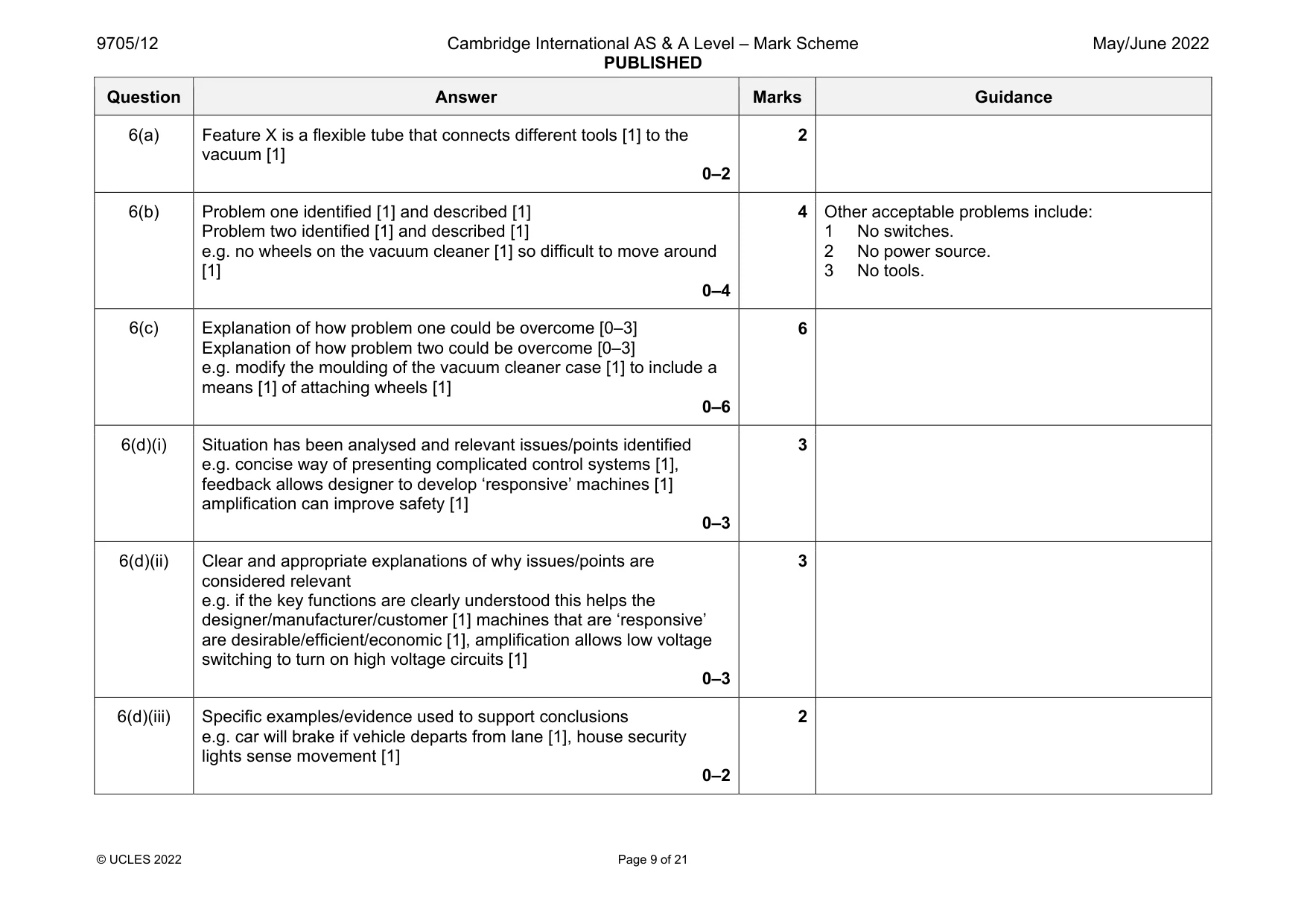
9705/12 Cambridge International AS & A Level – Mark Scheme PUBLISHED May/June 2022 © UCLES 2022 Page 9 of 21 Question Answer Marks Guidance 6(a) Feature X is a flexible tube that connects different tools [1] to the vacuum [1] 0–2 2 6(b) Problem one identified [1] and described [1] Problem two identified [1] and described [1] e.g. no wheels on the vacuum cleaner [1] so difficult to move around [1] 0–4 4 Other acceptable problems include: 1 No switches. 2 No power source. 3 No tools. 6(c) Explanation of how problem one could be overcome [0–3] Explanation of how problem two could be overcome [0–3] e.g. modify the moulding of the vacuum cleaner case [1] to include a means [1] of attaching wheels [1] 0–6 6 6(d)(i) Situation has been analysed and relevant issues/points identified e.g. concise way of presenting complicated control systems [1], feedback allows designer to develop ‘responsive’ machines [1] amplification can improve safety [1] 0–3 3 6(d)(ii) Clear and appropriate explanations of why issues/points are considered relevant e.g. if the key functions are clearly understood this helps the designer/manufacturer/customer [1] machines that are ‘responsive’ are desirable/efficient/economic [1], amplification allows low voltage switching to turn on high voltage circuits [1] 0–3 3 6(d)(iii) Specific examples/evidence used to support conclusions e.g. car will brake if vehicle departs from lane [1], house security lights sense movement [1] 0–2 2
Mark scheme, page 10
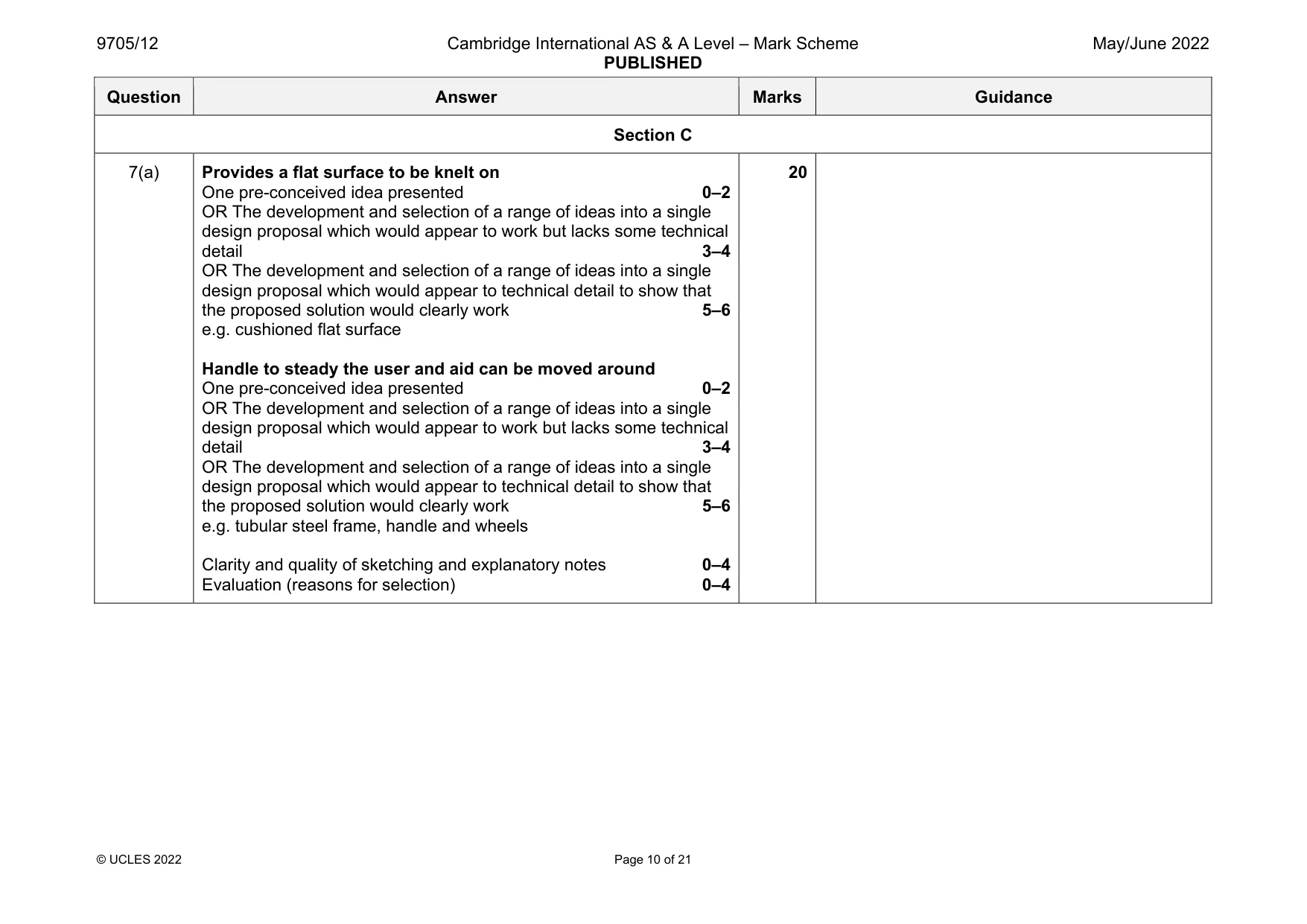
9705/12 Cambridge International AS & A Level – Mark Scheme PUBLISHED May/June 2022 © UCLES 2022 Page 10 of 21 Question Answer Marks Guidance Section C 7(a) Provides a flat surface to be knelt on One pre-conceived idea presented 0–2 OR The development and selection of a range of ideas into a single design proposal which would appear to work but lacks some technical detail 3–4 OR The development and selection of a range of ideas into a single design proposal which would appear to technical detail to show that the proposed solution would clearly work 5–6 e.g. cushioned flat surface Handle to steady the user and aid can be moved around One pre-conceived idea presented 0–2 OR The development and selection of a range of ideas into a single design proposal which would appear to work but lacks some technical detail 3–4 OR The development and selection of a range of ideas into a single design proposal which would appear to technical detail to show that the proposed solution would clearly work 5–6 e.g. tubular steel frame, handle and wheels Clarity and quality of sketching and explanatory notes 0–4 Evaluation (reasons for selection) 0–4 20
Mark scheme, page 11
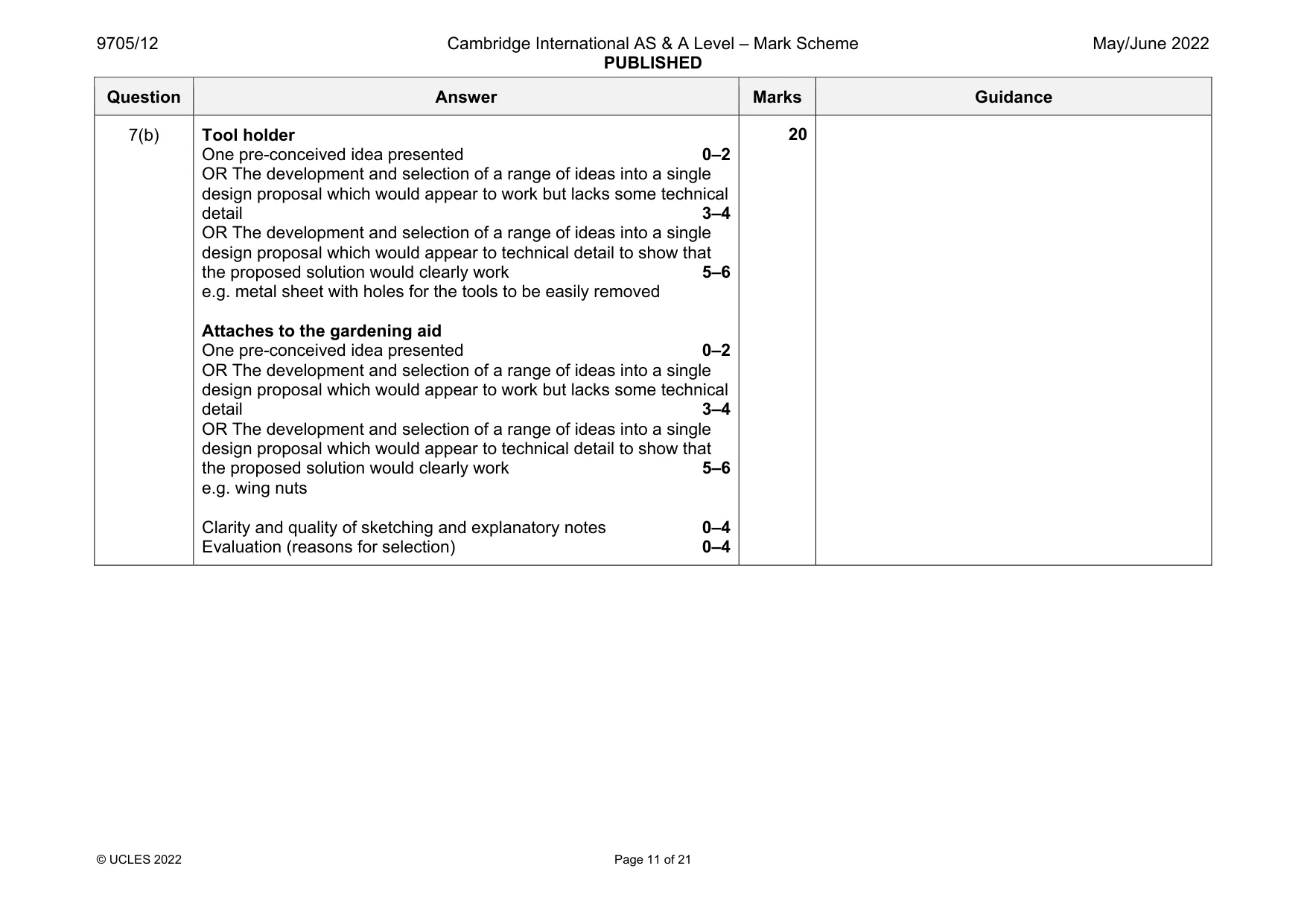
9705/12 Cambridge International AS & A Level – Mark Scheme PUBLISHED May/June 2022 © UCLES 2022 Page 11 of 21 Question Answer Marks Guidance 7(b) Tool holder One pre-conceived idea presented 0–2 OR The development and selection of a range of ideas into a single design proposal which would appear to work but lacks some technical detail 3–4 OR The development and selection of a range of ideas into a single design proposal which would appear to technical detail to show that the proposed solution would clearly work 5–6 e.g. metal sheet with holes for the tools to be easily removed Attaches to the gardening aid One pre-conceived idea presented 0–2 OR The development and selection of a range of ideas into a single design proposal which would appear to work but lacks some technical detail 3–4 OR The development and selection of a range of ideas into a single design proposal which would appear to technical detail to show that the proposed solution would clearly work 5–6 e.g. wing nuts Clarity and quality of sketching and explanatory notes 0–4 Evaluation (reasons for selection) 0–4 20
Mark scheme, page 12
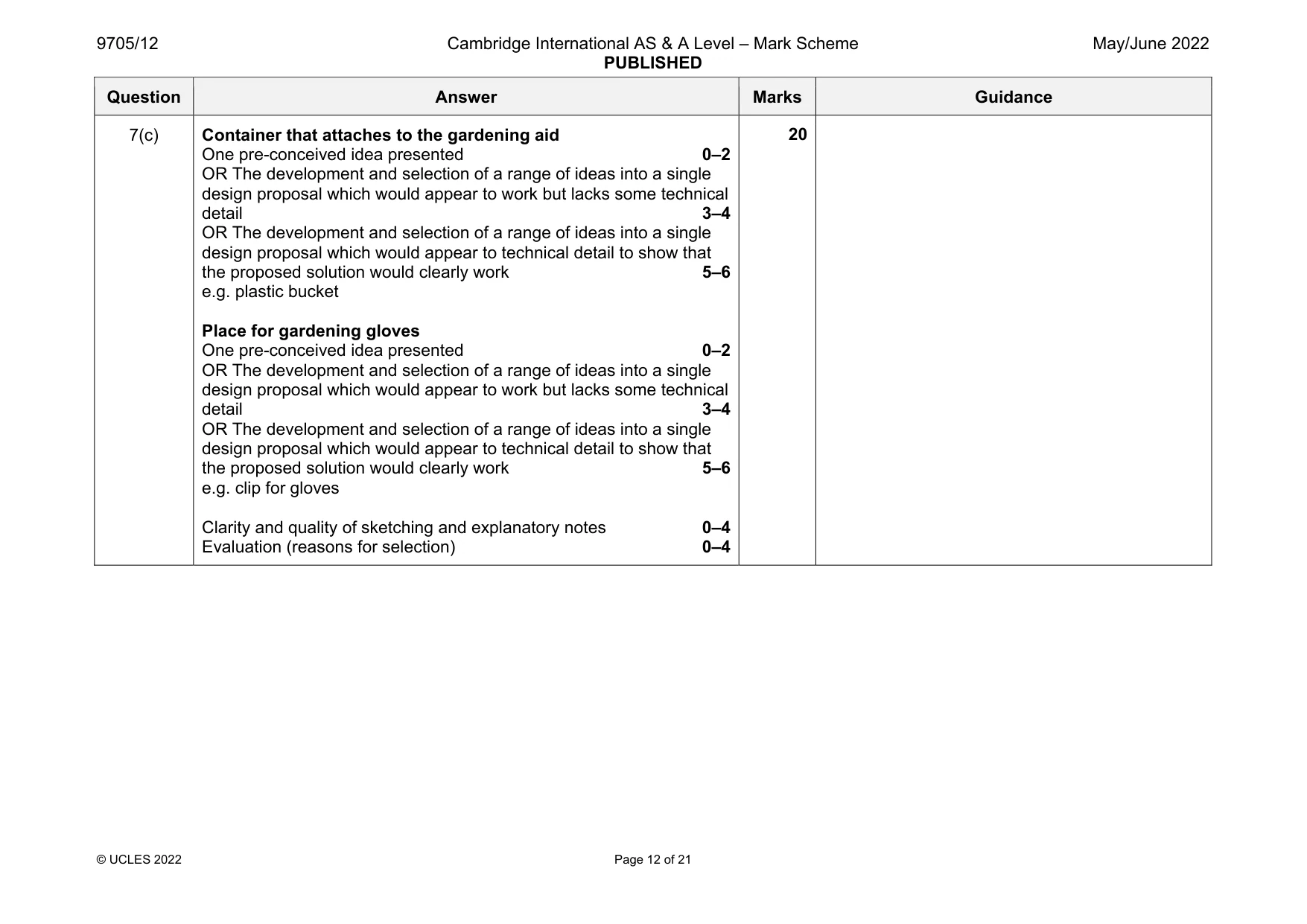
9705/12 Cambridge International AS & A Level – Mark Scheme PUBLISHED May/June 2022 © UCLES 2022 Page 12 of 21 Question Answer Marks Guidance 7(c) Container that attaches to the gardening aid One pre-conceived idea presented 0–2 OR The development and selection of a range of ideas into a single design proposal which would appear to work but lacks some technical detail 3–4 OR The development and selection of a range of ideas into a single design proposal which would appear to technical detail to show that the proposed solution would clearly work 5–6 e.g. plastic bucket Place for gardening gloves One pre-conceived idea presented 0–2 OR The development and selection of a range of ideas into a single design proposal which would appear to work but lacks some technical detail 3–4 OR The development and selection of a range of ideas into a single design proposal which would appear to technical detail to show that the proposed solution would clearly work 5–6 e.g. clip for gloves Clarity and quality of sketching and explanatory notes 0–4 Evaluation (reasons for selection) 0–4 20
Mark scheme, page 13
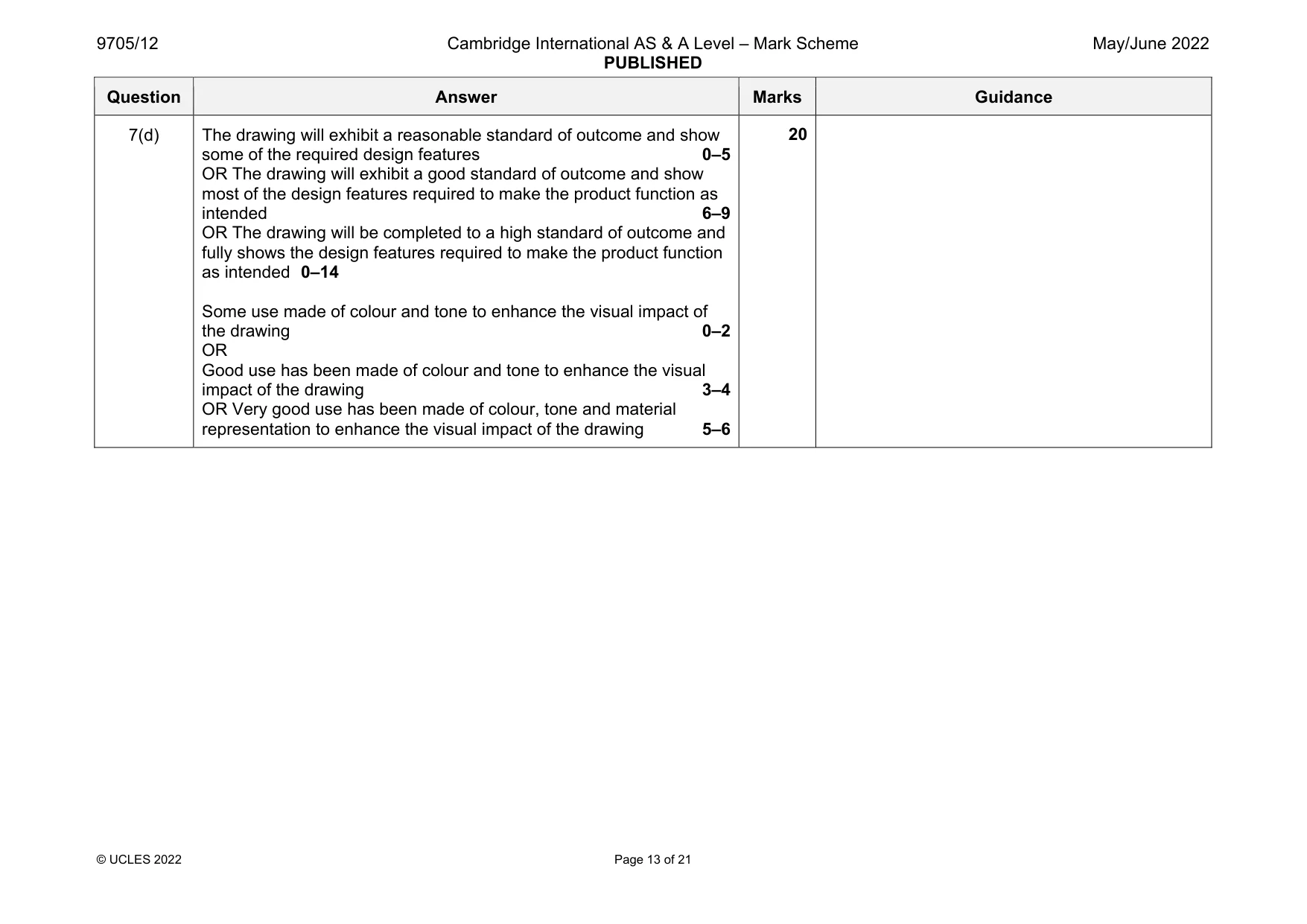
9705/12 Cambridge International AS & A Level – Mark Scheme PUBLISHED May/June 2022 © UCLES 2022 Page 13 of 21 Question Answer Marks Guidance 7(d) The drawing will exhibit a reasonable standard of outcome and show some of the required design features 0–5 OR The drawing will exhibit a good standard of outcome and show most of the design features required to make the product function as intended 6–9 OR The drawing will be completed to a high standard of outcome and fully shows the design features required to make the product function as intended 0–14 Some use made of colour and tone to enhance the visual impact of the drawing 0–2 OR Good use has been made of colour and tone to enhance the visual impact of the drawing 3–4 OR Very good use has been made of colour, tone and material representation to enhance the visual impact of the drawing 5–6 20
Mark scheme, page 14
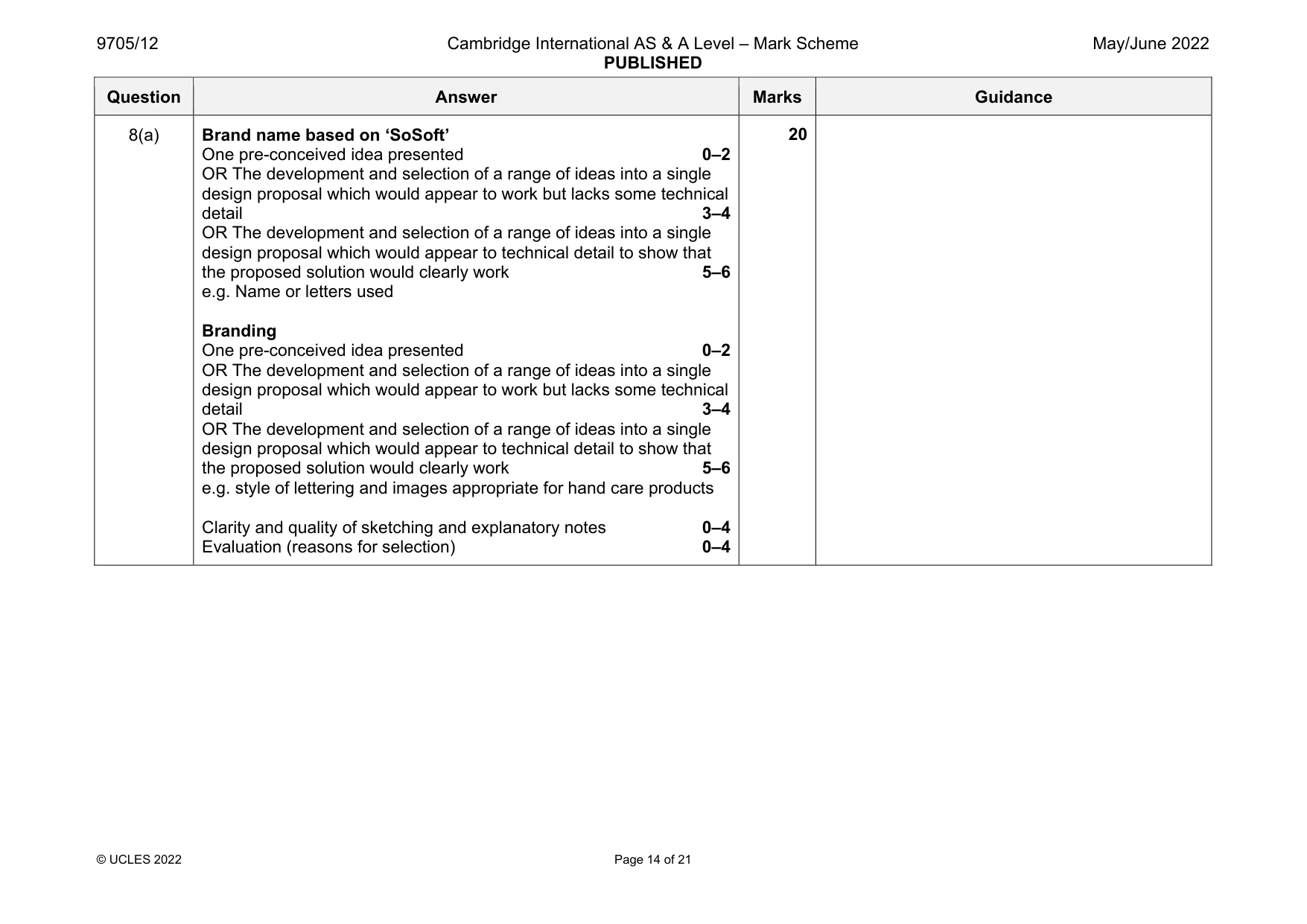
9705/12 Cambridge International AS & A Level – Mark Scheme PUBLISHED May/June 2022 © UCLES 2022 Page 14 of 21 Question Answer Marks Guidance 8(a) Brand name based on ‘SoSoft’ One pre-conceived idea presented 0–2 OR The development and selection of a range of ideas into a single design proposal which would appear to work but lacks some technical detail 3–4 OR The development and selection of a range of ideas into a single design proposal which would appear to technical detail to show that the proposed solution would clearly work 5–6 e.g. Name or letters used Branding One pre-conceived idea presented 0–2 OR The development and selection of a range of ideas into a single design proposal which would appear to work but lacks some technical detail 3–4 OR The development and selection of a range of ideas into a single design proposal which would appear to technical detail to show that the proposed solution would clearly work 5–6 e.g. style of lettering and images appropriate for hand care products Clarity and quality of sketching and explanatory notes 0–4 Evaluation (reasons for selection) 0–4 20
Mark scheme, page 15
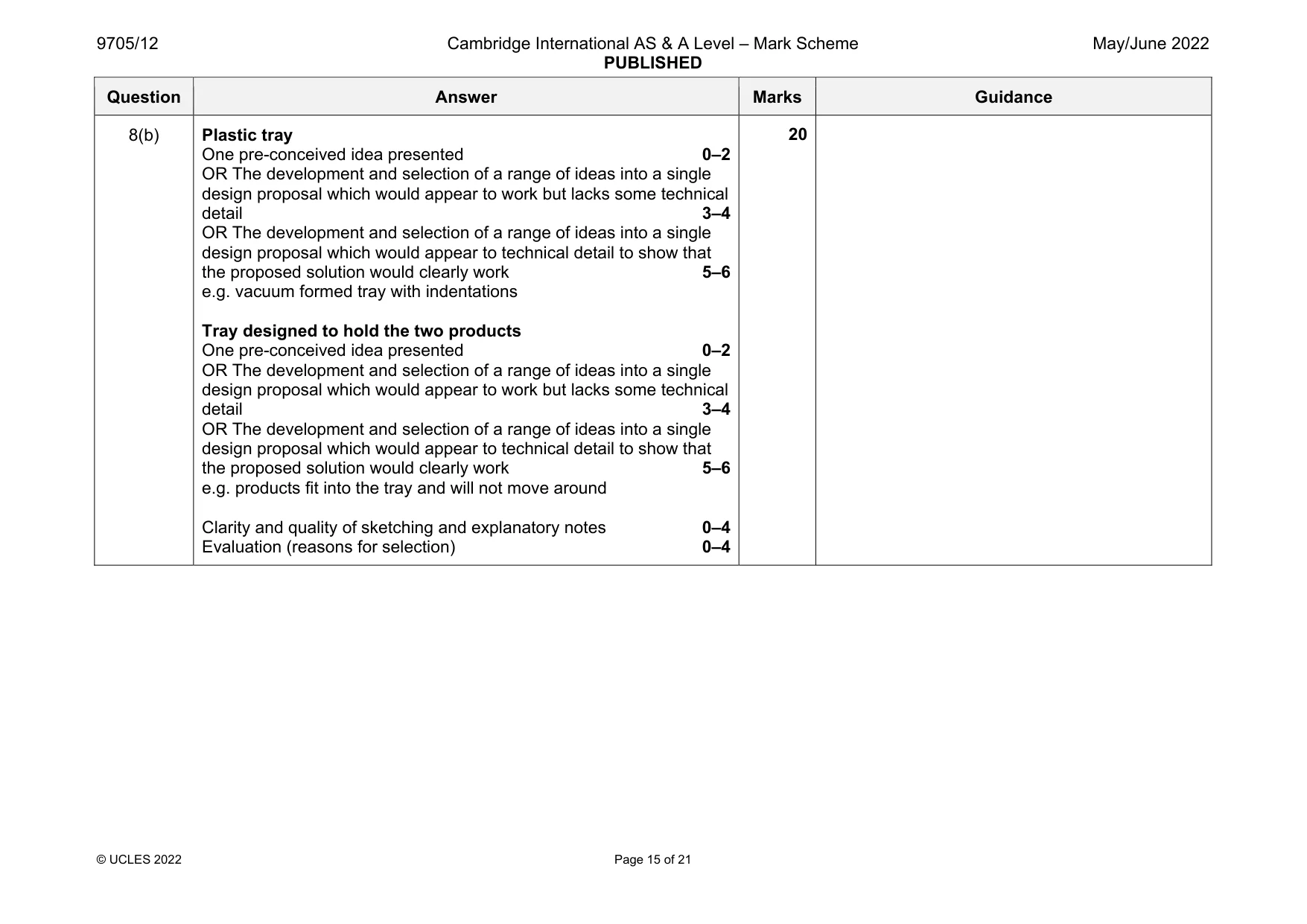
9705/12 Cambridge International AS & A Level – Mark Scheme PUBLISHED May/June 2022 © UCLES 2022 Page 15 of 21 Question Answer Marks Guidance 8(b) Plastic tray One pre-conceived idea presented 0–2 OR The development and selection of a range of ideas into a single design proposal which would appear to work but lacks some technical detail 3–4 OR The development and selection of a range of ideas into a single design proposal which would appear to technical detail to show that the proposed solution would clearly work 5–6 e.g. vacuum formed tray with indentations Tray designed to hold the two products One pre-conceived idea presented 0–2 OR The development and selection of a range of ideas into a single design proposal which would appear to work but lacks some technical detail 3–4 OR The development and selection of a range of ideas into a single design proposal which would appear to technical detail to show that the proposed solution would clearly work 5–6 e.g. products fit into the tray and will not move around Clarity and quality of sketching and explanatory notes 0–4 Evaluation (reasons for selection) 0–4 20
Mark scheme, page 16
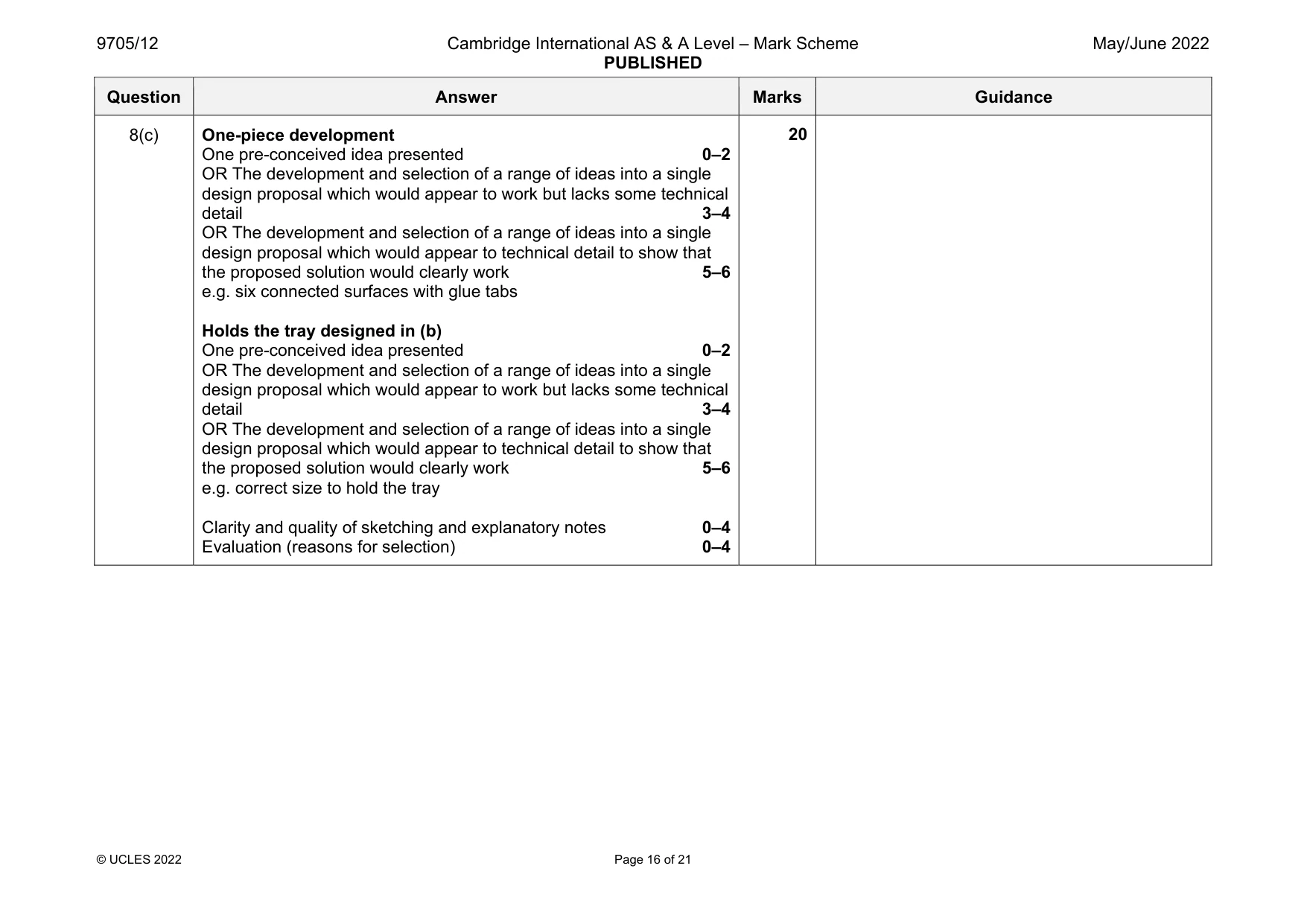
9705/12 Cambridge International AS & A Level – Mark Scheme PUBLISHED May/June 2022 © UCLES 2022 Page 16 of 21 Question Answer Marks Guidance 8(c) One-piece development One pre-conceived idea presented 0–2 OR The development and selection of a range of ideas into a single design proposal which would appear to work but lacks some technical detail 3–4 OR The development and selection of a range of ideas into a single design proposal which would appear to technical detail to show that the proposed solution would clearly work 5–6 e.g. six connected surfaces with glue tabs Holds the tray designed in (b) One pre-conceived idea presented 0–2 OR The development and selection of a range of ideas into a single design proposal which would appear to work but lacks some technical detail 3–4 OR The development and selection of a range of ideas into a single design proposal which would appear to technical detail to show that the proposed solution would clearly work 5–6 e.g. correct size to hold the tray Clarity and quality of sketching and explanatory notes 0–4 Evaluation (reasons for selection) 0–4 20
Mark scheme, page 17
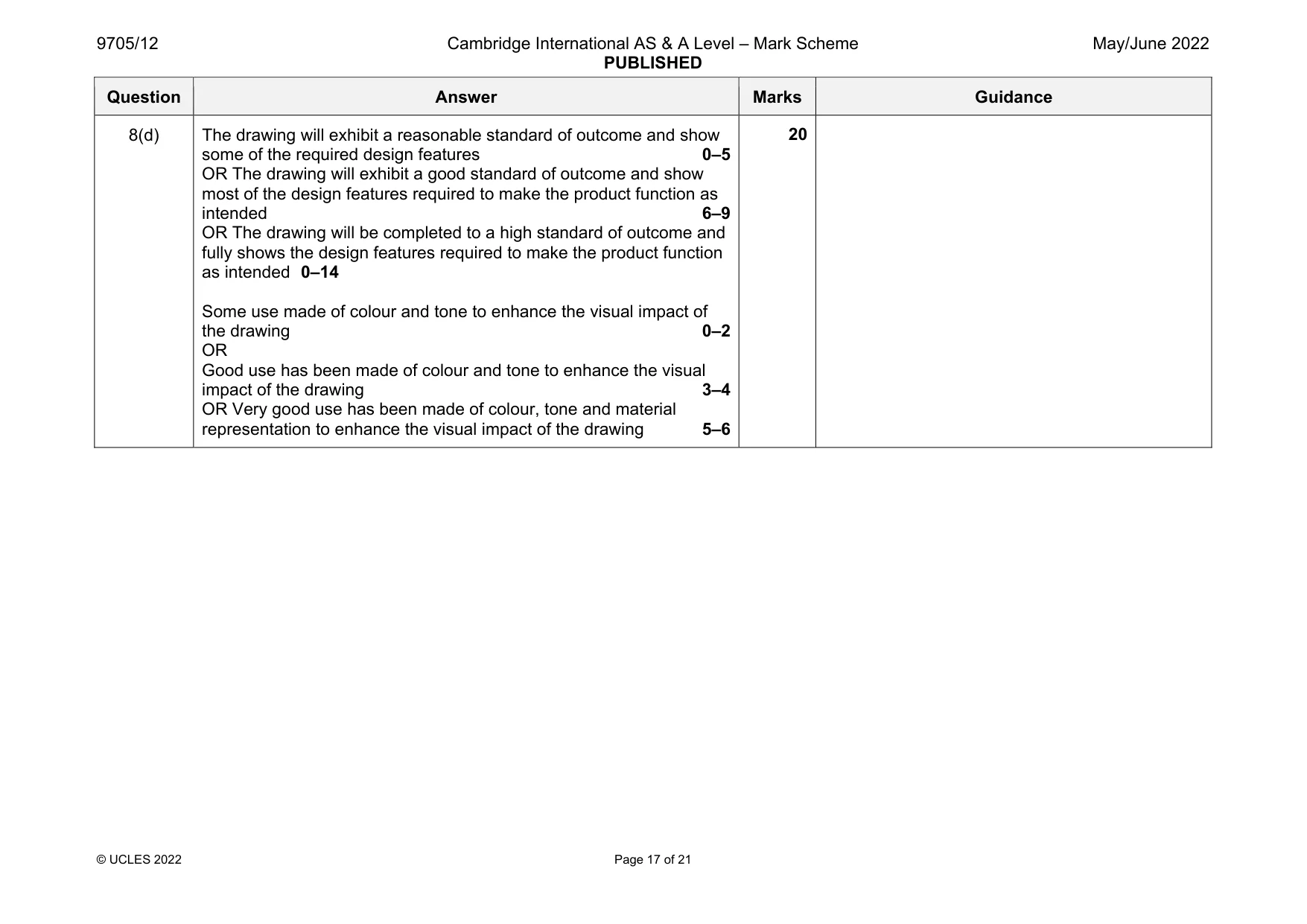
9705/12 Cambridge International AS & A Level – Mark Scheme PUBLISHED May/June 2022 © UCLES 2022 Page 17 of 21 Question Answer Marks Guidance 8(d) The drawing will exhibit a reasonable standard of outcome and show some of the required design features 0–5 OR The drawing will exhibit a good standard of outcome and show most of the design features required to make the product function as intended 6–9 OR The drawing will be completed to a high standard of outcome and fully shows the design features required to make the product function as intended 0–14 Some use made of colour and tone to enhance the visual impact of the drawing 0–2 OR Good use has been made of colour and tone to enhance the visual impact of the drawing 3–4 OR Very good use has been made of colour, tone and material representation to enhance the visual impact of the drawing 5–6 20
Mark scheme, page 18
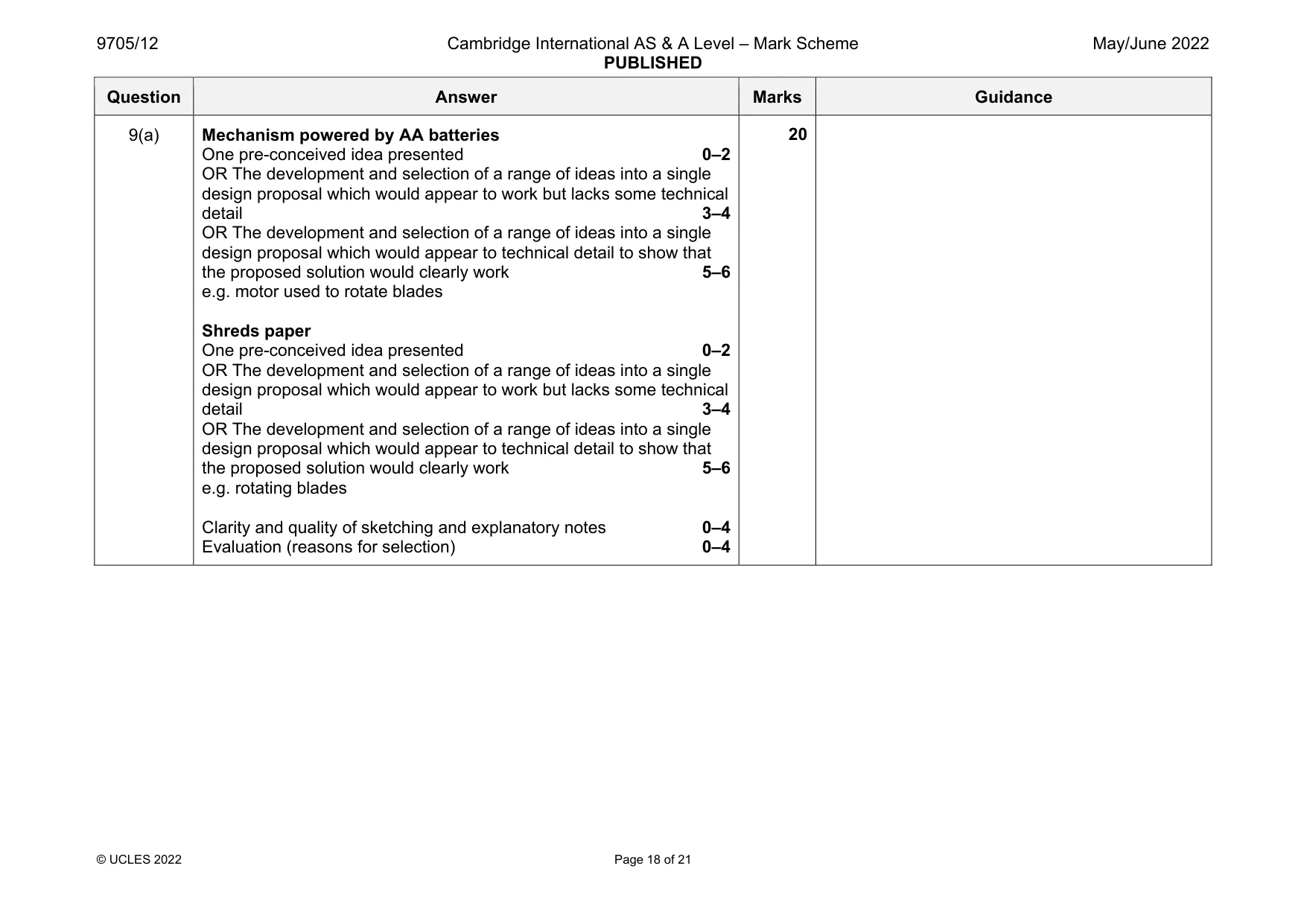
9705/12 Cambridge International AS & A Level – Mark Scheme PUBLISHED May/June 2022 © UCLES 2022 Page 18 of 21 Question Answer Marks Guidance 9(a) Mechanism powered by AA batteries One pre-conceived idea presented 0–2 OR The development and selection of a range of ideas into a single design proposal which would appear to work but lacks some technical detail 3–4 OR The development and selection of a range of ideas into a single design proposal which would appear to technical detail to show that the proposed solution would clearly work 5–6 e.g. motor used to rotate blades Shreds paper One pre-conceived idea presented 0–2 OR The development and selection of a range of ideas into a single design proposal which would appear to work but lacks some technical detail 3–4 OR The development and selection of a range of ideas into a single design proposal which would appear to technical detail to show that the proposed solution would clearly work 5–6 e.g. rotating blades Clarity and quality of sketching and explanatory notes 0–4 Evaluation (reasons for selection) 0–4 20
Mark scheme, page 19
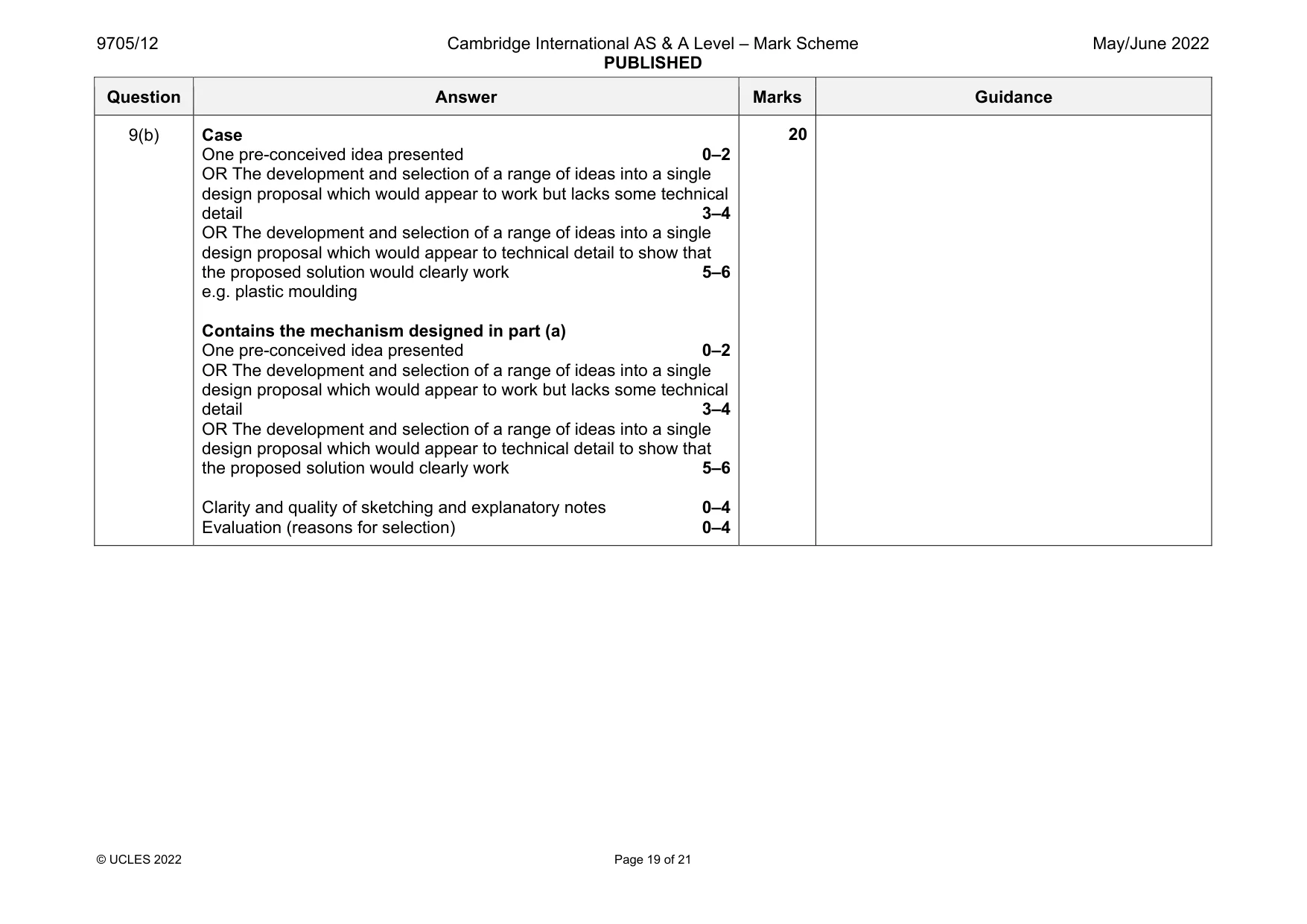
9705/12 Cambridge International AS & A Level – Mark Scheme PUBLISHED May/June 2022 © UCLES 2022 Page 19 of 21 Question Answer Marks Guidance 9(b) Case One pre-conceived idea presented 0–2 OR The development and selection of a range of ideas into a single design proposal which would appear to work but lacks some technical detail 3–4 OR The development and selection of a range of ideas into a single design proposal which would appear to technical detail to show that the proposed solution would clearly work 5–6 e.g. plastic moulding Contains the mechanism designed in part (a) One pre-conceived idea presented 0–2 OR The development and selection of a range of ideas into a single design proposal which would appear to work but lacks some technical detail 3–4 OR The development and selection of a range of ideas into a single design proposal which would appear to technical detail to show that the proposed solution would clearly work 5–6 Clarity and quality of sketching and explanatory notes 0–4 Evaluation (reasons for selection) 0–4 20
Mark scheme, page 20
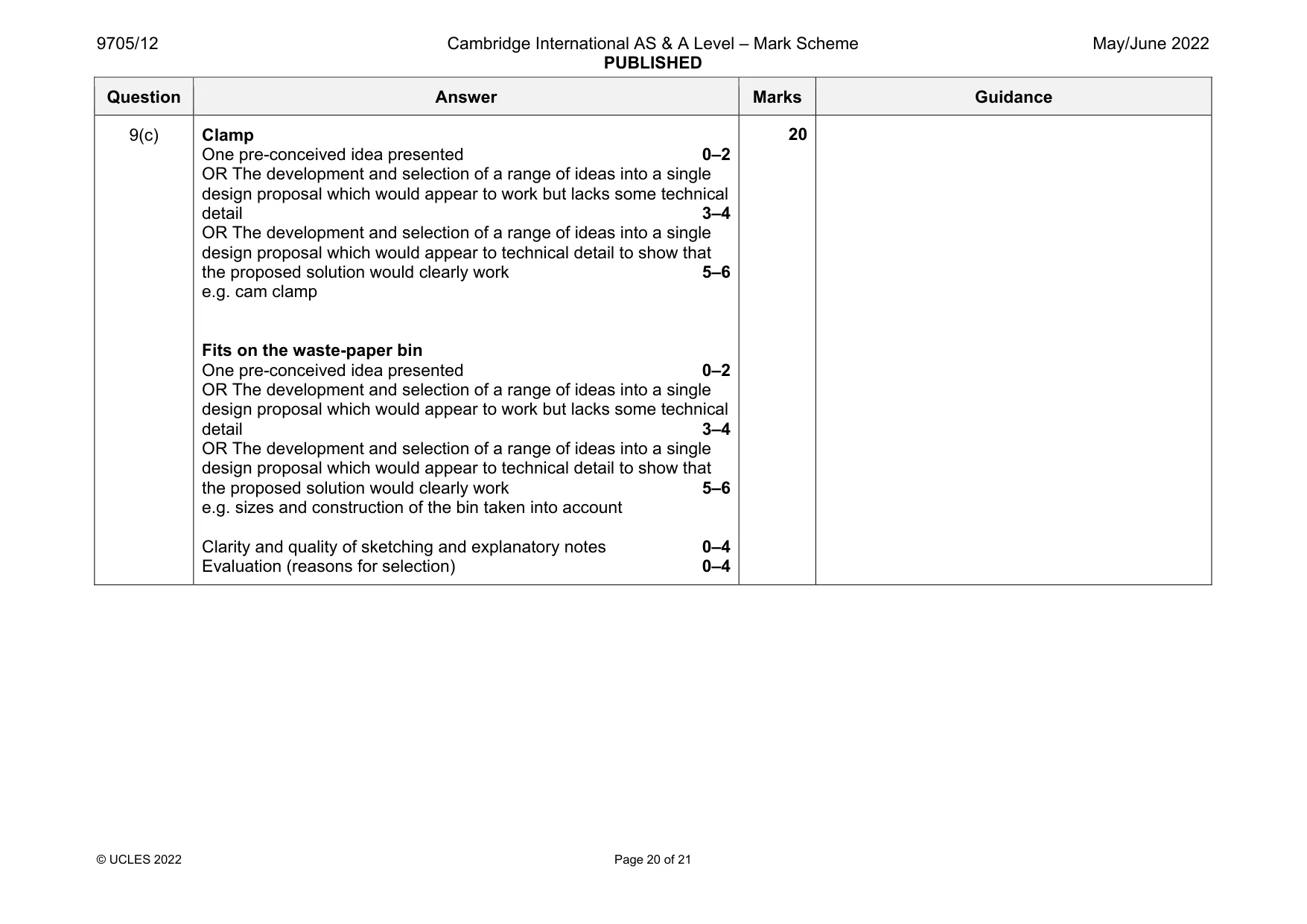
9705/12 Cambridge International AS & A Level – Mark Scheme PUBLISHED May/June 2022 © UCLES 2022 Page 20 of 21 Question Answer Marks Guidance 9(c) Clamp One pre-conceived idea presented 0–2 OR The development and selection of a range of ideas into a single design proposal which would appear to work but lacks some technical detail 3–4 OR The development and selection of a range of ideas into a single design proposal which would appear to technical detail to show that the proposed solution would clearly work 5–6 e.g. cam clamp Fits on the waste-paper bin One pre-conceived idea presented 0–2 OR The development and selection of a range of ideas into a single design proposal which would appear to work but lacks some technical detail 3–4 OR The development and selection of a range of ideas into a single design proposal which would appear to technical detail to show that the proposed solution would clearly work 5–6 e.g. sizes and construction of the bin taken into account Clarity and quality of sketching and explanatory notes 0–4 Evaluation (reasons for selection) 0–4 20
Mark scheme, page 21
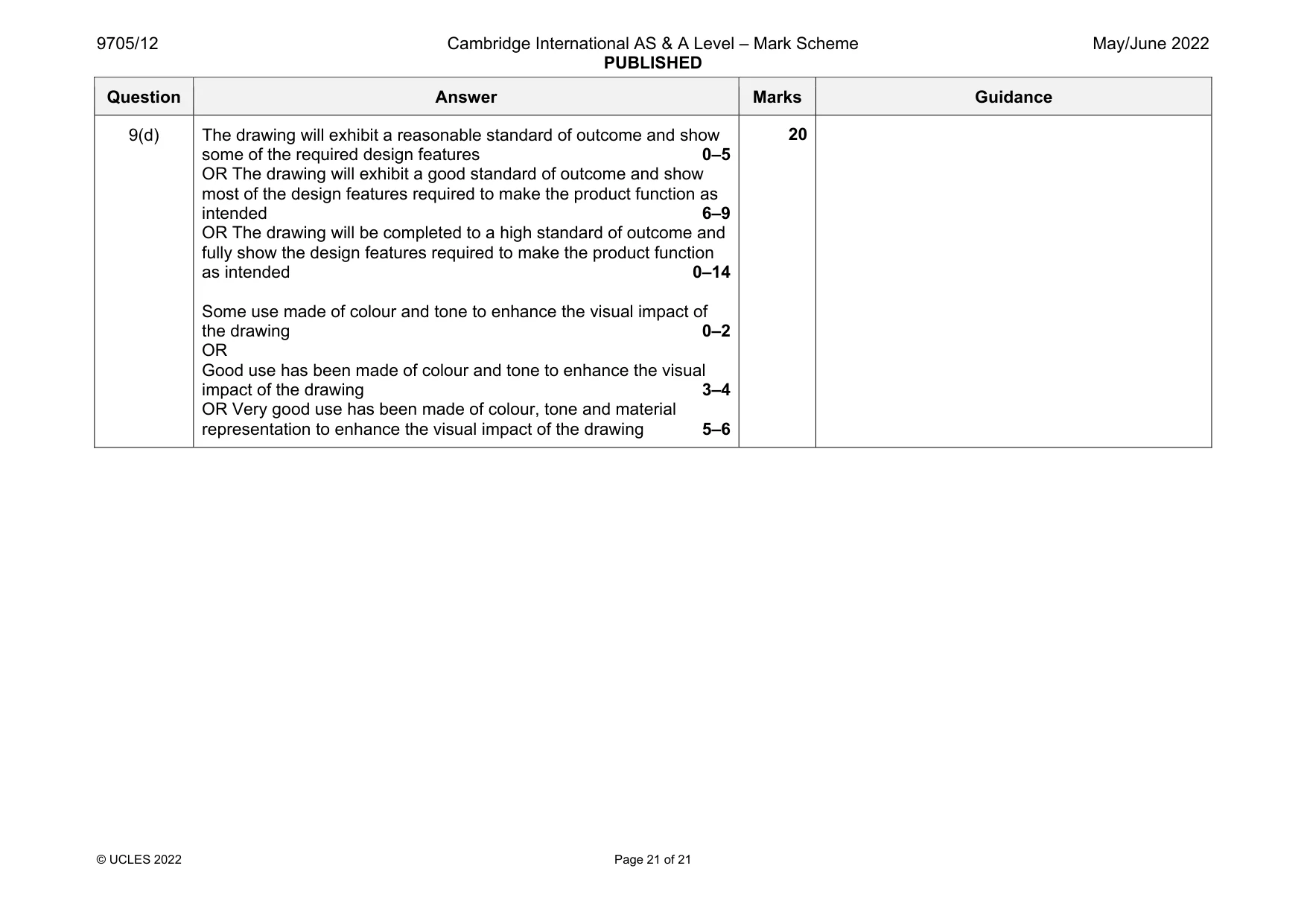
9705/12 Cambridge International AS & A Level – Mark Scheme PUBLISHED May/June 2022 © UCLES 2022 Page 21 of 21 Question Answer Marks Guidance 9(d) The drawing will exhibit a reasonable standard of outcome and show some of the required design features 0–5 OR The drawing will exhibit a good standard of outcome and show most of the design features required to make the product function as intended 6–9 OR The drawing will be completed to a high standard of outcome and fully show the design features required to make the product function as intended 0–14 Some use made of colour and tone to enhance the visual impact of the drawing 0–2 OR Good use has been made of colour and tone to enhance the visual impact of the drawing 3–4 OR Very good use has been made of colour, tone and material representation to enhance the visual impact of the drawing 5–6 20
What you needed in this session
Cambridge’s own grade thresholds for 2022 May/June, Paper 1 · Variant 2. A higher threshold means an easier paper — the bar moves with how the cohort did.