Cambridge A Level Design and Technology 9705 — 2024 Oct/Nov Paper 1 · Variant 1
9705/11/O/N/24 · 120 marks · ≈135 min
The question paper and its mark scheme, free to read here and free to download. This is Cambridge’s own paper, exactly as it was sat.
Question paper12 pages

Mark scheme17 pages
Answers below. Sit the paper first if you are practising.
Paper as text
Question paper, page 1
This document has 12 pages. Any blank pages are indicated. [Turn over * 8 4 8 4 9 6 5 1 5 2 * Cambridge International AS & A Level DESIGN & TECHNOLOGY 9705/11 Paper 1 October/November 2024 3 hours You must answer on the answer booklet/paper. You will need: Answer booklet/A4 paper Coloured pencils A3 drawing paper (2 sheets) Extra sheets of A3 drawing paper if needed A range of design drawing equipment INSTRUCTIONS ● Answer three questions in total: Section A: answer one question on the answer booklet/A4 paper provided. Section B: answer one question on the answer booklet/A4 paper provided. Section C: answer one question on A3 drawing paper. Use both sides of the paper. ● You may request additional sheets of A3 drawing paper, but only if you have used up both sides of each of the 2 sheets provided. ● If you have been given an answer booklet, follow the instructions on the front cover of the answer booklet. ● Use a black or dark blue pen. ● Write your name, centre number and candidate number on all the work you hand in. ● Do not use an erasable pen or correction fluid. ● You may use an HB pencil, or coloured pencils as appropriate, for any diagrams, graphs or rough working. ● At the end of the examination, fasten all your work together. Do not use staples, paper clips or glue. INFORMATION ● The total mark for this paper is 120. ● The number of marks for each question or part question is shown in brackets [ ]. ● All dimensions are in millimetres. DC (DE/FC) 337395/3 © UCLES 2024
Question paper, page 2
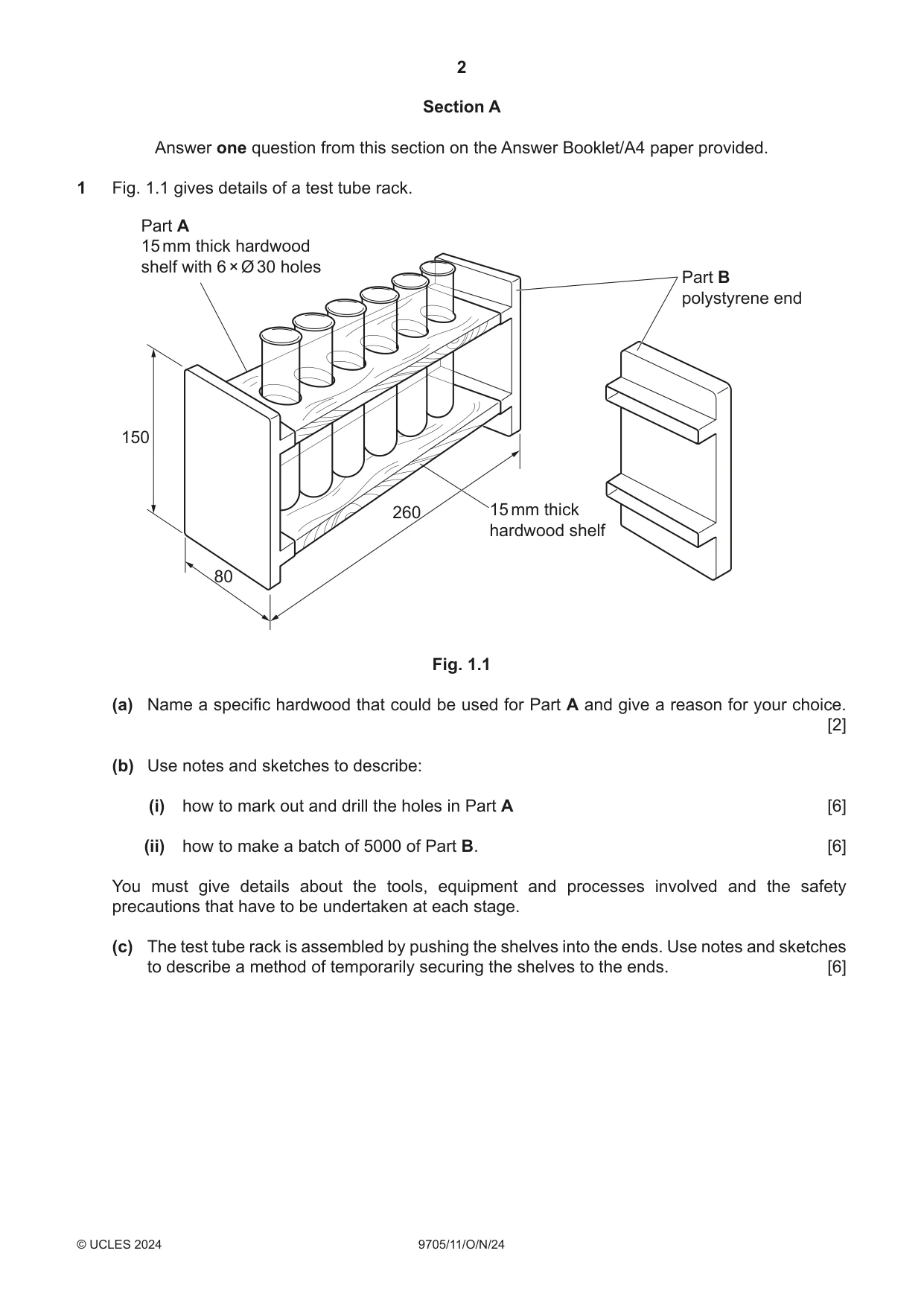
2 9705/11/O/N/24 © UCLES 2024 Section A Answer one question from this section on the Answer Booklet/A4 paper provided. 1 Fig. 1.1 gives details of a test tube rack. 150 260 80 Part A 15 mm thick hardwood shelf with 6 × Ø 30 holes 15 mm thick hardwood shelf Part B polystyrene end Fig. 1.1 (a) Name a specific hardwood that could be used for Part A and give a reason for your choice. [2] (b) Use notes and sketches to describe: (i) how to mark out and drill the holes in Part A [6] (ii) how to make a batch of 5000 of Part B. [6] You must give details about the tools, equipment and processes involved and the safety precautions that have to be undertaken at each stage. (c) The test tube rack is assembled by pushing the shelves into the ends. Use notes and sketches to describe a method of temporarily securing the shelves to the ends. [6]
Question paper, page 3
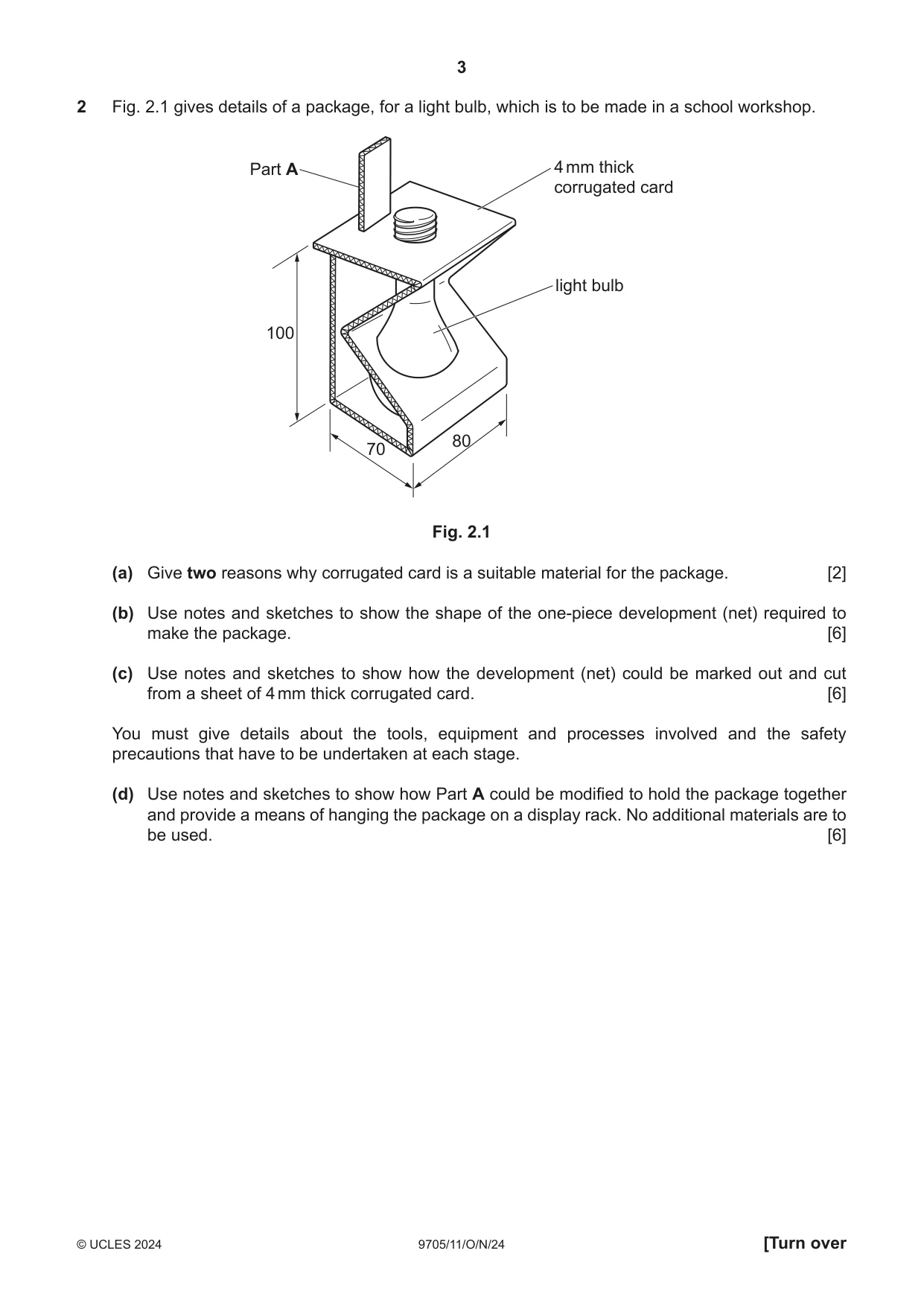
3 9705/11/O/N/24 © UCLES 2024 [Turn over 2 Fig. 2.1 gives details of a package, for a light bulb, which is to be made in a school workshop. Part A 4 mm thick corrugated card light bulb 80 70 100 Fig. 2.1 (a) Give two reasons why corrugated card is a suitable material for the package. [2] (b) Use notes and sketches to show the shape of the one-piece development (net) required to make the package. [6] (c) Use notes and sketches to show how the development (net) could be marked out and cut from a sheet of 4 mm thick corrugated card. [6] You must give details about the tools, equipment and processes involved and the safety precautions that have to be undertaken at each stage. (d) Use notes and sketches to show how Part A could be modified to hold the package together and provide a means of hanging the package on a display rack. No additional materials are to be used. [6]
Question paper, page 4
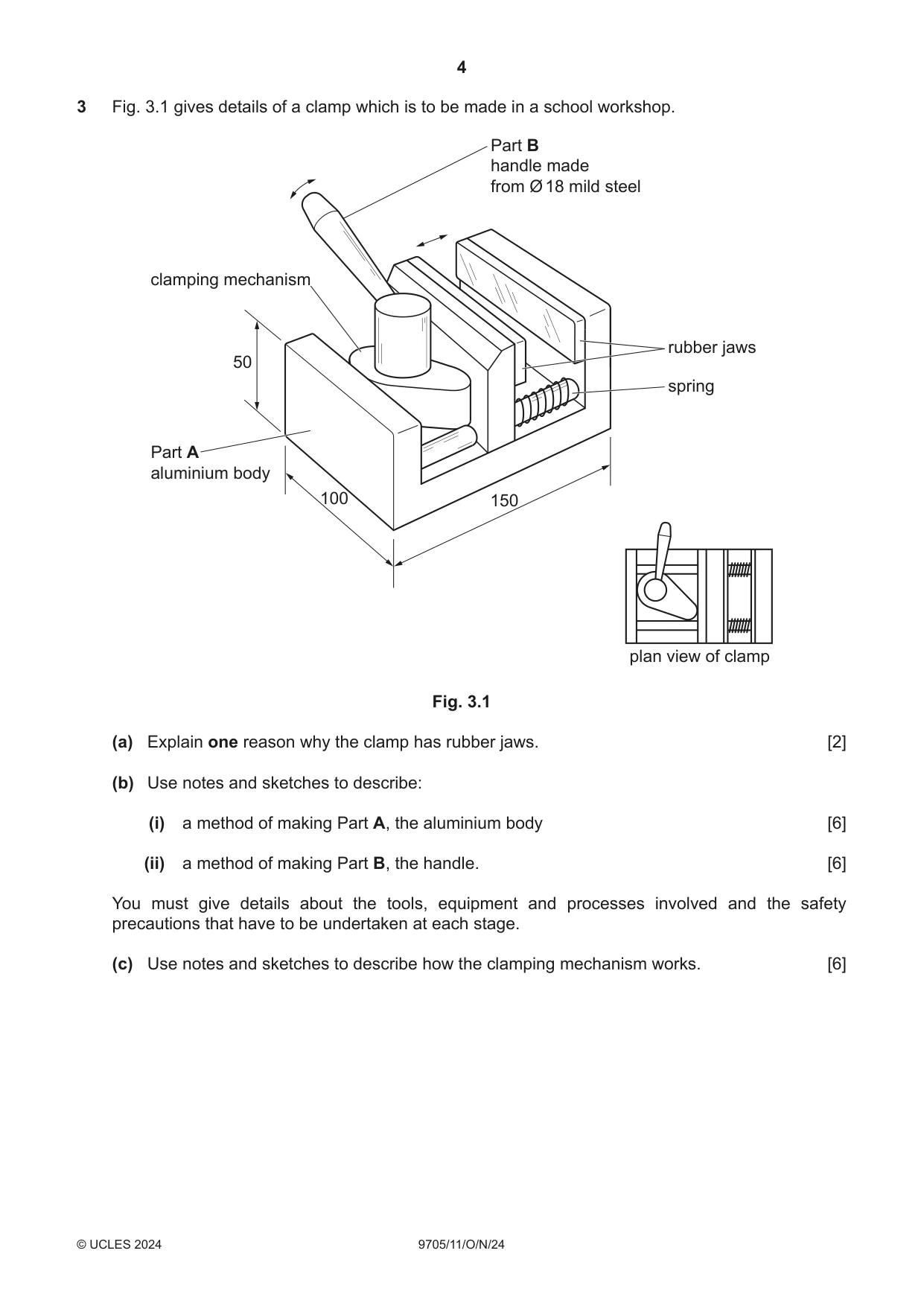
4 9705/11/O/N/24 © UCLES 2024 3 Fig. 3.1 gives details of a clamp which is to be made in a school workshop. 150 100 50 clamping mechanism Part B handle made from Ø 18 mild steel Part A aluminium body rubber jaws plan view of clamp spring Fig. 3.1 (a) Explain one reason why the clamp has rubber jaws. [2] (b) Use notes and sketches to describe: (i) a method of making Part A, the aluminium body [6] (ii) a method of making Part B, the handle. [6] You must give details about the tools, equipment and processes involved and the safety precautions that have to be undertaken at each stage. (c) Use notes and sketches to describe how the clamping mechanism works. [6]
Question paper, page 5
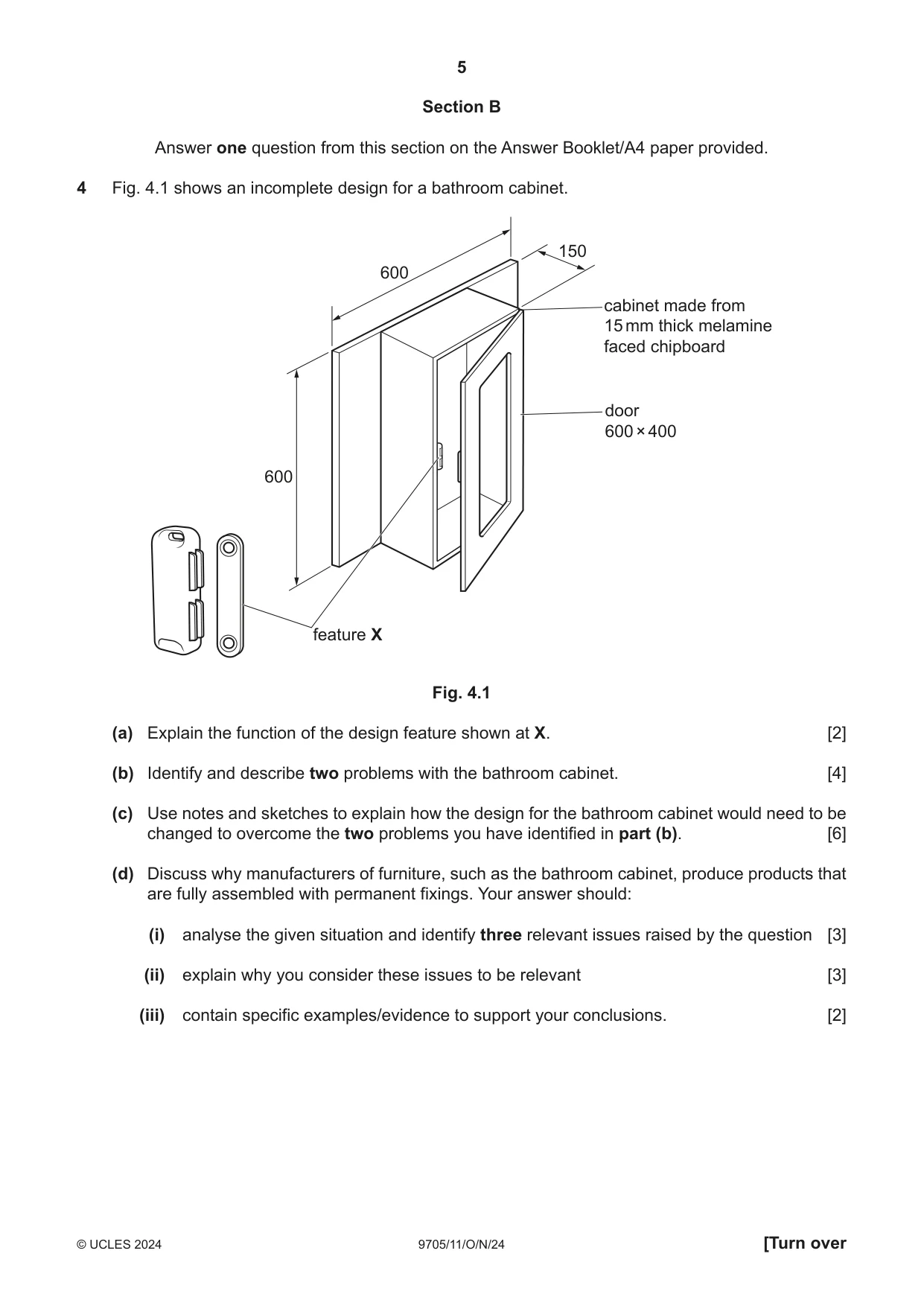
5 9705/11/O/N/24 © UCLES 2024 [Turn over Section B Answer one question from this section on the Answer Booklet/A4 paper provided. 4 Fig. 4.1 shows an incomplete design for a bathroom cabinet. 600 feature X 600 150 cabinet made from 15 mm thick melamine faced chipboard door 600 × 400 Fig. 4.1 (a) Explain the function of the design feature shown at X. [2] (b) Identify and describe two problems with the bathroom cabinet. [4] (c) Use notes and sketches to explain how the design for the bathroom cabinet would need to be changed to overcome the two problems you have identified in part (b). [6] (d) Discuss why manufacturers of furniture, such as the bathroom cabinet, produce products that are fully assembled with permanent fixings. Your answer should: (i) analyse the given situation and identify three relevant issues raised by the question [3] (ii) explain why you consider these issues to be relevant [3] (iii) contain specific examples/evidence to support your conclusions. [2]
Question paper, page 6
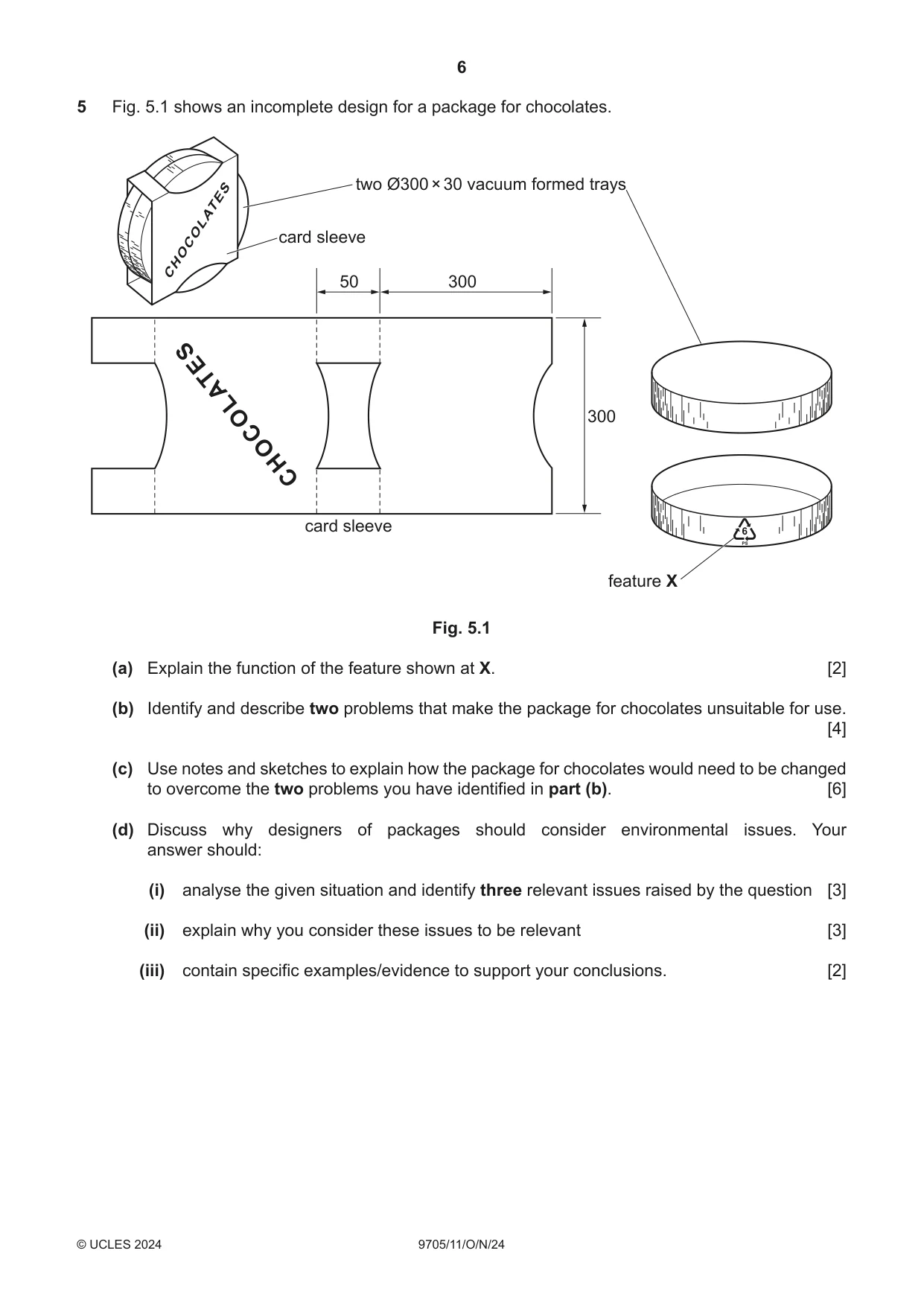
6 9705/11/O/N/24 © UCLES 2024 5 Fig. 5.1 shows an incomplete design for a package for chocolates. feature X CHOCOLATES card sleeve card sleeve 50 300 300 two Ø300 × 30 vacuum formed trays Fig. 5.1 (a) Explain the function of the feature shown at X. [2] (b) Identify and describe two problems that make the package for chocolates unsuitable for use. [4] (c) Use notes and sketches to explain how the package for chocolates would need to be changed to overcome the two problems you have identified in part (b). [6] (d) Discuss why designers of packages should consider environmental issues. Your answer should: (i) analyse the given situation and identify three relevant issues raised by the question [3] (ii) explain why you consider these issues to be relevant [3] (iii) contain specific examples/evidence to support your conclusions. [2]
Question paper, page 7
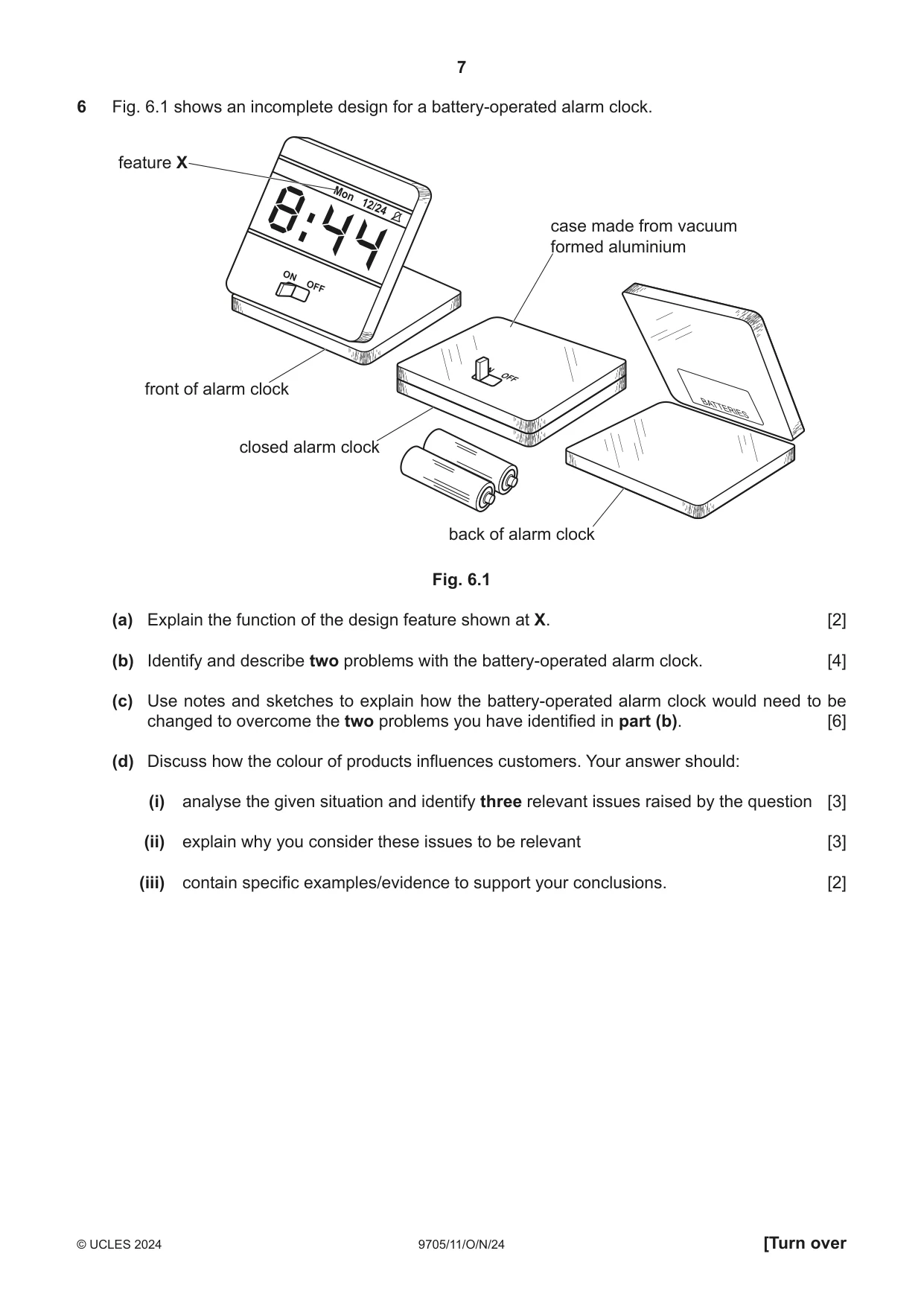
7 9705/11/O/N/24 © UCLES 2024 [Turn over 6 Fig. 6.1 shows an incomplete design for a battery-operated alarm clock. feature X front of alarm clock closed alarm clock back of alarm clock case made from vacuum formed aluminium Fig. 6.1 (a) Explain the function of the design feature shown at X. [2] (b) Identify and describe two problems with the battery-operated alarm clock. [4] (c) Use notes and sketches to explain how the battery-operated alarm clock would need to be changed to overcome the two problems you have identified in part (b). [6] (d) Discuss how the colour of products influences customers. Your answer should: (i) analyse the given situation and identify three relevant issues raised by the question [3] (ii) explain why you consider these issues to be relevant [3] (iii) contain specific examples/evidence to support your conclusions. [2]
Question paper, page 8
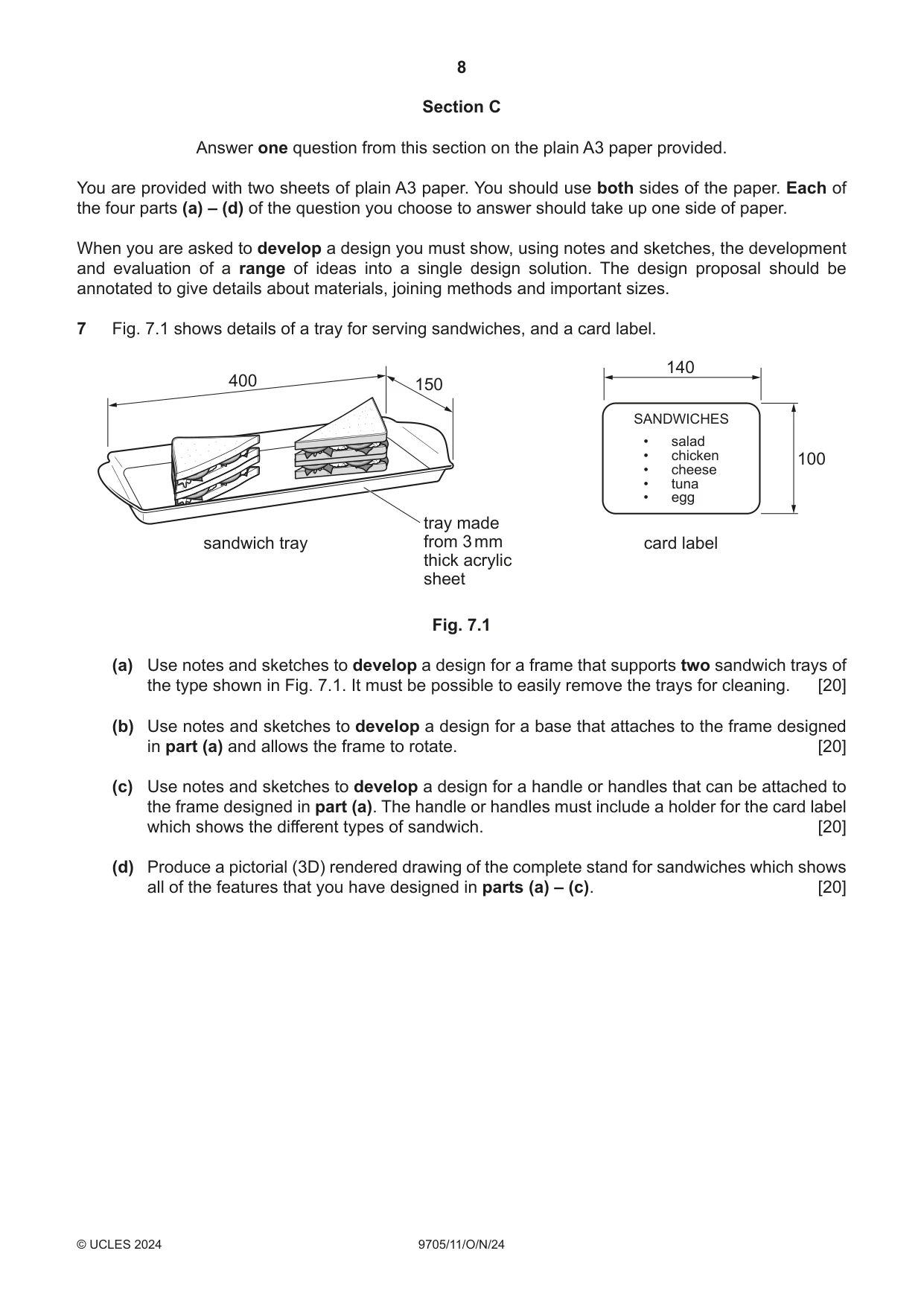
8 9705/11/O/N/24 © UCLES 2024 Section C Answer one question from this section on the plain A3 paper provided. You are provided with two sheets of plain A3 paper. You should use both sides of the paper. Each of the four parts (a) – (d) of the question you choose to answer should take up one side of paper. When you are asked to develop a design you must show, using notes and sketches, the development and evaluation of a range of ideas into a single design solution. The design proposal should be annotated to give details about materials, joining methods and important sizes. 7 Fig. 7.1 shows details of a tray for serving sandwiches, and a card label. SANDWICHES • salad • chicken • cheese • tuna • egg 100 140 400 150 tray made from 3 mm thick acrylic sheet sandwich tray card label Fig. 7.1 (a) Use notes and sketches to develop a design for a frame that supports two sandwich trays of the type shown in Fig. 7.1. It must be possible to easily remove the trays for cleaning. [20] (b) Use notes and sketches to develop a design for a base that attaches to the frame designed in part (a) and allows the frame to rotate. [20] (c) Use notes and sketches to develop a design for a handle or handles that can be attached to the frame designed in part (a). The handle or handles must include a holder for the card label which shows the different types of sandwich. [20] (d) Produce a pictorial (3D) rendered drawing of the complete stand for sandwiches which shows all of the features that you have designed in parts (a) – (c). [20]
Question paper, page 9
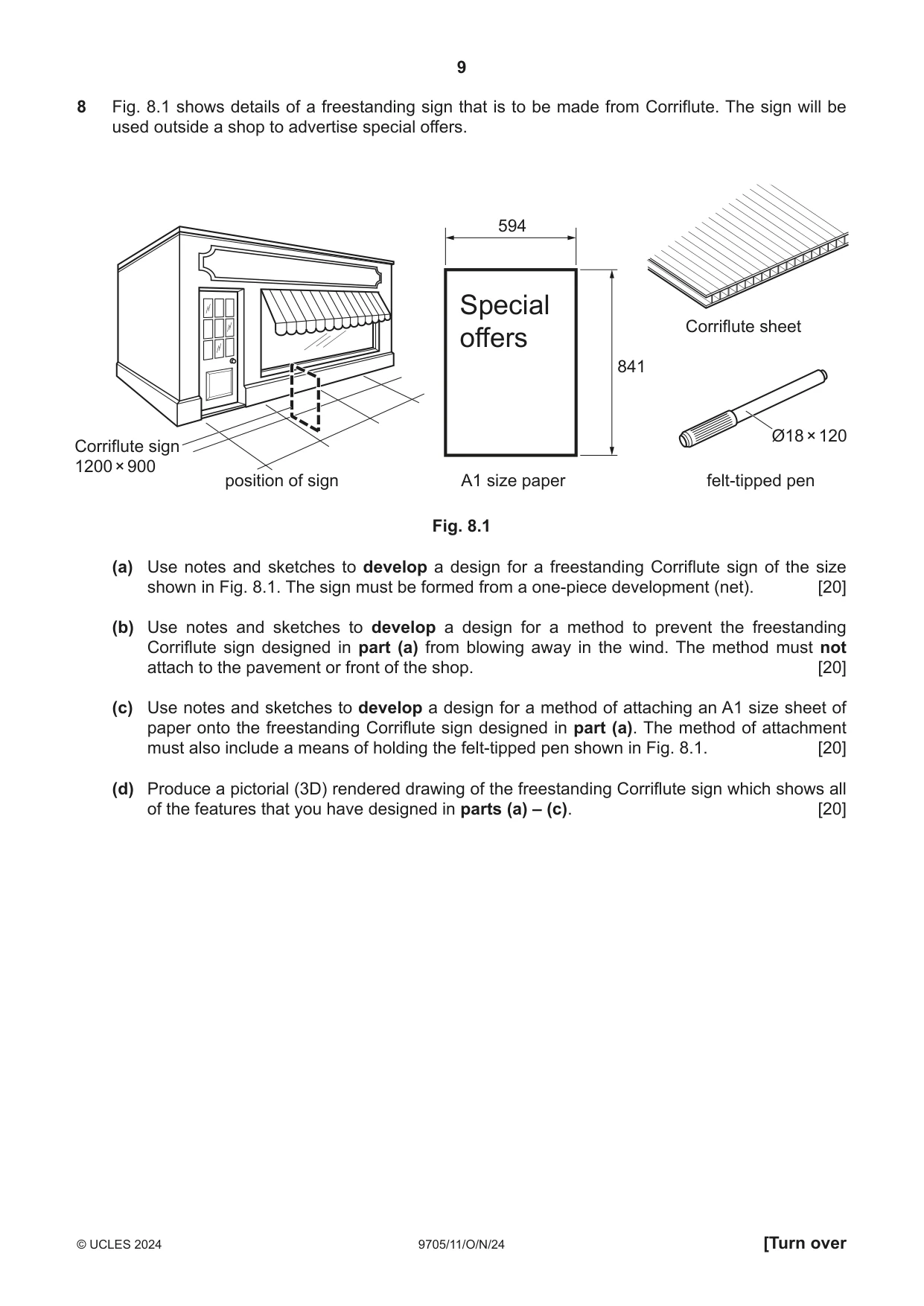
9 9705/11/O/N/24 © UCLES 2024 [Turn over 8 Fig. 8.1 shows details of a freestanding sign that is to be made from Corriflute. The sign will be used outside a shop to advertise special offers. Corriflute sheet Corriflute sign 1200 × 900 felt-tipped pen A1 size paper position of sign Ø18 × 120 841 594 Special offers Fig. 8.1 (a) Use notes and sketches to develop a design for a freestanding Corriflute sign of the size shown in Fig. 8.1. The sign must be formed from a one-piece development (net). [20] (b) Use notes and sketches to develop a design for a method to prevent the freestanding Corriflute sign designed in part (a) from blowing away in the wind. The method must not attach to the pavement or front of the shop. [20] (c) Use notes and sketches to develop a design for a method of attaching an A1 size sheet of paper onto the freestanding Corriflute sign designed in part (a). The method of attachment must also include a means of holding the felt-tipped pen shown in Fig. 8.1. [20] (d) Produce a pictorial (3D) rendered drawing of the freestanding Corriflute sign which shows all of the features that you have designed in parts (a) – (c). [20]
Question paper, page 10
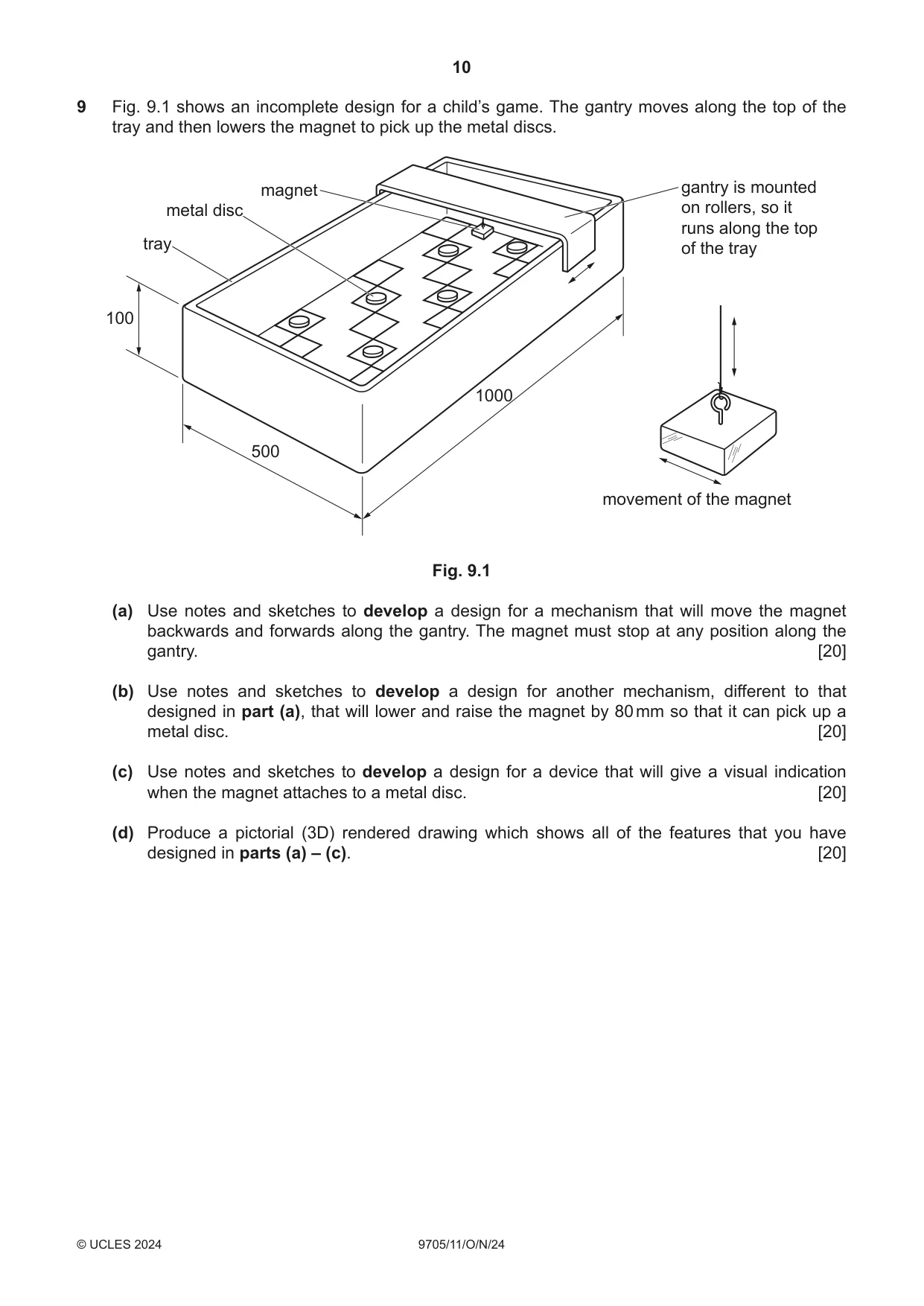
10 9705/11/O/N/24 © UCLES 2024 9 Fig. 9.1 shows an incomplete design for a child’s game. The gantry moves along the top of the tray and then lowers the magnet to pick up the metal discs. 100 500 1000 movement of the magnet gantry is mounted on rollers, so it runs along the top of the tray magnet metal disc tray Fig. 9.1 (a) Use notes and sketches to develop a design for a mechanism that will move the magnet backwards and forwards along the gantry. The magnet must stop at any position along the gantry. [20] (b) Use notes and sketches to develop a design for another mechanism, different to that designed in part (a), that will lower and raise the magnet by 80 mm so that it can pick up a metal disc. [20] (c) Use notes and sketches to develop a design for a device that will give a visual indication when the magnet attaches to a metal disc. [20] (d) Produce a pictorial (3D) rendered drawing which shows all of the features that you have designed in parts (a) – (c). [20]
Question paper, page 11
11 9705/11/O/N/24 © UCLES 2024 BLANK PAGE
Question paper, page 12
12 9705/11/O/N/24 © UCLES 2024 Permission to reproduce items where third-party owned material protected by copyright is included has been sought and cleared where possible. Every reasonable effort has been made by the publisher (UCLES) to trace copyright holders, but if any items requiring clearance have unwittingly been included, the publisher will be pleased to make amends at the earliest possible opportunity. To avoid the issue of disclosure of answer-related information to candidates, all copyright acknowledgements are reproduced online in the Cambridge Assessment International Education Copyright Acknowledgements Booklet. This is produced for each series of examinations and is freely available to download at www.cambridgeinternational.org after the live examination series. Cambridge Assessment International Education is part of Cambridge Assessment. Cambridge Assessment is the brand name of the University of Cambridge Local Examinations Syndicate (UCLES), which is a department of the University of Cambridge. BLANK PAGE
Mark scheme, page 1
This document consists of 17 printed pages. © Cambridge University Press & Assessment 2024 [Turn over Cambridge International AS & A Level DESIGN & TECHNOLOGY 9705/11 Paper 1 October/November 2024 MARK SCHEME Maximum Mark: 120 Published This mark scheme is published as an aid to teachers and candidates, to indicate the requirements of the examination. It shows the basis on which Examiners were instructed to award marks. It does not indicate the details of the discussions that took place at an Examiners’ meeting before marking began, which would have considered the acceptability of alternative answers. Mark schemes should be read in conjunction with the question paper and the Principal Examiner Report for Teachers. Cambridge International will not enter into discussions about these mark schemes. Cambridge International is publishing the mark schemes for the October/November 2024 series for most Cambridge IGCSE, Cambridge International A and AS Level components, and some Cambridge O Level components.
Mark scheme, page 2
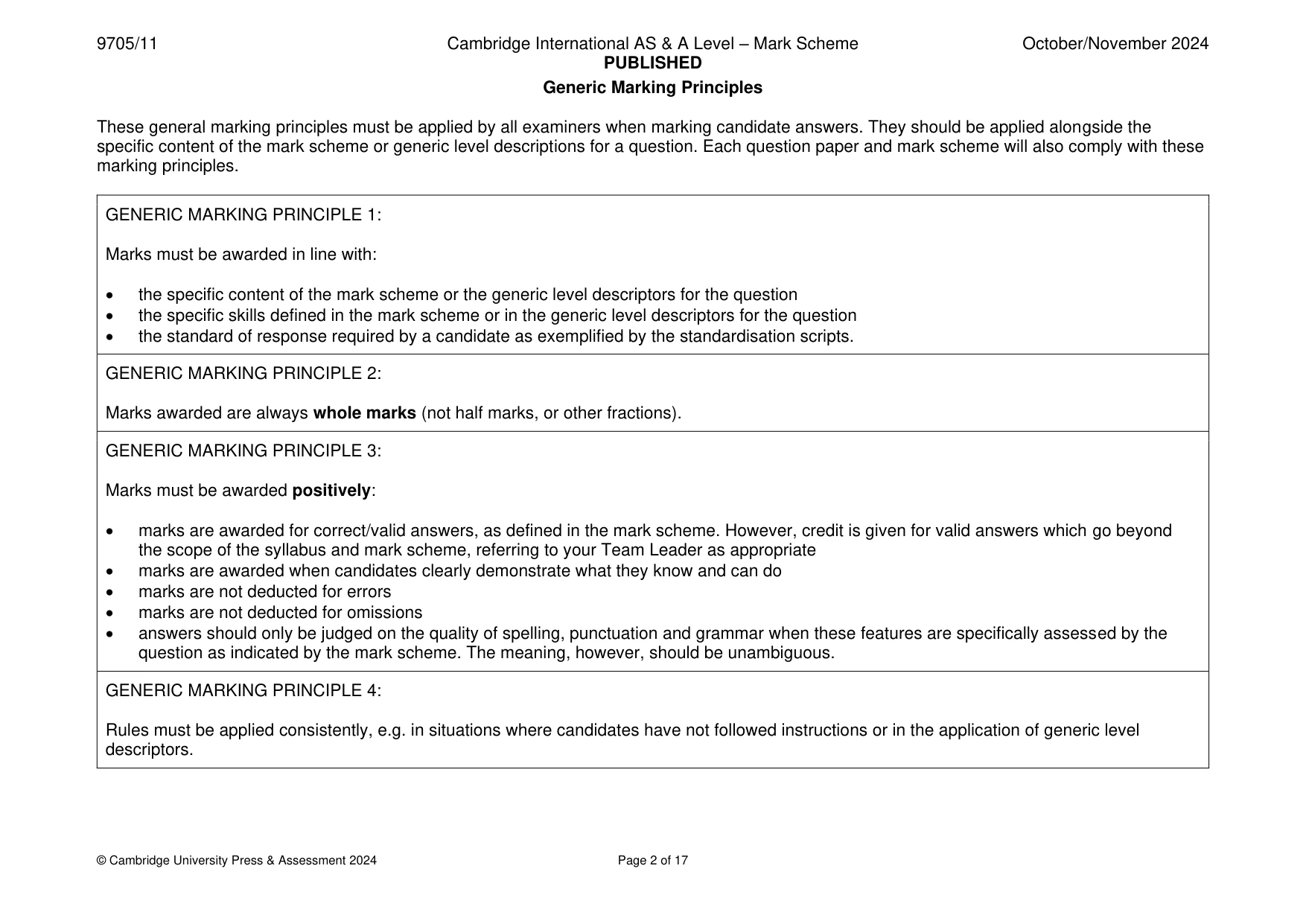
9705/11 Cambridge International AS & A Level – Mark Scheme PUBLISHED October/November 2024 © Cambridge University Press & Assessment 2024 Page 2 of 17 Generic Marking Principles These general marking principles must be applied by all examiners when marking candidate answers. They should be applied alongside the specific content of the mark scheme or generic level descriptions for a question. Each question paper and mark scheme will also comply with these marking principles. GENERIC MARKING PRINCIPLE 1: Marks must be awarded in line with: • the specific content of the mark scheme or the generic level descriptors for the question • the specific skills defined in the mark scheme or in the generic level descriptors for the question • the standard of response required by a candidate as exemplified by the standardisation scripts. GENERIC MARKING PRINCIPLE 2: Marks awarded are always whole marks (not half marks, or other fractions). GENERIC MARKING PRINCIPLE 3: Marks must be awarded positively: • marks are awarded for correct/valid answers, as defined in the mark scheme. However, credit is given for valid answers which go beyond the scope of the syllabus and mark scheme, referring to your Team Leader as appropriate • marks are awarded when candidates clearly demonstrate what they know and can do • marks are not deducted for errors • marks are not deducted for omissions • answers should only be judged on the quality of spelling, punctuation and grammar when these features are specifically assessed by the question as indicated by the mark scheme. The meaning, however, should be unambiguous. GENERIC MARKING PRINCIPLE 4: Rules must be applied consistently, e.g. in situations where candidates have not followed instructions or in the application of generic level descriptors.
Mark scheme, page 3
9705/11 Cambridge International AS & A Level – Mark Scheme PUBLISHED October/November 2024 © Cambridge University Press & Assessment 2024 Page 3 of 17 GENERIC MARKING PRINCIPLE 5: Marks should be awarded using the full range of marks defined in the mark scheme for the question (however; the use of the full mark range may be limited according to the quality of the candidate responses seen). GENERIC MARKING PRINCIPLE 6: Marks awarded are based solely on the requirements as defined in the mark scheme. Marks should not be awarded with grade thresholds or grade descriptors in mind.
Mark scheme, page 4
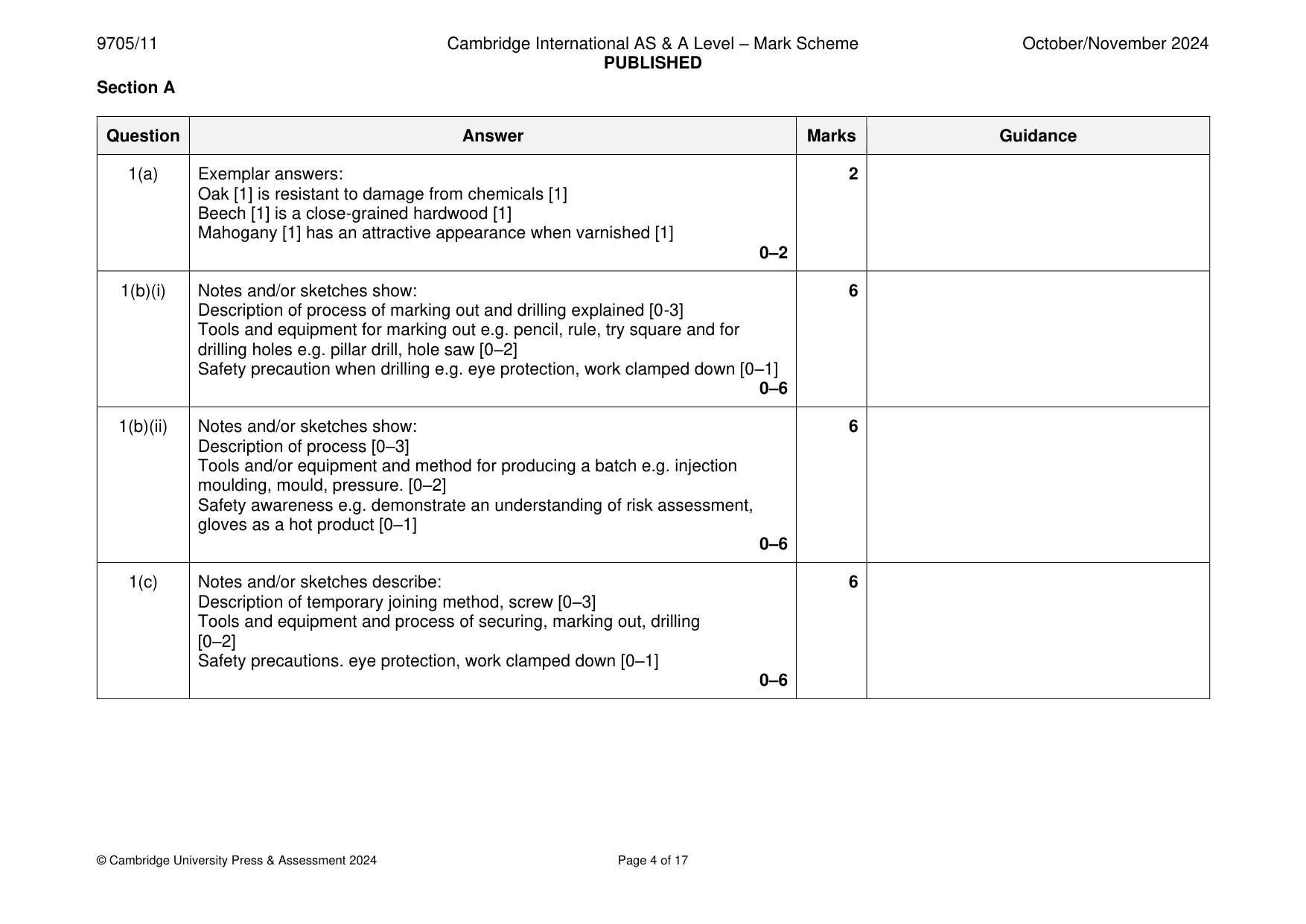
9705/11 Cambridge International AS & A Level – Mark Scheme PUBLISHED October/November 2024 © Cambridge University Press & Assessment 2024 Page 4 of 17 Section A Question Answer Marks Guidance 1(a) Exemplar answers: Oak [1] is resistant to damage from chemicals [1] Beech [1] is a close-grained hardwood [1] Mahogany [1] has an attractive appearance when varnished [1] 0–2 2 1(b)(i) Notes and/or sketches show: Description of process of marking out and drilling explained [0-3] Tools and equipment for marking out e.g. pencil, rule, try square and for drilling holes e.g. pillar drill, hole saw [0–2] Safety precaution when drilling e.g. eye protection, work clamped down [0–1] 0–6 6 1(b)(ii) Notes and/or sketches show: Description of process [0–3] Tools and/or equipment and method for producing a batch e.g. injection moulding, mould, pressure. [0–2] Safety awareness e.g. demonstrate an understanding of risk assessment, gloves as a hot product [0–1] 0–6 6 1(c) Notes and/or sketches describe: Description of temporary joining method, screw [0–3] Tools and equipment and process of securing, marking out, drilling [0–2] Safety precautions. eye protection, work clamped down [0–1] 0–6 6
Mark scheme, page 5
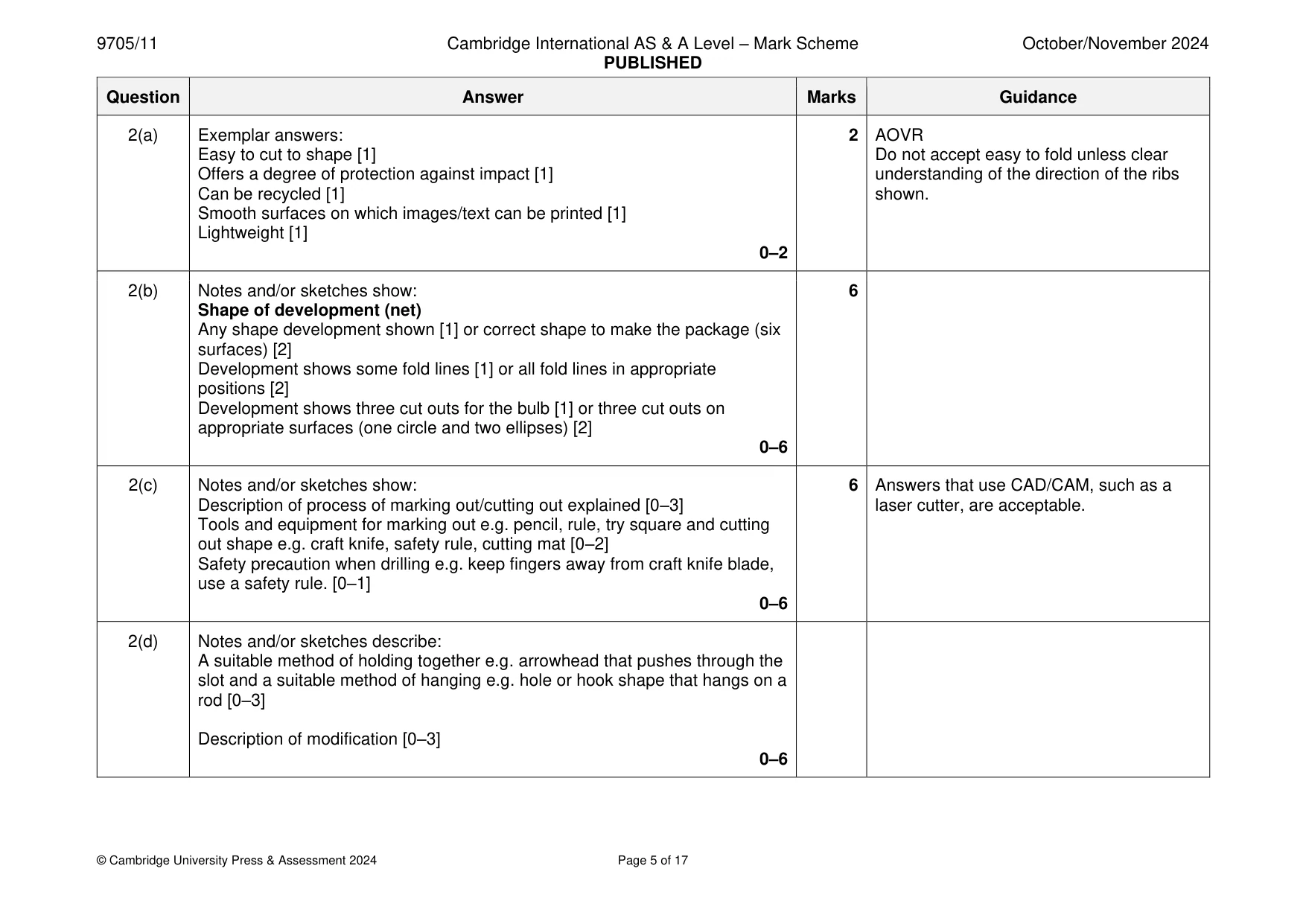
9705/11 Cambridge International AS & A Level – Mark Scheme PUBLISHED October/November 2024 © Cambridge University Press & Assessment 2024 Page 5 of 17 Question Answer Marks Guidance 2(a) Exemplar answers: Easy to cut to shape [1] Offers a degree of protection against impact [1] Can be recycled [1] Smooth surfaces on which images/text can be printed [1] Lightweight [1] 0–2 2 AOVR Do not accept easy to fold unless clear understanding of the direction of the ribs shown. 2(b) Notes and/or sketches show: Shape of development (net) Any shape development shown [1] or correct shape to make the package (six surfaces) [2] Development shows some fold lines [1] or all fold lines in appropriate positions [2] Development shows three cut outs for the bulb [1] or three cut outs on appropriate surfaces (one circle and two ellipses) [2] 0–6 6 2(c) Notes and/or sketches show: Description of process of marking out/cutting out explained [0–3] Tools and equipment for marking out e.g. pencil, rule, try square and cutting out shape e.g. craft knife, safety rule, cutting mat [0–2] Safety precaution when drilling e.g. keep fingers away from craft knife blade, use a safety rule. [0–1] 0–6 6 Answers that use CAD/CAM, such as a laser cutter, are acceptable. 2(d) Notes and/or sketches describe: A suitable method of holding together e.g. arrowhead that pushes through the slot and a suitable method of hanging e.g. hole or hook shape that hangs on a rod [0–3] Description of modification [0–3] 0–6
Mark scheme, page 6
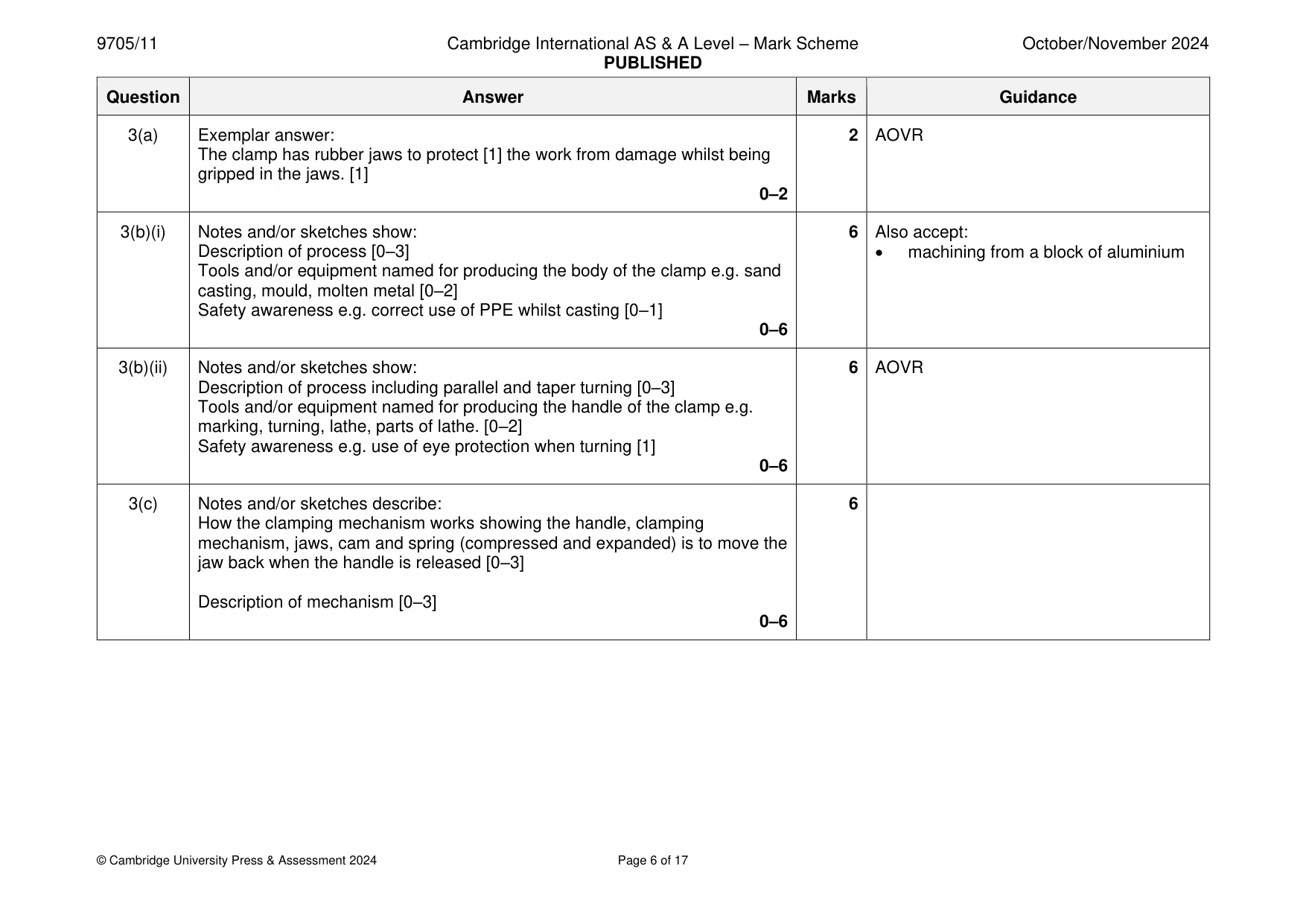
9705/11 Cambridge International AS & A Level – Mark Scheme PUBLISHED October/November 2024 © Cambridge University Press & Assessment 2024 Page 6 of 17 Question Answer Marks Guidance 3(a) Exemplar answer: The clamp has rubber jaws to protect [1] the work from damage whilst being gripped in the jaws. [1] 0–2 2 AOVR 3(b)(i) Notes and/or sketches show: Description of process [0–3] Tools and/or equipment named for producing the body of the clamp e.g. sand casting, mould, molten metal [0–2] Safety awareness e.g. correct use of PPE whilst casting [0–1] 0–6 6 Also accept: • machining from a block of aluminium 3(b)(ii) Notes and/or sketches show: Description of process including parallel and taper turning [0–3] Tools and/or equipment named for producing the handle of the clamp e.g. marking, turning, lathe, parts of lathe. [0–2] Safety awareness e.g. use of eye protection when turning [1] 0–6 6 AOVR 3(c) Notes and/or sketches describe: How the clamping mechanism works showing the handle, clamping mechanism, jaws, cam and spring (compressed and expanded) is to move the jaw back when the handle is released [0–3] Description of mechanism [0–3] 0–6 6
Mark scheme, page 7
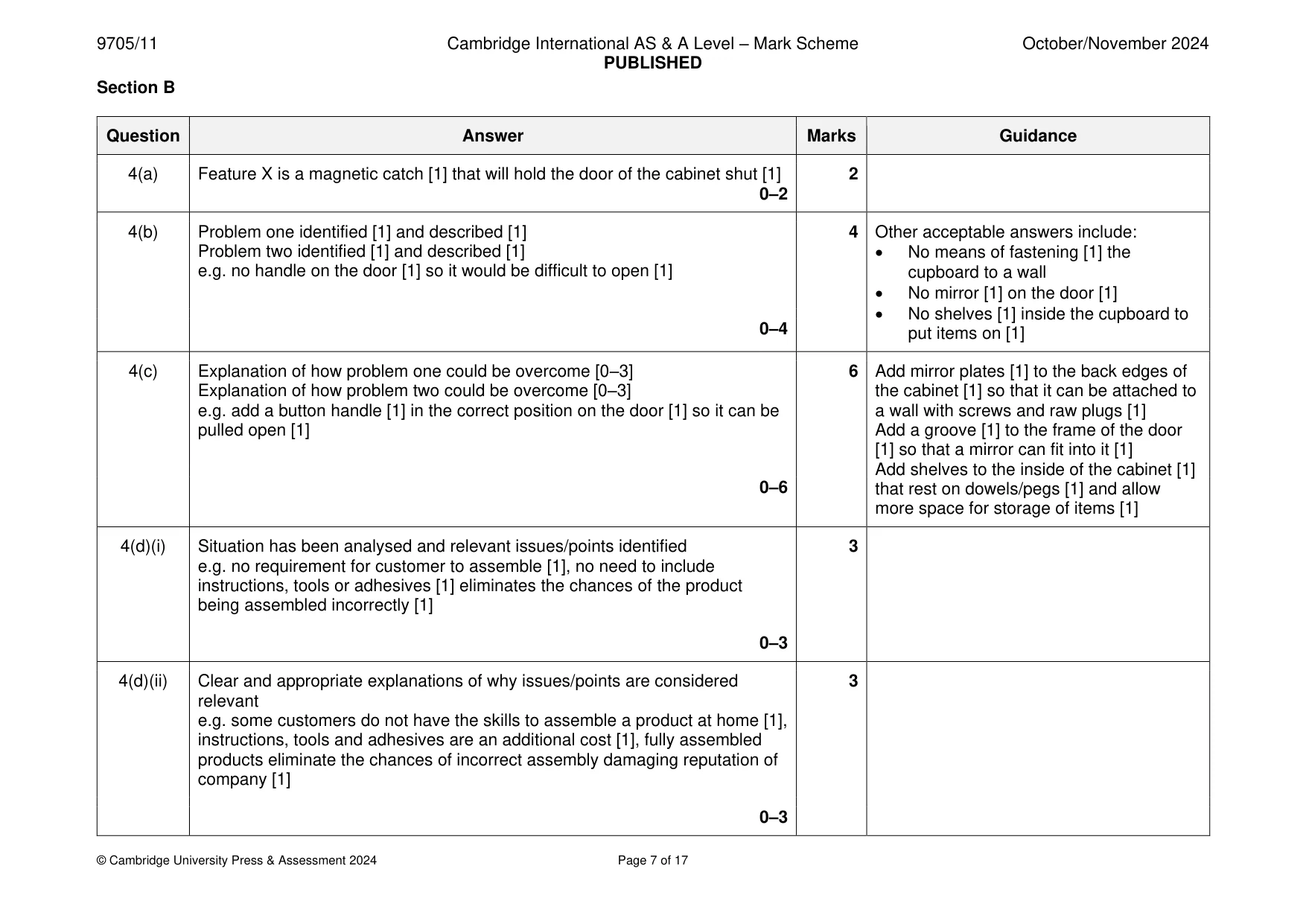
9705/11 Cambridge International AS & A Level – Mark Scheme PUBLISHED October/November 2024 © Cambridge University Press & Assessment 2024 Page 7 of 17 Section B Question Answer Marks Guidance 4(a) Feature X is a magnetic catch [1] that will hold the door of the cabinet shut [1] 0–2 2 4(b) Problem one identified [1] and described [1] Problem two identified [1] and described [1] e.g. no handle on the door [1] so it would be difficult to open [1] 4 Other acceptable answers include: • No means of fastening [1] the cupboard to a wall • No mirror [1] on the door [1] • No shelves [1] inside the cupboard to put items on [1] 0–4 4(c) Explanation of how problem one could be overcome [0–3] Explanation of how problem two could be overcome [0–3] e.g. add a button handle [1] in the correct position on the door [1] so it can be pulled open [1] 6 Add mirror plates [1] to the back edges of the cabinet [1] so that it can be attached to a wall with screws and raw plugs [1] Add a groove [1] to the frame of the door [1] so that a mirror can fit into it [1] Add shelves to the inside of the cabinet [1] that rest on dowels/pegs [1] and allow more space for storage of items [1] 0–6 4(d)(i) Situation has been analysed and relevant issues/points identified e.g. no requirement for customer to assemble [1], no need to include instructions, tools or adhesives [1] eliminates the chances of the product being assembled incorrectly [1] 3 0–3 4(d)(ii) Clear and appropriate explanations of why issues/points are considered relevant e.g. some customers do not have the skills to assemble a product at home [1], instructions, tools and adhesives are an additional cost [1], fully assembled products eliminate the chances of incorrect assembly damaging reputation of company [1] 3 0–3
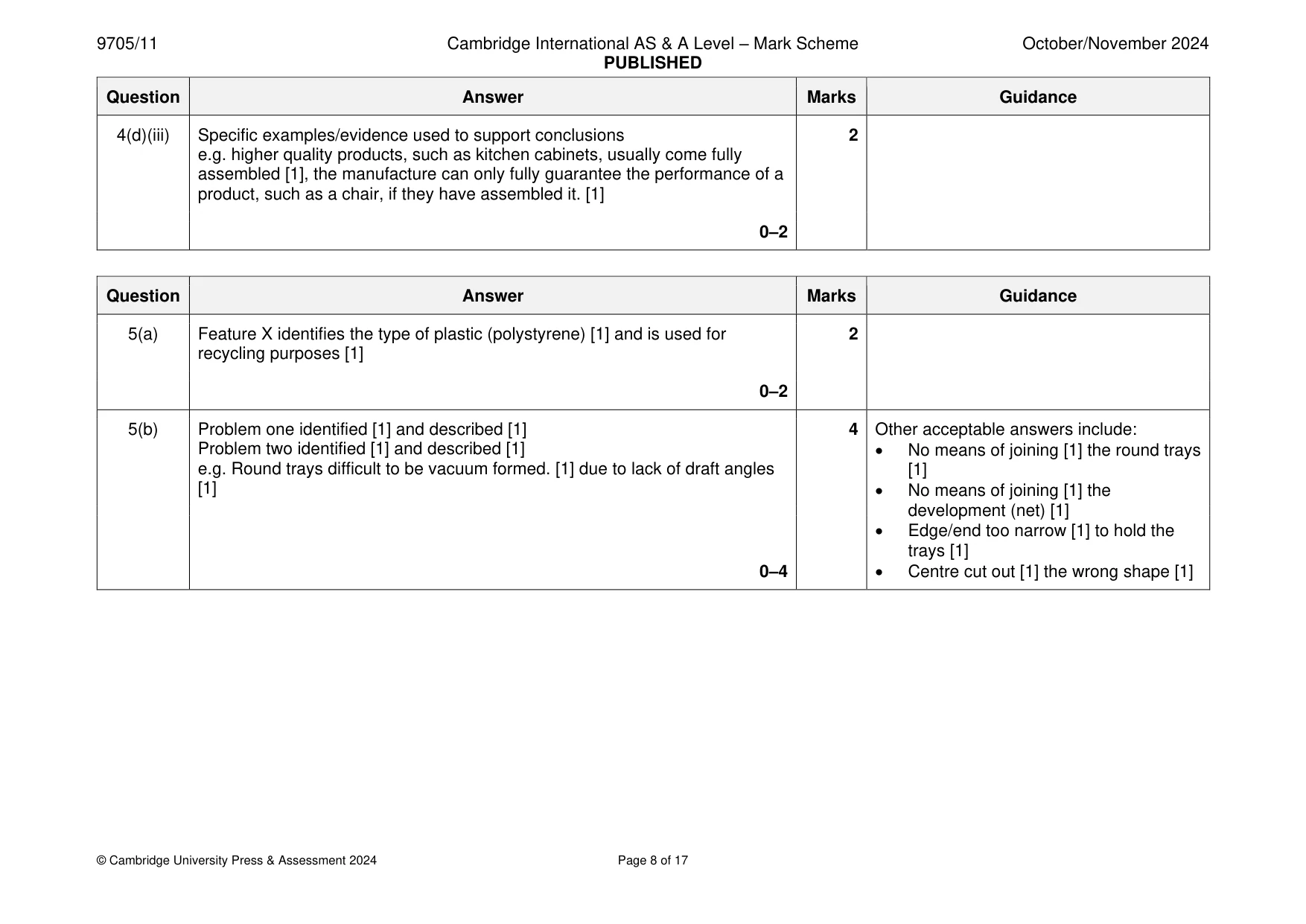
Mark scheme, page 8
9705/11 Cambridge International AS & A Level – Mark Scheme PUBLISHED October/November 2024 © Cambridge University Press & Assessment 2024 Page 8 of 17 Question Answer Marks Guidance 4(d)(iii) Specific examples/evidence used to support conclusions e.g. higher quality products, such as kitchen cabinets, usually come fully assembled [1], the manufacture can only fully guarantee the performance of a product, such as a chair, if they have assembled it. [1] 2 0–2 Question Answer Marks Guidance 5(a) Feature X identifies the type of plastic (polystyrene) [1] and is used for recycling purposes [1] 2 0–2 5(b) Problem one identified [1] and described [1] Problem two identified [1] and described [1] e.g. Round trays difficult to be vacuum formed. [1] due to lack of draft angles [1] 4 Other acceptable answers include: • No means of joining [1] the round trays [1] • No means of joining [1] the development (net) [1] • Edge/end too narrow [1] to hold the trays [1] • Centre cut out [1] the wrong shape [1] 0–4
Mark scheme, page 9
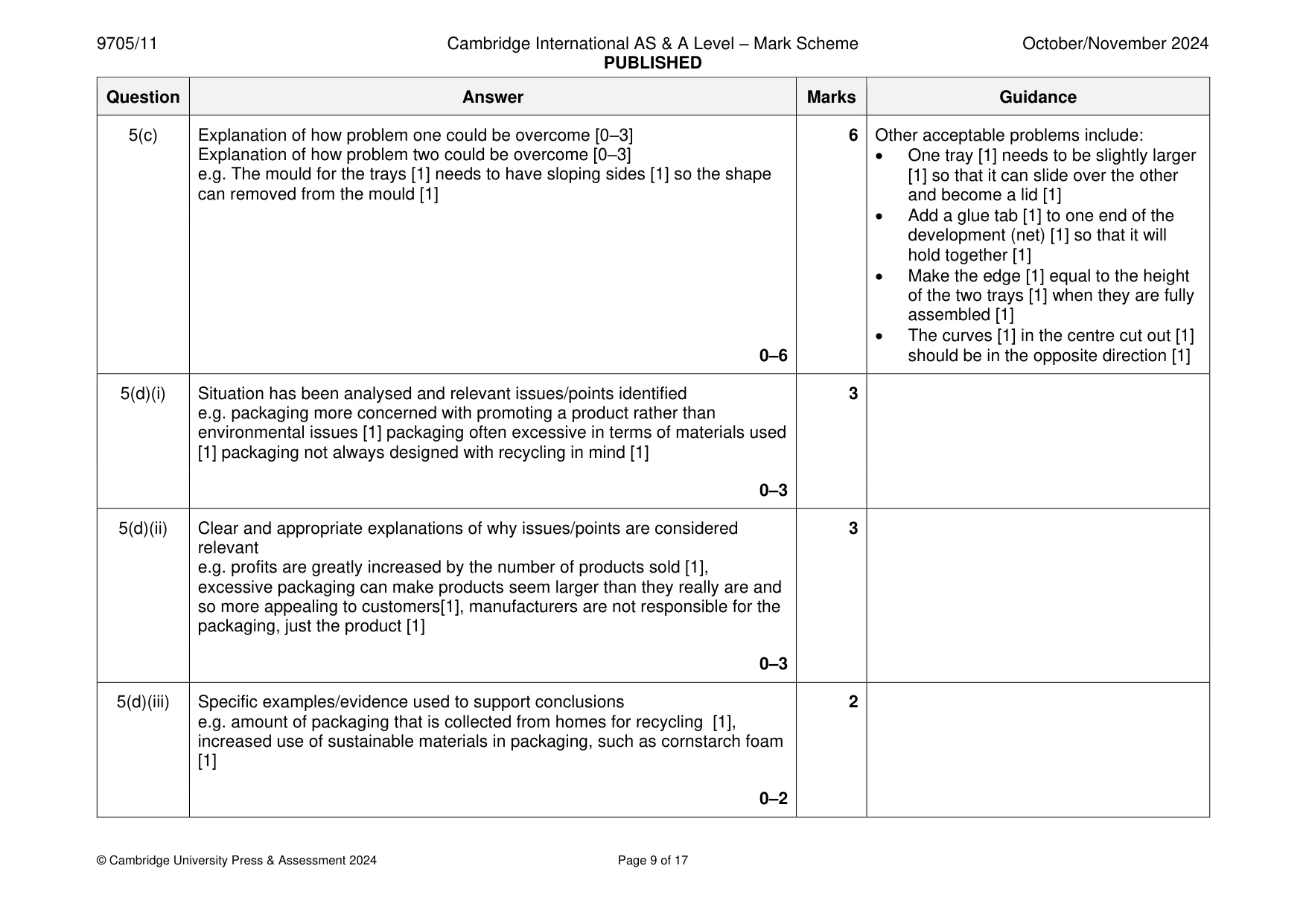
9705/11 Cambridge International AS & A Level – Mark Scheme PUBLISHED October/November 2024 © Cambridge University Press & Assessment 2024 Page 9 of 17 Question Answer Marks Guidance 5(c) Explanation of how problem one could be overcome [0–3] Explanation of how problem two could be overcome [0–3] e.g. The mould for the trays [1] needs to have sloping sides [1] so the shape can removed from the mould [1] 6 Other acceptable problems include: • One tray [1] needs to be slightly larger [1] so that it can slide over the other and become a lid [1] • Add a glue tab [1] to one end of the development (net) [1] so that it will hold together [1] • Make the edge [1] equal to the height of the two trays [1] when they are fully assembled [1] • The curves [1] in the centre cut out [1] should be in the opposite direction [1] 0–6 5(d)(i) Situation has been analysed and relevant issues/points identified e.g. packaging more concerned with promoting a product rather than environmental issues [1] packaging often excessive in terms of materials used [1] packaging not always designed with recycling in mind [1] 3 0–3 5(d)(ii) Clear and appropriate explanations of why issues/points are considered relevant e.g. profits are greatly increased by the number of products sold [1], excessive packaging can make products seem larger than they really are and so more appealing to customers[1], manufacturers are not responsible for the packaging, just the product [1] 3 0–3 5(d)(iii) Specific examples/evidence used to support conclusions e.g. amount of packaging that is collected from homes for recycling [1], increased use of sustainable materials in packaging, such as cornstarch foam [1] 2 0–2
Mark scheme, page 10
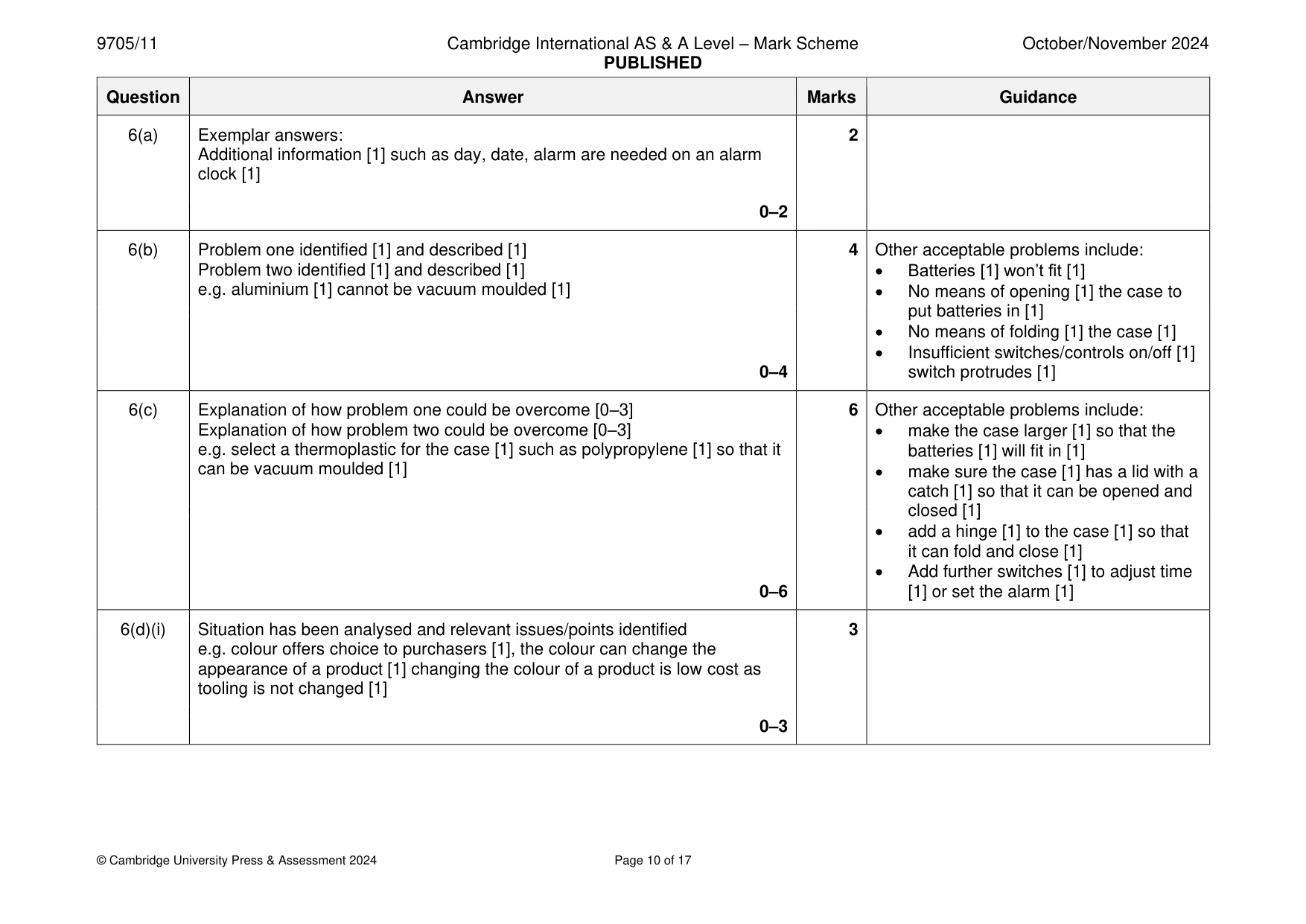
9705/11 Cambridge International AS & A Level – Mark Scheme PUBLISHED October/November 2024 © Cambridge University Press & Assessment 2024 Page 10 of 17 Question Answer Marks Guidance 6(a) Exemplar answers: Additional information [1] such as day, date, alarm are needed on an alarm clock [1] 2 0–2 6(b) Problem one identified [1] and described [1] Problem two identified [1] and described [1] e.g. aluminium [1] cannot be vacuum moulded [1] 4 Other acceptable problems include: • Batteries [1] won’t fit [1] • No means of opening [1] the case to put batteries in [1] • No means of folding [1] the case [1] • Insufficient switches/controls on/off [1] switch protrudes [1] 0–4 6(c) Explanation of how problem one could be overcome [0–3] Explanation of how problem two could be overcome [0–3] e.g. select a thermoplastic for the case [1] such as polypropylene [1] so that it can be vacuum moulded [1] 6 Other acceptable problems include: • make the case larger [1] so that the batteries [1] will fit in [1] • make sure the case [1] has a lid with a catch [1] so that it can be opened and closed [1] • add a hinge [1] to the case [1] so that it can fold and close [1] • Add further switches [1] to adjust time [1] or set the alarm [1] 0–6 6(d)(i) Situation has been analysed and relevant issues/points identified e.g. colour offers choice to purchasers [1], the colour can change the appearance of a product [1] changing the colour of a product is low cost as tooling is not changed [1] 3 0–3
Mark scheme, page 11
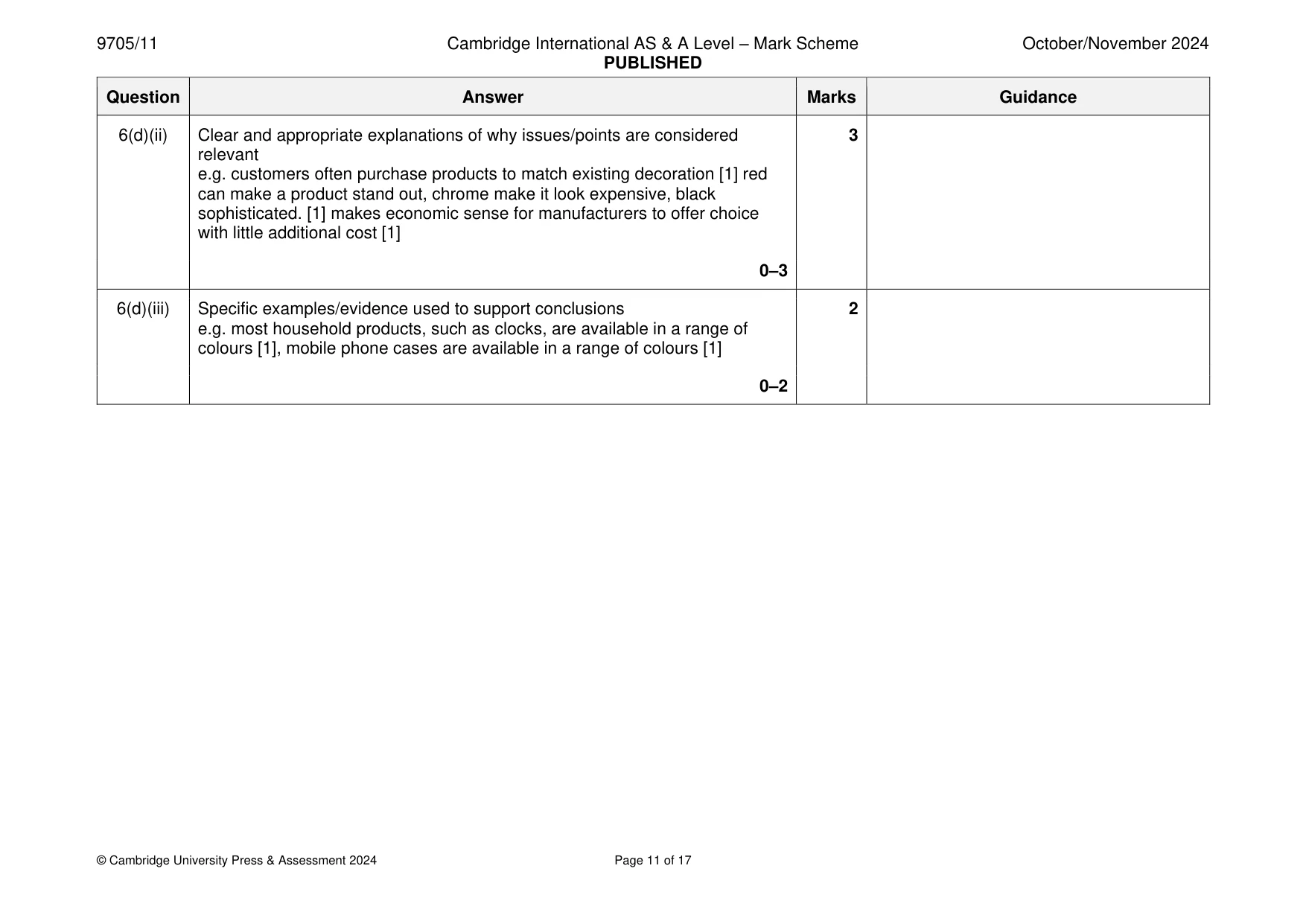
9705/11 Cambridge International AS & A Level – Mark Scheme PUBLISHED October/November 2024 © Cambridge University Press & Assessment 2024 Page 11 of 17 Question Answer Marks Guidance 6(d)(ii) Clear and appropriate explanations of why issues/points are considered relevant e.g. customers often purchase products to match existing decoration [1] red can make a product stand out, chrome make it look expensive, black sophisticated. [1] makes economic sense for manufacturers to offer choice with little additional cost [1] 3 0–3 6(d)(iii) Specific examples/evidence used to support conclusions e.g. most household products, such as clocks, are available in a range of colours [1], mobile phone cases are available in a range of colours [1] 2 0–2
Mark scheme, page 12
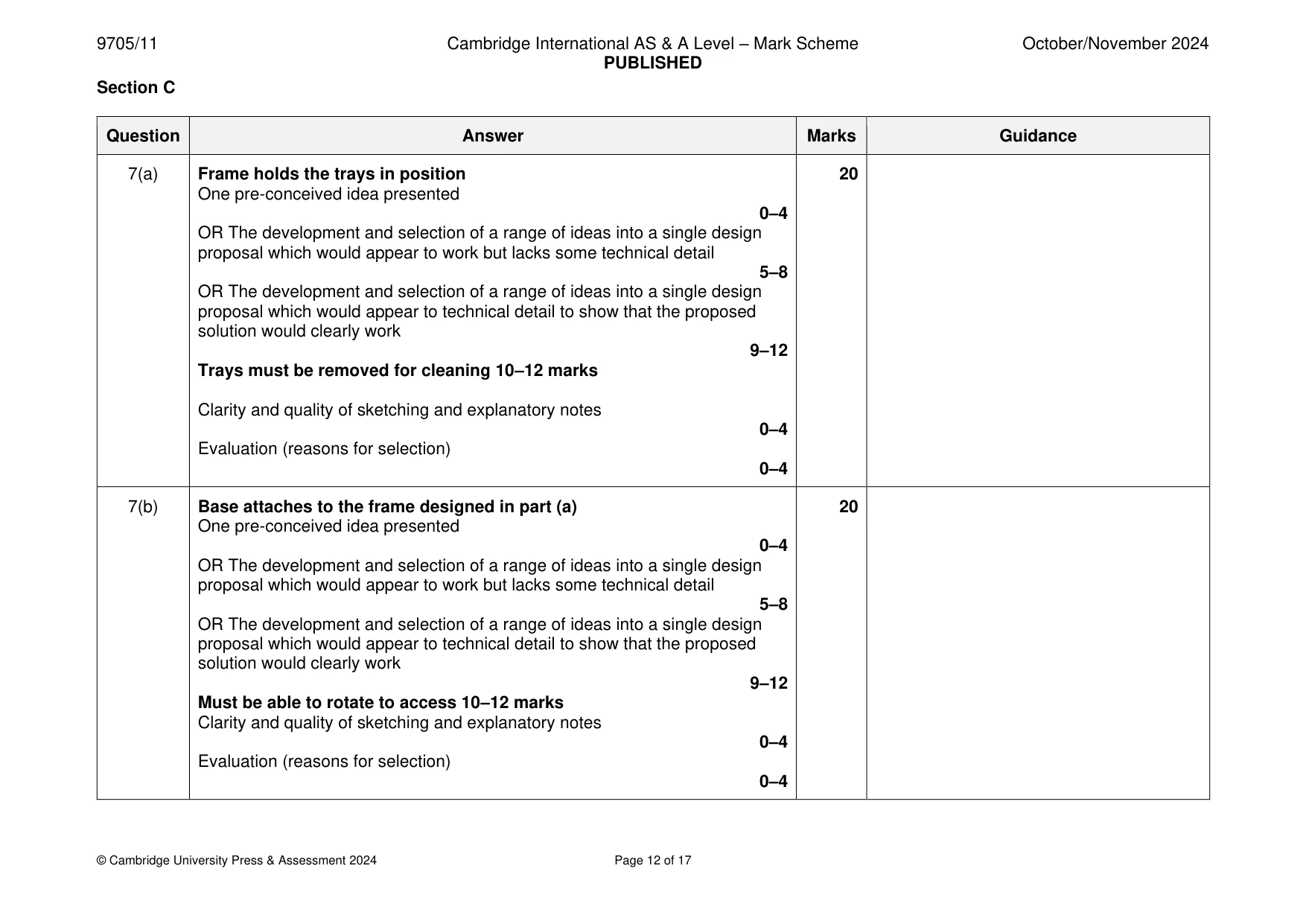
9705/11 Cambridge International AS & A Level – Mark Scheme PUBLISHED October/November 2024 © Cambridge University Press & Assessment 2024 Page 12 of 17 Section C Question Answer Marks Guidance 7(a) Frame holds the trays in position One pre-conceived idea presented 0–4 OR The development and selection of a range of ideas into a single design proposal which would appear to work but lacks some technical detail 5–8 OR The development and selection of a range of ideas into a single design proposal which would appear to technical detail to show that the proposed solution would clearly work 9–12 Trays must be removed for cleaning 10–12 marks Clarity and quality of sketching and explanatory notes 0–4 Evaluation (reasons for selection) 0–4 20 7(b) Base attaches to the frame designed in part (a) One pre-conceived idea presented 0–4 OR The development and selection of a range of ideas into a single design proposal which would appear to work but lacks some technical detail 5–8 OR The development and selection of a range of ideas into a single design proposal which would appear to technical detail to show that the proposed solution would clearly work 9–12 Must be able to rotate to access 10–12 marks Clarity and quality of sketching and explanatory notes 0–4 Evaluation (reasons for selection) 0–4 20
Mark scheme, page 13
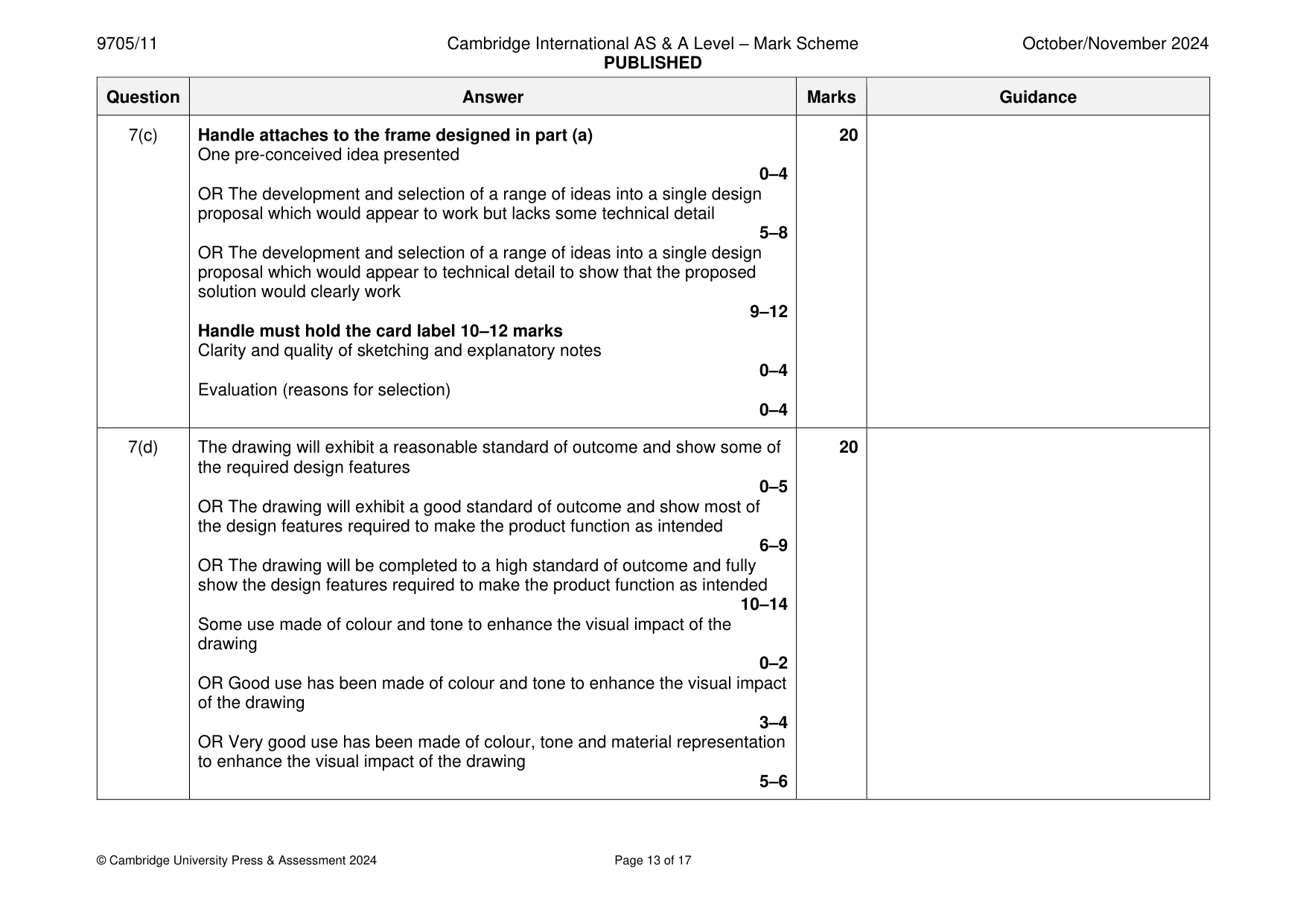
9705/11 Cambridge International AS & A Level – Mark Scheme PUBLISHED October/November 2024 © Cambridge University Press & Assessment 2024 Page 13 of 17 Question Answer Marks Guidance 7(c) Handle attaches to the frame designed in part (a) One pre-conceived idea presented 0–4 OR The development and selection of a range of ideas into a single design proposal which would appear to work but lacks some technical detail 5–8 OR The development and selection of a range of ideas into a single design proposal which would appear to technical detail to show that the proposed solution would clearly work 9–12 Handle must hold the card label 10–12 marks Clarity and quality of sketching and explanatory notes 0–4 Evaluation (reasons for selection) 0–4 20 7(d) The drawing will exhibit a reasonable standard of outcome and show some of the required design features 0–5 OR The drawing will exhibit a good standard of outcome and show most of the design features required to make the product function as intended 6–9 OR The drawing will be completed to a high standard of outcome and fully show the design features required to make the product function as intended 10–14 Some use made of colour and tone to enhance the visual impact of the drawing 0–2 OR Good use has been made of colour and tone to enhance the visual impact of the drawing 3–4 OR Very good use has been made of colour, tone and material representation to enhance the visual impact of the drawing 5–6 20
Mark scheme, page 14
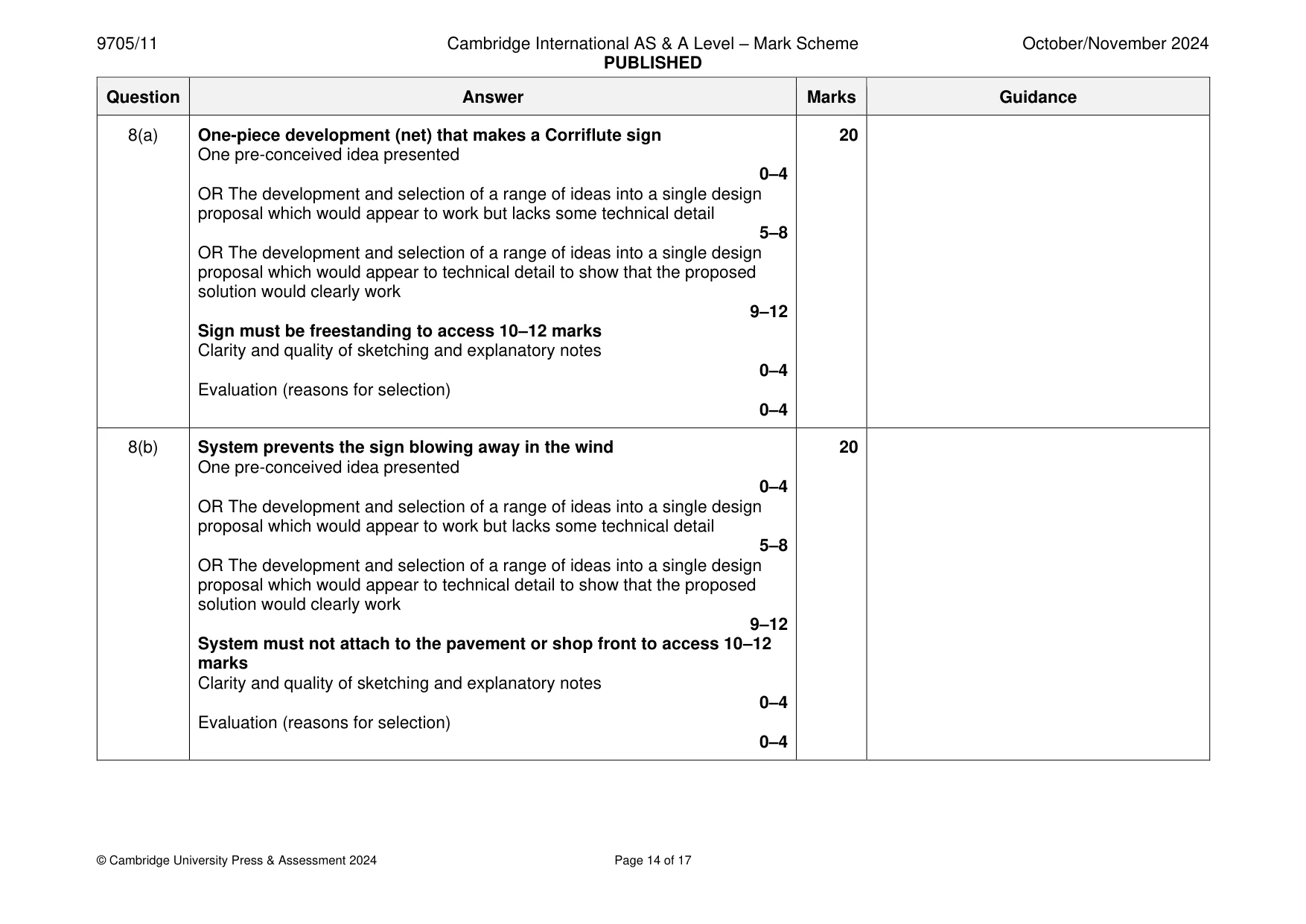
9705/11 Cambridge International AS & A Level – Mark Scheme PUBLISHED October/November 2024 © Cambridge University Press & Assessment 2024 Page 14 of 17 Question Answer Marks Guidance 8(a) One-piece development (net) that makes a Corriflute sign One pre-conceived idea presented 0–4 OR The development and selection of a range of ideas into a single design proposal which would appear to work but lacks some technical detail 5–8 OR The development and selection of a range of ideas into a single design proposal which would appear to technical detail to show that the proposed solution would clearly work 9–12 Sign must be freestanding to access 10–12 marks Clarity and quality of sketching and explanatory notes 0–4 Evaluation (reasons for selection) 0–4 20 8(b) System prevents the sign blowing away in the wind One pre-conceived idea presented 0–4 OR The development and selection of a range of ideas into a single design proposal which would appear to work but lacks some technical detail 5–8 OR The development and selection of a range of ideas into a single design proposal which would appear to technical detail to show that the proposed solution would clearly work 9–12 System must not attach to the pavement or shop front to access 10–12 marks Clarity and quality of sketching and explanatory notes 0–4 Evaluation (reasons for selection) 0–4 20
Mark scheme, page 15
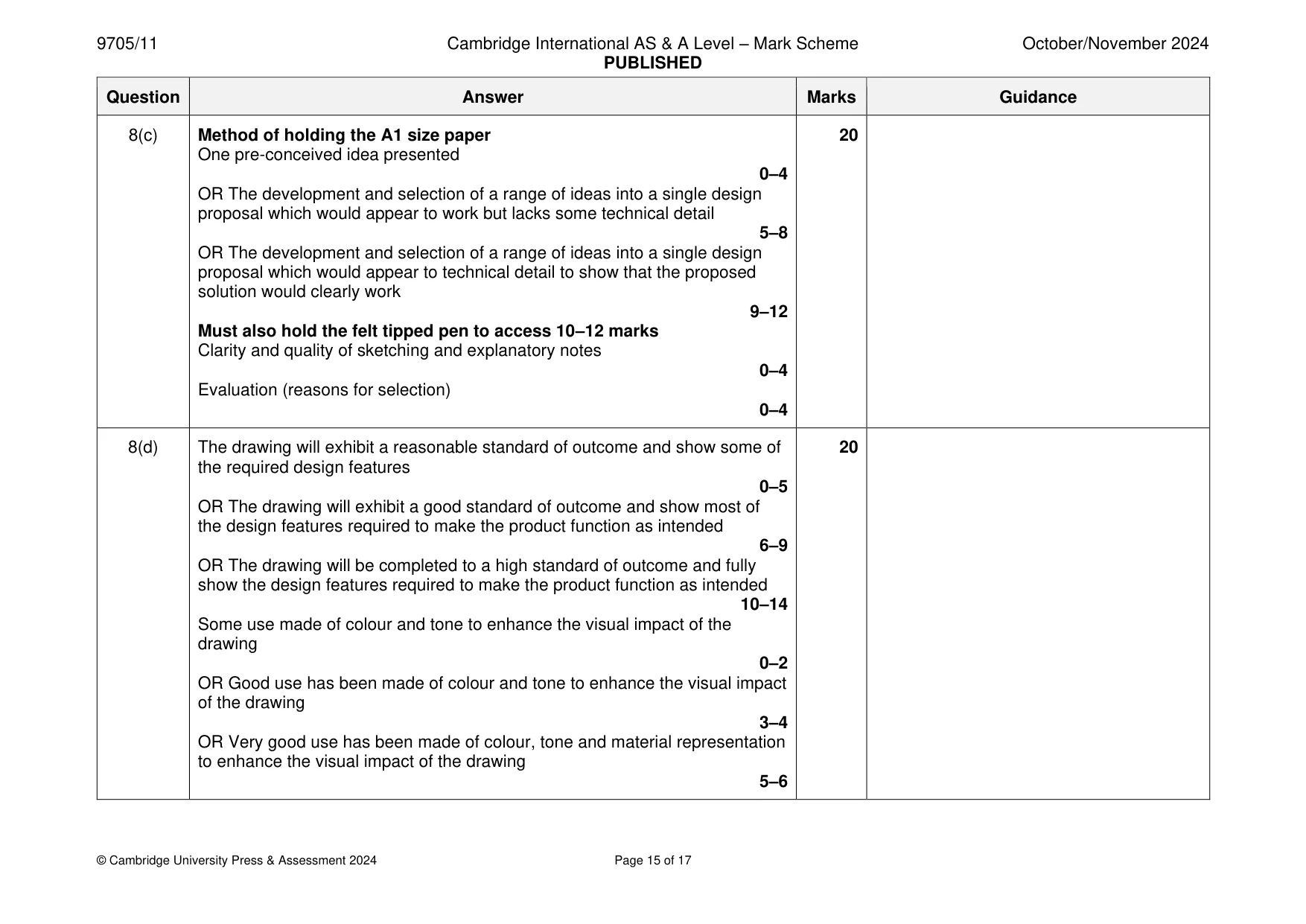
9705/11 Cambridge International AS & A Level – Mark Scheme PUBLISHED October/November 2024 © Cambridge University Press & Assessment 2024 Page 15 of 17 Question Answer Marks Guidance 8(c) Method of holding the A1 size paper One pre-conceived idea presented 0–4 OR The development and selection of a range of ideas into a single design proposal which would appear to work but lacks some technical detail 5–8 OR The development and selection of a range of ideas into a single design proposal which would appear to technical detail to show that the proposed solution would clearly work 9–12 Must also hold the felt tipped pen to access 10–12 marks Clarity and quality of sketching and explanatory notes 0–4 Evaluation (reasons for selection) 0–4 20 8(d) The drawing will exhibit a reasonable standard of outcome and show some of the required design features 0–5 OR The drawing will exhibit a good standard of outcome and show most of the design features required to make the product function as intended 6–9 OR The drawing will be completed to a high standard of outcome and fully show the design features required to make the product function as intended 10–14 Some use made of colour and tone to enhance the visual impact of the drawing 0–2 OR Good use has been made of colour and tone to enhance the visual impact of the drawing 3–4 OR Very good use has been made of colour, tone and material representation to enhance the visual impact of the drawing 5–6 20
Mark scheme, page 16
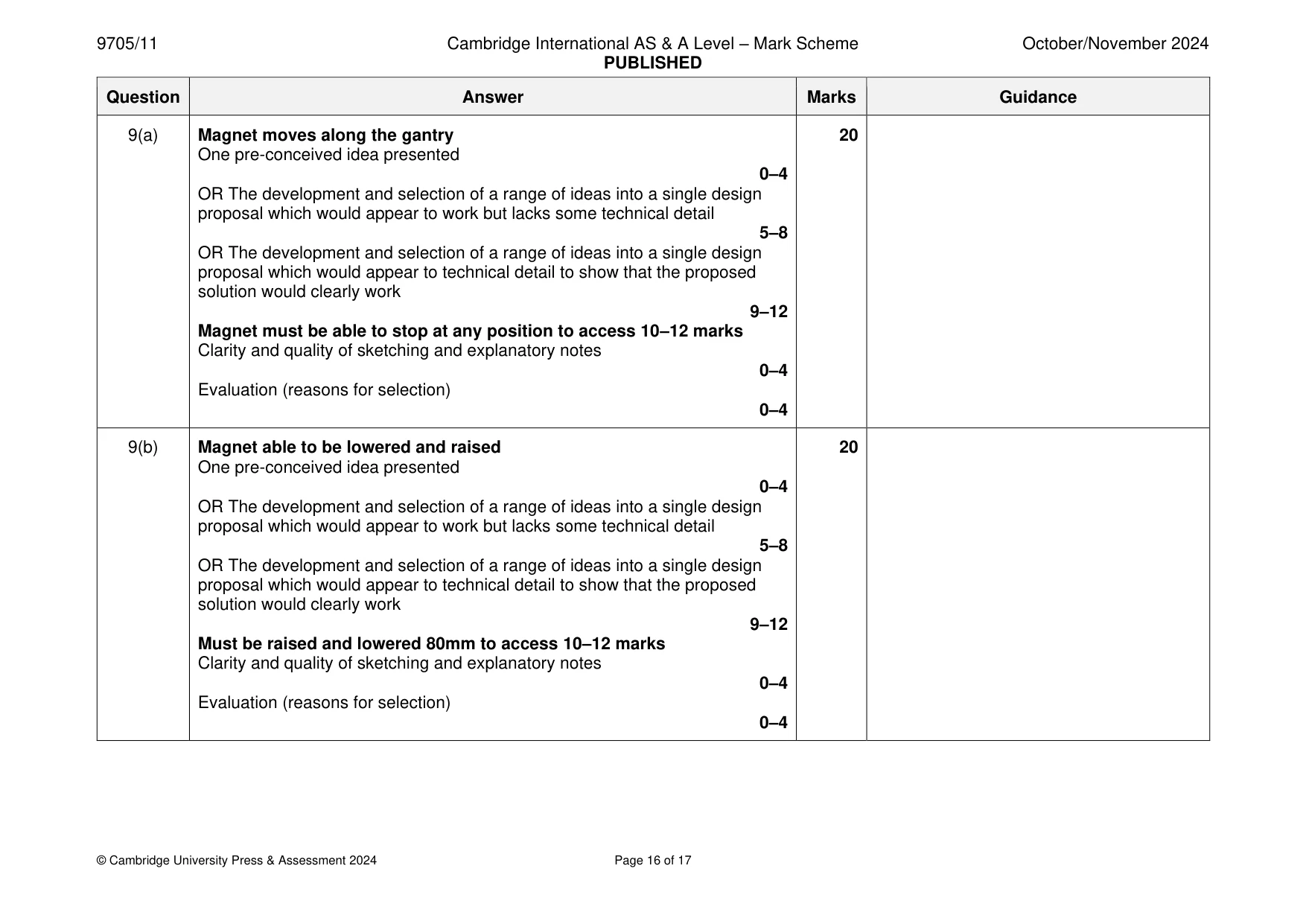
9705/11 Cambridge International AS & A Level – Mark Scheme PUBLISHED October/November 2024 © Cambridge University Press & Assessment 2024 Page 16 of 17 Question Answer Marks Guidance 9(a) Magnet moves along the gantry One pre-conceived idea presented 0–4 OR The development and selection of a range of ideas into a single design proposal which would appear to work but lacks some technical detail 5–8 OR The development and selection of a range of ideas into a single design proposal which would appear to technical detail to show that the proposed solution would clearly work 9–12 Magnet must be able to stop at any position to access 10–12 marks Clarity and quality of sketching and explanatory notes 0–4 Evaluation (reasons for selection) 0–4 20 9(b) Magnet able to be lowered and raised One pre-conceived idea presented 0–4 OR The development and selection of a range of ideas into a single design proposal which would appear to work but lacks some technical detail 5–8 OR The development and selection of a range of ideas into a single design proposal which would appear to technical detail to show that the proposed solution would clearly work 9–12 Must be raised and lowered 80mm to access 10–12 marks Clarity and quality of sketching and explanatory notes 0–4 Evaluation (reasons for selection) 0–4 20
Mark scheme, page 17
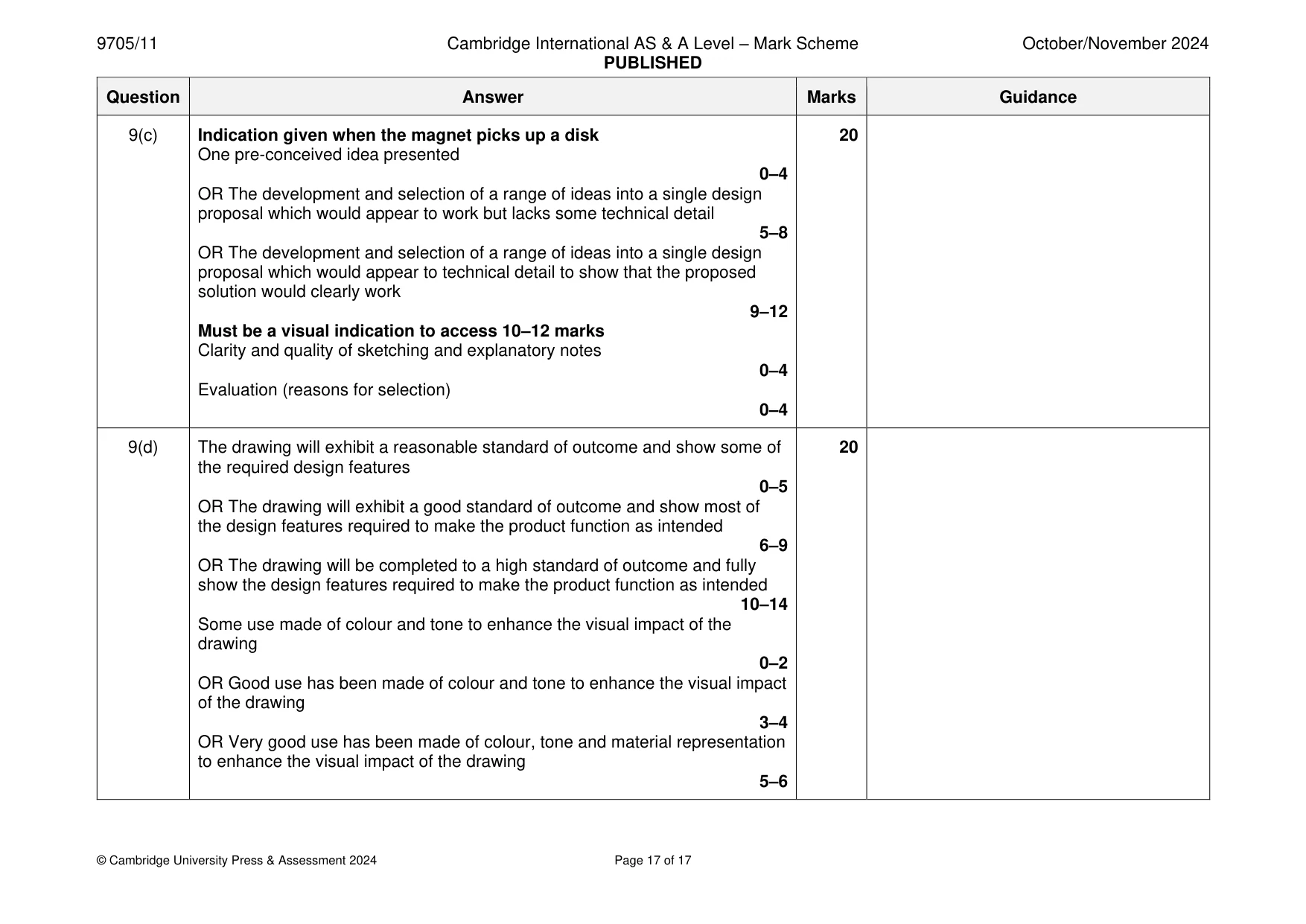
9705/11 Cambridge International AS & A Level – Mark Scheme PUBLISHED October/November 2024 © Cambridge University Press & Assessment 2024 Page 17 of 17 Question Answer Marks Guidance 9(c) Indication given when the magnet picks up a disk One pre-conceived idea presented 0–4 OR The development and selection of a range of ideas into a single design proposal which would appear to work but lacks some technical detail 5–8 OR The development and selection of a range of ideas into a single design proposal which would appear to technical detail to show that the proposed solution would clearly work 9–12 Must be a visual indication to access 10–12 marks Clarity and quality of sketching and explanatory notes 0–4 Evaluation (reasons for selection) 0–4 20 9(d) The drawing will exhibit a reasonable standard of outcome and show some of the required design features 0–5 OR The drawing will exhibit a good standard of outcome and show most of the design features required to make the product function as intended 6–9 OR The drawing will be completed to a high standard of outcome and fully show the design features required to make the product function as intended 10–14 Some use made of colour and tone to enhance the visual impact of the drawing 0–2 OR Good use has been made of colour and tone to enhance the visual impact of the drawing 3–4 OR Very good use has been made of colour, tone and material representation to enhance the visual impact of the drawing 5–6 20
What you needed in this session
Cambridge’s own grade thresholds for 2024 Oct/Nov, Paper 1 · Variant 1. A higher threshold means an easier paper — the bar moves with how the cohort did.