Cambridge A Level Design and Technology 9705 — 2020 Oct/Nov Paper 1 · Variant 3
9705/13/O/N/20 · 120 marks · ≈135 min
The question paper and its mark scheme, free to read here and free to download. This is Cambridge’s own paper, exactly as it was sat.
Question paper12 pages
Mark scheme12 pages
Answers below. Sit the paper first if you are practising.
Paper as text
Question paper, page 1
Cambridge International AS & A Level DC (ST/JG) 188744/2 © UCLES 2020 [Turn over This document has 12 pages. Blank pages are indicated. * 7 3 8 2 5 9 4 0 2 7 * DESIGN & TECHNOLOGY 9705/13 Paper 1 October/November 2020 3 hours You must answer on the answer booklet/paper. You will need: Answer booklet/A4 paper Coloured pencils A3 drawing paper (2 sheets) Extra sheets of A3 drawing paper if needed A range of design drawing equipment INSTRUCTIONS ● Answer three questions in total: Section A: answer one question on the answer booklet/A4 paper provided. Section B: answer one question on the answer booklet/A4 paper provided. Section C: answer one question on A3 drawing paper. Use both sides of the paper. ● You may request additional sheets of A3 drawing paper, but only if you have used up both sides of each of the 2 sheets provided. ● If you have been given an answer booklet, follow the instructions on the front cover of the answer booklet. ● Use a black or dark blue pen. ● Write your name, centre number and candidate number on all the work you hand in. ● Do not use an erasable pen or correction fluid. ● You may use an HB pencil, or coloured pencils as appropriate, for any diagrams, graphs or rough working. ● At the end of the examination, fasten all your work together. Do not use staples, paper clips or glue. INFORMATION ● The total mark for this paper is 120. ● The number of marks for each question or part question is shown in brackets [ ]. ● All dimensions are in millimetres.
Question paper, page 2
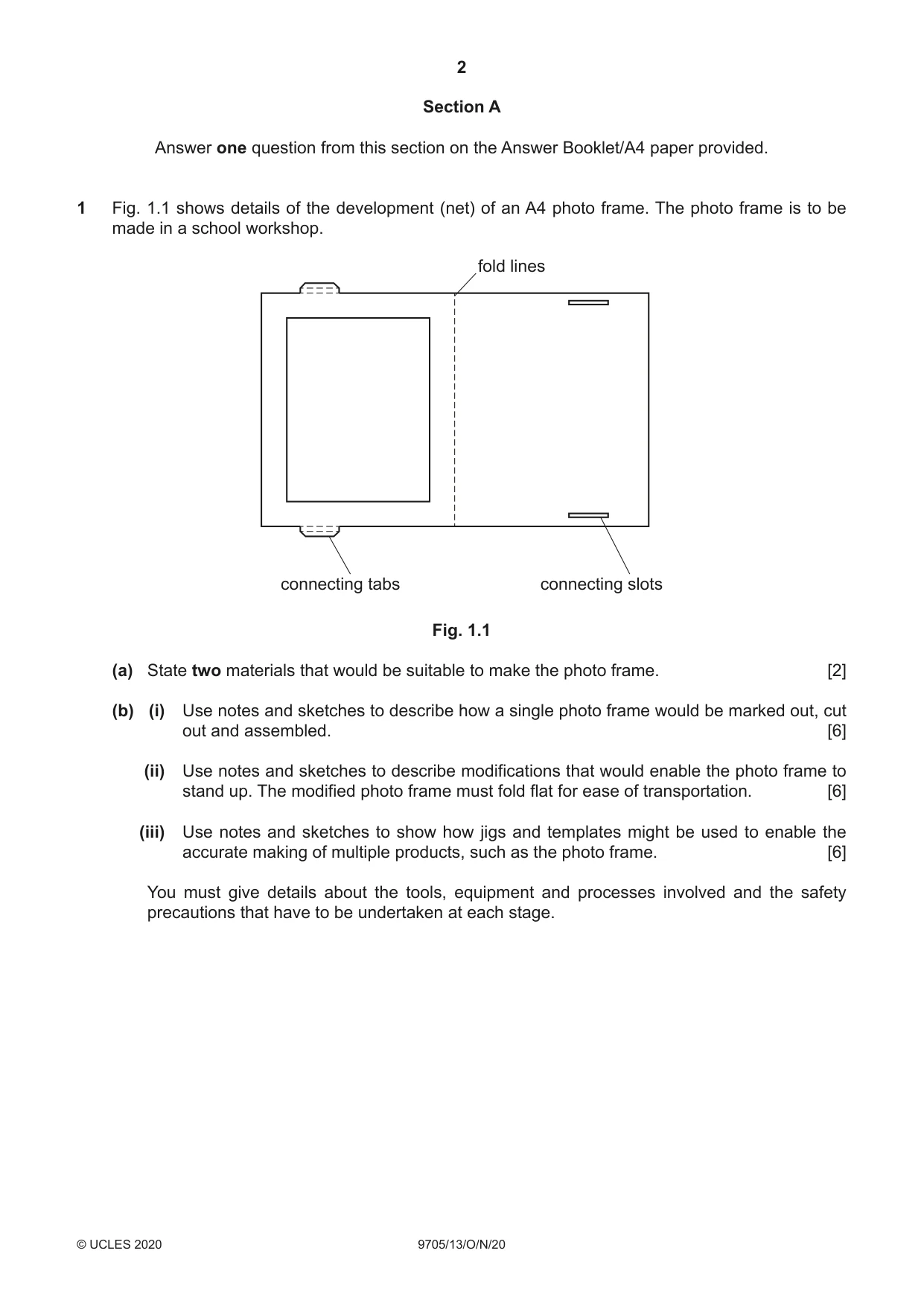
2 9705/13/O/N/20 © UCLES 2020 Section A Answer one question from this section on the Answer Booklet/A4 paper provided. 1 Fig. 1.1 shows details of the development (net) of an A4 photo frame. The photo frame is to be made in a school workshop. fold lines connecting tabs connecting slots Fig. 1.1 (a) State two materials that would be suitable to make the photo frame. [2] (b) (i) Use notes and sketches to describe how a single photo frame would be marked out, cut out and assembled. [6] (ii) Use notes and sketches to describe modifications that would enable the photo frame to stand up. The modified photo frame must fold flat for ease of transportation. [6] (iii) Use notes and sketches to show how jigs and templates might be used to enable the accurate making of multiple products, such as the photo frame. [6] You must give details about the tools, equipment and processes involved and the safety precautions that have to be undertaken at each stage.
Question paper, page 3
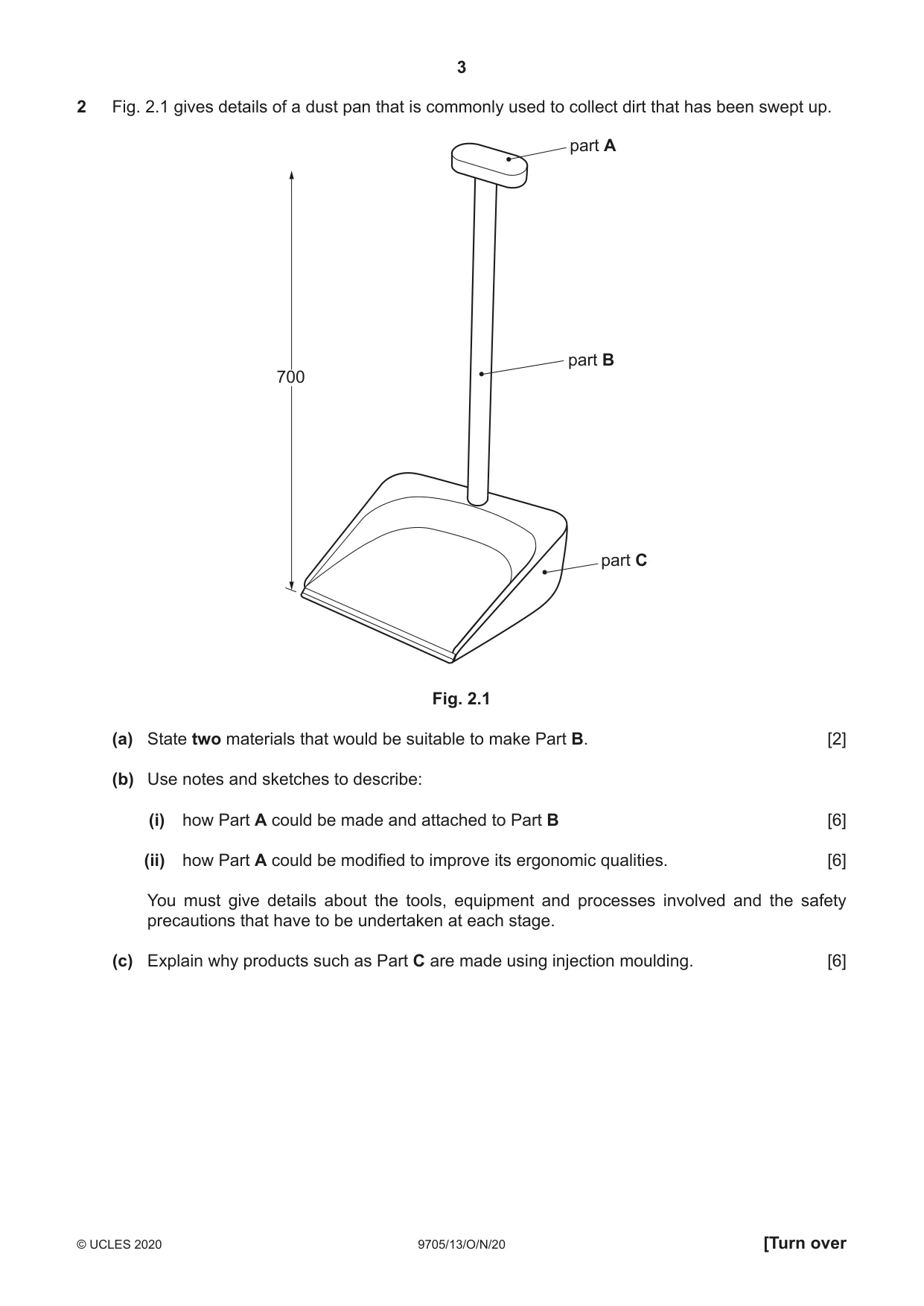
3 9705/13/O/N/20 © UCLES 2020 [Turn over 2 Fig. 2.1 gives details of a dust pan that is commonly used to collect dirt that has been swept up. 700 part A part B part C Fig. 2.1 (a) State two materials that would be suitable to make Part B. [2] (b) Use notes and sketches to describe: (i) how Part A could be made and attached to Part B [6] (ii) how Part A could be modified to improve its ergonomic qualities. [6] You must give details about the tools, equipment and processes involved and the safety precautions that have to be undertaken at each stage. (c) Explain why products such as Part C are made using injection moulding. [6]
Question paper, page 4
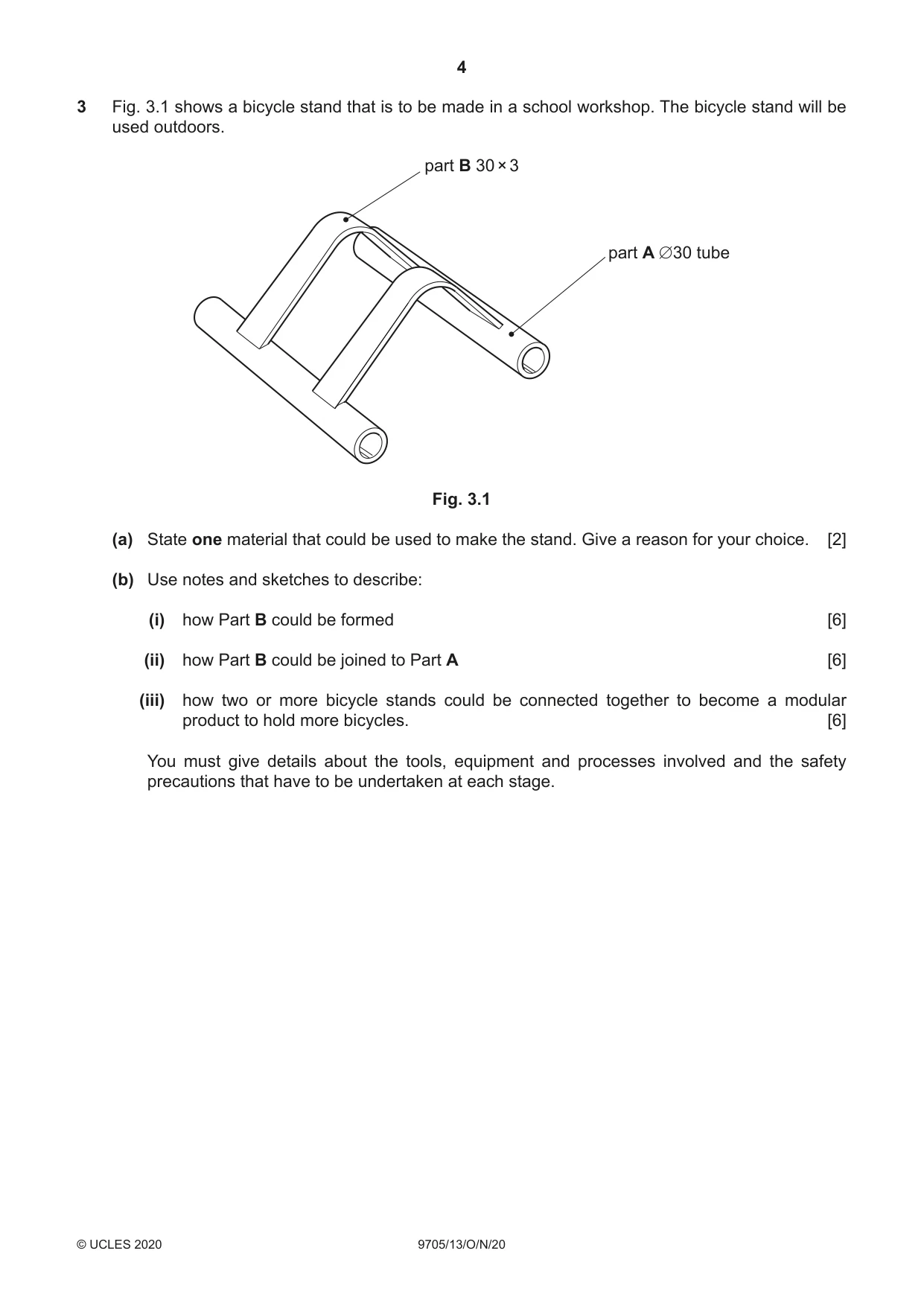
4 9705/13/O/N/20 © UCLES 2020 3 Fig. 3.1 shows a bicycle stand that is to be made in a school workshop. The bicycle stand will be used outdoors. part B 30 × 3 part A ∅30 tube Fig. 3.1 (a) State one material that could be used to make the stand. Give a reason for your choice. [2] (b) Use notes and sketches to describe: (i) how Part B could be formed [6] (ii) how Part B could be joined to Part A [6] (iii) how two or more bicycle stands could be connected together to become a modular product to hold more bicycles. [6] You must give details about the tools, equipment and processes involved and the safety precautions that have to be undertaken at each stage.
Question paper, page 5
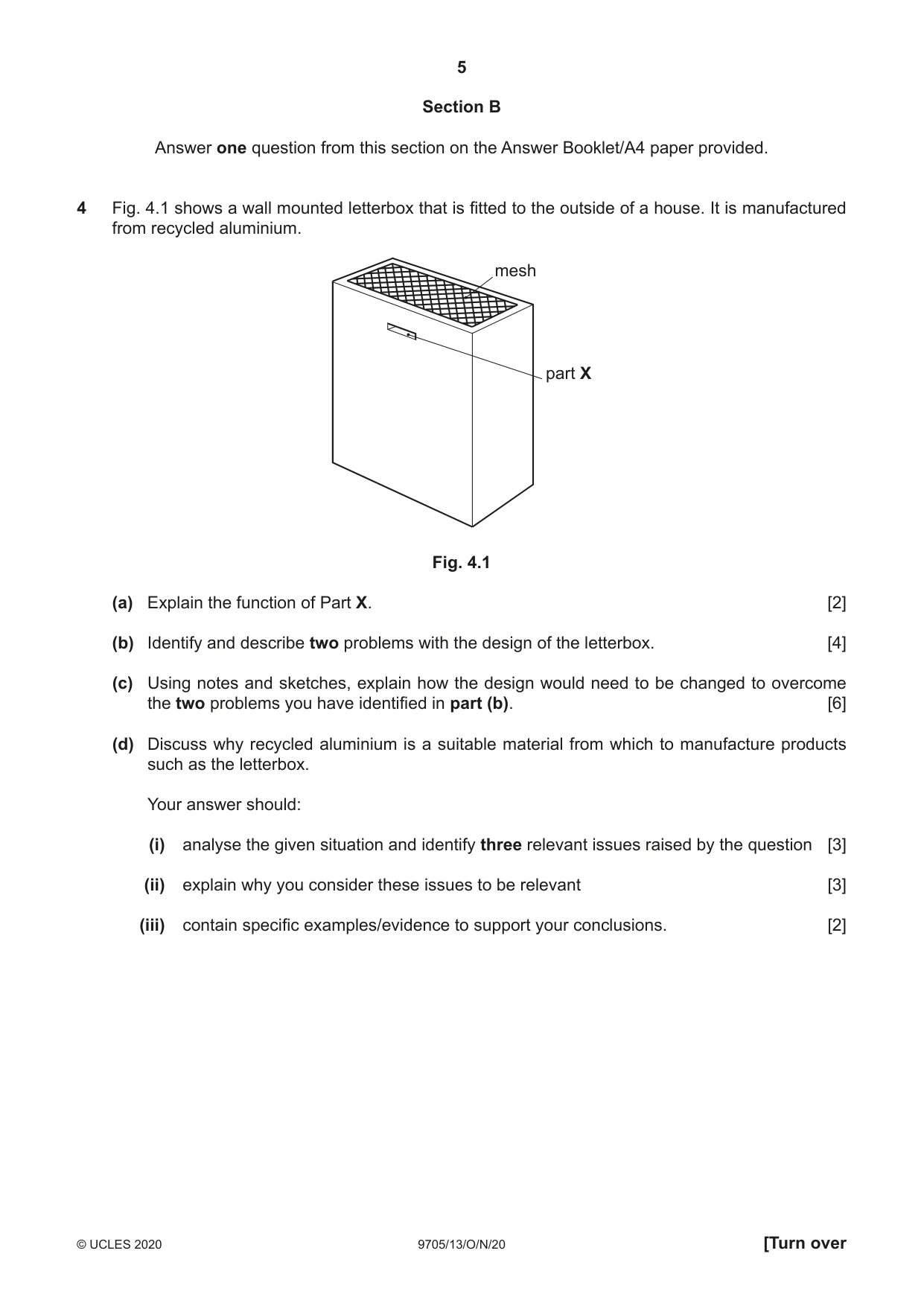
5 9705/13/O/N/20 © UCLES 2020 [Turn over Section B Answer one question from this section on the Answer Booklet/A4 paper provided. 4 Fig. 4.1 shows a wall mounted letterbox that is fitted to the outside of a house. It is manufactured from recycled aluminium. part X mesh Fig. 4.1 (a) Explain the function of Part X. [2] (b) Identify and describe two problems with the design of the letterbox. [4] (c) Using notes and sketches, explain how the design would need to be changed to overcome the two problems you have identified in part (b). [6] (d) Discuss why recycled aluminium is a suitable material from which to manufacture products such as the letterbox. Your answer should: (i) analyse the given situation and identify three relevant issues raised by the question [3] (ii) explain why you consider these issues to be relevant [3] (iii) contain specific examples/evidence to support your conclusions. [2]
Question paper, page 6
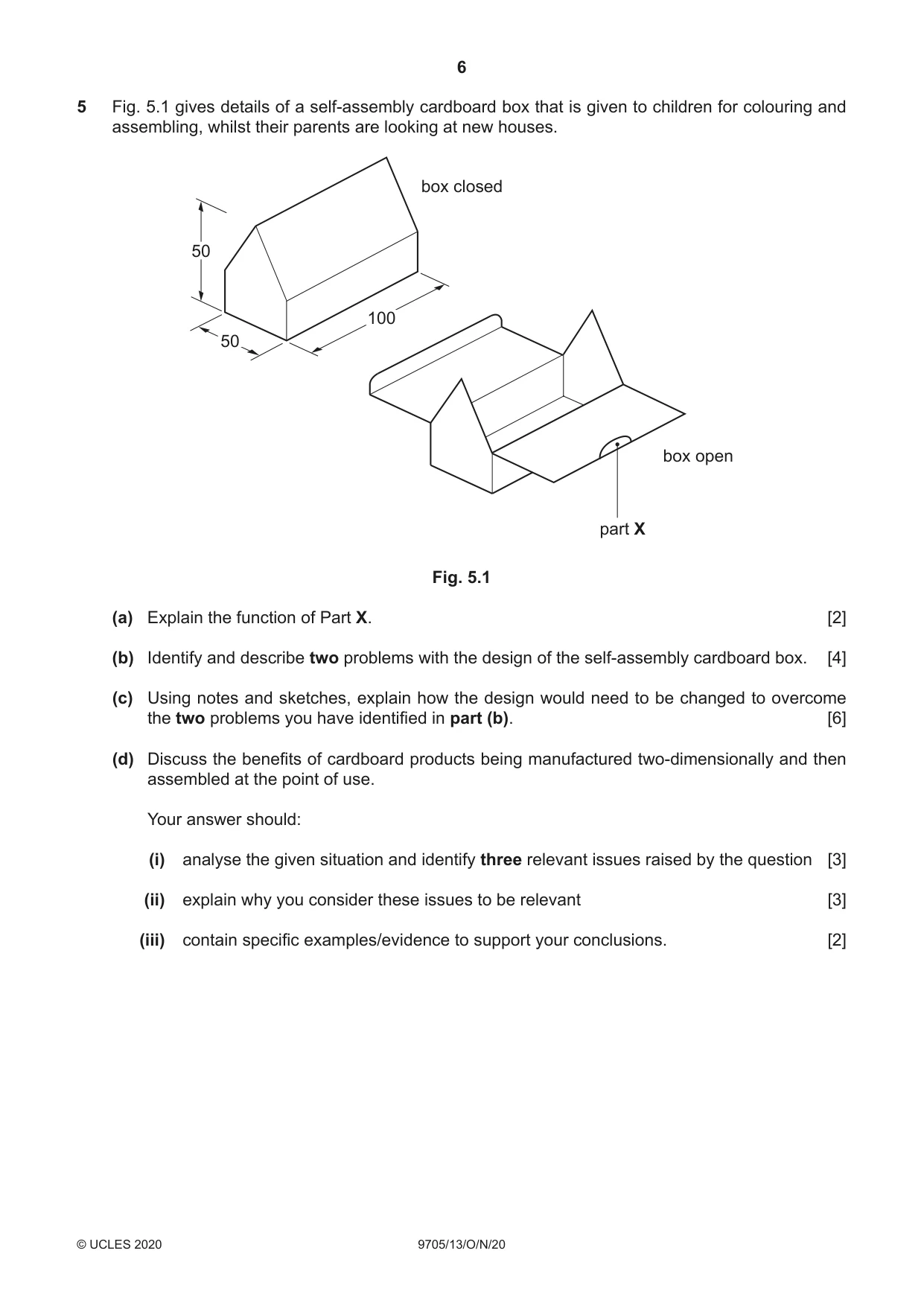
6 9705/13/O/N/20 © UCLES 2020 5 Fig. 5.1 gives details of a self-assembly cardboard box that is given to children for colouring and assembling, whilst their parents are looking at new houses. box closed box open part X 50 50 100 Fig. 5.1 (a) Explain the function of Part X. [2] (b) Identify and describe two problems with the design of the self-assembly cardboard box. [4] (c) Using notes and sketches, explain how the design would need to be changed to overcome the two problems you have identified in part (b). [6] (d) Discuss the benefits of cardboard products being manufactured two-dimensionally and then assembled at the point of use. Your answer should: (i) analyse the given situation and identify three relevant issues raised by the question [3] (ii) explain why you consider these issues to be relevant [3] (iii) contain specific examples/evidence to support your conclusions. [2]
Question paper, page 7
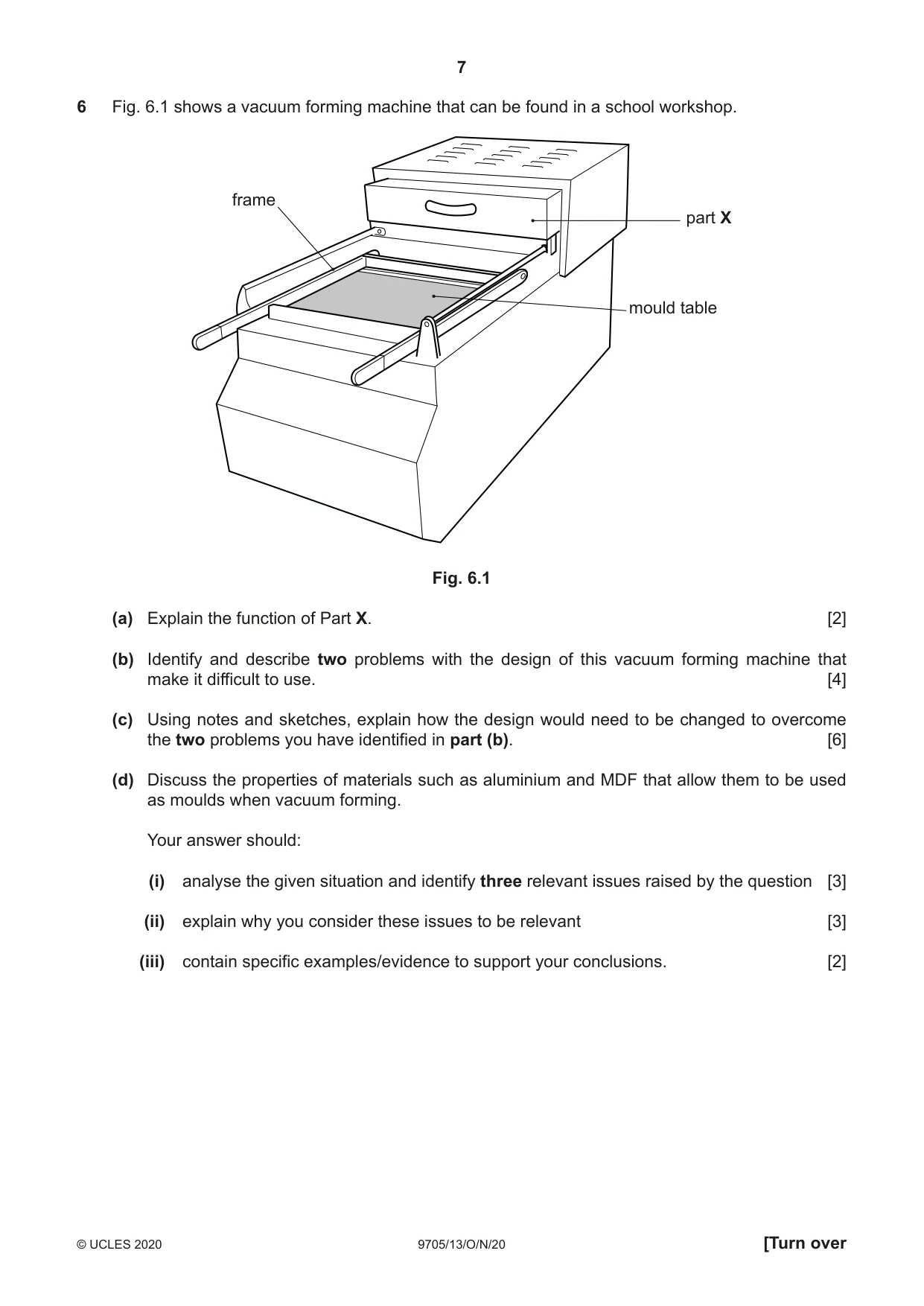
7 9705/13/O/N/20 © UCLES 2020 [Turn over 6 Fig. 6.1 shows a vacuum forming machine that can be found in a school workshop. frame part X mould table Fig. 6.1 (a) Explain the function of Part X. [2] (b) Identify and describe two problems with the design of this vacuum forming machine that make it difficult to use. [4] (c) Using notes and sketches, explain how the design would need to be changed to overcome the two problems you have identified in part (b). [6] (d) Discuss the properties of materials such as aluminium and MDF that allow them to be used as moulds when vacuum forming. Your answer should: (i) analyse the given situation and identify three relevant issues raised by the question [3] (ii) explain why you consider these issues to be relevant [3] (iii) contain specific examples/evidence to support your conclusions. [2]
Question paper, page 8
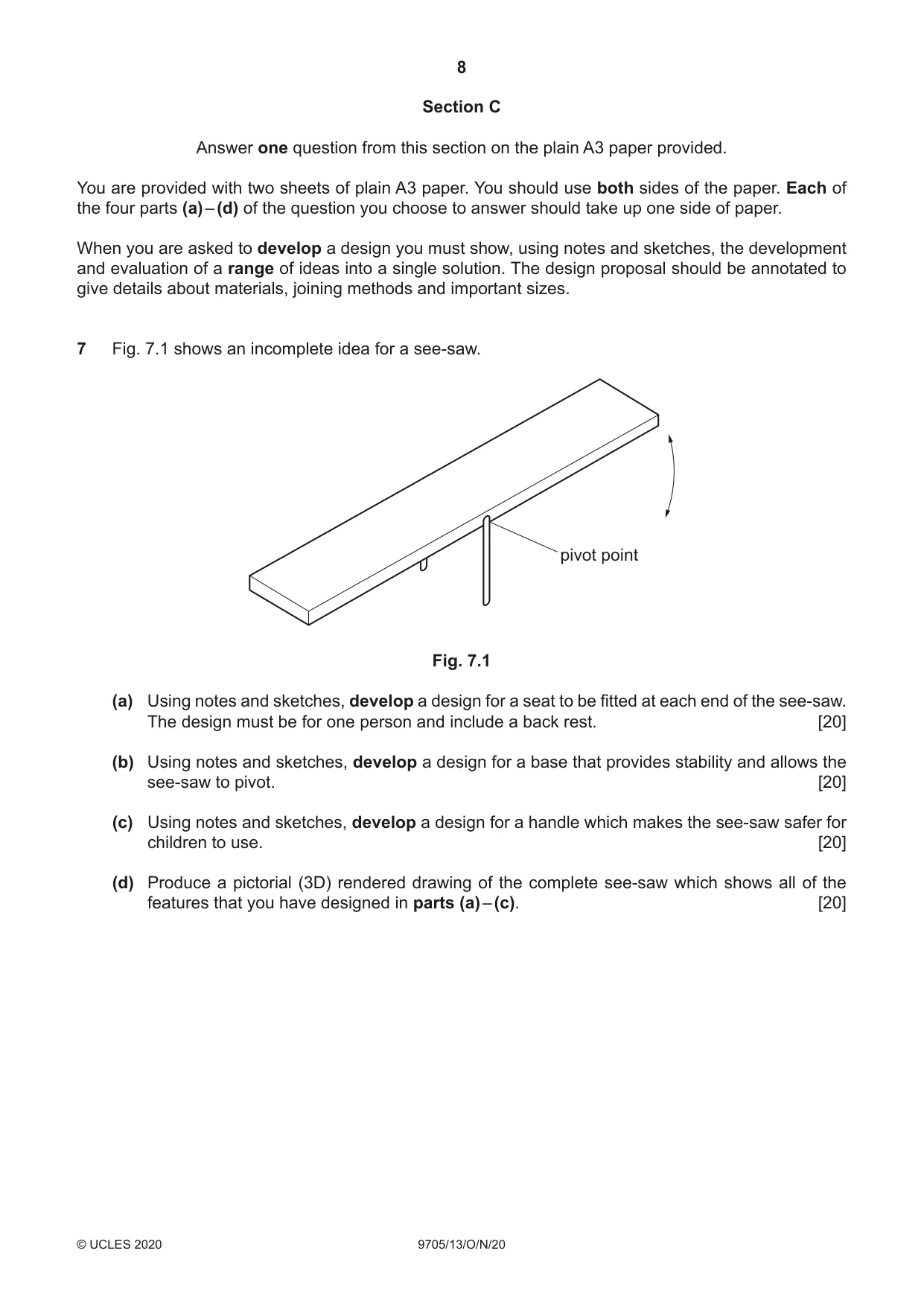
8 9705/13/O/N/20 © UCLES 2020 Section C Answer one question from this section on the plain A3 paper provided. You are provided with two sheets of plain A3 paper. You should use both sides of the paper. Each of the four parts (a) – (d) of the question you choose to answer should take up one side of paper. When you are asked to develop a design you must show, using notes and sketches, the development and evaluation of a range of ideas into a single solution. The design proposal should be annotated to give details about materials, joining methods and important sizes. 7 Fig. 7.1 shows an incomplete idea for a see-saw. pivot point Fig. 7.1 (a) Using notes and sketches, develop a design for a seat to be fitted at each end of the see-saw. The design must be for one person and include a back rest. [20] (b) Using notes and sketches, develop a design for a base that provides stability and allows the see-saw to pivot. [20] (c) Using notes and sketches, develop a design for a handle which makes the see-saw safer for children to use. [20] (d) Produce a pictorial (3D) rendered drawing of the complete see-saw which shows all of the features that you have designed in parts (a) – (c). [20]
Question paper, page 9
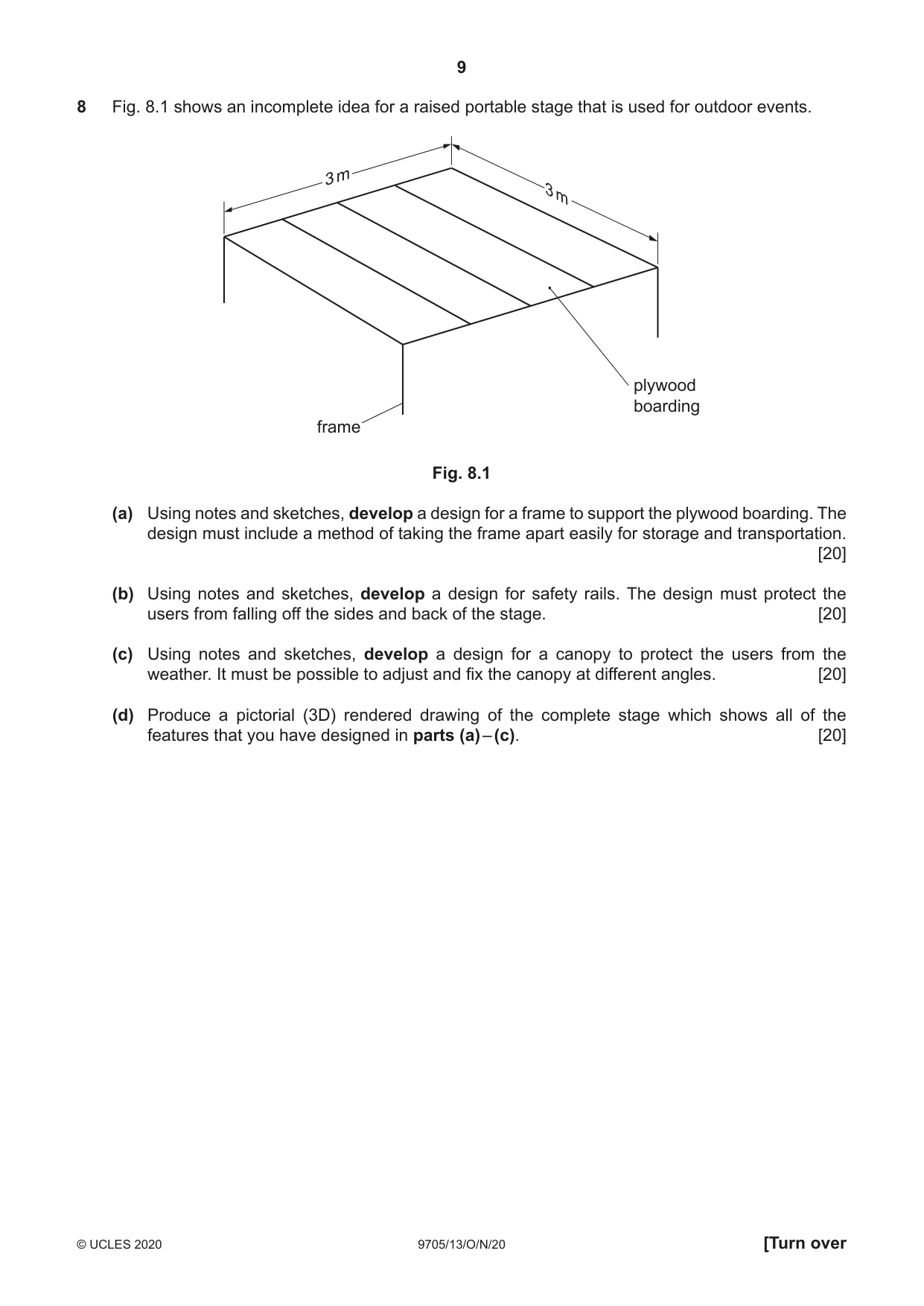
9 9705/13/O/N/20 © UCLES 2020 [Turn over 8 Fig. 8.1 shows an incomplete idea for a raised portable stage that is used for outdoor events. 3 m 3 m plywood boarding frame Fig. 8.1 (a) Using notes and sketches, develop a design for a frame to support the plywood boarding. The design must include a method of taking the frame apart easily for storage and transportation. [20] (b) Using notes and sketches, develop a design for safety rails. The design must protect the users from falling off the sides and back of the stage. [20] (c) Using notes and sketches, develop a design for a canopy to protect the users from the weather. It must be possible to adjust and fix the canopy at different angles. [20] (d) Produce a pictorial (3D) rendered drawing of the complete stage which shows all of the features that you have designed in parts (a) – (c). [20]
Question paper, page 10
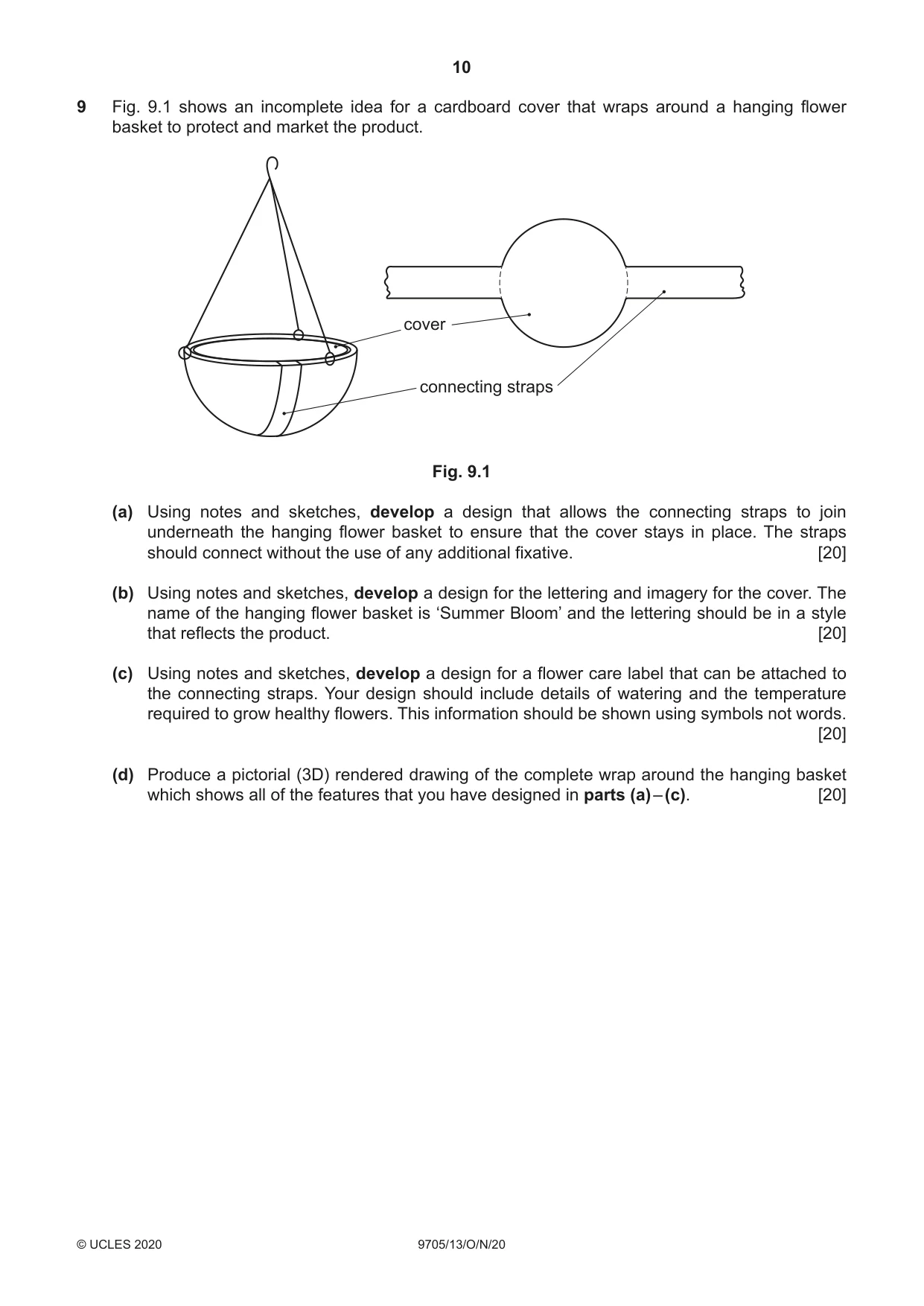
10 9705/13/O/N/20 © UCLES 2020 9 Fig. 9.1 shows an incomplete idea for a cardboard cover that wraps around a hanging flower basket to protect and market the product. cover connecting straps Fig. 9.1 (a) Using notes and sketches, develop a design that allows the connecting straps to join underneath the hanging flower basket to ensure that the cover stays in place. The straps should connect without the use of any additional fixative. [20] (b) Using notes and sketches, develop a design for the lettering and imagery for the cover. The name of the hanging flower basket is ‘Summer Bloom’ and the lettering should be in a style that reflects the product. [20] (c) Using notes and sketches, develop a design for a flower care label that can be attached to the connecting straps. Your design should include details of watering and the temperature required to grow healthy flowers. This information should be shown using symbols not words. [20] (d) Produce a pictorial (3D) rendered drawing of the complete wrap around the hanging basket which shows all of the features that you have designed in parts (a) – (c). [20]
Question paper, page 11
11 9705/13/O/N/20 © UCLES 2020 BLANK PAGE
Question paper, page 12
12 9705/13/O/N/20 © UCLES 2020 Permission to reproduce items where third-party owned material protected by copyright is included has been sought and cleared where possible. Every reasonable effort has been made by the publisher (UCLES) to trace copyright holders, but if any items requiring clearance have unwittingly been included, the publisher will be pleased to make amends at the earliest possible opportunity. To avoid the issue of disclosure of answer-related information to candidates, all copyright acknowledgements are reproduced online in the Cambridge Assessment International Education Copyright Acknowledgements Booklet. This is produced for each series of examinations and is freely available to download at www.cambridgeinternational.org after the live examination series. Cambridge Assessment International Education is part of the Cambridge Assessment Group. Cambridge Assessment is the brand name of the University of Cambridge Local Examinations Syndicate (UCLES), which itself is a department of the University of Cambridge. BLANK PAGE
Mark scheme, page 1
This document consists of 12 printed pages. © UCLES 2020 [Turn over Cambridge International AS & A Level DESIGN AND TECHNOLOGY 9705/13 Paper 1 October/November 2020 MARK SCHEME Maximum Mark: 120 Published This mark scheme is published as an aid to teachers and candidates, to indicate the requirements of the examination. It shows the basis on which Examiners were instructed to award marks. It does not indicate the details of the discussions that took place at an Examiners’ meeting before marking began, which would have considered the acceptability of alternative answers. Mark schemes should be read in conjunction with the question paper and the Principal Examiner Report for Teachers. Cambridge International will not enter into discussions about these mark schemes. Cambridge International is publishing the mark schemes for the October/November 2020 series for most Cambridge IGCSE™, Cambridge International A and AS Level and Cambridge Pre-U components, and some Cambridge O Level components.
Mark scheme, page 2
9705/13 Cambridge International AS & A Level – Mark Scheme PUBLISHED October/November 2020 © UCLES 2020 Page 2 of 12 Generic Marking Principles These general marking principles must be applied by all examiners when marking candidate answers. They should be applied alongside the specific content of the mark scheme or generic level descriptors for a question. Each question paper and mark scheme will also comply with these marking principles. GENERIC MARKING PRINCIPLE 1: Marks must be awarded in line with: • the specific content of the mark scheme or the generic level descriptors for the question • the specific skills defined in the mark scheme or in the generic level descriptors for the question • the standard of response required by a candidate as exemplified by the standardisation scripts. GENERIC MARKING PRINCIPLE 2: Marks awarded are always whole marks (not half marks, or other fractions). GENERIC MARKING PRINCIPLE 3: Marks must be awarded positively: • marks are awarded for correct/valid answers, as defined in the mark scheme. However, credit is given for valid answers which go beyond the scope of the syllabus and mark scheme, referring to your Team Leader as appropriate • marks are awarded when candidates clearly demonstrate what they know and can do • marks are not deducted for errors • marks are not deducted for omissions • answers should only be judged on the quality of spelling, punctuation and grammar when these features are specifically assessed by the question as indicated by the mark scheme. The meaning, however, should be unambiguous. GENERIC MARKING PRINCIPLE 4: Rules must be applied consistently, e.g. in situations where candidates have not followed instructions or in the application of generic level descriptors.
Mark scheme, page 3
9705/13 Cambridge International AS & A Level – Mark Scheme PUBLISHED October/November 2020 © UCLES 2020 Page 3 of 12 GENERIC MARKING PRINCIPLE 5: Marks should be awarded using the full range of marks defined in the mark scheme for the question (however; the use of the full mark range may be limited according to the quality of the candidate responses seen). GENERIC MARKING PRINCIPLE 6: Marks awarded are based solely on the requirements as defined in the mark scheme. Marks should not be awarded with grade thresholds or grade descriptors in mind.
Mark scheme, page 4
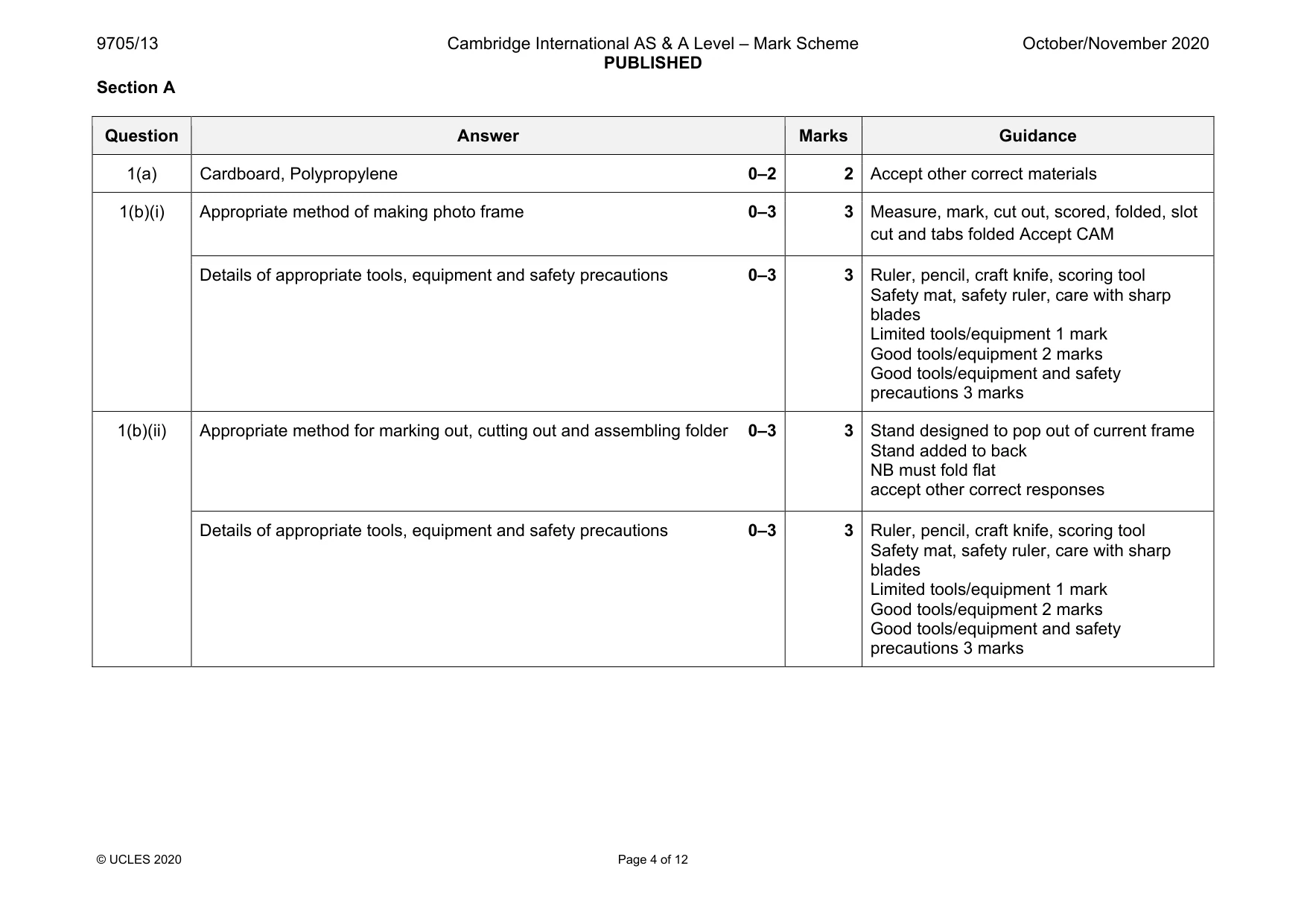
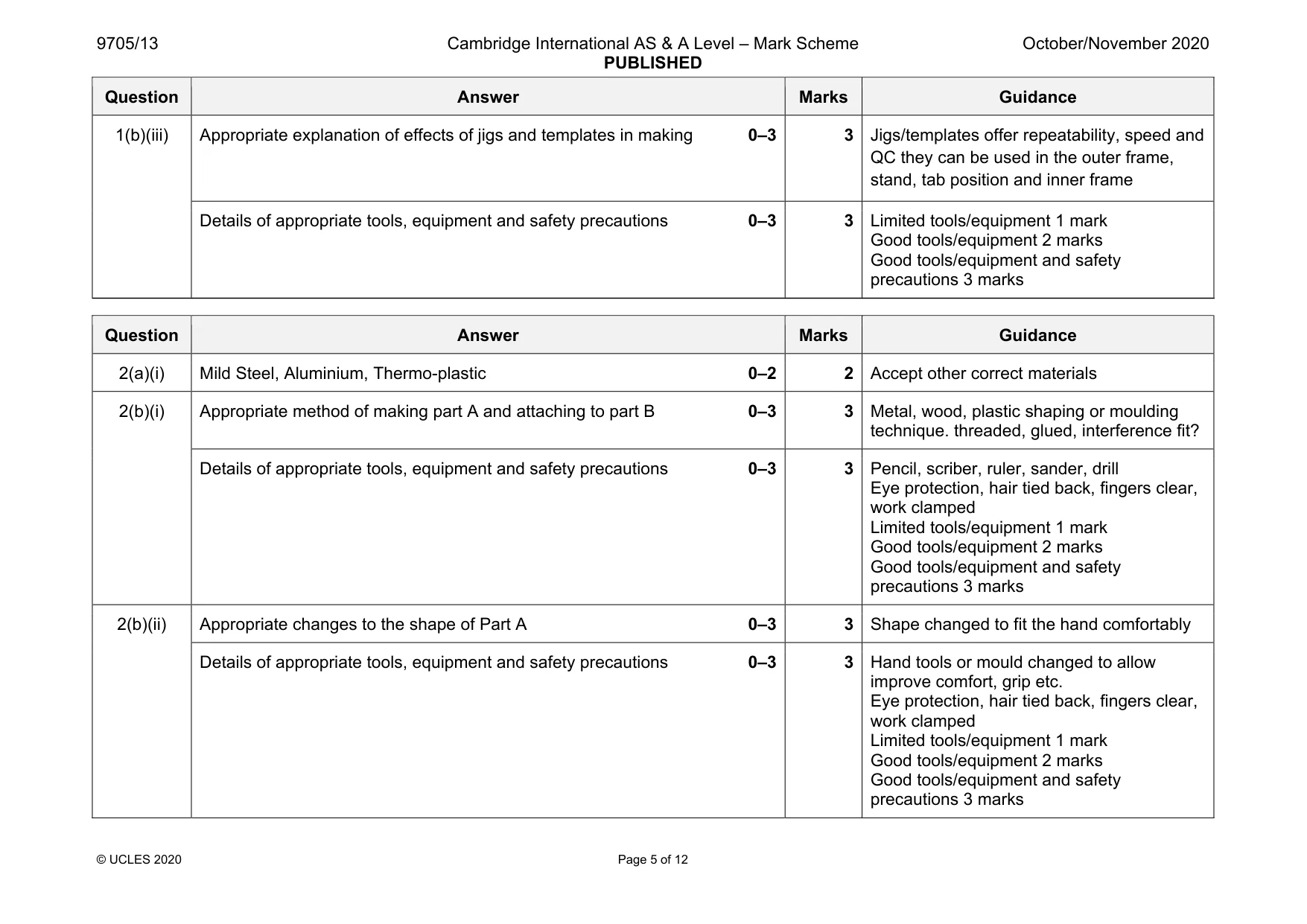
9705/13 Cambridge International AS & A Level – Mark Scheme PUBLISHED October/November 2020 © UCLES 2020 Page 4 of 12 Section A Question Answer Marks Guidance 1(a) Cardboard, Polypropylene 0–2 2 Accept other correct materials 1(b)(i) Appropriate method of making photo frame 0–3 3 Measure, mark, cut out, scored, folded, slot cut and tabs folded Accept CAM Details of appropriate tools, equipment and safety precautions 0–3 3 Ruler, pencil, craft knife, scoring tool Safety mat, safety ruler, care with sharp blades Limited tools/equipment 1 mark Good tools/equipment 2 marks Good tools/equipment and safety precautions 3 marks 1(b)(ii) Appropriate method for marking out, cutting out and assembling folder 0–3 3 Stand designed to pop out of current frame Stand added to back NB must fold flat accept other correct responses Details of appropriate tools, equipment and safety precautions 0–3 3 Ruler, pencil, craft knife, scoring tool Safety mat, safety ruler, care with sharp blades Limited tools/equipment 1 mark Good tools/equipment 2 marks Good tools/equipment and safety precautions 3 marks
Mark scheme, page 5
9705/13 Cambridge International AS & A Level – Mark Scheme PUBLISHED October/November 2020 © UCLES 2020 Page 5 of 12 Question Answer Marks Guidance 1(b)(iii) Appropriate explanation of effects of jigs and templates in making 0–3 3 Jigs/templates offer repeatability, speed and QC they can be used in the outer frame, stand, tab position and inner frame Details of appropriate tools, equipment and safety precautions 0–3 3 Limited tools/equipment 1 mark Good tools/equipment 2 marks Good tools/equipment and safety precautions 3 marks Question Answer Marks Guidance 2(a)(i) Mild Steel, Aluminium, Thermo-plastic 0–2 2 Accept other correct materials 2(b)(i) Appropriate method of making part A and attaching to part B 0–3 3 Metal, wood, plastic shaping or moulding technique. threaded, glued, interference fit? Details of appropriate tools, equipment and safety precautions 0–3 3 Pencil, scriber, ruler, sander, drill Eye protection, hair tied back, fingers clear, work clamped Limited tools/equipment 1 mark Good tools/equipment 2 marks Good tools/equipment and safety precautions 3 marks 2(b)(ii) Appropriate changes to the shape of Part A 0–3 3 Shape changed to fit the hand comfortably Details of appropriate tools, equipment and safety precautions 0–3 3 Hand tools or mould changed to allow improve comfort, grip etc. Eye protection, hair tied back, fingers clear, work clamped Limited tools/equipment 1 mark Good tools/equipment 2 marks Good tools/equipment and safety precautions 3 marks
Mark scheme, page 6
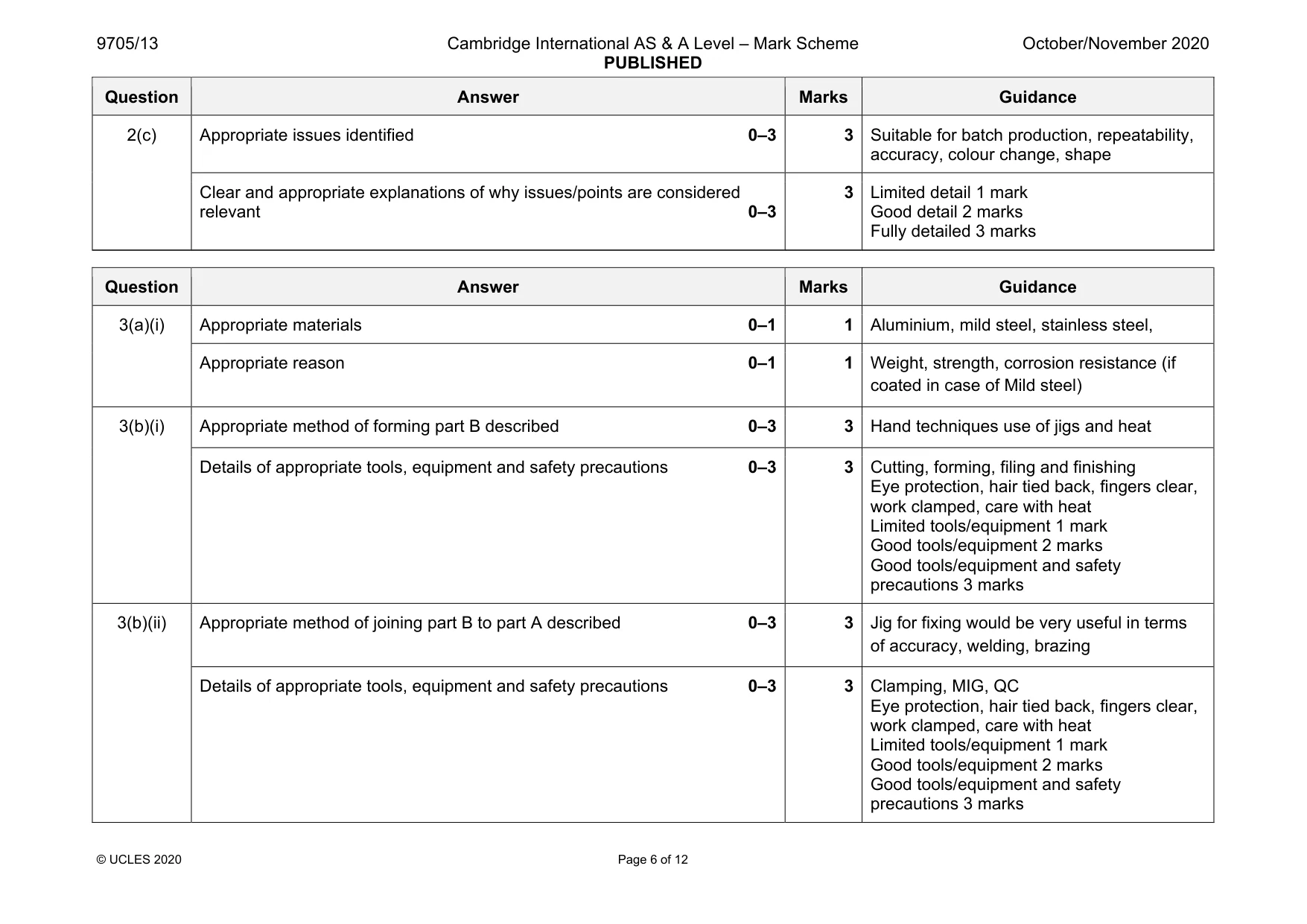
9705/13 Cambridge International AS & A Level – Mark Scheme PUBLISHED October/November 2020 © UCLES 2020 Page 6 of 12 Question Answer Marks Guidance 2(c) Appropriate issues identified 0–3 3 Suitable for batch production, repeatability, accuracy, colour change, shape Clear and appropriate explanations of why issues/points are considered relevant 0–3 3 Limited detail 1 mark Good detail 2 marks Fully detailed 3 marks Question Answer Marks Guidance 3(a)(i) Appropriate materials 0–1 1 Aluminium, mild steel, stainless steel, Appropriate reason 0–1 1 Weight, strength, corrosion resistance (if coated in case of Mild steel) 3(b)(i) Appropriate method of forming part B described 0–3 3 Hand techniques use of jigs and heat Details of appropriate tools, equipment and safety precautions 0–3 3 Cutting, forming, filing and finishing Eye protection, hair tied back, fingers clear, work clamped, care with heat Limited tools/equipment 1 mark Good tools/equipment 2 marks Good tools/equipment and safety precautions 3 marks 3(b)(ii) Appropriate method of joining part B to part A described 0–3 3 Jig for fixing would be very useful in terms of accuracy, welding, brazing Details of appropriate tools, equipment and safety precautions 0–3 3 Clamping, MIG, QC Eye protection, hair tied back, fingers clear, work clamped, care with heat Limited tools/equipment 1 mark Good tools/equipment 2 marks Good tools/equipment and safety precautions 3 marks
Mark scheme, page 7
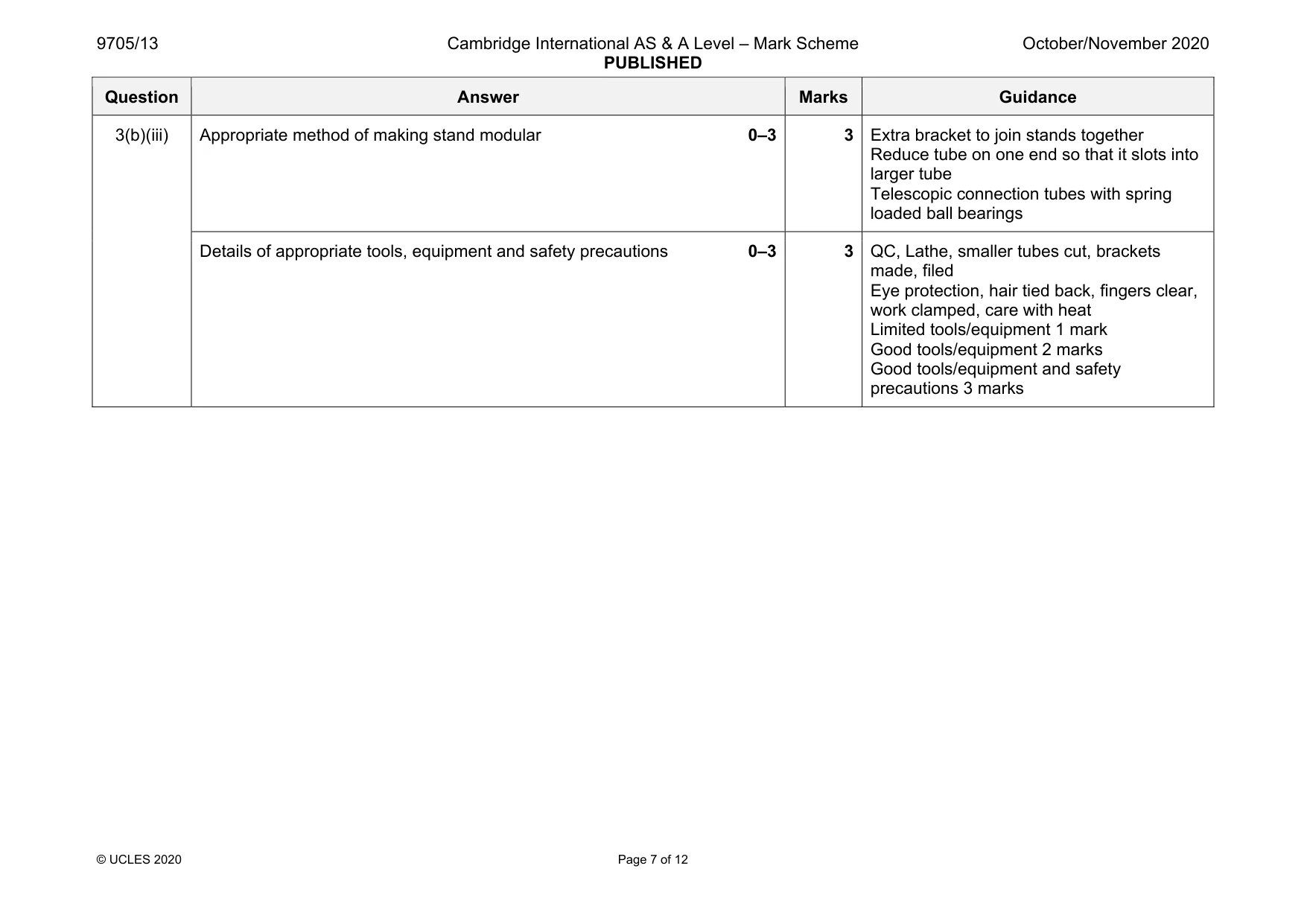
9705/13 Cambridge International AS & A Level – Mark Scheme PUBLISHED October/November 2020 © UCLES 2020 Page 7 of 12 Question Answer Marks Guidance 3(b)(iii) Appropriate method of making stand modular 0–3 3 Extra bracket to join stands together Reduce tube on one end so that it slots into larger tube Telescopic connection tubes with spring loaded ball bearings Details of appropriate tools, equipment and safety precautions 0–3 3 QC, Lathe, smaller tubes cut, brackets made, filed Eye protection, hair tied back, fingers clear, work clamped, care with heat Limited tools/equipment 1 mark Good tools/equipment 2 marks Good tools/equipment and safety precautions 3 marks
Mark scheme, page 8
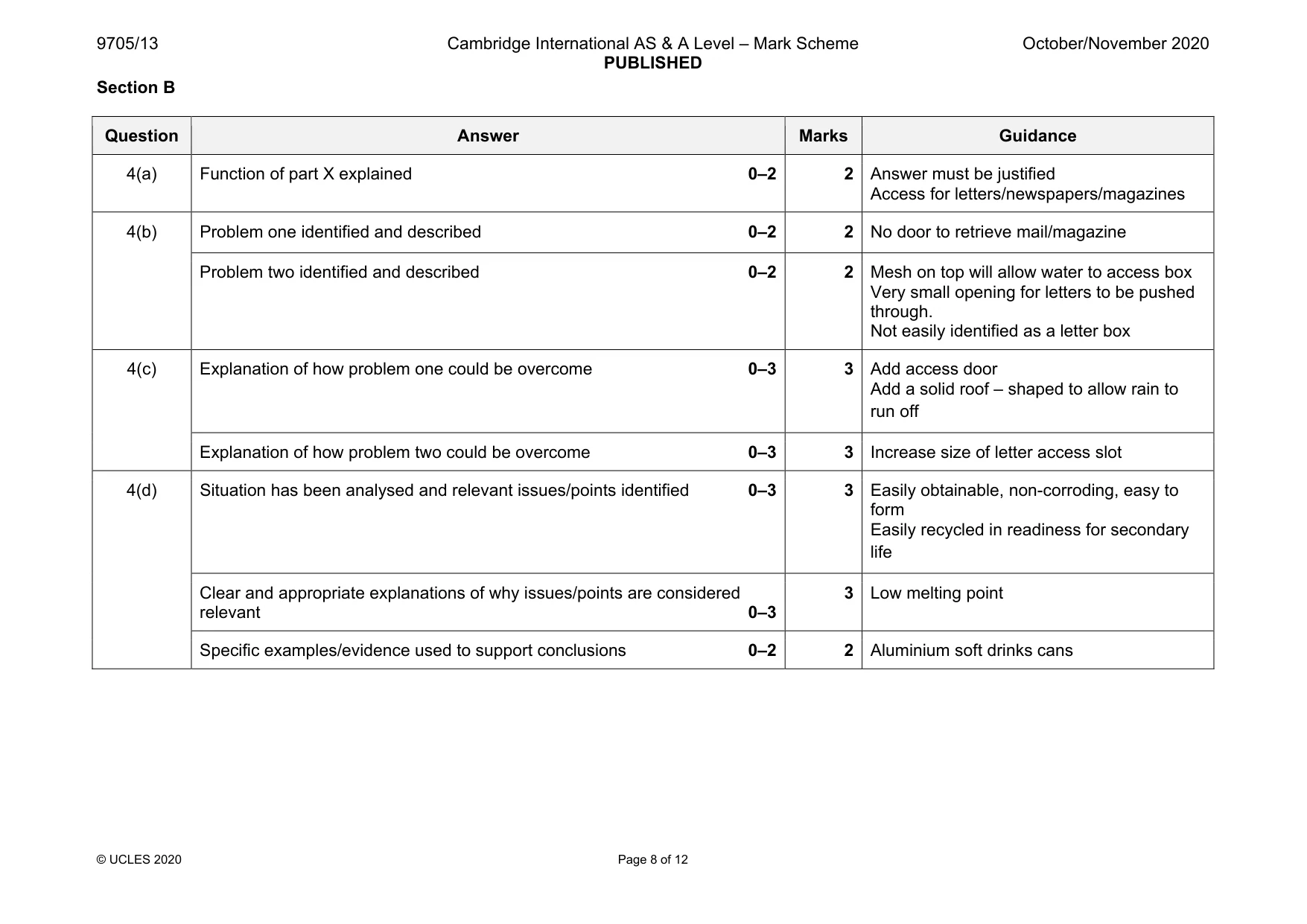
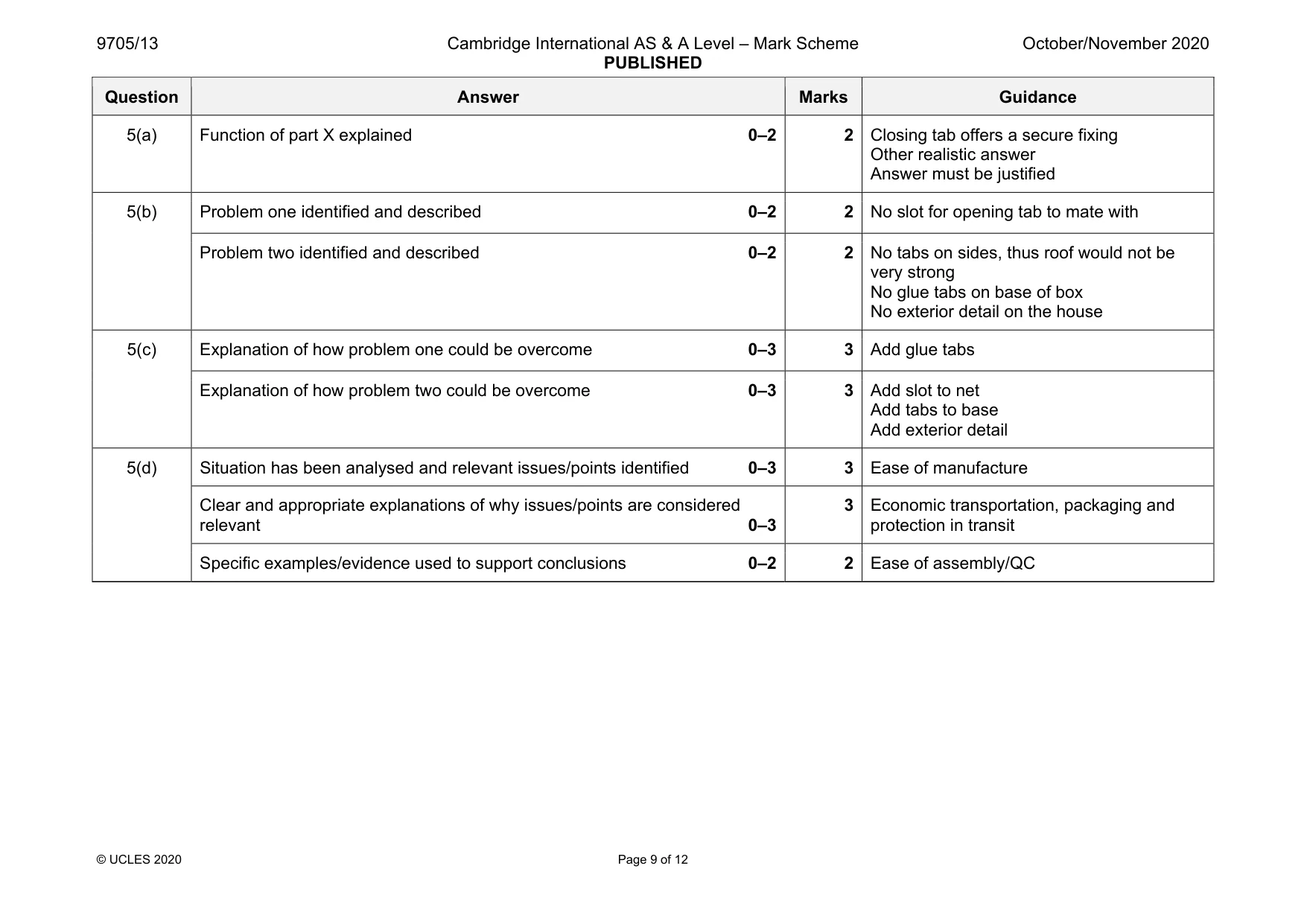
9705/13 Cambridge International AS & A Level – Mark Scheme PUBLISHED October/November 2020 © UCLES 2020 Page 8 of 12 Section B Question Answer Marks Guidance 4(a) Function of part X explained 0–2 2 Answer must be justified Access for letters/newspapers/magazines 4(b) Problem one identified and described 0–2 2 No door to retrieve mail/magazine Problem two identified and described 0–2 2 Mesh on top will allow water to access box Very small opening for letters to be pushed through. Not easily identified as a letter box 4(c) Explanation of how problem one could be overcome 0–3 3 Add access door Add a solid roof – shaped to allow rain to run off Explanation of how problem two could be overcome 0–3 3 Increase size of letter access slot 4(d) Situation has been analysed and relevant issues/points identified 0–3 3 Easily obtainable, non-corroding, easy to form Easily recycled in readiness for secondary life Clear and appropriate explanations of why issues/points are considered relevant 0–3 3 Low melting point Specific examples/evidence used to support conclusions 0–2 2 Aluminium soft drinks cans
Mark scheme, page 9
9705/13 Cambridge International AS & A Level – Mark Scheme PUBLISHED October/November 2020 © UCLES 2020 Page 9 of 12 Question Answer Marks Guidance 5(a) Function of part X explained 0–2 2 Closing tab offers a secure fixing Other realistic answer Answer must be justified 5(b) Problem one identified and described 0–2 2 No slot for opening tab to mate with Problem two identified and described 0–2 2 No tabs on sides, thus roof would not be very strong No glue tabs on base of box No exterior detail on the house 5(c) Explanation of how problem one could be overcome 0–3 3 Add glue tabs Explanation of how problem two could be overcome 0–3 3 Add slot to net Add tabs to base Add exterior detail 5(d) Situation has been analysed and relevant issues/points identified 0–3 3 Ease of manufacture Clear and appropriate explanations of why issues/points are considered relevant 0–3 3 Economic transportation, packaging and protection in transit Specific examples/evidence used to support conclusions 0–2 2 Ease of assembly/QC
Mark scheme, page 10
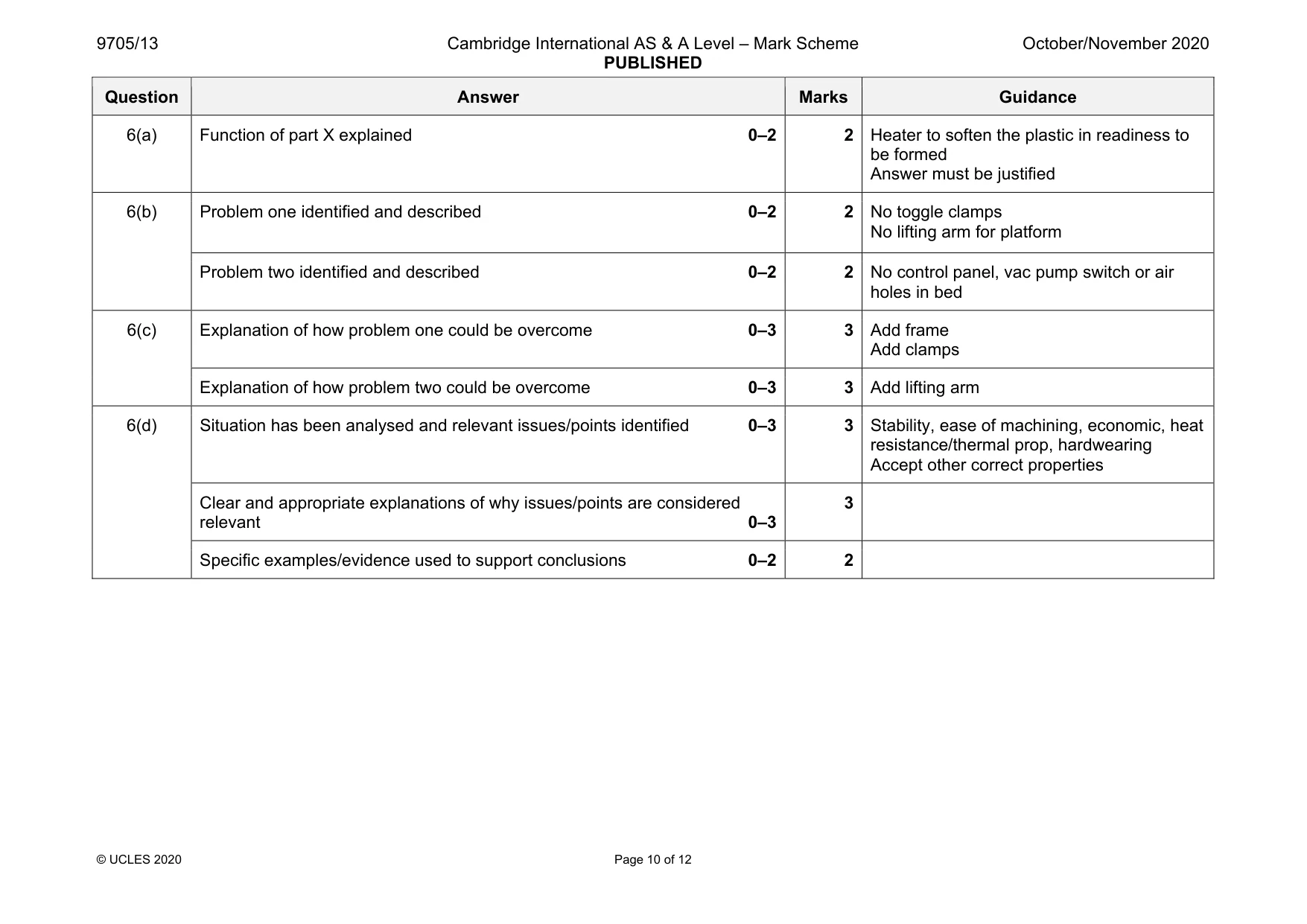
9705/13 Cambridge International AS & A Level – Mark Scheme PUBLISHED October/November 2020 © UCLES 2020 Page 10 of 12 Question Answer Marks Guidance 6(a) Function of part X explained 0–2 2 Heater to soften the plastic in readiness to be formed Answer must be justified 6(b) Problem one identified and described 0–2 2 No toggle clamps No lifting arm for platform Problem two identified and described 0–2 2 No control panel, vac pump switch or air holes in bed 6(c) Explanation of how problem one could be overcome 0–3 3 Add frame Add clamps Explanation of how problem two could be overcome 0–3 3 Add lifting arm 6(d) Situation has been analysed and relevant issues/points identified 0–3 3 Stability, ease of machining, economic, heat resistance/thermal prop, hardwearing Accept other correct properties Clear and appropriate explanations of why issues/points are considered relevant 0–3 3 Specific examples/evidence used to support conclusions 0–2 2
Mark scheme, page 11
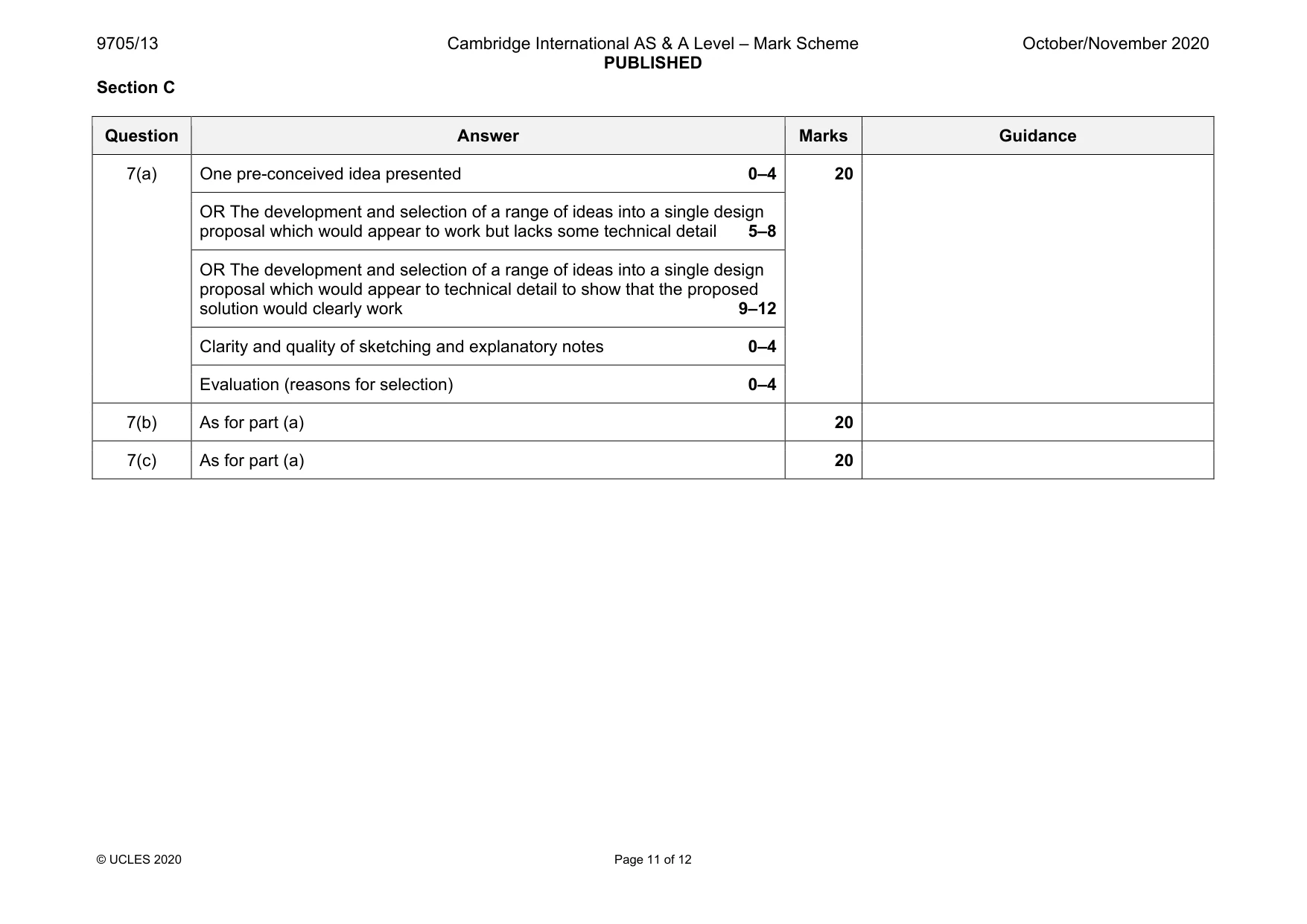
9705/13 Cambridge International AS & A Level – Mark Scheme PUBLISHED October/November 2020 © UCLES 2020 Page 11 of 12 Section C Question Answer Marks Guidance 7(a) One pre-conceived idea presented 0–4 20 OR The development and selection of a range of ideas into a single design proposal which would appear to work but lacks some technical detail 5–8 OR The development and selection of a range of ideas into a single design proposal which would appear to technical detail to show that the proposed solution would clearly work 9–12 Clarity and quality of sketching and explanatory notes 0–4 Evaluation (reasons for selection) 0–4 7(b) As for part (a) 20 7(c) As for part (a) 20
Mark scheme, page 12
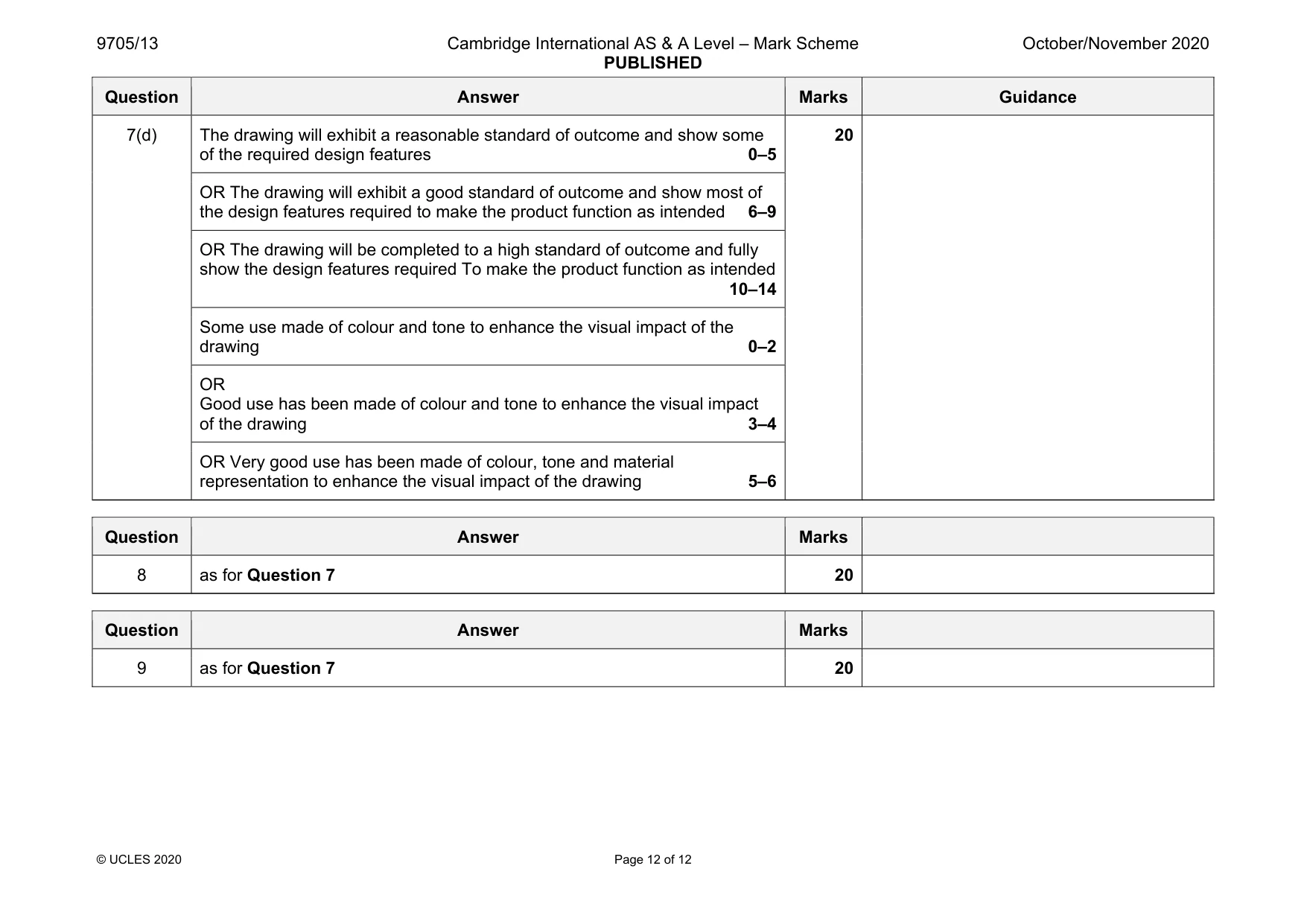
9705/13 Cambridge International AS & A Level – Mark Scheme PUBLISHED October/November 2020 © UCLES 2020 Page 12 of 12 Question Answer Marks Guidance 7(d) The drawing will exhibit a reasonable standard of outcome and show some of the required design features 0–5 20 OR The drawing will exhibit a good standard of outcome and show most of the design features required to make the product function as intended 6–9 OR The drawing will be completed to a high standard of outcome and fully show the design features required To make the product function as intended 10–14 Some use made of colour and tone to enhance the visual impact of the drawing 0–2 OR Good use has been made of colour and tone to enhance the visual impact of the drawing 3–4 OR Very good use has been made of colour, tone and material representation to enhance the visual impact of the drawing 5–6 Question Answer Marks 8 as for Question 7 20 Question Answer Marks 9 as for Question 7 20
What you needed in this session
Cambridge’s own grade thresholds for 2020 Oct/Nov, Paper 1 · Variant 3. A higher threshold means an easier paper — the bar moves with how the cohort did.