Cambridge A Level Design and Technology 9705 — 2020 Oct/Nov Paper 1 · Variant 2
9705/12/O/N/20 · 120 marks · ≈135 min
The question paper and its mark scheme, free to read here and free to download. This is Cambridge’s own paper, exactly as it was sat.
Question paper12 pages
Mark scheme12 pages
Answers below. Sit the paper first if you are practising.
Paper as text
Question paper, page 1
Cambridge International AS & A Level This document has 12 pages. Blank pages are indicated. DC (TC) 189491/2 © UCLES 2020 [Turn over * 5 3 3 2 4 5 3 4 3 7 * DESIGN & TECHNOLOGY 9705/12 Paper 1 October/November 2020 3 hours You must answer on the answer booklet/paper. You will need: Answer booklet/A4 paper Coloured pencils A3 drawing paper (2 sheets) Extra sheets of A3 drawing paper if needed A range of design drawing equipment INSTRUCTIONS ● Answer three questions in total: Section A: answer one question on the answer booklet/A4 paper provided. Section B: answer one question on the answer booklet/A4 paper provided. Section C: answer one question on A3 drawing paper. Use both sides of the paper. ● You may request additional sheets of A3 drawing paper, but only if you have used up both sides of each of the 2 sheets provided. ● If you have been given an answer booklet, follow the instructions on the front cover of the answer booklet. ● Use a black or dark blue pen. ● Write your name, centre number and candidate number on all the work you hand in. ● Do not use an erasable pen or correction fluid. ● You may use an HB pencil, or coloured pencils as appropriate, for any diagrams, graphs or rough working. ● At the end of the examination, fasten all your work together. Do not use staples, paper clips or glue. INFORMATION ● The total mark for this paper is 120. ● The number of marks for each question or part question is shown in brackets [ ]. ● All dimensions are in millimetres.
Question paper, page 2
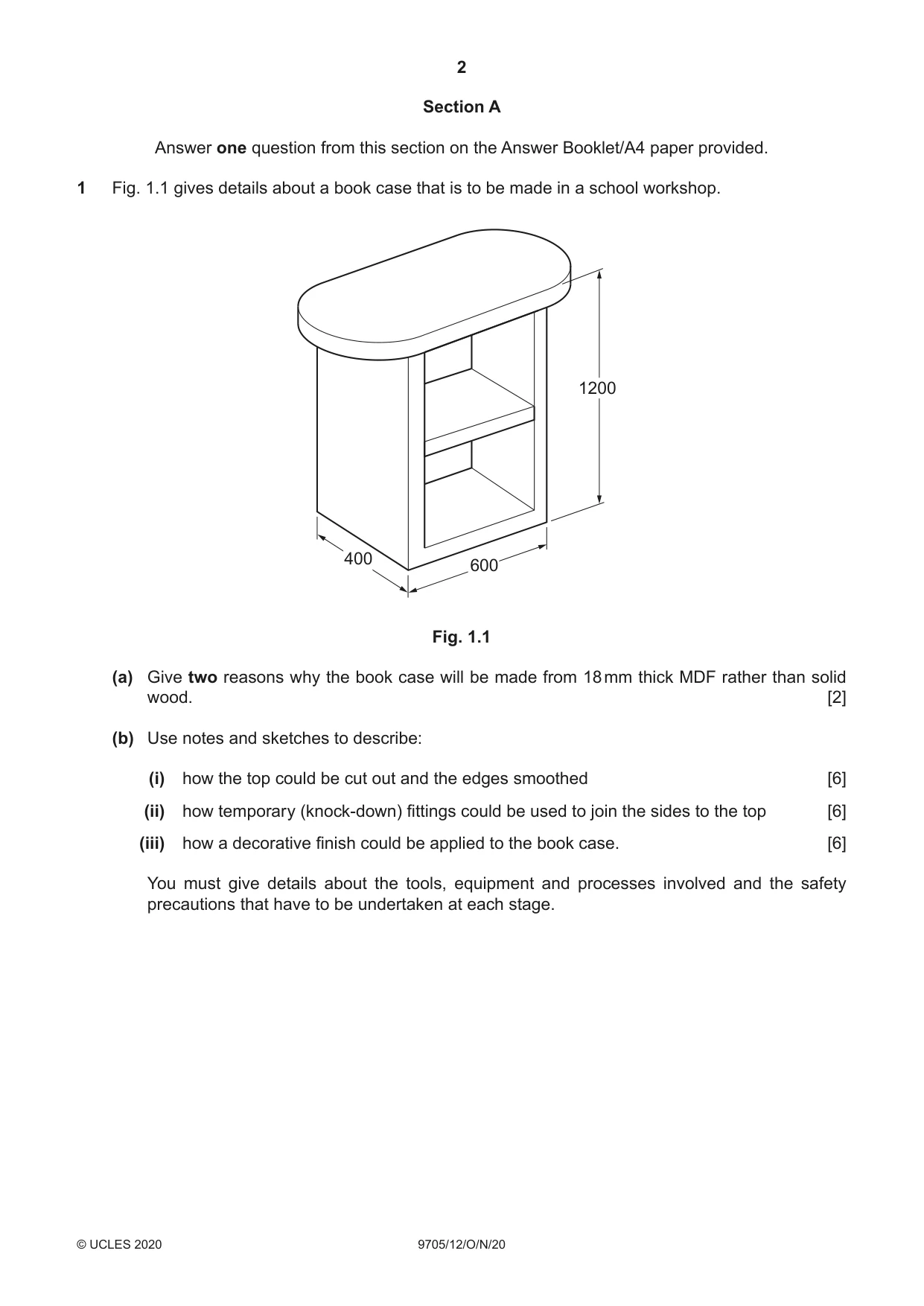
2 9705/12/O/N/20 © UCLES 2020 Section A Answer one question from this section on the Answer Booklet/A4 paper provided. 1 Fig. 1.1 gives details about a book case that is to be made in a school workshop. 1200 600 400 Fig. 1.1 (a) Give two reasons why the book case will be made from 18 mm thick MDF rather than solid wood. [2] (b) Use notes and sketches to describe: (i) how the top could be cut out and the edges smoothed [6] (ii) how temporary (knock-down) fittings could be used to join the sides to the top [6] (iii) how a decorative finish could be applied to the book case. [6] You must give details about the tools, equipment and processes involved and the safety precautions that have to be undertaken at each stage.
Question paper, page 3
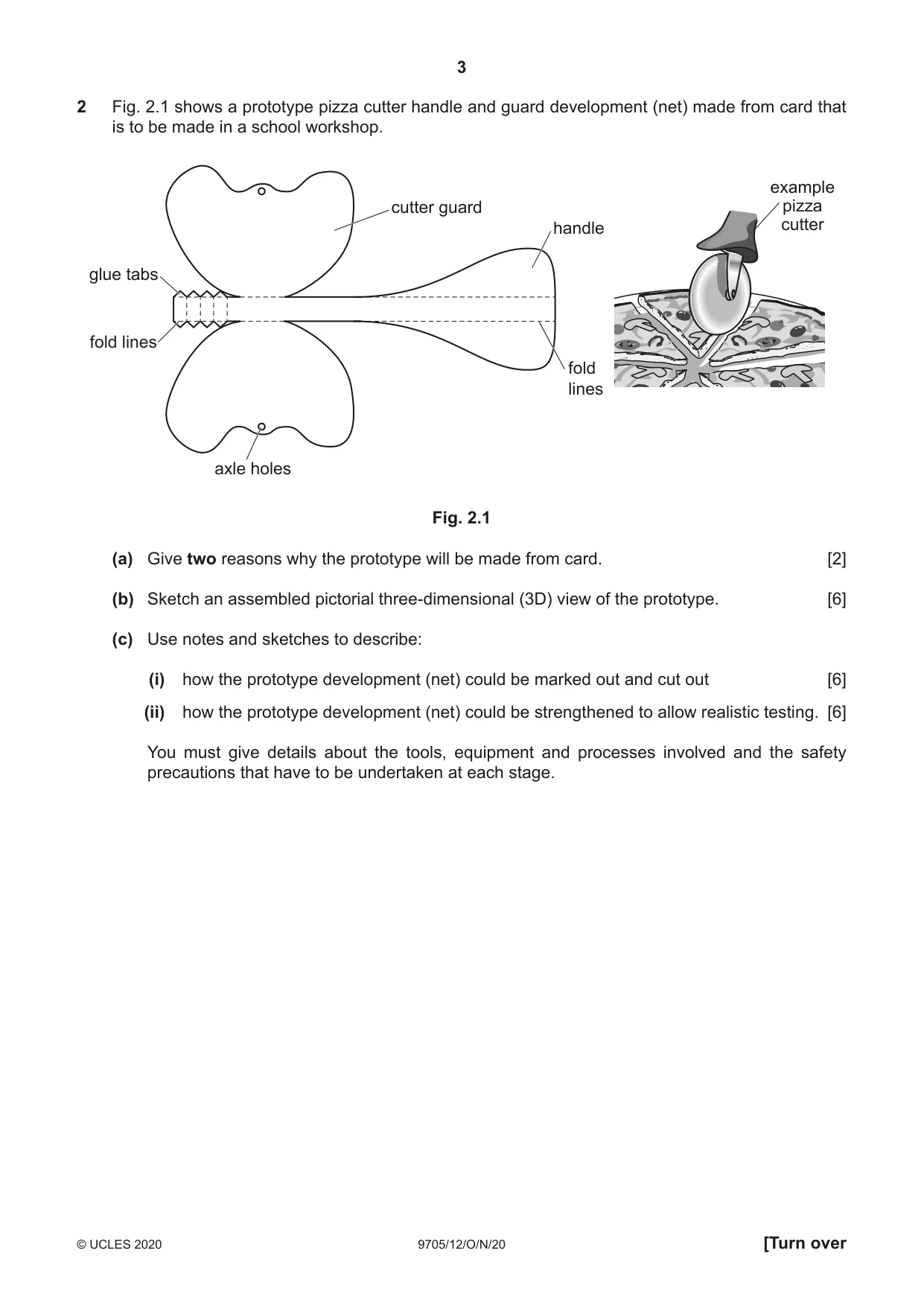
3 9705/12/O/N/20 © UCLES 2020 [Turn over 2 Fig. 2.1 shows a prototype pizza cutter handle and guard development (net) made from card that is to be made in a school workshop. cutter guard handle example pizza cutter axle holes fold lines glue tabs fold lines Fig. 2.1 (a) Give two reasons why the prototype will be made from card. [2] (b) Sketch an assembled pictorial three-dimensional (3D) view of the prototype. [6] (c) Use notes and sketches to describe: (i) how the prototype development (net) could be marked out and cut out [6] (ii) how the prototype development (net) could be strengthened to allow realistic testing. [6] You must give details about the tools, equipment and processes involved and the safety precautions that have to be undertaken at each stage.
Question paper, page 4
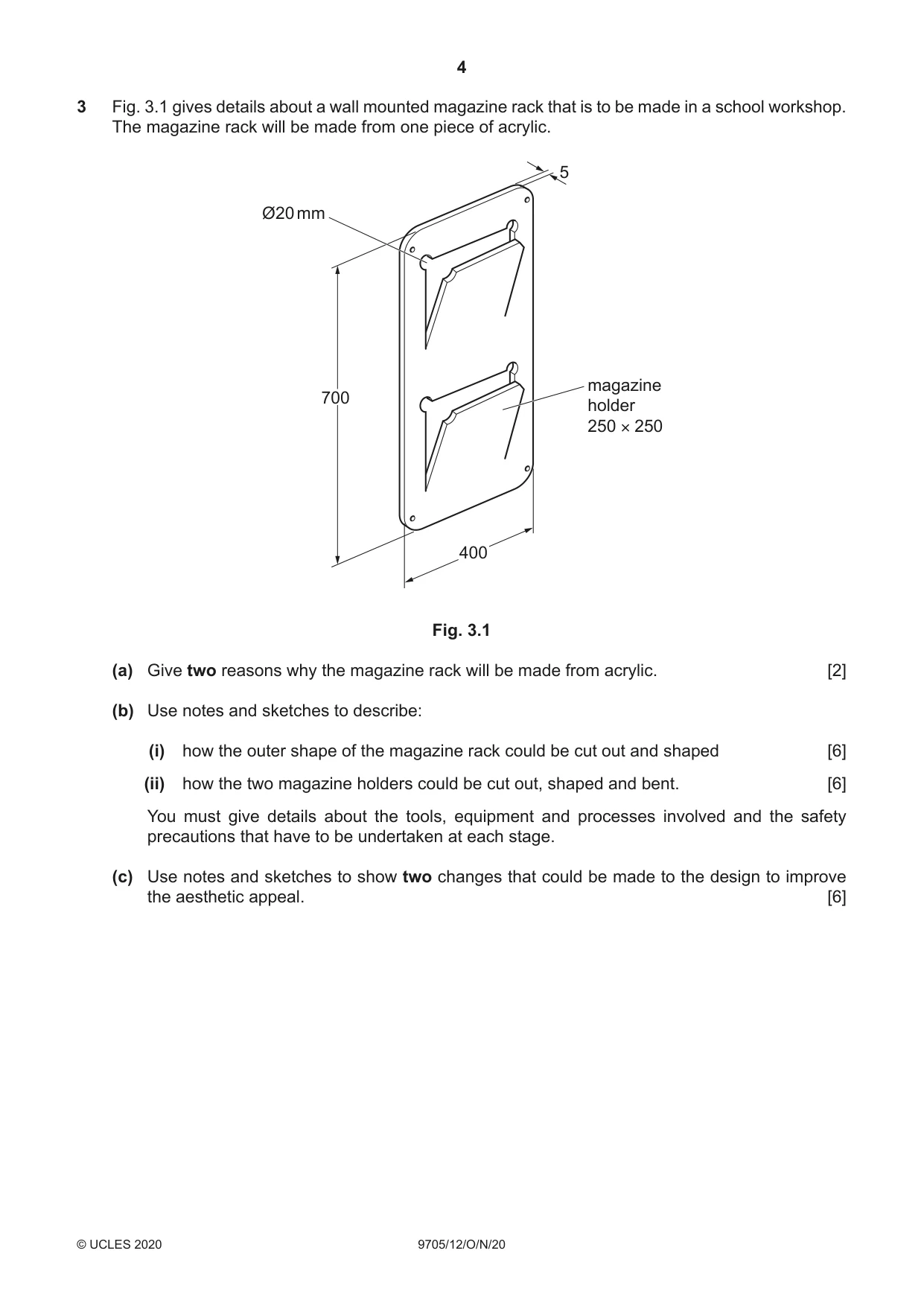
4 9705/12/O/N/20 © UCLES 2020 3 Fig. 3.1 gives details about a wall mounted magazine rack that is to be made in a school workshop. The magazine rack will be made from one piece of acrylic. magazine holder 250 × 250 5 400 700 Ø20 mm Fig. 3.1 (a) Give two reasons why the magazine rack will be made from acrylic. [2] (b) Use notes and sketches to describe: (i) how the outer shape of the magazine rack could be cut out and shaped [6] (ii) how the two magazine holders could be cut out, shaped and bent. [6] You must give details about the tools, equipment and processes involved and the safety precautions that have to be undertaken at each stage. (c) Use notes and sketches to show two changes that could be made to the design to improve the aesthetic appeal. [6]
Question paper, page 5
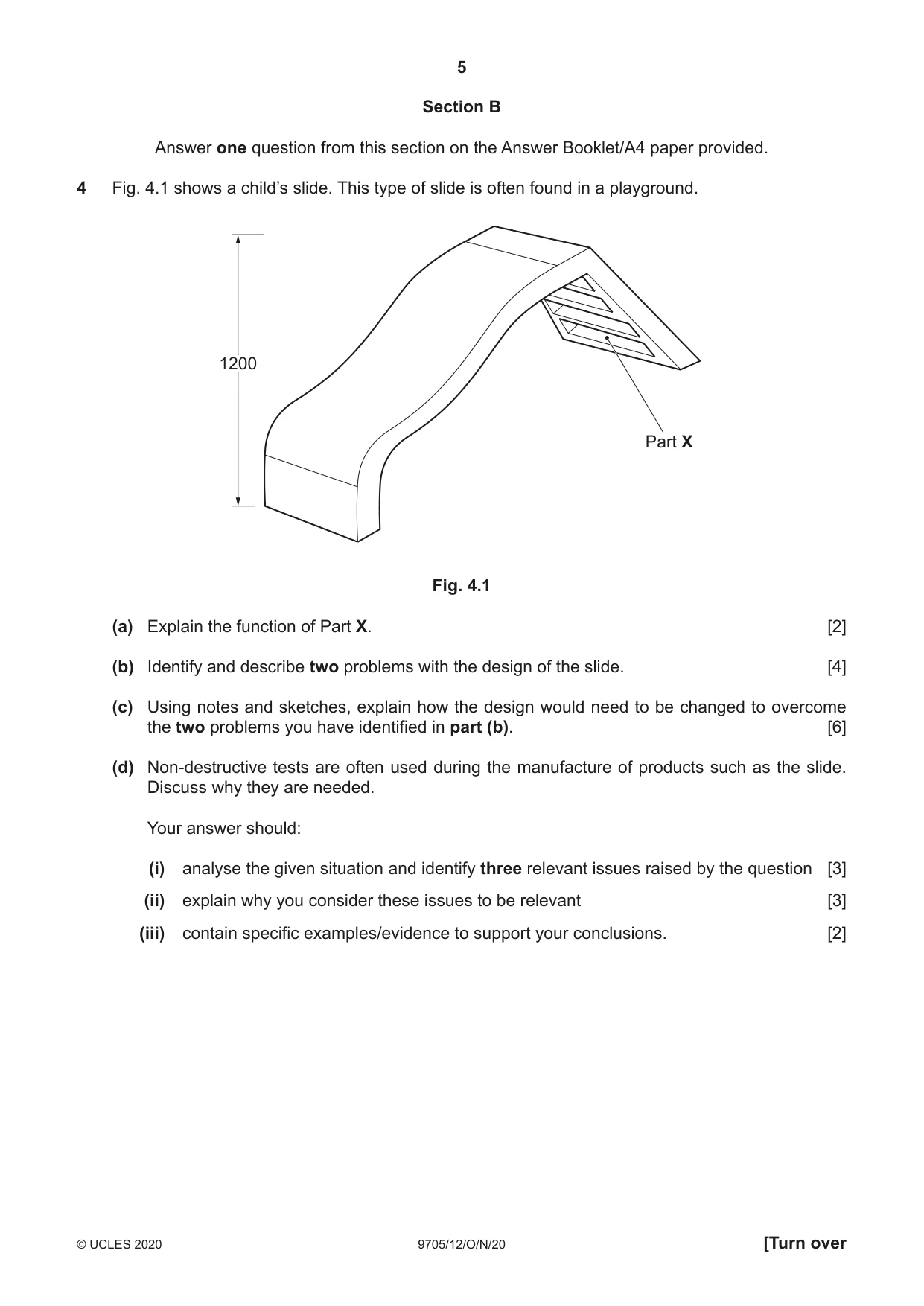
5 9705/12/O/N/20 © UCLES 2020 [Turn over Section B Answer one question from this section on the Answer Booklet/A4 paper provided. 4 Fig. 4.1 shows a child’s slide. This type of slide is often found in a playground. Part X 1200 Fig. 4.1 (a) Explain the function of Part X. [2] (b) Identify and describe two problems with the design of the slide. [4] (c) Using notes and sketches, explain how the design would need to be changed to overcome the two problems you have identified in part (b). [6] (d) Non-destructive tests are often used during the manufacture of products such as the slide. Discuss why they are needed. Your answer should: (i) analyse the given situation and identify three relevant issues raised by the question [3] (ii) explain why you consider these issues to be relevant [3] (iii) contain specific examples/evidence to support your conclusions. [2]
Question paper, page 6
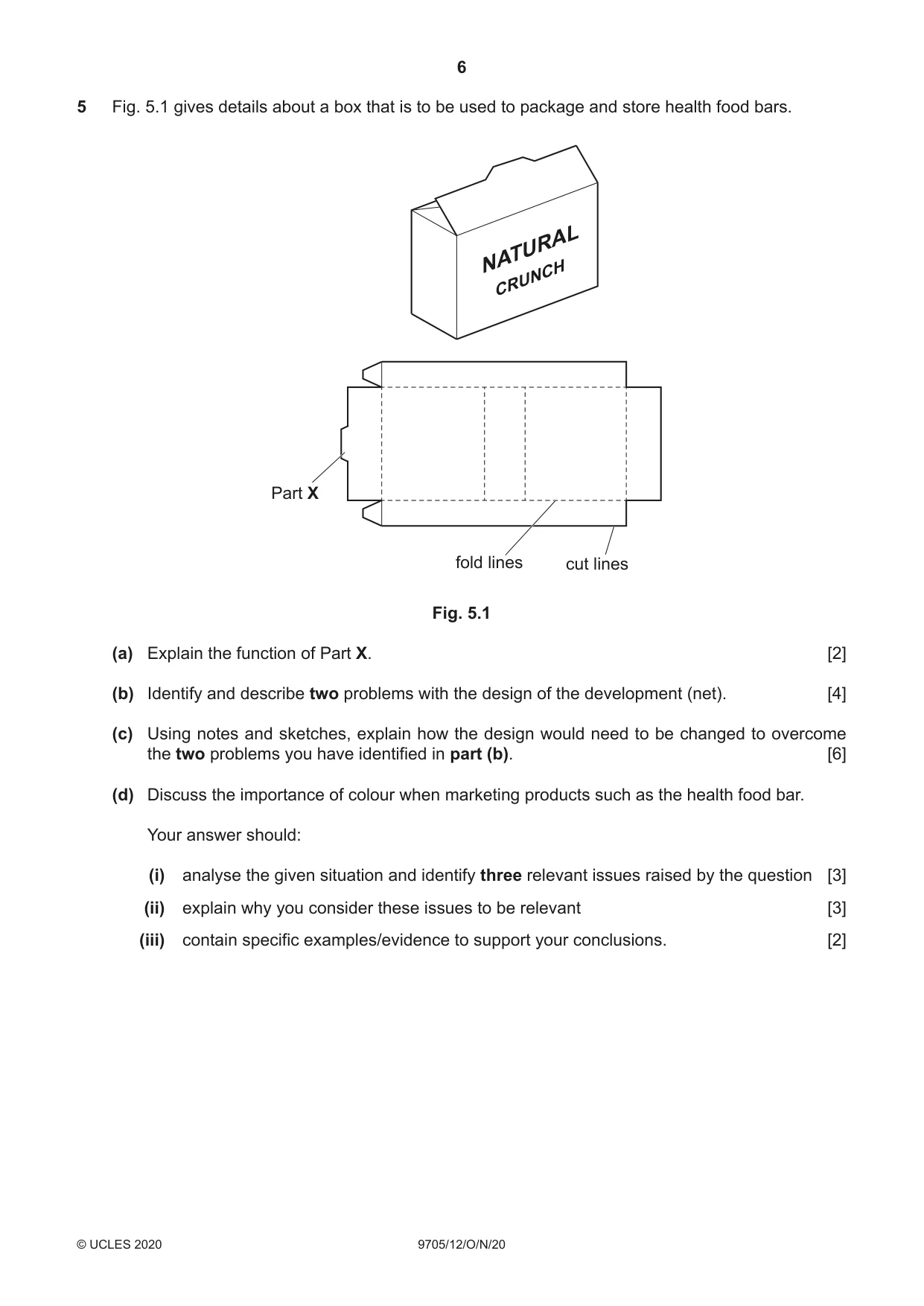
6 9705/12/O/N/20 © UCLES 2020 5 Fig. 5.1 gives details about a box that is to be used to package and store health food bars. NATURAL CRUNCH Part X fold lines cut lines Fig. 5.1 (a) Explain the function of Part X. [2] (b) Identify and describe two problems with the design of the development (net). [4] (c) Using notes and sketches, explain how the design would need to be changed to overcome the two problems you have identified in part (b). [6] (d) Discuss the importance of colour when marketing products such as the health food bar. Your answer should: (i) analyse the given situation and identify three relevant issues raised by the question [3] (ii) explain why you consider these issues to be relevant [3] (iii) contain specific examples/evidence to support your conclusions. [2]
Question paper, page 7
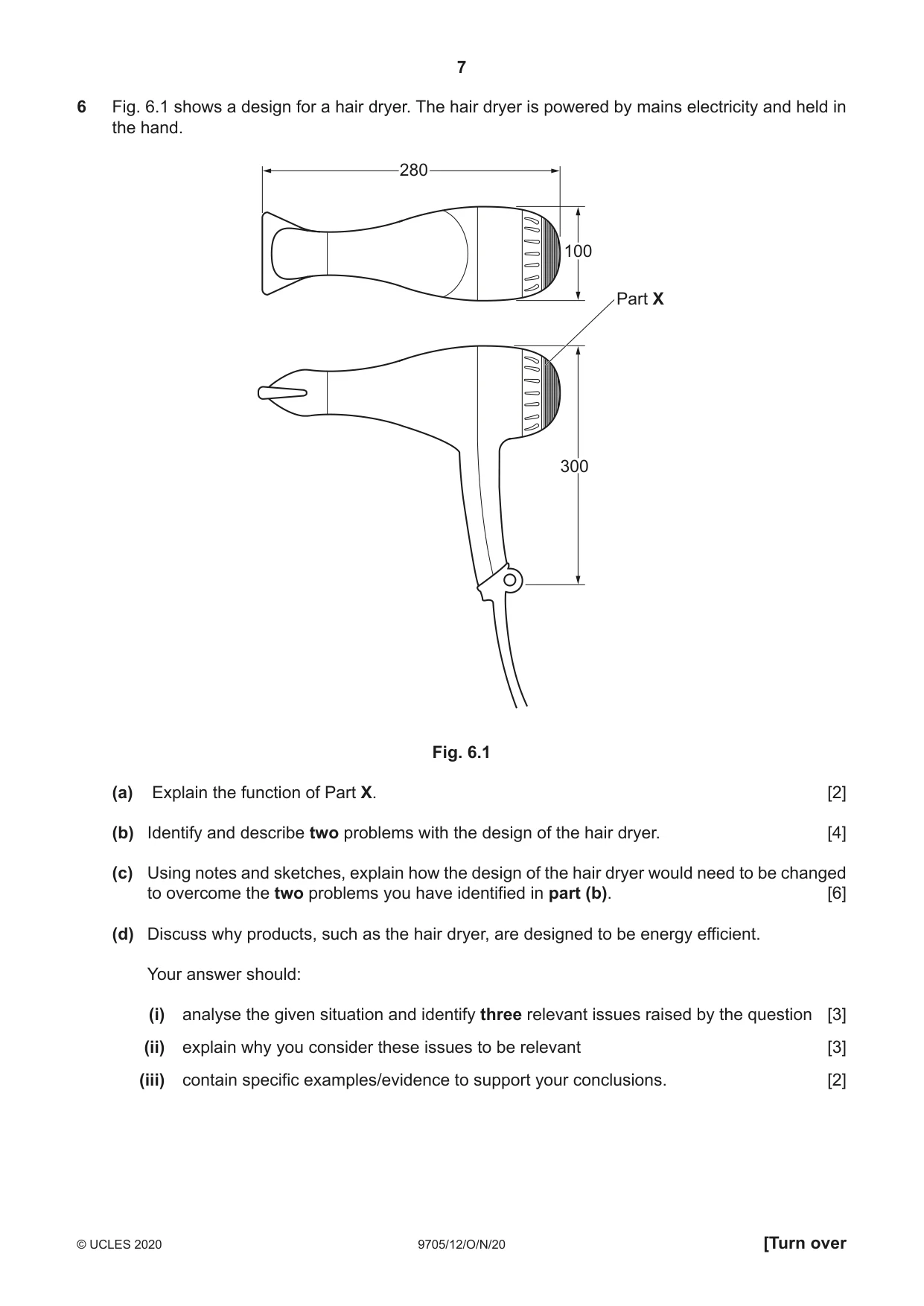
7 9705/12/O/N/20 © UCLES 2020 [Turn over 6 Fig. 6.1 shows a design for a hair dryer. The hair dryer is powered by mains electricity and held in the hand. 280 100 Part X 300 Fig. 6.1 (a) Explain the function of Part X. [2] (b) Identify and describe two problems with the design of the hair dryer. [4] (c) Using notes and sketches, explain how the design of the hair dryer would need to be changed to overcome the two problems you have identified in part (b). [6] (d) Discuss why products, such as the hair dryer, are designed to be energy efficient. Your answer should: (i) analyse the given situation and identify three relevant issues raised by the question [3] (ii) explain why you consider these issues to be relevant [3] (iii) contain specific examples/evidence to support your conclusions. [2]
Question paper, page 8
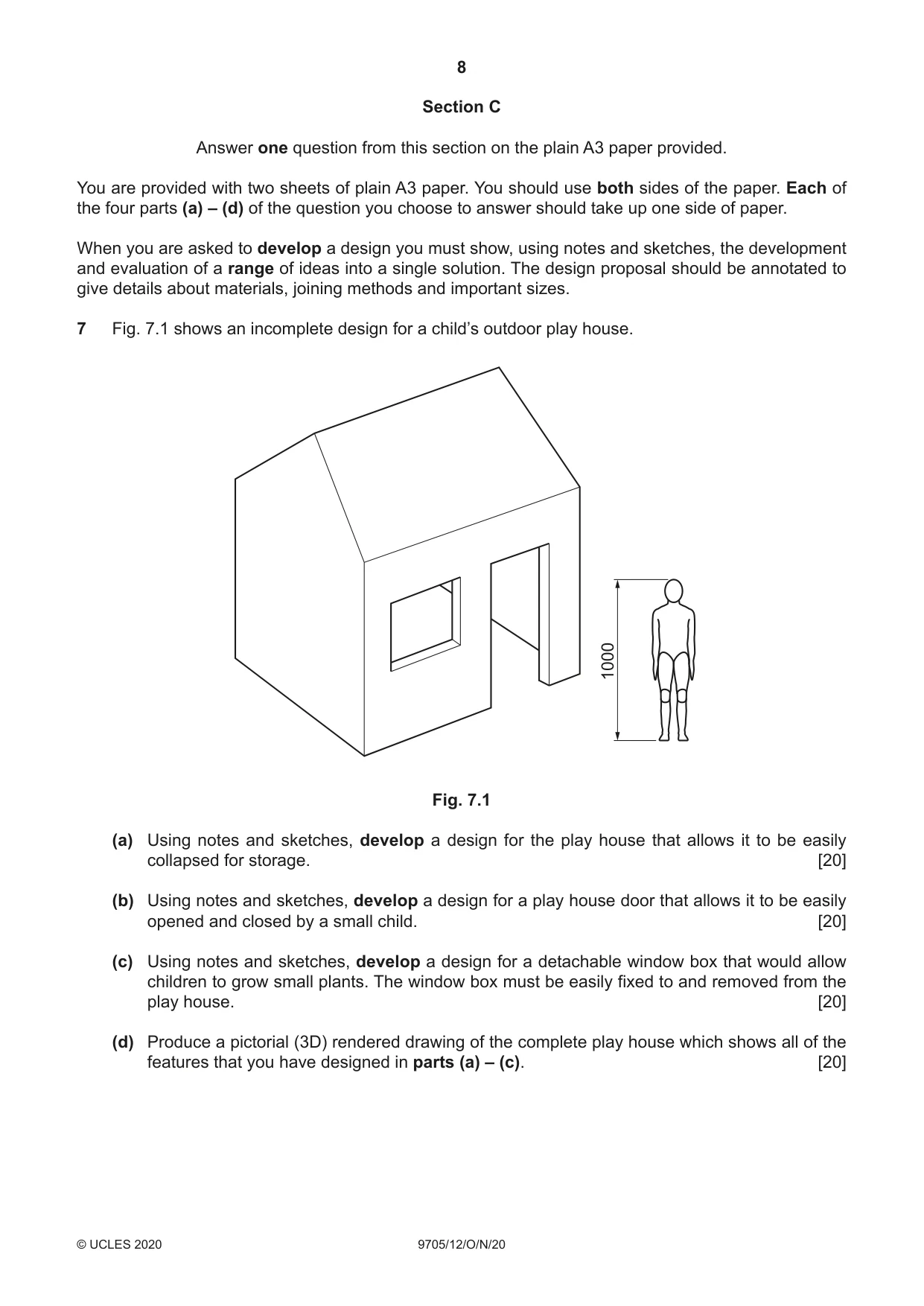
8 9705/12/O/N/20 © UCLES 2020 Section C Answer one question from this section on the plain A3 paper provided. You are provided with two sheets of plain A3 paper. You should use both sides of the paper. Each of the four parts (a) – (d) of the question you choose to answer should take up one side of paper. When you are asked to develop a design you must show, using notes and sketches, the development and evaluation of a range of ideas into a single solution. The design proposal should be annotated to give details about materials, joining methods and important sizes. 7 Fig. 7.1 shows an incomplete design for a child’s outdoor play house. 1000 Fig. 7.1 (a) Using notes and sketches, develop a design for the play house that allows it to be easily collapsed for storage. [20] (b) Using notes and sketches, develop a design for a play house door that allows it to be easily opened and closed by a small child. [20] (c) Using notes and sketches, develop a design for a detachable window box that would allow children to grow small plants. The window box must be easily fixed to and removed from the play house. [20] (d) Produce a pictorial (3D) rendered drawing of the complete play house which shows all of the features that you have designed in parts (a) – (c). [20]
Question paper, page 9
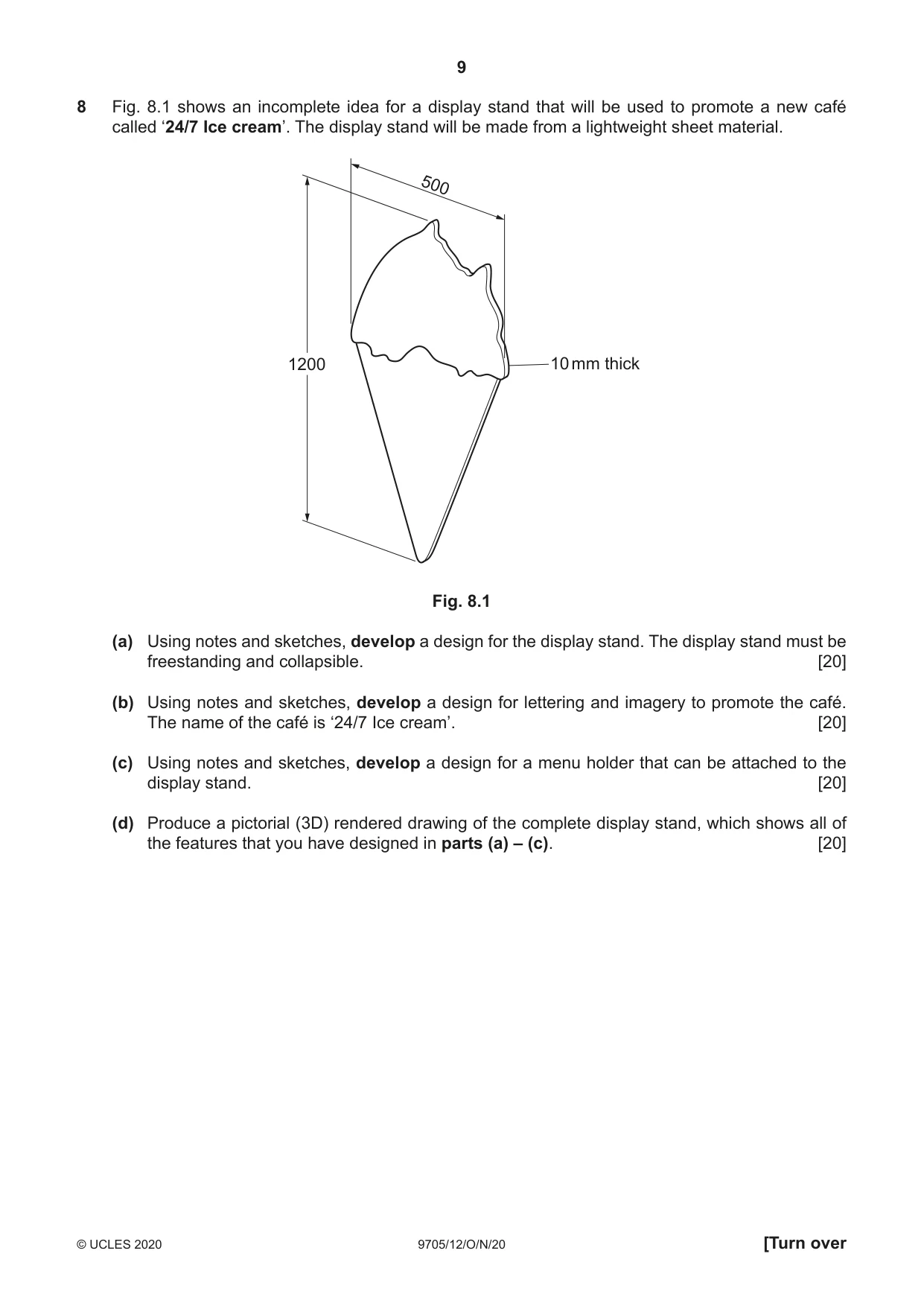
9 9705/12/O/N/20 © UCLES 2020 [Turn over 8 Fig. 8.1 shows an incomplete idea for a display stand that will be used to promote a new café called ‘24/7 Ice cream’. The display stand will be made from a lightweight sheet material. 500 1200 10 mm thick Fig. 8.1 (a) Using notes and sketches, develop a design for the display stand. The display stand must be freestanding and collapsible. [20] (b) Using notes and sketches, develop a design for lettering and imagery to promote the café. The name of the café is ‘24/7 Ice cream’. [20] (c) Using notes and sketches, develop a design for a menu holder that can be attached to the display stand. [20] (d) Produce a pictorial (3D) rendered drawing of the complete display stand, which shows all of the features that you have designed in parts (a) – (c). [20]
Question paper, page 10
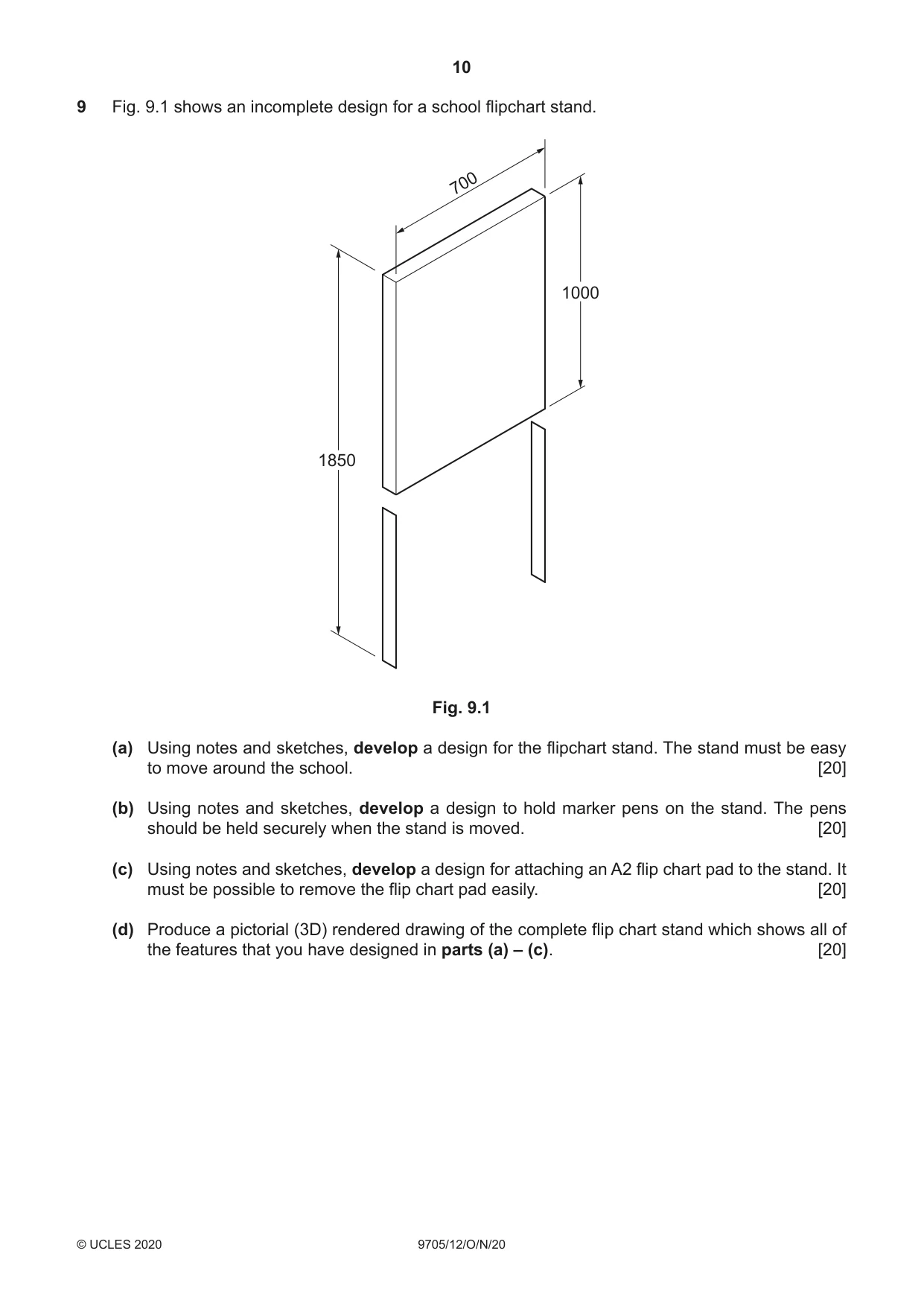
10 9705/12/O/N/20 © UCLES 2020 9 Fig. 9.1 shows an incomplete design for a school flipchart stand. 700 1850 1000 Fig. 9.1 (a) Using notes and sketches, develop a design for the flipchart stand. The stand must be easy to move around the school. [20] (b) Using notes and sketches, develop a design to hold marker pens on the stand. The pens should be held securely when the stand is moved. [20] (c) Using notes and sketches, develop a design for attaching an A2 flip chart pad to the stand. It must be possible to remove the flip chart pad easily. [20] (d) Produce a pictorial (3D) rendered drawing of the complete flip chart stand which shows all of the features that you have designed in parts (a) – (c). [20]
Question paper, page 11
11 9705/12/O/N/20 © UCLES 2020 BLANK PAGE
Question paper, page 12
12 9705/12/O/N/20 © UCLES 2020 Permission to reproduce items where third-party owned material protected by copyright is included has been sought and cleared where possible. Every reasonable effort has been made by the publisher (UCLES) to trace copyright holders, but if any items requiring clearance have unwittingly been included, the publisher will be pleased to make amends at the earliest possible opportunity. To avoid the issue of disclosure of answer-related information to candidates, all copyright acknowledgements are reproduced online in the Cambridge Assessment International Education Copyright Acknowledgements Booklet. This is produced for each series of examinations and is freely available to download at www.cambridgeinternational.org after the live examination series. Cambridge Assessment International Education is part of the Cambridge Assessment Group. Cambridge Assessment is the brand name of the University of Cambridge Local Examinations Syndicate (UCLES), which itself is a department of the University of Cambridge. BLANK PAGE
Mark scheme, page 1
This document consists of 12 printed pages. © UCLES 2020 [Turn over Cambridge International AS & A Level DESIGN AND TECHNOLOGY 9705/12 Paper 1 October/November 2020 MARK SCHEME Maximum Mark: 120 Published This mark scheme is published as an aid to teachers and candidates, to indicate the requirements of the examination. It shows the basis on which Examiners were instructed to award marks. It does not indicate the details of the discussions that took place at an Examiners’ meeting before marking began, which would have considered the acceptability of alternative answers. Mark schemes should be read in conjunction with the question paper and the Principal Examiner Report for Teachers. Cambridge International will not enter into discussions about these mark schemes. Cambridge International is publishing the mark schemes for the October/November 2020 series for most Cambridge IGCSE™, Cambridge International A and AS Level and Cambridge Pre-U components, and some Cambridge O Level components.
Mark scheme, page 2
9705/12 Cambridge International AS & A Level – Mark Scheme PUBLISHED October/November 2020 © UCLES 2020 Page 2 of 12 Generic Marking Principles These general marking principles must be applied by all examiners when marking candidate answers. They should be applied alongside the specific content of the mark scheme or generic level descriptors for a question. Each question paper and mark scheme will also comply with these marking principles. GENERIC MARKING PRINCIPLE 1: Marks must be awarded in line with: • the specific content of the mark scheme or the generic level descriptors for the question • the specific skills defined in the mark scheme or in the generic level descriptors for the question • the standard of response required by a candidate as exemplified by the standardisation scripts. GENERIC MARKING PRINCIPLE 2: Marks awarded are always whole marks (not half marks, or other fractions). GENERIC MARKING PRINCIPLE 3: Marks must be awarded positively: • marks are awarded for correct/valid answers, as defined in the mark scheme. However, credit is given for valid answers which go beyond the scope of the syllabus and mark scheme, referring to your Team Leader as appropriate • marks are awarded when candidates clearly demonstrate what they know and can do • marks are not deducted for errors • marks are not deducted for omissions • answers should only be judged on the quality of spelling, punctuation and grammar when these features are specifically assessed by the question as indicated by the mark scheme. The meaning, however, should be unambiguous. GENERIC MARKING PRINCIPLE 4: Rules must be applied consistently, e.g. in situations where candidates have not followed instructions or in the application of generic level descriptors.
Mark scheme, page 3
9705/12 Cambridge International AS & A Level – Mark Scheme PUBLISHED October/November 2020 © UCLES 2020 Page 3 of 12 GENERIC MARKING PRINCIPLE 5: Marks should be awarded using the full range of marks defined in the mark scheme for the question (however; the use of the full mark range may be limited according to the quality of the candidate responses seen). GENERIC MARKING PRINCIPLE 6: Marks awarded are based solely on the requirements as defined in the mark scheme. Marks should not be awarded with grade thresholds or grade descriptors in mind.
Mark scheme, page 4
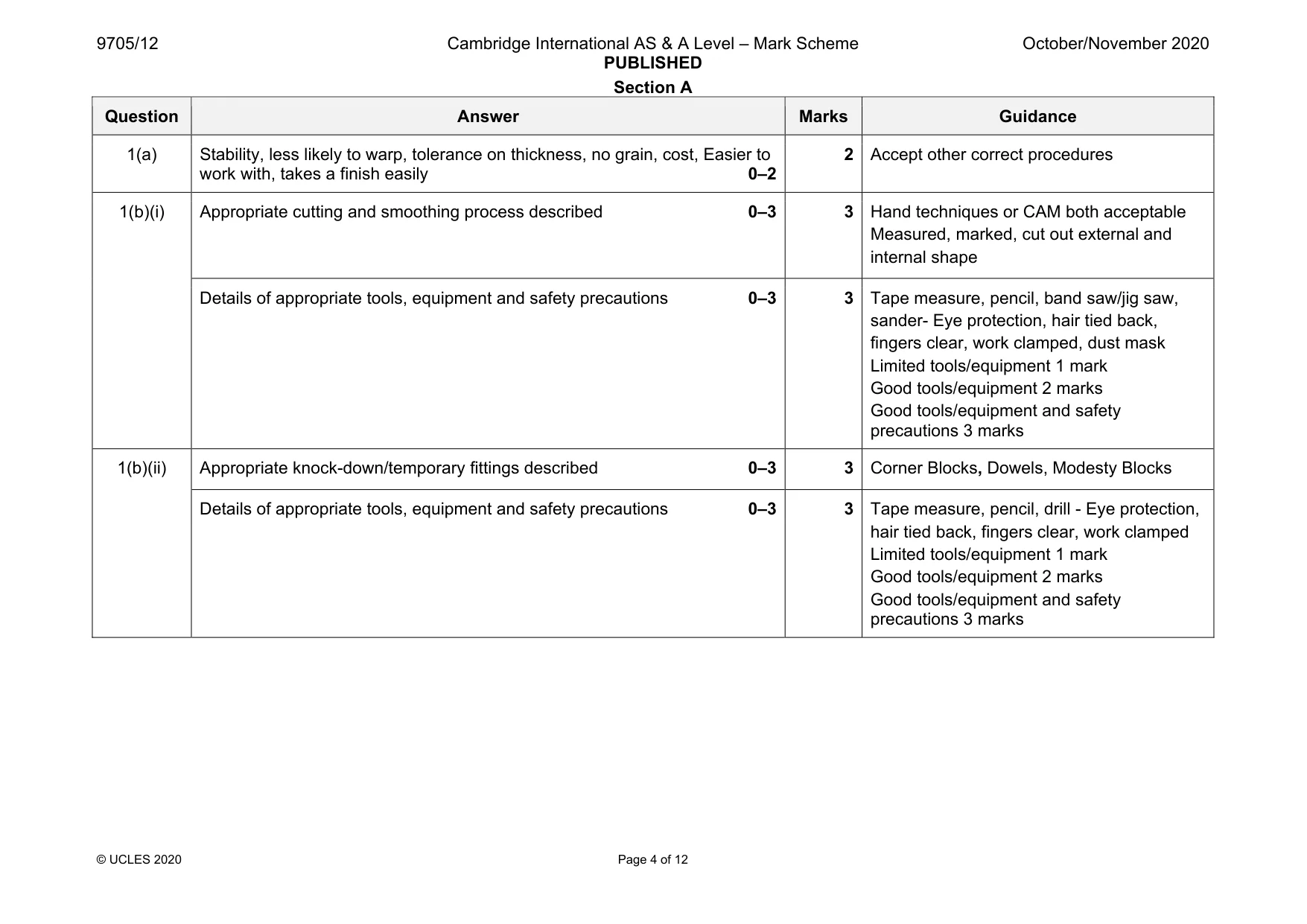
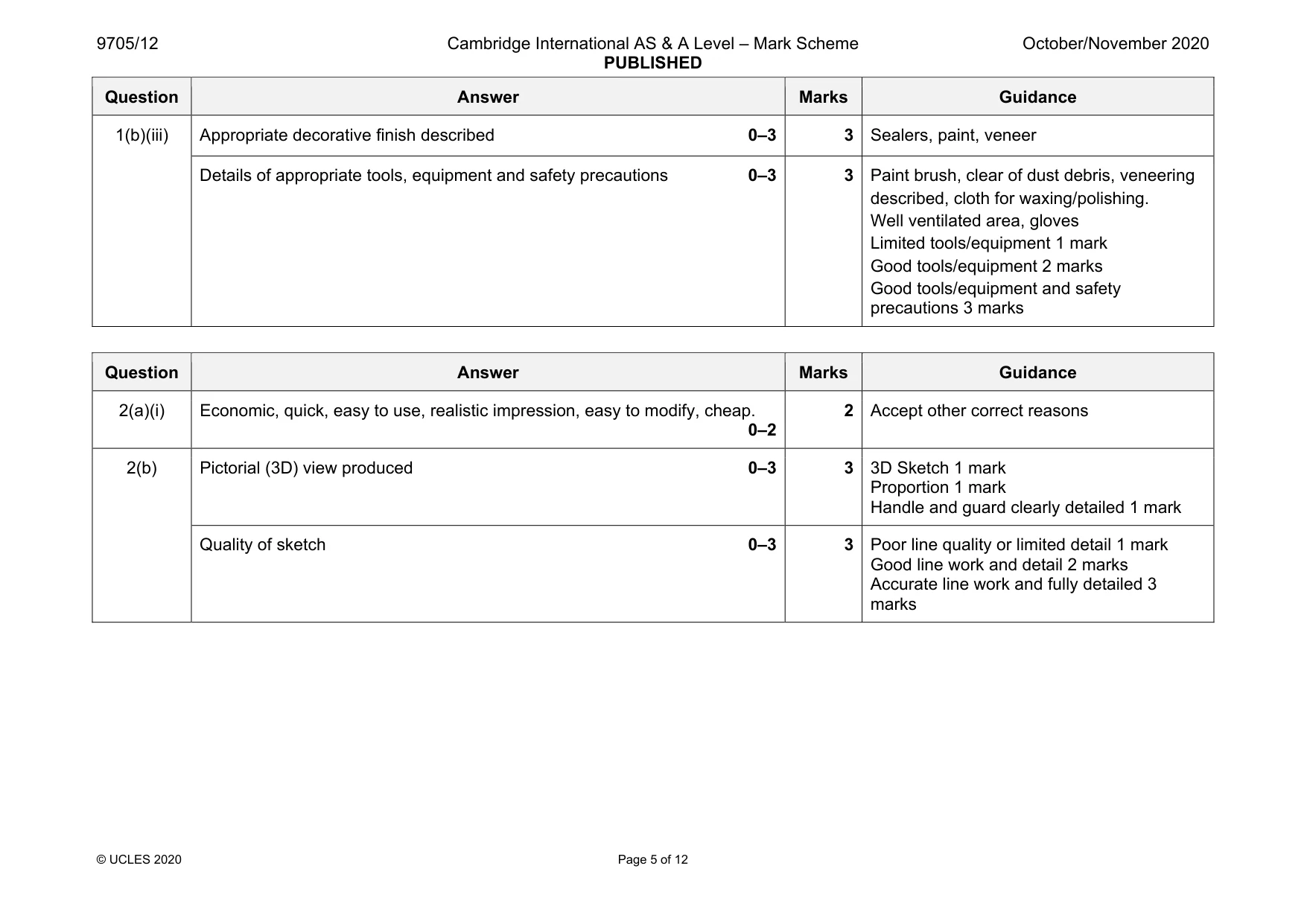
9705/12 Cambridge International AS & A Level – Mark Scheme PUBLISHED October/November 2020 © UCLES 2020 Page 4 of 12 Section A Question Answer Marks Guidance 1(a) Stability, less likely to warp, tolerance on thickness, no grain, cost, Easier to work with, takes a finish easily 0–2 2 Accept other correct procedures 1(b)(i) Appropriate cutting and smoothing process described 0–3 3 Hand techniques or CAM both acceptable Measured, marked, cut out external and internal shape Details of appropriate tools, equipment and safety precautions 0–3 3 Tape measure, pencil, band saw/jig saw, sander- Eye protection, hair tied back, fingers clear, work clamped, dust mask Limited tools/equipment 1 mark Good tools/equipment 2 marks Good tools/equipment and safety precautions 3 marks 1(b)(ii) Appropriate knock-down/temporary fittings described 0–3 3 Corner Blocks, Dowels, Modesty Blocks Details of appropriate tools, equipment and safety precautions 0–3 3 Tape measure, pencil, drill - Eye protection, hair tied back, fingers clear, work clamped Limited tools/equipment 1 mark Good tools/equipment 2 marks Good tools/equipment and safety precautions 3 marks
Mark scheme, page 5
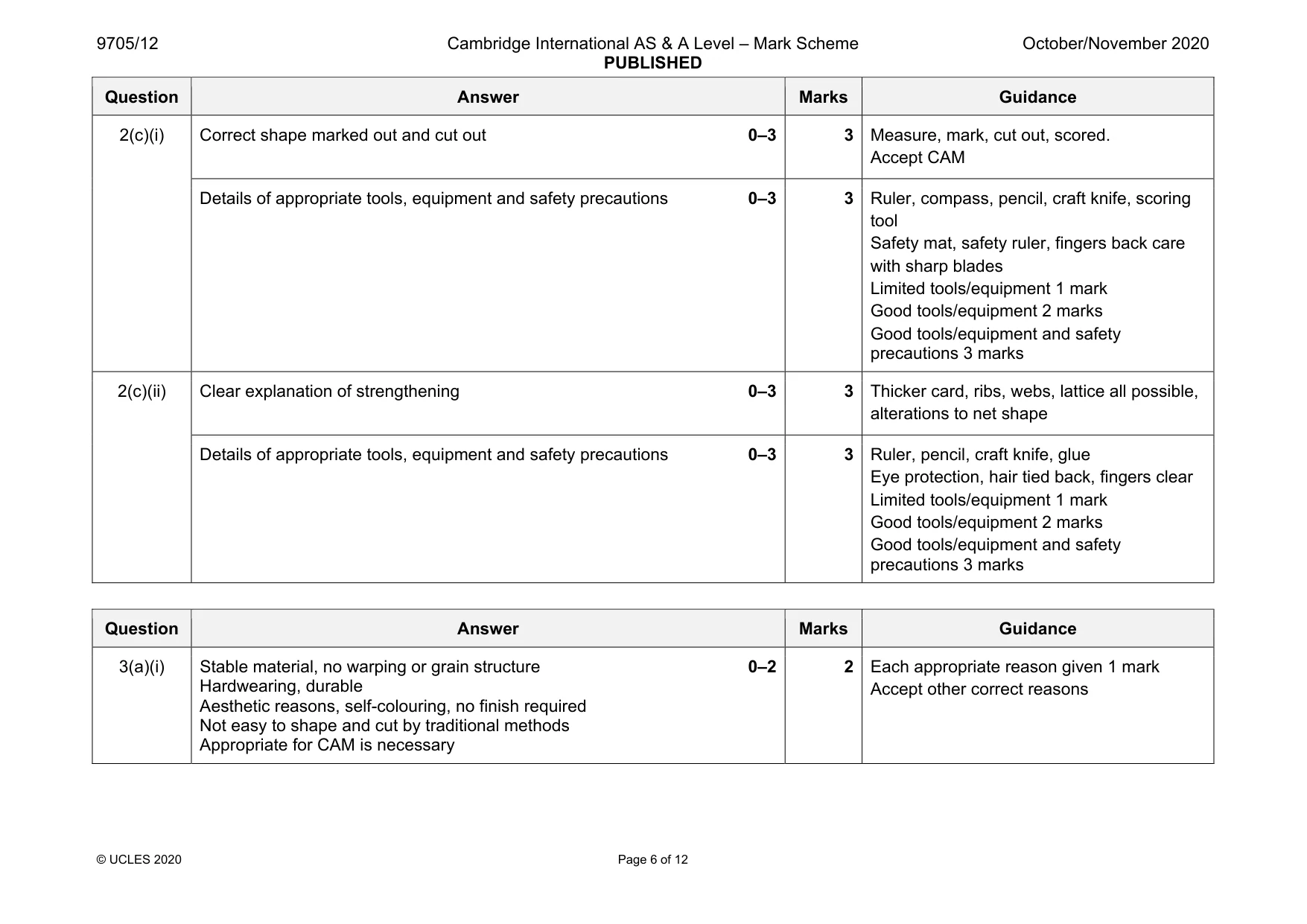
9705/12 Cambridge International AS & A Level – Mark Scheme PUBLISHED October/November 2020 © UCLES 2020 Page 5 of 12 Question Answer Marks Guidance 1(b)(iii) Appropriate decorative finish described 0–3 3 Sealers, paint, veneer Details of appropriate tools, equipment and safety precautions 0–3 3 Paint brush, clear of dust debris, veneering described, cloth for waxing/polishing. Well ventilated area, gloves Limited tools/equipment 1 mark Good tools/equipment 2 marks Good tools/equipment and safety precautions 3 marks Question Answer Marks Guidance 2(a)(i) Economic, quick, easy to use, realistic impression, easy to modify, cheap. 0–2 2 Accept other correct reasons 2(b) Pictorial (3D) view produced 0–3 3 3D Sketch 1 mark Proportion 1 mark Handle and guard clearly detailed 1 mark Quality of sketch 0–3 3 Poor line quality or limited detail 1 mark Good line work and detail 2 marks Accurate line work and fully detailed 3 marks
Mark scheme, page 6
9705/12 Cambridge International AS & A Level – Mark Scheme PUBLISHED October/November 2020 © UCLES 2020 Page 6 of 12 Question Answer Marks Guidance 2(c)(i) Correct shape marked out and cut out 0–3 3 Measure, mark, cut out, scored. Accept CAM Details of appropriate tools, equipment and safety precautions 0–3 3 Ruler, compass, pencil, craft knife, scoring tool Safety mat, safety ruler, fingers back care with sharp blades Limited tools/equipment 1 mark Good tools/equipment 2 marks Good tools/equipment and safety precautions 3 marks 2(c)(ii) Clear explanation of strengthening 0–3 3 Thicker card, ribs, webs, lattice all possible, alterations to net shape Details of appropriate tools, equipment and safety precautions 0–3 3 Ruler, pencil, craft knife, glue Eye protection, hair tied back, fingers clear Limited tools/equipment 1 mark Good tools/equipment 2 marks Good tools/equipment and safety precautions 3 marks Question Answer Marks Guidance 3(a)(i) Stable material, no warping or grain structure 0–2 Hardwearing, durable Aesthetic reasons, self-colouring, no finish required Not easy to shape and cut by traditional methods Appropriate for CAM is necessary 2 Each appropriate reason given 1 mark Accept other correct reasons
Mark scheme, page 7
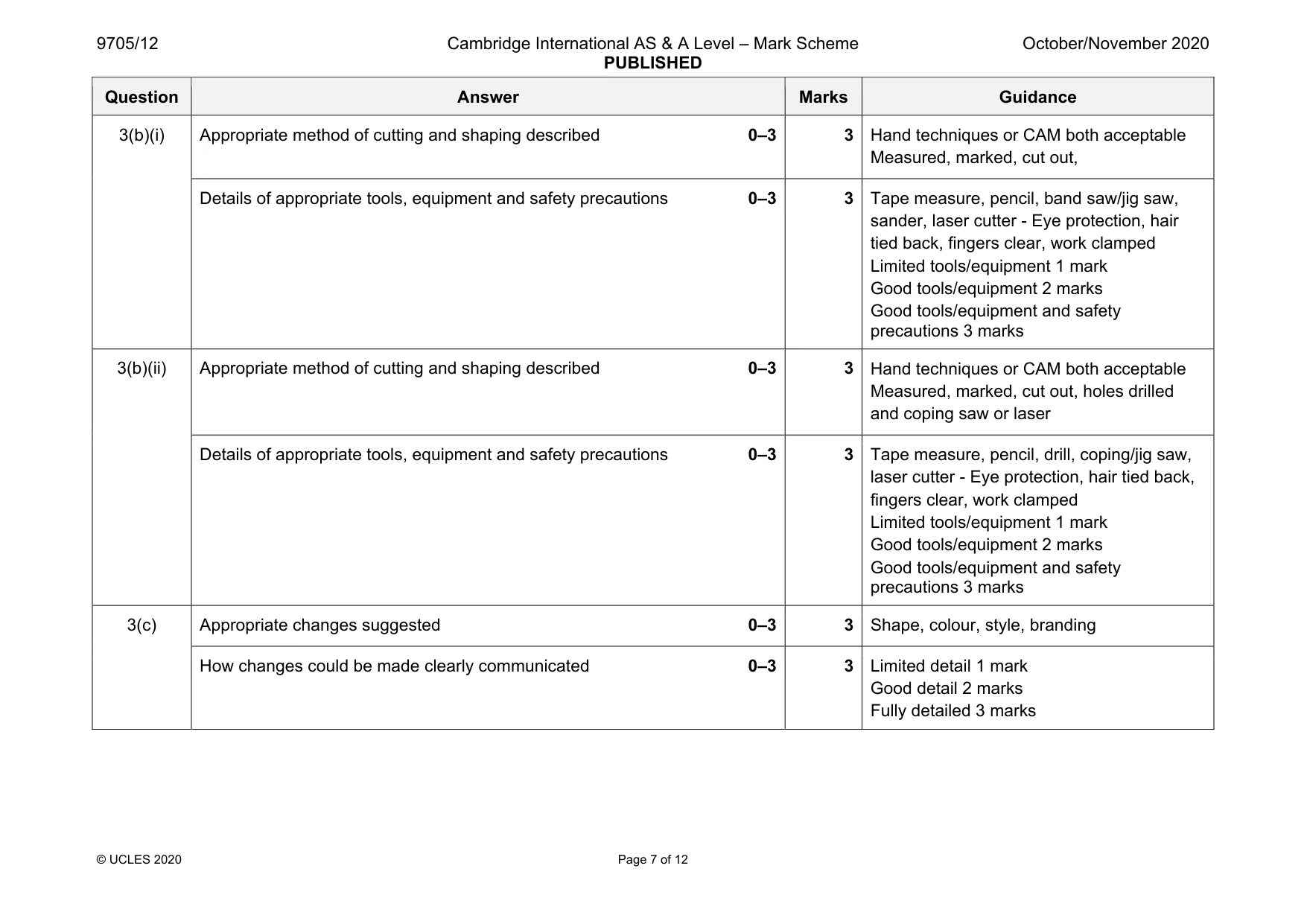
9705/12 Cambridge International AS & A Level – Mark Scheme PUBLISHED October/November 2020 © UCLES 2020 Page 7 of 12 Question Answer Marks Guidance 3(b)(i) Appropriate method of cutting and shaping described 0–3 3 Hand techniques or CAM both acceptable Measured, marked, cut out, Details of appropriate tools, equipment and safety precautions 0–3 3 Tape measure, pencil, band saw/jig saw, sander, laser cutter - Eye protection, hair tied back, fingers clear, work clamped Limited tools/equipment 1 mark Good tools/equipment 2 marks Good tools/equipment and safety precautions 3 marks 3(b)(ii) Appropriate method of cutting and shaping described 0–3 3 Hand techniques or CAM both acceptable Measured, marked, cut out, holes drilled and coping saw or laser Details of appropriate tools, equipment and safety precautions 0–3 3 Tape measure, pencil, drill, coping/jig saw, laser cutter - Eye protection, hair tied back, fingers clear, work clamped Limited tools/equipment 1 mark Good tools/equipment 2 marks Good tools/equipment and safety precautions 3 marks 3(c) Appropriate changes suggested 0–3 3 Shape, colour, style, branding How changes could be made clearly communicated 0–3 3 Limited detail 1 mark Good detail 2 marks Fully detailed 3 marks
Mark scheme, page 8
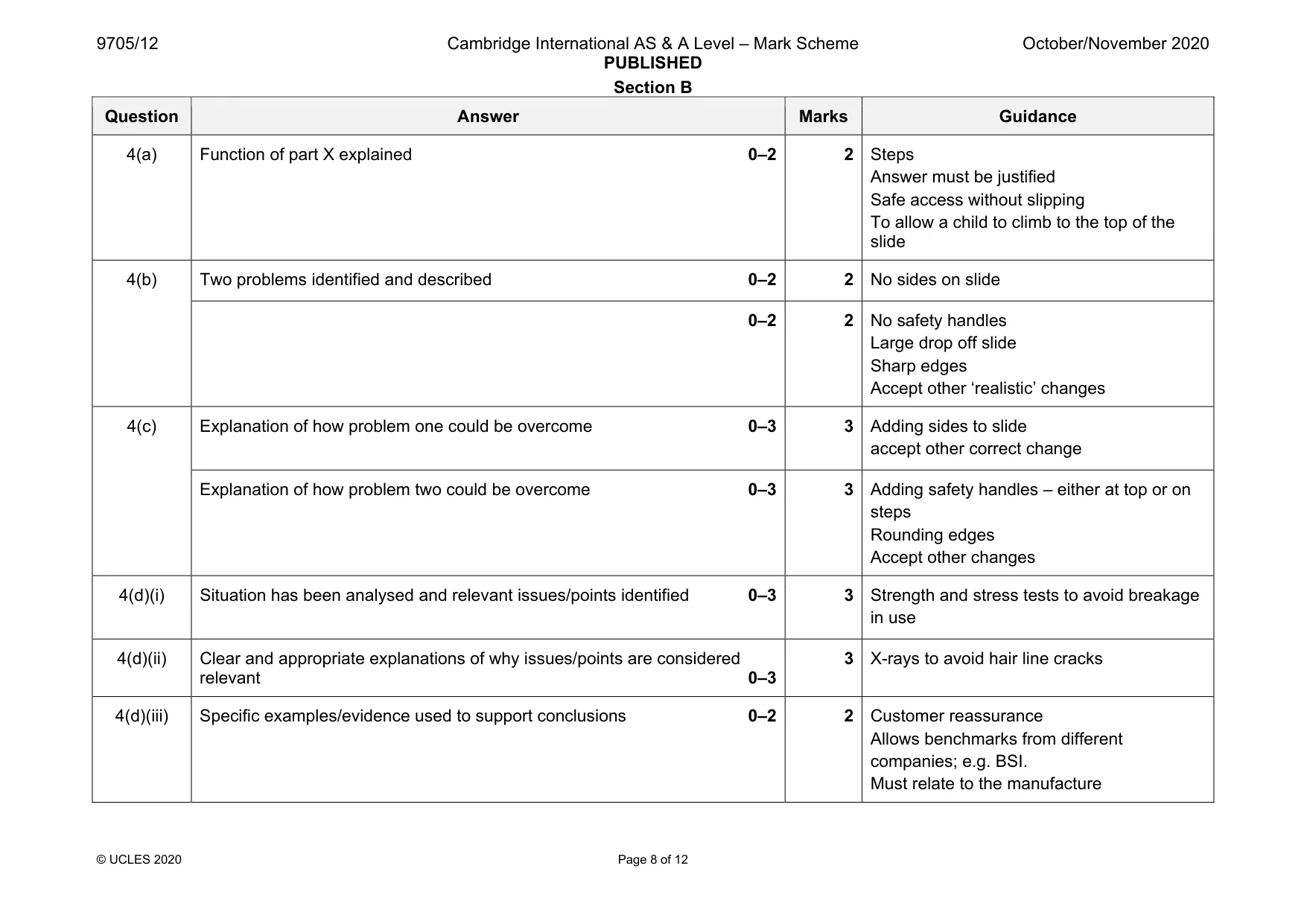
9705/12 Cambridge International AS & A Level – Mark Scheme PUBLISHED October/November 2020 © UCLES 2020 Page 8 of 12 Section B Question Answer Marks Guidance 4(a) Function of part X explained 0–2 2 Steps Answer must be justified Safe access without slipping To allow a child to climb to the top of the slide 4(b) Two problems identified and described 0–2 2 No sides on slide 0–2 2 No safety handles Large drop off slide Sharp edges Accept other ‘realistic’ changes 4(c) Explanation of how problem one could be overcome 0–3 3 Adding sides to slide accept other correct change Explanation of how problem two could be overcome 0–3 3 Adding safety handles – either at top or on steps Rounding edges Accept other changes 4(d)(i) Situation has been analysed and relevant issues/points identified 0–3 3 Strength and stress tests to avoid breakage in use 4(d)(ii) Clear and appropriate explanations of why issues/points are considered relevant 0–3 3 X-rays to avoid hair line cracks 4(d)(iii) Specific examples/evidence used to support conclusions 0–2 2 Customer reassurance Allows benchmarks from different companies; e.g. BSI. Must relate to the manufacture
Mark scheme, page 9
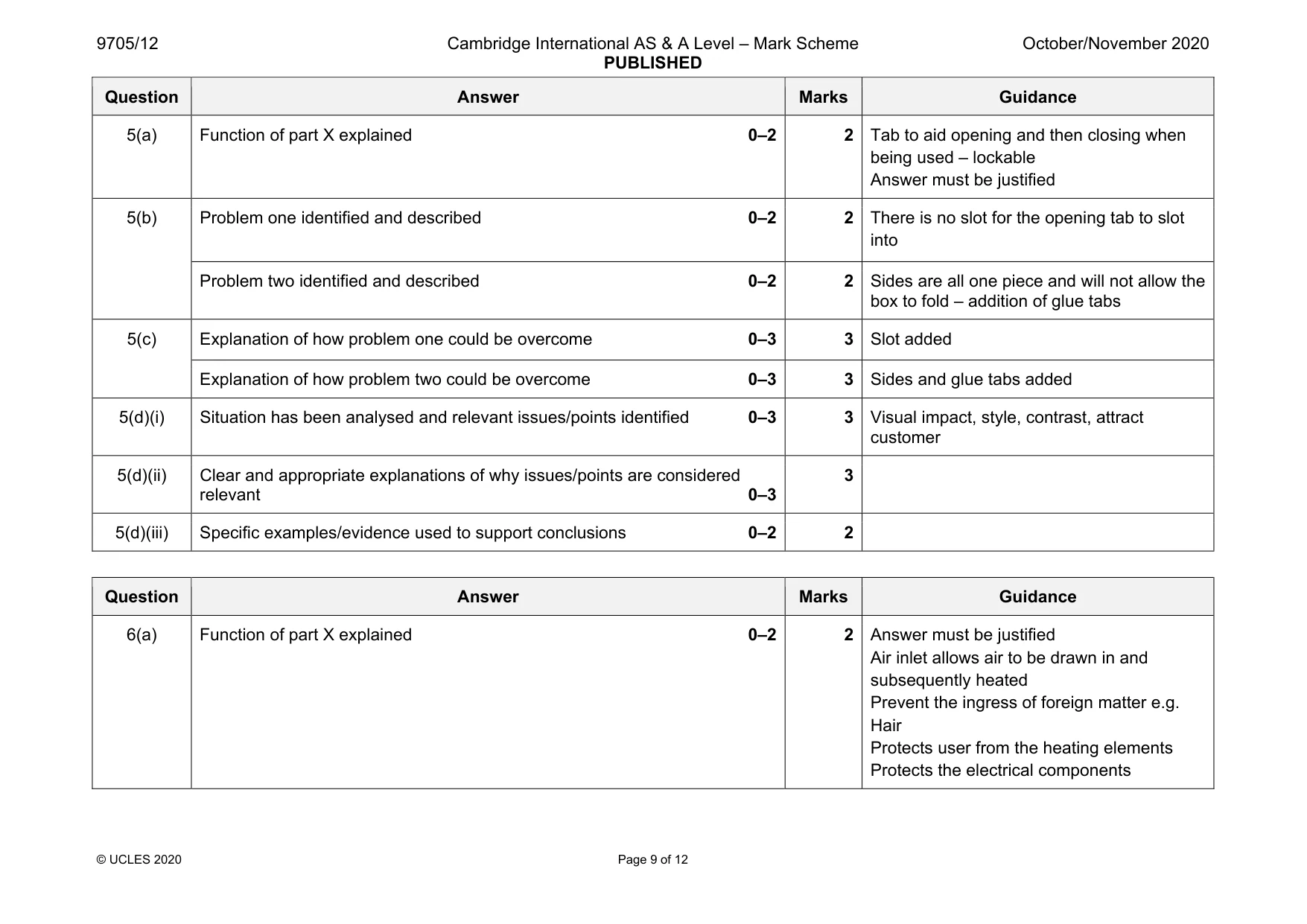
9705/12 Cambridge International AS & A Level – Mark Scheme PUBLISHED October/November 2020 © UCLES 2020 Page 9 of 12 Question Answer Marks Guidance 5(a) Function of part X explained 0–2 2 Tab to aid opening and then closing when being used – lockable Answer must be justified 5(b) Problem one identified and described 0–2 2 There is no slot for the opening tab to slot into Problem two identified and described 0–2 2 Sides are all one piece and will not allow the box to fold – addition of glue tabs 5(c) Explanation of how problem one could be overcome 0–3 3 Slot added Explanation of how problem two could be overcome 0–3 3 Sides and glue tabs added 5(d)(i) Situation has been analysed and relevant issues/points identified 0–3 3 Visual impact, style, contrast, attract customer 5(d)(ii) Clear and appropriate explanations of why issues/points are considered relevant 0–3 3 5(d)(iii) Specific examples/evidence used to support conclusions 0–2 2 Question Answer Marks Guidance 6(a) Function of part X explained 0–2 2 Answer must be justified Air inlet allows air to be drawn in and subsequently heated Prevent the ingress of foreign matter e.g. Hair Protects user from the heating elements Protects the electrical components
Mark scheme, page 10
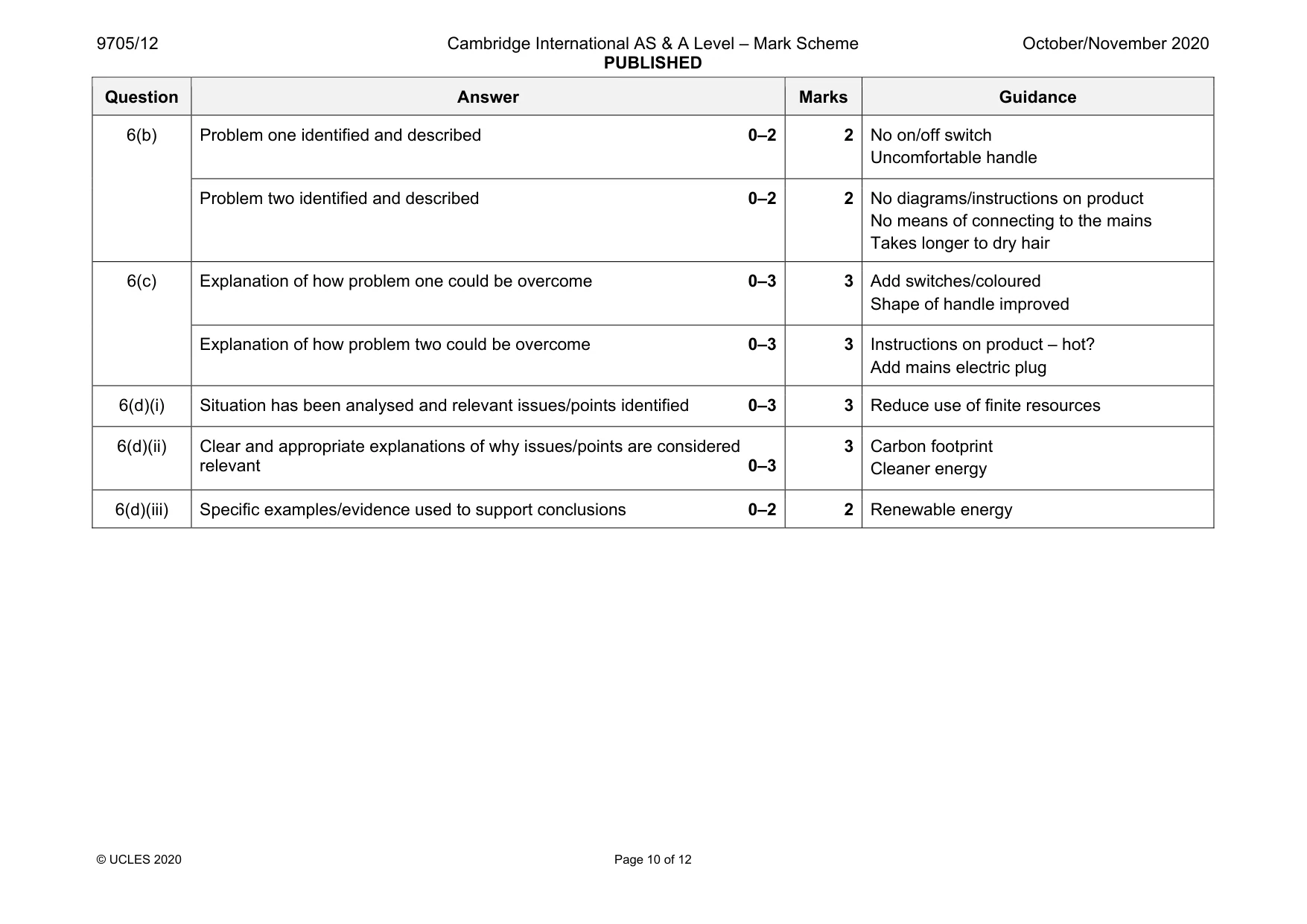
9705/12 Cambridge International AS & A Level – Mark Scheme PUBLISHED October/November 2020 © UCLES 2020 Page 10 of 12 Question Answer Marks Guidance 6(b) Problem one identified and described 0–2 2 No on/off switch Uncomfortable handle Problem two identified and described 0–2 2 No diagrams/instructions on product No means of connecting to the mains Takes longer to dry hair 6(c) Explanation of how problem one could be overcome 0–3 3 Add switches/coloured Shape of handle improved Explanation of how problem two could be overcome 0–3 3 Instructions on product – hot? Add mains electric plug 6(d)(i) Situation has been analysed and relevant issues/points identified 0–3 3 Reduce use of finite resources 6(d)(ii) Clear and appropriate explanations of why issues/points are considered relevant 0–3 3 Carbon footprint Cleaner energy 6(d)(iii) Specific examples/evidence used to support conclusions 0–2 2 Renewable energy
Mark scheme, page 11
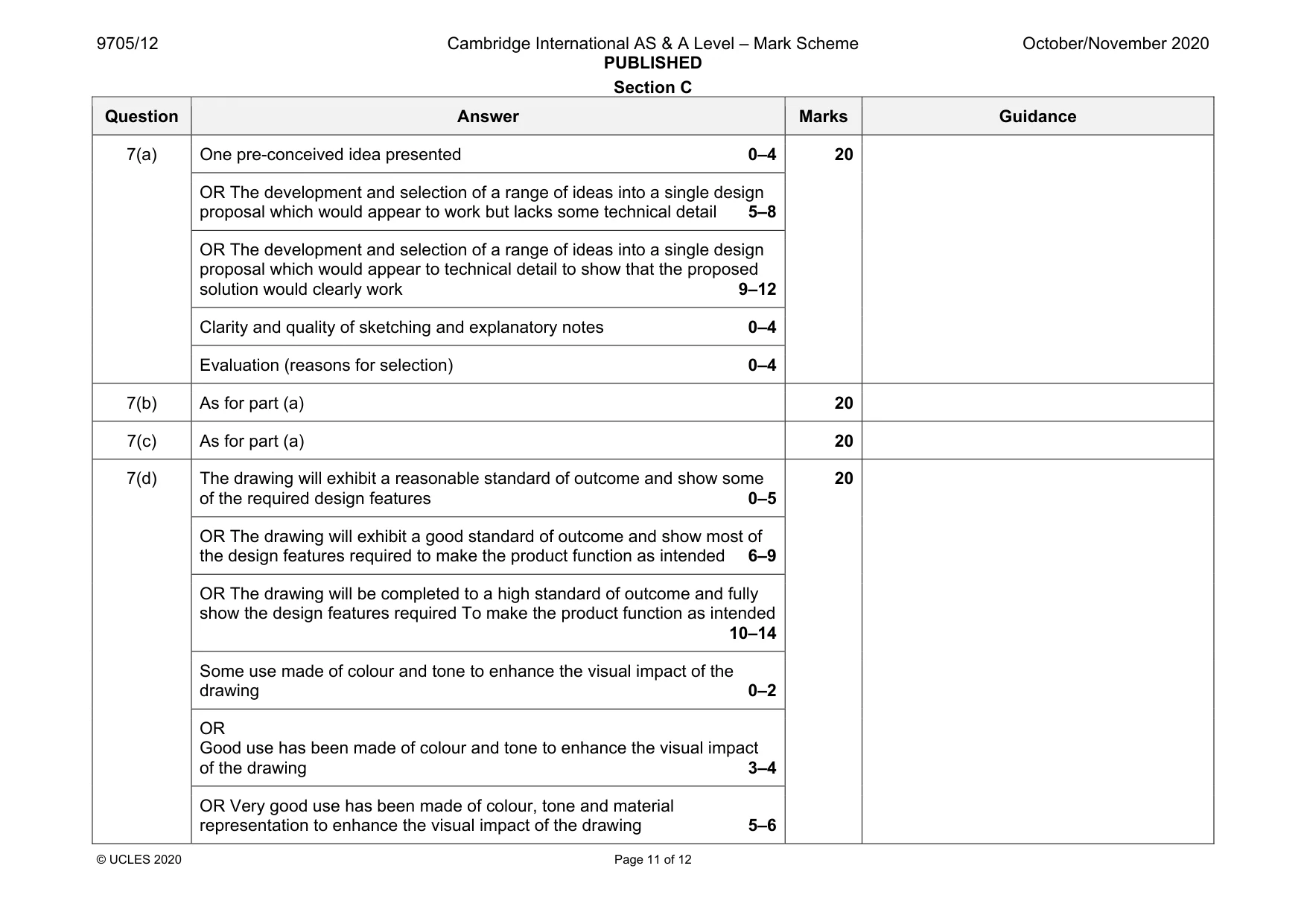
9705/12 Cambridge International AS & A Level – Mark Scheme PUBLISHED October/November 2020 © UCLES 2020 Page 11 of 12 Section C Question Answer Marks Guidance 7(a) One pre-conceived idea presented 0–4 20 OR The development and selection of a range of ideas into a single design proposal which would appear to work but lacks some technical detail 5–8 OR The development and selection of a range of ideas into a single design proposal which would appear to technical detail to show that the proposed solution would clearly work 9–12 Clarity and quality of sketching and explanatory notes 0–4 Evaluation (reasons for selection) 0–4 7(b) As for part (a) 20 7(c) As for part (a) 20 7(d) The drawing will exhibit a reasonable standard of outcome and show some of the required design features 0–5 20 OR The drawing will exhibit a good standard of outcome and show most of the design features required to make the product function as intended 6–9 OR The drawing will be completed to a high standard of outcome and fully show the design features required To make the product function as intended 10–14 Some use made of colour and tone to enhance the visual impact of the drawing 0–2 OR Good use has been made of colour and tone to enhance the visual impact of the drawing 3–4 OR Very good use has been made of colour, tone and material representation to enhance the visual impact of the drawing 5–6
Mark scheme, page 12
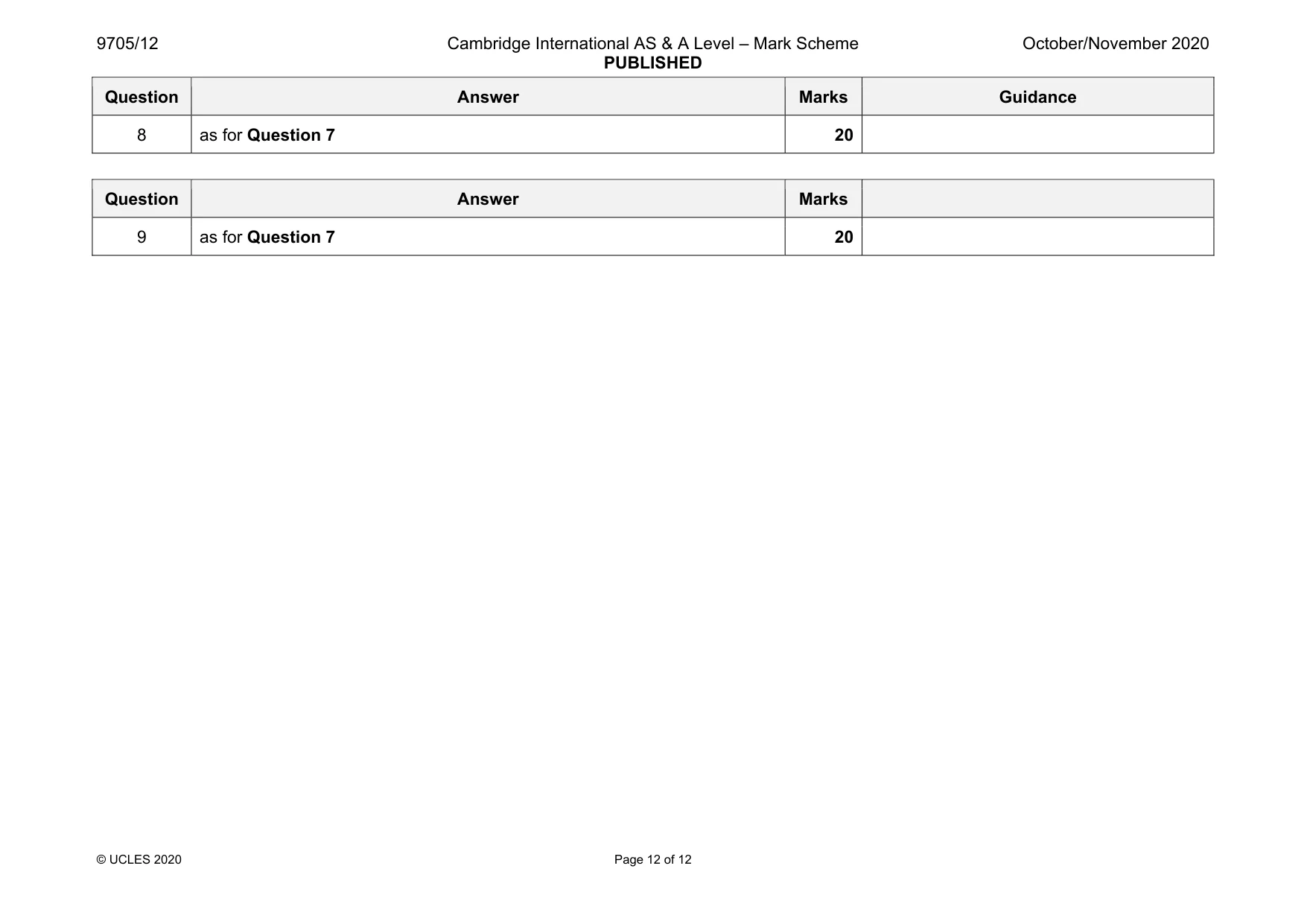
9705/12 Cambridge International AS & A Level – Mark Scheme PUBLISHED October/November 2020 © UCLES 2020 Page 12 of 12 Question Answer Marks Guidance 8 as for Question 7 20 Question Answer Marks 9 as for Question 7 20
What you needed in this session
Cambridge’s own grade thresholds for 2020 Oct/Nov, Paper 1 · Variant 2. A higher threshold means an easier paper — the bar moves with how the cohort did.