Cambridge A Level Design and Technology 9705 — 2019 Oct/Nov Paper 3 · Variant 3
9705/33/O/N/19 · 120 marks · ≈135 min
The question paper and its mark scheme, free to read here and free to download. This is Cambridge’s own paper, exactly as it was sat.
Question paper12 pages


Mark scheme16 pages
Answers below. Sit the paper first if you are practising.
Paper as text
Question paper, page 1
This document consists of 10 printed pages and 2 blank pages. DC (ST/CB) 170685/1 © UCLES 2019 [Turn over Cambridge Assessment International Education Cambridge International Advanced Subsidiary and Advanced Level * 9 3 4 5 7 6 6 9 0 5 * DESIGN AND TECHNOLOGY 9705/33 Paper 3 October/November 2019 3 hours Additional Materials: Answer Booklet/Paper A range of design drawing equipment A3 Drawing Paper (5 sheets) READ THESE INSTRUCTIONS FIRST Write your centre number, candidate number and name on all the work you hand in. Write in dark blue or black pen. You may use an HB pencil for any diagrams, graphs or rough working. Do not use staples, paper clips, glue or correction fluid. DO NOT WRITE IN ANY BARCODES. Section A Answer two questions from one of the Parts A, B or C. Section B Answer one question. All dimensions are in millimetres. The instruction ‘discuss’ denotes that you should: • examine critically the issues raised by the question; • explain and interpret these issues as appropriate; • introduce evidence wherever possible to support conclusions of arguments. At the end of the examination, fasten all your work securely together. The number of marks is given in brackets [ ] at the end of each question or part question.
Question paper, page 2
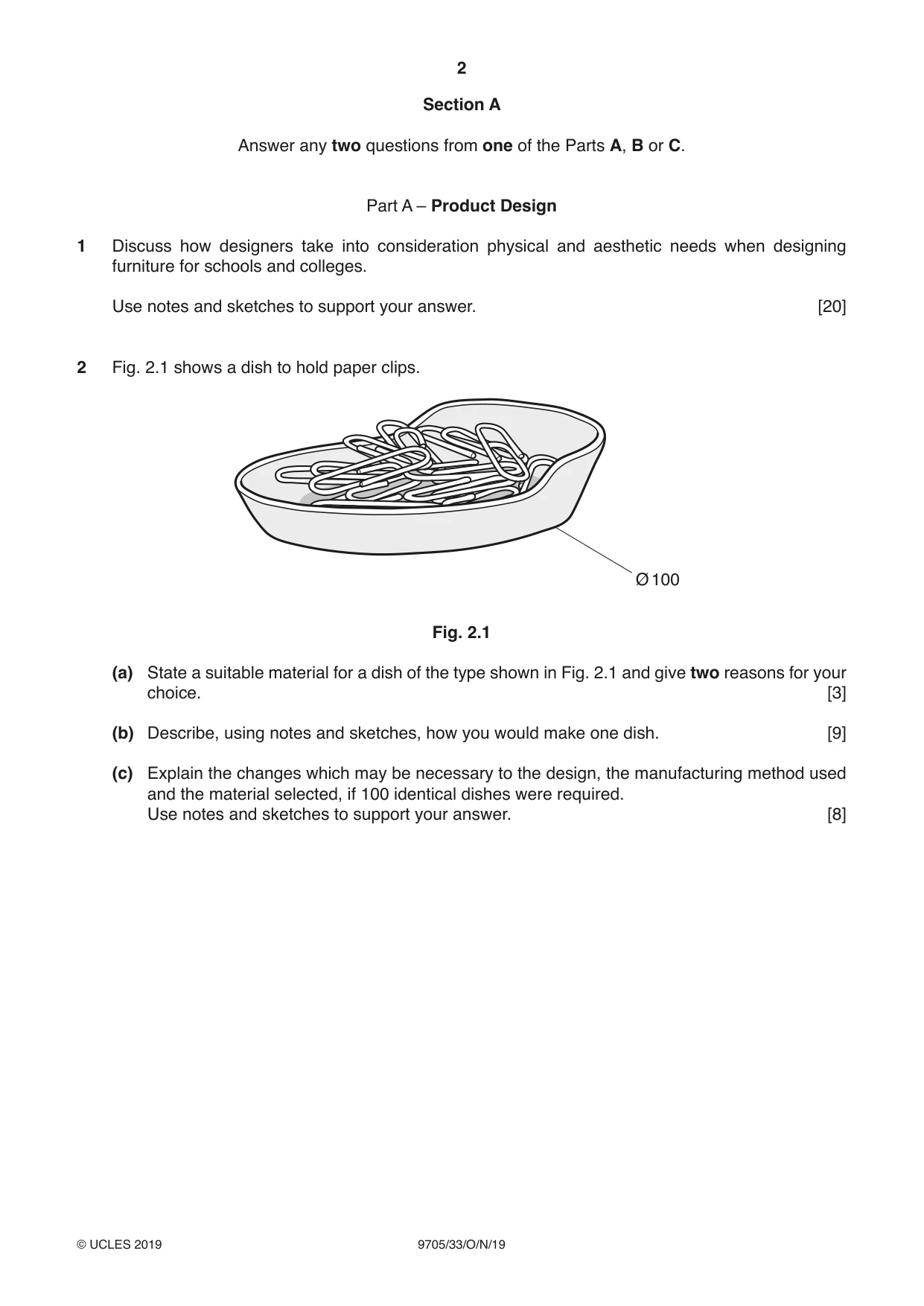
2 9705/33/O/N/19 © UCLES 2019 Section A Answer any two questions from one of the Parts A, B or C. Part A – Product Design 1 Discuss how designers take into consideration physical and aesthetic needs when designing furniture for schools and colleges. Use notes and sketches to support your answer. [20] 2 Fig. 2.1 shows a dish to hold paper clips. Ø 100 Fig. 2.1 (a) State a suitable material for a dish of the type shown in Fig. 2.1 and give two reasons for your choice. [3] (b) Describe, using notes and sketches, how you would make one dish. [9] (c) Explain the changes which may be necessary to the design, the manufacturing method used and the material selected, if 100 identical dishes were required. Use notes and sketches to support your answer. [8]
Question paper, page 3
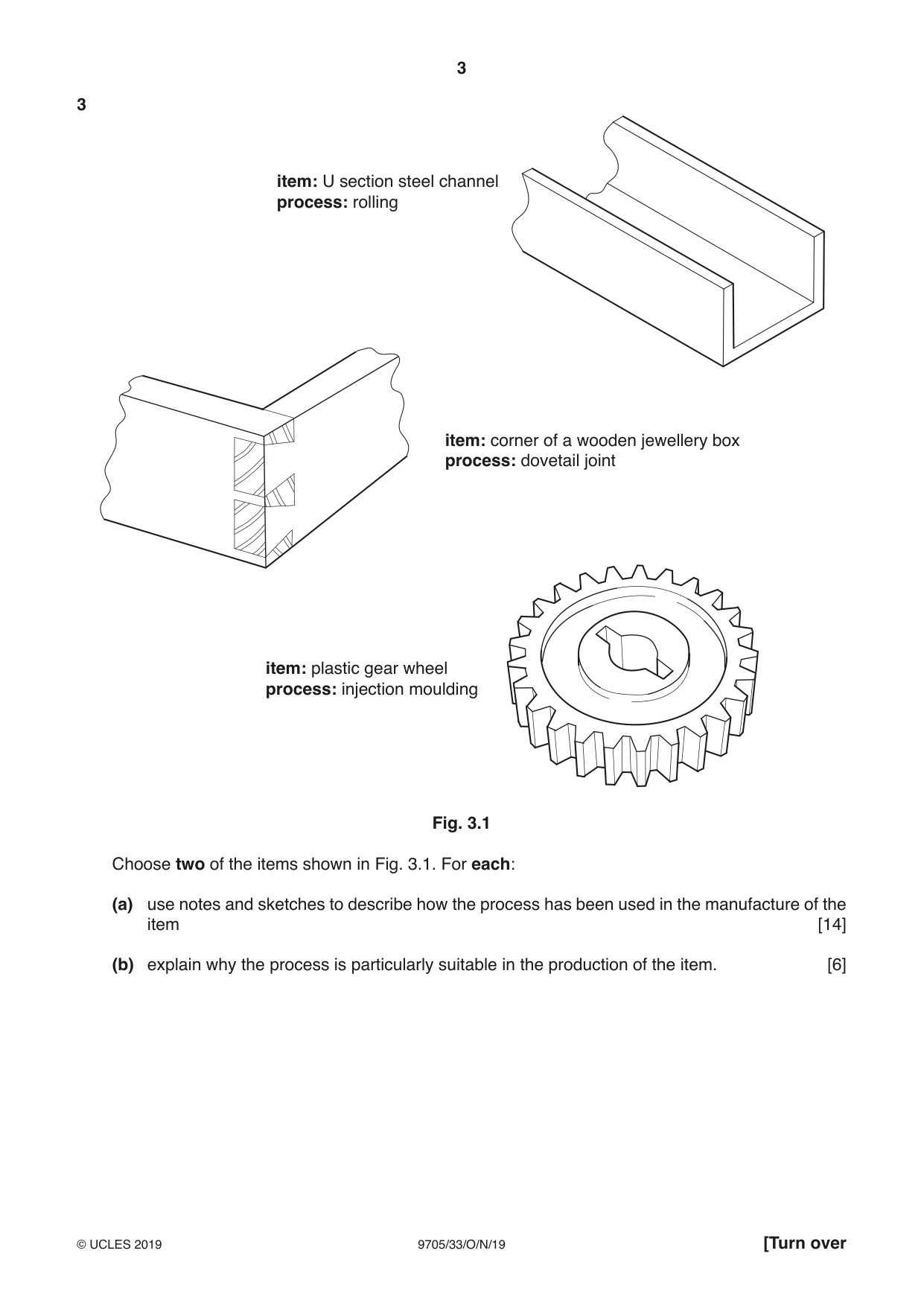
3 9705/33/O/N/19 © UCLES 2019 [Turn over 3 item: U section steel channel process: rolling item: corner of a wooden jewellery box process: dovetail joint item: plastic gear wheel process: injection moulding Fig. 3.1 Choose two of the items shown in Fig. 3.1. For each: (a) use notes and sketches to describe how the process has been used in the manufacture of the item [14] (b) explain why the process is particularly suitable in the production of the item. [6]
Question paper, page 4
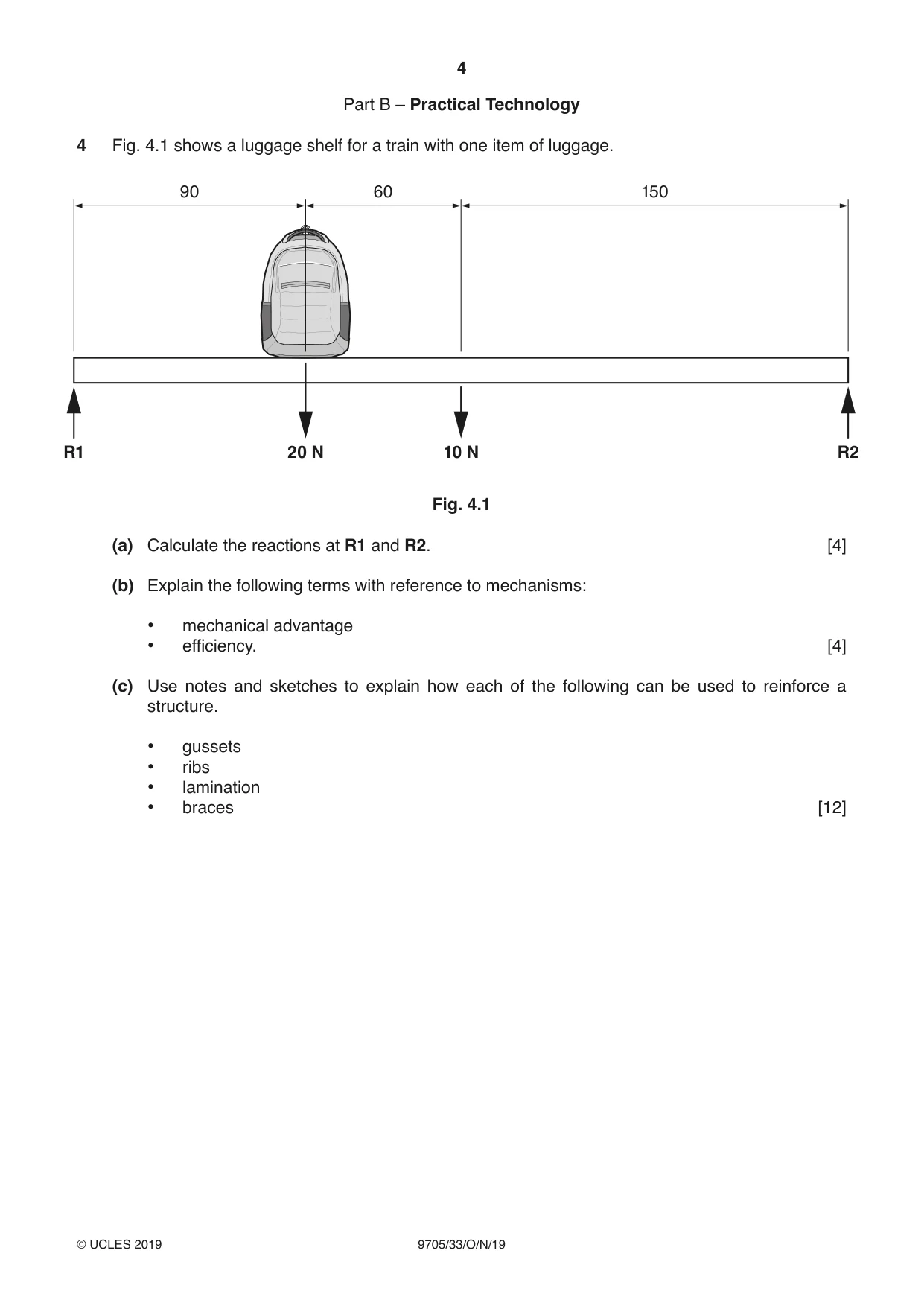
4 9705/33/O/N/19 © UCLES 2019 Part B – Practical Technology 4 Fig. 4.1 shows a luggage shelf for a train with one item of luggage. 90 R1 R2 20 N 10 N 60 150 Fig. 4.1 (a) Calculate the reactions at R1 and R2. [4] (b) Explain the following terms with reference to mechanisms: • mechanical advantage • efficiency. [4] (c) Use notes and sketches to explain how each of the following can be used to reinforce a structure. • gussets • ribs • lamination • braces [12]
Question paper, page 5
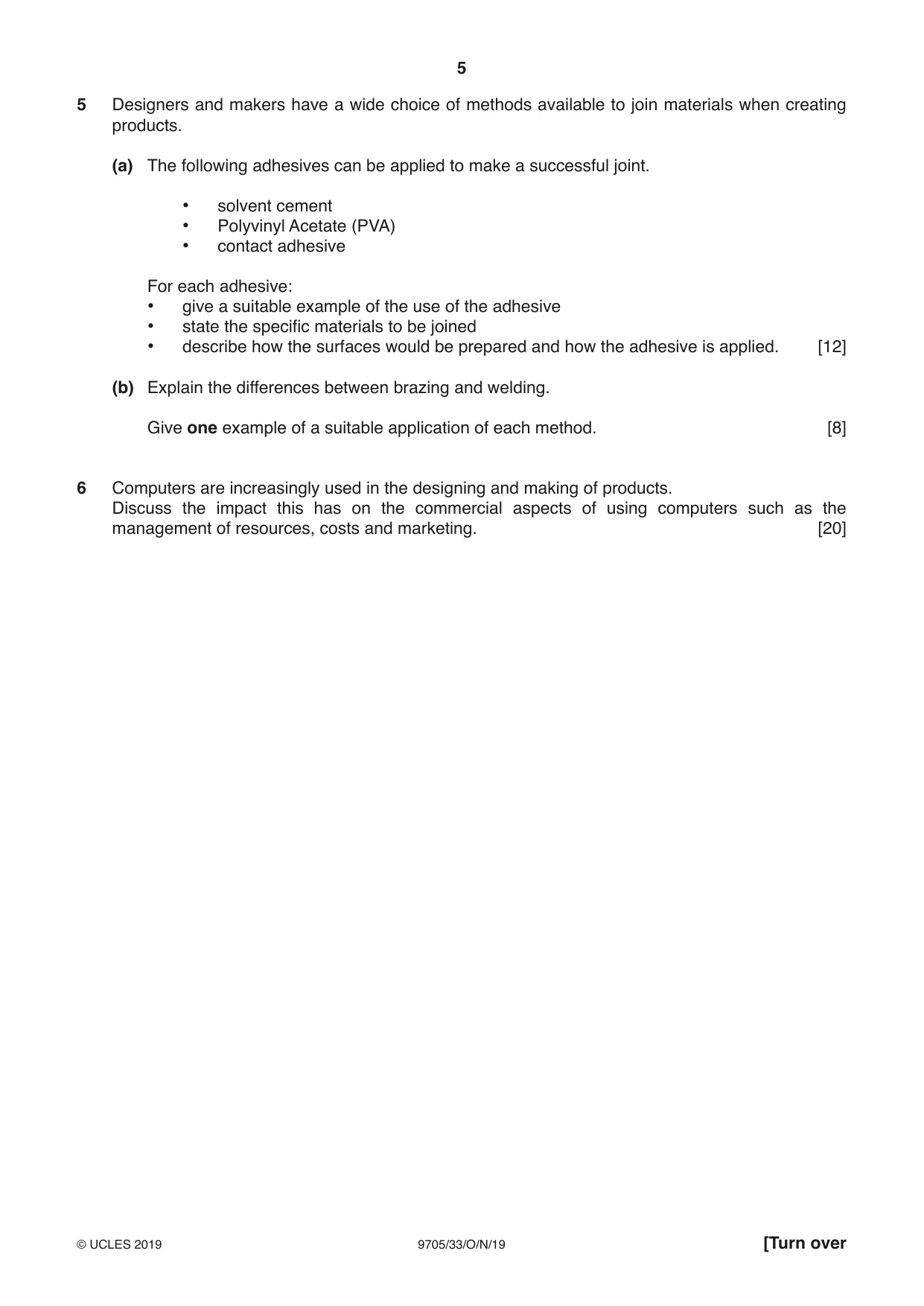
5 9705/33/O/N/19 © UCLES 2019 [Turn over 5 Designers and makers have a wide choice of methods available to join materials when creating products. (a) The following adhesives can be applied to make a successful joint. • solvent cement • Polyvinyl Acetate (PVA) • contact adhesive For each adhesive: • give a suitable example of the use of the adhesive • state the specific materials to be joined • describe how the surfaces would be prepared and how the adhesive is applied. [12] (b) Explain the differences between brazing and welding. Give one example of a suitable application of each method. [8] 6 Computers are increasingly used in the designing and making of products. Discuss the impact this has on the commercial aspects of using computers such as the management of resources, costs and marketing. [20]
Question paper, page 6
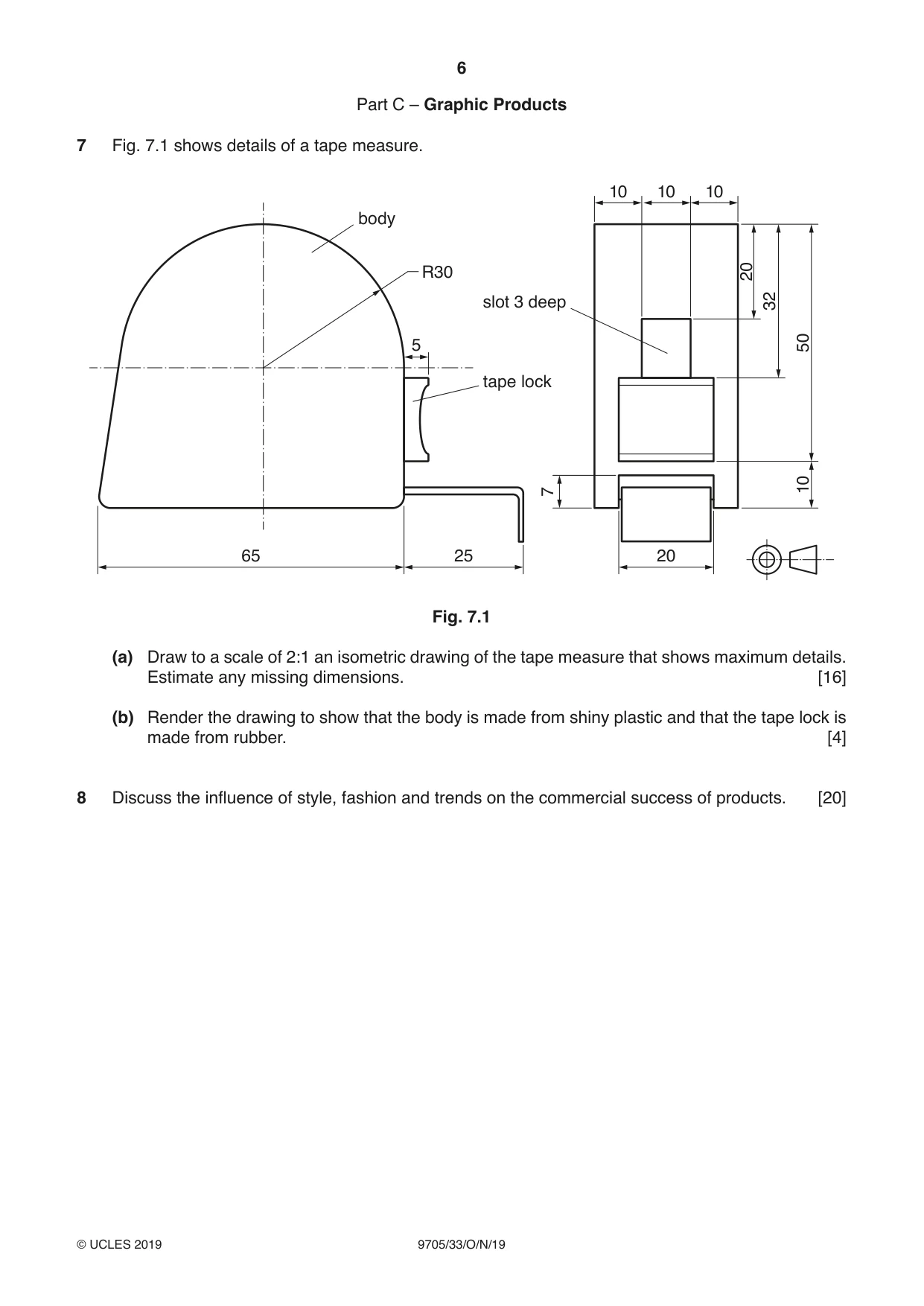
6 9705/33/O/N/19 © UCLES 2019 Part C – Graphic Products 7 Fig. 7.1 shows details of a tape measure. body tape lock slot 3 deep R30 25 20 10 10 10 20 32 50 65 5 7 10 Fig. 7.1 (a) Draw to a scale of 2:1 an isometric drawing of the tape measure that shows maximum details. Estimate any missing dimensions. [16] (b) Render the drawing to show that the body is made from shiny plastic and that the tape lock is made from rubber. [4] 8 Discuss the influence of style, fashion and trends on the commercial success of products. [20]
Question paper, page 7
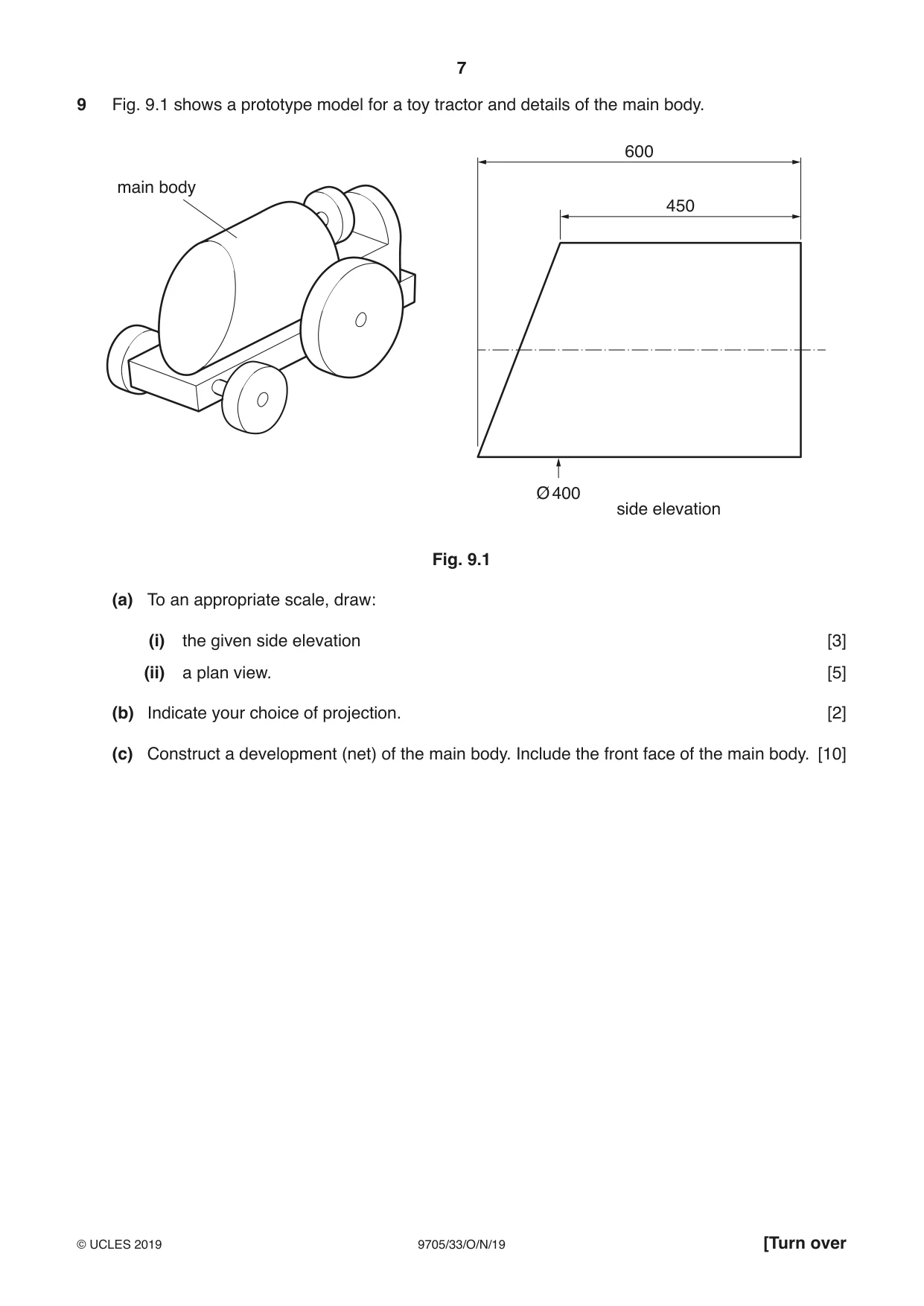
7 9705/33/O/N/19 © UCLES 2019 [Turn over 9 Fig. 9.1 shows a prototype model for a toy tractor and details of the main body. 450 600 Ø 400 main body side elevation Fig. 9.1 (a) To an appropriate scale, draw: (i) the given side elevation [3] (ii) a plan view. [5] (b) Indicate your choice of projection. [2] (c) Construct a development (net) of the main body. Include the front face of the main body. [10]
Question paper, page 8
8 9705/33/O/N/19 © UCLES 2019 Section B Answer one question on the A3 paper provided. Each question is worth 80 marks. You should approach the design question of your choice in the following manner: Analysis Produce an analysis of the given situation/problem, which may be in written or graphical form. [5] Specification From the analysis produce a detailed written specification of the design requirements. Include at least five specification points other than those given in the question. [5] Exploration Use bold sketches and brief notes to show your exploration of ideas for a design solution, with reasons for selection. [25] Development Use bold sketches and notes to show the development, reasoning and composition of ideas into a single design proposal. Give details of materials, constructional and other relevant technical details. [25] Proposed solution Produce drawings of an appropriate kind to show the complete solution. [15] Evaluation Give a written evaluation of the final design solution. [5]
Question paper, page 9
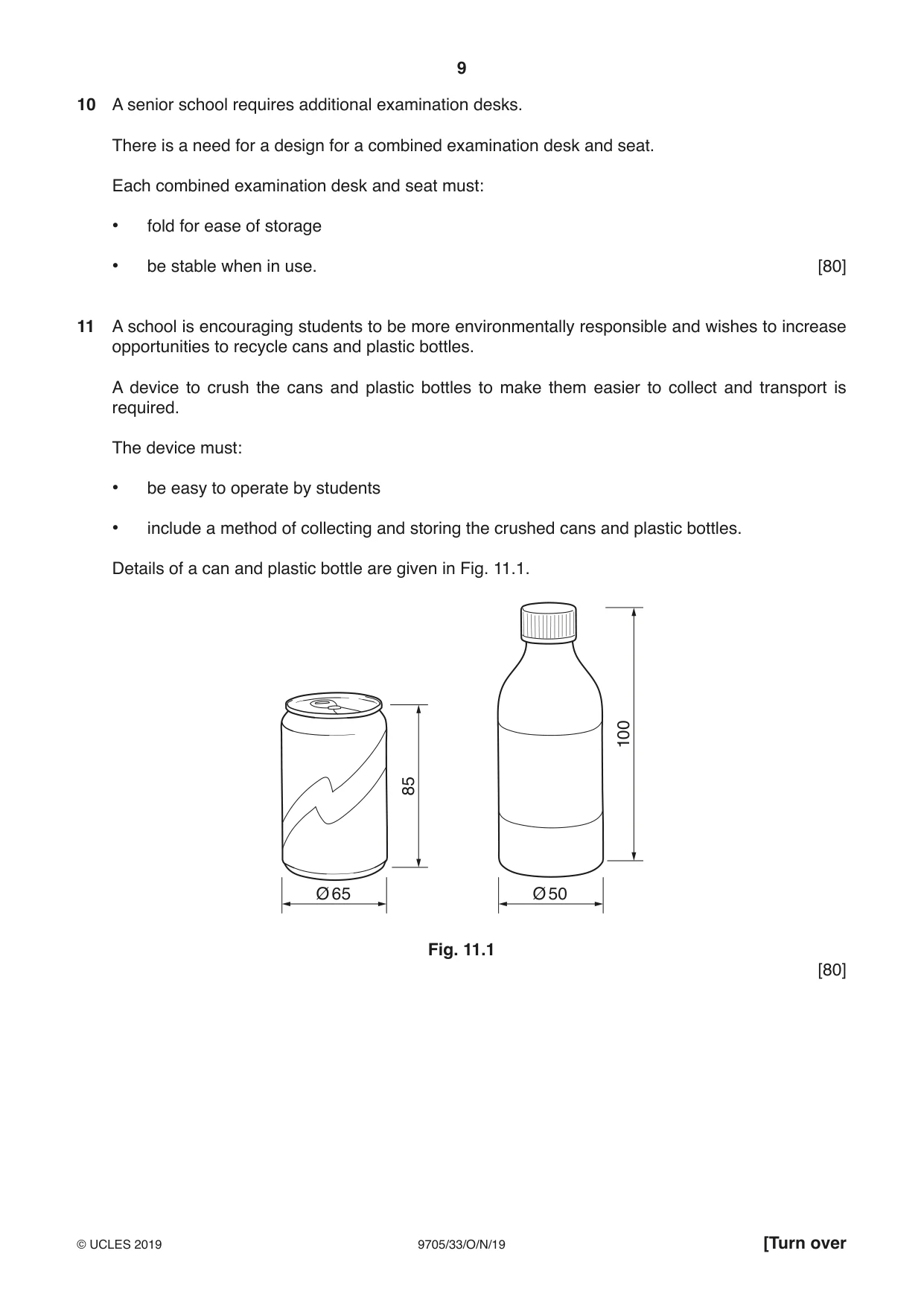
9 9705/33/O/N/19 © UCLES 2019 [Turn over 10 A senior school requires additional examination desks. There is a need for a design for a combined examination desk and seat. Each combined examination desk and seat must: • fold for ease of storage • be stable when in use. [80] 11 A school is encouraging students to be more environmentally responsible and wishes to increase opportunities to recycle cans and plastic bottles. A device to crush the cans and plastic bottles to make them easier to collect and transport is required. The device must: • be easy to operate by students • include a method of collecting and storing the crushed cans and plastic bottles. Details of a can and plastic bottle are given in Fig. 11.1. 100 Ø 50 Ø 65 85 Fig. 11.1 [80]
Question paper, page 10
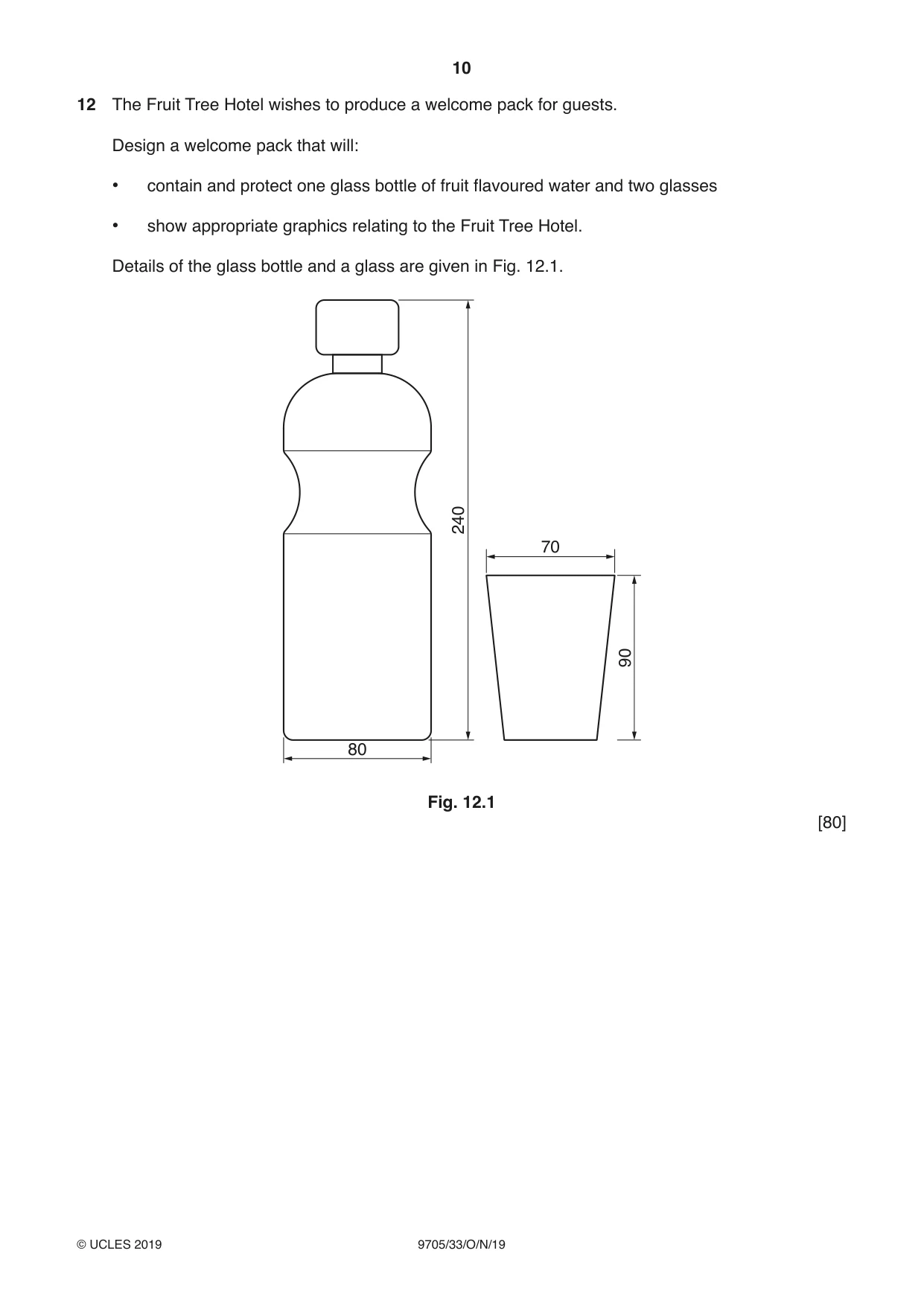
10 9705/33/O/N/19 © UCLES 2019 12 The Fruit Tree Hotel wishes to produce a welcome pack for guests. Design a welcome pack that will: • contain and protect one glass bottle of fruit flavoured water and two glasses • show appropriate graphics relating to the Fruit Tree Hotel. Details of the glass bottle and a glass are given in Fig. 12.1. 240 80 70 90 Fig. 12.1 [80]
Question paper, page 11
11 9705/33/O/N/19 © UCLES 2019 BLANK PAGE
Question paper, page 12
12 9705/33/O/N/19 © UCLES 2019 Permission to reproduce items where third-party owned material protected by copyright is included has been sought and cleared where possible. Every reasonable effort has been made by the publisher (UCLES) to trace copyright holders, but if any items requiring clearance have unwittingly been included, the publisher will be pleased to make amends at the earliest possible opportunity. To avoid the issue of disclosure of answer-related information to candidates, all copyright acknowledgements are reproduced online in the Cambridge Assessment International Education Copyright Acknowledgements Booklet. This is produced for each series of examinations and is freely available to download at www.cambridgeinternational.org after the live examination series. Cambridge Assessment International Education is part of the Cambridge Assessment Group. Cambridge Assessment is the brand name of the University of Cambridge Local Examinations Syndicate (UCLES), which itself is a department of the University of Cambridge. BLANK PAGE
Mark scheme, page 1
This document consists of 16 printed pages. © UCLES 2019 [Turn over Cambridge Assessment International Education Cambridge International Advanced Level DESIGN AND TECHNOLOGY 9705/33 Paper 3 October/November 2019 MARK SCHEME Maximum Mark: 120 Published This mark scheme is published as an aid to teachers and candidates, to indicate the requirements of the examination. It shows the basis on which Examiners were instructed to award marks. It does not indicate the details of the discussions that took place at an Examiners’ meeting before marking began, which would have considered the acceptability of alternative answers. Mark schemes should be read in conjunction with the question paper and the Principal Examiner Report for Teachers. Cambridge International will not enter into discussions about these mark schemes. Cambridge International is publishing the mark schemes for the October/November 2019 series for most Cambridge IGCSE™, Cambridge International A and AS Level components and some Cambridge O Level components.
Mark scheme, page 2
9705/33 Cambridge International A Level – Mark Scheme PUBLISHED October/November 2019 © UCLES 2019 Page 2 of 16 Generic Marking Principles These general marking principles must be applied by all examiners when marking candidate answers. They should be applied alongside the specific content of the mark scheme or generic level descriptors for a question. Each question paper and mark scheme will also comply with these marking principles. GENERIC MARKING PRINCIPLE 1: Marks must be awarded in line with: • the specific content of the mark scheme or the generic level descriptors for the question • the specific skills defined in the mark scheme or in the generic level descriptors for the question • the standard of response required by a candidate as exemplified by the standardisation scripts. GENERIC MARKING PRINCIPLE 2: Marks awarded are always whole marks (not half marks, or other fractions). GENERIC MARKING PRINCIPLE 3: Marks must be awarded positively: • marks are awarded for correct/valid answers, as defined in the mark scheme. However, credit is given for valid answers which go beyond the scope of the syllabus and mark scheme, referring to your Team Leader as appropriate • marks are awarded when candidates clearly demonstrate what they know and can do • marks are not deducted for errors • marks are not deducted for omissions • answers should only be judged on the quality of spelling, punctuation and grammar when these features are specifically assessed by the question as indicated by the mark scheme. The meaning, however, should be unambiguous. GENERIC MARKING PRINCIPLE 4: Rules must be applied consistently e.g. in situations where candidates have not followed instructions or in the application of generic level descriptors.
Mark scheme, page 3
9705/33 Cambridge International A Level – Mark Scheme PUBLISHED October/November 2019 © UCLES 2019 Page 3 of 16 GENERIC MARKING PRINCIPLE 5: Marks should be awarded using the full range of marks defined in the mark scheme for the question (however; the use of the full mark range may be limited according to the quality of the candidate responses seen). GENERIC MARKING PRINCIPLE 6: Marks awarded are based solely on the requirements as defined in the mark scheme. Marks should not be awarded with grade thresholds or grade descriptors in mind.
Mark scheme, page 4
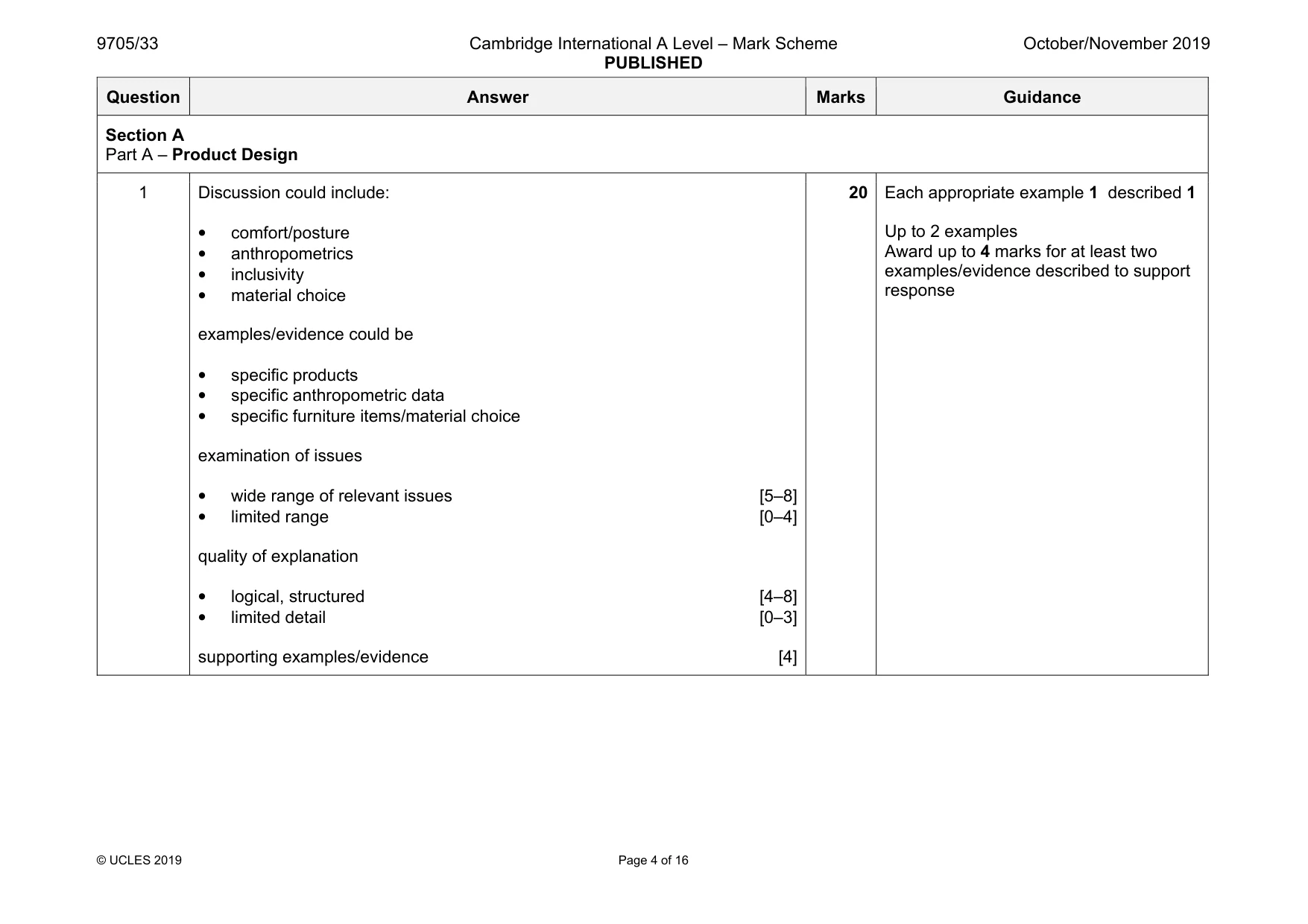
9705/33 Cambridge International A Level – Mark Scheme PUBLISHED October/November 2019 © UCLES 2019 Page 4 of 16 Question Answer Marks Guidance Section A Part A – Product Design 1 Discussion could include: • comfort/posture • anthropometrics • inclusivity • material choice examples/evidence could be • specific products • specific anthropometric data • specific furniture items/material choice examination of issues • wide range of relevant issues [5–8] • limited range [0–4] quality of explanation • logical, structured [4–8] • limited detail [0–3] supporting examples/evidence [4] 20 Each appropriate example 1 described 1 Up to 2 examples Award up to 4 marks for at least two examples/evidence described to support response
Mark scheme, page 5
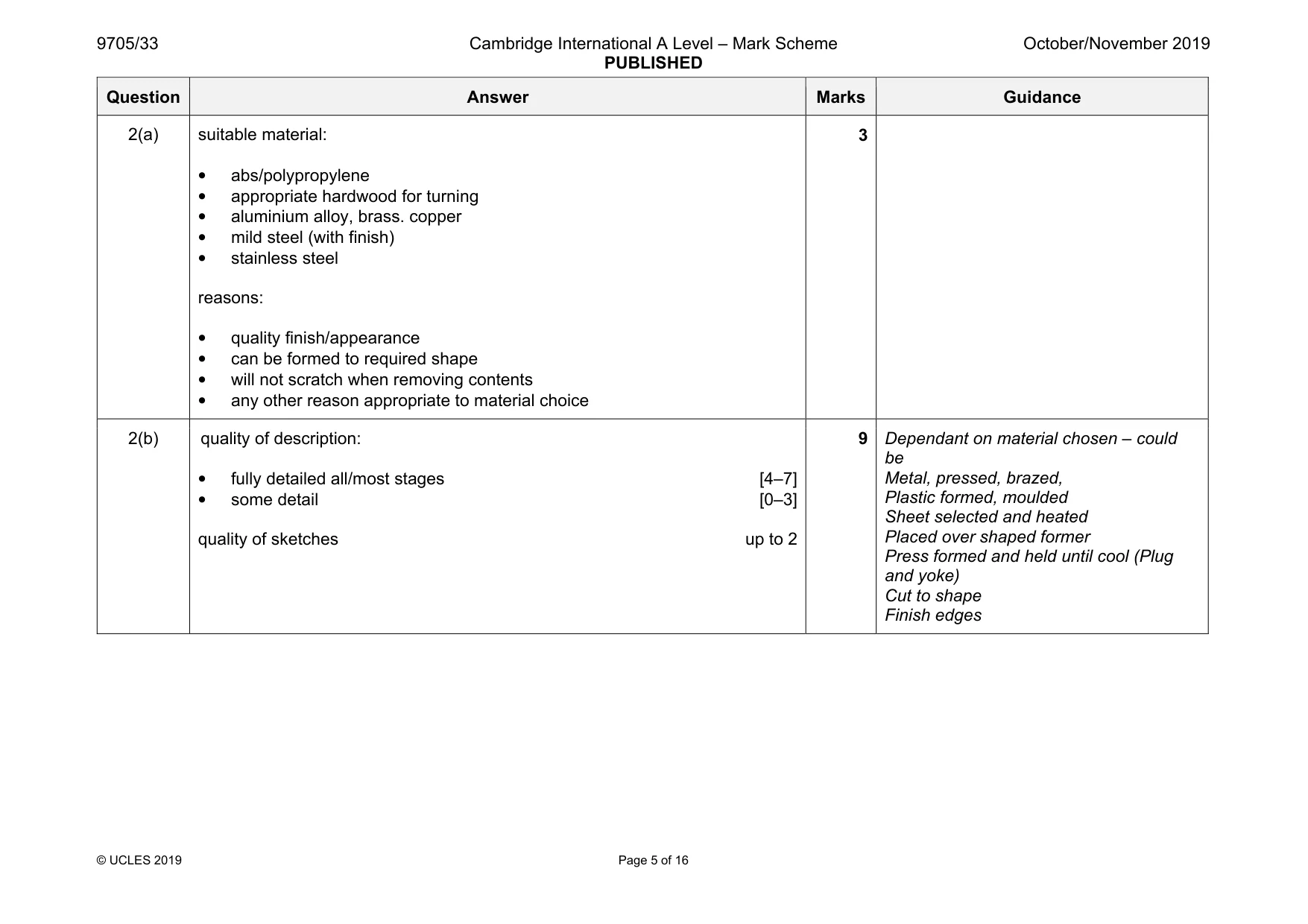
9705/33 Cambridge International A Level – Mark Scheme PUBLISHED October/November 2019 © UCLES 2019 Page 5 of 16 Question Answer Marks Guidance 2(a) suitable material: • abs/polypropylene • appropriate hardwood for turning • aluminium alloy, brass. copper • mild steel (with finish) • stainless steel reasons: • quality finish/appearance • can be formed to required shape • will not scratch when removing contents • any other reason appropriate to material choice 3 2(b) quality of description: • fully detailed all/most stages [4–7] • some detail [0–3] quality of sketches up to 2 9 Dependant on material chosen – could be Metal, pressed, brazed, Plastic formed, moulded Sheet selected and heated Placed over shaped former Press formed and held until cool (Plug and yoke) Cut to shape Finish edges
Mark scheme, page 6
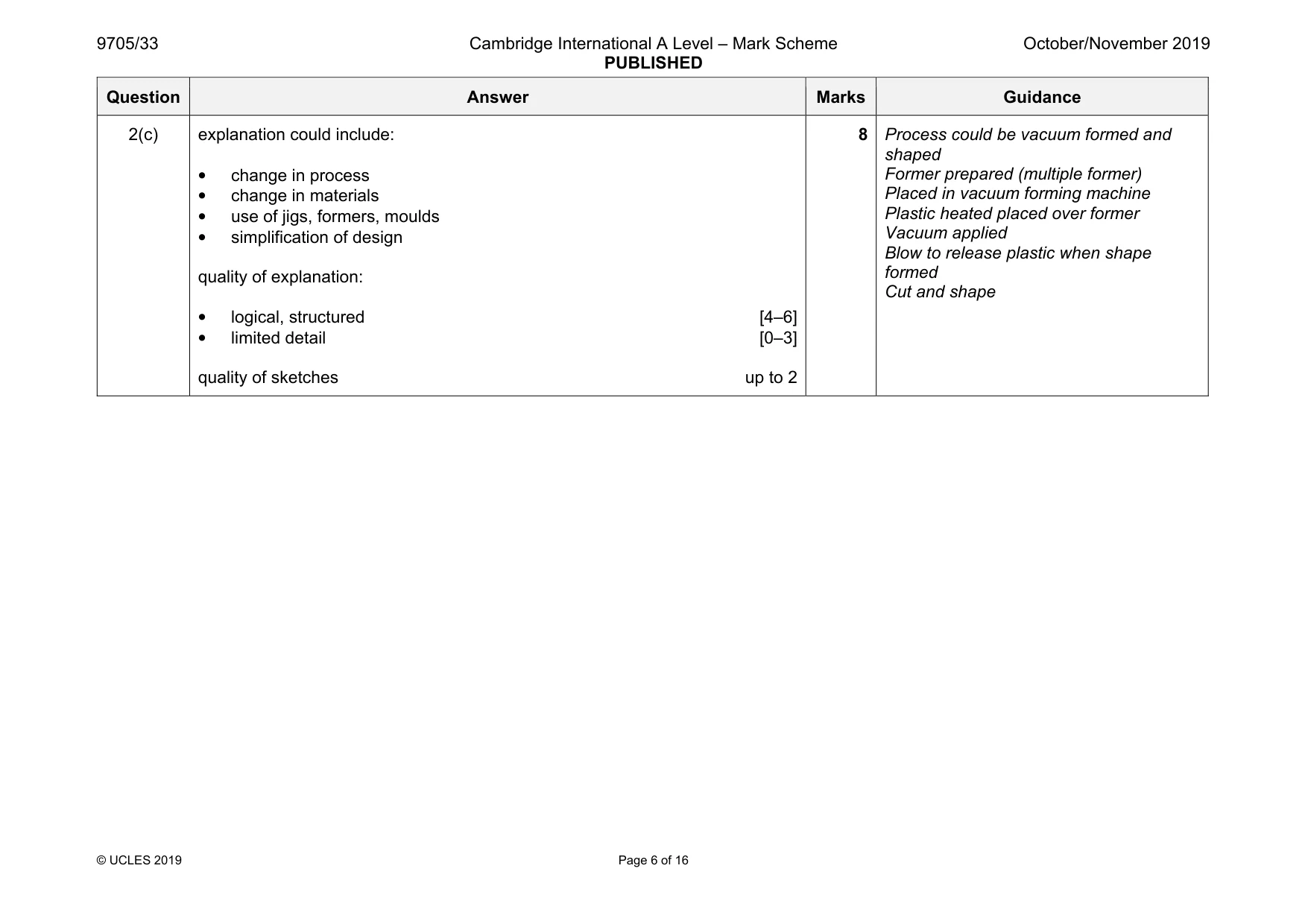
9705/33 Cambridge International A Level – Mark Scheme PUBLISHED October/November 2019 © UCLES 2019 Page 6 of 16 Question Answer Marks Guidance 2(c) explanation could include: • change in process • change in materials • use of jigs, formers, moulds • simplification of design quality of explanation: • logical, structured [4–6] • limited detail [0–3] quality of sketches up to 2 8 Process could be vacuum formed and shaped Former prepared (multiple former) Placed in vacuum forming machine Plastic heated placed over former Vacuum applied Blow to release plastic when shape formed Cut and shape
Mark scheme, page 7
9705/33 Cambridge International A Level – Mark Scheme PUBLISHED October/November 2019 © UCLES 2019 Page 7 of 16 Question Answer Marks Guidance 3(a) description of process: • fully detailed all/most stages [3–5] • some detail [0–2] quality of sketches up to 2 7 × 2 14 Stages could include: Rolling Ingot prepared and heated Roll formers selected ingot fed into rollers – reducing in size to final section profile cooled, stored and cut to length Dovetail joint Square ends of pieces Mark out wood depth and tails – dovetail template, Cut leaving tails Place tails on end to mark out pins Cut leaving pins Test joint – adjust-fit Injection moulding Injection moulding (must have details of mould for full marks)Mould created – single or multiple Granules in hopper Mould heated Plastic heated/injected Mould cooled Gear/s ejected Sprue removed
Mark scheme, page 8
9705/33 Cambridge International A Level – Mark Scheme PUBLISHED October/November 2019 © UCLES 2019 Page 8 of 16 Question Answer Marks Guidance 3(b) rolling • long lengths of exact section produced • relatively low cost, no wastage • long production run when set up • finish can be applied as part of process hot/cold rolled • maximum grain structure dovetail joint • lots of gluing area • very attractive • sense of quality • mechanically strong joint injection moulding • high quality finish • long production run • complex accurate shapes produced • high speed production 3 × 2 6
Mark scheme, page 9
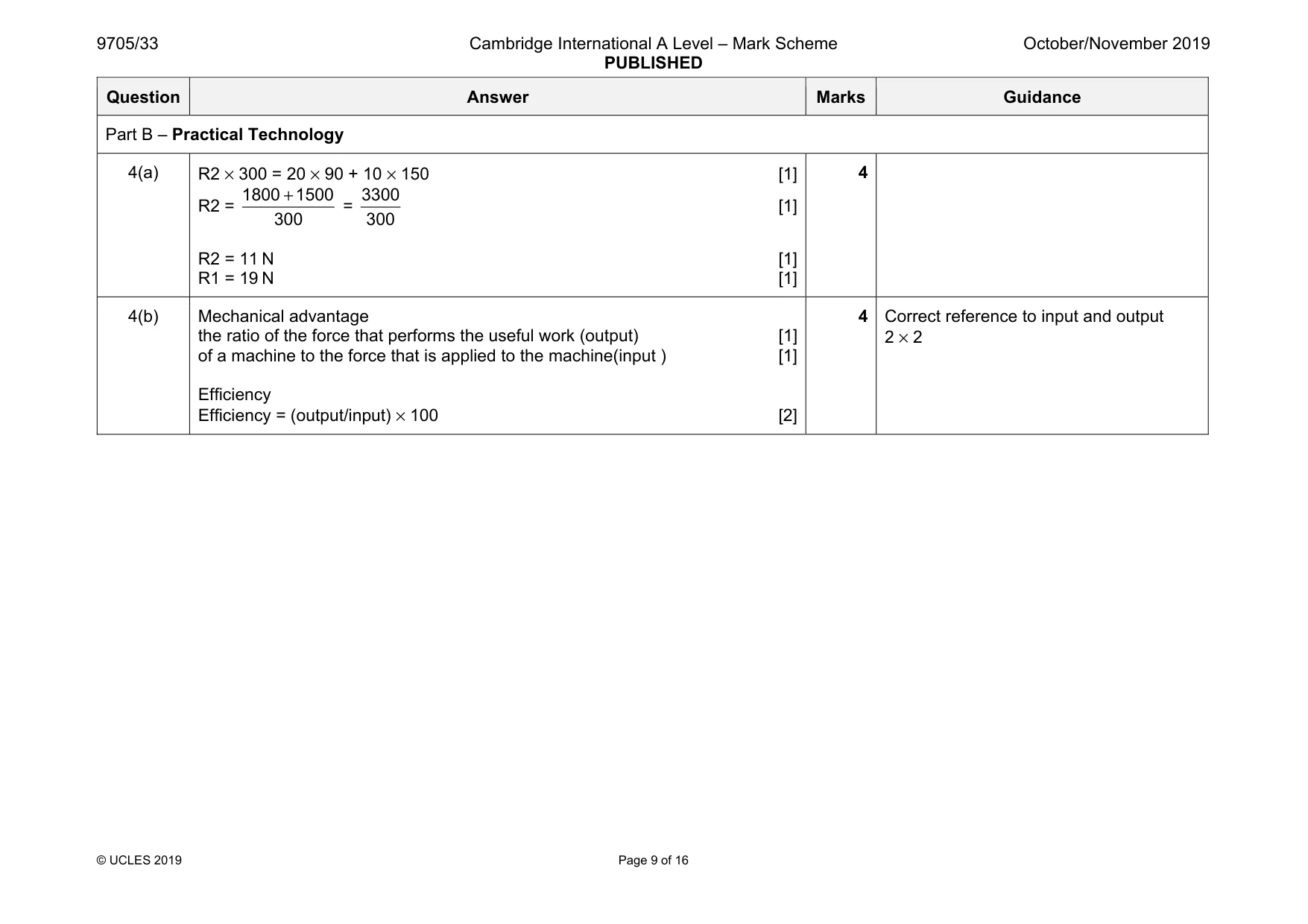
9705/33 Cambridge International A Level – Mark Scheme PUBLISHED October/November 2019 © UCLES 2019 Page 9 of 16 Question Answer Marks Guidance Part B – Practical Technology 4(a) R2 × 300 = 20 × 90 + 10 × 150 [1] R2 = 1800 1500 300 + = 3300 300 [1] R2 = 11 N [1] R1 = 19 N [1] 4 4(b) Mechanical advantage the ratio of the force that performs the useful work (output) [1] of a machine to the force that is applied to the machine(input ) [1] Efficiency Efficiency = (output/input) × 100 [2] 4 Correct reference to input and output 2 × 2
Mark scheme, page 10
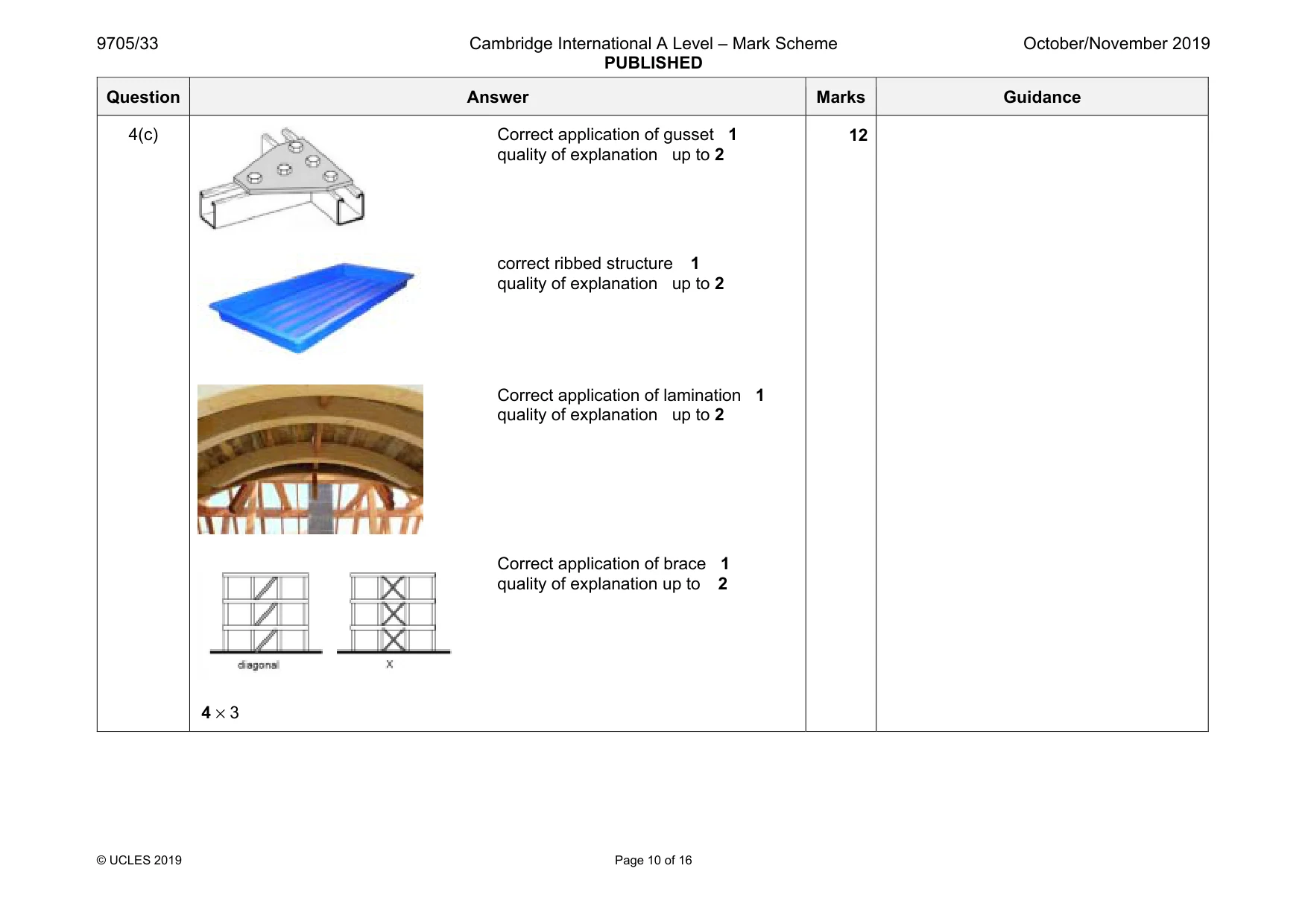
9705/33 Cambridge International A Level – Mark Scheme PUBLISHED October/November 2019 © UCLES 2019 Page 10 of 16 Question Answer Marks Guidance 4(c) Correct application of gusset 1 quality of explanation up to 2 correct ribbed structure 1 quality of explanation up to 2 Correct application of lamination 1 quality of explanation up to 2 Correct application of brace 1 quality of explanation up to 2 4 × 3 12
Mark scheme, page 11
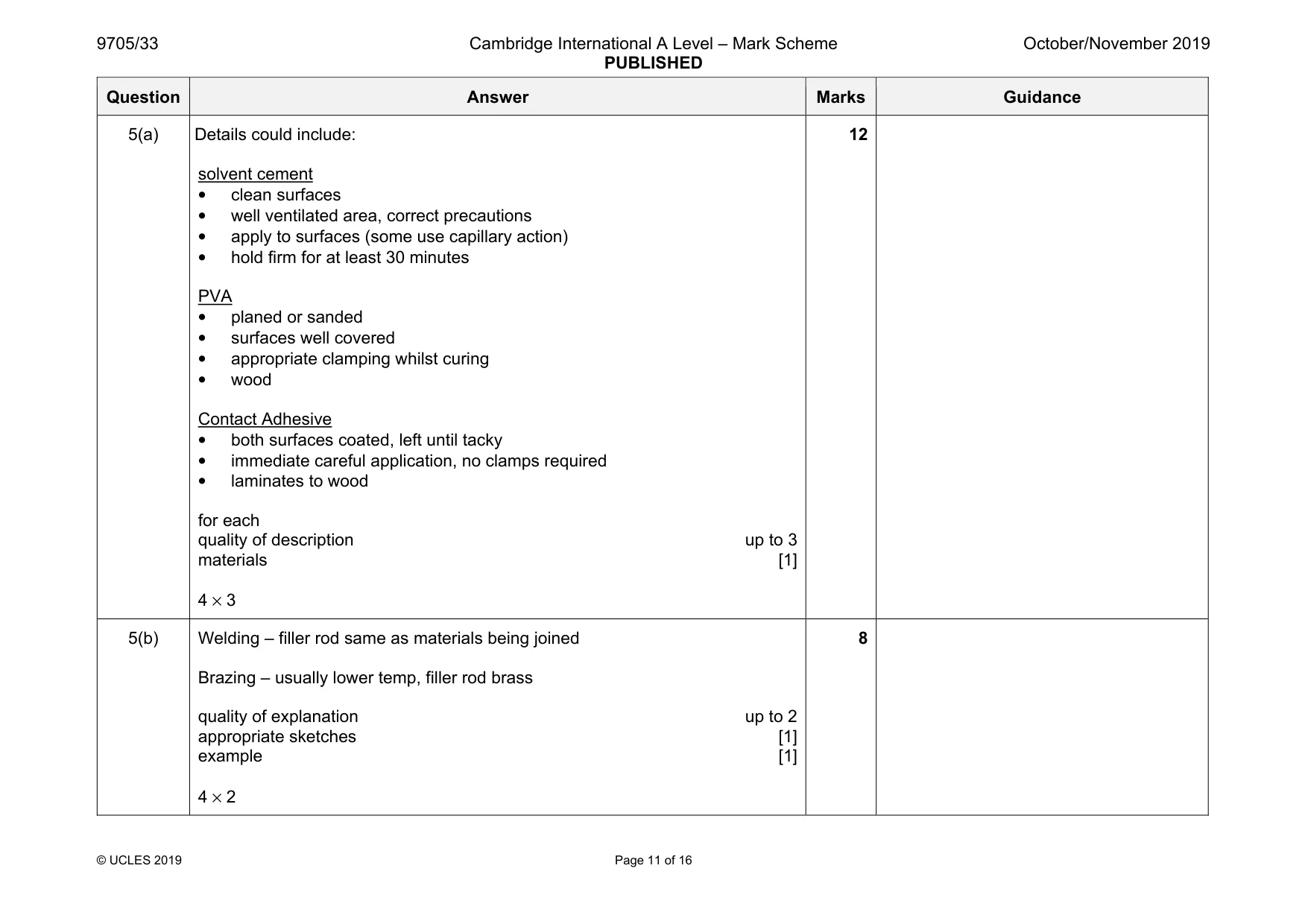
9705/33 Cambridge International A Level – Mark Scheme PUBLISHED October/November 2019 © UCLES 2019 Page 11 of 16 Question Answer Marks Guidance 5(a) Details could include: solvent cement • clean surfaces • well ventilated area, correct precautions • apply to surfaces (some use capillary action) • hold firm for at least 30 minutes PVA • planed or sanded • surfaces well covered • appropriate clamping whilst curing • wood Contact Adhesive • both surfaces coated, left until tacky • immediate careful application, no clamps required • laminates to wood for each quality of description up to 3 materials [1] 4 × 3 12 5(b) Welding – filler rod same as materials being joined Brazing – usually lower temp, filler rod brass quality of explanation up to 2 appropriate sketches [1] example [1] 4 × 2 8
Mark scheme, page 12
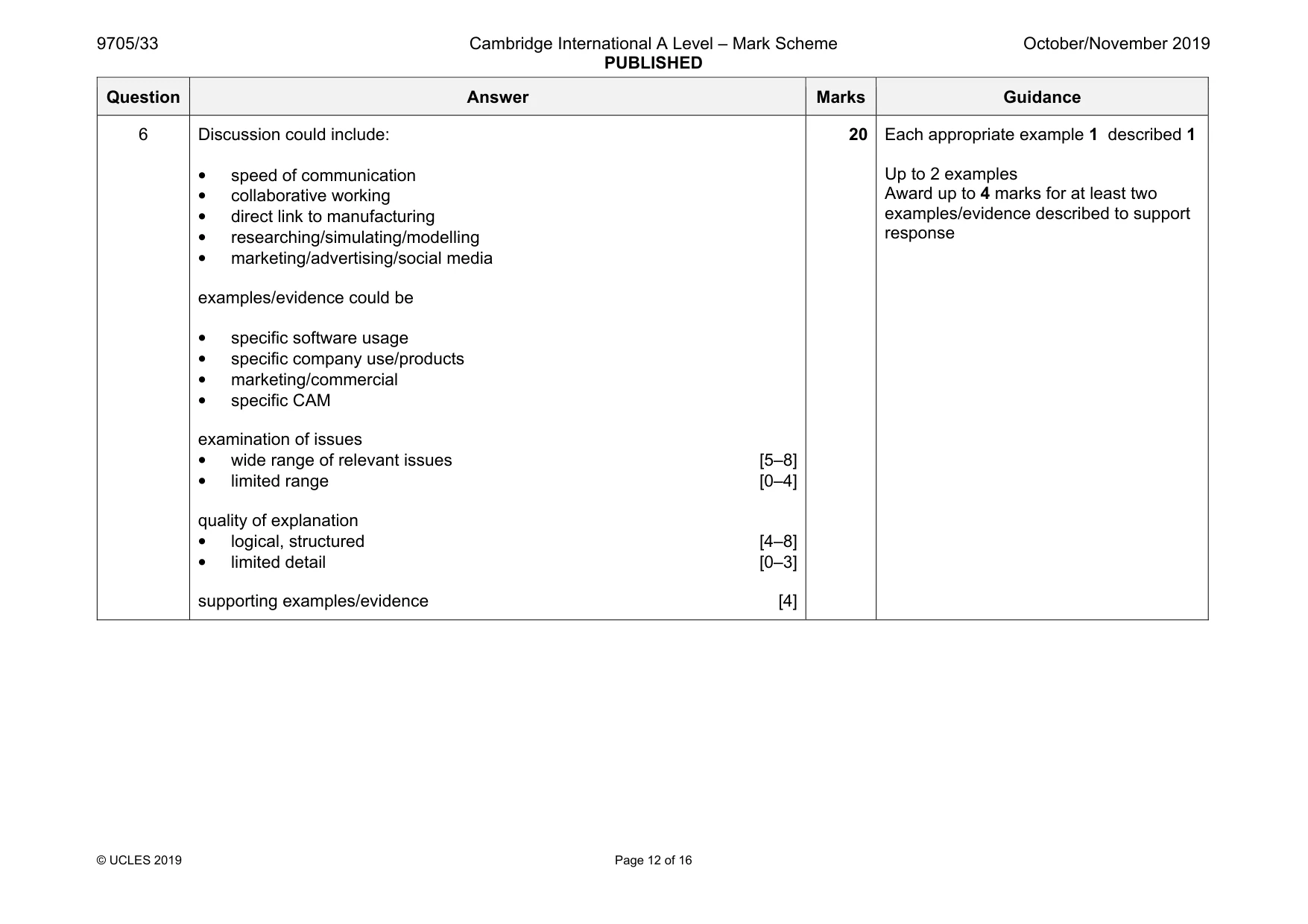
9705/33 Cambridge International A Level – Mark Scheme PUBLISHED October/November 2019 © UCLES 2019 Page 12 of 16 Question Answer Marks Guidance 6 Discussion could include: • speed of communication • collaborative working • direct link to manufacturing • researching/simulating/modelling • marketing/advertising/social media examples/evidence could be • specific software usage • specific company use/products • marketing/commercial • specific CAM examination of issues • wide range of relevant issues [5–8] • limited range [0–4] quality of explanation • logical, structured [4–8] • limited detail [0–3] supporting examples/evidence [4] 20 Each appropriate example 1 described 1 Up to 2 examples Award up to 4 marks for at least two examples/evidence described to support response
Mark scheme, page 13
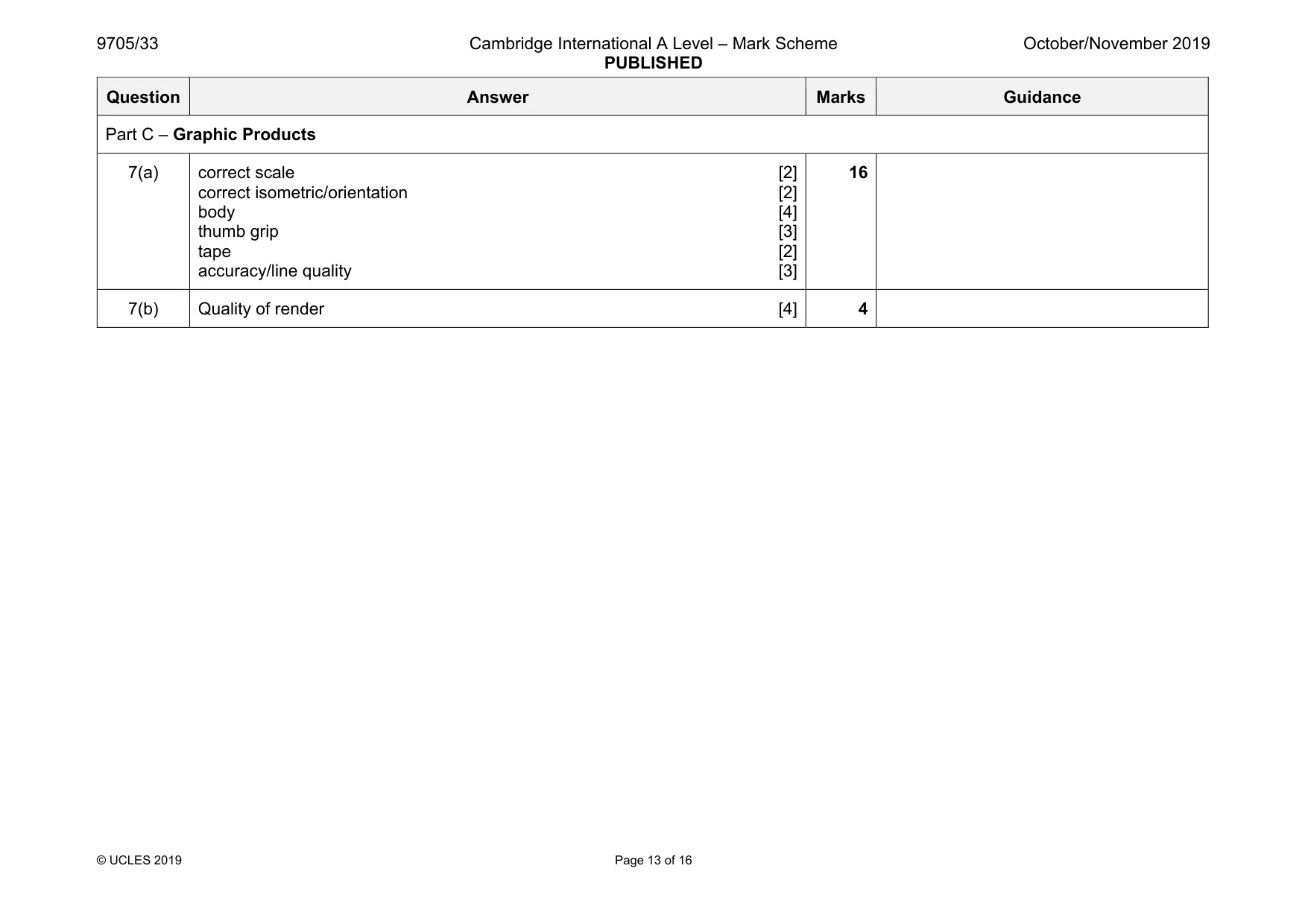
9705/33 Cambridge International A Level – Mark Scheme PUBLISHED October/November 2019 © UCLES 2019 Page 13 of 16 Question Answer Marks Guidance Part C – Graphic Products 7(a) correct scale [2] correct isometric/orientation [2] body [4] thumb grip [3] tape [2] accuracy/line quality [3] 16 7(b) Quality of render [4] 4
Mark scheme, page 14
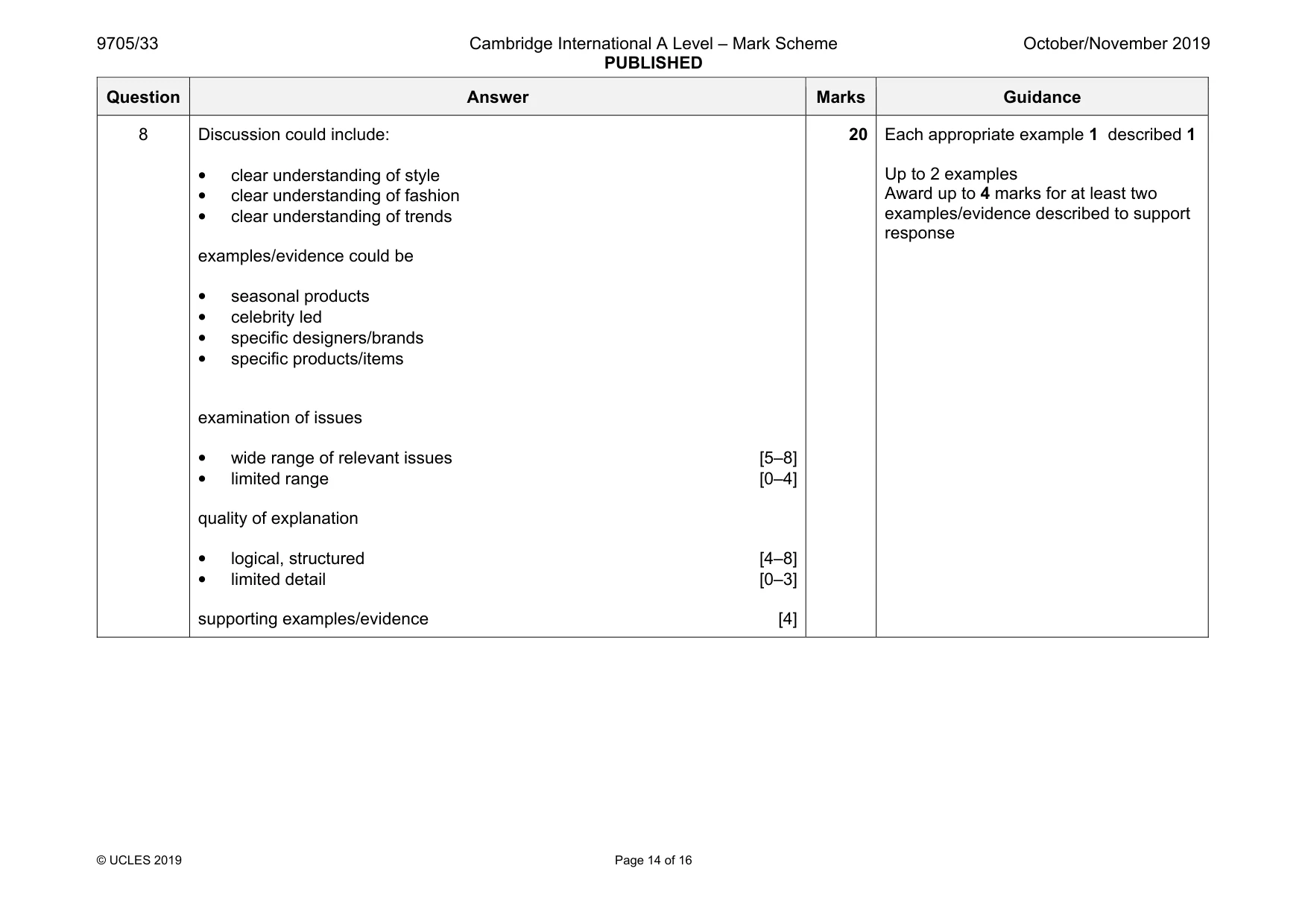
9705/33 Cambridge International A Level – Mark Scheme PUBLISHED October/November 2019 © UCLES 2019 Page 14 of 16 Question Answer Marks Guidance 8 Discussion could include: • clear understanding of style • clear understanding of fashion • clear understanding of trends examples/evidence could be • seasonal products • celebrity led • specific designers/brands • specific products/items examination of issues • wide range of relevant issues [5–8] • limited range [0–4] quality of explanation • logical, structured [4–8] • limited detail [0–3] supporting examples/evidence [4] 20 Each appropriate example 1 described 1 Up to 2 examples Award up to 4 marks for at least two examples/evidence described to support response
Mark scheme, page 15
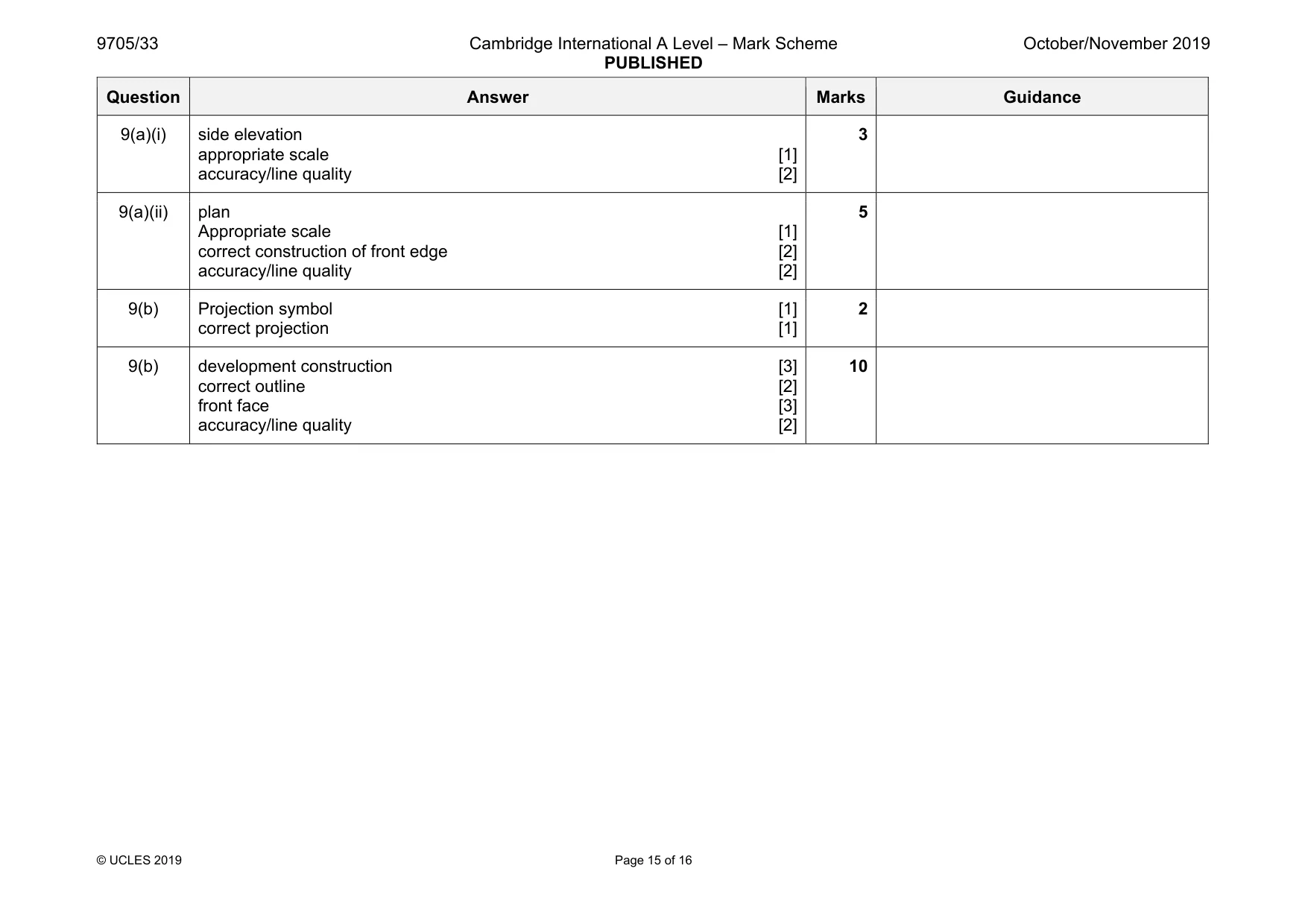
9705/33 Cambridge International A Level – Mark Scheme PUBLISHED October/November 2019 © UCLES 2019 Page 15 of 16 Question Answer Marks Guidance 9(a)(i) side elevation appropriate scale [1] accuracy/line quality [2] 3 9(a)(ii) plan Appropriate scale [1] correct construction of front edge [2] accuracy/line quality [2] 5 9(b) Projection symbol [1] correct projection [1] 2 9(b) development construction [3] correct outline [2] front face [3] accuracy/line quality [2] 10
Mark scheme, page 16
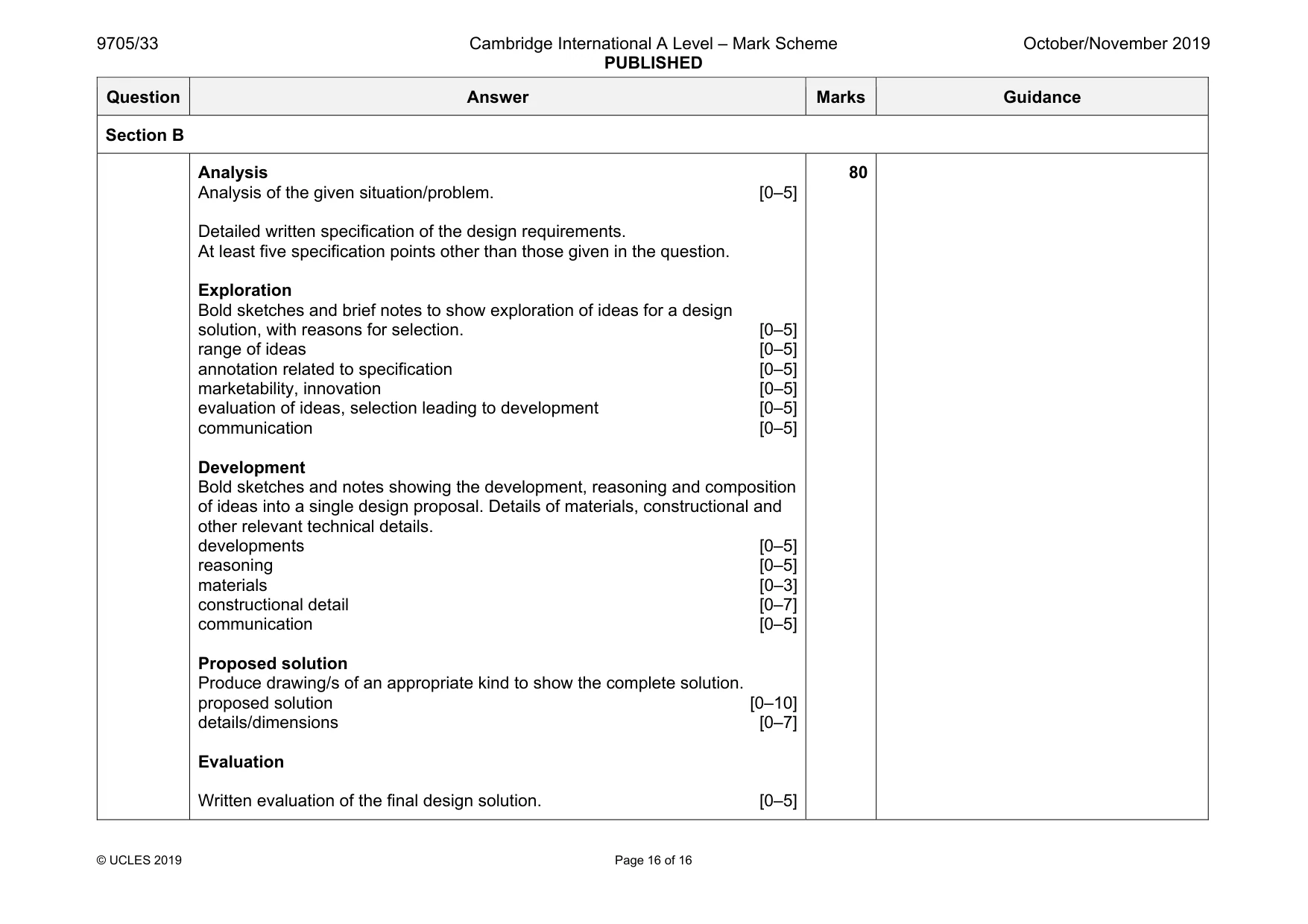
9705/33 Cambridge International A Level – Mark Scheme PUBLISHED October/November 2019 © UCLES 2019 Page 16 of 16 Question Answer Marks Guidance Section B Analysis Analysis of the given situation/problem. [0–5] Detailed written specification of the design requirements. At least five specification points other than those given in the question. Exploration Bold sketches and brief notes to show exploration of ideas for a design solution, with reasons for selection. [0–5] range of ideas [0–5] annotation related to specification [0–5] marketability, innovation [0–5] evaluation of ideas, selection leading to development [0–5] communication [0–5] Development Bold sketches and notes showing the development, reasoning and composition of ideas into a single design proposal. Details of materials, constructional and other relevant technical details. developments [0–5] reasoning [0–5] materials [0–3] constructional detail [0–7] communication [0–5] Proposed solution Produce drawing/s of an appropriate kind to show the complete solution. proposed solution [0–10] details/dimensions [0–7] Evaluation Written evaluation of the final design solution. [0–5] 80
What you needed in this session
Cambridge’s own grade thresholds for 2019 Oct/Nov, Paper 3 · Variant 3. A higher threshold means an easier paper — the bar moves with how the cohort did.