Cambridge A Level Design and Technology 9705 — 2019 Oct/Nov Paper 1 · Variant 1
9705/11/O/N/19 · 120 marks · ≈135 min
The question paper and its mark scheme, free to read here and free to download. This is Cambridge’s own paper, exactly as it was sat.
Question paper12 pages

Mark scheme16 pages
Answers below. Sit the paper first if you are practising.
Paper as text
Question paper, page 1
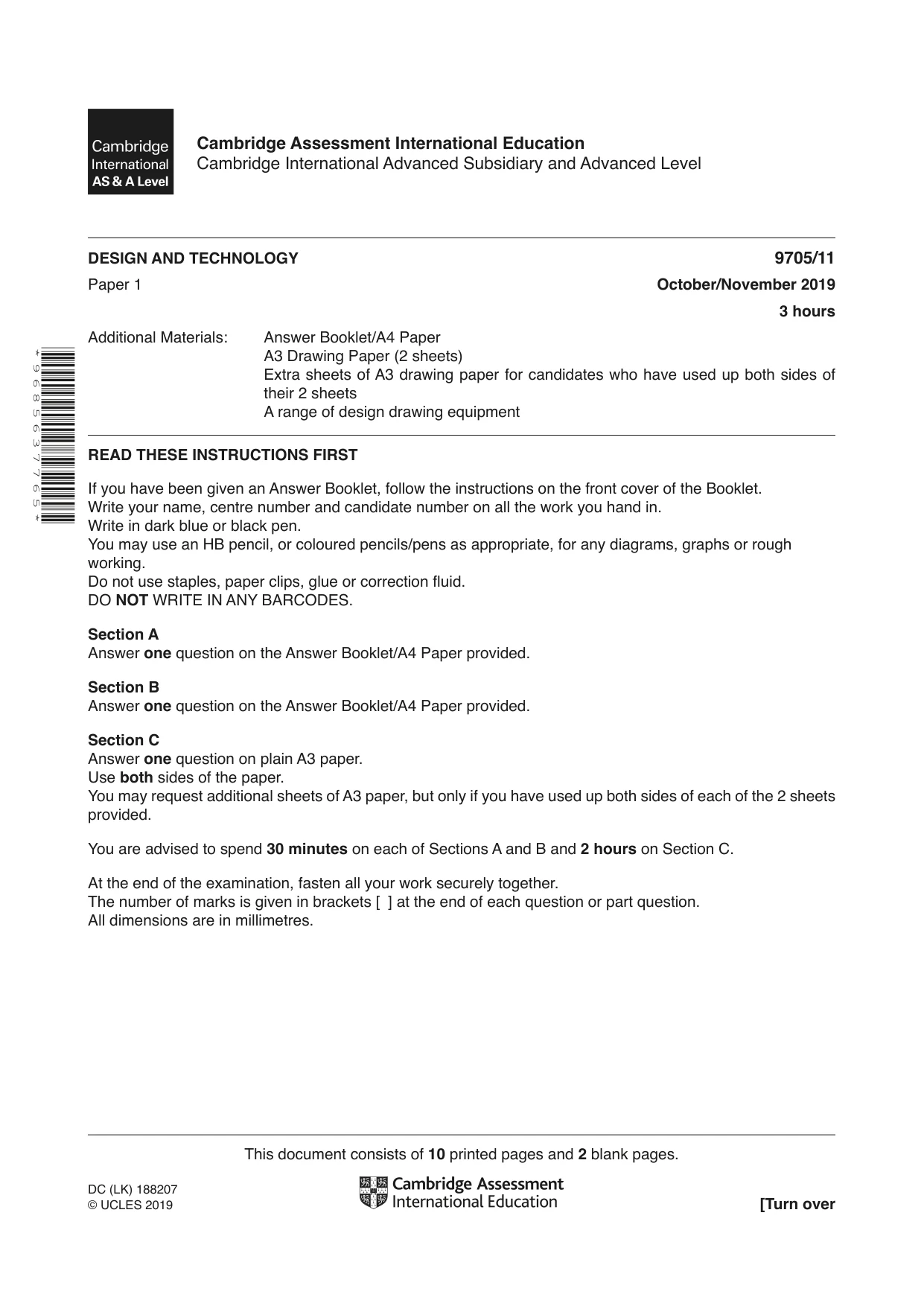
This document consists of 10 printed pages and 2 blank pages. DC (LK) 188207 © UCLES 2019 [Turn over * 9 6 8 5 6 3 7 7 6 5 * DESIGN AND TECHNOLOGY 9705/11 Paper 1 October/November 2019 3 hours Additional Materials: Answer Booklet/A4 Paper A3 Drawing Paper (2 sheets) Extra sheets of A3 drawing paper for candidates who have used up both sides of their 2 sheets A range of design drawing equipment READ THESE INSTRUCTIONS FIRST If you have been given an Answer Booklet, follow the instructions on the front cover of the Booklet. Write your name, centre number and candidate number on all the work you hand in. Write in dark blue or black pen. You may use an HB pencil, or coloured pencils/pens as appropriate, for any diagrams, graphs or rough working. Do not use staples, paper clips, glue or correction fluid. DO NOT WRITE IN ANY BARCODES. Section A Answer one question on the Answer Booklet/A4 Paper provided. Section B Answer one question on the Answer Booklet/A4 Paper provided. Section C Answer one question on plain A3 paper. Use both sides of the paper. You may request additional sheets of A3 paper, but only if you have used up both sides of each of the 2 sheets provided. You are advised to spend 30 minutes on each of Sections A and B and 2 hours on Section C. At the end of the examination, fasten all your work securely together. The number of marks is given in brackets [ ] at the end of each question or part question. All dimensions are in millimetres. Cambridge Assessment International Education Cambridge International Advanced Subsidiary and Advanced Level
Question paper, page 2
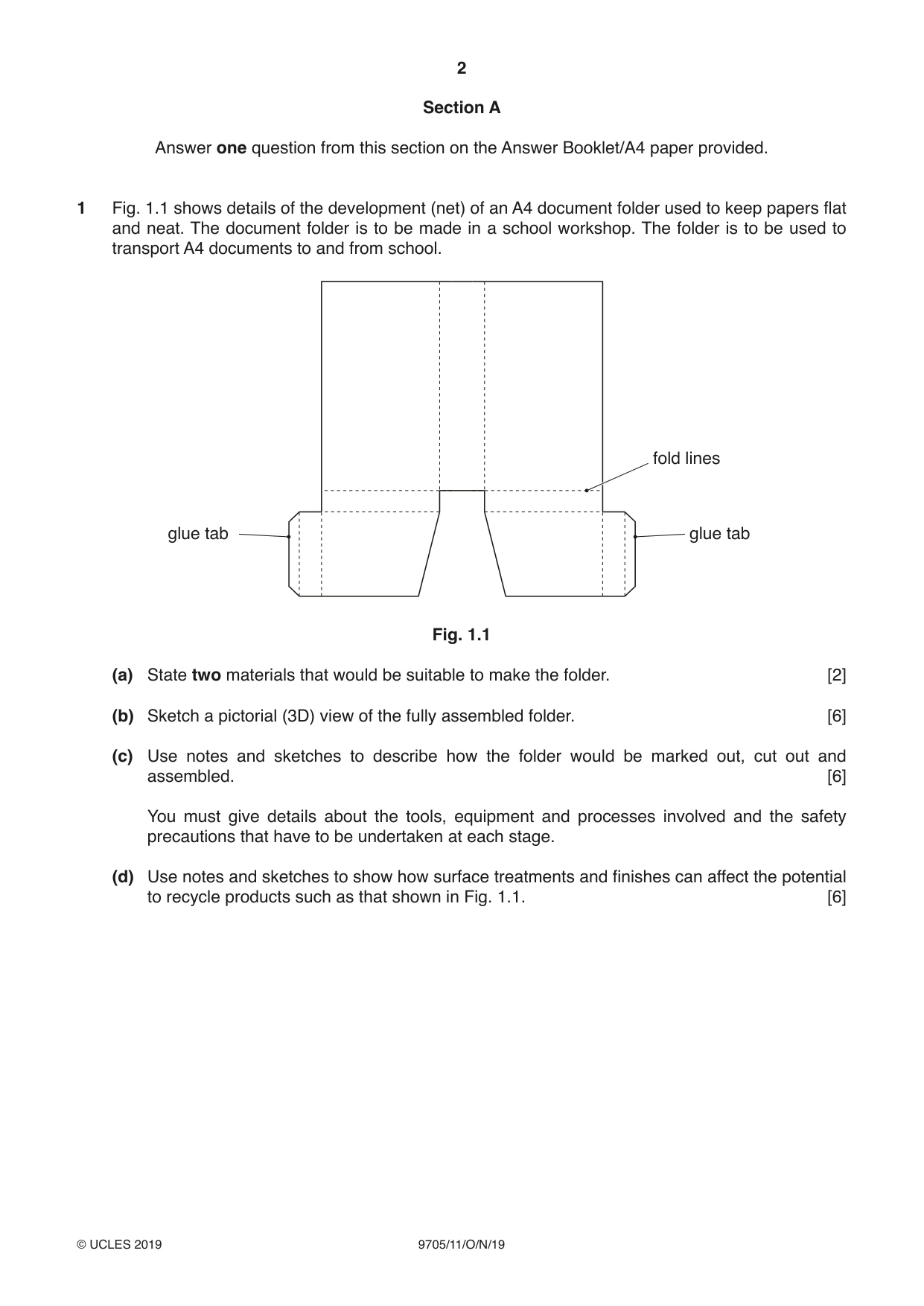
2 9705/11/O/N/19 © UCLES 2019 Section A Answer one question from this section on the Answer Booklet/A4 paper provided. 1 Fig. 1.1 shows details of the development (net) of an A4 document folder used to keep papers flat and neat. The document folder is to be made in a school workshop. The folder is to be used to transport A4 documents to and from school. fold lines glue tab glue tab Fig. 1.1 (a) State two materials that would be suitable to make the folder. [2] (b) Sketch a pictorial (3D) view of the fully assembled folder. [6] (c) Use notes and sketches to describe how the folder would be marked out, cut out and assembled. [6] You must give details about the tools, equipment and processes involved and the safety precautions that have to be undertaken at each stage. (d) Use notes and sketches to show how surface treatments and finishes can affect the potential to recycle products such as that shown in Fig. 1.1. [6]
Question paper, page 3
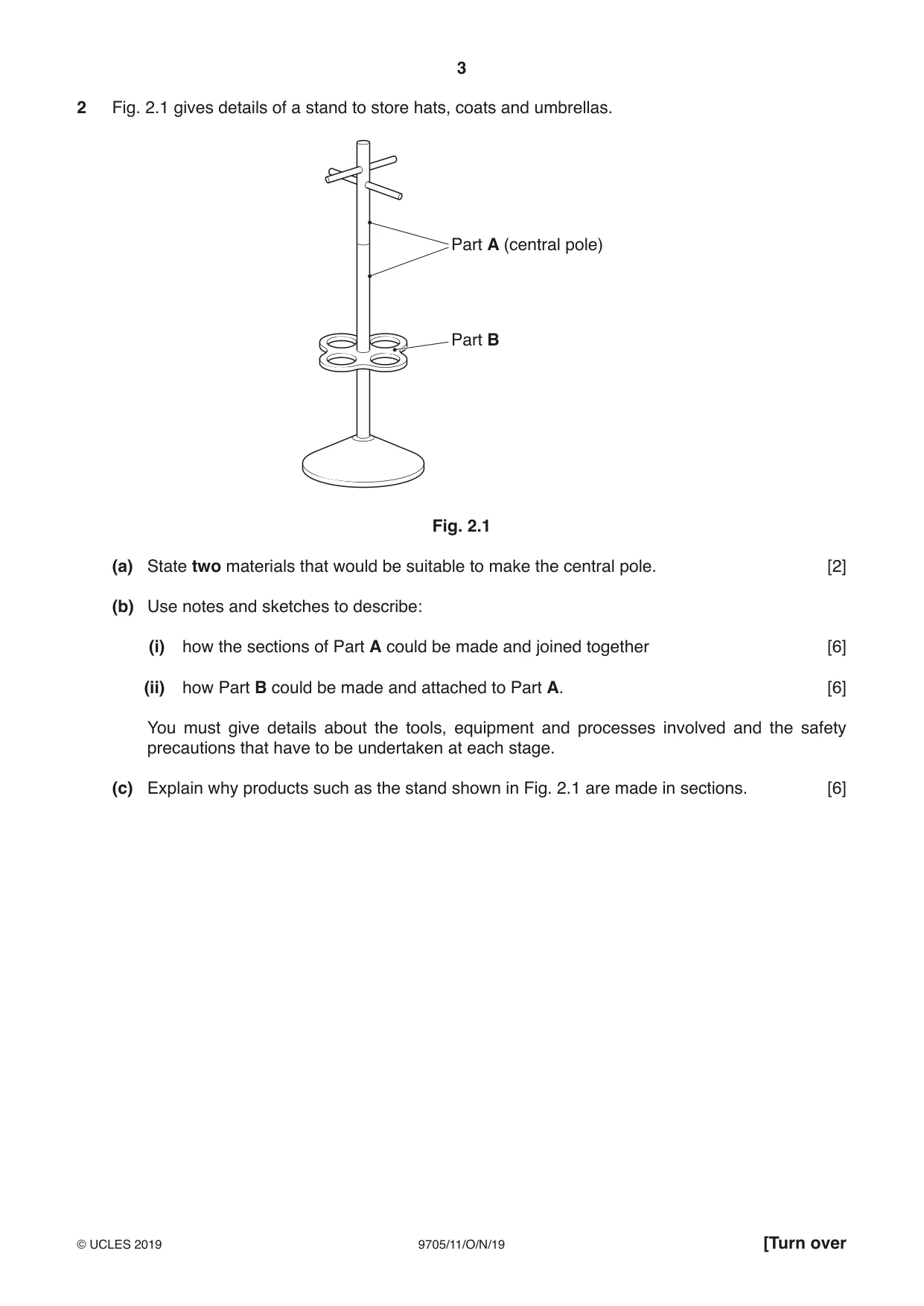
3 9705/11/O/N/19 © UCLES 2019 [Turn over 2 Fig. 2.1 gives details of a stand to store hats, coats and umbrellas. Part A (central pole) Part B Fig. 2.1 (a) State two materials that would be suitable to make the central pole. [2] (b) Use notes and sketches to describe: (i) how the sections of Part A could be made and joined together [6] (ii) how Part B could be made and attached to Part A. [6] You must give details about the tools, equipment and processes involved and the safety precautions that have to be undertaken at each stage. (c) Explain why products such as the stand shown in Fig. 2.1 are made in sections. [6]
Question paper, page 4
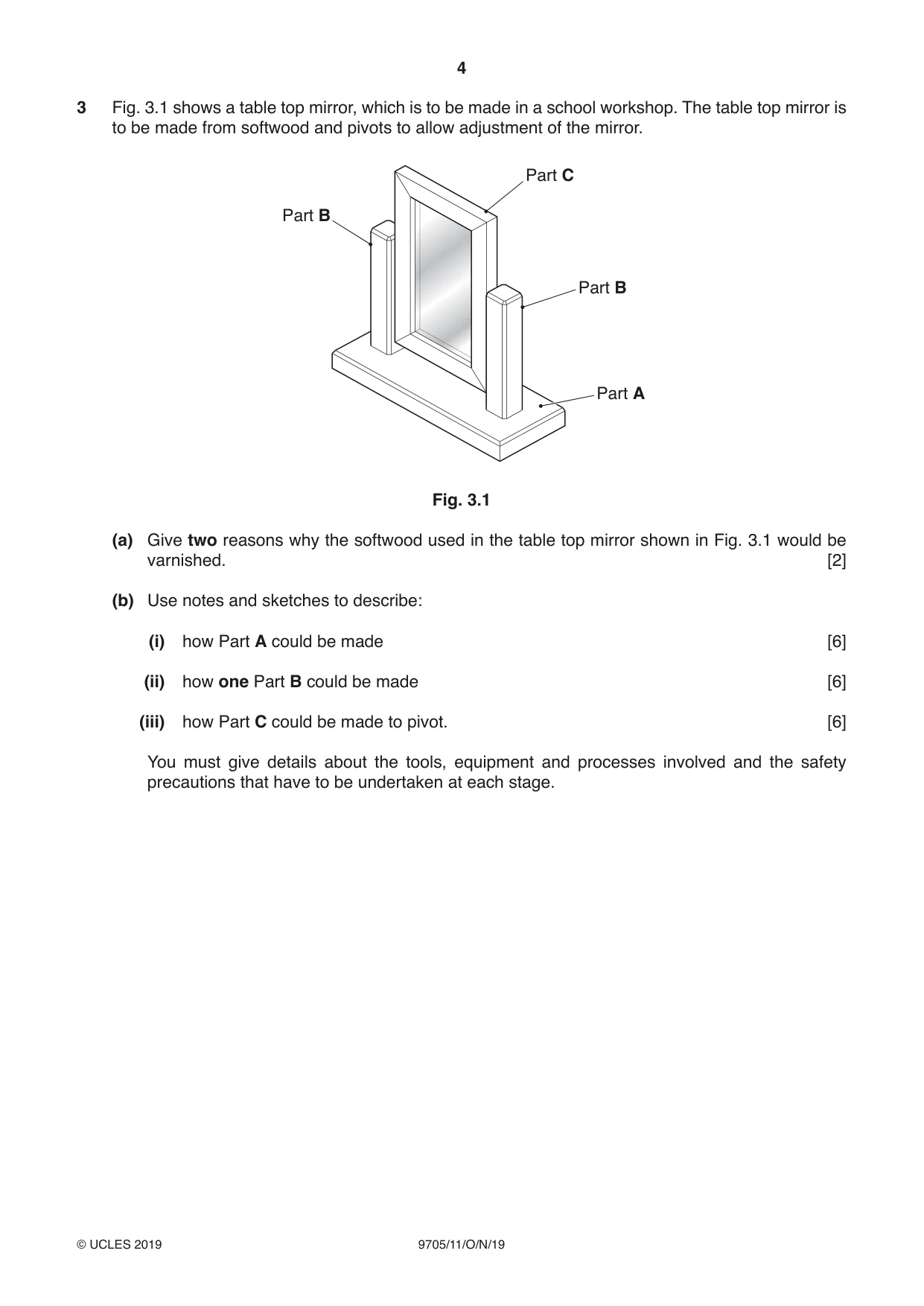
4 9705/11/O/N/19 © UCLES 2019 3 Fig. 3.1 shows a table top mirror, which is to be made in a school workshop. The table top mirror is to be made from softwood and pivots to allow adjustment of the mirror. Part A Part B Part C Part B Fig. 3.1 (a) Give two reasons why the softwood used in the table top mirror shown in Fig. 3.1 would be varnished. [2] (b) Use notes and sketches to describe: (i) how Part A could be made [6] (ii) how one Part B could be made [6] (iii) how Part C could be made to pivot. [6] You must give details about the tools, equipment and processes involved and the safety precautions that have to be undertaken at each stage.
Question paper, page 5
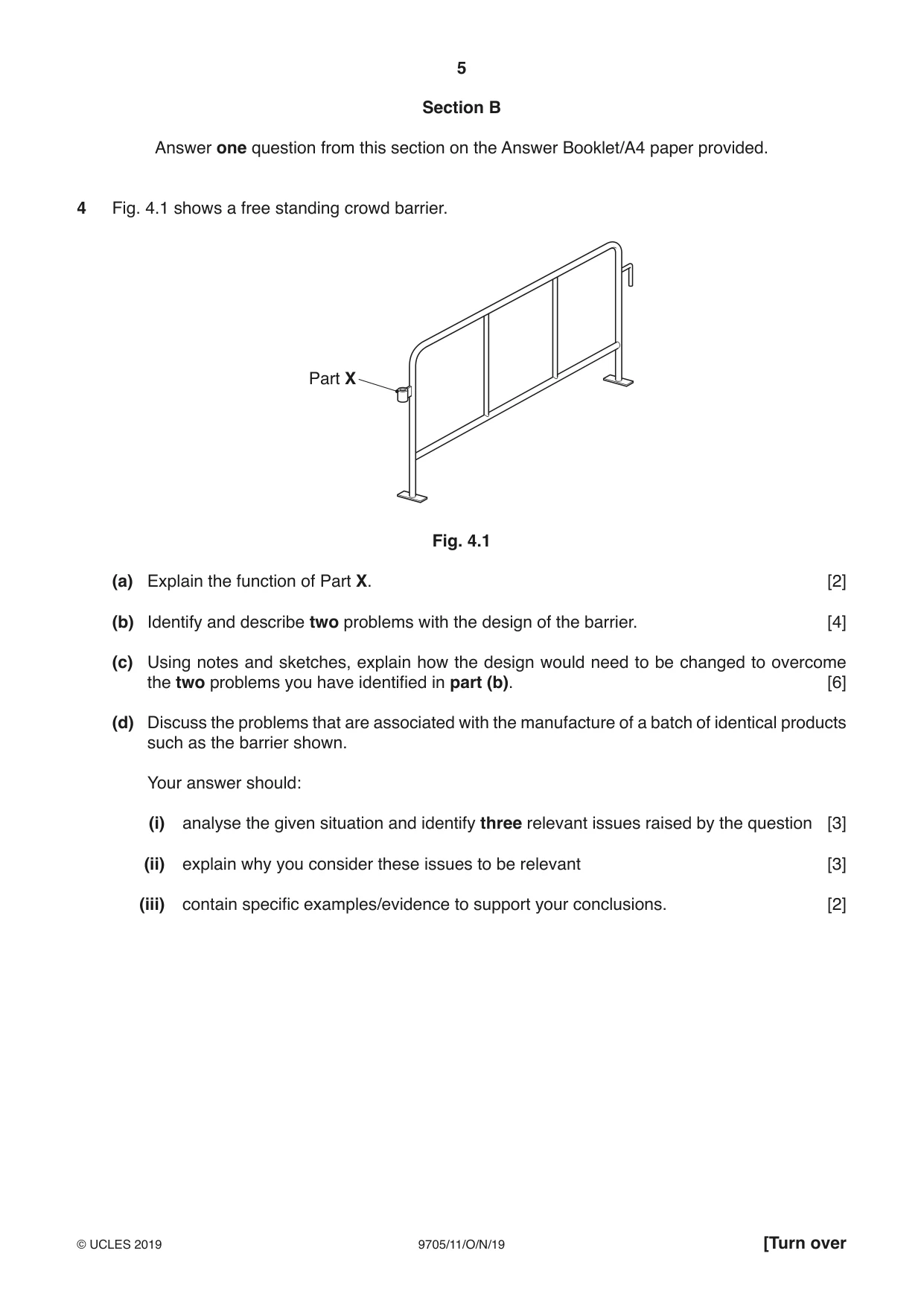
5 9705/11/O/N/19 © UCLES 2019 [Turn over Section B Answer one question from this section on the Answer Booklet/A4 paper provided. 4 Fig. 4.1 shows a free standing crowd barrier. Part X Fig. 4.1 (a) Explain the function of Part X. [2] (b) Identify and describe two problems with the design of the barrier. [4] (c) Using notes and sketches, explain how the design would need to be changed to overcome the two problems you have identified in part (b). [6] (d) Discuss the problems that are associated with the manufacture of a batch of identical products such as the barrier shown. Your answer should: (i) analyse the given situation and identify three relevant issues raised by the question [3] (ii) explain why you consider these issues to be relevant [3] (iii) contain specific examples/evidence to support your conclusions. [2]
Question paper, page 6
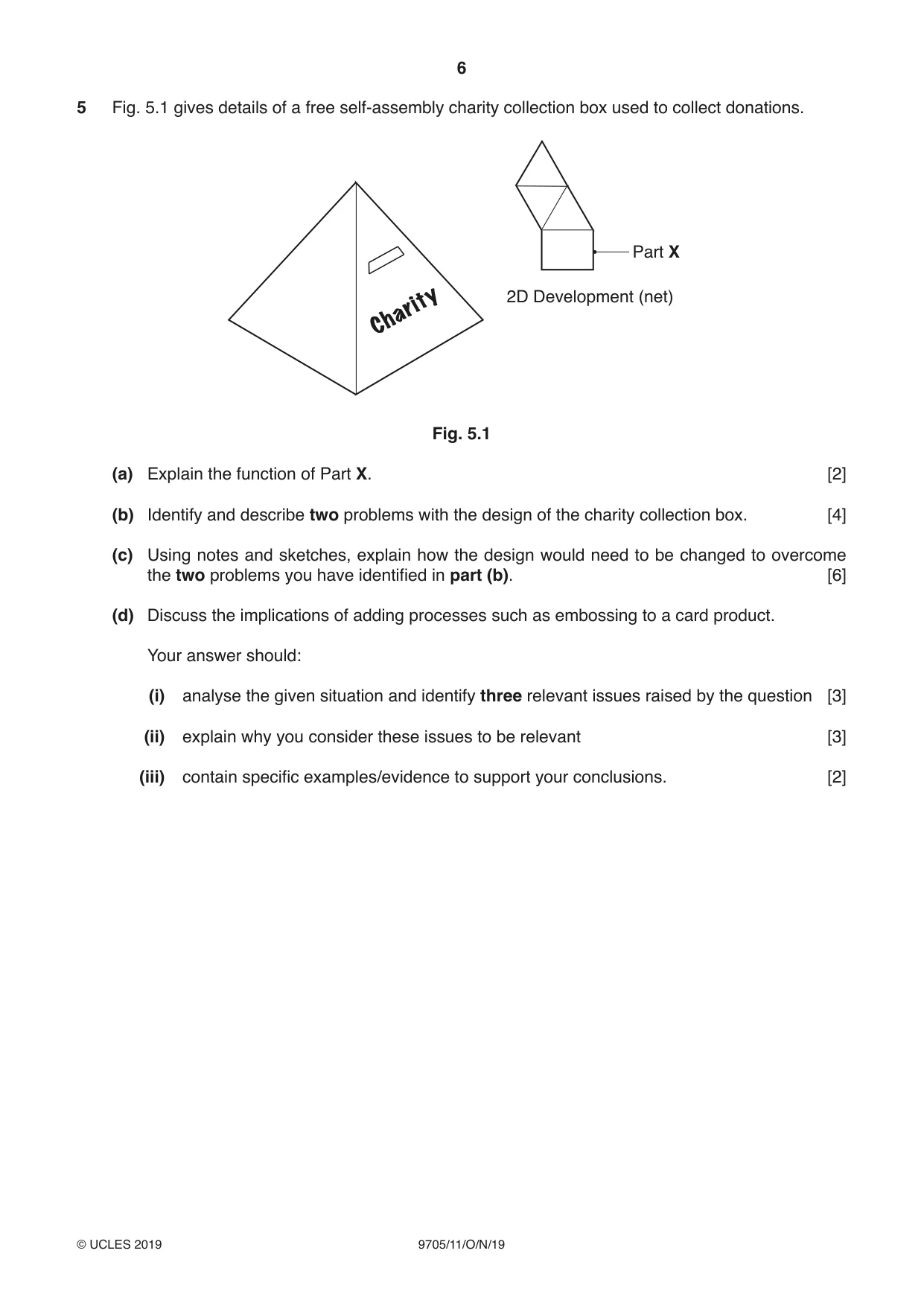
6 9705/11/O/N/19 © UCLES 2019 5 Fig. 5.1 gives details of a free self-assembly charity collection box used to collect donations. Part X 2D Development (net) Fig. 5.1 (a) Explain the function of Part X. [2] (b) Identify and describe two problems with the design of the charity collection box. [4] (c) Using notes and sketches, explain how the design would need to be changed to overcome the two problems you have identified in part (b). [6] (d) Discuss the implications of adding processes such as embossing to a card product. Your answer should: (i) analyse the given situation and identify three relevant issues raised by the question [3] (ii) explain why you consider these issues to be relevant [3] (iii) contain specific examples/evidence to support your conclusions. [2]
Question paper, page 7
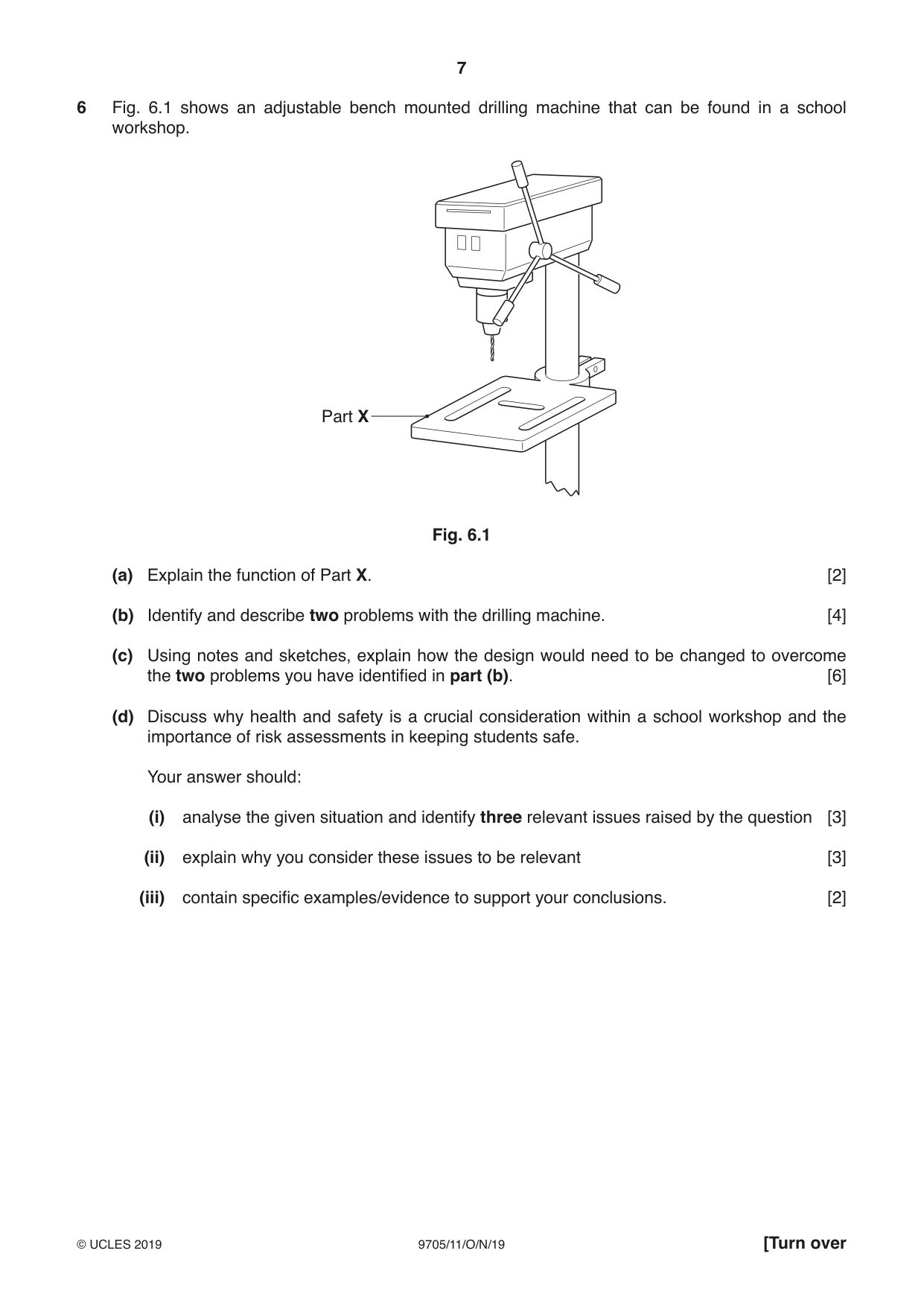
7 9705/11/O/N/19 © UCLES 2019 [Turn over 6 Fig. 6.1 shows an adjustable bench mounted drilling machine that can be found in a school workshop. Part X Fig. 6.1 (a) Explain the function of Part X. [2] (b) Identify and describe two problems with the drilling machine. [4] (c) Using notes and sketches, explain how the design would need to be changed to overcome the two problems you have identified in part (b). [6] (d) Discuss why health and safety is a crucial consideration within a school workshop and the importance of risk assessments in keeping students safe. Your answer should: (i) analyse the given situation and identify three relevant issues raised by the question [3] (ii) explain why you consider these issues to be relevant [3] (iii) contain specific examples/evidence to support your conclusions. [2]
Question paper, page 8
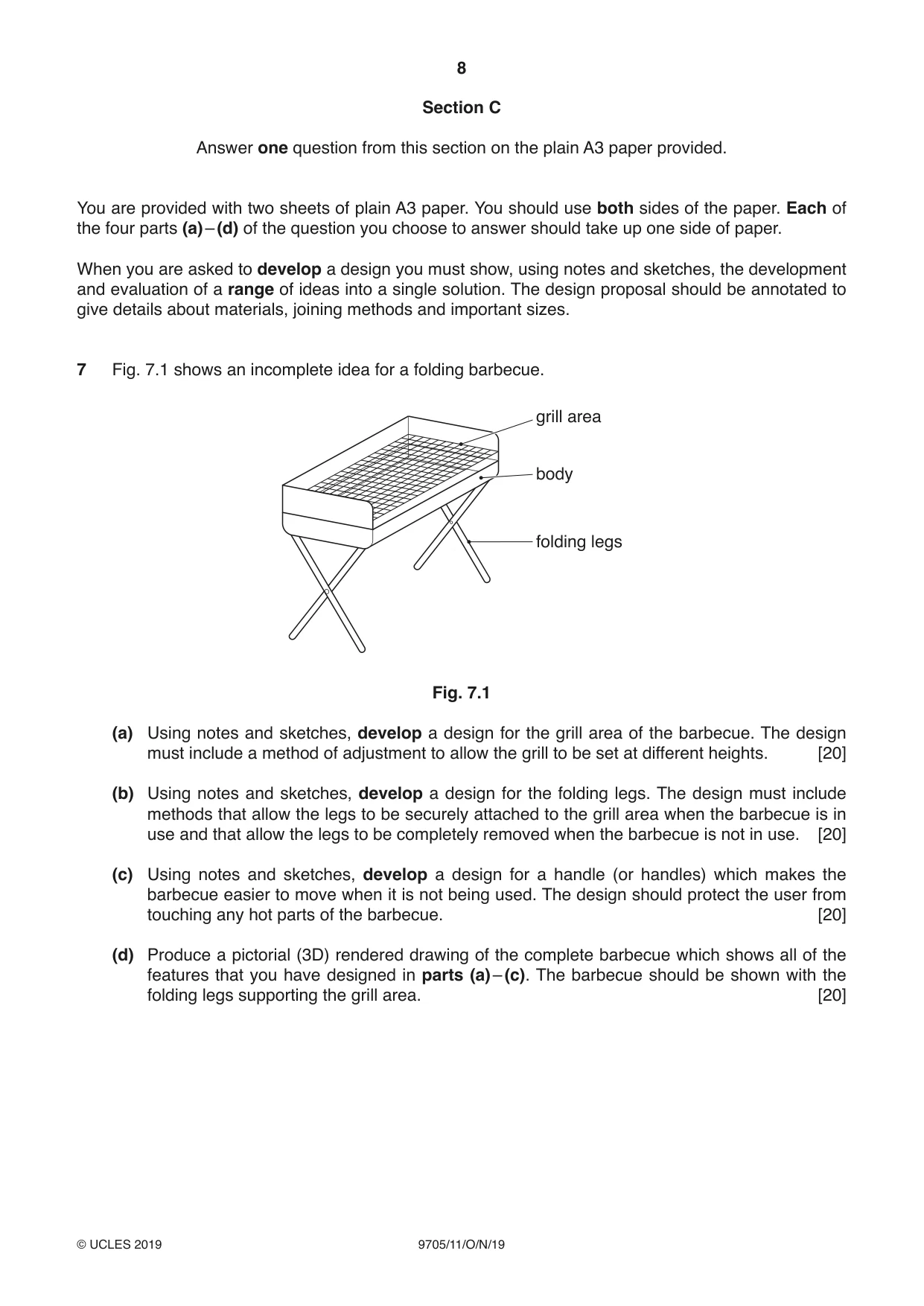
8 9705/11/O/N/19 © UCLES 2019 Section C Answer one question from this section on the plain A3 paper provided. You are provided with two sheets of plain A3 paper. You should use both sides of the paper. Each of the four parts (a) – (d) of the question you choose to answer should take up one side of paper. When you are asked to develop a design you must show, using notes and sketches, the development and evaluation of a range of ideas into a single solution. The design proposal should be annotated to give details about materials, joining methods and important sizes. 7 Fig. 7.1 shows an incomplete idea for a folding barbecue. folding legs body grill area Fig. 7.1 (a) Using notes and sketches, develop a design for the grill area of the barbecue. The design must include a method of adjustment to allow the grill to be set at different heights. [20] (b) Using notes and sketches, develop a design for the folding legs. The design must include methods that allow the legs to be securely attached to the grill area when the barbecue is in use and that allow the legs to be completely removed when the barbecue is not in use. [20] (c) Using notes and sketches, develop a design for a handle (or handles) which makes the barbecue easier to move when it is not being used. The design should protect the user from touching any hot parts of the barbecue. [20] (d) Produce a pictorial (3D) rendered drawing of the complete barbecue which shows all of the features that you have designed in parts (a) – (c). The barbecue should be shown with the folding legs supporting the grill area. [20]
Question paper, page 9
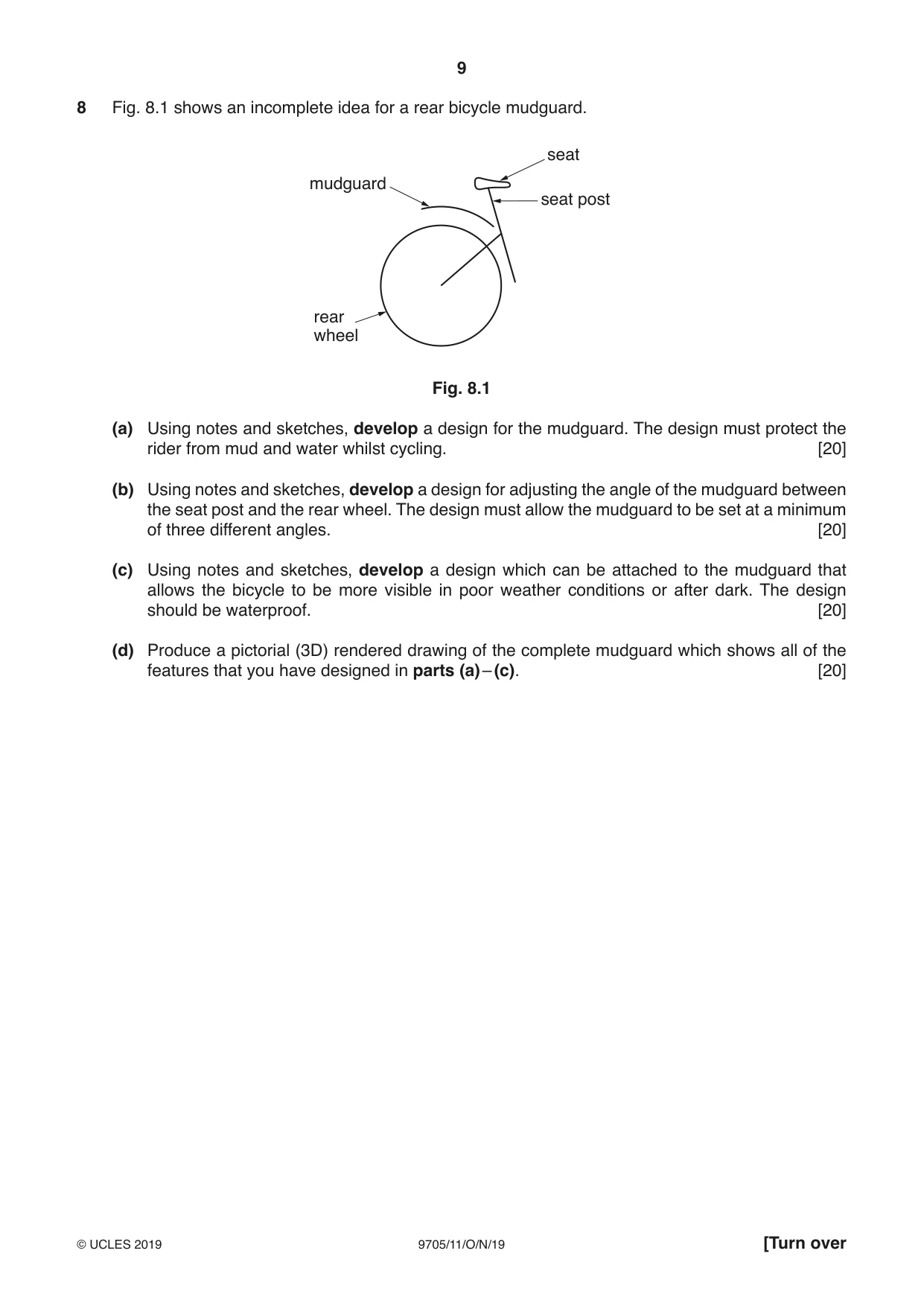
9 9705/11/O/N/19 © UCLES 2019 [Turn over 8 Fig. 8.1 shows an incomplete idea for a rear bicycle mudguard. seat post seat mudguard rear wheel Fig. 8.1 (a) Using notes and sketches, develop a design for the mudguard. The design must protect the rider from mud and water whilst cycling. [20] (b) Using notes and sketches, develop a design for adjusting the angle of the mudguard between the seat post and the rear wheel. The design must allow the mudguard to be set at a minimum of three different angles. [20] (c) Using notes and sketches, develop a design which can be attached to the mudguard that allows the bicycle to be more visible in poor weather conditions or after dark. The design should be waterproof. [20] (d) Produce a pictorial (3D) rendered drawing of the complete mudguard which shows all of the features that you have designed in parts (a) – (c). [20]
Question paper, page 10
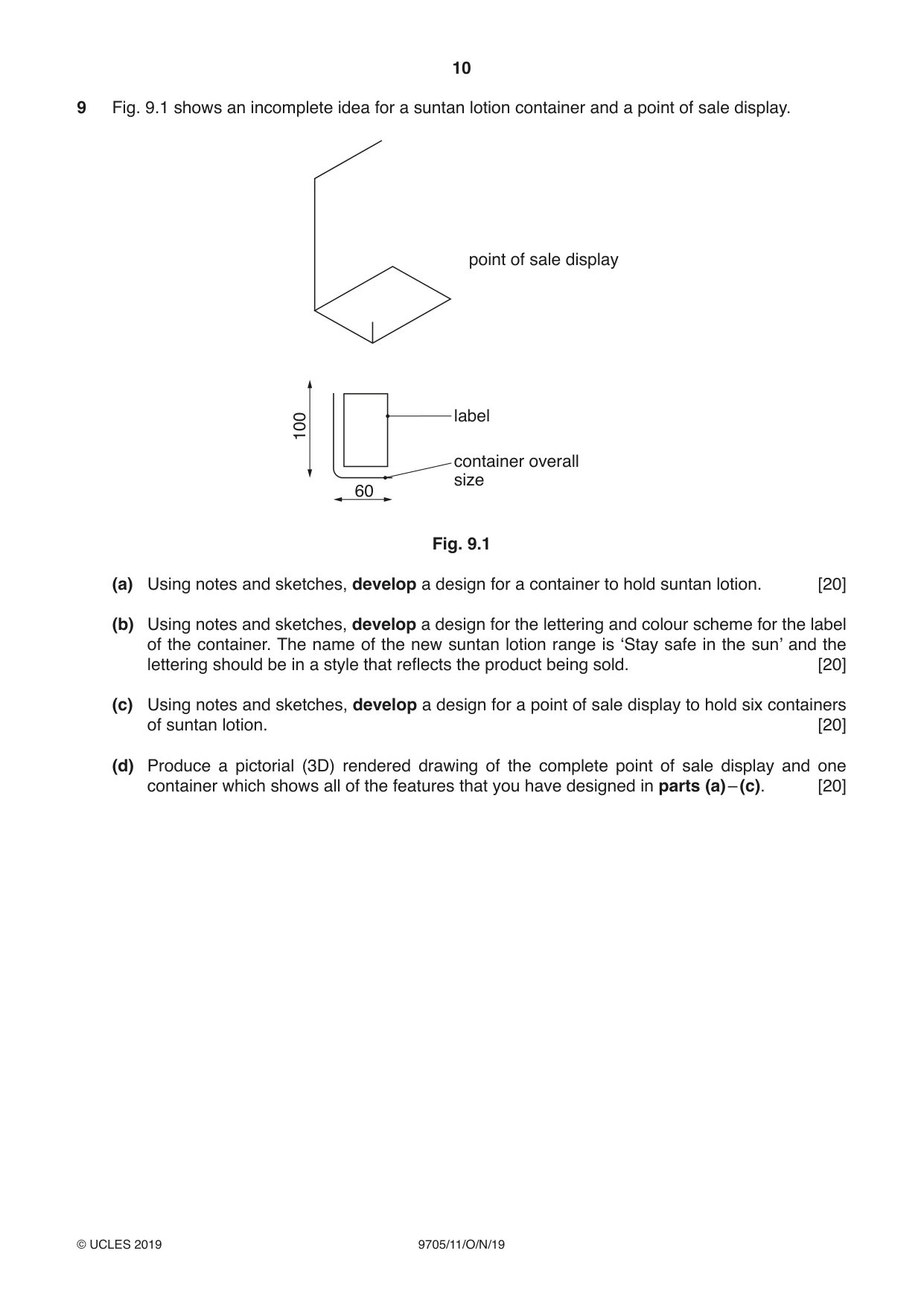
10 9705/11/O/N/19 © UCLES 2019 9 Fig. 9.1 shows an incomplete idea for a suntan lotion container and a point of sale display. point of sale display 60 100 label container overall size Fig. 9.1 (a) Using notes and sketches, develop a design for a container to hold suntan lotion. [20] (b) Using notes and sketches, develop a design for the lettering and colour scheme for the label of the container. The name of the new suntan lotion range is ‘Stay safe in the sun’ and the lettering should be in a style that reflects the product being sold. [20] (c) Using notes and sketches, develop a design for a point of sale display to hold six containers of suntan lotion. [20] (d) Produce a pictorial (3D) rendered drawing of the complete point of sale display and one container which shows all of the features that you have designed in parts (a) – (c). [20]
Question paper, page 11
11 9705/11/O/N/19 © UCLES 2019 BLANK PAGE
Question paper, page 12
12 9705/11/O/N/19 © UCLES 2019 Permission to reproduce items where third-party owned material protected by copyright is included has been sought and cleared where possible. Every reasonable effort has been made by the publisher (UCLES) to trace copyright holders, but if any items requiring clearance have unwittingly been included, the publisher will be pleased to make amends at the earliest possible opportunity. To avoid the issue of disclosure of answer-related information to candidates, all copyright acknowledgements are reproduced online in the Cambridge Assessment International Education Copyright Acknowledgements Booklet. This is produced for each series of examinations and is freely available to download at www.cambridgeinternational.org after the live examination series. Cambridge Assessment International Education is part of the Cambridge Assessment Group. Cambridge Assessment is the brand name of the University of Cambridge Local Examinations Syndicate (UCLES), which itself is a department of the University of Cambridge. BLANK PAGE
Mark scheme, page 1
This document consists of 16 printed pages. © UCLES 2019 [Turn over Cambridge Assessment International Education Cambridge International Advanced Subsidiary and Advanced Level DESIGN AND TECHNOLOGY 9705/11 Paper 1 October/November 2019 MARK SCHEME Maximum Mark: 120 Published This mark scheme is published as an aid to teachers and candidates, to indicate the requirements of the examination. It shows the basis on which Examiners were instructed to award marks. It does not indicate the details of the discussions that took place at an Examiners’ meeting before marking began, which would have considered the acceptability of alternative answers. Mark schemes should be read in conjunction with the question paper and the Principal Examiner Report for Teachers. Cambridge International will not enter into discussions about these mark schemes. Cambridge International is publishing the mark schemes for the October/November 2019 series for most Cambridge IGCSE™, Cambridge International A and AS Level components and some Cambridge O Level components.
Mark scheme, page 2
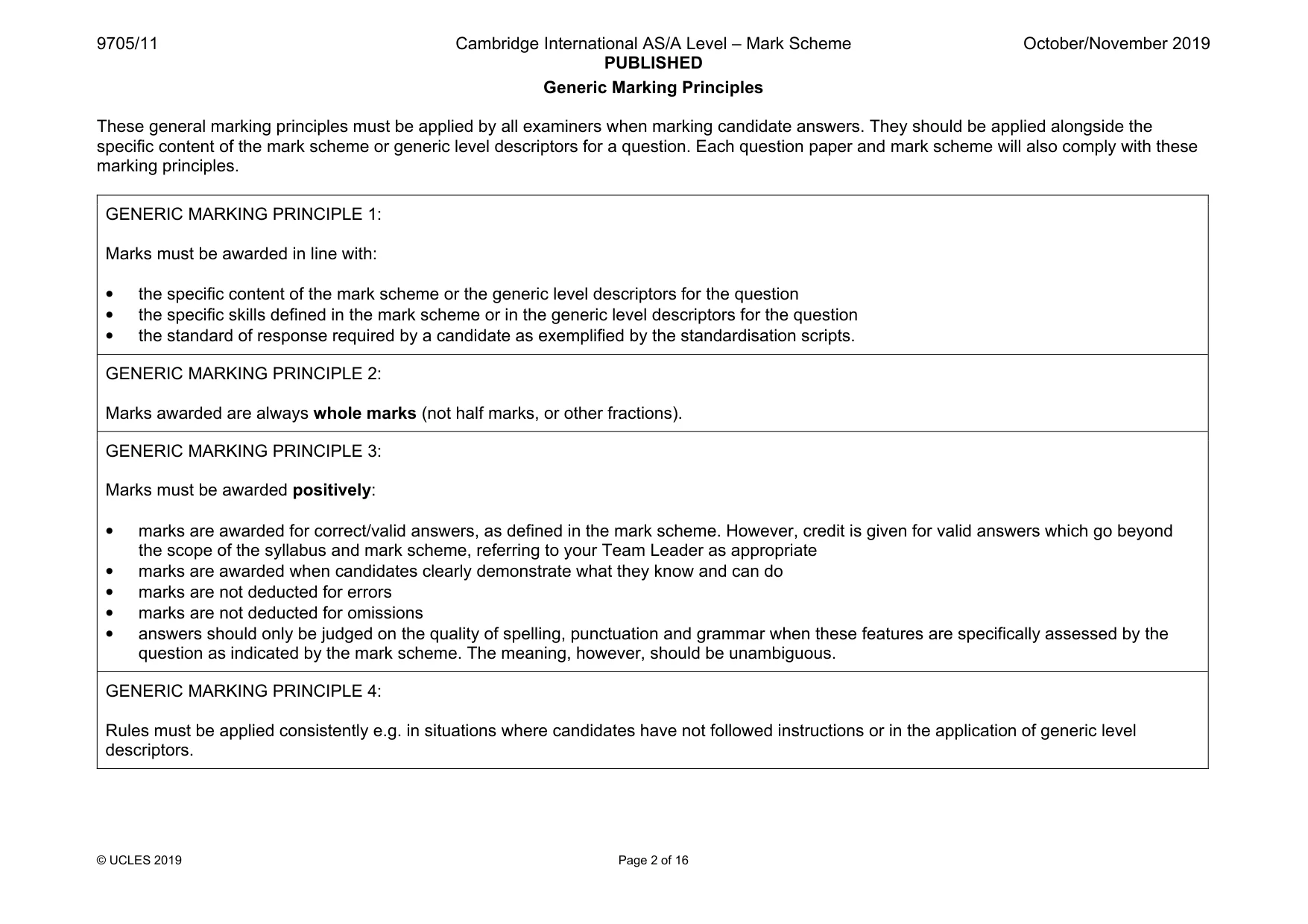
9705/11 Cambridge International AS/A Level – Mark Scheme PUBLISHED October/November 2019 © UCLES 2019 Page 2 of 16 Generic Marking Principles These general marking principles must be applied by all examiners when marking candidate answers. They should be applied alongside the specific content of the mark scheme or generic level descriptors for a question. Each question paper and mark scheme will also comply with these marking principles. GENERIC MARKING PRINCIPLE 1: Marks must be awarded in line with: • the specific content of the mark scheme or the generic level descriptors for the question • the specific skills defined in the mark scheme or in the generic level descriptors for the question • the standard of response required by a candidate as exemplified by the standardisation scripts. GENERIC MARKING PRINCIPLE 2: Marks awarded are always whole marks (not half marks, or other fractions). GENERIC MARKING PRINCIPLE 3: Marks must be awarded positively: • marks are awarded for correct/valid answers, as defined in the mark scheme. However, credit is given for valid answers which go beyond the scope of the syllabus and mark scheme, referring to your Team Leader as appropriate • marks are awarded when candidates clearly demonstrate what they know and can do • marks are not deducted for errors • marks are not deducted for omissions • answers should only be judged on the quality of spelling, punctuation and grammar when these features are specifically assessed by the question as indicated by the mark scheme. The meaning, however, should be unambiguous. GENERIC MARKING PRINCIPLE 4: Rules must be applied consistently e.g. in situations where candidates have not followed instructions or in the application of generic level descriptors.
Mark scheme, page 3
9705/11 Cambridge International AS/A Level – Mark Scheme PUBLISHED October/November 2019 © UCLES 2019 Page 3 of 16 GENERIC MARKING PRINCIPLE 5: Marks should be awarded using the full range of marks defined in the mark scheme for the question (however; the use of the full mark range may be limited according to the quality of the candidate responses seen). GENERIC MARKING PRINCIPLE 6: Marks awarded are based solely on the requirements as defined in the mark scheme. Marks should not be awarded with grade thresholds or grade descriptors in mind.
Mark scheme, page 4
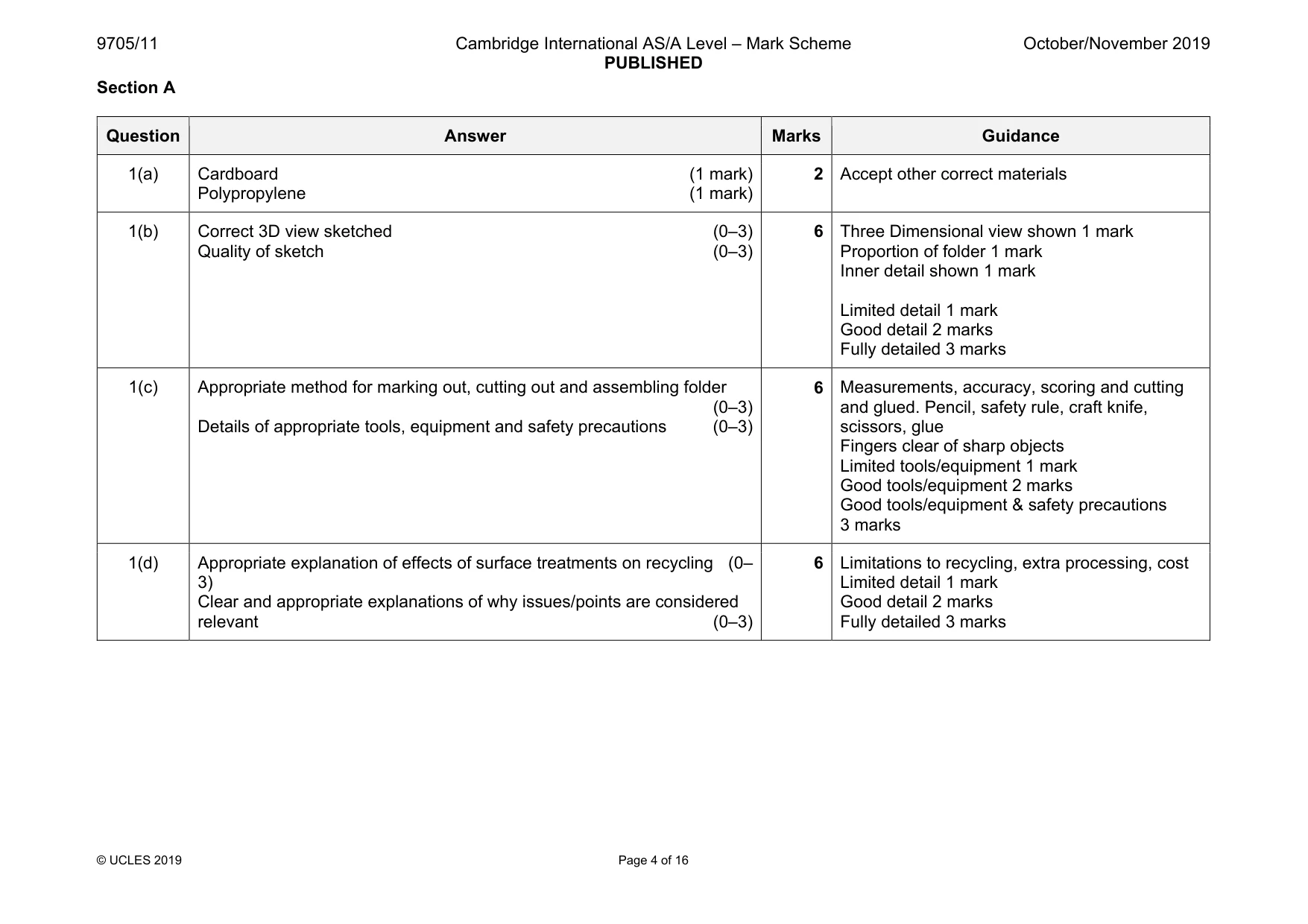
9705/11 Cambridge International AS/A Level – Mark Scheme PUBLISHED October/November 2019 © UCLES 2019 Page 4 of 16 Section A Question Answer Marks Guidance 1(a) Cardboard (1 mark) Polypropylene (1 mark) 2 Accept other correct materials 1(b) Correct 3D view sketched (0–3) Quality of sketch (0–3) 6 Three Dimensional view shown 1 mark Proportion of folder 1 mark Inner detail shown 1 mark Limited detail 1 mark Good detail 2 marks Fully detailed 3 marks 1(c) Appropriate method for marking out, cutting out and assembling folder (0–3) Details of appropriate tools, equipment and safety precautions (0–3) 6 Measurements, accuracy, scoring and cutting and glued. Pencil, safety rule, craft knife, scissors, glue Fingers clear of sharp objects Limited tools/equipment 1 mark Good tools/equipment 2 marks Good tools/equipment & safety precautions 3 marks 1(d) Appropriate explanation of effects of surface treatments on recycling (0– 3) Clear and appropriate explanations of why issues/points are considered relevant (0–3) 6 Limitations to recycling, extra processing, cost Limited detail 1 mark Good detail 2 marks Fully detailed 3 marks
Mark scheme, page 5
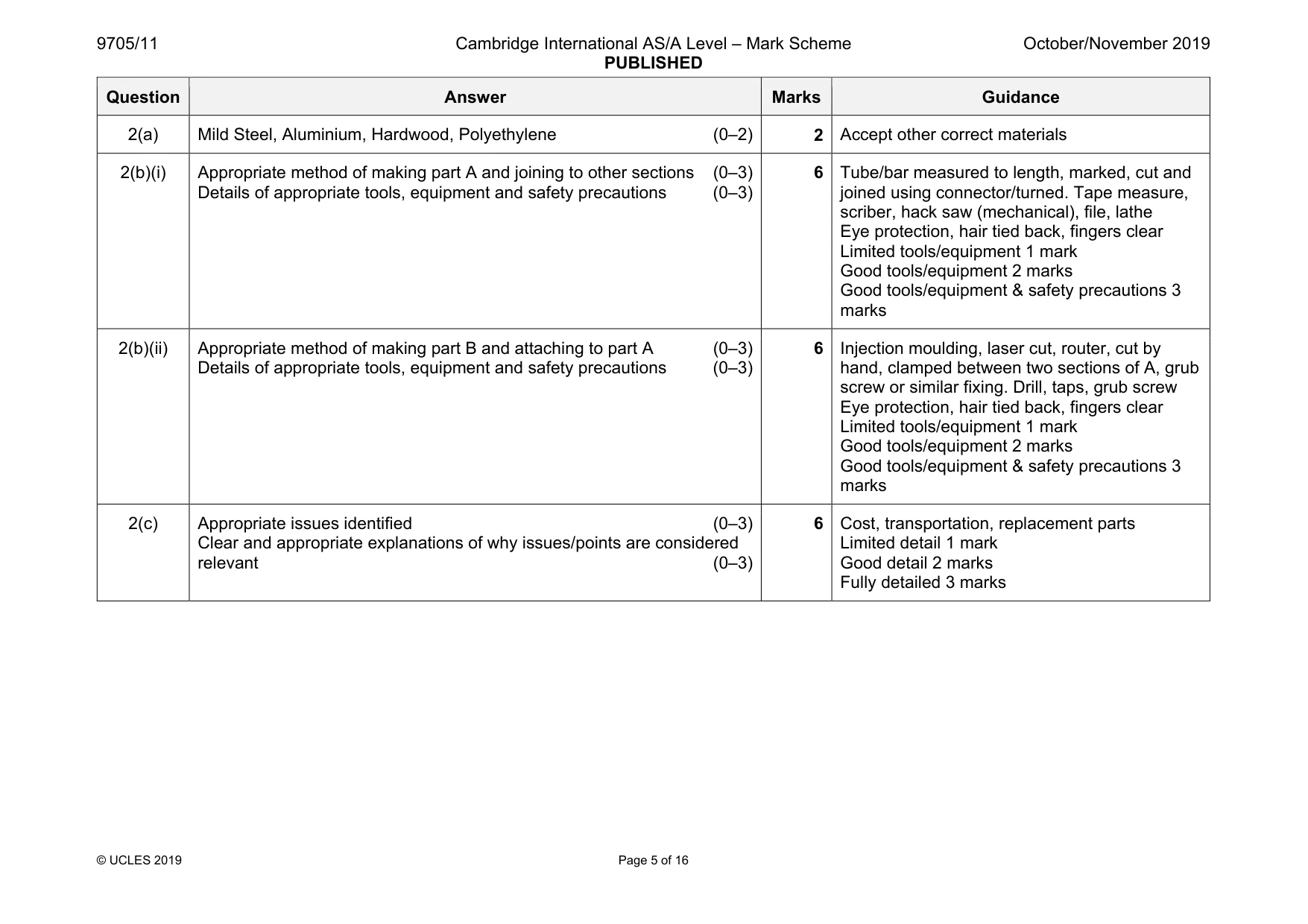
9705/11 Cambridge International AS/A Level – Mark Scheme PUBLISHED October/November 2019 © UCLES 2019 Page 5 of 16 Question Answer Marks Guidance 2(a) Mild Steel, Aluminium, Hardwood, Polyethylene (0–2) 2 Accept other correct materials 2(b)(i) Appropriate method of making part A and joining to other sections (0–3) Details of appropriate tools, equipment and safety precautions (0–3) 6 Tube/bar measured to length, marked, cut and joined using connector/turned. Tape measure, scriber, hack saw (mechanical), file, lathe Eye protection, hair tied back, fingers clear Limited tools/equipment 1 mark Good tools/equipment 2 marks Good tools/equipment & safety precautions 3 marks 2(b)(ii) Appropriate method of making part B and attaching to part A (0–3) Details of appropriate tools, equipment and safety precautions (0–3) 6 Injection moulding, laser cut, router, cut by hand, clamped between two sections of A, grub screw or similar fixing. Drill, taps, grub screw Eye protection, hair tied back, fingers clear Limited tools/equipment 1 mark Good tools/equipment 2 marks Good tools/equipment & safety precautions 3 marks 2(c) Appropriate issues identified (0–3) Clear and appropriate explanations of why issues/points are considered relevant (0–3) 6 Cost, transportation, replacement parts Limited detail 1 mark Good detail 2 marks Fully detailed 3 marks
Mark scheme, page 6
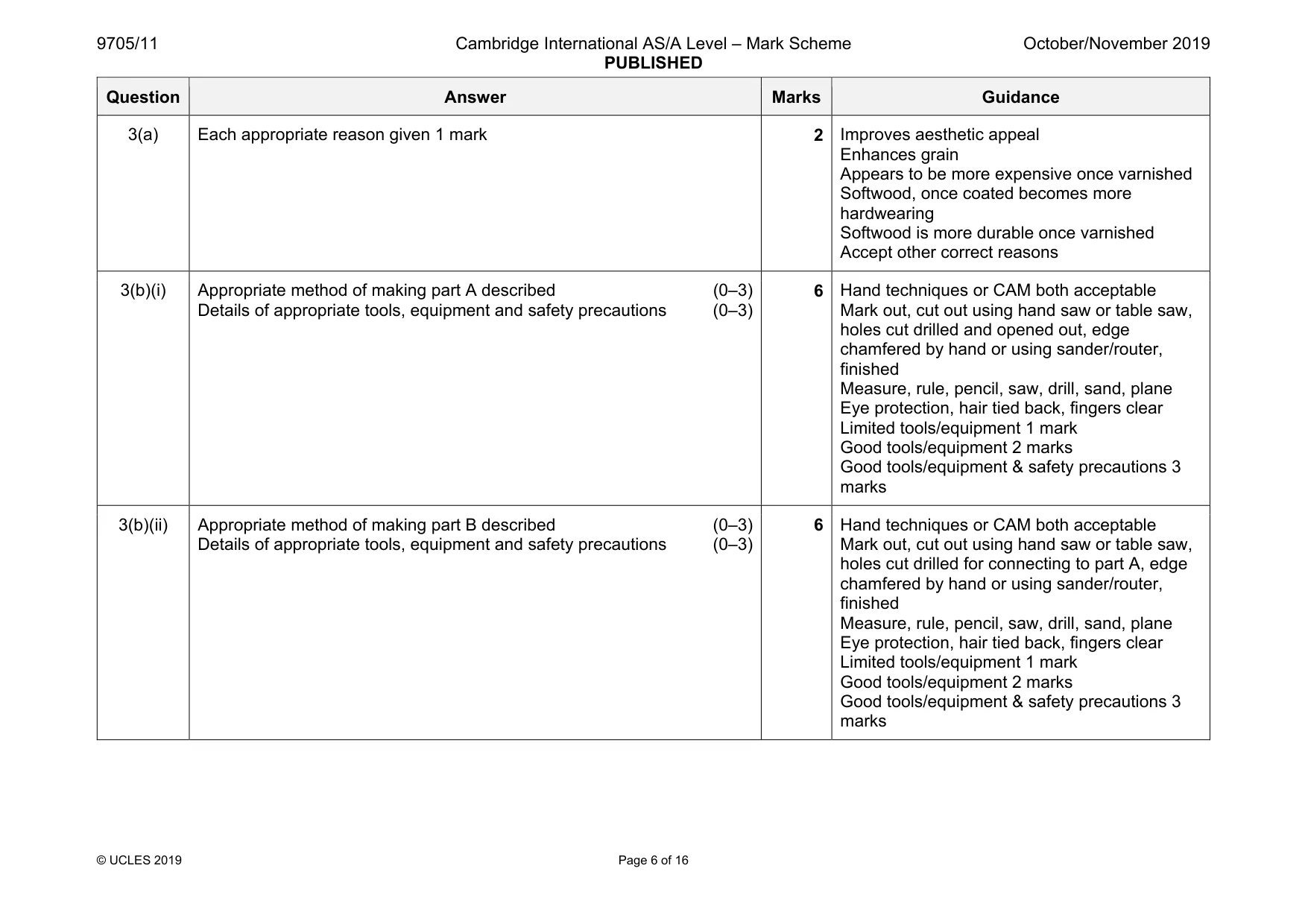
9705/11 Cambridge International AS/A Level – Mark Scheme PUBLISHED October/November 2019 © UCLES 2019 Page 6 of 16 Question Answer Marks Guidance 3(a) Each appropriate reason given 1 mark 2 Improves aesthetic appeal Enhances grain Appears to be more expensive once varnished Softwood, once coated becomes more hardwearing Softwood is more durable once varnished Accept other correct reasons 3(b)(i) Appropriate method of making part A described (0–3) Details of appropriate tools, equipment and safety precautions (0–3) 6 Hand techniques or CAM both acceptable Mark out, cut out using hand saw or table saw, holes cut drilled and opened out, edge chamfered by hand or using sander/router, finished Measure, rule, pencil, saw, drill, sand, plane Eye protection, hair tied back, fingers clear Limited tools/equipment 1 mark Good tools/equipment 2 marks Good tools/equipment & safety precautions 3 marks 3(b)(ii) Appropriate method of making part B described (0–3) Details of appropriate tools, equipment and safety precautions (0–3) 6 Hand techniques or CAM both acceptable Mark out, cut out using hand saw or table saw, holes cut drilled for connecting to part A, edge chamfered by hand or using sander/router, finished Measure, rule, pencil, saw, drill, sand, plane Eye protection, hair tied back, fingers clear Limited tools/equipment 1 mark Good tools/equipment 2 marks Good tools/equipment & safety precautions 3 marks
Mark scheme, page 7
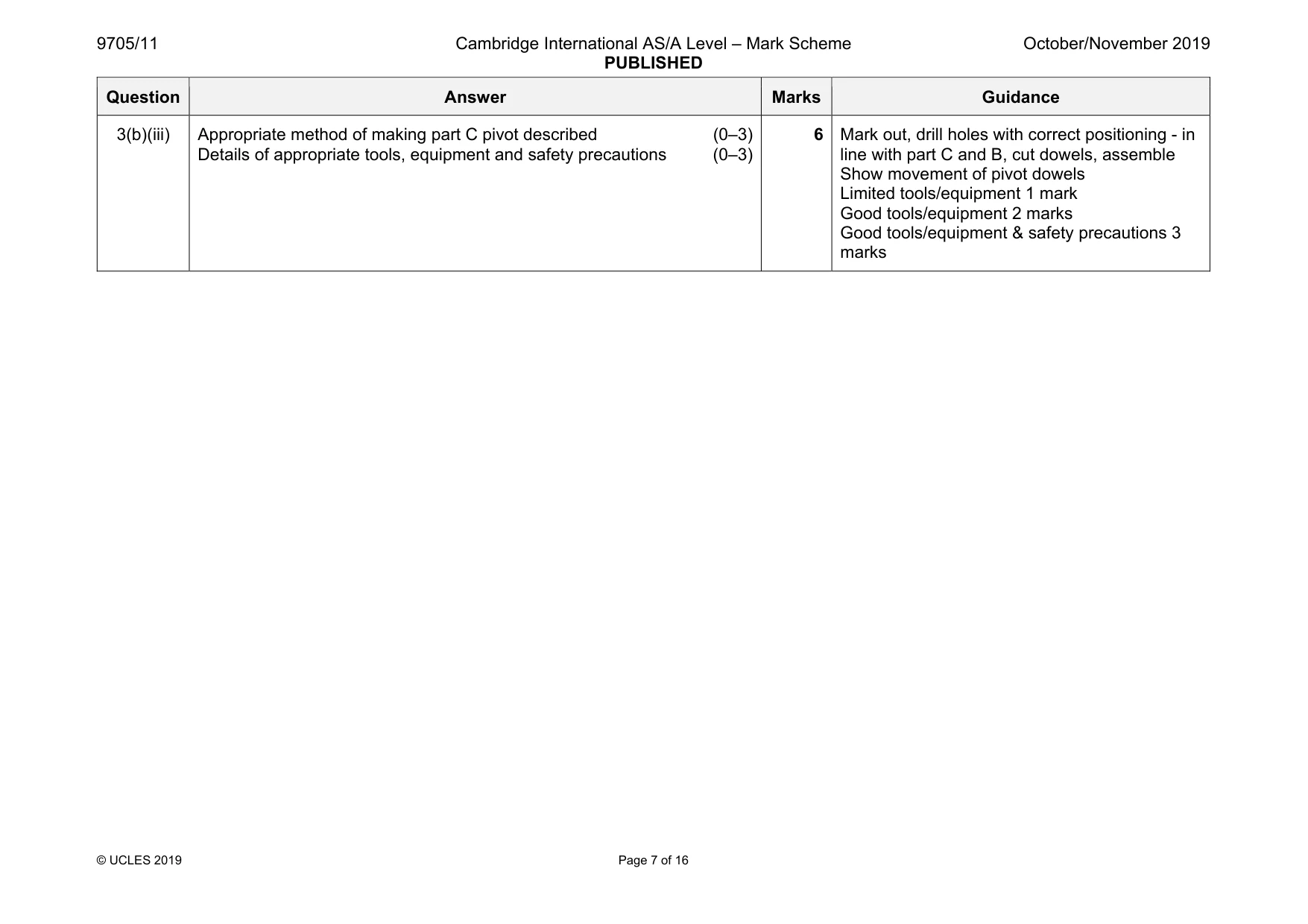
9705/11 Cambridge International AS/A Level – Mark Scheme PUBLISHED October/November 2019 © UCLES 2019 Page 7 of 16 Question Answer Marks Guidance 3(b)(iii) Appropriate method of making part C pivot described (0–3) Details of appropriate tools, equipment and safety precautions (0–3) 6 Mark out, drill holes with correct positioning - in line with part C and B, cut dowels, assemble Show movement of pivot dowels Limited tools/equipment 1 mark Good tools/equipment 2 marks Good tools/equipment & safety precautions 3 marks
Mark scheme, page 8
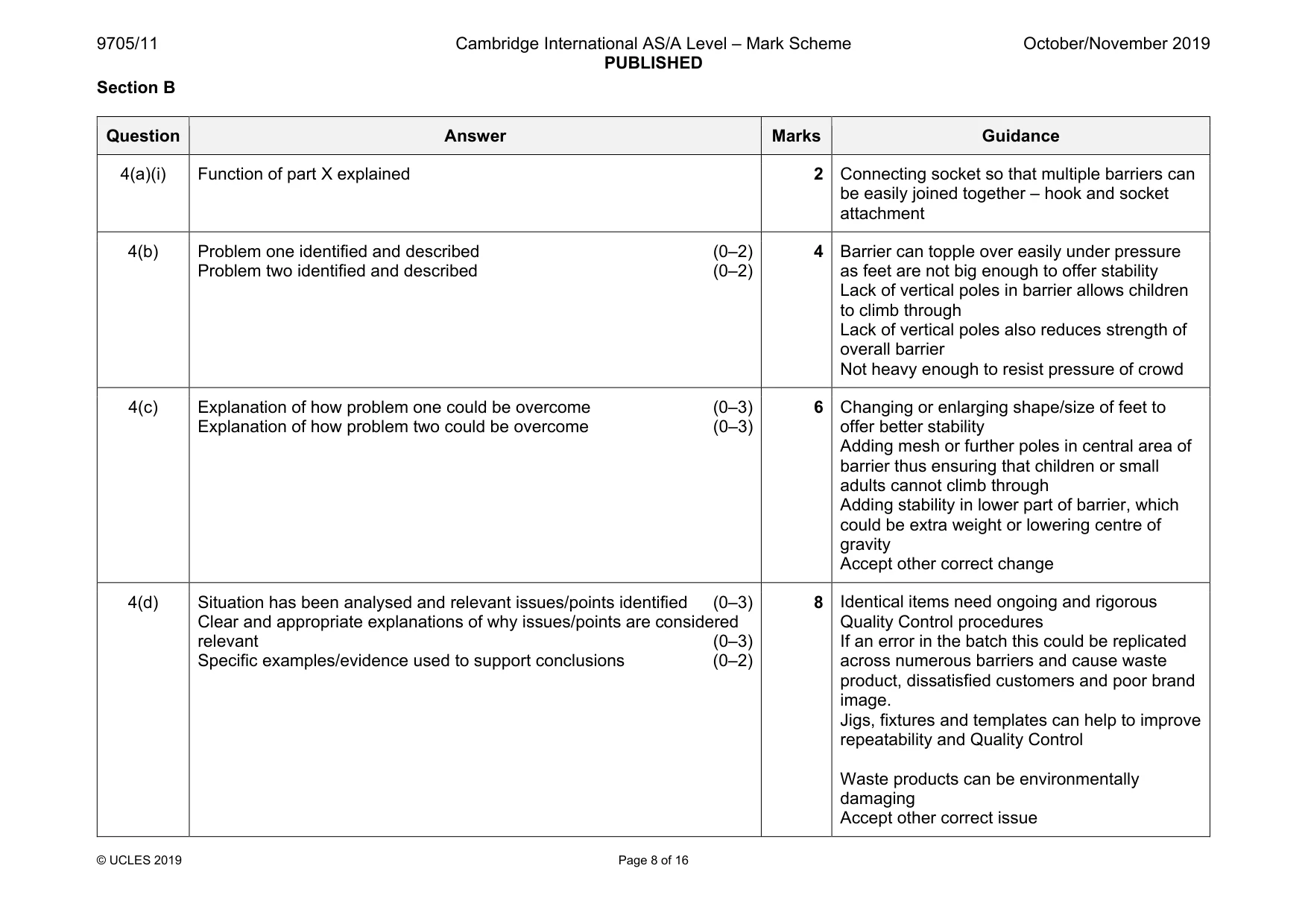
9705/11 Cambridge International AS/A Level – Mark Scheme PUBLISHED October/November 2019 © UCLES 2019 Page 8 of 16 Section B Question Answer Marks Guidance 4(a)(i) Function of part X explained 2 Connecting socket so that multiple barriers can be easily joined together – hook and socket attachment 4(b) Problem one identified and described (0–2) Problem two identified and described (0–2) 4 Barrier can topple over easily under pressure as feet are not big enough to offer stability Lack of vertical poles in barrier allows children to climb through Lack of vertical poles also reduces strength of overall barrier Not heavy enough to resist pressure of crowd 4(c) Explanation of how problem one could be overcome (0–3) Explanation of how problem two could be overcome (0–3) 6 Changing or enlarging shape/size of feet to offer better stability Adding mesh or further poles in central area of barrier thus ensuring that children or small adults cannot climb through Adding stability in lower part of barrier, which could be extra weight or lowering centre of gravity Accept other correct change 4(d) Situation has been analysed and relevant issues/points identified (0–3) Clear and appropriate explanations of why issues/points are considered relevant (0–3) Specific examples/evidence used to support conclusions (0–2) 8 Identical items need ongoing and rigorous Quality Control procedures If an error in the batch this could be replicated across numerous barriers and cause waste product, dissatisfied customers and poor brand image. Jigs, fixtures and templates can help to improve repeatability and Quality Control Waste products can be environmentally damaging Accept other correct issue
Mark scheme, page 9
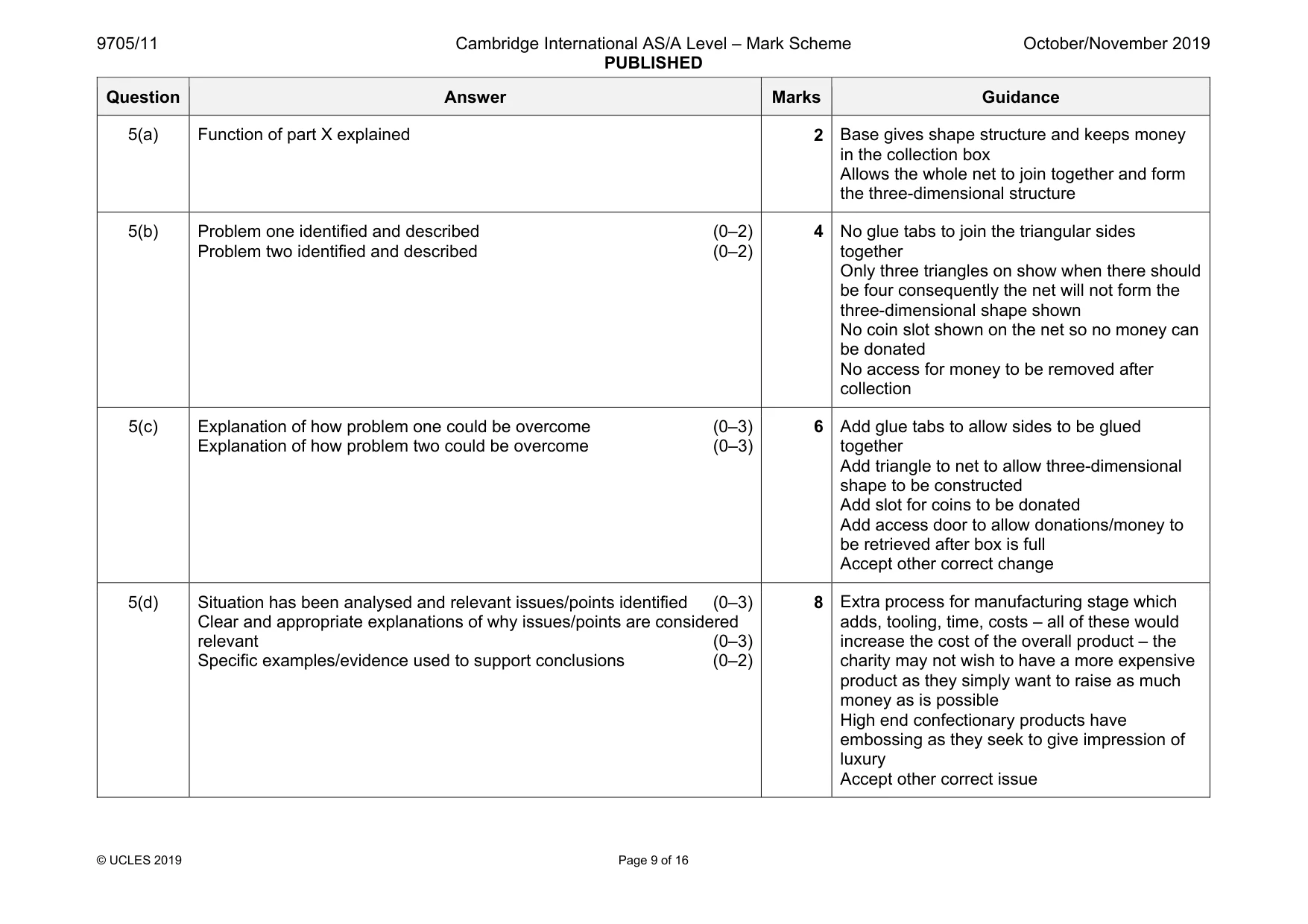
9705/11 Cambridge International AS/A Level – Mark Scheme PUBLISHED October/November 2019 © UCLES 2019 Page 9 of 16 Question Answer Marks Guidance 5(a) Function of part X explained 2 Base gives shape structure and keeps money in the collection box Allows the whole net to join together and form the three-dimensional structure 5(b) Problem one identified and described (0–2) Problem two identified and described (0–2) 4 No glue tabs to join the triangular sides together Only three triangles on show when there should be four consequently the net will not form the three-dimensional shape shown No coin slot shown on the net so no money can be donated No access for money to be removed after collection 5(c) Explanation of how problem one could be overcome (0–3) Explanation of how problem two could be overcome (0–3) 6 Add glue tabs to allow sides to be glued together Add triangle to net to allow three-dimensional shape to be constructed Add slot for coins to be donated Add access door to allow donations/money to be retrieved after box is full Accept other correct change 5(d) Situation has been analysed and relevant issues/points identified (0–3) Clear and appropriate explanations of why issues/points are considered relevant (0–3) Specific examples/evidence used to support conclusions (0–2) 8 Extra process for manufacturing stage which adds, tooling, time, costs – all of these would increase the cost of the overall product – the charity may not wish to have a more expensive product as they simply want to raise as much money as is possible High end confectionary products have embossing as they seek to give impression of luxury Accept other correct issue
Mark scheme, page 10
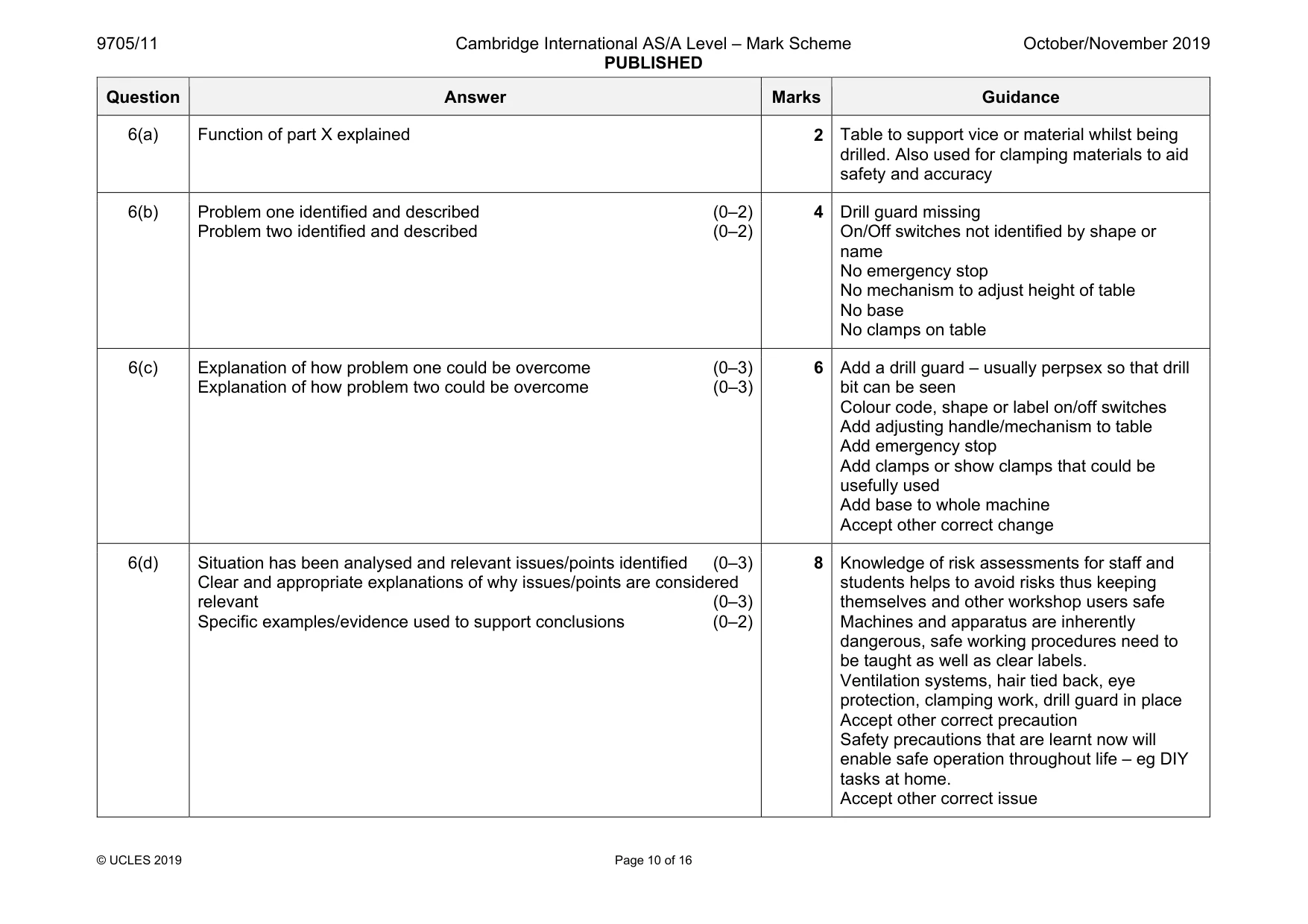
9705/11 Cambridge International AS/A Level – Mark Scheme PUBLISHED October/November 2019 © UCLES 2019 Page 10 of 16 Question Answer Marks Guidance 6(a) Function of part X explained 2 Table to support vice or material whilst being drilled. Also used for clamping materials to aid safety and accuracy 6(b) Problem one identified and described (0–2) Problem two identified and described (0–2) 4 Drill guard missing On/Off switches not identified by shape or name No emergency stop No mechanism to adjust height of table No base No clamps on table 6(c) Explanation of how problem one could be overcome (0–3) Explanation of how problem two could be overcome (0–3) 6 Add a drill guard – usually perpsex so that drill bit can be seen Colour code, shape or label on/off switches Add adjusting handle/mechanism to table Add emergency stop Add clamps or show clamps that could be usefully used Add base to whole machine Accept other correct change 6(d) Situation has been analysed and relevant issues/points identified (0–3) Clear and appropriate explanations of why issues/points are considered relevant (0–3) Specific examples/evidence used to support conclusions (0–2) 8 Knowledge of risk assessments for staff and students helps to avoid risks thus keeping themselves and other workshop users safe Machines and apparatus are inherently dangerous, safe working procedures need to be taught as well as clear labels. Ventilation systems, hair tied back, eye protection, clamping work, drill guard in place Accept other correct precaution Safety precautions that are learnt now will enable safe operation throughout life – eg DIY tasks at home. Accept other correct issue
Mark scheme, page 11
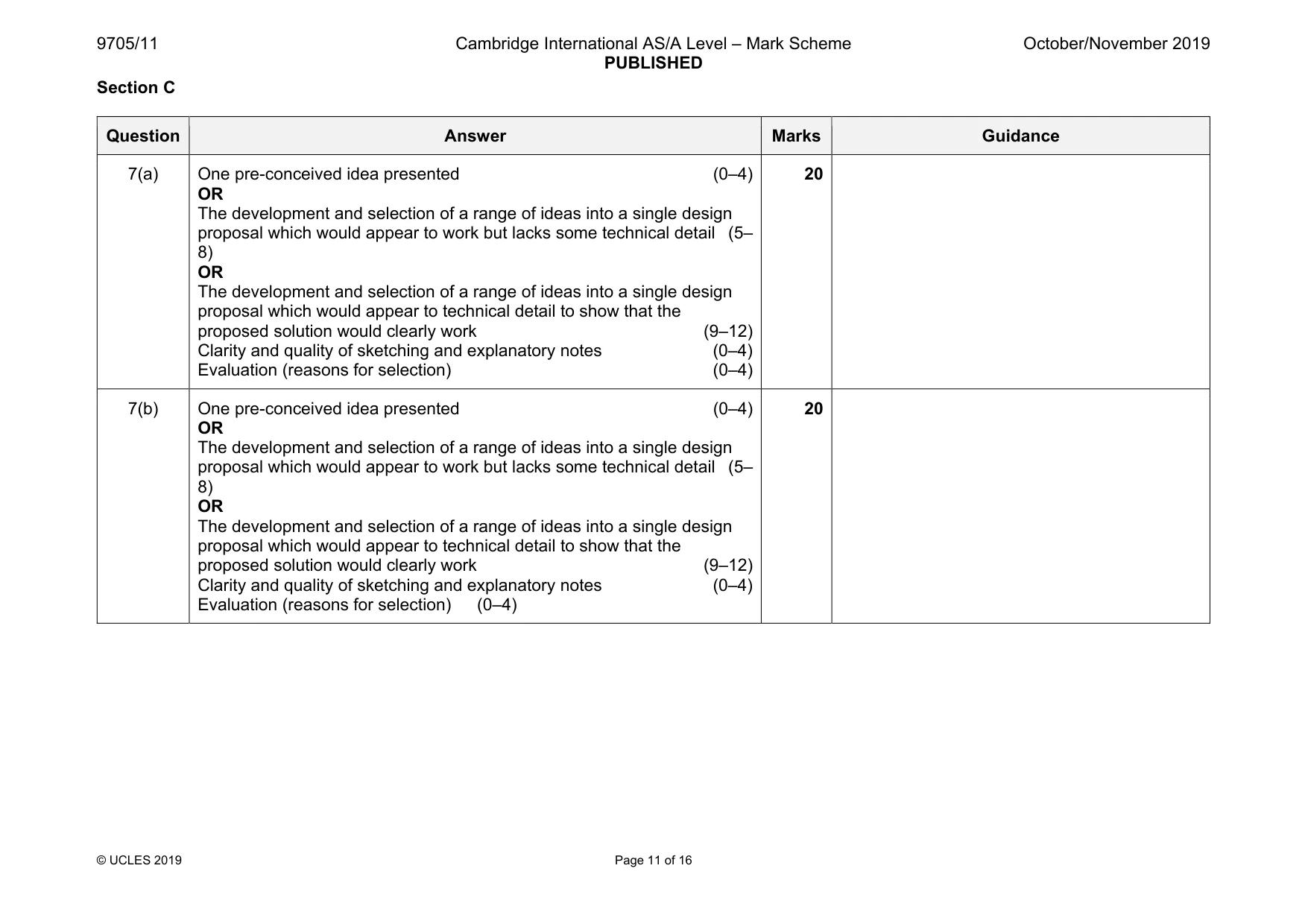
9705/11 Cambridge International AS/A Level – Mark Scheme PUBLISHED October/November 2019 © UCLES 2019 Page 11 of 16 Section C Question Answer Marks Guidance 7(a) One pre-conceived idea presented (0–4) OR The development and selection of a range of ideas into a single design proposal which would appear to work but lacks some technical detail (5– 8) OR The development and selection of a range of ideas into a single design proposal which would appear to technical detail to show that the proposed solution would clearly work (9–12) Clarity and quality of sketching and explanatory notes (0–4) Evaluation (reasons for selection) (0–4) 20 7(b) One pre-conceived idea presented (0–4) OR The development and selection of a range of ideas into a single design proposal which would appear to work but lacks some technical detail (5– 8) OR The development and selection of a range of ideas into a single design proposal which would appear to technical detail to show that the proposed solution would clearly work (9–12) Clarity and quality of sketching and explanatory notes (0–4) Evaluation (reasons for selection) (0–4) 20
Mark scheme, page 12
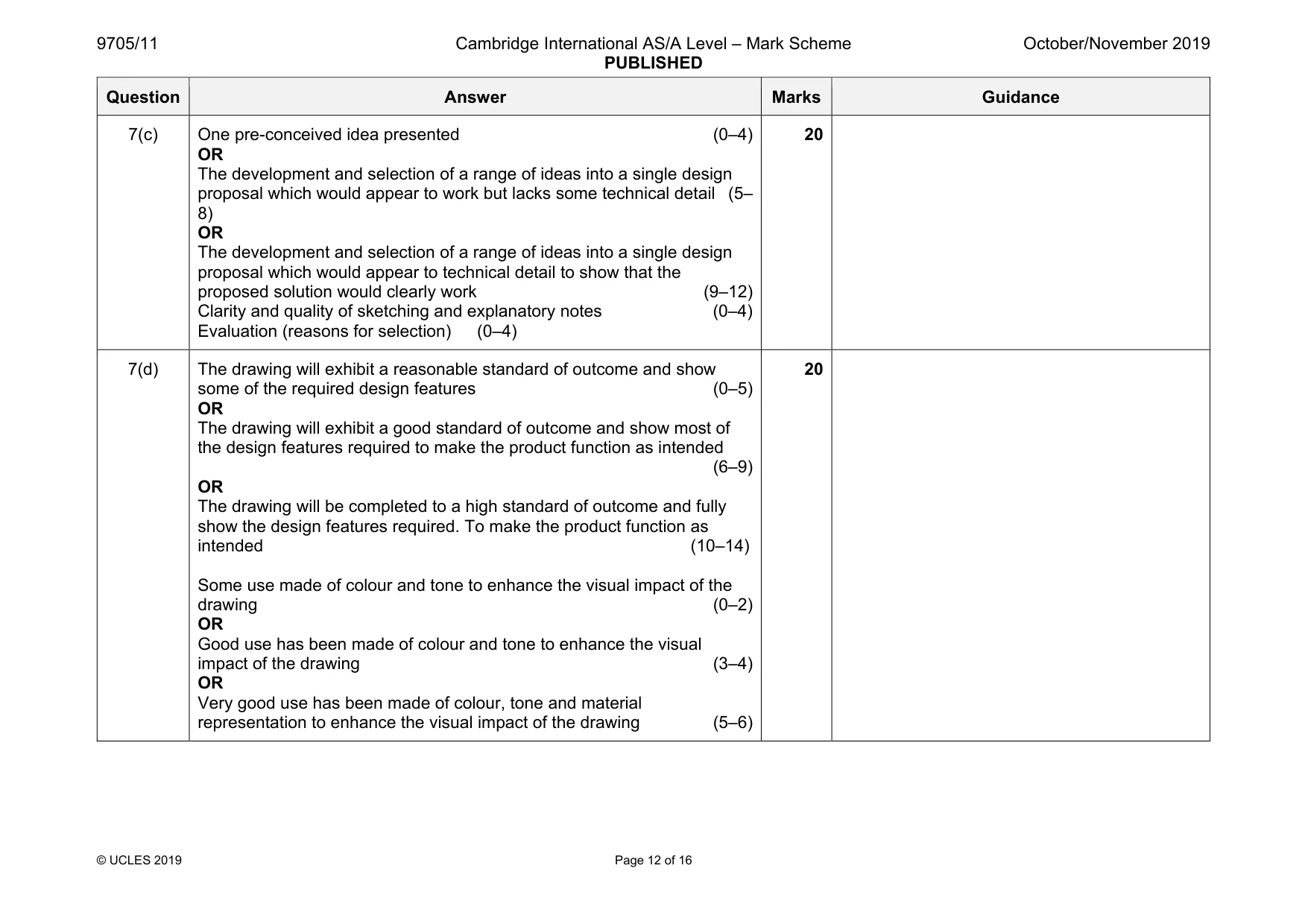
9705/11 Cambridge International AS/A Level – Mark Scheme PUBLISHED October/November 2019 © UCLES 2019 Page 12 of 16 Question Answer Marks Guidance 7(c) One pre-conceived idea presented (0–4) OR The development and selection of a range of ideas into a single design proposal which would appear to work but lacks some technical detail (5– 8) OR The development and selection of a range of ideas into a single design proposal which would appear to technical detail to show that the proposed solution would clearly work (9–12) Clarity and quality of sketching and explanatory notes (0–4) Evaluation (reasons for selection) (0–4) 20 7(d) The drawing will exhibit a reasonable standard of outcome and show some of the required design features (0–5) OR The drawing will exhibit a good standard of outcome and show most of the design features required to make the product function as intended (6–9) OR The drawing will be completed to a high standard of outcome and fully show the design features required. To make the product function as intended (10–14) Some use made of colour and tone to enhance the visual impact of the drawing (0–2) OR Good use has been made of colour and tone to enhance the visual impact of the drawing (3–4) OR Very good use has been made of colour, tone and material representation to enhance the visual impact of the drawing (5–6) 20
Mark scheme, page 13
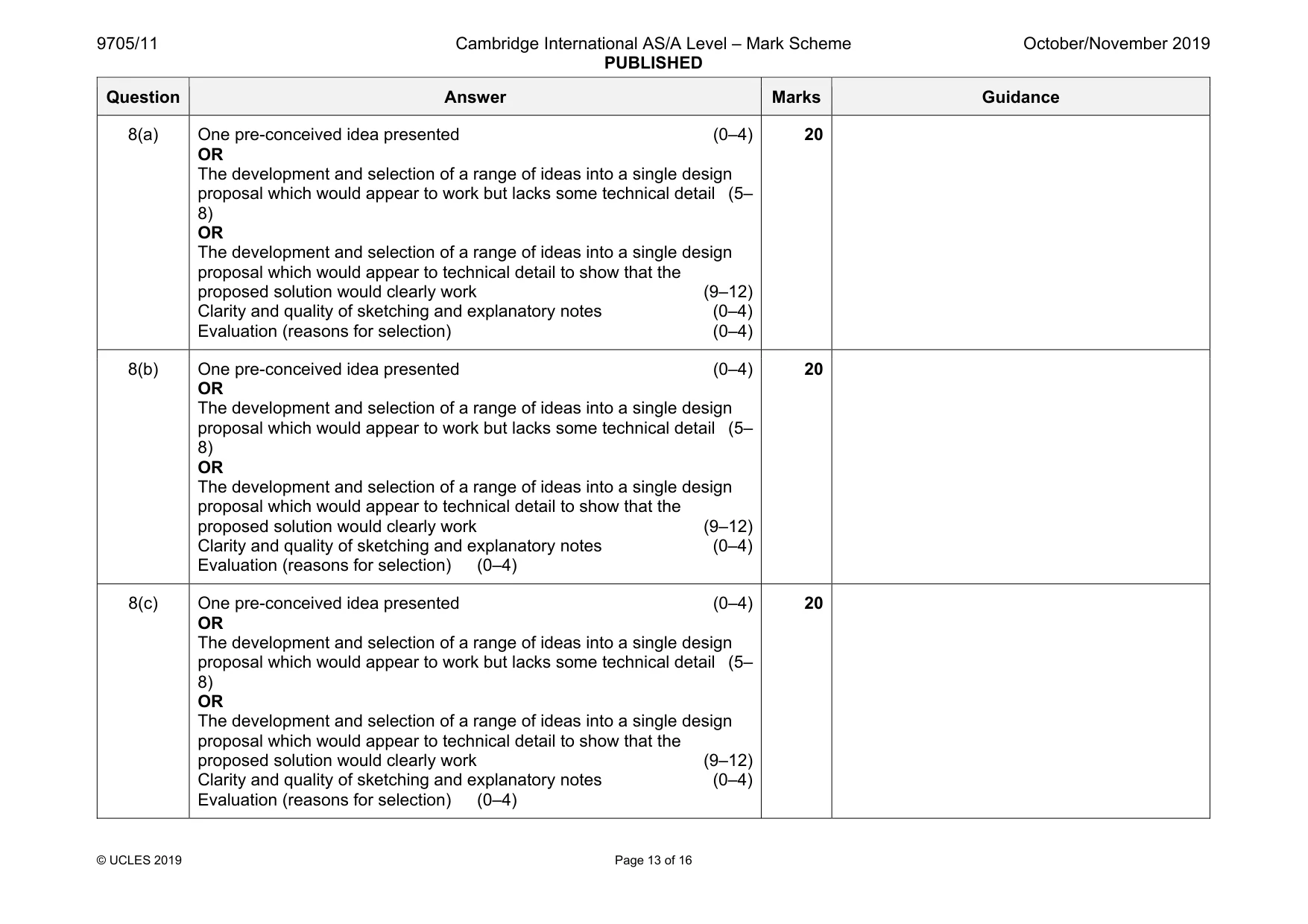
9705/11 Cambridge International AS/A Level – Mark Scheme PUBLISHED October/November 2019 © UCLES 2019 Page 13 of 16 Question Answer Marks Guidance 8(a) One pre-conceived idea presented (0–4) OR The development and selection of a range of ideas into a single design proposal which would appear to work but lacks some technical detail (5– 8) OR The development and selection of a range of ideas into a single design proposal which would appear to technical detail to show that the proposed solution would clearly work (9–12) Clarity and quality of sketching and explanatory notes (0–4) Evaluation (reasons for selection) (0–4) 20 8(b) One pre-conceived idea presented (0–4) OR The development and selection of a range of ideas into a single design proposal which would appear to work but lacks some technical detail (5– 8) OR The development and selection of a range of ideas into a single design proposal which would appear to technical detail to show that the proposed solution would clearly work (9–12) Clarity and quality of sketching and explanatory notes (0–4) Evaluation (reasons for selection) (0–4) 20 8(c) One pre-conceived idea presented (0–4) OR The development and selection of a range of ideas into a single design proposal which would appear to work but lacks some technical detail (5– 8) OR The development and selection of a range of ideas into a single design proposal which would appear to technical detail to show that the proposed solution would clearly work (9–12) Clarity and quality of sketching and explanatory notes (0–4) Evaluation (reasons for selection) (0–4) 20
Mark scheme, page 14
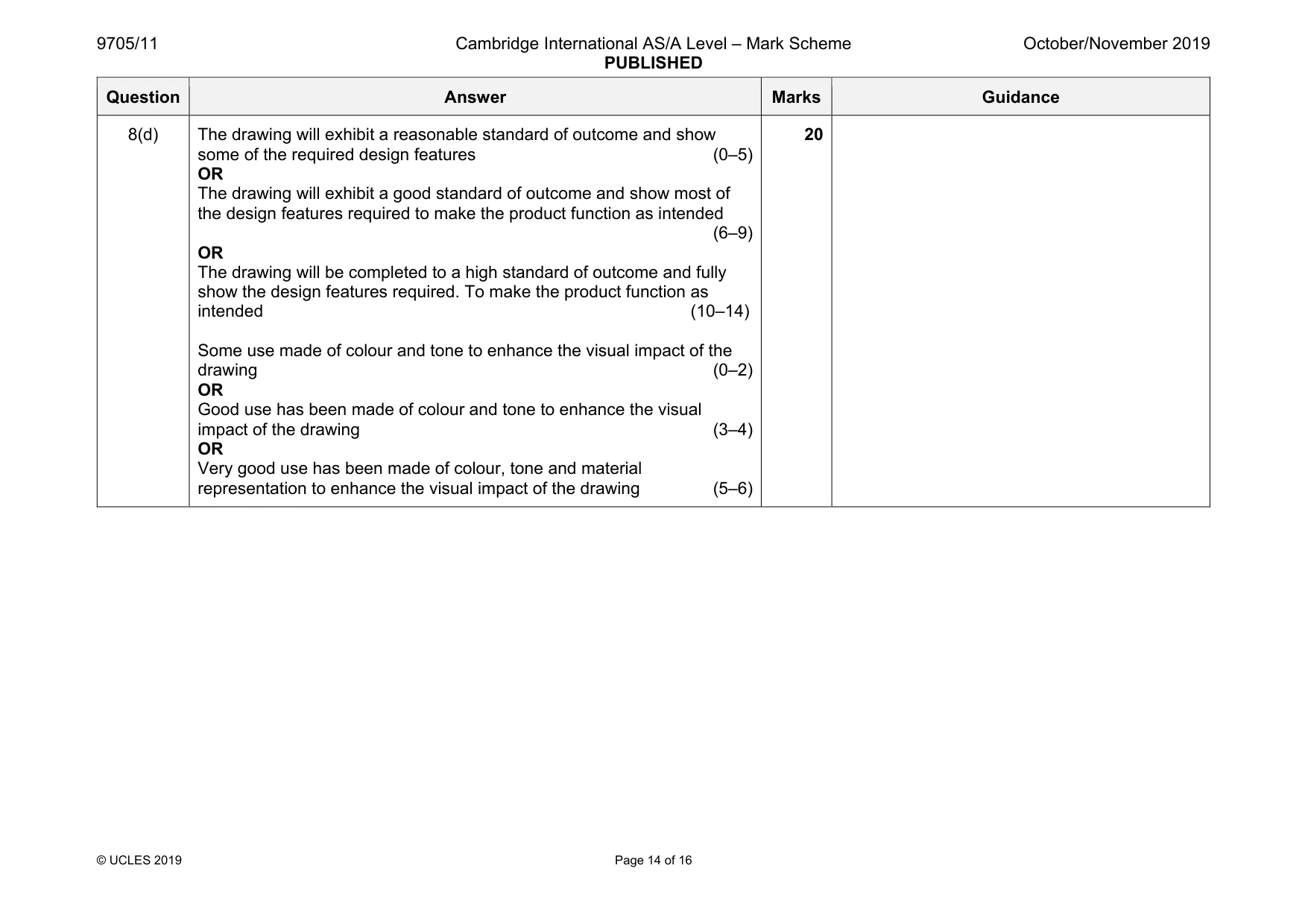
9705/11 Cambridge International AS/A Level – Mark Scheme PUBLISHED October/November 2019 © UCLES 2019 Page 14 of 16 Question Answer Marks Guidance 8(d) The drawing will exhibit a reasonable standard of outcome and show some of the required design features (0–5) OR The drawing will exhibit a good standard of outcome and show most of the design features required to make the product function as intended (6–9) OR The drawing will be completed to a high standard of outcome and fully show the design features required. To make the product function as intended (10–14) Some use made of colour and tone to enhance the visual impact of the drawing (0–2) OR Good use has been made of colour and tone to enhance the visual impact of the drawing (3–4) OR Very good use has been made of colour, tone and material representation to enhance the visual impact of the drawing (5–6) 20
Mark scheme, page 15
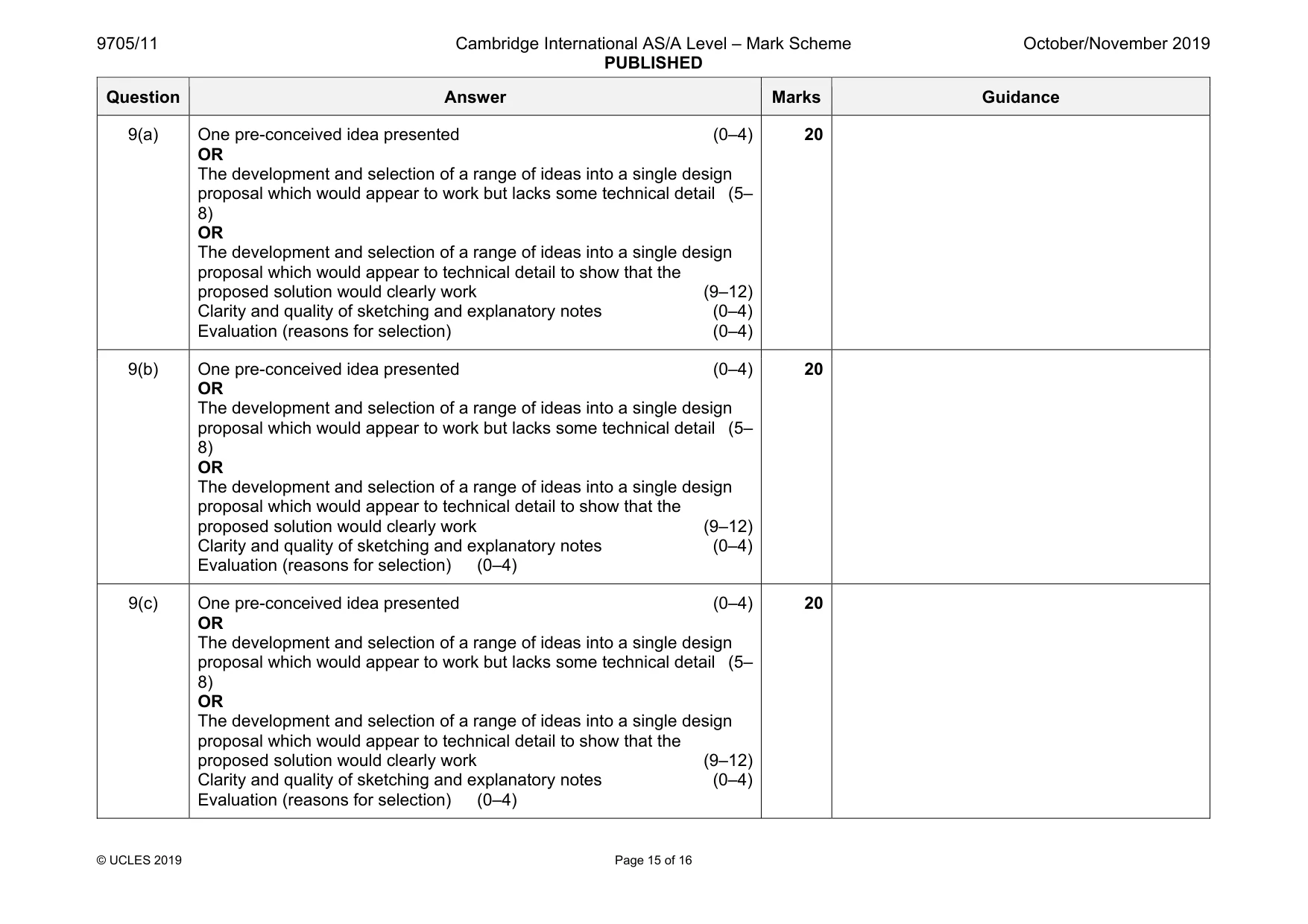
9705/11 Cambridge International AS/A Level – Mark Scheme PUBLISHED October/November 2019 © UCLES 2019 Page 15 of 16 Question Answer Marks Guidance 9(a) One pre-conceived idea presented (0–4) OR The development and selection of a range of ideas into a single design proposal which would appear to work but lacks some technical detail (5– 8) OR The development and selection of a range of ideas into a single design proposal which would appear to technical detail to show that the proposed solution would clearly work (9–12) Clarity and quality of sketching and explanatory notes (0–4) Evaluation (reasons for selection) (0–4) 20 9(b) One pre-conceived idea presented (0–4) OR The development and selection of a range of ideas into a single design proposal which would appear to work but lacks some technical detail (5– 8) OR The development and selection of a range of ideas into a single design proposal which would appear to technical detail to show that the proposed solution would clearly work (9–12) Clarity and quality of sketching and explanatory notes (0–4) Evaluation (reasons for selection) (0–4) 20 9(c) One pre-conceived idea presented (0–4) OR The development and selection of a range of ideas into a single design proposal which would appear to work but lacks some technical detail (5– 8) OR The development and selection of a range of ideas into a single design proposal which would appear to technical detail to show that the proposed solution would clearly work (9–12) Clarity and quality of sketching and explanatory notes (0–4) Evaluation (reasons for selection) (0–4) 20
Mark scheme, page 16
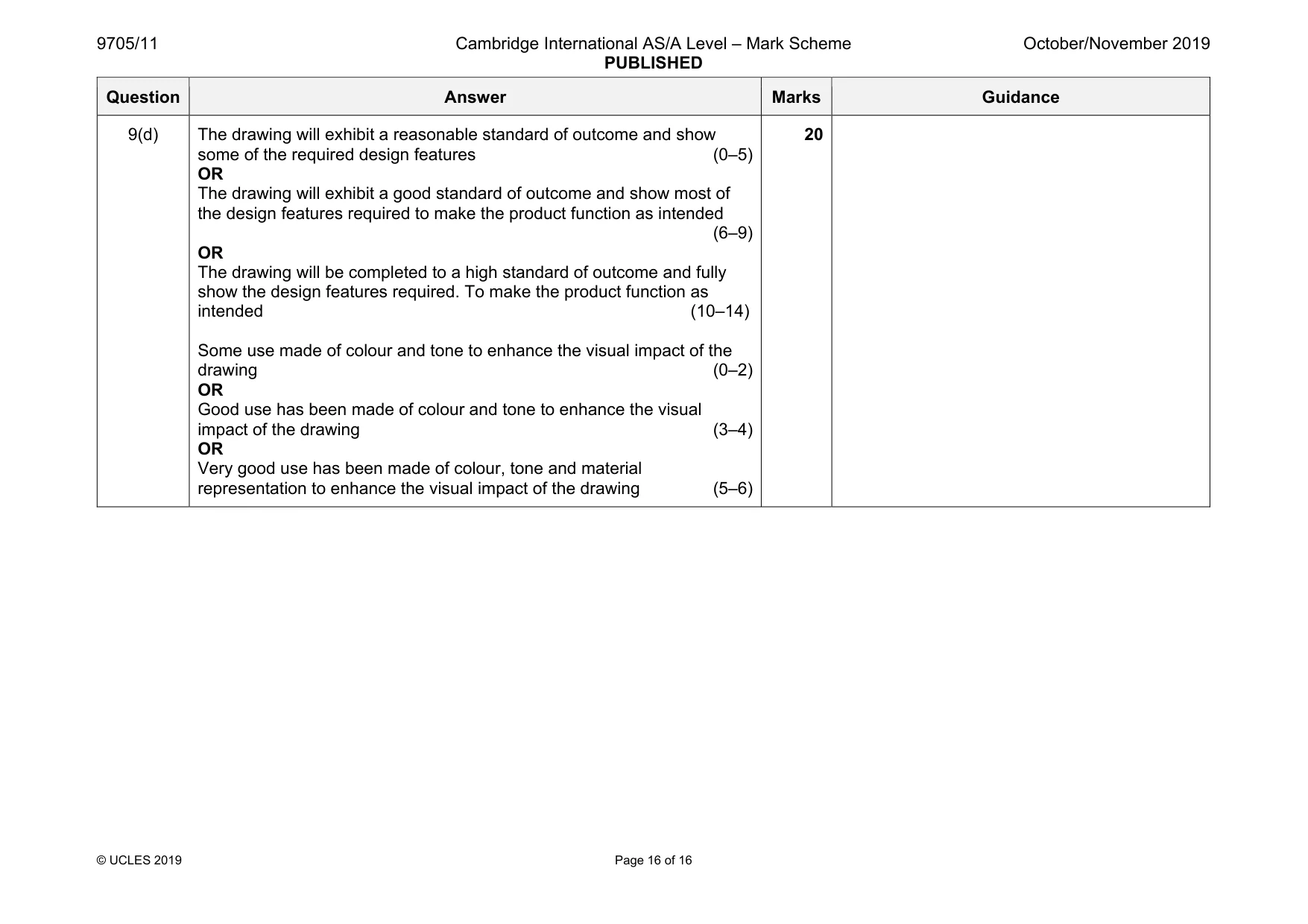
9705/11 Cambridge International AS/A Level – Mark Scheme PUBLISHED October/November 2019 © UCLES 2019 Page 16 of 16 Question Answer Marks Guidance 9(d) The drawing will exhibit a reasonable standard of outcome and show some of the required design features (0–5) OR The drawing will exhibit a good standard of outcome and show most of the design features required to make the product function as intended (6–9) OR The drawing will be completed to a high standard of outcome and fully show the design features required. To make the product function as intended (10–14) Some use made of colour and tone to enhance the visual impact of the drawing (0–2) OR Good use has been made of colour and tone to enhance the visual impact of the drawing (3–4) OR Very good use has been made of colour, tone and material representation to enhance the visual impact of the drawing (5–6) 20
What you needed in this session
Cambridge’s own grade thresholds for 2019 Oct/Nov, Paper 1 · Variant 1. A higher threshold means an easier paper — the bar moves with how the cohort did.