Cambridge A Level Design and Technology 9705 — 2018 Oct/Nov Paper 1 · Variant 1
9705/11/O/N/18 · 120 marks · ≈135 min
The question paper and its mark scheme, free to read here and free to download. This is Cambridge’s own paper, exactly as it was sat.
Question paper16 pages
Mark scheme7 pages
Answers below. Sit the paper first if you are practising.
Paper as text
Question paper, page 1
This document consists of 16 printed pages. DC (NF/CGW) 164855 © UCLES 2018 [Turn over * 1 6 5 6 8 0 0 4 8 5 * DESIGN AND TECHNOLOGY 9705/11 Paper 1 October/November 2018 3 hours Additional Materials: Answer Booklet/A4 Paper A3 Drawing Paper (2 sheets) Extra sheets of A3 drawing paper for candidates who have used up both sides of their 2 sheets A range of design drawing equipment READ THESE INSTRUCTIONS FIRST If you have been given an Answer Booklet, follow the instructions on the front cover of the Booklet. Write your name, Centre number and candidate number on all the work you hand in. Write in dark blue or black pen. You may use an HB pencil, or coloured pencils/pens as appropriate, for any diagrams, graphs or rough working. Do not use staples, paper clips, glue or correction fluid. DO NOT WRITE IN ANY BARCODES. Section A Answer one question on the Answer Booklet/A4 Paper provided. Section B Answer one question on the Answer Booklet/A4 Paper provided. Section C Answer one question on plain A3 paper. Use both sides of the paper. You may request additional sheets of A3 paper, but only if you have used up both sides of each of the 2 sheets provided. You are advised to spend 30 minutes on each of Sections A and B and 2 hours on Section C. At the end of the examination, fasten all your work securely together. The number of marks is given in brackets [ ] at the end of each question or part question. All dimensions are in millimetres. Cambridge International Examinations Cambridge International Advanced Subsidiary and Advanced Level
Question paper, page 2
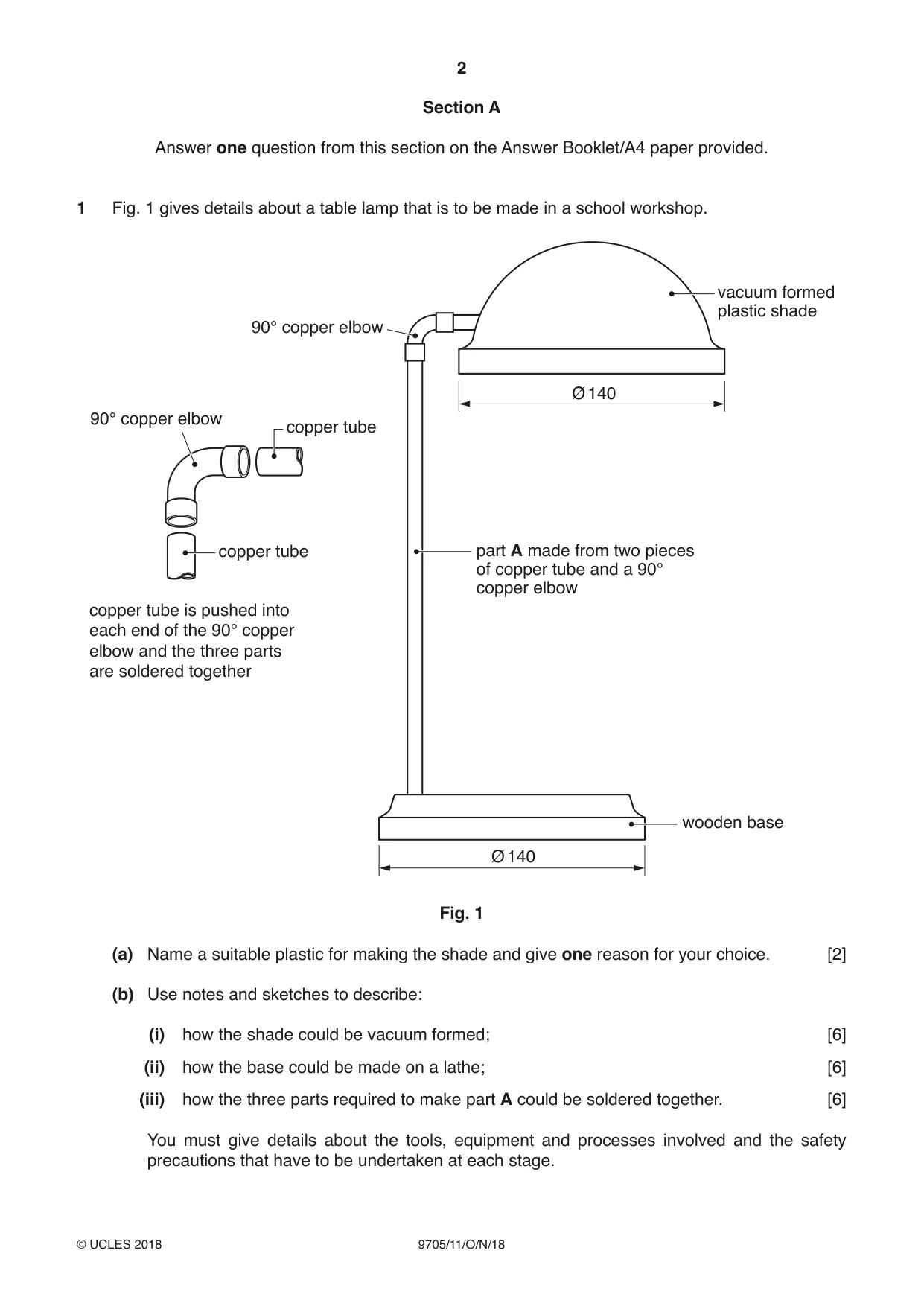
2 9705/11/O/N/18 © UCLES 2018 Section A Answer one question from this section on the Answer Booklet/A4 paper provided. 1 Fig. 1 gives details about a table lamp that is to be made in a school workshop. copper tube 90° copper elbow Ø 140 Ø 140 vacuum formed plastic shade part A made from two pieces of copper tube and a 90° copper elbow copper tube wooden base copper tube is pushed into each end of the 90° copper elbow and the three parts are soldered together 90° copper elbow Fig. 1 (a) Name a suitable plastic for making the shade and give one reason for your choice. [2] (b) Use notes and sketches to describe: (i) how the shade could be vacuum formed; [6] (ii) how the base could be made on a lathe; [6] (iii) how the three parts required to make part A could be soldered together. [6] You must give details about the tools, equipment and processes involved and the safety precautions that have to be undertaken at each stage.
Question paper, page 3
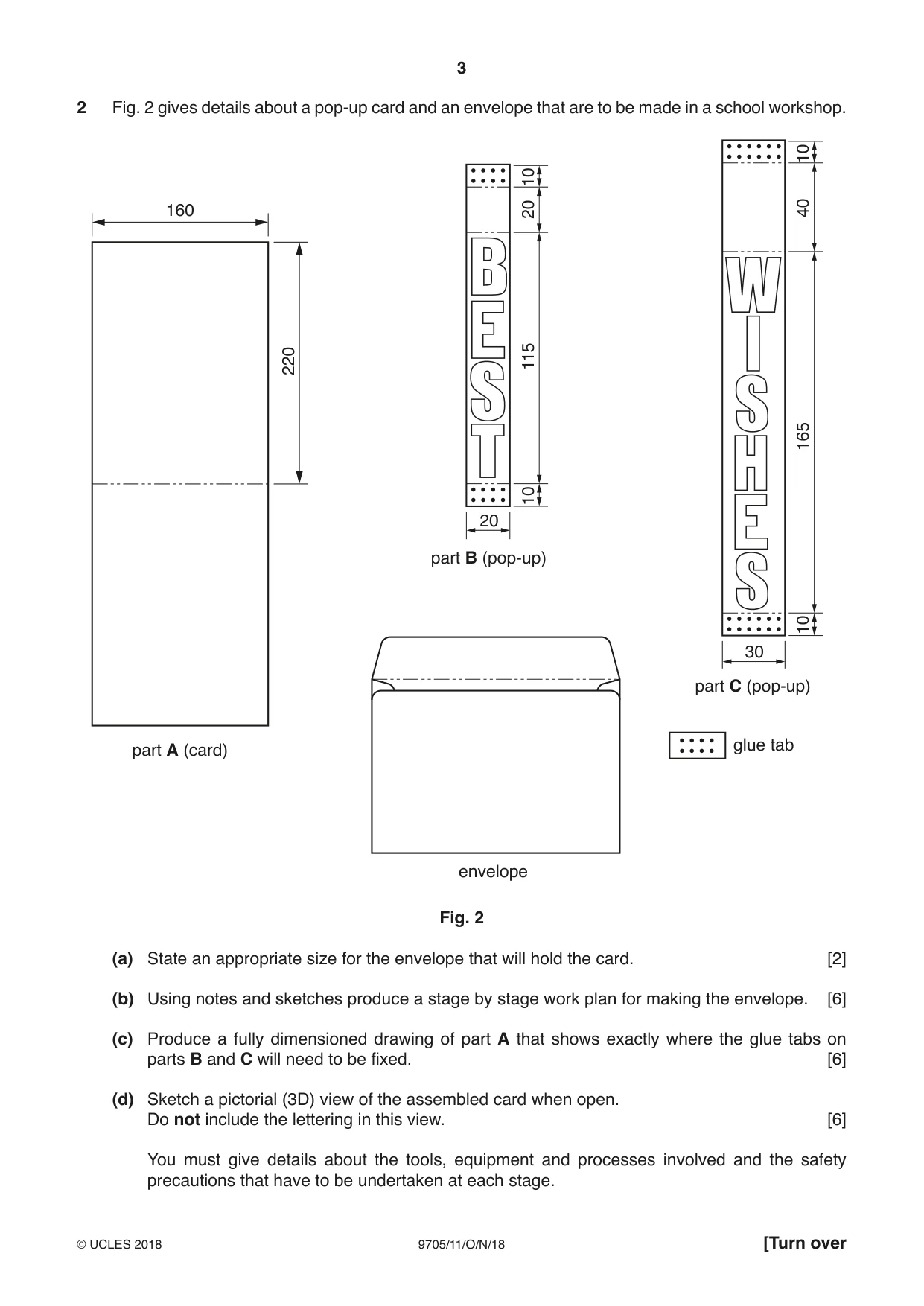
3 9705/11/O/N/18 © UCLES 2018 [Turn over 2 Fig. 2 gives details about a pop-up card and an envelope that are to be made in a school workshop. 160 220 115 10 10 10 165 40 10 20 30 20 part A (card) part B (pop-up) part C (pop-up) envelope glue tab Fig. 2 (a) State an appropriate size for the envelope that will hold the card. [2] (b) Using notes and sketches produce a stage by stage work plan for making the envelope. [6] (c) Produce a fully dimensioned drawing of part A that shows exactly where the glue tabs on parts B and C will need to be fixed. [6] (d) Sketch a pictorial (3D) view of the assembled card when open. Do not include the lettering in this view. [6] You must give details about the tools, equipment and processes involved and the safety precautions that have to be undertaken at each stage.
Question paper, page 4
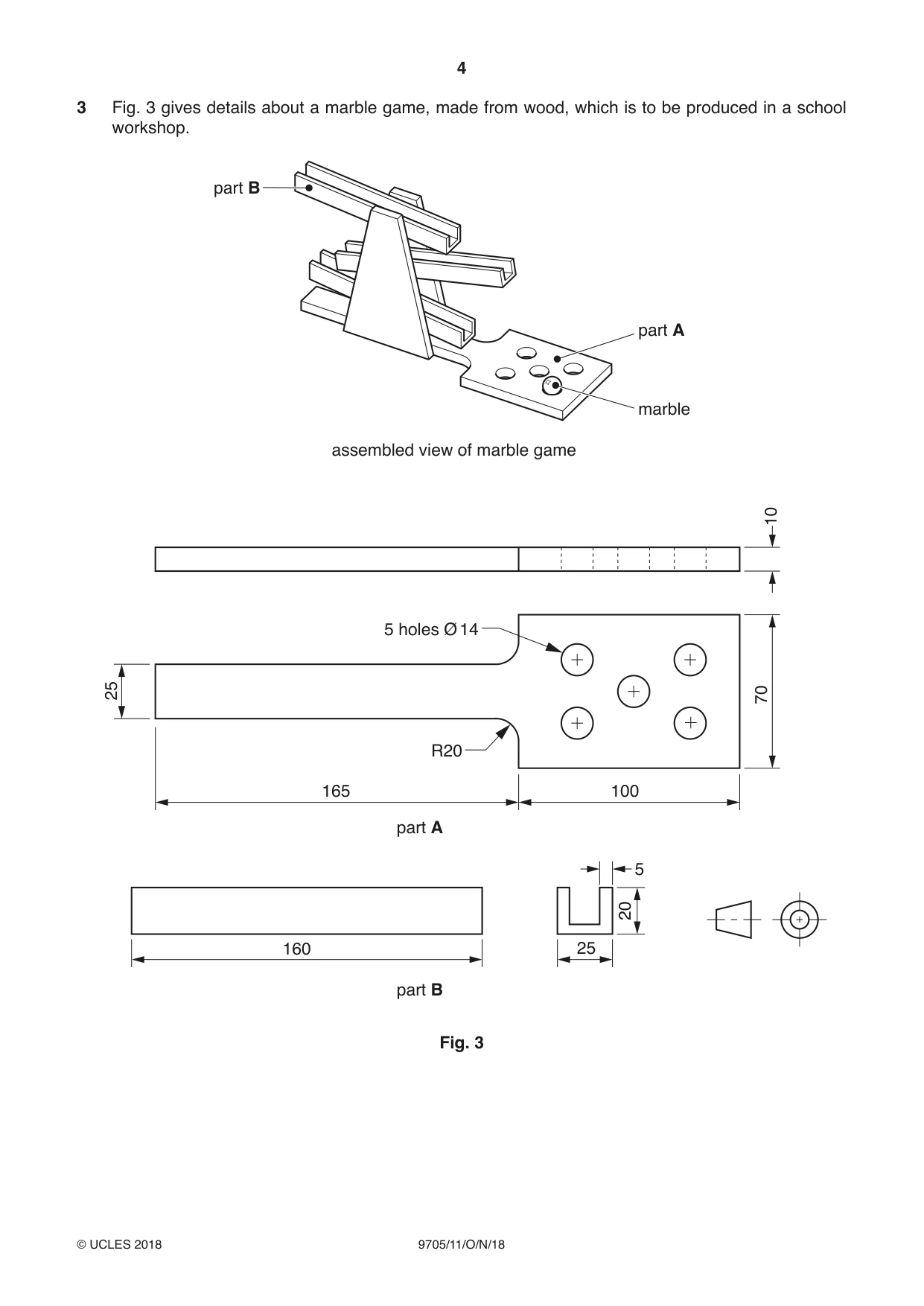
4 9705/11/O/N/18 © UCLES 2018 3 Fig. 3 gives details about a marble game, made from wood, which is to be produced in a school workshop. part B part A marble 25 165 160 100 70 10 20 5 25 R20 5 holes Ø 14 part A part B assembled view of marble game Fig. 3
Question paper, page 5
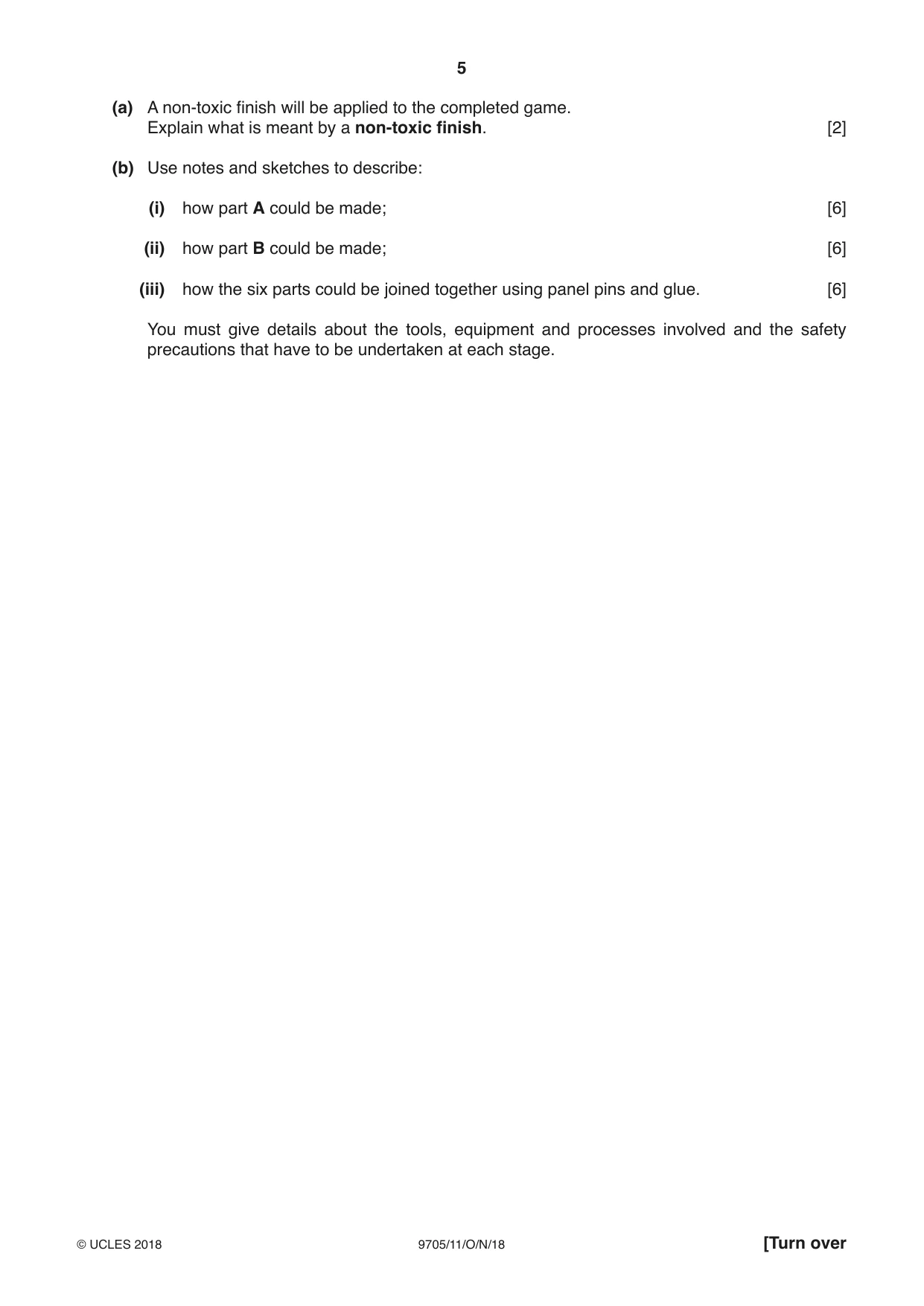
5 9705/11/O/N/18 © UCLES 2018 [Turn over (a) A non-toxic finish will be applied to the completed game. Explain what is meant by a non-toxic finish. [2] (b) Use notes and sketches to describe: (i) how part A could be made; [6] (ii) how part B could be made; [6] (iii) how the six parts could be joined together using panel pins and glue. [6] You must give details about the tools, equipment and processes involved and the safety precautions that have to be undertaken at each stage.
Question paper, page 6
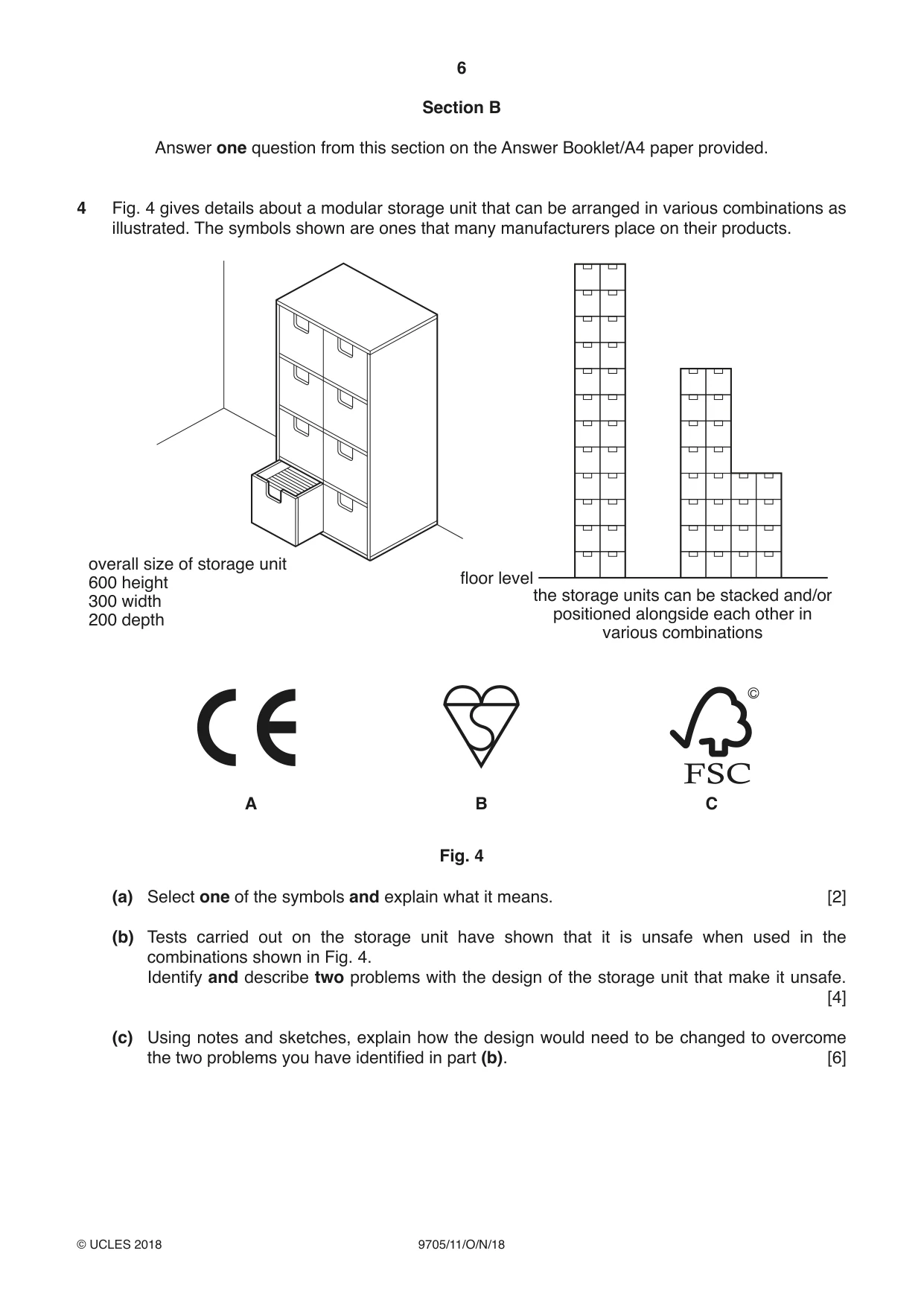
6 9705/11/O/N/18 © UCLES 2018 Section B Answer one question from this section on the Answer Booklet/A4 paper provided. 4 Fig. 4 gives details about a modular storage unit that can be arranged in various combinations as illustrated. The symbols shown are ones that many manufacturers place on their products. overall size of storage unit 600 height 300 width 200 depth the storage units can be stacked and/or positioned alongside each other in various combinations A B floor level FSC C C Fig. 4 (a) Select one of the symbols and explain what it means. [2] (b) Tests carried out on the storage unit have shown that it is unsafe when used in the combinations shown in Fig. 4. Identify and describe two problems with the design of the storage unit that make it unsafe. [4] (c) Using notes and sketches, explain how the design would need to be changed to overcome the two problems you have identified in part (b). [6]
Question paper, page 7
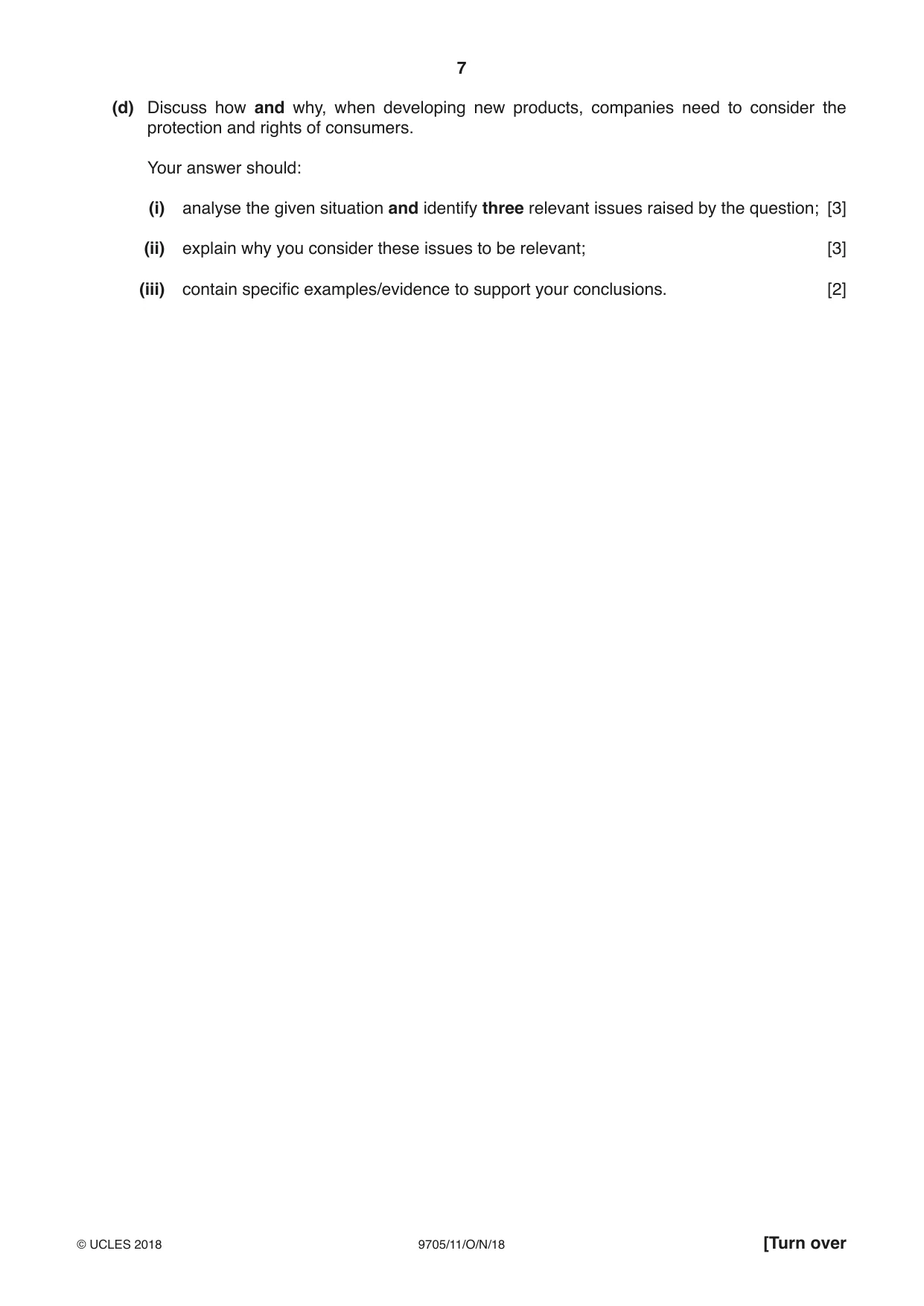
7 9705/11/O/N/18 © UCLES 2018 [Turn over (d) Discuss how and why, when developing new products, companies need to consider the protection and rights of consumers. Your answer should: (i) analyse the given situation and identify three relevant issues raised by the question; [3] (ii) explain why you consider these issues to be relevant; [3] (iii) contain specific examples/evidence to support your conclusions. [2]
Question paper, page 8
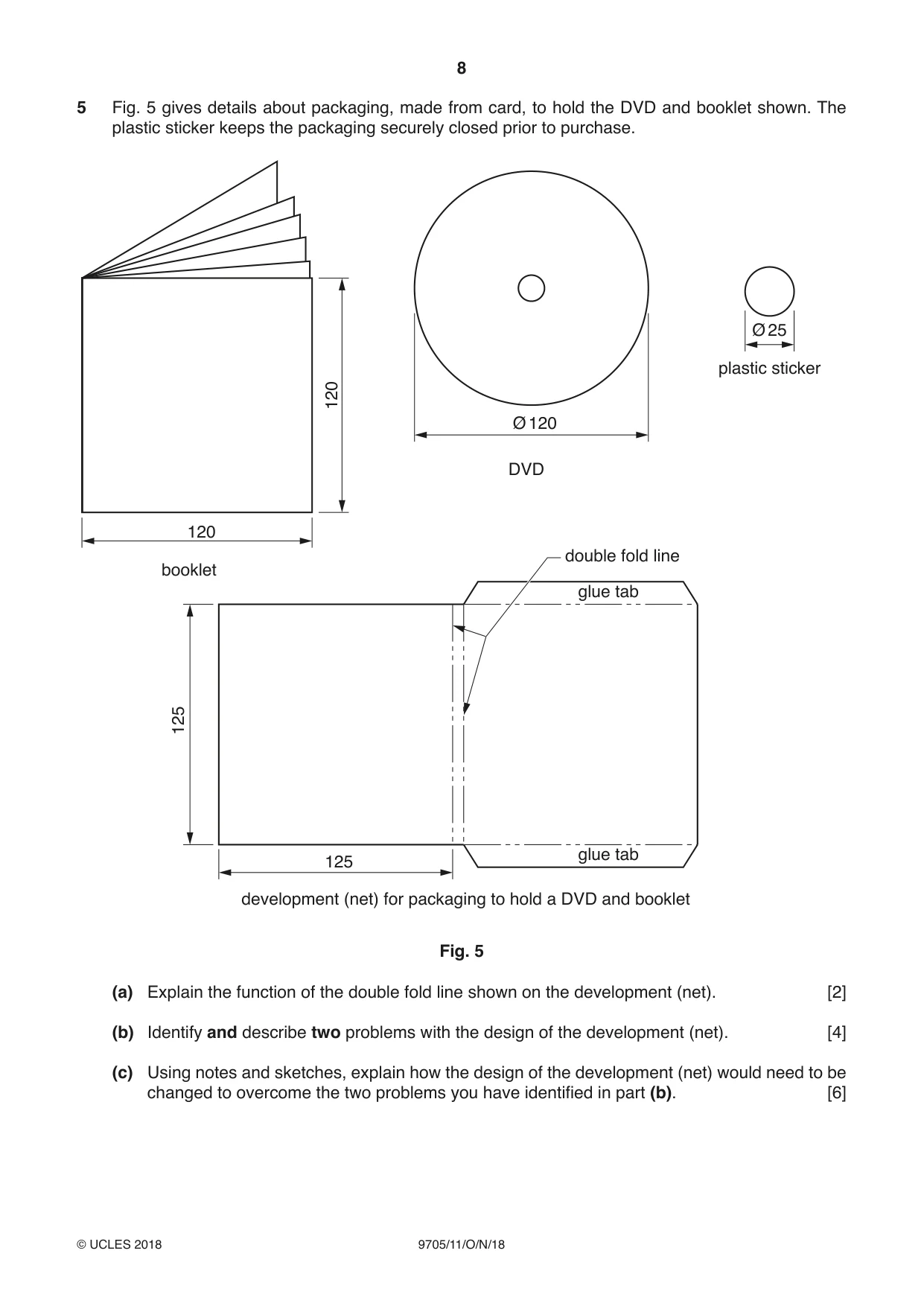
8 9705/11/O/N/18 © UCLES 2018 5 Fig. 5 gives details about packaging, made from card, to hold the DVD and booklet shown. The plastic sticker keeps the packaging securely closed prior to purchase. 120 Ø 120 booklet DVD 120 125 125 Ø 25 plastic sticker development (net) for packaging to hold a DVD and booklet glue tab glue tab double fold line Fig. 5 (a) Explain the function of the double fold line shown on the development (net). [2] (b) Identify and describe two problems with the design of the development (net). [4] (c) Using notes and sketches, explain how the design of the development (net) would need to be changed to overcome the two problems you have identified in part (b). [6]
Question paper, page 9
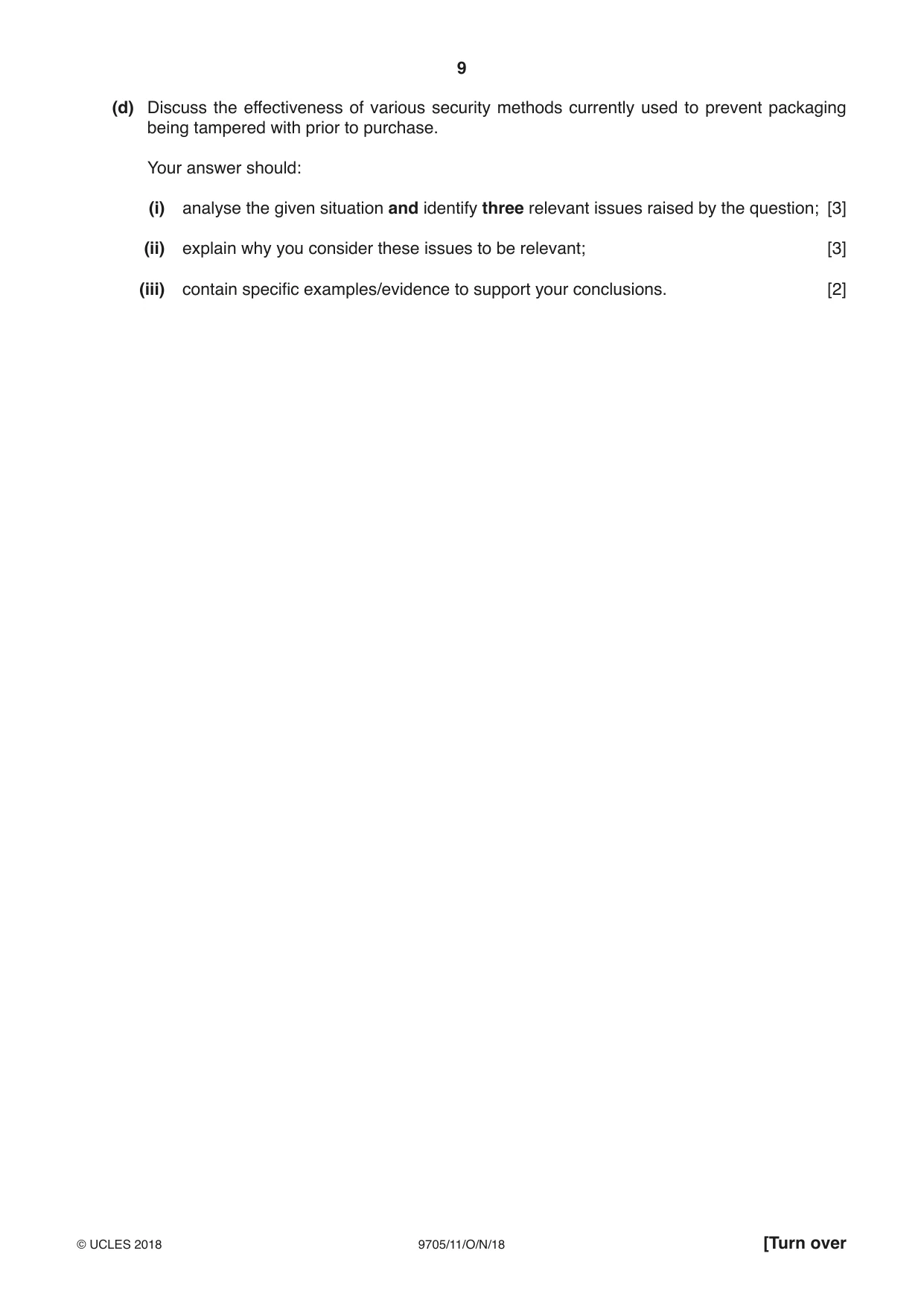
9 9705/11/O/N/18 © UCLES 2018 [Turn over (d) Discuss the effectiveness of various security methods currently used to prevent packaging being tampered with prior to purchase. Your answer should: (i) analyse the given situation and identify three relevant issues raised by the question; [3] (ii) explain why you consider these issues to be relevant; [3] (iii) contain specific examples/evidence to support your conclusions. [2]
Question paper, page 10
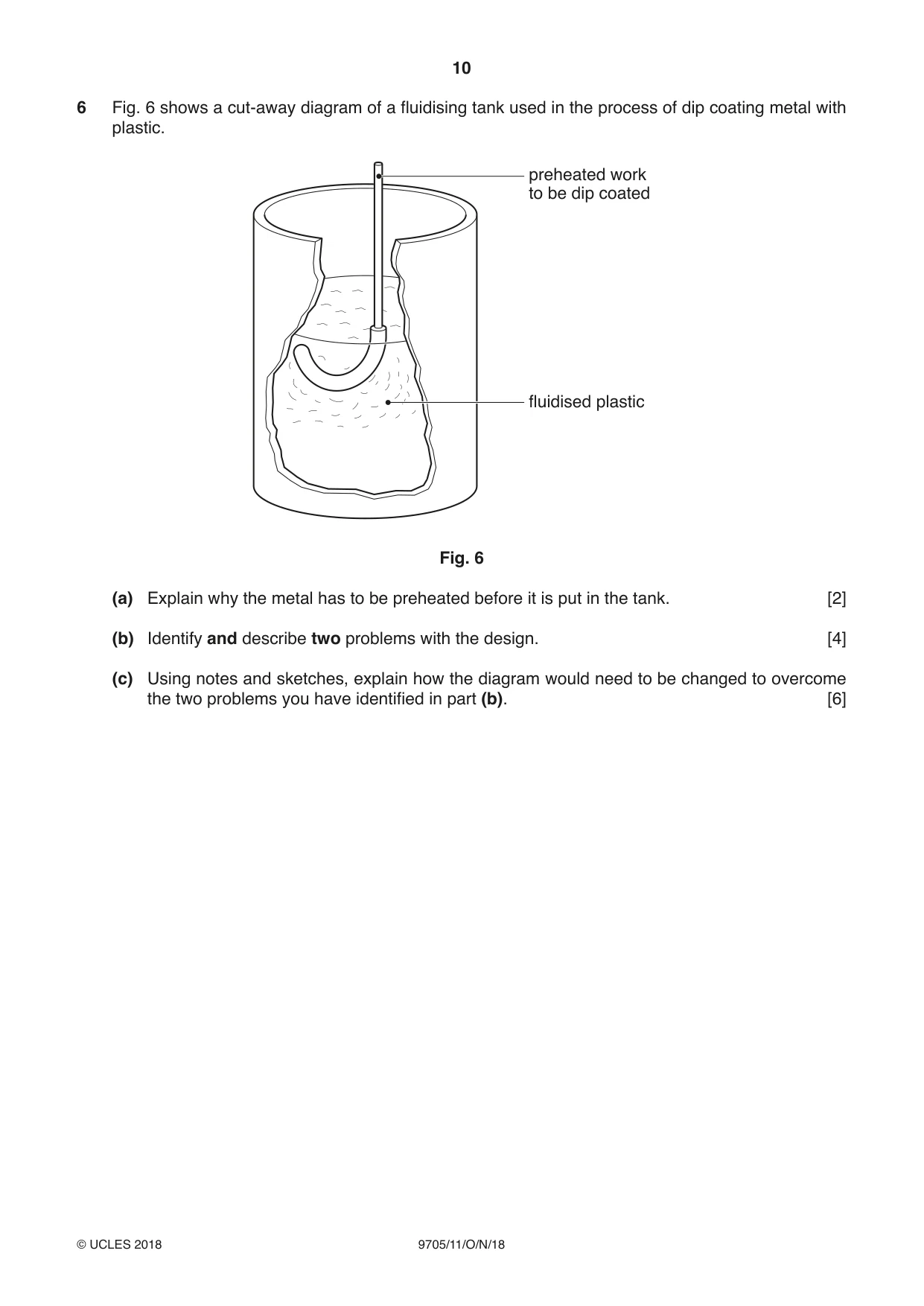
10 9705/11/O/N/18 © UCLES 2018 6 Fig. 6 shows a cut-away diagram of a fluidising tank used in the process of dip coating metal with plastic. preheated work to be dip coated fluidised plastic Fig. 6 (a) Explain why the metal has to be preheated before it is put in the tank. [2] (b) Identify and describe two problems with the design. [4] (c) Using notes and sketches, explain how the diagram would need to be changed to overcome the two problems you have identified in part (b). [6]
Question paper, page 11
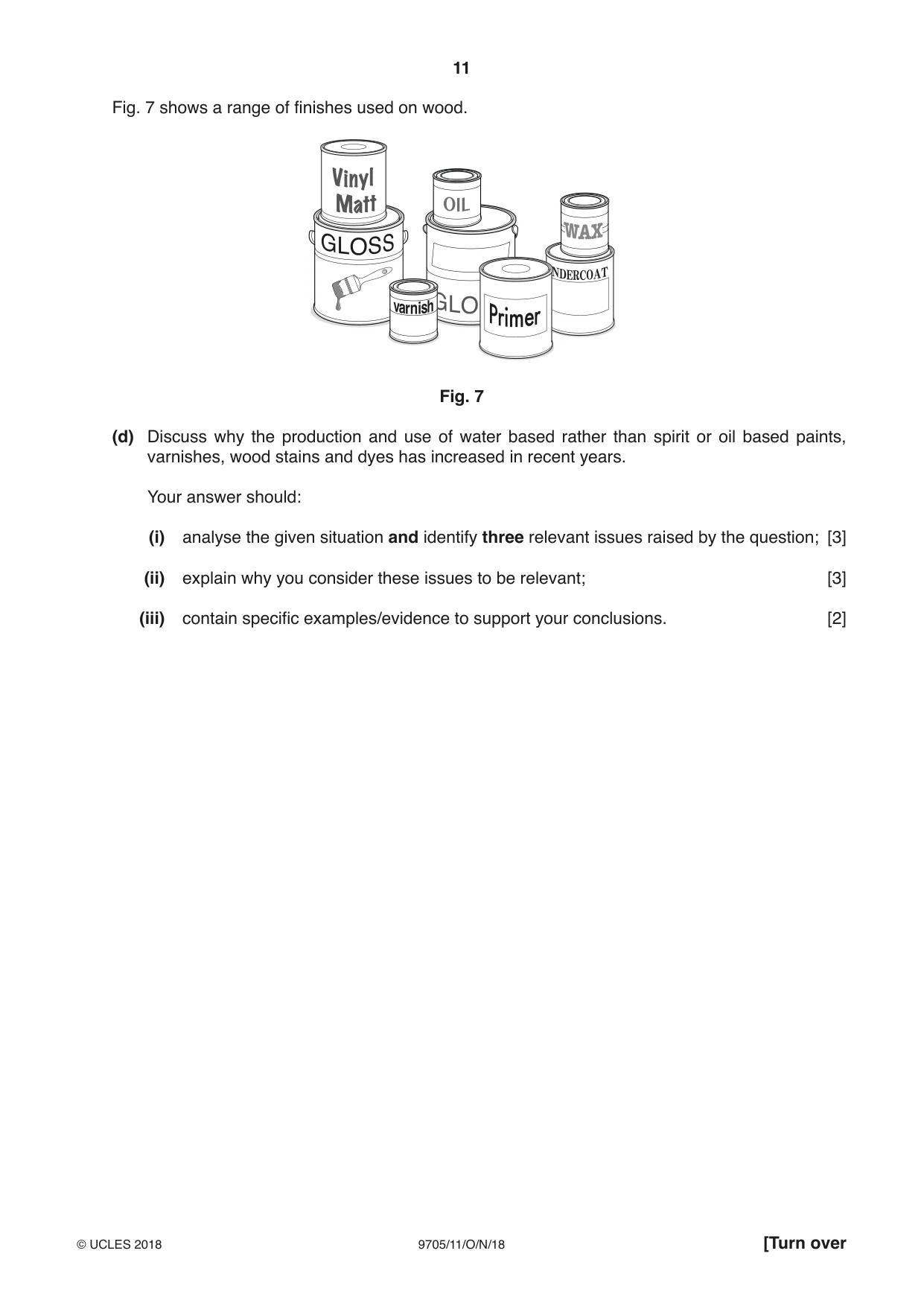
11 9705/11/O/N/18 © UCLES 2018 [Turn over Fig. 7 shows a range of finishes used on wood. Fig. 7 (d) Discuss why the production and use of water based rather than spirit or oil based paints, varnishes, wood stains and dyes has increased in recent years. Your answer should: (i) analyse the given situation and identify three relevant issues raised by the question; [3] (ii) explain why you consider these issues to be relevant; [3] (iii) contain specific examples/evidence to support your conclusions. [2]
Question paper, page 12
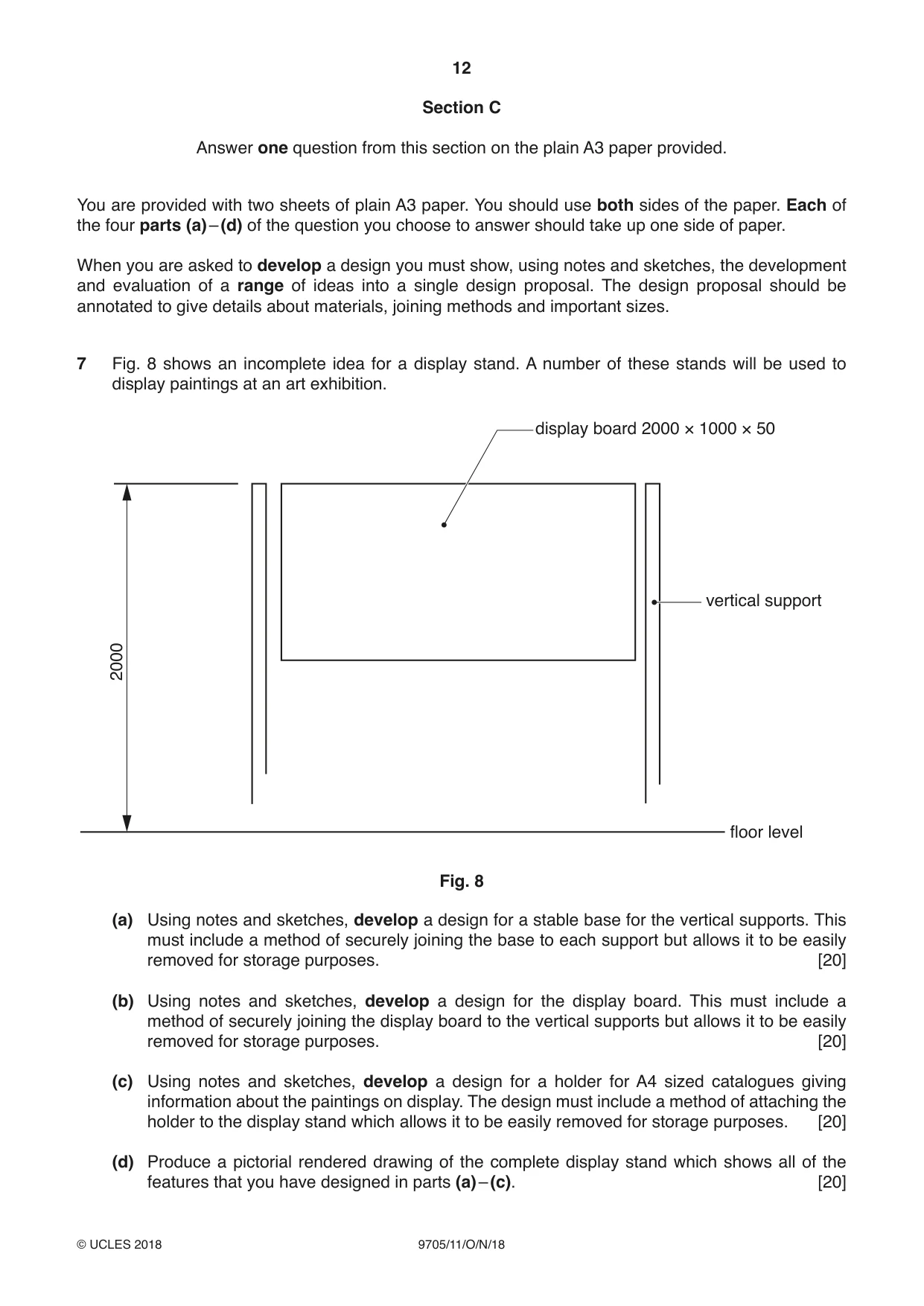
12 9705/11/O/N/18 © UCLES 2018 Section C Answer one question from this section on the plain A3 paper provided. You are provided with two sheets of plain A3 paper. You should use both sides of the paper. Each of the four parts (a) – (d) of the question you choose to answer should take up one side of paper. When you are asked to develop a design you must show, using notes and sketches, the development and evaluation of a range of ideas into a single design proposal. The design proposal should be annotated to give details about materials, joining methods and important sizes. 7 Fig. 8 shows an incomplete idea for a display stand. A number of these stands will be used to display paintings at an art exhibition. vertical support floor level 2000 display board 2000 × 1000 × 50 Fig. 8 (a) Using notes and sketches, develop a design for a stable base for the vertical supports. This must include a method of securely joining the base to each support but allows it to be easily removed for storage purposes. [20] (b) Using notes and sketches, develop a design for the display board. This must include a method of securely joining the display board to the vertical supports but allows it to be easily removed for storage purposes. [20] (c) Using notes and sketches, develop a design for a holder for A4 sized catalogues giving information about the paintings on display. The design must include a method of attaching the holder to the display stand which allows it to be easily removed for storage purposes. [20] (d) Produce a pictorial rendered drawing of the complete display stand which shows all of the features that you have designed in parts (a) – (c). [20]
Question paper, page 13
13 9705/11/O/N/18 © UCLES 2018 [Turn over TURN OVER FOR QUESTION 8
Question paper, page 14
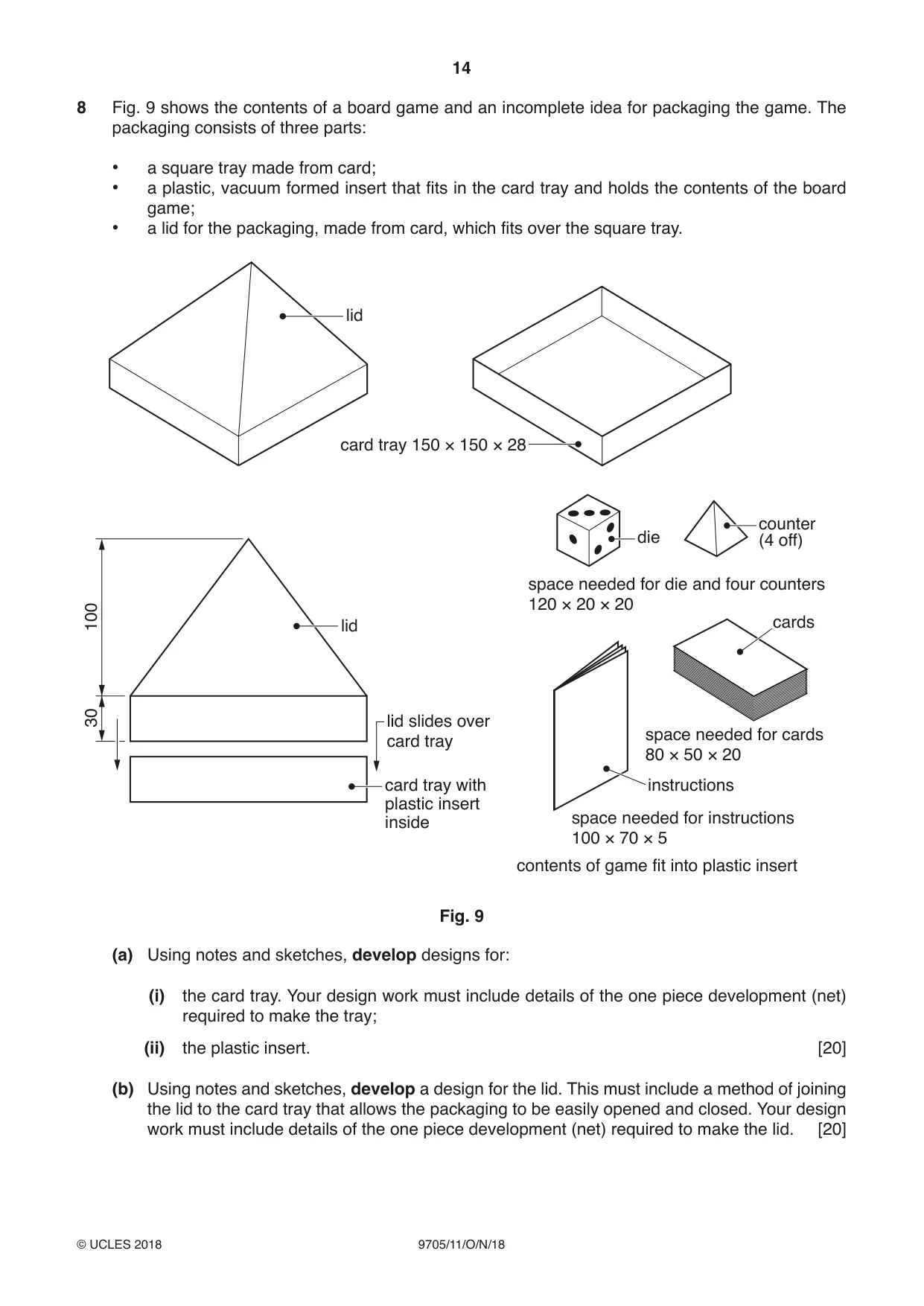
14 9705/11/O/N/18 © UCLES 2018 8 Fig. 9 shows the contents of a board game and an incomplete idea for packaging the game. The packaging consists of three parts: • a square tray made from card; • a plastic, vacuum formed insert that fits in the card tray and holds the contents of the board game; • a lid for the packaging, made from card, which fits over the square tray. 100 lid slides over card tray card tray with plastic insert inside lid die instructions cards counter (4 off) space needed for die and four counters 120 × 20 × 20 space needed for cards 80 × 50 × 20 space needed for instructions 100 × 70 × 5 contents of game fit into plastic insert card tray 150 × 150 × 28 30 lid Fig. 9 (a) Using notes and sketches, develop designs for: (i) the card tray. Your design work must include details of the one piece development (net) required to make the tray; (ii) the plastic insert. [20] (b) Using notes and sketches, develop a design for the lid. This must include a method of joining the lid to the card tray that allows the packaging to be easily opened and closed. Your design work must include details of the one piece development (net) required to make the lid. [20]
Question paper, page 15
15 9705/11/O/N/18 © UCLES 2018 [Turn over (c) Using notes and sketches, develop a design for the lettering to go on the packaging. The name of the game is ‘The Phantom of the Pyramid’ and the lettering should be in a style that reflects the name. [20] (d) Produce an exploded, pictorial, rendered drawing of the complete packaging that shows all of the features that you have designed in parts (a) – (c). Do not include the contents of the game in this drawing. [20]
Question paper, page 16
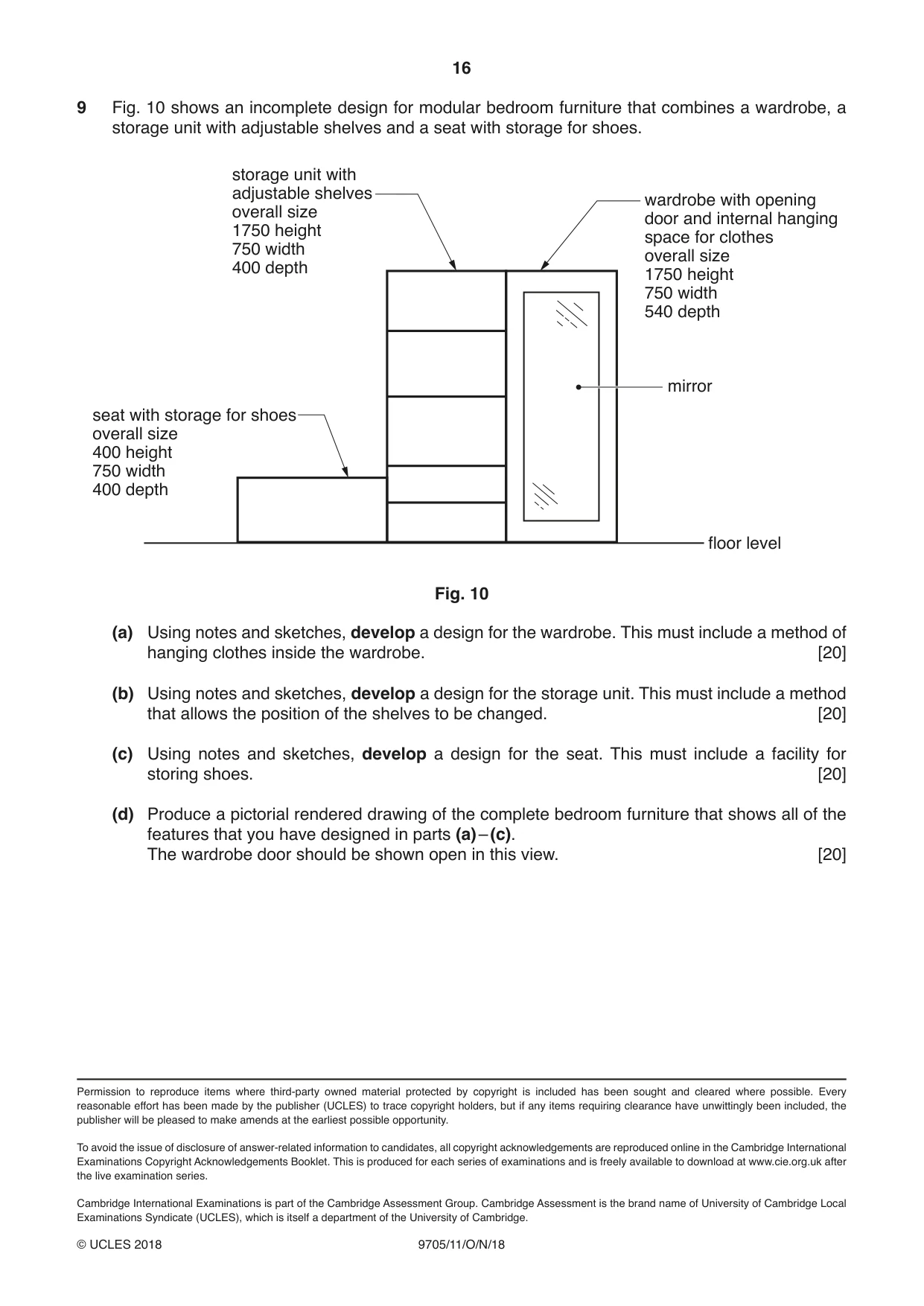
16 9705/11/O/N/18 © UCLES 2018 Permission to reproduce items where third-party owned material protected by copyright is included has been sought and cleared where possible. Every reasonable effort has been made by the publisher (UCLES) to trace copyright holders, but if any items requiring clearance have unwittingly been included, the publisher will be pleased to make amends at the earliest possible opportunity. To avoid the issue of disclosure of answer-related information to candidates, all copyright acknowledgements are reproduced online in the Cambridge International Examinations Copyright Acknowledgements Booklet. This is produced for each series of examinations and is freely available to download at www.cie.org.uk after the live examination series. Cambridge International Examinations is part of the Cambridge Assessment Group. Cambridge Assessment is the brand name of University of Cambridge Local Examinations Syndicate (UCLES), which is itself a department of the University of Cambridge. 9 Fig. 10 shows an incomplete design for modular bedroom furniture that combines a wardrobe, a storage unit with adjustable shelves and a seat with storage for shoes. mirror floor level wardrobe with opening door and internal hanging space for clothes overall size 1750 height 750 width 540 depth storage unit with adjustable shelves overall size 1750 height 750 width 400 depth seat with storage for shoes overall size 400 height 750 width 400 depth Fig. 10 (a) Using notes and sketches, develop a design for the wardrobe. This must include a method of hanging clothes inside the wardrobe. [20] (b) Using notes and sketches, develop a design for the storage unit. This must include a method that allows the position of the shelves to be changed. [20] (c) Using notes and sketches, develop a design for the seat. This must include a facility for storing shoes. [20] (d) Produce a pictorial rendered drawing of the complete bedroom furniture that shows all of the features that you have designed in parts (a) – (c). The wardrobe door should be shown open in this view. [20]
Mark scheme, page 1
This document consists of 7 printed pages. © UCLES 2018 [Turn over Cambridge Assessment International Education Cambridge International Advanced Subsidiary and Advanced Level DESIGN AND TECHNOLOGY 9705/11 Paper 1 October/November 2018 MARK SCHEME Maximum Mark: 120 Published This mark scheme is published as an aid to teachers and candidates, to indicate the requirements of the examination. It shows the basis on which Examiners were instructed to award marks. It does not indicate the details of the discussions that took place at an Examiners’ meeting before marking began, which would have considered the acceptability of alternative answers. Mark schemes should be read in conjunction with the question paper and the Principal Examiner Report for Teachers. Cambridge International will not enter into discussions about these mark schemes. Cambridge International is publishing the mark schemes for the October/November 2018 series for most Cambridge IGCSE™, Cambridge International A and AS Level components and some Cambridge O Level components.
Mark scheme, page 2
9705/11 Cambridge International AS/A Level – Mark Scheme PUBLISHED October/November 2018 © UCLES 2018 Page 2 of 7 Generic Marking Principles These general marking principles must be applied by all examiners when marking candidate answers. They should be applied alongside the specific content of the mark scheme or generic level descriptors for a question. Each question paper and mark scheme will also comply with these marking principles. GENERIC MARKING PRINCIPLE 1: Marks must be awarded in line with: • the specific content of the mark scheme or the generic level descriptors for the question • the specific skills defined in the mark scheme or in the generic level descriptors for the question • the standard of response required by a candidate as exemplified by the standardisation scripts. GENERIC MARKING PRINCIPLE 2: Marks awarded are always whole marks (not half marks, or other fractions). GENERIC MARKING PRINCIPLE 3: Marks must be awarded positively: • marks are awarded for correct/valid answers, as defined in the mark scheme. However, credit is given for valid answers which go beyond the scope of the syllabus and mark scheme, referring to your Team Leader as appropriate • marks are awarded when candidates clearly demonstrate what they know and can do • marks are not deducted for errors • marks are not deducted for omissions • answers should only be judged on the quality of spelling, punctuation and grammar when these features are specifically assessed by the question as indicated by the mark scheme. The meaning, however, should be unambiguous. GENERIC MARKING PRINCIPLE 4: Rules must be applied consistently e.g. in situations where candidates have not followed instructions or in the application of generic level descriptors. GENERIC MARKING PRINCIPLE 5: Marks should be awarded using the full range of marks defined in the mark scheme for the question (however; the use of the full mark range may be limited according to the quality of the candidate responses seen). GENERIC MARKING PRINCIPLE 6: Marks awarded are based solely on the requirements as defined in the mark scheme. Marks should not be awarded with grade thresholds or grade descriptors in mind.
Mark scheme, page 3
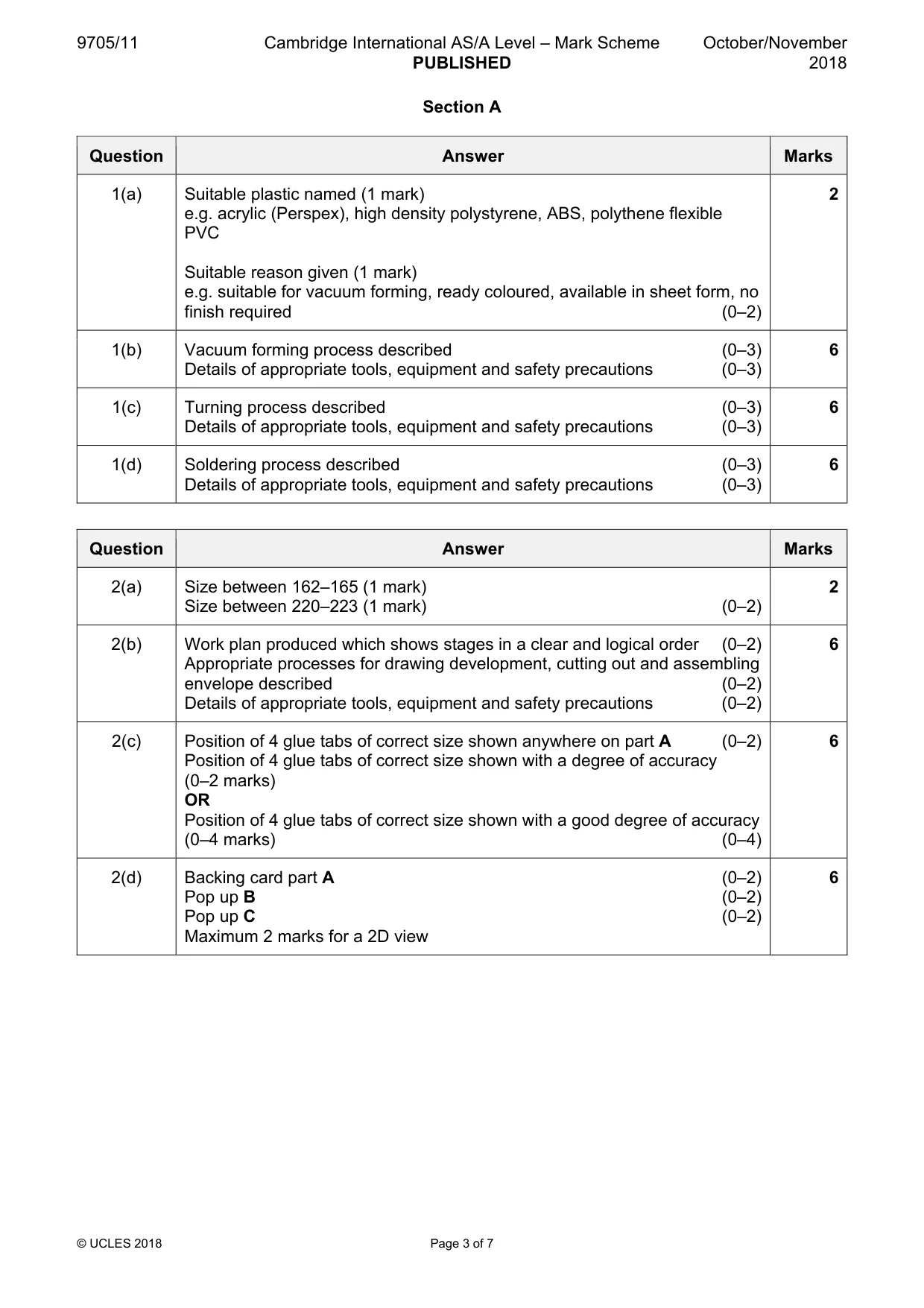
9705/11 Cambridge International AS/A Level – Mark Scheme PUBLISHED October/November 2018 © UCLES 2018 Page 3 of 7 Section A Question Answer Marks 1(a) Suitable plastic named (1 mark) e.g. acrylic (Perspex), high density polystyrene, ABS, polythene flexible PVC Suitable reason given (1 mark) e.g. suitable for vacuum forming, ready coloured, available in sheet form, no finish required (0–2) 2 1(b) Vacuum forming process described (0–3) Details of appropriate tools, equipment and safety precautions (0–3) 6 1(c) Turning process described (0–3) Details of appropriate tools, equipment and safety precautions (0–3) 6 1(d) Soldering process described (0–3) Details of appropriate tools, equipment and safety precautions (0–3) 6 Question Answer Marks 2(a) Size between 162–165 (1 mark) Size between 220–223 (1 mark) (0–2) 2 2(b) Work plan produced which shows stages in a clear and logical order (0–2) Appropriate processes for drawing development, cutting out and assembling envelope described (0–2) Details of appropriate tools, equipment and safety precautions (0–2) 6 2(c) Position of 4 glue tabs of correct size shown anywhere on part A (0–2) Position of 4 glue tabs of correct size shown with a degree of accuracy (0–2 marks) OR Position of 4 glue tabs of correct size shown with a good degree of accuracy (0–4 marks) (0–4) 6 2(d) Backing card part A (0–2) Pop up B (0–2) Pop up C (0–2) Maximum 2 marks for a 2D view 6
Mark scheme, page 4
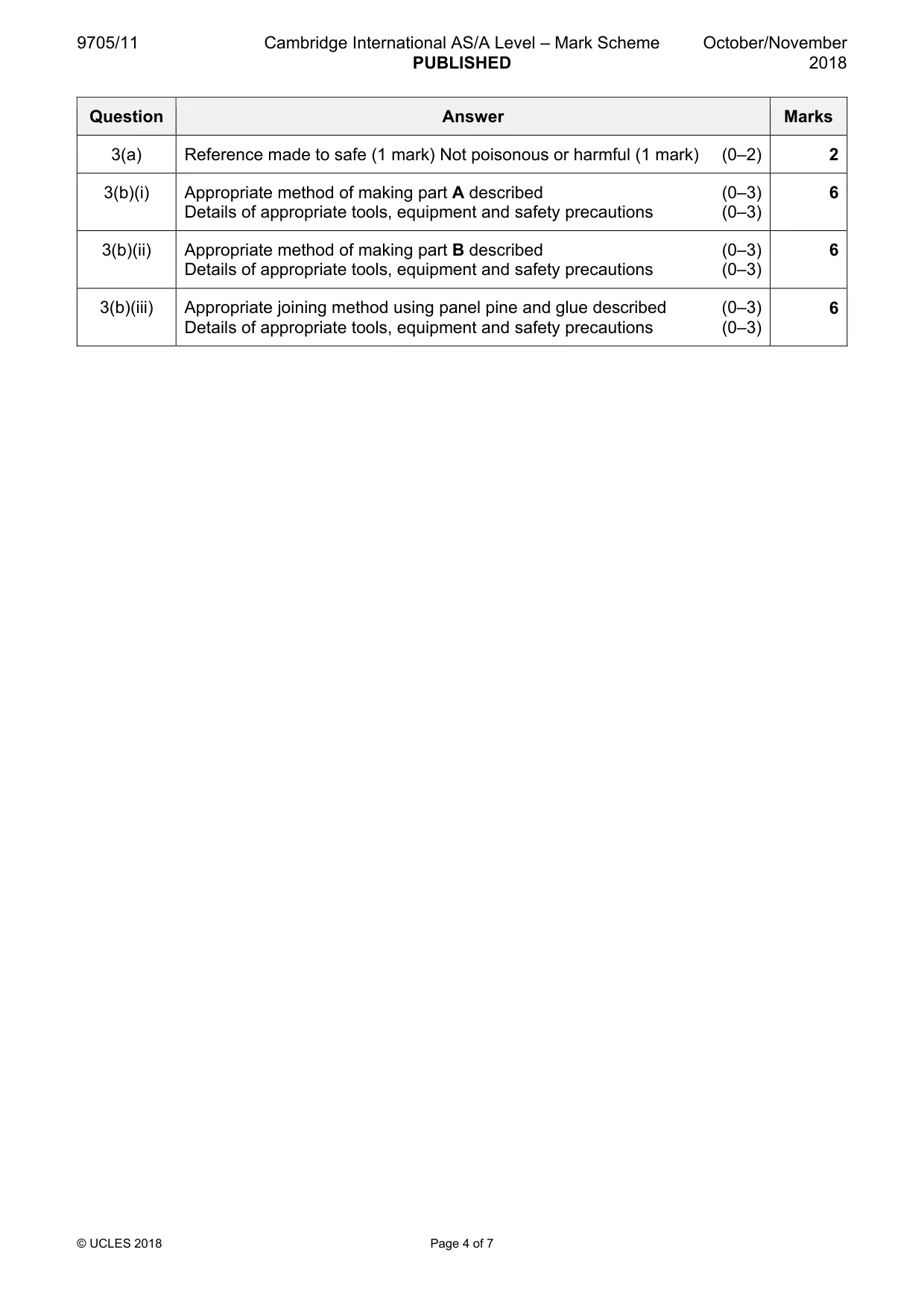
9705/11 Cambridge International AS/A Level – Mark Scheme PUBLISHED October/November 2018 © UCLES 2018 Page 4 of 7 Question Answer Marks 3(a) Reference made to safe (1 mark) Not poisonous or harmful (1 mark) (0–2) 2 3(b)(i) Appropriate method of making part A described (0–3) Details of appropriate tools, equipment and safety precautions (0–3) 6 3(b)(ii) Appropriate method of making part B described (0–3) Details of appropriate tools, equipment and safety precautions (0–3) 6 3(b)(iii) Appropriate joining method using panel pine and glue described (0–3) Details of appropriate tools, equipment and safety precautions (0–3) 6
Mark scheme, page 5
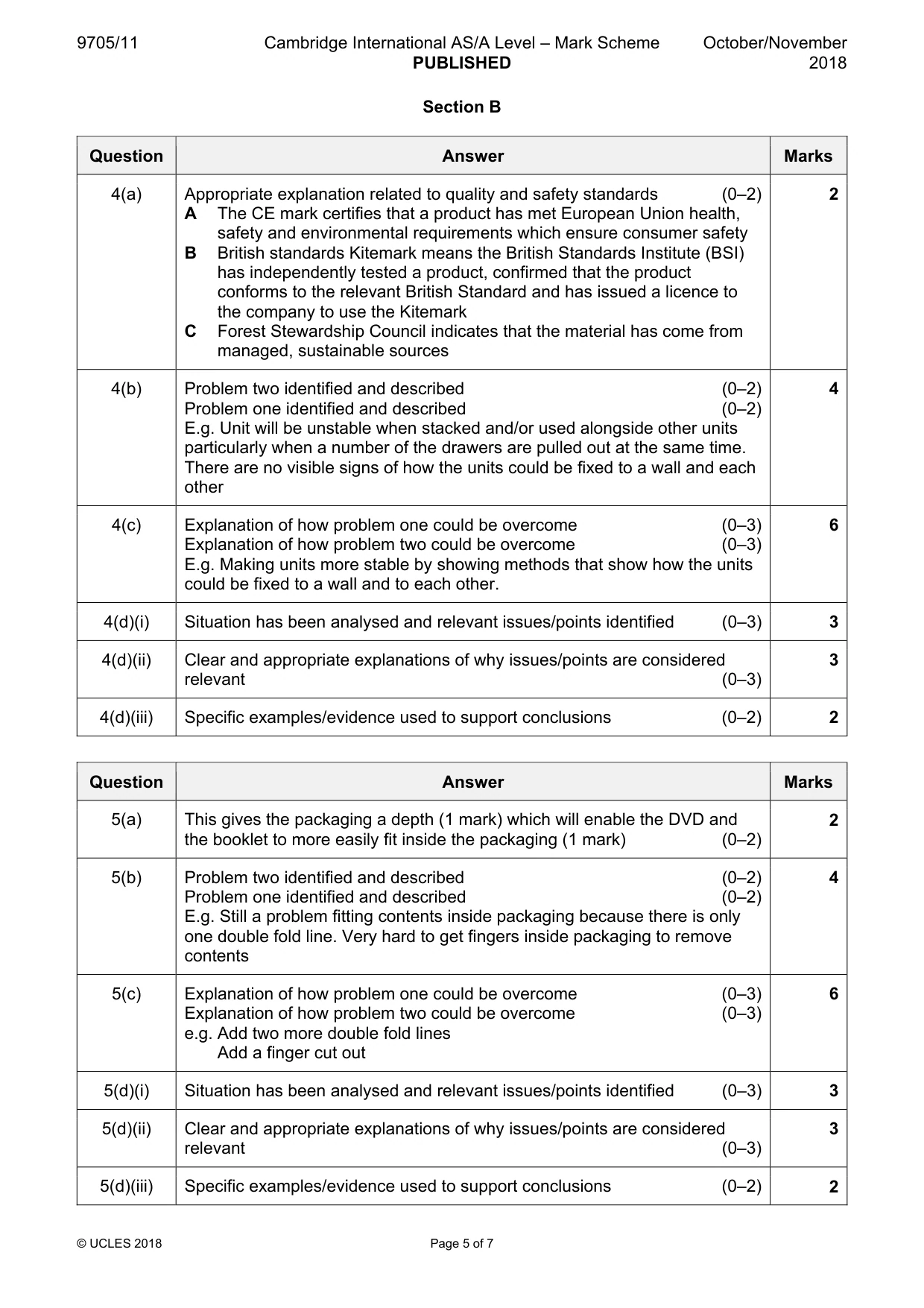
9705/11 Cambridge International AS/A Level – Mark Scheme PUBLISHED October/November 2018 © UCLES 2018 Page 5 of 7 Section B Question Answer Marks 4(a) Appropriate explanation related to quality and safety standards (0–2) A The CE mark certifies that a product has met European Union health, safety and environmental requirements which ensure consumer safety B British standards Kitemark means the British Standards Institute (BSI) has independently tested a product, confirmed that the product conforms to the relevant British Standard and has issued a licence to the company to use the Kitemark C Forest Stewardship Council indicates that the material has come from managed, sustainable sources 2 4(b) Problem two identified and described (0–2) Problem one identified and described (0–2) E.g. Unit will be unstable when stacked and/or used alongside other units particularly when a number of the drawers are pulled out at the same time. There are no visible signs of how the units could be fixed to a wall and each other 4 4(c) Explanation of how problem one could be overcome (0–3) Explanation of how problem two could be overcome (0–3) E.g. Making units more stable by showing methods that show how the units could be fixed to a wall and to each other. 6 4(d)(i) Situation has been analysed and relevant issues/points identified (0–3) 3 4(d)(ii) Clear and appropriate explanations of why issues/points are considered relevant (0–3) 3 4(d)(iii) Specific examples/evidence used to support conclusions (0–2) 2 Question Answer Marks 5(a) This gives the packaging a depth (1 mark) which will enable the DVD and the booklet to more easily fit inside the packaging (1 mark) (0–2) 2 5(b) Problem two identified and described (0–2) Problem one identified and described (0–2) E.g. Still a problem fitting contents inside packaging because there is only one double fold line. Very hard to get fingers inside packaging to remove contents 4 5(c) Explanation of how problem one could be overcome (0–3) Explanation of how problem two could be overcome (0–3) e.g. Add two more double fold lines Add a finger cut out 6 5(d)(i) Situation has been analysed and relevant issues/points identified (0–3) 3 5(d)(ii) Clear and appropriate explanations of why issues/points are considered relevant (0–3) 3 5(d)(iii) Specific examples/evidence used to support conclusions (0–2) 2
Mark scheme, page 6
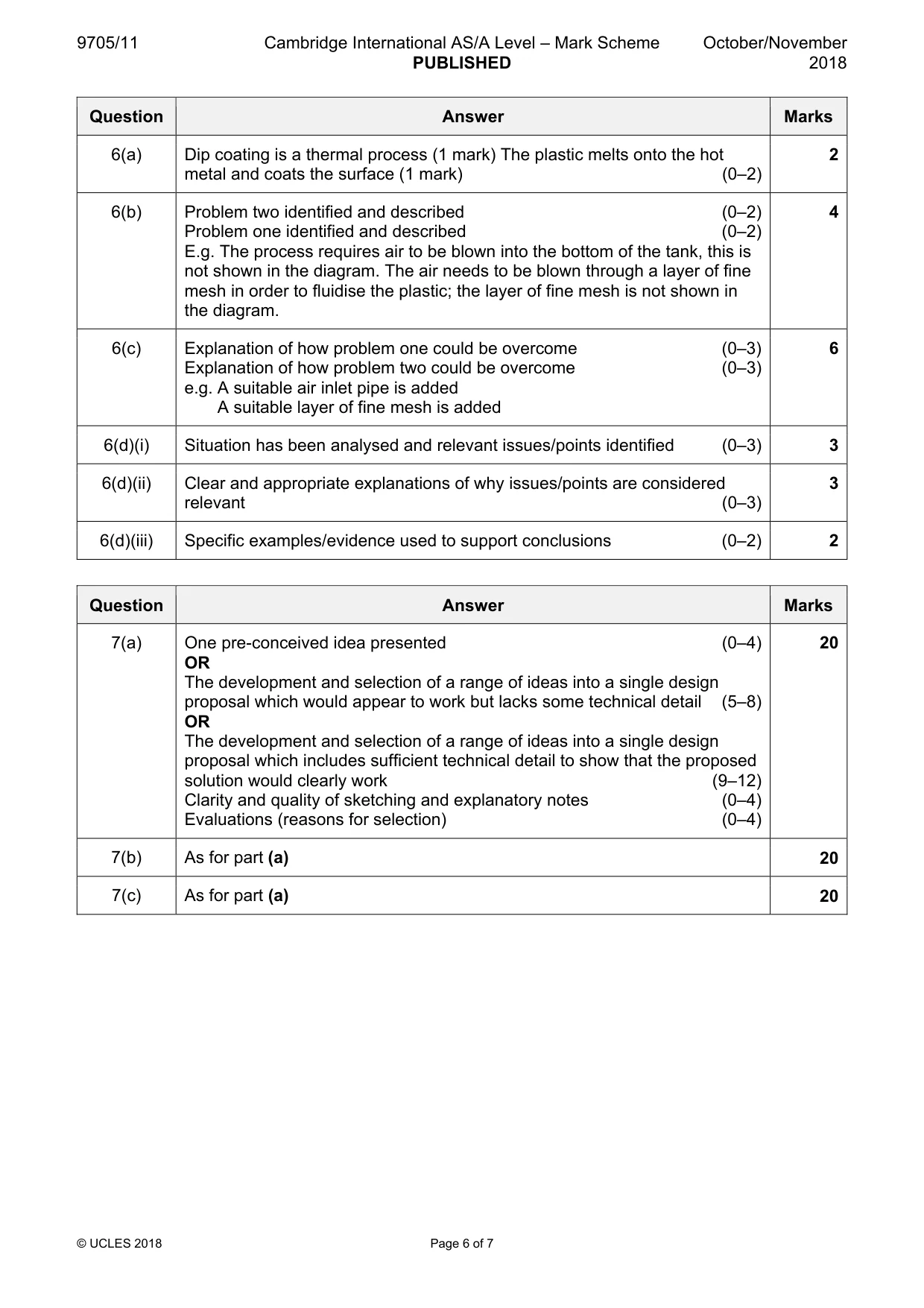
9705/11 Cambridge International AS/A Level – Mark Scheme PUBLISHED October/November 2018 © UCLES 2018 Page 6 of 7 Question Answer Marks 6(a) Dip coating is a thermal process (1 mark) The plastic melts onto the hot metal and coats the surface (1 mark) (0–2) 2 6(b) Problem two identified and described (0–2) Problem one identified and described (0–2) E.g. The process requires air to be blown into the bottom of the tank, this is not shown in the diagram. The air needs to be blown through a layer of fine mesh in order to fluidise the plastic; the layer of fine mesh is not shown in the diagram. 4 6(c) Explanation of how problem one could be overcome (0–3) Explanation of how problem two could be overcome (0–3) e.g. A suitable air inlet pipe is added A suitable layer of fine mesh is added 6 6(d)(i) Situation has been analysed and relevant issues/points identified (0–3) 3 6(d)(ii) Clear and appropriate explanations of why issues/points are considered relevant (0–3) 3 6(d)(iii) Specific examples/evidence used to support conclusions (0–2) 2 Question Answer Marks 7(a) One pre-conceived idea presented (0–4) OR The development and selection of a range of ideas into a single design proposal which would appear to work but lacks some technical detail (5–8) OR The development and selection of a range of ideas into a single design proposal which includes sufficient technical detail to show that the proposed solution would clearly work (9–12) Clarity and quality of sketching and explanatory notes (0–4) Evaluations (reasons for selection) (0–4) 20 7(b) As for part (a) 20 7(c) As for part (a) 20
Mark scheme, page 7
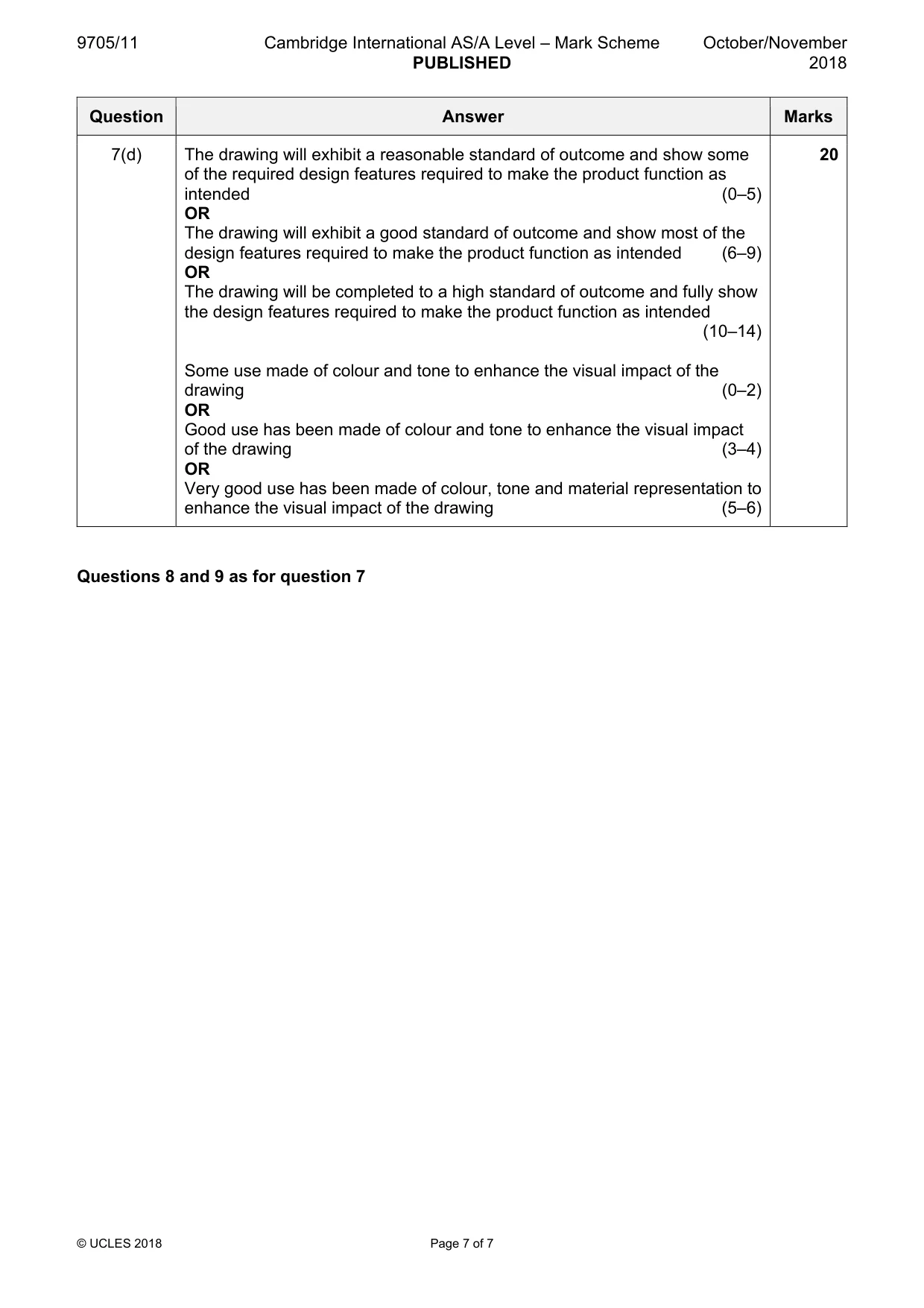
9705/11 Cambridge International AS/A Level – Mark Scheme PUBLISHED October/November 2018 © UCLES 2018 Page 7 of 7 Question Answer Marks 7(d) The drawing will exhibit a reasonable standard of outcome and show some of the required design features required to make the product function as intended (0–5) OR The drawing will exhibit a good standard of outcome and show most of the design features required to make the product function as intended (6–9) OR The drawing will be completed to a high standard of outcome and fully show the design features required to make the product function as intended (10–14) Some use made of colour and tone to enhance the visual impact of the drawing (0–2) OR Good use has been made of colour and tone to enhance the visual impact of the drawing (3–4) OR Very good use has been made of colour, tone and material representation to enhance the visual impact of the drawing (5–6) 20 Questions 8 and 9 as for question 7
What you needed in this session
Cambridge’s own grade thresholds for 2018 Oct/Nov, Paper 1 · Variant 1. A higher threshold means an easier paper — the bar moves with how the cohort did.