Cambridge A Level Design and Technology 9705 — 2018 Oct/Nov Paper 1 · Variant 2
9705/12/O/N/18 · 120 marks · ≈135 min
The question paper and its mark scheme, free to read here and free to download. This is Cambridge’s own paper, exactly as it was sat.
Question paper16 pages

Mark scheme6 pages
Answers below. Sit the paper first if you are practising.
Paper as text
Question paper, page 1
* 7 0 8 1 9 7 0 1 4 7 * This document consists of 14 printed pages and 2 blank pages. DC (CE/CGW) 152113/1 © UCLES 2018 [Turn over Cambridge International Examinations Cambridge International Advanced Subsidiary and Advanced Level DESIGN AND TECHNOLOGY 9705/12 Paper 1 October/November 2018 3 hours Additional Materials: Answer Booklet/A4 Paper A3 Drawing Paper (2 sheets) Extra sheets of A3 drawing paper for candidates who have used up both sides of their 2 sheets A range of design drawing equipment READ THESE INSTRUCTIONS FIRST If you have been given an Answer Booklet, follow the instructions on the front cover of the Booklet. Write your answers and working on the separate Answer Booklet/Paper provided. Write your name, Centre number and candidate number on all the work you hand in. Write in dark blue or black pen. You may use an HB pencil, or coloured pencils/pens as appropriate, for any diagrams, graphs or rough working. Do not use staples, paper clips, glue or correction fluid. DO NOT WRITE IN ANY BARCODES. Section A Answer one question on the Answer Booklet/A4 Paper provided. Section B Answer one question on the Answer Booklet/A4 Paper provided. Section C Answer one question on plain A3 paper. Use both sides of the paper. You may request additional sheets of A3 paper, but only if you have used up both sides of each of the 2 sheets provided. You are advised to spend 30 minutes on each of Sections A and B and 2 hours on Section C. At the end of the examination, fasten all your work securely together. The number of marks is given in brackets [ ] at the end of each question or part question. All dimensions are in millimetres.
Question paper, page 2
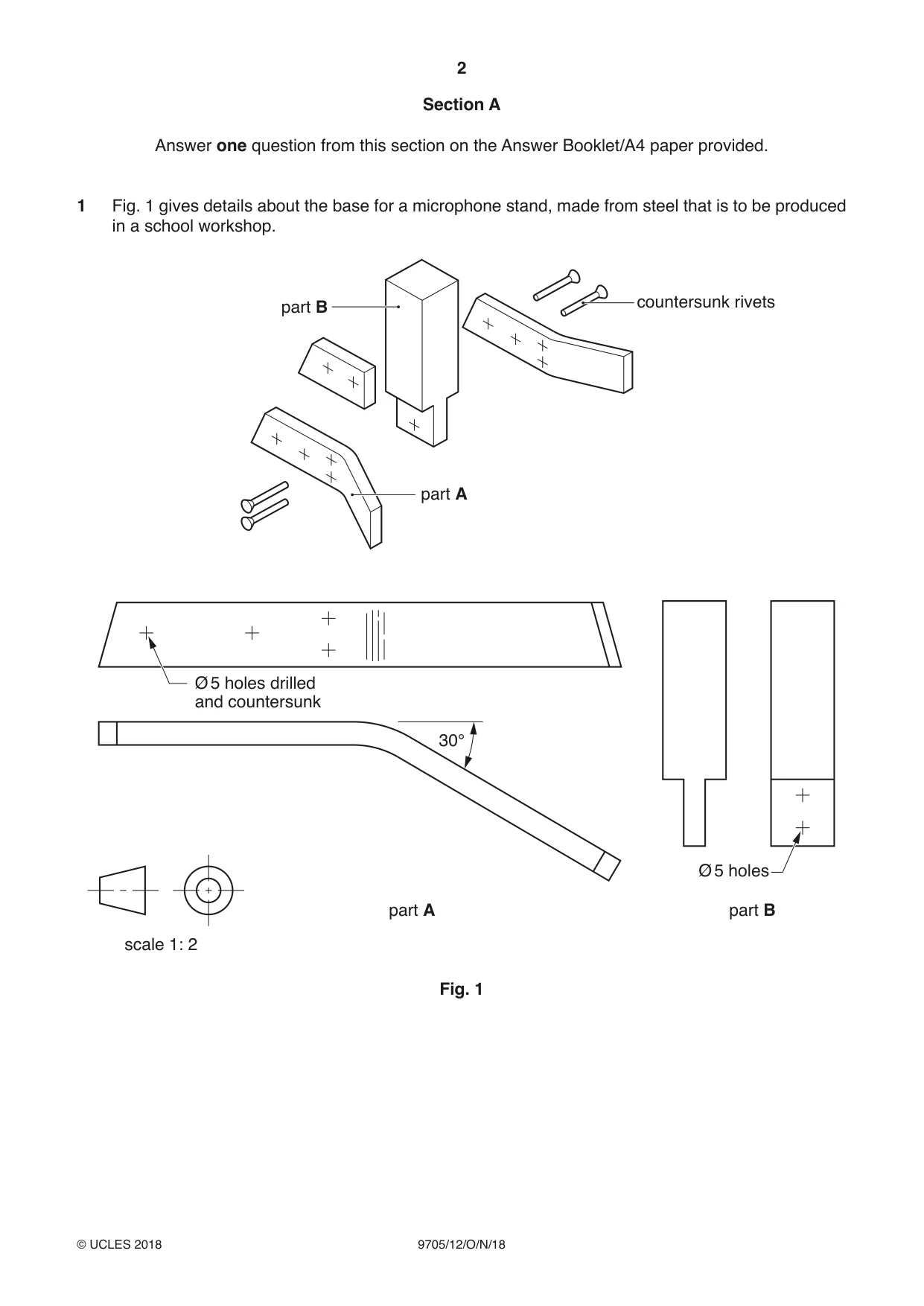
2 9705/12/O/N/18 © UCLES 2018 Section A Answer one question from this section on the Answer Booklet/A4 paper provided. 1 Fig. 1 gives details about the base for a microphone stand, made from steel that is to be produced in a school workshop. countersunk rivets part A part A part B part B 30° Ø 5 holes drilled and countersunk Ø 5 holes scale 1: 2 Fig. 1
Question paper, page 3
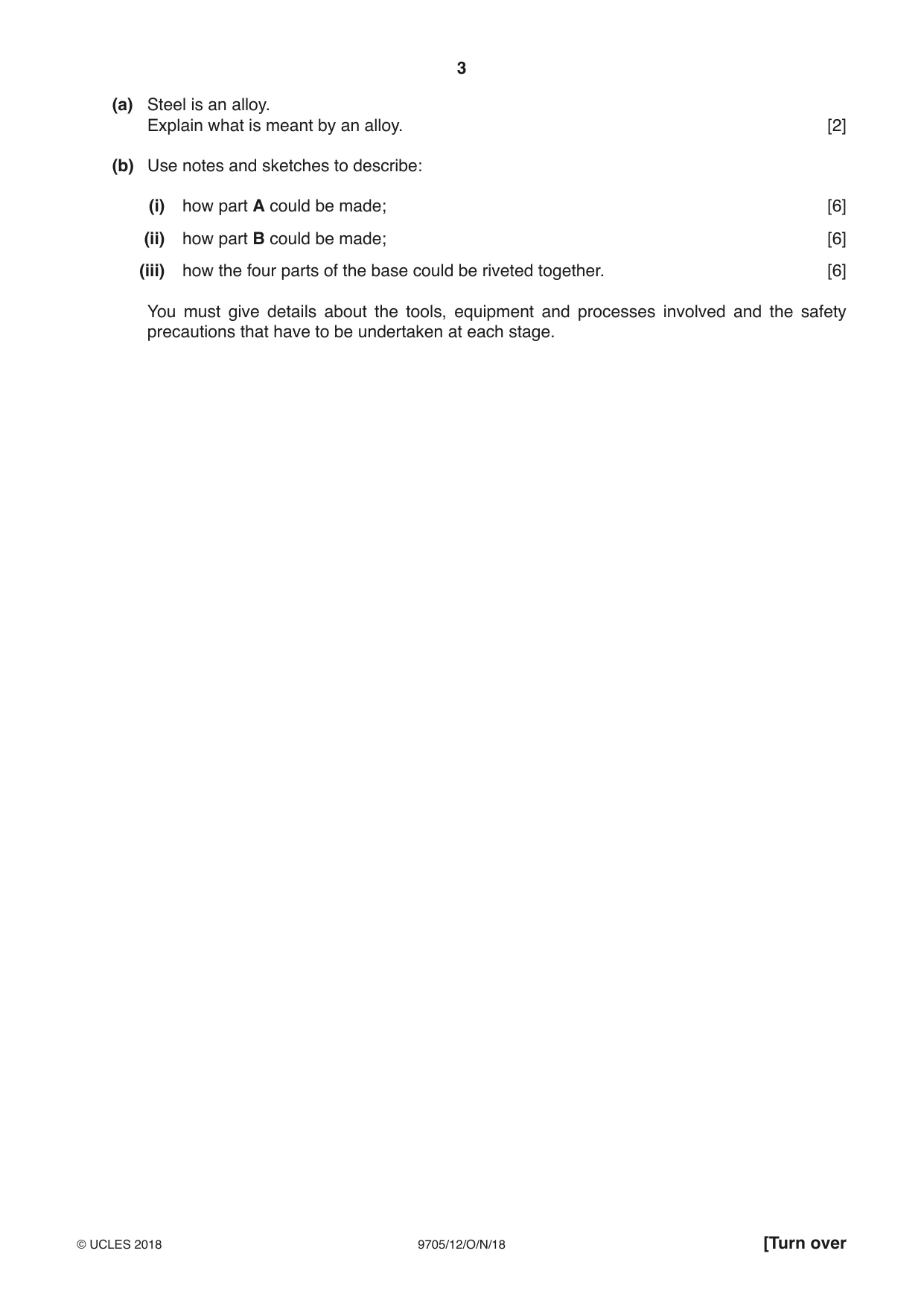
3 9705/12/O/N/18 © UCLES 2018 [Turn over (a) Steel is an alloy. Explain what is meant by an alloy. [2] (b) Use notes and sketches to describe: (i) how part A could be made; [6] (ii) how part B could be made; [6] (iii) how the four parts of the base could be riveted together. [6] You must give details about the tools, equipment and processes involved and the safety precautions that have to be undertaken at each stage.
Question paper, page 4
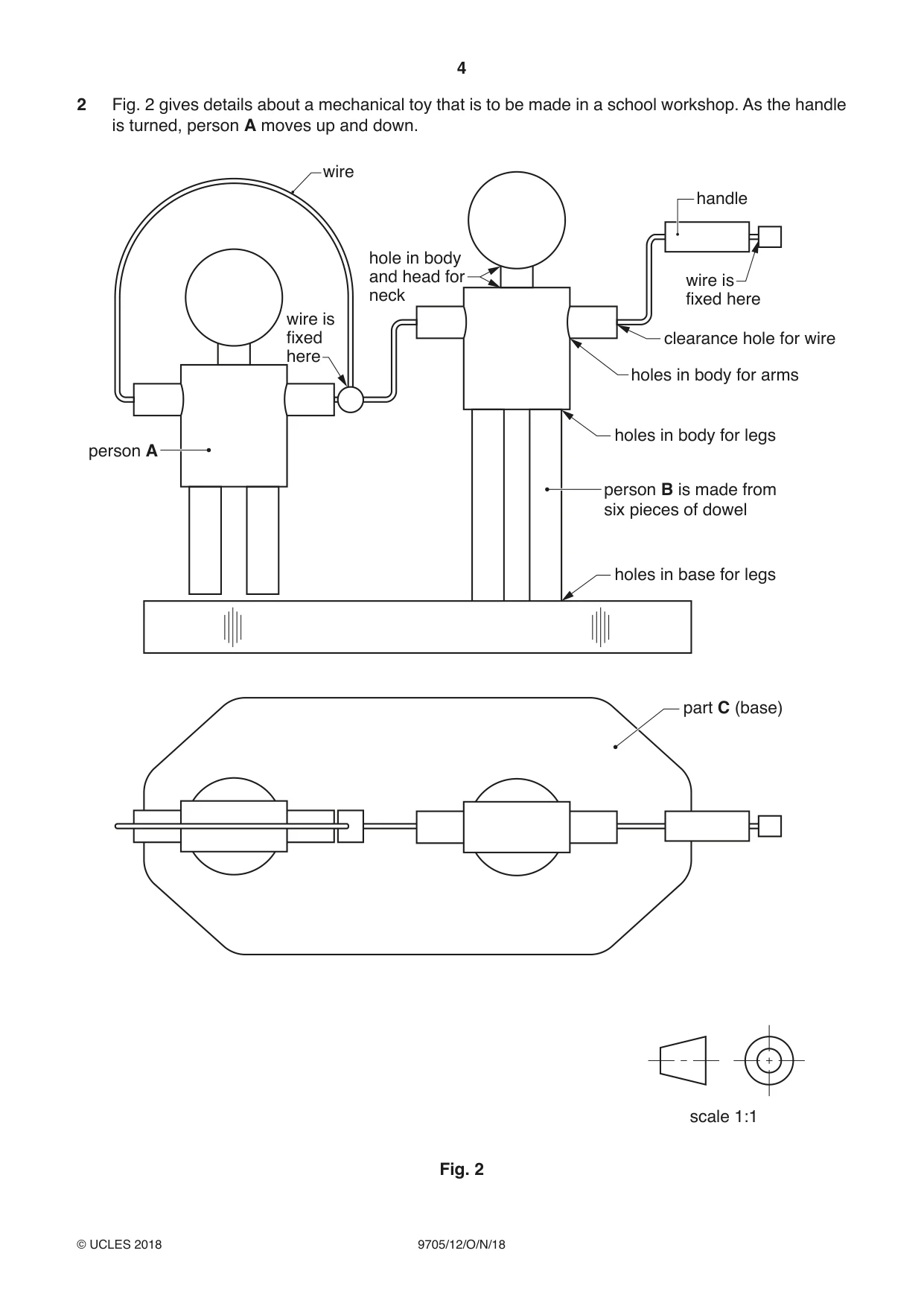
4 9705/12/O/N/18 © UCLES 2018 2 Fig. 2 gives details about a mechanical toy that is to be made in a school workshop. As the handle is turned, person A moves up and down. part C (base) person A person B is made from six pieces of dowel holes in base for legs holes in body for legs wire wire is fixed here hole in body and head for neck holes in body for arms clearance hole for wire wire is fixed here handle scale 1:1 Fig. 2
Question paper, page 5
5 9705/12/O/N/18 © UCLES 2018 [Turn over (a) Explain why the wire will need to be bent in stages as the toy is assembled. [2] (b) Use notes and sketches to describe: (i) how person B could be made from six pieces of dowel; [6] (ii) how part C could be made; [6] (iii) the stages needed to bend the wire to the required shape as the toy is assembled. [6] You must give details about the tools, equipment and processes involved and the safety precautions that have to be undertaken at each stage.
Question paper, page 6
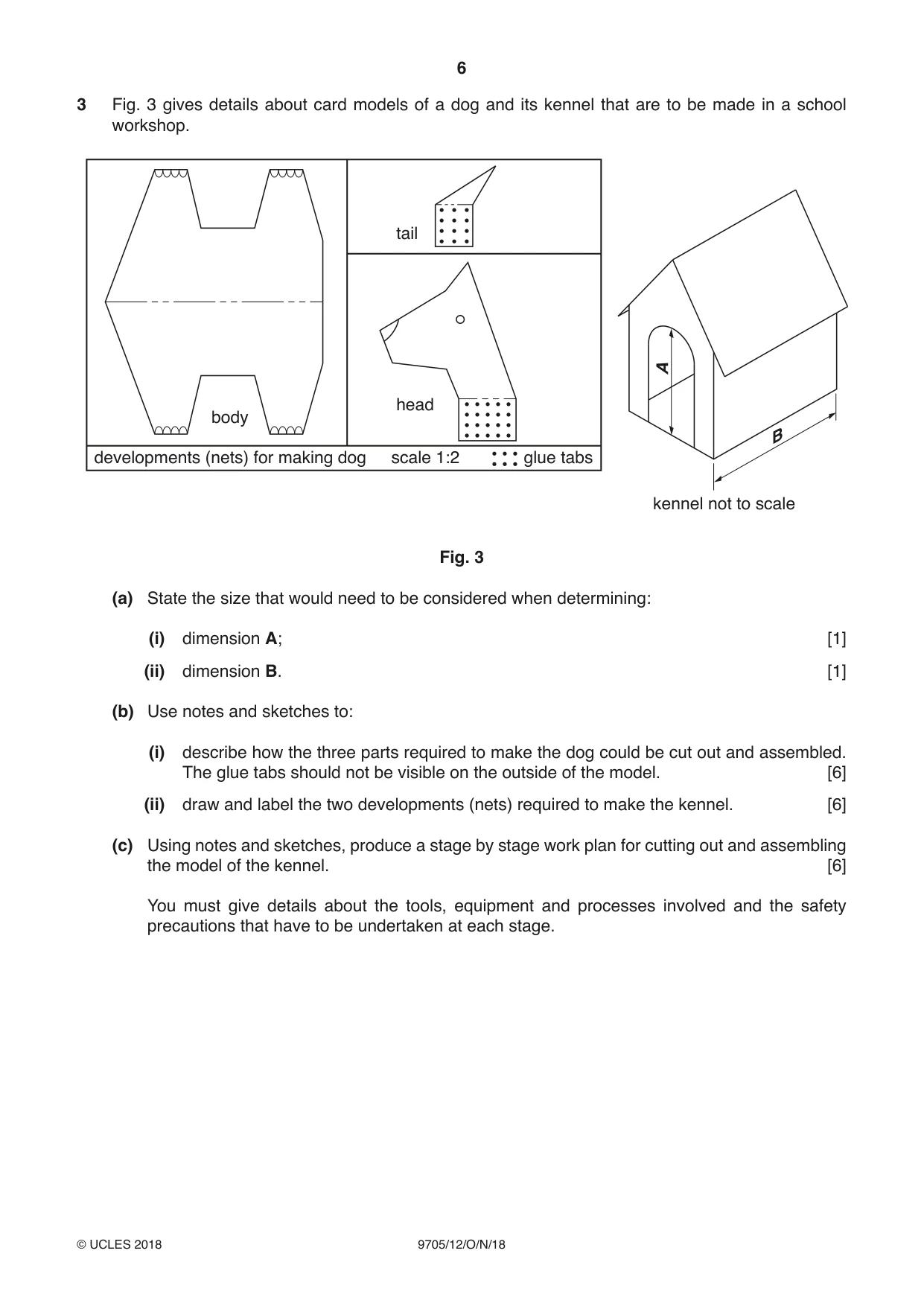
6 9705/12/O/N/18 © UCLES 2018 3 Fig. 3 gives details about card models of a dog and its kennel that are to be made in a school workshop. tail head body developments (nets) for making dog glue tabs scale 1:2 kennel not to scale B A Fig. 3 (a) State the size that would need to be considered when determining: (i) dimension A; [1] (ii) dimension B. [1] (b) Use notes and sketches to: (i) describe how the three parts required to make the dog could be cut out and assembled. The glue tabs should not be visible on the outside of the model. [6] (ii) draw and label the two developments (nets) required to make the kennel. [6] (c) Using notes and sketches, produce a stage by stage work plan for cutting out and assembling the model of the kennel. [6] You must give details about the tools, equipment and processes involved and the safety precautions that have to be undertaken at each stage.
Question paper, page 7
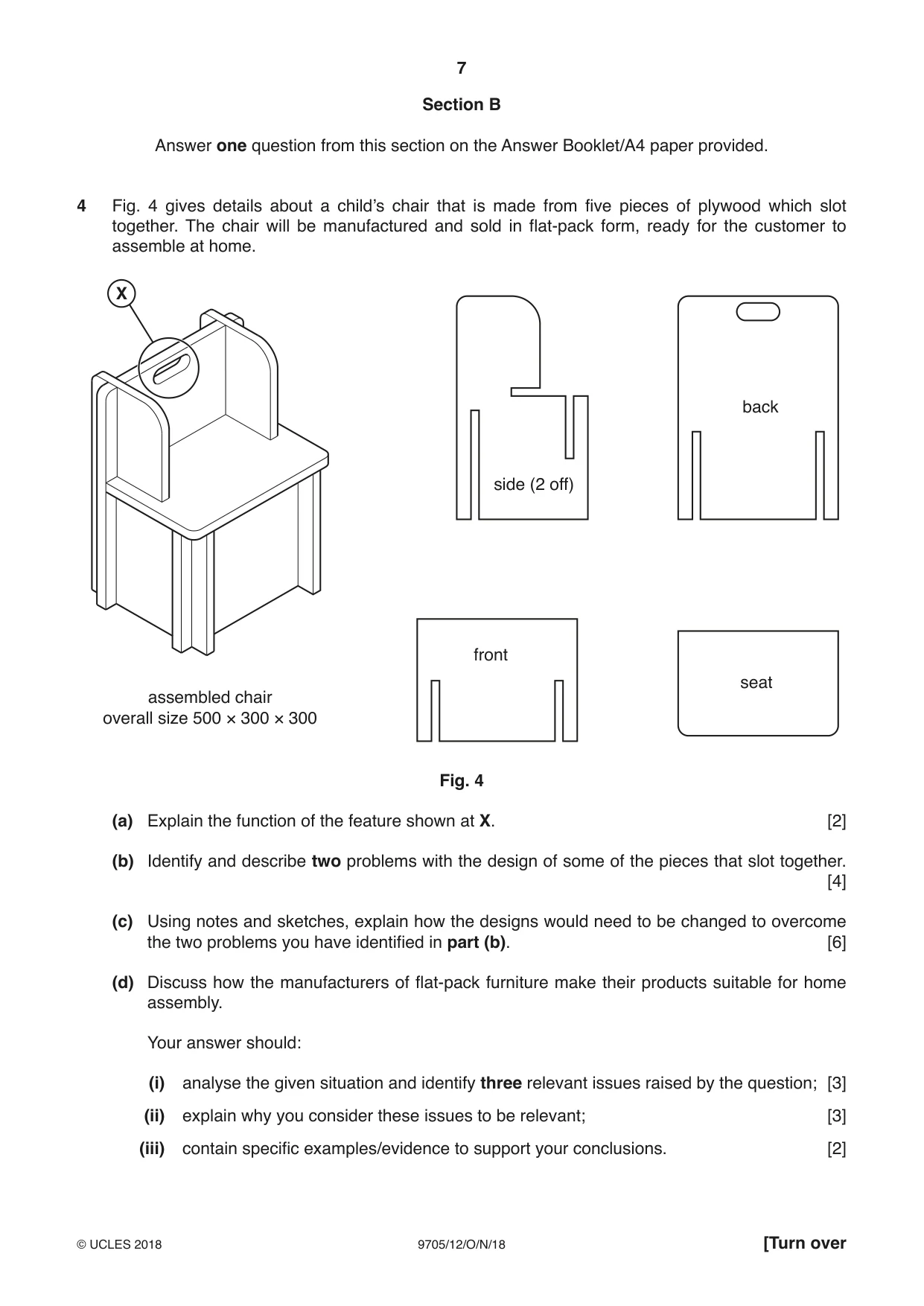
7 9705/12/O/N/18 © UCLES 2018 [Turn over Section B Answer one question from this section on the Answer Booklet/A4 paper provided. 4 Fig. 4 gives details about a child’s chair that is made from five pieces of plywood which slot together. The chair will be manufactured and sold in flat-pack form, ready for the customer to assemble at home. side (2 off) front assembled chair overall size 500 × 300 × 300 seat back X Fig. 4 (a) Explain the function of the feature shown at X. [2] (b) Identify and describe two problems with the design of some of the pieces that slot together. [4] (c) Using notes and sketches, explain how the designs would need to be changed to overcome the two problems you have identified in part (b). [6] (d) Discuss how the manufacturers of flat-pack furniture make their products suitable for home assembly. Your answer should: (i) analyse the given situation and identify three relevant issues raised by the question; [3] (ii) explain why you consider these issues to be relevant; [3] (iii) contain specific examples/evidence to support your conclusions. [2]
Question paper, page 8
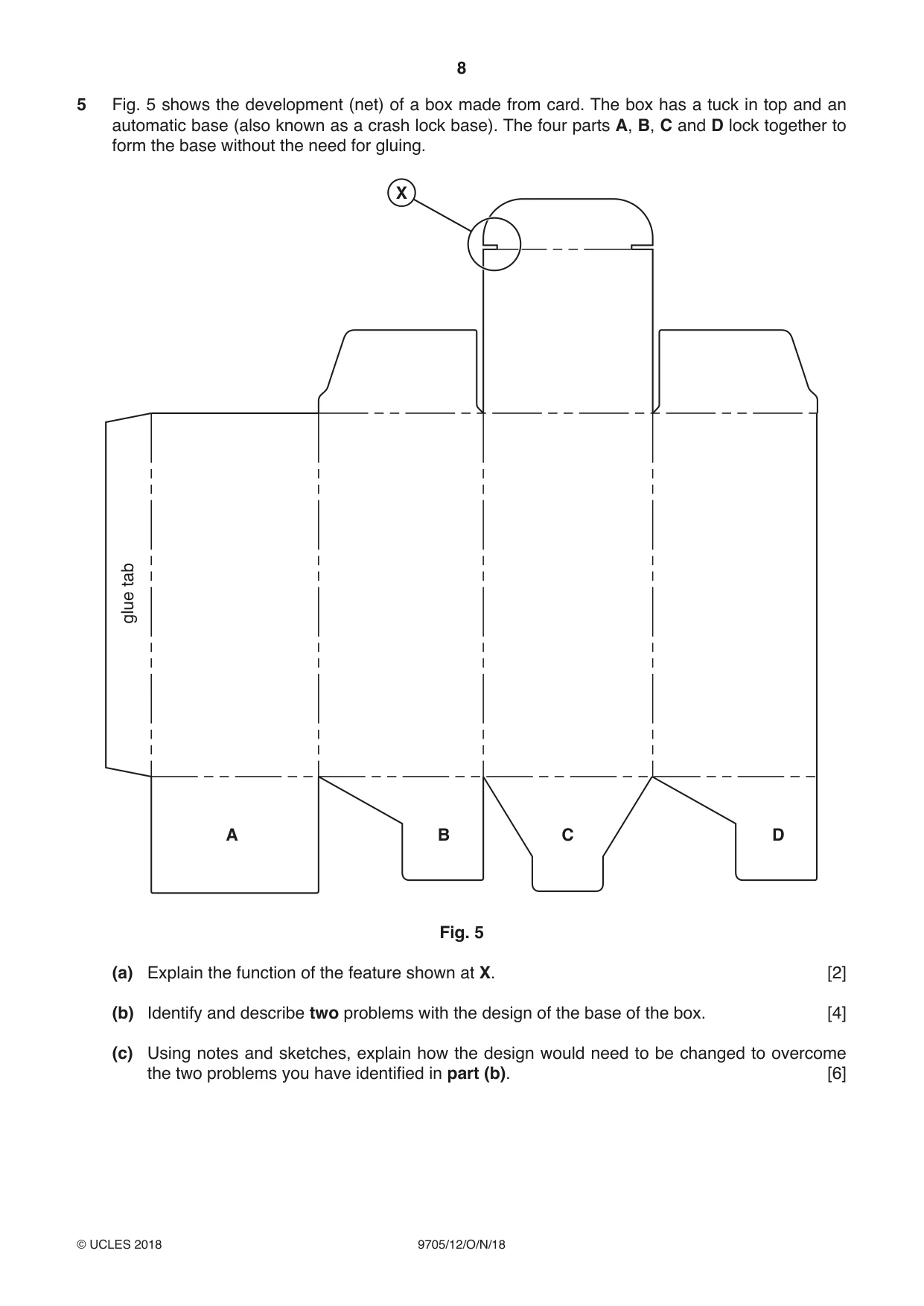
8 9705/12/O/N/18 © UCLES 2018 5 Fig. 5 shows the development (net) of a box made from card. The box has a tuck in top and an automatic base (also known as a crash lock base). The four parts A, B, C and D lock together to form the base without the need for gluing. A B C D glue tab X Fig. 5 (a) Explain the function of the feature shown at X. [2] (b) Identify and describe two problems with the design of the base of the box. [4] (c) Using notes and sketches, explain how the design would need to be changed to overcome the two problems you have identified in part (b). [6]
Question paper, page 9
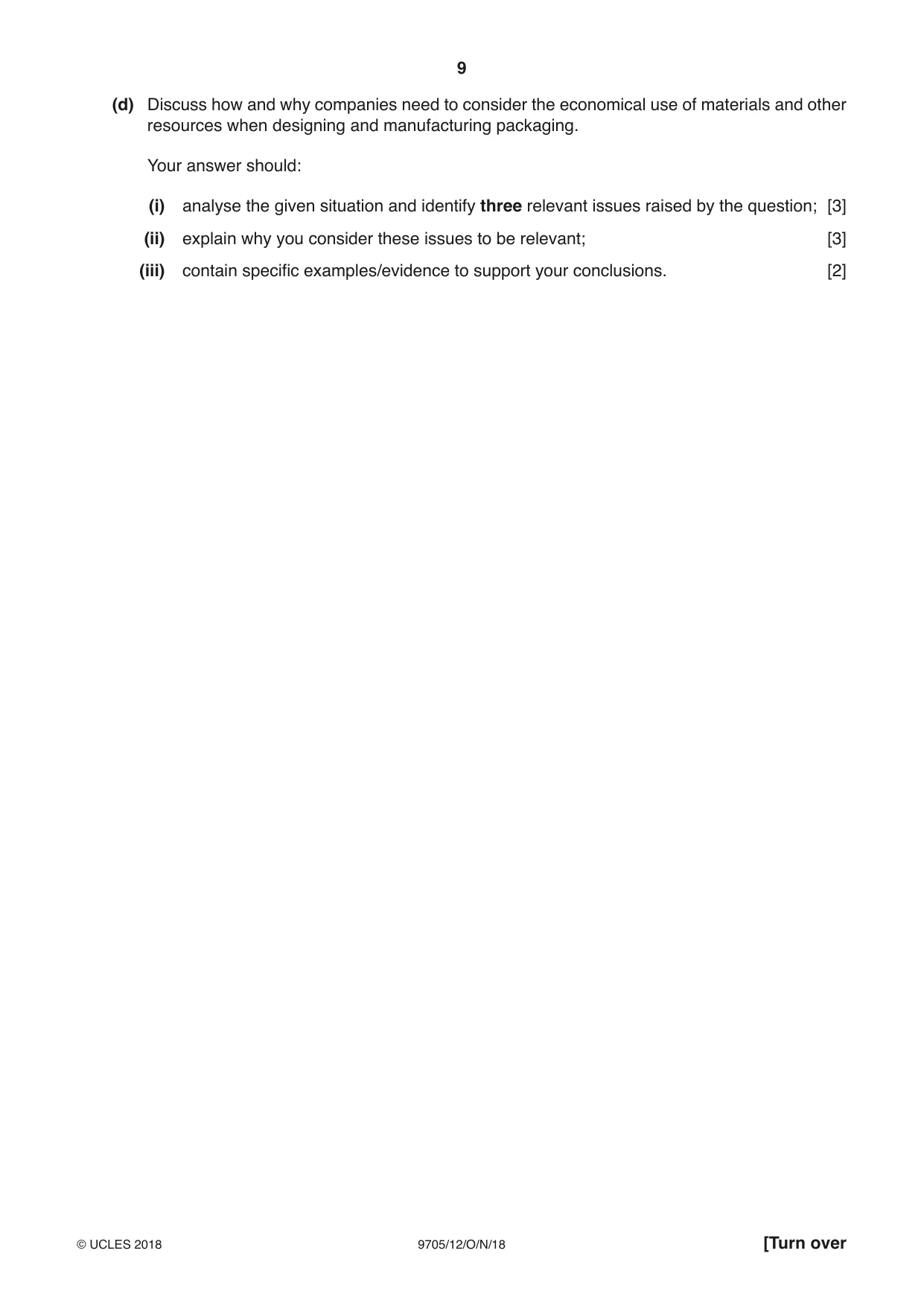
9 9705/12/O/N/18 © UCLES 2018 [Turn over (d) Discuss how and why companies need to consider the economical use of materials and other resources when designing and manufacturing packaging. Your answer should: (i) analyse the given situation and identify three relevant issues raised by the question; [3] (ii) explain why you consider these issues to be relevant; [3] (iii) contain specific examples/evidence to support your conclusions. [2]
Question paper, page 10
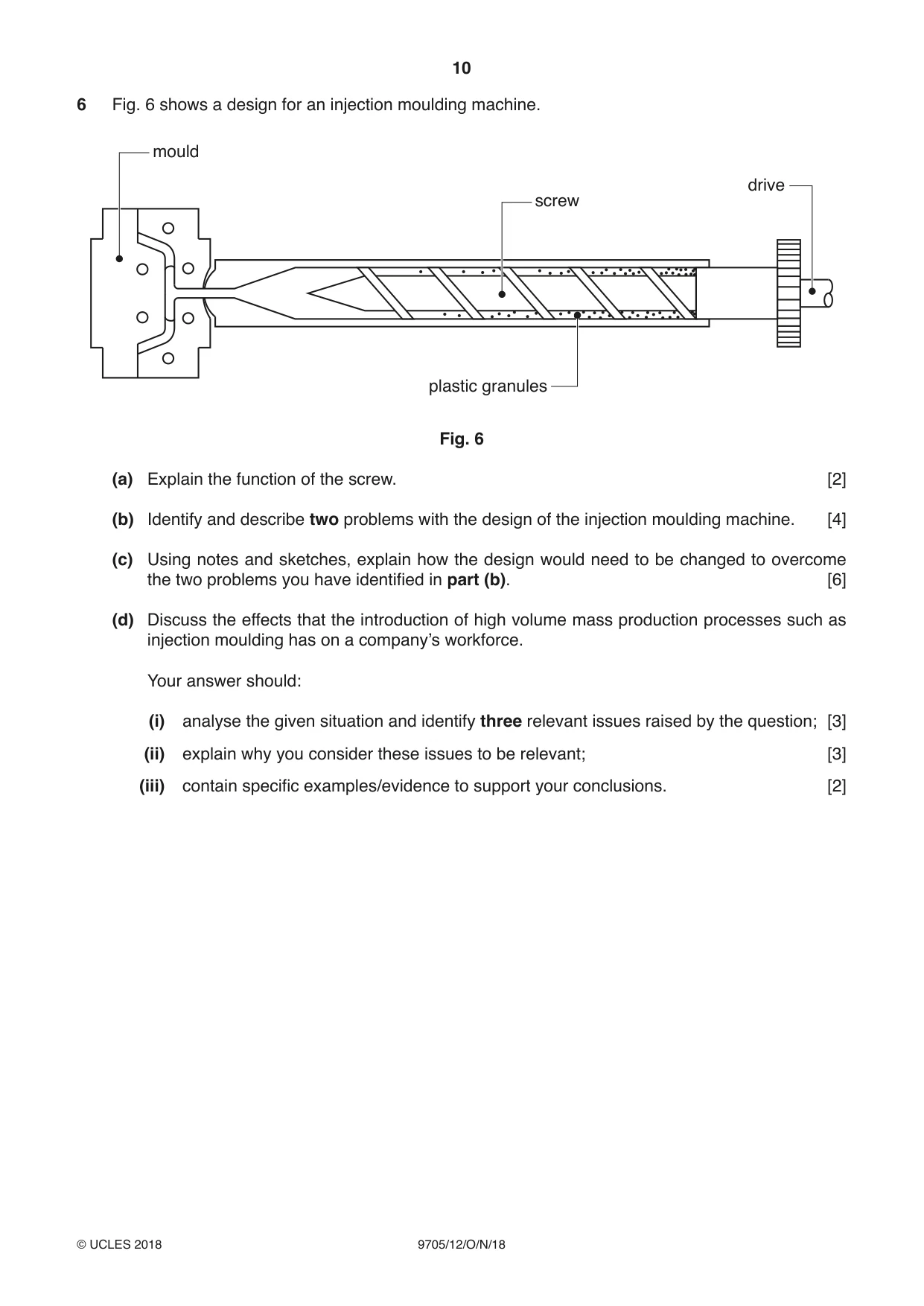
10 9705/12/O/N/18 © UCLES 2018 6 Fig. 6 shows a design for an injection moulding machine. mould screw plastic granules drive Fig. 6 (a) Explain the function of the screw. [2] (b) Identify and describe two problems with the design of the injection moulding machine. [4] (c) Using notes and sketches, explain how the design would need to be changed to overcome the two problems you have identified in part (b). [6] (d) Discuss the effects that the introduction of high volume mass production processes such as injection moulding has on a company’s workforce. Your answer should: (i) analyse the given situation and identify three relevant issues raised by the question; [3] (ii) explain why you consider these issues to be relevant; [3] (iii) contain specific examples/evidence to support your conclusions. [2]
Question paper, page 11
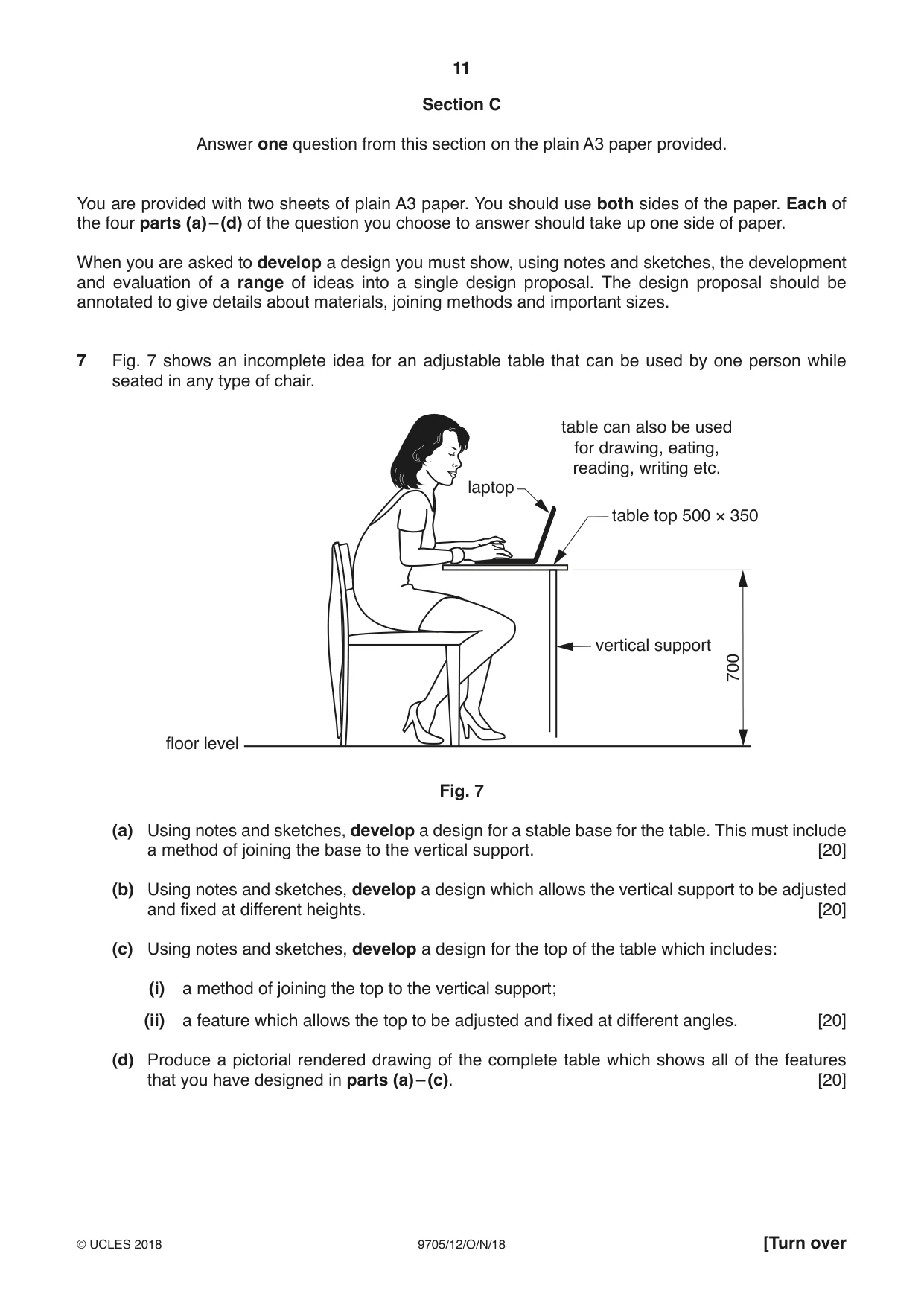
11 9705/12/O/N/18 © UCLES 2018 [Turn over Section C Answer one question from this section on the plain A3 paper provided. You are provided with two sheets of plain A3 paper. You should use both sides of the paper. Each of the four parts (a) – (d) of the question you choose to answer should take up one side of paper. When you are asked to develop a design you must show, using notes and sketches, the development and evaluation of a range of ideas into a single design proposal. The design proposal should be annotated to give details about materials, joining methods and important sizes. 7 Fig. 7 shows an incomplete idea for an adjustable table that can be used by one person while seated in any type of chair. vertical support floor level laptop table top 500 × 350 700 table can also be used for drawing, eating, reading, writing etc. Fig. 7 (a) Using notes and sketches, develop a design for a stable base for the table. This must include a method of joining the base to the vertical support. [20] (b) Using notes and sketches, develop a design which allows the vertical support to be adjusted and fixed at different heights. [20] (c) Using notes and sketches, develop a design for the top of the table which includes: (i) a method of joining the top to the vertical support; (ii) a feature which allows the top to be adjusted and fixed at different angles. [20] (d) Produce a pictorial rendered drawing of the complete table which shows all of the features that you have designed in parts (a) – (c). [20]
Question paper, page 12
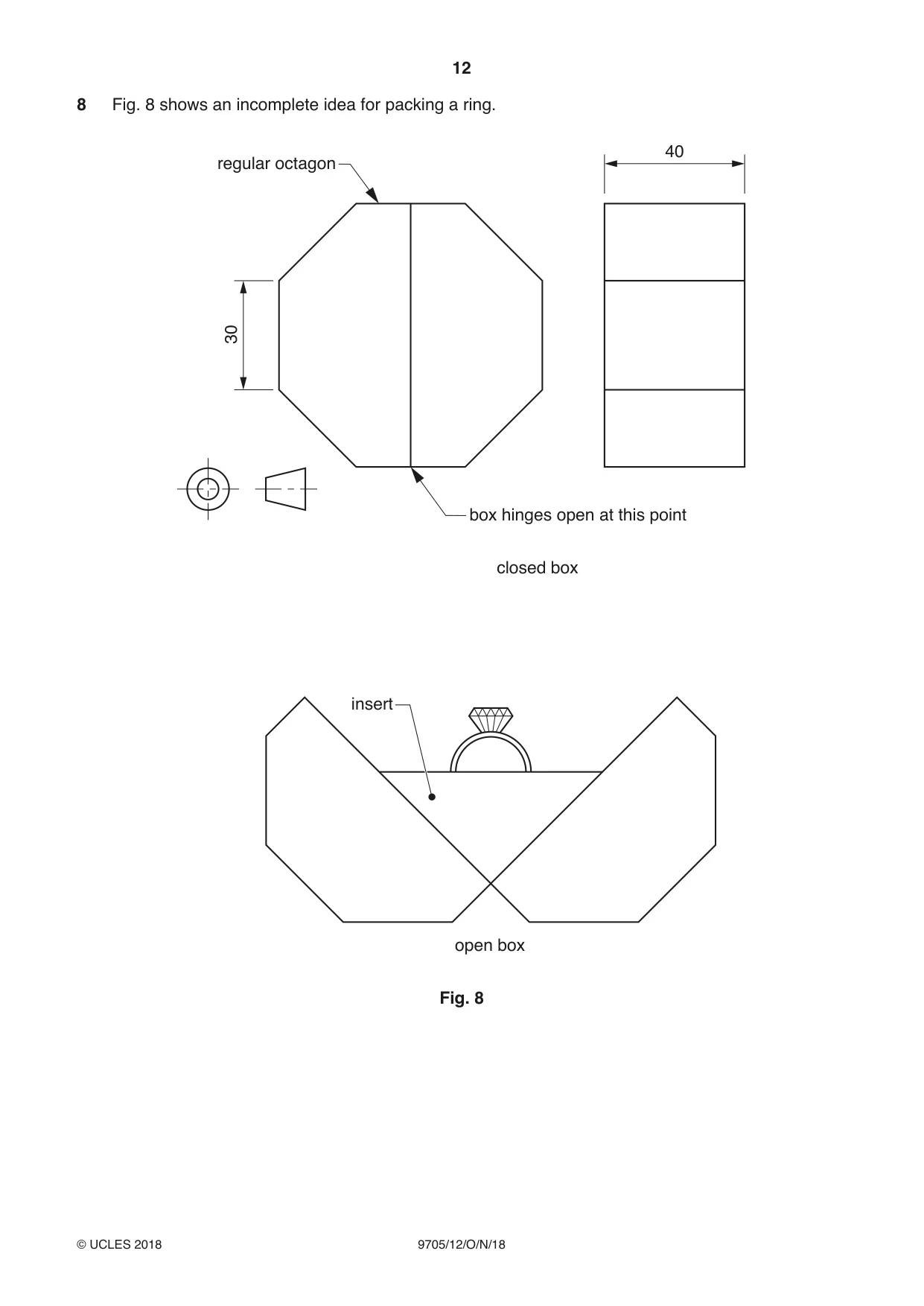
12 9705/12/O/N/18 © UCLES 2018 8 Fig. 8 shows an incomplete idea for packing a ring. regular octagon 30 40 box hinges open at this point closed box open box insert Fig. 8
Question paper, page 13
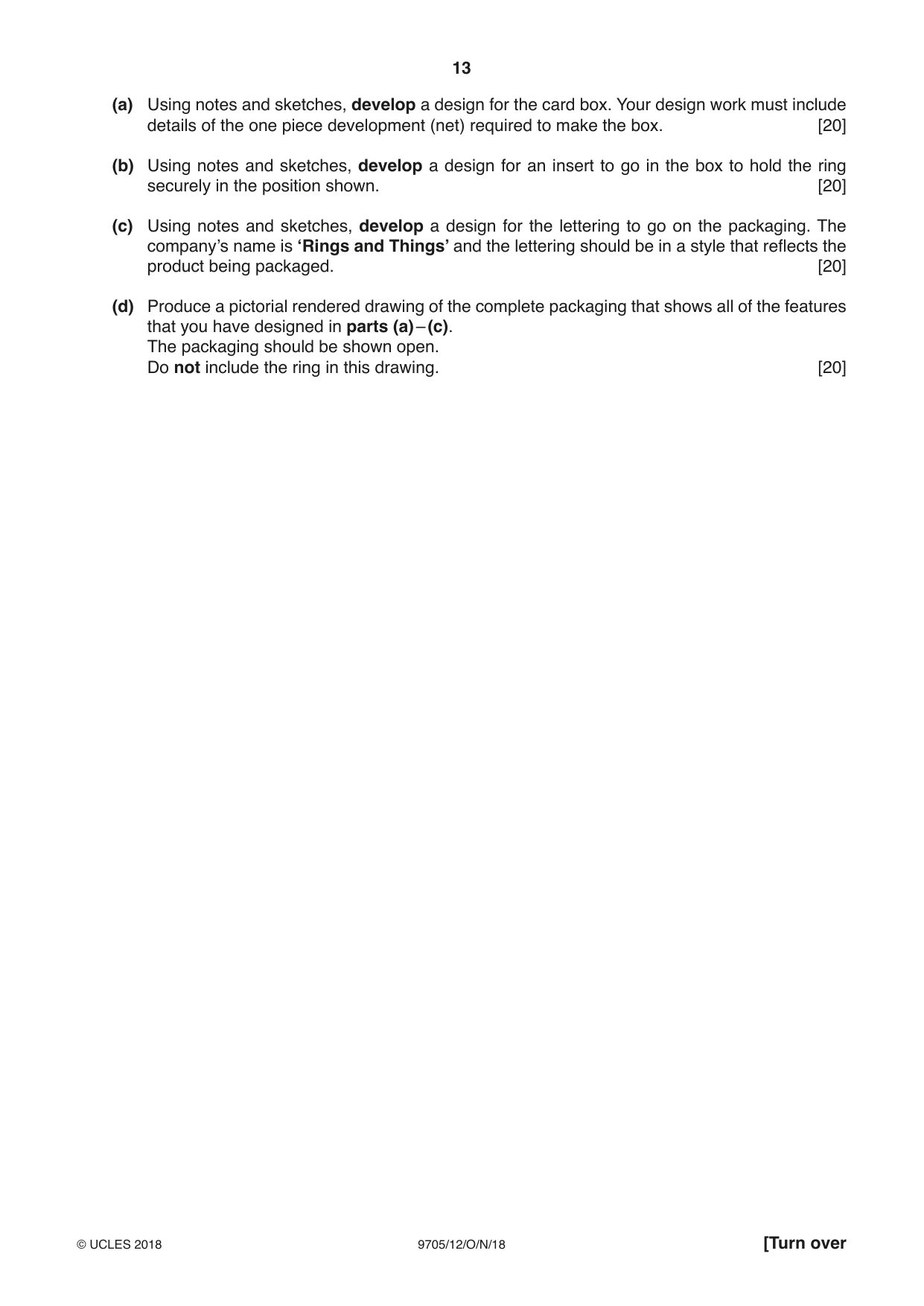
13 9705/12/O/N/18 © UCLES 2018 [Turn over (a) Using notes and sketches, develop a design for the card box. Your design work must include details of the one piece development (net) required to make the box. [20] (b) Using notes and sketches, develop a design for an insert to go in the box to hold the ring securely in the position shown. [20] (c) Using notes and sketches, develop a design for the lettering to go on the packaging. The company’s name is ‘Rings and Things’ and the lettering should be in a style that reflects the product being packaged. [20] (d) Produce a pictorial rendered drawing of the complete packaging that shows all of the features that you have designed in parts (a) – (c). The packaging should be shown open. Do not include the ring in this drawing. [20]
Question paper, page 14
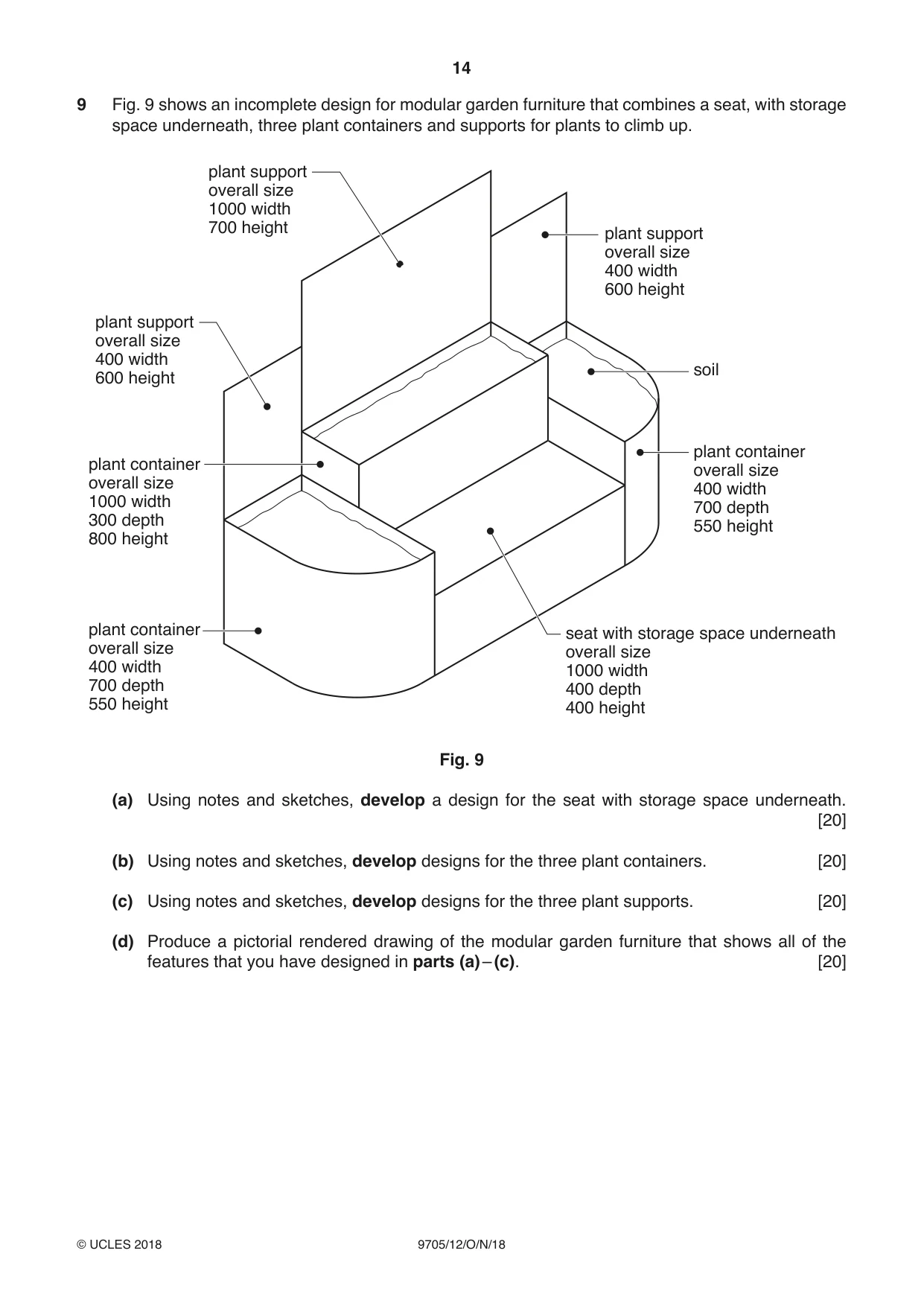
14 9705/12/O/N/18 © UCLES 2018 9 Fig. 9 shows an incomplete design for modular garden furniture that combines a seat, with storage space underneath, three plant containers and supports for plants to climb up. plant support overall size 400 width 600 height plant support overall size 1000 width 700 height plant support overall size 400 width 600 height soil plant container overall size 400 width 700 depth 550 height plant container overall size 1000 width 300 depth 800 height plant container overall size 400 width 700 depth 550 height seat with storage space underneath overall size 1000 width 400 depth 400 height Fig. 9 (a) Using notes and sketches, develop a design for the seat with storage space underneath. [20] (b) Using notes and sketches, develop designs for the three plant containers. [20] (c) Using notes and sketches, develop designs for the three plant supports. [20] (d) Produce a pictorial rendered drawing of the modular garden furniture that shows all of the features that you have designed in parts (a) – (c). [20]
Question paper, page 15
15 9705/12/O/N/18 © UCLES 2018 BLANK PAGE
Question paper, page 16
16 9705/12/O/N/18 © UCLES 2018 Permission to reproduce items where third-party owned material protected by copyright is included has been sought and cleared where possible. Every reasonable effort has been made by the publisher (UCLES) to trace copyright holders, but if any items requiring clearance have unwittingly been included, the publisher will be pleased to make amends at the earliest possible opportunity. To avoid the issue of disclosure of answer-related information to candidates, all copyright acknowledgements are reproduced online in the Cambridge International Examinations Copyright Acknowledgements Booklet. This is produced for each series of examinations and is freely available to download at www.cie.org.uk after the live examination series. Cambridge International Examinations is part of the Cambridge Assessment Group. Cambridge Assessment is the brand name of University of Cambridge Local Examinations Syndicate (UCLES), which is itself a department of the University of Cambridge. BLANK PAGE
Mark scheme, page 1
This document consists of 6 printed pages. © UCLES 2018 [Turn over Cambridge Assessment International Education Cambridge International Advanced Subsidiary and Advanced Level DESIGN AND TECHNOLOGY 9705/12 Paper 1 October/November 2018 MARK SCHEME Maximum Mark: 120 Published This mark scheme is published as an aid to teachers and candidates, to indicate the requirements of the examination. It shows the basis on which Examiners were instructed to award marks. It does not indicate the details of the discussions that took place at an Examiners’ meeting before marking began, which would have considered the acceptability of alternative answers. Mark schemes should be read in conjunction with the question paper and the Principal Examiner Report for Teachers. Cambridge International will not enter into discussions about these mark schemes. Cambridge International is publishing the mark schemes for the October/November 2018 series for most Cambridge IGCSE™, Cambridge International A and AS Level components and some Cambridge O Level components.
Mark scheme, page 2
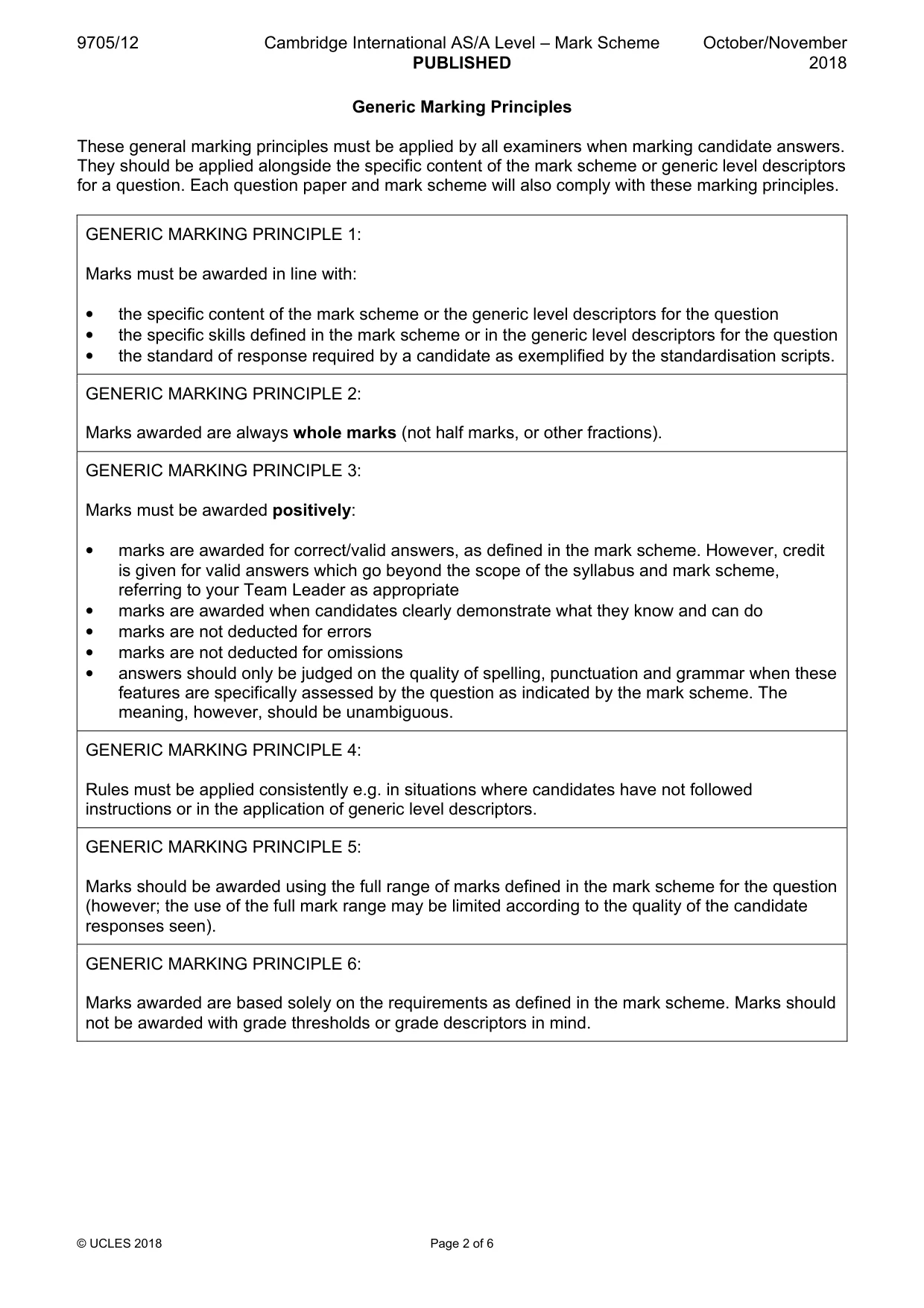
9705/12 Cambridge International AS/A Level – Mark Scheme PUBLISHED October/November 2018 © UCLES 2018 Page 2 of 6 Generic Marking Principles These general marking principles must be applied by all examiners when marking candidate answers. They should be applied alongside the specific content of the mark scheme or generic level descriptors for a question. Each question paper and mark scheme will also comply with these marking principles. GENERIC MARKING PRINCIPLE 1: Marks must be awarded in line with: • the specific content of the mark scheme or the generic level descriptors for the question • the specific skills defined in the mark scheme or in the generic level descriptors for the question • the standard of response required by a candidate as exemplified by the standardisation scripts. GENERIC MARKING PRINCIPLE 2: Marks awarded are always whole marks (not half marks, or other fractions). GENERIC MARKING PRINCIPLE 3: Marks must be awarded positively: • marks are awarded for correct/valid answers, as defined in the mark scheme. However, credit is given for valid answers which go beyond the scope of the syllabus and mark scheme, referring to your Team Leader as appropriate • marks are awarded when candidates clearly demonstrate what they know and can do • marks are not deducted for errors • marks are not deducted for omissions • answers should only be judged on the quality of spelling, punctuation and grammar when these features are specifically assessed by the question as indicated by the mark scheme. The meaning, however, should be unambiguous. GENERIC MARKING PRINCIPLE 4: Rules must be applied consistently e.g. in situations where candidates have not followed instructions or in the application of generic level descriptors. GENERIC MARKING PRINCIPLE 5: Marks should be awarded using the full range of marks defined in the mark scheme for the question (however; the use of the full mark range may be limited according to the quality of the candidate responses seen). GENERIC MARKING PRINCIPLE 6: Marks awarded are based solely on the requirements as defined in the mark scheme. Marks should not be awarded with grade thresholds or grade descriptors in mind.
Mark scheme, page 3
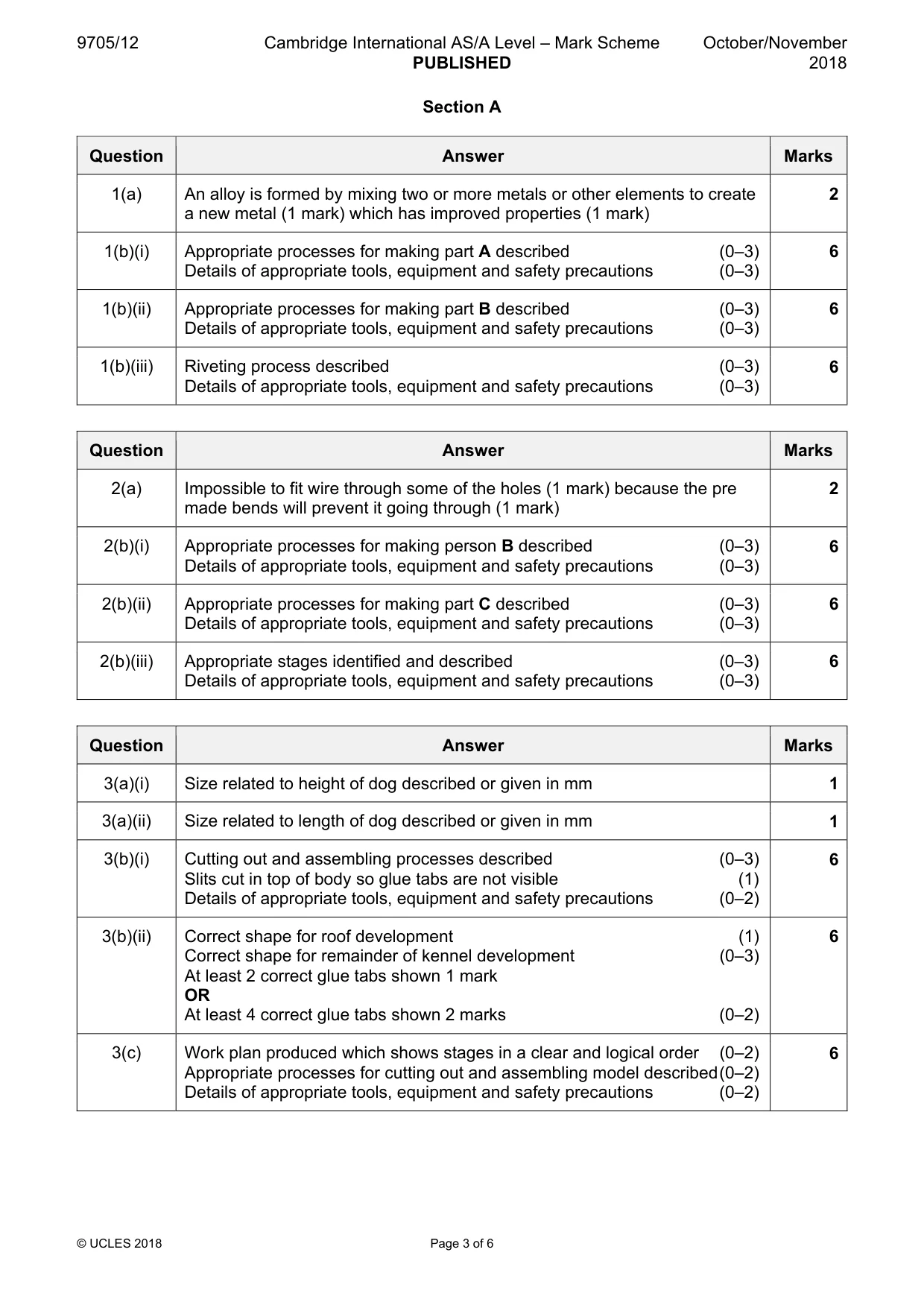
9705/12 Cambridge International AS/A Level – Mark Scheme PUBLISHED October/November 2018 © UCLES 2018 Page 3 of 6 Section A Question Answer Marks 1(a) An alloy is formed by mixing two or more metals or other elements to create a new metal (1 mark) which has improved properties (1 mark) 2 1(b)(i) Appropriate processes for making part A described (0–3) Details of appropriate tools, equipment and safety precautions (0–3) 6 1(b)(ii) Appropriate processes for making part B described (0–3) Details of appropriate tools, equipment and safety precautions (0–3) 6 1(b)(iii) Riveting process described (0–3) Details of appropriate tools, equipment and safety precautions (0–3) 6 Question Answer Marks 2(a) Impossible to fit wire through some of the holes (1 mark) because the pre made bends will prevent it going through (1 mark) 2 2(b)(i) Appropriate processes for making person B described (0–3) Details of appropriate tools, equipment and safety precautions (0–3) 6 2(b)(ii) Appropriate processes for making part C described (0–3) Details of appropriate tools, equipment and safety precautions (0–3) 6 2(b)(iii) Appropriate stages identified and described (0–3) Details of appropriate tools, equipment and safety precautions (0–3) 6 Question Answer Marks 3(a)(i) Size related to height of dog described or given in mm 1 3(a)(ii) Size related to length of dog described or given in mm 1 3(b)(i) Cutting out and assembling processes described (0–3) Slits cut in top of body so glue tabs are not visible (1) Details of appropriate tools, equipment and safety precautions (0–2) 6 3(b)(ii) Correct shape for roof development (1) Correct shape for remainder of kennel development (0–3) At least 2 correct glue tabs shown 1 mark OR At least 4 correct glue tabs shown 2 marks (0–2) 6 3(c) Work plan produced which shows stages in a clear and logical order (0–2) Appropriate processes for cutting out and assembling model described (0–2) Details of appropriate tools, equipment and safety precautions (0–2) 6
Mark scheme, page 4
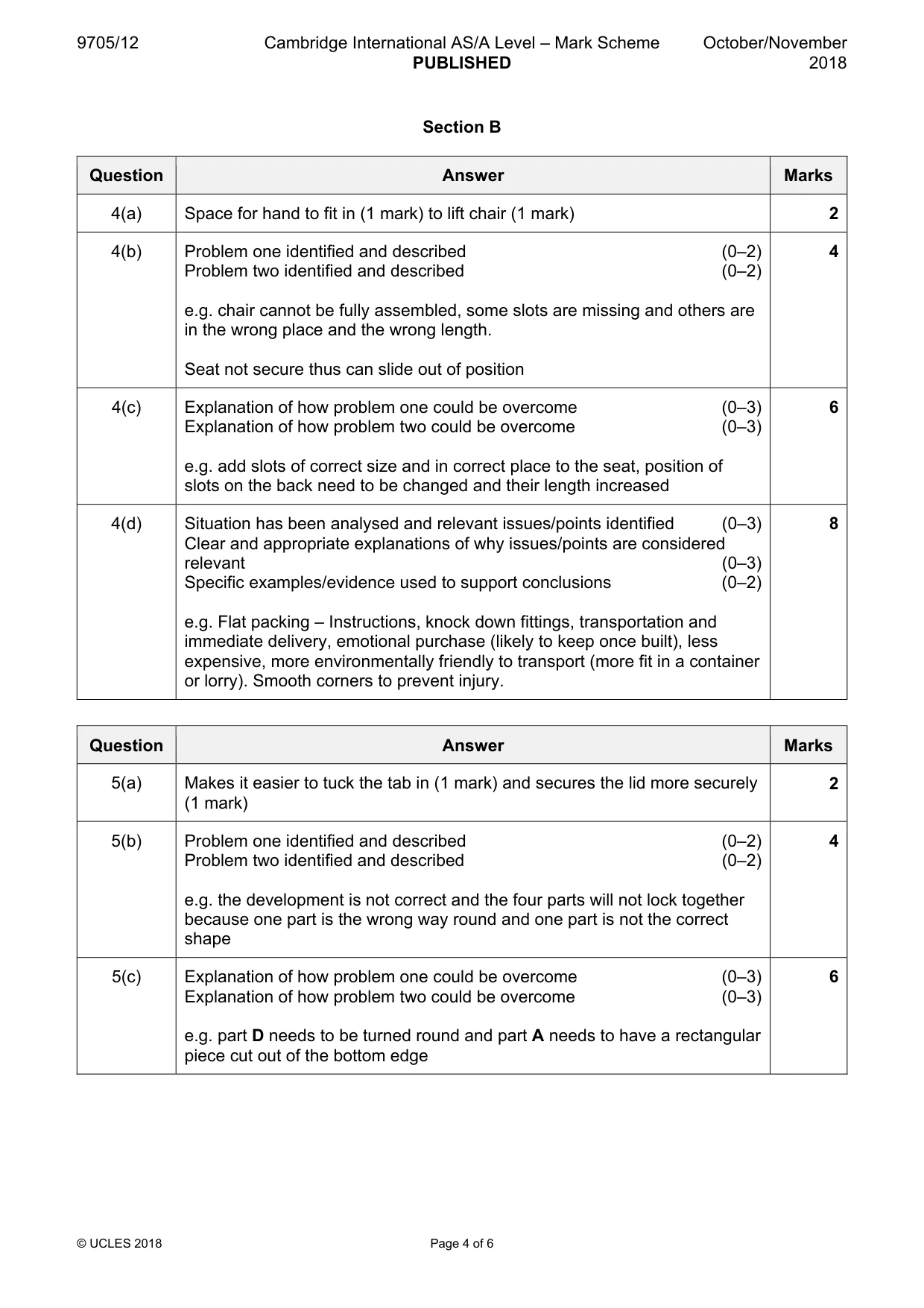
9705/12 Cambridge International AS/A Level – Mark Scheme PUBLISHED October/November 2018 © UCLES 2018 Page 4 of 6 Section B Question Answer Marks 4(a) Space for hand to fit in (1 mark) to lift chair (1 mark) 2 4(b) Problem one identified and described (0–2) Problem two identified and described (0–2) e.g. chair cannot be fully assembled, some slots are missing and others are in the wrong place and the wrong length. Seat not secure thus can slide out of position 4 4(c) Explanation of how problem one could be overcome (0–3) Explanation of how problem two could be overcome (0–3) e.g. add slots of correct size and in correct place to the seat, position of slots on the back need to be changed and their length increased 6 4(d) Situation has been analysed and relevant issues/points identified (0–3) Clear and appropriate explanations of why issues/points are considered relevant (0–3) Specific examples/evidence used to support conclusions (0–2) e.g. Flat packing – Instructions, knock down fittings, transportation and immediate delivery, emotional purchase (likely to keep once built), less expensive, more environmentally friendly to transport (more fit in a container or lorry). Smooth corners to prevent injury. 8 Question Answer Marks 5(a) Makes it easier to tuck the tab in (1 mark) and secures the lid more securely (1 mark) 2 5(b) Problem one identified and described (0–2) Problem two identified and described (0–2) e.g. the development is not correct and the four parts will not lock together because one part is the wrong way round and one part is not the correct shape 4 5(c) Explanation of how problem one could be overcome (0–3) Explanation of how problem two could be overcome (0–3) e.g. part D needs to be turned round and part A needs to have a rectangular piece cut out of the bottom edge 6
Mark scheme, page 5
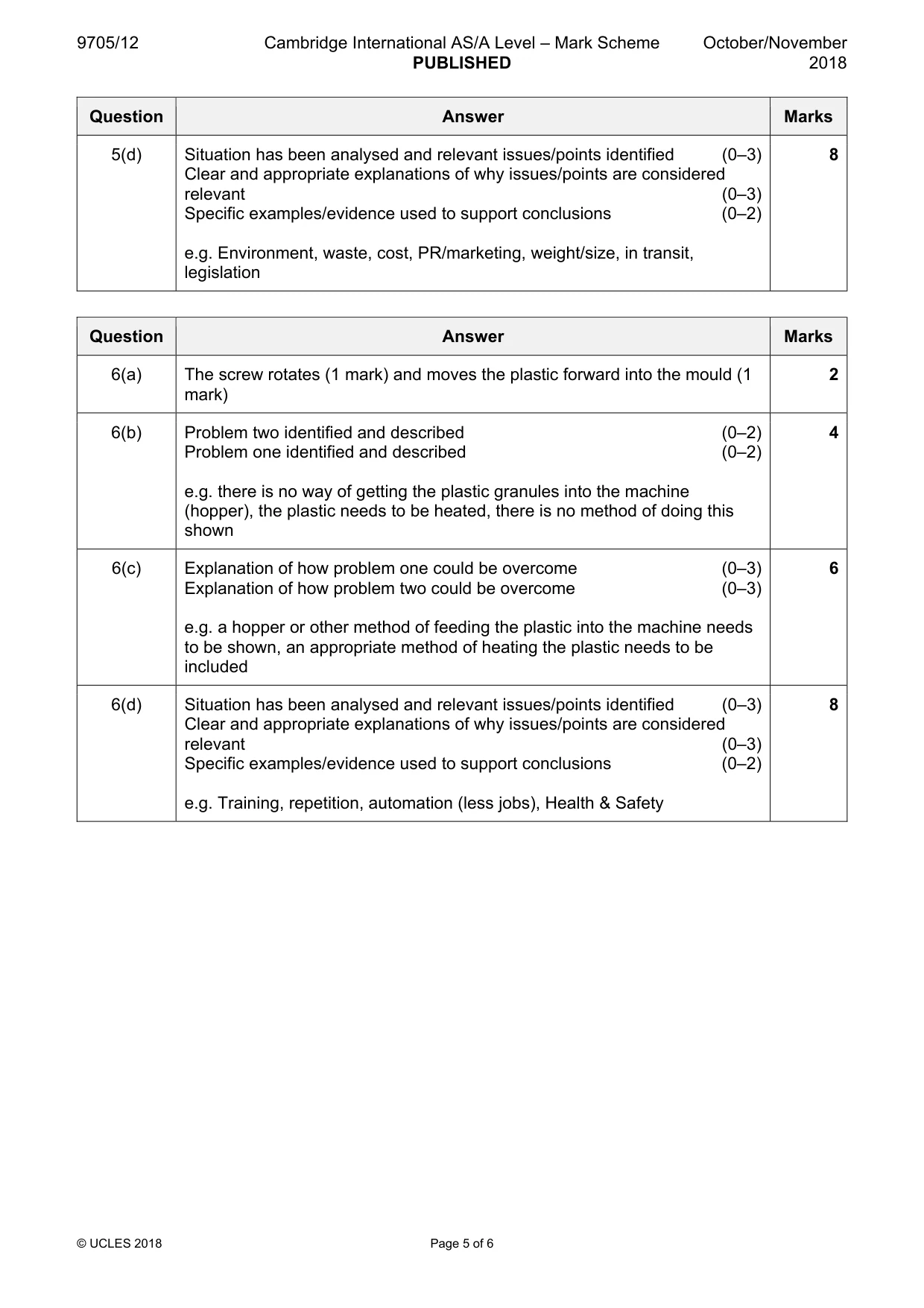
9705/12 Cambridge International AS/A Level – Mark Scheme PUBLISHED October/November 2018 © UCLES 2018 Page 5 of 6 Question Answer Marks 5(d) Situation has been analysed and relevant issues/points identified (0–3) Clear and appropriate explanations of why issues/points are considered relevant (0–3) Specific examples/evidence used to support conclusions (0–2) e.g. Environment, waste, cost, PR/marketing, weight/size, in transit, legislation 8 Question Answer Marks 6(a) The screw rotates (1 mark) and moves the plastic forward into the mould (1 mark) 2 6(b) Problem two identified and described (0–2) Problem one identified and described (0–2) e.g. there is no way of getting the plastic granules into the machine (hopper), the plastic needs to be heated, there is no method of doing this shown 4 6(c) Explanation of how problem one could be overcome (0–3) Explanation of how problem two could be overcome (0–3) e.g. a hopper or other method of feeding the plastic into the machine needs to be shown, an appropriate method of heating the plastic needs to be included 6 6(d) Situation has been analysed and relevant issues/points identified (0–3) Clear and appropriate explanations of why issues/points are considered relevant (0–3) Specific examples/evidence used to support conclusions (0–2) e.g. Training, repetition, automation (less jobs), Health & Safety 8
Mark scheme, page 6
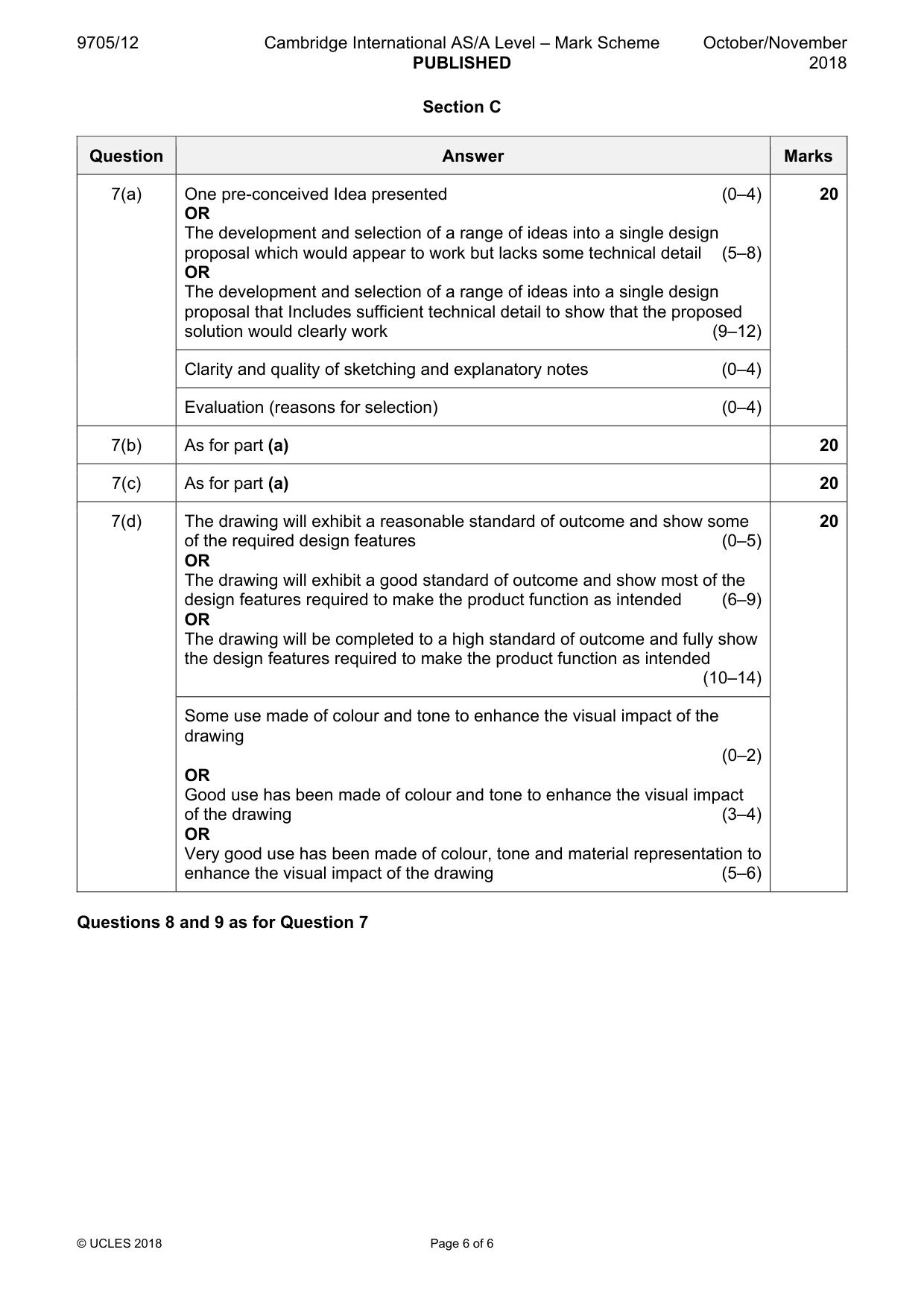
9705/12 Cambridge International AS/A Level – Mark Scheme PUBLISHED October/November 2018 © UCLES 2018 Page 6 of 6 Section C Question Answer Marks 7(a) One pre-conceived Idea presented (0–4) OR The development and selection of a range of ideas into a single design proposal which would appear to work but lacks some technical detail (5–8) OR The development and selection of a range of ideas into a single design proposal that Includes sufficient technical detail to show that the proposed solution would clearly work (9–12) 20 Clarity and quality of sketching and explanatory notes (0–4) Evaluation (reasons for selection) (0–4) 7(b) As for part (a) 20 7(c) As for part (a) 20 7(d) The drawing will exhibit a reasonable standard of outcome and show some of the required design features (0–5) OR The drawing will exhibit a good standard of outcome and show most of the design features required to make the product function as intended (6–9) OR The drawing will be completed to a high standard of outcome and fully show the design features required to make the product function as intended (10–14) 20 Some use made of colour and tone to enhance the visual impact of the drawing (0–2) OR Good use has been made of colour and tone to enhance the visual impact of the drawing (3–4) OR Very good use has been made of colour, tone and material representation to enhance the visual impact of the drawing (5–6) Questions 8 and 9 as for Question 7
What you needed in this session
Cambridge’s own grade thresholds for 2018 Oct/Nov, Paper 1 · Variant 2. A higher threshold means an easier paper — the bar moves with how the cohort did.