Cambridge A Level Design and Technology 9705 — 2012 Oct/Nov Paper 1 · Variant 3
9705/13/O/N/12 · 120 marks · ≈135 min
The question paper and its mark scheme, free to read here and free to download. This is Cambridge’s own paper, exactly as it was sat.
Question paper12 pages
Mark scheme5 pages
Answers below. Sit the paper first if you are practising.
Paper as text
Question paper, page 1
This document consists of 10 printed pages and 2 blank pages. DC (SJF/SW) 51718/3 © UCLES 2012 [Turn over UNIVERSITY OF CAMBRIDGE INTERNATIONAL EXAMINATIONS General Certificate of Education Advanced Subsidiary Level and Advanced Level * 8 7 3 2 4 9 7 8 0 4 * DESIGN AND TECHNOLOGY 9705/13 Paper 1 October/November 2012 3 hours Additional Materials: Answer Booklet/A4 Paper A3 Drawing Paper (2 sheets) Extra sheets of A3 drawing paper for candidates who have used up both sides of their 2 sheets A range of design drawing equipment READ THESE INSTRUCTIONS FIRST If you have been given an Answer Booklet, follow the instructions on the front cover of the Booklet. Write your answers and working on the separate Answer Booklet/Paper provided. Write your name, Centre number and candidate number on all the work you hand in. Write in dark blue or black pen. You may use a soft pencil, or coloured pencils/pens as appropriate, for any diagrams, graphs or rough working. Do not use staples, paper clips, highlighters, glue or correction fluid. DO NOT WRITE ON ANY BARCODES. Section A Answer one question on the Answer Booklet/A4 Paper provided. Section B Answer one question on the Answer Booklet/A4 Paper provided. Section C Answer one question on plain A3 paper. Use both sides of the paper. You may request additional sheets of A3 paper, but only if you have used both sides of each of the 2 sheets provided. You are advised to spend 30 minutes on each of Sections A and B and 2 hours on Section C. At the end of the examination, fasten all your work securely together. The number of marks is given in brackets [ ] at the end of each question or part question. All dimensions are in millimetres.
Question paper, page 2
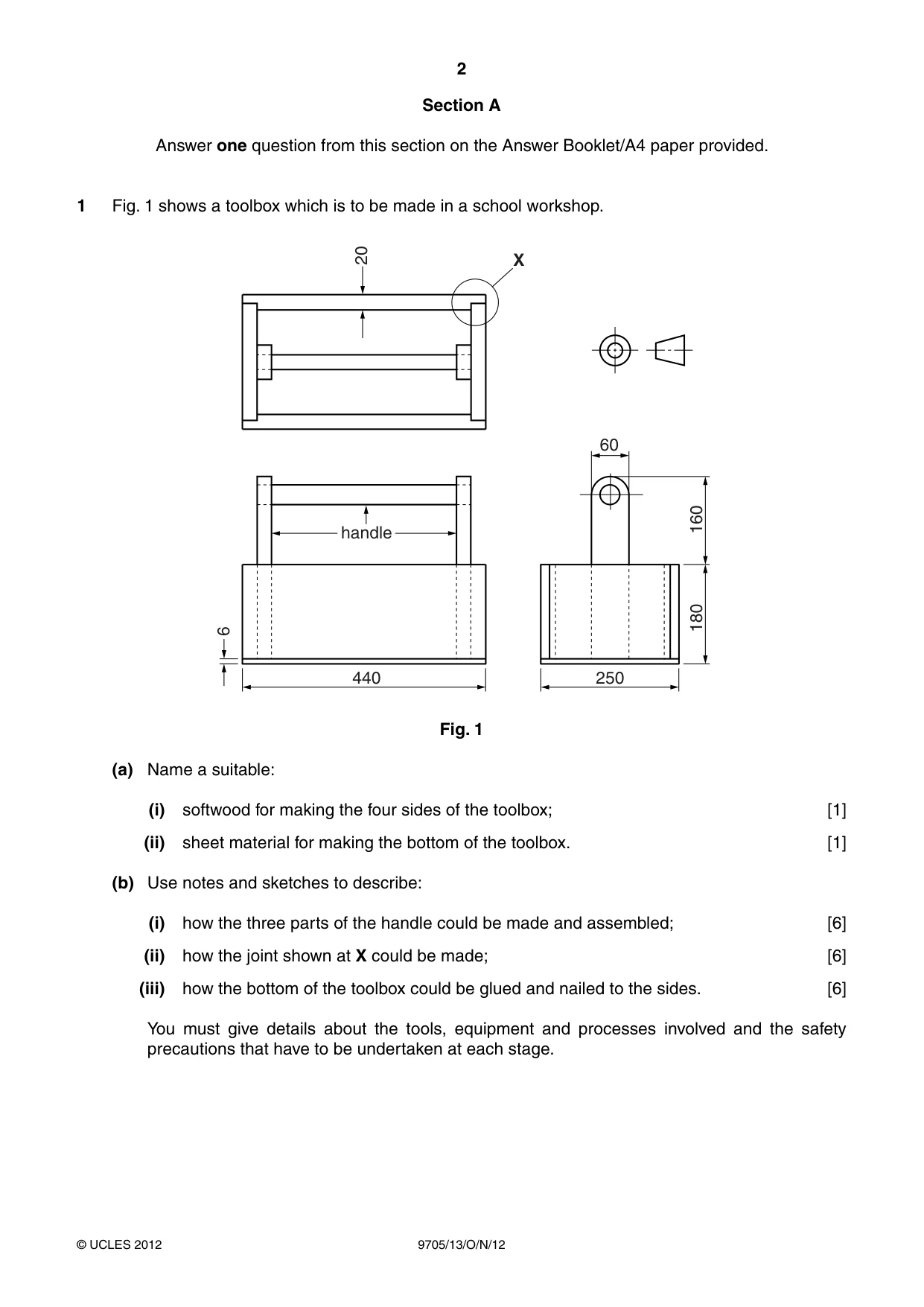
2 9705/13/O/N/12 © UCLES 2012 Section A Answer one question from this section on the Answer Booklet/A4 paper provided. 1 Fig. 1 shows a toolbox which is to be made in a school workshop. 20 60 160 180 250 440 6 handle X Fig. 1 (a) Name a suitable: (i) softwood for making the four sides of the toolbox; [1] (ii) sheet material for making the bottom of the toolbox. [1] (b) Use notes and sketches to describe: (i) how the three parts of the handle could be made and assembled; [6] (ii) how the joint shown at X could be made; [6] (iii) how the bottom of the toolbox could be glued and nailed to the sides. [6] You must give details about the tools, equipment and processes involved and the safety precautions that have to be undertaken at each stage.
Question paper, page 3
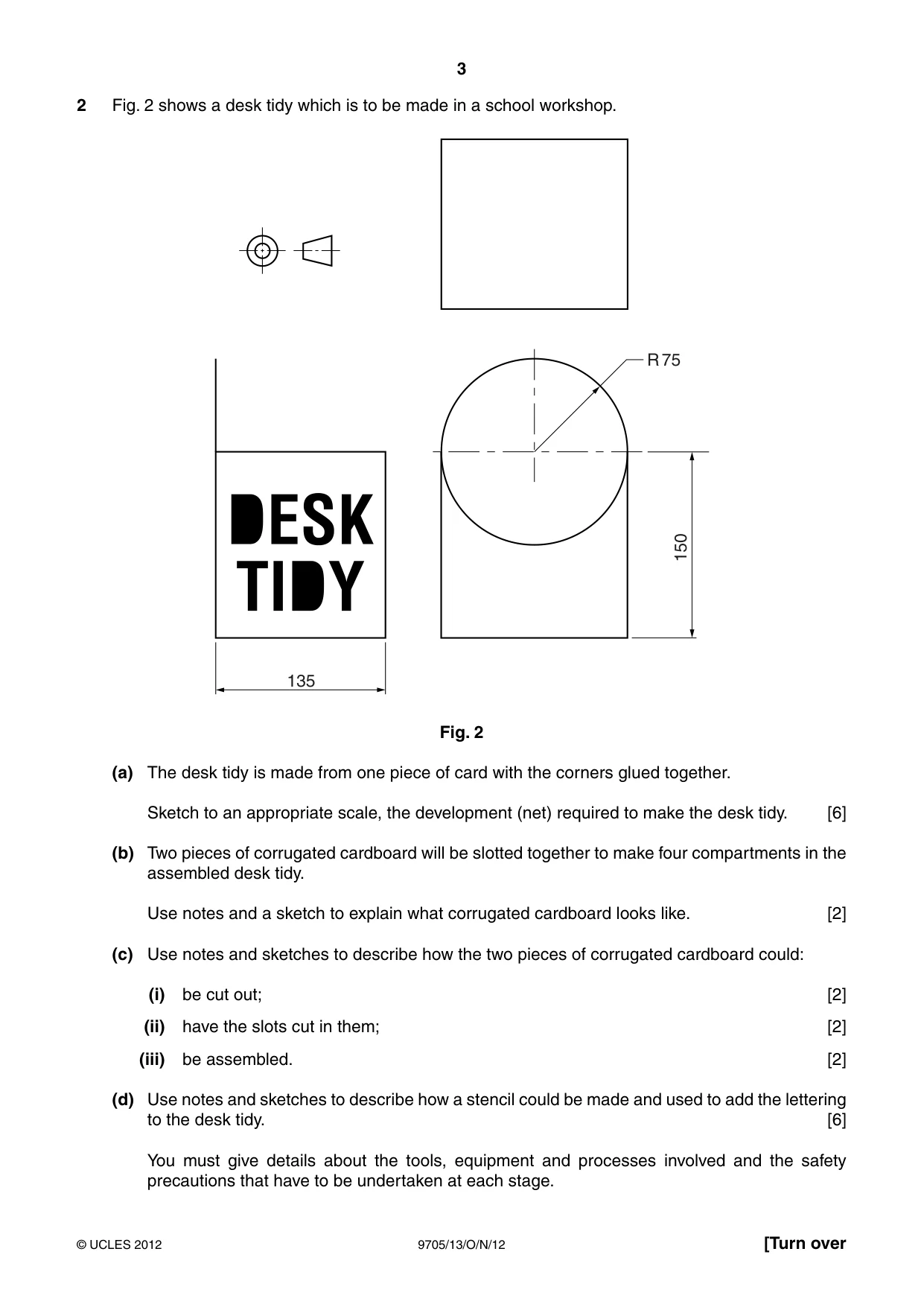
3 9705/13/O/N/12 © UCLES 2012 [Turn over 2 Fig. 2 shows a desk tidy which is to be made in a school workshop. 135 150 R 75 Fig. 2 (a) The desk tidy is made from one piece of card with the corners glued together. Sketch to an appropriate scale, the development (net) required to make the desk tidy. [6] (b) Two pieces of corrugated cardboard will be slotted together to make four compartments in the assembled desk tidy. Use notes and a sketch to explain what corrugated cardboard looks like. [2] (c) Use notes and sketches to describe how the two pieces of corrugated cardboard could: (i) be cut out; [2] (ii) have the slots cut in them; [2] (iii) be assembled. [2] (d) Use notes and sketches to describe how a stencil could be made and used to add the lettering to the desk tidy. [6] You must give details about the tools, equipment and processes involved and the safety precautions that have to be undertaken at each stage.
Question paper, page 4
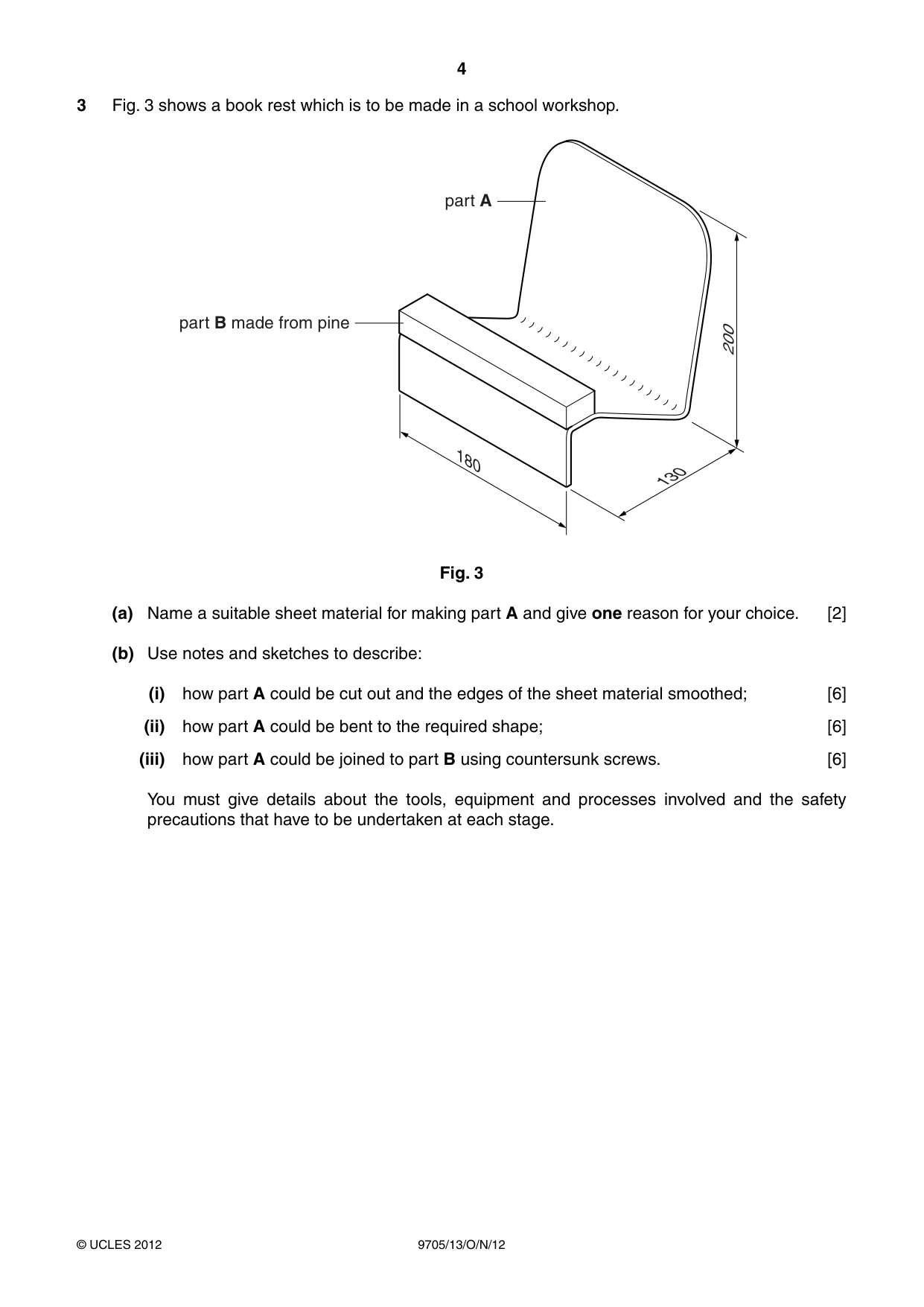
4 9705/13/O/N/12 © UCLES 2012 3 Fig. 3 shows a book rest which is to be made in a school workshop. 200 130 180 part A part B made from pine Fig. 3 (a) Name a suitable sheet material for making part A and give one reason for your choice. [2] (b) Use notes and sketches to describe: (i) how part A could be cut out and the edges of the sheet material smoothed; [6] (ii) how part A could be bent to the required shape; [6] (iii) how part A could be joined to part B using countersunk screws. [6] You must give details about the tools, equipment and processes involved and the safety precautions that have to be undertaken at each stage.
Question paper, page 5
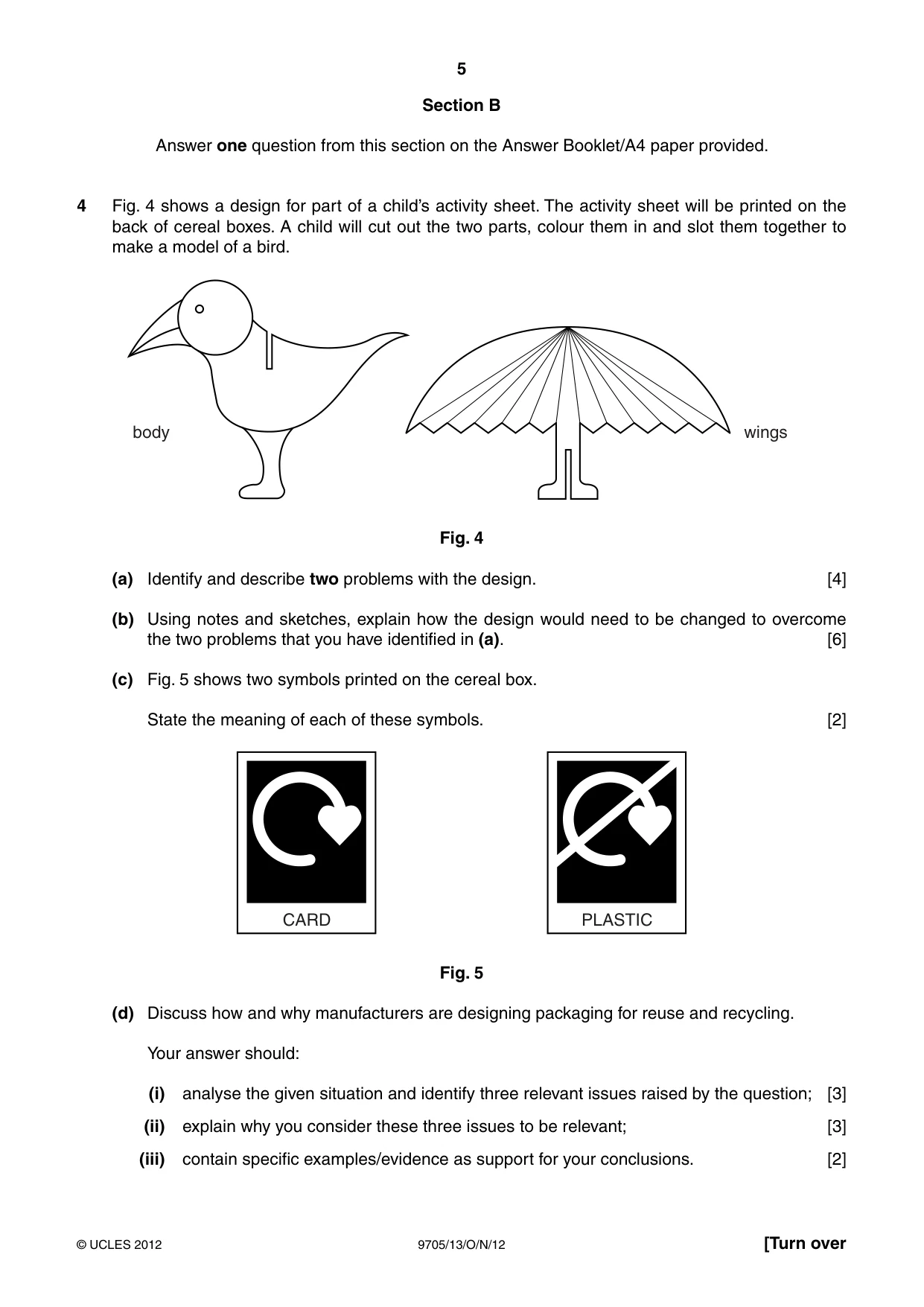
5 9705/13/O/N/12 © UCLES 2012 [Turn over Section B Answer one question from this section on the Answer Booklet/A4 paper provided. 4 Fig. 4 shows a design for part of a child’s activity sheet. The activity sheet will be printed on the back of cereal boxes. A child will cut out the two parts, colour them in and slot them together to make a model of a bird. body wings Fig. 4 (a) Identify and describe two problems with the design. [4] (b) Using notes and sketches, explain how the design would need to be changed to overcome the two problems that you have identified in (a). [6] (c) Fig. 5 shows two symbols printed on the cereal box. State the meaning of each of these symbols. [2] CARD PLASTIC Fig. 5 (d) Discuss how and why manufacturers are designing packaging for reuse and recycling. Your answer should: (i) analyse the given situation and identify three relevant issues raised by the question; [3] (ii) explain why you consider these three issues to be relevant; [3] (iii) contain specific examples/evidence as support for your conclusions. [2]
Question paper, page 6
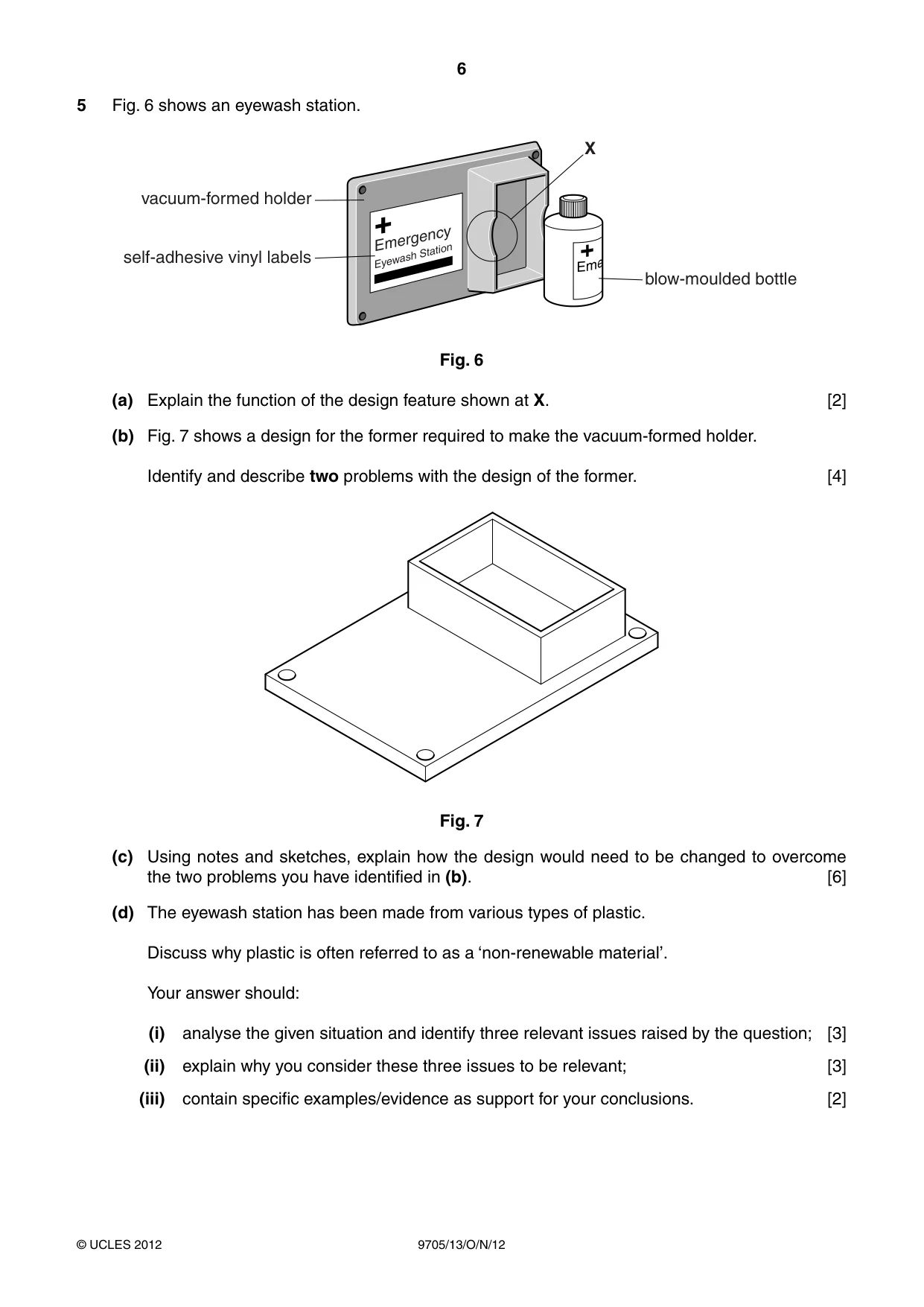
6 9705/13/O/N/12 © UCLES 2012 5 Fig. 6 shows an eyewash station. Emergency Eyewash Station vacuum-formed holder self-adhesive vinyl labels blow-moulded bottle X Fig. 6 (a) Explain the function of the design feature shown at X. [2] (b) Fig. 7 shows a design for the former required to make the vacuum-formed holder. Identify and describe two problems with the design of the former. [4] Fig. 7 (c) Using notes and sketches, explain how the design would need to be changed to overcome the two problems you have identified in (b). [6] (d) The eyewash station has been made from various types of plastic. Discuss why plastic is often referred to as a ‘non-renewable material’. Your answer should: (i) analyse the given situation and identify three relevant issues raised by the question; [3] (ii) explain why you consider these three issues to be relevant; [3] (iii) contain specific examples/evidence as support for your conclusions. [2]
Question paper, page 7
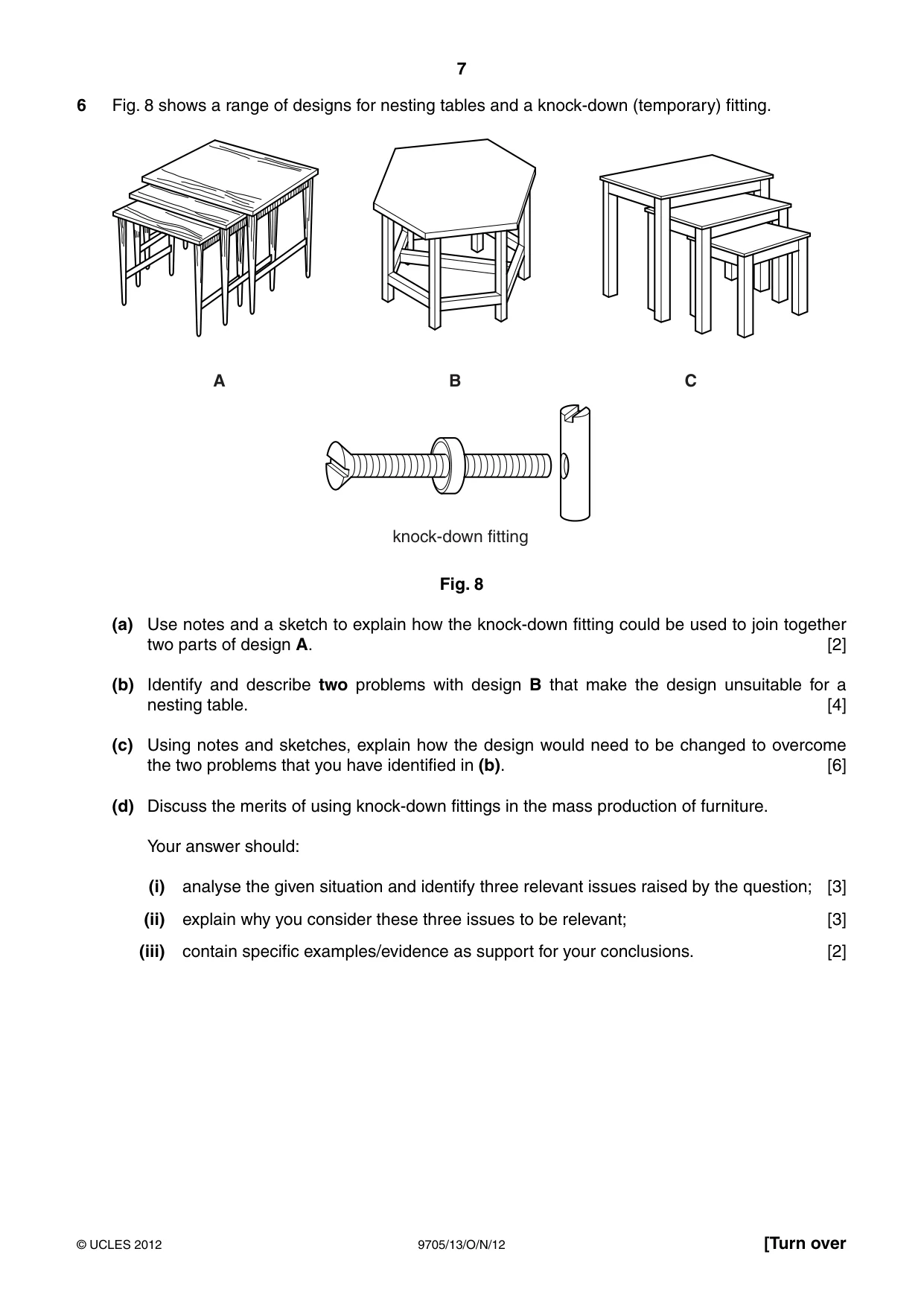
7 9705/13/O/N/12 © UCLES 2012 [Turn over 6 Fig. 8 shows a range of designs for nesting tables and a knock-down (temporary) fitting. A B C knock-down fitting Fig. 8 (a) Use notes and a sketch to explain how the knock-down fitting could be used to join together two parts of design A. [2] (b) Identify and describe two problems with design B that make the design unsuitable for a nesting table. [4] (c) Using notes and sketches, explain how the design would need to be changed to overcome the two problems that you have identified in (b). [6] (d) Discuss the merits of using knock-down fittings in the mass production of furniture. Your answer should: (i) analyse the given situation and identify three relevant issues raised by the question; [3] (ii) explain why you consider these three issues to be relevant; [3] (iii) contain specific examples/evidence as support for your conclusions. [2]
Question paper, page 8
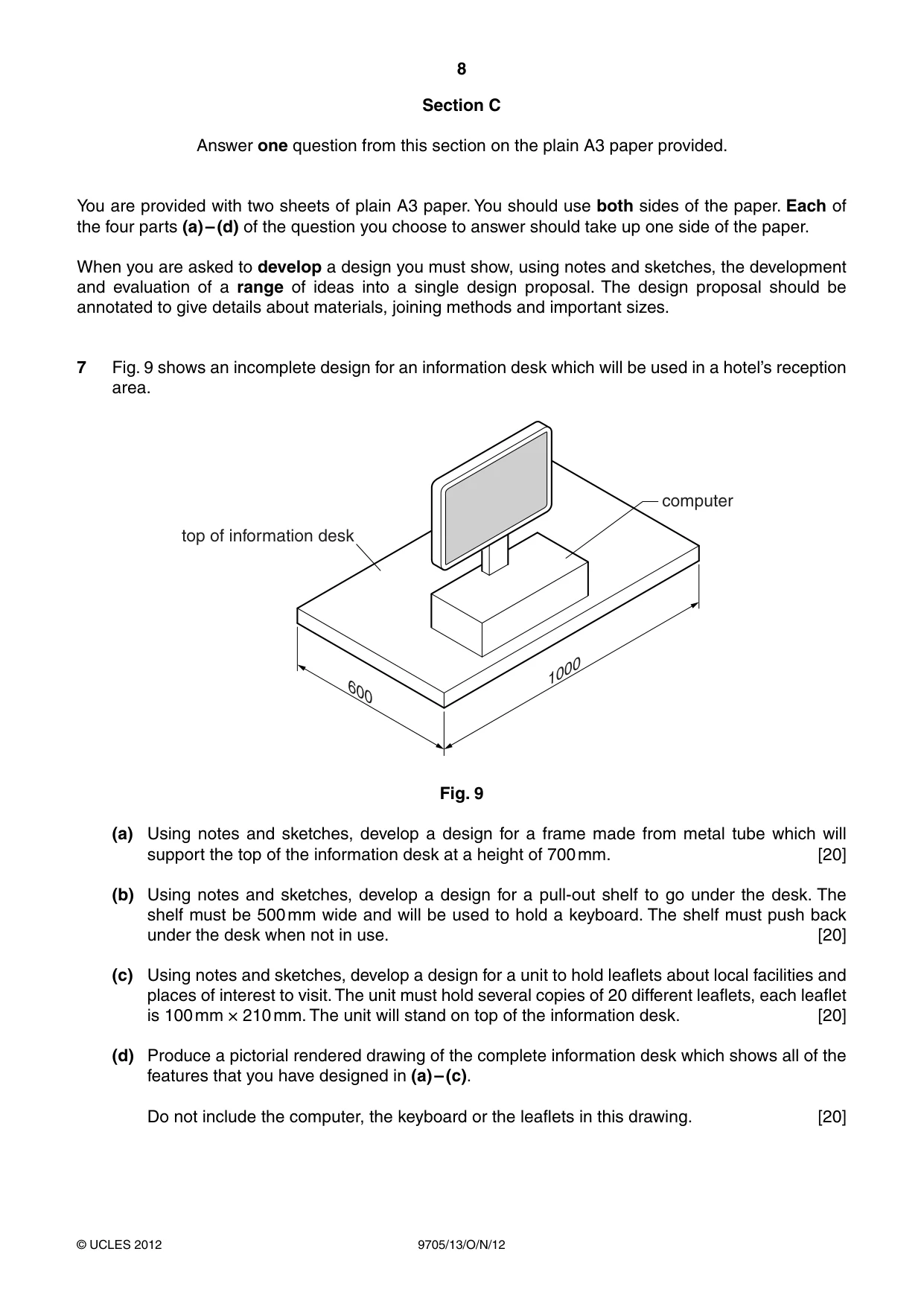
8 9705/13/O/N/12 © UCLES 2012 Section C Answer one question from this section on the plain A3 paper provided. You are provided with two sheets of plain A3 paper. You should use both sides of the paper. Each of the four parts (a) – (d) of the question you choose to answer should take up one side of the paper. When you are asked to develop a design you must show, using notes and sketches, the development and evaluation of a range of ideas into a single design proposal. The design proposal should be annotated to give details about materials, joining methods and important sizes. 7 Fig. 9 shows an incomplete design for an information desk which will be used in a hotel’s reception area. 1000 600 computer top of information desk Fig. 9 (a) Using notes and sketches, develop a design for a frame made from metal tube which will support the top of the information desk at a height of 700 mm. [20] (b) Using notes and sketches, develop a design for a pull-out shelf to go under the desk. The shelf must be 500 mm wide and will be used to hold a keyboard. The shelf must push back under the desk when not in use. [20] (c) Using notes and sketches, develop a design for a unit to hold leaflets about local facilities and places of interest to visit. The unit must hold several copies of 20 different leaflets, each leaflet is 100 mm × 210 mm. The unit will stand on top of the information desk. [20] (d) Produce a pictorial rendered drawing of the complete information desk which shows all of the features that you have designed in (a) – (c). Do not include the computer, the keyboard or the leaflets in this drawing. [20]
Question paper, page 9
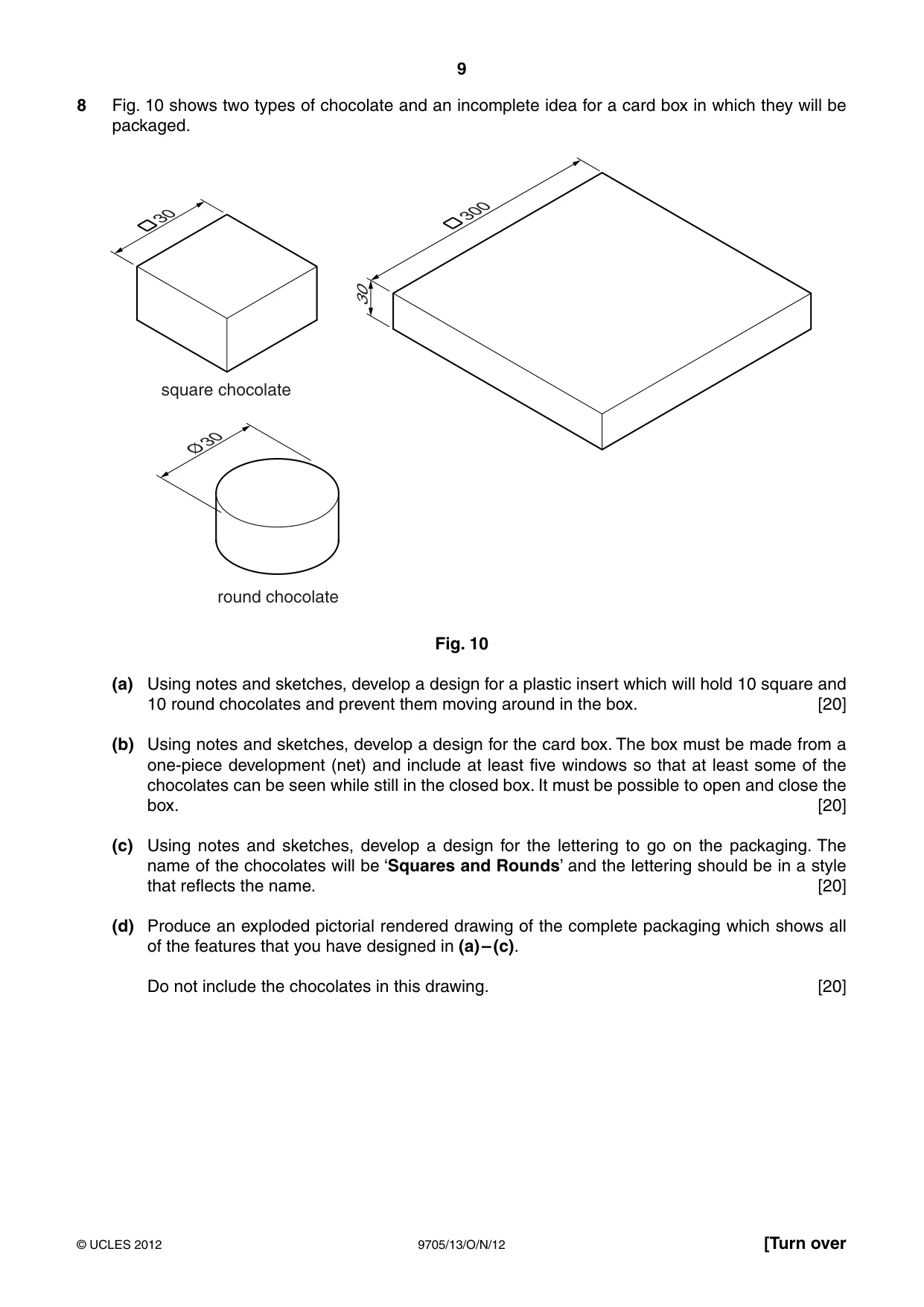
9 9705/13/O/N/12 © UCLES 2012 [Turn over 8 Fig. 10 shows two types of chocolate and an incomplete idea for a card box in which they will be packaged. Ø 30 30 300 30 square chocolate round chocolate Fig. 10 (a) Using notes and sketches, develop a design for a plastic insert which will hold 10 square and 10 round chocolates and prevent them moving around in the box. [20] (b) Using notes and sketches, develop a design for the card box. The box must be made from a one-piece development (net) and include at least five windows so that at least some of the chocolates can be seen while still in the closed box. It must be possible to open and close the box. [20] (c) Using notes and sketches, develop a design for the lettering to go on the packaging. The name of the chocolates will be ‘Squares and Rounds’ and the lettering should be in a style that reflects the name. [20] (d) Produce an exploded pictorial rendered drawing of the complete packaging which shows all of the features that you have designed in (a) – (c). Do not include the chocolates in this drawing. [20]
Question paper, page 10
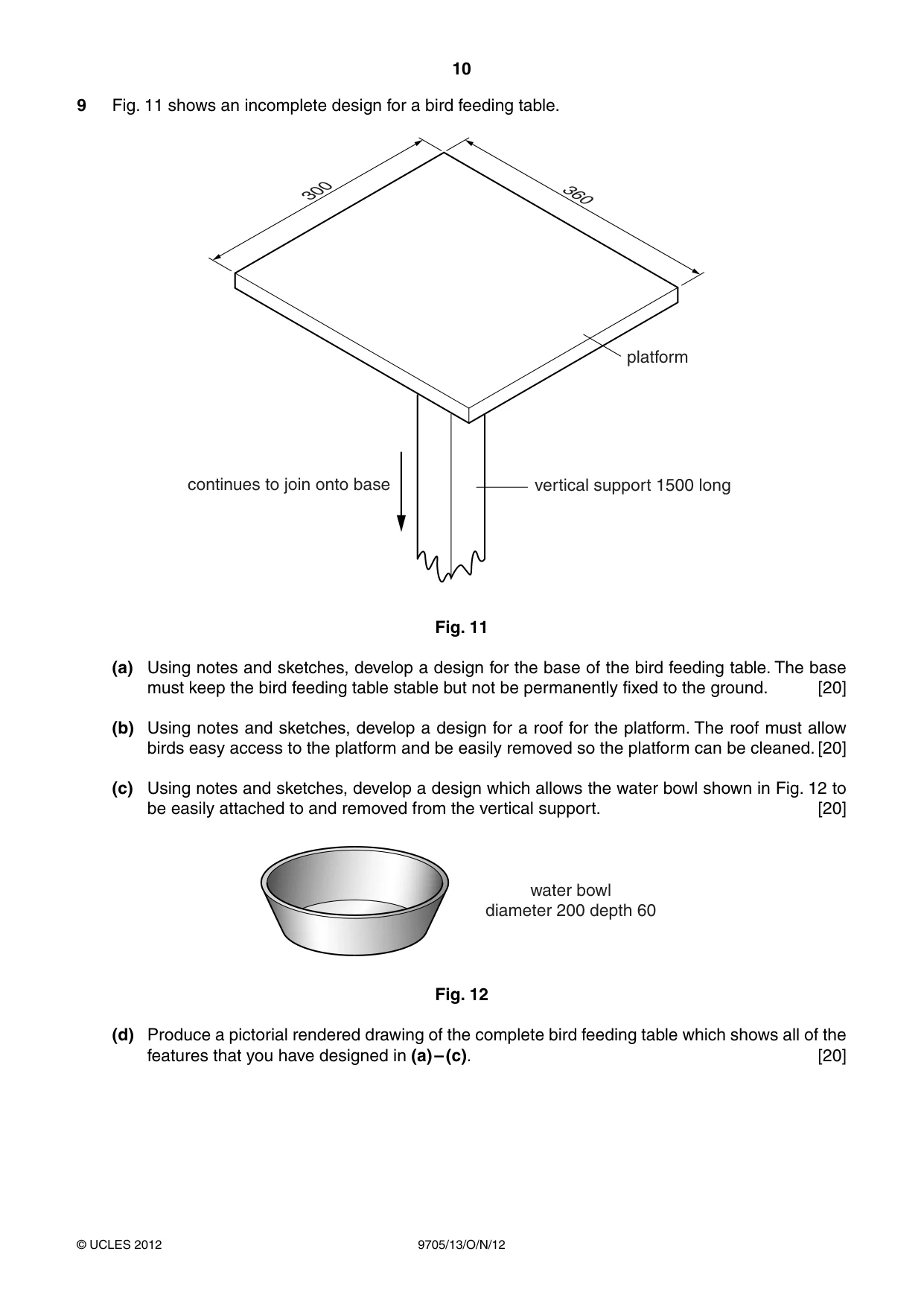
10 9705/13/O/N/12 © UCLES 2012 9 Fig. 11 shows an incomplete design for a bird feeding table. 300 360 vertical support 1500 long continues to join onto base platform Fig. 11 (a) Using notes and sketches, develop a design for the base of the bird feeding table. The base must keep the bird feeding table stable but not be permanently fixed to the ground. [20] (b) Using notes and sketches, develop a design for a roof for the platform. The roof must allow birds easy access to the platform and be easily removed so the platform can be cleaned. [20] (c) Using notes and sketches, develop a design which allows the water bowl shown in Fig. 12 to be easily attached to and removed from the vertical support. [20] water bowl diameter 200 depth 60 Fig. 12 (d) Produce a pictorial rendered drawing of the complete bird feeding table which shows all of the features that you have designed in (a) – (c). [20]
Question paper, page 11
11 9705/13/O/N/12 © UCLES 2012 BLANK PAGE
Question paper, page 12
12 9705/13/O/N/12 © UCLES 2012 Permission to reproduce items where third-party owned material protected by copyright is included has been sought and cleared where possible. Every reasonable effort has been made by the publisher (UCLES) to trace copyright holders, but if any items requiring clearance have unwittingly been included, the publisher will be pleased to make amends at the earliest possible opportunity. University of Cambridge International Examinations is part of the Cambridge Assessment Group. Cambridge Assessment is the brand name of University of Cambridge Local Examinations Syndicate (UCLES), which is itself a department of the University of Cambridge. BLANK PAGE
Mark scheme, page 1
CAMBRIDGE INTERNATIONAL EXAMINATIONS GCE Advanced Subsidiary Level and GCE Advanced Level MARK SCHEME for the October/November 2012 series 9705 DESIGN AND TECHNOLOGY 9705/13 Paper 1, maximum raw mark 120 This mark scheme is published as an aid to teachers and candidates, to indicate the requirements of the examination. It shows the basis on which Examiners were instructed to award marks. It does not indicate the details of the discussions that took place at an Examiners’ meeting before marking began, which would have considered the acceptability of alternative answers. Mark schemes should be read in conjunction with the question paper and the Principal Examiner Report for Teachers. Cambridge will not enter into discussions about these mark schemes. Cambridge is publishing the mark schemes for the October/November 2012 series for most IGCSE, GCE Advanced Level and Advanced Subsidiary Level components and some Ordinary Level components.
Mark scheme, page 2
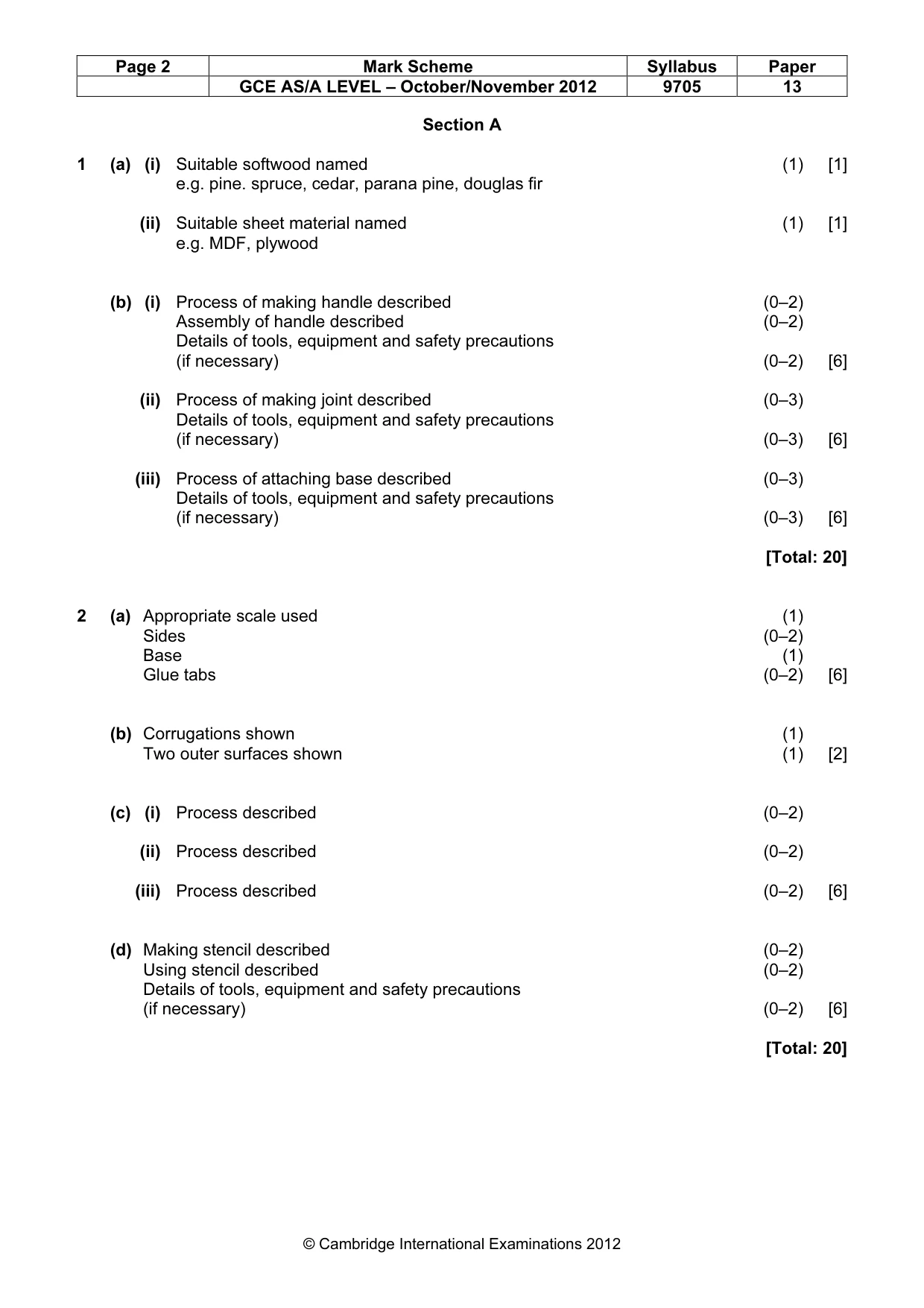
Page 2 Mark Scheme Syllabus Paper GCE AS/A LEVEL – October/November 2012 9705 13 © Cambridge International Examinations 2012 Section A 1 (a) (i) Suitable softwood named (1) [1] e.g. pine. spruce, cedar, parana pine, douglas fir (ii) Suitable sheet material named (1) [1] e.g. MDF, plywood (b) (i) Process of making handle described (0–2) Assembly of handle described (0–2) Details of tools, equipment and safety precautions (if necessary) (0–2) [6] (ii) Process of making joint described (0–3) Details of tools, equipment and safety precautions (if necessary) (0–3) [6] (iii) Process of attaching base described (0–3) Details of tools, equipment and safety precautions (if necessary) (0–3) [6] [Total: 20] 2 (a) Appropriate scale used (1) Sides (0–2) Base (1) Glue tabs (0–2) [6] (b) Corrugations shown (1) Two outer surfaces shown (1) [2] (c) (i) Process described (0–2) (ii) Process described (0–2) (iii) Process described (0–2) [6] (d) Making stencil described (0–2) Using stencil described (0–2) Details of tools, equipment and safety precautions (if necessary) (0–2) [6] [Total: 20]
Mark scheme, page 3
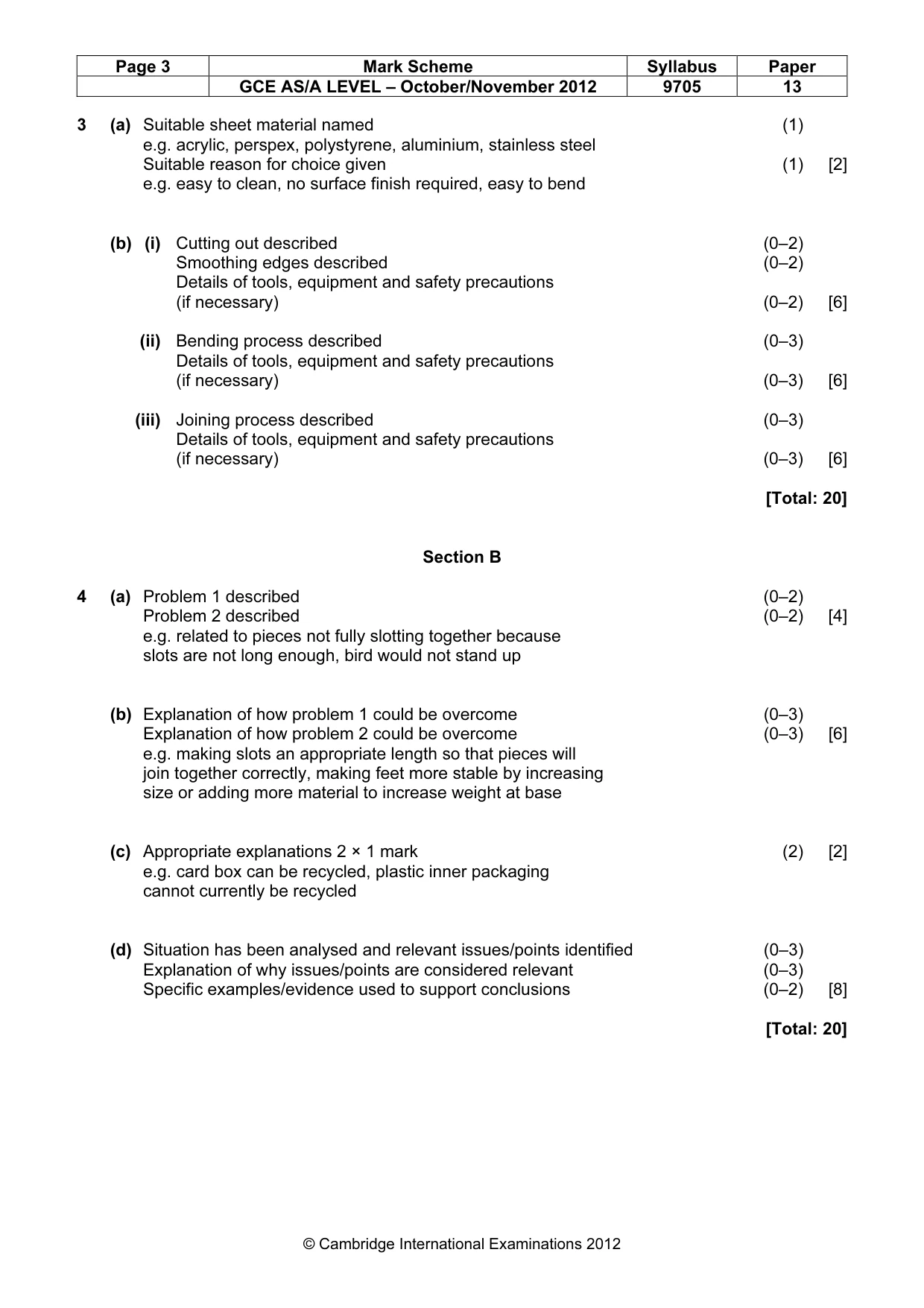
Page 3 Mark Scheme Syllabus Paper GCE AS/A LEVEL – October/November 2012 9705 13 © Cambridge International Examinations 2012 3 (a) Suitable sheet material named (1) e.g. acrylic, perspex, polystyrene, aluminium, stainless steel Suitable reason for choice given (1) [2] e.g. easy to clean, no surface finish required, easy to bend (b) (i) Cutting out described (0–2) Smoothing edges described (0–2) Details of tools, equipment and safety precautions (if necessary) (0–2) [6] (ii) Bending process described (0–3) Details of tools, equipment and safety precautions (if necessary) (0–3) [6] (iii) Joining process described (0–3) Details of tools, equipment and safety precautions (if necessary) (0–3) [6] [Total: 20] Section B 4 (a) Problem 1 described (0–2) Problem 2 described (0–2) [4] e.g. related to pieces not fully slotting together because slots are not long enough, bird would not stand up (b) Explanation of how problem 1 could be overcome (0–3) Explanation of how problem 2 could be overcome (0–3) [6] e.g. making slots an appropriate length so that pieces will join together correctly, making feet more stable by increasing size or adding more material to increase weight at base (c) Appropriate explanations 2 × 1 mark (2) [2] e.g. card box can be recycled, plastic inner packaging cannot currently be recycled (d) Situation has been analysed and relevant issues/points identified (0–3) Explanation of why issues/points are considered relevant (0–3) Specific examples/evidence used to support conclusions (0–2) [8] [Total: 20]
Mark scheme, page 4
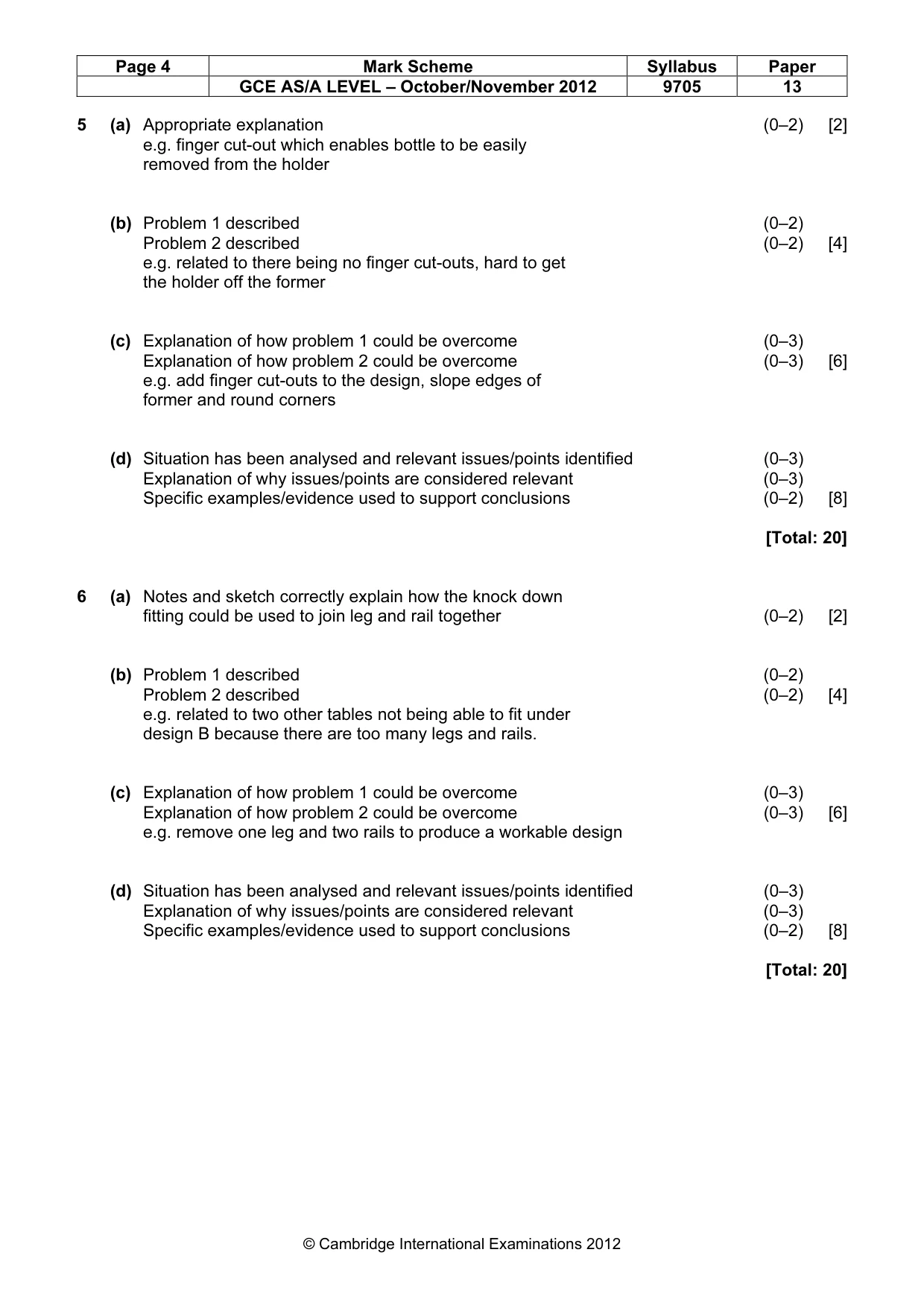
Page 4 Mark Scheme Syllabus Paper GCE AS/A LEVEL – October/November 2012 9705 13 © Cambridge International Examinations 2012 5 (a) Appropriate explanation (0–2) [2] e.g. finger cut-out which enables bottle to be easily removed from the holder (b) Problem 1 described (0–2) Problem 2 described (0–2) [4] e.g. related to there being no finger cut-outs, hard to get the holder off the former (c) Explanation of how problem 1 could be overcome (0–3) Explanation of how problem 2 could be overcome (0–3) [6] e.g. add finger cut-outs to the design, slope edges of former and round corners (d) Situation has been analysed and relevant issues/points identified (0–3) Explanation of why issues/points are considered relevant (0–3) Specific examples/evidence used to support conclusions (0–2) [8] [Total: 20] 6 (a) Notes and sketch correctly explain how the knock down fitting could be used to join leg and rail together (0–2) [2] (b) Problem 1 described (0–2) Problem 2 described (0–2) [4] e.g. related to two other tables not being able to fit under design B because there are too many legs and rails. (c) Explanation of how problem 1 could be overcome (0–3) Explanation of how problem 2 could be overcome (0–3) [6] e.g. remove one leg and two rails to produce a workable design (d) Situation has been analysed and relevant issues/points identified (0–3) Explanation of why issues/points are considered relevant (0–3) Specific examples/evidence used to support conclusions (0–2) [8] [Total: 20]
Mark scheme, page 5
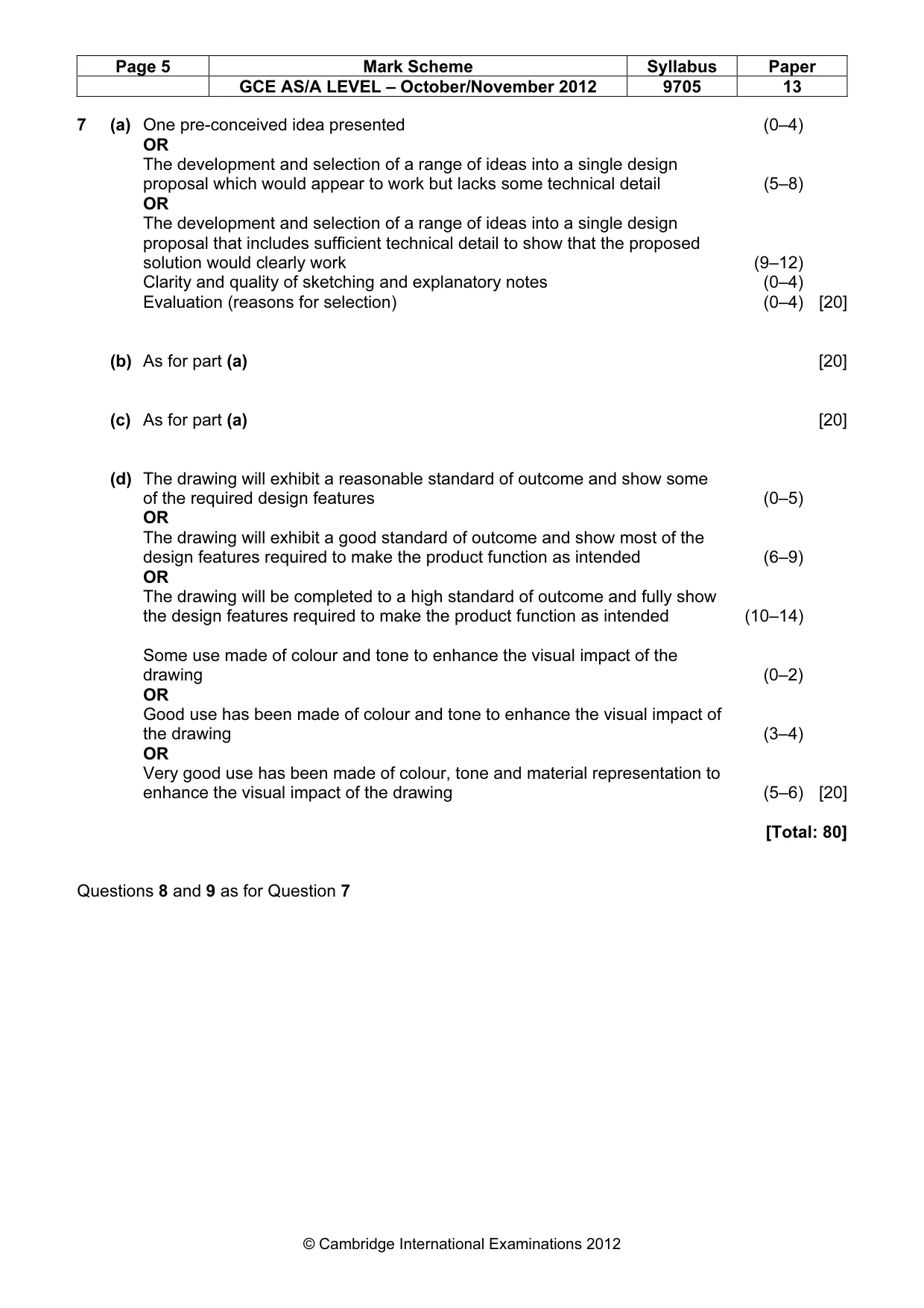
Page 5 Mark Scheme Syllabus Paper GCE AS/A LEVEL – October/November 2012 9705 13 © Cambridge International Examinations 2012 7 (a) One pre-conceived idea presented (0–4) OR The development and selection of a range of ideas into a single design proposal which would appear to work but lacks some technical detail (5–8) OR The development and selection of a range of ideas into a single design proposal that includes sufficient technical detail to show that the proposed solution would clearly work (9–12) Clarity and quality of sketching and explanatory notes (0–4) Evaluation (reasons for selection) (0–4) [20] (b) As for part (a) [20] (c) As for part (a) [20] (d) The drawing will exhibit a reasonable standard of outcome and show some of the required design features (0–5) OR The drawing will exhibit a good standard of outcome and show most of the design features required to make the product function as intended (6–9) OR The drawing will be completed to a high standard of outcome and fully show the design features required to make the product function as intended (10–14) Some use made of colour and tone to enhance the visual impact of the drawing (0–2) OR Good use has been made of colour and tone to enhance the visual impact of the drawing (3–4) OR Very good use has been made of colour, tone and material representation to enhance the visual impact of the drawing (5–6) [20] [Total: 80] Questions 8 and 9 as for Question 7
What you needed in this session
Cambridge’s own grade thresholds for 2012 Oct/Nov, Paper 1 · Variant 3. A higher threshold means an easier paper — the bar moves with how the cohort did.