Cambridge A Level Design and Technology 9705 — 2009 Oct/Nov Paper 3 · Variant 2
9705/32/O/N/09 · 120 marks · ≈135 min
The question paper and its mark scheme, free to read here and free to download. This is Cambridge’s own paper, exactly as it was sat.
Question paper12 pages

Mark scheme6 pages
Answers below. Sit the paper first if you are practising.
Paper as text
Question paper, page 1
This document consists of 10 printed pages and 2 blank pages. DC (SHW 00399 2/09) 18627/3 © UCLES 2009 [Turn over UNIVERSITY OF CAMBRIDGE INTERNATIONAL EXAMINATIONS General Certificate of Education Advanced Subsidiary Level and Advanced Level READ THESE INSTRUCTIONS FIRST Write your Centre number, candidate number and name on all the work you hand in. Write in dark blue or black pen. You may use a soft pencil for any diagrams, graphs or rough working. Do not use staples, paper clips, highlighters, glue or correction fluid. Section A Answer any two questions from one of the Parts A, B or C. Section B Answer one question. All dimensions are in millimetres. The instruction ‘discuss’ denotes that you should: • examine critically the issues raised by the question; • explain and interpret these issues as appropriate; • introduce evidence wherever possible to support conclusions of arguments. At the end of the examination, fasten all your work securely together. The number of marks is given in brackets [ ] at the end of each question or part question. * 5 0 3 8 4 4 5 6 1 5 * DESIGN AND TECHNOLOGY 9705/32 Paper 3 October/November 2009 3 hours Additional Materials: Answer Booklet/Paper A range of design drawing equipment A3 Drawing paper (5 sheets) www.xtremepapers.net
Question paper, page 2
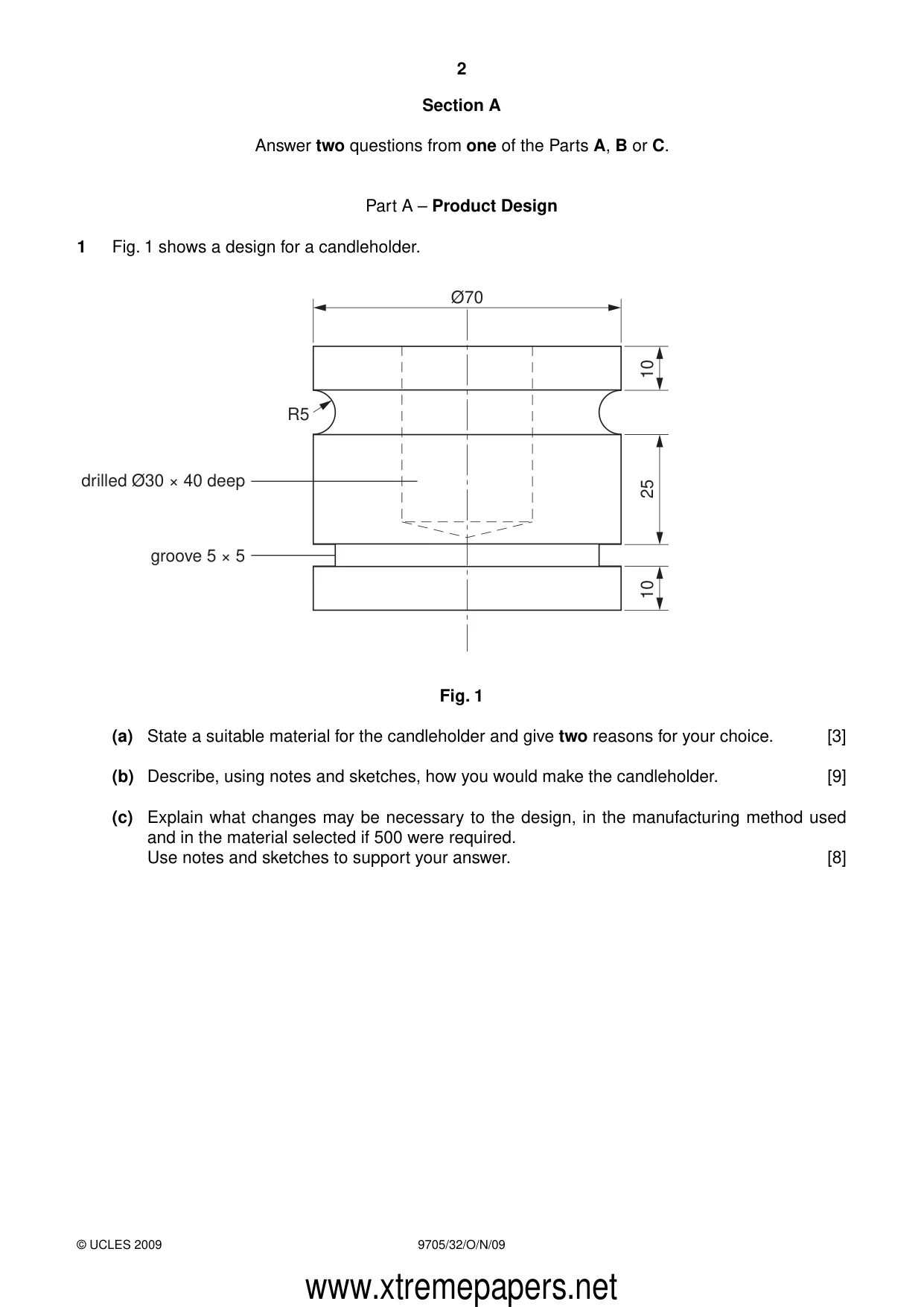
2 9705/32/O/N/09 © UCLES 2009 Section A Answer two questions from one of the Parts A, B or C. Part A – Product Design 1 Fig. 1 shows a design for a candleholder. 10 10 25 R5 drilled Ø30 × 40 deep groove 5 × 5 Ø70 Fig. 1 (a) State a suitable material for the candleholder and give two reasons for your choice. [3] (b) Describe, using notes and sketches, how you would make the candleholder. [9] (c) Explain what changes may be necessary to the design, in the manufacturing method used and in the material selected if 500 were required. Use notes and sketches to support your answer. [8] www.xtremepapers.net
Question paper, page 3
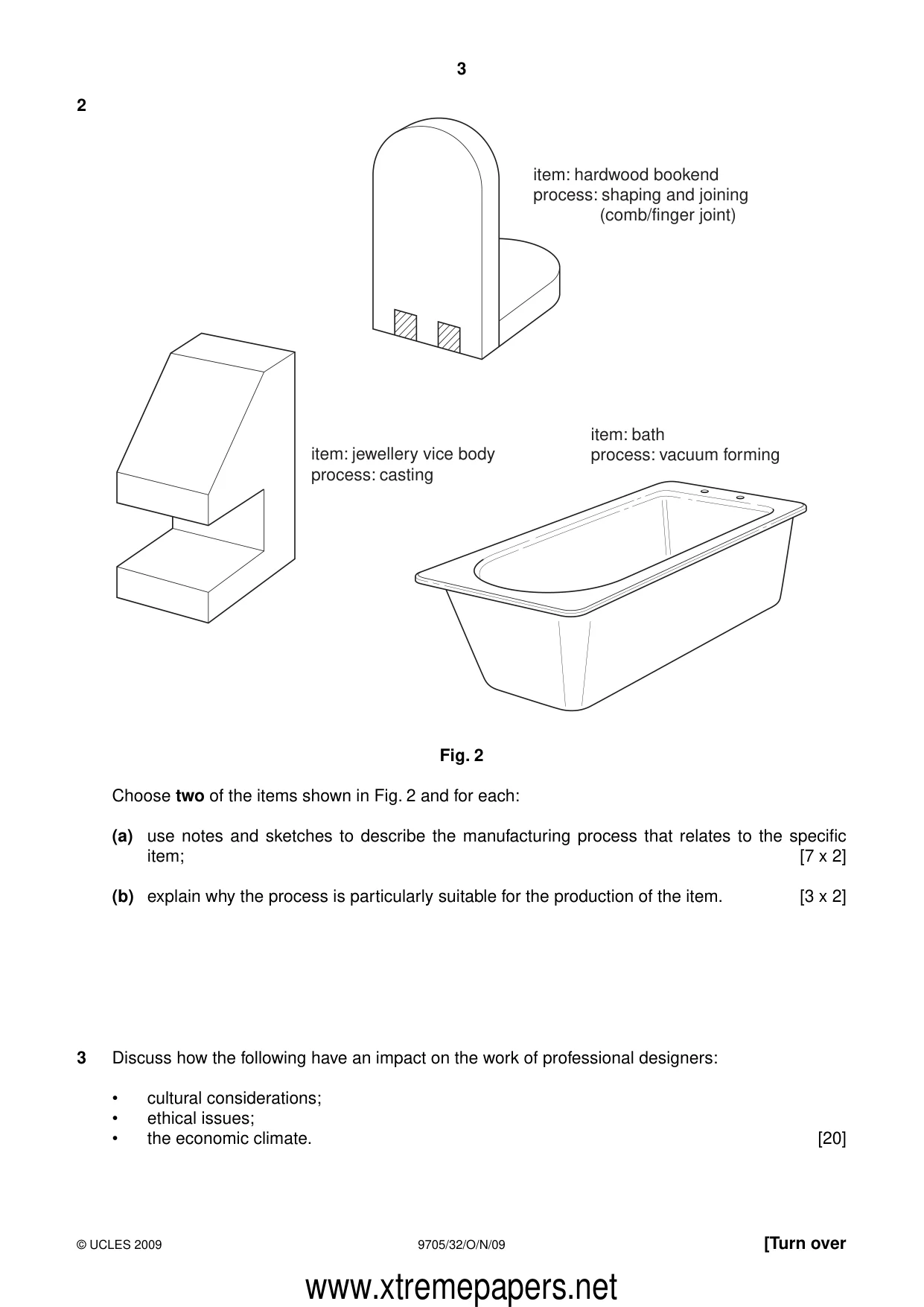
3 9705/32/O/N/09 © UCLES 2009 [Turn over 2 item: bath process: vacuum forming item: jewellery vice body process: casting item: hardwood bookend process: shaping and joining (comb/finger joint) Fig. 2 Choose two of the items shown in Fig. 2 and for each: (a) use notes and sketches to describe the manufacturing process that relates to the specific item; [7 x 2] (b) explain why the process is particularly suitable for the production of the item. [3 x 2] 3 Discuss how the following have an impact on the work of professional designers: • cultural considerations; • ethical issues; • the economic climate. [20] www.xtremepapers.net
Question paper, page 4
4 9705/32/O/N/09 © UCLES 2009 Part B – Practical Technology 4 Describe in detail, using sketches and notes where appropriate, the safety precautions that must be taken when carrying out five of the following processes: (i) cutting shapes in card using a craft knife; (ii) soldering components onto a PCB; (iii) drilling sheet material; (iv) applying adhesives; (v) bending plastic on a strip heater; (vi) using abrasive paper on MDF (medium density fibreboard); (vii) facing off mild steel bar. [5 x 4] 5 Select five materials from the following: beech MDF plywood teak acrylic ABS PVC polystyrene stainless steel aluminium high carbon steel copper (a) Name a specific product made predominantly from each selected material. [5] (b) In each case, explain in detail why the properties of the material make it suitable for the selected product. [15] 6 (a) Define the following: (i) hardness; [2] (ii) tensile strength. [2] (b) Use notes and sketches to describe: (i) a test to measure hardness; [5] (ii) a test to measure tensile strength. [5] (c) Explain, using examples, why the testing of materials is important in the designing and making of products. [6] www.xtremepapers.net
Question paper, page 5
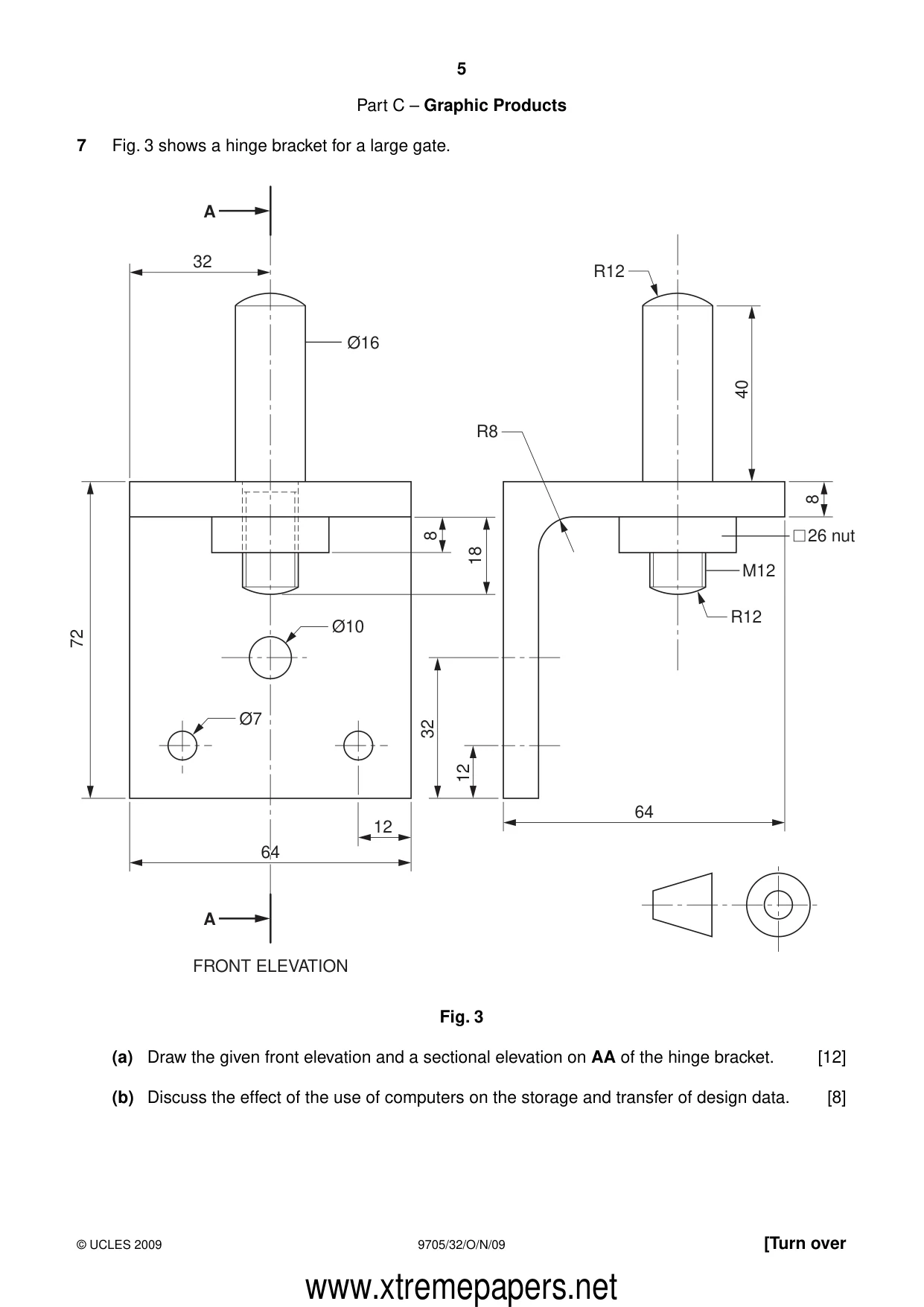
5 9705/32/O/N/09 © UCLES 2009 [Turn over Part C – Graphic Products 7 Fig. 3 shows a hinge bracket for a large gate. A A FRONT ELEVATION 64 64 12 12 32 8 8 40 18 Ø7 32 72 Ø10 R8 R12 R12 26 nut M12 Ø16 Fig. 3 (a) Draw the given front elevation and a sectional elevation on AA of the hinge bracket. [12] (b) Discuss the effect of the use of computers on the storage and transfer of design data. [8] www.xtremepapers.net
Question paper, page 6
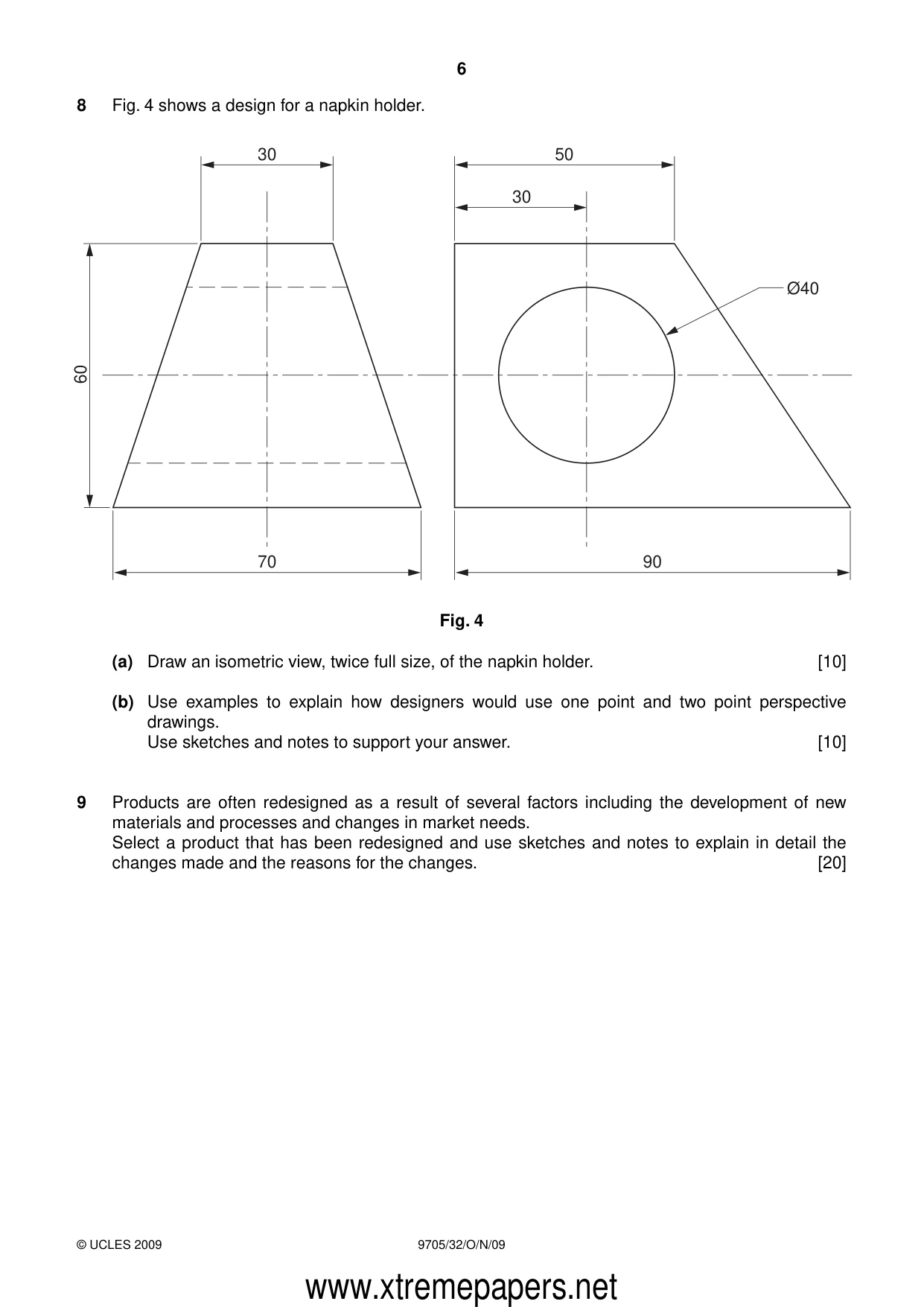
6 9705/32/O/N/09 © UCLES 2009 8 Fig. 4 shows a design for a napkin holder. 70 60 30 30 50 90 Ø40 Fig. 4 (a) Draw an isometric view, twice full size, of the napkin holder. [10] (b) Use examples to explain how designers would use one point and two point perspective drawings. Use sketches and notes to support your answer. [10] 9 Products are often redesigned as a result of several factors including the development of new materials and processes and changes in market needs. Select a product that has been redesigned and use sketches and notes to explain in detail the changes made and the reasons for the changes. [20] www.xtremepapers.net
Question paper, page 7
7 9705/32/O/N/09 © UCLES 2009 [Turn over Section B Answer one question on the A3 paper provided. You should approach the design question of your choice in the following manner: Analysis Produce an analysis of the given situation/problem, which may be in written or graphical form. [5] Specification From the analysis produce a detailed written specification of the design requirements. Include at least five specification points other than those given in the question. [5] Exploration Use bold sketches and brief notes to show your exploration of ideas for a design solution, with reasons for selection. [25] Development Show using bold sketches and notes, the development, reasoning and composition of ideas into a single design proposal. Give details of materials, constructional and other relevant technical details. [25] Proposed solution Produce drawings of an appropriate kind to show the complete solution. [15] Evaluation Give a written evaluation of the final design solution. [5] [Total: 80] www.xtremepapers.net
Question paper, page 8
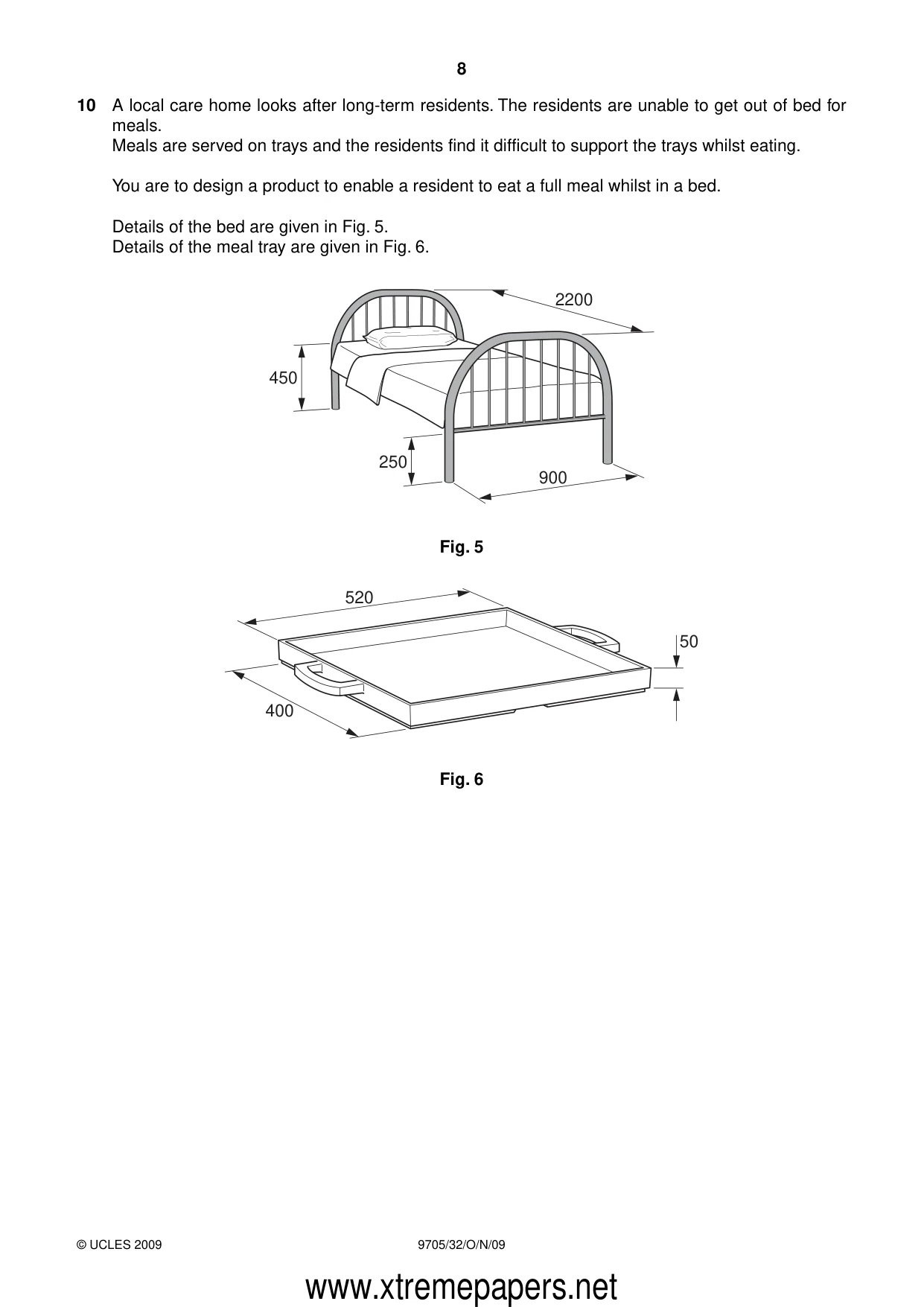
8 9705/32/O/N/09 © UCLES 2009 10 A local care home looks after long-term residents. The residents are unable to get out of bed for meals. Meals are served on trays and the residents find it difficult to support the trays whilst eating. You are to design a product to enable a resident to eat a full meal whilst in a bed. Details of the bed are given in Fig. 5. Details of the meal tray are given in Fig. 6. 2200 900 250 450 Fig. 5 50 400 520 Fig. 6 www.xtremepapers.net
Question paper, page 9
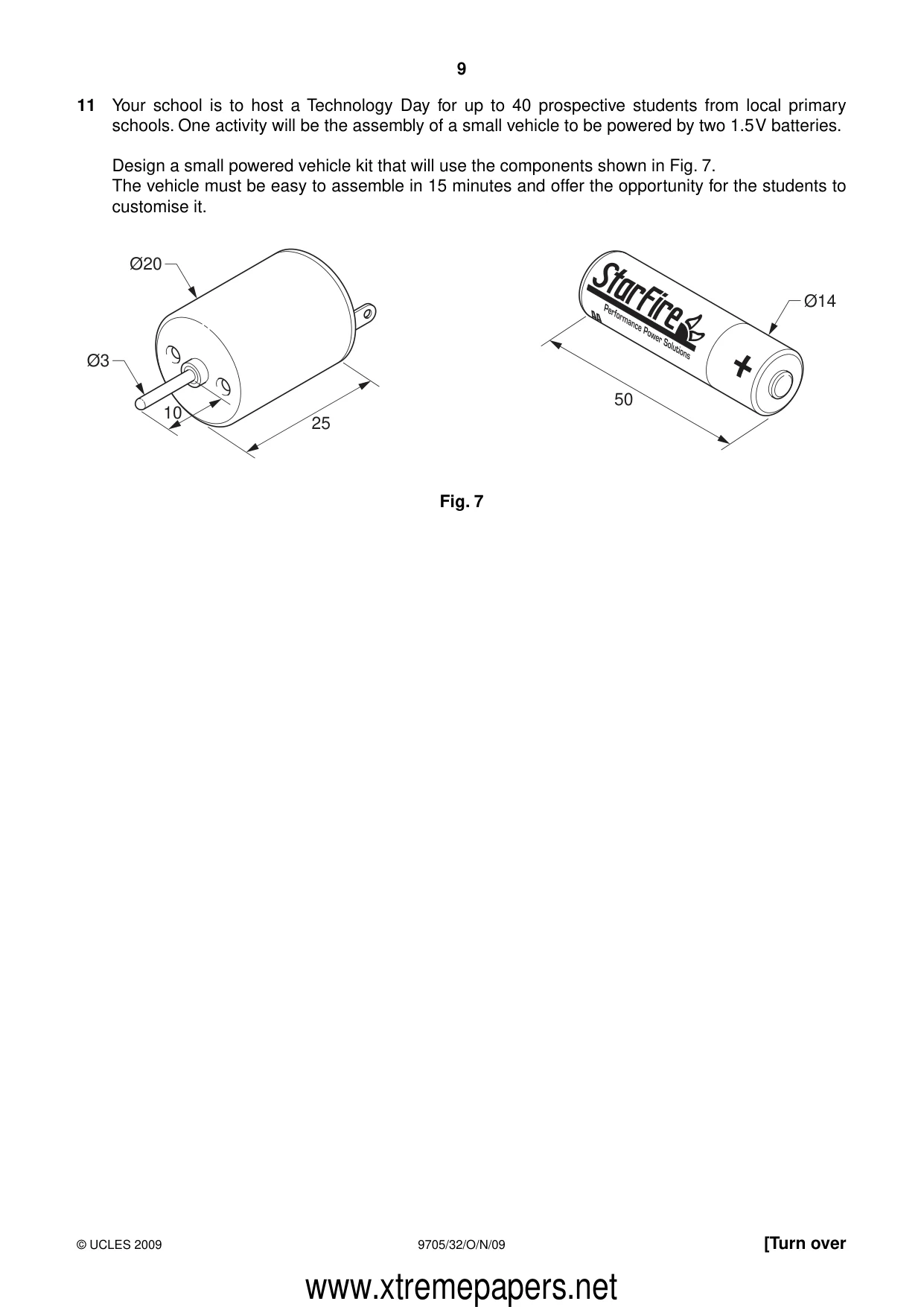
9 9705/32/O/N/09 © UCLES 2009 [Turn over 11 Your school is to host a Technology Day for up to 40 prospective students from local primary schools. One activity will be the assembly of a small vehicle to be powered by two 1.5 V batteries. Design a small powered vehicle kit that will use the components shown in Fig. 7. The vehicle must be easy to assemble in 15 minutes and offer the opportunity for the students to customise it. 25 50 10 Ø14 Ø20 Ø3 Fig. 7 www.xtremepapers.net
Question paper, page 10
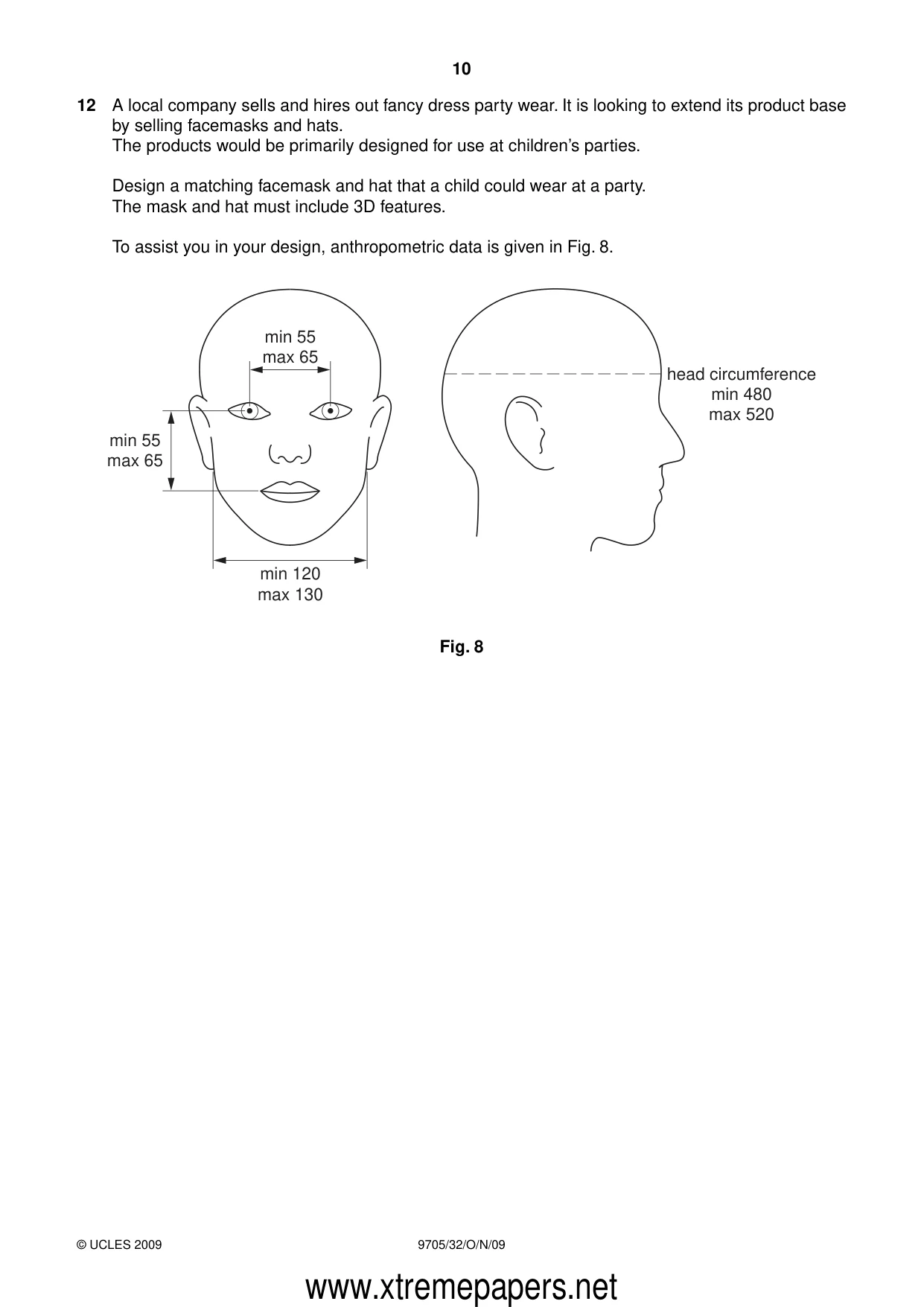
10 9705/32/O/N/09 © UCLES 2009 12 A local company sells and hires out fancy dress party wear. It is looking to extend its product base by selling facemasks and hats. The products would be primarily designed for use at children’s parties. Design a matching facemask and hat that a child could wear at a party. The mask and hat must include 3D features. To assist you in your design, anthropometric data is given in Fig. 8. min 55 max 65 head circumference min 480 max 520 min 120 max 130 min 55 max 65 Fig. 8 www.xtremepapers.net
Question paper, page 11
11 9705/32/O/N/09 BLANK PAGE www.xtremepapers.net
Question paper, page 12
12 9705/32/O/N/09 BLANK PAGE Permission to reproduce items where third-party owned material protected by copyright is included has been sought and cleared where possible. Every reasonable effort has been made by the publisher (UCLES) to trace copyright holders, but if any items requiring clearance have unwittingly been included, the publisher will be pleased to make amends at the earliest possible opportunity. University of Cambridge International Examinations is part of the Cambridge Assessment Group. Cambridge Assessment is the brand name of University of Cambridge Local Examinations Syndicate (UCLES), which is itself a department of the University of Cambridge. www.xtremepapers.net
Mark scheme, page 1
UNIVERSITY OF CAMBRIDGE INTERNATIONAL EXAMINATIONS GCE Advanced Subsidiary Level and GCE Advanced Level MARK SCHEME for the October/November 2009 question paper for the guidance of teachers 9705 DESIGN AND TECHNOLOGY 9705/32 Paper 32 (Written 2), maximum raw mark 120 This mark scheme is published as an aid to teachers and candidates, to indicate the requirements of the examination. It shows the basis on which Examiners were instructed to award marks. It does not indicate the details of the discussions that took place at an Examiners’ meeting before marking began, which would have considered the acceptability of alternative answers. Mark schemes must be read in conjunction with the question papers and the report on the examination. • CIE will not enter into discussions or correspondence in connection with these mark schemes. CIE is publishing the mark schemes for the October/November 2009 question papers for most IGCSE, GCE Advanced Level and Advanced Subsidiary Level syllabuses and some Ordinary Level syllabuses. www.xtremepapers.net
Mark scheme, page 2
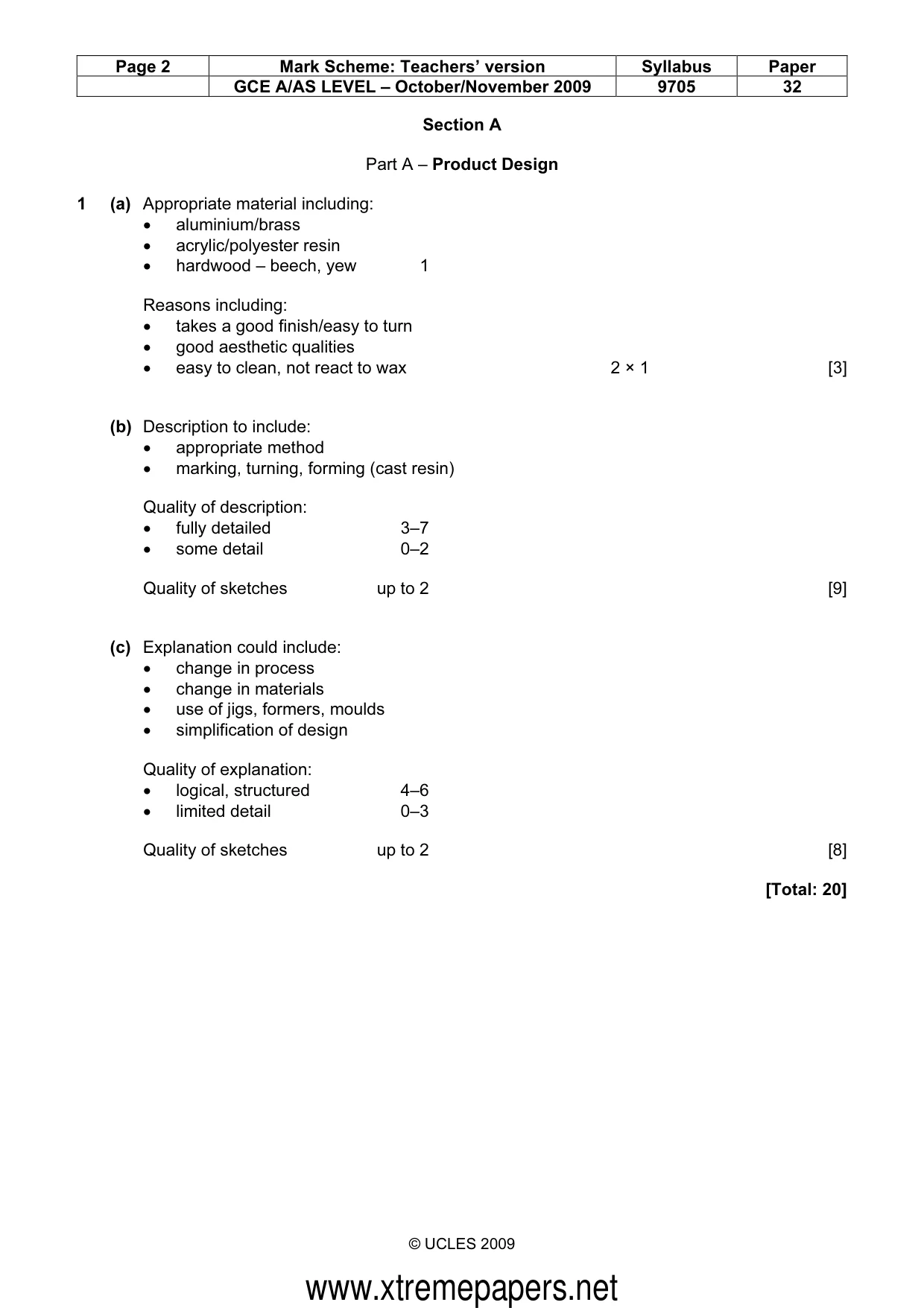
Page 2 Mark Scheme: Teachers’ version Syllabus Paper GCE A/AS LEVEL – October/November 2009 9705 32 © UCLES 2009 Section A Part A – Product Design 1 (a) Appropriate material including: • aluminium/brass • acrylic/polyester resin • hardwood – beech, yew 1 Reasons including: • takes a good finish/easy to turn • good aesthetic qualities • easy to clean, not react to wax 2 × 1 [3] (b) Description to include: • appropriate method • marking, turning, forming (cast resin) Quality of description: • fully detailed 3–7 • some detail 0–2 Quality of sketches up to 2 [9] (c) Explanation could include: • change in process • change in materials • use of jigs, formers, moulds • simplification of design Quality of explanation: • logical, structured 4–6 • limited detail 0–3 Quality of sketches up to 2 [8] [Total: 20] www.xtremepapers.net
Mark scheme, page 3
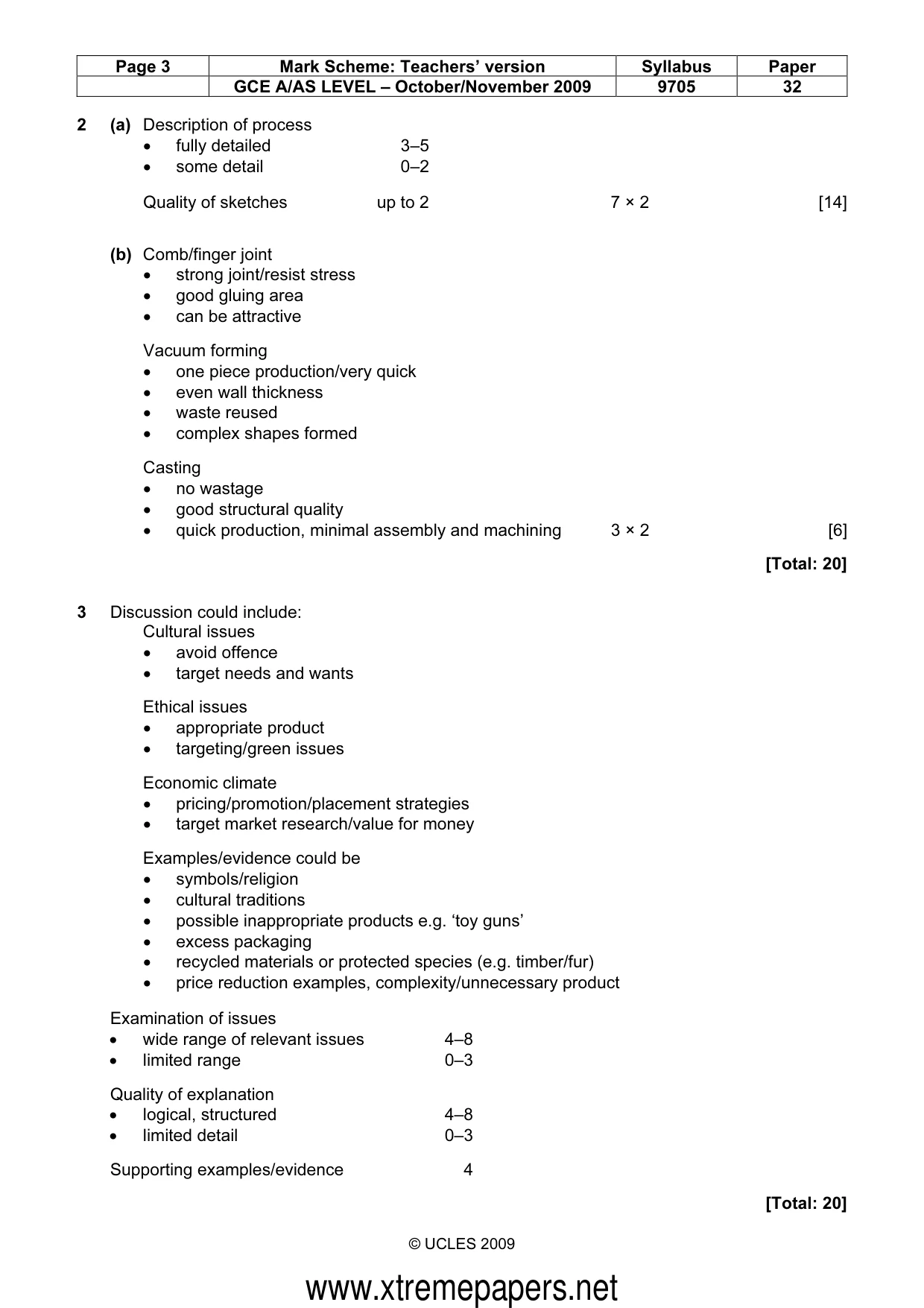
Page 3 Mark Scheme: Teachers’ version Syllabus Paper GCE A/AS LEVEL – October/November 2009 9705 32 © UCLES 2009 2 (a) Description of process • fully detailed 3–5 • some detail 0–2 Quality of sketches up to 2 7 × 2 [14] (b) Comb/finger joint • strong joint/resist stress • good gluing area • can be attractive Vacuum forming • one piece production/very quick • even wall thickness • waste reused • complex shapes formed Casting • no wastage • good structural quality • quick production, minimal assembly and machining 3 × 2 [6] [Total: 20] 3 Discussion could include: Cultural issues • avoid offence • target needs and wants Ethical issues • appropriate product • targeting/green issues Economic climate • pricing/promotion/placement strategies • target market research/value for money Examples/evidence could be • symbols/religion • cultural traditions • possible inappropriate products e.g. ‘toy guns’ • excess packaging • recycled materials or protected species (e.g. timber/fur) • price reduction examples, complexity/unnecessary product Examination of issues • wide range of relevant issues 4–8 • limited range 0–3 Quality of explanation • logical, structured 4–8 • limited detail 0–3 Supporting examples/evidence 4 [Total: 20] www.xtremepapers.net
Mark scheme, page 4
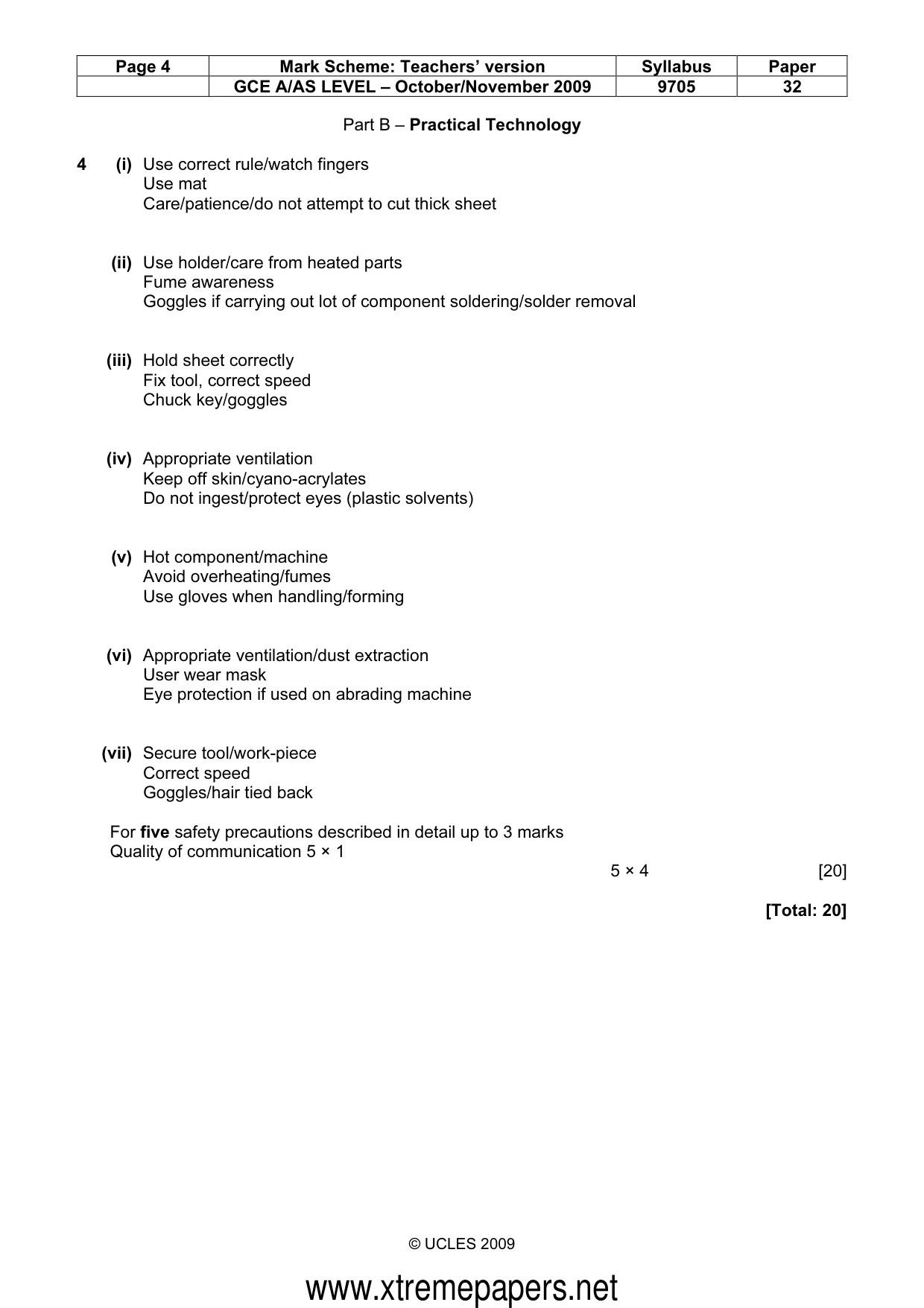
Page 4 Mark Scheme: Teachers’ version Syllabus Paper GCE A/AS LEVEL – October/November 2009 9705 32 © UCLES 2009 Part B – Practical Technology 4 (i) Use correct rule/watch fingers Use mat Care/patience/do not attempt to cut thick sheet (ii) Use holder/care from heated parts Fume awareness Goggles if carrying out lot of component soldering/solder removal (iii) Hold sheet correctly Fix tool, correct speed Chuck key/goggles (iv) Appropriate ventilation Keep off skin/cyano-acrylates Do not ingest/protect eyes (plastic solvents) (v) Hot component/machine Avoid overheating/fumes Use gloves when handling/forming (vi) Appropriate ventilation/dust extraction User wear mask Eye protection if used on abrading machine (vii) Secure tool/work-piece Correct speed Goggles/hair tied back For five safety precautions described in detail up to 3 marks Quality of communication 5 × 1 5 × 4 [20] [Total: 20] www.xtremepapers.net
Mark scheme, page 5
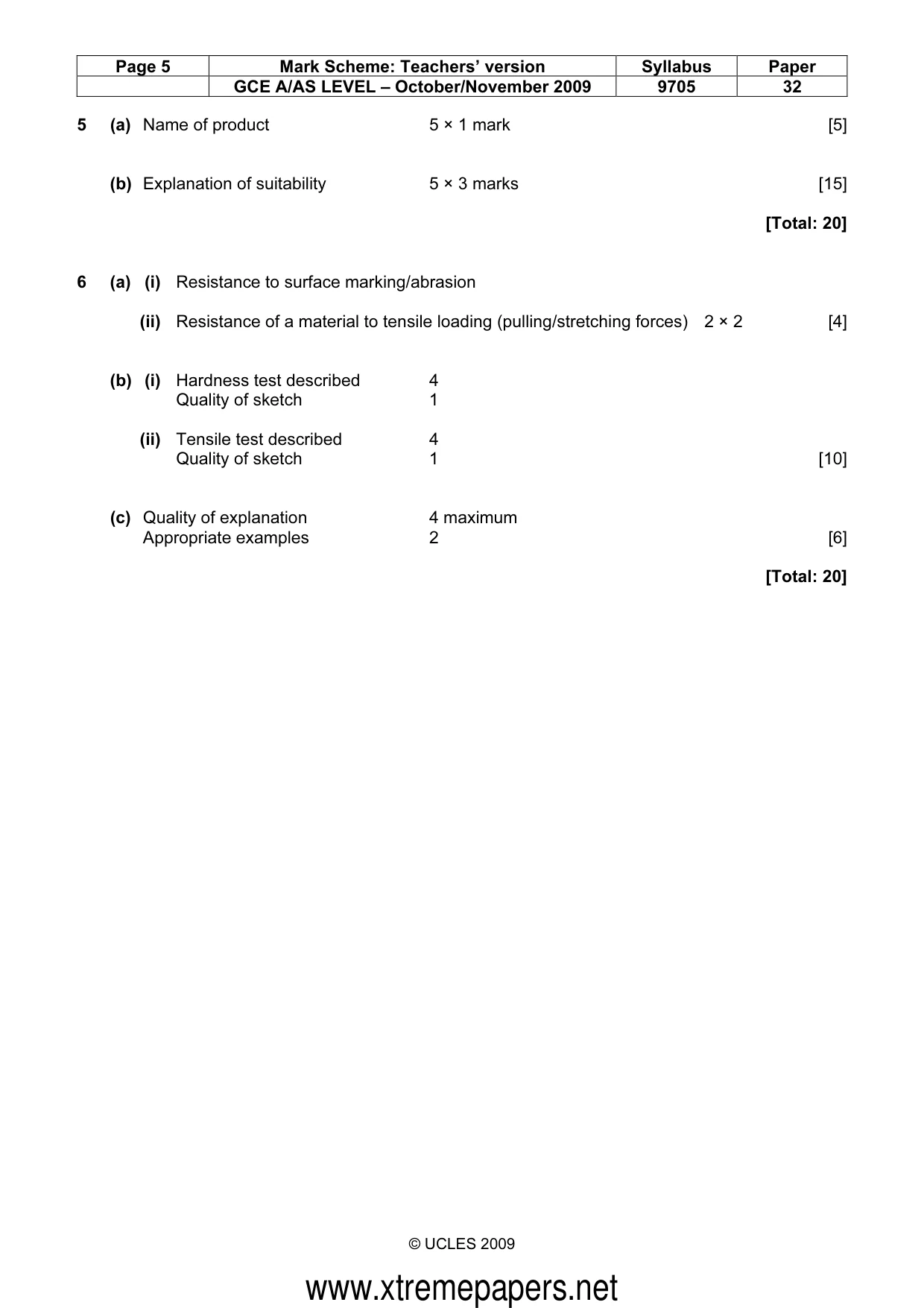
Page 5 Mark Scheme: Teachers’ version Syllabus Paper GCE A/AS LEVEL – October/November 2009 9705 32 © UCLES 2009 5 (a) Name of product 5 × 1 mark [5] (b) Explanation of suitability 5 × 3 marks [15] [Total: 20] 6 (a) (i) Resistance to surface marking/abrasion (ii) Resistance of a material to tensile loading (pulling/stretching forces) 2 × 2 [4] (b) (i) Hardness test described 4 Quality of sketch 1 (ii) Tensile test described 4 Quality of sketch 1 [10] (c) Quality of explanation 4 maximum Appropriate examples 2 [6] [Total: 20] www.xtremepapers.net
Mark scheme, page 6
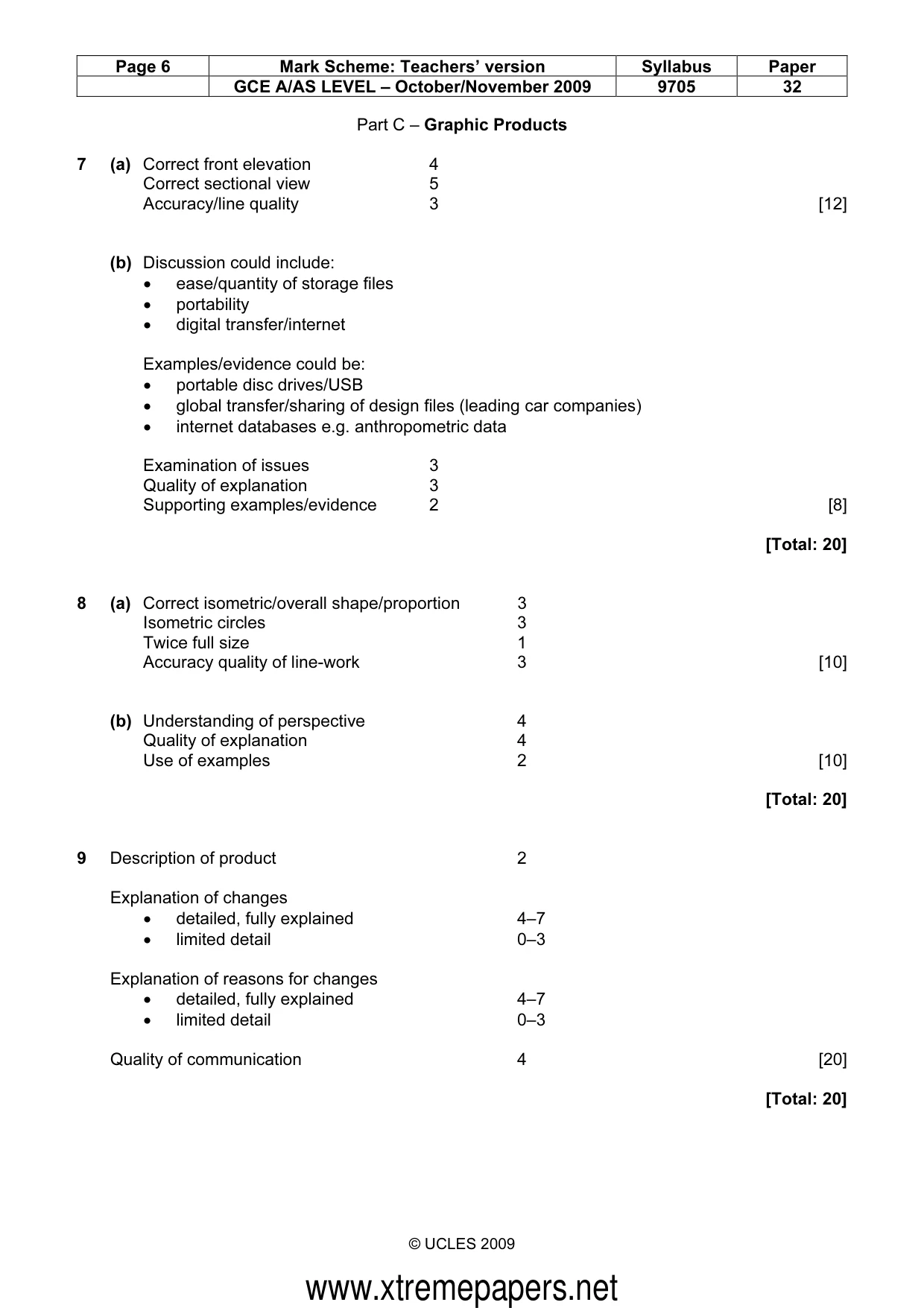
Page 6 Mark Scheme: Teachers’ version Syllabus Paper GCE A/AS LEVEL – October/November 2009 9705 32 © UCLES 2009 Part C – Graphic Products 7 (a) Correct front elevation 4 Correct sectional view 5 Accuracy/line quality 3 [12] (b) Discussion could include: • ease/quantity of storage files • portability • digital transfer/internet Examples/evidence could be: • portable disc drives/USB • global transfer/sharing of design files (leading car companies) • internet databases e.g. anthropometric data Examination of issues 3 Quality of explanation 3 Supporting examples/evidence 2 [8] [Total: 20] 8 (a) Correct isometric/overall shape/proportion 3 Isometric circles 3 Twice full size 1 Accuracy quality of line-work 3 [10] (b) Understanding of perspective 4 Quality of explanation 4 Use of examples 2 [10] [Total: 20] 9 Description of product 2 Explanation of changes • detailed, fully explained 4–7 • limited detail 0–3 Explanation of reasons for changes • detailed, fully explained 4–7 • limited detail 0–3 Quality of communication 4 [20] [Total: 20] www.xtremepapers.net
What you needed in this session
Cambridge’s own grade thresholds for 2009 Oct/Nov, Paper 3 · Variant 2. A higher threshold means an easier paper — the bar moves with how the cohort did.